
YOLO11_Opt: An Ultra-Lightweight Improved YOLO11n Algorithm for Low-Cost Embedded Devices for Accurate Plant Disease Detection—A Case Study on Bell Pepper
 , and
, and 
Abstract
1. Introduction
- A hardware-aware scaled YOLO11n architecture that is optimized for edge AI deployment on limited resource systems.
- An analysis with a systematic depth–width ablation study with embedded restriction for architectural purposes.
- Research on Raspberry Pi 4 and Jetson Nano.
- The effects of INT8 quantization on accuracy and latency.
- Comparison of full pipeline inference performance with regards to latency, CPU consumption, and power.
2. Related Works
- Optimization of Earlier YOLO Versions (v5, v7, v8)
- Multi-Class and Edge-Oriented Performance
- Recent Developments in YOLO11
- Summary of Existing Approaches
- Research Gap
3. Model Architectures
3.1. YOLO11 Architecture
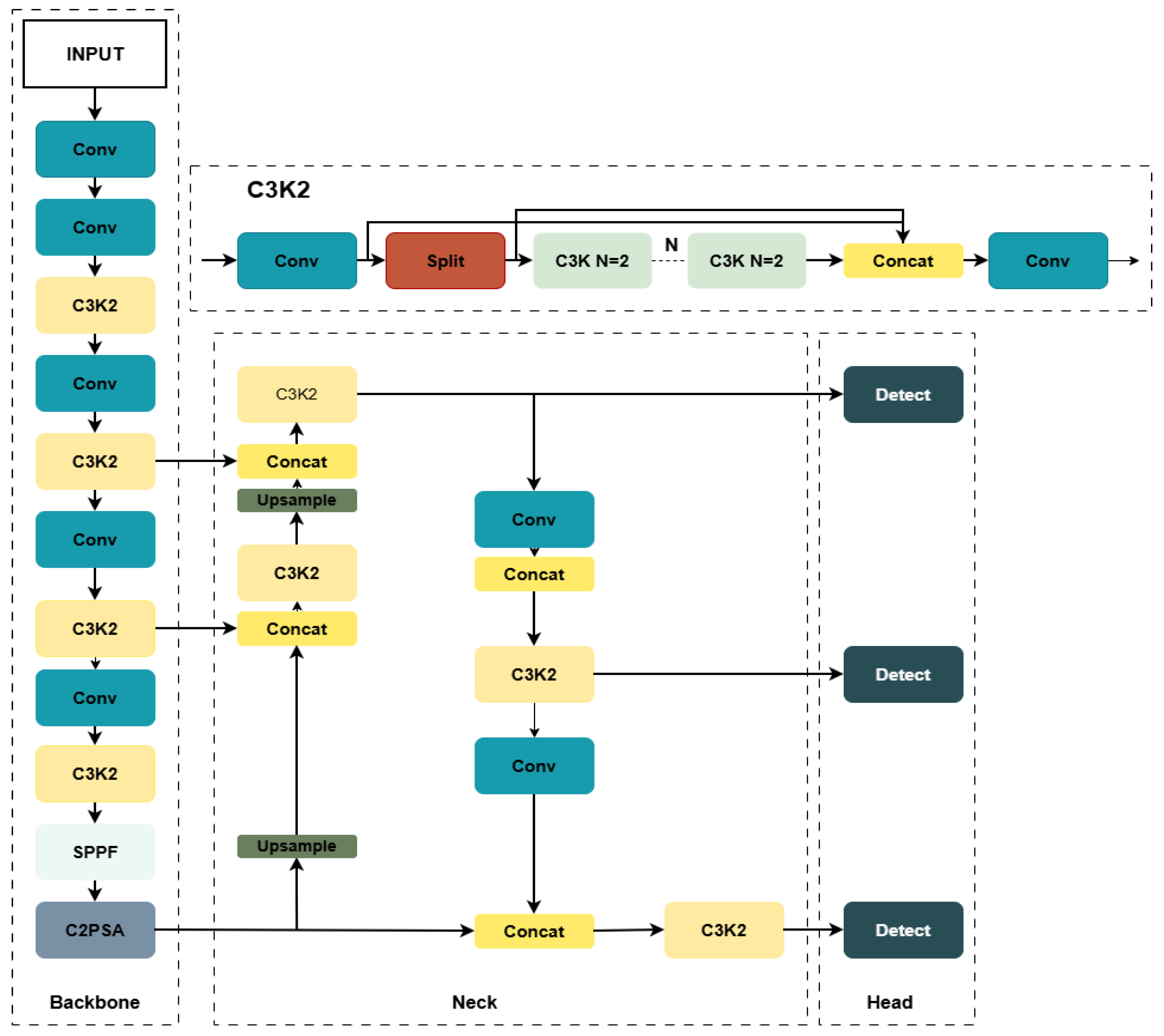
- Backbone (Layers 0–10): Processes an input of 640 × 640 × 3. It utilizes a depth factor of 0.50 and a width factor of 0.25. The spatial resolution is reduced through five stages: 320 × 320 (P1), 160 × 160 (P2), 80 × 80 (P3), 40 × 40 (P4), and 20 × 20 (P5).
- C3k2 blocks: Employs heavy repetitions of CSP-based kernels to maintain gradient flow.
- SPPF and C2PSA: These modules at the base provide spatial pyramid pooling and attention mechanisms to capture the global context before entering the neck.
- Neck (multi-branch): Uses a complex series of Upsample and Concat operations to fuse features across scales. This multi-path approach ensures high accuracy but increases memory synchronization overhead on embedded CPUs.
- Head: Three Detect modules process the fused features to predict bounding boxes and classes.
3.2. Proposed Architecture: YOLO11_Opt
- Aggressive Model Scaling
- Optimized Backbone
- Streamlined Neck and Head
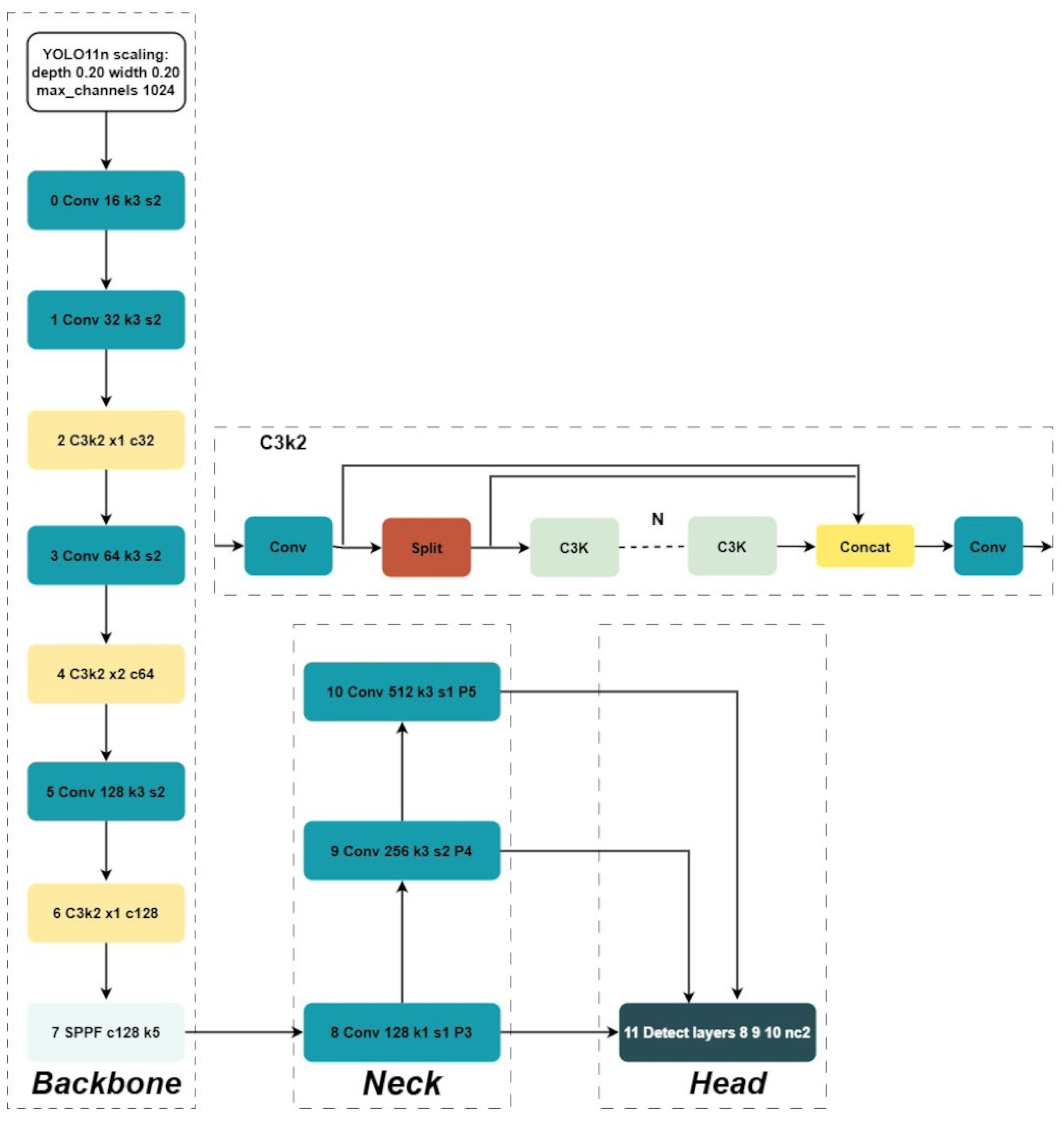
- Backbone (Layers 0–7):
- ○
- Layer 0–1 (Conv): Downsampling to 160 × 160 with filter counts of 16 and 32.
- ○
- Layer 2 (C3k2 x1): Minimalist block with 32 filters.
- ○
- Layer 3–4 (Conv and C3k2 x2): Processing at 80 × 80 with 64 filters (P3).
- ○
- Layer 5–6 (Conv and C3k2 x1): Processing at 40 × 40 with 128 filters (P4).
- ○
- Layer 7 (SPPF): Final context pooling at 20 × 20 with 128 filters.
- Neck (Single-Stream, Layers 8–10):
- ○
- Layer 8 (Conv): 1 × 1 convolution with 128 filters for P3 feature preparation.
- ○
- Layer 9 (Conv): 3 × 3 convolution, s2, increasing depth to 256 filters (P4).
- ○
- Layer 10 (Conv): 3 × 3 convolution, s1, reaching a maximum of 512 filters for deep semantic features (P5).
- Head (Layer 11):
- ○
- Detect: An anchorless module that integrates the streamlined outputs from Layers 8, 9, and 10 to perform real-time detection for two classes (healthy and bacterial spot).
4. Dataset Preparation
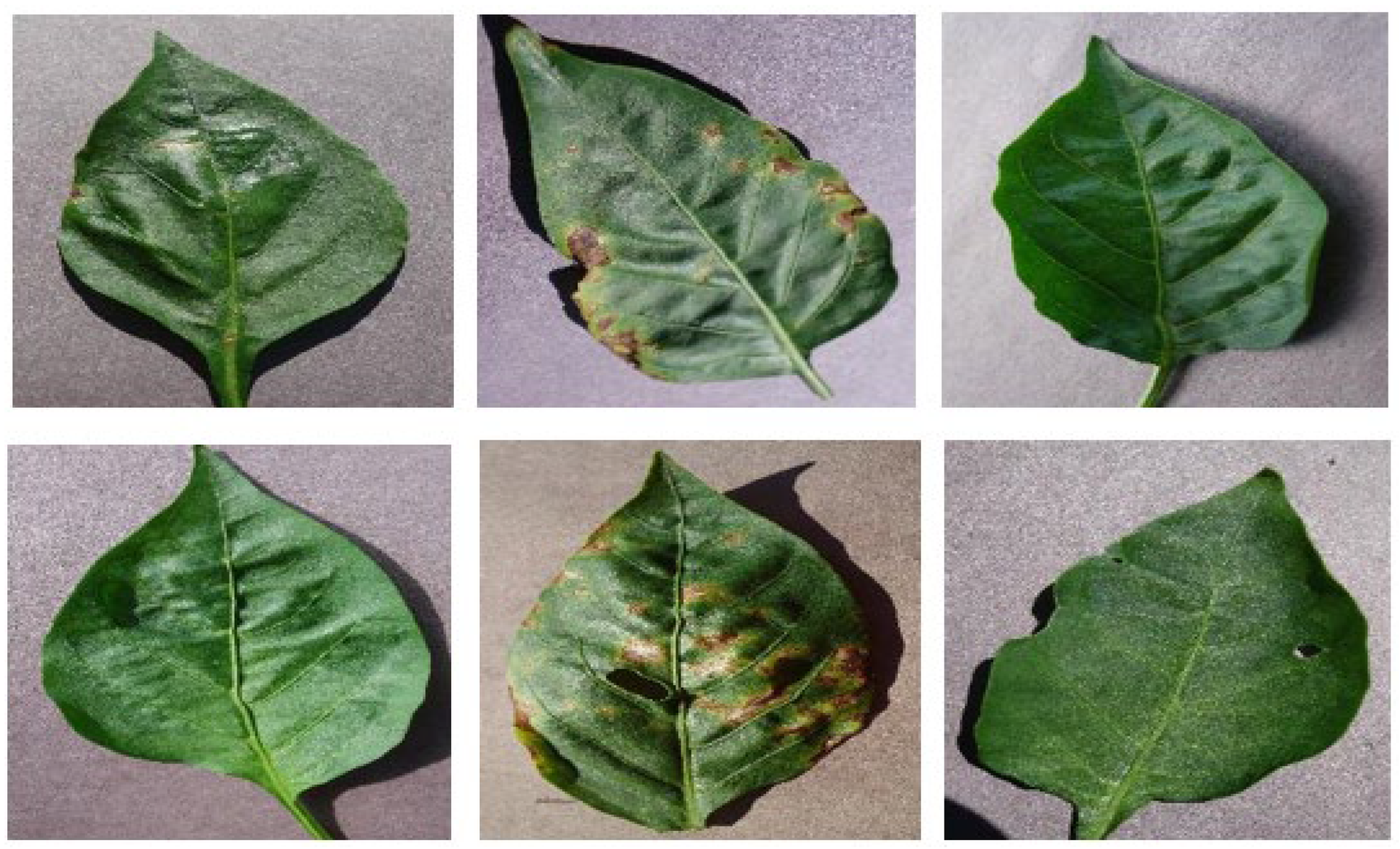
- Healthy: 1478 images.
- Bacterial Spot: 4997 images.
5. Results
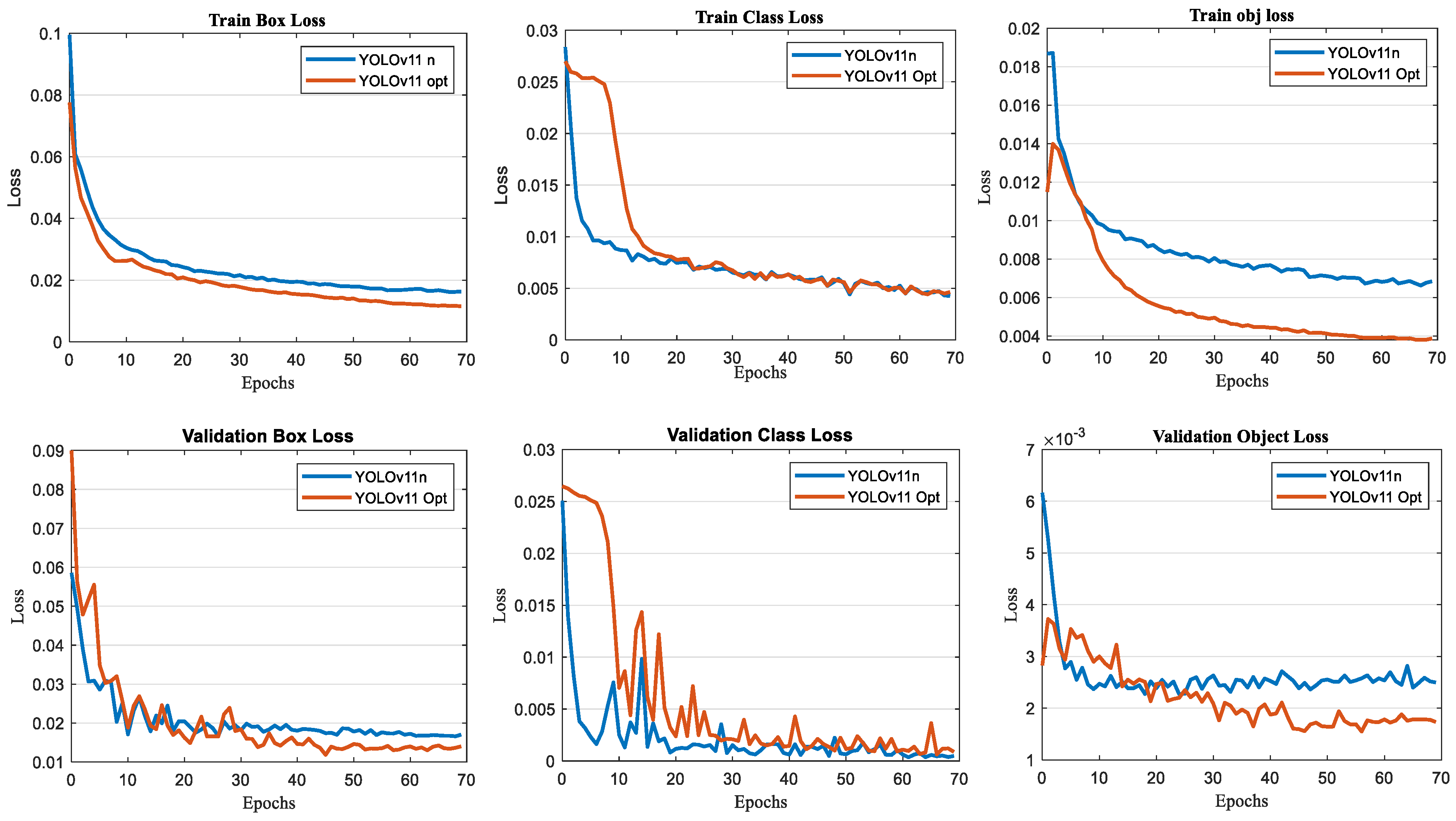
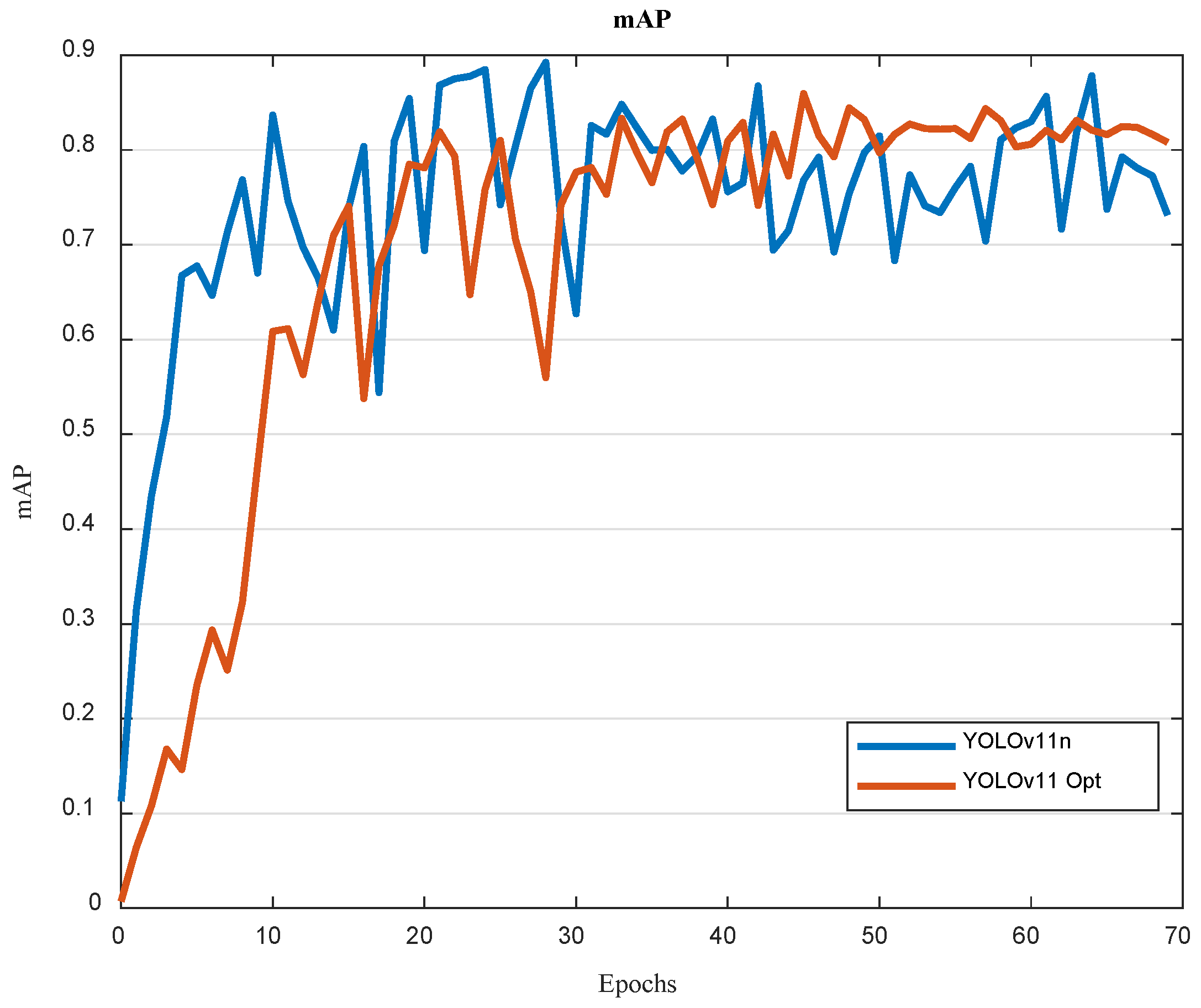
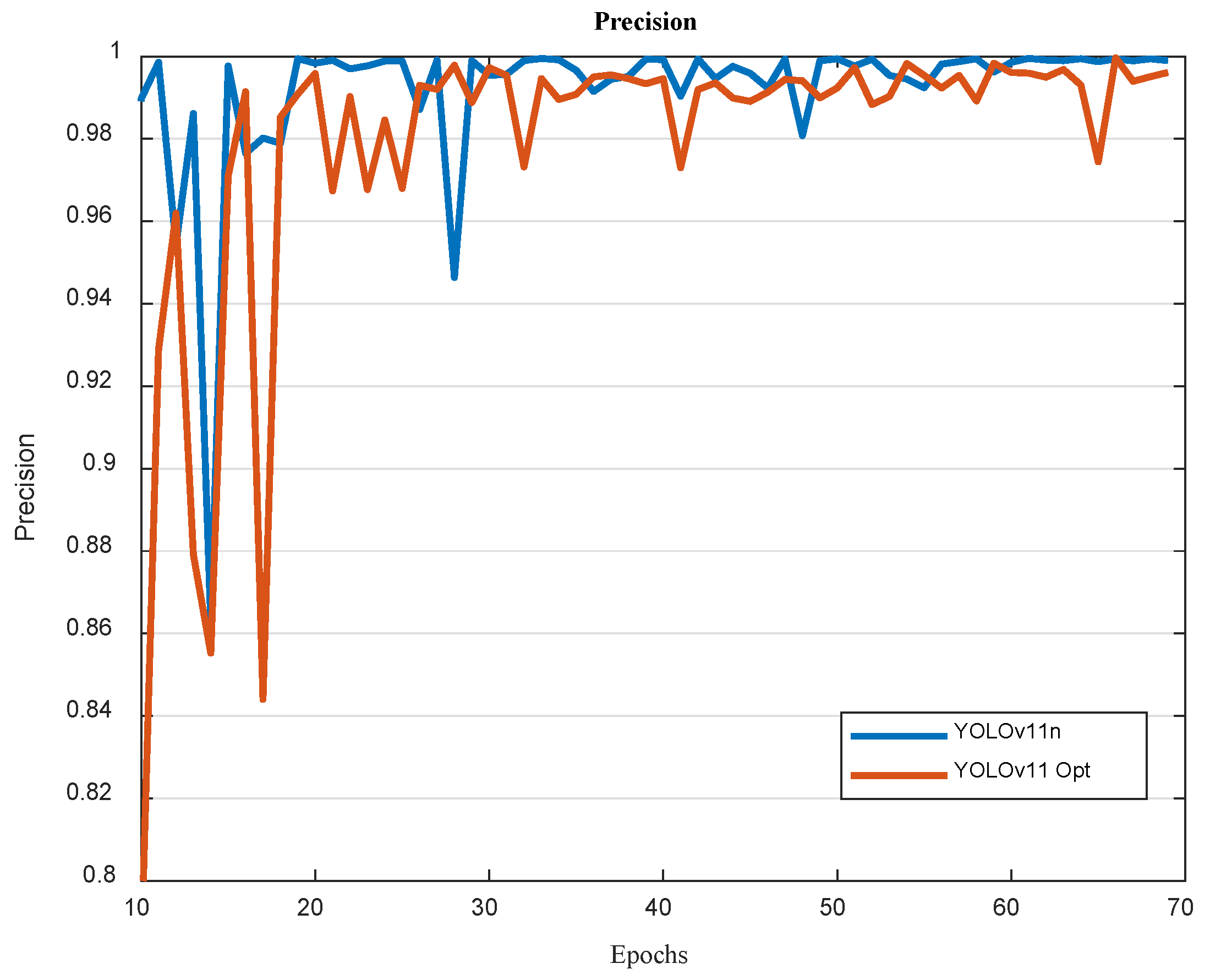
5.1. Model Evaluation: Training Dynamics
5.2. Evaluation Metrics
- Precision measures the ratio of correctly identified positive detections among all positive predictions [35]. It is calculated using Equation (1):
- Recall (Sensitivity) [36] calculates the proportion of correctly predicted samples for each positive categorization. The equation is expressed as:
- Mean Average Precision (mAP): The Average Precision (AP) is determined as the area under the precision-recall curve. The mAP reflects the average of the AP values across all classes. Specifically, mAP@0.5 represents the average value when an Intersection over Union (IoU) threshold of 0.5 is set, while mAP@0.5:0.95 refers to the average value when IoU thresholds fluctuate between 0.5 and 0.95 with a step of 0.05. The calculation formula is established as follows [37]:
5.3. Quantitative Analysis
- Performance baseline: YOLO11n (FP32) had excellent metrics of 0.961 mAP and 0.996 accuracy, but it demanded computational complexity: 6.3 GFLOPS, more than 2.58 million parameters, and a model size of 10 MB. The inference time of only 5 ms or less was notable.
- Optimized performance: On the other hand, YOLO11_Opt (FP32) had slightly lower 0.913 mAP and 0.991 accuracy rates, along with a significant reduction in resource consumption, using 0.5 GFLOPS complexity (~92% reduction) and only ~0.33 million parameters (~87% decrease). The model size was reduced to 1.3 MB, providing a significantly faster inference time of 1.4 ms.
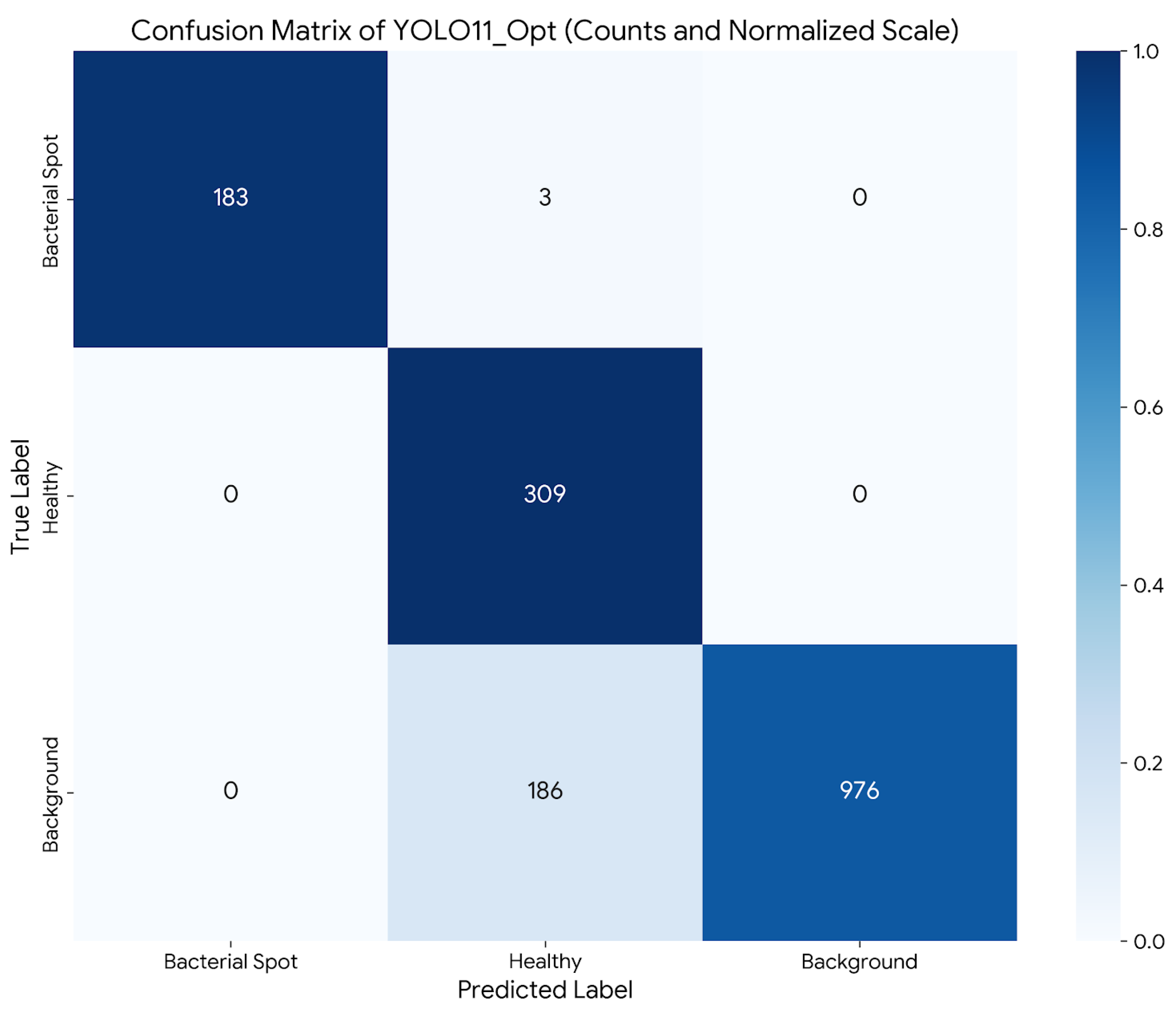
5.4. Confusion Matrix Analysis and Failure Assessment
- Class separation performance: The healthy class did well; 309 classifications were correctly identified, with negligible misclassification. This demonstrated the stability of both the models and the intraclass variability. The prediction rate of the bacterial spot class was high, with 183 correct predictions out of 186 genuine instances. Furthermore, there was very little confusion between the pathological (bacterial) and physiological (healthy) states, with only three misclassified events. This implies that the diseased leaves can be distinguished from the healthy leaves, which is a prerequisite condition for the automated diagnostic system.
- Ambiguity of background and false alarm rates: We observed from the analysis results that an issue existed regarding the background class, and 186 samples were misclassified as healthy. This pattern indicated that some background objects had similar surfaces to healthy leaves, resulting in false positives. Quantitatively, against this background, 5.4% of real-world cases would display false alarms. This is a well-known problem in unstructured feature environments; the specific lighting or background colors can confuse feature extraction layers.
- Analyzing failure and agricultural impact: Given the false negatives, it was established that missed infections will lead to delayed intervention and crop yield loss. This danger is mitigated by the high recall of YOLO11_Opt (0.984 for the bacterial class), which guarantees that almost all the diseased leaves are flagged. There is a 5.4% false alarm rate (background as healthy), which is “safe” because it does not activate false disease alarms or harmful chemical treatments.
- Conclusion of robustness: In conclusion, the confusion matrix confirmed that YOLO11_Opt performed effectively in distinguishing a healthy leaf from one with bacterial infections. While background ambiguity remains a challenge, it does not interfere with the system’s ability to detect disease presence when a leaf is present. These findings confirm that the model can be effectively integrated into automated systems for plant health monitoring.
6. System Implementation
6.1. Hardware Architecture
- The Raspberry Pi 4 (RPi4): This single-board computer has a quad-core Broadcom BCM2711 (Cortex-A72) CPU running at 1.5 GHz. The model was chosen for its general availability, low price (~$70), and enough FP32 (about 32 GFLOPS) performance to support lightweight models [39]. Studies [40] have shown it can efficiently process advanced neural networks without support from cloud infrastructure. During long-duration inference on Raspberry Pi 4, throttling may occur due to thermal constraints. System monitoring was performed, and appropriate cooling or workload scheduling and low CPU load can mitigate this effect.
- NVIDIA Jetson Nano: Built specifically for edge AI, this module combines a quad-core ARM Cortex-A57 CPU with a 128-core Maxwell GPU. With low power consumption (5–10 W), it offers 472 GFLOPS of computing power, including parallel processing using CUDA cores and optimizing TensorRT [41,42]. The Jetson Nano Developer Kit can cost 250 USD. The price may vary depending on the country and distributor.
6.2. Model Deployment and Performance Analysis
- CPU-Based Inference (Raspberry Pi 4)
- GPU-Based Inference (NVIDIA Jetson Nano)
- Synthesis and Scalability
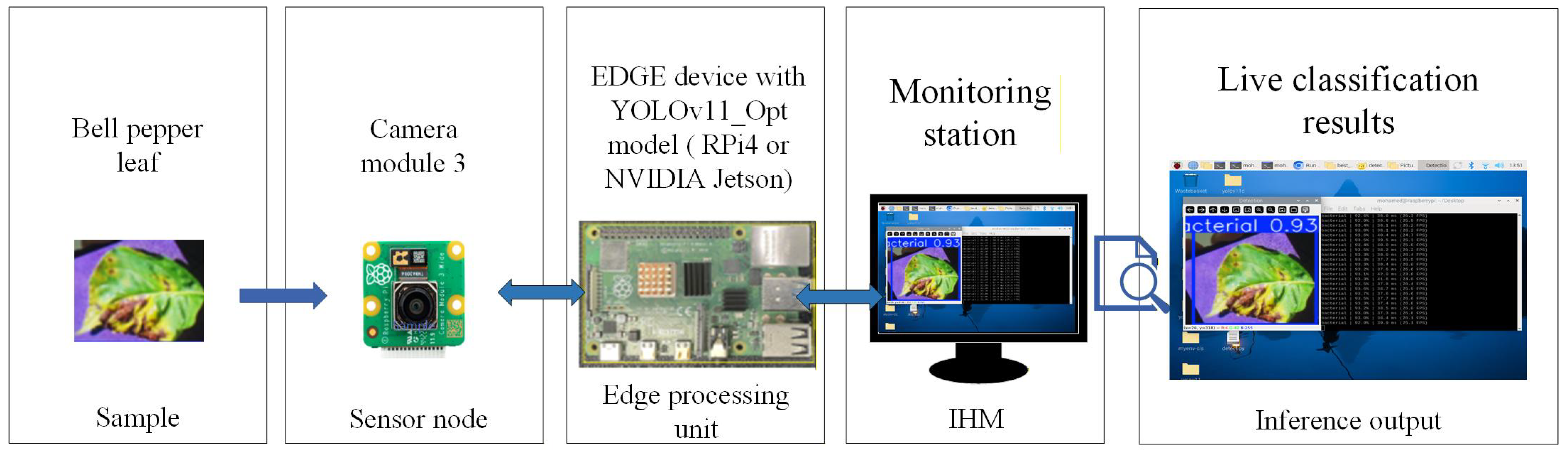
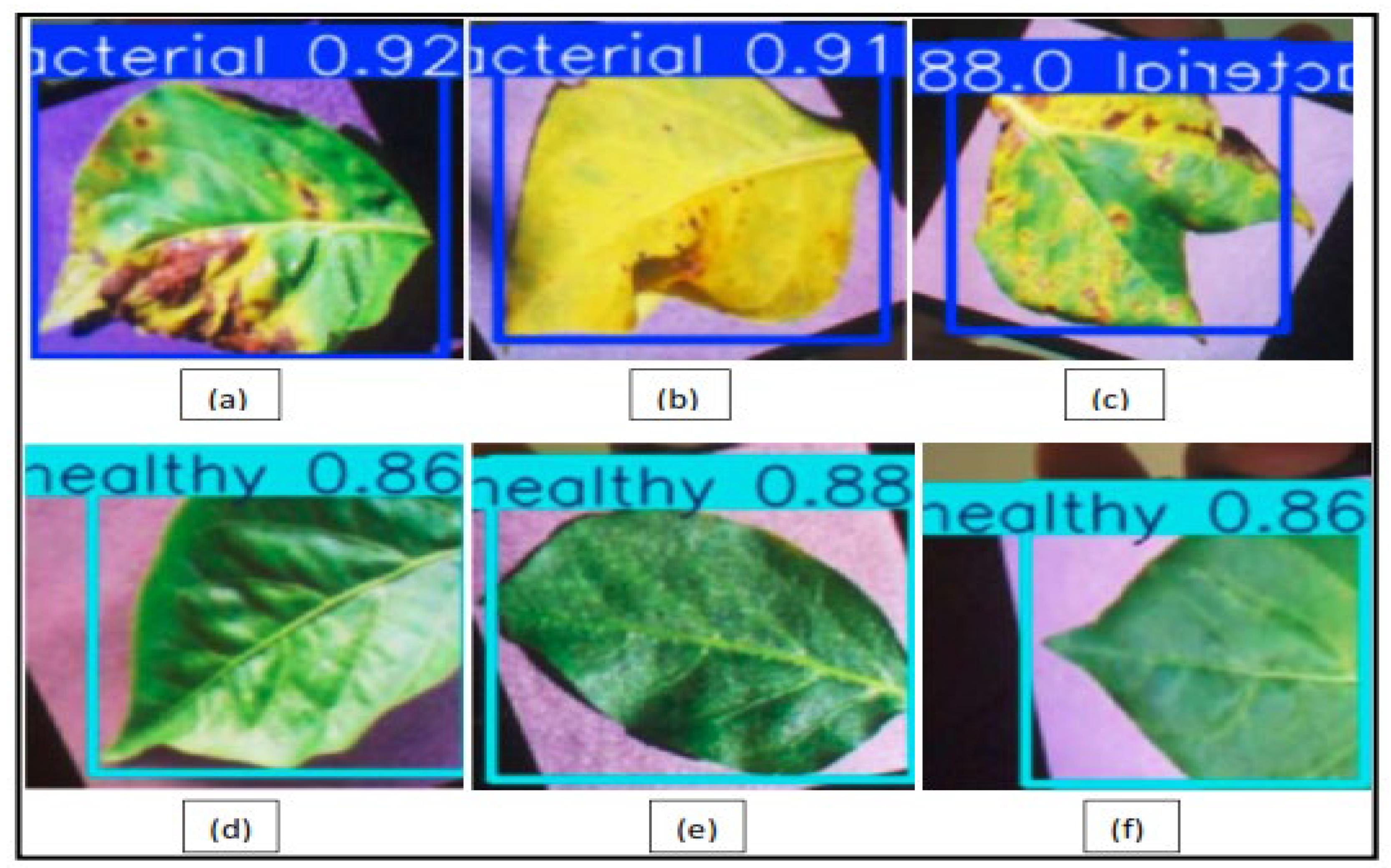
6.3. Live Classification Validation
6.3.1. Raspberry Pi 4 Results (CPU Inference)
- FP32 (baseline): The model has a confidence score of 0.92 for “bacterial spot” and 0.86 for “healthy”.
- FP16: The detection is consistent with the confidence scores obtained for bacterial samples: 0.91, and healthy samples: 0.88.
- INT8: Similar to integer quantization, the model exhibits robust detection ability, delivering 0.88 (bacterial) and 0.86 (healthy) scores. Such results confirm that quantization on the CPU provides the lowest degradation of detection confidence scores and the best performance in memory usage.
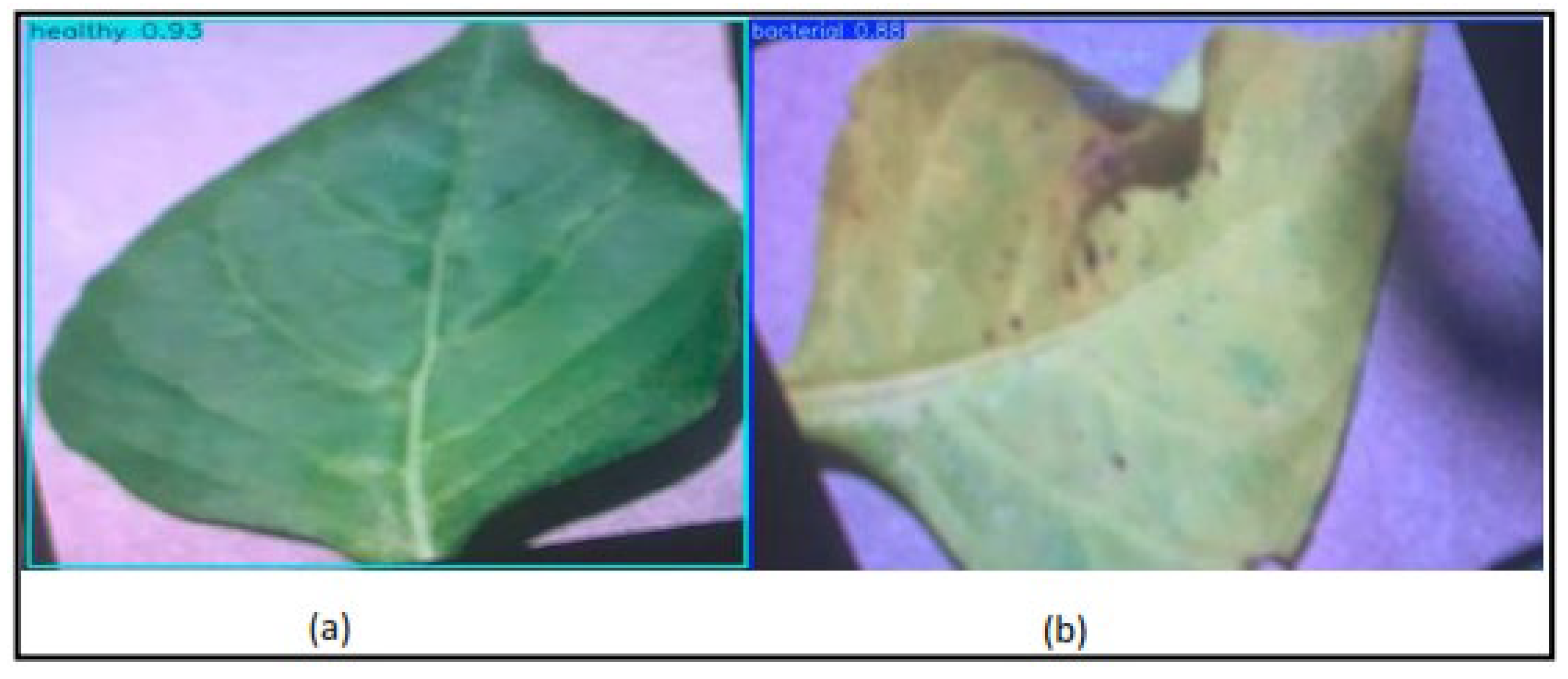
6.3.2. NVIDIA Jetson Nano Results (GPU Inference)
- Healthy class: Detected with a confidence score of 0.93.
- Bacterial class: Detected with a confidence score of 0.88.
7. Conclusions
7.1. Overall Contributions and Results
7.2. Limitations
7.3. Future Work
- Expansion of training data: Encompassing “in-the-wild” field images to enhance the model’s generalized performance in the context of diverse images.
- Hardware acceleration: Exploring the possibility of adding dedicated Neural Processing Units (NPUs) or migrating to next-generation platforms such as Raspberry Pi 5 for additional efficiency and speed.
- Multi-crop generalization: The YOLO11_Opt architecture can be extended for the detection of diseases among a wider variety of crop species at once to move toward a universal diagnostic tool for smart farming.
- Real-world deployment: Future research will focus on evaluating the YOLO11_Opt architecture using diverse, field-captured datasets to assess its robustness under varying illumination and complex environmental backgrounds, building upon the optimization foundation established in this study.
Author Contributions
Funding
Institutional Review Board Statement
Informed Consent Statement
Data Availability Statement
Acknowledgments
Conflicts of Interest
References
- Ye, K.; Hu, G.; Tong, Z.; Xu, Y.; Zheng, J. Key intelligent pesticide prescription spraying technologies for the control of pests, diseases, and weeds: A review. Agriculture 2025, 15, 81. [Google Scholar] [CrossRef] [Scilit]
- Mohanty, S.; Hughes, D.; Salathé, M. Using Deep Learning for Image-Based Plant Disease Detection. Front. Plant Sci. 2016, 10, 1419. [Google Scholar] [CrossRef] [Scilit] [PubMed]
- Singh, P.; Verma, A.; Sahaya Rani Alex, J. Disease and pest infection detection in coconut tree through deep learning techniques. Comput. Electron. Agric. 2021, 182, 105986. [Google Scholar] [CrossRef] [Scilit]
- Ultralytics. YOLO11 Release Notes. 2024. Available online: https://docs.ultralytics.com/ (accessed on 12 November 2025).
- Terven, A.D.; Cordova-Esparza, N.H.; Romero-González, J.-A. A Comprehensive Review of YOLO Architectures in Computer Vision: From YOLOv1 to YOLOv8 and YOLO-NAS. Mach. Learn. Knowl. Extr. 2023, 5, 1680–1716. [Google Scholar] [CrossRef] [Scilit]
- Kamilaris, A.; Prenafeta-Boldú, F.X. Deep learning in agriculture: A survey. Comput. Electron. Agric. 2018, 147, 70–90. [Google Scholar] [CrossRef] [Scilit]
- Too, E.C.; Yujian, L.; Njuki, S.; Yingchun, L. A comparative study of fine-tuning deep learning models for plant disease identification. Comput. Electron. Agric. 2019, 161, 272–279. [Google Scholar] [CrossRef] [Scilit]
- Mathew, M.P.; Mahesh, T.Y. Leaf-based disease detection in bell pepper plant using YOLO v5. Signal Image Video Process. 2022, 16, 841–847. [Google Scholar] [CrossRef] [Scilit]
- Chen, Z.; Wu, R.; Lin, Y.; Li, C.; Chen, S.; Yuan, Z.; Chen, S.; Zou, X. Plant Disease Recognition Model Based on Improved YOLOv5. Agronomy 2022, 12, 365. [Google Scholar] [CrossRef] [Scilit]
- O’Grady, M.J.; Langton, D.; O’Hare, G.M. Edge computing: A tractable model for smart agriculture? Artif. Intell. Agric. 2019, 3, 42–50. [Google Scholar] [CrossRef] [Scilit]
- Ji, W.; Pan, Y.; Xu, B.; Wang, J. A Real-Time Apple Targets Detection Method for Picking Robot Based on ShufflenetV2-YOLOX. Agriculture 2022, 12, 856. [Google Scholar] [CrossRef] [Scilit]
- Wang, H.; Shang, S.; Wang, D.; He, X.; Feng, K.; Zhu, H. Plant Disease Detection and Classification Method Based on the Optimized Lightweight YOLOv5 Model. Agriculture 2022, 12, 931. [Google Scholar] [CrossRef] [Scilit]
- Xu, W.; Wang, R. ALAD-YOLO: An lightweight and accurate detector for apple leaf disease. Front. Plant Sci. 2023, 14, 1204569. [Google Scholar]
- Wang, Y.; Wang, Y.; Zhao, J. MGA-YOLO: A lightweight one-stage network for apple leaf disease diagnosis. Front. Plant Sci. 2022, 13, 927424. [Google Scholar]
- Nnadozie, E.C.; Casaseca-De-La-Higuera, P.; Iloanusi, O.; Ani, O.; Alberola-López, C. Simplifying YOLOv5 for deployment in a real crop monitoring setting. Multimed. Tools Appl. 2023, 83, 50197–50223. [Google Scholar] [CrossRef] [Scilit]
- Xie, Z.; Li, C.; Yang, Z.; Zhang, Z.; Jiang, J.; Guo, H. YOLOv5s-BiPCNeXt, a Lightweight Model for Detecting Disease in Eggplant Leaves. Plants 2024, 13, 2303. [Google Scholar] [CrossRef] [Scilit] [PubMed]
- Ye, W.; Jiang, F.; Li, Z.; Zhao, L.; Wang, J.; Wang, H. A Study on Real-Time Detection of Rice Diseases in in Farmlands Based on Multidimensional Data Fusion. Plant Dis. 2025. [Google Scholar] [CrossRef] [Scilit]
- Ahmad, B.; Noon, S.K.; Ahmad, T.; Mannan, A.; Khan, N.I.; Ismail, M.; Awan, T. Efficient Real-Time Detection of Plant Leaf Diseases Using YOLOv8 and Raspberry Pi. VFAST Trans. Softw. Eng. 2024, 12, 250–259. [Google Scholar] [CrossRef] [Scilit]
- Li, D.; Ahmed, F.; Wu, N.; Sethi, A.I. YOLO-JD: A Deep Learning Network for Jute Diseases and Pests Detection from Images. Plants 2022, 11, 937. [Google Scholar] [CrossRef] [Scilit]
- Liu, Z.; Zhong, X.; Wang, C.; Wu, G.; He, F.; Wang, J.; Yang, D. Rapid and accurate detection of peanut pod appearance quality based on lightweight and improved YOLOv5_SSE model. Front. Plant Sci. 2025, 16, 1494688. [Google Scholar] [CrossRef] [Scilit]
- Zhang, Z.; Yang, Y.; Xu, X.; Liu, L.; Yue, J.; Ding, R.; Lu, Y.; Liu, J.; Qiao, H. GVC-YOLO: A Lightweight Real-Time Detection Method for Cotton Aphid-Damaged Leaves Based on Edge Computing. Remote Sens. 2024, 16, 3046. [Google Scholar] [CrossRef] [Scilit]
- Tang, X.; Sun, Z.; Yang, L.; Chen, Q.; Liu, Z.; Wang, P.; Zhang, Y. YOLO11-AIU: A lightweight detection model for the grading detection of early blight disease in tomatoes. Plant Methods 2025, 21, 1435. [Google Scholar] [CrossRef] [Scilit]
- Teng, H.; Wang, Y.; Li, W.; Chen, T.; Liu, Q. Advancing Rice Disease Detection in Farmland with YOLO11 RD. Sensors 2025, 25, 3056. [Google Scholar] [CrossRef] [Scilit]
- Zhang, X.; Wei, L.; Yang, R. TriPerceptNet and EDGE-MSE-YOLO11: Enhanced Multi-Scale Perception for Rice Leaf Disease Detection. Front. Plant Sci. 2025, 16, 1614929. [Google Scholar] [CrossRef] [Scilit]
- Hu, F.; Abula, M.; Wang, D.; Li, X.; Yan, N.; Xie, Q.; Zhang, X. ACURS-YOLO: Attention-Enhanced Cotton Leaf Disease Detection Model Based on YOLO11. Sensors 2025, 25, 4432. [Google Scholar] [CrossRef] [Scilit]
- Al Husaini, M.; Rachmat Raharja, A.; Cahaya Putra, V.H.; Lukmana, H. Enhanced Plant Disease Detection Using YOLO11: Pre-Trained Neural Network Application. J. Comput. Netw. Archit. High Perform. Comput. 2025, 7, 82–95. [Google Scholar] [CrossRef] [Scilit]
- Fang, K.; Zhou, R.; Deng, N.; Li, C.; Zhu, X. RLDD-YOLO11n: Lightweight Rice Leaf Disease Detection Based on YOLOv11. Agronomy 2025, 15, 1266. [Google Scholar] [CrossRef] [Scilit]
- Ali, M.L.; Zhang, Z. The YOLO Framework: A Comprehensive Review of Evolution, Applications, and Benchmarks in Object Detection. Computers 2024, 13, 336. [Google Scholar] [CrossRef] [Scilit]
- He, L.; Zhou, Y.; Liu, L.; Ma, J. Research and Application of YOLO11-Based Object Segmentation in Intelligent Recognition at Construction Sites. Buildings 2024, 14, 3777. [Google Scholar] [CrossRef] [Scilit]
- Wang, J.; Zhang, L.; Liu, H. YOLO-WAS: A Lightweight Apple Target Detection Method Based on Improved YOLO11. Agriculture 2025, 15, 1521. [Google Scholar] [CrossRef] [Scilit]
- Li, G. LCW-YOLO: A Lightweight Multi-Scale Object Detection Method Based on YOLOv11 and Its Performance Evaluation in Complex Natural Scenes. Sensors 2025, 25, 6209. [Google Scholar] [CrossRef] [Scilit] [PubMed]
- Li, B.; Yu, L.; Zhu, H.; Tan, Z. YOLO-FDLU: A Lightweight Improved YOLO11s-Based Algorithm for Accurate Maize Pest and Disease Detection. AgriEngineering 2025, 15, 323. [Google Scholar] [CrossRef] [Scilit]
- He, L.H.; Zhou, Y.Z.; Liu, L.; Cao, W.; Ma, J.H. Research on object detection and recognition in remote sensing images based on YOLO11. Sci. Rep. 2025, 15, 14032. [Google Scholar] [CrossRef] [Scilit]
- Faust, J.; Hanelt, P.H.P.; Bhat, S.A. PlantVillage Dataset: A Dataset of 5539 Training and Validation Images for 26 Crop Species. 2016. Available online: https://www.plantvillage.org/ (accessed on 20 October 2024).
- Okano, M.T.; Lopes, W.A.C.; Ruggero, S.M.; Vendrametto, O.; Fernandes, J.C.L. Edge AI for Industrial Visual Inspection: YOLOv8-Based Visual Conformity Detection Using Raspberry Pi. Algorithms 2025, 18, 510. [Google Scholar] [CrossRef] [Scilit]
- Powers, D.M. Evaluation: From precision, recall and F-measure to ROC, informedness, markedness and correlation. arXiv 2020, arXiv:2010.16061. [Google Scholar] [CrossRef] [Scilit]
- Wang, Y.; Yang, X.; Wang, H.; Wang, H.; Chen, Z.; Yun, L. RSWD-YOLO: A Walnut Detection Method Based on UAV Remote Sensing Images. Horticulturae 2025, 11, 419. [Google Scholar] [CrossRef] [Scilit]
- Mu, D.; Guou, Y.; Wang, W.; Peng, R.; Guo, C.; Marinello, F.; Xie, Y.; Huang, Q. URT-YOLO11: A Large Receptive Field Algorithm for Detecting Tomato Ripening Under Different Field Conditions. Agriculture 2025, 15, 1060. [Google Scholar] [CrossRef] [Scilit]
- Dey, A.; Srivastava, S.; Singh, G.; Pettit, R.G. Real-Time Performance Benchmarking of TinyML Models in Embedded Systems (PICO: Performance of Inference, CPU, and Operations). In Proceedings of the 2025 28th International Symposium on Real-Time Distributed Computing (ISORC), Toulouse, France, 26–28 May 2025; IEEE: New York, NY, USA, 2005. [Google Scholar]
- Piovesan, D.; Maciel, J.N.; Zalewski, W.; Ledesma, J.J.G.; Cavallari, M.R.; Junior, O.H.A. Edge Computing: Performance Assessment in the Hybrid Prediction Method on a Low-Cost Raspberry Pi Platform. Eng 2025, 6, 255. [Google Scholar] [CrossRef] [Scilit]
- NVIDIA. Jetson Nano—Technical Specifications and Edge AI Platform Overview; NVIDIA Corp.: St. Clara, CA, USA, 2019. [Google Scholar]
- Swaminathan, T.P.; Silver, C.; Akilan, T. Benchmarking Deep Learning Models on NVIDIA Jetson Nano for Real-Time Systems: An Empirical Investigation. Procedia Comput. Sci. 2025, 260, 906–913. [Google Scholar] [CrossRef] [Scilit]
- Sarıyer, R.M.; Edwards, A.D.; Needs, S.H. Open Hardware for Microfluidics: Exploiting Raspberry Pi Singleboard Computer and Camera Systems for Customisable Laboratory Instrumentation. Biosensors 2023, 13, 948. [Google Scholar] [CrossRef] [Scilit]





| Study | Model | Dataset | mAP@0.5:0.95 (%) | Platform | FPS | Hardware Validation |
|---|---|---|---|---|---|---|
| [12] | YOLOv5 (Light) | Leaf disease | ~92.0 | Not specified | ~6 | Limited |
| [13] | ALAD-YOLO | Apple leaves | 90.2 | Cloud platform | N/A | No edge |
| [14] | MGA-YOLO | Apple leaves | >90 | Mobile device | Real-time | Partial |
| [16] | MobileNet-YOLO | Eggplant | 91.5 | Jetson Orin | 35 | High-end only |
| [18] | YOLOv8 | Field + PlantDoc | 94.0 | Raspberry Pi 4 | ~15 | Yes |
| [19] | YOLO-JD | Jute | 96.6 | Not specified | N/A | No latency |
| [21] | YOLOv8n | Cotton | 92.4 | Jetson Xavier NX | 42 | High power |
| [22] | YOLO11-AIU | Tomato | 94.1 | Luban Cat5 | 15.67 | Limited |
| [24] | YOLO11-RD | Rice disease | 93.0 | Jetson Nano/RPi 4 | 23.5 | Yes |
| [27] | RLDD-YOLO11n | Rice disease | 91.8 | IoT sensor | N/A | Software only |
| This work | YOLO11_Opt | Bell pepper | 99.5 | RPi 4/Jetson Nano | 100 | Full (CPU + GPU) |
| Scaling Factor (d, w) | mAP@0.5:0.95 | Precision | GFLOPS | Params (M) | Model Size (MB) |
|---|---|---|---|---|---|
| 0.30 | 0.905 | 0.994 | 0.8 | 0.492 | 2.5 |
| 0.25 | 0.900 | 0.990 | 0.6 | 0.423 | 2 |
| 0.20 | 0.913 | 0.994 | 0.5 | 0.328 | 1.3 |
| 0.15 | 0.892 | 0.980 | 0.4 | 0.315 | 1 |
| Layer | Stage | Type | Kernel | Stride | Channels (I/O) | Output Dimensions |
|---|---|---|---|---|---|---|
| 0 | Backbone | Conv(stem) | 3 × 3 | 2 | 3/16 | 320 × 320 |
| 1 | Backbone | Conv | 3 × 3 | 2 | 16/32 | 160 × 160 |
| 2 | Backbone | C3k2 (×1) | _ | 1 | 32/32 | 160 × 160 |
| 3 | Backbone | Conv | 3 × 3 | 2 | 32/64 | 80 × 80 |
| 4 | Backbone | C3k2 (×2) | _ | 1 | 64/64 | 80 × 80 |
| 5 | Backbone | Conv | 3 × 3 | 2 | 64/128 | 40 × 40 |
| 6 | Backbone | C3k2 (×1) | _ | 1 | 128/128 | 40 × 40 |
| 7 | Backbone | SPPF | 5 × 5 | 1 | 128/128 | 20 × 20 |
| 8 | Neck | Conv (P3) | 1 × 1 | 1 | 128/128 | 80 × 80 |
| 9 | Neck | Conv (P4) | 3 × 3 | 2 | 128/256 | 40 × 40 |
| 10 | Neck | Conv (P5) | 3 × 3 | 1 | 256/512 | 20 × 20 |
| 11 | Head | Detect | _ | _ | 128/256/512 | Detect classes |
| Component | Parameter | YOLO11n (Standard) | YOLO11_Opt (Proposed) | Technical Justification |
|---|---|---|---|---|
| Model Scaling | Depth Factor (d) | 0.50 | 0.20 | Reduces sequential computation depth |
| Width Factor (w) | 0.25 | 0.20 | Reduces filter redundancy and RAM usage | |
| Max Channels | 1024 | 1024 | Eliminates memory bandwidth bottlenecks | |
| Backbone | C3k2 Repeats | [1, 2, 5, 2] | [1, 1, 2, 1] | Strategic pruning of feature extractors |
| Stage Filters | [64, 128, 256, 512, 1204] | [16, 32, 64, 128, 256] | Optimized for small-scale lesion detection | |
| Neck and Head | Feature Fusion | Multi-scale PAN | Streamlined PAN | Reduces branching and MAC operations |
| Complexity | Parameters | 2.61 M | 0.33 M | 87.3% reduction |
| GFLOPS | 6.5 | 0.5 | 92.3% reduction |
| Model | Type | mAP 0.5:0.95 | Precision | Recall | GFLOPS | Params | Model Size (MB) | Inference (ms) |
|---|---|---|---|---|---|---|---|---|
| YOLO11n | FP32 | 0.961 ± 0.002 | 0.996 ± 0.002 | 0.991 ± 0.001 | 6.3 | 2,582,542 | 10 | 5 ± 0.2 |
| FP16 | 0.960 ± 0.003 | 0.996 ± 0.002 | 0.991 ± 0.002 | 5.1 | 5.1 ± 0.3 | |||
| Integer | 0.944 ± 0.002 | 0.995 ± 0.003 | 0.988 ± 0.001 | 3.1 | 5.9 ± 0.3 | |||
| YOLO11-Opt | FP32 | 0.913 ± 0.001 | 0.994 ± 0.001 | 0.986 ± 0.002 | 0.5 | 328,223 | 1.3 | 1.3 ± 0.1 |
| FP16 | 0.911 ± 0.002 | 0.993 ± 0.002 | 0.986 ± 0.002 | 0.7 | 1.5 ± 0.3 | |||
| Integer | 0.910 ± 0.002 | 0.991 ± 0.002 | 0.983 ±0.001 | 0.38 | 1.7 ± 0.2 |
| RPi4B | Jetson Nano | |
|---|---|---|
| Processor type | CPU | GPU |
| Processor | BCM2711 ARM Cortex A72 | 4-core ARM A57 1.43 GHz CPU and 128-core Maxwell GPU |
| RAM | 4 GB LPDDR4 | 4 GB LPDDR4 |
| Storage | microSD | microSD |
| Networking | Wi-Fi 5 ac, Bluetooth 5.0, Gigabit Ethernet | 1 × Gigabit Ethernet |
| GPIO pin | 40 | 40 |
| Power input | USB-C (5 V, 5 A) | USB-C (5 V, 4 A) |
| Idle power | 3.2 W | 2 to 3 W |
| Use | AI, ML, high-speed computing | Robotics, IoT, ML, DL, edge computing |
| Price | 70 USD | 250 USD |
| Platform | Model | Class | Inference Type | FPS | Precision (%) | Inference (ms) |
|---|---|---|---|---|---|---|
| Raspberry Pi 4 | YOLO11n | Healthy | FP32 | 26.87 ± 0.87 | 92.4 ± 1.3 | 37.24 ± 1.11 |
| FP16 | 25.74 ± 0.92 | 90.5 ± 1.7 | 38.91 ± 1.44 | |||
| Integer | 29.17 ± 1.11 | 91.6 ± 1.12 | 34.33 ± 1.31 | |||
| Bacterial | FP32 | 25.89 ± 0.83 | 93.8 ± 0.28 | 38.67 ± 1.24 | ||
| FP16 | 25.99 ± 0.75 | 89.1 ± 1.02 | 38.51 ± 1.1 | |||
| Integer | 30.06 ± 0.96 | 86.75 ± 2.11 | 33.29 ± 1.08 | |||
| YOLO11_Opt | Healthy | FP32 | 93.17 ± 13.53 | 93.4 ± 0.18 | 10.97 ± 1.68 | |
| FP16 | 102.56 ± 10.52 | 91.3 ±1.59 | 9.75 ± 1.07 | |||
| Integer | 94.66 ± 11.26 | 85.5 ± 1.95 | 11.6 ± 1.52 | |||
| Bacterial | FP32 | 97.18 ± 11.57 | 91.8 ± 0.18 | 10.44 ± 1.28 | ||
| FP16 | 102.56 ± 10.52 | 91.58 ± 0.42 | 10.15 ± 0.99 | |||
| Integer | 99.83 ± 8.35 | 86.3 ± 2.31 | 12.35 ± 1.26 | |||
| NVIDIA Jetson Nano | YOLO11n | Healthy | FP32 | 142 ± 37.1 | 95.4 ± 1.21 | 5.1 ± 0.8 |
| FP16 | 224 ± 27.5 | 93.8 ± 1.4 | 4.1 ± 0.7 | |||
| Integer | 179.3 ± 68.5 | 91.2 ± 2.07 | 5.5 ± 1.8 | |||
| Bacterial | FP32 | 184.3 ± 18.2 | 94.6 ± 1.13 | 4.5 ± 0.6 | ||
| FP16 | 178.5 ± 66.1 | 92.1 ± 0.62 | 4.4 ± 1.1 | |||
| Integer | 244.6 ± 58.5 | 87.4 ± 1.34 | 3.6 ± 1.2 | |||
| YOLO11_Opt | Healthy | FP32 | 325.7 ± 46.2 | 93.9 ± 1.11 | 2.5 ± 0.7 | |
| FP16 | 338.5 ± 92.7 | 90.7 ± 1.84 | 2.6 ± 1.3 | |||
| Integer | 341.2 ± 62.6 | 90.1 ± 1.8 | 2.8 ± 0.9 | |||
| Bacterial | FP32 | 326.8 ± 53.86 | 93.2 ± 0.78 | 2.5 ± 0.7 | ||
| FP16 | 305.2 ± 108.3 | 91.7 ± 0.93 | 2.7 ± 1.2 | |||
| Integer | 355.8 ± 95.5 | 88.6 ± 1.72 | 3.8 ± 1.2 |
Disclaimer/Publisher’s Note: The statements, opinions and data contained in all publications are solely those of the individual author(s) and contributor(s) and not of MDPI and/or the editor(s). MDPI and/or the editor(s) disclaim responsibility for any injury to people or property resulting from any ideas, methods, instructions or products referred to in the content. |
© 2026 by the authors. Licensee MDPI, Basel, Switzerland. This article is an open access article distributed under the terms and conditions of the Creative Commons Attribution (CC BY) license.
Share and Cite
Mouzouna, Y.; Khafif, A.; El Mahfoud, M.; Nasraoui, H.; El Ouanjli, N.; Ennajih, A. YOLO11_Opt: An Ultra-Lightweight Improved YOLO11n Algorithm for Low-Cost Embedded Devices for Accurate Plant Disease Detection—A Case Study on Bell Pepper. AgriEngineering 2026, 8, 128. https://doi.org/10.3390/agriengineering8040128
Mouzouna Y, Khafif A, El Mahfoud M, Nasraoui H, El Ouanjli N, Ennajih A. YOLO11_Opt: An Ultra-Lightweight Improved YOLO11n Algorithm for Low-Cost Embedded Devices for Accurate Plant Disease Detection—A Case Study on Bell Pepper. AgriEngineering. 2026; 8(4):128. https://doi.org/10.3390/agriengineering8040128
Chicago/Turabian StyleMouzouna, Youssef, Ayman Khafif, Mohammed El Mahfoud, Hanane Nasraoui, Najib El Ouanjli, and Abdelhadi Ennajih. 2026. "YOLO11_Opt: An Ultra-Lightweight Improved YOLO11n Algorithm for Low-Cost Embedded Devices for Accurate Plant Disease Detection—A Case Study on Bell Pepper" AgriEngineering 8, no. 4: 128. https://doi.org/10.3390/agriengineering8040128
APA StyleMouzouna, Y., Khafif, A., El Mahfoud, M., Nasraoui, H., El Ouanjli, N., & Ennajih, A. (2026). YOLO11_Opt: An Ultra-Lightweight Improved YOLO11n Algorithm for Low-Cost Embedded Devices for Accurate Plant Disease Detection—A Case Study on Bell Pepper. AgriEngineering, 8(4), 128. https://doi.org/10.3390/agriengineering8040128