
Article

A Smart AIoT-Based Mobile Application for Plant Disease Detection and Environment Management in Small-Scale Farms Using MobileViT

Department of Electronics & Communication, Faculty of Engineering, Misr International University (MIU), Heliopolis, Cairo P.O. Box 1, Egypt
*
Author to whom correspondence should be addressed.
AgriEngineering 2026, 8(1), 11; https://doi.org/10.3390/agriengineering8010011 (registering DOI)
Submission received: 7 November 2025 / Revised: 14 December 2025 / Accepted: 17 December 2025 / Published: 1 January 2026
(This article belongs to the Special Issue Precision Agriculture: Sensor-Based Systems and IoT-Enabled Machinery)

Abstract

Small-scale farms produce more than one-third of the world’s food supply, making them a crucial contributor to global food security. In this study, an artificial intelligence of things (AIoT) framework is introduced for smart small-scale farm management. For plant disease detection, the lightweight MobileViT model, which integrates vision transformer and convolutional modules, was utilized to efficiently capture both global and local image features. Data augmentation and transfer learning were employed to enhance the model’s overall performance. MobileViT resulted in a test accuracy of 99.5%, with per-class precision, recall, and f1-score ranging between 0.92 and 1.00 considering the benchmark Plant Village dataset (14 species–38 classes). MobileViT was shown to outperform several standard deep convolutional networks, including MobileNet, ResNet and Inception, by 2–12%. Additionally, an LLM-powered interactive chatbot was integrated to provide farmers with instant plant care suggestions. For plant environment management, the powerful, cost-effective ESP32 microcontroller was utilized as the core processing unit responsible for collecting sensor data (e.g., soil moisture), controlling actuators (e.g., water pump for irrigation), and maintaining connectivity with Google Firebase Cloud. Finally, a mobile application was developed to integrate the AI and IoT system capabilities, hence providing users with a reliable platform for smart plant disease detection and environment management. Each system component was each tested individually, before being incorporated into the mobile application and tested in real-world scenarios. The presented AIoT-based solution has the potential to enhance crop productivity within small-scale farms while promoting sustainable farming practices and efficient resource management.

1. Introduction

Agriculture remains the backbone of global food security, sustaining livelihoods, driving economic growth, and providing essential resources for an ever-growing population. In 2050, the global population is projected to exceed nine billion, hence leading to a substantial increase in agricultural demand [1]. Small-scale farms are defined as those less than two hectares and largely dependent on family labor. According to the Food and Agriculture Organization (FAO), small-scale farms produce over one-third of the world’s food supply. Accordingly, they are considered a major contributor to global agricultural production and a key pillar of global food security [2]. Despite their importance, small-scale farms face several challenges including limited access to professional guidance, inefficient resource management, and high sensitivity to climate changes [3]. Additionally, they are vulnerable to pests and plant diseases, estimated to cause between 20–40% loss in crop yield every year [4]. Developing reliable and easily accessible smart solutions for small-scale farming is thus crucial to facilitate crop health monitoring and resource management, enabling timely and informed decisions that improve crop productivity and contribute to global food security [5].
Artificial Intelligence-of-Things (AIoT) is an emerging field that integrates artificial intelligence (AI) and Internet-of-things (IoT) technologies to enable real-time data collection, analysis, and intelligent decision making across diverse applications including smart cities, healthcare, and agriculture [6,7]. In this work, an AIoT-based mobile application is presented for small-scale farm management that provides farmers with two main capabilities: (1) reliable plant disease detection using deep learning, and (2) real-time plant environment monitoring and control using IoT. Both system components were individually validated before being integrated into the mobile application and tested in real-case scenarios.
The main contributions of this work are as follows:
(1)
For plant disease detection, the lightweight MobileViT network, combining transformer and convolution blocks, was utilized resulting in enhanced performance compared to several state-of-the-art models from literature.
(2)
For plant environment management, the powerful, budget-friendly ESP32 microcontroller was utilized as the core processing unit, collecting sensor data, controlling actuators, and maintaining connectivity with Google Firebase Cloud to allow real-time and remote system monitoring and control.
Although vision transformers are increasingly adopted for plant disease detection, the main contribution of this work lies in the development of a fully integrated smart mobile application. The presented AIoT-based mobile application integrates AI-based plant disease detection using a lightweight transformer model and an interactive chatbot for plant-related recommendations with IoT-driven environmental monitoring and control, leveraging Google Firebase for data storage, real-time synchronization, and user authentication. The presented AIoT-based mobile application has the potential to upscale the smart farming experience by facilitating remote plant monitoring and control, thus improving resource usage and enhancing crop productivity.

2. Related Works

Deep learning methods automatically learn relevant features from images in an end-to-end method, thus reducing the need for manual feature engineering and enabling more accurate performance. Convolutional neural networks (CNNs) have long been the standard architecture for image classification tasks. CNNs process input images through a stack of convolutional blocks and pooling layers, enabling them to efficiently capture local features such as textures, edges, and small-scale patterns. Several standard convolution-based architectures exist in the literature including VGGs [8], ResNets [9], and Inceptions [10]. However, these architectures are computationally expensive making them unsuitable for AIoT-based applications. MobileNets are lightweight CNNs that were introduced to provide a balance between performance and computational complexity, making them highly attractive for AIoT-based applications.
Recently, vision transformers (ViTs) [11] were introduced for computer vision related tasks as an adaptation of the transformer architectures originally developed for natural language processing (NLP). ViTs split an input image into fixed-size patches that are flattened prior to being processed by the transformer layers. Unlike CNNs which primarily focus on local features, ViTs capture global image dependencies more effectively. Consequently, they are rapidly gaining attention in the computer vision community for solving complex classification tasks [12,13]. Both ViTs and CNNs require large amounts of data for training, which may not always be available in domain-specific applications.
Transfer learning (TL) is a widely used approach for efficiently training deep networks. In TL, models pretrained on large-scale datasets, most commonly ImageNet [14], are adapted to solve specific tasks where limited data is available. This approach allows the model to converge faster, achieve higher accuracy, and generalize better, even with relatively small task-specific datasets. Consequently, TL is widely employed from plant disease detection as it provides improved performance while reducing the computational and data requirements associated with training deep networks from scratch.
Table 1 summarizes several smart farm systems reported in the literature which mainly differ in the deep learning model used, the number of crops considered, and the inclusion of a chatbot, IoT-plant-based management system, or mobile application. Most studies focused on plant disease detection, with few integrating a chatbot, IoT-based monitoring system, or providing a mobile application. Studies that implemented a chatbot all used traditional methods, providing disease treatment recommendations based on predefined data stored in a cloud database [15,16,17].
For plant disease detection, several studies compared the performance of standard CNNs reporting that MobileNetV2 resulted in the most reliable performance with accuracies ranging from 95–97% [15,16,17]. One study showed that a lightweight customized CNN outperformed standard networks, yet they only considered a single crop in their work [18]. Recently, several studies investigated ViTs comparing them to standard CNNs. Borhani et al. [19] showed that transformer-based models outperformed both the convolution-based and hybrid architectures by 5% and 2%, respectively. Tabbakh and Barpanda [20] implemented a hybrid model in which VGG16 was followed by a ViT, thus leveraging the merits of both architectures. Baek [21] and Nishankar [22] achieved accuracies exceeding 99% using vision transformer based architectures. Most of these studies, however, focus on single plant disease classification and have no IoT-based plant environment monitoring or mobile application integration, hence limiting their real-world applicability. Barman et al. [23] presented a smartphone-based solution using ViTs, showing that they outperformed InceptionV3 by approximately 1.7%. However, their experiments were limited to single plant scenarios and did not include IoT integration. Nevertheless, despite their enhanced performance, purely transformer-based architectures are more computationally demanding than CNNs, which limits their adaptation in AIoT applications [24].
MobileViT [25,26] is a lightweight hybrid architecture that combines compact transformer and convolutional blocks for global and local feature extraction, respectively. MobileViT was specifically designed to provide a strong balance between computational efficiency and performance, making it suitable for AIoT-based systems. Li et al. [27] and Zhang et al. [28] introduced slightly modified versions of the lightweight MobileViT, adding a convolutional block attention module (CBAM) and two channel attention modules, respectively. Although both studies conducted experiments only for single plants, an interesting aspect of their work was that they showed the potential of the lightweight hybrid MobileViT compared to standard lightweight CNNs. However, in both works the architectural modifications increased the computational complexity of the models. In addition, neither study provided a practical AIoT-based smart farming mobile solution integrating plant disease detection and real-time environmental management.
Table 1. Summary of related works for plant disease detection indicating the dataset, deep model, performance, and inclusion of a chatbot, IoT-based management system, or mobile application.
Plant Disease DetectionChatbotIoTMobile App
Dataset
(Crops)
ModelAccuracy
Shrimali [15]PV (14)MobileNetV295.70%Agriengineering 08 00011 i001Agriengineering 08 00011 i002Agriengineering 08 00011 i001
Tembhurne et al. [16]PV &
others (22)
MobileNetV296.00%Agriengineering 08 00011 i001Agriengineering 08 00011 i002Agriengineering 08 00011 i001
Garg et al. [17]PV (14)MobileNetV296.72%Agriengineering 08 00011 i001Agriengineering 08 00011 i001Agriengineering 08 00011 i001
Tyagi et al. [18]RiceCNN99.00%Agriengineering 08 00011 i002Agriengineering 08 00011 i002Agriengineering 08 00011 i001
Borhani et al. [19]PV (14)CNN 90.00%Agriengineering 08 00011 i002Agriengineering 08 00011 i002Agriengineering 08 00011 i002
Transformer95.00%
Hybrid93.00%
Tabbakh
and Barpanda [20]
Wheat VGG + ViT99.86%Agriengineering 08 00011 i002Agriengineering 08 00011 i002Agriengineering 08 00011 i002
PV (2)98.81%
Baek [21]Apple
Grape
Tomato
Multi-ViT99.12%
99.49%
96.69%
Agriengineering 08 00011 i002Agriengineering 08 00011 i002Agriengineering 08 00011 i002
Nishankar et al. [22]TomatoSwin ViT99.04%Agriengineering 08 00011 i002Agriengineering 08 00011 i002Agriengineering 08 00011 i002
Barman et al. [23]PV (1)ViT90.99%Agriengineering 08 00011 i002Agriengineering 08 00011 i002Agriengineering 08 00011 i001
Li et al. [27]Wheat MobileViT with CBAM & inverted residual blocks93.60%Agriengineering 08 00011 i002Agriengineering 08 00011 i002Agriengineering 08 00011 i002
Coffee85.40%
Rice93.10%
Zhang et al. [28]RiceMobileViT with dual attention99.61%Agriengineering 08 00011 i002Agriengineering 08 00011 i002Agriengineering 08 00011 i002
PV: Plant Village benchmark dataset originally consisting of 14 crops spanning 38 classes.
In this work, an AIoT-based mobile application was introduced that combines (1) plant disease detection using the hybrid lightweight MobileViT model, with (2) IoT-based environmental monitoring and control. For plant disease detection, leaf images were first separated from non-leaf images in order to increase the system’s robustness. Next, the lightweight hybrid MobileViT model was utilized to efficiently extract both local and global features. MobileViT was selected for its balance between performance and computational efficiency making it particularly suitable for resource-constrained AIoT-based applications. MobileViT was compared to the purely convolutional lightweight MobileNet network, which has been widely adopted in previous studies and consistently reported to outperform other CNNs in plant disease detection. A large benchmark plant disease dataset was considered which consists of 14 crops spanning 38 classes. Data augmentation was implemented in all experiments to increase the robustness of the deep learning models. Additionally, an LLM-powered interactive chatbot was integrated to allow easy access to useful plant-related recommendations. For the IoT-based system, several sensors were utilized to monitor key plant environmental parameters, including soil moisture, light intensity, and smoke or fire detection. The collected readings were primarily sent to the powerful, cost-effective ESP32 microcontroller for processing, then subsequently to the Google Firebase cloud for remote monitoring and control. Finally, a user-friendly mobile application, along with an equivalent web platform, integrated the AI and IoT modules ensuring the practicality of the provided solution by enabling users to seamlessly check their plants’ health, monitor their environment conditions, and remotely manage their farm resources.

3. Materials and Methods

In this section, we focus on the AI-based plant disease detection part of the system, summarizing the plant dataset details and the implemented deep learning models. The IoT-based environmental management system and the user interface development tools are later described in detail in Section 4.
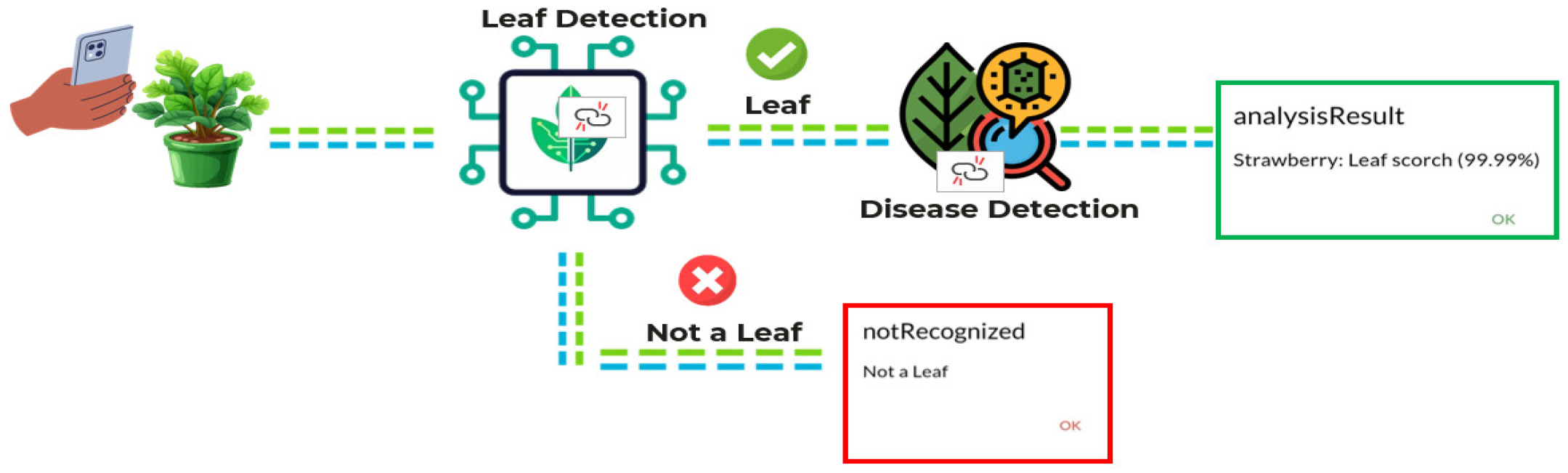
Figure 1 summarizes the leaf classification pipeline adopted in this work for plant disease detection consisting of two subsequent stages. First, a binary classifier checks whether the input image is a leaf or non-leaf image. Once verified, the leaf image is passed to a multiclass plant-disease classifier to determine the plant species and identify any present disease.

3.1. Datasets

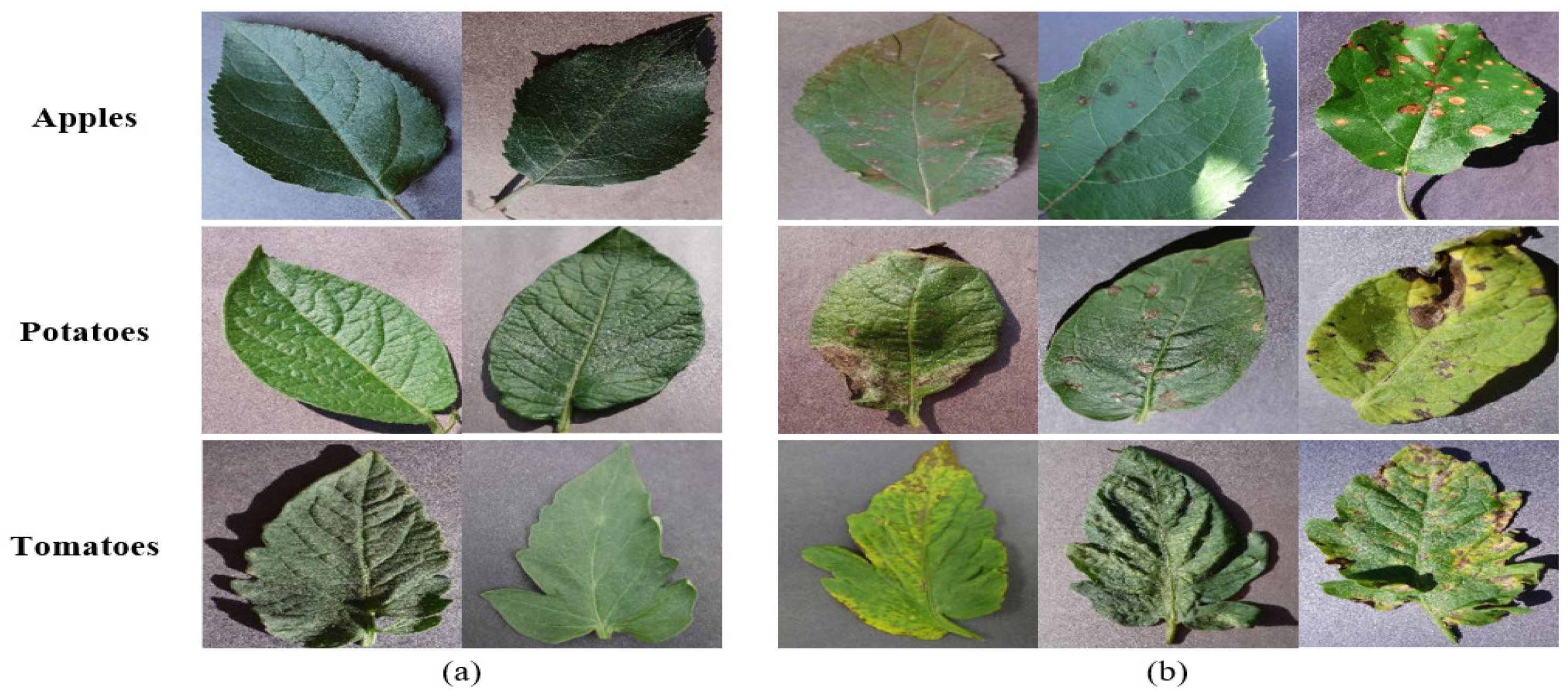
Plant Village [29] is a publicly available benchmark plant disease dataset, originally developed by researchers at Penn State University, USA. It contains over 54,000 healthy and diseased leaf images from 14 plant species, spanning 38 different classes. The plant species include apple, blueberry, cherry, corn, grape, orange, peach, pepper, potato, raspberry, soybean, squash, strawberry, and tomato. For each plant, there is one healthy class and one or more disease classes. For example, apples have three disease classes, whereas tomatoes have nine disease classes. In this work, the Plant Village dataset was obtained from the Kaggle repository [30] and was divided into 70% training, 20% validation, and 10% testing. Figure 2 shows sample images from the Plant Village dataset for the healthy and disease classes.
For the leaf detection phase, a leaf/non-leaf dataset was created by the authors. For the leaf class, 10,000 images were randomly selected from the Plant Village dataset. As for the non-leaf class, 7340 images were manually collected from various publicly available Kaggle datasets including images of soil, gardening tools, vehicles, human faces, and various objects such as chairs and tables.

3.2. Data Preprocessing

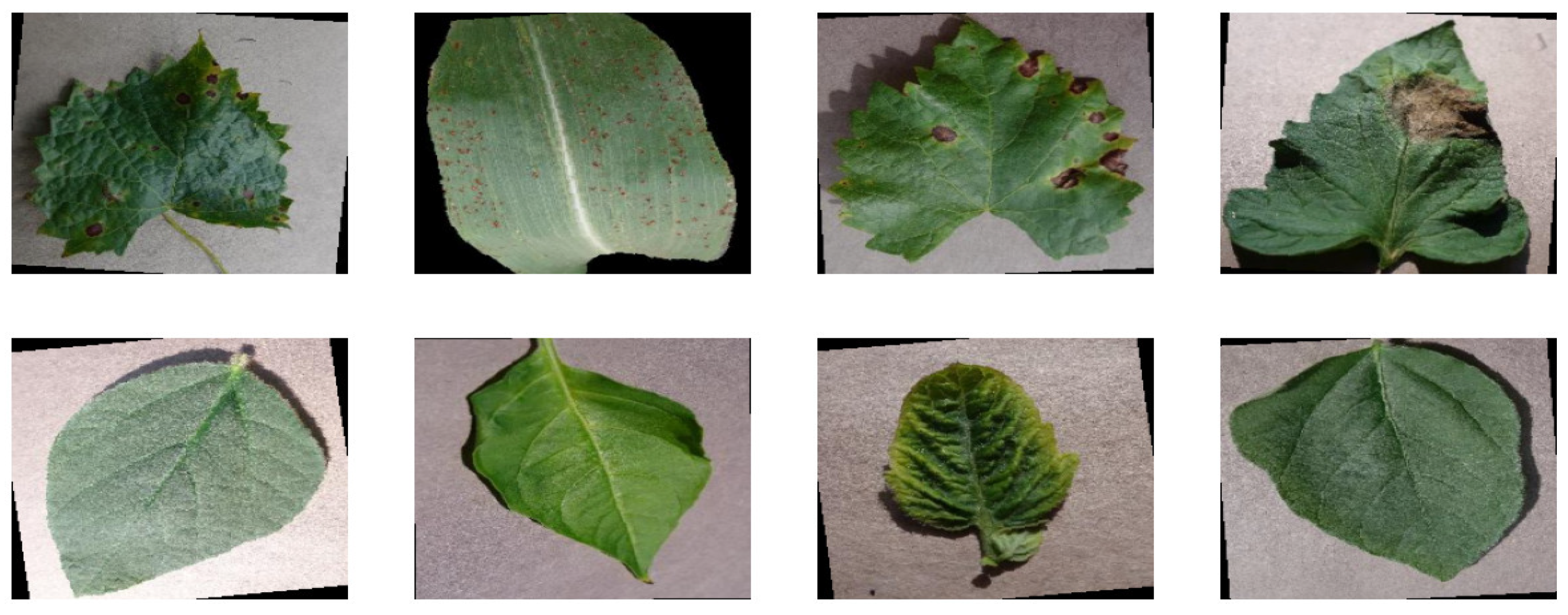
Data augmentation is widely used to increase the diversity of the training dataset by applying various transformations to the training images, thus improving the generalization capability of the model. In this work, horizontal flips, vertical flips, rotations (±10°), and brightness adjustments (range: 0.5, 1.5) were generated on-the-fly using the ImageDataGenerator [31]. Figure 3 shows several samples of the augmented images. All images were resized to 224 × 224 pixels and normalized using the ImageNet mean and standard deviation to align with the input expectations of the pretrained models.

3.3. MobileNet

MobileNet [32] is a family of lightweight CNNs designed for resource-constrained devices such as mobile phones and edge devices. The original MobileNetV1 [32] introduced depthwise separable CNNs, significantly reducing the model parameters to less than five million. MobileNetV2 [33] improved upon its predecessor by incorporating inverted residual blocks with linear bottlenecks, enabling further parameter reduction and better feature extraction. MobileNetV1 and MobileNetV2 have 4.3 million and 3.5 million parameters, respectively, which is significantly low compared to other standard CNNs having tens of millions of parameters.
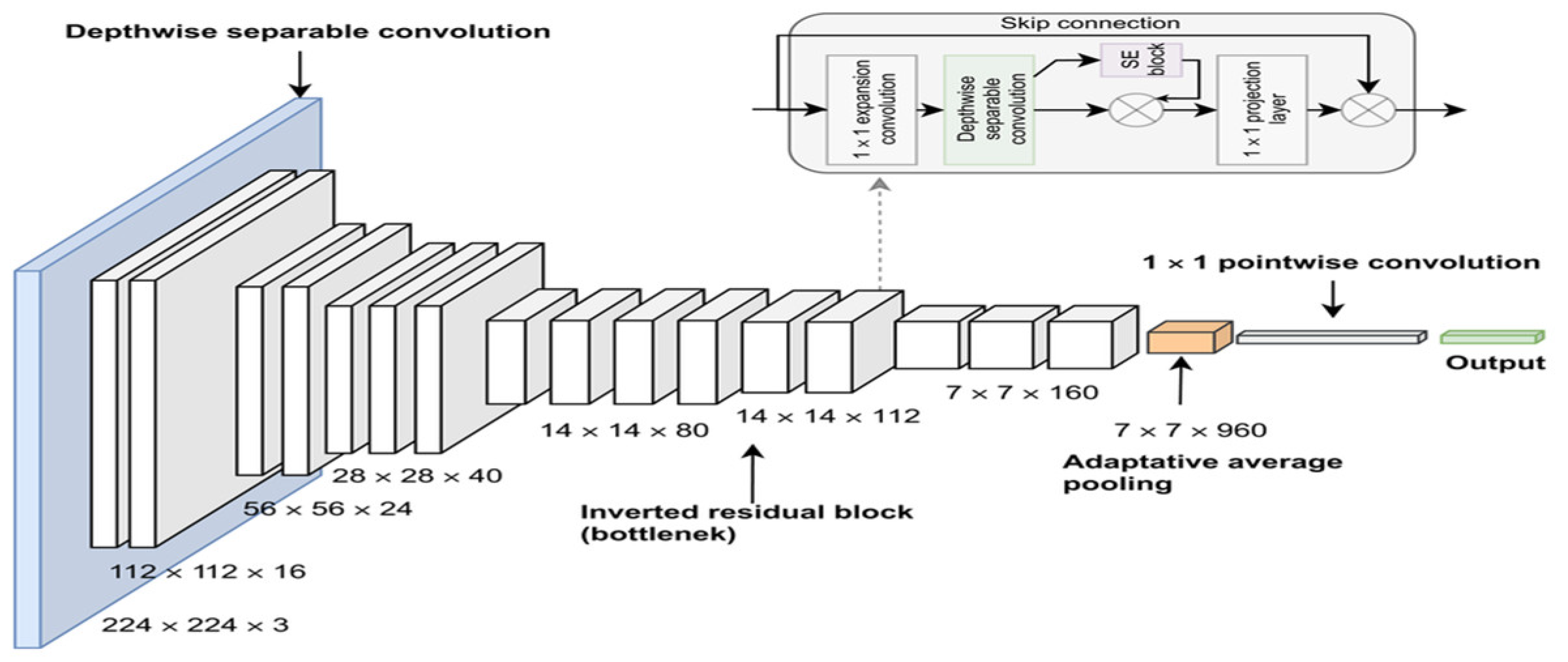
MobileNetV3 [34] is a more recent version with the MobileNet family that integrates lightweight squeeze-and-excitation (SE) attention modules, thus further enhancing overall performance compared to its predecessors (Figure 4). MobileNetV3 has two variants: MobileNetV3-Large (5.4 million parameters) for higher accuracy and MobileNetV3-Small (2.5 million parameters) for ultra-efficient applications. In this work, MobileNetV3-Small was considered for both leaf vs. non-leaf classification and plant disease detection. Specifically, MobileNetV3-Small was chosen as it balances accuracy with lightweight design making it suitable for our AIoT-based system.

3.4. MobileViT

MobileViT [25] is lightweight hybrid model that combines vision transformer blocks (MobileViT) for global context with convolutional blocks (MobileNetV2) for local feature extraction. Vision transformers leverage self-attention mechanisms to weigh relationships between all image patches, allowing them to capture long-range dependencies and global context that convolutional blocks alone cannot efficiently model. MobileViT can thus reliably extract both local and global features, which improves recognition of complex patterns, occlusions, and subtle variations in images, while still remaining lightweight and efficient for mobile deployment.
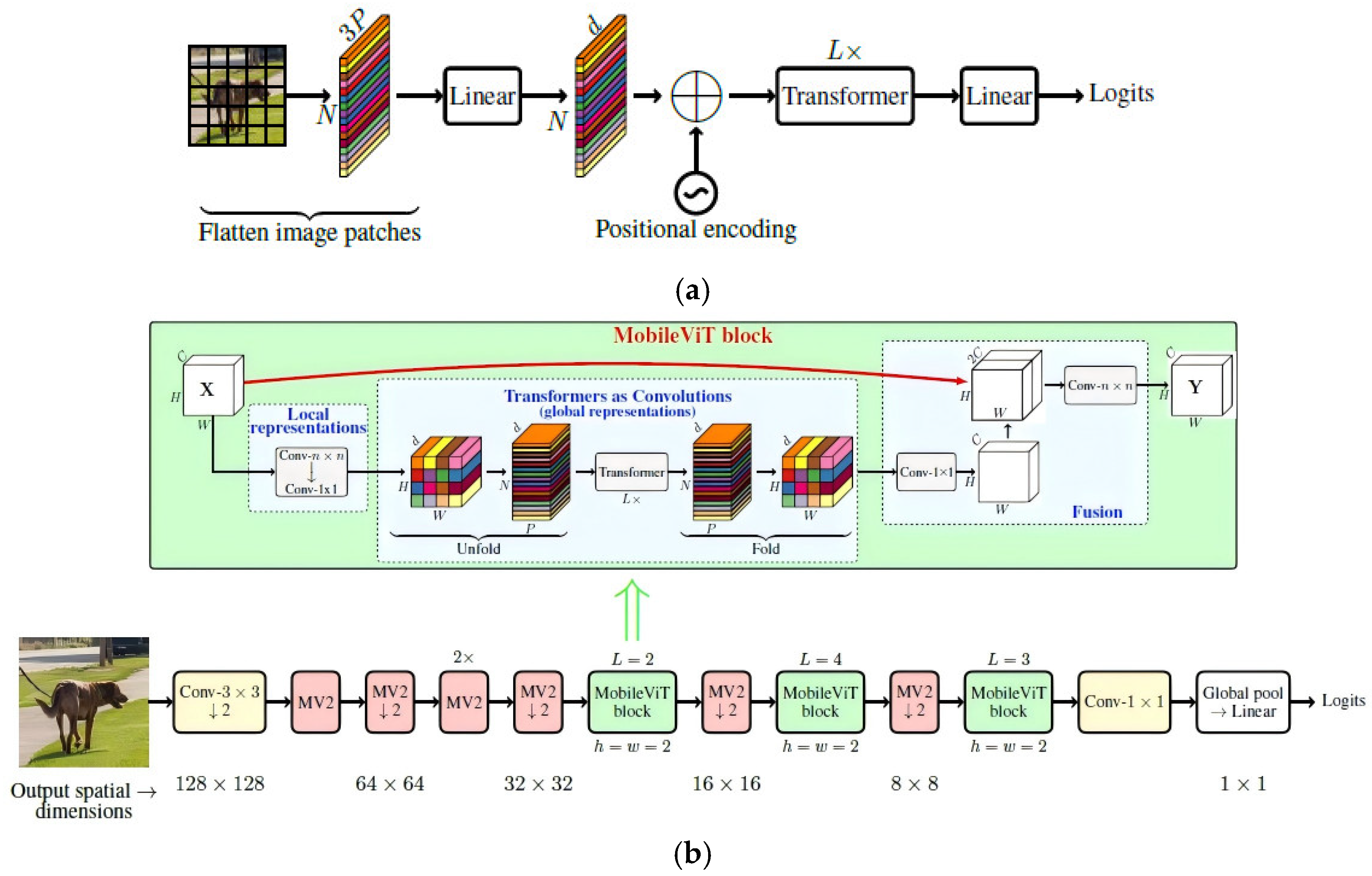
In the MobileViT block, the input is first passed through standard convolutional layers to extract low-level spatial features. Next, the output feature map is unfolded into non-overlapping patches that are input into a compact transformer block for global feature extraction. Finally, the processed tokens are folded back into a 2-dimensional feature map and another set of convolutions is applied to merge the global features. The MobileViT block is repeated multiple times within the architecture, allowing the network to progressively integrate local and global feature representations across different spatial resolutions. Finally, 1 × 1 convolution is applied to fuse the feature maps and reduce dimensionality before passing them to the final classification layer. Figure 5 compares the architecture of the traditional ViT to that of the hybrid MobileViT.
MobileViT comes in several variants designed to balance accuracy and efficiency for mobile and edge deployment. MobileViT-XXSmall is an ultra-compact variant, having ~1.3 million parameters, making it well optimized for extremely low-latency applications with minimal computational resource. In this work, MobileViT-XXSmall was compared to MobileNet3-Small for the multiclass plant disease detection.

3.5. Experimental Setup

In the present study, two lightweight models were compared for plant disease classification: MobileNetV3-Small and MobileViT-XXSmall. Additionally, MobileNetV3-Small was utilized for the leaf/non-leaf experiments. MobileNetV3-Small was implemented using Keras with TensorFlow 2.11 [36], whereas MobileViT-XXSmall was implemented using the Hugging Face Library with PyTorch 2.7.1 [25,37]. For both networks, the ImageNet pretrained versions were utilized, with new classification heads added to adapt the networks to the target task. An Adam optimizer with a learning rate of 10−3 and 10−4 was utilized for the MobileNetV3-Small and MobileViT-XXSmall networks, respectively. Cross entropy loss function and sigmoid classifier were considered in all experiments. Batch sizes of 64 and 32 were utilized, for the MobileNetV3-Small and MobileViT-XXSmall networks, respectively. Training was performed for up to 20 epochs, with early stopping applied to prevent overfitting when validation loss reached a plateau.

4. System Design

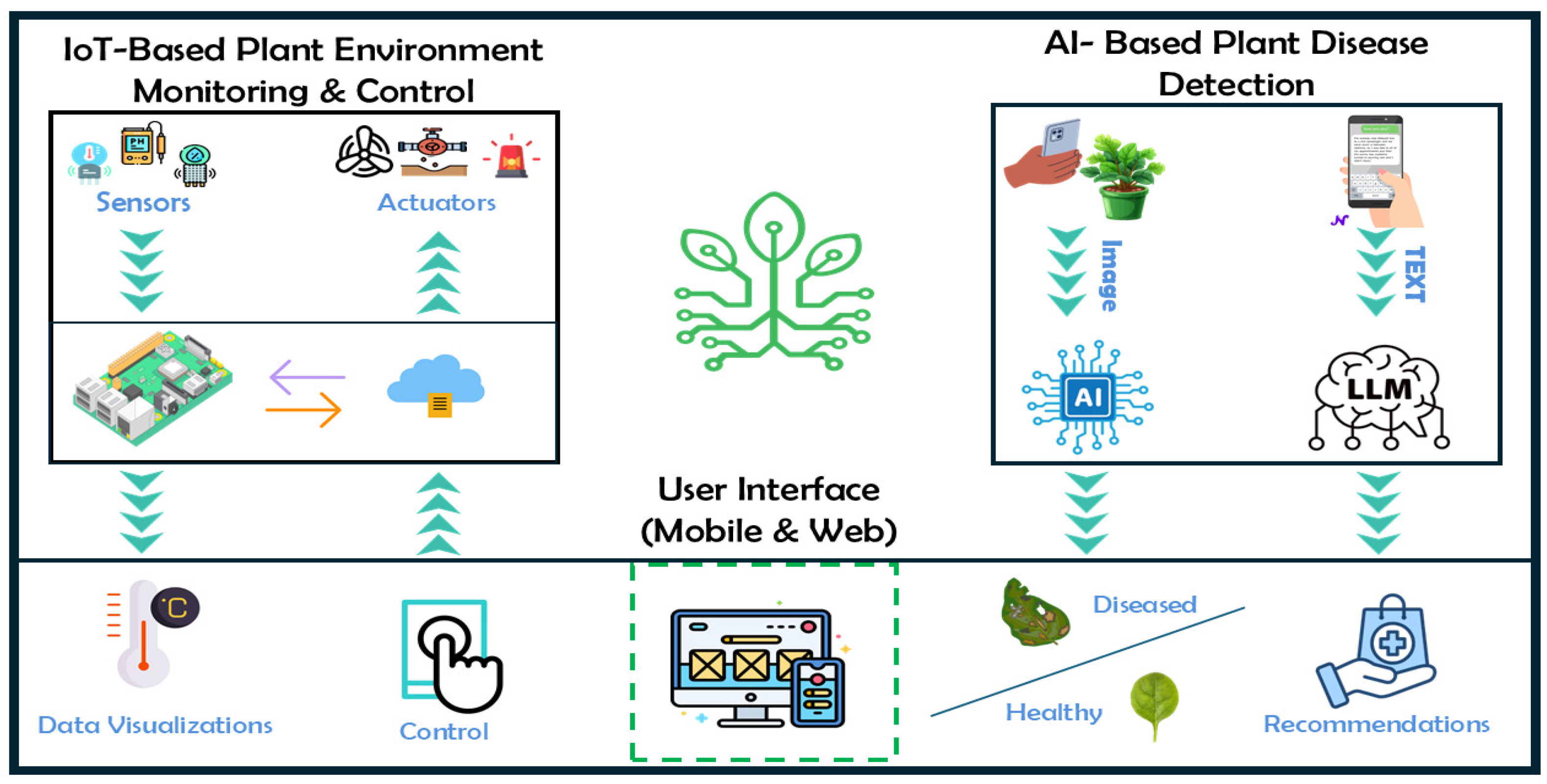
Figure 6 illustrates the simplified design of the presented AIoT-based system which includes two main components integrated within a mobile application:
(a)
AI-based plant disease detection and LLM-powered interactive chatbot.
(b)
IoT-based plant environment management (monitoring and control).
In this section, a description of each system component is provided, excluding the plant disease classification details that was already presented in the previous section. Additionally, a summary of the tools used for the development of the user interface (UI) is presented.

4.1. LLM-Powered Chatbot

Large language models (LLMs) are built using transformer-based architectures that employ self-attention mechanisms to capture long-range dependencies in text. By leveraging transformer-based architectures trained on massive text corpora, LLMs can understand natural language queries and generate contextually relevant, human-like responses. When embedded in a chatbot interface, these models enable interactive, adaptive, and domain-specific dialogue [38]. LLMs have thus enhanced the capabilities of modern chatbots, making them more engaging and user-friendly compared to traditional rule-based or template-driven methods [39]. With recent advancements in LLM-based chatbots, they have become an integral component of modern smart applications.
LLMs can be broadly categorized into proprietary models (e.g., OpenAI’s GPT and Google’s Gemini) and open-source alternatives (e.g., Meta’s LLaMA). These models differ in terms of accessibility, customization potential, and deployment flexibility. In this work, the open-source, lightweight LLaMA 3.2 model by Meta [40] was selected for its balance of accuracy and computational efficiency, along with its suitability for AIoT-based applications. LLaMA 3.2 was integrated into the cloud infrastructure as an interactive chatbot, providing mobile application users with easy access to AI-powered advice on plant-related issues such as plant care and disease treatment.

4.2. IoT-Based Plant Management System

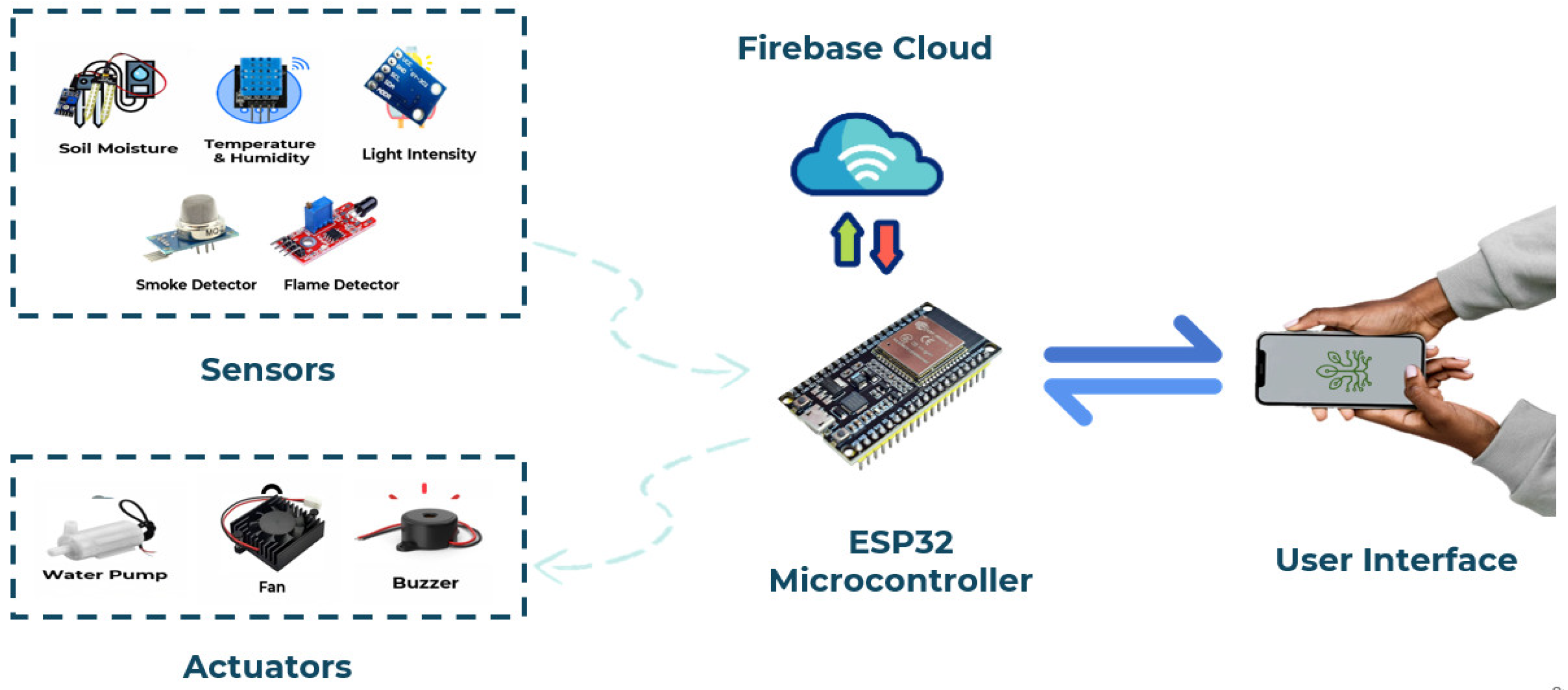
Figure 7 shows the simplified workflow of the implemented IoT-based plant management system comprising the ESP32 microcontroller, the different sensors, and actuators, and the Google Firebase Cloud. ESP32 [41] is a dual core, low power, and cost-effective microcontroller that integrates Wi-Fi and Bluetooth connectivity making it widely adopted in IoT applications. The ESP32 microcontroller was utilized as the core processing unit collecting sensor data and controlling actuators. Table 2 summarizes the sensors and actuators connected to the ESP32 for plant environment monitoring and control.
Google Firebase Cloud [42] is a suite of cloud-based tools that offers several features like real-time databases, authentication, cloud storage, and hosting, which are all designed to simplify backend development and enable real-time data synchronization across devices. In the present study, all sensor data were periodically synchronized with the Firebase Realtime Database [43] to enable real-time monitoring and to provide remote access via the mobile application. Algorithm 1 illustrates the system pseudocode for sensor monitoring and manual or automatic actuator control. Manual control enables turning the water pump on/off for irrigation or switching the fan on/off for ventilation. On the other hand, automatic control relies on the real-time sensor readings as compared to predefined threshold to make specific decision such as turning on/off the water pump based on soil moisture, switching the fan on/off based on air temperature, or triggering the alarm upon flame or smoke detection. The proposed IoT system thus facilitates real-time decision-making and automated interventions for efficient farm management.
Algorithm 1. Pseudo-code summarizing the operations of the IoT-based plant management system, including sensor data acquisition, Firebase cloud synchronization, and actuator control
BEGIN
1: Initialize Firebase, Wi-Fi, sensors, and actuators
2: WHILE TRUE DO
3:        Read all sensor data (temperature & humidity, light, soil moisture, flame, smoke)
4:        Upload all sensor data to Firebase
5:          IF manual command received from Firebase THEN
6:                Control actuators accordingly (fan–pump)
7:          ELSE IF predefined thresholds are exceeded THEN
8:                Control actuators automatically: turn water pump on for low soil moisture,
9:                turn fan on for high temperatures, trigger alarm if flame or smoke is detected
10:             END IF
11:           Wait for predetermined time interval
12: END WHILE
END

4.3. User Interface

In this study, a dual-platform architecture was developed, comprising a mobile application and a web-based platform, both integrated with the system’s cloud backend. The mobile application was developed using Flutter 3.27 and Dart 3.6, whereas the web platform was built using HTML5, CSS3, and JavaScript (ES6). Both platforms interfaced with a shared backend on Google Firebase, supporting user authentication, real-time database access and secure hosting for sensor data storage. Additionally, Google Firebase assured seamless data synchronization between the different platforms. Despite the wide adoption of the MQTT (Message Queuing Telemetry Transport) communication protocol in IoT systems due to its lightweight nature, HTTPS (Hypertext Transfer Protocol Secure) was employed in the present study as it is natively supported by the Firebase services.

5. Results and Discussion

In this section, the performance of the AI-based plant disease detection was thoroughly investigated. Moreover, the AI and IoT components were integrated within the mobile application and tested in real-world scenarios to validate the practical functionality and overall system effectiveness.

5.1. Plant Disease Detection Results

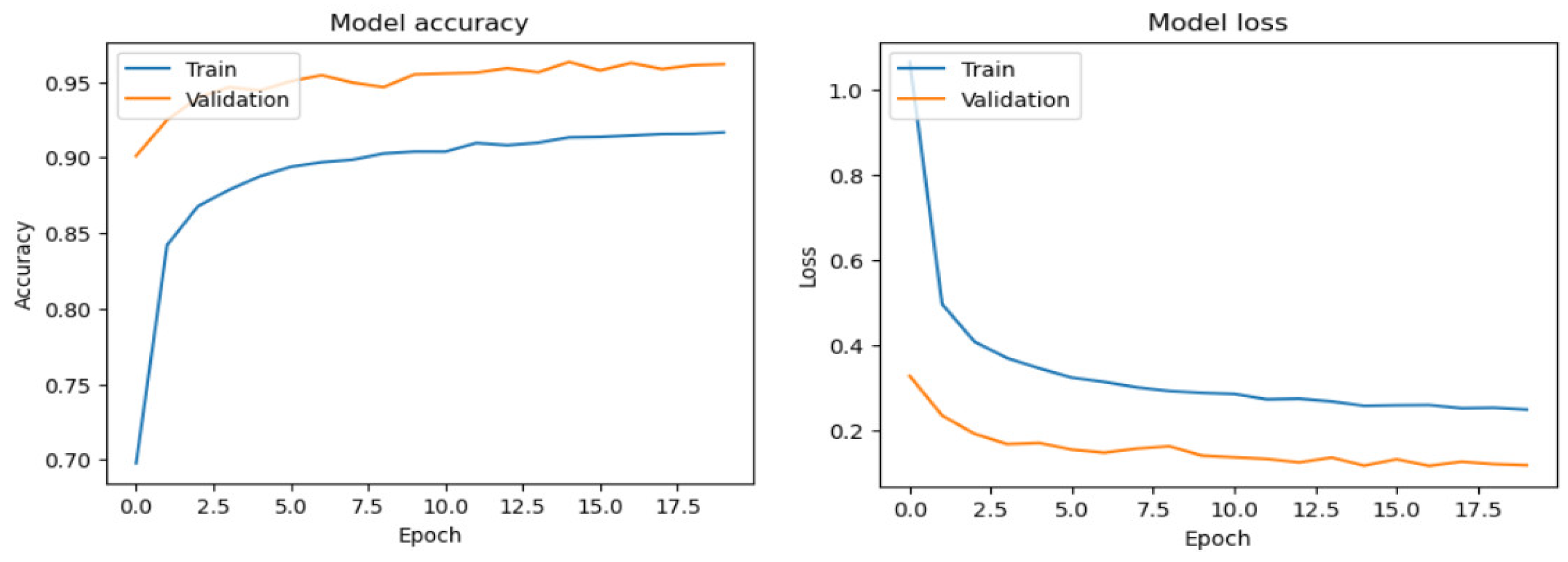
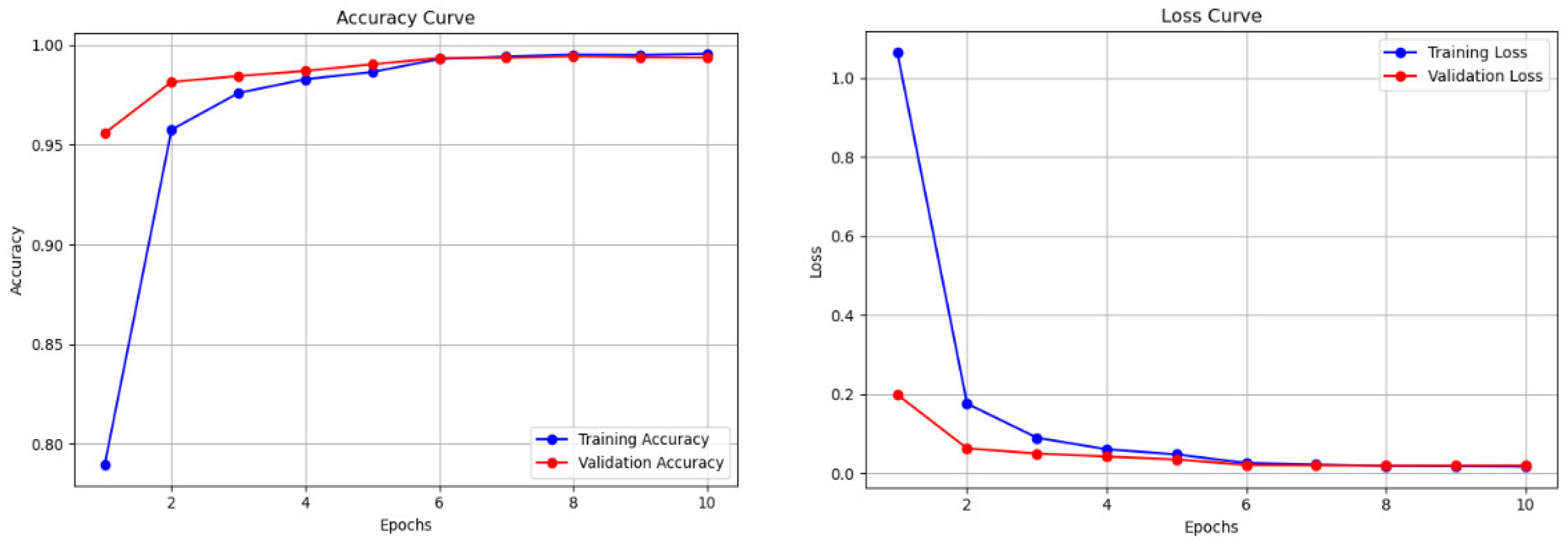
The results of two experiments are presented in this section: (1) leaf vs. non-leaf binary classification and (2) multiclass plant disease detection. Several metrics are utilized for performance evaluation including accuracy (acc.), precision (prec.), recall (rec.), F1-score, and area under the curve (AUC). Additionally, the training and validation loss and accuracy curves are provided to illustrate the convergence behavior and stability of the deep models. Finally, plant disease classification results are compared with several state-of-the-art methods from the literature.

5.1.1. Leaf vs. Non-Leaf Classification

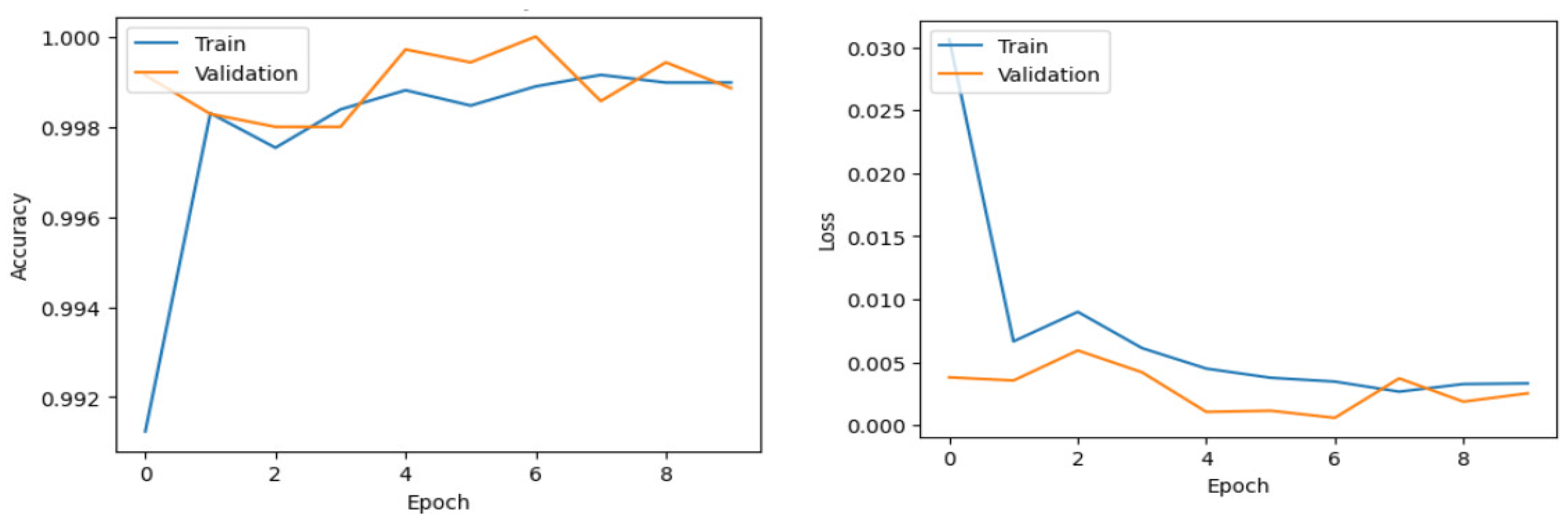
The first stage of the plant disease detection pipeline involved a leaf vs. non-leaf classifier using the MobileNetV3-Small network pretrained on ImageNet. Figure 8 shows the accuracy and loss curves of the performed experiment indicating the reliability of MobileNetV3-Small in filtering out the irrelevant non-leaf images. MobileNetV3 also achieved reliable performance on the test dataset (acc. and f1-score = 100%). This robust filtering step minimizes error propagation in the subsequent classification pipeline and improves the overall reliability of the system.

5.1.2. Plant Disease Classification

The second phase of the plant disease detection pipeline involves the identification of the plant species and disease (if any). In this work, the lightweight MobileNetV3-Small and MobileViT-XXSmall networks were compared for the multiclass plant disease classification task. MobileNetV3 is a purely convolutional-based architecture that offers fast and efficient local feature extraction. MobileViT is a hybrid model constituting both convolutional and transformer blocks allowing it to capture both local and global dependencies in the leaf images.
Figure 9 and Figure 10 illustrate the performance curves for the MobileNetV3-Small and MobileViT-XXSmall, respectively. Both models effectively converged during training, with MobileViT-XXSmall achieving better performance for the validation dataset (MobileViT-XXSmall acc.: 99.44% vs. MobileNetV3-Small acc.: 97.88%). The gap between the train and validation curves of MobileNetV3 resulted from the regularization dropout layers added to the classification head to avoid overfitting. For the test dataset, MobileViT-XXSmall (acc.: 99.5%) outperformed MobileNetV3-Small (acc.: 97.5%) by ~2% demonstrating that hybrid lightweight models more effectively captured relevant information for reliable plant disease classification.
Table 3 shows the classification report of the MobileViT-XXSmall network on the Plant Village test dataset. Results indicate that per-class precision, recall, and f1-score metrics ranged between 0.92 and 1.00, whereas the overall accuracy was 99.5%. These results demonstrate the effectiveness of the MobileViT-XXSmall network in differentiating between the various types of plant diseases, indicating its suitability for integration within smart farming applications.
In the present study, the lightweight MobileViT-XXSmall model was chosen for its hybrid architecture combining compact convolutional and transform blocks. This architecture enables the extraction of local and global features without significantly increasing the computational cost. On the other side, MobileNet is a family of purely convolutional models that was consistently shown in previous studies to outperform several other standard networks for plant disease classification [15,16,17]. MobileNetV3-Small was thus implemented for the sake of comparing the hybrid model to a reliable purely convolutional network. Nevertheless, we considered it valuable to also compare several other lightweight standard models to MobileViT-XXSmall. Table 4 summarizes the performance of different lightweight models on the Plant Village validation dataset. Results show that MobileViT-XXSmall achieved an accuracy of ~99.5%, outperforming all the other implemented models while offering the added advantage of a significantly lower number of parameters (~1.3 million).
Table 5 summarizes the performance of several plant disease classification models from literature on the benchmark Plant Village dataset. Garg et al. [17] and Shrimali [15] showed that MobileNetV2 outperformed several other standard CNNs for plant disease detection. Borhani et al. [19] found that customized transformer-based architectures outperformed purely convolutional models, however on the cost of increased computational complexity. In this work, the hybrid MobileViT-XXSmall lightweight network resulted in accuracy of 99.5%, thus outperforming various standard networks by 2–12% making it the model of choice for our mobile application.

5.2. Mobile Application

Finally, the AIoT-based mobile application was developed to allow users to easily detect plant diseases, access plant care and treatment recommendations, as well as to remotely monitor and control their plant environment. The mobile application was experimentally validated in real-world scenarios to ensure the robust operation of the different integrated system components.
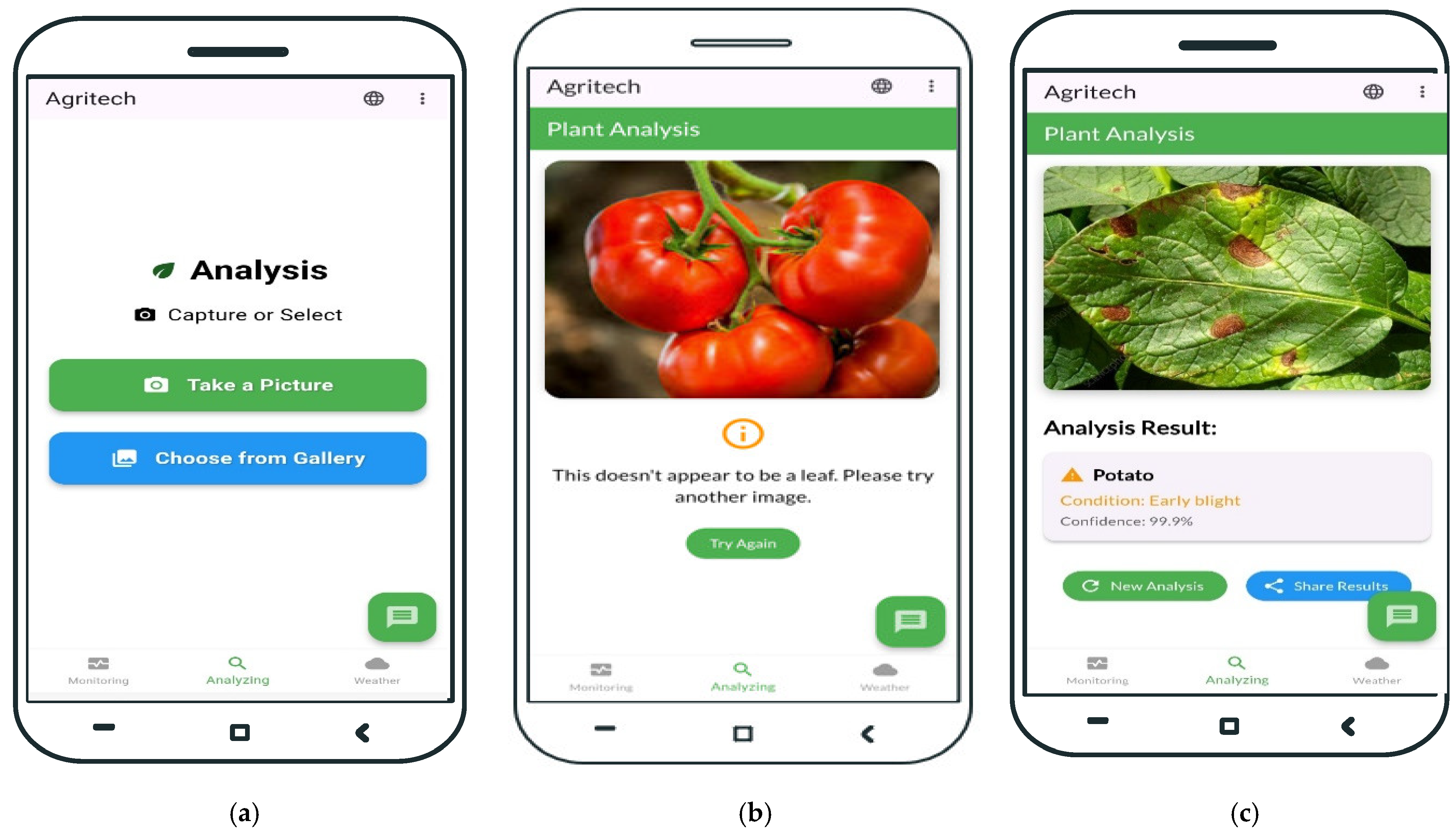
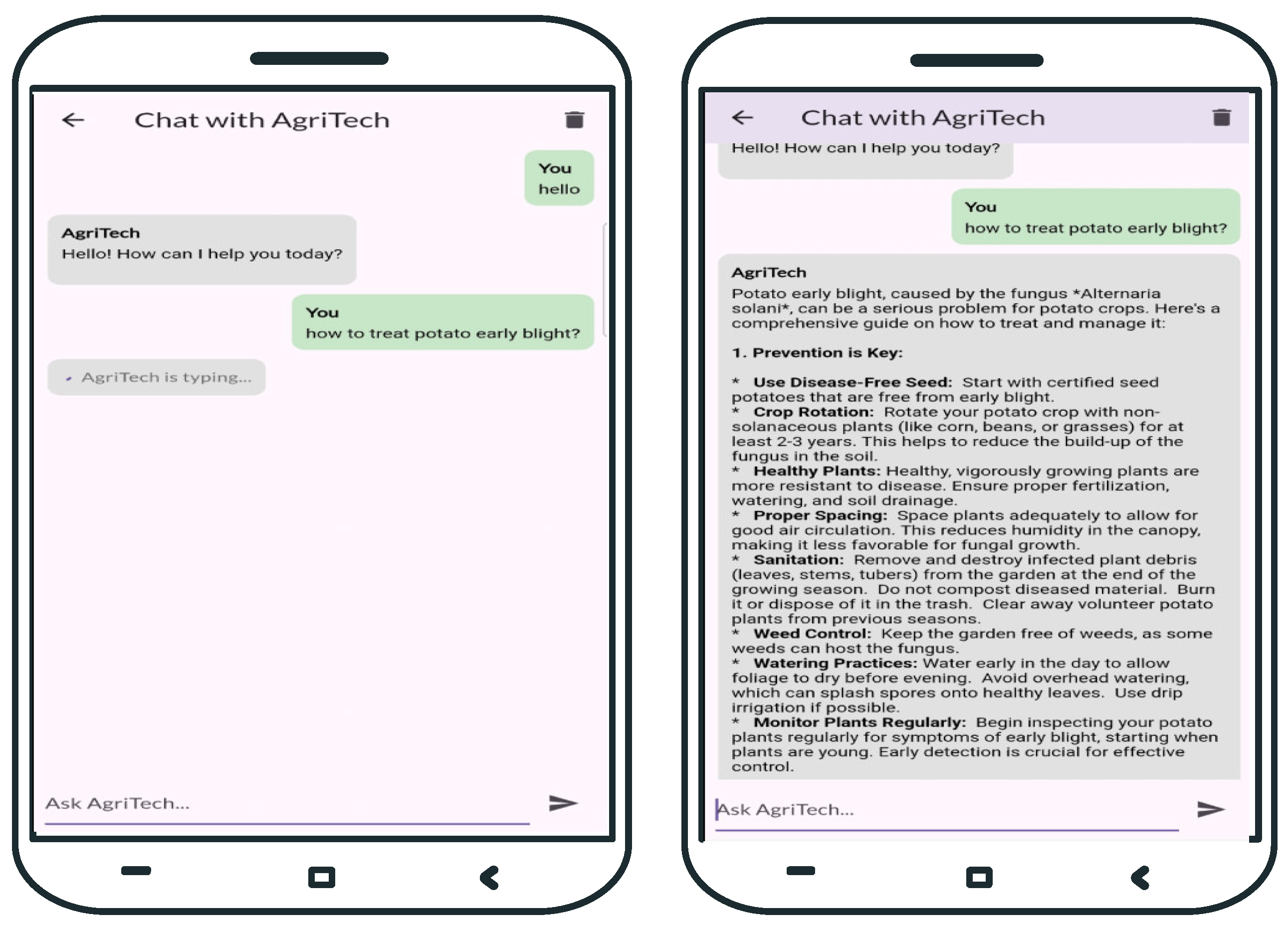
For the AI-based plant disease detection, all models were uploaded to the cloud infrastructure, enabling centralized deployment and remote access by the mobile application. To assess real-world applicability, the plant disease detection module was tested on images collected from real plants in actual farm environments. Final evaluation included an end-to-end validation of the full pipeline from image submission by the mobile application, through the leaf detection, to the final disease classification (Figure 11). Additionally, a chatbot button was added allowing users to receive instant guidance to farming-related queries (Figure 12).
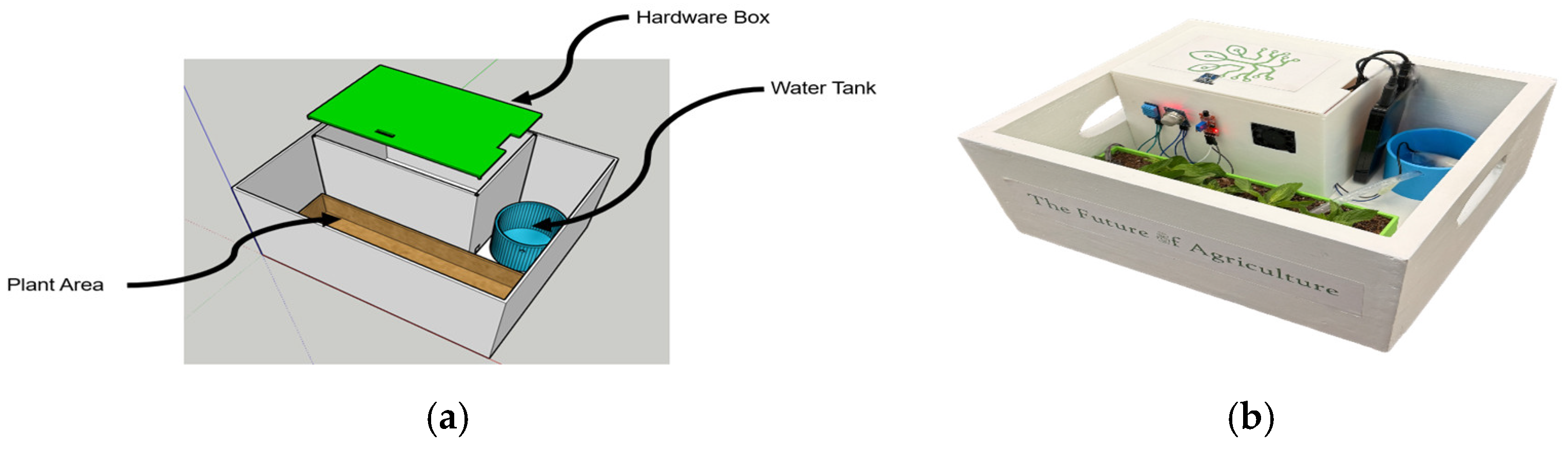
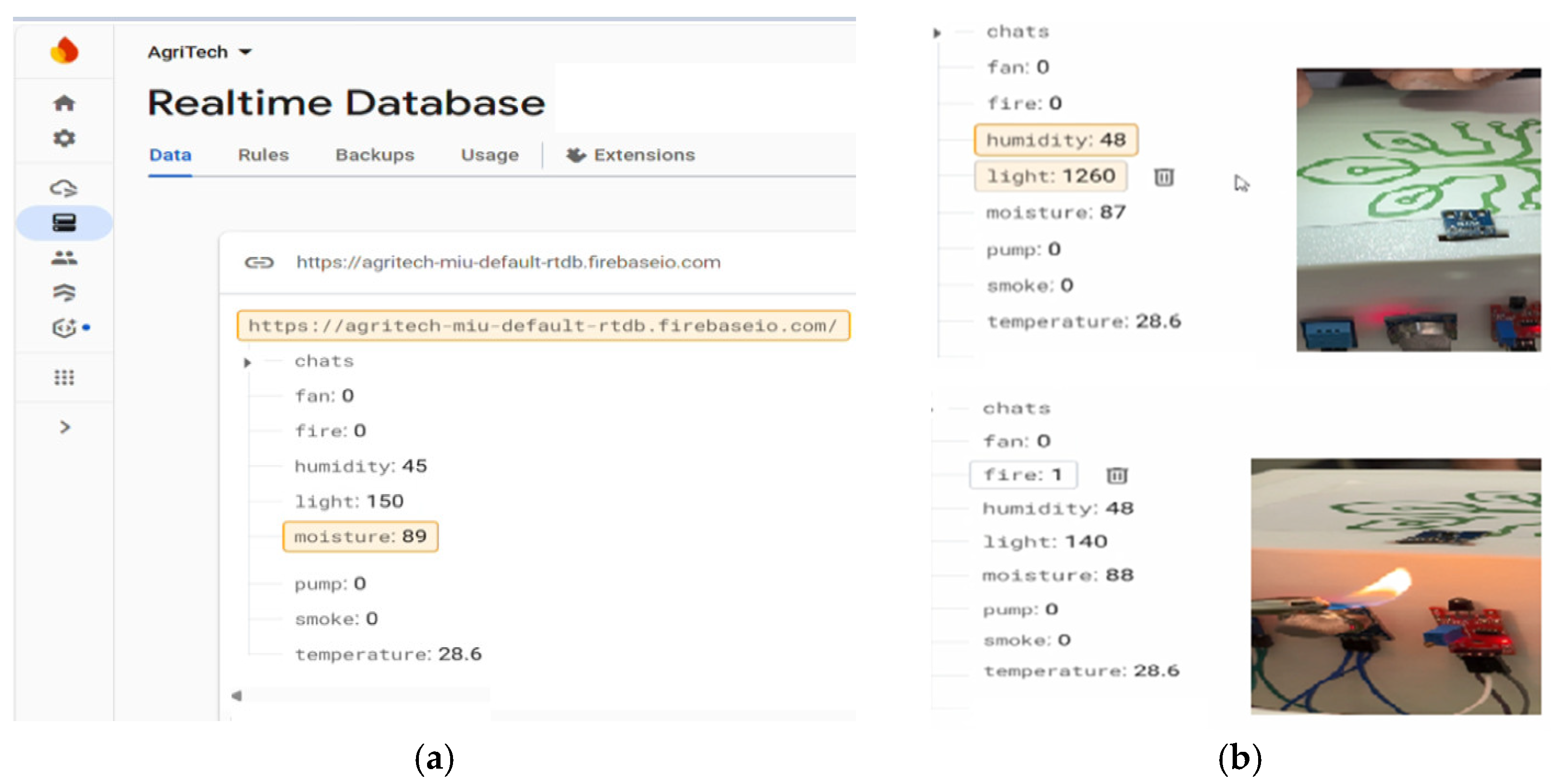
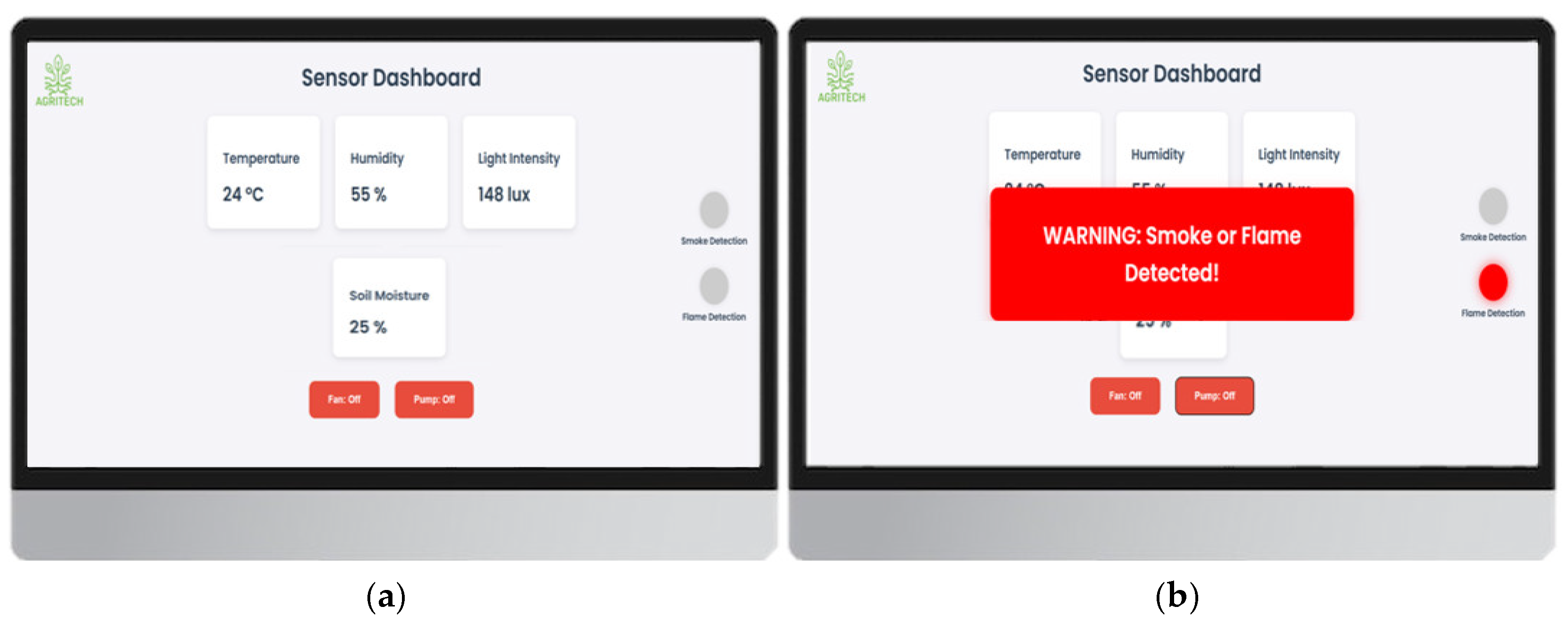
In order to test the functionality of the IoT plant management system, a 3D greenhouse prototype was implemented to simulate a realistic plant environment (Figure 13). All sensor readings collected by the ESP32 microcontroller were organized into a structured JSON format that were sent to predefined endpoints, for example: /temperature, /moisture, in the Firebase Realtime Database. A series of tests were conducted to validate the accurate operation of the hardware components and their seamless integration within the full system. Figure 14 shows snapshots of the Firebase Realtime Database displaying the effect of luminance and fire on the sensor readings. Finally, a web platform was designed to provide users with an alternative user interface, offering the same core resource management features as the mobile application (Figure 15 and Figure 16).

6. Conclusions

In this work, an AIoT-based mobile application was presented to provide a smart and practical solution for small-scale farm monitoring and management. The developed application integrates two main components: (1) AI-based plant disease detection from mobile captured images and in-app chatbot for plant care recommendations, along with (2) IoT-enabled plant growth environment monitoring and control. For the plant disease detection, MobileViT-XXSmall was implemented that combines transformer and convolutional blocks, resulting in an accuracy of 99.5% for the Plant Village dataset (14 species and 38 classes). Additionally, an LLM-powered chatbot built using Meta’s Llama 3.2, was integrated within the system, providing users with advice for plant care and management. The ESP32 microcontroller was utilized as the main processing unit, responsible for sensor data acquisition, actuator control, local processing, and communication with the cloud backend. Google Firebase was employed as a cloud backend for sensor data storage, inter-module synchronization, and user authentication management. The presented AIoT-based system has the potential to upscale the smart farming experience by facilitating remote plant monitoring and control, thus improving resource usage and enhancing crop productivity leading in turn to improved global food security.
There are several interesting directions for future work. The presented IoT-based monitoring system can be deployed and validated in real greenhouse environments to evaluate its performance under real operating conditions. Additionally, retrieval-augmented generation (RAG) can be implemented to improve the chatbot accuracy.

Author Contributions

Conceptualization, L.A.-H.; methodology & investigation, M.B., A.H., F.A. and L.A.-H.; software, M.B., A.H., F.A. and L.A.-H.; data curation, M.B.; visualization & writing—original draft preparation, M.B., A.H., F.A. and L.A.-H.; writing—review and editing, L.A.-H.; supervision & project administration, L.A.-H. All authors have read and agreed to the published version of the manuscript.

Funding

This research received no external funding.

Institutional Review Board Statement

Not applicable.

Informed Consent Statement

Not applicable.

Data Availability Statement

No new data were created or analyzed in this study. The Plant Village dataset used in this study is publicly available on Kaggle at https://www.kaggle.com/datasets/abdallahalidev/plantvillage-dataset (accessed on 21 November 2024).

Conflicts of Interest

The authors declare no conflicts of interest.

Abbreviations

The following abbreviations are used in this manuscript:
AIArtificial Intelligence
AIoTArtificial Intelligence of Things
CBAMConvolutional Block Attention Module
CNNConvolutional Neural Network
HTTPSHypertext Transfer Protocol Secure
IoTInternet of Things
JSONJavaScript Object Notation file
LLMLarge Language Model
MQTTMessage Queuing Telemetry Transport
MV2MobileNetV2
PVPlant Village Dataset
RBACRole-Based Access Control
SESqueeze and Excitation
ViTVision Transformer

References

  1. Food and Agriculture Organization of the United Nations (FAO). Global Agriculture Towards 2050; Food and Agriculture Organization of the United Nations: Rome, Italy, 2009. [Google Scholar]
  2. Lowder, S.K.; Sánchez, M.V.; Bertini, R. Which farms feed the world and has farmland become more concentrated? World Dev. 2021, 142, 105455. [Google Scholar] [CrossRef]
  3. Mandal, S.; Yadav, A.; Panme, F.A.; Devi, K.M.; Kumar, S.M.S. Adaption of smart applications in agriculture to enhance production. Smart Agric. Technol. 2024, 7, 100431. [Google Scholar] [CrossRef]
  4. Food and Agriculture Organization of the United Nations (FAO). The Future of Food and Agriculture: Trends and Challenges; Food and Agriculture Organization of the United Nations: Rome, Italy, 2017. [Google Scholar]
  5. Demilie, W.B. Plant disease detection and classification techniques: A comparative study of the performances. J. Big Data 2024, 11, 5. [Google Scholar] [CrossRef]
  6. Awaisi, K.S.; Ye, Q.; Sampalli, S. A Survey of Industrial AIoT: Opportunities, Challenges, and Directions. IEEE Access 2024, 12, 96946–96996. [Google Scholar] [CrossRef]
  7. Muhammed, D.; Ahvar, E.; Ahvar, S.; Trocan, M.; Montpetit, M.-J.; Ehsani, R. Artificial Intelligence of Things (AIoT) for smart agriculture: A review of architectures, technologies and solutions. J. Netw. Comput. Appl. 2024, 228, 103905. [Google Scholar] [CrossRef]
  8. Simonyan, K.; Zisserman, A. Very deep convolutional networks for large-scale image recognition. arXiv 2014, arXiv:1409.1556. [Google Scholar]
  9. He, K.; Zhang, X.; Ren, S.; Sun, J. Deep residual learning for image recognition. In Proceedings of the IEEE Conference on Computer Vision and Pattern Recognition, Las Vegas, NV, USA, 27–30 June 2016; pp. 770–778. [Google Scholar]
  10. Szegedy, C.; Liu, W.; Jia, Y.; Sermanet, P.; Reed, S.; Anguelov, D.; Erhan, D.; Vanhoucke, V.; Rabinovich, A. Going deeper with convolutions. In Proceedings of the IEEE Conference on Computer Vision and Pattern Recognition, Boston, MA, USA, 7–12 June 2015; pp. 1–9. [Google Scholar]
  11. Dosovitskiy, A.; Beyer, L.; Kolesnikov, A.; Weissenborn, D.; Zhai, X.; Unterthiner, T.; Dehghani, M.; Minderer, M.; Heigold, G.; Gelly, S.; et al. An image is worth 16x16 words: Transformers for image recognition at scale. arXiv 2020, arXiv:2010.11929. [Google Scholar]
  12. Pantelaios, D.; Theofilou, P.-A.; Tzouveli, P.; Kollias, S. Hybrid CNN-ViT Models for Medical Image Classification. In Proceedings of the 2024 IEEE International Symposium on Biomedical Imaging (ISBI), Athens, Greece, 27–30 May 2024; pp. 1–4. [Google Scholar] [CrossRef]
  13. Maurício, J.; Domingues, I.; Bernardino, J. Comparing Vision Transformers and Convolutional Neural Networks for Image Classification: A Literature Review. Appl. Sci. 2023, 13, 5521. [Google Scholar] [CrossRef]
  14. Deng, J.; Dong, W.; Socher, R.; Li, L.-J.; Li, K.; Li, F.F. ImageNet: A large-scale hierarchical image database. In Proceedings of the 2009 IEEE Conference on Computer Vision and Pattern Recognition, Miami, FL, USA, 20–25 June 2009; pp. 248–255. [Google Scholar] [CrossRef]
  15. Shrimali, S. PlantifyAI: A Novel Convolutional Neural Network Based Mobile Application for Efficient Crop Disease Detection and Treatment. Procedia Comput. Sci. 2021, 191, 469–474. [Google Scholar] [CrossRef]
  16. Tembhurne, J.V.; Gajbhiye, S.M.; Gannarpwar, V.R.; Khandait, H.R.; Goydani, P.R.; Diwan, T. Plant disease detection using deep learning based Mobile application. Multimed. Tools Appl. 2023, 82, 27365–27390. [Google Scholar] [CrossRef]
  17. Garg, G.; Gupta, S.; Mishra, P.; Vidyarthi, A.; Singh, A.; Ali, A. CROPCARE: An Intelligent Real-Time Sustainable IoT System for Crop Disease Detection Using Mobile Vision. IEEE Internet Things J. 2023, 10, 2840–2851. [Google Scholar] [CrossRef]
  18. Tyagi, S.; Reddy, S.R.N.; Anand, R.; Sabharwal, A. Enhancing rice crop health: A light weighted CNN-based disease detection system with mobile application integration. Multimed. Tools Appl. 2024, 83, 48799–48829. [Google Scholar] [CrossRef]
  19. Borhani, Y.; Khoramdel, J.; Najafi, E. A deep learning based approach for automated plant disease classification using vision transformer. Sci. Rep. 2022, 12, 11554. [Google Scholar] [CrossRef] [PubMed]
  20. Tabbakh, A.; Barpanda, S.S. A Deep Features Extraction Model Based on the Transfer Learning Model and Vision Transformer ‘TLMViT’ for Plant Disease Classification. IEEE Access 2023, 11, 45377–45392. [Google Scholar] [CrossRef]
  21. Baek, E.-T. Attention Score-Based Multi-Vision Transformer Technique for Plant Disease Classification. Sensors 2025, 25, 270. [Google Scholar] [CrossRef]
  22. Nishankar, S.; Pavindran, V.; Mithuran, T.; Nimishan, S.; Thuseethan, S.; Sebastian, Y. ViT-RoT: Vision Transformer-Based Robust Framework for Tomato Leaf Disease Recognition. AgriEngineering 2025, 7, 185. [Google Scholar] [CrossRef]
  23. Barman, U.; Sarma, P.; Rahman, M.; Deka, V.; Lahkar, S.; Sharma, V.; Saikia, M.J. Vit-SmartAgri: Vision transformer and smartphone-based plant disease detection for smart agriculture. Agronomy 2024, 14, 327. [Google Scholar] [CrossRef]
  24. Xiao, T.; Singh, M.; Mintun, E.; Darrell, T.; Dollár, P.; Girshick, R. Early convolutions help transformers see better. Adv. Neural. Inf. Process. Syst. 2021, 34, 30392–30400. [Google Scholar]
  25. Mehta, S.; Rastegari, M. Mobilevit: Light-weight, general-purpose, and mobile-friendly vision transformer. arXiv 2021, arXiv:2110.02178. [Google Scholar]
  26. Mehta, S.; Rastegari, M. Separable Self-attention for Mobile Vision Transformers (MobileViTv2). arXiv 2022, arXiv:2206.02680. [Google Scholar]
  27. Li, G.; Wang, Y.; Zhao, Q.; Yuan, P.; Chang, B. PMVT: A lightweight vision transformer for plant disease identification on mobile devices. Front. Plant Sci. 2023, 14, 1256773. [Google Scholar] [CrossRef] [PubMed]
  28. Zhang, M.; Lin, Z.; Tang, S.; Lin, C.; Zhang, L.; Dong, W.; Zhong, N. Dual-Attention-Enhanced MobileViT Network: A Lightweight Model for Rice Disease Identification in Field-Captured Images. Agriculture 2025, 15, 571. [Google Scholar] [CrossRef]
  29. Hughes, D.; Salathé, M. An open access repository of images on plant health to enable the development of mobile disease diagnostics. arXiv 2015, arXiv:1511.08060. [Google Scholar]
  30. Ali, A. Plant Village. Available online: https://www.kaggle.com/datasets/abdallahalidev/plantvillage-dataset (accessed on 21 March 2025).
  31. TensorFlow. ImageDataGenerator. Available online: https://www.tensorflow.org/api_docs/python/tf/keras/preprocessing/image/ImageDataGenerator (accessed on 21 January 2024).
  32. Howard, A.G.; Zhu, M.; Chen, B.; Kalenichenko, D.; Wang, W.; Weyand, T.; Andreetto, M.; Adam, H. Mobilenets: Efficient convolutional neural networks for mobile vision applications. arXiv 2017, arXiv:1704.04861. [Google Scholar] [CrossRef]
  33. Sandler, M.; Howard, A.; Zhu, M.; Zhmoginov, A.; Chen, L.-C. Mobilenetv2: Inverted residuals and linear bottlenecks. In Proceedings of the IEEE Conference on Computer Vision and Pattern Recognition, Salt Lake City, UT, USA, 18–23 June 2018; pp. 4510–4520. [Google Scholar]
  34. Howard, A.; Sandler, M.; Chu, G.; Chen, L.-C.; Chen, B.; Tan, M.; Wang, W.; Zhu, Y.; Pang, R.; Vasudevan, V.; et al. Searching for mobilenetv3. In Proceedings of the IEEE/CVF International Conference on Computer Vision, Seoul, Republic of Korea, 27 October–2 November 2019; pp. 1314–1324. [Google Scholar]
  35. Elaziz, M.A.; Al-Qaness, M.A.A.; Dahou, A.; Alsamhi, S.H.; Abualigah, L.; Ibrahim, R.A.; Ewees, A.A. Evolution toward intelligent communications: Impact of deep learning applications on the future of 6G technology. Wiley Interdiscip. Rev. Data Min. Knowl. Discov. 2024, 14, e1521. [Google Scholar] [CrossRef]
  36. F. and others Chollet. Keras. Available online: https://keras.io (accessed on 8 January 2025).
  37. MobileViT_XXS. Hugging Face. Available online: https://huggingface.co/timm/mobilevit_xxs.cvnets_in1k (accessed on 1 June 2025).
  38. Singh, S.U.; Namin, A.S. A survey on chatbots and large language models: Testing and evaluation techniques. Nat. Lang. Process. J. 2025, 10, 100128. [Google Scholar] [CrossRef]
  39. Liang, G.; Tong, Q. LLM-Powered AI Agent Systems and Their Applications in Industry. arXiv 2025, arXiv:2505.16120. [Google Scholar] [CrossRef]
  40. Grattafiori, A.; Dubey, A.; Jauhri, A.; Pandey, A.; Kadian, A.; Al-Dahle, A.; Letman, A.; Mathur, A.; Schelten, A.; Vaughan, A.; et al. The llama 3 herd of models. arXiv 2024, arXiv:2407.21783. [Google Scholar] [CrossRef]
  41. Espressif Systems. ESP32 Microcontroller. Available online: https://www.espressif.com/en/products/socs/esp32 (accessed on 21 November 2024).
  42. Google. Firebase. Available online: https://firebase.google.com/ (accessed on 21 March 2025).
  43. Google. Firebase Realtime Database. Available online: https://firebase.google.com/products/realtime-database (accessed on 21 March 2025).
Figure 1. Proposed plant disease classification pipeline consisting of two stages: (1) leaf vs. non-leaf image classification using MobileNetV3 and (2) plant disease detection using MobileViT.
Agriengineering 08 00011 g001
Figure 2. Sample (a) healthy and (b) diseased plant leaf images for apples, potatoes, and tomatoes from the Plant Village dataset [30].
Agriengineering 08 00011 g002
Figure 3. Samples augmented images generated on-the-fly during training using horizontal/vertical flips, rotation, and brightness adjustments.
Agriengineering 08 00011 g003
Figure 4. MobileNetV3 architecture, consisting of depthwise separable convolutional layers, inverted residual blocks, and squeeze–excitation (SE) attention modules designed to reduce the number of parameters while emphasizing important feature representations [35].
Agriengineering 08 00011 g004
Figure 5. (a) Standard vision transformer (ViT) architecture: images are divided into patches and positional encodings are added before being passed to the transformer blocks that captures global representations within images, (b) MobileViT architecture: lightweight hybrid model that combines the MobileNetV2 (MV2) inverted residual convolutional blocks with MobileViT transform blocks for efficient local and global feature extraction, respectively [25].
Agriengineering 08 00011 g005
Figure 6. Proposed method workflow for plant disease detection and environment management.
Agriengineering 08 00011 g006
Figure 7. Simplified IoT workflow illustrating the ESP32 microcontroller as the core processing unit, collecting sensor data, controlling actuators, and maintaining connectivity with Firebase Cloud, all while enabling remote management through the presented mobile application.
Agriengineering 08 00011 g007
Figure 8. Accuracy and loss curves for leaf vs. non-leaf binary classification (MobileNetV3-Small).
Agriengineering 08 00011 g008
Figure 9. Accuracy and loss curves for the plant disease classification (MobileNetV3-Small).
Agriengineering 08 00011 g009
Figure 10. Accuracy and loss curves for the plant disease classification (MobileViT-XXSmall).
Agriengineering 08 00011 g010
Figure 11. Sample pages from the presented mobile application: (a) main plant disease detection page, (b) sample result for non-leaf image, and (c) sample result for diseased leaf image.
Agriengineering 08 00011 g011
Figure 12. Sample pages from interactive LLM-based chatbot.
Agriengineering 08 00011 g012
Figure 13. (a) 3D model schematic and (b) prototype showcasing the plant area, water tank, and hardware box including the ESP32 microcontroller.
Agriengineering 08 00011 g013
Figure 14. Snapshot of the Firebase Realtime Database displaying (a) real-time sensor data from the implemented 3D prototype model, and (b) the effect of luminance and fire on the sensor readings.
Agriengineering 08 00011 g014
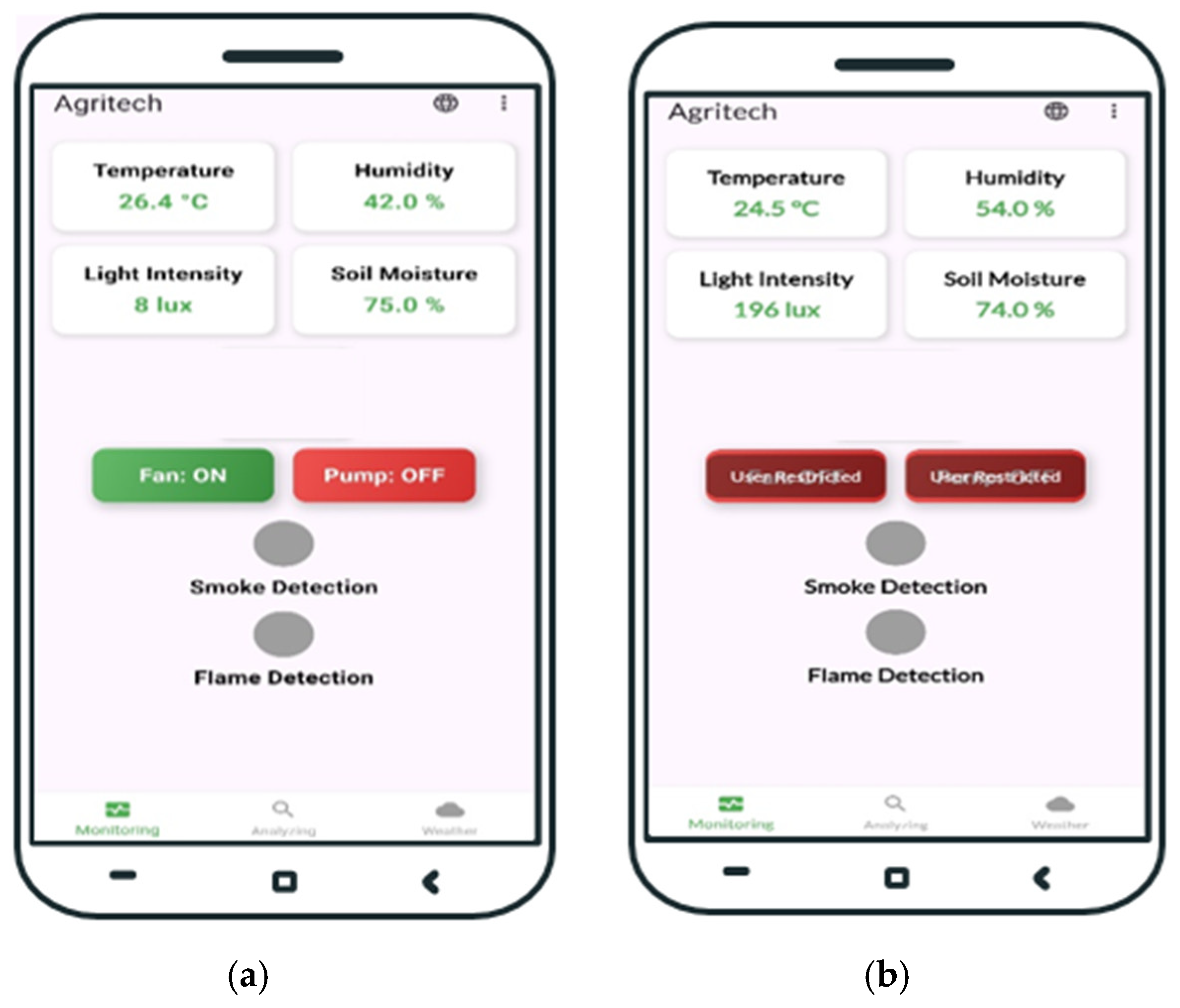
Figure 15. Sample pages from IoT-based plant environment management pages showcasing: (a) admin user page including access to fan and water pump control, and (b) standard user page in which these controls are restricted.
Agriengineering 08 00011 g015
Figure 16. Sample pages from the web platform showcasing (a) sensor reading and (b) flame detection warning.
Agriengineering 08 00011 g016
Table 2. Summary of sensors and actuators utilized for plant environment monitoring.
NameFunctionType
YL-69Soil MoistureSensor
DHT11Temperature & HumiditySensor
MQ-2Smoke & Gas DetectionSensor
Flame SensorFlame DetectionSensor
BH1750Light IntensitySensor
Water pumpIrrigation Actuator
FanVentilation Actuator
BuzzerFire alarmActuator
Table 3. Classification report of the test dataset for the plant disease classification task (MobileViT-XXSmall).
Plant Species_HealthPrec.Rec.F1-Score
1Apple___Apple_scab1.000.980.99
2Apple___Black_rot1.001.001.00
3Apple___Cedar_apple_rust1.001.001.00
4Apple___healthy0.990.990.99
5Blueberry___healthy1.001.001.00
6Cherry_(including_sour)___Powdery_mildew1.001.001.00
7Cherry_(including_sour)___healthy1.001.001.00
8Corn_(maize)___Cercospora_leaf_spot Gray_leaf_spot0.850.90.88
9Corn_(maize)___Common_rust_1.000.980.99
10Corn_(maize)___Northern_Leaf_Blight0.930.920.92
11Corn_(maize)___healthy1.001.001.00
12Grape___Black_rot0.991.001.00
13Grape___Esca_(Black_Measles)1.000.991.00
14Grape___Leaf_blight_(Isariopsis_Leaf_Spot)0.991.001.00
15Grape___healthy1.001.001.00
16Orange___Haunglongbing_(Citrus_greening)1.001.001.00
17Peach___Bacterial_spot1.001.001.00
18Peach___healthy1.001.001.00
19Pepper,_bell___Bacterial_spot1.001.001.00
20Pepper,_bell___healthy1.001.001.00
21Potato___Early_blight1.001.001.00
22Potato___Late_blight0.990.990.99
23Potato___healthy0.941.000.97
24Raspberry___healthy1.001.001.00
25Soybean___healthy1.001.001.00
26Squash___Powdery_mildew0.991.001.00
27Strawberry___Leaf_scorch1.000.991.00
28Strawberry___healthy1.001.001.00
29Tomato___Bacterial_spot0.990.990.99
30Tomato___Early_blight0.980.920.95
31Tomato___Late_blight0.980.980.98
32Tomato___Leaf_Mold1.001.001.00
33Tomato___Septoria_leaf_spot0.991.001.00
34Tomato___Spider_mites Two-spotted_spider_mite0.981.000.99
35Tomato___Target_Spot1.000.980.99
36Tomato___Tomato_Yellow_Leaf_Curl_Virus1.001.001.00
37Tomato___Tomato_mosaic_virus1.001.001.00
38Tomato___healthy0.991.001.00
Total0.990.990.99
Table 4. Plant disease detection results for several lightweight models (Plant Village dataset).
ModelParams.Acc. %Prec. %Rec. %AUC %
NasNetMobile5.3M93.1894.5492.3099.79
MobileNetV14.3M97.5097.7297.3699.85
MobileNetV23.5M96.0296.5295.6599.83
MobileNetV3-Small2.5M97.8898.0597.7899.92
MobileViT-XXSmall1.3M99.4499.3099.071.00
Table 5. Performance comparison for plant disease classification (Plant Village dataset).
ModelAccuracy
Shrimali 2021 [15]Customized77.3%
VGG93.6%
ResNet15287.3%
MobileNetV295.7%
Borhani et al. 2022 [19]Convolution-based model90.0%
Transformer-based model95.0%
Hybrid model93.0%
Garg et al. 2023 [17]InceptionV387.2%
ResNet3495.4%
MobileNetV296.7%
ProposedMobileViT-XXSmall99.5%
Disclaimer/Publisher’s Note: The statements, opinions and data contained in all publications are solely those of the individual author(s) and contributor(s) and not of MDPI and/or the editor(s). MDPI and/or the editor(s) disclaim responsibility for any injury to people or property resulting from any ideas, methods, instructions or products referred to in the content.