Article

Assessment of Spectral Indices for Detecting Rice Phenological Stages Using Long-Term In Situ Hyperspectral Observations and Sentinel-2 Data


1
Graduate School of Science and Technology, University of Tsukuba, 1-1-1 Tennodai, Tsukuba 305-8572, Ibaraki, Japan
2
Department of Agricultural Extension (DAE), Ministry of Agriculture, Dhaka 1000, Bangladesh
3
Institute for Agro-Environmental Sciences, National Agriculture and Food Research Organization (NARO), 3-1-3 Kannondai, Tsukuba 305-8604, Ibaraki, Japan
4
Institute of Life and Environmental Sciences, University of Tsukuba, 1-1-1 Tennodai, Tsukuba 305-8572, Ibaraki, Japan
*
Author to whom correspondence should be addressed.
AgriEngineering 2026, 8(1), 14; https://doi.org/10.3390/agriengineering8010014 (registering DOI)

Submission received: 23 October 2025 / Revised: 20 November 2025 / Accepted: 17 December 2025 / Published: 1 January 2026

Abstract

Efficient and reliable estimation of rice phenological stages is crucial for improving yield prediction, optimizing irrigation, and guiding fertilization management. Spectral indices (SIs) derived from remote sensing have demonstrated strong potential for phenology detection. However, the suitability of specific spectral indices (SIs) for individual growth stages remains unclear due to data limitations. This study addresses this gap using a 7-year (2019–2025) daily in situ hyperspectral dataset that includes shortwave infrared (SWIR) bands. We evaluated various SIs to determine their effectiveness in identifying key phenological stages. The results demonstrate that no single index captures the entire cycle; instead, a multi-index approach is required. The SWIR-based Normalized Difference Vegetation Index (SNDVI) proved superior for detecting irrigation, transplanting, and flowering. The Green–Red Vegetation Index (GRVI) effectively tracked tillering and heading, while the Normalized Difference Vegetation Index (NDVI) and Hue identified the maximum tillering stage. For the ripening phase, the Normalized Difference Yellowness Index (NDYI) exhibited the highest accuracy in detecting maturity. Validation against Sentinel-2 simulations revealed strong correlations ( R 2 > 0.81 ) for greenness-related indices (NDVI, GRVI, SNDVI, EVI), whereas colorimetric indices showed weaker agreement. These findings establish a robust, multi-index framework for high-frequency rice phenology monitoring.

1. Introduction

Rice (Oryza sativa L.) is a major staple crop worldwide, with approximately 90% of its cultivation area located in Asia [1]. Rice phenology refers to the sequence of developmental changes that occur in the rice plant, beginning from the time of planting and continuing through to the harvest stage [2]. It is typically divided into three main phases: the vegetative phase (germination to panicle initiation), the reproductive phase (panicle initiation to flowering), and the ripening phase (grain filling to maturity) [3]. Within these phenological phases, several are critical for precision farming management, such as the tillering and maximum tillering stages, which directly influence yield, and the panicle initiation (PI) stage, which is essential for grain formation and maturity [4]. Irrigation scheduling is particularly important during the rice growth period, especially in the maximum tillering stage [5]. Proper management of each stage has a significant impact on subsequent stages; for example, effective irrigation and nutrient management during the PI stage can greatly influence the success of the heading stage. Moreover, knowing the maturity date is essential, as delayed harvesting can reduce both rice yield and milling quality [3]. Collectively, these studies demonstrate that accurately monitoring rice phenological stages is essential for improving farming practices, predicting yields, and assessing the impacts of climate change [6,7].
There are two widely recognized approaches for detecting rice phenology. The first involves ground-based or near-surface monitoring, including visual observations and the use of unmanned aerial vehicles (UAVs). While this method provides high-resolution data, it is often time-consuming, labor-intensive, costly, and not easily repeatable [8,9]. In contrast, satellite remote sensing offers a valuable alternative by delivering consistent, large-scale observations suitable for regional to global monitoring of crop phenology. This approach offers clear advantages in terms of scalability, cost-efficiency, and temporal frequency [10,11,12]. Among remote sensing-based methods, the most widely adopted rely on spectral indices derived from optical satellite data [13]. These index-based approaches enable the detection of distinctive temporal and spatial signatures of rice paddies, which result from variations in cropping calendars and agricultural management practices [14].
However, applying these remote sensing methods to rice presents spatial challenges. Most paddy rice around the world is cultivated in small, fragmented fields, presenting a significant obstacle for moderate-resolution satellite sensors such as Landsat, MODIS (Moderate Resolution Imaging Spectroradiometer), and AVHRR (Advanced Very High Resolution Radiometer). Due to their coarse spatial resolutions (ranging from 30 to 1000 m), these sensors often fail to capture the fine-scale spatial variability typical of rice-growing regions [15,16]. In contrast, Sentinel-2 offers substantial advantages for rice phenology monitoring, providing high spatial resolution (10-m) imagery with a revisit frequency of 5–6 days [17,18]. Because of these capabilities, Sentinel-2 is increasingly favored for monitoring fragmented agricultural landscapes.
Over the past few decades, many spectral indices (SIs), including vegetation indices (VIs), have been developed to exploit such satellite data. Commonly used VIs such as the Normalized Difference Vegetation Index (NDVI), Enhanced Vegetation Index (EVI), and Green-Red Vegetation Index (GRVI) have been frequently employed to monitor vegetation dynamics [19,20]. While several studies have utilized spectral indices to detect the phenological stages of rice [21,22], most have relied solely on either satellite data or short-term in situ observations. These approaches often lack long-term, continuous datasets, which is a critical limitation. Detecting rice phenology dates accurately requires high-frequency observations, as key phenological transitions can occur within a span of just a few days [23], and satellite acquisitions are frequently disrupted by cloud cover. Moreover, existing research has primarily focused on spectral indices derived from shorter wavelengths (visible and near-infrared). The potential of longer wavelength bands—especially the shortwave infrared (SWIR), which is sensitive to canopy water content and structure—remains underexplored. Based on the physical properties of rice canopies, we hypothesized that the SWIR-based Normalized Difference Vegetation Index (SNDVI) would achieve greater separability for the transplanting and flowering stages compared to traditional greenness indices (NDVI/EVI). To test this hypothesis and address the data limitations, this study evaluates the suitability of a diverse set of spectral indices spanning both short and long wavelength regions. We utilized Sentinel-2 spectral response functions (SRFs) to simulate spectral indices from long-term (2019–2025) continuous in situ hyperspectral data collected using an automated hemispherical spectroradiometer (HSSR) system. This work represents the first systematic assessment of multi-domain spectral indices for high-resolution monitoring of rice phenology using continuous hyperspectral reflectance data.

2. Materials and Methods

2.1. Study Area

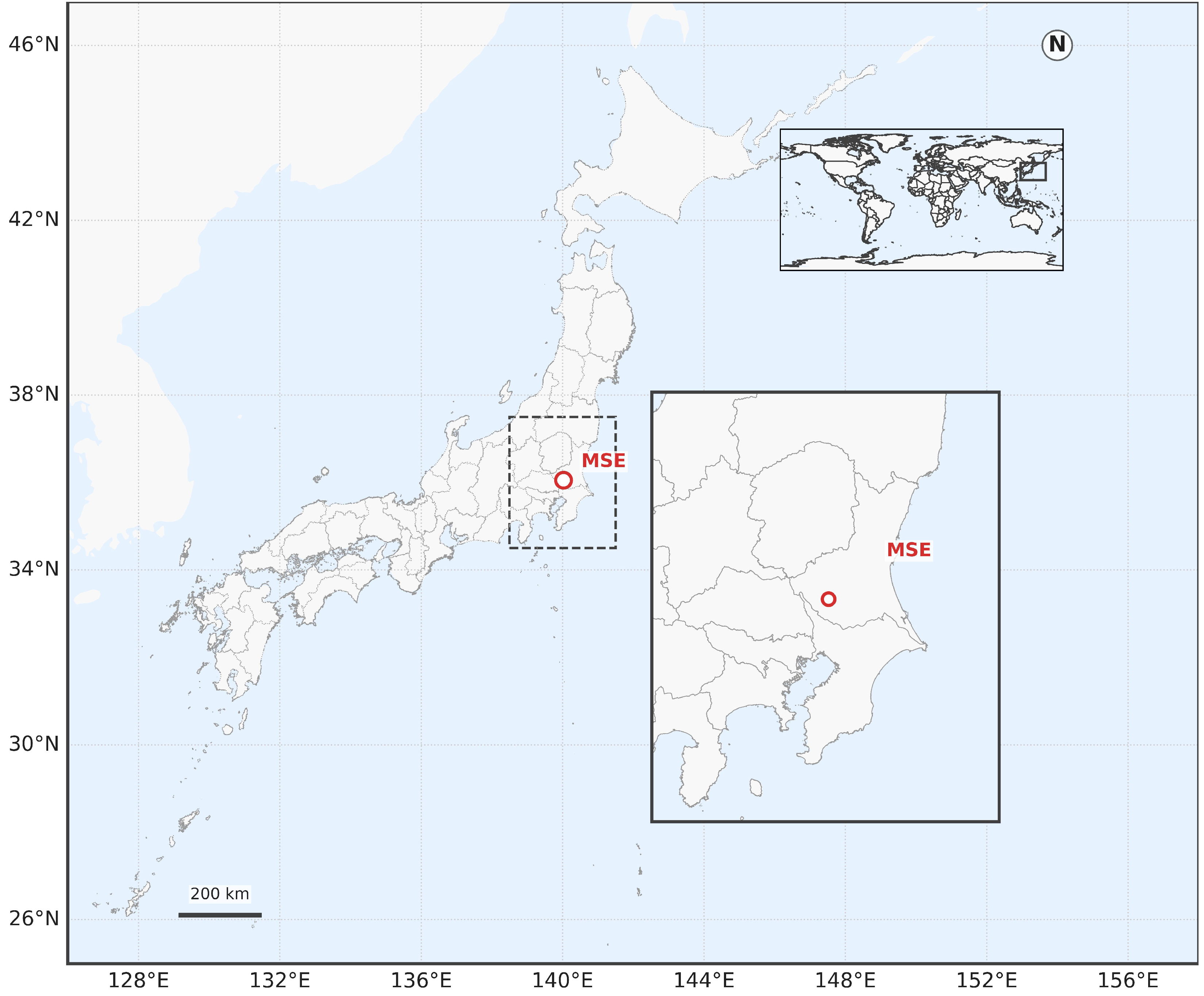
This study analyzes data collected from 2019 to 2025 at the Mase Rice Paddy (MSE), Japan (36°03′14″ N, 140°01′37″ E; elevation 13 m above sea level) (see Figure 1). The MSE site has been under continuous agricultural management for decades and serves as a long-term monitoring station. It is situated in the back marsh of the Kokai River and is characterized by a temperate oceanic climate (Cfb) according to the Köppen–Geiger classification. The field is cultivated with Oryza sativa L. (cultivar: Koshihikari) under a traditional single-cropping system. MSE is part of AsiaFlux [24], the Phenological Eyes Network (PEN) [25,26], and the Japan Long-Term Ecological Research Network (JaLTER) [27]. Rice seedlings were transplanted by machine in early May (typically around 3 May). This corresponds to Day of Year (DOY) 123, where DOY represents the sequential day count starting from 1 January. Transplanting was done with approximately 30 cm intervals, following field preparation that included plowing and flooding. Irrigation began in late April, and mid-season drainage was carried out between June and July. The heading stage occurred in late July, while harvest took place in mid-September. After harvesting, rice straw was left on the fields as ground cover. Finally, fields were plowed again in September following the harvest.

2.2. In Situ Data

Spectral irradiance data and canopy images were obtained automatically using the PEN system, which comprises hemispherical spectral radiometer (HSSR) and an automatic digital fisheye cameras (ADFC). Both instruments were installed on the observation tower at the MSE site.
The HSSR records incident light from the sky as well as light reflected from the vegetation canopy. Meanwhile, the ADFC captures hemispherical time-lapse images of the canopy and sky, enabling continuous monitoring of canopy structure and sky conditions. Such ground truth measurements have been applied in previous vegetation remote sensing research [20,28,29].

2.2.1. Hemi-Spherical Spectro-Radiometer (HSSR)

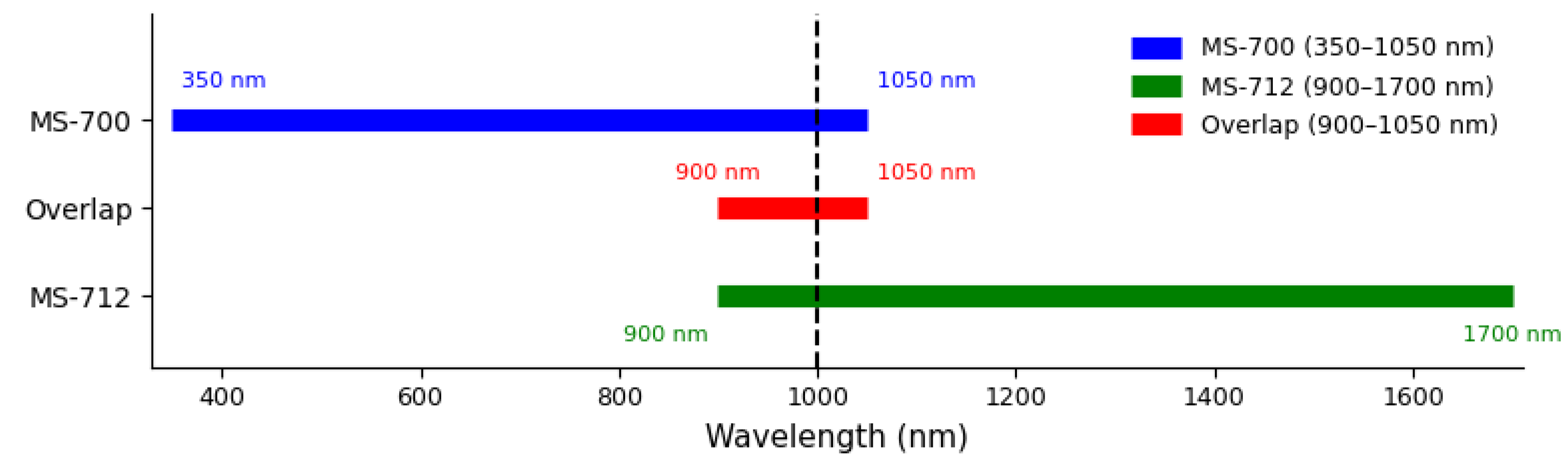
Hyperspectral radiometer data from the MS-700 and MS-712 models (EKO Instruments Co., Ltd., Tokyo, Japan) were utilized in this study. The MS-700 measures within the 350–1050 nm spectral range, with a wavelength spacing interval about 3.3 nm, whereas the MS-712 covers a longer wavelength range from 900–1700 nm at the same interval. Since both instruments overlap in the 900–1050 nm region, we selected data from the MS-700 up to 1000 nm and used measurements beyond this point from the MS-712 (see Figure 2).
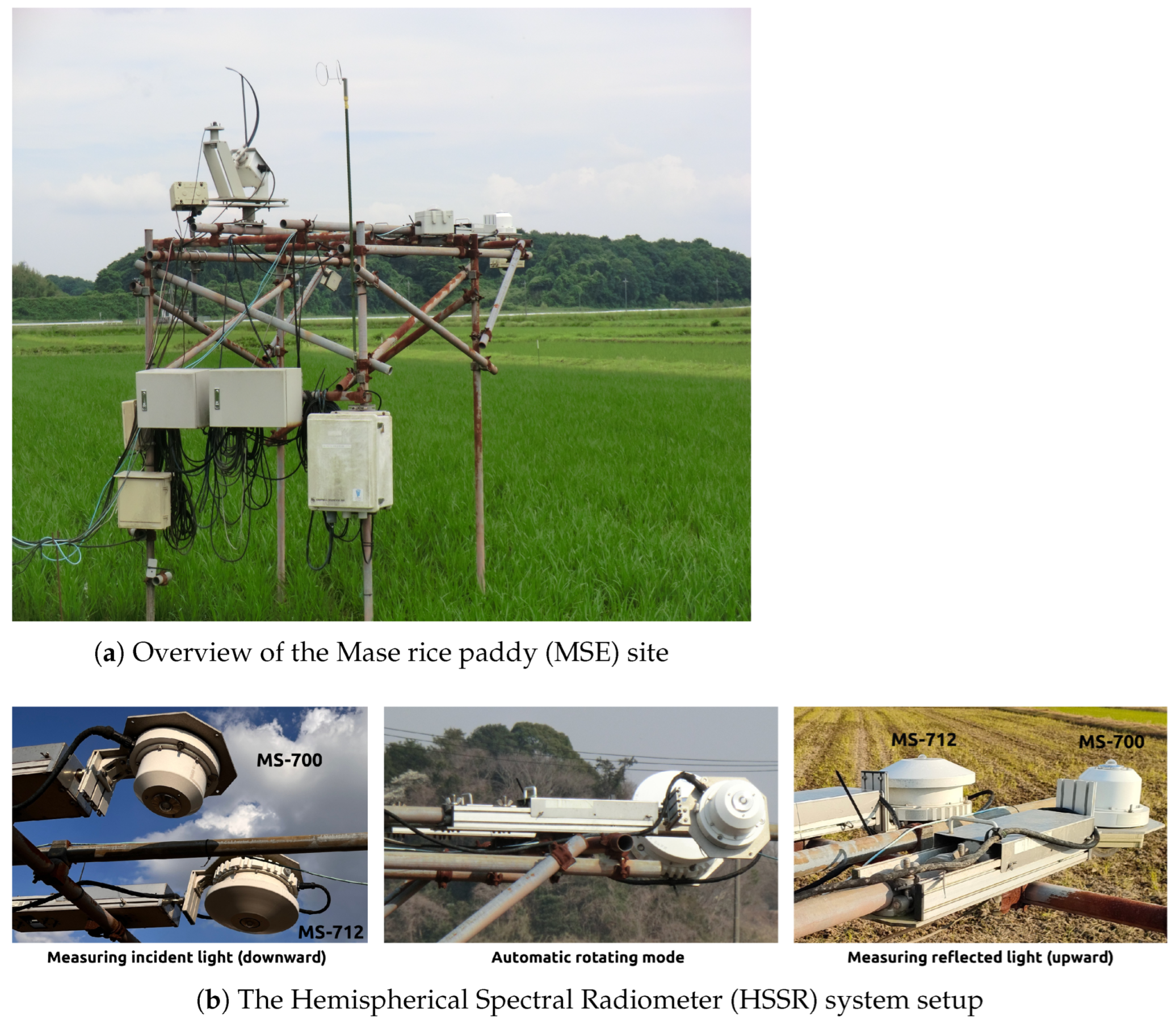
The full width at half maximum (FWHM) was 10 nm for the MS-700 and 7 nm for the MS-712, respectively [30]. Two hemispherical spectral radiometers (HSSRs) were mounted on top of the observation tower (Figure 3) and were alternately tilted upward and downward using an external motor (CHS-AR; Hayasaka Rikoh Co., Ltd., Hokkaido, Japan). Each radiometer repeatedly made measurements in 2 min intervals, with a 10 min cycle consisting of 4 times upward measurement and one time downward observation. It means, the upward measurement and the downward measurement are not simultaneous but has a temporal offset in between. To reduce the potential error due to this offset, the incident light corresponding to each reflected light measurement was estimated as the average of the incident light values recorded 2 min before and 2 min after the reflected light observation.

2.2.2. Automatic-Capturing Digital Fish-Eye Camera (ADFC)

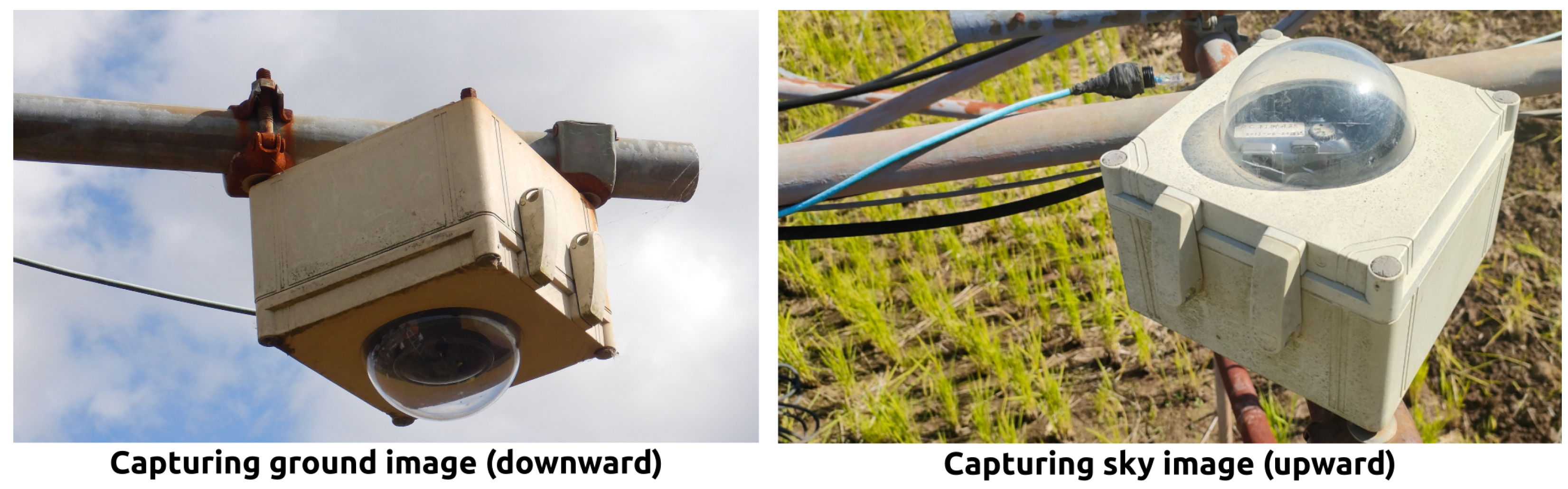
The Automatic Digital Fisheye Camera (ADFC) system is consisted of a digital camera (either the COOLPIX 4300 or COOLPIX 4500 model; Nikon Corp., Tokyo, Japan) equipped with a fisheye lens (FC-E8; Nikon Corp.) and enclosed within a waterproof housing (Figure 4). Two ADFC units were installed: a downward unit observed the ground (as well as rice canopy) with 30 min cycle, whereas an upward unit observed the sky with 5 min cycle. For the purposes of this study, we primarily analyzed images taken around local solar noon to ensure consistent lighting conditions.

2.2.3. In Situ Data Processing

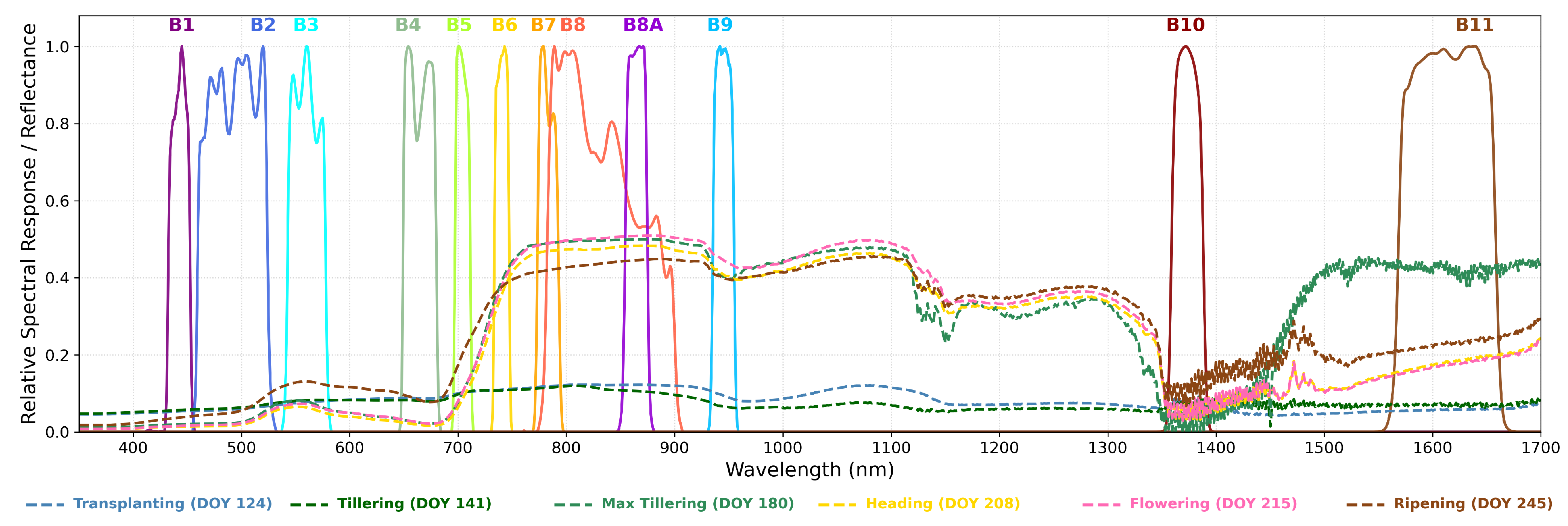
HSSR data were automatically recorded and transferred to the PEN server as daily text files between 05:02:00 and 20:00:00. Incident sky irradiance (upward-facing) was collected at 2-min intervals, while reflected ground irradiance (downward-facing) was recorded every 10 min. Initially, raw text files were converted to CSV format for processing. Subsequently, a temporal filter was applied to retain only measurements recorded between 09:00:00 and 14:58:00. This specific time window (approximately ±3 h from local solar noon) was selected to minimize variations in the Solar Zenith Angle (SZA). By restricting observations to periods of high solar altitude, the influence of changing illumination geometry and Bidirectional Reflectance Distribution Function (BRDF) effects was kept negligible relative to the seasonal phenological signal. Quality control procedures were further applied to remove outliers caused by rain, dense cloud cover, or instrumental errors (e.g., maintenance periods). Following these filters, the average annual data retention rate was approximately 68% (ranging from 258 to 365 days depending on the year), ensuring a sufficient density of clear-sky observations to accurately reconstruct daily growth curves. The native recording wavelength interval was approximately 3.3 nm for both HSSR units. To facilitate processing, a linear interpolation was applied to resample the data to 0.1 nm intervals. This interpolation was performed solely for numerical integration purposes and was not intended to artificially enhance spectral resolution, following protocols from previous studies [28,31]. Throughout the majority of the study period, spectral continuity in the overlap region (900–1000 nm) was consistent. A distinct radiometric offset at the 1000 nm junction was observed only in the 2024 dataset, corresponding to the sensor maintenance period described in Section 3.4. However, because the Sentinel-2 bands utilized in this study (specifically band 8 and band 11) are spectrally centered away from this junction, this narrow-band discontinuity was found to have a negligible impact on the aggregated band reflectance. Therefore, to preserve data integrity, no artificial correction factor was applied. All data processing steps were executed using custom Python 3.12.3 scripts. Finally, in situ spectral irradiance data were converted into weighted-average reflectance values simulating the spectral bands of Sentinel-2’s MultiSpectral Instrument (MSI) (see Table 1). The HSSR spectra were convolved with the Sentinel-2 spectral response functions (Figure 5) to compute the irradiance for each Sentinel-2 band. Band-specific reflectance was then obtained by dividing canopy irradiance by sky irradiance, as described in Equation (1) [31].
R B x = g ( λ ) SRF B x ( λ ) d λ f ( λ ) SRF B x ( λ ) d λ
Here, f ( λ ) is incident spectral irradiance from the sky, g ( λ ) is reflected spectral irradiance from the vegetation canopy, and B x refers to the spectral band label (e.g., x = 1 , 2 , ; see Table 1). R B x is simulated reflectance, and SRF B x ( λ ) is the spectral response function of band B x . As previously noted, the incident spectral irradiance f ( λ ) is calculated as the average of the two measurements taken two minutes before and two minutes after each reflected-light observation.

2.3. Satellite Data

2.3.1. Satellite Data Acquisition

This study utilized Sentinel-2 MSI Level-2A surface reflectance data at spatial resolutions of 10 m and 20 m (see Table 1). Instead of processing raw Sentinel-2 imagery directly, we derived mean spectral reflectance values over the target rice paddy field (4311 m2) using Google Earth Engine (GEE) for the period 2019–2025. To ensure data reliability, only high-quality pixels were included in the analysis, selected based on the QA60 cloud mask, cloud pixel percentage, and cloud probability bands.
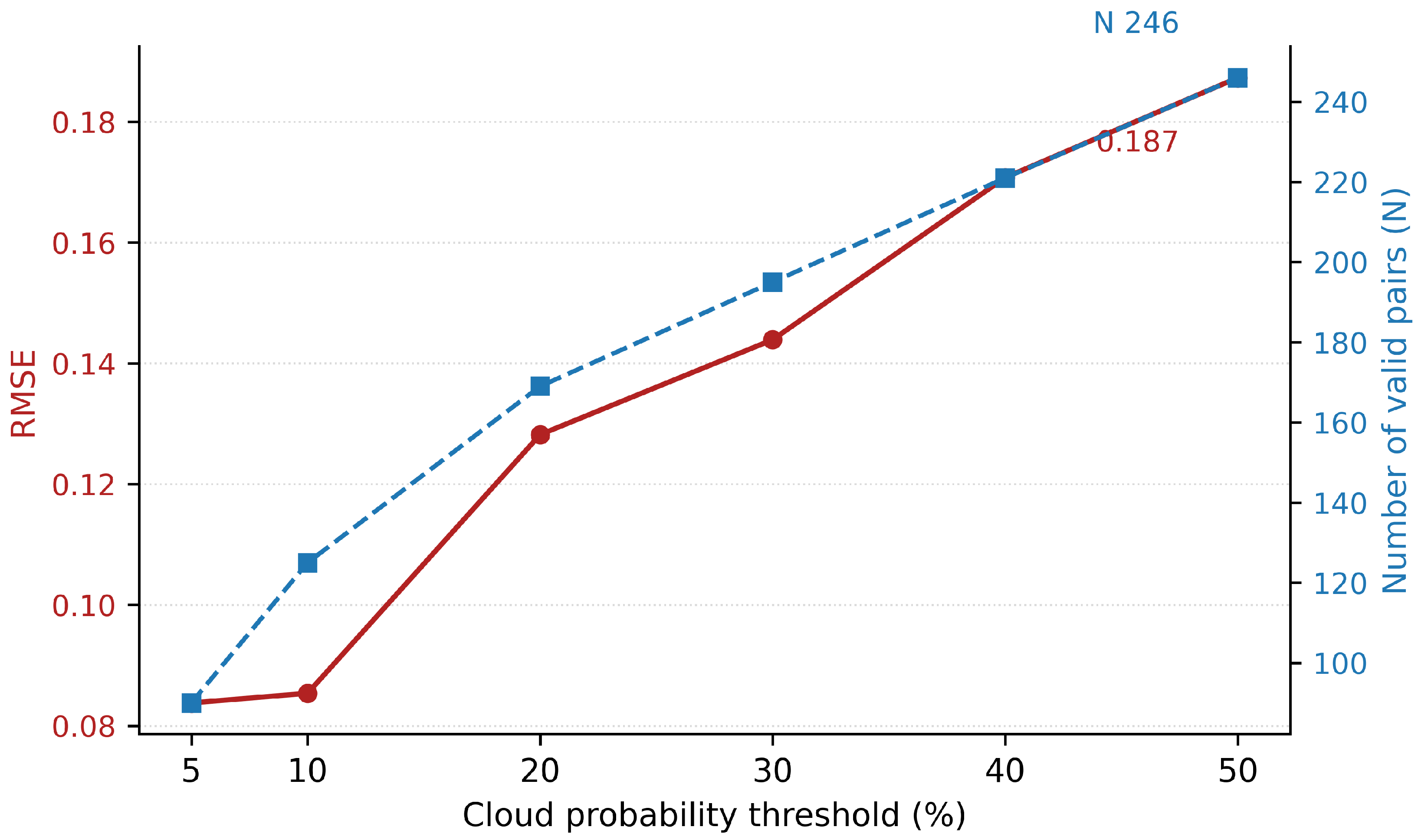
To determine the optimal cloud masking threshold, a sensitivity analysis was conducted evaluating probability thresholds from 5% to 50%. Results indicated a non-linear trade-off between data quality and temporal availability (Figure 6). Thresholds of 5% and 10% maintained a low RMSE (≈0.085) but restricted the sample size to N = 125 . Loosening the threshold to 20% increased the number of valid pairs to N = 169 (a 35% increase in data density). Although this introduced moderate atmospheric noise (increasing RMSE to 0.128), the gain in temporal coverage was deemed critical for reconstructing the phenological trajectory. Extending the threshold further to 30% yielded diminishing returns: it added only 26 observations but caused a further degradation in correlation (r dropped to 0.85) and RMSE (increased to 0.144), indicating substantial cloud contamination. Consequently, the 20% threshold was selected as the optimal balance point.

2.3.2. Calculation of Spectral Indices (SIs)

From the simulated reflectance of each Sentinel-2/MSI band, SIs (NDVI, SNDVI, GRVI, Hue, EVI and NDYI) were calculated. Each spectral index was computed using Equations (2)–(10), as shown below [32,33,34,35,36,37,38,39,40].
NDVI ( Normalized Difference Vegetation Index ) = R B 8 R B 4 R B 8 + R B 4
SNDVI ( Short Wave Infrared based NDVI ) = R B 11 + R B 8 R B 4 R B 11 + R B 8 + R B 4
GRVI ( Green Red Vegetation Index ) = R B 3 R B 4 R B 3 + R B 4
EVI ( Enhanced Vegetation Index ) = 2.5 ( R B 8 R B 4 ) R B 8 + 6 R B 4 7.5 R B 2 + 1
NDYI ( Normalized Difference Yellowness Index ) = R B 3 R B 2 R B 3 + R B 2
LSWI ( Land Surface Water Index ) = R B 8 R B 11 R B 8 + R B 11
GNDVI ( Green Normalized Difference Vegetation Index ) = R B 8 R B 3 R B 8 + R B 3
SAVI ( Soil - Adjusted Vegetation Index ) = ( R B 8 R B 4 ) ( 1 + L ) R B 8 + R B 4 + L
NDRE ( Normalized Difference Red Edge Index ) = R B 8 R B 5 R B 8 + R B 5
In addition to commonly used spectral indices (SIs), this study also employed Hue, one of the components of the HSV (Hue–Saturation–Value) model. Hue quantifies the chromatic attribute of an object by capturing variations in color appearance, and it is typically expressed as an angle ranging from 0° to 360°. The HSV model is derived from the RGB (Red–Green–Blue) color space, making it particularly intuitive for analyzing visual characteristics in natural scenes. In this study, Hue was calculated using Equation (11), as shown below [28].
H = 0 , if M m = 0 , 60 × G B M m , if M = R , 60 × B R M m + 2 , if M = G , 60 × R G M m + 4 , if M = B .
Here, R, G, and B refer to the reflectance in the Red ( R B 4 ), Green ( R B 3 ), and Blue ( R B 2 ) bands, respectively. M is the maximum and m is the minimum of these values ( M = max ( R , G , B ) and m = min ( R , G , B ) ).

2.4. Statistical Analysis

To quantitatively evaluate the agreement between in situ and satellite-derived spectral indices, we constructed a matched dataset with strict temporal pairing. Sentinel-2 observations were matched with HSSR in situ measurements only when both were acquired on the exact same Day of Year (DOY). For days with valid satellite overpasses, the in situ measurement closest to the overpass time (approximately 10:30 AM local time) was selected to minimize solar angle discrepancies.
As summarized in Table 2, this pairing process constrained by the in situ time window (09:00–14:58) and the satellite cloud probability threshold (<20%) resulted in a final dataset of 169 valid observation pairs for the statistical comparison.
We employed standard metrics widely accepted in remote sensing validation to assess performance: the Pearson correlation coefficient (r), root mean square error (RMSE), and mean absolute error (MAE). These are defined as follows:
r = i = 1 n ( x i x ¯ ) ( y i y ¯ ) i = 1 n ( x i x ¯ ) 2 i = 1 n ( y i y ¯ ) 2
RMSE = 1 n i = 1 n ( x i y i ) 2
MAE = 1 n i = 1 n | x i y i |
where n is the sample size (169); x i and y i represent the i-th sample values of the Sentinel-2 and in situ indices, respectively; and x ¯ and y ¯ are their corresponding sample means.
In addition to these standard metrics, we incorporated advanced statistical methods to address the temporal structure of the data and evaluate systematic bias, as recommended for time-series validation. First, we calculated Lin’s Concordance Correlation Coefficient (CCC, ρ c ), which evaluates agreement by accounting for both correlation and deviation from the 1:1 line:
ρ c = 2 ρ σ x σ y σ x 2 + σ y 2 + ( μ x μ y ) 2
where μ x and μ y are the means, σ x 2 and σ y 2 are the variances of the Sentinel-2 and in situ datasets, and ρ is the Pearson correlation coefficient between them.
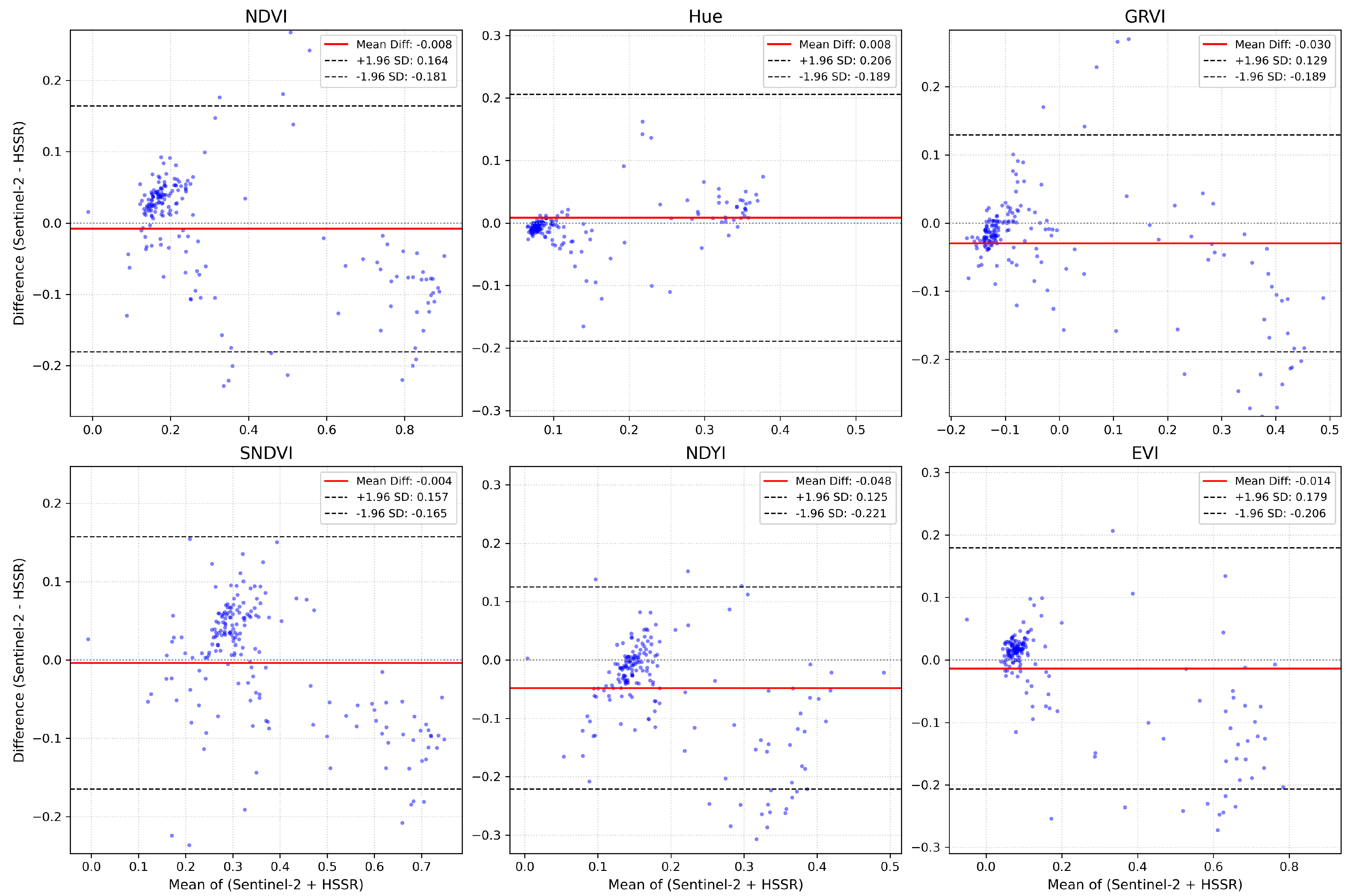
Second, to account for temporal autocorrelation, we computed 95% confidence intervals (CI) for the RMSE using a year-blocked bootstrap approach. In this method, the dataset was resampled 1000 times by selecting entire years with replacement, rather than individual data points. This preserves the seasonal structure of the error during resampling. Finally, a Bland–Altman analysis was performed to visualize systematic bias and determine the limits of agreement (LoA) between the two sensor platforms.

3. Results

3.1. Rice Paddy Phenology

The life cycle of a rice paddy is characterized by several distinct phenological stages. Table 3 summarizes the timing of these critical stages, recorded as the Day of Year (DOY) for the study period. While the dates for transplanting and heading were confirmed through direct field observations, the remaining phenological transitions were derived from an analysis of Automatic Digital Fisheye Camera (ADFC) data.

3.2. Spectral Profile of Rice Paddy

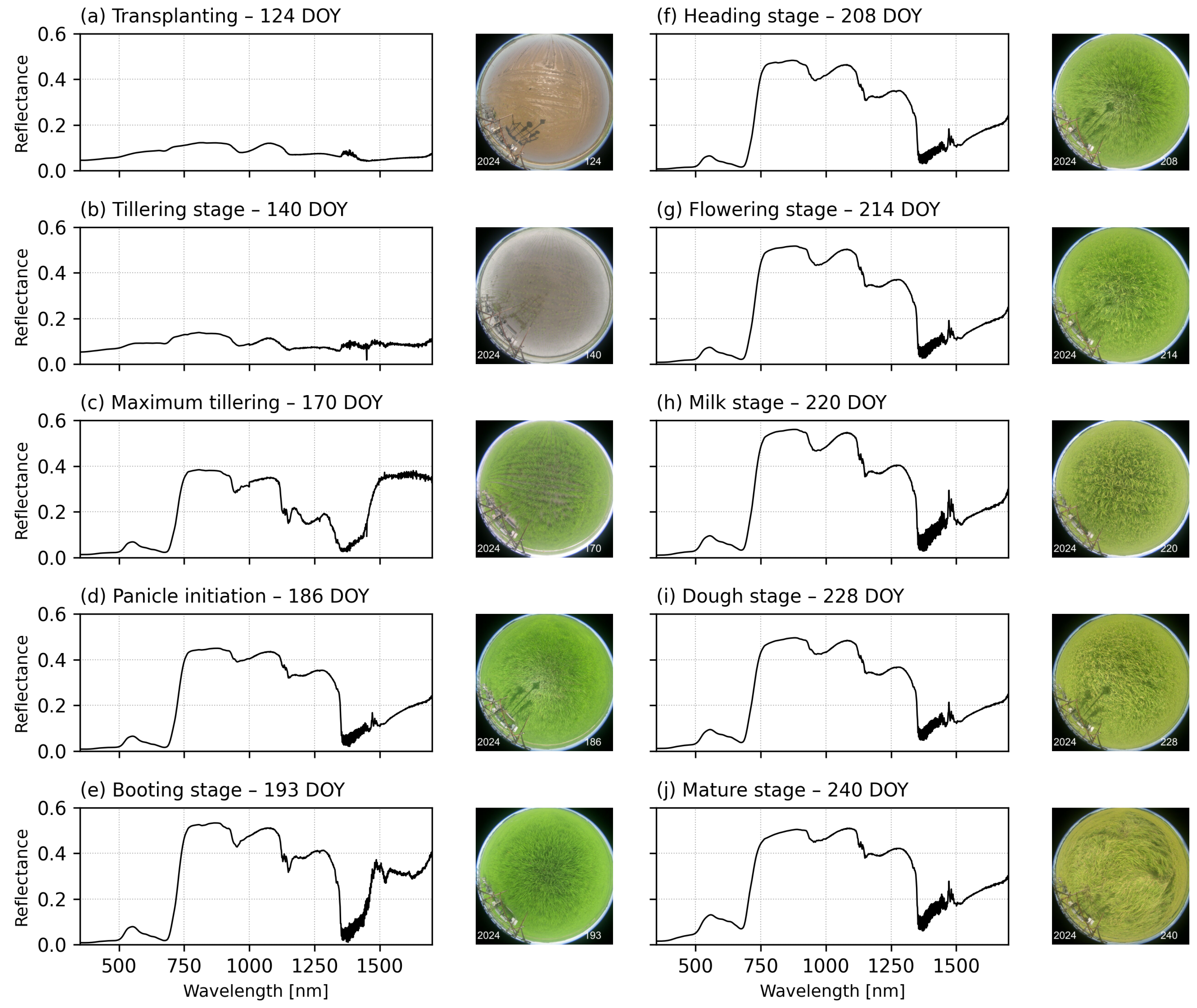
Figure 7 presents representative spectral reflectance profiles captured by the HSSR system in different phenological stages during the rice growth period. Various variations in both spectral band reflectance and vegetation indices were observed in correspondence with key growth phases, reflecting physiological changes throughout the crop calendar.

3.3. Relation of Spectral Indices (SIs) with Rice Paddy Phenology

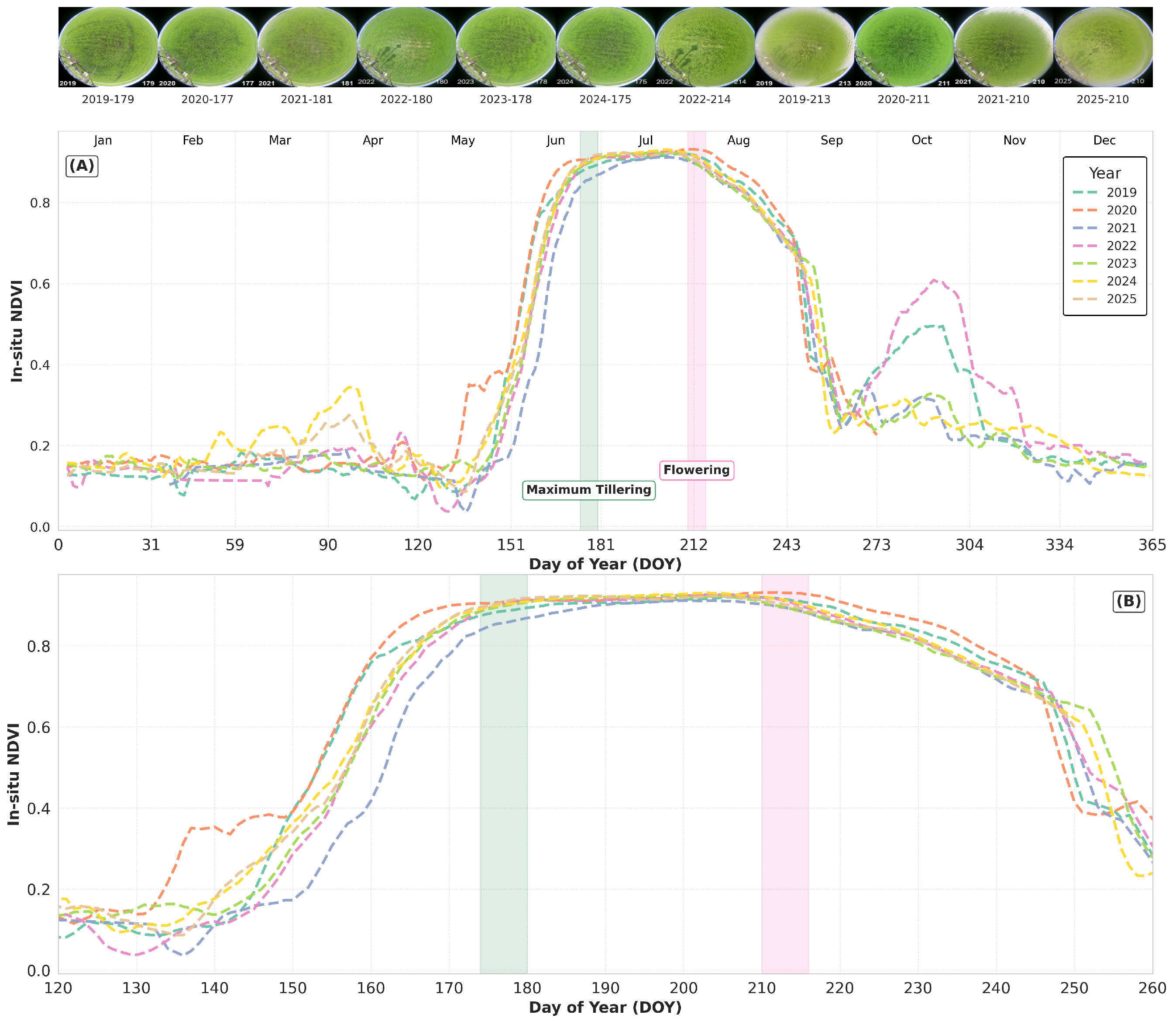
Multiple Spectral Indices (SIs) were evaluated to identify each phenological stage of rice; however, for brevity, only the best-performing indices are presented in the results. The NDVI time series effectively captured the rice paddy’s phenological cycle. As shown in Figure 8, NDVI values rose sharply from a baseline of approximately 0.15 during the vegetative growth phase, reaching a peak mean value of 0.92 between the maximum tillering (DOY 175) and flowering stages. Subsequently, values decreased to approximately 0.4 during the senescence phase.
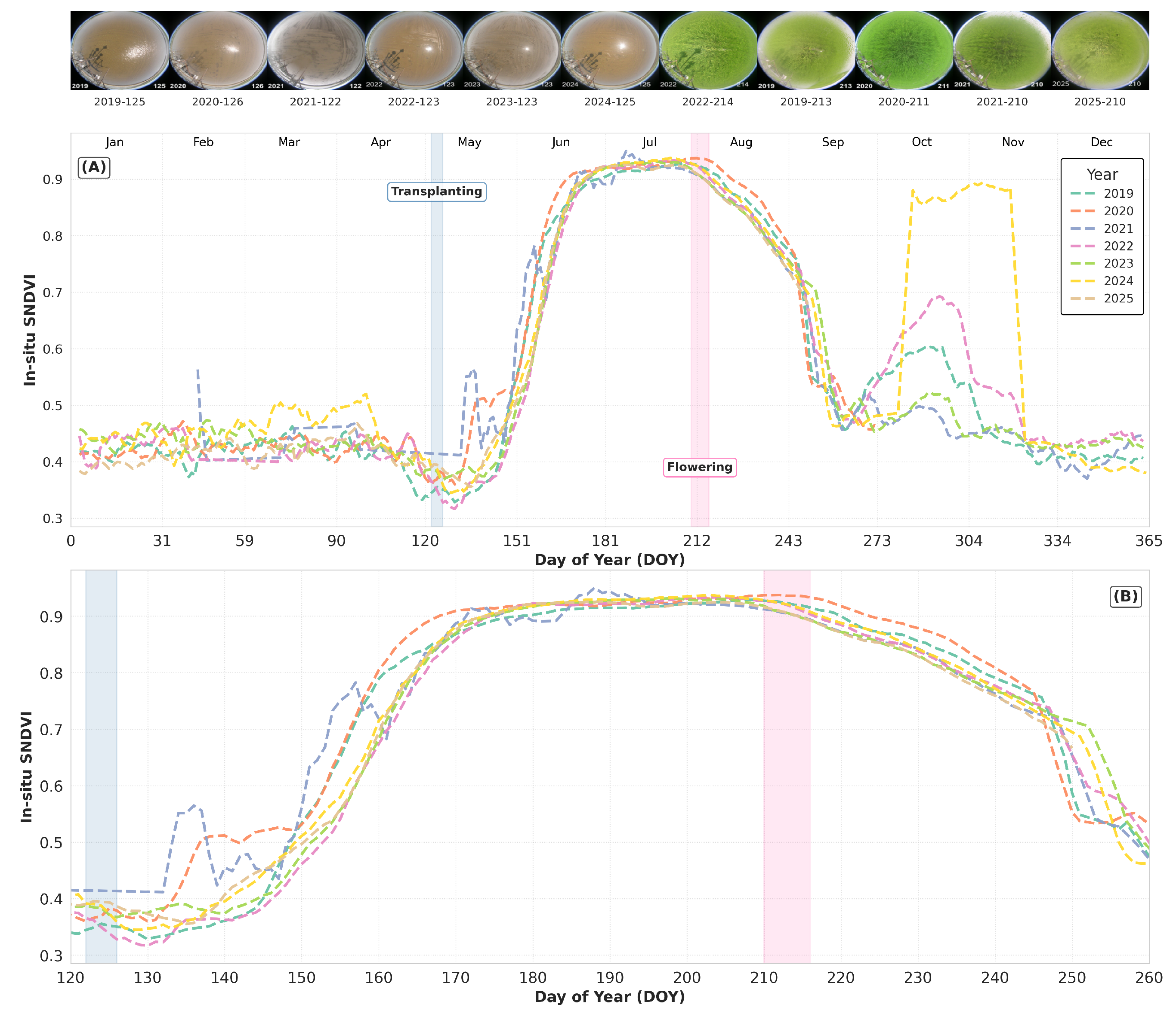
Among the tested indices, SNDVI exhibited the highest sensitivity to the transplanting and flowering stages (Figure 9). The SNDVI temporal profile is characterized by a pronounced minimum value of approximately ∼0.35 immediately following transplanting (DOY 123), followed by a rapid increase during the vegetative growth phase. The index reached a peak of ∼0.93, which closely corresponding to the flowering period.
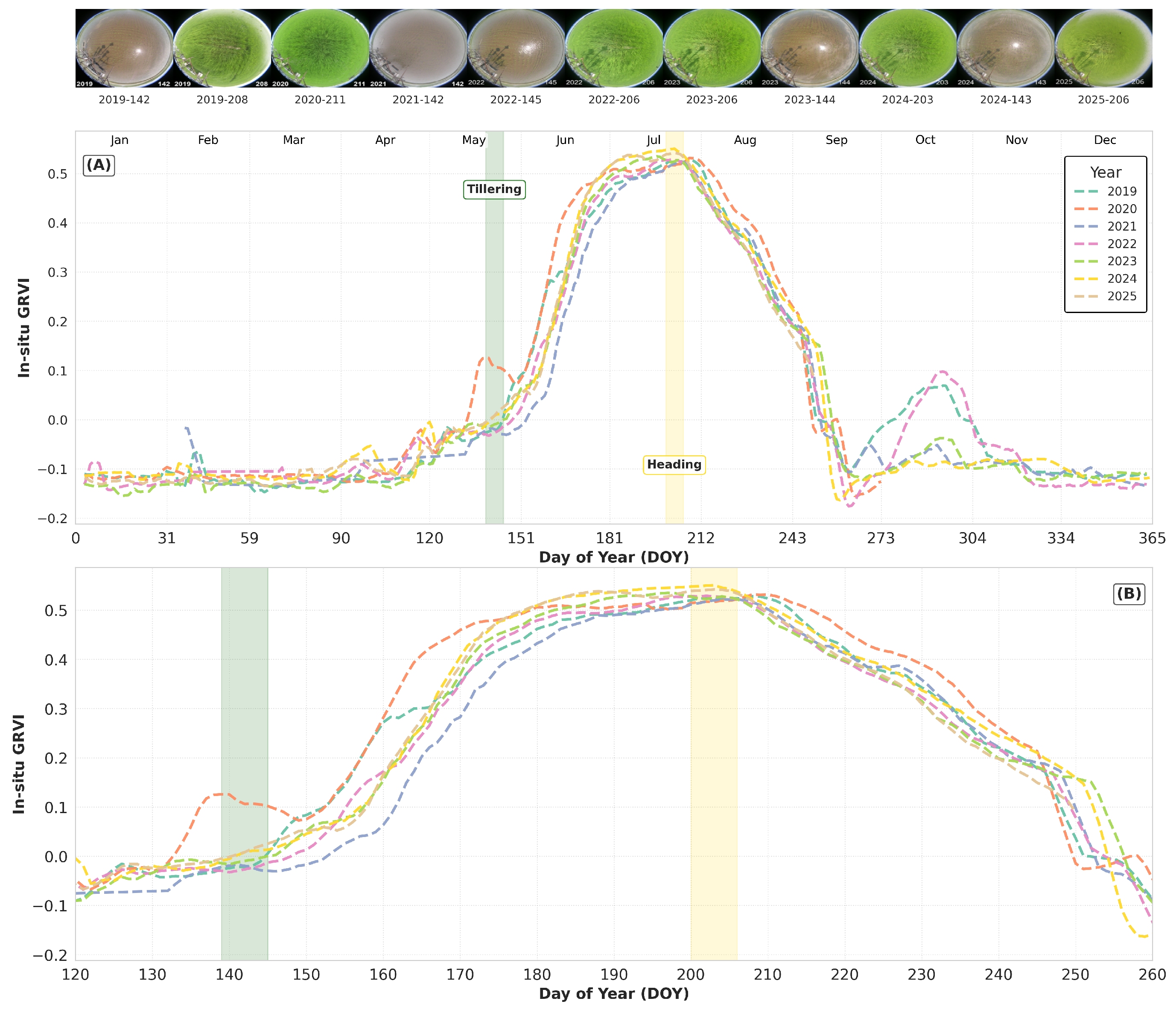
The unique behavior of the GRVI made it a strong indicator for the tillering and heading stages (Figure 10). The index crossed the zero-value threshold (transitioning from negative to positive) exactly coinciding with the start of tillering (∼DOY 140). Its seasonal maximum of approximately 0.54 aligned with the heading stage.
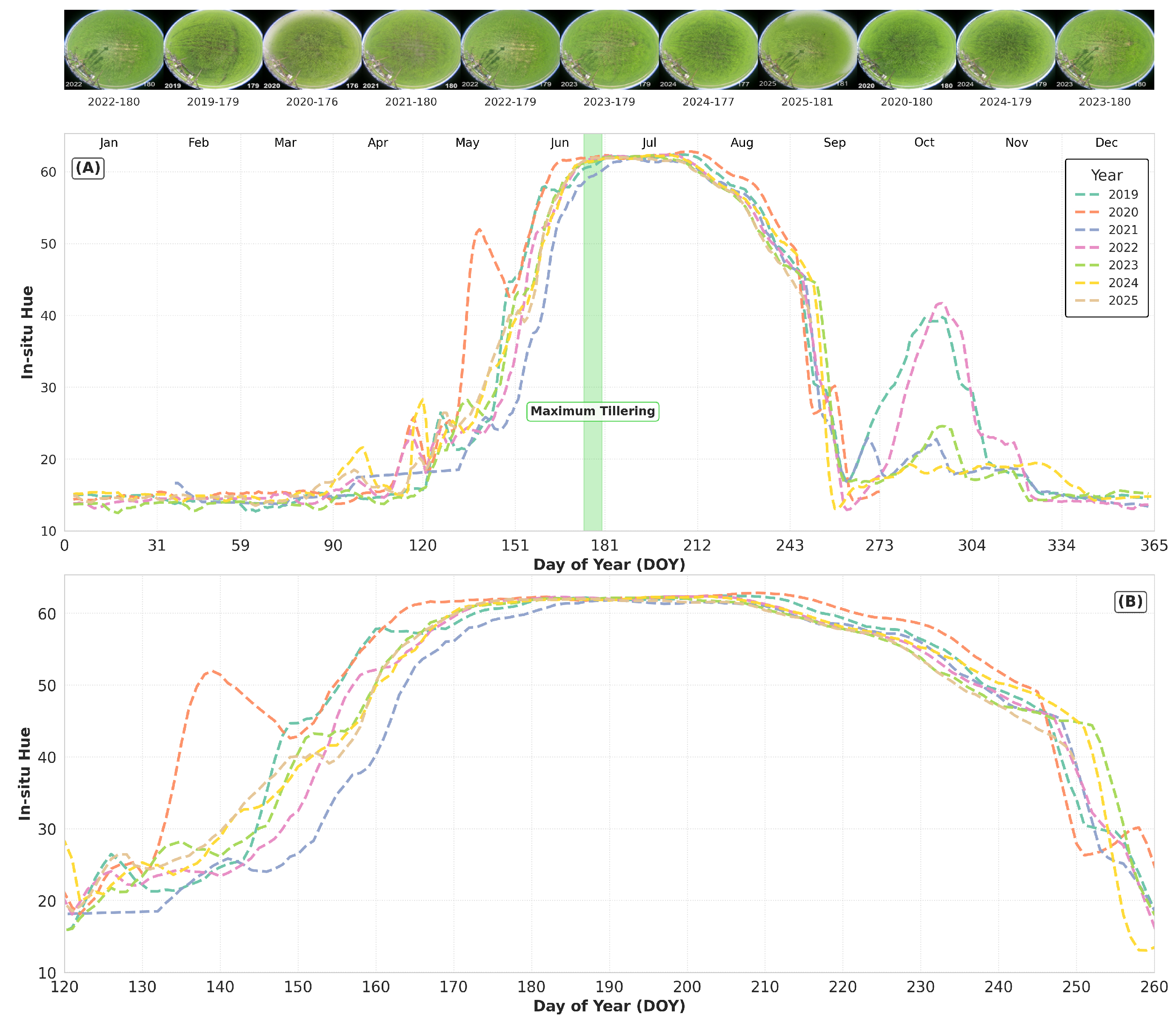
The Hue value effectively captured changes in rice canopy greenness throughout the growing season. As shown in Figure 11, Hue increased sharply from ∼20° during the vegetative growth phase and reached a stable plateau of approximately 62° starting around the maximum tillering stage. The value then gradually declined after the heading stage to ∼30° during senescence.
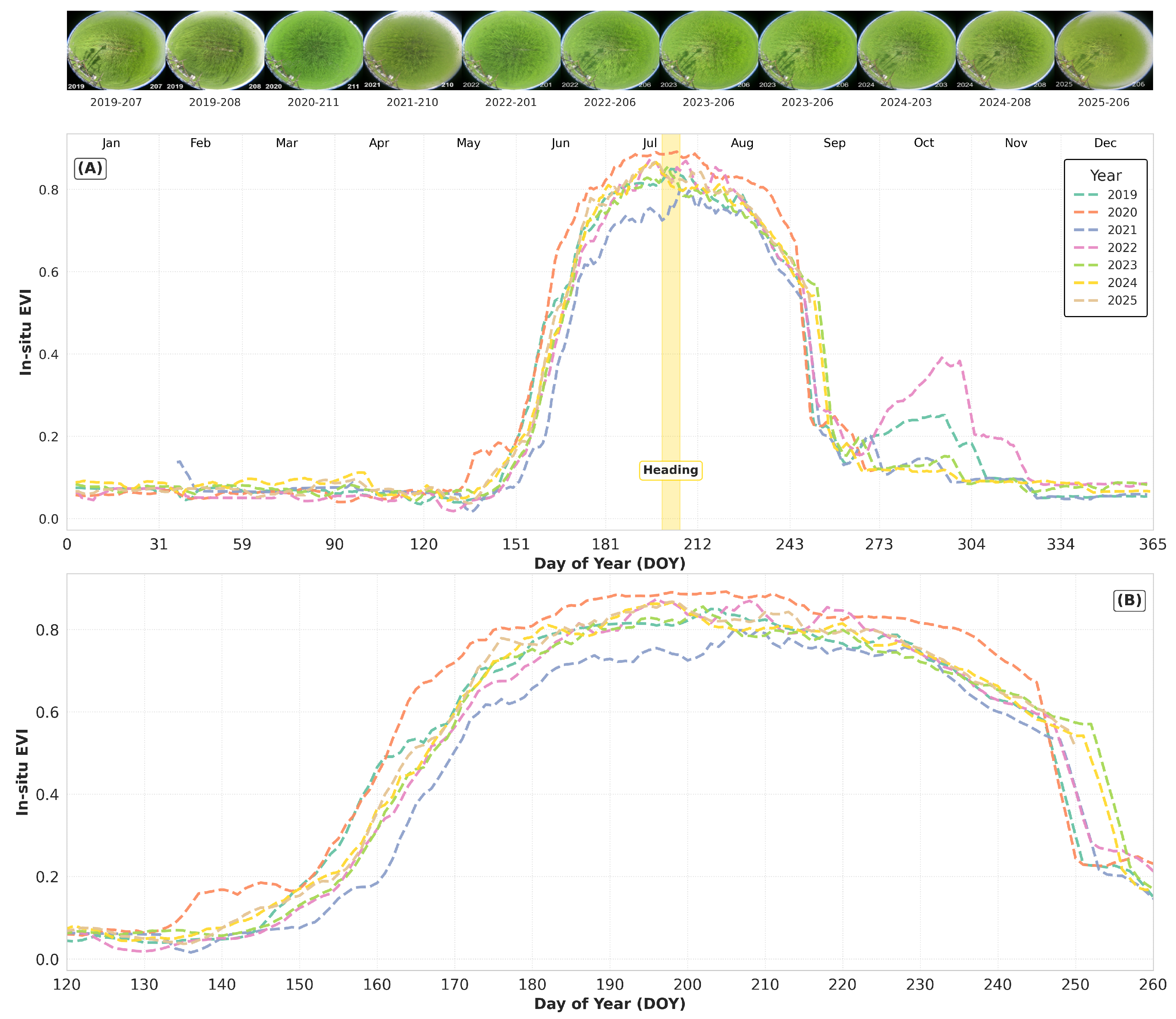
The seasonal trajectory of in situ HSSR-derived EVI is presented in Figure 12. The index was characterized by a rapid increase from 0.1 to a distinct peak of ∼0.85, corresponding with the heading stage, before entering a period of gradual decline. Consistent with other vegetation indices, EVI shows a rapid decrease to post-harvest values of <0.2.
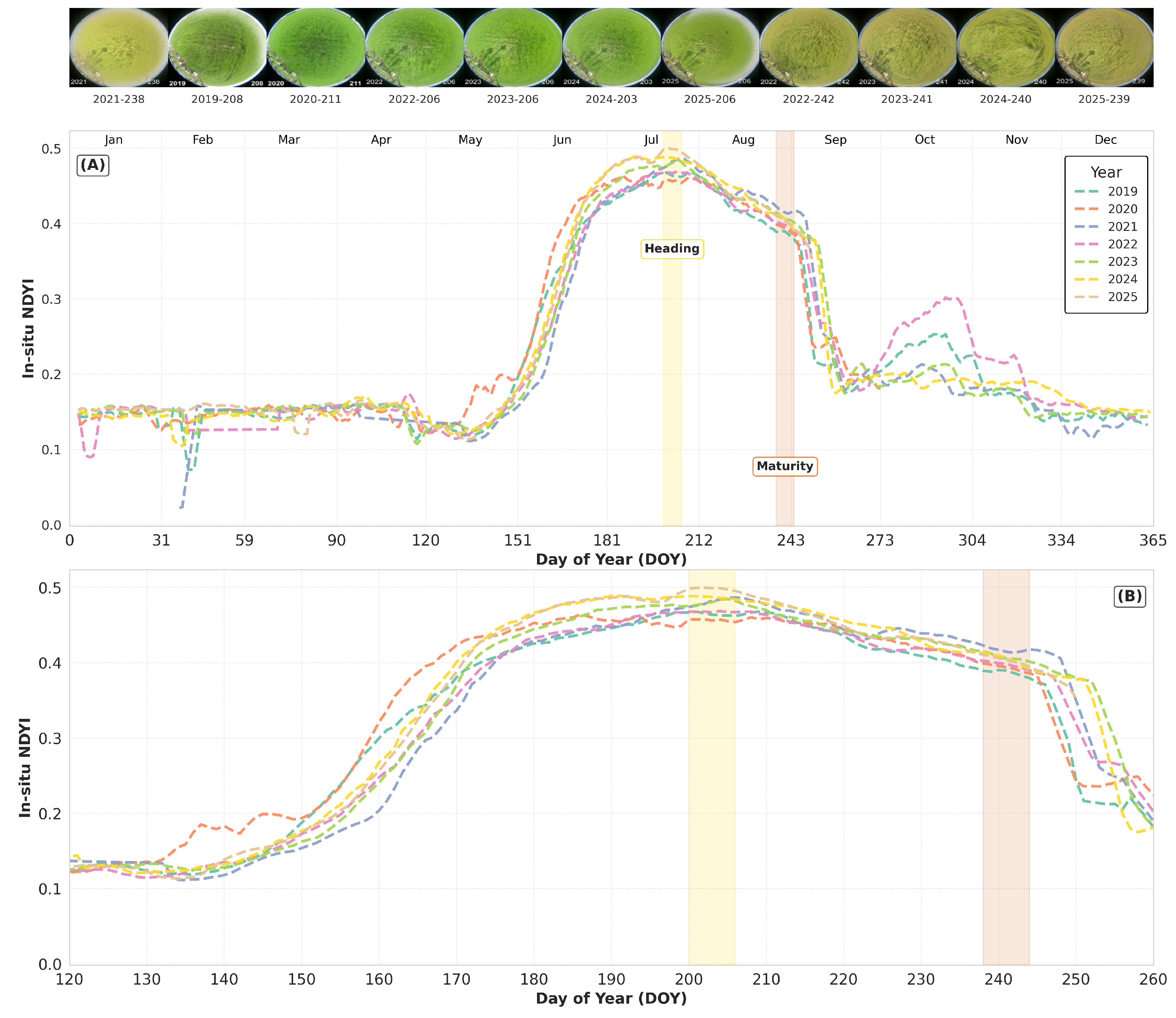
NDYI showed a distinct peak of ∼0.48 during the heading stage, after which it gradually declined (Figure 13). During the maturation stage, as the rice canopy fully yellowed, NDYI values stabilized around 0.40. A sharp drop in NDYI values occurred post-harvest.
All spectral indices (SIs) described in Section 2 were evaluated for their ability to capture rice phenological stages. To improve clarity and comply with manuscript length limitations, only those indices that yielded meaningful and representative results are presented in Section 3. The remaining results are provided in the Supplementary Materials.

3.4. Anomalous Events and Data Artifacts

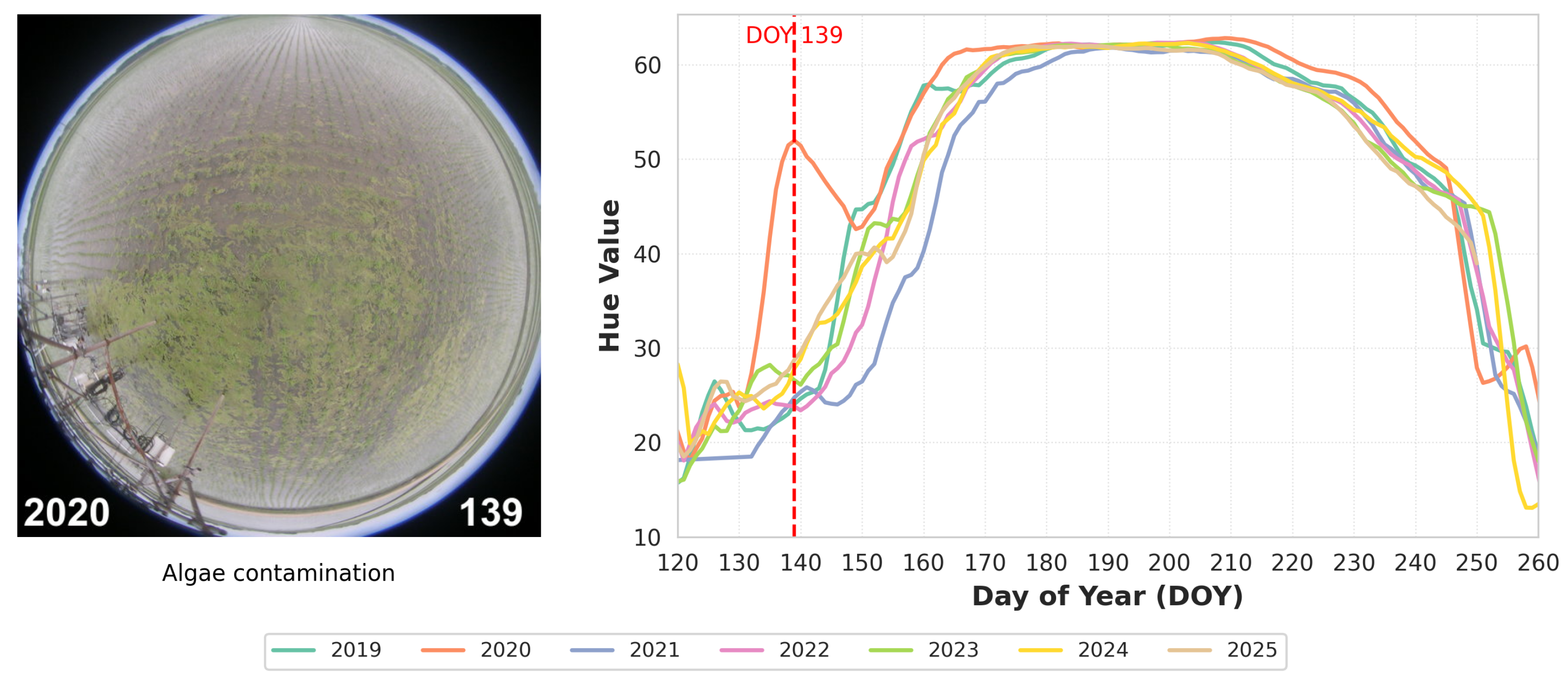
Continuous in-situ hyperspectral monitoring successfully detected non-crop biological events that significantly altered the spectral signal. First, an unusually large peak was observed on DOY 139 in the year 2020, deviating from the typical growth curve. This anomaly corresponds to a widespread algal bloom (Figure 14). The spectroradiometer detected the strong chlorophyll signal of the algae floating on the water surface, which caused a sharp rise in greenness-related indices (such as Hue and NDVI) prior to the actual rice canopy closure. Quantitatively, this event introduced noise to the 2020 dataset; excluding the algal bloom period (DOY 130–150) improved the coefficient of determination ( R 2 ) for the Hue index from 0.15 to 0.18, indicating that the biological interference degraded the correlation between sensor platforms.
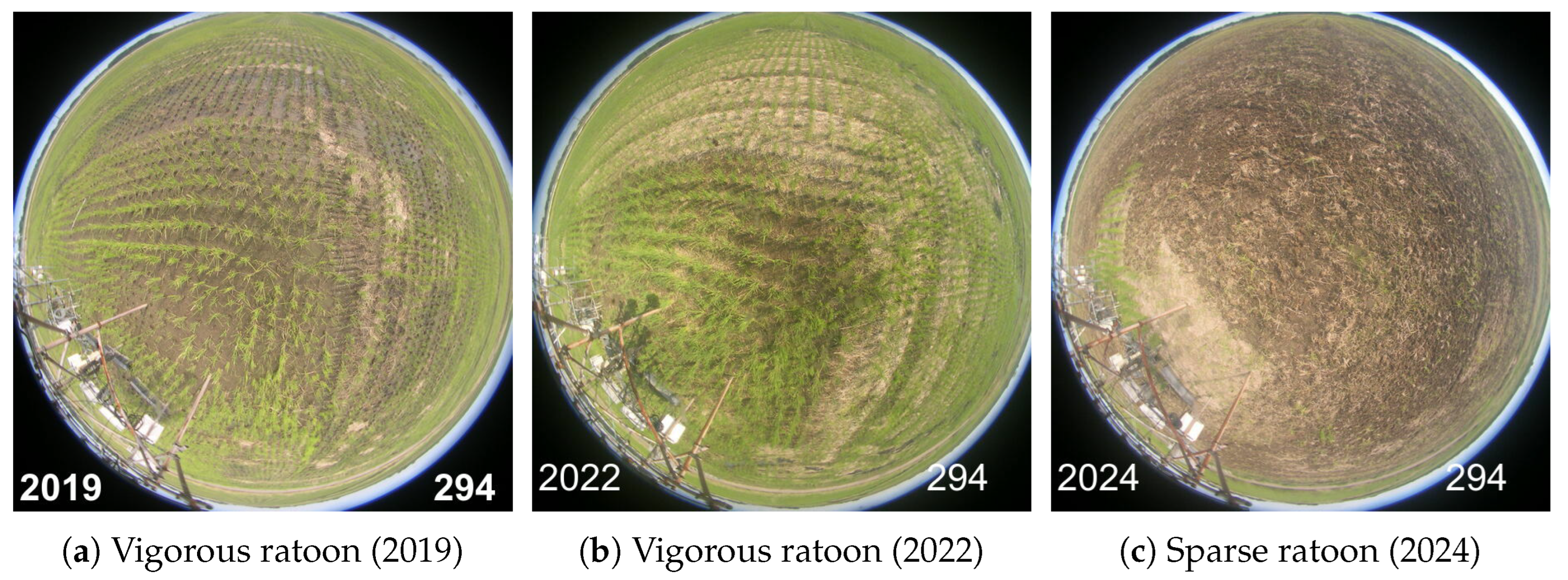
Second, a distinct secondary peak was detected in all spectral indices around DOY 294 in both 2019 and 2022. Spectroscopy identified a “re-greening” signal during the post-harvest period. Visual validation confirmed this was due to unusually vigorous ratoon growth (regrowth from rice stubble), which was absent in other years (Figure 15). These incidents demonstrate that high-frequency in situ spectroscopy is sensitive enough to detect unplanned biotic events, distinguishing them from standard crop phenology.
Finally, a data artifact was noted in the 2024 SNDVI series between DOY 280 and 320 (Figure 9). This was caused by the temporary removal of the MS-712 sensor for maintenance, resulting in missing SWIR1 band data required for the SNDVI calculation. This artifact impacted the linearity of the relationship for 2024; removing this specific maintenance window improved the SNDVI R 2 from 0.71 to 0.74, confirming that the missing data partially decoupled the satellite-to-ground agreement.

3.5. Stage-Specific Sensitivity of SIs

Our findings demonstrate that no single spectral index (SI) could reliably detect all phenological stages of paddy rice. However, a multi-index approach is highly effective, as different indices showed complementary strengths and sensitivity to specific growth stages (Table 4).

3.6. Comparison of SIs from In Situ and Sentinel-2 Data

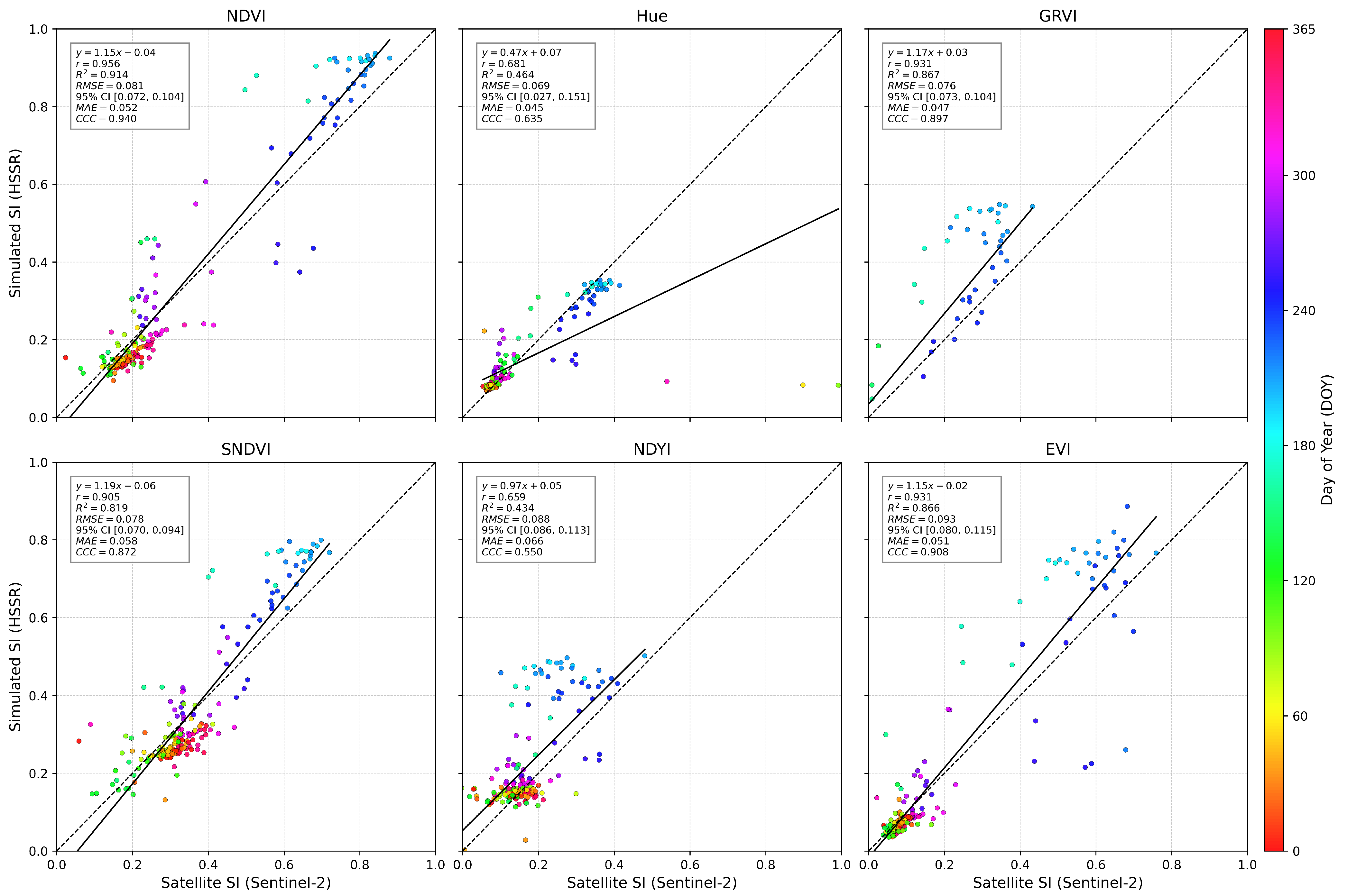
The spectral indices (SIs) derived from in-situ HSSR measurements were compared against those calculated from Sentinel-2 satellite observations. Figure 16 shows the relationships for six key indices: NDVI, SNDVI, GRVI, Hue, EVI, and NDYI.
To further evaluate the agreement structure and identify potential systematic biases, a Bland–Altman analysis was performed (Figure 17). The analysis revealed minimal systematic bias in the greenness indices (NDVI, SNDVI, EVI), with mean differences close to zero (−0.008, −0.004, and −0.014, respectively). Notably, SNDVI exhibited the narrowest Limits of Agreement (LoA), demonstrating stable performance across different phenological stages. In contrast, the color/pigment indices (NDYI, GRVI, Hue) showed a more pronounced negative bias, with Sentinel-2 slightly underestimating NDYI (−0.048) and GRVI (−0.030). The Hue index displayed a scale-dependent error, with discrepancies increasing as canopy color saturation varied. Overall, while random errors were present due to atmospheric and scale differences, the greenness and SWIR-based indices (NDVI, SNDVI) exhibited negligible systematic biases.

4. Discussion

4.1. Mechanisms of Spectral Response and Saturation

The temporal behavior of the spectral indices reveals clear differences in their sensitivity to rice canopy development. We observed that Hue and NDVI saturate around the maximum tillering stage (DOY 174–180). This saturation occurs because NDVI is sensitive primarily to chlorophyll absorption in the red band and scattering in the NIR. Once the rice canopy achieves closure (Leaf Area Index > 3 ), red light absorption maximizes, and further increases in biomass do not significantly alter the spectral ratio, leading to the observed plateau [20,38]. The Hue index began to saturate, reaching its highest values and remaining relatively stable until the onset of the flowering stage. This saturation reflects the stabilization of canopy color characteristics as rice plants attain full leaf expansion and peak chlorophyll concentration. Since Hue represents the dominant wavelength of reflected visible light, it is particularly sensitive to changes in canopy pigment composition especially chlorophyll, which strongly absorbs red and blue wavelengths while reflecting green light [38,41]. As the canopy becomes denser and more uniform during maximum tillering, spectral variability across the field decreases, resulting in a plateau in Hue values. This stage is typically associated with high photosynthetic activity and a uniform green canopy, conditions under which the Hue index tends to saturate. Together, the temporal dynamics of the Hue index and NDVI highlight their potential as complementary indicators for monitoring key phenological transitions in rice.
Our results specifically validate the hypothesis that SNDVI achieves greater separability for transplanting and flowering than standard vegetation indices. SNDVI maintained sensitivity across a wider range of phenological stages. During transplanting, when fields are inundated and vegetation is sparse, VNIR indices struggle to distinguish vegetation from the water background [37,42]. SNDVI, however, showed a distinct decline due to strong SWIR water absorption, enabling reliable detection of irrigation onset and transplanting (Figure 9). Its seasonal trajectory peaking near flowering and declining through senescence reflects its dual sensitivity to canopy structure and water content [43,44,45]. The observed pattern indicates that SNDVI is sensitive to both canopy structure and physiological changes, making it particularly effective for monitoring mid-to-late phenological stages in paddy rice.
Tillering begins approximately around DOY 140 to 145. The GRVI, based on reflectance differences between the green and red spectral bands, effectively captures vegetation dynamics throughout rice growth. During the transplanting and seedling establishment phases, paddy fields are inundated and sparsely vegetated, causing elevated red reflectance from soil and water backgrounds and resulting in negative or near-zero GRVI values [46]. As tillering starts, rapid leaf development and increasing chlorophyll content enhance green reflectance and reduce red reflectance, causing GRVI values to rise above zero [20]. GRVI generally peaks near the heading stage, when leaf area and the contrast between green and red reflectance are greatest. Chlorophyll concentration usually peaks slightly earlier, strengthening this spectral separation [47]. After harvest, declining vegetation cover and exposed soil or residue backgrounds increase red reflectance, returning GRVI to negative levels. Overall, GRVI effectively tracks rice canopy development and senescence, with clear potential for identifying key phenological stages such as tillering and heading (see Figure 10). Recent work also supports its utility; for example, a phenology-based index combining red, near-infrared, and shortwave-infrared bands successfully detected transitions from grain filling and harvest to tillering in ratoon rice [48].
During rice maturation, canopy reflectance shifts from green to yellow as senescence progresses. This transition results from chlorophyll degradation and carotenoid accumulation, which decrease red absorption and increase blue absorption, producing higher yellow reflectance. NDYI, which incorporates the blue band, is therefore highly sensitive to this senescence-driven yellowing. Although developed for rapeseed, NDYI has also been shown to effectively capture senescence dynamics in rice [49,50]. In this study, NDYI increased after tillering and peaked at heading—corresponding to maximum canopy greenness—then declined steadily to about 0.4 at harvest maturity (Figure 13). EVI showed a similar pattern, peaking at heading as well (Figure 12), reflecting full canopy development and high chlorophyll content. The simultaneous peaks in NDYI and EVI highlight heading as a critical phenological stage marking the shift from vegetative to reproductive growth.

4.2. Impact of Environmental and Biotic Factors

Paddy ecosystems are complex mixtures of water, soil, and vegetation. Our high-frequency monitoring revealed how these components interact with spectral signatures. During the transplanting phase (DOY 122–124), the signal is dominated by water. Indices relying solely on VNIR (e.g., NDVI) struggle here due to the low reflectance of turbid water [42]. In contrast, the strong absorption of SWIR wavelengths by water produces a characteristic decline in SNDVI, allowing it to reliably detect the onset of irrigation and transplanting. The 2020 algal bloom event (DOY 139) demonstrated that greenness does not always equal crop growth. Algae possess chlorophyll, mimicking the spectral signature of rice and causing premature spikes in NDVI and Hue (Figure 14). Quantitatively, excluding this anomaly improved the Hue index R 2 from 0.15 to 0.18, confirming that biotic interference degrades sensor agreement. This highlights a limitation of optical remote sensing without visual verification, aquatic weeds can lead to false phenological detections [51]. The re-greening observed in 2019 and 2022 (Figure 15) confirms that post-harvest ratoon growth can generate significant spectral signals. If not filtered, this regrowth can confuse automated algorithms attempting to define the end-of-season. Furthermore, crop residues (straw) left on the field increase SWIR reflectance. Multi-temporal filtering is required to distinguish between the senescence of the primary crop and the vigorous vegetative growth of the ratoon crop.

4.3. Sensitivity, Uncertainty, and Cross-Platform Agreement

The comparison between Sentinel-2 and in situ HSSR measurements (Figure 16) revealed that greenness-related indices (NDVI, SNDVI, EVI) achieved high agreement ( R 2 > 0.81 , C C C > 0.87 ), while colorimetric indices (Hue, NDYI) were less robust ( R 2 < 0.47 ). The Bland–Altman analysis further indicated that while NDVI and SNDVI exhibited negligible bias, Hue and NDYI showed systematic scale-dependent errors, likely due to the higher sensitivity of blue-band reflectance to atmospheric scattering in satellite imagery [52]. The robustness of these findings depends on data processing criteria. Our sensitivity analysis regarding cloud contamination revealed a critical trade-off. Tightening the cloud probability threshold to <10% marginally improved the RMSE of the satellite-to-ground comparison but resulted in a >40% loss of data availability during the critical Baiu (rainy) season. Similar trade-offs between cloud-screening rigor and temporal coverage have been reported in other agricultural monitoring studies [53]. The selected 20% threshold provided the optimal balance, maintaining the temporal continuity required to reconstruct growth curves. Additionally, resampling HSSR spectra to 0.1 nm resolution prior to convolution with Sentinel-2 spectral response functions followed recommended practice for minimizing discretization artefacts and ensuring accurate band integration [54]. Collectively, these considerations emphasize that the reliability of multi-platform phenology monitoring depends not only on the intrinsic spectral properties of the indices but also on rigorous atmospheric filtering, cloud screening criteria, and careful spectral harmonization procedures.

4.4. Practical Implications for Management

The phenology-specific behavior of the evaluated spectral indices offers clear operational guidance for implementing precision rice management. Our findings support a stage-resolved, multi-index strategy that aligns each index with the dominant physiological processes occurring throughout the season. At the start of the season, SNDVI provides the most reliable signal for detecting field flooding and transplanting, as its characteristic early-season decline consistently marks the transition into crop establishment. During the vegetative phase, GRVI performs particularly well, with its zero-crossing behaviour offering a distinct and easily interpretable threshold for identifying the onset of active tillering (approximately DOY 140), a critical period for top-dressing fertilization. As the crop enters the reproductive stage, NDVI and Hue remain effective for tracking maximum canopy development, but SNDVI adds value through its sensitivity to structural changes associated with panicle emergence and flowering. Toward the end of the season, NDYI proves to be the most dependable indicator of maturity; a reduction in NDYI below a site-specific threshold (e.g., 0.4) is strongly associated with the timing of pre-harvest drainage. Although daily observations from hyperspectral platforms provide ideal temporal resolution, our results demonstrate that the 5-day revisit interval typical of Sentinel-2 is sufficient for operational decision-making, provided that managers apply the index best suited to the prevailing growth stage. This stage-specific approach enables more reliable detection of phenological transitions and strengthens the practical utility of satellite-driven monitoring frameworks.

5. Conclusions

Accurate identification of rice phenological stages is fundamental for optimizing field management and improving yield forecasting. This study evaluated the performance of a diverse suite of spectral indices (SIs) using a unique 7-year (2019–2025) high-frequency in situ hyperspectral dataset, validated against Sentinel-2 imagery. Our findings demonstrate that relying on a single greenness index is insufficient for monitoring the complex aquatic–terrestrial transition of rice paddies; instead, a multi-index approach is required to resolve the full phenological cycle. We confirmed that the SWIR-based SNDVI is superior to standard vegetation indices for detecting both the transplanting/flooding and flowering stages, as it effectively captures background water signals and canopy structural changes that visible-NIR indices miss. While NDVI and Hue effectively track vegetative vigor, they saturate upon canopy closure; to monitor the subsequent reproductive and ripening phases, NDYI proved essential, successfully tracking physiological maturity through senescence-induced pigment changes. Additionally, GRVI provided a robust binary indicator for the onset of tillering. Methodologically, the comparison between ground-based and Sentinel-2 data revealed strong agreement for greenness indices ( R 2 > 0.9 , C C C > 0.9 ) but highlighted the sensitivity of colorimetric indices to atmospheric artifacts. Our sensitivity analysis established that a 20% cloud probability threshold offers the optimal balance between radiometric accuracy and the temporal continuity required to reconstruct growth curves. These spectrally derived metrics offer a scalable solution for enhancing agricultural management practices, optimizing resource inputs, and determining the optimal timing for irrigation, fertilization, and harvest.

Supplementary Materials

The following supporting information can be downloaded at: https://www.mdpi.com/article/10.3390/agriengineering8010014/s1; Figures S1–S4: depict the seasonal dynamics of LSWI (Figure S1); GNDVI (Figure S2); SAVI (Figure S3); and NDRE (Figure S4) across rice phenological stages (2019–2025).

Author Contributions

Conceptualization, M.M.S. and Y.M.; methodology, M.M.S., Y.M. and K.N.N.; software, M.M.S. and Y.M.; formal analysis, M.M.S.; investigation, M.M.S.; resources, T.K., K.O. and K.N.N.; data curation, M.M.S. and K.O.; writing—original draft preparation, M.M.S.; writing—review and editing, M.M.S. and K.N.N.; visualization, M.M.S.; supervision, Y.M. and K.N.N.; project administration, K.N.N.; funding acquisition, K.N.N. and K.O. All authors have read and agreed to the published version of the manuscript.

Funding

This research was suppoted by the following funds: ER4GCF102 (FY2025-2027, PI: Kenlo Nasahara), ER3GCF102 (FY2022–2024, PI: Kenlo Nasahara), and ER2GCF103 (FY2019-2021, PI: Kenlo Nasahara) of the Japan Aerospace Exploration Agency (JAXA). KAKENHI (19H03077 and 19H03085: Keisuke Ono), Japan Science and Technology Agency (JST) PRESTO#JPMJPR17O4 led by Keisuke Ono.

Institutional Review Board Statement

Not applicable.

Informed Consent Statement

Not applicable.

Data Availability Statement

The PEN dataset is available at https://pen.envr.tsukuba.ac.jp/ (accessed on 26 September 2025). The Python scripts used for HSSR data processing are available at https://github.com/manikdae/HSSR-process (accessed on 26 September 2025).

Acknowledgments

We extend our sincere gratitude to NISHINA Kazuya of the National Institute for Environmental Studies and MATSUMOTO Mio of the University of Tsukuba for their valuable cooperation in obtaining the PEN data. We also express our deep appreciation to the three anonymous reviewers for their insightful comments and constructive suggestions, which have greatly improved the clarity and quality of this manuscript.

Conflicts of Interest

The authors declare no conflicts of interest.

References

  1. Qin, J.; Hu, T.; Yuan, J.; Liu, Q.; Wang, W.; Liu, J.; Guo, L.; Song, G. Deep-Learning-Based Rice Phenological Stage Recognition. Remote Sens. 2023, 15, 2891. [Google Scholar] [CrossRef]
  2. Nguyen, D.B.; Gruber, A.; Wagner, W. Mapping rice extent and cropping scheme in the Mekong Delta using Sentinel-1A data. Remote Sens. Lett. 2016, 7, 1209–1218. [Google Scholar] [CrossRef]
  3. Moldenhauer, K.E.W.C.; Slaton, N. Rice growth and development. Rice Prod. Handb. 2001, 192, 7–14. [Google Scholar]
  4. Ling, Q.; Zhang, H.; Ding, Y.; Dai, Q.; Ling, L.; Wang, S.; Xu, M. Precise and quantitative cultivation for high yield in rice. North Rice 2007, 2, 9. [Google Scholar]
  5. Zheng, H.; Cheng, T.; Yao, X.; Deng, X.; Tian, Y.; Cao, W.; Zhu, Y. Detection of rice phenology through time series analysis of ground-based spectral index data. Field Crops Res. 2016, 198, 131–139. [Google Scholar] [CrossRef]
  6. Zhang, J.; Gao, L.; Liu, M.; Dong, Y.; Liu, C.; Casa, R.; Pignatti, S.; Huang, W.; Li, Z.; Tian, T.; et al. Accurate Paddy Rice Mapping Based on Phenology-Based Features and Object-Based Classification. Remote Sens. 2024, 16, 4406. [Google Scholar] [CrossRef]
  7. Guo, Y.; Fu, Y.; Hao, F.; Zhang, X.; Wu, W.; Jin, X.; Bryant, C.R.; Senthilnath, J. Integrated phenology and climate in rice yields prediction using machine learning methods. Ecol. Indic. 2021, 120, 106935. [Google Scholar] [CrossRef]
  8. Corcione, V.; Nunziata, F.; Mascolo, L.; Migliaccio, M. A study of the use of COSMO-SkyMed SAR PingPong polarimetric mode for rice growth monitoring. Int. J. Remote Sens. 2016, 37, 633–647. [Google Scholar] [CrossRef]
  9. Dash, J.; Jeganathan, C.; Atkinson, P.M. The use of MERIS Terrestrial Chlorophyll Index to study spatio-temporal variation in vegetation phenology over India. Remote Sens. Environ. 2010, 114, 1388–1402. [Google Scholar] [CrossRef]
  10. Cauba, A.G.; Darvishzadeh, R.; Schlund, M.; Nelson, A.; Laborte, A. Estimation of transplanting and harvest dates of rice crops in the Philippines using Sentinel-1 data. Remote Sens. Appl. Soc. Environ. 2025, 37, 101435. [Google Scholar] [CrossRef]
  11. Dong, J.; Xiao, X. Evolution of regional to global paddy rice mapping methods: A review. ISPRS J. Photogramm. Remote Sens. 2016, 119, 214–227. [Google Scholar] [CrossRef]
  12. Wang, H.; Chen, J.; Wu, Z.; Lin, H. Rice heading date retrieval based on multi-temporal MODIS data and polynomial fitting. Int. J. Remote Sens. 2012, 33, 1905–1916. [Google Scholar] [CrossRef]
  13. Mosleh, M.K.; Hassan, Q.K. Development of a remote sensing-based “Boro” rice mapping system. Remote Sens. 2014, 6, 1938–1953. [Google Scholar] [CrossRef]
  14. Zhou, Y.; Xiao, X.; Qin, Y.; Dong, J.; Zhang, G.; Kou, W.; Jin, C.; Wang, J.; Li, X. Mapping paddy rice planting area in rice-wetland coexistent areas through analysis of Landsat 8 OLI and MODIS images. Int. J. Appl. Earth Obs. Geoinf. 2016, 46, 1–12. [Google Scholar] [CrossRef] [PubMed]
  15. Xiao, W.; Xu, S.; He, T. Mapping Paddy Rice with Sentinel-1/2 and Phenology-, Object-Based Algorithm—A Implementation in Hangjiahu Plain in China Using GEE Platform. Remote Sens. 2021, 13, 990. [Google Scholar] [CrossRef]
  16. Liu, L.; Xiao, X.; Qin, Y.; Wang, J.; Xu, X.; Hu, Y.; Qiao, Z. Mapping cropping intensity in China using time series Landsat and Sentinel-2 images and Google Earth Engine. Remote Sens. Environ. 2020, 239, 111624. [Google Scholar] [CrossRef]
  17. Soriano-González, J.; Angelats, E.; Martínez-Eixarch, M.; Alcaraz, C. Monitoring rice crop and yield estimation with Sentinel-2 data. Field Crops Res. 2022, 281, 108507. [Google Scholar] [CrossRef]
  18. Misra, G.; Cawkwell, F.; Wingler, A. Status of Phenological Research Using Sentinel-2 Data: A Review. Remote Sens. 2020, 12, 2760. [Google Scholar] [CrossRef]
  19. Li, C.; Teng, X.; Tan, Y.; Zhang, Y.; Zhang, H.; Xiao, D.; Luo, S. Spatio-temporal mapping of leaf area index in rice: Spectral indices and multi-scale texture comparison derived from different sensors. Front. Plant Sci. 2024, 15, 1445490. [Google Scholar] [CrossRef]
  20. Motohka, T.; Nasahara, K.N.; Oguma, H.; Tsuchida, S. Applicability of Green-Red Vegetation Index for Remote Sensing of Vegetation Phenology. Remote Sens. 2010, 2, 2369–2387. [Google Scholar] [CrossRef]
  21. Zhao, X.; Nishina, K.; Akitsu, T.K.; Jiang, L.; Masutomi, Y.; Nasahara, K.N. Feature-based algorithm for large-scale rice phenology detection based on satellite images. Agric. For. Meteorol. 2023, 329, 109283. [Google Scholar] [CrossRef]
  22. Raghavendra, B.R.; Aslam, M.M. Sensitivity of vegetation indices of MODIS data for the monitoring of rice crops in Raichur district, Karnataka, India. Egypt. J. Remote Sens. Space Sci. 2017, 20, 187–195. [Google Scholar] [CrossRef]
  23. He, Z.; Li, S.; Wang, Y.; Dai, L.; Lin, S. Monitoring Rice Phenology Based on Backscattering Characteristics of Multi-Temporal RADARSAT-2 Datasets. Remote Sens. 2018, 10, 340. [Google Scholar] [CrossRef]
  24. AsiaFlux. Available online: http://www.asiaflux.net/ (accessed on 23 August 2025).
  25. Nasahara, K.N.; Nagai, S. Development of an in situ observation network for terrestrial ecological remote sensing: The Phenological Eyes Network (PEN). Ecol. Res. 2015, 30, 211–223. [Google Scholar] [CrossRef]
  26. Phenological Eyes Network (PEN). Available online: http://www.pheno-eye.org/ (accessed on 10 August 2025).
  27. Japan Long Term Ecological Research Network (JaLTER). Available online: http://www.jalter.org/ (accessed on 10 August 2025).
  28. Mizuno, Y.; Sasagawa, T.; Takahashi, Y.; Ide, R.; Kobayashi, T.; Muraoka, H.; Takagi, K.; Ono, K.; Nasahara, K.N. Assessment of the Applicability of Hue from In Situ Spectral Measurements to Remote Sensing of Plant Phenology. Remote Sens. 2025, 17, 2767. [Google Scholar] [CrossRef]
  29. Ide, R.; Hirose, Y.; Oguma, H.; Saigusa, N. Development of a masking device to exclude contaminated reflection during tower-based measurements of spectral reflectance from a vegetation canopy. Agric. For. Meteorol. 2016, 223, 141–150. [Google Scholar] [CrossRef]
  30. Motohka, T.; Nasahara, K.N.; Murakami, K.; Nagai, S. Evaluation of Sub-Pixel Cloud Noises on MODIS Daily Spectral Indices Based on in situ Measurements. Remote Sens. 2011, 3, 1644–1662. [Google Scholar] [CrossRef]
  31. Sasagawa, T.; Akitsu, T.K.; Ide, R.; Takagi, K.; Takanashi, S.; Nakaji, T.; Nasahara, K.N. Accuracy Assessment of Photochemical Reflectance Index (PRI) and Chlorophyll Carotenoid Index (CCI) Derived from GCOM-C/SGLI with In Situ Data. Remote Sens. 2021, 14, 5352. [Google Scholar] [CrossRef]
  32. Jw, R. Monitoring vegetation systems in the Great Plains with ERTS. In Third NASA Earth Resources Technology Satellite Symposium; NASA: Washington, DC, USA, 1973; Volume 1, pp. 309–317. [Google Scholar]
  33. Kumar, S.; Arya, S.; Jain, K. A SWIR-based vegetation index for change detection in land cover using multi-temporal Landsat satellite dataset. Int. J. Inf. Technol. 2022, 14, 2035–2048. [Google Scholar] [CrossRef]
  34. Tucker, C.J. Red and photographic infrared linear combinations for monitoring vegetation. Remote Sens. Environ. 1979, 8, 127–150. [Google Scholar] [CrossRef]
  35. Huete, A.; Justice, C.; Liu, H. Development of vegetation and soil indices for MODIS-EOS. Remote Sens. Environ. 1994, 49, 224–234. [Google Scholar] [CrossRef]
  36. Sulik, J.J.; Long, D.S. Spectral considerations for modeling yield of canola. Remote Sens. Environ. 2016, 184, 161–174. [Google Scholar] [CrossRef]
  37. Xiao, X.; Boles, S.; Frolking, S.; Salas, W.; Moore, B., III; Li, C.; He, L.; Zhao, R. Observation of flooding and rice transplanting of paddy rice fields at the site to landscape scales in China using VEGETATION sensor data. Int. J. Remote Sens. 2002, 23, 3009–3022. [Google Scholar] [CrossRef]
  38. Gitelson, A.A.; Kaufman, Y.J.; Merzlyak, M.N. Use of a green channel in remote sensing of global vegetation from EOS-MODIS. Remote Sens. Environ. 1996, 58, 289–298. [Google Scholar] [CrossRef]
  39. Huete, A.R. A soil-adjusted vegetation index (SAVI). Remote Sens. Environ. 1988, 25, 295–309. [Google Scholar] [CrossRef]
  40. Gitelson, A.; Merzlyak, M.N. Spectral reflectance changes associated with autumn senescence of Aesculus hippocastanum L. and Acer platanoides L. leaves. Spectral features and relation to chlorophyll estimation. J. Plant Physiol. 1994, 143, 286–292. [Google Scholar] [CrossRef]
  41. Zarco-Tejada, P.J.; Miller, J.R.; Morales, A.; Berjón, A.; Agüera, J. Hyperspectral indices and model simulation for chlorophyll estimation in open-canopy tree crops. Remote Sens. Environ. 2004, 90, 463–476. [Google Scholar] [CrossRef]
  42. Zhao, Z.; Dong, J.; Zhang, G.; Yang, J.; Liu, R.; Wu, B.; Xiao, X. Improved phenology-based rice mapping algorithm by integrating optical and radar data. Remote Sens. Environ. 2024, 315, 114460. [Google Scholar] [CrossRef]
  43. Olsen, J.L.; Ceccato, P.; Proud, S.R.; Fensholt, R.; Grippa, M.; Mougin, E.; Ardö, J.; Sandholt, I. Relation between Seasonally Detrended Shortwave Infrared Reflectance Data and Land Surface Moisture in Semi-Arid Sahel. Remote Sens. 2013, 5, 2898–2927. [Google Scholar] [CrossRef]
  44. Fukumoto, Y.; Shinohara, Y. Influence of different rice growth stages on NDVI in the latter half of growth using UAV-mounted multispectral sensor. J. Jpn. Soc. Irrig. Drain. Rural. Eng. 2022, 91, II_9–II_16. [Google Scholar]
  45. Onojeghuo, A.O.; Blackburn, G.A.; Wang, Q.; Atkinson, P.M.; Kindred, D.; Miao, Y. Rice crop phenology mapping at high spatial and temporal resolution using downscaled MODIS time-series. GISci. Remote Sens. 2018, 55, 659–677. [Google Scholar] [CrossRef]
  46. Burkart, A.; Hecht, V.L.; Kraska, T.; Rascher, U. Phenological analysis of unmanned aerial vehicle based time series of barley imagery with high temporal resolution. Precis. Agric. 2018, 19, 134–146. [Google Scholar] [CrossRef]
  47. Wu, C.; Du, B.; Cui, X.; Zhang, L. A post-classification change detection method based on iterative slow feature analysis and Bayesian soft fusion. Remote Sens. Environ. 2017, 199, 241–255. [Google Scholar] [CrossRef]
  48. Chen, Y.; Hu, J.; Cai, Z.; Yang, J.; Zhou, W.; Hu, Q.; Wang, C.; You, L.; Xu, B. A phenology-based vegetation index for improving ratoon rice mapping using harmonized Landsat and Sentinel-2 data. J. Integr. Agric. 2024, 23, 1164–1178. [Google Scholar] [CrossRef]
  49. Han, J.; Zhang, Z.; Luo, Y.; Cao, J.; Zhang, L.; Zhang, J.; Li, Z. The RapeseedMap10 database: Annual maps of rapeseed at a spatial resolution of 10 m based on multi-source data. Earth Syst. Sci. Data 2021, 13, 2857–2874. [Google Scholar] [CrossRef]
  50. d’Andrimont, R.; Taymans, M.; Lemoine, G.; Ceglar, A.; Yordanov, M.; van der Velde, M. Detecting flowering phenology in oil seed rape parcels with Sentinel-1 and-2 time series. Remote Sens. Environ. 2020, 239, 111660. [Google Scholar] [CrossRef]
  51. Kutser, T. Passive optical remote sensing of cyanobacteria and other intense phytoplankton blooms in coastal and inland waters. Int. J. Remote Sens. 2009, 30, 4401–4425. [Google Scholar] [CrossRef]
  52. Vermote, E.F.; Tanré, D.; Deuze, J.L.; Herman, M.; Morcette, J.J. Second simulation of the satellite signal in the solar spectrum, 6S: An overview. IEEE Trans. Geosci. Remote Sens. 1997, 35, 675–686. [Google Scholar] [CrossRef]
  53. Chai, D.; Newsam, S.; Zhang, H.K.; Qiu, Y.; Huang, J. Cloud and cloud shadow detection in Landsat imagery based on deep convolutional neural networks. Remote Sens. Environ. 2019, 225, 307–316. [Google Scholar] [CrossRef]
  54. D’Odorico, P.; Gonsamo, A.; Damm, A.; Schaepman, M.E. Experimental evaluation of Sentinel-2 spectral response functions for NDVI time-series continuity. IEEE Trans. Geosci. Remote Sens. 2013, 51, 1336–1348. [Google Scholar] [CrossRef]
Figure 1. Geographical location of the Mase rice paddy (MSE) site in Japan, indicated by the red circle. Insets show the location at global (top right) and regional (bottom right) scales.
Agriengineering 08 00014 g001
Figure 2. Spectral ranges of the MS-700 (350–1000 nm) and MS-712 (1000–1700 nm) hyperspectral radiometers used in this study. The two instruments overlap in the 900–1050 nm region (shown in red). To ensure consistency in sensor integration, data up to 1000 nm were taken from the MS-700 and wavelengths beyond 1000 nm from the MS-712. The 1000 nm cutoff point is marked with a vertical dashed line.
Agriengineering 08 00014 g002
Figure 3. Instrument for continuous monitoring of rice paddy canopy. (a) The field observation system installed on tower, featuring the ADFC, and HSSR unit mounted at the top. (b) Close-up of the system using two co-located Hemispherical Spectral Radiometers (HSSR), models MS-700 (UV-Visible) and MS-712 (NIR-SWIR), and their automatic rotation mechanism for sequential upward and downward measurements.
Agriengineering 08 00014 g003
Figure 4. The Automatic Digital Fisheye Camera (ADFC) system used for field monitoring. The instrument was configured to capture downward-facing (ground) hemispherical images at 30-min intervals and upward-facing (sky) images at 5-min intervals.
Agriengineering 08 00014 g004
Figure 5. Spectral response functions (SRFs) of Sentinel-2A MSI bands (as listed in Table 1), overlaid with crop canopy reflectance measured at the MSE site during the 2024 growing season. Reflectance measurements were acquired using a hemispherical spectroradiometer (HSSR; MS-700 for wavelength < 1000 nm and MS-712 for wavelength > 1000 nm) on selected days of year (DOY), represented by dashed lines.
Agriengineering 08 00014 g005
Figure 6. Sensitivity analysis of the cloud probability threshold. The plot illustrates the trade-off between data quality (RMSE, red line) and data availability (N, blue dashed line). A 20% threshold was identified as the optimal balance point.
Agriengineering 08 00014 g006
Figure 7. Representative in-situ spectral reflectance profiles of rice paddy fields across key phenological stages during the 2024 growing season, measured using the Hemispherical Spectroradiometer (HSSR) over the 350–1700 nm spectral range. Corresponding field photographs are shown alongside each measurement.
Agriengineering 08 00014 g007
Figure 8. Multi-year time series of in situ HSSR-derived NDVI at the rice paddy site. The top panel displays fisheye camera images from key growth stages. (A) The complete annual NDVI profile. (B) A magnified view of the main growing season (DOY 120–260), highlighting the periods of maximum tillering (green shading) and flowering (pink shading).
Agriengineering 08 00014 g008
Figure 9. Seasonal and inter-annual dynamics of in situ HSSR-derived SNDVI from 2019–2025. The fisheye camera images at the top show canopy conditions at different times. (A) The full annual time series, highlighting the distinct minimum at transplanting (blue shading) and the peak at flowering (pink shading). (B) A magnified view of the primary growing season (DOY 120–260) for a clearer illustration of the trend.
Agriengineering 08 00014 g009
Figure 10. Multi-year time series of in situ HSSR-derived GRVI. (A) The complete annual profile, with shaded areas indicating the approximate timing of tillering (green) and heading (yellow). (B) A detailed view of the main growing season (DOY 120–260). The images at the top show representative field conditions.
Agriengineering 08 00014 g010
Figure 11. Seasonal and inter-annual dynamics of in situ canopy Hue at the rice paddy site (2019–2025). The fisheye camera images at the top illustrate corresponding canopy color. (A) The full annual time series, showing Hue values peaking and forming a plateau around the maximum tillering stage (green shading). (B) A magnified view of the primary growing season (DOY 120–260).
Agriengineering 08 00014 g011
Figure 12. Multi-year time-series of in situ HSSR-derived EVI at the paddy rice site. (A) The complete annual profile shows the full cycle of growth and senescence. (B) A magnified view of the main growing season (DOY 120–260) provides a clearer look at canopy development around the heading stage (orange shaded area). The images at the top show representative field conditions.
Agriengineering 08 00014 g012
Figure 13. Seasonal and inter-annual dynamics of the in situ HSSR-derived NDYI at the rice paddy site (2019–2025). The fisheye camera images at the top show corresponding canopy conditions. (A) The full annual time series, showing the NDYI value peaking at heading (yellow shading) and stabilizing during maturity (orange shading). (B) A magnified view of the primary growing and senescence period.
Agriengineering 08 00014 g013
Figure 14. Effect of algal contamination on the Hue time-series in a paddy rice field. The plot on the right highlights an anomalous peak in the Hue value on DOY 139 of 2020, which deviates from the typical seasonal trend seen in other years. The image on the left, captured on that specific day, provides visual evidence that this anomaly was caused by a widespread algal bloom on the water surface before significant rice canopy development.
Agriengineering 08 00014 g014
Figure 15. Visual evidence of variable ratoon growth. Vigorous regrowth in (a) 2019 and (b) 2022 resulted in a dense canopy, while regrowth was sparse in (c) 2024. This variability caused the anomalous signal in the 2019 and 2022 spectral data.
Agriengineering 08 00014 g015
Figure 16. Comparison between spectral indices derived from Sentinel-2 imagery (x-axis) and simulated from ground-based HSSR data (y-axis). Each point is colored by the Day of Year (DOY). The solid line represents the linear regression fit, and the dashed line is the 1:1 line. Indices related to canopy greenness (NDVI, GRVI, SNDVI, EVI) show strong correlation ( R 2 > 0.81 ), whereas indices related to color (Hue, NDYI) exhibit relatively weaker relationships.
Agriengineering 08 00014 g016
Figure 17. Bland−Altman plots assessing the agreement between Sentinel-2 and in situ HSSR spectral indices. The solid red line represents the mean difference (systematic bias), while the dashed black lines represent the 95% Limits of Agreement ( ± 1.96 SD). A negative mean difference indicates that Sentinel-2 values are, on average, lower than in situ measurements.
Agriengineering 08 00014 g017
Table 1. Spatial resolution and wavelength information for each band of Sentinel-2 MSI.
BandElectromagnetic RegionCenter Wavelength [nm]Spatial Resolution [m]
B1Coastal aerosol44360
B2Blue49010
B3Green56010
B4Red66510
B5Red Edge 170520
B6Red Edge 274020
B7Red Edge 378320
B8NIR (Near-Infrared)83310
B8ARed Edge 486520
B9Water vapor94560
B10SWIR—Cirrus137560
B11SWIR 1161020
Table 2. Summary of data processing parameters, quality criteria, and the number of valid matched observation pairs (N) per year used for the statistical analysis.
YearSatellite SRFIn Situ Time FilterCloud Prob.Valid Pairs (N)
2019Sentinel-2A v4.009:00–14:58<20%30
2020Sentinel-2A v4.009:00–14:58<20%17
2021Sentinel-2A v4.009:00–14:58<20%22
2022Sentinel-2A v4.009:00–14:58<20%21
2023Sentinel-2A v4.009:00–14:58<20%30
2024Sentinel-2A v4.009:00–14:58<20%23
2025Sentinel-2A v4.009:00–14:58<20%26
Total169
Table 3. Day of Year (DOY) for key rice paddy phenological stages from 2019 to 2025. Heading and transplanting were observed in the field; other stages were identified using ADFC data.
YearVegetative Phase (DOY)Reproductive Phase (DOY)Ripening Phase (DOY)
TransplantingTilleringMax TilleringPanicle Ini.BootingHeadingFloweringMilkDoughMatureHarvest
2025123143176189195207215221228240252
2024123140170186193208214220228240254
2023122141179187193205213218226237255
2022122140178189194206212217224235251
2021122139181191197204215221228238251
2020123138175188196212217223230237248
2019122137175185192209215222229238249
Table 4. Performance summary of each spectral index (SI) for detecting key phenological stages in rice paddy. Successful detection is indicated by a green circle (Agriengineering 08 00014 i001) and failed detection by a red cross (Agriengineering 08 00014 i002).
Phenological StageSpectral Indices (SIs)
NDVISNDVIGRVIHueEVINDYI
TransplantingAgriengineering 08 00014 i002Agriengineering 08 00014 i001Agriengineering 08 00014 i002Agriengineering 08 00014 i002Agriengineering 08 00014 i002Agriengineering 08 00014 i002
TilleringAgriengineering 08 00014 i002Agriengineering 08 00014 i002Agriengineering 08 00014 i001Agriengineering 08 00014 i002Agriengineering 08 00014 i002Agriengineering 08 00014 i002
Maximum TilleringAgriengineering 08 00014 i001Agriengineering 08 00014 i002Agriengineering 08 00014 i002Agriengineering 08 00014 i001Agriengineering 08 00014 i002Agriengineering 08 00014 i002
Panicle InitiationAgriengineering 08 00014 i002Agriengineering 08 00014 i002Agriengineering 08 00014 i002Agriengineering 08 00014 i002Agriengineering 08 00014 i002Agriengineering 08 00014 i002
BootingAgriengineering 08 00014 i002Agriengineering 08 00014 i002Agriengineering 08 00014 i002Agriengineering 08 00014 i002Agriengineering 08 00014 i002Agriengineering 08 00014 i002
HeadingAgriengineering 08 00014 i002Agriengineering 08 00014 i002Agriengineering 08 00014 i001Agriengineering 08 00014 i002Agriengineering 08 00014 i001Agriengineering 08 00014 i001
FloweringAgriengineering 08 00014 i001Agriengineering 08 00014 i001Agriengineering 08 00014 i002Agriengineering 08 00014 i002Agriengineering 08 00014 i002Agriengineering 08 00014 i002
MilkAgriengineering 08 00014 i002Agriengineering 08 00014 i002Agriengineering 08 00014 i002Agriengineering 08 00014 i002Agriengineering 08 00014 i002Agriengineering 08 00014 i002
DoughAgriengineering 08 00014 i002Agriengineering 08 00014 i002Agriengineering 08 00014 i002Agriengineering 08 00014 i002Agriengineering 08 00014 i002Agriengineering 08 00014 i002
MaturingAgriengineering 08 00014 i002Agriengineering 08 00014 i002Agriengineering 08 00014 i002Agriengineering 08 00014 i002Agriengineering 08 00014 i002Agriengineering 08 00014 i001
Disclaimer/Publisher’s Note: The statements, opinions and data contained in all publications are solely those of the individual author(s) and contributor(s) and not of MDPI and/or the editor(s). MDPI and/or the editor(s) disclaim responsibility for any injury to people or property resulting from any ideas, methods, instructions or products referred to in the content.