


Abstract
Landfill leachate reverse osmosis (RO) treatment generates a highly concentrated stream rich in recalcitrant organic matter, particularly humic substances (HS), which present potential for recovery and reuse as a biofertilizer. This study evaluated HS recovery from the RO concentrate of the Seropédica Landfill (Rio de Janeiro, Brazil) using a nanofiltration (NF) process with a polyethersulfone membrane (MWCO = 1000 Da) operated at 9 bar. The NF system achieved a volume reduction factor of 2.5, rejecting 70–75% of the organic matter. At the same time, salts were predominantly transmitted to the permeate. The phytotoxicity of recovered HS solution was evaluated through maize (Zea mays L.) germination assays at concentrations ranging from 20 to 100 mg HS/L. All treatments showed germination indices above 100%, indicating the absence of phytotoxicity, and seedling growth significantly improved relative to the control, especially at 20 mg HS/L. Trace metal concentrations in the recovered HS complied with Brazilian standards for irrigation water. Overall, the results show that nanofiltration is highly effective in concentrating humic substances from leachate RO concentrate, minimizing the presence of salts, and contributing to strategies for landfill leachate management.
1. Introduction
The landfill is an economical and widely used solution for managing urban solid waste, functioning as a dynamic reactor that undergoes chemical and biological reactions, producing biogas, liquid effluents such as leachate, and mineralized waste (humus) from the decomposition of organic matter [1]. Landfill leachate represents one of the main environmental risk factors due to its high concentrations of organic matter and inorganic compounds such as ammonia nitrogen.
Due to the complexity of landfill leachate composition and its extreme variability, its treatment often requires a combination of processes [2,3]. Conventional treatments primarily involve the biological degradation of leachate, including stabilization ponds, activated sludge, and combined treatment with sanitary sewage in Sewage Treatment Plants (STPs) [4]. Studies indicate that biological treatments are effective for leachates from young landfills, whose organic fraction is primarily composed of volatile fatty acids [2,5].
Other techniques that can be used in the treatment of leachates include the ammonia stripping process, chemical precipitation, coagulation/flocculation, adsorption, and advanced oxidation process [6]. The treatment techniques that utilize membranes have been widely adopted due to their operational flexibility, as the system is more compact and yields a treated effluent of higher quality [7,8]. Its growing application is also justified by its ability to remove contaminants that conventional processes cannot, such as recalcitrant organic matter. Among the main Membrane Separation Processes (MSPs) applicable to the treatment of landfill leachate, Reverse Osmosis (RO) and Nanofiltration (NF) are frequently used due to their high retention capacity for organic matter and inorganic contaminants [2,9].
Despite their advantages, membrane processes generate a significant challenge: the production of a highly concentrated stream (RO concentrate), which retains the recalcitrant fraction of the leachate [9,10]. The management of this concentrate has become one of the critical unresolved problems in leachate treatment, as it cannot be discharged directly into the environment or returned to the landfill without risking soil salinization, phytotoxicity, and long-term groundwater contamination [9]. Currently, many landfills store or recirculate the concentrate, but both practices merely postpone the problem and raise operational and environmental concerns [11].
Since November 2019, a leachate treatment plant with a capacity of 1000 m3/day has been operating at the Seropédica landfill (Seropédica, Brazil), which serves the metropolitan region of Rio de Janeiro [10]. The system consists of two independent reverse osmosis (RO) lines, each with a capacity of 500 m3/day, fully installed within four 40-foot shipping containers [10].
Reverse osmosis is one of the most common technologies used for leachate treatment in Brazilian landfills [3]. In addition to the Seropédica facility, 12 other landfills across seven Brazilian states also operate RO systems dedicated to treating landfill leachate [11].
The RO process produces a purified permeate and membrane concentrate stream [12]. The leachate concentrate is highly composed of dissolved organic matter but has a low BOD: COD (biological oxygen demand–chemical oxygen demand) ratio, indicating poor biodegradability [9]. Regarding the recalcitrant organic matter presented in the leachate concentrate stream, the humic substance fraction (humic acids (HA) and fulvic acids (FA)) accounts for 72% of the composition [13,14].
Humic substances are fundamental components of organic fertilizers, playing important roles in plant growth by enhancing water retention in the soil matrix, improving the chemical properties of acidic soils, reducing soil salinity, and providing a source of nutrient elements [15,16]. Studies proposed by [17] suggest that humic substances extracted from landfill leachate can be utilized as a resource in biofertilizers. As a fertilizer, humic substances can increase the content of organic matter in soil, improve the structure of soil aggregates, and stimulate plant growth [12].
Separating humic substances from the leachate concentrate matrix is a challenge. The salinity of this concentrate can have deleterious effects on the soil when the leachate concentrate is used for irrigation [17].
Membrane filtration is an effective method for recovering humic substances (HS). In leachate, HS molecules primarily fall into two size categories: those less than 1 kDa and those between 1 and 3.5 kDa [18]. The molecular weight cut-off (MWCO) for nanofiltration (NF) membranes ranges from 200 to 1000 Da. Loose nanofiltration (LNF) membrane is a type of separation membrane with a pore size between ultrafiltration (UF) and nanofiltration (NF), which has been widely used for removing small organic macromolecules, where UF membranes are often difficult to achieve [19]. LNF membrane is characterized by having a large MWCO (500–2000 Da) and high salt permeation [20].
These membranes offer two main advantages: First, with respect to selectivity, LNF membranes provide high rejection of organic matter, such as natural organic matter (NOM), while maintaining low rejection of mineral ions, thus enabling effective organic removal without excessive desalination [17]. Second, regarding operational efficiency and cost, the larger MWCO corresponds to larger effective pore sizes, which facilitates water transport and leads to higher permeate fluxes [20]. Elevated fluxes not only allow operation at lower pressures, thereby reducing energy consumption, but also decrease the frequency and intensity of chemical cleaning and the volume of flushing water required. Taken together, these factors result in a substantial reduction in overall operational costs.
Recent studies have explored the recovery of humic substances (HS) from landfill leachate using nanofiltration; however, a critical knowledge gap remains regarding the valorization of landfill leachate concentrate from reverse osmosis treatment, an effluent typically regarded as a problematic by-product in the leachate treatment chain. Given its inherently high HS content, this concentrate represents an untapped resource with significant potential for circular-economy approaches. In this context, the present study investigates the use of nanofiltration to recover humic substances from reverse osmosis concentrate generated during landfill leachate treatment and assesses the phytotoxicity of the recovered product through maize seed germination assays.
2. Materials and Methods
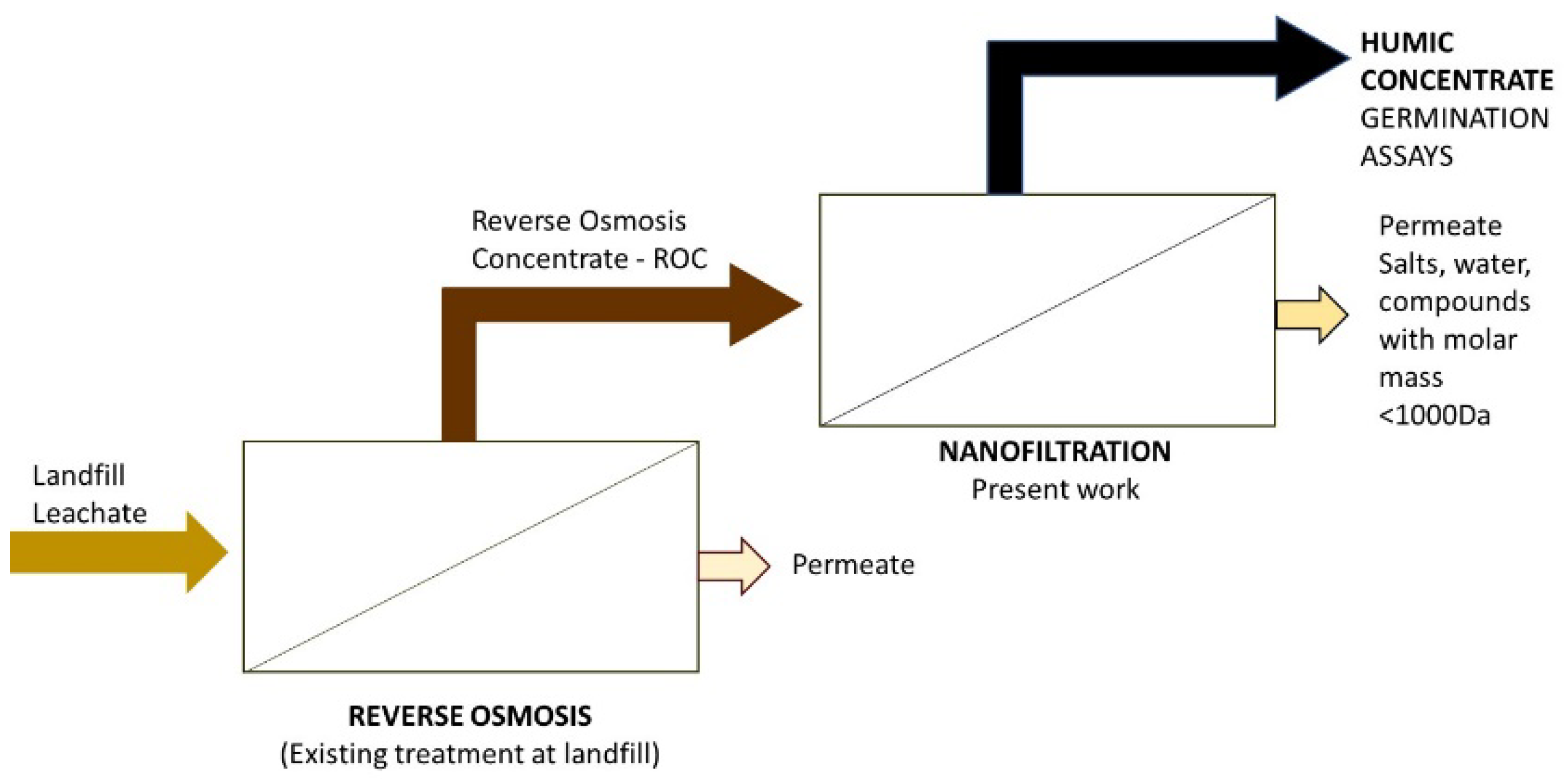
Figure 1 summarizes the context of this study. The procedures and materials used in this study are described below.
Figure 1.
Summary diagram of the context of this study.
As shown in the diagram, the feed for the NF system was the concentrate from the reverse osmosis leachate treatment (Reverse Osmosis Concentrate, ROC), which was sent to the laboratory. The stream of interest evaluated in this study was the concentrate from the NF process, which will henceforth be referred to as humic concentrate.
2.1. Reverse Osmosis Concentrate
The reverse osmosis concentrate (ROC) came from the Seropédica Landfill (Waste Treatment Center of Seropédica, Seropédica, Brazil), located in the Metropolitan area of Rio de Janeiro city. The landfill began operating in 2011 and was designed for a useful life of 25 years. The landfill occupies an area of 3 million square meters and receives and treats approximately 10,000 tonnes of urban solid waste [21]. The treatment system consists of two three-stage reverse osmosis units with a total capacity of 1000 m3/day, installed in two 40-foot sea containers each, totaling four 40-foot sea containers [11].
ROC was characterized by the following parameters [22]: absorbance at 254 nm (method 5910 B), color (method 2120 C), pH, Total Organic Carbon—TOC (method 5310 C), Chemical Oxygen Demand—COD (method 5220 D), Ammonia Nitrogen—N-NH3 (method 4500 E), chloride (method 4500 B), conductivity (2510 A), turbidity, solids analysis (2540 D), alkalinity (2320 A). The concentration of Humic Substances (HS) was evaluated using a colorimetric technique developed by [23], which is based on the binding of the dye toluidine blue to humic substances (HS), forming a dye–HS complex that results in a decrease in absorbance at 630 nm. This method was later adapted by [24] for landfill leachates and subsequently tested by [25] for leachate generated at the same landfill investigated in the present study.
2.2. Nanofiltration
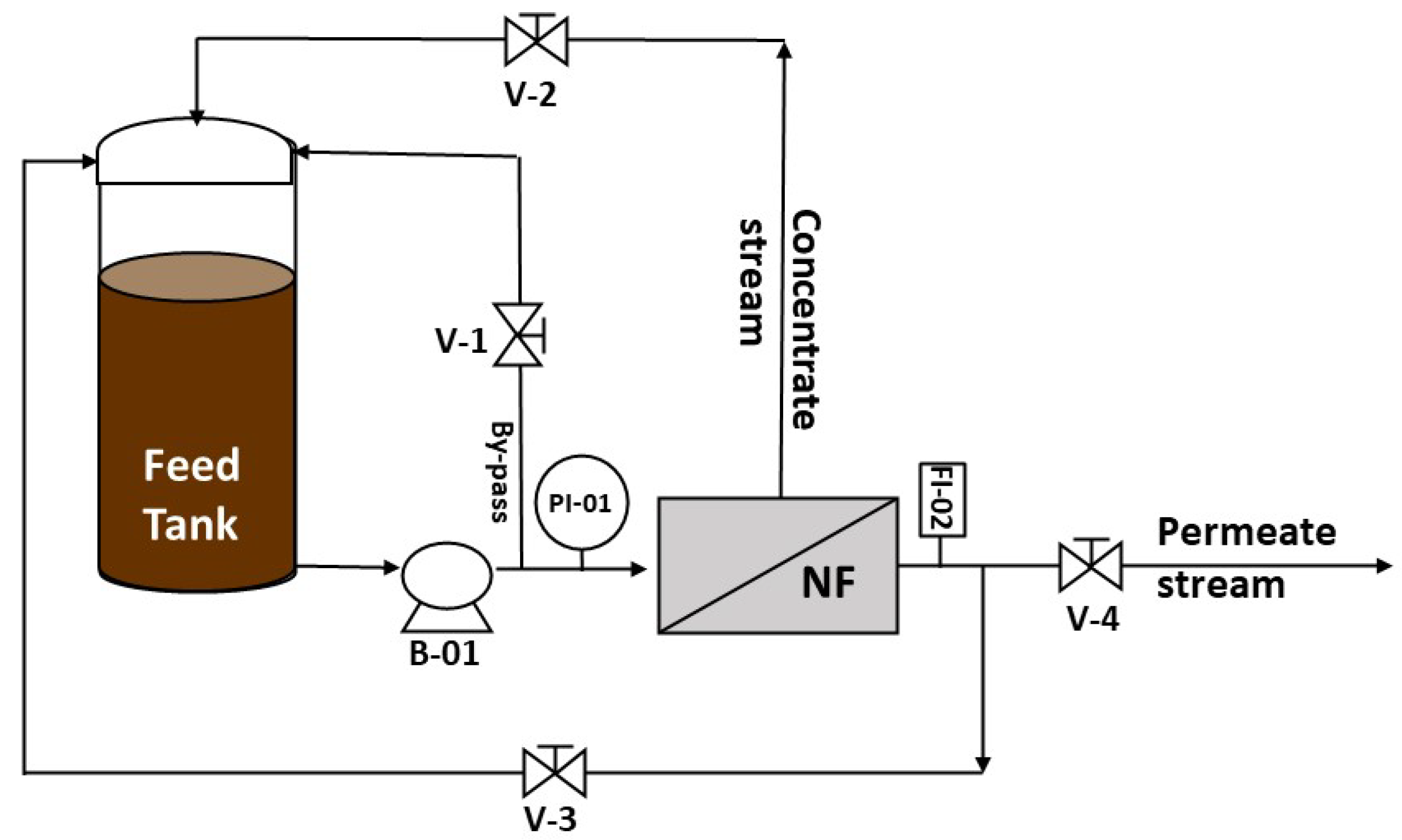
Nanofiltration was performed using a benchtop filtration module in 316 stainless steel cell construction materials supplied by PAM Selective Membranes Inc. (Rio de Janeiro, Brazil) (Figure 2). The experimental system consisted of a chilled feed tank (5 L capacity), a membrane module (effective area of 77.7 cm2), flow meters (Fl-01 and Fl-02), flow control valves in the feed (V-01), in the permeation (V-03 and V-04) and in the concentrate (V-02), a pressure gauge and a recirculation pump (B-01).
Figure 2.
Schematic diagram of the nanofiltration experimental setup. B-01, pump (feed); PI-01, pressure gauge (feed); V-01, control valve (by-pass); V-02, control valve (concentrate); V-03, control valve (permeate); V-04, control valve (permeate); FI-02: flowmeter (permeate); and NF, nanofiltration module. For the experiments: T = 25 °C and pressure = 9 bar.
NF NADIR membrane (by Mann + Hummel Company, Wiesbaden, Germany), model NP010, made of polyethersulfone, cut-off molar mass in the range of 1000 Daltons, and nominal rejection of 35 to 75% Na2SO4 was used.
The system was fed with 5 L of leachate concentrate and operated at a feed flow rate of 120 L/h and a transmembrane pressure of 9 bar, which was the maximum operating pressure of the system. The permeate flux was monitored during operating time. The concentrate quality was measured using the same parameters as those for ROC.
The volume reduction factor (VRF) was used to describe the extent of the NF unit concentration during 20 h of filtration. The VRF was calculated using Equation (1).
where Vf and Vc are the volumes of the NF feed tank, i.e., the initial feed volume and final concentrate volume, respectively, both measured in L.
VRF = Vf/Vc
A cleaning strategy utilizing both alkaline and acidic cleansing [26] was employed. Solution of NaOH (1 mol/L) was recirculated, followed by acidic cleansing (H2SO4, 1 mol/L) for 1 h each solution, at 25 °C. Thereafter, the membrane was submerged in a 24 h SDBS (sodium dodecylbenzene sulfonate) solution [27]. Between the cleaning steps, distilled water was flushed to eliminate any traces of the cleaning solution.
The mass distribution in permeate and concentrate of the Nanofiltration process was calculated according to Equation (2).
where Vf is the volume of feed (L); Cf is the concentration of HS, COD, TOC or chloride in the feed (mg/L); Vx is the volume of permeate or concentrate (L), and Cx is the concentration of HS, COD, TOC or chloride in the permeate or concentrate (mg/L)
Mass Balance (%) = (Vx × Cx)/(Vf × Cf) ×100
Efficiency removal was calculated in terms of mass (Equation (3)), since part of the humic matter was adsorbed onto the membrane (Figure S1).
where Vp is the volume of permeate (L); Cp is the concentration of HS, COD, TOC or chloride in the permeate (mg/L);
Mass rejection (%) = {[(Vf × Cf) − (Vp × Cp)]/(Vf × Cf)} × 100
2.3. Germination Test with Recovered Humic Substances
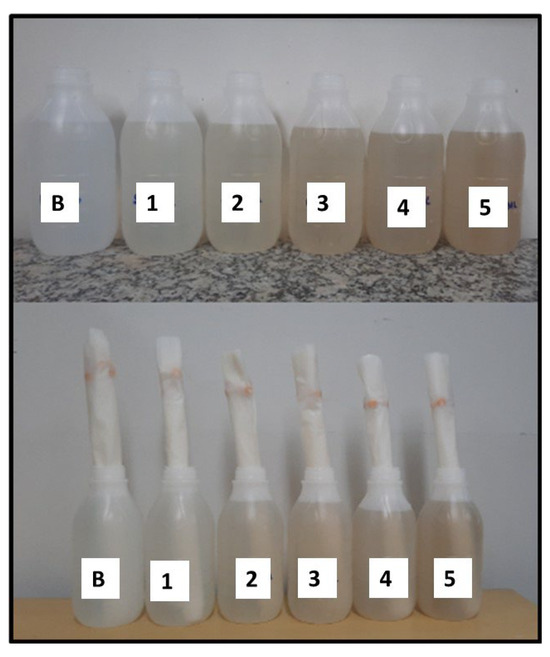
A germination test was conducted to evaluate the impact of adding recovered humic substance on plant growth and development. This test is important for evaluating the effectiveness of the recovered humic substance as a water-soluble biofertilizer, specifically assessing its efficacy at varying concentrations. The germination and growth test was evaluated using seeds of Zea mays L., specifically the maize variety BRS Eldorado. The seeds were provided by EMBRAPA (Brazilian Agricultural Research Corporation, Rio de Janeiro, Brazil). Humic concentrate was added at different concentrations (0, 20, 40, 60, 80, and 100 mg HS/L), obtained through serial dilutions of the concentrate after nanofiltration, and applied as fertilizer for irrigating corn seeds. The seeds were rolled in GermitestTM filter paper properly for germination tests. Each roll was prepared with 10 seeds in triplicate (three sheets of germination paper). The rolls with germination paper were placed in 500 mL plastic bottles containing the mixtures (Figure 3). After preparing the samples, they were incubated at 28 °C and analyzed after 7 days of germination, as recommended by [28]. The germination experiments included a control test with distilled water.
Figure 3.
Seeds conditioned in solutions with different concentrations of Humic Substances (B = blank test; 1 = 20 mg HS/L; 2 = 40 mg HS/L; 3 = 60 mg HS/L; 4 = 80 mg HS/L, and 5 = 100 mg HS /L).
The liquid level in the containers was checked daily and, if necessary, the volume was replenished with the sample. The volume of solutions used in each bottle was 400 mL, which was sufficient for the test and did not need to be replenished. Morphological parameters, such as Primary Root Length (PRL) and Aerial Part Length (APL), were measured to determine the applicability of the samples as biofertilizers and to assess whether any phytotoxicity was present. To assess these parameters, PRL and APL, the rolls were opened, and measurements were taken using a ruler, as shown in Figure S2.
The germination index (GI) was calculated by multiplying germination rate (GR) and relative root length (RL), both expressed as percentages (%) of the control values [29], as shown in Equation (4). These parameters were calculated based on the mean of germinated seeds and the mean of root length.
GI = (GR% × RL%) × 100
GR% = (number of germinated seeds in a sample/number of germinated seeds in the control) × 100;
RL% = (mean root length in a sample/mean root length in the control) × 100
2.4. Statistical Evaluation
The results obtained during the germination test were statistically analyzed using Statistica 10 software. The data were assessed by one-way ANOVA. Significant statistical differences were examined using a Tukey test to evaluate the effect of different concentrations of HS solutions. For the statistical evaluations, a significance level of 5% (α = 0.05) was used.
3. Results and Discussion
3.1. Characterization of the Leachate Concentrate
Table 1
presents the main physical-chemical characteristics of the ROC from landfill leachate treatment.
Table 1.
Characterization of the ROC from Seropédica landfill. Each parameter was analyzed in six samples (n = 6), except for parameters marked with (*), which correspond to only one measurement.
There is limited information in the literature regarding reverse osmosis concentrates from landfill leachate treatment systems operating under comparable conditions (e.g., landfill age, waste composition, and operational parameters). In general, the data from Table 1 fall within the ranges listed in a review carried out by [9,30], including pH, COD, conductivity, and chloride. For TOC, the absorbance at 254 nm and ammonia nitrogen, the mean values are higher than the range of values presented by [9,30]. The review [9] presents the results of studies encompassing concentrates generated from heterogeneous treatment trains, such as MBR followed by RO, biological treatment coupled with RO, nanofiltration-based processes, and other configurations. For the specific treatment configuration evaluated here, namely a standalone triple-stage reverse osmosis system, no directly comparable data were found.
Given this scarcity, the consistency of the Seropédica landfill data was assessed instead, drawing on multiple published studies that characterize the leachate produced at this site. The Seropédica landfill is an operating landfill that receives about 10,000 tonnes of municipal solid waste per day from the Metropolitan Region of the City of Rio de Janeiro [29]. This landfill has generated leachate with a high concentration of pollutants; therefore, it can be concluded that the results of the characterization of the reverse osmosis concentrate of the leachate from the Seropédica landfill are consistent with the leachate characterization data available in the literature [3,25,31]. Some data that corroborate these conclusions are listed below.
- Recalcitrant organic compounds: The Seropédica landfill leachate presents a high concentration of recalcitrant organic compounds, with an average humic substance concentration of 1935 mg/L [25]. The low biodegradability evidenced in the leachates of the landfills studied is the absorbance at 254 nm value. The absorbance at 254 nm value is related to aromatic organic compounds, such as humic substances [32]. A high absorbance value at 254 nm is observed in the leachate of the Seropédica landfill (31.5) [31]. The parameter color can be associated with dissolved substances, confirmed by the high concentration of humic substances.
- Ammonia nitrogen: Concentrations in the range of 2104–2231 mg/L were described by [3] for Seropédica landfill leachate. High concentrations of ammonia nitrogen are found in leachates as a product of the degradation of waste protein and can constitute 0.5% of the dry mass of waste. The ammonia nitrogen remains high, as can chloride and alkalinity concentrations in leachates from mature landfills. Therefore, it is considered one of the main pollutants of leachate [33].
- Chloride: The average chloride concentration at Seropédica landfill was 3389 mg/L by [31]. Chloride is considered a conservative contaminant and does not attenuate significantly over the years, as it is not affected by the biochemical processes in the landfill [34].
3.2. Nanofiltration Performance
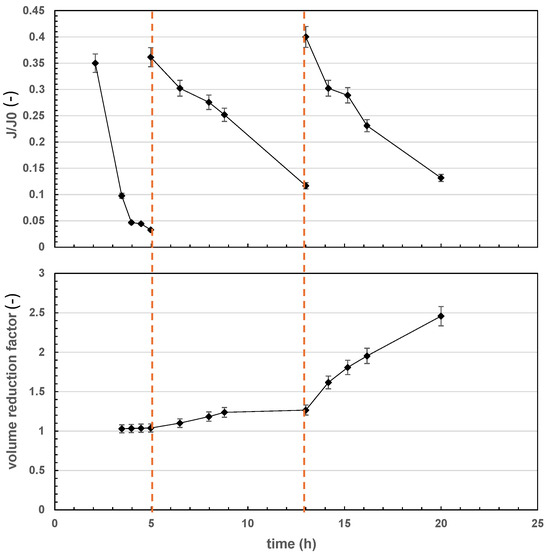
Figure 4 shows the permeate flux over time, normalized by the initial flux (J0) at 9 bar. J0 is the water flux at the same pressure (9 bar), which averaged 100 L/m2·h. Among the washes performed, the flow ranged from 30 to 34.8 L/(m2·h).
Figure 4.
Normalized permeate flux evolution and volume reduction factor over time for T = 25 °C, ∆P = 9.0 bar. (- - - - - - -) Membrane cleaning.
In terms of absolute values, except for the first period, after 6–7 h of filtration, the NF was able to generate a permeate stream with a flux of 7.6 L/(m2·h). The cleaning protocol was sufficient to recover the initial permeate flux throughout the filtration process. Under similar operating conditions, the permeate fluxes for clean and new membranes showed variations of less than 10%, confirming the effectiveness of the cleaning procedure. Figure S3 illustrates the original ROC (feed), NF permeate and NF concentrate.
The same leachate, without prior concentration, after treatment with lime, was filtered in the same system using an NF membrane TriSep Cellulose Acetate model SB90, with a cut-off in the range of 500–700 Dalton and a pressure of 9 bar [35]. The authors obtained a permeate flow rate of 16 to 15 L/(m2·h). They associated the continuous drop in permeate flux through the process with the adsorption of humic and fulvic acids on the membrane surface (429 mg HS/L, TOC = 996 mg/L, and COD = 2600 mg/L), which can cause membrane fouling and lead to extremely low permeate fluxes.
Still with the same raw leachate (without prior concentration step), with COD = 2258 mg/L and HS = 821 mg/L and using the same filtration system, and the same operating pressure (9 bar), [27] obtained 8 L/(m2·h) and 12 L/(m2·h) for the NF membranes SR 100 (cutoff = 200 Da, Fluid System TFC®) and NP030 (cutoff = 400 Da, Nadir®), respectively. The authors associated the presence of humic acids with the decline in permeate flux, as well as the results obtained by [24].
Other authors [8] used the same NF membrane (NP010) to filter raw leachate (COD = 1971 mg/L, TOC = 522 mg/L, and HS = 582 mg/L) from the Gericinó landfill (Rio de Janeiro, Brazil) in a dead-end filtration system. The authors obtained a greater permeate flux (45 L/(m2·h), but the operating pressure was 25 bar. Additionally, the authors tested other membranes with varying molecular weight cut-offs and surface properties, concluding that hydrophilicity, electrostatic charges, and roughness significantly influence membrane rejection capability and permeate flux [8,36].
Comparing the permeate flux data obtained with the filtration of the leachate of the same source as the concentrate in this study, using similar membranes and operating conditions, the permeate flux obtained with the leachate concentrate reached satisfactory levels, considering that its organic composition was of TOC of 7564 mg/L, COD of 32,872 mg/L and HS of 19,671 mg/L.
Nevertheless, Ye et al. [37] evaluated an electro-neutral nanofiltration membrane (MWCO of 592 Da and operational pressure of 4 bar) of leachate concentrate from a membrane bioreactor system (TOC of 1755.7 mg/L; 289.5 humic acid/L and 1138.2 mg fulvic acid/L) and obtained a reduction in permeate flux from 74.0 to 9.3 L/(m2·h) as the concentration factor increased to 32.6 during the concentration process, mainly due to the increasing content of the humate. This concentration of humic substances led to the formation of a humate cake layer, which increased the membrane hydraulic resistance [17].
In the present work, due to the characteristics of the feed, a concentration factor of 2.5 was achieved. Some authors [17] pointed out that humic acid concentration, pH, ionic strength, calcium concentration, and membrane surface characteristics are important factors in minimizing fouling, as they are inherent to the process of separating organic matter and salts for resource recovery from highly loaded wastewater. In addition, the desirable design of the membrane module for favorable hydrodynamics can be a critical strategy for mitigating the fouling of loose NF membranes in this application. It should be noted that the system used for the experiments in the present work comprised a plate-and-frame module, which, although its construction contemplated crossflow operation, was insufficient to minimize fouling. Therefore, higher VRF values would substantially increase the viscosity and humate loading at the membrane surface, promoting cake-layer formation and irreversible fouling, an effect particularly critical given the plate-and-frame configuration and the extremely high TOC and HS levels of the feed stream.
At full scale, some design adjustments will likely be required to translate the laboratory/single-module results into a robust, energy-efficient plant. Key modifications to consider include [26,36] (i) increasing and making adjustable crossflow velocity to reduce boundary-layer formation and fouling, (ii) testing and selecting spacer geometries or turbulence promoters that improve mass transfer while balancing the increase in pressure drop, (iii) implementing dynamic cleaning measures such as controlled backpulsing and a defined cleaning strategy, among other adjustments.
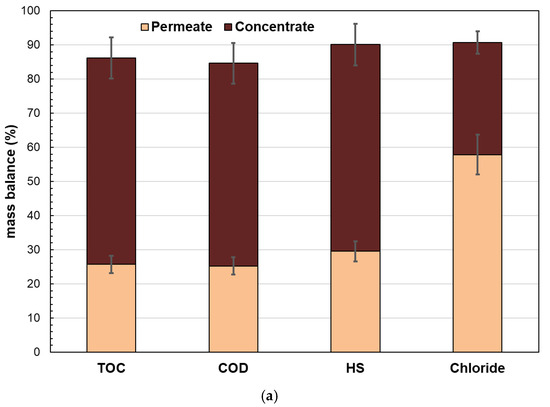
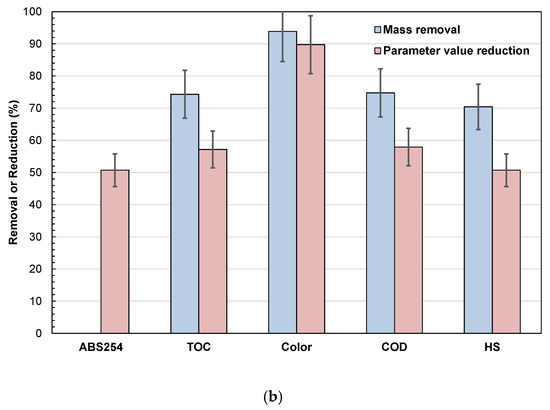
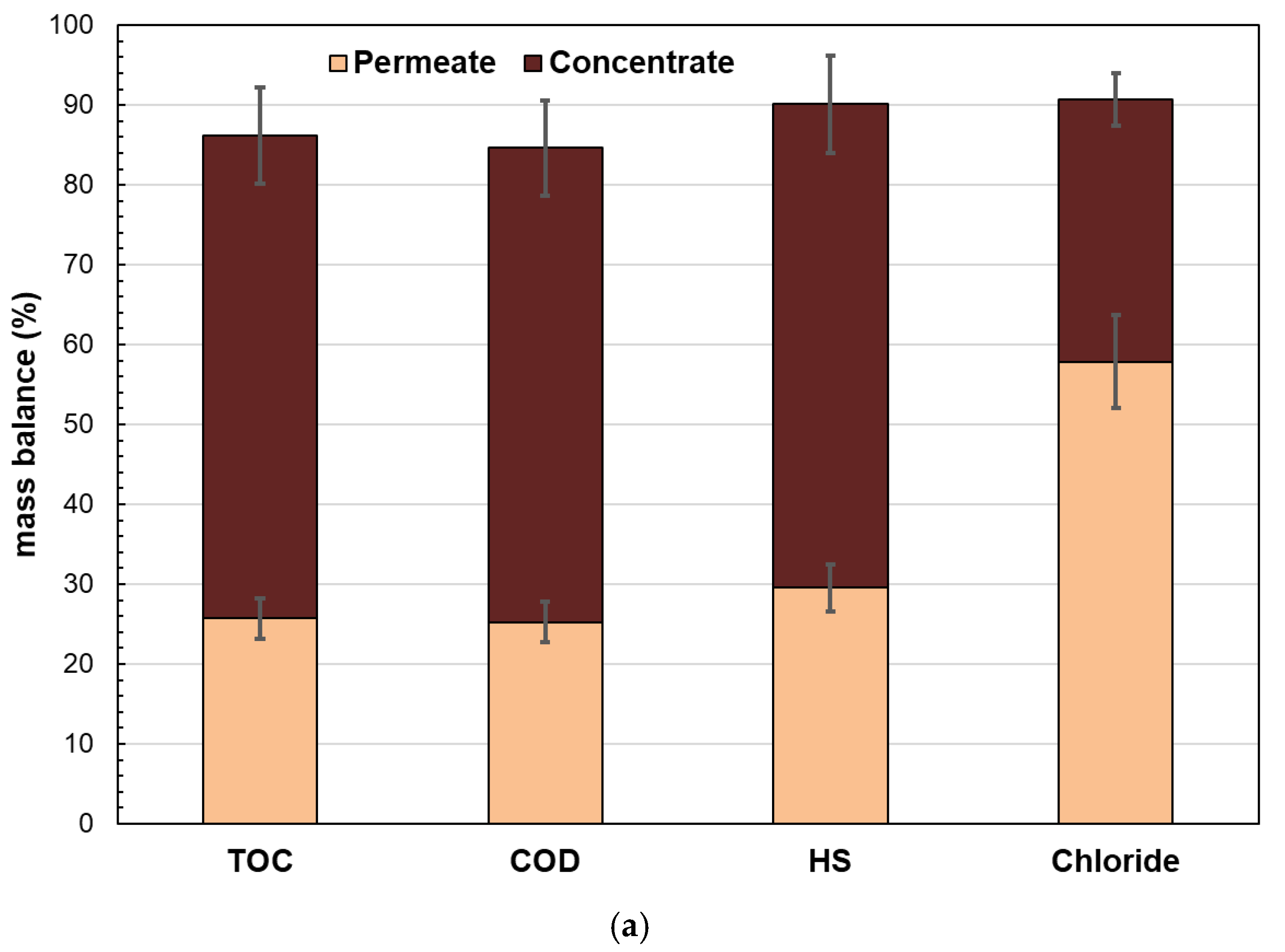
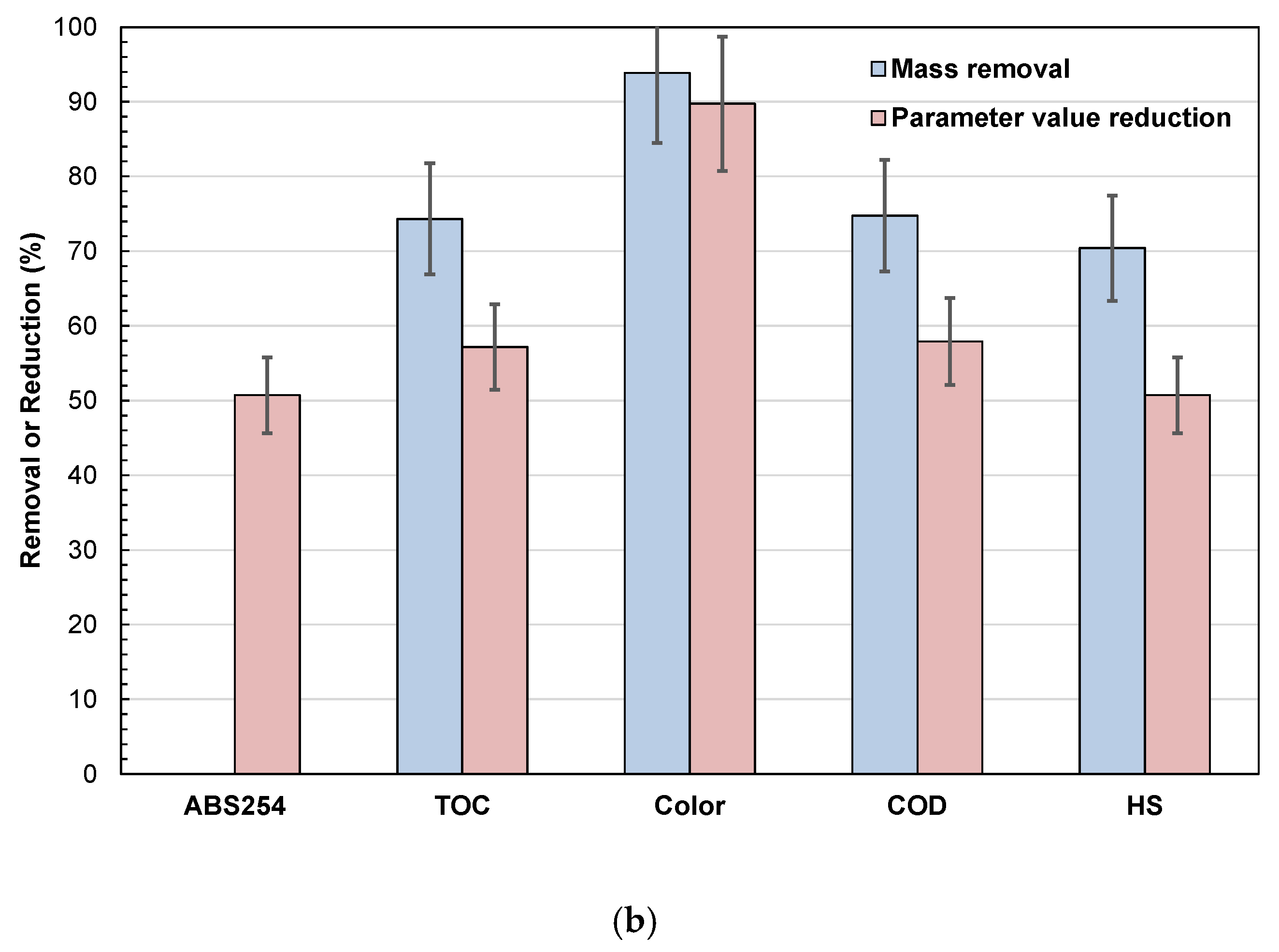
Table 2 presents the mean values of the quality of both streams (permeate and concentrate) from NF operation. The consolidated results are presented in Table S1, and the calculation details are provided in Table S2. Figure 5a shows the mass distributions of different parameters in the permeate and concentrate of the NF process (humic concentrate). Figure 5b shows the removal results (in relation to the feed and permeate streams) considering both the concentration and mass of the two fractions.
Table 2.
Characterization (mean values and standard deviation) of the final concentrate (humic concentrate) and the permeate obtained by the nanofiltration process at a pressure of 9 bar for 20 h and with a Volume Reduction Factor (VRF) of 2.5.
Figure 5.
(a) Mass distributions in the permeate and concentrate of the NF process. (b) Removal efficiency results for the NF process.
The main objective of conducting nanofiltration was to concentrate further the reverse osmosis concentrate stream generated during landfill leachate treatment and assess the recovery of humic substances. In view of this, the nanofiltration process proved to be efficient. Regarding organic matter, a rejection of 70–75% was achieved in terms of mass during NF, considering the parameters TOC, COD, and HS.
Some authors [17] applied loose nanofiltration (molecular weight cut-off of 860 Da) to recover humic substance from a concentrated stream originating from an MBR system that treated landfill leachate. The authors achieved rejection rates of 92–96% for humic substances and 85.7% for salt. The performance values were better than those in the present study because they used a concentrated stream with a lower concentration of pollutants, since the leachate was biotreated in the MBR: abs 254 nm = 22.94, COD = 2012 mg/L, conductivity = 10.17, and HS = 1393 mg/L; instead of the following values in this study: abs 254 nm = 208.51, COD = 32,872 mg/L, conductivity = 72.25, and HS = 19,671 mg/L.
For the recovery process of humic substances from biogas slurry [38], a loose nanofiltration (LNF) system was used, achieving a humic acid (HA) recovery efficiency of 87% and a salt permeation efficiency of 88% at a concentration factor (CF) of 10. In contrast, the traditional ultrafiltration (UF) process showed a much lower HA recovery of only 30%, despite a similar salt permeation efficiency (89%) and a longer concentration time at the same CF. The biogas slurry used in [38] presented a COD concentration of 1112.3 mg/L, a humic substance (HS) content of 654.3 mg/L, and a conductivity of 6.37 mS/cm.
3.3. Germination Experiments
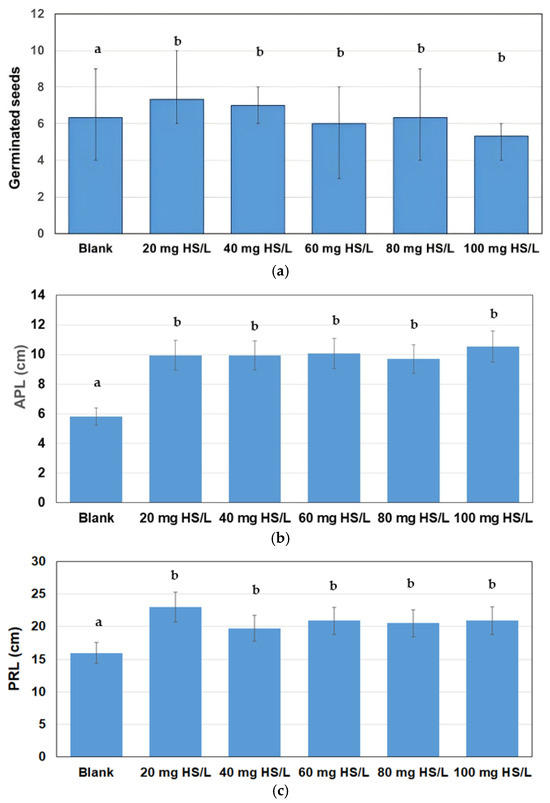
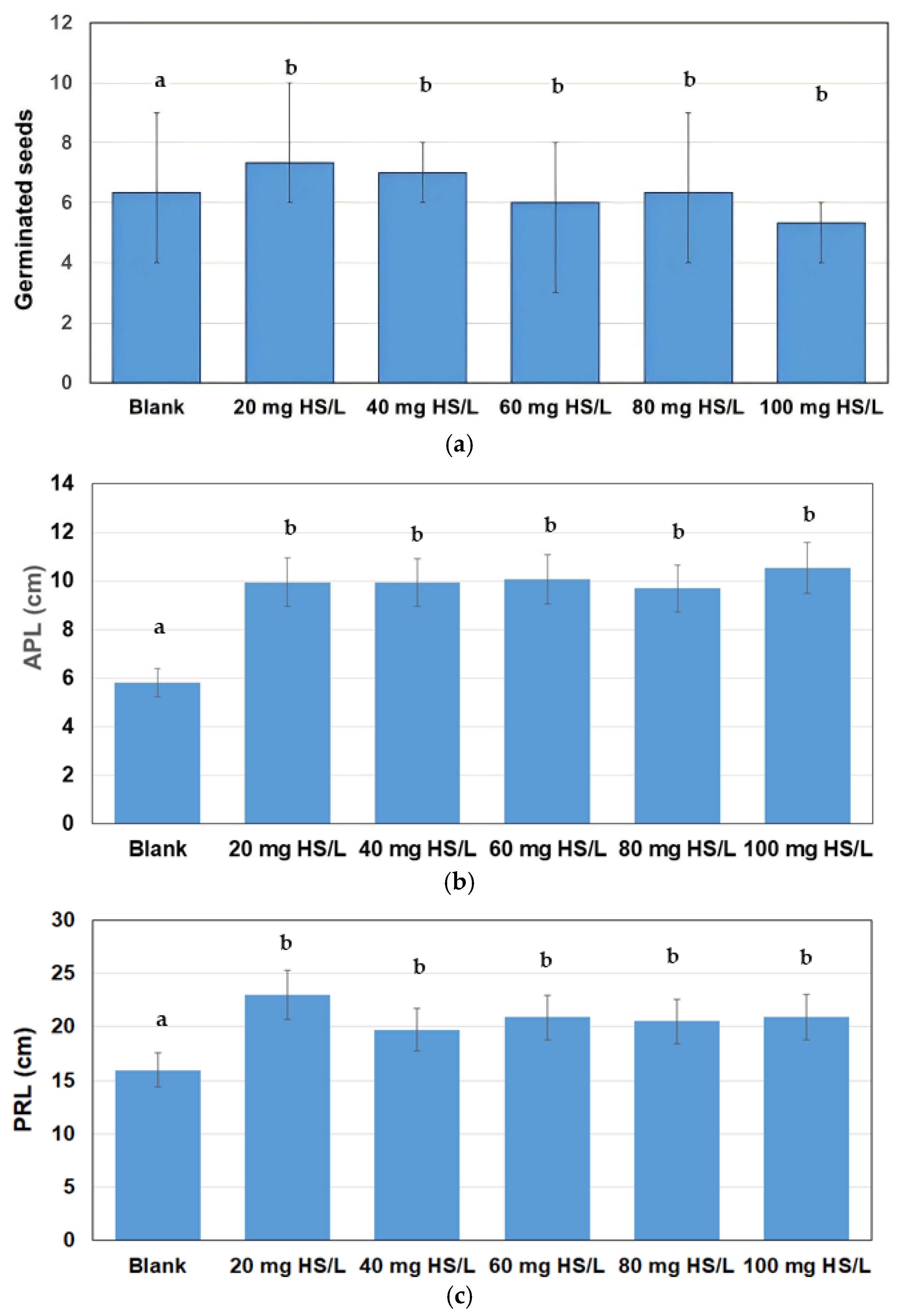
Figure 6a, Figure 6b, and Figure 6c illustrate the results of germinated seeds, aerial part length (APL), and primary root length (PRL), respectively. Table 3 presents the results for germination rate (GR), relative root length (RL), and germination index (GI).
Figure 6.
Results for the 7-day experiment of (a) germinated seeds; (b) aerial part length (APL), and (c) primary root length (PRL). n = 3 rolls, each roll was prepared with 10 seeds. Note: The letters ‘a’ and ‘b’ in the figures are markers used to group groups whose means do not differ statistically from each other.
Table 3.
Results of germination rate (GR), relative root length (RL), and germination index (GI) for the 7-day experiment.
Regarding germinated seeds, according to ANOVA, all groups exhibited the same behavior (95% significance), indicating no significant difference in germination rates between solutions containing humic substances and the blank. Regarding the development of aerial parts and roots, a significant difference was observed between the blank and all HS concentrations tested. According to Tukey’s test, the blank had the lowest value when compared to the HS concentrations used. Among the HS concentrations, there was no significant difference. That is, from 20 mg/L onwards, there is an increase in the development of maize seeds.
GI is the most practical parameter for verifying the phytotoxicity of a fertilizer compound. This is because the GI-related method is reliable when directly related to seed germination [39,40,41].
In all experiments, the germination index (GI) remained above 100% across all tested HS concentrations, confirming the absence of phytotoxic effects [42,43]. Although GI decreased slightly as HS concentration increased, the solution containing 20 mg HS/L, recovered from the RO concentrate of landfill leachate, showed a greater value of GI. This performance is associated with the fact that low concentrations of HS act as natural biostimulants, favoring fundamental physiological processes during the initial phase of germination. At high concentrations, humic molecules tend to form large supra-molecular aggregates, reducing their mobility and decreasing the bioavailable fraction that effectively interacts with seed tissues. In addition, HS recovered from landfill leachate concentrate may contain salts, phenolic compounds, low-molecular-weight organic acids, or traces of ammonia. At low concentrations, these compounds are too diluted to cause damage; however, when the concentration of HS increases, they can reach levels that cause osmotic stress, enzyme inhibition, and cell damage [42,43].
Finally, the metal values measured in the 100 mg/L HS solution were compared with the Brazilian resolution CONAMA 357 [44], which classifies Brazilian water bodies and provides guidelines for categorizing them based on their predominant uses. Regarding heavy metal concentration, solutions with concentrations of up to 100 mg/L of HS did not exceed those recommended by Brazilian legislation for the irrigation of vegetables and fruit plants (Table 4).
Table 4.
Comparison of metal values in the 100 mg HS/L solution and Brazilian legislation.
The low concentration of metals observed in the final product demonstrates the efficiency of nanofiltration (NF) in separating humic substances from metal contaminants present in the leachate concentrate. This performance is related to the ability of a 1000 Da cut-off nanofiltration to allow the passage of free metal ions and complexes of lower molar mass, while retaining the soluble humic fraction, resulting in a product with greater purity and a lower risk of phytotoxicity. This selectivity represents a significant advantage of the process, as it reduces the contaminant load associated with recovered HS and expands its potential for agronomic application in a safer and more environmentally appropriate manner [27].
Table S3 summarizes the results of the present study.
4. Conclusions
This study demonstrated that nanofiltration using a polyethersulfone membrane (molecular weight cut-off, MWCO = 1000 Da) is an effective process for recovering humic substances (HS) from reverse osmosis concentrate generated during landfill leachate treatment. Operating at 9 bar and achieving a volume reduction factor of 2.5, the NF process rejected approximately 70–75% of the organic matter (COD, TOC and HS) in the retentate, while allowing major ionic species to permeate, thus improving product purity.
Humic concentrate exhibited no phytotoxic effects in germination assays with Zea mays L. seeds, achieving germination indices above 100% and promoting significant growth enhancement, particularly at a concentration of 20 mg HS/L. Trace metal concentrations in the recovered solution complied with the Brazilian environmental standards for irrigation water, indicating its suitability for agricultural applications.
These results highlight the feasibility of using nanofiltration as a sustainable strategy for valorizing reverse osmosis concentrate from landfill leachate treatment plants. However, long-term studies should be conducted to evaluate further the effects of the recovered product on soil interactions, nutrient uptake, and crop yield.
Supplementary Materials
The following supporting information can be downloaded at: https://www.mdpi.com/article/10.3390/agriengineering8010012/s1, Figure S1. Detail of the membrane after permeation; Figure S2. (a) Evaluation of Air Part Length (APL) and (b) Primary Root Length (PRL) using a ruler; Figure S3. Photos of (a) original RO concentrate (feed), (b) NF permeate and (c) NF concentrate. Table S1. Characterization of the feed, permeate, and concentrate from nanofiltration. Conditions: applied pressure: 9 bar; operation time: 20 h; Volume Reduction Factor (VRF): 2.5; the NF NADIR membrane, model NP010; Table S2. Calculation details of mass balance during the NF process; Table S3. Key findings of the present study.
Author Contributions
Conceptualization, J.C.C. and B.R.Q.; methodology, J.C.C. and B.R.Q.; validation, J.C.C. and B.R.Q.; formal analysis, L.B.A.; investigation, L.B.A. and C.E.A.d.S.; data curation, L.B.A. and C.E.A.d.S.; writing—original draft preparation, L.B.A.; writing—review and editing, J.C.C.; visualization, J.C.C.; supervision, J.C.C.; funding acquisition, J.C.C. All authors have read and agreed to the published version of the manuscript.
Funding
This work was supported by Fundação Carlos Chagas Filho de Amparo à Pesquisa do Estado do Rio de Janeiro—FAPERJ (Grant No. E-26/201.097/2022) and Conselho Nacional de Desenvolvimento Científico e Tecnológico—CNPq (Grant No. 310116/2021-0).
Institutional Review Board Statement
Not applicable.
Informed Consent Statement
Not applicable.
Data Availability Statement
The data presented in this study are openly available in http://objdig.ufrj.br/61/dissert/938315.pdf (accessed on 25 October 2025).
Acknowledgments
To Comlurb (Municipal Company of Urban Cleaning—City of Rio de Janeiro) for collecting and sending the leachate samples.
Conflicts of Interest
The authors (Letícia B Alves, Juacyara Campos and Carlos Eduardo A. Silva) declare no commercial or financial relationship with Company of Urban Cleaning. There is no conflict of interest. The funders had no role in the design of the study, in the collection, analysis, or interpretation of data, in the writing of the manuscript, or in the decision to publish the results.
References
- Alfaia, R.G.S.M.; Costa, A.M.; Campos, J.C. Municipal solid waste in Brazil: A review. Waste Manag. Res. 2017, 35, 1195–1209. [Google Scholar] [CrossRef] [Scilit] [PubMed]
- Renou, S.; Givaudan, J.G.; Poulain, S.; Dirassouyan, F.; Moulin, P. Landfill leachate treatment: Review and opportunity. J. Hazard. Mater. 2008, 150, 468–493. [Google Scholar] [CrossRef] [Scilit] [PubMed]
- Costa, A.M.; Alfaia, R.G.S.M.; Campos, J.C. Landfill leachate treatment in Brazil—An overview. J. Environ. Manag. 2019, 232, 110–116. [Google Scholar] [CrossRef] [Scilit] [PubMed]
- Zhang, X.; Fan, L.; Roddick, F.A. Influence of the characteristics of soluble algal organic matter released from Microcystis aeruginosa on the fouling of a ceramic microfiltration membrane. J. Membr. Sci. 2013, 425, 23–29. [Google Scholar] [CrossRef] [Scilit]
- Sossou, K.; Prasad, S.B.; Agbotsou, K.E.; Souley, H.S.; Mudigandla, R. Characteristics of landfill leachate and leachate treatment by biological and advanced coagulation process: Feasibility and effectiveness—An overview. Waste Manag. Bull. 2024, 2, 181–198. [Google Scholar] [CrossRef] [Scilit]
- Chen, H.; Xu, H.; Zhong, C.; Liu, M.; Yang, L.; He, J.; Sun, Y.; Zhao, C.; Wang, D. Treatment of landfill leachate by coagulation: A review. Sci. Total Environ. 2024, 912, 169294. [Google Scholar] [CrossRef] [Scilit]
- Marian, T.; Nghiem, L.D. Landfill leachate tretment using hybrid coagulation-nanofiltration processes. Desalination 2010, 250, 677–681. [Google Scholar] [CrossRef] [Scilit]
- Alfaia, R.G.S.M.; de Almeida, R.; Nascimento, K.S.; Campos, J.C. Landfill leachate pre-treatment effects on nanofiltration and reverse osmosis membrane performance. Process Saf. Environ. Prot. 2023, 172, 273–281. [Google Scholar] [CrossRef] [Scilit]
- de Almeida, R.; Porto, R.F.; Quintaes, B.R.; Bila, D.M.; Lavagnolo, M.C.; Campos, J.C. A review on membrane concentrate management from landfill leachate treatment plants: The relevance of resource recovery to close the leachate treatment loop. Waste Manag. Res. 2023, 41, 264–284. [Google Scholar] [CrossRef] [Scilit]
- ABREMA—Brazilian Association of Solid Waste and Environment. Available online: https://www.abrema.org.br/2020/12/14/aterro-sanitario-seropedica-regiao-metropolitana-do-rio-de-janeiro/ (accessed on 25 October 2025).
- AST Ambiente. Available online: https://ast-ambiente.com.br/ (accessed on 25 October 2025).
- Gu, N.; Liu, J.; Ye, J.; Chang, N.; Li, Y. Bioenergy, ammonia and humic substances recovery from municipal solid waste leachate: A review and process integration. Bioresour. Technol. 2019, 293, 122159. [Google Scholar] [CrossRef] [Scilit]
- Chai, X.L.; Shimaoka, T.; Guo, Q.; Zhao, Y.C. Characterization of humic and fulvic acids extracted from landfill by elemental composition, 13C CP/MAS NMR and TMAH-PY-GC/MS. Waste Manag. 2007, 28, 896–903. [Google Scholar] [CrossRef] [Scilit]
- de Almeida, R.; Campos, J.C. Technoeconomic analysis of landfill leachate treatment. Rev. Ineana. 2022, 8, 6–27. Available online: https://www.inea.rj.gov.br/wp-content/uploads/2020/06/Revista-ineana-8.1.pdf (accessed on 25 October 2025).
- Liu, M.; Wang, C.; Wang, F.; Xie, Y. Maize (Zea mays) growth and nutrient uptake following integrated improvement of vermi compost and humic acid fertilizer on coastal saline soil. Appl. Soil Ecol. 2019, 142, 147–154. [Google Scholar] [CrossRef] [Scilit]
- Yang, X.; Zhang, J.; Mostofa, K.M.G.; Mohinuzzaman, M.; Teng, H.H.; Senesi, N.; Senesi, G.S.; Yuan, J.; Liu, Y.; Li, S.-L.; et al. Solubility characteristics of soil humic substances as a function of pH: Mechanisms and biogeochemical perspectives. Biogeosciences 2025, 22, 1745–1765. [Google Scholar] [CrossRef] [Scilit]
- Ye, W.; Liu, H.; Jiang, M.; Lin, J.; Ye, K.; Fang, S.; Xu, Y.; Zhai, S.; Van der Bruggen, B.; He, Z. Sustainable management of landfill leachate concentrate through recovering humic substance as liquid fertilizer by loose nanofiltration. Water Res. 2019, 157, 555–563. [Google Scholar] [CrossRef] [Scilit]
- Xu, D.; Wang, X.K.; Chen, C.L.; Zhou, X.; Tan, X.L. Influence of soil humic acid and fulvic acid on sorption of thorium(IV) on MX-80 bentonite. Radiochim. Acta 2006, 94, 429–434. [Google Scholar] [CrossRef] [Scilit]
- Zhao, Z.; Zhang, Y.; Yu, L.; Hou, D.; Wu, X.; Li, K.; Wang, J. Fenton pre-treatment to mitigate membrane distillation fouling during treatment of landfill leachate membrane concentrate: Performance and mechanism. Water Res. 2023, 244, 120517. [Google Scholar] [CrossRef] [Scilit]
- Guo, S.; Wan, Y.; Chen, X.; Luo, J. Loose nanofiltration membrane custom-tailored for resource recovery. Chem. Eng. J. 2021, 409, 127376. [Google Scholar] [CrossRef] [Scilit]
- Ciclus Ambiental. Available online: https://ciclusambiental.com.br/#solucoes (accessed on 25 October 2025).
- APHA (American Public Health Association); AWWA (American Water Works Association); WEF (Water Environment Federation). Standard Methods for the Examination of Water and Wastewater, 23rd ed.; American Public Health Association: Washington, DC, USA, 2017; 1360p. [Google Scholar]
- Sheng, G.; Zhang, M.; Yu, H. A rapid quantitative method for humic substances determination in natural waters. Anal. Chim. Acta 2007, 592, 162–167. [Google Scholar] [CrossRef] [Scilit]
- Sir, M.; Podhola, M.; Patocka, T.; Honzajkova, Z.; Kocurek, P.; Kubal, M.; Kuras, M. The effect of humic acids on the reverse osmosis treatment of hazardous landfill leachate. J. Hazard. Mater. 2012, 207–208, 86–90. [Google Scholar] [CrossRef] [Scilit]
- Lima, L.S.M.S.; De Almeida, R.; Quintaes, B.R.; Bila, D.M.; Campos, J.C. Evaluation of humic substances removal from leachates originating from solid waste landfills in Rio de Janeiro State, Brazil. J. Environ. Sci. Health Part A 2017, 52, 828–836. [Google Scholar] [CrossRef] [Scilit]
- Demir, I.; Pasaoglu, M.E.; Guclu, S.; Turken, T.; Yildiz, S.; Balahorli, V.; Koyuncu, I. Foulant and chemical cleaning analysis of ultrafiltration membrane used in landfill leachate treatment. Desalin. Water Treat. 2017, 77, 142–148. [Google Scholar] [CrossRef] [Scilit]
- de Almeida, R.; Couto, J.M.C.; Gouvea, R.M.; Oroski, F.A.; Bila, D.M.; Quintaes, B.R.; Campos, J.C. Nanofiltration applied to the landfill leachate treatment and preliminary cost estimation. Waste Manag. Res. 2020, 38, 1119–1128. [Google Scholar] [CrossRef] [Scilit]
- MAPA—Ministry of Agriculture, Livestock and Supply. Legislation. 2009. Available online: www.agricultura.gov.br (accessed on 25 October 2025).
- Aylaj, M.; Adani, F. The evolution of compost phytotoxicity during municipal waste and poultry manure composting. J. Ecol. Eng. 2023, 24, 281–293. [Google Scholar] [CrossRef] [Scilit]
- de Almeida, R.; Porto, R.F.; Hinojosa, M.A.G.; Sanches, L.C.M.; Monteiro, B.B.; Conde, A.L.F.M.; Costa, A.M.; Quintaes, B.R.; Bila, D.M.; Campos, J.C. Monitoring of experimental landfill cells with membrane concentrate infiltration: A systematic assessment of leachate quality and treatment performance. Process Saf. Environ. Prot. 2022, 168, 1155–1165. [Google Scholar] [CrossRef] [Scilit]
- Costa, A.M.; Daflon, S.D.A.; Campos, J.C. Landfill Leachate and Ecotoxicity. In A Review of Landfill Leachate; Anouzla, A., Souabi, S., Eds.; Springer: Cham, Switzerland, 2024; pp. 129–180. [Google Scholar] [CrossRef] [Scilit]
- Guvenc, S.Y.; Varank, G. Degradation of refractory organics in concentrated leachate by the Fenton process: Central composite design for process optimization. Front. Environ. Sci. Eng. 2021, 15, 2. [Google Scholar] [CrossRef] [Scilit]
- Clément, B.; Merlin, G. The contribution of ammonia and alkalinity to landfill leachate toxicity to duckweed. Sci. Total Environ. 1995, 170, 71–79. [Google Scholar] [CrossRef] [Scilit]
- El-Fadel, M.; Bou-Zeid, E.; Chahine, W.; Alayli, B. Temporal variation of leachate quality from pre-sorted and baled municipal solid waste with high organic and moisture content. Waste Manag. 2002, 22, 269–282. [Google Scholar] [CrossRef] [Scilit]
- de Almeida Costa, A.M.; Oroski, F.A.; Campos, J.C. Evaluation of coagulation–flocculation and nanofiltration processes inlandfill leachate treatment. J. Environ. Sci. Health Part A 2019, 54, 1091–1098. [Google Scholar] [CrossRef] [Scilit]
- Mah, S.; Chang, C.C.H.; Wu, T.Y.; Chai, S. The study of reverse osmosis on glycerin solution filtration: Dead-end and crossflow filtrations, transport mechanism, rejection and permeability investigations. Desalination 2014, 352, 66–81. [Google Scholar] [CrossRef] [Scilit]
- Ye, W.; Hong, M.; Huang, X.; Chen, T.; Gu, A.; Lin, X.; Li, X.; Chen, X.; Seo, D.H.; Zhao, S.; et al. Towards effective recovery of humate as green fertilizer from landfill leachate concentrate by electro-neutral nanofiltration membrane. Sci. Total Environ. 2023, 896, 165335. [Google Scholar] [CrossRef] [Scilit]
- Zou, Z.; Li, Y.; Ren, X.; Zhao, Z.; Du, Z.; Wu, D. Potential effect of biogas slurry application to mitigate of peak N2O emission without compromising crop yield in North China Plain cropping systems. Appl. Soil Ecol. 2025, 210, 106083. [Google Scholar] [CrossRef] [Scilit]
- Liu, D.; Ding, Z.; Ali, E.F. Biochar and compost enhance soil quality and growth of roselle (Hibiscus sabdariffa L.) under saline conditions. Sci. Rep. 2021, 11, 8739. [Google Scholar] [CrossRef] [Scilit]
- Ning, L.; Zhou, J.; Han, L.; Ma, S.; Sun, X.; Huang, G. Role and multi-scale characterization of bamboo biochar during poultry manure aerobic composting. Bioresour. Technol. 2017, 241, 190–199. [Google Scholar] [CrossRef] [Scilit] [PubMed]
- Wei, L.; Shutao, W.; Jin, Z.; Tong, X. Biochar influences the microbial community structure during tomato stalk composting with chicken manure. Bioresour. Technol. 2014, 154, 148–154. [Google Scholar] [CrossRef] [Scilit] [PubMed]
- He, M.; Tian, G.; Liang, X. Phytotoxicity and speciation of copper, zinc and lead during the aerobic composting of sewage sludge. J. Hazard. Mater. 2009, 163, 671–677. [Google Scholar] [CrossRef] [Scilit]
- Tiquia, S. Reduction of compost phytotoxicity during the process of decomposition. Chemosphere 2010, 79, 506–512. [Google Scholar] [CrossRef] [Scilit] [PubMed]
- Brazil. National Environment Council (CONAMA). Resolution 357: Classification of the Water Bodies and Environmental Guidelines. 2005. Available online: https://conama.mma.gov.br/?id=450&option=com_sisconama&task=arquivo.download (accessed on 25 October 2025).

Disclaimer/Publisher’s Note: The statements, opinions and data contained in all publications are solely those of the individual author(s) and contributor(s) and not of MDPI and/or the editor(s). MDPI and/or the editor(s) disclaim responsibility for any injury to people or property resulting from any ideas, methods, instructions or products referred to in the content. |
© 2026 by the authors. Licensee MDPI, Basel, Switzerland. This article is an open access article distributed under the terms and conditions of the Creative Commons Attribution (CC BY) license.