
Digital Twins in Intelligent Transport Systems: A Systematic Review of Resilience Mechanisms and Smart City Implications



Highlights
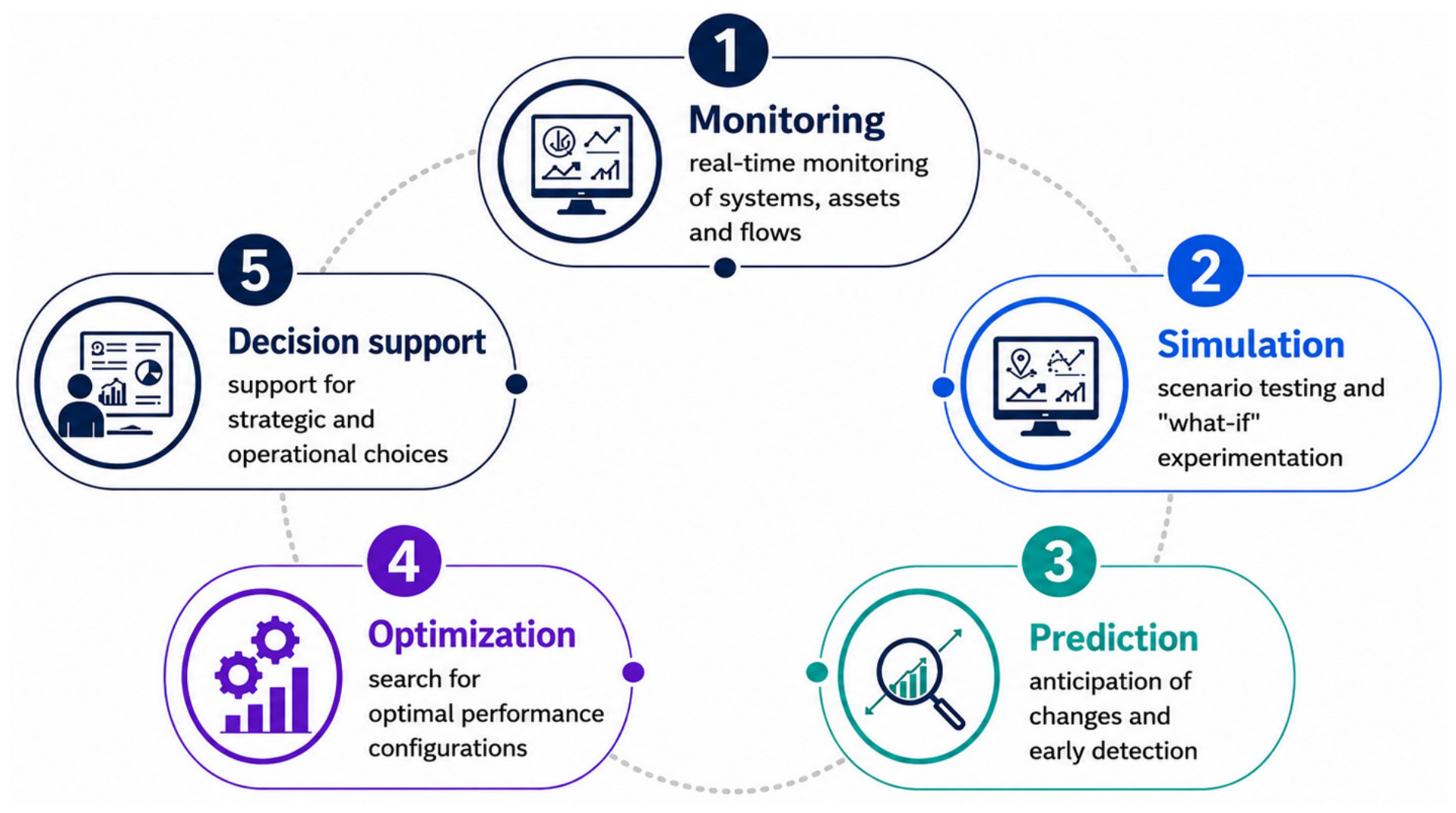
- Digital twins applied to intelligent transport systems are evolving from a simple logic of virtual replication towards service-oriented cyber–physical layers capable of supporting monitoring, prediction, simulation, optimization, decision support, service continuity, and post-disruption learning.
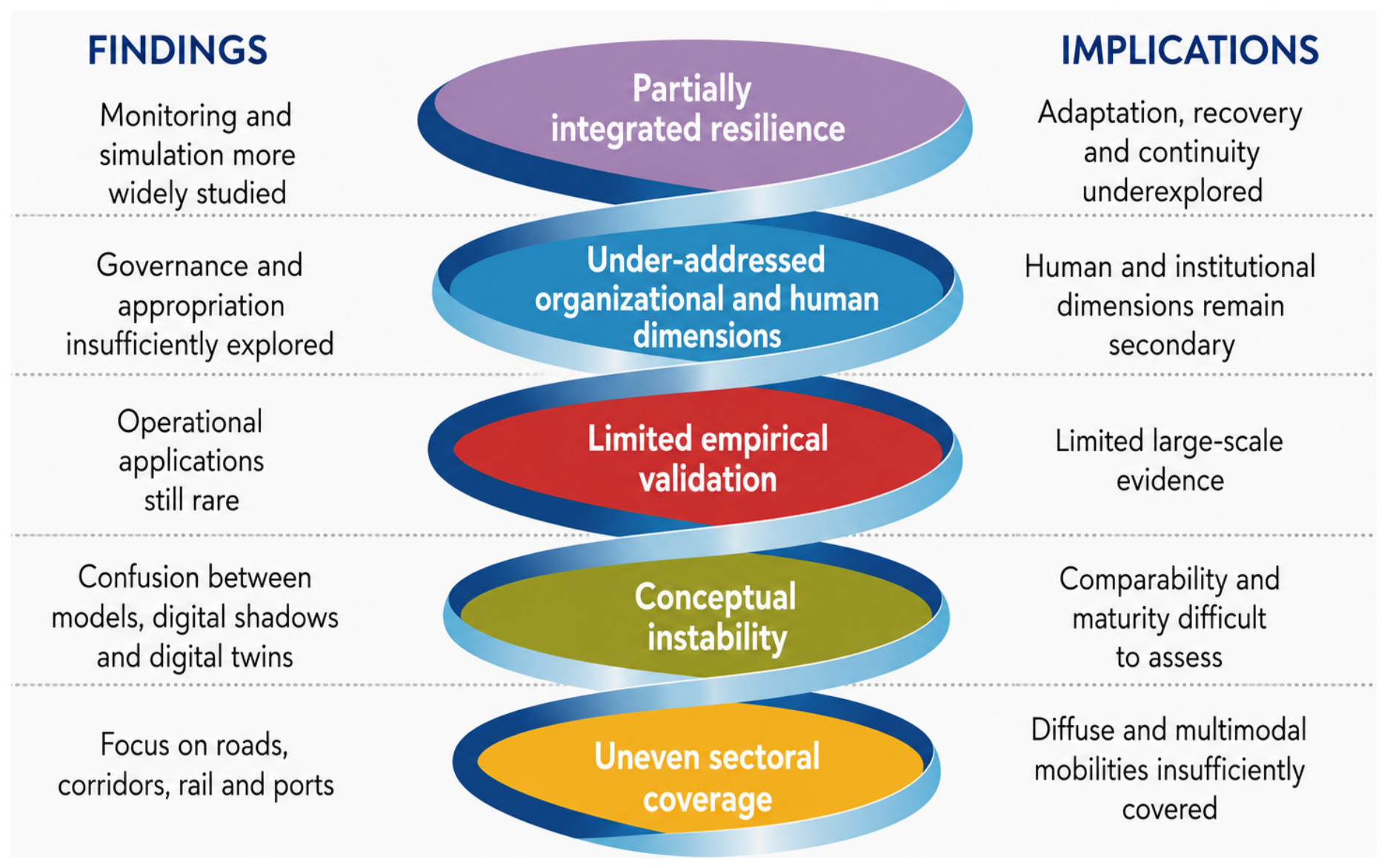
- The literature remains fragmented due to conceptual confusion between digital model, digital shadow, and digital twin; a lack of large-scale empirical validation; a sectoral concentration of studies; and the still limited consideration of human, organizational, and governance dimensions.
- The contribution of digital twins to the resilience of intelligent transport systems depends heavily on data quality, interoperability, real-time synchronization, model reliability, and the ability of stakeholders to transform digital intelligence into operational responses.
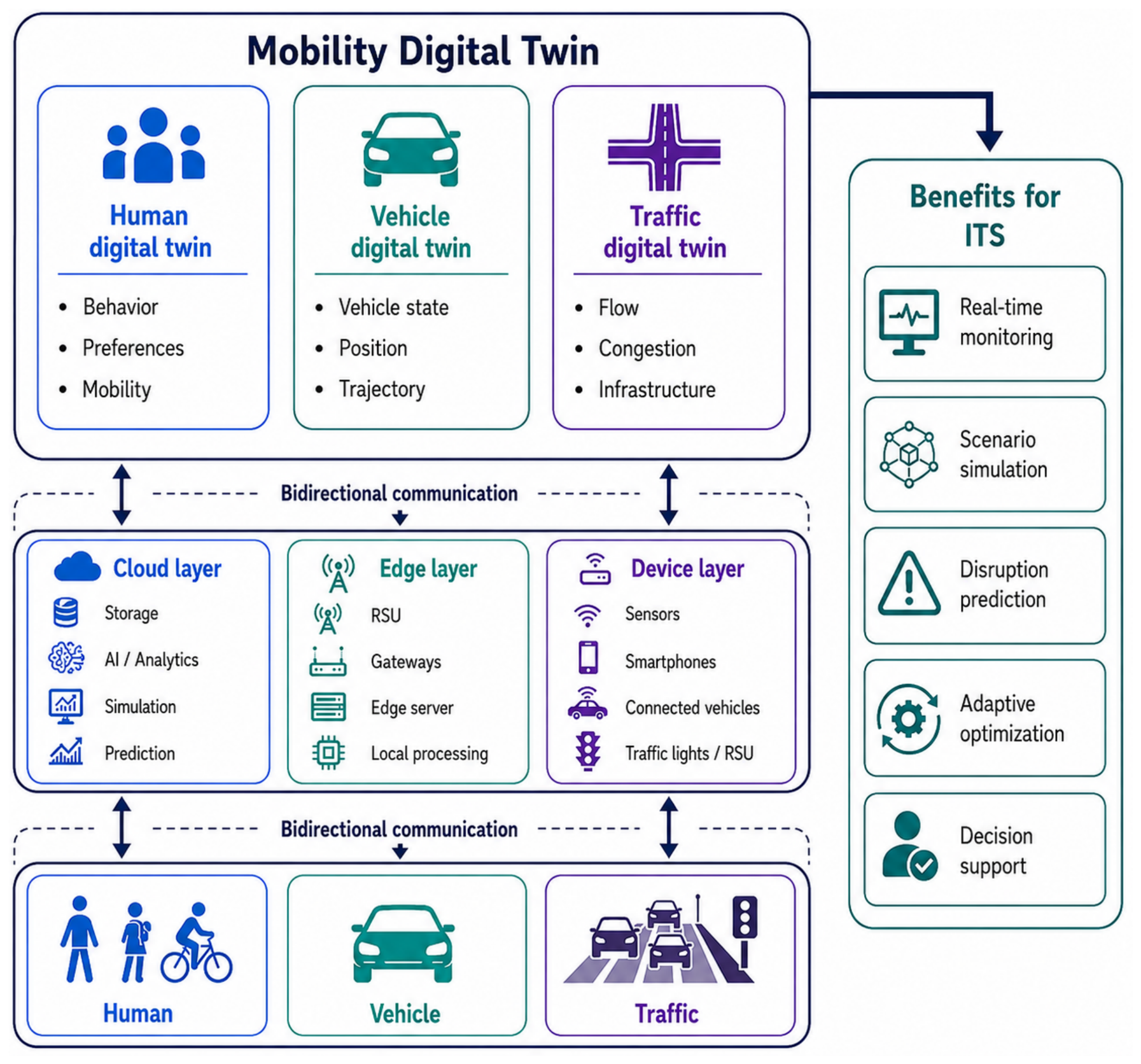
- For smart cities, digital twins should be designed not only as technical modeling tools, but also as integrated decision-support mechanisms linking infrastructure monitoring, mobility management, and resilience governance.
Abstract
1. Introduction
2. Methodology
2.1. Search Strategy and Keywords
2.2. Inclusion and Exclusion Criteria
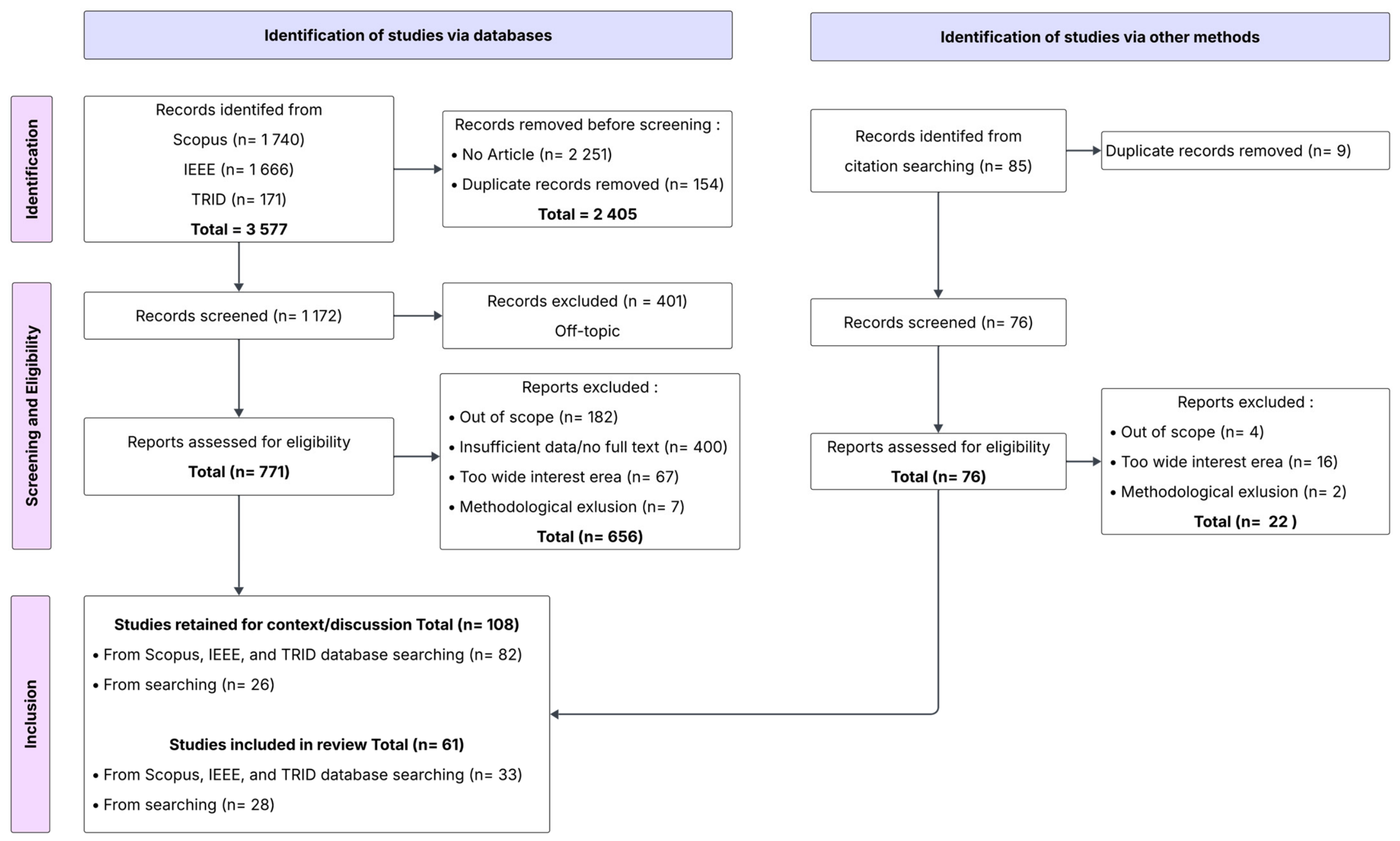
2.3. Article Selection Process
3. Results of the Systematic Review and Thematic Synthesis
3.1. Conceptual Foundations of the Link Between Digital Twins, Intelligent Transport Systems and Resilience
3.1.1. Genesis, Definition and Evolution of the Digital Twin Concept
3.1.2. Functional Components of Digital Twins in Transport
3.1.3. Intelligent Transport Systems as an Application Framework
3.1.4. Resilience of Intelligent Transport Systems: Foundations and Dimensions
3.1.5. Conceptual Link Between Digital Twin, ITS and Resilience
3.2. Technological Structuring, Operational Purposes and Literature Trends on Digital Twins in Transport
3.2.1. Architectures and Technologies Mobilized
3.2.2. Dominant Purposes and Uses of Digital Twins in Transport
3.2.3. Emerging Trends and Imbalances in the Literature
Emerging Trends
Imbalances in the Literature
3.3. Digital Twin Functions and Their Contribution to Resilience Phases in Intelligent Transport Systems
3.3.1. Real-Time Visibility and Monitoring
3.3.2. Prediction and Anticipation of Disruptions
3.3.3. Scenario Simulation and Decision Support
3.3.4. Operational Adaptation and Dynamic Optimization
3.3.5. Recovery, Service Continuity and Learning
3.3.6. Comparative Synthesis of Evidence, Boundary Conditions and Strength of Support
3.3.7. Stratified Interpretation by Transport Mode, System Scale and Disruption Type
3.4. Enabling and Constraining Conditions for DT-ITS Resilience
4. Discussion
4.1. Evidence Limitations, Theoretical Contributions and Practical Implications
4.2. Smart City Implications, Urban Governance, and Future Research Priorities
5. Conclusions
Author Contributions
Funding
Data Availability Statement
Conflicts of Interest
Abbreviations
| 5G | Fifth-Generation Mobile Network |
| ADD | Agency for Digital Development |
| AGV | Automated Guided Vehicle |
| AI | Artificial Intelligence |
| BIM-GIS | Building Information Modeling–Geographic Information System |
| CNRST | National Center for Scientific and Technical Research |
| DOI | Digital Object Identifier |
| DT | Digital Twin |
| DT-ITS | Digital Twin–Intelligent Transport Systems |
| DTTF-Sim | Digital Twin Traffic Flow Simulation system |
| DSS | Decision Support System |
| IEEE | Institute of Electrical and Electronics Engineers |
| IoV | Internet of Vehicles |
| ITS | Intelligent Transport Systems |
| MCDM-GIS | Multi-Criteria Decision-Making–Geographic Information System |
| ML | Machine Learning |
| NASA | National Aeronautics and Space Administration |
| OECD | Organization for Economic Co-operation and Development |
| SME | Small- and Medium-sized Enterprises |
| PRISMA | Preferred Reporting Items for Systematic Reviews and Meta-Analyses |
| PRISMA-S | PRISMA Search Extension |
| TRID | Transport Research International Documentation |
| UAM | Urban Air Mobility |
| UAV | Unmanned Aerial Vehicle |
| V2I | Vehicle-to-Infrastructure |
| V2V | Vehicle-to-Vehicle |
| V2X | Vehicle-to-Everything |
| VR-DT | Virtual Reality–Digital Twin |
Appendix A

| Database | Boolean Search Query |
|---|---|
| Scopus | TITLE-ABS-KEY (((“digital twin*” OR “digital-twin*” OR “digital shadow*”) AND (transport* OR transportation OR traffic OR mobility OR “intelligent transport system*” OR ITS OR “smart transport*” OR “smart mobility” OR “urban mobility” OR railway OR rail OR road* OR highway* OR bridge* OR port* OR maritime OR “urban logistics”) AND ((resilien* OR robustness OR robust* OR disruption* OR failure* OR incident* OR emergency OR emergenc* OR hazard* OR shock* OR recover* OR recovery OR adapt* OR vulnerability OR “risk management” OR “service continuity” OR “continuity of service” OR “post-disruption”) AND (simulation OR prediction OR forecasting OR optimization OR “decision support” OR “real-time monitoring” OR “scenario analysis” OR “adaptive control” OR rerouting OR reconfiguration)))) AND PUBYEAR > 2019 AND PUBYEAR < 2026 |
| IEEE | (“digital twin” OR “digital twins” OR “digital-twin” OR “digital-twins” OR “digital shadow” OR “digital shadows”) AND (transportation OR traffic OR mobility OR “intelligent transport system” OR “intelligent transport systems” OR ITS OR “smart mobility” OR “urban mobility” OR railway OR rail OR road OR highway OR bridge OR port OR maritime OR “urban logistics”) AND (resilience OR resilient OR robustness OR robust OR disruption OR failure OR incident OR emergency OR recovery OR adaptation OR adaptive OR vulnerability OR “risk management” OR “service continuity” OR “continuity of service”) AND (simulation OR prediction OR forecasting OR optimization OR “decision support” OR “real-time monitoring” OR “scenario analysis” OR “adaptive control” OR rerouting OR reconfiguration) |
| TRID | (“digital twin” OR “digital twins” OR “digital-twin” OR “digital-twins” OR “digital shadow” OR “digital shadows”) AND (resilience OR resilient OR robustness OR robust OR disruption OR disruptions OR failure OR failures OR incident OR incidents OR emergency OR emergencies OR recovery OR recover OR adaptation OR adaptive OR vulnerability OR vulnerabilities OR “risk management” OR “service continuity” OR “continuity of service”) AND (simulation OR simulations OR prediction OR predictions OR forecasting OR forecast OR optimization OR optimisation OR “decision support” OR “real-time monitoring” OR “real time monitoring” OR “scenario analysis” OR “adaptive control” OR rerouting OR reconfiguration) |
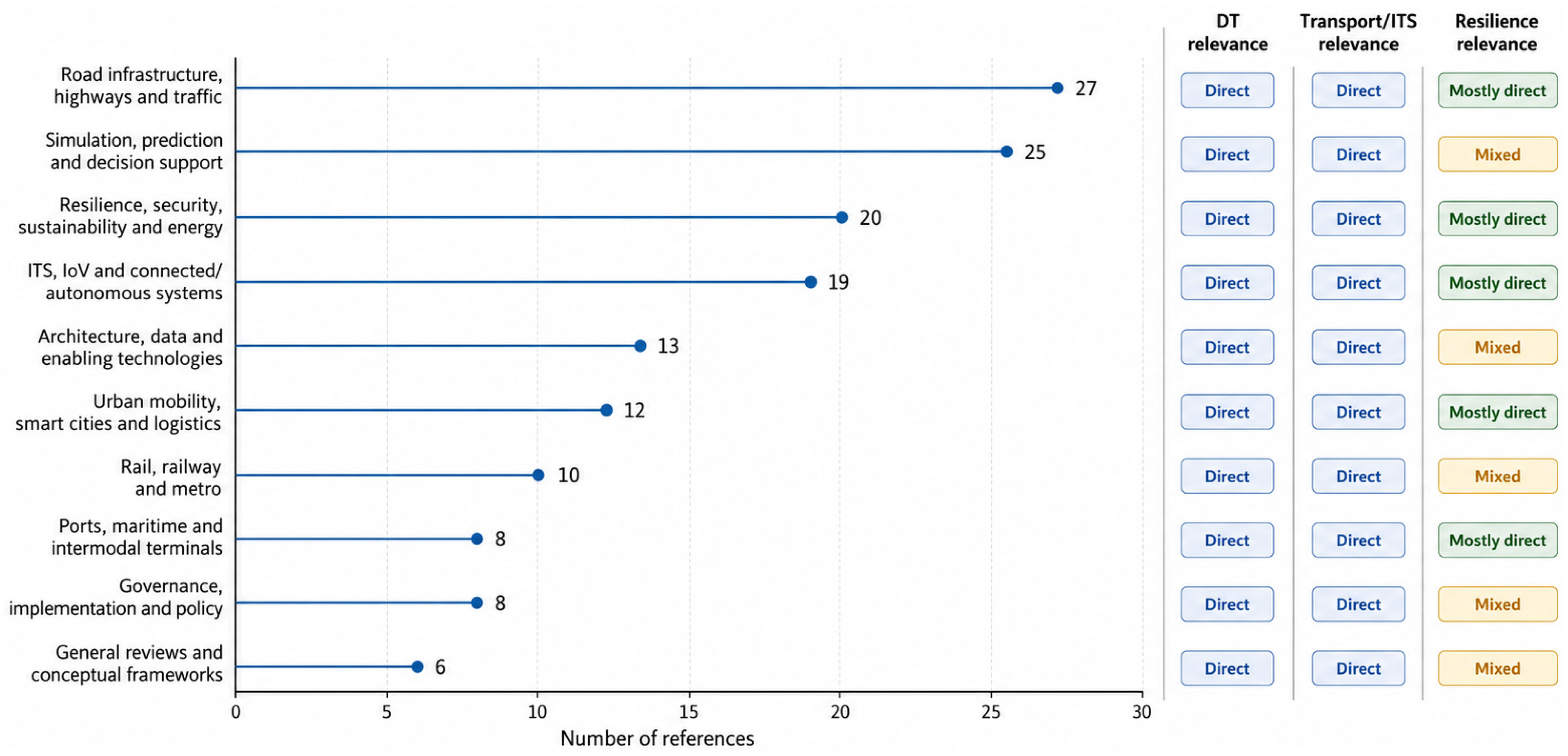
| No. | Paper | Proposed Thematic Axis | Digital Twin Relevance | Transport/ITS Relevance | Resilience Relevance | Mechanism/Function |
|---|---|---|---|---|---|---|
| 1 | [77] | Logistics/humanitarian transport | Direct | Direct | Direct | Emergency response/disaster logistics/evacuation |
| 2 | [78] | Connected/autonomous vehicles/vehicular networks | Direct | Direct | Direct | Predictive maintenance/fault diagnosis/asset management |
| 3 | [79] | Road infrastructure/bridges/pavements | Direct | Direct | Direct | Recovery/restoration and interdependent infrastructure resilience |
| 4 | [80] | Logistics/city logistics/supply chain | Direct | Direct | Direct or implicit | Disruption impact analysis/resilience planning/supply-chain adaptation |
| 5 | [81] | Logistics/healthcare waste transport | Direct | Direct | Direct | Robust optimization under disruption |
| 6 | [82] | Railway/smart rail | Direct | Direct | Direct | Predictive maintenance/fault diagnosis/asset management |
| 7 | [83] | Connected/autonomous vehicles/vehicular networks | Direct | Direct | Direct | Safety, collision avoidance and situational awareness |
| 8 | [84] | Connected/autonomous vehicles/vehicular networks | Direct | Direct | Direct | Robust optimization under disruption |
| 9 | [85] | Road infrastructure/bridges/pavements | Direct | Direct | Direct | Predictive maintenance/fault diagnosis/asset management |
| 10 | [86] | Road infrastructure/bridges/pavements | Direct | Direct | Direct | Predictive maintenance/fault diagnosis/asset management |
| 11 | [87] | Road infrastructure/bridges/pavements | Direct | Direct | Direct | Structural health monitoring/infrastructure robustness |
| 12 | [88] | Maritime/ports/waterways | Direct | Direct | Direct | Predictive maintenance/fault diagnosis/asset management |
| 13 | [89] | Railway/smart rail | Direct | Direct | Direct | Fatigue damage assessment/structural health monitoring |
| 14 | [90] | Urban traffic/ITS/smart mobility | Direct | Direct | Direct | Recovery/restoration and interdependent infrastructure resilience |
| 15 | [91] | Maritime/ports/waterways | Direct | Direct | Direct | Predictive maintenance/fault diagnosis/asset management |
| 16 | [92] | Road infrastructure/bridges/pavements | Direct | Direct | Direct or implicit | Multi-scale infrastructure integration/maintenance support |
| 17 | [93] | Connected/autonomous vehicles/vehicular networks | Direct | Direct | Direct | Predictive maintenance/fault diagnosis/asset management |
| 18 | [94] | Road infrastructure/bridges/pavements | Direct | Direct | Direct | Predictive maintenance/fault diagnosis/asset management |
| 19 | [95] | Maritime/ports/waterways | Direct | Direct | Direct or implicit | Cybersecurity/trustworthiness of DT-enabled systems |
| 20 | [96] | Road infrastructure/bridges/pavements | Direct | Direct | Direct | Structural health monitoring/infrastructure robustness |
| 21 | [97] | Connected/autonomous vehicles/vehicular networks | Direct | Direct | Direct | Fault-tolerant federated learning/blockchain-enabled resilience |
| 22 | [98] | Urban traffic/ITS/smart mobility | Direct | Direct | Direct | Safety, collision avoidance and situational awareness |
| 23 | [99] | Urban traffic/ITS/smart mobility | Direct | Direct | Direct or implicit | Cybersecurity/trustworthiness of DT-enabled systems |
| 24 | [100] | Connected/autonomous vehicles/vehicular networks | Direct | Direct | Direct | Safety, collision avoidance and situational awareness |
| 25 | [101] | Road infrastructure/bridges/pavements | Direct | Direct | Direct | Safety, collision avoidance and situational awareness |
| 26 | [102] | Road infrastructure/bridges/pavements | Direct | Direct | Direct | Predictive maintenance/fault diagnosis/asset management |
| 27 | [103] | Air transport/UAM/UAV | Direct | Direct | Direct or implicit | Predictive maintenance/fault diagnosis/asset management |
| 28 | [104] | Railway/smart rail | Direct | Direct | Direct | Predictive maintenance/fault diagnosis/asset management |
| 29 | [105] | Connected/autonomous vehicles/vehicular networks | Direct | Direct | Direct or implicit | Vehicle vulnerability prevention/safety and security review |
| 30 | [106] | Maritime/ports/waterways | Direct | Direct | Direct | Damage control and decision support |
| 31 | [63] | Urban traffic/ITS/smart mobility | Direct | Direct | Direct | Safety, collision avoidance and situational awareness |
| 32 | [107] | Road infrastructure/bridges/pavements | Direct | Direct | Direct | Predictive maintenance/fault diagnosis/asset management |
| 33 | [108] | Urban traffic/ITS/smart mobility | Direct | Direct | Direct | Safety, collision avoidance and situational awareness |
| 34 | [8] | Motorway traffic DT/real-time simulation | Direct | Direct | Indirect | Potential monitoring and simulation for dynamic traffic states |
| 35 | [9] | AI-enabled DT/safe intelligent transportation | Direct | Direct | Direct | Safety-oriented monitoring/decision support |
| 36 | [42] | Transportation DT/traffic safety and mobility review | Direct | Direct | Direct | Safety-oriented mobility DT |
| 37 | [109] | Road engineering lifecycle DT | Direct | Direct | Indirect | Lifecycle monitoring and maintenance |
| 38 | [73] | Road infrastructure management DT | Direct | Direct | Indirect | Infrastructure management and maintenance |
| 39 | [110] | Adaptive traffic signal DT under limited synchronization | Direct | Direct | Indirect | Adaptive control under constrained conditions |
| 40 | [111] | Highway asset maintenance DT | Direct | Direct | Indirect | Asset maintenance/information management |
| 41 | [112] | Port asset management/BIM-GIS-DT | Direct | Direct | Indirect | Asset management and maintenance |
| 42 | [113] | Rail anomaly detection DT | Direct | Direct | Direct | Failure/anomaly detection and monitoring |
| 43 | [114] | Road pavement DT | Direct | Direct | Indirect | Pavement condition/lifecycle monitoring |
| 44 | [72] | Port multi-equipment scheduling under uncertainty | Direct | Direct | Direct | Adaptive scheduling under uncertainty |
| 45 | [65] | Intermodal container terminal rescheduling | Direct | Direct | Direct | Adaptive rescheduling/disruption management potential |
| 46 | [115] | Road geometric DT maintenance | Direct | Direct | Indirect | Maintenance and change detection |
| 47 | [116] | Railway bogie DT updating | Direct | Direct | Indirect | Model updating for vehicle components |
| 48 | [117] | Bridge traffic load DT | Direct | Direct | Indirect | Structural load/mechanical effects |
| 49 | [118] | Bridge lifecycle management DT | Direct | Direct | Indirect | Lifecycle management and maintenance |
| 50 | [119] | Digital twin trains/railway digitalization | Direct | Direct | Indirect | AI-powered services and digital train functions |
| 51 | [120] | AI-assisted DT for smart railways | Direct | Direct | Indirect | Reference architecture for reliable smart railways |
| 52 | [121] | Subway tunnel DT review | Direct | Direct | Indirect | Tunnel intelligence, lifecycle and monitoring |
| 53 | [70] | Resilient port DSS with digital twinning | Direct | Direct | Direct | Decision support for port resilience |
| 54 | [122] | Rail transit structural health monitoring | Direct | Direct | Direct | Damage/fault monitoring and condition assessment |
| 55 | [123] | Pedestrian/connected vehicle in-the-loop DT co-simulation | Direct | Direct | Indirect | Co-simulation for safety-oriented testing |
| 56 | [124] | Urban rail traction power DT | Direct | Direct | Indirect | Power-system modeling and reliability support |
| 57 | [71] | Autonomous driving testing DT | Direct | Direct | Indirect | Scenario testing and validation |
| 58 | [48] | Resilience-oriented DT/adaptability | Direct | Direct | Direct | Adaptability/resilience improvement |
| 59 | [125] | Airspace management/advanced air mobility | Direct | Direct | Indirect | Operational coordination and management |
| 60 | [126] | Smart freeway DT | Direct | Direct | Indirect | Real-time freeway monitoring/simulation/traffic control |
| 61 | [127] | Overheight vehicle warning and rerouting | Direct | Direct | Direct | Incident prevention and adaptive rerouting |
| Criterion and Assessment Question | Score 0 | Score 1 | Score 2 |
|---|---|---|---|
| Digital Twin Conceptual Clarity: Does the study clearly define the DT, digital shadow, or DT-enabled system and its system boundaries? | Unclear or only mentioned | Partially defined | Clearly defined and operationalized |
| Methodological Transparency: Are data sources, models, assumptions, procedures, and analytical steps sufficiently described? | Weak or unclear | Partially described | Transparent and reproducible |
| Validation/Empirical Grounding: Does the study provide simulation validation, case evidence, prototype testing, or real-world deployment evidence? | No validation | Simulation/prototype only | Case-based or real-world validation |
| Resilience Relevance: Does the study explicitly connect DT functions to resilience mechanisms or outcomes? | No explicit link | Indirect or potential link | Clear resilience-related mechanism or outcome |
| Limitations and Uncertainty: Does the study discuss uncertainty, limitations, transferability, or implementation constraints? | Not discussed | Briefly discussed | Clearly discussed |
| Total Score | Quality/Evidence Category | Interpretation |
|---|---|---|
| 0–3 | Low | Conceptual or weakly documented evidence; used cautiously |
| 4–6 | Moderate | Partial methodological support or simulation/prototype evidence |
| 7–8 | Good | Clear method and relevant validation |
| 9–10 | Strong | Robust empirical, case-based, or real-world evidence |
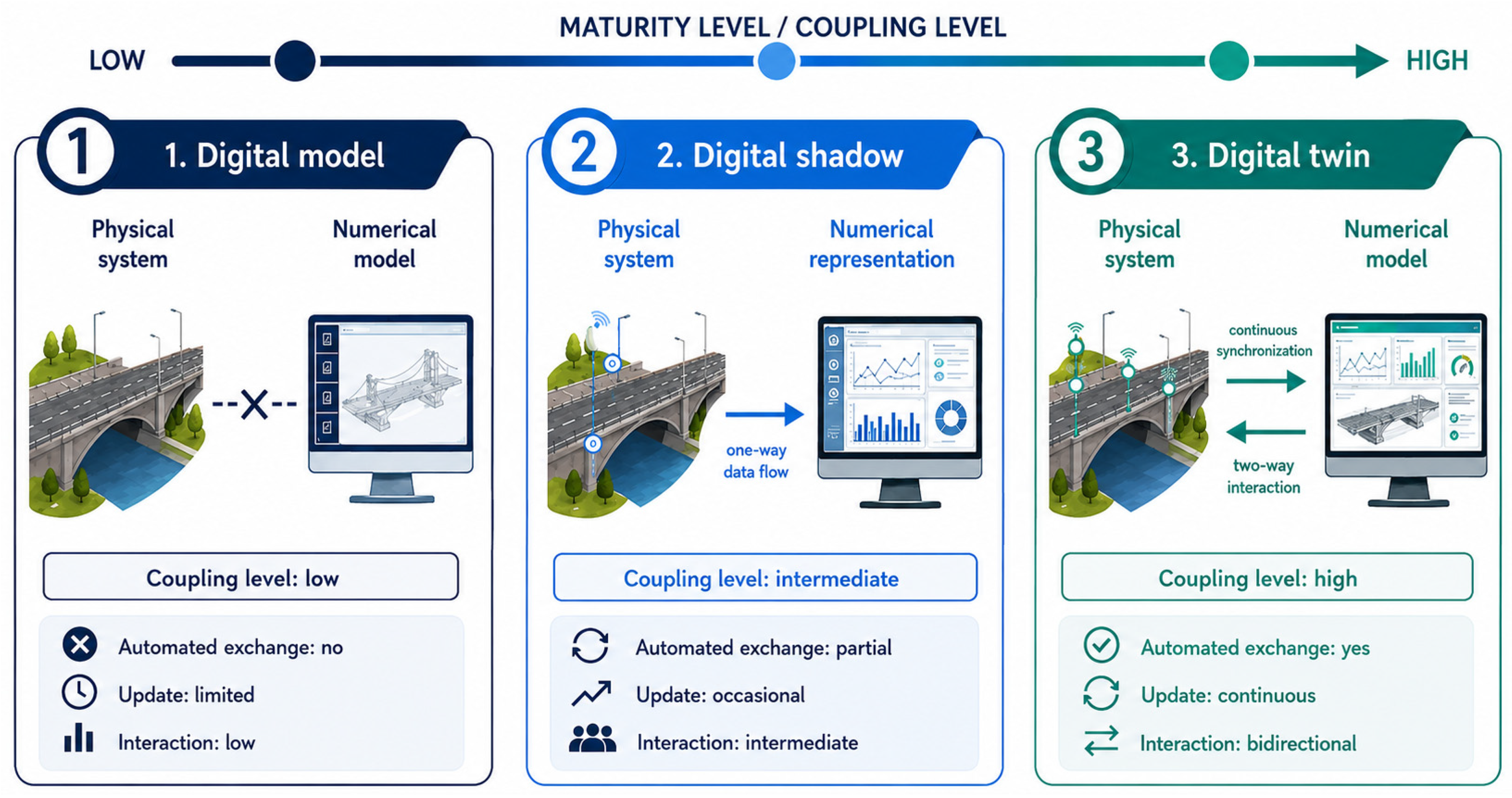
| Category | Main Criterion | Data Flow | Synchronization | Feedback/Control |
|---|---|---|---|---|
| Digital model | Static or manually updated digital representation | Manual or absent | No real-time synchronization | No feedback |
| Digital shadow | Automatic data flow from the physical system to the digital representation | One-way physical-to-digital | Possible near-real-time update | No systematic feedback |
| Digital twin | Synchronized representation connected to the physical system | Two-way or decision feedback | Continuous or near-real-time synchronization | Decision support or operational feedback |
| Advanced/closed-loop digital twin | Operational system with adaptive intervention capability | Bidirectional and operationally integrated | Real-time or near-real-time | Automated or semi-automated control, rerouting, reconfiguration |
| Unclear | Insufficient information in the study | Not clearly reported | Not clearly reported | Not clearly reported |
| Coding Category | Definition | Coding Rule |
|---|---|---|
| Transport domain | Main transport field addressed by the study | Coded only when explicitly stated: road, rail, port, maritime, urban mobility, public transport, infrastructure, intermodal, etc. |
| Study type | Nature of the study design | Review, conceptual framework, simulation, prototype, case study, real-world deployment |
| DT maturity | Level of digital twin maturity | Digital model, digital shadow, digital twin, advanced/closed-loop DT, unclear |
| Resilience contribution | Type of contribution to resilience | Potential resilience-supporting function or empirically verified resilience benefit |
| Functional mechanism | Main DT function addressed | Monitoring, prediction, simulation, optimization, decision support, recovery, learning |
| Resilience dimension | Resilience aspect addressed | Robustness, redundancy, service continuity, response, recovery, adaptation, reconfiguration |
| Evidence level | Strength of evidence | Low, moderate, good, strong, based on Table A4 |
| Thematic axis | Dominant analytical theme | Assigned according to the main contribution of the study; multi-label coding allowed only when explicitly justified |
| Transport Domain | Typical System Scale | Main Disruption or Risk Context | Main Digital Twin Functions | Main Resilience Contribution | Boundary of Generalization |
|---|---|---|---|---|---|
| Road corridors and urban traffic | Intersection, corridor, road network | Congestion, incidents, abnormal traffic states, signal failures | Real-time monitoring, prediction, adaptive control, rerouting | Preparedness, response, adaptation | Transferability depends on sensor coverage, V2X availability, traffic data quality, and local control architecture. |
| Railways and metro systems | Asset, station, line, network | Passenger flow disruption, rolling-stock anomalies, infrastructure degradation, service interruption | Condition monitoring, passenger flow prediction, simulation, maintenance support | Preparedness, absorption, recovery | Findings are more transferable to closed or semi-closed systems with structured operations and reliable asset data. |
| Ports and intermodal terminals | Terminal, port system, logistics node | Equipment failure, scheduling uncertainty, congestion, operational disruption | Simulation, scheduling optimization, decision support, resource reallocation | Response, recovery, adaptation | Generalization depends on terminal layout, operational rules, equipment configuration, and multi-actor coordination. |
| Bridges and transport infrastructures | Asset, infrastructure network, lifecycle system | Structural degradation, maintenance needs, extreme loads, infrastructure failure | Asset monitoring, lifecycle modeling, predictive maintenance | Preparedness, absorption, recovery | Evidence is mainly asset-specific and cannot be directly generalized to full mobility-system resilience. |
| Urban mobility and public transport | Multimodal network, city scale | Demand fluctuation, service interruption, modal disruption, urban mobility imbalance | Mobility simulation, real-time visibility, decision support, scenario analysis | Preparedness, adaptation, transformation | Transferability is limited by governance capacity, interoperability, data integration, and the openness of urban mobility systems. |
References
- United Nations. 68% of the World Population Projected to Live in Urban Areas by 2050, Says UN. Available online: https://www.un.org/uk/desa/68-world-population-projected-live-urban-areas-2050-says-un (accessed on 4 March 2026).
- OECD. ITF Transport Outlook 2023. Available online: https://www.oecd.org/en/publications/itf-transport-outlook-2023_b6cc9ad5-en.html (accessed on 20 April 2026).
- OECD. Transport System Resilience: Summary and Conclusions. Available online: https://www.oecd.org/en/publications/transport-system-resilience_d90b86ac-en.html (accessed on 20 April 2026).
- Dehghani, M.; Louis Breteau, M.G.J. Disaster and Climate-Resilient Transport Guidance Note; World Bank: Washington, DC, USA, 2025. [Google Scholar] [CrossRef]
- Yang, Y.; Huang, H.; Li, G.; Han, B.; Yuan, Z.; Ma, H. A systematic review of resilience assessment and enhancement of urban integrated transportation networks. J. Transp. Geogr. 2025, 129, 104420. [Google Scholar] [CrossRef]
- Mattsson, L.-G.; Jenelius, E. Vulnerability and resilience of transport systems—A discussion of recent research. Transp. Res. Part A Policy Pract. 2015, 81, 16–34. [Google Scholar] [CrossRef]
- Nag, D.; Brandel-Tanis, F.; Pramestri, Z.A.; Pitera, K.; Frøyen, Y.K. Exploring digital twins for transport planning: A review. Eur. Transp. Res. Rev. 2025, 17, 15. [Google Scholar] [CrossRef]
- Kušić, K.; Schumann, R.; Ivanjko, E. A digital twin in transportation: Real-time synergy of traffic data streams and simulation for virtualizing motorway dynamics. Adv. Eng. Inform. 2023, 55, 101858. [Google Scholar] [CrossRef]
- Long, K.; Ma, C.; Li, H.; Li, Z.; Huang, H.; Shi, H.; Huang, Z.; Sheng, Z.; Shi, L.; Li, P.; et al. AI-Enabled Digital Twin Framework for Safe and Sustainable Intelligent Transportation. Sustainability 2025, 17, 4391. [Google Scholar] [CrossRef]
- Wu, D.; Zheng, A.; Yu, W.; Cao, H.; Ling, Q.; Liu, J.; Zhou, D. Digital Twin Technology in Transportation Infrastructure: A Comprehensive Survey of Current Applications, Challenges, and Future Directions. Appl. Sci. 2025, 15, 1911. [Google Scholar] [CrossRef]
- Andruccioli, M.; Delnevo, G.; Girau, R.; Salomoni, P. Digital twins in public bus transport: A systematic literature review of architectures, intelligence, and interaction. Future Gener. Comput. Syst. 2026, 180, 108379. [Google Scholar] [CrossRef]
- Thompson, E.A.; Lu, P.; Alimo, P.K.; Atuobi, H.B.; Akoto, E.T.; Abbew, C.K. Revolutionizing railway systems: A systematic review of digital twin technologies. High-Speed Railw. 2025, 3, 238–250. [Google Scholar] [CrossRef]
- Ge, C.; Qin, S. Digital twin intelligent transportation system (DT-ITS)—A systematic review. IET Intell. Transp. Syst. 2024, 18, 2325–2358. [Google Scholar] [CrossRef]
- Page, M.J.; McKenzie, J.E.; Bossuyt, P.M.; Boutron, I.; Hoffmann, T.C.; Mulrow, C.D.; Shamseer, L.; Tetzlaff, J.M.; Akl, E.A.; Brennan, S.E.; et al. The PRISMA 2020 statement: An updated guideline for reporting systematic reviews. BMJ 2021, 372, n71. [Google Scholar] [CrossRef] [PubMed]
- Snyder, H. Literature review as a research methodology: An overview and guidelines. J. Bus. Res. 2019, 104, 333–339. [Google Scholar] [CrossRef]
- Tranfield, D.; Denyer, D.; Smart, P. Towards a Methodology for Developing Evidence-Informed Management Knowledge by Means of Systematic Review. Br. J. Manag. 2003, 14, 207–222. [Google Scholar] [CrossRef]
- Rethlefsen, M.L.; Kirtley, S.; Waffenschmidt, S.; Ayala, A.P.; Moher, D.; Page, M.J.; Koffel, J.B. PRISMA-S: An extension to the PRISMA statement for reporting literature searches in systematic reviews. J. Med. Libr. Assoc. 2021, 109, 174–200. [Google Scholar] [CrossRef] [PubMed]
- Falagas, M.E.; Pitsouni, E.I.; Malietzis, G.A.; Pappas, G. Comparison of PubMed, Scopus, Web of Science, and Google Scholar: Strengths and weaknesses. FASEB J. 2008, 22, 338–342. [Google Scholar] [CrossRef] [PubMed]
- Mongeon, P.; Paul-Hus, A. The journal coverage of Web of Science and Scopus: A comparative analysis. Scientometrics 2016, 106, 213–228. [Google Scholar] [CrossRef]
- Gusenbauer, M.; Haddaway, N.R. Which academic search systems are suitable for systematic reviews or meta-analyses? Evaluating retrieval qualities of Google Scholar, PubMed, and 26 other resources. Res. Synth. Methods 2020, 11, 181–217. [Google Scholar] [CrossRef] [PubMed]
- Carrera-Rivera, A.; Ochoa, W.; Larrinaga, F.; Lasa, G. How-to conduct a systematic literature review: A quick guide for computer science research. MethodsX 2022, 9, 101895. [Google Scholar] [CrossRef] [PubMed]
- Hiebl, M.R.W. Sample Selection in Systematic Literature Reviews of Management Research. Organ. Res. Methods 2023, 26, 229–261. [Google Scholar] [CrossRef]
- Sauer, P.C.; Seuring, S. How to conduct systematic literature reviews in management research: A guide in 6 steps and 14 decisions. Rev. Manag. Sci. 2023, 17, 1899–1933. [Google Scholar] [CrossRef]
- Booth, A.; Sutton, A.; Papaioannou, D. Systematic Approaches to a Successful Literature Review; SAGE Publications Inc.: Thousand Oaks, CA, USA, 2016. [Google Scholar]
- Briner, R.B.; Denyer, D. Systematic review and evidence synthesis as a practice and scholarship tool. In The Oxford Handbook of Evidence-Based Management; Oxford University Press: Oxford, UK, 2012; pp. 112–129. [Google Scholar]
- Kitchenham, B.; Pretorius, R.; Budgen, D.; Brereton, O.P.; Turner, M.; Niazi, M.; Linkman, S. Systematic literature reviews in software engineering—A tertiary study. Inf. Softw. Technol. 2010, 52, 792–805. [Google Scholar] [CrossRef]
- Grieves, M. Conceptual ideal for PLM. In Product Lifecycle Management Center/PLM Industry Presentation; Lurie Engineering Center, University of Michigan: Ann Arbor, MI, USA, 2002. [Google Scholar]
- Vickers, J.H.; Lowry, D.; Scotti, S.J.; Stewart, J.; Calomino, A.M.; Piascik, R. Materials, Structures, Mechanisms, & Manufacturing Technology Roadmap Briefing to NRC. In National Academies Committee Meeting; NASA Technical Reports Server: Washington, DC, USA, 2011. [Google Scholar]
- Machacek, Z.; Hercik, R.; Vaclavik, A.; Zemanek, J.; Hameed, I.A.; Koziorek, J. Modern trends and industrial use cases of digital twin technology with 3D behavioral representation. J. Intell. Manuf. 2025. [Google Scholar] [CrossRef]
- Iranshahi, K.; Brun, J.; Arnold, T.; Sergi, T.; Müller, U.C. Digital twins: Recent advances and future directions in engineering fields. Intell. Syst. Appl. 2025, 26, 200516. [Google Scholar] [CrossRef]
- Aragón, A.; Arquier, M.; Tokdemir, O.B.; Enfedaque, A.; Alberti, M.G.; Lieval, F.; Loscos, E.; Pavón, R.M.; Novischi, D.M.; Legazpi, P.V.; et al. Seeking a Definition of Digital Twins for Construction and Infrastructure Management. Appl. Sci. 2025, 15, 1557. [Google Scholar] [CrossRef]
- AboElHassan, A.; Sakr, A.H.; Yacout, S. General purpose digital twin framework using digital shadow and distributed system concepts. Comput. Ind. Eng. 2023, 183, 109534. [Google Scholar] [CrossRef]
- Elshafei, B.; Chaplin, J.C.; Sanderson, D.; Ratchev, S. Facilitating interoperability in manufacturing systems using digital twins: A multi-asset AAS system. Int. J. Adv. Manuf. Technol. 2025. [Google Scholar] [CrossRef]
- Singh, M.; Fuenmayor, E.; Hinchy, E.; Qiao, Y.; Murray, N.; Devine, D. Digital Twin: Origin to Future. Appl. Syst. Innov. 2021, 4, 36. [Google Scholar] [CrossRef]
- Haverkamp, P.; Anantheswar, A.; May, M.; Wadlig, G.; Hildebrandt, J.; Thiessat, K.A.; Wollny, I.; Traverso, M.; Müller-Mall, S.; Kaliske, M.; et al. Digital Twin Road: Value and implications involving data and application. Discov. Appl. Sci. 2025, 7, 510. [Google Scholar] [CrossRef]
- Yan, B.; Yang, F.; Qiu, S.; Wang, J.; Cai, B.; Wang, S.; Zaheer, Q.; Wang, W.; Chen, Y.; Hu, W. Digital twin in transportation infrastructure management: A systematic review. Intell. Transp. Infrastruct. 2023, 2, liad024. [Google Scholar] [CrossRef]
- Cordoș, N.; Duma, I.; Moldovanu, D.; Todoruț, A.; Barabás, I. An Overview of Intelligent Transportation Systems in Europe. World Electr. Veh. J. 2025, 16, 387. [Google Scholar] [CrossRef]
- Llagostera-Brugarola, E.; Corpas-Marco, E.; Victorio-Vergel, C.; Lopez-Aguilera, E.; Vázquez-Gallego, F.; Alonso-Zarate, J. A Digital Twin for Intelligent Transportation Systems in Interurban Scenarios. Appl. Sci. 2025, 15, 7454. [Google Scholar] [CrossRef]
- Aslam, M.M.; Shafik, W.; Hidayatullah, A.F.; Kalinaki, K.; Gul, H.; Zakari, R.Y.; Tufail, A. Intelligent Transportation Systems: A Critical Review of Integration of Cyber-Physical Systems (CPS) and Industry 4.0. Digit. Commun. Netw. 2026, 12, 143–164. [Google Scholar] [CrossRef]
- Wang, Z.; Gupta, R.; Han, K.; Wang, H.; Ganlath, A.; Ammar, N.; Tiwari, P. Mobility Digital Twin: Concept, Architecture, Case Study, and Future Challenges. IEEE Internet Things J. 2022, 9, 17452–17467. [Google Scholar] [CrossRef]
- Rouky, N.; Benmoussa, O.; Fri, M.; Abourraja, M.N.; Ben-Bouazza, F.-E. Artificial Intelligence Applications for Smart and Sustainable Mobility as a Service Concept: A Systematic Literature Review. Future Transp. 2025, 5, 122. [Google Scholar] [CrossRef]
- Irfan, M.S.; Dasgupta, S.; Rahman, M. Toward Transportation Digital Twin Systems for Traffic Safety and Mobility: A Review. IEEE Internet Things J. 2024, 11, 24581–24603. [Google Scholar] [CrossRef]
- Machkour, B.; Rouky, N.; Abriane, A.; Benmoussa, O. Artificial Intelligence and Blockchain as Enablers of Resilient and Sustainable Multimodal Transport Chains: Evidence from a Multi-Actor Qualitative Study. Sustainability 2026, 18, 2381. [Google Scholar] [CrossRef]
- Sassaron, M.L.d.S.; Rodrigues da Silva, A.N.; Fonseca, F.; Rodrigues, D.; Ribeiro, P.J.G.; Nakata-Osaki, C.M. Combining Resilience and Sustainability in Urban Mobility: A Scoping Review and Thematic Analysis. Land 2025, 14, 2063. [Google Scholar] [CrossRef]
- Gonçalves, L.A.P.J.; Ribeiro, P.J.G. Resilience of urban transportation systems. Concept, characteristics, and methods. J. Transp. Geogr. 2020, 85, 102727. [Google Scholar] [CrossRef]
- Ahmed, S.; Dey, K. Resilience modeling concepts in transportation systems: A comprehensive review based on mode, and modeling techniques. J. Infrastruct. Preserv. Resil. 2020, 1, 8. [Google Scholar] [CrossRef]
- Pavão, J.; Bastardo, R.; Rocha, N.P. Cyber Resilience and Intelligent Transport Systems, a Scoping Review. Procedia Comput. Sci. 2024, 239, 139–148. [Google Scholar] [CrossRef]
- Feng, H.; Lv, H.; Lv, Z. Resilience towarded Digital Twins to improve the adaptability of transportation systems. Transp. Res. Part A Policy Pract. 2023, 173, 103686. [Google Scholar] [CrossRef]
- Gu, X.; Duan, W.; Zhang, G.; Hou, J.; Peng, L.; Wen, M.; Gao, F.; Chen, M.; Ho, P.-H. Digital Twin Technology for Intelligent Vehicles and Transportation Systems: A Survey on Applications, Challenges and Future Directions. IEEE Commun. Surv. Tutor. 2026, 28, 3235–3271. [Google Scholar] [CrossRef]
- Manandhar, B.; Vance, K.D.; Rawat, D.B.; Yilmaz, N. Leveraging Digital Twin Technology for Sustainable and Efficient Public Transportation. Appl. Sci. 2025, 15, 2942. [Google Scholar] [CrossRef]
- Gao, J.; Peng, C.; Yoshinaga, T.; Han, G.; Guleng, S.; Wu, C. Digital Twin-Enabled Internet of Vehicles Applications. Electronics 2024, 13, 1263. [Google Scholar] [CrossRef]
- Hu, C.; Fan, W.; Zeng, E.; Hang, Z.; Wang, F.; Qi, L.; Bhuiyan, M.Z.A. Digital Twin-Assisted Real-Time Traffic Data Prediction Method for 5G-Enabled Internet of Vehicles. IEEE Trans. Ind. Inform. 2022, 18, 2811–2819. [Google Scholar] [CrossRef]
- Neugebauer, J.; Heilig, L.; Voß, S. Digital Twins in the Context of Seaports and Terminal Facilities. Flex. Serv. Manuf. J. 2024, 36, 821–917. [Google Scholar] [CrossRef]
- Zhou, J.; Yu, M.; Guo, Y.; Li, B.; Ying, S.; Li, Z. A high-definition map architecture for transportation digital twin system construction. Int. J. Appl. Earth Obs. Geoinf. 2025, 144, 104822. [Google Scholar] [CrossRef]
- Afshari, A.; Lee, J.; Besenski, D. A Digital Twin Platform for Real-Time Intersection Traffic Monitoring, Performance Evaluation, and Calibration. Infrastructures 2025, 10, 204. [Google Scholar] [CrossRef]
- Astarita, V.; Guido, G.; Haghshenas, S.S.; Haghshenas, S.S. Risk Reduction in Transportation Systems: The Role of Digital Twins According to a Bibliometric-Based Literature Review. Sustainability 2024, 16, 3212. [Google Scholar] [CrossRef]
- Yang, W.; Bao, X.; Zheng, Y.; Zhang, L.; Zhang, Z.; Zhang, Z.; Li, L. A digital twin framework for large comprehensive ports and a case study of Qingdao Port. Int. J. Adv. Manuf. Technol. 2024, 131, 5571–5588. [Google Scholar] [CrossRef]
- Somma, A.; Amalfitano, D.; Bucaioni, A.; De Benedictis, A. A model-driven approach for engineering Mobility Digital Twins: The Bologna case study. Inf. Softw. Technol. 2025, 188, 107863. [Google Scholar] [CrossRef]
- Xing, L.; Li, B.; Deng, K.; Gao, J.; Wu, H.; Ma, H.; Zhang, X. Advancing intelligent transportation through digital twin: Challenges, models, and future prospects. Ad Hoc Netw. 2026, 181, 104077. [Google Scholar] [CrossRef]
- Kajba, M.; Jereb, B.; Cvahte Ojsteršek, T. Exploring Digital Twins in the Transport and Energy Fields: A Bibliometrics and Literature Review Approach. Energies 2023, 16, 3922. [Google Scholar] [CrossRef]
- Machkour, B.; Rouky, N.; Abriane, A. Integrating artificial intelligence and blockchain for the resilience of sustainable multimodal transport: A systematic review. Multimodal Transp. 2026, 5, 100298. [Google Scholar] [CrossRef]
- Gazzaneo, L.; Longo, F.; Mirabelli, G.; Pellegrino, M.; Solina, V. Towards Green and Smart Ports: A Review of Digital Twin and Hydrogen Applications in Maritime Management. Appl. Syst. Innov. 2025, 8, 165. [Google Scholar] [CrossRef]
- Xu, H.; Berres, A.; Yoginath, S.B.; Sorensen, H.; Nugent, P.J.; Severino, J.; Tennille, S.A.; Moore, A.; Jones, W.; Sanyal, J. Smart Mobility in the Cloud: Enabling Real-Time Situational Awareness and Cyber-Physical Control Through a Digital Twin for Traffic. IEEE Trans. Intell. Transp. Syst. 2023, 24, 3145–3156. [Google Scholar] [CrossRef]
- Ou, Y.; Mihăiţă, A.-S.; Ellison, A.; Mao, T.; Lee, S.; Chen, F. Rail Digital Twin and Deep Learning for Passenger Flow Prediction Using Mobile Data. Electronics 2025, 14, 2359. [Google Scholar] [CrossRef]
- Li, J.; Chang, D.; Wen, F. Digital twin enhanced rescheduling based on hybrid strategy in intermodal container terminal. Comput. Oper. Res. 2025, 180, 107053. [Google Scholar] [CrossRef]
- Zhu, M.; Calderon, C.; Ford, A.; Robson, C.; Jin, J. Digital Twin for resilience and sustainability assessment of port facility. Sustain. Resilient Infrastruct. 2025, 11, 267–300. [Google Scholar] [CrossRef]
- Benjdiya, O.; Rouky, N.; Benmoussa, O.; Fri, M. On the use of Machine Learning Techniques and Discrete Choice Models in Mode Choice Analysis. Logforum 2023, 19, 331–345. [Google Scholar] [CrossRef]
- Marian, A.R.; Serdar, M.Z.; Masad, E. Assessment of road network vulnerability using multilayer perceptron surrogates with automated closure propagation. Comput.-Aided Civil. Infrastruct. Eng. 2025, 40, 5325–5350. [Google Scholar] [CrossRef]
- Gao, Y.; Chang, D.; Chen, C.-H.; Sha, M. A digital twin-based decision support approach for AGV scheduling. Eng. Appl. Artif. Intell. 2024, 130, 107687. [Google Scholar] [CrossRef]
- Zhou, C.; Xu, J.; Miller-Hooks, E.; Zhou, W.; Chen, C.-H.; Lee, L.H.; Chew, E.P.; Li, H. Analytics with digital-twinning: A decision support system for maintaining a resilient port. Decis. Support. Syst. 2021, 143, 113496. [Google Scholar] [CrossRef]
- Liang, Z.; Wang, J.; Zhang, T.; Yong, X. DTTF-Sim: A Digital Twin-Based Simulation System for Continuous Autonomous Driving Testing. Sensors 2025, 25, 3447. [Google Scholar] [CrossRef] [PubMed]
- Li, W.; Fan, H.; Cai, L.; Guo, W.; Wu, Z.; Yang, P. Digital twin-driven proactive-reactive scheduling framework for port multi-equipment under a complex uncertain environment. Simul. Model. Pract. Theory 2024, 136, 103011. [Google Scholar] [CrossRef]
- Buuveibaatar, M.; Shin, S.; Lee, W. Digital Twin Framework for Road Infrastructure Management. Appl. Sci. 2025, 15, 5765. [Google Scholar] [CrossRef]
- Li, M.; Gong, D.; Song, Y. Research on multiple paths of transportation system resilience building in digital contexts. Sci. Rep. 2025, 15, 28644. [Google Scholar] [CrossRef] [PubMed]
- Afolabi, A.; Ogunrinde, O.; Zabihollah, A. Digital Twin and AI Models for Infrastructure Resilience: A Systematic Knowledge Mapping. Appl. Sci. 2025, 15, 13135. [Google Scholar] [CrossRef]
- Marian, A.R.; Hijazi, R.; Masad, E.; Abdel-Wahab, A. Quantifying the vulnerability of road networks to flood-induced closures using traffic simulation. Transp. Eng. 2024, 17, 100262. [Google Scholar] [CrossRef]
- Abrishami, S.; Jayaram, R. Digital Twins and Augmented Reality for Humanitarian Logistics in Urban Disasters: Framework Development. Logistics 2025, 9, 143. [Google Scholar] [CrossRef]
- Bhagavathi, R.; Kufoalor, D.K.M.; Hasan, A. Digital Twin-Driven Fault Diagnosis for Autonomous Surface Vehicles. IEEE Access 2023, 11, 41096–41104. [Google Scholar] [CrossRef]
- Braik, A.M.; Koliou, M. A digital twin framework for efficient electric power restoration and resilient recovery in the aftermath of hurricanes considering the interdependencies with road network and essential facilities. Resilient Cities Struct. 2024, 3, 79–91. [Google Scholar] [CrossRef]
- Burgos, D.; Ivanov, D. Food retail supply chain resilience and the COVID-19 pandemic: A digital twin-based impact analysis and improvement directions. Transp. Res. Logist. Transp. Rev. 2021, 152, 102412. [Google Scholar] [CrossRef] [PubMed]
- Cao, C.; Liu, J.; Liu, Y.; Wang, H.; Liu, M. Digital twin-driven robust bi-level optimisation model for COVID-19 medical waste location-transport under circular economy. Comput. Ind. Eng. 2023, 186, 109107. [Google Scholar] [CrossRef]
- Crespo Marquez, A.; Marcos Alberca, J.A.; Guillén López, A.J.; De La Fuente Carmona, A. Digital twins in condition-based maintenance apps: A case study for train axle bearings. Comput. Ind. 2023, 151, 103980. [Google Scholar] [CrossRef]
- Du, H.; Leng, S.; He, J.; Xiong, K.; Zhou, L. Digital twin empowered cooperative trajectory planning of platoon vehicles for collision avoidance with unexpected obstacles. Digit. Commun. Netw. 2024, 10, 1666–1676. [Google Scholar] [CrossRef]
- ElSayed, M.; Mohamed, M. Robust digital-twin airspace discretization and trajectory optimization for autonomous unmanned aerial vehicles. Sci. Rep. 2024, 14, 12506. [Google Scholar] [CrossRef] [PubMed]
- Franciosi, M.; Kasser, M.; Viviani, M. Digital twins in bridge engineering for streamlined maintenance and enhanced sustainability. Autom. Constr. 2024, 168, 105834. [Google Scholar] [CrossRef]
- Gao, Y.; Xiong, G.; Hu, Z.; Chai, C.; Li, H. Bridge Digital Twin for Practical Bridge Operation and Maintenance by Integrating GIS and BIM. Buildings 2024, 14, 3731. [Google Scholar] [CrossRef]
- Ghahari, F.; Malekghaini, N.; Ebrahimian, H.; Taciroglu, E. Bridge Digital Twinning Using an Output-Only Bayesian Model Updating Method and Recorded Seismic Measurements. Sensors 2022, 22, 1278. [Google Scholar] [CrossRef] [PubMed]
- Golovan, A.; Mateichyk, V.; Gritsuk, I.; Lavrov, A.; Smieszek, M.; Honcharuk, I.; Volska, O. Enhancing Information Exchange in Ship Maintenance through Digital Twins and IoT: A Comprehensive Framework. Computers 2024, 13, 261. [Google Scholar] [CrossRef]
- Hamarat, M.; Papaelias, M.; Kaewunruen, S. Fatigue damage assessment of complex railway turnout crossings via Peridynamics-based digital twin. Sci. Rep. 2022, 12, 14377. [Google Scholar] [CrossRef] [PubMed]
- Han, Y.; Bian, R.; Meng, X. Improving a Regional-Scale Hurricane Evacuation Traffic Simulation Framework for Digital Twin Creation. Transp. Res. Rec. J. Transp. Res. Board. 2025, 2679, 171–185. [Google Scholar] [CrossRef]
- Hasan, A.; Asfihani, T.; Osen, O.; Bye, R.T. Leveraging digital twins for fault diagnosis in autonomous ships. Ocean. Eng. 2024, 292, 116546. [Google Scholar] [CrossRef]
- Heise, I.; Esser, S.; Borrmann, A. A graph-based systems-of-systems architecture enabling multi-scale Digital Twins for maintaining road infrastructure. Adv. Eng. Inform. 2025, 68, 103649. [Google Scholar] [CrossRef]
- Iqbal, M.; Suhail, S.; Matulevičius, R.; Shah, F.A.; Malik, S.U.R.; McLaughlin, K. IoV-TwinChain: Predictive maintenance of vehicles in internet of vehicles through digital twin and blockchain. Internet Things 2025, 30, 101514. [Google Scholar] [CrossRef]
- Jahan, H.; Sreeram, A.; Al-Tabbaa, A.; Airey, G.; Hu, Y.; Awuah, F.; Tan, Z.; Reja, V.K. Advancing asphalt pavement monitoring and prognostics with physics-informed digital twins: A feasibility study. Int. J. Pavement Eng. 2025, 26, 2566277. [Google Scholar] [CrossRef]
- Jeon, J.; Theotokatos, G. A Framework to Assure the Trustworthiness of Physical Model-Based Digital Twins for Marine Engines. J. Mar. Sci. Eng. 2024, 12, 595. [Google Scholar] [CrossRef]
- Jirawattanasomkul, T.; Hang, L.; Srivaranun, S.; Likitlersuang, S.; Jongvivatsakul, P.; Yodsudjai, W.; Thammarak, P. Digital twin-based structural health monitoring and measurements of dynamic characteristics in balanced cantilever bridge. Resilient Cities Struct. 2025, 4, 48–66. [Google Scholar] [CrossRef]
- Li, J.; Zheng, C.; Chen, Z. Resilient Federated Learning for Vehicular Networks: A Digital Twin and Blockchain-Empowered Approach. Future Internet 2025, 17, 505. [Google Scholar] [CrossRef]
- Li, T.; Bian, Z.; Lei, H.; Zuo, F.; Yang, Y.-T.; Zhu, Q.; Li, Z.; Chen, Z.; Ozbay, K. Digital Twin-Based Driver Risk-Aware Predictive Mobility Analytics for Real-Time Situational Awareness Through Cooperative Sensing. IEEE Trans. Intell. Transp. Syst. 2025, 26, 20071–20090. [Google Scholar] [CrossRef]
- Lv, Z.; Dang, S.; Qiao, L.; Lv, H. Deep-Learning-Based Security of Optical Wireless Communications for Intelligent Transportation Digital Twins Systems. IEEE Internet Things Mag. 2022, 5, 154–159. [Google Scholar] [CrossRef]
- El Marai, O.; Messinis, S.; Doulamis, N.; Taleb, T.; Manner, J. Roads Infrastructure Digital Twin: Advancing Situational Awareness Through Bandwidth-Aware 360° Video Streaming and Multi-View Clustering. IEEE Open J. Veh. Technol. 2025, 6, 1348–1362. [Google Scholar] [CrossRef]
- Martinez, V.M.G.; Mussi, S.S.; Ribeiro, M.R.N.; Campelo, D.R.; Carvalho, T.C. VRU Safety at Road Intersections: An Ontology-Driven Digital Twin. IEEE Access 2025, 13, 138166–138184. [Google Scholar] [CrossRef]
- Mohammadi, M.; Rashidi, M.; Yu, Y.; Samali, B. Integration of TLS-derived Bridge Information Modeling (BrIM) with a Decision Support System (DSS) for digital twinning and asset management of bridge infrastructures. Comput. Ind. 2023, 147, 103881. [Google Scholar] [CrossRef]
- Sadeghi, A.; Bellavista, P.; Song, W.; Yazdani-Asrami, M. Digital Twins for Condition and Fleet Monitoring of Aircraft: Toward More-Intelligent Electrified Aviation Systems. IEEE Access 2024, 12, 99806–99832. [Google Scholar] [CrossRef]
- Shen, C.; Zhang, P.; Dollevoet, R.; Zoeteman, A.; Li, Z. Evaluating railway track stiffness using axle box accelerations: A digital twin approach. Mech. Syst. Signal Process. 2023, 204, 110730. [Google Scholar] [CrossRef]
- Vishnukumar, R.; Ramaiah, M. Study and Analysis of Various Smart Vehicle Vulnerable Prevention Using Digital Twin Technology: A Challenging Review. Int. J. Eng. Trends Technol. 2024, 72, 73–87. [Google Scholar] [CrossRef]
- Wang, B.; Hou, Y.; Zhang, Y.; Wang, K.; Huang, J. Digital Twin Framework for Predictive Simulation and Decision Support in Ship Damage Control. J. Mar. Sci. Eng. 2025, 13, 2348. [Google Scholar] [CrossRef]
- Yu, G.; Zhang, S.; Hu, M.; Wang, Y.K. Prediction of Highway Tunnel Pavement Performance Based on Digital Twin and Multiple Time Series Stacking. Adv. Civ. Eng. 2020, 2020, 8824135. [Google Scholar] [CrossRef]
- Ywet, N.L.; Maw, A.A.; Nguyen, T.A.; Lee, J.-W. YOLOTransfer-DT: An Operational Digital Twin Framework with Deep and Transfer Learning for Collision Detection and Situation Awareness in Urban Aerial Mobility. Aerospace 2024, 11, 179. [Google Scholar] [CrossRef]
- Yan, Y.; Ni, L.; Sun, L.; Wang, Y.; Zhou, J. Digital Twin Enabling Technologies for Advancing Road Engineering and Lifecycle Applications. Engineering 2025, 44, 184–206. [Google Scholar] [CrossRef]
- Zhu, H.; Sun, F.; Tang, K.; Wu, H.; Feng, J.; Tang, Z. Digital Twin-Enhanced Adaptive Traffic Signal Framework under Limited Synchronization Conditions. Sustainability 2024, 16, 5502. [Google Scholar] [CrossRef]
- Yin, M.; Reja, V.K.; Wei, R.; Brilakis, I.; Sheil, B.; Perrotta, F.; D’AVigneau, A.M.; Lu, L. Exploring the value of digital twins for information management in highway asset maintenance. Dev. Built Environ. 2025, 21, 100614. [Google Scholar] [CrossRef]
- González-Cancelas, N.; Martínez, P.M.; Vaca-Cabrero, J.; Camarero-Orive, A. Optimization of Port Asset Management Using Digital Twin and BIM/GIS in the Context of Industry 4.0: A Case Study of Spanish Ports. Processes 2025, 13, 705. [Google Scholar] [CrossRef]
- Zhao, X.; He, D.; Fang, Z.; Chen, H.; Zhang, Y.; Zeng, L.; Pan, H.; Zhang, Z. Digital twin-enhanced self-powered sensing anomaly detection system for intelligent rail transportation. Nano Energy 2025, 144, 111338. [Google Scholar] [CrossRef]
- Talaghat, M.A.; Golroo, A.; Kharbouch, A.; Rasti, M.; Heikkilä, R.; Jurva, R. Digital twin technology for road pavement. Autom. Constr. 2024, 168, 105826. [Google Scholar] [CrossRef]
- Davletshina, D.; Reja, V.K.; Brilakis, I. Automating maintenance of road Geometric Digital Twins through single scan instance aware point cloud change retrieval. Adv. Eng. Inform. 2025, 67, 103476. [Google Scholar] [CrossRef]
- Zhang, B.; Ding, G.; Zheng, Q.; Zhang, K.; Li, Z.; Ding, K.; Du, Q. Digital twin updating method of railway vehicle bogies based on hybrid whale sea-horse optimization. Adv. Eng. Inform. 2025, 68, 103685. [Google Scholar] [CrossRef]
- Dan, D.; Pan, R.; Kong, Z.; Yan, X. A digital twin model of traffic flow load for full bridge deck geared to analysis of bridge mechanical effects under statistical steady state. Structures 2025, 73, 108299. [Google Scholar] [CrossRef]
- Kang, C.; Walker, M.; Bartels, J.-H.; Marzahn, G.; Marx, S. Digital twin technologies for bridge lifecycle management—Literature insights and a pilot study on the Nibelungen Bridge. Results Eng. 2025, 28, 108288. [Google Scholar] [CrossRef]
- Sarp, S.; Kuzlu, M.; Jovanovic, V.; Polat, Z.; Guler, O. Digitalization of railway transportation through AI-powered services: Digital twin trains. Eur. Transp. Res. Rev. 2024, 16, 58. [Google Scholar] [CrossRef]
- De Donato, L.; Dirnfeld, R.; Somma, A.; De Benedictis, A.; Flammini, F.; Marrone, S.; Azari, M.S.; Vittorini, V. Towards AI-assisted digital twins for smart railways: Preliminary guideline and reference architecture. J. Reliab. Intell. Environ. 2023, 9, 303–317. [Google Scholar] [CrossRef]
- Zhao, Y.; Liu, Y.; Mu, E. A Review of Intelligent Subway Tunnels Based on Digital Twin Technology. Buildings 2024, 14, 2452. [Google Scholar] [CrossRef]
- Adeagbo, M.O.; Wang, S.-M.; Ni, Y.-Q. Revamping structural health monitoring of advanced rail transit systems: A paradigmatic shift from digital shadows to digital twins. Adv. Eng. Inform. 2024, 61, 102450. [Google Scholar] [CrossRef]
- Wang, Z.; Zheng, O.; Li, L.; Abdel-Aty, M.; Cruz-Neira, C.; Islam, Z. Towards Next Generation of Pedestrian and Connected Vehicle In-the-Loop Research: A Digital Twin Co-Simulation Framework. IEEE Trans. Intell. Veh. 2023, 8, 2674–2683. [Google Scholar] [CrossRef]
- Li, X.; Liu, Y. A Hybrid Data and Mechanism Model-driven Digital Twin Modelling Approach for Novel Traction Power Systems. Urban. Rail Transit. 2025, 11, 221–233. [Google Scholar] [CrossRef]
- Namuduri, K. Digital Twin Approach for Integrated Airspace Management with Applications to Advanced Air Mobility. IEEE Open J. Veh. Technol. 2023, 4, 693–700. [Google Scholar] [CrossRef]
- Fu, H.; Zhao, T.; Chen, Y.; Yao, Y.; Leng, J. Framework and operation of digital twin smart freeway. IET Intell. Transp. Syst. 2023, 17, 620–633. [Google Scholar] [CrossRef]
- Trembearth, O.; Sun, Q.; Wang, S.; Duckham, M. Spatial digital twin framework for overheight vehicle warning and re-routing system. Urban. Inform. 2024, 3, 23. [Google Scholar] [CrossRef]




| Digital Twin Function | Main Resilience Phase (s) Supported | Main Resilience Dimension (s) | Resilience Contribution |
|---|---|---|---|
| Real-time monitoring and visibility | Preparedness, absorption, response | Robustness, situational awareness, response capacity | Improves situational awareness, early detection of anomalies, identification of critical points, and rapid understanding of system degradation. |
| Prediction and anticipation | Preparedness, absorption | Robustness, anticipatory capacity, absorption capacity | Supports risk forecasting, weak-signal detection, disruption anticipation, and estimation of probable system trajectories before or during disturbances. |
| Scenario simulation and decision support | Preparedness, response | Redundancy, response alternatives, decision robustness | Enables testing of alternative actions, comparison of intervention scenarios, prioritization of decisions, and reduction in uncertainty before operational intervention. |
| Dynamic optimization and adaptive control | Response, adaptation | Adaptability, operational reconfiguration | Supports resource reallocation, adaptive rerouting, scheduling adjustment, traffic control, and operational reconfiguration under changing conditions. |
| Service continuity and recovery support | Absorption, response, recovery | Rapid recovery, service continuity, absorption | Helps maintain minimum service levels, contain disruption effects, support restoration pathways, and reduce recovery time. |
| Post-disruption learning and model recalibration | Recovery, adaptation, transformation | Adaptability, transformation, long-term resilience | Enables learning from previous incidents, recalibration of thresholds and models, improvement of intervention protocols, and long-term system transformation. |
| Evidence Category | Number | Share |
|---|---|---|
| Direct resilience-outcome evidence | 10 | 16.4% |
| Validated enabling-function evidence | 36 | 59.0% |
| Conceptual/review evidence | 15 | 24.6% |
| Total | 61 | 100% |
Disclaimer/Publisher’s Note: The statements, opinions and data contained in all publications are solely those of the individual author(s) and contributor(s) and not of MDPI and/or the editor(s). MDPI and/or the editor(s) disclaim responsibility for any injury to people or property resulting from any ideas, methods, instructions or products referred to in the content. |
© 2026 by the authors. Licensee MDPI, Basel, Switzerland. This article is an open access article distributed under the terms and conditions of the Creative Commons Attribution (CC BY) license.
Share and Cite
Machkour, B.; Rouky, N.; Abriane, A.; Fri, M.; Benmoussa, O. Digital Twins in Intelligent Transport Systems: A Systematic Review of Resilience Mechanisms and Smart City Implications. Smart Cities 2026, 9, 123. https://doi.org/10.3390/smartcities9080123
Machkour B, Rouky N, Abriane A, Fri M, Benmoussa O. Digital Twins in Intelligent Transport Systems: A Systematic Review of Resilience Mechanisms and Smart City Implications. Smart Cities. 2026; 9(8):123. https://doi.org/10.3390/smartcities9080123
Chicago/Turabian StyleMachkour, Badr, Naoufal Rouky, Ahmed Abriane, Mouhsene Fri, and Othmane Benmoussa. 2026. "Digital Twins in Intelligent Transport Systems: A Systematic Review of Resilience Mechanisms and Smart City Implications" Smart Cities 9, no. 8: 123. https://doi.org/10.3390/smartcities9080123
APA StyleMachkour, B., Rouky, N., Abriane, A., Fri, M., & Benmoussa, O. (2026). Digital Twins in Intelligent Transport Systems: A Systematic Review of Resilience Mechanisms and Smart City Implications. Smart Cities, 9(8), 123. https://doi.org/10.3390/smartcities9080123