Review

Electrical Grid Architectures for Smart Cities from Digitalized Power Systems to AI-Enabled Urban Energy Ecosystems


1
Department of Electrical Technology, Faculty of Technology and Education, Capital University, Cairo 12613, Egypt
2
Mechatronics and Robotics Section, Department of Mechanical Engineering, Faculty of Engineering, The British University in Egypt, Cairo 11837, Egypt
*
Author to whom correspondence should be addressed.
Smart Cities 2026, 9(6), 96; https://doi.org/10.3390/smartcities9060096

Submission received: 3 April 2026 / Revised: 22 May 2026 / Accepted: 25 May 2026 / Published: 27 May 2026

Highlights

What are the main findings?
  • A multi-layer architectural framework for smart-city electrical grids integrating physical infrastructure, communication, AI, cybersecurity, and governance layers was developed.
  • Smart-city grid evolution was analyzed from centralized and digitalized systems toward decentralized and AI-enabled urban energy ecosystems.
What are the implications of the main findings?
  • Scalable smart-city grid deployment requires interoperability, cybersecurity, governance alignment, and auditability to be treated as core architectural design constraints.
  • AI-enabled urban power systems are most deployable when implemented as assisted autonomy supported by layered coordination and regulatory compliance.

Abstract

Smart cities increasingly depend on electrical grid infrastructures capable of operating under high levels of digitalization, decentralization, and intelligence while maintaining reliability, security, and governance at the city scale. However, conventional power systems, historically designed for centralized generation and passive operation, are poorly aligned with the operational complexity, multi-actor coordination, and cross-sector integration characteristic of urban energy systems. This review develops an architecture-first perspective on smart-city electrical grids, tracing their evolution from digitalized power networks to decentralized and AI-enabled urban energy ecosystems. Rather than focusing on individual technologies, the study evaluates grid architectures using a multi-layer framework that integrates physical grid infrastructure, distributed energy resources and microgrids, communication and data platforms, intelligence placement, cybersecurity exposure, and governance accountability. Smart-city grid architectures are assessed using deployability beyond pilot projects, auditability, and regulatory alignment as primary evaluation criteria alongside conventional technical considerations. Through this perspective, the review explains a recurring pattern observed in the literature: many technically mature smart-grid solutions fail to scale in real urban deployments due to architectural fragmentation and governance constraints. By synthesizing insights from power systems engineering, information and communication technologies, and smart-city research, the paper highlights architectural trade-offs related to decentralization, interoperability, resilience under compound threats, and assisted autonomy. The resulting framework supports researchers, system designers, and policymakers in the coordinated development of resilient, secure, and governable electrical grids for future smart-city energy systems.

1. Introduction

Concentrated population, economic activity, infrastructure, and energy demand occur in cities, making urban energy systems key to achieving decarbonization, efficiency, and resilience goals. Urban energy research has focused on developing integrated modeling and planning methods that account for the diversity of urban loads, infrastructure, and governance constraints to achieve these goals [1]. At the same time, achieving a high penetration of variable renewable energy will require flexibility at the system level through energy storage, demand response, sector coupling, and operational coordination, particularly in dense urban contexts [2].
Smart-city projects put these imperatives into practice through the integration of digital technologies, sensing technologies, and data-driven management within a comprehensive urban service framework (such as mobility, buildings, and utilities). In this context, the electric grid acts as more than just a means of delivering electricity; it serves as a foundational support for electric transportation, smart buildings, and the digitally orchestrated delivery of urban services. As a result, it is necessary to modernize power system architecture to produce grids that are observable, controllable, and interoperable within the broader cyber–physical system [3,4].
However, traditional grid designs and operating practices, which were developed for centralized generation and predictable demand, are becoming increasingly burdened by the emergence of distributed energy resources (DERs), bi-directional electricity flows and dynamic urban loads. Research into smart grids has emphasized that the future grid will need to integrate electrical energy flows with information flows through advanced communication, control, and automation capabilities to ensure it is reliable, efficient and sustainable in an increasingly complex Power System [5,6].

1.1. Evolution of Urban Electrical Grid Architectures

The evolution toward smart-city-ready grids can be viewed as a progression from digitalization to distributed architectures and then to data-driven intelligence [7].
First, digitalized grid architectures increased observability and automation by embedding sensing, monitoring, and communication into grid operations, laying a foundation for faster situational awareness and improved operational decision-making as envisioned in smart-grid surveys [5]. Second, as DERs expanded, microgrids emerged as an architectural building block for urban distribution systems, enabling local control, islanding capability, and resilience-oriented operation in the presence of disturbances and upstream outages [8]. Third, modern urban power systems increasingly rely on granular consumption/production data and analytics. Smart meter data, in particular, has become a central asset for descriptive, predictive, and prescriptive functions (for instance, load analysis, forecasting, demand management), and has consequently influenced both grid planning and operational control architectures [9].

1.2. Smart Cities as Integrated Energy Cyber-Physical Systems

A key conceptual shift in the smart-city literature is that “smartness” emerges from the integration of technology, governance, infrastructure, and stakeholders, rather than from the deployment of isolated devices. The integrative smart-city framework proposed in IEEE venues explicitly emphasizes multi-factor coupling (technology, governance, policy, people, economy, built infrastructure, and environment), which implies that power grid modernization must align with broader urban systems and institutions [3,10].
At the technology layer, Internet of Things (IoT) architectures provide a unifying substrate for sensing and actuation at scale across city domains, including energy systems [4]. When combined with smart-grid principles, two-way flows of electricity and information and control architectures capable of coordinating distributed assets, urban electrical grids become operationally inseparable from communications and data infrastructures [5,11]. This coupling makes architectural issues (interoperability boundaries, data governance, latency/security trade-offs, and cross-domain coordination) first-order design considerations rather than implementation details.
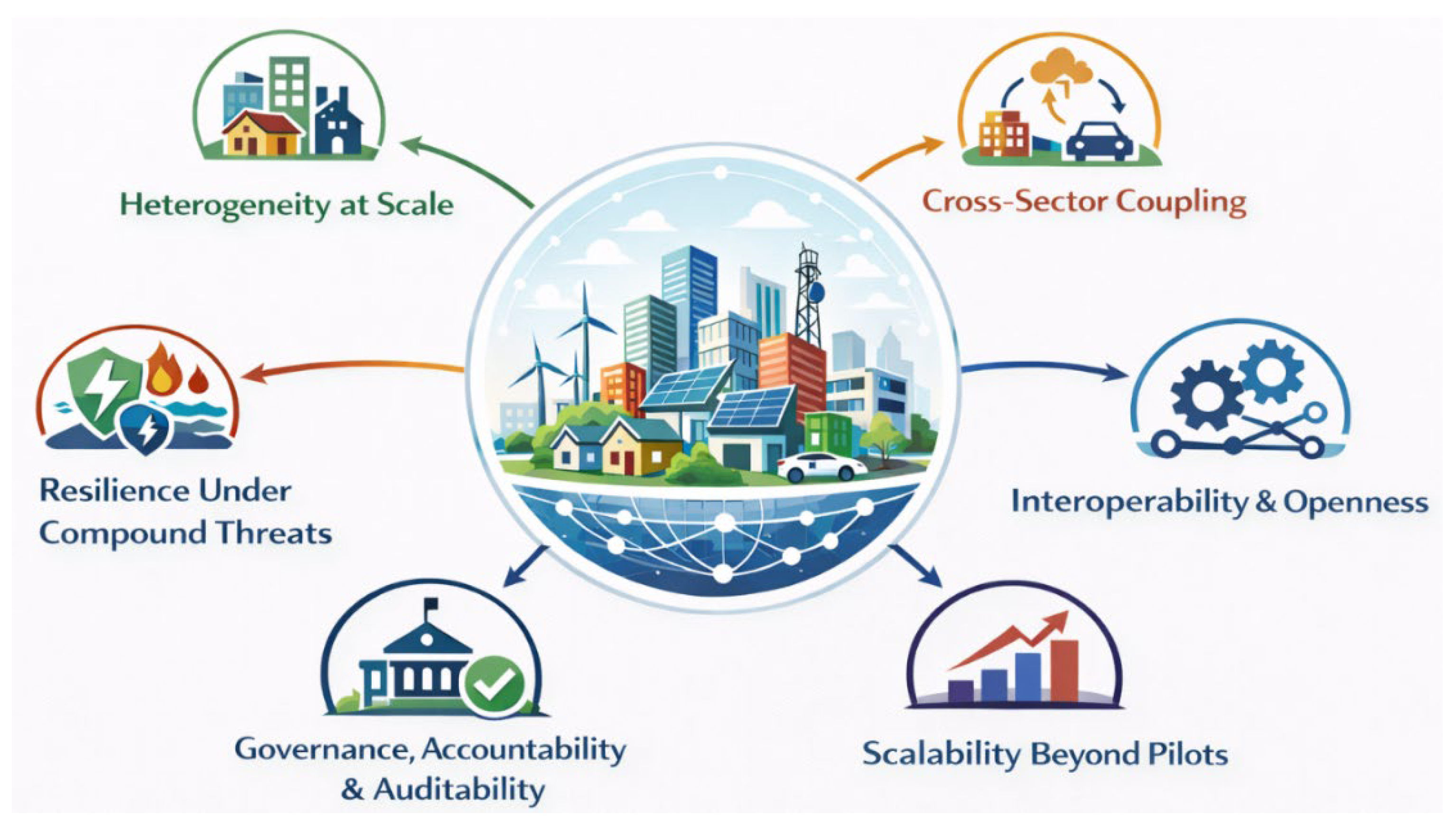
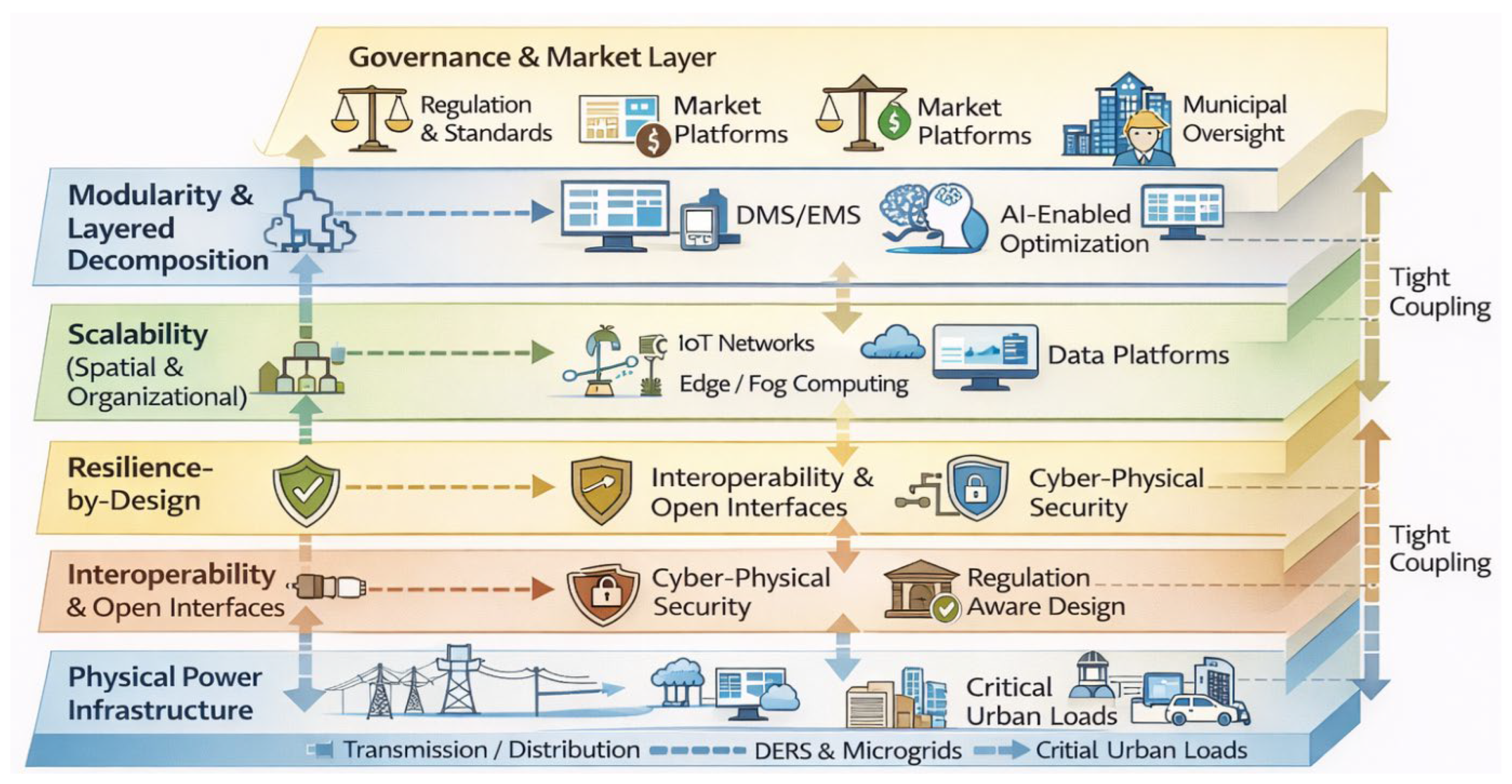
To guide the architectural analysis conducted in this review, smart-city power systems are evaluated against a set of recurring requirements derived from the urban energy and smart-city literature. These requirements reflect conditions that differentiate city-scale deployment from conventional power systems and are used consistently throughout Section 3, Section 4, Section 5, Section 6 and Section 7.
The smart-city requirements considered in this review are:
  • Heterogeneity at scale, reflecting the coexistence of diverse assets, ownership models, objectives, and operational constraints across urban energy systems.
  • Cross-sector coupling, referring to the tight interdependence between electricity networks and buildings, transportation systems, digital services, and urban data platforms.
  • Resilience under compound threats, defined as the ability to maintain critical services under combined physical, climatic, and cyber disturbances.
  • Interoperability and openness, denoting the integration of multi-vendor systems through standardized and extensible interfaces.
  • Governance, accountability, and auditability, ensuring compatibility with municipal governance structures and regulatory oversight.
  • Scalability beyond pilots, capturing the capability to transition from experimental deployments to city-wide operation.
The recurring requirements that shape the architectural evaluation of smart-city power systems are summarized in Figure 1.
Table 1 summarizes the operational definitions and representative evaluation perspectives of the principal architectural concepts used throughout this review.

1.3. Gaps in Existing Literature

Despite extensive research, the evidence base remains partially fragmented across (i) smart-city systems frameworks, (ii) smart-grid communications/control, (iii) microgrid-centric designs, and (iv) data/AI analytics streams. For example, the microgrid literature provides detailed operational and control insights [8], while smart meter analytics surveys emphasize data-driven applications and challenges [9]. However, fewer works explicitly connect these threads into a single architectural narrative spanning physical topology, distributed resources, communications/data layers, and intelligence placement, especially under smart-city scale constraints and governance requirements implied by the smart-city framework literature [3]. Table 2 positions this review relative to key literature streams on smart-city frameworks, smart grids, microgrid architectures, and grid digitalization, highlighting differences in analytical focus, scale, and architectural scope. In particular, it contrasts how prior reviews address grid structure, data and communication platforms, intelligence placement, cybersecurity, interoperability, and governance. The table highlights the fragmented treatment of architectural integration and deployment constraints in existing reviews. Prior reviews place comparatively less emphasis on deployment scalability under real regulatory and institutional constraints.
Differentiation from Recent 2023–2025 Reviews
Recent review articles increasingly examine smart grids in the context of smart cities, digitalization, digital twins, and AI-enabled operation, but they typically remain technology- or application-centric and provide limited emphasis on city-scale architectural integration that explicitly integrates physical infrastructure, data and communication platforms, intelligence placement, cybersecurity zoning, and governance accountability. For example, broad surveys of grid modernization emphasize sustainability and technological transformation at the level of modern power systems, but generally do not explicitly frame these developments within a deployability-oriented smart-city architectural model that treats governance and auditability as coequal design variables [6]. Reviews focused on smart cities and urban governance highlight socio-technical and institutional dimensions, yet provide limited discussion of operational electrical-grid architectures or the allocation of control authority across cyber–physical layers required to assess deployability [7,10]. Reviews and gap analyses addressing smart grids in smart-city contexts provide comprehensive topical coverage of urban smart-grid technologies, but generally examine physical topology, DER and microgrid coordination, communication platforms, and governance as related but separately treated themes rather than within a unified architecture-first evaluation framework [11,12,13,14].
Similarly, recent digital-twin-focused reviews comprehensively survey modeling concepts, applications, and tools, but often provide limited emphasis on interoperability boundaries, cybersecurity trust zoning, and institutional responsibility required for sustained city-scale deployment [15,16].
Unlike technology-centric reviews that address smart grids, AI, cybersecurity, or digitalization separately, this review evaluates their interaction within a unified smart-city architectural framework emphasizing deployability, interoperability, and governance constraints.
Table 2. Comparison of representative smart-grid and smart-city reviews highlighting the architectural scope and deployment-related gaps addressed in this work.
ReferenceMain FocusScaleArchitectureData ArchitectureAI/Control CybersecurityInteroperabilityRegulation Review MethodologyMain Evaluation PerspectiveDeployment/Governance FocusKey Limitation
[3]Conceptual smart-city dimensions (governance, people, ICT, infrastructure)CityPartialPartialConceptual smart-city framework reviewGovernance and urban integrationPartialLacks operational power-grid architecture and control/validation perspective.
[4]Urban IoT connectivity and heterogeneous sensingCity/servicesPartialPartialTechnology-oriented IoT reviewConnectivity and sensing integrationLimitedDoes not address grid stability, DER coordination, or standards-constrained control.
[5]Smart-grid concepts, enabling technologiesGrid-widePartialPartialPartialPartialBroad smart-grid surveyTechnical functionality and enabling technologiesLimitedLimited treatment of smart-city scale, governance, and cross-sector coupling.
[1]Urban energy planning and modelingCity energy systemPartialPartialUrban energy systems reviewPlanning and energy-system modelingPartialFocuses on planning models, not operational grid/data/control architectures.
[12]Microgrid operation and hierarchical controlMicrogridPartialMicrogrid-focused technical reviewControl coordination and microgrid operationLocal-scale focusStrong at the microgrid level but weak on city-scale coordination and governance.
[15,16]Digital twins, analytics, automationAsset/gridPartialPartialPartialPartialDigitalization and digital-twin reviewsAnalytics, monitoring, and automationLimitedOften application-centric; limited city-scale federation and governance focus.
This reviewArchitecture-first synthesis for smart-city power systemsCity-scale CPSSmart-city smart-grid thematic reviewsTechnology integration and smart-city applicationsPartialAddresses deployability, scalability, and governance gaps through integrated architectural analysis.

1.4. Contributions of This Review

The review synthesizes the literature into a deployment-oriented architectural perspective for smart-city electrical grids and identifies the principal design and operational constraints affecting city-scale implementation. The main contributions are summarized as follows.
  • A multi-dimensional architectural evaluation framework is developed to analyze smart-city electrical grids across physical infrastructure, DER and microgrid coordination, communication/data platforms, intelligence placement, cybersecurity/interoperability boundaries, and governance/deployability layers.
  • The review traces the evolution of urban electrical grids from centralized systems to digitalized, decentralized, and AI-enabled architectures.
  • The paper integrates insights from power systems, ICT, and urban energy research within a unified smart-city grid perspective.
  • Key deployment and coordination challenges are evaluated from an integrated architectural perspective.
  • The review identifies research priorities related to AI-assisted control, interoperability, cybersecurity, governance, and deployable city-scale operation.
The novelty of the review lies in integrating technical, operational, and governance dimensions into a unified architectural evaluation framework for smart-city grids.

1.5. Multi-Layer Architectural Framework for Smart-City Electrical Grids

The multi-layer architectural framework provides a structured basis for analyzing smart-city power-system architectures and their associated technologies. Because of the cyber–physical and institutional couplings that define urban energy systems, the multi-layer architectural framework clearly defines the interactions between technical design choices, deployability, security, and governance constraints at the city scale, and serves as a basis for the analysis of the evolution of the smart grid, as well as the comparison of the various architectures available and the determination of the eventual deployability of smart grids.
In contrast to prior reviews that focus primarily on technologies, applications, or isolated operational domains, the framework proposed in this review evaluates interactions between architectural layers as the primary determinant of deployability at the city scale.
The multi-layer architectural framework is presented in Table 3 and is composed of urban electrical distribution systems that are decomposed into functional layers that span five areas: physical infrastructure, sensing and communications, control and coordination, intelligence and analysis, and governance and oversight. Each functional layer will be further classified according to its primary components and functions (operational roles) at the control, data, and regulatory levels. Consequently, each functional layer will be defined as distinct layers, thus reflecting the cyber–physical and institutional couplings of the various systems. The multi-layer architectural framework provides a consistent basis for analysis in Section 3, Section 4, Section 5, Section 6 and Section 7 and clarifies how technical and design decisions affect deployability, security, and governance at the city scale.

1.6. Organization of the Paper

Section 2 presents the methodologies utilized in this review and the analytic framework applied. Section 3 gives an overview of existing digital-grid architecture. Section 4 provides a discussion of DER, microgrids, and hybrid networks. Section 5 presents the application of artificial intelligence on grid intelligence and autonomous energy management (AEM). Section 6 discusses cybersecurity, interoperability, and regulatory issues. Section 7 provides a synthesis of architectural design principles. Section 8 identifies future research directions, and Section 9 concludes the review.

2. Review Methodology

The current study adopts a structured narrative review methodology combined with architectural and analytical synthesis to ensure transparency, consistency, and reproducibility in the evaluation of smart-city electrical grid architectures to ensure rigor, transparency and reproducibility. Structured review methodologies improve transparency, traceability, and consistency in interdisciplinary energy-system research and improving traceability of studies through a systematic approach, and often in interdisciplinary energy research [17,18]. This methodology captures the entire body of literature on electrical grid architecture for smart cities as well as the ability to extract systemic similarities, disparities, and emerging trends through both the technical and non-technical aspects of electrical grid architecture. The study does not aim to perform exhaustive quantitative evidence aggregation or formal meta-analysis; instead, it adopts a structured narrative review approach intended to support integrative architectural synthesis across interdisciplinary literature domains.

2.1. Scope and Research Questions

The scope of the review encompasses electrical grid systems operating within, or in direct support of, smart-city environments. This includes urban transmission–distribution interfaces, active distribution networks, microgrids, and networked microgrids, as well as the associated communication, data, and control infrastructures. The focus on urban contexts is consistent with prior work highlighting the distinct characteristics of urban energy systems compared to national-scale modeling perspectives [1].
Particular attention is given to systems characterized by high penetration of distributed energy resources and increasing reliance on data-driven and intelligent control, which are defining features of modern smart-grid paradigms [5].
The review is guided by the following research questions.
  • How have electrical grid architectures evolved to meet the operational, sustainability, and resilience requirements of smart cities?
  • What architectural and control paradigms are emerging for urban grids dominated by distributed and inverter-based resources?
  • How do digital technologies and artificial intelligence reshape grid monitoring, control, and planning in urban contexts?
  • What are the dominant resilience, reliability, cybersecurity, and interoperability challenges associated with smart-city power systems?
  • How do regulatory, economic, and governance frameworks influence the deployment and operation of advanced urban grid architectures?
Accordingly, this work adopts a structured narrative review methodology combined with architectural synthesis to integrate technical, operational, cybersecurity, interoperability, and governance perspectives across smart-city electrical grid research. Unlike PRISMA-oriented systematic reviews that focus on exhaustive study aggregation and quantitative evidence synthesis, the present work emphasizes comparative architectural interpretation, cross-domain integration, and deployment-oriented analysis [19,20].

2.2. Literature Search Strategy

A structured literature search was conducted using IEEE Xplore, ScienceDirect (Elsevier), SpringerLink, and Wiley Online Library databases [21]. The search targeted peer-reviewed journal articles, authoritative review papers, and selected high-impact conference proceedings where architectural or system-level contributions were presented.
Literature searches were conducted between January and March 2026 and focused primarily on publications from approximately 2013–2026 to reflect the rapid evolution of smart grids, smart cities, digitalization, and AI-enabled power-system operation. Earlier foundational studies were included selectively where necessary to establish conceptual or architectural baselines.
In developing searches, keywords were combined for all the following concepts: (1) smart cities, (2) electric grid, and (3) system architecture. These keywords included smart city power systems, smart grid architecture, urban distributed networks, micro-grids, distributed energy resources, digital power systems, artificial intelligence applications in power systems, and cyber-physical energy systems [15,16].
Representative search strings included combinations such as:
(“smart city” AND “power system architecture”), (“smart grid” AND “urban energy systems”),
(“microgrid” AND “distributed energy resources” AND “urban”), (“AI-enabled power systems” AND “smart city”), and (“cyber-physical energy systems” AND “grid architecture”).
Search terms were iteratively refined to capture studies addressing both technical and deployment-oriented architectural dimensions.
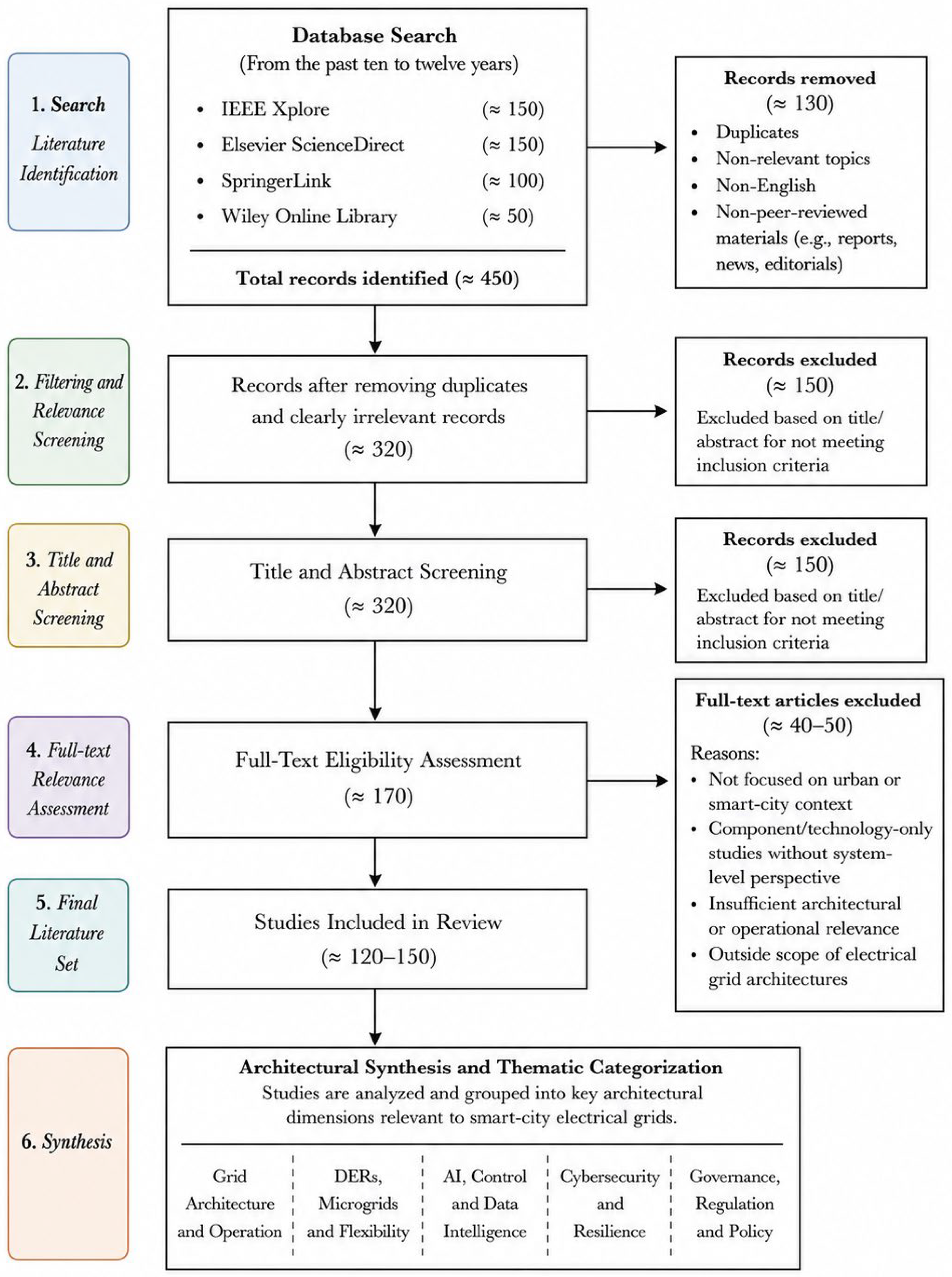
The initial database search identified 412 records. After removal of duplicates and clearly irrelevant publications during title screening, 238 records remained for abstract review. Full-text relevance assessment resulted in 134 publications being included in the final architectural synthesis. The final body of literature included smart-grid surveys, microgrid and DER architecture studies, AI-enabled power-system operation studies, cybersecurity and interoperability analyses, and smart-city governance literature. Selection was based primarily on architectural and system-level relevance rather than citation count alone. The screening process consisted of four stages: (i) database identification, (ii) duplicate removal and title screening, (iii) abstract-level relevance assessment, and (iv) full-text eligibility evaluation according to the inclusion and exclusion criteria defined in Section 2.3. Table 4 summarizes the databases, search period, screening stages, selection criteria, and final literature corpus used in the structured narrative architectural synthesis conducted in this review.

2.3. Inclusion and Exclusion Criteria

Selection decisions were guided primarily by architectural and system-level relevance to smart-city electrical grid deployment, with emphasis on studies addressing interactions between physical infrastructure, distributed coordination, digital platforms, operational intelligence, interoperability, cybersecurity, and governance. To ensure that studies were only relevant, of high quality, and applicable in a consistent manner, explicit criteria for inclusion and exclusion were established. Inclusion criteria covered studies related to electric grids and power systems operating in urban or smart-city contexts, and provided an architectural, control or system-level insight that would apply beyond the scope of a single device or algorithm. Studies that investigated the interaction between the physical grid infrastructure and digital or intelligent levels were given preference [5,22].
Studies were excluded from the research if they were specifically designed for rural or isolated areas, looked solely at component-level designs about the operation of the entire system, or did not include peer-reviewed research. Studies discussing smart cities conceptually but containing no true energy or power system content were also excluded.
The most common exclusion reasons during abstract and full-text screening included:
(i)
Purely component-level or algorithmic focus without architectural implications.
(ii)
Absence of smart-city or urban deployment context.
(iii)
Lack of operational or system-level relevance.
(iv)
Non-peer-reviewed or insufficiently documented sources.
The broader literature screening process identified a large body of relevant publications spanning smart grids, urban energy systems, digitalization, microgrids, artificial intelligence, interoperability, and governance. However, the detailed analytical synthesis presented in Section 3, Section 4, Section 5, Section 6 and Section 7 focused primarily on studies with direct architectural relevance to smart-city electrical grid design, deployment, coordination, and governance. Consequently, not all screened publications were discussed individually in the manuscript.
The criteria for exclusion were not based on the quality or technical merit of the study. Instead, the studies were excluded due to their relevance to the fulfilment of the study’s purpose, which was to provide city-scale architectural decisions. The exclusion criteria included studies that looked only at a single algorithm, a single device, or laboratory test results without system-level ramifications, or conceptual studies discussing smart cities that did not contain any real-world energy or power system content. This exclusion method supports the purpose of architecture synthesis as opposed to performance benchmarking. To improve methodological transparency and consistency, Figure 2 summarizes the literature search, relevance filtering, and architectural categorization process adopted in the structured narrative review.

2.4. Classification and Analytical Framework

The reviewed literature was analyzed using a multi-dimensional architectural framework that evaluates smart-city electrical grids across interacting physical, cyber, operational, and institutional layers. Rather than classifying studies only by technology domain, the framework examines how architectural decisions related to topology, distributed coordination, communication structure, intelligence placement, interoperability, cybersecurity exposure, and governance constraints collectively affect deployability under smart-city conditions [23].
The categories used to organize the literature were grid architecture (i.e., physical topology) and the incorporation of distributed energy resources with respect to microgrid configuration; data and communication infrastructures; controls and artificial-intelligence-based (AI-enabled) controls; resilience due to cybersecurity; and the governance and regulation adhered to with respect to each of these areas. The articles are not only categorized by theme but also evaluated by using the same set of architectural criteria, as described in Section 1.2, deployability beyond pilot implementations, auditability of control and decision process, and alignment to the regulations and governance; these evaluation criteria were applied throughout Section 3, Section 4, Section 5, Section 6 and Section 7 for examining The way how different architectural grids will perform based on the identified criteria under a smart city constraint, providing an opportunity for comparison and critical analysis rather than generic summary.
The analytical novelty of this framework lies in treating deployability, auditability, interoperability, and governance compatibility as coequal architectural evaluation variables alongside conventional technical performance considerations.

2.5. Synthesis and Critical Analysis Approach

The review adopts a comparative and critically synthesizing narrative approach rather than summarizing individual studies alone. This is appropriate for smart-grid research, as several architectures and control paradigms exist together and must be evaluated against their own scalability, resilience, and deployability constraints [1,24]. Accordingly, the objective is interpretive architectural synthesis and comparative cross-domain analysis rather than exhaustive statistical aggregation of all available studies.
In addition to this comparison, the analysis emphasizes repetition of architectural features, contrasting approaches of centralized versus decentralized control, and placing intelligence in edge, fog, and cloud layers. Evaluating these factors will require utilization of the actual findings from field demonstrations and pilot projects wherever possible to be able to put the theoretical data into context. Accordingly, the manuscript synthesizes the most architecturally relevant studies identified during screening rather than individually discussing every retrieved publication.

2.6. Methodological Limitations

Some methodological limitations exist. To begin with, there are regional biases found in the literature regarding advanced smart-grid jurisdictional development and regulation. Secondly, the rapid advancement of digital platforms and artificial intelligence may outdate published validation studies of these technologies. Finally, cross-jurisdictional and urban environments can produce considerable variation in the applicability of some of the examined literature to other jurisdictions.
These identified limitations have been addressed with an explicit identification of context-dependent assumptions and cross-domain synthesis using the established methodological guidance for systematic reviews.
Thoroughly synthesizing the reviewed literature included the use of both architectural and thematic analytical approaches. Instead of aggregating quantitative performance, a broader approach was taken to determine the common architectural forms, assumptions associated with the design and deployment of both physical and cyber systems, and constraints of a governing and regulatory structure within Section 3, Section 4, Section 5, Section 6 and Section 7, providing a distillation of the literature in such a way as to allow for a comparative assessment of different grid architecture evaluated against the required functionality of a smart city. Overall, the adopted methodology was designed to support transparent and reproducible architectural synthesis rather than exhaustive quantitative aggregation of all retrieved studies.

3. Digitalized Electrical Grid Architectures for Smart Cities

Using the methodological framework introduced in Section 2 as a starting point, Section 3 discusses digitalized electrical grid architectures as the foundational layer for power systems in smart cities. Digitalization is the first major transformation stage in the multi-layer architectural framework utilized in this review and will allow for greater observability, more advanced communication capabilities and better automated control over electricity flow to and from the end-use customer. These three functions will be required prerequisites to establish a decentralized and intelligent architecture, as discussed in Section 4 and Section 5.
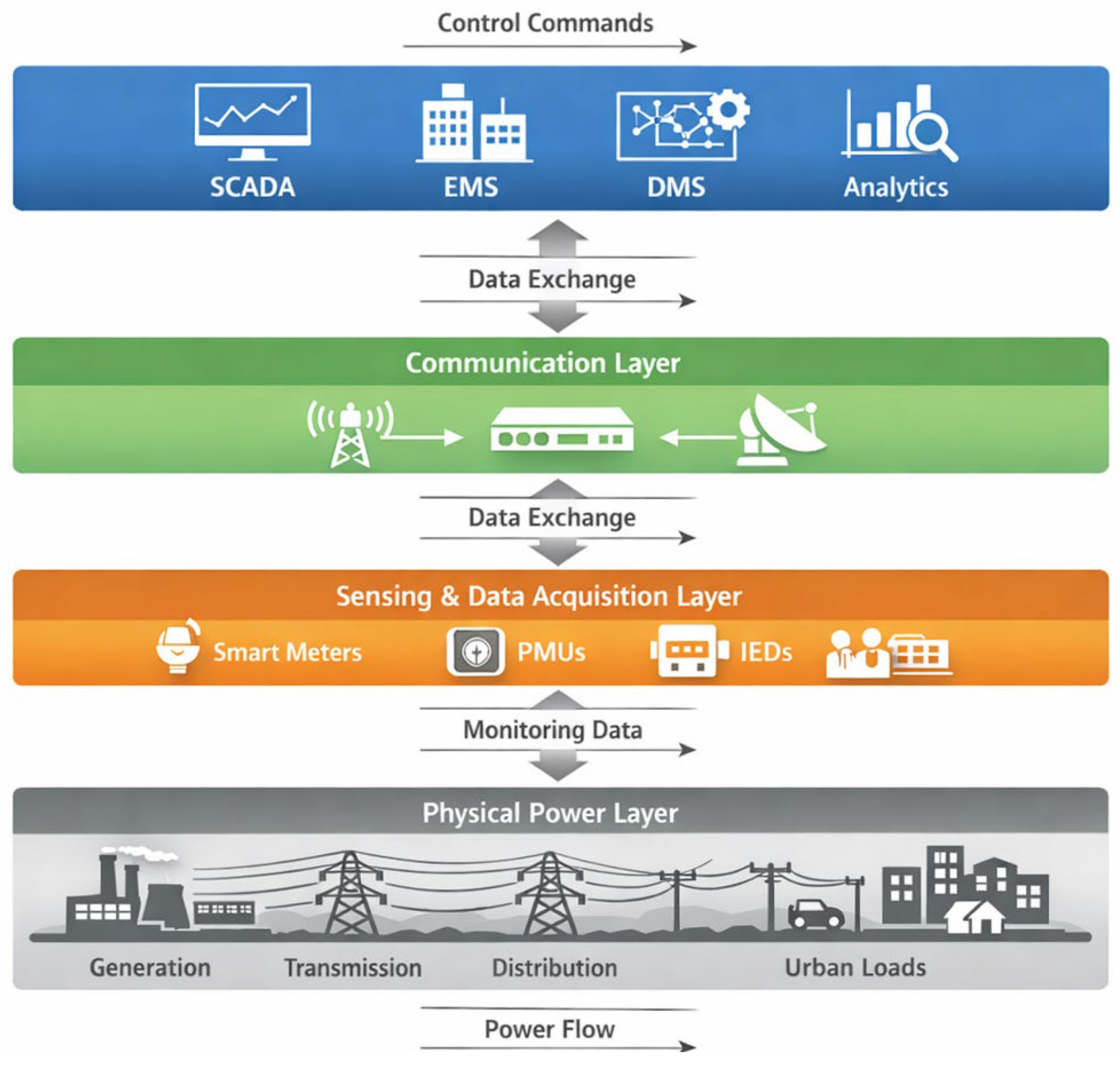
Digitalization uses existing power distribution infrastructures, but does not change their physical topology significantly; instead, it adds cybersecurity or cyber capabilities to existing physical topologies. Digitalized electrical grids provide the operational foundation for coordinated and data-driven management of urban energy systems [25,26]. Figure 3 illustrates the layered conceptual architecture of a digitalized electrical grid for smart cities, highlighting the separation between physical power infrastructure, sensing and data acquisition, communication networks, and control and application functions, as well as the bidirectional information and control flows that connect these layers.
Digitalized grid architectures typically separate physical infrastructure, communication networks, data management, and supervisory applications into interoperable layers, improving modularity and supporting incremental system evolution [27]. At the physical layer, digitalization relies on extensive deployment of intelligent electronic devices, smart sensors, and advanced measurement units across both transmission and distribution networks [28].

3.1. Architectural Characteristics of Digitalized Urban Grids

The cyber layer enables bidirectional information exchange between field devices and control platforms. Communication infrastructures, including power line communication, wireless networks, and fiber-based systems, have been identified as critical architectural enablers of smart-grid functionality, particularly in urban contexts characterized by high device density and stringent latency requirements [25,29]. These communication layers also facilitate integration between power systems and broader smart-city data platforms.

3.2. Monitoring and Observability in Urban Power Systems

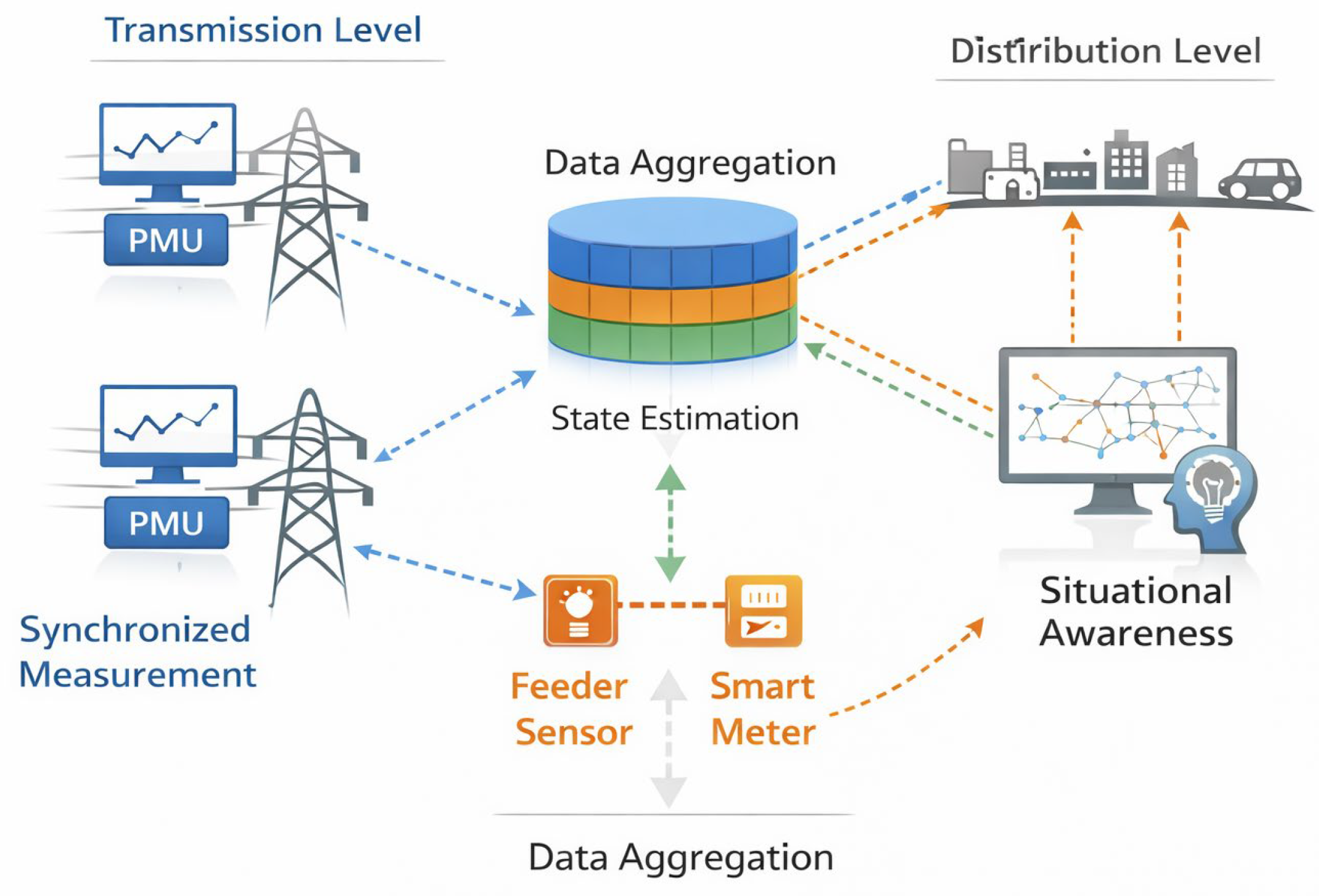
One of the key features of digitalized grid architectures is their enhanced ability to observe the electricity grid. Wide-area monitoring systems utilize synchronized measurements to provide time-aligned visibility of the grid’s dynamic behaviors. They also allow several advanced function capability including state estimation, oscillation detection, and disturbance analysis—all of which will grow in importance with the increased variability introduced into the urban grid by distributed generation and active demand [30].
In addition, smart meters and feeder level monitoring provide greater visibility at the distribution level than was historically available, enabling the provision of high-resolution consumption and power quality data that will enhance operational situational awareness and permit the use of data-driven operational decision-making. Enhanced observability has become a foundational requirement for scalable urban grid management [31].
As depicted in Figure 4, digitalization of the urban electrical grid system enables the combination of synchronized measurements from the transmission level with high-resolution sensing at the distribution level to create a system where phasor measurement units (PMUs) provide system-wide time-aligned data, while feeder sensors and smart meters allow visibility into the lower voltage networks. Together, these capabilities provide for complete data aggregation and state estimation with which improved operational situational awareness can be achieved, and create the baseline for proactive monitoring and control in digitally enabled urban power system applications.

3.3. Automation and Digital Control Functions

Digitalized architectures enable increased automation of grid operations by coupling real-time data acquisition with software-based control systems. Automation functions such as fault detection, isolation, and service restoration, voltage and reactive power control, and congestion management improve operational reliability and reduce outage duration in urban networks [32,33].
Architecturally, automation enables faster coordination and operational response across heterogeneous urban grid assets [27,34].
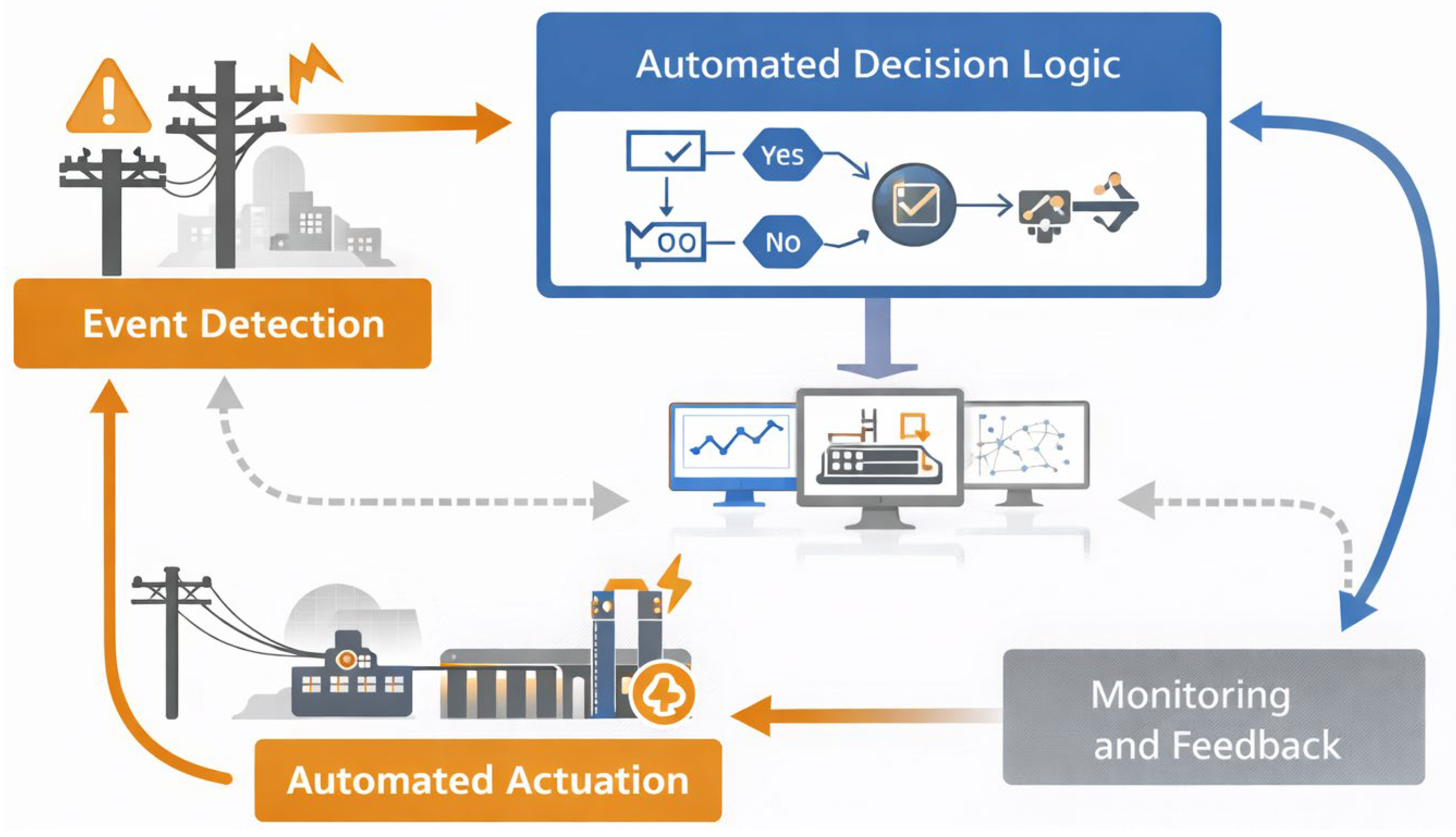
Figure 5 illustrates the closed-loop automation process enabled by digitalized grid architectures, showing how detected events are processed through automated decision logic and translated into control actions, with continuous monitoring and feedback supporting responsive and coordinated grid operation in urban environments.

3.4. Data Platforms and Digital Twins

As the digital age continues to unfold, managing data is at the forefront of architectural design. The amount of data produced from urban power systems is enormous, varied in type, and has different temporal and spatial characteristics. Therefore, digital platforms are needed to aggregate, process, store, and display data from both operational and planning time horizons [31,35].
In digitalized urban grids, data platforms and digital twins integrate operational measurements with virtual system representations for monitoring, analysis, and operational support. This integration enables monitoring, analyzing, and scenario analysis in addition to providing an architectural connection between basic digitalization concepts and advanced intelligent grid features that will be explained later in this article.
Digital twins were developed as an evolution of digitalization in the electric grid. By combining models based on the principles of physics with real-time operation data, a digital twin is an ever-changing virtual representation of the grid asset or assets and the grid network. Digital twins enable predictive maintenance, contingency analysis, and scenario importing; they represent a growing link between digitalized grids and artificial intelligence-enabled grids [36,37]. In the context of smart cities, digital twins, as shown in Figure 6, also support the synchronization of energy systems with other types of urban infrastructure.

3.5. Cybersecurity and Interoperability Considerations

Digital interface and communication pathway expansion increases the cyber-attack surface of power systems, thus necessitating that digitalized grid architecture includes cybersecurity considerations in the design phase of the grid, using secure communication protocols, access control mechanisms, and intrusion detection capabilities [38,39]. These cybersecurity considerations reinforce the architectural constraints discussed in Section 1.2.
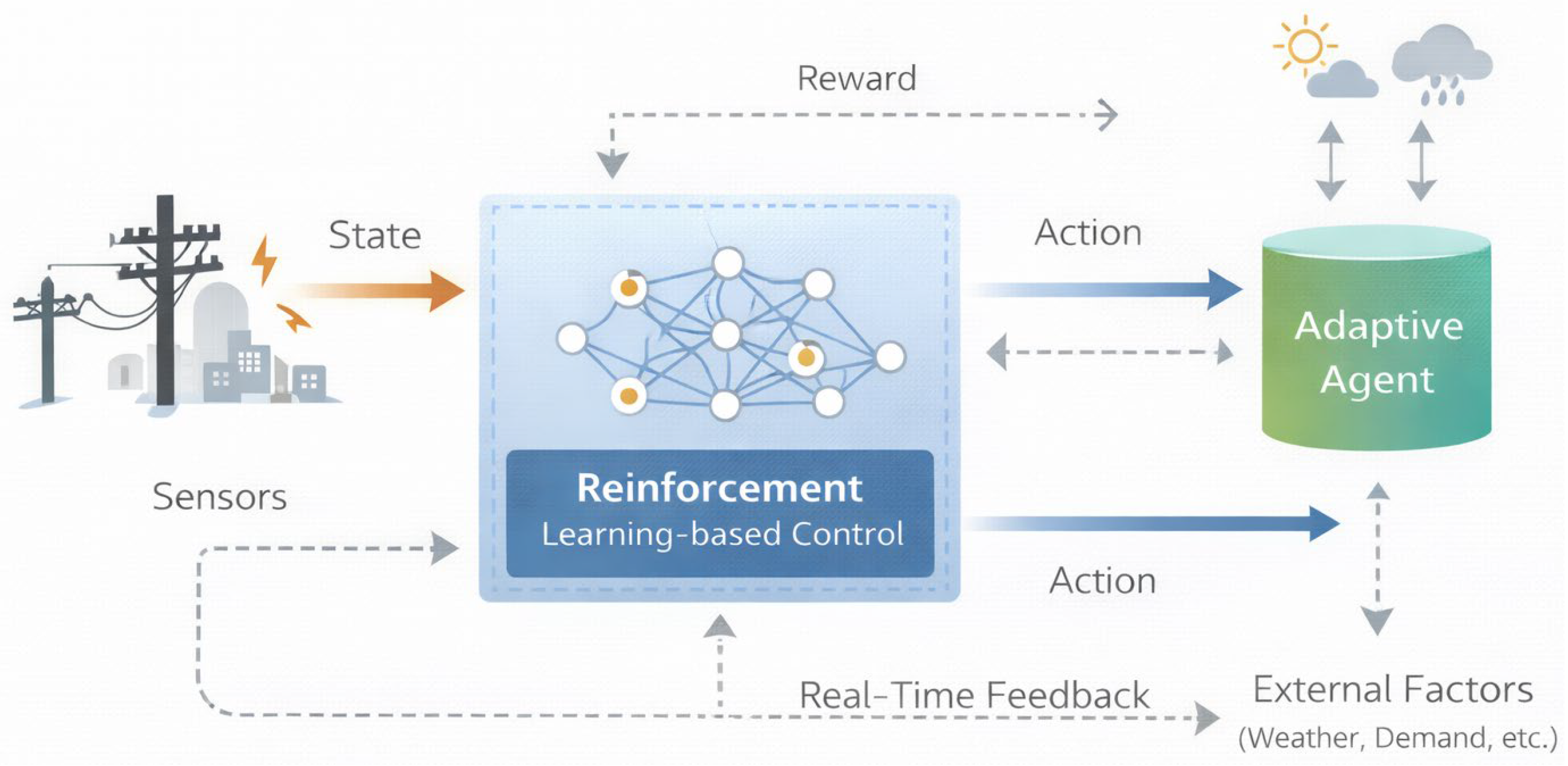
Figure 7 illustrates an adaptive control architecture in which real-time measurements support continuously updated operational decisions, providing a conceptual transition from digitalized monitoring toward intelligent grid operation. The urban grid consists of equipment from many vendors placed at various times across a wide variety of locations. Standardized communication protocols and data models are essential to ensure compatibility, scalability, and long-term maintainability [40,41]. Insufficient interoperability can undermine the benefits of digitalization and limit integration with smart-city platforms.

3.6. Digitalization as a Foundation for Decentralized Architectures

Although digitalized architectures improve monitoring, automation, and coordination, high DER penetration and bidirectional power flows increasingly require decentralized operational structures beyond traditional centralized control paradigms [42,43].
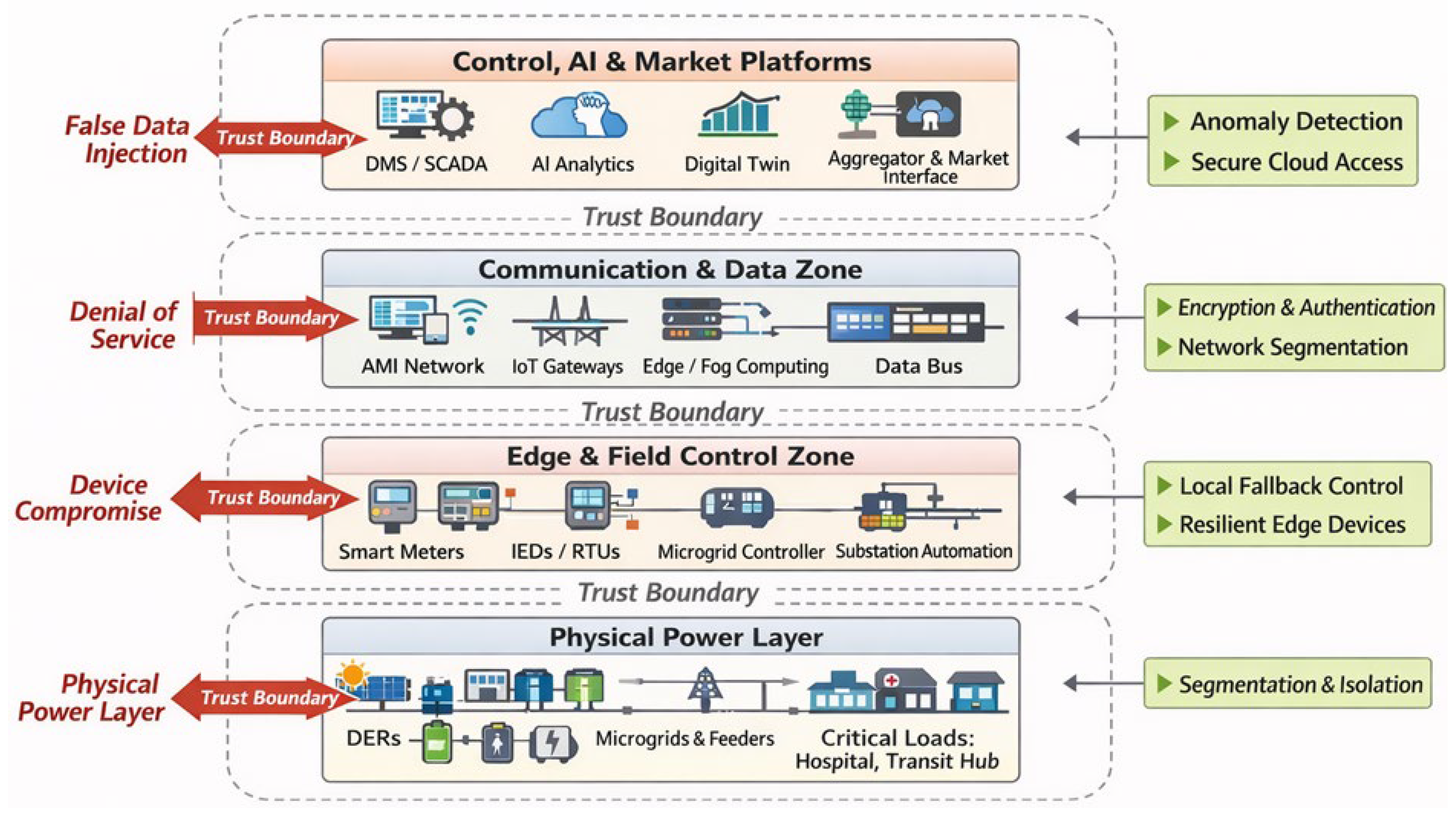
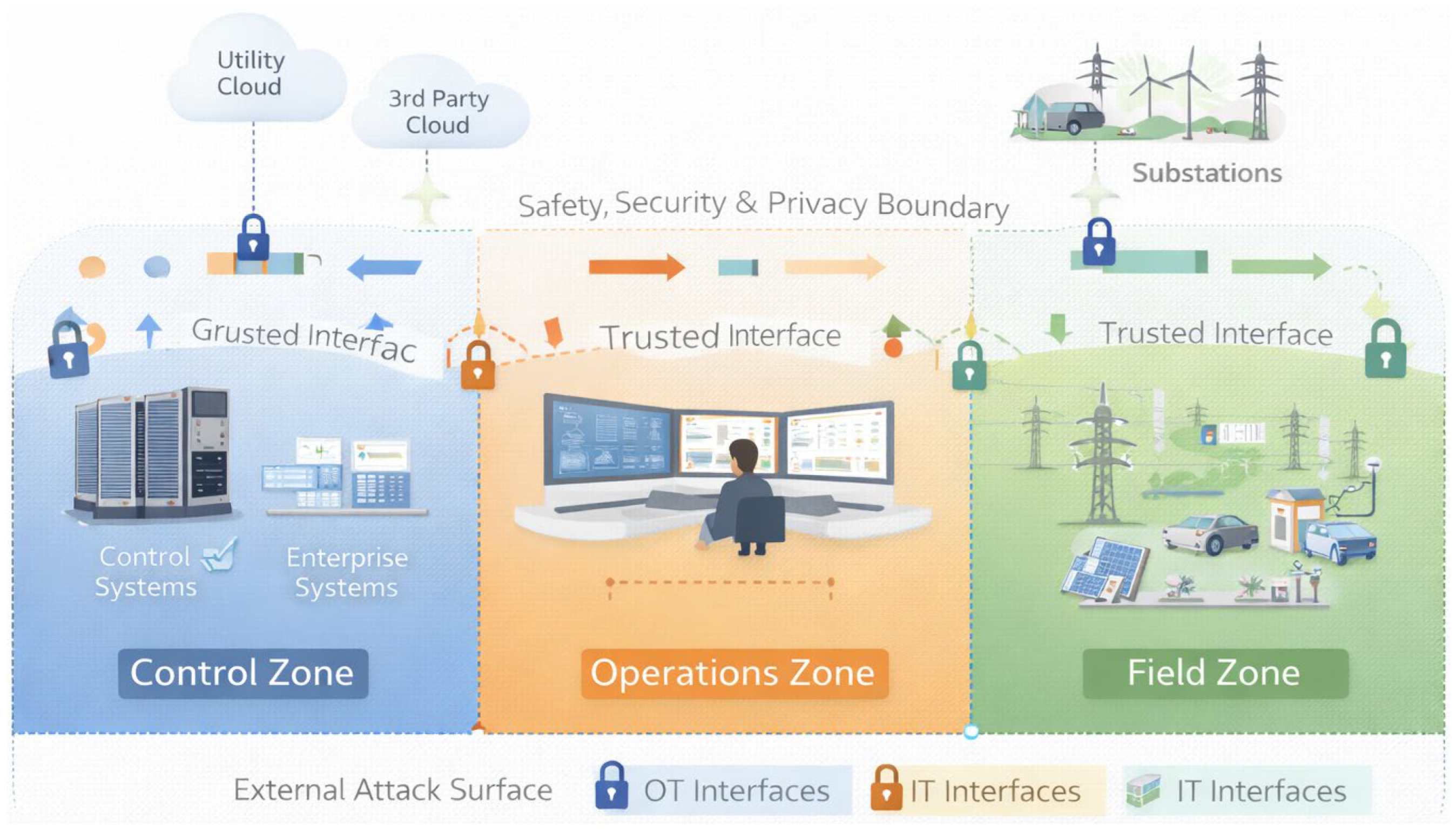
Figure 8 illustrates the security and interoperability domains of a digitalized urban electrical grid, highlighting the separation between field devices, control systems, and external interfaces. By delineating trust boundaries and interaction zones, the figure emphasizes the architectural role of cybersecurity and interoperability in ensuring reliable and scalable grid operation within smart-city environments.
These developments further support the transition toward decentralized architectures discussed in Section 4.

4. Distributed Energy Resources, Microgrids, and Hybrid Network Structures

Building on the digitalized grid architectures discussed in Section 3, this section examines the architectural shift toward decentralization driven by the large-scale integration of distributed energy resources in urban power systems. These conditions motivate the transition toward decentralized architectures based on distributed energy resources, microgrids, and hybrid network structures. These challenges motivate the adoption of decentralized architectures based on distributed energy resources, microgrids, and hybrid network structures [44].
In smart-city power systems, decentralization redistributes generation, storage, and control closer to loads, enabling localized energy management and more flexible system operation under variable urban conditions [45].
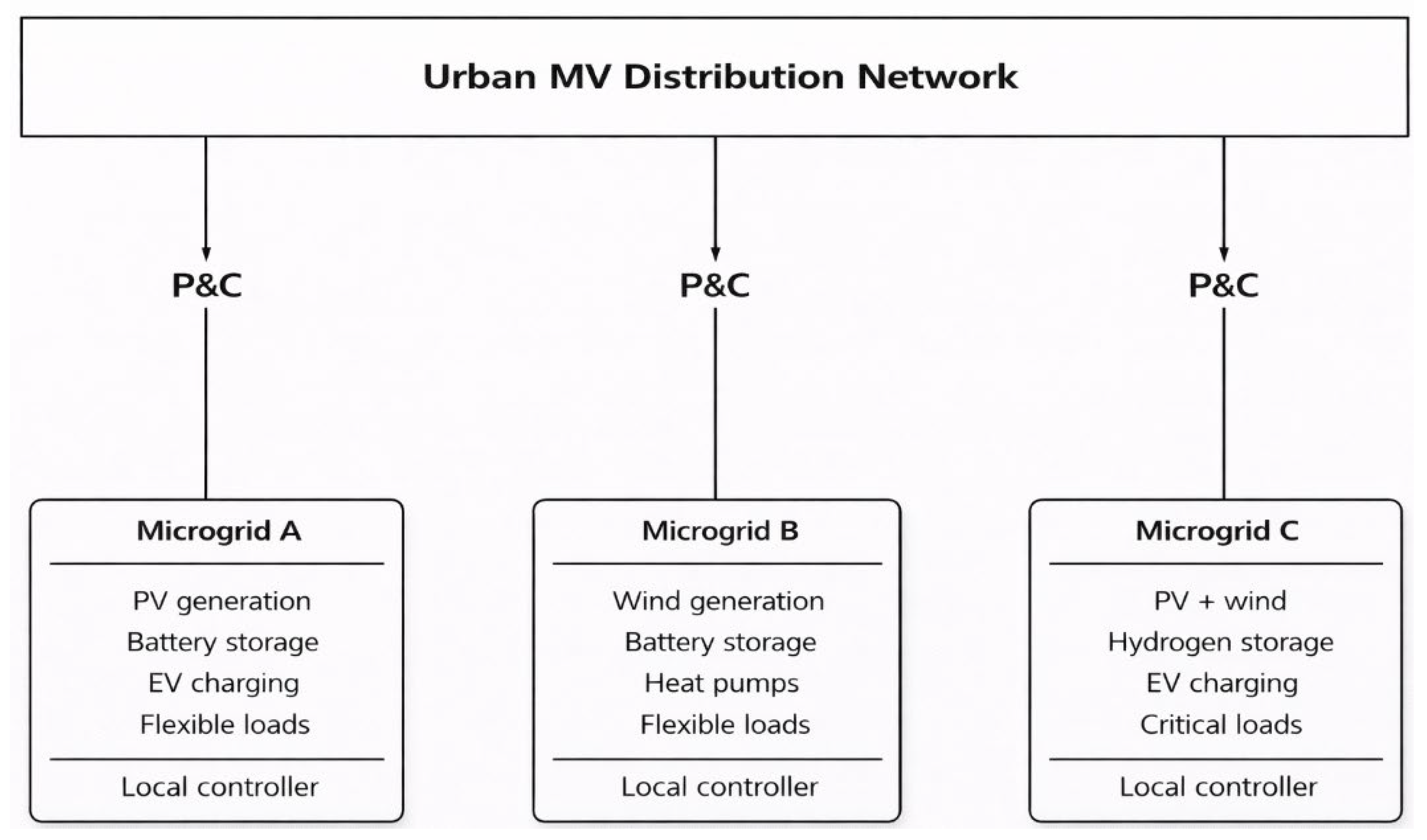
Figure 9 illustrates a representative architectural configuration in which heterogeneous distributed energy resources are aggregated into microgrids connected to an urban medium-voltage distribution network through defined points of common coupling.

4.1. Distributed Energy Resources in Urban Power Systems

Distributed energy resources, including photovoltaic generation, battery energy storage systems, controllable loads, and electric vehicles, are increasingly deployed within urban distribution networks. Their integration alters traditional planning and operational assumptions by introducing variability, uncertainty, and bidirectional power flows at low and medium voltage levels. Comprehensive reviews highlight that high DER penetration fundamentally challenges centralized control paradigms and necessitates new architectural approaches for coordination and system operation [46,47].
From an architectural perspective, DERs transform distribution networks from passive infrastructures into active systems with heterogeneous and geographically dispersed resources. This transformation requires enhanced local monitoring, bidirectional communication, and flexible control mechanisms that extend beyond the capabilities of purely centralized digitalized architectures. DER integration therefore accelerates the transition toward decentralized urban grid architectures [48].

4.2. Microgrids as a Decentralized Architectural Building Block

With the increasing number of DERs in cities, the concept of microgrids has become a popular approach to managing these issues at the architectural level. Microgrids are typically defined as electrically defined systems that integrate generation, storage, and load; can operate as an independent or connected to the electrical grid [49]; and allow for localized control, making them very resilient, especially for critical infrastructures in urban areas.
From an architectural standpoint, microgrids provide the ability to pass some of the control from central authority (electric utility) to local controllers, while still allowing for coordinated operation with the upstream electric grid. Microgrids are widely recognized as modular architectures for integrating distributed resources and supporting localized energy management [50,51]. Importantly, microgrids build directly on the digitalized sensing, communication, and automation infrastructure discussed in Section 3, illustrating the cumulative nature of grid evolution.

4.3. Networked and Hybrid Microgrid Structures

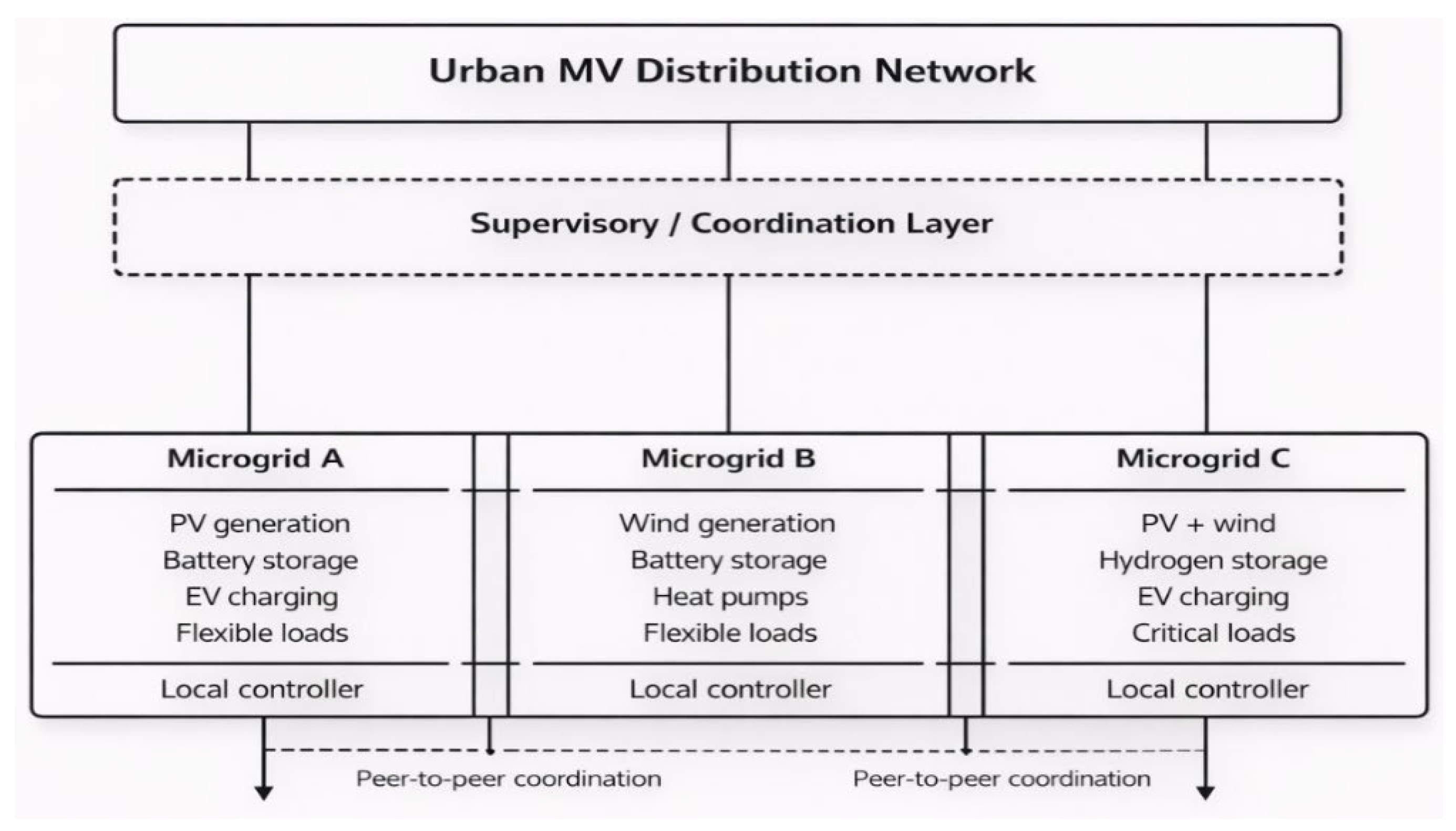
As the number of microgrids in urban environments increases, research attention has expanded toward networked and hybrid microgrid configurations. In such architectures, multiple microgrids interact with one another and with the main grid through coordinated control strategies. Networked microgrids enable resource sharing, mutual support during disturbances, and improved utilization of distributed assets [52]. Figure 10 illustrates a hybrid and networked microgrid architecture in which locally controlled microgrids coordinate through a supervisory layer while also engaging in peer-to-peer interactions.
Hybrid networks represent a mixed architecture that can be applied to both centralized and decentralized elements while reflecting practical limitations found in urban electricity systems. Instead of being completely decentralized, hybrids maintain some level of high-level supervisory control of operations but enable local controllers to execute rapid changes in their operations to meet local needs. Hybrid architectures combine centralized supervision with local autonomy to support coordinated urban grid operation [53].

4.4. Control Architectures for Decentralized Urban Grids

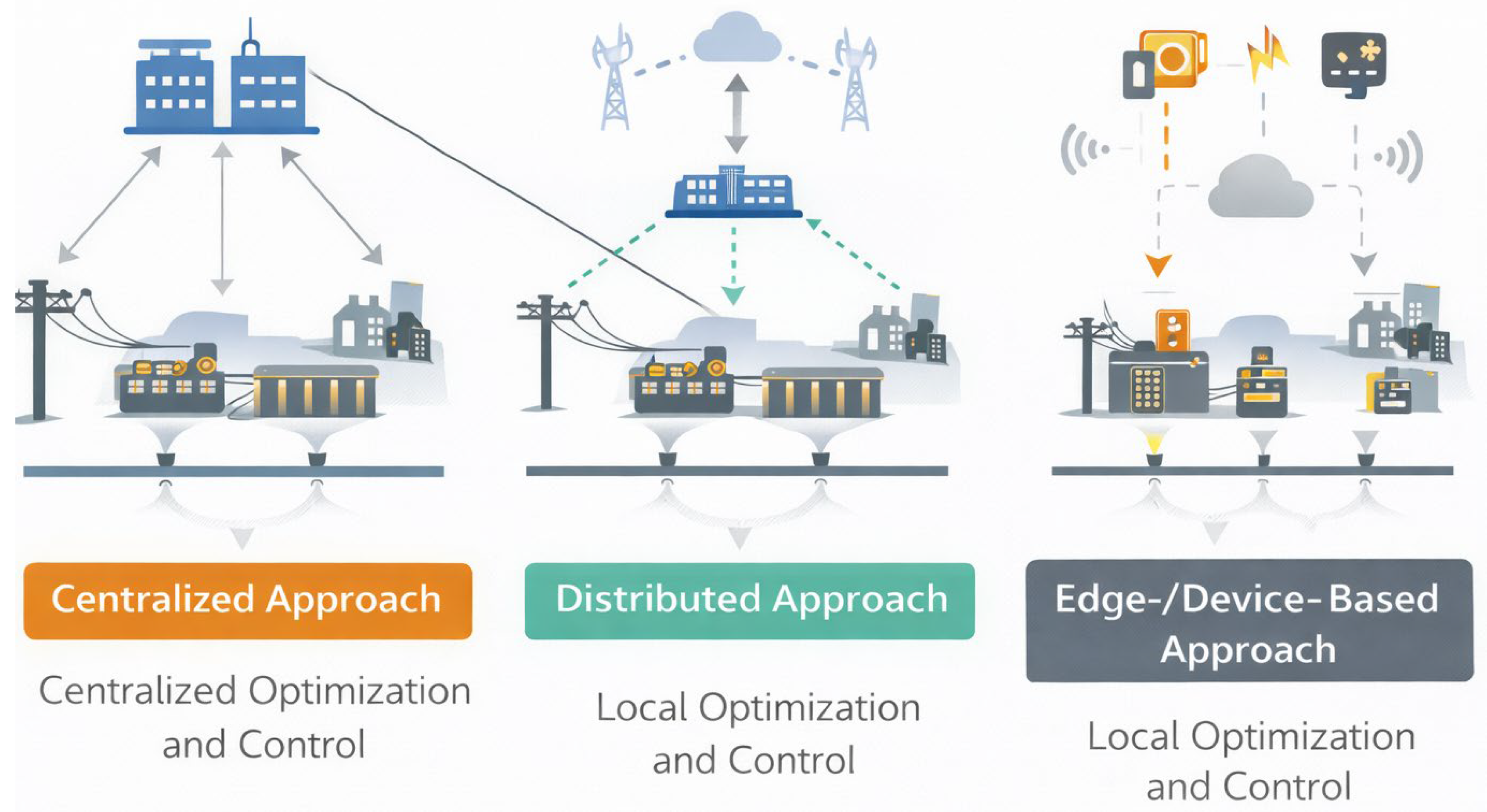
New challenges arise for decentralized energy systems with respect to stability, coordination, and optimization among multiple independent systems. Control architectures for systems with large numbers of DERs and microgrids can be classified as either centralized supervisory control, hierarchical control, or fully distributed control. Control architectures must therefore be selected according to system scale, communication constraints, and operational requirements [54,55].
In many metropolitan areas, hierarchical control and distributed control architectures are preferred due to their scalability and resilience. The digitalized monitoring and communication layer, described in Section 3, is critical to the strong relationship between digitalization and decentralization for smart-city power systems.

4.5. Resilience and Reliability Implications

Improved resilience is a key driver for employing decentralized architectures in smart cities. By supporting localized operation and providing the capability to operate in islanded mode, microgrids can continue providing services to their customers during outages upstream and enable faster recovery after disruptions. Numerous empirical studies and comprehensive reviews demonstrate that decentralized configurations can improve the overall reliability of distributed energy resources and significantly reduce the impact of outages in the urban environment [56,57]. Decentralized architectures additionally require tighter coordination between protection, monitoring, and supervisory control mechanisms [58,59].

4.6. Decentralization as a Precursor to Intelligent Grid Operation

The operational complexity introduced by large-scale coordination of distributed resources increasingly exceeds the capability of static rule-based control approaches. These conditions motivate the AI-enabled and adaptive operational frameworks discussed in Section 5 [60,61].

5. Intelligent and Autonomous Operation of Urban Energy Systems

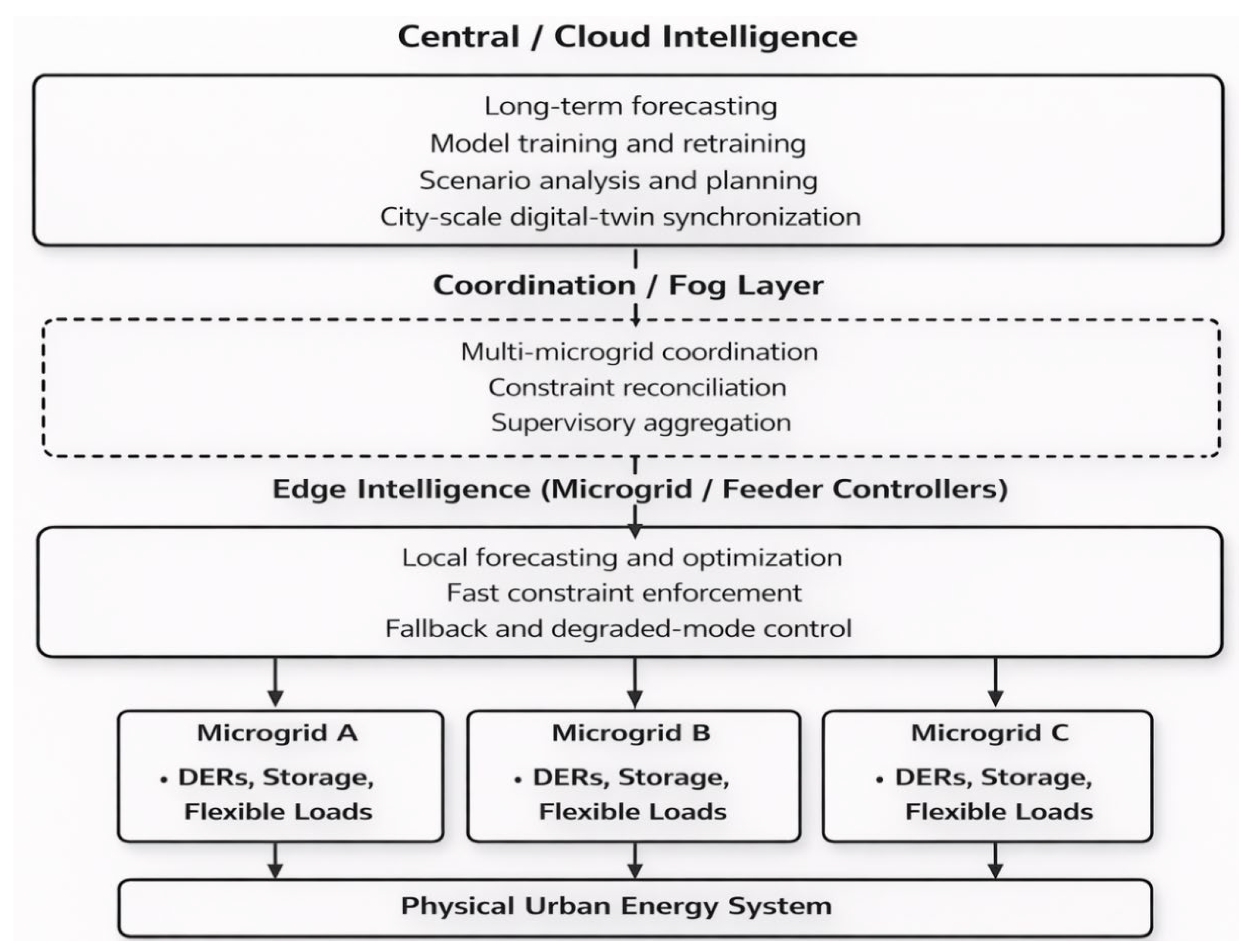
The decentralized architectures discussed in Section 4 fundamentally reshape how urban power systems must be operated. High penetrations of distributed energy resources, coupled with fast-varying loads such as electric vehicles and heat pumps, erode the assumptions of predictability and centralized observability that underpinned traditional distribution system operation. As a result, intelligent coordination becomes increasingly necessary for managing distributed urban energy systems. This section examines how intelligence is embedded into urban energy systems, how autonomy is bounded by physical and regulatory constraints, and where current approaches remain limited [62]. Figure 11 illustrates the layered intelligence architecture adopted in urban energy systems, highlighting the distribution of decision-making functions across edge, coordination, and central layers.
Evidence-status notation used in this section
To clarify what is well established versus assumption-dependent in AI-enabled urban grid operation, statements are annotated as: (E) established in deployed practice or widely validated studies; (Em) emerging with partial validation (typically pilot-scale or limited-scope deployments); (S) speculative or primarily simulation-based and strongly contingent on assumptions about data integrity, communication reliability, and institutional authority boundaries.

5.1. Data-Driven Forecasting as an Operational Foundation

Short-term forecasting of load, renewable generation, and flexible demand forms the backbone of intelligent grid operation. Accurate forecasts enable proactive congestion management, microgrid scheduling, and reserve allocation, particularly in dense urban networks where operational margins are narrow. Recent comprehensive reviews demonstrate that deep learning methods significantly outperform classical statistical models under nonlinear and highly variable conditions, especially for short-term load forecasting [63]. The demonstrated performance gains of these methods are well established for short-term forecasting under controlled data conditions (E), whereas their long-term robustness under evolving urban consumption patterns, policy-driven behavioral change, and dataset shift remains an emerging research area (Em).
However, the literature increasingly acknowledges that predictive accuracy alone is insufficient for operational intelligence. Urban power systems operate close to voltage and thermal limits, meaning that small forecasting errors can translate into infeasible dispatch decisions or increased reliance on corrective actions [64]. Moreover, smart-city data streams are heterogeneous and nonstationary: consumption patterns evolve with electrification trends, building retrofits, and policy changes. Models trained on historical data may therefore degrade silently over time, a risk highlighted in recent forecasting reviews that emphasize robustness, uncertainty quantification, and online adaptation as essential research directions rather than optional improvements [63,65]. Forecasting therefore requires continuous validation, uncertainty awareness, and operational integration [66].

5.2. Layered Placement of Intelligence Across Edge, Coordination, and Central Platforms

The placement of intelligence within the grid architecture is as important as the choice of algorithms. Urban energy systems require decision-making at multiple temporal and spatial scales, ranging from fast local control to city-wide coordination. Surveys on edge computing for IoT-enabled smart grids show that relocating intelligence closer to physical assets reduces latency, alleviates communication bottlenecks, and improves resilience to network disruptions [67].
Edge-level intelligence, deployed at microgrid controllers or substations, is particularly suited for fast inference tasks such as local constraint enforcement, anomaly detection, and fallback control during communication failures. At higher levels, coordination platforms aggregate information from multiple microgrids to reconcile local objectives with system-wide constraints. Centralized platforms remain indispensable for long-term forecasting, model training, and scenario analysis due to their computational demands [68].
Despite broad agreement on this layered paradigm, many proposed AI-enabled control frameworks implicitly assume reliable, high-bandwidth communication across all layers. In practice, urban infrastructures are characterized by intermittent connectivity and heterogeneous communication technologies. Architectures that do not explicitly specify degraded modes of operation risk cascading failures when assumptions about data availability are violated. Operational robustness therefore depends on bounded local autonomy combined with supervisory coordination [67,69]. The architectures discussed in this subsection assume partial but non-adversarial data availability and intermittent communication; fully disconnected or adversarial conditions require the fallback and cybersecurity mechanisms discussed in Section 6.

5.3. Digital Twins as Decision-Support and Validation Infrastructure

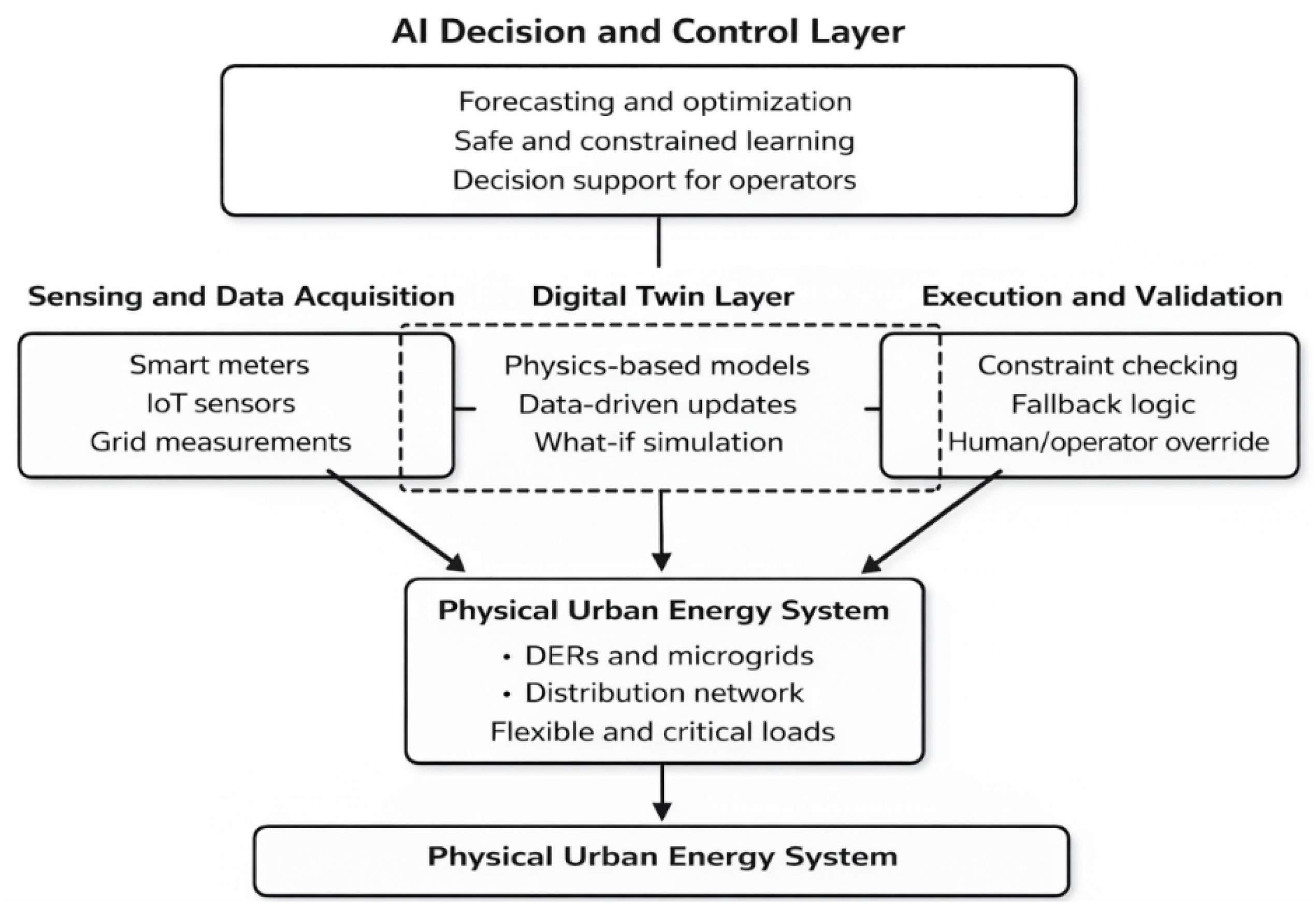
Digital twins are emerging as the integrative layer linking sensing, modeling, and intelligent control in power systems through real-time synchronization between physical assets and virtual models for monitoring, simulation, and decision-making [70,71]. In urban grids, digital twins allow operators to test control actions before deployment, reducing operational risk. Figure 12 shows the closed-loop framework integrating digital twins, AI-based decision-making, and validated execution for safe and adaptive urban energy operation.
However, the promise of digital twins is often overstated. City-scale power systems exhibit extreme asset heterogeneity, incomplete observability, and frequent topology changes, making full-fidelity replication impractical. Systematic reviews emphasize that most operational twins remain modular and use-case specific, focusing on feeders, microgrids, or asset classes rather than entire cities [13,72]. This modularity is not a weakness but a necessary architectural choice.
For intelligent operation, digital twins play a critical role in validating learning-based controllers and detecting performance degradation. Without a trustworthy validation environment, continuous model updates, common in AI-driven systems, introduce unacceptable operational risk. Hybrid digital twins combining physics-based and data-driven models currently represent the most practical operational approach [73].

5.4. Autonomous Control, Safe Learning, and Regulatory Constraints

Reinforcement learning has attracted significant attention as a means of achieving autonomous control in complex and uncertain environments. Recent reviews in Renewable and Sustainable Energy Reviews and Engineering Applications of Artificial Intelligence systematically analyze safe reinforcement learning techniques for power systems, highlighting mechanisms such as action shielding, constraint embedding, and supervisory oversight [74,75]. These studies converge on a key insight: autonomy in power systems must be explicitly bounded by safety and reliability requirements. At present, reinforcement-learning-based control in urban power systems should be interpreted as decision-support or advisory intelligence validated through simulation and limited field trials (Em-S), rather than as a directly deployable replacement for standards-compliant primary and secondary control.
Unlike many cyber-physical domains, power systems permit very limited exploration during live operation. Unsafe control actions can propagate rapidly, leading to widespread outages. As a result, reinforcement learning approaches that perform well in simulation often face significant barriers to deployment. Safe reinforcement learning frameworks mitigate these risks but introduce additional complexity and computational overhead, and they still struggle with generalization under nonstationary conditions [76,77].
Regulatory and standardization constraints further limit the scope of autonomy. IEEE Std 1547-2018 and its companion guide IEEE Std 1547.2 define mandatory behaviors for distributed energy resources, including voltage and frequency response and abnormal condition handling [78,79]. Any autonomous control strategy must comply with these requirements, effectively constraining the action space of learning-based controllers. Intelligent operation in smart-city grids is therefore most realistically implemented as bounded or assisted autonomy, where AI augments human operators and standards-compliant control systems rather than replacing them outright.

5.5. Illustrative Deployments of AI-Enabled Urban Grid Operation

Current AI-enabled urban grid deployments remain concentrated in forecasting, anomaly detection, predictive maintenance, and operational decision support, rather than fully autonomous control.
Utility-scale implementations commonly integrate machine-learning-assisted load forecasting and outage prediction into distribution management workflows to improve operational awareness and resource allocation. Similarly, microgrid demonstration projects increasingly employ AI-supported energy management systems for coordinating distributed generation, storage, and flexible demand under varying operating conditions. Digital twin platforms are also being introduced in selected urban energy pilots to support scenario analysis, predictive monitoring, and operational validation prior to field-level control actions. Current deployments remain concentrated in operational support applications, while fully autonomous operation remains limited by broader deployment constraints.

6. Cybersecurity, Interoperability, and Regulatory Challenges

Urban electrical grids are transforming data-driven, decentralized, and AI-enabled cyber-physical systems. The changes happening in the electrical grid as a multi-faceted evolution will create a new class of systemic vulnerabilities that exist beyond the typical concerns associated with the reliability of conventional power systems. The architectural evolutions of digitalization, decentralization, and intelligence have also expanded the attack surface and increased the difficulty of coordinating the systems and technologies employed in each of these areas, which has led to misalignment between their technological capabilities and the regulatory framework within which they must operate. This section examines cybersecurity, interoperability, and regulation as coequal architectural constraints shaping the feasibility, scalability, and trustworthiness of smart-city electrical grids [80,81]. Figure 13 illustrates centrally located area networks (C-LANs) as a system-level architectural quality of smart-city electrical grids, with trust boundaries, cyber-physical attack vectors, and defense-in-depth mechanisms emerging through a layered grid infrastructure.

6.1. Cybersecurity as a System-Level Architectural Constraint

Cybersecurity in smart-city power systems must be treated as a system-level architectural requirement rather than a post-deployment hardening measure. The interdependence of power electronics, communication networks, cloud platforms, and AI-based control transforms the grid into a high-risk cyber–physical system where cyberattacks can trigger physical disruptions. Unlike traditional IT systems that prioritize confidentiality, smart grids primarily depend on availability and integrity, with failures potentially causing cascading impacts across infrastructures.
As a result of digitalized and decentralized architecture, there has been a significant increase in the number of entry points for hostile actors. Each of these types of devices has some unique characteristics; smart meters, microgrid controllers, inverter-based distributed energy resources (DERs), edge computing nodes, and third-party data hosts, for example, all provide an entry point for adversaries to exploit the disparate hardware and software security postures exhibited by these types of devices. Empirical analysis of smart grid attack taxonomies indicates that adversaries can utilize both cyber-only exploitation vectors, such as data manipulation, and cyber-physical exploitation vectors, such as coordinated manipulation of inverter set points, to disrupt grid operation. Furthermore, in many instances, an adversary does not have to breach the core utility control center to generate system-wide effects; the compromise of either peripheral-owned devices or consumer-owned devices will suffice to induce localized impacts.
From an architectural point of view, there are many assumptions that underpin many AI-enabled control proposals. These assumptions include the use of trustworthy measurements, reliable communications, and benign data streams. A review of machine-learning-based applications on power systems from Elsevier points out that most learning-based controllers are evaluated in idealised conditions rather than the real world, with minimal consideration for adversarial manipulation or stealthy data corruption [82,83]. This has resulted in a significant gap between performance in simulation and the operational robustness of algorithms used in actual urban areas.
Cybersecurity therefore requires defense-in-depth architectures with explicit trust boundaries and resilient fallback operating modes. The work of IEEE emphasizes that resilient architecture will use a graceful degradation, local autonomy and conservative fallback control as a basis for design rather than attempt to prevent all intrusions [84,85]. In the case of smart city grids, microgrids and (edge) controllers will need to have the ability to maintain positions of stability through partial observability, delayed communications or beliefs of data compromise; therefore, this is a design fundamental that directly restricts the design of intelligent control systems described in Section 5.

6.2. Interoperability and the Fragmentation Problem

Interoperability represents a parallel architectural constraint in smart-city grid deployment. Smart city grids comprise utilizing multiple vendor equipment over several decades, where there are legacy protection devices, modern digital relays, IoT sensors, cloud-based analytics and AI-enabled controllers. Without a robust interoperability framework in place to manage this heterogeneity, there is an inherent risk that cities will be locked into isolated, vendor-specific ecosystems, which make it difficult to scale and adapt over the long term [14]. A review of leading publications shows that interoperability is cited as a precondition to successfully deploying smart grids versus an afterthought when implementation takes place [86].
Several standards, namely IEC 61850, IEEE 2030 and Common Information Model (CIM), have been developed to help address these concerns; however, the adoption of such standards by urban distribution networks is still uneven. Inconsistent implementation of interoperability standards can create semantic interoperability gaps in which exchanged data remain syntactically compatible but operationally inconsistent [87].
Fragmentation becomes especially problematic in AI-enabled architectures. Computer-based systems that use learning methods are dependent on data that has consistent definitions, times that are in sync, and standard definitions on how they are controlled. When there is a lack of interoperability, the costs of integrating systems and pre-processing data become custom work that increases the cost of implementing the system and decreases the ability to replicate that implementation from one city to another. Digital twin and AI reviews have shown that the most significant barrier to moving pilot projects into city-wide operational platforms is the lack of standardized data models [88].
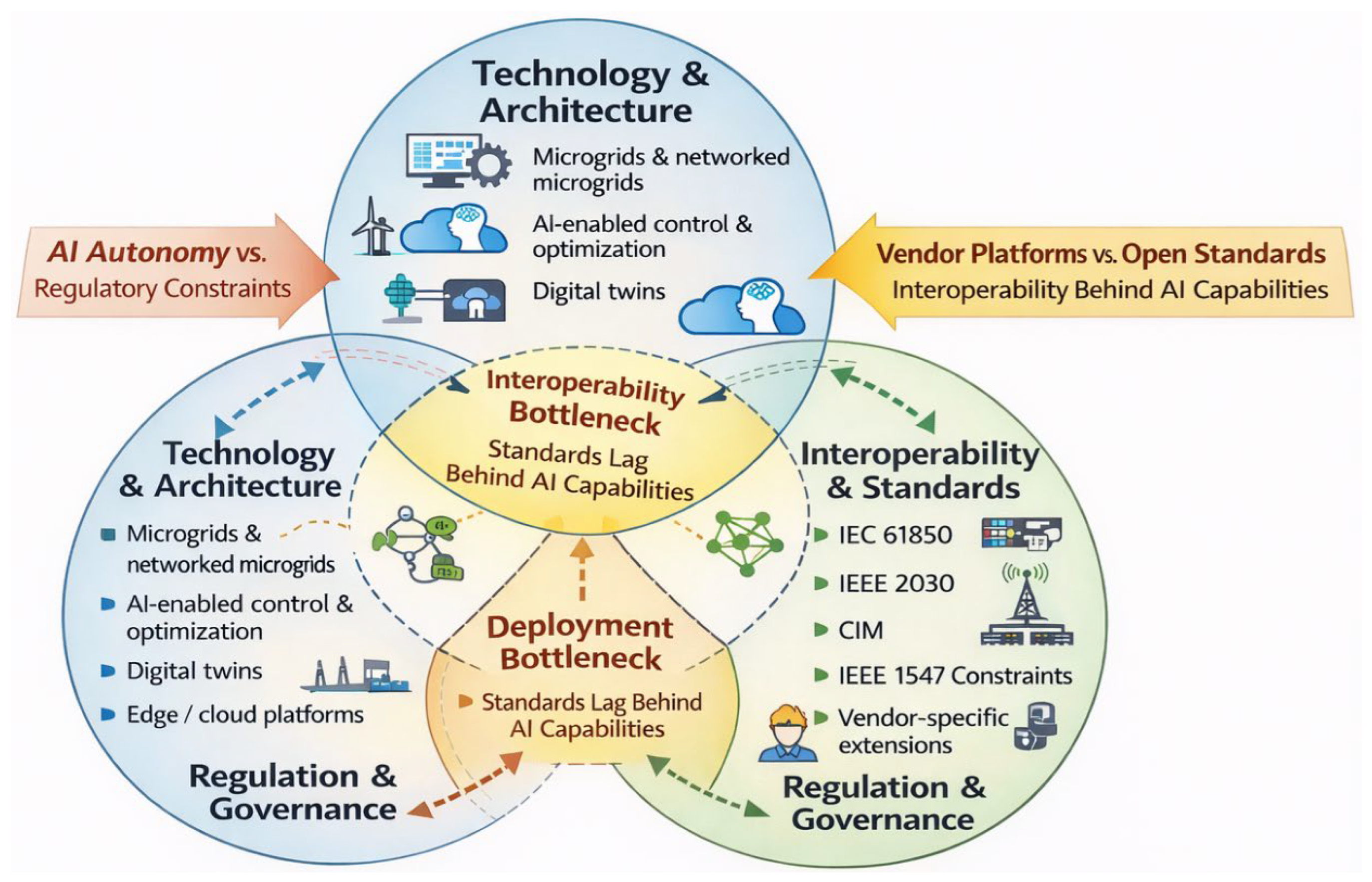
Also, there are issues with cybersecurity and interoperability that present significant challenges. The variety of different interfaces and the existence of proprietary extensions create complexity within the areas of security auditing, patch management, and incident response. An effective use of cybersecurity and artificial intelligence requires both architectural simplicity and standardization as primary enablers of safe and intelligent operation of the electric grid [89]. Figure 14 illustrates how technological innovation, incomplete interoperability, and legacy regulatory structures converge to create structural bottlenecks that constrain large-scale deployment of smart-city grid architectures.
International interoperability and cybersecurity standards increasingly provide the structural foundation for deployable smart-grid architectures. Standards such as IEC 61850 support interoperable substation and communication modeling, the Common Information Model (CIM) enables standardized data exchange across heterogeneous platforms, and IEEE 2030 provides guidance for interoperability between power, communication, and information systems. Similarly, cybersecurity-oriented frameworks and standards, including IEC 62351 and the NIST smart-grid cybersecurity framework, support secure communication, authentication, access control, and protection of cyber–physical energy infrastructures. Within the multi-layer architectural framework proposed in this review, these standards collectively support interoperability, secure data exchange, hierarchical coordination, and governance compatibility across physical, communication, control, and supervisory layers.

6.3. Regulatory Misalignment with Decentralized and Intelligent Architectures

Regulatory frameworks strongly influence which smart-grid architectures are deployable in practice. However, most electricity regulations were developed for centralized systems with clear asset ownership, hierarchical control, and deterministic operational boundaries. The decentralized and AI-enabled architectures emerging in smart cities challenge these assumptions at multiple levels [90,91].
Existing electricity regulations were largely developed for vertically integrated utilities and centralized generation structures. Decentralized and autonomous urban grid structures add complexity in regard to reliability and asset ownership by utilizing many distributed energy resources [90,91].
Distributed energy resources blur traditional distinctions between producers, consumers, aggregators, and microgrid operators, creating institutional roles that many existing regulatory frameworks were not designed to accommodate [92].
Adaptive and learning-based control systems complicate traditional accountability models because operational decisions may evolve dynamically rather than follow fixed deterministic rules. This creates uncertainty regarding liability, auditability, and regulatory responsibility in the event of disturbances or operational failures.
Regulatory approval processes typically evolve more slowly than technological innovation, delaying the deployment of technically mature smart-grid solutions at city scale [92,93].
Regulatory compatibility must therefore be treated as a primary architectural design variable rather than a post-deployment constraint [94,95].
One major tension concerns control of authority and responsibility. In microgrid-rich urban environments, operational decisions are increasingly distributed across utilities, third-party aggregators, building operators, and automated controllers. Yet regulatory accountability mechanisms typically assume a single system operator with full visibility and control.
IEEE and Elsevier studies highlight that this misalignment creates uncertainty around liability in the event of outages, cyber incidents, or algorithmic failures [96,97]. The implications of interconnection standards and regulatory constraints for AI-enabled control are discussed in Section 5.4 [79,96,97], particularly the necessity of assisted autonomy, are discussed in detail in Section 5.4.
Market and tariff structures introduce additional constraints. Many regulatory regimes do not adequately value flexibility, resilience, or local energy balancing, reducing incentives for microgrid coordination and advanced control deployment. Springer and Wiley analyses of urban energy governance emphasize that without regulatory recognition of flexibility services and peer-to-peer energy exchange, technically viable architectures may remain economically unattractive [96,97].
The following deployment examples illustrate a recurring pattern in which technical functionality scales more readily than governance, interoperability, cybersecurity assurance, and accountability mechanisms across smart-city power systems. Utility-led AMI and automation programs, campus- and district-scale microgrids, and cross-sector smart-city pilots consistently demonstrate a pattern in which technical functionality scales are more readily achieved than governance, interoperability, cybersecurity assurance, and accountability mechanisms [57,98]. The following examples are therefore not treated as isolated case studies, but as representative manifestations of a recurring architectural scaling pattern observed across multiple cities and regulatory contexts.

6.4. Illustrative City-Scale Deployment Examples

The intent is not to provide detailed case studies, but to demonstrate how architectural layers, control authority, interoperability, and governance constraints interact in practice, and why many technically mature solutions encounter scaling limitations when deployed in urban environments.
Example A: Utility-led urban smart grid modernization (AMI + distribution automation)
Large-scale smart-grid deployments in urban environments commonly begin with advanced metering infrastructure (AMI) and distribution automation, driven by utilities seeking improved observability, outage management, and operational efficiency [5,26,29]. In an architectural manner, the installed deployments primarily enhance the “sensing” and “actuating,” “communication” and “data” and the “control” and “coordination” portions of the framework defined in Section 1.5 of this article, while providing little or no change to the governance structure or the authority to control [11]. Generally, the cities, through adding AMI focused architecture, experience an increase in the ability to perform an objective such as fault detection; improved performance in outage restoration; a significantly increased volume of data availability, and therefore can be expected to provide a more responsive grid to the end user. When considering the larger perspective of the “smart city” functionality defined in Section 1.2 above, AMI-based deployments exhibit the following structural limitations: (1) centralized and utility-centric nature of the control authority; (2) limited cross-sector connectivity with buildings, mobility, municipal platforms, etc., and (3) governance boundaries limiting third-party integration into the data. Consequently, while AMI and automation can generally scale in technology, they tend to serve as point-source enablers, not an integrated smart city energy system.
A representative large-scale deployment example is the Enel Telegestore smart-metering program in Italy, which enabled large-scale AMI deployment across millions of consumers and demonstrated significant improvements in remote monitoring, outage management, and operational visibility. However, subsequent studies also highlighted interoperability challenges, cybersecurity concerns, and the need for continuous infrastructure modernization as digitalization expanded across operational layers. These deployments improve observability and operational responsiveness but remain constrained by centralized governance structures and limited cross-sector integration capability [99]. Evaluated through the multi-layer architectural framework in Section 1.5, this deployment pattern illustrates how sensing, communication, and centralized control layers can scale technically, while governance, interoperability, and cross-sector coordination remain binding constraints.
Example B: Microgrid-rich urban districts and campuses
Microgrids are frequently installed to create resilient, flexible operations that utilize local energy resources distributed across various urban areas and large campuses where these types of resources have already been widely implemented. From the architecture perspective of these types of deployments, microgrids validate each of the physical, control, coordination, and intelligence layers of the multi-layered architecture discussed in Section 1.5. The governance and market integration components, however, remain predominantly local to the deployment site or district [8,12,22].
Microgrid-rich architecture has distinct advantages at the site or district level when viewed in terms of potential future capabilities. This includes providing the capability to operate as an island from the main utility grid, improving service continuity for selected critical loads, and effectively coordinating the use of local generation and storage. However, when microgrid sites and districts are evaluated against the usual requirements for a smart city (as defined in Section 1.2), scaling limitations due to the coordination of multiple microgrids become apparent. Several interoperability challenges arise in the coordination of multiple microgrids that increase the complexity of communications, cybersecurity, and unresolved issues related to control authority and liability across organizational lines.
The Brooklyn Microgrid project in New York represents a widely cited urban microgrid deployment integrating distributed solar generation, localized energy exchange, and community-level coordination. The project demonstrated the potential of decentralized energy management and local resilience enhancement, while also exposing regulatory, interoperability, and market-governance challenges associated with scaling peer-to-peer energy coordination beyond pilot environments. Although microgrid architectures are technologically mature at local scales, city-scale deployment remains constrained by interoperability, governance coordination, and multi-operator accountability requirements [22,24].
Example C: Cross-Sector Coupling of Power, Buildings, and Electric Mobility
Buildings will increasingly be linked to electrical grids through smart city development and are connected to EV charging infrastructure via an energy management system. Smart city deployments cover three layers of the smart city framework, described in Section 1.5 of this document: the physical layer (distribution networks and chargers), the control and coordination layer (aggregators and energy management systems), and the intelligent layer (forecasting and optimization across sectors) [2,24].
At the limited scale of coordinated charging of building demand response to reduce peak loads and to provide greater flexibility when considered considering the smart city requirements described in Section 1.2, large-scale deployment will reveal structural constraints. Specifically, cross-sectoral coordination will increase data volumes, latency sensitivity, and vulnerabilities from cybercrime; governance of the systems will become fragmented among different utilities, mobility operators, building owners, and municipalities. Control and liability boundaries are often unclear, leading to complications in the enforcement of grid constraints and accountability during disturbances [4,24].
Singapore’s Smart Nation initiatives provide a representative example of cross-sector smart-city integration through the coordination of digital infrastructure, transportation systems, urban services, and energy-management platforms. These deployments demonstrated benefits in operational coordination, urban monitoring, and service integration, while also highlighting increasing dependence on interoperable data platforms, cybersecurity assurance, and centralized governance coordination at large scale.
Collectively, these deployments demonstrate that the principal limitations of smart-city electrical grid architectures increasingly arise not from isolated technological capability, but from cross-layer integration challenges involving interoperability, governance coordination, cybersecurity assurance, and scalable operational management. Table 5 summarizes representative real-world smart-city electrical grid deployments together with their architectural characteristics, documented benefits, and observed deployment limitations.

6.5. Toward Security- and Regulation-Aware Grid Architectures

Cybersecurity, interoperability, and regulation must be treated as co-designed architectural layers rather than independent implementation concerns [100]. Smart-city grid architectures must therefore be evaluated not only by technical performance but also by cybersecurity resilience, interoperability, and governance compatibility under large-scale deployment conditions [101,102].
As smart cities evolve toward integrated cyber–physical governance, the electricity grid must be treated as part of the broader urban ecosystem rather than an isolated infrastructure. Modern smart cities interconnect energy, transportation, buildings, communications, and public services; therefore, grid modernization must support cross-sector interoperability, institutional accountability, and resilient critical services [103,104,105].
Smart-city architectures must accommodate heterogeneous devices, ownership structures, and operational objectives while maintaining interoperable and secure coordination across open urban platforms [106,107]. Smart-city power systems must also remain resilient under combined cyber and physical disturbances, requiring architectures with bounded operational autonomy and resilient fallback mechanisms under degraded operating conditions [108].
Deployable smart-city architectures must remain compatible with regulatory, interoperability, and governance constraints while supporting scalable coordination of distributed resources and platform-based services [109]. Public trust in smart-city automation depends on transparent control boundaries, auditable operation, and constrained AI-assisted coordination within standards-compliant architectures [110,111].
Implications under smart-city requirements
Under smart-city deployment conditions, cybersecurity, interoperability, and regulation emerge as primary architectural constraints rather than secondary implementation concerns. Their integration into system design is essential for scalable and resilient urban grid operation.

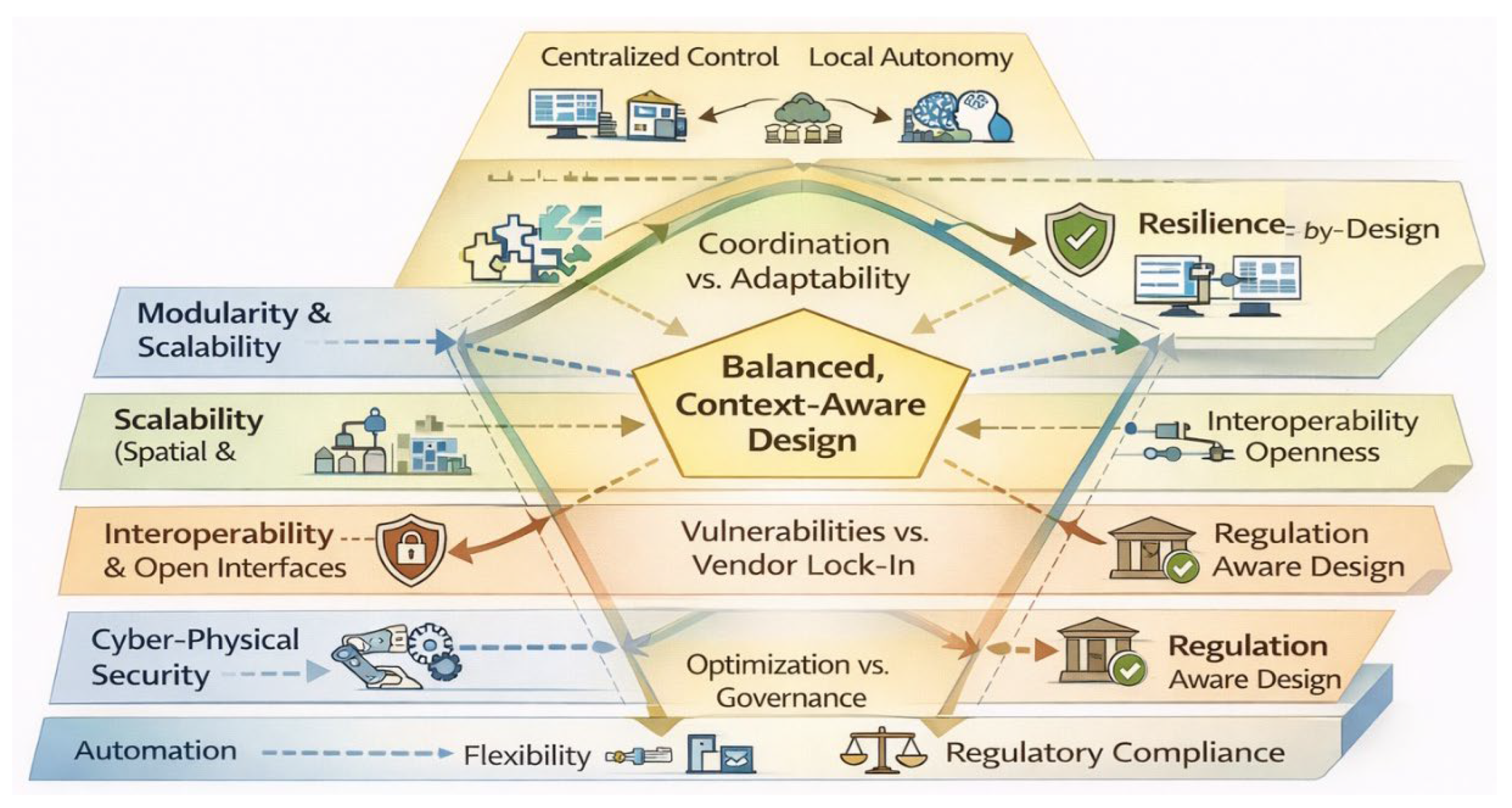
6.6. Cross-Layer Architectural Tensions in Smart-City Grids

The principal challenges in scaling smart-city electrical grids arise from cross-layer integration and coordination rather than from limitations within individual technologies. Digitalization, decentralization, and AI-enabled operation each improve system capability while simultaneously introducing new coordination, cybersecurity, accountability, and governance constraints.
Cybersecurity requires controlled trust boundaries, whereas interoperability depends on openness and extensibility [25,26]. These tensions are structural characteristics of smart-city cyber–physical systems and require balanced architectural trade-offs rather than unrestricted optimization of autonomy or digitalization. Successful designs tend to have three repeated attributes as follows:
  • Bounded rather than unrestricted autonomy;
  • Layered rather than purely centralized or fully decentralized coordination;
  • Governance-aware rather than technology-isolated system design.
These cross-layer tensions motivate the need for architectural evaluation principles that extend beyond isolated technology assessment. Collectively, Section 3, Section 4, Section 5 and Section 6 indicate that deployable smart-city grids emerge from negotiated trade-offs across physical, cyber, operational, and institutional layers rather than from isolated technological optimization. These observations motivate the architectural design principles synthesized in Section 7.

7. Architectural Design Principles for Smart City Power Systems

The preceding sections show that smart-city electrical grids must be designed as integrated cyber–physical infrastructures operating under technical, operational, and governance constraints. The architectural principles synthesized here are derived from the recurring smart-city requirements introduced in Section 1.2 and the deployment limitations identified in Section 3.6. The following principles characterize resilient, scalable, and governable smart-city power systems and should be interpreted as interdependent architectural design considerations rather than isolated objectives.

7.1. Modularity and Layered Decomposition

Modularity and layered decomposition remain foundational architectural principles for smart-city power systems [112]. Layered decomposition enables complex urban grids to be separated into manageable subsystems with independently evolving physical, communication, and control functions. Many researchers agree that layered decomposition (modular architecture) results in greater maintainability, interoperability, and long-term adaptability of smart grid systems [113,114]. Figure 15 summarizes the cross-layer architectural principles synthesized throughout this review.
In a smart-city context, modularity is especially important due to the mismatch between the lifecycles of different types of infrastructure: while physical assets in a smart-city environment can last decades, digital platforms and AI services evolve much more quickly [115]. Tightly coupled physical and cyber components reduce a utility’s or municipality’s ability to update or replace them without full-scale replacement of the infrastructure, creating the risk of technology lock-in and premature obsolescence. On the contrary, through modular architecture, utilities and municipalities can incrementally introduce new services (such as advanced analytics and digital twins) without requiring the destruction and complete replacement of existing physical infrastructure.

7.2. Scalability Across Spatial and Organizational Dimensions

Urban grids must scale not just at the building level but also at the district and city-wide level, while at the same time supporting many different actors from various industry sectors, such as utilities, aggregators, mobility service providers, and municipal authorities. Review of the literature indicates that many of the current smart grid solutions fail because they are not technically inadequate, but rather because they do not scale in an organizational and/or institutional way [116,117,118].
In terms of architecture, scalability supports both hierarchical and hybrid control systems where local autonomy is maintained at the edge (i.e., microgrids and/or substations) while higher-level coordination maintains system-wide consistency. This principle is consistent with cyber-physical system theory, which emphasizes that control scope and authority need to correspond to physical scale as well as temporal scale [119]. Therefore, the architecture of a smart city will utilize a scalable architecture that will be layered with control and coordination mechanisms that can continue to evolve in their expansion as the city itself evolves.
The comparison further indicates that deployment readiness is determined less by isolated technical capability than by cross-layer coordination between infrastructure, intelligence, cybersecurity, interoperability, and regulatory compatibility. Consequently, future smart-city grid architectures are likely to evolve toward hybrid and layered coordination models rather than purely centralized or fully decentralized paradigms.

7.3. Resilience-by-Design and Graceful Degradation

As modern cities increasingly depend on electricity for critical services, resilience has become essential in smart-grid design. Unlike traditional reliability metrics focused on outage frequency and duration, urban resilience emphasizes maintaining service continuity during extreme weather, equipment failures, and cyberattacks. Recent studies highlight that digitization has shifted resilience from an operational concern to an architectural feature, enabling systems to isolate, reconfigure, and operate autonomously under stress [120,121,122].
Microgrid technology offers examples of resilience by allowing essential services to remain operational despite failure in the upstream coordination structure [123]. Lastly, resilience-driven architectures and systems assume an occurrence of failure and therefore their main objective is to contain and recover from a failure event or recovery in the least brittle manner possible through utilizing the most effective and efficient means available to do so.

7.4. Interoperability and Open Interfaces

Smart grid interoperability is a fundamental principle for smart cities, due to the necessity to unite different devices from different vendors and provide overall service over a long time. Studies based on both IEEE standard organizations and Springer research consistently show that there is currently not enough interoperability to expand the implementation of smart grids beyond pilot projects [124,125].
Table 6 illustrates that no single architecture simultaneously optimizes scalability, resilience, interoperability, cybersecurity, governance compatibility, and deployment readiness. Instead, smart-city electrical grids require negotiated architectural trade-offs across physical, cyber, operational, and institutional layers. Centralized and hierarchical architectures remain operationally mature and auditable but offer limited flexibility for highly distributed urban systems. In contrast, distributed, hybrid, and AI-enabled architectures improve adaptability and resilience while introducing greater interoperability complexity, cybersecurity exposure, and governance challenges.
From an architectural perspective, interoperability requires more than simply the ability to comply with a protocol; it also requires the establishment of semantic consistency between the various data models that all interoperating components will share and clearly defined control interfaces between those components for the application of artificial intelligence to succeed. Without these three characteristics, architectures that utilize proprietary or non-transparent interfaces may provide only temporary performance improvements, at the expense of long-term flexibility and municipal governance objectives [13].

7.5. Cyber-Physical Security as an Architectural Property

As discussed in Section 6, cybersecurity in smart-city power systems cannot be retrofitted. Instead, it must be embedded into architectural design through segmentation, trust boundaries, and defense-in-depth strategies. Literature on smart-grid security emphasizes that cyber–physical systems differ fundamentally from traditional IT systems, as cyber incidents can propagate directly into physical consequences [126,127]. Accordingly, autonomy assumptions for AI-enabled operation should follow the assisted-autonomy bounds established in Section 5.4 [75]. The implications of these governance and accountability requirements for autonomy bounds and assisted-autonomy operation are detailed in Section 5.4.

7.6. Regulation-Aware and Governance-Compatible Design

A distinctive requirement of smart-city power systems is alignment with regulatory and governance structures. Electricity grids operate within tightly regulated environments, yet smart-city objectives, such as decarbonization, flexibility, and citizen participation, often emerge at municipal or regional levels. Studies in Technological Forecasting and Social Change and IEEE Proceedings highlight that misalignment between technology and regulation is a major cause of stalled deployments [128].
Regulation-aware architectures explicitly encode compliance constraints, accountability boundaries, and auditability into system design. Rather than treating regulation as an external limitation, such architectures recognize governance as a design parameter that shapes feasible control strategies and market interactions. This principle is particularly relevant for AI-enabled systems, where transparency and explainability are prerequisites for regulatory acceptance.

7.7. Human-Centric and Service-Oriented Operation

To put simply, it is critical that Smart City grid designs have human-centered operations. Failure in an urban area could have immediate social and political ramifications, which means that the design of a Smart City architecture must be willing to provide for human oversight, intervention, and accountability in all areas of automating and increasing the level of intelligence. Research conducted on Human-Centered Smart City approaches has found that the level of trust in the public is dependent upon the level of transparency, inclusivity, and controllability of automation [129]. Thus, the human-centered operation design aligns with the design and standard constraints of assisted and bounded autonomy discussed in Section 5.4.
The principle promotes the development of Smart City architectures with well-defined control hierarchies, providing an understandable/communicable state for human operators and authority intervention when necessary. This reinforces the practical application of Layered Designs, where the use of AI-enabled optimization assists or supports (but does not take precedence over) human-based decision-making and institutional responsibility.
The possible architectural design space for smart city power systems is shown in Figure 15. This figure shows how architectural principles discussed in Section 8 become mutually constraining when applied to the urban scale. This reveals the regions where technically optimal solutions become either operationally or institutionally impossible to implement. It illustrates that as decentralization, interoperability, and automation increase, there is a systematic increase in cybersecurity exposure, regulatory complexity and governance overhead, while excessive centralization or overly restrictive security stances hinder scalability and innovation. Figure 16 establishes a clear structural rationale for the often observed disconnect between successful small-scale implementations and failing to implement on a large scale; it provides clarity into why no single architectural principle can be maximized individually from all others; and it establishes that the analysis of architectural design is framed as a problem of constraint navigation rather than as a performance optimization issue thereby motivating needed context sensitive tradeoffs and directing future research as discussed in Section 8.

7.8. Key Architectural Insights for Deployable Smart-City Power Systems

The synthesis conducted in this review yields several architecture-level insights that do not emerge from technology-centric or application-centric surveys:
  • Deployability is an architectural property
Smart-grid solutions fail to scale not primarily due to algorithmic immaturity, but due to misalignment across physical, data, control, cybersecurity, and governance layers.
2.
Decentralization and intelligence amplify governance and security constraints
Increased autonomy and interoperability systematically expand the cyber-attack surface and complicate accountability, making cybersecurity and regulation binding design constraints rather than secondary considerations.
3.
Assisted autonomy is the dominant feasible paradigm
See Section 5.4 for the standards- and regulation-bounded justification, and Section 7.6 and Section 7.7 for governance and human-oversight implications.
4.
Interoperability is a prerequisite for intelligence at scale
Interoperability is a necessary precondition for scalable, AI-enabled coordination in smart-city power systems.
5.
City-scale resilience requires graceful degradation
Architectures that assume perfect data availability and communication are brittle; resilient smart-city grids require local autonomy and conservative fallback modes by design.
These insights frame smart-city grid design as a problem of architectural constraint navigation rather than isolated performance optimization.

7.9. Applying the Architectural Framework in Practice

To support practical use, the architectural framework introduced in Section 1.5 can be applied as a structured evaluation checklist for proposed or existing smart-city power system initiatives. In practice, a project can be assessed by sequentially examining:
  • The physical power layer (asset ownership, protection boundaries, and DER penetration).
  • Sensing and communication layers (observability coverage, latency, and failure modes).
  • Control and coordination layers (distribution of authority, fallback operation, and interoperability).
  • Intelligence and analytics layers (decision-support versus autonomous control, validation mechanisms, and auditability).
  • Governance and oversight layers (institutional responsibility, regulatory compliance, and accountability).
The architectural principles synthesized in this section highlight the need for coordinated evolution across physical infrastructure, digital platforms, operational intelligence, cybersecurity, and governance mechanisms. These remaining gaps motivate the future research directions discussed in Section 8.

8. Future Research Directions

Despite major advances in digitalization, decentralization, and AI-enabled operation, several unresolved architectural challenges continue to limit scalable and governable smart-city grid deployment. The following research directions emerge from the synthesis developed in Section 3, Section 4, Section 5, Section 6 and Section 7 [5,26].

8.1. City-Scale Validation and Replicability of Grid Architectures

City-scale validation remains a critical gap because most proposed grid architectures are evaluated under idealized assumptions regarding communication reliability, data integrity, and institutional boundaries. This limits confidence in their replicability across heterogeneous urban contexts and directly contributes to the persistence of large-scale deployments rather than sustained city-wide operation [8,109]. Future research should prioritize long-duration, multi-stakeholder validation frameworks that explicitly test architectural performance under realistic operational, cyber, and governance constraints, enabling comparison and transferability across cities rather than isolated demonstrations [125].

8.2. Security-Aware Intelligence Under Degraded and Adversarial Conditions

Intelligence that is aware of security issues is usually not as mature as it should be, since most of the AI-enabled approaches to grid control focus on non-secure environments where they assume reliable communication and trustworthy data streams. In reality, however, when deploying sensors in smart cities, there are compromises of sensors, false data injections, and degraded communication that can completely disrupt coordination through learning-based methods and create an increased level of systemic risk within urban networks that have high numbers of DER [74]. Future research should focus on designing architectures for intelligence that remain stable in environments where there are partial observations and degraded trust and building intelligence into designs that incorporate conservative fallback modes, constraint enforcement, and the explicit inclusion of adversarial scenarios as first-class considerations in the design process.

8.3. Interoperable Data and Control Platforms for Urban Energy Systems

Interoperability continues to be a binding constraint because heterogeneous devices, vendors, and legacy systems often lack consistent data semantics and standardized control interfaces, even when basic protocol compatibility exists. This fragmentation significantly increases integration effort, undermines scalable coordination, and limits the deployment of advanced analytics and digital twins at the city scale. Future research should prioritize interoperable, machine-readable data and control models that support cross-operator coordination, enable AI-enabled services, and remain compatible with long-term asset lifecycles and evolving standards.

8.4. Governance-Compatible Automation and Accountability Mechanisms

Governance-compatible automation remains unresolved because decentralized and AI-enabled grid architectures distribute control authority across utilities, aggregators, building operators, and automated systems, while regulatory accountability frameworks largely assume centralized responsibility. This misalignment creates uncertainty around liability, auditability, and decision authority, constraining the deployment of autonomous coordination in urban environments [77]. Future research should therefore develop architectural mechanisms that embed accountability, transparency, and regulatory compliance into automated operation, enabling assisted autonomy that remains legible, auditable, and enforceable within municipal and regulatory governance structures.

8.5. Architectural Boundary Conditions and Deployment Realities

While the architectural framework developed in this review provides a structured pathway toward AI-enabled urban energy ecosystems, several boundary conditions constrain real-world deployment. First, data integrity cannot be assumed. Urban grids operate with incomplete observability, inconsistent time synchronization, and evolving asset inventories [31,35]. Architecture must therefore tolerate uncertainty rather than rely on idealized data completeness. Second, communication infrastructures exhibit heterogeneous latency, bandwidth, and reliability characteristics [67,69]. Designs that implicitly assume uninterrupted high-speed connectivity are unlikely to perform robustly in city-scale environments.
Third, institutional inertia is frequently identified in the literature as a significant non-technical deployment constraint. Utilities operate under reliability mandates that prioritize risk minimization. Radical architectural transformations may be technically feasible yet politically or economically unacceptable without incremental transition pathways [90,128]. Fourth, economic viability strongly influences scalability and long-term deployment feasibility. Architectures may encounter deployment challenges in municipal contexts [124,129].
These constraints highlight the importance of evaluating smart-grid architectures within realistic regulatory, economic, and operational conditions. Smart-city grid evolution is best understood as an adaptive transformation shaped simultaneously by engineering capability, regulatory reform, economic feasibility, and societal acceptance.

9. Conclusions

This review frames smart-city electrical grids as integrated cyber–physical infrastructures whose successful deployment depends less on the maturity of individual technologies than on architectural alignment across physical, digital, and governance layers.
The synthesis shows that digitalization, decentralization, and AI-enabled operation are necessary but not sufficient conditions for smart-city power systems. Their effectiveness ultimately depends on alignment with interoperability, cybersecurity, and governance requirements.
The reviewed literature consistently suggests that cybersecurity, interoperability, and regulation should be treated as major architectural constraints in smart-city grid deployment. As urban grids become increasingly connected and automated, these dimensions strongly influence the feasible control space and determine whether intelligent coordination enhances resilience or instead introduces systemic fragility. Architecture-first design, therefore, favors modular, layered, and standards-compliant structures that support assisted autonomy, explicit trust boundaries, and auditable control responsibilities.
The proposed architectural framework is intended to explain deployability constraints at the city scale rather than to predict quantitative performance outcomes, and its conclusions should therefore be interpreted as system-level design guidance rather than prescriptive operational rules. Within this scope, the framework provides a structured basis for evaluating whether smart-city grid architectures are not only technically feasible but also institutionally and operationally deployable under real governance and regulatory conditions.
Beyond synthesizing recent advances in smart grids, microgrids, and AI-enabled energy management, this review contributes a deployment-oriented architectural lens that explains persistent scaling failures observed across urban smart-grid initiatives. By enabling comparative evaluation across architectural layers, the framework complements technology-centric surveys and supports informed policy dialogue, system design, and future city-scale validation efforts aimed at resilient and sustainable urban energy systems.

Scope and Limitations

This review focuses on architectural principles and system-level integration challenges relevant to electrical grids operating in dense, digitally connected urban environments. The proposed framework is therefore most applicable to smart-city contexts characterized by high penetration of distributed energy resources, advanced communication infrastructure, and multi-stakeholder governance. It is less directly applicable to rural, weakly interconnected, or fully islanded power systems, where architectural constraints and deployment drivers differ substantially.
The review prioritizes peer-reviewed academic literature and standardization efforts, which may under-represent rapidly evolving industrial practices, city-specific regulatory adaptations, and proprietary interoperability solutions. In addition, due to heterogeneity in evaluation methodologies and reporting practices across the literature, the paper does not attempt quantitative cross-city performance comparison, reinforcing the need for standardized, comparative validation frameworks as a priority for future research.

Author Contributions

Conceptualization, H.A.; methodology, H.A.; formal analysis, E.H.E.B. and H.A.; investigation, H.A. and E.H.E.B.; writing—original draft preparation, H.A.; writing—review and editing, E.H.E.B.; visualization, H.A. All authors have read and agreed to the published version of the manuscript.

Funding

This research received no external funding.

Data Availability Statement

No new data were created or analyzed in this study. Data sharing is not applicable to this article.

Conflicts of Interest

The authors declare no conflicts of interest.

Abbreviations

AIArtificial Intelligence
AMIAdvanced Metering Infrastructure
CIMCommon Information Model
CPSCyber-Physical Systems
DERsDistributed Energy Resources
DMSDistribution Management System
EMSEnergy Management System
EVElectric Vehicle
ICTInformation and Communications Technology
IEDsIntelligent Electronic Devices
IoTInternet-of-Things
P & CProtection and Control
PCCPoint of Common Coupling
PMUPhasor Measurement Unit
PRISMAPreferred Reporting Items for Systematic Reviews and Meta-Analyses
PVPhotovoltaic
RTUsRemote Terminal Units
SCADASupervisory Control and Data Acquisition

References

  1. Keirstead, J.; Jennings, M.; Sivakumar, A. A review of urban energy system models: Approaches, challenges and opportunities. Renew. Sustain. Energy Rev. 2012, 16, 3847–3866. [Google Scholar] [CrossRef]
  2. Lund, P.D.; Lindgren, J.; Mikkola, J.; Salpakari, J. Review of energy system flexibility measures to enable high levels of variable renewable electricity. Renew. Sustain. Energy Rev. 2015, 45, 785–807. [Google Scholar] [CrossRef]
  3. Chourabi, H.; Nam, T.; Walker, S.; Gil-Garcia, J.R.; Mellouli, S.; Nahon, K.; Pardo, T.A.; Scholl, H.J. Understanding smart cities: An integrative framework. In Proceedings of the Annual Hawaii International Conference on System Sciences; IEEE Computer Society: New York, NY, USA, 2012; pp. 2289–2297. [Google Scholar] [CrossRef]
  4. Zanella, A.; Bui, N.; Castellani, A.; Vangelista, L.; Zorzi, M. Internet of things for smart cities. IEEE Internet Things J. 2014, 1, 22–32. [Google Scholar] [CrossRef]
  5. Fang, X.; Misra, S.; Xue, G.; Yang, D. Smart grid-The new and improved power grid: A survey. IEEE Commun. Surv. Tutor. 2012, 14, 944–980. [Google Scholar] [CrossRef]
  6. Yaghouti, S.; Hayati, M.M.; Gharehnaz, H.M.; Sorouri, H.; Jabari, F.; Abapour, M.; Oshnoei, A.; Blaabjerg, F. Grid modernization and transitioning toward sustainability: An in-depth survey of the latest transformative directions in modern power systems. In Reference Module in Materials Science and Materials Engineering; Elsevier: Amsterdam, The Netherlands, 2025. [Google Scholar] [CrossRef]
  7. Bittencourt, J.C.N.; Jesus, T.C.; Peixoto, J.P.J.; Costa, D.G. The Road to Intelligent Cities. Smart Cities 2025, 8, 77. [Google Scholar] [CrossRef]
  8. Katiraei, F.; Iravani, R.; Hatziargyriou, N.; Dimeas, A. Microgrids management. IEEE Power Energy Mag. 2008, 6, 54–65. [Google Scholar] [CrossRef]
  9. Wang, Y.; Chen, Q.; Hong, T.; Kang, C. Review of Smart Meter Data Analytics: Applications, Methodologies, and Challenges. IEEE Trans. Smart Grid 2019, 10, 3125–3148. [Google Scholar] [CrossRef]
  10. Mora, L.; Gerli, P.; Ardito, L.; Petruzzelli, A.M. Smart city governance from an innovation management perspective: Theoretical framing, review of current practices, and future research agenda. Technovation 2023, 123, 102717. [Google Scholar] [CrossRef]
  11. Almihat, M.G.M.; Munda, J.L. The Role of Smart Grid Technologies in Urban and Sustainable Energy Planning. Energies 2025, 18, 1618. [Google Scholar] [CrossRef]
  12. Zhou, Y.; Ngai-Man Ho, C. A review on Microgrid architectures and control methods. In 2016 IEEE 8th International Power Electronics and Motion Control Conference, IPEMC-ECCE Asia 2016; Institute of Electrical and Electronics Engineers Inc.: New York, NY, USA, 2016; pp. 3149–3156. [Google Scholar] [CrossRef]
  13. Alhasnawi, B.N.; Hashim, H.K.; Zanker, M.; Bureš, V. The rising, applications, challenges, and future prospects of energy in smart grids and smart cities systems. Energy Convers. Manag. X 2025, 27, 101162. [Google Scholar] [CrossRef]
  14. Silva, N.S.E.; Castro, R.; Ferrão, P. Smart Grids in the Context of Smart Cities: A Literature Review and Gap Analysis. Energies 2025, 18, 1186. [Google Scholar] [CrossRef]
  15. Mbasso, W.F.; Harrison, A.; Dagal, I.; Jangir, P.; Khishe, M.; Kotb, H.; Shaikh, M.S.; Smerat, A.; Donfack, E.F.; Kumar, R. Digital twins in renewable energy systems: A comprehensive review of concepts, applications, and future directions. Energy Strat. Rev. 2025, 61, 101814. [Google Scholar] [CrossRef]
  16. Al-Shetwi, A.Q.; Atawi, I.E.; El-Hameed, M.A.; Abuelrub, A. Digital Twin Technology for Renewable Energy, Smart Grids, Energy Storage and Vehicle-to-Grid Integration: Advancements, Applications, Key Players, Challenges and Future Perspectives in Modernising Sustainable Grids. IET Smart Grid 2025, 8, e70026. [Google Scholar] [CrossRef]
  17. Gál, T.; Alinasab, N.; Abdulhaq, H.A.; Skarbit, N. A Structured Literature Review of the Application of Local Climate Zones (LCZ) in Urban Climate Modelling. Earth 2025, 7, 3. [Google Scholar] [CrossRef]
  18. Templier, M.; Paré, G. Transparency in literature reviews: An assessment of reporting practices across review types and genres in top IS journals. Eur. J. Inf. Syst. 2018, 27, 503–550. [Google Scholar] [CrossRef]
  19. Moher, D.; Liberati, A.; Tetzlaff, J.; Altman, D.G. Preferred reporting items for systematic reviews and meta-analyses: The PRISMA statement. Int. J. Surg. 2010, 8, 336–341. [Google Scholar] [CrossRef] [PubMed]
  20. Tedja, M.; Kusumawati, A.; Yulianto, E. Systematic literature review using PRISMA: Exploring the influence of service quality and perceived value on satisfaction and intention to continue relationship. Future Bus. J. 2024, 10, 39. [Google Scholar] [CrossRef]
  21. Kitchenham, B.; Brereton, O.P.; Budgen, D.; Turner, M.; Bailey, J.; Linkman, S. Systematic literature reviews in software engineering-A systematic literature review. Inf. Softw. Technol. 2009, 51, 7–15. [Google Scholar] [CrossRef]
  22. Hatziargyriou, N. Microgrids: Architectures and Control; Wiley-IEEE Press: London, UK, 2013. [Google Scholar] [CrossRef]
  23. Lee, E.A. Cyber physical systems: Design challenges. In Proceedings of the 11th IEEE Symposium on Object/Component/Service-Oriented Real-Time Distributed Computing, ISORC 2008; IEEE: New York, NY, USA, 2008; pp. 363–369. [Google Scholar] [CrossRef]
  24. Palensky, P.; Dietrich, D. Demand side management: Demand response, intelligent energy systems, and smart loads. IEEE Trans. Ind. Inform. 2011, 7, 381–388. [Google Scholar] [CrossRef]
  25. Galli, S.; Scaglione, A.; Wang, Z. For the grid and through the grid: The role of power line communications in the smart grid. Proc. IEEE 2011, 99, 998–1027. [Google Scholar] [CrossRef]
  26. Farhangi, H. The path of the smart grid. IEEE Power Energy Mag. 2010, 8, 18–28. [Google Scholar] [CrossRef]
  27. Ipakchi, A.; Albuyeh, F. Grid of the future. IEEE Power Energy Mag. 2009, 7, 52–62. [Google Scholar] [CrossRef]
  28. Jnr, B.A.; Sylva, W.; Watat, J.K.; Misra, S. A Framework for Standardization of Distributed Ledger Technologies for Interoperable Data Integration and Alignment in Sustainable Smart Cities. J. Knowl. Econ. 2023, 15, 12053–12096. [Google Scholar] [CrossRef]
  29. Brown, R.E. Impact of Smart Grid on Distribution System design. In IEEE Power and Energy Society 2008 General Meeting: Conversion and Delivery of Electrical Energy in the 21st Century, PES; IEEE: New York, NY, USA, 2008. [Google Scholar] [CrossRef]
  30. Metke, A.R.; Ekl, R.L. Security technology for smart grid networks. IEEE Trans. Smart Grid 2010, 1, 99–107. [Google Scholar] [CrossRef]
  31. Ten, C.W.; Manimaran, G.; Liu, C.C. Cybersecurity for critical infrastructures: Attack and defense modeling. IEEE Trans. Syst. Man. Cybern.-Part A Syst. Hum. 2010, 40, 853–865. [Google Scholar] [CrossRef]
  32. Al Muttaki, M.R.; Anil, A.I.A.; Afrin, S.; Hasan, S. Towards smarter grids: A systematic review of wide area monitoring enhancing stability, protection, and promoting environmental sustainability. Energy Convers. Manag. X 2026, 29, 101424. [Google Scholar] [CrossRef]
  33. Phadke, A.G.; Thorp, J.S. Synchronized Phasor Measurements and Their Applications; Springer: New York, NY, USA, 2008. [Google Scholar] [CrossRef]
  34. Athanasiadis, C.L.; Papadopoulos, T.A.; Kryonidis, G.C.; Doukas, D.I. A Review of Distribution Network Applications Based on Smart Meter Data Analytics. Renew. Sustain. Energy Rev. 2024, 191, 114151. [Google Scholar] [CrossRef]
  35. Ancillotti, E.; Bruno, R.; Conti, M. The role of communication systems in smart grids: Architectures, technical solutions and research challenges. Comput. Commun. 2013, 36, 1665–1697. [Google Scholar] [CrossRef]
  36. Raihan, A. Synergistic integration of digital twins and artificial intelligence for sustainable energy and environmental systems: A comprehensive review. Sustain. Cities Soc. Adv. 2026, 2, 100024. [Google Scholar] [CrossRef]
  37. Shahmoradi, S.; Imani, M.H.; Mazza, A.; Pons, E. Applications of the Digital Twin and the Related Technologies Within the Power Generation Sector: A Systematic Literature Review. Energies 2025, 18, 562. [Google Scholar] [CrossRef]
  38. Rashid, M.; Mosarat, Z.; Habib, A.A.; Ghosh, A.; Rahman, K.S.; Sultan, S.M.; Tso, C.P.; Shan, T.W.; Islam, A.; Rokonuzzaman, A. A comprehensive review of cybersecurity challenges and resilience strategies in renewable energy integration with battery storage for sustainable smart grids. Results Eng. 2026, 29, 108557. [Google Scholar] [CrossRef]
  39. Szczepaniuk, E.K.; Szczepaniuk, H. Cybersecurity of Smart Grids: Requirements, Threats, and Countermeasures. Energies 2025, 18, 5017. [Google Scholar] [CrossRef]
  40. Rubio, S.; Bogarra, S.; Nunes, M.; Gomez, X. Smart Grid Protection, Automation and Control: Challenges and Opportunities. Appl. Sci. 2025, 15, 3186. [Google Scholar] [CrossRef]
  41. Sahoo, B.; Panda, S.; Rout, P.K.; Bajaj, M.; Blazek, V. Digital twin enabled smart microgrid system for complete automation: An overview. Results Eng. 2025, 25, 104010. [Google Scholar] [CrossRef]
  42. Mahmood, M.; Chowdhury, P.; Yeassin, R.; Hasan, M.; Ahmad, T.; Chowdhury, N.-U. Impacts of digitalization on smart grids, renewable energy, and demand response: An updated review of current applications. Energy Convers. Manag. X 2024, 24, 100790. [Google Scholar] [CrossRef]
  43. Arcas, G.I.; Cioara, T.; Anghel, I.; Lazea, D.; Hangan, A. Edge Offloading in Smart Grid. Smart Cities 2024, 7, 680–711. [Google Scholar] [CrossRef]
  44. Irmak, E.; Kabalci, E.; Kabalci, Y. Digital Transformation of Microgrids: A Review of Design, Operation, Optimization, and Cybersecurity. Energies 2023, 16, 459. [Google Scholar] [CrossRef]
  45. Siano, M.; Dolatabadi, M. Decentralized optimization for coordinated participation of local energy communities in ancillary services markets with desired energy sharing and costs. Int. J. Electr. Power Energy Syst. 2025, 168, 110694. [Google Scholar] [CrossRef]
  46. Shahidehpour, M.; Yamin, H.; Li, Z. Market Overview in Electric Power Systems. In Market Operations in Electric Power Systems; Wiley: Hoboken, NJ, USA, 2002; pp. 1–20. [Google Scholar] [CrossRef]
  47. Momoh, J. Smart Grid: Fundamentals of Design and Analysis; John Wiley and Sons: Hoboken, NJ, USA, 2012. [Google Scholar] [CrossRef]
  48. Saranya, S.T.; Bhowmik, P. A comprehensive review of microgrid architectures, power management and resilient operation. Energy Rep. 2026, 15, 109021. [Google Scholar] [CrossRef]
  49. Bielecki, S.; Skoczkowski, T.; Wołowicz, M. Microgrids as a Tool for Energy Self-Sufficiency. Sensors 2025, 25, 6707. [Google Scholar] [CrossRef]
  50. Vandoorn, T.L.; Vasquez, J.; Guerrero, J.M.; Vandevelde, L. Microgrids: Hierarchical control and an overview of the control and reserve management strategies. IEEE Ind. Electron. Mag. 2013, 7, 42–55. [Google Scholar] [CrossRef]
  51. Couraud, B.; Andoni, M.; Robu, V.; Norbu, S.; Chen, S.; Flynn, D. Responsive FLEXibility: A smart local energy system. Renew. Sustain. Energy Rev. 2023, 182, 113343. [Google Scholar] [CrossRef]
  52. Huang, H.; Wei, L.; Liu, D.; Feng, B.; Deng, M.; Liu, W.; Xie, X. Achieving energy independence in urban microgrids: Strategies for domestic resource utilization and environmental sustainability. Sustain. Cities Soc. 2024, 101, 105158. [Google Scholar] [CrossRef]
  53. Moradi, M.; Foroud, A.A. Decentralized Energy Hub Management in Networked Microgrids with Bi-Directional Energy Trading: An RO-IGDT Approach. IET Gener. Transm. Distrib. 2025, 19, e70085. [Google Scholar] [CrossRef]
  54. Adham, M.; Keene, S.; Bass, R.B. Distributed Energy Resources: A Systematic Literature Review. Energy Rep. 2025, 13, 1980–1999. [Google Scholar] [CrossRef]
  55. Kabeyi, M.J.B.; Olanrewaju, O.A. Smart grid technologies and application in the sustainable energy transition: A review. Int. J. Sustain. Energy 2023, 42, 685–758. [Google Scholar] [CrossRef]
  56. Balasubramaniam, K.; Saraf, P.; Hadidi, R.; Makram, E.B. Energy management system for enhanced resiliency of microgrids during islanded operation. Electr. Power Syst. Res. 2016, 137, 133–141. [Google Scholar] [CrossRef]
  57. Sanjalawe, Y.; Al-E’mari, S.; Fraihat, S.; Makhadmeh, S.N.; Alzubi, E. AI-Powered Smart Grids in the 6G Era: A Comprehensive Survey on Security and Intelligent Energy Systems. IEEE Open J. Commun. Soc. 2025, 6, 7677–7719. [Google Scholar] [CrossRef]
  58. Saxena, V.; Manna, S.; Rajput, S.K.; Kumar, P.; Sharma, B.; Alsharif, M.H.; Kim, M.-K. Navigating the complexities of distributed generation: Integration, challenges, and solutions. Energy Rep. 2024, 12, 3302–3322. [Google Scholar] [CrossRef]
  59. Gómez-Luna, E.; De La Cruz, J.; Vasquez, J.C. New Approach for Validation of a Directional Overcurrent Protection Scheme in a Ring Distribution Network with Integration of Distributed Energy Resources Using Digital Twins. Energies 2024, 17, 1677. [Google Scholar] [CrossRef]
  60. Liu, J.; Zhuan, X.; Shang, L.; Su, S.; Xie, Q. The Hierarchical Structure and Control Signal Transmission of Microgrid Hierarchical Control: A Review. IET Power Electron. 2025, 18, e70057. [Google Scholar] [CrossRef]
  61. Hamidieh, M.; Ghassemi, M. Microgrids and Resilience: A Review. IEEE Access 2022, 10, 106059–106080. [Google Scholar] [CrossRef]
  62. Rozhkov, A. Decentralized renewable energy integration in the urban energy markets: A system dynamics approach. PLoS Complex Syst. 2025, 2, e0000083. [Google Scholar] [CrossRef]
  63. Eren, Y.; Küçükdemiral, İ. A comprehensive review on deep learning approaches for short-term load forecasting. Renew. Sustain. Energy Rev. 2024, 189, 114031. [Google Scholar] [CrossRef]
  64. Iqbal, H.; Stevenson, A.; Sarwat, A.I. Impact Analysis and Optimal Placement of Distributed Energy Resources in Diverse Distribution Systems for Grid Congestion Mitigation and Performance Enhancement. Electronics 2025, 14, 1998. [Google Scholar] [CrossRef]
  65. Ferenci, S.; Coteț, F.-A.; Lakatos, E.S.; Munteanu, R.A.; Szabó, L. Artificial Intelligence in Local Energy Systems: A Perspective on Emerging Trends and Sustainable Innovation. Energies 2026, 19, 476. [Google Scholar] [CrossRef]
  66. Chen, Z.; Fierro, G.; Gori, V.; Madsen, D.T.U.H.; Anna, M.P. Data-Driven Smart Buildings: State-of-the-Art Review Energy in Buildings and Communities Technology Collaboration Programme. 2023. Available online: www.iea-ebc.org (accessed on 5 January 2026).
  67. Mehmood, M.Y.; Oad, A.; Abrar, M.; Munir, H.M.; Hasan, S.F.; Muqeet, H.A.U.; Golilarz, N.A. Edge Computing for IoT-Enabled Smart Grid. Secur. Commun. Netw. 2021, 2021, 5524025. [Google Scholar] [CrossRef]
  68. Ahmadi, M.; Aly, H.; Gu, J. A comprehensive review of AI-driven approaches for smart grid stability and reliability. Renew. Sustain. Energy Rev. 2026, 226, 116424. [Google Scholar] [CrossRef]
  69. Noor, K.; Imoize, A.L.; Adelabu, M.A.; Lee, C.C. A Comprehensive Survey on AI-Assisted Multiple Access Enablers for 6G and beyond Wireless Networks. Comput. Model. Eng. Sci. 2025, 145, 1575–1664. [Google Scholar] [CrossRef]
  70. Machacek, Z.; Hercik, R.; Vaclavik, A.; Zemanek, J.; Hameed, I.A.; Koziorek, J. Modern trends and industrial use cases of digital twin technology with 3D behavioral representation. J. Intell. Manuf. 2025. [Google Scholar] [CrossRef]
  71. Iossa, R.; Domenighini, P.; Cotana, F. Digital Twins from Building to Urban Areas: An Open Opportunity to Energy, Environmental, Economic and Social Benefits. Appl. Sci. 2025, 15, 10795. [Google Scholar] [CrossRef]
  72. Heluany, J.B.; Gkioulos, V. A review on digital twins for power generation and distribution. Int. J. Inf. Secur. 2024, 23, 1171–1195. [Google Scholar] [CrossRef]
  73. Sadri, H. AI-driven integration of digital twins and blockchain for smart building management systems: A multi-stage empirical study. J. Build. Eng. 2025, 105, 112439. [Google Scholar] [CrossRef]
  74. Yu, P.; Zhang, H.; Song, Y.; Wang, Z.; Dong, H.; Ji, L. Safe reinforcement learning for power system control: A review. Renew. Sustain. Energy Rev. 2025, 223, 116022. [Google Scholar] [CrossRef]
  75. Bui, V.H.; Mohammadi, S.; Das, S.; Hussain, A.; Hollweg, G.V.; Su, W. A critical review of safe reinforcement learning strategies in power and energy systems. Eng. Appl. Artif. Intell. 2025, 143, 110091. [Google Scholar] [CrossRef]
  76. Mohanty, A.; Ramasamy, A.; Verayiah, R.; Bastia, S.; Dash, S.S.; Cuce, E.; Khan, T.Y.; Soudagar, M.E.M. Power system resilience and strategies for a sustainable infrastructure: A review. Alex. Eng. J. 2024, 105, 261–279. [Google Scholar] [CrossRef]
  77. Ali, O.; Mohammed, O.A. A Review of Multi-Microgrids Operation and Control from a Cyber-Physical Systems Perspective. Computers 2025, 14, 409. [Google Scholar] [CrossRef]
  78. 1547.2-2023; IEEE Application Guide for IEEE Std 1547TM-2018, IEEE Standard for Interconnection and Interoperability of Distributed Energy Resources with Associated Electric Power Systems Interfaces. IEEE: New York, NY, USA, 2023. [CrossRef]
  79. 1547-2018; IEEE Standard for Interconnection and Interoperability of Distributed Energy Resources with Associated Electric Power Systems Interfaces. IEEE: New York, NY, USA, 2018. [CrossRef]
  80. Abbasi, A.R. Safeguarding the energy transition: A review of cybersecurity strategies for vulnerability management in smart grids. Energy Convers. Manag. X 2026, 29, 101419. [Google Scholar] [CrossRef]
  81. Zhang, Z.; Turnbull, B.; Kermanshahi, S.K.; Pota, H.; Damiani, E.; Yeun, C.Y.; Hu, J. A survey on resilient microgrid system from cybersecurity perspective. Appl. Soft Comput. 2025, 175, 113088. [Google Scholar] [CrossRef]
  82. Xie, J.; Alvarez-Fernandez, I.; Sun, W. A review of machine learning applications in power system resilience. In IEEE Power and Energy Society General Meeting; IEEE Computer Society: New York, NY, USA, 2020. [Google Scholar] [CrossRef]
  83. Azad, S.; Nazari-Heris, M. Artificial Intelligence in the Operation and Control of Digitalized Power Systems; Springer: Berlin/Heidelberg, Germany, 2024. [Google Scholar]
  84. Yu, S.S.; Rahman, M.S.; Zhang, G.; Meraj, S.T.; Trinh, H. Comprehensive Review of PMU Applications in Smart Grid: Enhancing Grid Reliability and Efficiency. Chin. J. Electr. Eng. 2025, 11, 19–59. [Google Scholar] [CrossRef]
  85. Bobba, R.B.; Dagle, J.; Heine, E.; Khurana, H.; Sanders, W.H.; Sauer, P.; Yardley, T. Enhancing grid measurements. IEEE Power Energy Mag. 2012, 10, 67–73. [Google Scholar] [CrossRef]
  86. Ball, C.S.; Degischer, D. IoT implementation for energy system sustainability: The role of actors and related challenges. Util. Policy 2024, 90, 101769. [Google Scholar] [CrossRef]
  87. Hahn, A.; Ashok, A.; Sridhar, S.; Govindarasu, M. Cyber-physical security testbeds: Architecture, application, and evaluation for smart grid. IEEE Trans. Smart Grid 2013, 4, 847–855. [Google Scholar] [CrossRef]
  88. Chikhi, S.; Bermak, A.; Amine, A.; Chaoui, A.; Saidouni, D.E.; Kholladi, M.K. Artificial Intelligence and Internet of Things; Springer Nature: Cham, Switzerland, 2025; Volume 1267. [Google Scholar] [CrossRef]
  89. Jørgensen, B.N.; Ma, Z.G. Cybersecurity and Resilience of Smart Grids: A Review of Threat Landscape, Incidents, and Emerging Solutions. Appl. Sci. 2026, 16, 981. [Google Scholar] [CrossRef]
  90. Rathor, S.K.; Saxena, D. Energy management system for smart grid: An overview and key issues. Int. J. Energy Res. 2020, 44, 4067–4109. [Google Scholar] [CrossRef]
  91. Enescu, F.M.; Drǎguşin, S.-A.; Boştinaru, R.-N.; Marica, M.-C.; Nicolăescu, C.-G.; Frîncu, N.-C.; Bizon, N. Energy market: A review of current solutions, trends, issues, and future directions based on the blockchain, internet of things and artificial intelligence. Results Eng. 2025, 28, 107736. [Google Scholar] [CrossRef]
  92. Verbong, G.P.J.; Geels, F.W. Exploring sustainability transitions in the electricity sector with socio-technical pathways. Technol. Forecast. Soc. Change 2010, 77, 1214–1221. [Google Scholar] [CrossRef]
  93. Mannucci, C.; Chu, Q. Safe Exploration Algorithms for Reinforcement Learning Controllers. IEEE Trans. Neural Netw. Learn. Syst. 2018, 29, 1069–1081. [Google Scholar] [CrossRef]
  94. Hasan, M.; Zarin, N.A.; Ahmed, M.R.; Farrok, O. Global pathways for hybrid renewable energy systems: Challenges, solutions, policy, and regulatory frameworks. Energy Convers. Manag. X 2026, 29, 101534. [Google Scholar] [CrossRef]
  95. Tanis, Z.; Durusu, A.; Altintas, N. A Comprehensive Review on Peer-to-Peer Energy Trading: Market Structure, Operational Layers, Energy Cooperatives and Multi-energy Systems. IET Renew. Power Gener. 2025, 19, e70075. [Google Scholar] [CrossRef]
  96. Shahidehpour, M.; Yamin, H.; Li, Z. Market Operations in Electric Power Systems; Wiley: Hoboken, NJ, USA, 2002. [Google Scholar] [CrossRef]
  97. Chen, Y.; Vinco, S.; Pagliari, D.J.; Montuschi, P.; MacIi, E.; Poncino, M. Modeling and Simulation of Cyber-Physical Electrical Energy Systems with SystemC-AMS. IEEE Trans. Sustain. Comput. 2020, 5, 552–567. [Google Scholar] [CrossRef]
  98. Advanced Metering Infrastructure and Customer Systems: Results from the Smart Grid Investment Grant Program, Technical Report. Available online: https://www.energy.gov/sites/prod/files/2016/12/f34/AMI%20Summary%20Report_09-26-16.pdf (accessed on 5 January 2026).
  99. Schier, J.; Roura, C.; Paulsen, P.E.; Vaden, K.; Rock, J.; Sheehe, C.J.; Peura, A.; Seibert, M.; Weir, E.L. Deeper dive into interoperability and its implications for LunaNet communications and navigation services. Int. J. Satell. Commun. Netw. 2024, 44, 216–237. [Google Scholar] [CrossRef]
  100. Sanchez-Gallegos, D.D.; Carrizales-Espinoza, D.E.; Torres-Charles, C.; Carretero, J. Smart Cities: A Systematic Review of Emerging Technologies. Smart Cities 2025, 8, 173. [Google Scholar] [CrossRef]
  101. Masera, M.; Bompard, E.F.; Profumo, F.; Hadjsaid, N. Smart (Electricity) Grids for Smart Cities: Assessing Roles and Societal Impacts. Proc. IEEE 2018, 106, 613–625. [Google Scholar] [CrossRef]
  102. Adeleke, O.J.; Jovanovich, K.D.; Ogunbunmi, S.; Samuel, O.; Kehinde, T.O. Comprehensive Exploration of Smart Cities: A Systematic Review of Benefits, Challenges, and Future Directions in Telecommunications and Urban Development. IEEE Sens. Rev. 2025, 2, 228–245. [Google Scholar] [CrossRef]
  103. Yip, C.; Dong, Z.Y.; Tao, Y.; Lai, S. Towards Sustainable Human-Centred Smart Cities—Design Framework and Case Studies for Hong Kong and Riyadh. IET Smart Cities 2025, 7, e70010. [Google Scholar] [CrossRef]
  104. Innis, K.; Müller-Mahn, D. Searching for stable electricity in Monrovia: Co-evolution of energy infrastructure and practices. Energy Policy 2024, 193, 114266. [Google Scholar] [CrossRef]
  105. Davies, A. IOT, Smart Technologies, Smart Policing: The Impact for Rural Communities. In Modeling and Optimization in Science and Technologies; Springer: Berlin/Heidelberg, Germany, 2020; Volume 17, pp. 25–37. [Google Scholar] [CrossRef]
  106. Konečný, J.; McMahan, H.B.; Yu, F.X.; Richtárik, P.; Suresh, A.T.; Bacon, D. Federated Learning: Strategies for Improving Communication Efficiency. arXiv 2017, arXiv:1610.05492. [Google Scholar] [CrossRef]
  107. Jasiūnas, J.; Lund, P.D.; Mikkola, J. Energy system resilience–A review. Renew. Sustain. Energy Rev. 2021, 150, 111476. [Google Scholar] [CrossRef]
  108. Zia, M.F.; Elbouchikhi, E.; Benbouzid, M. Microgrids energy management systems: A critical review on methods, solutions, and prospects. Appl. Energy 2018, 222, 1033–1055. [Google Scholar] [CrossRef]
  109. Alarsaheb, I.T.; Waza, A.M. Smart Cities and Political Accountability: Challenges of Data-Driven Governance. Int. J. Adv. Soc. Sci. Educ. (IJASSE) 2025, 3, 195–204. [Google Scholar] [CrossRef]
  110. Loia, F.; Maione, G. Social Accountability of Local Governments in Smart Cities: A Multiple Case Study. In Managing Smart Cities: Sustainability and Resilience Through Effective Management; Springer International Publishing: Berlin/Heidelberg, Germany, 2022; pp. 181–197. [Google Scholar] [CrossRef]
  111. Tekinerdogan, B.; Köksal, Ö.; Çelik, T. System Architecture Design of IoT-Based Smart Cities. Appl. Sci. 2023, 13, 4173. [Google Scholar] [CrossRef]
  112. Qi, H.; Wang, X.; Tolbert, L.M.; Li, F.; Peng, F.Z.; Ning, P.; Amin, M. A resilient real-time system design for a secure and reconfigurable power grid. IEEE Trans. Smart Grid 2011, 2, 770–781. [Google Scholar] [CrossRef]
  113. Coelho, S.; Afonso, J.L.; Monteiro, V. An SST-Based Emergency Power Sharing Architecture Using a Common LVDC Feeder for Hybrid AC/DC Microgrid Clusters and Segmented MV Distribution Grids. Electronics 2026, 15, 496. [Google Scholar] [CrossRef]
  114. Ehtsham, M.; Parisi, G.; Pedone, F.; Rossi, F.; Zincani, M.; Congiu, E.; Marchionni, C. AI-Powered Advanced Technologies for a Sustainable Built Environment: A Systematic Review on Emerging Challenges. Sustainability 2025, 17, 8005. [Google Scholar] [CrossRef]
  115. Vakulenko, I.; Saher, L.; Lyulyov, O.; Pimonenko, T. A systematic literature review of smart grids. In E3S Web of Conferences; EDP Sciences: Hulls, France, 2021. [Google Scholar] [CrossRef]
  116. Tuballa, M.L.; Abundo, M.L. A review of the development of Smart Grid technologies. Renew. Sustain. Energy Rev. 2016, 59, 710–725. [Google Scholar] [CrossRef]
  117. Wolsink, M. Conceptualizations of smart grids–anomalous and contradictory expert paradigms in transitions of the electricity system. Energy Res. Soc. Sci. 2024, 109, 103392. [Google Scholar] [CrossRef]
  118. Yamashita, D.Y.; Vechiu, I.; Gaubert, J.P. A review of hierarchical control for building microgrids. Renew. Sustain. Energy Rev. 2020, 118, 109523. [Google Scholar] [CrossRef]
  119. Crespo-Aguado, M.; Martínez-Palomo, L.; Molner, N.; Torrealba-Ferrer, A.-J.; Higón-Sorribes, J.-M.; Blasco, C.; Ravelo, C.; Gomez-Barquero, D. Flexible Multi-Domain IoT Architecture for Smart Cities. Appl. Sci. 2026, 16, 1534. [Google Scholar] [CrossRef]
  120. Paul, S.; Poudyal, A.; Poudel, S.; Dubey, A.; Wang, Z. Resilience assessment and planning in power distribution systems: Past and future considerations. Renew. Sustain. Energy Rev. 2024, 189, 113991. [Google Scholar] [CrossRef]
  121. Raoufi, H.; Vahidinasab, V.; Mehran, K. Power systems resilience metrics: A comprehensive review of challenges and outlook. Sustainability 2020, 12, 9698. [Google Scholar] [CrossRef]
  122. Mishra, S.; Anderson, K.; Miller, B.; Boyer, K.; Warren, A. Microgrid resilience: A holistic approach for assessing threats, identifying vulnerabilities, and designing corresponding mitigation strategies. Appl. Energy 2020, 264, 114726. [Google Scholar] [CrossRef]
  123. 2030-2011; IEEE Guide for Smart Grid Interoperability of Energy Technology and Information Technology Operation with the Electric Power System (EPS), End-Use Applications, and Loads. IEEE: New York, NY, USA, 2011. [CrossRef]
  124. Andrén, F.; Stifter, M.; Strasser, T. Towards a semantic driven framework for smart grid applications: Model-driven development using CIM, IEC 61850 and IEC 61499. Inform. Spektrum 2013, 36, 58–68. [Google Scholar] [CrossRef]
  125. Amanlou, S.; Hasan, M.K.; Mokhtar, U.A.; Malik, K.M.; Islam, S.; Khan, S.; Khan, M.A. Cybersecurity Challenges in Smart Grid Systems: Current and Emerging Attacks, Opportunities, and Recommendations. IEEE Open J. Commun. Soc. 2025, 6, 1965–1997. [Google Scholar] [CrossRef]
  126. Manias, D.M.; Saber, A.M.; Radaideh, M.I.; Gaber, A.T.; Maniatakos, M.; Zeineldin, H.; Svetinovic, D.; El-Saadany, E.F. Trends in Smart Grid Cyber-Physical Security: Components, Threats, and Solutions. IEEE Access 2024, 12, 161329–161356. [Google Scholar] [CrossRef]
  127. Barros, P.; Agupugo, C.P.; Ejichukwu, E.; Hayden, M.D.; Ogunmoye, K.A. Smart grid security: Safeguarding sustainable energy systems from cyber threats. World J. Adv. Res. Rev. 2025, 26, 1284–1301. [Google Scholar] [CrossRef]
  128. Skubis, I.; Wolniak, R.; Grebski, W.W. AI and Human-Centric Approach in Smart Cities Management: Case Studies from Silesian and Lesser Poland Voivodships. Sustainability 2024, 16, 8279. [Google Scholar] [CrossRef]
  129. Anwer, N.; Stark, R.; Tao, F.; Erkoyuncu, J.A. Developing and leveraging digital twins in engineering design. CIRP Ann. 2025, 74, 843–868. [Google Scholar] [CrossRef]
Figure 1. Key requirements for smart-city power systems. The figure illustrates the set of co-equal requirements used throughout this review to evaluate grid architectures at city scale, including heterogeneity at scale, cross-sector coupling, resilience under compound threats, interoperability and openness, governance and accountability, and scalability beyond pilot deployments.
Smartcities 09 00096 g001
Figure 2. Structured literature selection and architectural synthesis workflow adopted for the narrative review methodology used in this study.
Smartcities 09 00096 g002
Figure 3. Layered architecture of a digitalized smart-city electrical grid showing physical infrastructure, sensing, communication, and supervisory control layers with bidirectional data and control flows.
Smartcities 09 00096 g003
Figure 4. Enhanced grid observability using PMUs, feeder sensors, and smart meters to support synchronized monitoring, state estimation, and situational awareness across urban power networks.
Smartcities 09 00096 g004
Figure 5. Closed-loop automation architecture in digitalized grids, where real-time measurements are processed through supervisory control systems to support automated monitoring and operational response.
Smartcities 09 00096 g005
Figure 6. Integration of data platforms and digital twins in urban electrical grids for synchronized monitoring, predictive analysis, and operational planning.
Smartcities 09 00096 g006
Figure 7. Reinforcement learning–based adaptive control architecture for urban electrical grids.
Smartcities 09 00096 g007
Figure 8. Security and interoperability domains in digitalized urban grids illustrating trusted interfaces, communication pathways, and separation between operational and information technology layers.
Smartcities 09 00096 g008
Figure 9. Architectural integration of distributed energy resources and microgrids in an urban distribution network. Distributed generation, storage, electric vehicles, and controllable loads are organized into electrically bounded microgrids connected to the main distribution grid through points of common coupling. Local controllers coordinate internal resources while enabling grid-connected and islanded operation.
Smartcities 09 00096 g009
Figure 10. Hybrid and networked microgrid control architecture for smart-city power systems. Multiple microgrids operate with local autonomy while remaining coordinated through a supervisory layer that enables resource sharing, mutual support, and interaction with the main grid. Hierarchical and distributed control layers balance scalability, resilience, and operational complexity.
Smartcities 09 00096 g010
Figure 11. Layered intelligence architecture for urban energy systems. Decision-making functions are distributed across edge, coordination (fog), and central (cloud) layers to align control timescales, communication reliability, and safety requirements with microgrid-based urban power system architectures.
Smartcities 09 00096 g011
Figure 12. Closed-loop intelligent operation of urban energy systems. Measurements from the physical system are acquired through sensing layers and mirrored in a digital twin, enabling AI-enabled decision-making whose outputs are validated, constrained, and subject to human oversight before execution, thereby ensuring adaptive yet safe system operation.
Smartcities 09 00096 g012
Figure 13. Cybersecurity-aware architectural zoning of smart-city electrical grids. The figure illustrates how digitalization, decentralization, and AI-enabled control expand the cyber-attack surface and necessitate explicit trust boundaries, defense-in-depth mechanisms, and autonomous fallback operation across physical, communication, and control layers.
Smartcities 09 00096 g013
Figure 14. Structural misalignment between technology evolution, interoperability standards, and regulatory frameworks in smart-city electrical grids. The figure highlights how decentralized and AI-enabled architectures challenge legacy governance models, creating deployment bottlenecks that cannot be resolved through technical innovation alone.
Smartcities 09 00096 g014
Figure 15. Multi-layer architectural principles for smart-city power systems. The figure illustrates how modularity, scalability, resilience, interoperability, security, regulatory alignment, and human-centric operation act as cross-cutting design principles spanning physical, cyber, and governance layers.
Smartcities 09 00096 g015
Figure 16. Trade-offs and tensions among architectural design principles in smart-city power systems. The figure highlights inherent conflicts between decentralization, security, interoperability, regulatory compliance, and automation, underscoring the need for balanced and context-aware architectural design.
Smartcities 09 00096 g016
Table 1. Operational definitions of key architectural concepts used in this review.
ConceptOperational DefinitionRepresentative Evaluation Perspective
DeployabilityThe ability of an architecture to transition from pilot or limited deployment into sustained city-scale operation under technical, regulatory, economic, and institutional constraintsScalability, implementation maturity, integration complexity
AuditabilityThe degree to which operational decisions, control actions, and system behaviors can be traced, interpreted, and verified by operators or regulatorsTraceability, explainability, accountability
Governance compatibilityThe extent to which an architecture aligns with regulatory frameworks, institutional responsibilities, operational authority structures, and compliance requirementsRegulatory alignment, institutional coordination
Assisted autonomyOperational architectures in which AI augments human decision-making and standards-based control systems rather than replacing them fullySupervisory control, bounded autonomy
InteroperabilityThe capability of heterogeneous systems, devices, and platforms to exchange, interpret, and operationally use information consistentlyStandards compatibility, semantic coordination
Resilience under compound threatsThe ability of the grid architecture to maintain or recover operation under simultaneous cyber, physical, communication, or environmental disturbancesFault tolerance, fallback operation, recovery capability
These definitions are used consistently throughout the manuscript to support comparative architectural analysis and deployment-oriented evaluation.
Table 3. Multi-Layer Architecture of Smart Grids Including Functional Roles, Control Responsibilities, Data Flows, and Regulatory Considerations.
LayerWhat It IncludesWhat It DoesWho Controls ItData InvolvedWhy Regulation Matters
Physical power layerLines, transformers, DERs, inverters, protection devicesDelivers electricity; maintains voltage, frequency, and protectionLocal devices and protection systemsElectrical measurements and asset statesGrid codes, safety rules, protection standards
Sensing and actuation layerSensors, smart meters, IEDs, actuatorsMeasures system state and executes local actionsLocal controllers and utilitiesTime-series measurements (voltage, power, status)Metering rules and data access obligations
Communication and data layerField networks, middleware, data platformsTransports and aggregates data across the systemUtilities and platform operatorsOperational and historical grid dataInteroperability and data protection requirements
Control and coordination layerEMS, DMS, microgrid controllers, aggregatorsCoordinates resources; enforces operational constraintsUtilities, aggregators, microgrid operatorsState estimates, schedules, control setpointsOperational responsibility and liability
Intelligence and analytics layerForecasting models, AI tools, digital twinsSupports prediction, optimization, and decision-makingAssisted autonomy with human oversightDerived models and learned policiesExplainability, auditability, compliance
Governance and oversight layerRegulators, municipalities, system operatorsSets rules, ensures accountability, and oversees performanceInstitutional authoritiesAggregated indicators and audit trailsMarket rules, regulations, and public accountability
Table 4. Summary of literature search and screening methodology.
ItemDescription
DatabasesIEEE Xplore, ScienceDirect, SpringerLink, Wiley Online Library
Search periodJanuary–March 2026
Publication coveragePrimarily 2013–2026
Initial records412
Records after screening238
Final literature corpus analyzed134
Review typeStructured narrative review with architectural synthesis
Main selection criterionArchitectural and deployment relevance
Table 5. Representative real-world smart-city electrical grid deployments and observed architectural trade-offs.
Deployment
Example
Main Architecture TypeDocumented BenefitsMain Barriers/Scalability Limitations
Enel Telegestore (Italy)AMI/centralized digitalized grid architectureLarge-scale smart metering, improved outage management, enhanced operational visibility, remote monitoring and controlInteroperability modernization requirements, cybersecurity exposure, infrastructure upgrade complexity
Brooklyn Microgrid (USA)Distributed/microgrid-based architectureLocal resilience enhancement, distributed solar integration, peer-to-peer energy coordination, community-level energy managementRegulatory uncertainty, interoperability challenges, market-governance complexity, scalability beyond pilot environments
Singapore Smart Nation (Singapore)Cross-sector hybrid smart-city platformIntegrated urban monitoring, coordination between energy, mobility, and digital services, improved operational efficiencyDependence on interoperable data platforms, cybersecurity assurance requirements, centralized governance coordination complexity
Table 6. Comparative architectural assessment of major smart-city electrical grid architectures.
ArchitectureScalabilityResilienceInteroperabilityCybersecurity ExposureRegulatory CompatibilityAuditabilityDeployment ReadinessKey Limitation
CentralizedHighModerateLow complexityModerateHighHighMatureLimited flexibility
HierarchicalHighModerate–HighModerateModerateHighHighMatureCoordination complexity
DistributedModerateHighHigh complexityHighModerateModerateEmergingProtection/control coordination
Microgrid-basedModerateHighModerate–HighModerateModerateModerateDevelopingMulti-operator coordination
HybridHighHighHighHighModerateModerateEmergingGovernance integration
AI-enabledPotentially highAdaptiveVery highVery highLimited–ModerateLimited–ModerateEarly-stageExplainability and regulation
Disclaimer/Publisher’s Note: The statements, opinions and data contained in all publications are solely those of the individual author(s) and contributor(s) and not of MDPI and/or the editor(s). MDPI and/or the editor(s) disclaim responsibility for any injury to people or property resulting from any ideas, methods, instructions or products referred to in the content.