


What Is Worse than a Back-Seat Driver? A Remote One: Rethinking Teleoperation in Automated Vehicles

Highlights
- Remote driving is difficult and less safe than in-vehicle driving.
- Humans can solve novel and complex driving problems providing remote assistance to AVs.
- Passenger interactions will add a new level of complexity to problem scenarios.
- Remote driving should be avoided or kept to an absolute minimum.
- Humans should support AVs solving problems not just taking-over from AVs.
- Research is needed to understand future currently unexpected passenger needs.
Abstract
1. Introduction
- What tasks conducted as a safety officer (SO) could and would be undertaken remotely; what are plausible, what are viable, and conversely what should be avoided due to safety and performance concerns?
- What unexpected, or previously unnoticed tasks emerged as the SO was removed from the vehicle that needed to be addressed?
- Just how many AVs could a remote operator (RO) supervise and manage at a time? Are there factors that affect this ratio and, if so, how could the human automation teaming structure and interface design address these effects?
2. Methodology
2.1. Initial Comparison with Existing Surveys
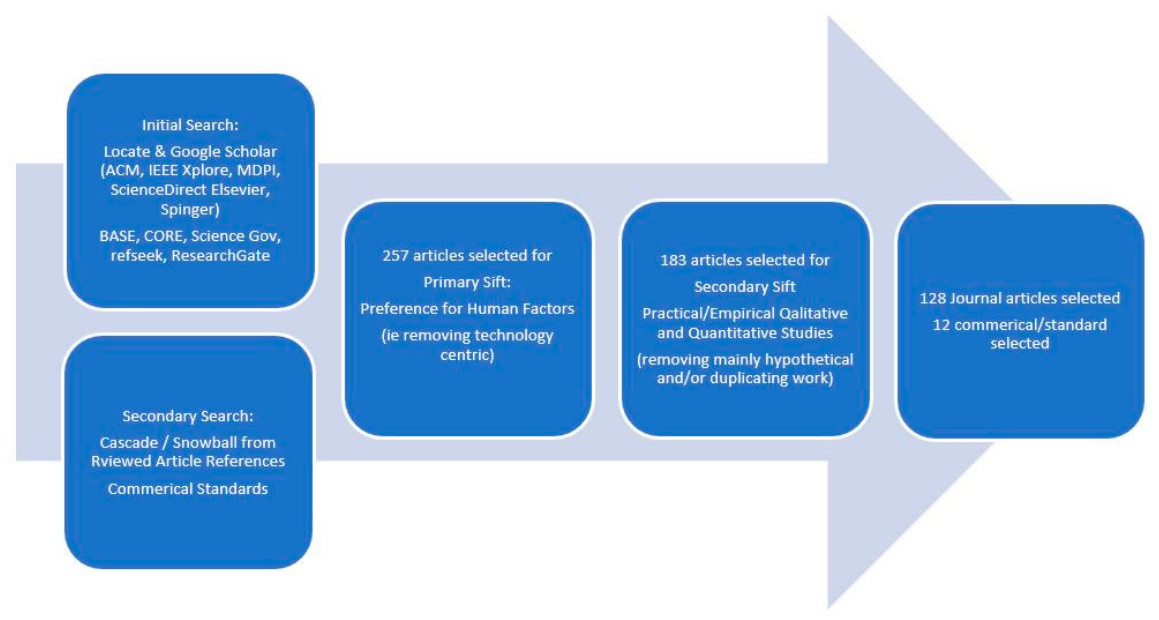
2.2. Search Process
2.2.1. Stage One—Initial Searches
- Database search: a search of well-known research databases using meta-search engines such as “Locate”, the Coventry University Library search tool, and Google Scholar to search across core publishers (e.g., ACM, EBSCO, Gale, IEEE Xplore, MDPI, ProQuest, ScienceDirect Elsevier, Spinger, etc.) and publicly accessible research databases (e.g., BASE, CORE, Science Gov, refseek, ResearchGate) using keywords in Table 2 below, either initially identified by the authors or latterly observed as common or prevalent within the papers being viewed;
- Cross-reference search: a secondary cascade or “snowball” method of reviewing references and citations found in the peer review articles discovered in the database searches (above).
Initial Search Database Search
Initial Search Inclusion Criteria
- What tasks conducted as an SO could and would be undertaken remotely; what are plausible, what are viable, and conversely what should be avoided due to safety and performance concerns?
- What unexpected, or previously unnoticed tasks emerged as the SO was removed from the vehicle that needed to be addressed?
- Just how many AVs could an RO supervise and manage at a time? Are there factors that effect this ratio and, if so, how could the human automation teaming structure and interface design address these effects?
- The title, abstract or summary indicated the paper discussed human factors associated with the driver or safety officer (SO) of an AV for a task/activity that an RO might reasonably anticipate as being carried over to future remote operations. The primary activity looked for was the reactive takeover of the direct driving task (either forcefully taking control from the AV or taking over at the request of the AV), as it is envisaged that in some commercial models the RO could, at times, be expected to undertake the duties of a standby driver or safety officer. However, articles discussing human factors of other driving or SO-related tasks were also considered;
- The title, abstract or summary indicated the paper discussed human factors or human performance of remote operation of automated or autonomous ground (or road) vehicles.
Initial Search Exclusion Criteria
Initial Search Cross-Reference (Snowball) Search
2.2.2. Stage Two—Article Review and Sift
Review Inclusion Criteria
Review—Additional Exclusion Criteria
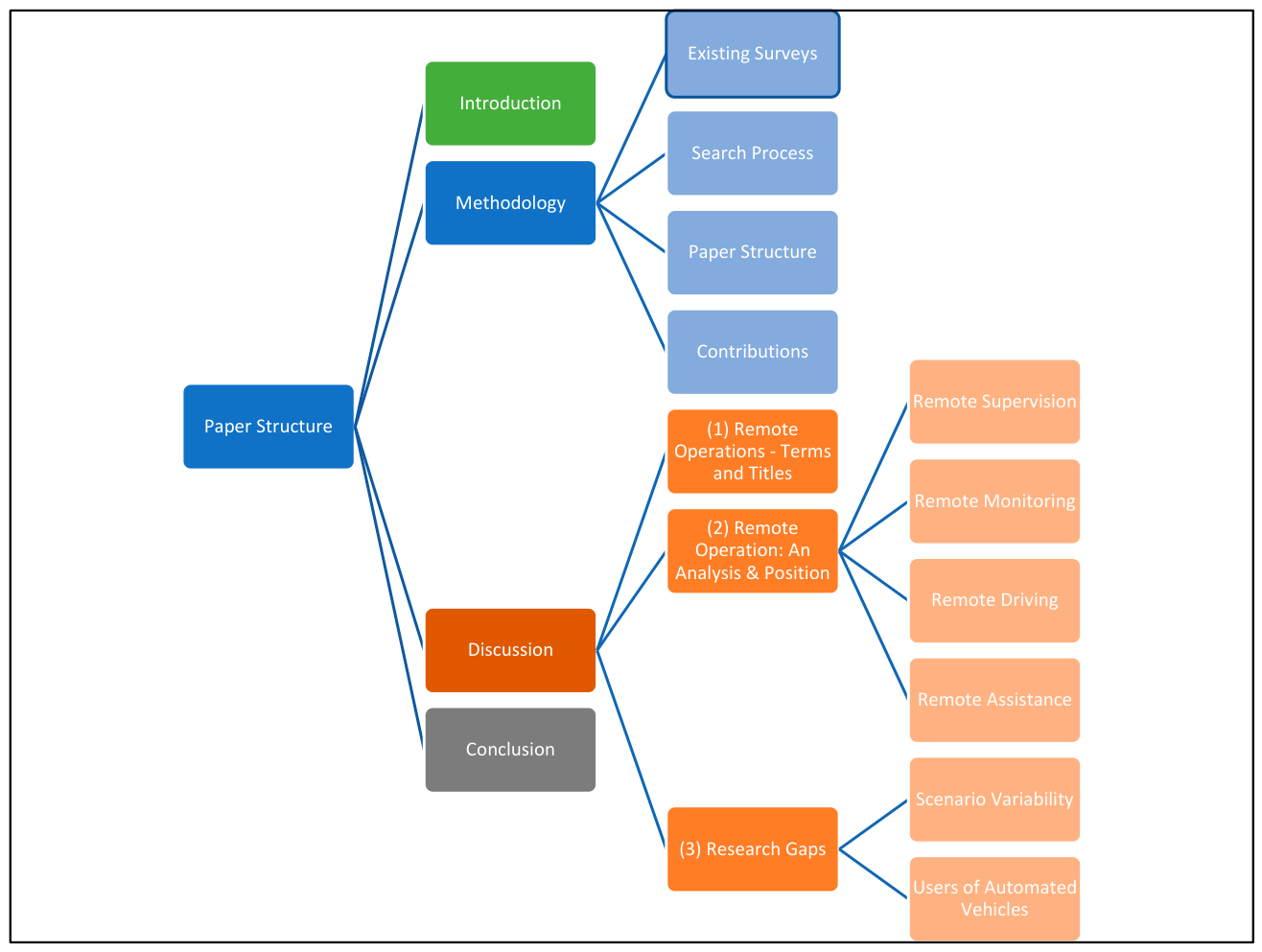
2.3. Paper Structure
2.4. Contributions
- A discussion on terms and labels for RO in common usage, with the aim of assisting readers understand and identify potential discord and mis-use of terms;
- An exploration of the recent literature on RO used to update of the findings of prior peer reviews and provide an updated “current state of science” of research into RO;
- A position, derived from the review of existing literature, on the point of separation between remote driving and remote assistance based upon command and control of the direct driving task;
- A position, derived from the review of existing literature, on the plausibility and viability of implementing the primary or standard RO positions (remote monitoring, remote driving and remote assistance);
- A proposal of the primary knowledge and research gaps that, when addressed, are likely to have the most impact on future design and implementation of remote operator roles.
3. Discussion
3.1. Part 1—Remote Operation Terms and Titles
What Is Really Meant by Remote Operation?
- Remote Monitoring (RM). The observation and oversight of one or more AVs, their behaviour and performance, progress on a journey, safety and security of passengers, and any passengers, cargo or load.
- Remote Driving (RD). Real-time and direct control of the vehicle, extending to conducting part or all of the direct driving task.
- Remote Assistance (RA). The provision of information or advice to an automated driving system-equipped vehicle or the passengers of the vehicle to facilitate trip continuation.
- A Supervisor (or someone conducting Remote Supervision) is an individual in a responsible and commanding position who could have a wide range of loosely defined tasks, monitoring vehicles (remote monitoring) and taking actions (remote assistance or remote driving) to improve AV safety and efficiency [11]. The primary value of the term is that it implies that the individual, the Supervisor, is the team lead and has oversight or command responsibility (e.g., “supervisory control” by Schitz et al. [52] (p. 174), Georg et al. [23] (p. 915)).
- Teleoperation is technically used to identify that the human is using some form of telecommunication data link (e.g., radio or Wi-Fi) to send information and directions to the AV. However, within many research papers, the term teleoperation appears to be synonymous with remote driving in a much broader context; both the type of remote operation meant and the type of vehicle supported. It continues to be used by many contemporary authors to describe using telecommunications to directly control vehicles both with and without automation. Some authors also seem to include remote assistance within the scope of teleoperation (e.g., [53]). Thus, the expectation of what is meant by teleoperation is inconsistent across the literature could lead to significant misunderstanding of context. Parr et al. [26] note that the term teleoperation is not defined consistently within the literature and instead elect to use the more standardised term remote operation.
3.2. Part 2—Remote Operation: An Analysis and Position
3.2.1. Remote Supervision: How Many Vehicles Can We Manage?
- Legacy research into optimal FO is largely inconclusive, offering findings of FO as low as two or as high as 12;
- When workload exceeds 70% of available time, performance in remote supervision significantly degrades;
- Simplistic FO calculations based upon time on task divided by time available fail to take into account the significant human factor effects of stress and teaming.
3.2.2. Remote Supervision: The Effect of Level of Automation
“The more automation is added to a system, and the more reliable and robust that automation is, the less likely that human operators overseeing the automation will be aware of critical information and able to take over manual control when needed.”
- The higher the LOA of the system, the lower the workload and more spare capacity the operator has and thus the higher the FO possible;
- The more consistent the LOA the better the human performance (and conversely, the more variable the LOA the more errors made from forgetting what LOA the system was at);
- Even with high LOA, as FO increases so does operator workload, ultimately limiting the FO.
3.2.3. Fragmenting Remote Supervision into Sub-Tasks: The Control Task Factor
- There is a general inverse relationship between the FO and the time it takes for the supervisor to interact with any given vehicle;
- While a remote operator attempts to drive, they are immediately and significantly limited in their ability to supervise and even drive other vehicles.
3.2.4. Remote Monitoring: So What Is the Baseline Number of AVs to Be Monitored?
3.2.5. Remote Monitoring: But Is It Actually Needed?
- The effective operational range for Fan-Out is four to eight, optimized at five for proactive remote monitoring of an AV;
- Remote monitoring can induce high levels of subjective workload in remote operators, leading to degraded performance (reaction time and decision making);
- Research into how the presence or absence of remote monitoring can affect human workload, performance and decision making is needed.
3.2.6. Remote Driving: Should the Task Even Be Attempted?
Technology
Human Factors
So, Should Remote Driving Be Attempted?
- Technical issues such as data latency, the potential for data loss during communication and reduced situational information increase the difficulty and reduce the reliability of remote driving;
- Human factors issues such as reaction time, take-over time and time to build situation awareness challenge the viability of RO as a take-over solution for a moving AV or an AV in a dynamic environment;
- Many commercial AV organisations are not attempting to implement remote driving solutions (although there are some organisations providing RD of non-automated vehicles as a service).
3.2.7. Remote Driving: Could Involving the AV in the Task Make It More Viable?
- Attempts have been made to provide AVs with software that gives them the capability to modify RD provided control inputs to allow the AV to “share” the driving task by modifying the path to be driven;
- Most shared driving solutions still result in “stop-and-go” style of driving as the AV attempts a path that, due to communication and processing delays, is quickly made obsolete;
- Shared driving solutions where the AV calculates and proposes multiple paths can overwhelm human decision-making. The optimum number of paths is three.
3.2.8. Remote Assistance: Should Humans Just Avoid Remote Driving?
- Researchers have attempted to create categories or levels of remote driving and remote assistance; however, not all remote operator and AV teaming solutions fit neatly into the categories proposed;
- It is proposed that the point of difference between remote driving and remote assistance is the decision making capability of the AV;
- If the AV can modify or override the human input and the AV has the complete DDT, it is remote assistance;
- If the human has control over the DDT, it is remote driving;
- A GUI designed to provide multiple “categories” or methods of RA as “plays” is more useful than limiting RA to a singular method;
- A GUI designed to provide strategic goals and directives (e.g., route plans) is more adaptable to be used to support fleets of mixed vehicle types.
3.2.9. Remote Operation: Summary Observations for Viability of RO Implementation
3.3. Part 3—Remote Operation: Research Gaps?
3.3.1. Accounting for Scenario Variability in Remote Operation
3.3.2. Scenario Variability: The Limitations of Current Workload Models
3.3.3. Scenario Variability: The Challenge for Automation Support Models
3.3.4. Scenario Variability: Scenario Classification
3.3.5. Scenario Variability: A Path Forward
- A significant limiting factor for the supervision of multiple AVs is the surge in workload the operator is subject to when conducting remote assistance or remote driving;
- The intensity of the subjected workload has been linked to the complexity of the scenario that led to human interaction and the AV ODD at the point of interaction;
- More research is needed on scoping and categorising the complex scenarios that would lead or need humans providing solution generation support.
3.3.6. What About the Users of Automated Vehicles?
- Legacy research into user perception and potential uptake of use of AVs was largely hypothetical;
- Recent user interest and concerns have been less about how the AV might perform and more about the safety and security of users when no driver is present in the vehicle;
- There is a gap for research into unexpected consequences of AV use that will impact on the scope of the support task an RO is expected to provide.
4. Conclusions
- A discussion on terms and labels for RO in common usage, with the aim of assisting readers understand and identify potential discord and misuse of terms;
- An exploration of the recent literature on RO used to update the findings of prior peer reviews and provide an updated “current state of science” of research into RO;
- A position, derived from the review of existing literature, on the point of separation between remote driving and remote assistance based upon command and control of the direct driving task;
- A position, derived from the review of existing literature, on the plausibility and viability of implementing the primary or standard RO positions (remote monitoring, remote driving and remote assistance);
- A proposal of the primary knowledge and research gaps that, when addressed, are likely to have the most impact on future design and implementation of remote operator roles.
5. Limitations
Author Contributions
Funding
Data Availability Statement
Conflicts of Interest
Abbreviations
| ADS | Autonomous Driving System |
| AV | Automated Vehicle |
| CCAV | Centre for Connected and Automated Vehicles |
| DDT | Direct Driving Task |
| FO | Fan-Out |
| GUI | Graphical User Interface |
| HAT | Human Autonomy Teaming |
| HMI | Human Machine Interface |
| LOA | Level Of Automation |
| ODD | Operational Design Domain |
| PTO | Public Transport Operator |
| RA | Remote Assistance |
| RO | Remote Operator |
| ROC | Remote Operations Centre |
| RD | Remote Driving |
| RM | Remote Monitoring |
| SA | Situation Awareness |
| SO | Safety Officer |
| UAV | Uncrewed Aerial Vehicle |
References
- Kirkham, C.; Parashuraman, P.; Rajan, G. Tesla Wins Approval to Test Autonomous Robotaxis in Arizona’. Reuters. Available online: https://www.reuters.com/business/autos-transportation/tesla-wins-approval-test-autonomous-robotaxis-arizona-2025-09-20/ (accessed on 20 September 2025).
- Solihull Metropolitan Borough Council. CAV Trials SCALE. Available online: https://www.solihull.gov.uk/about-council/cav-trials/scale (accessed on 21 October 2025).
- Feng, J.; Yu, S.; Chen, G.; Gong, W.; Li, Q.; Wang, J.; Zhan, H. Disengagement causes analysis of automated driving system. In Proceedings of the 2020 3rd World Conference on Mechanical Engineering and Intelligent Manufacturing (WCMEIM), Shanghai, China, 4–6 December 2020. [Google Scholar] [CrossRef]
- California Department of Motor Vehicles. Autonomous Vehicle Disengagement Reports. 2024. Available online: https://www.dmv.ca.gov/portal/file/2024-autonomous-vehicle-disengagement-reports-csv/ (accessed on 18 December 2025).
- Moradloo, N.; Mahdinia, I.; Khattak, A.J. Who initiates the automated vehicle disengagement—Humans or automated driving systems? J. Intell. Transp. Syst. 2025, 1–18. [Google Scholar] [CrossRef]
- Neumeier, S.; Gay, N.; Dannheim, C.; Facchi, C. On the way to autonomous vehicles teleoperated driving. In Proceedings of the AmE 2018-Automotive meets Electronics: 9th GMM-Symposium, Dortmund, Germany, 7–8 March 2018. [Google Scholar]
- Schrank, A.; Wilbrink, M.; Brandenburg, S.; Oehl, M. Improving road user perception in adverse weather: An augmented human–machine interface for remote assistants of automated vehicles. Transp. Res. Part F Traffic Psychol. Behav. 2025, 113, 500–516. [Google Scholar] [CrossRef]
- Tener, F.; Lanir, J. Guiding, not Driving: Design and Evaluation of a Command-Based User Interface for Teleoperation of Autonomous Vehicles. Int. J. Hum.–Comput. Interact. 2025, 1–24. [Google Scholar] [CrossRef]
- Cummings, M.; Li, S.; Seth, D.; Seong, M. Concepts of Operations for Autonomous Vehicle Dispatch Operations; Technical Report No. CSCRS-R9; Collaborative Sciences Center for Road Safety: Chapel Hill, NC, USA, 2020. [Google Scholar]
- BSI PAS 1884:2021; Safety Operators in Automated Vehicle Testing and Trialling. British Standards Institution: London, UK, 2021.
- Skogsmo, I.; Andersson, J.; Jernberg, C.; Aramrattana, M. One2many: Remote Operation of Multiple Vehicles; Technical Report VTI Rapport 1164; Swedish National Road and Transport Research Institute: Linköping, Sweden, 2023. [Google Scholar]
- Nihei, K.; Itsumi, H.; Shinohara, Y.; Araki, T.; Iwai, T. Multiple Cars Remote Monitoring System using AI-based Video Streaming and Alert. In Proceedings of the 2023 IEEE 97th Vehicular Technology Conference (VTC2023-Spring), Florence, Italy, 20–23 June 2023. [Google Scholar] [CrossRef]
- Cornet, H.; Pavlakis, S.; Levassor, W.; Morael, N. Remote Supervision Strategies for Automated Vehicles Fleets: Three Real-Life Operational Case Studies. In Shared Mobility Revolution: Lecture Notes In Mobility; Cornet, H., Gkemou, M., Eds.; Springer Nature: Cham, Switzerland, 2024; pp. 19–31. [Google Scholar] [CrossRef]
- Gnatzig, S.; Schuller, F.; Lienkamp, M. Human-machine interaction as key technology for driverless driving-A trajectory-based shared autonomy control approach. In Proceedings of the 2012 IEEE RO-MAN: The 21st IEEE International Symposium on Robot and Human Interactive Communication, Paris, France, 9–13 September 2012; pp. 913–918. [Google Scholar] [CrossRef]
- Guanetti, J.; Kim, Y.; Borrelli, F. Control of connected and automated vehicles: State of the art and future challenges. Annu. Rev. Control 2018, 45, 18–40. [Google Scholar] [CrossRef]
- Kamtam, S.B.; Lu, Q.; Bouali, F.; Haas, O.C.; Birrell, S. Network latency in teleoperation of connected and autonomous vehicles: A review of trends, challenges, and mitigation strategies’. Sensors 2024, 24, 3957. [Google Scholar] [CrossRef] [PubMed]
- Shen, X.; Chong, Z.J.; Pendleton, S.; James Fu, G.M.; Qin, B.; Frazzoli, E.; Ang, M.H., Jr. Teleoperation of on-road vehicles via immersive telepresence using off-the-shelf components. In Intelligent Autonomous Systems 13. Advances in Intelligent Systems and Computing; Menegatti, E., Michael, N., Berns, K., Yamaguchi, H., Eds.; Springer International Publishing: Cham, Switzerland, 2016; Volume 302, pp. 1419–1433. [Google Scholar] [CrossRef]
- Nostadt, N.; Abbink, D.A.; Christ, O.; Beckerle, P. Embodiment, presence, and their intersections: Teleoperation and beyond. ACM Trans. Hum.-Robot Interact. (THRI) 2020, 9, 1–19. [Google Scholar] [CrossRef]
- Zeng, Y.; Fu, B.; Hu, Y.; Li, M.; Xie, B. The research on an image stitching scheme for remote driving scenarios of vehicles. Proc. Inst. Mech. Eng. Part D J. Automob. Eng. 2025, 240, 2857–2872. [Google Scholar] [CrossRef]
- Koskinen, H.; Schrank, A.; Lehtonen, E.; Oehl, M. Analyzing the remote operation task to support highly automated vehicles–suggesting the core task analysis to ensure the human-centered design of the remote operation station. In HCI in Mobility, Transport, and Automotive Systems. HCII 2024. Lecture Notes in Computer Science; Krömker, H., Ed.; Springer Nature: Cham, Switzerland, 2024; pp. 145–156. [Google Scholar] [CrossRef]
- Carsten, O. Human factors challenges of remote support and control a position paper from HF-IRADS. In Proceedings of the 81st Session of the Global Forum for Road Traffic Safety, Geneva, Switzerland, 21–25 September 2020. [Google Scholar]
- Mutzenich, C.; Durant, S.; Helman, S.; Dalton, P. Updating our understanding of situation awareness in relation to remote operators of autonomous vehicles. Cogn. Res. Princ. Implic. 2021, 6, 9. [Google Scholar] [CrossRef]
- Georg, J.M.; Feiler, J.; Hoffmann, S.; Diermeyer, F. Sensor and actuator latency during teleoperation of automated vehicles. In Proceedings of the 2020 IEEE Intelligent Vehicles Symposium (IV), Las Vegas, NV, USA, 19 October–13 November 2020. [Google Scholar] [CrossRef]
- Cohen, A.; Borowsky, A.; Lanir, J. How different levels of semantic segmentation affect human perception of driving scenes. Transp. Res. Part F Traffic Psychol. Behav. 2025, 109, 19–31. [Google Scholar] [CrossRef]
- Majstorović, D.; Hoffmann, S.; Pfab, F.; Schimpe, A.; Wolf, M.M.; Diermeyer, F. Survey on teleoperation concepts for automated vehicles. In Proceedings of the 2022 IEEE International Conference on Systems, Man, and Cybernetics (SMC), Prague, Czech Republic, 9–12 October 2022. [Google Scholar] [CrossRef]
- Parr, H.; Harvey, C.; Burnett, G.; Sharples, S. Investigating levels of remote operation in high-level on-road autonomous vehicles using operator sequence diagram’s. Cogn. Technol. Work 2024, 26, 207–223. [Google Scholar] [CrossRef]
- Wolf, M.M.; Krauss, N.; Schmidt, A.; Diermeyer, F. Control Center Framework for Teleoperation Support of Automated Vehicles on Public Roads. In Proceedings of the 2025 IEEE Intelligent Vehicles Symposium (IV), Cluj-Napoca, Romania, 22–25 June 2025. [Google Scholar] [CrossRef]
- Goodall, N. Non-technological challenges for the remote operation of automated vehicles. Transp. Res. Part A Policy Pract. 2020, 142, 14–26. [Google Scholar] [CrossRef]
- Kalaiyarasan, A.; Simpson, B.; Jenkins, D.; Mazzeo, F.; Ye, H.; Obazele, I.; Kourantidis, K.; Courtier, M.; Wong, M.C.S.; Wilford, R. Remote Operation of Connected and Automated Vehicles; Technical Report No. PPR1011; TRL Limited: Wokingham, UK, 2021. [Google Scholar]
- Amador, O.; Aramrattana, M.; Vinel, A. A survey on remote operation of road vehicles. IEEE Access 2022, 10, 130135–130154. [Google Scholar] [CrossRef]
- Favarò, F.; Eurich, S.; Nader, N. Autonomous vehicles’ disengagements: Trends, triggers, and regulatory limitations. Accid. Anal. Prev. 2018, 110, 136–148. [Google Scholar] [CrossRef]
- Chen, J.Y.; Barnes, M.J.; Harper-Sciarini, M. Supervisory control of multiple robots: Human-performance issues and user-interface design. IEEE Trans. Syst. Man Cybern. Part C (Appl. Rev.) 2010, 41, 435–454. [Google Scholar] [CrossRef]
- De Winter, J.C.; Happee, R.; Martens, M.H.; Stanton, N.A. Effects of adaptive cruise control and highly automated driving on workload and situation awareness: A review of the empirical evidence. Transp. Res. Part F Traffic Psychol. Behav. 2014, 27, 196–217. [Google Scholar] [CrossRef]
- Endsley, M.R. Situation awareness in future autonomous vehicles: Beware of the unexpected. In Proceedings of the 20th Congress of the International Ergonomics Association; Bagnara, S., Tartaglia, R., Albolino, T., Fujita, Y., Eds.; Springer: Cham, Switzerland, 2018; Volume 824, pp. 303–309. [Google Scholar] [CrossRef]
- Carsten, O.; Martens, M.H. How can humans understand their automated cars? HMI principles, problems and solutions. Cogn. Technol. Work 2019, 21, 3–20. [Google Scholar] [CrossRef]
- Marcano, M.; Díaz, S.; Pérez, P.; Irigoyen, E. A Review of Shared Control for Automated Vehicles: Theory and Applications. IEEE Trans. Hum.-Mach. Syst. 2020, 50, 475–491. [Google Scholar] [CrossRef]
- Xing, X.; Huang, C.; Lv, C. Driver-Automation Collaboration for Automated Vehicles: A Review of Human-Centered Shared Control. In Proceedings of the 2020 IEEE Intelligent Vehicles Symposium (IV), Las Vegas, NV, USA, 19 October–13 November 2020. [Google Scholar] [CrossRef]
- Musicant, O.; Botzer, A.; Richmond-Hacham, B. Safety, Efficiency, and Mental Workload in Simulated Teledriving of a Vehicle as Functions of Camera Viewpoint. Sensors 2024, 24, 6134. [Google Scholar] [CrossRef] [PubMed]
- Zhao, L.; Nybacka, M.; Aramrattana, M.; Rothhämel, M.; Habibovic, A.; Drugge, L.; Jiang, F. Remote driving of road vehicles: A survey of driving feedback, latency, support control, and real applications. IEEE Trans. Intell. Veh. 2024, 9, 6086–6107. [Google Scholar] [CrossRef]
- Page, M.J.; McKenzie, J.E.; Bossuyt, P.M.; Boutron, I.; Hoffmann, T.C.; Mulrow, C.D.; Shamseer, L.; Tetzlaff, J.M.; Akl, E.A.; Brennan, S.E.; et al. The PRISMA 2020 statement: An updated guideline for reporting systematic reviews. BMJ 2021, 372, n71. [Google Scholar] [CrossRef]
- SAE J3016 2021-04; Taxonomy and Definitions for Terms Related to Driving Automation Systems for On-Road Motor Vehicles. Society of Automotive Engineers (SAE): Warrendale, PA, USA, 2021.
- BSI Flex 1890 v6.0:2025-03; Connected and Automated Mobility (CAM)—Vocabulary. British Standards Institution: London, UK, 2025.
- Bendrick, A.; Tappe, D.; Sperling, N.; Ernst, R.; Nota, A.; Saidi, S.; Diermeyer, F. Teleoperation as a Step Towards Fully Autonomous Systems. In Proceedings of the 2025 Design, Automation & Test in Europe Conference (DATE), Lyon, France, 31 March–2 April 2025. [Google Scholar] [CrossRef]
- Schippers, E.; Schrank, A.; Kotian, V.; Messiou, C.; Oehl, M.; Papaioannou, G. A motion for no motion: The redundancy of motion feedback in low-velocity remote driving of a real vehicle. IEEE Access 2025, 13, 181899–181914. [Google Scholar] [CrossRef]
- Parasuraman, R.; Cosenzo, K.A.; De Visser, E. Adaptive automation for human supervision of multiple uninhabited vehicles: Effects on change detection, situation awareness, and mental workload. Mil. Psychol. 2009, 21, 270–297. [Google Scholar] [CrossRef]
- Rossi, A.; Staffa, M.; Rossi, S. Supervisory control of multiple robots through group communication. IEEE Trans. Cogn. Dev. Syst. 2016, 9, 56–67. [Google Scholar] [CrossRef]
- Vreeswijk, J.; Habibovic, A.; Madland, O.; Hooft, F. Remote support for automated vehicle operations. In Road Vehicle Automation 9. ARTSymposium 2021. Lecture Notes in Mobility; Meyer, G., Beiker, S., Eds.; Springer International Publishing: Cham, Switzerland, 2023. [Google Scholar] [CrossRef]
- Automated Vehicle Safety Consortium. AVSC Best Practice for ADS Remote Assistance Use Case; Technical Report AVSC-I-04-2023; Automated Vehicle Safety Consortium: Warrendale, PA, USA, 2023. [Google Scholar]
- BSI PAS 1881:2022; Assuring the Operational Safety of Automated Vehicles—Specification. British Standards Institution: London, UK, 2022.
- BSI Flex 1891 v1.0:2025-01; Behaviour Taxonomy for Automated Driving System (ADS) Applications—Specification. British Standards Institution: London, UK, 2025.
- Prakash, J.; Vignati, M.; Sabbioni, E.; Cheli, F. Vehicle teleoperation: Human in the loop performance comparison of smith predictor with novel successive reference-pose tracking approach. Sensors 2022, 22, 9119. [Google Scholar] [CrossRef]
- Schitz, D.; Graf, G.; Rieth, D.; Aschemann, H. Interactive corridor-based path planning for teleoperated driving. In Proceedings of the 2021 7th International Conference on Mechatronics and Robotics Engineering (ICMRE), Budapest, Hungary, 3–5 February 2021. [Google Scholar] [CrossRef]
- Tener, F.; Lanir, J. Devising a high-level command language for the teleoperation of autonomous vehicles. Int. J. Hum.–Comput. Interact. 2025, 41, 5299–5315. [Google Scholar] [CrossRef]
- BSI Flex 1887 v2.0:2025-01; Human Factors for Remote Operation of Vehicles. Guide. British Standards Institution: London, UK, 2025.
- Ruff, H.A.; Narayanan, S.; Draper, M.H. Human interaction with levels of automation and decision-aid fidelity in the supervisory control of multiple simulated unmanned air vehicles. Presence 2002, 11, 335–351. [Google Scholar] [CrossRef]
- Lewis, M.; Wang, H.; Chien, S.Y.; Velagapudi, P.; Scerri, P.; Sycara, K. Choosing autonomy modes for multirobot search. Hum. Factors 2010, 52, 225–233. [Google Scholar] [CrossRef]
- Porat, T.; Oron-Gilad, T.; Rottem-Hovev, M.; Silbiger, J. Supervising and controlling unmanned systems: A multi-phase study with subject matter experts. Front. Psychol. 2016, 7, 568. [Google Scholar] [CrossRef]
- Calhoun, G.L.; Ruff, H.A.; Behymer, K.J.; Frost, E.M. Human-autonomy teaming interface design considerations for multi-unmanned vehicle control. Theor. Issues Ergon. Sci. 2018, 19, 321–352. [Google Scholar] [CrossRef]
- Shoffner, L.D.; Feng, J. Simultaneous remote monitoring of multiple automated vehicles. In Proceedings of the Human Factors and Ergonomics Society Annual Meeting, Los Angeles, CA, USA, 9–13 September 2024. [Google Scholar] [CrossRef]
- Olsen, D.R., Jr.; Wood, S.B. Fan-out: Measuring human control of multiple robots. In Proceedings of the SIGCHI Conference on Human Factors in Computing Systems, Vienna, Austria, 24–29 April 2004. [Google Scholar] [CrossRef]
- Ruff, H.A.; Calhoun, G.L.; Draper, M.H.; Fontejon, J.V.; Guilfoos, B.J. Exploring automation issues in supervisory control of multiple UAVs. In Human Performance, Situation Awareness and Automation (HPSAA II); Vincenzi, D.A., Mouloua, M., Hancock, P.A., Eds.; Lawrence Erlbaum Associcates, Inc.: Mahwah, NJ, USA, 2004; pp. 218–222. [Google Scholar]
- Wasson, R.; Liu, D.; Macchiarella, D. The effect of level of automation and number of UAVs on operator performance in UAV systems. In Proceedings of the IIE Annual Conference and Expo 2007—Industrial Engineering’s Critical Role in a Flat World, Nashville, TN, USA, 19–23 May 2007. [Google Scholar]
- Cummings, M.L.; Guerlain, S. Developing operator capacity estimates for supervisory control of autonomous vehicles. Hum. Factors 2007, 49, 1–15. [Google Scholar] [CrossRef] [PubMed]
- Miller, G.A. The magical number seven, plus or minus two: Some limits on our capacity for processing information. Psychol. Rev. 1956, 63, 81–97. [Google Scholar] [CrossRef]
- Donmez, B.; Nehme, C.; Cummings, M.L. Modeling workload impact in multiple unmanned vehicle supervisory control. IEEE Trans. Syst. Man Cybern.-Part A Syst. Hum. 2010, 40, 1180–1190. [Google Scholar] [CrossRef]
- Chen, J.Y.; Barnes, M.J. Supervisory control of multiple robots: Effects of imperfect automation and individual differences. Hum. Factors 2012, 54, 157–174. [Google Scholar] [CrossRef] [PubMed]
- Yerkes, R.M.; Dodson, J.D. The relation of strength of stimulus to rapidity of habit-formation. J. Comp. Neurol. Psychol. 1908, 18, 459–482. [Google Scholar] [CrossRef]
- Cummings, M.L.; Mitchell, P.J. Predicting controller capacity in supervisory control of multiple UAVs. IEEE Trans. Syst. Man Cybern.-Part A Syst. Hum. 2008, 38, 451–460. [Google Scholar] [CrossRef]
- Endsley, M.R. From Here to Autonomy: Lessons Learned From Human-Automation Research. Hum. Factors 2017, 59, 5–25. [Google Scholar] [CrossRef] [PubMed]
- Bainbridge, L. Ironies of automation. In Proceedings of the IFAC/IFIP/IFORS/IEA Conference on Analysis, Design and Evaluation of Man–Machine Systems, Baden-Baden, Germany, 27–29 September 1982. [Google Scholar] [CrossRef]
- Parasuraman, R.; Galster, S.; Squire, P.; Furukawa, H.; Miller, C. A flexible delegation-type interface enhances system performance in human supervision of multiple robots: Empirical studies with RoboFlag. IEEE Trans. Syst. Man Cybern.-Part A Syst. Hum. 2005, 35, 481–493. [Google Scholar] [CrossRef]
- Crandall, J.W.; Cummings, M.L. Identifying predictive metrics for supervisory control of multiple robots. IEEE Trans. Robot. 2007, 23, 942–951. [Google Scholar] [CrossRef][Green Version]
- Calhoun, G.L.; Ruff, H.A.; Draper, M.H.; Wright, E.J. Automation-level transference effects in simulated multiple unmanned aerial vehicle control. J. Cogn. Eng. Decis. Mak. 2011, 5, 55–82. [Google Scholar] [CrossRef]
- Kidwell, B.; Calhoun, G.L.; Ruff, H.A.; Parasuraman, R. Adaptable and adaptive automation for supervisory control of multiple autonomous vehicles. In Proceedings of the Human Factors and Ergonomics Society Annual Meeting, Boston, MA, USA, 22–26 October 2012. [Google Scholar] [CrossRef]
- Colley, M.; Westhauser, J.; Andersson, J.; Mirnig, A.G.; Rukzio, E. Introducing ROADS: A Systematic Comparison of Remote Control Interaction Concepts for Automated Vehicles at Road Works. In Proceedings of the 2025 CHI Conference on Human Factors in Computing Systems, Yokohama, Japan, 26 April–1 May 2025. [Google Scholar] [CrossRef]
- Bogg, A.; Birrell, S. Overloaded, underloaded or in control: How many automated vehicles can one person supervise? Comput. Hum. Behav. 2025, 170, 108690. [Google Scholar] [CrossRef]
- Kalamkar, S.; Biener, V.; Beck, F.; Grubert, J. Remote monitoring and teleoperation of autonomous vehicles—Is virtual reality an option? In Proceedings of the 2023 IEEE International Symposium on Mixed and Augmented Reality (ISMAR), Sydney, Australia, 16–20 October 2023. [Google Scholar] [CrossRef]
- Andersson, J.; Rizgary, D.; Söderman, M.; Vännström, J. Exploring remote operation of heavy vehicles—Findings from a simulator study. Hum.-Intell. Syst. Integr. 2024, 6, 15–24. [Google Scholar] [CrossRef]
- Baddeley, A. Working Memory. Curr. Biol. 2010, 20, R136–R140. [Google Scholar] [CrossRef] [PubMed]
- Merat, N.; Seppelt, B.; Louw, T.; Engström, J.; Lee, J.D.; Johansson, E.; Green, C.A.; Katazaki, S.; Monk, C.; Itoh, M.; et al. The “Out-of-the-Loop” concept in automated driving: Proposed definition, measures and implications. Cogn. Technol. Work 2019, 21, 87–98. [Google Scholar] [CrossRef]
- Endsley, M.R. Toward a Theory of Situation Awareness in Dynamic Systems. Hum. Factors J. Hum. Factors Ergon. Soc. 1995, 37, 32–64. [Google Scholar] [CrossRef]
- NMD/SAF/2611; Guidelines on Fatigue Management in ATC Rostering Systems. Eurocontrol HQ: Brussels, Belgium, 2023.
- Kettwich, C.; Schrank, A.; Oehl, M. Teleoperation of highly automated vehicles in public transport: User-centered design of a human-machine interface for remote-operation and its expert usability evaluation. Multimodal Technol. Interact. 2021, 5, 26. [Google Scholar] [CrossRef]
- Whiteside, J. 2GetThere: The Future of Mobility. EME Outlook Magazine. Available online: https://www.emeoutlookmag.com/automotive/400-2getthere (accessed on 3 March 2026).
- Automated Vehicle Act (2024, c10); The Stationer Office: London, UK, 2024.
- Chucholowski, F.; Büchner, S.; Reicheneder, J.; Lienkamp, M. Prediction Methods for Teleoperated Road Vehicles. Available online: https://mediatum.ub.tum.de/doc/1171394/1171394.pdf (accessed on 3 March 2026).
- Neumeier, S.; Wintersberger, P.; Frison, A.K.; Becher, A.; Facchi, C.; Riener, A. Teleoperation: The holy grail to solve problems of automated driving? Sure, but latency matters. In Proceedings of the 11th International Conference on Automotive User Interfaces and Interactive Vehicular Applications, Utrecht, The Netherlands, 22–25 September 2019. [Google Scholar] [CrossRef]
- Lu, S.; Zhang, M.Y.; Ersal, T.; Yang, X.J. Workload management in teleoperation of unmanned ground vehicles: Effects of a delay compensation aid on human operators’ workload and teleoperation performance. Int. J. Hum.–Comput. Interact. 2019, 35, 1820–1830. [Google Scholar] [CrossRef]
- Davis, J.; Smyth, C.; McDowell, K. The effects of time lag on driving performance and a possible mitigation. IEEE Trans. Robot. 2010, 26, 590–593. [Google Scholar] [CrossRef]
- Noomwongs, N.; Siriwattana, K.T.; Chantranuwathana, S.; Phanomchoeng, G. The Development of Teleoperated Driving to Cooperate with the Autonomous Driving Experience. Automation 2025, 6, 26. [Google Scholar] [CrossRef]
- Hoffmann, S.; Majstorović, D.; Diermeyer, F. Safe corridor: A trajectory-based safety concept for teleoperated road vehicles. In Proceedings of the 2022 International Conference on Connected Vehicle and Expo (ICCVE), Lakeland, FL, USA, 7–9 March 2022. [Google Scholar] [CrossRef]
- Schrank, A.; Wendorff, N.; Oehl, M. Assisting the remote assistant: Augmenting degraded video streams with additional sensor data to improve situation awareness in complex urban traffic. In HCI International 2024 Posters. HCII 2024. Communications in Computer and Information Science; Stephanidis, C., Antona, M., Ntoa, S., Salvendy, G., Eds.; Springer Nature: Cham, Switzerland, 2024; Volume 2118. [Google Scholar] [CrossRef]
- Prakash, J.; Vignati, M.; Vignarca, D.; Sabbioni, E.; Cheli, F. Predictive display with perspective projection of surroundings in vehicle teleoperation to account time-delays. IEEE Trans. Intell. Transp. Syst. 2023, 24, 9084–9097. [Google Scholar] [CrossRef]
- Prakash, J.; Vignati, M.; Sabbioni, E. Performance of successive reference pose tracking vs smith predictor approach for direct vehicle teleoperation under variable network delay’s. IEEE Trans. Veh. Technol. 2023, 73, 4636–4645. [Google Scholar] [CrossRef]
- Hosseini, A.; Wiedemann, T.; Lienkamp, M. Interactive path planning for teleoperated road vehicles in urban environments. In Proceedings of the 17th International IEEE Conference on Intelligent Transportation Systems (ITSC), Qingdao, China, 8–11 October 2014. [Google Scholar] [CrossRef]
- Tener, F.; Lanir, J. Driving from a distance: Challenges and guidelines for autonomous vehicle teleoperation interfaces. In Proceedings of the 2022 CHI Conference on Human Factors in Computing Systems, New York, NY, USA, 30 April–5 May 2022. [Google Scholar] [CrossRef]
- Li, S.; Zhang, Y.; Edwards, S.; Blythe, P.T. Exploration into the needs and requirements of the remote driver when teleoperating the 5G-enabled level 4 automated vehicle in the real world—A case study of 5G connected and automated logistics. Sensors 2023, 23, 820. [Google Scholar] [CrossRef]
- Papaioannou, G.; Zhao, L.; Nybacka, M.; Jerrelind, J.; Happee, R.; Drugge, L. Occupants’ Motion Comfort and Driver’s Feel: An Explorative Study About Their Relation in Remote Driving. IEEE Trans. Intell. Transp. Syst. 2024, 25, 11077–11091. [Google Scholar] [CrossRef]
- Larsson, P.; De Souza, J.B.R.; Begnert, J. An auditory display for remote road vehicle operation that increases awareness and presence. In Proceedings of the 28th International Conference on Auditory Display, Norrköping, Sweden, 26 June–1 July 2023. [Google Scholar]
- Hosseini, A.; Richthammer, F.; Lienkamp, M. Predictive haptic feedback for safe lateral control of teleoperated road vehicles in urban areas. In Proceedings of the 2016 IEEE 83rd Vehicular Technology Conference (VTC Spring), Nanjing, China, 15–18 May 2016. [Google Scholar] [CrossRef]
- Hacinecipoglu, A.; Konukseven, E.I.; Koku, A.B. Evaluation of haptic feedback cues on vehicle teleoperation performance in an obstacle avoidance scenario. In Proceedings of the 2013 World Haptics Conference (WHC), Daejeon, Republic of Korea, 14–17 April 2013. [Google Scholar] [CrossRef]
- Zhao, L.; Nybacka, M.; Rothhämel, M.; Habibovic, A.; Papaioannou, G.; Drugge, L. Driving experience and behavior change in remote driving: An explorative experimental study. IEEE Trans. Intell. Veh. 2023, 9, 3754–3767. [Google Scholar] [CrossRef]
- Brecht, D.; Gehrke, N.; Kerbl, T.; Krauss, N.; Majstorović, D.; Pfab, F.; Wolf, M.M.; Diermeyer, F. Evaluation of teleoperation concepts to solve automated vehicle disengagements. IEEE Open J. Intell. Transp. Syst. 2024, 5, 629–641. [Google Scholar] [CrossRef]
- Gold, C.; Damböck, D.; Lorenz, L.; Bengler, K. “Take over!” How long does it take to get the driver back into the loop? In Proceedings of the Human Factors and Ergonomics Society Annual Meeting, San Diego, CA, USA, 30 September–4 October 2013. [Google Scholar] [CrossRef]
- Eriksson, A.; Stanton, N.A. Takeover time in highly automated vehicles: Noncritical transitions to and from manual control. Hum. Factors 2017, 59, 689–705. [Google Scholar] [CrossRef]
- Shin, D.; Kim, B.; Yi, K.; Carvalho, A.; Borrelli, F. Human-centered risk assessment of an automated vehicle using vehicular wireless communication. IEEE Trans. Intell. Transp. Syst. 2018, 20, 667–681. [Google Scholar] [CrossRef]
- Liang, N.; Yang, J.; Yu, D.; Prakah-Asante, K.O.; Curry, R.; Blommer, M.; Swaminathan, R.; Pitts, B.J. Using eye-tracking to investigate the effects of pre-takeover visual engagement on situation awareness during automated driving. Accid. Anal. Prev. 2021, 157, 106143. [Google Scholar] [CrossRef]
- Lu, Z.; Coster, X.; De Winter, J. How much time do drivers need to obtain situation awareness? A laboratory-based study of automated driving. Appl. Ergon. 2017, 60, 293–304. [Google Scholar] [CrossRef] [PubMed]
- Samuel, S.; Borowsky, A.; Zilberstein, S.; Fisher, D.L. Minimum time to situation awareness in scenarios involving transfer of control from an automated driving suite. Transp. Res. Rec. 2016, 2602, 115–120. [Google Scholar] [CrossRef]
- Jones, D.G. A Practical Perspective on the Utility of Situation Awareness. J. Cogn. Eng. Decis. Mak. 2014, 9, 98–100. [Google Scholar] [CrossRef]
- Melnicuk, V.; Thompson, S.; Jennings, P.; Birrell, S. Effect of cognitive load on drivers’ state and task performance during automated driving: Introducing a novel method for determining stabilisation time following take-over of control. Accid. Anal. Prev. 2021, 151, 105967. [Google Scholar] [CrossRef]
- Mutzenich, C.; Durant, S.; Helman, S.; Dalton, P. Situation awareness in remote operators of autonomous vehicles: Developing a taxonomy of situation awareness in video-relays of driving scenes. Front. Psychol. 2021, 12, 727500. [Google Scholar] [CrossRef]
- Scholtz, J.; Antonishek, B.; Young, J. Operator interventions in autonomous off-road driving: Effects of terrain. In Proceedings of the 2004 IEEE International Conference on Systems, Man and Cybernetics (IEEE Cat. No. 04CH37583), The Hague, The Netherlands, 10–13 October 2004. [Google Scholar] [CrossRef]
- Sheridan, T.B. Musings on telepresence and virtual presence. Presence Teleoper. Virtual Environ. 1992, 1, 120–125. [Google Scholar]
- Gnatzig, S.; Chucholowski, F.; Tang, T.; Lienkamp, M. A system design for teleoperated road vehicles. In Proceedings of the International Conference on Informatics in Control, Automation and Robotics, Reykjavik, Iceland, 29–31 July 2013; Volume 2, pp. 231–238. [Google Scholar] [CrossRef]
- Hosseini, A.; Lienkamp, M. Enhancing telepresence during the teleoperation of road vehicles using HMD-based mixed reality. In Proceedings of the 2016 IEEE Intelligent Vehicles Symposium (IV), Gothernburg, Sweden, 19–22 June 2016; pp. 1366–1373. [Google Scholar] [CrossRef]
- Georg, J.M.; Feiler, J.; Diermeyer, F.; Lienkamp, M. Teleoperated driving, a key technology for automated driving? Comparison of actual test drives with a head mounted display and conventional monitors. In Proceedings of the 2018 21st International Conference on Intelligent Transportation Systems (ITSC), Maui, HI, USA, 4–7 November 2018; pp. 3403–3408. [Google Scholar] [CrossRef]
- Mutzenich, C.; Helman, S.; Durant, S.; Gulhan, D.; Dalton, P. Effect of format of presentation on remote assistance of automated vehicles. In Proceedings of the 2024 IEEE Intelligent Vehicles Symposium (IV), Jeju Island, Republic of Korea, 2–5 June 2024; pp. 57–62. [Google Scholar] [CrossRef]
- Kallioniemi, P.; Burova, A.; Mäkelä, J.; Keskinen, T.; Ronkainen, K.; Mäkelä, V.; Hakulinen, J.; Turunen, M. Multimodal warnings in remote operation: The case study on remote driving. Multimodal Technol. Interact. 2021, 5, 44. [Google Scholar] [CrossRef]
- Feiler, J.; Diermeyer, F. The Perception Modification Concept to Free the Path of An Automated Vehicle Remotely. In Proceedings of the 7th International Conference on Vehicle Technology and Intelligent Transport Systems (VEHITS 2021), Online, 28–30 April 2021. [Google Scholar]
- Vay Technology GmbH. Available online: https://vay.io/ (accessed on 27 April 2026).
- Elmo. Available online: https://www.elmoremote.com/ (accessed on 27 April 2026).
- Li, S.; Zhang, Y.; Edwards, S.; Blythe, P. Quantifying the Remote Driver’s Interaction with 5G-Enabled Level 4 Automated Vehicles: A Real-World Study. Electronics 2024, 13, 4366. [Google Scholar] [CrossRef]
- Kim, J.S.; Ryu, J.H. Shared teleoperation of a vehicle with a virtual driving interface. In Proceedings of the 2013 13th International Conference on Control, Automation and Systems (ICCAS 2013), Gwangju, Republic of Korea, 20–23 October 2013. [Google Scholar] [CrossRef]
- Hosseini, A.; Lienkamp, M. Predictive safety based on track-before-detect for teleoperated driving through communication time delay. In Proceedings of the 2016 IEEE Intelligent Vehicles Symposium (IV), Gothenburg, Sweden, 19–22 June 2016. [Google Scholar] [CrossRef]
- Kettwich, C.; Schrank, A.; Avsar, H.; Oehl, M. A helping human hand: Relevant scenarios for the remote operation of highly automated vehicles in public transport. Appl. Sci. 2022, 12, 4350. [Google Scholar] [CrossRef]
- O’Neill, T.; McNeese, N.; Barron, A.; Schelble, B. Human–Autonomy Teaming: A Review and Analysis of the Empirical Literature. Hum. Factors 2020, 64, 904–938. [Google Scholar] [CrossRef]
- Fennel, M.; Zea, A.; Hanebeck, U.D. Haptic-guided path generation for remote car-like vehicles. IEEE Robot. Autom. Lett. 2021, 6, 4087–4094. [Google Scholar] [CrossRef]
- Schitz, D.; Bao, S.; Rieth, D.; Aschemann, H. Shared autonomy for teleoperated driving: A real-time interactive path planning approach. In Proceedings of the 2021 IEEE International Conference on Robotics and Automation (ICRA), Xi’an, China, 30 May–5 June 2021. [Google Scholar] [CrossRef]
- Majstorović, D.; Hoffmann, S.; Diermeyer, F. Trajectory guidance: Enhanced remote driving of highly-automated vehicles. In Proceedings of the 2024 IEEE Intelligent Vehicles Symposium (IV), Jeju Island, Republic of Korea, 2–5 June 2024. [Google Scholar] [CrossRef]
- Wolf, M.M.; Taupitz, R.; Diermeyer, F. Should teleoperation be like driving in a car? comparison of teleoperation HMIS. In Proceedings of the 2024 IEEE Intelligent Vehicles Symposium (IV), Jeju Island, Republic of Korea, 2–5 June 2024. [Google Scholar] [CrossRef]
- Zhu, S.; Xiong, G.; Chen, H.; Gong, J. Guidance point generation-based cooperative UGV teleoperation in unstructured environment. Sensors 2021, 21, 2323. [Google Scholar] [CrossRef]
- Majstorović, D.; Diermeyer, F. Dynamic collaborative path planning for remote assistance of highly-automated vehicles. In Proceedings of the 2023 IEEE International Automated Vehicle Validation Conference (IAVVC), Austin, TX, USA, 16–18 October 2023. [Google Scholar] [CrossRef]
- Murphy, R.; Shields, J.; Schmorrow, D.; Appleby, B.; Howe, A.; Israel, K.; Livanos, A.; McCarthy, J.; Mooney, R.; Nathman, J.; et al. The Role of Autonomy in DoD Systems; Office of the Secretary of Defence: Washington, DC, USA, 2012. [Google Scholar]
- Medojevic, M.; Bogg, A.; Birrell, S.; Babbra, R.; Vincent, K. Human-Centred Classification of Remote Operation Intervention Scenarios for Automated Vehicles. In Proceedings of the Applied Human Factors and Ergonomics International: Intelligent Human Systems Integration (IHSI 2026): Disruptive and Innovative Technologies, Firenze, Italy, 11–13 February 2026; Volume 200, pp. 628–638. [Google Scholar] [CrossRef]
- Georg, J.M.; Diermeyer, F. An adaptable and immersive real time interface for resolving system limitations of automated vehicles with teleoperation. In Proceedings of the 2019 IEEE International Conference on Systems, Man and Cybernetics (SMC), Bari, Italy, 6–9 October 2019. [Google Scholar] [CrossRef]
- Bogg, A.; Birrell, S.; Bromfield, M.A.; Parkes, A.M. Can we talk? How a talking agent can improve human autonomy team performance. Theor. Issues Ergon. Sci. 2020, 22, 488–509. [Google Scholar] [CrossRef]
- Wickens, C.D. Multiple Resources and Mental Workload. Hum. Factors 2008, 50, 449–455. [Google Scholar] [CrossRef] [PubMed]
- CAP 719; Fundamental Human Factors Concepts Civil Aviation Authority. Documedia Solutions Ltd.: Cheltenham, UK, 2002.
- CAP 1430; UK Air Traffic Management Vocabulary. Civil Aviation Authority: London, UK, 2017.
- CAP 413; Radiotelephony Manual. Civil Aviation Authority: London, UK, 2016.
- Le Large, N.; Brecht, D.; Poh, W.; Pauls, J.H.; Lauer, M.; Diermeyer, F. Human-Aided Trajectory Planning for Automated Vehicles Through Teleoperation and Arbitration Graphs. In Proceedings of the 2025 IEEE Intelligent Vehicles Symposium (IV), Cluj-Napoca, Romania, 22–25 June 2025. [Google Scholar] [CrossRef]
- Schrank, A.; Walocha, F.; Brandenburg, S.; Oehl, M. Human-centered design and evaluation of a workplace for the remote assistance of highly automated vehicles. Cogn. Technol. Work 2024, 26, 183–206. [Google Scholar] [CrossRef]
- Department for Transport. User Requirements to Enable Passengers of Automated Passenger Services (APS) to Perform Journey Tasks During Emergencies; Department for Transport: London, UK, 2025. [Google Scholar]
- Morrison, D.; Cui, L.; Feng, J. An online method to study remote operation of automated vehicles. In Proceedings of the Human Factors and Ergonomics Society Annual Meeting, Atlanta, GA, USA, 10–14 October 2022. [Google Scholar] [CrossRef]
- Kamaraj, A.V.; Domeyer, J.E.; Lee, J.D. Hazard analysis of action loops for automated vehicle remote operation. In Proceedings of the Human Factors and Ergonomics Society Annual Meeting, Baltimore, MD, USA, 4–7 October 2021. [Google Scholar] [CrossRef]
- Clark, J.R.; Large, D.R.; Shaw, E.; Nichele, E.; Trigo, M.J.G.; Fischer, J.E.; Burnett, G.; Stanton, N.A. Identifying interaction types and functionality for automated vehicle virtual assistants: An exploratory study using speech acts cluster analysis. Appl. Ergon. 2024, 114, 104152. [Google Scholar] [CrossRef]
- Hardman, S.; Berliner, R.; Tal, G. Who will be the early adopters of automated vehicles? Insights from a survey of electric vehicle owners in the United States. Transp. Res. Part D Transp. Environ. 2019, 71, 248–264. [Google Scholar] [CrossRef]
- Penmetsa, P.; Adanu, E.K.; Wood, D.; Wang, T.; Jones, S.L. Perceptions and expectations of autonomous vehicles–A snapshot of vulnerable road user opinion. Technol. Forecast. Soc. Change 2019, 143, 9–13. [Google Scholar] [CrossRef]
- Mason, J.; Classen, S.; Wersal, J.; Sisiopiku, V.P. Establishing face and content validity of a survey to assess users’ perceptions of automated vehicles. Transp. Res. Rec. 2020, 2674, 538–547. [Google Scholar] [CrossRef]
- Lee, C.; Seppelt, B.; Abraham, H.; Reimer, B.; Mehler, B.; Coughlin, J.F. Consumer comfort with vehicle automation: Changes over time. In Proceedings of the 10th International Driving Symposium on Human Factors in Driver Assessment, Training, and Vehicle Design, Santa Fe, NM, USA, 24–27 June 2019. [Google Scholar] [CrossRef]
- Oliveira, L.; Proctor, K.; Burns, C.G.; Birrell, S. Driving Style: How Should an Automated Vehicle Behave? Information 2019, 10, 219. [Google Scholar] [CrossRef]
- Liu, P.; Yang, R.; Xu, Z. How safe is safe enough for self-driving vehicles? Risk Anal. 2019, 39, 315–325. [Google Scholar] [CrossRef]
- Schaefer, K.E.; Straub, E.R. Will passengers trust driverless vehicles? Removing the steering wheel and pedals. In Proceedings of the 2016 IEEE International Multi-Disciplinary Conference on Cognitive Methods in Situation Awareness and Decision Support (CogSIMA), San Diego, CA, USA, 21–25 March 2016. [Google Scholar] [CrossRef]
- Li, S.; Zhang, Y.; Blythe, P.; Edwards, S.; Ji, Y. Remote driving as the Failsafe: Qualitative investigation of Users’ perceptions and requirements towards the 5G-enabled Level 4 automated vehicles. Transp. Res. Part F Traffic Psychol. Behav. 2024, 100, 211–230. [Google Scholar] [CrossRef]
- Brandt, T.; Wilbrink, M.; Oehl, M. Transparent internal human-machine interfaces in highly automated shuttles to support the communication of minimal risk maneuvers to the passengers. Transp. Res. Part F Traffic Psychol. Behav. 2024, 107, 275–287. [Google Scholar] [CrossRef]
- Kuck, I.; Wagner-douglas, L.; Wirtz, L.; Ladwig, S. An autonomous shuttle for everyone: What information do users need when using shuttles? In Proceedings of the Intelligent Human Systems Integration (IHSI 2025): Integrating People and Intelligent Systems; Ahram, T., Karwowski, W., Martino, C., Di Bucchianico, G., Maselli, V., Eds.; AHFE International: New York, NY, USA, 2025; Volume 160. [Google Scholar] [CrossRef]
- Hansson, S.O.; Belin, M.Å.; Lundgren, B. Self-driving vehicles—An ethical overview. Philos. Technol. 2021, 34, 1383–1408. [Google Scholar] [CrossRef]
- Brooks, R. Robotic cars won’t understand us, and we won’t cut them much slack. IEEE Spectr. 2017, 54, 34–51. [Google Scholar] [CrossRef]



| Year | Author | Title | Summary/Scope | Gap or Issue |
|---|---|---|---|---|
| 2010 | Chen, Barnes and Harper-Sciarini | Supervisory Control of Multiple Robots: Human-Performance Issues and User-Interface Design [32] | Review of FO and HMI primarily for UAV but also for UGV, observing that that FO is significantly impacted by the control task | Assumes RO is in command as supervisor and falls back and attempts all facets of RO (RM, RD and RA) |
| 2014 | de Winter, Happee, Martens, and Stanton | Effects of adaptive cruise control and highly automated driving on workload and situation awareness: A review of the empirical evidence [33] | Review of Workload and SA in partially automated vehicles | Useful for background on SA but primarily only applicable to Remote Driving and then at a low LOA (3-) |
| 2018 | Endsley | Situation Awareness in Future Autonomous Vehicles Beware the Unexpected [34] | Review of issues and concerns over degradation of SA when operating highly automated technology leading to slow reaction and poor decision making | Written from perspective of human as fall back driver and recommends against intermediary LOA |
| 2018 | Favarò, Eurich, and Nader | Autonomous vehicles disengagements: trends, triggers, and regulatory limitations [31] | Attempt to catgorise and spot trends in causes of AV voluntary or SO-initiated disengagements | Focuses on problem but not RO solutions |
| 2018 | Guanetti, Kim, and Borrelli | Control of connected and automated vehicles: state of the art and future challenges [15] | Discussion over technologies for CAV rather than human factors | Little in the way of discussion of RO |
| 2019 | Carsten and Martens | How can humans understand their automated cars? HMI principles, problems and solutions [35] | Focuses on HMI design for AV functions when the driver is inside the vehicle, which could be laterally applied when SO becomes RO | Does not consider difference in SO to RO, nor multi vehicle RM |
| 2020 | Carsten | Human Factors Challenges of Remote Support and Control A Position Paper from HF-IRADS [21] | Discussion on how the change in environment between SO & RO leads to differences in tasks and then HMI | As the discussion is more of a literature review, it is a bit short and has limited references. |
| 2020 | Cummings, Li, Seth and Seong | Concepts of Operations for Autonomous Vehicle Dispatch Operations [9] | Discussion on how future dispatchers will need to have the new task of being the RO teleoperators included in the job description | Starts from assumption that RO is to be added to existing dispatcher workloads and does not consider RO as a separate position |
| 2020 | Goodall | Non-technological challenges for the remote operation of automated vehicles [28] | Legal, technical and manning factors affecting RO in the USA | Does not provide recommendations based upon empirical data |
| 2020 | Marcano, Díaz, Pérez, and Irigoyen | A Review of Shared Control for Automated Vehicles: Theory and Applications [36] | Comprehensive review of the literature on engineering formulae and solutions for implementing a model of human and AV sharing driving controls in-vehicle | Centred on in-vehicle sharing of driving controls rather than remote operation and limited to RD (no RA or RM application) |
| 2020 | Xing, Huang, and Lv | Driver-Automation Collaboration for Automated Vehicles: A Review of Human-Centered Shared Control [37] | Comprehensive review of the literature on engineering formulae and solutions for implementing a model of human and AV sharing driving controls in-vehicle | Centred on in-vehicle sharing of driving controls rather than remote operation and limited to RD (no RA or RM application) |
| 2021 | Kaliyarasan, Simpson, Jenkins, Mazzeo, Ye, Obazele, Kourantidis, Courtier, Wong, and Wilford | Remote Operation of Connected and Automated Vehicles [29] | Project Review of how to implement a remote Safety Driver and Test Assistance | Observations and discussion very hypothetical identifying gaps and possibilities for RO |
| 2021 | Mutzenich, Durant, Helman, and Dalton | Updating our understanding of situation awareness in relation to remote operators of autonomous vehicles [22] | Discussion on cases for human intervention, types of intervention possible (RA, RMgt, RD) and SA demands for those cases | Focuses on defining but does not get to examining whether the RO sub-categories are plausible |
| 2022 | Amador, Aramrattanan, Vinel | A Survey on Remote Operation of Road Vehicles [30] | A broad but by necessity shallow review of scope, technology and challenges for RO | Too broad in scope to answer research questions and needs updating |
| 2022 | Majstorovic, Hoffmann, Pfab, Schimpe, Wolf, and Diermeyer | Survey on Teleoperation Concepts for Automated Vehicles [25] | Attempt to categorise concepts and methods for human operators to team and interact with automation that helps separate RD from RA | Primarily concerned with attempting to create categories of RO rather than determine whether any specific method is more viable |
| 2023 | Skogsmo, Andersson, Jernberg, and Aramrattana | Remote Operation of Multiple Vehicles [11] | Reviews legal perspective on viability of implementing RO tasks and sub-groups | Tends to make recommendations purely from a legal rather than practical perspective |
| 2024 | Musicant, Botzer, and Richmond-Hacham | Safety, Efficiency, and Mental Workload in Simulated Teledriving of a Vehicle as Functions of Camera Viewpoint [38] | Review of effect of driving viewpoint on situation awareness, workload and general performance of remote drivers | Primarily aimed at preparing an experimental study into whether changing the viewpoint of a remote driver could improve their performance and workload |
| 2024 | Parr, Harvey, Burnett, and Sharples | Investigating levels of remote operation in high-level on-road autonomous vehicles using operator sequence diagrams [26] | Proposes sub-categories of RO with definitions and task scope and then scenario tests them using operator sequence diagrams | Very useful at providing RO sub-task work scope proposals but could do with expanding and experimental evaluation |
| 2024 | Zhao, Nybacka, Aramrattana, Rothhämel, Habibovic, Drugge, and Jiang | Remote Driving of Road Vehicles: A Survey of Driving Feedback, Latency, Support Control, and Real Applications [39] | Review of papers related to methods and technology for providing driving feedback through controls. | Focused on technological issues and solutions for remote driving |
| 2025 | Wolf, Krauss, Schmidt, and Diermeyer | Control Centre Framework for Teleoperation Support of Automated Vehicles on Public Roads [27] | Contains a review of remote operator literature to generate and define discrete roles and tasks for ROs | Does not address value, preference, or HF of each type of RO |
| Lead | Secondary | Context | Optional |
|---|---|---|---|
| Remote | Operation(s) | Automated Vehicle | Passenger |
| Tele | Control | Connected and Automated Vehicle | Situation Awareness |
| Takeover | Communication | AV | Workload |
| Supervision | CAV | Human Factors | |
| Monitor/Monitoring | Autonomous Vehicle | Human Machine Interface | |
| Driver/Driving | Autonomous Mobility | Fan-Out | |
| Assistance/Assisting |
| Challenge Category | Identified Issues | Impact/Implications |
|---|---|---|
| Operational Scope |
|
|
| Limitations of Current Standards |
|
|
| Scope | Category | Description |
|---|---|---|
| Remote Driving | Direct Control | Remote operator uses hand and feet controls to provide direct driving task inputs (vehicle wheel and engine) without any input from the AV. |
| Shared Control | Remote operator uses hand and feet controls to provide direct driving task inputs (vehicle wheel and engine). The inputs that are interpreted, manipulated or adjusted by the AV to “live” situation and accuracy. | |
| Trajectory Control | Remote operator uses hand and feet controls to provide driving goals and/or routes. The AV then calculates vehicle wheel and engine outputs to achieve that route or conducts a minimum risk manoeuvre. | |
| Remote Assistance | Waypoint Guidance | Remote operator uses IO devices to set point locations of a route. The AV connects the point location and calculates a “best fit” route then executes the direct driving task along that route. |
| Interactive Path Planning | Remote operator and AV team to propose and then select possible routes or paths for the AV to drive. Paths are primarily generated by AV although there is scope for inclusion of operator-generated paths. Scope also extends to human being executive with selection authority, to AV being executive with selection authority. | |
| Perception Modification | Remote operator acts as observer and situation analyst. The operator actively or passively analyses the driving environment and assists the AV to identify potential driving obstructions, threats or other driving-related situations. The remote operator has no input to the driving task. |
| Role | Task | Task Scope | Recipient | Technology Issues | Human Factors Issues | Mitigation Issues | Authors’ Recommended Implementation | References | |
|---|---|---|---|---|---|---|---|---|---|
| 1 | Remote Monitoring | Look-Out For Emergency Intervention | Observing sensor/video feeds from vehicles with an intent to proactively identify safety, emergency or other time-critical reactive interventions in AV DDT. | AV and/or Passenger | Latency negatively impacts time to react [87], reducing safety margins. The reduction in safety margins and braking distance is amplified almost linearly by vehicle speed [90]. | Effort to maintain SA increases in proportion to number of AVs monitored. Optimum performance is affected by task complexity and varies between 4 and 8 [32,76]. Observational errors are more likely when monitoring 9+ [76]. | Mitigations address and reduce latency but do not eliminate it and often introduce new human factors.
| Should only be implemented when:
| [86,87,88,89,90,93,94] |
| 2 | Remote Monitoring | Actively Preparing To Provide On-Demand Support | Observing vehicle feeds (sensor/location) with an intent to build SA in preparation for providing support on demand. | AV and/or Passenger | Nil. On demand expected to be requested at LOA 4 [41] when AV has completed Minimum Risk Manoeuvre (MRM) and AV is stationary [7,142]. | Effort to maintain SA increase in proportion to number of AVs monitored with optimum performance between 5 and 7. Observational errors/misses likely when monitoring 9+ [76]. | Mitigations are often centred around designing Human Machine Interface (HMI) where operator gathers information on AV. Research tends to focus on conducting task for one vehicle, e.g., [8,53,83]. Further research is needed into HMI design requirements for monitoring multiple vehicles and operator performance when responding to multiple demands, e.g., [75] | Should only be implemented when:
| [7,8,35,53,75,83,103,126] |
| 3 | Remote Monitoring | Passively Preparing To Provide On-Demand Support | Conducting secondary task while waiting for AV/passenger demand for support. | AV and/or Passenger | Nil. Demand expected to be requested when AV has completed Minimum Risk Manoeuvre (MRM) and AV is stationary. | No effort to maintain SA, but could be a sharp rise in workload (startle response) to demand to build SA. Absent SA needs to be completely built, which can take 8–12 s [108,109]. | The majority of research was based upon operators actively monitoring AV. Only some involved evaluating operators looking away from the video feed (e.g., [143]. Secondary evidence is that no mitigation is required when the AV is geofenced [84]. More research is required on the human factors and viability of implementing passive remote monitoring. |
| [83,103,108,109,111,126,143] |
| 4 | Remote Driving | Emergency Intervention | Task includes Role 1. Task is to carry out emergency manoeuvres, both longitudinal (braking) and even lateral (swerving), to avoid an incident such as collision or road departure. | AV | As for Role 1, plus: Lack of tactile and motion data lead to reduced driving competency [95]. Reduced driving competency can make passengers motion sick [98]. | As for Role 1, plus: Time to build SA [108,109] can be longer than time to react [104,106], meaning fast reacting drivers could be making driving decisions based upon incomplete SA, or drivers choose to wait (likely under stress) to establish SA before reacting, increasing reaction time and reducing safety margins. | As for Role 1: Mitigations are primarily focused on: | Should only be implemented when:
| [9,32,75,76,95,98,100,103,104,106,108] |
| 5 | Remote Driving | Manoeuvre Vehicle | Manoeuvre an AV past a situation that it cannot complete the DDT for. Reasons for inability to complete DDT could include inability to identify objects on or near road, situation complexity and dynamic nature, limitations of ODD. | AV | As for Role 1, plus: Interruptions in communication link reduce ability to continuously control AV [91] Lack of tactile and motion data lead to reduced driving competency [95] with drivers prone to hesitant “stop-and-go” driving behaviour [52]. Reduced driving competency can make passengers motion-sick [98]. | As for Role 1, plus: Building SA is more difficult and drivers’ perception of safety and competency is negatively affected [22,102]. | As for Role 1, plus: Mitigations address and reduce loss of tactile awareness but do not eliminate it and often introduce new human factors.
| Should only be implemented when:
| [14,22,51,52,86,87,88,89,90,91,93,94,95,96,97,98,99,100,101,113,116,117,124,125,128] |
| 6 | Remote Assistance | Assist Vehicle Identify Object | Assist AV to identify and categorise an object and determine if current path can be achieved or if alternative solution is needed [120]. | AV | Requires AV to have visual sensors for conditions it will operate in [92], e.g., optical in day light, infra-red/NV for low light. | Humans may have difficulty determining which object is to be identified and therefore can make mis-identification. | Research focused solely on this function appeared to be limited, indicating a requirement for further research. Research either identified this as a function [126] or simply assumed it was possible within the scope of preparing a solution [143]. | Should only be implemented when:
| [8,22,53,92,120,126,143] |
| 7 | Remote Assistance | Assist Vehicle Manoeuvre | Assist AV formulate or identify a manoeuvre to get past a situation that it cannot currently complete the DDT for. Reasons for inability to complete DDT could include inability to identify objects on or near road, situation complexity and dynamic nature, limitations of ODD [41,42,54]. | AV | Requires the AV to be more capable than for Task 4 as vehicle needs to either calculate alternative solutions or adapt new solutions into DDT. | Human provision of solutions takes a finite time; however, the AV environment is normally dynamic, meaning solutions presented can be obsolete before or during implementation, ref. [129] leading to “stop-and-go” driving and constant re-calculation. | Assistance is the mitigation to latency making conventional DDT challenging. It sees the human provide a solution to a driving problem that the AV accepts, modifies or rejects. Currently researched options include: | Should only be implemented when:
| [8,14,25,52,91,95,103,124,129,130,131,132,133,142,143] |
| 8 | Remote Assistance | Assist Vehicle User (Passenger) | Respond to, diagnose and solve a passenger request or observed issue. Could extend to interactions with external agencies or interfacing between passenger and AV [138]. | AV and Passenger | Communication with passenger [13]. | Communication with passenger [13]. | To the knowledge of the authors not a widely researched topic. Research is underway to identify user/passenger requirements [13,144] but none was found that discussed how a remote operator may team with a passenger and AV to formulate a mutually agreeable solution. | In the view of the authors, further research is needed on three-way interactions between operator, AV and customer. | [13,138,144] |
| Topic | Observations |
|---|---|
| Remote Supervision: Limits of monitoring |
|
| Remote Supervision: The effect of LOA |
|
| Remote Supervision: The limitation of supervision because of the control task |
|
| Remote Monitoring: Active with limits or passive? |
|
| Remote Driving: Observations and concerns |
|
| Remote Driving: Attempts and issues to overcome remote driving limitations |
|
| Remote Assistance: Future of remote operation? |
|
| The impact of scenarios and ODD |
|
| User perception |
|
| Conclusion |
|
Disclaimer/Publisher’s Note: The statements, opinions and data contained in all publications are solely those of the individual author(s) and contributor(s) and not of MDPI and/or the editor(s). MDPI and/or the editor(s) disclaim responsibility for any injury to people or property resulting from any ideas, methods, instructions or products referred to in the content. |
© 2026 by the authors. Licensee MDPI, Basel, Switzerland. This article is an open access article distributed under the terms and conditions of the Creative Commons Attribution (CC BY) license.
Share and Cite
Bogg, A.; Birrell, S.; Medojevic, M.; Vincent, K. What Is Worse than a Back-Seat Driver? A Remote One: Rethinking Teleoperation in Automated Vehicles. Smart Cities 2026, 9, 94. https://doi.org/10.3390/smartcities9060094
Bogg A, Birrell S, Medojevic M, Vincent K. What Is Worse than a Back-Seat Driver? A Remote One: Rethinking Teleoperation in Automated Vehicles. Smart Cities. 2026; 9(6):94. https://doi.org/10.3390/smartcities9060094
Chicago/Turabian StyleBogg, Adam, Stewart Birrell, Marko Medojevic, and Kevin Vincent. 2026. "What Is Worse than a Back-Seat Driver? A Remote One: Rethinking Teleoperation in Automated Vehicles" Smart Cities 9, no. 6: 94. https://doi.org/10.3390/smartcities9060094
APA StyleBogg, A., Birrell, S., Medojevic, M., & Vincent, K. (2026). What Is Worse than a Back-Seat Driver? A Remote One: Rethinking Teleoperation in Automated Vehicles. Smart Cities, 9(6), 94. https://doi.org/10.3390/smartcities9060094