1. Introduction
It is becoming increasingly clear that today’s urban transport is undergoing major changes as a result of the proliferation of digital technology, ever-faster communications and the expansion of smart devices [
1,
2,
3]. Over the past twenty years, major cities have expanded rapidly, and urban transport systems are looking for better, more flexible and greener solutions to meet the growing demand for travel. In this context, intelligent transport systems (ITSs) seem to represent the solution to building new smart cities [
4,
5]. ITSs incorporate modern technologies that collect and use traffic-related data to make transport systems work better, safer and more efficiently. New technologies can provide vehicle-to-vehicle and vehicle-to-infrastructure communication [
6,
7,
8], real-time data analysis and automation tools that help manage traffic, reduce congestion, improve safety and reduce pollution [
9]. ITSs do not just focus on one technology. Through technological advances, they use sensors, smart grids, cloud platforms and decision-making software to help cities better organize transportation. In this environment, the digitalization of transport is becoming a central part of transforming the way people move through cities and the way businesses and services meet people’s travel needs [
6,
7,
8,
9,
10].
In this context, an essential aspect arising from digitization is the emergence and expansion of shared mobility, a concept that brings together services such as car-sharing, bike-sharing, ride-hailing and ride-pooling [
11,
12,
13]. Differing from conventional public transport, which is based on fixed timetables and predetermined routes, shared mobility offers on-demand mobility, instantly adapting to users’ needs through mobile applications and predictive algorithms. The development of the domain was accelerated by the expansion of the digital economy and the sharing economy, which changed the paradigm by transforming private property into a temporarily accessible service. Platforms such as Uber, Lyft, DiDi, Bolt and Grab have revolutionized the way people perceive urban transportation, making the transition from the idea of “possession” to that of “access”. This paradigm shift has led to the emergence of a new form of mobility: online ride-hailing, a real-time service that connects passengers with available drivers through automatic matching algorithms and spatiotemporal data. Shared mobility could be a beneficial solution for cities and users by reducing the number of private vehicles, optimizing the use of transport resources, lowering costs and, eventually, reducing the carbon footprint [
14]. However, the development of these services also poses major challenges of a technological, economic and social nature. Thus, issues related to additional congestion, data protection, regulation and equity in access to transport also arise [
15,
16,
17].
Online shared mobility services are currently one of the most dynamic segments of smart mobility [
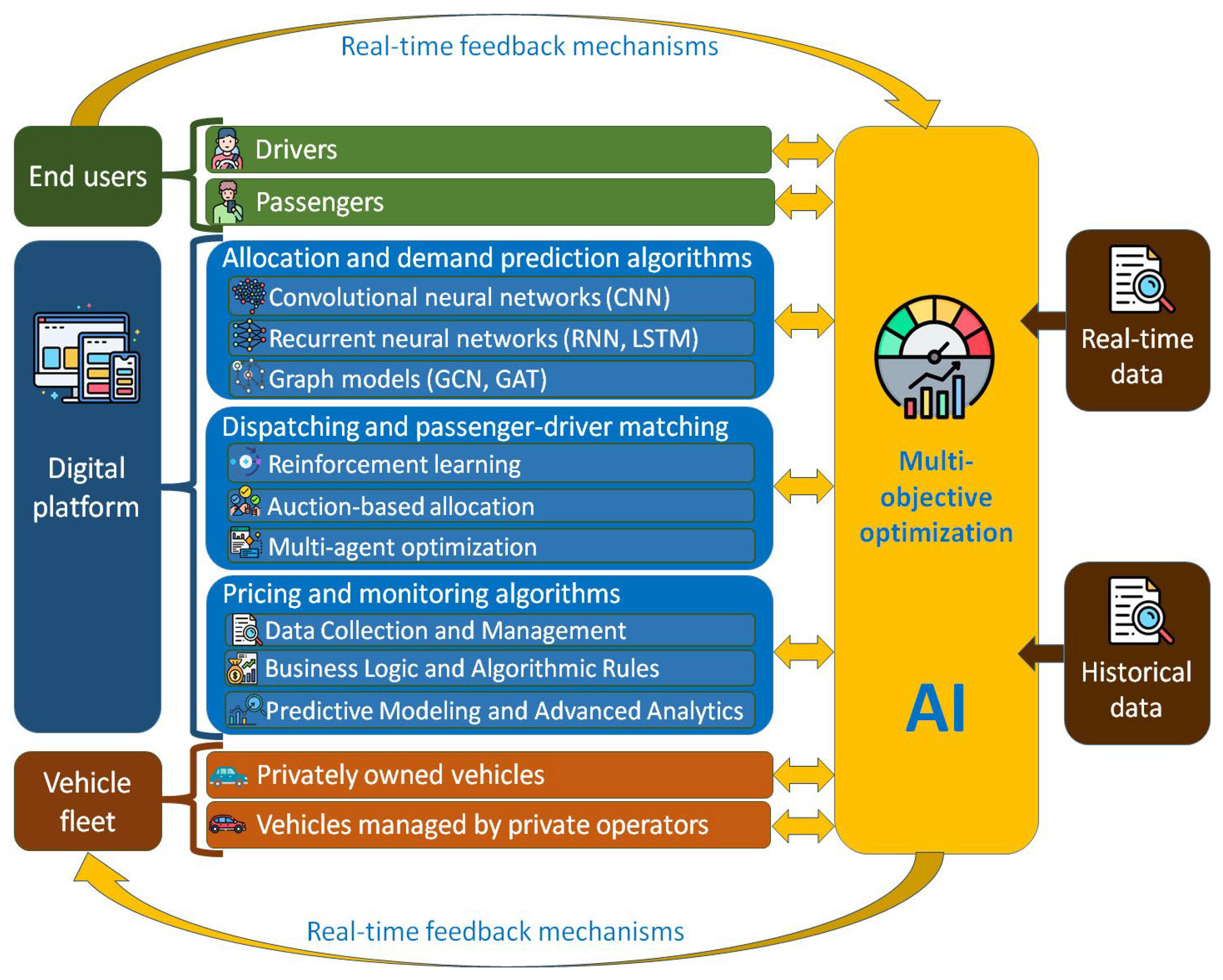
18]. As illustrated in
Figure 1, they function as a complex ecosystem made up of three essential components: (i) the digital platform, which is responsible for allocation, pricing and monitoring algorithms, (ii) the vehicle fleet, represented by private vehicles or operator-managed vehicles, and (iii) end users. The interaction between these components is managed by machine learning models, multi-purpose optimization, and real-time feedback mechanisms. From a technological perspective, modern mobility platforms use complex spatiotemporal models to anticipate demand and optimize vehicle distribution. Demand prediction (DP) algorithms are based on convolutional neural networks (CNNs), Recurrent Neural Networks (RNNs), such as Long Short-Term Memory (LSTM), and graph patterns, such as Graph Convolutional Networks (GCNs) or Graph Attention Networks (GATs), which can learn mobility patterns from historical and real-time data. In parallel, routing and passenger–driver matching become combinatorial optimization problems, addressed through techniques such as reinforcement learning (RL), auction-based allocation or multi-agent optimization. In addition to the operational dimension, recent research has also focused on assessing systems performance, user satisfaction, data security and impacts on urban infrastructure. Moreover, the development of electric vehicles (EVs) and autonomous vehicles (AVs) has amplified the interest in their integration into ride-hailing services [
18,
19], giving rise to the concept of the robotaxi, a vision in which transport becomes fully automated and predictive [
20,
21,
22].
Significantly, current research no longer looks at ride-hailing services solely as technological tools, but as socioeconomic players influencing urban planning, environmental policies and consumption behaviors [
20,
21,
22]. In this context, new questions related to market regulation, responsibility for platforms, equity of access to transport and the impact on the traditional car industry arise. In parallel, the trend towards electrification and automation of fleets is causing a strategic repositioning of companies, vehicle manufacturers and local authorities [
23]. Therefore, the analysis of research directions in the field provides not only a technological perspective, but also an understanding of interrelated characteristics, focusing on how ride-hailing services contribute to the definition of new paradigms of sustainable, connected and autonomous urban mobility.
In this sense, the emergence of ride-hailing platforms represents a “disruptive shock” to urban governance, forcing a transition from traditional, static transport planning to dynamic, data-driven policymaking [
24]. The process generally follows a non-linear cycle. Initially, the “regulatory lag” allowed ride-hailing platforms to scale rapidly. Policymaking was often triggered reactively by other factors, such as the protest of incumbent taxi industries or measurable increases in urban congestion [
25]. Unlike traditional infrastructure projects, ride-hailing platform policy involves a complex intertwining of stakeholders: municipal authorities, platform operators, and labor advocates. The formulation stage is characterized by a tension between the efficiency-driven goals of the platforms and the equity-driven mandates of the state. Implementation has evolved from physical roadside inspections to “Regulation-as-Code.” Modern cities utilize Mobility Data Specifications (MDSs) to implement policy in real time. This allows for automated enforcement of vehicle caps, geo-fenced restricted zones, and dynamic licensing. The feedback loop is increasingly quantitative. Authorities monitor empty miles and surge pricing patterns to evaluate if current policies are meeting sustainability goals, leading to adaptive regulation where rules are updated frequently based on platform-provided data.
To bridge the gap between innovation and public safety, regulators utilize a policy mix categorized into three primary types of instruments: (i) regulatory, such as strict background checks for drivers, vehicle age requirements, and “caps” on the total number of TNC licenses issued, (ii) economic, such as per-trip surcharges, congestion pricing in central business districts, and tiered taxation based on vehicle emissions, and (iii) soft policy and informative instruments, such as voluntary data-sharing agreements and public–private partnerships. The implementation of these instruments varies significantly based on the political economy of the host city.
The balance between policy and technology remains the central challenge. While platforms optimize for latency and matching efficiency, policymakers optimize for safety, equity, and environmental protection. Future policy must address the algorithmic management of labor, ensuring that the “black box” of platform pricing and dispatching remains transparent to the state. As the sector moves toward autonomous vehicles (AVs), the policymaking process will likely shift from regulating human drivers to auditing software code, necessitating a new generation of technical knowledge regulators [
26].
Therefore, this survey provides a comprehensive analysis of the specialized literature in the field of ride-hailing services, emphasizing major trends and emerging research directions. Ten main areas are identified, illustrating how this domain is evolving from a technological, economic and social perspective. For this purpose, representative scientific papers are selected and analyzed, with an emphasis on methodological and conceptual contributions to the development of intelligent transport and sustainable urban mobility. It should be mentioned here that this work does not aim to cover all existing articles focused on the ride-hailing domain, but aims to emphasize the importance of this topic and to highlight the main research areas which comprise this topic.
The main contributions of this study are as follows: (i) the elaboration of an integrated conceptual structure that organizes the specialized literature on online ride-hailing services in ten major research directions, providing a structure for understanding the interdependencies between the technological, operational and socioeconomic aspects of on-demand mobility; (ii) critical and comparative analysis of recent scientific contributions for each thematic direction; the study focuses on the methods used, algorithmic approaches and emerging trends, highlighting the evolution of the field from traditional statistical models to solutions based on machine learning and AI; (iii) the identification of open challenges and future research directions, with a focus on the integration of autonomous technologies, the sustainable optimization of fleets and the development of urban mobility policies adapted to the digital economy; (iv) the correlation of technical and human dimensions of ride-hailing services, through the performance analysis of systems, user satisfaction and implications on mobility behavior; (v) the identification of the evolution of research in this field, from the first operational optimization models to current approaches based on machine learning, blockchain and reinforcement learning, highlighting the directions of interdisciplinary convergence; (vi) the completion of an up-to-date documentation base that can serve as a reference point for researchers, practitioners and decision-makers interested in the design, evaluation and regulation of smart mobility services.
This variety of directions shows that the field of ride-hailing exceeds the simple problem of individual transport, becoming an interdisciplinary research field at the intersection of computer science, transport engineering, economics, behavioral sciences and public policy. Thus, the following analysis details ten thematic areas, highlighting the main scientific contributions, development trends and open challenges.
The rest of this article is organized as follows.
Section 2 describes the methodology used for literature collection, selection, and categorization.
Section 3 presents the integrated conceptual structure and a detailed analysis of ten thematic areas of research, followed by an in-depth review of the associated scientific contributions. Finally,
Section 4 discusses open challenges and future research directions and presents the final conclusions of this article.
2. Methodology
This article presents a literature review on the current state of the art of online ride-hailing platforms. The main goal is to provide a structured and as objective as possible basis for the analysis presented in the following sections. In addition to technological and operational features, the review also considers socioeconomic aspects. The purpose of this chapter is to describe the approach used to identify and select relevant scientific literature related to these topics. To ensure the accuracy and soundness of the present work, only peer-reviewed academic research is included in the review.
2.1. Search Approach and Databases
This literature review is based on a structured search of the top digital libraries in the fields of engineering and computer science. Thus, IEEE Xplore was the main search source, given the study’s strong focus on ITS, machine learning and optimization algorithms. To capture the economic and policy impact in the field, specific searches were also performed in Scopus and Web of Science (WoS) to broaden the field of interest, especially for papers with a high number of citations published in journals on transport, sustainability and urban planning.
2.2. Study Selection Criteria
The identified papers were selected through a screening process which was divided into two parts in order to filter the final volume of literature, as shown in
Table 1. Firstly, in the general selection part, the English language was considered mandatory. The second criterion was to select only peer-reviewed papers. The exclusion and inclusion of articles were based on the main subject, which was limited to online ride-hailing platforms. The following were excluded: (i) works in which the topic was not app-based ride-hailing, (ii) papers that did not address the effect of app-based ride-hailing, and (iii) qualitative studies that did not show the quantitative effects of ride-hailing platforms. The search was also limited to articles published between 2015 and 2025, to reflect the rapid acceleration of the shared digital mobility sector following the expansion of major platforms. After that, in the second part, the full-text review was based on the relevance and depth of the subject, followed by the contribution to the state of knowledge.
2.3. Data Extraction and Study Assessment
In order to generate the survey classification structure, the final set of selected papers was analyzed. While this work follows a narrative review framework, to allow for a more integrative synthesis, the identification of the ten research themes was conducted through a multi-stage process to minimize bias.
First, we performed a preliminary content analysis of the selected literature to identify recurring technical and socioeconomic keywords. In this regard, key metadata were noted for each paper, including the publication year, research methodology (e.g., reinforcement learning, policy analysis), and main contribution. Each paper’s contribution was tagged with descriptive labels based on the research problem it addresses (e.g., “Pricing Strategies,” “Electric Vehicle Charging,” “Integration with Public Transport”).
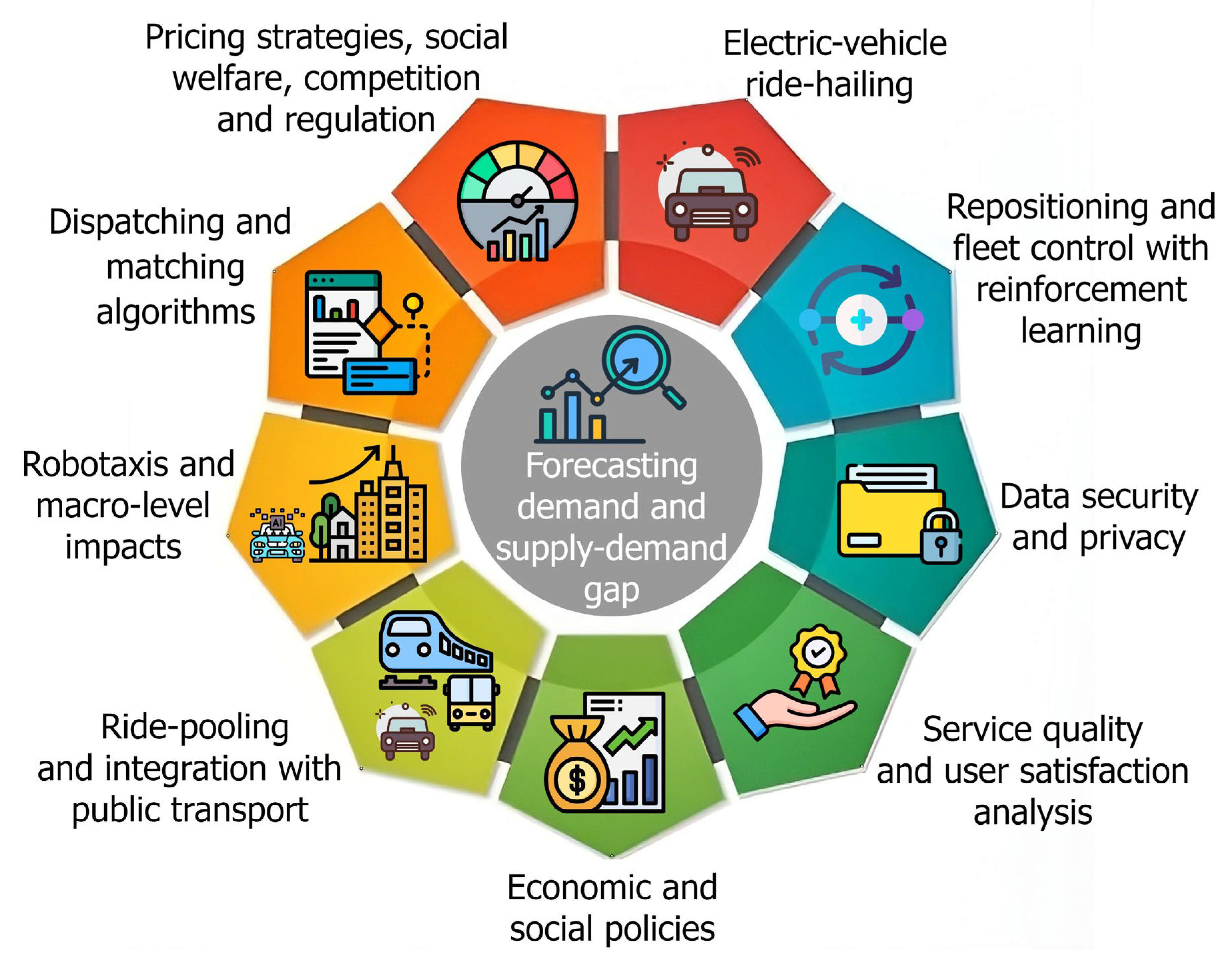
Second, an iterative comparison of these findings was conducted, where related research directions were compared for conceptual overlap. Finally, these directions were consolidated into a thematic structure composed of ten distinct research areas. This process ensured that the themes selected represent the dominant and most influential directions within the 2015–2025 research landscape of ride-hailing. The results, depicted in
Figure 2, ensure a broad coverage of both the technical and social aspects of the field.
We mention here that the purpose of this work is not to completely present the entire research effort engaged toward the development of the ride hailing concept, but to establish a map showing the main research domains and trends within this domain. Thus, ten main research areas have been highlighted, and for each of them, several works have been detailed. The selected works are relevant within the specific sub-area and were selected for their ability to illustrate important findings that inform the ride-hailing concept. Therefore, this survey provides a deliberate choice of illustrative studies which depict the research landscape, rather than being an exhaustive work. Thus, this work provides readers a structured perspective and a coherent map for the main research directions, and not a comprehensive presentation of all existing studies.
3. Research Trends and New Directions
Studies show that online ride-hailing services are growing rapidly due to improvements in digital technology and smarter transport systems. With the increasing role of these services, researchers began to study various aspects related to them, from mathematical models and ways to make them operationally efficient to studies of the socioeconomic impact of these technologies. Due to growing interest, the study of ride-hailing has resulted in the development of several related research areas, each focusing on a specific aspect of how these services work and develop. The main topics are shown in
Figure 2 and described in more detail in the following sections.
This variety of directions shows that the field of ride-hailing exceeds the simple problem of individual transport. Hence, ride-hailing research is becoming an interdisciplinary field at the intersection of computer science, transport engineering, economics, behavioral sciences and public policy. Therefore, the following analysis highlights the main scientific contributions, development trends and open challenges for future research.
3.1. Forecasting Demand and Supply–Demand Gap
Prediction of demand and the supply–demand equilibrium are some of the most important research directions in the field of ride-hailing services. These aspects have an essential role in optimizing vehicle dispatching and reducing waiting times. In turn, recent models based on deep learning and spatiotemporal analysis aim to anticipate high-demand areas and rush hour periods. For this aim, these models consider factors such as requests history, traffic conditions, weather, and distribution of Points of Interest (POIs). From the first deep supply–demand (DeepSD)-type neural models to complex architectures integrating networks on graphs, such as Temporal Graph Convolutional Network (T-GCN) or Multimodal Fusion Graph Convolutional Network (MFGCN), these studies demonstrate the transition to multimodal approaches that are capable of rationally capturing the dynamic interactions between space, time and urban context.
In this regard, article [
27] presents a deep neural network model for estimating the disproportion between supply and demand in ride-hailing services. The aim is to predict areas where demand for rides will exceed driver availability, enabling decisions such as vehicle redistribution or fare adjustment. The proposed DeepSD model integrates varied data, such as request history, spatial and temporal information, weather, and traffic, into an end-to-end architecture consisting of multiple blocks connected by residual mechanisms. This architecture allows for simple addition of new types of data and reduces the need for manual preprocessing. The main element of novelty consists of combining integrated spatiotemporal representations with a historical weighting mechanism that automatically learns the relevance of each day of the week to current predictions. Experimental results show a significant improvement in accuracy over classical methods. Thus, this concept demonstrates improved efficiency and flexibility.
Another approach is presented in article [
28], which proposes an ensemble learning framework that aims to predict demand for ride-hailing services such as Didi or Uber. The authors start with the finding that individual models are not able to satisfactorily capture the complexity of spatiotemporal correlations in urban transport data. Moreover, the authors also emphasize that this failure is applicable even for more advanced models based on neural networks. Consequently, they develop a method that combines the results of several basic models, each trained to predict local demand according to request history. This method results into an integrated structure capable of learning the characteristics based on location and time period. The method is based on a fully convolutional network architecture that is capable of treating individual predictions of basic models as channels of a spatial “image”. This network compresses and then restores information, using skip connections to simultaneously preserve fine details and deep contextual information. In the first stage, heterogeneous models such as Light Gradient Boosting Machine (LightGBM), a linear regression, or a model based on the K-Nearest Neighbors (KNNs) method are used to generate independent predictions. In the second stage, the convolutional module combines the independent predictions into a final prediction that optimizes global accuracy. The main novelty of the work consists of adapting the ensemble learning principle to spatiotemporal data by using convolutional networks to integrate multiple predictive perspectives. As a result, this approach improves performance over individual models and mitigates the impact of poor models on the final outcome. Empirical results obtained using real data from the city of Chengdu, China, demonstrate a significant increase in the accuracy of predictions over classical methods and other simple model combination strategies.
A method of short-term prediction of demand for ride-hailing urban transport services is also proposed in article [
29]. In this case, the authors propose the Least Squares Support Vector Machine (LS-SVM) model based on the idea that anticipating ride requests over short time periods of about 5–15 min is essential for improving the service. Thus, the LS-SVM model is chosen due to its high accuracy and reduced drive time compared to other regression methods. Using this model, the optimization task involves solving a set of linear equations instead of a more complex quadratic process. As a result, the processing complexity is reduced, and therefore less computational power is required. Within the methodology, each urban area is treated independently, and the model learns the relationship between the current demand and its historical values using a Radial Basis Function (RBF) and an optimal selection of hyperparameters through cross-validation and logarithmic network search. Experiments performed on a set of real data collected in January 2016 from 66 regions in a Chinese city by the Didi platform demonstrate that the LS-SVM method provides superior accuracy over regression by Least Absolute Shrinkage and Selection Operator (LASSO), decision trees, KNN and neural networks, according to the Mean Absolute Error (MAE), Root Mean Squared Error (RMSE) and Mean Absolute Percentage Error (MAPE) indicators. Thus, the model proved to be robust, fast and capable of offering stable predictions even for horizons of up to 60 min. The main novelty element of the study consists of the application and adaptation of LS-SVM to the problem of prediction of ride-hailing demand, with a systematic approach to parameter selection and a rigorous demonstration of its superior performance.
Another short-term prediction model based on the stacking ensemble learning method is proposed in [
30]. The model is built on two levels. The first level contains three basic algorithms: Random Forest, LightGBM, and an LSTM network. Each of them is able to manage different types of features. On the second level, an SVR regression model processes their results to obtain the final prediction. This approach allows a reduction in individual errors and increases the generalization capacity of the system. The data used for simulations came from a dataset provided by the Didi platform, corresponding to the city of Haikou, China. The results show that the stacking ensemble model exceeds the performance of each individual model, reducing MAE and RMSE by more than 5% in an interval of 30 min. The main novelty of this work is the integration of traditional and neural network-based methods into an architecture capable of learning complex spatiotemporal interdependencies. Thus, this study demonstrates the potential of the stacking technique in prediction applications for smart mobility.
Another study based on the real data from the city of Haikou, China, is found in [
31]. This work presents an advanced method of predicting origin–destination (OD) flows in ride-hailing services based on convolutional neural networks on graphs and recurrent units. The purpose is to estimate the short-term number of rides between various urban regions in order to provide decision support for vehicle planning and dispatching. The authors use the data from 8 million ride-hailing requests and divide the central area of the city into 84 grids, with a side of 3 km. To capture the complex spatial relationships between areas, three adjacency matrices are constructed (i.e., Am01, Sam and Amn), describing the physical vicinity, traffic intensity and proportion of travel flows. Based on these structures, the T-GCN model is developed. The model integrates a GCN for learning spatial relationships and a Gated Recurrent Unit (GRU) for modeling temporal dependencies. The results show that T-GCN outperforms the compared models (LSTM, GRU, ConvLSTM, ST-GCN), providing high prediction accuracy (
R2 ≈ 0.9). Moreover, the results show that the model is especially efficient in high-traffic areas, where the results are even better. The model based on the Amn matrix proved to be the finest performer, best reflecting the actual proportions of OD flows. The main contribution of the work consists of the coherent integration of irregular spatial relationships and temporal dynamics in a unitary framework, providing a robust solution for the prediction of transport demand in difficult urban networks.
A complex DP model for ride-hailing services, named CNN–LSTM–Attention–GCN (CLAG), is proposed in [
32]. This model integrates several deep learning components to simultaneously capture the spatial, temporal, and contextual dependencies that influence urban transport demand. The CLAG architecture combines CNNs and LSTM networks equipped with an attention mechanism to extract temporal patterns of proximity, periodicity, and trend. Meanwhile, by using similarity of POIs, the GCN-type network captures functional spatial relationships between regions. The model also includes external factors such as weather and working days, integrated through fully connected layers. The dataset used to evaluate the model comes from the city of Chengdu, China, and contains GPS records from more than 14,000 taxis, accompanied by meteorological information and POIs. The results show a superior performance compared to the reference models, including LSTM, SpatioTemporal Residual Neural Network (ST-ResNet), and Historical Average, with reductions of more than 40% in MAE, RMSE, and MAPE, and an increase in the
R2 coefficient to 0.94. Ablation evaluation confirms that the integration of external factors and POI data contributes significantly to improving accuracy. The main contribution of this work consists of the development of a multi-factorial and multi-modular model that is able to coherently reflect the complex interactions between time, space, and urban context. Thus, the model provides an efficient solution for the prediction of ride-hailing demand in dynamic metropolitan environments.
In ref. [
33], the authors propose an innovative MFGCN model for the prediction of ride-hailing demand based on a multimodal fusion network with GCNs. Researchers address three major challenges: modeling non-linear spatiotemporal interactions between users and vehicles, integrating contextual information and managing data sparsity. The MFGCN model includes three main components. The first component combines three adjacency graphs (i.e., geographic, semantic, and functional) to capture the complex spatial correlations, based on Multimodal Origin–Destination Graph Convolutional Network (MODGCN). The second component integrates external factors, such as weather and people’s mobility behaviors, to improve prediction accuracy (i.e., multimodal attribute enhancement). The third component captures the periodic variations in demand, allowing the model to learn the recurrent temporal patterns, based on Temporal Attention Skip–LSTM (TAS-LSTM). Tested on real Manhattan data, MFGCN outperformed benchmark models, including T-GCN, with improvements of 6.74% in MAPE and 19.64% in RMSE, demonstrating superior performance in predicting demand for various time frames. The results show that multimodal integration and temporal attention significantly enhance the accuracy of predictions in intelligent transport systems.
Work [
34] proposes an improved method of identifying critical areas or hotspots for ride-hailing services. The method uses an adapted variant of the DBSCAN clustering algorithm, namely Reverse Nearest Neighbor Density-Based Spatial Clustering of Applications with Noise (RNN-DBSCAN). Based on spatial and temporal data from the Didi platform controls in the city of Chengdu, China, this work aims to determine the areas with the highest intensity of transport activity at different periods of the day and week. The authors show that the classic DBSCAN algorithm has limitations related to the arbitrary choice of parameters and the difficulty of differentiating regions with variable densities. The proposed RNN-DBSCAN model requires a single parameter (i.e., number of inverse neighbors), reducing complexity and improving the accuracy of cluster identification. The algorithm is evaluated with indicators such as the Adjusted Rand Index and the Davies–Bouldin Index, demonstrating better performance than DBSCAN. The results show distinct critical areas for weekday and weekend rush hours. The identified areas include commercial, university, residential zones and transport stations, confirming that the model behaves as it does in real life. The main contribution of the work consists of a novel adaptation of the RNN-DBSCAN algorithm for analyzing ride-hailing data. As a result, this work provides a robust, automated and scalable solution for detecting areas with high transport demand.
The papers analyzed in this subsection are presented in
Table 2. The result of this analysis is that studies dedicated to demand prediction and the demand–supply gap in ride-hailing services confirm that a high performance depends on the model’s ability to simultaneously learn spatial, temporal, and contextual dependencies from data. From this perspective, deep learning, and sometimes deep learning integrated with GCNs, has established a new methodological standard, surpassing the accuracy and generalization capacity of classical methods. The systematic use of ensemble and multimodal fusion approaches (e.g., CLAG, MFGCN) has proven crucial for robustness against data sparsity and dynamic urban variations. Even though including contextual factors like weather and POIs has resulted in noticeable improvements, there are still important challenges to address. In particular, these advanced models can be too slow or demanding for real-time use, and they often do not adapt well to cities with very different geography or economic conditions. These challenges define the main focus for future research in urban mobility forecasting.
3.2. Dispatching and Matching Algorithms
Dispatching, matching, and pooling processes are essential to ride-hailing platforms, directly determining efficiency, response time and user satisfaction. In order to balance passenger, driver and platform interests, recent research addresses these processes from an integrated perspective by using combinatorial optimization models, queueing theory and economic mechanisms. From distributed matching algorithms and bidding mechanisms to models based on evolutionary games and graph-like networks, studies investigate how local decisions can generate global efficiencies in dynamic and uncertain networks.
The authors of [
35] propose an innovative mechanism for the distribution and pricing of requests in ridesharing services, based on the theory of auctions. The authors start from frequent situations of vehicle shortages during peak periods, when some passengers are willing to pay an additional bonus to prioritize their requests. The proposed model transforms this process into an automatic auction system, where passengers act as bidders and declare their willingness to pay. On the other side, the platform acts simultaneously as seller and auctioneer, assigning rides and setting final prices in order to maximize total social utility. The auction mechanism is implemented through two approaches. The first one is based on a greedy algorithm and assigns step-by-step requests to the vehicle that provides the highest marginal gain. The second one is based on a ranking algorithm and groups the requests into “packages” of compatible passengers and distributes them based on a global utility rank. Each method has a corresponding pricing strategy, greedy pricing (GPri), respectively, Divide-and-Walk (DnW), designed to guarantee fundamental auction properties, truthfulness with participants being stimulated to bid real value, individual rationality, profitability and computational efficiency. Results based on real data from Didi Chuxing in Beijing show that the rank-type algorithm produces higher overall utility and greater efficiency than the greedy method, while still keeping a good balance between platform profit and user satisfaction. The paper’s key contribution is the incorporation of bidding mechanisms into ride dispatching and pricing, offering an adaptable way to manage demand even when the traffic is congested.
A significantly improved method for the insertion operation is described in [
36]. Insertion is an essential component of route-planning algorithms in dynamic ridesharing services. This consists of introducing a new OD pair into an existing route of a driver so that a function such as total travel time or passenger waiting time is objectively optimized. The main problem addressed is O(n
3) time complexity, the cubic increase in execution time of the classic insertion operator, where “n” is the number of requests in a driver’s route. This limits the scalability of systems at the urban level. The authors propose a partitioning framework and a dynamic programming-based solution which reduces complexity to O(n
2) and, subsequently, to O(n). For this purpose, the concept uses efficient data structures such as the Fenwick tree (i.e., indexed binary tree) structure. These optimizations allow quick verification of capacity and time-limit constraints, as well as constant-time objective calculation for each pair of potential insertion positions. The overall model addresses three objectives: minimizing the maximum waiting time, the total travel time and the sum of the flow times. The extension of the method to these objectives is achieved without increasing computational complexity. The concept was evaluated based on real data from New York taxi services and the Cainiao delivery platform, and shows increased speedups from 1.5 to 998 times with respect to existing solutions while maintaining the same optimal results. The main contribution of the work consists of redefining the insertion operator in an efficient and scalable form, with wide applicability in ridesharing, fast deliveries and urban logistics.
A theoretical vehicle-dispatching framework based on queueing theory is proposed in [
37]. This main purpose of this method is to maximize the income of ride-hailing platforms in dynamic conditions. The problem analyzed is optimal allocation of vehicles for revenue maximization, named Maximum Revenue Vehicle Dispatching (MRVD). Accordingly, the total revenue of the platform is maximized by taking into account temporal variations in supply and demand. The authors demonstrate that the MRVD problem is NP-hard, which justifies the use of a heuristic approach. The proposed framework combines supply and demand prediction through machine learning algorithms with M/M/c queueing models to estimate driver downtime in each region. Based on this information, a batch-based dispatch algorithm called the Idle Ratio-oriented Greedy (IRG) heuristic algorithm is developed. The algorithm prioritizes passengers and drivers according to an idle ratio between the estimated waiting time and the duration of the journey. An evaluation based on real data collected from the New York City Taxi and Limousine Commission shows that the proposed method achieves higher total revenues and reduced processing times compared to traditional random or greedy algorithms. In addition, all dispatching processes can be executed in less than two seconds per batch, making it suitable for real-time applications. The main contribution of the study consists of the integration of queueing theory into a practical dynamic dispatching framework, which simultaneously optimizes the operational efficiency and revenues of transport platforms.
Article [
38] addresses the issue of optimal and stable allocation of drivers to passengers in ride-hailing systems of the Uber or Lyft type. The authors emphasize that existing centralized algorithms envisioned to maximize overall efficiency can generate unstable matchings, as certain driver–passenger pairs would prefer to redo their matches with each other to obtain greater benefits. To solve this problem, a distributed algorithm based on the auction mechanism is proposed. The algorithm assumes that each driver bids for the passenger who brings him the highest profit while taking into account a virtual fare associated with each passenger. This fare gradually increases when several drivers compete for the same passenger, until only one interested bidder remains. The process converges towards a stable steady state, a selection in which no driver and no passenger would gain an advantage by changing partners. Compared to centralized methods, such as the Kuhn–Munkres algorithm that is typically used for assignment problems like this, the proposed algorithm has lower complexity. The authors theoretically demonstrate that the proposed algorithm converges to a stable and near-optimal solution, maximizing total social welfare and revenue. Simulations performed in MATLAB show that the distributed solution obtains income comparable to that of the global optimal solution, but with a much lower computational cost. The major contribution of this work consists of the integration of the principles of matching theory and auction mechanisms in a distributed framework, capable of ensuring both stable and economically efficient dispatching in modern ride-hailing systems.
An optimized model for choosing fixed Pick-up Points (PuPs) to improve the efficiency of ride-pooling services is presented in article [
39]. The authors start with the observation that current ride-hailing services increase urban traffic, as they add dedicated vehicles instead of using existing cars. In turn, the proposed model is envisioned to balance vehicle occupancy, safety and the privacy of users. Thus, the ride-hailing system considers fixed pick-up and drop-off locations monitored by video, protecting the privacy of passengers by masking the real address and increasing the likelihood of joint rides. The model extends the problem of minimum coverage from geometry, i.e., covering a surface with a minimum number of circles, to road networks, using variable radii determined by population density. Thus, each urban area is “covered” by a minimum number of PuPs, ensuring a k-anonymity level, i.e., the impossibility of precisely identifying the location of a user out of a total of k users. Multi-objective optimization focusing on maximum coverage and high confidentiality is solved by a greedy approach named Greedy Randomized Adaptive Search Procedure (GRASP), generating a Pareto set of solutions. Evaluations of Melbourne’s city road network have shown that optimal selection of PuPs significantly increases the vehicle occupancy rate while maintaining privacy and balance between comfort and safety. The major novelty is the integration of spatial privacy into the infrastructure planning for ride-hailing, through an adaptive and anonymous coverage model.
Paper [
40] proposes a distributed framework for the efficient matching of transport requests and offers in carpooling services, optimized for large road networks. This work addresses the real problem of dynamic association between passengers and drivers in real time, considering both spatial distances and temporal synchronization of supply and demand. The proposed model, named Task Match (TMATCH), divides the road network into a set of sub-regions, each managed by a server handling requests in that area. When a new passenger sends a request, the system determines the appropriate route and transmits the information only to the relevant servers using a random multi-casting algorithm based on a rank function that evaluates the importance of each server. This strategy greatly reduces communication costs and network load. In each server, requests are indexed using an RTI-Tree structure, which combines an R-Tree tree for geographic positions and an inverted list for arrival and expiration times. This allows quick queries and efficient deletion of expired requests. For matching requests, a rank-based matching algorithm is proposed, which maximizes the common route length between two compatible passengers under distance and time constraints. Tests with real Didi data show that TMATCH works better than traditional methods like Nearest Neighbor Matching (NNM) and Basic Combinatorial Matching (BCM), cutting down both response times and the number of empty trips. Therefore, this paper proposes the development of a scalable and robust framework for the real-time matching of carpooling requests in distributed environments.
Studies reviewed in this section show that game theory, market-based methods, and probability-based models are more often being combined to inform decisions regarding more efficient behavior. At the same time, techniques based on graphs and heuristics make it possible to scale solutions at the level of big cities. The researchers also take into account the principles of stability and equity in the matching algorithms to achieve both platform profitability and user satisfaction. Overall, research on this topic defines the theoretical framework of an adaptive and collaborative optimization of ride-hailing systems, oriented towards sustainability and social efficiency. Despite progress in the field, some important challenges still remain. One issue is to find a single objective that fairly balances the needs of everyone involved, maximizing platform revenue, minimizing passenger waiting time, and ensuring a fair wage for drivers, because most current models focus on optimizing just one of these goals. Although it is addressed in [
39,
40], ensuring real-time response still remains a challenge: planning multiple pick-ups and drop-offs without delaying passengers adds enough complexity that it often cannot be handled fast enough for real-time use at the scale of a whole city. Finally, most optimization models treat drivers as fixed resources, but in reality, drivers make decisions based on things like which rides to accept, preferences for certain areas, and strategic considerations. Therefore, a more realistic driver profile must be incorporated into dispatching models to improve assignment stability and acceptance rates.
Table 3 shows a summary of the studies discussed.
3.3. Pricing Strategies, Social Welfare, Competition and Regulation
Price setting and market regulation are two key elements that keep transport services viable and fair. They depend directly on economic choices, but also on public policy decisions. Researchers are studying different pricing strategies, such as dynamic pricing, where higher fares are seen at peak times and lower fares are seen during quiet periods, and how money is split between platforms and drivers, to see how everyone involved is affected. At the same time, economists use two-sided market models to understand the interaction between passengers and drivers through a common platform and the influence pricing, competition, and regulation have on these interactions. These models explain that competition, pricing and regulation can shape outcomes for drivers, passengers and the platforms themselves.
3.3.1. Pricing and Social Welfare Optimization
In this sense, the authors of [
41] propose a theoretical pricing model for ride-hailing platforms, designed from the perspective of maximizing social welfare (i.e., simultaneously optimizing benefits for passengers, drivers, and the platform). The authors use queueing theory and the birth–death process to model the flow of drivers in a dynamic system, where rates change according to the level of driver availability. The model considers a dynamic pricing strategy with a single threshold, where the platform sets a high price when the number of available drivers falls below a certain threshold and a low price when the driver supply is sufficient. To ensure the existence of a stable solution, the authors apply the Brouwer fixed-point theorem, and the numerical solution of the model is performed with the fmincon function in Matlab. The results demonstrate that this model can identify the optimal rates and the revenue-sharing coefficient between the platform and drivers, thus maximizing the overall yield of the system. Case studies in Chinese cities with varying densities (e.g., Shanghai, Suzhou or Nantong) indicate that social welfare increases with population density and supply–demand balance. At the same time, the optimal income distribution rate is between 0.5 and 0.7. The paper makes a significant contribution by combining economic theory with queueing models, providing a unified framework for a pricing mechanism oriented towards the balance between profitability and social efficiency.
A different approach is found in [
42], where the determinants of total social well-being in the ride-hailing service industry are analyzed based on the idea that passengers, companies and the government represent three interdependent parts of a complex urban ecosystem. The authors construct a multi-dimensional system of indicators that assess producer surplus, consumer surplus and government surplus, defined as component elements of total social welfare. On these grounds, they apply the Decision-Making Trial and Evaluation Laboratory (DEMATEL) method to identify both key factors and the relationships between the dimensions involved. DEMATEL allows the determination of the direct and indirect influence of each factor and the construction of a map of impact relationships between variables. The study case was conducted on data from a DiDi subsidiary in China, and has identified direct income, price factor and operational factor as the main determinants of total social welfare. The analysis also shows that the government plays the role of a major causal factor, influencing both companies and passengers. Additionally, it shows that the passenger side is the most vulnerable to external changes. The paper proposes improvement measures, such as dynamic pricing policies and optimization of operations by region, to increase the overall efficiency of the ride-hailing system and the quality of urban governance. The central element of novelty is the methodological integration of DEMATEL into a three-dimensional socioeconomic framework, which provides a systemic perspective on the interdependence between participants and how to maximize social well-being.
3.3.2. Market Trend and Regulation
The strategic interaction between government and ride-hailing platforms in the context of regulatory market access policies is studied in article [
43]. In this case, the authors consider the use of the evolutionary game theory. The main purpose of this work is to understand how access thresholds and pricing schemes can be established in order to ensure a balance between the economic efficiency of the platforms and the regulatory objectives of the authorities. The developed model describes a game between two entities: the government, which can adopt a “strict” or “relaxed” access policy, and the ride-hailing platform, which can choose to increase prices or keep them reasonable. Under the assumption of limited rationality, the strategies of the two parties evolve over time according to rewards, penalties and regulatory costs. The model includes variables such as subsidies to compliant platforms, fines for non-compliance with prices, and government oversight costs. As expected, the analysis of evolutionary balances shows that government decisions regarding the level of sanctions and motivations directly influence the behavior of the platforms. The results indicate that a simultaneous increase in both penalties and subsidies for compliant behaviors causes platforms to keep prices stable, while insufficient penalties favor tariff increases. Also, monitoring and sanctioning excess regulation at the government level ensures a balanced access thresholds. The main conclusion is that a regulatory framework based on evolutionary balance between incentives and punishments can support the sustainable development of the ride-hailing market, maintaining a trade-off between profitability, accessibility and social efficiency.
Paper [
44] analyzes the evolution and competitive dynamics of Chinese ride-hailing platforms such as Didi, interpreting the industry through the lens of two-sided market theory, with passengers and drivers influencing each other through network effects. The paper identifies three distinct stages of the development on the Chinese market: the early period (i.e., 2012–2013), characterized by intense subsidy-based competition; the growth period (i.e., 2014–2015), in which vertical differentiations occur between platforms through Quality of Service (QoS) and orientation towards different market segments; and the stable period (i.e., after 2016), marked by oligopolistic concentration and stricter regulations imposed by the authorities. The theoretical model analyzes the competition between a higher-quality platform and a lower-quality one, integrating network effects and vertical differentiation. The results show that as network effects increase, large, lower-quality platforms become more profitable due to the high volume of transactions, even if they offer poorer-quality services. At the stable stage, the author models the impact of driver access regulations and demonstrates that direct regulation of platforms rather than drivers leads to an increase in drivers’ social welfare and income. In conclusion, the study points out that the evolution of the ride-hailing market in China is driven by a mild balance between network effects, service differentiation and regulatory policies. Thus, the optimization of this balance is essential for sustainable and effective competition.
3.3.3. Technological Integration for Price and Resource Optimization
An innovative model for optimizing prices and resource allocation in ride-hailing services based on edge computing (EC) is proposed in [
45]. The authors address the issue of uncertain capacity and load imbalance between drivers and passengers with the help of EC. Thus, EC acts as an intermediate layer between cloud servers and mobile devices to reduce latency and power consumption. The proposed model combines factors such as the number of users and the reputation of vehicles, building a resource allocation system that minimizes costs and optimizes platform performance. The problem is formulated as a Mixed-Integer Non-Linear Programming (MINLP) problem, which is decomposed into sub-problems of user connection, resource allocation, and download report. The results, obtained based on real data from Didi Express (i.e., Xi’an and Chengdu), show that the proposed algorithm reduces the average delay, energy consumption and costs, reaching an average download utility of about 70%. Compared to other models, the proposed EC solution offers superior performance in terms of energy efficiency and response time. The outcome is that EC integration into ride-hailing platforms can support the development of smart transport networks by dynamically optimizing prices and digital resources.
Table 4 presents key methodological innovations discussed above.
3.3.4. Open Challenges in Pricing and Regulation
The research presented shows that economic efficiency and fairness for all actors involved are equally important for pricing and regulating ride-hailing services. Studies based on various models show that implementing well-thought-out rules can help maintain market stability without hindering innovation. At the same time, approaches based on two-sided market models emphasize the importance of network effects, which occur because the value of the platform increases as more drivers and passengers use it. Based on the above, the present research confirms that the long-term success and sustainability of ride-hailing services depend on finding common ground between the objectives of the platforms, those who use them and the authorities that regulate them. Therefore, this balance could be achieved through transparent pricing mechanisms and adaptive public policies. However, there remain some challenges that outline the future directions of research. The first challenge is the lack of transparency of the models, especially those that maximize the profit of the platform. This raises concerns about algorithmic discrimination, predatory pricing practices and incorrect revenue sharing for drivers. Thus, there is a real need to develop and implement pricing mechanisms that are verifiable, auditable and fair to all participants, not just economically optimized. Although most models address internal balance, another challenge is that negative external factors such as urban congestion and pollution are not taken into account. This would require close collaboration with local authorities. Although game theory models offer useful theoretical balances, a third challenge is presented by the empirical effects of highly complex and local-specific regulations, such as driver background checks, vehicle age limits or commission caps. This can affect the QoS and the supply. Consequently, it remains a challenge to create a platform capable of predicting, based on real data, the heterogeneous impact of regulatory interventions in different types of cities.
3.4. Electric Vehicle Ride-Hailing: Task Allocation, Charging and Scheduling
With the increase in the number of EVs used in ride-hailing services, new challenges have emerged. Factors such as range, available charging stations and the necessity of energy management for batteries require new ways of planning and dispatching. Therefore, recent research focuses on finding new intelligent methods that also consider battery recharging scheduling, not just the operational task efficiency. To achieve this, the new models tend to use mathematical optimizations and reinforcement learning, taking into account various parameters required for the new tasks, such as the battery charge level, the distance to the charging stations, the queueing at the charging stations and the demand across different areas.
Based on the above discussion, the paper [
46] shows that long battery charging times inevitably lead to reduced vehicle availability, which can affect passenger satisfaction. To meet this challenge, the authors propose an intelligent method of charging and dispatching EVs for ride-hailing services. They define the problem as a Power-Aware Electric Vehicle Assignment (PAEVA), which aims to maximize the number of served travel requests by considering the current battery charge level, customer deadlines, and charging station capacity. The authors show that this problem is NP-hard and difficult to solve with classical methods without long processing times, so they propose two practical solutions: Double-Threshold (DT) and Multi-Delayed Upper Confidence Bound (MD-UCB). The DT method uses two threshold values that guide assignment decisions. One uses the battery charge level and the other uses the demand–supply ratio. Based on these two thresholds, the algorithm approximates the necessary balance between serving a passenger and going to a charging station. The MD-UCB method enhances this approach by adding an adaptable learning mechanism that attempts exploration with novel decisions in addition to exploitation of proven successful ones in order to improve long-term performance. Experiments based on real New York data show that both methods perform much better than classic greedy or random-based models. In particular, the MD-UCB method is capable of serving more than twice as many travel requests while simultaneously maintaining a short processing time. Overall, this article makes an important contribution to the management of electric vehicle fleets by combining intelligent energy use with ride allocations, providing an efficient and scalable solution for sustainable transportation.
An intelligent framework for managing EV fleets based on RL is proposed in [
47]. Due to long charging times and traffic unpredictability, users’ dissatisfaction and operational hiccups remain ongoing problems. The authors manage to solve these challenges by proposing an Intelligent E-taxi Hailing Service (I-EHS) controller that acts in two directions. The first one is based on a simple heuristic algorithm that decides which vehicle should take over a ride and which should go to a charging station. The second one is configured as a Markov Decision Process (MDP) and learns the best policies for allocating rides and charging vehicles’ batteries based on a Deep Q-Network (DQN) approach. The battery charge level, vehicle location, traffic conditions and available charging stations are the state variables that drive this model. The DQN is trained in OpenAI Gym on a 10 × 10 grid simulated road network, over thousands of simulated days for fleet operation. The results show that the I-EHS model performs better than classical approaches, which are based on greedy or random allocation strategies. The proposed algorithm helps EVs to maintain operational efficiency and service quality. Consequently, the average waiting time for a ride is about 30 min, and the system sends the vehicles to charging stations before depleting the battery. Although 30 min might seem long for the comfort of passengers, this strategy ensures that enough vehicles are available throughout the day, instead of risking too many cars being at the charging stations at the same time. The main contribution of this work is the combination of a hybrid RL–heuristic algorithm that improves both user satisfaction and energy sustainability of electric fleets.
In a dense urban scenario, the synchronization of ride-hailing and electric charging service processes is crucial for the economic performance of operators. Paper [
48] proposes an intelligent strategy for scheduling the charging of e-taxis operating in ride-hailing mode, aimed to reduce waiting times and to optimize energy consumption and grid usage. The authors build an RL model capable of learning optimal decision policies for allocating vehicles to ride pickups or charging stations, taking into account distance, waiting time, battery status and request density. The model is formalized through a set of statuses (which include vehicle position, battery level, charging queue status and travel request queue status), actions (choice of a charging station or acceptance of a ride), and scores (reflecting economic rewards and penalties for delays). Through the Q-learning method, the RL algorithm adjusts decision policies to maximize total operator profit and charging infrastructure utilization. The evaluation results demonstrate that the proposed method significantly reduces overall waiting time and charging delays, increasing fleet efficiency and power grid stability. The main contribution of the work consists of the simultaneous integration of ride-hailing operations management and electric charging planning based on an adaptive approach that uses machine learning, and which has a direct impact on the intelligent management of urban electric transport.
To maximize daily vehicle income while taking into account charging costs, battery wear, energy losses and the remaining charge level at the end of the day, paper [
49] proposes an intelligent strategy for recommending power charging stations for ride-hailing EVs based on a hierarchical deep reinforcement learning framework combined with GCN and GAT. The model builds a system organized on three levels: the environment layer, consisting of the road network and charging stations, the state perception layer, which transforms spatial information into a graphical representation “road–vehicle–station” and the reinforcement learning model layer. The hierarchical algorithm is triggered by an event (i.e., completing a ride) and consists of two sub-models: the upper layer recommends the optimal charging power and the lower layer chooses the optimal charging station based on the previous result. Therefore, GCN is used to extract spatial dependencies between nodes, while GAT assigns adaptive weights to neighboring nodes, allowing for flexible learning in a complex urban scenario. This combination improves the performance of the DQN used for decision-making. Simulations performed on real data from Chengdu, China, including road maps, average speeds, passenger controls and charging stations, show that the proposed strategy increases the total revenue and operational stability of vehicles compared to models based on GCN, GAT or classical neural networks. The main contribution of the work is represented by the integration of a hierarchical architecture GCN–GAT–DQN, which is capable of providing adaptive, fast and accurate decisions for the management of electric ride-hailing vehicle charging in a dynamic urban scenario.
Table 5 offers a summary of the key elements discussed.
Models dedicated to electric ride-hailing fleets demonstrate that simultaneous optimization of rides allocation and battery charging is crucial for reducing costs and increasing vehicle availability. Solutions based on reinforcement learning, multi-armed bandit algorithms or dynamic programming allow decisions to be adapted to changing traffic and battery status conditions. In this situation, hierarchical and collaborative strategies improve coordination between vehicles and charging infrastructure. Overall, research in this field is paving the way towards an autonomous, efficient and sustainable management of on-demand electricity transport, where energy optimization becomes an integral part of operational planning. Nevertheless, some future challenges in EV ride-hailing still remain open. Firstly, the current models primarily focus on platform profit and vehicle needs. Thus, it is necessary to integrate real-time grid capacity and pricing signals into the charging decision process to reduce overall energy costs at a city level. This requires coordination between the ride-hailing platform and the smart grid operator. Secondly, the complex and hierarchical RL models are computationally intensive. Accordingly, it is a challenge to scale these high-dimensional decision processes to large fleets operating across metropolitan areas while maintaining real-time responsiveness. Thirdly, most of the existing papers do not include long-term battery health or degradation costs in their optimization algorithm. Developing charging policies that balance immediate revenue maximization with minimizing long-term battery replacement costs is a crucial factor for the economic sustainability of EV fleets.
3.5. Repositioning and Fleet Control with Reinforcement Learning
Because demand is unpredictable and undergoes changes in unpredictable ways, vehicle repositioning and dynamic fleet control are difficult to decide in ride-hailing services. Some of the methods that have most frequently been used to automate these decisions in recent years are RL algorithms. These allow agents to learn the best strategies by interacting directly with the environment. Modern models, based on deep neural networks, federated learning, and the integration of demand prediction, aim to improve system performance by anticipating future demand and repositioning vehicles to reduce the distance to potential users.
Paper [
50] considers ways to improve the management of operations on ride-hailing platforms such as Didi, Uber and Lyft using a scalable Decentralized Reinforcement Learning (DRL) framework. With traditional multi-agent RL approaches, if you consider each vehicle as making its own choices, treating everything at once, the number of possible ways in which all vehicles could act quickly becomes huge, making these approaches impractical for real-world applications. The proposed algorithm uses a central planner that picks and assigns one trip after the other until all cars are assigned. By handling one little decision at a time, the overall process becomes much easier and faster to manage. The proposed approach allows the use of the Proximal Policy Optimization (PPO) algorithm, an RL method with conservative policy updating. The use of PPO makes control policy updates stable and robust, even though sequential decomposition produces many subdecisions within the decision interval. The model is formulated as a finite MDP, in which the states considered include the distribution of vehicles and transport requirements, and the rewards reflect the success of the matching process. To compile the status, global information is captured regarding where the vehicles and users are located in areas of interest and how many requests remain unfulfilled. Immediate rewards are awarded based on the efficiency of completing services based on matching decisions. Analyses made on actual Didi Chuxing data (networks with five and nine regions) show that the proposed PPO policy exceeds the time-dependent lookahead method of the previous literature with a fulfillment rate of about 2–3% more (up to 87%). The main novelty of the work lies in the design of a scalable sequential control policy for multi-agent systems, allowing efficient application of DRL algorithms in large ride-hailing networks. This sequential decomposition effectively solves the scalability limitations of common-action RL approaches and makes DRL applicable to real-world fleet management tasks involving thousands of vehicles.
Classic methods, such as the Linear Programming (LP) solution of a fluid-based optimization problem or Model Predictive Control (MPC) approach seem to be less suitable for use in ride-hailing applications because they involve unrealistic conditions, such as stable systems and drivers who always do what the platform suggests. Paper [
51] introduces a better method of relocating unoccupied vehicles to where the system predicts they would be needed. The proposed method combines LP with RL and DP so that supply meets demand in real time. The authors also propose a lookahead policy that predicts demand in a given future period and takes into account the likelihood that drivers will follow instructions. The proposed approach uses a relaxed non-linear LP model that incorporates a value function learned from previous platform data (such as rides completed by the driver) using RL. In parallel, a combined LSTM–CNN model predicts how many ride requests will occur in different areas by learning patterns in space and time. This allows the system to make accurate short-term predictions while optimizing long-term decisions. The proposed model was able to complete over 87% of rides when tested on actual data from Didi Chuxing, even when only 12% of drivers followed the platform’s recommendations. The results were better than those obtained with traditional LP and RL methods. In large-scale urban simulations in 1745 regions, the system proved reliable, scalable, and efficient. The novelty of this paper lies in the way that it takes the realistic behavior of drivers and the change in system conditions in a hybrid RL–LP prediction framework into account. The model makes realistic and efficient relocation decisions, suitable for modern transport platforms.
Research on RL-based repositioning shows that this approach is a good starting point for a flexible and scalable framework that can be improved for real-time decision optimization. Therefore, hybrid models that combine RL with demand prediction and optimization techniques (LP, lookahead, PPO, and Federated PPO) achieve superior performance in terms of ride completion rate and vehicle utilization. Furthermore, the integration of federated learning and mechanisms like policy distillation allows collaboration between multiple platforms without compromising data privacy. Overall, this research direction signifies the transition to autonomous and self-adaptive ride-hailing systems that are capable of optimizing their behavior through continuous experience. On the other hand, some challenges remain. Firstly, large-scale DRL requires extensive exploration (trying different untested actions) to find the optimal policy. In a real-world ride-hailing environment, sending drivers to unlikely areas leads to revenue loss and driver dissatisfaction. Secondly, defining an effective reward function that balances short-term metrics such as immediate match rate with long-term goals such as driver retention, long-term revenue and system stability is not so easy to implement. Last but not least, DRL policies rely on instant knowledge of the system state (i.e., vehicle positions, demand, and so on). When policies are deployed, there is inherent latency in data collection and communication, which can lead to agents acting based on outdated information, interpreting the optimized policies as ineffective in reality.
Table 6 summarizes the discussed works.
3.6. Data Security and Privacy
3.6.1. Cryptographic and Decentralized Matching
As ride-hailing platforms become more and more complex digital systems based on location and real-time transaction details, cybersecurity and data protection issues gain crucial importance. Recent research has explored solutions to protect user identity, travel routes and sensitive location information using advanced technologies such as differential privacy, homomorphic encryption and blockchain. In addition, decentralized designs have been proposed. These architectures combine federated systems with computing resources located as close as possible to users and vehicles, instead of relying on centralized cloud servers, such as distributed processing at the level of local network nodes (often referred to as “fog computing”) and data processing near data sources (often referred to as “edge computing”), to reduce reliance on centralized platforms and increase trust between participants. In this context, article [
52] proposes an innovative cryptographic architecture for ride-hailing platforms based on fog computing. This concept is designed to ensure the confidentiality, authenticity, and timely delivery of requests between passengers and drivers. The authors identify three major problems in existing systems: (i) protecting sensitive passenger data, (ii) enabling private two-way request matching based on the preferences of both passengers and drivers, and (iii) ensuring the temporal validity of encrypted requests. To meet these requirements, the paper introduces a new cryptographic mechanism called Fine-grained Puncturable Matchmaking Encryption (FP-ME), which combines the principles of attribute-based encryption, matchmaking encryption and puncturable encryption. FP-ME allows passengers and drivers to set fine-grained and symmetrical access policies, ensuring that a request can only be decrypted if the preferences of both parties coincide. Simultaneously, requests are digitally signed to prevent message falsification or spoofing and include a timestamp that automatically invalidates them after expiration. The implementation is based on an infrastructure with fog computing nodes, which mediates request matching without having access to the sensitive data. The paper provides theoretical security evidence against chosen-plaintext and forgery attacks and demonstrates through simulations that the proposed system is efficient and useful. The main element of novelty consists of the unified integration of authenticity, two-way matching and time guarantee in a unique cryptographic mechanism, applicable on a real scale in ride-hailing services.
Paper [
53] proposes an effective method to protect the confidentiality of users’ position in ride-hailing services. For this purpose, the method uses a mechanism called Location Privacy Preservation Mechanism (LPPM), which is based on the MinHash algorithm. The authors observe that traditional methods, such as homomorphic encryption or k-anonymity, provide data protection, but involve high computational costs and reliance on trusted third parties. In contrast, LPPM uses geographic POIs around the user to represent the location in an approximate manner without revealing the exact coordinates. Both the user and the driver select a set of POIs from a defined perimeter (e.g., 1 km for the passenger and 3 km for the driver). These sets are then transformed into signature vectors by applying MinHash functions, reducing the size of the data and hiding the actual location. The ride-hailing platform determines the Jaccard similarity coefficient between these signatures to estimate the proximity between the passenger and the driver without having access to the exact positions. Security analysis indicates that an attacker cannot distinguish between close locations, and tests on large datasets (up to 10,000 points) confirm that the method maintains distance measurement accuracy while reducing computational cost. The main contribution of this work is represented by the development of a location protection mechanism that combines efficiency and spatial anonymity, allowing correct passenger–driver matching without disclosure of actual GPS data.
3.6.2. Blockchain for Data Integrity and Trust
Paper [
54] introduces a blockchain framework intended for the secure sharing of location data generated in ride-hailing services. The authors identify the lack of trust between parties (i.e., passengers, drivers, platforms and third parties) and the risk of exposure of sensitive data as the main problems. To address these challenges, the paper introduces a Blockchain-Based Security Data Sharing Framework for Online Car-Hailing Journey (OCHJRNChain), based on a combination of homomorphic encryption, probabilistic verification and an efficient Hash XOR Tree (HXT) data structure for selective disclosure. The main purpose of this concept is to significantly reduce computational and storage space costs compared to traditional Merkle trees. The system ensures the integrity and verification of location data without revealing the identity of users, while allowing for quick validation of transactions and transport routes. OCHJRNChain also integrates smart contracts that regulate data sharing and related rewards. Thus, the system is creating a fair mechanism for distributing the value of information. Evaluation results show microsecond-level processing times and low storage costs, demonstrating the efficiency and scalability of the system. The novelty of this work comes from the merging of advanced cryptography with optimized blockchain structures, providing a practical solution for securing and monetizing data in ride-hailing systems.
The impact of blockchain technology on ride-hailing platforms in the context of the COVID-19 pandemic is analyzed in [
55]. The work starts from the central problem of the dramatic drop in demand due to fears of infection and passengers’ lack of confidence in the sanitization of vehicles. The authors propose a theoretical model based on game theory and an M/M/n queuing model, and aim to determine the conditions under which blockchain implementation becomes advantageous for the platform, drivers and passengers. The model shows that the use of blockchain allows full traceability of the hygiene status and history of each vehicle, ensuring transparency and significantly reducing consumers’ concerns. In addition, smart contracts offer instant payment for drivers, eliminating bank charges and brokerage costs. Theoretical results demonstrate that, when passengers’ anxiety levels towards infection are high, blockchain implementation generates an “all-win” scenario which increases platform revenues, driver earnings and user satisfaction. In cases where the benefits do not outweigh the costs, the authors show that government intervention through subsidies can make blockchain profitable for all parties. The main contribution of this work consists of demonstrating, through rigorous mathematical analysis, that blockchain can be not only a technological solution but also an economic tool for stabilizing and relaunching ride-hailing platforms in health crisis conditions.
3.6.3. Geometric Anonymity and Attack Modeling
A complete system to protect user privacy in online ride-hailing and navigation services is described in [
56]. The purpose of this system is to simultaneously protect the user’s starting point, destination and route, even in front of co-traveler adversaries such as drivers or passengers sharing the same journey. The model introduces the Initial, Route, and Destination Preservation (IRDP) system, which uses Voronoi geometry and concentric circles to mask actual locations and generate hidden candidate locations. The algorithm performs a false multi-destination navigation, which disrupts directional correlations between route segments, preventing the identification of the actual destination through range or segment direction attacks. IRDP uses four main algorithms: (i) for choosing secure departure and destination points, (ii) for dividing the area into Voronoi cells, (iii) for multi-destination navigation and (iv) for safety assessment in the case of ridesharing. Concept’s security is analyzed theoretically, demonstrating resistance to inferences based on distances and directions. Experiments conducted in the cities of Harbin and Jiamusi show that the system offers a high success rate and reduced execution times while maintaining a high level of data protection. Compared to other systems, such as Privacy-Preserving Group Ridesharing Matching (PGRide), the tracking system based on WiFi list monitoring (TrackU), and Privacy-preserving Ride matching (pRide), IRDP provides the most complete coverage, protecting all three critical components of privacy: starting point, route, and destination. The main novelty of the work is the geometric integration into a practical system of Voronoi principles and multi-destination navigation, without reliance on computationally heavy cryptography. In addition, the concept is also capable of providing privacy protection throughout the transport chain in ride-hailing applications.
Another approach [
57] addresses the vulnerability of Mobility-as-a-Service (MaaS) systems to Denial-of-Service (DoS) attacks. The authors propose a theoretical and analytical framework that models how a group of malicious users, referred to as “Zubers” or “ZLyfts”, can disrupt vehicle availability by sending false requests, repeated cancelations, or manipulating car redistribution algorithms. The model is developed on the basis of queueing theory, using a closed Jackson-type network, in which vehicles travel between urban regions according to actual demand and false demands generated by attackers. Through this mathematical construction, the authors investigate how the spatial and temporal distribution of vehicles is affected when part of the demand is artificial, while also analyzing the degree of efficiency of different attack strategies according to parameters such as range, frequency of false demands or budget of the attacker. The evaluation was made based on a set of real data containing more than 75 million taxi rides in New York and shows that a coordinated attack within a radius of approximately 1–2 km can significantly destabilize the availability of vehicles in central areas, generating delays and notable economic losses for the platform. The authors demonstrate that a volume of about 5000 false claims per hour can produce losses of more than
$20,000, and a simple increase in the cost per false claim (e.g., cancelation fee) could deter attacks. The paper highlights that MaaS systems, through their reliance on real-time data and automated dispatching algorithms, are highly sensitive to orchestrated attacks on an urban scale. Additionally, it proposes possible defense measures, such as the introduction of dynamic penalties for cancelations, limiting the range of vehicle allocation or the development of attacker–defender game models. The main contribution of this work consists of providing a unified analytical framework for studying DoS attacks on mobility platforms, which links cybersecurity, economy and urban transport perspectives in a common approach.
The key methodological studies are presented in
Table 7.
3.6.4. Open Challenges in Security and Privacy
In conclusion, this research demonstrates that strong encryption and decentralized technology can make data sharing both secure and open to verification at the same time. It means that the model can match passengers with drivers without revealing their actual GPS locations or exact movement data. Additionally, the use of blockchain facilitates the traceability and fair distribution of data value and may help mitigate DoS attack risks or other forms of data manipulation. Overall, this research demonstrates a new standard of trust and security for digital mobility but the field still faces significant challenges due to large amount of additional computing processes and latencies often introduced by these advanced cryptographic methods. The essential challenge is to deploy these solutions at the metropolitan scale where matching requires sub-second response times. Additionally, methods that achieve strong location obfuscation (e.g., k-anonymity, IRDP) may conflict with emerging regulatory needs, such as fraud investigation or tax auditing, that necessitate some degree of data traceability, which remains a complex challenge. Finally, automated dispatching and prediction algorithms have been proven to be vulnerable to manipulation. Hence, there is a need to develop AI-based models that are resistant to coordinated adversarial attacks.
3.7. Service Quality and User Satisfaction Analysis
Service quality and user satisfaction have become important indicators in evaluating the performance of the ride-hailing platform, especially in the context of a mature and competitive market. Current research focuses on analyzing passengers’ perceptions, identifying the essential factors that can ensure their loyalty, as well as new mobility behaviors arising as a result of frequent use of these services. Applying quantitatively methods, from Structural Equation Modeling (SEM) and logistic regression algorithms to entropy-based methods and Importance–Performance Analysis (IPA) models, the present studies provide detailed insight into how quality, platform trust, price, safety and digital experience influence users’ satisfaction and transport choices.
To evaluate the QoS of ride-hailing offers from the perspective of user satisfaction, article [
58] introduces an objective framework, which combines the methods of Analytical Hierarchical Process (AHP), the entropy weight method, and IPA. The paper observes that as the ride-hailing market matures, the competition has moved from the tariff war to the QoS race, and existing evaluations based on subjective methods do not capture users’ perceptions in a balanced way. In response to this limitation, the authors adapt the Service Quality (SERVQUAL) model to the specifics of online services and define an evaluation system composed of 5 main dimensions and 19 secondary indicators. This evaluation is covering aspects such as application operability, reliability, driver empathy, responsiveness, and the cost–performance ratio. By combining the AHP (i.e., subjective component) with the entropic method (i.e., objective component), composite weights are calculated that reflect both the importance perceived by users and the variability of the data collected through questionnaires. Then, the IPA method is used to correlate the importance of each indicator with the degree of user satisfaction, pointing out areas that require priority improvements. The case study carried out in the city of Dazhou, Sichuan province, China, shows that the main aspects that require intervention are the attitude of the drivers, the interior aspect of the vehicle and the promptness in taking requests. These attributes have a high importance, but a low level of satisfaction. The main contribution of the article consists of a mixed evaluation model, objective–subjective, which allows a rigorous ranking of the factors that influence the quality of ride-hailing services. The methodology provides a practical source for transport companies with a view to user-oriented optimization of operational performance and customer satisfaction.
Another approach is presented in article [
59], which proposes a conceptual model for the analysis of passenger satisfaction in ride-hailing services based on SEM. The work incorporates customer satisfaction and user experience theories to identify factors that influence the overall perception of service quality. Based on the data collected through questionnaires, the authors define a set of latent variables such as perceived quality, passenger expectations, perceived value, safety and loyalty. Reliability and validation analyses, namely Exploratory Factor Analysis (EFA) and Confirmatory Factor Analysis (CFA), indicate that user experience and trust in the platform have the greatest influence on overall satisfaction. However, price-related factors have an indirect, moderate effect. The SEM model confirms the hypothetical relationships between variables and provides a pragmatic basis for improving ride-hailing services from the users’ perspective. The main contribution of this work consists of an integrated theoretical framework for evaluating passenger satisfaction, which combines statistical analysis with psychological understanding of the digital mobility experience.
Paper [
60] analyzes the possibility of “Internet Plus” technology, a specific Chinese government initiative to integrate IT into traditional industries, to improve passenger satisfaction in digital taxi services. The authors developed a satisfaction model based on latent variables such as technical support, QoS, perceived safety payment system, vehicle operation, and fare perception. Using statistical methods, with the help of SPSS and Amos software, and a survey conducted in Harbin, the research evaluates the impact of each component on user experience. The results show that the factors with the greatest influence are the QoS and the perception of the tariff, while the perception over security of online payments sometimes has a negative effect on overall satisfaction, due to the supplementary delay inserted by complex verifications. The model indicates an overall satisfaction of 72.9%, which signals a moderate positive evaluation. In conclusion, the study recommends improving the application interface, simplifying the payment process, increasing the QoS offered by drivers and a more clear pricing policy, emphasizing the central role of “Internet Plus” technologies in modernizing and making urban transport more efficient.
Paper [
61] evaluates the characteristics of ride-hailing service users and the manner in which they change their travel behavior when these services are restricted or prohibited. The study is based on a November 2018 survey of 384 users in the city of Chengdu and uses a binary logit model to examine transitions between modes of transport (e.g., from public transport or taxi to ride-hailing and vice versa). The results indicate that the users of ride-hailing services are, usually, young people with a high level of education and middle income. The main reasons why they opt for such services are speed and accessibility, followed by deficiencies in public transport or difficulty in finding an available taxi. Most trips are recreational or social, and the average waiting time is kept below five minutes, even during peak hours. Behavioral analyses suggest that in the event of a restriction of ride-hailing services, many users would return to public transport or their personal car. In contrast, former taxi users would be more inclined to migrate towards more economical and environmentally friendly modes of transport. It has been observed that women and middle-income people tend to prefer public transport, while having a private-owned vehicle increases the likelihood of calling a taxi. The study provides essential insight into the dynamics of transport mode choice in China’s urban environment, emphasizing that the regulation of on-demand mobility services must be linked to measures to strengthen public transport to prevent car dependency and traffic congestion.
User demand analysis for transport services is investigated in paper [
62] based on a set of real Didi platform data. With the help of statistical and algorithmic methods, their study analyzes the influence of factors such as location, period, social and economic context on user requests. The authors examine how population density, economic activity, transport infrastructure and weather conditions can influence the number of rides. The results highlight significant variations between different urban areas and between different time periods. Data modeling demonstrates that demand has a distribution closely related to the urban context and user behavior. The study’s main conclusion shows that a thorough understanding of these factors enables optimization of dispatching and more efficient resource planning within ride-hailing platforms.
Paper [
63] evaluates the factors that determined the choice of transport mode in the post-COVID normalization period using a multiple logistic regression model implemented in the R programming environment. The study is based on a survey conducted on a sample of 513 respondents and analyzes variables related to their personal characteristics, travel behavior and family environment. The results show that gender, occupation, number of elderly people in the household, time and cost of travel are the factors that have the greatest impact on the choice of means of transport. Women tend to prefer private vehicles, as do families with several elderly members. Otherwise, employees of public institutions prefer means of collective transport. Also, high costs and long travel times increase the likelihood of choosing private transport. Therefore, this paper validates the usefulness of logistic regression for the analysis of mobility behavior and provides recommendations for transport policies adapted to the needs of different social groups.
The results support the idea that user perception and trust in a platform are the main determinants of overall satisfaction, as they have a stronger impact than price or waiting time. Functional factors (i.e., application accuracy, comfort, driver behavior) and trust factors (i.e., safety, control perception, platform reputation) contribute to the foundation of user loyalty. Research also shows that users migrate to ride-hailing services at the expense of public transport or traditional taxis when the latter fail to provide a competitive travel experience. Overall, the specialized literature emphasizes that optimizing the quality of services and increasing the degree of customer satisfaction are the most important factors influencing the full integration of these platforms into the classic system of the transport network.
Table 8 presents the key research approaches.
3.8. Performance Monitoring and Metrology
Measuring the performance and reliability of ride-hailing systems is an important component used to ensure service quality and user trust. As the complexity of digital platforms and the volume of data generated in real time are increasing, performance analysis can no longer be limited to traditional metrics such as response time or application stability. Recent research proposes integrated approaches which combine statistical modeling methods, spatiotemporal analysis, stress testing and metrological tools to verify the accuracy of pricing and measurement data. Thus, the monitoring and performance evaluation of ride-hailing systems aims to move from the detection of technical deficiencies toward an optimized user experience, achieved based on the interdependent evaluation of economic, technological and operational factors.
Paper [
64] proposes an efficient method to evaluate the performance and sustainability of ride-hailing services; the method is based on Bayesian networks. The main goal of this method is to identify the key factors that influence the user experience and to determine how these factors interact with each other. This data should then be used to support economic and operational optimization decisions. The authors define four main dimensions of user experience: service, price, safety and travel time. Based on Bayesian modeling, the causal relationships and importance of each factor in the choice of passengers to use ride-hailing platforms are evaluated. The results indicate that safety and price represent the most important determinants for user behavior. Additionally, two major influence paths are identified: first chain is personal safety–travel safety–service use, and the second chain is subsidies–price–service use. Moreover, the paper develops a reliability budgeting and allocation model that aims to ensure an optimal balances between costs, system complexity and the impact of each factor on overall performance. Thus, the method provides an optimized approach for investment in improving service quality. The conclusions underline that the price advantage, high safety standards and passenger confidence are essential for the long-term sustainability of ride-hailing platforms. Additionally, Bayesian networks provides a flexible and scalable framework that can be used to analyze the performance of complex urban mobility systems.
Paper [
65] proposes an innovative model used to monitor the safety of ride-hailing services based on an analysis of high-volume spatiotemporal data. The authors address the problem of the lack of automatic tools that can be used to detect anomalous driver behaviors, such as unjustified detours or suspicious stops. The paper also proposes an intelligent system that combines Geographic Information Systems (GISs), the Internet of Things (IoT) and big data mining technologies for real-time surveillance of vehicles. The model attempts to identify potentially dangerous zones defined by geographical and temporal factors. Based on these areas and historical GPS data, the system determines a “risk score” for each vehicle, using five main indicators: regional hazard index, origin–destination distance, speed in traffic conditions, driving time and passenger information. The model was evaluated using a set of real data from Gangzha District of Nantong City, China, showing 92.06% accuracy in identifying abnormal behaviors, including 100% accuracy in detecting suspicious stops and 90.57% for detour routes. The results confirm the method’s applicability for automatic safety monitoring in ride-hailing services, exceeding the performance of current platforms based on manual surveillance. In conclusion, the study offers a solid basis for the development of intelligent safety management systems in urban mobility, which integrates geographical and temporal analysis with driver behavior assessment.
Paper [
66] proposes a complete stress-testing system designed to assess the performance of ride-hailing platforms during peak periods before holidays. The authors underline the limitations of traditional pressure testing tools (e.g., LoadRunner, which have a 77% market share, and JMeter, which is a well-known open source pressure-testing tool). Traditional approaches cannot accurately model user reactions and interactions between various components when the platform is at full capacity. The proposed system has a distributed architecture, capable of running in a real production environment. It also includes a stress generation engine built on the basis of Finite State Machines (FSMs). This allows it to simulate how passengers and drivers act in real life, from logging into an account to accepting and finishing the ride. The system also includes the Flow Prediction for Full Link-Stress Testing (FPFLST) model, which analyzes real-time traffic patterns to create stress testing scenarios that are as close to reality as possible. The use of the Dynamic Time Warping (DTW) algorithm ensures high accuracy of predictions, allowing the simulation of millions of users with thousands of requests per second. This approach simplifies the early detection of critical points (bottlenecks), ensuring the stability of the platform even during periods of maximum demand. Thus, the study offers a superior alternative to traditional methods of assessing performance in mobility systems.
The evaluation of performance and uncertainty of online taxi systems used in ride-hailing platforms is addressed in [
67]. This study focuses on the need to guarantee precision in determining distance and travel time, as these parameters are the basis for the correct calculation of fares. The authors propose a test methodology that combines experimental analysis with uncertainty modeling, respecting metrological standards. GPS-generated errors, signal fluctuations and time synchronization are evaluated, with the results used to establish the confidence intervals of the data provided by the terminal. In addition, the stability of the measurement system under variable traffic conditions, speed and urban density is analyzed. The results indicate that although most systems fall within the permissible error limits, uncertainty increases considerably in dense urban areas and at low speeds. The study proposes an adaptive calibration method and recommends standardized procedures to enhance equipment reliability, contributing to the creation of a rigorous metrological verification and certification framework.
The paper [
68] addresses the development of a portable distance- and time-measuring device for ride-hailing services. The purpose of the device is to validate the accuracy of charging systems based on mobile applications. This work is motivated by a problem identified by the authors, specifically the high frequency of differences caused by calculation errors of the duration and distance of the rides. Specifically, these issues are generated by the limits of the GPS, the correction algorithms of the platforms and the quality of the cartographic data. The authors propose a dual-constellation Global Navigation Satellite System (GNSS) device with a sampling frequency of 5 Hz which is able to monitor of the vehicle’s trajectory in real time and to determine distances using an outlier detection and integration/filtering method. The proposed method enables direct testing of ride-hailing terminals without complex laboratory equipment. Tests conducted at the National Satellite Navigation and Timing Industry Testing Center showed a measurement error between 0.02% and 0.81% and a negligible time error. The present model provides an accurate solution for controlling the correctness of tariffs and the operation of digital billing systems. The paper shows the potential of the system as a standardized metrological verification tool for urban transport platforms.
The works discussed in this section show the use of big data and probabilistic models and emphasize a significant evolution from conventional performance testing towards intelligent evaluation. The integration of Bayesian networks, spatiotemporal analysis and distributed testing systems enables the rapid identification of causes affecting the performance and safety of ride-hailing platforms. Additionally, research in the field of digital metrology makes it possible to create a standardized framework that enables the verification of the correctness of tariff calculations and the transparency and the credibility of services. Overall, this research supports the development of resilient, accurate and user-oriented urban mobility systems. However, this research area still faces some challenges. One limitation is that metrological testing is often defined by specific national standards, affecting global comparability and standardization. Another challenge is minimizing false alarms while being able to effectively block dynamic and advanced adversarial attacks. A solution for this issue is to create AI-based monitoring systems that automatically adjust risk thresholds in real time based on external factors.
The research approaches discussed above are presented in
Table 9.
3.9. Ride Pooling and Integration with Public Transport
One of the most dynamic research directions is the integration of Mobility-on-Demand (MoD) services in the classic public transport network. Recent studies have considered three main aspects. Firstly, it is necessary to optimize dispatching systems through dynamic prices and user reward mechanisms. Secondly, there is a need to improve the configurations of shared mobility systems to ensure passenger comfort along with the operational efficiency of the fleet. Thirdly, interconnection with public transport is imperative to simplify transit between different modes of transport. The solutions proposed nowadays range from the optimization of reinforcement learning algorithms to complex simulations at the urban scale. In this way, a real potential is created to reduce congestion, pollution and the need to expand the transport infrastructure.
In this context, paper [
69] proposes a new dispatching mechanism based on tariff reductions for ride-hailing services. This mechanism aims to improve the efficiency of matching requests with vehicles and the profitability of the platform. This new mechanism considers the fact that in current systems, platforms set a fixed distance limit for pickup to avoid long waiting times. However, this rigid threshold significantly reduces the number of possible matches between passengers and drivers. Moreover, this effect is further amplified in low-density areas. The authors note that the tolerance of users for pick-up distances varies, and some passengers might accept a longer distance if they received a discount proportional to the additional pickup distance or time. Based on this idea, the paper expresses a double problem, determining the cost reduction factor and dispatching requests, and proposes dedicated methods for individual and ridesharing services. For individual services, two methods which significantly reduce calculation time are introduced: S-Discount based on simplified exhaustive search, and O-Discount based on optimized search by adaptive sampling. For shared services, the problem is demonstrated as NP-hard, being solved by an iterative algorithm inspired by the wait-time maximization principles called I-Discount (RS). Evaluation based on real data from New York City show that the proposed models increase the profit of the platform by up to 170% for individual rides and by more than 40% for shared rides compared to conventional methods. In addition, the models reduce the number of canceled requests and increase the matching rate between drivers and passengers. Thus, the study demonstrates that the integration of dynamic discount mechanisms into dispatch algorithms can improve the operational efficiency, user experience and economic sustainability of on-demand mobility platforms.
Paper [
70] analyzes the impact on the performance and efficiency of ride-pooling services as a result of changing the configuration of operational parameters such as waiting time, delays caused by detours and the number of stops. To validate the results of this study, the researchers used real data from the operator MOIA in Hamburg, Germany. Using the MATSim simulation program, the authors modeled a workday on the mobility platform using around 14,000 requests and a fleet of over 100 vehicles. The study assessed how the adjustment of these parameters influences the most important indicators, such as the number of completed rides, the waiting time for users and the total distance traveled by vehicles. The results demonstrate that adjusting the maximum waiting time and maximum delay for detours are the most important factors, as changing them can unbalance the overall performance of the system by up to 20%. It was also found that reducing the number of stops, though it requires users to travel longer distances on foot, optimizes the efficiency of the system by reducing mileage without load (empty vehicles) and increasing customer service capacity. In essence, the research emphasizes that the success of the on-demand mobility service depends on the rigorous selection of operating parameters. The main conclusion highlights the need to introduce a dynamic calibration of these settings according to the variation in demand and supply, so as to increase the number of passengers served and reduce the empty rides, without compromising the quality of the service.
To optimize multimodal travel and reduce transport costs, paper [
71] introduces an intelligent model for integrating ride-hailing services with urban rail transport. The study begins with the observation that underground transport does not uniformly cover all areas of the city. Additionally, the lack of efficient connectivity between modes of transport affects its attractiveness. The authors use real GPS data from ride-hailing services in Beijing, and based on this data, they build a topological map of the road network and define the attraction areas of metro stations. Depending on the position of the OD points, two connection modes are identified: Former-Car-Hailing (i.e., ride-hailing before metro) and Latter-Car-Hailing (i.e., ride-hailing after metro). The work implements a State–Action–Reward–State–Action (SARSA) reinforcement learning algorithm enhanced with
ε-greedy strategy, to identify optimal paths according to cost, distance and time. The model is compared with the Q-Learning algorithm, and the experimental results show a 35% increase in convergence speed, an 11% reduction in route length and an 8% decrease in travel cost. Thus, the results demonstrate better adaptability to complex and unknown environments. Therefore, the study provides a reward learning-based planning framework for the effective integration of ride-hailing with rail transport able to reduce congestion and improve the multimodal urban mobility experience.
The impact of the stopping processes of ride-hailing and ride-pooling vehicles on the capacity of bimodal urban networks (i.e., private cars and ride services) is studied in [
72] via microscopic simulations. The study uses a simulation framework in Simulation of Urban MObility (SUMO) applied to the district of Harvestehude, in Hamburg. The model evaluates the interaction between private cars and ridesharing fleets by means of the Three-dimensional passenger-based Macroscopic Fundamental Diagram (3D-pMFD). Thus, the model links vehicle accumulation to total passenger production. The authors vary parameters such as the type of stop (i.e., at intersections, on the sidelines or in off-street parking lots) and the behavior at rest (i.e., stationary or random traffic), and compare scenarios for ride-hailing and ride-pooling. The results show that ride-pooling fleets offer a similar level of service to ride-hailing, but with a lower Vehicle Kilometers Traveled (VKT), and therefore, greater operational efficiency. At the same time, mid-block off-street stops reduce local congestion and increase network capacity, reaching maximum values of 419 pers·m/s and serving up to 88% of requests, compared to 79–81% in traditional scenarios. This work demonstrates that the stopping process and fleet behavior significantly influence efficiency and urban traffic flow. Thus, adapting these parameters can improve system efficiency and passenger experience. The findings of this work suggest that intelligent stop and dispatch management can increase the capacity of networks without requiring major infrastructure changes.
Paper [
73] proposes a new urban mobility model based on the concept of Public Vehicles (PVs) based on a centralized cloud platform. The model is capable of providing dynamic shared ride services on demand. The vehicles within the platform are envisioned to replace taxis, private cars and buses, and to significantly reduce congestion, energy consumption and pollution. The paper formulates the Public Vehicle Path (PVP) problem of routing these vehicles as an NP-complete optimization problem. Within this challenge, the purpose is to minimize the total distance traveled, while maintaining a high level of service quality by ensuring a reduced waiting time and minimal detour. The authors propose a heuristic request planning and insertion algorithm named Precedence Constrained Insertion (PCI). The algorithms determines optimal routes according to active requests and passenger comfort constraints. The model was evaluated with simulations based on data from Shanghai and compares the performance of the PV system with that of conventional transport and the Uber Pool. The results show that for the same level of performance (i.e., total travel time and waiting), the PV system requires 90% fewer vehicles than the conventional system and 57% fewer than the Uber Pool, reducing the total distance traveled by 34% and 14%, respectively. Thus, the authors consider that the intelligent public vehicle system can represent a feasible solution for the cities of the future, as they offer a balance between efficiency, comfort and sustainability. On the other side, future challenges are related to pricing policies, safety, privacy and charging infrastructure.
Through a realistic agent-based simulation, ref. [
74] analyzes the effects of introducing large-scale ride-pooling in a MoD system applied at the level of the city of Prague. The research starts from the idea that MoD systems can significantly reduce the need for parking space, but tend to generate additional traffic due to unallocated trips. To respond to this effect, the authors investigate the potential of ridesharing to increase vehicle occupancy and reduce the total number of kilometers traveled. Using realistic mobility data and a detailed model of Prague’s road network, the team simulates three scenarios. This scenarios include the current private transport, a ridesharing-free MoD system and a ridesharing-free one, limiting the increase in travel time to 10 min. The results show that the MoD system with ride-pooling reduces the total distance traveled to 35% of that of the system without shared rides and to 60% of the current traffic of private cars, reaching an average occupancy of 2.7 passengers/vehicle. Additionally, congested road segments decrease significantly and network capacity is used in more efficient manner. The paper demonstrates that the integration of ridesharing into a MoD system can transform urban mobility, reduce emissions, reduce traffic and the necessity for parking without sacrificing QoS.
The analysis of the works presented above and summarized in
Table 10 points out a clear evolution of the field, from theoretical concepts of ride-pooling to complex models of integrated mobility. At this point, this evolution is supported by simulations and experiments on real data. Recent studies demonstrate that the implementation of dynamic pricing mechanisms, such as those based on adaptive price reductions, can increase the matching rate and improve the economic efficiency of ride-hailing platforms. Similar, research on operational design and pooling parameters shows that an intelligent calibration of waiting times, detours and stop networks maximizes fleet utilization without affecting passenger comfort. The integration of ride-hailing services with rail transport and the capacity impact evaluation of urban networks demonstrate the potential of these systems to significantly reduce traffic, emissions and the need for additional road infrastructure. Looking to the future, the development of autonomous public vehicle concepts and intelligent multimodal systems confirms the trend of transforming urban mobility towards a collective, adaptive and sustainable model. On this trip, ride-pooling becomes a key element of the integrated transport networks. While ride-pooling can reduce VKT [
74], its success depends on passengers accepting the inconveniences of longer waiting times and detours.
3.10. Robotaxis and Macro-Level Impacts
Autonomous driving technology has already made its way into our society, but also into Mobility-on-Demand services. Robotaxis, also called Shared Autonomous Mobility On Demand (SAMOD), offer a new vision of the connection between humans and vehicles. Instead of each person owning their own car, the new concepts are based on sharing autonomous vehicles, which could make driving more efficient. Many recently published papers have begun to look at where this change might lead. Studies are being done on how well these systems could work in everyday activities and how they could be integrated with buses and trains, but also on the effects they could have on the economy, how we would perceive car ownership and even how public policy and people’s behavior would change. The general consensus is that autonomous shared vehicles could reduce the number of cars needed and create new rules and plans for urban transport, changing the way cities look.
Paper [
75] analyses the performance of SAMOD systems through a reinforcement learning-based approach. The authors propose a decentralized model, in which each AV functions as an intelligent agent that is able to decide whether to take on a passenger, reposition or remain inactive. During this process, the system is learning from experience to improve operational efficiency. The proposed method also combines ridesharing and automatic reposition mechanisms. The method is tested on a real Manhattan dataset. During this evaluation, thousands of demands are simulated in a congestive urban environment. The results show that the proposed system significantly reduces average waiting time and increases vehicle occupancy, while maintaining a high level of passenger satisfaction. Nevertheless, road congestion affects overall performance as it increases detours and causes a slight decrease in the number of applications served.
Article [
76] investigates the relationship between AVs and public transport systems. In this case, the evaluation is performed based on an analytical model which examines the impact of these technologies on traffic flows and demand balance. The authors formulate a theory of modal balance and they describe the introduction of individual Shared Autonomous Vehicles (SAV) and their effect on the distribution of users between public and automated private transport. The model considers factors such as traffic density, travel time, cost and perceived comfort, and it demonstrates that the widespread use of SAVs can generate a “reverse modal shift” from public to private transport. In turn, this effect can increase congestion and reduce the overall efficiency of the mobility system. However, when autonomous services are intelligently integrated with public transport, accessibility is improved and total travel time is reduced. The main conclusion of this study comes from the fact that it evaluates the impact of AVs on urban transport, and it shows that the success of this integration critically depends on integration and regulatory policies. On the other hand, without strategic coordination, AVs can accentuate the inefficiencies of the system. According to the finding of this work, when implemented as a complement to public transport, AVs can contribute to a sustainable and balanced urban mobility.
The authors of [
77] develop a complex theoretical model that explains the relationship between shared ride services, travel behaviors and the optimal level of private vehicle fleet size in a city. For this purpose, a Stochastic User Equilibrium (SUE) model is proposed. This model describes the modal choices of travelers, between solo driving, shared ride (as driver or passenger) and public transport, and takes into account the uncertainty of the perception of travel costs and the interactions between these options. The authors formulate the model as mathematical connection based on a variational inequality and, subsequently, as a mixed complementarity problem. This approach allows us to analyze the existence and uniqueness of solutions. Next, the authors introduce a two-level binary optimization model that determines the optimal number of private cars in a city which also uses shared ride programs. Thus, this model balances the individual and social costs associated with congestion. Simulation results show that a moderate degree of participation in shared rides can significantly reduce traffic and overall transport costs. On the other hand, an excessive number of personal vehicles leads to congestion. Therefore, this study offers an efficient framework for urban planning and public policy decisions on car possession. Also, this framework can also be used for the integration of shared mobility services into a sustainable transport system.
The relationship between the development of ride-hailing services and how these services influence the private vehicle purchase intention is examined in work [
78]. The authors propose an extended model of Theory of Planned Behavior (TPB). This plan considers aspects such as perceived value, perceived risk and environmental awareness in order to analyze the psychological mechanisms that determine consumer decisions. The study used a questionnaire applied to 519 respondents in China. The data of this questionnaire was analyzed using the Partial Least Squares Structural Equation Modeling (PLS-SEM) approach and shows that attitude and social norms significantly influence acquisition intent, while perceived behavioral control has no significant effect. The results also indicate that ecological awareness has the greatest indirect impact on purchase intention, followed by perceived value and risk. The study shows that ride-hailing services can reduce the intention to buy internal combustion vehicles, but do not considerably influence the desire to purchase EVs. The conclusion of this work indicates that the expansion of ride-hailing is changing the motivations and perceptions of owning a car, encouraging more sustainable mobility and a shift towards green vehicles. Additionally, the authors point out the importance of public policies and collaboration between car manufacturers and transport platforms to turn these changes into a competitive and ecological advantage.
While aiming to improve safety, efficiency and quality of user experience, the study [
79] proposes a conceptual model aimed to integrate artificial intelligence technology and autonomous driving into ride-hailing services. This study presents the idea that the current ride-hailing platforms face problems related to safety, legal responsibility and quality control. In the same line, these issues can be solved by fully automating the transport process. The proposed model describes a fully autonomous system, in which driverless vehicles are controlled by AI algorithms and managed through a digital platform connected to the cloud. The concept includes a mobile application used in the demand process, with the passenger unlocking the car with a QR code. Next, the route is automatically selected based on a real-time traffic optimization function. Innovations include the removal of the driver cabin to expand useful space, touch screens for indoor environmental control, and safety mechanisms based on dynamic user authentication. The authors consider that such a system would reduce urban traffic pressure by automatically assigning less congested routes, eliminate risks of human interaction and clarify responsibilities between platform and user. In conclusion, the author argues that the integration of artificial intelligence and autonomous driving is the next natural step in the evolution of the sharing economy, potentially redefining urban mobility services.
The studies described above provide an integrated view of how AVs will reshape urban mobility and the automotive industry. RL models applied to autonomous fleets indicate the potential of decentralized systems to manage dynamic demand and congestion. Additionally, theoretical research on modal balance shows that the impact of these technologies depends on how they are integrated with public transport and regulated at the urban level. From a macroeconomic perspective, studies highlight the tendency to reduce the private vehicle purchase intention, in parallel with an increased orientation towards shared and ecological mobility solutions. Together, the transition to AV/robotaxi systems poses new challenges related to safety, legal responsibility, infrastructure, user trust, and the management of deadheading. Overall, the transition to AV/robotaxi systems represents a technological revolution, and also an economic and social one. Thus, this emerging research area has the potential to redefine how the urban mobility of the future is conceived, regulated and perceived. The research approaches discussed above are resumed in
Table 11.
4. Final Conclusions and Future Research Directions
4.1. Synthesis and Conclusions of the Literature Review
This literature review explores on-demand mobility services, especially ride-pooling and ride-hailing. The field addressed is in full development and intertwines with data science, artificial intelligence, public policies, but also other essential fields in today’s society. As such, ten main lines of research have been identified, from demand prediction through advanced algorithms to social and economic impact, and from the integration of autonomous vehicles to quality of service, which provide a clear perspective on how mobility in big cities is starting to transform into the new digital age.
The first direction analyzes the best algorithms by which supply can satisfy demand with the help of the most accurate predictions. Thus, it has been shown that neural networks and deep learning models can anticipate variations in passenger flow, providing essential support in the composition of dispatching algorithms. At the same time, through advanced resource allocation and optimization techniques, these systems manage to operate more efficiently and to respond better to user needs.
Recent advances in reinforcement learning introduced in the optimization of electric car fleets have eased the transition from traditional models to adaptive systems. Thus, the new models can learn how to optimally reposition the vehicles, when to send them to charging stations, and what adjustments to make to allocate them in real time. As the field expands, a new need becomes increasingly important: addressing security and data protection. To meet this challenge, the adoption of blockchain technology, distributed privacy preservation schemes and fog computing infrastructures has been proposed.
Another important aspect refers to the quality of services, which has a decisive influence on user satisfaction and behavior. Studies have shown that factors such as their safety, cost and comfort are essential in order for platforms to remain relevant on the market. In addition, research dedicated to performance tracking and verification comes with new dedicated methodologies for assessing reliability, calculation accuracy for tariffs and system stability under operational stress conditions.
The rapid expansion of ride-hailing services has significant public policy implications for urban transport systems. The expansion of urban transport networks was analyzed, taking into account on-demand mobility services and their integration in parallel with public transport. The studies carried out highlight the potential of new modes of transport to reduce traffic congestion, pollution and the need for new investments in road infrastructure. At the same time, the new emerging trends related to the use of autonomous vehicles and robotaxis open new avenues of research in the field of macroeconomic and social impact, observing profound transformations in user behavior, in the way car possession is viewed and in the way it changes the entire transport industry.
As a synthesis, research on ride-hailing reveals that this type of transport has been studied from many different angles that cover both micro-level operations and macro-level impacts. At the micro-level, scholars focus on demand forecasting, matching algorithms, pricing strategies, and dispatch optimization, often using machine learning and data-driven methods to improve efficiency. Scientists look at how ride-hailing works in detail, assessing how to predict when and where trips are needed, how to match riders with drivers quickly, and how pricing is adjusted in real time to balance supply and demand. For example, machine learning approaches have been widely applied for demand prediction, demonstrating that advanced models such as neural networks and decision trees can enhance forecasting performance and enable precise resource allocation. This operational research is essential for reducing waiting times, balancing supply and demand, and optimizing vehicle use.
At the macro-level, ride-hailing services are being examined with regard to their integration with traditional public transport and their broader urban impacts. Many studies have found that ride-hailing can change how people travel, including decreasing the use of public buses and trains in some places, or increasing it in others. Ride-hailing can sometimes add convenience and comfort compared to traditional transport, but it can also lead to more traffic and competition with public transit if not well regulated. The impact varies by city and depends on local rules, how people behave, and the accessibility of services. Several studies highlight the relevance of combining ride-hailing with public transit planning to improve multimodal connectivity and overall mobility performance. Strategies such as tailored vehicle dispatching and ride-matching algorithms that prioritize public transport use can promote complementary transportation systems rather than competition. For example, studies propose models where ride-hailing helps people complete the first and last parts of their trip that public transit does not cover.
The literature also underscores the multidisciplinary nature of ride-hailing research. Alongside operational and algorithmic topics, scholars investigate trust, safety, user behavior, environmental effects, reflecting common ground with urban planning, data governance, and transportation policy. Systematic reviews of ride-hailing’s impacts reveal both positive (e.g., increased accessibility, comfort, and potential sustainability gains) and negative effects (e.g., competition with public transit, congestion, and labor concerns), emphasizing that outcomes depend on varied contexts, including regulation and user behavior.
Across this field of research, there is agreement that data and artificial intelligence are becoming central to both the operational and planning sides of ride-hailing, especially with regard to demand prediction, matching, and integration with other transport modes. These developments bring opportunities but also raise issues about safety, data privacy, fairness, and trust, which are still challenges that need more attention from both researchers and policymakers. Furthermore, studies on emerging mobility solutions such as robotaxi services extend this research into autonomous systems, suggesting a frontier where ride-hailing intersects with automation and user adoption behavior.
Overall, the review of the specialized literature highlights a whole universe of intelligent mobility defined by data processing, ensuring interconnectivities and collaboration with various actors of the transport system. The transition from traditional transport platforms to systems that integrate autonomous and shared mobility requires a complex adaptation effort, necessitating close collaboration between various fields, both by creating new algorithms and by changing public policies. Thus, future research in this field will need to pursue a balance between technological efficiency, urban sustainability and user trust, thus laying the foundations for a new architecture of smart cities.
4.2. Future Research Directions
Starting with the challenges identified in the ten directions analyzed, the future research agenda must focus on reducing the discrepancies between theoretical optimization, practical implementation and the impact on society. An essential aspect is given by the development of new DRL models that satisfy two contradictory conditions: to be scalable at the urban level and to offer reduced latencies even in the case of large vehicle fleets. The response of the system must occur in real time so that it does not affect the stability or safety of optimization policies. At the same time, new models must include human behavior, such as dynamic driver compliance rate η or driver self-repositioning, as variables. This is important to guarantee realistic and predictable behavior, favoring customer loyalty and long-term satisfaction of driver partners. Another high-priority direction is establishing global standards for digital pricing and distance measurement. The implementation of unitary rules would allow for rigorous verification of the accuracy of all transport platforms, ensuring the necessary transparency, regardless of the operator. At the same time, it is necessary to develop integrated models that can predict the impact of algorithmic interventions on subjective user satisfaction, such as changing waiting times or pricing policies.
From the governance point of view, policymakers must close the regulatory lag by designing adaptable frameworks that can respond to technological change and mitigate side effects such as congestion, modal shifts away from public transit, and labor market impacts, while still embracing innovation. Empirical evidence shows that regulatory measures, including driver licensing requirements, vehicle caps, price controls, and congestion surcharges, shape the behavior of platforms and influence outcomes such as public transit use and market growth. For example, implementing regulatory policy has been shown to reduce the negative impacts of ride-hailing on traditional travel modes such as bus ridership, supporting a more balanced modal mix and improving integration with public transport systems. Second, authorities should adopt data-driven policymaking and enforcement mechanisms, including open or standardized mobility data reporting, to monitor services in real time, evaluate impacts, and adjust regulations proactively. This includes tracking empty miles, pricing patterns, and accessibility metrics to ensure that regulatory interventions align with sustainability, equity, and safety goals. Finally, policy responses should be context-sensitive and comparative: there is no unique solution. Different cities and regions adopt varied mixes of regulatory, economic, and collaborative instruments based on local priorities, such as environmental goals, labor protections, or integration with existing transit. International and subnational policy analyses highlight the need for flexible, adaptive frameworks that balance innovation with public welfare objectives, including mobility equity and sustainable transport integration.
As autonomous fleets begin to be introduced in big cities, the future of EV platforms depends on algorithms that are capable of taking into account both current profitability and keeping the battery in good condition in the long term. At the macroeconomic level, the stability of the electrical network and its ability to support the load peaks that could occur with the increase in the use of EVs must be taken into account, thus preventing its overload. Strengthening security through artificial intelligence must aim to create systems that are immune to external cyber-attacks and are capable of dynamic risk management. In the context of the rise of robotaxis, priorities are starting to migrate to the legislative area: defining legal liability in the event of an accident and establishing new insurance policies to ensure the seamless integration of mobility on demand.
Last but not least, it is essential to implement unified and dynamic tariff systems that ensure a fair interface between public transport and ride-pooling services. By creating fair charging systems, users could be drawn to shared mobility options, thus optimizing the entire transport system.



 ,
,