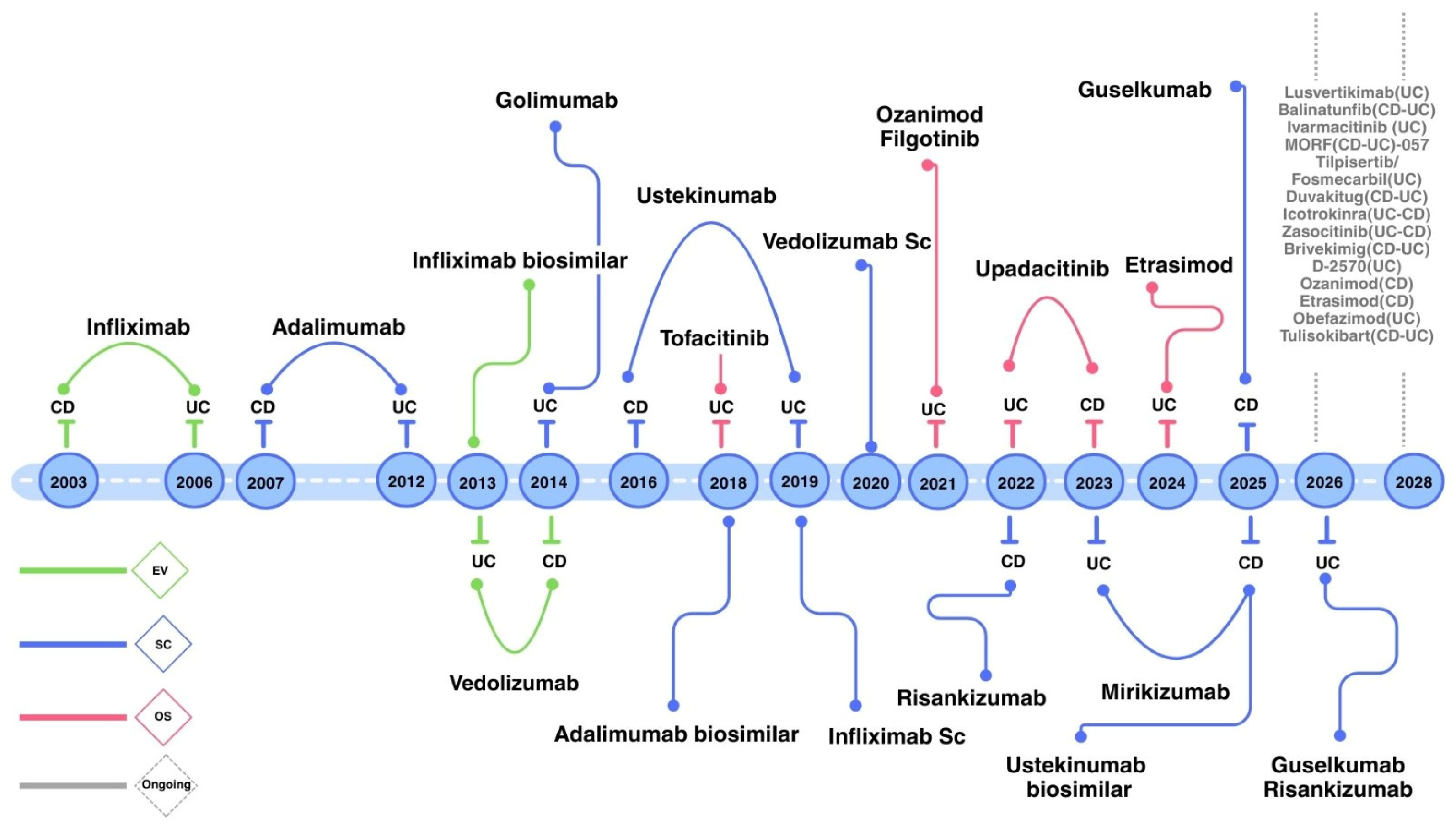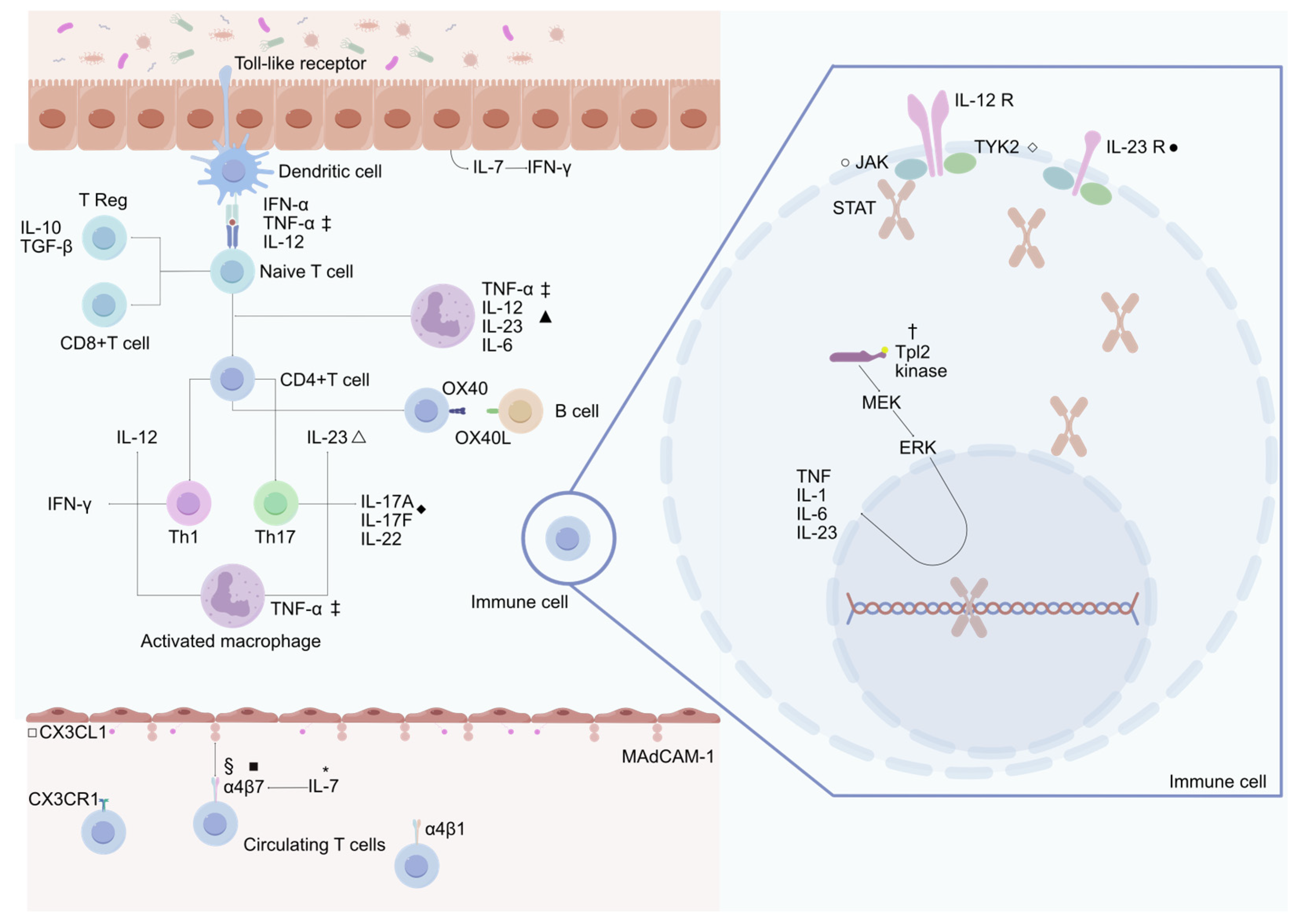
.png)

The Evolving Landscape of Advanced Therapies in Inflammatory Bowel Disease: Current Evidence and Emerging Targets

 , , , ,
Abstract
1. Introduction
2. Anti-TNF-α
2.1. Infliximab
2.1.1. Crohn’s Disease
Crohn’s Disease: Real-World Evidence
2.1.2. Ulcerative Colitis
Ulcerative Colitis: Real-World Evidence
2.2. Adalimumab
2.2.1. Crohn’s Disease
Crohn’s Disease: Real-World Evidence
2.2.2. Ulcerative Colitis
Ulcerative Colitis: Real-World Evidence
2.3. Golimumab
2.3.1. Ulcerative Colitis
Ulcerative Colitis: Real-World Evidence
3. Anti-Integrin
3.1. Vedolizumab
3.1.1. Crohn’s Disease
Crohn’s Disease: Real-World Evidence
3.1.2. Ulcerative Colitis
Ulcerative Colitis: Real-World Evidence
4. Anti-Interleukin
4.1. Ustekinumab
4.1.1. Crohn’s Disease
Crohn’s Disease: Real-World Evidence
4.1.2. Ulcerative Colitis
Ulcerative Colitis: Real-World Evidence
4.2. Risankizumab
4.2.1. Crohn’s Disease
Crohn’s Disease: Real-World Evidence
4.2.2. Ulcerative Colitis
4.3. Mirikizumab
4.3.1. Crohn’s Disease
4.3.2. Ulcerative Colitis
Ulcerative Colitis: Real-World Evidence
4.4. Guselkumab
4.4.1. Crohn’s Disease
4.4.2. Ulcerative Colitis
5. Janus Kinase Inhibitors
5.1. Tofacitinib
5.1.1. Ulcerative Colitis
Ulcerative Colitis: Real-World Evidence
5.2. Filgotinib
5.2.1. Ulcerative Colitis
Ulcerative Colitis: Real-World Evidence
5.3. Upadacitinib
5.3.1. Crohn’s Disease
Crohn’s Disease: Real-World Evidence
5.3.2. Ulcerative Colitis
Ulcerative Colitis: Real-World Evidence
6. Sphingosine-1-Phosphate Receptor Modulators
6.1. Ozanimod
6.1.1. Ulcerative Colitis
Ulcerative Colitis: Real-World Evidence
6.2. Etrasimod
6.2.1. Ulcerative Colitis

| Drug | Trial Publication | Trial Name | Randomization Type | Outcome | |||||||
|---|---|---|---|---|---|---|---|---|---|---|---|
| Steroid-Free Clinical Remission (Week) | Clinical Remission (Week) | Endoscopic Remission (Week) | Severe Adverse Events | ||||||||
| Intervention | Placebo | Intervention | Placebo | Intervention | Placebo | Intervention | Placebo | ||||
| Infliximab | May 2002 | ACCENT-1 [2] | Treat-through | n.a. | n.a. | 39% (5 mg) 45% (10 mg) (30) | 21% | n.a. | n.a. | 8% 6% | 7% |
| Adalimumab | February 2007 | CLASSIC-1 [11] | Induction biologic-naïve | n.a. | n.a. | 36% (6) | 12% (6) | n.a. | n.a. | 1% | 5% |
| September 2007 | CLASSIC-2 [12] | Re-randomized maintenance 56 weeks | 88% | 57% | 79% | 44% | n.a. | n.a. | 2% | 1% | |
| Vedolizumab | August 2013 | GEMINI-2 [36] | Induction biologic-naïve | n.a. | n.a. | 14.5% (6) | 6.8% (6) | n.a. | n.a. | n.a. | n.a. |
| GEMINI-2 [37] | Re-randomized maintenance 52 weeks | 31.7% q8w 28.8% qw4 | 15.9% | 39% q8w 36.4% q4w | 21.6% | n.a. | n.a. | 24.4% | 15.3% | ||
| Ustekinumab | November 2016 | UNITI-2 [58] | Induction biologic-naïve | n.a. | n.a. | 55.5 (6) | 28.7%(6) | n.a. | n.a. | 2.9% | 5.8% |
| IM-UNITI [58] | Re-randomized maintenance 44 weeks | 46.9 q8w 42.6 q12w | 29.8 | 53.1% q8w 48% q12w | 35.9 | n.a. | n.a. | 9.9% 12.1% | 15% | ||
| Risankizumab | May 2022 | ADVANCE [66] | Induction biologic/conventional-experienced 12 weeks | n.a. | n.a. | 600 mg: 45% 1200 mg: 42% | 25% | 600 mg: 24% 1200 mg: 24% | 9% | 600 mg: 6% 1200 mg: 5% | 10% |
| MOTIVATE [66] | Induction biologic-experienced 12 weeks | n.a. | n.a. | 600 mg: 42% 1200 mg: 40% | 20% (12) | 600 mg: 19% 1200 mg: 20% | 4% | 600 mg: 3% 1200 mg: 6% | 12% | ||
| May 2022 | FORTIFY [67] | Re-randomized maintenance 52 weeks | n.a. | n.a. | 180 mg:62% 360 mg: 59% | 49% | 180 mg: 47% 360 mg: 55% | 21% | 180 mg: 7% 360 mg: 12% | 13% | |
| Mirikizumab | January 2025 | VIVID-1 [72] | Treat-through 52 weeks | 43.7% | 18.6% | 37.7% (12) 54.1% | 25.1% (12) 19.6% | 10.9% (12) 15.9% (composite) | 4% (12) 2% (composite) | 9.2% | 15.2% |
| Guselkumab | March 2025 | GALAXI-2 [80] | Treat-through 48 weeks | 100 mg: 47% 200 mg: 51% | 9% | 47% (12) | 22% (12) | 100 mg: 27% 200 mg: 33% (48) | 3% | 200 mg: 7% 100 mg: 11% | 15% |
| GALAXI-3 [80] | Treat-through 48 weeks | 100 mg: 46% 200 mg: 45% | 13% | 47% (12) | 15% (12) | 100 mg: 24% 200 mg: 23% | 6% | ||||
| Upadacitinib | May 2023 | U-EXCEL [103] | Induction 12 weeks | 45 mg: 42.9% | 15.7% | 45 mg: 49.5 | 29.1% | 45 mg: 28.9% | 7.4% | 45 mg: 8.9% | 8.5% |
| U-EXCEED [103] | 45 mg: 34.3% | 11.7% | 45 mg: 38.9 | 21.1% | 45 mg: 19.1% | 2.3% | 45 mg:11.7% | 8.6% | |||
| U-ENDURE [104] | Re-randomized maintenance 52 weeks | 15 mg: 36.7% 30 mg: 46.4% | 14.5% | 15 mg: 37.3% 30 mg: 47.6% | 15.1% | 15 mg: 19.1% 30 mg: 28.6% | 5.5% | 15 mg: 25% 30 mg: 18.6% | 35.5% | ||
| Drug | Trial Publication | Trial Name | Randomization Type | Outcome | |||||||
|---|---|---|---|---|---|---|---|---|---|---|---|
| Steroid-Free Clinical Remission (Week) | Clinical Remission (Week) | Endoscopic Remission (Week) | Severe Adverse Events | ||||||||
| Intervention | Placebo | Intervention | Placebo | Intervention | Placebo | Intervention | Placebo | ||||
| Infliximab | December 2005 | ACT 1 [9] | Induction 8 weeks | n.a | n.a | 38.8% (5 mg) 32.0% (10 mg) | 14.9% | 62.0% (5 mg) 59.0% (10 mg) | 30.9% | n.a | n.a |
| Treat-through 54 weeks | n.a | n.a | 34.7% (5 mg) 34.4%(10 mg) | 16.5% | 45.5% (5 mg) 46.7%(10 mg) | 18.2% | 21.5% (5 mg) 23.8%(10 mg) | 25.6% | |||
| Adalimumab | February 2012 | ULTRA-1 [24] | Induction 8 weeks | n.a | n.a | 18,5% (160/80 mg) 10% (80/40 mg) (8) | 9.2% (8) | n.a | n.a | 7,6% | 4% |
| ULTRA-2 [25] | Treat-through 52 weeks | 13.6% | 6.2% | 17.3% (54) | 8.5% (54) | 25% (54) | 15.4% (54) | 4% | 5% | ||
| Golimumab | January 2014 | PURSUIT SC [29] | Induction 6 weeks | n.a | n.a | 17.9% | 6.4% | 45.1% | 28.7% | 6.1% | 3% |
| PURSUIT-M [30] | Re-randomized maintenance 52 weeks | 23.2% | 12.2% | 49.7% | 31.2% | 42.4% | 26.6% | 14.3% | 7.7% | ||
| Vedolizumab | August 2013 | GEMINI-1 [45] | Induction 6 weeks | n.a | n.a | 16.9% | 5.4% | 40.9% | 24.8% | n.a | n.a |
| Re-randomized maintenance 52 weeks | 31.4% q8w 45.2% q4w | 13.9% | 41.8% q8w 44.8% q4w | 15.9% | 51.6% q8w 56% q4w | 19.8% | 12.4% | 13.5% | |||
| Ustekinumab | September 2019 | UNIFI [57] | Induction 8 weeks | n.a | 15.6% (130 mg) 15.5%(~6 mg/kg) 15% | 5.3% | 20.3%/130 mg) 18.4%(~6 mg/kg | 8.9% | n.a | n.a | |
| Re-randomized maintenance 44 weeks | 37.8% q12w 42% q8w | 23.4% | 38.4% q12w 43.8%q8w | 24.0% | n.a | n.a | 12% q12w 11% q8w | 22% | |||
| Risankizumab | July 2024 | INSPIRE [70] | Induction | n.a | n.a | 20.3% (12) | 6.2%(12) | 10.6% (12) | 3.4% | 2.5% | 10.2% |
| COMMAND [70] | Re-randomized maintenance 52 weeks | 39.6% (180 mg) 37.1% (360 mg) | 25.1% | 40.2% (180 mg) 37.6% (360 mg) | 25.1% | 23.2% (180 mg) 24.3% (360 mg) | 14.8% | 1.6% 3.1% | 5.1% | ||
| Mirikizumab | October 2023 | LUCENT-1 [71] | Induction 12 weeks | n.a | 24.2% | 13.2% | 36.3% | 21.1% | 2.1% | 2.2% | |
| October 2023 | LUCENT-2 [71] | Re-randomized 40 weeks | 44.9% | 21.8% | 63.6% | 36.9% | 58.6% | 29.1% | 3.3% | 5.2% | |
| Guselkumab | September 2024 | QUASAR [82] | Induction 12 weeks | n.a | n.a | 23% | 8% | 15% | 5% | 2% | 7% |
| Re-randomized maintenance 52 weeks | 45% 100 mg 49% 200 mg | 18% | 61% 100 mg 72% 200 mg | 34% | 35% 100 mg 34% 200 mg | 15% | 3% 100 mg 6% 200 mg | 1% | |||
| Tofacitinib | May 2017 | OCTAVE induction 1 and 2 [84] | Induction 8 weeks | n.a | n.a | 18.5% | 8.2% | 31.3% | 15.6% | 3.4% | 4.1% |
| Induction 8 weeks | n.a | n.a | 16.6% | 3.6% | 28.4% | 11.6% | 4.2% | 8% | |||
| OCTAVE sustain [84] | Re-randomized maintenance 52 weeks | n.a | n.a | 5 mg: 34.3% 10 mg: 40.6% | 11.1% | 5 mg: 37.4% 10 mg: 45.7% | 13.1% | 5 mg: 5.1% 10 mg: 5.6% | 6.6% | ||
| Filgotinib | June 2021 | SELECTION Bio-naïve [97] | Induction 10 weeks | n.a | n.a | 100 mg: 19.1% 200 mg: 26.1% | 15.3% | 100 mg: 5.8% 200 mg: 12.2% | 3.6% | 100 mg: 5% 200 mg: 4% | 4.7% |
| SELECTION Bio-experienced [97] | Induction 10 weeks | n.a | n.a | 100 mg: 9.5% 200 mg: 11.5% | 4.2% | 100 mg: 2.1% 200 mg: 3.4% | 2.1% | ||||
| SELECTION maintenance [97] | Re-randomized maintenance 58 weeks | 100 mg: 13.6% 200 mg: 27.2% | 5.4% 6.4% | 100 mg: 23.8% 200 mg: 37.2% | 13.5% 11.2% | 100 mg: 13.4% 200 mg: 15.6% | 7.9% 6.1% | 100 mg: 4.5% 200 mg: 4.5% | 7.7% 0% | ||
| Upadacitinib | June 2022 | U-ACHIEVE Induction [110] | Induction 8 weeks | n.a | n.a | 26% | 5% | 14% | 1% | 6% | 3% |
| U-ACCOMPLISH Induction [111] | Induction 8 weeks | n.a | n.a | 33% | 4% | 18% | 2% | 5% | 3% | ||
| U-ACHIEVE maintenance [110] | Re-randomized maintenance 52 weeks | 15 mg: 57% 30 mg: 68% | 22% | 15 mg: 42% 30 mg: 52% | 12% | 15 mg: 24% 30 mg: 26% | 6% | 15 mg: 7% 30 mg: 6% | 13% | ||
| Ozanimod | October 2021 | TRUE NORTH [118] | Induction 10 weeks | n.a | n.a | 18.4% | 6% | 27.3% | 11.6% | 4%(chort1) 6.3%(chort2) | 3.2%(chort1) |
| Re-randomized maintenance 52 weeks | 31.7% | 16.7% | 37% | 18.5% | 45.7% | 26.4% | 5.2% | 7.9% | |||
| Etrasimod | March 2023 | ELEVATE UC [120] | Induction 12 weeks | n.a | n.a | 25% (12) | 15%(12) | 33 (12) | 19 (12) | 3% | 2% |
| ELEVATE UC [120] | Treat-through 52 weeks | 33% | 7% | 27% (12) 32% (52) | 7%(12) 7%(52) | 37%(12) 39%(52) | 17%(12) 13%(52) | 7% | 6% | ||
7. Head-to-Head Trials
8. Indirect Comparison—Network Meta-Analysis Evidence
8.1. Crohn’s Disease: Indirect Comparison—Network Meta-Analysis Evidence
8.2. Ulcerative Colitis: Indirect Comparison—Network Meta-Analysis Evidence
9. New Targets and Ongoing Trials
10. Advanced IBD Therapies: Current Status
11. Conclusions
Author Contributions
Funding
Institutional Review Board Statement
Informed Consent Statement
Data Availability Statement
Conflicts of Interest
Abbreviations
| IBD | Inflammatory bowel disease |
| CD | Crohn’s disease |
| UC | Ulcerative colitis |
| JAKi | Janus kinase inhibitors |
| S1P | Sphingosine-1-phosphate |
| TNF-α | Tumor necrosis factor-α |
| IFX | Infliximab |
| ADA | Adalimumab |
| VDZ | Vedolizumab |
| SC | Subcutaneus |
| IV | Intravenous |
| POR | Postoperative recurrence |
| UST | Ustekinumab |
| RISA | Risankizumab |
| MIRI | Mirikizumab |
| GUSE | Guselkumab |
| TOFA | Tofacitinib |
| DVT | Deep vein thrombosis |
| FIL | Filgotinib |
| SAEs | Serious adverse events |
| UPA | Upadacitinib |
| VTEs | Venous thromboembolic events |
| ASUC | Acute severe ulcerative colitis |
| OZA | Ozanimod |
| ETM | Etrasimod |
| NME | Network meta-analysis |
References
- van Dullemen, H.M.; van Deventer, S.J.H.; Hommes, D.W.; Bijl, H.A.; Jansen, J.; Tytgat, G.N.J.; Woody, J. Treatment of Crohn’s Disease with Anti-Tumor Necrosis Factor Chimeric Monoclonal Antibody (CA2). Gastroenterology 1995, 109, 129–135. [Google Scholar] [CrossRef]
- Hanauer, S.B.; Feagan, B.G.; Lichtenstein, G.R.; Mayer, L.F.; Schreiber, S.; Colombel, J.F.; Rachmilewitz, D.; Wolf, D.C.; Olson, A.; Bao, W.; et al. Maintenance Infliximab for Crohn’s Disease: The ACCENT I Randomised Trial. Lancet 2002, 359, 1541–1549. [Google Scholar] [CrossRef] [PubMed]
- Sands, B.E.; Anderson, F.H.; Bernstein, C.N.; Chey, W.Y.; Feagan, B.G.; Fedorak, R.N.; Kamm, M.A.; Korzenik, J.R.; Lashner, B.A.; Onken, J.E.; et al. Infliximab Maintenance Therapy for Fistulizing Crohn’s Disease. N. Engl. J. Med. 2004, 350, 876–885. [Google Scholar] [CrossRef] [PubMed]
- Lichtenstein, G.R.; Feagan, B.G.; Cohen, R.D.; Salzberg, B.A.; Safdi, M.; Popp, J.W.; Langholff, W.; Sandborn, W.J. Infliximab for Crohn’s Disease: More Than 13 Years of Real-World Experience. Inflamm. Bowel Dis. 2018, 24, 490–501. [Google Scholar] [CrossRef] [PubMed]
- Tursi, A.; Mocci, G.; Lorenzetti, R.; Allegretta, L.; Brandimarte, G.; Cassieri, C.; Colucci, R.; De Medici, A.; Faggiani, R.; Ferronato, A.; et al. Long-Term Real-Life Efficacy and Safety of Infliximab and Adalimumab in the Treatment of Inflammatory Bowel Diseases Outpatients. Eur. J. Gastroenterol. Hepatol. 2021, 33, 670–679. [Google Scholar] [CrossRef] [PubMed]
- Adamina, M.; Bonovas, S.; Raine, T.; Spinelli, A.; Warusavitarne, J.; Armuzzi, A.; Bachmann, O.; Bager, P.; Biancone, L.; Bokemeyer, B.; et al. ECCO Guidelines on Therapeutics in Crohn’s Disease: Surgical Treatment. J. Crohns Colitis 2020, 14, 155–168. [Google Scholar] [CrossRef] [PubMed]
- Regueiro, M.; Feagan, B.G.; Zou, B.; Johanns, J.; Blank, M.A.; Chevrier, M.; Plevy, S.; Popp, J.; Cornillie, F.J.; Lukas, M.; et al. Infliximab Reduces Endoscopic, but Not Clinical, Recurrence of Crohn’s Disease After Ileocolonic Resection. Gastroenterology 2016, 150, 1568–1578. [Google Scholar] [CrossRef] [PubMed]
- Singh, S.; Garg, S.K.; Pardi, D.S.; Wang, Z.; Murad, M.H.; Loftus, E.V. Comparative Efficacy of Pharmacologic Interventions in Preventing Relapse of Crohn’s Disease After Surgery: A Systematic Review and Network Meta-Analysis. Gastroenterology 2015, 148, 64–76.e2. [Google Scholar] [CrossRef]
- Rutgeerts, P.; Sandborn, W.J.; Feagan, B.G.; Reinisch, W.; Olson, A.; Johanns, J.; Travers, S.; Rachmilewitz, D.; Hanauer, S.B.; Lichtenstein, G.R.; et al. Infliximab for Induction and Maintenance Therapy for Ulcerative Colitis. N. Engl. J. Med. 2005, 353, 2462–2476, Correction in N. Engl. J. Med. 2006, 354, 2200.. [Google Scholar] [CrossRef]
- Huang, Z.; Tang, J.; Wu, R.; Long, S.; Chen, W.; Lu, T.; Xia, Q.; Wu, Y.; Yang, H.; Yang, Q.; et al. Comparison of Clinical and Endoscopic Efficacy between Vedolizumab and Infliximab in Bio-Naïve Patients with Ulcerative Colitis: A Multicenter, Real-World Study. Therap. Adv. Gastroenterol. 2024, 17, 17562848241281218. [Google Scholar] [CrossRef]
- Hanauer, S.B.; Sandborn, W.J.; Rutgeerts, P.; Fedorak, R.N.; Lukas, M.; MacIntosh, D.; Panaccione, R.; Wolf, D.; Pollack, P. Human Anti–Tumor Necrosis Factor Monoclonal Antibody (Adalimumab) in Crohn’s Disease: The CLASSIC-I Trial. Gastroenterology 2006, 130, 323–333. [Google Scholar] [CrossRef]
- Sandborn, W.J.; Hanauer, S.B.; Rutgeerts, P.; Fedorak, R.N.; Lukas, M.; MacIntosh, D.G.; Panaccione, R.; Wolf, D.; Kent, J.D.; Bittle, B.; et al. Adalimumab for Maintenance Treatment of Crohn’s Disease: Results of the CLASSIC II Trial. Gut 2007, 56, 1232–1239. [Google Scholar] [CrossRef]
- Sandborn, W.J.; Rutgeerts, P.; Enns, R.; Hanauer, S.B.; Colombel, J.-F.; Panaccione, R.; D’Haens, G.; Li, J.; Rosenfeld, M.R.; Kent, J.D.; et al. Adalimumab Induction Therapy for Crohn Disease Previously Treated with Infliximab. Ann. Intern. Med. 2007, 146, 829–838. [Google Scholar] [CrossRef]
- Colombel, J.; Sandborn, W.J.; Rutgeerts, P.; Enns, R.; Hanauer, S.B.; Panaccione, R.; Schreiber, S.; Byczkowski, D.; Li, J.; Kent, J.D.; et al. Adalimumab for Maintenance of Clinical Response and Remission in Patients with Crohn’s Disease: The CHARM Trial. Gastroenterology 2007, 132, 52–65. [Google Scholar] [CrossRef]
- Panaccione, R.; Colombel, J.-F.; Sandborn, W.J.; D’Haens, G.; Zhou, Q.; Pollack, P.F.; Thakkar, R.B.; Robinson, A.M. Adalimumab Maintains Remission of Crohn’s Disease after up to 4 Years of Treatment: Data from CHARM and ADHERE. Aliment. Pharmacol. Ther. 2013, 38, 1236–1247. [Google Scholar] [CrossRef]
- Loftus, E.V.; Reinisch, W.; Panaccione, R.; Berg, S.; Alperovich, G.; Bereswill, M.; Kalabic, J.; Petersson, J.; Thakkar, R.; Robinson, A.M.; et al. Adalimumab Effectiveness Up to Six Years in Adalimumab-Naïve Patients with Crohn’s Disease: Results of the PYRAMID Registry. Inflamm. Bowel Dis. 2019, 25, 1522–1531. [Google Scholar] [CrossRef]
- Peters, C.P.; Eshuis, E.J.; Toxopeüs, F.M.; Hellemons, M.E.; Jansen, J.M.; D’Haens, G.R.A.M.; Fockens, P.; Stokkers, P.C.F.; Tuynman, H.A.R.E.; van Bodegraven, A.A.; et al. Adalimumab for Crohn’s Disease: Long-Term Sustained Benefit in a Population-Based Cohort of 438 Patients. J. Crohns Colitis 2014, 8, 866–875. [Google Scholar] [CrossRef] [PubMed]
- Hisamatsu, T.; Suzuki, Y.; Kobayashi, M.; Hagiwara, T.; Kawaberi, T.; Ogata, H.; Matsui, T.; Watanabe, M.; Hibi, T. Long-Term Safety and Effectiveness of Adalimumab in Japanese Patients with Crohn’s Disease: 3-Year Results from a Real-World Study. Intest. Res. 2021, 19, 408–418. [Google Scholar] [CrossRef]
- Sartini, A.; Scaioli, E.; Liverani, E.; Bellanova, M.; Ricciardiello, L.; Bazzoli, F.; Belluzzi, A. Retention Rate, Persistence and Safety of Adalimumab in Inflammatory Bowel Disease: A Real-Life, 9-Year, Single-Center Experience in Italy. Dig. Dis. Sci. 2019, 64, 863–874. [Google Scholar] [CrossRef] [PubMed]
- De Cruz, P.; Kamm, M.A.; Hamilton, A.L.; Ritchie, K.J.; Krejany, E.O.; Gorelik, A.; Liew, D.; Prideaux, L.; Lawrance, I.C.; Andrews, J.M.; et al. Efficacy of Thiopurines and Adalimumab in Preventing Crohn’s Disease Recurrence in High-risk Patients—A POCER Study Analysis. Aliment. Pharmacol. Ther. 2015, 42, 867–879. [Google Scholar] [CrossRef] [PubMed]
- Savarino, E.; Bodini, G.; Dulbecco, P.; Assandri, L.; Bruzzone, L.; Mazza, F.; Frigo, A.C.; Fazio, V.; Marabotto, E.; Savarino, V. Adalimumab Is More Effective Than Azathioprine and Mesalamine at Preventing Postoperative Recurrence of Crohn’s Disease: A Randomized Controlled Trial. Am. J. Gastroenterol. 2013, 108, 1731–1742. [Google Scholar] [CrossRef]
- López-Sanromán, A.; Vera-Mendoza, I.; Domènech, E.; Taxonera, C.; Vega Ruiz, V.; Marín-Jiménez, I.; Guardiola, J.; Castro, L.; Esteve, M.; Iglesias, E.; et al. Adalimumab vs Azathioprine in the Prevention of Postoperative Crohn’s Disease Recurrence. A GETECCU Randomised Trial. J. Crohns Colitis 2017, 11, 1293–1301. [Google Scholar] [CrossRef]
- Cañete, F.; Mañosa, M.; Casanova, M.J.; González-Sueyro, R.C.; Barrio, J.; Bermejo, F.; Nos, P.; Iglesias-Flores, E.; García-Planella, E.; Pérez-Calle, J.L.; et al. Adalimumab or Infliximab for the Prevention of Early Postoperative Recurrence of Crohn Disease: Results From the ENEIDA Registry. Inflamm. Bowel Dis. 2019, 25, 1862–1870. [Google Scholar] [CrossRef]
- Reinisch, W.; Sandborn, W.J.; Hommes, D.W.; D’Haens, G.; Hanauer, S.; Schreiber, S.; Panaccione, R.; Fedorak, R.N.; Tighe, M.B.; Huang, B.; et al. Adalimumab for Induction of Clinical Remission in Moderately to Severely Active Ulcerative Colitis: Results of a Randomised Controlled Trial. Gut 2011, 60, 780–787. [Google Scholar] [CrossRef]
- Sandborn, W.J.; van Assche, G.; Reinisch, W.; Colombel, J.; D’Haens, G.; Wolf, D.C.; Kron, M.; Tighe, M.B.; Lazar, A.; Thakkar, R.B. Adalimumab Induces and Maintains Clinical Remission in Patients with Moderate-to-Severe Ulcerative Colitis. Gastroenterology 2012, 142, 257–265.e3. [Google Scholar] [CrossRef] [PubMed]
- Ogata, H.; Hagiwara, T.; Kawaberi, T.; Kobayashi, M.; Hibi, T. Safety and Effectiveness of Adalimumab in the Treatment of Ulcerative Colitis: Results from a Large-Scale, Prospective, Multicenter, Observational Study. Intest. Res. 2021, 19, 419–429. [Google Scholar] [CrossRef] [PubMed]
- Vitello, A.; Grova, M.; Pugliese, D.; Rizzello, F.; Lanzarotto, F.; Lavagna, A.; Caccaro, R.; Cappello, M.; Viola, A.; Ribaldone, D.G.; et al. Effectiveness of Adalimumab for Ulcerative Colitis: A Multicentre, Retrospective Study of Clinical Practice in Italy. Dig. Liver Dis. 2022, 54, 352–357. [Google Scholar] [CrossRef]
- Bessissow, T.; Nguyen, G.C.; Tarabain, O.; Peyrin-Biroulet, L.; Foucault, N.; McHugh, K.; Ruel, J. Impact of Adalimumab on Disease Burden in Moderate-to-Severe Ulcerative Colitis Patients: The One-Year, Real-World UCanADA Study. World J. Gastroenterol. 2022, 28, 5058–5075. [Google Scholar] [CrossRef]
- Sandborn, W.J.; Feagan, B.G.; Marano, C.; Zhang, H.; Strauss, R.; Johanns, J.; Adedokun, O.J.; Guzzo, C.; Colombel, J.-F.; Reinisch, W.; et al. Subcutaneous Golimumab Induces Clinical Response and Remission in Patients with Moderate-to-Severe Ulcerative Colitis. Gastroenterology 2014, 146, 85–95. [Google Scholar] [CrossRef]
- Sandborn, W.J.; Feagan, B.G.; Marano, C.; Zhang, H.; Strauss, R.; Johanns, J.; Adedokun, O.J.; Guzzo, C.; Colombel, J.; Reinisch, W.; et al. Subcutaneous Golimumab Maintains Clinical Response in Patients with Moderate-to-Severe Ulcerative Colitis. Gastroenterology 2014, 146, 96–109.e1. [Google Scholar] [CrossRef] [PubMed]
- Tursi, A.; Mocci, G.; Elisei, W.; Allegretta, L.; Colucci, R.; Della Valle, N.; De Medici, A.; Faggiani, R.; Ferronato, A.; Forti, G.; et al. Long-Term, Real-Life, Observational Study in Treating Outpatient Ulcerative Colitis with Golimumab. J. Gastrointest. Liver Dis. 2021, 30, 456–461. [Google Scholar] [CrossRef] [PubMed]
- Bressler, B.; Williamson, M.; Sattin, B.; Camacho, F.; Steinhart, A.H. Real World Effectiveness of Golimumab Therapy in Ulcerative Colitis Regardless of Prior TNF Exposure. J. Can. Assoc. Gastroenterol. 2018, 1, 129–134. [Google Scholar] [CrossRef] [PubMed]
- Teich, N.; Grümmer, H.; Jörgensen, E.; Liceni, T.; Holtkamp-Endemann, F.; Fischer, T.; Hohenberger, S. Golimumab in Real-World Practice in Patients with Ulcerative Colitis: Twelve-Month Results. World J. Gastroenterol. 2020, 26, 2852–2863. [Google Scholar] [CrossRef]
- Battat, R.; Dulai, P.S.; Jairath, V.; Vande Casteele, N. A Product Review of Vedolizumab in Inflammatory Bowel Disease. Hum. Vaccin. Immunother. 2019, 15, 2482–2490. [Google Scholar] [CrossRef]
- Loftus, E.V.; Feagan, B.G.; Panaccione, R.; Colombel, J.; Sandborn, W.J.; Sands, B.E.; Danese, S.; D’Haens, G.; Rubin, D.T.; Shafran, I.; et al. Long-term Safety of Vedolizumab for Inflammatory Bowel Disease. Aliment. Pharmacol. Ther. 2020, 52, 1353–1365. [Google Scholar] [CrossRef]
- Sandborn, W.J.; Feagan, B.G.; Rutgeerts, P.; Hanauer, S.; Colombel, J.-F.; Sands, B.E.; Lukas, M.; Fedorak, R.N.; Lee, S.; Bressler, B.; et al. Vedolizumab as Induction and Maintenance Therapy for Crohn’s Disease. N. Engl. J. Med. 2013, 369, 711–721. [Google Scholar] [CrossRef]
- Sands, B.E.; Feagan, B.G.; Rutgeerts, P.; Colombel, J.-F.; Sandborn, W.J.; Sy, R.; D’Haens, G.; Ben-Horin, S.; Xu, J.; Rosario, M.; et al. Effects of Vedolizumab Induction Therapy for Patients with Crohn’s Disease in Whom Tumor Necrosis Factor Antagonist Treatment Failed. Gastroenterology 2014, 147, 618–627.e3. [Google Scholar] [CrossRef]
- Vermeire, S.; D’Haens, G.; Baert, F.; Danese, S.; Kobayashi, T.; Loftus, E.V.; Bhatia, S.; Agboton, C.; Rosario, M.; Chen, C.; et al. Efficacy and Safety of Subcutaneous Vedolizumab in Patients with Moderately to Severely Active Crohn’s Disease: Results From the VISIBLE 2 Randomised Trial. J. Crohns Colitis 2022, 16, 27–38. [Google Scholar] [CrossRef]
- Dulai, P.S.; Singh, S.; Jiang, X.; Peerani, F.; Narula, N.; Chaudrey, K.; Whitehead, D.; Hudesman, D.; Lukin, D.; Swaminath, A.; et al. The Real-World Effectiveness and Safety of Vedolizumab for Moderate–Severe Crohn’s Disease: Results From the US VICTORY Consortium. Am. J. Gastroenterol. 2016, 111, 1147–1155. [Google Scholar] [CrossRef]
- Bokemeyer, B.; Plachta-Danielzik, S.; di Giuseppe, R.; Efken, P.; Mohl, W.; Hoffstadt, M.; Krause, T.; Schweitzer, A.; Schnoy, E.; Atreya, R.; et al. Real-World Effectiveness of Vedolizumab vs Anti-TNF in Biologic-Naïve Crohn’s Disease Patients: A 2-Year Propensity-Score-Adjusted Analysis from the VEDOIBD-Study. Inflamm. Bowel Dis. 2024, 30, 746–756. [Google Scholar] [CrossRef] [PubMed]
- Bressler, B.; Yarur, A.; Silverberg, M.S.; Bassel, M.; Bellaguarda, E.; Fourment, C.; Gatopoulou, A.; Karatzas, P.; Kopylov, U.; Michalopoulos, G.; et al. Vedolizumab and Anti-Tumour Necrosis Factor α Real-World Outcomes in Biologic-Naïve Inflammatory Bowel Disease Patients: Results from the EVOLVE Study. J. Crohns Colitis 2021, 15, 1694–1706. [Google Scholar] [CrossRef]
- Lamichhane, N.; Melas, N.; Bergqvist, V.; Ekholm, N.-P.; Olén, O.; Ludvigsson, J.F.; Hjortswang, H.; Marsal, J.; Eriksson, C.; Halfvarson, J. Real-World Outcomes of Patients Starting Intravenous and Transitioning to Subcutaneous Vedolizumab in Inflammatory Bowel Disease. Dig. Dis. Sci. 2024, 69, 2175–2183. [Google Scholar] [CrossRef]
- Frieri, G.; Valvano, M.; Frassino, S.; Faenza, S.; Cesaro, N.; Amicucci, G.; Manetta, R.; Viscido, A.; Latella, G. Prophylactic Treatment with Vedolizumab in the Prevention of Postoperative Recurrence (POR) in High-Risk Crohn’s Patients. J. Clin. Med. 2023, 12, 3130. [Google Scholar] [CrossRef] [PubMed]
- D’Haens, G.; Taxonera, C.; Lopez-Sanroman, A.; Nos, P.; Danese, S.; Armuzzi, A.; Roblin, X.; Peyrin-Biroulet, L.; West, R.; Mares, W.G.N.; et al. Vedolizumab to Prevent Postoperative Recurrence of Crohn’s Disease (REPREVIO): A Multicentre, Double-Blind, Randomised, Placebo-Controlled Trial. Lancet Gastroenterol. Hepatol. 2025, 10, 26–33. [Google Scholar] [CrossRef]
- Sandborn, W.J.; Baert, F.; Danese, S.; Krznarić, Ž.; Kobayashi, T.; Yao, X.; Chen, J.; Rosario, M.; Bhatia, S.; Kisfalvi, K.; et al. Efficacy and Safety of Vedolizumab Subcutaneous Formulation in a Randomized Trial of Patients with Ulcerative Colitis. Gastroenterology 2020, 158, 562–572.e12, Correction in Gastroenterology 2025, 169, 390. [Google Scholar] [CrossRef]
- Feagan, B.G.; Rutgeerts, P.; Sands, B.E.; Hanauer, S.; Colombel, J.-F.; Sandborn, W.J.; Van Assche, G.; Axler, J.; Kim, H.-J.; Danese, S.; et al. Vedolizumab as Induction and Maintenance Therapy for Ulcerative Colitis. N. Engl. J. Med. 2013, 369, 699–710. [Google Scholar] [CrossRef] [PubMed]
- Engel, T.; Ungar, B.; Yung, D.E.; Ben-Horin, S.; Eliakim, R.; Kopylov, U. Vedolizumab in IBD–Lessons From Real-World Experience; A Systematic Review and Pooled Analysis. J. Crohns Colitis 2018, 12, 245–257. [Google Scholar] [CrossRef] [PubMed]
- Pulusu, S.S.R.; Srinivasan, A.; Krishnaprasad, K.; Cheng, D.; Begun, J.; Keung, C.; Van Langenberg, D.; Thin, L.; Mogilevski, T.; De Cruz, P.; et al. Vedolizumab for Ulcerative Colitis: Real World Outcomes from a Multicenter Observational Cohort of Australia and Oxford. World J. Gastroenterol. 2020, 26, 4428–4441. [Google Scholar] [CrossRef]
- Eriksson, C.; Marsal, J.; Bergemalm, D.; Vigren, L.; Björk, J.; Eberhardson, M.; Karling, P.; Söderman, C.; Myrelid, P.; Cao, Y.; et al. Long-Term Effectiveness of Vedolizumab in Inflammatory Bowel Disease: A National Study Based on the Swedish National Quality Registry for Inflammatory Bowel Disease (SWIBREG). Scand. J. Gastroenterol. 2017, 52, 722–729. [Google Scholar] [CrossRef]
- Macaluso, F.S.; Fries, W.; Renna, S.; Viola, A.; Muscianisi, M.; Cappello, M.; Guida, L.; Siringo, S.; Camilleri, S.; Garufi, S.; et al. Effectiveness and Safety of Vedolizumab in Biologically Naïve Patients: A Real-world Multi-centre Study. United Eur. Gastroenterol. J. 2020, 8, 1045–1055. [Google Scholar] [CrossRef]
- Biemans, V.B.C.; van der Woude, C.J.; Dijkstra, G.; van der Meulen-de Jong, A.E.; Oldenburg, B.; de Boer, N.K.; Löwenberg, M.; Srivastava, N.; Bodelier, A.G.L.; West, R.L.; et al. Vedolizumab for Inflammatory Bowel Disease: Two-Year Results of the Initiative on Crohn and Colitis (ICC) Registry, A Nationwide Prospective Observational Cohort Study. Clin. Pharmacol. Ther. 2020, 107, 1189–1199. [Google Scholar] [CrossRef] [PubMed]
- Tursi, A.; Mocci, G.; Faggiani, R.; Allegretta, L.; Della Valle, N.; de Medici, A.; Forti, G.; Franceschi, M.; Ferronato, A.; Gallina, S.; et al. Vedolizumab Is Effective and Safe in Real-Life Treatment of Inflammatory Bowel Diseases Outpatients: A Multicenter, Observational Study in Primary Inflammatory Bowel Disease Centers. Eur. J. Intern. Med. 2019, 66, 85–91. [Google Scholar] [CrossRef]
- Plevris, N.; Chuah, C.S.; Allen, R.M.; Arnott, I.D.; Brennan, P.N.; Chaudhary, S.; Churchhouse, A.M.D.; Din, S.; Donoghue, E.; Gaya, D.R.; et al. Real-World Effectiveness and Safety of Vedolizumab for the Treatment of Inflammatory Bowel Disease: The Scottish Vedolizumab Cohort. J. Crohns Colitis 2019, 13, 1111–1120. [Google Scholar] [CrossRef]
- Mocci, G.; Tursi, A.; Maconi, G.; Cataletti, G.; Mantia, B.; Serio, M.; Scarcelli, A.; Pagnini, C.; Graziani, M.G.; Di Paolo, M.C.; et al. Real-World Efficacy and Safety of Vedolizumab in Managing Ulcerative Colitis versus Crohn’s Disease: Results from an Italian Multicenter Study. Expert Opin. Biol. Ther. 2023, 23, 293–304. [Google Scholar] [CrossRef]
- D’Amico, F.; Massimino, L.; Palmieri, G.; Dal Buono, A.; Gabbiadini, R.; Caron, B.; Moreira, P.; Silva, I.; Bosca-Watts, M.; Innocenti, T.; et al. An International Multicentre Study of SwiTching from Intravenous to Subcutaneous inflixiMab and vEdolizumab in Inflammatory Bowel Diseases: The TIME Study. Eur. J. Clin. Investig. 2024, 54, e14283. [Google Scholar] [CrossRef]
- Sands, B.E.; Sandborn, W.J.; Panaccione, R.; O’Brien, C.D.; Zhang, H.; Johanns, J.; Adedokun, O.J.; Li, K.; Peyrin-Biroulet, L.; Van Assche, G.; et al. Ustekinumab as Induction and Maintenance Therapy for Ulcerative Colitis. N. Engl. J. Med. 2019, 381, 1201–1214. [Google Scholar] [CrossRef]
- Feagan, B.G.; Sandborn, W.J.; Gasink, C.; Jacobstein, D.; Lang, Y.; Friedman, J.R.; Blank, M.A.; Johanns, J.; Gao, L.-L.; Miao, Y.; et al. Ustekinumab as Induction and Maintenance Therapy for Crohn’s Disease. N. Engl. J. Med. 2016, 375, 1946–1960. [Google Scholar] [CrossRef]
- Tursi, A.; Mocci, G.; Cuomo, A.; Allegretta, L.; Aragona, G.; Colucci, R.; Della Valle, N.; Ferronato, A.; Forti, G.; Gaiani, F.; et al. Real-Life Efficacy and Safety of Ustekinumab as Second- or Third-Line Therapy in Crohn’s Disease: Results from a Large Italian Cohort Study. Eur. Rev. Med. Pharmacol. Sci. 2021, 25, 2099–2108. [Google Scholar] [CrossRef] [PubMed]
- Mocci, G.; Tursi, A.; Scaldaferri, F.; Napolitano, D.; Pugliese, D.; Capobianco, I.; Bartocci, B.; Blasi, V.; Savarino, E.V.; Maniero, D.; et al. Long-Term Effectiveness and Safety of Ustekinumab in Crohn’s Disease: Results from a Large Real-Life Cohort Study. J. Clin. Med. 2024, 13, 7192. [Google Scholar] [CrossRef]
- Thomas, P.W.A.; van Caem, M.; West, R.L.; Russel, M.G.V.M.; Jansen, J.M.; Römkens, T.E.H.; Hoentjen, F. Long-Term Effectiveness and Safety of Ustekinumab in Crohn’s Disease: A Prospective Cohort Study. Eur. J. Gastroenterol. Hepatol. 2023, 35, 261–269. [Google Scholar] [CrossRef] [PubMed]
- Forss, A.; Clements, M.; Myrelid, P.; Strid, H.; Söderman, C.; Wagner, A.; Andersson, D.; Hjelm, F.; Olén, O.; Halfvarson, J.; et al. Ustekinumab Is Associated with Real-World Long-Term Effectiveness and Improved Health-Related Quality of Life in Crohn’s Disease. Dig. Dis. Sci. 2023, 68, 65–76. [Google Scholar] [CrossRef]
- Hong, S.J.; Krugliak Cleveland, N.; Akiyama, S.; Zullow, S.; Yi, Y.; Shaffer, S.R.; Malter, L.B.; Axelrad, J.E.; Chang, S.; Hudesman, D.P.; et al. Real-World Effectiveness and Safety of Ustekinumab for Ulcerative Colitis From 2 Tertiary IBD Centers in the United States. Crohns Colitis 360 2021, 3, otab002. [Google Scholar] [CrossRef]
- Iborra, M.; Ferreiro-Iglesias, R.; Maria Dolores, M.-A.; Mesonero Gismero, F.; Mínguez, A.; Porto-Silva, S.; García-Ramírez, L.; García de la Filia, I.; Aguas, M.; Nieto-García, L.; et al. Real-World Long-Term Effectiveness of Ustekinumab in Ulcerative Colitis: Results from a Spanish Open-Label Cohort. Scand. J. Gastroenterol. 2024, 59, 260–268. [Google Scholar] [CrossRef]
- McKeage, K.; Duggan, S. Risankizumab: First Global Approval. Drugs 2019, 79, 893–900. [Google Scholar] [CrossRef]
- D’Haens, G.; Panaccione, R.; Baert, F.; Bossuyt, P.; Colombel, J.-F.; Danese, S.; Dubinsky, M.; Feagan, B.G.; Hisamatsu, T.; Lim, A.; et al. Risankizumab as Induction Therapy for Crohn’s Disease: Results from the Phase 3 ADVANCE and MOTIVATE Induction Trials. Lancet 2022, 399, 2015–2030. [Google Scholar] [CrossRef]
- Ferrante, M.; Panaccione, R.; Baert, F.; Bossuyt, P.; Colombel, J.-F.; Danese, S.; Dubinsky, M.; Feagan, B.G.; Hisamatsu, T.; Lim, A.; et al. Risankizumab as Maintenance Therapy for Moderately to Severely Active Crohn’s Disease: Results from the Multicentre, Randomised, Double-Blind, Placebo-Controlled, Withdrawal Phase 3 FORTIFY Maintenance Trial. Lancet 2022, 399, 2031–2046. [Google Scholar] [CrossRef]
- Fumery, M.; Caron, B.; Hébuterne, X.; Altwegg, R.; Roblin, X.; Stefanescu, C.; Meyer, A.; Nachury, M.; Laharie, D.; Le Berre, C.; et al. Long-Term Outcome of Risankizumab in Crohn’s Disease: A Real-World GETAID Study. Clin. Gastroenterol. Hepatol. 2024, 22, 2451–2458.e1. [Google Scholar] [CrossRef]
- Johnson, A.M.; Askar, M.; Belani, S.; Khan, A.; Xu, A.A.; Kassmeyer, B.; Said, H.; Santiago-Castro, M.; Devi, J.; Huang, K.; et al. A Multicenter Study of the Real-World Effectiveness and Safety of Risankizumab in Crohn’s Disease. J. Crohns Colitis 2025, 19, jjaf070. [Google Scholar] [CrossRef] [PubMed]
- Louis, E.; Schreiber, S.; Panaccione, R.; Bossuyt, P.; Biedermann, L.; Colombel, J.-F.; Parkes, G.; Peyrin-Biroulet, L.; D’Haens, G.; Hisamatsu, T.; et al. Risankizumab for Ulcerative Colitis. JAMA 2024, 332, 881, Correction in JAMA 2024, 332, 1676.. [Google Scholar] [CrossRef] [PubMed]
- D’Haens, G.; Dubinsky, M.; Kobayashi, T.; Irving, P.M.; Howaldt, S.; Pokrotnieks, J.; Krueger, K.; Laskowski, J.; Li, X.; Lissoos, T.; et al. Mirikizumab as Induction and Maintenance Therapy for Ulcerative Colitis. N. Engl. J. Med. 2023, 388, 2444–2455, Correction in N. Engl. J. Med. 2023, 389, 772.. [Google Scholar] [CrossRef] [PubMed]
- Ferrante, M.; D’Haens, G.; Jairath, V.; Danese, S.; Chen, M.; Ghosh, S.; Hisamatsu, T.; Kierkus, J.; Siegmund, B.; Bragg, S.M.; et al. Efficacy and Safety of Mirikizumab in Patients with Moderately-to-Severely Active Crohn’s Disease: A Phase 3, Multicentre, Randomised, Double-Blind, Placebo-Controlled and Active-Controlled, Treat-through Study. Lancet 2024, 404, 2423–2436, Correction in Lancet 2025, 405, 1230.. [Google Scholar] [CrossRef]
- Sands, B.E.; D’Haens, G.; Clemow, D.B.; Irving, P.M.; Johns, J.T.; Hunter Gibble, T.; Abreu, M.T.; Lee, S.; Hisamatsu, T.; Kobayashi, T.; et al. Two-Year Efficacy and Safety of Mirikizumab Following 104 Weeks of Continuous Treatment for Ulcerative Colitis: Results From the LUCENT-3 Open-Label Extension Study. Inflamm. Bowel Dis. 2024, 30, 2245–2258. [Google Scholar] [CrossRef]
- St-Pierre, J.; Choi, D.; Fear, E.; Choi, N.K.; Mathew, A.J.; Cohen, R.D.; Dalal, S.R.; Pekow, J.; Krugliak Cleveland, N.; Rubin, D.T. Mirikizumab in the Treatment of Ulcerative Colitis: Initial Real-World Data in a Population from a Large Tertiary Center. Dig. Dis. Sci. 2025, 70, 1864–1872. [Google Scholar] [CrossRef]
- Takagi, Y.; Sato, T.; Nishiguchi, T.; Nogami, A.; Igeta, M.; Yagi, S.; Ikenouchi, M.; Kawai, M.; Kamikozuru, K.; Yokoyama, Y.; et al. Real-World Effectiveness and Safety of Mirikizumab Induction Therapy in Patients with Ulcerative Colitis: A Multicentre Retrospective Observational Study. Aliment. Pharmacol. Ther. 2025, 61, 1923–1934. [Google Scholar] [CrossRef]
- Bubna, A.K.; Viplav, V. Guselkumab—In Psoriasis and Beyond. Dermatol. Pract. Concept. 2024, 14, e2024181. [Google Scholar] [CrossRef]
- Kerut, C.K.; Wagner, M.J.; Daniel, C.P.; Fisher, C.; Henderson, E.J.; Burroughs, C.R.; Amarasinghe, S.; Willett, O.; Ahmadzadeh, S.; Varrassi, G.; et al. Guselkumab, a Novel Monoclonal Antibody Inhibitor of the P19 Subunit of IL-23, for Psoriatic Arthritis and Plaque Psoriasis: A Review of Its Mechanism, Use, and Clinical Effectiveness. Cureus 2023, 15, e51405. [Google Scholar] [CrossRef] [PubMed]
- Sachen, K.L.; Hammaker, D.; Sarabia, I.; Stoveken, B.; Hartman, J.; Leppard, K.L.; Manieri, N.A.; Bao, P.; Greving, C.; Lacy, E.R.; et al. Guselkumab Binding to CD64+ IL-23–Producing Myeloid Cells Enhances Potency for Neutralizing IL-23 Signaling. Front. Immunol. 2025, 16, 1532852. [Google Scholar] [CrossRef]
- Sandborn, W.J.; D’Haens, G.R.; Reinisch, W.; Panés, J.; Chan, D.; Gonzalez, S.; Weisel, K.; Germinaro, M.; Frustaci, M.E.; Yang, Z.; et al. Guselkumab for the Treatment of Crohn’s Disease: Induction Results From the Phase 2 GALAXI-1 Study. Gastroenterology 2022, 162, 1650–1664.e8. [Google Scholar] [CrossRef] [PubMed]
- Panaccione, R.; Feagan, B.G.; Afzali, A.; Rubin, D.T.; Reinisch, W.; Panés, J.; Danese, S.; Hisamatsu, T.; Terry, N.A.; Salese, L.; et al. Efficacy and Safety of Intravenous Induction and Subcutaneous Maintenance Therapy with Guselkumab for Patients with Crohn’s Disease (GALAXI-2 and GALAXI-3): 48-Week Results from Two Phase 3, Randomised, Placebo and Active Comparator-Controlled, Double-Blind, Triple-Dummy Trials. Lancet 2025, 406, 358–375. [Google Scholar] [CrossRef] [PubMed]
- Hart, A.; Panaccione, R.; Steinwurz, F.; Danese, S.; Hisamatsu, T.; Cao, Q.; Ritter, T.; Seidler, U.; Olurinde, M.; Vetter, M.L.; et al. Efficacy and Safety of Guselkumab Subcutaneous Induction and Maintenance in Participants with Moderately to Severely Active Crohn’s Disease: Results From the Phase 3 GRAVITI Study. Gastroenterology 2025, 169, 308–325. [Google Scholar] [CrossRef]
- Rubin, D.T.; Allegretti, J.R.; Panés, J.; Shipitofsky, N.; Yarandi, S.S.; Huang, K.-H.G.; Germinaro, M.; Wilson, R.; Zhang, H.; Johanns, J.; et al. Guselkumab in Patients with Moderately to Severely Active Ulcerative Colitis (QUASAR): Phase 3 Double-Blind, Randomised, Placebo-Controlled Induction and Maintenance Studies. Lancet 2025, 405, 33–49, Correction in Lancet 2026, 407, 678.. [Google Scholar] [CrossRef]
- Lichtenstein, G.R.; Allegretti, J.R.; Rubin, D.T.; Feagan, B.G.; Bressler, B.; Panés, J.; Afif, W.; Samaan, M.; Ye, B.D.; Yarandi, S.; et al. Su1856: Efficacy and safety of guselkumab for ulcerative colitis through week 92 of the quasar long-term extension study. Gastroenterology 2025, 169, S-861. [Google Scholar] [CrossRef]
- Sandborn, W.J.; Su, C.; Sands, B.E.; D’Haens, G.R.; Vermeire, S.; Schreiber, S.; Danese, S.; Feagan, B.G.; Reinisch, W.; Niezychowski, W.; et al. Tofacitinib as Induction and Maintenance Therapy for Ulcerative Colitis. N. Engl. J. Med. 2017, 376, 1723–1736. [Google Scholar] [CrossRef]
- Lin, C.-H.; Liu, W.-S.; Wan, C.; Wang, H.-H. Effectiveness of Tofacitinib in Patients with Ulcerative Colitis: An Updated Systematic Review and Meta-Analysis of Real-World Studies. BMJ Open Gastroenterol. 2024, 11, e001347. [Google Scholar] [CrossRef] [PubMed]
- Carvalhas Gabrielli, A.M.; Ferretti, F.; Monico, C.M.; Tombetti, E.; Maconi, G.; Romeo, S.; Piazza O Sed, N.; Caprioli, F.; Mazzola, A.M.; Alicante, S.; et al. Effect of Tofacitinib on One-Year Colectomy Risk in Anti-TNF Refractory Ulcerative Colitis: A Prospective Multicenter Italian Study. Dig. Dis. Sci. 2024, 69, 1785–1792. [Google Scholar] [CrossRef]
- Weisshof, R.; Aharoni Golan, M.; Sossenheimer, P.H.; El Jurdi, K.; Ollech, J.E.; Pekow, J.; Cohen, R.D.; Sakuraba, A.; Dalal, S.; Rubin, D.T. Real-World Experience with Tofacitinib in IBD at a Tertiary Center. Dig. Dis. Sci. 2019, 64, 1945–1951. [Google Scholar] [CrossRef]
- Shimizu, H.; Aonuma, Y.; Hibiya, S.; Kawamoto, A.; Takenaka, K.; Fujii, T.; Saito, E.; Nagahori, M.; Ohtsuka, K.; Okamoto, R. Long-Term Efficacy and Safety of Tofacitinib in Patients with Ulcerative Colitis: 3-Year Results from a Real-World Study. Intest. Res. 2024, 22, 369–377. [Google Scholar] [CrossRef] [PubMed]
- Hernández Martínez, A.; Navajas Hernández, P.; Rodríguez, M.d.M.M.; Lázaro Sáez, M.; Olmedo Martín, R.; Núñez Ortiz, A.; Argüelles Arias, F.; Cano, M.d.C.F.; Gallardo Sánchez, F.; Marín Pedrosa, S.; et al. Efficacy and Safety of Tofacitinib in the Treatment of Ulcerative Colitis: Real-Life Experience in Andalusia. Rev. Española De Enfermedades Dig. 2022, 114, 516–521. [Google Scholar] [CrossRef]
- Shin, S.H.; Oh, K.; Hong, S.N.; Lee, J.; Oh, S.J.; Kim, E.S.; Na, S.-Y.; Kang, S.-B.; Koh, S.-J.; Bang, K.B.; et al. Real-Life Effectiveness and Safety of Tofacitinib Treatment in Patients with Ulcerative Colitis: A KASID Multicenter Cohort Study. Therap. Adv. Gastroenterol. 2023, 16, 17562848231154103. [Google Scholar] [CrossRef] [PubMed]
- Ma, C.; Panaccione, R.; Xiao, Y.; Khandelwal, Y.; Murthy, S.K.; Wong, E.C.L.; Narula, N.; Tsai, C.; Peerani, F.; Reise-Filteau, M.; et al. REMIT-UC: Real-World Effectiveness and Safety of Tofacitinib for Moderate-to-Severely Active Ulcerative Colitis. Am. J. Gastroenterol. 2023, 118, 861–871. [Google Scholar] [CrossRef]
- Chaparro, M.; Acosta, D.; Rodríguez, C.; Mesonero, F.; Vicuña, M.; Barreiro-de Acosta, M.; Fernández-Clotet, A.; Hernández Martínez, Á.; Arroyo, M.; Vera, I.; et al. Real-World Evidence of Tofacinitib in Ulcerative Colitis: Short-Term and Long-Term Effectiveness and Safety. Am. J. Gastroenterol. 2023, 118, 1237–1247. [Google Scholar] [CrossRef]
- Taxonera, C.; Olivares, D.; Alba, C. Real-World Effectiveness and Safety of Tofacitinib in Patients with Ulcerative Colitis: Systematic Review with Meta-Analysis. Inflamm. Bowel Dis. 2022, 28, 32–40. [Google Scholar] [CrossRef] [PubMed]
- Bernardi, F.; Faggiani, I.; Parigi, T.L.; Zilli, A.; Allocca, M.; Furfaro, F.; Peyrin-Biroulet, L.; Danese, S.; D’Amico, F. JAK Inhibitors and Risk of Cancer in IBD Patients. Cancers 2025, 17, 1795. [Google Scholar] [CrossRef]
- Deepak, P.; Alayo, Q.A.; Khatiwada, A.; Lin, B.; Fenster, M.; Dimopoulos, C.; Bader, G.; Weisshof, R.; Jacobs, M.; Gutierrez, A.; et al. Safety of Tofacitinib in a Real-World Cohort of Patients with Ulcerative Colitis. Clin. Gastroenterol. Hepatol. 2021, 19, 1592–1601.e3. [Google Scholar] [CrossRef]
- Feagan, B.G.; Danese, S.; Loftus, E.V.; Vermeire, S.; Schreiber, S.; Ritter, T.; Fogel, R.; Mehta, R.; Nijhawan, S.; Kempiński, R.; et al. Filgotinib as Induction and Maintenance Therapy for Ulcerative Colitis (SELECTION): A Phase 2b/3 Double-Blind, Randomised, Placebo-Controlled Trial. Lancet 2021, 397, 2372–2384. [Google Scholar] [CrossRef]
- Feagan, B.G.; Matsuoka, K.; Rogler, G.; Laharie, D.; Vermeire, S.; Danese, S.; Loftus, E.V.; Beales, I.; Schreiber, S.; Kim, H.J.; et al. Long-term Safety and Efficacy of Filgotinib for the Treatment of Moderately to Severely Active Ulcerative Colitis: Interim Analysis from up to 4 Years of Follow-up in the SELECTION Open-label Long-term Extension Study. Aliment. Pharmacol. Ther. 2024, 60, 563–584. [Google Scholar] [CrossRef]
- Akiyama, S.; Yokoyama, K.; Yagi, S.; Shinzaki, S.; Tsuruta, K.; Yoshioka, S.; Sako, M.; Shimizu, H.; Kobayashi, M.; Sakurai, T.; et al. Efficacy and Safety of Filgotinib for Ulcerative Colitis: A Real-world Multicenter Retrospective Study in Japan. Aliment. Pharmacol. Ther. 2024, 59, 1413–1424. [Google Scholar] [CrossRef]
- Gros, B.; Goodall, M.; Plevris, N.; Constantine-Cooke, N.; Elford, A.T.; O’Hare, C.; Noble, C.; Jones, G.-R.; Arnott, I.D.; Lees, C.W. Real-World Cohort Study on the Effectiveness and Safety of Filgotinib Use in Ulcerative Colitis. J. Crohns Colitis 2025, 19, jjad187. [Google Scholar] [CrossRef]
- Toba, T.; Karashima, R.; Fujii, K.; Inoue, K.; Inoue, N.; Ogawa, Y.; Hojo, A.; Fujimoto, A.; Matsuda, T. Real-World Data on the Effectiveness and Safety of Filgotinib for Ulcerative Colitis in Japanese Patients: A Single-Center Experience. Cureus 2024, 16, e61496. [Google Scholar] [CrossRef] [PubMed]
- Nogami, A.; Asonuma, K.; Okabayashi, S.; Ikenouchi, M.; Matsuda, T.; Shinzaki, S.; Fukata, M.; Kobayashi, T. Real-World Comparative Effectiveness and Safety of Filgotinib and Upadacitinib for Ulcerative Colitis: A Multicentre Cohort Study. United Eur. Gastroenterol. J. 2024, 12, 1357–1366. [Google Scholar] [CrossRef] [PubMed]
- Ikenouchi, M.; Fukui, H.; Yagi, S.; Nogami, A.; Kaku, K.; Sato, T.; Kawai, M.; Kamikozuru, K.; Yokoyama, Y.; Takagawa, T.; et al. Propensity Score-Matched Real-World Comparative Treatment Outcomes of Janus Kinase Inhibitors for Ulcerative Colitis in Patients with and without Prior Exposure to Anti-Tumor Necrosis Factor α Antibody. Intest. Res. 2025, 23, 464–474. [Google Scholar] [CrossRef]
- Loftus, E.V.; Panés, J.; Lacerda, A.P.; Peyrin-Biroulet, L.; D’Haens, G.; Panaccione, R.; Reinisch, W.; Louis, E.; Chen, M.; Nakase, H.; et al. Upadacitinib Induction and Maintenance Therapy for Crohn’s Disease. N. Engl. J. Med. 2023, 388, 1966–1980. [Google Scholar] [CrossRef]
- Loftus, J.E.V.; D’Haens, G.; Louis, E.; Regueiro, M.; Jairath, V.; Magro, F.; Nakase, H.; Dubcenco, E.; Lacerda, A.P.; Ford, S.; et al. Efficacy and Safety of Upadacitinib Maintenance Therapy in Patients with Moderately to Severely Active Crohn’s Disease: 2-Year Results from the U-ENDURE Long-Term Extension Study. J. Crohns Colitis 2025, 19, jjaf138. [Google Scholar] [CrossRef]
- Colombel, J.-F.; Lacerda, A.P.; Irving, P.M.; Panaccione, R.; Reinisch, W.; Rieder, F.; Steinlauf, A.; Schwartz, D.; Feng, T.; Dubcenco, E.; et al. Efficacy and Safety of Upadacitinib for Perianal Fistulizing Crohn’s Disease: A Post Hoc Analysis of 3 Phase 3 Trials. Clin. Gastroenterol. Hepatol. 2025, 23, 1019–1029. [Google Scholar] [CrossRef] [PubMed]
- Devi, J.; Xu, A.; Stone, M.; Patel, A.; Khan, A.; Reddy, N.; Klein, J.; Chowla, N.; Benson, C.; Luu, B.C.; et al. Real-World Effectiveness and Safety of Upadacitinib in Crohn’s Disease: A Multicenter Study. Clin. Gastroenterol. Hepatol. 2025, 23, 2281–2291.e4. [Google Scholar] [CrossRef] [PubMed]
- Richard, N.; Amiot, A.; Seksik, P.; Altwegg, R.; Laharie, D.; Vuitton, L.; Nachury, M.; Bouguen, G.; Nancey, S.; Gilletta, C.; et al. Effectiveness and Safety of Upadacitinib Induction Therapy for 223 Patients with Crohn’s Disease: A GETAID Multicentre Cohort Study. Aliment. Pharmacol. Ther. 2025, 61, 1662–1670. [Google Scholar] [CrossRef]
- Farkas, B.; Bessissow, T.; Limdi, J.K.; Sethi-Arora, K.; Kagramanova, A.; Knyazev, O.; Bezzio, C.; Armuzzi, A.; Lukas, M.; Michalopoulos, G.; et al. Real-World Effectiveness and Safety of Selective JAK Inhibitors in Ulcerative Colitis and Crohn’s Disease: A Retrospective, Multicentre Study. J. Clin. Med. 2024, 13, 7804. [Google Scholar] [CrossRef] [PubMed]
- Honap, S.; Temido, M.J.; Shakweh, E.; Badrulhisham, F.; Shields, N.; Mehta, S.; McBride, J.; Uzzan, M.; Lukáš, M.; Fumery, M.; et al. Janus Kinase (JAK) Inhibitor-Induced Acne in Inflammatory Bowel Disease: An International, Multicenter, Retrospective Cohort Study. Clin. Gastroenterol. Hepatol. 2025, 24, 484–492.e7. [Google Scholar] [CrossRef]
- Danese, S.; Vermeire, S.; Zhou, W.; Pangan, A.L.; Siffledeen, J.; Greenbloom, S.; Hébuterne, X.; D’Haens, G.; Nakase, H.; Panés, J.; et al. Upadacitinib as Induction and Maintenance Therapy for Moderately to Severely Active Ulcerative Colitis: Results from Three Phase 3, Multicentre, Double-Blind, Randomised Trials. Lancet 2022, 399, 2113–2128, Correction in Lancet 2022, 400, 996.. [Google Scholar] [CrossRef]
- Vermeire, S.; Danese, S.; Zhou, W.; Ilo, D.; Klaff, J.; Levy, G.; Yao, X.; Chen, S.; Sanchez Gonzalez, Y.; Hébuterne, X.; et al. Efficacy and Safety of Upadacitinib Maintenance Therapy for Moderately to Severely Active Ulcerative Colitis in Patients Responding to 8 Week Induction Therapy (U-ACHIEVE Maintenance): Overall Results from the Randomised, Placebo-Controlled, Double-Blind, Phase 3 Maintenance Study. Lancet Gastroenterol. Hepatol. 2023, 8, 976–989. [Google Scholar] [CrossRef]
- Panaccione, R.; Vermeire, S.; Danese, S.; Higgins, P.D.R.; Lichtenstein, G.R.; Nakase, H.; Glover, S.; Colombel, J.-F.; Eccleston, J.; Kujawski, M.; et al. Long-Term Efficacy and Safety of Upadacitinib in Patients with Moderately to Severely Active Ulcerative Colitis: An Interim Analysis of the Phase 3 U-ACTIVATE Long-Term Extension Study. Lancet Gastroenterol. Hepatol. 2025, 10, 507–519. [Google Scholar] [CrossRef]
- Wu, H.; Xie, T.; Yu, Q.; Su, T.; Zhang, M.; Wu, L.; Wang, X.; Peng, X.; Zhi, M.; Yao, J. An Analysis of the Effectiveness and Safety of Upadacitinib in the Treatment of Inflammatory Bowel Disease: A Multicenter Real-World Study. Biomedicines 2025, 13, 190. [Google Scholar] [CrossRef]
- García, M.J.; Brenes, Y.; Vicuña, M.; Bermejo, F.; Sierra-Ausín, M.; Vicente, R.; Arroyo, M.T.; Martínez Montiel, P.; Villoria, A.; Ferrer, J.Á.; et al. Persistence, Effectiveness, and Safety of Upadacitinib in Crohn’s Disease and Ulcerative Colitis in Real Life: Results From a Spanish Nationwide Study (Ureal Study). Am. J. Gastroenterol. 2025, 120, 1593–1604. [Google Scholar] [CrossRef] [PubMed]
- Honap, S.; St-Pierre, J.; Colwill, M.; Patel, K.; Le Berre, C.; Caron, B.; Nogami, A.; Kobayashi, T.; Altwegg, R.; Laharie, D.; et al. Comparative Effectiveness of Tofacitinib versus Upadacitinib for the Treatment of Acute Severe Ulcerative Colitis. Clin. Gastroenterol. Hepatol. 2025. [Google Scholar] [CrossRef]
- Akiyama, S.; Shimizu, H.; Tamura, A.; Yokoyama, K.; Sakurai, T.; Kobayashi, M.; Eizuka, M.; Yanai, S.; Nomura, K.; Shibuya, T.; et al. Comparative Efficacy and Safety of Three Janus Kinase Inhibitors in Ulcerative Colitis: A Real-World Multicentre Study in Japan. Aliment. Pharmacol. Ther. 2025, 61, 524–537. [Google Scholar] [CrossRef]
- Yagi, S.; Fukui, H.; Ikenouchi, M.; Shiraishi, T.; Kaku, K.; Wakita, M.; Takagi, Y.; Sato, T.; Kawai, M.; Kamikozuru, K.; et al. Continuous Treatment with Tofacitinib but Not Filgotinib is Effective in Non-Responders with Active Ulcerative Colitis: A Propensity Score-Matching Analysis. J. Clin. Med. 2025, 14, 217. [Google Scholar] [CrossRef] [PubMed]
- Sandborn, W.J.; Feagan, B.G.; D’Haens, G.; Wolf, D.C.; Jovanovic, I.; Hanauer, S.B.; Ghosh, S.; Petersen, A.; Hua, S.Y.; Lee, J.H.; et al. Ozanimod as Induction and Maintenance Therapy for Ulcerative Colitis. N. Engl. J. Med. 2021, 385, 1280–1291. [Google Scholar] [CrossRef]
- Cohen, N.A.; Choi, D.; Garcia, N.; Choi, N.K.; Picker, E.; Krugliak Cleveland, N.; Cohen, R.D.; Dalal, S.R.; Pekow, J.; Rubin, D.T. Real World Clinical Effectiveness and Safety of Ozanimod in the Treatment of Ulcerative Colitis: 1-Year Follow-Up from a Tertiary Center. Dig. Dis. Sci. 2024, 69, 579–587. [Google Scholar] [CrossRef]
- Sandborn, W.J.; Vermeire, S.; Peyrin-Biroulet, L.; Dubinsky, M.C.; Panes, J.; Yarur, A.; Ritter, T.; Baert, F.; Schreiber, S.; Sloan, S.; et al. Etrasimod as Induction and Maintenance Therapy for Ulcerative Colitis (ELEVATE): Two Randomised, Double-Blind, Placebo-Controlled, Phase 3 Studies. Lancet 2023, 401, 1159–1171. [Google Scholar] [CrossRef]
- Chkolnaia, Z.; Peyrin-Biroulet, L.; Uzzan, M. A Descriptive Comparison of Phase 3 Results and Head-to-Head Trials in Inflammatory Bowel Diseases. J. Crohns Colitis 2026, jjag009. [Google Scholar] [CrossRef]
- Sands, B.E.; Peyrin-Biroulet, L.; Loftus, E.V.; Danese, S.; Colombel, J.-F.; Törüner, M.; Jonaitis, L.; Abhyankar, B.; Chen, J.; Rogers, R.; et al. Vedolizumab versus Adalimumab for Moderate-to-Severe Ulcerative Colitis. N. Engl. J. Med. 2019, 381, 1215–1226. [Google Scholar] [CrossRef]
- O’Connor, D.B.; Lahiff, C. Vedolizumab versus Adalimumab for Moderate-to-Severe Ulcerative Colitis. N. Engl. J. Med. 2020, 382, 92–94. [Google Scholar] [CrossRef]
- Rubin, D.T.; Ananthakrishnan, A.N.; Siegel, C.A.; Sauer, B.G.; Long, M.D. ACG Clinical Guideline: Ulcerative Colitis in Adults. Am. J. Gastroenterol. 2019, 114, 384–413. [Google Scholar] [CrossRef] [PubMed]
- Gemayel, N.C.; Rizzello, E.; Atanasov, P.; Wirth, D.; Borsi, A. Dose Escalation and Switching of Biologics in Ulcerative Colitis: A Systematic Literature Review in Real-World Evidence. Curr. Med. Res. Opin. 2019, 35, 1911–1923. [Google Scholar] [CrossRef] [PubMed]
- Sands, B.E.; Irving, P.M.; Hoops, T.; Izanec, J.L.; Gao, L.-L.; Gasink, C.; Greenspan, A.; Allez, M.; Danese, S.; Hanauer, S.B.; et al. Ustekinumab versus Adalimumab for Induction and Maintenance Therapy in Biologic-Naive Patients with Moderately to Severely Active Crohn’s Disease: A Multicentre, Randomised, Double-Blind, Parallel-Group, Phase 3b Trial. Lancet 2022, 399, 2200–2211. [Google Scholar] [CrossRef] [PubMed]
- Peyrin-Biroulet, L.; Chapman, J.C.; Colombel, J.-F.; Caprioli, F.; D’Haens, G.; Ferrante, M.; Schreiber, S.; Atreya, R.; Danese, S.; Lindsay, J.O.; et al. Risankizumab versus Ustekinumab for Moderate-to-Severe Crohn’s Disease. N. Engl. J. Med. 2024, 391, 213–223. [Google Scholar] [CrossRef]
- Singh, S.; Murad, M.H.; Fumery, M.; Sedano, R.; Jairath, V.; Panaccione, R.; Sandborn, W.J.; Ma, C. Comparative Efficacy and Safety of Biologic Therapies for Moderate-to-Severe Crohn’s Disease: A Systematic Review and Network Meta-Analysis. Lancet Gastroenterol. Hepatol. 2021, 6, 1002–1014. [Google Scholar] [CrossRef]
- Peyrin-Biroulet, L.; Arkkila, P.; Armuzzi, A.; Danese, S.; Guardiola, J.; Jahnsen, J.; Lees, C.; Louis, E.; Lukáš, M.; Reinisch, W.; et al. Comparative Efficacy and Safety of Infliximab and Vedolizumab Therapy in Patients with Inflammatory Bowel Disease: A Systematic Review and Meta-Analysis. BMC Gastroenterol. 2022, 22, 291. [Google Scholar] [CrossRef]
- Cholapranee, A.; Hazlewood, G.S.; Kaplan, G.G.; Peyrin-Biroulet, L.; Ananthakrishnan, A.N. Systematic Review with Meta-analysis: Comparative Efficacy of Biologics for Induction and Maintenance of Mucosal Healing in Crohn’s Disease and Ulcerative Colitis Controlled Trials. Aliment. Pharmacol. Ther. 2017, 45, 1291–1302. [Google Scholar] [CrossRef]
- Vuyyuru, S.K.; Nguyen, T.M.; Murad, M.H.; Narula, N.; Bessissow, T.; Zou, G.; McCurdy, J.D.; Peyrin-Biroulet, L.; Danese, S.; Ma, C.; et al. Comparative Efficacy of Advanced Therapies for Achieving Endoscopic Outcomes in Crohn’s Disease: A Systematic Review and Network Meta-Analysis. Clin. Gastroenterol. Hepatol. 2024, 22, 1190–1199.e15. [Google Scholar] [CrossRef]
- Chu, X.; Biao, Y.; Liu, C.; Zhang, Y.; Liu, C.; Ma, J.; Guo, Y.; Gu, Y. Network Meta-Analysis on Efficacy and Safety of Different Biologics for Ulcerative Colitis. BMC Gastroenterol. 2023, 23, 346. [Google Scholar] [CrossRef]
- Trigo-Vicente, C.; Gimeno-Ballester, V.; García-López, S.; López-Del Val, A. Systematic Review and Network Meta-Analysis of Treatment for Moderate-to-Severe Ulcerative Colitis. Int. J. Clin. Pharm. 2018, 40, 1411–1419. [Google Scholar] [CrossRef]
- Bourreille, A.; Kierkus, J.; Corallo, F.; Reinish, W. OP36 Lusvertikimab, a First-in-Class IL7 Receptor Antagonist, in Moderate to Severe Ulcerative Colitis: Results of a Multicenter, Randomized, Placebo-Controlled Phase II Study. J. Crohns Colitis 2025, 19, i71–i72. [Google Scholar] [CrossRef]
- Stein Gold, L.; Eyerich, K.; Merola, J.F.; Torres, J.; Coates, L.C.; Allegretti, J.R. Oral Peptide Therapeutics as an Emerging Treatment Modality in Immune-Mediated Inflammatory Diseases: A Narrative Review. Adv. Ther. 2025, 42, 3158–3172. [Google Scholar] [CrossRef] [PubMed]
- Jairath, V.; Siegmund, B.; Surace, L.; Erondu, N.; Chen, M.; Chachu, K.; Louis, E.; Matsuoka, K.; Limdi, J.; Arthur, E.; et al. S1449 Efficacy and Safety of Icotrokinra, a Targeted Oral Peptide That Selectively Blocks IL-23 Receptor Activation, in Ulcerative Colitis: Results From Week 28 of ANTHEM-UC, a Phase 2b Dose-Ranging Trial. Am. J. Gastroenterol. 2025, 120, S312. [Google Scholar] [CrossRef]
- Reinisch, W.; Štěpek, D.; Kempinski, R.; Danese, S.; Sands, B.; Ratiu-Duma, B.; Singh, R.; Barkay, H.; Raphael, G.; Jairath, V. Duvakitug, an Anti-TL1a mAb, Demonstrates Efficacy and Favorable Safety as an Induction Treatment in Adults With Moderately to Severely Active Ulcerative Colitis: Results From the RELIEVE UCCD Phase 2b Basket Trial. Am J. Gastroenterol. 2025, 120, S403. [Google Scholar] [CrossRef]
- Jenkinson, P.W.; Plevris, N.; Siakavellas, S.; Lyons, M.; Arnott, I.D.; Wilson, D.; Watson, A.J.M.; Jones, G.-R.; Lees, C.W. Temporal Trends in Surgical Resection Rates and Biologic Prescribing in Crohn’s Disease: A Population-Based Cohort Study. J. Crohns Colitis 2020, 14, 1241–1247. [Google Scholar] [CrossRef]
- Ingravalle, F.; Valvano, M.; Barbara, A.; Bardhi, D.; Latella, G.; Viscido, A.; Campanale, M.; Vinci, A.; Viora, C.; Bulfone, G.; et al. Inflammatory Bowel Disease in the Post-STRIDE II Era: Epidemiology and Long-Term Clinical Outcomes from a Population-Based Study. Med. Sci. 2025, 13, 55. [Google Scholar] [CrossRef] [PubMed]
- Valvano, M.; Vinci, A.; Cesaro, N.; Frassino, S.; Ingravalle, F.; Ameli, M.; Viscido, A.; Necozione, S.; Latella, G. The Long-Term Effect on Surgery-Free Survival of Biological Compared to Conventional Therapy in Crohn’s Disease in Real World-Data: A Retrospective Study. BMC Gastroenterol. 2023, 23, 438. [Google Scholar] [CrossRef]
- Murthy, S.K.; Begum, J.; Benchimol, E.I.; Bernstein, C.N.; Kaplan, G.G.; McCurdy, J.D.; Singh, H.; Targownik, L.; Taljaard, M. Introduction of Anti-TNF Therapy Has Not Yielded Expected Declines in Hospitalisation and Intestinal Resection Rates in Inflammatory Bowel Diseases: A Population-Based Interrupted Time Series Study. Gut 2020, 69, 274–282. [Google Scholar] [CrossRef]
- Altieri, G.; Zilli, A.; Parigi, T.L.; Allocca, M.; Furfaro, F.; Fiorino, G.; Cicerone, C.; Peyrin-Biroulet, L.; Danese, S.; D’Amico, F. Dual Therapy in Inflammatory Bowel Disease. Biomolecules 2025, 15, 222. [Google Scholar] [CrossRef] [PubMed]
- Triantafillidis, J.K.; Zografos, C.G.; Konstadoulakis, M.M.; Papalois, A.E. Combination Treatment of Inflammatory Bowel Disease: Present Status and Future Perspectives. World J. Gastroenterol. 2024, 30, 2068–2080. [Google Scholar] [CrossRef] [PubMed]


| Molecules | Year | Mechanism of Action | Trial (Disease) | RCT Number—Phase | Status |
|---|---|---|---|---|---|
| IMU-838 (Vidofludimus Calcium) | 2017 | Dihydroorotate dehydrogenase inhibitor | CALDOSE | NCT03341962 | Discontinued (unpublished data) |
| TD-1473 (Izencitinib) | 2018 | Pan-JAK inhibitor | DIONE (CD) | NCT03635112 | Discontinued |
| BI-655130 (Spesolimab) | 2018 | Full humanized antibody vs. IL-36 receptors | (UC) | NCT03482635 | Discontinued |
| UTTR1147A (efmarodocokin alfa) | 2018–2022 | Recombinant fusion protein vs. IL-22 | (CD and UC) | NCT03558152 | Discontinued |
| GS-4875 (Tilpisertib) | 2019- | Small-molecule inhibitor TPL2 | (UC) | NCT04130919 | Discontinued |
| Hemay007 | 2019 | Small-molecule inhibitor TNF-α | (UC) | NCT03977480 | Discontinued |
| DIMS0150 (Cobitolimod) | 2021–2023 | Oligonucleotide TLR9 agonist | CONDUCT (UC) COLLECT (UC) | -II NCT04985968—III | Discontinued |
| CU104 | 2023 | Blockers of endothelial/vascular dysfunction | (UC) | NCT05907330—II | Not yet recruiting |
| SHP-647 (Ontamalimab) | 2017–2024 | IgG2 monoclonal antibody vs. MAdCAM-1 | TURANDOT (UC) FIGARO (UC) OPERA (CD) CARMEN (CD) | NCT01620255—II NCT03290781—III NCT01298492—II NCT03627091—III | Discontinued |
| OSE-127 (Lusvertikimab) | 2021–2025 | Humanized monoclonal antibody vs. IL-7 | CoTikiS (UC) | NCT04882007—II | Ongoing |
| GS-5290 (Tilpisertib Fosmecarbil) | 2023 | Small-molecule kinase inhibitor | PALEKONA (UC) | NCT06029972—II | Ongoing |
| MK-724 (Tulisokibart) | 2023–2025 | Humanized monoclonal antibody vs. TNF-like ligand 1A | ATLAS (UC) ARES (CD) | NCT06052059—III NCT06430801—III NCT06651281—extension | Ongoing |
| SAR441566 (balinatunfib) | 2024 | Small-molecule inhibitor TNF-α | SPECIFI-CD SPECIFI-UC SPECIFI-IBD-LTS (CD and UC) | NCT06637631—II NCT06867094 NCT07222189—II | Ongoing |
| MORF-057 | 2024 | Small-molecule inhibitor α4β7 inhibitor | GARNET (CD) EMERALD-2 (UC) | NCT06226883—II NCT05291689—II | Ongoing |
| SHR0302 (Ivarmacitinib) | 2018–2025 | JAK 1 inhibitor | (UC) (UC) | NCT03677648—II NCT05181137—III | Ongoing |
| E6011 (Quetmolimab) | 2019–2025 | Humanized antibody vs. CX3CL1 (blocking leukocyte trafficking) | CD | NCT03733314 | Under investigation |
| AJM 300 (Carotegrast Methyl) | 2022 | Small molecules against α4β1 and α4β7 anti-integrin | UC | NCT03531892—III NCT06897150 -IV | Approved in Japan (Carogra) |
| SAR441344 (Duvakitug) | 2025 | Anti-tumor necrosis factor-like ligand | UC CD | NCT07185009—III NCT07184996 NCT07184944—III NCT07184931 | Ongoing |
| JNJ-77242113 (Icotrokinra) | 2025 | Oral peptide against IL-23R | ICONIC (UC) ICONIC (CD) | NCT07196748-III NCT07196722—II/III | Ongoing |
| TAK-279 (Zasocitinib) | 2025 | Allosteric inhibitor of tyrosine kinase 2 | CD and UC | NCT06764615—II | Ongoing |
| SAR442970 (Brivekimig) | 2025 | Nanobody (VHH) against TNF-α and OX40L | CHROMA (CD) COLOR (UC) | NCT06958536—II NCT06975722—II | Ongoing |
| D-2570 | 2025 | Small-molecule inhibitor tyrosine kinase 2 | UC | NCT07035041 | Ongoing |
Disclaimer/Publisher’s Note: The statements, opinions and data contained in all publications are solely those of the individual author(s) and contributor(s) and not of MDPI and/or the editor(s). MDPI and/or the editor(s) disclaim responsibility for any injury to people or property resulting from any ideas, methods, instructions or products referred to in the content. |
© 2026 by the authors. Licensee MDPI, Basel, Switzerland. This article is an open access article distributed under the terms and conditions of the Creative Commons Attribution (CC BY) license.
Share and Cite
Balducci, D.; Mosca, M.; Monaco, S.; Faenza, S.; Fabiani, S.; Cortellini, F.; Cesaro, N.; Stefanelli, G.; Paba, S.; Pecchini, M.; et al. The Evolving Landscape of Advanced Therapies in Inflammatory Bowel Disease: Current Evidence and Emerging Targets. Gastrointest. Disord. 2026, 8, 13. https://doi.org/10.3390/gidisord8010013
Balducci D, Mosca M, Monaco S, Faenza S, Fabiani S, Cortellini F, Cesaro N, Stefanelli G, Paba S, Pecchini M, et al. The Evolving Landscape of Advanced Therapies in Inflammatory Bowel Disease: Current Evidence and Emerging Targets. Gastrointestinal Disorders. 2026; 8(1):13. https://doi.org/10.3390/gidisord8010013
Chicago/Turabian StyleBalducci, Daniele, Marta Mosca, Sabrina Monaco, Susanna Faenza, Stefano Fabiani, Fabio Cortellini, Nicola Cesaro, Gianpiero Stefanelli, Salvatore Paba, Maddalena Pecchini, and et al. 2026. "The Evolving Landscape of Advanced Therapies in Inflammatory Bowel Disease: Current Evidence and Emerging Targets" Gastrointestinal Disorders 8, no. 1: 13. https://doi.org/10.3390/gidisord8010013
APA StyleBalducci, D., Mosca, M., Monaco, S., Faenza, S., Fabiani, S., Cortellini, F., Cesaro, N., Stefanelli, G., Paba, S., Pecchini, M., Montori, M., & Valvano, M. (2026). The Evolving Landscape of Advanced Therapies in Inflammatory Bowel Disease: Current Evidence and Emerging Targets. Gastrointestinal Disorders, 8(1), 13. https://doi.org/10.3390/gidisord8010013