Article

Impact of Mo Substrate Roughness on the Stability and Properties of Diamond Films for Aerospace Applications


by
Luciano Velardi
1,*,
Grazia Cicala
2,
Antonio Della Torre
1,
Luca Nunzio Francioso
1 and
Maria Assunta Signore
1
1
Institute for Microelectronics and Microsystems, CNR-IMM, Via Monteroni, 73100 Lecce, Italy
2
Institute for Plasma Science and Technology, CNR-ISTP, Via Amendola, 70126 Bari, Italy
*
Author to whom correspondence should be addressed.
Surfaces 2025, 8(4), 85; https://doi.org/10.3390/surfaces8040085
Submission received: 22 September 2025 / Revised: 18 November 2025 / Accepted: 20 November 2025 / Published: 26 November 2025
(This article belongs to the Special Issue Surface Engineering of Thin Films)

Abstract

This study deals with diamond films grown via the microwave plasma-enhanced chemical vapor deposition technique (MWPECVD) on molybdenum (Mo) substrates of different roughness. This work is motivated by the necessity of overcoming the poor adhesion of diamond films on smooth Mo substrates, to ensure their effective application as cathodes for aerospace propulsion. The deposition process was monitored in situ using pyrometric interferometry (PI), thus enabling the real-time monitoring of both the rate and the temperature of deposition. The characterization of the obtained diamond films was performed using different techniques, such as Raman spectroscopy, X-ray diffraction (XRD), and scanning electron microscopy (SEM). The poor adhesion of diamond films on Mo substrates was solved by roughening their surface, which promotes residual stress reduction in the diamond films. In this work, the PI technique was also exploited to support the prediction of the adhesion and stability of diamond films before their exposure in air through the monitoring of the deposition temperature. This represents a novel point of our work that has never been discussed in other research papers, as pyrometric interferometry is generally mainly used to assess the rate and the temperature of deposition.

1. Introduction

The superior chemical–physical properties of diamond, such as high chemical inertness, high mechanical hardness, high radiation hardness, good thermal conductivity, and a high secondary electron emission coefficient, make it one of the most investigated materials in the field of materials research. In particular, the chemical inertness allows it to operate under harsh external conditions. Diamond is also a wide band gap semiconductor (5.47 eV) and is, thus, implemented in UV sensors [1,2]. In addition, it is a good electron emitter due to its low electron affinity (0.35–0.5 eV), making it attractive for photocathode production, especially in nanocrystalline structures [3,4,5,6].
Since the synthesis of diamond films is generally carried out using chemical vapor deposition (CVD) techniques, such as hot filament CVD (HFCVD) [7] and microwave plasma-enhanced CVD (MWPECVD) [2,4,8], working at high deposition temperatures (≥600 °C), the employed substrates must be compatible with the growth of diamond. The role of the substrate in diamond film growth is crucial, because it affects many properties of diamond, like its structure, microstructure, morphology, and adhesion. This is the reason why the choice of substrate for diamond deposition must fulfil certain requirements [9]. First, it must be resistant to high temperatures and have thermal expansion coefficients or lattice constants close to those of diamond. Second, it must be able to form carbides as an intermediate layer with high surface free energies that are relatively close to the surface free energy of diamond [10,11,12,13,14]. Refractory metals (Mo, W, Ta), as well as silicon, form stable carbides in the presence of carbon or hydrocarbons due to their high stability and the low carbon solubility of these metals. For example, W forms W2C at 920–970 °C, Mo forms Mo2C at 700–770 °C [10], and SiC is the predominant form of the intermediate layer when using silicon as a substrate. The carbon surface diffusion on the substrate is mainly important for diamond’s nucleation [9]. For example, Ta and W have shown very low carbon diffusion into the substrate, making the growth of diamond [9] difficult, while high nucleation rates are observed with Nb and Mo substrates [9]. In addition, the carbon diffusion coefficient, together with the substrate temperature and the carbon concentration, influence the relatively slow carbide layer growth rate, providing a very thin-layer thickness of the order of 10 nm, as reported by some authors for the SiC intermediate layer when diamond is deposited on a silicon substrate using the MWPECVD technique [11,12,13]. Carbide layers play an important role in the mechanical and structural properties of the grown diamond film (sp2/sp3 carbon content, grain size, orientation of growth), thus modifying the microhardness and corrosion resistance of the material [10].
Most papers reported in the literature show diamond synthesized on molybdenum [7,15,16,17,18,19], conventional silicon substrates [15,19,20], and copper [15,16,17,18,19], mainly thanks to their high melting point temperature, which allows them to be utilized in CVD techniques. Moreover, the lattice constants, which are close to that of diamond, make them good for heteroepitaxy deposition, especially Cu and Mo. Among these conductors, molybdenum is considered the best substrate for diamond growth [9,15,16,17], thanks to the lattice constant and thermal expansion, which are close to those of diamond. It is also a refractory metal with a high melting point (2623 °C) and, therefore, extraordinarily resistant to high temperatures. However, silicon is generally the most utilized substrate material for diamond growth in CVD techniques, having a thermal expansion coefficient very close to that of diamond, despite its small nucleation density of 104 cm−2, due to the high surface diffusivity of the carbon species.
Table 1 summarizes the above-discussed key properties of the main substrates suitable for diamond thin film growth and compares them with diamond ones.
In general, the high surface energy of diamond makes it extremely difficult to grow on non-diamond substrates [21]. Therefore, this problem has been solved by using various techniques that promote the nucleation process and enhance the density of nuclei up to 1010 cm−2 on the silicon substrate [22]. The most commonly used approach is the pre-treatment of the substrates [9,20,22,23,24], which consists of ultrasonic abrasion using diamond particles ranging from 10 nm to 45 μm. Another way to treat the substrate surface, but less common, is mechanical scratching with diamond powder [18], to induce morphology modifications capable of creating active sites for better adsorption of diamond precursors. This step is extremely important in the first phase of growth: a mirror or flat surface does not promote diamond nucleation, as it does not have (a) appropriately shaped scratches on the surface, which act as growth templates, nor (b) nanometer-sized diamond fragments embedded in the surface, which then act as seed crystals, nor (c) a combination of both. A third approach (even less commonly used than the others) to improve the nucleation and subsequent growth of nanocrystalline diamond (NCD) films on Si substrates involves the deposition of metal seed nanolayers (Cr, Mo, Nb, Ti, V and W) [25,26], as they can promote NCD nucleation thanks to better interlocking of nanometric diamond seeds introduced by ultrasound on rough nanometric metal surfaces and the rapid carburization of metal surfaces during the early stages of diamond film formation.
On metallic substrates, CVD-grown diamond films exhibit good adhesion [9,19], although some authors report their detachment [27]. In particular, diamond films on Mo substrates show greater adhesion on roughened surfaces [19].
The aim of this work is to study the impact of Mo substrate roughness on the properties of the diamond films, in order to overcome the poor adhesion and stability of films on smooth Mo substrates observed in samples to be tested as a neutralizer cathode for aerospace applications. The films were grown using the MWPECVD technique, and both the deposition rate and temperature were monitored in situ via pyrometric interferometry (PI).
In this work, we also demonstrate how the deposition temperature can be considered a key parameter for the production of diamond films with high quality and mechanical stability. The characterization of diamond films was performed using atomic force microscopy (AFM) to evaluate the substrate roughness; X-ray diffraction (XRD) to evaluate crystallinity, average orientation, crystalline grain size and residual stress; Raman spectroscopy to assess the carbon hybridization and the phase purity; and scanning electron microscopy (SEM) to determine the surface morphology of the films.
Finally, we show initial tests on cathode erosion in Ar plasma, in order to obtain a preliminary estimate of the stability of these films as cathodes in a plasma environment, as occurs when they are applied in aerospace propulsion.

2. Materials and Methods

Diamond films were deposited on molybdenum and silicon substrates using the MWPECVD technique in a home-made cylindrical stainless-steel ASTeX-type reactor, starting from a CH4-H2 gas mixture.

2.1. Substrate Preparation

Four types of substrates were used in this study: a disk of p-Si (highly doped in boron with a low resistivity <0.005 ohm·cm, single side polished, diameter of 25 mm and thickness of 0.75 mm) and three disks of smooth Mo (diameter of 25 mm, thickness of 0.75 mm). One Mo disk was used as received (MoS), while the other two were mechanically treated using two different methods to roughen their surface and study the influence of the surface roughness on the adhesion of diamond film.
The first available method was sandpaper. The sanding operation was performed manually using P60 sandpaper with average grit particles size of 269 μm (MoRsandpaper) to achieve a coarser surface. This treatment was performed for 10 min by applying a constant force of approximately 10 N/cm2. Subsequently, the opportunity was taken to use a shot peening machine (CB800PA series A, Singapore), improving the quality of the roughness treatment (uniformity and better control of surface modification). A jet of alumina powder (25 μm in size) was used on the Mo sample (MoRshot-peened) placed at a distance of 10 cm for a duration of 15 min. After these treatments, the Mo substrates were cleaned with alcohol and deionized water to remove any residual dirt and debris. The root mean square roughness (Rq) of the substrates was evaluated using AFM (Nanosurf CoreAFM, Liestal, Switzerland).

2.2. Diamond Deposition via MWPECVD Technique

Before being placed in the MWPECVD deposition chamber, the p-Si and Mo substrates were treated with ultrasound for one hour in an ethanol suspension of diamond powder (grain size 40–60 µm). This treatment enhanced the nucleation density [24], promoting the deposition process of diamond films. During the plasma chemical process, the substrates were placed directly on the susceptor, previously heated to 700 °C by a PID (Proportional Integral Derivative) feedback control system. A highly diluted mixture of CH4:H2 was employed 2.5:247.5 sccm (standard cubic centimeters per minute), with a total gas flow rate of 250 sccm. The flow rate of each gas was controlled via a flowmeter and kept constant during the whole process. The deposition rate rD was monitored via pyrometric interferometry (PI) technique using a dual-wavelength (λ1 = 2.1 μm and λ2 = 2.4 μm) infrared pyrometer and laser reflectance interferometry (LRI, λ = 632.8 nm), to obtain films with a thickness slightly greater than 1 µm.
Table 2 below reports the deposition parameters for sample preparation, keeping the composition of gas mixture (1% CH4-99%H2), total gas flow rate (250 sccm), susceptor height (70 mm), microwave power (1250 Watt) and pressure (35 mbar) constant. The deposition rate rD values were calculated as the average of the values obtained with PI (see the following paragraph) and LRI. The film thickness values (shown in Table 2) are obtained by multiplying rD by the deposition time.

2.3. Process Diagnostics: Pyrometric Interferometry (PI)

As already reported, continuous real-time measurement of the surface temperature of the substrate on which the diamond is deposited is very important. It allows the deposition rate and, therefore, the average thickness of the film obtained to be measured, and it also shows how the adhesion properties of the film can be controlled by observing the pyrometric interferogram and deposition temperature during the diamond growth process.
In the experiment, the temperature was measured using pyrometric interferometry, a non-invasive, in situ diagnostic technique for plasma chemical process that allows real-time temperature monitoring. Specifically, a noncontact, dual-wavelength infrared (λ1 = 2.1 μm and λ2 = 2.4 μm) pyrometer (Williamson Pro 9240, Concord, MA, USA) working in the temperature range 475–1475 °C was employed. It was positioned on the upper quartz window of the MWPECVD reactor using optical fiber, placed perpendicular to the substrate surface at an observation angle θ = 0° and interfaced to the computer via a programmable interface module. The intensity of emitted IR radiation is modulated over time by interference phenomena causing a variation in the apparent temperature reading of the pyrometer. The real deposition temperature (TD) of the process can be calculated as the average value. In addition, pyrometric interferences also provide the deposition rate rD according to the following equation [28]:
r D = λ 1 + λ 2 cos θ 4 n Δ t
where λ1 and λ2 are the two wavelengths of the pyrometer, θ is the observation angle measured from the substrate surface normal, n is the refraction index of the diamond film [29], and Δt is the time interval between two consecutive maxima or minima of the apparent temperature oscillations.
The pyrometer used offers the following advantages:
  • The two wavelengths allow automatic compensation for artificial signals caused by variations in emissivity;
  • The wavelengths chosen allow the specimen surface to be observed through the plasma without contributions from the latter;
  • The long-term stability of the calibration is useful for monitoring processes or controlling applications where accurate and reproducible results can be crucial;
  • The values of the quality factor known as Signal Dilution Factor (500:1) are high;
  • The optical fiber allows the sensor to be placed in more convenient and remote zones.

2.4. Diamond Film Characterization

Material characterization plays an important role both in optimizing the plasma chemical process and in the behavior of the diamond film in the application of final device.
The topography of the p-Si and molybdenum substrates was analyzed via AFM technique (Nanosurf CoreAFM, Liestal, Switzerland) operating in contact mode in air at room temperature, scanning an area of (10 × 10) μm2.
The topography and morphology of the diamond surfaces were investigated using SEM. The SEM images were obtained using a Cryo-FIB (Focused Ion Beam)/SEM system (Tescan-Amber, TESCAN Essence Software, Version 1.3.4.0 build 8124) in secondary electrons mode. The system consists of an electron beam and an ion beam that can be used separately for surface observation and ion milling within a single instrument. SEM imaging was performed in ultra-high-resolution mode, operating at an accelerating voltage of 5 kV and a current of 65 pA.
The Cryo-FIB/SEM system (Tescan-Amber) was also used to perform measurements of diamond film cross-sections. In particular, to perform the FIB milling procedure, the samples were aligned so as to be perpendicular to the gallium ion beam at an angle of about 55°. First, a rectangular protective platinum layer (thickness 1.5 µm) was deposited on the substrate to prevent disruption during the milling process. Subsequently, a 3D slide-shaped pattern with a maximum depth of about 5 µm was created with an accelerating voltage of 30 kV and a current of 10 nA to reveal the cross-section of the sample. Then, a 2D rectangular-shaped pattern was used to polish the cross-section surface with an accelerating voltage of 30 kV and a current of 50 pA. Finally, the cross-section was acquired in ultra-high-resolution mode using the electron beam column (5 kV acceleration voltage and 65 pA current), with the sample tilted at 35°. To ensure accurate measurement of the various thicknesses of the section, the software’s tilt correction function was activated.
The chemical–structural features of diamond films were examined at room temperature using a confocal Raman micro-spectrometry apparatus (Labram from Jobin-Yvon Horiba, Palaiseau, France) in backscattering configuration using an excitation Ar-ion laser beam (514 nm, laser output power 1 mW). The spot size on the samples was approximately 1 µm diameter using a 100× objective. Raman spectroscopy allows the order and structure of the various carbon allotropes to be evaluated by analyzing the position and the shape of the phonon peaks, making it possible to distinguish between sp2 (graphite) and sp3 (diamond) hybridized carbon.
The crystalline structure and the crystal orientation of the diamond films were analyzed using the XRD technique (Rigaku SmartLab SE diffractometer, Tokyo, Japan) in pseudo-parallel Bragg–Brentano mode with an incident angle of 0.5°, using the Cu-Kα radiation (λ = 0.154 nm, 40 kV and 50 mA), and the spectra were collected in 2θ = 10–80° (0.010° step size and scan speed of 0.2° min−1). The spectra were fitted with a Voigt function to calculate the full width at half maximum (FWHM) for crystal quality assessment. The crystallite size of the thin films was extracted from the XRD data.

2.5. Erosion Tests in Ar Plasma

Erosion tests on diamond films were performed using Ar plasma in an RF sputtering chamber. Diamond films were mounted on the substrate holder of the system. Ar gas (P = 2 × 10⁻³ mbar) was introduced into the chamber through a mass flow controller, and RF biasing (13.56 MHz) was applied to the substrate. The applied RF power (300 W) created a negative DC voltage between the plasma area and the substrate (dark zone) of about −400 V, which accelerated the Ar ions through the plasma-substrate sheath, bombarding the diamond film surface. The ion bombardment for the erosion test was carried out for one hour.

3. Results and Discussion

Figure 1 shows the following: (a) photos of molybdenum substrates, (b) the corresponding AFM topography images, with and without roughening treatments, and (c) the AFM profiles. AFM analyses on Mo substrates were performed after their treatment in an ethanol suspension of diamond powder (grain size 40–60 µm).
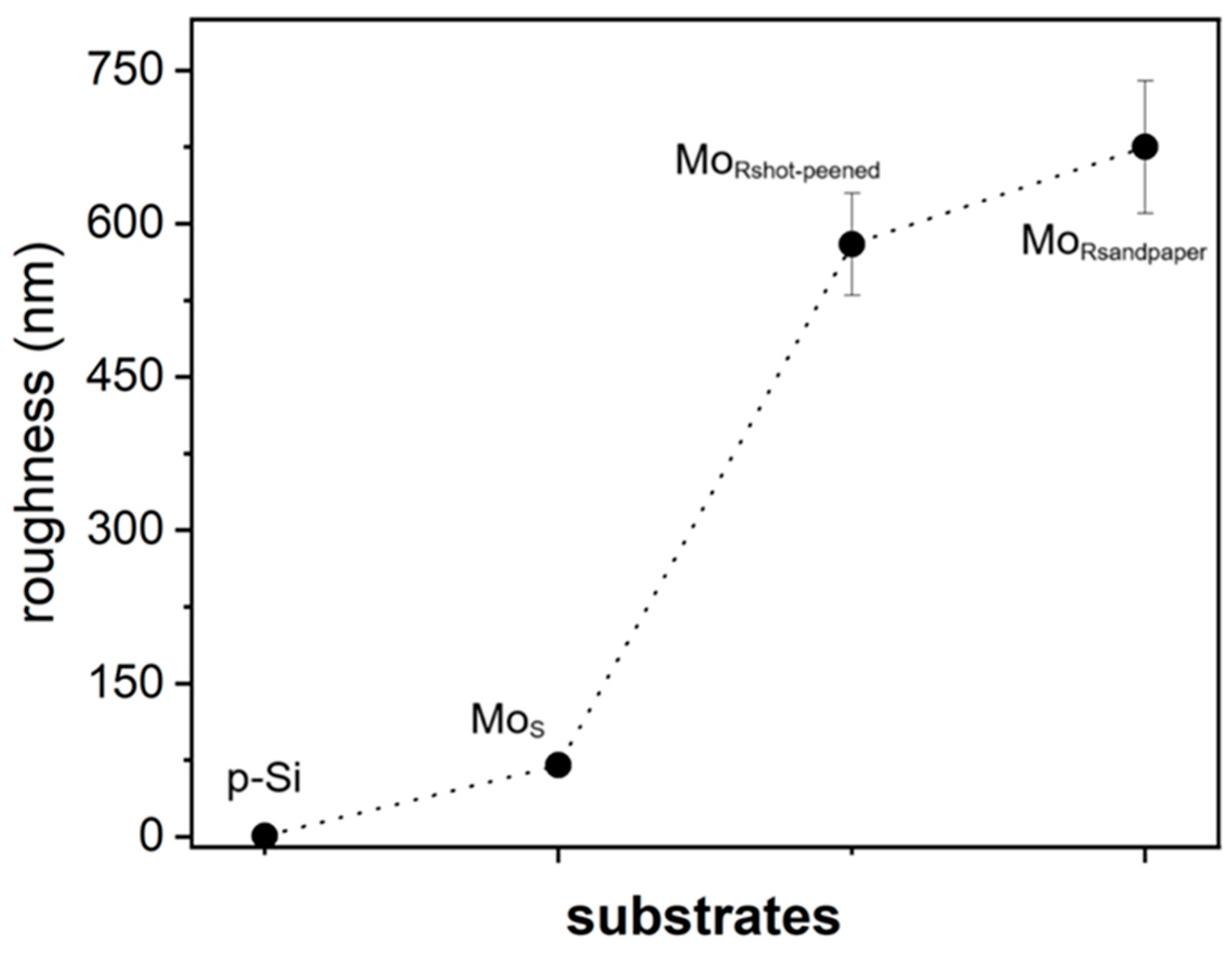
The topography of the polished p-Si substrate, studied using AFM, showed an average roughness of less than 1 nm. The smooth Mo surface (MoS), on the other hand, had a higher roughness of (70 ± 5) nm than that to silicon, which increased to (580 ± 50) nm when roughened by shot peening (MoRshot-peened) and up to (675 ± 65) nm when treated with sandpaper (MoRsandpaper). Furthermore, the AFM images in Figure 1b show that the surface of Mo roughened by shot peening is regular and uniform over the entire surface (thanks to the uniform distribution of the particles), unlike the surface roughened with sandpaper, which has grooves in different directions with a depth of approximately 1 μm (see Figure 1c), compatible with the specifications of the sandpaper used.
Figure 2 compares the Mo roughness with and without the roughening treatments. The roughness of Si is also shown in the same figure for further information.
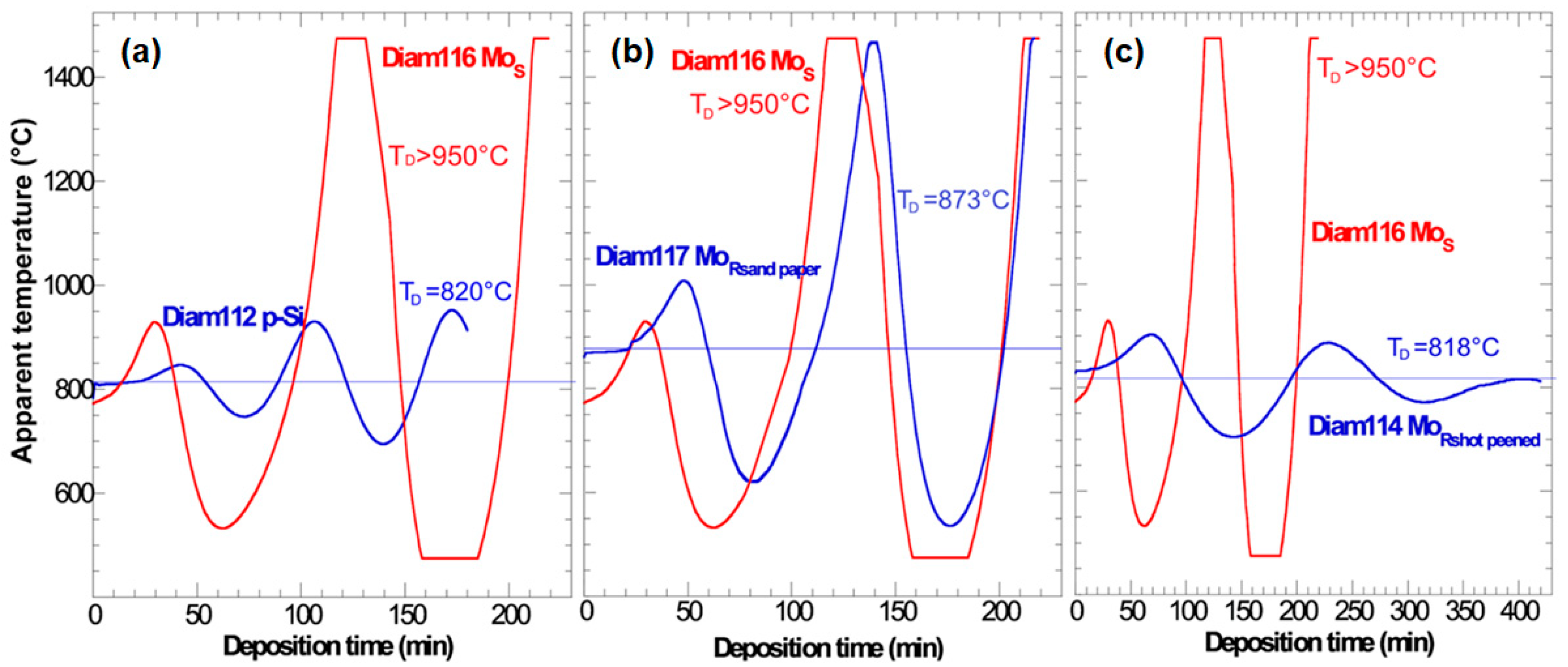
After analyzing the roughness and topography of the substrates, diamond depositions were performed on them. Figure 3a shows the pyrometric interferograms obtained during the deposition process of Diam112 on p-doped polished silicon (Diam112_pSi, blue curve) and Diam116 on smooth Mo (Diam116_MoS, red curve), without the roughening treatment.
Although both samples were synthesized under the same experimental conditions, it is worth noting that the apparent temperature recorded on each substrate is very different. In particular, the minimum and maximum values of the Diam116_MoS interference fringes are below and above the sensor’s measurement range and are recorded as LO (below range, i.e., <475 °C) or HI (above range, i.e., >1475 °C). The value of real deposition temperature (TD), given by the averaged values of apparent temperatures, is indicated in Figure 3a by the horizontal blue line for Diam112_pSi (TD = 820 °C), while it was not possible to calculate it for Diam116_MoS (interpolation gives TD > 950 °C).
The results change when comparing the temperatures obtained during the synthesis of the diamond films on rough Mo substrates. In fact, Figure 3b reports the pyrometric interferograms of Diam116_MoS (red curve) and Diam117 grown on roughened Mo with sandpaper (Diam117_MoRsandpaper, blue curve), which shows a clear decrease in the deposition temperature from TD > 950 °C to 873 °C. The roughening treatment of Mo induces a pyrometric interferogram in which the maximum and minimum values of interference fringes fall within the pyrometer’s measurement range (475 °C < T < 1475 °C), indicating that depositions occur at a lower deposition temperature than that recorded for untreated substrates.
The subsequent opportunity to improve roughness treatment through shot peening (greater uniformity and better control of surface morphology) made it possible to reduce the process temperature for Diam114_MoRshot-peened. The pyrometric interferogram reported in Figure 3c falls even better within the operating range of the pyrometer, with an estimated deposition temperature of 818 °C (Diam114_MoRshot-peened, blue curve).
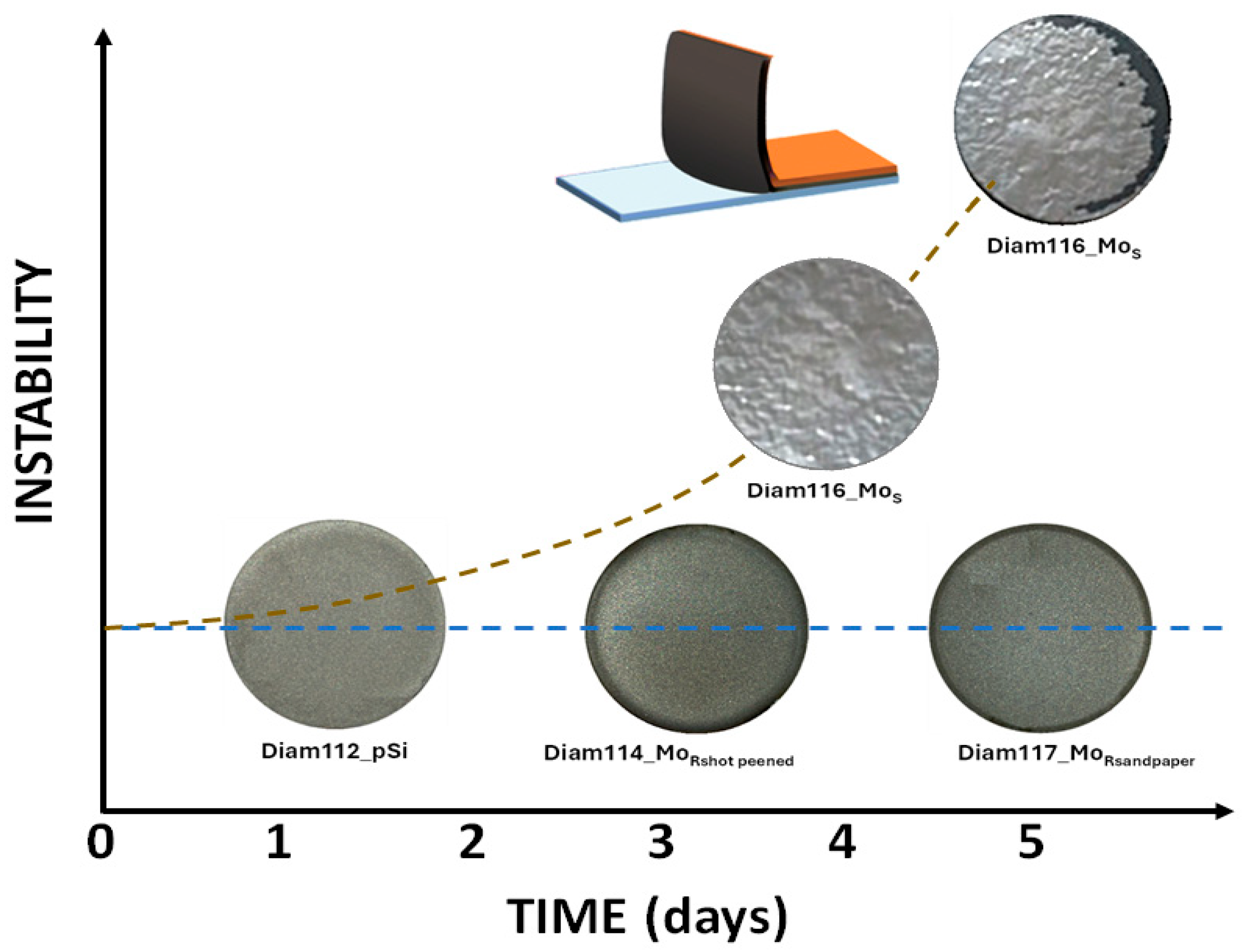
After deposition and subsequent susceptor cooling, all diamond films were removed from the deposition chamber and exposed to air. Their adhesion to the substrates over time was very different, as schematized in Figure 4, which depicts a diagram representing the temporal evolution of diamond film stability after their synthesis. Specifically, photos of the diamond film surfaces were taken during the first 5 days of exposure to air (constant room temperature of 22 °C with stable humidity levels of about 65%). As clearly observable, the film deposited on smooth Mo (Diam116_MoS) was the only one to show obvious surface fractures and delamination, indicating the poor adhesion to the substrate. In contrast, the other diamond films grown on Si (Diam112_pSi) and rough Mo substrates (Diam114_MoRshot-peened and Diam117_MoRsandpaper) showed excellent adhesion, without any surface defects.
To understand the causes that determined the different adhesion and stability behavior of the samples analyzed, XRD, Raman, and SEM characterization techniques were used.
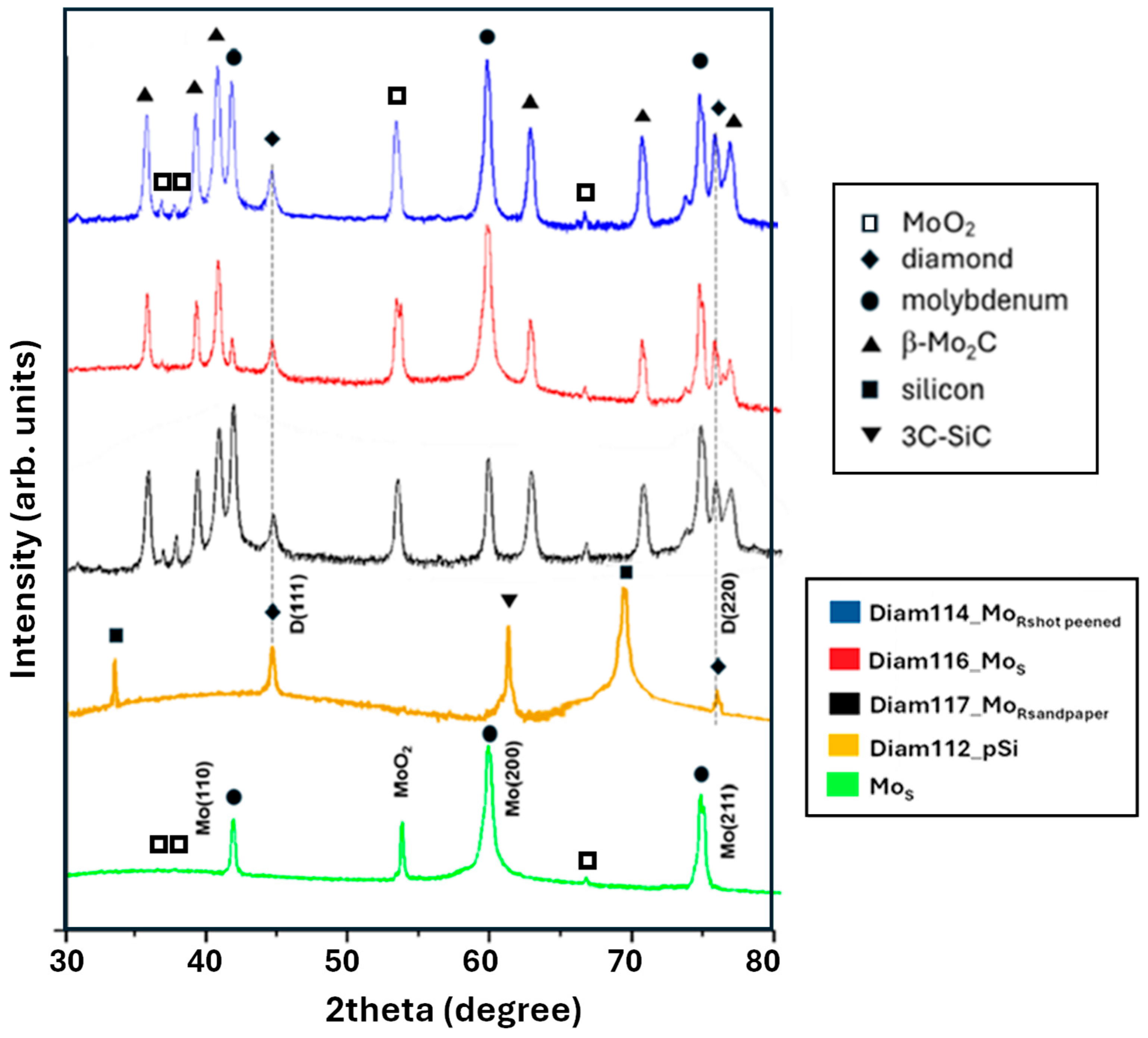
Figure 5 shows the XRD patterns of the diamond films, performed in θ–2θ (Bragg–Brentano) geometry, from 0 to 80 degrees. The labels showed, for all the investigated films, the diffraction peaks corresponding to two orientation planes of the cubic diamond. Specifically, the peak at 2θ = 43.9° belongs to the diffraction from the crystallographic plane (111) of the diamond; the other peak at 2θ = 75.3° is attributable to the diffraction from the (220) plane of the cubic diamond.
All the spectra of the diamond films also show reflection from their substrates. In particular, the Diam112_pSi pattern shows two peaks at 2θ = 32.9° and 69.1°, corresponding, respectively, to the (200) and (400) crystalline planes of silicon. The spectra of the Mo substrate, Diam116_MoS, Diam114_MoRshot-peened and Diam117_MoRsandpaper show three peaks located at 40.6°, 58.8° and 73.8°, corresponding, respectively, to the (110), (200) and (211) crystalline planes of molybdenum (JPCDS 89-5023). Very-low-intensity peaks attributable to MoO2 in its monoclinic phase (JCPDS 32-0671) [30] can be seen in the bare substrate spectrum as well as in the diffractograms of diamond deposited on Mo. In addition to the reflection peaks of diamond films and the corresponding substrates with their oxide reflections, all spectra show various peaks attributable to the metal carbide interlayer. In particular, the spectrum of Diam112_pSi shows a very high and narrow peak of 3C-SiC, while Diam116_MoS, Diam114_MoRshot-peened and Diam117_MoRsandpaper show various strong reflection peaks attributed to β-Mo2C (exagonal carbide phase, JCPDS 35-0787).
The X-ray reflections also provide information about the interfaces, suggesting that layers of Mo2C and SiC were produced on the substrate surface before the growth of diamond films; as a result, diamond films grow on the respective carbide layers. The roughening of the Mo substrates does not influence the crystallinity of the diamond films, which show the same diffractograms, regardless of the substrate surface conditions. On the contrary, a strong influence on the microstructure can be observed by estimating the crystallite size of diamond films. Grain size (Gs) along the (111) and (220) planes of diamond were calculated using the Scherrer formula [31] and fitting the XRD peak with a Voigt function. The values obtained are reported in Table 3.
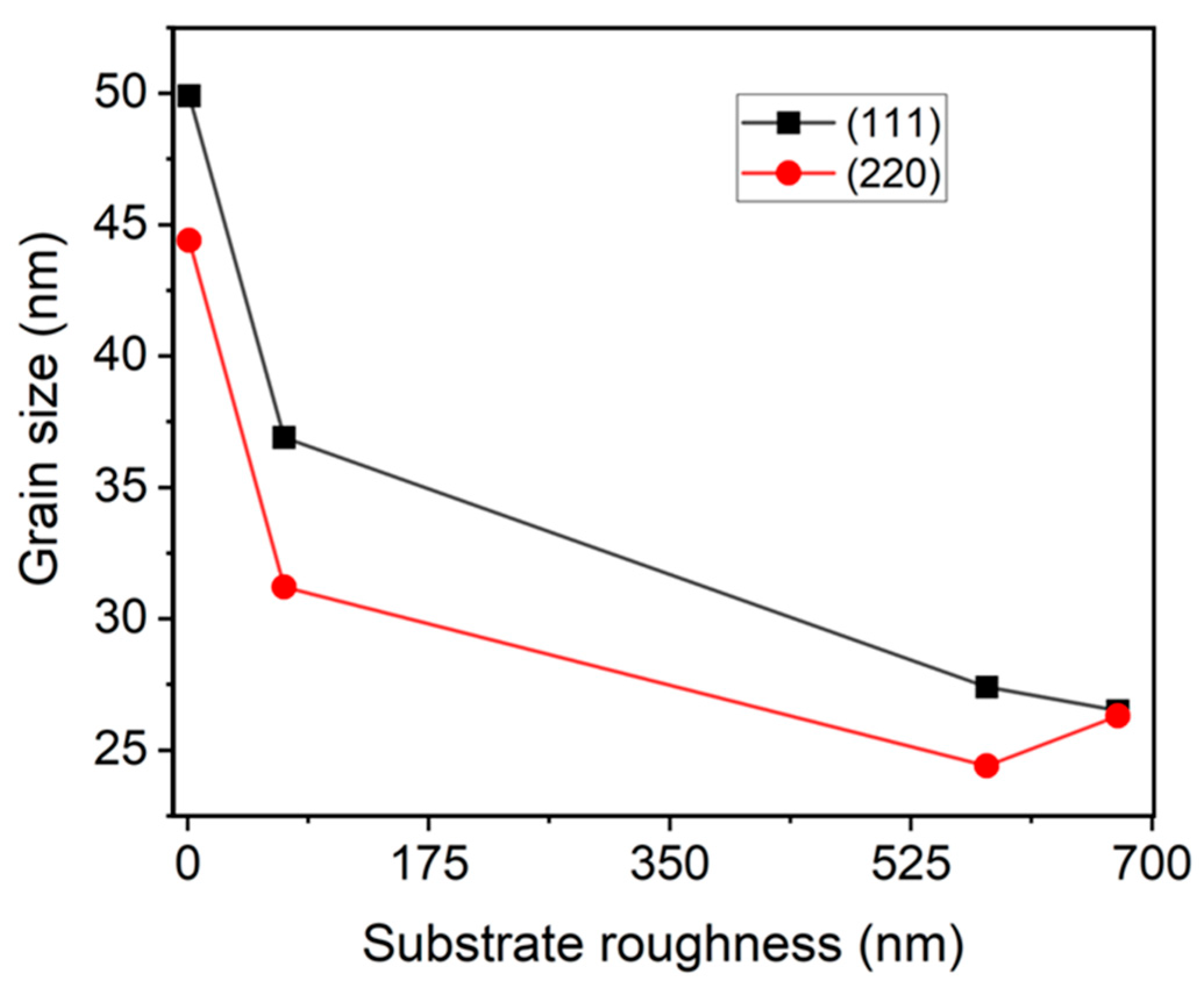
It is worth noting that all diamond films grow preferentially along the (111) plane, as confirmed by the faster growth of (111) grain size. In addition, the grain size decreases with increasing substrate roughness, as depicted in Figure 6.
The lattice constant was also calculated using Bragg Law. The lattice constant of the stress-free diamond (cubic carbon) is 0.357 nm, which is 34% smaller than that of Si (0.543 nm) and 12% larger than that of Mo (0.314 nm). Considering the XRD spectra in Figure 5, an interlayer of carbide appears on all substrates. The lattice parameters for β-Mo2C are a = 0.30 nm and c = 0.473 nm (JCPDS no. 11–0680). SiC has more than 250 different polytypes but usually exists in two basic crystalline modifications: hexagonal α-SiC (6H-SiC (a = 0.3073 nm, c = 1.511 nm) and cubic β-SiC (3C-SiC a = 0.43596 nm). Lattice mismatches between diamond and molybdenum/silicon carbides are 19% (larger) and 22% (smaller), respectively.
The dislocation density (δ) gives additional information about the number of defects in the films, which can be calculated from the Williamson–Smallman relation [32]:
δ = 1 G s 2
where the grain size GS is expressed in nm. Higher δ values indicate lower crystallinity levels for the films and a greater number of defects in the structure. All diamond films arrange along the (111) plane with higher crystallinity. The number of crystallites per unit area (N) can be calculated from the following formula:
N = t G s 3
where t is the thickness of the film. The higher N values indicate an abundance of crystallization. All these parameters are reported in Table 4.
Table 4 clearly evidences the effect of the substrate roughness on the crystallographic parameters of diamond films: higher values of dislocation density (δ) and number of crystallites per unit area (N) are found on diamond films deposited on rough molybdenum substrates due to their nanocrystalline nature (as shown below), which results in smaller grains and, thus, more grain boundaries.
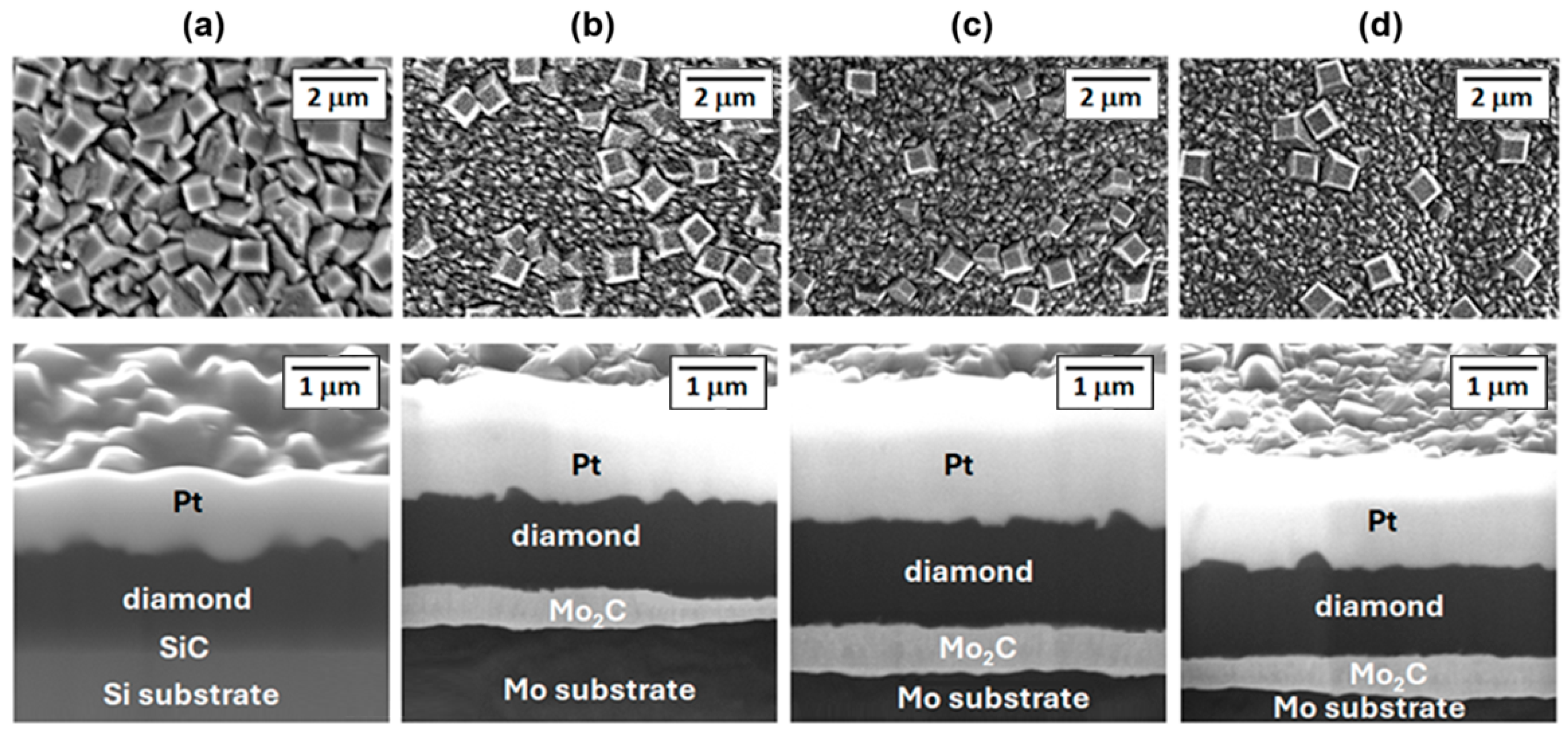
Figure 7 shows SEM topography images of diamond films grown on different substrates with the corresponding cross-sectional images. SEM analysis allows for better observation of the more pronounced nanocrystalline structure of diamond films when grown on rougher Mo substrates compared to the others. The Diam112_pSi film (Figure 7a) exhibits a microcrystalline character, and many grains from 0.3 to 0.8 μm with extended (001) facets oriented approximately parallel to the surface.
The SEM image of Diam116_MoS (Figure 7b) still shows a microcrystalline character of the film, although to a lesser extent than Diam112_pSi. In particular, grains with various shapes and sizes slightly smaller than 0.8 µm are seen, together with nanocrystalline grains.
However, the surface morphology of the films on rougher Mo (Diam114_MoRshot-peened and Diam117_MoRsandpaper, Figure 7c and Figure 7d, respectively) is different and exhibits a higher nanocrystalline character. Specifically, both Diam114_MoRshot-peened and Diam117_MoRsandpaper, due to the memory effect of the roughened Mo surface with different morphological features, show globular structures aggregated that include few microcrystalline grains. This is slightly more evident in Diam117_MoRsandpaper, which shows the lowest density of microcrystalline grains, i.e., the highest nanocrystalline character. The increased roughness going from smooth to roughened Mo leads to a decrease in both grain size and morphological features.
Further information can be obtained by analyzing the cross-sectional SEM images in Figure 7. Both the thickness of the diamond films and that of the intermediate carbide layers were evaluated. The cross-sectional image of Diam112_pSi (Figure 7a) shows a thickness of the diamond film of approximately 1.1 μm and 30 nm for SiC interlayer. A similar thickness is found for diamond films on Mo substrates, with values of 1.2 μm for Diam116_MoS and Diam114_MoRshot-peened, and 1.1 μm for Diam117_MoRsandpaper, in accordance with those reported in Table 2. On the other hand, higher thickness values are found for the intermediate layers of molybdenum carbide, which are approximately 400–500 nm. This explains the intense Mo2C signals detected in the XRD analyses (see Figure 5).
A careful observation of the Mo2C interlayers in Figure 7 shows that the thickness is most uneven in the Diam116_MoS sample (followed by Diam117_MoRsandpaper). This thickness inhomogeneity is generally related to several factors [33,34,35,36] such as deposition parameters (in particular, high temperature), substrate characteristics (roughness and uneven surface) and internal stresses (uneven deformations between the substrate and the film layers can cause thickness variations and compromise the integrity of the film). The consequences of the poor uniformity are reduced adhesion between the film and the substrate (which can cause the film to detach or sag, especially as the film thickness increases), improvement in the residual stress in the film, and poor quality of the layer structure (non-uniform thickness can cause performance issues, as the film may be too thick or too thin in some areas). This is critical for applications that require precise film thickness and system durability under external stresses (as required, for example, for a neutralizing cathode), as an uneven interlayer can drastically reduce the mechanical and functional properties of the final product.
For these reasons, the growth of an interlayer of homogeneous thickness between the substrate and the film is a key factor in improving the adhesion and stability of the film, as it promotes better stress distribution and prevents common problems such as flaking and delamination.
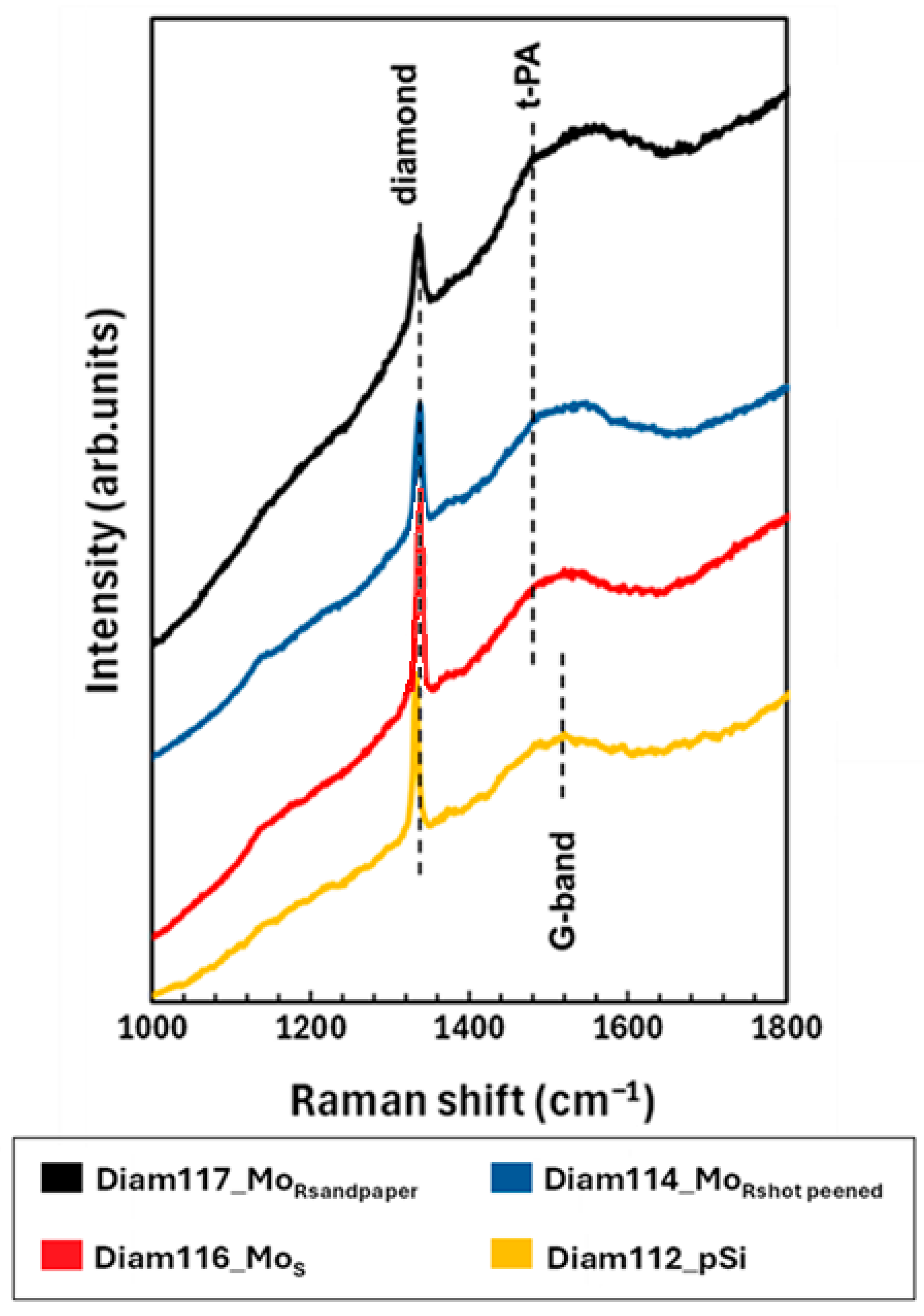
The Raman spectra of diamond films (just deposited) are reported in Figure 8 and confirm the results obtained from XRD and SEM analyses. The films exhibit the typical features of micro- and nanocrystalline diamond films [37]. In particular, the Diam112_pSi spectrum shows a typical microcrystalline structure with a diamond peak at 1332 cm−1 and the G-band centered at 1515 cm−1 due to graphite and sp2 bonds at the grain boundaries.
Some changes begin to be seen in the Diam116_MoS spectrum: the diamond peak is shifted to 1335.2 cm−1 and a peak due to trans-polyacetylene (t-PA) begins to be visible at 1480 cm−1. The structural properties of this film are different from those of Diam112_pSi and exhibit both microcrystalline and nanocrystalline characters.
The spectra of Diam114_MoRshot-peened and Diam117_MoRsandpaper appear similar but different from Diam112_pSi and Diam116_MoS. They show the diamond peak shifted to 1334.4 and 1334.9 cm−1, respectively, and a more prominent t-PA peak at 1480 cm−1.
The shift from the 1332 cm−1 literature value to higher values is generally attributed to structural stress in the films (discussed below).
In terms of the diamond peak width (FWHM), there is also a difference between the samples. The lower FWHM values of the diamond peaks of Diam112_pSi and Diam116_MoS indicate a higher microcrystalline nature of these films compared to the others (see Table 5).
In addition, it is easy to observe that when moving from microcrystalline (Diam116_MoS) to nanocrystalline (Diam114_MoRshot-peened and Diam117_MoRsandpaper) films, the diamond peak decreases and, at the same time, the sp2-C signal (G-band) widens and increases because the graphitic component at the grain boundaries increases.
A qualitative estimate of the carbon fraction organized in the diamond or graphite structure can be determined using a quality factor (Fq) defined as the ratio Fq = ID/IND, where ID and IND are the peak intensities of the diamond peak and the graphite band, respectively. Similarly, the ratio AR = AD/AND can be considered, where AD and AND are the areas of the diamond peak and the graphite band, respectively. High values of Fq or AR ratios indicate the microcrystalline nature of the films. Table 5 reports these data obtained by analyzing the Raman spectra; the values reported are the average of four different points for each sample analyzed.
All these results evidence how the structural characteristics of diamond films deposited on molybdenum are closely related to the surface roughness of the substrate: a smooth Mo surface favors the growth of a film with a microcrystalline character, while both rough Mo surfaces (with a roughness approximately 10-times greater than that of smooth Mo) favor the growth of a nanocrystalline film.
Raman spectra provide further information on the above discussion. In particular, the shift of the diamond peak can be correlated to the residual stress of the deposited film [36]. Residual stress is due to two different factors [38,39]: extrinsic factors due exposure to external environmental media (e.g., temperature changes, chemical reactions, moisture absorption, etc.) and intrinsic factors that are caused by the thin-film layer’s internal structural properties, which depend on the deposition conditions.
This stress was calculated using the following equation [36,40]:
σ G P a = 0.49   G P a / c m 1 ν m ν 0 ( c m 1 )
were 0.49 GPa/cm−1 is the weighted average gauge factor related to a polycrystalline diamond film, νm is the Raman shift of the deposited diamond film and ν0 is the position of the diamond peak without stress condition.
Thermal stress and intrinsic stress can also be calculated. The thermal stress, related to thermal expansion between the film and substrate, was calculated using the following formula:
σ D I A M = α D I A M α S U B   ·   ( T T 0 ) t D I A M   ·   ( 1 v S U B ) t S U B   ·   E S U B   +   1 v D I A M E D I A M
where the subscripts “DIAM” and “SUB” indicate the diamond and substrate, respectively, α is the coefficient of thermal expansion, T and T0 are the deposition and room temperatures, respectively, t is the thickness, ν is the Poisson’s ratio and E is the Young’s modulus [41].
Intrinsic stress refers to the internal stresses in deposited thin films that occur during the growth process and is generally influenced by process parameters, such as gas pressure in the deposition chamber and substrate temperature [39]. It was calculated as the difference between residual stress and thermal stress [36,40].
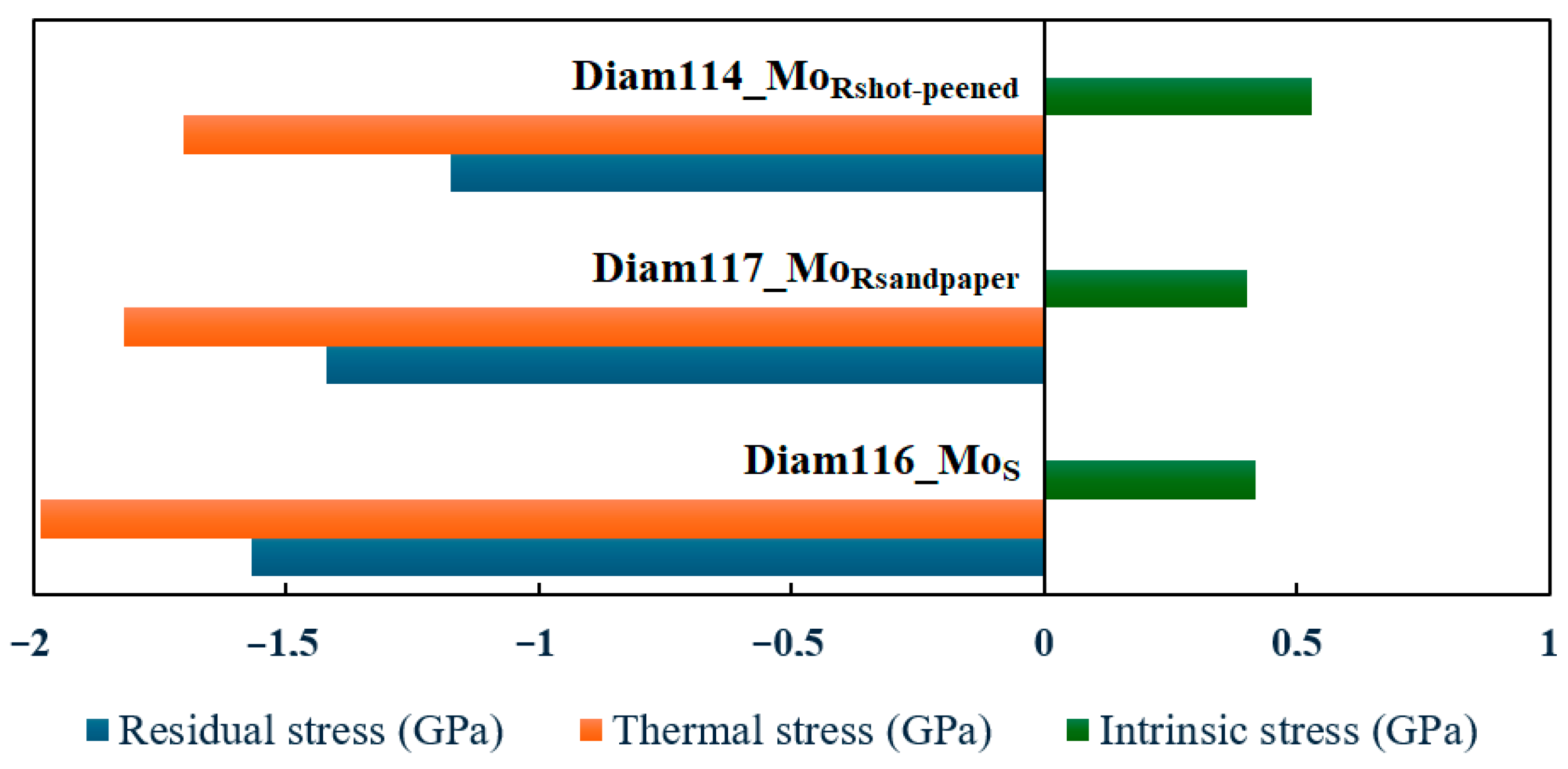
The residual stress obtained for diamond grown on smooth Mo (Diam116_MoS) was −1.57 GPa, which means compressive stress (pushes the film inwards and can cause wrinkling or deformation, sometimes delamination when very high [42,43]), while the two nanocrystalline films deposited on rough Mo showed lower negative values (−1.18 GPa for Diam114_MoRshot-peened and −1.42 GPa for Diam117_MoRsandpaper). The thermal stress values (closely related to the deposition temperatures) obtained from Equation (5) showed a similar trend, with the highest negative value for Diam116_MoS.
Figure 9 shows the stresses of the films deposited on molybdenum.
As can be easily deduced from Figure 9, the diamond film deposited on smooth Mo shows the highest negative values of residual and thermal stresses. Thermal stress is closely related to the deposition temperature and can induce deformations in thin films, such as bending and warping, and can even lead to fracture and delamination (as observed in Diam116_MoS). Film growth at high temperatures tends to promote grain growth and high deposition rates. This is one of the reasons why the Diam116_MoS film has a microcrystalline character and higher deposition rates than the other films deposited on rough Mo (see Table 1).

4. Preliminary Tests on Cathode Erosion in Plasma

The ultimate purpose of these diamond films is to use them as neutralizing cathodes for aerospace propulsion. Conventional neutralizers exploit the thermionic electron emission from materials with low or negative work function. These conventional neutralizers rely on the surface properties of the material and their interactions with the plasma and working gas and are prone to cathode poisoning. The poisoning process causes an increase in the work function of the thermionic emitter and, consequently, a decrease in electron emission. Plasma cathodes have been considered as a potential replacement for conventional hollow cathodes [44] since they do not rely on a thermionic emissive material but rather on ionization and electron generation in the bulk plasma.
It follows that the stability of diamond films and their adhesion to the substrate are key parameters, as a cathode is exposed to harsh working conditions, such as high temperature and wear, due to the plasma produced during thrust.
To study the behavior of these diamond films under the action of plasma, erosion tests were conducted using an Ar plasma (this is one of the gases used as a propellant) in an RF sputtering reactor. Aware that the present experimental conditions did not represent those experienced during aerospace propulsion, the aim at this preliminary stage was simply to study the degradation of diamond films following interaction with the plasma.
In this section, we discuss the preliminary results from erosion tests performed on samples produced exclusively for this characterization, keeping the experimental conditions unchanged. The test consists of exposing freshly deposited diamond samples to an Ar plasma, as previously described.
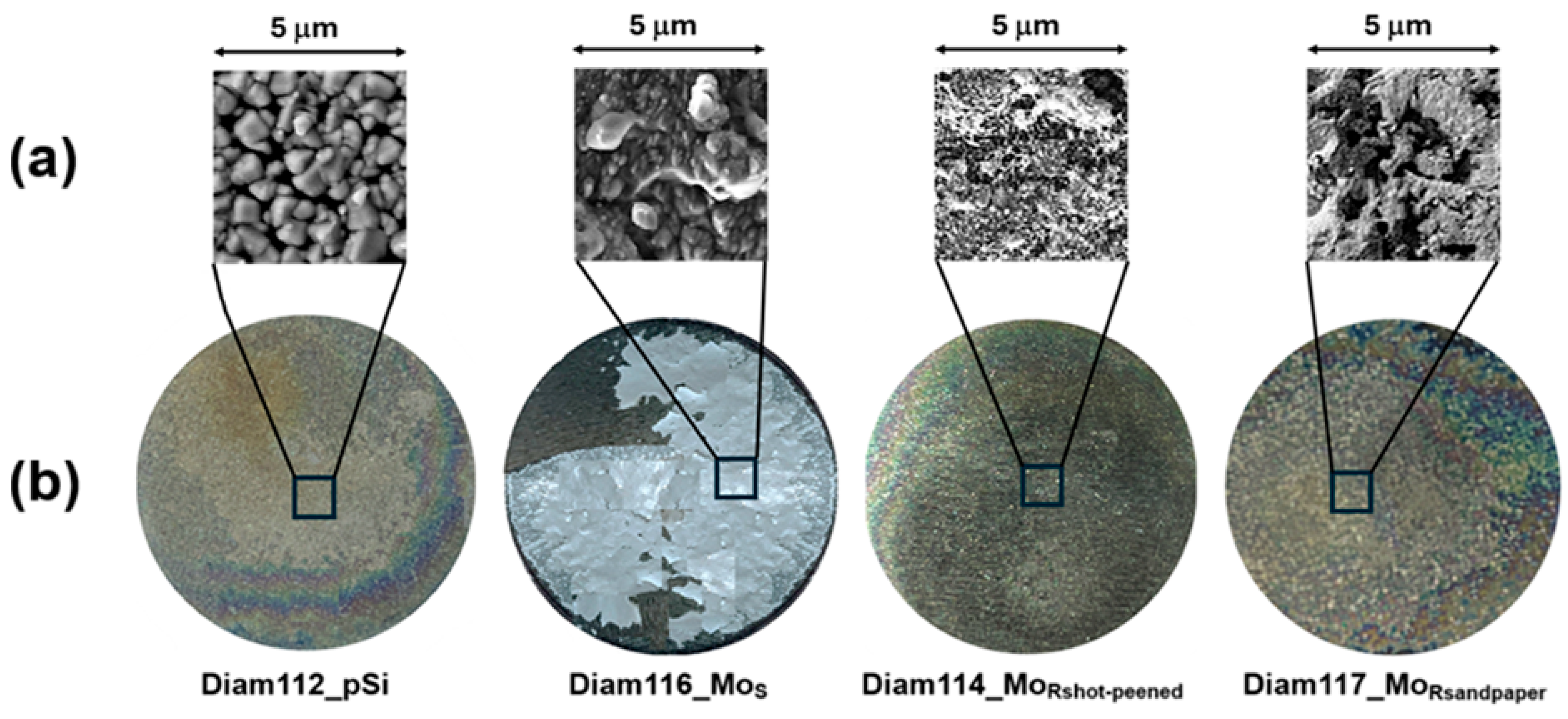
Figure 10 shows photos of the cathodes after plasma treatment (Figure 10b) together with SEM images highlighting the areas where diamond films showed less erosion and were more intact (Figure 10a).
Figure 10b clearly shows that the least stable film is once again the one deposited on smooth Mo. On the contrary, the most stable film (among those deposited on Mo substrates) was Diam114_MoRshot-peened. It was found that a high degree of uniformity in the roughness of the substrate surface improved adhesion, as it reduces the process temperature (i.e., residual and thermal stresses, as shown in Figure 9) compared to a smooth or irregularly rough surface, such as that obtained with sandpaper.
In conclusion, the results obtained in this work demonstrate the following:
  • A rough substrate surface is better than a smooth one for the growth of diamond films on molybdenum using the MWPECVD technique;
  • The use of a rough Mo substrate reduces the deposition temperature (TD);
  • The decrease in TD leads to a reduction in residual and thermal stresses;
  • The decrease in TD also leads to a change in the characteristics of the film, which changes from microcrystalline to nanocrystalline, limiting the cracking or peeling phenomena attributed to the grain size variation [38,45,46];
  • A more uniform substrate roughness (MoRshot-peened) improves film stability and further reduces the deposition temperature (i.e., lower stress in the film) with the above-mentioned advantages.

5. Conclusions

The influence of the molybdenum substrates’ roughness on the characteristics of diamond films was discussed based on AFM, XRD, SEM, and Raman results. Specifically, roughened Mo substrates ensure greater mechanical stability of the films without delamination. Moreover, these results showed how the deposition temperature values correlated with diamond–substrate adhesion. Adhesion was good for the film deposited on silicon, whose minimum and maximum interference fringes of the pyrometric interferogram and deposition temperature were within the pyrometer’s measurement range (475 °C < T < 1475 °C) and of 820 °C. As for Mo substrates, roughness and, therefore, morphology influenced the adhesion and structural properties of the diamond film. In fact, an undefined high deposition temperature >950 °C was found for films deposited on the smooth Mo substrate, as the pyrometric interferogram showed minimum and maximum interference fringe values below 475 °C and above 1475 °C, outside of the pyrometer’s measurement range. Such a high temperature (>950 °C) caused a change in the diamond structure (from nano- to microcrystalline), greater residual and thermal stresses and, consequently, poor adhesion of the film to the substrate and detachment of the film itself.
On the contrary, diamond films on roughened Mo substrates, Diam114_MoRshot-peened and Diam117_MoRsandpaper, showed good adhesion and stability with lower deposition temperatures of 818 and 873 °C, respectively. In particular, Diam114_MoRshot-peened showed the best mechanical stability and adhesion among the films deposited on Mo, thanks to the method used to treat the Mo substrate (shoot peening), which allows for a uniform and controlled increase in surface roughness, causing the film to grow at lower temperatures and, thus, reducing residual and thermal stresses compared to films grown under the same experimental conditions but on a smoother surface.
These results were confirmed by preliminary erosion tests in a plasma environment, where Diam114_MoRshot-peened proved to be the most stable film (among those deposited on Mo substrates).
In addition, the support of process diagnostics like pyrometric interferometry made it possible to predict the adhesion and the stability of diamond films before their exposure to air. This is a very interesting aspect that has never been addressed in research papers, as pyrometric interferometry is generally used to assess the deposition rate and temperature and not to study the quality of thin films and their adhesion to the substrate. It was, therefore, possible to define the stability of the diamond film already during the growth process simply by monitoring the pyrometric interferograms, i.e., the apparent deposition temperature.

Author Contributions

Conceptualization, L.V. and G.C.; methodology, L.V. and M.A.S.; software, L.V.; validation, L.V., M.A.S., G.C., A.D.T. and L.N.F.; investigation, L.V., G.C., A.D.T. and M.A.S.; resources, G.C. and L.N.F.; data curation, L.V. and M.A.S.; writing—original draft preparation, L.V., M.A.S. and G.C.; supervision, L.V., M.A.S., G.C., A.D.T. and L.N.F. All authors have read and agreed to the published version of the manuscript.

Funding

This research received no external funding.

Data Availability Statement

The original contributions presented in this study are included in the article. Further inquiries can be directed at the corresponding author.

Conflicts of Interest

The authors declare no conflicts of interest.

Abbreviations

The following abbreviations are used in this manuscript:
CVDChemical Vapor Deposition
HFCVDHot Filament Chemical Vapor Deposition
MWPECVDMicrowave Plasma-Enhanced Chemical Vapor Deposition
NCDNanocrystalline Diamond
PIPyrometric Interferometry
LRILaser Reflectance Interferometry
AFMAtomic Force Microscopy
XRDX-Ray Diffraction
FIBFocused Ion Beam
SEMScanning Electron Microscopy
PIDProportional Integral Derivative
FWHMFull Width at Half Maximum
RFRadio Frequency

References

  1. Mckeag, R.D.; Chan, S.S.M.; Jackman, R.B. Polycrystalline diamond photoconductive device with high UV-visible discrimination. Appl. Phys. Lett. 1995, 67, 2117–2119. [Google Scholar] [CrossRef]
  2. Muscarella, M.F.; Altamura, D.; Brescia, R.; Capitelli, M.; Casamassima, G.; Cassano, T.; Celiberto, R.; Cicala, G.; Cornacchia, D.; De Giacomo, A.; et al. A comparative study on comb electrodes devices made of MWPECVD diamond films grown on p-doped and intrinsic silicon substrate. Diam. Relat. Mater. 2011, 20, 1005–1009. [Google Scholar] [CrossRef]
  3. Velardi, L.; Valentini, A.; Cicala, G. Highly efficient and stable photocathode based on nanodiamond particles. Appl. Phys. Lett. 2016, 108, 083503. [Google Scholar] [CrossRef]
  4. Jou, S.; Huang, B.-R.; Wu, M.-C. Nanocrystalline diamond film as cathode for gas discharge sensors. Thin Solid Film. 2010, 518, 4458–4461. [Google Scholar] [CrossRef]
  5. Agarwala, J.; Chatterjee, C.; Cicala, G.; Cicuttin, A.; Ciliberti, P.; Crespo, M.L.; Dalla Torre, S.; Dasgupta, S.; Gregori, M.; Levorato, S.; et al. Study of MicroPattern Gaseous detectors with novel nanodiamond based photocathodes for single photon detection in EIC RICH. Nucl. Instrum. Methods Phys. Res. A Accel. Spectrometers Detect. Assoc. Equip. 2020, 952, 161967. [Google Scholar] [CrossRef]
  6. Wang, Y.; Lin, C.; Zhang, J. High performance field emission cathode based on the diamond nanowires prepared by nanocrystalline diamond films annealed in air. J. Micromech. Microeng. 2024, 34, 025011. [Google Scholar] [CrossRef]
  7. Wang, W.L.; Liao, K.J.; Fang, L.; Esteve, J.; Polo, M.C. Analysis of diamond nucleation on molybdenum by biased hot filament chemical vapor deposition. Diam. Relat. Mater. 2001, 10, 383–387. [Google Scholar] [CrossRef]
  8. Cicala, G.; Velardi, L.; Senesi, G.S.; Picca, R.A.; Cioffi, N. Electrical current at micro-/macro-scale of undoped and nitrogen-doped MWPECVD diamond films. Appl. Surf. Sci. 2017, 426, 456–465. [Google Scholar] [CrossRef]
  9. Köpf, A.; Lux, B.; Haubner, R. Substrate Effects during Nucleation and Growth of CVD diamond. New Diam. Front. Carbon Technol. 2001, 11, 11–23. [Google Scholar]
  10. Behera, M.; Jena, A.; Pattnaik, S.K.; Padhi, S.; Sarangi, S.K. The effect of transition-metal seeding powder on deposition and growth of diamond synthesized by hot filament chemical vapor deposition processes on cemented carbide substrates and its characterization. Mater. Chem. Phys. 2020, 256, 123638. [Google Scholar] [CrossRef]
  11. Stoner, B.R.; Ma, G.H.M.; Wolter, S.D.; Glass, J.T. Characterization of bias-enhanced nucleation of diamond on silicon by invacuo surface analysis and transmission electron microscopy. Phys. Rev. B 1992, 45, 11067. [Google Scholar] [CrossRef] [PubMed]
  12. Meilunas, R.; Wong, M.S.; Sheng, K.C.; Chang, R.P.H.; Van Duyne, R.P. Early stages of plasma synthesis of diamond films. Appl. Phys. Lett. 1989, 54, 2204–2206. [Google Scholar] [CrossRef]
  13. Jubber, G.; Milne, D.K. Microwave Plasma CVD of High Quality Heteroepitaxial Diamond Films. Phys. Status Solidi A 1996, 154, 185–195. [Google Scholar] [CrossRef]
  14. Lux, B.; Haubner, R. Diamond substrate interactions and the adhesion of diamond coatings. Pure Appl. Chem. 1994, 66, 1783–1788. [Google Scholar] [CrossRef]
  15. Ashfold, M.N.R.; May, P.W.; Rego, C.A.; Everitt, N.M. Thin film diamond by chemical vapour deposition methods. Chem. Soc. Rev. 1994, 23, 21–30. [Google Scholar] [CrossRef]
  16. Trava-Airoldi, V.J.; Corat, E.J.; Santos, L.V.; Moro, J.R.; Leite, N.F. Studies of molybdenum surface modification for growth of adherent CVD diamond Films. Mater. Res. 2003, 6, 305–309. [Google Scholar] [CrossRef]
  17. Buijnsters, J.G.; Shankar, P.; van Enckervort, W.J.P.; Schermer, J.J.; ter Meulen, J.J. Adhesion analisis of polycrystalline diamond films on molybdenum by means of scratch, indentation and sand abrasion testing. Thin Solid Film. 2005, 474, 186–196. [Google Scholar] [CrossRef]
  18. Wako, H.; Abe, T.; Takagi, T.; Ikohagi, T. Comparison of diamond film adhesion on molybdenum substrates with different surface morphologies. Appl. Surf. Sci. 2009, 256, 1466–1471. [Google Scholar] [CrossRef]
  19. Ristić, G.S.; Bogdanov, Ž.D.; Zec, S.; Romčević, N.; Dohčević-Mitrović, Z.; Miljanić, Š.S. Effect of the substrate material on diamond CVD coating properties. Mater. Chem. Phys. 2003, 80, 529–536. [Google Scholar] [CrossRef]
  20. Mallik, A.K.; Binu, S.R.; Satapathy, L.N.; Narayana, C.; Seikh, M.M.; Shivashankar, S.A.; Biswas, S.K. Effect of substrate roughness on growth of diamond by hot filament CVD. Bull. Mater. Sci. 2010, 33, 251–255. [Google Scholar] [CrossRef]
  21. Mandal, S. Nucleation of diamond films on heterogeneous substrates: A review. RSC Adv. 2021, 11, 10159–10182. [Google Scholar] [CrossRef]
  22. Cicala, G.; Bruno, P.; Bénédic, F.; Silva, F.; Hassouni, K.; Senesi, G.S. Nucleation, growth and characterization of nanocrystalline diamond films. Diam. Relat. Mater. 2005, 14, 421–425. [Google Scholar] [CrossRef]
  23. Li, X.; He, L.; Li, Y.; Yang, Q. Diamond Deposition on Iron and Steel Substrates: A Review. Micromachines 2020, 11, 719. [Google Scholar] [CrossRef] [PubMed]
  24. Akatsuka, F.; Shimura, F. Effect of Substrate Materials on CVD diamond Growth. Mater. Sci. Monogr. 1991, 73, 379–381. [Google Scholar] [CrossRef]
  25. Buijnsters, J.C.; Celis, J.-P.; Hendrikx, R.W.A.; Vázquez, L. Metallic Seed Nanolayers for Enhanced Nucleation of Nanocrystalline Diamond Thin Films. J. Phys. Chem. C 2013, 117, 23322–23332. [Google Scholar] [CrossRef]
  26. Li, C.; Dai, W.; Qian, L.; Li, M.; Sun, D.; Gao, C.; Yang, B. Effect of metallic seed layers on the properties of nanocrystalline diamond films. Diam. Relat. Mater. 2014, 49, 48–54. [Google Scholar] [CrossRef]
  27. Fernandes, A.; Neves, A.; Silva, R.F.; Nazaré, M.H. Evaluation of MPCVD diamond film adhesion on hard metal substrates by micro Raman spectroscopy. Diam. Relat. Mater. 1997, 6, 769–773. [Google Scholar] [CrossRef]
  28. Cicala, G.; Brescia, R.; Nitti, M.A.; Romeo, A.; Altamura, D.; Giannini, C.; Capitelli, M.; Spinelli, P.; Schutzmann, S. Study of polycrystalline diamond deposition by continuous and pulsed discharges. Surf. Coat. Technol. 2010, 204, 1884–1888. [Google Scholar] [CrossRef]
  29. Yin, Z.; Akkerman, Z.; Yang, B.X.; Smith, F.W. Optical properties and microstructure of CVD diamond films. Diam. Relat. Mater. 1997, 6, 153–158. [Google Scholar] [CrossRef]
  30. Parka, J.; Choi, I.; Jeong Lee, M.; Kima, M.H.; Lima, T.; Parka, K.H.; Janga, J.; Oha, S.M.; Cho, S.K.; Kima, J.J. Effect of fluoroethylene carbonate on electrochemical battery performance and the surface chemistry of amorphous MoO2 lithium-ion secondary battery negative electrodes. Electrochim. Acta 2014, 132, 338–346. [Google Scholar] [CrossRef]
  31. Langford, J.I.; Wilson, A.J.C. Scherrer after sixty years: A survey and some new results in the determination of crystallite size. J. Appl. Crystallogr. 1978, 11, 102–113. [Google Scholar] [CrossRef]
  32. Williamson, G.K.; Smallman, R.E., III. Dislocation densities in some annealed and cold-worked metals from measurements on the X-ray debye-scherrer spectrum. Philos. Mag. A J. Theor. Exp. Appl. Phys. 1956, 1, 34–46. [Google Scholar] [CrossRef]
  33. Ali, A.M.; Egiza, M.; Murasawa, K.; Sugita, H.; Deckert-Gaudig, T.; Deckert, V.; Yoshitake, T. Effects of substrate temperature and intermediate layer on adhesion, structural and mechanical properties of coaxial arc plasma deposition grown nanodiamond composite films on Si substrates. Surf. Coat. Technol. 2021, 417, 127185. [Google Scholar] [CrossRef]
  34. Li, L.; Yin, L.; Chu, P.K. Finite element analysis of residual stress and interlayer in hard coating/interlayer/soft substrate system during nanoindentation. J. Mater. Res. 2008, 23, 1358–1363. [Google Scholar] [CrossRef]
  35. Huang, J.-H.; Ma, C.-H.; Chen, H. Effect of Ti interlayer on the residual stress and texture development of TiN thin films. Surf. Coat. Technol. 2006, 200, 5937–5945. [Google Scholar] [CrossRef]
  36. Long, F.; Wei, Q.; Yu, Z.M.; Luo, J.; Zhang, X.; Long, H.; Wu, X. Effects of temperature and Mo2C layer on stress and structural properties in CVD diamond film grown on Mo foil. J. Alloys Compd. 2013, 579, 638–645. [Google Scholar] [CrossRef]
  37. Gicquel, A.; Hassouni, K.; Silva, F.; Achard, J. CVD diamond films: From growth to applications. Curr. Appl. Phys. 2001, 1, 479–496. [Google Scholar] [CrossRef]
  38. Engwall, A.M.; Rao, Z.; Chason, E. Origins of residual stress in thin films: Interaction between microstructure and growth kinetics. Mater. Des. 2016, 110, 616–623. [Google Scholar] [CrossRef]
  39. Huff, M. Review Paper: Residual Stresses in Deposited Thin-Film Material Layers for Micro- and Nano-Systems Manufacturing. Micromachines 2022, 13, 2084. [Google Scholar] [CrossRef]
  40. Ahmed, F.; Bayerlein, K.; Rosiwal, S.M.; Göken, M.; Durst, K. Stress evolution and cracking of crystalline diamond thin films on ductile titanium substrate: Analysis by micro-Raman spectroscopy and analytical modelling. Acta Mater. 2011, 59, 5422–5433. [Google Scholar] [CrossRef]
  41. Cicala, G.; Magaletti, V.; Senesi, G.S.; Carbone, G.; Altamura, D.; Giannini, C.; Bartali, R. Superior hardness and Young’s modulus of low temperature nanocrystalline diamond coatings. Mater. Chem. Phys. 2014, 144, 505–511. [Google Scholar] [CrossRef]
  42. Wiklund, U.; Gunnars, J.; Hogmark, S. Influence of residual stresses on fracture and delamination of thin hard coatings. Wear 1999, 232, 262–269. [Google Scholar] [CrossRef]
  43. Forschelen, P.J.J.; Suiker, A.S.J.; van der Sluis, O. Effect of residual stress on the delamination response of film-substrate systems under bending. Int. J. Solids Struct. 2016, 97–98, 284–299. [Google Scholar] [CrossRef]
  44. Gurciullo, A.; Lucca Fabris, A.; Knoll, A. Direct Current Plasma Electron Source for Electric Propulsion Applications Using Atomic and Molecular Propellants. IEEE Trans. Plasma Sci. 2017, 45, 2472–2480. [Google Scholar] [CrossRef]
  45. Nothwang, W.D.; Cole, M.W.; Hirsch, S.G. Grain growth and residual stress in BST thin films. Integr. Ferroelectr. 2005, 71, 107–113. [Google Scholar] [CrossRef]
  46. Cao, L.; Sengupta, A.; Pantuso, D.; Koslowski, M. Effect of texture and grain size on the residual stress of nanocrystalline thin films. Model. Simul. Mater. Sci. Eng. 2017, 25, 075004. [Google Scholar] [CrossRef]
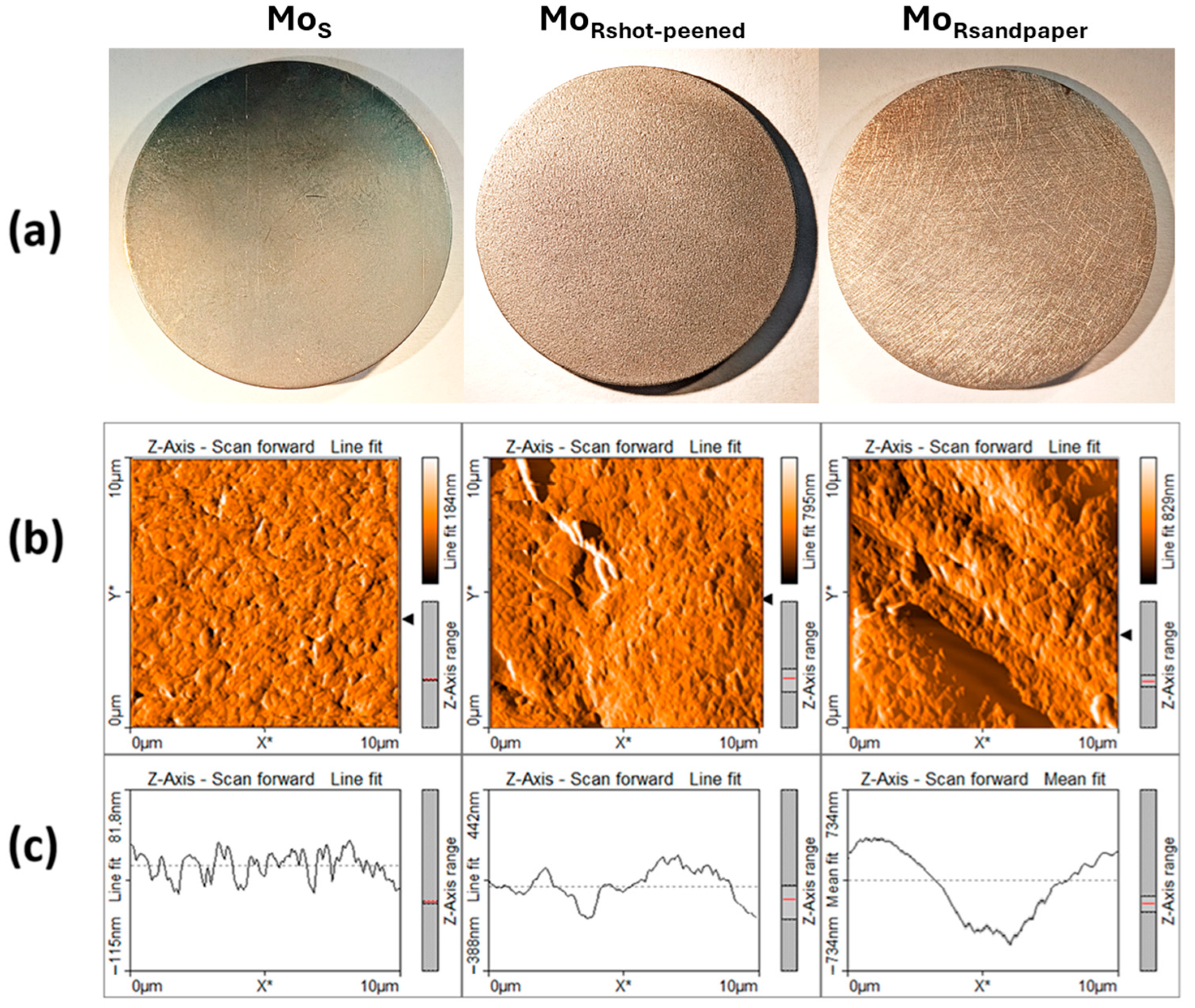
Figure 1. (a) Photos of molybdenum substrates (2.5 cm of diameter, 0.75 mm of thickness): smooth (MoS), rough by shot peening machine (MoRshot-peened) and rough by sandpaper (MoRsandpaper) and corresponding (b) AFM topographies and (c) AFM line profiles.
Surfaces 08 00085 g001
Figure 2. Root mean square roughness (Rq) of the substrates, determined by AFM (Nanosurf CoreAFM, Liestal, Switzerland).
Surfaces 08 00085 g002
Figure 3. Pyrometric interferograms obtained during the deposition process of Diam116 on smooth Mo (Diam116_MoS, red curve) compared to (a) Diam112 on polished p-doped silicon (Diam112_pSi, blue curve), (b) Diam117 on Mo roughened with sandpaper (Diam117_MoRsandpaper, blue curve) and (c) Diam114 on Mo roughened with shot peening (Diam114_MoRshot-peened, blue curve).
Surfaces 08 00085 g003
Figure 4. Diagram representing the temporal evolution of diamond films after their synthesis during the first 5 days of exposure to air (constant room temperature of 22 °C with stable humidity levels of about 65%).
Surfaces 08 00085 g004
Figure 5. XRD patterns of the investigated diamond films and Mo substrate.
Surfaces 08 00085 g005
Figure 6. Substrate roughness Rq vs. diamond grain size estimated by XRD peak analysis.
Surfaces 08 00085 g006
Figure 7. SEM and cross-sectional images of the diamond films deposited on (a) p-Si (Diam112_pSi), (b) smooth Mo (Diam116_MoS), (c) Mo roughened by shot peening (Diam114_MoRshot-peened) and (d) Mo roughened by sandpaper (Diam117_MoRsandpaper).
Surfaces 08 00085 g007
Figure 8. Raman spectra of diamond films deposited on Si and Mo substrates.
Surfaces 08 00085 g008
Figure 9. Stresses of the diamond films deposited on Mo substrates having different roughness.
Surfaces 08 00085 g009
Figure 10. (a) Photos of the cathodes after the plasma treatment; (b) SEM images showing the areas where diamond films show less erosion and are more intact.
Surfaces 08 00085 g010
Table 1. Main properties of substrates suitable for diamond film growth and compared to diamond ones.
MaterialThermal Expansion (×10−6 K−1)Melting Point (°C)Lattice Constant (nm)
Copper16.510840.361
Silicon2.614140.543
Molybdenum4.826230.314
Diamond1.040900.357
Table 2. Plasma conditions for the deposition of diamond films on silicon p-Si(100) and molybdenum substrates, keeping the total flow rate (250 sccm), composition (1% CH4) of CH4-H2 gas mixture, pressure (35 mbar), microwave power (1250 Watt) and heating temperature of susceptor (700 °C) constant.
SampleSubstrate TypeDeposition
Temperature (°C)
Deposition Time (min)Deposition Rate rD (μm/h)Thickness (μm)
Diam112_pSi p-Si8201800.43 ± 0.021.29 ± 0.05
Diam116_MoSsmooth Mo>9502190.33 ± 0.021.20 ± 0.03
Diam117_MoRsandpaperrough Mo 18732170.30 ± 0.021.10 ± 0.02
Diam114_MoRshot-peenedrough Mo 28184200.17 ± 0.021.20 ± 0.04
1 roughened by sandpaper, 2 roughened by shot peening.
Table 3. Grain size (Gs) along (111) and (220) planes of diamond, calculated by Scherrer formula.
SampleGS(111) (nm)GS(220) (nm)Substrate Roughness (nm)
Diam112_pSi49.9 44.4 very low (<1)
Diam116_MoS36.9 31.2 70 ± 5
Diam114_MoRshot-peened27.4 24.4 580 ± 50
Diam117_MoRsandpaper26.5 26.3 675 ± 65
Table 4. Crystallographic parameters of diamond films obtained by XRD analysis.
Samplea (111)
Å
a (220)
Å
δ111
(×1015 lines/m2)
δ220
(×1015 lines/m2)
N111
(×1016/m2)
N220
(×1016/m2)
Diam112_pSi3.543.550.400.511.041.48
Diam116_MoS3.503.510.731.022.804.62
Diam114_MoRshot-peened3.513.521.331.685.788.20
Diam117_MoRsandpaper3.513.521.421.457.167.35
Table 5. Diamond peak, FWHM, t-PA, G-band, Fq, and AR data obtained by analyzing the Raman spectra.
SampleDiamond Peak (cm−1)FWHM (cm−1)t-PA
(cm−1)
G-Band
(cm−1)
Fq = ID/INDAR = AD/AND
Diam112_pSi1332.54.8--15157.00.45
Diam116_MoS1335.25.4148515154.60.30
Diam114_MoRshot-peened1334.48.3148515451.90.18
Diam117_MoRsandpaper1334.99.9149315551.40.15
Disclaimer/Publisher’s Note: The statements, opinions and data contained in all publications are solely those of the individual author(s) and contributor(s) and not of MDPI and/or the editor(s). MDPI and/or the editor(s) disclaim responsibility for any injury to people or property resulting from any ideas, methods, instructions or products referred to in the content.