
Challenges and Multidisciplinary Approaches for Cultural Heritage Information Management: The Marquis’s Palace of Botrugno Case Study in Southern Italy

 ,
,  , and
, and 
Abstract
1. Introduction
“How can a lightweight and operationally sustainable Asset Information Model (AIM) for Cultural Heritage be developed for small municipalities with limited technological, organizational, and economic resources?”
1.1. The Digitalization of Cultural Heritage: BIMs, Digital Twins, and Ontologies
1.2. Sustainability and Innovative Materials for Additive Manufacturing (3D Printing): Advantages and Challenges
2. Materials and Methods
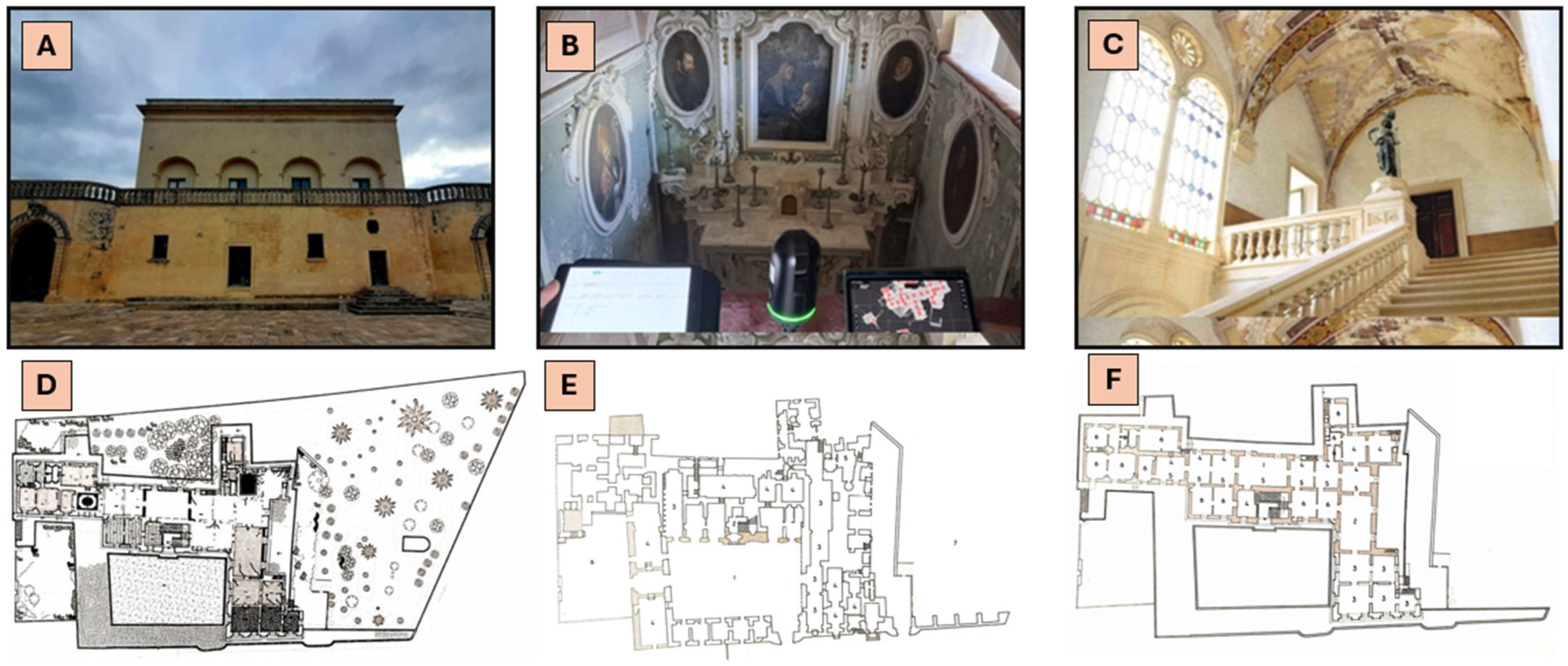
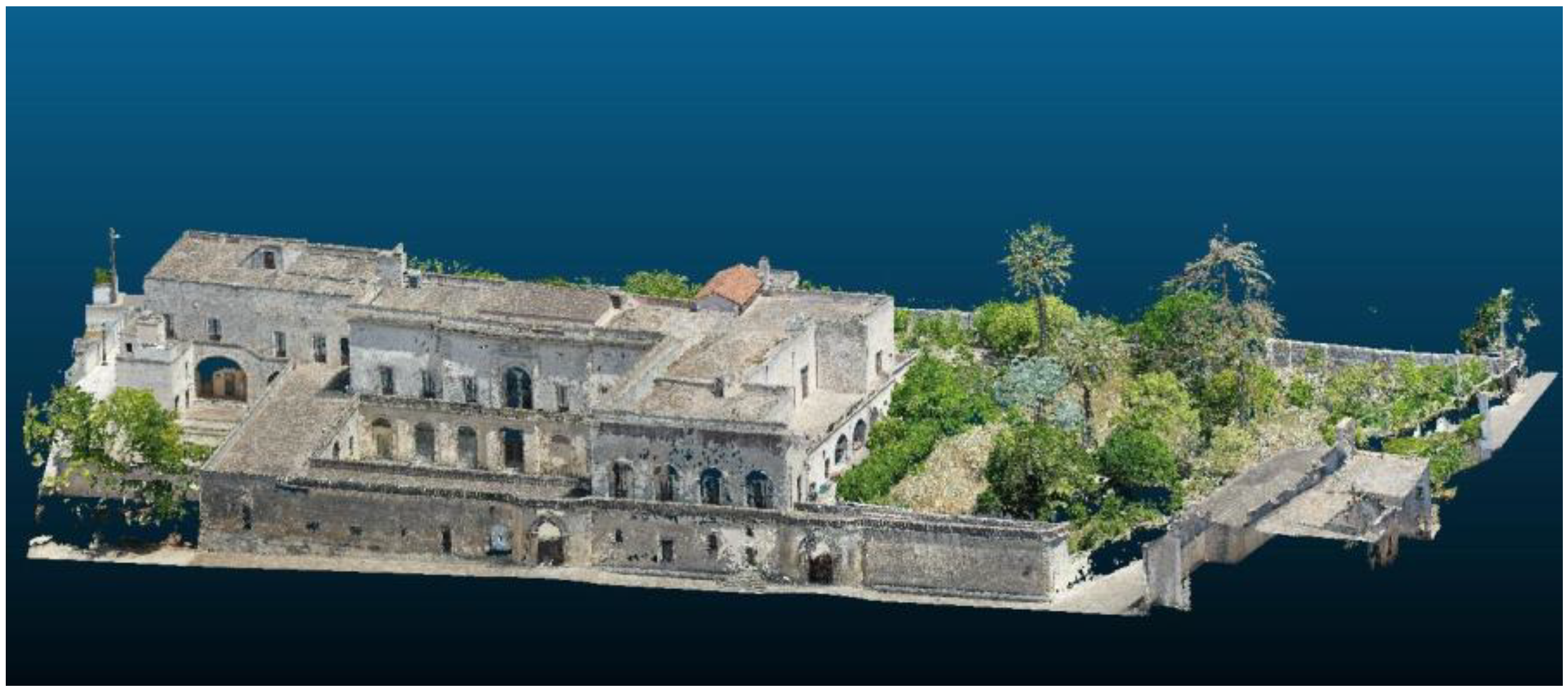
2.1. The Case Study: Marquis’s Palace in Botrugno (Lecce, Italy)
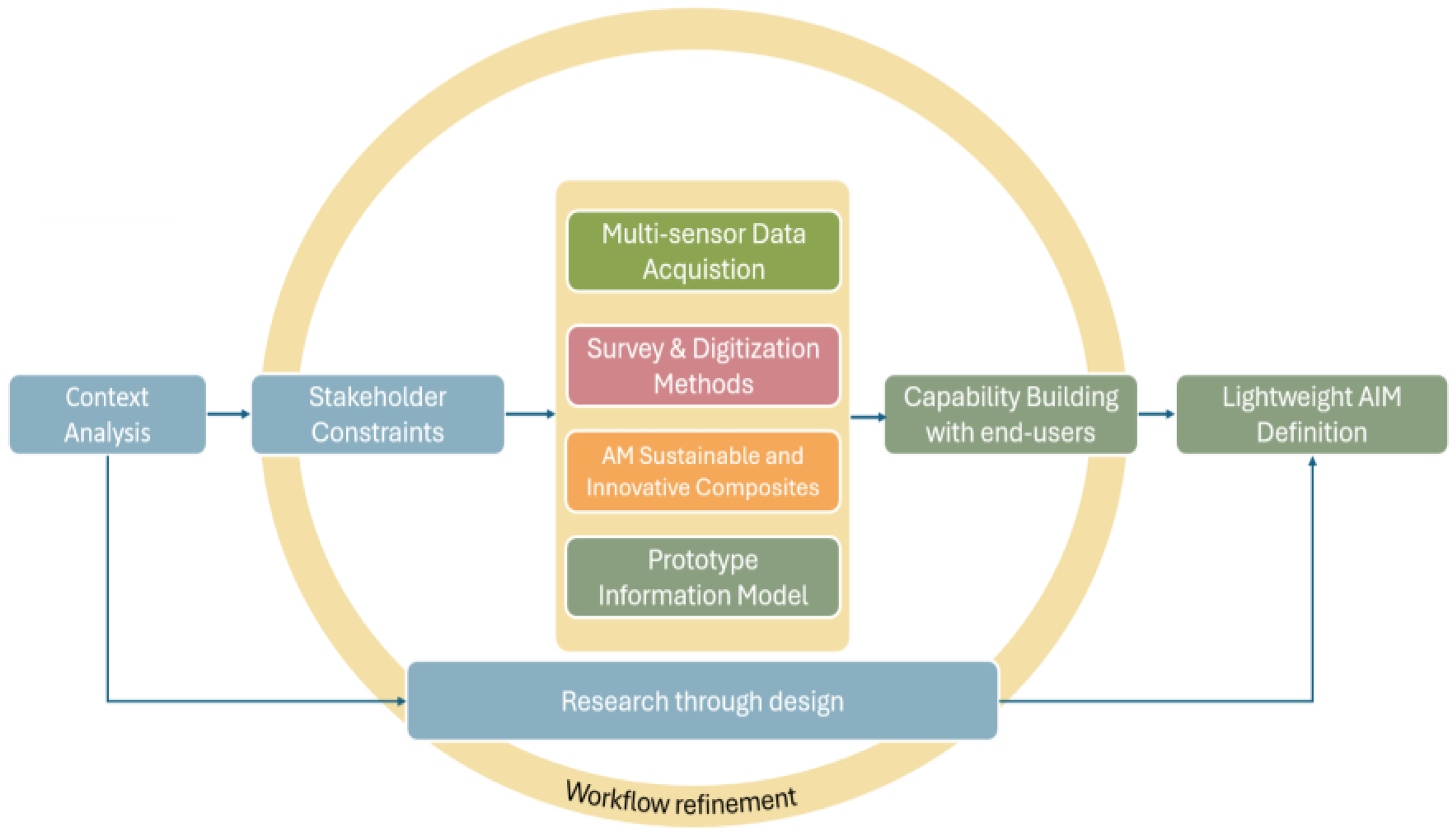
2.2. Methodological Framework
- Information retrievability;
- Accessibility for non-specialized personnel;
- Scalability;
- Maintainability over time;
- Compatibility with limited economic and technical resources.
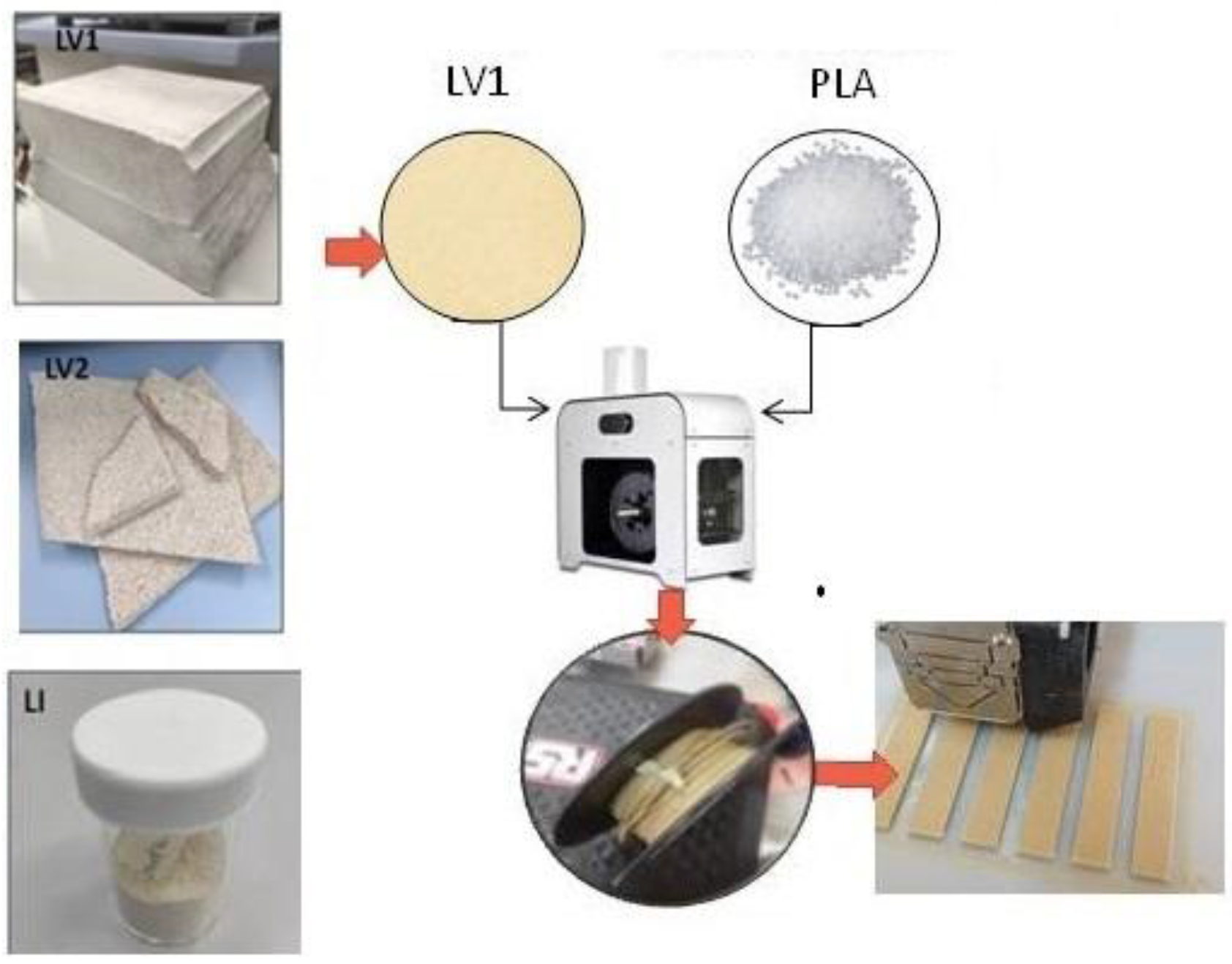
- The development of new, sustainable, and innovative formulations for additive manufacturing (3D printing) and performance testing: The development of innovative composite filaments made from industrial stone waste for FFF printing through a handmade process provides a useful tool for private users involved in 3D printing and suggests eco-friendly protocols for companies that can reuse or dispose of their inorganic industrial waste in an environmentally responsible manner.
- Multidisciplinary Integration: RtD facilitates a mixed-methods approach that combines quantitative data (metric surveys, chemical parameters) with qualitative insights (archival research, site inspections). This ensures that findings can be integrated from multiple sources, providing a more robust understanding of the asset’s state of conservation.
- Addressing the Digital Divide: A key strength of this methodology is its flexibility. By defining a framework that adapts to the real-world constraints of local technical offices, the project balances scientific rigor with operational feasibility, proposing scalable solutions that bridge the technological gap in peripheral or rural areas.
- Facilitating Technology Transfer: The results of the design process provided a lightweight information model for diverse stakeholders (Universities, users, private companies, and local authorities), enabling an effective transfer of innovation to the territory and supporting evidence-based decision-making.
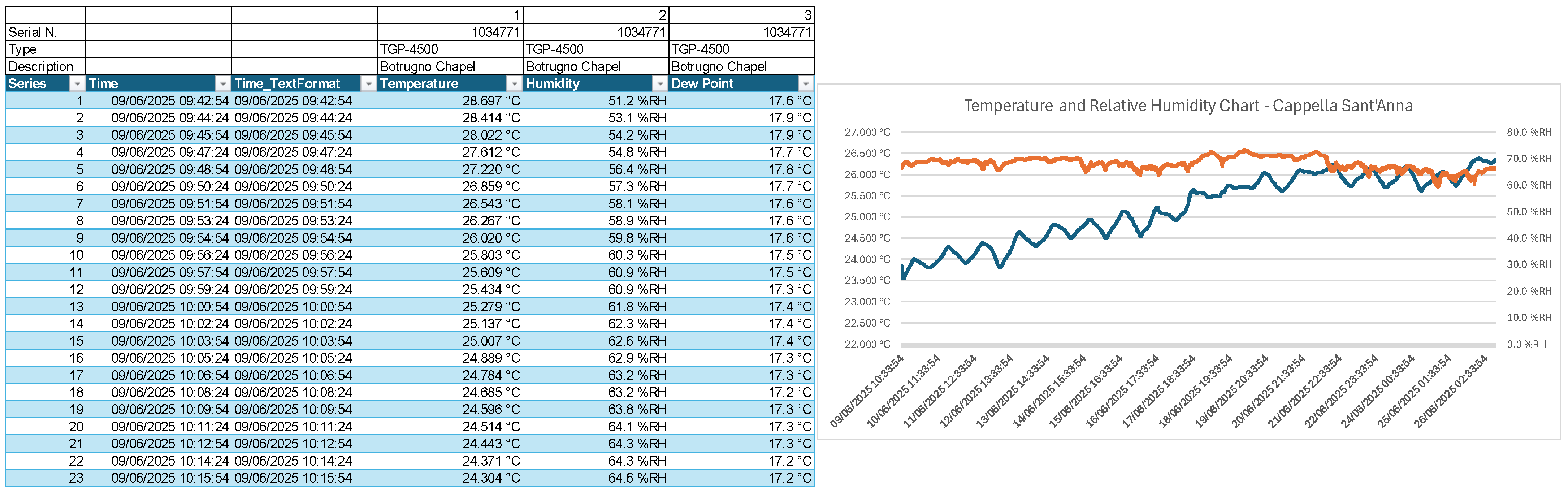
- Closing the Physical–Digital Cycle: Through RtD, data transitions continuously between dimensions. A physical architectural element is captured digitally, processed into an information model, and then “returned” to the tangible world. The cycle of Physical (Survey) → Digital (HBIM/Mesh) → Physical (3D printing) extends the applicability of the digital model from representation and documentation to a vehicle for “tangible archiving”. In the physical to digital operational process, the physical asset’s data are captured through multi-sensor surveys (IoT real time monitoring was not a viable solution), documented in digital sources (i.e., HBIMs, spreadsheet, segmented point clouds) and then “returned” to the tangible dimension via the development of innovative composite filaments. The characteristics of these composite filaments for 3D printing filaments are linked and informed by these digital data sources to drive decisions related to the desired chemical and physical characteristics, along with color and shapes. Information regarding the production of new composites for printing (technical data sheets for the new materials and their mechanical properties, operating parameters for the reuse of materials and artisanal extrusion, etc.) can, in fact, be integrated into the digitized database (which already contains technical data sheets for other materials, user manuals, material information, a maintenance history, asset monitoring data, etc.) with the aim of supporting facility managers in their day-to-day and strategic decisions, addressing specific operational needs.
2.3. Multi-Sensor Documentation and Diagnostic Techniques
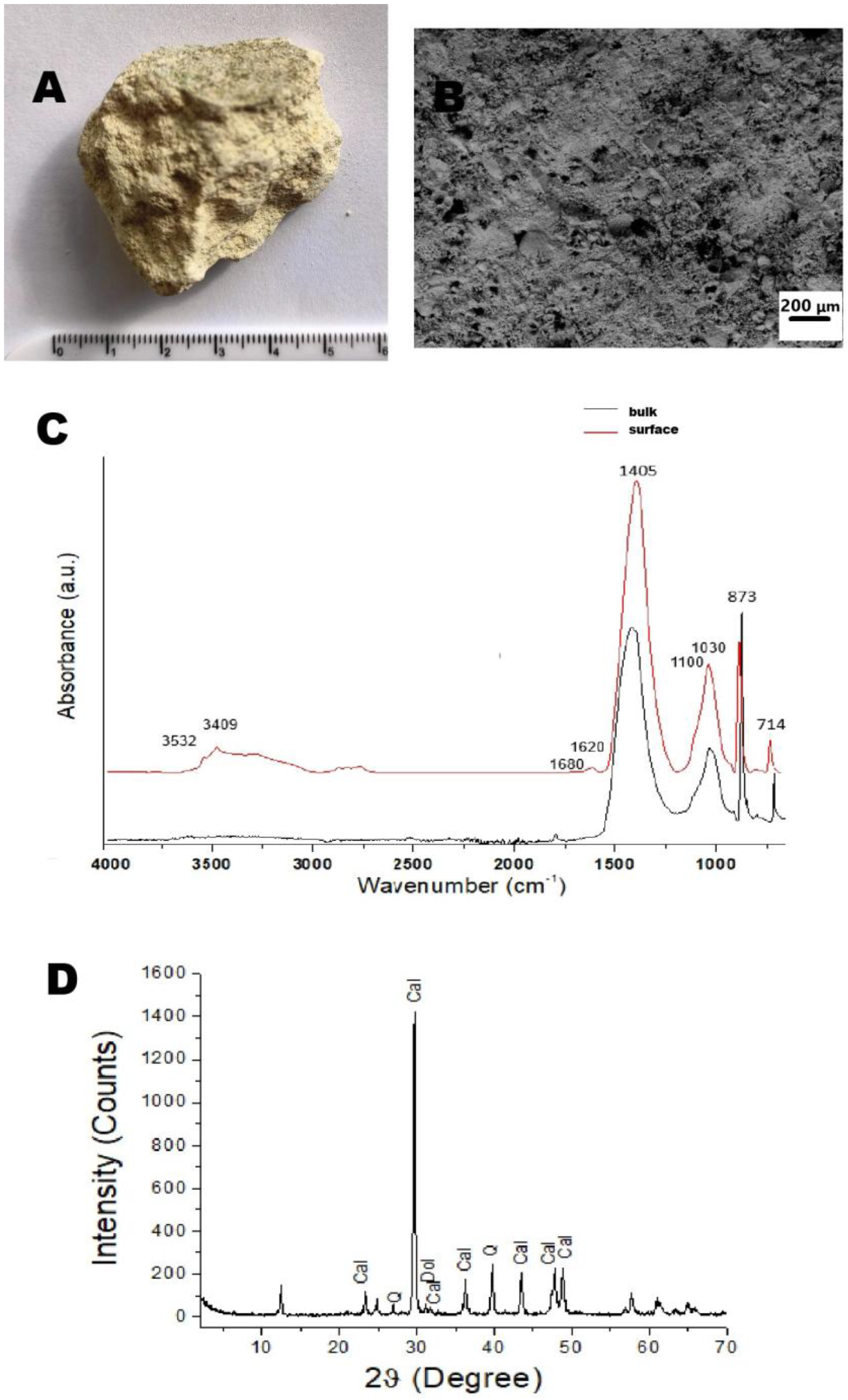
2.4. Sustainability and Innovative Composites for Additive Manufacturing (3D Printing)
2.4.1. Additive Manufacturing Materials
2.4.2. Additive Manufacturing Methods
3. Results
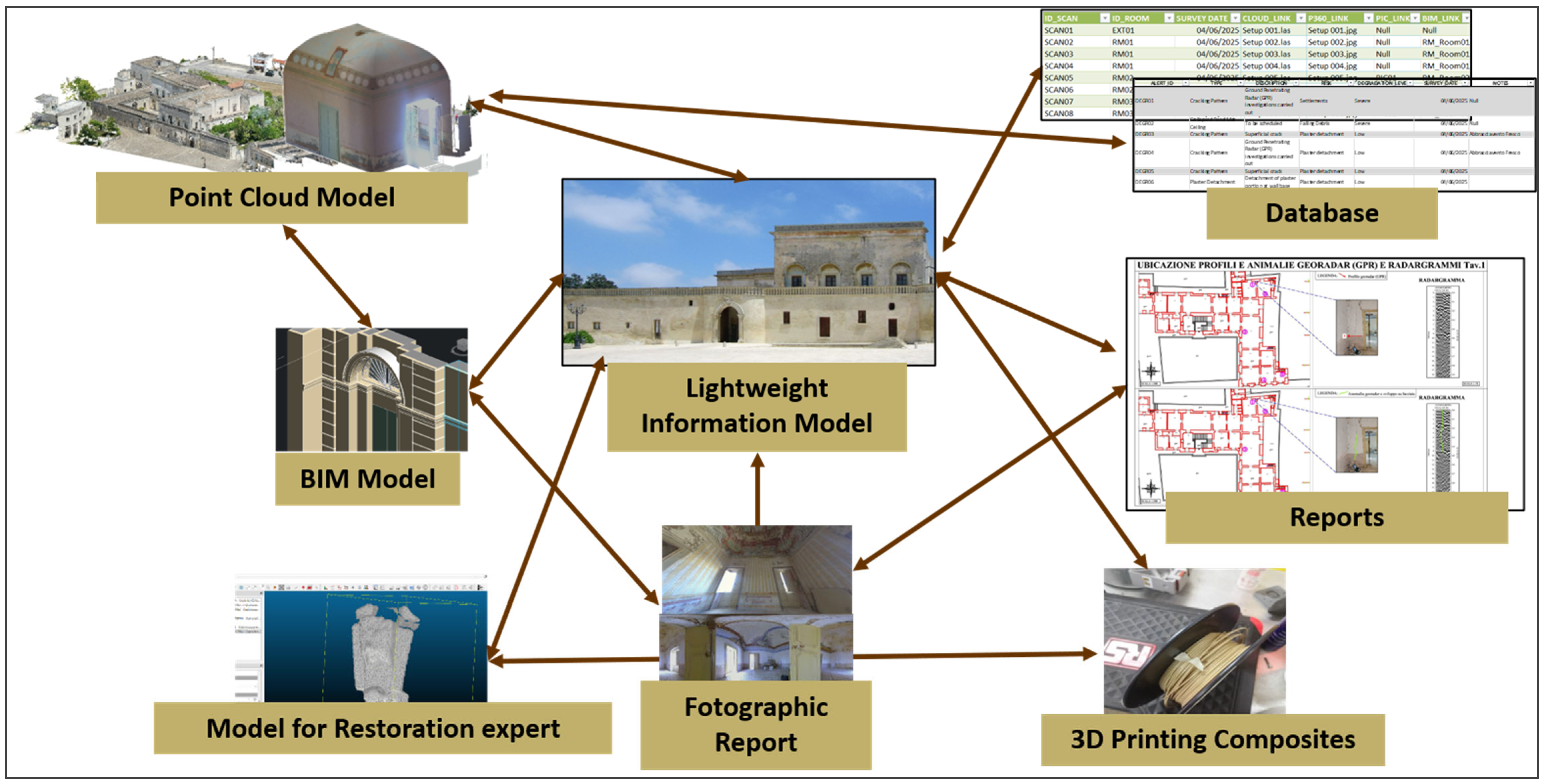
3.1. Multi-Sensor Survey Integration and the “Lightweight” Information Model
- HBIM geometrical model: The HBIMs, from a geometrical perspective, can be extended to a triad comprising BIM-modeled elements, individual point cloud scans of spaces, and 3D meshes derived either from point clouds or ad hoc modeling activities. The choice of using the native single scans of rooms acted as natural work around to have a pre-segmented point cloud, divided by a room, thanks to the singular scan performed with the tool.
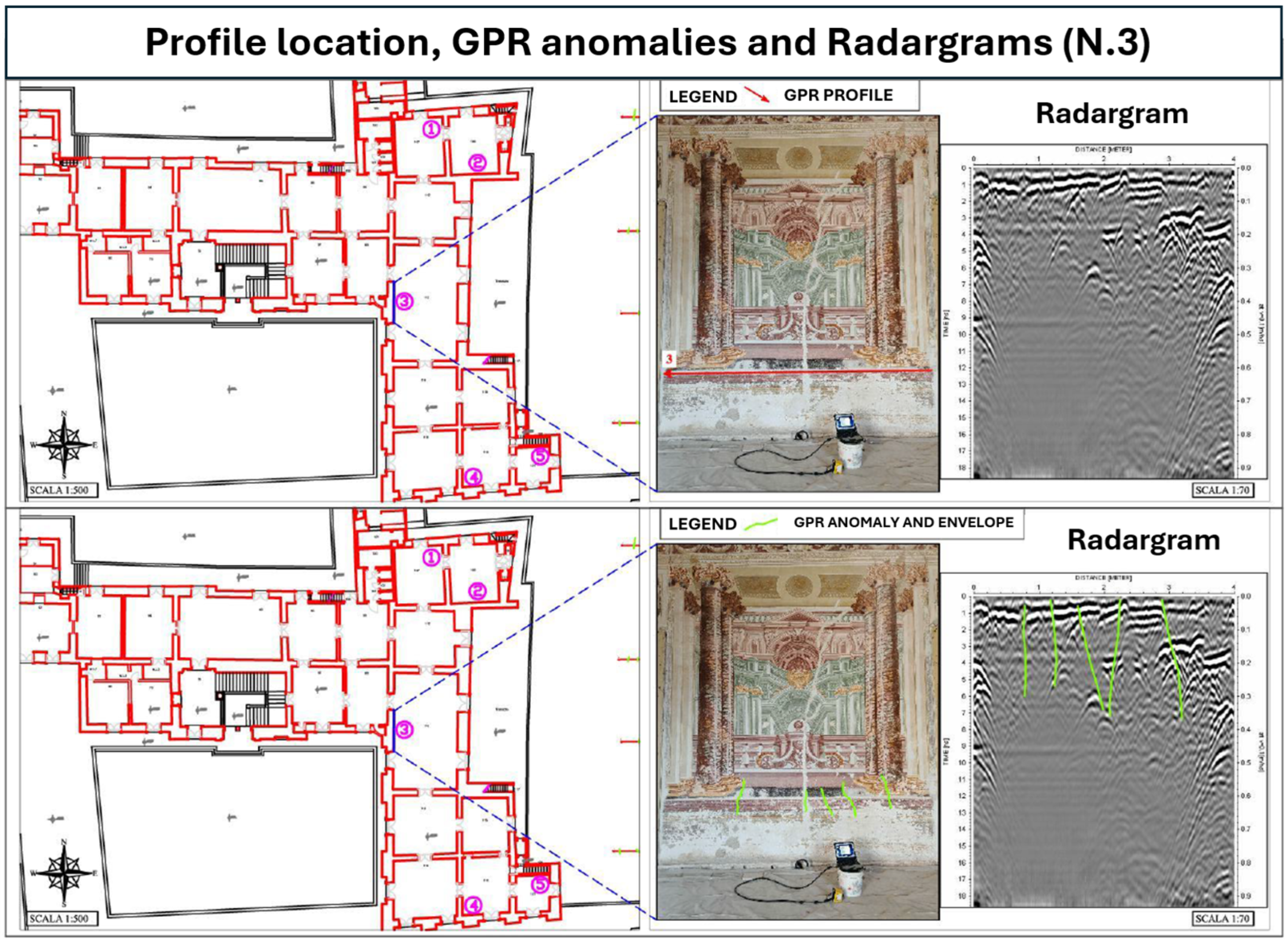
- Documentation: This includes all information that, by its nature, cannot be converted into BIM Property Sets, since it consists of complex descriptions (e.g., historical-documentary investigations) or technical reports (e.g., GPR analyses, visual inspection reports), which are more appropriately linked to BIMs through document URLs and referenced within databases using encoded filenames.
- Database: The database, implementable in Excel as well as in Access or other dedicated Database Management Systems (DBMSs), consists of a series of tables connected through primary and foreign keys. These tables include:
- ○
- Degradation phenomena table: A table containing details regarding space codes (consistent with the HBIMs), related photographs, the specific point cloud scan in which the phenomenon is visible, any technical investigation validating the damage, and additional notes.
- ○
- Spaces table: A table designed to aggregate photographs, scans, investigations, and additional information such as areas and volumes at the individual space level, consistently with the HBIMs.
- ○
- Scans table: Each scan is identified through an ID corresponding to its filename to facilitate rapid information retrieval. Attributes may include the acquisition date, represented space, links to BIMs, etc.
- ○
- Documentation table: All report-format data, whether directly attributable to BIM elements or degradation phenomena, as well as those referring to the building as a whole (e.g., historical investigations), are systematically organized within a dedicated table.
- ○
- Sensor campaigns and time-series table: Time-series data may be collected as individual records from which users can access the dataset associated with a specific surveying campaign.
3.2. Subsurface Diagnostic and Condition Assessment: GPR and Crack Pattern Correlation
3.3. Sustainability and Innovative Materials for Additive Manufacturing (3D Printing)
3.4. Bridging the Digital Divide and the Challenge of Multidisciplinarity
3.5. Multidimensionality and Multidisciplinarity as Tools for Climate Change Resilience
3.6. Systematic Analysis of Challenges and Operational Adaptation
4. Conclusions
Author Contributions
Funding
Data Availability Statement
Acknowledgments
Conflicts of Interest
Abbreviations
| AI | Artificial Intelligence |
| AIM | Asset Information Model |
| AM | Additive Manufacturing |
| BIM | Building Information Model |
| CH | Cultural Heritage |
| CNN | Convolutional Neural Network |
| ETL | Extract, Transform, Load |
| FFF | Fused Filament Fabrication |
| GIS | Geographic Information System |
| HBIM | Heritage Building Information Model |
| IFCs | Industry Foundation Classes |
| MVS | Multi-View Stereo |
| PLA | Polylactic Acid |
| RTD | Research Through Design |
| SEM | Scanning Electron Microscopy |
| SFM | Structure From Motion |
| TLS | Terrestrial Laser Scanning |
| UAV | Unmanned Aerial Vehicle |
| VIS | Visual Inertial System |
References
- Pozo-Antonio, J.S.; Rivas, T.; López, A.J.; Fiorucci, M.P.; Ramil, A. Effectiveness of granite cleaning procedures in cultural heritage: A review. Sci. Total Environ. 2016, 571, 1017–1028. [Google Scholar] [CrossRef] [Scilit] [PubMed]
- Dastgerdi, A.S.; Sargolini, M.; Pierantoni, I. Climate Change Challenges to Existing Cultural Heritage Policy. Sustainability 2019, 11, 5227. [Google Scholar] [CrossRef] [Scilit]
- Di Turo, F.; Proietti, C.; Screpanti, A.; Fornasier, M.F.; Cionni, I.; Favero, G.; De Marco, A. Impacts of air pollution on cultural heritage corrosion at European level: What has been achieved and what are the future scenarios. Environ. Pollut. 2016, 218, 586–594. [Google Scholar] [CrossRef] [Scilit] [PubMed]
- Sesana, E.; Gagnon, A.S.; Ciantelli, C.; Cassar, J.; Hughes, J.J. Climate change impacts on cultural heritage: A literature review. WIREs Clim. Change 2021, 12, e710. [Google Scholar] [CrossRef] [Scilit]
- Abuku, M.; Janssen, H.; Roels, S. Impact of wind-driven rain on historic brick wall buildings in a moderately cold and humid climate: Numerical analyses of mould growth risk, indoor climate and energy consumption. Energy Build. 2009, 41, 101–110. [Google Scholar] [CrossRef] [Scilit]
- Croce, V.; Caroti, G.; Piemonte, A. ASSESSMENT OF EARTHQUAKE-INDUCED DAMAGE LEVEL ON BUILDINGS: ANALYSIS OF TWO DIFFERENT SURVEY METHODS FOR A CASE STUDY. Int. Arch. Photogramm. Remote Sens. Spat. Inf. Sci. 2019, XLII-2/W15, 351–358. [Google Scholar] [CrossRef] [Scilit]
- Vojinovic, Z.; Hammond, M.; Golub, D.; Sianee, H.; Weesakul, S.; Meesuk, V.; Media, N.; Sanchez, A.; Kummara, S.; Abbott, M. Holistic approach to flood risk assessment in areas with cultural heritage: A practical application in Ayutthaya, Thailand. Nat. Hazards 2016, 81, 589–616. [Google Scholar] [CrossRef] [Scilit]
- Cumo, F.; Sferra, A.S.; Pennacchia, E. Building heritage of “Sapienza”: Integrated digital tools for the executive project; [Patrimonio edilizio della “Sapienza”: Strumenti digitali integrati per il progetto esecutivo]. TECHNE 2019, 18, 191–198. [Google Scholar] [CrossRef] [Scilit]
- Croce, P.; Landi, F.; Meligeni, F. DIGITAL TWIN FOR STRUCTURAL HEALTH MONITORING OF CULTURAL HERITAGE: THE BUILDCHAIN DEMO-PILOT, PALAZZO PONIATOWSKI-GUADAGNI IN FLORENCE. In World Congress in Computational Mechanics and ECCOMAS Congress; Scipedia S.L.: Barcelona, Spain, 2024. [Google Scholar] [CrossRef] [Scilit]
- Grazianova, M.; Mesaros, P. Cultural heritage management from traditional methods to digital systems: A review from bim to digital twin. E3S Web Conf. 2024, 550, 01015. [Google Scholar] [CrossRef] [Scilit]
- Clini, P.; Nespeca, R.; Angeloni, R.; Ferretti, U. Above-Ground and Underground Architectural Heritage Documentation: A Scan-to-HBIM-to-XR Approach for Historic Centres. Int. Arch. Photogramm. Remote Sens. Spat. Inf. Sci.-ISPRS Arch. 2025, 48, 345–351. [Google Scholar] [CrossRef] [Scilit]
- Zhang, L.; Tang, M.; Xu, Y.; Zhang, C. Application Research on Artificial Intelligence Generated Content in Architectural Design. In ACM International Conference Proceeding Series; Association for Computing Machinery: New York, NY, USA, 2024; pp. 671–680. [Google Scholar] [CrossRef] [Scilit]
- Calvar, S.; Elseicy, A.; Novo, A.; Salgado, D.; Balado, J.; Solla, M. Innovative AR and GPR techniques for enhanced modelling and condition assessment of bridge structures. Int. Arch. Photogramm. Remote Sens. Spat. Inf. Sci. 2026, XLVIII-4/W17-2025, 75–82. [Google Scholar] [CrossRef] [Scilit]
- Leucci, G. Ground Penetrating Radar: The Electromagnetic Signal Attenuation and Maximum Penetration Depth. Sch. Res. Exch. 2008, 2008, 1–7. [Google Scholar] [CrossRef] [Scilit]
- Leucci, G.; Masini, N.; Persico, R.; Soldovieri, F. GPR and sonic tomography for structural restoration: The case of the cathedral of Tricarico. J. Geophys. Eng. 2011, 8, S76–S92. [Google Scholar] [CrossRef] [Scilit]
- Leucci, G. Nondestructive Testing for Archaeology and Cultural Heritage: A Practical Guide and New Perspectives; Springer International Publishing: Cham, Switzerland, 2019. [Google Scholar] [CrossRef] [Scilit]
- Leucci, G.; Masini, N.; Persico, R. Time–frequency analysis of GPR data to investigate the damage of monumental buildings. J. Geophys. Eng. 2012, 9, S81–S91. [Google Scholar] [CrossRef] [Scilit]
- Mishra, M.; Lourenço, P.B. Artificial intelligence-assisted visual inspection for cultural heritage: State-of-the-art review. J. Cult. Herit. 2024, 66, 536–550. [Google Scholar] [CrossRef] [Scilit]
- BIM Dictionary. BIM Dictionary. Available online: https://bimdictionary.scom/en/iso-19650-terms/1 (accessed on 11 May 2026).
- D.Lgs. 36, D.Lgs.36/2023. 2023. Available online: https://www.normattiva.it/uri-res/N2Ls?urn:nir:stato:decreto.legislativo:2023-03-31;36 (accessed on 5 May 2026).
- Cheng, Q.; Tayeh, B.A.; Abu Aisheh, Y.I.; Alaloul, W.S.; Aldahdooh, Z.A. Leveraging BIM for Sustainable Construction: Benefits, Barriers, and Best Practices. Sustainability 2024, 16, 7654. [Google Scholar] [CrossRef] [Scilit]
- Hauashdh, A.; Nagapan, S.; Jailani, J.; Gamil, Y. An integrated framework for sustainable and efficient building maintenance operations aligning with climate change, SDGs, and emerging technology. Results Eng. 2024, 21, 101822. [Google Scholar] [CrossRef] [Scilit]
- Saka, A.B.; Chan, D.W.M. BIM divide: An international comparative analysis of perceived barriers to implementation of BIM in the construction industry. J. Eng. Des. Technol. 2023, 21, 1604–1632. [Google Scholar] [CrossRef] [Scilit]
- Xiahou, X.; Ding, X.; Chen, P.; Qian, Y.; Jin, H. Digital Technologies in Urban Regeneration: A Systematic Literature Review from the Perspectives of Stakeholders, Scales, and Stages. Buildings 2025, 15, 2455. [Google Scholar] [CrossRef] [Scilit]
- Lovell, L.J.; Davies, R.J.; Hunt, D.V.L. The Application of Historic Building Information Modelling (HBIM) to Cultural Heritage: A Review. Heritage 2023, 6, 6691–6717. [Google Scholar] [CrossRef] [Scilit]
- Cinquepalmi, F.; Tiburcio, V.A. Sustainable Restoration of Cultural Heritage in the digital era. Vitruvio 2023, 8, 76–87. [Google Scholar] [CrossRef] [Scilit]
- Acke, L.; Corradi, D.; Verlinden, J. Comprehensive educational framework on the application of 3D technologies for the restoration of cultural heritage objects. J. Cult. Herit. 2024, 66, 613–627. [Google Scholar] [CrossRef] [Scilit]
- Sánchez-Aparicio, L.J.; del Blanco-García, F.L.; Mencías-Carrizosa, D.; Villanueva-Llauradó, P.; Aira-Zunzunegui, J.R.; Sanz-Arauz, D.; Pierdicca, R.; Pinilla-Melo, J.; Garcia-Gago, J. Detection of damage in heritage constructions based on 3D point clouds. A systematic review. J. Build. Eng. 2023, 77, 107440. [Google Scholar] [CrossRef] [Scilit]
- Adamopoulos, E.; Rinaudo, F.; Volinia, M.; Girotto, M. Multispectral Sensing and Data Integration for the Study of Heritage Architecture. Eng. Proc. 2020, 2, 64. [Google Scholar] [CrossRef] [Scilit]
- Avena, M.; Colucci, E.; Sammartano, G.; Spanò, A. HBIM modelling for an historical urban centre. Int. Arch. Photogramm. Remote Sens. Spat. Inf. Sci.—ISPRS Arch. 2021, 43, 831–838. [Google Scholar] [CrossRef] [Scilit]
- Massafra, A.; Predari, G.; Gulli, R. TOWARDS DIGITAL TWIN DRIVEN CULTURAL HERITAGE MANAGEMENT: A HBIM-BASED WORKFLOW FOR ENERGY IMPROVEMENT OF MODERN BUILDINGS. Int. Arch. Photogramm. Remote Sens. Spat. Inf. Sci. 2022, XLVI-5/W1-2022, 149–157. [Google Scholar] [CrossRef] [Scilit]
- Garcia-León, J.; Murrieri, P.; Collado-Espejo, P.E. Hbim as a tool for the analysis and conservation of architectural heritage. case study: The rame tower’s digital twin. Int. Arch. Photogramm. Remote Sens. Spat. Inf. Sci.-ISPRS Arch. 2023, 48, 637–644. [Google Scholar] [CrossRef] [Scilit]
- Bernardello, R.A.; Montecchio, M. Information ontology for historical analysis: Survey and BIM model of the San Trovaso Church in Venice. DISEGNARECON 2021, 14, 8.2–8.19. [Google Scholar] [CrossRef]
- Celeste, G.; Lazoi, M.; Mangia, M.; Mangialardi, G. Innovating the Construction Life Cycle through BIM/GIS Integration: A Review. Sustainability 2022, 14, 766. [Google Scholar] [CrossRef] [Scilit]
- Cursi, S.; Martinelli, L.; Paraciani, N.; Calcerano, F.; Gigliarelli, E. Linking external knowledge to heritage BIM. Autom. Constr. 2022, 141, 104444. [Google Scholar] [CrossRef] [Scilit]
- Matrone, F.; Colucci, E.; Ruvo, V.; Lingua, A.; Spanò, A. HBIM in a semantic 3d gis database. Int. Arch. Photogramm. Remote Sens. Spat. Inf. Sci. 2019, XLII-2/W11, 857–865. [Google Scholar] [CrossRef] [Scilit]
- Pavlidis, G.; Sevetlidis, V.; Arampatzakis, V. Defining a New Digital Twin Ontology for Cultural Heritage Preservation—The Case of ARGUS. In Digital Heritage; The Eurographics Association: Goslar, Germany, 2025. [Google Scholar] [CrossRef]
- Attenni, M.; Bianchini, C.; Caldarone, A.; Griffo, M.; Paris, L.; Senatore, L.J.; Rossi, M.L. Integrating Building Information Modeling for Enhanced Efficiency and Sustainability in Public Construction: The Sapienza University Protocol. Heritage 2025, 8, 114. [Google Scholar] [CrossRef] [Scilit]
- Berlato, M.; Binni, L.; Durmus, D.; Gatto, C.; Giusti, L.; Massari, A.; Toldo, B.M.; Cascone, S.; Mirarchi, C. Digital Platforms for the Built Environment: A Systematic Review Across Sectors and Scales. Buildings 2025, 15, 2432. [Google Scholar] [CrossRef] [Scilit]
- Bartolini, G.; De Falco, A.; Gianfranceschi, L.; Martino, M.; Vignali, L. The Heritage Building Information Modeling Methodology for Structural Diagnosis: An Integrated System of Digital Models for the Baptistery of San Giovanni in Pisa. Heritage 2024, 7, 6366–6391. [Google Scholar] [CrossRef] [Scilit]
- Crisan, A.; Pepe, M.; Costantino, D.; Herban, S. From 3D Point Cloud to an Intelligent Model Set for Cultural Heritage Conservation. Heritage 2024, 7, 1419–1437. [Google Scholar] [CrossRef] [Scilit]
- Roman, O.; Avena, M.; Farella, E.M.; Remondino, F.; Spanò, A. A SEMI-AUTOMATED APPROACH TO MODEL ARCHITECTURAL ELEMENTS IN SCAN-TO-BIM PROCESSES. Int. Arch. Photogramm. Remote Sens. Spat. Inf. Sci. 2023, XLVIII-M-2–2023, 1345–1352. [Google Scholar] [CrossRef] [Scilit]
- Pierdicca, R.; Paolanti, M.; Matrone, F.; Martini, M.; Morbidoni, C.; Malinverni, E.S.; Frontoni, E.; Lingua, A.M. Point Cloud Semantic Segmentation Using a Deep Learning Framework for Cultural Heritage. Remote Sens. 2020, 12, 1005. [Google Scholar] [CrossRef] [Scilit]
- Vacca, G.; Quaquero, E.; Pili, D.; Brandolini, M. GIS-HBIM INTEGRATION FOR THE MANAGEMENT OF HISTORICAL BUILDINGS. Int. Arch. Photogramm. Remote Sens. Spat. Inf. Sci. 2020, XLII-2, 4–7. [Google Scholar]
- Mangia, M.; Lazoi, M.; Mangialardi, G. Digital Management of Large Building Stocks: BIM and GIS Integration-Based Systems. In Product Lifecycle Management. Green and Blue Technologies to Support Smart and Sustainable Organizations; IFIP Advances in Information and Communication Technology; Canciglieri Junior, O., Noël, F., Rivest, L., Bouras, A., Eds.; Springer International Publishing: Cham, Switzerland, 2022; Volume 639, pp. 133–150. [Google Scholar] [CrossRef] [Scilit]
- Matrone, F.; Colucci, E.; Iacono, E.; Ventura, G.M. The HBIM-GIS Main10ance Platform to Enhance the Maintenance and Conservation of Historical Built Heritage. Sensors 2023, 23, 8112. [Google Scholar] [CrossRef] [Scilit] [PubMed]
- Wojciechowska, G.; Bednarz, L.J.; Dolińska, N.; Opalka, P.; Krupa, M.; Imnadze, N. Intelligent Monitoring System for Integrated Management of Historical Buildings. Buildings 2024, 14, 2108. [Google Scholar] [CrossRef] [Scilit]
- Ciuffreda, A.L.; Trovatelli, F.; Meli, F.; Caselli, G.; Stramaccioni, C.; Coli, M.; Tanganelli, M. Historic Building Information Modeling for Conservation and Maintenance: San Niccolo’s Tower Gate, Florence. Heritage 2024, 7, 1334–1356. [Google Scholar] [CrossRef] [Scilit]
- Tahoon, D.; El-Zohairy, A.; Hendawy, H.I. Cost Impact Comparative Analysis via BIM between Heritage Regular Maintenance Projects and Long-Term Restoration Projects—A Case Study. Heritage 2023, 7, 50–75. [Google Scholar] [CrossRef] [Scilit]
- Siewczyński, B.; Szot, J. BIM goals and uses in the management, maintenance, and preservation of historic buildings: An open access perspective. Implementation characteristics of HBIM for improved documentation and lifecycle management. npj Herit. Sci. 2025, 13, 103. [Google Scholar] [CrossRef] [Scilit]
- Freire, G.; Vieira, M.; Mesquita, E. HBIM protocol for supporting the management and maintenance of historic buildings. J. Build. Eng. 2026, 124, 116053. [Google Scholar] [CrossRef] [Scilit]
- Romani, A.; Suriano, R.; Levi, M. Biomass waste materials through extrusion-based additive manufacturing: A systematic literature review. J. Clean. Prod. 2023, 386, 135779. [Google Scholar] [CrossRef] [Scilit]
- Fico, D.; Rizzo, D.; Casciaro, R.; Esposito Corcione, C. A Review of Polymer-Based Materials for Fused Filament Fabrication (FFF): Focus on Sustainability and Recycled Materials. Polymers 2022, 14, 465. [Google Scholar] [CrossRef] [Scilit] [PubMed]
- Mikula, K.; Skrzypczak, D.; Izydorczyk, G.; Warchoł, J.; Moustakas, K.; Chojnacka, K.; Witek-Krowiak, A. 3D printing filament as a second life of waste plastics—A review. Environ. Sci. Pollut. Res. 2021, 28, 12321–12333. [Google Scholar] [CrossRef] [Scilit] [PubMed]
- Algarni, M.; Ghazali, S. Comparative Study of the Sensitivity of PLA, ABS, PEEK, and PETG’s Mechanical Properties to FDM Printing Process Parameters. Crystals 2021, 11, 995. [Google Scholar] [CrossRef] [Scilit]
- Rajendran Royan, N.R.; Leong, J.S.; Chan, W.N.; Tan, J.R.; Shamsuddin, Z.S.B. Current State and Challenges of Natural Fibre-Reinforced Polymer Composites as Feeder in FDM-Based 3D Printing. Polymers 2021, 13, 2289. [Google Scholar] [CrossRef] [Scilit] [PubMed]
- Fico, D.; Rizzo, D.; De Carolis, V.; Esposito Corcione, C. Bio-Composite Filaments Based on Poly(Lactic Acid) and Cocoa Bean Shell Waste for Fused Filament Fabrication (FFF): Production, Characterization and 3D Printing. Materials 2024, 17, 1260. [Google Scholar] [CrossRef] [Scilit] [PubMed]
- Fico, D.; Rizzo, D.; De Carolis, V.; Montagna, F.; Esposito Corcione, C. Sustainable Polymer Composites Manufacturing through 3D Printing Technologies by Using Recycled Polymer and Filler. Polymers 2022, 14, 3756. [Google Scholar] [CrossRef] [Scilit] [PubMed]
- Esposito Corcione, C.; Scalera, F.; Gervaso, F.; Montagna, F.; Sannino, A.; Maffezzoli, A. One-step solvent-free process for the fabrication of high loaded PLA/HA composite filament for 3D printing. J. Therm. Anal. Calorim. 2018, 134, 575–582. [Google Scholar] [CrossRef] [Scilit]
- Scopigno, R.; Cignoni, P.; Pietroni, N.; Callieri, M.; Dellepiane, M. Digital Fabrication Techniques for Cultural Heritage: A Survey. Comput. Graph. Forum 2017, 36, 6–21. [Google Scholar] [CrossRef] [Scilit]
- Fico, D.; Rizzo, D.; De Carolis, V.; Lerario, F.; Di Roma, A.; Esposito Corcione, C. From Marble Waste to Eco-Friendly Filament for 3D Printing to Help Renaturalization of Quarries. Sustainability 2025, 17, 1977. [Google Scholar] [CrossRef] [Scilit]
- Lionetto, F.; Esposito Corcione, C. Recent Applications of Biopolymers Derived from Fish Industry Waste in Food Packaging. Polymers 2021, 13, 2337. [Google Scholar] [CrossRef] [Scilit] [PubMed]
- ADSI—Giornata Nazionale Palazzo Marchesale di Botrugno. Available online: https://www.associazionedimorestoricheitaliane.it/evento-dimora/392812/palazzo-marchesale-di-botrugno/ (accessed on 9 May 2026).
- Our Commitment for the Conservation and Enhancement of an Italian Heritage. Available online: https://www.associazionedimorestoricheitaliane.it/evento-dimora/425454/cappella-palatina-di-s-anna/ (accessed on 9 May 2026).
- Stappers, P.J.; Giaccardi, E. Research through Design. In The Encyclopedia of Human-Computer Interaction, 2nd ed.; The Interaction Design Foundation: Aarhus, Denmark, 2017. [Google Scholar]
- Koskinen, I.; Zimmerman, J.; Binder, T.; Redstrom, J.; Wensveen, S. Design Research Through Practice: From the Lab, Field, and Showroom. IEEE Trans. Prof. Commun. 2013, 56, 262–263. [Google Scholar] [CrossRef] [Scilit]
- Zimmerman, J.; Forlizzi, J.; Evenson, S. Research through design as a method for interaction design research in HCI. In Proceedings of the SIGCHI Conference on Human Factors in Computing Systems; ACM: San Jose, CA, USA, 2007; pp. 493–502. [Google Scholar] [CrossRef] [Scilit]
- ISO 19650-1; Organization and Digitization of Information About Buildings and Civil Engineering Works, Including Building Information Modelling (BIM)—Information Management Using Building Information Modelling—Part 1: Concepts and Principles. ISO: Geneva, Switzerland, 2018.
- UNI 11337-1:2017; Edilizia e Opere di Ingegneria Civile—Gestione Digitale dei Processi Informativi delle Costruzioni—Parte 1: Modelli, Elaborati e Oggetti Informativi per Prodotti e Processi. UNI: Milano, Italy, 2017. Available online: https://store.uni.com/uni-11337-1-2017 (accessed on 9 November 2025).
- Guo, P.; Xue, H.; Ma, J.; Cheng, J.C.P. Advancing BIM information retrieval with an LLM-based query-domain-specific language and library code function alignment system. Autom. Constr. 2025, 178, 106374. [Google Scholar] [CrossRef] [Scilit]
- Kim, H.; Lee, H.-S.; Park, M.; Chung, B.; Hwang, S. Information Retrieval Framework for Hazard Identification in Construction. J. Comput. Civ. Eng. 2015, 29, 04014052. [Google Scholar] [CrossRef] [Scilit]
- Heaton, J.; Parlikad, A.K.; Schooling, J. Design and development of BIM models to support operations and maintenance. Comput. Ind. 2019, 111, 172–186. [Google Scholar] [CrossRef] [Scilit]
- Jesus, M.; Guimarães, A.S.; Rangel, B.; Lino Alves, J. The potential of 3D printing in building pathology: Rehabilitation of cultural heritage. Int. J. Build. Pathol. Adapt. 2023, 41, 647–674. [Google Scholar] [CrossRef] [Scilit]
- Fico, D. Càrparu e Leccisu: Tecniche di Finitura e Deterioramento Degli Edifici Storici del Salento. Ph D. Thesis, Università del Salento, Lecce, Italy, 2015. [Google Scholar]
- Derrick, M.R.; Stulik, D.; Landry, J.M. Infrared Spectroscopy in Conservation Science; Scientific Tools for Conservation; Getty Conservation Institute: Los Angeles, CA, USA, 1999. [Google Scholar]
- Galván-Ruiz, M.; Hernández, J.; Baños, L.; Noriega-Montes, J.; Rodríguez-García, M.E. Characterization of Calcium Carbonate, Calcium Oxide, and Calcium Hydroxide as Starting Point to the Improvement of Lime for Their Use in Construction. J. Mater. Civ. Eng. 2009, 21, 694–698. [Google Scholar] [CrossRef] [Scilit]
- Kaczmarek, S.E.; Gregg, J.M.; Bish, D.L.; Machel, H.G.; Fouke, B.W. DOLOMITE, VERY HIGH-MAGNESIUM CALCITE, AND MICROBES—IMPLICATIONS FOR THE MICROBIAL MODEL OF DOLOMITIZATION. In Characterization and Modeling of Carbonates–Mountjoy Symposium 1; SEPM (Society for Sedimentary Geology): Tulsa, OK, USA, 2017. [Google Scholar] [CrossRef] [Scilit]
- Bilgin, N.; Yeprem, H.A.; Arslan, S.; Bilgin, A.; Günay, E.; Marşoglu, M. Use of waste marble powder in brick industry. Constr. Build. Mater. 2012, 29, 449–457. [Google Scholar] [CrossRef] [Scilit]
- Zhang, C.; Xu, Z.; Hu, Y.; He, J.; Tian, M.; Zhou, J.; Zhou, Q.; Chen, S.; Chen, D.; Chen, P.; et al. Novel Insights into the Hydroxylation Behaviors of α-Quartz (101) Surface and its Effects on the Adsorption of Sodium Oleate. Minerals 2019, 9, 450. [Google Scholar] [CrossRef] [Scilit]
- Rothon, R.N. Particulate-Filled Polymer Composites, 2nd ed.; Rapra Technology: Shrewsbury, UK, 2003. [Google Scholar]
- Fico, D.; Rizzo, D.; De Carolis, V.; Montagna, F.; Palumbo, E.; Corcione, C.E. Development and characterization of sustainable PLA/Olive wood waste composites for rehabilitation applications using Fused Filament Fabrication (FFF). J. Build. Eng. 2022, 56, 104673. [Google Scholar] [CrossRef] [Scilit]
- Nugroho, A.; Ardiansyah, R.; Rusita, L.; Larasati, I.L. Effect of layer thickness on flexural properties of PLA (PolyLactid Acid) by 3D printing. J. Phys. Conf. Ser. 2018, 1130, 012017. [Google Scholar] [CrossRef] [Scilit]
- Zanichelli. La cCrisi Demografica Italiana. Ultim’ora di Geografia | Zanichelli. Available online: https://ultimora.zanichelli.it/geografia/ultimora-geografia-popolazione/la-crisi-demografica-italiana/ (accessed on 6 November 2025).
- D.Lgs. 01/2004., DECRETO LEGISLATIVO 22 gennaio 2004, n. 42—Normattiva. Available online: https://www.normattiva.it/uri-res/N2Ls?urn:nir:stato:decreto.legislativo:2004-01-22;42!vig= (accessed on 8 December 2025).





| ID_SCAN | ID_ROOM | SURVEY DATE | CLOUD_LINK | P360_LINK | PIC_LINK | BIM_LINK | … |
|---|---|---|---|---|---|---|---|
| SCAN01 | EXT01 | 04/06/2025 | Setup 001.e57 | Setup 001.jpg | Null | Null | … |
| SCAN02 | RM01 | 04/06/2025 | Setup 002.e57 | Setup 002.jpg | Null | RM_Room01 | … |
| SCAN03 | RM01 | 04/06/2025 | Setup 003.e57 | Setup 003.jpg | Null | RM_Room01 | … |
| … | … | … | … | … | … | … |
| ALERT_ID | TYPE | DESCRIPTION | RISK | DEGRADATION_LEVEL | SURVEY_DATE | NOTES |
|---|---|---|---|---|---|---|
| DEGR01 | Cracking Pattern | Ground-penetrating radar (GPR) investigations carried out | Settlements | Severe | 04/06/2025 | Null |
| DEGR02 | Collapsed Reed Mat Ceiling | To be scheduled | Falling Debris | Severe | 04/06/2025 | Null |
| DEGR03 | Cracking Pattern | Superficial crack | Plaster detachment | Low | 04/06/2025 | Abbracciavento Fresco |
| … | … | … | … | … | … | … |
| Sample | DSC Test (Filament) | Bending Test (Bar) | |||||
|---|---|---|---|---|---|---|---|
| Tg (°C) | Tc (°C) | Tm1 (°C) | Tm2 (°C) | E (GPa) | σR (MPa) | εR (%) | |
| 100PLA | 59.56 | 124.43 | 154.80 | / | 3.74 ± 0.15 | 102.54 ± 2.25 | 4.17 ± 0.42 |
| 90PLA/10LV1 | 61.13 | 115.66 | 152.30 | 158.05 | 3.09 ± 0.14 | 70.02 ± 2.05 | 3.89 ± 0.21 |
| 80PLA/20LV1 | 64.80 | 113.50 | 149.80 | 155.89 | 3.85 ± 0.15 | 68.76 ± 2.11 | 3.65 ± 0.34 |
| Domain | Category | Identified Challenge | Compromises and Adopted Solutions |
|---|---|---|---|
| Infrastructural | Connectivity | Absence of Wi-Fi infrastructure in the palace and 1 m thick masonry walls preventing signal transmission. | Replacement of real-time IoT networks with offline TinyTag data loggers. |
| Infrastructural | Hardware & Software | Lack of high-performance workstations and absence of commercial CDE/ACDat platforms in the technical office. | Shift from high-end Digital Twin to a “lightweight” local AIM using common office hardware and open-source viewers. |
| Management & Social | Skills & Human Resources | Lack of specialized BIM personnel, high staff turnover, and absence of capacity-building strategies. | Simplification of the information interface and AIM. Proposed a basic linkage between spreadsheets, databases, and graphical sources such as point clouds, and HBIMs. |
| Management & Social | Database Complexity | Difficulty in implementing and maintaining standard RDBMS (e.g., SQL) due to lack of internal IT expertise. | Adoption of Microsoft Excel as a relational-logic tool, utilizing unique IDs to manage links between data sources. |
| Data & Accuracy | Modeling Effort | Excessive costs and time required for manual Scan-to-BIM modeling of every architectural detail. | Use of native single-room point cloud scans (.e57) as pre-segmented assets, bypassing complete manual modeling. HBIM modeling of portions of the building to promote knowledge about HBIM capabilities to the end-users. |
| Data & Accuracy | Data Fragmentation | Heterogeneous data sources (TLS, GPR, IoT) without a clear strategy for their operational roles. | Implementation of a relational structure (Primary/Foreign keys) where each degradation instance is a queryable database record. |
Disclaimer/Publisher’s Note: The statements, opinions and data contained in all publications are solely those of the individual author(s) and contributor(s) and not of MDPI and/or the editor(s). MDPI and/or the editor(s) disclaim responsibility for any injury to people or property resulting from any ideas, methods, instructions or products referred to in the content. |
© 2026 by the authors. Licensee MDPI, Basel, Switzerland. This article is an open access article distributed under the terms and conditions of the Creative Commons Attribution (CC BY) license.
Share and Cite
Mangia, M.; Biccari, C.d.; Fico, D.; Rizzo, D.; Esposito Corcione, C. Challenges and Multidisciplinary Approaches for Cultural Heritage Information Management: The Marquis’s Palace of Botrugno Case Study in Southern Italy. Heritage 2026, 9, 282. https://doi.org/10.3390/heritage9070282
Mangia M, Biccari Cd, Fico D, Rizzo D, Esposito Corcione C. Challenges and Multidisciplinary Approaches for Cultural Heritage Information Management: The Marquis’s Palace of Botrugno Case Study in Southern Italy. Heritage. 2026; 9(7):282. https://doi.org/10.3390/heritage9070282
Chicago/Turabian StyleMangia, Mattia, Carla di Biccari, Daniela Fico, Daniela Rizzo, and Carola Esposito Corcione. 2026. "Challenges and Multidisciplinary Approaches for Cultural Heritage Information Management: The Marquis’s Palace of Botrugno Case Study in Southern Italy" Heritage 9, no. 7: 282. https://doi.org/10.3390/heritage9070282
APA StyleMangia, M., Biccari, C. d., Fico, D., Rizzo, D., & Esposito Corcione, C. (2026). Challenges and Multidisciplinary Approaches for Cultural Heritage Information Management: The Marquis’s Palace of Botrugno Case Study in Southern Italy. Heritage, 9(7), 282. https://doi.org/10.3390/heritage9070282