1. Introduction
Climate change is increasingly reshaping the conditions under which cultural heritage is preserved, managed, and made accessible. Heritage sites, historic buildings, museum collections, and even intangible cultural expressions are exposed to long-term environmental pressures whose effects are often gradual, cumulative, and difficult to address through conventional short-term planning. Recent research has shown that climate-related risks for heritage are not limited to dramatic events such as flooding, fire, or extreme heat. They also include slower but persistent changes in temperature, relative humidity, air pollution, indoor microclimates, and energy demand, all of which can alter conservation conditions and increase management complexity [
1,
2,
3,
4].
Museums are particularly relevant in this context because they occupy a dual position. On the one hand, they are custodians of collections that are highly sensitive to environmental change; on the other, they are organizations that must maintain public access, educational missions, and institutional sustainability under growing ecological, economic, and social pressure. Studies on museum and heritage indoor environments have long demonstrated that changes in temperature and relative humidity can directly affect artefact deterioration, especially in historic buildings where environmental control is difficult or constrained by conservation requirements [
5,
6,
7]. More recent work has confirmed that climate change is already intensifying these pressures, especially in vulnerable regions and in institutions with limited adaptive capacity [
3,
8].
At the same time, museums are undergoing an equally significant digital transition. Over the last decade, and especially since the COVID-19 pandemic, digital tools have expanded their role from communication and online access to documentation, visitor engagement, interpretation, collection management, and organizational coordination [
9,
10,
11,
12]. Digital environments, interoperable data systems, immersive applications, and informed models can support museums in improving access, reducing fragmentation, strengthening management, and, potentially, enabling more informed conservation and monitoring practices [
13,
14]. In this sense, digital transformation may become a relevant component of climate-responsive heritage management.
However, digital transformation is not sustainable by default. The literature increasingly highlights its hidden costs and contradictions: technological obsolescence, maintenance burdens, fragmented infrastructures, dependence on external providers, and growing energy and data requirements. If not planned strategically, digital initiatives may remain short-lived, poorly integrated, and environmentally costly, thereby increasing rather than reducing organizational fragility [
10,
15]. The key challenge is therefore not simply to digitalize museums, but to determine how digital strategies can be designed in ways that are environmentally responsible, economically durable, socially inclusive, and culturally meaningful.
This shift in perspective is especially important for small and medium-sized museums, which often operate under constrained budgets, limited staff, uneven digital maturity, and weak long-term planning capacity. In such settings, digital projects frequently emerge as isolated responses to calls, crises, or technological opportunities, rather than as components of a coherent institutional strategy [
10,
15,
16]. Yet it is precisely in these contexts that a structured planning approach may offer the greatest value, helping institutions prioritize actions, assess lifecycle costs, connect digital investments to conservation and sustainability goals, and avoid the trap of one-off innovation.
Against this background, this paper argues that museums need a strategic planning framework capable of linking digital transformation to the broader agenda of sustainable and climate-responsive heritage management. Rather than treating digital innovation as an end in itself, this research conceptualizes it as a governance problem: one that requires balancing technologies, organizational processes and people with the environmental, economic, social, and cultural dimensions of sustainability. Building on the Italian policy context of the National Plan for the Digitalization of Cultural Heritage and on recent scholarship on digital museum transformation, sustainability, and climate-related heritage risks, the paper proposes a framework for planning museum digital transition in a way that is both low-impact and mission-driven [
9,
14,
17].
The paper therefore addresses the following questions: first, which barriers and priorities emerge when museum digital transformation is examined through a sustainability lens; second, how digital transition can be reframed as a strategic planning problem rather than a purely technical one; and third, how museums can assess digital actions in relation to their cultural, social, economic and environmental implications. In doing so, the research seeks to contribute to current debates on sustainable heritage management by showing that digital transformation can support adaptation and resilience only when it is strategically governed, continuously monitored, and evaluated against long-term sustainability criteria.
3. Research Context and Method
3.1. Research Context: The ECO ART Programme
This study is grounded in the empirical context of ECO ART—Digital R-evolution for Sustainability, a programme supported by the Italian Ministry of Culture and funded through NextGeneration EU/PNRR. The initiative is explicitly aimed at strengthening the capacity of cultural and creative operators to address the digital and green transition through training, capacity building, and the collection of transferable practices [
31,
32]. The programme involves five partners, is structured into four projects, and combines mapping, dissemination, and collaborative activities. Among its most relevant outputs is a geolocated mapping of best practices, conceived as a tool for benchmarking and peer learning across the cultural sector [
31,
32].
The relevance of ECO ART for the present study lies in its explicit attempt to address digital transformation and sustainability jointly, rather than as separate agendas. As discussed by Quattrini et al. [
32], the project assumes that digital and green transition should be read as interconnected processes requiring organizational awareness, shared methodologies, and concrete examples of application in the cultural field. This makes ECO ART an information-rich context for investigating how museums can move from fragmented digital initiatives toward more strategic and sustainable planning models.
Although the programme addresses the wider cultural and creative sector, this article focuses specifically on the museum-related evidence generated within ECO ART. This choice is further supported by recent contributions connected to the same research environment, which address museum digital curation, integrated access to buildings and collections, and the role of digital solutions in inclusive museum practices [
14,
33,
34]. These studies reinforce the idea that museum digital transformation should not be understood only as a matter of communication or online visibility, but as a broader organizational and interpretive process.
3.2. Research Design and Corpus
Methodologically, the paper adopts an exploratory qualitative case-study approach, suitable for investigating a phenomenon that is context-dependent, organizationally complex, and still evolving in both theory and practice. The aim is not to test causal relationships, but to interpret emerging priorities and to translate them into a strategic framework for sustainable digital transformation in museums.
The case-study strategy was selected because ECO ART provided an information-rich empirical context in which digital transition and sustainability were addressed jointly through training, mapping, capacity-building, and participatory activities. The study therefore focuses on the museum-related evidence generated within and around the programme, with particular attention to small and medium-sized institutions, where digital transformation is often shaped by limited resources, hybrid professional roles, fragmented infrastructures, and discontinuous planning capacities.
The empirical corpus analysed in this paper is composed of five interrelated streams of material produced within or around the programme (
Table 1).
First, it includes a technical round table held five years after COVID-19, used as an initial reflective space on the transformations affecting cultural organizations. The technical round table involved 5 participants, including museum professionals, cultural heritage researchers, digital heritage specialists, and representatives of cultural organizations. Participants were selected through purposive sampling on the basis of their direct involvement in museum management, digital innovation, heritage mediation, sustainability-oriented cultural projects, or cultural policy implementation. The aim was not to construct a representative sample of the Italian museum sector, but to bring together actors with situated knowledge of the operational, organizational, and strategic problems associated with museum digital transition. The technical round table added a longitudinal and reflective perspective to the empirical corpus by revisiting museum digital transformation five years after the pandemic. Rather than focusing on individual tools or exemplary projects, the discussion addressed a more structural question: whether digitalization had actually become part of museum strategy, organizational routines, and mission, or whether it still remained largely episodic and funding driven. It was particularly important because it helped situate the participatory findings within a broader critical reflection on continuity, strategic planning, staffing fragility, and the long-term sustainability of museum digital actions.
Second, the corpus draws on the ECO ART best-practice mapping, developed as a benchmarking and peer-learning device [
31,
32]. The mapping was used to identify recurring strategies, transferable practices, and operational patterns in the relationship between digital and green transition. For the purposes of this article, the analysis focused on cases and practices relevant to museum transformation, digital access, cultural mediation, sustainability-oriented management, and organizational learning.
Third, the corpus includes the participatory laboratory on the digital maturity of museum institutions, conceived as a first step toward a community of practice. The laboratory involved 16 participants from 10 institutions, including museum staff, cultural operators, digital project managers, researchers, and professionals involved in heritage communication, accessibility, or collection-related activities. Participants were selected because of their professional proximity to the issues addressed in the study: digital planning, museum mediation, audience engagement, institutional management, sustainability, and the implementation of digital tools in cultural contexts.
Fourth, the study considers the focus group on green and digital challenges for culture, aimed at identifying priorities, barriers, and operational needs for sustainable transition. The focus group involved 14 participants and was organized around a semi-structured discussion protocol. Participants were invited to reflect on the main challenges encountered in digital transformation processes, the conditions required to make such processes sustainable, the risks associated with poorly planned digitalization, and the criteria that should guide future digital actions in museums.
Fifth, it incorporates project notes and conceptual materials that progressively led to the formulation of a sustainability matrix and a draft roadmap for planning museum digital transition. These materials include internal synthesis documents, working notes, outputs from participatory discussions, and preliminary conceptual schemes developed during the framework-building process.
Taken together, these materials provide a layered empirical basis combining benchmarking, participatory reflection, and framework-oriented synthesis. Rather than treating each activity as an isolated dataset, the article reads them as complementary sources contributing to the same analytical goal: identifying the conditions under which digital transformation may become more sustainable, transferable, and strategically governed in museum settings. The sample and corpus are therefore intentionally qualitative and purposive: their value lies in the depth and relevance of the perspectives collected, rather than in numerical representativeness.
3.3. Data Collection and Analytical Procedure
The analysis combined document analysis, participatory evidence, and qualitative thematic coding. The materials described in the previous section were examined iteratively in order to identify recurrent barriers, enabling conditions, planning needs, and sustainability-related implications emerging across the ECO ART activities. Data collection relied on project documents, best-practice materials, notes from the technical round table, outputs from the participatory laboratory and focus group, and internal conceptual notes developed during the programme.
The participatory activities followed a semi-structured protocol. The technical round table was organized around open questions concerning the evolution of museum digital transformation after the pandemic, with particular attention to continuity, strategic integration, and organizational fragility. The participatory laboratory focused on digital maturity, asking participants to discuss infrastructural conditions, competencies, governance problems, and operational needs. The focus group addressed the relationship between green and digital transition, with questions concerning priorities, risks, sustainability criteria, and monitoring requirements. In all cases, the discussion was designed to move from participants’ direct professional experience to broader reflections on transferable barriers and planning conditions.
The analytical procedure combined deductive and inductive coding. In the first phase, the materials were read through a deductive grid based on the conceptual structure of the paper: the three domains of technologies, processes, and people, and the four dimensions of sustainability—cultural, social, economic, and environmental. This made it possible to connect the empirical evidence to the theoretical framework and to avoid reducing digital transformation to a purely technological issue. In the second phase, the materials were examined inductively in order to identify recurring themes emerging from the discussions and documents, including infrastructural asymmetries, interoperability problems, usability limits, fragile governance, lack of maintenance planning, weak monitoring, insufficient training, role discontinuity, and resistance to change.
The transition from empirical notes to analytical categories was developed through an iterative synthesis. Recurring issues were first grouped into broader categories, then compared across the different sources in order to verify whether they appeared as isolated observations or as transversal patterns. For example, references to platforms, standards, infrastructures, and usability were grouped under the technological domain; references to governance, sequencing, lifecycle management, and monitoring were grouped under the process domain; and references to skills, training, professional roles, and organizational culture were grouped under the people domain. These categories provided the analytical basis for the subsequent framework-building phase.
Several precautions were adopted to reduce interpretive bias. First, the analysis relied on source triangulation, comparing evidence from documents, participatory activities, best-practice materials, and project notes. Second, the coding process combined theory-driven categories with themes emerging from the empirical material. Third, the authors repeatedly checked the proposed categories against the original materials, privileging recurrent patterns over isolated statements. Finally, the limits of the corpus were acknowledged: the study is based on qualitative and purposive evidence, and its contribution should therefore be understood in terms of analytical transferability rather than statistical generalization.
3.4. From Empirical Evidence to Framework Building
The purpose of the analysis is not limited to describing barriers or reporting project activities. Rather, it seeks to transform heterogeneous empirical materials into a strategic planning framework for sustainable museum digital transformation. For this reason, the study adopts a framework-building logic: empirical evidence is analysed in order to extract recurring dimensions, decision points, and operational priorities that can be reorganized into a more general planning device.
Two synthetic outputs emerged from this process. The first is a roadmap, structured around five phases that recur in the participatory materials: Context Lab, Strategic Design, Implementation, Dissemination, and Monitoring. The second output is a sustainability matrix, intended to assess museum digital actions through the intersection of technologies, processes, and people with the four dimensions of sustainability. In line with the ECO ART methodology and with the interpretive direction suggested by Quattrini et al. [
32], the matrix is not conceived as a strict measurement tool, but as a decision-support device that helps museums evaluate whether a digital action is culturally coherent, socially inclusive, economically maintainable, and environmentally responsible.
This framework-building effort also draws on the idea that digital transformation should be embedded in wider territorial, organizational, and relational ecologies. In this sense, the analytical synthesis proposed here is coherent with recent work emphasizing the role of strategic dependencies and local embeddedness in shaping innovation trajectories within the cultural and creative sector [
35]. It is therefore proposed not simply as an internal planning model, but as a tool for positioning museum digital transition within broader networks of sustainability, collaboration, and heritage governance.
Table 2 summarizes the main links between the evidence collected, the analytical categories derived from the coding process, and the corresponding elements of the proposed framework.
3.5. Scope and Boundaries
This study has several boundaries, which should also be read as conditions of its contribution. First, it is based on a single national programme and on a specific Italian policy and organizational context. Its value therefore lies less in statistical generalization than in analytical transferability. Second, the evidence is predominantly qualitative and participatory: it captures perceptions, barriers, priorities, and emergent planning logics rather than measuring the direct environmental performance of digital interventions. Third, the framework is derived from a research and capacity-building context in which some materials are still operational and practice-oriented rather than fully standardized research datasets.
At the same time, these limits are consistent with the paper’s objective. The paper addresses how museums can make more robust and sustainable strategic decisions in contexts shaped by ecological pressure, organizational fragility, and long-term heritage responsibilities. From this perspective, the study contributes by showing how participatory and practice-based evidence can support the design of a planning framework for sustainable museum digital transformation.
4. Findings: Barriers and Priorities for Sustainable Digital Transformation in Museums
4.1. Shared Awareness, Uneven Starting Conditions
A first relevant finding is that the museum professionals involved in the participatory activities showed a diffuse awareness of the Italian National Plan for the Digitalization of Cultural Heritage (PND) and a willingness to use national policy references as a common frame to translate into everyday institutional practice. This is important because it suggests that, at least among the actors involved in the ECO ART process, the issue is not the absence of conceptual guidance, but rather the difficulty of operationalizing it under uneven local conditions.
At the same time, the laboratory materials make clear that museums do not start from the same point. The first set of barriers concerns technological and infrastructural asymmetries. Participants highlighted uneven territorial maturity, which affects both the production and the use of digital contents, as well as weak interoperability due to heterogeneous formats, vocabularies, and platforms. Usability also emerged as a recurrent issue: part of the technological difficulty is linked not to the lack of tools as such, but to interface and experience design choices that are not always oriented toward effectiveness and inclusion. In this sense, the evidence suggests that digital transition is constrained by enabling conditions that remain highly variable across territories and institutions.
The technical round table reinforced this interpretation by showing that, five years after the pandemic, the central issue is no longer whether museums have experimented with digital tools, but whether digital transition has become a structural component of institutional vision and everyday management. The discussion explicitly contrasted episodic digital actions with more mature forms of strategic integration, suggesting that the real divide lies between museums that use digital tools opportunistically and those that embed them in mission, planning, and organizational continuity.
This first result shows that sustainable digital transformation cannot be assumed as a homogeneous trajectory across museums, because the technical premises themselves are uneven. As a consequence, any strategic framework must include some form of initial assessment of infrastructural readiness, data conditions, and usability constraints before digital actions are planned or scaled.
4.2. Processes and Governance as the Main Bottleneck
A particularly strong point emerging from the technical round table concerns the weakness of operational strategic planning. Participants noted that the mere existence of a plan is not, in itself, evidence of digital maturity. What matters is whether the plan is operational, publicly shared, periodically revised, and supported by clear objectives, implementation phases, timeframes, financial resources, dedicated staff, and monitoring tools. The discussion also offered a sharp critique of call-driven digitalization. Several contributions observed that digital projects are often developed in response to funding opportunities rather than from clearly identified institutional needs. This reverses the correct decision-making sequence: instead of asking what the museum needs, institutions may ask what can be done with the available funding. According to the participants, such an approach risks generating fragmented interventions that are weakly aligned with mission, poorly maintained over time, and limited in their transformative capacity.
More broadly, the participatory laboratory and the focus group converge on the view that the main obstacles to digital transition are process-related rather than purely technological. Participants referred to fragile governance structures, unclear roles, discontinuous workflows, weak coordination among institutions, and the absence of a shared language between cultural professionals and digitization experts. These problems are compounded by limited resources, weak monitoring, and the lack of a long-term management perspective. As a result, digitalization is often treated as a one-off project rather than as a continuous service requiring maintenance, updating, and lifecycle planning.
Another recurrent risk is organizational fragmentation. The materials highlight difficulties in communication, top-down processes that museums are required to absorb without real co-design, and the lack of common decisions around data ethics, transparency, and strategic priorities. Participants also warned against the tendency to “digitalize everything and for everyone” without shared criteria of selection, which may generate redundancy and dispersion of resources rather than strategic value.
The focus group report confirms this interpretation very clearly: the difficulties of digital transition do not depend primarily on the availability of technologies or even financial resources, but on the design and governance of the process itself—clarity of responsibilities, operational continuity, the capacity to reason by phases, the definition of priorities, and alignment between objectives and actions. In this sense, the core problem for museums is not whether digital tools exist, but whether institutions are able to govern their adoption through coherent planning, shared priorities, and continuous organizational support.
4.3. People, Skills, and Continuity of Roles
A third major finding concerns the people dimension. The technical round table highlighted a preliminary structural issue: digital transformation cannot be discussed independently of staffing conditions. One of the strongest claims advanced during the discussion was that a museum without personnel is not a museum in the full sense, but merely an exhibition space. This point is particularly relevant for the Italian museum landscape, where many local and civic museums operate with extremely limited human resources, weak organizational structures, and fragile continuity of roles. Under such conditions, digital transition cannot be expected to follow the same models adopted by larger and more structured institutions.
Within this structural constraint, the participatory materials repeatedly emphasize that the competence gap affects above all the ordinary management of digital processes. What is needed is not only occasional training but structural and continuous training plans, differentiated by professional profile, combined with shared operational manuals, mentoring across institutions, and communities of practice grounded in field experience. This finding is especially relevant because, among the sustainability criteria discussed, training was the only standard that emerged with clear and immediate consensus, suggesting that competencies are perceived as the most urgent precondition for any meaningful transition.
People-related issues, however, go beyond training. The materials also identify cultural resistance, both inside museums and among some visitor groups. Internally, digital transition may be perceived as a threat to established routines or to control over content; externally, some visitors may see digital mediation as less legitimate or less valuable than more conventional museum experiences. In less mature territorial ecosystems, these resistances may be stronger, and the adoption curve correspondingly slower.
Closely connected to this is the issue of role continuity. Both the round table and the participatory materials stress that digital projects often follow a recurring pattern: they are implemented, function for a limited period, and then become obsolete because of missing updates, expired licenses, insufficient training, or lack of maintenance budgets. When the people who mediate between cultural content, management, and technology are not stable or institutionally recognized, it is difficult to pursue a strategic approach to digital matters [
36]: processes are interrupted, responsibilities become blurred, and institutional memory weakens. In this perspective, sustainability means continuity over time as much as innovation at the moment of implementation.
4.4. Critical Actions and Operational Warnings
The focus group materials provide a particularly useful synthesis of the critical actions that museums perceive as decisive in digital transition. Four areas stand out.
The first is the use of AI, which participants treated as a transversal dimension rather than a single action. Because of its pervasive potential, AI was considered both enabling and risky. According to POLIMI [
28], generative AI is used by 30% of the Italian museums. However, its adoption remains largely individual rather than organizational, with staff members independently using AI tools to improve the efficiency and speed of routine tasks, while structured institution-wide projects are still limited. For the participants, the main concerns relate to poor source quality, lack of internal competencies, unverified outputs, and unclear decision responsibilities; they therefore insisted on the need for human oversight, validation criteria, role definition, and adequate internal conditions, including training, data access, and internal policies. The second is digitalization itself, which participants reframed as a strategic choice that must be justified at the outset. The recurring question was not simply how to digitalize, but why the action is needed and whether it is coherent with the museum’s real needs and audiences. Without a clear perimeter and explicit goals, digitalization risks turning into a list of disconnected interventions that consume time, budget, energy, and credibility without producing durable value.
The third is the need to set clear and measurable objectives. Participants described this as a decisive early step, because vague or generic objectives lead to weak final outputs, low relevance for audiences, waste of investment, and loss of internal trust. Again, the emphasis falls on diagnosis: objectives must derive from an accurate reading of the museum’s identity, resources, publics, and constraints.
The fourth is monitoring, which was recognized as essential both at the beginning and at the end of the process. At the beginning, it is needed to decide what should be measured and how; at the end, to evaluate results and support self-assessment. The main risk, according to participants, is the use of indicators that are incoherent with objectives. This means that monitoring should not be treated as a final add-on, but as a design component that requires early analytical work.
These critical actions were accompanied by a set of operational warnings. The materials explicitly mention the danger of “getting the sequence wrong,” as well as the risks of assuming accessibility by default, assuming sustainability by default, and designing in a self-referential way rather than through partnerships. These warnings are important because they reveal a mature understanding among participants: sustainability, inclusion, and strategic coherence do not arise automatically from digital adoption but must be intentionally built into the process.
4.5. From Fragmented Initiatives to a Replicable Planning Logic
Taken together, the findings indicate that museum digital transformation is perceived not as a technical upgrade, but as a planning problem. The most synthetic formulation emerging from the focus group is that, before “doing digital”, museums need to clarify who they are, for whom they are acting, why they are acting, and with whom. This implies starting from diagnosis rather than tools and understanding digitalization as one component of a wider institutional strategy.
The same materials converge on a common set of priorities for internal capacity building: defining the starting point, adopting measurable objectives, establishing priorities, safeguarding competencies and resources, and setting accountability and maintenance mechanisms from the outset. These priorities are presented explicitly as the conditions that may help smaller museums move from a fragmented vision of digital transition to a more replicable planning method.
The technical round table also broadened the understanding of what museums should plan for. Participants argued that digital transition should not be limited to attracting physical visitors but should also recognize digital audiences as real museum publics in their own right. From this perspective, the museum public is no longer only physical, but also digital and hybrid, moving between on-site and remote forms of access. This implies a significant shift in mission: museums should not only bring people into the museum through digital tools but also bring heritage out of the museum and make it accessible to users who may never visit physically.
Within this broader logic, the round table identified two minimum priorities for any museum willing to approach digital transition seriously: first, the digitalization of heritage as a basis for conservation, study, documentation, and future reuse; second, the availability of a stable platform, whether small or large, through which digital heritage can be managed, narrated, and developed over time. This emphasis on minimum infrastructures is especially useful for calibrating digital planning to the actual scale and capacity of museums.
The discussion further suggested that digital transformation should be linked to a broader public-value perspective, in which heritage is treated as a common good and digital access becomes a way to extend the museum’s civic and educational function beyond the physical visit.
Finally, the findings point toward the need for an explicit evaluative tool capable of connecting digital actions with the four dimensions of sustainability. The conceptual materials linked to the project propose that the impact of a digital strategy should be weighed within a Digital Operation Plan structured around technologies, processes, and people, and assessed against cultural, environmental, economic, and social sustainability. In this sense, the empirical findings do not merely identify barriers (
Table 3); they also create the conditions for the framework-building effort developed in the next section.
5. A Strategic Planning Framework for Sustainable Museum Transformation
5.1. Rationale of the Framework
The results suggest that sustainable digital transformation in museums is not a sequence of isolated technological choices, but a structured planning process. Digital transition becomes fragmented and inefficient when it is not supported by a Digital Operation Plan, that is, by a strategic device capable of connecting technologies, processes, and people within a coherent institutional trajectory.
This need is reinforced by the participatory evidence collected through the laboratory and focus group. The key issue emerging from those activities is not the absence of tools, but the difficulty of defining priorities, sequencing actions, assigning responsibilities, and building continuity over time.
On this basis, the framework proposed here is designed as a decision-support model for sustainability-oriented and low-impact museum management. Its aim is not to quantify sustainability in a strict metric sense, but to provide museums with a practical structure for judging whether a digital action is worth undertaking, under which conditions, and with what expected consequences for conservation, accessibility, organizational resilience, and long-term sustainability.
The framework consists of two integrated components: a Sustainability Matrix and a five-phase Roadmap.
5.2. The Sustainability Matrix
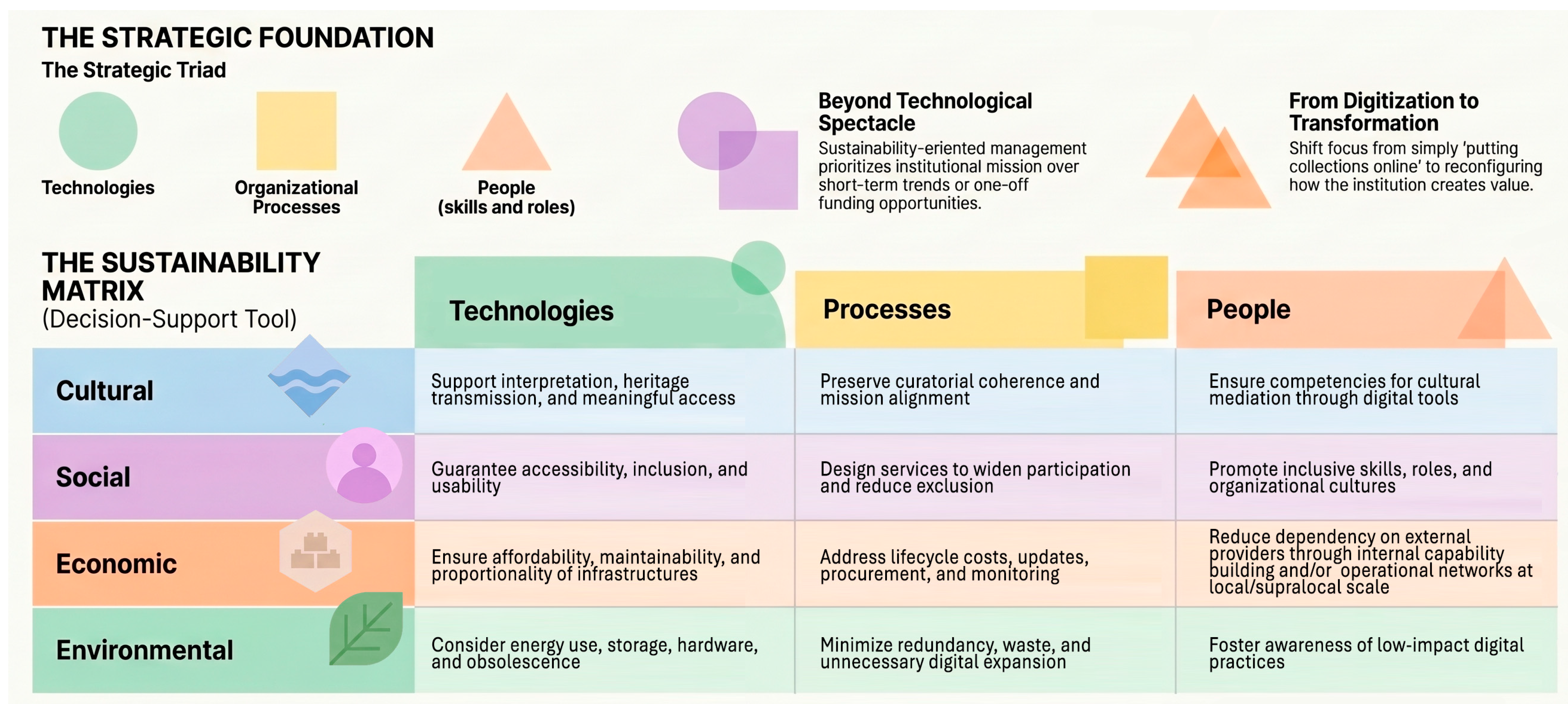
The first component of the framework is the Sustainability Matrix (
Figure 1), which crosses the three operational domains of museum digital transition—technologies, processes, and people—with the four dimensions of sustainability—cultural, environmental, economic, and social. This structure is the organizing core of a well-structured Digital Operation Plan and as a way to weigh the sustainable impact of digital strategies rather than assuming their value automatically.
The horizontal axis—technologies, processes, and people—translates the strategic logic already embedded in the Italian policy framework and echoed in the project materials. Technologies refer to infrastructures, platforms, applications, data environments, and devices. Processes refer to workflows, governance, service design, interoperability, lifecycle management, and monitoring. People refer to skills, professional roles, training, internal cultures, and the distribution of responsibilities. The matrix is useful because it prevents the recurring mistake of reducing digital transformation to the technological layer alone.
The vertical axis introduces the four sustainability dimensions. Environmental sustainability is associated with reducing the carbon footprint of digital infrastructures, adopting green IT, optimizing storage, and using renewable energy; economic sustainability with managing digital investments responsibly and focusing on data quality rather than quantity; social sustainability with accessibility, inclusion, and digital equity; and cultural sustainability with preserving meanings, values, and identities while balancing innovation and preservation.
To make the matrix operational,
Table 4 summarizes the main strategic implications of each sustainability dimension and the key planning questions that museums should address when designing digital actions.
Taken together, these two axes encourage museums to assess a digital initiative not only in terms of feasibility or attractiveness, but also in terms of its broader organizational and sustainability implications. A technology may be innovative, but poorly governed; a process may be efficient, but environmentally costly; a people-centred intervention may be socially valuable, but economically unsustainable if maintenance is ignored. The matrix therefore works as a structured prompt for integrated decision-making.
The need for such a matrix is reinforced by the technical round table, where participants repeatedly warned against treating digital tools as an automatic value. The discussion emphasized that even very simple technologies may be appropriate if they are coherent with museum identity, content, audiences, and context, whereas more spectacular solutions may prove unsustainable, weakly justified, or poorly integrated.
To make the Sustainability Matrix operational,
Table 5 proposes a set of illustrative KPIs associated with each intersection between the three operational domains (technologies, processes, and people) and the four dimensions of sustainability (cultural, social, economic, and environmental). The indicators are not intended as a rigid measurement system, but as a flexible monitoring framework to support strategic planning, implementation, and review. Museums may select a limited subset of indicators for each cell according to their strategic priorities.
5.3. How the Matrix Sshould Be Used
The matrix is intended to function as a pre-decision and design tool. At the planning stage, each proposed digital action should be discussed across all twelve intersections of the matrix. This does not necessarily require quantitative indicators from the outset, but it does require explicit questions.
From a technological perspective, museums should ask whether the proposed solution relies on infrastructures that are available and maintainable, whether it reduces or amplifies fragmentation, and whether it risks rapid obsolescence. This concern is particularly relevant in light of research showing that museum digital platforms may support integrated access and management only if heterogeneous information is made interoperable and connected through sustainable workflows.
From a process perspective, the matrix should lead museums to assess whether workflows, responsibilities, monitoring procedures, and lifecycle planning are already defined. This is crucial because the participatory materials identify process fragility as the most recurrent barrier to digital transition, with specific warnings against “getting the sequence wrong,” assuming sustainability or accessibility by default, and designing in an overly self-referential way instead of through partnerships.
From a people perspective, the matrix should help verify whether internal competencies, training needs, and role continuity have been considered from the beginning. In the project notes, training is the only standard that emerged with immediate consensus as a core condition of sustainability, which suggests that museums perceive human capabilities as the most urgent prerequisite for meaningful transformation.
5.4. The Five-Phase Roadmap
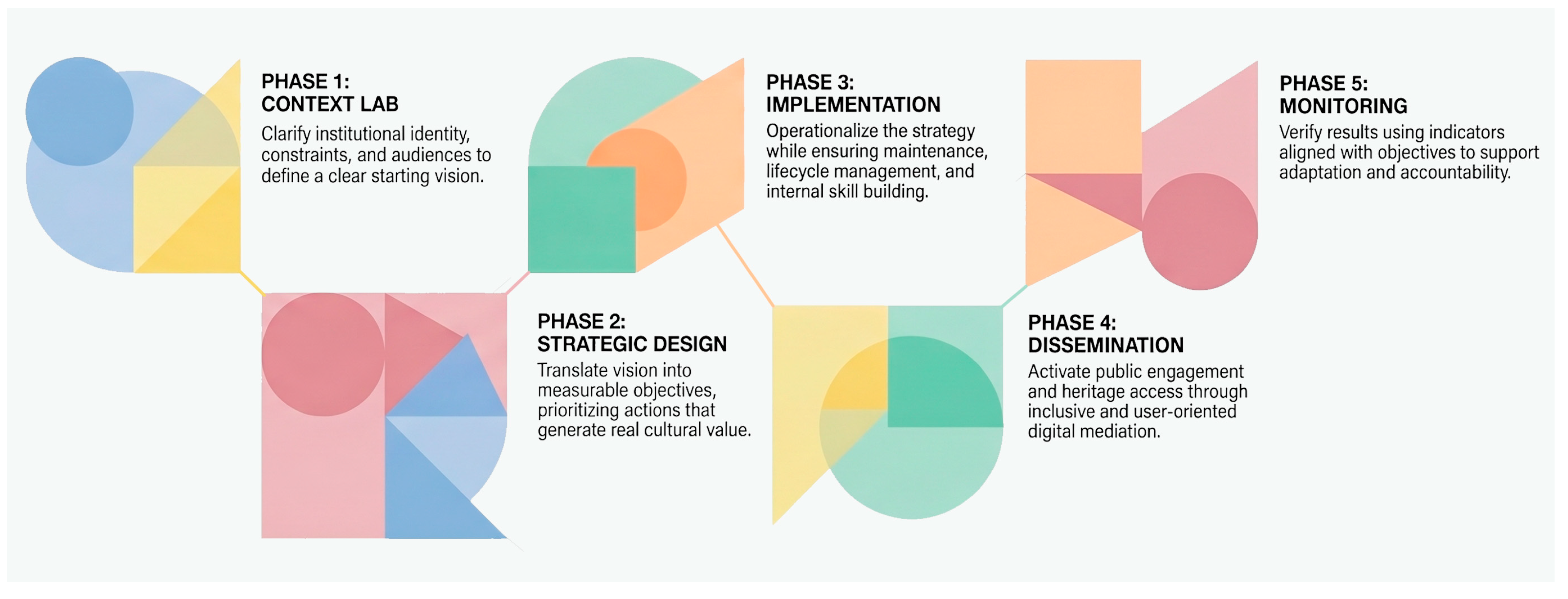
The second component of the framework is the Roadmap (
Figure 2), which translates the empirical findings into an ordered planning sequence. This research identifies five phases: Context Lab, Strategic Design, Implementation, Dissemination, and Monitoring. Each phase corresponds to a distinct function and helps correct one of the main weaknesses highlighted in the findings, namely the absence of sequence and the tendency to begin with solutions rather than with diagnosis (
Table 6).
This phase is devoted to diagnosis. Museums are expected to clarify their mission, collections, audiences, existing infrastructures, competencies, constraints, and sustainability priorities. The goal is to define the starting point and establish the conditions for a strategic vision. This phase directly reflects the focus group’s first operational compass: before deciding what to digitalize, museums must understand the sense of digitalizing. The technical round table strongly supports the diagnostic role of this phase, since participants repeatedly argued that museums should begin by clarifying their needs, priorities, and mission before responding to technologies or funding opportunities.
Once the context is clear, vision must be shaped selecting priorities, defining objectives, developing a timeline, and deciding how the digital action is expected to generate value across the four sustainability dimensions. The report explicitly states that measurable objectives and clear priorities are essential to avoid weak outputs, investment dispersion, and loss of internal trust.
Implementation is not understood as mere execution, but as the phase in which the museum tests the economic and operational sustainability of the strategy. At this stage, decisions about infrastructures, procurement, maintenance, role allocation, operational budget and internal or external competencies become critical. The project materials stress that sustainability must not be treated as an automatic by-product of implementation; it has to be built into it. In implementation terms, the round table also made clear that digital sustainability depends on maintenance, upgrades, budget continuity, and institutional memory. Without these elements, even successful digital actions risk becoming rapidly obsolete and forcing museums to restart from scratch.
Dissemination is conceived not simply as communication, but as public restitution and audience activation. This phase includes access, engagement, inclusion, and the social and cultural effects of digital actions. It is particularly important in museum contexts because many digital initiatives fail when they are technically completed but poorly connected to user needs, interpretive quality, and public mediation.
The final phase focuses on control and evaluation. Here again, the findings are very clear: monitoring should not be underestimated and should be designed from the beginning, not appended at the end. Without verification, the plan does not hold. This implies linking indicators to objectives and ensuring that maintenance and accountability mechanisms are in place from the outset.
5.5. Strategic Propositions of the Framework
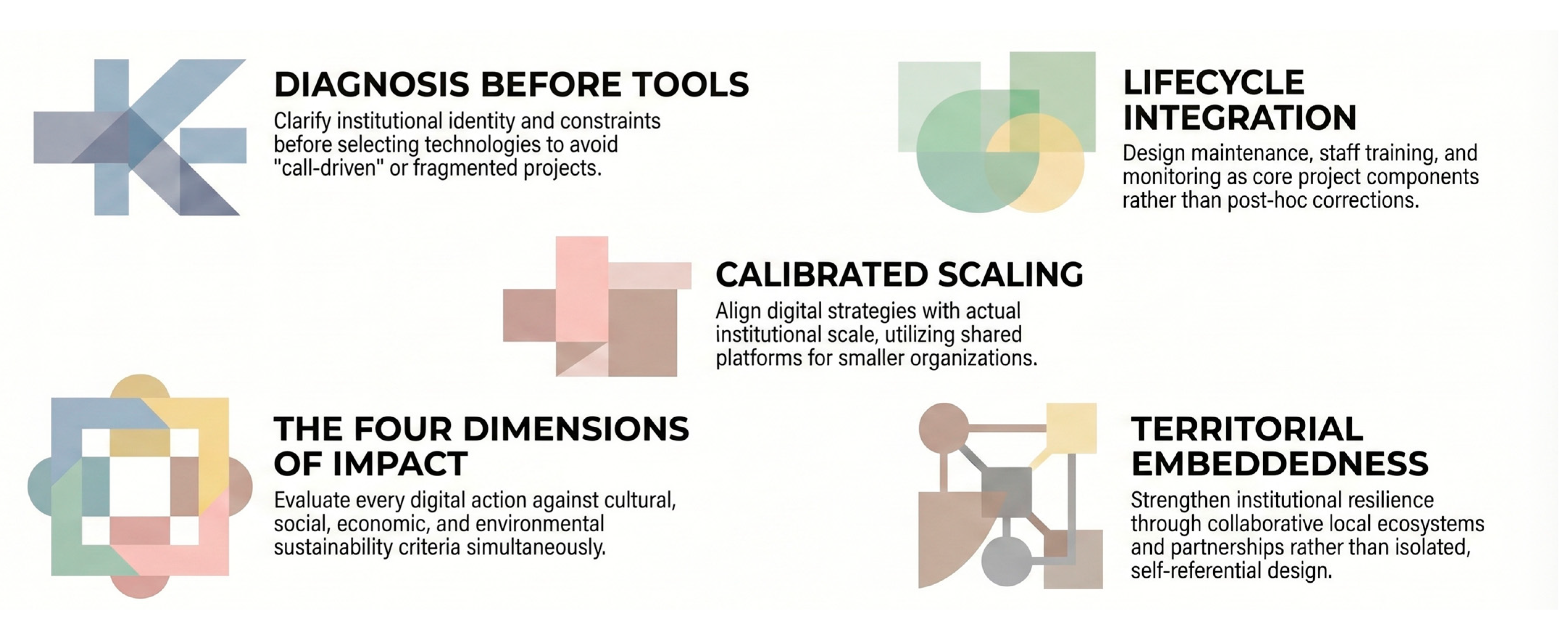
The framework can be summarized in five strategic propositions (
Figure 3).
First, digital transformation should start from diagnosis, not from tools. The museum must understand its context, constraints, and priorities before deciding on technologies. This proposition directly reflects the logic of the roadmap and the warnings emerging from the focus group.
Second, digital actions should be evaluated across four sustainability dimensions simultaneously. Cultural, social, economic, and environmental sustainability should not be treated as secondary effects, but as criteria of design and governance. The matrix was built precisely to support this integrated reading.
Third, maintenance, training, and monitoring are part of design, not post-hoc corrections. This proposition follows from the recurring emphasis on lifecycle management, role continuity, and accountability, and is particularly important for small and medium-sized museums, where fragmented implementation often leads to rapid decline of digital projects. Research on integrated museum digital platforms similarly shows that sustainability depends on informed models, manageable workflows, and reduced fragmentation over time.
Fourth, digital transformation is more sustainable when it is developed through partnerships, co-design, and cross-sector dialogue rather than through isolated or self-referential initiatives. The empirical materials repeatedly stress the importance of collaborative design processes involving cultural professionals, technical experts, and external stakeholders, so that digital actions are more context-sensitive, legitimate, and capable of generating shared learning. In this sense, collaboration is not only a resource issue, but also a governance principle.
Fifth, digital strategies should be calibrated to institutional scale and supported by shared infrastructures and networked models of implementation. The round table made clear that many small museums cannot sustain digital transformation through stand-alone investments and therefore need access to shared platforms, territorial cooperation, operational networks, and communities of practice. From this perspective, sustainability depends not only on good planning within individual institutions, but also on the availability of collective arrangements that reduce costs, duplication, and organizational fragility.
5.6. Relevance for Climate-Responsive Heritage Management
Although the framework does not directly model indoor climate impacts or conservation damage, it is highly relevant to climate-responsive heritage management. Climate change forces museums to make longer-term and more integrated decisions about infrastructures, energy use, digital investments, access, conservation support, and organizational resilience. In this context, a digital strategy that is not planned sustainably may increase fragility rather than adaptation capacity. Conversely, a structured Digital Operation Plan can help museums align digital investments with low-impact goals, responsible resource use, better access to information, and more robust management of collections and historic buildings.
For this reason, the framework proposed here should be read not only as a museum innovation tool, but as a contribution to the strategic management of heritage under ecological pressure. Its main value lies in offering a practical way to connect digital transition, sustainability assessment, and organizational planning within a single governance model.
6. Discussion and Conclusions
The results of this study show that sustainable digital transformation in museums should not be interpreted primarily as a technological issue, but as a problem of strategic governance. While digital tools are often presented as solutions for access, engagement, innovation, and even resilience, the empirical evidence discussed in this paper suggests that the most persistent barriers are located elsewhere: in weak governance structures, discontinuous processes, unclear responsibilities, insufficient monitoring, unstable competencies, and the absence of long-term planning. This finding is consistent with the broader literature on digital transformation, which argues that technology alone does not produce meaningful organizational change unless it is embedded in strategy, capabilities, and institutional learning. In the museum field, this means that the crucial question is not whether digital tools are available, but whether museums are able to decide selectively, coherently, and sustainably which digital actions are worth undertaking.
A second major conclusion concerns the role of sustainability in museum digital planning. One of the clearest messages emerging from this research is that sustainability cannot be assumed as an automatic effect of innovation. On the contrary, museums must avoid assuming sustainability by default, just as they must avoid assuming accessibility or public relevance by default. The framework proposed in this paper addresses this issue by treating sustainability as a multidimensional criterion for decision-making. In line with recent scholarship, the study adopts a four-dimensional understanding of sustainability—cultural, social, economic, and environmental—and argues that each of these dimensions should inform digital planning from the very beginning. This is especially important in museums, where digital actions almost always generate simultaneous effects across different domains: a solution may improve participation while increasing maintenance costs, strengthen interpretation while excluding some users, or support management while creating new environmental and infrastructural burdens.
From this perspective, the paper contributes to current debates by proposing a shift from an innovation-centred view of digital transformation to a responsibility-centred one. Museums do not simply need more digital tools; they need better criteria for deciding which tools and actions are culturally coherent, socially inclusive, economically maintainable, and environmentally responsible. This is the rationale behind the framework proposed, which combines a Sustainability Matrix with a five-phase Roadmap. The matrix helps museums assess digital actions through the intersection of technologies, processes, and people with the four dimensions of sustainability. The roadmap, in turn, translates this logic into an ordered planning sequence, beginning with diagnosis and ending with monitoring. Taken together, these two devices respond directly to one of the main findings of the study: the fact that museum digital transition often fails not because tools are missing, but because institutions “get the sequence wrong” and move to implementation before clarifying aims, priorities, sustainability criteria, and responsibilities.
This paper does not claim that digital tools automatically solve the problems posed by climate change, nor does it directly model environmental damage, indoor microclimate, or collection deterioration. Rather, it addresses a complementary question: how museums can strengthen their decision-making capacity under conditions where conservation, access, energy use, digital infrastructures, and organizational resilience are increasingly intertwined. This perspective is fully aligned with research showing that climate change affects cultural heritage not only through catastrophic events, but also through slower and cumulative transformations in indoor conditions, building performance, and conservation requirements. In this context, a digital strategy that is not planned sustainably may increase institutional fragility, while a structured Digital Operation Plan may help museums align digital investments with low-impact goals, information management, accessibility, and long-term resilience.
This conclusion is especially relevant for small and medium-sized museums, which emerged throughout the study as particularly exposed to fragmented digitalization. These institutions often operate with limited budgets, hybrid roles, weak infrastructure, and unstable competencies. For them, the problem is rarely a shortage of possible technologies; it is rather the lack of a replicable method for deciding what should be done, in what order, with which partners, and with what maintenance implications. The framework proposed here is intended precisely as such a method. Its value lies not in prescribing one model of innovation, but in helping museums become more selective and strategic, reducing overproduction, dependence on one-off funding opportunities, and self-referential design. In this sense, the study also reinforces the importance of partnerships and territorial embeddedness, in line with recent work showing that cultural organizations strengthen resilience not by eliminating dependencies altogether, but by recognizing and managing them through networks, alliances, and local ecosystems.
The technical round table adds an important final layer to this discussion by showing that digital transition in museums is also an ethical and institutional responsibility. Participants stressed that innovation should not be measured only by technological intensity, but by its coherence with the museum’s public role, accessibility standards, environmental awareness, and educational responsibilities, especially when young audiences are involved. More broadly, the round table confirmed that the most mature understanding of museum digital transition lies between two extremes: digitalization as spectacle or fashion, on the one hand, and defensive resistance to change, on the other. The shared position was that contemporary museums must integrate digital transition into a wider vision based on strategy, continuity, accessibility, sustainability, and public responsibility.
At the same time, the study has several boundaries. First, it is based on a qualitative and practice-based corpus generated within a single national programme and a specific Italian policy context. Its contribution therefore lies in analytical transferability rather than statistical generalization. Second, the proposed framework has not yet been tested comparatively across different museum types, scales, and territorial conditions. Third, while the framework is intended to support climate-responsive management, it does not directly measure environmental performance or conservation outcomes. These limitations also point to future research directions. Further studies could apply the matrix and roadmap in concrete museum planning processes, develop more precise indicators for the four sustainability dimensions, and explore how digital planning can be integrated more explicitly with indoor environmental monitoring, preventive conservation, and climate adaptation strategies.
Taken together, the findings of this paper support one overall conclusion: sustainable digital transformation in museums is not a matter of technological accumulation, but of strategic choice. Museums need planning frameworks that help them judge which digital actions are worth undertaking, for whom, at what cost, with what organizational implications, and with what cultural, social, economic, and environmental effects. By proposing a framework based on technologies, processes, and people, and by linking it to the four dimensions of sustainability, this paper argues that under conditions of ecological pressure and long-term heritage responsibility, digital transformation can support museum resilience only when it is planned as part of a wider model of sustainable and long-term governance.