


A Review of Artificial Intelligence as a Tool for Damage Detection in Paintings: Challenges and Limitations for Contemporary Paintings


Abstract
1. Introduction
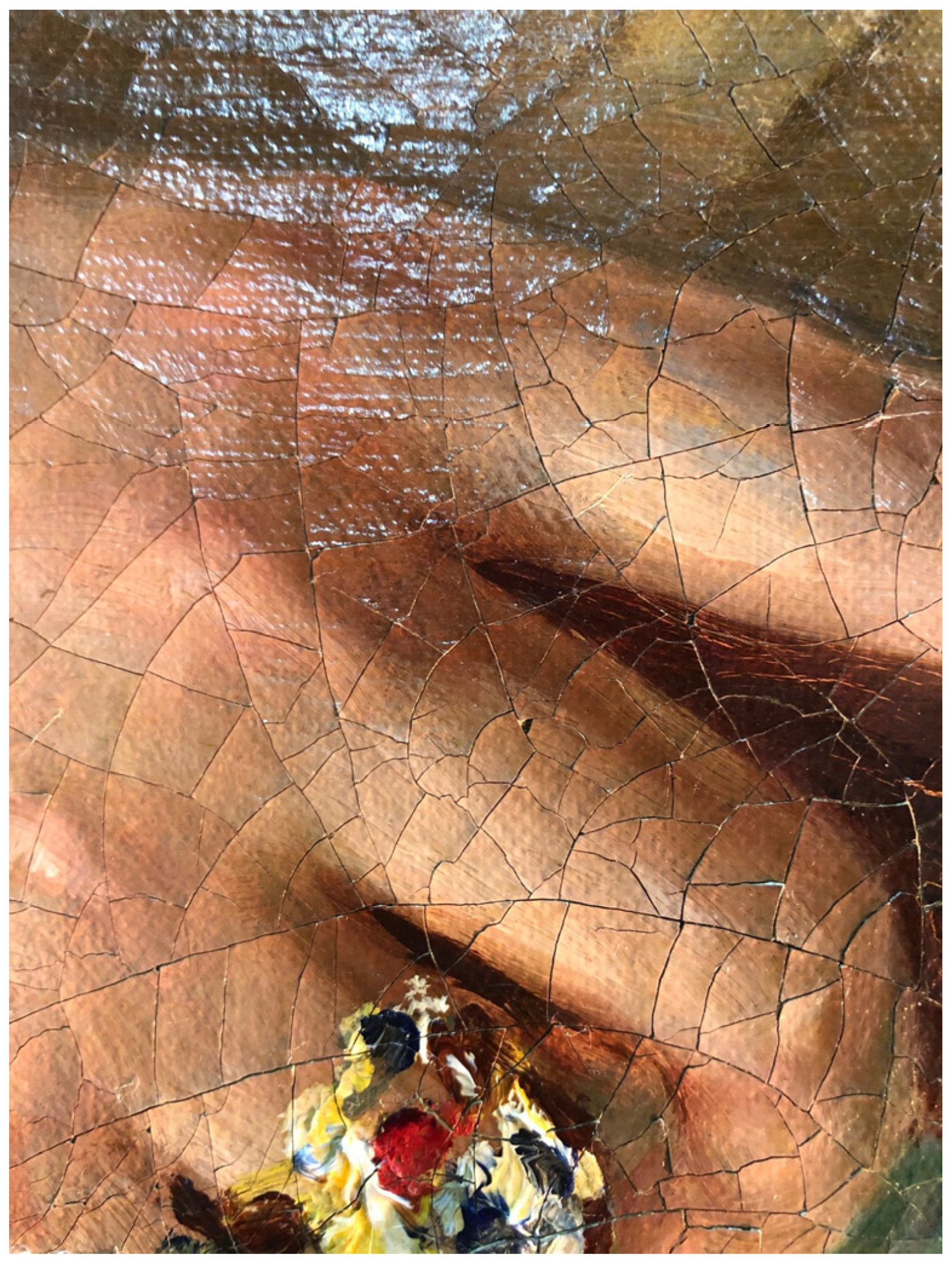
- Colour alterations: caused by photodegradation processes, leading to damage such as fading, darkening, or blanching [6].
2. Methodology
3. AI in Conservation
3.1. Damage Detection
3.1.1. Generalist Damage Detection Models
3.1.2. Detection of Craquelure Patterns Models
3.1.3. Detection of Paint Loss Models
- PA-FPN with residual connections, enhancing the fusion of high-resolution features with deep semantic features;
- Dual-Backbone (CSPDarkNet + ShuffleNet V2), increasing feature extraction at multiple scales and improving discrimination of degraded areas against complex backgrounds;
- SPD-Conv module (Space-to-Depth Convolution), replacing traditional pooling layers, enabling better detection of small areas and perception of degraded regions of different sizes.
4. Contemporary Paintings: Investigating Material Diversity and Degradation Using AI
5. Findings and Discussion
6. Conclusions
Author Contributions
Funding
Institutional Review Board Statement
Informed Consent Statement
Data Availability Statement
Conflicts of Interest
Abbreviations
| AI | Artificial intelligence |
| ML | Machine learning |
| CNN | Convolutional neural network |
| PLDS | Paint loss detection and segmentation |
| YOLO | You only look once |
References
- Canadian Conservation Institute. Know Your Paintings: Structure, Materials and Aspects of Deterioration (CCI Notes 10/17); Government of Canada: Ottawa, ON, Canada, 2017.
- Canadian Conservation Institute. Causes of Damage to Paintings and Preventive Conservation Strategies (CCI Notes); Government of Canada: Ottawa, ON, Canada, 23 July 2025. Available online: https://www.canada.ca/en/conservation-institute/services/preventive-conservation/guidelines-collections/paintings.html (accessed on 8 February 2026).
- Mecklenburg, M.F. Methods and materials and the durability of canvas paintings: A preface to the topical collection Failure Mechanisms in Picasso’s Paintings. SN Appl. Sci. 2020, 2, 2182. [Google Scholar] [CrossRef]
- Boon, J.J. Processes inside paintings that affect the picture: Chemical changes at, near and underneath the paint surface. In Reporting Highlights of the De Mayerne Programme: Research Programme on Molecular Studies in Conservation and Technical Studies in Art History; Boon, J.J., Ferreira, E.S.B., Eds.; NOW: The Hague, The Netherlands, 2006; pp. 21–31. [Google Scholar]
- Poyatos, F.; Morales, F.; Nicholson, A.W.; Giordano, A. Physiology of biodeterioration on canvas paintings. J. Cell. Physiol. 2018, 233, 2741–2751. [Google Scholar] [CrossRef]
- Miliani, C.; Monico, L.; Melo, M.J.; Fantacci, S.; Angelin, E.M.; Romani, A.; Janssens, K. Photochemistry of Artists’ Dyes and Pigments: Towards Better Understanding and Prevention of Colour Change in Works of Art. Angew. Chem.–Int. Ed. 2018, 57, 7324–7334. [Google Scholar] [CrossRef]
- Bury, M.; Bratasz, Ł. Development of craquelure patterns in paintings on canvas. Herit. Sci. 2024, 12, 375. [Google Scholar] [CrossRef]
- Campo-Frances, G.; Ferrer, S.; Cayuela, D.; Carrera-Gallisà, E. Canvas-Ground Interaction: A New Approach to Quantifying Ground Mechanical Degradation. Materials 2025, 18, 4041. [Google Scholar] [CrossRef] [PubMed]
- Kaminari, A.; Banou, P.; Moutsatsou, A.; Alexopoulou, A. Non-destructive investigation of paintings on different substrates: Methodology, achievements and limitations. Des./Arts/Cult. 2022, 2, 10–17. [Google Scholar] [CrossRef]
- Van Vijle, A.; Hacıgüzeller, P.; Van der Snickt, G. Machine learning for painting conservation: A state-of-the-art review. npj Herit. Sci. 2025, 13, 437. [Google Scholar] [CrossRef]
- Khalid, S.; Azad, M.M.; Kim, H.S.; Yoon, Y.; Lee, H.; Choi, K.-S.; Yang, Y. A review on traditional and artificial intelligence-based preservation techniques for oil painting artworks. Gels 2024, 10, 517. [Google Scholar] [CrossRef] [PubMed]
- Markowski, M.P.; Gansukh, S.; Madry, M.; Borowiec, R.; Rogoz, J.; Szczupak, B. Non-invasive painting pigment classification through supervised machine learning. Appl. Sci. 2025, 15, 7594. [Google Scholar] [CrossRef]
- Grabowski, B.; Masarczyk, W.; Głomba, P.; Mendys, A. Automatic pigment identification from hyperspectral data. J. Cult. Herit. 2024, 64, 53–63. [Google Scholar] [CrossRef]
- Sizyakin, R.; Voronin, V.; Pizurica, A. Virtual restoration of paintings based on deep learning. In Fourteenth International Conference on Machine Vision (ICMV 2021); Osten, W., Nikolaev, D., Zhou, J., Eds.; SPIE: Edinburgh, UK, 2022; Volume 12084. [Google Scholar]
- Parvathaneni, T.S.R.; Pisarenco, M.; Onvlee, H. A deep learning approach for digital color reconstruction of Van Gogh’s paintings using unpaired areas under the frame. SN Comput. Sci. 2024, 5, 498. [Google Scholar] [CrossRef]
- Learner, T.J.S.; Smithen, P.; Krueger, J.W.; Schilling, M.R. (Eds.) Modern Paints Uncovered: Proceedings from the Modern Paints Uncovered Symposium, May 16–19, 2006, Tate Modern, London; Getty Conservation Institute: Los Angeles, CA, USA, 2007. [Google Scholar]
- Righi, L.; Viñas, A. Conservar el Arte Contemporáneo; Editorial Nerea: Guipuzcoa, Spain, 2013; ISBN 9788496431003. [Google Scholar]
- Mukhamediev, R.I. Review of artificial intelligence and machine learning: Core algorithms and applications. Mathematics 2022, 10, 2552. [Google Scholar] [CrossRef]
- Wang, P. On Defining Artificial Intelligence. J. Artif. Gen. Intell. 2019, 10, 1–37. [Google Scholar] [CrossRef]
- Huang, P.-C.; Li, I.-C.; Wang, C.-Y.; Shih, C.-H.; Srinivaas, M.; Yang, W.-T.; Kao, C.-F.; Su, T.-J. Integration of Artificial Intelligence in Art Preservation and Exhibition Spaces. Appl. Sci. 2025, 15, 562. [Google Scholar] [CrossRef]
- Monteiro, J.A.R.; Cardeira, L.; Bailão, A.; Nascimento, S.M.C.; Linhares, J.M.M. Reviving the colors of paintings by removing the protective coating: A physical and virtual intervention. J. Cult. Herit. 2025, 74, 322–331. [Google Scholar] [CrossRef]
- Antropov, S.; Bratasz, Ł. Development of craquelure patterns in paintings on panels. Herit. Sci. 2024, 12, 89. [Google Scholar] [CrossRef]
- Chen, A.; Jesus, R.; Vilarigues, M. Identification of pure painting pigment using machine learning algorithms. In Artificial Intelligence in Music, Sound, Art and Design—10th International Conference, EvoMUSART 2021; Romero, J., Martins, T., Rodríguez-Fernández, N., Eds.; Springer: Berlin/Heidelberg, Germany, 2021; pp. 52–64. [Google Scholar] [CrossRef]
- Zavrtanik, V.; Kristan, M.; Skočaj, D. DRAEM—A discriminatively trained reconstruction embedding for surface anomaly detection. In Proceedings of the IEEE/CVF International Conference on Computer Vision (ICCV 2021); IEEE: New York, NY, USA, 2021; pp. 8330–8339. [Google Scholar]
- Mezina, A.; Burget, R.; Kotrly, M. A deep learning approach for anomaly detection in X-ray images of paintings. npj Herit. Sci. 2025, 13, 127. [Google Scholar] [CrossRef]
- ART-RISK—Artificial Intelligence Applied to Preventive Conservation. European Heritage Awards/Europa Nostra. 2021. Available online: https://www.europeanheritageawards.eu/winners/art-risk-artificial-intelligence-applied-preventive-conservation/ (accessed on 8 May 2026).
- Califano, A.; Foti, P.; Baiesi, M.; Sepe, R.; Berto, F.; Bertolin, C. Machine learning and numerical simulations for predicting critical crack conditions in wooden panels. Int. J. Struct. Integr. 2025, 16, 914–935. [Google Scholar] [CrossRef]
- Perles, A.; Fuster-López, L.; Bosco, E. Preventive conservation, predictive analysis and environmental monitoring. Herit. Sci. 2024, 12, 11. [Google Scholar] [CrossRef]
- Moradi, M.; Ghorbani, R.; Sfarra, S.; Tax, D.M.J.; Zarouchas, D. A spatiotemporal deep neural network useful for defect identification and reconstruction of artworks using infrared thermography. Sensors 2022, 22, 9361. [Google Scholar] [CrossRef]
- Mishra, M.; Lourenço, P.B. Artificial intelligence-assisted visual inspection for cultural heritage: State-of-the-art review. J. Cult. Herit. 2022, 54, 246–266. [Google Scholar] [CrossRef]
- Wu, L.G.; Zhang, L.; Zhang, Y.; Wan, J.F. Damage detection of grotto murals based on lightweight neural network. Comput. Electr. Eng. 2022, 102, 108237. [Google Scholar] [CrossRef]
- García-Moreno, F.M.; Cortés Alcaraz, J.; del Castillo de la Fuente, J.M.; Rodríguez-Simón, L.R.; Hurtado-Torres, M.V. ARTDET: Machine learning software for automated detection of art deterioration in easel paintings. SoftwareX 2024, 28, 101917. [Google Scholar] [CrossRef]
- Chirosca, G.; Radvan, R.; Pop, M.; Chirosca, A. Autoencoder Application for Artwork Authentication Fingerprinting Using the Craquelure Network. Appl. Sci. 2025, 15, 9014. [Google Scholar] [CrossRef]
- Yuan, Q.; He, X.; Han, X.; Guo, H. Automatic recognition of craquelure and paint loss on polychrome paintings of the Palace Museum using improved U-Net. Herit. Sci. 2023, 11, 65. [Google Scholar] [CrossRef]
- Sizyakin, R.; Cornelis, B.; Meeus, L.; Dubois, H.; Martens, M.; Voronin, V.; Pižurica, A. Crack detection in paintings using convolutional neural networks. IEEE Access 2020, 8, 74535–74546. [Google Scholar] [CrossRef]
- Zabari, N. Analysis of craquelure patterns in historical painting using image processing along with neural network algorithms. In Proceedings of SPIE: Optics for Arts, Architecture, and Archaeology VIII; SPIE: Cergy-Pontoise, France, 2021; Volume 11784, p. 1178408. [Google Scholar] [CrossRef]
- Sindel, A.; Maier, A.; Christlein, V. CraquelureNet: Matching the crack structure in historical paintings for multi-modal image registration. In Proceedings of the IEEE International Conference on Image Processing (ICIP), Anchorage, AK, USA, 19–22 September 2021; pp. 994–998. [Google Scholar] [CrossRef]
- Meeus, L.; Huang, S.; Devolder, B.; Martens, M.; Pizurica, A. Deep learning for paint loss detection: A case study on the Ghent Altarpiece. In Image Processing for Art Investigation (IP4AI); Universiteit Gent: Gent, Belgium, 2018; pp. 30–32. [Google Scholar]
- Li, S.Y.; Hou, M.L.; Cao, P.H.; Lyu, S.Q. Extraction of paint loss in ancient murals based on 3D residual neural network. ISPRS Ann. Photogramm. Remote Sens. Spat. Inf. Sci. 2023, X-1/W1-2023, 199–206. [Google Scholar] [CrossRef]
- Chen, Y.; Zhang, A.; Shi, J.; Gao, F.; Guo, J.; Wang, R. Paint loss detection and segmentation based on YOLO: An. improved model for ancient murals and color paintings. Heritage 2025, 8, 136. [Google Scholar] [CrossRef]
- Meeus, L.; Huang, S.; Žižakić, N.; Xie, X.; Devolder, B.; Dubois, H.; Martens, M.; Pizurica, A. Assisting classical paintings restoration: Efficient paint loss detection and descriptor-based inpainting using shared pretraining. In Optics, Photonics and Digital Technologies for Imaging Applications VI; Schelkens, P., Kozacki, T., Eds.; SPIE: Cergy-Pontoise, France, 2021; Volume 11353. [Google Scholar] [CrossRef]
- Fiorucci, M.; Khoroshiltseva, M.; Pontil, M.; Traviglia, A.; Del Bue, A.; James, S. Machine learning for cultural heritage: A survey. Pattern Recognit. Lett. 2020, 133, 102–108. [Google Scholar] [CrossRef]
- Bucklow, S.L. The description of craquelure patterns. Stud. Conserv. 1997, 42, 129–140. [Google Scholar] [CrossRef]
- Recht, B.; Roelofs, R.; Schmidt, L.; Shankar, V. Do ImageNet classifiers generalize to ImageNet? In Proceedings of the 36th International Conference on Machine Learning (ICML 2019); Wallach, H.M., Larochelle, H., Beygelzimer, A., d’Alché-Buc, F., Fox, E., Garnett, R., Eds.; Proceedings of Machine Learning Research: Cambridge, MA, USA, 2019; Available online: http://proceedings.mlr.press/v97/recht19a.html (accessed on 8 May 2026).
- Gatti, T.H. Conservação de Materiais em Arte e Papel: Desafios da arte contemporânea. Museol. Interdiscip. 2012, 1, 104–120. [Google Scholar] [CrossRef]
- Hummelen, I.J. Conservation strategies for modern and contemporary art: Recent developments in the Netherlands. CR Interdiscip. Vakbl. Voor Conserv. Restaur. 2005, 6, 22–26. [Google Scholar]
- Gonçalves, M.D. A Contemporaneidade No Restauro. Master’s Thesis, Universidade Católica Portuguesa, Lisbon, Portugal, 2018. Available online: http://hdl.handle.net/10400.26/28555 (accessed on 8 May 2026).
- Basaloco, M.M.L.C. A Conservação da Pintura Contemporânea: Quatro Casos de Estudo da Coleção da Faculdade de Belas Artes da Universidade do Porto (Mestrado); UPT: Antalya, Türkiye, 2016; Available online: https://repositorio.upt.pt/entities/publication/3758eb77-1685-4411-807b-03224671c965 (accessed on 8 May 2026).
- Bacalhau, L.d.E. Study and Conservation of the Painting “The Exile (An Old Exile Dreaming of His Youth)” by Paula Rego. Master’s Thesis, Universidade NOVA de Lisboa, Lisbon, Portugal, 2025. [Google Scholar]
- Souza Carmo, J.G. Beyond Materiality: Collage as a Tool of Visual Culture in Contemporary Times. Master’s Thesis, IADE—Faculty of Design, Technology and Communication, Universidade Europeia, Lisbon, Portugal, 2022. [Google Scholar]
- Stalidzāne, A.; Vērdiņa, Ž. Mixed techniques in contemporary art: Experiments, unusual connections of different materials in painting. In Proceedings of the 64th International Scientific Conference of Daugavpils University, Daugavpils, Latvia, 21–22 April 2023. [Google Scholar]
- Cudell, A.; Cruz, A.J.; Martins, A.; Carballo, J.; Calvo, A.; Saraiva, S. Materials and painting processes of Pedro Cabrita Reis: The artist’s memory versus materials analysis. In The Artist’s Process: Technology and Interpretation; Archetype Publications: London, UK, 2012; pp. 212–214. [Google Scholar]
- Civil, I.; Michalski, S.; Murray, A. Cracking the ‘matter paintings’ of Antoni Tàpies: The role of artistic intent, deterioration and underlying mechanical causes. In Paintings II: Scientific Study of Paintings (Methods and Techniques); ICOM-CC: Rio de Janeiro, Brazil, 2007; pp. 407–413. [Google Scholar]
- De Winter, S. Conservation problems with paintings containing fluorescent layers of paint. CeROArt Conserv. Expo. Restaur. D’objets D’art 2010, 1–16. [Google Scholar] [CrossRef]
- Learner, T.J.S. Modern Paints. In Scientific Examination of Art: Modern Techniques in Conservation and Analysis; Townsend, J.H., McCarthy, M.I., Eds.; National Academies Press: Washington, DC, USA, 2005; pp. 137–151. Available online: https://www.nap.edu/read/11413/chapter/11 (accessed on 8 May 2026).
- Ivanova, D.; Aversa, M.; Henderson, P.; Williamson, J. ARTeFACT: Benchmarking segmentation models on diverse analogue media damage. In Proceedings of the IEEE/CVF Winter Conference on Applications of Computer Vision (WACV); IEEE: New York, NY, USA, 2025; pp. 7439–7449. [Google Scholar] [CrossRef]
- Diniz, J.F. Reintegração Cromática de Superfícies Pictóricas Contemporâneas com Acabamento Mate: Um Estudo Técnico com base no Critério da Reversibilidade. Master’s Thesis, Universidade Católica Portuguesa, Lisbon, Portugal, 2022. Available online: https://repositorio.ucp.pt/handle/10400.14/40853 (accessed on 8 May 2026).
- Carnazza, P.; Francone, S.; Morelli, P.K.; Reale, R.; Sammartino, M.P. Retouching matt contemporary paint layers: A new approach using natural polymers. Ge-Conserv. 2020, 18, 384–393. [Google Scholar] [CrossRef]
- Ma, Q.; Li, J.; Wang, Y. Development trend in non-destructive techniques for cultural heritage: From material characterization to AI-driven diagnosis. Herit. Sci. 2024, 8, 381. [Google Scholar]
- Tate. Paula Rego [Artist Biography]. Tate Britain. Available online: https://www.tate.org.uk/whats-on/tate-britain/paula-rego?utm (accessed on 2 January 2026).
- Rego, P.; MacEwen, J. Paula Rego; Phaidon Press: London, UK, 1997. [Google Scholar]
- Pei, Z.; Huang, Y.M.; Zhou, T. Review on analysis methods enabled by hyperspectral imaging for cultural relic conservation. Photonics 2023, 10, 1104. [Google Scholar] [CrossRef]



| Study | Moradi et al. 2022 [29] | Mezina et al. 2025 [25] | Wu et al. 2022 [31] | Garcia Moreno et al. 2024 [32] |
| Objective/focus | General detection of superficial and internal defects in paintings and artworks, without predefined damage categories. | Identification of general damages and degradations in paintings through the detection of structural anomalies not visible to the naked eye. | Automatic detection of damages in grotto murals (cracks, detachments, and lacunae), with a focus on practical implementation. | Automatic detection and pixel-level segmentation of visible deteriorations in easel paintings (lacunae and stucco restorations). |
| Method/model | Spatiotemporal deep neural network applied to infrared thermography; analysis of heating and cooling patterns over time; virtual reconstruction of damaged regions. | Unsupervised deep learning approach based on convolutional autoencoders (CNNs); learning of the painting’s “normal” appearance and interpretation of poorly reconstructed regions as damaged areas. | Lightweight neural network based on YOLOv5; Ghost Convolution; double attention mechanisms; bi-directional weighted feature pyramid for multi-scale damage detection. | Pre-trained Mask R-CNN deep learning model; pixel-level segmentation; training on high-resolution, manually annotated datasets. |
| Data/Case-study | Paintings and artworks analysed using time-dependent infrared thermography. | X-ray images of paintings. | Historical grotto murals. | Easel paintings acquired under controlled imaging conditions. |
| Contributions | Higher sensitivity to subtle damages; improved accuracy compared to traditional thermographic methods; robustness across different temperature and material contexts; integration of damage detection and reconstruction. | Effective localisation of degraded regions; highlighting of subtle damages visible only in X-ray images; good generalisation across diverse paintings; limitations in precise damage identification, requiring expert validation. | Model simplification of ~34.4%; real-time performance improvement of ~53%; accuracy of 64.7%; useful as a degradation alert system, though less effective for subtle damages. | Average recall of 80.4%; average confidence score of 99% for detected areas; effective for visible and traditionally recognised damages; limited capability for detecting less superficial or non-visible degradations. |
| Study | Yuan et al. 2023 [34] | Sizyakin et al. 2020 [35] | Zabari et al. 2021 [36] | Sindel et al. 2021 [37] | Chirosca et al. 2025 [33] |
| Objective/focus | Automatic segmentation and identification of craquelure | Develop and evaluate CNN-based models for the automatic detection of craquelure in paintings, demonstrating their robustness across multiple imaging modalities | CNN-based detection of craquelure across modalities | Extraction and analysis of craquelure as an artwork signature | Structural analysis and authentication using generative models |
| Method/model | Deep learning (U-Net with ResNet-50 residual structure) | Convolutional neural networks (CNNs) | Imagen processing + CNNs | CraquelureNet (structural pattern matching) | Autoencoders + modified CNN (VGG19-based) |
| Data/Case-study | Polychrome mural paintings, Imperial Palace, Beijing | Visible, infrared, and X-radiography images | Historical paintings | Visible, infrared, X-ray, and UV fluorescence images | High-resolution greyscale images of paintings |
| Contributions | Outperformed traditional crack segmentation and manual detection; captured subtle pigment loss patterns; demonstrated deep learning applicability in conservation. | Complete pipeline for paint loss detection and inpainting; reduced need for large annotated datasets; broader applicability across artworks. | Detects fissures and interprets geometric crack patterns as distinctive features; provides historical and structural information beyond simple detection. | Uses crack patterns as stable structural markers for alignment; expands craquelure application to data integration and registration. | Detects subtle deviations in craquelure patterns; extracts global and local features; demonstrates potential of generative models for authentication and anomaly detection. |
| Study | Meeus et al. 2018 [38] | Meeus et al. 2021 [41] | Li et al. 2023 [39] | Chen et al. 2025 [40] |
| Objective/focus | Automatic detection of paint loss | Expansion of previous study; integration of reconstruction of loss areas | Mapping and identification of paint loss in ancient murals | Overcome limitations of previous methods and improve segmentation |
| Method/model | 2D convolutional neural network (CNN) | CNN + descriptor-based Inpainting + Shared Pretraining | 3D Residual Network (3D ResNet) | PLDS-YOLO (YOLOv8s-seg + PA-FPN + Dual-Backbone + SPD-Conv) |
| Data/Case-study | Ghent Altarpiece, visible and multispectral images | Ghent Altarpiece | Ancient murals of Qutan Temple | Ancient murals and polychrome paintings |
| Contributions | Demonstrated the applicability of 2D convolutional neural networks for the automatic detection of paint losses in paintings, showing superior performance over traditional and manual methods and enabling the identification of subtle pigment losses in complex pictorial areas. | Integrates automatic inpainting and shared pretraining strategies, thereby reducing the need for large annotated datasets and broadening the applicability of the method to different artworks beyond a single case study. | Simultaneous analysis of spatial and spectral features; effective distinction between paint loss and calcified white patterns; multiscale detail extraction. | Segmentation accuracy of 86.2%; better detection of small and complex degraded areas; optimised for rapid and precise paint loss segmentation |
Disclaimer/Publisher’s Note: The statements, opinions and data contained in all publications are solely those of the individual author(s) and contributor(s) and not of MDPI and/or the editor(s). MDPI and/or the editor(s) disclaim responsibility for any injury to people or property resulting from any ideas, methods, instructions or products referred to in the content. |
© 2026 by the authors. Licensee MDPI, Basel, Switzerland. This article is an open access article distributed under the terms and conditions of the Creative Commons Attribution (CC BY) license.
Share and Cite
Almeida, L.; Babo, S.; Jesus, R. A Review of Artificial Intelligence as a Tool for Damage Detection in Paintings: Challenges and Limitations for Contemporary Paintings. Heritage 2026, 9, 204. https://doi.org/10.3390/heritage9050204
Almeida L, Babo S, Jesus R. A Review of Artificial Intelligence as a Tool for Damage Detection in Paintings: Challenges and Limitations for Contemporary Paintings. Heritage. 2026; 9(5):204. https://doi.org/10.3390/heritage9050204
Chicago/Turabian StyleAlmeida, Leonor, Sara Babo, and Rui Jesus. 2026. "A Review of Artificial Intelligence as a Tool for Damage Detection in Paintings: Challenges and Limitations for Contemporary Paintings" Heritage 9, no. 5: 204. https://doi.org/10.3390/heritage9050204
APA StyleAlmeida, L., Babo, S., & Jesus, R. (2026). A Review of Artificial Intelligence as a Tool for Damage Detection in Paintings: Challenges and Limitations for Contemporary Paintings. Heritage, 9(5), 204. https://doi.org/10.3390/heritage9050204