
Mitigation of Cultural Differences: Co-Produced Temporary Exhibition with Strong Storytelling and Design Analysis

Abstract
1. Introduction
2. Materials and Methods
- I.
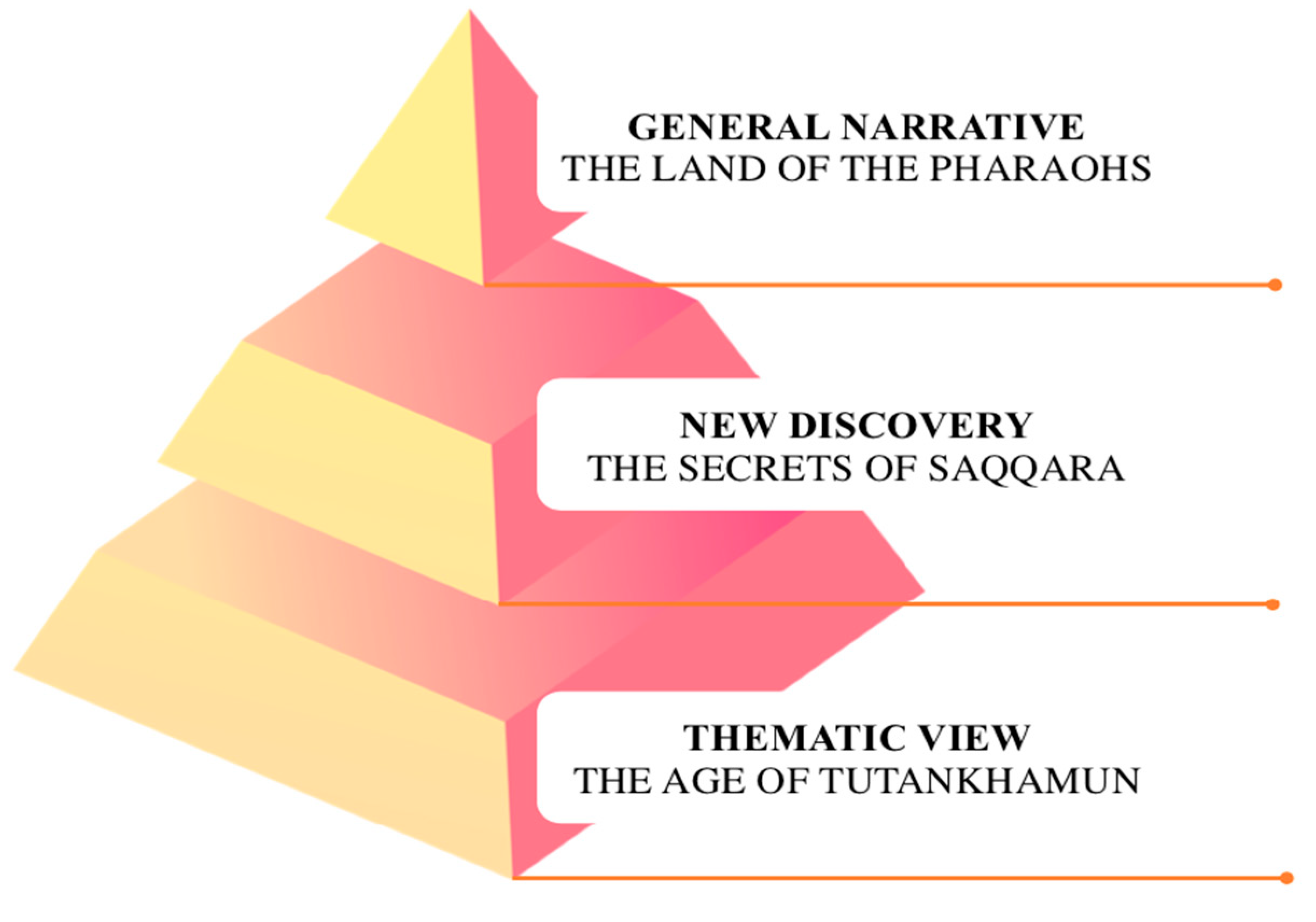
- Research Objective 1 (RO 1): To examine the narrative strategy of the exhibition through the proposed analytical lens named “New Pyramid Method” (NPM), and to investigate how a people-centered approach was operationalized by curators to enhance visitors’ cultural experience.
- II.
- Research Objective 2 (RO 2): To evaluate the co-produced exhibition between the Egyptian government and Chinese partners, focusing on its scientific content and dissemination to the public, in accordance with the principles of the UNESCO Convention (1972) and Sustainable Development Goal 17 (Partnerships for the Goals).
2.1. Data Collection from Semi-Structured Interview
- Selection Criteria: Interviewees were purposively selected to reflect the multidisciplinary exhibition team. The sample comprised Egyptologists who provided scholarly content and Shanghai Museum staff responsible for exhibition curation and project management.
- Duration: Each interview focused on participants’ personal opinions and experiences relating to Egyptology and museology, and lasted between 30 and 60 min.
- Location: Interviews were conducted both in person and via online conferencing platforms, according to participants’ geographic location and preference.
- Interview Content: The interview content covered not only the technical implementation and co-produced experiences of the exhibition design but also focused on the challenges and constraints encountered during the producing process, as well as the curatorial team’s anticipation of potential confusion on the visitors’ side.
- Anonymity: All interview data were strictly anonymized. Interviews were documented in Microsoft Word with participants’ consent and subsequently transcribed verbatim for analysis.
- Compensation: Interviewees received cultural and creative gifts related to the co-produced Egyptology exhibition, such as a teacup, fridge magnet and bookmark.
- (a)
- How do you design a clear pedestrian flow line that can avoid congestion during the peak hour?
- (b)
- How do you proceed in an environmentally responsible manner for the design of the exhibition hall?
- (c)
- What would be your first and most important consideration regarding the preservation of artefacts?
- (d)
- Regarding the safety design of the exhibition halls, have environmentally friendly and sustainable materials been used for the niches displaying the pharaonic figures, the metal cabinet frames, and the exhibition stand materials? Additionally, have the safety of these materials and their environmental impact been carefully considered?
- (e)
- Do you have thoughts on the revenue generated by the exhibition?
- (f)
- Do you think that the Shanghai Museum, Egyptian museums, and relevant authorities have used appropriate methods to disseminate the culture and knowledge, and if yes, are they cooperating effectively not only in the archeological site but also in the preparation of the exhibition?
- (g)
- Do you or your organization use the cultural knowledge learned in the exhibition to guide your deliberations related to Egyptology? If yes, is the cultural information accessed adequately?
2.2. Thematic Analysis of Interview Data
2.3. Visitor Data and Researcher Field Notes for Triangulation
2.3.1. Visitor Feedback Analysis
2.3.2. Field Survey of Visitor Flow and Exhibition Design
2.4. Thematic Coding with Illustrative Evidence
3. Results
3.1. Curatorial Theory and Its Application
3.2. Collaborative Mechanisms Between Chinese and Egyptian Teams
3.3. Spatial Layout, Visitor Flow, and Environmental Considerations
3.4. Artifacts Selection and Display Strategies
3.5. Visitor Engagement with Immersive Experience
“I visited the exhibition just yesterday. It was truly breathtaking, such a magnificent glimpse into ancient Egyptian civilisation.”
“Now I understand how the pyramids were formed!”
“Hopefully there will be exhibitions of cultural relics from Ancient Greece, Ancient Rome and Ancient Babylon in the future.”
“Very creative.”
3.6. Other Actions Relevant to People-Centered Endeavor
3.6.1. Museum Responsiveness on Social Media
3.6.2. Tensions Between Curatorial Intentions and Visitor Experience
“During my visit, tour guides kept bringing group after group to the exhibits, pushing visitors aside directly. This seriously disrupted the viewing experience of others. It would have been much better if visitors had just used audio guides instead.”
A: “I suspect 90% of people don’t really get it, they’re just here for the photos.”
B: “Come on, that’s not fair. I believe most visitors would acquire some prior knowledge to a greater or lesser extent before their visit. Otherwise, they’d feel like they wasted their ticket money.”
4. Discussion
4.1. Evaluation of the Visitor Attendance and Economic Benefits of Exhibition
4.2. NPM: Visual Storytelling and Public Engagement in Art History Exhibitions
4.3. From Excavation to Exhibition: Sino–Egyptian Collaboration Redefines Public Engagement
4.4. Alignment with UNESCO Convention and UN Sustainable Development Goal 17 (SDG 17)
4.5. Limitations of the Study
5. Conclusions
Author Contributions
Funding
Informed Consent Statement
Data Availability Statement
Acknowledgments
Conflicts of Interest
Abbreviations
| NPM | New Pyramid Method |
| LED | Light-emitting diode |
| SDG 17 | Sustainable Development Goal 17 |
Appendix A. Inscriptions of Saqqara 20,780 Coffin

Appendix B. Narrative Script for “The World of Tutankhamun” Immersive Experience

| Narrative Beat | Time | Projection Content 1: Mural Projection | Projection Content 2: Sarcophagus Projection | Visitor Action |
|---|---|---|---|---|
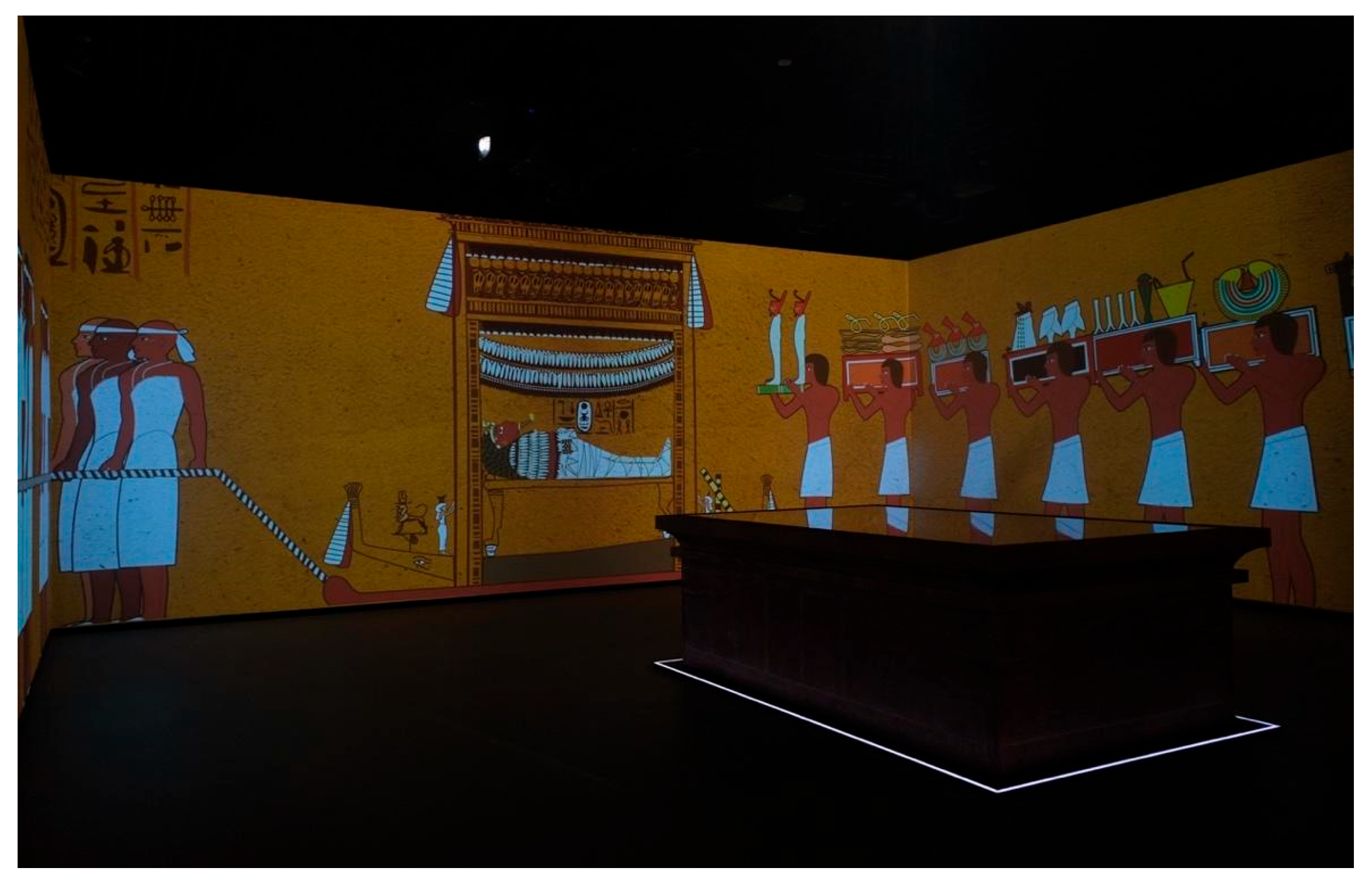
| Part A: “Illumination of the Dark Tomb” | 00:00:00–00:00:30 | Golden circular light patches conduct a systematic scan across the mysterious burial chamber, areas irradiated by the golden light source reveal divine figures and their inscribed names (Isis, Anubis, Hathor, Osiris, etc.). Howard Carter emerges from a gilded circular aperture, whose candle illuminates the chamber. Instantly, the space is bathed in a golden radiance, with the content of wall paintings manifesting sequentially at materializing against the luminous backdrop. | The sarcophagus lid, synchronized with the mural projection’s narrative progression illuminates gradually. | The visitor crosses threshold, gazes at the sarcophagus and mural projection, and then establishes an emotional connection through iconic imageries demonstrated |
| Part B: “Ceremony of the Pharaoh’s Resurrection” | 00:00:30–00:02:30 | The contents of the mural paintings are rendered by golden lines, and then the golden lines, along with all images, fade into particles. The particles light up the funeral boat, and the procession slowly moves toward the main screen. It is a vast funeral procession: a group of female mourners mourning the loss of the pharaoh leads the way, followed by a procession of oxen. A group of high-ranking officials follows closely behind, divided into five groups, pulling a sleigh carrying a funeral boat. The corpse of the king lay in a coffin decorated with garlands of flowers. Behind the coffin is a long procession carrying a shrine and an array of offerings. The procession dissolves from a long shot into a close-up. The hand of Pharaoh Ay reaches out from outside the painting, touching Tutankhamun’s lips with a ritual object. Standing in front of the successor, Pharaoh Ay, who is wearing the leopard skin of the High Priest, Tutankhamun opens his mouth. The golden ankh, symbolizing breath and life, bursts forth between the artifact and the late Pharaoh’s mouth, then spreads over all the frame, filling the space with a golden hue. The golden scene rises, and it comes to a dark subterranean water, where the story unfolds with the pharaoh’s journey, accompanied by Anubis, through the dark underworld known as Duat, a place filled with dangerous creatures (Amit, Apep, fiery serpents, scorpions, etc.) and mysterious powers. Anubis leads Tutankhamun before Osiris to undergo the judgment of the scales. The court, composed of Osiris, Ma’at, Thoth (the recorder of the trial), Anubis, the beast Amit, and the 42 gods of the underworld, witnessed—on the scales—the weight of Tutankhamun’s heart balanced with Ma’at’s feather. Osiris then embraced Tutankhamun. | The coffin lid opens to unveil Tutankhamun’s golden mask, followed by the closure of his gilded sarcophagus, layer by layer, descending into solemn silence. | The audience continues exploring through the physical walk, thinks further about the Resurrection, and engages with other content about the story of Tutankhamun. |
| Part C: “Glimpse of the Eternal Realm” | 00:02:30–00:03:00 | The main scene morphs into the sun through the Eye of Horus. The scene transitions to the Nile River. Depicting a solar boat sailing down the Nile, while 12 baboons, standing along both banks, greet the boat as it passes by. As the solar boat passes the twelfth baboon, the scarab raises the sun, and then the baboons leap, letting out a jubilant cry. The particles dissolved, and the projection demonstrated that the sun rises over Aaru. Tutankhamun, now one of the gods, sails in the floating solar boat towards the spectacular Sun Temple. | The lid of the coffin closes, its surface has a sacred scarab (Khepri) pushing the sun disk, while flower petals disperse following the movement of the solar boat towards the temple. | Audience could link the artifacts (e.g., figure of Osiris, scarab, solar boat, etc., exhibited in the former display cabinets) with the story of Tutankhamun’s tomb and the afterlife, as the interactive experience allows the audience to immerse themselves further into the ancient Egyptian world. It would increase their interest to reflect more about the definitions, such as “Weighing of the Heart”, “Spiritual and Physical Rebirth”, “Eternal World”, and personalize their visit to the exhibition. |
References
- Museum, S. On Top of The Pyramid: The Civilization of Ancient Egypt; Shanghai Calligraphy and Painting Publishing House: Shanghai, China, 2024. [Google Scholar]
- Montanari, E. Exhibiting Exhibitions. Re-staging, Re-viewing and Re-considering the Role of Seminal Displays. In Architecture & Exhibit Design: New Challenges for Museums, ICAMT 2020 Online Conference ed; ICAMT (International Committee for Architecture & Museum Techniques): Paris, France, 2021. [Google Scholar]
- Zijlstra, M.; Mamattah, S.; McGillivray, D. Co-Production in Arts & Culture: A Review of Evidence; University of the West of Scotland: Paisley, UK, 2024. [Google Scholar]
- Rausch, C.; Benschop, R.; Sitzia, E.; van Saaze, V. (Eds.) Practices in Art and Cultural Heritage–Learning Through and from Collaboration; Springer International Publishing AG: Heidelberg, Germany, 2022. [Google Scholar]
- Hendrysiak, J.; Steiner, T. Co-Creation als Tool zur Gestaltung von Co-Experiences in Ausstellungen; FH JOANNEUM Graz: Graz, Austria, 2022. [Google Scholar]
- Olesen, A.R.; Holdgaard, N.; Løvlie, A.S. Co-designing a co-design tool to strengthen ideation in digital experience design at museums. CoDesign 2022, 18, 227–242. [Google Scholar] [CrossRef]
- Leonardi, F. Curating the context: Re-enacting and reconstructing exhibitions as ways of studying the past. Mus. Manag. Curatorship 2021, 36, 172–188. [Google Scholar] [CrossRef]
- Roberts, J. Writing for Strategic Communication Industries; The Ohio State University Press: Columbus, OH, USA, 2016. [Google Scholar]
- Ciğerci, F.M.; Yıldırım, M. From Freytag pyramid story structure to digital storytelling: Adventures of pre-service teachers as story writers and digital story tellers. Educ. Inf. Technol. 2024, 29, 5697–5720. [Google Scholar] [CrossRef]
- Hall, J.; Gaved, M.; Sargent, J. Participatory Research Approaches in Times of COVID-19: A Narrative Literature Review. Int. J. Qual. Methods 2021, 20, 16094069211010087. [Google Scholar] [CrossRef]
- Rask, M.; Mačiukaitė-Žvinienė, S.; Tauginienė, L.; Dikčius, V.; Matschoss, K.; Aarrevaara, T.; d’Andrea, L. Public Participation, Science and Society: Tools for Dynamic and Responsible Governance of Research and Innovation; Routledge: New York, NY, USA, 2018. [Google Scholar]
- Stephens, L.; Smith, H.; Epstein, I.; Baljko, M.; Mcintosh, I.; Dadashi, N.; Prakash, D.N. Accessibility and participatory design: Time, power, and facilitation. CoDesign 2023, 19, 287–303. [Google Scholar] [CrossRef]
- Reussner, E.M. Strategic management for visitor-oriented museums. Int. J. Cult. Policy 2003, 9, 95–108. [Google Scholar] [CrossRef]
- Macdonald, S. A Companion to Museum Studies; Blackwell Publishing Ltd.: Oxford, UK, 2006. [Google Scholar]
- Ajmat, R.; Sandoval, J.; Arana Sema, F.; O’Donell, B.; Gor, S.; Alonso, H. Lighting design in museums: Exhibition vs. preservation. In Structural Studies, Repairs and Maintenance of Heritage Architecture XII; Brebbia, C.A., Binda, L., Eds.; WIT Press: Southampton, UK, 2011. [Google Scholar]
- Lorna, O. Sacred Sites of Ancient Egypt: An Illustrated Guide to the Temples and Tombs of the Pharaohs; Hermes House: London, UK, 2003. [Google Scholar]
- Weiss, L. The Walking Dead at Saqqara. Strategies of Social and Religious Interaction in Practice; De Gruyter: Berlin, Germany, 2022. [Google Scholar]
- Xue, J.; Yan, H.; Li, M.; Wang, H. Unveiling ancient Egyptian treasures: Anthropoid coffins discoveries at the Bubasteion in Saqqara. Sci. Conserv. Archeol. 2024, 36, 173–187. [Google Scholar]
- Bhot, K. Nut (Deity). 2022. Available online: https://www.ebsco.com/research-starters/religion-and-philosophy/nut-deity (accessed on 10 March 2025).
- Dodson, A.; Hilton, D. The Complete Royal Families of Ancient Egypt; Thames & Hudson Ltd.: London, UK, 2004. [Google Scholar]
- Kozloff, A.P. Chapter 15: Luxury Arts. In A Companion to Ancient Egyptian Art; Hartwig, M.K., Ed.; John Wiley & Sons Ltd.: West Sussex, UK, 2015. [Google Scholar]
- Jadresin Milic, R.; McPherson, P.; McConchie, G.; Reutlinger, T.; Singh, S. Architectural History and Sustainable Architectural Heritage Education: Digitalisation of Heritage in New Zealand. Sustainability 2022, 14, 16432. [Google Scholar] [CrossRef]
- Luo, D.; Doucé, L.; Nys, K. Multisensory museum experience: An integrative view and future research directions. Mus. Manag. Curatorship 2024, 41, 212–239. [Google Scholar] [CrossRef]
- Taylor, J.H. Changes in the Afterlife. In Egyptian Archaeology; Wendrich, W., Ed.; John Wiley & Sons Ltd.: West Sussex, UK, 2010. [Google Scholar]
- Yang, D.; Yan, H. New Perspectives on Museum Education; Cultural Relics Press: Beijing, China, 2009. [Google Scholar]
- Davidson, L.; Pérez-Castellanos, L. Cosmopolitan Ambassadors: International Exhibitions, Cultural Diplomacy and the Polycentral Museum; Vernon Press: Wilmington, DE, USA, 2019. [Google Scholar]
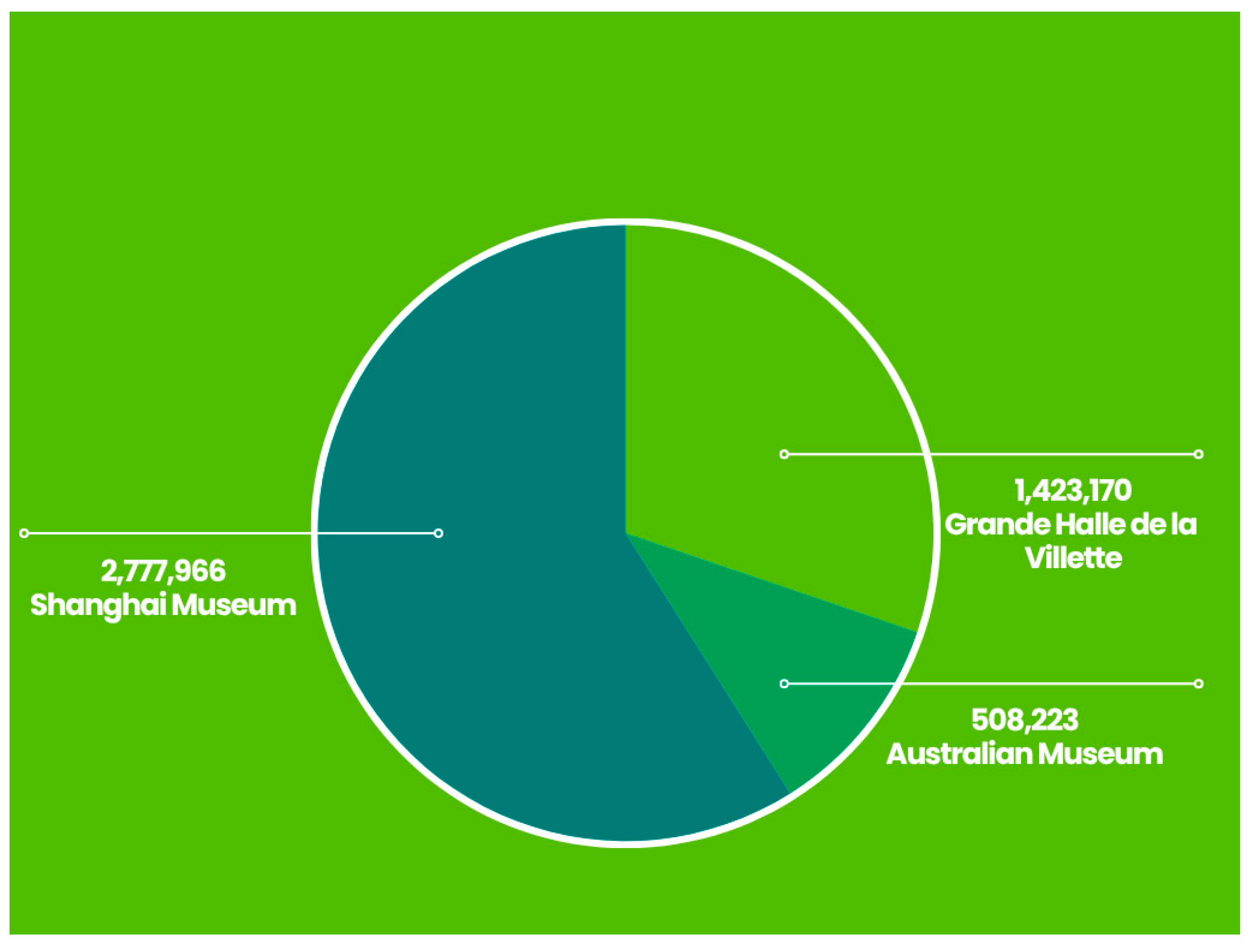
- Information Office of Shanghai Municipality. Received 2.77 Million Visitors and Obtained Total Revenue of 760 Million Yuan, the Shanghai Museum’s Ancient Egyptian Civilization Exhibition Successfully Came to an End, Setting Multiple World Records. 2025. Available online: https://www.shio.gov.cn/TrueCMS/shxwbgs/wxdtt/content/59bde02c-5538-40d0-93d1-92a67c47b5f8.html (accessed on 22 March 2025).
- Marie, M. Tutankhamun Exhibition Breaks Record in Paris, in Egypt Today. 2019. Available online: https://www.egypttoday.com/Article/4/75111/Tutankhamun-Exhibition-breaks-record-in-Paris?utm_source=chatgpt.com (accessed on 22 March 2025).
- Trust, A.M. Australian Museum Annual Report 2023–2024. 2024. Available online: https://australian.museum/about/organisation/annual-reports/ (accessed on 22 March 2025).
- Foster, N.; Davidson, J.C. Restaging Exhibitions. J. Curator. Stud. 2019, 8, 159–161. [Google Scholar] [CrossRef]
- Frey, B.S.; Meier, S. Chapter 29 The Economics of Museums. In Handbook of the Economics of Art and Culture; Ginsburg, V.A., Throsby, D., Eds.; Elsevier: Amsterdam, The Netherlands, 2006; pp. 1017–1047. [Google Scholar]
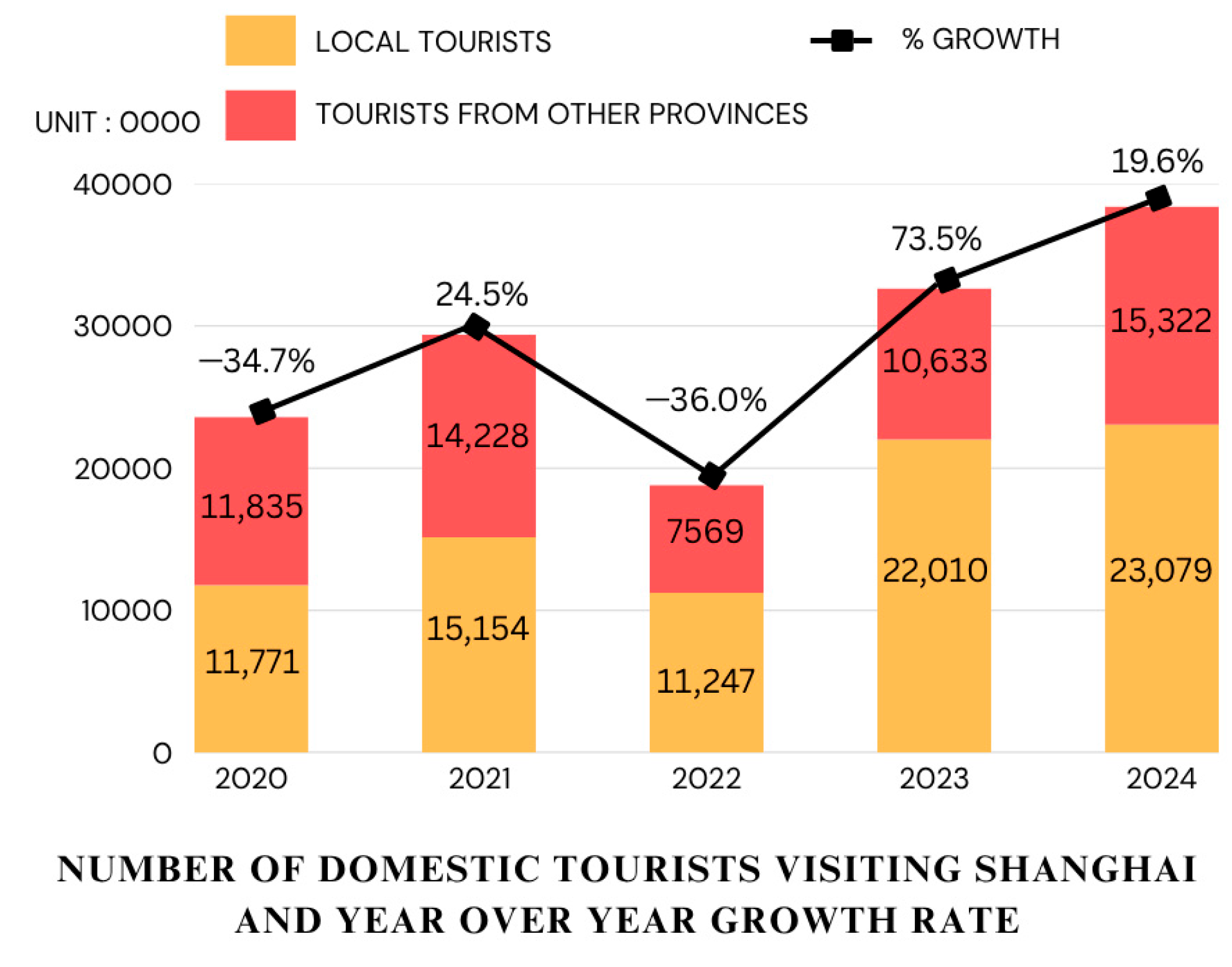
- Bureau, S.M.S. Shanghai Statistical Yearbook 2023; Shanghai Municipal Statistics Bureau: Shanghai, China, 2024. [Google Scholar]
- Bureau, S.M.S. Shanghai Statistical Yearbook 2024; Shanghai Municipal Statistics Bureau: Shanghai, China, 2025. [Google Scholar]
- Bureau, S.M.S. Shanghai Statistical Bulletin on National Economic and Social Development; Shanghai Municipal Statistics Bureau: Shanghai, China, 2025. [Google Scholar]
- Csapó, J.; Schultz, É. War heritage impact on museum dynamics in Budapest: A multidimensional analysis of visitor satisfaction through cultural, statistical, and netnographic modalities. Mus. Manag. Curatorship 2024, 1–21. [Google Scholar] [CrossRef]
- Popoli, Z.; Derda, I. Developing experiences: Creative process behind the design and production of immersive exhibitions. Mus. Manag. Curatorship 2021, 36, 384–402. [Google Scholar] [CrossRef]
- UNESCO. Convention Concerning the Protection of the World Cultural and Natural Heritage; UNESCO: Paris, France, 1972. [Google Scholar]
- Nonet, G.A.-H.; Gössling, T.; Van Tulder, R.; Bryson, J.M. Multi-stakeholder Engagement for the Sustainable Development Goals: Introduction to the Special Issue. J. Bus. Ethics 2022, 180, 945–957. [Google Scholar] [CrossRef] [PubMed]
- Foundation for Advancement in Conservation. Held in Trust: Transforming Cultural Heritage Conservation for a More Resilient Future; Foundation for Advancement in Conservation: Washington, DC, USA, 2023; pp. 66–255. [Google Scholar]
- Pérez-Gil, M.d.M. Tourists not welcome: Perceptions of tourism in popular romance novels. J. Tour. Cult. Change 2025, 23, 18–31. [Google Scholar] [CrossRef]





| Themes Identified | Primary Data Sources | Illustrative Evidence |
|---|---|---|
| Theme 1. Curatorial Theory and Its Application | Interviews | “Most Chinese visitors’ understanding of Egyptian artifacts remains limited, although ‘Egyptian fever’ continues to grow.” (Interviewee A, curator & Egyptologist) |
| Theme 2. Collaborative Mechanisms Between Chinese and Egyptian Teams | Field notes recorded at exhibition site, Egyptian museums, and archaeological sites | Field notes documented: “An Egyptian Egyptologist explained to the Chinese audience the City of Amenhotep III, and discussed the functions of its seven zones. His archaeological experiences attracted the visitors’ attention.” |
| Theme 3. Spatial Layout, Visitor Flow, and Environmental Considerations | Interviews | Interviewee B noted: “all materials used were tested by the Cultural Relics Protection Center before the installation process.” |
| Theme 4. Artifacts Selection and Display Strategies | Interviews | “The exhibits excavated from Saqqara drew public attention as some of the exhibition’s iconic pieces, but we also included museum-collected items previously never exhibited outside Egypt.” (Interviewee A, curator & Egyptologist) |
| Theme 5. Visitor Engagement with Immersive Experience | Visitor comments | “I visited the exhibition just yesterday. It was truly breathtaking, such a magnificent glimpse into ancient Egyptian civilization.” (WeChat comment) |
| Theme 6. Other Actions relevant to People-centered Endeavor | Visitor comments | “I suspect 90% of people don’t really get it, they’re just here for the photos.” (WeChat comment) |
Disclaimer/Publisher’s Note: The statements, opinions and data contained in all publications are solely those of the individual author(s) and contributor(s) and not of MDPI and/or the editor(s). MDPI and/or the editor(s) disclaim responsibility for any injury to people or property resulting from any ideas, methods, instructions or products referred to in the content. |
© 2026 by the authors. Licensee MDPI, Basel, Switzerland. This article is an open access article distributed under the terms and conditions of the Creative Commons Attribution (CC BY) license.
Share and Cite
Xue, J.; Li, X. Mitigation of Cultural Differences: Co-Produced Temporary Exhibition with Strong Storytelling and Design Analysis. Heritage 2026, 9, 138. https://doi.org/10.3390/heritage9040138
Xue J, Li X. Mitigation of Cultural Differences: Co-Produced Temporary Exhibition with Strong Storytelling and Design Analysis. Heritage. 2026; 9(4):138. https://doi.org/10.3390/heritage9040138
Chicago/Turabian StyleXue, Jiang, and Xiang Li. 2026. "Mitigation of Cultural Differences: Co-Produced Temporary Exhibition with Strong Storytelling and Design Analysis" Heritage 9, no. 4: 138. https://doi.org/10.3390/heritage9040138
APA StyleXue, J., & Li, X. (2026). Mitigation of Cultural Differences: Co-Produced Temporary Exhibition with Strong Storytelling and Design Analysis. Heritage, 9(4), 138. https://doi.org/10.3390/heritage9040138