1. Introduction
Ancient Egypt’s extraordinary documentary legacy—spanning three millennia of administrative papyri, diplomatic correspondence, temple archives, and prosopographical inscriptions—presents one of the richest relational datasets in the ancient world. Yet despite this abundance of explicitly networked information, Egyptology has remained notably cautious in adopting the quantitative methods of Social Network Analysis that have transformed other areas of archaeological research. This methodological reticence is beginning to shift. Recent studies have demonstrated that formal network analysis can illuminate previously hidden patterns in Egyptian administrative structures, elite strategies, and state dynamics, suggesting that the discipline stands at the threshold of a significant analytical transformation. The question is no longer whether network methods are appropriate for Egyptian sources, but rather how systematically and effectively they can be applied to unlock new dimensions of understanding about ancient Egyptian society.
1.1. Definition and Development of Social Network Analysis in Archaeology
Social Network Analysis (SNA) represents an analytical methodology that enables the examination of complex relational structures through graph theory and specialized statistical methods. In the archaeological context, this approach has proven particularly valuable for the formal study of past relational phenomena: social networks, transport systems, communication, and exchange.
The application of SNA in archaeology has experienced significant development since the early twenty-first century. As noted by Brughmans [
1] and Collar et al. [
2], network analysis methods have become firmly established within contemporary archaeological practice, being commonly used to explore large archaeological datasets. The seminal manual by Brughmans and Peeples [
3] constitutes the first comprehensive guide to this field of research, offering a step-by-step description of network science methods and exploring their theoretical foundations and applications in archaeological research.
The methodological evolution of the field can be traced through key contributions that have defined its theoretical foundations. These foundational works have been complemented by specific applications that demonstrate the versatility of the method across diverse geographical and temporal contexts.
The exponential growth of SNA applications in humanities and archaeology is evidenced by bibliometric data. According to Web of Science statistics, there has been exponential growth in “Arts and Humanities” publications that include “Social Network Analysis” in their titles, showing the expansion of this method from virtually zero publications in the 1990s to nearly 100 annual publications by 2025. This growth reflects both the maturation of methodological frameworks and the increasing recognition of SNA’s potential for addressing complex archaeological questions.
1.2. Egyptology as a Particular Case: A Field in Transition
Egyptology presents characteristics that distinguish it from other archaeological disciplines in its adoption of SNA. Unlike other areas of ancient world studies where network analysis has found relatively early and systematic application, Egyptology has shown a more gradual and selective adoption of this analytical methodology.
This situation is paradoxical when we consider that ancient Egypt possesses one of the richest and most continuous documentary traditions in the ancient world. Administrative archives, prosopographical inscriptions, epistolary documentation, and temple records provide a corpus of relational data of extraordinary richness that, in principle, lends itself ideally to social network analysis [
4]. This contrast becomes even more striking when compared to other archaeological contexts where SNA adoption has been similarly limited; for instance, Jiménez-Puerto [
5] notes that applications in the Iberian Peninsula remain scarce despite the method’s obvious potential, suggesting that the conservative adoption of SNA may reflect broader disciplinary patterns rather than source-specific limitations.
Egyptian sources present several characteristics that make them particularly appropriate for network analysis:
Exceptional temporal continuity: Egyptian documentation spans more than three millennia, allowing diachronic analyses of great scope that would be impossible in other ancient world contexts.
Typological diversity: Sources include administrative documentation (Middle and New Kingdom papyri), diplomatic correspondence (Amarna archive), temple records (Ptolemaic archives such as the Zenon archive), prosopographical inscriptions, and distributed material evidence.
Prosopographical richness: The Egyptian tradition of recording titles, genealogies, and family connections provides explicit relational data that constitute ideal raw material for the construction of social networks.
Differential but systematic preservation: Although preservation is selective, it follows identifiable patterns that allow appropriate methodological corrections.
Despite these evident advantages, Egyptology has shown relatively late adoption of SNA compared to other archaeological disciplines. Several factors contribute to explaining this situation.
Methodological conservatism represents a significant factor, as Egyptology, being a mature discipline with well-established analytical traditions, has shown some resistance to incorporating advanced quantitative methodologies. This conservative approach reflects both the discipline’s confidence in existing methods and wariness about the appropriateness of quantitative approaches for humanistic questions.
Disciplinary fragmentation has also hindered adoption, as specialization in specific historical periods has made it difficult to embrace methodologies that require comparative and diachronic perspectives. The traditional organization of Egyptology around chronological periods has created barriers to adopting methods that benefit from broader temporal and comparative frameworks.
Source complexity presents another significant challenge, as the diversity and complexity of Egyptian sources have created specific methodological difficulties that require specialized adaptations of standard SNA protocols. The fragmentary nature of archaeological evidence requires careful consideration of data quality and representativeness, challenges [
6] that are particularly acute in Egyptology given the differential preservation patterns of Egyptian documentation.
Finally, the lack of specific reference frameworks has constrained development, as until recently, the discipline lacked methodological guides specifically designed for applying SNA to Egyptian sources. The archaeological record’s inherent fragmentation means that researchers must often perform “network synthesis” rather than “network analysis,” working backwards from incomplete evidence to reconstruct probable relational structures.
1.3. Current State and Evidence of Change
The described panorama is undergoing significant transformation in the last decade. Evidence of this change can be observed in several ways:
Systematic research on SNA in Egyptology, practically non-existent before 2008, has experienced notable growth. Ruffini’s [
7] pioneering work on social networks in Byzantine Egypt marked the beginning of this trend, followed by methodological contributions and specific applications that have gradually established the legitimacy of the method in the discipline.
The work by Bárta et al. [
8] represents the first systematic application of SNA to the Old Kingdom, combining network analysis with Hidden Markov Models to examine the dynamics of the Egyptian state. This study demonstrates the methodological sophistication achieved by the field and its capacity to integrate SNA with other advanced quantitative methodologies.
The study of Tambs [
9] applies social network analysis (SNA) to the Zenon Archive, the largest surviving private document collection from Ancient Egypt, containing approximately 1845 texts spanning 35 years (263–229 BCE) under Ptolemaic rule. The author demonstrates how formal SNA methods can map and visualize relationships between people and places mentioned in these ancient documents, using a case study of texts from Zenon’s work as a financial agent in the Levant. This innovative approach reveals new insights into social and economic networks in Hellenistic Egypt and suggests broader applications for understanding ancient Mediterranean societies.
A particularly significant development has been the publication of Chollier’s [
10] work on power networks in Upper Egypt during the New Kingdom. This study represents the first systematic analysis of social and political networks applied to the most documented period of Egyptian history, combining prosopography, social anthropology, and SNA to examine provincial elite strategies. The interdisciplinary methodology employed by Chollier [
10] establishes a model for future research in the field.
The publication of the first methodological synthesis specific to Egyptology [
4] marks a crucial moment in the field’s maturation. This work provides specific protocols for applying SNA to Egyptian sources, addressing the specific methodological challenges presented by Egyptian documentation.
The appearance of specialized critical reviews, such as Stefanović’s evaluation of Chollier’s work, indicates that the field has reached a sufficient level of maturity to generate specialized methodological discussion. This self-critical capacity is an important indicator of disciplinary consolidation.
Contemporary methodological development also reflects broader concerns in archaeological network analysis regarding data quality and interpretive validity. As emphasized in recent methodological reviews [
11], the robustness of network models must be tested against random contamination, and the interpretive leap from static structural patterns to dynamic social processes requires careful theoretical grounding. These considerations are particularly relevant for Egyptology, where the temporal depth and complexity of sources demand sophisticated approaches to uncertainty and incomplete data.
Analysis of recent production reveals increasingly comprehensive chronological coverage:
Old Kingdom: Bárta et al. [
8] have demonstrated the method’s applicability to the earliest periods of Egyptian history.
Middle Kingdom: Stefanović [
4] has developed specific applications for the votive zone of Abydos.
New Kingdom: Chollier [
10] has provided the first systematic analysis of this crucial period.
Ptolemaic Period: Ongoing investigations of the Zenon archive [
12] promise to significantly expand our knowledge of Ptolemaic administrative networks.
Byzantine Egypt: Ruffini’s [
7] pioneering work maintains its relevance as a methodological reference point.
The thematic scope of Egyptian SNA applications also shows increasing diversification. Beyond administrative and prosopographical studies, recent work has begun to explore economic networks, elite strategies, and the dynamics of political power. This development parallels broader trends in archaeological network analysis, where prosopographical applications have proven particularly successful in other ancient contexts, including Roman and Assyrian studies [
13], providing methodological models that could be adapted for Egyptian contexts.
Despite the advances described, the field currently lacks a comprehensive evaluation that integrates recent developments into a coherent perspective. Existing works, although valuable, address specific aspects or periods without providing a synthetic view of the discipline’s general state.
The absence of a specific state-of-the-art review on SNA in Egyptology represents an important gap, especially considering that the general manual by Brughmans and Peeples [
3], although fundamental, addresses Egyptology only marginally. This situation contrasts with the specific attention received by other archaeological areas where SNA has found systematic application.
The field finds itself at a critical moment in its development. The convergence of several factors—the availability of consolidated methodologies, the existence of successful case studies, and the emergence of a community of specialized researchers—suggests that Egyptology is prepared for significant expansion in SNA applications.
This moment presents a unique opportunity to influence the field’s future direction through the identification of specific strengths, weaknesses, and opportunities. A systematic evaluation can provide the basis for developing a coordinated research agenda that maximizes SNA’s potential in Egyptology.
The systematic application of SNA has the potential to significantly transform our understanding of ancient Egyptian society. Social, political, and economic networks constitute fundamental aspects of any complex society, and their formal analysis can reveal patterns and dynamics that escape traditional methodologies.
Existing case studies have already demonstrated SNA’s capacity to generate new perspectives on fundamental themes such as the functioning of the Egyptian state [
8], provincial elite strategies [
10], and the evolution of administrative structures [
9].
1.4. Objectives of the Present Work
The present work aims to provide a comprehensive state-of-the-art review on the application of Social Network Analysis in Egyptology, evaluating methodological developments, achievements, and prospects of the field. This general objective encompasses several specific dimensions that together provide a systematic analysis of the current state and future potential of Egyptian SNA applications.
The methodological evaluation component seeks to analyze the adaptation of general SNA methodologies to the specific characteristics of Egyptian sources, identifying methodological innovations and persistent technical challenges. This analysis examines how standard network analytical approaches have been modified for Egyptian contexts and what distinctive methodological contributions have emerged from this adaptation process.
The systematic examination of academic production involves evaluating existing works according to their methodological quality, substantive contributions, and impact on understanding ancient Egyptian society. This assessment provides a comprehensive overview of what has been achieved while identifying patterns in research quality and impact across different studies and approaches.
Tracing the field’s evolution from its beginnings to the present allows identification of factors that have influenced its development and key moments of transformation. This developmental analysis reveals the internal logic of field growth while highlighting external factors that have shaped research directions and opportunities.
The coverage assessment analyzes the chronological, geographical, and thematic distribution of existing studies, systematically identifying well-developed areas and significant gaps. This analysis provides essential information for understanding current limitations and prioritizing future research directions.
Finally, the prospective analysis identifies future opportunities for SNA application in Egyptology while proposing priority research lines and strategies for coordinated field development. This forward-looking component translates the analytical findings into actionable recommendations for advancing the field’s development and impact.
It is important to clarify the nature of this contribution. This article is a systematic review article in the strict sense: it does not present new primary research data, nor is it a grant proposal or a manifesto for the field. Its purpose is to document, evaluate, and synthesize what has been done; to identify where the field stands methodologically and thematically; and to indicate, on the basis of that evidence, where the most productive avenues for future research lie. The prospective dimension of the article follows naturally from the gaps identified in the critical analysis and is a standard component of systematic review methodology. The journal Heritage provides an appropriate venue for this contribution, given its scope encompassing archaeological method, cultural heritage research, and the digital and quantitative approaches increasingly applied to the study of ancient material and documentary culture.
2. Materials and Methods
2.1. Literature Search Strategy and Selection Criteria
The systematic literature search underpinning this review was conducted in accordance with the principles of the PRISMA (Preferred Reporting Items for Systematic Reviews and Meta-Analyses) framework, adapted to the specificities of a humanities and archaeological domain. Searches were carried out across the following databases and specialist resources: Web of Science, Scopus, JSTOR, Google Scholar, the Egyptological bibliography Aegyptologie.net, and the journal Zeitschrift für Ägyptische Sprache und Altertumskunde. Search terms combined “Social Network Analysis”, “network analysis”, and “network science” with “Egyptology”, “ancient Egypt”, “Egyptian archaeology”, “pharaonic”, and “Ptolemaic”. The search period covered publications from 2000 to 2025, reflecting the timeframe in which SNA methods have been actively and formally applied within the humanities and archaeology.
Inclusion criteria required that works: (1) applied formal SNA methods or network science concepts to Egyptian historical or archaeological data; (2) were published in peer-reviewed journals, edited volumes, or academic monographs; and (3) were available in English, French, Spanish, or German. Studies were excluded if they discussed network concepts only in a metaphorical sense without formal analysis, or if they focused exclusively on non-Egyptian contexts without comparative engagement with Egyptian material. Following screening, a final corpus of 38 directly relevant studies was identified and subjected to systematic evaluation. The analysis of each work addressed methodological approach, data sources used, chronological and thematic scope, key findings, and limitations. Given the relatively small size of this corpus—itself a finding of significance—a full PRISMA flow diagram is not reproduced here.
2.2. Foundations of Social Network Analysis in Archaeology
The application of Social Network Analysis to archaeological contexts requires a solid understanding of both the theoretical foundations of network science and the specific adaptations necessary for working with ancient data. This section establishes the methodological framework within which Egyptological applications of SNA must be understood, drawing primarily on the comprehensive synthesis provided by Brughmans and Peeples [
3], while addressing the challenges presented by Egyptian sources.
Social Network Analysis, fundamentally, is concerned with the study of relationships between entities and the patterns that emerge from these relationships. In archaeological contexts, these entities (nodes) can represent a wide variety of elements: sites, artifacts, individuals, communities, or regions, while relationships (edges) can signify various forms of interaction: trade, communication, cultural influence, or kinship ties [
14].
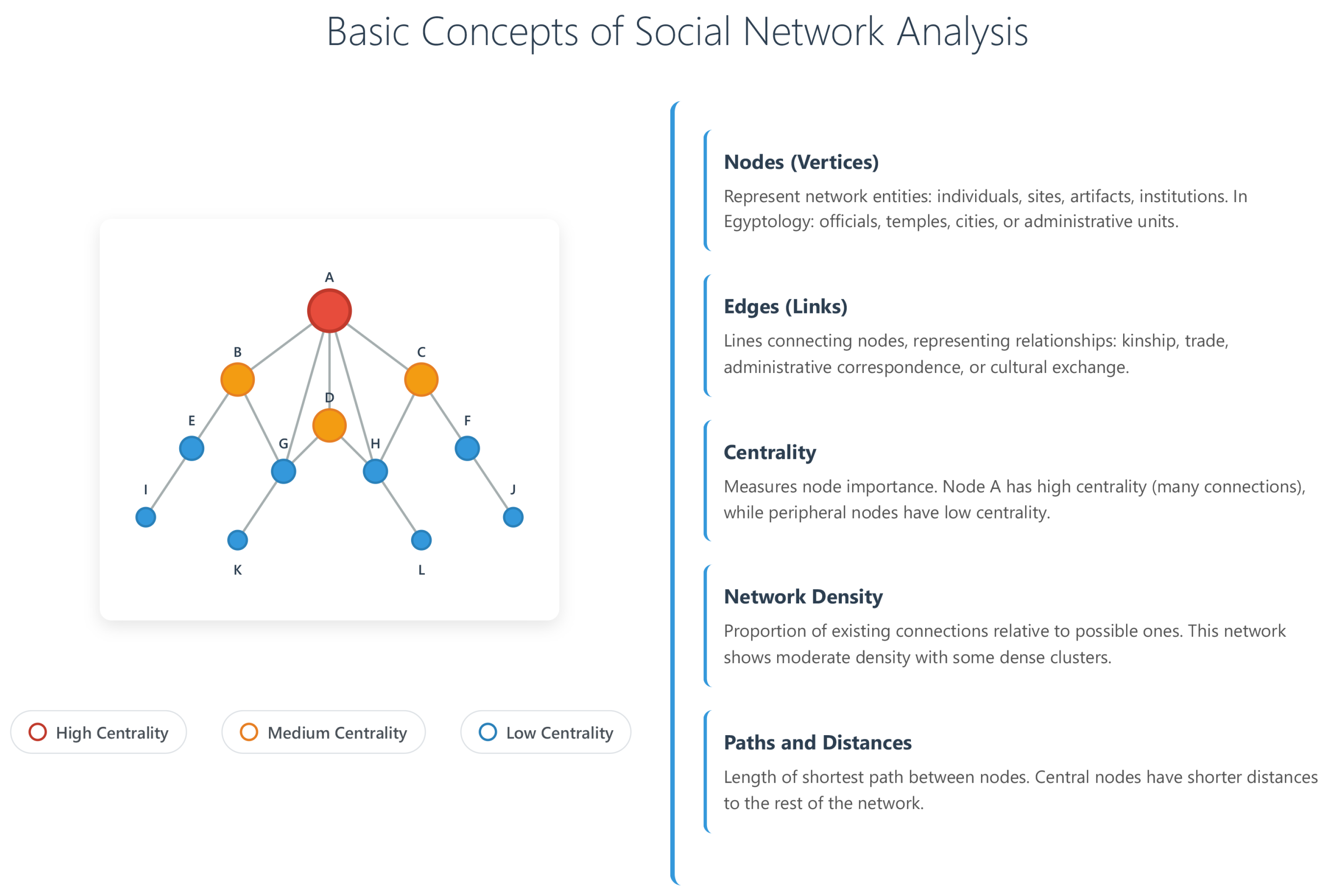
The power of network thinking lies in its capacity to move beyond the analysis of individual elements to examine the structural properties of entire systems (see
Figure 1) such as centrality, average path length, density, etc. As Collar et al. [
2] emphasize, networks in archaeology serve three fundamental purposes: as phenomena (the actual relationships that existed in the past), as abstractions (our theoretical models of these relationships), and as representations (the mathematical and visual tools we use to analyze them).
This tripartite understanding is crucial for Egyptological applications, where the relationship between past phenomena and present representations is mediated by complex processes of preservation, discovery, and interpretation. The challenge lies not only in reconstructing ancient networks from fragmentary evidence but also in ensuring that our analytical methods are appropriate for the kinds of questions we seek to answer about Egyptian society.
Network science provides a mathematical framework for quantifying and analyzing relational structures. The basic building blocks—nodes and edges—can be combined into increasingly complex configurations that reveal emergent properties of the system. These properties operate at multiple scales: individual (micro), community (meso), and system-wide (macro) levels [
3].
Micro-level properties focus on individual nodes and their immediate neighborhoods. Centrality measures such as degree centrality (number of connections), betweenness centrality (frequency of appearance on shortest paths between other nodes), and closeness centrality (average distance to all other nodes) provide insights into the relative importance or influence of specific entities within the network [
15].
Meso-level properties examine intermediate structures such as communities, clusters, or structural equivalence groups. These sub-structures often reveal the organizational principles underlying network formation and can indicate social, economic, or cultural boundaries within the larger system [
16].
Macro-level properties characterize the overall structure of the network, including measures such as density (proportion of possible connections that are realized), average path length (typical distance between nodes), and clustering coefficient (tendency for connected nodes to share neighbors). These measures provide insights into system-wide properties such as integration, efficiency, and robustness [
17].
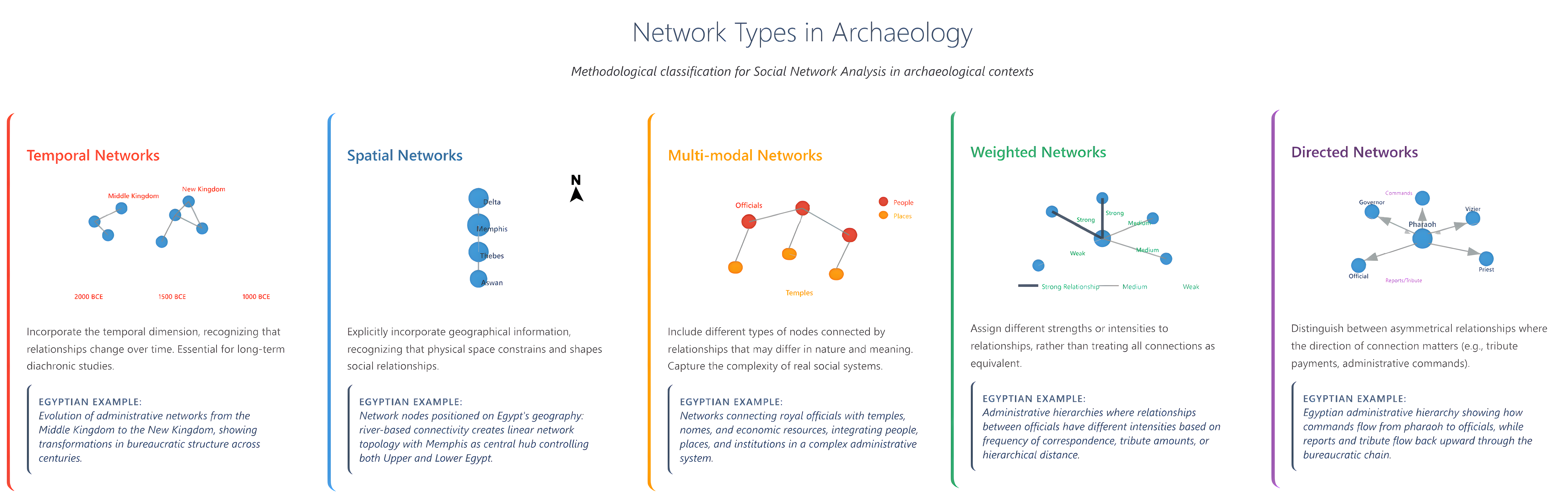
Archaeological networks can be classified according to several important dimensions that affect both their interpretation, and the analytical methods appropriate for studying them [
3].
Temporal networks acknowledge that relationships change over time. Archaeological applications must grapple with questions of temporal resolution, duration of relationships, and the dynamics of network formation and dissolution. Egyptian sources, with their exceptional temporal span, present both opportunities and challenges in this regard.
Spatial networks explicitly incorporate geographical information, recognizing that physical space often constrains and shapes social relationships. The geography of the Nile Valley, with its linear distribution of settlements and resources, creates distinctive spatial network properties that must be considered in Egyptological applications.
Multi-modal networks include different types of nodes (e.g., people and places, or individuals and institutions) connected by relationships that may differ in nature and meaning. Egyptian administrative and religious hierarchies often require multi-modal representations to capture their complexity adequately.
Weighted networks assign different strengths or intensities to relationships, rather than treating all connections as equivalent. Egyptian sources often provide information about the relative importance or frequency of relationships that can be incorporated through edge weights.
Directed networks distinguish between asymmetrical relationships where the direction of the connection matters (e.g., tribute payments, administrative commands). Many Egyptian administrative and diplomatic relationships are inherently directional and require directed network representations (see
Figure 2).
2.3. Methodological Approaches in Archaeological Network Analysis
The construction of archaeological networks begins with the fundamental challenge of translating archaeological evidence into network data. This process requires explicit decisions about what constitutes a node, what constitutes an edge, and how relationships should be defined and measured [
6,
14].
Node definition strategies vary according to research questions and available data. In archaeological contexts, nodes commonly represent archaeological sites (for regional interaction studies), individual artifacts (for technological or stylistic transmission studies), people (for prosopographical or social studies), or institutions (for organizational studies). The choice of node type fundamentally shapes the kinds of questions that can be addressed and the interpretations that are possible.
Edge definition strategies require careful consideration of what constitutes evidence for a relationship. Archaeological evidence for connections might include shared artifact styles (indicating cultural interaction), presence of foreign materials (indicating trade relationships), architectural similarities (indicating knowledge transfer), or documentary evidence of relationships (in literate societies). The strength of evidence and the criteria for recognizing relationships must be explicitly defined and consistently applied.
Network boundary problems arise when determining which nodes and edges to include in the analysis. Archaeological networks are always partial representations of past reality, bounded by preservation, discovery, and research focus. These boundaries significantly affect network properties and interpretations, requiring careful consideration and sensitivity analysis.
Once constructed, archaeological networks can be analyzed using a variety of exploratory techniques designed to reveal structural patterns and identify significant nodes or relationships. Descriptive statistics provide basic characterizations of network structure, including size (number of nodes and edges), density, degree distribution, and connectivity patterns. These measures establish baseline properties and enable comparisons between different networks or time periods.
Centrality analysis identifies nodes that occupy important structural positions within the network. Different centrality measures capture different aspects of importance: degree centrality identifies well-connected nodes, betweenness centrality identifies nodes that bridge different parts of the network, and eigenvector centrality identifies nodes connected to other important nodes. The choice of centrality measure should align with theoretical expectations about what kinds of importance are relevant for the research question.
Community detection identifies groups of nodes that are more densely connected to each other than to the rest of the network. These communities may represent social groups, cultural regions, or functional units within the larger system. Various algorithms exist for community detection, each with different strengths and assumptions [
16].
Structural equivalence analysis identifies nodes that occupy similar positions in the network structure, even if they are not directly connected. This approach can reveal functional roles or social positions that recur across different parts of the network.
Archaeological network analysis increasingly employs statistical methods to distinguish meaningful patterns from random noise and to test specific hypotheses about network structure [
3]. Null model comparisons represent a fundamental approach that involves comparing observed network properties to those expected under various random models, helping identify which aspects of network structure are statistically significant and unlikely to result from chance alone [
18]. These comparisons typically involve generating multiple random networks with the same basic properties as the observed network (such as the same number of nodes and edges) but with randomized connections, then comparing metrics like clustering coefficients, path lengths, or centrality distributions between the observed and random networks [
17]. Statistical significance is assessed through the distribution of differences, allowing researchers to identify whether observed patterns represent genuine social structures or could have emerged through random processes. Common null models include random graphs, small-world models, and configuration models that preserve specific structural properties while randomizing others.
Temporal network analysis examines how network properties change over time, identifying periods of stability, transition, or crisis, an approach particularly relevant for Egyptian studies given the long temporal sequences available. This method involves constructing networks for different time periods and analyzing changes in structural properties, node positions, or relationship patterns to identify moments of transformation or continuity in social organization. Spatial network analysis incorporates geographical information to test hypotheses about the relationship between physical space and social networks, employing distance-based models, gravity models, and spatial autocorrelation methods to reveal how geographical factors shape network formation and how social connections relate to physical proximity or accessibility.
Robustness analysis examines how sensitive network properties are to missing data, measurement errors, or alternative analytical choices, proving crucial for assessing result reliability given the fragmentary nature of archaeological evidence [
19]. This analysis involves systematically removing nodes or edges from the network to test whether key structural properties remain stable, simulating different levels of data completeness to understand how missing information might affect conclusions. Robustness testing also includes examining sensitivity to different relationship definitions, threshold values for tie strength, or alternative network construction protocols to determine which findings are stable across methodological choices and which depend on specific analytical decisions [
20]. Researchers might also test how results change when using different centrality measures, community detection algorithms, or temporal aggregation strategies, providing confidence intervals or uncertainty estimates for network metrics to help interpret findings appropriately given data limitations.
2.4. Challenges in Archaeological Network Analysis
Archaeological networks face distinctive challenges related to data quality that must be addressed through careful methodological choices and sensitivity analysis [
21].
Archaeological network analysis faces several systematic challenges that can significantly affect the reliability and interpretation of results. Preservation bias affects the survival of different types of evidence in systematic ways, as organic materials decay differentially compared to inorganic materials, elite contexts are often better preserved than commoner contexts, and certain time periods or regions may be over- or under-represented, creating systematic distortions in reconstructed networks that may not reflect past reality. Discovery bias results from the history and methods of archaeological investigation, where some sites, regions, or time periods have received more intensive investigation than others, leading to apparent patterns that may reflect research history rather than ancient relationships, while publication bias can further skew available data toward exceptional or well-preserved examples that may not represent typical patterns.
Temporal resolution problems arise when attempting to integrate evidence from different time periods or when the temporal relationships between network elements are unclear, as Egyptian chronology, despite being relatively well-established, still contains uncertainties that affect network construction, particularly for earlier periods where dating precision decreases and the risk of conflating relationships from different generations or centuries increases. Scale mismatches occur when evidence exists at different scales of analysis, from individual relationships to household connections, community networks, and regional systems, that must be integrated into coherent network representations, yet the aggregation of evidence across these scales can obscure important patterns at specific levels or create artificial connections that never existed simultaneously in the historical record.
These challenges compound each other in archaeological contexts, where researchers often work with incomplete, biased, and temporally uncertain data while attempting to reconstruct complex social systems. The cumulative effect of these biases can lead to network reconstructions that systematically over-represent certain types of relationships while missing others entirely, potentially creating false impressions of network structure, density, or evolution that require careful consideration and methodological approaches specifically designed to acknowledge and mitigate these limitations.
The translation of network analytical results into archaeological interpretations raises several fundamental challenges that require careful theoretical consideration [
22].
Archaeological network analysis faces several fundamental interpretive challenges that complicate the translation of quantitative results into meaningful historical understanding. The static-dynamic problem involves inferring dynamic social processes from static archaeological evidence, as networks derived from archaeological evidence represent accumulated patterns over time while social relationships in the past were dynamic and constantly changing, creating a fundamental mismatch between the temporal nature of the evidence and the processes researchers seek to understand [
23]. Methods for addressing temporal dynamics in network analysis are still developing, but the challenge remains that archaeological deposits collapse temporal sequences into seemingly simultaneous patterns, making it difficult to distinguish between relationships that were truly contemporary and those that occurred sequentially but appear connected in the archaeological record [
1].
The individual-aggregate problem concerns the relationship between individual behaviors and aggregate patterns, as network analysis typically reveals system-level properties while archaeological interpretation often seeks to understand individual or group behaviors that produce these patterns. This creates a scale mismatch where researchers observe macro-level network structures but must infer the micro-level decisions, strategies, and actions that created these patterns, requiring careful attention to the mechanisms linking individual actions to network structure and recognition that aggregate patterns may emerge from individual behaviors that were not consciously directed toward creating the observed network properties [
24].
The correlation-causation problem affects the interpretation of network patterns as evidence for specific social processes, since statistical association between network properties and other variables does not necessarily indicate causal relationships, and alternative explanations must be carefully considered. Network analysis can reveal that certain individuals occupied central positions or that communities were densely connected, but determining whether centrality caused influence or influence caused centrality, or whether density resulted from cooperation or conflict, requires additional evidence and theoretical frameworks beyond the network analysis itself [
25].
The emic-etic problem involves the relationship between analytical categories imposed by researchers and the meaningful categories used by past actors, as network analysis necessarily imposes mathematical structures on archaeological data that may not correspond to socially meaningful divisions or relationships in the past [
3]. Modern concepts of “centrality,” “community,” or “influence” may not have direct equivalents in ancient Egyptian social understanding, and the mathematical identification of network clusters or hierarchies may cut across categories that were more meaningful to ancient actors, such as kinship groups, professional associations, or religious affiliations that operated according to different logics than those captured by network metrics.
2.5. Specific Methodological Adaptations for Egyptian Sources
Egyptian sources present distinctive characteristics that require specific methodological adaptations for network analysis. Understanding these characteristics is crucial for designing appropriate analytical approaches and interpreting results correctly [
26].
Temporal depth and continuity: Egyptian documentation spans over three millennia, providing opportunities for diachronic network analysis that are unmatched in most other ancient contexts. However, this temporal depth also creates challenges for maintaining consistent analytical categories and dealing with changing social, political, and economic structures over time. Egyptian chronology, while relatively well-established compared to other ancient civilizations, contains systematic uncertainties that require explicit methodological protocols for network analysis. Uncertainty increases substantially for earlier periods, with the Old Kingdom showing dating variations of ±50–100 years for individual reigns, while New Kingdom chronology generally permits precision within ±10–25 years [
27].
Network analysis protocols must accommodate this uncertainty through several approaches: Temporal binning strategies that group evidence into periods larger than maximum dating uncertainty. Fuzzy temporal boundaries that represent relationships with probability distributions rather than fixed dates, allowing relationships to exist across multiple time periods with varying probability weights [
28]. Sensitivity analysis that tests how chronological uncertainty affects network properties by constructing multiple network versions using different chronological assumptions and comparing resulting structural measures [
29].
Preservation bias mitigation protocols: Egyptian sources exhibit systematic preservation biases that require explicit methodological corrections. Elite contexts are dramatically over-represented due to differential investment in preservation, with royal and high administrative contexts showing preservation rates potentially 100–1000 times higher than common household contexts [
30]. Geographic preservation bias favors Upper Egypt due to climatic conditions, with papyrus survival rates in the Fayyum and southern sites significantly exceeding Delta preservation [
31].
Network analysis must implement bias correction protocols including stratified sampling approaches that explicitly account for differential preservation when making inferences about population-level patterns, null model testing that compares observed network patterns against models incorporating known preservation biases, and robustness testing that examines how network conclusions change under different assumptions about missing data patterns. These protocols should be documented and reported as standard practice in Egyptian network studies.
Hierarchical structure: Egyptian society was highly stratified, and this stratification is reflected in the differential survival and documentation of evidence. Elite contexts are heavily over-represented in the available record, potentially skewing network reconstructions toward high-status relationships and under-representing broader social patterns.
Administrative complexity: The Egyptian bureaucratic system generated extensive documentary records that provide explicit evidence for administrative relationships, reporting structures, and institutional connections. However, the complexity of this system requires careful attention to formal versus informal relationships and official versus actual networks.
Religious integration: Egyptian society was characterized by close integration between religious and secular institutions, meaning that many relationships operated simultaneously in multiple domains. Network analysis must account for this multi-dimensional quality of Egyptian social relationships.
Geographic constraints: The linear geography of the Nile Valley created distinctive spatial patterns that affected network formation and should be incorporated into analytical models. The contrast between the narrow river valley and the broader Delta region also creates systematic differences in network potential.
Different types of Egyptian sources provide different kinds of evidence for relationships and require different approaches to network construction and analysis.
Administrative documents (papyri, ostraca, administrative inscriptions) provide the most explicit evidence for institutional relationships, hierarchical structures, and formal communication networks. These sources are particularly valuable for understanding governmental administration, temple management, and economic organization. However, they may under-represent informal relationships and social networks that operated outside official channels.
The Zenon archive from the Ptolemaic period exemplifies the potential of administrative documents for network analysis, providing detailed evidence for economic relationships, administrative hierarchies, and communication patterns across the eastern Mediterranean (ongoing research by Tambs and Alvares Freire). Similar potential exists for other administrative archives, including Middle Kingdom documents from Lahun and New Kingdom materials from Deir el-Medina.
Prosopographical sources (biographical inscriptions, genealogical records, title sequences) provide evidence for kinship networks, career patterns, and social mobility. These sources are crucial for understanding elite social networks and the mechanisms of political integration. However, they are heavily biased toward high-status individuals and may not represent broader social patterns. Stefanović’s [
4] work on the votive zone at Abydos demonstrates the potential for prosopographical network analysis in Egyptian contexts, revealing patterns of family relationships, religious affiliations, and regional connections among Middle Kingdom officials. Chollier’s [
32] analysis of New Kingdom provincial elites provides a more comprehensive model for integrating prosopographical evidence with social network analysis.
Material culture distributions (pottery, metalwork, stone vessels, ornaments) provide evidence for trade networks, technological transmission, and cultural interaction. These sources are less affected by social stratification biases and can reveal relationships that operated below the level of elite documentation [
32]. However, they require careful attention to the relationship between object movement and social relationships.
Artistic and architectural evidence (decorative programs, architectural styles, iconographic themes) can reveal networks of cultural influence, knowledge transmission, and symbolic communication. These sources are particularly valuable for understanding cultural integration and the diffusion of religious or political ideologies.
Diplomatic and international evidence (treaty records, diplomatic correspondence, foreign relations documentation) provides evidence for inter-polity networks, alliance systems, and international relationships. The Amarna letters represent the most comprehensive source for international network analysis in ancient Egypt, though other periods provide scattered evidence for external relationships [
33].
The exceptional temporal span of Egyptian civilization creates both opportunities and challenges for network analysis that require specific methodological adaptations [
30]. Egyptian chronology provides a relatively secure framework for temporal analysis, though uncertainties remain, particularly for earlier periods, necessitating the use of broad temporal bins or fuzzy temporal boundaries to accommodate dating uncertainties and their potential impact on relationship dating. Traditional Egyptian periodization, such as the Old Kingdom, Middle Kingdom, and New Kingdom divisions, may not correspond to meaningful network transitions, and while network analysis can contribute to understanding these transitions by identifying changes in structural properties, it should not be constrained by predetermined period boundaries.
The long temporal span of Egyptian sources enables analysis of network evolution, structural change, and long-term trends, requiring methods for handling temporal networks and identifying periods of stability, transition, or crisis while accounting for changing social, political, and economic structures when integrating evidence from different periods. Different types of Egyptian sources provide evidence at varying temporal resolutions, from daily administrative records to lifetime biographical summaries, requiring network analysis designs that accommodate these different temporal scales and their implications for relationship duration and intensity. Furthermore, some relationships in Egyptian sources were essentially synchronic (contemporary interactions), while others were diachronic (inherited traditions, institutional continuities), necessitating analytical methods that can distinguish between these different types of relationships.
The distinctive geography of Egypt creates specific opportunities and constraints for network analysis that must be incorporated into methodological design. The linear layout of the Nile Valley creates distinctive spatial network properties that differ from more typical two-dimensional geographical contexts, requiring adaptations to distance measures, connectivity patterns, and centrality concepts. The contrast between the narrow river valley of Upper Egypt and the broader Delta region of Lower Egypt creates systematic differences in spatial network potential that should be incorporated into analytical models and may require different methodological approaches for different regions. Egyptian administrative divisions, including nomes, districts, and provinces, created formal spatial boundaries that affected network formation and should be considered in network analysis, though they should not be assumed to represent impermeable barriers to interaction. Additionally, Egyptian religious beliefs created a sacred geography that could override physical geography in determining relationship patterns, as pilgrimage routes, temple networks, and religious affiliations created connections that might not follow patterns predicted by physical distance or administrative boundaries [
34]. Finally, Egypt’s position at the crossroads of Africa, Asia, and the Mediterranean created extensive international networks that operated at different scales and followed different logics than internal Egyptian networks, requiring consideration in comprehensive network analysis.
Egyptian social and cultural structures create specific interpretive challenges for network analysis that require careful theoretical consideration. The highly stratified nature of Egyptian society affects both the evidence available for network analysis and the interpretation of results, as network analysis may reveal different patterns at different social levels, requiring care not to generalize findings from elite networks to society as a whole. Egyptian kinship systems, including practices such as sibling marriage in royal families and complex adoption patterns, create distinctive network structures that must be understood on their own terms rather than through the lens of modern kinship concepts. The integration of religious and secular authority in Egyptian society creates complex multi-dimensional networks that operate simultaneously in multiple domains, requiring network analysis to account for this complexity and avoid artificial separation of religious and secular relationships.
Gender considerations present additional interpretive challenges, as Egyptian sources provide varying degrees of evidence for women’s networks and relationships [
35]. While women appear less frequently in formal administrative contexts, they play important roles in kinship networks, religious activities, and economic transactions, requiring network analysis to be sensitive to these gendered patterns and their implications. Finally, Egyptian cultural conservatism created distinctive patterns of cultural transmission and innovation that affect network interpretation, as the persistence of traditional forms alongside innovation creates complex temporal patterns that must be carefully analyzed to understand the full scope of Egyptian social networks.
2.6. Methodological Synthesis and Best Practices
Effective network analysis of Egyptian sources requires an integrated methodological approach that combines insights from network science, Egyptology, and related disciplines, operating at several interconnected levels. Multi-source integration, which combines evidence from different types of sources including administrative, prosopographical, material, and spatial data, provides a more comprehensive picture of past networks while enabling cross-validation of patterns, though this integration must account for the different biases and limitations of each source type. Egyptian networks operated at multiple spatial and social scales, from local village networks to international diplomatic relationships, requiring multi-scalar analysis methods that can link these different scales and understand their interactions. The long temporal span of Egyptian civilization enables multi-temporal analysis of network evolution and change, necessitating methods for handling temporal networks and identifying patterns of continuity and change over time. This comprehensive approach benefits significantly from interdisciplinary collaboration between Egyptologists, network scientists, archaeologists, historians, and other specialists to ensure both methodological rigor and interpretive validity.
Given the challenges associated with archaeological network analysis, robust quality control and validation procedures are essential for maintaining scholarly standards. Traditional Egyptological methods of source criticism remain fundamental for assessing the reliability and representativeness of evidence used in network construction, including evaluation of dating, authenticity, context, and preservation conditions. Network results should be subjected to sensitivity analysis to test their robustness against analytical choices, missing data, and alternative interpretations, helping to identify stable patterns and assess the reliability of conclusions. Whenever possible, network results should be cross-validated using independent sources of evidence or alternative analytical methods to distinguish real patterns from analytical artifacts. Transparency and reproducibility require clear documentation of network analysis methods and data to enable replication and evaluation by other researchers, including explicit documentation of data sources, analytical choices, and interpretive assumptions.
The translation of network analytical results into archaeological and historical interpretations requires careful attention to theoretical frameworks and interpretive assumptions. Network analysis should be grounded in appropriate social theories that provide frameworks for understanding the relationships and processes under investigation, including theories of social organization, political integration, economic systems, and cultural transmission. Network results must be interpreted within their specific historical contexts, accounting for the particular social, political, economic, and cultural circumstances of ancient Egypt, while comparative perspectives from other ancient societies can provide additional insights while respecting Egyptian particularities. Given the limitations of archaeological evidence, network analysis should consider multiple working hypotheses rather than seeking single definitive explanations, helping to identify the most plausible interpretations while acknowledging uncertainties. Finally, network analysis should recognize that past societies were dynamic and changing rather than static, requiring attention to processes of network formation, evolution, and dissolution rather than treating networks as fixed structures.
2.7. Toward a Methodological Framework for Egyptian SNA
The application of Social Network Analysis to Egyptological questions requires a sophisticated methodological framework that addresses the distinctive characteristics of Egyptian sources while drawing on best practices from archaeological network analysis more generally. This framework must balance several key considerations that are fundamental to producing meaningful and reliable results. Methods must demonstrate sufficient rigor to produce reliable results while maintaining the flexibility necessary to accommodate the diverse characteristics of Egyptian sources and research questions, recognizing that the varied nature of Egyptian documentation—from administrative papyri to monumental inscriptions—requires adaptable analytical approaches. Analysis should be grounded in appropriate theoretical frameworks that provide conceptual coherence while remaining sensitive to the empirical patterns revealed in the data, ensuring that theoretical expectations do not override evidence-based discoveries.
The framework must also integrate insights from multiple disciplines, drawing on expertise from Egyptology, network science, archaeology, and related fields, while simultaneously developing specialized approaches tailored to Egyptian-specific challenges such as the unique temporal depth, hierarchical social structure, and distinctive geographic constraints of Egyptian civilization. Innovation in methodological approaches should be actively pursued to address these Egyptian-specific challenges, but such innovations must be rigorously validated against established methods and independent evidence to ensure their reliability and scholarly acceptance.
The methodological framework outlined in this section provides the essential foundation for evaluating existing applications of SNA in Egyptology and identifying priorities for future development, establishing the criteria by which current and future network studies of Egyptian sources can be assessed. The following section will examine how these methodological principles have been applied in practice, assessing both the successes and limitations of existing studies while identifying concrete opportunities for methodological refinement and expansion that will advance the field’s capacity to understand ancient Egyptian social networks.
3. Results
The application of Social Network Analysis to Egyptological questions has evolved from isolated pioneering efforts to an emerging field of specialized research over the past two decades. This section provides a systematic analysis of existing studies, examining their methodological approaches, substantive contributions, and cumulative impact on our understanding of ancient Egyptian society. The landscape of Egyptian SNA research can be characterized by several distinctive features: a relatively small but growing body of work, significant methodological diversity, uneven chronological coverage, and increasing sophistication over time.
Giovanni Ruffini’s “Social Networks in Byzantine Egypt” [
7] represents the foundational study for SNA applications in Egyptian contexts, focusing on the sixth to eighth centuries CE. This work established many methodological approaches that continue to influence the field today. Ruffini employed documentary evidence and prosopographical analysis to reconstruct social networks, using metrics such as centrality measures and network density to quantify relationships among local elites, administrative officials, and economic networks. His analysis revealed high clustering in elite networks, hierarchical administrative structures with informal connections, and gender differences in network participation. The study introduced systematic integration of documentary and prosopographical evidence, explicit attention to network boundaries, and consideration of temporal dynamics, though it faced limitations including elite bias in sources and temporal aggregation challenges.
The period from 2015 to 2022 witnessed significant development in methodological frameworks for archaeological network analysis generally, with important implications for Egyptian applications. The publication of major methodological works established standardized approaches that could be adapted for Egyptian contexts, including improved methods for handling missing data, standardized approaches to temporal aggregation, and frameworks for integrating spatial and network analysis.
The study by Yeakel et al. [
36], “Collapse of an ecological network in Ancient Egypt,” while focused on ecological rather than social networks, contributed important methodological insights for Egyptian SNA. Using iconographic and textual evidence to reconstruct predator-prey networks over 6000 years, this work demonstrated the potential for long-term diachronic analysis and provided models for integrating diverse evidence types in network reconstruction.
A significant methodological breakthrough came with Arianna Sacco’s 2021 [
37] doctoral research, which marked the first systematic application of network analysis exclusively to Egyptian material culture, demonstrating that SNA could transcend its text-dependent origins to address purely archaeological questions. Her dissertation “More than people and pots: identity and regionalization in Ancient Egypt during the second intermediate period, ca. 1775–1550 BC” [
31] pioneered a quantitative network approach to analyzing regional connectivity through material objects including beads, scarabs, stone vessels, Tell el-Yahudiyah ware, Cypriot pottery, and weapons By dividing her analysis into three chronological phases (Late Middle Kingdom, Early Second Intermediate Period, Late Second Intermediate Period), Sacco demonstrated how network analysis could illuminate processes of regionalization and cultural fragmentation during periods traditionally characterized by limited written sources. This methodological innovation proved particularly valuable for the Second Intermediate Period, often dismissed as Egypt’s “dark age,” revealing instead complex patterns of cultural interaction and regional identity formation. Her work exemplifies how SNA can generate new historical insights about Egyptian society by applying rigorous quantitative methods to material evidence, suggesting promising directions for analyzing other periods where textual sources are scarce or absent. The success of Sacco’s material culture networks points toward SNA’s potential to revolutionize our understanding of ancient Egyptian connectivity, moving beyond elite prosopographical studies toward broader social and economic patterns embedded in archaeological assemblages.
Bárta et al. [
8] study represents a significant methodological innovation. This work combined Social Network Analysis with Hidden Markov Models to examine state dynamics during the Old Kingdom (c. 2686–2181 BCE), constructing networks representing administrative relationships between different components of the Egyptian state. The analysis revealed highly centralized network structures in the early Old Kingdom with gradual decentralization over time, identifying distinct “states” of political organization and transitions between them. The study demonstrated the importance of religious institutions as network integrators and pioneered formal temporal modelling in Egyptian SNA, though it faced limitations including elite bias in prosopographical data and complexity in interpretation.
Danijela Stefanović’s “Social Network Analysis and Egyptology” [
4] represents a crucial milestone in the development of Egyptian SNA applications, providing the first comprehensive methodological synthesis specifically designed for Egyptological applications. The work establishes standardized procedures for constructing networks from different types of Egyptian sources, protocols for handling temporal aggregation and chronological uncertainty, and frameworks for addressing preservation biases. The book includes detailed case studies, particularly focusing on the votive zone at Abydos during the Middle Kingdom, demonstrating integration of prosopographical and spatial data, analysis of multi-modal networks, and temporal analysis across generations.
Vincent Chollier’s “Réseaux de pouvoir en Haute-Égypte” [
10] represents the first systematic application of SNA to New Kingdom Egyptian contexts, examining political strategies of provincial elites in Upper Egypt during the New Kingdom (1539–1077 BCE). The study combines prosopography, social anthropology, and Social Network Analysis to trace the evolution of elite power structures, arguing for a transformation from centralized court-based networks under the Eighteenth Dynasty to decentralized, locally-based networks during the Ramesside period. Through five detailed case studies of elite officials, Chollier [
10] demonstrates sophisticated multi-method approaches integrating kinship networks, administrative hierarchies, spatial relationships, and temporal analysis. The work reveals strategic use of family connections, marriage alliances, and institutional affiliations in elite network formation, though Stefanović [
4] identifies methodological concerns regarding ego-network analysis and incomplete bibliographical updating.
Current research on the Zenon archive by scholars at Cologne and Rostock represents significant potential advancement in Egyptian SNA applications, offering exceptional preservation, detailed administrative documentation, extensive geographical coverage, and precise chronological frameworks that enable large-scale quantitative analysis of Ptolemaic administrative and economic networks.
The development of Egyptian SNA demonstrates several significant methodological achievements including successful integration of diverse source types, development of approaches for diachronic network analysis, application at multiple spatial and social scales, effective interdisciplinary integration, and methodological standardization through Stefanović’s synthesis. Substantive contributions include new insights into elite strategies and political transformation, administrative systems and state organization, religious networks and social integration, regional variations and identity formation, and long-term social change patterns.
The current body of work shows uneven chronological coverage, with significant achievements in the Old Kingdom, Middle Kingdom, New Kingdom, Ptolemaic, and Byzantine periods, while the Late Period remains largely unexplored. Research has focused primarily on elite social networks, administrative systems, religious networks, and regional networks, while economic networks, craft production networks, and broader social networks remain less developed. Most studies have focused on Upper Egypt or specific sites, with less attention to Lower Egypt, the Delta region, or Egypt’s international connections.
3.1. State of the Field: Critical Analysis
The examination of existing research reveals a field characterized by significant achievements alongside persistent challenges and limitations. This section provides a critical analysis of the current state of Social Network Analysis in Egyptology, evaluating both the successes and shortcomings of existing approaches while identifying systemic issues that affect the field’s development and future trajectory. Egyptian SNA, despite notable individual contributions, remains a developing field with uneven coverage, methodological inconsistencies, and significant gaps in both chronological and thematic scope.
One of the most significant achievements of Egyptian SNA research has been the demonstration that network analysis methods can be successfully adapted to Egyptian contexts and can produce meaningful insights into ancient Egyptian society. Studies have successfully demonstrated that diverse types of Egyptian sources can be integrated into coherent network representations—for example, Bárta et al. [
8] integrated prosopographical and administrative evidence into state-level network models for the Old Kingdom, while Chollier [
9] combined prosopography, social anthropology, and SNA to represent provincial elite networks in the New Kingdom. Tambs [
9] demonstrated the integration of a large documentary corpus (the Zenon archive) into economic and social network representations for the Ptolemaic period. These studies have made significant progress in addressing temporal dynamics and successfully applied network analysis at multiple scales from individual ego-networks to state-level administrative systems.
Egyptian SNA applications have generated several important substantive insights including Chollier’s analysis revealing previously unrecognized patterns in New Kingdom political organization, Bárta et al.’s new insights into Old Kingdom state dynamics, multiple studies revealing the crucial importance of religious networks in Egyptian social organization, and demonstration of how network analysis can illuminate processes of regional identity formation and cultural boundary maintenance.
The field has developed several methodological innovations including pioneering sophisticated integration of network analysis with traditional humanities methods—most notably Bárta et al. [
8], who combined SNA with Hidden Markov Models to analyze Old Kingdom state dynamics, and Chollier [
10], who integrated network methods with traditional prosopography and historical anthropology. Other innovations include the integration of network analysis with temporal modelling techniques [
4], the development of approaches to analyzing multi-modal networks linking individuals, places, and institutions [
9], and progress in addressing challenges of missing data and incomplete networks in archaeological contexts [
7].
Despite two decades of development, the field remains characterized by a surprisingly small number of studies, lacking the critical mass necessary for cumulative knowledge development. The chronological distribution reveals significant gaps, particularly in the Late Period, while geographical concentration focuses heavily on Upper Egypt with limited attention to Lower Egypt or international connections. Research has concentrated heavily on elite networks and administrative systems, with limited attention to broader social networks, economic systems, or cultural transmission.
Studies employ diverse methodological approaches that limit comparability and cumulative knowledge development, vary significantly in data collection and evidence integration approaches, lack robust validation procedures, and provide insufficient documentation of analytical procedures. For instance, Bárta et al. [
8] employ probabilistic modelling while Chollier [
10] prioritizes qualitative network mapping, and Tambs [
9] focuses on visualization-based exploration, making direct comparison across studies highly challenging. The field lacks coherent theoretical development specific to Egyptian network analysis, often struggles with interpreting quantitative network measures as meaningful historical insights, fails to adequately address cultural translation challenges, and remains under-theorized regarding the relationship between synchronic network structures and diachronic social processes.
All studies must contend with systematic biases including overwhelming concentration on elite networks, preservation biases favouring certain evidence types and regions, literacy bias creating systematic bias toward literate populations, and temporal aggregation problems that may obscure important dynamics. Studies show inconsistent approaches to defining network boundaries, varying definitions of what constitutes relationships, diverse approaches to missing data that are often inadequately documented, and inadequate validation procedures to assess reliability.
Many studies demonstrate considerable analytical sophistication but struggle with historical interpretation, show superficial integration of quantitative and qualitative approaches, employ inadequate statistical procedures, and lack adequate comparative frameworks to assess whether observed patterns are distinctive to Egyptian contexts. For example, while Bárta et al. [
8] deploy advanced probabilistic modelling, their interpretation of centrality shifts in terms of actual administrative or political processes remains underdeveloped. Similarly, Chollier [
10], although methodologically rich in its integration of prosopography and SNA, does not systematically test whether the observed elite network configurations are statistically distinctive compared to null models, making it difficult to assess whether the patterns identified are historically meaningful or partially artifactual.
Many SNA studies show limited engagement with traditional Egyptological scholarship, creating communication barriers between network analysts and traditional Egyptologists. The technical nature of network analysis creates barriers, while traditional Egyptology has shown limited enthusiasm for quantitative methods. Egyptian SNA research shows limited engagement with methodological developments in broader archaeological network analysis, makes limited contributions to broader methodological development, rarely engages with comparative analysis from other contexts, and shows limited evidence of collaborative research projects.
The field’s development has been heavily dependent on individual pioneers rather than collective research programs, lacks strong institutional support, shows limited attention to training and capacity building, and faces significant resource constraints. Studies show limited evidence of building systematically on previous work, limited systematic methodological refinement, virtually no replication studies, and diversity that makes meta-analysis difficult.
The field lacks clear disciplinary identity, shows limited internal dialogue and coherence in citation patterns, has limited evidence for research community formation, and faces uncertain future trajectory regarding sustained growth and institutional support.
Comparison with Roman network studies reveals that Egyptian research lags in larger-scale collaborative projects, standardized data collection protocols, systematic methodological development, and regular replication studies. The field shows limited methodological standardization, limited institutional support and infrastructure, weak evidence for research community formation, and underdeveloped quality control mechanisms.
Critical bottlenecks include scale limitations affecting all aspects of field development, methodological diversity creating barriers to cumulative development, limited integration with traditional Egyptology constraining impact, and resource constraints preventing larger collaborative projects. Structural challenges include conservative disciplinary culture, training and expertise gaps, publication and evaluation challenges, and interdisciplinary coordination difficulties.
The critical analysis reveals a field characterized by significant individual achievements alongside systematic limitations and challenges. While pioneering studies have successfully demonstrated the potential of network analysis for understanding Egyptian society, the field as a whole remains constrained by scale limitations, methodological inconsistencies, and integration challenges.
Critical priorities for field advancement include addressing scale limitations through collaborative research and institutional support, developing greater methodological coherence while maintaining beneficial diversity, strengthening integration with traditional Egyptology and broader archaeological network analysis, and developing better infrastructure for data management, collaboration, and training.
The field’s future depends on its ability to move beyond individual pioneering efforts toward more systematic, collaborative, and cumulative research approaches. While the challenges are significant, the demonstrated achievements of existing studies provide a foundation for future development, and growing recognition of network analysis potential in archaeological contexts creates favorable conditions for expansion. However, realizing this potential will require coordinated efforts to address the structural challenges and systematic limitations identified in this analysis.
3.2. Discussion: Future Prospects and Strategic Development
The critical analysis presented in
Section 3.1 revealed Egyptian SNA as a field with demonstrated potential constrained by systematic limitations. This section shifts from assessment to strategic planning, identifying priority opportunities for field development while addressing structural challenges. The approach recognizes that effective development requires not only promising research areas but realistic strategies for overcoming current constraints through coordinated efforts and strategic investments.
The Late Period (664–332 BCE) represents the most significant unexplored opportunity in Egyptian SNA, combining exceptional documentary richness with complex political dynamics ideally suited to network analysis. Late Period documentation includes extensive administrative archives from Saite and Persian periods, detailed prosopographical records in multiple languages, abundant material culture evidence for trade and cultural interaction, and comprehensive evidence for international networks spanning the eastern Mediterranean. This period offers opportunities for multi-ethnic network analysis examining interactions between Egyptian, Greek, Persian, and other populations, international diplomatic networks, economic integration studies, cultural transmission analysis, and administrative integration research. The contemporary documentation in multiple languages enables cross-validation, while extensive archaeological evidence provides independent verification and well-established chronological frameworks reduce temporal uncertainty.
Early Dynastic and Predynastic periods present distinctive opportunities for analyzing state formation networks and cultural integration processes. Early Dynastic Egypt offers exceptional opportunities for analyzing political integration and administrative development during state formation, while the transformation from Predynastic regional cultures to unified Egyptian civilization represents cultural network formation that could be analyzed using evidence for stylistic transmission, technological diffusion, and symbolic integration. These early period applications could drive methodological innovation in temporal network analysis, spatial analysis for territorial integration, and material culture analysis for cultural transmission.
The Eighteenth Dynasty deserves systematic attention as a period of exceptional historical importance combining imperial expansion with religious transformation. The Eighteenth Dynasty Egyptian empire offers opportunities for analyzing imperial networks spanning from Nubia to the Euphrates, while the Amarna letters provide exceptional documentation for international diplomatic networks. The Amarna period’s religious and political transformation offers opportunities for analyzing networks of cultural change, providing a natural experiment in network disruption and reconstitution.
Economic networks represent the most significant thematic gap in current Egyptian SNA applications despite abundant evidence for Egyptian economic relationships. Egyptian evidence for trade relationships spans the entire pharaonic period, offering opportunities for diachronic analysis of economic network evolution through administrative records, material evidence for object movement, textual evidence for trade partnerships, and archaeological evidence for economic infrastructure. Egypt’s highly developed craft production system provides evidence for networks linking raw material procurement, production centers, distribution systems, and consumption patterns, while Egyptian temple economies offer evidence for major economic networks of land holdings, production facilities, and trade relationships. Late Period Egypt provides evidence for monetary systems and credit relationships that could be analyzed using network methods adapted from modern financial network analysis.
Religious networks, while touched upon in existing studies, remain systematically underdeveloped despite obvious potential. Egyptian evidence for pilgrimage to sites like Abydos provides opportunities for working on religious networks connecting local communities with national religious centers. The extensive Egyptian priestly hierarchy provides evidence for religious networks spanning local temples to national institutions, while Egyptian religious festivals created temporary networks linking communities, institutions, and individuals in complex participation patterns. The development and transmission of Egyptian religious ideas could be studied as networks of intellectual influence, institutional affiliation, and textual transmission, while Egyptian mortuary practices created networks linking families, communities, and religious institutions across generations.
Gender and social network analysis represent both a methodological challenge and significant opportunity for advancing understanding of Egyptian social organization. Despite documentary bias, Egyptian evidence provides substantial information about women’s relationships in kinship, religious, and economic contexts. Egyptian kinship systems, including royal sibling marriage and complex adoption patterns, provide opportunities for sophisticated kinship network analysis, while household and community level analysis could provide insights into social organization below the elite level through integration of archaeological and documentary evidence.
Advancing temporal network analysis represents a crucial opportunity building on Egyptian sources’ exceptional temporal depth. Egyptian sources often provide evidence for relationships spanning multiple generations, enabling analysis of network inheritance, transformation, and persistence that could reveal mechanisms of social reproduction and change. Major historical events provide opportunities for analyzing network disruption and reconstitution, revealing network resilience and adaptation mechanisms, while Egyptian evidence for cyclical patterns could enable analysis of temporal network variations and their social functions.
The integration of network analysis with spatial analysis and GIS represents a major methodological opportunity capitalizing on Egypt’s distinctive geography. The linear geography of the Nile Valley creates distinctive spatial network properties that could be modelled using specialized approaches adapted to riverine environments. Egyptian networks operated at multiple spatial scales from local communities to international systems, requiring multi-scale spatial analysis to reveal how networks functioned across geographical levels and how local patterns related to national and international systems. The integration of environmental data with social network analysis could reveal how environmental factors influenced network formation and change, while Egyptian evidence for transport and communication systems could be considered as networks supporting social and economic relationships.
The increasing availability of digitized Egyptian sources creates opportunities for computational approaches that could transform the scale and sophistication of Egyptian network analysis. Automated text mining of Egyptian documents could enable large-scale extraction of relationship data, dramatically expanding analytical scale through development of Egyptian-specific text mining tools. Integration of existing Egyptian databases could enable comprehensive network analysis at previously impossible scales, while machine learning approaches could assist with relationship identification, missing data imputation, and pattern recognition in large-scale datasets. Agent-based modelling and network simulation could enable experimental approaches to understanding Egyptian network formation and evolution through testing hypotheses about network processes not directly observable in historical data.
The development of large-scale international collaborative projects represents a crucial opportunity for addressing scale limitations that currently constrain Egyptian SNA development. Collaborative projects integrating Egyptian networks with broader Mediterranean systems could attract resources and interest while providing comparative frameworks for understanding Egyptian developments. Collaborative analysis of network patterns across ancient states could attract interest from comparative historians and political scientists while advancing theoretical understanding of ancient political systems. International collaboration on digital infrastructure for ancient network analysis could address resource constraints while advancing methodological development, while collaborative training programs could address expertise gaps while building international research communities. Systematic interdisciplinary collaboration could tackle many current limitations while advancing both Egyptian studies and network analysis methodology.
This analysis reveals substantial opportunities for advancing Egyptian Social Network Analysis while addressing identified limitations and challenges. The field stands at a crucial juncture where strategic development could transform both its scale and impact through coordinated approaches addressing scale limitations through collaboration, methodological limitations through standardization and innovation, and integration challenges through strategic partnerships and demonstration projects. While challenges are significant, the demonstrated achievements of existing research provide a foundation for optimism about future development, and the convergence of methodological advancement, technological opportunity, and growing recognition of network analysis potential creates favourable conditions for field expansion. Success depends on addressing structural challenges while building on demonstrated strengths through sustained institutional support, effective collaboration, methodological innovation, and strategic resource development.
The novelty and significance of the present study lies in three specific contributions that have not been previously offered by the literature. First, this is, to the authors’ knowledge, the first comprehensive and systematic review of SNA applications specifically in Egyptology, providing a structured evaluation of a corpus of works that has hitherto been discussed only in passing within broader methodological surveys [
3,
4]. Second, the study provides an original critical framework for assessing the methodological quality of Egyptian SNA studies, identifying both their collective achievements and their shared structural limitations in a systematic manner. Third, the prospective analysis translates these findings into a concrete, evidence-based research agenda for the field, moving beyond generic calls for further research to identify specific periods, themes, and methodological approaches that offer the highest potential return. Taken together, these contributions provide a reference point and strategic map for researchers wishing to develop SNA applications in Egyptology, and demonstrate to the broader archaeological network analysis community the unique documentary resources that Egyptian studies can offer.
4. Conclusions
Social Network Analysis in Egyptology stands at a critical juncture in its development, having progressed from experimental beginnings to an emerging field with demonstrated potential but facing significant structural challenges. The comprehensive analysis presented in this study confirms that SNA has shown genuine capacity for advancing understanding of ancient Egyptian society, with individual studies successfully generating new insights while developing appropriate methodological approaches for Egyptian contexts. However, the field faces substantial structural challenges including scale limitations, methodological inconsistencies, integration difficulties, and resource constraints that currently limit its impact and future development trajectory.
The foundation established by pioneering researchers demonstrates clear potential for transformative contributions to Egyptian studies, yet realizing this potential requires moving beyond individual pioneering efforts toward coordinated, collaborative, and cumulative research approaches. This transition necessitates not only methodological development but also institutional support, community formation, and integration with broader scholarly contexts. While the challenges are significant, they are not insurmountable, and the demonstrated achievements of existing studies provide a foundation for optimism about future development, particularly given the growing recognition of network analysis potential in archaeological contexts that creates favorable conditions for field expansion.
The analysis identifies several critical success factors that will determine whether Egyptian SNA achieves its transformative potential. Methodological consolidation represents a fundamental requirement, as the field must achieve greater standardization while maintaining beneficial diversity, balancing the need for standardized basic approaches with encouragement of innovation in specific applications. Scale expansion through collaboration emerges as perhaps the most important requirement for field advancement, as collaborative approaches can pool resources, expertise, and data while advancing shared methodological development in ways that individual initiatives cannot achieve.
Successful integration with traditional Egyptology proves essential for field acceptance and impact, requiring demonstration of value, building partnerships, and developing communication strategies that bridge methodological and cultural differences between quantitative and traditional humanities approaches. Sustainable institutional support represents another crucial factor, as long-term field development requires research centers, training programs, funding sources, and quality assurance mechanisms that can only be established through strategic advocacy and sustained demonstrations of scholarly value. These success factors are interconnected and mutually reinforcing, requiring coordinated effort across multiple dimensions to achieve transformative impact.
This study carries important implications for methodological development within Egyptology and other traditional humanities disciplines. The analysis demonstrates viable approaches to integrating quantitative methods with traditional humanistic scholarship while maintaining scholarly rigor and cultural sensitivity, revealing opportunities for digital transformation in traditional disciplines while identifying challenges and requirements for successful implementation. The interdisciplinary collaboration models developed here could prove applicable to other methodological innovations within Egyptology and related disciplines, while the evidence integration strategies demonstrate approaches to combining diverse types of evidence that could advance other areas of Egyptological research.
The contributions extend beyond Egyptology to archaeological network analysis more broadly. The focus on Egyptian temporal depth contributes methods and approaches for diachronic network analysis applicable to other archaeological contexts, while the analysis of hierarchical, multi-institutional networks advances understanding of network analysis applications in complex ancient societies. The development of approaches for integrating diverse source types could benefit network analysis applications in other well-documented ancient societies, while the emphasis on quality control and validation contributes to broader discussions of scientific rigor in archaeological network analysis.
The study also contributes to digital humanities development in historical network analysis through computational approaches to historical network research, database integration strategies that advance digital humanities infrastructure, collaborative research models relevant to other digital humanities initiatives, and quality assurance frameworks that contribute to scholarly standards in digital research. These broader implications demonstrate the potential for Egyptian SNA development to influence methodological advancement across multiple disciplines and research domains.
Under favorable conditions, Egyptian SNA could achieve transformative impact on understanding of ancient Egyptian civilization through several interconnected developments. Network analysis provides analytical capabilities for examining relational structures, temporal dynamics, and systemic properties that are difficult or impossible to analyze using traditional methods alone, opening new avenues for understanding Egyptian social organization. The field could advance synthetic understanding of Egyptian civilization by revealing patterns of connection, influence, and change that operate across traditional analytical boundaries separating political, religious, economic, and social domains.
Egyptian network analysis could generate insights relevant to understanding other ancient societies while contributing to broader theories of social organization, political development, and cultural change, establishing Egyptian studies as a significant contributor to comparative ancient studies. The field could also establish Egyptian studies as a leader in archaeological network analysis while contributing methods and approaches applicable to other contexts, reversing the traditional pattern of Egyptian studies as primarily a consumer rather than producer of methodological innovation.
The transformative potential extends to public understanding and engagement with ancient Egyptian civilization, as network analysis provides compelling visualizations and narratives that can communicate complex social relationships and historical processes to broader audiences. This public engagement dimension could help justify continued investment in Egyptian studies while demonstrating the contemporary relevance of ancient historical research.
While comprehensive within its scope, this analysis faces several limitations that should be acknowledged for future development. Coverage limitations focus primarily on published research, potentially missing unpublished work, ongoing projects, and emerging developments that require future updates to maintain currency and completeness. The methodological scope’s focus on Social Network Analysis may miss relevant developments in related areas such as complex systems analysis, computational social science, and digital humanities that could inform Egyptian applications.
The analysis is conducted primarily from within Egyptology and archaeology, potentially missing insights from network science, computer science, and other relevant disciplines that could provide different perspectives on field development challenges and opportunities. Geographic and linguistic bias may reflect preference for English-language scholarship and Western institutional contexts, potentially missing relevant developments in other scholarly traditions that could contribute to field advancement.
Future research needs include regular field assessment updates to track progress and identify new developments, continued monitoring of methodological developments in network analysis and digital humanities, expanded comparative analysis including other archaeological contexts and methodological approaches, and impact assessment studies evaluating the effectiveness of recommendations and initiatives. The rapid development of both network analysis methods and digital technologies requires ongoing monitoring and periodic reassessment to maintain relevance and identify new opportunities.
The roadmap provided here offers specific guidance for strategic development, but its implementation requires coordinated effort from researchers, institutions, and funding organizations working toward shared goals. The stakes prove significant: successful development could transform understanding of one of humanity’s most important ancient civilizations while contributing to broader knowledge of social networks, political organization, and cultural change in ancient societies. The convergence of methodological advancement, technological opportunity, and growing recognition of network analysis potential creates favorable conditions for field expansion, but realizing these potential demands sustained commitment to addressing identified structural challenges and systematic limitations.
The invisible threads that connected ancient Egyptian society over three millennia remain to be fully revealed through systematic application of network analytical approaches. With strategic development and sustained collaborative effort, Social Network Analysis offers powerful tools for illuminating these connections and understanding their role in shaping one of history’s most remarkable civilizations. The foundation exists, the methods are available, and the opportunities are clear. What remains is the commitment to pursue systematic and collaborative development that can transform both our understanding of ancient Egypt and the methodological capabilities of Egyptological research. The opportunity exists; success depends on the willingness to pursue it strategically, collaboratively, and with sustained institutional support.