Is There Something Missing from the Antikythera Mechanism? Was It a Mechanical Planetarium–Positioner? Or a Luni-Solar Time Calculator Device? Reconstructing the Lost Parts of b1 Gear and Its Cover Disc

 ,
, 
Abstract
1. Introduction
1.1. A Brief History of the Antikythera Mechanism
1.2. The Measuring Units of the Antikythera Mechanism
1.3. Regarding the Ancient Craftsman of the Antikythera Mechanism
2. Materials and Method
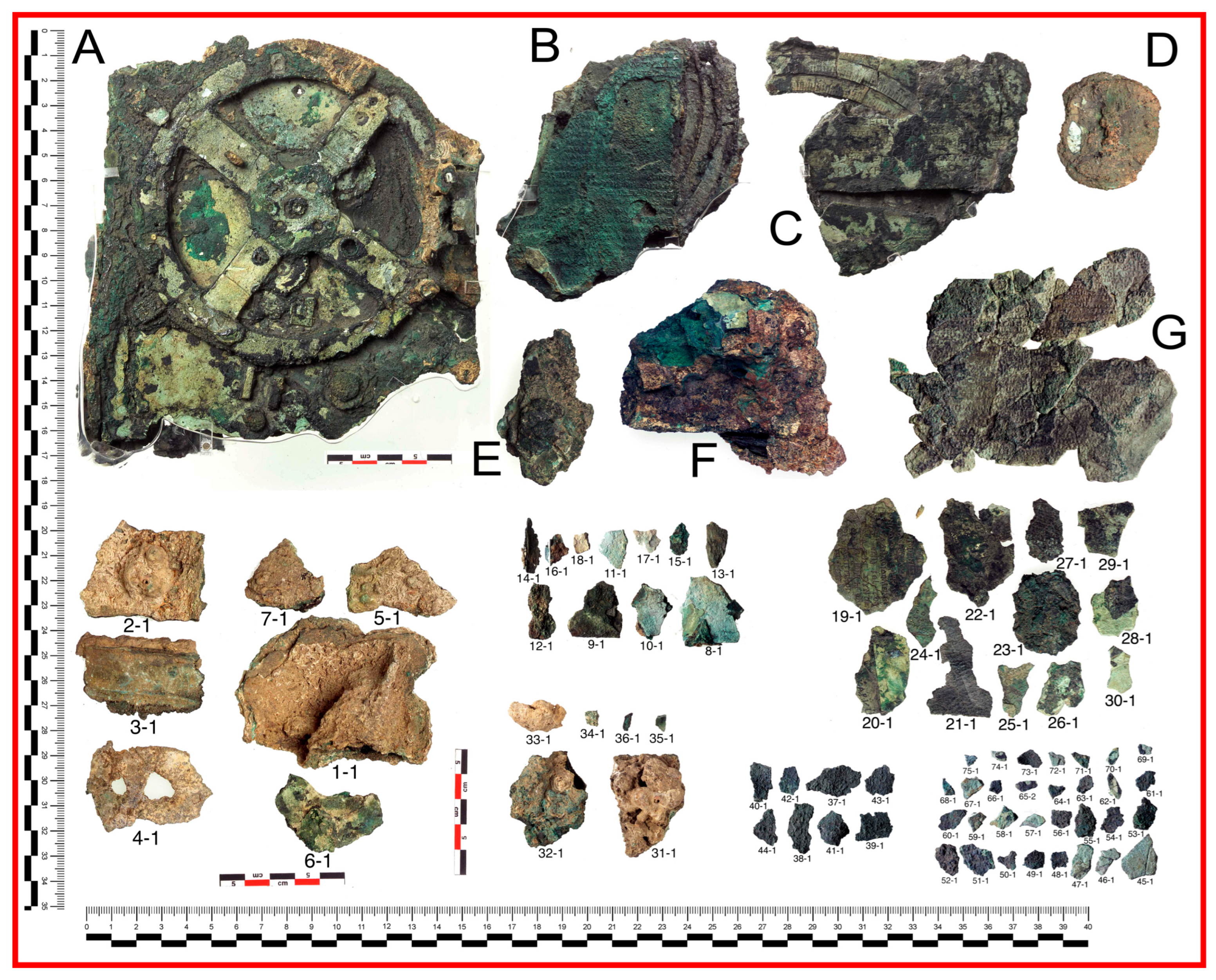
2.1. Present Day Missing Parts of the Antikythera Mechanism

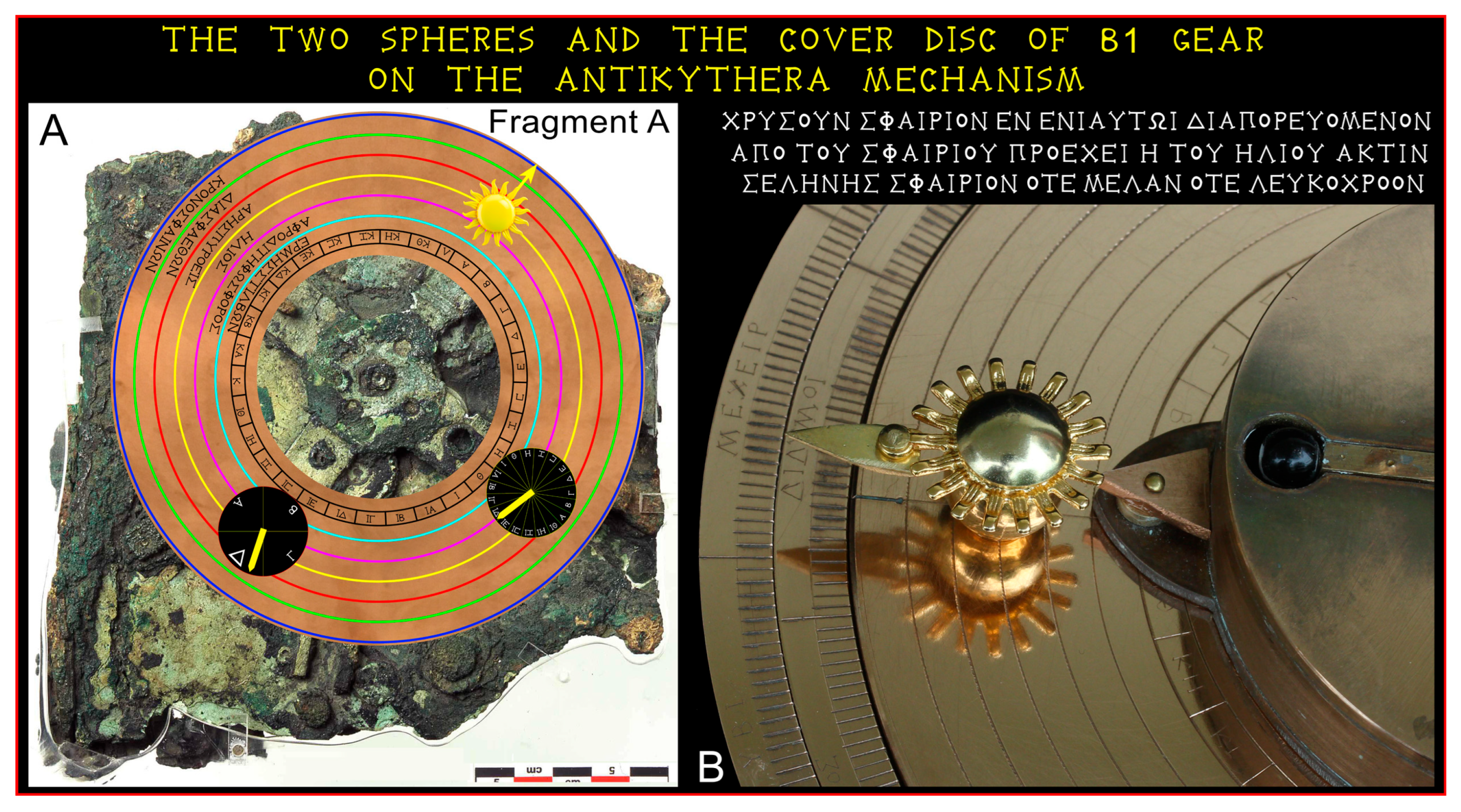
2.2. Clues for the Hypothesis of the Planets’ Rotating Spheres on the Antikythera Mechanism: Objections and Contradictions
- -
- Clue I: On the Back Cover plate of the Mechanism, the engraved Instruction manual of the device (Back Cover Inscription—BCI) is given in two parts and is partially or poorly preserved [19]. The operational parts of the Front Plate are presented in the text of BCI Part-1, while the operational parts of the Back Plate are presented on the BCI Part-2.
- -
- Clue II: The (theophoric) names of the five planets can also be found on the Front Cover inscription [35], with information for each planet, related to the planet’s timed position on the Ecliptic, e.g., Ο ΔΕ ΦΩ[ΣΦΟΡΟΣ, Ο ΔΕ Φ̣Α̣ΕΘΩ̣Ν ΕΝ . . . . . ̣ΑΠΟΚΑΤΑΣΤ̣Α̣Σ̣[ΕΙΣ , [Ε]ΣΠΕΡΙΝΟΝ ΣΤΗΡΙΓΜΟΝ etc.
- -
- Clue III: Fragment D is an unplaced part of the Mechanism. It consists of a gear with 63 teeth (r1), with a circular plate attached to it and an independent oblong/curved plate that are visible in the CTs (see Fragment D analysis in [36]. It was suggested that these parts can be related to the gearing of the planet Venus, after its engagement with an additional number of hypothetical/non-existent gears [11,12].
- -
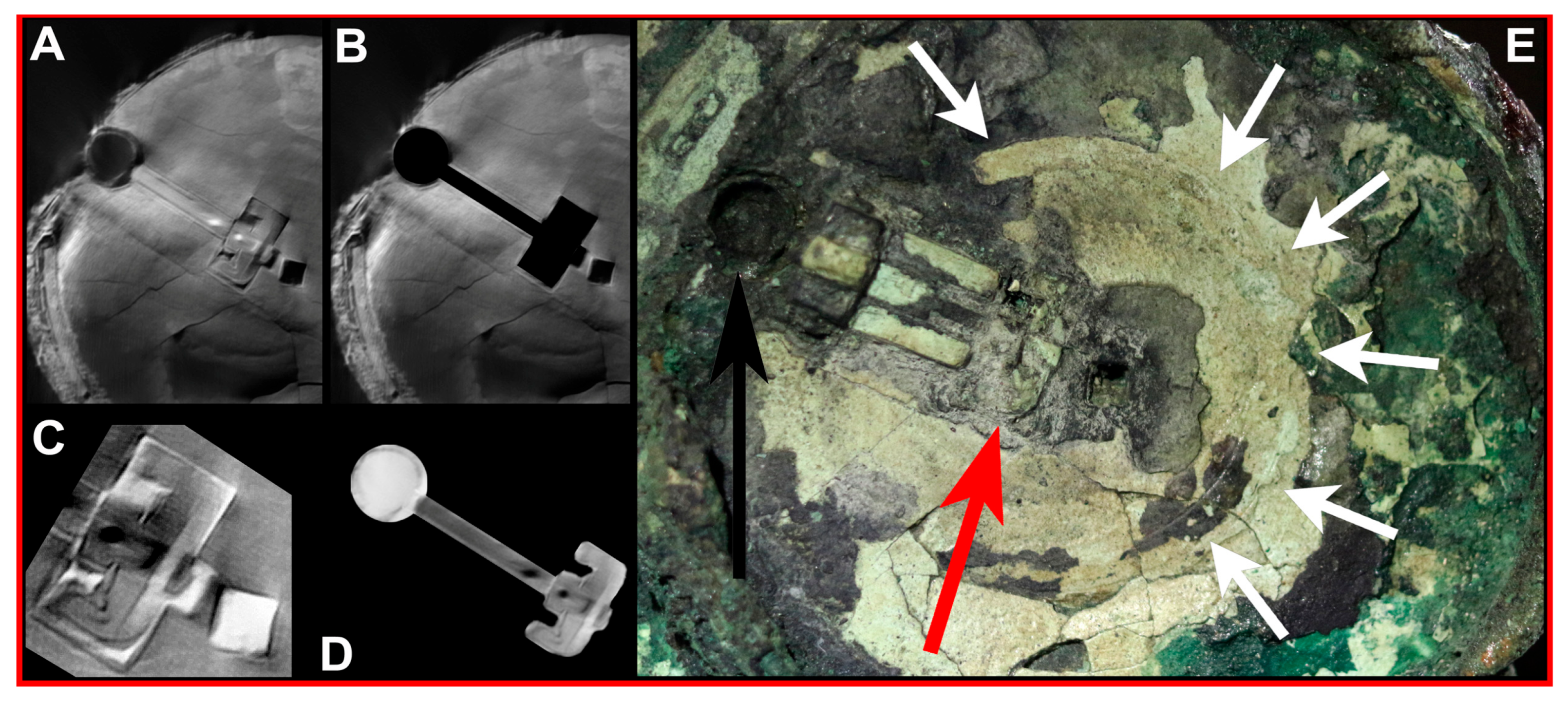
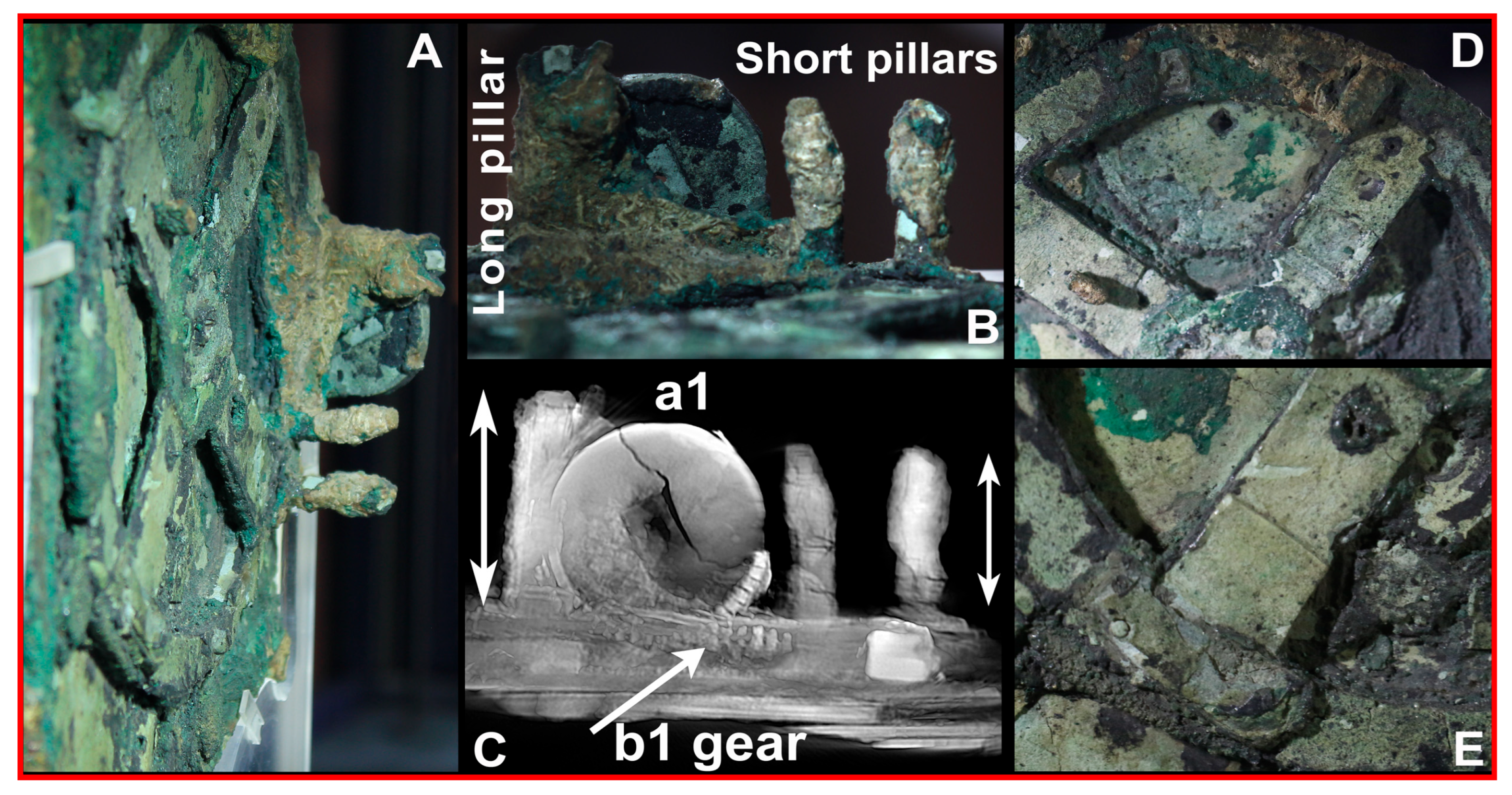
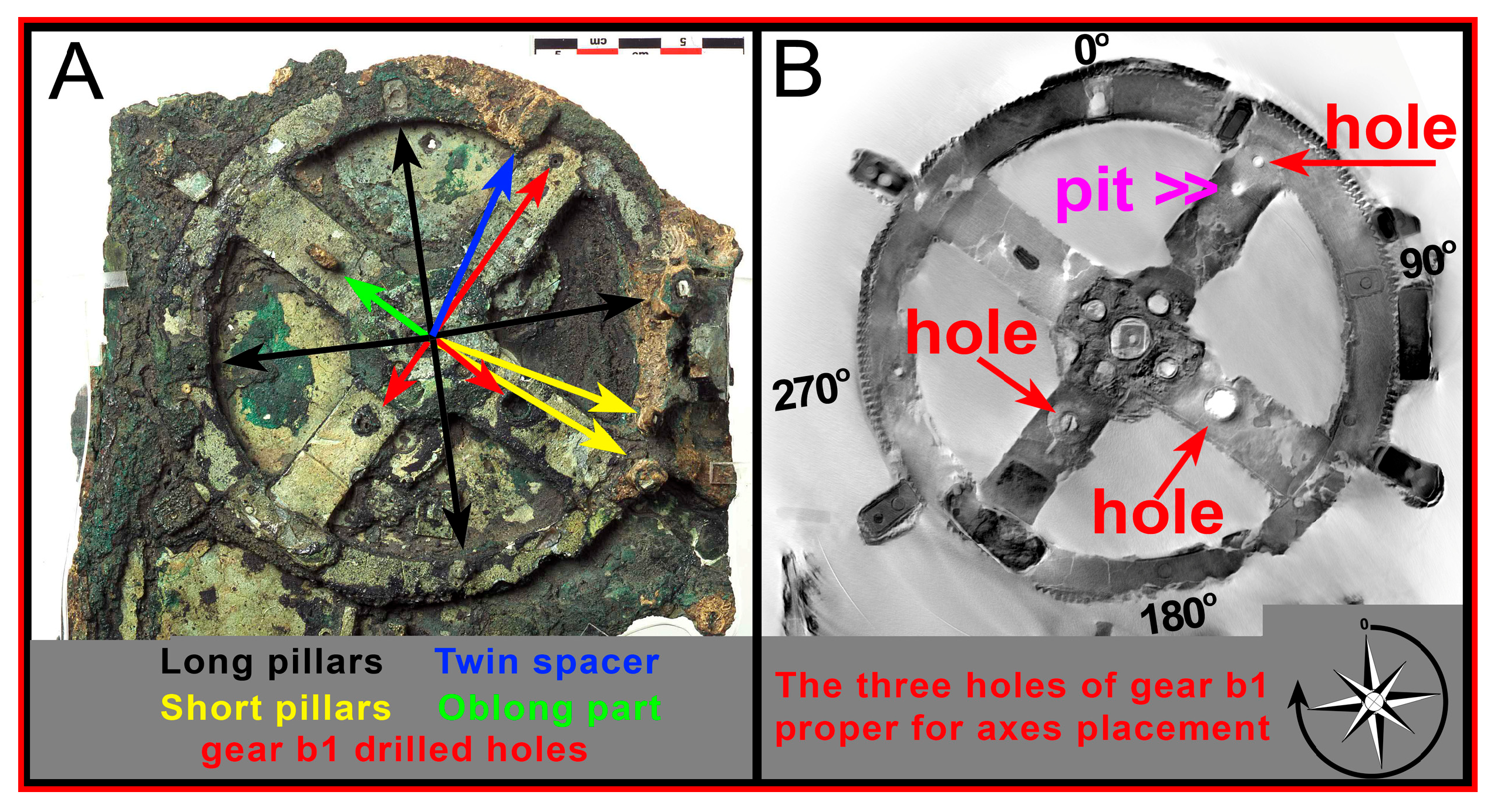
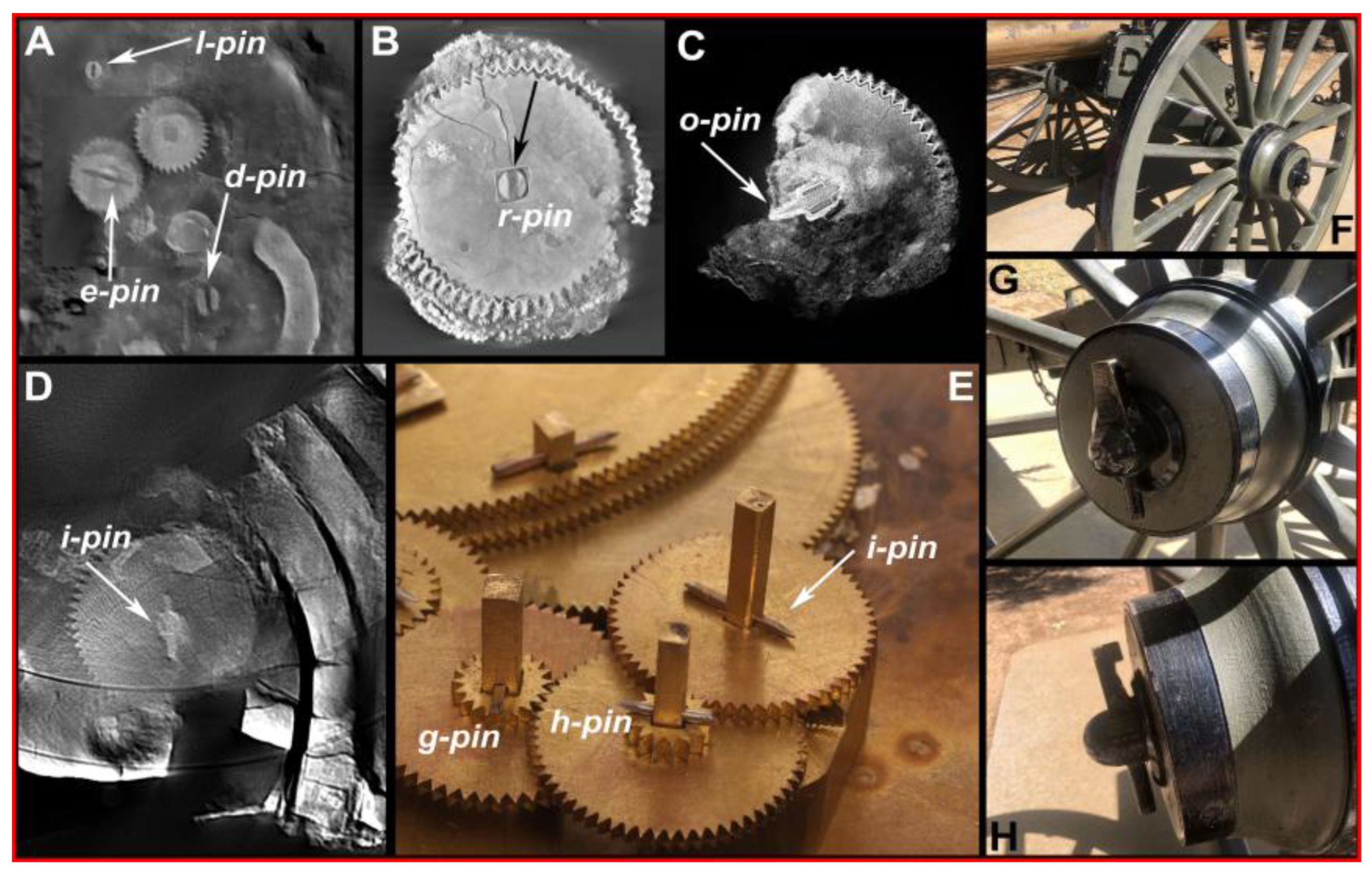
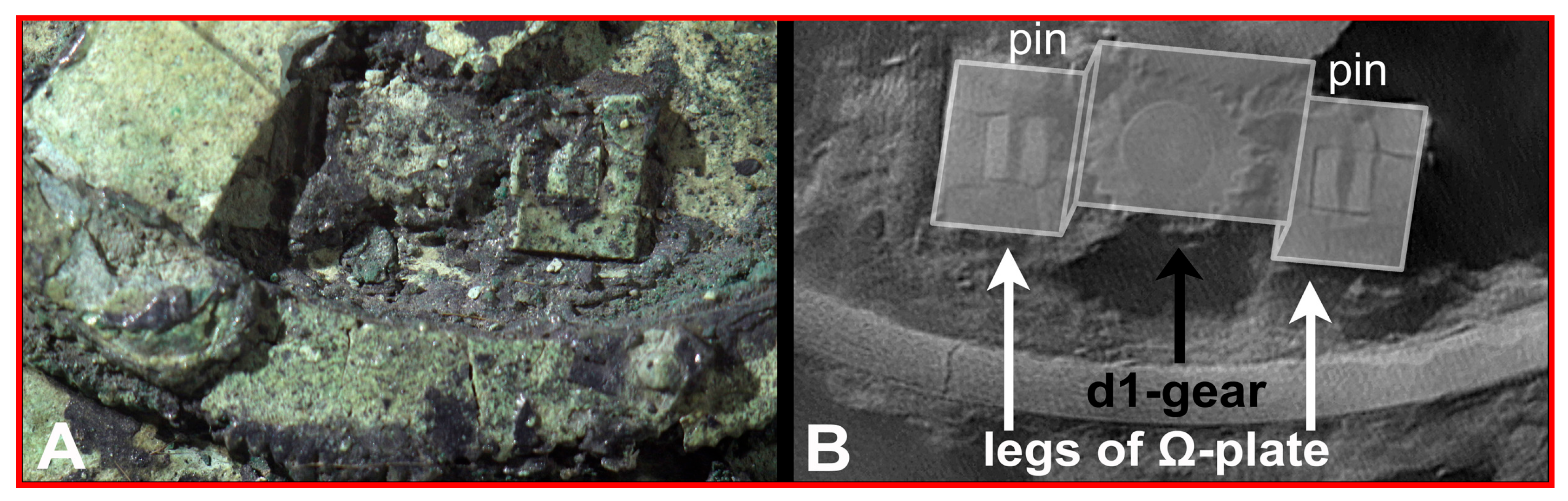
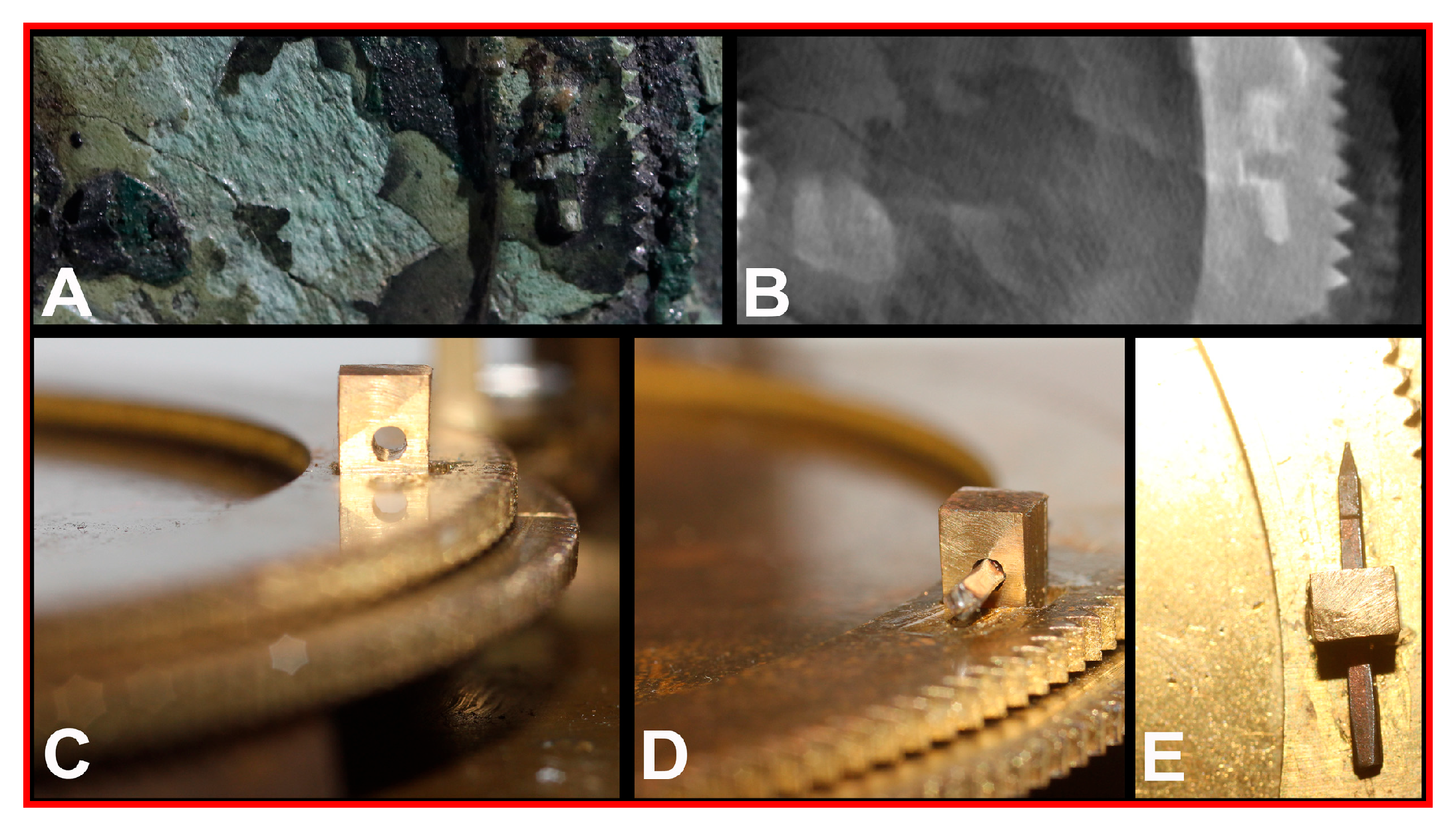
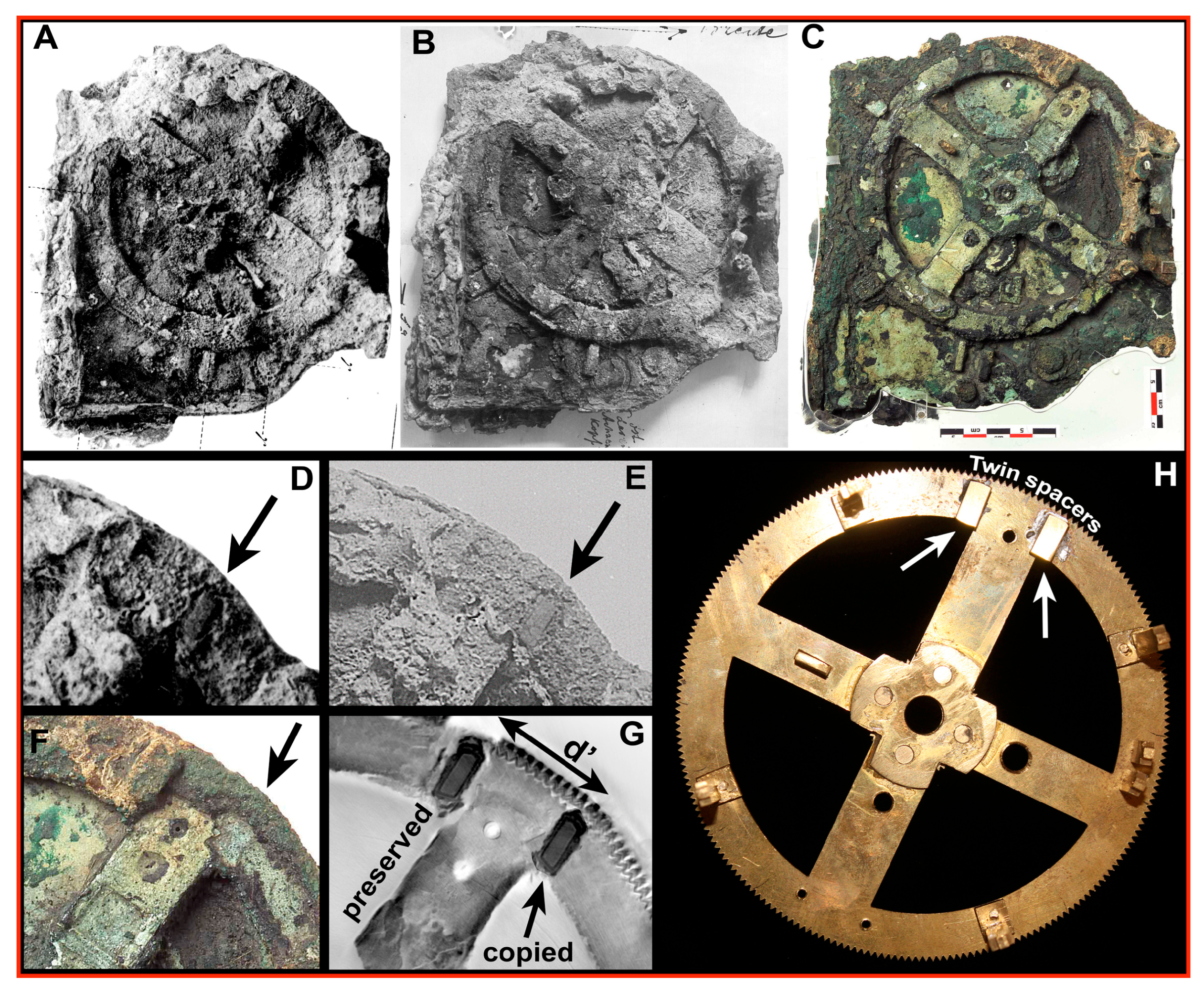
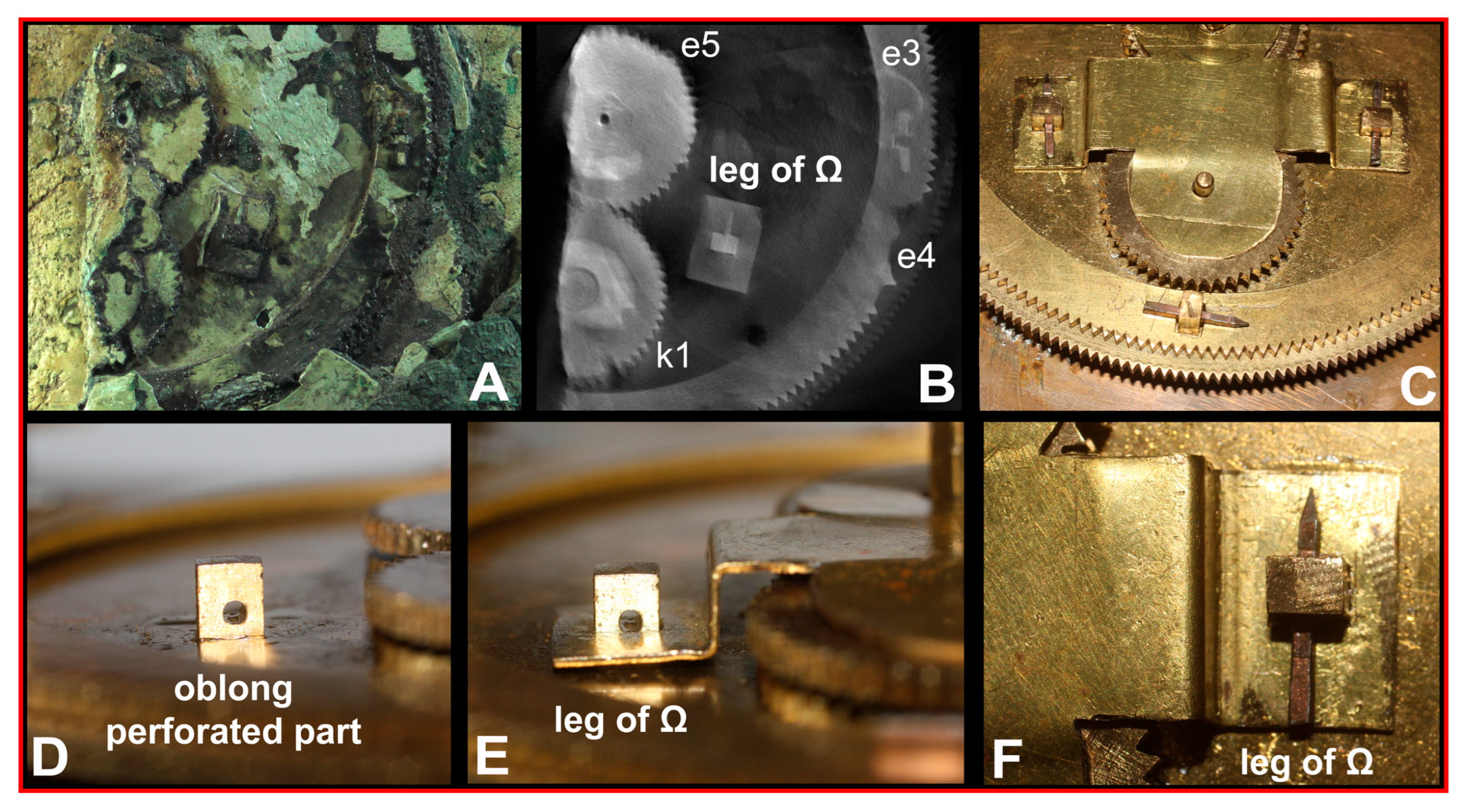
- Clue IV: There are preserved mechanical remains fixed on gear b1 (Figure 3A,D,E), which lead to the conclusion that a mechanical structure existed on the b1 gear and extended above it (Figure 3A–C). These lost structures and the lost Cover Disc of gear b1 occupied the space of the large central large hole of the Front Plate.
- -
- First argument against the planet gearing hypothesis: A reference to the planets’ names is not enough to prove the existence of a planet indication gearing. It is possible to reconstruct the text on the Back Cover inscription related to the names of the planets, although the relative text is partially/poorly preserved. This text is given below, taken from [19] p. 234. It corresponds to Back Cover Inscription (BCI) Lines 16–25 (the left/right boundary of the following table corresponds to the Cover plate boundary):
| (16) ΠΡΟΕΧΟΝ ΑΥΤΟΥ ΓΝΩΜΟΝΙΟΝ Σ[………………………………………………….…… ΠΕΡΙ (17) ΦΕΡΕΙΩΝ Η ΜΕΝ ΕΧΟΜΕΝΗ ΤΩΙ ΤΗΣ […………………………………. ΕΡΜΟΥ ΣΤΙΛΒΟΝ- (18) ΤΟΣ ΤΟ ΔΕ ΔΙ ΑΥΤΟΥ ΦΕΡΟΜΕΝ[ΟΝ …………………………………..……………………… (19) ΤΗΣ ΑΦΡΟΔΙΤΗ<Σ> ΦΩΣΦΟΡΟΥ . . .[ ……………………………………..………….….……… (20) ΤΟΥ [ΦΩ]ΣΦΟΡΟΥ ΠΕΡΙΦΕΡΕΙΑΝ .[……………………………..………..………………..….… (21) ΓΝΩΜΩ[.]ΚΕΙΤΑΙ ΧΡΥΣΟΥΝ ΣΦΑΙΡΙΟΝ . .[………………..……………………………..…….. (22) ΗΛΙ[ΟΥ] ΑΚΤΙΝ ΥΠΕΡ ΔΕ ΤΟΝ ΗΛΙΟΝ ΕΣΤΙΝ […………………………….……….…….…… (23) [---ΤΟ]Υ ΑΡΕΩΣ ΠΥΡΟΕΝΤΟΣ ΤΟ ΔΕ ΔΙΑΠΟΡΕ[ΥΟΜΕΝΟΝ …………………………………… (24) [ΔΙΟΣ ΦΑ]ΕΘΟΝΤΟΣ ΤΟ ΔΕ ΔΙΑΠΟΡΕΥΟΜΕΝΟΝ̣[…………………………… Ο ΤΟΥ ΚΡΟ- (25) [ΝΟΥ ΦΑ]ΙΝΟΝΤ̣ΟΣ ΚΥΚΛΟΣ ΤΟ ΔΕ ΣΦΑΙΡΙΟΝ ΦΛ̣[……………………………………..… |
| (22) ΗΛΙ[ΟΥ] ΑΚΤΙΝ ΥΠΕΡ ΔΕ ΤΟΝ ΗΛΙΟΝ ΕΣΤΙΝ [………………………..…….…… ΕΣΤΙΝ Ο ΚΥΚ- (23) ΛΟΣ ΤΟ]Υ ΑΡΕΩΣ ΠΥΡΟΕΝΤΟΣ ΤΟ ΔΕ ΔΙΑΠΟΡΕ[ΥΟΜΕΝΟΝ ΣΦΑΙΡΙΟΝ….. ΕΣΤΙΝ Ο ΚΥΚΛΟΣ ΤΟΥ (24) ΔΙΟΣ ΦΑ]ΕΘΟΝΤΟΣ ΤΟ ΔΕ ΔΙΑΠΟΡΕΥΟΜΕΝΟΝ̣ [ΣΦΑΙΡΙΟΝ ………….. ΕΣΤΙΝ Ο ΤΟΥ ΚΡΟ- (25) ΝΟΥ ΦΑ]ΙΝΟΝΤ̣ΟΣ ΚΥΚΛΟΣ ΤΟ ΔΕ ΣΦΑΙΡΙΟΝ ΦΛ̣[………………….……………………………… |
- About seven sentences (Lines 10–16) to describe the Lunar Cylinder + the Lunar Phases sphere + the lunar pointer + its operation;
- About three sentences (Lines 20–22) to describe the Golden Sphere–Sun and its position + its pointer + its operation; and
- Definitely, one sentence each is used for the planets Mars (Line 23), Jupiter (Line 24), and Saturn (Line 25), in order to describe the planet’s position + its (hypothetical) colored sphere + its pointer + its operation, and also for Mercury (Lines end of 17–18) and Venus (Line 19), see Table 2.
- -
- Second argument against the planet gearing hypothesis: The preserved text on the Front Cover Inscription (FCI) describes the motion of the planets but there is no reference to a mechanical part related to a planet on the Mechanism, e.g., there should be a phrase such as ΓΝΩΜΟΝΙΟΝ ΚΡΟΝΟΥ (Saturn pointer) or ΣΦΑΙΡΙΟΝ ΔΙΟΣ (Sphere of Jupiter) or ΓΝΩΜΟΝΙΟΝ ΜΕΤΑ ΣΦΑΙΡΙΟΥ ΤΟΥ ΑΡΕΩΣ (Mars’ sphere attached on the arm), etc.
- -
- Third argument against the planet gearing hypothesis: The measurements of the gears’ rotational inertia in [33], and torques in [39] proves that “the Input of the Antikythera Mechanism is very doubtful from the axis a1, as it creates problems in the mechanical parts, has low torque and makes the handling difficult because of the lack of precision in the pointing”. The central hole of the contrate gear a1 has an oblong shape, and an axis with an oblong cross-section edge is attached. These two parts could have been previously made and come from a different machine or construction, i.e., scrap material/useless parts, and the ancient craftsman processed them into a gear and axis (as one part).
- -
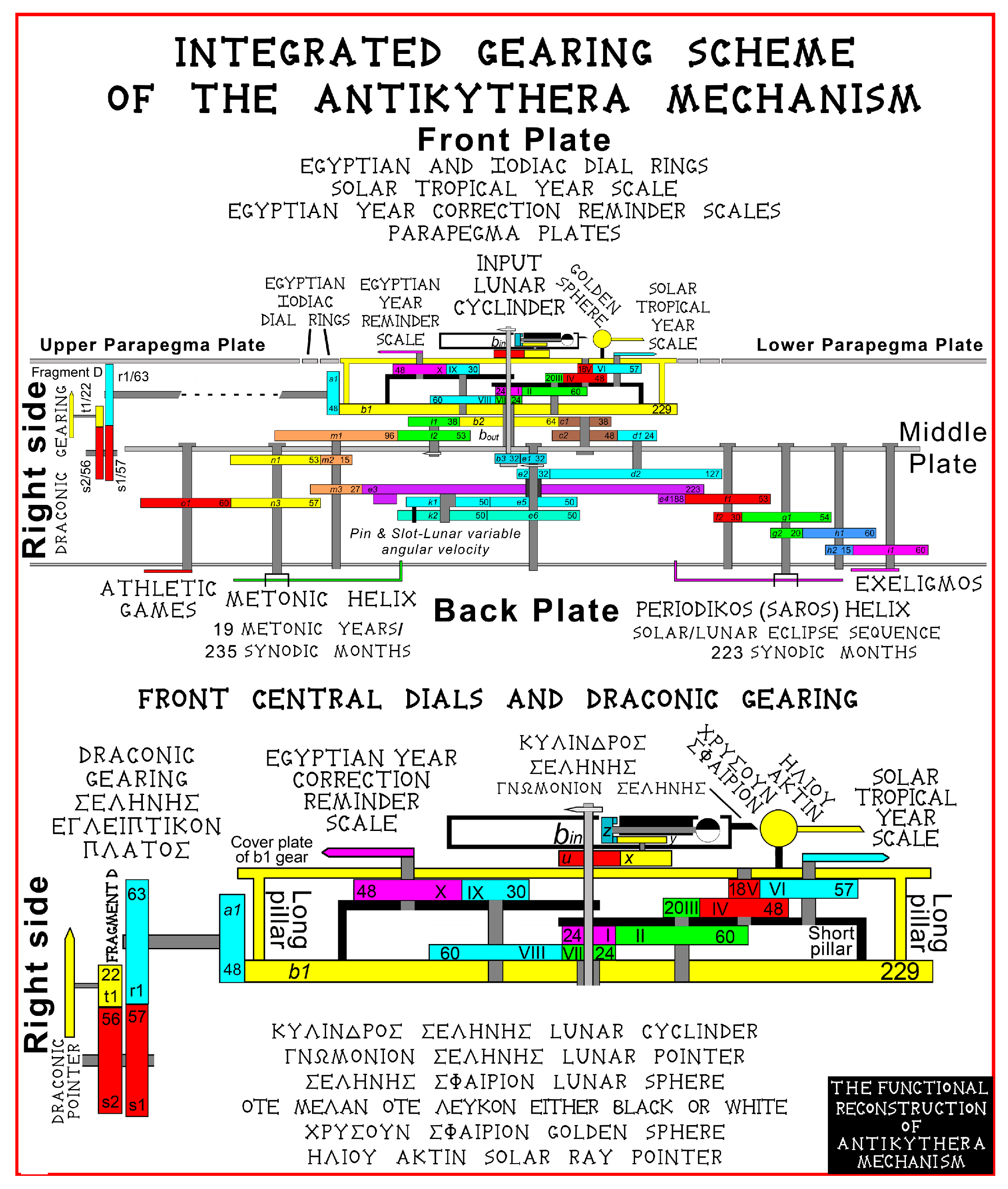
- Fourth argument against the planet gearing hypothesis: The mechanical remains in gear b1 can be related to necessary operation(s) of the Mechanism which are currently missing and without using the hypothesis of the planet indication gearing. The analysis and discussion are presented in the next two sections.
2.3. Remains of Mechanical Parts on the Gear b1
2.4. The b1 Cover Disc of the Antikythera Mechanism’s Front Face
3. Results
3.1. The Personal Constructional Characteristics (PCC) of the Ancient Craftsman
3.1.1. PCC-1: The Stabilization of the Moving Parts
3.1.2. PCC-2: The Ω-Plates and the Thin Sheet Strips
3.1.3. PCC-3: Using Spacers for the Gears’ Support
3.1.4. PCC-4: The Pointers Rotated on Their Calibrated Dial
3.2. Reconstructing Lost Mechanical Parts of the b1 Gear by Applying the Constructional Characteristics of the Ancient Craftsman
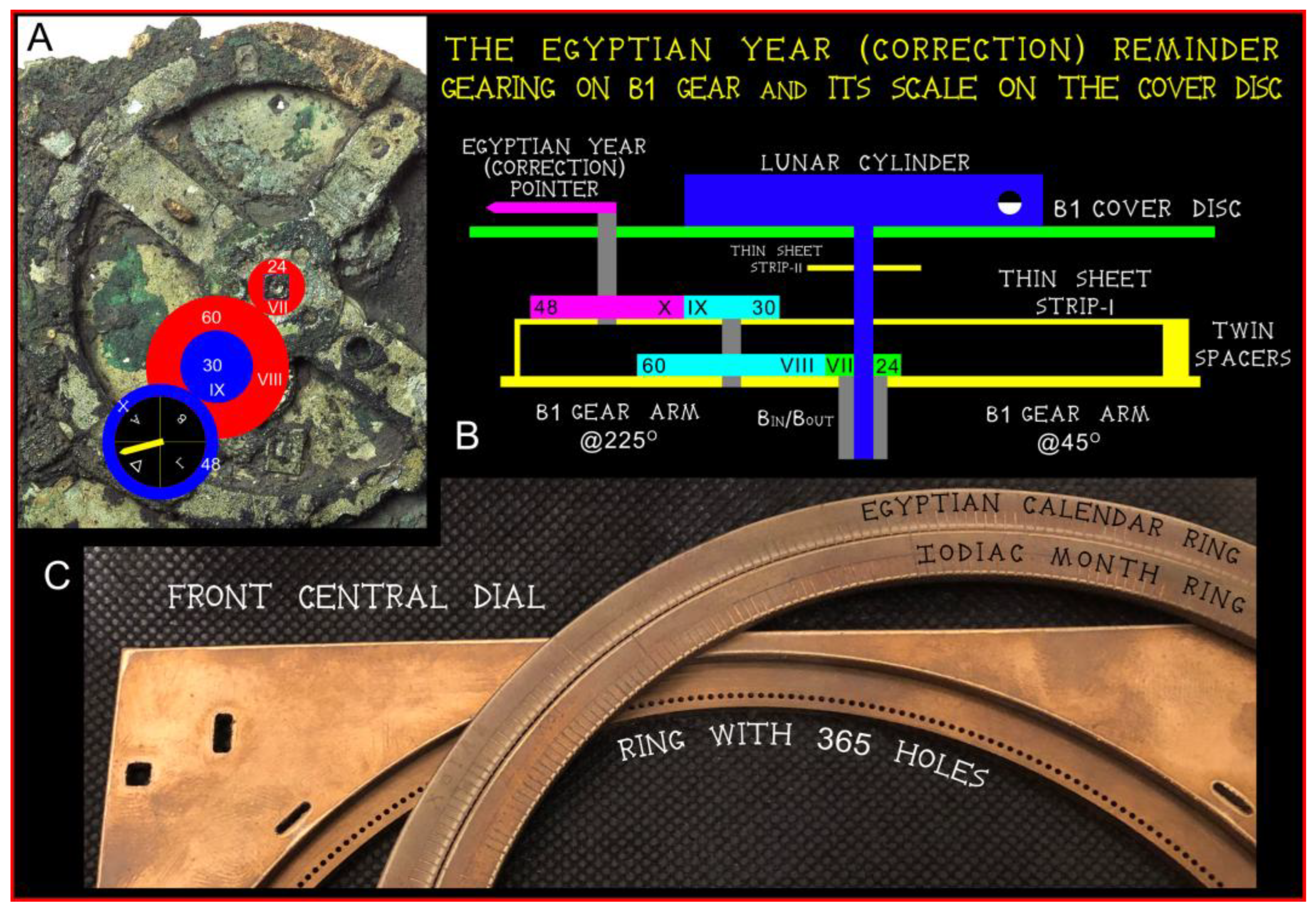
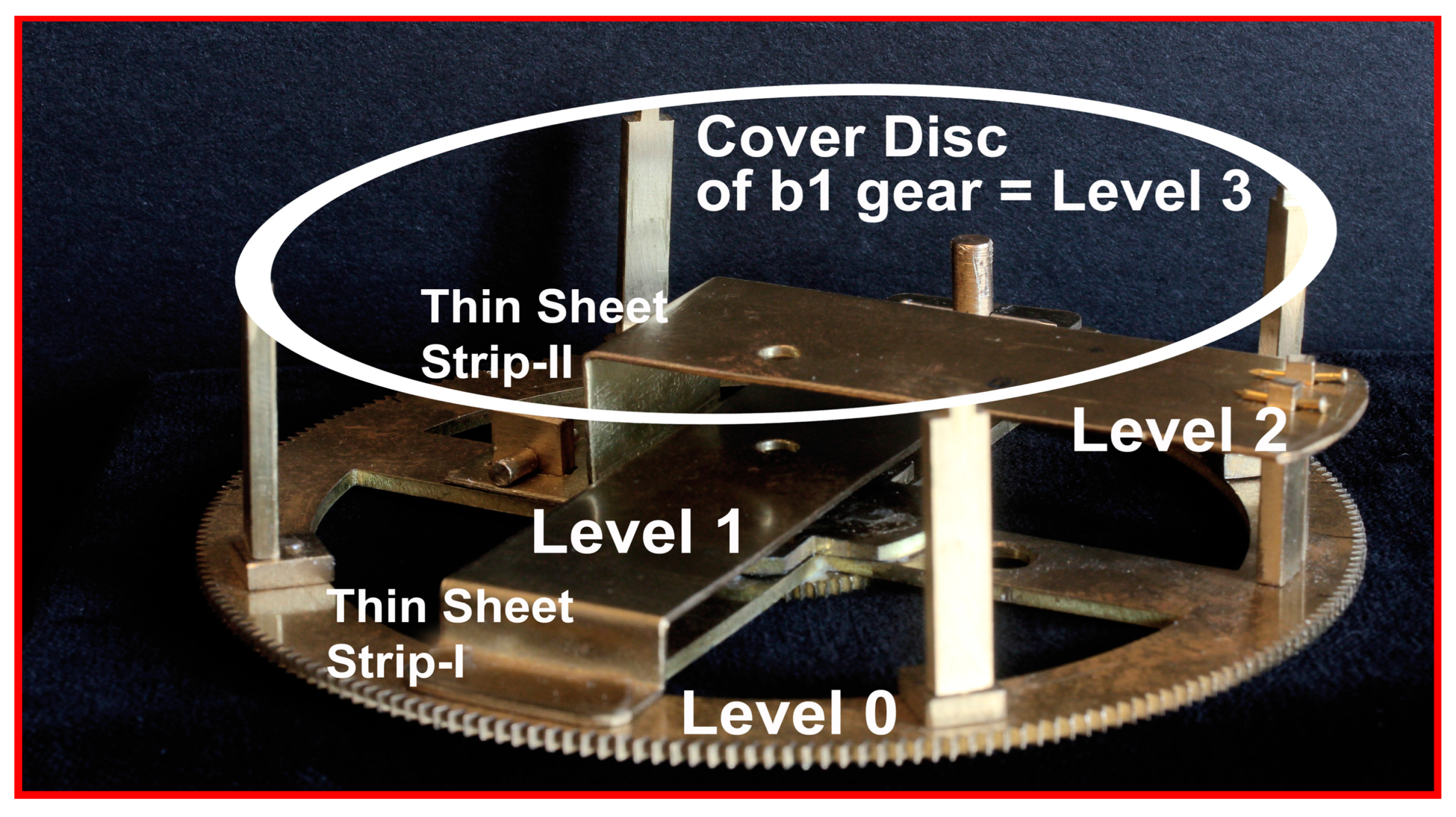
- The 1 + 3 long pillars can be related to the attachment/stabilization of the b1 Cover Disc, which is the outer central front face of the Mechanism, as shown in Figures 6 and 14.
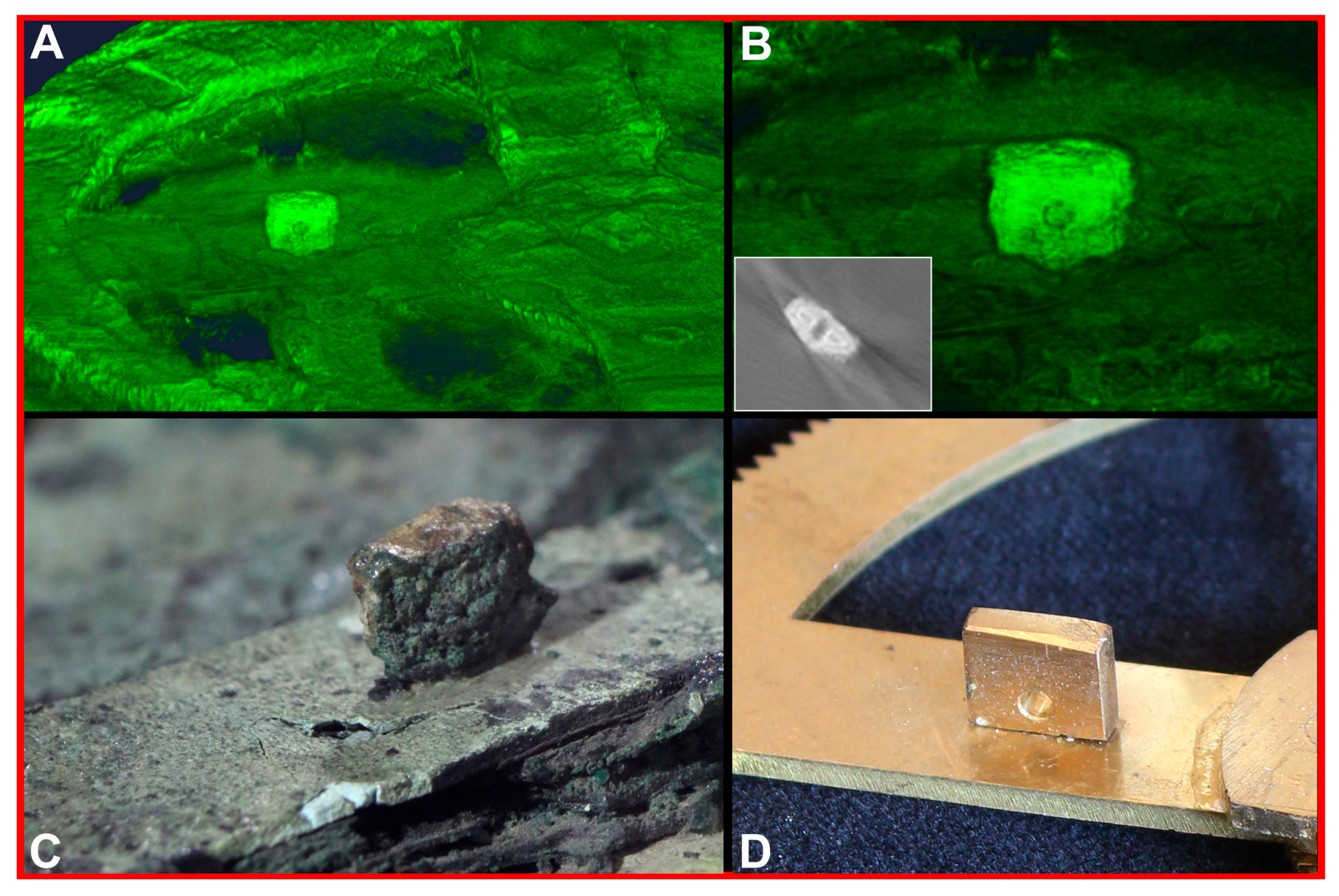
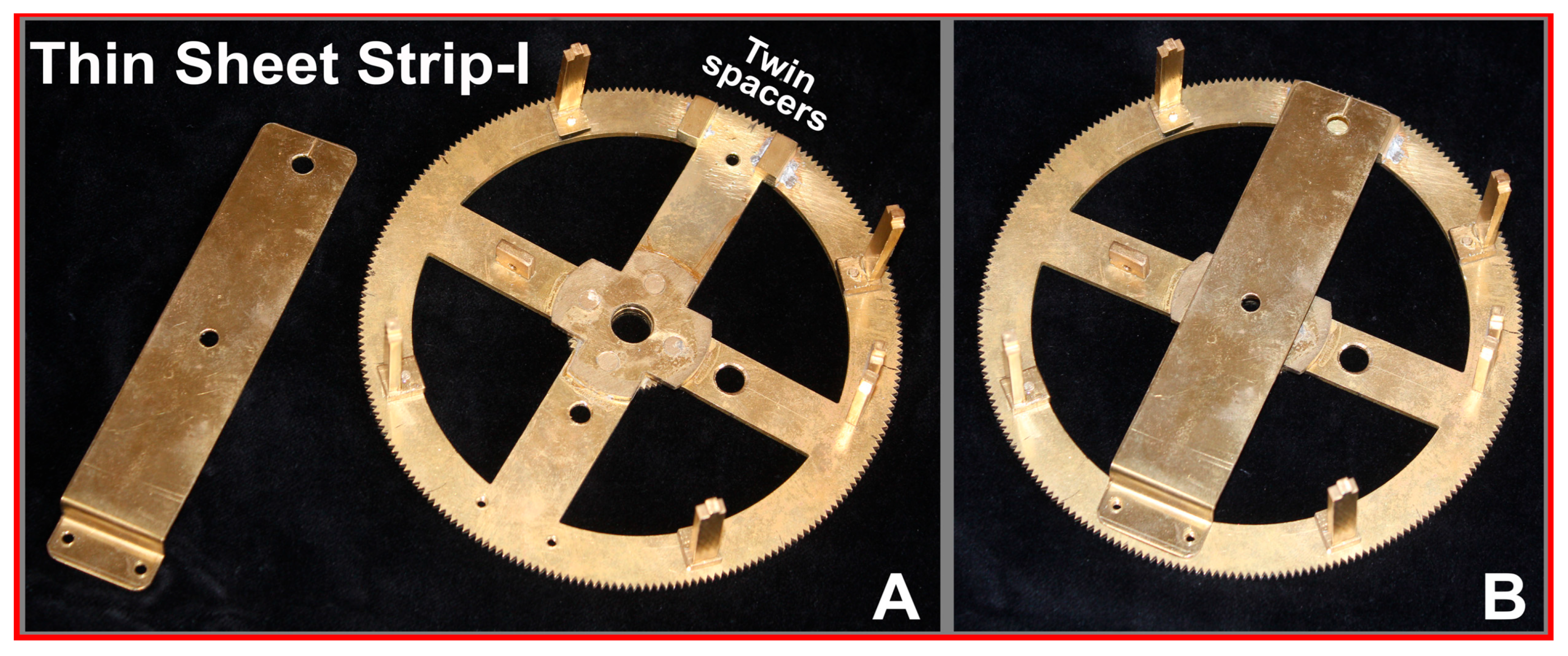
- One preserved spacer is placed at 40° and the imprint of the second similar spacer at 50° (well visible in the [5] and in Rehm photographs [47]). We call these two similar spacers the twin spacers (see Figure 6). In the opposite position (−135°), there exists one edge of a thin flexible bronze sheet. The second (lost) edge of this sheet should be in contact with the twin spacers, and therefore the thin sheet extends to the whole diameter of the b1 gear, as shown in Figure 12. The stabilization of the Thin Sheet Strip-I can be done with a perpendicular pin, according to the Constructional Characteristic No 2.
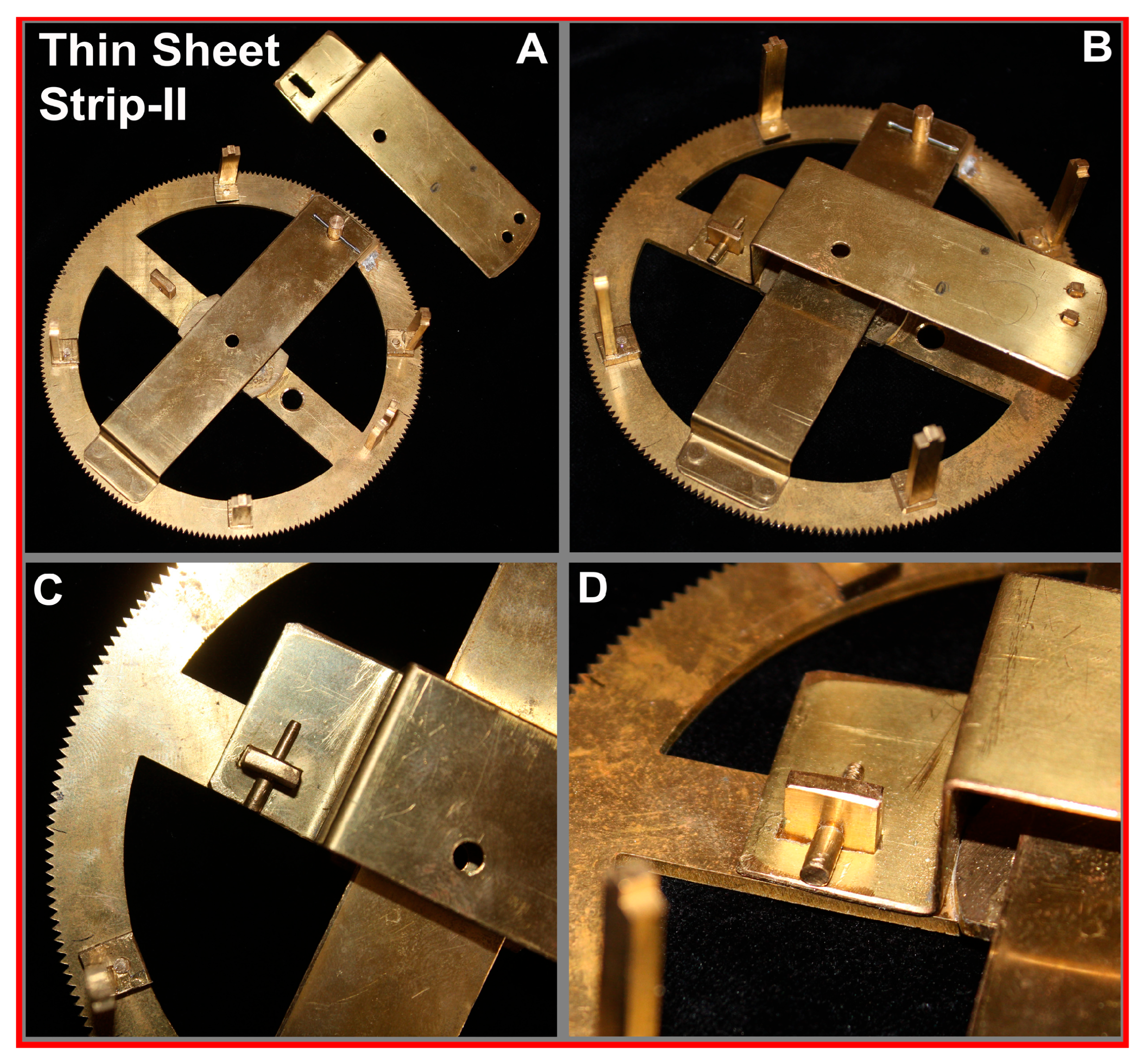
- According to the Constructional Characteristic No 2, the small oblong part with a hole located at the −45° position on the b1 arm should be the stabilizer for the edge of a second flexible thin bronze sheet. The edge of the thin sheet is stabilized with the use of a perpendicular pin in the hole of the small oblong part.
3.2.1. Measuring Procedures That Must Have Been Present in the AM but Are Not Preserved
3.2.2. First Necessary (Not Preserved) Measurement Process
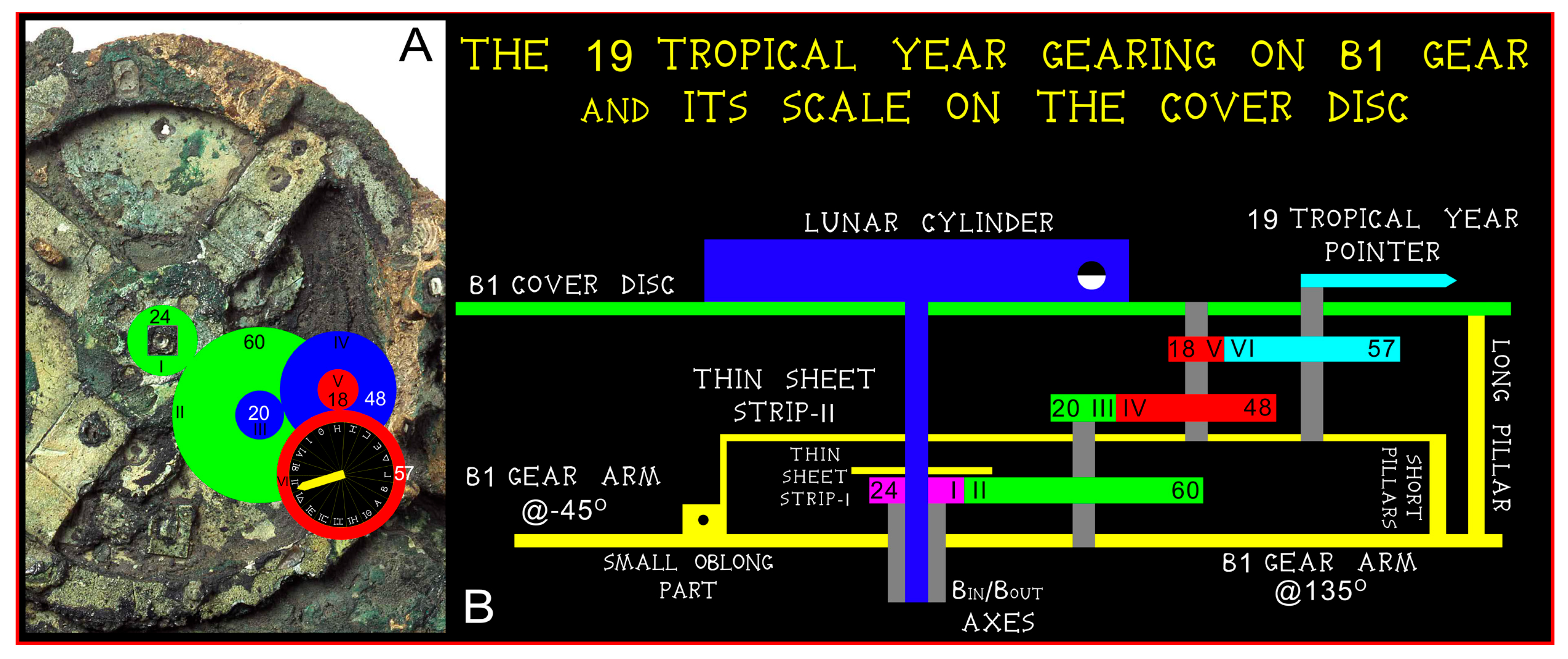
(1/2.5) × (1/2.4) × (6/19) = (1/19)
3.2.3. Second Necessary (Not Preserved) Measurement Process
4. Discussion
5. Conclusions
Author Contributions
Funding
Data Availability Statement
Acknowledgments
Conflicts of Interest
References
- Lykoudis, E. The Diary of the Retraction; Kollaros, I., Ed.; Pages-Poikila: Athens, Greece, 1920. (In Greek) [Google Scholar]
- Rados, K. Ναυτικαὶ καὶ Ἀρχαιολογικαὶ Σελίδες: Περὶ τῶν Θησαυρῶν τῶν Ἀντικυθήρων; En Typois Panelleniou Kratous: Athens, Greece, 1910. (In Greek) [Google Scholar]
- Rediadis, P. Τὸ ἐξ Ἀντικυθήρων ἀστρολάβον. Ἀρχαιολογική Ἐφημερίς 1910, 10, 158–172. (In Greek) [Google Scholar]
- Rehm, A. Review of P. Rediadis, Der Astrolabos von Antikythera, translated by W. Barth, Athens 1903. Philol. Wochenschr. 1907, 27, 467–470. [Google Scholar]
- Svoronos, I.N. Ὁ Θησαυρὸς τῶν Ἀντικυθήρων; Beck & Barth: Athens, Greece, 1903; Republished in Svoronos, Τὸ ἐν Ἀθήναις Ἐθνικὸν Μουσεῖον; Beck & Barth: Athens, Greece, 1908. [Google Scholar]
- Theofanidis, I. Saint Paul. Volume 1, Τό Εὕρημα των Aντικυθήρων; Great Millitair and Navy Encyclopedia: Athens, Greece, 1929; pp. 97–101. (In Greek) [Google Scholar]
- Theofanidis, I. Sur l’instrument en cuivre dont des fragments se trouvent au Musée Archéologique d’Athènes et qui fut retiré du fond de la mer d’Anticythère en 1902. Πρακτικὰ τῆς Ἀκαδημίας Ἀθηνῶν 1934, 9, 140–149. [Google Scholar]
- Price, D.S. Gears from the Greeks: The Antikythera Mechanism, a Calendar Computer from ca. 80 B.C. Trans. Am. Philos. Soc. 1974, 64, 1–70. [Google Scholar] [CrossRef]
- Wright, M.T. A planetarium display for the Antikythera mechanism. Horol. J. 2002, 144, 169–173. [Google Scholar]
- Wright, M.T. The Antikythera mechanism: Compound gear-trains for planetary indications. Almagest 2013, 4, 4–31. [Google Scholar] [CrossRef]
- Freeth, T.; Jones, A. The Cosmos in the Antikythera Mechanism. ISAW Pap. 2012, 11. [Google Scholar]
- Freeth, T.; Higgon, D.; Dacanalis, A.; MacDonald, L.; Georgakopoulou, M.; Wojcik, A. A Model of the Cosmos in the ancient Greek Antikythera Mechanism. Sci. Rep. 2021, 11, 5821. [Google Scholar] [CrossRef]
- Freeth, T.; Bitsakis, Y.; Moussas, X.; Seiradakis, J.H.; Tselikas, A.; Mangou, H.; Zafeiropolou, M.; Hadland, R.; Bate, D.; Ramsey, A.; et al. Decoding the Ancient Greek Astronomical Calculator Known as the Antikythera Mechanism. Nature 2006, 444, 587–591. [Google Scholar] [CrossRef]
- Ramsey, A. X-ray tomography of the Antikythera Mechanism. In Proceedings of the Science: From Antikythera to the Square Kilometre Array: Lessons from the Ancients (Conference Proceedings), Kerastari, Greece, 12–15 June 2012; pp. 1–12. [Google Scholar]
- Pakzad, A.; Iacoviello, F.; Ramsey, A.; Speller, R.; Griffiths, J.; Freeth, T.; Gibson, A. Improved X-ray computed tomography reconstruction of the largest fragment of the Antikythera Mechanism, an ancient Greek astronomical calculator. PLoS ONE 2018, 13, e0207430. [Google Scholar] [CrossRef]
- Schmidt, G. Heronis Alexandrini opera quae Supersunt Omnia, Volume 1; Teubner: Leipzig, Germany, 1899. (In German) [Google Scholar]
- Evans, J.; Carman, C.; Thorndike, A. Solar Anomaly and Planetary Displays in the Antikythera Mechanism. J. Hist. Astron. 2010, 41, 1–39. [Google Scholar] [CrossRef]
- Anastasiou, M.; Seiradakis, J.H.; Evans, J.C.; Drougou, S.; Efstathiou, K. The Astronomical Events of the Parapegma of the Antikythera Mechanism. J. Hist. Astron. 2013, 44, 173–186. [Google Scholar] [CrossRef]
- Bitsakis, Y.; Jones, A. The inscriptions of the Antikythera mechanism paper 5: The Back cover inscription. Almagest 2016, VII, 216–249. [Google Scholar] [CrossRef]
- Lehoux, D.R. Astronomy, Weather, and Calendars in the Ancient World: Parapegmata and Related Texts in Classical and Near Eastern Societies; Cambridge University Press: Cambridge, UK, 2012. [Google Scholar]
- Manitius, K. Gemini Elementa Astronomiae; Teubner: Leipzig, Germany, 1880; (In Greek and Latin). [Google Scholar]
- Voulgaris, A.; Mouratidis, C.; Vossinakis, A. Reconstructing the Antikythera Mechanism’s Central Front Dial parts—Division and Placement of the Zodiac Dial ring. J. Astron. Hist. Herit. 2025, 28, 257–279. [Google Scholar] [CrossRef]
- Voulgaris, A.; Mouratidis, C.; Vossinakis, A. Ancient Machine Tools for the construction of the Antikythera Mechanism parts. Digit. Appl. Archaeol. Cult. Herit. J. 2019, 13, e00092. [Google Scholar] [CrossRef]
- Voulgaris, A.; Mouratidis, C.; Vossinakis, A. The Initial Calibration Date of the Antikythera Mechanism after the Saros Spiral Mechanical Apokatastasis. Almagest 2023, 14, 4–39. [Google Scholar] [CrossRef]
- Freeth, T. Eclipse prediction on the ancient Greek astronomical calculating machine known as the Antikythera Mechanism. PLoS ONE 2014, 9, e103275. [Google Scholar] [CrossRef]
- Carman, C.C.; Evans, J. On the epoch of the Antikythera mechanism and its eclipse predictor. Arch. Hist. Exact Sci. 2014, 68, 693–774. [Google Scholar] [CrossRef]
- Voulgaris, A.; Mouratidis, C.; Vossinakis, A. The Reconstruction of the Antikythera Mechanism Instruction Manual of the Back Dial Plate, After a Diligent Study and Analysis of the Back Cover Inscription. Sci. Technol. Cult. Herit. 2026; forthcoming. Available online: https://arxiv.org/pdf/2207.12009 (accessed on 1 February 2026).
- Allen, M.; Ambrisco, W.; Anastasiou, M.; Bate, D.; Bitsakis, Y.; Crawley, A.; Edmunds, M.G.; Gelb, D.; Hadland, R.; Hockley, P.; et al. Inscriptions of the Antikythera Mechanism 1. General Preface to the Inscriptions. Almagest 2016, 7, 5–35. [Google Scholar]
- Voulgaris, A.; Mouratidis, C.; Vossinakis, A. Simulation and Analysis of Natural Seawater Chemical Reactions on the Antikythera Mechanism. J. Coast. Res. 2019, 35, 959–972. [Google Scholar] [CrossRef]
- Wright, M.T. The Antikythera Mechanism and the Early History of the Moon-Phase Display. Antiqu. Horol. 2006, 29, 319–329. [Google Scholar]
- Wright, M.T. The Front Dial of the Antikythera Mechanism. In Explorations in the History of Machines and Mechanisms; Koetsier, T., Ceccarelli, M., Eds.; Springer: Dordrecht, The Netherlands, 2012; pp. 279–292. [Google Scholar]
- Carman, C.C.; Di Cocco, M. The Moon Phase Anomaly in the Antikythera Mechanism. ISAW Pap. 2016, 11. [Google Scholar]
- Voulgaris, A.; Mouratidis, C.; Vossinakis, A. Conclusions from the Functional Reconstruction of the Antikythera Mechanism. J. Hist. Astron. 2018, 49, 216–238. [Google Scholar] [CrossRef]
- REAL3D. Real3d VolViCon [Software], an Advanced Application for Three-Dimensional Visualization and Image Analysis. Version 4.31.0422. 9 April 2022. Available online: https://real3d.pk/volvicon/ (accessed on 1 February 2026).
- Anastasiou, M.; Bitsakis, Y.; Jones, A.; Moussas, X.; Tselikas, A.; Zafeiropoulou, M. The inscriptions of the Antikythera mechanism paper 6: The front cover inscription. Almagest 2016, VII, 250–297. [Google Scholar] [CrossRef]
- Voulgaris, A.; Mouratidis, C.; Vossinakis, A. Assembling the Fragment D on the Antikythera Mechanism: Its role and operation in the Draconic gearing. Mediterr. Archaeol. Archaeom. 2022, 22, 103–131. [Google Scholar]
- Voulgaris, A.; Mouratidis, C.; Vossinakis, A. The Reconstruction of the Antikythera Mechanism Instruction Manual of the Front Dial Plate, After a Diligent Study and Analysis of the Back Cover Inscription. Sci. Technol. Cult. Herit. 2026; forthcoming. Available online: https://arxiv.org/pdf/2207.12009 (accessed on 1 February 2026).
- Toomer, G.J. Ptolemy’s Almagest. Edition and Translation. Duckworth Classical, Medieval, and Renaissance Editions; Duckworth: London, UK, 1984. [Google Scholar]
- Roumeliotis, M. Calculating the torque on the shafts of the Antikythera Mechanism to determine the location of the driving gear. Mech. Mach. Theory 2018, 122, 148–159. [Google Scholar] [CrossRef]
- Bell, F. Principles of Mechanics and Biomechanics; Stanley Thornes: Cheltenham, UK, 1998. [Google Scholar]
- Samuel, A.E. Greek and Roman Chronology, Calendars and Years in Classical Antiquity; Beck: München, Germany, 1972. [Google Scholar]
- Voulgaris, A.; Mouratidis, C.; Vossinakis, A. A Revision for the Draconic Gearing of the Antikythera Mechanism, the Eclipse Events of Saros Spiral and their Classification. arXiv 2026, arXiv:2412.07023. [Google Scholar]
- Wright, M.T. Epicyclic Gearing and the Antikythera Mechanism: Part II. Antiqu. Horol. 2005, 29, 51–63. [Google Scholar]
- Gourtsoyannis, E. Hipparchus vs. Ptolemy and the Antikythera Mechanism: Pin–Slot Device Models Lunar Motions. Adv. Space Res. 2010, 46, 540–544. [Google Scholar] [CrossRef]
- Voulgaris, A.; Mouratidis, C.; Vossinakis, A. Reconstructing the Antikythera Mechanism lost eclipse events applying the Draconic gearing—The impact of gear error. Cult. Herit. Mod. Technol. 2023, 1, 1–68. [Google Scholar]
- Marchant, J. Decoding the Heavens: A 2,000-Year-Old Computer and the Century-Long Search to Discover Its Secrets; Da Capo Press: Cambridge, MA, USA, 2009. [Google Scholar]
- Rehm, A. Notizbuch (Unpublished Notebooks), Research Manuscripts and Photographs from 1905–1906 Rehmiana III/7 and III/9; Bayerische Staatsbibliothek: Munich, Germany, 1905–1906. [Google Scholar]
- Notre Patrimoine Horloger Page, by Gérard Guilbaud. Les Horloges Astronomiques. Available online: https://www.patrimoine-horloge.fr/astronomiques.html (accessed on 1 February 2026).
- van der Waerden, B.L. Greek Astronomical Calendars. II. Callippus and his Calendar. Arch. Hist. Exact Sci. 1984, 29, 115–124. [Google Scholar] [CrossRef]
- Fotheringham, J.K. The Metonic and Callippic Cycles. Mon. Not. R. Astron. Soc. 1924, 84, 383–392. [Google Scholar] [CrossRef]
- Theodosiou, S.; Danezis, M. The Calendar Odyssey; Diaylos: Athens, Greece, 1995. (In Greek) [Google Scholar]
- Freeth, T.; Jones, A.; Steele, J.M.; Bitsakis, Y. Calendars with Olympiad Display and Eclipse Prediction on the Antikythera Mechanism. Nature 2008, 454, 614–617. Available online: http://www.nature.com/nature/journal/v454/n7204/extref/nature07130-s1.pdf (accessed on 1 February 2026). [CrossRef] [PubMed]
- New Scientist Magazine. Wrong Bolts Sent Pilot into the Blue. April 1992. Available online: https://www.newscientist.com/article/mg13418180-300-wrong-bolts-sent-pilot-into-the-blue/ (accessed on 1 February 2026).
- Apian, P. Cosmographia; Apud haeredes Arnoldi Birckmanni: Antwerp, Belgium, 1564. [Google Scholar]
- Drennan, A.S. The Bibliographical Description of Astronomical Volvelles and Other Moveable Diagrams. Library 2012, 13, 316–339. [Google Scholar] [CrossRef]











| Measuring Dial | Antikythera Mechanism Scale | Scale Subdivisions/Units | Type of Measurement |
|---|---|---|---|
| Egyptian calendar ring | Egyptian year of full 365 Days | 1 Day | Time |
| Parapegma plates 1, 2 | 1 Year = 2 Plates = 2 × 2 (corner) columns 1 column = 1 Season = 3 month Each Parapegma event corresponds to a specific Date = 1 Day per index letter | 1 Day | Time |
| Lunar Phases sphere | The lunar phases are measured in days (e.g., Full Moon = 15 day Moon, not Moon at 180°) | colors B&W: Black, White, half black-half white | Time |
| Zodiac month ring | 1 tropical year of 365.25 Days (365 equal subdivisions + 0.25 or 365.0 subdivisions with a correction procedure). | 1 Day | Time (instead of arc degrees-space) |
| Metonic spiral | 19 Years/235 Synodic months | 1 Synodic month/cell | Time |
| Saros spiral | 18.03 Years/223 Synodic months | 1 Synodic month/cell | Time |
| Exeligmos dial | 54.09 = 3 × Saros (=3 × 223 Synodic months) | 18.03 Years/sector | Time |
| Athletic Games dial | 4 Years (=alternately 49/50 Synodic months) | 1 Year/quadrant | Time |
| Preserved Inscription | Related to the | Number of Sentences |
|---|---|---|
| (10) [- - - - - - - - - - -]Ε̣Π ΑΚΡΟΥ Δ[ …………………………….…………..…. (11) [- - - - - - - - - - -].ΩΣΜΕΝΩΝ .[……….………………………….………… (12) [- - - - - - - - - - - -]Ε̣ ΜΕΛΑΝ ΟΤ .[………………………………..……….. (13) [- - - - - - - - - - -]. . . . . . Λ̣Ω̣ΝΓΕΓ[………………………………….……….. (14) [- - - - - - - - - -]. Ε . ΔΥΠΟΛΑΒΕΙ[Ν…………….……………..…………… (15) [ ̣ ̣]ΟΘ̣Ε ̣ ̣ ΤΟ ΣΦΑΙΡΙΟΝ ΦΕΡΕ ̣[…………..…………………..…..…..…. (16) ΠΡΟΕΧΟΝ ΑΥΤΟΥ ΓΝΩΜΟΝΙΟΝ Σ[………………………..… ΠΕΡΙ | Lunar Cylinder | 7+ |
| (17) ΦΕΡΕΙΩΝ Η ΜΕΝ ΕΧΟΜΕΝΗ ΤΩΙ ΤΗΣ …. […ΕΡΜΟΥ ΣΤΙΛΒΟΝ- | Lunar Cylinder + Mercury | 1+ |
| (18) ΤΟΣ ΤΟ ΔΕ ΔΙ ΑΥΤΟΥ ΦΕΡΟΜΕΝ[ΟΝ………………….….………… | Mercury + Venus | |
| (19) ΤΗΣ ΑΦΡΟΔΙΤΗ<Σ> ΦΩΣΦΟΡΟΥ . . .……..……….……….………… | Venus | 1+ |
| (20) ΤΟΥ [ΦΩ]ΣΦΟΡΟΥ ΠΕΡΙΦΕΡΕΙΑΝ .[……………….…….……..…….. | Venus + Sun | |
| (21) ΓΝΩΜΩ[.]ΚΕΙΤΑΙ ΧΡΥΣΟΥΝ ΣΦΑΙΡΙΟΝ . .[………..……………..… (22) ΗΛΙ[ΟΥ] ΑΚΤΙΝ ΥΠΕΡ ΔΕ ΤΟΝ ΗΛΙΟΝ ΕΣΤΙΝ ……….…………… | Sun | 2+ |
| (23) [---ΤΟ]Υ ΑΡΕΩΣ ΠΥΡΟΕΝΤΟΣ ΤΟ ΔΕΔΙΑΠΟΡΕ[ΥΟΜΕΝΟΝ…..…. | Mars | 1 |
| (24) [ΔΙΟΣ ΦΑ]ΕΘΟΝΤΟΣ ΤΟ ΔΕΔΙΑΠΟΡΕΥΟΜΕΝΟΝ̣[…. Ο ΤΟΥ ΚΡΟ | Jupiter | 1 |
| (25) [ΝΟΥ ΦΑ]ΙΝΟΝΤ̣ΟΣ ΚΥΚΛΟΣ ΤΟ ΔΕ ΣΦΑΙΡΙΟΝ ΦΛ̣[………….… | Saturn | 1 |
| (26) [- - - - - - -]Ε̣ΡΑ ΔΕ ΤΟΥ ΚΟΣΜΟΥ ΚΕΙΤΑΙ . . .[…………………………. | Beyond Cosmos |
| Mechanical Part on the b1 Gear | Description | Setting 0° at −7° to the Middle-Perpendicular of b1 Gear | Comments | Operation |
|---|---|---|---|---|
| 1 | Long pillar (preserved) | 90° | Height ≈ 27 mm Figure 3 | 1st of 4 pillars for the b1 Cover Disc bearing |
| 2 | Long pillar (non-preserved) | 0° | The imprint of its base is visible Figure 5 | 2nd of 4 pillars for the b1 Cover Disc bearing |
| 3 | Long pillar (non-preserved) | −90° | The imprint of its base is visible Figure 5 | 3rd of 4 pillars for the b1 Cover Disc bearing |
| 4 | Long pillar (non-preserved) | 180° | The imprint of its base is visible Figure 5 | 4th of 4 pillars for the b1 Cover Disc bearing |
| 5 | Short pillar-1 (preserved) Figure 3 | +120° | Height ≈ 19 mm Figure 13 | For the Thin Sheet Strip-II stabilization |
| 6 | Short pillar-2 (preserved) Figure 3 | +135° | Height ≈ 19 mm Figure 13 | For the Thin Sheet Strip-II stabilization |
| 7 | (Twin) Oblong spacer-1 (preserved) Figure 6 | +40° | Stabilized on the gear perimeter Figure 6 | Spacer for the edge of the Thin Sheet Strip-I bearing |
| 8 | (Twin) Oblong spacer-2 (not preserved). Same part as the part No 7 | +50° | Spacer’s imprint in Rehm and Svoronos photograph, Figure 6 | Spacer for the edge of the Thin Sheet Strip-I bearing |
| 9 | Small oblong part with a hole for a pin adaptation Figure 3A–D | −45° | Figures 3, 5 and 11–13 | For the Thin Sheet Strip-II edge immobilization See analysis in Section 3.1 and its reconstruction in Section 3.2 |
| 10 | Hole in b1 arm Figures 3D and 5 and 6F,G, | 45° | For a small pillar adaptation Figures 12 and 13A,B | For the Thin Sheet Strip-I edge immobilization Section 3.1 and its reconstruction in Section 3.2 |
| 11 | The dug pothole (pit) in b1 arm | 45° | Origin from scrap material, before the parts process (?) Figure 6F | Non-related to mechanical parts |
| 12 | Edge of a flexible Thin Sheet Strip-I | −135° | It is stabilized with pins on the b1 gear Figure 3E | See its reconstruction in Section 3.2, Figures 12 and 13A,B |
| The 19-Solar-Tropical-Year Gearing on the b1 Gear | ||||
|---|---|---|---|---|
| Numbered gear (I–VI) and their teeth number | I: 24 teeth | III: 20 | V: 18 | =1/19 |
| II: 60 teeth | IV: 48 | VI: 57 | ||
| Ratio | 1/2.5 | 1/2.4 | 6/19 | |
| The Egyptian-Year-Reminder Gearing on the b1 Gear | |||
|---|---|---|---|
| Numbered gear (VII–X) and their teeth number | VII: 24 teeth | IX: 30 | =1/4 |
| VIII: 60 teeth | X: 48 | ||
| Ratio | 1/2.5 | 1/1.6 | |
| Protocol of Mandatory Parameters for a Research Grade Bronze Reconstruction of Antikythera Mechanism | |
| 1 | CT Scans and Photographic Documentation: The reconstruction must be based on detailed CT scans and visual photographs of the fragments. |
| 2 | Preservation of Dimensions and Positioning: The preserved parts must not undergo any arbitrary/unjustified changes in dimension or position. The symmetry of the design should be introduced, considering the deformation and displacement of some of the parts in the original artifact. |
| 3 | No Arbitrary Alterations/Modifications: No holes should be made where they do not exist in the original prototype. |
| 4 | Hypothetical Additions: Hypothetical components cannot be introduced in places where no clear indication of a missing part exists in the original artifact. |
| 5 | Respect for the Ancient Craftsman’s Techniques: The reconstruction should preserve the Personal Constructional Characteristics of the ancient craftsman (analyzed and presented in this work) |
| 6 | No Use of Modern Mechanical Parts: Modern components such as screws, bolts, grub screws, or other mechanical fasteners or bearings must not be used in the reconstruction. |
| 7 | Gear Thickness, Design and Stabilization: The gears should have a uniform thickness of approximately 2–2.5 mm, without any central thickening (hub). The gears should be secured to their shafts using a perpendicular pin. |
| 8 | Gear Teeth Shape: The teeth of the gears must be triangular in shape, similar to the original, not following the modern involute design used in contemporary gear systems. |
| 9 | Material Specifications: All gears, shafts, and axles should be made from a simple bronze alloy (bronze gears, bronze shafts, and bronze axles), rather than special alloys, steel, or other ferrous materials. |
| 10 | Minimal Hypothetical Additions: The addition of hypothetical components should be kept to a minimum, ensuring that the reconstruction remains as close to the original as possible. |
| Scientific Methodology | |
| I | Hypothetical Considerations: Any hypothetical considerations (e.g., units of a lost scale) must be accepted only after their consequences, impacts, and functionality are tested directly. These should be validated through the construction and use of a Research Grade functional model. |
| II | Experimental Validation: Any proposed hypothetical function of the Antikythera Mechanism must be supported by experimental evidence or a functional bronze reconstruction. Theoretical speculation alone is insufficient. |
| III | Experimental Disagreement: If a hypothesis contradicts experimental results, it must be considered incorrect. |
| IV | Theoretical Approaches: Theories that have not been experimentally validated cannot be accepted as definitive and they cannot be used to reject hypotheses that are backed by experimental evidence. |
| V | Measurement Precision: It is strongly recommended to use traditional simple measuring tools, such as a compass and ruler, rather than relying on modern electronic digital display calipers. |
Note: Any deviation from the aforementioned parameters can significantly alter the mechanical status of the system/Antikythera Mechanism, potentially leading to the following:
| |
Disclaimer/Publisher’s Note: The statements, opinions and data contained in all publications are solely those of the individual author(s) and contributor(s) and not of MDPI and/or the editor(s). MDPI and/or the editor(s) disclaim responsibility for any injury to people or property resulting from any ideas, methods, instructions or products referred to in the content. |
© 2026 by the authors. Licensee MDPI, Basel, Switzerland. This article is an open access article distributed under the terms and conditions of the Creative Commons Attribution (CC BY) license.
Share and Cite
Voulgaris, A.; Mouratidis, C.; Vossinakis, A.; Roumeliotis, M. Is There Something Missing from the Antikythera Mechanism? Was It a Mechanical Planetarium–Positioner? Or a Luni-Solar Time Calculator Device? Reconstructing the Lost Parts of b1 Gear and Its Cover Disc. Heritage 2026, 9, 95. https://doi.org/10.3390/heritage9030095
Voulgaris A, Mouratidis C, Vossinakis A, Roumeliotis M. Is There Something Missing from the Antikythera Mechanism? Was It a Mechanical Planetarium–Positioner? Or a Luni-Solar Time Calculator Device? Reconstructing the Lost Parts of b1 Gear and Its Cover Disc. Heritage. 2026; 9(3):95. https://doi.org/10.3390/heritage9030095
Chicago/Turabian StyleVoulgaris, Aristeidis, Christophoros Mouratidis, Andreas Vossinakis, and Manos Roumeliotis. 2026. "Is There Something Missing from the Antikythera Mechanism? Was It a Mechanical Planetarium–Positioner? Or a Luni-Solar Time Calculator Device? Reconstructing the Lost Parts of b1 Gear and Its Cover Disc" Heritage 9, no. 3: 95. https://doi.org/10.3390/heritage9030095
APA StyleVoulgaris, A., Mouratidis, C., Vossinakis, A., & Roumeliotis, M. (2026). Is There Something Missing from the Antikythera Mechanism? Was It a Mechanical Planetarium–Positioner? Or a Luni-Solar Time Calculator Device? Reconstructing the Lost Parts of b1 Gear and Its Cover Disc. Heritage, 9(3), 95. https://doi.org/10.3390/heritage9030095