Next Article in Journal
Extended Reality Approaches to Cultural Representation: Spatializing the Experience of Traditional Chinese Opera
Next Article in Special Issue
Knowledge-Based Approach for the Digitalization and Analysis of Historic Built Heritage: Application in a Calabrian Context (Italy)
Previous Article in Journal
A Novel Framework for Heat Stress Risk Assessment and Mitigation in Real and Typological Historical Public Open Spaces Under Climate Change Scenarios
Previous Article in Special Issue
Semantic Collaborative Environment for Extended Digital Natural Heritage: Integrating Data, Metadata, and Paradata
 
 
Due to scheduled maintenance work on our servers, there may be short service disruptions on this website between 11:00 and 12:00 CEST on March 28th.
Review

Digital Visualization Infrastructures of 3D Models in a Scientific Contest

by
Sander Münster
1,* and
Fabrizio I. Apollonio
2
1
Digital Humanities (Object/Image), Faculty of Arts and Humanities, Friedrich Schiller University Jena, Fürstengraben 1, 07743 Jena, Germany
2
Department of Architecture, University of Bologna, 40136 Bologna, Italy
*
Author to whom correspondence should be addressed.
Heritage 2026, 9(2), 59; https://doi.org/10.3390/heritage9020059
Submission received: 23 November 2025 / Revised: 11 January 2026 / Accepted: 30 January 2026 / Published: 4 February 2026

Abstract

Over recent decades, various projects—especially at the European level—have developed platforms for storing 2D and 3D digital models of cultural heritage. These platforms aim to preserve, organise, and make heritage data accessible for research, education, and public engagement. However, they face challenges due to diverse data formats, increasing user demands, and a lack of standardisation and metadata consistency. Advancements in digital technologies have enabled more efficient systems for acquiring, processing, and preserving cultural heritage data. Three-dimensional digitisation, in particular, supports multidimensional analysis and modernises documentation practices. Despite significant experience in creating 3D data repositories, comprehensive Information Systems for managing the full lifecycle of cultural heritage—especially those that integrate existing platforms—or web-based platforms designed to support collaborative scientific research by integrating data, tools, and computational resources remain limited and are not established at national levels. This paper explores this evolving landscape, highlighting key methodological and technological foundations for future systems. It also addresses open questions, opportunities, limitations, and ongoing challenges, emphasizing the need for semantic-based approaches to integrate fragmented data and foster collaboration between public and private stakeholders.

1. Introduction

Since the 1980s, digital 3D models have become essential tools in disciplines such as archaeology, architecture, art history, and museology. These models support research, documentation, and public engagement by enabling the visualisation, exploration, and analysis of Cultural Heritage (CH) in both its preserved and reconstructed forms. Typically, 3D models are generated either through retro-digitisation of existing artefacts or through interpretative reconstruction of lost objects based on historical sources. Despite methodological differences, both approaches share common requirements for visualisation, metadata accessibility, and semantic documentation.
Over the past two decades, the European Union has actively supported the development of infrastructures to manage and disseminate 3D Cultural Heritage data.
Several initiatives have emerged to address the needs of specific research communities:
European Research Infrastructures (ERICs) provide tools for specific purposes. Of high relevance for 3D data are:
  • DARIAH, together with CLARIN and joint initiatives of both infrastructures, such as CLARIAH (Common Lab Research Infrastructure for the Arts and Humanities), provides a modular infrastructure for digital humanities, offering tools, datasets, and workflows for text, media, and historical data analysis [https://www.clariah.nl/, accessed on 29 January 2026].
  • E-RIHS (European Research Infrastructure for Heritage Science) [https://www.e-rihs.eu/, accessed on 29 January 2026] provides access to advanced laboratories, instruments, and digital platforms for the study, conservation, and documentation of Cultural Heritage. It operates through a network of national nodes and offers services via platforms such as DIGILAB and FIXLAB [https://www.e-rihs.eu/e-rihs-catalogue-of-services/, accessed on 29 January 2026].
A set of Europe-wide data, computing, and processing infrastructures includes or focuses on Cultural Heritage:
  • The European Data Spaces include chapters for Tourism and Cultural Heritage to provide a data infrastructure [1]. The Data Space for Cultural Heritage is coordinated and maintained by a consortium led by Europeana, the EU’s flagship digital library, which aggregates millions of Cultural Heritage records from museums, libraries, and increasingly supports 3D content integration [https://www.europeana.eu/, accessed on 29 January 2026]. Besides different implementation projects, part of the DS4CH is the 3D-4CH competence centre, which supports capacity building [2].
  • The European Cultural and Creative Cloud (ECCCH) provides a tooling space particularly for research on cultural heritage [3]. It is coordinated by the ECHOES project with various implementation projects running [https://www.echoes-eccch.eu, accessed on 29 January 2026].
  • The European Open Science Cloud (EOSC) [https://eosc-portal.eu/, accessed on 29 January 2026]—aligned with the broader European Union data strategy, which aims to unify data infrastructures and governance models to promote data sharing and collaboration across sectors—has matured into a clearly defined initiative, recognised as the central data space for science, research, and innovation.
The European Commission has launched two Horizon Europe partnerships with links to 3D cultural heritage. The Virtual Worlds partnership explores and will develop XR technologies with Arts and Culture, named as one of the application areas [4]. The starting Partnership for Resilient Cultural Heritage has integrated ICH as part of all three topic areas: the cross-cutting theme of Science–Policy–Society Interface [5].
Various research communities are around specific topics of 3D for heritage. Examples include:
  • ARIADNE (Advanced Research Infrastructure for Archaeological Dataset Networking) serves the archaeological community by integrating distributed datasets and offering services for data discovery, analysis, and reuse [https://www.ariadne-research-infrastructure.eu/, accessed on 29 January 2026].
  • CARARE, as a domain aggregator for Europeana, focuses on archaeological and architectural heritage, including 3D and VR content, and contributes to the European Data Space for Cultural Heritage [https://www.carare.eu/, accessed on 29 January 2026].
The COVID-19 pandemic accelerated the digital transformation of the cultural heritage sector, highlighting the need for scalable, interoperable infrastructures for 3D content. In response, the European Commission launched a strategic campaign to digitise endangered and high-profile monuments, aiming to produce over 16 million 3D assets by 2030 [6]. However, most accessible 3D models remain hosted on private-sector platforms like Sketchfab [https://sketchfab.com], while public repositories face challenges related to standardisation, metadata quality, and long-term preservation. As shown in the example of Sketchfab, which moved its business model away from 3D data visualisation and towards the game asset marketplace after the purchase by EPIC Games in 2024, there are potential issues with sustainability [7].
Despite the proliferation of platforms and tools, the integration of 3D visualisation infrastructures into coherent, interoperable systems remains a significant challenge. Many existing solutions operate in silos [8,9,10] lacking semantic frameworks and lifecycle management capabilities, as well as web-based platforms designed to support collaborative scientific research (Virtual Research Environment—VRE), that would enable sustainable, cross-institutional collaboration. Addressing these gaps requires a shift toward semantic-driven infrastructures that can interconnect heterogeneous data sources and support the full research life-cycle—from acquisition and analysis to dissemination and reuse.
This paper aims to present this topic, outlining the open questions that motivate it, the main methodological and technological elements on which such systems should be based, and the opportunities, limitations, and challenges that remain for the future.
In the following sections, we will discuss the state of the art and the open questions regarding both existing repositories and platforms and Information Systems (IS) for Cultural Heritage life-cycle management and supporting collaborative scientific research. The fundamental principles on which such an IS should be based will then be outlined, along with the Information Technology (IT) implementation and interoperability aspects that should be ensured between platforms, repositories, and IS. The final sections will present conclusions and future actions.

2. State of the Art

What is the current situation of 3D infrastructures for 3D heritage objects? As stated in [11], various studies have been conducted to date on 3D heritage data (see Table 1). The literature-based reviews and surveys by FSU Jena [12], by the Virtual Multimodal Museum CSA [12], and the VIGIE study on the 3D digitisation of tangible heritage examined usage scenarios and defined quality criteria [13]. Specific studies on 3D infrastructures include the Dutch Pure3D (2021: 48 valid responses) [7,14], the Europeana 3D (2019: 38 individuals) [15], the EU INCEPTION project survey [16], and the survey by the US CS3DP group [17] (2018: 53 respondents). Most recently, the UK 3D Data Service Survey [18] was conducted in 2022. In addition, several surveys on available platforms, repositories, and frameworks were compiled recently [19,20,21,22,23] to provide an overview of particular technologies. Moreover, several studies analyse data and digitisation within specific domains with occasional links to 3D data. These include the ARIADNE+ user survey [24] for archaeology, the ICOM surveys [25,26,27], and the survey by Samaroudi et al. [28] analysing museums during the COVID-19 pandemic. In 2023, Storeide et al. did a survey on 3D data infrastructures [10]. The large-scale surveys by ViMM [12] and EU VIGIE [13] provided a comprehensive analysis of a community, as well as objects and technologies for 3D modelling. A scientometric review of 146 articles about technologies for preservation was conducted by Mendoza et al. in 2023 [29], while Skublewska-Paszkowska et al. particularly reviewed technologies for intangible heritage [30]. The 3D-4CH survey in 2025 did specifically focus on competency development and knowledge in the field of 3D for cultural heritage [2]. The European Commission has issued an interim report on the Data Space implementation in 2025, which highlights the progress in the member states but does not particularly focus on 3D data [31].

2.1. Three-Dimensional Cultural Heritage Content from Small Institutions: Aggregation, Visibility, and Sustainability

The analysis of major European aggregators of digital cultural heritage—most notably Europeana and its infrastructural evolution within the Data Space for Cultural Heritage—indicates that 3D content produced by small museums and archives is not yet represented proportionally to their actual presence within the European institutional landscape: only 117 data providers, out of a total of 4077 (equal to 2.8%), have contributed 3D data; among these, 97 (equal to 82%) have contributed less than 100 items, for a total of 22% of the total items collected in Europeana database [https://metis-statistics.europeana.eu/en/, accessed on 29 January 2026]. The inclusion of 3D models is largely mediated by funded projects and specialised aggregation pipelines, such as CARARE for archaeology and built heritage, or initiatives like EUreka3D and Twin it! [2]. Most of those initiatives prioritised the publication of emblematic and curated selections rather than ensuring systematic coverage of the so-called “long tail” of smaller institutions [35]. Comparable objectives are pursued by initiatives such as Open Heritage 3D [https://openheritage3d.org/data#%7B%7D, accessed on 29 January 2026], promoted by CyArk, which seeks to make primary 3D cultural heritage data openly accessible and to reduce barriers for content producers. While private and currently open publishing platforms, such as Sketchfab, have significantly lowered technical barriers to entry and are widely adopted by cultural institutions [for example, http://agiosnikolaosmuseum.gr/en/3d-objects/, accessed on 29 January 2026] as embedded viewers, as well as by private initiatives [https://www.3d-archeolab.it, accessed on 29 January 2026] that have emerged to support museums in the creation of virtually accessible collections [https://www.3d-virtualmuseum.it, accessed on 29 January 2026], either through custom-built websites or by integration within existing institutional websites, such as the official website of a museum, they do not provide mechanisms to rebalance visibility. Comparably, several institutions have set up their own repositories with open-source viewers [for example, https://ephemera.cyi.ac.cy, accessed on 29 January 2026]. Consequently, the prominence of small institutions remains dependent on editorial continuity, communication capacity, and project-based resources rather than on proportional representation.

2.2. An Overview of 3D Data and Repositories in Europe

Against the background of both, almost all of the previously mentioned surveys focused on users and objects, but not on collections of 3D assets and the repositories holding them. Against this background, we conducted an additional survey between 2023 and 2024, which aimed specifically at 3D repositories. The purpose of this study was to explore the availability of 3D data of European heritage in both curated and non-curated collections.
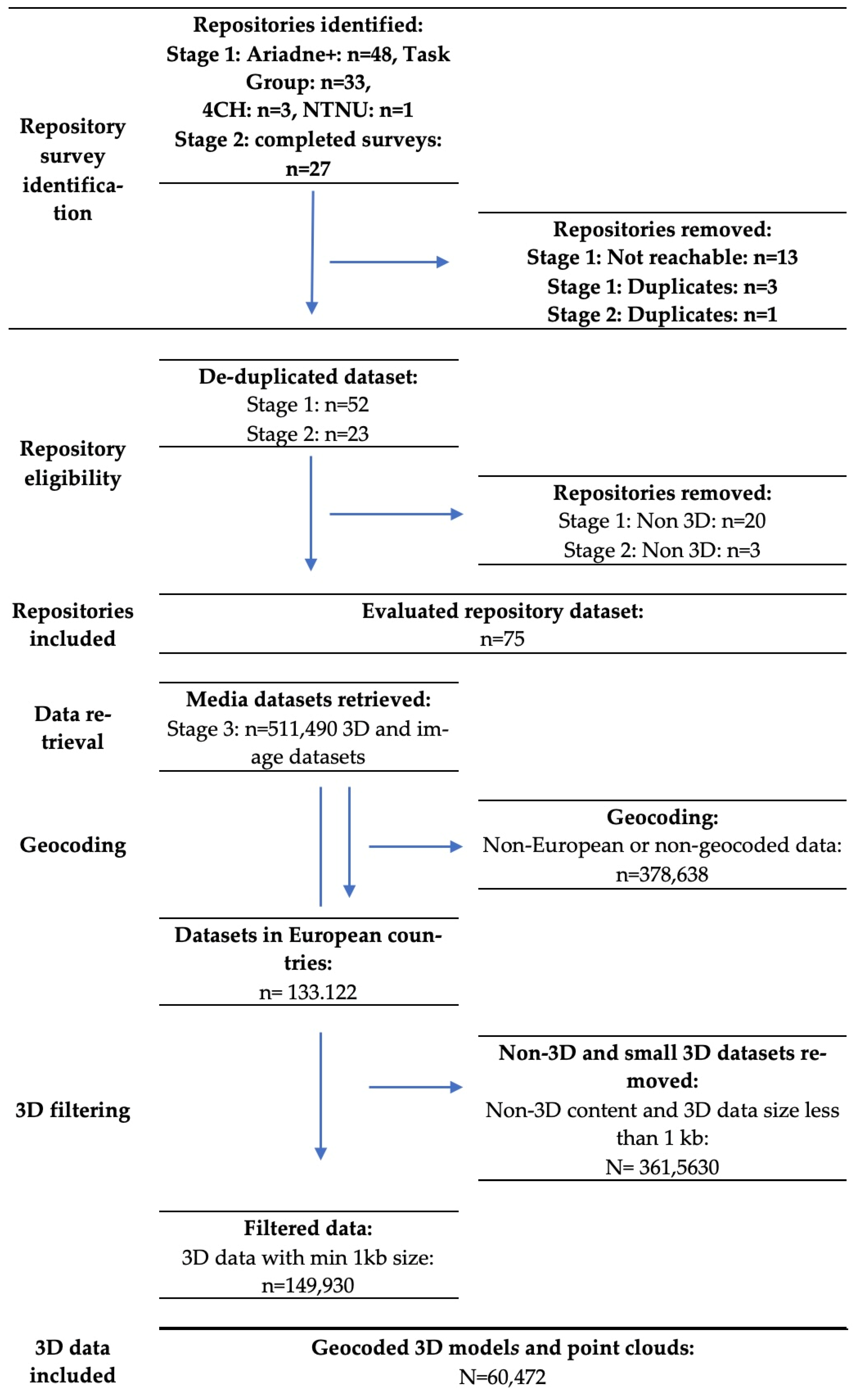
The survey comprised the stages of (1) desk research and (2) a questionnaire-based online survey (Figure 1). Results of the survey have been presented in [34]. Due to the availability of large 3D collections retrieved for AI training, another approach was to (3) retrieve, geolocalise, and classify these collections to identify European 3D heritage assets (Table 2).

2.3. Stage 1: Desk Research Stage

The desk research stage was conducted between 11/23 and 3/24 and comprised the review of extant reports by Ariadne+ [37] and 4CH [38], a survey financed by the Norwegian University of Science and Technology [10], and expert reviews by the Europeana 3D working group. Criteria for inclusion were (1) public online accessibility of—at least—metadata about the records, (2) holding 3D objects of (3) cultural heritage. The reviewed resources included, in total, 98 links to repositories (Figure 1). Of those, 85 could be retrieved and linked to still extant websites. Vice versa, 13 of 48 repositories investigated by Ariadne in 2014 were no longer reachable, neither by the provided links nor by search on the corresponding institutional site. Therefore, the total number of active repositories containing 3D data retrieved from this stage is 52.

2.4. Stage 2: Online Survey

An online questionnaire survey was conducted between mid-March and the end of April 2024 to further consolidate our understanding of the nature of 3D repositories within the European landscape across various sectors as cultural heritage, research, architecture, and engineering. Within the survey, we gathered data on the nature of the repositories, who is operating them, and what their scope is. In addition to the scoping questions, the survey includes questions regarding the number of 3D items each repository contains, if repositories accept data or are used currently for internal data only, and if the data in the repositories are open to aggregation. The survey has been (a) published as a news post in Europeana Pro [41] and Time Machine News; (b) sent via mailing lists, such as TMO and CARARE; (c) sent to a list of 59 individuals proposed and collected by the Europeana 3D working group; (d) and sent via personal emails from members of the 3D working group, primarily from TMO colleagues. We received 27 responses to the survey (including two responses from one repository), so 26 repositories were covered. Of these, 3 did not contain 3D objects or datasets, or not yet, and have not been included in the further analysis.
The de-duplicated survey dataset comprises 75 entries. All mentioned online repositories have been visited via their weblink and the number of 3D models contained counted via search interfaces. For verification, we checked a few 3D data examples for each repository to assess if 3D content was available, e.g., via a link or embedded viewer. In three cases, a cross-checking of unclear survey answers via the institutional website took place; in one case, the respondent was contacted and asked for details.

2.5. Results from the Desk Research and Online Survey Stages

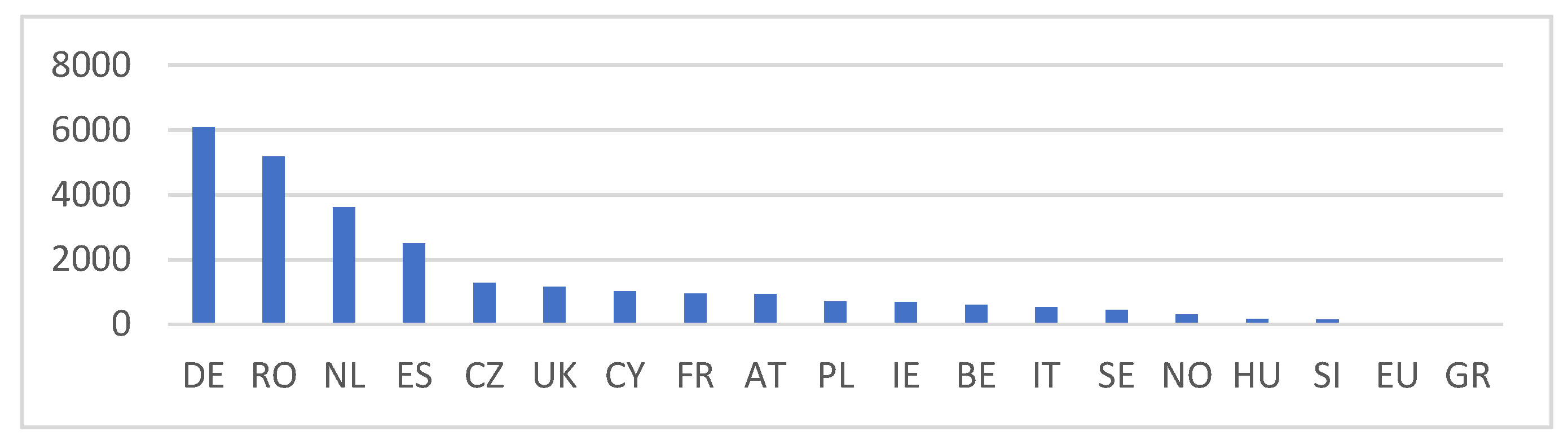
The size of repositories varies between repositories containing only a small number of datasets and larger repositories with several 1000 entries. The largest numbers by country are reported from repositories in Germany, Romania, and the Netherlands. In total, 26,500 3D assets are contained in the reviewed European repositories (Figure 2). In addition, ca. 12,500 assets are held by international repositories (including Europeana and US partners), and 12,400 are available from 4 US universities and museums.
A limitation of the survey action is that it could not reveal if the 3D data assets are unique or also listed elsewhere. This is particularly the case with aggregators, such as Europeana, which aggregate their content from other repositories. In addition, many responses and website entries use different numbers of, e.g., 3D assets (as single 3D data), datasets (may contain multiple assets), or projects (may contain multiple 3D datasets and/or assets).

2.5.1. Geographic Coverage

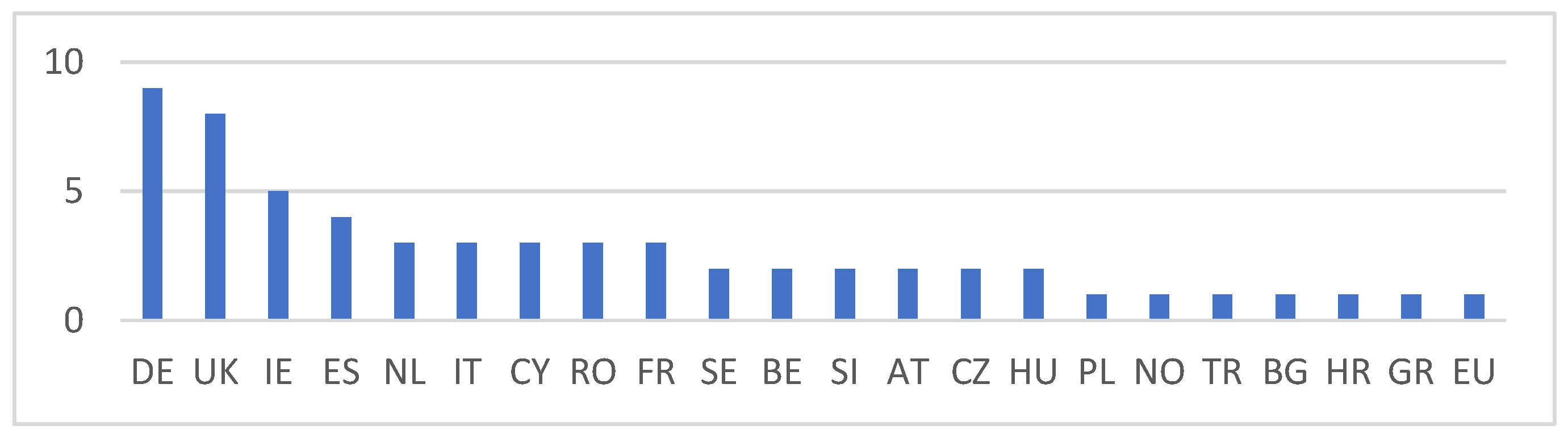
Regarding geographical coverage, most of the repositories investigated are located in Germany, the UK, and Ireland (Figure 3). Two repositories built by partners in EU projects have not been assigned to a specific country but flagged as “EU”.

Concerning the coverage of the EU countries, particularly the North-Eastern countries, such as Finland and the Baltic states, are missing (Figure 4), with one project in Lithuania reported in the survey as currently in the planning stages. Other countries not covered are Luxembourg, Denmark, and Portugal. The indicator used for the geographic coverage is the country of the operator. This does not necessarily reflect the repository consortium (e.g., for cross-national repositories as the multinational 3D Repository hosted by the University of Applied Sciences, Mainz, and utilised in the CoVHer project, which includes a consortium from DE, IT, and ES [42]) or a national limitation. Another bias may be caused by the communication channels and compilation means of the panel. Particularly, for some of the missing countries, 3D asset creators and holders are known and expected to hold 3D data.

2.5.2. Conclusions from the Survey

Of the extant 3D repositories that responded to the survey and are already fully operational, more than three-quarters are classed as mature, meaning they are concerned with factors such as openly licensed data, facilitating public access, and exploration of data. However, in general, most of the responding repositories do not contain huge amounts of 3D data, and many receive data only from one institution or various partners, for example, within a consortium.

2.6. Stage 3: Review of Available 3D Datasets

Methodology

Particularly for AI model training, several large-scale datasets—such as Objaverse, which includes 800.000 objects in the 1.0 version and 10.2 million 3D models in the extended XL collection [43], or ShapeNet, including 50 k 3D models [44]—have been compiled. In addition, commercial platforms, such as Sketchfab, host several 100k heritage items [45]. An overlapping area includes the automated 3D model creation processes from extant imagery [46,47,48,49], with large-scale 2D/3D datasets compiled, such as MVImgNet2 [50] and MegaScenes [40]. Within the 3D Big Data Space Digital Europe project, a mapping of extant 3D resources in large-scale collections for AI training took place. For the evaluation of available 3D data, we used a subset of that database to build two samples—one containing the total available object datasets (“No. of object datasets”), including image sets and datasets without 3D models, and a second set (“No. of 3D datasets”), only including datasets with linked 3D mesh, Gaussian Splat, or point cloud models (Table 3).
For geolocalisation, we identified the object countries via keywords in their English or translated descriptions by using the Geopy geocoding framework with the Nominatim geocoder as the first choice and the Google V3 geocoder as a fallback option if no result by Nominatim was achieved. The procedure has been described in a previous article [51] and utilises the Open Street Map (Nominatim) or Google Place API database to resolve named entities from name labels and descriptions of the 3D assets into geocoordinates.

3. Results

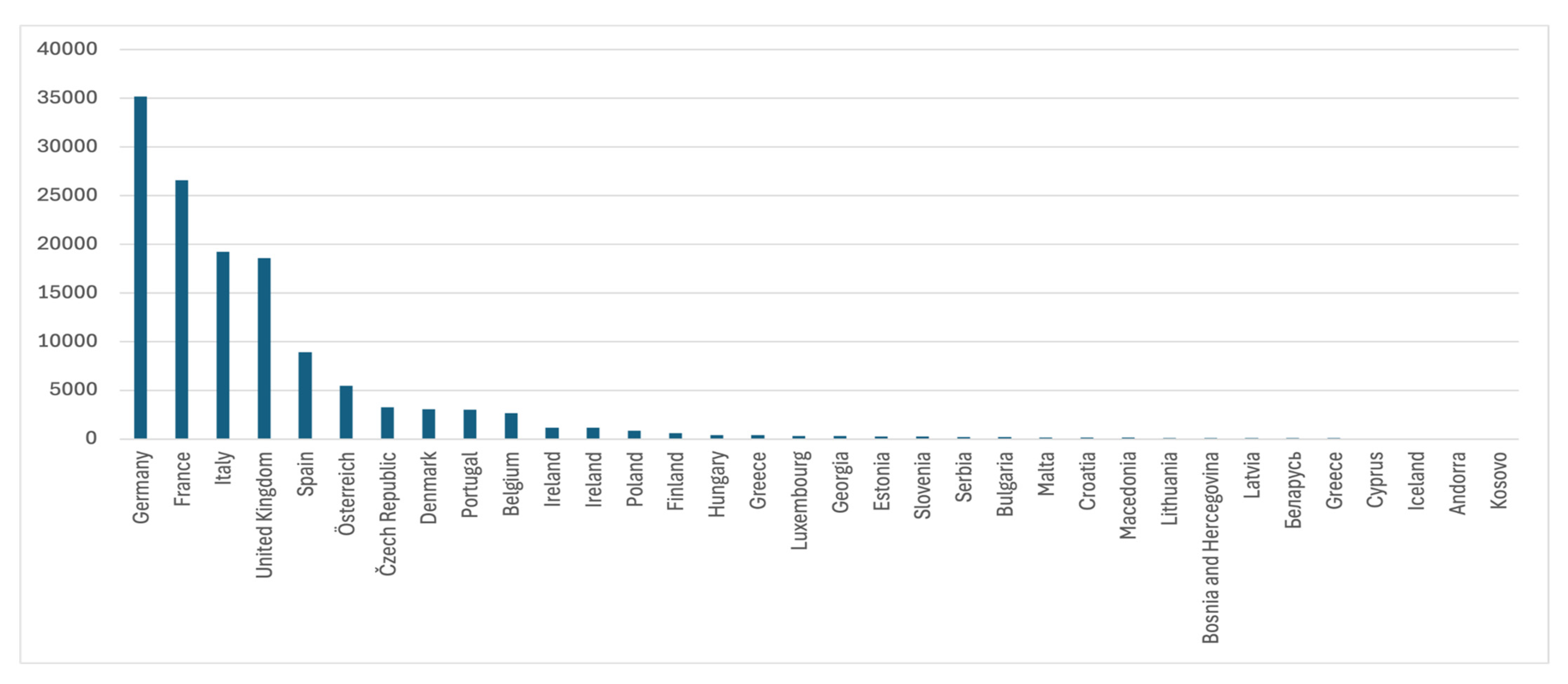
Results have been filtered for European countries in their original and English spelling. The evaluation of the object datasets—including 3D mesh models, pointclouds but also object-specific photographic image datasets—achieved n = 133,122 geocodings (Figure 5).
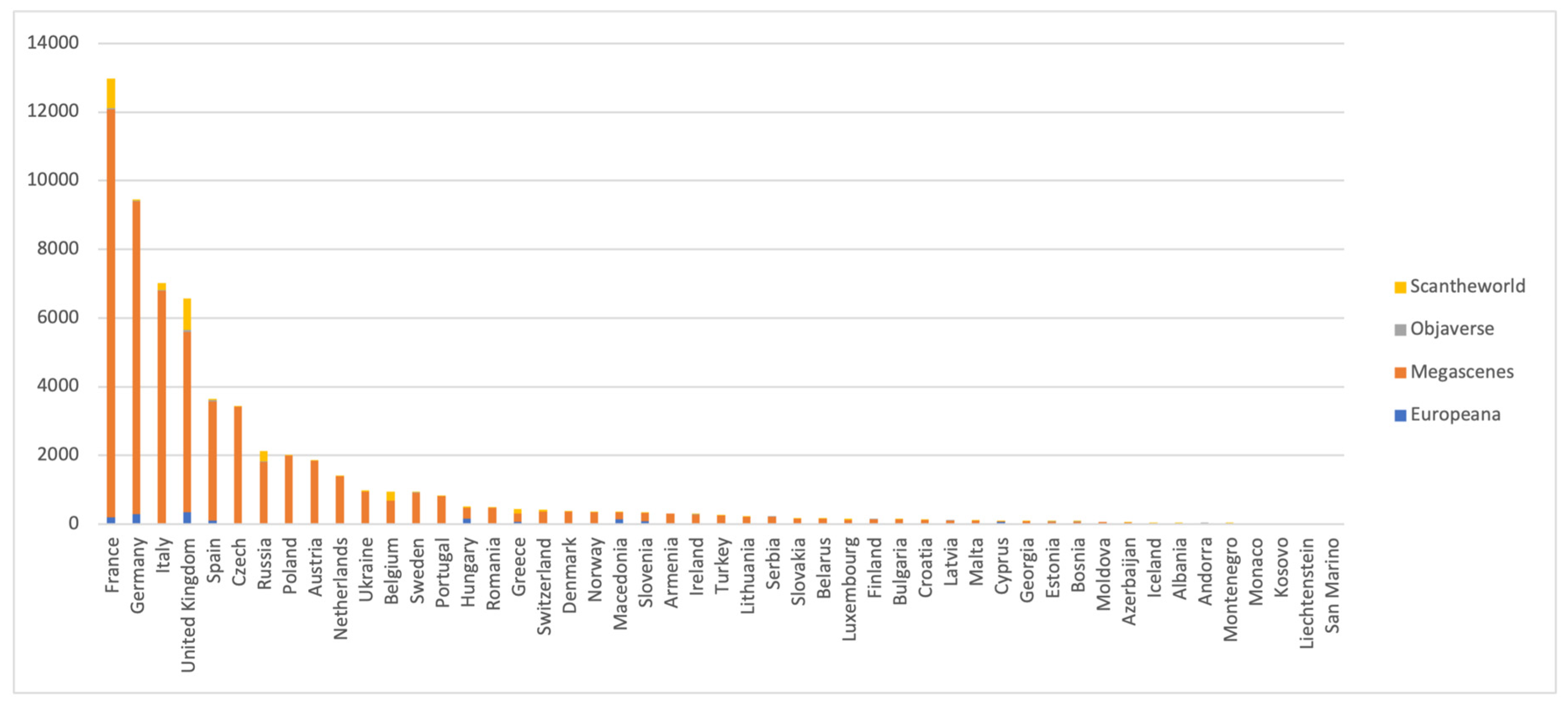
In the next step, we reconstructed and exported the image datasets in the Megascenes collection as point clouds via COLMAP and discarded results smaller than 1 KByte size, which resulted in 69,475 objects with 3D datasets. This resulted in a total set of 60,472 point clouds and mesh models with location information related to European countries (Figure 6).

4. Discussion

4.1. Geographic Distribution

The overarching finding of the assessment is that, in contrast to previous surveys in which the majority of 3D datasets were located in Mediterranean countries [12]—particularly Italy, Greece, and Spain—Germany, France, the Netherlands, and the UK are now also amongst the top-ranking countries with regard to available datasets.
The survey stages investigated curated and non-curated datasets. While one repository in Romania—operated by the national library—holds more than 5000 3D objects, the eight repositories investigated in the UK cumulatively hold a much lower number: 1155 objects in total.
The large availability of photo content, which enables 3D reconstructions, particularly pushes the availability of uncurated datasets. Due to the predominance of Megascenes data in our analysis, there is a strong correlation between images available on Wikimedia Commons and the number of datasets available per country. Germany (601 k images), the UK (491 k images), France (362 k images), and Italy (191 k images) are among the countries with the largest number of images available on Wikimedia Commons, while Finland (69 k images) and Belgium (114 k images) are less well represented. Interestingly, there is a lack of Greek content in the Megascenes dataset, which is due to a national law requiring a licence for the use of cultural heritage photographs, except for private use [52]. Of the 3038 Scan the World datasets, most originate from the UK (915), followed by France (864) and Russia (315).

4.2. Institutional Coverage and Duplicate Entries

The Objaverse dataset contains larger sets of 3D cultural heritage data provided by specific users. While various cultural heritage institutions are amongst the top providers, universities and digitisation projects, e.g., Global Digital Heritage, and even work by private enthusiasts, are also reaching large quantities at a good quality.
Vice versa, there is evidence that the same datasets are contained in multiple collections. Since this is intended in case of the Europeana data, which is aggregated from other curated repositories, these duplications also affect the uncurated datasets. As an example, we checked the data for three cases where data aggregation in the Europeana takes place—from the Hunt museum in Limerick, Ireland, 186 items are also included in the Objaverse dataset, the AI Mainz has 340 items in the Objaverse data, and Scan the World has 1 object in the Objaverse data.

4.3. Data Quality

The quality of the non-curated datasets is particularly heterogeneous. This may reveal some general findings and potential flaws related to the assessment of 3D content.
The distinction between metadata and 3D data quality, as defined in the current Europeana classification [53], can result in a situation where the metadata quality of an object is high, but the quality of the 3D data is low. While this could be assessed and resolved in the case of technical parameters, such as a minimum size, it is challenging to assess parameters such as the accuracy of representation.
Current measures primarily apply at the stage of content production (e.g., [13]), with only a few approaches envisaged for retrospective assessment of 3D content quality. In the realm of generative AI for 3D, various metrics for 2D and 3D accuracy measures are proposed, such as—for 3D content—the Chamfer Distance or geometric deviation [54]. Since this type of evaluation requires ground truth data, there are various methods proposed for no-reference objects (Overview: e.g., via comparison of similar inner geometric features, e.g., repeated columns [55] or variations in the data provided for a reconstruction [56] or deviations in the statistical distribution of features [57].
Additionally, the European Commission’s current requirements aim to provide high-quality 3D content that covers all cases [6]. However, given the variety of use cases, such as for mobile applications versus detailed inspection or monitoring of degradation, it is clear that using case-specific requirements should be maintained. Overviews about application scenarios for cultural heritage visualisation have been presented in publications on museums [58,59,60] and virtual tourism [61] or from a generic point proposed in [62].
Finally, there is the issue of the automatic enrichment of data, e.g., with regard to the use of image-to-3D techniques. Since photogrammetric approaches, such as those applied to the Megascenes data, are widely accepted, the question arises as to how to handle objects generated via AI, for example, from single views or textual descriptions.

4.4. Quantity of Curated vs. Uncurated Datasets

Another general finding is that the availability of 3D content can be greatly increased by generating 3D models from user-generated images, although the quality is, of course, highly variable and depends on the quantity and quality of the input data.
User-generated content also raises additional issues and questions about what counts as cultural heritage. Cultural heritage can be understood as traces and expressions from the past that attribute values and are used in contemporary society (cf. [63]). Although Megascenes objects represent monuments and artworks that have been documented and assessed as suitable for Wikimedia projects [64], it is unclear whether this qualifies the content as cultural heritage in all cases. In other cases, the 3D object clearly represents a fantasy item, such as a bow used in a computer game, rather than an object from the real world. Nevertheless, according to the ICOMOS definitions, this object may be considered digital heritage as a computer-born artwork [65,66].

5. Limitations

This investigation aims to provide an overview of the current availability of 3D data. As such, it has a limited scope and may be subject to various limitations.
For example, the quality of the content was not assessed further within this study beyond a size check; in our sample, we excluded objects smaller than 1 KB. There is a high risk that at least parts of the content of uncurated datasets have geometric or radiometric flaws. We are currently working on approaches to further investigate this issue.
Although the survey sample is based on previous studies by different groups, such as the ARIADNE survey, there is a risk of missing repositories that are not active within the ecosystems surveyed by previous studies or that were not reached by the online survey. To mitigate this issue, we (1) kept the online survey open and promoted it further to continuously record additional inputs, and (2) started a qualitative follow-up, particularly for countries where no repositories have yet been identified. This activity was not finalised at the time of finalising this article.
Finally, the investigation of the results uses mainly descriptive means, rather than more elaborate investigations, such as using LLM-based retrieval techniques to gain location information. This has been benchmarked for our dataset by previous publications and is currently in progress. We only exemplified the issue of duplicate data, but did not yet conduct a systematic investigation of gaps or duplicates in the collections.

6. Virtual Research Environments

The growing complexity and interdisciplinarity of scientific research have necessitated the development of integrated digital infrastructures capable of supporting collaborative and data-intensive workflows. Among these, Virtual Research Environments (VREs) have emerged as a transformative paradigm, offering researchers a unified platform for accessing data, computational resources, analytical tools, and collaborative services. VREs are designed to facilitate the entire research lifecycle—from data acquisition and processing to analysis, publication, and preservation—within a secure, scalable, and user-centric digital ecosystem.
The concept of VRE originated in the early 2000s, driven by the need to support geographically distributed research teams and manage increasingly heterogeneous datasets. Early implementations were often domain-specific, such as the VRE for Cultural Heritage, developed to manage archaeological and historical data through integrated GIS and multimedia systems [67]. These platforms have demonstrated the potential of combining spatial, textual, and visual information within a single research framework [68].
Over the past two decades, VREs have evolved significantly, increasing their prominence as Open Science has advanced on the political and institutional agenda [69,70,71] and proposing collaborative tools. The emergence of service-oriented architectures, cloud computing, and containerisation has enabled the creation of modular and interoperable platforms, adaptable to different scientific fields. Among the most notable examples:
  • D4Science, a service-oriented infrastructure that supports the creation of community-specific VREs in fields such as marine sciences, agriculture, and biodiversity. It emphasises co-creation, interoperability, and adherence to the FAIR principles [72,73].
  • REANA [https://reanahub.io, accessed on 29 January 2026], a reproducible analysis platform developed at CERN, which allows scientists to define and execute containerised workflows using tools such as Jupyter, CWL, and Snakemake. It integrates seamlessly with CERN’s broader VRE infrastructure to support research in high-energy physics and astrophysics.
  • CERN’s Multi-Science VRE is designed to support large-scale data analysis across multiple disciplines. It includes federated storage (via Rucio [https://rucio.cern.ch/, accessed on 29 January 2026]), compute clusters, and advanced notebook interfaces, all designed to handle exabyte-scale data and promote reproducibility and open science.
  • Within E-RIHS, a catalogue of services and tools for processing cultural heritage objects has been compiled [https://www.e-rihs.eu/e-rihs-catalogue-of-services/, accessed on 29 January 2026], amongst which are several VREs for managing large-scale object images and 3D models.
  • With IDOVIR, a paradata infrastructure for 3D reconstruction models and processes is available [74].
  • quasi.modo is under development by CNRS as a conceptual and technical architecture dedicated to the exploration, integration, and interoperability of data and knowledge produced around complex heritage objects [75].
  • The 4D Browser developed by the U. Jena provides a VRE for photographs and 3D assets. It links digital images and their actual location and thereby provides spatiotemporal search functions and tools for assessing visibility, highlighting a spatial distribution of photo locations and preferred views, and enabling the correlation to architectural and urban buildings [76].
Recent VREs are increasingly aligned with Open Science principles and the FAIR (Findable, Accessible, Interoperable, Reusable) guidelines [77], promoting transparency, accessibility, and the long-term sustainability of scientific results. They also incorporate advanced visualisation frameworks, semantic technologies, and workflow orchestration tools, enabling researchers to explore complex datasets interactively and collaboratively.
As scientific research continues to expand across disciplinary and institutional boundaries, VREs are poised to play a central role in shaping the future of research. Their capacity to integrate diverse resources, enable collaborative work, and drive innovation makes them key tools for modern research. In this context, the European Open Science Cloud (EOSC) [https://eosc-portal.eu/, accessed on 29 January 2026] provides a set of generic tools to manage and interact with data, with the ECCCH providing a set of research tools.

7. Information Systems for the Restoration of Cultural and Architectural Heritage

The management of tangible Cultural Heritage is a topic of interest to administrators, professionals, and scholars engaged in the documentation, restoration, and valorisation of artistic and architectural heritage. Managing the life cycle of such heritage, particularly restoration interventions, is a complex process in which many internal and external variables coexist, considering the vast number of skills and professionals involved. The enormous and heterogeneous amount of documentation produced can significantly impact the quality of the intervention and the possibility of systemic and informed future interventions. Research in this field has focused on the creation of digital information systems, in which the 3D geometric representation of an artifact is linked to additional, structured information through semantic annotation. This is designed to archive restoration data and enable scalable access and use over time. With the aim of creating a digital ecosystem for spatiotemporal monitoring of a restoration site, efforts have been made to develop methodologies for data management and enrichment.
Initial experiments have shown how photogrammetric surveys and laser scanners are essential for producing accurate digital models to support restoration operations [78]. The creation of georeferenced 3D-CAD vector models not only allows for the documentation of architectural details with millimetre precision, but also for the integration of diagnostic data (such as GPR surveys) and the production of structural thematic maps useful for intervention planning.
These approaches have highlighted the importance of centralizing and accessing data within integrated digital databases, a prerequisite for managing knowledge about architectural heritage.

7.1. Browser Interfaces for 3D Content

A baseline application includes the provision of structured overviews about data collections and models. Particular scenarios for 3D models, as well as imagery, have been investigated, e.g., by [79]. Scenarios include:
  • Browsing content, e.g., for building a mental typology of objects;
  • Looking for specific datasets, e.g., for a particular object or site;
  • Looking for items that can be grouped by characteristics.
Currently, various aggregators provide interfaces to search collections. Most prominently are tile-based search interfaces, which provide groups of records in a raster structure and enable users to filter for specific criteria. Examples include:
  • Europeana, which provides access to 60 million cultural heritage records from museums and libraries, as well as increased support and a focal point on 3D content integration [53].
  • The 3Drepo.eu, which provides an interface particularly for 3D datasets of Cultural Heritage that were collected from different data compilations [https://3drepo.eu, accessed on 29 January 2026].
More recently, 4D World Viewers provide time- and space-dependent access to media collections. Examples include the 4D Browser [https://4dbrowser.org, accessed on 29 January 2026] and 4D City [https://4dcity.org, accessed on 29 January 2026] applications for browsing and time- and location-based viewing of 3D mesh models and images, or the Time Atlas [https://timeatlas.eu, accessed on 29 January 2026] for browsing maps, genealogical records, and postcards.
Finally, a set of browser interfaces allows for a more abstracted search and find strategy. Examples include knowledge graph visualisations where objects are grouped and interlinked by multidimensional features or more abstracted 3D views coding multiple dimensions [80].

7.2. Ontologies and Semantic Systems for Knowledge Management

Several contributions propose addressing the complexity of damage diagnosis and multidisciplinary data management through models based on computational ontology. Tools such as CULTO [81] and semantic frameworks for decision-making (CnR-DM) [82,83] aim to:
  • Translate professional know-how into machine-readable procedures;
  • Support data annotation, indexing, and classification;
  • Integrate geometric information (HBIM) with historical, diagnostic, and decorative data.
Semantic annotations on 2D/3D models represent an active area of research: innovative approaches (e.g., ClippingVolumes) [84]. Aïoli [http://aioli.cloud, accessed on 29 January 2026] [85] seeks to overcome the limitations of traditional techniques, ensuring spatial, temporal, and morphological continuity between multiple and multi-resolution representations.

7.3. Information Systems Dedicated to Restoration Projects

Significant experience has been accumulated over complex projects, such as the restoration of the Fountain of Neptune (Bologna) [86] and, much more recently, the Notre-Dame de Paris Cathedral ([87], see also other articles in this Special Issue [88]). In both cases, web-based information systems based on high-precision 3D models were designed, with navigation, annotation, and diagnostic data access capabilities.
Neptune IS demonstrated the effectiveness of a 3D IS for documentation and collaboration between specialists, overcoming the limitations of WebGL and remote rendering.
The Notre Dame case has prompted the development of true multidisciplinary digital ecosystems, bringing together images, annotations, multimodal datasets, and semantically enriched models, with the support of AI for automated analysis (e.g., stone degradation detection).

7.4. Cloud Platforms and Integrated Data Lifecycle Management

The SACHER project [89] represents a benchmark for the development of distributed, open-source ICT platforms capable of integrating heterogeneous data and supporting interaction between public and private stakeholders. The most advanced solutions include:
  • SACHER 3D CH, for managing the lifecycle of 3D data in restoration.
  • SACHER MuSE CH, a multidimensional search engine for data from heterogeneous sources.
  • The Share3D [https://www.share3d.eu, accessed on 29 January 2026] metadata capture tool is designed to help cultural heritage institutions share 3D digital resources of European heritage with Europeana and the Common European data space for cultural heritage.
  • The Heritage Data Processor (HDP) is a GUI, API, and Command-Line-driven application designed for the comprehensive processing, enrichment, and management of digital assets, with a primary focus on multimodality. Together with the preceding Zenodo toolbox, around 65.000 3D mesh models and another 65.000 photographs have been processed and stored in Zenodo [51].
  • The Eureka 3D Data Hub addresses topics of support, capacity building, and solutions to the challenges faced by Cultural Heritage Institutions (CHIs) in their digital transformation journey, particularly concerning the implementation of high-quality 3D digitisation and their sharing to different stakeholders and in the common European data space for cultural heritage [https://eureka3d.eu/eureka3d-data-hub/, accessed on 29 January 2026].
These approaches aim to make document management scalable, overcoming data fragmentation and fostering social entrepreneurship models based on participatory design.

7.5. HBIM and Cognitive Automation

The Historic/Heritage Building Information Modelling (HBIM) was proposed in 2009 [90,91] as a new system of modelling historic structures, beginning with remote collection of survey data (using a terrestrial laser scanner combined with digital cameras), mapping of BIM objects onto the 3D surface model for creating full 2D and 3D models, including detail behind the object’s surface concerning its methods of construction and material makeup, integrating 3D geometry and information management. Recent research highlights:
  • The role of HBIM in diagnosing and evaluating the performance of historic buildings [92];
  • The need for semantic model enrichment [93,94];
  • The prospect of HBIM-assisted diagnosis (DA-HBIMM) through artificial intelligence and cognitive automation [95,96];
Critical reviews show how HBIM can provide the framework for future intelligent heritage management.

7.6. Digital Twins

Digital information spaces like Digital Twins are intended to structure or systematise all existing knowledge about an object/topic and provide fully digital simulation workflows for analysis or simulation. Ioannides et al. introduced an adjacent approach—Memory Twins—as a framework for semantically enriched heritage objects [97]. Digital Twins are in the focus of various infrastructures now:
  • The ECCCH is proposed to provide an infrastructure for digital twins of cultural heritage. This addresses application areas such as museum collections, conservation, and creative industries [3].
  • The ARTEMIS infrastructure specifically addresses information management for conservation and restoration [98].

8. Metadata, Paradata, and 3D Data

The documentation of 3D modelling results through metadata is well established nowadays. Numerous initiatives are advancing the development of domain-specific thesauri for art and architectural history content—e.g., ICONCLASS and the Getty Art & Architecture Thesaurus [http://vocab.getty.edu/aat/300000885, accessed on 29 January 2026]. Ontologies such as those provided by Wikibase (https://www.wikimedia.de/projects/wikibase/, accessed on 29 January 2026) or CIDOC-CRM also define relations between data. Derived categories for classification can be the employed reference ontology, as well as the adopted application ontology [99]. For heritage documentation, CIDOC-CRM especially became an overarching standard [100] and is fixed by the ISO. Several sectoral standards, like IFC for BIM [101] and GML [102] for geo and city-scale models, are of relevance. The IIIF-3D manifestos [103] are proposed to provide an interoperable standard to define 3D representations by viewers, while metadata schemes, such as EDM, METS/MODS, or LIDO, define sets of information required to describe 3D objects. Besides the development of specific metadata standards, a concurrent approach is to enable mapping schemes to allow for interoperability between different metadata standards [104].
In contrast to result documentation, approaches to documentation of the creation process are still less standardised [105]. For 3D digitisation, processes and workflows differ greatly by application scenario (cf. [106]), with various guidelines [62] or protocols to plan and/or document specific procedures taken for recording. For 3D reconstruction, it is evident that in a majority of projects, process documentation occurs by personal notes, communication artefacts, or versioning of states [107]. While these artefacts “document” a workflow and communication history, another question concerns the employed software, algorithms, and documentation of computational processing. For 3D reconstruction from historical sources, guidelines are provided by the Charters of London [108] and Seville [109], but these do not present a clearly applicable methodology and therefore are not directly transferable into practice [12]. Despite much research (c.f. [110]) and numerous methods and tools [111,112,113], there is still no standardised methodology to document the creation process of hypothetical 3D reconstructions.
A wide range of 3D file types is currently available. A main distinction is between proprietary 3D model formats (e.g., C4D for Maxon Cinema 4D or MAX for Autodesk 3D Studio Max), which are specific to the software in which they were created, and overarching formats like OBJ, DAE, STL, FBX, X3D, and gITF, which can be opened and created by many software tools [15]. Surface representations, as in the formats mentioned above, are distinct from volume information, as in DICOM. Several approaches use specific standards integrating both 3D and metadata, such as IFC for BIM [114] or Shapefiles for GIS [115]. Since formats such as OBJ and PLY are proprietary structured, DAE and X3D follow an XML-based data organisation. Formats like X3D and gITF are specifically designed for browser-based viewing [20]. With the advent of Gaussian Splatting, formats like 3DGS are available to represent volumetric sets of 3D Gaussians [116]. Another issue is storing 3D information. Generative approaches do not rely on storing resultant 3D geometries, but on parameters, and generate a 3D object in real time [117,118]. In contrast, discrete approaches store all 3D information: (A) point clouds as a set of points in a defined coordinate system; (B) wireframe/polygon models as vertices connected with edges and polygons; and (C) voxels as volume pixels. While geometric data can largely be sorted into one of these archetypes, there is a heterogeneous scope of formats for radiometric or dynamic information.

9. Three-Dimensional Viewer

Requirements and usage scenarios for 3D Viewers have been queried in various surveys, e.g., by Europeana [15], the Dutch Pure 3D consortium [33], the French HumaNum, or the German DFG 3D Viewer groups. A collection and formalisation of user stories have been conducted by the IIIF-3D workgroup [103]. Usage scenarios related to 3D Viewers include:
  • A most relevant use case includes the visual analysis of 3D models by rotating, zooming, panning, but also via changes in lighting [33] to assess colour reproduction and surfaces.
  • Another use case is to measure and analyse 3D objects via measurement tools, cross sections, or by enabling/disabling parts of scenes [33].
  • Annotation of models by highlighting or retrieving information and links to other information resources.
  • Download and recompilation of 3D models, e.g., to compare meshes.
From a meta-perspective, the Handbook of Digital 3D Reconstruction of Historical Architecture [106] summarised application scenarios in research, e.g., the visual assessment of building typologies and orders, the investigation of building phases, and the assessment of the correspondence of plan sources.
In the fields of archaeology, art, and architectural history, visualizing digital 3D reconstructions is a crucial step. Besides the fidelity in reproducing the geometrical shape, colours play a crucial role in the field of archaeological and architectural heritage. Colour analysis and colour rendition are involved in several critical facets of heritage preservation, conservation, and restoration [119]. Visualisation techniques of a heritage artefact, therefore, present the problem of the correctness of the colour representation. This aspect—already essential for enabling proper remote access to any kind of existing Cultural Heritage Artefact, for example, for museum use, scientific study, etc.—takes on absolute relevance and importance in the case of restoration work on any artefact belonging to the historical, artistic, archaeological, and architectural heritage ([10], p.18; [120]), and even in the hypothetical reconstruction of lost or never-existing assets. Technological advances now allow for faithful reproduction of the colour and surface radiometric characteristics of most materials (including gold) [121], offering the possibility of obtaining a digital copy as if it were the original [122,123].
Various viewer stacks are available to 3D visualise cultural heritage objects (Overviews: [10,11,13,14]). Examples include 3DHOP, which is developed and maintained by the CNR in Pisa to visualise scan models. ATON provides a multi-purpose infrastructure to create 3D VREs for cultural heritage with multi-temporal visualisation and RTI relighting features. ATON has been utilised in numerous projects, particularly for 3D analysis and visualisation [89]. Kompakkt/Semantic Kompakkt has been originally developed as a 3D visualisation and repository infrastructure and enhanced to particularly connect to Wikidata annotations. PoTree was originally developed at TU Vienna and is specialised in visualizing point cloud data on a large scale. The DLibra viewer is used in the Polish national infrastructure and provides the capability to visualise meshes and point cloud objects. The DFG 3D Viewer project sets up a distributed national infrastructure for 3D models in Germany. It involves five federal state libraries and their repositories and creates a modular architecture to integrate different viewer stacks and provide processing tools for data and metadata enrichment. Weave3D has been developed by the Slovenian SME Arctur as a 3D mesh model viewer. The Eureka3D Viewer particularly targets large meshes. There are various other viewers, such as the Smithsonian3D, Ark/k, Clara.io, CFIR.science, MorphoSource, Stanford 3D, Exhibit, Virtual Interiors, DarkLab, GB3D, CyArk, and NASA 3D [11].
In addition, various general-purpose approaches are utilised for viewing 3D models of cultural heritage. This includes generic 3D viewers like the Modelviewer, as well as Game environments like Unreal or Unity 3D to create more complex applications.
Finally, viewers like the INCEPTION viewer target specific usage scenarios, such as the visualisation of BIM models.

10. Effective Management of Small-Scale 3D Archives: Cases and Practices

Alongside these structural constraints, several case studies demonstrate that local museums and specialised archives can successfully manage small-scale 3D repositories when they adopt strongly curated and context-driven strategies. A paradigmatic example is the Mediateca of the Palladio Museum, an early and widely cited best-practice case, which integrates a limited number of 3D models within a structured scholarly catalogue of Palladian works [https://mediateca.palladiomuseum.org/palladio/opere.php, accessed on 29 January 2026], positioning 3D not as an autonomous digital product but as an interpretative and analytical instrument embedded in a broader knowledge system [124,125]. Another relevant case is the 3D models dataset of the Archaeological Park of Herculaneum [https://opendata-ercolano.cultura.gov.it/dataset/modelli-3d-lr, accessed on 29 January 2026], which provides access to thousands of models of archaeological artefacts through a dedicated institutional open-data portal, demonstrating how even larger 3D corpora can remain coherent when clearly scoped and well documented.
At the national level, initiatives developed in example in Italy under the coordination of the Ministry of Culture (MiC) within the PNRR Cultura 4.0 framework have addressed several of these challenges by combining strategic governance, shared infrastructures, and capacity-building actions, including the National Plan for the Digitisation of Cultural Heritage (PND) [https://digitallibrary.cultura.gov.it/il-piano, accessed on 29 January 2026] and dedicated training programmes such as Dicolab [https://dicolab.it/il-progetto/, accessed on 29 January 2026].
These policy and infrastructural measures are intended to create favourable conditions for small institutions—when adequately supported financially and in terms of technological skills—to manage sustainable 3D archives at a limited scale, particularly when they adopt strongly curated corpora, integrate 3D into existing catalogues and narratives, and treat metadata and rights management as core products rather than as secondary administrative layers.

11. Repositories and Intangible Heritage

Digital technologies are playing an expanding role in documenting, researching, and communicating intangible cultural heritage [65]. Intangible cultural heritage includes practices, expressions, knowledge, and skills that communities, groups, and, sometimes, individuals recognise as part of their cultural heritage and are expressed, e.g., via oral traditions, performing arts, social practices, rituals, ecological knowledge, or traditional craftsmanship [122]. Regarding digital repositories, intangible cultural heritage is still primarily transferred via texts, audio, or video media. Limitations of those approaches are the lack of capturing the full sensory and social context. Documenting movement and spatial relationships can be difficult in 2D media [4].
Therefore, various XR and 3D technologies are employed to record and transfer intangible heritage and enhance its protection, inheritance, and dissemination [126]. Techniques such as 3D and 4D scanning, along with motion capture systems, enable the precise recording of traditional practices, ensuring their preservation and accessibility [30,127].
These technologies are frequently combined with audiovisual media to offer a more comprehensive and immersive portrayal of cultural expressions. Vice versa, interoperability issues between different digital formats and technologies, the lack of established standards and interoperability for volumetric video data, or the representation of complex actions in dynamic 3D scenes are currently not fully solved [4]. Although the preservation of intangible cultural heritage documented as video, audio, or text is well established and is the focus of audiovisual archives like the Dutch Sound & Vision Archive (https://www.beeldengeluid.nl/en, accessed on 29 January 2026), 3D and XR representations are still emerging and subject to standardisation. Since initiatives, such as the Metaverse Standardisation Forum (https://metaverse-standards.org/, accessed on 29 January 2026), try to establish standards and protocols to enhance interoperability between XR applications, while within the European Data Space for Cultural Heritage, the XRCulture and Eureka3D-XR projects establish frameworks for storing, sharing, and safeguarding XR applications [2].

12. Conclusions

Technological innovation has profoundly transformed the documentation and representation of cultural heritage, enabling the adoption of advanced tools for three-dimensional recording and visualisation. At the same time, several European research infrastructures have been established to support the collection of complex datasets, ensure online accessibility of resources, and foster remote collaboration among scholars.
Key insights from the surveys of curated and uncurated 3D cultural heritage datasets include a visible shift in the geographic distribution of 3D cultural heritage datasets: while earlier surveys were dominated by Mediterranean countries, Northern and Western European countries—particularly Germany, France, the Netherlands, and the UK—now also rank among the leading providers for both curated and uncurated datasets. Dataset availability varies greatly between repositories, with some single institutions holding thousands of objects while others collectively host far fewer.
A major driver of growth is uncurated 3D content generated from large image collections, especially those on Wikimedia Commons, resulting in a strong correlation between image availability and dataset volume by country. Legal frameworks, such as Greece’s licensing requirements for cultural heritage photography, significantly affect national representation. Although not investigated in detail in our study yet, we assume that data aggregation leads to notable duplication across curated and uncurated repositories.
Data quality remains highly heterogeneous, especially in uncurated datasets. Existing quality frameworks often separate metadata from 3D model quality, making it difficult to assess aspects such as representational accuracy, reliability, or other object-specific metrics. Current standards also struggle to accommodate diverse use cases and—although not of much relevance for the current study—emerging AI-generated 3D content.
Cultural heritage data, however, are inherently heterogeneous: textual descriptions, drawings, images, metric surveys, and 3D digital models often converge into archives that remain fragmented and poorly integrated. Another significant limiting factor is the types and characteristics of 3D models stored in various systems/platforms/infrastructures, which still lack shared standards or miss characteristics that allow for their widespread reuse for different purposes and applications. For example, while SRMs [128] produced in the context of VREs must be suitable for providing a comprehensible and reusable 3D model, which can serve as a source reference for the dissemination of knowledge and further research, 3D models used in the most qualified restoration interventions (e.g., the Notre Dame reconstruction project [88]) must guarantee a faithful, high-resolution geometric and radiometric reproduction of the objects’ surface characteristics. A possible solution to these limitations could arise from the multi-scalar, multi-source approach that underlies the concept of the master model and its corresponding derivates, introduced within the framework of cultural heritage 3D modelling [129], which has found significant parallels in subsequent research, and which is peculiar to data management approach in the BIM environment (see LOD, LOI, and LOA for heritage preservations) [130]. A growing body of literature proposes hierarchical and multi-scale representations [131], in which a high-fidelity reference model is complemented by simplified versions tailored to visualisation, dissemination, or web applications [11]. Recent contributions expand this logic through multi-source workflows, integrating diverse datasets, such as laser scans, photogrammetry, and archival documentation [132]. These developments reinforce the shared objective of ensuring model consistency, interoperability, and adaptability across heterogeneous platforms and use contexts. At the same time, the challenge of systematically incorporating interpretative layers and uncertainty—central to the definition of 3D models as scientific constructs—remains only partially resolved, highlighting the need for further methodological standardisation. Therefore, despite significant progress, fully and multi-purpose interoperability among existing systems continues to represent a major challenge, limiting the long-term accessibility, preservation, and reuse of data, metadata, and paradata. This fragmentation restricts the potential reuse of 3D resources in advanced contexts such as Virtual Research Environments (VREs), Information Systems (IS) for lifecycle management, and scientific visualisation platforms. In this landscape, European infrastructures play a crucial role in promoting FAIR principles (Findable, Accessible, Interoperable, Reusable), such as, for instance, the Data Space for Cultural Heritage and the Heritage Cloud. CLARIAH supports digital humanities with modular and interoperable workflows, while ARIADNE represents one of the most advanced federated environments for archaeological datasets, including 3D content. CARARE, as a domain aggregator for Europeana, focuses on archaeological and architectural heritage, enhancing 3D and VR content and contributing to the European Data Space for Cultural Heritage. Europeana itself is increasingly integrating 3D content while promoting common standards, and E-RIHS provides advanced platforms, such as DIGILAB and FIXLAB, linking scientific and diagnostic data with 3D models for a multidisciplinary approach to conservation.
Several metadata standards define the semantic enrichment of 3D heritage objects. Besides the development of specific metadata standards, a concurrent approach is to enable mapping schemes to enable interoperability between different metadata standards [104]. The recording of paradata, which documents the creation process of 3D objects, is still limited and unstandardised. A specific move is towards holistic approaches for connecting 3D objects, descriptive data, and contextual information towards Memory Twins [133]. Data formats for 3D payload include a large amount of mesh, point, or volumetric representations, with Gaussian Splatting as a volumetric rendering technique based on 3D Gaussians as a more recently added type of data representation.
Requirements and usage scenarios for 3D viewers have been widely studied in European and international initiatives. Core use cases include interactive visual analysis of 3D models (rotation, zooming, lighting control), measurement and structural analysis, annotation and linking to external resources, and downloading models for comparison or reuse. In research fields such as archaeology, art history, and architectural history, 3D visualisation is essential for analysing building typologies, construction phases, and source correspondence. A wide range of 3D viewer solutions exists to support these needs, from specialised tools for meshes or point clouds to modular national and international infrastructures, reflecting the diversity of data types, scales, and research and public-use scenarios in cultural heritage.
Concerning the small-scale 3D repositories operated by small museums and/or institutions, their visibility within digital cultural heritage ecosystems is thus less dependent on proportional representation and more closely tied to editorial continuity, communication resources, and—above all—the availability of investments capable of supporting structured digitisation processes, long-term preservation, cloud services, and integrated access platforms. In this context, dedicated training initiatives could play a key role in strengthening the capacities of museums, archives, and libraries. The cases analysed confirm that the sustainability of small-scale 3D archives does not stem from the quantity of models produced, but rather from the clarity of the curatorial scope, technical and semantic interoperability, and the ability to embed 3D production within cooperative distribution networks enabled by national and European infrastructures.
Although the focus of this article is currently on tangible objects, intangible cultural heritage becomes a more relevant topic, which also reflects an increasing number of infrastructures and applications [30,127]. Similarly, digital heritage, e.g., XR applications or computer games, is a currently underrepresented area of preservation and sharing [5].
Although these initiatives differ in scope and maturity, they collectively contribute to a digital ecosystem in which 3D data become genuinely accessible and reusable, supporting the development of interoperable VREs, integrated heritage information systems, and innovative visualisation platforms, but also require specific approaches to documentation to meet the requirements of digital ecosystems [134]. Nevertheless, workflows remain only partially standardised, and the full potential of digital technologies is yet to be realised. Emerging paradigms, such as the Internet of Things and Artificial Intelligence, could address these gaps, transforming cultural objects into “smart” entities capable of dynamic data exchange and interaction. Achieving such a vision requires standardised protocols, automated workflows, and cross-platform integration, paving the way towards a sustainable and truly interoperable cultural heritage information ecosystem.

Supplementary Materials

The following supporting information can be downloaded at: https://www.mdpi.com/article/10.3390/heritage9020059/s1, Preferred Reporting Items for Systematic reviews and Meta-Analyses extension for Scoping Reviews (PRISMA-ScR) Checklist. Reference [36] is cited in the supplementary materials.

Author Contributions

Chapters introduction, conclusion, and infrastructures: all authors; state of the art, 3D viewer, metadata, intangible heritage: S.M.; virtual research infrastructures, small repositories, recommendations: F.I.A. All authors have read and agreed to the published version of the manuscript.

Funding

Parts of the research on which this paper is based was carried out in the EU projects INDUX-R (European Commission, Grant No. 101135556), Digicher (European Commission, Grant No. 101132481), INFINITY (European Commission, Grant No. 101233051), the EIT Culture and Creativity STG for Cultural Heritage and 3DBigDataSpace (European Commission, Grant No. 101173385), as well as the German DFG 3D-Viewer (Deutsche Forschungsgemeinschaft, Grant No. 439948010).

Data Availability Statement

Dataset available on request from the authors.

Acknowledgments

The survey on 3D data in Europe was carried out as part of the activities of the 3D Working Group within the common European data space for cultural heritage under a service contract with the European Commission (contract number LC-01901432). Special thanks are due to Fiona Mowat, who co-conducted the survey and contributed to data analysis and interpretation.

Conflicts of Interest

The authors declare no conflicts of interest.

References

  1. Farrell, E.; Minghini, M.; Kotsev, A.; Soler Garrido, J.; Tapsall, B.; Micheli, M.; Posada Sanchez, M.; Signorelli, S.; Tartaro, A.; Bernal Cereceda, J.; et al. European Data Spaces—Scientific Insights into Data Sharing and Utilisation at Scale; Publications Office of the European Union: Luxembourg, 2023. [Google Scholar] [CrossRef]
  2. Münster, S.; Medici, M.; Fresa, A.; Stan, A.; Charles, V. 3D Data in the Data Space for Cultural Heritage—Presentation. In Proceedings of the Digital Heritage, Siena, Italy, 8 September 2025. [Google Scholar] [CrossRef]
  3. Brunet, P.; De Luca, L.; Hyvönen, E.; Joffres, A.; Plassmeyer, P.; Pronk, M.; Scopigno, R.; Sonkoly, G. Report on a European Collaborative Cloud for Cultural Heritage: Ex-Ante Impact Assessment Prepared for European Commission Directorate-General for Research and Innovation; Publications Office of the European Union: Luxembourg, 2022. [Google Scholar]
  4. Papadopoulos, T. Virtual Worlds—Strategic Research & Innovation Agenda. 2025. Available online: https://www.virtualworldsassociation.eu/actions/strategic-research-innovation-agenda-virtual-worlds-eu (accessed on 29 January 2026).
  5. Caussé, A. Arche Sria and Its Synthesis. 2025. Available online: https://www.heritageresearch-hub.eu/app/uploads/2025/06/ARCHE-D2.6-ARCHE-SRIA-and-its-Synthesis.pdf (accessed on 29 January 2026).
  6. European Commission. Commission Recommendation on A Common European Data Space for Cultural Heritage. 2021. Available online: https://digital-strategy.ec.europa.eu/en/news/commission-proposes-common-european-data-space-cultural-heritage (accessed on 29 January 2026).
  7. Papadopoulos, C.; Gillikin Schoueri, K.; Schreibman, S. And Now What? Three-Dimensional Scholarship and Infrastructures in the Post-Sketchfab Era. Heritage 2025, 8, 99. [Google Scholar] [CrossRef]
  8. O’Neill, B.; Stapleton, L. Digital cultural heritage standards: From silo to semantic web. AI Soc. 2022, 37, 891–903. [Google Scholar] [CrossRef] [PubMed]
  9. Davis, E.; Heravi, B. Linked Data and Cultural Heritage: A Systematic Review of Participation, Collaboration, and Motivation. J. Comput. Cult. Herit. 2021, 14, 21. [Google Scholar] [CrossRef]
  10. Storeide, M.; George, S.; Sole, A.; Hardeberg, J.Y. Standardization of digitized heritage: A review of implementations of 3D in cultural heritage. Herit. Sci. 2023, 11, 249. [Google Scholar] [CrossRef]
  11. Münster, S. Advancements in 3D Heritage Data Aggregation and Enrichment in Europe: Implications for Designing the Jena Experimental Repository for the DFG 3D Viewer. Appl. Sci. 2023, 13, 9781. [Google Scholar] [CrossRef]
  12. Münster, S. Digital Cultural Heritage as Scholarly Field—Topics, Researchers and Perspectives from a bibliometric point of view. J. Comput. Cult. Herit. 2019, 12, 22–49. [Google Scholar] [CrossRef]
  13. European Commission. Study on Quality in 3D Digitisation of Tangible Cultural Heritage: Mapping Parameters, Formats, Standards, Benchmarks, Methodologies, and Guidelines. VIGIE 2020/654 Final Study Report. 2022. Available online: https://digital-strategy.ec.europa.eu/en/library/study-quality-3d-digitisation-tangible-cultural-heritage (accessed on 29 January 2026).
  14. Fung, N.; Schoueri, K.; Scheibler, C. Pure 3D: Comparison of Features Available on Aton, Smithsonian Voyager, 3DHOP, Kompakkt and Virtual Interiors (Technical Report); Maastricht University: Maastricht, The Netherlands, 2021. [Google Scholar]
  15. Fernie, K.; Blümel, I.; Corns, A.; Giulio, R.d.; Ioannides, M.; Niccolucci, F.; Beck, J.; Mathys, A.; Rossi, V.; Vastenhoud, C.; et al. 3D Content in Europeana Task Force; Europeana Network Association: The Hague, The Netherlands, 2020. [Google Scholar]
  16. Zarnic, R.; Brunoro, S.; Maietti, F.; Piaia, E.; Moropoulou, A.; Ioannides, M.; Rajcic, V. Establishment of Stakeholder Panel, Value-Added Assessment and State of the Art. Deliverable 1.1; European Commission: Brussels, Belgium, 2016. [Google Scholar]
  17. Moore, J.; Rountrey, A.; Kettler, H.S. 3D Data Creation to Curation: Community Standards for 3D Data Preservation; ACRL: Chicago, IL, USA, 2020. [Google Scholar]
  18. Rodriguez, K. Scoping a 3D Data Service Within UK-iDAH Infrastructure; CARARE Cafe: The Hague, The Netherlands, 2022. [Google Scholar]
  19. Hernández-Muñoz, Ó. Analysis of Digitized 3D Models Published by Archaeological Museums. Heritage 2023, 6, 3885–3902. [Google Scholar] [CrossRef]
  20. Cieslik, E. 3D Digitization in Cultural Heritage Institutions Guidebook; Univeristy of Maryland: Baltimore, MD, USA, 2020. [Google Scholar]
  21. Champion, E.; Rahaman, H. Survey of 3D Digital Heritage Repositories and Platforms. Virtual Archaeol. Rev. 2020, 11, 1. [Google Scholar] [CrossRef]
  22. Benardou, A.; Champion, E.; Dallas, C.; Hughes, L. Cultural Heritage Infrastructures in Digital Humanities; Routledge: London, UK, 2018. [Google Scholar]
  23. Nishanbaev, I. A web repository for geo-located 3D digital cultural heritage models. Digit. Appl. Archaeol. Cult. Herit. 2020, 16, e00139. [Google Scholar] [CrossRef]
  24. Geser, G. ARIADNE+ D2.3 Final Report on Community Needs; European Commission: Brussels, Belgium, 2021. [Google Scholar]
  25. ICOM—International Council of Museums. Museums, Museum Professionals and COVID-19: Follow-Up Survey; ICOM: Paris, France, 2020. [Google Scholar]
  26. ICOM—International Council of Museums. Museums, Museum Professionals and Covid-19: Third Survey; ICOM: Paris, France, 2021. [Google Scholar]
  27. ICOM—International Council of Museums. Museums, Museum Professionals and COVID-19. Survey Results; ICOM: Paris, France, 2020. [Google Scholar]
  28. Samaroudi, M.; Echavarria, K.R.; Perry, L. Heritage in lockdown: Digital provision of memory institutions in the UK and US of America during the COVID-19 pandemic. Mus. Manag. Curatorship 2020, 35, 337–361. [Google Scholar] [CrossRef]
  29. Mendoza, M.A.; De La Hoz Franco, E.; Gómez, J.E. Technologies for the Preservation of Cultural Heritage—A Systematic Review of the Literature. Sustainability 2023, 15, 1059. [Google Scholar] [CrossRef]
  30. Skublewska-Paszkowska, M.; Milosz, M.; Powroznik, P.; Lukasik, E. 3D technologies for intangible cultural heritage preservation—Literature review for selected databases. Herit. Sci. 2022, 10, 3. [Google Scholar] [CrossRef] [PubMed]
  31. European Commission: Directorate-General for Communications Networks, Content and Technology. The Future of Europe’s Past—Why Member States Must Do More to Advance Digitisation of Our Cultural Heritage—Implementation of the 2021 Commission Recommendation on a Common European Data Space for Cultural Heritage—Progress Report 2021–2023; Publications Office of the European Union: Luxembourg, 2024. [Google Scholar]
  32. Münster, S. A Survey on Topics, Researchers and Cultures in the Field of Digital Heritage. ISPRS Ann. Photogramm. Remote Sens. Spat. Inf. Sci. 2017, IV-2/W2, 157–162. [Google Scholar] [CrossRef]
  33. Schoueri, K.; Papadopoulos, C.; Schreibman, S. Survey on 3D Web Infrastructures. Final Report. 2022. Available online: https://pure3d.eu/wp-content/uploads/2022/02/3D-Infrastructure-Survey-Report_PURE3D-1.pdf (accessed on 30 March 2023).
  34. Münster, S.; Mowat, F.; Medici, M. Mapping of national and sectoral 3D repositories. In Digital Heritage Progress in Cultural Heritage: Documentation, Preservation, and Protection. Proceedings of the Euromed 2024; Ioannides, M., Magnenat-Thalmann, N., Fink, E., Žarni, R., Yen, A.-Y., Quak, E., Eds.; Springer: Berlin/Heidelberg, Germany, in press.
  35. Europeana. Common European Data Space for Cultural Heritage Annual Report 2022/2023. 2023. Available online: https://www.thinkdigital.travel/research-directory/common-european-data-space-for-cultural-heritage-annual-report-2022-to-2023-77c0c (accessed on 29 January 2026).
  36. Moher, D.; Liberati, A.; Tetzlaff, J.; Altman, D.G. Preferred reporting items for systematic reviews and meta-analyses: The PRISMA statement. Int. J. Surg. 2010, 8, 336–341. [Google Scholar] [CrossRef]
  37. Selhofer, H.; Geser, G. Ariadne D2.2 Second Report on Users’ Needs. 2015. Available online: http://legacy.ariadne-infrastructure.eu/wp-content/uploads/2019/01/ARIADNE_D2.2_Second_report_on_users_needs.pdf (accessed on 29 January 2026).
  38. Medici, M.; Fernie, K. D4.1 Report on Standards, Procedures and Protocols (1.0); Zenodo: Genf, Switzerland, 2022. [Google Scholar]
  39. Deitke, M.; Schwenk, D.; Salvador, J.; Weihs, L.; Michel, O.; VanderBilt, E.; Schmidt, L.; Ehsani, K.; Kembhavi, A.; Farhadi, A. Objaverse: A Universe of Annotated 3D Objects. arXiv 2022, arXiv:2212.08051. [Google Scholar] [CrossRef]
  40. Tung, J.; Chou, G.; Cai, R.; Yang, G.; Zhang, K.; Wetzstein, G.; Hariharan, B.; Snavely, N. MegaScenes: Scene-Level View Synthesis at Scale. arXiv 2024, arXiv:2406.11819. [Google Scholar] [CrossRef]
  41. Mowat, F.; Münster, S.; Evans, G. Do You Operate a Data Repository or Infrastructure Which Stores and Manages 3D Data? Then We Want to Hear from You! Discover How—And Why—To Take Our Survey on 3D Repositories for Cultural Heritage. Available online: https://pro.europeana.eu/post/help-us-to-map-european-data-infrastructures-for-3d-cultural-heritage (accessed on 29 January 2026).
  42. Computer-Based Visualization of Architectural Cultural Heritage (CoVHer). 2023. Available online: https://book.unibo.it/courses/course-v1:Unibo+CoVHer101+2024_E1/about (accessed on 30 March 2023).
  43. Deitke, M.; Liu, R.; Wallingford, M.; Ngo, H.; Michel, O.; Kusupati, A.; Fan, A.; Laforte, C.; Voleti, V.; Gadre, S.Y.; et al. Objaverse-XL: A Universe of 10M+ 3D Objects. arXiv 2023, arXiv:2307.05663. [Google Scholar]
  44. Chang, A.X.; Funkhouser, T.; Guibas, L.; Hanrahan, P.; Huang, Q.; Li, Z.; Savarese, S.; Savva, M.; Song, S.; Su, H. Shapenet: An information-rich 3d model repository. arXiv 2015, arXiv:1512.03012. [Google Scholar]
  45. Flynn, T. Over 100,000 Cultural Heritage Models on Sketchfab. Available online: https://sketchfab.com/nebulousflynn/collections/over-100000-cultural-heritage-models-on-sketchfab (accessed on 29 January 2022).
  46. Snavely, N.; Seitz, S.M.; Szeliski, R. Modeling the World from Internet Photo Collection. Int. J. Comput. Vis. Vision. 2007, 80, 189–210. [Google Scholar] [CrossRef]
  47. Wu, X.; Averbuch-Elor, H.; Sun, J.; Snavely, N. Towers of Babel: Combining Images, Language, and 3D Geometry for Learning Multimodal Vision. In Proceedings of the 2021 IEEE/CVF International Conference on Computer Vision (ICCV), Montreal, QC, Canada, 10–17 October 2021. [Google Scholar]
  48. Stathopoulou, E.K.; Welponer, M.; Remondino, F. Open-Source Image-Based 3D Reconstruction Pipelines: Review, Comparison and Evaluation. Int. Arch. Photogramm. Remote Sens. Spat. Inf. Sci. 2019, XLII-2/W17, 331–338. [Google Scholar] [CrossRef]
  49. Maiwald, F.; Komorowicz, D.; Munir, I.; Beck, C.; Muenster, S. Semi-automatic generation of historical urban 3D models at a larger scale using Structure-from-Motion, Neural Rendering and historical maps. In Research and Education in Urban History in the Age of Digital Libraries. Third International Workshop, UHDL 2023, Munich, Germany, 27–28 March 2023, Revised Selected Papers; Münster, S., Kröber, C., Pattee, A., Niebling, F., Eds.; Springer CCIS: Cham, Switzerland, 2023; pp. 107–127. [Google Scholar]
  50. Wu, Y.; Shi, L.; Liu, H.; Liao, H.; Qiu, L.; Yuan, W.; Gu, X.; Dong, Z.; Cui, S.; Han, X. MVImgNet2.0: A Larger-scale Dataset of Multi-view Images. ACM Trans. Graph. 2024, 43, 173. [Google Scholar] [CrossRef]
  51. Münster, S.; Bruschke, J.; Rajan, V.; Komorowicz, D.; Preßler, R.; Ukolov, D. 4D World Viewers as Multi-user Content Management Systems. ISPRS Int. Arch. Photogramm. Remote. Sens. Spat. Inf. Sci. 2025, XLVIII-M-9, 1043–1050. [Google Scholar] [CrossRef]
  52. Markellou, M. Cultural Heritage Accessibility in the Digital Era and the Greek Legal Framework. Int. J. Semiot. Law—Rev. Int. De. Sémiotique Jurid. 2023, 36, 1945–1969. [Google Scholar] [CrossRef]
  53. Isaac, A.; Fernie, K.; Bachi, V.; Tsoupra, E.; Medici, M.; Alkemade, H.; Münster, S.; Charles, V.; Heslinga, L. Making the Europeana Data Model a Better Fit for Documentation of 3D Objects. In 3D Research Challenges in Cultural Heritage V: Paradata, Metadata and Data in Digitisation; Ioannides, M., Baker, D., Agapiou, A., Siegkas, P., Eds.; Springer Nature: Cham, Switzerland, 2025; pp. 63–74. [Google Scholar]
  54. Balloni, E.; Paolanti, M.; Uggeri, J.; Zingaretti, P.; Pierdicca, R. Enhancing Cultural Heritage with Generative AI: A Comparative Framework for the Evaluation of 3D Model Accuracy and Visual Fidelity. In Digital Heritage; Campana, S., Ferdani, D., Graf, H., Guidi, G., Hegarty, Z., Pescarin, S., Remondino, F., Eds.; The Eurographics Association: Graz, Austria, 2025. [Google Scholar]
  55. Zhang, Z.; Sun, W.; Min, X.; Wang, T.; Lu, W.; Zhai, G. No-Reference Quality Assessment for 3D Colored Point Cloud and Mesh Models. IEEE Trans. Circuits Syst. Video Technol. 2022, 32, 7618–7631. [Google Scholar] [CrossRef]
  56. Fryskowska, A.; Stachelek, J. A no-reference method of geometric content quality analysis of 3D models generated from laser scanning point clouds for hBIM. J. Cult. Herit. 2018, 34, 95–108. [Google Scholar] [CrossRef]
  57. Ferrarotti, A.; Rodríguez, I.; Usón, J.; Baldoni, S.; Gutiérrez, J.; Berjón, D.; Morán, F.; Battisti, F.; García, N.; Carli, M.; et al. Analysis of Objective 3D Mesh Quality Metrics for Cultural Heritage. In Proceedings of the 2025 17th International Conference on Quality of Multimedia Experience (QoMEX), Madrid, Spain, 30 September–2 October 2025; pp. 1–4. [Google Scholar]
  58. ViMM WG 2.2. Meaningful Content Connected to the Real World. 2017; unpublished report. [Google Scholar]
  59. Bekele, M.K.; Pierdicca, R.; Frontoni, E.; Malinverni, E.S.; Gain, J. A Survey of Augmented, Virtual, and Mixed Reality for Cultural Heritage. ACM J. Comput. Cult. Herit. 2018, 11, 7. [Google Scholar] [CrossRef]
  60. Daniela, L. Virtual Museums as Learning Agents. Sustainability 2020, 12, 2698. [Google Scholar] [CrossRef]
  61. Siddiqui, M.S.; Syed, T.; Nadeem Al Hassan, A.; Nawaz, W.; Alkhodre, A. Virtual Tourism and Digital Heritage: An Analysis of VR/AR Technologies and Applications. Int. J. Adv. Comput. Sci. Appl. 2022, 13, 303–315. [Google Scholar] [CrossRef]
  62. Markiewicz, J.; Kot, P.; Georgopoulos, A.; Bocheńska, A.; Muradov, M.; Hess, M.; Czajkowski, K.; Zawieska, D.; Antoniou, A. Transforming architectural heritage documentation: Developing integrated European recommendations for safeguarding and preservation. npj Herit. Sci. 2025, 13, 622. [Google Scholar] [CrossRef]
  63. UNESCO. Draft Medium Term Plan 1990–1995. 1989. Available online: https://digitallibrary.un.org/record/1291656 (accessed on 29 January 2026).
  64. Wikimedia Commons. Commons: Contributing Your Own Work. Available online: https://commons.wikimedia.org/wiki/Commons:Contributing_your_own_work#Step_2:_Is_it_suitable_here? (accessed on 29 January 2026).
  65. UNESCO. Concept of Digital Heritage. 2018. Available online: https://dl.acm.org/doi/10.1145/3202918.3203089 (accessed on 29 January 2026).
  66. UNESCO. Charter on the Preservation of Digital Heritage. 2003. Available online: https://www.unesco.org/en/legal-affairs/charter-preservation-digital-heritage (accessed on 29 January 2026).
  67. Meyer, É.; Grussenmeyer, P.; Perrin, J.-P.; Durand, A.; Drap, P. A web information system for the management and the dissemination of Cultural Heritage data. J. Cult. Herit. 2007, 8, 396–411. [Google Scholar] [CrossRef]
  68. Kuroczyński, P. Virtual Research Environment for Digital 3D Reconstructions: Standards, Thresholds and Prospects. Stud. Digit. Herit. 2017, 1, 456–476. [Google Scholar] [CrossRef]
  69. Ahmed, I.; Poole, M.; Trudeau, A. A Typology of Virtual Research Environments. In Proceedings of the 51st Hawaii International Conference on System Sciences, Waikoloa Village, HI, USA, 3–6 January 2018. [Google Scholar]
  70. Gadzhev, G.; Georgieva, I.; Ganev, K.; Ivanov, V.; Miloshev, N.; Chervenkov, H.; Syrakov, D. Climate Applications in a Virtual Research Environment Platform. Scalable Comput. Pract. Exp. 2018, 19, 107–118. [Google Scholar] [CrossRef]
  71. Zuiderwijk, A. Analysing Open Data in Virtual Research Environments: New Collaboration Opportunities to Improve Policy Making. Int. J. Electron. Gov. Res. 2017, 13, 76–92. [Google Scholar] [CrossRef]
  72. Assante, M.; Candela, L.; Castelli, D.; Cirillo, R.; Coro, G.; Dell’Amico, A.; Frosini, L.; Lelii, L.; Lettere, M.; Mangiacrapa, F.; et al. Virtual research environments co-creation: The D4Science experience. Concurr. Comput. Pract. Exp. 2023, 35, e6925. [Google Scholar] [CrossRef]
  73. Candela, L.; Castelli, D.; Pagano, P. The D4Science Experience on Virtual Research Environment Development. Comput. Sci. Eng. 2023, 25, 12–19. [Google Scholar] [CrossRef]
  74. Wacker, M.; Grellert, M.; Stille, W.; Bruschke, J.; Beck, D. IDOVIR—Infrastructure for Documentation of Virtual Reconstructions: Towards a Documentation Practice for Everyone. Heritage 2025, 8, 328. [Google Scholar] [CrossRef]
  75. De Luca, L. Building Cathedrals of digital data & multidisciplinary knowledge for heritage science (Keynote). In Proceedings of the Digital Heritage 2025, Siena, Italy, 8 September 2025. [Google Scholar]
  76. Münster, S.; Maiwald, F.; Bruschke, J.; Kröber, C.; Sun, Y.; Dworak, D.; Komorowicz, D.; Munir, I.; Beck, C.; Münster, D.L. A Digital 4D Information System on the World Scale: Research Challenges, Approaches, and Preliminary Results. Appl. Sci. 2024, 14, 1992. [Google Scholar] [CrossRef]
  77. Wilkinson, M.D.; Dumontier, M.; Aalbersberg, I.J.; Appleton, G.; Axton, M.; Baak, A.; Blomberg, N.; Boiten, J.-W.; da Silva Santos, L.B.; Bourne, P.E. The FAIR Guiding Principles for scientific data management and stewardship. Sci. Data 2016, 3, 160018. [Google Scholar] [CrossRef]
  78. Giunta, G.; Di Paola, E.; Morlin Visconti Castiglione, B. Innovative 3D Information System for the Restoration and Preventive Maintenance Plan of the Milan Cathedral; SPIE: Bellingham, WA, USA, 2004; Volume 5239. [Google Scholar]
  79. Kröber, C. German Art History Students’ Use of Digital Repositories: An Insight, in Diversity, Divergence, Dialogue. In Proceedings of the 16th International Conference, Beijing, China, 17–31 March 2021; pp. 176–192. [Google Scholar]
  80. Windhager, F.; Federico, P.; Schreder, G.; Glinka, K.; Dörk, M.; Miksch, S.; Mayr, E. Visualization of Cultural Heritage Collection Data: State of the Art and Future Challenges. IEEE Trans. Vis. Comput. Graph. 2019, 25, 2311–2330. [Google Scholar] [CrossRef]
  81. Garozzo, R.; Murabito, F.; Santagati, C.; Pino, C.; Spampinato, C. Culto: An Ontology-Based Annotation Tool for Data Curation in Cultural Heritage. Int. Arch. Photogramm. Remote Sens. Spat. Inf. Sci. 2017, XLII-2/W5, 267–274. [Google Scholar] [CrossRef]
  82. Alam, M.; de Boer, V.; Daga, E.; van Erp, M.; Hyvönen, E.; Meroño Peñuela, A.; Sack, H.; Moraitou, E.; Christodoulou, Y.; Caridakis, G. Semantic models and services for conservation and restoration of cultural heritage: A comprehensive survey. Semant. Web 2022, 14, 261–291. [Google Scholar] [CrossRef]
  83. Moraitou, E.; Christodoulou, Y.; Kotis, K.; Caridakis, G. An Ontology-Based Framework for Supporting Decision-Making in Conservation and Restoration Interventions for Cultural Heritage. J. Comput. Cult. Herit. 2024, 17, 41. [Google Scholar] [CrossRef]
  84. Ponchio, F.; Callieri, M.; Dellepiane, M.; Scopigno, R. Effective Annotations Over 3D Models. Comput. Graph. Forum 2020, 39, 89–105. [Google Scholar] [CrossRef]
  85. Croce, V.; Caroti, G.; De Luca, L.; Piemonte, A.; Véron, P. Semantic Annotations on Heritage Models: 2D/3D Approaches and Future Research Challenges. Int. Arch. Photogramm. Remote Sens. Spat. Inf. Sci. 2020, XLIII-B2-2020, 829–836. [Google Scholar] [CrossRef]
  86. Apollonio, F.I.; Basilissi, V.; Callieri, M.; Dellepiane, M.; Gaiani, M.; Ponchio, F.; Rizzo, F.; Rubino, A.R.; Scopigno, R.; Sobra’, G. A 3D-centered information system for the documentation of a complex restoration intervention. J. Cult. Herit. 2018, 29, 89–99. [Google Scholar] [CrossRef]
  87. De Luca, L. A digital ecosystem for the multidisciplinary study of Notre-Dame de Paris. J. Cult. Herit. 2024, 65, 206–209. [Google Scholar] [CrossRef]
  88. Dillmann, P.; Regert, M.; Magnien, A.; Lievaux, P.; Luca, L.D. (Eds.) Special issue: Notre-Dame de Paris: A multidisciplinary scientific site. In Journal of Cultural Heritage; Institute of Condensed Matter Chemistry and Energy Technologies: Genoa, Italy, 2025. [Google Scholar]
  89. Bertacchi, S.; Jawarneh, I.M.A.; Apollonio, F.I.; Bertacchi, G.; Cancilla, M.; Foschini, L.; Grana, C.; Martuscelli, G.; Montanari, R. SACHER Project: A Cloud Platform and Integrated Services for Cultural Heritage and for Restoration. In Proceedings of the 4th EAI International Conference on Smart Objects and Technologies for Social Good, Bologna, Italy, 28–30 November 2018; pp. 283–288. [Google Scholar]
  90. Murphy, M.; McGovern, E.; Pavia, S. Historic building information modelling (HBIM). Struct. Surv. 2009, 27, 311–327. [Google Scholar] [CrossRef]
  91. Murphy, M.; McGovern, E.; Pavia, S. Historic Building Information Modelling—Adding intelligence to laser and image based surveys of European classical architecture. ISPRS J. Photogramm. Remote Sens. 2013, 76, 89–102. [Google Scholar] [CrossRef]
  92. Bruno, S.; De Fino, M.; Fatiguso, F. Historic Building Information Modelling: Performance assessment for diagnosis-aided information modelling and management. Autom. Constr. 2018, 86, 256–276. [Google Scholar] [CrossRef]
  93. Yang, X.; Grussenmeyer, P.; Koehl, M.; Macher, H.; Murtiyoso, A.; Landes, T. Review of built heritage modelling: Integration of HBIM and other information techniques. J. Cult. Herit. 2020, 46, 350–360. [Google Scholar] [CrossRef]
  94. Penjor, T.; Banihashemi, S.; Hajirasouli, A.; Golzad, H. Heritage building information modeling (HBIM) for heritage conservation: Framework of challenges, gaps, and existing limitations of HBIM. Digit. Appl. Archaeol. Cult. Herit. 2024, 35, e00366. [Google Scholar] [CrossRef]
  95. Münster, S.; Maiwald, F.; Lenardo, I.d.; Henriksson, J.; Isaac, A.; Graf, M.; Beck, C.; Oomen, J. Artificial Intelligence for Digital Heritage Innovation. Setting up a R&D roadmap for Europe. Heritage 2024, 7, 794–816. [Google Scholar]
  96. Bounouioua, F.; Saffidine, D.; Korichi, A. An Enhanced HBIM Framework Integrating Advanced Technologies to strengthen the Cultural Heritage. J. Inf. Technol. Constr. 2025, 30, 570–602. [Google Scholar] [CrossRef]
  97. Baker, D.; Ioannides, M.; Panayiotou, P.; Karittevli, E. The Memory Twin: A Holistic Framework for Tangible and Intangible Cultural Heritage Preservation. In Digital Humanities Mongolia 2024; The National University of Mongolia: Ulaanbaatar, Mongolia, 2024; p. 6. [Google Scholar]
  98. Felicetti, A.; Niccolucci, F. Artificial Intelligence and Ontologies for the Management of Heritage Digital Twins Data. Data 2025, 10, 1. [Google Scholar] [CrossRef]
  99. Kuroczyński, P.; Hauck, O.; Dworak, D. 3D models on triple paths—New pathways for documenting and visualising virtual reconstructions. In 3D Research Challenges in Cultural Heritage II; Münster, S., Pfarr-Harfst, M., Kuroczyński, P., Ioannides, M., Eds.; Springer: Cham, Switzerland, 2016; pp. 149–172. [Google Scholar]
  100. Doerr, M. The CIDOC CRM—An Ontological Approach to Semantic Interoperability of Metadata. AI Mag. 2003, 24, 75. [Google Scholar] [CrossRef]
  101. ISO. BIM—The Present EN ISO 19650 Standards Provide the Construction Industry with An Approach to Manage and Exchange Information on Projects. Available online: https://group.thinkproject.com/de/ressourcen/bim-standards-und-praktiken/ (accessed on 2 February 2022).
  102. OGC. OGC City Geography Markup Language (CityGML) Encoding Standard, Version 2.0.0; OGC: Arlington, VA, USA, 2012.
  103. IIIF 3D Community Group. IIIF 3D Stories. 2025. Available online: https://github.com/IIIF/iiif-3d-stories/issues (accessed on 29 January 2026).
  104. Bajena, I.; Kuroczyński, P. Metadata for 3D digital heritage models. In the search of a common ground. In Research and Education in Urban History in the Age of Digital Libraries. Third International Workshop, UHDL 2023, Munich, Germany, 27–28 March 2023, Revised Selected Papers; Münster, S., Kröber, C., Pattee, A., Niebling, F., Eds.; Springer CCIS: Munich, Germany, 2023; pp. 45–64. [Google Scholar]
  105. Pfarr-Harfst, M. Documentation system for digital reconstructions. Reference to the Mausoleum of the Tang-Dynastie at Zhaoling, in Shaanxi Province, China. In 16th International Conference on “Cultural Heritage and New Technologies” Vienna, 2011; Routledge: Oxfordshire, UK, 2011; pp. 648–658. [Google Scholar]
  106. Münster, S.; Apollonio, F.; Blümel, I.; Fallavollita, F.; Foschi, R.; Grellert, M.; Ioannides, M.; Jahn, P.H.; Kurdiovsky, R.; Kuroczynski, P.; et al. Handbook of Digital 3D Reconstruction of Historical Architecture; Springer: Heidelberg, Germany, 2024. [Google Scholar]
  107. Münster, S.; Prechtel, N. Beyond Software. Design Implications for Virtual Libraries and Platforms for Cultural Heritage from Practical Findings. In Digital Heritage. Progress in Cultural Heritage: Documentation, Preservation, and Protection; Ioannides, M., Magnenat-Thalmann, N., Fink, E., Žarnić, R., Yen, A.-Y., Quak, E., Eds.; Springer International Publishing: Cham, Switzerland, 2014; Volume 8740, pp. 131–145. [Google Scholar]
  108. Beacham, R.; Denard, H.; Niccolucci, F. An Introduction to the London Charter. In Papers from the Joint Event CIPA/VAST/EG/EuroMed Event; Ioannides, M., Arnold, D., Niccolucci, F., Mania, K., Eds.; Archaeolingua: Budapest, Hungary, 2006; pp. 263–269. [Google Scholar]
  109. Bendicho, V.M.L.-M. The principles of the Seville Charter. In Proceedings of the XXIII CIPA Symposium—Prague, Czech Republic—12–16 September 2011—Proceedings, 2011, Prague, Czech Republic, 12–16 September 2011. [Google Scholar]
  110. Bentkowska-Kafel, A.; Denard, H.; Baker, D. Paradata and Transparency in Virtual Heritage; Ashgate: Burlington, VT, USA, 2012. [Google Scholar]
  111. Niccolucci, F. Setting Standards for 3D Visualization of Cultural Heritage in Europe and Beyond. In Paradata and Transparency in Virtual Heritage; Bentkowska-Kafel, A., Denard, H., Baker, D., Eds.; Ashgate: Burlington, VT, USA, 2012; pp. 23–36. [Google Scholar]
  112. Kuroczyński, P.; Bajena, I.; Große, P.; Jara, K.; Wnęk, K. Digital Reconstruction of the New Synagogue in Breslau: New Approaches to Object-Oriented Research. In Research and Education in Urban History in the Age of Digital Libraries. UHDL 2019; Niebling, F., Münster, S., Messemer, H., Eds.; Springer Nature: Cham, Switzerland, 2021; pp. 25–45. [Google Scholar] [CrossRef]
  113. Grellert, M.; Wacker, M.; Bruschke, J.; Beck, D.; Stille, W. IDOVIR—A New Infrastructure for Documenting Paradata and Metadata of Virtual Reconstructions. In 3D Research Challenges in Cultural Heritage V: Paradata, Metadata and Data in Digitisation; Ioannides, M., Baker, D., Agapiou, A., Siegkas, P., Eds.; Springer Nature: Cham, Switzerland, 2025; pp. 103–114. [Google Scholar]
  114. ISO 16739:2013; Industry Foundation Classes (IFC) for Data Sharing in the Construction and Facility Management Industries. Building and Construction Standards Committee: Sacramento, CA, USA, 2013.
  115. Special Interest Group 3D (Ed.) CityGML Specification. 2007. Available online: https://www.ogc.org/standards/citygml/ (accessed on 29 January 2026).
  116. Farella, E.M.; Remondino, F.; Arnaoutoglou, F.; Koutsoudis, A.; Nomikos, V.; Corns, A.; Sterpin, A.; Boitsova, I.; Boitsov, F.; Demetrescu, E.; et al. 3D-4CH—D3.1—State-of-the-Art of 3D Heritage Tools and Methodologies. in press.
  117. Havemann, S.; Fellner, D.W. Generative Parametric Design of Gothic Window Tracery. In VAST 2004: The 5th International Symposium on Virtual Reality, Archaeology and Cultural Heritage; Eurographics Association: Brussels and Oudenaarde, Belgium, 2004; pp. 193–201. [Google Scholar]
  118. Garagnani, S.; Manferdini, A.M. Parametric Accuracy: Building Information Modeling Process applied to the Clultural Heritage Preservation. In Proceedings of the 3D Virtual Reconstruction and Visualization of Complex Architectures, Trento, Italy, 25–26 February 2013. [Google Scholar]
  119. Gaiani, M.; Apollonio, F.I.; Ballabeni, A. Cultural and architectural heritage conservation and restoration: Which colour? Color. Technol. 2021, 137, 44–55. [Google Scholar] [CrossRef]
  120. Willot, L.; Réby, K.; Manuel, A.; Gouet-Brunet, V.; Vodislav, D.; de Luca, L. Creating a Dataset for the Detection and Segmentation of Degradation Phenomena in Notre-Dame de Paris. In Proceedings of the SUMAC ’24: Proceedings of the 6th workshop on the analySis, Understanding and proMotion of heritAge Contents, Melbourne, VIC, Australia, 28 October 2024; pp. 5–12. [Google Scholar] [CrossRef]
  121. Fantini, F.; Gaiani, M.; Garagnani, S. Knowledge and Documentation of Renaissance Works of Art: The Replica of the “Annunciation” by Beato Angelico. Int. Arch. Photogramm. Remote Sens. Spat. Inf. Sci. 2023, XLVIII-M-2-2023, 527–534. [Google Scholar] [CrossRef]
  122. Gaiani, M.; Apollonio, F.I.; Ballabeni, A.; Remondino, F. Securing Color Fidelity in 3D Architectural Heritage Scenarios. Sensors 2017, 17, 2437. [Google Scholar] [CrossRef]
  123. Galeazzi, F.; Callieri, M.; Dellepiane, M.; Charno, M.; Richards, J.; Scopigno, R. Web-based visualization for 3D data in archaeology: The ADS 3D viewer. J. Archaeol. Sci. Rep. 2016, 9, 1–11. [Google Scholar] [CrossRef]
  124. Baldissini, S.; Gaiani, M. Interacting with the Andrea Palladio Works: The History of Palladian Information System Interfaces. J. Comput. Cult. Herit. 2014, 7, 11. [Google Scholar] [CrossRef]
  125. Gaiani, M.; Beltramini, G. PALLADIOLibrary. Un progetto a virtualizzazione crescente per comprendere le opere di Andrea Palladio. Accademie e Biblioteche d’Italia. Quaderni 2018, 2, 7–14. [Google Scholar]
  126. Buragohain, D.; Meng, Y.; Deng, C.; Li, Q.; Chaudhary, S. Digitalizing cultural heritage through metaverse applications: Challenges, opportunities, and strategies. Herit. Sci. 2024, 12, 295. [Google Scholar] [CrossRef]
  127. Yumeng, H.; Sarah, K.; Davide, P.; Mattia, E.; Alessandro, A. Digitizing Intangible Cultural Heritage Embodied: State of the art. J. Comput. Cult. Herit. 2022, 15, 1–20. [Google Scholar] [CrossRef]
  128. Kuroczyński, P.; Bajena, I.P.; Cazzaro, I. The Scientific Reference Model—A Methodological Approach in the Hypothetical 3D Reconstruction of Art and Architecture. Heritage 2024, 7, 5446–5461. [Google Scholar] [CrossRef]
  129. Apollonio, F.I.; Gaiani, M.; Benedetti, B. 3D reality-based artefact models for the management of archaeological sites using 3D Gis: A framework starting from the case study of the Pompeii Archaeological area. J. Archaeol. Sci. 2012, 39, 1271–1287. [Google Scholar] [CrossRef]
  130. Salah, R.; Károlyfi, K.A.; Szép, J.; Géczy, N. A structured framework for HBIM standardization: Integrating scan-to-BIM methodologies and heritage conservation standards. Digit. Appl. Archaeol. Cult. Herit. 2025, 37, e00420. [Google Scholar] [CrossRef]
  131. Moyano, J.; Carreño, E.; Nieto-Julián, J.E.; Gil-Arizón, I.; Bruno, S. Systematic approach to generate Historical Building Information Modelling (HBIM) in architectural restoration project. Autom. Constr. 2022, 143, 104551. [Google Scholar] [CrossRef]
  132. Klapa, P.; Żygadło, A.; Pepe, M. 3D Heritage Reconstruction Through HBIM and Multi-Source Data Fusion: Geometric Change Analysis Across Decades. Appl. Sci. 2025, 15, 8929. [Google Scholar] [CrossRef]
  133. Cassar, A. Paradata, Metadata, and Data in the Digitisation of Cultural Heritage: A Memory Twin Perspective. In 3D Research Challenges in Cultural Heritage VI: Digital Twin Versus Memory Twin; Ioannides, M., Fink, E., Anderson, J., Fresa, A., Cassar, A., Münster, S., Eds.; Springer Nature: Cham, Switzerland, 2026; pp. 1–14. [Google Scholar]
  134. Nappi, M.L.; Buono, M.; Chivăran, C.; Giusto, R.M. Models and tools for the digital organisation of knowledge: Accessible and adaptive narratives for cultural heritage. Herit. Sci. 2024, 12, 112. [Google Scholar] [CrossRef]
Figure 1. PRISMA flow chart of the literature selection process (c.f. [36]) in Supplementary Materials.
Heritage 09 00059 g001
Figure 2. Three-dimensional assets held by repositories per country (n = 26,277).
Heritage 09 00059 g002
Figure 3. Number of repositories by country included in the survey activity (n = 60).
Heritage 09 00059 g003
Figure 4. Coverage of EU countries (countries hosting min. 1 repository highlighted), Source: [34].
Heritage 09 00059 g004
Figure 5. Geocoded 3D mesh, 3D point cloud, and image datasets of objects in European countries (n = 133,122).
Heritage 09 00059 g005
Figure 6. Geocoded 3D models and point clouds without image datasets (n = 60,472).
Heritage 09 00059 g006
Table 1. Surveys related to 3D heritage modelling and infrastructures.
YearStudyScopeParticipant No.
2013Conference article review (2000–2013) [12]Worldwide478 published articles
2016FSU Jena author survey [32]Worldwide988 participants
2017ViMM survey [12]Worldwide782 responses
2016INCEPTION survey [16]EU53 representatives
2018CS3DP [17]US53 respondents
2019Europeana 3D Survey [15]EU38 individuals
2020VIGIE Study [13]Worldwide420 respondents
2021Pure3D [33]NL48 responses
2022UK 3D Data Service Survey [18]UKUnknown
2023Systematic literature rev. (2018–2022) [29]Worldwide146 articles
2024Review of European CH repositories for 3D data [34]EU75 repositories
Table 2. Stages of investigation.
Stage Description
Stage 1: Desk research from previous investigations of repositoriesA total of 85 repositories named in previous reports by Ariadne+ [37] and 4CH [38], a survey financed by the Norwegian University of Science and Technology [10], and expert reviews by the Europeana 3D working group.
Stage 2: Online questionnaire A total of 23 repositories answering an online survey that was conducted between mid-March and the end of April 2024.
Stage 3: Analysis of open 3D collectionsAn analysis of large data collections from open 3D data created, e.g., for AI training and including the Objaverse 1.0 [39], the Megascenes [40], and Scan-the-world collections, as well as Europeana and Smithsonian 3D data. The total datasets included comprise 511,490 objects, including imagesets, 3D mesh, and pointcloud data. If excluding the image sets, 149,930 objects have 3D mesh and pointcloud data.
Table 3. Datasets used for evaluation.
Data SourceNo. of Object DatasetsNo. of 3D DatasetsDescription
Europeana8.7088.708The Europeana 3D dataset contains validated metadata and is utilised to provide Ground Truth data. The metadata retrieval was conducted via the Europeana Python Framework [https://github.com/europeana/rd-europeana-python-api?tab=readme-ov-file, accessed on 29 January 2026] in March 2025
Objaverse 1.055.61455.614The Objaverse 1.0 dataset includes 800.000 3D objects, with 55.000 datasets classified as Cultural Heritage. It was compiled by the Paul Allen Institute. The datasets were mainly retrieved from open-licensed content held by Sketchfab. The data and metadata retrieval and ingestion in Zenodo were conducted from December 2023 to April 2025 [https://objaverse.allenai.org/, accessed on 29 January 2026, see also [43]].
Smithsonian3.6853.685A set of openly licensed 3D models from the Smithsonian collection was processed in mid-2025.
Megascenes431.03569.475Public image data showing architecture and immovable artworks, partially reconstructed as sparse point clouds. From the full dataset, 3D models with sparse pointclouds larger than 1 KByte were selected for the 3D dataset.
Scan the World12.44812.448Scan the World provides an ecosystem to freely share digital, 3D-scanned cultural artefacts for physical 3D printing and was processed in October 2025.
Disclaimer/Publisher’s Note: The statements, opinions and data contained in all publications are solely those of the individual author(s) and contributor(s) and not of MDPI and/or the editor(s). MDPI and/or the editor(s) disclaim responsibility for any injury to people or property resulting from any ideas, methods, instructions or products referred to in the content.