
Learning with Surrounding Heritage: Education, Innovation and Rural Empowerment Along European Pilgrimage Routes

 , , ,
, , ,  and
and
Abstract
1. Introduction; Pilgrimage Routes as Laboratories for Innovation in Rural Heritage Education
2. Theoretical Foundations: Heritage Education as a Driver of Rural Innovation and Rural Empowerment
3. Methodological Framework
3.1. Research Design and Data Collection
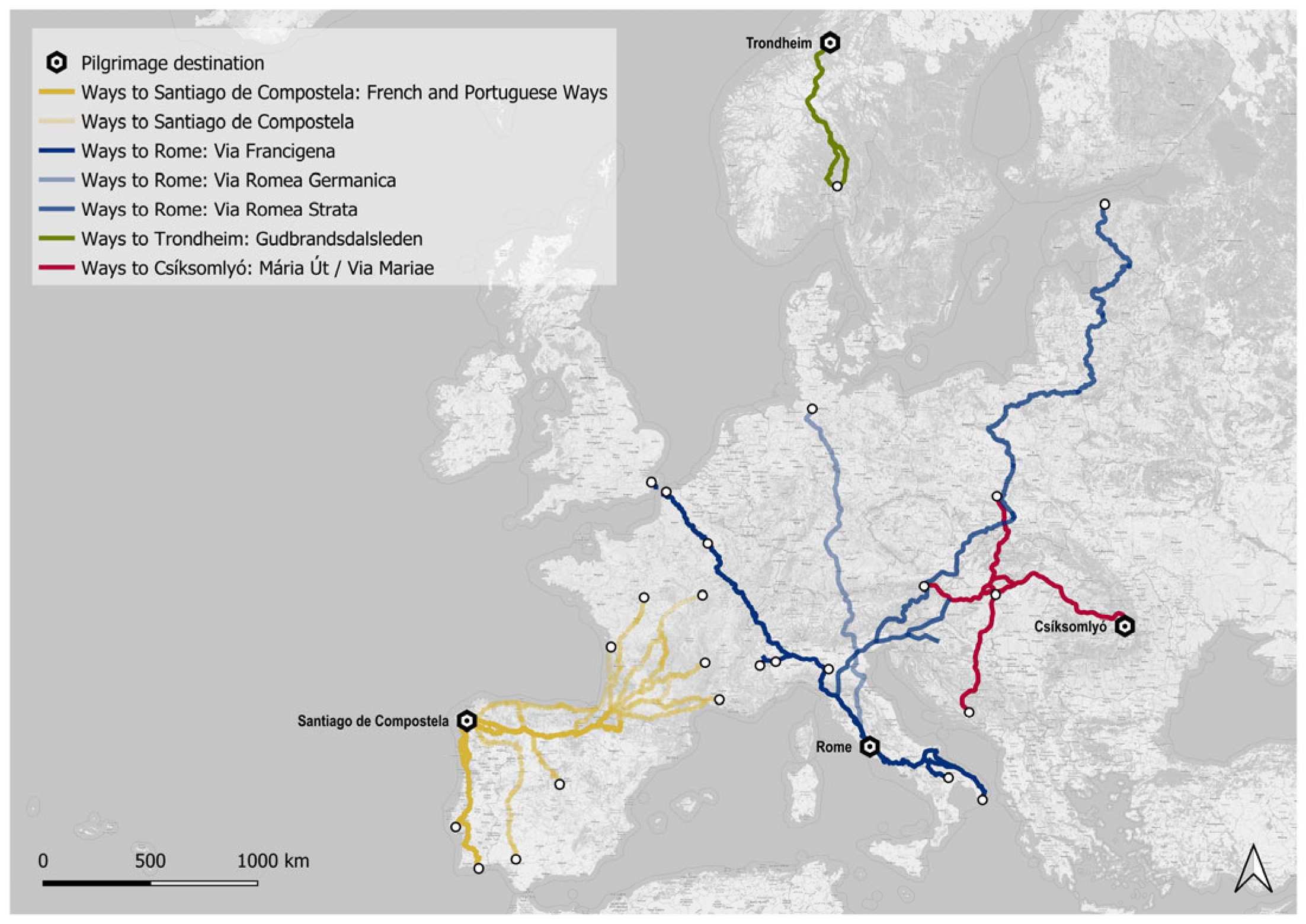
- The Way of St. James (Spain and Portugal): Focusing on segments of the French Way, the Winter Way, and the Portuguese Coastal Way in Galicia and northern Portugal. The emphasis is placed on existing infrastructure and its role in facilitating rural tourism.
- The Ways to Rome (France, Switzerland, Italy): Exploring selected segments of the Via Francigena, Via Romea Germanica, and Via Romea Strata, with a focus on thermal heritage and its historical-cultural relevance.
- The Olav Ways (Norway): Centred on routes along the western shore of Lake Mjøsa and the Gudbrandsdalen Valley. This pilot highlights ethnographic heritage and traditional practices in Norwegian rural settings.
- The Mária Út/Csíksomlyó Route (Hungary, Slovakia, Romania): Covering stretches in Eastern and Central Europe, particularly in Hungarian and Transylvanian rural areas, with a focus on natural heritage and religious-cultural integration.
- Public sector: Representatives of local or regional public administrations involved in tourism, culture, or rural development.
- Private sector: Professionals from tourism-related businesses or cultural enterprises.
- Third sector: Members of NGOs, associations, foundations, cooperatives, or civil society organizations linked to cultural or community initiatives.
- Academic and research institutions: Experts with a background in cultural heritage, tourism, or rural innovation, aligned with the project’s objectives.
- Knowledge and skill gaps among cultural and non-cultural stakeholders.
- Perceived barriers to professional development in rural tourism.
- Opportunities for innovation in heritage interpretation.
- Priorities for future research and policy design.
- Identifying thematic areas relevant to rural heritage, digital tools, tourism, education, and community participation.
- Mapping knowledge gaps and reviewing existing recommendations from literature and stakeholder input.
- Synthesizing findings into a roadmap including long-term research lines, innovation priorities, and mechanisms for stakeholder engagement.
3.2. Methodological Reflections and Limitations
4. Designing Rural Heritage Education: Needs, Audiences, and Strategies
4.1. Synthesis of Key Empirical Findings
4.2. Empirical Results: Stakeholder Needs and Perspectives
4.2.1. Tourism Management and Marketing: A Universal Priority with Differentiated Focus
4.2.2. Universal Accessibility: An Emerging Ethical and Practical Imperative
4.2.3. Digital Competencies: The Cross-Cutting Divide
4.2.4. Synthesis of Actor Perspectives
- Administrations prioritized governance, coordination, and infrastructure.
- Professionals emphasized practical skills, marketing, and daily business operations.
- Residents and Civil Society focused on cultural sustainability, identity, and social impact.
4.3. Discussion: Heritage Education as a Strategy for Empowerment and Cohesion
4.4. From Findings to Action: A Co-Designed Training Framework
5. Rethinking Rural Heritage: Towards an Innovation Agenda in the Vicinity of Pilgrimage Ways
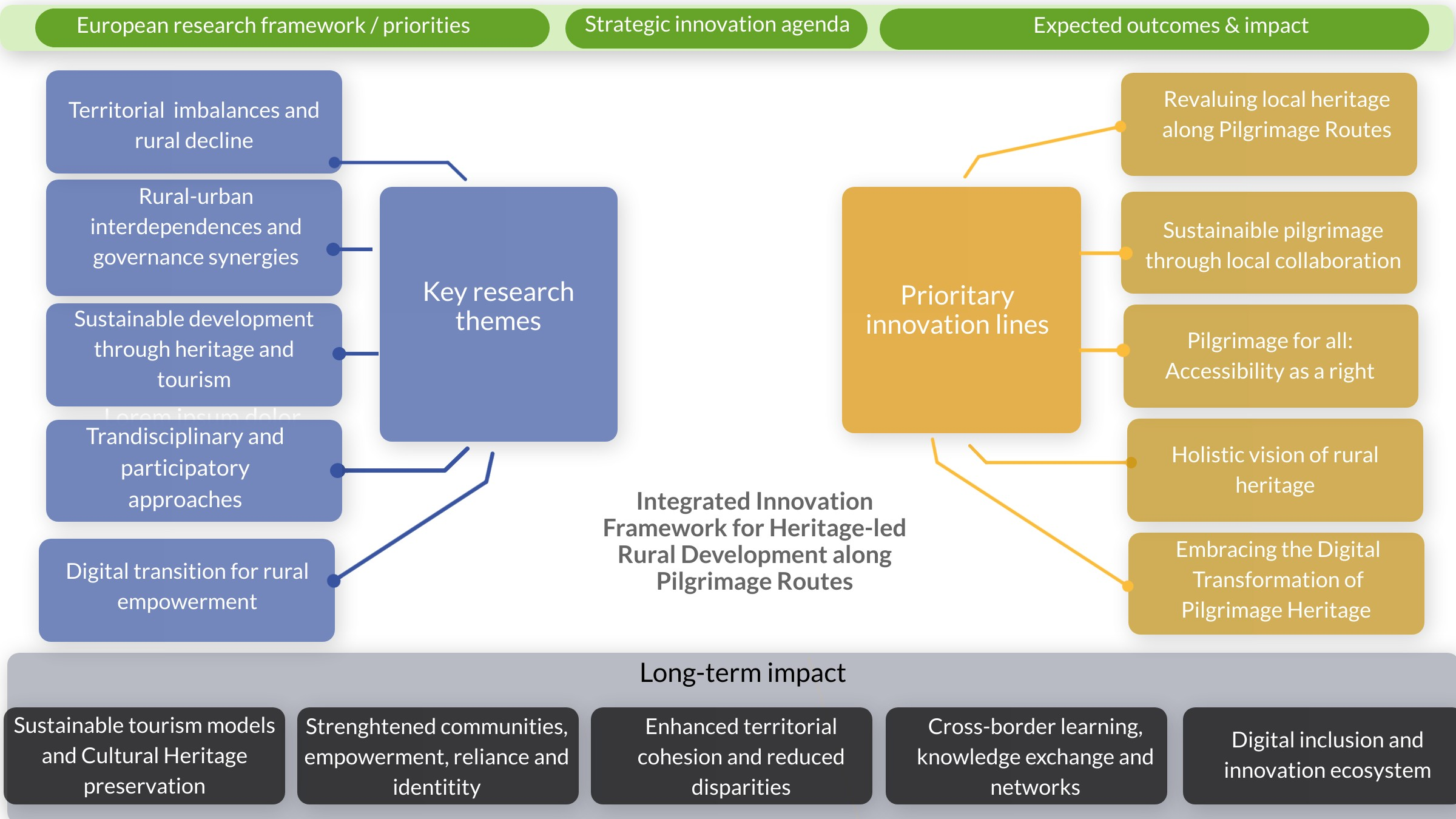
5.1. From European Priorities to Local Realities: Key Research Themes
- Developing cultural and creative tourism models to promote cooperation between rural and remote areas (HORIZON-CL2-2023-HERITAGE-01-05).
- Advancing a shared understanding of differentiated development needs across territories, encouraging knowledge exchange between regions with diverse challenges and assets.
- Territorial partnerships that foster cooperation between rural, peri-urban, and urban communities, improving wellbeing and resilience (HORIZON-CL6-2023-COMMUNITIES-01-2).
- The social and cultural connections that strengthen territorial identity and cohesion, while enabling more balanced and networked development approaches.
- Assessing how cultural tourism can contribute to economic growth in remote areas while safeguarding community values and heritage (HORIZON-CL2-2023-HERITAGE-01-05).
- Promoting inclusive and sustainable tourism models and critically evaluating current practices and their impact on territorial balance.
- Ensuring that carrying capacity is respected, and that sustainability and resilience are embedded in the planning and governance of rural destinations.
- Strengthen macro-regional and cross-border cooperation in cultural tourism.
- Encourage community participation, social inclusion, and local engagement in heritage promotion.
- Connect cultural identity, arts, and crafts with tourism innovation and citizen involvement.
- Using digital platforms to promote less-known destinations.
- Developing AI-based tools for digitising tangible heritage.
- Creating open and user-friendly ecosystems for research and collaboration.
- Enhancing circular and green innovation models, supported by stronger rural digital infrastructures.
5.2. Pilgrimage Routes and Rural Futures: Strategic Recommendations for Innovation
- 1.
- Revaluing Local Heritage along Pilgrimage Routes
- 2.
- Sustainable Pilgrimage through Local Collaboration
- 3.
- Embracing the Digital Turn in Pilgrimage Heritage
- 4.
- Cross-Border Collaboration and Mutual Learning
- 5.
- Pilgrimage for All: Accessibility as a Right
- 6.
- A Holistic Vision of Rural Heritage
6. Learning Pathways for Rural Heritage: Conclusions and Strategic Insights
Supplementary Materials
Author Contributions
Funding
Data Availability Statement
Conflicts of Interest
References
- Makuc, N. Fostering Socio-Economic Development of Rural Areas Through Cultural and Religious Tourism: Innovative Solutions for Involvement of Private Sector; Firenze University Press: Florence, Italy, 2015. [Google Scholar]
- Trono, A.; Castronuovo, V. The Via Francigena del Sud: The value of pilgrimage routes in the development of inland areas. The state of the art of two emblematic cases. Rev. Galega Econ. 2021, 30, 1–18. [Google Scholar] [CrossRef]
- Moscatelli, M. Heritage as a Driver of Sustainable Tourism Development: The Case Study of the Darb Zubaydah Hajj Pilgrimage Route. Sustainability 2024, 16, 7055. [Google Scholar] [CrossRef]
- Morales Molina, T.; Morales-Urrutia, X.; Lascano, N. Cultural and Ethnographic Routes as a Tourist Resource for Rural Development: A Theoretical Review. In Management, Tourism and Smart Technologies, ICMTT 2023; Montenegro, C., Rocha, Á., Cueva Lovelle, J.M., Eds.; Lecture Notes in Networks and Systems; Springer: Cham, Switzerland, 2024; Volume 774. [Google Scholar] [CrossRef]
- Hortelano Mínguez, L.A.; Mansvelt Beck, J. Is heritage tourism a panacea for rural decline? A comparative study of the Camino de Santiago and the Canal de Castilla in Spain. J. Herit. Tour. 2023, 18, 224–242. [Google Scholar] [CrossRef]
- Andrade Suárez, M.; López Salas, E.; Caamaño Franco, I.; Álvarez Sousa, A. Towards a methodology of good practices for heritage-led rural regeneration: From the main paths to the surrounding areas. Cities 2025, 161, 105849. [Google Scholar] [CrossRef]
- Velu, N.; Arthanari, A. Reinvigorating Rural Tourism Market Potential Through Entrepreneurial Self-efficacy and Heritage Education. J. Tour. Herit. Serv. Mark. 2024, 10, 33–46. [Google Scholar] [CrossRef]
- Silva, F.M.; Borges, I.; Arreiol, M. Universal accessibility on the Portuguese Coastal Way to Santiago in Porto Municipality. Int. J. Relig. Tour. Pilgr. 2023, 11, 96–115. [Google Scholar] [CrossRef]
- del Bosque, A.; Fernández-Arias, P.; Castro-López, P.; Nieto-Sobrino, M.; Vergara, D. Universal accessibility to cultural heritage in Spain: A bibliometric review. Buildings 2025, 15, 1563. [Google Scholar] [CrossRef]
- Silva, F.M.; Martins, A.V. The Portuguese Way to Santiago and Henrique Moreira’s public art: The impact of heritage education and universal accessibility on an itinerary through the city of Porto. In Perspectives and Trends in Education and Technology; Abreu, A., Carvalho, J.V., Mesquita, A., Pinto, A.S., Teixeira, M.M., Eds.; Lecture Notes in Networks and Systems; Springer: Cham, Switzerland, 2024; Volume 859, pp. 507–519. [Google Scholar] [CrossRef]
- Lois González, R.C.; Castro Fernández, B.M.; Lopez, L. From sacred place to monumental space: Mobility along the Way to St. James. Mobilities 2016, 11, 770–788. [Google Scholar] [CrossRef]
- Gomez-Heras, M.; González-Soutelo, S.; Castelo-Ruano, R.; García-Juan, L. The challenge of accessibility to heritage around the Via Francigena. Heritage 2023, 6, 371. [Google Scholar] [CrossRef]
- Tarhuni, S.M. Vertical accessibility for wheelchair users at historic buildings. Eurasian J. Sci. Eng. 2025, 10, 2. [Google Scholar] [CrossRef]
- Guerrero-Contreras, G.J.; Balderas-Díaz, S.; Toribio-Camuñas, S.; Rodríguez-Almendros, M.L.; Hurtado-Torres, M.V. AL-MUSACTRA: A unified digital platform for inclusive access to the cultural heritage of Andalusia. In Proceedings of the 2024 International Symposium on Computers in Education (SIIE), A Coruña, Spain, 19–21 June 2024. [Google Scholar] [CrossRef]
- Ruiz-Rodrigo, A.; Morales, E.; Lakoud, M.; Riendeau, J.; Lemay, M.; Savaria, A.; Mathieu, S.; Feillou, I.; Routhier, F. Experiencing accessibility of historical heritage places with individuals living with visible and invisible disabilities. Front. Rehabil. Sci. 2024, 5, 1379139. [Google Scholar] [CrossRef]
- de Luca, C.; López-Murcia, J.; Conticelli, E.; Santangelo, A.; Perello, M.; Tondelli, S. Participatory process for regenerating rural areas through heritage-led plans: The RURITAGE community-based methodology. Sustainability 2021, 13, 5212. [Google Scholar] [CrossRef]
- Achille, C.; Fiorillo, F. Teaching and learning of cultural heritage: Engaging education, professional training, and experimental activities. Heritage 2022, 5, 2565–2593. [Google Scholar] [CrossRef]
- European Union Council. Council of Europe Framework Convention on the Value of Cultural Heritage for Society; European Union: Brussels, Belgium, 2005. [Google Scholar]
- Gillovic, B.; McIntosh, A. Accessibility and inclusive tourism development: Current state and future agenda. Sustainability 2020, 12, 9722. [Google Scholar] [CrossRef]
- Tang, M.; Xu, H. Cultural integration and rural tourism development: A scoping literature review. Tour. Hosp. 2023, 4, 75–90. [Google Scholar] [CrossRef]
- Pardo, M.C.; Cortés García, M.C.; Silva, G. Developing Pilgrimage Tourism in Latin America: Lessons Learned from the Camino de Santiago. Int. J. Relig. Tour. Pilgr. 2023, 11, 5. [Google Scholar] [CrossRef]
- Moscarelli, R.; Lopez, L.; Lois González, R.C. Who is interested in developing the way of Saint James? The pilgrimage from faith to tourism. Religions 2020, 11, 24. [Google Scholar] [CrossRef]
- Romanelli, M.; Gazzola, P.; Grechi, D.; Pollice, F. Towards a sustainability oriented religious tourism. Syst. Res. Behav. Sci. 2021, 38, 386–396. [Google Scholar] [CrossRef]
- Bambi, G.; Iacobelli, S.; Rossi, G.; Pellegrini, P.; Barbari, M. Rural tourism to promote territories along the ancient roads of communication: Case study of the rediscovery of the St. Francis’s ways between Florence and La Verna. Eur. Countrys. 2019, 11, 462–474. [Google Scholar] [CrossRef]
- García-Delgado, F.J.; Martínez-Puche, A.; Lois-González, R.C. Heritage, tourism and local development in peripheral rural spaces: Mértola (Baixo Alentejo, Portugal). Sustainability 2020, 12, 9157. [Google Scholar] [CrossRef]
- Juárez Sánchez, J.P.; Ramírez Valverde, B.; Mota Vargas, J.A. ¿Las peregrinaciones rurales impulsan el desarrollo local? Análisis en San Miguel del Milagro, Tlaxcala, México. El Periplo Sustentable 2017, 33, 428–451. [Google Scholar]
- Toker, B.; Rezapouraghdam, H. Intangible cultural heritage and management of educational tourism: An experiential learning approach. In Handbook of Research on Human Capital and People Management in the Tourism Industry; IGI Global: Hershey, PA, USA, 2021; pp. 199–216. [Google Scholar]
- Popov, B.; Stytsyuk, R.; Motagali, Y.; Artemyeva, O. Conceptual aspects of the development of cultural and educational tour-ism on the basis of an object of cultural and historical heritage. In Proceedings of the 2nd International Conference on Contemporary Education, Social Sciences and Ecological Studies (CESSES 2019); Atlantis Press: Paris, France, 2019; pp. 833–837. [Google Scholar]
- Andrade, I.B.; Serrano, C.L.; Encalada, A.R. Educational tourism and cultural heritage: An analysis from two high schools in an Ecuadorian province. In Proceedings of INTED2020; IATED: Valencia, Spain, 2020; pp. 281–288. [Google Scholar]
- Darmayanti, P.W.; Oka, I.M.D.; Sumadi, K. Cultural Heritage as the Base for the Development of Educational Tourism in Biaung Village, Penebel, Tabanan. Pariwisata Budaya J. Ilm. Agama Dan Budaya 2022, 7, 175–185. [Google Scholar] [CrossRef]
- Abos, I.A. The Importance of Educational Tourism in Cultural Heritage Preservation and Sustainable Tourism. Case Study of the Mureș Valley’s Cultural Heritage: Five Castles, Five Stories. Res. Educ. 2023, 8, 7. [Google Scholar] [CrossRef]
- Braun, V.; Clarke, V. Using thematic analysis in psychology. Qual. Res. Psychol. 2006, 2, 77–101. [Google Scholar] [CrossRef]
- Rosser, P.; Soler, S. In the footsteps of tradition: Reinventing the paths of Santa Faz within the paradigm of sustainability and territorial development in Alicante. Religions 2025, 16, 224. [Google Scholar] [CrossRef]
- Balestrieri, M.; Congiu, T. Rediscovering rural territories by means of religious route planning. Sustainability 2017, 9, 363. [Google Scholar] [CrossRef]


| Pilot Area | Public Sector | Private Sector | Third Sector | Academic/Research | Total |
|---|---|---|---|---|---|
| Santiago de Compostela (ES, PT) | 1: Tourism technician, regional gov. | 1: Rural accommodation manager | 1: Camino association leader | 1: University professor (Heritage Studies) | 4 |
| Rome routes (FR, CH, IT) | 1: Regional cultural officer | 1: Spa operator | 1: Local NGO (thermal heritage) | 1: Academic (Religious tourism) | 4 |
| Trondheim (NO) | 1: Cultural heritage planner | 1: Craft business owner | 1: Pilgrim center coordinator | 1: Researcher (Ethnography) | 4 |
| Csíksomlyó/Mária Út (HU, RO, SK) | 1: Local development agency | 1: Ecotourism entrepreneur | 1: Religious foundation rep. | 1: Heritage researcher | 4 |
| Total | 4 | 4 | 4 | 4 | 16 |
| Illustrative Data Insight (Anonymized) | Initial Code | Analytical Category | Final Theme |
|---|---|---|---|
| “Many visitors ask about the local history, but we lack a structured narrative to share.” | Unprepared heritage interpretation | Heritage Knowledge and Storytelling | Designing Heritage-Based Experiences |
| “Our family business is not visible online compared to operators in larger towns.” | Low digital visibility and marketing gap | Marketing and Online Presence | Designing Heritage-Based Experiences |
| “The historic path has steps and is impossible for a wheelchair.” | Physical barriers at site | Physical Barriers | Making Heritage Accessible to All |
| “We wouldn’t know how to adapt a tour for someone with a learning disability.” | Lack of cognitive accessibility know-how | Inclusive Communication and Design | Making Heritage Accessible to All |
| “I’ve heard of geolocation apps but don’t know how to use them to promote our site.” | Unfamiliarity with geotechnologies | Digital Tool Literacy | Using Digital Tools to Tell and Share Heritage |
| “We record visitor numbers on paper; a digital system would help us understand our impact.” | Analog and non-strategic data management | Data Management and Digital Strategy | Using Digital Tools to Tell and Share Heritage |
| MODULE TITLE | Discovering Your Cultural Heritage |
|---|---|
| INTRODUCTION | According to the importance of a better knowledge of local heritage to be protected by those closest inhabitants who live in direct contact with these resources, it would be necessary to show and publicize their singularities in relation to other sites, as well as emphasize other type of heritage (intangible, for example) that is at risk of disappearing and that can explain their singularities and many of the elements present in each territory. Of course, it is important to stress the need to use rigorous and appropriate historical and descriptive content, respecting tradition but providing responsible and coherent information with the help and advice of specialists. To this goal, it will be necessary to provide the necessary tools to understand and value the heritage of each area, and to provide new options for its preservation in a circular economy, where the protection and enjoyment of the territory can be properly managed. Likewise, this proposed program would also allow to know the doubts and problems encountered by the neighbours regarding the knowledge and protection of their heritage, as well as the search for consensual solutions for each problem and to advise those who may need it. |
| KEY AUDIENCE | Municipalities, associations, customers, local vendors and inhabitants and tourist offices |
| OBJECTIVES |
|
| THEMATIC CONTENTS (SHORT DESCRIPTION) |
|
| INSTRUMENTS (WEBINAR, WORKSHOP, CONFERENCE, SEMINAR, ONLINE COURSE, ETC.) |
|
| TIMING OF LEARNING ACTIVITIES |
|
| MODULE TITLE | Discovering Your Natural Heritage |
|---|---|
| INTRODUCTION | The aim of this module is training in general concepts of biodiversity and geodiversity to understand the value of natural heritage. Communicate to local stakeholders how their natural heritage is perceived from a global perspective and discern what aspects of natural heritage are valuable for locals in comparison to heritage protection figures and what specialist groups and tourists consider valuable. From this starting point, the module will reflect on how the aspects of natural heritage may be a vehicle for local economic development. The peculiarities of natural heritage should be stressed; particularly, risks and vulnerabilities need to be identified to make way to a sustainable exploitation of this natural heritage. Finally, the importance of the integration of natural and cultural heritage protection should be underlined. |
| KEY AUDIENCE | Municipalities, local associations, visitors, local vendors. |
| OBJECTIVES |
|
| THEMATIC CONTENTS (SHORT DESCRIPTION) | Digital tools to georeferenced some interesting sites Adequate and rigorous explanation and information about this natural heritage, including cultural heritage linked to it. |
| INSTRUMENTS (WEBINAR, WORKSHOP, CONFERENCE, SEMINAR, ONLINE COURSE, ETC.) |
|
| TIMING OF LEARNING ACTIVITIES |
|
| MODULE TITLE | HERITAGE FOR EVERYTHING AND EVERYONE |
|---|---|
| INTRODUCTION | Both cultural and natural heritage needs to be, as much as possible, ambulatory, cognitively and sensorially accessible. Reaching an inclusive and accessible environment needs to go through the global awareness of the local population that an adaptation for an individual benefits the whole society. It is also relevant to reflect on how accessible tourism is a large market, as it includes not only people with permanent disabilities, but people individuals with temporary “disabilities” or elderly people. While ambulatory accessibility may be difficult and costly to reach, many materials and measures to achieve cognitive and sensory accessibility can be produced with relatively low cost. In any case, any adaptation targeted to a specific public should be designed together with end-users and/or educators to avoid the risk of not addressing the real needs of a diverse public. |
| KEY AUDIENCE | Municipalities, associations, tourism service providers, public |
| OBJECTIVES |
|
| THEMATIC CONTENTS (SHORT DESCRIPTION) |
|
| INSTRUMENTS (WEBINAR, WORKSHOP, CONFERENCE, SEMINAR, ONLINE COURSE, ETC.) |
|
| TIMING OF LEARNING ACTIVITIES |
| MODULE TITLE | Capturing Reality Through Geotechnologies |
|---|---|
| INTRODUCTION | This program aims to bring easy-to-use tools that allow capturing geographic information and managing it spatially. Google is undoubtedly one of the most widespread tools in the world. Less known is another of its applications, Google My Maps, which would allow collaborative and permanent data collection to gather existing resources, creating a gallery of available, updated and expandable information. |
| KEY AUDIENCE | Municipalities, associations, local vendors, inhabitants |
| OBJECTIVES |
|
| THEMATIC CONTENTS (SHORT DESCRIPTION) |
|
| INSTRUMENTS (WEBINAR, WORKSHOP, CONFERENCE, SEMINAR, ONLINE COURSE, ETC.) |
|
| TIMING OF LEARNING ACTIVITIES |
|
| Target Group | Identified Need | Training Proposal | Expected Outcome |
|---|---|---|---|
| Local and Regional Administrations | Improve territorial coordination, digital visibility, and accessibility strategies. | Workshops on digital platform management, accessibility planning, and intermunicipal governance. | More effective and inclusive public governance of pilgrimage-related heritage assets. |
| Rural Tourism and Heritage Professionals | Enhance marketing skills, digital literacy, and heritage awareness. | Modules on sustainable tourism storytelling, experience co-creation, and geodata tools. | Increased visitor engagement, improved service quality, and stronger market positioning. |
| Local Communities and Residents | Promote participation, oral history preservation, and inclusive interpretation. | Community labs for narrative co-creation, heritage stewardship, and designing inclusive signage. | Empowered citizens, stronger local identity, enhanced social cohesion, and safeguarded intangible heritage. |
Disclaimer/Publisher’s Note: The statements, opinions and data contained in all publications are solely those of the individual author(s) and contributor(s) and not of MDPI and/or the editor(s). MDPI and/or the editor(s) disclaim responsibility for any injury to people or property resulting from any ideas, methods, instructions or products referred to in the content. |
© 2026 by the authors. Licensee MDPI, Basel, Switzerland. This article is an open access article distributed under the terms and conditions of the Creative Commons Attribution (CC BY) license.
Share and Cite
Andrade-Suárez, M.; González-Soutelo, S.; García-Juan, L.; Gomez-Heras, M.; López-Salas, E. Learning with Surrounding Heritage: Education, Innovation and Rural Empowerment Along European Pilgrimage Routes. Heritage 2026, 9, 55. https://doi.org/10.3390/heritage9020055
Andrade-Suárez M, González-Soutelo S, García-Juan L, Gomez-Heras M, López-Salas E. Learning with Surrounding Heritage: Education, Innovation and Rural Empowerment Along European Pilgrimage Routes. Heritage. 2026; 9(2):55. https://doi.org/10.3390/heritage9020055
Chicago/Turabian StyleAndrade-Suárez, María, Silvia González-Soutelo, Laura García-Juan, Miguel Gomez-Heras, and Estefanía López-Salas. 2026. "Learning with Surrounding Heritage: Education, Innovation and Rural Empowerment Along European Pilgrimage Routes" Heritage 9, no. 2: 55. https://doi.org/10.3390/heritage9020055
APA StyleAndrade-Suárez, M., González-Soutelo, S., García-Juan, L., Gomez-Heras, M., & López-Salas, E. (2026). Learning with Surrounding Heritage: Education, Innovation and Rural Empowerment Along European Pilgrimage Routes. Heritage, 9(2), 55. https://doi.org/10.3390/heritage9020055