
Article

Prevalence and Factors Associated with Hygiene Behaviours among In-School Adolescents in Ghana
1
Department of Population and Health, University of Cape Coast, Cape Coast PMB TF0494, Ghana
2
College of Public Health, Medical and Veterinary Sciences, James Cook University, Townsville, QLD 4811, Australia
3
Department of Estate Management, Takoradi Technical University, Takoradi P.O. Box 256, Ghana
4
Department of Population and Behavioural Sciences, School of Public Health, University of Health and Allied Sciences, Hohoe PMB 31, Ghana
5
Department of Health, Physical Education, and Recreation, University of Cape Coast, Cape Coast PMB T40494, Ghana
6
Neurocognition and Action-Biomechanics-Research Group, Faculty of Psychology and Sport Sciences, Bielefeld University, Postfach 10 10 31, 33501 Bielefeld, Germany
7
Department of English, University of Cape Coast, Cape Coast PMB T40494, Ghana
8
Department of Education and Psychology Studies, University of Cape Coast, Cape Coast PMB T40494, Ghana
9
School of Agriculture, University of Cape Coast, Cape Coast PMB T40494, Ghana
10
School of Public Health, Faculty of Health, University of Technology Sydney, Sydney, NSW 2007, Australia
*
Author to whom correspondence should be addressed.
J 2021, 4(2), 169-181; https://doi.org/10.3390/j4020014
Submission received: 16 May 2021 / Revised: 29 May 2021 / Accepted: 31 May 2021 / Published: 7 June 2021
(This article belongs to the Section Public Health & Healthcare)

Abstract

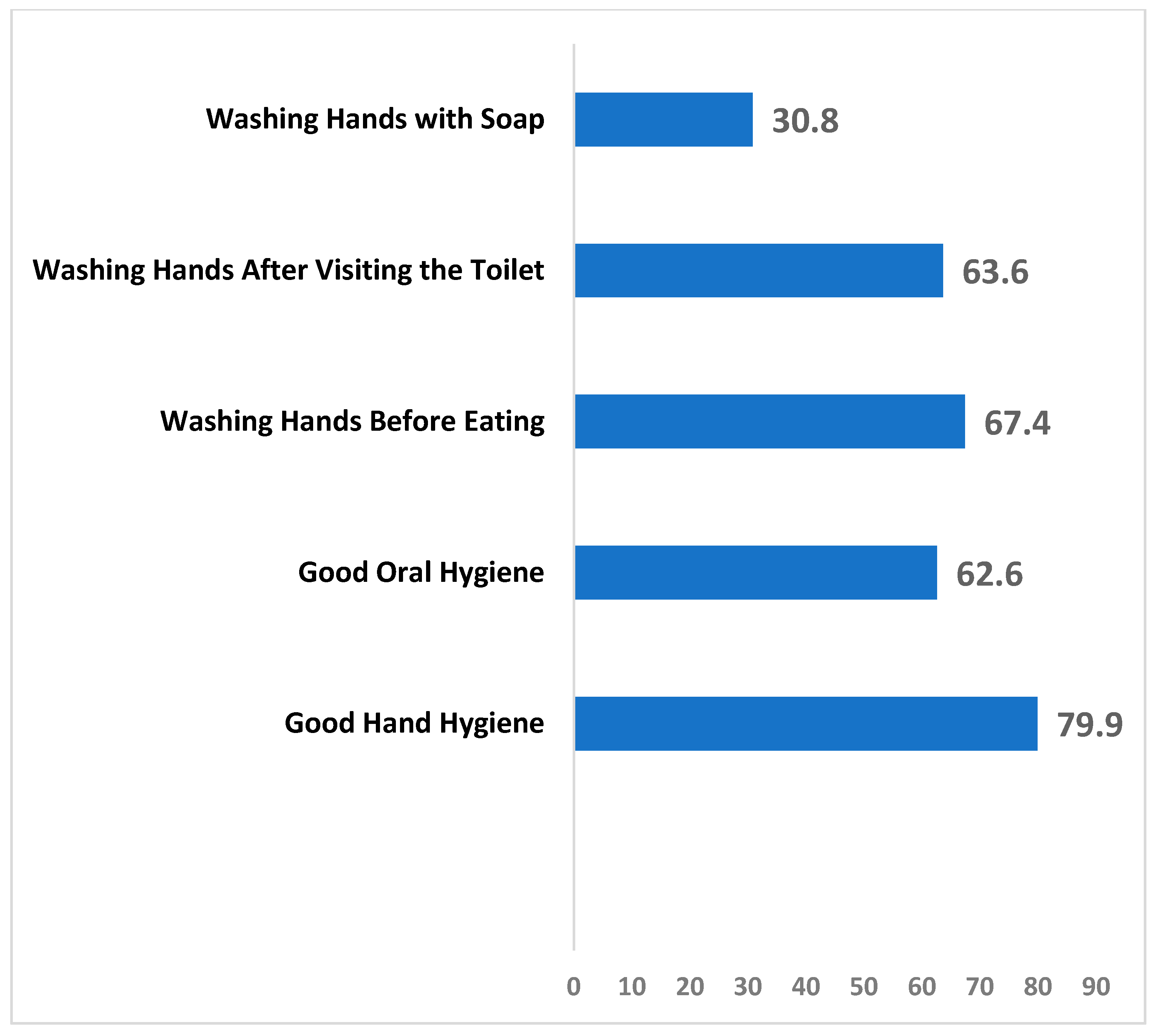
(1) Background: Despite a global call to act to resolve communicable diseases caused by lack of clean water, sanitation, and hygiene, many people in low- and middle-income countries continue to die each year. In this study, we looked at in-school adolescents’ oral and hand hygiene activities in Ghana, as well as the factors that influence them. (2) Methods: This was a cross-sectional study that utilised data on 1348 in-school adolescents from the 2012 global school-based health survey. Using Stata software version 14.2, descriptive and inferential statistics were used to analyze the data. All statistical analyses were considered significant at p-value < 0.05. (3) Results: The prevalence of good hygiene behaviour was 62.6% and 79.9% for good oral hygiene and good hand hygiene, respectively. In-school adolescents who were truant were 31% (AOR = 0.69, 95% CI = 0.51–0.92) and 28% (AOR = 0.72, 95% CI = 0.54–0.87), respectively, less likely to practise good hand and oral hygiene compared to those who were not. Adolescents whose parents supervised their homework, however, had higher probabilities of practising good hand (AOR = 2.30, 95% CI = 1.64–2.31) and oral (AOR = 2.34, 95% CI = 1.80–3.04) hygiene respectively. Adolescents aged 18 years and above were 1.33 times more likely to practice good oral hygiene than younger adolescents (AOR=1.33, 95% CI = 1.07–1.66). Adolescents who were bullied had lower odds of practicing good hand hygiene (AOR = 0.70, 95% CI = 0.52–0.94). (4) Conclusions: While good hygiene behaviour remains a major strategy in decreasing the prevalence of communicable diseases, the less than 65% prevalence of hand hygiene we observed in the current study is indicative of the country’s inability to achieve water, hygiene and sanitation for all by the year 2030. To accelerate progress towards meeting the Sustainable Development Goal 6.2, there is a need for the implementation of innovative interventions which seek to promote good hygiene behaviours among adolescents and the expansion of existing interventions, such as the WASH initiative, in schools. Such interventions should focus more on younger adolescents, those who are truant, and adolescents who suffer from bullying in school.
Keywords: hand hygiene; hygiene behaviours; in-school adolescents; Ghana; oral hygiene hand hygiene; hygiene behaviours; in-school adolescents; Ghana; oral hygiene