1. Introduction
Ensuring access to safe drinking water while minimizing environmental impacts, energy consumption, and chemical dependency has become a central challenge of sustainable water management. Despite significant advances in treatment technologies, millions of people worldwide still lack access to safely managed drinking water services, particularly in rural communities, decentralized systems, and low-resource regions [
1,
2]. Consequently, water treatment is increasingly evaluated not only in terms of contaminant removal but also regarding sustainability, resource efficiency, and public health protection. Recent studies have emphasized the need for treatment technologies capable of simultaneously addressing these dimensions through integrated water–environment–health approaches [
3]. In this context, low-cost, low-energy, and environmentally responsible treatment systems can contribute directly to Sustainable Development Goal 6 (Clean Water and Sanitation).
Conventional water treatment relies heavily on centralized infrastructure and chemical-intensive processes. Although highly effective, these systems often require substantial energy inputs, continuous chemical supply chains, and significant infrastructure investments [
4,
5]. Such requirements may limit their applicability in decentralized or resource-constrained settings, motivating the development of sustainable and resilient treatment alternatives [
6,
7].
Coagulation–flocculation remains one of the most widely applied processes for turbidity reduction and suspended particle removal. Conventional coagulants, particularly aluminum sulfate, are extensively used because of their high efficiency. However, concerns related to sludge generation, residual metal concentrations, and chemical consumption have encouraged the search for more sustainable alternatives [
8,
9]. Among these alternatives, natural coagulants have attracted considerable attention due to their renewable origin, biodegradability, local availability, and lower environmental impacts. In addition, they may reduce operational costs, making them particularly attractive for decentralized treatment applications [
8,
10,
11]. Recent reviews have highlighted the growing potential of plant-based coagulants to achieve clarification efficiencies comparable to those of conventional chemical coagulants [
12,
13]. Nevertheless, clarification efficiency alone does not provide a comprehensive assessment of the sustainability of natural coagulants. Besides treatment performance, downstream sludge management should also be considered, since sludge characteristics directly influence dewatering, handling, disposal, and potential resource recovery. Recent studies have shown that sludge generated by plant-based coagulants may exhibit physicochemical characteristics different from those produced by conventional metal-based coagulants, although these characteristics remain strongly dependent on sludge composition and operating conditions [
14,
15]. In addition, comprehensive sustainability assessments should consider complementary water quality parameters, such as pH stability and residual organic matter, which may influence the overall applicability of natural coagulants. Consequently, further investigations are still required to better understand sludge management, complementary water quality parameters, and their implications for the large-scale implementation of natural coagulants [
16,
17].
Among the most investigated natural materials,
Moringa oleifera has demonstrated remarkable coagulation performance due to the presence of water-soluble cationic proteins capable of destabilizing colloidal particles [
14,
15]. More recently,
Aloe vera has emerged as a promising alternative because of its polysaccharide-rich composition and bioflocculation potential, showing encouraging results in water clarification studies [
18].
Besides coagulant selection, hydraulic conditions strongly influence flocculation performance. Effective floc formation depends not only on particle destabilization mechanisms but also on the hydraulic environment available for particle collisions, aggregation, and floc growth [
19,
20]. Consequently, low-energy hydraulic flocculation technologies have received increasing attention as sustainable treatment alternatives.
Helically coiled tube flocculators (HCTFs) represent one such alternative. These systems utilize the hydraulic energy of the flowing water itself to promote coagulation and flocculation, eliminating the need for mechanical mixing equipment. Their compact geometry, operational simplicity, low maintenance requirements, and reduced energy demand make them attractive for decentralized treatment applications [
21,
22]. Furthermore, secondary flows and Dean vortices generated by the curved geometry enhance radial mixing and particle interactions, promoting floc development even under laminar flow conditions [
23]. Previous studies have demonstrated the capacity of HCTFs to achieve high clarification efficiencies while maintaining simple operational conditions [
21,
23].
Among the variables affecting HCTF performance, hydraulic retention time (HRT) is particularly important because it directly influences particle interaction time, aggregation kinetics, and floc stability [
24]. In these systems, reactor length directly determines HRT and therefore represents a critical design parameter [
23].
Although significant advances have been achieved in both natural coagulants and HCTFs, most investigations involving plant-based coagulants remain limited to conventional jar-test experiments. Comparatively fewer studies have evaluated their performance under continuous-flow hydraulic conditions, where hydrodynamic effects become critical. More importantly, despite the growing interest in natural coagulants and low-energy flocculation technologies, the interaction between coagulation mechanisms and hydraulic conditions remains poorly understood.
Recent reviews have shown that natural coagulants may act through multiple physicochemical pathways, including charge neutralization, adsorption, polymer bridging, and bioflocculation, depending on their biochemical composition and extraction method [
8,
12,
13,
25]. In contrast, aluminum-based coagulants predominantly operate through charge neutralization and sweep coagulation. Because these mechanisms differ in their requirements for particle contact, aggregation kinetics, and floc development, it cannot be assumed that they respond similarly to changes in HRT. Understanding how coagulation mechanisms influence sensitivity to hydraulic conditions is essential for the rational design and optimization of sustainable continuous-flow treatment systems.
From a practical perspective, such knowledge is particularly relevant for decentralized and low-energy treatment technologies, where HRT is often a key design parameter. From a scientific perspective, elucidating the relationship between coagulation mechanisms and hydraulic performance may contribute to establishing broader design principles applicable to different classes of natural and chemical coagulants.
Among natural coagulants,
Moringa oleifera and
Aloe vera were selected because the literature reports different dominant coagulation pathways associated with their active compounds, including protein-mediated charge neutralization, adsorption, polymer bridging, and bioflocculation processes [
8,
12]. Accordingly, it was hypothesized that coagulants governed predominantly by polymer bridging and bioflocculation mechanisms would exhibit greater sensitivity to HRT than coagulants acting primarily through charge neutralization.
Therefore, this study investigates how HRT influences the clarification performance of coagulants operating through different coagulation mechanisms, represented by aluminum sulfate, Moringa oleifera, and Aloe vera, in continuous-flow HCTF. By comparing coagulants characterized by charge neutralization, polymer bridging, and bioflocculation pathways under controlled hydraulic conditions, this work seeks not only to evaluate treatment performance but also to advance the understanding of how coagulation mechanisms interact with HRT in sustainable flocculation systems. The novelty of this study lies not only in the systematic comparison of natural and chemical coagulants under identical continuous-flow hydraulic conditions using HCTFs, but also in demonstrating that the influence of HRT depends on the dominant coagulation mechanism. This mechanistic perspective provides a rational basis for selecting HRT during reactor design rather than relying solely on empirical optimization.
2. Materials and Methods
This study was designed to investigate how HRT influences the clarification performance of coagulants characterized by different dominant coagulation mechanisms under continuous-flow conditions. Experiments were conducted using an HCTF operating at a constant flow rate while HRT was varied through changes in reactor length. Aluminum sulfate, Moringa oleifera, and Aloe vera were selected as representative coagulants due to their distinct coagulation pathways reported in the literature. Clarification performance was assessed based on residual turbidity and turbidity removal efficiency under controlled experimental conditions.
2.1. Experimental Design
The experimental design was structured to isolate the influence of HRT on clarification performance under continuous-flow conditions. HRT variation was achieved exclusively through modifications in reactor length, while the operational flow rate remained constant throughout all experiments. By maintaining constant flow rate, tube diameter, coiling diameter, sedimentation conditions, and coagulant dosage, reactor length was the only operational parameter intentionally varied. This approach minimized simultaneous changes in hydraulic loading and shear conditions, allowing the direct evaluation of HRT effects on coagulation and flocculation performance.
The study was designed to compare coagulants characterized by different dominant coagulation mechanisms under identical hydraulic conditions. Aluminum sulfate was evaluated as a conventional chemical coagulant, whereas
Moringa oleifera and
Aloe vera were investigated as natural coagulants associated with different dominant coagulation pathways reported in the literature. This experimental framework enabled the assessment of how coagulants governed by different coagulation mechanisms respond to variations in HRT.
Table 1 summarizes the evaluated experimental conditions.
2.2. Continuous-Flow Clarification System
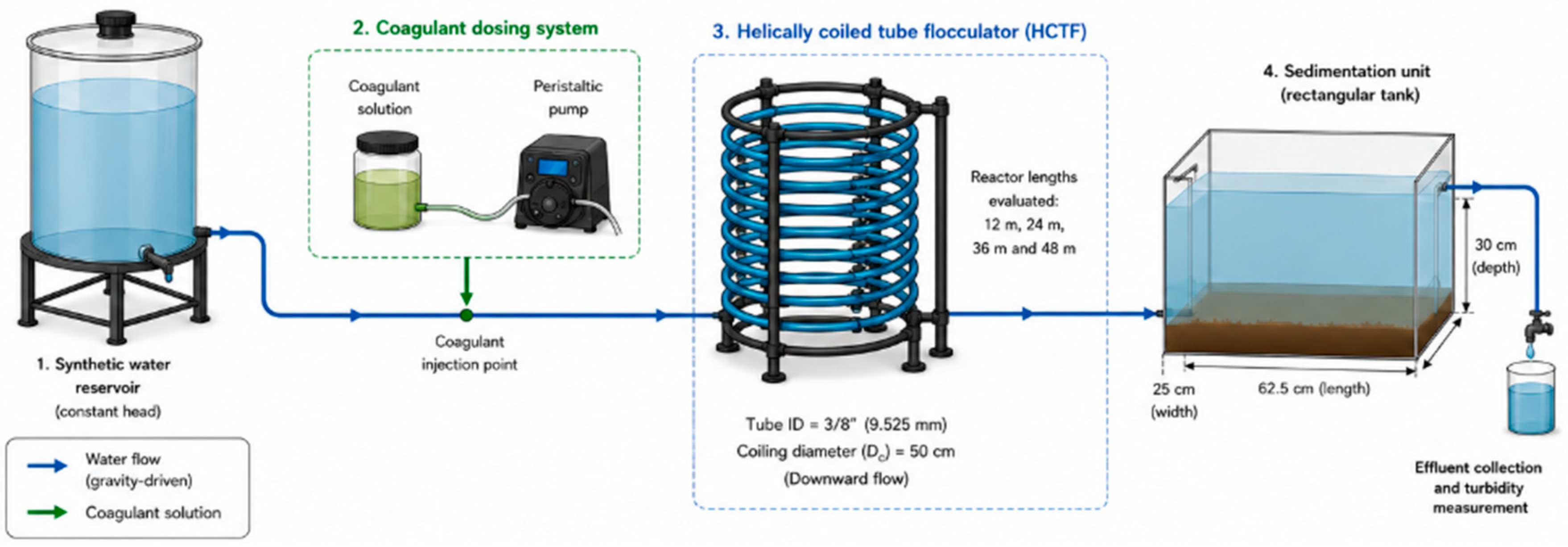
The experimental setup consisted of a continuous-flow clarification system comprising a synthetic water reservoir, a coagulant dosing unit, a HCTF, and a sedimentation unit, as shown in
Figure 1.
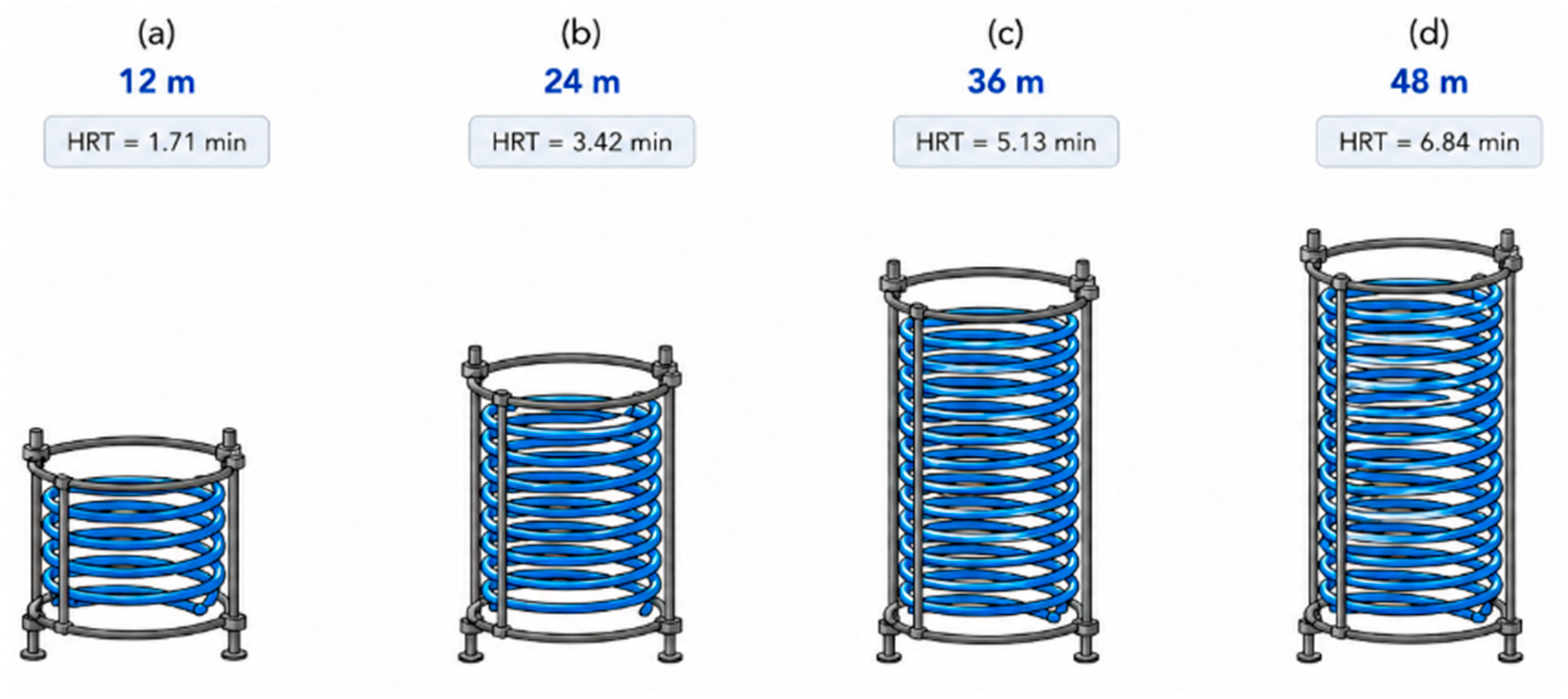
The HCTF was constructed using flexible tubing with an internal diameter of 3/8″ (9.525 mm), helically wrapped around a cylindrical support structure with a constant coiling diameter of 50 cm. Four reactor lengths were experimentally evaluated: 12, 24, 36, and 48 m (
Figure 2), while the system operated under downward-flow conditions at a constant flow rate of 0.5 L/min. To isolate the influence of HRT, the tube diameter, coiling diameter, operational flow rate, and sedimentation conditions were maintained constant throughout all experiments, while reactor length was systematically varied according to the experimental design.
2.3. Hydraulic Conditions
The HCTF system operated under gravity-fed conditions, with water supplied from an elevated storage tank. The water flow rate was maintained at 0.5 L min−1 throughout all experiments using a control valve and was continuously monitored with a flow meter. Coagulant was continuously injected into the water stream at the inlet of the HCTF using a metering pump (OFA 100D, OFA Ambiental, São Paulo, Brazil). No separate rapid-mixing unit was employed; initial mixing was promoted by the hydraulic conditions at the reactor inlet before flocculation within the HCTF.
The hydraulic behavior of HCTF was characterized in terms of HRT, Reynolds number (Re), and Dean number (De). Since the water flow rate, tube diameter, and coiling diameter were maintained constant throughout the experiments, the different HRT values were obtained exclusively by varying the reactor length.
The HRT was calculated as the ratio between reactor volume and operational flow rate according to Equation (1):
where
HRT is the hydraulic retention time (min);
is the internal reactor volume (L);
is the volumetric flow rate (L/min).
The internal reactor volume was determined using Equation (2):
where
Under the adopted operating conditions, the calculated HRT values were 1.71, 3.42, 5.13, and 6.84 min for reactor lengths of 12, 24, 36, and 48 m, respectively. The mean flow velocity inside the tube was 0.117 m s−1. Considering water properties at room temperature, with a density of 998.2 kg m−3 and a dynamic viscosity of 0.001003 Pa·s, the Reynolds number was approximately 1109, indicating laminar flow conditions according to the conventional classification for pipe flow.
To account for the influence of tube curvature on flow behavior, the Dean number was calculated according to Equation (3):
where
is the Dean number;
is the Reynolds number;
is the internal tube diameter (m);
is the coil diameter (m).
The calculated Dean number was approximately 153, indicating that curvature-induced secondary flows were expected to develop within the HCTF despite the laminar Reynolds number. These secondary flows are known to enhance radial mixing and particle interactions, thereby contributing to coagulation and flocculation processes in helically coiled reactors [
20,
21,
22,
23].
2.4. Sedimentation Unit
The treated water exiting the HCTF was continuously directed to a rectangular sedimentation unit for gravitational solid–liquid separation. The sedimentation unit operated under the same flow rate as the HCTF (0.5 L min−1), without any flow reduction prior to sedimentation. The unit had a useful volume of 46.875 L and a surface area of 0.156 m2. Under these operating conditions, the corresponding hydraulic detention time and surface overflow rate were 93.75 min and 0.192 m h−1, respectively. These hydraulic design parameters provided quiescent conditions favorable for gravitational settling of the formed flocs prior to turbidity analysis.
2.5. Preparation of Synthetic Water
Synthetic turbid water was prepared using natural sodium bentonite dispersed in tap water to provide reproducible turbidity conditions. Bentonite was selected because it is predominantly composed of montmorillonite and forms stable colloidal suspensions commonly employed in water treatment studies. The target initial turbidity for all experiments was approximately 100 NTU. The use of synthetic water ensured controlled and reproducible experimental conditions, allowing the influence of HRT and coagulant type to be evaluated independently of variations in raw water quality.
To prepare the synthetic water, 0.496 g of natural sodium bentonite was dispersed in 2 L of tap water, producing an initial turbidity of approximately 100 NTU. The suspension was mixed at 500 rpm for 30 min to ensure homogeneous particle dispersion and subsequently stored in sealed containers for at least 24 h to allow particle stabilization.
Before each experimental run, the suspension was transferred to the feed reservoir of the continuous-flow system and continuously re-homogenized using a mechanical stirrer to prevent particle settling and maintain a uniform turbidity at the HCTF inlet throughout the experiments.
The initial turbidity was measured using a calibrated turbidimeter and used as the reference value for calculating turbidity removal efficiency. All experiments were conducted at room temperature. The pH was monitored throughout the experimental campaign, and no significant differences were observed among the evaluated coagulants or after coagulation. Parameters such as COD-Mn, total dissolved solids (TDS), and hardness (Ca2+ + Mg2+) were not determined, as the objective of this study was to evaluate coagulation performance under controlled laboratory conditions using synthetic water with standardized turbidity.
2.6. Coagulant Preparation and Dosage Selection
Three coagulants were evaluated in this study: aluminum sulfate, Moringa oleifera, and Aloe vera. The preparation procedures adopted for each coagulant and the rationale for their selection are described in the following sections.
2.6.1. Aluminum Sulfate
Aluminum sulfate (ACS Científica, São Paulo, Brazil) was used as the reference chemical coagulant. The aluminum sulfate dosage adopted in this study corresponded to 0.498 g of aluminum sulfate and 0.100 g of sodium hydroxide per 2-L beaker, equivalent to dosages of 249 and 50 mg L−1, respectively. This dosage was selected based on preliminary jar-test experiments. Sodium hydroxide (ACS Científica, São Paulo, Brazil) was added to adjust the pH prior to the coagulation experiments. For the continuous-flow experiments, an aqueous aluminum sulfate dosing solution was prepared immediately before the experiments and continuously injected into the hydraulic system at a flow rate of 12 mL min−1 using the metering pump. The concentration of the dosing solution was adjusted to reproduce the aluminum sulfate and sodium hydroxide dosages established during the preliminary jar-test experiments. Aluminum sulfate was selected because it is one of the most widely used chemical coagulants in conventional drinking water treatment, serving as a benchmark for comparison with the investigated natural coagulants.
2.6.2. Moringa oleifera
Mature
Moringa oleifera seeds were purchased from Arbocenter, São Paulo, Brazil. The
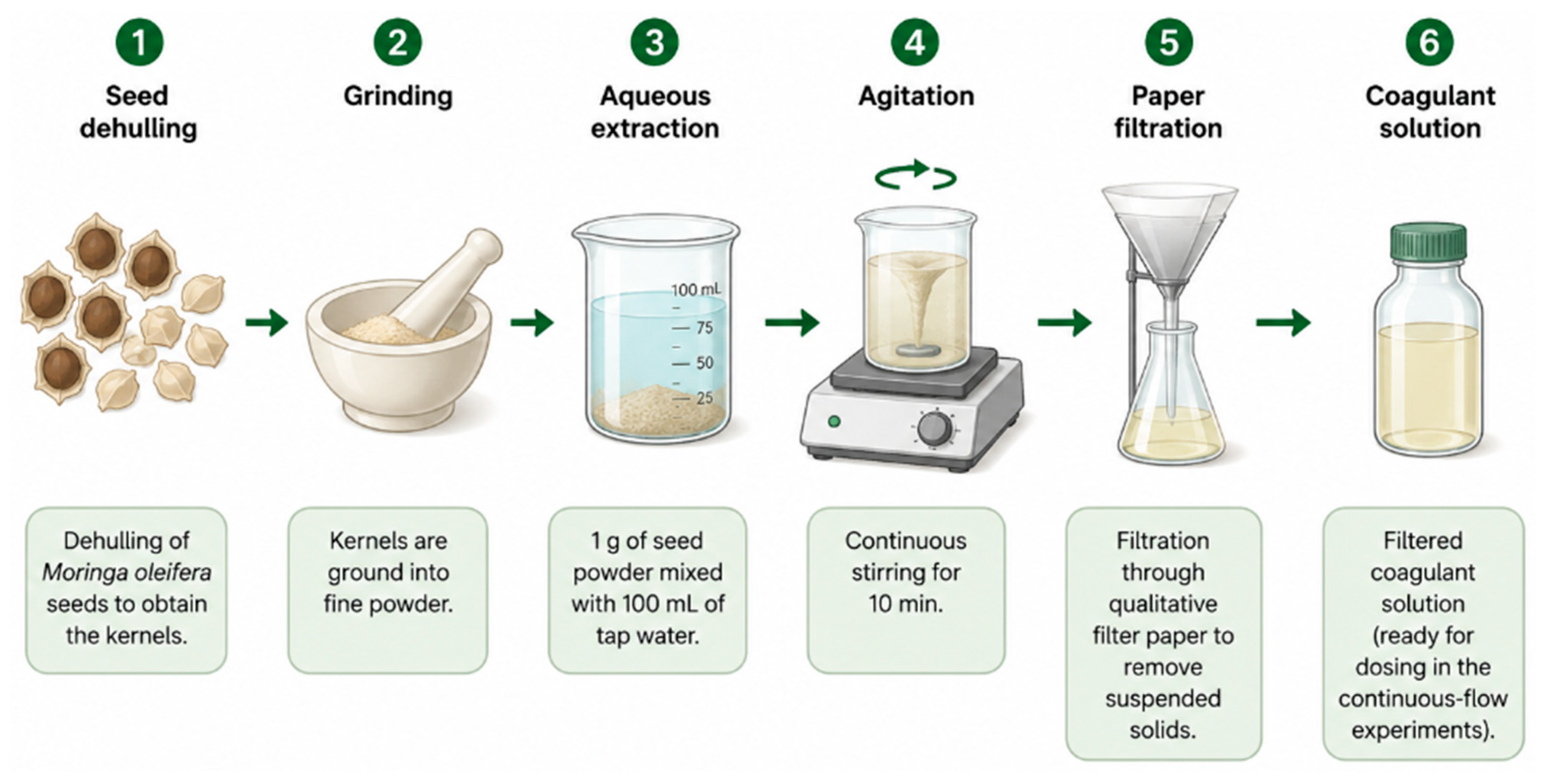
Moringa oleifera-based natural coagulant was prepared from manually dehulled seeds ground into a fine powder. Subsequently, 1 g of seed powder was mixed with 100 mL of tap water under continuous stirring for 10 min and filtered through qualitative filter paper (Melitta, São Paulo, Brazil) to remove suspended solids. The resulting filtrate was immediately used in the experiments. This simplified preparation method avoids saline extraction and membrane filtration processes, making it more suitable for decentralized and low-infrastructure water treatment systems. The simplified preparation procedure adopted for the
Moringa oleifera-based natural coagulant is illustrated in
Figure 3.
2.6.3. Aloe vera
The
Aloe vera-based coagulant was prepared immediately before each experiment to preserve its bioactive compounds. Fresh
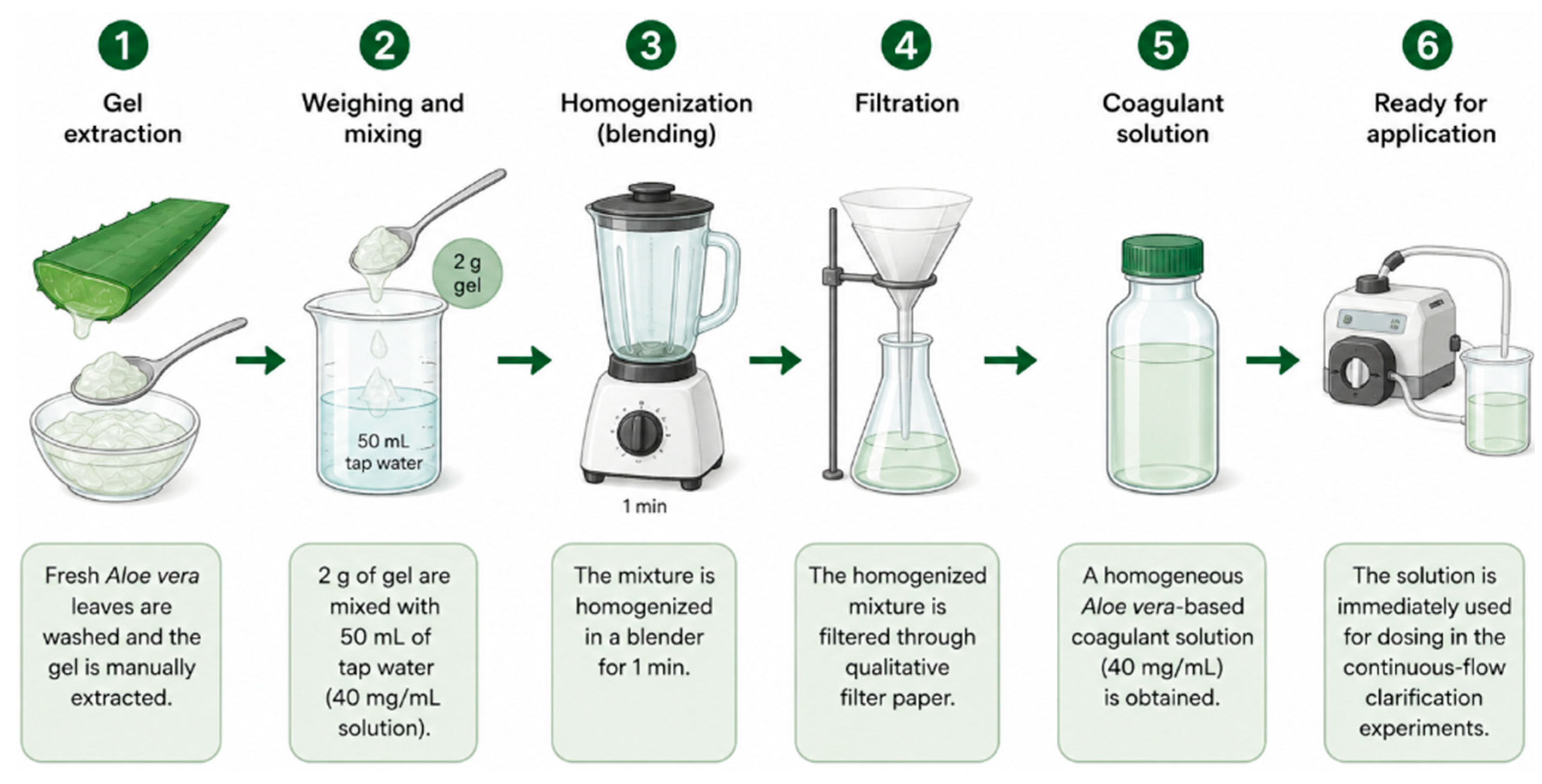
Aloe vera gel was manually extracted from leaves harvested from plants cultivated at the Federal Institute of Espírito Santo (Ifes), Campus Cariacica, Espírito Santo, Brazil. Two grams of gel were then mixed with 50 mL of tap water, resulting in a 40 mg/mL solution. The mixture was homogenized in a blender (Skymsen LC3, 500 W, 4500 rpm; Skymsen, Santa Catarina, Brazil) for 1 min and subsequently filtered through filter paper to obtain a homogeneous solution suitable for continuous-flow clarification experiments. The simplified preparation procedure adopted for the
Aloe vera-based natural coagulant is illustrated in
Figure 4.
2.6.4. Selection of Coagulant Dosages
The coagulant dosing flow rates adopted in the continuous-flow experiments were defined based on preliminary dosage optimization studies performed under the same experimental conditions using synthetic water with an initial turbidity of approximately 100 NTU. Because the three coagulants differ in composition, coagulation mechanism, and optimum dosage requirements, a specific dosing flow rate was selected for each coagulant. The selected values corresponded to the conditions that provided the highest clarification efficiencies during the preliminary experiments and were maintained constant throughout the continuous-flow tests to isolate the influence of HRT. The adopted dosing flow rates were 12 mL/min for aluminum sulfate, 10 mL/min for
Aloe vera, and 4 mL/min for
Moringa oleifera. The detailed results of the preliminary dosage optimization experiments are presented in
Appendix A.
Figure 4.
Simplified preparation workflow of the Aloe vera-based natural coagulant, including gel extraction, homogenization in water, blending, and paper filtration before application in the continuous-flow clarification experiments.
Figure 4.
Simplified preparation workflow of the Aloe vera-based natural coagulant, including gel extraction, homogenization in water, blending, and paper filtration before application in the continuous-flow clarification experiments.
2.7. Performance Evaluation and Statistical Analysis
All experimental conditions were evaluated in triplicate. Clarification performance was assessed using residual turbidity and turbidity removal efficiency, calculated according to Equation (4):
where
For each experimental condition, water samples were collected in triplicate from the outlet of the sedimentation unit after the clarification process. The samples were transferred directly into turbidity measurement cuvettes, and turbidity was measured by direct reading using a calibrated turbidimeter (AKSO TU430, AKSO, Rio Grande do Sul, Brazil), following the manufacturer’s instructions. The resulting turbidity values were used to calculate turbidity removal efficiency.
The experimental results were expressed as the mean ± standard deviation. Statistical analyses were performed using SigmaPlot version 16.0 (Systat Software Inc., San Jose, CA, USA). A two-way analysis of variance (ANOVA) was conducted considering coagulant type and HRT as fixed factors to evaluate their individual and interactive effects on turbidity removal efficiency. When significant differences were identified, Tukey’s post hoc test was applied at a significance level of p < 0.05.
Additionally, the pH of the treated water was monitored after the coagulation process as a complementary water quality parameter.
3. Results and Discussion
This section presents the experimental results obtained for the continuous-flow HCTFs and discusses how HRT influenced the clarification performance of coagulants associated with different dominant coagulation mechanisms. The analysis first examines the overall effects of HRT and coagulant type on turbidity removal efficiency and final turbidity. Subsequently, the responses of aluminum sulfate, Moringa oleifera, and Aloe vera are discussed in relation to their coagulation mechanisms and hydraulic sensitivity. Finally, the hydrodynamic implications of the results are evaluated in the context of sustainable continuous-flow clarification systems.
3.1. Overall Effects of HRT and Coagulant Type
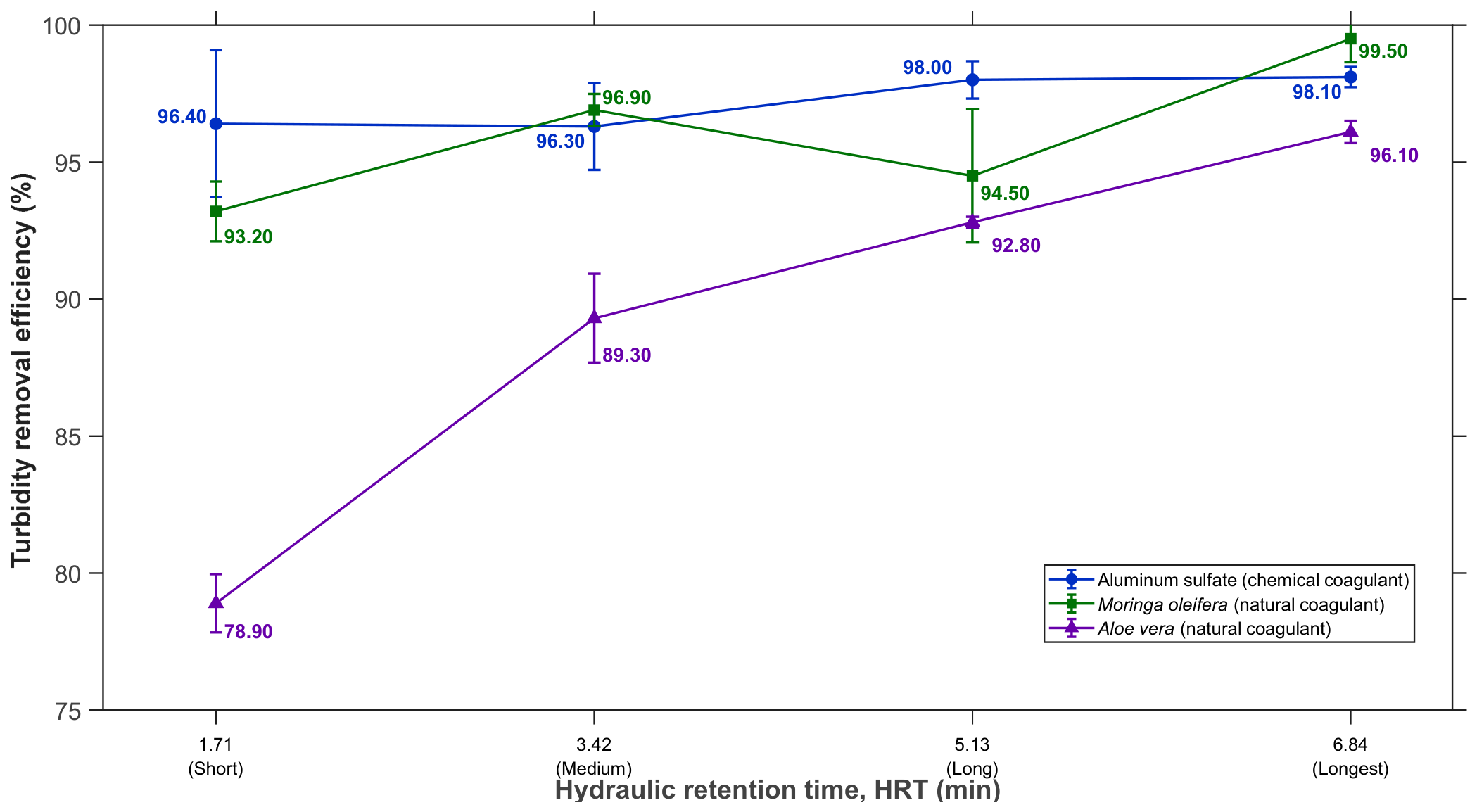
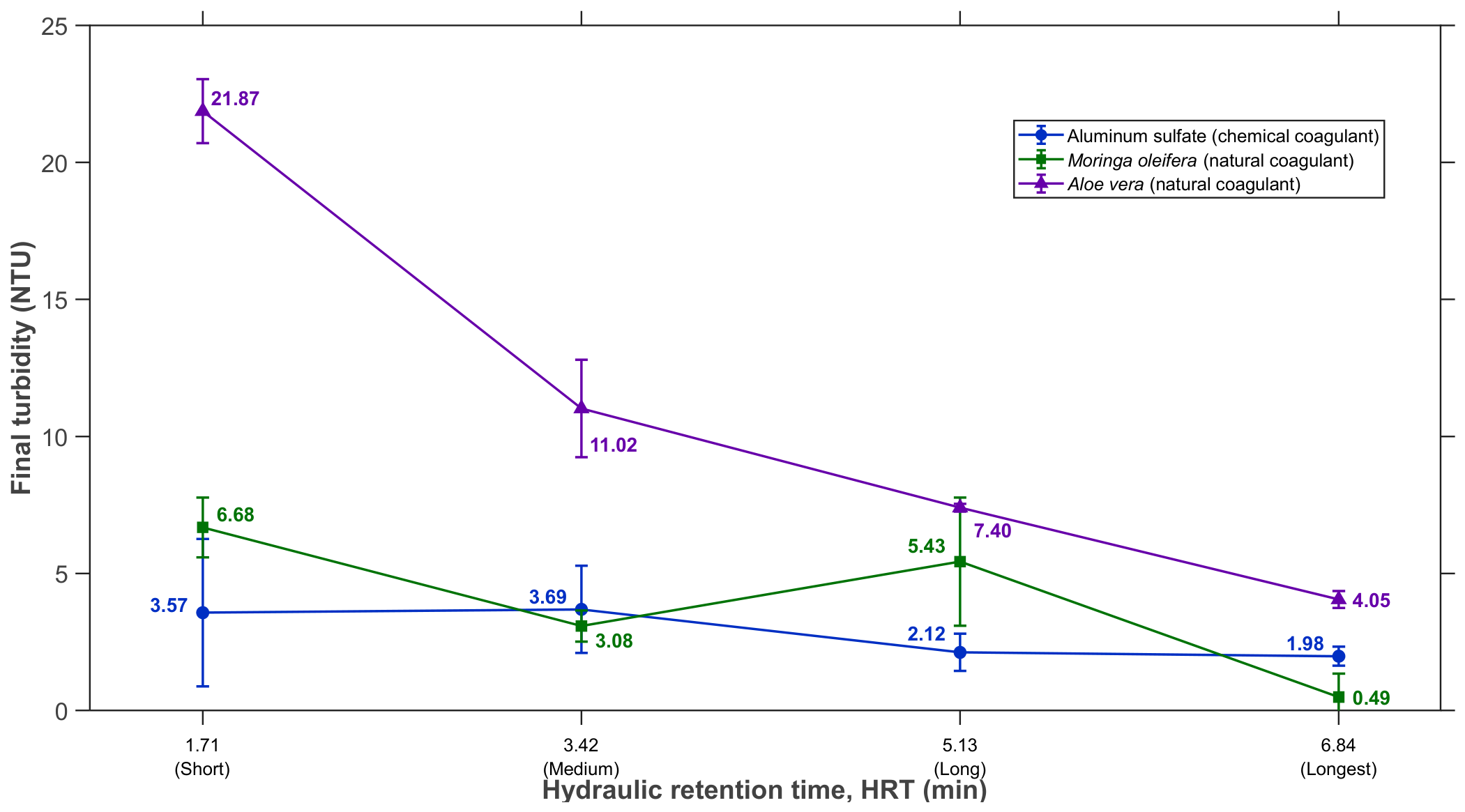
The overall influence of HRT on clarification performance is presented in
Figure 5 and
Figure 6, which show turbidity removal efficiency and final turbidity, respectively, for the evaluated coagulants. Turbidity removal efficiency was adopted as the primary response variable because it directly represents the overall clarification performance of the investigated systems, whereas final turbidity was used as a complementary indicator. The complete experimental dataset used for the graphical and statistical analyses is provided in
Appendix B.
Overall, the influence of HRT on clarification performance depended on the dominant coagulation mechanism rather than following a common trend for all evaluated coagulants (
Figure 5 and
Figure 6). Distinct responses were observed among the evaluated coagulants, indicating that HRT affected clarification performance according to the dominant coagulation mechanism governing particle destabilization and floc development.
In contrast to aluminum sulfate and Aloe vera, Moringa oleifera did not exhibit a continuous improvement in clarification performance with increasing HRT. This behavior indicates that increasing the hydraulic retention time did not necessarily improve clarification performance under the evaluated conditions. A possible explanation is that prolonged exposure to the hydrodynamic conditions within the HCTF promoted floc restructuring or breakage, thereby reducing settling efficiency. However, because floc characteristics such as size, density, and mechanical strength were not evaluated in the present study, this interpretation remains hypothetical and should be investigated in future research.
To verify the statistical significance of the observed trends, the experimental data were analyzed using a two-way analysis of variance (ANOVA). Prior to the analysis, the assumptions of normality and homogeneity of variances were verified using the Shapiro–Wilk (p = 0.331) and Brown–Forsythe (p = 0.204) tests, respectively, confirming the suitability of the dataset for parametric statistical analysis.
The ANOVA results are summarized in
Table 2. Both HRT (F = 58.024,
p < 0.001) and coagulant type (F = 117.741,
p < 0.001) significantly affected turbidity removal efficiency. Among the evaluated factors, coagulant type exhibited the highest F-value, indicating that the dominant coagulation mechanism exerted a stronger influence on clarification performance than HRT under the investigated conditions. Furthermore, the interaction between HRT and coagulant type was also highly significant (F = 22.367,
p < 0.001), demonstrating that the effect of HRT depended on the coagulation mechanism associated with each coagulant.
The significant interaction identified by the two-way ANOVA indicates that increasing HRT did not affect all coagulants equally. Consequently, Tukey’s multiple-comparison test was performed to evaluate the influence of HRT separately for each coagulant. The results of these comparisons are presented in
Table 3, while the complete statistical outputs are provided in
Appendix C.
The statistical analysis demonstrated distinct hydraulic sensitivities among the evaluated coagulants, indicating that the observed differences cannot be explained solely by experimental variability. The possible mechanisms underlying these differences are discussed in the following section.
3.2. Influence of HRT on Different Coagulation Mechanisms
The significant interaction identified by the two-way ANOVA indicates that the effect of HRT depended on the dominant coagulation mechanism represented by each evaluated coagulant. The Tukey multiple-comparison results (
Table 3) revealed distinct hydraulic sensitivities among aluminum sulfate,
Moringa oleifera, and
Aloe vera, indicating that the effectiveness of each coagulation pathway is closely associated with the available residence time for particle destabilization, floc growth, and maturation. The responses of each coagulant are discussed below.
In addition to clarification efficiency, the pH of the treated water was monitored after the coagulation process as a complementary water quality parameter. No appreciable changes in pH were observed for any of the evaluated coagulants under the investigated operating conditions, indicating that the applied dosages did not substantially alter the acid–base characteristics of the treated water. Although COD was not evaluated in the present study, additional water quality parameters should be considered in future investigations to provide a more comprehensive assessment of treatment performance and overall water quality.
3.2.1. Aluminum Sulfate
Aluminum sulfate was used as the reference chemical coagulant because its coagulation process is predominantly governed by rapid hydrolysis, charge neutralization, and sweep flocculation mechanisms. Although the relative contribution of each mechanism depends on operational factors such as coagulant dosage, pH, and water characteristics, charge neutralization and sweep flocculation are consistently recognized as the dominant pathways for aluminum-based coagulation [
26,
27]. Consequently, aluminum sulfate is generally characterized by fast coagulation kinetics and limited dependence on prolonged contact times.
Consistent with this mechanistic framework, no significant differences were observed among the evaluated HCTF lengths (
Table 3;
p > 0.05), indicating that high clarification efficiencies were achieved even under the shortest HRT investigated. Turbidity removal efficiency remained consistently high, ranging from 96.3% to 98.1%, while residual turbidity remained low for all reactor lengths (
Figure 5 and
Figure 6).
The absence of statistically significant differences among reactor lengths suggests that the shortest HRT evaluated (1.71 min) was already sufficient to complete the dominant coagulation reactions promoted by aluminum sulfate. Once the suspended particles had been rapidly destabilized through charge neutralization and incorporated into aluminum hydroxide precipitates, extending the residence time provided little additional opportunity for further clarification. This behavior agrees with previous studies reporting that aluminum-based coagulants exhibit fast coagulation kinetics and are capable of producing stable flocs over relatively short contact times when appropriate operational conditions are established [
27]. This observation is particularly relevant for the design of compact and sustainable continuous-flow water treatment systems, where minimizing reactor volume, material consumption, and construction costs without compromising clarification efficiency is a key engineering objective.
This behavior contrasts with that expected for polymeric natural coagulants, whose flocculation mechanisms generally rely on slower adsorption and bridging phenomena requiring longer particle–coagulant interaction times.
3.2.2. Moringa oleifera
Moringa oleifera was selected as a representative natural coagulant because its coagulation activity is primarily attributed to water-soluble cationic proteins, which are generally considered to adsorb onto negatively charged colloidal particles, thereby reducing electrostatic repulsion and promoting destabilization through adsorption and charge neutralization. Depending on the extraction procedure, coagulant dosage, and water characteristics, bridging interactions may also contribute to floc formation and stabilization [
28,
29,
30].
Consistent with this mechanistic framework,
Moringa oleifera exhibited a moderate dependence on HRT. Significant improvements in clarification efficiency were observed between the 12 m and 24 m reactors (
p = 0.015), as well as between the 12 m and 48 m reactors (
p < 0.001), whereas no significant differences were detected among the intermediate reactor lengths (
Table 3). These results indicate that increasing HRT enhanced clarification performance during the initial stages of floc development, although the benefits progressively diminished as residence time increased. Unlike aluminum sulfate, whose rapid hydrolysis promotes almost immediate particle destabilization, the effectiveness of protein-mediated coagulation depends on sufficient particle–coagulant interactions to promote floc growth and maturation. This mechanistic difference explains the greater sensitivity of
Moringa oleifera to increases in HRT.
The highest clarification performance was obtained at the longest HRT evaluated (6.84 min), corresponding to a turbidity removal efficiency of 99.5% and a final turbidity of only 0.49 NTU (
Figure 5 and
Figure 6). Under the longest HRT evaluated,
Moringa oleifera achieved clarification efficiencies comparable to those obtained with aluminum sulfate, reaching the highest turbidity removal observed in this study. This progressive improvement indicates that, although adsorption and charge neutralization were rapidly initiated, subsequent floc aggregation and maturation benefited from longer residence times within the HCTF. Considering that clarification efficiencies comparable to those obtained with aluminum sulfate were achieved under the longest HRT evaluated, these findings highlight the potential of
Moringa oleifera as a sustainable coagulant for continuous-flow clarification systems when hydraulic conditions are properly tailored to its coagulation mechanism.
The observed hydraulic behavior is consistent with the coagulation mechanisms described for
Moringa oleifera. Following the initial adsorption of cationic proteins onto negatively charged particles, curvature-induced secondary flows within the HCTF likely increased particle collision frequency, facilitating aggregate formation and the consolidation of larger flocs [
20,
22,
23]. As residence time increased, these hydrodynamic conditions favored progressive floc growth and stabilization until clarification efficiency approached a plateau. Consequently, further increases in HRT produced only marginal improvements because the flocculation process was already approaching completion [
29,
30,
31].
From an engineering perspective, these findings indicate that Moringa oleifera exhibits an intermediate hydraulic behavior among the evaluated coagulants. Continuous-flow HCTF designed for protein-based natural coagulants should provide sufficient residence time to maximize particle aggregation and floc maturation. However, once these mechanisms approach completion, further increases in reactor length are unlikely to produce substantial gains in clarification efficiency. Therefore, tailoring HRT to the dominant coagulation mechanism can improve clarification efficiency while avoiding unnecessarily large reactor volumes, contributing to the development of compact and more sustainable continuous-flow water treatment systems.
3.2.3. Aloe vera
Aloe vera was selected as a representative bio-based coagulant because its coagulation activity is primarily associated with the polysaccharides, mucilage, and other high-molecular-weight compounds naturally present in the gel. These compounds are widely recognized for promoting particle destabilization and subsequent aggregation through adsorption, polymer bridging, and bioflocculation mechanisms rather than the rapid charge neutralization typically associated with conventional metal-based coagulants, making coagulation efficiency more dependent on particle–coagulant contact time [
32,
33,
34]. In contrast to aluminum sulfate and
Moringa oleifera, whose coagulation mechanisms involve relatively rapid particle destabilization,
Aloe vera relies predominantly on progressive polymer-mediated interactions and floc development.
Consistent with this mechanistic framework,
Aloe vera exhibited the strongest dependence on HRT among the evaluated coagulants. Tukey’s multiple-comparison analysis revealed statistically significant differences for all pairwise comparisons between reactor lengths (
Table 3;
p ≤ 0.039), demonstrating a continuous improvement in clarification performance as HRT increased. Turbidity removal efficiency increased from 78.9% in the 12 m reactor to 96.1% in the 48 m reactor, corresponding to an absolute increase of 17.2 percentage points. Concurrently, the final turbidity decreased from 21.87 NTU to 4.05 NTU (
Figure 5 and
Figure 6). Unlike the behavior observed for aluminum sulfate and
Moringa oleifera, clarification efficiency did not reach a plateau within the investigated HRT range, indicating that the coagulation–flocculation process continued to benefit from longer residence times.
The progressive improvement observed with increasing HRT indicates that adsorption and bioflocculation mechanisms require extended particle–coagulant interactions to promote effective floc growth and consolidation. Within the HCTF, curvature-induced secondary flows likely enhanced particle collision frequency [
20,
22,
23], facilitating contact between suspended particles and the polysaccharide-rich constituents of the
Aloe vera extract. As residence time increased, these hydrodynamic conditions promoted progressive aggregate growth and floc maturation, resulting in continuous improvements in clarification efficiency. Consequently, the absence of a performance plateau suggests that the flocculation process had not yet reached completion within the investigated HRT. This interpretation agrees well with previous studies reporting that
Aloe vera acts predominantly through adsorption, polymeric interactions, and bioflocculation rather than rapid charge neutralization [
32,
33,
34].
The pronounced hydraulic sensitivity observed for Aloe vera contrasts with the responses obtained for the other evaluated coagulants. Whereas aluminum sulfate achieved consistently high clarification efficiencies even under the shortest HRT because of its rapid hydrolysis and fast coagulation kinetics, and Moringa oleifera approached maximum performance after intermediate residence times, Aloe vera continued to exhibit significant improvements throughout the entire HRT range evaluated. Collectively, the responses of the three coagulants demonstrate that the influence of HRT is governed primarily by the dominant coagulation mechanism rather than by whether the coagulant is classified as natural or chemical.
Considering that clarification efficiencies above 96% were achieved at the longest HRT evaluated, these results highlight the potential of Aloe vera as a sustainable bio-based coagulant for continuous-flow clarification systems when hydraulic conditions are properly tailored to its coagulation mechanism. From an engineering perspective, bio-based coagulants governed predominantly by adsorption and bioflocculation require longer HRT than conventional chemical coagulants to fully develop stable flocs. Therefore, although longer HRT improved the clarification performance of Aloe vera, reactor design should be tailored according to coagulation kinetics rather than simply maximizing HRT. Such an approach can achieve high treatment efficiency while avoiding unnecessarily large reactor volumes, excessive material consumption, and increased construction costs.
Beyond the specific responses observed for the evaluated coagulants, some considerations regarding the experimental conditions should be highlighted. Although synthetic water provided highly reproducible experimental conditions for evaluating the effects of hydraulic retention time and coagulant type, it is recognized that water quality characteristics such as pH, dissolved organic matter, ionic composition, hardness, and dissolved solids may influence coagulation mechanisms, floc formation, and settling behavior. The use of synthetic water in the present study minimized variability associated with raw water quality, allowing the hydraulic performance of the HCTF system to be assessed under controlled conditions. Future studies should evaluate the proposed system using natural waters with different physicochemical characteristics to further investigate the influence of water quality on floc properties and treatment performance.
4. Conclusions
This study experimentally demonstrated that the influence of HRT on clarification performance is governed primarily by the dominant coagulation mechanism rather than by whether the coagulant is classified as natural or chemical. By systematically evaluating three coagulants characterized by distinct coagulation pathways under identical hydraulic conditions in continuous-flow HCTF, this work provides new mechanistic insights into the relationship between coagulation kinetics and hydraulic design.
The experimental results revealed distinct hydraulic sensitivities among the evaluated coagulants, which reflected their different dominant coagulation mechanisms. Aluminum sulfate exhibited consistently high clarification efficiencies over the entire HRT range investigated, indicating that its rapid hydrolysis and charge-neutralization mechanisms were effectively completed even under the shortest HRT. Moringa oleifera showed an intermediate response, with clarification efficiency increasing as HRT increased before approaching a performance plateau. In contrast, Aloe vera exhibited the strongest dependence on HRT, with continuous improvements in turbidity removal throughout the investigated range, indicating that adsorption, polymer-mediated interactions, and bioflocculation require longer residence times to achieve effective floc development.
Collectively, these results demonstrate that the hydraulic design of continuous-flow flocculation systems should be tailored to the dominant coagulation mechanism of the selected coagulant. Rather than adopting the longest HRT for all applications, reactor design should be optimized according to the dominant coagulation mechanism. This approach can maximize clarification efficiency while avoiding unnecessarily large reactor volumes, excessive material consumption, and increased construction costs.
The performance achieved by Moringa oleifera and Aloe vera demonstrates the potential of natural coagulants for sustainable continuous-flow clarification when hydraulic conditions are properly adapted to their dominant coagulation mechanisms. Future studies should also investigate sludge characteristics and quantitative floc properties, including particle size distribution and fractal dimension, to provide a more comprehensive understanding of coagulation mechanisms and support the further optimization of continuous-flow clarification systems.
The present study offers several important advantages. By directly comparing natural and chemical coagulants in a compact continuous-flow HCTF under controlled operating conditions, it provides robust experimental evidence of how different coagulation mechanisms respond to hydraulic retention time. The findings also provide practical guidance for the hydraulic design and optimization of decentralized water treatment systems. However, some limitations should be acknowledged. The experiments were conducted using synthetic water under controlled laboratory conditions, sludge characteristics and floc properties were not evaluated, and no techno-economic assessment was performed. These aspects should be addressed in future studies to further support the implementation of sustainable continuous-flow clarification technologies.
Overall, this work advances the current understanding of the interaction between coagulation chemistry and hydraulic design in continuous-flow HCTF. By demonstrating that HRT should be selected according to the dominant coagulation mechanism, the proposed framework moves beyond empirical reactor sizing and provides a more rational basis for designing compact, efficient, and sustainable clarification systems.
Taken together, the results demonstrate that HRT should be regarded as a design variable intrinsically linked to coagulation kinetics rather than as a fixed operational parameter. Ultimately, the findings support a mechanism-based hydraulic design strategy for continuous-flow flocculators, in which HRT is selected according to the dominant coagulation pathway rather than adopting a universal design criterion for different classes of coagulants. This approach has the potential to improve clarification efficiency while contributing to the development of more compact, sustainable, and resource-efficient water treatment systems.