
Review

Green Hydrogen Development in Chile: A Review of Deployment, Techno-Economics, and Global Market Integration

1
Chemical Engineering Department, Escola d’Enginyeria de Barcelona Est (EEBE), Universitat Politècnica de Catalunya (UPC)-BarcelonaTECH, Campus Diagonal-Besòs, Eduard Maristany Ave., 16, 08019 Barcelona, Spain
2
Barcelona Research Center in Multiscale Science and Engineering, Campus Diagonal Besòs, Building I. Eduard Maristany Ave., 10–14, 08019 Barcelona, Spain
3
Núcleo de Biotecnología Curauma, Pontificia Universidad Católica de Valparaíso, Universidad Ave., 330, Curauma, Valparaíso 2373223, Chile
*
Author to whom correspondence should be addressed.
Clean Technol. 2026, 8(3), 72; https://doi.org/10.3390/cleantechnol8030072
Submission received: 19 February 2026 / Revised: 6 April 2026 / Accepted: 27 April 2026 / Published: 7 May 2026

Abstract

Chile is widely regarded as a key global player in green hydrogen production due to its exceptional renewable energy potential, which enables low-carbon and competitive production costs. This article provides a comprehensive review of Chile’s green hydrogen sector, evaluating the transition from early strategic goals to the current phase of industrial scaling. It offers an integrated analysis of the regulatory framework, infrastructure deployment, and the techno-economic variables essential for integrating Chilean derivatives into global markets. The country has established a supportive framework through its National Green Hydrogen Strategy (NGHS), which sets out goals of 25 GW of installed electrolyzer capacity and USD 2.5 billion in annual exports by 2030. Despite these ambitious targets, actual deployment remains in the early stages, with only 3.9 GW currently in the implementation phase and a lack of fully operational industrial-scale facilities. Furthermore, initial NGHS projections suggested a levelized cost of hydrogen (LCOH) of USD 1.3–1.4/kg by 2030. However, current calculations point to a more complex reality of approximately USD 3.1/kg due to infrastructure bottlenecks and global supply chain pressures. While Chile’s renewable resources ensure low production-stage emissions, the absence of explicit regulatory carbon targets underscores the need for comprehensive life-cycle assessments encompassing manufacturing and global distribution. Overall, this review concludes that Chile should overcome persistent regulatory and logistical constraints to consolidate a robust and internationally competitive green hydrogen sector, aligned with its 2050 carbon neutrality objectives.

1. Introduction

Since the carbon neutrality commitment was announced by the Chilean Presidency in 2019, hydrogen (H2) has been recognized as a cornerstone for achieving the country’s climate objectives [1]. Hydrogen has the potential to replace conventional energy sources and decarbonize manufactured goods, particularly those intended for international markets. Furthermore, domestic hydrogen production could significantly mitigate the energy sector’s reliance on imported fossil fuels [2]. Green hydrogen production has gained substantial interest in recent years due to its capacity to decarbonize hard-to-abate industrial sectors, particularly as it can be produced using otherwise curtailed electricity from renewable sources such as solar or wind. This positions hydrogen as a highly attractive alternative to fossil fuels, while also addressing the variability challenges inherent to renewable energy systems [3].
According to the International Energy Agency (IEA) [4], Chile has the potential to produce approximately 160 Mt H2/y at a cost below USD 2/kg H2. Local demand is projected to reach 300 kt by 2030 and 2000 kt by 2035, with over 1000 kt intended for export as ammonia, methanol, or e-fuels [5]. Under Chile’s 2050 carbon-neutrality scenario, total demand is expected to exceed 4200 kt, of which 2000 kt would be exported, while the widespread adoption of hydrogen in the transport sector will be critical to meeting national emission targets [5,6,7]. Beyond environmental impacts, the hydrogen economy is forecasted to generate between 78,000 and 740,000 jobs by 2030 and 2050, respectively [8].
Recognizing hydrogen as a cornerstone of the national carbon neutrality roadmap, the Chilean Government established a strategic political framework to accelerate its development. By publishing the National Green Hydrogen Strategy (NGHS) in 2020, Chile positioned itself as a regional leader in Latin America. The NGHS specifically prioritizes hydrogen produced from water electrolysis, setting ambitious milestones to catalyze a competitive domestic market [1]. These objectives aim to foster a robust industrial ecosystem while implementing a manufacturing strategy to secure Chile’s role as a primary supplier in international clean fuel markets.
The competitiveness of Chile’s hydrogen sector is underpinned by some of the world’s lowest levelized costs of energy (LCOE). These favorable economic conditions, derived from abundant solar and wind resources, have attracted significant international investment following recent government initiatives [9]. Consequently, 83 projects have been announced to date, with seven already approved by the Environmental Impact Assessment Service (EIAS) and currently in different stages of implementation [10,11]. However, the gap between announced projects and those achieving environmental approval highlights a disparity between political ambition and project implementation. This disparity is largely attributed to the structural difficulties financiers face in pricing the risks of an emergent industry lacking a historical track record or financial data [12]. Furthermore, uncertainty regarding sufficient long-term demand and the willingness to pay among off-takers militates against project feasibility. Currently, the market lacks the necessary depth to guarantee these economic fundamentals. Additionally, developers and investors emphasize that the lack of a specific legal framework and standardized certification, to formally qualify hydrogen as “green”, further exacerbates delays and project uncertainty.
According to the IEA, Chile accounts for half of the total potential production from project announcements in Latin America [13]. The country’s low-emission hydrogen production could reach approximately 3.5 Mt/y by 2030 if all currently announced projects are executed as planned. Brazil follows with an announced capacity of over 2 Mt/y H2 by 2030. Together, Chile and Brazil represent 80% of the region’s potential hydrogen production [13]. However, the realization of this massive implementation depends on transitioning these announcements into final investment decisions.
Several articles [8,14,15,16,17] have analyzed the potential of green hydrogen to decarbonize the Chilean economy. These studies generally conclude that, while the nation’s climate targets are technically and economically feasible, their realization is contingent upon overcoming specific structural and regulatory bottlenecks. High production costs have been identified as a primary barrier to establishing a domestic green hydrogen market, with current estimates remaining significantly above the targets defined in the NGHS [18,19,20,21]. Nevertheless, existing studies often overlook the relationship between these costs and Chile’s competitiveness in international markets, as well as their influence on local adoption and greenhouse gas (GHG) mitigation potential. Furthermore, a notable gap persists in the literature regarding the comprehensive assessment of GHG emissions across the national hydrogen value chain. Given that life-cycle GHG emissions are critical for both domestic applications and international trade compliance, understanding the carbon footprint is essential. To date, only a limited number of publicly available studies have addressed the GHG emissions specifically associated with Chilean green hydrogen production [22,23,24,25].
Several review articles have focused on green hydrogen production in Chile. Acosta et al. [25] examined the production advantages, energy mix integration, and current and planned green hydrogen projects in the country. Cacciuttolo et al. [26] explored the potential for green hydrogen production and its derivatives in the Magallanes Region. Pavez et al. [27] reviewed international standards for integrating green hydrogen technologies into the mining industry. However, no prior review has comprehensively addressed the broader implications of the green hydrogen industry in Chile, considering integrated policy, economic, and environmental perspectives. While techno-economic and environmental challenges can significantly limit the marketability of hydrogen produced in Chile, there is currently no integrated review that addresses the policy–economy–emissions nexus, including deployment levels and the potential hydrogen integration into international markets.
Given Chile’s potential to produce low-cost green hydrogen and emerge as a global supplier, this article provides a comprehensive review of the country’s policy landscape, strategic objectives, and implementation progress. Particular emphasis is placed on regulatory framework, current deployment levels, life-cycle GHG emissions, techno-economic cost structures, and the integration of Chilean green hydrogen derivatives into international markets. To the best of the authors’ knowledge, this work constitutes the first integrated policy–economy–emissions review of Chile’s emerging green hydrogen economy. The analysis draws on official government reports, peer-reviewed literature, and systematic searches in databases such as Scopus and Web of Science, utilizing keywords including “green hydrogen”, “GHG emissions”, “energy transition”, and “Chile”. Overall, this review contributes to the discourse on energy transitions by identifying the critical opportunities and barriers to scaling the green hydrogen sector in alignment with Chile’s decarbonization goals.

2. Policy Instruments and Legal Frameworks for the Promotion of Green Hydrogen in Chile

The political framework holding the development of green hydrogen in Chile was stated at the end of the 2010s, when this energy vector was mentioned for the first time in the Updated Long-Term Energy Planning 2018–2022 published in 2019 [28]. This document is regarded as the initial policy initiative aimed at achieving net-zero emissions in the Chilean energy sector and the earliest to recognize hydrogen as a relevant energy storage strategy for the country. The subsequent version of the plan, published in 2024 and covering the 2023–2027 period, advances this vision by identifying hydrogen as a key solution for the indirect electrification of certain energy end-uses [29].
The Long-Term Climate Strategy (LTCS), published in 2021, sets the goal that zero-emission fuels, such as green hydrogen and its derivatives, will represent 15% of non-electric final energy use by 2030 and at least 70% by 2050 [28,30]. The Updated Energy Policy of 2022 [31] states that Chile will export green hydrogen by 2030 and promotes the replacement of fossil fuels with renewable sources in the domestic energy sector. The document confirms that at least 70% of zero-emission fuels will be used in non-electric final energy sectors by 2050.
By launching its NGHS in 2020 [1], Chile became the first Latin American country to define an action plan for green hydrogen deployment. The strategy established that hydrogen would be produced through water electrolysis and set the goal of positioning the country as a global leader in green hydrogen production, with 5 GW of installed electrolyzer capacity by 2025 and 25 GW by 2030. The NGHS considers that over 25% of the Chilean carbon emissions could be efficiently mitigated by using green hydrogen by 2050. It also targets for the country to export USD 2.5 billion per year in green hydrogen and its derivatives by 2030, and to attract investments of USD 5 billion by 2025.
In March 2026, an updated version of the NGHS was published. This document [32] identifies several critical factors for the implementation of green hydrogen in the country. First, production costs remain high to ensure competitiveness against other international producers. Second, permitting processes and the lack of an appropriate regulatory framework continue to delay project approvals. Third, public economic incentives are still limited. Fourth, despite the signing of several agreements with different economies, the country’s global positioning in the sector remains limited. Finally, infrastructure and logistics constraints, particularly delays in adapting ports and transport routes for hydrogen export, constitute a major bottleneck. The government explicitly recognizes inadequate infrastructure as a key barrier to the development of new projects that must be urgently addressed. In this regard, the updated document establishes the target of establishing shared-use port and logistics infrastructures in at least two regions by 2030. To achieve this goal, “the Chilean State will promote public–private and private initiatives for the development of logistics and port systems, promoting multipurpose infrastructure, for public and/or shared use. The State will continue to contribute to the direct execution of some investments, in cooperation and/or complement to private initiatives, where public companies can play a relevant role, without compromising their economic performance”. In practical terms, the two projects discussed in this review consider the construction of dedicated transport infrastructure, such as ports and pipelines in their own sites, aiming to operational efficiency and continuity of production.
The Green Hydrogen Action Plan 2023–2030 [2], published in 2023, represents another key policy instrument for advancing Chile’s hydrogen strategy. The Action Plan projects that green hydrogen and its derivatives, primarily applied in mining and freight transport, could reduce national GHG emissions by 24% and support the country’s decarbonization process. The document proposed 17 actions and defined key drivers aimed at financially supporting the green hydrogen industry throughout its value chain. The public–private relationship is expected to play a relevant role in mitigating green hydrogen implementation risks. The document establishes that the government should promote and seek private investment in production and demand projects through financial instruments and promotes the creation of a facility to catalyze private investment primarily by providing public support to mitigate financial risks. The costs for this financial facility amount to USD 1000 million, mainly funded with loans and contributions from the Interamerican Development Bank (IDB), the World Bank, the German Development Bank, the European Union, and additional resources from the Production Development Corporation (Corfo, its Spanish acronym for Corporación de Fomento de la Producción) [33].
Table 1 illustrates a summary of key objectives, actual progress and critical risks for the above-mentioned Chilean legal documents discussed: NGHS, Updated Energy Policy, and Green Hydrogen Action Plan 2023–2030. The analysis of Chilean policies in green hydrogen clearly highlights a mismatch between project objectives and actual progress with a full delay in short-term goals. This can be largely attributed to delays in environmental approvals and lack of mature local supply chains. Economic objectives in terms of exports, established through several trade agreements subscribed with different international markets, are largely risked by market immaturity, high production costs, and lack of standardized green hydrogen certification leading to uncertain achievement of 2030 targets. In terms of electrolyzer implementation, the country faces substantial barriers due to a lack of a robust supply chain for electrolyzer components and high demand for freshwater. This can increase the overall production costs, assuming supply chain risk because of the high dependency on imported critical metals that prevents a clear definition of production costs.
To overcome these challenges and risks, the Chilean government provides ongoing support for investors interested in developing green hydrogen projects through institutions like InvestChile and Corfo. Initiatives such as the Green Hydrogen Industry Development Committee and the 2023–2030 Action Plan aim to coordinate and ensure the sector’s sustainable growth. To date, USD 15.2 million has been provided by Corfo for the implementation of two green H2 pilot projects [34,35]. Chile also benefits from 33 trade agreements with 65 economies, facilitating access to international markets for clean energy exports [36]. Moreover, the country has subscribed specific green hydrogen agreements for capacity building and to support the establishment of international routes and markets [37].

3. Green Hydrogen Deployment Status and Regional Progress

In 2020, under the framework of the national economic post COVID reactivation, Corfo launched its first call for the development of a green hydrogen industry [38]. The goal of this first call was to identify investment plans focused on accelerating the development of green hydrogen production projects. Six over the eighteen projects submitted received financial support from Corfo for their subsequent implementation [38,39,40]. It was forecasted that these projects will produce over 5000 t of green hydrogen annually and will reduce the emissions of more than 600,000 t of CO2 [41]. Two of these projects were submitted to the National EIAS and are currently under construction (projects 3 and 4 listed in Table 2) [10]. Table 2 depicts all green hydrogen projects submitted to the EIAS, until December 2025.
In 2024, Corfo launched a second call for the development of a green hydrogen industry to select research and development (R&D) institutions, involved in the manufacture and/or assembly of electrolyzers and their components in Chile [42]. These institutions should play an important role in supplying equipment to the national electrolyzer industry [43]. Three projects were selected out of ten: two are located in the Southern Biobío Region, and one in the Metropolitan Region of Santiago. These three initiatives, according to the government’s expectations, would create more than 1000 direct and indirect jobs [44]. Additionally, Corfo opened a request for information (RFI) to identify companies interested in manufacturing wind technology systems in Chile. The main objective of this initiative relies on the creation of a robust supply chain of clean energy technologies that will boost the production of green hydrogen in the future [45].
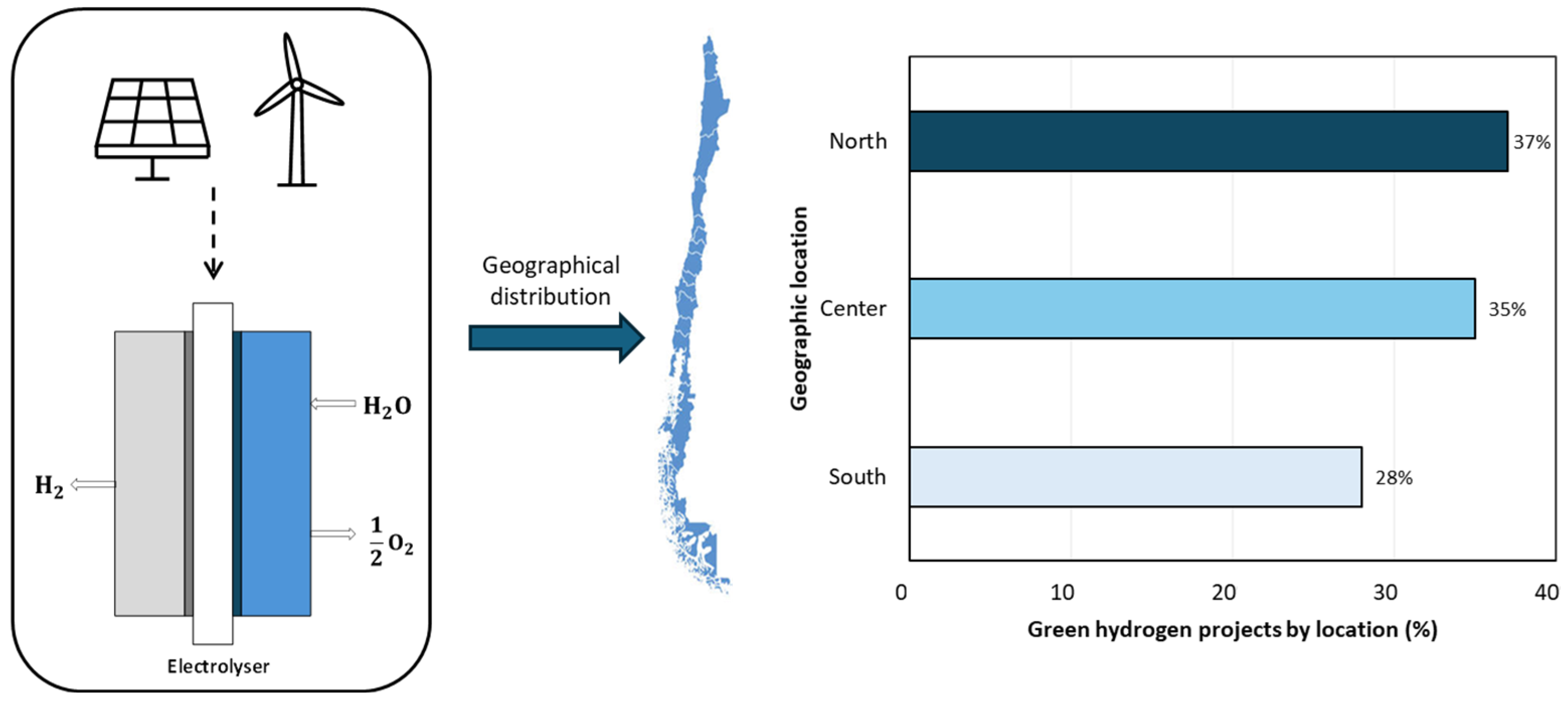
As a result of the government’s initiatives, by 2025, 83 projects related to hydrogen production have been announced, spanning different stages of development [46]. Of this total, 46 projects focus on the production and commercialization of hydrogen and its derivatives, 33 target various end-use applications, and 4 are centered on manufacturing components for the national value chain. Most of these projects are located in the northern zone (37%), followed by the center-south zone (35%) and the south zone (28%) (Figure 1). Within this extensive pipeline, only ten projects focused on green hydrogen and ammonia production have been submitted to the EIAS (Table 2), seven of which have received environmental approval and are currently at different stages of implementation [47]. Collectively, these ten projects represent an announced electrolysis capacity of 12.5 GW; however, the seven approved projects account for only 3.9 GW, highlighting significant delays in achieving the milestones proposed by the NGHS. These delays can be attributed to three primary factors: (i) the pilot-scale nature of several projects with limited capacity; (ii) persistent technical and regulatory barriers; and (iii) financial obstacles and challenges in securing reliable off-take agreements due to the industry’s relative immaturity. As noted by the IEA [48], the slow market development, which complicates long-term off-take security, and the abandonment of initiatives with weak business cases following the initial ‘hydrogen boom’, are the primary drivers for the decline in active projects. The seven approved projects represent a private investment of USD 3.9 billion [10]; of this, USD 15.2 million in public funding was allocated to support two specific pilot projects (items 3 and 4 in Table 2) [34,35].
At a global level, only 9% of announced projects reached the Final Investment Decision (FID) phase by 2024. According to the IEA, low-emission hydrogen production is expected to remain more costly than unabated fossil-based production in the near term. Furthermore, cost projections for electrolyzers have become less optimistic than in previous years due to limited deployment to date [48]. These global trends present significant challenges for Chile, as achieving the production cost targets is a fundamental pillar for the successful implementation of the NGHS.
The green hydrogen projects detailed in Table 2 exclusively use either alkaline electrolyzers (AE) or proton exchange membrane (PEM) systems. This selection is primarily driven by their high technological maturity, as both AE and PEM have reached a technology readiness level (TRL) of 9 [48]. In contrast, several alternative production routes remain in different stages of development, as shown in Table 3. Currently these technologies face a spectrum of challenges and opportunities, each closely tied to their TRLs [49]. Considering the industrial-scale requirements of the hydrogen plants currently being implemented in Chile, the prioritization of AE and PEM systems is justified to ensure techno-economic feasibility and rapid deployment.

4. Review of Life-Cycle Greenhouse Gas Emissions of Green Hydrogen Production in Chile

Despite literature related to hydrogen in Chile is abundant [8,14,17,18,50,51,52,53,54,55,56], there is a lack of research on evaluating the GHG emissions linked to the production of green hydrogen in the country. This is a limiting factor given the country’s intention to be a world leader in the production of low-carbon hydrogen [57,58]. Although renewable energy technologies and water electrolysis systems do not produce direct operational emissions, they do generate life-cycle emissions arising from upstream processes (e.g., equipment manufacturing, raw materials extraction) and downstream activities related to hydrogen distribution [58]. This explains the carbon footprint gap between a theoretically zero-emission system and the emissions incurred across the full supply chain. To date, only a few studies evaluating the GHG emissions of the green hydrogen production in Chile are publicly available [22,23,24]. The objective of this section is to review the existing studies on GHG emissions associated with green hydrogen systems.
García and Oliva [22] evaluated the GHG emissions of hydrogen production powered by a combination of solar photovoltaic (PV) and wind energy in an off-grid electrolysis plant, including four locations in Chile with abundant wind and solar resources. The authors considered a generic electrolysis subsystem unit and a production of 250 t of green hydrogen per year. The authors concluded that GHG emissions ranged between 1.06 and 1.57 kg CO2e/kg H2 (“e” refers to CO2-equivalent based on global warming potential), when combining solar PV and wind energy sources. However, GHG emissions ranged from 1.99 to 7.1 kg CO2e/kg H2 and from 0.85 to 2.2 kg CO2e/kg H2, when the energy was exclusively obtained from solar PV and wind energy sources, respectively. The study from García and Oliva also analyzed the impact of the geographical location, and concluded that Taltal, in the Northern zone, has the lowest emissions (1.06 kg CO2e/kg H2), followed by Tiltil and Licanten in the Central zone, and Mejillones in the Northern zone.
Urrutia [23] calculated the carbon footprint of the production of ammonium nitrate (AN), generated from green hydrogen. The process considers the production of green hydrogen, which, combined with nitrogen (N2), produces ammonia (NH3) that is used directly as an input to synthetize ammonium nitrate (NH4NO3) as a final product. This work considered the production of hydrogen by water electrolysis using a PEM system, and that hydrogen and ammonia are produced in the same facility, located in the Atacama Desert. The electricity used in the production processes is supplied by an external renewable provider and not connected to the grid. The emissions were calculated considering scopes 1, 2 and 3, according to the GHG Protocol [59]. This implies that the analysis includes both direct production emissions and indirect emissions associated with electricity generation and upstream manufacturing processes from the acquisition of raw materials. The results illustrated that 74,122 t CO2e were generated to produce 300,000 t of ammonium nitrate, corresponding to a carbon footprint of 0.2 t CO2e/t AN.
Pottstock [24] conducted a cradle-to-gate life-cycle assessment (LCA) of hydrogen production in Chile using four pathways: (i) solar energy with hydrogen compression, (ii) wind energy with hydrogen compression, (iii) solar energy with hydrogen liquefaction, and (iv) wind energy with hydrogen liquefaction. The analysis included the different upstream manufacturing processes, as well as the liquefication, storage and distribution of the produced hydrogen. A total of 17 impact categories were evaluated using the ReCiPe methodology. The findings indicated that the primary environmental impacts stem from the liquefaction phase, driven predominantly by high electrical power consumption. Interestingly, the author noted that the choice of primary energy source (solar and wind) did not yield significant differences in environmental performance when using the same downstream production process across the four cases. In contrast, the storage stage (compression versus liquefaction) proved to be a decisive factor, resulting in a significant variance in total impacts. Ultimately, the results favored wind-based hydrogen production combined with liquefaction as the most environmentally favorable configuration among the evaluated scenarios.
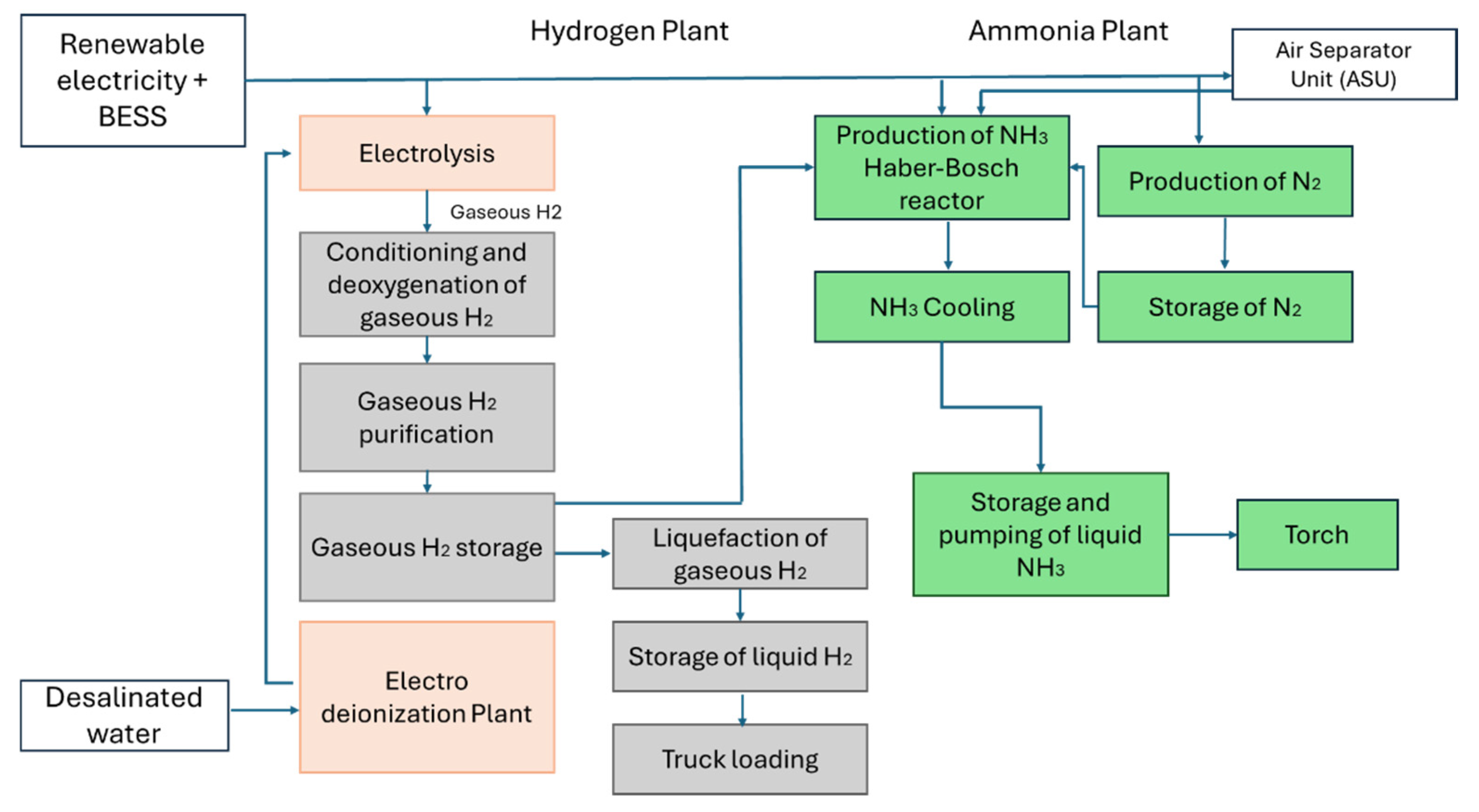
In Chile, each project submitted to the EIAS must compulsorily publish an inventory of atmospheric emissions, focusing on particulate matter (PM2.5, PM5 and PM10) and air-polluting gases (NOX, SOX, CO, COV and NH3) [47]. However, the EIAS does not require specific information about carbon footprints. Exceptionally, two projects related to green ammonia production from hydrogen, submitted to the EIAS, included estimates of CO2, CH4 and N2O emissions generated by the different activities of each project. The emission factors for each activity were obtained from the Database GHG Emission Factors Chile Footprint Platform 2019, based on the IPCC 2006 Guidelines for National Greenhouse Gas Inventories document [60,61]. One of them is the “Integrated Energy Infrastructure Project for the Generation of Green Hydrogen and Ammonia” (INNA, for its Spanish acronym), located in the northern Region of Antofagasta, while the other is the “Comprehensive project for the production and export of green ammonia-HNH ENERGY” (HNH, for its Spanish acronym), located in the southern Region of Magallanes and Chilean Antarctic. The objective of both projects is to synthetize ammonia for exportation, by using green hydrogen produced by AE powered with renewable electricity. Figure 2 depicts the general process for ammonia production using green hydrogen. In both projects, all activities will be carried out in the same plant site, and the final product will be transported by pipelines to the maritime terminal. Table 4 describes the properties of each project, according to the information presented to the EIAS [62,63].
Table 5 illustrates the GHG emissions of the INNA and NHN projects according to the information submitted to the Chilean EIAS. The results of these projects align with Ghavan et al. [64], confirming that GHG emissions from solar/wind-powered ammonia electrolysis are minimal. Data show the INNA project’s footprint is driven by construction, whereas the NHN project’s production stage dominates due to its longer lifespan. According to Wilkinson et al. [65], the plant lifespan and transportation distance or mode can have a significant environmental impact. Specifically, Sadhegi and Ghandehariun [66] reported that extending the plant lifetime from 15 to 45 years can reduce emissions from 1.88 to 0.63 kg CO2e, respectively.
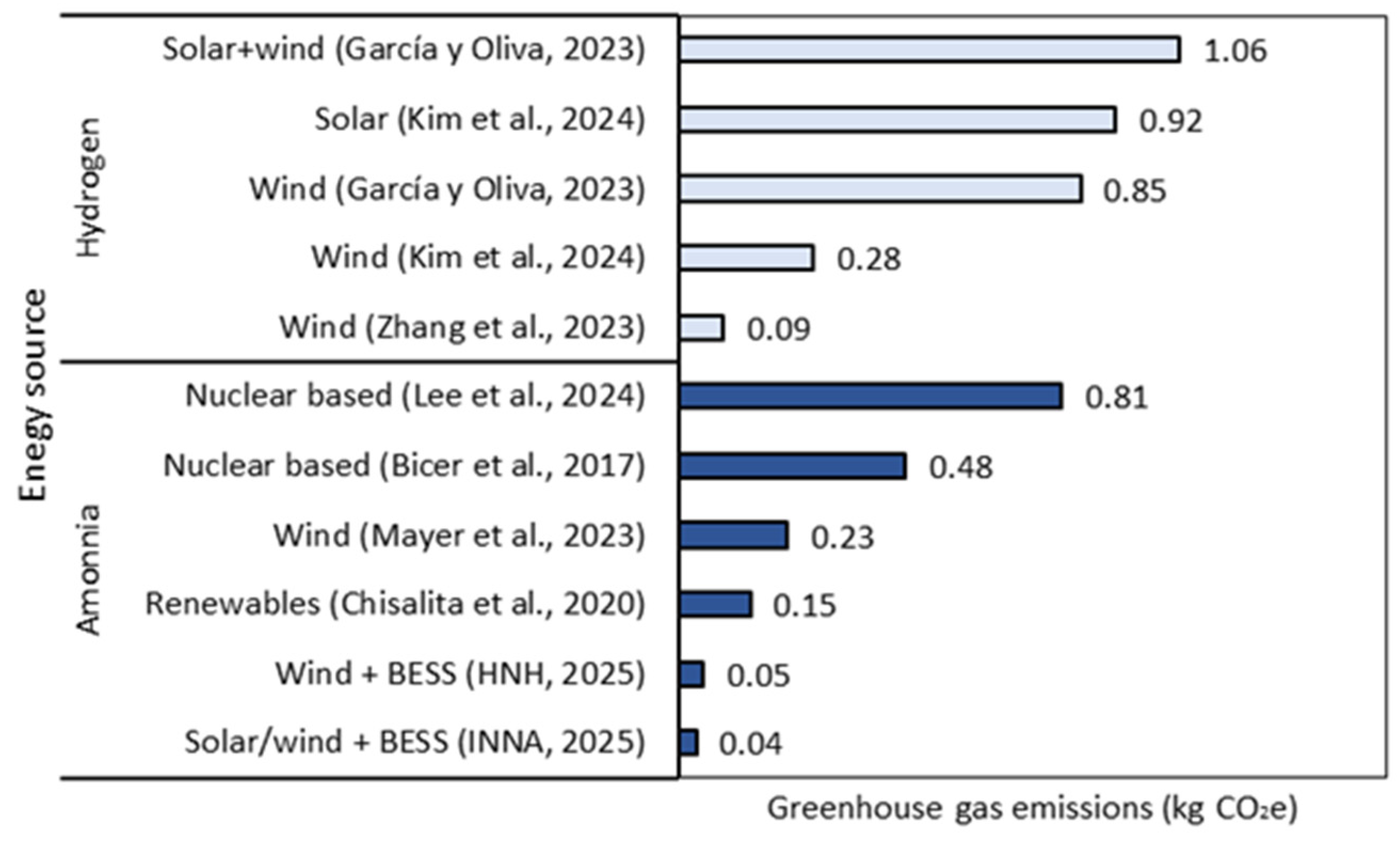
Figure 3 illustrates a summary of GHG emissions associated with the energy sources used in green hydrogen and ammonia production, based on data from the EIAS and the scientific literature. Direct comparisons with previous studies reveal a broad spectrum of results, largely driven by discrepancies in system boundaries, calculation frameworks, and electricity sources. For example, Mayer et al. [67] concluded that the ammonia production process would reach 0.23 kg CO2e/kg NH3 using onshore wind electricity and 0.5 kg CO2e using PV electricity. Bicer et al. [68] evaluated 15 ammonia generation pathways in the USA and identified that nuclear-based ammonia production had the lowest climate impact at 0.48 t CO2e/t NH3. Chisalita et al. [69] reported GHG emissions of 0.149 t CO2e/t NH3 for green ammonia production in Germany using a carbon-free energy mix of hydro, wind, solar PV and biomass. In a South Korean context, Lee et al. [58] compared domestic and imported ammonia, concluding that domestic nuclear-powered water electrolysis yielded the lowest emissions at 0.81 t CO2e/t NH3. More broadly, Mohamed et al. [70] noted that reported GHG values for conventional ammonia synthesis plants range from 1.25 to 2.16 kg CO2e/kg NH3. Improving system energy efficiency can also be important to enhance the environmental prospect of green ammonia production. For instance, recent research has shown that electricity-hydrogen-ammonia synergistic planning can lead to important energy efficiency improvements [71], which could provide benchmarking information for the design of large-scale green ammonia systems in Chile.
Regarding the influence of energy sources used in the production process, these results are consistent with García and Oliva [22], who concluded that the use of wind or solar PV-wind hybrid systems would be environmentally more advantageous than solar PV systems in Chilean hydrogen production plants. Also, Zhang et al. [72] demonstrated that the combination of onshore wind power and PEM electrolysis technology for hydrogen production emits 0.0936 kg CO2e. Kim et al. [73] found that in South Korea, producing 1 kg of hydrogen emits 0.283 kg CO2e for wind power and 0.924 kg for solar power. According to García and Oliva [22], when exclusively wind energy is used, GHG emissions of the hydrogen production ranged between 0.85 and 2.2 kg CO2e/kg H2 in the north and central-south Chilean zones, respectively, with capacity factors ranging between 21 and 44%. The capacity factor refers to the fraction of time a plant operates over a year and directly influenced by the availability of renewable energy sources. The Magallanes and Chile’s Antarctic region, where the HNH Project is located, is characterized by a high availability of wind energy sources with a plant-factor of more than 60%, which would also explain the low emissions and the differences observed with the results obtained by García and Oliva. The Region is considered a hot spot for the Chilean clean hydrogen strategy [74]. Overall, this review highlights a lack of information on emissions from the Chilean hydrogen and ammonia manufacturing process and demonstrates that further research must prioritize life-cycle assessments to mitigate uncertainties and support the country’s transition to a green hydrogen economy.

5. Review of Cost Drivers and Levelized Cost of Hydrogen Projections in the Chilean Context

The NGHS [1] projects that, by 2030, Chilean hydrogen production will achieve the lowest global levelized cost of hydrogen (LCOH), reaching approximately USD 1.3–1.4/kg. However, a study commissioned by the Energy Ministry projected an average of USD 3.1/kg by 2030, even when considering the ‘best combination of wind and solar’ energy sources [21]. The study calculated the LCOH of 47 projects and concluded that the 2022 cost values averaged USD 4.6/kg, and that the average value would slightly exceed USD 2.0/kg by 2050. Even for highly competitive initiatives like the HNH project (see Section 4), with a projected LCOH of USD 2.36/kg by 2030 and USD 1.65/kg by 2050, the LCOH remains significantly above the goals proposed by the NGHS. Similarly, Moraga et al. [18] estimated that solar-based systems in the northern Antofagasta region could achieve a minimum cost of USD 1.39/kg within the next decade, which still exceeds both the price objectives and the aggressive timelines established in the national strategy.
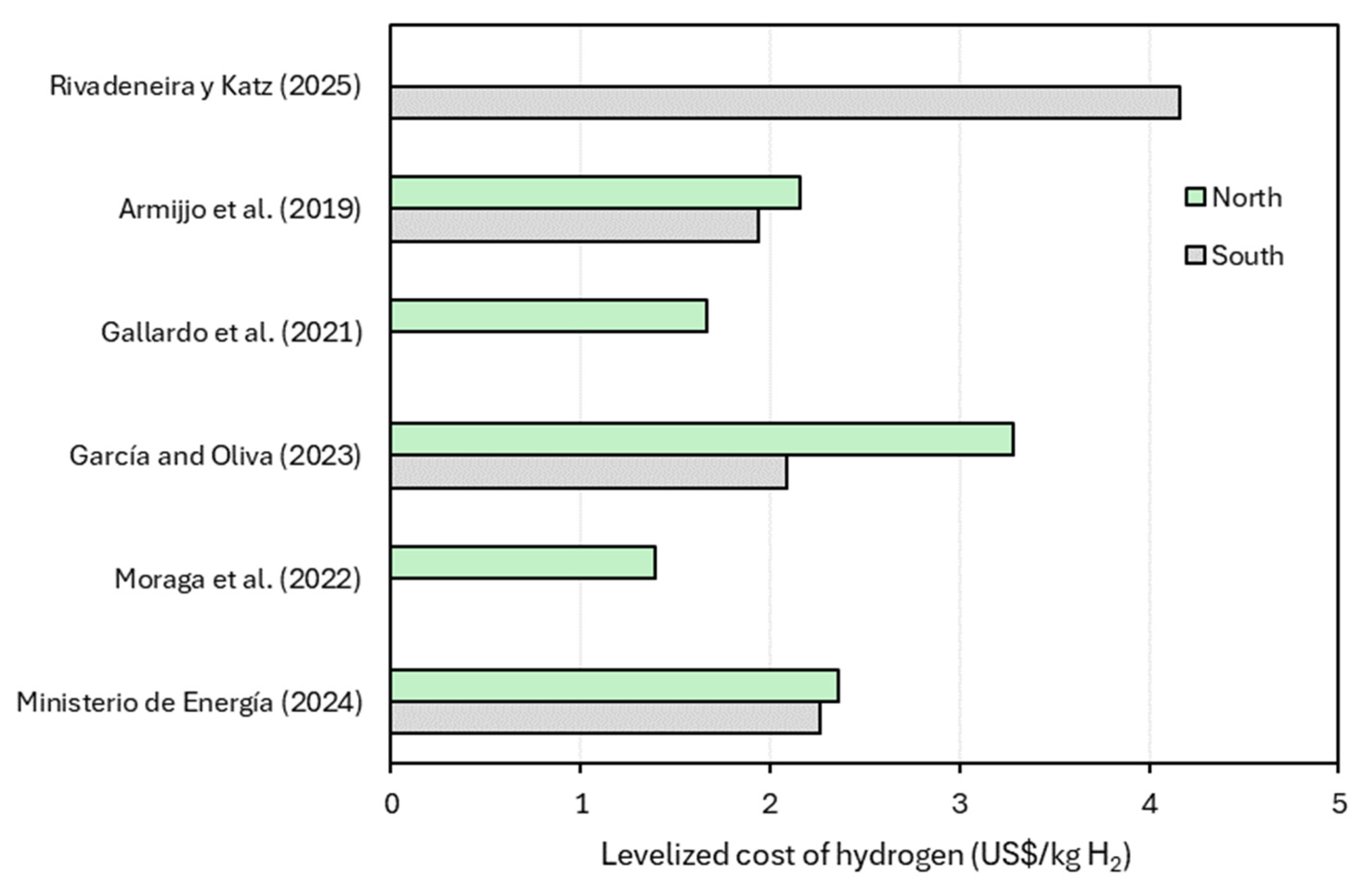
Figure 4 presents LCOH values reported in the scientific literature for Chile. The largest contributor to the costs of green hydrogen is strongly linked to the electricity consumption, which varies significantly with the location of the power facilities within Chile and depends on the international prices of equipment and transport [67]. The results from the study by García and Oliva [22] indicate that green hydrogen production costs range from USD 2.09 to 3.28/kg, depending on the plant’s location and its corresponding renewable capacity factor. Specifically, the authors identified Taltal, in northern Chile, as a highly cost-effective site where an LCOH of USD 2.09/kg could be achieved using a hybrid solar PV and wind configuration. Furthermore, Gallardo et al. [75] concluded that, by utilizing commercial electricity power purchase agreements (PPAs) for PV-powered alkaline electrolyzers in the Atacama Desert, the LCOH could drop to USD 1.67/kg by 2025, representing one of the lowest estimated production costs for hydrogen to date. More recently, Rivadeneira and Katz [76] calculated a USD 4.16/kg cost to produce green hydrogen in the Magallanes Region, using wind energy. The authors concluded that this LCOH value is considerably higher than that previously reported in literature (around USD 2/kg H2), but closer to the prices observed in the current market (USD 8–10/kg H2).
Armijo et al. [19] examined the flexible production of green hydrogen in Chile and Argentina and concluded that hybrid solar–wind systems significantly reduce costs by optimizing the electrolyzer capacity factor. Their estimates suggest near-term production costs of USD 1.8–3/kg in Northern Chile, with green ammonia costs falling below USD 500/t. This is a critical threshold; as noted by Osman et al. [77], a levelized cost of ammonia (LCOA) of USD 450/t renders green ammonia directly competitive with conventional fossil-based production. Furthermore, Nayal-Luke and Bañares-Alcántara [78] suggest that, by 2030, integrated solar–wind pathways could reduce the LCOA below USD 350/t. This economic potential is supported by Baral and Sebo [20], who identified the combination of solar PV and onshore/offshore wind with energy storage as a promising alternative to achieve a minimum LCOH of USD 1.46–3.09/kg by 2030. Even in configurations without storage, offshore wind and solar PV were found feasible, with production costs ranging from USD 1.78 to 2.21/kg.
Gallardo et al. [75] noted that the techno-economic feasibility of green hydrogen production is also highly dependent on the energy market characteristics. The authors highlighted that demand volume, transportation logistics, and energy carrier are decisive factors in the cost structure and the delivered LCOH of the hydrogen supply chain. In this regard, Galimova et al. [79] analyzed the impact of international transportation chains on the cost of green hydrogen produced in Chile and exported to Germany and Finland. The authors concluded that, despite the lower production costs compared to Germany and Finland, the additional transportation costs make imports economically unattractive. Fúnez-Guerra et al. [80] and Gallardo et al. [75] conducted techno-economic analysis, including the costs of transporting green hydrogen and green ammonia from Chile to Japan. According to their results, using ammonia as an energy carrier would be a technically viable and profitable solution with positive environmental impacts. According to Gallardo et al. [75], although a competitive LCOH could be achieved at the port of arrival in 2025 (3.94–4.32 USD/kg H2 for NH3 and 4.89–5.07 USD/kg H2 for H2), these values are still higher than the ~0.7 USD/kg H2 for ammonia and ~2.3 USD/kg H2 for hydrogen, targeted by the Japanese Hydrogen Strategy by 2030 [81]. Regarding to the impacts of shipment costs, a study carried out by the Institute of Energy Economics of Japan [82] concluded that, despite Chile’s geographic distance from Japan, transport costs for hydrogen and ammonia accounts for a limited share of the whole supply cost. Indeed, distance does not cause a significant disadvantage, representing less than 6% of the total exportation value chain.
It is important to note that cost projections remain highly uncertain due to the variability of electricity prices, electrolyzer costs, and supply chain disruptions, which can affect the economic performance of hydrogen systems. Accordingly, potential price fluctuations can widen the gap between the Chilean NGHS objectives and actual cost performance. To address this, several studies have incorporated sensitivity analyses. Galimova et al. [79] applied a ±20% range for capital and operating expenditures in the hydrogen transport value chain, finding that exports to Europe remained economically unattractive regardless of the transport cost variations. Fúnez Guerra et al. [80], who evaluated Chilean green ammonia export to Japan, illustrated that a payback period exceeding 10 years occurs only if ammonia prices fall below EUR 400/t NH3, potentially disincentivizing process investment. Their analysis highlights that electricity prices below EUR 26/MWh are required to achieve economic profitability, while an electrolyzer capital cost below EUR 620/kW is needed to reach payback periods below 10 years. These findings reinforce the idea that Chilean green hydrogen systems have yet to reach economic profitability. Furthermore, León et al. [51] examined green hydrogen production plants in Atacama Desert and Patagonia using off-grid renewable energy systems. The sensitivity analysis identified equipment cost as the most sensitive economic parameter, which can be attributed to the high electrolyzer and off-grid renewable system expenses. Finally, geopolitical risks and fuel price volatility present additional threats to the supply chain, directly impacting the total costs of hydrogen manufacturing and global shipping.

6. Chilean Green Hydrogen Economy: Strategic Positioning and International Market

For Chile, green hydrogen is not merely a component of its carbon neutrality roadmap. The government prioritized the sector as a strategic driver for economic diversification, intended to catalyze technological innovation and generate significant national revenue. To realize the export ambitions outlined in the NGHS [1], two primary measures were established: (i) the active opening of international markets; and (ii) the development of a new export economy focused on clean energy and low-carbon footprint commodities. Within this framework, the NGHS outlines specific actions to foster green hydrogen market and facilitate international trade: (i) promoting the establishment of international certification schemes for carbon footprint and guarantees of origin; and (ii) catalyzing commercial initiatives with potential hydrogen-importing countries to develop large-scale export–import projects. In this regard, the Chilean Ministry of Energy has signed several international agreements intended to facilitate market access for nationally produced green H2. These partnerships aim to foster production aligned with international market conditions, secure strategic transportation routes, and accelerate domestic capacity building in hydrogen technologies [36]. To expand the international market, Chile also benefits from trade agreements signed with these economies [83]. Table 6 depicts the different agreements related to green hydrogen and trade agreements signed by Chile.
One outcome of these agreements has been the implementation of a pilot plant for the production and use of green hydrogen to produce e-methanol and e-gasoline, with support from the German government. Following the success of this project and the shipment of e-fuels to Germany, HIF Global submitted to the EIAS, the carbon-neutral synthetic fuel project. This project is expected to produce more than 173,000 t per year of e-methanol, which will be further processed into 70,000 t per year of e-gasoline and 8030 t per year of e-liquified petroleum gas. The project was approved in November 2025 and is currently under construction. According to a study carried out by the Chile–Germany Energy Partnership Project [84], transport costs can be reduced by nearly half if ships exporting hydrogen and its derivatives are also used to transport the chemical products imported by Chile from Germany. This optimization would have the greatest influence on the liquid hydrogen value chain, in which the total LCOH can decrease by 4–8%. In the case of ammonia, the reduction is estimated at 2–3%, while for the methanol, the impact is more limited, at only 0.7–1.1% of the total LCOH. In the case of hydrogen exports via methanol from northern Chile to Germany, shipping costs are expected to account for less than 5% of the total cost.
Rapid progress has been made in the implementation of certification schemes, specifying the rules, criteria and labels concerning the contribution of green H2 in the decarbonization objectives of different countries. However, according to the IEA [13], the current fragmentation of certification schemes creates a significant risk of technical incompatibility and increased administrative burdens as hydrogen becomes a globally traded commodity. For national producers, this variety of schemes could represent a strategic risk. Companies must navigate diverse regulatory requirements to verify the environmental integrity of their products for different jurisdictions. In this regard, the IEA [13] reports almost 40 certification schemes in operation, within national, regional, sub-national and global/international markets. Of these initiatives, 13 are regulatory in nature, including Korea, Brazil, Canada, the United Kingdom and the USA, while the remainder consist of voluntary cooperation frameworks. All the schemes listed by the IEA (except for the European Union, the UK Renewable Transport Fuel Obligation, and H2Global) have a threshold below 4 kg CO2e/kg H2 considering a well-to-gate scope. Table 7 lists the certification schemes in force in the countries to which Chile plans to export green hydrogen, as well as potential competitor countries such as Brazil, China, and Kenya.
To comply with the NGHS goals, Chile, the European Union and the Latin American Energy Association (OLADE, by the Spanish acronym) launched a capacity-building project designed to align domestic production with international certification standards for hydrogen and its derivatives, thereby facilitating global market access for exports [48]. Additionally, Chile commissioned a study to develop a strategic proposal for a national sustainability certification system encompassing hydrogen, ammonia and synthetic fuels. Published in 2025, this framework aims to ensure regulatory operability with the stringent import requirements of Europe, Japan and the Republic of Korea [85].
Given the international agreements ratified by the Chilean government and the emerging landscape of global green hydrogen producers, it is essential to benchmark Chile’s progress against the strategic initiatives undertaken by other countries. In the rest of Latin America, certification schemes and emissions threshold have been announced, but the definition of methodology and rules to measure GHG emissions are yet to be published [48]. The region is already pursuing regulatory harmonization to promote international trade [13]. At COP 28, fourteen Latin American and Caribbean countries endorsed a regional certification scheme (CertHiLAC) consistent with international standards but considering the specific regional conditions [13].
The success of international agreements to export green hydrogen and its derivatives from Chile will be determined by the technical and economic feasibility of this approach. Different exportation pathways for green hydrogen in Chile have been explored in the literature. Table 8 summarizes the key characteristics and outcomes of selected case studies.
Seeger et al. [88] evaluated the techno-economic implications of green hydrogen production in Chile for subsequent exportation to Germany. The supply chain stages included production, conversion, transport, reconversion and distribution, with ammonia, methanol and liquified hydrogen evaluated as potential energy carriers. The results illustrated that Chile exports to Germany could reach EUR 4.8/kg H2 by 2030 and EUR 3/kg H2 by 2050. Liquified hydrogen is projected to offer a better economic prospect by 2050 than ammonia and methanol, primarily due to its lower conversion costs. This suggests that liquified hydrogen could become the most suitable energy carrier for large-scale hydrogen exports by 2050. However, ammonia and methanol present advantages in terms of lower conversion and transportation costs when they can be used directly, thus avoiding costly reconversion processes. This makes them particularly attractive in the short-term, especially green ammonia, as existing natural gas infrastructure, such as storage facilities and pipelines, can be adapted with relatively minor modifications [88,90]. In this regard, hydrogen faces substantial challenges in establishing a robust export infrastructure due to the large investments required for dedicated storage systems and pipelines, requirements that are largely avoided in the NGHS.
While exporting green hydrogen and its derivatives to third countries can be attractive, given the high availability of renewable energy sources in Chile [91,92], its large-scale implementation will largely depend on the costs and environmental impacts associated with long-distance transportation. Hartvigsen et al. [86] reported that ammonia imported from Chile was more economically competitive than locally produced hydrogen, with projected transportation costs at EUR 95/t NH3 by 2030 and EUR 76/t NH3 by 2050. Galimova et al. [87] demonstrated that exporting green methanol from Chile to Germany, Spain and Finland can lead to cost reductions towards 2050, despite the cost advantages are limited for Spain due to its abundant solar energy resources. This underscores that the cost-attractiveness of hydrogen-based carriers exports from Chile will be greater in countries with limited renewable energy availability and higher domestic production costs. In contrast, environmental impact assessments reveal different trends from those observed for economic performance. Kolb et al. [57] analyzed the environmental performance of liquified hydrogen imports from Chile to Germany using a cradle-to-gate perspective. The authors reported that life-cycle GHG emissions for hydrogen exported from Chile range between 2.4 and 4.1 kg CO2e/kg H2, and do not outperform imports from Canada or Morocco, despite Chile featuring the lowest GHG emissions in the production stage. This outcome can be attributed to the longer shipping distances to Germany, which contribute significantly (around 1.7 kg CO2e/kg H2) to overall environmental impacts. Although Chile has established agreements with Germany to develop corridors for transporting green hydrogen and its derivatives, these findings highlight the inherent environmental challenges associated with long-distance distribution to European markets.
Beyond export opportunities, hydrogen can also be used domestically to support the decarbonization of hard-to-abate industrial sectors. Ferrada et al. [16] evaluated the role of green hydrogen in the Chilean energy transition through a multi-sectoral energy model. The results illustrated that green hydrogen has economic and environmental potential to decarbonize inter-provincial buses and long-haul trucks, as well as to decarbonize electricity supply through seasonal hydrogen storage and hydrogen fuel cells implementation. Sánchez-Squella et al. [93] evaluated green hydrogen as a fuel for a Chilean company in the mining sector and reported that a medium-scale system (electrolyzer powered with 1700-kW photovoltaic plant) could be economically feasible, particularly when capacity factors of 90% are achieved.
Finally, it is important to address how geopolitical risks and supply chain pressures can impact green hydrogen integration into the global market and the deployment of infrastructure within Chile. On the one hand, global fuel prices and maritime transportation routes remain highly volatile due to ongoing geopolitical conflicts. This uncertainty directly impacts the cost-effectiveness of distributing hydrogen and its derivatives from Chile to international markets. On the other hand, the establishment of robust infrastructure depends on the deployment of electrolyzers and renewable energy systems. As highlighted in Section 2, these technologies rely substantially on imported critical metals, the availability and price of which are subject to complex geopolitical relationships and global supply chain bottlenecks. Consequently, these external pressures prevent a clear definition of production and shipping costs, potentially hindering the achievement of 2030 export targets.

7. Challenges and Perspectives of the Green Hydrogen Industry in Chile

For Chile, green hydrogen stands as a key factor towards carbon neutrality and represents an important business opportunity to provide technological innovations and resources to the national economy. In this regard, the Chilean NGHS aims to achieve USD 2.5 billion per year of green hydrogen exportations and states that the hydrogen produced nationally will achieve the lowest world LCOH [1]. Different studies concluded that achieving these exports, under the current conditions, is not yet a feasible option [18,20,21]. The lowest cost value that the country could expect by 2030 would range from USD 1.46 to 3.09/kg of hydrogen [21]. These results highlight that green hydrogen cost projections are still far from the objectives set by the Chilean Strategy.
Implementation of green hydrogen projects in Chile remains limited, hindering the targets established in the NGHS. While ten projects totaling 12.5 GW have been submitted to the EIAS, half of the 2030 goal, the seven approved initiatives account for only 3.9 GW. This capacity fails to meet the benchmark set for 2025, highlighting a disconnection between policy objectives and current project realization. Although the government has introduced significant policy instruments to promote hydrogen initiatives, several bureaucratic procedures continue to hinder large-scale implementation. Chile’s success is dependent on the transition of the sector toward a commercially and operationally consolidated industry. As the IEA [4] and Odenweller and Ueckerdt [94] pointed out, the hydrogen sector needs to overcome different challenges: (i) providing market confidence and reducing uncertainties to the private sector; (ii) accelerating progress in regulation and implementation of support policies; (iii) complying regulatory and certification schemes in international markets; (iv) reducing uncertainties regarding green hydrogen production standards; and (v) fostering technical and institutional capacity to support the development of this industry. Intermittency of wind and solar resources can also represent an important challenge for integrating water electrolyzers for green hydrogen production. Potential strategies, such as microgrid control approaches [95], may provide a relevant solution for off-grid green hydrogen projects in Chile. Additionally, it is crucial to recognize that the employment projections for this industry may be overstated. Scholvin [52] argues that the green hydrogen sector is inherently capital-intensive rather than labor-intensive. While significant labor is required during the construction of the infrastructure and plants, the subsequent operation and maintenance phase requires comparatively minimal labor. This output highlights that the Chilean Government expectations seem optimistic and far from short-term projections.
The lack of information available in the scientific literature and policy reports related to the life-cycle GHG emissions of the green hydrogen produced in Chile is another potential barrier. Due to its increasing share of renewable energy in the electrical matrix, the country has the potential to produce low carbon footprint hydrogen and ammonia, which could easily be introduced in different markets [96]. However, Chile should also account for the upstream emissions of the construction and manufacturing of renewable energy assets to ensure the green quality of the hydrogen nationally produced. In addition to complying with certification schemes across different markets and importing countries, the government should also consider future developments aimed at reducing the carbon footprint and costs associated with long-distance hydrogen transportation, as these factors could significantly influence national hydrogen strategies and business models.

8. Conclusions

Chile has advanced in establishing the foundations of an industry focused on the production of green hydrogen and its derivatives. However, despite the government’s efforts, progress remains limited, and the costs required to enable large-scale commercialization of hydrogen are still far from being achieved. Few industrial projects are currently under implementation and only ten have been so far submitted to the Environmental Impact Assessment Service. The reason for the low implementation of green hydrogen projects can be attributed to several factors, such as the economic impacts of the pandemic, the different geopolitical conflicts worldwide, and the recent foreign policies dictated by the US Government which affect production costs and create uncertainties. Chile, despite having signed agreements with several countries, has not been able to implement a consolidated and robust hydrogen industry due to delays in the development of the infrastructure dedicated to hydrogen production and transportation.
To reinforce Chile’s ambitions to lead the green hydrogen industry, an updated NGHS was recently published [32]. This document identifies critical aspects that have hindered previous implementation and establishes specific milestones to address them. The proposed actions, which include providing financial instruments, ensuring infrastructure availability, and incentivizing active participation from the private sector and regional stakeholders, aim to effectively resolve the observed barriers. However, Chile’s dependence on external factors, both on imported production technologies and international buyer markets, and the inability to precisely define production and shipping costs due to market immaturity, continues to limit sector growth.
To advance toward the goals established in the updated NGHS, the country must implement actionable measures across policy, industry and research dimensions:
  • At the policy level, the country must adapt its legal framework to provide institutional security for all actors involved in the green hydrogen sector. The government has to quantify the specific contributions of hydrogen to the national emission reductions and establish robust quality guarantees for the gas and its derivatives to comply with international certification schemes in potential markets. In this regard, it is critical that the certification framework proposed in the NGHS becomes fully operational before the first production plants are commissioned. Furthermore, the environmental licensing process must be streamlined, specifically regarding evaluation deadlines to avoid delays and maintain investor confidence.
  • At the industry level, infrastructure development requires a strategic shift from foreign dependency toward localized resource management. The implementation of funding measures is recommended to incentivize the local manufacturing of electrolyzer components, thus reducing reliance on external markets and lowering the capital intensity of the hydrogen supply chain. Additionally, the country should coordinate the deployment of desalination infrastructure in Northern regions, where exceptional solar irradiance is currently offset by limited availability of water resources. The industry should also transition from its 33 existing trade agreements toward firm contracts, which is crucial to provide the required clarity for final investment decisions.
  • In the research dimension, strengthening long-term Research and Development (R&D) cooperation is vital for achieving medium-term goals. Expanding R&D alliances with international partners, such as the Chile–Germany agreement, should prioritize improving cost-efficiency and reducing the dependency on critical metals in PEM stacks. Mitigating these supply chain risks is essential for the stability of the Chilean hydrogen value chain. Finally, coordinating these R&D activities with domestic applications, particularly in the mining industry and the heavy-duty transport sectors, is crucial to ensure the successful implementation of the 2030 green hydrogen goals.

Author Contributions

Conceptualization, H.S., R.C., C.V., A.M., F.F. and S.V.; methodology, H.S.; validation, R.C., C.V. and S.V.; formal analysis, H.S., A.M. and F.F.; investigation, H.S.; writing—original draft preparation, H.S.; writing—review and editing, R.C., C.V., A.M., F.F. and S.V.; supervision, C.V. and S.V. All authors have read and agreed to the published version of the manuscript.

Funding

This research received no external funding.

Data Availability Statement

Not applicable.

Acknowledgments

The authors acknowledge the Catalan Government (ref. 2021-SGR-596). This work was part of Maria de Maeztu Units of Excellence Programme CEX2023–001300-M funded by MCIN/AEI/10.13039/501100011033. Sergi Vinardell is a Serra Húnter fellow.

Conflicts of Interest

The authors declare no conflicts of interest.

Abbreviations

The following abbreviations are used in this manuscript:
ANammonium nitrate
CorfoCorporación de Fomento de la Producción
EIASEnvironmental Impact Assessment Service
FIDFinal Investment Decision
GHGgreenhouse gas
GIZGesellschaft Für Internationale Zusammenarbeit
H2hydrogen
IDBInteramerican Development Bank
IEAInternational Energy Agency
LCOAlevelized cost of ammonia
LCOElevelized costs of energy
LCOHlevelized costs of hydrogen
LTCSLong-Term Climate Strategy
N2nitrogen
NGHSNational Green Hydrogen Strategy
NH3ammonia
NH4NO3ammonium nitrate
PMparticulate matter
RFIrequest for information

References

  1. Correa, M.; Barría, C.; Mulenda, B. National Green Hydrogen Strategy: Chile, a Clean Energy Provider for a Carbon Neutral Planet. Available online: https://energia.gob.cl/sites/default/files/national_green_hydrogen_strategy_-_chile.pdf (accessed on 8 January 2025).
  2. Gobierno de Chile. Green-Hydrogen Action Plan 2023–2030. Available online: https://energia.gob.cl/documentos/green-hydrogen-action-plan-2023-2030 (accessed on 20 February 2025).
  3. Li, X.; Ye, T.; Meng, X.; He, D.; Li, L.; Song, K.; Jiang, J.; Sun, C. Advances in the Application of Sulfonated Poly(Ether Ether Ketone) (SPEEK) and Its Organic Composite Membranes for Proton Exchange Membrane Fuel Cells (PEMFCs). Polymers 2024, 16, 2840. [Google Scholar] [CrossRef]
  4. IEA. The Future of Hydrogen. Seizing Today’s Opportunities. Available online: https://www.iea.org/reports/the-future-of-hydrogen (accessed on 25 February 2025).
  5. Banco Central de Chile. Hidrógeno Verde en Chile: Perspectivas de Demanda e Inversión. Blog. Available online: https://www.bcentral.cl/web/banco-central/w/hidrogeno-verde-chile (accessed on 16 February 2025).
  6. Ministerio de Energía. Energía 2050 Política Energética Nacional de Chile. Available online: https://mma.gob.cl/wp-content/uploads/2019/05/Politica-Energetica-Nacional.pdf (accessed on 17 March 2025).
  7. Ministerio de Energía. Ruta Energética 2018–2022. Available online: https://comisionenergia-my.sharepoint.com/personal/infoestadistica_cne_cl/Documents/energia_abierta/Centro_de_Información/Estudios/Minerg/20180525_rutaenergetica2018-2022.pdf?ga=1 (accessed on 25 February 2025).
  8. Jorquera-Copier, J.; Lorca, Á.; Sauma, E.; Lorenczik, S.; Negrete-Pincetic, M. Impacts of different hydrogen demand levels and climate policy scenarios on the Chilean integrated hydrogen–electricity network. Energy Policy 2024, 184, 113881. [Google Scholar] [CrossRef]
  9. Secretary of the Energy Partnership Chile-Germany. Chile: Current Status of Green Hydrogen, Coal Exit and Climate Resilience. Available online: https://energypartnership.cl/fileadmin/chile/media_elements/Coal_Phase-Out/Factsheet_EP_Chile-Alemania_eng.pdf (accessed on 12 January 2026).
  10. SEIA. Datos H2V December 2025. Available online: https://www.sea.gob.cl/documentacion/reportes/proyectos-de-hidrogeno-verde-en-el-seia (accessed on 12 January 2026).
  11. H2Chile. Hydrogen Europe y H2 Chile Acuerdan Fortalecer la Cooperación Para Promover el Despliegue del Hidrógeno Renovable. Available online: https://h2chile.cl/2024/11/hydrogen-europe-y-h2-chile-acuerdan-fortalecer-la-cooperacion-para-promover-el-despliegue-del-hidrogeno-renovable/ (accessed on 25 May 2025).
  12. GIZ; López, F.; Valdivieso, R.; Delpiano, R. Evaluación e Implementación de Incentivos y Medidas Habilitantes para el Impulso de la Industria del Hidrógeno Verde y sus Derivados en Chile. Parte I—Informe Final; Deutsche Gesellschaft für Internationale Zusammenarbeit (GIZ) GmbH: Santiago, Chile, 2025. [Google Scholar]
  13. International Energy Agency (IEA). Global Hydrogen Review 2024. Available online: https://www.iea.org/reports/global-hydrogen-review-2024 (accessed on 25 February 2025).
  14. Mitigation and Energy Working Group. The Chilean Potential for Exporting Renewable Energy. Available online: https://minciencia.gob.cl/uploads/filer_public/c4/e1/c4e187c3-9545-481c-bc12-8a75a20b83d7/the_chilean_potential_for_exporting_renewable_energy.pdf (accessed on 21 May 2025).
  15. Isidoro Losada, A.M. Green hydrogen: Chances and barriers for the Energiewende in Chile. Sci. Talks 2022, 4, 100088. [Google Scholar] [CrossRef]
  16. Ferrada, F.; Babonneau, F.; Homem-de-Mello, T.; Jalil-Vega, F. The role of hydrogen for deep decarbonization of energy systems: A Chilean case study. Energy Policy 2023, 177, 113536. [Google Scholar] [CrossRef]
  17. Barra Novoa, R. Green Hydrogen in Chile: A Comprehensive Analysis of its Role in the Energy Transition and Sustainable Development. Available online: https://hal.science/hal-04703931v1 (accessed on 25 June 2025).
  18. Moraga, F.; Cerda, M.T.; Dinter, F.; Fuentes, F. Techno-Economic Analysis of the Integration of Large-Scale Hydrogen Production and a Hybrid CSP+PV Plant in Northern Chile. In Proceedings of the Solar PACES 2022, 28th International Conference on Concentrating Solar Power and Chemical Energy Systems, Albuquerque, NM, USA, 27 September 2022. [Google Scholar]
  19. Armijo, J.; Philibert, C. Flexible production of green hydrogen and ammonia from variable solar and wind energy: Case study of Chile and Argentina. Int. J. Hydrogen Energy 2020, 45, 1541–1558. [Google Scholar] [CrossRef]
  20. Baral, S.; Šebo, J. Techno-economic assessment of green hydrogen production integrated with hybrid and organic Rankine cycle (ORC) systems. Heliyon 2024, 10, e25742. [Google Scholar] [CrossRef] [PubMed]
  21. Ministerio de Energía; Ministerio de Relaciones Exteriores; Facultad de Ciencias Físicas y Matemáticas. Universidad de Chile. Principales Características del Motor de Cálculo de Costo Nivelado de Producción de Hidrógeno (LCOH). Available online: https://hidrogenoverde.minenergia.cl/wp-content/uploads/2024/04/Motor-Calculo-LCOH-Principales-Caracteristicas-20240411.pdf (accessed on 18 June 2025).
  22. Garcia, G.M.; Oliva, H.S. Technical, economic, and CO2 emissions assessment of green hydrogen production from solar/wind energy: The case of Chile. Energy 2023, 278, 127981. [Google Scholar] [CrossRef]
  23. Urrutia, F. Evaluación del Potencial de Reducción de Huella de Carbono en Tronadura a Partir de Hidrógeno Verde. Bachelor’s Thesis, Universidad de Chile, Santiago, Chile, 2022. Available online: https://repositorio.uchile.cl/handle/2250/192489 (accessed on 15 June 2025).
  24. Pottstock, A. The Environmental Impact of Hydrogen Production and Exportation Within the Framework of the Chilean Green Hydrogen Strategy. Master’s Thesis, Universidad de Chile, Santiago, Chile, 2024. Available online: https://repositorio.uchile.cl/bitstream/handle/2250/201955/The-environmental-impact-of-hydrogen-production-and-exportation-within-the-framework-of-the-chilean-green-hydrogen-strategy.pdf?sequence=1&isAllowed=y (accessed on 12 January 2026).
  25. Acosta, K.; Salazar, I.; Saldaña, M.; Ramos, J.; Navarra, A.; Toro, N. Chile and its Potential Role Among the Most Affordable Green Hydrogen Producers in the World. Front. Environ. Sci. 2022, 10, 890104. [Google Scholar] [CrossRef]
  26. Cacciuttolo, C.; Huertas, A.; Montoya, B.; Cano, D. The Present and Future of Production of Green Hydrogen, Green Ammonia, and Green E-Fuels for the Decarbonization of the Planet from the Magallanes Region, Chile. Appl. Sci. 2025, 15, 6228. [Google Scholar] [CrossRef]
  27. Pavez, R.; Ripoll, N.; Briceño, P.; Sánchez-Squella, A.; Olivares, M.; Pontt, J.; Mena, R.; Espergues, F.; Toledo, M. Review of international standards for the use of green H2 in Chilean mining industry. Int. J. Hydrogen Energy 2025, 103, 975–986. [Google Scholar] [CrossRef]
  28. Ministerio de Energía. Planificación Energética de Largo Plazo. 2018–2022. Informe de Actualización de Antecedentes. 2019. Available online: https://energia.gob.cl/sites/default/files/documentos/20191209_actualizacion_pelp_-_iaa_2019.pdf (accessed on 25 June 2025).
  29. Ministerio de Energía. Planificación Energética de Largo Plazo 2023–2027. Informe Final 2024. Available online: https://energia.gob.cl/sites/default/files/documentos/pelp2023-2027_informe_final_0.pdf (accessed on 23 March 2025).
  30. Gobierno de Chile. Long-Term Climate Strategy. The Path to Carbon Neutrality and Resilience by 2050. Available online: https://unfccc.int/documents/309334 (accessed on 19 February 2025).
  31. Ministerio de Energía; Política Energética Nacional. Transición Energética de Chile 2050. Actualización 2022. Available online: https://energia.gob.cl/sites/default/files/documentos/pen_2050_-_actualizado_marzo_2022_0.pdf (accessed on 17 February 2024).
  32. Ministerio de Energía. Estrategia Nacional de Hidrógeno Verde y Derivados. Actualización 2026. 2026. Available online: https://energia.gob.cl/sites/default/files/documentos/estrategia_nacional_de_hidrogeno_verde_y_derivados.pdf (accessed on 1 April 2026).
  33. Ministerio de Energía. Gobierno Presenta Fondo por US$ 1.000 Millones para el Desarrollo del Hidrógeno Verde en Chile. 2023. Available online: https://energia.gob.cl/noticias/nacional/gobierno-presenta-fondo-por-us-1000-millones-para-el-desarrollo-del-hidrogeno-verde-en-chile (accessed on 24 March 2025).
  34. Servicio de Evaluación de Impacto Ambiental (SEIA). Proyecto Piloto de Descarbonización y Producción de Combustibles de Carbono Neutral. Capítulo 1. Descripción del Proyecto. Available online: https://seia.sea.gob.cl/archivos/2020/11/18/0e6_Cap_1_Descripcion_de_Proyecto.pdf (accessed on 15 May 2025).
  35. Servicio de Evaluación de Impacto Ambiental (SEIA). Hidrógeno Verde Bahía de Quintero. Capítulo 1. Descripción del Proyecto. Available online: https://seia.sea.gob.cl/archivos/2023/08/31/Capitulo_1._Descripcion_de_Proyecto_Rev2.pdf (accessed on 9 April 2025).
  36. International Trade Administration. Chile—Country Commercial Guide; Doing Business in Chile; Market Overview. Available online: https://www.trade.gov/country-commercial-guides/chile-trade-agreements (accessed on 13 January 2026).
  37. Ministerio de Energía. Listado de Acuerdos, Memorandos, Declaraciones Conjuntas, que Incluyen Hidrógeno Como Parte de su Contenido Suscritos por el Ministerio de Energía. Available online: https://www.planhidrogenoverde.cl/wp-content/uploads/2023/12/A3-Acuerdos-Internacionales-Suscritos.pdf (accessed on 6 January 2026).
  38. Corporación de Fomento de la Producción (CORFO). Corfo Recibe Propuestas para Desarrollar Plantas de Hidrógeno Verde en Chile. Available online: https://www.corfo.cl/sites/cpp/sala_de_prensa/nacional/08_09_2021_plantas_de_hidrogeno_verde (accessed on 24 March 2025).
  39. Corporación de Fomento de la Producción (CORFO). Corfo Adjudica Propuestas de Hidrógeno Verde que Atraerán Inversiones por 1.000 Millones de Dólares. Available online: https://www.corfo.cl/sites/cpp/sala_de_prensa/nacional/27_12_2021_ganadores_hidrogeno_verde (accessed on 24 March 2025).
  40. Corporación de Fomento de la Producción (CORFO). Financiamiento a Proyectos de Hidrógeno Verde. Available online: https://www.corfo.cl/sites/Satellite?blobcol=urldata&blobkey=id&blobtable=MungoBlobs&blobwhere=1475168238588&ssbinary=true (accessed on 24 March 2025).
  41. Ministerio de Energía. H2V Hidrógeno Verde. Un Proyecto País. Santiago de Chile. Available online: https://energia.gob.cl/sites/default/files/guia_hidrogeno_abril.pdf (accessed on 25 June 2025).
  42. Corporación de Fomento de la Producción (CORFO). Hidrógeno verde: Corfo abre llamado para impulsar fabricación de electrolizadores en Chile y anuncia Centro Tecnológico en Magallanes. Chile. Available online: https://energia.gob.cl/noticias/nacional/hidrogeno-verde-corfo-abre-llamado-para-impulsar-fabricacion-de-electrolizadores-en-chile-y-anuncia-centro-tecnologico-en-magallanes (accessed on 16 May 2025).
  43. Corporación de Fomento de la Producción (CORFO). Hidrógeno Verde: Corfo Extiende Plazo para Postular a la Convocatoria para la Fabricación y/o Ensamblaje de Electrolizadores en Chile. Available online: https://corfo.cl/sites/cpp/sala_de_prensa/nacional/05_08_2024_hidrogeno_verde;jsessionid=L0koHlTbxsD2qdbtYV9AKFt4I_KZywQwyWZm-sermYz9_FW-jDTur!1096599763!1299355144#:~:text=Hidr%C3%B3geno%20verde:%20Corfo%20extiende%20plazo,ensamblaje%20de%20electrolizadores%20en%20Chile (accessed on 25 June 2025).
  44. Corporación de Fomento de la Producción (CORFO). Corfo Apoya la Instalación de Fábricas de Electrolizadores para la Industria de Hidrógeno Verde. Available online: https://www.corfo.cl/sites/cpp/sala_de_prensa/nacional/18_03_2025_electrolizadores (accessed on 25 June 2025).
  45. Corporación de Fomento de la Producción (CORFO). RFI for Wind Systems. Available online: https://www.corfo.cl/sites/cpp/rfi-for-wind-system (accessed on 25 June 2025).
  46. H2Chile. Mapa de Proyectos. Available online: https://h2chile.cl/mapa-de-proyectos/ (accessed on 25 March 2025).
  47. Ministerio de Medio Ambiente. Servicio de Evaluación Ambiental. Available online: https://www.sea.gob.cl/ (accessed on 2 April 2025).
  48. International Energy Agency (IEA). Global Hydrogen Review 2025. Available online: www.iea.org (accessed on 25 February 2025).
  49. Segovia-Hernández, J.G.; Hernández, S.; Cossío-Vargas, E.; Juarez-García, M.; Sánchez-Ramírez, E. Green hydrogen production for sustainable development: A critical examination of barriers and strategic opportunities. RSC Sustain. 2025, 3, 134–157. [Google Scholar] [CrossRef]
  50. Backer McKenzie. Hydrogen Developments. Global Hydrogen Policy Tracker. Available online: https://resourcehub.bakermckenzie.com/en/resources/hydrogen-heat-map/latin-america/chile/topics/hydrogen-developments (accessed on 24 June 2025).
  51. León, M.; Silva, J.; Ortíz-Soto, R.; Carrasco, S. A Techno-Economic Study for Off-Grid Green Hydrogen Production Plants: The Case of Chile. Energies 2023, 16, 5327. [Google Scholar]
  52. Scholvin, S. Green hydrogen and linkage-based development in Antofagasta, Chile. Local Econ. J. Local Econ. Policy Unit 2023, 38, 506–517. [Google Scholar]
  53. Leiss, B.C.; Maxwell, L.; Mónago, T.O. Paving the Road for Competitive Green Hydrogen Hubs: Does Chile have a Chance? Rice University’s Baker Institute for Public Policy: Houston, TX, USA, 2023. [Google Scholar] [CrossRef]
  54. San Martin, M.; Poch, P.; Carmona, R.; Rodríguez, P.; Rodríguez, A.; Garrido, R.; Serafini, D.; Mena, M.; Valdés, J.; Masip, Y. Parameterization proposal to determine the feasibility of geographic areas for the green hydrogen industry under so-cio-environmental and technical constraints in Chile. Int. J. Hydrogen Energy 2024, 50, 578–598. [Google Scholar] [CrossRef]
  55. Masip, Y.; Rodríguez, P.; Rodríguez, A.A.; Carmona, R. Green hydrogen value chain in the sustainability for port operations: Case study in the region of Valparaiso, Chile. Sustainability 2021, 13, 13681. [Google Scholar] [CrossRef]
  56. Carmona, R.; Miranda, R.; Rodriguez, P.; Garrido, R.; Serafini, D.; Rodriguez, A.; Mena, M.; Fernández, A.; Valdés, J.; Masip, Y. Assessment of the green hydrogen value chain in cases of the local industry in Chile applying an optimization model. Energy 2024, 300, 131630. [Google Scholar] [CrossRef]
  57. Kolb, S.; Müller, J.; Luna-Jaspe, N.; Karl, J. Renewable hydrogen imports for the German energy transition—A comparative life cycle assessment. J. Clean. Prod. 2022, 373, 133289. [Google Scholar] [CrossRef]
  58. Lee, H.E.; Ling, J.L.J.; Pae, K.P.; Solanki, B.S.; Park, H.S.; Ahn, H.J.; Seo, H.W.; Lee, S.H. Comparative life cycle assessment of carbon-free ammonia as fuel for power generation based on the perspective of supply chains. Energy 2024, 312, 133557. [Google Scholar] [CrossRef]
  59. World Resources Institute; World Business Council for Sustainable Development. Greenhouse Gas Protocol. A Corporate Accounting and Reporting Standard (Revised Edition). Available online: https://ghgprotocol.org/sites/default/files/standards/ghg-protocol-revised.pdf (accessed on 19 June 2025).
  60. Gestión Ambiental Consultores S.A. Anexo 1-8 Estimación de Emisiones de GEI y Forzantes Climáticos de Vida Corta EIA-Proyecto Integral para la Producción y Exportación de Amoniaco Verde-HNH Energy Región de Magallanes y de la Antártica Chilena. 2024. Available online: www.gac.cl (accessed on 19 February 2025).
  61. Gestión Ambiental Consultores S.A. Anexo 1-04 Estimación de Emisiones Atmosféricas. Estudio de Impacto Ambiental INNA. Available online: https://infofirma.sea.gob.cl/DocumentosSEA/MostrarDocumento?docId=2024/12/20/5114-fff0-49a7-9e15-1f9dc2d088f3 (accessed on 3 February 2025).
  62. Gestión Ambiental Consultores S.A. Capítulo 1 Descripción de Proyecto. Estudio de Impacto Ambiental INNA–Proyecto Integrado de Infraestructura Energética para la Generación de Hidrógeno y Amoníaco Verde. Región de Antofagasta. Available online: www.gac.cl (accessed on 3 February 2025).
  63. Gestión Ambiental Consultores S.A. Capítulo 1. Descripción de Proyecto. EIA-Proyecto Integral para la Producción y Ex-Portación de Amoniaco Verde-HNH Energy. Región de Magallanes y la Antártica Chilena. 2024. Available online: https://infofirma.sea.gob.cl/DocumentosSEA/MostrarDocumento?docId=2024/12/20/5114-fff0-49a7-9e15-1f9dc2d088f3 (accessed on 16 April 2025).
  64. Ghavam, S.; Vahdati, M.; Wilson, I.A.G.; Styring, P. Sustainable Ammonia Production Processes. Front. Energy Res. 2021, 9, 580808. [Google Scholar] [CrossRef]
  65. Wilkinson, J.; Mays, T.; McManus, M. Review and meta-analysis of recent life cycle assessments of hydrogen production. Clean. Environ. Syst. 2023, 9, 100116. [Google Scholar] [CrossRef]
  66. Sadeghi, S.; Ghandehariun, S. Environmental impacts of a standalone solar water splitting system for sustainable hydrogen production: A life cycle assessment. Int. J. Hydrogen Energy 2023, 48, 19326–19339. [Google Scholar] [CrossRef]
  67. Mayer, P.; Ramirez, A.; Pezzella, G.; Winter, B.; Sarathy, S.M.; Gascon, J.; Bardow, A. Blue and green ammonia production: A techno-economic and life cycle assessment perspective. iScience 2023, 26, 107389. [Google Scholar] [CrossRef]
  68. Bicer, Y.; Dincer, I.; Vezina, G.; Raso, F. Impact Assessment and Environmental Evaluation of Various Ammonia Production Processes. Environ. Manag. 2017, 59, 842–855. [Google Scholar] [CrossRef]
  69. Chisalita, D.A.; Petrescu, L.; Cormos, C.C. Environmental evaluation of European ammonia production considering various hydrogen supply chains. Renew. Sustain. Energy Rev. 2020, 130, 109964. [Google Scholar] [CrossRef]
  70. Mohamed, A.M.O.; Al-Ghamdi, S.G.; Bicer, Y. Life cycle assessment of clean ammonia synthesis from thermo-catalytic solar cracking of liquefied natural gas. Int. J. Hydrogen Energy 2021, 46, 38551–38562. [Google Scholar] [CrossRef]
  71. Zhou, J.; Fan, F.; Ye, X.; Wang, Z.; Xu, J.; Zhang, H.; Jiang, J.; Xue, R.; Sun, C.; Song, K.; et al. Power-to-hydrogen-ammonia coordination and planning for integrated energy systems with ammonia co-firing and waste heat recovery. Appl. Energy 2026, 406, 127258. [Google Scholar] [CrossRef]
  72. Zhang, J.; Wang, Z.; He, Y.; Li, M.; Wang, X.; Wang, B.; Zhu, Y.; Cen, K. Comparison of onshore/offshore wind power hydrogen production through water electrolysis by life cycle assessment. Sustain. Energy Technol. Assess. 2023, 60, 103515. [Google Scholar] [CrossRef]
  73. Kim, Y.; Min, I.; Lee, J.; Yang, H. An Analysis of Greenhouse Gas Emissions in Electrolysis for Certifying Clean Hydrogen. Energies 2024, 17, 3698. [Google Scholar] [CrossRef]
  74. Bartlett, J. Chile’s Bet on Green Hydrogen. Finance & Development Magazine, International Monetary Fund. Available online: https://www.imf.org/en/Publications/fandd/issues/2022/12/country-case-chile-bet-on-green-hydrogen-Bartlett#:~:text=An%20ambitious%20national%20green%20hydrogen,three%20exporters%20globally%20by%202040 (accessed on 8 February 2025).
  75. Gallardo, F.I.; Monforti, A.; Lamagna, M.; Bocci, E.; Astiaso, D.; Baeza-Jeria, T.E. A Techno-Economic Analysis of solar hydrogen production by electrolysis in the north of Chile and the case of exportation from Atacama Desert to Japan. Int. J. Hydrogen Energy 2021, 46, 13709–13728. [Google Scholar] [CrossRef]
  76. Rivadeneira, C.; Katz, J. El Costo del Hidrógeno Verde en la Región de Magallanes, Chile, 2025. Master’s Thesis, Universidad de Chile, Santiago, Chile, 2025. Available online: https://repositorio.uchile.cl/bitstream/handle/2250/207898/El-costo-de-hidr%C3%B3geno-verde-en-la-regi%C3%B3n-de-Magallanes%2C-Chile%20%28una-actualizaci%C3%B3n-al%202025%29.pdf?sequence=1&isAllowed=y (accessed on 31 March 2026).
  77. Osman, O.; Sgouridis, S.; Sleptchenko, A. Scaling the production of renewable ammonia: A techno-economic optimization applied in regions with high insolation. J. Clean. Prod. 2020, 271, 121627. [Google Scholar] [CrossRef]
  78. Nayak-Luke, R.M.; Bañares-Alcántara, R. Techno-economic viability of islanded green ammonia as a carbon-free energy vector and as a substitute for conventional production. Energy Environ. Sci. 2020, 13, 2957–2966. [Google Scholar] [CrossRef]
  79. Galimova, T.; Fasihi, M.; Bogdanov, D.; Breyer, C. Impact of international transportation chains on cost of green e-hydrogen: Global cost of hydrogen and consequences for Germany and Finland. Appl. Energy 2023, 347, 121369. [Google Scholar] [CrossRef]
  80. Fúnez Guerra, C.; Reyes-Bozo, L.; Vyhmeister, E.; Jaén, M.; Salazar, J.L.; Clemente-Jul, C. Technical-economic analysis for a green ammonia production plant in Chile and its subsequent transport to Japan. Renew. Energy 2020, 157, 404–414. [Google Scholar] [CrossRef]
  81. New Zealand Foreign Affairs & Trade. Japan: Hydrogen Strategy. Available online: https://www.mfat.govt.nz/en/trade/mfat-market-reports/japan-hydrogen-strategy-november-2023 (accessed on 8 July 2025).
  82. The Institute of Energy Economics. Study on the Economics of the Green Hydrogen International Supply Chain. Available online: https://eneken.ieej.or.jp/data/9882.pdf (accessed on 29 March 2026).
  83. Subsecretaría de Relaciones Económicas Internacionales. Acuerdos Económicos-Comerciales (AEC) Vigentes. Available online: https://www.subrei.gob.cl/acuerdos-comerciales/acuerdos-comerciales-vigentes?sf_cntrl_id=ctl00%24ContentplaceholderAfterJs%24TF771A0CF033 (accessed on 14 January 2026).
  84. Tractebel/Engie. Condiciones y Oportunidades para el Comercio de Hidrógeno Verde Desde Chile a Alemania y Japón. 2021. Available online: https://energypartnership.cl/fileadmin/chile/media_elements/Studies/Abstract_Hydrogen_Export_from_Chile_to_GER_EP_CHL_2_2021_01.pdf (accessed on 29 March 2026).
  85. Paradela, M.; Romero, L.; Giralt, C.; Vera, J.A. Propuesta Estratégica para Sistema de Certificación de Sostenibilidad de Hidrógeno y Derivados en Chile; Deutsche Gesellschaft für Internationale Zusammenarbeit (GIZ) GmbH: Santiago, Chile, 2025. [Google Scholar]
  86. Hartvigsen, C.; Wenzel, H.; Nami, H. Techno-economic comparison of green ammonia imports from Chile and Australia versus domestic production in Denmark. Energy Convers. Manag. X 2026, 29, 101541. [Google Scholar] [CrossRef]
  87. Galimova, T.T.; Fasihi, M.; Bogdanov, D.; Lopez, G.; Breyer, C. Analysis of green e-methanol supply costs: Domestic production in Europe versus imports via pipeline and sea shipping. Renew. Energy 2025, 241, 122336. [Google Scholar] [CrossRef]
  88. Seeger, K.; Genovese, M.; Schlüter, A.; Kockel, C.; Corigliano, O.; Díaz Canales, E.; Praktiknjo, A.; Fragiacomo, P. Techno-economic analysis of hydrogen and green fuels supply scenarios assessing three import routes: Canada, Chile, and Algeria to Germany. Int. J. Hydrogen Energy 2025, 116, 558–576. [Google Scholar] [CrossRef]
  89. Egerer, J.; Grimm, V.; Niazmand, K.; Runge, P. The economics of global green ammonia trade—‘Shipping Australian wind and sunshine to Germany. Appl. Energy 2023, 334, 120662. [Google Scholar] [CrossRef]
  90. McKinlay, C.J.; Turnock, S.R.; Hudson, D.A. Route to zero emission shipping: Hydrogen, ammonia or methanol? Int. J. Hydrogen Energy 2021, 46, 28282–28297. [Google Scholar] [CrossRef]
  91. Connolly, D.; Mathiesen, B.V.; Ridjan, I. A comparision between renewable transport fuels that can supplement or replace biofuels in a 100% renewable energy system. Renew. Sustain. Energy Rev. 2023, 173, 113057. [Google Scholar]
  92. Galván, A.; Haas, J.; Moreno-Leiva, S.; Osorio-Aravena, J.; Nowak, W.; Palma-Benke, R.; Breyer, C. Exporting sunshine: Planning South America’s electricity transition with green hydrogen. Appl. Energy 2022, 325, 119569. [Google Scholar] [CrossRef]
  93. Sánchez-Squella, A.; Muñoz, M.; Toledo, M.; Yanine, F. Techno-economic assessment of a green hydrogen production plant for a mining operation in Chile. Int. J. Hydrogen Energy 2025, 112, 531–543. [Google Scholar] [CrossRef]
  94. Odenweller, A.; Ueckerdt, F. The green hydrogen ambition and implementation gap. Nat. Energy 2025, 10, 110–123. [Google Scholar] [CrossRef]
  95. Wang, Z.; Fan, F.; Zhang, H.; Song, K.; Jiang, J.; Sun, C.; Xue, R.; Zhang, J.; Chen, Z. Flexible On-Grid and Off-Grid Control for Electric–Hydrogen Coupling Microgrids. Energies 2025, 18, 985. [Google Scholar] [CrossRef]
  96. Jafar, U.; Nuhu, U.; Khan, W.U.; Hossain, M.M. A review on green ammonia as a potential CO2 free fuel. Int. J. Hydrogen Energy 2024, 71, 857–876. [Google Scholar] [CrossRef]
Figure 1. Geographic distribution of the green hydrogen projects in Chile [46].
Cleantechnol 08 00072 g001
Figure 2. Block diagram of green ammonia production process. Orange boxes represent hydrogen production system; grey boxes indicate hydrogen processing steps; green boxes correspond to ammonia production, storage, and distribution processes. Adapted from [62].
Cleantechnol 08 00072 g002
Figure 3. GHG emissions according to the energy source used in the green H2 and NH3 production processes [22,58,67,68,69,72,73].
Cleantechnol 08 00072 g003
Figure 4. LCOH according to the location of the green hydrogen production plants in Chile [18,19,21,22,75,76].
Cleantechnol 08 00072 g004
Table 1. Goals, progress, critical gaps, risks and strengths on the implementation of the NGHS, Updated Energy Policy, and Green Hydrogen Action Plan 2023–2030.
Policy FrameworkKey Goals and ObjectivesProgressCritical Gaps, Risks and Strengths (SWOT Analysis)
National Green Hydrogen Strategy (NGHS) 2020 [1]Technology: hydrogen would be produced through water electrolysis.All projects in evaluation by the EIAS are looking for water electrolyzers.Weaknesses: lack of local manufacturing for PEM components and high freshwater demand for electrolysis. In this regard, in the northern regions, high solar irradiance may be offset by water scarcity. This makes necessary costly desalination infrastructure.Threat: capital intensity and reliance on imported electrolyzers critical metals generate a global supply chain bottleneck that prevents a clear definition of production costs.
Technology selection: mature proton exchange membrane (PEM) and alkaline electrolyzer (AE) technologies are the primary focus due to their high technology readiness level (TRL) of 9.
Capacity: 5 GW of installed electrolyzer capacity by 2025 and 25 GW by 2030.Lagging: no one project is currently in operational stage; they are mostly in the EIAS evaluation phase.Weakness: delays in environmental approvals and lack of mature local supply chains.Strength: unmatched solar and wind capacity factors in the Atacama and Magallanes regions.
100 kt/y H2 equivalent by 2025.
Economic: export USD 2.5 billion per year of green hydrogen and its derivatives by 2030.Early stage: multiple trade agreements subscribed with several countries/markets.Threat: production and shipping costs remain undefined, mostly due to market immaturity, which can threaten the price competitiveness required to meet the 2030 targets.Strength: robust international diplomacy with 33 trade agreements subscribed.
Economic: USD 5 billion in investments by 2025.Early stage: private investment of USD 3.9 billion for the seven approved projects.Threat: international market uncertainties. Actors involved are mostly related to international companies.
USD 15.2 million in public funding was allocated to support two specific pilot projects.
Updated Energy Policy (2022) [31]Decarbonization: more than 90% renewables in the electricity matrix by 2030 and robust hydrogen export supply chain by 2030.On track: high penetration of wind and solar, though domestic fossil fuel replacement is ongoing.Threat: high dependency on global market volatility and international technology trade.Strength: high penetration of wind and solar renewable resources in the country.
More than 60% renewables in the electricity matrix by 2025.
Green Hydrogen Action Plan 2023–2030 [2]Support: 17 specific actions to provide financial and value-chain support.Implementation: key drivers defined to incentivize private investment.Threat: lack of standardized green hydrogen certification creates regulatory uncertainty for investors.Strength: comprehensive roadmap providing a reliable framework for investors.
Table 2. Green hydrogen projects under evaluation and approved by the EIAS in Chile [10].
Project NameObjectiveLocalization
(Region)
Stage
Announced
Electrol. Capacity (MW)Electricity
Source
Status
Pilot Project for Decarbonization and Production of Carbon Neutral FuelsMethanol and Gasoline from Carbon Dioxide and HydrogenMagellan and Chilean AntarcticaConstruction 2021–2023 (under construction) Operation: 20221.2Wind
(3.4 MW)
Joined: November 2020
Approved: May 2021
HyEx—Synthesis of Green AmmoniaGreen AmmoniaAntofagastaConstruction: 2024
Operation:
Stage 1. June 2025
Stage 2: 2030
2800n/aJoined: August 2021
Approved: April 2022
HyEx Green hydrogen production (pilot plant)Green HydrogenAntofagastaConstruction: 2024
Operation: 2025
26n/aJoined: August 2021
Approved: April 2022
Bahía de Quinteros Green Hydrogen (demonstration plant)Green HydrogenValparaísoConstruction: 202510National Electricity SystemJoined: September 2023
Approved: December 2024
Carbon neutral fuel plant Cabo Negroe-Methanol e-Gasoline and e-liquefied gasMagellan and Chilean AntarcticaOperation: 26 months after approbation by SEA242Wind + Battery Energy Storage System (BESS)Joined: October 2023
Approved: November 2025
Green Hydrogen Production Plant for the Calama Mining DistrictGreen HydrogenAntofagastaConstruction: October 2025
Operation Stage 1: December 2026
Stage 1: 20
Stage 2: 100
Stage 3: 200
Existing power gridJoined: December 2023
Approved: September 2025
Volta Project—Green Hydrogen and Ammonia PlantAmmonia from Green HydrogenAntofagastaConstruction:
Stage 1: 2025
Operation: December 2027
700Solar photovoltaic (600 MW)Joined: February 2024
Approved: December 2025
Production and export of green ammonia—HNH ENERGYAmmonia from Green HydrogenMagellan and Chilean AntarcticaConstruction: 2027
Operation: 2032
3000Wind (1.4 GW)Joined: July 2024
Under evaluation
INNA—Integrated Energy Infrastructure Project for the Generation of Green Hydrogen and AmmoniaAmmonia from Green HydrogenAntofagastaConstruction: 2027
Operation: 2032
1680Wind (534 MW)
Solar and solar photovoltaic (1687 MW)
Joined: December 2024
Under evaluation
Proyecto de Producción de Hidrógeno y Amoniaco Verde—H2 MagallanesAmmonia from Green HydrogenMagellan and Chilean AntarcticaConstruction: 2027
Operation: 2030
3850Wind (5000 MW)Joined: May 2025
Under evaluation
Table 3. Technology readiness level (TRL) of green hydrogen technologies [48,49].
TechnologiesTRL LevelTRL Indicative
Alkaline electrolyzer9 (commercial)Full-scale implementation
Proton exchange membrane electrolyzer
Anion exchange membrane electrolyzer6–7 (small scale/early commercial)Prototype has been demonstrated in the relevant environment
Solid oxide electrolyzer cells∼7–8 (approaching commercialization)Prototype has been demonstrated in an operational environment
Pyrolysis catalytic decomposition5Development has not yet reached prototype level
Photocatalytic water splitting
Electrified steam methane reforming
Biomass gasification
Table 4. Properties of INNA and HNH projects submitted to the EIAS [62,63].
ProjectLocalizationObjective and
Components
LifespanProduction (t/Day)Production
Technology
Electricity Source and Storage
H2NH3
INNACity of Taltal
Antofagasta Region
H2 gaseous and liquid and ammonia production plants; desalination plant (117.9 L/s); storage and liquefaction of H2; ammonia production; water pipeline; electricity transmission line; NH3 pipelines and maritime terminal.42
(5, 35, 2)
5952000AE
+
Haber-Bosch
Solar PV
1687 MW
Battery Energy Storage System (BESS)
2/3 of the installed power production in solar parks
Wind farm
534 MW
HNH EnergyCity of San Gregorio Magallanes and Chilean Antarctic RegionH2 and ammonia production plants; wind farm; port for the storage and export of ammonia and import parts of the project; electricity transmission lines and pipelines for the transport of desalinated water, NH3 and effluents. Desalination plants: 10 L/s for the construction phase and 175 L/s for operations.57
(6, 49, 2)
12806600Pressured AE
150 electrolyzers (20 MW/unit)
+
Haber-Bosch
Wind farm
3.5 GW
Battery Energy Storage System (BESS)
1000 MWh
Backup generators: 150 MW powered by hydrogen gas
Table 5. GHG emissions of the INNA and NHN projects, according to the information submitted to the Chilean EIAS [60,61].
ProjectConstruction
(t CO2e)
Operation
(t CO2e)
Dismantling
(t CO2e)
Production
(t NH3)
Carbon Footprint
(t CO2/t NH3)
INNA797,878.90123,614.04-25,550,000.00.036
Lifespan (years)535235-
HNH733,705.40980,615.5266,676.65118,041,000,00.051
Lifespan (years)649249-
Table 6. Summary of agreements, memoranda of understanding, and joint declarations encompassing green hydrogen signed by the Chilean Ministry of Energy in August 2023 [37], and international trade agreements ratified by Chile [83].
CountryTypeInstitutionsGoal (Signature)Trade Agreements
(Validity)
SingaporeMemorandum of Understanding Ministry of Trade and Industry of SingaporeTo foster bilateral and multilateral collaboration on initiatives to develop low-carbon hydrogen (15 February 2021).Commercial Protocol Pacific Alliance (2016)
P4 Economic Partnership Agreement (2006)
NetherlandsMemorandum of Understanding Port of Rotterdam Advance in establishing an international hydrogen supply chain from Chile to Rotterdam (March 2021, extended in March 2023).Chile–EU Interim Trade Agreement
(2005; 2025)
Joint Statement Ministry of Economic Affairs and Climate Policy Signed on 1 July 2021.
KoreaMemorandum of Understanding Korea’s Ministry of Trade, Industry and EnergyCollaboration on Low-carbon hydrogen, (9 November 2021).Free Trade Agreement (2004)
United KingdomJoint Statement UK Department for Business, Energy and Industrial DevelopmentSigned on 24 June 2021.Economic Partnership Agreement (2021)
Germany Memorandum of Understanding Ministry of Economy and Energy of GermanyCreation of a ministerial task force to strengthen cooperation in green hydrogen (29 June 2021).Chile–EU Interim Trade Agreement
(2005; 2025)
Memorandum of Understanding Ministry of Economy and Innovation of the City and the Port of Hamburg To explore the creation of corridors to transport green hydrogen or derivatives (24 August 2022).
FranceJoint Statement French Ministry of Ecological Transition On low-carbon hydrogen (30 June 2021).Chile–EU Interim Trade Agreement (2005; 2025)
Joint Statement Ministry of Foreign Trade, Attractiveness and French AbroadFor the creation of a working group on green and/or low-carbon hydrogen (9 June 2023).
USAMemorandum of Cooperation Department of Energy Technical assistance and exchange of information for the development of energy sectors in each country (16 August 2023).Free Trade Agreement (2004)
BelgiumMemorandum of Understanding Ports of Antwerp and ZeebruggeTo advance in establishing an international hydrogen supply chain from Chile (4 November 2021).Chile–EU Interim Trade Agreement (2005; 2025)
Japan Memorandum of Cooperation on Energy Transition Ministry of Economy, Trade and IndustrySigned on 28 April 2023.Economic Partnership Agreement (2007)
Memorandum of Understanding Japan Bank for International Cooperation (JBIC) Strategic Cooperation (4 August 2023).
EU and GermanyJoint Declaration of Intent to Collaborate European Union, Federal Republic of Germany Initiate the Team Europe project for the Development of Renewable Hydrogen in Chile (14 June 2023).Chile–EU Interim Trade Agreement (2005; 2025)
EUJoint Declaration of Intent European Investment Bank (Strategic Partnership Sustainable raw materials value chains)On fair energy transition in Chile, with a focus on hydrogen and other green technologies (17 July 2023)Chile–EU Interim Trade Agreement
(2005; 2025)
Table 7. Certification schemes in force in markets of interest for the Chilean green hydrogen industry and potential competitors [13].
CountrySchemePurposeThreshold
United KingdomLow Carbon Hydrogen StandardRegulatory2.4 kg CO2e/kg H2
KoreaClean Hydrogen Certification SchemeRegulatoryGrade 1: 0–0.1 kg CO2e/kg H2
Grade 2: 0.1–1 kg CO2e/kg H2
Grade 3: 1–2 kg CO2e/kg H2
Grade 4: 2–4 kg CO2e/kg H2
European UnionEuropean Renewable Energy Directive (RED III 2018/2001) Regulatory3.38 kg CO2e/kg H2
USAClean Hydrogen Production Standard (CHPS) Regulatory≤4.0 kg CO2e/kg H2
FranceFrance Ordinance No. 2021-167Regulatory3.38 kg CO2e/kg H2
GermanyH2Global initiativeFunding program3 kg CO2e/kg H2
JapanHydrogen Society Promotion ActRegulatory3.4 kg CO2e/kg H2
ChinaStandard and Evaluation of Low-Carbon Hydrogen, Clean Hydrogen and Renewable Hydrogen (China Hydrogen Alliance)Voluntary4.9 kg CO2e/kg H2
KenyaGuidelines on Green Hydrogen and its DerivativesRegulatory1 kg CO2e/kg H2
BrazilBrazilian Hydrogen Certification System (SBCH2, by the Portuguese acronym)Regulatory7 kg CO2e/kg H2
Table 8. Key characteristics and outcomes of selected case studies.
ReferenceCarrierCommodity StructureMain Outputs
Hartvigsen et al. [86]AmmoniaProduction and shipping transport of green ammonia from Chile to Denmark in 2030 and 2050.Transport cost from Chile to Denmark is estimated at EUR 95/t NH3 in 2030 and EUR 76/t NH3 in 2050.
Galimova et al. [87]MethanolProduction and transport of e-methanol from Chile to Germany, Finland, and Spain in 2030 and 2050. Two transportation routes were included: shipping and pipeline.Exports from Chile to Germany may reduce 15–22% costs in 2050, while exports from Chile to Spain may reduce costs 5–15% compared to national production.
Seeger et al. [88]Liquified hydrogen, methanol, and ammoniaProduction, shipping, transport, and distribution of three e-fuels from Chile to Germany in 2030 and 2050.By 2030, exports from Chile to Germany could reach around EUR 4.8/kg H2. By 2050, the price could reach EUR 3/kg H2.
Galimova et al. [79]Liquified hydrogenProduction and transport of liquified hydrogen from Chile to Germany and Finland. Two transportation routes were included: shipping and pipeline.Exports of liquified hydrogen from Chile are projected to cost EUR 1.5/kg H2 for Germany and EUR 1.7/kg H2 for Finland in 2050.
Erger et al. [89]AmmoniaProduction, shipping transport, and storage of green ammonia from Australia to Germany.Green ammonia can be competitive compared with gray ammonia costs.
Gallardo et al. [75]Liquified hydrogen and ammoniaProduction, distribution and shipping transport of liquified hydrogen and ammonia from Atacama Desert (Chile) to Japan for 2025–2030 scenarios.Levelized costs of USD 3.94–4.32/kg H2 for NH3 and USD 4.89–5.07/kg H2 for liquified H2.
Fúnez Guerra et al. [80]AmmoniaProduction and shipping transport of green ammonia from Chile to Japan.In Japanese ports the sell price of green ammonia must be lower than EUR 400/t to maintain a payback period below 10 years.
Disclaimer/Publisher’s Note: The statements, opinions and data contained in all publications are solely those of the individual author(s) and contributor(s) and not of MDPI and/or the editor(s). MDPI and/or the editor(s) disclaim responsibility for any injury to people or property resulting from any ideas, methods, instructions or products referred to in the content.