1. Introduction
The Spanish vegetable processing sector produces large quantities of by-products, such as tomato skins and seeds and artichoke bracts. During industrial processing, solid residues, mainly composed of peels and seeds, may represent approximately 10–30% of the total mass of tomato (
Solanum lycopersicum L.) [
1]. In the case of artichokes (
Cynara cardunculus L.), only the edible heart is typically used, while external bracts, stems, and leaves are removed (around 60–85% of the total plant biomass) [
2]. Although the percentage of tomato residues is lower than that of artichokes, national tomato production exceeds several million tonnes per year. This results in the production of more than 100,000 tons of tomato and artichoke by-products each year [
3], which require proper management and valorization due to their high biocompound content.
Tomato peels contain lycopene, an acyclic C
40 carotenoid with a highly conjugated double-bond system, located in chromoplasts and embedded in lipid matrices, where its retention is mainly controlled by hydrophobic interactions [
4]. The lycopene content of these by-products is found to be in a significant percentage (between 80 and 90%) of those present in ripe tomatoes [
5]. Furthermore, it has been shown that this content varies significantly based on geographic location, variety, ripeness, season, and processing parameters [
6,
7]. Conventional extraction of lycopene has traditionally relied on nonpolar organic solvents such as hexane, acetone, or their mixtures. Although hexane is currently authorized in the European Union for food extraction, it is a petroleum-derived solvent characterized by neurotoxicity, volatility, and flammability and is therefore subject to strict residue limits to minimize risks to human health and the environment [
8]. Ethanol is a food-grade, renewable, biodegradable, and efficient solvent with suitable lycopene solubilization capacity and high compatibility with food applications that has emerged as a safer and more sustainable alternative [
9]. Despite the use of ethanol, lycopene recovery is often limited by mass-transfer constraints and the strong association of carotenoids with chromoplast membranes. Therefore, intensification strategies capable of disrupting plant tissues and enhancing solvent penetration are required to improve extraction efficiency [
10].
Artichoke bracts contain significant amounts of inulin, a storage polysaccharide mainly composed of β-(2→1)-linked fructose units, classified as a prebiotic dietary fiber associated with improved gut health and other physiological benefits [
11]. Inulin-type fructan exhibits high solubility in water due to its highly polar nature. Its extraction from plant matrices is primarily limited by mass transfer phenomena rather than by solubility itself, as it is located within intracellular compartments and embedded in complex cell wall matrices, which hinder its release into the extraction medium. Conventional industrial extraction of inulin usually relies on hot-water diffusion at temperatures between 70 and 80 °C for long extraction times (1–2 h). Although effective, this approach is energy-intensive and often results in relatively low yields while promoting co-extraction of undesired compounds and increasing downstream purification requirements [
11,
12]. Moreover, inulin-type fructans are susceptible to structural degradation under prolonged thermal exposure, making conventional hot-water extraction potentially detrimental to polymer integrity. For this reason, the application of non-thermal treatments as alternative extraction strategies capable of improving inulin recovery under milder and more sustainable conditions becomes particularly advantageous [
11,
13].
Among non-thermal technologies, ultrasound-assisted extraction (sonication) and high-pressure processing (pressurization) have gained considerable interest in the recovery of biocompounds from plant matrices [
10,
14]. Sonication enhances biomass diffusion through acoustic cavitation, promoting cell wall disruption and solvent penetration [
10,
15] using low extraction temperature and cheap operating costs [
11]. Pressurization induces microstructural modifications in plant tissues, increases membrane permeability, and alters weak intermolecular interactions, thereby facilitating solvent access to intracellular compounds while preserving bioactivity [
16,
17].
For lycopene, the selection of appropriate sonication parameters is essential to maximize recovery while preventing oxidative degradation. Arroqui et al. [
18] conducted a systematic review to determine the optimal experimental conditions for recovering lycopene from tomato by-products using ethanol as a solvent and ultrasound as the extraction technique and proposed suitable sonication conditions, including extraction times, temperatures, and probe sonication specifications. For inulin recovery, several studies [
11,
12] have likewise reported that extraction efficiency is strongly influenced by ultrasound power, extraction time, and solvent composition. When high pressures are applied to extract lycopene from tomato waste, increased cell wall permeability promotes the release of lycopene by disrupting protein–carotenoid associations [
19]. Higher lycopene recovery has been achieved using high pressure levels (500–600 MPa), short processing times (1–5 min), and low solvent-to-solid ratios (1:1 to 1:5) [
14,
20]. In contrast, the application of pressurization for inulin recovery from artichoke residues remains scarcely investigated. Nevertheless, studies conducted on other polysaccharide-rich matrices have shown that combining pressurization with aqueous extraction can increase extraction yields and shorten processing time compared to conventional hot water extraction [
21]. Conversely, only a single study has combined pressurization and sonication to extract pectin and polyphenols from tomato peels. In this study, the aim was to make full use of tomato skins by obtaining two extracts, one produced using each of the technologies, as well as a residue rich in fatty acids [
22]. The use of both technologies to assess their synergistic effects on the extraction of a compound—in this case, lycopene—has not yet been explored.
The purpose of this preliminary phase was to evaluate the prospective advantages of utilizing these technologies as a previous step towards a possible feasibility study of industrial-scale processes, which was not the focus of this research. The main objective of this study was to evaluate the impact of non-thermal technologies and conventional extraction in the recovery of biocompounds from tomato and artichoke by-products. The specific objective was to assess the effectiveness of (i) ethanol-based non-thermal technologies and conventional extraction for green lycopene recovery from tomato peels and (ii) water-based non-thermal technologies and conventional extraction of inulin-type fructans from blanched artichoke bracts using ultrasound-assisted extraction (sonication), high-pressure processing (pressurization), and dual processing (pressurization + sonication).
2. Materials and Methods
2.1. Materials
Tomato peels and blanched artichoke bracts, corresponding to the 2025 harvesting and processing season, were kindly supplied by Grupo AN-Conservas DANTZA© (AN Sociedad Cooperativa, Castejón, Navarre, Spain). Tomato peels were obtained from red pear tomatoes (Solanum lycopersicum L., cv. Gladis), a hybrid cultivar characterized by an elongated oblong shape, high flesh content, and a thin skin and widely used by the Navarre food industry for canned tomato production. During industrial tomato sauce processing, the peels were separated after the blanching step. Approximately 80 kg of tomato peels were collected within 24 h of generation and stored under refrigerated conditions at the industrial facility prior to transport. Upon arrival at the laboratory, the material was homogenized, divided into 2 kg portions, vacuum-packed in polyethylene bags, and immediately frozen at −20 °C. Samples were maintained under frozen conditions until subsequent proximate characterization and sample preparation for non-thermal treatment assays.
Similarly, the artichoke (Cynara cardunculus L. var. Scolymus) by-product consisted of bracts removed after the blanching process of artichoke hearts. According to industrial processing conditions, artichoke heads were blanched at 98 °C for 40 min prior to bract separation. Approximately 80 kg of blanched artichoke bracts were collected, homogenized and divided into 2 kg portions, vacuum-packed, and frozen at −20 °C until further processing.
2.2. Experimental Design
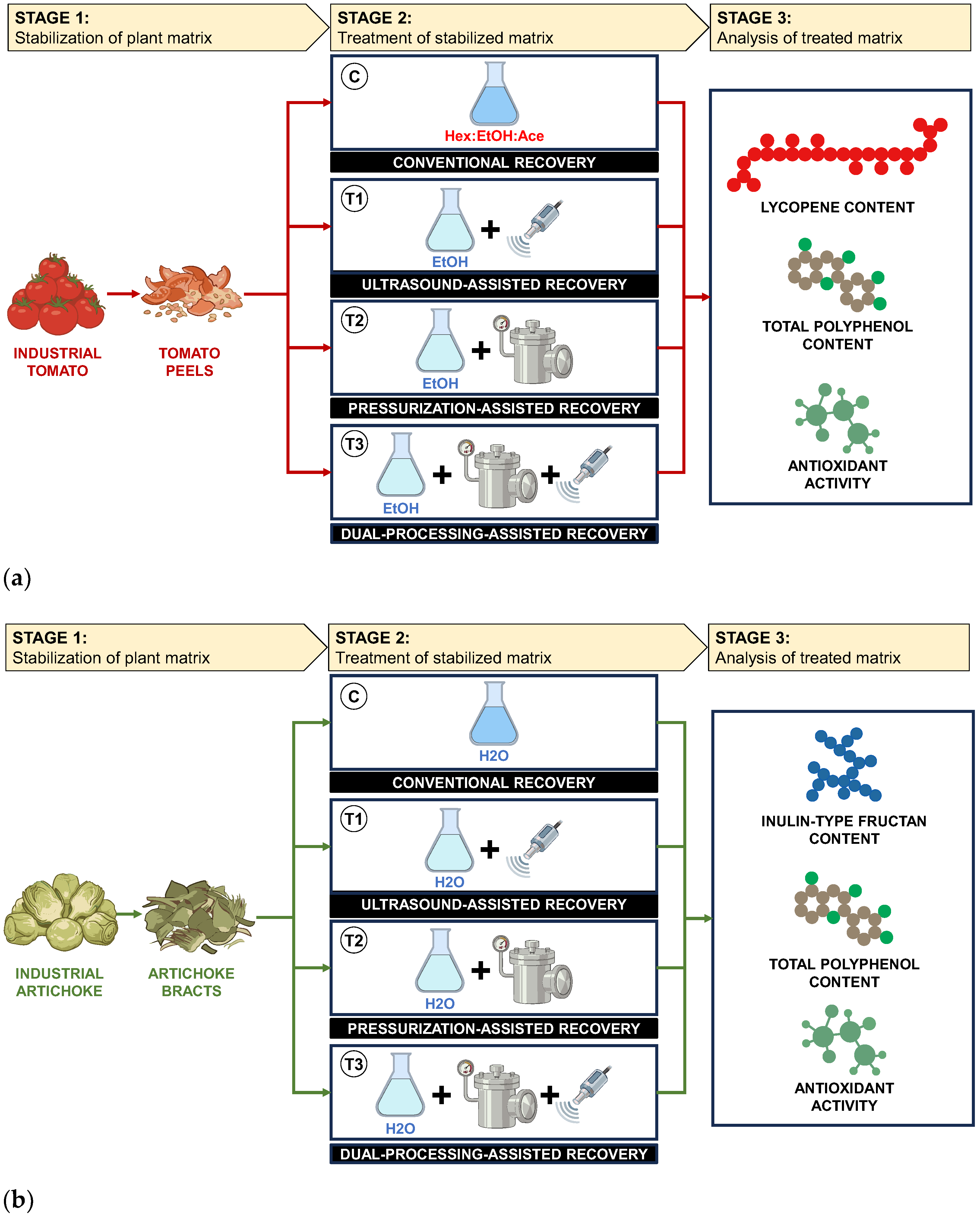
Figure 1 illustrates the experimental design proposed to evaluate the impact of non-thermal treatments as a strategy for the recovery of high-value biocompounds from agro-industrial by-products. A three-stage approach was used to achieve this goal: (i) characterization and stabilization of the plant matrices; (ii) treatment of stabilized matrices through conventional extraction, ultrasound-assisted extraction (sonication), high-pressure processing (pressurization), and dual processing (sonication + pressurization); and (iii) chemical analysis of biocompounds from treated matrices.
2.3. Conditioning and Treatments of Tomato By-Products
Frozen tomato peel samples were thawed under controlled conditions, homogenized, and analyzed for proximate composition following official analytical standards, according to the methods described by Fernandez-Pan et al. [
23].
The treatments applied for lycopene extraction from fresh tomato peels were as follows, where only the conventional method extraction employed a solvent mixture: (i) conventional extraction using a hexane:ethanol:acetone mixture; (ii) ethanol-based sonication; (iii) ethanol-based pressurization; and (iv) ethanol-based dual processing (pressurization + sonication), in which tomato peels were first subjected to pressurization in the presence of ethanol and subsequently processed by ultrasound-assisted extraction.
Prior to the application of non-thermal treatments, sample preparation was adapted according to the plant matrix and the extraction technology employed. For lycopene extraction, fresh (wet) tomato peels were used in all experiments without a prior drying step in order to preserve the native structure of the matrix and avoid thermal degradation or isomerization of lycopene before non-thermal processing [
24].
2.3.1. Conventional Extraction
Extraction was carried out according to the method described by Periago et al. [
25], with minor modifications. One g of fresh tomato peel material was weighed into a 50 mL volumetric flask wrapped in aluminum foil to exclude light. Fifty milliliters of a mixture of hexane/acetone/ethanol (2:1:1,
v/
v/
v) were added, in accordance with proportions established by Arias et al. [
26]. The samples were stirred for 30 min at a temperature below 40 °C, after which 10 mL of distilled water was added to promote phase separation. The solution was allowed to separate into a distinct polar layer and a nonpolar layer containing lycopene. The non-polar phase was used for lycopene, TPC, and DPPH determination. The volumetric flask provided sufficient headspace for proper mixing and phase separation. The resulting extract was used for the assessment of lycopene content, total polyphenol content (TPC), and antioxidant activity by the 2,2-diphenyl-1-picrylhydrazyl (DPPH) free radical scavenging assay.
2.3.2. Ethanol Extraction Assisted by Sonication
The experimental conditions for extraction were 20 min under continuous agitation at 1500 rpm (magnetic stirrer VELP Scientifica SRL, Usmate, Italy) and a temperature below 40 °C. Sonication was performed according to the systematic review conducted by Arroqui et al. [
18]—a by-product to solvent ratio of 1:3 (
w/
v), an ultrasonic power of 350 W, a frequency of 24 kHz, and an amplitude of 100%—using an ultrasonic-homogenizer (Labsonic 2000, B.Braun BioTech Inc., Melsungen, Germany) equipped with a 13 mm probe tip. The 6 cm ultrasound probe was immersed to a depth of 2.8 cm in the sample, and the same conditions were applied to the artichoke bracts. After sonication, tomato peels were separated from the solvent using a metal strainer, and the resulting ethanol extract was collected for the determination of lycopene content, TPC, and antioxidant activity.
2.3.3. Ethanol Extraction Assisted by Pressurization
The high-pressure processing (pressurization) conditions selected for lycopene extraction were based on previous studies performed by Briones-Labarca et al. [
16], which identified pressure levels around 450 MPa as effective for enhancing carotenoid recovery. Preliminary trials were conducted to optimize extraction conditions using an IDUS 25L equipment (Pressurization Systems S.L.U., Noain, Spain, 25 L capacity vessel). Pressures ranging from 300 to 500 MPa, with a constant treatment time of 5 min, were initially evaluated. Based on these preliminary assays, the highest lycopene extraction yield was achieved at 500 MPa for 5 min, and these conditions were therefore selected for all subsequent pressurization and dual processing (pressurization + sonication) experiments.
For pressurization-assisted ethanol extraction, 100 g of wet tomato peels were dispersed in 300 mL of 96% ethanol, maintaining a by-product-to-solvent ratio of 1:3 (w/v) and subjected to pressurization at 500 MPa for 5 min as a pre-treatment. After pressure release, samples were stirred for an additional 15 min, completing a total extraction time of 20 min. Tomato peels were then separated using a metal strainer, and the ethanol extracts obtained were collected for the determination of lycopene content, TPC, and antioxidant activity.
2.3.4. Ethanol Extraction Assisted by Dual Processing
For dual processing (pressurization + sonication), 100 g of wet tomato peels were first processed by pressurization at 500 MPa for 5 min in the presence of ethanol, followed by ultrasound-assisted extraction using the sonication conditions described above (350 W, 24 kHz, 100% amplitude, temperature below 40 °C, 20 min). After treatment, tomato peels were separated using a metal strainer, and the ethanol extracts obtained were collected for the determination of lycopene content, TPC, and antioxidant activity.
2.4. Artichoke By-Product Treatments
To recover inulin-type fructans (ITFs) from blanched artichoke bracts using conventional extraction and sonication, batches of 3 kg of blanched artichoke bracts were stabilized until reaching equilibrium moisture content by traditional convection drying. The artichoke by-product was placed in a semi-industrial hot air-drying cabinet (Kowell Ind. Corp., Suwon, Gyeonggi-do, Republic of Korea). A drying temperature of 60 °C was selected, within the range reported by Borsini et al. [
27], and drying was continued until equilibrium was reached. Subsequently, for practical application, the dried artichoke by-product was blended using a cooking robot (Thermomix TM6, Vorwerk, Madrid, Spain) for subsequent assays. For pressurization and dual treatments, the bracts were processed in a wet state and later dehydrated at 60 °C for 24 h after the pressure pre-treatment.
The selection of extraction conditions was based on a systematized bibliographic review. Conventional extraction parameters were defined according to Zeaiter et al. [
2]. Sonication conditions were selected based on previous studies reported by Zeaiter et al. [
2], Zhu et al. [
11], Corrias et al. [
12], Castellino et al. [
28], and Cavini et al. [
29], which investigated the recovery of inulin-type fructans from artichoke matrices. Pressurization conditions were established considering research by Li et al. [
13] and Kim & Iwahashi [
21]. Dual processing (pressurization + sonication) was evaluated in the present study in order to assess potential synergistic effects on inulin extraction efficiency.
2.4.1. Conventional Extraction
The treatment was carried out according to Zeaiter et al. [
2] with minor modifications. Briefly, 50 g of dried blanched artichoke bract material were dispersed in 500 mL of distilled water in a 1000 mL glass beaker, resulting in a by-product-to-solvent ratio of 1:10 (
w/
v). The mixture was heated at 70 °C for 1 h under continuous stirring using water as a solvent. After heating, the extracted slurry was filtered using a paper coffee filter to separate the liquid extract from the solid residue. The volume of the filtrate was then reduced to 250 mL. Subsequently, two volumes of ethanol (≥99%, Sigma-Aldrich, Merck KGaA, Darmstadt, Germany), corresponding to 500 mL, were added to induce precipitation of ITF. The mixture was left to stand for 24 h at 25 °C. The following day, the precipitated fraction was recovered by filtration using a paper coffee filter, and the ethanol was evaporated in a drying oven at 70 °C for 24 h prior to further processing for ITF quantification and complementary analyses.
2.4.2. Ultrasound-Assisted Extraction
Sonication conditions for ITF recovery from blanched artichoke bracts were established using water as extraction solvent, an extraction time of 30 min, a temperature of 70 °C, and a by-product-to-solvent ratio of 1:10 (w/v). Sonication was performed at 350 W ultrasonic power, 24 kHz frequency, and 100% amplitude using an ultrasonic homogenizer (Labsonic 2000, B.Braun BioTech Inc., Melsungen, Germany) equipped with a 13 mm probe tip. Briefly, 50 g of dried material was dispersed in 500 mL of distilled water and subjected to ultrasound treatment under the conditions described above. After sonication, the extracted slurry was filtered using a paper coffee filter to separate the liquid extract from the solid residue. The volume of the filtrate was then reduced to 250 mL. Subsequently, two volumes of ethanol (≥99%, Sigma-Aldrich, Merck KGaA, Darmstadt, Germany), corresponding to 500 mL, were added to induce precipitation of ITF. The mixture was left to stand for 24 h at 25 °C. The following day, the precipitated fraction was recovered by filtration using a paper coffee filter and the ethanol was evaporated in a drying oven at 70 °C for 24 h prior to further processing for ITF quantification and complementary analyses.
2.4.3. Pressurization Assisted Extraction
Pressurization was applied to wet blanched artichoke bracts at 300 MPa for 10 min, according to Kim & Iwahashi [
21], using an IDUS 25L (Pressurization Systems S.L.U., Noain, Spain; 25 L capacity vessel). After pressure treatment, the material was subsequently dehydrated at 60 °C for 24 h. Then, 50 g of dried material was dispersed in 500 mL of distilled water (1:10
w/
v) and subjected to aqueous extraction (70 °C for 1 h, stirring). After extraction, the slurry was filtered, and ITF was precipitated by two volumes of ethanol (≥99%, Sigma-Aldrich, Merck KGaA, Darmstadt, Germany), corresponding to 500 mL, were added to induce precipitation of ITF. The mixture was left to stand for 24 h at 25 °C. The following day, the precipitated fraction was recovered by filtration using a paper coffee filter, and the ethanol was evaporated in a drying oven at 70 °C for 24 h prior to further processing for ITF quantification and complementary analyses.
2.4.4. Dual Processing Extraction
For dual processing (pressurization + sonication), wet artichoke bracts were first subjected to pressurization at 300 MPa for 10 min and subsequently dehydrated at 60 °C for 24 h. The dried material was then dispersed and processed by sonication using the same conditions previously detailed.
The extracts obtained from the different treatments were analyzed by determination of ITF, TPC and DPPH.
2.5. Chemical Analysis
2.5.1. Characterization of Tomato and Artichoke By-Products
Moisture content was quantified by convection-oven-drying for 24 h at 130 ± 3 °C. Crude protein content was measured after digestion at 390 °C for 4 h, using a nitrogen-to-protein conversion factor (4.4) for plant-based foods [
30]. Crude fat was quantified after extraction by the Soxhlet method. Ash content was determined after incineration at 525 °C for 24 h. Total carbohydrate content was quantified from the percentage remaining from the mean values of the above-mentioned parameters.
2.5.2. Determination of Lycopene Content of Tomato By-Product
Lycopene content was quantified spectrophotometrically using a Multiskan™ GO Microplate Spectrophotometer (Thermo Fisher Scientific Inc., Madrid, Spain) following the method described by Silva et al. [
31]. Considering that the extraction treatments are not fully selective for lycopene and may co-extract other carotenoid fractions, results were expressed as lycopene equivalents based on calibration curves prepared using a lycopene standard (Sigma Aldrich R, Merck KGaA, Darmstadt, Germany) in the corresponding solvent (hexane or ethanol) measured at 472 nm. Lycopene content was expressed as µg/g dry weight (DW).
2.5.3. Determination of Total Polyphenol Content and Antioxidant Activity
The total polyphenol content (TPC) was determined using the Folin–Ciocalteu method, improved by Sánchez-Rangel et al. [
32]. For all treatments, the phenolic content of the tomato peel ethanolic extract was determined using a calibration curve and expressed as mg gallic acid equivalents per L. A standard curve of gallic acid was prepared in the range of 80−400 mg L
−1, with the equation y = 0.0011x + 0.0094 and a correlation coefficient R
2 = 0.9974. For all treatments, the phenolic content from the aqueous extract of blanched artichoke bracts obtained in all treatments was determined from a calibration curve and expressed as mg gallic acid equivalents per L. A standard curve of gallic acid was prepared in the range of 50−600 mg L
−1, with the equation y = 0.0212x + 0.007 and a correlation coefficient R
2 = 0.9998. The total phenolic content was expressed as μg gallic acid equivalents per g DW for tomato peels and mg gallic acid equivalents per g DW for blanched artichoke bracts. The antioxidant activity (DPPH%) was assessed according to the method of Brand-Williams et al. [
33] using the following formula:
where
At=0 is the absorbance of 2940 μL of DPPH,
Asample is the absorbance of 2940 μL of DPPH plus 60 μL of sample. Results were expressed as percentage inhibition.
2.5.4. Determination of ITF Content of By-Products
The determination of ITF in artichoke bract extracts was carried out using a commercial fructan assay kit (Megazyme Ltd., Wicklow, Ireland), following the method described in the literature [
34] and according to the manufacturer’s instructions.
Briefly, dried and milled samples of each treatment were extracted with distilled water under controlled heating conditions (100 °C, boiling water bath, 10 min) to solubilize fructans. After centrifugation using a MiniSpin microcentrifuge (Eppendorf, Hamburg, Germany) at 13,000× g for 5 min, aliquots of the extract were subjected to enzymatic removal of interfering sugars. Sucrose and starch were hydrolyzed using a sucrase/β-amylase/pullulanase/maltase mixture at 30 °C, and the released glucose and fructose, along with native reducing sugars, were reduced to their corresponding sugar alcohols using alkaline sodium borohydride at 40 °C. Following neutralization with acetic acid, fructans were specifically hydrolyzed to D-fructose and D-glucose by recombinant exo- and endo-inulinases and endo-levanase at pH 4.5 and 40 °C. The released monosaccharides were quantified calorimetrically using the PAHBAH (p-hydroxybenzoic acid hydrazide) reducing sugar method after incubation at 100 °C for 6 min, and absorbance was measured at 410 nm against appropriate blanks using a Multiskan™ GO Microplate Spectrophotometer (Thermo Fisher Scientific Inc., Madrid, Spain). Fructan content was calculated according to the manufacturer’s equation, applying correction factors for dilution, molecular weight conversion (free fructose to anhydrofructose), and sample weight. Results were expressed as inulin-type fructans as g per 100 g DW.
2.6. Statistical Analysis
All experimental data were expressed as mean ± standard deviation. The effects of the recovery treatments (conventional extraction, sonication, pressurization, and pressurization + sonication) on lycopene content, ITF content, TPC, and antioxidant activity were evaluated by one-way analysis of variance (ANOVA) considering recovery technology (stage 2) as the sole factor. When ANOVA was statistically significant (p < 0.05), HSD Tukey’s test was applied for multiple comparisons among mean values, using a confidence level at 95%. All statistical analyses were performed by Minitab® Statistical Software version 21.0 (Minitab LLC., Herndon, VA, USA).
3. Results and Discussion
3.1. Chemical Properties of Agro-Industrial By-Products
The proximate composition of tomato peels and blanched artichoke bracts (
Table 1) reflects structural and compositional differences that may influence extraction performance. Tomato by-products showed a moisture content of 72.66 ± 0.42%, together with relatively high lipid (3.42 ± 0.16%) and protein (2.78 ± 0.14%) contents compared with artichoke bracts. This composition agrees with previous studies by Fernandez-Pan et al. [
20] which reported that tomato by-products are characterized by appreciable lipid fractions associated with chromoplast membranes, where lycopene is mainly localized.
Artichoke by-products presented a markedly higher moisture content (89.78 ± 0.48%) and lower fat levels (0.38 ± 0.06%), consistent with their highly hydrated parenchymatous tissue and polysaccharide-rich cell wall structure. Similar proximate compositions have been reported for artichoke processing by-products by Fernandez-Pan et al. [
35], characterized by high water content and low lipid fractions, which favor aqueous extraction approaches.
The use of fresh (wet) tomato peels in this study was particularly relevant considering that drying processes are known to significantly alter the microstructure of plant tissues. Previous studies have shown that drying can induce cell collapse, shrinkage, and structural deformation, as well as modify porosity, depending on the method applied [
24]. These microstructural changes could directly affect mass transfer phenomena, solvent accessibility, and the stability of biocompounds such as lycopene. Therefore, by avoiding a drying step, the native architecture of the plant matrix would be preserved, enabling a more accurate evaluation of the effects of non-thermal treatments.
3.2. Effect of Non-Thermal Treatments on Biocompound Extracted from Tomato By-Products
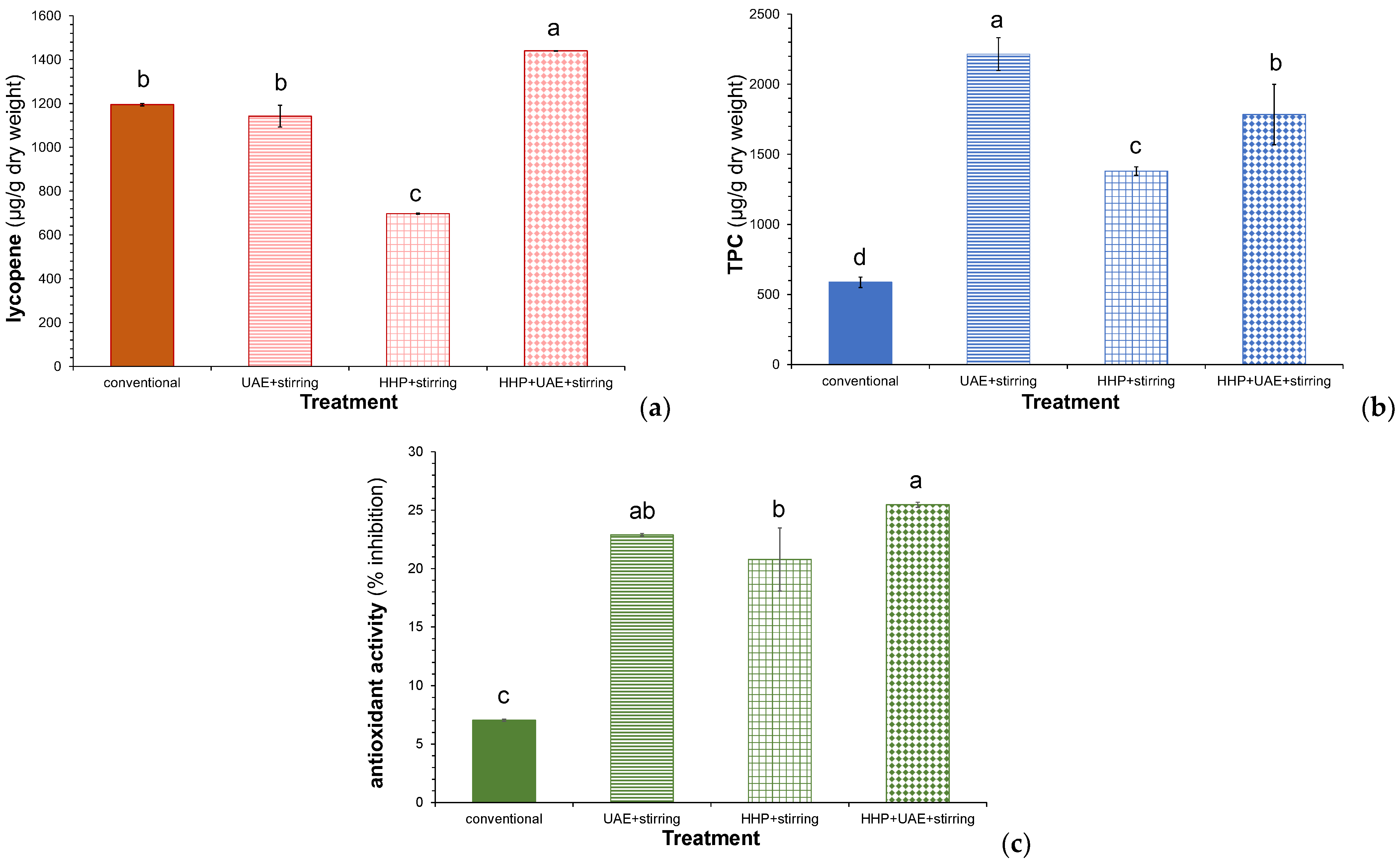
Non-thermal treatments had a significant effect (
p < 0.05) on the extraction yields of lycopene, total phenolic content (TPC) and antioxidant activity, all expressed on a dry weight basis (DW) (
Figure 2). The highest lycopene content was obtained using dual processing (pressurization + sonication) (1440.09 ± 0.71 µg/g DW), followed by conventional extraction using a hexane:ethanol:acetone mixture (1194.47 ± 6.01 µg/g DW) and sonication using ethanol (1142.33 ± 49.42 µg/g DW). Lycopene extraction with pressurization alone yielded the lowest content (697.00 ± 2.27 µg/g DW) (
Figure 2a). Li et al. [
36] and Mozafari et al. [
9] also observed elevated levels of lycopene recovery when ethanol-sonication was applied (from 1500 to almost 2500 µg/g DW). Nevertheless, a comparison of the lycopene content was not possible, due to the fact that it is influenced by geographical location, variety, ripeness, and season [
7]. Mavridis et al. [
1] reported lycopene contents between 600 and 1300 µg/g DW depending on the extraction technique, further supporting that the magnitudes obtained in this work fall within or exceed the upper range of literature values. Although conventional extraction employs solvent mixtures with polarity well suited for carotenoids, Calvo et al. [
37] demonstrated that ethanol is capable of efficiently recovering lycopene from tomato peels, producing yields comparable to hexane-based systems. In agreement with this, the present study shows that when ethanol-based extraction was assisted by ultrasound (sonication), lycopene yields were similar to those obtained in conventional extraction, emphasizing that physical disruption of the matrix is more critical than solvent polarity alone.
Ultrasound intensifies mass transfer via acoustic cavitation, generating shear forces that promote cell wall rupture and solvent penetration [
10,
36], thereby facilitating subsequent lycopene recovery [
1,
36,
37].
High pressures do not enable efficient ethanol-based lycopene extraction. High-pressure processing disrupts weak intermolecular interactions and increases membrane permeability without breaking covalent bonds, facilitating carotenoid release [
14,
16]. When pressure is increased, ethanol undergoes adiabatic compression heating of 8 °C/100 MPa [
38], reaching around 40 °C during pressurization pretreatment for lycopene extraction. Although lycopene extraction using ethanol has been shown to increase with temperature [
19] and pressurization (500−600 MPa) increases membrane permeability [
14], these phenomena are insufficient to match the lycopene yields achieved using ultrasound or conventional extraction methods.
Additionally, the present study showed that dual processing (pressurization + sonication) resulted in enhanced yield, indicating a synergistic effect on lycopene extraction. Along with the increase in mass transfer rate achieved with pressurization, ultrasound further intensifies mass transfer via acoustic cavitation, generating shear forces that promote cell wall rupture and solvent penetration [
10]. The superior performance of dual processing therefore arises from the sequential action of pressure-induced permeabilization followed by cavitation-driven disruption.
Regarding co-extracted compounds, tomato peels contain appreciable amounts of phenolic compounds. TPC ranged from 587.67 ± 45.74 µg/g DW (conventional) to 2214.62 ± 143.72 µg/g DW (UAE + stirring) (
Figure 2b), which contributed to antioxidant potential [
1,
19] with values that increased from 7.10 ± 0.10% (conventional processing) to 25.50 ± 0.20% (dual processing) (
Figure 2c).
In the case of polyphenol recovery, the highest yield was achieved with ethanol-based sonication. This high yield was to be expected, given that polyphenol extraction is facilitated by a mixture of more polar solvents compared to extraction in the non-polar phase used in the conventional method [
39], together with the application of ultrasound.
Ethanol-based pressurization extraction of polyphenols also yielded greater extraction than the conventional method, largely due to the solvent used. However, as observed for lycopene extraction, the results suggest that the physical changes caused by this non-thermal technology do not facilitate this biocompound extraction to the same extent as ultrasound treatment.
Furthermore, dual processing did not outperform ultrasound treatment in polyphenol extraction results, as reported by Ninčević Grassino et al. [
22] who observed lower polyphenol yields when pressurization was applied before ultrasound extraction compared with ultrasound extraction using 70% ethanol. In their study, the use of HPP and sonication was demonstrated to be an effective way of reducing the extraction time of pectins, enabling the efficient production of valuable functional ingredients such as pectin and polyphenols. The present work focuses on the environmentally friendly recovery of lycopene, a valuable compound, with polyphenols acting as co-products.
Concomitant increases in all variables of TPC, lycopene, and antioxidant activity were observed (
Figure 2b and
Figure 2c, respectively). This behavior agrees with previous reports showing that both phenolics and lycopene jointly determine the antioxidant capacity of tomato extracts [
1].
3.3. Effect of Non-Thermal Treatments on Biocompounds Extracted from Artichoke By-Products
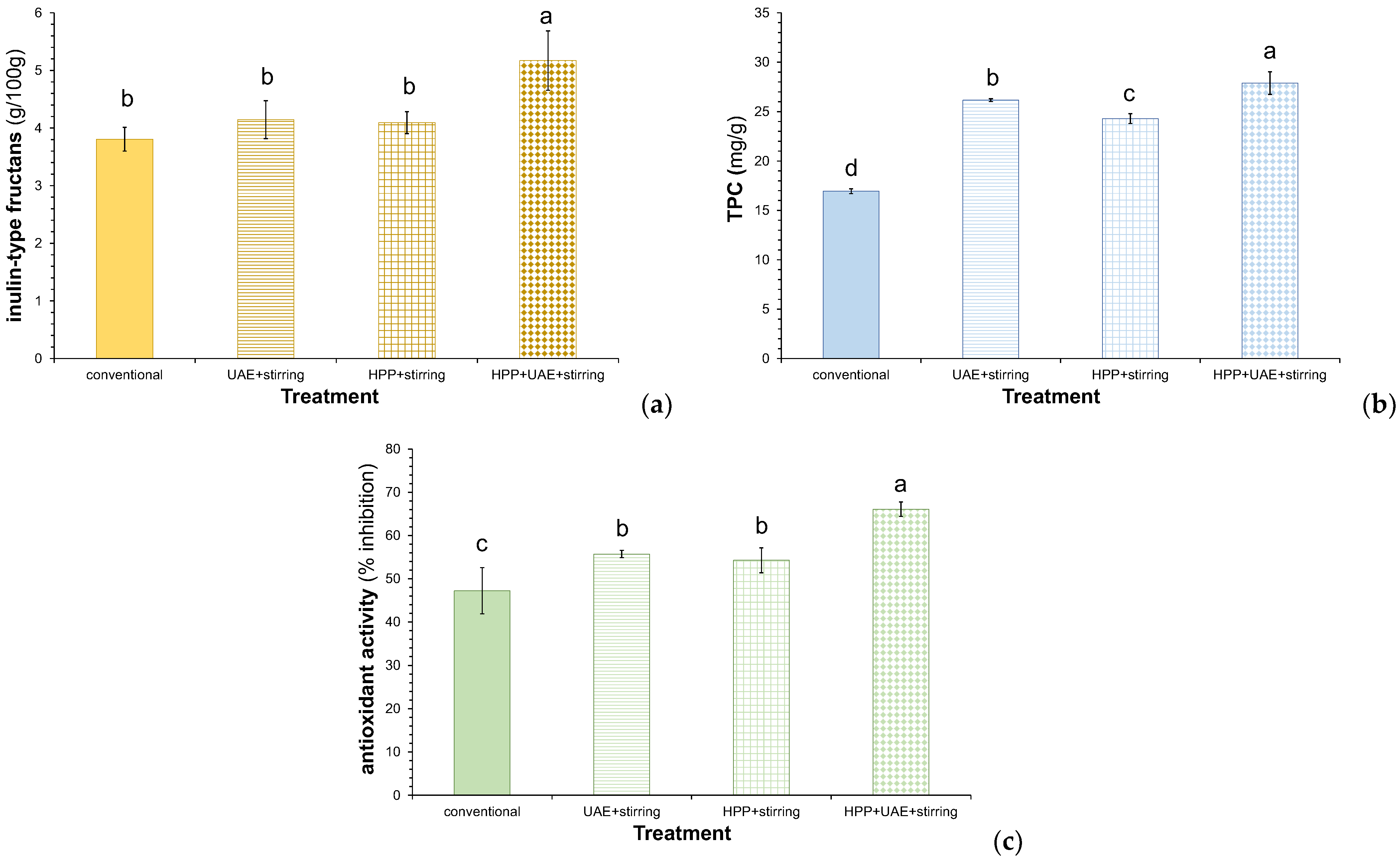
ITF content, expressed on a dry weight basis (DW), ranged from 3.81 ± 0.21 g/100 g DW for conventional extraction to 5.17 ± 0.51 g/100 g DW for dual processing (pressurization + sonication), which provided the highest yield (
Figure 3a). The extraction strategy affected the recovery of ITF from blanched artichoke bracts (
p < 0.05), although no differences were found between conventional, sonication, and pressurization methods.
In the case of ultrasound treatment, while the performance does not exceed that achieved with the conventional method, technological processing favors ITF water extraction, since the extraction time using the same solvent (water at 70 °C) is reduced from 1 h to 30 min; i.e., it is halved. When pretreatment of pressurization prior to conventional water extraction was applied, however, the technology did not appear to improve performance. As noted in the case of lycopene extraction, the modifications to the plant matrix due to pressurization do not result in enhanced water extraction of ITF from artichoke bracts.
In contrast, dual processing (pressurization + sonication) increases ITF outcomes compared with conventional and sonication strategies, as was observed for lycopene extraction. The pretreatment of pressurization enhances the ultrasound effect on ITF extraction, facilitating water access into intracellular vacuoles where fructans are stored. As a result, a shorter and more efficient ITF treatment compared to a conventional one was reached, which minimizes thermal damage, contributing to improved extraction efficiency and preservation of carbohydrate integrity.
Zeaiter et al. [
2] reported inulin-type fructans concentrations in artichoke by-products between 2 and 6 g/100 g DW depending on plant part and extraction conditions, which is in good agreement with the values obtained in the present study. Similarly, Zhu et al. [
11] demonstrated that ultrasound-assisted extraction significantly enhances fructan recovery from plant matrices compared to conventional hot-water diffusion. Corrias et al. [
12] also showed that ultrasound intensification improves the extraction of carbohydrates and phenolic compounds from artichoke wastes, supporting the trends observed herein.
Although studies directly applying high-pressure processing to inulin extraction from artichoke are scarce, evidence from polysaccharide-rich matrices indicates that pressurization pretreatment improves aqueous extraction yields and reduces extraction time and temperature. Kim and Iwahashi [
21] reported that the combination of pressurization (300 MPa, 50 °C, 10 min) with hot-water extraction produced a higher polysaccharide yield (2.79 ± 0.03 g DW) from
Phellinus linteus than hot-water extraction alone (2.24 ± 0.02 g DW at 80 °C for 6 h), demonstrating that pressure-assisted extraction can enhance polysaccharide recovery while allowing milder thermal conditions.
Artichoke bracts are recognized as rich sources of phenolic compounds with strong antioxidant potential, mainly due to their high content of hydroxycinnamic acids and flavonoids [
12,
40,
41]. In the present study, TPC ranged from 16.91 ± 0.28 mg GAE/g DW for the conventional extraction to 27.68 ± 1.29 mg GAE/g DW for dual processing (pressurization + sonication), while antioxidant activity increased from 47.87 ± 6.35% (conventional) to 66.11 ± 2.03% dual processing (pressurization + sonication) (
Figure 3b,c).
Sonication and pressurization applied separately also produced significantly higher TPC values (26.11 ± 0.12 and 24.22 ± 0.58 mg GAE/g DW, respectively) compared to the conventional method (p < 0.05), proving the positive effect of non-thermal technologies on phenolic recovery.
The higher TPC and antioxidant activity values observed for sonication treatments can be attributed to cavitation-induced cell wall disruption, which facilitates solvent penetration and mass transfer of phenolic compounds, as was observed in other studies [
10,
13]. Additionally, pressure-induced membrane permeabilization promotes increasing biocompound extraction yields when pressurization is used as a pretreatment [
17,
39], as noted by Kim et al. [
42] on Jerusalem artichoke when investigating the effect of pressurization as a pretreatment to enhance the extraction of polyphenols and antioxidant activity compared with conventional hot-water extraction. Tubers were subjected to pressurization at 300 MPa for short treatment times, either alone or combined with enzymatic hydrolysis and fermentation, before aqueous extraction. Results showed that pressurization-treated samples exhibited significantly higher total phenolic content and antioxidant activity than conventional hot-water extracts. The enhancement was attributed to pressure-induced microstructural modifications of plant tissues, which increased cell wall permeability and facilitated solvent penetration and diffusion of intracellular phenolic compounds. The dual processing (pressurization + sonication) appears to exert a synergistic effect, explaining the highest phenolic content and antioxidant activity obtained.
3.4. Solvent Improvements and Future Steps
Assuming the processing of 100,000 tonnes of tomato peels per year, conventional hexane extraction at a solid-to-solvent ratio of 1:50 would require approximately 2.5 million m
3 of solvent per year. In contrast, the proposed ethanol-based system operating at a ratio of 1:10 would reduce solvent consumption to 1.0 million m
3, corresponding to a 60% reduction in solvent demand. This decrease not only lowers solvent procurement costs but also substantially reduces the energy required for solvent evaporation and recovery. In addition, recent EFSA technical assessments have highlighted the need for re-evaluation of hexane safety as a food extraction solvent [
8].
Among the evaluated extraction strategies, the combined application of sonication and pressurization yielded the highest recovery of lycopene and ITF, indicating a potential synergistic effect between both technologies. However, despite this improvement, the overall increase in extraction yield remained below 50%, which raises important concerns regarding the economic feasibility of this dual approach.
In this context, the use of two relatively energy-intensive and capital-demanding technologies may not be justified at an industrial scale unless further optimization leads to significantly higher extraction efficiencies or provides additional advantages, such as reduced processing time or enhanced product quality. Therefore, future research should focus on critically assessing whether the incremental yield gains can offset the increased capital and operational costs through comprehensive techno-economic analyses, including detailed energy balance evaluations and scalability considerations.
Moreover, optimization of operating conditions and solvent recovery strategies, particularly for ethanol, will be essential to improve process efficiency and sustainability. In parallel, Life Cycle Assessment studies are required to verify whether these non-thermal approaches offer tangible environmental benefits compared to conventional extraction methods. Ultimately, pilot-scale validation under realistic conditions, together with regulatory considerations, will be necessary to determine the practical feasibility of implementing these technologies for the valorization of agro-industrial by-products.
4. Conclusions
This research proves that non-thermal technologies are an effective and sustainable alternative to traditional methods of extracting biocompounds from tomato peels and blanched artichoke bracts. Dual non-thermal approaches significantly improved the efficiency of extraction using green solvents, suggesting that matrix disruption may be a more important factor than solvent polarity. Although replacing hexane with ethanol provides a safer alternative for lycopene extraction, solvent substitution alone does not maximize recovery.
Combining sonication with pressurization matched or outperformed conventional methods, while sonication alone achieved comparable ITF extraction in a shorter processing time with limited thermal effects. Pressurization was not considered a viable standalone technique due to lower extraction yields. Polyphenols were also recovered with higher yields in ethanol–water systems, and non-thermal technologies enhanced their aqueous extraction from artichoke bracts. The antioxidant activity was consistent with the levels of lycopene, ITF, and phenolic compounds obtained.
From an industrial perspective, ethanol-based extraction at lower solvent ratios offers substantial solvent savings compared with conventional hexane extraction. Future work should therefore address the techno-economic feasibility, energy requirements, solvent recovery, and pilot-scale validation of these non-thermal strategies to support their industrial implementation in the valorization of agro-industrial by-products.







 ,
,