Article

CFD Simulation of a Vertical-Axis Savonius-Type Micro Wind Turbine Using Meteorological Data from an Educational Environment


by
José Cabrera-Escobar
1,*,
Carlos Mauricio Carrillo Rosero
1,
César Hernán Arroba Arroba
1,
Santiago Paúl Cabrera Anda
1,
Catherine Cabrera-Escobar
2 and
Raúl Cabrera-Escobar
3
1
Faculty of Civil and Mechanical Engineering, Universidad Técnica de Ambato, Ambato 180206, Ecuador
2
Departamento de Máquinas y Motores Térmicos, Universidad de Cádiz, 11510 Cádiz, Spain
3
Departamento de Ingeniería Eléctrica, Universidad de Jaén, 23071 Jaén, Spain
*
Author to whom correspondence should be addressed.
Clean Technol. 2026, 8(2), 40; https://doi.org/10.3390/cleantechnol8020040
Submission received: 17 January 2026 / Revised: 27 February 2026 / Accepted: 3 March 2026 / Published: 12 March 2026

Highlights

What are the main findings?
  • This study demonstrates that a two-dimensional CFD model based on the URANS equations with the k–ω SST turbulence model can reliably predict the aerodynamic performance of a Savonius-type vertical-axis wind turbine operating under high-altitude atmospheric conditions. The numerical results show stable periodic torque behavior after the initial transient cycles and reveal that the optimal operating region occurs around a tip-speed ratio between 0.8 and 1.0, where the power coefficient reaches approximately 0.21.
  • The flow field analysis confirms that turbine performance is governed mainly by the pressure difference between the advancing and returning blades, as well as by vortex shedding and turbulence generation in the wake region. The CFD predictions show good agreement with experimental data from the Sandia laboratory, with mean absolute percentage errors below 8%, validating the reliability of the numerical methodology.
What are the implications of the main findings?
  • The results highlight the importance of evaluating wind turbine performance under real local atmospheric conditions, particularly in high-altitude regions where reduced air density significantly decreases the available wind power. This consideration is essential for accurately estimating the performance of small-scale wind energy systems installed in Andean environments and other elevated locations.
  • Furthermore, this study confirms that Savonius turbines represent a viable solution for micro-generation in urban and educational environments characterized by low wind speeds, limited installation space, and the need for low noise levels. The validated CFD approach provides a useful tool for future design optimization and for the development of decentralized renewable energy systems adapted to local meteorological conditions.

Abstract

This study presents a two-dimensional computational fluid dynamics analysis of a vertical-axis Savonius-type wind turbine under atmospheric conditions representative of an educational environment located in the Ecuadorian Andean region. Unlike previous studies conducted under sea-level meteorological conditions, this research is performed under high-altitude conditions (2723 m a.s.l.). The unsteady flow around the rotor was simulated using a two-dimensional approach based on the Unsteady Reynolds-Averaged Navier–Stokes (URANS) equations, discretized with the finite volume method and coupled with the k–ω Shear Stress Transport (SST) turbulence model. The rotor rotation was modeled using sliding mesh technique, employing a second-order implicit time scheme to ensure numerical stability and adequate temporal resolution. The numerical model was configured for a tip speed ratio of 0.8 and a wind speed of 3.9 m/s. The time step was defined based on a constant angular advancement of the rotor per time iteration, ensuring numerical stability and adequate temporal resolution. The aerodynamic torque was obtained by integrating the pressure and viscous forces acting on the blades, allowing the calculation of the mechanical power generated and the power coefficient. The results showed a periodic and stable torque behavior after the initial transient cycles, yielding an average torque of 0.7687 N·m and a mechanical power of 5.17 W, while the power coefficient reached a value of 0.2102. Analysis of the flow fields revealed the formation of a low-velocity wake downstream of the rotor, regions of high turbulent kinetic energy associated with periodic vortex shedding, and a significant pressure difference between the advancing and returning blades, confirming that turbine operation is dominated by drag forces. The numerical results were validated through comparison with previous studies, showing good agreement and demonstrating the reliability of the proposed Computational Fluid Dynamics (CFD) approach. This study highlights the potential of Savonius turbines for low-power applications in urban and educational environments, as well as the usefulness of CFD as a tool for evaluating and optimizing their aerodynamic performance.

1. Introduction

Wind energy is one of the most promising renewable energy sources in the transition from fossil fuel-based energy systems to clean energy, playing an essential role in achieving the net-zero emissions target by 2050 [1,2]. Offshore and onshore projects based on horizontal-axis wind turbines at sea level have long dominated the sector; however, the implementation of wind energy systems in urban environments has been gaining momentum in recent years [2,3]. Wind turbines are generally classified into two main groups: horizontal-axis wind turbines and vertical-axis wind turbines. Vertical Axis Wind Turbines (VAWTs) present several advantages over Horizontal Axis Wind Turbines (HAWTs), as their performance does not depend on the relative wind direction, eliminating the need for yaw control systems [4]. In addition, they exhibit lower cut-in wind speeds, efficient operation at low tip-speed ratios, compact installation footprints, and suitability for low-power applications in urban areas [5,6,7].
The Savonius turbine, which belongs to the VAWT category, generates torque through a combination of lateral force effects and aerodynamic drag, and it is typically composed of two or three blades. Compared to other types of vertical-axis wind turbines, it offers several advantages, including operation at low wind speeds, low noise emissions, high starting torque, simple structure, and low manufacturing cost [8,9,10,11]. The main disadvantage of this type of vertical-axis wind turbine is its relatively low maximum efficiency, which is approximately 0.33 and lower than that of other VAWT designs [4,12]. This limitation arises from its drag-based operating principle: the geometry formed by two opposing semicircular blades produces higher resistance on the concave surface that drives rotation, while the wind simultaneously exerts resistance on the convex surface of the returning blade. This counteracting pressure limits the rotational speed and, consequently, reduces the overall efficiency of the rotor [11].
Significant efforts have been made to understand the behavior of Savonius VAWTs. One of the earliest studies was conducted by Sheldahl et al. (1978) [13], who experimentally evaluated the aerodynamic performance of two- and three-bladed Savonius rotors through low-speed wind tunnel tests. Fifteen configurations were analyzed by varying key geometric parameters, such as the number of blades, rotor height, blade overlap, and the effect of the Reynolds number. For each configuration, torque and rotational speed were measured under both static and dynamic conditions, allowing the determination of torque and power coefficients as functions of the speed coefficient. The results made it possible to identify the influence of geometry on performance and to recommend optimal configurations to maximize energy conversion from the incident flow.
Subsequently, with advances in numerical methods and computational power, CFD-based studies became more prevalent. Tian et al. (2015) [14] conducted a numerical CFD study to analyze and optimize the aerodynamic performance of a Savonius VAWT using novel blade geometries defined by the Myring equation. Two-dimensional transient simulations were performed by solving the Reynolds-averaged Navier–Stokes equations, employing the Renormalization Group (RNG) k–ε turbulence model and a sliding mesh approach to represent rotor rotation. The study evaluated the effect of the blade fullness parameter, varying between 0.5 and 3, on the cm and cp over a Tip Speed Ratio (TSR) range of 0.4 to 1.2, considering a wind speed of 7 m/s. The results were validated against experimental data and allowed the identification of an optimal configuration (n ≈ 1), which increased the power coefficient up to 0.257, achieving an improvement of approximately 11% compared to a conventional Savonius VAWT. Additionally, pressure, velocity, and wake flow fields were analyzed.
Mauro et al. (2019) [15] optimized the geometry of a Savonius turbine using both 2D and 3D CFD simulations. Existing designs were analyzed, and a global optimization approach was applied to evaluate thousands of configurations with simple geometries. This process led to the proposal of a novel “scooplet-based” design, achieving an increase in the power coefficient of up to 39% compared to the classical Savonius turbine. Three-dimensional results confirmed the performance improvement and demonstrated the feasibility of the design without increasing manufacturing complexity. Blanco et al. (2021) [16] analyzed the performance of a Savonius turbine using CFD to study flow behavior and energy transfer. Different blade profiles and geometric configurations were evaluated to identify aerodynamic improvements, and the numerical results enabled comparisons of energy performance and characterization of velocity and pressure fields around the rotor.
More recent research has extended beyond rotor geometry Ghafoorian et al. (2024) [17] conducted a numerical CFD study to improve the aerodynamic performance of a Savonius VAWT through the incorporation of an innovative external device known as a Semi-Directional Curved Guide Vane. Two-dimensional transient simulations were carried out by solving the URANS equations with the SST k–ω turbulence model, analyzing the effect of the number of guide vanes and their longitudinal and lateral positions relative to the rotor on the torque and power coefficients, as well as on the operational TSR range. Optimization methods based on Kriging, factorial design, and response surface methodology were applied to identify the optimal system configuration. The results demonstrated that the Semi-Directional Curved Guide Vane reduces the unfavorable pressure gradient on the returning blade, improves flow injection, and enables significant increases in turbine efficiency and operating range.
Abdullah et al. (2024) [18] evaluated the aerodynamic performance of the Savonius turbine using CFD simulations to analyze pressure and velocity distributions on the rotor. Various geometric configurations were studied to identify improvements in energy capture, and the numerical results allowed comparisons of the power coefficient and a better understanding of the physical mechanisms limiting efficiency. Kumar et al. (2025) [19] performed a CFD analysis of an array of four vertical-axis Savonius turbines, evaluating different configurations based on wake interactions between rotors. Individual and average power coefficients were compared for different tip-speed ratio values and array orientations. The results showed that certain configurations can enhance power output by up to 34% compared to an isolated rotor.
Finally, studies such as that of Shahriare et al. (2025) [20] conducted transient two-dimensional CFD simulations of a Savonius VAWT, considering typical wind speeds in the range of 10–12 m/s and evaluating rotor performance over a TSR range of 0.4 to 1.5. Maximum cp values close to 0.32–0.35 were reported for modified geometries, compared to lower values for conventional semicircular designs. These findings confirm that blade geometry modification directly influences pressure distribution and the overall aerodynamic efficiency of the system.
The present research focuses on analyzing the aerodynamic behavior of a Savonius turbine using CFD under meteorological conditions representative of an educational environment located in the Ecuadorian Andean region, at an approximate altitude of 2723 m above sea level. These conditions generate specific atmospheric effects, such as reduced atmospheric pressure and air density, which decrease the energy content of the wind and, consequently, the power generation capacity of conventional turbines. The Savonius turbine represents a suitable alternative due to its favorable performance at low wind speeds and in environments with high turbulence intensity caused by surrounding buildings—characteristics typical of educational campuses. Although numerous numerical and experimental studies on Savonius VAWTs exist, most have been conducted at sea level under standard conditions and have not focused on educational environments, where low noise levels are required and building-induced turbulence significantly affects the wake flow. This research aims to analyze a Savonius VAWT using CFD under the meteorological conditions of an educational environment in the Ecuadorian Andean region, providing relevant information for micro wind power generation applications under high-altitude meteorological conditions.

2. Materials and Methods

Computational Fluid Dynamics has become established as a reliable tool widely used in industry due to its multiple advantages [21], one of its applications is aerodynamic analysis, as this tool enables the development of a reliable methodology for the analysis of Savonius VAWTs. In this work, transient CFD simulations are employed to evaluate the aerodynamic behavior of a two-bladed semicircular Savonius VAWT [22].

2.1. Geometric Modeling and Mesh Generation

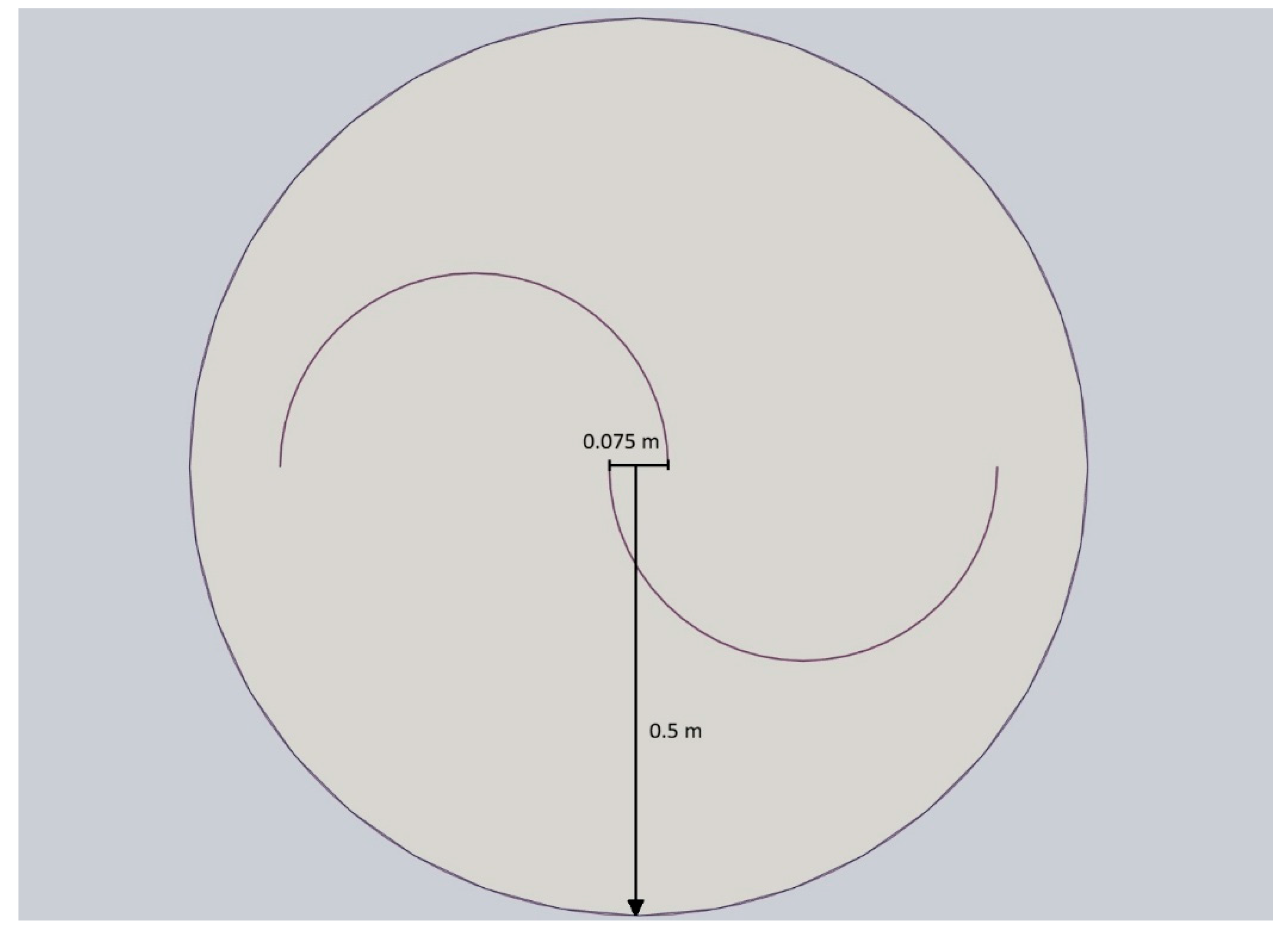
The two-dimensional geometric model of the Savonius VAWT shown in Figure 1 was constructed using two semicircular blades symmetrically arranged around the axis of rotation and separated by a gap of 0.075 m. These semicircular blades operate under the drag-based principle. The Savonius turbine has a rotor diameter of 0.9273 m, a blade diameter of 0.5000 m, and a gap of 0.15 m.
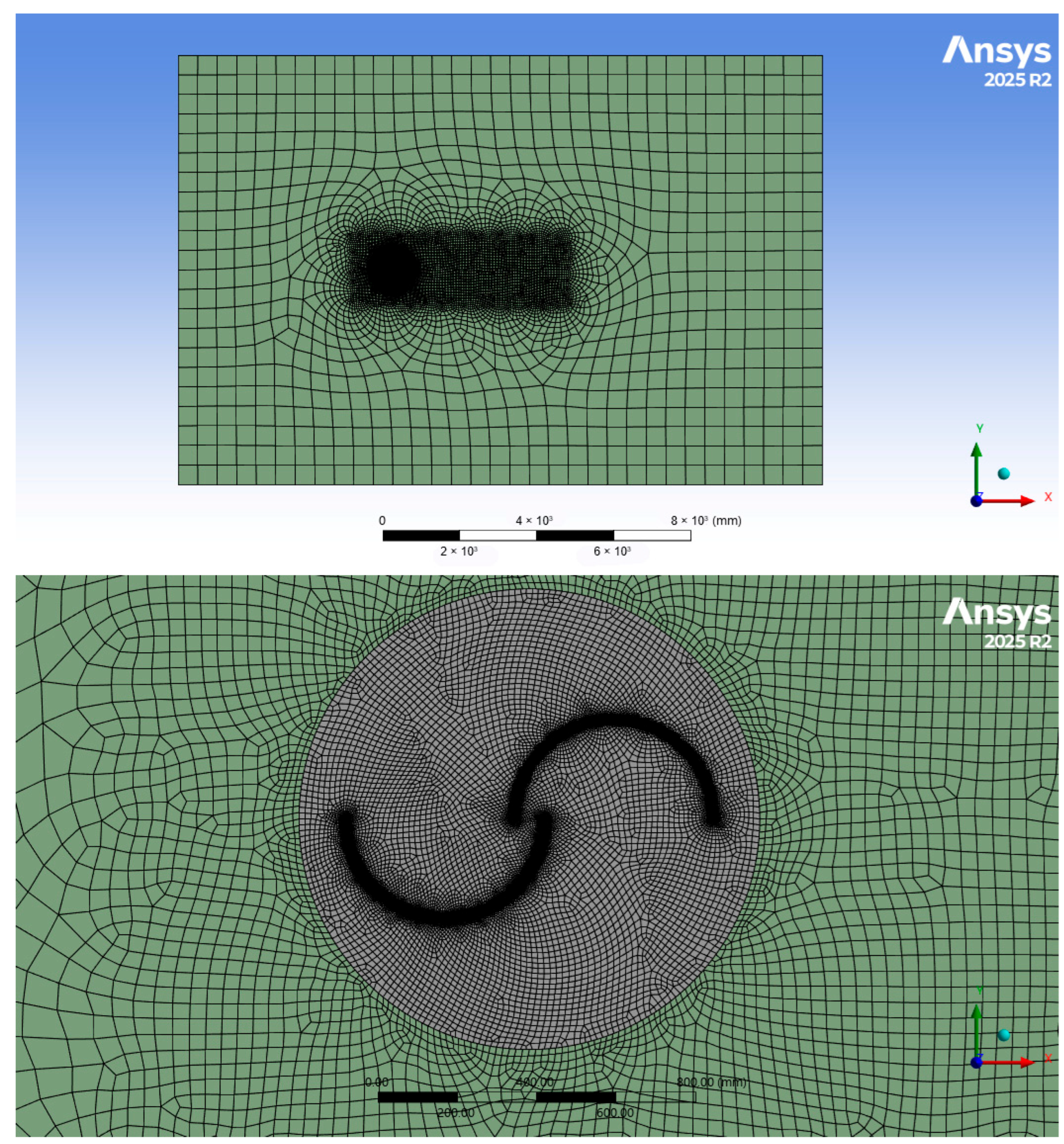
Figure 2, generated using the Mesh tool in ANSYS Fluent 2025 R2, shows an unstructured 2D mesh used to accurately capture the gradients of the analyzed variables. Progressive refinement was applied to the mesh in the rotor region, where inflation layers were used to capture the boundary layer behavior. The external flow region was rendered coarser to represent undisturbed flow.
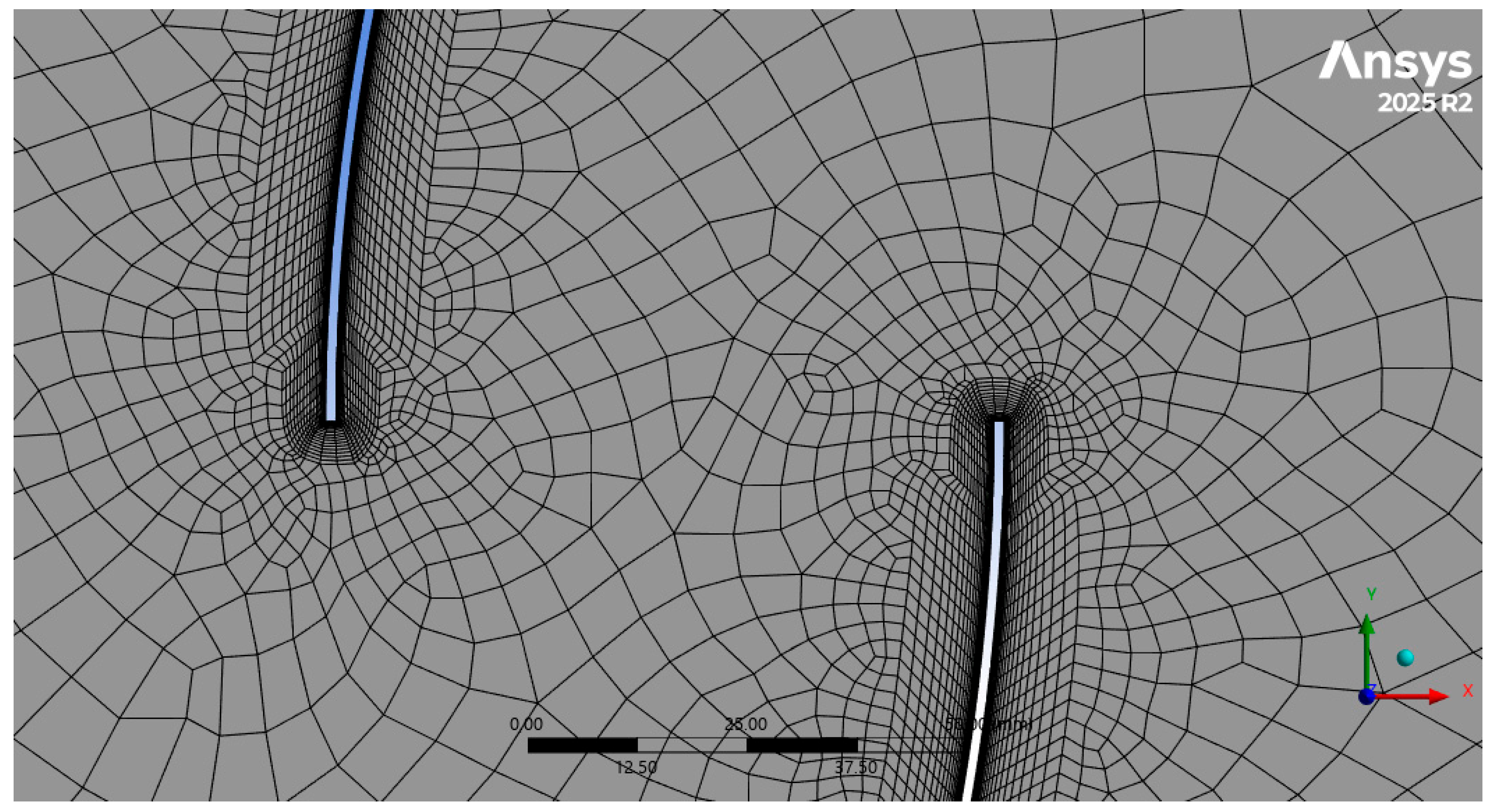
Figure 3 illustrates the inflation layers used for boundary layer analysis. The height of the first prismatic layer on the turbine blades was selected to ensure a y+ value lower than 1, facilitating the use of wall-resolved turbulence modeling [14,23].

2.2. Numerical Model and Time Step

A CFD model based on the URANS equations for mass and momentum conservation was developed for the analysis of the Savonius VAWT. The continuity equation ensures mass conservation within the domain, as shown in Equation (1), while the momentum equation describes the velocity fields by accounting for pressure, molecular viscosity, and turbulent viscosity effects, as presented in Equation (2).
· u = 0
ρ u t + u · u = p + · μ + μ t u + u T
For turbulence modeling, the k–ω SST model [24,25,26] was employed due to its low computational cost and acceptable results [27]. This model simultaneously solves the transport equations for turbulent kinetic energy and the specific dissipation rate, allowing accurate representation of turbulent behavior both near walls and in the free stream. The SST model combines the advantages of the standard k–ω model in near-wall regions—where it provides improved boundary layer resolution—with the behavior of the k–ε model in the free flow, reducing sensitivity to inlet boundary conditions [28,29,30,31]. The transport equation for turbulent kinetic energy is given in Equation (3), and the transport equation for the specific dissipation rate is shown in Equation (4).
ρ κ t + ρ μ j κ x j = P κ β * ρ κ + x j μ + σ κ μ t κ x j
ρ ω t + ρ μ j ω x j = α ω κ P κ β ρ ω 2 + x j μ + σ ω μ t ω x j + 2 1 F 1 ρ σ ω 2 1 ω κ x j ω x j
The turbulent viscosity is computed as shown in Equation (5), including the shear stress limiter characteristic of the SST model, which prevents overprediction of turbulent viscosity in regions with flow separation.
μ t = ρ κ ω
This hybrid formulation is suitable for flows with separation, strong recirculation, and steep velocity gradients, which are characteristic of the flow around Savonius-type vertical-axis wind turbines. To calculate the time step, the time required for the turbine to complete one full rotation is first determined using Equation (6), and the time step corresponding to a 1° angular increment is then calculated using Equation (7) [32,33,34].
t = 2 π ω
t = t 360

2.3. Computational Domain and Boundary Conditions

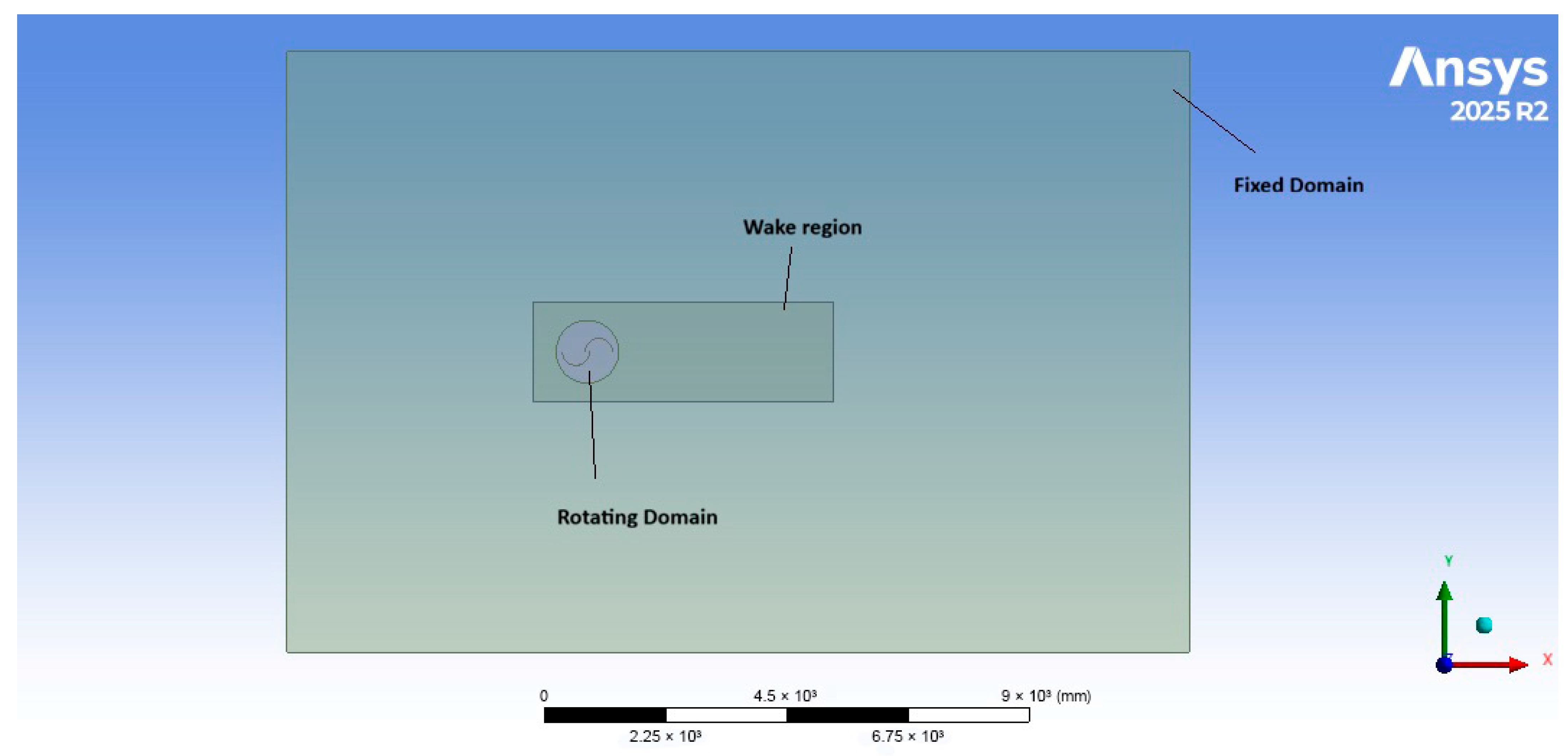
For the CFD simulation, the two-dimensional computational domain was divided into three subdomains, as shown in Figure 4: the rotating domain containing the rotor (Rotating Domain), with a diameter of 1.25D; a wake region designed to adequately capture the airflow downstream of the rotor (Wake Region), with dimensions of 2D in the direction transverse to the flow and 6D in the streamwise direction; and a third domain representing the undisturbed flow (Fixed Domain), with dimensions of 12D in the transverse direction and 18D in the streamwise direction [14].
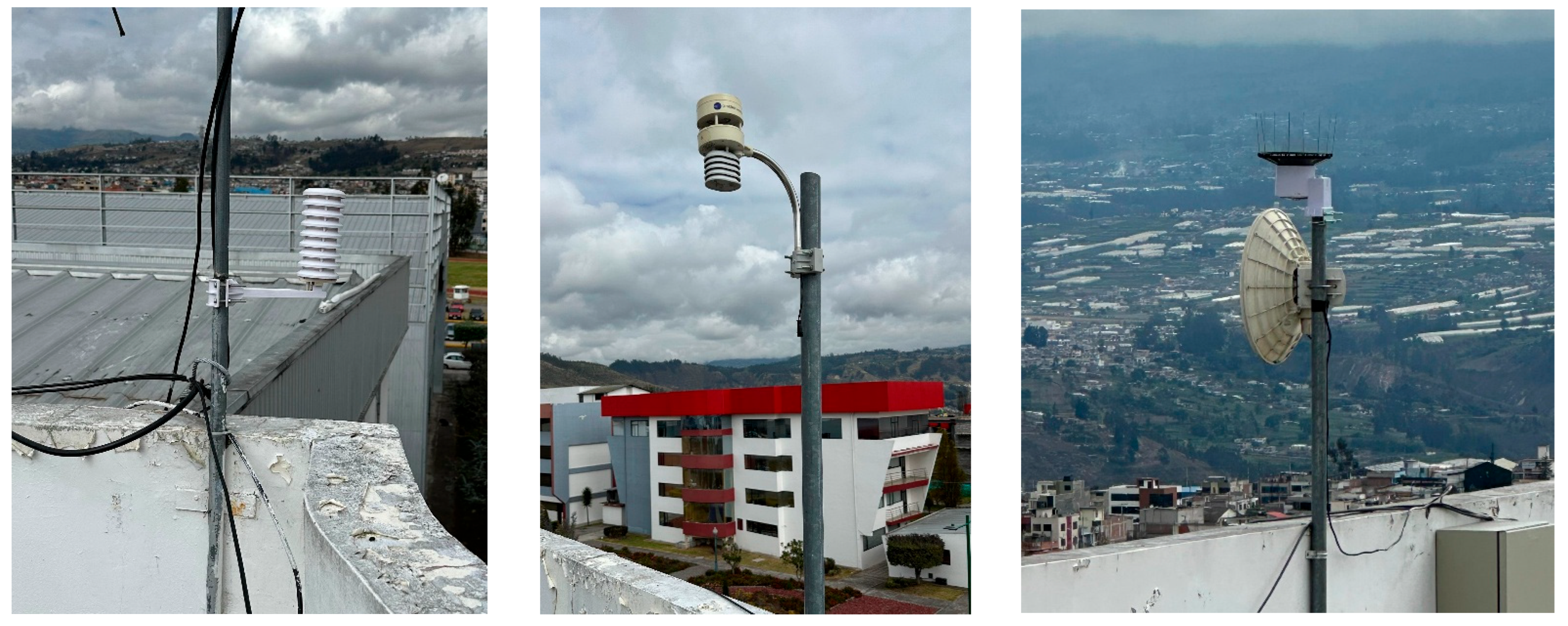
The boundary conditions were defined based on data obtained from the Ambient Weather WS5000 meteorological station located at the Universidad Técnica de Ambato. Figure 5 shows the meteorological station at the site. This equipment records, among other variables, wind speed, temperature, and atmospheric pressure [35], information that was used to establish the boundary conditions of the CFD model in the performed simulations.
At the inlet, a velocity inlet boundary condition with a value of 3.9 m/s was applied to represent the incident flow on the turbine. At the outlet, a pressure outlet boundary condition with a value of 0 Pa was imposed [36], allowing the fluid to exit the domain. The upper and lower boundaries of the fixed domain were modeled using symmetry boundary conditions, assuming two-dimensional flow and avoiding normal gradients of the flow variables at these surfaces. The surfaces of the Savonius rotor blades were defined as no-slip walls [37], enabling the capture of viscous interaction between the fluid and the solid surfaces, as well as the development of the boundary layer around the blades. The domain containing the rotor was modeled as a rotating domain and assigned a constant angular velocity calculated from the tip-speed ratio considered in the simulation. The interaction between the rotating domain and the stationary domain was resolved using a sliding mesh interface, which allows transient reproduction of the relative motion between the rotor and the surrounding flow [38].

2.4. Discretization of the Governing Equations

For the discretization of the governing equations in the CFD simulation using ANSYS Fluent 2025 R2, the finite volume method was employed due to its conservative nature, with each control volume representing a portion of the computational domain. Progressive mesh refinement was applied in regions near the blades and in the wake generated by the fluid as it interacts with the turbine. Subsequently, the differential conservation equations for mass, momentum, and turbulence were solved within each control volume [39].
Due to the transient nature of the flow around the turbine, temporal discretization was applied to compute the evolution of the flow over time. Time derivatives were approximated using a second-order implicit scheme. This resulted in a coupled system of algebraic equations relating the flow variables as a consequence of spatial and temporal discretization. The resulting system of algebraic equations was solved using iterative methods with the aid of pressure–velocity coupling algorithms, specifically the SIMPLE method [40,41].

2.5. Aerodynamic Coefficients

The mechanical power generated by the Savonius VAWT was calculated from the average torque obtained in the CFD simulation and the rotor angular velocity, as shown in Equation (8) [42].
P t = T · ω
The power available in the wind was calculated using Equation (9) [20,43].
P a = 1 2 ρ · A · V 3
The power coefficient, which represents the fraction of the wind’s kinetic energy converted into useful mechanical power by the Savonius VAWT, is given by Equation (10) [20,44].
c p = P t P a

3. Results

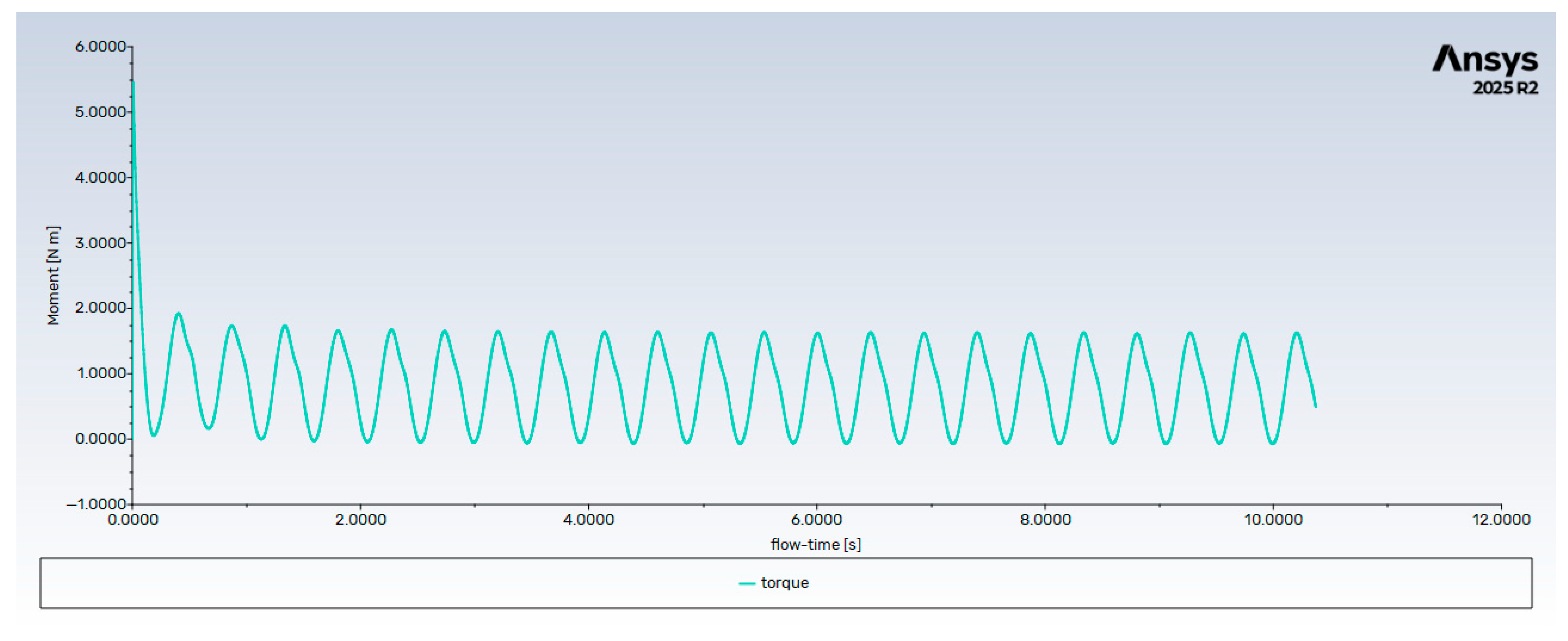
The CFD simulations were run for multiple revolutions until the torque (moment) versus time curve reached a stable periodic behavior, as can be observed in Figure 6. For the calculation of the average torque, the last five complete revolutions of the rotor were used, which ensures independence from the initial conditions. In this simulation, a wind speed of 3.9 m/s was considered, since it is the average wind speed in the study area.
In Table 1, it can be observed that as the TSR increases from 0.6 to 1.0, the torque decreases from 0.92267 N·m to 0.62025 N·m, which is consistent with the increase in the rotor rotational speed. However, despite this reduction in torque, the power delivered by the rotor slightly increases, from 4.65663 W to 5.21724 W, due to the increase in angular velocity. The wind power remains constant at 24.61541 W for all the analyzed conditions, since it depends only on the wind speed imposed in the simulation. As a result, the power coefficient  c p , which represents the fraction of wind power converted into useful power by the rotor, increases with TSR, from 0.18918 for TSR = 0.6 to a maximum value of 0.21195 for TSR = 1.0.
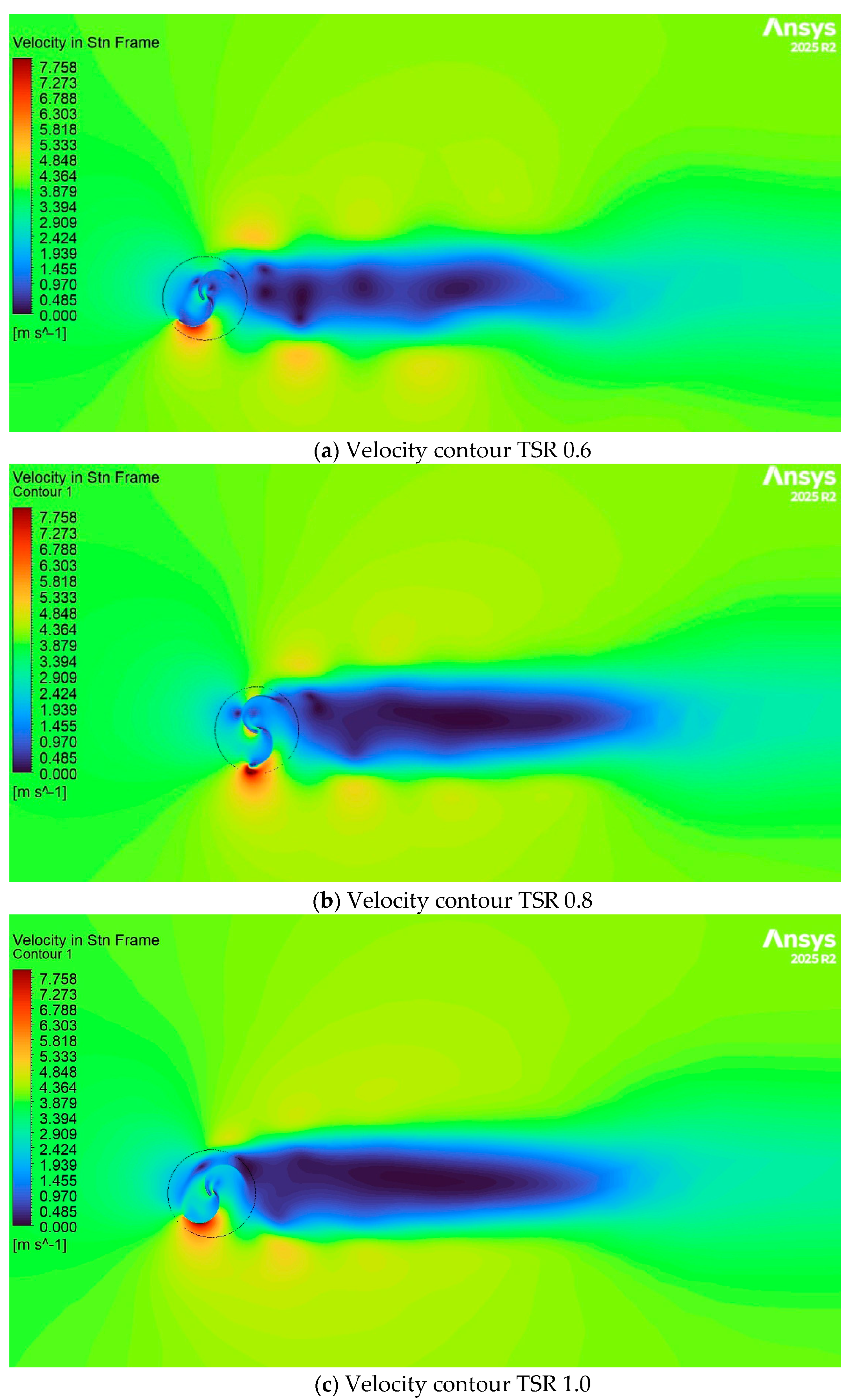
The velocity contours shown in Figure 7 at TSR values of 0.6, 0.8, and 1.0 allow the aerodynamic behavior of the Savonius VAWT to be analyzed. They show a local acceleration of the flow around the advancing blade, where the velocities exceed the inlet value (3.9 m/s), while downstream of the rotor a low-velocity wake develops, associated with the extraction of kinetic energy from the wind.
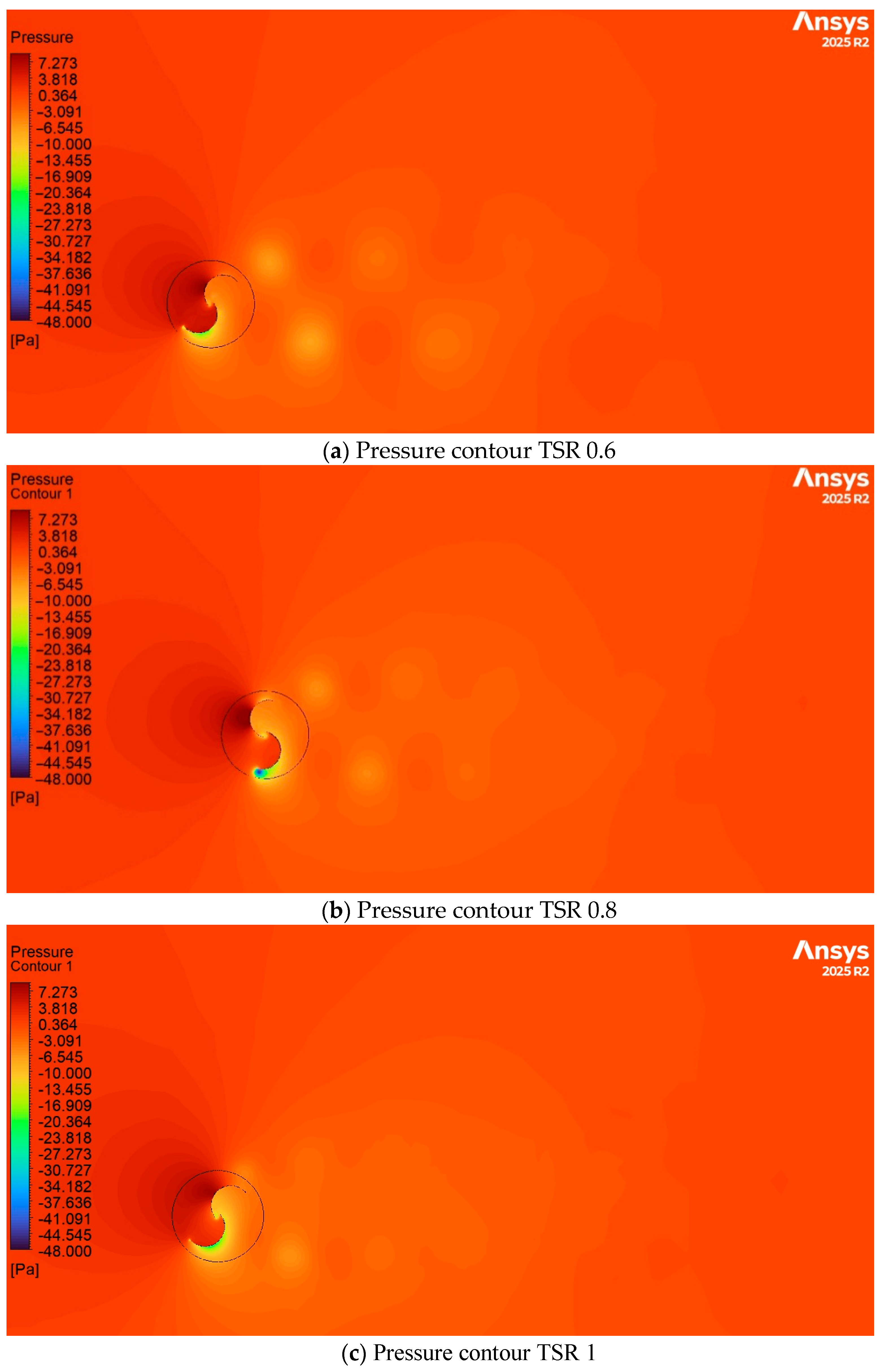
On the other hand, Figure 8 shows the pressure contours at TSR values of 0.6, 0.8, and 1.0. Overpressure regions (intense red–orange) can be distinguished in the windward zone where the flow impinges on the working blade, and low-pressure regions (green–blue) around and within the recirculation zone of the returning blade and in the wake. The pressure contours highlight that torque generation is mainly driven by the pressure contrast between the advancing blade (overpressure region on the windward side) and the returning blade (low-pressure regions associated with separation and recirculation).
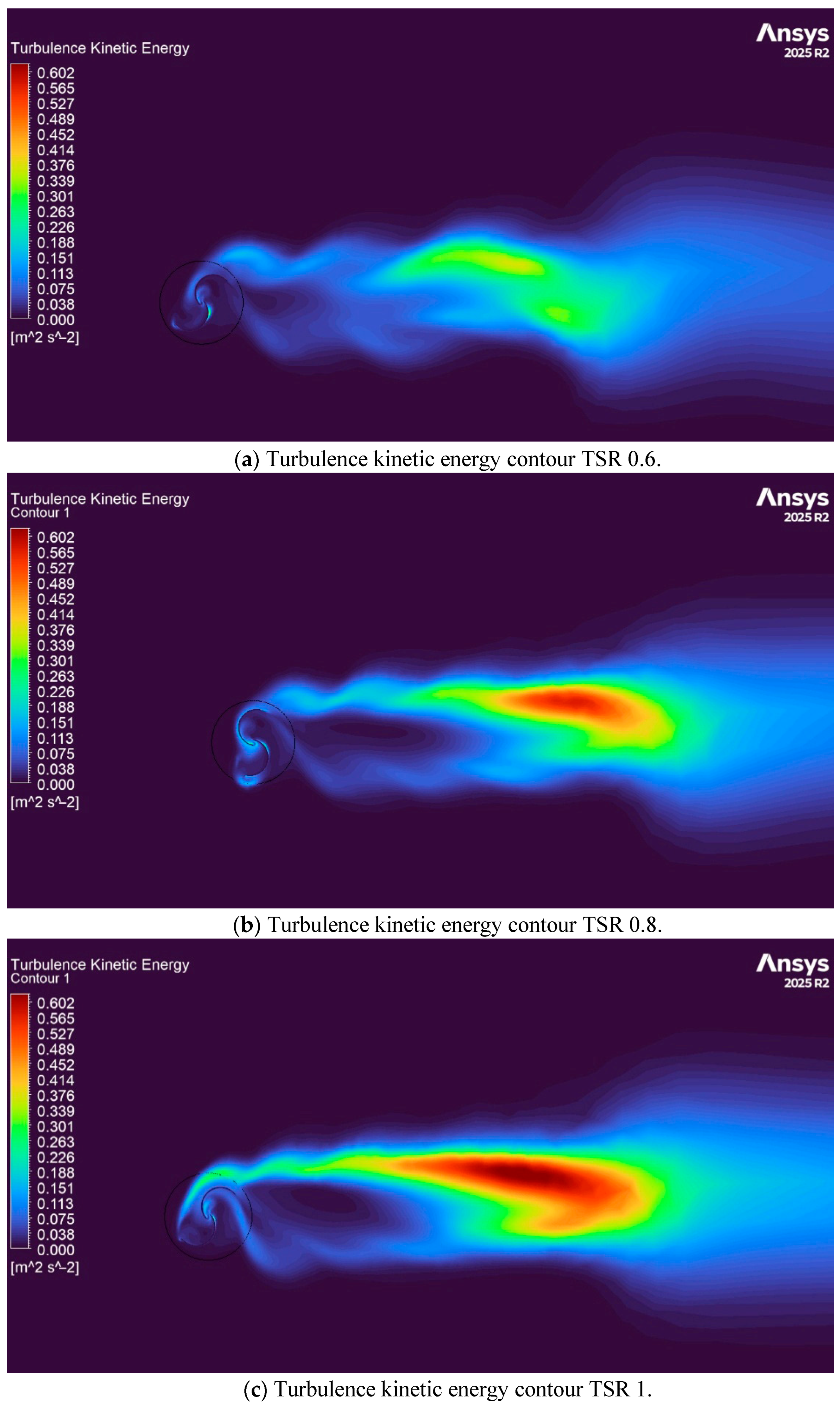
The turbulence kinetic energy contours in Figure 9 show that turbulence generation is concentrated in the immediate region of the rotor and mainly in the downstream wake, where the shear layers associated with vortex shedding enhance mixing and dissipation. As the TSR increases, the wake structure becomes more coherent and a more clearly defined region of high turbulence kinetic energy appears, indicating higher shear and increased turbulence production.
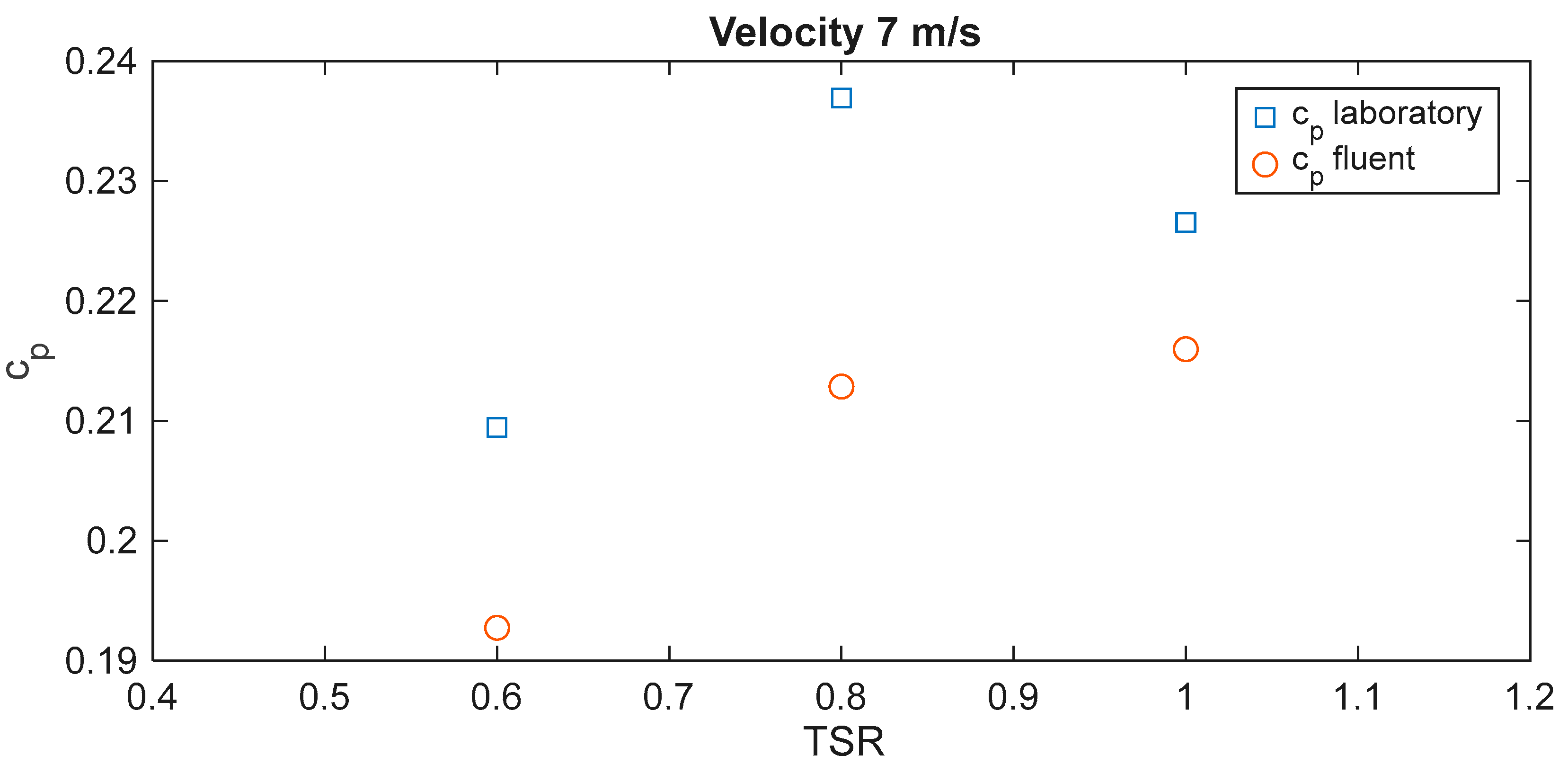
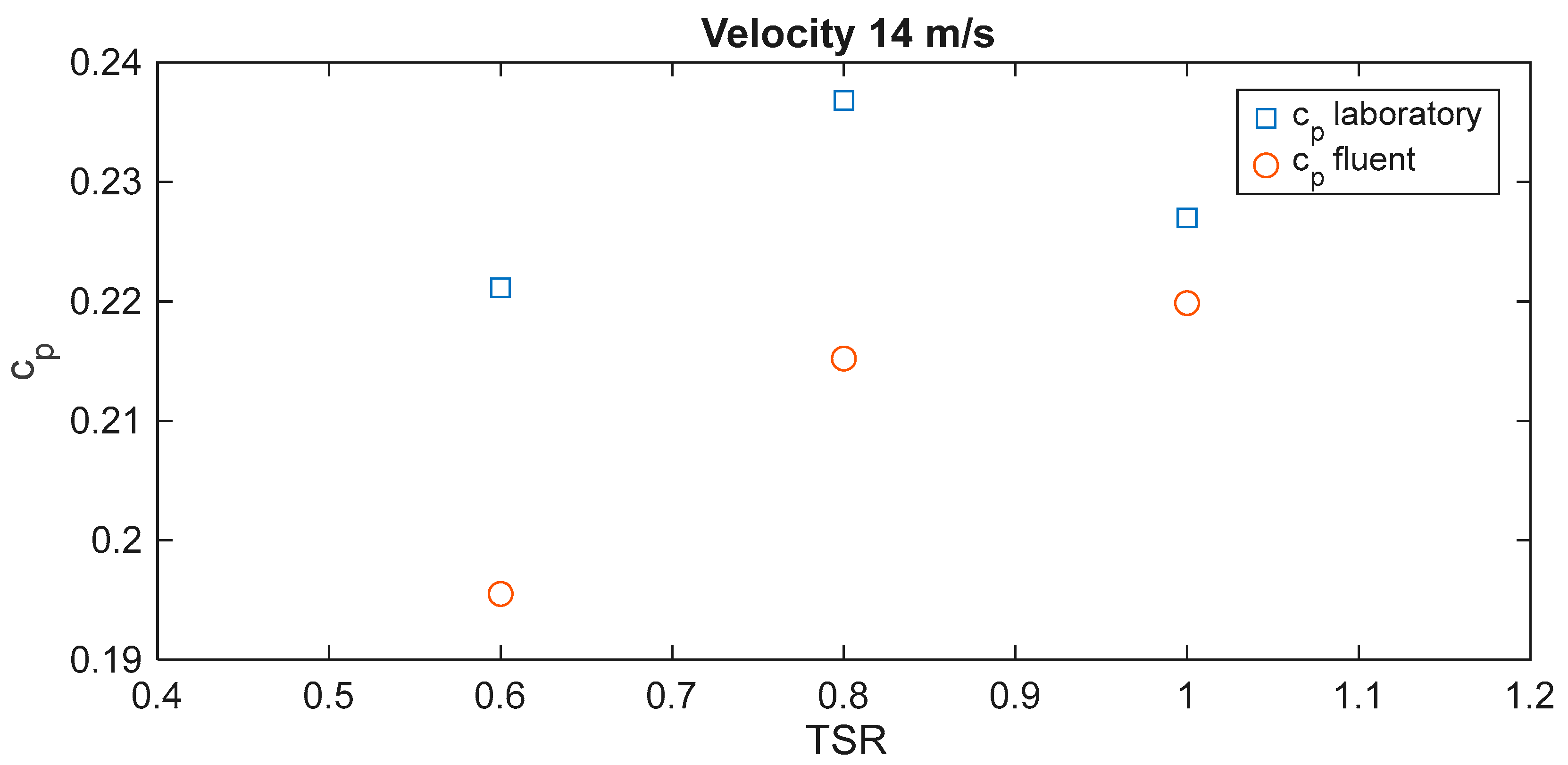
For validation, the data obtained by the Sandia laboratory [13] were used, where wind tunnel tests were performed on Savonius turbines with the same dimensions, at wind speeds of 7 and 14 m/s and TSR values of 0.6, 0.8, and 1. Therefore, the same parameters were used for the validation of the simulation.
Figure 10 and Figure 11 show the comparison between the experimental and numerical values of the power coefficient  c p  as a function of TSR, for inlet velocities of 7 m/s and 14 m/s, respectively. In both cases, the CFD results adequately reproduce the experimental trend, showing an increase in  c p  from TSR = 0.6 to TSR = 0.8, followed by a slight decrease at TSR = 1.0. This behavior confirms the existence of an optimal operating region around TSR ≈ 0.8–1.0, which is characteristic of drag-type Savonius turbines.
In Table 2 and Table 3, the quantitative validation of the numerical model is presented through comparison with the experimental data obtained at 7 m/s and 14 m/s. The APE was calculated for each TSR value using the experimental data as reference. Additionally, from these data, a MAPE of 7.60% at 7 m/s and a MAPE of 7.95% at 14 m/s were obtained.

4. Discussion

The results obtained in this research made it possible to analyze the aerodynamic performance of a Savonius VAWT operating under real meteorological conditions of an educational environment located in the Ecuadorian Andean region. The transient behavior of the torque showed a stable periodic response after the first rotation cycles, which confirms that the numerical model was able to adequately capture the unsteady nature of the flow around the rotor. This behavior has been widely reported in previous studies on Savonius turbines and is associated with flow separation processes and periodic vortex shedding during rotor rotation [13,14].
The results show that the power coefficient  c p  mainly depends on the TSR, exhibiting an increase from TSR = 0.6 to 1.0 for both analyzed wind speeds. The increase in  c p  from 0.8 to 1.0 is minimal. This behavior confirms the existence of an optimal operating region around TSR ≈ 0.8–1.0, characteristic of drag-type Savonius turbines, where the balance between the driving force generated by the pressure difference and the aerodynamic losses associated with separation and turbulence is maximized.
The quantitative analysis of torque and mechanical power reinforces this interpretation. It is observed that the torque decreases progressively as the TSR increases (from 0.92267 N·m at TSR = 0.6 to 0.62025 N·m at TSR = 1.0), which represents a reduction of about 33%. Nevertheless, the generated power increases from 4.65663 W to 5.21724 W (an approximate increase of 12%). This behavior is explained by the fundamental relation  P = T ω , where the increase in angular velocity associated with the increase in TSR compensates for the reduction in torque. Consequently, the rotor performance does not depend solely on the magnitude of the torque, but on the balance between torque and angular velocity. The power available in the wind remains constant (24.61541 W); therefore, the increase in  c p  directly reflects an improvement in energy conversion efficiency. However, the marginal increase between TSR = 0.8 and TSR = 1.0 (relative variation below 1%) indicates a tendency toward performance stabilization.
The analysis of the velocity contours shows that, as the TSR increases, the downstream wake becomes more defined and exhibits a larger velocity deficit, which indicates a greater extraction of kinetic energy from the flow. Likewise, a better organization of the vortex structures in the region close to the rotor is observed for higher TSR values, which favors a more efficient momentum transfer.
This interpretation is reinforced by the pressure contours, where a more pronounced contrast between the overpressure regions on the advancing blade and the low-pressure regions on the returning blade can be observed as the TSR increases. The pressure difference constitutes the main torque-generating mechanism in Savonius turbines; therefore, a more organized pressure distribution leads to better aerodynamic performance. This phenomenon explains why the maximum power coefficient of this type of turbine is lower than that of other lift-based VAWTs, such as Darrieus-type turbines [4,12,45].
The turbulence kinetic energy contours show that turbulence production is mainly concentrated in the wake and in the shear layers generated by flow separation at the blade edges. The k–ω SST model proved to be suitable for capturing these phenomena, especially in regions close to the blades and in the wake, as has been reported in similar CFD studies [14,15]. At higher TSR values, the region of high turbulence kinetic energy becomes more intense and coherent, indicating an increase in mixing and energy dissipation. This phenomenon explains why an increase in TSR does not produce proportional improvements in  c p , since part of the extracted energy is dissipated in the form of turbulence.
The comparison with experimental data shows good agreement between the numerical and laboratory results, with a Mean Absolute Percentage Error (MAPE) below 8% at both wind speeds. The CFD model tends to slightly underestimate the experimental  c p , which can be attributed to the two-dimensional simplification of the computational domain and to the inherent limitations of the URANS turbulence model employed, which may smooth highly unsteady vortical structures present in the experiment. Nevertheless, the simulation correctly reproduces the overall trend of the performance curve and the location of the optimal TSR, demonstrating the predictive capability of the model.
Another important aspect to consider in the analysis of the results is the influence of the altitude of the study site, located at 2723 m a.s.l., on the power generation potential of the Savonius VAWT. At this altitude, atmospheric pressure and air density are significantly lower compared to sea-level conditions, which directly reduces the energy potential of the wind. Since the available wind power is proportional to air density, a decrease in this property leads to a reduction in power production potential, even when the wind speed remains constant. Consequently, the mechanical power values obtained in this study reflect not only the intrinsic aerodynamic performance of the Savonius turbine, but also the particular atmospheric conditions of the Andean environment. This effect should be considered when comparing the results with studies conducted at lower altitudes and highlights the importance of evaluating wind turbine performance under real local conditions, especially in urban and educational applications located at high altitudes.
Finally, the results obtained reinforce the viability of the Savonius turbine as a suitable solution for high-altitude educational and urban environments, where moderate wind speeds, high turbulence intensity, and constraints associated with noise and available space prevail.

5. Conclusions and Recommendations

In this study, a two-dimensional CFD model was developed and validated for the aerodynamic analysis of a Savonius VAWT, using the Reynolds-averaged Navier–Stokes equations and the k–ω SST turbulence model. The transient simulation made it possible to adequately capture the unsteady nature of the flow around the rotor, as evidenced by the periodic evolution of the aerodynamic torque once the initial start-up cycles were surpassed, which confirms the stability and reliability of the adopted numerical scheme.
The comparison of the obtained results with data reported in the literature allowed the employed methodology to be validated, showing acceptable agreement. These results demonstrate that the adopted CFD approach constitutes a reliable tool for the analysis and evaluation of the aerodynamic performance of Savonius turbines in urban and educational applications.
The obtained results also reflect the influence of the altitude of the study site, located at approximately 2723 m a.s.l., on the power generation potential of the turbine. Under these conditions, the lower atmospheric pressure and air density reduce the energy content of the wind compared to sea-level conditions. Since the available wind power is proportional to air density, this reduction directly translates into lower values of generated mechanical power, even when the wind speed remains constant. Consequently, the power and power coefficient values obtained in this research should be interpreted as representative of the Andean atmospheric environment, and not as the maximum performance limits of the turbine under standard conditions.
The implementation of higher-fidelity turbulence models, such as Detached Eddy Simulation (DES) or hybrid Large Eddy Simulation (LES), is recommended, as it could improve the prediction of turbulence kinetic energy and reduce the underestimation observed in the power coefficient.

Author Contributions

Conceptualization, S.P.C.A., C.C.-E. and R.C.-E.; Methodology, J.C.-E. and R.C.-E.; Software, J.C.-E.; Validation, C.H.A.A.; Formal analysis, S.P.C.A.; Investigation, C.M.C.R.; Data curation, C.C.-E.; Writing—review & editing, C.M.C.R. and C.H.A.A. All authors have read and agreed to the published version of the manuscript.

Funding

This research received no external funding.

Data Availability Statement

The original contributions presented in this study are included in the article. Further inquiries can be directed to the corresponding author.

Acknowledgments

The authors thank the Dirección de Investigación y Desarrollo (DIDE) of the Universidad Técnica de Ambato for supporting this work through the research project PFICM38, “Evaluación y optimización de un sistema híbrido de generación eléctrica mediante aerogeneradores de eje vertical (VAWT) mediante Dinámica de Fluidos Computacional (CFD) y paneles solares fotovoltaicos mediante el software PVSOL para comunidades rurales de la sierra ecuatoriana sin acceso a energía eléctrica”.

Conflicts of Interest

The authors declare no conflicts of interest.

Nomenclature

CFDComputational fluid dynamics
cpPower coefficient
cmTorque coefficient
GAPMinimum separation between semicircular blades
APEAbsolute Percentage Error
MAPEMean Absolute Percentage Error
HAWTHorizontal-axis wind turbine
VAWTVertical-axis wind turbine
RANSReynolds-averaged Navier–Stokes
URANSUnsteady-Reynolds-averaged Navier–Stokes
uFluid velocity [m/s]
μjMean velocity components [m/s]
P κ Turbulent kinetic energy production [Kg/m.s3]
PPressure [N/m2]
tTime [s]
tTime step [s]
PtMechanical power generated by the turbine [W]
PaAvailable wind power [W]
ARotor swept area [m2]
VWind velocity [m/s]
TAerodynamic torque [N.m]
TKETurbulence kinetic energy
F1Blending function that enables the transition between the k–ω and k–ε models
ρDensity [kg/m3]
μ Molecular dynamic viscosity [kg/m.s]
μ t Turbulent viscosity [kg/m.s]
ω Angular velocity [rad/s]
λ Tip speed ratio
α Empirical model constant
β Empirical model constant
β * Empirical model constant
σ κ Empirical model constant
σ ω Empirical model constant

References

  1. International Energy Agency. World Energy Outlook 2024. 2024. Available online: http://www.iea.org/terms (accessed on 23 December 2025).
  2. Kumar, S.; Mishra, N.; Mitra, S.; Mishra, D.P.; Vaikuntanathan, V. Optimization of Savonius rotor array through a hybrid CFD-ANN-PSO method. Ocean Eng. 2026, 344, 123405. [Google Scholar] [CrossRef]
  3. Abraham, J.P.; Mowry, G.S.; Plourde, B.P.; Sparrow, E.M.; Minkowycz, W.J. Numerical simulation of fluid flow around a vertical-axis turbine. J. Renew. Sustain. Energy 2011, 3, 033109. [Google Scholar] [CrossRef]
  4. Marinić-Kragić, I.; Vučina, D.; Milas, Z. Global optimization of Savonius-type vertical axis wind turbine with multiple circular-arc blades using validated 3D CFD model. Energy 2022, 241, 122841. [Google Scholar] [CrossRef]
  5. Abdolahifar, A.; Zanj, A. Addressing VAWT Aerodynamic Challenges as the Key to Unlocking Their Potential in the Wind Energy Sector. Energies 2024, 17, 5052. [Google Scholar] [CrossRef]
  6. Longo, R.; Nicastro, P.; Natalini, M.; Schito, P.; Mereu, R.; Parente, A. Impact of urban environment on Savonius wind turbine performance: A numerical perspective. Renew. Energy 2020, 156, 407–422. [Google Scholar] [CrossRef]
  7. Singh, D.; Kumar, R.; Sinha, S. Design and performance characterization of hybrid vertical axis wind turbine with Savonius and Gorlov blades in low wind regimes: Integrating CFD simulations and experimental approach. Proc. Inst. Mech. Eng. C J. Mech. Eng. Sci. 2025, 239, 4890–4902. [Google Scholar] [CrossRef]
  8. Shigetomi, A.; Murai, Y.; Tasaka, Y.; Takeda, Y. Interactive flow field around two Savonius turbines. Renew. Energy 2011, 36, 536–545. [Google Scholar] [CrossRef]
  9. Sivasegaram, S. Design parameters affecting the performance of resistance-type, vertical-axis windrotors; an experimental investigation. Wind Eng. 1977, 1, 207–217. [Google Scholar]
  10. Pope, K.; Dincer, I.; Naterer, G.F. Energy and exergy efficiency comparison of horizontal and vertical axis wind turbines. Renew. Energy 2010, 35, 2102–2113. [Google Scholar] [CrossRef]
  11. Prabowoputra, D.M.; Prabowo, A.R. Effect of the Phase-Shift Angle on the vertical axis Savonius wind turbine performance as a renewable-energy harvesting instrument. Energy Rep. 2022, 8, 57–66. [Google Scholar]
  12. Chitura, A.G.; Mukumba, P.; Lethole, N. Enhancing the Performance of Savonius Wind Turbines: A Review of Advances Using Multiple Parameters. Energies 2024, 17, 3708. [Google Scholar] [CrossRef]
  13. Sheldahl, R.E.; Blackwell, B.F.; Feltz, L.V. Wind tunnel performance data for two-and three-bucket Savonius rotors. J. Energy 1978, 2, 160–164. [Google Scholar] [CrossRef]
  14. Tian, W.; Song, B.; VanZwieten, J.H.; Pyakurel, P. Computational Fluid Dynamics Prediction of a Modified Savonius Wind Turbine with Novel Blade Shapes. Energies 2015, 8, 7915–7929. [Google Scholar] [CrossRef]
  15. Mauro, S.; Brusca, S.; Lanzafame, R.; Messina, M. CFD modeling of a ducted Savonius wind turbine for the evaluation of the blockage effects on rotor performance. Renew. Energy 2019, 141, 28–39. [Google Scholar] [CrossRef]
  16. Blanco, J.; Rodriguez, J.d.D.; Couce, A.; Lamas, M.I. Proposal of a Nature-Inspired Shape for a Vertical Axis Wind Turbine and Comparison of Its Performance with a Semicircular Blade Profile. Appl. Sci. 2021, 11, 6198. [Google Scholar] [CrossRef]
  17. Ghafoorian, F.; Mirmotahari, S.R.; Mehrpooya, M.; Akhlaghi, M. Aerodynamic performance and efficiency enhancement of a Savonius vertical axis wind turbine with Semi-Directional Curved Guide Vane, using CFD and optimization method. J. Braz. Soc. Mech. Sci. Eng. 2024, 46, 443. [Google Scholar] [CrossRef]
  18. Abdullah, M.S.; Ismail, F. Optimization of Savonius rotor blade performance using Taguchi method: Experimental and 3D-CFD approach. Energy 2024, 303, 131801. [Google Scholar] [CrossRef]
  19. Kumar, S.; Mitra, S.; Mishra, N.; Vaikuntanathan, V. Computational fluid dynamical analysis of a Savonius vertical axis wind rotor array. Phys. Fluids 2025, 37, 017163. [Google Scholar] [CrossRef]
  20. Shahriare, S.; Rony, M.R.; Das, P. Enhanced Aerodynamic Performance of Savonius Wind Turbines Through Blade Design Modifications: A CFD Study. Wind Energy 2025, 28, e70042. [Google Scholar] [CrossRef]
  21. Cabrera-Escobar, J.; Vera, D.; Jurado, F.; Córdova-Suárez, M.; Santillán-Valdiviezo, G.; Rodríguez-Orta, A.; Cabrera-Escobar, R. Optimization of olive pomace dehydration process through the integration of computational fluid dynamics and deep learning. Energy Sources Part A Recover. Util. Environ. Eff. 2024, 46, 4756–4776. [Google Scholar] [CrossRef]
  22. Kumar, V.P.; Ponnappan, V.S.; Kumar, M.S.; Rajasekar, R.; Balakrishnan, K.; Janarthanam, H. Design and performance analysis of savonius type vertical axis wind turbine with CFD simulation. AIP Conf. Proc. 2020, 2311, 090004. [Google Scholar] [CrossRef]
  23. Fatahian, H.; Mishra, R.; Jackson, F.F.; Fatahian, E. Design optimization of an innovative deflector with bleed jets to enhance the performance of dual Savonius turbines using CFD-Taguchi method. Energy Convers. Manag. 2023, 296, 117655. [Google Scholar] [CrossRef]
  24. Chegini, S.; Asadbeigi, M.; Ghafoorian, F.; Mehrpooya, M. An investigation into the self-starting of darrieus-savonius hybrid wind turbine and performance enhancement through innovative deflectors: A CFD approach. Ocean Eng. 2023, 287, 115910. [Google Scholar] [CrossRef]
  25. Farajyar, S.; Ghafoorian, F.; Mehrpooya, M.; Asadbeigi, M. CFD Investigation and Optimization on the Aerodynamic Performance of a Savonius Vertical Axis Wind Turbine and Its Installation in a Hybrid Power Supply System: A Case Study in Iran. Sustainability 2023, 15, 5318. [Google Scholar] [CrossRef]
  26. Dobrev, I.; Massouh, F. CFD and PIV investigation of unsteady flow through Savonius wind turbine. Energy Procedia 2011, 6, 711–720. [Google Scholar] [CrossRef]
  27. Abdullah, M.S.; Abidin, M.S.Z.; Ismail, F. New strategy for enhancing Savonius turbine efficiency through delayed flow separation with advanced flow control. Energy 2025, 333, 137309. [Google Scholar] [CrossRef]
  28. Aboujaoude, H.; Polidori, G.; Beaumont, F.; Murer, S.; Toumi, Y.; Bogard, F. Comparative Study of Deflector Configurations under Variable Vertical Angle of Incidence and Wind Speed through Transient 3D CFD Modeling of Savonius Turbine. Computation 2024, 12, 204. [Google Scholar] [CrossRef]
  29. Rezaeiha, A.; Montazeri, H.; Blocken, B. On the accuracy of turbulence models for CFD simulations of vertical axis wind turbines. Energy 2019, 180, 838–857. [Google Scholar] [CrossRef]
  30. Alom, N.; Saha, U.K.; Dewan, A. In the quest of an appropriate turbulence model for analyzing the aerodynamics of a conventional Savonius (S-type) wind rotor. J. Renew. Sustain. Energy 2021, 13, 023313. [Google Scholar] [CrossRef]
  31. Ghazalla, R.A.; Mohamed, M.H.; Hafiz, A.A. Synergistic analysis of a Darrieus wind turbine using computational fluid dynamics. Energy 2019, 189, 116214. [Google Scholar] [CrossRef]
  32. Satrio, D.; Utama, I.K.A.P.; Mukhtasor. The influence of time step setting on the CFD simulation result of vertical axis tidal current turbine. J. Mech. Eng. Sci. 2018, 12, 3399–3409. [Google Scholar] [CrossRef]
  33. Sharma, S.; Sharma, R.K. Performance improvement of Savonius rotor using multiple quarter blades—A CFD investigation. Energy Convers. Manag. 2016, 127, 43–54. [Google Scholar] [CrossRef]
  34. Sharma, S.; Sharma, R.K. CFD investigation to quantify the effect of layered multiple miniature blades on the performance of Savonius rotor. Energy Convers. Manag. 2017, 144, 275–285. [Google Scholar] [CrossRef]
  35. Cabrera-Escobar, R.; Cabrera-Escobar, J.; Vera, D.; Jurado, F.; Orozco-Cantos, L.; Córdova-Suárez, M.; García-Mora, F. Comparative Analysis of Material Efficiency and the Impact of Perforations on Heat Sinks for Monocrystalline Photovoltaic Panel Cooling. Energies 2024, 17, 5511. [Google Scholar] [CrossRef]
  36. Hidalgo, I.R.; Rojas, I.O.; Riaño, A.B.; Morales, C.C.; Arias, A.R. Evaluation of a Geometric Modification in Savonius Rotor Using CFD Evaluación de Modificación Geométrica en Rotor Savonius Usando CFD. In Proceedings of the 2018 IEEE ANDESCON, Santiago de Cali, Colombia, 22–24 August 2018; pp. 1–6. [Google Scholar] [CrossRef]
  37. Alizadeh, H.; Jahangir, M.H.; Ghasempour, R. CFD-based improvement of Savonius type hydrokinetic turbine using optimized barrier at the low-speed flows. Ocean Eng. 2020, 202, 107178. [Google Scholar] [CrossRef]
  38. Ferrari, G.; Federici, D.; Schito, P.; Inzoli, F.; Mereu, R. CFD study of Savonius wind turbine: 3D model validation and parametric analysis. Renew. Energy 2017, 105, 722–734. [Google Scholar] [CrossRef]
  39. Han, Y.; Kim, E.; Oh, S. Numerical investigations on double Savonius vertical axis wind turbines with a deflector: Effects of turbine and deflector-related parameters. Energy Rep. 2025, 14, 4950–4962. [Google Scholar] [CrossRef]
  40. Cabrera-Escobar, J.; Cevallos, P.V.; Bodero-Poveda, E.; Radicelli-García, C.D.; Contreras-Vásquez, L.; Benavides, D. Computational Fluid Dynamics Simulation of Heavy Crude Oil Transport Under Ecuadorian Oriente Conditions. Processes 2025, 13, 3487. [Google Scholar] [CrossRef]
  41. Zhao, J.; Liu, J.; Dong, H.; Zhao, W.; Wei, L. Numerical investigation on the flow and heat transfer characteristics of waxy crude oil during the tubular heating. Int. J. Heat Mass Transf. 2020, 161, 120239. [Google Scholar] [CrossRef]
  42. Zakaria, A.; Ibrahim, M.S.N. Estimating an Optimal Multiple Savonius Wind Turbines Layout by CFD Velocity Pattern Analysis. J. Phys. Conf. Ser. 2019, 1300, 012062. [Google Scholar] [CrossRef]
  43. Zheng, M.; Zhang, X.; Zhang, L.; Teng, H.; Hu, J.; Hu, M. Uniform Test Method Optimum Design for Drag-Type Modified Savonius VAWTs by CFD Numerical Simulation. Arab. J. Sci. Eng. 2018, 43, 4453–4461. [Google Scholar] [CrossRef]
  44. Debnath, P.; Chakraborty, D.; Chakraborty, S. Performance Enhancement of the Aerodynamics of Savonius Wind Turbine by Wind Flow Control using CFD Analysis. In Proceedings of the 2024 International Conference on Advancement in Renewable Energy and Intelligent Systems (AREIS), Thrissur, India, 5–6 December 2024; pp. 1–5. [Google Scholar] [CrossRef]
  45. Kumar, R.; Kumar, A. Investigation of slot parameters on the performance of Savonius hydrokinetic turbine: A CFD study. J. Braz. Soc. Mech. Sci. Eng. 2024, 46, 506. [Google Scholar] [CrossRef]
Figure 1. 2D Savonius turbine model.
Cleantechnol 08 00040 g001
Figure 2. Domain mesh.
Cleantechnol 08 00040 g002
Figure 3. Mesh with inflation layers.
Cleantechnol 08 00040 g003
Figure 4. 3D computational domain.
Cleantechnol 08 00040 g004
Figure 5. Ambient Weather WS-500 meteorological station.
Cleantechnol 08 00040 g005
Figure 6. Mechanical torque derived from the transient simulation.
Cleantechnol 08 00040 g006
Figure 7. Velocity contours at 3.9 m/s.
Cleantechnol 08 00040 g007
Figure 8. Pressure contours at 3.9 m/s.
Cleantechnol 08 00040 g008
Figure 9. Turbulence kinetic energy contours at 3.9 m/s.
Cleantechnol 08 00040 g009
Figure 10. c p  as a function of TSR at 7 m/s.
Cleantechnol 08 00040 g010
Figure 11. c p  as a function of TSR at 14 m/s.
Cleantechnol 08 00040 g011
Table 1. CFD simulation results at a wind speed of 3.9 m/s.
TSRTorque (N·m)Fluent Power (W)Wind Power (W)Fluent cp
0.60.922674.6566324.615410.18918
0.80.768725.1728824.615410.21015
10.620255.2172424.615410.21195
Table 2. Absolute Percentage Error to 7 m/s.
TSRcp Laboratorycp FluentAPE
0.60.209450.192747.98
0.80.236910.2128510.16
10.226530.215974.66
Table 3. Absolute Percentage Error to 14 m/s.
TSRcp Laboratorycp FluentAPE
0.60.209450.192747.98
0.80.236910.2128510.16
10.226530.215974.66
Disclaimer/Publisher’s Note: The statements, opinions and data contained in all publications are solely those of the individual author(s) and contributor(s) and not of MDPI and/or the editor(s). MDPI and/or the editor(s) disclaim responsibility for any injury to people or property resulting from any ideas, methods, instructions or products referred to in the content.