Article

Graphene as a Soil Amendment for the Mitigation of Fungicide Kresoxim-Methyl Pollution

1
School of Fashion and Textiles, RMIT University, Brunswick, VIC 3056, Australia
2
Department of Biomedical and Analytical Chemistry, Institute of Biological Sciences, Faculty of Medicine, The John Paul II Catholic University of Lublin, Konstantynów 1J, 20-708 Lublin, Poland
3
Department of Radiochemistry and Environmental Chemistry, Institute of Chemical Sciences, Faculty of Chemistry, Maria Curie-Sklodowska University in Lublin, Pl. M. Curie-Skłodowskiej 3, 20-031 Lublin, Poland
4
Institute for Frontier Materials, Deakin University, Waurn Ponds, VIC 3216, Australia
*
Authors to whom correspondence should be addressed.
Clean Technol. 2026, 8(2), 39; https://doi.org/10.3390/cleantechnol8020039
Submission received: 4 December 2025 / Revised: 19 February 2026 / Accepted: 2 March 2026 / Published: 12 March 2026

Highlights

What are the main findings?
  • Rising demand for high-quality food is increasing pesticide use, with significant impacts on soil health and the food chain.
  • Synthesised graphenes with large surface area and abundant oxygen-containing groups, enhance the ability of soils to immobilise the pesticide kresoxim–methyl and improve its adsorption efficiency.
What are the implication of the main findings?
  • Graphene-amended soils can reduce the mobility and environmental risk of kresoxim–methyl, supporting safer agricultural practices.
  • Tailored graphene materials offer a promising strategy for mitigating pesticide contamination and protecting ecosystems and food safety.

Abstract

The global demand for high-quality food is rising due to the increasing population, necessitating intensive farming practices that often involve the extensive use of pesticides, which can accumulate in soils and enter the food chain. This study explores the use of synthesized and commercial graphenes for the removal of kresoxim-methyl (KM), a common strobilurin fungicide, from soil. Adding only 1 wt% of graphene to soil enhanced its partitioning capacity from about 4.77 mg/g for unamended soil to 9.57 mg/g, indicating effective immobilization and reduced environmental risk. The adsorption efficacy was notably higher in materials rich in oxygen-containing functional groups and with a large surface area, highlighting the significance of surface characteristics and porosity. The adsorption followed pseudo-second-order kinetics, underscoring the importance of surface heterogeneity in KM adsorption.

1. Introduction

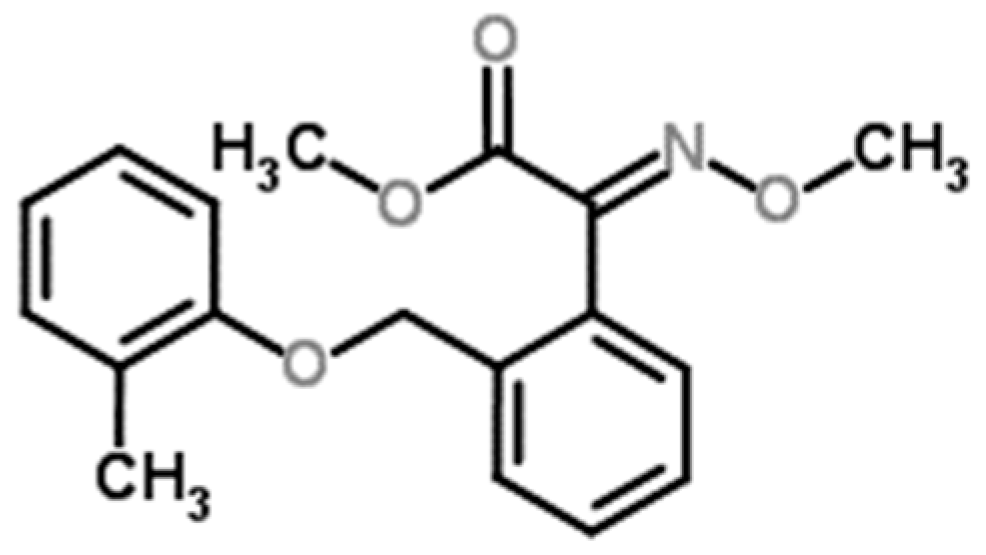
The increasing global population necessitates the production of large quantities of high-quality food, which is closely associated with intensive agricultural practices and the widespread use of plant protection products. Among these, fungicides constitute a major group applied to protect crops against fungal diseases. Kresoxim-methyl (methyl-(E)-2-methoxyimino-2-[2-(2-methylphenoxymethyl)phenyl] (Figure 1), hereafter referred to as KM, is a broad-spectrum strobilurin fungicide commonly used in agriculture for crop and fruit protection [1].
Due to the potential human health risks associated with its residues, maximum residue levels (MRLs) for KM in food products of both plant and animal origin have been established under Regulation (EC) No 396/2005 [2] and later revised by Regulation (EU) 2020/856 [3]. The MRLs for KM typically range between 0.01 and 0.05 mg/kg, depending on the specific food commodity. Following oral exposure, KM is rapidly absorbed and predominantly accumulates in the gastrointestinal tract, liver, and kidneys. The established acceptable operator exposure level (AOEL) and acceptable daily intake (ADI) for KM are 0.9 mg/kg body weight/day and 0.3 mg/kg body weight/day, respectively.
The primary mode of action of KM involves the inhibition of mitochondrial respiration through its interaction with the cytochrome bc1 complex (Complex III) of the electron transport chain [4]. In addition to its antifungal efficacy, KM has been demonstrated to exert ecotoxicological effects across a range of non-target organisms, including soil biota, aquatic species, and mammals [4]. For instance, KM exposure has been associated with mitochondrial dysfunction, metabolic disturbances, and developmental anomalies in Danio rerio (zebrafish), as well as alterations in antioxidant enzyme activities in juvenile grass carp and algal species [4].
In mammalian renal cell lines, sub-nephrotoxic concentrations of KM induce mitochondrial dysfunction characterized by elevated hydrogen peroxide (H2O2) and nitrite production, along with increased intracellular calcium concentrations [5]. Similarly, in human HepG2 hepatocellular carcinoma cells, KM impairs mitochondrial function by enhancing superoxide radical generation, depleting ATP levels, reducing the ratio of reduced to oxidized glutathione, and diminishing overall cell viability [4]. Furthermore, high-dose exposure to KM (200 mg/kg body weight) has been associated with a moderate increase in S-phase DNA synthesis [6]. Although KM is classified as having low to moderate acute toxicity via oral, dermal, and inhalation routes [6], environmental degradation processes can yield transformation products with greater toxicity than the parent compound [7,8].
In the environment, KM displays moderate persistence depending on physicochemical conditions. It is relatively stable under neutral and acidic conditions but degrades more rapidly under alkaline conditions (pH 9) [8]. In soils, KM undergoes rapid degradation (DT50 < 3 days), forming acidic metabolites via hydrolysis, oxidation, reduction, decarboxylation, and desaturation pathways [7]. Additionally, KM is susceptible to photochemical degradation upon exposure to simulated sunlight, involving processes such as photoisomerization, hydrolysis of the methyl ester group, hydroxylation, and cleavage of both the oxime ether and benzyl ether moieties [8]. Despite its relatively fast degradation, repeated applications and continuous agricultural use raise concerns regarding KM mobility, bioavailability, and uptake by crops.
Carbon-based materials, including biochar, carbon nanotubes, porous carbon, and nanocarbons such as graphene and reduced graphene oxide, have attracted increasing attention in environmental remediation due to their high surface area, tunable surface chemistry, and strong affinity for organic contaminants [9,10,11,12,13]. These materials have been applied in areas such as soil health improvement, wastewater treatment, and water purification due to their unique structural and physicochemical properties.
Among these materials, graphene stands out for its superior efficacy in environmental applications, particularly in soil amendment and pollution mitigation. Organic pollutants can be effectively adsorbed by graphene nanomaterials due to their large reactive surface areas, high sorption capacities, and diverse functional groups, enabling interactions like hydrogen bonding and π–π interactions. This adsorption influences the fate and transport of pollutants in the environment [14,15,16]. However, existing studies predominantly focus on adsorption by pristine graphene materials in aqueous systems, while systematic investigations addressing the behavior of pesticides in graphene-amended soils remain scarce. In particular, the influence of graphene surface chemistry and structural defects on pesticide adsorption kinetics, partitioning, and soil–pollutant interactions has not been comprehensively evaluated. Moreover, comparative studies linking the adsorption performance of individual graphene materials with their effectiveness when incorporated into soil matrices are largely lacking. Graphene is expected to outperform other carbonaceous materials for KM adsorption in soils, emphasizing π–π interactions with the aromatic KM structure, high defect density, and tunable oxygen-containing functional groups.
The novelty of this study lies in the integrated evaluation of KM adsorption in both pure graphene systems and graphene-amended soils, enabling direct comparison between material-level and soil-level behavior. By employing three commercial graphene materials and one tailor-made graphene synthesized in-house, each with distinct physicochemical properties, this work advances beyond the current state of the art by elucidating how graphene structure, surface functionality, and defect density govern KM adsorption efficiency, kinetics, and partitioning in soil systems.
Accordingly, this study aims to: (i) investigate the interaction of KM with soil amended with 1 wt% of four structurally and chemically distinct graphene materials; (ii) quantify and compare the adsorption capacity and mechanisms of KM; and (iii) assess adsorption kinetics in both soil-based systems and individual graphene materials using pseudo-first-order and pseudo-second-order models. By bridging the gap between material-scale adsorption and soil-scale behavior, this work provides new insights into the feasibility of graphene-based amendments for mitigating pesticide contamination in agricultural soils.

2. Materials and Methods

2.1. Reagents

For HPLC-QTOF/MS, LC-MS grade formic acid (FA) and acetonitrile (ACN, LC-MS grade) were from Sigma Aldrich (St. Louis, MO, USA) and Merck (Darmstadt, Germany), respectively. The kresoxim-methyl was obtained from Sigma Aldrich (St. Louis, MO, USA) in crystalline form. The stock solution of KM was prepared by dissolving the reagent in ACN and stored at −20 °C. DOM (dissolved organic matter-tannic acid) and NaHCO3 were from Sigma Aldrich (St. Louis, MO, USA) and Merck (Darmstadt, Germany). NaCl and KNO3 were purchased from Chempur (Piekary Śląskie, Poland). Ultrapure water was obtained by a Direct Q 3UV water purification system (Millipore, Molshein, France). For the calibration, standard solutions were prepared daily by diluting the stock solution in water. The following concentrations were chosen: 5.0, 10.0, 50.0, 100.0, 500.0, 1000.0, and 2000 µg/L. Moreover, matrix-matched calibration solutions in the soil matrix were prepared. For this, 100 mg of soil was weighed. Then, 10 mL of aqueous solutions of KM were added. For this calibration, the following KM concentrations were selected: 50.0, 100.0, 500.0, 1000.0, and 2000.0 µg/L. The mixture was shaken for 30 min using an SSL4 see-saw rocker (Stuart; Cole-Parmer, Stone, UK) and centrifuged (15 min, 8228× g via 5804 centrifuge (Eppendorf, Hamburg, Germany)). Then, 8 mL of KM solution was collected. Then, 10 mL of ACN was added, and the mixture was hand-shaken for 1 min. Subsequently, QuEChERS salt (4 g MgSO4, 1 g NaCl, 1 g sodium citrate, 0.5 g sodium hydrogencitrate sesquihydrate; Agilent Technologies, Santa Clara, CA, USA, PN: 5982-0650) was added, and the mixture was shaken again for 1 min. After centrifugation (15 min, 8228× g), the acetonitrile extract was collected and analyzed.

2.2. Adsorbents Preparation and Characterization

This work examines the effectiveness of reduced graphene oxides in mitigating KM for enhancing soil health. A total of 100 g of graphite (Asbury, flakes, ≥98% carbon basis, 325 mesh particle size (50–70%), Graphite grade 3243) was gradually added to a mixture of 500 mL of fuming nitric acid and 750 mL of concentrated sulfuric acid in a cooled (ice bath) reaction vessel, with continuous stirring for 30 min to maintain a low temperature. Then, 110 g of potassium chlorate was slowly introduced in small portions while stirring, ensuring the temperature remained below 40 °C to prevent excessive chlorine dioxide gas formation. The reaction mixture was stirred continuously for 24 h at room temperature. To quench the reaction, the mixture was carefully poured into a large volume of ice-cold distilled water, followed by filtration and thorough washing with dilute HCl (5%) and distilled water until a neutral pH was reached. The resulting graphene oxide (GO) was then collected and dried overnight at 70 °C in a forced-air oven. To obtain thermally reduced graphene (TRG), the dried GO was placed in a pre-filled argon muffle furnace at 900 °C for 1 min(flow rate: 0.5–1 L/min), facilitating its thermal reduction into graphene nanosheets. To meaningfully compare how the physical and chemical properties of graphene affect removal performance, the study includes synthesized graphene (SG-A) alongside three commercially available reduced graphene oxides from Standard Graphene, GMG, and Nanoexplore (CG-C, CG-D, and CG-E).
The characterization of the graphene samples (SG-A, CG-C, CG-D, and CG-E) included surface and structural assessments. Specific surface area and pore size measurements were performed using the Brunauer–Emmett–Teller (BET) and Barrett–Joyner–Halenda (BJH) theories with a Quantachrome automated gas sorption analyzer. The morphology and microstructure of the synthesized samples were examined using scanning electron microscopy (SEM), capturing images with the Zeiss SUPRA 55-VP FEGSEM instrument. Raman spectroscopy, via the Renishaw inVia Raman microscope, was employed to study the graphite properties by analyzing the D- and G-bands, indicating changes in disordered sp3 and graphitic sp2 carbon atoms (a Modu-Laser argon-ion laser with a 514nm excitation). Surface chemical properties were analyzed using X-ray photoelectron spectroscopy (XPS) with a Thermo Fisher K-Alpha instrument (pressure below 2 × 10⁻⁸ Pa, Kα-Aluminum anode).

2.3. Adsorption Experiments

Adsorption was performed using the batch technique. All adsorption experiments were conducted at a controlled temperature (25 ± 1 °C), under dark conditions to prevent photodegradation of KM. For kinetic studies, 1 mg of material was contacted with 1 mL of an aqueous solution containing 5 mg/L of KM (for materials CG-D and CG-E) or 25 mg/L (for materials SG-A and CG-C), as it resulted from initial tests, when SG-A and CG-C revealed significantly increased adsorption capacity. Kinetics was optimized at 2, 5, 10, 15, 20, 30, 40, and 50 min as well as 1, 3, 6, 16, 24, and 48 h. All the samples were mixed using a mechanical stirrer (IKA MS5 basic, Woburn, MA, USA) operating at 1500 rpm. After a proper time, the samples were filtered using a 0.22 µm hydrophilic polytetrafluoroethylene (PTFE, Alfatec Technology, Poznań, Poland) syringe filter. The clear solutions were placed into an amber glass chromatographic vial and analyzed via HPLC-QTOF/MS. All the experiments were performed in duplicate at room temperature in PP containers. The amount of adsorbed target compound (cs, mg/g) was calculated considering the decrease in the KM content after the adsorption process. For kinetic and isotherm modeling, the following well-known models were applied: pseudo-first-order (PFO), pseudo-second-order (PSO), Elovich (E), Intraparticle Diffusion (IPD) [17].
Moreover, the effect of dissolved organic matter (DOM) as well as interfering inorganic ions (Cl, NO3, HCO3) on the adsorption properties of materials SG-A and CG-C was assessed. To this end, 1 mg of material was contacted with 1 mL of an aqueous solution containing 25 mg/L KM and the proper concentration of tannic acid or interfering ions. To conduct these experiments, the following concentrations of tannic acid were selected: 5 mg/L, 13.57 mg/L, and 25 mg/L. In the case of interfering ions, 0.05 M NaCl, KNO3, and NaHCO3 solutions were prepared. The samples were mixed for 30 min using a mechanical stirrer (1500 rpm). After a proper time, the samples were filtered using a 0.22 µm hydrophilic PTFE syringe filter. The clear solutions were placed into an amber glass chromatographic vial and analyzed.

2.4. Adsorption Experiments in the Presence of the Soil Matrix

For kinetic studies, 100 mg of soil (labeled as S) (loess-based soil characterized by pH = 6.57, TOC 12.89 mg/g, DOC 31.95 mg/L, and TON 8.543 mg/L), mixed with 1 mg of material was contacted with 10 mL of an aqueous solution containing 1.5 mg/L of KM (for materials CG-D and CG-E, the samples labeled as S+D and S+E, respectively) and 5.0 mg/L (for materials SG-A and CG-C) (samples S+A, and S+C, respectively). The agricultural soil was used for studies (with the following main parameters: pHKCl = 5.3–6.2, organic carbon content—2.99 g/kg, P—59.3 mg/g, Mg—73 mg/kg, and K 346.9 mg/kg). Kinetics was optimized at 1, 6, 24, 48, 96, and 168 h. The mixture was shaken using an SSL4 see-saw rocker and centrifuged (15 min, 8228× g). In total, 8 mL of KM solution was collected. Then, 10 mL of ACN was added, and the mixture was shaken by hand for 1 min. Subsequently, QuEChERS (Quick, Easy, Cheap, Effective, Rugged, and Safe method) salt (4 g MgSO4, 1 g NaCl, 1 g sodium citrate, 0.5 g sodium hydrogen citrate sesquihydrate) was added, and the mixture was shaken again for 1 min. After centrifugation (15 min, 8228× g), the acetonitrile extract was collected and analyzed.

2.5. HPLC-QTOF/MS Setup and Analytical Conditions

Chromatographic measurements were carried out on a 1200 Series high-performance liquid chromatograph (Agilent Technologies) fitted with an autosampler, a quaternary pump with a degasser, and a column thermostat. It was coupled to a tandem mass spectrometer (Agilent Technologies 6538 UHD Accurate Mass Q-TOF LC/MS) equipped with a dual ESI ion source. The conditions for chromatographic separation were adopted from previous work [18]. The analytical column used was a Zorbax Eclipse Plus C18 RRHT (2.1 × 50 mm, 1.8 µm; p.n. 959741-902), protected by a corresponding guard column (2.1 × 5 mm, 1.8 µm; p.n. 821725-901), both purchased from Agilent Technologies. The mobile phase consisted of 0.2% FA in water (v/v, solvent A) and 0.2% FA in ACN (v/v, solvent B), with a flow rate of 0.4 mL/min at 40 °C. The composition of the mobile phase changed from 10% solvent B at the beginning of the analysis, followed by a linear increase to 95% solvent B by 9 min. The column was conditioned for 3 min before the next sample injection (post-run). The autosampler was cooled to 7 °C during the measurements. The injection volume was 5 µL, and each sample was injected three times. Under the applied conditions, the KM signal appeared at a retention time of 6.5 min. For quantitative analysis, the calibration curve was designed as a series of samples containing KM at concentrations from 0.01 to 10 mg/L. The determined values of limit of detection and limit of quantification were 0.03 and 0.10 ppm, respectively. The recoveries were 90–104%. The conditions for KM ionization in the MS source and detection were optimized using a standard at a concentration of 0.5 mg/L. The optimized settings were as follows: positive polarity (ESI+), nebulizer pressure of 40 psi, gas temperature of 250 °C, gas flow of 9 L/min, and capillary voltage of 4000 V. For the MS TOF, additional settings were: fragmentor of 120 V, skimmer of 80 V, and Oct 1 RF Vap of 750 V. The spectra were acquired in MS scan mode over a range of 100–1000 m/z with a scan rate of 1 scan/s (number of transients: 8159, collision energy: 0 eV). Internal mass calibration was enabled using two reference mass ions (121.050873 and 922.009798). The system was operated using Agilent MassHunter LC/MS Data Acquisition software v. 10.1. Data were evaluated with Agilent MassHunter Quantitative Analysis software v. 10.0 after extracting the ions of 314.14 m/z.
All experiments were conducted in duplicate to ensure reproducibility and data reliability. Quantitative analysis was performed using a calibration curve with a high degree of linearity (R2 = 0.9999), confirming the accuracy of the method. The limits of detection (LOD) and quantification (LOQ) were estimated based on the signal-to-noise ratio (3 × S/N for LOD and 10 × S/N for LOQ). In neat solvent, the determined LOD and LOQ values were 2.84 µg/L and 9.48 µg/L, respectively. In the soil matrix, the LOD and LOQ values were 11.64 µg/L and 38.79 µg/L, respectively.

3. Results and Discussion

3.1. Physicochemical Properties of Tested Compounds

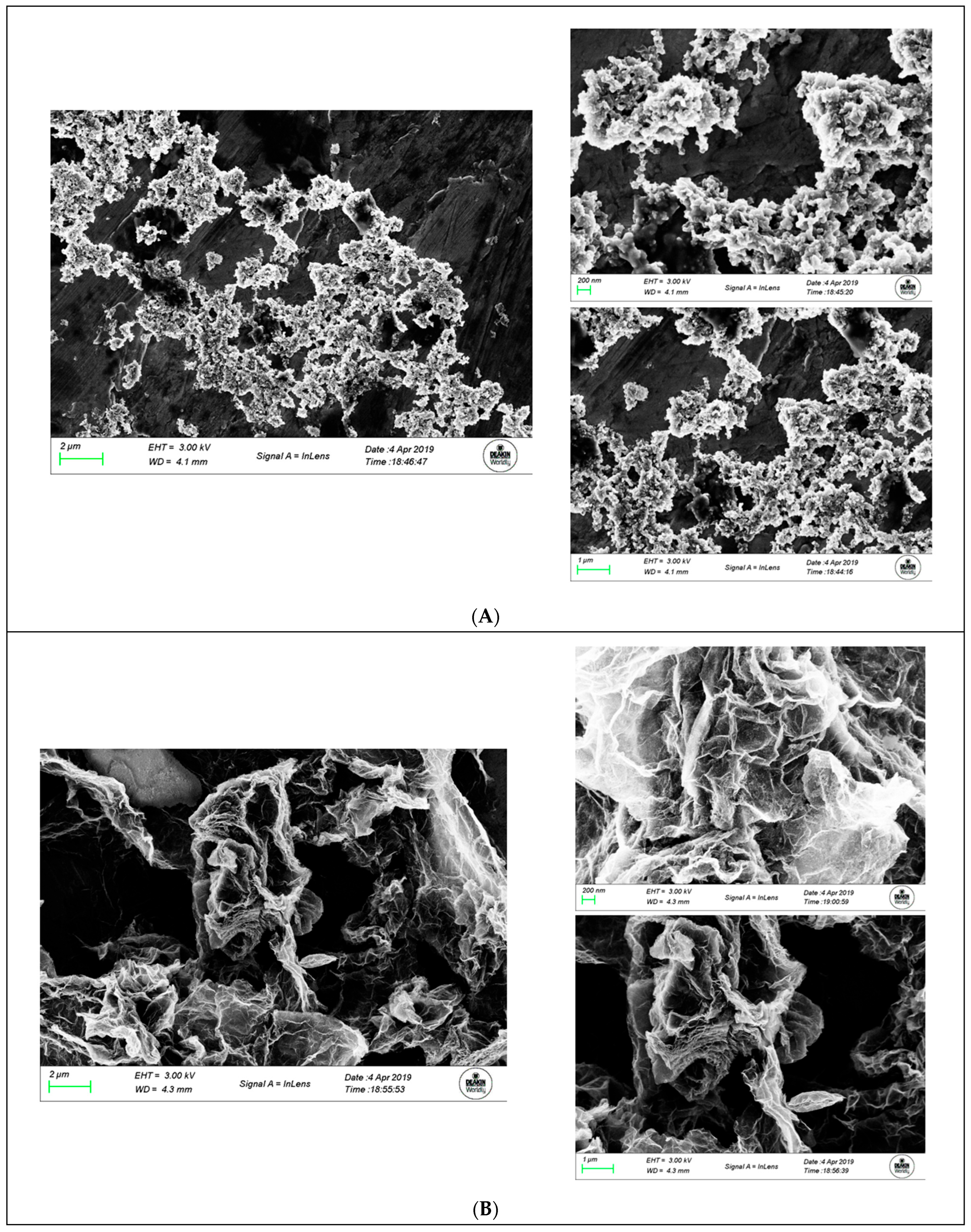
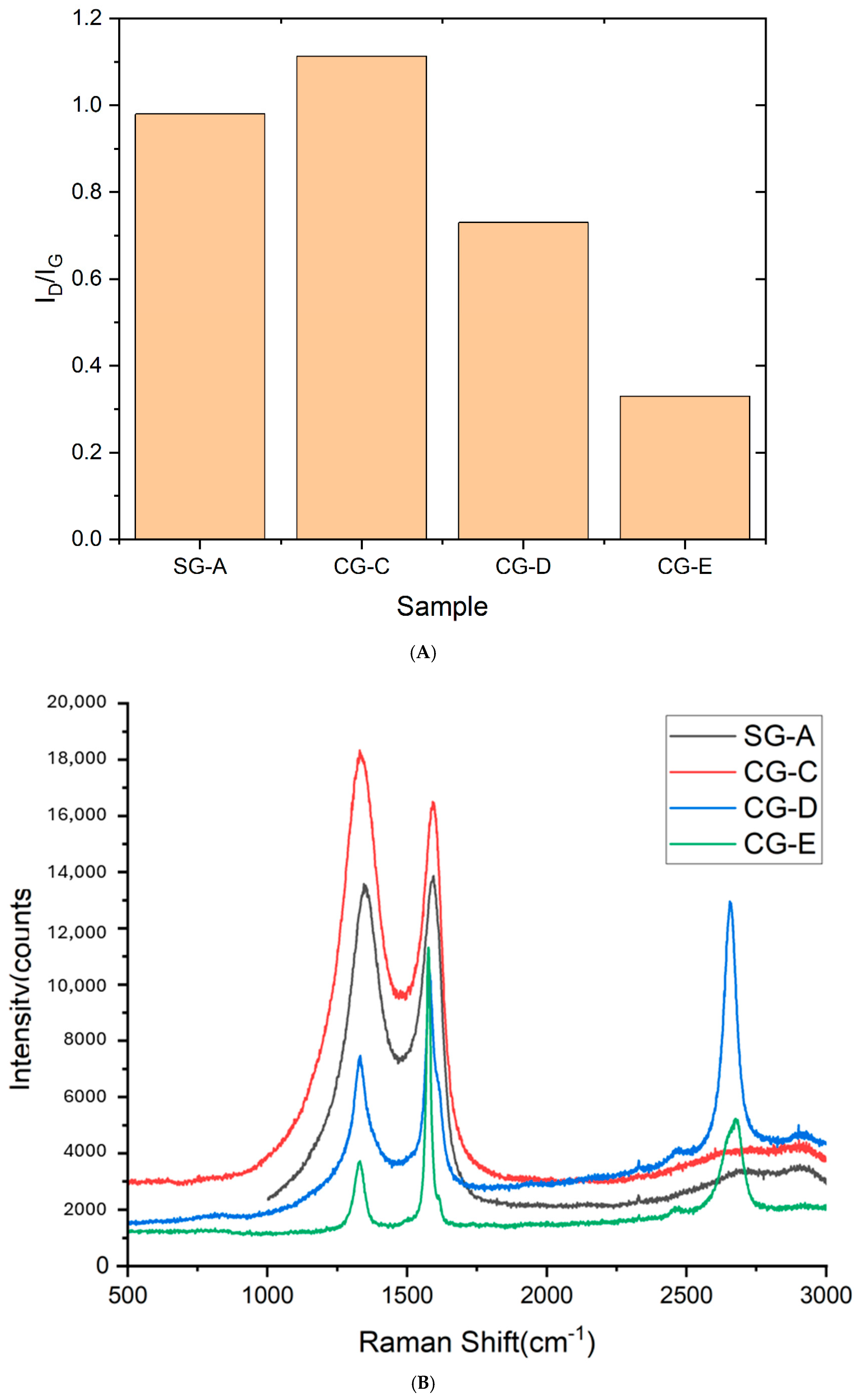
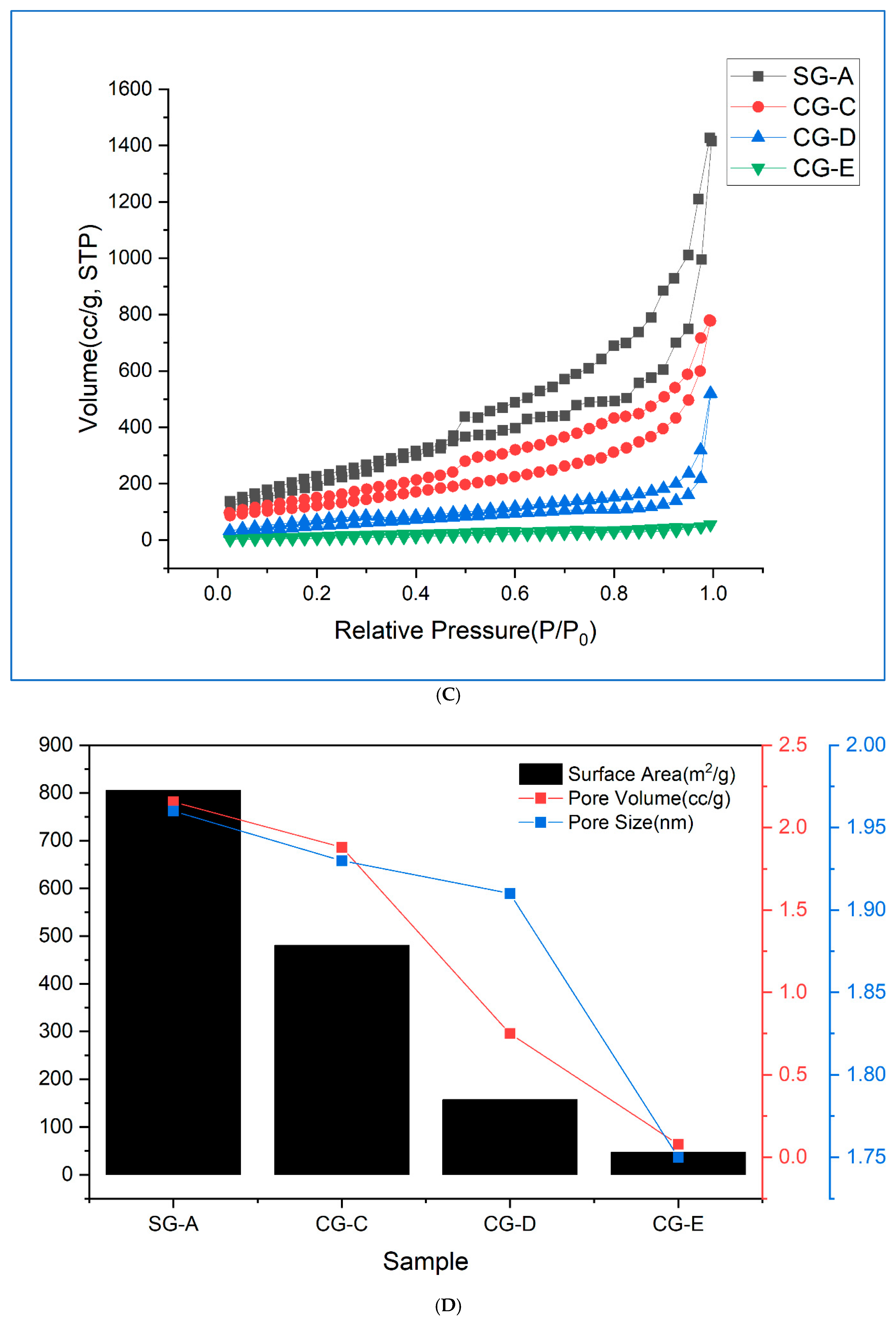
The SEM images of CG-D and SG-A are shown in Figure 2. As evident from the images, the synthesized graphene features large graphene sheets with significant pore volume, offering a promising platform for removal applications. Additionally, the structural image reveals a substantial surface area, providing more sites for interactions with kresoxim-methyl that need to be removed. Based on the results of the BET test and XPS data provided in Figure 2 and Figure 3, it is clear that graphene samples SG-A and CG-C demonstrate significantly higher surface areas compared to CG-D and CG-E. This enhancement in surface area directly corresponds to improved adsorption capabilities, as materials with more extensive surface regions present a greater number of active sites for interaction with pollutants. For instance, SG-A exhibits the highest BET surface area at 805.44 m2/g, alongside a pore volume of 2.156 cm3/g and an average pore size of 1.96 nm (Table A1). CG-C also displays a substantial surface area of 480.46 m2/g with a pore volume of 1.88 cm3/g and a pore size of 1.93 nm. On the other hand, CG-D and CG-E have considerably lower BET surface areas—157.12 m2/g and 47.18 m2/g, respectively—which translates to fewer adsorption sites and thus more limited pollutant removal potential.
The significance of high surface area is reinforced by research indicating that graphene-based materials rely on the abundance of exposed sites for effective capture of molecules. In the case of removing kresoxim-methyl, the larger surface area of SG-A and CG-C facilitates a greater degree of interaction with the pollutant, increasing their efficiency in adsorption and subsequent removal from contaminated environments. This means both SG-A and CG-C would be expected to perform considerably better as adsorbents compared to CG-D and CG-E. In addition, the relatively large pore volumes observed in SG-A and CG-C provide further pathways for pollutants to access internal sites, maximizing adsorption capacity [19].
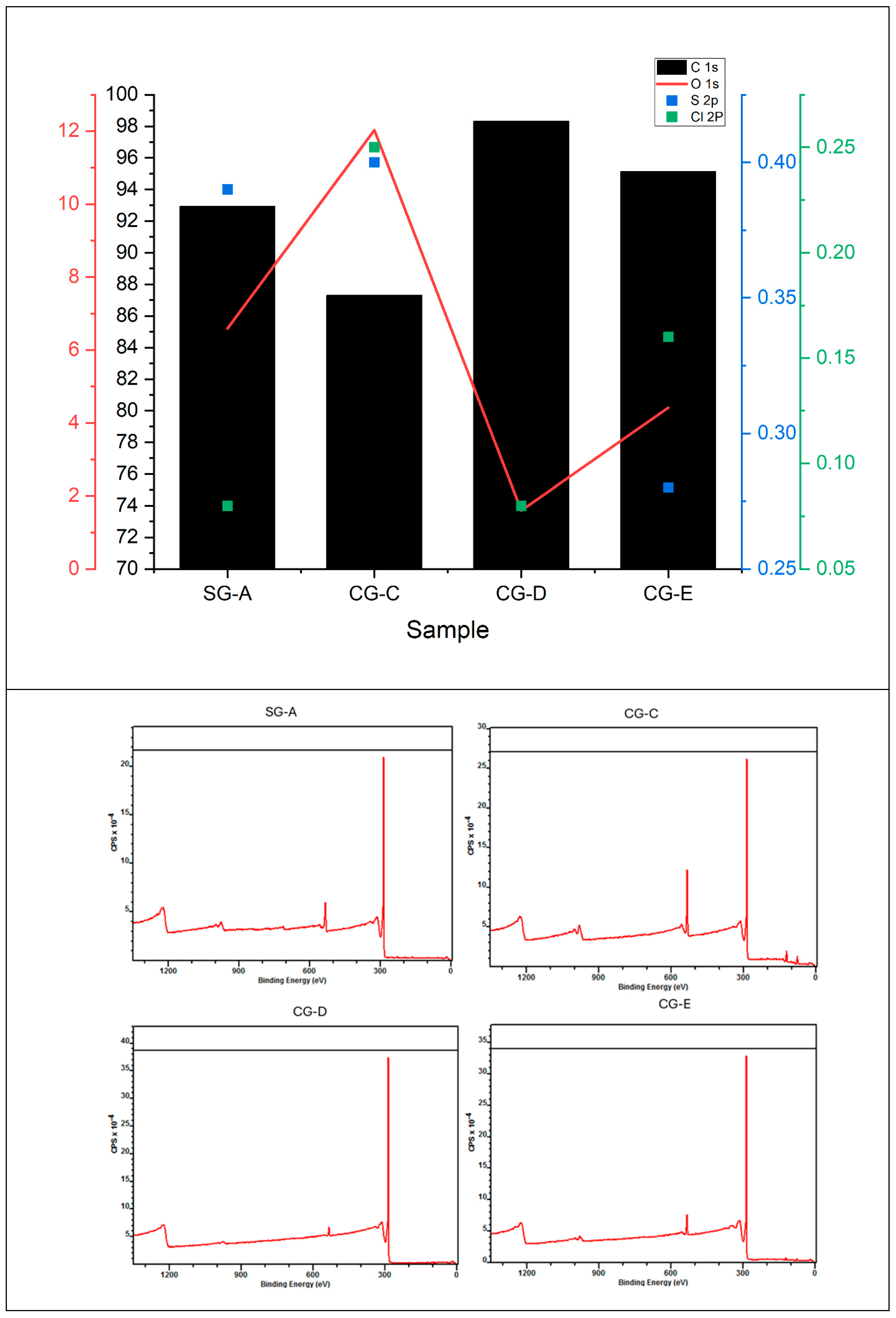
Additionally, X-ray photoelectron spectroscopy (XPS) studies reveal that CG-C and SG-A have higher oxygen content than the other graphene types, resulting in increased oxygen-carbon bonding (Figure 4). This is significant because oxygen functionalities on graphene enhance its reactivity and polarity, thereby improving interactions with polar molecules such as kresoxim-methyl. The presence of oxygen groups can facilitate stronger electrostatic interactions [19,20,21] and hydrogen bonding, which are crucial for efficient adsorption. Previous studies have demonstrated that oxygen-rich graphene materials exhibit improved adsorption efficiency for various pollutants, underscoring their potential in environmental applications [20,22]. Therefore, the combination of high surface area and increased oxygen content in CG-C and SG-A makes them particularly effective for removing kresoxim-methyl from contaminated environments.

3.2. Adsorption Kinetics in Soil and Graphene-Amended Systems

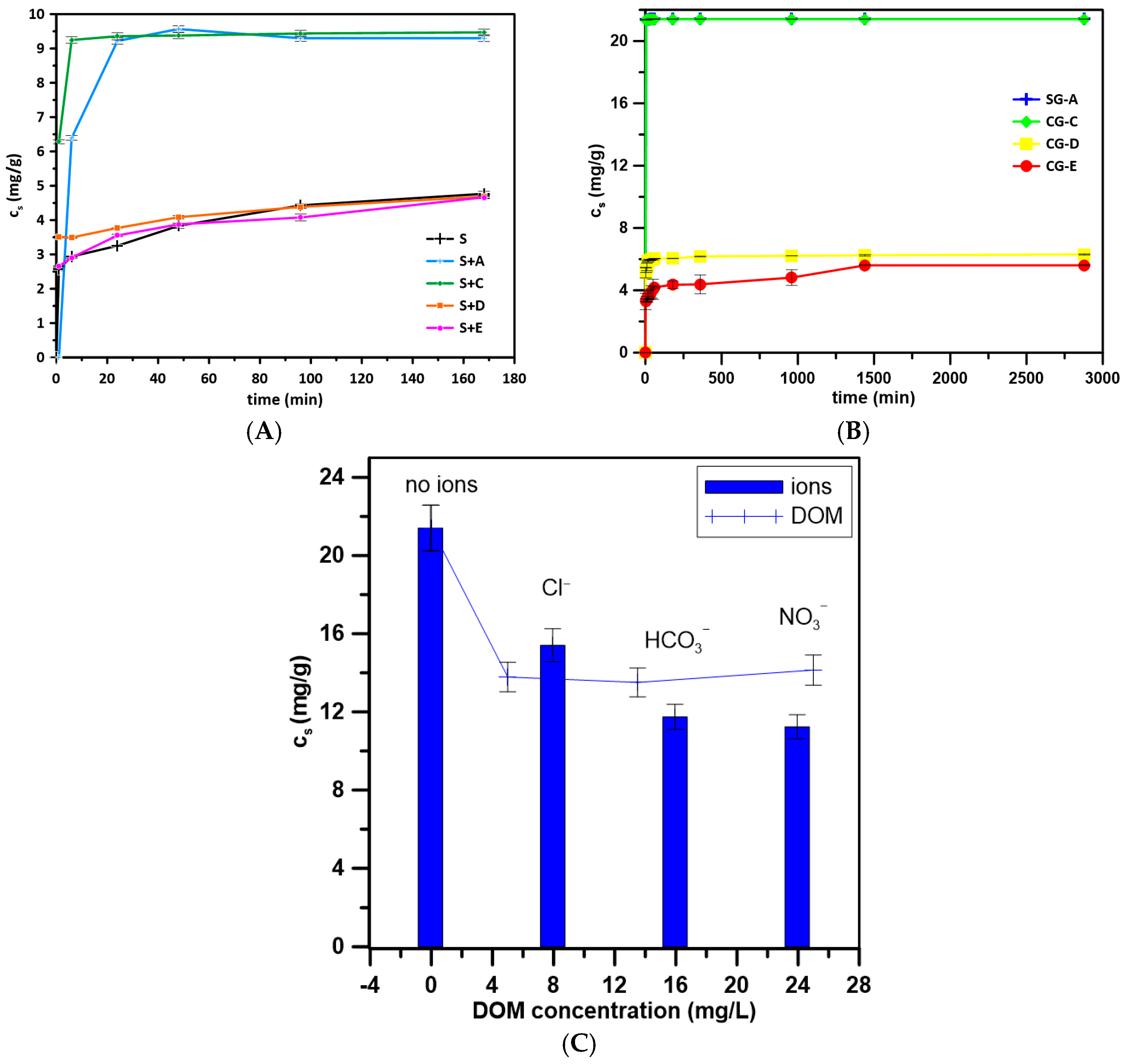
The adsorption of KM onto soil and graphene-amended soils proceeded rapidly, particularly in systems amended with SG-A and CG-C (Figure 5A). In the S+A and S+C systems, a sharp initial increase in adsorption was observed, with near-equilibrium reached within 20–40 min. The maximum adsorption capacity in these systems exceeded 9 mg/g, indicating strong affinity and fast adsorption kinetics induced by graphene-based amendments. In contrast, systems S+D and S+E exhibited moderate adsorption performance, with equilibrium adsorption capacities of approximately 5.5–6.0 mg/g. In these cases, adsorption proceeded more gradually over the entire 180 min period, reflecting slower kinetics compared to S+A and S+C. The unamended soil (S) showed the lowest adsorption capacity (≈4.5 mg/g) and the slowest adsorption kinetics, clearly confirming the effectiveness of graphene-based amendments in enhancing KM retention.
All soil-based systems reached adsorption equilibrium within approximately 60 min, after which the adsorption capacities remained stable, indicating negligible desorption or degradation of KM during the experimental period.

3.3. Sorption Kinetics on Graphene Materials

To elucidate the sorption mechanism, the adsorption kinetics of the individual graphene materials were also investigated (Figure 5B). The sorption of KM onto SG-A and CG-C was extremely rapid, with equilibrium achieved within a few minutes. These materials exhibited the highest adsorption capacities (cs ≈ 20.5 mg/g), confirming their very strong affinity for KM. Material CG-D displayed intermediate adsorption behavior, reaching a plateau at approximately 5.5 mg/g, with noticeably slower kinetics than SG-A and CG-C. Among the tested materials, CG-E showed the slowest adsorption kinetics and the lowest adsorption capacity (cs ≈ 4.5 mg/g), with adsorption increasing gradually over time without a distinct plateau.
Kinetic modeling revealed that the adsorption of KM onto graphene materials followed a pseudo-second-order (PSO) model (Table 1). In contrast, adsorption onto unmodified soil was better described by the pseudo-first-order (PFO) model [23]. The superior performance of SG-A and CG-C can be attributed to their physicochemical properties, including high specific surface area (805 and 481 m2/g, respectively), relatively lower carbon content, higher oxygen content, and a more defective, less ordered carbon structure (ID/IG ≥ 1). These characteristics provide abundant active sites and enhance interactions with KM. Importantly, the results indicate that adsorption efficiency is governed not only by surface area but also by surface chemistry and structural defects.

3.4. Correlations and Partitioning Behavior

Correlation analysis (Pearson test) revealed no statistically significant relationship between the PSO rate constant (k2) and the physicochemical properties of the tested materials. This observation is consistent with the calculated partition coefficients (Kd, Table 1), which followed the order:
CG-C ≈ SG-A >> CG-D ≈ S > CG-E.
Materials SG-A and CG-C exhibited the highest Kd values (~1.95 L/g), indicating strong affinity and efficient partitioning of KM. The presence of oxygen- and sulfur-containing functional groups (e.g., epoxide, hydroxyl, carboxyl, and carbonyl groups) likely promoted KM adsorption by providing direct binding sites or facilitating π–π and hydrophobic interactions. Notably, the addition of only 1 wt% of SG-A or CG-C to soil increased KM partitioning nearly ninefold, highlighting their effectiveness even at low amendment levels.

3.5. Comparison with Literature and Environmental Relevance

In the presence of inorganic ions, the adsorption was hindered (Figure 5C). The greatest effect was observed when NO3 and HCO3 were present. DOM addition also hindered KM adsorption, whereas the effect of DOM was similar for a broad range of DOM concentrations (0–25 mg/L). Although only limited literature data are available on KM adsorption onto carbonaceous materials, the obtained results are comparable to previously reported values (Table 2). The tested graphene materials, particularly SG-A and CG-C, demonstrate high adsorption efficiency and rapid kinetics, supporting their potential application as effective amendments for mitigating pesticide contamination in soils.

4. Conclusions

The synthesized graphene SG-A and the commercial material CG-C exhibited higher adsorption affinity and faster uptake of kresoxim-methyl than unamended soil under the tested laboratory conditions. Their enhanced performance is associated with increased surface area, higher density of surface functional groups, and structural defects that promote surface–pollutant interactions. The results demonstrate that the incorporation of small amounts of functionalized graphene can increase the apparent adsorption capacity and adsorption rate of KM in soil–water systems. However, the findings represent short-term, batch-scale behavior and should be interpreted as indicative of potential sorption enhancement rather than confirmed long-term immobilization or remediation efficiency. Further research is required to assess the environmental stability, mobility, ecotoxicological impacts, and field-scale feasibility of graphene-based soil amendments before practical application can be considered.

Author Contributions

K.S. led the project’s conceptualization, supervision, methodology, formal analysis, and manuscript writing. B.C. also contributed to the conceptualization, data curation, project administration, methodology, and writing. A.K.-T. and I.S. were key contributors to the formal analysis, investigation, methodology, and the initial draft of the manuscript. O.Z. was involved in the conceptualization, investigation, and methodology. M.N. provided conceptualization, supervision, and project administration, and contributed to the original draft. All authors have read and agreed to the published version of the manuscript.

Funding

This research received no external funding.

Data Availability Statement

The raw data supporting the conclusions of this article will be made available by the authors on request.

Conflicts of Interest

The authors declare no conflicts of interest.

Appendix A

Table A1. BET results of graphene samples.
SampleBET Surface Area (m2/g)Pore Volume (cc/g)Pore Size (nm)
SG-A805.442.1561.96
CG-C480.461.881.93
CG-D157.120.751.91
CG-D47.180.081.75

References

  1. Kanungo, D.; Dewhurst, I. Kresoxim-Methyl. In Proceedings of Joint Meeting of the FAO Panel of Experts on Pesticide Residues, in Food and the Environment and the WHO Core Assessment Group on Pesticide Residues, Berlin, Germany; JMPR: Rome, Italy, 2018; pp. 225–277. [Google Scholar]
  2. EU. Regulation (EC) No 396/2005 of the European Parliament and of the Council of 23 February 2005 on Maximum Residue Levels of Pesticides in or on Food and Feed of Plant and Animal Origin and Amending Council Directive 91/414/EEC Text with EEA Relevance; EU: Brussels, Belgium, 2005. [Google Scholar]
  3. EU. Commission Regulation (EU) 2020/856 of 9 June 2020 Amending Annexes II and III to Regulation (EC) No 396/2005 of the European Parliament and of the Council as Regards Maximum Residue Levels for Cyantraniliprole, Cyazofamid, Cyprodinil, Fenpyroximate, Fludioxonil, Fluxapyroxad, Imazalil, Isofetamid, Kresoxim-Methyl, Lufenuron, Mandipropamid, Propamocarb, Pyraclostrobin, Pyriofenone, Pyriproxyfen and Spinetoram in or on Certain Products (Text with EEA Relevance); EU: Brussels, Belgium, 2020. [Google Scholar]
  4. Vandensande, Y.; Carbone, M.; Mathieu, B.; Gallez, B. Mitochondrial dysfunction induced in human hepatic HepG2 cells exposed to the fungicide kresoxim-methyl and to a mixture kresoxim-methyl/boscalid. Redox Rep. 2024, 29, 2424677. [Google Scholar] [CrossRef]
  5. Flampouri, E.; Mavrikou, S.; Mouzaki-Paxinou, A.-C.; Kintzios, S. Alterations of cellular redox homeostasis in cultured fibroblast-like renal cells upon exposure to low doses of cytochrome bc1 complex inhibitor kresoxim-methyl. Biochem. Pharmacol. 2016, 113, 97–109. [Google Scholar] [CrossRef] [PubMed]
  6. WHO; FAO. Pesticide Residues in Food—2018, Toxicological Evaluations. In Proceedings of the FAO Panel of Experts on Pesticide Residues in Food and the Environment and the WHO Core Assessment Group on Pesticide Residues, Berlin, Germany, 18–27 September 2018. [Google Scholar]
  7. Man, Y.; Wang, W.; Mao, L.; Zhu, L.; Zhang, Y.; Zhang, L.; Jiang, H.; Liu, X. Degradation of Kresoxim-Methyl in Different Soils: Kinetics, Identification of Transformation Products, and Pathways Using High-Resolution-Mass-Spectrometry-Based Suspect and Non-Target Screening Approaches. J. Agric. Food Chem. 2022, 70, 16146–16155. [Google Scholar] [CrossRef]
  8. Man, Y.; Wu, C.; Yu, B.; Mao, L.; Zhu, L.; Zhang, L.; Zhang, Y.; Jiang, H.; Yuan, S.; Zheng, Y.; et al. Abiotic transformation of kresoxim-methyl in aquatic environments: Structure elucidation of transformation products by LC-HRMS and toxicity assessment. Water Res. 2023, 233, 119723. [Google Scholar] [CrossRef] [PubMed]
  9. Shirvanimoghaddam, K.; Czech, B.; Abdikheibari, S.; Brodie, G.; Kończak, M.; Krzyszczak, A.; Al-Othman, A.; Naebe, M. Microwave synthesis of biochar for environmental applications. J. Anal. Appl. Pyrolysis 2022, 161, 105415. [Google Scholar] [CrossRef]
  10. Shirvanimoghaddam, K.; Czech, B.; Abolhasani, M.M.; Naebe, M. Sustainable periodically patterned carbon nanotube for environmental application: Introducing the cheetah skin structure. J. Clean. Prod. 2018, 179, 429–440. [Google Scholar] [CrossRef]
  11. Fakhrhoseini, S.M.; Czech, B.; Shirvanimoghaddam, K.; Naebe, M. Ultrafast microwave assisted development of magnetic carbon microtube from cotton waste for wastewater treatment. Colloids Surf. A Physicochem. Eng. Asp. 2020, 606, 125449. [Google Scholar] [CrossRef]
  12. Czech, B.; Shirvanimoghaddam, K.; Trojanowska, E.; Naebe, M. Sorption of pharmaceuticals and personal care products (PPCPs) onto a sustainable cotton based adsorbent. Sustain. Chem. Pharm. 2020, 18, 100324. [Google Scholar] [CrossRef]
  13. Shirvanimoghaddam, K.; Czech, B.; Wójcik, G.; Naebe, M. The light enhanced removal of Bisphenol A from wastewater using cotton waste derived carbon microtubes. J. Colloid Interface Sci. 2019, 539, 425–432. [Google Scholar] [CrossRef]
  14. Yang, Y.; Zhang, R.; Zhang, X.; Chen, Z.; Wang, H.; Li, P.C.H. Effects of Graphene Oxide on Plant Growth: A Review. Plants 2022, 11, 2826. [Google Scholar] [CrossRef]
  15. Peña-Álvarez, V.; Baragaño, D.; Prosenkov, A.; Gallego, J.R.; Peláez, A.I. Assessment of co-contaminated soil amended by graphene oxide: Effects on pollutants, microbial communities and soil health. Ecotoxicol. Environ. Saf. 2024, 272, 116015. [Google Scholar] [CrossRef]
  16. Nie, E.; Xu, L.; Chen, Y.; Chen, Y.; Lu, Y.; Zhang, S.; Yu, Z.; Li, Q.X.; Ye, Q.; Wang, H. Effects of reduced graphene oxide nanomaterials on transformation of 14C-triclosan in soils. Sci. Total Environ. 2024, 946, 173858. [Google Scholar] [CrossRef]
  17. Nasri-Nasrabadi, B.; Czech, B.; Yadav, R.; Shirvanimoghaddam, K.; Krzyszczak, A.; Unnikrishnan, V.; Naebe, M. Radially aligned hierarchical N-doped porous carbon beads derived from oil-sand asphaltene for long-life water filtration and wastewater treatment. Sci. Total Environ. 2023, 863, 160896. [Google Scholar] [CrossRef] [PubMed]
  18. Khandelwal, A.; Narayanan, N.; Varghese, E.; Gupta, S. Linear and Nonlinear Isotherm Models and Error Analysis for the Sorption of Kresoxim-Methyl in Agricultural Soils of India. Bull. Environ. Contam. Toxicol. 2020, 104, 503–510. [Google Scholar] [CrossRef] [PubMed]
  19. Stoller, M.D.; Park, S.; Zhu, Y.; An, J.; Ruoff, R.S. Graphene-Based Ultracapacitors. Nano Lett. 2008, 8, 3498–3502. [Google Scholar] [CrossRef] [PubMed]
  20. Dreyer, D.R.; Todd, A.D.; Bielawski, C.W. Harnessing the chemistry of graphene oxide. Chem. Soc. Rev. 2014, 43, 5288. [Google Scholar] [CrossRef]
  21. Yang, S.-T.; Chen, S.; Chang, Y.; Cao, A.; Liu, Y.; Wang, H. Removal of methylene blue from aqueous solution by graphene oxide. J. Colloid Interface Sci. 2011, 359, 24–29. [Google Scholar] [CrossRef]
  22. Yang, X.; Doerge, D.R.; Fisher, J.W. Prediction and evaluation of route dependent dosimetry of BPA in rats at different life stages using a physiologically based pharmacokinetic model. Toxicol. Appl. Pharmacol. 2013, 270, 45–59. [Google Scholar] [CrossRef]
  23. Tran, H.N.; You, S.J.; Hosseini-Bandegharaei, A.; Chao, H.P. Mistakes and inconsistencies regarding adsorption of contaminants from aqueous solutions: A critical review. Water Res. 2017, 120, 88–116. [Google Scholar] [CrossRef]
  24. Pathak, S.; Srivastava, A.; Srivastava, P.C. Adsorption of strobilurin fungicide Kresoxim methyl onto diverse Indian soils: Kinetic and mechanistic modeling. Pest Manag. Sci. 2025, 81, 70120. [Google Scholar] [CrossRef]
  25. Sabale, R.P.; Shabeer, T.P.A.; Dasgupta, S.; Utture, S.C.; Banerjee, K.; Oulkar, D.P.; Adsule, P.G.; Deshmukh, M.B. Adsorption–desorption and leaching behavior of kresoxim-methyl in different soils of India: Kinetics and thermodynamic studies. Env. Monit Assess 2015, 187, 436. [Google Scholar] [CrossRef]
Figure 1. MK chemical structure.
Cleantechnol 08 00039 g001
Figure 2. SEM imaging of graphene samples (A): CG-D, (B):SG-A at different magnifications.
Cleantechnol 08 00039 g002
Figure 3. RAMAN spectroscopy (A,B) and BET characterization of graphene samples (C,D).
Cleantechnol 08 00039 g003aCleantechnol 08 00039 g003b
Figure 4. XPS data on graphene samples.
Cleantechnol 08 00039 g004
Figure 5. The removal of KM (A) from soil samples, (B) the sorption kinetics, and (C) the effect of inorganic ions and DOM on KM removal.
Cleantechnol 08 00039 g005
Table 1. Kinetics of the sorption of KM onto the tested materials.
PFOPSOELOVICHIPDFilm Diffusion
qmax [mg/g]k1 (×103)
[min−1]
qe
[mg/g]
R2
[-]
k2
[g/mg min]
q2
[mg/g]
R2
[-]
α (×103)
[mg/g min]
β
[g/mg]
R2
[-]
kIPD
[mg/g]
R2
[-]
KdkFD (×103)
[min−1]
bR2
[-]
S4.770.3070.8670.99640.274.8680.99401.852.5990.74100.02440.98430.9531.852.5990.7410
SG-A21.411.2707.9880.1527>1000.021.4071.00001.011.0960.77260.00020.18511.9501.011.0960.7726
CG-C21.401.6476.6850.23050.321.4001.00001.2711.050.15270.00040.18841.9521.2711.050.1527
CG-D6.301.8470.7590.741073.6916.2921.00001.3310.380.16400.01530.47120.9531.3310.380.1640
CG-E5.601.0140.6250.77266.2165.5890.99700.310.7150.07070.04500.90610.8860.310.7150.0707
S+A9.570.4040.0550.821619.99.580.99990.123.2950.07070.02300.434317.5770.123.2950.0707
S+C9.470.380.6310.687036.19.4861.00000.382.8810.68700.02270.391517.8460.382.8810.6870
S+D4.680.3630.4460.95310.44.7140.99750.361.1040.95310.01380.98620.9370.361.1040.9531
S+E4.660.521.0500.87090.34.6700.99300.520.4910.87090.02110.97070.9330.520.4910.8709
Table 2. Comparison of the obtained results with literature data.
AdsorbentPollutantqmaxKineticsIsothermReferences
SG-A
S+A
KM21.41 mg/g
9.57 mg/g
PSO This studies
Soil with high clay contentKM16.096 mg kg−1PSO [24]
ClayKM21.28 mg F[25]
SoilKM15 µg/g F and T[18]
Disclaimer/Publisher’s Note: The statements, opinions and data contained in all publications are solely those of the individual author(s) and contributor(s) and not of MDPI and/or the editor(s). MDPI and/or the editor(s) disclaim responsibility for any injury to people or property resulting from any ideas, methods, instructions or products referred to in the content.