


Abstract
This study evaluated low-cost food waste anaerobic digestion (FWAD) designed for African urban informal settlements, where electricity and process control are limited. Eight small-scale reactors were operated under varying mixing, pH control, and temperature conditions to assess the feasibility of stable operation with minimal input. Results showed no significant difference in methane yield between continuously mixed and minimally mixed (48-hourly) systems, nor between reactors with continuous pH dosing and those adjusted every 48 h (ANOVA p > 0.05 for all comparisons). The highest mean methane yield, 0.267 L CH4 g VS−1, was achieved by the minimally mixed reactor with 48-hourly pH control at 30 °C, while the controlled reactor at 37 °C produced a comparable 0.247 L CH4 g VS−1. Total methane production was similar at both temperatures, although gas generation was faster during the first 24 h at 37 °C. Compared to gas recovery achieved by extended batch operation following semi-continuous feeding, 58–73% of total methane was produced within the 48-h cycle, suggesting conversion could increase by 30–40% with extended liquid retention. Microbial analyses showed compositional differences but consistent performance, indicating functional redundancy within the microbial consortia. These results confirm the capacity of FWAD for stable, efficient biogas production without continuous energy input.
1. Introduction
Waste management remains a significant environmental and social challenge in the Republic of South Africa, particularly in urban and peri-urban regions experiencing rapid population growth and limited waste management infrastructure [1,2,3]. A large proportion of municipal solid waste consists of organic matter, with food waste representing one of the most abundant and poorly managed fractions nationally [2]. Food waste in South Africa is typically produced early in the food supply chain, with fruit, vegetable, and cereal waste comprising approximately 70% of this loss [1,3,4]. When disposed of in landfills, food waste undergoes anaerobic decomposition, releasing methane and carbon dioxide into the atmosphere [4], and producing leachate with the potential to contaminate groundwater [5]. South Africa relies predominantly on landfill disposal, with over 90% of the country’s waste managed this way [4]. This reliance results in the loss of recoverable organic resources and contributes substantially to environmental pollution and greenhouse gas emissions. Reducing the volume of food waste directed to landfills and diverting it toward biological energy recovery through a process such as anaerobic digestion (AD) therefore offers a dual benefit, addressing both environmental degradation and energy insecurity.
The recovery of biogas from food waste is particularly relevant for informal settlements, where access to reliable and affordable energy remains limited. In such areas, households are heavily reliant on liquefied petroleum gas (LPG) for cooking and heating, which costs between R33–R39 per kilogram, with a typical household consuming 10–15 kg per month [6]. This expense, amounting to around R400 per month for a family of five, represents a substantial portion of household income in such communities. A decentralised AD system that converts food waste from urban sources into biogas could therefore offer both environmental and socioeconomic benefits, reducing the burden on municipal waste infrastructure, while supplying a clean and low-cost cooking fuel to low-income communities.
AD presents a viable means of achieving this objective by converting organic fruit and vegetable waste into biogas through microbial activity [7]. The resulting biogas can be harnessed for cooking and heating, while the digestate can serve as fertiliser, supporting nutrient recycling and aligning with circular economy principles. Implementing low-cost continuous digesters in low-income urban areas could facilitate the diversion of food waste from conventional disposal routes while generating renewable energy locally. To ensure stable long-term operation in such contexts, a continuous AD process, operating with an established microbial culture and fed solely with fruit- and vegetable-based food waste, is required. This would enable consistent biogas production under steady-state conditions, minimising the need for reinoculation and reducing the start-up instability typical of batch processes. However, few studies have investigated continuous FWAD using unprocessed fruit and vegetable waste under low-energy conditions comparable to those found in informal South African settlements, underscoring the need for this research [7,8,9].
The AD process has been used globally for centuries to manage organic waste, with modern applications tracing back to 1859, when the first digester was constructed in India at a leper colony in Bombay [10]. AD was later widely adopted in China, where it provided a renewable energy source for rural households, forming a crucial component of sustainable energy practices. While AD has traditionally been applied in agricultural and municipal waste contexts, FWAD aligns more closely with the organic waste profiles of urban informal settlements, particularly since food loss in developing countries often occurs in unprocessed form [11]. FWAD has gained attention in recent years for producing digestate, subsequently used as fertiliser, soil conditioner, or animal bedding, and can also yield biochar and fuel [12]. However, FWAD applications in standalone biogas production remain limited, especially outside co-digestion with municipal solid waste (MSW), despite the substantial energy potential of food waste [13]. In African contexts, the warm climate and organic waste composition typical of South Africa’s informal settlements present an opportunity to enhance AD efficiency, making FWAD a viable and sustainable solution for such communities [14].
For the successful implementation of an AD system in an informal settlement without electricity, it is crucial to quantify the effects of mixing, temperature, and pH control on each of the four stages (hydrolysis, acidogenesis, acetogenesis, and methanogenesis) to optimise performance [8,9]. Although these parameters have been widely accepted as major factors contributing to the efficiency of the AD process, there is insufficient insight into their effect on a semi-continuous FWAD process with a feed consisting solely of food waste. Key parameters including hydraulic retention time (HRT), organic loading rate (OLR), and microbial populations at each condition must also be evaluated to accurately assess system efficiency [9]. Observing biogas production rates at steady state is essential for adapting this process to decentralised energy applications in these settings. Table 1 provides a summary of operating conditions and reported biogas or methane yields from previous AD studies, highlighting the variability in performance across different feedstocks, operating regimes, and reactor configurations.
Table 1.
Summary of operational conditions and performance of related FWAD studies.
More insight into FWAD is critical in terms of optimising this process for use in low-income urban African communities. The main objective of a successful FWAD process is to ensure that the microbial populations present in the reactor can coexist optimally, thus the aforementioned conditions need to be closely monitored and understood, particularly for a system with a feed consisting solely of unprocessed food waste. Developing a stable system inside the reactor, with particular respect to the effect of mixing, temperature, and pH, is essential for these purposes, due to the shortage of electrical or electronic equipment available at such locations.
Mixing, temperature, and pH are key operational parameters that directly influence the efficiency, stability, and microbial dynamics of AD. Mixing enhances substrate-to-microbe contact, prevents stratification, and maintains temperature and concentration uniformity within the reactor [20,21,22,23]. The frequency and mode of mixing affect the extent of microbial interaction and substrate availability, with intermittent mixing (15 min every 45 min) producing the highest methane yield in a study by Babaei and Shayegan (2019) [8], while continuous and minimal mixing resulted in 40% and 50% lower yields, respectively. However, intermittent regimes require mechanical or automated control, making them impractical for decentralised or low-energy applications such as informal settlements. Temperature similarly exerts a major influence on microbial activity, reaction rates, and overall process stability. The mesophilic regime (20–45 °C, optimal at 35–38 °C) is most commonly used due to its robustness and minimal energy requirement, while thermophilic operation (43–80 °C, optimal at 50–60 °C) can enhance reaction rates but often leads to instability and higher energy demands [8,9,24]. Within these ranges, temperature affects the dominant methanogenic pathways, with acetoclastic methanogens prevailing under mesophilic conditions and hydrogenotrophic routes favoured at higher temperatures [15]. Different pH values further govern microbial balance across AD stages: hydrolytic, acidogenic, and acetogenic microorganisms favour slightly acidic conditions (pH 5.5–6.5), while methanogens perform optimally near neutrality (pH 6.8–7.5) [5,9,25]. In food waste digestion, rapid hydrolysis and acidogenesis generate high volatile fatty acid (VFA) concentrations, lowering pH and potentially inhibiting methanogenesis if buffering is insufficient [12]. The frequency of pH dosing therefore plays a crucial role in maintaining microbial stability and consistent biogas production.
This study is distinguished by its evaluation of semi-continuous FWAD under deliberately simplified operating conditions that reflect the practical constraints of decentralised implementation in African urban informal settlements. In contrast to most FWAD studies that rely on continuous mixing, automated pH control, and tightly regulated mesophilic temperatures, this work compares controlled and low-maintenance operation using identical feedstock and loading conditions at steady state. By demonstrating statistically equivalent methane yields under minimal mixing, infrequent pH adjustment, and sub-mesophilic operation, the study provides experimental evidence that FWAD systems can be designed for scalability and robustness without continuous energy input, bridging a key gap between laboratory optimisation and real-world application.
Accordingly, this study aims to quantify the effects of 48 h mixing and pH dosing intervals, alongside lower temperatures characteristic of a typical South African climate, on steady-state biogas production rates in a semi-continuous FWAD system. Comparisons are drawn against conditions of continuous mixing, frequent pH dosing (every 20 min), and elevated mesophilic temperatures. Using a semi-continuous feed of a well-approximated food waste slurry at an OLR of 1.57 g VS L−1 d−1, this study replicates a small-scale model of the proposed system. Objectives include assessing the impacts of these parameters on the AD process, through examining digestate and biogas composition, and analysing biogas production rates.
2. Materials and Methods
2.1. Experimental Preparation
This study investigated the AD of food waste using eight reactors of varying sizes, operating conditions, mixing frequencies, and pH control regimes. Reactors included both 300 mL and 750 mL working volumes, with temperatures maintained at 30 °C or 37 °C. Three mixing modes and pH control strategies were evaluated to optimise biogas production. All reactors were fed identical food waste and dosed with the same acid and alkali solutions. Food waste was produced from local produce obtained from Lynnpark Food Hall, Lynnwood, Gauteng (25°45′40″ S, 28°15′03″ E) and prepared using a food processor (Genesis Nutrimax 2200W Blender, Verimark, Johannesburg, South Africa).
The reactor feed was composed of food waste with the following composition on a mass basis:
- 20% potato;
- 20% cabbage;
- 17.5% butternut;
- 10% lemon;
- 9% tomato;
- 8.5% banana;
- 7.5% onion;
- 7.5% spinach.
The feed was determined based on waste composition data from informal settlements in Pretoria, South Africa, as it is designed to accurately represent food waste samples realistically seen by such communities. This feed mixture was homogenised using a food processor and adjusted from an 11.8% to a 5% total solids content, using distilled water, to maintain microbial stability during digestion. The feed was balanced to achieve a suitable carbon-to-nitrogen (C:N) ratio of 27 ± 1, promoting optimal biogas production.
The hydraulic retention time was set at 30 days, resulting in an OLR of 1.57 g VS L−1 d−1. These operating conditions were selected to prioritise stability and robustness over volumetric throughput, thereby reducing the risk of over-acidification and inhibition under decentralised, low-maintenance operating conditions.
Manure was collected from the Irene Farm (25°52′40″ S, 28°12′47″ E) and processed to provide inoculum for the reactors. Total solids content of the manure was determined by drying samples at 103 °C for 16 h (or until no change in mass was observed) [25]. The dried samples were then combusted in a furnace (Scientific 16 L Economy Furnace, Model: 916) at 500 °C for 4 h to determine ash content and calculate volatile solids (VS). The manure was found to contain 13.23% total solids, of which 81.18% were volatile solids.
The manure was diluted with distilled water to 5% volatile solids and fermented in batch mode for 40 days at 37 °C, with pH consistently adjusted to 7 until gas production ceased. The resulting digestate was distributed among the eight reactor bottles, which were then used for the experimental runs. This allowed the microbial culture to develop and steady state conditions to be achieved faster in the continuous reactors.
2.2. Experimental Design and Reactor Setup
Four reactor types were employed in this study to evaluate the influence of pH correction frequency, mixing frequency, temperature, and reactor size on the semi-continuous FWAD process, as summarised in Table 2. These parameters were selected as they represent the primary operational factors that influence the efficiency and stability of AD processes. Quantifying their effect under steady-state conditions using a food waste substrate is critical for assessing the viability of low-maintenance digestion systems.
Table 2.
Experimental reactor sets and operating conditions.
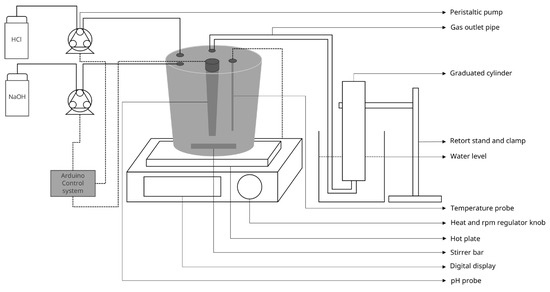
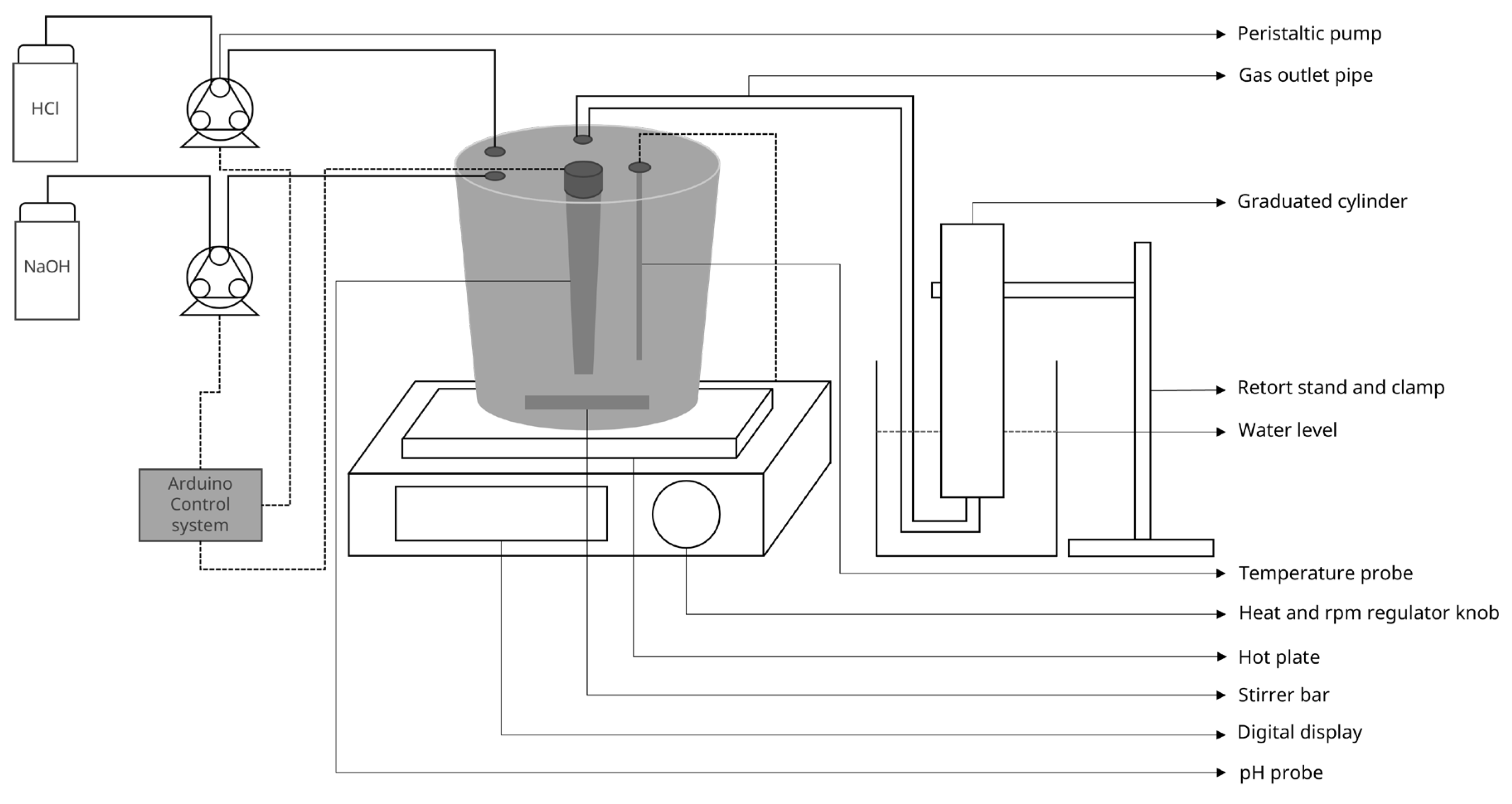
Figure 1 depicts the reactor setup and gas capture device for the 750_A reactors. The pH probe was used to read the pH measurements inside the reactor every 5 min, reporting an average value every 25 min, and dosing solutions (hydrochloric acid and sodium hydroxide) were connected to the reactor using peristaltic pumps, dosing every 25 min to correct the pH to 7.0 ± 0.5. A temperature probe was connected to the hot plate and calibrated to control the temperature inside the reactor at the specified condition. A gas outlet pipe was additionally connected to the top of the reactor, such that any biogas formed would enter the gas capture device shown in Figure 1. The displacement method was used to capture biogas and measured in calibrated graduated cylinders.
Figure 1.
Schematic diagram of the 750_A reactor configuration with Arduino pH control system, continuous mixing using a stirrer bar, and gas capture using displacement method. Solid lines indicate fluid connections, including acid/base dosing lines and gas transfer lines, while dashed lines represent electrical signal connections between the Arduino control system, peristaltic pumps, and sensors, as well as for the temperature probe.
The 750_B and 300_B reactors had an identical setup, with the 300_B reactors having an overall smaller volume than the 750_A reactor. This setup was similar to the schematic depicted in Figure 1, albeit with no stirrer bar or pH probe present and no Arduino control system and dosing solutions connected. Thus, these reactors solely consisted of the airtight vessel and an outlet pipe connected to the gas capture device, and each reactor was placed on a hot plate set to allow the average reactor temperature to be maintained at the specified value for that condition.
During operation, following feeding, CO2 was bubbled through the reactor contents of each reactor for approximately 30 s, and the headspace was subsequently flushed to remove residual air. The reactor was then sealed to maintain anaerobic conditions during the subsequent operating cycle and biogas measurements. Carbon dioxide was additionally introduced into the reactor headspace during feeding events and whenever access to the reactor contents was required, such as during pH measurements, to minimise oxygen ingress.
2.3. Analytical Instruments and Measurements
Chemical analyses were performed using the Merck Millipore Photometric ammonium (Spectroquant photometric, 0.010–3.00 mg/L (NH4-N) Merck KGaA, Darmstadt, Germany, 2024) and phosphate (Spectroquant photometric, 0.0025–5.00 mg/L (PO4-P), 0.0077–15.3 mg/L (PO43−), 0.0057–11.46 mg/L (P2O5) Merck KGaA, Darmstadt, Germany, 2024) tests, both analysed in conjunction with a UV–Vis spectrophotometer (Agilent Technologies™, Cary 60 UV–vis, G6860 A, Santa Clara, CA, USA) at wavelengths of 690 nm. COD Cell Tests (COD Vario Tube Test 0–1500mg/L Pk150) were additionally conducted using a photometer (Lovibond PCcheckit COD Vario photometer, Tintometer, Dortmund, Germany). The nutrient tests were used to determine nutrient retention of the AD process, and the COD tests were used to analyse the level to which the process was completed. The MRU OPTIMA Biogas Analyser (MRU Instruments, Neckarsulm, Germany) was used to measure the composition of the biogas.
Digestate samples for microbial community analysis were collected at pseudo steady-state conditions. Samples were taken on day 62 for reactors operated at 37 °C and on day 34 for the 750_B reactor operated at 30 °C. Prior to sampling, reactors were mixed to ensure representative collection of both liquid and suspended solids. Microbial sequencing and primary bioinformatic analysis were performed by an external service provider (Inqaba Biotec, Pretoria, South Africa). DNA extraction, 16S rRNA gene amplicon, and initial taxonomic assignment were conducted by the service provider using standard laboratory protocols. Taxonomic identification was performed through sequence alignment against the NCBI nucleotide database, with classification based on NCBI Taxonomy. Microbial community composition is reported as relative abundance at phylum, family, and genus levels. The analysis focused on dominant microbial groups relevant to AD processes, rather than exhaustive taxonomic resolution.
The following measurements were recorded throughout the duration of the experimental phase:
- Biogas Measurements (Gas production was recorded every 48 h using a water displacement method. Tubes from each reactor were connected to volumetric cylinders filled with water, inverted in a water bath to trap gas. Pressure was defined by the hydrostatic head of the water column and remained close to ambient pressure conditions. The gas outlet was submerged approximately 300 mm below the water surface corresponding to hydrostatic pressure 300 mm H2O (≈3 kPa). Pressure was not actively measured during operation; however, leak tests were conducted prior to operation to ensure gas-tight conditions with each reactor withstanding internal pressures of at least 15 kPa).
- Gas Composition Analysis (Methane (CH4), carbon dioxide (CO2), nitrogen (N2), oxygen (O2), and hydrogen sulphide (H2S) contents of the biogas were measured weekly in the 750 mL reactors. Gas volumes produced by the 300 mL reactors were not large enough for the composition to be accurately quantified).
- Digestate Analysis (total solids content of the digestate was measured weekly to monitor reactor performance).
Reactors with automated pH control used Arduino systems to adjust pH to 7.0 ± 0.1 with 1 M NaOH and 1 M HCl solutions. A small volume of either solution, calculated based on the pH reading, was dosed every 25 min using Baines BPA42 peristaltic pumps (Lei Rong Fluid Tech, Shanghai, China), connected to the Arduino system using a stepper motor. Mixing speeds were maintained at 200 rpm across all reactors with mechanical stirring or shaking. Temperature was controlled using hot plates or shaking incubators, depending on the reactor type.
3. Results and Discussion
The results presented in this section focus on the pseudo steady-state performance of all reactors. Start-up data has been excluded since several months of operation were required for the systems to stabilise. Direct quantification of gas composition was not possible in the 300 mL digesters due to the limited quantity of gas produced, and the measured gas yields were influenced by CO2 dissolution in the water used for gas displacement. This dissolution was significant, particularly given the large gas–liquid interface in the 300 mL reactors. Preliminary experiments with pure CO2 in the gas-capturing devices of the 300 mL digesters suggest complete dissolution of all CO2 within 48 h. These experiments were conducted under the same ambient temperature, pressure, and gas-collection conditions as the digestion experiments. It was accordingly assumed that the CO2 content in the 300 mL digester experiments was negligible when gas volumes were measured. This assumption represents a scale-related limitation specific to the smallest reactor configuration. For the 750 mL reactors, biogas production was approximately 25% higher; subsequent gas composition analysis indicated a CH4:CO2 ratio of 2.5–3.5. System development and performance evaluation were therefore directed toward the larger reactor volume, where gas production was sufficient to allow direct quantification of gas composition and more reliable interpretation of methane yields. Hydrogen sulphide readings were additionally consistently negligible across operating conditions, with measured concentrations remaining at or near the detection limit throughout the experimental period. All reported gas volumes have accordingly been expressed as L CH4 g VS−1 for consistency.
3.1. Repeatability
Repeatability across reactors was assessed to verify the consistency of semi-continuous FWAD performance across replicate reactors operated under identical conditions. Methane yield was selected as the key indicator of process stability, as it directly reflects the balance between organic loading, degradation efficiency, and microbial activity [26]. The 48-hourly methane yields from replicate reactors were compared using single factor ANOVA at a 95% confidence level (α = 0.05). A p-value greater than 0.05 was interpreted as evidence of statistical equivalence between replicates, confirming that observed differences were within the range of expected biological variability [27]. An analysis of the mean yields, standard deviations (SD), and corresponding p-values for all reactor sets has been conducted to confirm statistical equivalence and determine variance of each datapoint from the mean yield.
Semi-continuous operation was successfully maintained for 62 days under mesophilic (37 °C) and 34 days under sub-mesophilic (30 °C) conditions. Across all eight reactors, methane production stabilised after approximately two weeks and remained consistent for the remainder of each operating period, confirming steady-state operation. The consistent gas production over these extended runs demonstrates the robustness of the digestion process and the ability of the microbial communities to maintain equilibrium under both controlled and minimally controlled operating regimes.
Table 3 presents the mean methane yields and statistical comparisons between replicate reactors within each set. The results show low variability in performance, with p-values exceeding 0.05, indicating no statistically significant differences between replicates. These outcomes confirm that replicate reactors behaved equivalently under steady-state conditions and that the averaged yields accurately represent the performance of each operating configuration. The 750_B set included only a single reactor, thus the single factor ANOVA analysis could not be performed on the set; however, standard deviation was calculated and the reactor performance data has proven to have remained consistent throughout the operating period and aligned closely with the results of other reactor sets at similar conditions, confirming its reliability as a representative dataset. Overall, the close alignment between replicates and low standard deviations validate the repeatability of the semi-continuous FWAD process.
Table 3.
One-way ANOVA Analysis of methane yields across reactors and sets.
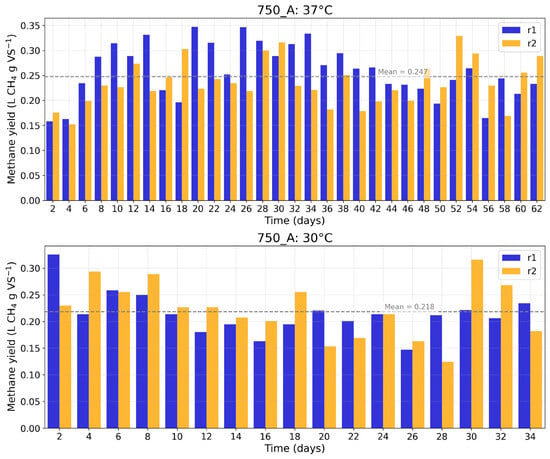
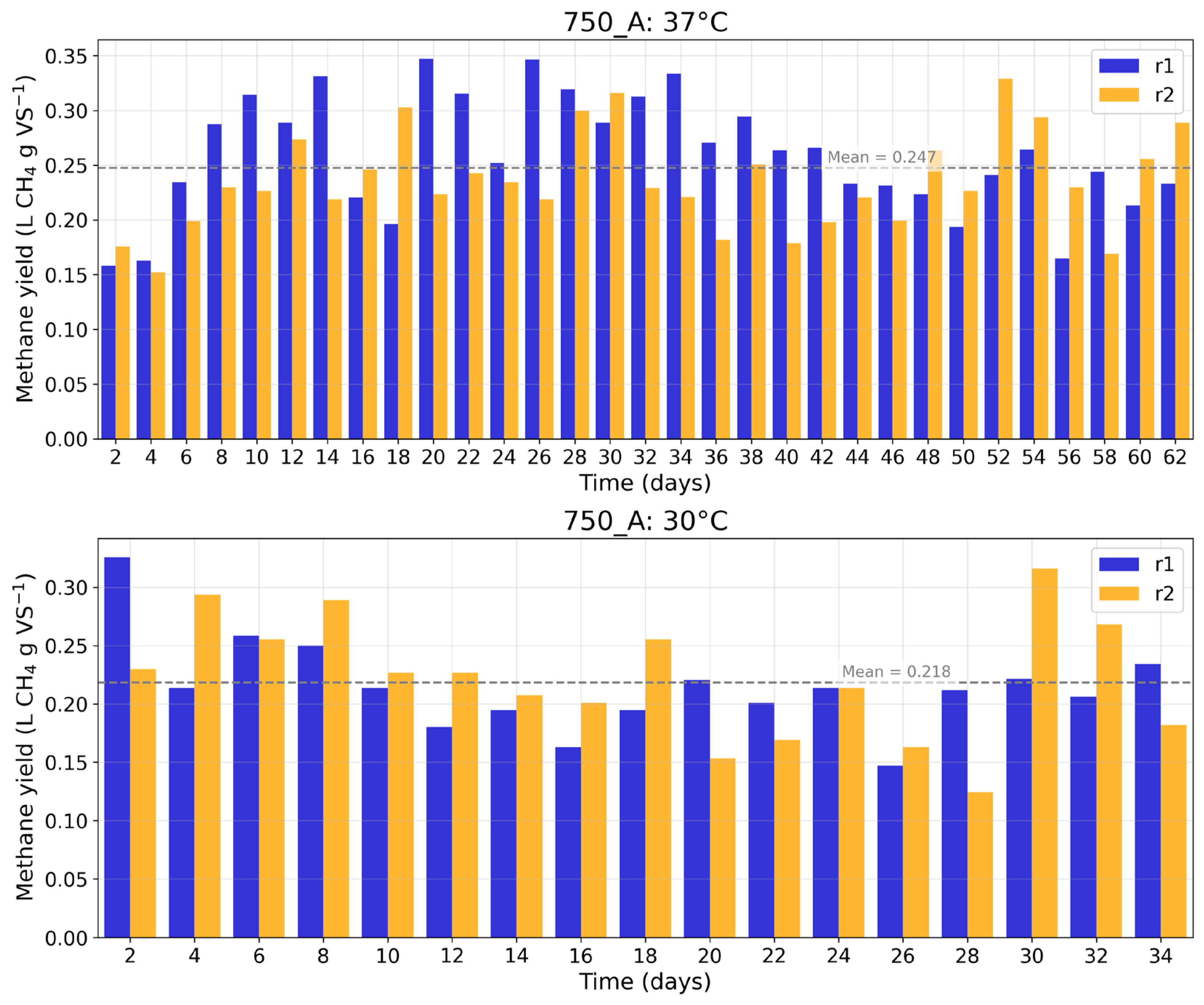
Figure 2 compares the 48 h methane production of the duplicate 750_A reactors operated at 37 °C and 30 °C. The two reactors exhibited very similar patterns of 48 h methane production throughout the experimental period, demonstrating consistent performance between replicates and confirming that steady-state conditions were maintained. This example is presented to illustrate the repeatability achieved within multi-reactor sets.
Figure 2.
Comparison of the 48-hourly methane yield of reactor 1 (r1) and reactor 2 (r2) of set 750_A at 37 °C and 30 °C.
3.2. Influence of Reactor Volume, Mixing, and pH Control Strategy
Although reactor geometry can influence gas–liquid behaviour, the observed differences between the 300 mL and 750 mL systems were not significant (p > 0.97 across all comparable condition). The smaller reactors had a surface-area-to-volume (SA:V) ratio of 0.836, compared to 0.620 for the 750 mL units, representing a 34.8% increase. This increased relative surface area enhanced CO2 dissolution into the liquid phase due to the larger gas–liquid interface but did not affect the net methane yield. The close agreement across both scales indicates that reactor performance was influenced primarily by biochemical rather than physical factors. Minor variations in yield fall within the expected range of biological and experimental variability, confirming that both reactor configurations operated reliably and reproducibly once pseudo steady-state digestion was established.
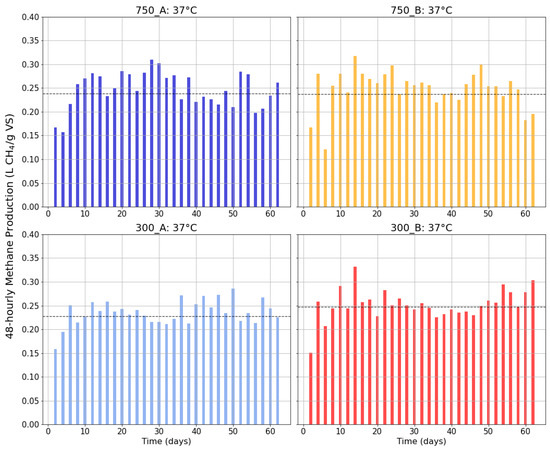
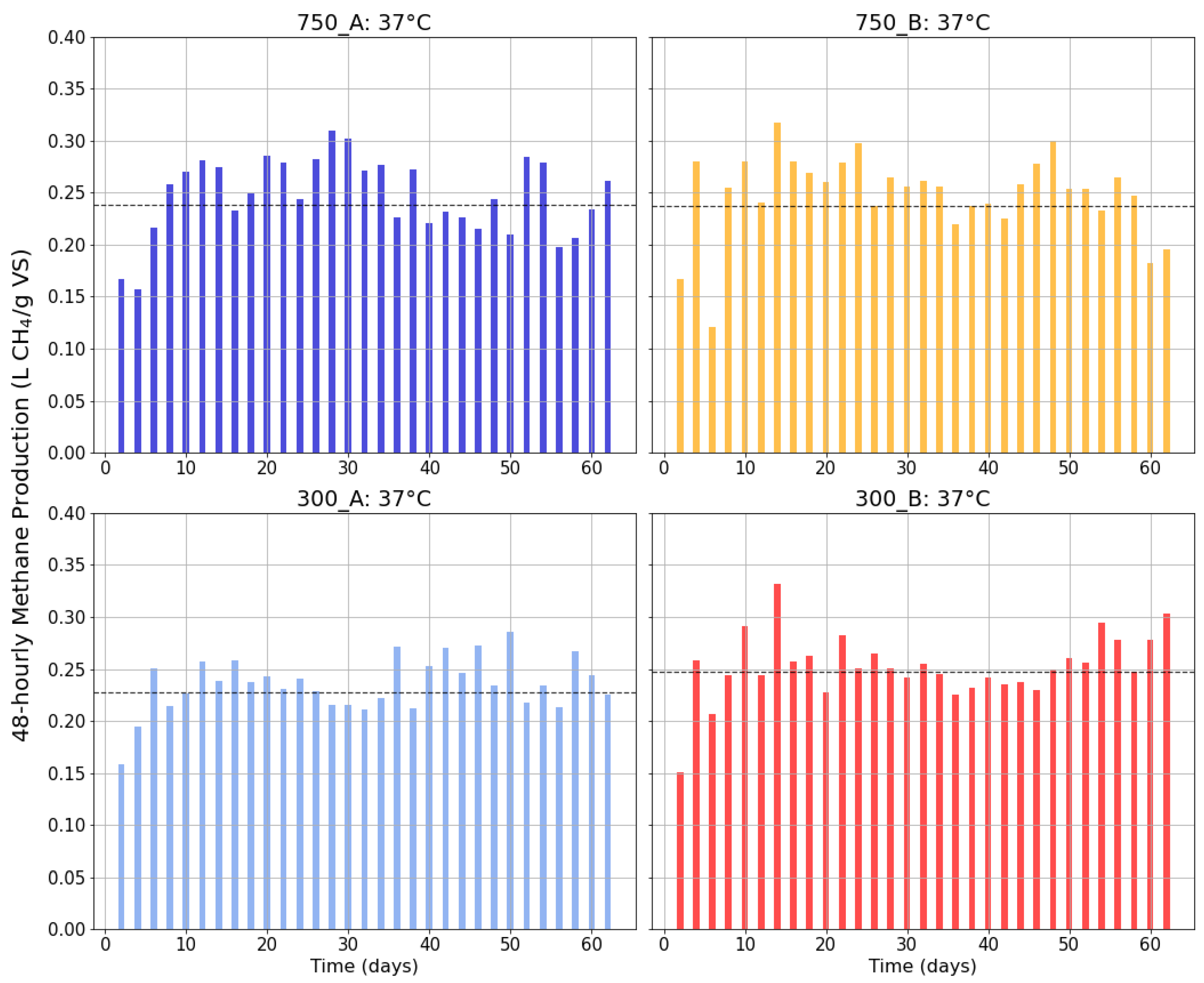
Methane yields for all reactor sets under mesophilic conditions (37 °C) are presented in Figure 3. It is clear that yields remained consistent after steady-state was reached, with all reactors showing minimal variation between controlled and minimally controlled conditions. All reactors exhibited stable methane production, with yields ranging from 0.234 to 0.253 L CH4 g VS−1. The 750 mL reactors showed negligible differences between control levels, with the continuously mixed, automatically dosed 750_A reactors achieving an average yield of 0.247 L CH4 g VS−1, compared to 0.249 L CH4 g VS−1 for the minimally mixed and 48-hourly dosed 750_B reactor. This negligible difference (<1%) demonstrates that continuous pH dosing and mixing provided no measurable benefit under mesophilic conditions. ANOVA analysis of the reactors showed a p-value of 0.9983 supporting the assertion of negligible difference in the operation of the reactors operated at these conditions. The similarity in performance indicates that the microbial population and buffer capacity of the digestate were sufficient to maintain stable operation without continuous intervention.
Figure 3.
A comparison of 48-hourly biogas production of each reactor set at 37 °C. The mean methane yields of all reactors in a set are represented by the dashed lines. Refer to Table 2 for information on the set conditions.
The 300 mL reactors displayed a slightly greater difference between control conditions, although both remained within the same operational range. The continuously mixed 300_A reactors yielded 0.234 L CH4 g VS−1, while the minimally mixed 300_B reactors produced 0.253 L CH4 g VS−1, representing an increase of approximately 8%. The ANOVA p-value in this case was determined as 0.1883 showing that the difference between data cannot conclusively be attributed to the different mixing regimes. Overall, the results at 37 °C confirm that both the 750 mL and 300 mL reactors maintained comparable methane yields regardless of control intensity. Continuous mixing and automated pH regulation therefore had minimal influence on digestion performance. These findings demonstrate that, under mesophilic operation, well-developed microbial communities and stable feed conditions are sufficient to sustain efficient biogas production without the need for continuous intervention.
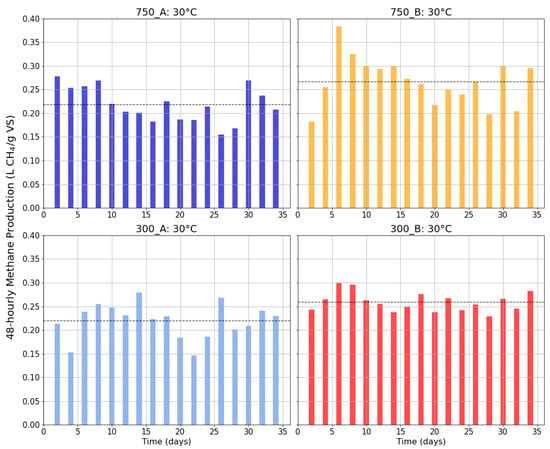
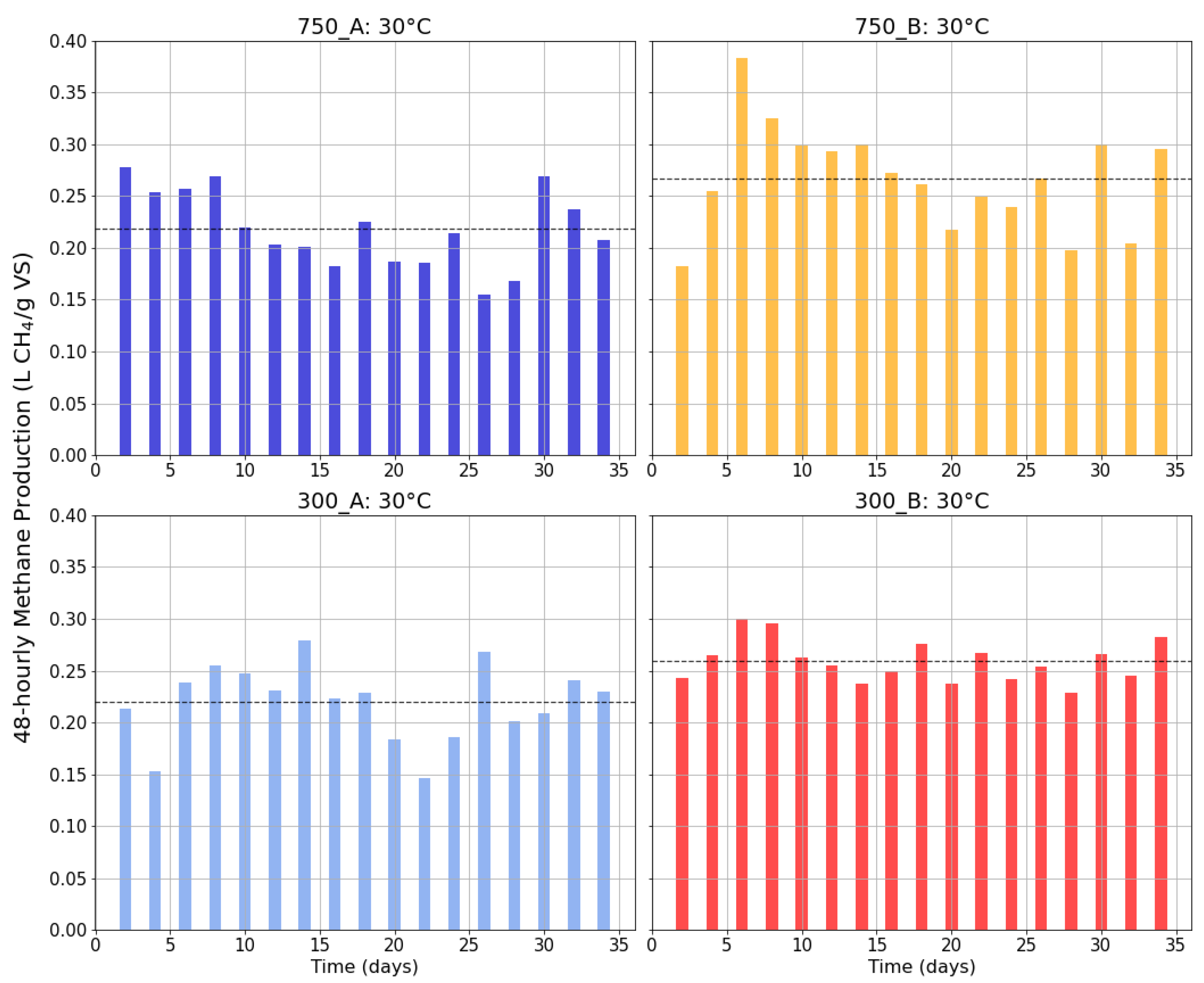
Under sub-mesophilic temperature conditions (30 °C), methane yields remained consistent over all reactor sets, as shown in Figure 4. Although the pH-controlled and uncontrolled 750 mL reactors showed a 22% difference in average methane yield, this variation was not statistically significant (p = 0.0834). The 750_A reactors produced 0.218 L CH4 g VS−1, while the minimally controlled 750_B reactors achieved 0.267 L CH4 g VS−1 under identical loading and feed conditions. Continuous pH dosing and mixing therefore conferred no measurable performance advantage, indicating that simplified control strategies are sufficient to maintain stable digestion.
Figure 4.
A comparison of 48-hourly methane production of each reactor set at 30 °C. The mean methane yields of all reactors in a set are represented by the dashed lines. Refer to Table 2 for information on the set conditions.
The smaller reactors exhibited a similar response as the 750 mL systems; minor variations in methane yield were observed but were not statistically significant. The 300_A reactors produced 0.220 L CH4 g VS−1, while the minimally mixed 300_B reactors achieved 0.259 L CH4 g VS−1, representing a 17.7% higher yield (p = 0.0179). As with the larger systems, intermittent mixing and less frequent pH dosing were sufficient to sustain efficient digestion; however, the limited reactor volume may have amplified the effects of mixing intensity, contributing to the observed difference in methane yield.
Limited or intermittent mixing appeared to support reactor stability under fluctuating conditions. Reduced mixing intensity can allow small, transient gradients in pH and substrate concentration to develop within the digestate, potentially promoting a more balanced environment for acidogenic and methanogenic populations. Previous studies have reported that partial or intermittent mixing can improve the buffering capacity of anaerobic systems and enhance process stability without compromising gas yield [28,29]. Both the 300 mL and 750 mL minimally mixed reactors remained stable throughout operation, confirming that efficient digestion can be maintained with reduced mechanical input.
Although methanogens are typically inhibited below pH 6.8 and experience significant suppression below pH 6.0–6.5 [5], the 750_B reactor maintained activity despite operating without continuous pH correction. This suggests that the digestate’s inherent buffering capacity and gradual consumption of VFAs stabilised pH between dosing events. Similar behaviour has been observed in systems where alkalinity derived from ammonia and bicarbonate formation helped maintain near-neutral conditions during intermittent pH control [29].
The slightly higher methane yields observed in the minimally mixed reactors align with previous findings showing that intermittent or low-intensity mixing can equal or surpass continuous mixing in performance. Lindmark et al. [23] reported that low-intensity or intermittent mixing produced gas yields comparable to continuous operation while reducing energy demand and mechanical stress on the microbial community. Babaei and Shayegan [8] similarly found that intermittent mixing achieved higher methane yields than both continuous and unmixed systems, with the latter two differing by less than 20%. These studies reinforce that continuous agitation provides no consistent benefit once steady-state microbial communities are established.
Reduced control therefore did not compromise digester performance and may have enhanced stability by favouring microbial populations tolerant of moderate pH and substrate fluctuations typical of semi-continuous feeding cycles. Periodic pH dosing and 48-hourly mixing thus represent practical, low-maintenance strategies for sustaining efficient biogas production without continuous mechanical or chemical intervention.
3.3. Influence of Temperature Effects
All reactor sets maintained steady methane yields once equilibrium was reached at both 37 °C and 30 °C, as shown in Figure 3 and Figure 4, respectively. No significant performance improvement was observed for the continuously mixed systems or for operation at the higher temperature. The continuously mixed 750_A reactors produced approximately 12% lower methane yields at 30 °C than at 37 °C (p = 0.306), while the minimally controlled 750_B reactor achieved a 7% higher yield under the lower temperature condition (p = 0.9934). Among the smaller reactors, the 300_A system showed a 6% decrease (p = 0.9532), whereas the minimally mixed 300_B reactor maintained near-identical performance, with only a 2% increase relative to its mesophilic yield (p > 0.9999). These small percentage differences and large p values confirm that lowering the operating temperature from 37 °C to 30 °C had no significant effect on steady-state methane production. The digestion process remained efficient and stable across both temperature regimes, suggesting that performance was not strongly sensitive to the temperature range examined in this study.
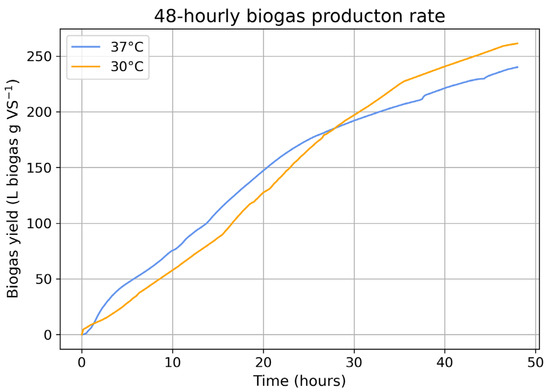
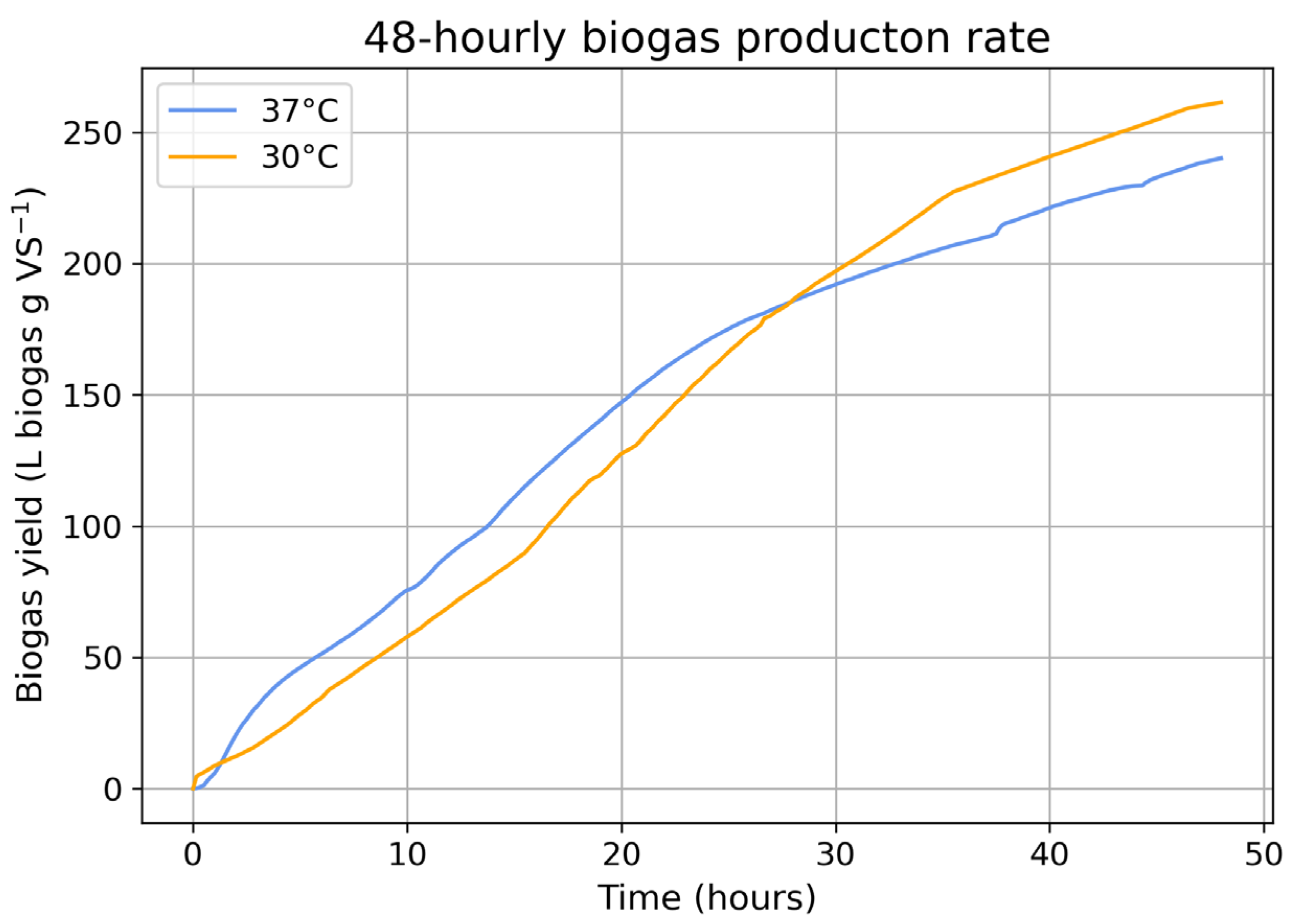
Despite the similar overall yields, the transient behaviour of gas production differed between temperature conditions. Biogas production was recorded every ten minutes during the 48 h feeding cycle for the 750_B reactor at both 30 °C and 37 °C, using CO2 flushing in each case. Figure 5 shows that gas production occurred more rapidly during the first 15 h at 37 °C, after which the 30 °C system exhibited a gradual increase before stabilising around 35 h. This indicates that biogas formation was initially slower at the lower temperature but was sustained for longer, resulting in similar total methane yields. Comparable temperature-dependent kinetics have been reported for food-waste digestion systems, where elevated temperature accelerates hydrolysis and acidogenesis, while lower temperature allows more balanced methanogenesis [8,15].
Figure 5.
A comparison of the rate of biogas production over a 48 h period of 750_B at different temperature conditions.
Biogas production rates did not fully stabilise within the 48 h cycle at either temperature, though both decreased notably in comparison with earlier stages. This indicates that the majority of methane generation occurred within the first 48 h after feeding, with production rates slowing noticeably thereafter. Such rapid degradation of fruit and vegetable waste highlights the substrate’s suitability for decentralised biogas systems, where short-cycle operation and consistent gas generation are advantageous for small-scale applications.
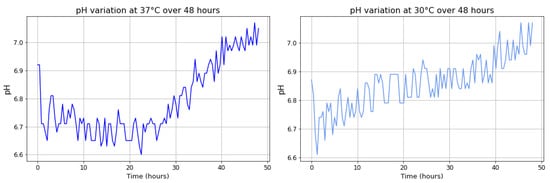
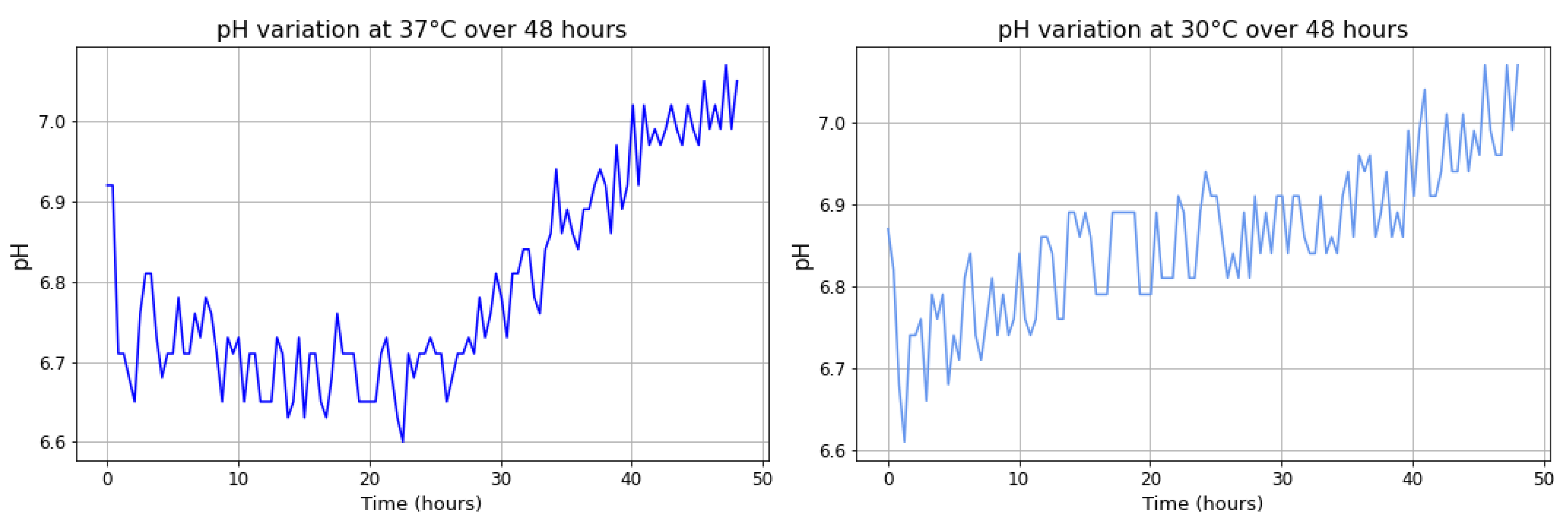
The pH profiles, at 30 °C and 37 °C, of reactors with continuous mixing and no pH control are depicted in Figure 6, with significant differences observed at each temperature. An overall decrease in the pH is observed at 37 °C over the first 20 h of the period; however, the pH at 30 °C over the same period experiences an overall increase. The pH at 37 °C is notably lower for a longer period than that at 30 °C, with pH levels remaining below 6.8 for more than half of the 48 h cycle at the higher temperature, potentially resulting in inhibitory effects on methanogenic activity, despite the higher temperature [5,25]. This behaviour corresponds with faster hydrolysis and acid formation at higher temperatures, followed by a slower but more balanced reaction sequence at lower temperatures [15].
Figure 6.
A comparison of the pH profiles over a 48 h period of a monitored reactor at different temperature conditions (37 °C and 30 °C), with perfect mixing and no pH control.
The pH behaviour of the 750_A reactors remained consistently stable throughout operation, as automated control allowed for values close to neutral (7.0 ± 0.1) to be maintained across all conditions. In contrast, the manually dosed reactors (750_B, 300_A, and 300_B) exhibited naturally regulated pH profiles similar to those illustrated in Figure 6. These systems often operated for two to three weeks without requiring any pH correction, and when dosing was necessary, it was due to a slight drop in pH below 7, with only a small volume of sodium hydroxide added to restore neutral conditions. This indicates that the digestion process achieved a self-regulating balance once steady state was reached, where acid production and buffering reactions were in equilibrium. The minimal dosing requirement and stable pH behaviour observed in these reactors demonstrate that frequent adjustment is not essential for maintaining optimal methanogenic conditions in semi-continuous food waste digestion systems, once steady state has been achieved.
3.4. Substrate Conversion
At the conclusion of the semi-continuous operation, two reactors from 300_A and two from 300_B were terminated by converting to batch mode to assess the extent of residual substrate degradation. Gas production was monitored for an additional 30 days, until no further gas production was observed, without any additional feeding.
It was observed that the methane produced during the first 48 h of the final semi-continuous feeding cycle accounted for approximately 58–73% of the total methane collected during the subsequent batch period. This indicates that a portion of biodegradable material remained unconverted under steady-state semi-continuous conditions, despite a nominal retention time of 30 days. The continued gas generation during batch operation suggests that higher overall yields could be achieved by increasing the liquid retention time within the reactor, while keeping the OLR constant, allowing more complete digestion of the slowly degradable organic fraction.
3.5. Digestate Component and Microbial Analysis
Table 4 presents the mean total solids of the digestate from each reactor as well as chemical characterisation of the liquid fraction of the digestate from all eight conditions, alongside the feedstock composition. It is important to note that these results represent only the soluble portion of the digestate, and a fraction of the organic matter and nutrients would remain associated with the solid phase and therefore not reflected in the reported concentrations.
Table 4.
Total solids, COD, ammonium, and phosphate measurements in reactor digestate.
A significant reduction in total solids was observed across all reactors relative to the feed, confirming effective conversion of organic matter during AD. Solids fractions ranged from 1.28 to 2.38% compared to 5% in the feed, corresponding to an approximate 60–75% reduction. Slightly higher residual solids in the 750_A and 300_A reactors may result from the redistribution of suspended material due to continuous mixing, rather than incomplete digestion. The comparable solids levels across temperatures further indicate stable degradation under both mesophilic and sub-mesophilic regimes.
A substantial reduction in soluble COD was observed across all reactors, indicating efficient degradation of readily biodegradable organics. The highest apparent COD removal efficiencies occurred under mesophilic conditions, with residual concentrations of 9660 mg L−1 and 13,660 mg L−1 for 300_A and 750_B, respectively, equivalent to 78–84% removal relative to the feed. Actual removal would likely be lower when accounting for undissolved organics retained in the solid fraction. The slightly higher residual COD in sub-mesophilic reactors suggests a modest reduction in reaction rate at 30 °C, though overall stabilisation remained effective across all conditions.
Ammonium (NH4+) concentrations increased across all reactors, reflecting the mineralisation of nitrogenous compounds during digestion, with the highest values observed in 300_B and 750_B (1035.9 mg L−1 and 970.9 mg L−1). Despite these elevated levels, no methanogenic inhibition occurred, indicating effective microbial adaptation and sufficient buffering capacity. In contrast, soluble phosphate (PO43−) decreased from 37 mg L−1 in the feed to 12–19 mg L−1 in the digestate, likely due to microbial assimilation and precipitation as metal–phosphate compounds. The lowest PO43− concentration (14.3 mg L−1) coincided with minimum COD values, suggesting that greater organic matter removal enhanced nutrient uptake and precipitation.
Overall, the results confirm that AD under all tested conditions achieved substantial soluble organic matter degradation and nutrient transformation. Temperature and mixing had minimal impact on the final composition of the liquid digestate, and the consistent solids reduction across reactors indicates stable and efficient digestion performance throughout.
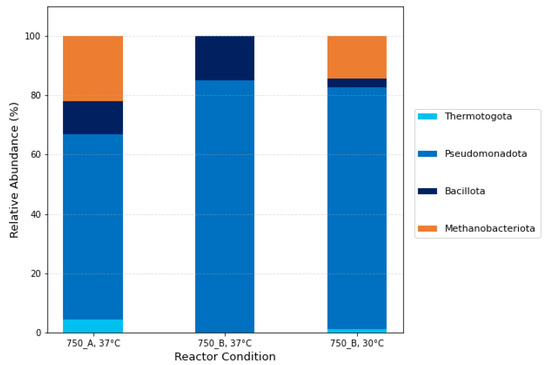
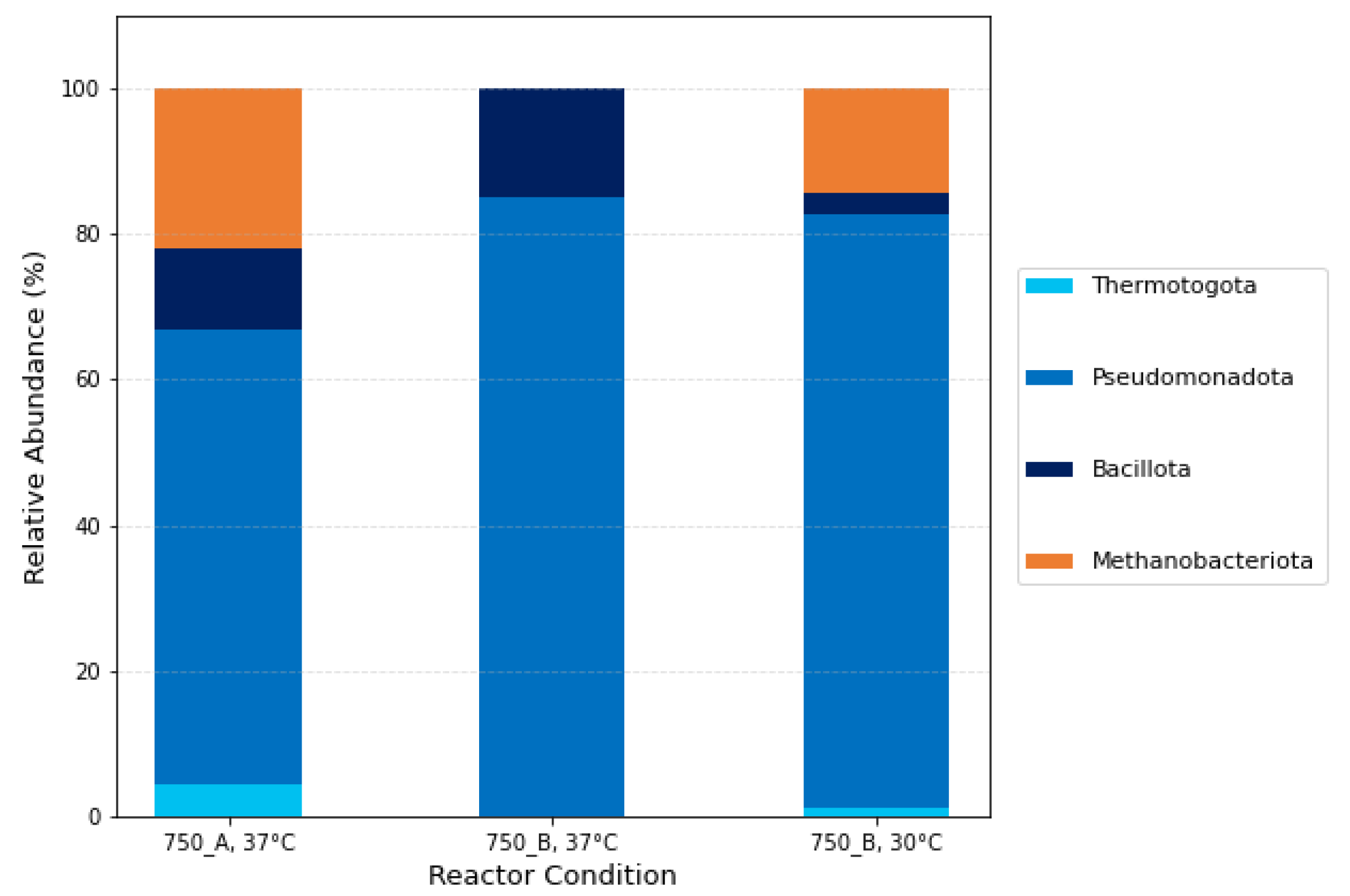
Figure 7 depicts the relative abundance of dominant microbial phyla identified across the reactor conditions, including Bacillota (formerly Firmicutes), Pseudomonadota (formerly Proteobacteria), Methanobacteriota, and Thermotogota. These represent the principal functional groups within AD systems, encompassing hydrolytic, fermentative, acetogenic, and methanogenic microorganisms [30]. Members of Bacillota are primarily associated with hydrolysis and acidogenesis through the secretion of extracellular enzymes and the fermentation of carbohydrates and proteins, while Pseudomonadota include facultative anaerobes and fermentative bacteria that contribute to acidogenesis and acetogenesis. The archaeal Methanobacteriota are hydrogenotrophic methanogens that convert hydrogen and carbon dioxide (or formate and carbon dioxide) to methane [31,32].
Figure 7.
Relative abundance of dominant microbial phyla across reactor conditions. The figure compares microbial community composition at the phylum level between 750_A and 750_B. 750_A was analysed at 37 °C and 750_B was analysed at both 37 °C and 30 °C.
Distinct community profiles were observed between the continuously mixed, pH-controlled 750_A reactor and the minimally mixed 750_B reactors. From Table 5, it is clear that the 750_B systems contained markedly higher proportions of Pseudomonadota. Within this phylum, the family Yersiniaceae and genus Yersinia were predominant, particularly in 750_B (39.9% at 37 °C and 54.6% at 30 °C) compared with 750_A (2.98% at 37 °C). Yersinia species are strongly fermentative facultative anaerobes that metabolise amino acids and simple carbohydrates to VFAs, formate, and hydrogen, which are key intermediates for syntrophic interactions with methanogens [33]. It should be noted that taxonomic identification was performed at genus level using 16S rRNA gene amplicon sequencing, which does not allow discrimination between pathogenic and non-pathogenic species. The genus Yersinia includes a range of environmental and commensal organisms commonly detected in and wastewater systems, and its presence alone does not imply pathogenic risk. As with all digestate derived from food waste, appropriate handing and sanitation measures would be required for any downstream use.
Table 5.
Key phyla, families, orders, and genera identified in digestate samples from each reactor condition, with their corresponding relative abundances (%).
The co-presence of Erysipelotrichaceae (phylum Bacillota) further supports a metabolically active fermentative and acetogenic consortium, as members of this family are known to generate acetate and other VFAs used as substrates for methanogenesis [31]. Together, these populations likely maintained a balanced fermentative–acetogenic network that efficiently supported methane production under minimally controlled conditions.
Within the archaeal community, Methanobacteriaceae and Methanomicrobiales were consistently identified. Both groups are strictly hydrogenotrophic methanogens, utilising H2 + CO2 or formate + CO2 as substrates [31,32]. Methanobacteriaceae are among the most common hydrogenotrophic families in AD systems [32], while members of Methanomicrobiales (such as Methanospirillum and Methanolinea) form syntrophic partnerships with fermentative bacteria that transfer electrons via hydrogen or formate. Other potential bacteria associated with direct interspecies electron transfer (DIET), such as Syntrophomonas and Geobacter, though not dominant, are often present at low abundance and may have contributed to interspecies electron transfer under these conditions [34]. No significant acetoclastic methanogens (such as Methanothrix or Methanosarcina) were detected; however, approximately 25% of sequences in each dataset were classified as “unassigned”, suggesting the presence of uncharacterised or low-abundance taxa that were not resolved at the family or genus level.
In the 750_B reactor operated at 37 °C, Methanobacteriota was detected at very low relative abundance. This likely reflects either a dominance of acetoclastic methane production under these conditions or the presence of hydrogenotrophic archaea at abundances below detection limits. It is additionally possible that hydrogenotrophic species that form part of the “unassigned” category were present and could not be resolved using the reference database.
Despite these variations in microbial composition, all reactors achieved comparable methane yields, demonstrating that process performance was not dependent on specific microbial assemblages [32]. This functional redundancy within the microbial consortia indicates that semi-continuous food waste digestion is governed more by reactor environment and operating stability than by individual species composition, underscoring the adaptability and resilience of the anaerobic microbial community.
4. Conclusions
The performance of semi-continuous FWAD under low-control conditions demonstrates that process stability and methane generation can be maintained without continuous mechanical or chemical intervention. The experimental data clearly indicates that neither frequent pH correction nor continuous mixing is required for stable reactor performance. Reactors adjusted only every 48 h achieved equivalent—and in some cases slightly higher—methane yields than those operated with automated control. Similarly, minimal mixing was sufficient to sustain uniform digestion, suggesting that the microbial system is capable of self-regulation once a steady state is achieved. These outcomes were supported by statistical analysis, which confirmed that observed differences in methane yield between reactor configurations were not statistically significant and fall within expected biological variability. This validates the practicality of low-maintenance, semi-continuous digestion for food waste treatment.
Temperature influenced the rate of gas generation rather than the total methane yield. While higher operating temperatures accelerated production directly after feeding, the cumulative gas volume over each 48 h cycle remained similar between 30 °C and 37 °C. The best-performing reactor, operating at 30 °C with minimal mixing and manual pH adjustment, achieved a methane yield of 0.267 L CH4 g VS−1, comparable to the fully controlled reactor at 37 °C (0.247 L CH4 g VS−1). When benchmarked against the extended batch operation, in which feeding was stopped and residual gas production was monitored until completion, it was found that approximately 58–73% of the total methane potential was generated within the 48 h feeding cycle of the semi-continuous process. The remaining fraction was released during the subsequent batch period of 30 days, confirming that additional gas can be recovered from residual substrate when retention time is increased. These results indicate that extending the effective retention period would enable more complete conversion of the feedstock and a corresponding increase in overall gas yield.
Microbial analyses confirmed that community composition varied with the temperature and mixing regime, yet overall methane yield remained stable. The maintenance of stable methane yields despite differences in microbial community composition indicates that functional redundancy within the microbial ecosystem contributes to the robustness of the process. The collective results provide strong evidence that semi-continuous food waste digestion can operate as a self-stabilising biological system. Future work should quantify this resilience over longer timeframes and under variable feed conditions, with an emphasis on scaling reactor design to optimise retention and conversion efficiency.
Author Contributions
Conceptualization, C.K. and W.N.; methodology, C.K. and W.N.; software, C.K. and H.G.B.; validation, C.K., H.G.B., N.H. and W.N.; formal analysis, C.K., H.G.B., and W.N.; investigation, C.K.; resources, H.G.B., N.H. and W.N.; data curation, C.K.; writing—original draft preparation, C.K., H.G.B., N.H. and W.N.; writing—review and editing, C.K., H.G.B., N.H. and W.N.; visualization, C.K.; supervision, H.G.B. and W.N.; project administration, C.K., H.G.B., and W.N.; funding acquisition, H.G.B., N.H. and W.N. All authors have read and agreed to the published version of the manuscript.
Funding
This work received support from the Austrian Federal Ministry of Women’s Affairs, Science and Research (BMFWF) and implemented by OeAD, [Grant numbers: Africa UNINET P119, Africa UNINET P169, and APPEAR Project 341]. APPEAR is a programme of the Austrian Development Organization. This research was further funded in part by the Austrian Science Fund (FWF) [10.55776/ESP1514224] and the National Research Foundation of South Africa (NRF) [CSRP220420402].
Institutional Review Board Statement
Not applicable.
Informed Consent Statement
Not applicable.
Data Availability Statement
The raw data supporting the conclusions of this article will be made available by the authors on request.
Conflicts of Interest
The authors declare no conflicts of interest.
Abbreviations
The following abbreviations are used in this manuscript:
| AD | Anaerobic Digestion |
| B | Batch |
| C | Continuous |
| CM | Cow manure |
| C:N | Carbon-to-nitrogen ratio |
| DIET | Direct interspecies electron transfer |
| FW | Food waste |
| FWAD | Food waste anaerobic digestion |
| HRT | Hydraulic retention time |
| LPG | Liquified petroleum gas |
| MSW | Municipal solid waste |
| OLR | Organic loading rate |
| RA | Relative abundance |
| SC | Semi-continuous |
| VFA | Volatile fatty acid |
References
- Thakur, R.; Onwubu, S.C. Household waste management behaviour amongst residents in an informal settlement in Durban, South Africa. J. Environ. Manag. 2024, 349, 119521. [Google Scholar] [CrossRef] [Scilit] [PubMed]
- Haywood, L.K.; Kapwata, T.; Oelofse, S.; Breetzke, G.; Wright, C.Y. Waste Disposal Practices in Low-Income Settlements of South Africa. Int. J. Environ. Res. Public Health 2021, 18, 8176. [Google Scholar] [CrossRef] [Scilit] [PubMed]
- Tsheleza, V.; Ndhleve, S.; Kabiti, H.M.; Nakin, M.D.V. Household Solid Waste Quantification, Characterisation and Management Practices in Mthatha City, South Africa. Int. J. Environ. Waste Manag. 2022, 29, 208–229. [Google Scholar] [CrossRef] [Scilit]
- de Vries, L.; Jenkins, N.; Tian, N.; Modau, I.; Pillay, P.; Carle, B.; Notten, P. Food Loss and Waste: Facts and Futures Taking Steps Towards a More Sustainable Food Future; WWF-SA: Claremont, South Africa, 2017. [Google Scholar]
- Mbazima, S.J.; Masekameni, M.D.; Mmereki, D. Waste-to-energy in a developing country: The state of landfill gas to energy in the Republic of South Africa. Energy Explor. Exploit. 2022, 40, 1287–1312. [Google Scholar] [CrossRef] [Scilit]
- Mohlakoana, N.; Annecke, W. Finally Breaking the Barriers: South African case study on LPG use by low-income urban households. In Proceedings of the Clean Cooking Fuels, Istanbul, Turkey, 16–17 June 2008. [Google Scholar]
- Vögeli, Y.; Lohri, C.R.; Gallardo, A.; Diener, S.; Zurbrügg, C. Anaerobic Digestion of Biowaste in Developing Countries: Practical Information and Case Studies; Mercer, S., Ed.; Eawag—Swiss Federal Institute of Aquatic Science and Technology: Dübendorf, Switzerland, 2014. [Google Scholar]
- Babaei, A.; Shayegan, J. Effects of temperature and mixing modes on the performance of municipal solid waste anaerobic slurry digester. J. Environ. Health Sci. Eng. 2019, 17, 1077–1084. [Google Scholar] [CrossRef] [Scilit]
- Meegoda, J.N.; Li, B.; Patel, K.; Wang, L.B. A Review of the Processes, Parameters, and Optimization of Anaerobic Digestion. Int. J. Environ. Res. Public Health 2018, 15, 2224. [Google Scholar] [CrossRef] [Scilit]
- Marsh, G. Rise of the Anaerobic Digester. Renew. Energy Focus 2008, 9, 28–34. [Google Scholar] [CrossRef] [Scilit]
- Shabbirahmed, A.M.; Somu, P.; Yang, H.-H.; Hiruthyaswamy, S.P.; Karua, C.S.; Yadav, A.K. Challenges and strategies for waste food anaerobic digestion: Insights and future directions. Environ. Dev. Sustain. 2024, 27, 27009–27042. [Google Scholar] [CrossRef] [Scilit]
- Decker, S.R.; Milbrandt, A. Anaerobic Digestion of Food Waste: Products and Their Uses; National Renewable Energy Laboratory: Golden, CO, USA, 2022. [Google Scholar]
- Xu, F.; Li, Y.; Ge, X.; Yang, L.; Li, Y. Anaerobic digestion of food waste—Challenges and opportunities. Bioresour. Technol. 2018, 247, 1047–1058. [Google Scholar] [CrossRef] [Scilit]
- Khune, S. Biogas Production from Solid Food Waste and Its Use for Electricity Production; Vaal University of Technology: Vanderbijlpark, South Africa, 2021. [Google Scholar]
- Paramaguru, G.; Kannan, M.; Senthilkumar, N.; Lawrence, P. Effect of temperature on biogas production from food waste through anaerobic digestion. Desalination Water Treat. 2017, 85, 68–72. [Google Scholar] [CrossRef] [Scilit]
- Nagao, N.; Tajima, N.; Kawai, M.; Niwa, C.; Kurosawa, N.; Matsuyama, T.; Yusoff, F.M.; Toda, T. Maximum organic loading rate for the single-stage wet anaerobic digestion of food waste. Bioresour. Technol. 2012, 118, 210–218. [Google Scholar] [CrossRef] [Scilit]
- Nguyen, D.D.; Chang, S.W.; Cha, J.H.; Jeong, S.Y.; Yoon, Y.S.; Lee, S.J.; Tran, M.C.; Ngo, H.H. Dry semi-continuous anaerobic digestion of food waste in the mesophilic and thermophilic modes: New aspects of sustainable management and energy recovery in South Korea. Energy Convers. Manag. 2017, 135, 445–452. [Google Scholar] [CrossRef] [Scilit]
- Parajuli, A.; Khadka, A.; Sapkota, L.; Ghimire, A. Effect of Hydraulic Retention Time and Organic-Loading Rate on Two-Staged, Semi-Continuous Mesophilic Anaerobic Digestion of Food Waste during Start-Up. Fermentation 2022, 8, 620. [Google Scholar] [CrossRef] [Scilit]
- Cubero-Cardoso, J.; Munoz-Arjona, A.; Trujillo-Reyes, A.; Serrano, A.; Alonso-Farinas, B.; Rodriguez-Gutierrez, G.; Urbano, J.; Borja, R.; Fermoso, F.G. Mesophilic Semi-Continuous Anaerobic Digestion of Strawberry Extrudate Pretreated with Steam Explosion. Foods 2020, 9, 1887. [Google Scholar] [CrossRef] [Scilit] [PubMed]
- Zhang, J.; Mao, L.; Nithya, K.; Loh, K.-C.; Dai, Y.; He, Y.; Wah Tong, Y. Optimizing mixing strategy to improve the performance of an anaerobic digestion waste-to-energy system for energy recovery from food waste. Appl. Energy 2019, 249, 28–36. [Google Scholar] [CrossRef] [Scilit]
- Bergamo, U.; Viccione, G.; Coppola, S.; Landi, A.; Meda, A.; Gualtieri, C. Analysis of anaerobic digester mixing: Comparison of long shafted paddle mixing vs gas mixing. Water Sci. Technol. 2020, 81, 1406–1419. [Google Scholar] [CrossRef] [Scilit]
- Singh, B.; Szamosi, Z.; Siménfalvi, Z. State of the art on mixing in an anaerobic digester: A review. Renew. Energy 2019, 141, 922–936. [Google Scholar] [CrossRef] [Scilit]
- Lindmark, J.; Thorin, E.; Bel Fdhila, R.; Dahlquist, E. Effects of mixing on the result of anaerobic digestion: Review. Renew. Sustain. Energy Rev. 2014, 40, 1030–1047. [Google Scholar] [CrossRef] [Scilit]
- Gonde, L.; Wickham, T.; Brink, H.G.; Nicol, W. pH-Based Control of Anaerobic Digestion to Maximise Ammonium Production in Liquid Digestate. Water 2023, 15, 417. [Google Scholar] [CrossRef] [Scilit]
- House, D. The Complete Biogas Handbook; Alternative House Information: Lowell, MA, USA, 2010. [Google Scholar]
- Khadir, A.; Haroun, B.; Jang, E.; Santoro, D.; Walton, J.; Al-Omari, A.; Muller, C.; Bell, K.Y.; Parker, W.; Nakhla, G. Methane production and microbial adaptation in high-load vacuum-enhanced anaerobic digestion: Addressing ammonia and propionate toxicity. Chem. Eng. J. 2025, 509, 161105. [Google Scholar] [CrossRef] [Scilit]
- Bensegueni, C.; Kheireddine, B.; Khalfaoui, A.; Amrouci, Z.; Bouznada, M.O.; Derbal, K. Optimization of Biogas and Biomethane Yield from Anaerobic Conversion of Pepper Waste Using Response Surface Methodology. Sustainability 2025, 17, 2688. [Google Scholar] [CrossRef] [Scilit]
- Nguyen, L.N.; Johir, M.A.H.; Commault, A.; Bustamante, H.; Aurisch, R.; Lowrie, R.; Nghiem, L.D. Impacts of mixing on foaming, methane production, stratification and microbial community in full-scale anaerobic co-digestion process. Bioresour. Technol. 2019, 281, 226–233. [Google Scholar] [CrossRef] [Scilit]
- Singh, B.; Kovács, K.L.; Bagi, Z.; Petrik, M.; Szepesi, G.L.; Siménfalvi, Z.; Szamosi, Z. Significance of Intermittent Mixing in Mesophilic Anaerobic Digester. Fermentation 2022, 8, 518. [Google Scholar] [CrossRef] [Scilit]
- Pasalari, H.; Gholami, M.; Rezaee, A.; Esrafili, A.; Farzadkia, M. Perspectives on microbial community in anaerobic digestion with emphasis on environmental parameters: A systematic review. Chemosphere 2021, 270, 128618. [Google Scholar] [CrossRef] [Scilit] [PubMed]
- Ziemiński, K.; Frąc, M. Methane fermentation process as anaerobic digestion of biomass: Transformations, stages and microorganisms. Afr. J. Biotechnol. 2012, 11, 4127–4139. [Google Scholar] [CrossRef] [Scilit]
- Venkiteshwaran, K.; Bocher, B.; Maki, J.; Zitomer, D. Relating Anaerobic Digestion Microbial Community and Process Function. Microbiol. Insights 2015, 8, 37–44. [Google Scholar] [CrossRef] [Scilit] [PubMed]
- Chen, S.; Thompson, K.M.; Francis, M.S. Environmental Regulation of Yersinia Pathophysiology. Front. Cell Infect. Microbiol. 2016, 6, 25. [Google Scholar] [CrossRef] [Scilit]
- Morita, M.; Malvankar, N.S.; Franks, A.E.; Summers, Z.M.; Giloteaux, L.; Rotaru, A.E.; Rotaru, C.; Lovley, D.R. Potential for direct interspecies electron transfer in methanogenic wastewater digester aggregates. mBio 2011. [Google Scholar] [CrossRef] [Scilit]

Disclaimer/Publisher’s Note: The statements, opinions and data contained in all publications are solely those of the individual author(s) and contributor(s) and not of MDPI and/or the editor(s). MDPI and/or the editor(s) disclaim responsibility for any injury to people or property resulting from any ideas, methods, instructions or products referred to in the content. |
© 2026 by the authors. Licensee MDPI, Basel, Switzerland. This article is an open access article distributed under the terms and conditions of the Creative Commons Attribution (CC BY) license.