


Abstract
Copper is a strategic raw material and an important component in electric motors, widely used across industries because of its excellent conductivity and recyclability. It plays an important role in the transformation from fossil fuel-based systems to green, electrified systems. However, substantial material losses continue throughout the lifecycle of electric motors, even with copper’s intrinsic capacity for circularity. Also, copper’s increasing demand, which is driven by the emergence of electric vehicles, industrial electrification, and renewable energy infrastructure, poses questions regarding its sustainable supply. The recovery of secondary copper sources from end-of-life (EoL) products is becoming more and more important in this context. However, it is still difficult to achieve circularity of copper, especially from industrial electric motors. This study investigates the challenges of closing the loop for copper during the lifecycle of motors in industrial applications. Based on an examination of EoL strategies, material flow insights, and practical investigation, the research pinpoints significant inefficiencies in the current processes. The widespread use of scraping as an approach of end-of-life management is one significant issue. Most of the electric motors are not built to separate their components, which makes both mechanical and manual disassembly difficult. The quality of recovered copper is thus compromised by the dominance of mixed metal shredding methods in the recycling step. This study highlights the need for systemic changes in addition to technical solutions to address copper circularity issues. It requires a focus on circularity in designing, giving disassembly and metal recovery a priority. This study focuses on circularity and its technological challenges in a value chain of copper. It not only identifies different processes such as supply chain disconnections and design constraints, but it also suggests workable solutions to close the copper flow loop in the electric motor sector. Copper quality and recovery is ultimately a problem involving design, technology, and cooperation, in addition to resources. This study supports the transition to a more sustainable and circular electric motor industry by offering a basis for directing such changes in industry practices and prospective EU regulations.
1. Introduction
Electrical motors are versatile and used in various fields, including construction, mining, electrical vehicles, and renewable energy production. They play a central role in the green energy transition. Driven by electrification and an exchange towards more efficient motors in accordance with the EU’s ecodesign requirements [1], the industrial electric motor market will increase. As the market for electric motors grows with the energy transition, end-of-life management arises as a common challenge in many industries [2], necessitating appropriate circular strategies for high-value materials such as copper.
Copper’s intrinsic qualities, such as its excellent conductivity and durability, make it the material of choice for promoting the green transition and make it the most popular material for motor windings [3]. Demand for copper is expected to grow in line with the energy transformation towards the EU’s 2050 net-zero target [4]. Acknowledging its strategic importance for the green transition, copper was added to the EU’s critical raw materials list in 2023 [5]. According to the ICSG, global refined copper use is projected to increase by about 2.2% in 2024 and 2.7% in 2025, reflecting a continued rise in annual demand [6]. The importance of circular strategies for recycling, recovery, and the use of secondary copper as a raw material becomes increasingly important, as it can offer both environmental benefits and contributes to a secure supply of material and enables the EU to become less dependent on imported raw material [5].
Moving towards a circular economy and improving material circularity, supported by circular strategies, can close-loop systems enhanced with resource efficiency [7], by returning used materials back into its value chain. The extended life of the material can lead to less need for virgin material. Access to secondary materials becomes important, enabled through different reverse flows, reverse logistics, buy-back or take-back products at EoL, or through different material recovery collaborations where resource value can be maximized [8]. At the same time, this means that a closed-loop system can offer both competitive advantages, economic and sustainable [7,9], and enable business opportunities.
Previous research has highlighted a need for circularity of materials used in the manufacturing of electric motors [2]. To enhance the knowledge of circularity of materials used in electrical motors, this study examines the current challenges for establishing a closed-loop system of high-quality copper, with a purity of >99.90%, for a single motor manufacture of industrial electrical motors. By the identification of challenges faced by producers, users, service, and maintenance, recyclers across the high-quality copper value chain the current circular limitations across the electric motors lifecycle are identified.
The research question for this study is the following: What are the barriers to establishing a closed system of high-quality copper, without material downcycling, for a single electric motor manufacturer during the lifecycle of an electric motor?
2. Materials and Methods
The existing flow of high-quality copper flow throughout the lifecycle of industrial electric motors, as well as challenges associated with closing the loop, was examined using a qualitative research design based on semi-structured in-depth interviews. The methodology followed a 6-step research methodology.
- Literature study: It focused on circularity in terms of sustainable material flows and life cycles analysis (LCAs) of electric motors.
- Interview topics: To approach the subject from different angles, an interview guide was developed and structured around the following four main topics: (a) process description, for understanding the method, process, and product usage; (b) quality assurance, to identify how the material is used, reused, recovered, and quality controlled in its value chain; (c) challenges and barriers, to identify today’s challenges and barriers for circularity in the value chain; and (d) drivers for recycling and material recovery, to identify potential circular improvement in the value chain. Minor adjustments to the guide were made to align with each interviewee’s responsibility and operational context.
- Identifying interviewees: Through literature studies, primary LCA analysis of electric motors was circular actors identified in the copper value chain and select them to cover the industrial electric motor lifecycle.
- Data collection: Interviews were conducted between April and June 2025, including 7 actors, all part of the copper value chain of industrial electrical motor operation in Europe. Ten interviewees with diverse responsibilities participated in the study. Background information on interviewees is presented in Table 1. Depending on access to digital tools, opportunity for site visit, and specific requirements, the way the interview was conducted was decided by the participants themselves, which is presented in Table 2. All interviews were conducted in English. Each interview session lasted at least one to two hours, all recorded with the participants’ explicit consent. Prior to the interviews, stakeholders were informed about the voluntary nature of their involvement and their right to decline any questions they considered sensitive.Table 1. Interviewee’s participation.Table 2. Data collection methods.
- Data evaluation: Every recorded interview was verbally transcribed and reviewed; methods used are presented in Table 2. The data analysis began with the researchers familiarizing themselves individually with the data, by carefully reviewing them several times. Initially, open coding was used to enable an open and exploration analysis. The open coding was our way of beginning to sort and organize data [10] which was initially carried out by each researcher individually. Through discussions and collaboration between the researchers, initial individual codes were combined, refined, and improved. Connections were identified from the open codes forming the axial coding [10]; fragments of themes began to be identified. Through further discussions based on the axial coding, the final clustering was made possible, from which the following three main themes emerged: (a) design—the impact of electrical motor design on material circularity; (b) performance—the impact of material quality on the electrical motor; and (c) market—circular challenges linked to the market for the material. During the coding processes, MS Excel was used to facilitate collaboration and structure and visualize data without losing the coding history.
- Writing article: During manuscript preparation, interview citations were interpreted and simplified for clarity, with removing repeated expressions and edits made at the interviewee’s request without changing the meaning. The writing processing was supported by AI-assisted spelling and grammar checking.
3. Results
The results of the study are divided into four different chapters—copper flow in electric motor lifecycle, design challenges, performance challenges, and market challenges—which enable an in-depth analysis of challenges faced by the actors within the copper value chain in relation to a closed-loop system.
3.1. Copper Flow in Electric Motor Lifecycle
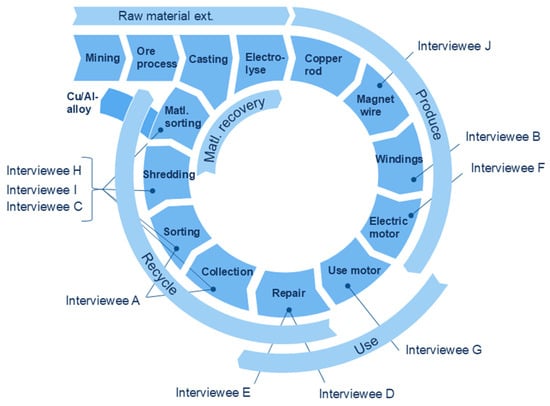
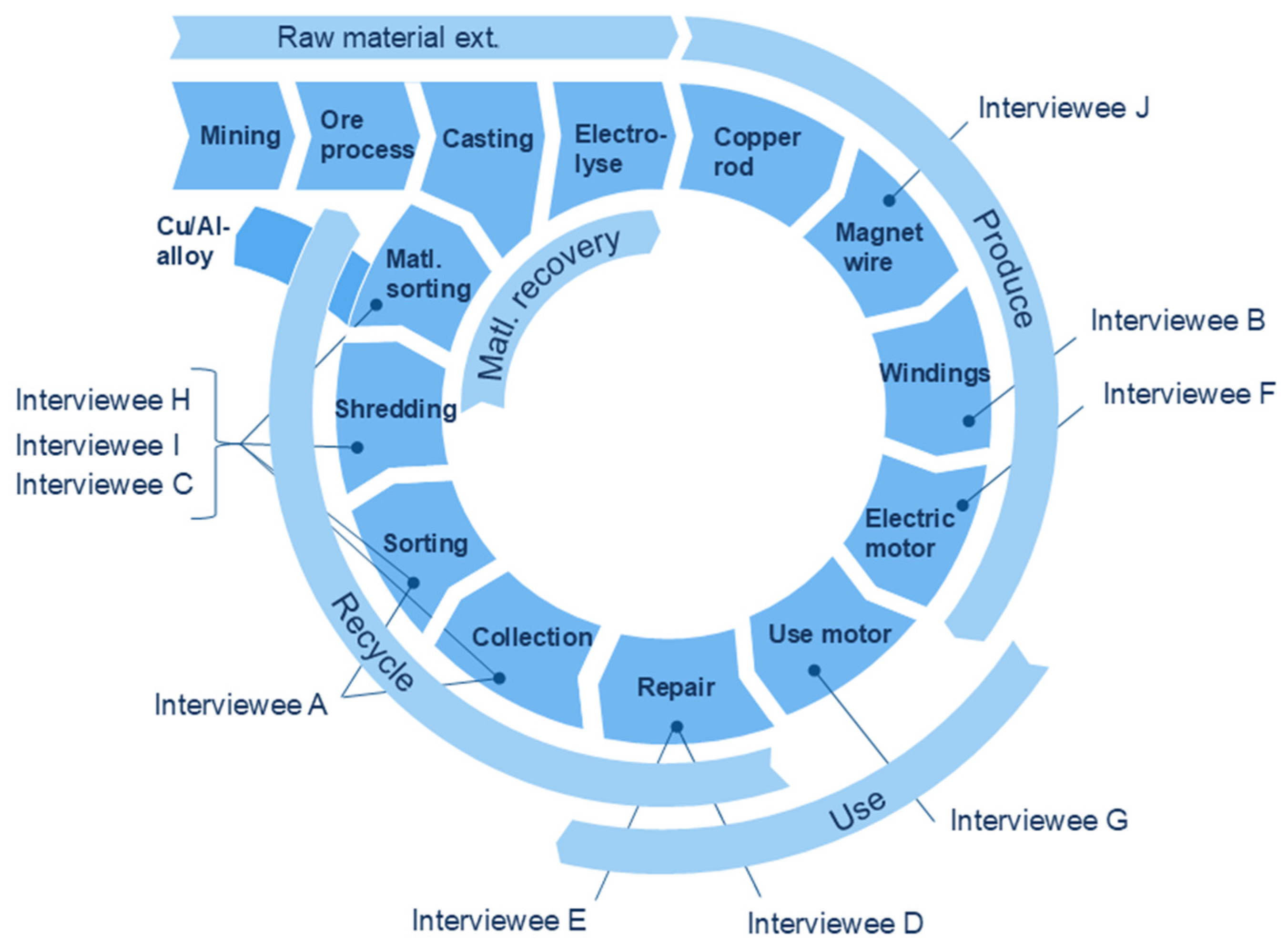
A partial result of this study is a visualization of the investigated material flow of high-quality copper in the lifecycle of an electric motor. In Figure 1, circular actors in the copper value chain are presented generically, based on the lifecycle phases of the electric motor, which extend from raw material extraction, production, use, and recycling to material recovery. Figure 1 also visualizes the interviewees who were included in the study from the perspective of a circular actor in the copper value chain.
Figure 1.
Copper flow in electric motor lifecycle.
3.2. Design
Copper enters the lifecycle of an electrical motor either as magnet wire, pre-manufactured winding, or rods covered with insulating coating such as enamel, a composition that may consist of varnish, polyester, or fiberglass. The copper surrounded by insulating paper, mica, or fiberglass tubes are embedded parts in the stator core slots, secured with resin, epoxy, or fiberglass rods to prevent movement. The stator core, composed of stacked and welded plates in e-steel, is pressed into the motor housing, made from cast iron or aluminum. End windings are tightened around the stator core and fixed with impregnation or adhesive tapes round the housing. The motor is closed with end caps that fix the shaft made of steel, with the rotor core in aluminum and e-steel placed in center of stator through press fitting of bearings. The way copper is built in with these materials creates challenges for downstream actors during repair and recycling, such as inefficient, time- and energy-intensive disassembly. A recycler explains the challenges of the inbound materials: “I think that our main challenge is probably that we get material mixed […] especially since a lot of products, when they go into end of life, are not built for recycling. So things are mixed into each other in a way that makes it very time consuming to pick them apart.” (Interviewee H).
Although some downstream methods have been developed, mainly focusing on the pre-separation of aluminum and copper from larger electrical motors, smaller motors, however, continue to challenge the circularity not only with the linear consuming pattern, take–make–dispose, but also in the recycling. These motors are typically sorted and sold as mixed metals for shredding, without any pre-separation. Material losses challenge the material sorting processes during shredding; mixtures of copper and other non-ferrous materials lead to a downcycling of the copper quality. A typical material mix of copper and aluminum is an output from the shredding that leaves the value chain of high-quality copper for usage as a secondary raw material by aluminum and copper alloy melters. To optimize the shredding, recyclers are combining products with similar material composition and quality. Through test runs, processes parameters are tuned to ensure material output quality, which corresponds to high material purity to meet the customers’ requirements. Looking at a closed-loop system for high-quality copper for a single manufacture, challenges arise as traceability of material origin, increased transportation, as well as resource-intensive sorting and material storage, ineffective and energy- intensive shredding. A recycler explains: “You need to keep the material totally separate and you need to get in enough material to make it into a pile and keep it there and then run it through the process and store it afterwards and sort…” (Interviewee H). “The fragmentation with less material will also use energy that might have been more efficiently used, so all things together, it is more environmentally friendly to do it on an industrial size instead of a per customer part” (Interviewee H).
Furthermore, a closed-loop system will lead to challenges in material supply, the long-use phase of motors results in limited secondary material availability.
3.3. Performance
In the use phase of an electrical motor, efficiency and performance are important because they have a significant impact on environmental and sustainability implications. Over the last century, efficiency improvements have been achieved by the use of materials with higher quality, increasing the material quantity for copper to reduce resistance losses [11]. Across the high-quality copper value chain, there is a well-established understanding that copper purity is directly linked to resistance and efficiency. Consequently, no actor in the value chain is willing to compromise the product performance by lowering copper quality. Downstream challenges emerge when considering the use of recycled materials as secondary copper is perceived with a potential risk for quality fluctuation that might affect the product quality, performance, and efficiency. A maintenance worker explains that secondary materials should not be used if quality is compromised: “If the quality of the copper is reduced by recycling, it probably wouldn’t because we want the quality to be as good as possible.” (Interviewee D)
Optimization of operating conditions for motors has driven the development of insulation material capable of withstanding higher temperatures, alongside improvements in adhesion of both enamel and pre-assembled insulation tape. However, these advances introduce new challenges for service, recycling, and material recovery. Where the new insulation materials complicate the separation from copper, and a transition from energy-intensive purification processes, to restore copper quality is made more difficult. Among these, main contributors are heating processes and electrolysis mentioned in the study.
3.4. Market
In the green transition, it is essential to emphasize sustainability and reduced pollution (e.g., carbon neutrality), which has influenced the copper market where attention increasingly shifted towards increased recycled content. Here, it is described by a manufacturer: “Meanwhile, there’s a change to the recycle content, because this is also connected with the carbon footprint.” (Interviewee J). However, the transition in the copper market is not happening without hesitation. There are industries that currently perceive the use of recycled metals as risks in terms of quality, reliability, and compliance with technical standards. Here, they are described by a recycler: “Industries that are still a little bit afraid of using reused metals, but they are getting less and less […] they also feel the pressure from the industries which use reuse copper because if they cannot buy the copper as cheap as possible, their product is going to be more expensive than their competition, which uses old metals, reused metals” (Interviewee C). The competitive advantages that recycled copper brings create an increasingly competitive disadvantage for companies that rely solely on virgin materials.
As the copper industry places greater emphasis on sustainability, these greener technologies often come at a higher price, underscoring the fact that sustainability is not free. A manufacture describes the following: “… the sustainability discussion. Very nice and green and greener every day, but you have also an increase of cost.” (Interviewee J). The copper price also poses challenges in both sales and storage. A recycler stated the following: “The interest of secondary raw materials has driven up the price” (Interviewee A). When prices rise, there is a strong incentive to resell stockpiled copper or scrap to maximize profits. The market dynamic makes it difficult to predict resale decisions and hinders predictability in the material flows which complicate the circularity through the copper value chain.
“A key barrier is the limited availability of high-quality recycled copper—only 25–30% in cathodes and likely below 40% in magnetic wire, which limits circularity.” (Interviewee J)—a manufacturer describes that the limited availability of recycled copper reduces the possibility of closing the loop and at the same time makes it difficult to reduce dependency on virgin copper.
4. Summary
In line with the EU’s Critical Raw Materials Act [12], the study indicates an increasing interest in recycled copper driven both by business opportunities and influenced by sustainability considerations. The findings also indicate a shifting attitude towards the value of secondary materials. Nonetheless, secondary copper is currently perceived with uncertainty related to varying quality and material purity, which in turn necessitates a need for energy-intensive refining processes to ensure end-product performance and efficiency. These factors highlight circularity challenges linked to industrial motor design, both in terms of material and component composition, which prevents effective material separation with maintained quality. From a market perspective, the competitiveness of recycled copper becomes a challenge due to energy-intensive purification processes and limited availability of secondary materials. This makes it difficult with today’s processes for recovery to enable a cost-effective solution while simultaneously meeting the increased need for copper in the green transition [6] through a closed-loop system of high-quality copper.
The study identifies numerous circularity challenges within the high-quality copper value chain. According to the findings, implementing a closed-loop system for a single motor manufacture will likely be difficult. This is due not only to current limitations in recycling and recovery processes, but also to current challenges with increased transport, resource-intensive material sorting, separation and storage, and difficulties in maintaining traceability throughout the motor lifecycle in the copper value chain. However, these factors will currently challenge both the economics and the sustainability of a closed-loop system for high-quality copper for a single motor manufacturer.
Despite a limited number of interviewees, this study has identified challenges with a closed system, both technical limitations and behavioral barriers associated with a closed-loop system. To provide a complete picture of current barriers and to increase the understanding of the challenges of copper circularity in electric motors, further research should include larger and more diverse set actors across the copper value chain.
Author Contributions
Conceptualization, L.S., S.R.G. and R.L.; methodology, L.S. and S.R.G.; software, L.S. and S.R.G.; validation, L.S., S.R.G., M.N.; formal analysis, L.S. and S.R.G.; investigation, L.S. and S.R.G.; resources, L.S. and S.R.G.; data curation, L.S. and S.R.G.; writing—original draft preparation, L.S. and S.R.G.; writing—review and editing, L.S., S.R.G., E.J., V.V.C., M.K., M.N. and R.L.; visualization, L.S.; supervision, M.N., R.L., M.K., E.J. and V.V.C.; project administration, M.K. and R.L.; funding acquisition, M.K. and R.L. All authors have read and agreed to the published version of the manuscript.
Funding
This research was partly founded by The Swedish Agency for Economic and Regional Growth, 20359796, Green Transition North—circular economy and RE: Source program at the Swedish Energy Agency under grant no. P2024-00581.
Informed Consent Statement
Informed consent was obtained from all subjects involved in the study.
Data Availability Statement
The datasets presented in this article are not readily available because data are part of an ongoing study or due to technical/ time limitations. Requests to access the datasets should be directed to Luleå University of Technology, Archives and registry.
Acknowledgments
We acknowledge the funding from the Swedish Energy Agency via the research program RE: Source, grant no. P2024-00581.
Conflicts of Interest
The funders had no role in the design of the study; in the collection, analyses, or interpretation of data; in the writing of the manuscript; or in the decision to publish the results.
References
- Commission Regulation (EU) 2019/1781 of 1 October 2019 Laying Down Ecodesign Requirements for Electric Motors and Variable Speed Drives Pursuant to Directive 2009/125/EC of the European Parliament and of the Council, Amending Regulation (EC) No 641/2009 with Regard to Ecodesign Requirements for Glandless Standalone Circulators and Glandless Circulators Integrated in Products and Repealing Commission Regulation (EC) No 640/2009 (Text with EEA Relevance) (OJ L 272 25.10.2019, p. 74). Available online: http://data.europa.eu/eli/reg/2019/1781/oj (accessed on 14 August 2025).
- Tiwari, D.; Miscandlon, J.; Tiwari, A.; Jewell, G.W. A review of circular economy research for electric motors and the role of industry 4.0 technologies. Sustainability 2021, 13, 9668. [Google Scholar] [CrossRef] [Scilit]
- Copper and Copper Alloys|PDF|Metallurgy|Copper, Scribd. Available online: https://www.scribd.com/document/370020448/Copper-and-Copper-Alloys (accessed on 5 August 2025).
- Regulation 2021/1119. Regulation (EU) 2021/1119 of the European Parliament and of the Council of 30 June 2021 Establishing the Framework for Achieving Climate Neutrality and Amending Regulations (EC) No 401/2009 and (EU) 2018/1999 (‘European Climate Law’). Available online: https://eur-lex.europa.eu/eli/reg/2021/1119/oj/eng (accessed on 14 August 2025).
- COM (2023) Brussels 16.3.2023. Proposal for a Regulation of the European Partliament and of the Council Establishing a Framwork for Ensuring a Secure and Sustainable Supply of Critical Raw Materials and Emending Regulations (EU) 168/2013, (EU) 2018/858, 2018/1724 and (EU) 2019/1020. Available online: https://eur-lex.europa.eu/legal-content/EN/TXT/?uri=celex:52023PC0160 (accessed on 14 August 2025).
- Press Releases―International Copper Study Group (ICSG). Available online: https://icsg.org/press-releases/ (accessed on 21 August 2025).
- Geissdoerfer, M.; Savaget, P.; Bocken, N.M.P.; Hultink, E.J. The Circular Economy―A new sustainability paradigm? J. Clean. Prod. 2017, 143, 757–768. [Google Scholar] [CrossRef] [Scilit]
- Falsafi, A.; Togiani, A.; Colley, A.; Varis, J.; Horttanainen, M. Life cycle assessment in circular design process: A systematic literature review. J. Clean. Prod. 2025, 521, 146188. [Google Scholar] [CrossRef] [Scilit]
- Schenkel, M.; Caniëls, M.C.J.; Krikke, H.; van der Laan, E. Understanding value creation in closed loop supply chains―Past findings and future directions. J. Manuf. Syst. 2015, 37, 729–745. [Google Scholar] [CrossRef] [Scilit]
- Corbin, J.; Strauss, A. Basics of Qualitative Research: Techniques and Procedures for Developing Grounded Theory, 3rd ed.; Sage Publication Inc.: Thousand Oaks, CA, USA, 2008; pp. 195–199. [Google Scholar]
- Saidur, R. A review on electrical motors energy use and energy savings. Renew. Sustain. Energy Rev. 2010, 14, 877–898. [Google Scholar] [CrossRef] [Scilit]
- Regulation 2021/1119. Regulation (EU) No 2024/1252 of the European Parliament and of the Council of 11 April 2024 Establishing a Framework for Ensuring a Secure and Sustainable Supply of Critical Raw Materials and Amending Regulations (EU) No 168/2013, (EU) 2018/858, (EU) 2018/1724 and (EU) 2019/1020. Available online: https://eur-lex.europa.eu/legal-content/EN/TXT/?uri=CELEX%3A32024R1252&qid=1720020986785 (accessed on 14 August 2025).

Disclaimer/Publisher’s Note: The statements, opinions and data contained in all publications are solely those of the individual author(s) and contributor(s) and not of MDPI and/or the editor(s). MDPI and/or the editor(s) disclaim responsibility for any injury to people or property resulting from any ideas, methods, instructions or products referred to in the content. |
© 2026 by the authors. Licensee MDPI, Basel, Switzerland. This article is an open access article distributed under the terms and conditions of the Creative Commons Attribution (CC BY) license.