
Article

Ecological Thresholds for a Fenthion-Based Veterinary Pharmaceutical in Tropical Soil Using Species Sensitivity Distribution (SSD) Modeling

by
Isadora Varela
1,
Felipe Ogliari Bandeira
1,
Carolina Riviera Duarte Maluche Baretta
2,
Paulo Roger Lopes Alves
3,*,
Ícaro Luiz Golin
1,
Rodrigo Pizzani
1 and
Dilmar Baretta
1,*
1
Department of Animal Science, Center for Higher Education of the West, Santa Catarina State University, Chapecó 89815-630, SC, Brazil
2
Graduate Program in Environmental Sciences, Community University of Chapecó Region—Unochapeco, Chapecó 89809-900, SC, Brazil
3
Laboratory of Soil Ecotoxicology, Federal University of Fronteira Sul, Av. Fernando Machado 108 E, Chapecó 89802-112, SC, Brazil
*
Authors to whom correspondence should be addressed.
Soil Syst. 2026, 10(8), 88; https://doi.org/10.3390/soilsystems10080088
Submission received: 21 June 2026 / Revised: 29 July 2026 / Accepted: 31 July 2026 / Published: 3 August 2026
(This article belongs to the Special Issue Challenges and Future Trends of Soil Ecotoxicology)

Abstract

Fenthion is a veterinary pharmaceutical (VP) used in the control of ecto- and endoparasites in livestock. This active substance may reach the soil through the animals’ urine and feces, but the ecotoxicological data of this compound on non-target soil fauna is limited. This study aimed to evaluate the chronic ecotoxicity of a fenthion-based veterinary formulation on six species of soil invertebrates. Ecotoxicological tests were performed in a natural tropical soil (Entisol) with earthworms Eisenia andrei, enchytraeids Enchytraeus crypticus and Enchytraeus bigeminus and collembolans Folsomia candida, Sinella curviseta and Proisotoma minuta, following ISO protocols. The species sensitivity distribution (SSD) approach was employed to establish protective concentrations (PCs) for fenthion in soil. Collembolans were the most sensitive organisms; the EC50 for F. candida, S. curviseta and P. minuta were 0.72, 0.93 and 0.48 mg kg−1, respectively. Earthworms E. andrei presented intermediate sensitivity (EC50 = 28.40 mg kg−1). Enchytraeids were the least sensitive animals (EC50 for E. crypticus and E. bigeminus of 233.66 and 221.47 mg kg−1, respectively). SSD-derived PCs for 95%, 90%, 80% and 50% of soil species were estimated in 0.017, 0.054, 0.225 and 3.432 mg kg−1, respectively. The predicted environmental concentration (PEC) of fenthion in soil via veterinary use (0.032 mg kg−1) is almost twice the PC95 value (0.017 mg kg−1), indicating potential ecological risk of fenthion to soil species. This study brings new information regarding the ecotoxicological profile and ecological risk of a relevant VP to the edaphic community.

1. Introduction

Livestock farming represents a major segment of Brazil’s agribusiness sector. According to the Brazilian Institute of Geography and Statistics (IBGE) [1], the value of the main livestock products reached R$ 122.4 billion in 2023, with a growth of 5.4% compared to the previous year. In terms of cattle herd size in the country, estimations indicate a total of 227 million animals in 2022 [2,3]. Despite the overall high productivity, the livestock activity is significantly impaired by parasitism. For cattle, for example, the parasitism by endo- and ectoparasites is estimated to cause annual losses as high as USD 13.9 billion [4].
Parasite control in cattle is carried out through integrated management techniques that utilize chemical products, such as anthelmintics, insecticides and acaricides, playing a central role in the treatment and control of ruminant parasites [5]. These products account for 29% of all the veterinary pharmaceuticals (VPs) sold in the country [6], and they can be administered orally, topically by spraying or pour-on and via intraruminal bolus or injection. After treatment, parasiticides are excreted through urine or feces, with excretion rates depending on the compound, the dosage applied and the body size of the animal receiving the drug. However, for some VPs, it is known that between 40% and 90% of the administered compound is excreted unmetabolized [7,8].
Among the VPs used to control parasites in cattle, organophosphate (OP) insecticides (such as chlorpyrifos and fenthion) have gained space in the livestock field due to their outstanding efficacy against ectoparasites, such as ticks [9]. Fenthion is a long-acting OP [10] used to control ectoparasites such as warble flies, biting flies, lice and larvae in dairy cattle. It is rapidly absorbed through the skin and used topically, with application doses ranging from 10 to 15 mg of active ingredient (a.i.) per kilogram of body weight [11].
Due to the indiscriminate use of VPs in large herds, and considering the high rate of excretion of these compounds in unmetabolized form by treated cattle [7,8], it is likely that these substances reach the soil. In the case of fenthion, the compound has high lipophilicity (log Kow = 4.84 [12]) and moderate persistence in the soil (half-life of 47 days), potentially remaining for over 180 days [13]. Given its mechanism of action on the nervous system of target organisms, it may also pose toxicity risks to non-target soil invertebrates. However, studies assessing the toxic effects of this active ingredient on soil fauna bioindicators remain scarce and limited to earthworms [14,15].
Due to their representativeness and ecological functions within the soil ecosystem, soil fauna organisms such as collembolans, earthworms and enchytraeids have been widely used as model organisms in ecotoxicological tests (ISO 11267 [16], ISO 11268-2 [17], ISO 16387 [18]). However, data generated from these studies are typically based on a limited number of species, which may not accurately reflect environmental exposure under field conditions, where a large number of taxa can be affected, and the magnitude of impacts varies according to species sensitivity. One approach to improve the extrapolation of laboratory results to more ecologically realistic scenarios is the use of species sensitivity distributions (SSDs), which integrate ecotoxicological test results across multiple species, accounting for interspecific variability and taxonomic diversity in toxicity responses [19]. Due to these advantages, SSDs are widely used by environmental regulatory agencies to establish protection thresholds and support decision-making [20].
Although Brazil currently has no regulation establishing how SSDs should be elaborated, the Australian National Environment Protection Council (NEPC) recommends having ecotoxicity values for at least five species belonging to at least three distinct taxonomic groups [21]. In this line, earthworms, enchytraeids and collembolans are amongst the most commonly used and recommended soil faunal groups [16,17,18] for the determination of toxicity thresholds of contaminants in soil.
The objective of this study is to conduct an ecotoxicological assessment of the VP fenthion toward non-target soil invertebrates. Ecotoxicological tests were conducted with collembolans, enchytraeids and earthworms following standardized international test (ISO) protocols, and the ecotoxicological data were used to construct a species sensitivity distribution (SSD) curve to derive protective concentrations (PCs) for fenthion in soil.

2. Materials and Methods

2.1. Test Soil

A natural sandy soil (Entisol) sampled in Araranguá, Santa Catarina, Brazil (29°00′19.98″ S, 49°31′03.84″ W), was used as a test substrate for ecotoxicity bioassays. The soil, which was obtained from the top layer (0–20 cm), was sieved (2 mm mesh aperture), air-dried and defaunated through three freezing–thawing cycles (ISO 11268-2 [17]). Physicochemical characteristics of Entisol (60.7% sand, 35.2% silt, 4.1% clay, 0.9% soil organic matter, 2.12 cmolc dm−3 cation exchange capacity, pH 4.02) were determined in the EPAGRI soil laboratory, following Tedesco et al. [22]. This soil was selected for the ecotoxicological bioassays, as this class of soils is representative of Brazilian sandy soils, occupying approximately 15% of the national territory [23], and likely represents a worst-case scenario for evaluating the toxicity of organic chemicals in Brazilian scenarios [24]. The soil samples used on the bioassays had their moisture adjusted to approximately 60% of their maximum water-holding capacity (WHC).

2.2. Test Substance

A fenthion-based veterinary commercial formulation was used to artificially spike the soil samples for ecotoxicity bioassays. Tiguvon® Spot-on (150 g fenthion L−1) is recommended for the control of larvae, mosquitoes, lice and ticks in both dairy and beef cattle herds [11]. While the product label describes the carrier generically as vehicle q.s.p. [11], equivalent Tiguvon® Spot-on formulations employ dipropylene glycol methyl ether as the main organic solvent vehicle [25]. Soil samples were spiked with 0.1, 1, 10, 100, 500 and 1000 mg active ingredient (a.i.) kg−1 dry soil (mg kg−1) for the bioassays with earthworms Eisenia andrei and enchytraeids Enchytraeus crypticus and Enchytraeus bigeminus; 0.5, 1, 2, 4 and 8 mg kg−1 for collembolans Folsomia candida; and 0.25, 1 and 8 mg kg−1 for the alternative species of collembolans Sinella curviseta and Proisotoma minuta. The range of concentrations was defined based on range-finding bioassays and previous sensitivity assessments with alternative species [26] and was selected in order to allow a good estimation of the effective concentrations (EC10, EC20 and EC50 values) for each species.

2.3. Test Organisms

Earthworms E. andrei, enchytraeids E. crypticus and E. bigeminus and collembolans F. candida, S. curvisetta and P. minuta were maintained in a climate-controlled (20 ± 2 °C, 12 h photoperiod) laboratory room, according to ISO protocols (ISO 11268-2 [17], ISO 16387 [18] and ISO 11267 [16], respectively). Specific details about culture media composition, feeding frequency and moisture replenishment can be found in Bandeira et al. [27].

2.4. Chronic Toxicity Test with Earthworms E. andrei

Adult earthworms (with a clitellum) weighing 380 ± 107 mg were selected for the assay. The pool of earthworms was previously acclimated in the Entisol (control wet soil) for 24 h before the test began. Six fenthion concentrations, plus a negative control with distilled water, were tested. Ten earthworms were placed in each experimental unit, which consisted of plastic recipients containing 800 g of wet soil. The oligochaetes were fed with defaunated horse manure (approximately 5 g) weekly, and a few drops of distilled water were used to replenish moisture loss once a week. Adult survival was measured after 28 days through manual counting, whereas juvenile production was assessed after 56 days through warm extraction, following the procedure described in Alves et al. [28].

2.5. Chronic Toxicity Test with Enchytraeids E. crypticus and E. bigeminus

Bioassays with enchytraeids were performed with the standard species E. crypticus and the alternative species E. bigeminus. Organisms with an approximate length of 1 cm and a visible clitellum were used in the bioassays. In summary, ten organisms were manually pinched from the culture medium (agar-based) and added to each replica containing 30 g of wet soil (contaminated or control). Six fenthion concentrations were tested, as well as a negative control. Once a week, soil moisture was adjusted with distilled water, and around 5 mg of finely ground oat flakes was offered as food. After 21 days, enchytraeids were fixed in 70% ethanol, and Bengal rose solution (1%) was used to stain the organisms, which were then counted on a stereoscopic microscope [26]. Detailed information about the procedures can be found in Alves et al. [29].

2.6. Chronic Toxicity Test with Collembolans F. candida, S. curviseta and P. minuta

Bioassays with collembolans were performed with the standard soil species (F. candida) as well as two alternative species (S. curviseta and P. minuta). Age-synchronized collembolans (10–12 days old) were used in the chronic ecotoxicity bioassays, as established by ISO 11267 [16]. Briefly, ten collembolans were added to snap cap recipients containing 30 g of wet soil (contaminated or control soil). Five concentrations were selected for the bioassay with the standard species F. candida, and the outcomes with this species were used to choose priority concentrations for the species S. curviseta and P. minuta to avoid unnecessary exposure of organisms. A control treatment receiving only distilled water was set up for the assays with all species. The exposure period lasted 28 days, with weekly checks and adjustments of soil moisture, internal air renewal of replicas and replenishment of food (Saccharomyces cerevisiae, approximately 5 mg). At the end of the exposure period, the surviving adults and generated juveniles were counted as described in Bandeira et al. [27] through image assessment in ImageJ version 1.54g from the high-resolution pictures taken from floating collembolans in each replica.

2.7. Data Analysis

2.7.1. Estimation of Effect Concentrations

The Kolmogorov–Smirnov test and the Bartlett’s test were used to verify the normality and homoscedasticity of the data of each assay individually. Data was log-transformed (to fulfill ANOVA’s assumptions) and then submitted to Dunnett’s post hoc test (p < 0.05) to identify the no observed effect concentration (NOEC) as well as the lowest observed effect concentration (LOEC). Exponential, Hormesis, Logistic and Gompertz regression models were fitted to the data, and the best-fit model was selected for the estimation of effective concentrations of 10% (EC10), 20% (EC20) and 50% (EC50) of reduction in reproduction. All statistical analyses were performed using Statistica v7.0.61.0 software.

2.7.2. Species Sensitivity Distribution (SSD) Modeling

A species sensitivity distribution (SSD) curve was elaborated using the EC20 values obtained from the bioassays with each one of the six organisms tested. The USEPA Species Sensitivity Distribution generator [30] was used to generate the curve through a log-normal model fitting. Protective concentrations for 95% (PC95), 90% (PC90), 80% (PC80) and 50% (PC50) were derived from the curve.

3. Results

3.1. Chronic Ecotoxicity Tests

The chronic ecotoxicity tests with the standard species met the validation criteria established by ISO protocols. In the control treatments, more than 100 juveniles of F. candida and a coefficient of variation (CV) below 30% were recorded, as well as more than 30 juveniles of E. andrei, E. crypticus and E. bigeminus, with CVs below 20% and 50%, respectively, in the test controls (Table S1). Adult mortality remained below 20% in all control treatments for collembolans (with no mortality in the earthworm and enchytraeids test). For S. curviseta, the number of juveniles in the control was lower than 100 (60 ± 8 juveniles), which is somewhat expected, as this species has lower reproduction rates compared to the standard species [26].
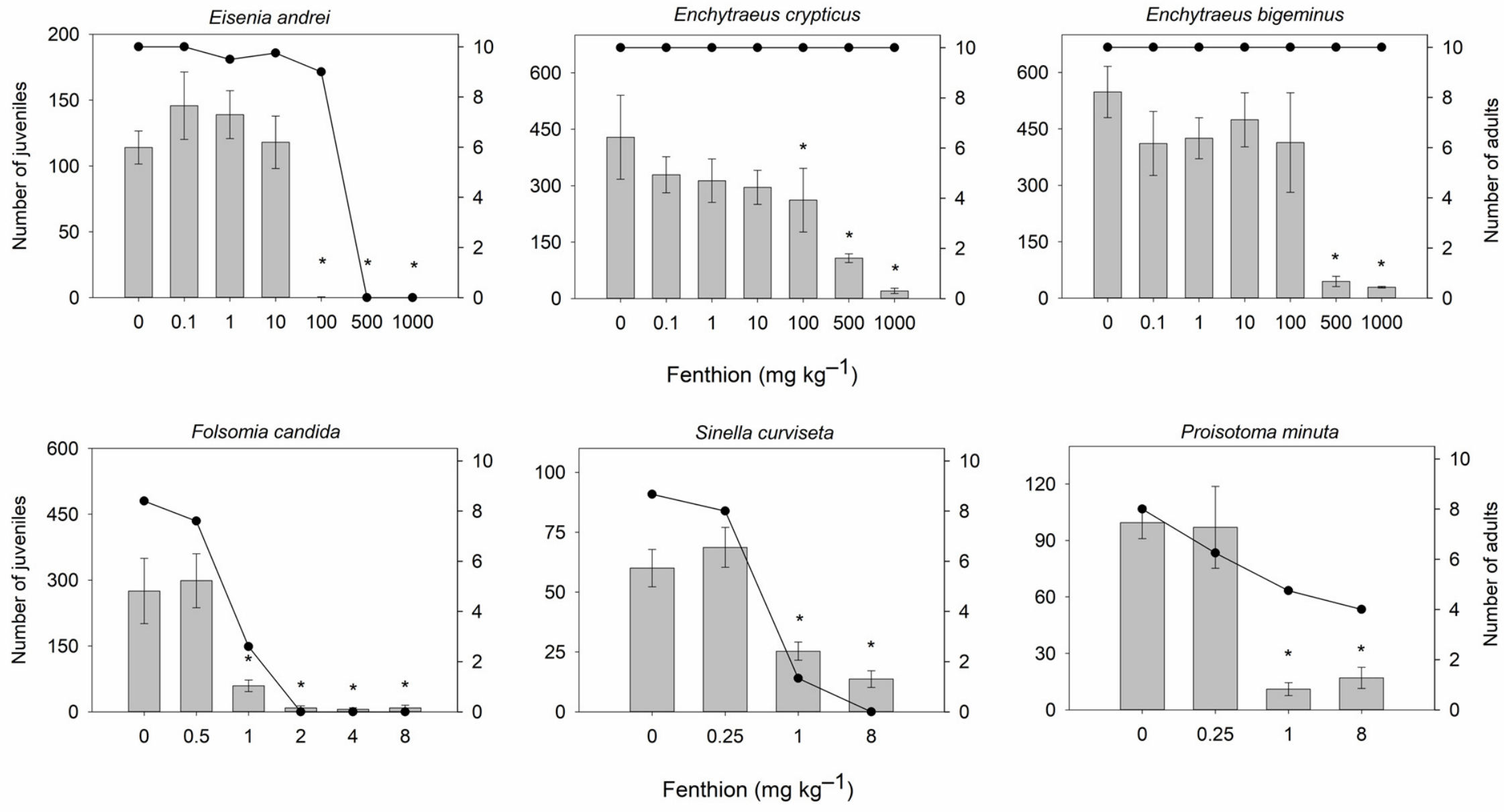
Fenthion caused a significant reduction in the production of juveniles of all bioassays performed, but the magnitude of the toxic effect varied with species (Figure 1). E. bigeminus was only significantly affected by 500 mg kg−1, whereas E. crypticus and E. andrei had their reproduction significantly reduced by 100 mg kg−1.
Collembolans were the most sensitive group, with significant reductions in reproduction starting at 1 mg kg−1 for all the species studied (Figure 1, Table 1). For F. candida, reproduction was strongly inhibited (78%) by 1 mg kg−1 onwards, with almost no offspring produced from 2 mg kg−1.

3.2. Species Sensitivity Distribution (SSD)

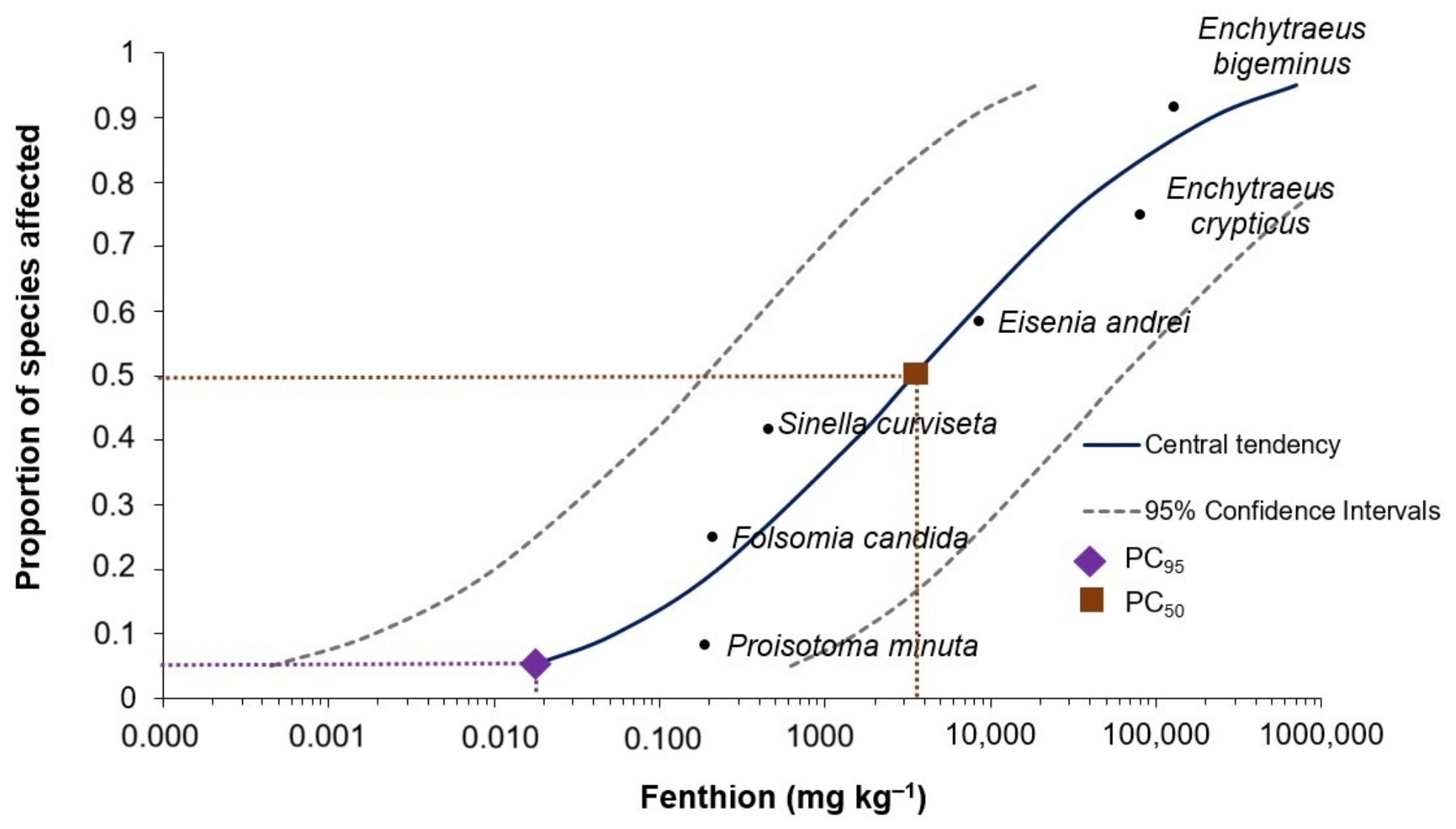
The SSD revealed a clear distinction of sensibility amongst the groups studied. Enchytraeids were clearly the least sensitive group to fenthion (Figure 2); a 20% reduction in the reproduction of species is expected only from concentrations of 80 mg kg−1 and above. Earthworms E. andrei, on the other hand, presented intermediate sensibility, with an EC20 9 to 15 times lower than those estimated for enchytraeids. Collembolans were relatively more sensitive to fenthion (Figure 2), with EC20 values in the range of 0.19–0.46 mg kg−1 (Table 1).
The protective concentration estimation revealed that a concentration of 0.017 mg kg−1 is the safe fenthion threshold to guarantee the protection of 95% of soil species. PC90, PC80 and PC50 values are also presented in Table 2.

4. Discussion

Regarding the EC50 values (Table 1), the values for both enchytraeid species are similar, with their 95% confidence intervals overlapping, indicating no significant difference in ecotoxicity between the two species. Despite that, Freitas et al. [31] observed that E. bigeminus was the most sensitive species to copper compared to E. crypticus and E. dudichi. In addition, this species can be found in different land-use scenarios of agricultural areas, which makes this species a realistic model for soil ecotoxicity bioassays [32].
Collembolans were significantly affected from 1 mg kg−1. From an ecosystem perspective, concentrations of this magnitude may represent a significant ecological risk for the species, since continuous exposure to these levels could lead to a decline in F. candida populations over time. The risk is also relevant for S. curviseta, as although this species still showed reproduction when exposed to 1 and 8 mg/kg, it reproduces sexually, generally producing fewer juveniles compared to F. candida, which reproduces through parthenogenesis [33,34].
In addition, although the EC50 values of the three collembolan species overlapped, we observed a 1.9- to 2.9-fold difference in the mean ECx values for P. minuta compared to S. curviseta, revealing that even within the same taxonomic group, different species can exhibit distinct responses to fenthion exposure in soil. These differences are likely related to the larger body size and consequently lower surface-area-to-volume ratio of S. curviseta, which limits cuticular toxicant uptake [35], combined with species-specific differences in habitat use and detoxification capacity documented for Collembola [36,37].
Studies evaluating the ecotoxicity of fenthion on soil invertebrates are scarce, but Márquez-Lázaro et al. [14] verified that fenthion did not cause growth inhibition of Eisenia fetida up to 50 µg kg−1 and that 75 µg kg−1 induced a statistically significant increase in earthworm’s growth compared to control. On the other hand, muscle protein carbonylation was significantly increased from 25 µg kg−1, indicating that biomarkers of oxidative stress might be considered when assessing the toxicity of fenthion toward soil invertebrates. In the environment, fenthion undergoes oxidative and hydrolytic degradation into metabolites such as fenthion phenol sulfoxide and fenthion phenol sulfone, which QSAR model estimations suggest may exert even higher ecotoxicity than the parent compound [38], although experimental validation of their effects on soil invertebrates remains absent in the literature.
Reis et al. [39] conducted a study in which the toxicity of amitraz—an antiparasitic compound that, like fenthion, acts on the arthropod nervous system—was tested for F. candida and E. crypticus in a tropical soil and found that the toxic effects of amitraz were more pronounced in collembolans than in enchytraeids, a pattern similar to the results obtained in the present experiment. The greater toxicity of amitraz and fenthion to collembolans compared to oligochaetes may be attributed to the fact that arthropods are one of the main targets of these active ingredients [40,41]. In general, synthetic compounds that act on acetylcholinesterase (AChE) tend to be more toxic to arthropods than to oligochaetes because these substances are designed to affect the insect nervous system, which shares significant similarities with that of other arthropods [26].
The recommended commercial dose of TIGUVON is approximately 7.5 g of active ingredient per animal (50 mL of commercial formulation recommended for one animal; TIGUVON contains 15 g a.i. per 100 mL). In a worst-case scenario, a maximum cattle density of 3.6 cattle units per hectare is expected in Brazilian pasturelands under intensification scenarios [42], and an excretion rate of 90% of the active ingredient [7,8] can be assumed. In this scenario, the estimated amount of fenthion reaching the soil in one hectare is about 24.3 g a.i. Assuming an incorporation depth of 5 cm and a soil density of 1500 kg m−3 [43], the estimated environmental concentration of fenthion after application of the commercial dose—assuming uniform distribution of the feces over one hectare—is 0.032 mg kg−1 (see Equation (S1) in the Supplementary Material for detailed calculation). Therefore, although this concentration is not expected to cause a significant reduction in species reproduction on chronic toxicity assays (Figure 1), it is almost twice higher than the PC95 value (0.017 mg kg−1). According to EC [44], the ecological risk of a certain compound is considered significant when the PEC/PNEC (predicted no-effect concentration) ratio is equal to or greater than 1; in our case, assuming the PC95 as the PNEC value, this ratio is 1.88, indicating that the ecological risk of fenthion to the species is significant/unacceptable. Therefore, our PC95 is likely a good initial protective threshold for soil invertebrates, but the veterinary use of this compound can result in contamination scenarios that equal or even exceed these limits.
It is also important to consider that fenthion can also be used as a pesticide, and its concentration in the soil may be higher when applied in this form. For example, Mahmud et al. [45] reported fenthion concentrations ranging from 1.65 to 1.81 µg g−1 (equivalent to mg kg−1) after pesticide application in agricultural soils used for watermelon cultivation. These concentrations would likely have a significant impact on collembolan reproduction and are higher than the PC80 (0.225 mg kg−1), indicating that more than 20% of species would be at risk.
Using commercial formulations rather than pure active ingredients in ecotoxicological evaluations provides a more realistic scenario for users and yields ecotoxicity outcomes that are more ecologically relevant from a regulatory point of view. Despite that, it must be recognized that fenthion-based formulations may contain organic solvents used to dissolve and stabilize the active ingredient (e.g., dipropylene glycol methyl ether; [25]). Therefore, a potential influence of the formulation vehicle on the final ecotoxicity cannot be completely ruled out. For future studies with fenthion, it is recommended to include a vehicle control to properly rule out any vehicle-related toxic effects.
Our experiments were conducted under standard conditions of soil moisture (e.g., 60% WHC) and temperature (20 °C). However, it must be noted that environmental conditions, particularly soil moisture, can directly influence the ecotoxicity of soil contaminants. Previous works already demonstrated a higher ecotoxicity of organic contaminants in scenarios of reduced soil moisture (e.g., 30–45% WHC) compared to standard soil moisture (50–60% WHC; [46,47]). Considering that drought scenarios are expected to be more frequent in a climate change world, drought stress could still amplify the toxic effects of fenthion observed in this study.
Our study brings new information about the toxicity thresholds for fenthion in soil, contributing to filling an existing regulatory gap in Brazil. Data from our study are also relevant for other countries, given that there is evidence that fenthion is also used in other regions around the world, such as North America [48] and Europe [49,50]. Although preliminary, the PCx values derived from our SSD are likely a reliable starting point for establishing environmentally protective concentrations of fenthion, once the modeling accounts for species covering at least three different taxonomic groups and with effective concentrations estimated for a natural sandy soil that potentially represents a worst-case scenario of exposure. The addition of ecotoxicity data obtained from other soil invertebrate species in our SSD, particularly other earthworm ecological guilds (e.g., endogeic or anecic species) rather than only the standard epigeic E. andrei, as well as other taxonomic groups such as Acari and Isopoda, is recommended as a continued step of research, in order to improve the accuracy and representativeness of the derived protective concentrations. Finally, future research should explore the cumulative effects of fenthion over time, as well as its combined impacts with other pollutants under field conditions.

5. Conclusions

Fenthion caused ecotoxicity in all the species tested, but the effects were higher for collembolans than for earthworms (intermediate sensitivity) and enchytraeids (least sensitive group). The protective concentration for 95% of soil species (0.017 mg kg−1) was lower than the predicted concentration following veterinary use, indicating that the risk for soil invertebrates is not negligible. Our results provide a more integrated understanding of the ecotoxicity of fenthion to soil faunal invertebrates, which could be helpful for environmental agencies in the establishment of threshold limits of this active ingredient in soil compartments.

Supplementary Materials

The following supporting information can be downloaded at https://www.mdpi.com/article/10.3390/soilsystems10080088/s1, Table S1: Adult survival (%), number of juveniles (±standard deviation) and coefficient of variation (CV) of the control treatments of chronic ecotoxicity bioassays conducted with earthworms Eisenia andrei, enchytraeids Enchytraeus crypticus and Enchytraeus bigeminus and collembolans Folsomia candida, Sinella curviseta and Proisotoma minuta exposed to fenthion in Entisol. Equation S1: Estimated environmental concentration of Fenthion in soil following veterinary application.

Author Contributions

Conceptualization, F.O.B. and D.B.; data curation, I.V.; formal analysis, F.O.B. and D.B.; investigation, I.V., Í.L.G. and R.P.; resources, D.B.; writing—original draft preparation, I.V. and F.O.B.; writing—review and editing, C.R.D.M.B., P.R.L.A. and D.B.; supervision, F.O.B. and D.B.; project administration, F.O.B. and D.B.; funding acquisition, D.B. All authors have read and agreed to the published version of the manuscript.

Funding

The authors thank the Fundacao de Amparo a Pesquisa e Inovacao do Estado de Santa Catarina (FAPESC) for the financial support (project number 2024TR002026, Edital 33/2024; Edital 35/2025). R.P. and F.O.B. thank the FAPESC for the SET-E and DCR-C grants (process numbers 1712/2024 and 910/2025, respectively).

Data Availability Statement

The data presented in this study will be made available as Supplementary Materials associated with the published article.

Acknowledgments

D.B. and C.R.D.M.B. thank the National Council for Scientific and Technological Development (CNPq) for their scientific productivity grants (process numbers 3081895939/2022-1 and 30249483/2022-0, respectively). During the preparation of this work, the authors used generative AI tools to assist in language revision, grammar checking and text improvement. The authors take full responsibility for the content of the publication and have carefully reviewed and edited all outputs.

Conflicts of Interest

The authors declare no conflicts of interest.

Abbreviations

The following abbreviations are used in this manuscript:
WHCWater-Holding Capacity

References

  1. IBGE (Instituto Brasileiro de Geografia e Estatistica). Value of Livestock and Agricultural Production Reached R$122.4 Billion in 2023. 2024. Available online: https://agenciadenoticias.ibge.gov.br/en/agencia-news/2184-news-agency/news/41366-value-of-livestock-and-agricultural-production-reached-r-122-4-billion-in-2023 (accessed on 10 January 2026).
  2. CONAB (Companhia Nacional de Abastecimento). Informações Agropecuárias. 2023. Available online: https://www.conab.gov.br/ (accessed on 15 January 2026). (In Portuguese)
  3. Telles, T.S.; Bichel, A.; Zanin, E.; Pellini, T.; Da Silveira Pontes, L. Livestock changes in Brazil and sustainable intensification challenges. Agronomy 2024, 14, 2429. [Google Scholar] [CrossRef]
  4. Grisi, L.; Leite, R.C.; De Souza Martins, J.R.; De Barros, A.T.M.; Andreotti, R.; Cançado, P.H.D.; De León, A.a.P.; Pereira, J.B.; Villela, H.S. Reassessment of the potential economic impact of cattle parasites in Brazil. Braz. J. Vet. Parasitol. 2014, 23, 150–156. [Google Scholar] [CrossRef]
  5. Forbes, A. Parasiticides: Perspectives and prospects. Livestock 2023, 28, 277–282. [Google Scholar] [CrossRef]
  6. SINDAN (Sindicato Nacional da Indústria de Produtos para Saúde Animal). Anuário Sindan 2024. 2025. Available online: https://sindan.org.br/wp-content/uploads/2025/06/INDUSTRIA-VETERINARIA-2024.pdf (accessed on 20 December 2025).
  7. Joint FAO/WHO Expert Committee on Food Additives. Residues of Some Veterinary Drugs in Animals and Foods: Monographs Prepared by the Fortieth Meeting of the Joint FAO/WHO Expert Committee on Food Additives, Geneva, 9–18 June 1992; Food and Agriculture Organization of the United Nations: Rome, Italy, 1993. [Google Scholar]
  8. Gaballah, M.S.; Guo, J.; Sun, H.; Aboagye, D.; Sobhi, M.; Muhmood, A.; Dong, R. A review targeting veterinary antibiotics removal from livestock manure management systems and future outlook. Bioresour. Technol. 2021, 333, 125069. [Google Scholar] [CrossRef] [PubMed]
  9. Batista Junior, A.C.; Maciel, L.Í.L.; Rocha, Y.A.; Souza, G.G.; Vaz, B.G.; Lopes, W.D.Z.; Botelho, A.F.M.; Chalom, M.Y.; Chaves, A.R. Assessing antiparasitic compounds persistence in cattle hair by DART-MS. J. Am. Soc. Mass Spectrom. 2024, 36, 201–208. [Google Scholar] [CrossRef] [PubMed]
  10. Rahalkar, K.; Ng, M.; Tan, E.M.J.; Tan, B.K.K.; Yao, Y.J.; Anantham, D.; Ponampalam, R. Fenthion flea-killer: Unpredictable and dangerous. Proc. Singap. Healthc. 2024, 33. [Google Scholar] [CrossRef]
  11. Bayer, S.A. Tiguvon Spot-On Product Label. 2021. Available online: https://casadalavoura.vteximg.com.br/arquivos/182.pdf (accessed on 22 July 2026).
  12. FAO/WHO. Pesticide Residues in Food—1995 Evaluations. Part I: Residues. Fenthion; Joint FAO/WHO Meeting on Pesticide Residues (JMPR): Rome, Italy, 1995. [Google Scholar]
  13. Cheke, R.A.; Adranyi, E.; Cox, J.R.; Farman, D.I.; Magoma, R.N.; Mbereki, C.; McWilliam, A.N.; Mtobesya, B.N.; van der Walt, E. Soil contamination and persistence of pollutants following organophosphate sprays and explosions to control red-billed quelea (Quelea quelea). Pest Manag. Sci. 2012, 69, 386–396. [Google Scholar] [CrossRef]
  14. Márquez-Lázaro, J.; Díaz-Pineda, K.; Méndez-Cuadro, D.; Rodríguez-Cavallo, E. Fluoroquinolone antibiotics and organophosphate pesticides induce carbonylation on Eisenia fetida muscle proteins. Sci. Total Environ. 2020, 758, 143954. [Google Scholar] [CrossRef] [PubMed]
  15. University of Hertfordshire. Agriculture & Environment Research Unit. Fenthion (Ref: OMS 2). Pesticide Properties Database. 2025. Available online: https://sitem.herts.ac.uk/aeru/ppdb/en/Reports/310.htm (accessed on 22 July 2026).
  16. ISO 11267:2023; Soil Quality—Inhibition of Reproduction of Collembola (Folsomia candida) by Soil Contaminants. International Standardization Organization: Genève, Switzerland, 2023.
  17. ISO 11268-2:2023; Soil Quality—Effects of Pollutants on Earthworms. Part 2: Determination of Effects on Reproduction of Eisenia fetida/Eisenia andrei. International Standardization Organization: Genève, Switzerland, 2023.
  18. ISO 16387:2023; Soil Quality: Effects of Pollutants on Enchytraeidae (Enchytraeus sp.). Determination of Effects on Reproduction and Survival. International Standardization Organization: Genève, Switzerland, 2023.
  19. Aldenberg, T.; Jaworska, J.S. Uncertainty of the hazardous concentration and fraction affected for normal species sensitivity distributions. Ecotoxicol. Environ. Saf. 2000, 46, 1–18. [Google Scholar] [CrossRef] [PubMed]
  20. Posthuma, L.; Suter, G.W.; Traas, T.P. Species Sensitivity Distributions in Ecotoxicology, 1st ed.; CRC Publisher: Boca Raton, FL, USA, 2002. [Google Scholar] [CrossRef]
  21. NEPC (National Environment Protection Council). Assessment of Site Contamination-Schedule B5a: Guideline on Ecological Risk Assessment; NEPC: Canberra, Australia, 2011. [Google Scholar]
  22. Tedesco, M.J.; Gianello, C.; Bissani, C.A.; Bohnen, H.; Volkweiss, S.J. Análise de Solo, Plantas e Outros Materiais, 2nd ed.; Boletim Técnico, 5; Universidade Federal do Rio Grande do Sul: Porto Alegre, Brazil, 1995; p. 147. [Google Scholar]
  23. EMBRAPA. Sistema Brasileiro de Classificação de Solos, 3rd ed.; Embrapa: Brasília, Brazil, 2013; p. 353. [Google Scholar]
  24. Bernardino, M.M.; Alves, P.R.L.; De Santo, F.B.; Niemeyer, J.C.; Leal, R.M.P. Ecotoxicity of imidacloprid to soil invertebrates in two tropical soils with contrasting texture. Environ. Sci. Pollut. Res. 2021, 28, 27655–27665. [Google Scholar] [CrossRef] [PubMed]
  25. Bayer Australia Ltd. Tiguvon Spot-on Cattle Lice Insecticide Material Safety Data Sheet (MSDS); Bayer Australia Ltd.: Pymble, NSW, Australia, 2012; Available online: https://assets.cdn.thewebconsole.com/S3WEB3986/images/Bayer-Tiguvon-Spot-on-Cattle-MSDS.pdf (accessed on 22 July 2026).
  26. Bandeira, F.O.; Alves, P.R.L.; Hennig, T.B.; Brancalione, J.; Nogueira, D.J.; Matias, W.G. Chronic effects of clothianidin to non-target soil invertebrates: Ecological risk assessment using the species sensitivity distribution (SSD) approach. J. Hazard. Mater. 2021, 419, 126491. [Google Scholar] [CrossRef] [PubMed]
  27. Bandeira, F.O.; Alves, P.R.L.; Hennig, T.B.; Schiehl, A.; Cardoso, E.J.B.N.; Baretta, D. Toxicity of imidacloprid to the earthworm Eisenia andrei and collembolan Folsomia candida in three contrasting tropical soils. J. Soils Sediments 2020, 20, 1997–2007. [Google Scholar] [CrossRef]
  28. Alves, P.R.L.; Cardoso, E.J.B.N.; Martines, A.M.; Sousa, J.P.; Pasini, A. Earthworm ecotoxicological assessments of pesticides used to treat seeds under tropical conditions. Chemosphere 2013, 90, 2674–2682. [Google Scholar] [CrossRef] [PubMed]
  29. Alves, P.R.L.; Natal-Da-Luz, T.; Sousa, J.P.; Cardoso, E.J.B.N. Ecotoxicological characterization of sugarcane vinasses when applied to tropical soils. Sci. Total Environ. 2015, 526, 222–232. [Google Scholar] [CrossRef] [PubMed]
  30. USEPA (United States Environmental Protection Agency). Species Sensitivity Distribution Generator (Version 1.0). 2005. Available online: https://www.epa.gov/sites/default/files/2017-10/ssd_generator_v1.xlsm. (accessed on 18 October 2025).
  31. Freitas, T.R.; Peron, R.A.S.; De Oliveira Filho, L.C.I.; Campos, M.L.; Klauberg-Filho, O.; Baretta, D. Copper prevention values in Brazilian subtropical soils. Chemosphere 2025, 372, 144079. [Google Scholar] [CrossRef] [PubMed]
  32. Assis, O.; Niva, C.C.; Brown, G.G. Using fragmenting enchytraeid species in ecotoxicological tests: Regeneration as a new endpoint. Ecotoxicology 2025, 34, 2192–2198. [Google Scholar] [CrossRef] [PubMed]
  33. Fountain, M.T.; Hopkin, S.P. FOLSOMIA CANDIDA (COLLEMBOLA): A “Standard” Soil Arthropod. Annu. Rev. Entomol. 2004, 50, 201–222. [Google Scholar] [CrossRef] [PubMed]
  34. De Lima E Silva, C.; Van Haren, C.; Mainardi, G.; De Rooij, W.; Ligtelijn, M.; Van Straalen, N.M.; Van Gestel, C.A.M. Bringing ecology into toxicology: Life-cycle toxicity of two neonicotinoids to four different species of springtails in LUFA 2.2 natural soil. Chemosphere 2020, 263, 128245. [Google Scholar] [CrossRef] [PubMed]
  35. Gergs, A.; Kulkarni, D.; Preuss, T.G. Body size-dependent toxicokinetics and toxicodynamics could explain intra- and interspecies variability in sensitivity. Environ. Pollut. 2015, 206, 449–455. [Google Scholar] [CrossRef] [PubMed]
  36. Zhang, F.; Ding, Y.; Zhou, Q.S.; Wu, J.; Luo, A.; Zhu, C.D. A High-quality Draft Genome Assembly of Sinella curviseta: A Soil Model Organism (Collembola). Genome Biol. Evol. 2019, 11, 521–530. [Google Scholar] [CrossRef] [PubMed]
  37. Joimel, S.; Chassain, J.; Artru, M.; Faburé, J. Collembola are Among the Most Pesticide-Sensitive Soil Fauna Groups: A Meta-Analysis. Environ. Toxicol. Chem. 2022, 41, 2333–2341. [Google Scholar] [CrossRef] [PubMed]
  38. Vagi, M.C.; Petsas, A.S.; Pavlaki, M.D.; Smaragdaki, N.M.; Kostopoulou, M.N. Toxic Effects of the Organophosphorus Insecticide Fenthion on Growth and Chlorophyll Production Activity of Unicellular Marine Microalgae Tetraselmis suecica: Comparison between Observed and Predicted Endpoint Toxicity Data. In Insecticides—Agriculture and Toxicology; IntechOpen: London, UK, 2018. [Google Scholar] [CrossRef]
  39. Reis, T.R.D.; Segat, J.C.; Cardoso, E.J.B.N.; Baretta, D. The toxicity of the antiparasitic amitraz in tropical soils on the reproduction of edaphic organisms. Ecotoxicol. Environ. Contam. 2023, 18, 12–19. [Google Scholar] [CrossRef]
  40. Guo, L.; Fan, X.-Y.; Qiao, X.; Montell, C.; Huang, J. An octopamine receptor confers selective toxicity of amitraz on honeybees and Varroa mites. eLife 2021, 10, e68268. [Google Scholar] [CrossRef] [PubMed]
  41. Lee, J.; Kim, J.-H. Simultaneous analysis of fenthion and its five metabolites in produce using Ultra-High Performance Liquid Chromatography-Tandem Mass spectrometry. Molecules 2020, 25, 1938. [Google Scholar] [CrossRef] [PubMed]
  42. Arantes, A.E.; De Moreira Couto, V.R.; Sano, E.E.; Ferreira, L.G. Livestock intensification potential in Brazil based on agricultural census and satellite data analysis. Pesqui. Agropecu. Bras. 2018, 53, 1053–1060. [Google Scholar] [CrossRef]
  43. Broch, D.T.; Klein, V.A. Maximum soil density of Entisols as a function of silt content. Cienc. Rural 2017, 47, e20160762. [Google Scholar] [CrossRef][Green Version]
  44. EC—European Comission. Technical guidance document on risk assessment. In Support of Commission Directive 93/67/EEC; Commission Regulation (EC) No 1488/94 and Directive 98/8/EC; European Commission Joint Research Center: Brussels, Belgium, 2003. [Google Scholar]
  45. Mahmud, M.M.; Akan, J.C.; Mohammed, Z.; Battah, N. Assessment of Organophosphorus and Pyrethroid Pesticide Residues in Watermelon (Citrulus lanatus) and Soil Samples from Gashua, Bade Local Government Area Yobe State, Nigeria. J. Environ. Pollut. Hum. Health 2015, 3, 52–61. [Google Scholar] [CrossRef]
  46. Hennig, T.B.; Alves, P.R.L.; Toniolo, T.; Bandeira, F.O.; Dos Santos, W.E.; Cabrera, L.D.C.; Gilson, Í.K.; Baretta, D. Toxicity of fipronil to Folsomia candida in contrasting tropical soils and soil moisture contents: Effects on the reproduction and growth. Ecotoxicology 2022, 31, 64–74. [Google Scholar] [CrossRef] [PubMed]
  47. Bandow, C.; Karau, N.; Römbke, J. Interactive effects of pyrimethanil, soil moisture and temperature on Folsomia candida and Sinella curviseta (Collembola). Appl. Soil Ecol. 2014, 81, 22–29. [Google Scholar] [CrossRef]
  48. Cox, D.D.; Mullee, M.T.; Allen, A.D. Cattle grub control with feed additives (coumaphos and fenthion) and pour-ons (fenthion and trichlorfon). J. Econ. Entomol. 1967, 60, 522–527. [Google Scholar] [CrossRef]
  49. O’Keeffe, M.; Eades, J.F.; Strickland, K.L. Fenthion residues in milk and milk products following treatment of dairy cows for warble-fly. J. Sci. Food Agric. 1983, 34, 192–197. [Google Scholar] [CrossRef] [PubMed]
  50. Stendel, W. Control of cattle grubs with fenthion pour-on and trichlorfon spot-on in Germany. Vet. Parasitol. 1977, 3, 245–249. [Google Scholar] [CrossRef]
Figure 1. Mean number of juveniles (bars ± SD, left y-axis) and adults (dots with line, right y-axis) of earthworms Eisenia andrei (n = 4), Enchytraeus crypticus and Enchytraeus bigeminus (n = 4) and collembolans Folsomia candida (n = 5), Sinella curviseta (n = 3) and Proisotoma minuta (n = 3) found in Entisol contaminated with increasing concentrations of a fenthion-based veterinary formulation. Asterisks (*) indicate a significant reduction in the number of generated juveniles compared to the control treatment (Dunnett’s post hoc test, p < 0.05).
Soilsystems 10 00088 g001
Figure 2. Species sensitivity distribution (SSD) curve elaborated with the EC20 values derived from chronic ecotoxicity assays with fenthion for six different species of soil invertebrates. PCx: protective concentrations for x% of soil invertebrate species.
Soilsystems 10 00088 g002
Table 1. Reproduction-based ecotoxicological parameters (NOEC, LOEC, EC10, EC20 and EC50, expressed as mg kg−1, with 95% confidence limits in parentheses) from ecotoxicity assays with earthworms Eisenia andrei, enchytraeids Enchytraeus crypticus and Enchytraeus bigeminus and collembolans Folsomia candida, Sinella curviseta and Proisotoma minuta exposed to Entisol contaminated with increasing concentrations of a fenthion-based veterinary formulation.
Parameter Species
E. andreiE. crypticusE. bigeminusF. candidaS. curvisetaP. minuta
NOEC10101000.500.250.25
LOEC100100500111
EC103.50 (0.33–6.68)43.5 (a)94.7 (21.8–167)0.08 (a)0.35 (a)0.12 (a)
EC208.49 (4.19–12.8)80.90 (a)130 (46.6–212)0.21 (0.10–0.33)0.46 (0.03–0.90)0.19 (0.06–0.34)
EC5028.4 (14.0–42.8)234 (88.4–379)221 (107–336)0.72 (0.41–1.03)0.93 (0.19–1.67)0.48 (0.18–0.78)
(a) Data did not allow the estimation of the 95% confidence limits.
Table 2. Fenthion protective concentrations for x % of soil species (PC95, PC90, PC80 and PC50) estimated from species sensitivity distribution curve elaborated with chronic toxicity assays with six species of soil invertebrates.
ParameterValue (mg kg−1) a
PC950.017 (0.001–0.621)
PC900.054 (0.002–1.550)
PC800.225 (0.010–5.028)
PC503.432 (0.188–62.688)
a The 95% confidence intervals were presented in parentheses.
Disclaimer/Publisher’s Note: The statements, opinions and data contained in all publications are solely those of the individual author(s) and contributor(s) and not of MDPI and/or the editor(s). MDPI and/or the editor(s) disclaim responsibility for any injury to people or property resulting from any ideas, methods, instructions or products referred to in the content.