


Abstract
Heavy metal/loid (HM) pollution of soils, primarily as a consequence of mining and ore-processing activities, poses significant risks to ecosystems and human health. Soil microbial communities play essential roles in maintaining key ecosystem functions, including nutrient cycling, carbon sequestration, and soil stability. The purpose of this study was to characterize the taxonomic composition and diversity of bacterial communities and evaluate their functional adaptation to heavy metal stress in soils affected by long-term gold–copper mining activities in Bulgaria. Ten soil samples representing a Cu pollution gradient (53–860 mg kg−1) were categorized into five pollution classes. High-throughput sequencing of 16S rRNA gene amplicons revealed the dominance of the phyla Pseudomonadota (mean relative abundance 32%), Acidobacteriota (22%), and Actinomycetota (16%). At the class level, Alphaproteobacteria (18%), Terriglobia (16%), and Gammaproteobacteria (14%) were the most abundant taxa, indicating their adaptation to long-term heavy metal contamination. The genus Z2-YC6860 exhibited significant tolerance to Cu, whereas Bradyrhizobium_503372 was negatively associated with As and Zn concentrations. Functional predictions suggested enrichment of key pathways related to heavy metal resistance, including efflux systems and detoxification. The study design spans a broad Cu pollution gradient across river-associated and industrially impacted sites, providing an ecologically relevant framework for evaluating microbial responses to long-term metal stress.
1. Introduction
Environmental heavy metal pollution is a globally widespread problem, and its effects on the soil microbiome have been extensively investigated. Heavy metals (HMs) are released into the environment through anthropogenic activities such as mining and metallurgical operations [1]. Their accumulation in soils exerts toxic effects on bacterial communities, ultimately impairing soil quality and ecosystem functioning. Soil bacteria play a crucial role in nutrient cycling, soil fertility, and carbon sequestration, all of which are essential for maintaining soil ecological functions [2].
Previous studies have identified several general trends in the response of soil bacterial communities to heavy metals and metalloids, including decreased microbial diversity [3,4,5], reduced bacterial abundance [6,7], increased proportions of metal-resistant taxa [3,8,9], and alterations in microbial biomass and metabolic activity [10]. Metagenomic approaches combined with Illumina high-throughput sequencing have revealed that soil microbial communities in mining-impacted areas are typically dominated by the phyla Pseudomonadota, Actinomycetota, Bacteroidota, Acidobacteriota, and Chloroflexota [11,12,13,14], with marked shifts in their relative abundances across different mining sites. For example, Epelde et al. [15] reported a decline in Actinomycetota and Acidobacteriota in Pb–Zn mining soils, accompanied by an increased prevalence of Chloroflexota, particularly members of the class Ktedonobacteria. Fajardo et al. [16] identified Firmicutes as the most resistant phylum under high concentrations of heavy metals, which selectively displaced other bacterial phyla such as Pseudomonadota, Actinomycetota, and Verrucomicrobiota. Zhao et al. [8] also observed the dominance of Pseudomonadota and Firmicutes across various mining regions and reported a positive correlation between these phyla and heavy metal concentrations (Cu, Zn, Pb).
At the class and genus levels, several studies have highlighted the abundance of Alphaproteobacteria, with the genus Bradyrhizobium showing increased relative abundance in highly contaminated mining sites [17,18]. Other frequently reported classes include Gammaproteobacteria [19,20], Bacilli [21], and additional metal-tolerant taxa [21,22].
Based on metagenomic data, the ecological functions of bacterial communities have frequently been inferred using PICRUSt2 [23]. Functional metagenomic approaches provide insights into genes involved in essential soil microbial processes and enable the identification of microbial taxa harboring genes associated with resistance to heavy metals and metalloids. Such microorganisms constitute a valuable resource for the development of bioremediation strategies [17]. In mining-impacted soils, predicted functional profiles frequently indicate enhanced expression of metal resistance genes (such as znuD, zntA, pbrB, and pbrT, ars operon, copA), revealing adaptive pathways for HM resistance [17,18,19,24].
The adaptive capacity of soil microbiota depends not only on heavy metal concentrations and bioavailability, but also on local soil attributes [11]. Several studies have demonstrated that soil physicochemical parameters, particularly soil pH, organic carbon content, and total heavy metal concentrations, strongly influence the distribution and structure of bacterial communities across different soil types [3,8,25,26].
Despite extensive research, our understanding of the diversity and composition of bacterial communities across different soil habitats within mining regions, as well as the relative contributions of environmental factors and varying levels of heavy metal pollution, remains limited. The main objectives of this study were to: (i) characterize the taxonomic composition and diversity of bacterial communities in mining-impacted heavy metal polluted soils; and (ii) evaluate their functional adaptation to heavy metal stress. For this purpose, high-throughput sequencing of the 16S rRNA gene (V3–V4 region) was performed to characterize bacterial community composition and PICRUSt2 was used to predict their functional profiles.
We hypothesized that heavy metal pollution and local soil properties jointly shape bacterial community structure by selecting for bacterial taxa well adapted to heavy metal stress. The study was conducted in the Zlatitsa–Pirdop Valley region in Western Bulgaria, which has been affected by copper–gold mining for decades. The region contains one of the largest gold-copper deposits on the Balkan Peninsula. Long-term monitoring data indicate persistent soil pollution of diffuse or pedogenic origin, primarily with Cu, Zn, Pb, Cd, and As [27,28]. By integrating river-associated and industrially impacted agricultural soils spanning a broad Cu pollution gradient (53–860 mg kg−1), this study provides new insights into microbial adaptation and resilience and supports the development of microbial indicators for soil health assessment and bioremediation strategies.
2. Materials and Methods
2.1. Study Area and Soil Sampling
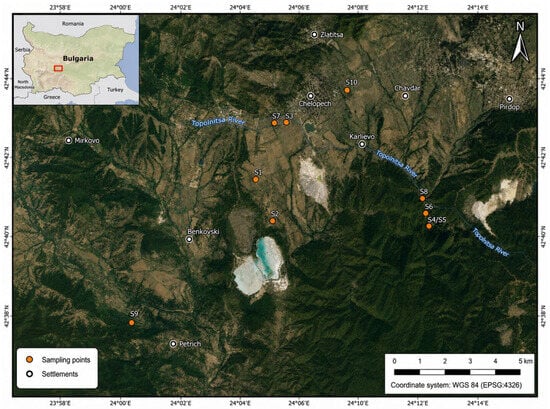
Soil samples were collected in May 2024 from different land-use types in the Zlatitsa–Pirdop Valley region, Western Bulgaria, along a gradient of Cu pollution and co-contaminants Zn, Pb, Cd, and As (Figure 1). The soil samples S1 (42°40′26.3″ N, 24°03′11.5″ E), S2 (42°39′16.9″ N, 24°03′42.5″ E), S3 (42°41′25.8″ N, 24°04′09.4″ E), S7 (42°41′23.6″ N, 24°03′49.5″ E) and S10 (42°42′05.0″ N, 24°05′50.5″ E) were collected from highly industrialized area, characterized by numerous mines and processing plants for copper and other non-ferrous metals. The soil samples, noted S4 (soil) and S5 (sediment) (42°39′14.0″ N, 24°09′02.8″ E), S6 (42°39′26.6″ N, 24°08′14.3″ E), S8 (42°39′47.0″ N, 24°08′10.0″ E) and S9 (42°36′40.7″ N, 24°00′46.8″ E) were collected in the vicinity of the Topolnitsa River and its tributaries (Medetska, Zlatishka and Bunovska Rivers), which are impacted by mining and metallurgical activities and serve as the main irrigation network for the surrounding agricultural lands. Soil samples were collected from agricultural fields with industrial and oilseed crops (Lavandula vera L., Gossypium sp., Brassica napus) and from pastures. The soils were classified as Fluvisols [29]; sampling sites encompassed both alluvial settings along the Topolnitsa River system and deluvial-alluvial settings within the adjacent valley and foothill areas. The Zlatitsa–Pirdop Valley is a Sub-Balkan valley situated between the Balkan Mountains to the north and Sredna Gora to the south, with the Topolnitsa River and its tributaries forming the main drainage network [27,28]. The study area therefore represents a mixed industrial-agricultural landscape in which mining and metallurgical activities occur in proximity to agricultural fields, pastures, settlements, and waters used for irrigation [27,28]. Sampling locations were selected to represent contrasting positions along the Cu-dominated contamination gradient, including highly industrialized sites and river-associated agricultural settings.
Figure 1.
Map of the sampling sites in the region of Zlatitsa–Pirdop Valley, Western Bulgaria.
At each site, five subsamples (approximately 200 g each) were randomly collected within a 100 m × 100 m quadrat from the upper 0–20 cm layer to account for small-scale spatial heterogeneity. The five subsamples were combined and homogenized to obtain one representative composite sample per site. After collection, the sample material was sieved, and each composite sample was divided into two portions: one stored at −80 °C for molecular analysis and the other at 4 °C for physicochemical analysis.
2.2. Soil Physicochemical Properties
Soil pH (H2O) (1:2.5 soil/water ratio) was determined according to BDS EN ISO 10390:2022 [30], and organic carbon (TOC) was measured according to [31]. Soil moisture (SM) was calculated after oven drying (105 °C).
2.3. Heavy Metal Content and the Level of Pollution
The concentrations of HMs were determined by inductively coupled plasma optical emission spectrometry (ICP-OES) using an Agilent 5800 instrument (Agilent Technologies, Santa Clara, CA, USA) after microwave-assisted aqua regia digestion (ETHOS EASY, Milestone, Sorisole (BG), Italy) of soil samples, in accordance with ISO 11047:1998 [32]. The Single Pollution Index (PI) and the integrated Nemerow pollution index (NPI) were calculated to assess the level of HM pollution [33]. NPI values were interpreted as follows: <0.7, clean; 0.7–1.0, warning limit; 1.0–2.0, slight pollution; 2.0–3.0, moderate pollution; and >3.0, high pollution [33]. The maximum permissible concentrations (MPC) of heavy metals specified by Bulgarian Regulation 3/2008 were used as a reference for calculating the PI and NPI (Ministry of Environment and Water of the Republic of Bulgaria, National Legislation (Soils), available at: https://www.moew.government.bg/bg/pochvi/zakonodatelstvo/nacionalno-zakonodatelstvo/ (accessed on 1 August 2008)). For S5, which is a sediment sample, the corresponding soil thresholds were used solely as comparative screening values and do not represent legally applicable sediment-quality criteria.
2.4. DNA Extraction and Illumina Sequencing
Total DNA was extracted from 0.5 g of soil using the E.Z.N.A. DNA Soil Kit (Omega Bio-tek, Norcross, GA, USA) following the manufacturer’s protocol. DNA concentration and purity were measured using a Qubit 4 Fluorometer (Thermo Scientific, Waltham, MA, USA) and a NanoDrop 1000 spectrophotometer (Thermo Scientific, Waltham, MA, USA), respectively. DNA quality was assessed by 1% agarose gel electrophoresis. Targeted sequencing of 16S amplicons (V3–V4 region) was performed with barcoded primers 341F (5′-CCTACGGGNGGCWGCAG-3′) and 806R (5′-GACTACHVGGGTATCTAATCC-3′) [34]. Amplicon libraries were prepared and sequenced on an Illumina MiSeq platform (Macrogen, Seoul, Republic of Korea) with 2 × 300 bp reads.
2.5. Bioinformatics and Data Processing
After trimming the barcodes, the raw sequencing data were processed with the standard QIIME2 pipeline [35]. DADA2 was used to cut primer sequences, denoise and select representative sequences [36]. Predicted functional changes in the bacterial community were assessed with the Phylogenetic Investigation of Communities by Reconstruction of Unobserved States (PICRUSt2) software package, v.2.6.3. [23]. The resulting KO IDs were manually annotated using the KEGG database to estimate the abundances of HM resistance genes.
Taxonomic classification of bacterial sequences was performed with a Naive Bayes classifier pre-trained on the Greengenes 13_8 99% OTU reference database (2024.09.taxonomy) [37,38]. ASVs were clustered at 99% sequence identity. Chimera checking was conducted on aligned 16S rRNA sequences using the UCHIME algorithm [39]. Alpha diversity indices, including observed features (ASVs), ACE, Chao1, and Shannon, were calculated using the QIIME 2 platform.
2.6. Data Analyses
Statistical analyses and graphical outputs were performed in R version 4.4.1, using the pheheatmap, ggplot2, tidyr and dplyr packages [40]. Relationships between bacterial taxonomic abundance at the genus level, soil physicochemical properties, and HM concentrations were analyzed using Spearman’s rank correlation at a significance level of p < 0.05. Benjamini–Hochberg false discovery rate (FDR) correction was also performed to account for multiple comparisons.
3. Results
3.1. Heavy Metal Content, Level of Pollution, and Soil Physicochemical Properties
The concentrations of Cu in S1, S4–S10 soil samples exceeded the corresponding maximum permissible concentrations (MPCs) under Bulgarian legislation (Table 1). Pollution indices (PIs) (Table S1) and NPI were calculated as the ratios of measured heavy metal content and MPCs to assess the pollution levels of the soils [33]. Cu had the highest mean single-element pollution index (mean PI(Cu) = 3.0) and was the major contributor to the overall pollution assessment, which categorized the soils as moderately contaminated. The overall heavy metal pollution, based on the calculated NPI, follows the order: S1 and S2 (clean, uncontaminated) < S3 (warning) < S4, S5 and S6 (slight) < S7 and S8 (moderate) < S9 and S10 (high) (Table 1). Pb exceeded the applicable soil MPC only in S10. Elevated As concentrations were recorded in S2, S3, S7, S8, and S10; the corresponding PI values are reported in Table S1. Soils were nutrient-rich, with TOC ranging from 12.5 g·kg−1 to 42.6 g·kg−1, except for S9 at 5.9 g·kg−1. pH varied from moderately acidic 5.3 to slightly alkaline 7.3. SM (%) was higher in S4, S8, and S9.
Table 1.
HMs content, level of pollution, and soil physicochemical properties.
3.2. Alpha Diversity of Bacterial Communities
A total of 136,036 high-quality bacterial reads were obtained from 16S rRNA sequencing of the 10 topsoil samples, and detected sequences of each sample varied from 12,834 to 15,563, with a length of 301 bp (Table 2). The valid sequences were clustered into 5133 ASVs based on 99% similarity, which were taxonomically classified into 25 phyla, 47 classes, and 320 genera (105 genera were >1.5%).
Table 2.
Diversity estimation statistics of bacterial communities.
The alpha diversity indices (ACE and Chao1) showed considerable variation among the studied soils, while showing a similar pattern across samples with ACE values ranging from 325.01 to 770.39 and Chao1 values from 331.33 to 756.06. Four samples exhibited relatively low estimated richness (331.33 to 517.40), whereas others showed substantially higher richness (597.45–756.06), suggesting marked variation in bacterial taxon richness across the sampled soils. This difference indicates that some soils may harbor approximately twice the number of bacterial taxa compared with others. Shannon index ranged from 7.97 to 8.89, which suggests that the soils had high bacterial richness and diversity.
3.3. Taxonomic Composition and Structure of Soil Bacterial Communities
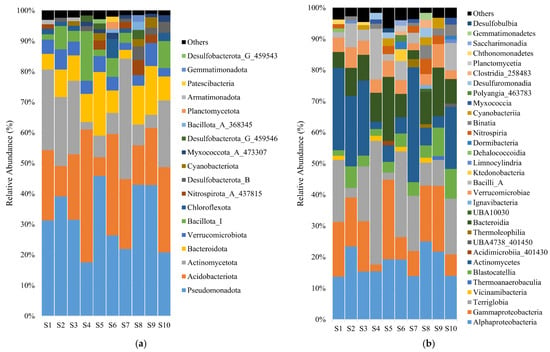
Bacterial community analyses on soil samples revealed a total of 25 bacterial phyla, and only 18 phyla displayed a relative abundance <1%. Pseudomonadota, Acidobacteriota and Actinomycetota represented 70% of the bacterial sequences (Figure 2a). Pseudomonadota showed higher relative abundance in clean, warning, slight (S5), moderate (S8) and high (S9) (31–45%) levels of HM pollution. In contrast, its abundance decreased markedly in soils S4, S7, and S10, where it accounted for only 17–20% of the community. An opposite trend was observed for Acidobacteriota, whose relative abundance increased substantially in these samples, reaching a maximum of 43.54% in S4. Actinomycetota were relatively evenly distributed among the clean, warning, and highly polluted (S10) soils, with relative abundances ranging from 21.87% to 26.40%. However, a pronounced increase was observed in the moderately polluted soil S7, where this phylum represented 39.49% of the bacterial community.
Figure 2.
Relative abundance of bacterial phyla (a) and bacterial classes (b) in soils. ‘Others’ represents the summed relative abundance of phyla/classes < 1%.
Among the subdominant phyla, Bacteroidota exhibited elevated relative abundances in the slightly polluted (S5), moderately polluted (S8), and highly polluted (S9) soils, ranging from 12.75% to 20.87%. Verrucomicrobiota were relatively evenly distributed across most soils; however, their abundance decreased in the moderately polluted (S7 and S8) and highly polluted (S10) soils, declining from 3.47% to 2.27%, respectively. Notably, increased abundances of Bacillota_I and Chloroflexota were observed in specific samples. Bacillota_I reached 16.25% in the slightly polluted soil S4, whereas Chloroflexota attained its highest relative abundance in sample S6 (6.23%).
At the class level, 31 bacterial classes (relative abundance < 1%) were detected across soils along the Cu pollution gradient (Figure 2b). The bacterial communities were predominantly composed of Alphaproteobacteria, Gammaproteobacteria, and Terriglobia. Alphaproteobacteria displayed a relatively stable distribution across the soils, contributing 13.69–25.0% of the total community. In contrast, the relative abundance of Gammaproteobacteria varied considerably among samples, ranging from 2.0% in S4 to 25.0% in S5. Terriglobia showed an inverse distribution, with the highest abundances in the slightly polluted soils S4 (39.71%) and S6 (27.58%), followed by a pronounced decline in S5 (2.27%). Actinomycetes were particularly enriched in S7 (approximately 37%) and remained among the dominant classes in S1, S2, S3, and S10, whereas Bacteroidia were more abundant in S5, S8, and S9. Blastocatellia showed a relatively uniform distribution across samples but increased in highly polluted soils (S9 and S10), reaching approximately 10%. Members of Verrucomicrobiae accounted for 3.47–7.55% of the bacterial community in most soils but were less abundant in S7 and S8. Bacilli_A was markedly enriched in S4 (16%) and was absent from S8 and S9.
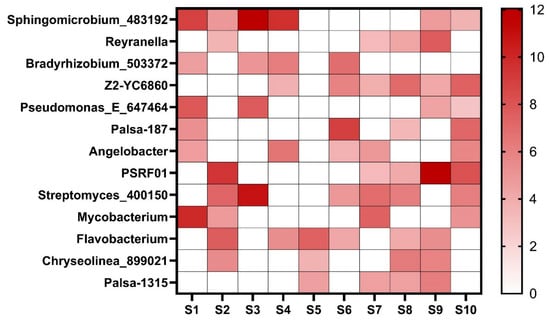
At the genus level, the relative abundance of the 13 most dominant bacterial genera across the soil samples is presented in Figure 3. Distinct distribution patterns were observed along the Cu pollution gradient. Sphingomicrobium_483192 (class Alphaproteobacteria) was among the dominant genera in the uncontaminated, warning and slightly polluted soils (S1–S4), reaching its highest relative abundance in warning S3 soil (12.01%). Its abundance markedly decreased in the highly polluted soils (S9–S10), remaining below 5%.
Figure 3.
Heatmap showing the relative abundance of the dominant 13 bacterial genera (<1.5%) across all soils. Color intensity represents the relative abundance (%).
In contrast, Z2-YC6860 (Alphaproteobacteria) was more abundant in moderately and highly polluted soils, particularly in S8–S10, where its relative abundance ranged from approximately 5.0% to 7.4%, with the highest value recorded in S10. Lower abundances were observed in the slightly polluted soils.
Palsa-1315 (class Nitrospiria) exhibited a relatively stable distribution across most soil samples, with abundances around 5%. However, its abundance increased in the highly polluted soils, reaching a maximum of 6.11% in S9. PSRF01 (class Blastocatellia) displayed considerable variation among the soil samples. Relatively low abundances were detected in the moderately polluted soils S7 and S8 (3.28% and 4.09%, respectively), whereas substantially higher abundances were observed in the highly polluted soils S9 (12.05%) and S10 (8.09%). Notably, a high abundance was also recorded in the uncontaminated S2 (9.40%), indicating that factors other than heavy metal pollution may also influence its distribution. The results revealed a shift in the dominant bacterial genera along the pollution gradient, with Sphingomicrobium_483192 prevailing in the less contaminated soils, whereas Z2-YC6860, Palsa-1315, and PSRF01 tended to increase in abundance under higher levels of heavy metal pollution.
3.4. Relationships of Heavy Metal Concentrations, Soil Properties and Bacterial Genera
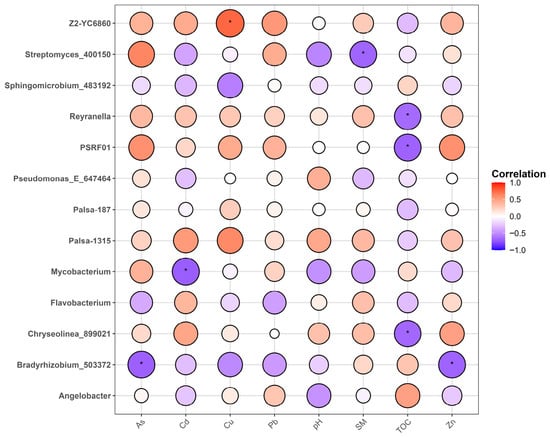
The relationships between HM concentrations, soil physicochemical properties, and bacterial genera were assessed using Spearman’s rank correlation analysis, with statistical significance determined at p < 0.05 (Figure 4). It showed that several bacterial genera exhibited distinct responses to HM pollution and local soil properties. Z2-YC6860 and Reyranella (class Alphaproteobacteria), PSRF01 (class Blastocatellia), and Palsa-1315 (class Nitrospiria) generally showed positive correlations with most HMs. Among them, Z2-YC6860 exhibited a significant positive correlation with Cu concentration (Spearman’s ρ = 0.7504, p < 0.05), suggesting a potential adaptation to Cu-enriched environments. In contrast, Bradyrhizobium_503372 (class Alphaproteobacteria) was negatively correlated with all investigated HMs. Significant negative correlations were observed with As (Spearman’s ρ = −0.6828, p < 0.05) and Zn (Spearman’s ρ = −0.6760, p < 0.05). Similarly, Mycobacterium (Actinomycetes) showed a significant negative correlation with Cd concentration (Spearman’s ρ = −0.6964, p < 0.05).
Figure 4.
Correlation analysis between dominant bacterial genera, heavy metals and soil physicochemical properties. Bubble plots represent the Spearman correlation coefficients between bacterial taxa and environmental variables. Red circles indicate positive correlations, while blue circles indicate negative correlations; circle size corresponds to the correlation strength. Asterisks (*) indicate statistically significant correlations at p < 0.05.
Regarding soil physicochemical properties, Reyranella, PSRF01, and Chryseolinea_899021 (Bacteroidia) were significantly negatively correlated with TOC, with Spearman’s correlation coefficients of −0.6487, −0.6788, and −0.6555, respectively (p < 0.05). Negative correlations with (SM) and pH were also observed for Streptomyces_400150 and Mycobacterium, while Angelobacter (Terriglobia) was negatively correlated with pH. However, among these relationships, only the correlation between Streptomyces_400150 and SM was statistically significant (Spearman’s ρ = −0.6713, p < 0.05). Although several significant correlations were observed between bacterial genera, HMs and soil physicochemical properties, none remained significant after FDR correction, likely due to the limited number of soils and high number of comparisons.
The correlation analysis indicated that several bacterial genera, particularly Z2-YC6860, Reyranella, and PSRF01, were positively associated with elevated HM concentrations, whereas Bradyrhizobium_503372 and Mycobacterium appear to be negatively affected by increasing metal levels. These patterns suggest differential ecological adaptation of bacterial taxa to HM pollution and local environmental conditions.
3.5. Predicted Bacterial Metabolic Pathways Related to HM Resistance
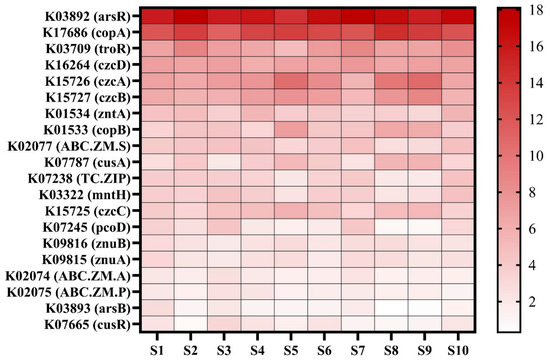
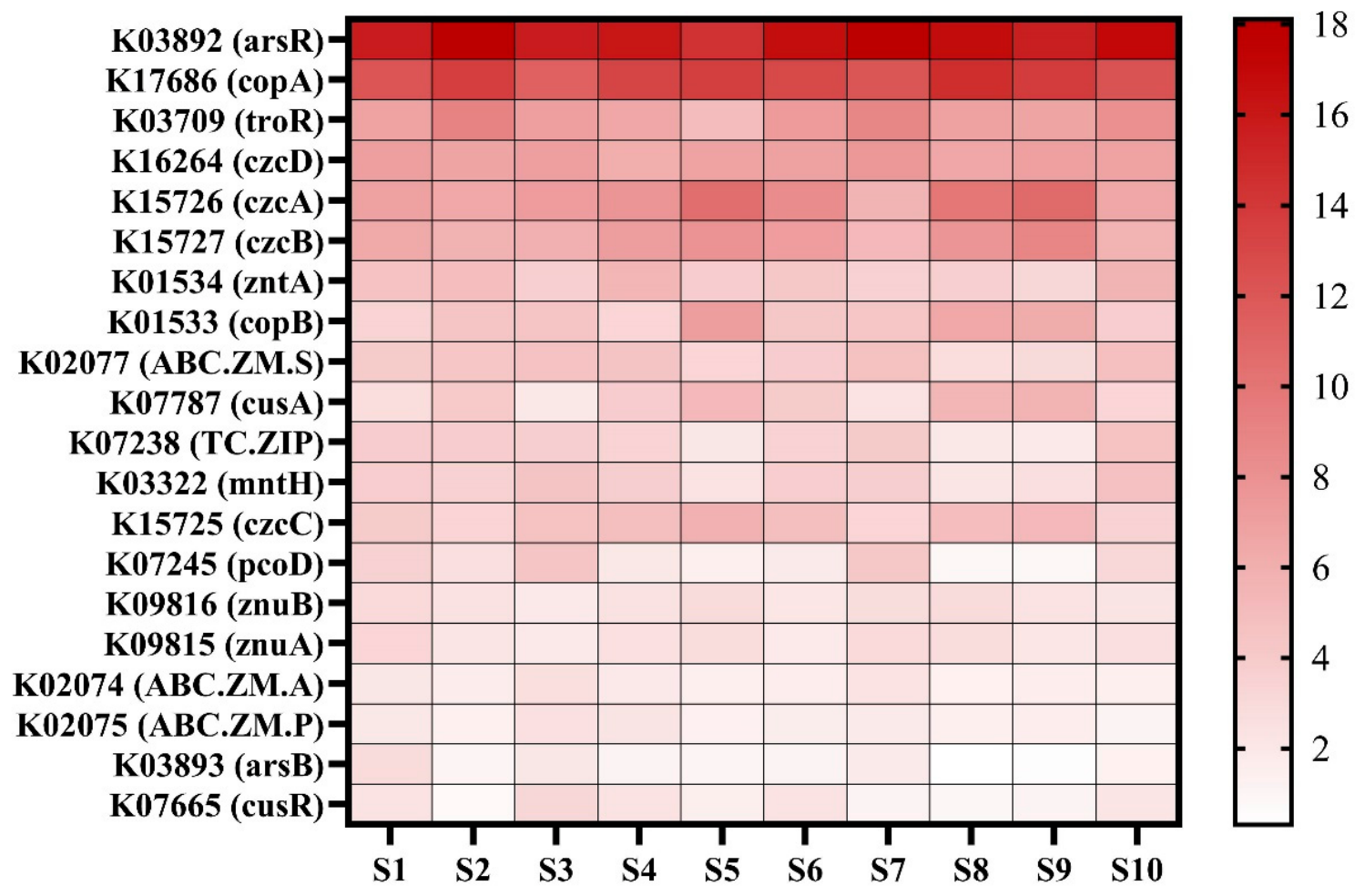
Using the KEGG database, the relative abundance of the most prevalent heavy metal (HM) resistance-related functional pathways (>2% abundance in at least one soil) was identified (Table S2), mainly associated with Cu, As, Zn, and Cd resistance. Figure 5 presents a heatmap of the relative abundance of the predicted KEGG orthologs involved in HM resistance.
Figure 5.
Heatmap showing the relative abundance of predicted KEGG Orthologs (KOs) associated with heavy metal resistance in soils.
Based on their relative abundance, the identified KEGG orthologs could be classified into four groups. The most abundant genes were arsR (K03892) with relative abundances ranging from 14.35% to 18.00%, and copA (K17686), ranging from 11.23% to 14.68% across slightly and highly polluted soils. The second group included K03709 (troR), K16264 (czcD), K15726 (czcA), and K15727 (czcB), with relative abundances ranging from 5.00% to 10.69%. The third group comprised K01534 (zntA), K01533 (copB), K02077 (ABC.ZM.S), K07787 (cusA), K07238 (TC.ZIP), K03322 (mntH), and K15725 (czcC), with abundances of up to 6.46% (Table S2). The fourth and least abundant group included K07245 (pcoD), which reached approximately 4% abundance in samples S3 and S7, as well as K09816 (znuB), K09815 (znuA), K02074 (ABC.ZM.A), K02075 (ABC.ZM.P), K03893 (arsB), and K07665 (cusR), all of which exhibited relative abundances below 4%.
4. Discussion
4.1. Heavy Metal Pollution and Soil Properties
The Zlatitsa–Pirdop Valley has been subjected to decades of copper mining and metallurgical activities, resulting in persistent Cu-dominated soil pollution consistent with previous studies from the region and other mining-affected areas [28,41]. The soils covered five NPI pollution categories (Table 1). The mobility and toxicity of HM and their effects on microbial communities are strongly modulated by soil properties such as pH, organic matter, texture, and land use [1,28], underscoring the importance of these interactions for ecological protection and sustainable land management [3,21,42].
4.2. Taxonomic Composition and Structure of Bacterial Communities
Alpha bacterial diversity observed across the different pollution levels was relatively stable (Table 2). Some authors reported that microbial community structure is more affected by HM toxicity than microbial diversity [7,10,43].
Pseudomonadota, Acidobacteriota, and Actinomycetota dominated the bacterial communities across the Cu pollution gradient, consistent with previous studies in both unpolluted and HM polluted soils [3,6,10,19,44,45,46,47,48,49,50,51,52,53]. Their persistence reflects broad ecological adaptability to metal stress [20]. Although Pseudomonadota were slightly more abundant in some highly polluted soils, no consistent relationship with Cu concentration was observed (Figure 2a). Many authors have reported Pseudomonadota as dominant in HM polluted soils, which might be related to their relatively high tolerance to some heavy metals and ability to live in extreme environments [8,10,20,52,53].
Bacteroidota increased, whereas Verrucomicrobiota declined, with increasing Cu pollution (Figure 2a). The enrichment of Bacteroidota agrees with previous studies showing that its metabolic versatility promotes persistence in HM polluted soils and contributes to microbial adaptation and altered nutrient cycling [52]. The decline of Verrucomicrobiota in moderately and highly polluted soils suggests sensitivity to heavy metal stress. This phylum is typically associated with stable soil environments and its reduced abundance under metal contamination is consistent with previous reports identifying HM as key drivers of bacterial community restructuring [21].
Alphaproteobacteria, Gammaproteobacteria, and Terriglobia dominated the bacterial communities (Figure 2b), in agreement with previous studies of HM polluted soils [19,20,52,54,55]. At the genus level (Figure 3), Sphingomicrobium_483192 declined with increasing Cu pollution, whereas Z2-YC6860 and Palsa-1315 increased, suggesting contrasting sensitivities and adaptation to heavy metal stress [56,57]. In contrast, PSRF01 occurred in both polluted and unpolluted soils, indicating that factors other than heavy metal contamination also influence its distribution [24,58,59,60].
4.3. Associations Among Heavy Metal Concentrations, Soil Properties and Bacterial Genera
Spearman’s rank correlation analysis revealed taxon-specific relationships between bacterial genera, HM concentrations, and soil physicochemical properties (Figure 4), indicating differences in ecological adaptation to long-term pollution. Z2-YC6860 was positively associated with Cu, whereas Bradyrhizobium_503372 and Mycobacterium showed negative associations with HMs, suggesting contrasting responses to metal stress. These patterns are consistent with previous studies reporting enrichment of metal-tolerant taxa and decline of sensitive microorganisms in contaminated soils [3,19,52,61,62]. Several genera, including Reyranella, PSRF01, and Chryseolinea_899021, were negatively correlated with TOC, while Streptomyces_400150, Mycobacterium, and Angelobacter were negatively associated with SM and/or pH. These results support the important role of soil physicochemical properties, particularly pH and organic carbon, in shaping bacterial communities by influencing metal bioavailability and resource availability [52]. Although none of the correlations remained significant after FDR correction, the observed trends agree with previous studies mentioned above and support the concept that long-term HM pollution, together with local soil properties, acts as a key driver of bacterial community assembly.
4.4. Predicted Bacterial Resistance to Heavy Metals
It should be noted that the functional profiles of bacterial communities were obtained from 16S rRNA gene amplicon sequencing and taxonomic composition. Consequently, the identified KEGG orthologs represent predicted functional potential based on the known ecological characteristics of the detected taxa. They should therefore be interpreted as indicative of possible microbial responses to long-term metal stress. The predicted functional profiles suggest that bacterial communities inhabiting Cu-polluted soils possess an increased potential for metal tolerance and resistance. The relatively high predicted abundance of KEGG orthologs associated with As and Cu resistance (K03892, K17686), together with orthologs related to Cu transport and detoxification (K01533, K07245, K07665), may reflect adaptive responses to prolonged exposure to elevated HM concentrations (Figure 5, Table S2). Similarly, the predicted enrichment of orthologs associated with Co–Zn–Cd efflux systems (K15725, K15726, K15727 and K16264) is consistent with previous metagenomic studies reporting enhanced metal resistance potential in HM polluted soils [12,17,19,63]. The relatively stable predicted abundance of arsenic-related orthologs (K03892 and K03893) across all soils may indicate that As resistance is a widespread adaptive feature of soil bacterial communities rather than a response exclusively to elevated As concentrations [64,65]. In contrast, the greater representation of predicted functions associated with Cu and Zn resistance suggests that these metals may show stronger selective pressure on bacterial communities in the study soils. The enrichment of predicted Co–Zn–Cd efflux-related functions is similarly consistent with previous observations from polluted soils, where these transport systems have been proposed to contribute to microbial tolerance under chronic metal exposure [19,66].
Long-term exposure to Cu, Zn and Cd has been shown to favour metal-tolerant microorganisms and may also contribute to the co-selection of metal and antibiotic resistance determinants, thereby increasing the potential abundance of antibiotic resistance genes (ARGs) in polluted soils [67,68,69,70]. In addition, the predicted occurrence of orthologs involved in metal homeostasis and oxidative stress responses (K03709 and K03322) may indicate that maintaining intracellular metal balance and mitigating oxidative damage represent important components of microbial adaptation to metal stress [71,72].
Although these predicted functions cannot be assigned with certainty to individual taxa, they were associated with the dominant bacterial taxa Pseudomonadota, Acidobacteriota and Actinomycetota identified in this study. These phyla are widely recognized for being representatives capable of diverse metal tolerance mechanisms, including metal efflux, intracellular sequestration and other detoxification processes [17,19,24,69,73]. Overall, the predicted functional profiles suggested that long-term metal contamination may promote the selection of bacterial communities with an enhanced functional potential for metal regulation, transport and detoxification. Nevertheless, these predicted functions require confirmation using metagenomic and functional genomic approaches.
5. Conclusions
Long-term Cu pollution altered the bacterial community structure, whereas bacterial diversity and abundance remained relatively stable across a broad Cu pollution gradient. Several bacterial genera showed strong associations with HM concentrations and soil physicochemical properties, highlighting the combined influence of metal pollution and local environmental conditions on the soil bacterial communities. KEGG functional analysis revealed both widespread common HM defense pathways and more complex mechanisms for HM-resistant bacteria. These results need to be further validated in upcoming studies with integration of metagenomic and metatranscriptomic approaches. These findings improve our understanding of microbial adaptation to chronic metal contamination and provide a scientific basis for the development of microbial indicators for soil health assessment in agricultural soils affected by long-term gold–copper mining.
Supplementary Materials
The following supporting information can be downloaded at: https://www.mdpi.com/article/10.3390/soilsystems10080091/s1, Table S1: Single pollution level (PI) of the soils, Table S2: Definition and relative abundance of the KEGG pathways providing heavy metal resistance of bacterial communities in soils.
Author Contributions
M.P., writing—original draft preparation, methodology, investigation, formal analysis; G.D., formal analysis, validation, data curation; E.G., formal analysis, validation, data curation; M.H., methodology, investigation, formal analysis, data curation; N.D., project administration, funding acquisition; G.R., writing—review and editing, conceptualization, methodology, supervision. All authors have read and agreed to the published version of the manuscript.
Funding
This research was funded by the Bulgarian Science Fund, grant number KP-06-N76/9/2023.
Institutional Review Board Statement
Not applicable.
Informed Consent Statement
Not applicable.
Data Availability Statement
The datasets generated and analyzed during the current study are available in the NCBI Bioproject database under accession number PRJNA1480567.
Conflicts of Interest
The authors declare no conflicts of interest.
References
- Campillo-Cora, C.; Rodríguez-Seijo, A.; Pérez-Rodríguez, P.; Fernández-Calviño, D.; Santás-Miguel, V. Effect of heavy metal pollution on soil microorganisms: Influence of soil physicochemical properties. A systematic review. Eur. J. Soil Biol. 2025, 124, 103706. [Google Scholar] [CrossRef] [Scilit]
- Sazykin, I.; Khmelevtsova, L.; Azhogina, T.; Sazykina, M. Heavy Metals Influence on the Bacterial Community of Soils: A Review. Agriculture 2023, 13, 653. [Google Scholar] [CrossRef] [Scilit]
- Wang, Z.; Deng, G.; Hu, C.; Hou, X.; Zhang, X.; Fan, Z.; Zhao, Y.; Peng, M. Microbial diversity and community assembly in heavy metal-contaminated soils: Insights from selenium-impacted mining areas. Front. Microbiol. 2025, 16, 1561678. [Google Scholar] [CrossRef] [Scilit] [PubMed]
- Zhang, M.; Zhang, T.; Zhou, L.; Lou, W.; Zeng, W.; Liu, T.; Yin, H.; Liu, H.; Liu, X.; Mathivanan, K.; et al. Soil microbial community assembly model in response to heavy metal pollution. Environ. Res. 2022, 213, 113576. [Google Scholar] [CrossRef] [Scilit] [PubMed]
- Goswami, A.; Adkins-Jablonsky, S.J.; Barreto Filho, M.M.; Shilling, M.D.; Dawson, A.; Heiser, S.; O’Connor, A.; Walker, M.; Roberts, Q.; Morris, J.J. Heavy metal pollution impacts soil bacterial community structure and antimicrobial resistance at the Birmingham 35th Avenue Superfund site. Microbiol. Spectr. 2023, 11, e02426-22. [Google Scholar] [CrossRef] [Scilit] [PubMed]
- Cui, H.; Liu, L.L.; Dai, J.R.; Yu, X.N.; Guo, X.; Yi, S.J.; Zhou, D.Y.; Guo, W.H.; Du, N. Bacterial community shaped by heavy metals and contributing to health risks in cornfields. Ecotoxicol. Environ. Saf. 2018, 166, 259–269. [Google Scholar] [CrossRef] [Scilit] [PubMed]
- Li, D.; Zhang, X.; Zhang, H.; Fan, Q.; Guo, B.; Li, J. A global meta-analysis reveals effects of heavy metals on soil microorganisms. J. Hazard. Mater. 2025, 491, 138018. [Google Scholar] [CrossRef] [Scilit] [PubMed]
- Zhao, X.; Huang, J.; Lu, J.; Sun, Y. Study on the influence of soil microbial community on the long-term heavy metal pollution of different land use types and depth layers in mine. Ecotoxicol. Environ. Saf. 2019, 170, 218–226. [Google Scholar] [CrossRef] [Scilit] [PubMed]
- Hemmat-Jou, M.H.; Safari-Sinegani, A.A.; Che, R.; Mirzaie-Asl, A.; Tahmourespour, A.; Tahmasbian, I. Toxic trace element resistance genes and systems identified using the shotgun metagenomics approach in an Iranian mine soil. Environ. Sci. Pollut. Res. 2021, 28, 4845–4856. [Google Scholar] [CrossRef] [Scilit] [PubMed]
- Li, J.; Zheng, Q.; Liu, J.; Pei, S.; Yang, Z.; Chen, R.; Ma, L.; Niu, J.; Tian, T. Bacterial-fungal interactions and response to heavy metal contamination of soil in agricultural areas. Front. Microbiol. 2024, 15, 1395154. [Google Scholar] [CrossRef] [Scilit] [PubMed]
- Yin, Y.; Wang, X.; Hu, Y.; Li, F.; Cheng, H. Soil bacterial community structure in the habitats with different levels of heavy metal pollution at an abandoned polymetallic mine. J. Hazard. Mater. 2023, 442, 130063. [Google Scholar] [CrossRef] [Scilit] [PubMed]
- Li, C.; Quan, Q.; Gan, Y.; Dong, J.; Fang, J.; Wang, L.; Liu, J. Effects of heavy metals on microbial communities in sediments and establishment of bioindicators based on microbial taxa and function for environmental monitoring and management. Sci. Total Environ. 2020, 749, 141555. [Google Scholar] [CrossRef] [Scilit] [PubMed]
- Pan, X.; Zhang, S.; Zhong, Q.; Gong, G.; Wang, G.; Guo, X.; Xu, X. Effects of soil chemical properties and fractions of Pb, Cd, and Zn on bacterial and fungal communities. Sci. Total Environ. 2020, 715, 136904. [Google Scholar] [CrossRef] [Scilit] [PubMed]
- Fashola, M.O.; Ngole-Jeme, V.M.; Babalola, O.O. Heavy metal pollution from gold mines: Environmental effects and bacterial strategies for resistance. Int. J. Environ. Res. Public Health 2016, 13, 1047. [Google Scholar] [CrossRef] [Scilit] [PubMed]
- Epelde, L.; Lanzén, A.; Blanco, F.; Urich, T.; Garbisu, C. Adaptation of soil microbial community structure and function to chronic metal contamination at an abandoned Pb-Zn mine. FEMS Microbiol. Ecol. 2015, 91, 1–11. [Google Scholar] [CrossRef] [Scilit] [PubMed]
- Fajardo, C.; Costa, G.; Nande, M.; Botías, P.; García-Cantalejo, J.; Martín, M. Pb, Cd, and Zn soil contamination: Monitoring functional and structural impacts on the microbiome. Appl. Soil Ecol. 2019, 135, 56–64. [Google Scholar] [CrossRef] [Scilit]
- Navas, M.; Pérez-Esteban, J.; Torres, M.-Á.; Hontoria, C.; Moliner, A. Taxonomic and functional analysis of soil microbial communities in a mining site across a metal(loid) contamination gradient. Eur. J. Soil Sci. 2020, 72, 1190–1205. [Google Scholar] [CrossRef] [Scilit]
- Zhu, S.; Mao, H.; Yang, X.; Zhao, W.; Sheng, L.; Sun, S.; Du, X. Resilience mechanisms of rhizosphere microorganisms in lead-zinc tailings: Metagenomic insights into heavy metal resistance. Ecotoxicol. Environ. Saf. 2025, 292, 117956. [Google Scholar] [CrossRef] [Scilit] [PubMed]
- Nikolova, R.; Gatev, E.; Kenarova, A.; Petkova, M.; Dinev, N.; Baldrian, P.; Radeva, G. Selective Pressure of Heavy Metals on Soil Microbial Taxa near a Smelting Area. Toxics 2025, 13, 1025. [Google Scholar] [CrossRef] [Scilit] [PubMed]
- Zuo, Y.; Li, Y.; Chen, H.; Ran, G.; Liu, X. Effects of multi-heavy metal composite pollution on microorganisms around a lead-zinc mine in typical karst areas, southwest China. Ecotoxicol. Environ. Saf. 2023, 262, 115190. [Google Scholar] [CrossRef] [Scilit] [PubMed]
- Abbaszade, G.; Toumi, M.; Farkas, R.; Vajna, B.; Krett, G.; Dobosy, P.; Szabó, C.; Tóth, E. Exploring the relationship between metal(loid) contamination rate, physicochemical conditions, and microbial community dynamics in industrially contaminated urban soils. Sci. Total Environ. 2023, 897, 166094. [Google Scholar] [CrossRef] [Scilit] [PubMed]
- Gupta, K.; Chatterjee, C.; Gupta, B. Isolation and characterization of heavy metal tolerant gram-positive bacteria with bioremedial properties from municipal waste rich soil of Kestopur Canal (Kolkata), West Bengal, India. Biologia 2012, 67, 827–836. [Google Scholar] [CrossRef] [Scilit]
- Douglas, G.M.; Maffei, V.J.; Zaneveld, J.R.; Yurgel, S.; Brown, J.; Taylor, C.; Huttenhower, C.; Langille, M. PICRUSt2 for prediction of metagenome functions. Nat. Biotechnol. 2020, 38, 685–688. [Google Scholar] [CrossRef] [Scilit] [PubMed]
- Xing, E.-L.; Yu, Z.; Bai, Z.-W.; Wang, H.; Zhang, W.; Xu, D.-M.; Feng, Z.; Li, Z.-Y.; Fu, R.-B. Arsenic and iron gradients orchestrate microbial community restructuring and functional shifts in long-term abandoned Pb-Zn tailings. Environ. Technol. Innov. 2026, 42, 104907. [Google Scholar] [CrossRef] [Scilit]
- Wu, X.; Xing, H.; Wang, X.; Yang, J.; Chen, J.; Liu, X.; Dai, D.; Zhang, M.; Yang, Q.; Dong, S.; et al. Changes in soil microbial communities are linked to metal elements in a subtropical forest. Appl. Soil Ecol. 2023, 188, 104919. [Google Scholar] [CrossRef] [Scilit]
- Hu, X.; Wang, J.; Lv, Y.; Liu, X.; Zhong, J.; Cui, X.; Zhang, M.; Ma, D.; Yan, X.; Zhu, X. Effects of heavy metals/metalloids and soil properties on microbial communities in farmland in the vicinity of a metals smelter. Front. Microbiol. 2021, 12, 707786. [Google Scholar] [CrossRef] [Scilit] [PubMed]
- Nikova, I.; Hristov, B.; Dinev, N.; Hristova, M. Assessment of soil quality in a copper mining region in Bulgaria. Ecol. Balk. 2019, 11, 13–23. [Google Scholar]
- Petkova, M.; Nankova, N.; Kancheva, V.; Boteva, S.; Kenarova, A.; Radeva, G. Distribution of microbial abundance in long-term copper contaminated soils from Topolnitsa-Pirdop valley, Southern Bulgaria. BioRisk 2023, 20, 23–35. [Google Scholar] [CrossRef] [Scilit]
- Food and Agriculture Organization of the United Nations (FAO). World Reference Base for Soil Resources 2014: International Soil Classification System for Naming Soils and Creating Legends for Soil Maps; Update 2015; World Soil Resources Reports No. 106; FAO: Rome, Italy, 2015; 192p. [Google Scholar]
- BDS EN ISO 10390:2022; Soil, Treated Biowaste and Sludge—Determination of pH. Bulgarian Institute for Standardization: Sofia, Bulgaria, 2022.
- Chen, J.; He, F.; Zhang, X.; Sun, X.; Zheng, J. Heavy metal pollution decreases microbial abundance, diversity and activity within particle-size fraction of a paddy soil. FEMS Microbiol. Ecol. 2014, 87, 161–181. [Google Scholar] [CrossRef] [Scilit] [PubMed]
- ISO 11047:1998; Soil Quality—Determination of Cadmium, Chromium, Cobalt, Copper, Lead, Manganese, Nickel and Zinc—Flame and Electrothermal Atomic Absorption Spectrometric Methods. International Organization for Standardization: Geneva, Switzerland, 1998.
- Kowalska, J.B.; Mazurek, R.; Gąsiorek, M.; Zaleski, T. Pollution indices as useful tools for the comprehensive evaluation of the degree of soil contamination—A review. Environ. Geochem. Health 2018, 40, 2395–2420. [Google Scholar] [CrossRef] [Scilit] [PubMed]
- Wen, C.; Wu, L.; Qin, Y.; Van Nostrand, J.D.; Ning, D.; Sun, B.; Xue, K.; Liu, F.; Deng, Y.; Liang, Y.; et al. Evaluation of the reproducibility of amplicon sequencing with Illumina MiSeq platform. PLoS ONE 2017, 12, e0176716. [Google Scholar] [CrossRef] [Scilit] [PubMed]
- Bolyen, E.; Rideout, J.R.; Dillon, M.R.; Bokulich, N.A.; Abnet, C.C.; Al-Ghalith, G.A.; Alexander, H.; Alm, E.J.; Arumugam, M.; Asnicar, F.; et al. Reproducible, interactive, scalable and extensible microbiome data science using QIIME 2. Nat. Biotechnol. 2019, 37, 852–857. [Google Scholar] [CrossRef] [Scilit] [PubMed]
- Callahan, B.; McMurdie, P.; Rosen, M.; Han, A.; Johnson, A.; Holmes, A. DADA2: High-resolution sample inference from Illumina amplicon data. Nat. Methods 2016, 13, 581–583. [Google Scholar] [CrossRef] [Scilit] [PubMed]
- Robeson, M.S., 2nd; O’Rourke, D.R.; Kaehler, B.D.; Ziemski, M.; Dillon, M.R.; Foster, J.T.; Bokulich, N.A. RESCRIPt: Reproducible sequence taxonomy reference database management. PLoS Comput. Biol. 2021, 17, e1009581. [Google Scholar] [CrossRef] [Scilit] [PubMed]
- McDonald, D.; Jiang, Y.; Balaban, M.; Cantrell, K.; Zhu, Q.; Gonzalez, A.; Morton, J.T.; Nicolaou, G.; Parks, D.H.; Karst, S.M.; et al. Greengenes2 unifies microbial data in a single reference tree. Nat. Biotechnol. 2024, 42, 715–718. [Google Scholar] [CrossRef] [Scilit] [PubMed]
- Edgar, R.C.; Haas, B.J.; Clemente, J.C.; Quince, C.; Knight, R. UCHIME improves sensitivity and speed of chimera detection. Bioinformatics 2011, 27, 2194–2200. [Google Scholar] [CrossRef] [Scilit] [PubMed]
- R Core Team. R: A Language and Environment for Statistical Computing; R Foundation for Statistical Computing: Vienna, Austria, 2025; Available online: https://www.R-project.org/ (accessed on 7 June 2026).
- Jiang, X.; Liu, W.; Xu, H.; Cui, X.; Li, J.; Chen, J.; Zheng, B. Characterizations of heavy metal contamination, microbial community, and resistance genes in a tailing of the largest copper mine in China. Environ. Pollut. 2021, 280, 116947. [Google Scholar] [CrossRef] [Scilit] [PubMed]
- Shammi, S.A.; Salam, A.; Khan, M.A.H. Assessment of heavy metal pollution in the agricultural soils, plants, and in the atmospheric particulate matter of a suburban industrial region in Dhaka, Bangladesh. Environ. Monit. Assess. 2021, 193, 104. [Google Scholar] [CrossRef] [Scilit] [PubMed]
- Li, X.; Meng, D.; Li, J.; Yin, H.; Liu, H.; Liu, X.; Luo, M.; Li, W.; Xu, J.; Yang, Y.; et al. Response of soil microbial communities and microbial interactions to long-term heavy metal contamination. Environ. Pollut. 2017, 231, 908–917. [Google Scholar] [CrossRef] [Scilit] [PubMed]
- Kim, H.S.; Lee, S.H.; Jo, H.Y.; Finneran, K.T.; Kwon, M.J. Diversity and composition of soil Acidobacteria and Proteobacteria communities as a bacterial indicator of past land-use change from forest to farmland. Sci. Total Environ. 2021, 797, 148944. [Google Scholar] [CrossRef] [Scilit] [PubMed]
- Mhete, M.; Eze, P.N.; Rahube, T.O.; Akinyemi, F.O. Soil properties influence bacterial abundance and diversity under different land-use regimes in semi-arid environments. Sci. Afr. 2020, 7, e00246. [Google Scholar] [CrossRef] [Scilit]
- Song, J.; Shen, Q.; Wang, L.; Qui, G.; Shi, J.; Xu, J.; Brookes, P.h.C.; Liu, X. Effects of Cd, Cu, Zn and their combined action on microbial biomass and bacterial community structure. Environ. Pollut. 2018, 243, 510–518. [Google Scholar] [CrossRef] [Scilit] [PubMed]
- Wang, X.; Gao, P.; Li, D.; Liu, J.; Yang, N.; Gu, W.; He, X.; Tang, W. Risk assessment for and microbial community changes in farmland soil contaminated with heavy metals and metalloids. Ecotoxicol. Environ. Saf. 2019, 185, 109685. [Google Scholar] [CrossRef] [Scilit] [PubMed]
- Schneider, A.R.; Gommeaux, M.; Duclercq, J.; Fanin, N.; Conreux, A.; Alahmad, A.; Lacoux, J.; Roger, D.; Spicher, F.; Ponthieu, M.; et al. Response of bacterial communities to Pb smelter pollution in contrasting soils. Sci. Total Environ. 2017, 605–606, 436–444. [Google Scholar] [CrossRef] [Scilit] [PubMed]
- Beattie, R.E.; Henke, W.; Campa, M.F.; Hazen, T.C.; McAliley, L.R.; Campbell, J.H. Variation in microbial community structure correlates with heavy-metal contamination in soils decades after mining ceased. Soil Biol. Biochem. 2018, 126, 57–63. [Google Scholar] [CrossRef] [Scilit]
- Sonthiphand, P.; Kraidech, S.; Polart, S.; Chotpantarat, S.; Kusonmano, K.; Uthaipaisanwong, P.; Luepromchai, E. Arsenic speciation, the abundance of arsenite-oxidizing bacteria and microbial community structures in groundwater, surface water, and soil from a gold mine. J. Environ. Sci. Health Part A 2021, 56, 769–785. [Google Scholar] [CrossRef] [Scilit] [PubMed]
- Prakash, A.A.; Rajasekar, A.; Sarankumar, R.K.; AlSalhi, M.S.; Devanesan, S.; Aljaafreh, M.J.; Govarthanan, M.; Saye, S.R.M. Metagenomic analysis of microbial community and its role in bioelectrokinetic remediation of tannery contaminated soil. J. Hazard. Mater. 2021, 412, 125133. [Google Scholar] [CrossRef] [Scilit] [PubMed]
- Zou, M.; Zhang, Q.; Li, F.; Chen, L.; Qiu, L.; Yin, Q.; Zhou, S. Impacts of multiple environmental factors on soil bacterial community assembly in heavy metal polluted paddy fields. Sci. Rep. 2024, 14, 14696. [Google Scholar] [CrossRef] [Scilit] [PubMed]
- Yan, C.; Wang, F.; Geng, H.; Liu, H.; Pu, S.; Tian, Z.; Chen, H.; Zhou, B.; Yuan, R.; Yao, J. Integrating high-throughput sequencing and metagenome analysis to reveal the characteristic and resistance mechanism of microbial community in metal contaminated sediments. Sci. Total Environ. 2020, 707, 136116. [Google Scholar] [CrossRef] [Scilit] [PubMed]
- Yu, X.; Zhao, J.; Liu, X.; Sun, L.; Tian, J.; Wu, N. Cadmium Pollution Impact on the Bacterial Community Structure of Arable Soil and the Isolation of the Cadmium Resistant Bacteria. Front. Microbiol. 2021, 12, 698834. [Google Scholar] [CrossRef] [Scilit] [PubMed]
- Zou, L.; Lu, Y.; Dai, Y.; Khan, M.I.; Gustave, W.; Nie, J.; Liao, Y.; Tang, X.; Shi, J.; Xu, J. Spatial variation in microbial community in response to As and Pb contamination in paddy soils near a Pb–Zn mining site. Front. Environ. Sci. 2021, 9, 630668. [Google Scholar] [CrossRef] [Scilit]
- Chen, Y.; Tao, S.; Ma, J.; Qu, Y.; Sun, Y.; Wang, M.; Cai, Y. New insights into assembly processes and driving factors of urban soil microbial community under environmental stress in Beijing. Sci. Total Environ. 2024, 947, 174551. [Google Scholar] [CrossRef] [Scilit] [PubMed]
- Cheng, X.; Qu, M.; Hu, Y.; Liu, X.; Mei, Y. Differences in Microbial Communities and Phosphorus Cycles between Rural and Urban Lakes: Based on Glyphosate and AMPA Effects. J. Environ. Manag. 2025, 376, 124577. [Google Scholar] [CrossRef] [Scilit] [PubMed]
- Greco, C.; Andersen, D.T.; Yallop, M.L.; Barker, G.; Jungblut, A.D. Genome-resolved metagenomics reveals diverse taxa and metabolic complexity in Antarctic lake microbial structures. Environ. Microbiol. 2024, 26, e16663. [Google Scholar] [CrossRef] [Scilit] [PubMed]
- Gao, F.; Li, Y.; Fan, H.; Xue, J.; Yao, H. Main environmental drivers of abundance, diversity and community structure of comammox Nitrospira in paddy soils. Pedosphere 2022, 33, 808–818. [Google Scholar] [CrossRef] [Scilit]
- Zhang, F.; Xie, Y.; Peng, R.; Ji, X.; Bai, L. Heavy metals and nutrients mediate the distribution of soil microbial community in a typical contaminated farmland of South China. Sci. Total Environ. 2024, 947, 174322. [Google Scholar] [CrossRef] [Scilit] [PubMed]
- Liu, J.; Pei, S.; Zheng, Q.; Li, J.; Liu, X.; Ruan, Y.; Luo, B.; Ma, L.; Chen, R.; Hu, W.; et al. Heavy metal contamination impacts the structure and co-occurrence patterns of bacterial communities in agricultural soils. J. Basic Microbiol. 2024, 64, e2300435. [Google Scholar] [CrossRef] [Scilit] [PubMed]
- Ma, S.; Qiao, L.; Liu, X.; Zhang, S.; Zhang, L.; Qiu, Z.; Yu, C. Microbial community succession in soils under long-term heavy metal stress: From community diversity-structure to KEGG function pathways. Environ. Res. 2022, 214, 113822. [Google Scholar] [CrossRef] [Scilit] [PubMed]
- Cervantes-Cervantes, M.P.; Calderón-Salinas, J.V.; Albores, A.; Muñoz-Sánchez, J.L. Copper increases the damage to DNA and proteins caused by reactive oxygen species. Biol. Trace Elem. Res. 2005, 103, 229–248. [Google Scholar] [CrossRef] [Scilit] [PubMed]
- Zhang, C.; Xiao, X.; Zhao, Y.; Zhou, J.; Sun, B.; Liang, Y. Patterns of microbial arsenic detoxification genes in low-arsenic continental paddy soils. Environ. Res. 2021, 201, 111584. [Google Scholar] [CrossRef] [Scilit] [PubMed]
- Li, X.; Liu, X.; Cao, N.; Fang, S.; Yu, C. Adaptation mechanisms of arsenic metabolism genes and their host microorganisms in soils with different arsenic contamination levels around abandoned gold tailings. Environ. Pollut. 2021, 291, 117994. [Google Scholar] [CrossRef] [Scilit] [PubMed]
- Abilda, Z.; Isgandarov, I.; Kanat, R.; Daurov, D.; Sapakhova, Z.; Zhambakin, K.; Daurova, A.; Begaliyeva, D.; Choi, K.; Shamekova, M. Genome-resolved metagenomics reveals co-selection of antibiotic and metal resistance in chronically polluted industrial soils. Front. Microbiol. 2026, 17, 1829529. [Google Scholar] [CrossRef] [Scilit] [PubMed]
- Li, N.; Chen, J.; Liu, C.; Yang, J.; Zhu, C.; Li, H. Cu and Zn exert a greater influence on antibiotic resistance and its transfer than doxycycline in agricultural soils. J. Hazard. Mater. 2022, 423, 127042. [Google Scholar] [CrossRef] [Scilit] [PubMed]
- Wu, P.; Wang, J.; Guo, Z.; Cheng, Y.; Wu, J. Heavy metals and bacterial community determine resistance genes distribution in agricultural soils surrounding long-term mining area. Appl. Soil Ecol. 2024, 202, 105581. [Google Scholar] [CrossRef] [Scilit]
- Wang, Y.; Ding, C.; Zheng, Z.; Liu, W.; Shi, Y. The spatial distribution of heavy metal contamination, microbial communities, and resistance genes in agricultural soil near a manganese mine in China. Ecotoxicol. Environ. Saf. 2026, 311, 119865. [Google Scholar] [CrossRef] [Scilit] [PubMed]
- Pan, J.; Zheng, N.; An, Q.; Li, Y.; Sun, S.; Wang, S.; Ji, Y.; Li, N. The effects of cadmium-copper stress on the accumulation of antibiotic-resistance genes in soil and pakchoi leaves. Soil Biol. Biochem. 2024, 191, 109362. [Google Scholar] [CrossRef] [Scilit]
- Saraithong, P.; Goetting-Minesky, M.P.; Durbin, P.M.; Olson, S.W.; Gherardini, F.C.; Fenno, J.C. Roles of TroA and TroR in metalloregulated growth and gene expression in Treponema denticola. J. Bacteriol. 2020, 202, e00770-19. [Google Scholar] [CrossRef] [Scilit] [PubMed]
- Hohle, T.H.; O’Brian, M.R. The mntH gene encodes the major Mn(II) transporter in Bradyrhizobium japonicum and is regulated by manganese via the Fur protein. Mol. Microbiol. 2009, 72, 399–409. [Google Scholar] [CrossRef] [Scilit] [PubMed]
- Xavier, J.C.; Costa, P.E.S.; Hissa, D.C.; Melo, V.M.M.; Falcão, R.M.; Balbino, V.Q.; Mendonça, L.A.R.; Lima, M.G.S.; Coutinho, H.D.M.; Verde, L.C.L. Evaluation of the microbial diversity and heavy metal resistance genes of a microbial community on contaminated environment. Appl. Geochem. 2019, 105, 1–6. [Google Scholar] [CrossRef] [Scilit]

Disclaimer/Publisher’s Note: The statements, opinions and data contained in all publications are solely those of the individual author(s) and contributor(s) and not of MDPI and/or the editor(s). MDPI and/or the editor(s) disclaim responsibility for any injury to people or property resulting from any ideas, methods, instructions or products referred to in the content. |
© 2026 by the authors. Licensee MDPI, Basel, Switzerland. This article is an open access article distributed under the terms and conditions of the Creative Commons Attribution (CC BY) license.