
Article

Photoproduction of the Quarkonia Pairs in the CGC Framework
1
Departamento de Física, Universidad Técnica Federico Santa María, Casilla 110-V, Valparaíso 2390123, Chile
2
Centro Científico-Tecnológico de Valparaíso, Casilla 110-V, Valparaíso 2390136, Chile
3
Instituto de Física, Pontificia Universidad Católica de Valparaíso, Av. Brasil 2950, Valparaíso 2370200, Chile
4
Facultad de Ingeniería, Laboratorio DataScience, Universidad de Playa Ancha, Leopoldo Carvallo 270, Valparaíso 2360004, Chile
*
Author to whom correspondence should be addressed.
Particles 2026, 9(3), 74; https://doi.org/10.3390/particles9030074
Submission received: 31 May 2026 / Revised: 10 July 2026 / Accepted: 13 July 2026 / Published: 15 July 2026

Abstract

In this manuscript, we present the results of our studies on the exclusive photoproduction of quarkonium-photon pairs with large invariant mass. In our analysis, we focus on the production of the η c γ and χ c J γ pairs in high energy kinematics. We use the Color Glass Condensate (CGC) framework for analysis and demonstrate that at leading order in α s the cross-sections of these processes are determined by the forward dipole scattering amplitude. The kinematic distributions of the produced particles allow us to study the dipole amplitude in detail, making this process a very clean probe for studies of saturation physics. Using phenomenological parametrizations of the dipole amplitudes, we estimate numerically the differential production cross-sections for η c γ and χ c γ in the kinematics of ultraperipheral collisions at the LHC and the future Electron-Ion Collider (EIC). Furthermore, we assess the role of this process as a possible background to the exclusive photoproduction of C-even quarkonia, which is frequently considered as a tool for odderon searches.

1. Introduction

The rapid increase of the partonic (and especially gluonic) densities in the small-x kinematics leads to the inapplicability of the partonic picture based on collinear or k T factorization, and the eventual onset of the saturation regime. The Color Glass Condensate (CGC) framework provides a natural and systematic description of this regime. The interaction of the high-energy projectile with the target can be described in the eikonal approximation, assuming that the interaction with its gluonic field may be described by a product of Wilson lines of the projectile’s partons. For many processes, the leading-order contribution is controlled by the forward quark-antiquark scattering amplitude, convoluted with appropriate wave functions that describe the initial and final states. This picture is well-justified in the presence of an appropriate hard scale that controls the transverse size of the system. However, the hard scale that controls the suppression of higher-order corrections also tends to strongly suppress the observable cross-section. For this reason, in many channels used for the analysis of high-energy scattering, the corresponding scale may be as low as a couple of GeV. While the dominance of the forward dipole scattering amplitude allows one to obtain a consistent and phenomenologically successful picture [1,2,3,4,5,6,7,8,9,10,11,12], recent studies [13,14,15,16] demonstrated that a significant correction to these processes may come from higher-order Fock states (e.g., quadrupole contributions), which contribute at next-to-leading order (NLO) [17,18]. This suggests that the extracted dipole amplitudes may inadvertently include sizable contributions from the quadrupoles, thus casting doubt on the consistency of the approach. Unfortunately, those estimates depend significantly on the implemented parametrization of the quadrupole amplitude, and to the best of our knowledge, at present there are no direct, model-independent extractions of the latter from experimental data. For this reason, the situation regarding quadrupoles remains ambiguous. At the same time, recent studies [6,7] suggest that the available data do not uniquely fix the dipole amplitudes, and a reasonable phenomenological description can be achieved using significantly different parametrizations (technically, the dipole amplitude may be formulated as an initial condition for the BK-JIMWLK equation, or as an approximate solution of the BK or DGLAP equations, with sufficient flexibility to adjust it to experimental data). While it is impossible to completely switch off the quadrupole contributions, testing the universality of the dipole amplitude from the analysis of completely different channels can potentially help to corroborate the validity of assumption regarding the dominance of the quark-antiquark component. For this purpose, we propose studying the exclusive photoproduction of C-even charmonia ( η c , χ c J ) in conjunction with a hard photon,
γ + p Q + γ + p , ( Q = η c or χ c J , J = 0 , 1 , 2 )
The cross-section of this process at leading order in α s is controlled by the forward dipole scattering amplitude, thus opening up the possibility of using these channels as the aforementioned independent universality tests, and potentially helping to pin down the onset of the non-linear saturation regime, thus naturally complementing previous studies using other diffractive and exclusive channels (see e.g., [19,20] for details). The main advantage of the exclusive processes over other diffractive channels is their low experimental background and the absence of a large number of production mechanisms, which allows unambiguous studies of the partonic target. While historically the exclusive photoproduction of the C-even mesons (via the γ p η c p and γ p χ c p channels) has been considered as a tool for the study of the C-odd exchanges (odderons) [21,22,23], the emission of an associated photon swaps the sign of the C-parity exchange in the t-channel, and allows us to use these channels for studies of the dipole scattering amplitude. Furthermore, the χ c γ photoproduction presents interest for studies of the χ c J quarkonia themselves. Since the long-distance matrix elements in the triplet of the P-wave quarkonia are proportional to each other due to heavy-quark spin symmetry (HQSS), in the heavy-quark mass limit it is possible to obtain very accurate predictions for the ratio of their production cross-sections. However, these expectations disagree significantly with the experimentally measured ratio σ χ c 2 / σ χ c 1 in hadroproduction experiments. In order to reconcile this discrepancy, phenomenological approaches either introduce sizable contributions from the color-octet LDMEs, or even consider that HQSS is significantly broken in the charm sector [24,25,26,27,28]. The exclusive χ c γ photoproduction proposed in this manuscript does not receive contributions from the color-octet channels, and, for this reason, the study of the ratio σ γ χ c 2 / σ γ χ c 1 can unambiguously clarify the situation with the validity of HQSS for these mesons.
This paper is structured as follows. In Section 2, we briefly introduce the theoretical framework used for the evaluation of the cross-sections. In Section 3, we present numerical estimates for the cross-sections and counting rates at the EIC and the LHC in ultraperipheral kinematics. In Section 4, we compare this channel with the odderon-mediated processes, and in Section 5, we present our conclusions.

2. Theoretical Framework and Kinematics

In the CGC framework, it is assumed that the interaction of the high-energy partons with the target may be described in the eikonal approximation. Technically, the interaction of the parton with the gluonic field of the target is encoded in the so-called Wilson line U ( x ) defined as
U x = P exp i g d x A a + x , x t a ,
where x is the transverse coordinate of the parton, A a μ is the gluonic field, and t a are the color group generators in the irreducible representations 3 , 3 ¯ or 8 for the quark, antiquark or gluon, respectively. The CGC Feynman rules based on this picture may be found, e.g., in [3,29,30,31]. Since in the quarkonium the dominant Fock state includes only a pair of heavy quarks, for the exclusive process γ p Q γ p , the leading-order invariant amplitude of the process is controlled by the forward dipole scattering amplitude
N ( x , r , b ) = 1 1 N c Tr U ( x 1 ) U ( x 2 )
where r = x 1 x 2 is the dipole size, b = ( x 1 + x 2 ) / 2 is the impact parameter, and the angular brackets stand for the stochastic averaging over all possible configurations of the gluonic fields in the target (technically, this averaging is usually formulated in terms of color sources ρ a ). In the proposed process, we should take into account that the emission of a hard final-state photon may occur before and after the interaction with the shock wave. For this reason, the amplitude of the quarkonium-photon production may be represented as a sum of two contributions
A γ p Q γ p ( λ ; σ , H ) = A 1 ( λ ; σ , H ) + A 2 ( λ ; σ , H )
where A 1 ( λ ; σ , H ) and A 2 ( λ ; σ , H ) correspond to the left and right diagrams of Figure 1, and we use superscript indices λ , σ , H for the helicities of the incoming photon, outgoing photon, and produced quarkonium, respectively. Since the interaction of the emitted photon with the shock wave may be neglected as an O α em correction, both contributions are controlled by the dipole amplitude N x , r , b , convoluted with appropriate impact factors. The latter may be represented as a product of the “wave functions” contracted over the helicity indices.
The corresponding contributions A 1 ( λ ; σ , H ) and A 2 ( λ ; σ , H ) are given by
A 1 ( λ ; σ , H ) = 0 α Q d z 0 k = 0 2 d 2 x k Ψ Q ( h , h ¯ ) z 0 z 0 + z 1 , r 10 Ψ γ γ Q ¯ Q ( λ , σ , h , h ¯ ) z 0 , z 1 = α Q z 0 , z 2 α ¯ Q , x 0 , x 1 , x 2 × × N x , r 10 , b 10 exp i p Q · b 10 α ¯ Q α Q r γ i k γ · x 2 ,
A 2 ( λ ; σ , H ) = 0 α Q d z 0 k = 1 3 d 2 x k Ψ Q ¯ Q γ Q ( σ , h , h ¯ ) z 0 , z 1 = α Q z 0 , z 2 α ¯ Q , x 0 , x 1 , x 2 ψ γ Q ¯ Q ( λ , h , h ¯ ) z 0 z 0 + z 1 , r 10 × × N x , r 10 , b 10 exp i p Q · b 10 α ¯ Q α Q r γ i k γ · r γ + b 10 .
where α Q is the light-cone fraction of the photon’s momentum carried by the produced quarkonium, α ¯ Q = 1 α Q is a similar fraction carried by the final-state hard photon, and k γ and p Q are the transverse momenta of the emitted hard photon and produced quarkonium, respectively (here, transversity implies spatial components that are orthogonal with respect to the collision axis, in the frame where the momenta of the incoming photon and proton point in opposite directions). We also use similar notations for the integration variables z 0 , z 1 , z 2 that represent the light-cone fractions of the momentum carried by the quark, antiquark, and the emitted photon, and x 0 , x 1 , x 2 for the transverse coordinates of the quark, antiquark, and photon when they cross the shockwave. The variables r 10 = x 0 x 1 and b 10 = ( x 0 + x 1 ) / 2 correspond to the size and impact parameter of the dipole formed by the quark-antiquark pair, whereas the variable r γ = x 2 b 10 is the distance between the emitted photon and the center of mass of the dipole. The “wave functions” Ψ γ γ Q ¯ Q , ψ γ Q ¯ Q , Ψ Q , and Ψ Q ¯ Q γ Q (with helicity indices h , h ¯ , λ shown as superscript indices in parentheses) should be understood as leading-order perturbative amplitudes that correspond to the formation of the quark-antiquark ensemble from the initial or final-state particles. The explicit expressions for Ψ Q and Ψ Q ¯ Q γ Q depend on the quarkonia (their LDMEs, spins, and helicities) and, due to space limitations, cannot be provided here (an interested reader may find them, as well as many technical details of the evaluation, in [32,33]). The physically observable invariant differential cross-section of the quarkonium-photon photoproduction is related to the amplitude by
d σ ( T ) d t d t d M γ Q 1 2 λ , σ , H A γ p Q γ p ( λ ; σ , H ) 2 128 π 3 M γ Q ,
where M γ Q is the invariant mass of the produced quarkonium-photon pair, t = p p 2 is the invariant momentum transfer to the target, and t = q k 2 is the invariant momentum transfer from the incoming to the outgoing photon. For the Bjorken variable x in the argument of the dipole amplitude (3) we use the value x M γ Q 2 / W 2 , where W is the energy of the photon-proton collision.

3. Numerical Estimates and Experimental Feasibility

For definiteness, we use the bCGC parametrization of the forward dipole scattering amplitude proposed in [9] with fit parameters from [7]. As explained in [9], in the small-r and large-r asymptotic limits this parametrization turns into an analytic solution of the BK evolution equations, providing a smooth interpolation across the intermediate regime. Although numerous phenomenological parameterizations are available in the literature, they all are fitted to the same high-precision DIS data from HERA, and for this reason, yield nearly identical predictions, diverging only when extrapolated to energy far exceeding those of HERA. (See [8,9] for comparison).
Due to space limitations, we focus on unpolarized cross-sections (a more detailed analysis for polarized cross-sections, as well as possible asymmetries, can be found in [32,33]). We assume that the invariant mass M γ Q is larger than the quarkonium mass M Q by at least 0.5 GeV to suppress the large backgrounds from the radiative decays J / ψ η c γ and ψ ( 2 S ) χ c γ .
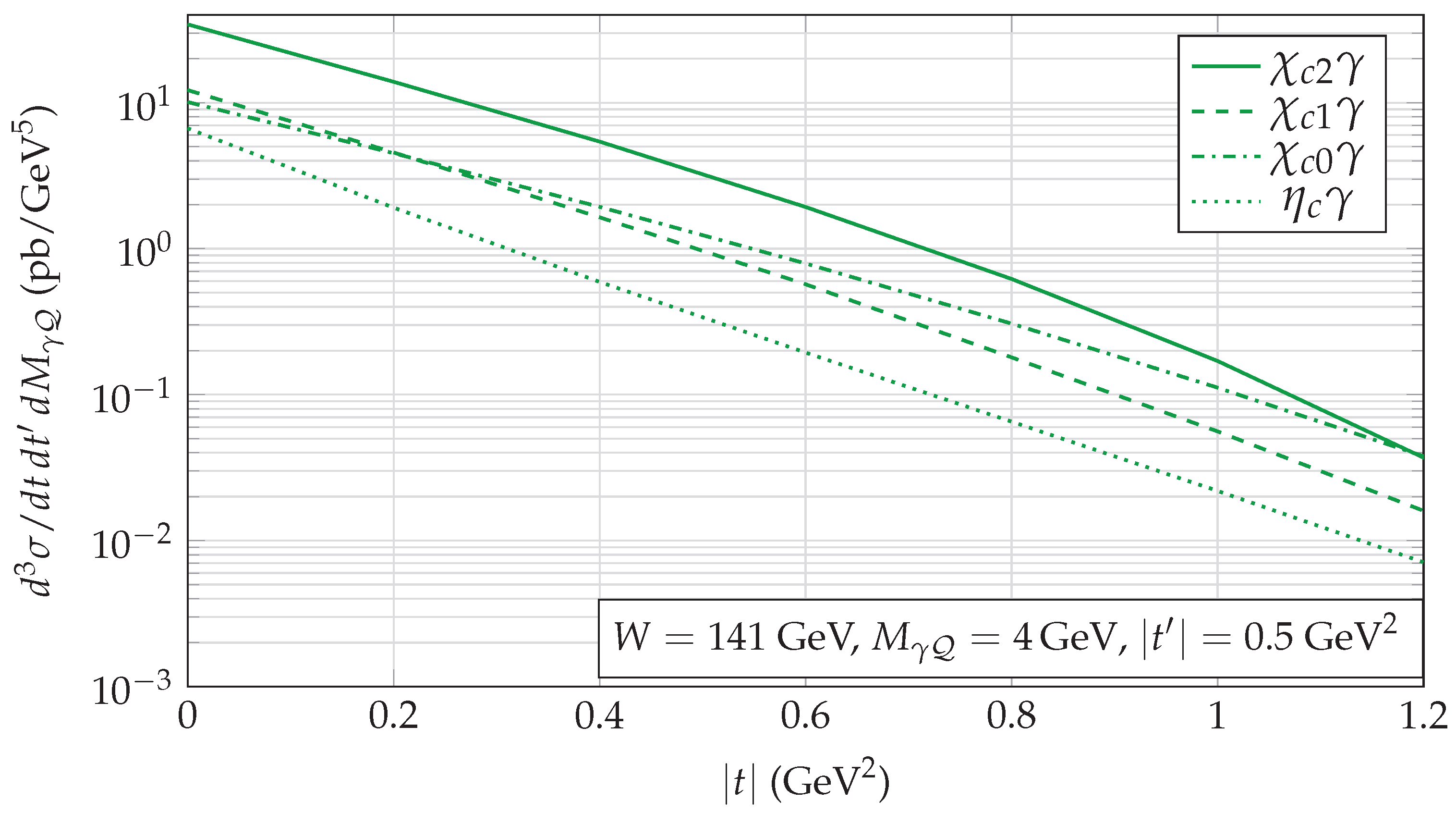
In Figure 2, we show the predicted differential cross-sections as functions of the momentum transfer to the proton, t. The steep exponential fall-off is a common feature of all exclusive processes and originates from the impact-parameter dependence implemented in the b-CGC model. The value of the slope is closely related to the spatial size of the target (proton). A rapid decrease of the cross-section with | t | implies that the quarkonia and final-state photons are predominantly produced with small-t, or equivalently, oppositely directed transverse momenta p Q k γ .
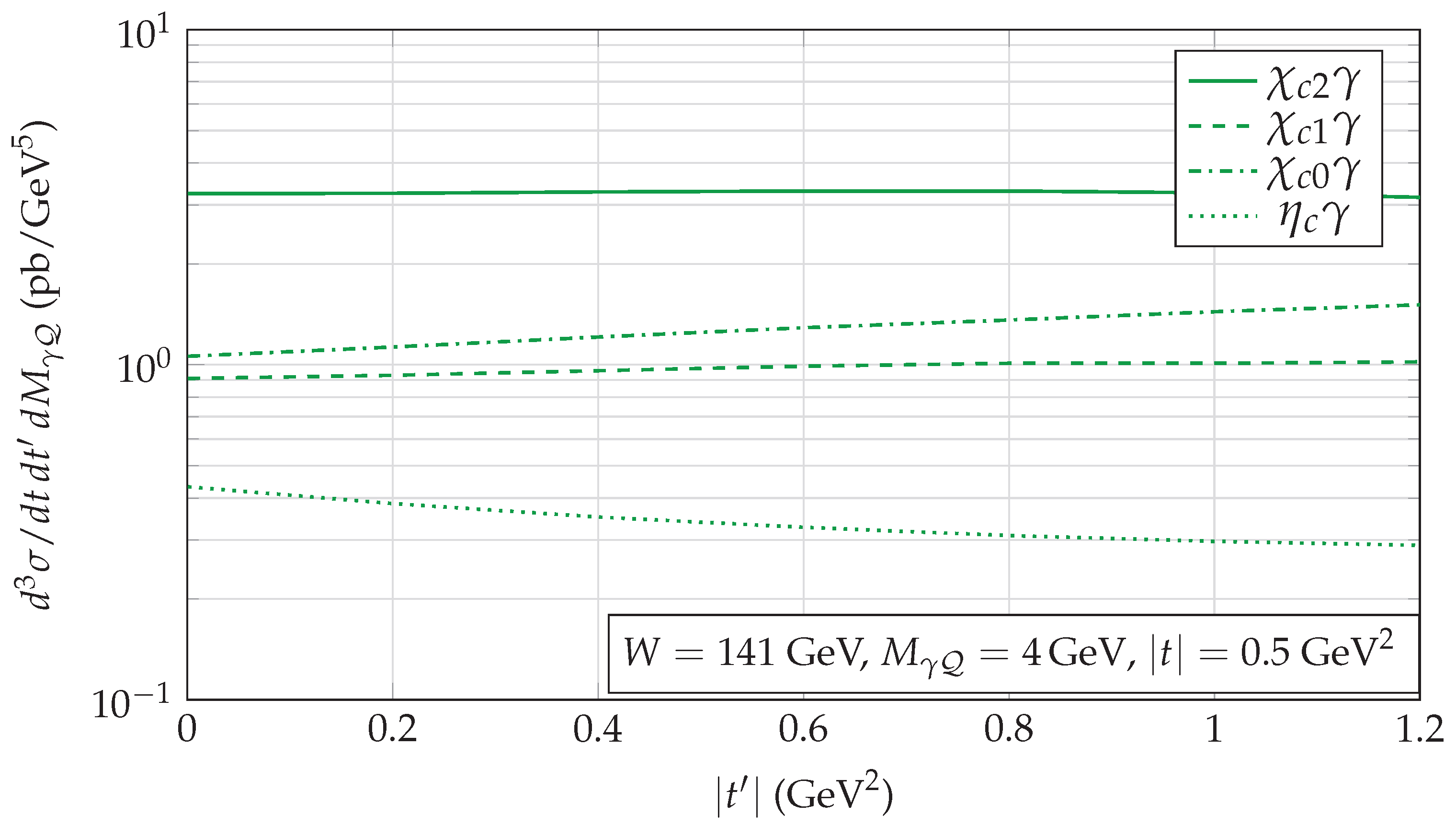
In the Figure 3, we show the dependence of the cross-sections on the invariant momentum transfer to the photon, t , which is closely related to the scattering angle of the photon, and for this reason has a strong dependence on the helicities of the final-state particles. In the forward kinematics ( | t | 0 ) this dependence is very mild because, technically, in many expressions the variable t contributes in a linear combination with hard scales M Q 2 , M γ Q 2 . In the backward kinematics, when | t | approaches its maximal value M γ Q 2 M Q 2 , the cross-section is strongly suppressed.
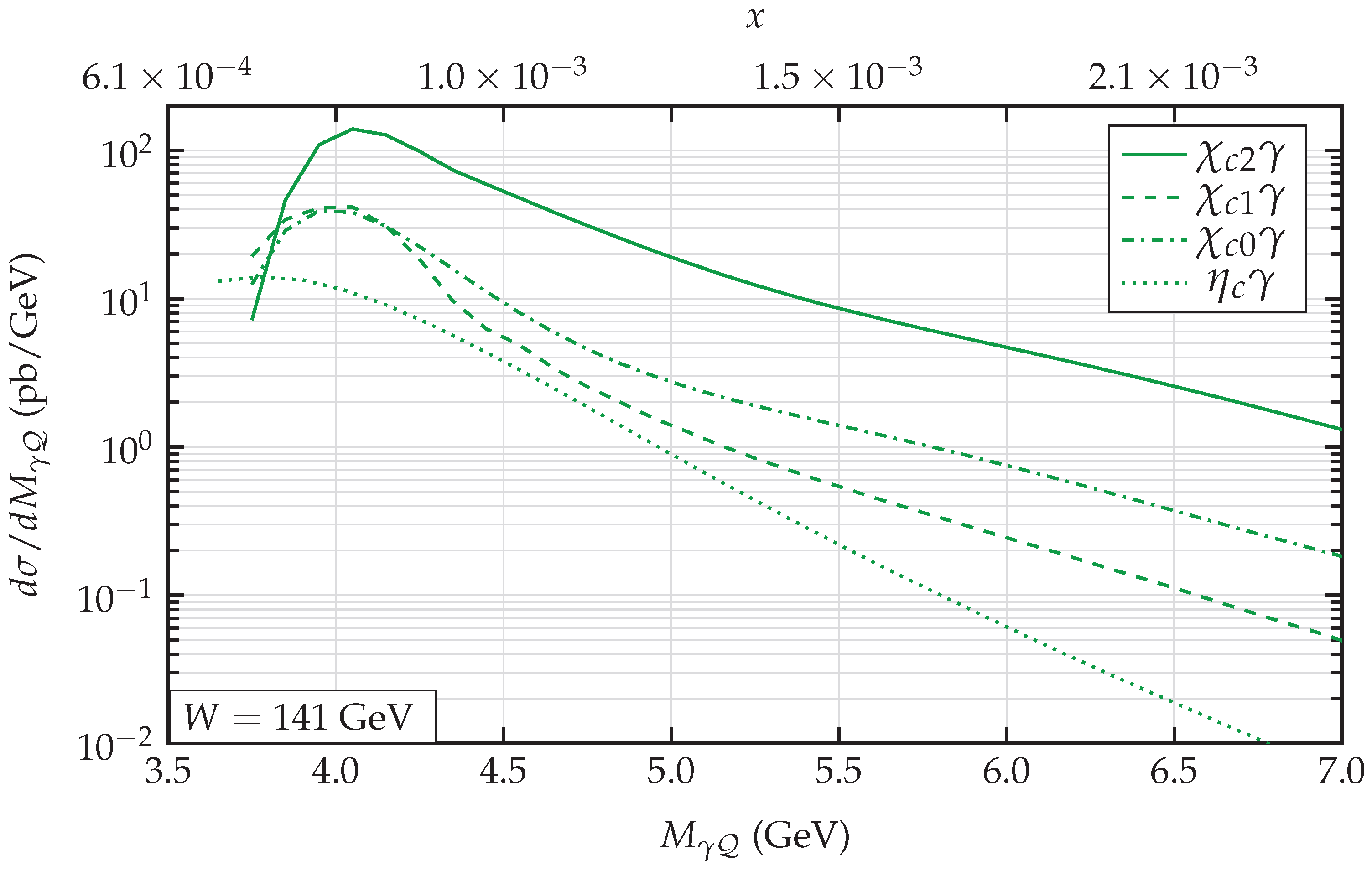
The dependence on the invariant mass M γ Q is illustrated in Figure 4. This dependence largely stems from the convolution integrals in Equations (5) and (6): it can be shown that at large values of M γ Q , the latter becomes proportional to the transverse momentum of the quarkonium | p Q | that appears explicitly in Equations (5) and (6), and thus effectively turns into the hard scale that controls the size of the color dipole. In this kinematics a rapid decrease of the cross-section at large M γ Q can be interpreted as a manifestation of color transparency: a strong suppression of the dipole scattering amplitude N for small-size dipoles. Although the variable M γ Q also appears in the prefactor of the cross-section (7), that dependence is relatively mild.
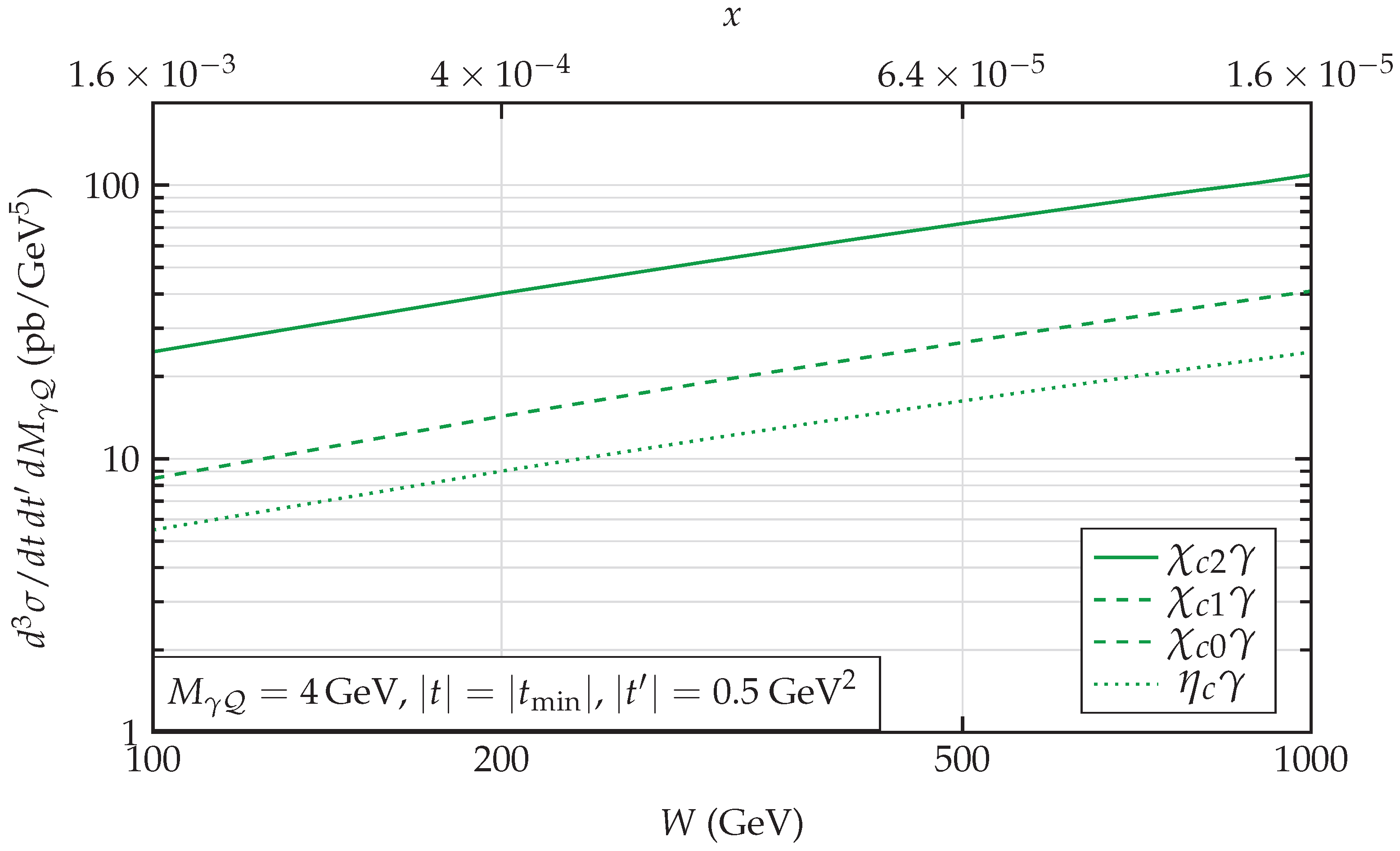
In the Figure 5 we show the energy dependence of the differential cross-section d 3 σ / d t d t d M γ Q . This dependence exhibits a clear power-law growth with energy, d σ W δ , with an exponent δ 0.6 0.7 . This growth is closely related to the energy dependence (x-dependence) of the saturation-scale evolution Q s 2 ( x ) x λ where λ δ / 2 . Any deviation from this power-law behavior at ultra-high energies would signal the onset of saturation. We find that the differential and total cross-sections show a very similar energy dependence.

Production and Counting Rates

To estimate the experimental viability of the proposed channels, we calculate the production and counting rates for the kinematics of ultraperipheral collisions at the LHC and the future Electron-Ion Collider (EIC). For definiteness, we assume the proton–proton collision energy to be s p p = 13 TeV in LHC kinematics, the electron–proton collision energy s e p = 141 GeV at the EIC, the instantaneous luminosity L = 10 34 cm 2 s 1 , and the integrated luminosity L d t = 100 fb 1 . The results are summarized in Table 1 and Table 2. The expected counting rates depend on the channel used for detection. For the χ c 1 and χ c 2 mesons, the radiative decays into J / ψ have the largest branching fractions, and for this reason are conventionally used for studies of these quarkonia. For χ c 0 , such a radiative decay into J / ψ leads to statistically insignificant counting rates; for this reason, we also provide counting rates for decays into other channels. Although the decay into four charged pions has the largest branching ratio, its experimental reconstruction might be challenging due to large combinatorial backgrounds from light-quark fragmentation. From this point of view, the two-body decay into charged kaons ( K + K ) presents the most viable alternative. The frequently discussed decay χ c 0 p p ¯ is of limited practical interest due to statistically insignificant counting rates.
From the analysis of the values in Table 1 and Table 2, we can see that the expected counting rates are sufficient for measurements of the unpolarized total cross-sections, even if the quarkonia are reconstructed from a single decay channel. The use of a multichannel analysis (namely, the simultaneous reconstruction of η c and χ c from several decay channels) can significantly boost the expected counting rates and the corresponding precision.

4. Comparison with Odderon-Mediated Photoproduction

The odderon, or C-odd color-singlet exchange of three reggeized gluons in the t-channel, was predicted more than 50 years ago, and since that time has been extensively studied in the literature [34,35,36,37,38,39]. Its experimental identification remains a long-standing challenge in QCD. A recent observation of the difference between the p p and p p ¯ elastic cross-sections by the TOTEM-D0 Collaborations [40,41] has reinvigorated interest in odderon searches and stimulated the search for new channels that could be used for precision studies of the odderon-mediated amplitudes, especially those accessible experimentally both at the HL-LHC and the future EIC.
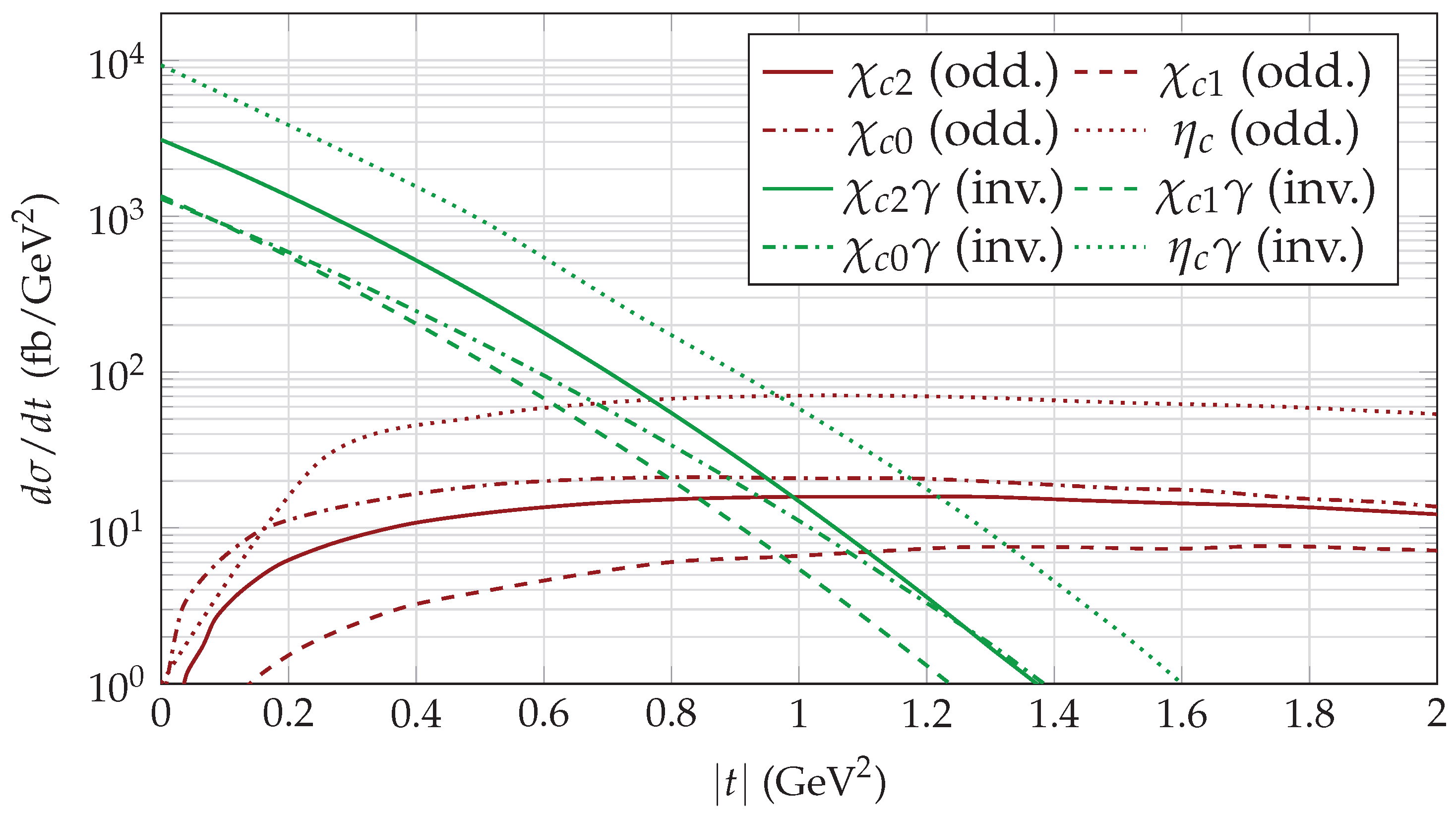
The exclusive photoproduction processes γ p η c p and γ p χ c J p have been suggested in the literature as clean probes of the odderon because the leading order amplitudes of these processes are controlled by the odderon amplitude [22,23,42], and the heavy-quarkonium mass acts as a hard scale that suppresses the dipole sizes and justifies the applicability of a perturbative approach for the evaluation of the impact factors. The main challenge for studies of the odderon in these channels is the presence of various background mechanisms, which may set the detection limits for odderon searches. In this context, the exclusive photoproduction of a quarkonium–photon pair with an undetected (“invisible”) photon may serve as a background that requires attention. While formally suppressed by a factor of O ( α em ) , this process is mediated by the much stronger C-even Pomeron exchange (dipole amplitude), and, for this reason, its contribution may be numerically comparable to that of the odderon, if the latter is estimated using modern parametrizations of the odderon amplitude. In Figure 6, we compare the cross-sections of η c and χ c production via the two aforementioned mechanisms. For the process γ p Q γ p , we integrate over the entire phase space of the produced photon with the additional cutoff M γ Q 3.8 GeV to exclude the near-threshold region (so the variable t is constrained by 0 < | t | < M γ Q 2 M Q 2 ). The predictions for the odderon-mediated cross-sections are taken from [22,23] and should be considered as order-of-magnitude estimates (as discussed in [43], at present the constraints on the odderon amplitude are very loose). In the kinematics of small momentum transfer | t | 1 GeV 2 , the quarkonium–photon background is almost two orders of magnitude larger than the odderon signal. We would also like to highlight that the exclusive production of Q γ may also proceed via the radiative decays J / ψ η c γ and ψ ( 2 S ) χ c γ . While for studies of the direct Q γ production it is possible to eliminate these contributions by imposing a cut on the invariant mass M γ Q , for events with an undetected photon it is impossible to impose such cuts, and for this reason the processes γ p J / ψ p η c p + γ ( inv . ) and γ p ψ ( 2 S ) p χ c p + γ ( inv . ) constitute the main backgrounds for odderon searches via exclusive quarkonia production (see [32,33] for more details).

5. Conclusions

In this work, we have studied in detail the exclusive photoproduction of quarkonium–photon pairs ( Q γ ) in the CGC framework, focusing on the C-even mesons Q = η c , χ c J . The possibility of experimental studies of both the quarkonia η c , χ c and direct photons in the proposed kinematics has already been demonstrated in the literature, and their momenta have been reliably reconstructed even in inclusive channels, which have significantly larger backgrounds. In exclusive channels, the independent production of these quarkonia with the subsequent emission of a photon from charged particles is suppressed due to C-parity; hence, we expect minimal contamination by other mechanisms. At leading order, the amplitudes of the proposed channels are controlled entirely by the forward dipole scattering amplitude N ( x , r , b ) . At higher orders the process receives contributions from quadrupoles; however, they are formally suppressed by O α s ( M Q ) Q s 2 / M Q 2 . The impact factors of the proposed processes can be analyzed perturbatively because the heavy quarkonium mass M Q and the invariant mass of the quarkonium–photon system M Q γ play the role of natural hard scales that control the size of the dipoles. We assume that the invariant mass M γ Q is sufficiently large to suppress the so-called feed-down contributions; however, this constraint is relatively mild and is satisfied if the quarkonia and photons are separated by 1–2 units of rapidity or by a sufficiently large azimuthal angle between their transverse momenta. We have established detailed relations between the kinematic distributions of the produced particles and the dependence of the forward dipole scattering amplitude on the dipole size, impact parameter, and rapidity in the heavy-quark mass limit. However, these hard scales also tend to suppress the cross-sections. Furthermore, a large heavy-quark mass also increases the number of possible decay channels and thereby decreases the branching ratios for the individual channels used to reconstruct the quarkonia in the detectors. We also estimated numerically the cross-sections of the proposed processes in the kinematics of ultraperipheral collisions at the LHC and the future EIC. We found that tens of thousands of η c γ and χ c γ pairs are produced for each L d t = 100 fb 1 of integrated luminosity. However, the reconstructed yields range from a few hundred to several thousand events, depending on the channels used to reconstruct the quarkonia. This rate is sufficient for the measurement of the total and single-differential cross-sections. However, measuring the double- and triple-differential cross-sections, as well as studying polarization asymmetries, will require significantly higher luminosities, or, alternatively, a multichannel analysis to overcome the small branching fractions of the individual decay channels. We also found that the proposed channel represents a significant physical background for exclusive odderon searches via single C-even charmonia photoproduction, especially in the kinematics of small momentum transfer | t | 1 GeV 2 .

Author Contributions

Conceptualization, M.S. and M.R.; Methodology, M.S.; Software, I.Z.; Validation, M.S.; Investigation, M.R.; Data curation, I.Z.; Writing – original draft, M.S.; Writing – review and editing, M.S.; Supervision, M.S. All authors have read and agreed to the published version of the manuscript.

Funding

This research was partially supported by ANID CCTVal CIA250027, and Fondecyt Regular grants No. 1251975, and Postdoctoral grant No. 3230699. I. Z. also expresses his gratitude to the Institute of Physics of PUCV.

Data Availability Statement

The original contributions presented in this study are included in the article. Further inquiries can be directed to the corresponding author.

Acknowledgments

We thank our colleagues at the UTFSM university for helpful discussions. Powered@NLHPC: This research was partially supported by the supercomputing infrastructure of the NLHPC (ECM-02).

Conflicts of Interest

The authors declare no conflicts of interest that could affect the research agenda, representation or interpretation of the reported research results. The funders had no role in the design of the study; in the collection, analyses, or interpretation of data; in the writing of the manuscript; or in the decision to publish the results.

References

  1. Ma, Y.-Q.; Venugopalan, R. Comprehensive description of J/ψ production in proton-proton collisions at collider energies. Phys. Rev. Lett. 2014, 113, 192301. [Google Scholar] [CrossRef] [PubMed]
  2. Mäntysaari, H.; Roy, K.; Salazar, F.; Schenke, B. Gluon imaging using azimuthal correlations in diffractive scattering at the Electron-Ion Collider. Phys. Rev. D 2021, 103, 094026. [Google Scholar] [CrossRef]
  3. Blaizot, J.P.; Gelis, F.; Venugopalan, R. High energy pA collisions in the color glass condensate approach II: Quark pair production. Nucl. Phys. A 2004, 743, 57–91. [Google Scholar] [CrossRef]
  4. Abelev, B.; Adam, J.; Adamová, D.; Adare, A.M.; Aggarwal, M.M.; Aglieri Rinella, G.; Agnello, M.; Agocs, A.G.; Agostinelli, A.; Ahammed, Z.; et al. Transverse Momentum Distribution and Nuclear Modification Factor of Charged Particles in p—Pb Collisions at s N N = 5.02 TeV. Phys. Rev. Lett. 2013, 110, 082302. [Google Scholar] [CrossRef] [PubMed]
  5. Aad, G.; Abbott, B.; Abdallah, J.; Abdinov, O.; Abeloos, B.; Aben, R.; AbouZeid, O.S.; Abraham, N.L.; Abramowicz, H.; Abreu, H.; et al. Transverse momentum, rapidity, and centrality dependence of inclusive charged-particle production in sNN=5.02 TeV p--Pb collisions measured by the ATLAS experiment. Phys. Lett. B 2016, 763, 313–336. [Google Scholar] [CrossRef]
  6. Rezaeian, A.H.; Siddikov, M.; Van de Klundert, M.; Venugopalan, R. Analysis of combined HERA data in the Impact-Parameter dependent Saturation model. Phys. Rev. D 2013, 87, 034002. [Google Scholar] [CrossRef]
  7. Rezaeian, A.H.; Schmidt, I. Impact-parameter dependent Color Glass Condensate dipole model and new combined HERA data. Phys. Rev. D 2013, 88, 074016. [Google Scholar] [CrossRef]
  8. Watt, G.; Kowalski, H. Impact parameter dependent colour glass condensate dipole model. Phys. Rev. D 2008, 78, 014016. [Google Scholar] [CrossRef]
  9. Kowalski, H.; Motyka, L.; Watt, G. Exclusive diffractive processes at HERA within the dipole picture. Phys. Rev. D 2006, 74, 074016. [Google Scholar] [CrossRef]
  10. Albacete, J.L. Testing the CGC in proton-lead collisions at the LHC. Nucl. Phys. A 2013, 910–911, 155–162. [Google Scholar] [CrossRef]
  11. Aaij, R.; Abdelmotteleb, A.S.W.; Abellan Beteta, C.; Abudinén, F.; Ackernley, T.; Adeva, B.; Adinolfi, M.; Afsharnia, H.; Agapopoulou, C.; Aidala, C.A.; et al. Study of exclusive photoproduction of charmonium in ultra-peripheral lead-lead collisions. J. High Energy Phys. 2023, 6, 146. [Google Scholar]
  12. Mäntysaari, H.; Salazar, F.; Schenke, B. Energy dependent nuclear suppression from gluon saturation in exclusive vector meson production. Phys. Rev. D 2024, 109, L071504. [Google Scholar] [CrossRef]
  13. Banu, K.; Siddiqah, M.; Abir, R. Small-x evolution of 2n-tuple Wilson line correlator revisited: The nonsingular kernels. Phys. Rev. D. 2019, 99, 094017. [Google Scholar] [CrossRef]
  14. Mäntysaari, H.; Penttala, J. Complete calculation of exclusive heavy vector meson production at next-to-leading order in the dipole picture. J. High Energy Phys. 2022, 08, 247. [Google Scholar]
  15. Mäntysaari, H.; Penttala, J. Exclusive production of light vector mesons at next-to-leading order in the dipole picture. Phys. Rev. D 2022, 105, 114038. [Google Scholar] [CrossRef]
  16. Iancu, E.; Mulian, Y. Dihadron production in DIS at NLO: The real corrections. J. High Energy Phys. 2023, 07, 121. [Google Scholar]
  17. Beuf, G.; Lappi, T.; Paatelainen, R. Massive quarks in NLO dipole factorization for DIS: Longitudinal photon. Phys. Rev. D 2021, 104, 056032. [Google Scholar] [CrossRef]
  18. Beuf, G.; Lappi, T.; Paatelainen, R. Massive quarks in NLO dipole factorization for DIS: Transverse photon. Phys. Rev. D 2022, 106, 034013. [Google Scholar] [CrossRef]
  19. Beuf, G.; Lappi, T.; Mäntysaari, H.; Paatelainen, R.; Penttala, J. Diffractive deep inelastic scattering at NLO in the dipole picture. J. High Energy Phys. 2024, 05, 024. [Google Scholar]
  20. The ALICE Collaboration; Abelev, B.; Adam, J.; Adamová, D.; Adare, A.M.; Aggarwal, M.M.; Rinella, G.A.; Agocs, A.G.; Agostinelli, A.; Salazar, S.A.; et al. Measurement of inelastic, single- and double-diffraction cross sections in proton–proton collisions at the LHC with ALICE. Eur. Phys. J. C 2013, 73, 2456. [Google Scholar] [CrossRef] [PubMed]
  21. Jia, Y.; Mo, Z.; Pan, J.; Zhang, J.-Y. Photoproduction of C-even quarkonia at the EIC and EicC. Phys. Rev. D 2023, 108, 016015. [Google Scholar] [CrossRef]
  22. Benic, S.; Horvatic, D.; Kaushik, A.; Vivoda, E.A. Exclusive ηc production from small-x evolved Odderon at an electron-ion collider. Phys. Rev. D 2023, 108, 074005. [Google Scholar]
  23. Benic, S.; Dumitru, A.; Kaushik, A.; Motyka, L.; Stebel, T. Photon-odderon interference in exclusive χc charmonium production at the Electron-Ion Collider. Phys. Rev. D 2024, 110, 014025. [Google Scholar]
  24. Ma, Y.-Q.; Wang, K.; Chao, K.-T. QCD radiative corrections to χcJ production at hadron colliders. Phys. Rev. D 2011, 83, 111503. [Google Scholar] [CrossRef]
  25. Likhoded, A.K.; Luchinsky, A.V.; Poslavsky, S.V. Production of χc- and χb-mesons in high energy hadronic collisions. Phys. Rev. D 2014, 90, 074021. [Google Scholar] [CrossRef]
  26. Zhang, H.-F.; Yu, L.; Zhang, S.-X.; Jia, L. Global analysis of the experimental data on χc meson hadroproduction. Phys. Rev. D 2016, 93, 054033. [Google Scholar] [CrossRef]
  27. Baranov, S.P.; Lipatov, A.V. Are there any challenges in the charmonia production and polarization at the LHC? Phys. Rev. D 2019, 100, 114021. [Google Scholar] [CrossRef]
  28. Baranov, S.P.; Lipatov, A.V.; Prokhorov, A.A.; Chen, X. Towards higher-order calculations of quarkonia production with kT-factorization: P-wave charmonia. Eur. Phys. J. C 2024, 84, 348. [Google Scholar] [CrossRef]
  29. Ayala, A.; Hentschinski, M.; Jalilian-Marian, J.; Tejeda-Yeomans, M.E. Spinor helicity methods in high-energy factorization: Efficient momentum-space calculations in the Color Glass Condensate formalism. Nucl. Phys. B 2017, 920, 232–255. [Google Scholar] [CrossRef]
  30. Caucal, P.; Salazar, F.; Venugopalan, R. Dijet impact factor in DIS at next-to-leading order in the Color Glass Condensate. J. High Energy Phys. 2021, 11, 222. [Google Scholar]
  31. Caucal, P.; Salazar, F.; Schenke, B.; Venugopalan, R. Back-to-back inclusive dijets in DIS at small x: Sudakov suppression and gluon saturation at NLO. J. High Energy Phys. 2022, 11, 169. [Google Scholar]
  32. Siddikov, M.; Zemlyakov, I.; Roa, M.; Valdebenito, S. Photoproduction of ηcγ pairs in the CGC framework. Phys. Rev. D 2025, 111, 056024. [Google Scholar] [CrossRef]
  33. Siddikov, M.; Zemlyakov, I.; Roa, M. Exclusive photoproduction of χcγ pairs in the small-x kinematics. Phys. Rev. D 2026, 113, 034024. [Google Scholar] [CrossRef]
  34. Bartels, J. High-energy behaviour in a non-abelian gauge theory (II). First corrections to Tn→m beyond the leading lns approximation. Nucl. Phys. B 1980, 175, 365. [Google Scholar] [CrossRef]
  35. Jaroszewicz, T. Infrared Divergences and Regge Behavior in QCD. Acta Phys. Pol. B 1980, 11, 965. [Google Scholar]
  36. Kwiecinski, J.; Praszalowicz, M. Three Gluon Integral Equation and Odd c Singlet Regge Singularities in QCD. Phys. Lett. B 1980, 94, 413. [Google Scholar] [CrossRef]
  37. Bartels, J.; Braun, M.A.; Colferai, D.; Vacca, G.P. Diffractive ηc photoproduction and electroproduction with the perturbative QCD odderon. Eur. Phys. J. C 2001, 20, 323–331. [Google Scholar] [CrossRef]
  38. Czyzewski, J.; Kwiecinski, J.; Motyka, L.; Sadzikowski, M. Exclusive ηc photo- and electroproduction at HERA as a possible probe of the odderon singularity in QCD. Phys. Lett. B 1997, 398, 400–406, Erratum in Phys. Lett. B 1997, 411, 402. [Google Scholar] [CrossRef]
  39. Engel, R.; Ivanov, D.Y.; Kirschner, R.; Szymanowski, L. Diffractive meson production from virtual photons with odd charge-parity exchange. Eur. Phys. J. C 1998, 4, 93–104. [Google Scholar] [CrossRef]
  40. Antchev, G.; Aspell, P.; Atanassov, I.; Avati, V.; Baechler, J.; Barrera, C.B.; Berardi, V.; Berretti, M.; Bossini, E.; Bottigli, U.; et al. Elastic differential cross section /dt at s = 2.76 TeV and implications on the existence of a colourless C-odd three-gluon compound state. Eur. Phys. J. C 2020, 80, 91. [Google Scholar] [CrossRef]
  41. Alverson, G.; Alves, G.A.; Aoki, M.; Askew, A.; Atkins, S.; Augsten, K.; Avila, C.; Badaud, F.; Bagby, L.; Baldin, B.; et al. Measurement of the differential cross section /dt in elastic p p ¯ scattering at s = 21.96 TeV. Phys. Rev. D 2012, 86, 012009. [Google Scholar] [CrossRef]
  42. Dumitru, A.; Stebel, T. Multiquark matrix elements in the proton and three gluon exchange for exclusive ηc production in photon-proton diffractive scattering. Phys. Rev. D 2019, 99, 094038. [Google Scholar] [CrossRef]
  43. Roa, M.; Siddikov, M.; Gentile, Y.; Zemlyakov, I. Constraints on the odderon amplitude in the CGC framework. arXiv 2026, arXiv:2603.02394. to appear in Physical Review D. [Google Scholar]
Figure 1. Schematic representation of the quarkonium-photon pair photoproduction process at leading order in the CGC framework. The left and the right diagrams correspond to the amplitudes of the processes in which the final-state photon is emitted before and after the interaction of the heavy quarks with the shockwave (correspond to the terms A 1 and A 2 , respectively). Each diagram should be supplemented by the (charge-conjugate) contribution with inverted direction of the fermion lines.
Particles 09 00074 g001
Figure 2. The dependence of the differential cross-sections of the γ p Q γ p process on the momentum transfer | t | to the target at W = 141 GeV, M γ Q = 4 GeV and | t | = 0.5 GeV 2 (corresponding Bjorken variable x 8 × 10 4 ).
Particles 09 00074 g002
Figure 3. The dependence of the differential cross-sections of γ p Q γ p on the momentum transfer | t | to the photon at W = 141 GeV and M γ Q = 4 GeV (corresponding Bjorken variable x 8 × 10 4 ).
Particles 09 00074 g003
Figure 4. The dependence of the single-differential cross-section of the γ p Q γ p on the invariant mass M γ Q , integrated over all possible values of t and t . The increase of energy scales up the cross-section but does not change its shape. The cross-section for χ c γ has a characteristic peak followed by a rapid suppression in the near-threshold region. For η c γ pairs, a similar near-threshold behavior shows up at significantly smaller values of M γ Q . The upper ticks show the corresponding values of the Bjorken variable x.
Particles 09 00074 g004
Figure 5. The energy dependence of the differential cross-section of of γ p Q γ p process. The straight line curves in double logarithmic coordinates suggest the power-law energy dependence of the differential cross-section. The slope of the energy dependence practically does not depend on other kinematic variables. The upper ticks show the corresponding values of the Bjorken variable x.
Particles 09 00074 g005
Figure 6. Comparison of the cross-sections of the odderon-mediated γ p Q p and the Pomeron-mediated γ p Q γ p with an invisible photon (we use the labels “ Q (odd.)” and “ Q γ (inv.)” with Q = η c , χ c to distinguish them). The predictions for the odderon-mediated cross-sections are taken from [22,23] and may include up to an order of magnitude uncertainty [43]. The predictions for η c are provided for the Bjorken variable value x = 10 2 , whereas predictions for χ c are given for the center-of-mass energy s = 141 GeV. For legibility, we do not show the feed-down contributions from the radiative decay channels J / ψ η c γ and ψ ( 2 S ) χ c γ , which have the same shape of t-dependence as γ p Q γ p but are approximately two orders of magnitude larger.
Particles 09 00074 g006
Table 1. Production and counting rates at the EIC ( s e p = 141 GeV , L d t = 100 fb 1 ). The columns N and d N / d t correspond to total number of produced quarkonia-photon pairs and the production rates. The sixth column “Combined Br.” corresponds to the product of branching fractions of subprocesses shown in the fifth column. Similarly, the columns N d and d N d / d t correspond to the total number of detected pairs and the detection (counting) rates, assuming the quarkonia are reconstructed via the subprocesses shown in the fifth column.
State σ tot N (Total) dN / dt Decay ChannelCombined Br. N d dN d / dt
η c 0.25 pb 2.5 × 10 4 220/day η c ( 1 S ) K S 0 K + π 2.6 % 650175/month
χ c 0 0.35 pb 3.5 × 10 4 300/day χ c 0 J / ψ γ μ + μ γ 0.08 % 287/month
χ c 0 2 ( π + π ) 2.34 % 819210/month
χ c 0 K + K 0.6 % 21053/month
χ c 1 0.32 pb 3.2 × 10 4 275/day χ c 1 J / ψ γ μ + μ γ 2.0 % 640167/month
χ c 2 1.3 pb 1.3 × 10 5 1120/day χ c 2 J / ψ γ μ + μ γ 1.1 % 1430375/month
Table 2. Production and counting rates at the LHC kinematics ( s p p = 13 TeV , L d t = 100 fb 1 ). The columns N and d N / d t correspond to total number of produced quarkonia-photon pairs and the production rates. The sixth column “Combined Br.” corresponds to the product of branching fractions of subprocesses shown in the fifth column. Similarly, the columns N d and d N d / d t correspond to the total number of detected pairs and the detection (counting) rates, assuming the quarkonia are reconstructed via the subprocesses shown in the fifth column.
State σ tot N (Total) dN / dt Decay ChannelCombined Br. N d dN d / dt
η c 0.2 pb 2 . × 10 4 180/day η c ( 1 S ) K S 0 K + π 2.6 % 520142/month
χ c 0 0.23 pb 2.3 × 10 4 200/day χ c 0 J / ψ γ μ + μ γ 0.08 % 184.8/month
χ c 0 2 ( π + π ) 2.34 % 538142/month
χ c 0 K + K 0.6 % 13837/month
χ c 1 0.19 pb 1.9 × 10 4 165/day χ c 1 J / ψ γ μ + μ γ 2.0 % 380100/month
χ c 2 0.9 pb 9 × 10 4 780/day χ c 2 J / ψ γ μ + μ γ 1.1 % 990260/month
Disclaimer/Publisher’s Note: The statements, opinions and data contained in all publications are solely those of the individual author(s) and contributor(s) and not of MDPI and/or the editor(s). MDPI and/or the editor(s) disclaim responsibility for any injury to people or property resulting from any ideas, methods, instructions or products referred to in the content.