Article

Nanofusion: Plasmons Help to Accelerate Protons

by
Tamás Biró
on behalf of the NAPLIFE Collaboration
HUN-REN Wigner Research Centre for Physics, 1525 Budapest, Hungary
Particles 2026, 9(1), 28; https://doi.org/10.3390/particles9010028

Submission received: 4 November 2025 / Revised: 10 March 2026 / Accepted: 17 March 2026 / Published: 19 March 2026
(This article belongs to the Special Issue Particles and Plasmas in Strong Fields)

Abstract

We report on laser fusion research with nanotechnology-improved targets embedded in special polymers. The results of the last three years are reviewed here, including laser matter interaction craters, laser infrared breakdown spectroscopy, and Raman spectroscopy results, as well as a selected Thomson parabola image showing protons accelerated up to 300 keV. In this paper, we focus on proton acceleration and plasmonic enhancement mechanisms rather than on the direct demonstration of sustained fusion reactions.

1. Introduction

Energy is precious and is the foundation of all civilizations. A future energy sources that would be plentiful at an affordable price is nuclear fusion. It has the highest energy density per unit mass of fuel; for the well-established and well-tested deuteron-triton reaction, less than a gram contains the energy of one and a half kg of fission material (uranium) and the same amount of energy as twenty tons of coal. It is based on the fusion of light elements, and results in several MeV of energy released per reaction in the form of fusion products. Some of the possible reaction channels have the remarkable property that no neutrons are produced; these are called aneutronic fusion reactions. Most prominently, the reaction of protons with the 11B boron isotope results in three alpha particles with kinetic energies in the range of 3–4 MeV each. Alpha particles can be stopped with a thin paper sheet, while the beta radiation of energetic electrons can be stopped with metal foil. Even the gamma radiation of photons of several hundred keV to MeV can be shielded with lead walls. Only energetic neutrons of over 10 MeV, such as those resulting from the D + T reaction, cannot be stopped. They contribute to the contamination of reaction zones and their walls; therefore, the idea of doping the wall with lithium to catch as many neutrons as possible has been proposed. However, for safe civil use, aneutronic fusion reactions should be preferred.
There are numerous approaches to fusion. The best-known, i.e., “classical”, ones are (i) equilibrium thermonuclear fusion under high pressure and temperature with magnetic field confinement (as shown by, e.g., the international Thermonuclear Experimental Reactor, ITER) [1,2] and (ii) laser inertial fusion, compressing fuel with synchronized laser beams (achieved by, e.g., the National Ignition Facility, NIF) [3]. The National Ignition Facility achieved laser inertial fusion in 2022 [4,5,6]. The private sector has also shown increasing interest in fusion research [7]. Alternative technologies of realizing or helping to ignite fusion reactions are also numerous. Two examples involving strong magnetic fields are the directly coupling of fusion energy via magnetic fields [8] and fusion ignition using very strong magnetic fields in cavities, which were proposed to increase pressure in fusion fuel [9]. Our approach uses the plasmon effect, observed in low-energy laser experiments, in order to concentrate the laser pulse energy in a smaller region, hence increasing the energy density there. This led us to name it Nanoplasmonic Laser-Ignited Fusion Experiment (NAPLIFE).
Our present experimental efforts focus on proton acceleration and plasmonic enhancement mechanisms rather than on the direct demonstration of sustained fusion reactions. However, from one point of view, such experiments are worth being pursued in order to reach nuclear fusion conditions that will be sufficient for positive net energy production in the future.

2. Materials and Methods

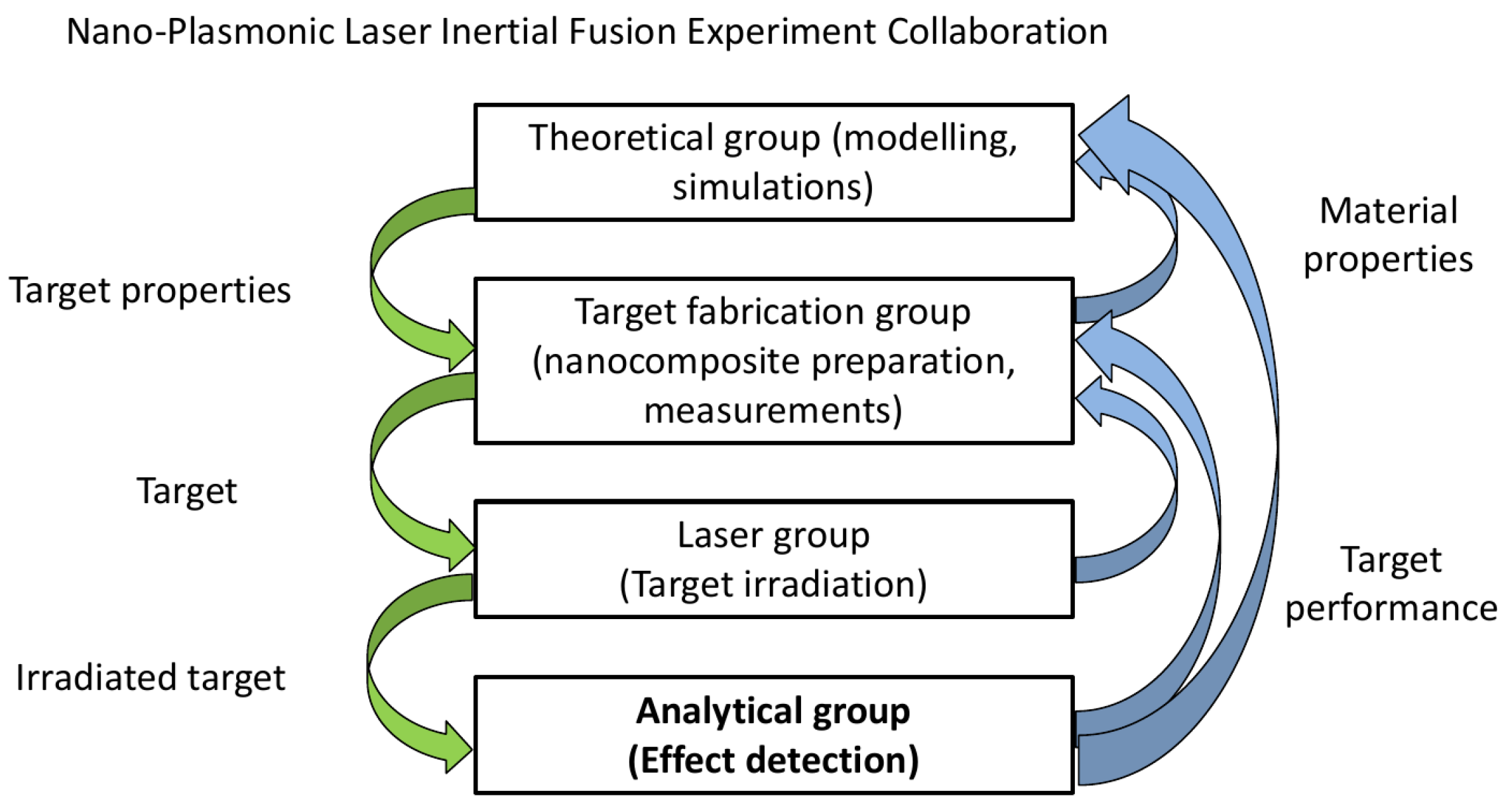
According to the strategy outlined above, we organized a unique research network within the framework of the Hungarian National Laboratories program, run by NKFIH [10], consisting of groups concentrating on four tasks: (i) the theoretical modeling and simulation of the laser matter interaction, plasmon formation, and electron and proton acceleration [11,12,13,14,15,16,17,18]; (ii) target design and fabrication with nanoparticles [19,20,21]; (iii) laser irradiation with femtosecond laser pulses in a 1–30 mJ regime [22]; and, finally, (iv) spectroscopic activity for the detection of processes and their remnants inside and outside the target [23,24,25,26]. A flow diagram describing the interactions between these research tasks is shown in Figure 1. The diagram was drawn by Judit Kámán [27].
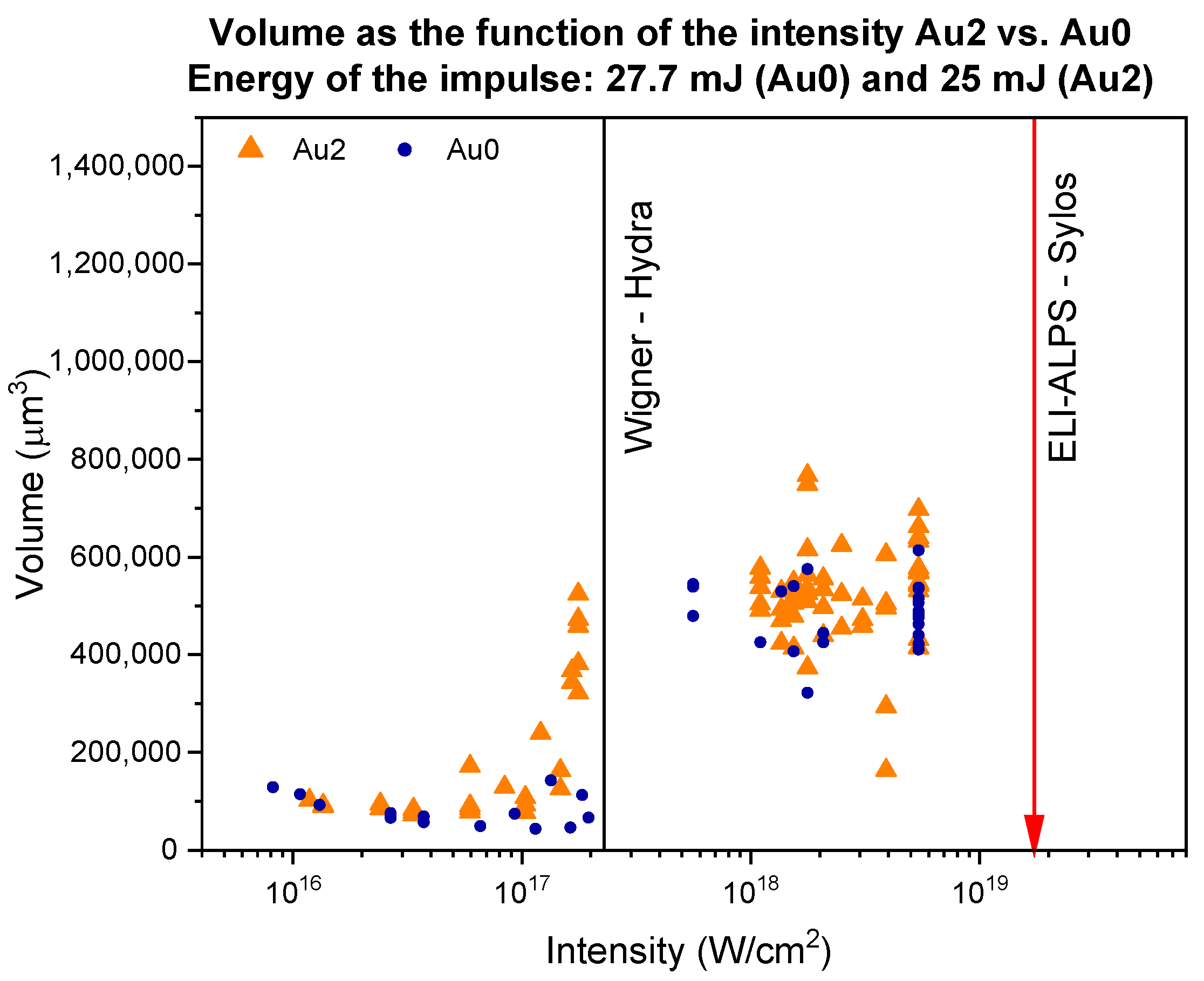
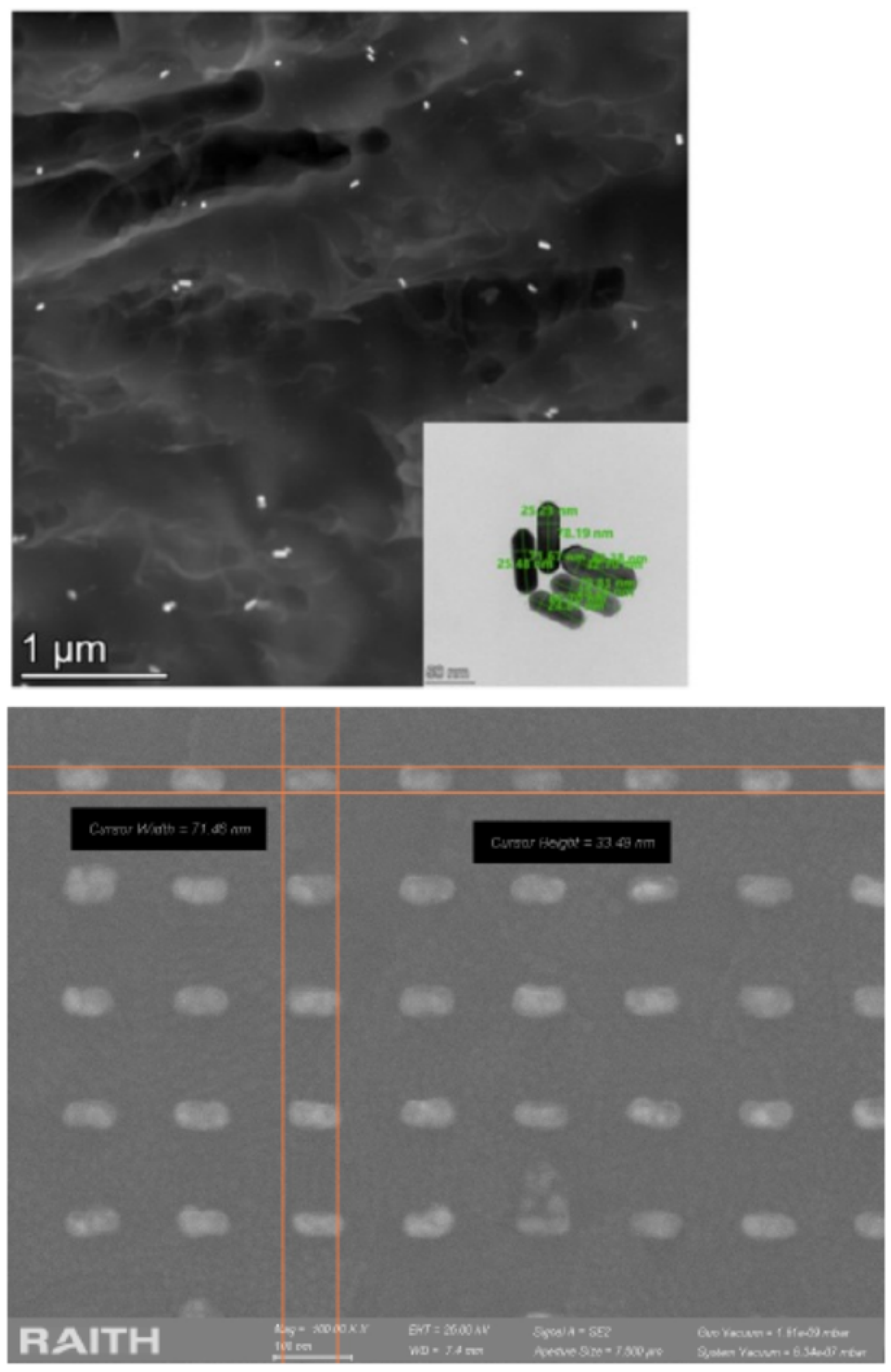
In particular, we used gold nanorods of resonant size to the given laser beam with a 795 nm wavelength, with a varying pulse duration and total energy. In this way, we performed an intensity scan. With the Hidra laser at the Hun-Ren Wigner Physics Research Center for Physics (Wigner RCP), we achieved pulse intensities in the range of 5 × 10 15 W / cm 2 2 × 10 17 W / cm 2 , and with the SYLOS laser at the ELI-ALPS, Szeged, we achieved intensities in the range of 5 × 10 17 W / cm 2 5 × 10 18 W / cm 2 . The mentioned nanorods were embedded in an UDMA-TEGDMA copolymer, also used in dentistry, because it can be made solid via UV light irradiation. Then, the thin films can be prepared, transported, and irradiated by laser beams repeatedly. The gold nanorods in the resulting solid target film should not aggregate; this sets an upper limit on the achievable density and thus on the generated plasmonic effect. A microscope photo of a selected target piece with randomly placed and randomly oriented Au nanorods is presented in the left part of Figure 2, courtesy of Attila Bonyár [28]. The right half shows a newly fabricated target with regularly placed and parallel nanorods. The importance of the nanorod orientation will be shown in the next section by inspecting the ion distribution and energies using so-called Thomson parabola pictures. As shown, the respective magnification factors differ. The nanorods have the same size in both cases.

3. Results

We have several results. First of all, we experimented with and developed a purposeful target fabrication procedure using commercially available nanorod packages and embedded them into the above-mentioned copolymer. Spectroscopic and microscopic control is realized before transport and usage. We compared the embedded samples of gold nanoparticles in terms of resonant size, off-resonant size, and pure polymer targets. Recently, in 2025, we obtained nanorods embedded in an arranged lattice pattern [20,21].
Second, we used femtosecond laser pulses for irradiation, changing the pulse duration between 12 and 160 fs. The corresponding intensity was inversely proportional to these durations. Shots were performed at the Hun-Ren Wigner Research Centre for Physics (Wigner RCP) in Budapest and at the ELI-ALPS in Szeged, with the latter occurring at user campaigns lasting several days. Beyond the duration, the pulse’s total energy was also changed, increasing up to 30 mJ in a single pulse. The target films were fixed in a framework, and the laser focus width of 10–20 microns was set in position.
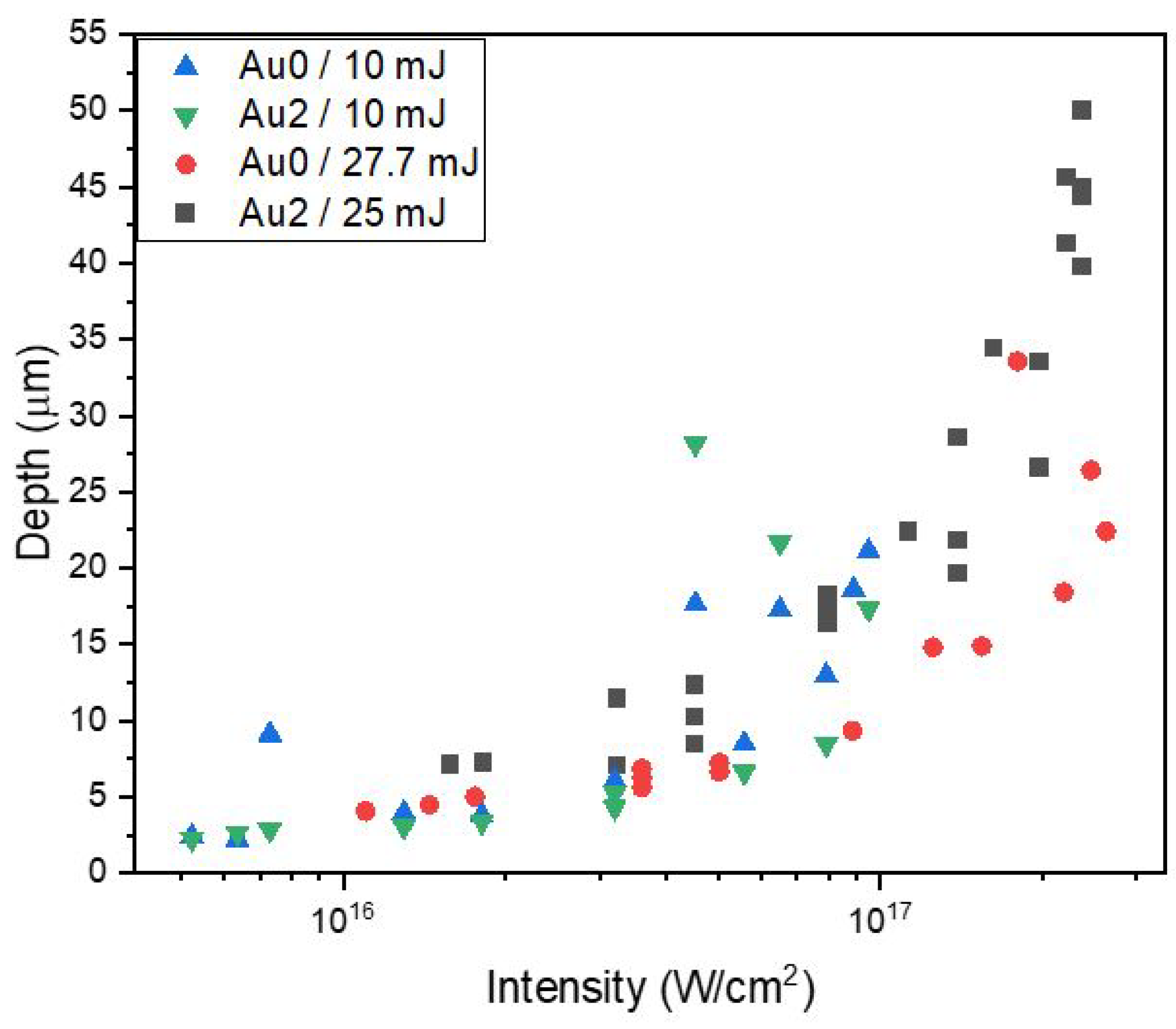
Third, on- and offline spectroscopy was applied in order to study the effect of each shot, comparing the resonant nanorod targets with the other types. We studied the craters in terms of shape and size, resulting from the laser–matter interaction. Meanwhile, the crater depth features a monotonic increase by laser pulse intensity across the experimental range cf. In Figure 3, the gold nanorod-doped samples show a significant increase in crater volume starting around the threshold intensity of 2 × 10 17 W / cm 2 cf. In Figure 4. ELI-ALPS SYLOS measurements at higher intensities show a saturation effect on the crater volumes. Here, one should note that the contrast is much higher with the ELI-ALPS instrumentation, so these measurements will have to be repeated later with improved contrast of the Wigner RCP’s Hidra laser.
Online spectroscopy was used for laser-induced breakdown spectroscopy (LIBS), concentrating on the Balmer series of the H atom compared to that with the D atom. These should be signals of any possible deuteron production and atomic reconstruction. For comparison, artificially doped deuterium polymers were also investigated, up to 30 % of D. Here, our measurements are still somewhat inconclusive, although deuterium production from a fraction of a percent up to a few per cent cannot be excluded. The natural abundance of deuterium is 1 / 6000 0.016 % , so even this would be a significant finding [30]. The required resolution in the Balmer spectra is 0.1 nm for distinguishing between H and D atoms. Our statistics are also limited. We controlled these findings by applying mass spectroscopy after the shots from the vacuum chamber, selecting the atomic mass number range of 1–4. Unfortunately, only a small fraction of D could be detected, even from the deuterized samples, so these measurements must be technically improved in the future [23].
As important as the detection of fusion reaction products is, the investigation focused on proton and heavier ion energies. It reveals information about the chances of possible nuclear fusion reactions, not only considering the percentage of protons that overcome an energy threshold but also providing us leverage for selecting reaction channels. Our findings are exemplary only; a low percentage of the proton tracks belong to energies over 100 keV.
Future fusion technologies would prefer less destructive processes than the lowest-temperature and lowest-density D-T reaction, according to Lawson’s criterion [4]. A currently favored channel is the p + 11 B reaction [31,32,33,34], with a near threshold resonance in the cross-section at 162 keV proton energy in the lab. Furthermore, this reaction does not produce any neutron directly, only alpha particles in the 3–4 MeV energy range. However, the absolute maximum of this cross-section is over 600 keV. Another aneutronic reaction, with beryllium, has resonance at even lower energy levels, around 70 keV. According to the number of protons in the required energy range, in our experiments, nanofusion can indeed take place at this point. The application of such fusion reactions will significantly improve the safety situation of nuclear radiation, as well as the fusion device’s lifetime [35].
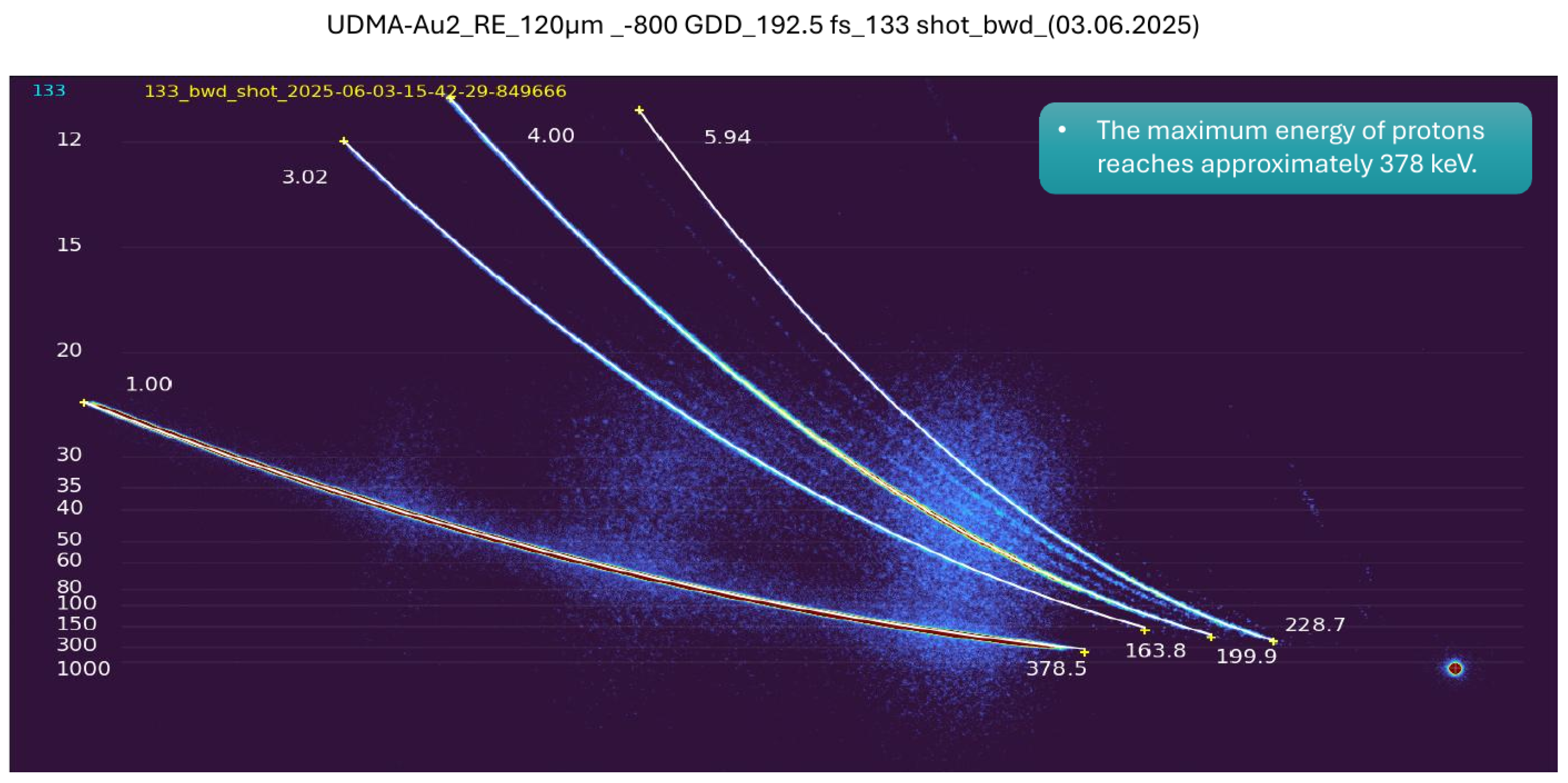
To date, thousands of shots are being analyzed with respect to proton acceleration. The protons and other light ions are observed via Thomson parabola detection, where parallel electric and magnetic fields cause a transverse deviation from the original current direction. According to this, impacts are detected alongside parabolic lines, with each line belonging to a different mass-to-charge ( m / q ) ratio. Figure 5 presents tracks with proton energies up to 370 keV, courtesy of Miklós Kedves and Márk Aladi, members of NAPLIFE [34].
Let us discuss here in detail why and how these parabolic tracks emerge. Charged particles fly through electric and magnetic fields, which deflect them from their original paths. Assuming realistically that they are emitted in direction z with a velocity much higher than the components gained in the fields orthogonal to this direction, i.e., v z v x , v y , we approximate the total kinetic energy as E m v z 2 / 2 . The deviations in the y (electric) and x (magnetic) directions are obtained by the Lorentz force accelerating in the fly-by time:
y = q m E y · 1 2 2 v z 2 = q E C 1 ,
and
x = q m v z B y · 2 2 2 v z 2 = q m E C 2 .
Here, the electric ( E ) and magnetic ( B ) fields are orthogonal to the original flight direction and extend along a length of 1 and 2 , respectively. The reference point, ( x = 0 , y = 0 ) , has no deviation. This corresponds either to charged particles with infinite kinetic energy, E = , or to neutral particles, q = 0 .
Comparing these two equations, the x and y direction positions can be related to each other:
y = m q C 1 C 2 2 · x 2 .
where each mass-to-charge ratio, m / q , belongs to a separate parabola. The higher the initial kinetic energy, the nearer the detected point is to the ( 0 , 0 ) patch.
In summarizing the above calculation, the ions fly through electric and magnetic fields, which deflect them from their original directions. Assuming realistically that v z v x , v y , i.e., the ion-beam-directed velocity dominates up to detection, one easily sees that accelerations in the electric field direction and orthogonal to the magnetic field direction are connected to the dominant velocity component, v z . The deviations are calculated from the accelerations and fly-by times, with the latter being inversely proportional to the dominant velocity component. Hence, the deviations depend on the specific charge, q / m , and on the velocity, including 1 / v z 2 (electric) and 1 / v z (magnetic). A parabola is drawn for each fixed m / q value. In atomic units, this value is m / q = 1 for protons, and only for them. Some higher values can be composed from higher-charged heavier ions in various ways, e.g., m / q = 4 can be obtained for a triply ionized carbon atom or a four-times ionized oxygen atom. These ions make up a common track.
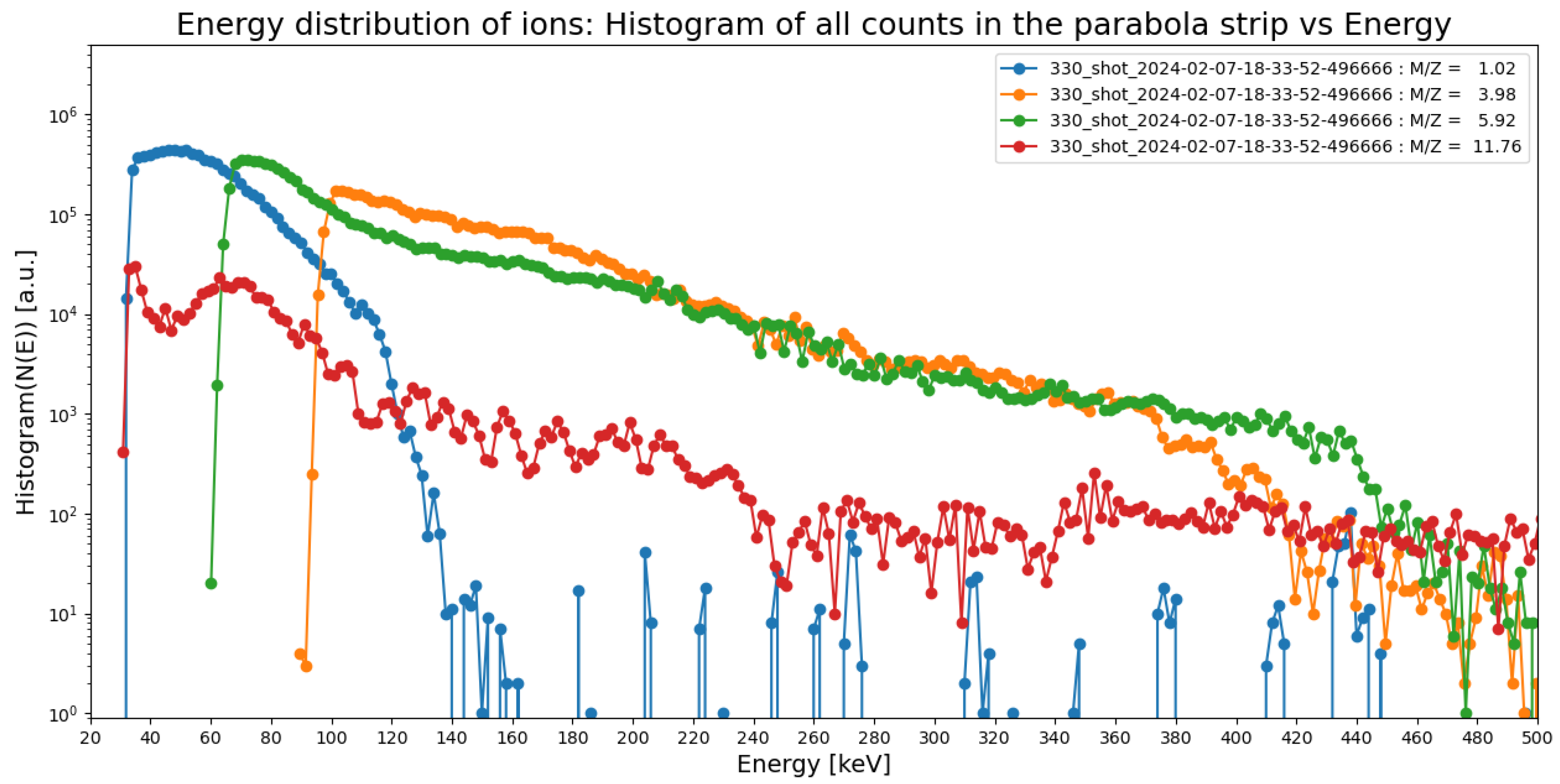
Furthermore, Thomson parabola images can be converted into energy distributions. Since the vertical y deviation is simply connected to the original kinetic energy (cf. Equation (1)), by counting the hits on a given parabola, such as N ( y ) d y , in a short interval [ y , y + d y ] , one determines the original kinetic energy distribution using a Jacobian:
f ( E ) q C 1 E 2 N q C 1 E
Figure 6 shows the energy distribution of protons and some heavier m / q ions for a selected Thomson parabola image obtained by Márk Aladi, Miklós Kedves, and Iméne Benabdelghani. The labels M / Z stand for m / q . Knowing which parabola is associated wit which particle is not easy. For protons, the answer is unique; for higher-charged ions, it is not. For example, M / Z = 2 can be associated with a fully (six-times) ionized carbon atom, but also with a fully ionized oxygen atom, and M / Z = 4 with a four-times ionized oxygen atom or a triply ionized carbon atom, or even a single ionized He atom.
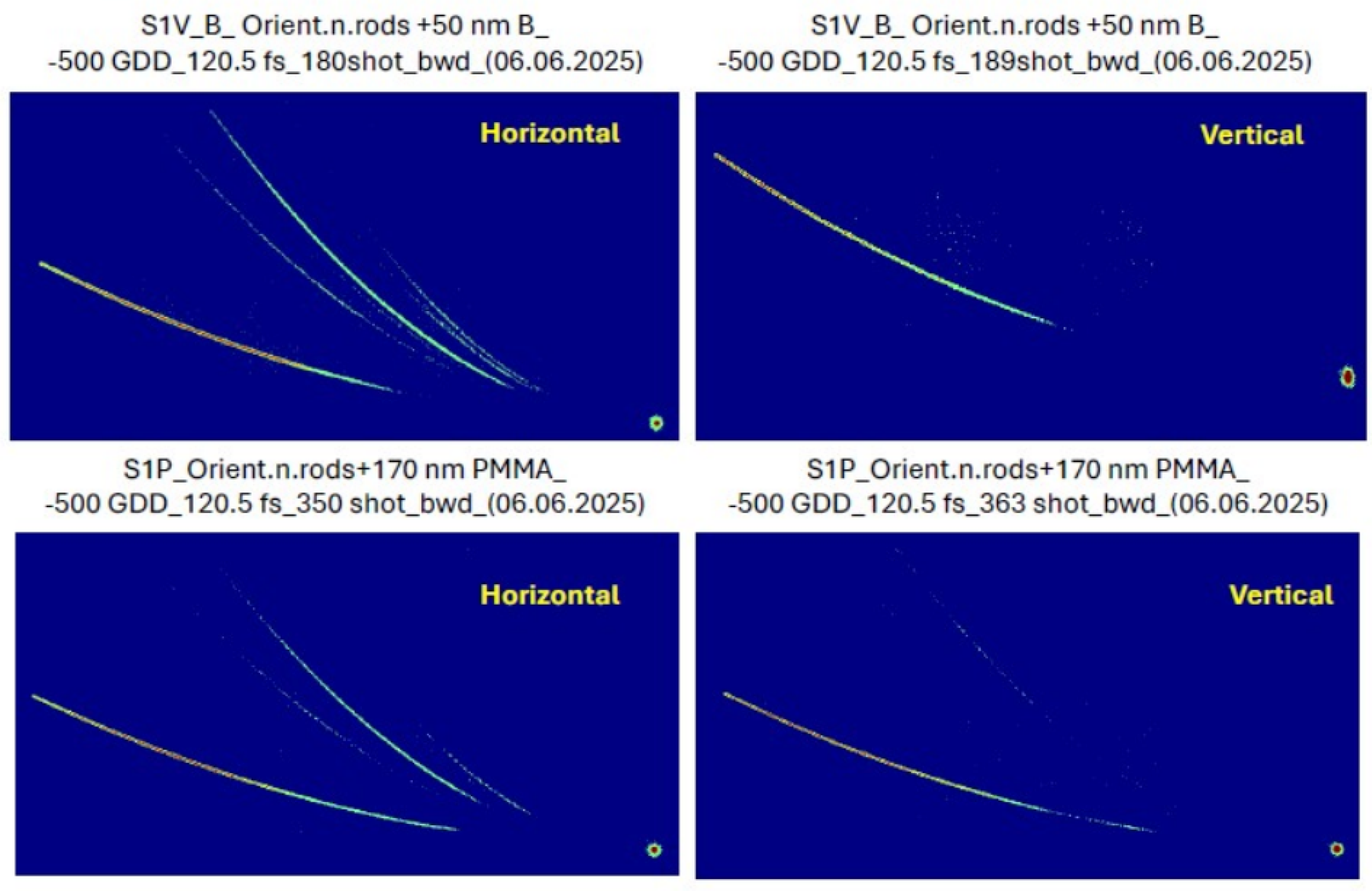
As it is shown in Figure 7, the Thomson parabola images also vary according to the laser pulse polarization, when using oriented nanorod arrays in the target.
Finally, let us note that the Thomson parabola images can also be analyzed with respect to the velocity distributions. Observe that
1 v z = B y E y 2 2 1 2 y x .
Iusing this formula the distribution of 1 / v z values can be, in principle, obtained from these data. This quantity appears in the so-called Gamow–Sommerfeld factor [36,37] when calculating the quantum tunneling probability under a Coulomb barrier.

4. Conclusions

We have shown that some protons reach energies relevant for nuclear fusion reactions. About a thousand protons have kinetic energy over 100 keV according to Thomson parabola images. Currently, the number of energy protons of several hundred keV is minor; future developments will have to improve it. Moreover, this number was achieved using only 25 mJ laser pulses. This is the essence of the nanofusion concept. The main achievements are in the study of laser–matter interactions and nanotechnological target fabrication.
For the future, we plan to pursue further variations in target fabrication, both with randomly and regularly arranged nanoparticles of resonant size, and considering a control using non-resonant sizes. The amount of fusion fuel in the target, or that will be eventually used as a second sheet, will also be varied. While a number of nuclear reactions are available above a given proton energy threshold, we would explicitly like to focus on aneutronic channels in order to save the laboratory environment and keep our devices clean from induced radioactivity.
More details on the procedures and results outlined above shall be reported in further articles on this thematic issue, particularly in the papers contributed by Norbert Kroó, Miklós Kedves, Márk Aladi, Iméne Benabdelghani, and Ágnes Nagyné Szokol.
Beyond the initial achievements discussed in this paper, we note that the ultimate purpose of this research that motivates us is to be part of future efforts establishing the civilian, non-invasive, and mobile uses of nuclear fusion.

Funding

This research and the APC were funded by the Hungarian National Office for Research and Development (NKFIH) under project 2022-NL-2.1.1-2022-00002.

Data Availability Statement

Data is contained within the article.

Acknowledgments

In addition to the members of the NAPLIFE collaboration, the author thanks Szeged Károly Osvay, Parvan Vazmayer, and Zsuzsa Márton for their help with the ELI-ALPS experiments.

Conflicts of Interest

The author declares no conflicts of interest.

Abbreviations

The following abbreviations are used in this manuscript:
NAPLIFENanoplasmonic Laser-Ignited Fusion Experiment
NKFIHHungarian National Office for Research, Development and Innovation

References

  1. Available online: https://www.iter.org (accessed on 26 October 2025).
  2. Clery, D. Giant international fusion project is in big trouble. ITER operations delayed to 2034, with energy-producing reactions expected 5 years later. Science 2021, 385, 10–11. [Google Scholar] [CrossRef]
  3. Achieving Fusion Ignition. Available online: https://lasers.llnl.gov/science/achieving-fusion-ignition (accessed on 16 March 2026).
  4. Lawson, J.D. Some criteria for a power producing thermonuclear reactor. Proc. Phys. Soc. Lond. Sect. B 1957, 70, 6. [Google Scholar] [CrossRef]
  5. Aggleton, M.; Aghaian, L.; Aguirre, A.; Aikens, D.; Akre, J.; Albert, F.; Albrecht, M.; Albright, B.; Albritton, J.; Alcala, J.; et al. Lawson criteria for ignition exceeded in an inertial fusion experiment. Phys. Rev. Lett. 2022, 129, 075001. [Google Scholar]
  6. ITER applauds NIF Fusion Breakthrough. ITER Newsline, 12 December 2022.
  7. Fusion Industry Association. Available online: https://www.fusionindustryassociation.org (accessed on 16 March 2026).
  8. Helion Energy. Available online: https://www.helionenergy.com/technology (accessed on 16 March 2026).
  9. Chodukowski, T.; Borodziuk, S.; Tchórz, P.; Rosiński, M.; Rusiniak, Z.; Dudzak, R.; Krupka, M.; Cikhardt, J.; Burian, T.; Singh, S.; et al. High efficiency of laser energy conversion with cavity pressure acceleration. Sci. Rep. 2025, 15, 21863. [Google Scholar] [CrossRef]
  10. Hungarian Office for Research, Development and Innovation, NKFIH. Available online: https://nkfih.gov.hu/about-the-office (accessed on 26 October 2025).
  11. Kroó, N.; Varró, S.; Rácz, P.; Dombi, P. Surface plasmons: A strong alliance of electrons and light. Phys. Scr. 2016, 91, 053010. [Google Scholar] [CrossRef]
  12. Scully, S.W.J.; Emmas, E.D.; Gharaibeh, H.F.; Phaneuf, R.A.; Kilayne, A.L.D.; Schlachter, A.S.W.; Shippers, S.; Muller, A.; Chakrabarty, H.S.; Madjet, M.E.; et al. Photoexcitation of a Volume Plasmon in C60 Ions. Phys. Rev. Lett. 2005, 94, 065503. [Google Scholar] [CrossRef]
  13. Dorfman, K.E.; Jha, P.K.; Vovorine, D.V.; Genavet, P.; Capasso, F.; Scully, M.O. Quantum-coherence-enhanced surface plasmon amplification by stimulated emission of radiation. Phys. Rev. Lett. 2013, 111, 043601. [Google Scholar] [CrossRef]
  14. Kroo, N.; Racz, P.; Varro, S. Surface-plasmon-assisted electron pair formation in strong electromagnetic field. Eur. Phys. Lett. 2014, 105, 67003. [Google Scholar] [CrossRef]
  15. Voronine, D.V.; Huo, W.; Sally, M. Ultrafast dynamics of surface plasmon nanolayers with quantum coherence and external plasmonic feedback. J. Opt. 2014, 16, 114013. [Google Scholar] [CrossRef]
  16. Csernai, L.P.; Kroó, N.; Papp, I. Radiation dominated implosion with nano-plasmonics. Laser Part. Beams 2018, 36, 171–178. [Google Scholar] [CrossRef]
  17. Csernai, L.P.; Csete, M.; Mishustin, I.N.; Motornenko, A.; Papp, I.; Satarov, L.M.; Stöcker, H.; Kroó, N.; NAPLIFE Collaboration. Radiation dominate dimplosion with flat target. Phys. Wave Phenom. 2020, 28, 187–199. [Google Scholar] [CrossRef]
  18. Papp, I.; Zsukovszky, K. Particle simulation of various gold nanoantennas in laser irradiated matter for fusion production. Eur. Phys. J. Spec. Top. 2025, 234, 2993–2998. [Google Scholar] [CrossRef]
  19. Bukovszky, K.; Szalóki, M.; Csarnovics, I.; Bonyár, A.; Petrik, P.; Kalas, B.; Daróczi, L.; Kéki, S.; Kökényesi, S.; Hegedus, C. Optimization of plasmonic gold nanoparticle concentration in green LED light active dental photopolymer. Polymers 2021, 13, 275. [Google Scholar] [CrossRef]
  20. Kasani, S.; Curtin, K.; Wu, N. A review of 2D and 3D plasmonic nanostructure array patterns: Fabrication, light management and sensing applications. Nanophotonics 2019, 8, 2065–2089. [Google Scholar] [CrossRef]
  21. Jeong, T.; Oh, D.; Kim, S.; Park, J.; Kim, Y.; Mun, J.; Kim, K.; Chew, S.; Rho, J.; Kim, S. Deterministic nanoantenna array design for stable plasmon-enhanced harmonic generation. Nanophotonics 2023, 12, 619–629. [Google Scholar] [CrossRef]
  22. Biró, T.S. et al. [NAPLIFE Collaboration] Nanotechnology and plasmonics for fusion. Eur. Phys. J. Spec. Top. 2025, 234, 2979–2984. [Google Scholar] [CrossRef]
  23. Kroó, N.; Aladi, M.; Kedves, M.; Ráczkevi, B.; Kumari, A.; Rácz, P.; Veres, M.; Galbács, G.; Csernai, L.P.; Biró, T.S.; et al. Monitoring of nanoplasmonics assisted deuterium production in a polymer seeded with resonant Au nanorods using in situ femtosecond laser induced breakdown spectroscopy. Sci. Rep. 2024, 14, 18288. [Google Scholar] [CrossRef]
  24. Rigó, I.; Kámán, J.; Nagyné Szokol, Á.; Holomb, R.; Bonyár, A.; Szalóki, M.; Borók, A.; Zangana, S.; Rácz, P.; Aladi, M.; et al. Raman spectroscopic characterization of crater walls formed upon single-shot high-energy femtosecond laser irradiation of dimethacrylate polymer doped with plasmonic gold nanorods. Sci. Rep. 2025, 15, 14469. [Google Scholar] [CrossRef] [PubMed]
  25. Nagyné Szokol, Á.; Kámán, J.; Holomb, R.; Rigó, I.; Aladi, M.; Kedves, M.; Ráczkevi, B.; Rácz, P.; Bonyár, A.; Borók, A.; et al. Morphology studies on craters created by femtosecond laser irradiation in UDMA polymer targets embedded with plasmonic gold nanorods. Eur. Phys. J. Spec. Top. 2025, 234, 3007–3013. [Google Scholar] [CrossRef]
  26. Casian-Plaza, F.A.; Janovszky, P.M.; Palásti, D.J.; Kohut, A.; Geretovszky, Z.; Kopniczky, J.; Schubert, F.; Zivkovic, S.; Galbács, Z.; Galbács, G. Comparison of three nanoparticle deposition techniques potentially applicable to elemental mapping by nanoparticle-enhanced laser-induced breakdown spectroscopy. Appl. Surf. Sci. 2024, 657, 159844. [Google Scholar] [CrossRef]
  27. Kámán, J. (Wigner RCP, Budapest, Hungary). Personal communication, 2023.
  28. Bonyár, A. (TU Budapest, Budapest, Hungary). Personal communication, 2024.
  29. Csernai, L.P. Private communication, 2025.
  30. Available online: https://en.wikipedia.org/wiki/Deuterium (accessed on 25 December 2025).
  31. Sikora, M.H.; Weber, H.R. A new evaluation of the 11B(p,α)αα reaction rates. J. Fusion Energy 2016, 35, 538–543. [Google Scholar] [CrossRef]
  32. Magee, R.M.; Ogawa, K.; Tajima, T.; Allfrey, I.; Gota, H.; McCaroll, P.; Oholachi, S.; Isobe, M.; Kamio, S.; Klumper, V.; et al. First measurement of p11B fusion in magnetically confined plasma. Nat. Commun. 2023, 14, 955. [Google Scholar] [CrossRef]
  33. Liu, S.J.; Wu, D.; Hu, T.X.; Liang, T.Y.; Niag, X.C.; Liang, J.H.; Liu, Y.C.; Liu, P.; Liu, X.; Sheng, Z.M.; et al. Proton-boron fusion scheme taking into account the effects of target degeneracy. Phys. Rev. Res. 2024, 6, 013323. [Google Scholar] [CrossRef]
  34. Kroó, N.; Csernai, L.P.; Papp, I.; Kedves, M.A.; Aladi, M.; Bonyár, A.; Szalóki, M.; Osvay, K.; Varmazyar, P.; Biró, T.S.; et al. Indication of p +11 B reaction in laser induced nanofusion experiment. Sci. Rep. 2024, 14, 30087. [Google Scholar] [CrossRef]
  35. Ruiz, G. Aneutronic Nuclear Fusion Energy (And References Therein). 2022. Available online: http://large.stanford.edu/courses/2022/ph241/ruiz2 (accessed on 16 March 2026).
  36. Gamow, G. Zur Quantentheorie des Atomkernes. Zeitcshrift Phys. 1928, 51, 204–212. [Google Scholar] [CrossRef]
  37. Yoon, J.H.; Wong, C.Y. Relativistic Modification of the Gamow Factor. Phys. Rev. C 1999, 61, 044905. [Google Scholar] [CrossRef]
Figure 1. Relations between subgroups in the NAPLIFE project (Kámán 2023).
Particles 09 00028 g001
Figure 2. Photo of UDMA-TEGDMA with embedded, randomly placed, and randomly oriented Au nanorods [28] (top) compared with regularly placed and oriented ones [29] (bottom). The lines orange are just to guide the eye.
Particles 09 00028 g002
Figure 3. Damage crater depth vs. laser pulse intensity [25]. Label Au0 stands for samples without gold nanorods and Au2 for the maximal density of nanorods we were able to fabricate without aggregation so far.
Particles 09 00028 g003
Figure 4. Damage crater volumes vs. laser pulse intensity with the lasers of Wigner Hidra and ELI-ALPS SYLOS [24,25].
Particles 09 00028 g004
Figure 5. Thomson parabola image of high-energy protons and light ions (Kedves, Aladi, Benabdelghani 2025). Maximal energies up to several hundreds of keV are reached with some protons. The results are scatter case by case, as shown in this example.
Particles 09 00028 g005
Figure 6. Proton and ion energy distributions from a Thomson parabola image (Kedves 2025). Only a few protons occur in the 100 keV energy range presented. The labels M / Z in the figure legend stand for the mass-to-charge ratio m / q , with some heavier ions containing neutrons as well.
Particles 09 00028 g006
Figure 7. Laser pulse polarization dependence of the effects on oriented nanorod targets. The ‘Horizontal’ label refers to cases when the nanorod’s major axis is aligned with the electric field direction in the laser pulse, and the ‘Vertical’ label to when they are orthogonal.
Particles 09 00028 g007
Disclaimer/Publisher’s Note: The statements, opinions and data contained in all publications are solely those of the individual author(s) and contributor(s) and not of MDPI and/or the editor(s). MDPI and/or the editor(s) disclaim responsibility for any injury to people or property resulting from any ideas, methods, instructions or products referred to in the content.