All articles published by MDPI are made immediately available worldwide under an open access license. No special
permission is required to reuse all or part of the article published by MDPI, including figures and tables. For
articles published under an open access Creative Common CC BY license, any part of the article may be reused without
permission provided that the original article is clearly cited. For more information, please refer to
https://www.mdpi.com/openaccess.
Feature papers represent the most advanced research with significant potential for high impact in the field. A Feature
Paper should be a substantial original Article that involves several techniques or approaches, provides an outlook for
future research directions and describes possible research applications.
Feature papers are submitted upon individual invitation or recommendation by the scientific editors and must receive
positive feedback from the reviewers.
Editor’s Choice articles are based on recommendations by the scientific editors of MDPI journals from around the world.
Editors select a small number of articles recently published in the journal that they believe will be particularly
interesting to readers, or important in the respective research area. The aim is to provide a snapshot of some of the
most exciting work published in the various research areas of the journal.
Relativistic heavy-ion collisions generate ultra-strong magnetic fields that interact with the quark–gluon plasma (QGP), a key focus of high-energy physics research. This study investigates QGP energy density evolution under time-dependent magnetic fields within a (1 + 1)D relativistic magnetohydrodynamic (RMHD) framework integrated with Bjorken flow. Three magnetic field temporal evolution models (Type-1, Type-2, Type-3) are analyzed for two different equations of state: (1) (simplified ultra-relativistic), and (2) (magnetized conformal), incorporating a temperature-dependent magnetic susceptibility derived from lattice QCD. Results show that stronger magnetic fields consistently suppress QGP energy density decay, with suppression magnitude dependent on the magnetic field’s temporal profile. Ultra-relativistic fluids exhibit slowed energy decay due to magnetic pressure counteracting hydrodynamic expansion. In contrast, magnetized conformal fluids display faster energy dissipation under identical conditions, arising from the synergistic effect of enhanced magnetic fluid coupling, increased energy dissipation during interaction, and QGP’s perfect fluid expansion at elevated temperatures. Temperature-dependent magnetic susceptibility reveals a transition from diamagnetic (confined phase) to paramagnetic (deconfined QGP phase) behavior, introducing a feedback mechanism that strengthens energy retention at higher temperatures. This work clarifies the interplay between magnetic field dynamics, QCD phase structure, and hydrodynamic expansion, providing key observational signatures for distinguishing fluid types in heavy-ion collisions and advancing realistic modeling of magnetized QGP.
Relativistic heavy-ion collision experiments at facilities like the Relativistic Heavy Ion Collider (RHIC) provide a unique laboratory to study the properties of quantum chromodynamic (QCD) matter under extreme conditions. In such collisions, the interaction of two highly Lorentz-contracted nuclei generates a hot, dense medium dominated by deconfined quarks and gluons—the quark–gluon plasma (QGP) [1,2]. This short-lived state exhibits near-perfect fluidity, enabling relativistic hydrodynamic models to successfully describe its collective expansion and thermalization dynamics [3,4,5,6,7,8]. Notably, the interplay between hydrodynamic evolution and electromagnetic phenomena has emerged as a critical frontier in understanding QGP behavior, particularly in non-central collisions where ultra-strong magnetic fields ( Gauss) are transiently generated [9,10,11,12,13,14,15,16].
These magnetic fields, though short-lived in vacuum [17], persist longer in the electrically conductive QGP medium [18,19,20,21], creating opportunities to probe magnetohydrodynamic effects. Key phenomena such as the Chiral Magnetic Effect (CME) [22,23], Chiral Separation Effect (CSE) [24], and their collective manifestation as Chiral Magnetic Waves (CMWs) [25,26] are theorized to induce charge-dependent azimuthal anisotropies in particle emission [27]. However, disentangling these signals from background collective flow remains experimentally challenging [28,29,30], necessitating precise theoretical modeling of the coupled evolution of the QGP and electromagnetic fields [31,32,33,34,35,36,37,38]. Relativistic magnetohydrodynamics (RMHD) offers a self-consistent framework to explore this coupling. While prior studies have examined simplified scenarios, the time-dependent evolution of magnetic fields particularly their dependence on proper time () in the RHIC energy regime remains under explored in (1 + 1)D RMHD frameworks. This gap limits our ability to quantify how magnetic field dissipation shapes energy density dynamics and thermalization processes in the QGP.
It is widely believed that the QGP produced in high-energy heavy-ion collisions behaves as an almost perfect fluid. Perfect hydrodynamics assumes zero viscosity, implying that fluid elements move without internal “friction”. However, in more realistic scenarios, the QGP is a fluid with small dissipative properties (viscosity). Several transport coefficients characterize the internal “friction” of the fluid. For example, shear viscosity (dynamic viscosity) measures the fluid’s resistance to flow, bulk viscosity (volume viscosity) measures the fluid’s resistance to expansion, and thermal conductivity measures the fluid’s ability to conduct heat.
In this work, we address this challenge by integrating three distinct models of time-dependent magnetic field evolution into a (1 + 1)D relativistic magnetohydrodynamic framework based on Bjorken flow [39]. These models (Type-1, Type-2 and Type-3) capture characteristic τ-dependencies observed in RHIC energy collisions [40,41,42,43]. We systematically analyze their impact on energy dissipation in two fluid scenarios: (1) an ultra-relativistic fluid with a simplified equation of state (), and (2) a magnetized conformal fluid incorporating explicit magnetization effects. To enhance physical realism, we further introduce a temperature-dependent magnetic susceptibility () derived from lattice QCD calculations [44,45,46,47,48,49], which encodes the transition from diamagnetic hadronic matter ( < 0) to paramagnetic QGP ( > 0).
Our study aims to resolve two pivotal questions: (1). How do the temporal profiles of magnetic fields in the RHIC regime influence the energy density evolution of QGP? (2). What role does the phase structure of Quantum Chromodynamics (QCD), manifested through temperature (), play in regulating electromagnetic response and energy dissipation? By bridging first-principles QCD inputs with macroscopic RMHD simulations, this work advances the quantitative understanding of magnetized QGP dynamics. The results not only clarify the interplay between magnetic field decay and hydrodynamic expansion but also establish benchmarks for future studies incorporating dissipative effects and spatial inhomogeneities.
The paper is organized as follows: Section 2 outlines the RMHD formalism with magnetization. Section 3 adapts Bjorken flow to incorporate external magnetic fields. Section 4 compares energy density evolution across the three magnetic field models for both fluid types. Section 5 integrates lattice QCD-derived and a realistic equation of state. Section 6 summarizes key findings and discusses implications for heavy-ion physics.
2. Magnetohydrodynamics with Bulk Viscosity and Magnetization
We expand on previous studies [50,51,52] to consider RMHD with both bulk viscosity and non-zero magnetization. In this case, the energy-momentum tensor is expressed as follows:
where denotes the energy density, denotes the pressure, represents the bulk viscous pressure. and denote the magnetic field strength and the magnetization intensity in the local rest frame of the fluid, respectively, where , and is the magnetic susceptibility. In the original Israel–Stewart (IS) theory, the bulk viscous stress is considered an independent dynamical variable [53,54,55] given by the following equation:
where is the bulk viscosity, and is the relaxation time for the bulk viscosity. First-order (Navier–Stokes) viscous hydrodynamics suffers from acausal propagation and instability in the relativistic regime. Such violations of causality and stability are resolved by second-order theories such as the Israel–Stewart formalism, which treat dissipative fluxes as dynamical variables with relaxation times. While essential for rigorous transport modeling, the Israel–Stewart framework introduces additional complexity without altering the qualitative magnetic field effects studied here. We thus employ first-order theory as a baseline, noting that our primary conclusions regarding magnetic suppression of energy dissipation remain robust when extended to second-order formulations [56].
The subscript denotes the Navier–Stokes value, which can be written as
where , is the entropy density, is the parameterized bulk viscosity coefficient [57,58].
The projection of energy-momentum along the four-dimensional velocity vector corresponds to the conservation of fluid energy, and its form is as follows:
where , , and are taken. The Maxwell equations is given by
Similarly, the projection of the energy-momentum along the direction orthogonal to the four-velocity corresponds to the momentum conservation, and its expression is
and the last term of Equation (6) is given as
where the magnetization coefficient is constant. It is found that the last term of Equation (6) vanishes. The simplified momentum conservation becomes
where one uses .
3. Bjorken Flow
In the work, we consider a fluid undergoing Bjorken expansion. For longitudinally boost invariance flow, Milne coordinates are more convenient than standard Cartesian coordinates . Milne coordinates are , which are natural choices for describing ultra-relativistic heavy-ion collision, where is the proper time and is the pseudorapidity.
The Bjorken flow [39] is uniform in the transverse direction and exhibits longitudinal boost invariance. Its symmetry lies in the transverse plane (x — y plane), enhancing invariance along the longitudinal (or beam) direction, and also exhibiting reflection symmetry . This implies that the flow profile and are symmetric in the transverse plane and invariant along the longitudinal direction. The fluid velocity can be taken as
where is the proper time. All macroscopic quantities depend only on the proper time , and are independent of the spatial coordinates and the four-velocity .
Using Milne coordinates, the four-velocity simplifies to , the spatial derivatives and the four-divergence are given by
In this work, we adopt the Bjorken flow as a baseline scenario to isolate the effects of magnetic field evolution on energy density dynamics. While more general flow profiles including accelerating solutions (e.g., in Rindler coordinates) exist and may be important in the initial stages [59], the Bjorken flow provides a transparent framework for comparing different magnetic field models and equations of state. Investigation of accelerating flows is left for future work.
In addition to the direction provided by the fluid velocity, the magnetic field also selects another special direction in the system, which we associate with a spacelike unit vector , where , it is normalized to . In our work, we assume that the magnetic field is perpendicular to the reaction plane and is oriented along the y-axis in a fluid with infinite conductivity and non-zero magnetization .
In the following work, the useful thermodynamic relations are reviewed. For a perfect fluid in thermodynamic equilibrium, we have
where is the baryon number density and is the corresponding chemical potential. These follow the standard thermodynamic relations
From these thermodynamic relations, we can derive the Gibbs–Duhem relation
In ultra-relativistic heavy-ion collisions, the net baryon number density and chemical potential are nearly zero at mid-rapidity. Therefore, for simplicity, we consider the case of zero baryon chemical potential in our work.
4. Fluid Evolution Under Three Different Magnetic Field Conditions
Within the linear approximation, the effects of magnetization can be characterized by magnetic susceptibility. A wealth of theoretical studies have indicated that the medium shows diamagnetic behavior in the confined phase, i.e., , whereas it exhibits paramagnetic behavior in the deconfined quark–gluon plasma (QGP) phase, i.e., [44,49,51,60]. In the present work, we exclusively focus on the behavior of the magnetic field in the deconfined phase. For the sake of simplicity, we assume that magnetic susceptibility remains constant throughout this section, which thus leads to the following form of the energy conservation equation:
since the magnetic field is non-zero only in the y direction, there exists . Inserting into Equation (14), one can obtain
The external magnetic field generated by relativistic heavy-ion collisions is introduced into the framework of relativistic magnetohydrodynamics, discussing the variation in energy density with proper time. It is assumed that the magnetic field [23] is along the y direction in relativistic heavy-ion collisions and consider three different parameterization approaches commonly used in the literature [40,41,42,43] for studying various magnetic field effects in relativistic heavy-ion collisions as
Type-1:
Type-2:
and Type-3:
In all these parameterizations, is the fundamental magnetic field lifetime parameter that controls the rate at which the magnetic field decreases over time. However, it should be noted that due to differences in their functional forms, the evolution of the magnetic field varies slightly for the same value [23]. In this study, it is assumed that is comparable to , meaning that the lifetime of the magnetic field is similar to the initial time of hydrodynamic evolution. This assumption implies that the magnetic field exists during the early stages of hydrodynamic evolution but gradually vanishes over time. To quantify the energy dependence of the extracted magnetic field lifetime, we fit the optimal values to a scaling formula motivated by the Lorentz contraction of the nuclear passing-through time: , where the fitting parameter (with units of ) characterizes the overall magnitude of the magnetic field lifetime across collision energies. For example, for = 11.5 GeV, for = 200 GeV. Parameter A = 92 for type-1, A = 125 for type-2 and A = 128 for type-3. Taking a statistical average over these three scenarios yields .
Both fluids considered in this work are ultra-relativistic. The distinction lies in their treatment of magnetization and conformality: the first case is a simple ultra-relativistic ideal fluid with and no explicit magnetization correction. The second case is a magnetized conformal fluid, where the term is included to maintain conformality at finite magnetic field . Conformality is strictly satisfied only for .
Since the fluid is considered as ultra-relativistic, the contribution of the rest mass to the equation of state (EOS) can be neglected. The pressure is proportional to the energy density, i.e., , where is the local sound speed, which is assumed to be constant (). Some dimensionless quantities , , are defined to describe the energy density, and the pressure varies with proper time, where represents the initial energy density.
Substituting the magnetic field decay models under the three different modes into Equation, we obtain the following form:
Type-1:
Type-2:
Type-3:
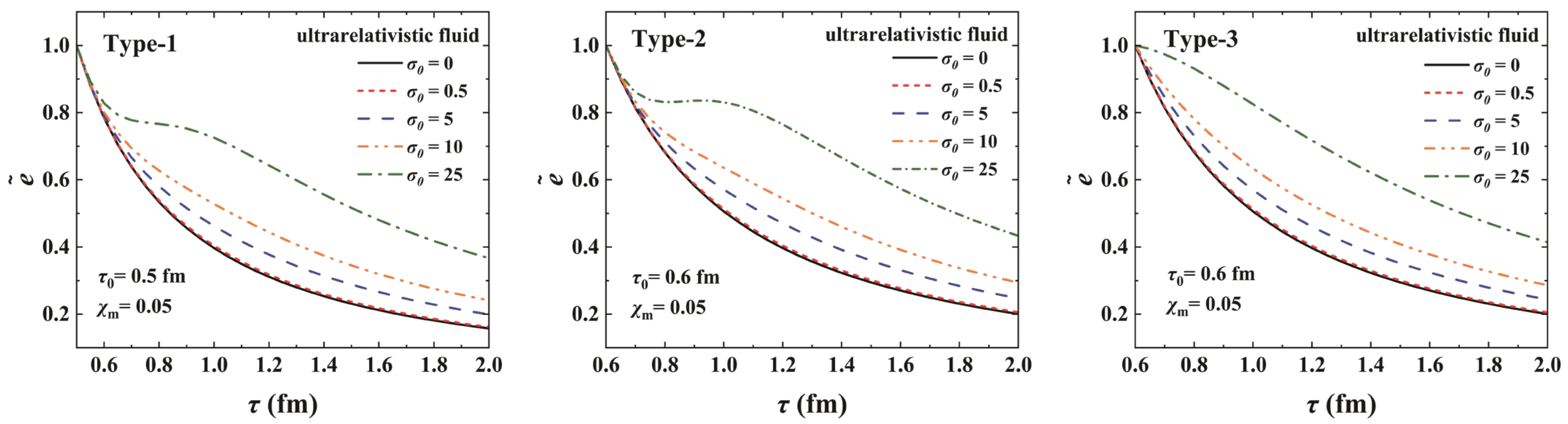
Figure 1 investigates the evolution of energy density in an ultra-relativistic fluid under the influence of time-dependent magnetic fields in the relativistic heavy-ion collisions within the framework of relativistic magnetohydrodynamics (RMHD). The figure depicts three different magnetic field evolution models (Type-1, Type-2, and Type-3) while considering various magnetic field values of . Specifically, it examines how three distinct magnetic field evolution models (Type-1, Type-2, and Type-3 in relativistic heavy-ion collisions) affect the decay rate of energy density as a function of proper time (). The study highlights the interplay between magnetic field strength (parameterized by ) and energy dissipation dynamics. All the models indicate that, compared with the situation without magnetic field influence, the initial stronger magnetic field leads to a slower energy density decay.
Figure 1 underscores the critical role of magnetic field evolution models in shaping energy density dynamics. The study bridges theoretical RMHD frameworks with relativistic heavy-ion experimental, emphasizing the need for precise modeling of magnetic fields in high-energy physics.
We note that the present framework includes bulk viscosity through the Israel–Stewart formalism (Equations (2) and (3)), with the Navier–Stokes value . While bulk viscosity alone can produce a ‘reheating’ effect that slows energy density decay [59], here we focus on isolating the magnetic field contribution by fixing the bulk viscosity coefficient. The interplay between magnetic suppression and viscous dissipation—particularly whether these effects amplify or compete with each other—presents an interesting direction for future systematic studies with varying .
Figure 1.
Evolution of energy density in the ultra-relativistic fluid. We choose magnetic susceptibility , , [55]. The left, middle, and right panels correspond to three different temporal evolution models of the magnetic field. The black solid line represents the case without a magnetic field. The red short dashed line, blue long dashed line, orange dash-dot-dotted line, and green dash-dotted line corre-spond to different values of
, respectively.
Figure 1.
Evolution of energy density in the ultra-relativistic fluid. We choose magnetic susceptibility , , [55]. The left, middle, and right panels correspond to three different temporal evolution models of the magnetic field. The black solid line represents the case without a magnetic field. The red short dashed line, blue long dashed line, orange dash-dot-dotted line, and green dash-dotted line corre-spond to different values of
, respectively.
In this case, the energy density takes into account the degree of magnetization or the strength of the magnetic field, i.e., a conformal fluid with a magnetic field present in four-dimensional spacetime
Then, the conservation equation under different magnetic field models becomes
Type-1:
Type-2:
Type-3:
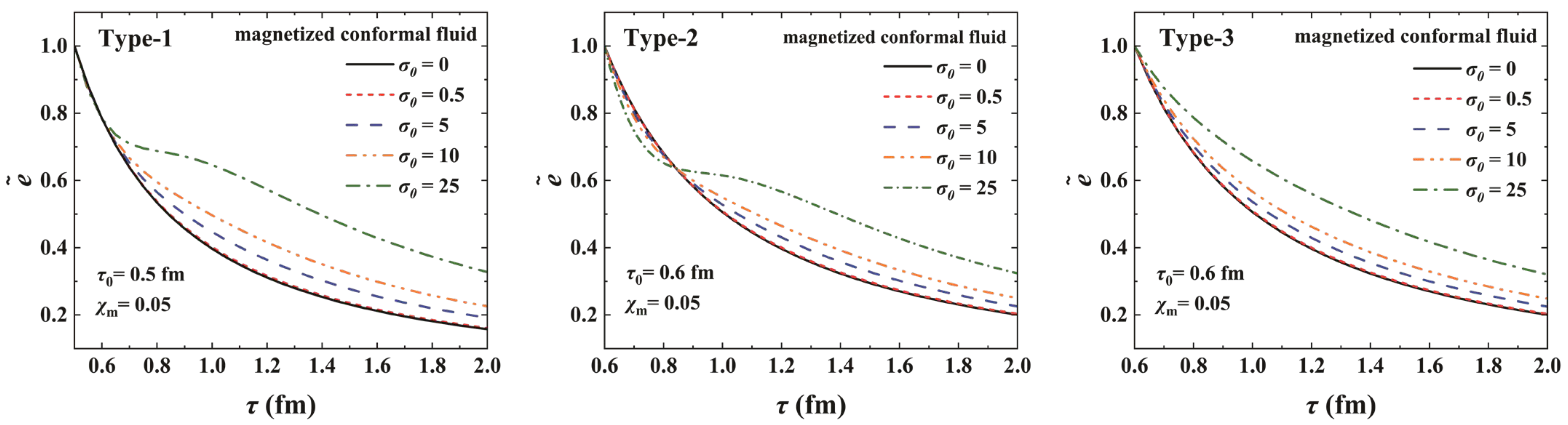
Figure 2 illustrates the effect of different magnetic field parameters on the evolution of energy density with proper time in the magnetized conformal fluid model, with the magnetic susceptibility fixed at 0.05. Consistent with the behavior observed in Figure 1, stronger magnetic fields (higher ) significantly slow the decay of energy density over proper time (). For instance, the energy density for decays much more slowly compared to weaker fields (e.g., ). This suppression arises due to magnetic pressure and Lorentz forces, which counteract the hydrodynamic expansion of the quark–gluon plasma (QGP). The magnetic field acts as a “brake” on energy dissipation by altering the fluid’s equation of state and flow dynamics, a trend that aligns with our earlier findings in Figure 1.
The three magnetic field evolution models in relativistic heavy-ion collisions exhibit distinct trends: Type-1 causes the strongest suppression of energy density decay. Type-2 shows rapid early-stage energy dissipation for weak fields ( = 0.5), diverging from monotonic trends. Type-3 has the weakest overall impact on energy density evolution. These differences stem from the functional forms of the magnetic field decay (e.g., exponential vs. power-law dependence on τ), which govern how magnetic energy is transferred to or stored in the fluid.
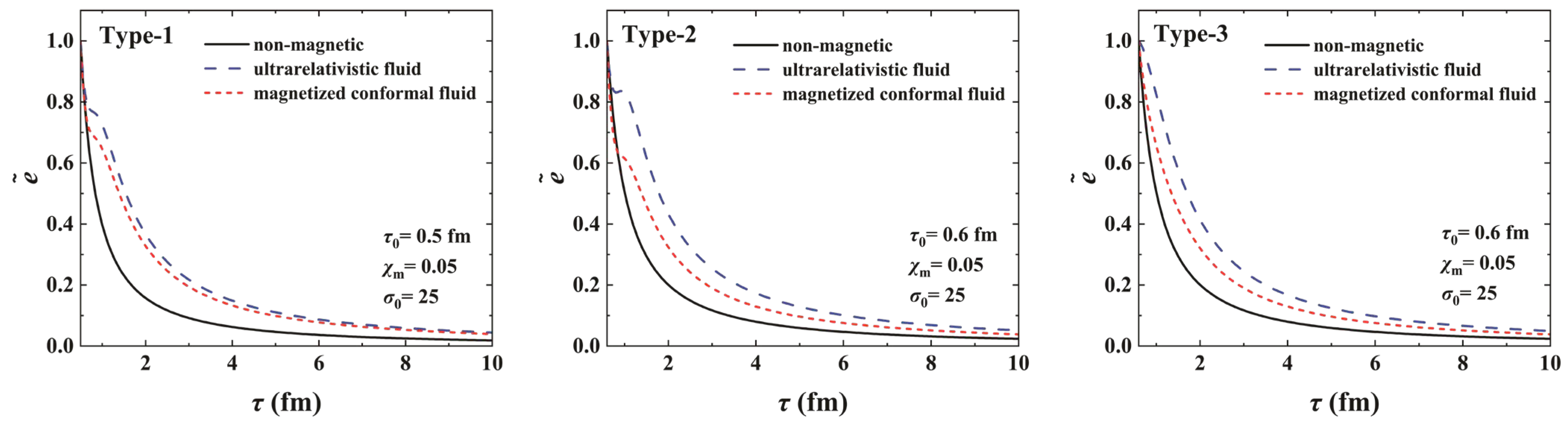
Figure 3 compares the normalized energy density evolution between an ultra-relativistic fluid (blue dashed line) and a magnetized conformal fluid (red dotted line) under identical initial conditions ( = 25, = 0.05). Please note that for a positive magnetization coefficient, the energy obtained by magnetized conformal fluids from the magnetic field is less than that obtained by ultra-relativistic fluids.
5. Energy-Density Evolution with Temperature-Dependent Magnetic Susceptibility
Following the rather academic discussion in the previous section, we now consider a more realistic scenario based on lattice QCD. In this section, we extend the analysis by incorporating a temperature-dependent magnetic susceptibility derived from lattice QCD, which represents a more realistic description of the QGP’s magnetic response across the deconfinement transition. This extends the magnetized conformal fluid framework of Section 4 by replacing the constant assumption with a realistic temperature-dependent parametrization. For simplicity, we choose the temperature as the independent variable and express the magnetic susceptibility as a function of . In lattice QCD calculations, the behavior of magnetic susceptibility as a function of temperature has been investigated using several different approaches. The latest lattice QCD results on the magnetic susceptibility of QCD matter, which can be found in Ref. [60], show that at high temperatures, is parameterized in accordance with perturbative theory as follows:
where , parameter is defined as ( is the temperature), which shown as a dimensionless quantity. These parameters and are 0.1544, 23.99, −2.085, 0.1290, 21.35, −6.201, 0.5766, 0.1497, respectively.
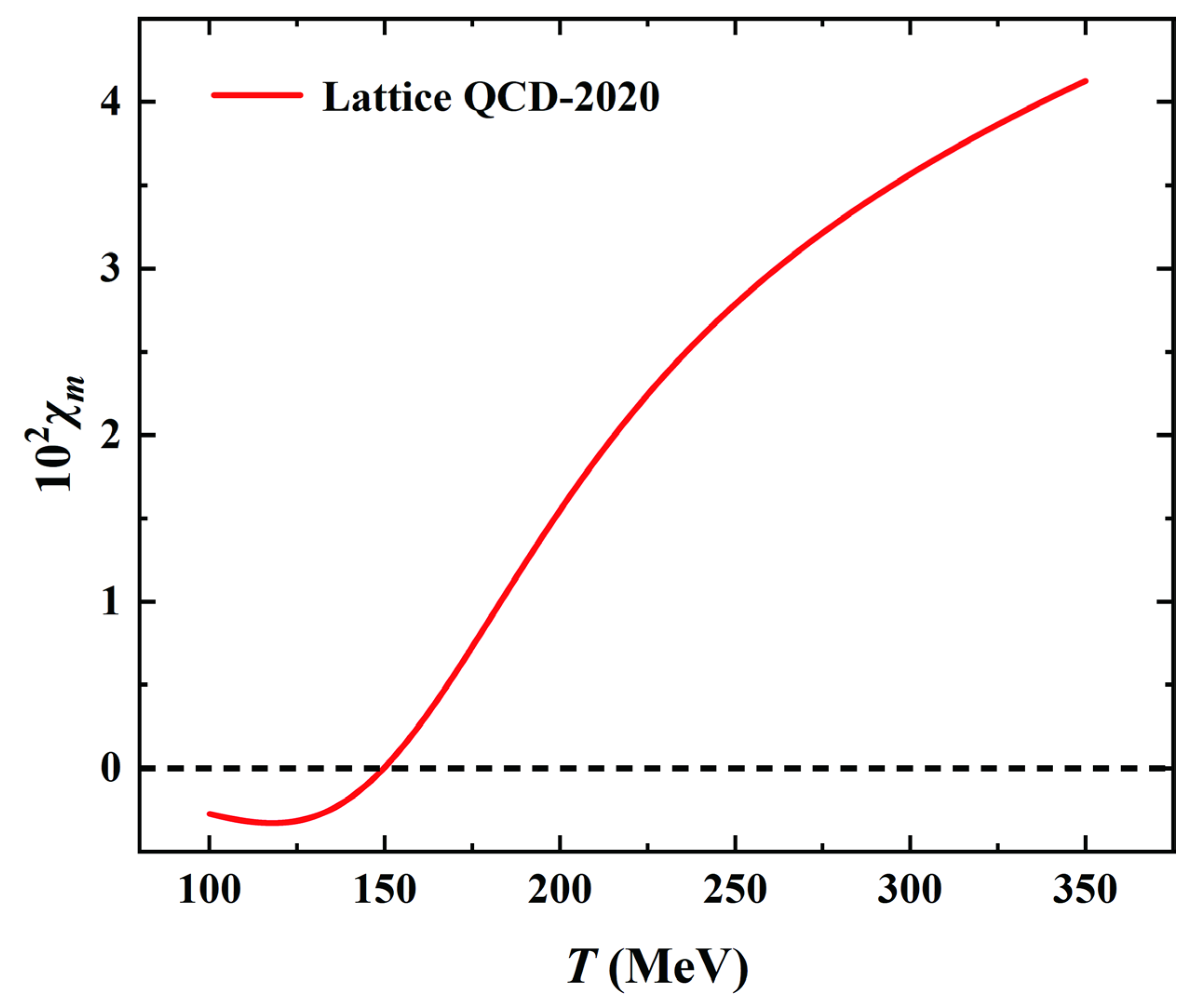
Figure 4 presents the magnetic susceptibility of QCD matter as a function of temperature, derived from lattice QCD calculations conducted in 2020 [60]. The graph illustrates a significant increase in with rising temperature, transitioning from near-zero values at lower temperatures (approximately 100–150 MeV) to a steep ascent beyond 150 MeV. This trend suggests a marked change in the magnetic response of QCD matter as it transitions from hadronic to quark–gluon plasma (QGP) phases. In the confined phase, characterized by hadrons, the medium exhibits diamagnetic properties, with , indicating a tendency to expel magnetic fields. Conversely, in the deconfined QGP phase, the medium becomes paramagnetic, with , showing an increased magnetic response. Such temperature-dependent behavior is crucial for understanding the electromagnetic properties of QCD matter under extreme conditions, which is pertinent to the study of high-energy heavy-ion collisions and the evolution of early universe. The results from the lattice QCD-2020 calculations provide a valuable theoretical foundation for exploring the magnetic characteristics of QCD matter and their implications in high-energy physics, particularly in the context of phase transitions and the associated changes in magnetic susceptibility.
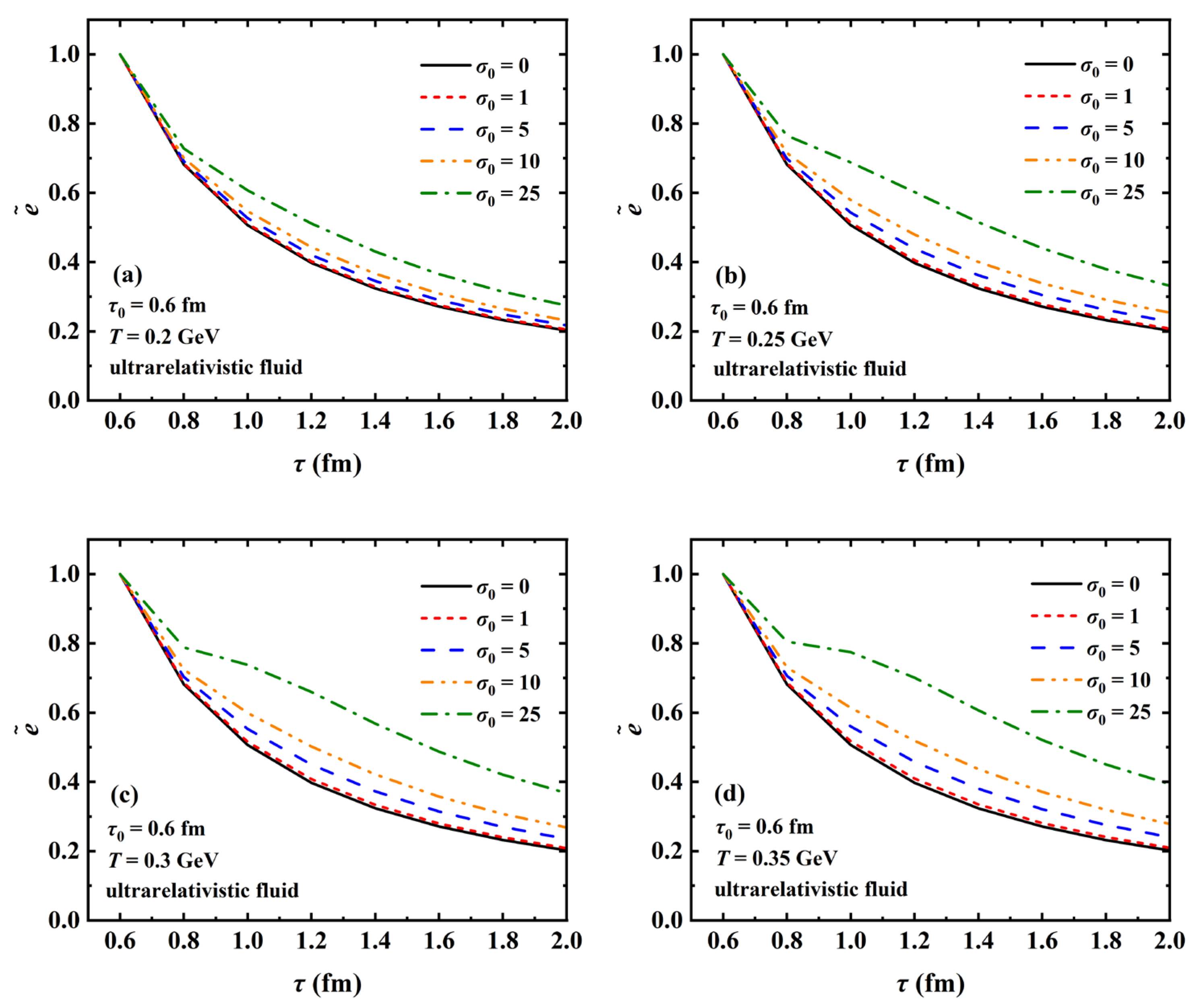
Figure 5 illustrates temporal evolution of the energy density in Type-2 ultra-relativistic fluids. We adopt the Type-2 magnetic field model (Equation (17)), as its exponential decay form is the most widely used parameterization in the literature. At GeV, in the early stage after the confinement–deconfinement phase transition, where the magnetic susceptibility as just started to rise from a near-zero value (paramagnetism emerges initially but remains weak), leading to a low coupling efficiency between the magnetic field and the fluid. The results demonstrate that temperature is the core regulating factor of the magnetic field-fluid coupling efficiency: as the temperature increases from 0.2 GeV to 0.35 GeV, the QGP magnetic susceptibility is significantly enhanced, and the “sustaining effect” on energy density over the same magnetic field lifetime is improved synchronously.
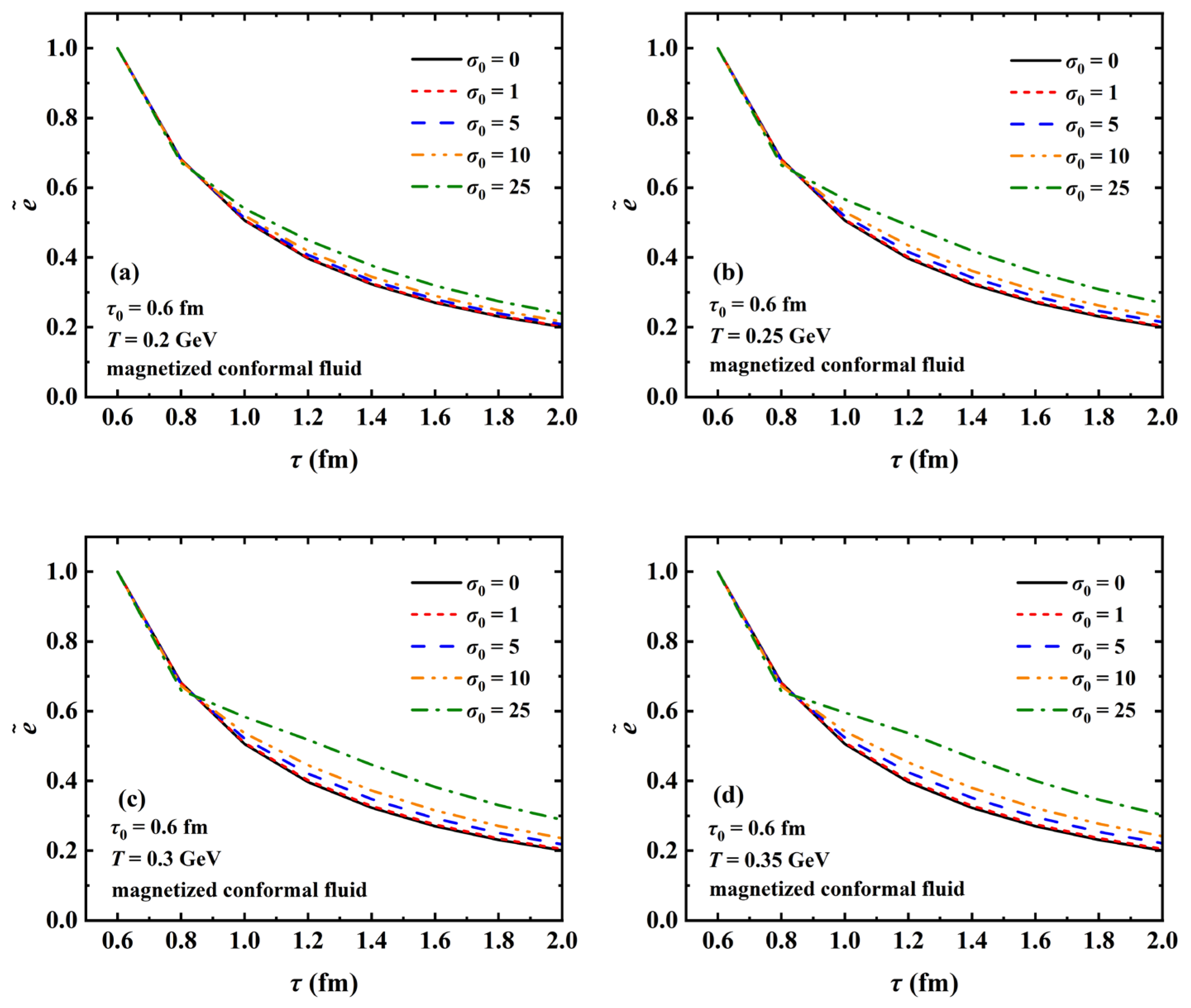
Figure 6 illustrates temporal evolution of the energy density in Type-2 magnetized conformal fluids. In this scenario, the energy density decay rate of the QGP is rather faster than that in ultra-relativistic fluids. This phenomenon stems from the synergistic effect between the equation of state and magnetic response of the magnetized conformal fluid: enhanced paramagnetism strengthens the coupling between the magnetic field and the fluid, yet it also induces more pronounced dissipation during the energy conversion between the magnetic field and the fluid. Combined with the perfect fluid expansion characteristic of the QGP at elevated temperatures, this ultimately results in a steeper energy density decay slope than that of ultra-relativistic fluids under the same temperature and initial magnetic field strength conditions. This finding reveals that the magnetization effect does not simply suppress energy density decay, but reshapes the energy evolution dynamics of the QGP through the trade-off between coupling and dissipation. It clarifies the intrinsic difference in energy decay behavior between magnetized conformal fluids and ultra-relativistic fluids, providing a key observational signature for distinguishing fluid types in heavy-ion collision experiments.
The comparison between temperature-dependent and constant magnetic susceptibility can be made by contrasting Figure 6 ( from lattice QCD) with Figure 2 middle panel (constant , same Type-2 magnetic field). Both cases exhibit suppressed energy density decay with stronger magnetic fields. However, the scenario shows a self-reinforcing effect: higher temperatures enhance paramagnetic response (), which further slows energy dissipation and sustains elevated temperatures.
The use of lattice QCD-derived represents a significant step toward realistic modeling of magnetized QGP. It bridges theoretical predictions with experimental conditions in heavy-ion collisions and opens avenues for exploring the QCD phase diagram’s electromagnetic signatures. By incorporating dynamic magnetic responses, this work paves the way for deeper insights into the interplay between quantum chromodynamics and relativistic magnetohydrodynamics.
6. Summary and Conclusions
In this work, we systematically investigated the evolution of energy density in relativistic fluids under time-dependent magnetic fields within the framework of relativistic magnetohydrodynamics (RMHD). By incorporating three distinct magnetic field evolution models (Type-1, Type-2, and Type-3) in relativistic heavy-ion collisions (RHIC) into the Bjorken flow framework, we analyzed their impacts on energy dissipation dynamics in both ultra-relativistic and magnetized conformal fluids. Furthermore, a temperature-dependent magnetic susceptibility derived from lattice QCD calculations was introduced to enhance the physical realism of the magnetic response in quark–gluon plasma (QGP). Our results demonstrate that magnetic fields play a critical role in modulating energy dissipation. Stronger magnetic fields consistently suppress the decay of energy density across all models, with the suppression magnitude being model-dependent. Notably, Type-1 exhibits the most pronounced retardation of energy dissipation, while Type-3 shows the weakest effect. This divergence arises from the distinct temporal evolution profiles of the magnetic fields, which govern how magnetic energy couples to the fluid. For instance, in ultra-relativistic fluids, the interplay between magnetic pressure and hydrodynamic expansion leads to slower thermalization, while in magnetized conformal fluids, explicit magnetization terms in the equation of state amplify energy retention.
It is worth noting that the magnetic suppression of energy density decay observed here shares qualitative similarities with the effects of bulk viscosity in Bjorken flow [Ref. [61], Figure 3]. Both mechanisms introduce effective pressure contributions that counteract hydrodynamic expansion. In realistic heavy-ion collisions, the actual evolution likely reflects a combination of magnetic and viscous effects.
The inclusion of temperature-dependent magnetic susceptibility further enriches the dynamics. Lattice QCD-based parametrizations reveal a transition from diamagnetic behavior in the confined phase to paramagnetic response in the deconfined QGP phase. This temperature dependence introduces a feedback mechanism: delayed energy dissipation sustains higher temperatures, reinforcing paramagnetic behavior and influencing the magnetic field’s evolution. Such findings underscore the necessity of integrating QCD-based susceptibilities into RMHD frameworks for accurate modeling of heavy-ion collisions.
This study bridges theoretical RMHD models with experimental observables, emphasizing the importance of precise magnetic field modeling in interpreting QGP dynamics. However, several limitations warrant future exploration. First, dissipative effects such as viscosity [56,62] and finite conductivity—neglected in the ideal RMHD approximation—could modify energy-momentum transfer. In addition, future work could explore the attractor nature of these solutions by identifying initial conditions that lead to identical asymptotic behaviors, as discussed in studies of viscous hydrodynamics.
Author Contributions
Conceptualization, H.-J.Z. and S.-Q.F.; methodology, H.-J.Z.; software H.-J.Z.; validation, H.-J.Z. and S.-Q.F.; formal analysis S.-Q.F.; investigation, S.-Q.F.; resources, S.-Q.F.; data curation, S.-Q.F.; writing—original draft preparation, H.-J.Z.; writing—review and editing H.-J.Z.; visualization, H.-J.Z.; supervision, H.-J.Z.; project administration S.-Q.F.; funding acquisition, S.-Q.F. All authors have read and agreed to the published version of the manuscript.
Funding
This work was supported by the National Natural Science Foundation of China (Grants No. 12575144, No. 11875178).
Data Availability Statement
The original contributions presented in this study are included in the article. Further inquiries can be directed to the corresponding author.
Acknowledgments
I would like to express my sincere gratitude to Zuman Zhang, Zefang Jiang and all the members of the research group for their invaluable help and support during the completion of this paper.
Conflicts of Interest
The authors declare no conflicts of interest.
References
Adams, J.; Aggarwal, M.; Ahammed, Z.; Amonett, J.; Anderson, B.; Arkhipkin, D.; Averichev, G.; Badyal, S.; Bai, Y.; Balewski, J.; et al. Experimental and theoretical challenges in the search for the quark–gluon plasma: The STAR Collaboration’s critical assessment of the evidence from RHIC collisions. Nucl. Phys. A2005, 757, 102–183. [Google Scholar] [CrossRef]
Gyulassy, M.; McLerran, L. New forms of QCD matter discovered at RHIC. Nucl. Phys. A2005, 750, 30–63. [Google Scholar] [CrossRef]
Heinz, U.W.; Kolb, P.F. Early thermalization at RHIC. Nucl. Phys. A2002, 702, 269–280. [Google Scholar] [CrossRef]
Hirano, T.; Heinz, U.W.; Kharzeev, D.; Lacey, R.; Nara, Y. Hadronic dissipative effects on elliptic flow in ultrarelativistic heavy-ion collisions. Phys. Lett. B2006, 636, 299–304. [Google Scholar] [CrossRef]
Guo, L.B.; Liu, L.S.; Du, D.S. Charmless decays of the B meson in perturbative QCD. J. Phys. G1999, 25, 1–10. [Google Scholar] [CrossRef]
Moreland, J.S.; Bernhard, J.E.; Bass, S.A. Alternative ansatz to wounded nucleon and binary collision scaling in high-energy nuclear collisions. Phys. Rev. C2015, 92, 011901. [Google Scholar] [CrossRef]
Shuryak, E. Why does the quark gluon plasma at RHIC behave as a nearly ideal fluid? Prog. Part. Nucl. Phys.2004, 53, 273–303. [Google Scholar] [CrossRef]
Heinz, U.; Snellings, R. Collective flow and viscosity in relativistic heavy-ion collisions. Ann. Rev. Nucl. Part. Sci.2013, 63, 123–151. [Google Scholar] [CrossRef]
Bzdak, A.; Skokov, V. Event-by-event fluctuations of magnetic and electric fields in heavy ion collisions. Phys. Lett. B2012, 710, 171–174. [Google Scholar] [CrossRef]
Deng, W.-T.; Huang, X.-G. Event-by-event generation of electromagnetic fields in heavy-ion collisions. Phys. Rev. C2012, 85, 044907. [Google Scholar] [CrossRef]
Tuchin, K. Particle production in strong electromagnetic fields in relativistic heavy-ion collisions. Adv. High Energy Phys.2013, 2013, 490495. [Google Scholar] [CrossRef]
Mo, Y.-J.; Feng, S.-Q.; Shi, Y.-F. Effect of the Wood-Saxon nucleon distribution on the chiral magnetic field in relativistic heavy-ion collisions. Phys. Rev. C2013, 88, 024901. [Google Scholar] [CrossRef]
Zhong, Y.; Yang, C.-B.; Cai, X.; Feng, S.-Q. A systematic study of magnetic field in relativistic heavy-ion collisions in the RHIC and LHC energy regions. Adv. High Energy Phys.2014, 2014, 193039. [Google Scholar] [CrossRef]
Zhong, Y.; Yang, C.-B.; Cai, X.; Feng, S.-Q. Spatial distributions of magnetic field in the RHIC and LHC energy regions. Chin. Phys. C2015, 39, 104105. [Google Scholar] [CrossRef][Green Version]
Roy, V.; Pu, S. Event-by-event distribution of magnetic field energy over initial fluid energy density in \sqrts_NN= 200 GeV Au-Au collisions. Phys. Rev. C2015, 92, 064902. [Google Scholar] [CrossRef]
Li, H.; Sheng, X.-L.; Wang, Q. Electromagnetic fields with electric and chiral magnetic conductivities in heavy ion collisions. Phys. Rev. C2016, 94, 044903. [Google Scholar] [CrossRef]
Kharzeev, D.E.; McLerran, L.D.; Warringa, H.J. The Effects of topological charge change in heavy ion collisions: ‘Event by event P and CP violation’. Nucl. Phys. A2008, 803, 227–253. [Google Scholar] [CrossRef]
She, D.; Feng, S.-Q.; Zhong, Y.; Yin, Z.-B. Chiral magnetic currents with QGP medium response in heavy ion collisions at RHIC and LHC energies. Eur. Phys. J. A2018, 54, 48. [Google Scholar] [CrossRef]
Chen, B.-X.; Feng, S.-Q. A systematical study of the chiral magnetic effects at the RHIC and LHC energies. Chin. Phys. C2020, 44, 024104. [Google Scholar] [CrossRef]
Chen, Y.; Sheng, X.-L.; Ma, G.-L. Electromagnetic fields from the extended Kharzeev-McLerran-Warringa model in relativistic heavy-ion collisions. Nucl. Phys. A2021, 1011, 122199. [Google Scholar] [CrossRef]
Fukushima, K.; Kharzeev, D.E.; Warringa, H.J. The Chiral Magnetic Effect. Phys. Rev. D2008, 78, 074033. [Google Scholar] [CrossRef]
Guo, Y.; Shi, S.; Feng, S.; Liao, J. Magnetic Field Induced Polarization Difference between Hyperons and Anti-hyperons. Phys. Lett. B2019, 798, 134929. [Google Scholar] [CrossRef]
Burnier, Y.; Kharzeev, D.E.; Liao, J.; Yee, H.-U. Chiral magnetic wave at finite baryon density and the electric quadrupole moment of quark-gluon plasma in heavy ion collisions. Phys. Rev. Lett.2011, 107, 052303. [Google Scholar] [CrossRef]
Jiang, Z.-F.; Zhang, Z.-H.; Yuan, X.-F.; Zhang, B.-W. External-magnetic-field-induced paramagnetic squeezing effect in heavy-ion collisions at energies available at the CERN Large Hadron Collider. Phys. Rev. C2024, 110, 014902. [Google Scholar] [CrossRef]
Khachatryan, V.; Sirunyan, A.M.; Tumasyan, A.; Adam, W.; Asilar, E.; Bergauer, T.; Brandstetter, J.; Brondolin, E.; Dragicevic, M.; Erö, J.; et al. Observation of charge-dependent azimuthal correlations in p-Pb collisions and its implication for the search for the chiral magnetic effect. Phys. Rev. Lett.2017, 118, 122301. [Google Scholar] [CrossRef]
Sirunyan, A.M.; Tumasyan, A.; Adam, W.; Ambrogi, F.; Asilar, E.; Bergauer, T.; Brandstetter, J.; Brondolin, E.; Dragicevic, M.; Erö, J.; et al. Constraints on the chiral magnetic effect using charge-dependent azimuthal correlations in pPb and PbPb collisions at the CERN Large Hadron Collider. Phys. Rev. C2018, 97, 044912. [Google Scholar] [CrossRef]
Sirunyan, A.M.; Tumasyan, A.; Adam, W.; Ambrogi, F.; Asilar, E.; Bergauer, T.; Brandstetter, J.; Brondolin, E.; Dragicevic, M.; Erö, J.; et al. Probing the chiral magnetic wave in pPb and PbPb collisions at \sqrt s_NN =5.02TeV using charge-dependent azimuthal anisotropies. Phys. Rev. C2019, 100, 064908. [Google Scholar] [CrossRef]
Qiu, Y.-W.; Feng, S.-Q. Spin polarization and anomalous magnetic moment in a (2+1)-flavor Nambu–Jona-Lasinio model in a thermomagnetic background. Phys. Rev. D2023, 107, 076004. [Google Scholar] [CrossRef]
Zhu, X.; Feng, S.-Q. Shear viscosity coefficient of magnetized QCD medium near chiral phase transition. Phys. Rev. D2023, 107, 016018. [Google Scholar] [CrossRef]
Deng, J.; Feng, S.-Q. Holographic deconfined QGP phase diagram and entropy with an anomalous flow in a magnetic field background. Phys. Rev. D2022, 105, 026015. [Google Scholar] [CrossRef]
Qiu, Y.-W.; Feng, S.-Q.; Zhu, X.-Q. Shear viscosity coefficient of magnetized QCD medium with anomalous magnetic moments near chiral phase transition. Phys. Rev. D2023, 108, 116022. [Google Scholar] [CrossRef]
Bao, Y.-R.; Feng, S.-Q. Effects of tensor spin polarization on the chiral restoration and deconfinement phase transitions. Phys. Rev. D2024, 109, 096033. [Google Scholar] [CrossRef]
Feng, S.-Q.; Zhao, Y.-Q.; Chen, X. Systematical study of thermal width of heavy quarkonia in a finite temperature magnetized background from holography. Phys. Rev. D2020, 101, 026023. [Google Scholar] [CrossRef]
Zhu, Z.-R.; Feng, S.-Q.; Shi, Y.-F.; Zhong, Y. Energy loss of heavy and light quarks in holographic magnetized background. Phys. Rev. D2019, 99, 126001. [Google Scholar] [CrossRef]
Feng, S.-Q.; Pei, L.; Sun, F.; Zhong, Y.; Yin, Z.-B. Estimation of the chiral magnetic effect considering the magnetic field response of the QGP medium. Chin. Phys. C2018, 42, 054102. [Google Scholar] [CrossRef]
Bjorken, J.D. Highly Relativistic Nucleus-Nucleus Collisions: The Central Rapidity Region. Phys. Rev. D1983, 27, 140–151. [Google Scholar] [CrossRef]
Müller, B.; Schäfer, A. Chiral magnetic effect and an experimental bound on the late time magnetic field strength. Phys. Rev. D2018, 98, 071902. [Google Scholar] [CrossRef]
Jiang, Y.; Shi, S.; Yin, Y.; Liao, J. Quantifying the chiral magnetic effect from anomalous-viscous fluid dynamics. Chin. Phys. C2018, 42, 011001. [Google Scholar] [CrossRef]
Shi, S.; Jiang, Y.; Lilleskov, E.; Liao, J. Anomalous Chiral Transport in Heavy Ion Collisions from Anomalous-Viscous Fluid Dynamics. Annals Phys.2018, 394, 50–72. [Google Scholar] [CrossRef]
Bonati, C.; D’Elia, M.; Mariti, M.; Negro, F.; Sanfilippo, F. Magnetic Susceptibility of Strongly Interacting Matter across the Deconfinement Transition. Phys. Rev. Lett.2013, 111, 182001. [Google Scholar] [CrossRef]
Bonati, C.; Capponi, F.; D’Elia, M.; Negro, F. On the Phase Diagram of Yang-Mills Theories in presence of a Θ parameter. PoS2014, 187, 135. [Google Scholar] [CrossRef][Green Version]
Bonati, C.; D’Elia, M.; Mariti, M.; Negro, F.; Sanfilippo, F. Magnetic susceptibility and equation of state of Nf=2+1 QCD with physical quark masses. Phys. Rev. D2014, 89, 054506. [Google Scholar] [CrossRef]
Levkova, L.; DeTar, C. Quark-gluon plasma in an external magnetic field. Phys. Rev. Lett.2014, 112, 012002. [Google Scholar] [CrossRef]
Simonov, Y.A.; Orlovsky, V.D. Magnetic susceptibility of the quark matter in QCD. JETP Lett.2015, 101, 423–426. [Google Scholar] [CrossRef]
Bali, G.S.; Bruckmann, F.; Endrödi, G.; Katz, S.D.; Schäfer, A. The QCD equation of state in background magnetic fields. J. High Energy Phys.2014, 08, 177. [Google Scholar] [CrossRef]
Roy, V.; Pu, S.; Rezzolla, L.; Rischke, D. Analytic Bjorken flow in one-dimensional relativistic magnetohydrodynamics. Phys. Lett. B2015, 750, 45–52. [Google Scholar] [CrossRef]
Csanád, M.; Nagy, M.I.; Jiang, Z.F.; Csörgő, T. A simple family of solutions of relativistic viscous hydrodynamics for fireballs with Hubble flow and ellipsoidal symmetry. Int. J. Mod. Phys. E2023, 32, 2340024. [Google Scholar] [CrossRef]
Denicol, G.S.; Kodama, T.; Koide, T.; Mota, P. Stability and Causality in relativistic dissipative hydrodynamics. J. Phys. G2008, 35, 115102. [Google Scholar] [CrossRef]
Denicol, G.S.; Kodama, T.; Koide, T.; Mota, P. Shock propagation and stability in causal dissipative hydrodynamics. Phys. Rev. C2008, 78, 034901. [Google Scholar] [CrossRef][Green Version]
Csörgő, T.; Kasza, G.; Csanád, M.; Jiang, Z.F. New exact solutions of relativistic hydrodynamics for longitudinally expanding fireballs. Universe2018, 4, 69. [Google Scholar] [CrossRef]
Bali, G.S.; Endrödi, G.; Piemonte, S. Magnetic susceptibility of QCD matter and its decomposition from the lattice. J. High Energ. Phys.2020, 07, 183. [Google Scholar] [CrossRef]
Csorgo, T.; Kasza, G. New, multipole solutions of relativistic, viscous hydrodynamics. In Gribov-90 Memorial Volume; World Scientific: Singapore, 2021. [Google Scholar] [CrossRef]
Figure 2.
Evolution of energy density in the magnetized conformal fluid case. We choose . The left, middle, and right panels correspond to Type-1, Type-2, and Type-3 magnetic field time evolution, respectively. The black solid line represents the case without a magnetic field. The red short dashed line, blue long dashed line, orange dash-dot-dotted line, and green dash-dotted line correspond to , respectively.
Figure 2.
Evolution of energy density in the magnetized conformal fluid case. We choose . The left, middle, and right panels correspond to Type-1, Type-2, and Type-3 magnetic field time evolution, respectively. The black solid line represents the case without a magnetic field. The red short dashed line, blue long dashed line, orange dash-dot-dotted line, and green dash-dotted line correspond to , respectively.
Figure 3.
Evolution of the normalized energy density. The left, middle, and right panels correspond to Type-1, Type-2, and Type-3 magnetic field time evolution, respectively. The magnetic field parameter is set to = 25, and the magnetic susceptibility is . The black line, the blue dashed line and red dotted line correspond to the non-magnetic fluid, ultra-relativistic fluid and the magnetized conformal fluid, respectively.
Figure 3.
Evolution of the normalized energy density. The left, middle, and right panels correspond to Type-1, Type-2, and Type-3 magnetic field time evolution, respectively. The magnetic field parameter is set to = 25, and the magnetic susceptibility is . The black line, the blue dashed line and red dotted line correspond to the non-magnetic fluid, ultra-relativistic fluid and the magnetized conformal fluid, respectively.
Figure 4.
The magnetic susceptibility of QCD matter as a function of temperature. Results from lattice QCD calculations in 2020 [60].
Figure 4.
The magnetic susceptibility of QCD matter as a function of temperature. Results from lattice QCD calculations in 2020 [60].
Figure 5.
Temporal evolution of the energy density in Type-2 Ultra-relativistic ideal fluid (without magnetization correction). Panels (a), (b), (c), and (d) correspond to different temperatures of the QGP deconfined phase ( 0.2, 0.25, 0.3, 0.35 GeV), respectively. The black solid line represents the case without a magnetic field.
Figure 5.
Temporal evolution of the energy density in Type-2 Ultra-relativistic ideal fluid (without magnetization correction). Panels (a), (b), (c), and (d) correspond to different temperatures of the QGP deconfined phase ( 0.2, 0.25, 0.3, 0.35 GeV), respectively. The black solid line represents the case without a magnetic field.
Figure 6.
Temporal evolution of the energy density in Type-2 magnetized conformal fluid (with conformality-preserving trace correction). Panels (a), (b), (c), and (d) correspond to different temperatures ( 0.2, 0.25, 0.3, 0.35 GeV), respectively. The black solid line represents the case without a magnetic field.
Figure 6.
Temporal evolution of the energy density in Type-2 magnetized conformal fluid (with conformality-preserving trace correction). Panels (a), (b), (c), and (d) correspond to different temperatures ( 0.2, 0.25, 0.3, 0.35 GeV), respectively. The black solid line represents the case without a magnetic field.
Disclaimer/Publisher’s Note: The statements, opinions and data contained in all publications are solely those of the individual author(s) and contributor(s) and not of MDPI and/or the editor(s). MDPI and/or the editor(s) disclaim responsibility for any injury to people or property resulting from any ideas, methods, instructions or products referred to in the content.
Zheng, H.-J.; Feng, S.-Q.
Magnetodynamic Characteristics of QGP Energy Dissipation in RMHD Framework with Relativistic Heavy-Ion Collisions. Particles2026, 9, 29.
https://doi.org/10.3390/particles9010029
AMA Style
Zheng H-J, Feng S-Q.
Magnetodynamic Characteristics of QGP Energy Dissipation in RMHD Framework with Relativistic Heavy-Ion Collisions. Particles. 2026; 9(1):29.
https://doi.org/10.3390/particles9010029
Chicago/Turabian Style
Zheng, Huang-Jing, and Sheng-Qin Feng.
2026. "Magnetodynamic Characteristics of QGP Energy Dissipation in RMHD Framework with Relativistic Heavy-Ion Collisions" Particles 9, no. 1: 29.
https://doi.org/10.3390/particles9010029
APA Style
Zheng, H.-J., & Feng, S.-Q.
(2026). Magnetodynamic Characteristics of QGP Energy Dissipation in RMHD Framework with Relativistic Heavy-Ion Collisions. Particles, 9(1), 29.
https://doi.org/10.3390/particles9010029
Article Metrics
No
No
Article Access Statistics
For more information on the journal statistics, click here.
Multiple requests from the same IP address are counted as one view.
Zheng, H.-J.; Feng, S.-Q.
Magnetodynamic Characteristics of QGP Energy Dissipation in RMHD Framework with Relativistic Heavy-Ion Collisions. Particles2026, 9, 29.
https://doi.org/10.3390/particles9010029
AMA Style
Zheng H-J, Feng S-Q.
Magnetodynamic Characteristics of QGP Energy Dissipation in RMHD Framework with Relativistic Heavy-Ion Collisions. Particles. 2026; 9(1):29.
https://doi.org/10.3390/particles9010029
Chicago/Turabian Style
Zheng, Huang-Jing, and Sheng-Qin Feng.
2026. "Magnetodynamic Characteristics of QGP Energy Dissipation in RMHD Framework with Relativistic Heavy-Ion Collisions" Particles 9, no. 1: 29.
https://doi.org/10.3390/particles9010029
APA Style
Zheng, H.-J., & Feng, S.-Q.
(2026). Magnetodynamic Characteristics of QGP Energy Dissipation in RMHD Framework with Relativistic Heavy-Ion Collisions. Particles, 9(1), 29.
https://doi.org/10.3390/particles9010029