Article

Ab Initio Study on the Halo Structure in 11Be

1
Peng Huanwu Collaborative Center for Research and Education, International Institute for Interdisciplinary and Frontiers, Beihang University, Beijing 100191, China
2
School of Physics, Beihang University, Beijing 102206, China
3
Physics Department, College of Engineering and Physics, King Fahd University of Petroleum and Minerals, Dhahran 31261, Saudi Arabia
4
Faculty of Natural Sciences and Engineering, Gaziantep Islam Science and Technology University, Gaziantep 27010, Turkey
5
Facility for Rare Isotope Beams and Department of Physics and Astronomy, Michigan State University, East Lansing, MI 48824, USA
6
Helmholtz-Institut für Strahlen- und Kernphysik and Bethe Center for Theoretical Physics, Universität Bonn, D-53115 Bonn, Germany
7
Institute for Advanced Simulation (IAS-4), Forschungszentrum Jülich, D-52425 Jülich, Germany
8
School of Physics, Nankai University, Tianjin 300071, China
*
Authors to whom correspondence should be addressed.
Particles 2026, 9(1), 25; https://doi.org/10.3390/particles9010025
Submission received: 21 January 2026 / Revised: 3 March 2026 / Accepted: 5 March 2026 / Published: 10 March 2026

Abstract

We present an ab initio study on the one-neutron halo nucleus 11Be using nuclear lattice effective field theory with high-fidelity chiral interactions at N3LO. By employing the wavefunction matching method to mitigate the sign problem and the pinhole algorithm to sample many-body correlations, we successfully reproduce the ground-state parity inversion and the extended matter radius characteristic of the halo structure. We analyze the intrinsic density distributions and geometric shapes of 11Be in comparison with the core nucleus 10Be. Our results reveal a prominent two-cluster structure in both nuclei and the occupation of the σ molecular orbital by the valence neutron in 11Be. It enhances the prolate deformation as well as the diffuse neutron tail, distinct from the π -orbital occupation observed in the 10Be ground state.

1. Introduction

Radioactive ion beams have opened new avenues for the study of nuclear structures and dynamics far away from the stability line. Exotic phenomena such as unusually large matter distributions, later known as halo structures, were discovered in light neutron-rich nuclei [1]. The 11Be nucleus is one of the earliest identified and most extensively studied one-neutron halo nuclei [2,3], serving as a benchmark system for understanding the properties of loosely bound quantum systems.
A striking feature of 11Be is the “parity inversion” of its ground state. According to the standard shell model, the seventh neutron should occupy the 1 p 1 / 2 orbital, resulting in a 1 / 2 ground state. However, experiments established long ago that the ground state of 11Be has spin-parity 1 / 2 + [4,5], while the 1 / 2 state lies at an excitation energy of 0.32 MeV. This inversion indicates the breakdown of the N = 8 magicity and the lowering of the 2 s 1 / 2 orbital relative to the 1 p 1 / 2 orbital. The weak binding of the s-wave neutron leads to a spatially extended density distribution, forming the characteristic halo structure.
Experimentally, the structure of 11Be has been investigated using various probes. Transfer reactions, such as ( d ,   p ) and ( p ,   d ) , have been used to extract spectroscopic factors for the halo neutron. Schmitt et al. [6] reported spectroscopic factors of 0.71(5) for the 1 / 2 + ground state and 0.62(4) for the 1 / 2 excited state. Breakup and knockout reactions have also confirmed the dominant s-wave component of the ground state and provided information on the core excitation [7,8,9]. Electromagnetic dissociation measurements have extracted the B ( E 1 ) strength and the root mean square distance of the halo neutron [10,11,12]. Elastic scattering and breakup data have also been analyzed to constrain the core excitation and reaction mechanisms [13].
Theoretically, reproducing the parity inversion and halo structure of 11Be has been a challenge. Early studies highlighted the importance of a dynamic coupling between the core and the loosely bound neutron [14]. Approaches incorporating particle–vibration coupling [15,16] or core deformation [17] have been successful in explaining the level order. Microscopic cluster models, such as antisymmetrized molecular dynamics, have also reproduced the anomalous parity and suggested a molecular orbit picture for the valence neutron [18,19]. In the realm of ab initio calculations, the no-core shell model initially faced difficulties in reproducing the parity inversion with realistic two-nucleon forces, suggesting a need for three-nucleon interactions or larger model spaces [20]. More recent ab initio studies using chiral interactions have emphasized the role of continuum effects and specific features of the three-nucleon force in correctly describing the spectrum [21]. Unified descriptions using density functional theory linking parity inversion, halo, and clustering continue to be a focus of recent work [22].
Recently, a systematic ab initio study was performed on beryllium isotopes from 7Be to 12Be [23] using nuclear lattice effective field theory (NLEFT) [24,25,26]. This comprehensive investigation employed high-fidelity chiral interactions up to next-to-next-to-next-to-leading order (N3LO), made possible by the wavefunction matching (WFM) technique [27], which mitigates the Monte Carlo sign problem. It successfully reproduced the ground-state energies, radii, and electromagnetic properties of the beryllium chain, including the correct ground state of 11Be.
This proceeding will present a more detailed analysis of the 11Be halo structure as a supplement to the previous study [23]. Specifically, we investigate the density distributions and underlying geometric structure of the ground and excited states using the pinhole algorithm.

2. Nuclear Lattice Effective Field Theory

In this work, we employ nuclear lattice effective field theory [24,25] to investigate the structure of 11Be. The high-fidelity χEFT Hamiltonian at N3LO employed in this work follows Ref. [27]:
H = K + V OPE Λ π = 300 + V Cou . + V 2 N Q 4 + W 2 N Q 4 + V 2 N , WFM Q 4 + W 2 N , WFM Q 4 + V 3 N Q 3 ,
where K is the kinetic energy; V OPE Λ π = 300 is the one-pion exchange (OPE) interaction with cutoff Λ π = 300 MeV; V Cou . is the Coulomb interaction; V 2 N Q 4 are the two-nucleon (2N) contact interactions at Q 4 chiral expansion order; W 2 N Q 4 denotes the corresponding Galilean invariance-restoring (GIR) terms; V 2 N , WFM Q 4 and W 2 N , WFM Q 4 are the 2N wave function matching (WFM) interactions and GIR terms; and V 3 N Q 3 are the three-nucleon (3N) contact interactions at Q 3 chiral expansion order. The details on the interaction are presented in Refs. [27,28,29].
To address the Monte Carlo sign problem inherent in realistic nuclear forces, we utilize the wavefunction matching (WFM) method [27]. This method introduces a simple Hamiltonian H S with an SU(4)-symmetric contact interaction and a smeared OPE potential. A unitary transformation is performed on the full Hamiltonian H to H so that the short-distance wave functions of H matches those of H S , while the difference H H S is treated in first-order perturbation theory.
The ground-state wave function of the simple Hamiltonian is obtained using projection Monte Carlo simulations with auxiliary fields. The trial wave function | Ψ 0 S was chosen as a single Slater determinant of harmonic oscillator wave functions. To analyze the spatial correlations and halo structure, we use the pinhole algorithm [30], which samples nucleon coordinates according to the following amplitude:
Z = Ψ 0 S | M L t / 2 ρ ( n 1 , , n A ) M L t / 2 | Ψ 0 S .
where M = : exp ( a t H S ) : is the transfer matrix operator of the simple Hamiltonian, a t is the Euclidean time projection step, and L t is the total number of time slices. The many-body density operator ρ ( n 1 , , n A ) is defined as
ρ ( n 1 , , n A ) = : a ( n 1 ) a ( n 1 ) a ( n A ) a ( n A )   :   .
Observables are then calculated by combining the unperturbed contributions from the sampled configurations with the perturbative corrections from the N3LO Hamiltonian [27]. See the Supplemental Materials of Refs. [30,31] for more details of the pinhole algorithm and its perturbative corrections. This framework allows for the precise determination of radii and intrinsic density distributions essential for studying halo nuclei.

3. Results and Discussion

We adopted a lattice size of L = 10 with lattice spacing a = 1.32 fm and Euclidean time lattice spacing of a t = 0.001 MeV −1. The low-lying spectrum from 7Be to 12Be was calculated in Ref. [23], and the energies and radii of 10Be and 11Be are summarized in Table 1. The experimental values are also listed for comparison [32,33,34,35]. The binding energy of 10Be calculated via NLEFT is 7.2 MeV with respect to the α - α -neutron–neutron threshold, and 6.1 MeV with respect to the 9Be-neutron threshold. The binding energy of the last neutron in 11Be calculated via NLEFT is 1.9 MeV with respect to the 10Be-neutron threshold, closer to the 500 keV binding observed in nature. To achieve a more accurate description of the binding energies, more efforts are needed to improve the accuracy of the ab initio calculations, such as through the fine tuning of three-body interactions [36].
The ground-state parity inversion of 11Be can be reproduced through NLEFT calculations with the N3LO interaction, and the overall agreement with the experimental data is good. The radii of 10Be are about 10% larger than the experimental values, while the radii of 11Be agree better. A sudden increase in the matter radius of 11Be is observed in the halo structure.
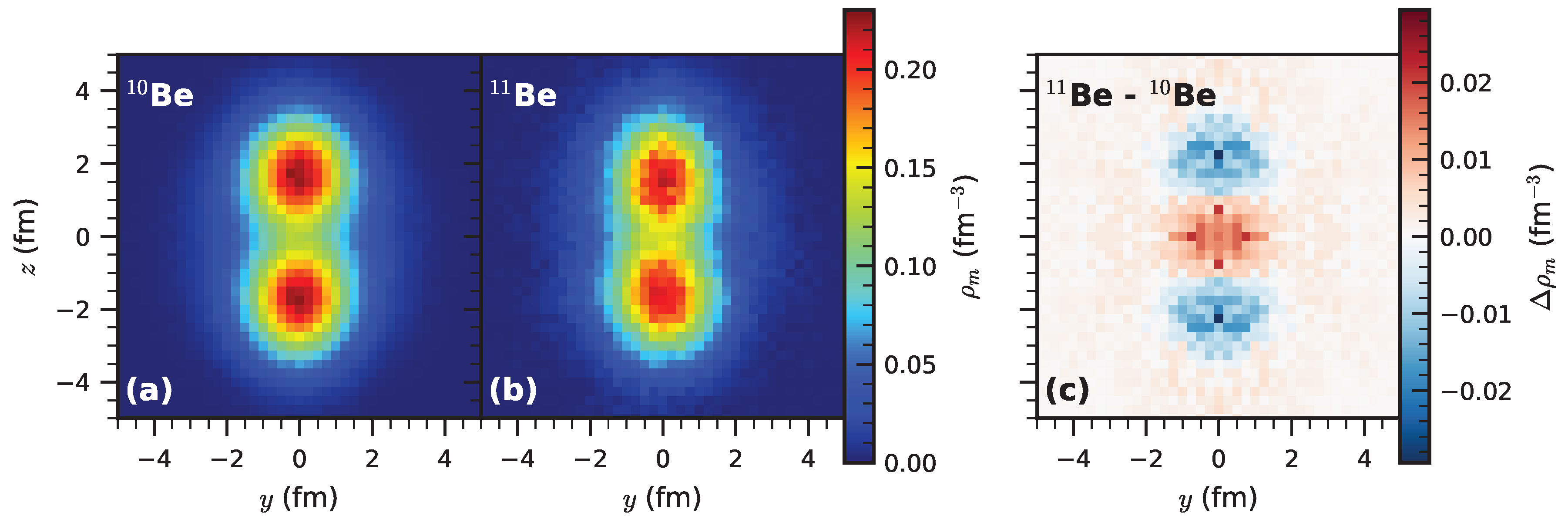
In Ref. [23], the A-nucleons were grouped into two clusters composed of two protons and two neutrons that are the closest to each other according to their spatial coordinates r i sampled by the pinhole algorithm. The extra neutrons (two in 10Be and three in 11Be) are considered to be the valence neutrons. By randomly rotating one of the clusters along the z-axis, the intrinsic 3D density distribution ρ ( r ) is obtained. The results of the 10Be and 11Be ground states are shown in Figure 1a,b, respectively. Their difference (11Be-10Be) is shown in Figure 1c.
One can see a clear two-cluster structure in the density distribution. Due to the different occupations of the π and σ orbitals, the two nuclei show quite different shape patterns. In the 10Be ground state, the valence neutrons occupy the π orbital surrounding and between the two clusters [37,38,39,40,41]. The extra neutron in 11Be occupies the σ orbital [38]. As shown in Figure 1c, its center part has a higher density, whereas at the top/bottom of the clusters, the density is lower. Furthermore, the halo structure can also be seen in the difference in density distributions.
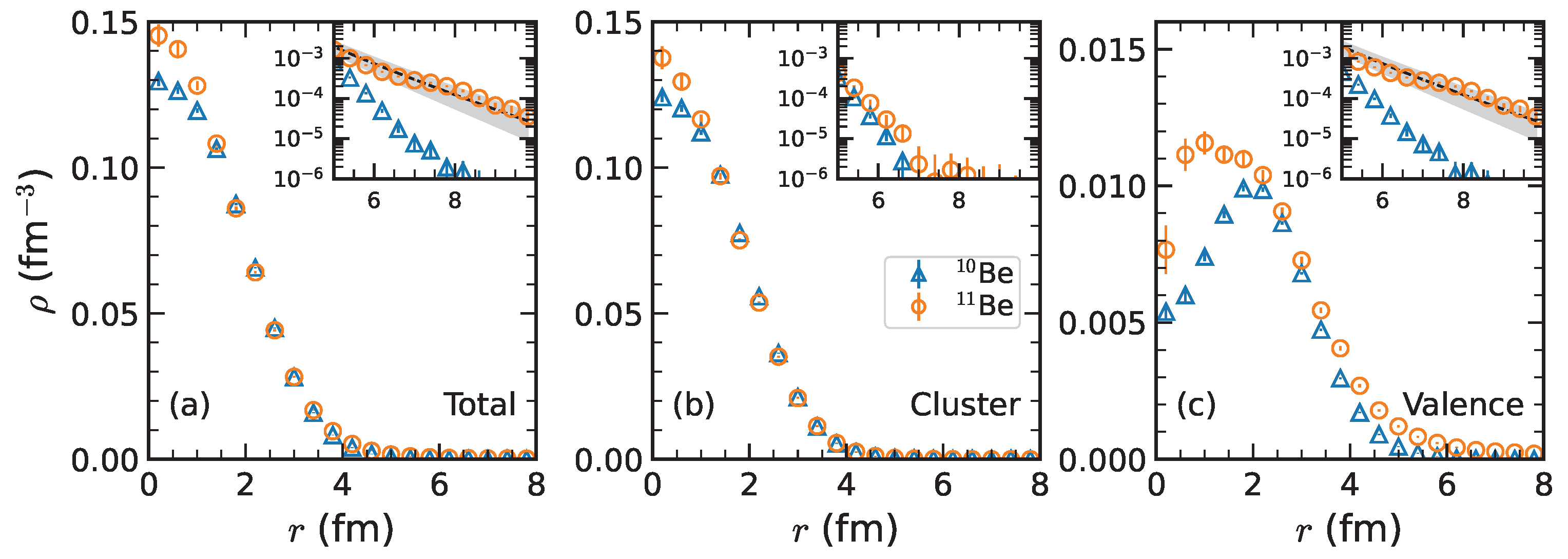
To see the details of the density distribution and halo character more closely, we plotted the radial density distributions of the 10Be and 11Be ground states calculated by NLEFT in Figure 2. From left to right are the total densities, densities of the two clusters, and densities of the valence neutrons. The dashed line in Figure 2a,c indicates the expected asymptotic density distribution proportional to e 2 κ r / r 2 , with κ = 2 m E / 0.303 fm−1 calculated for | E | = 1.9 MeV, and the shadow band indicating the error propagated from the binding energy uncertainty. One can see at a large radial distance that the density of 11Be is much more extended, showing the halo structure. By comparing panels (a) and (c), one can see that the density at such a large radial distance mainly comes from the valence neutrons. Due to the occupation of the σ orbital, the density of 11Be near the center is larger, where both the σ -orbital valence neutron and the clusters contribute. Due to the more prolate shape of 11Be, its cluster radial density distribution is also slightly more extended, as seen in panel (b).
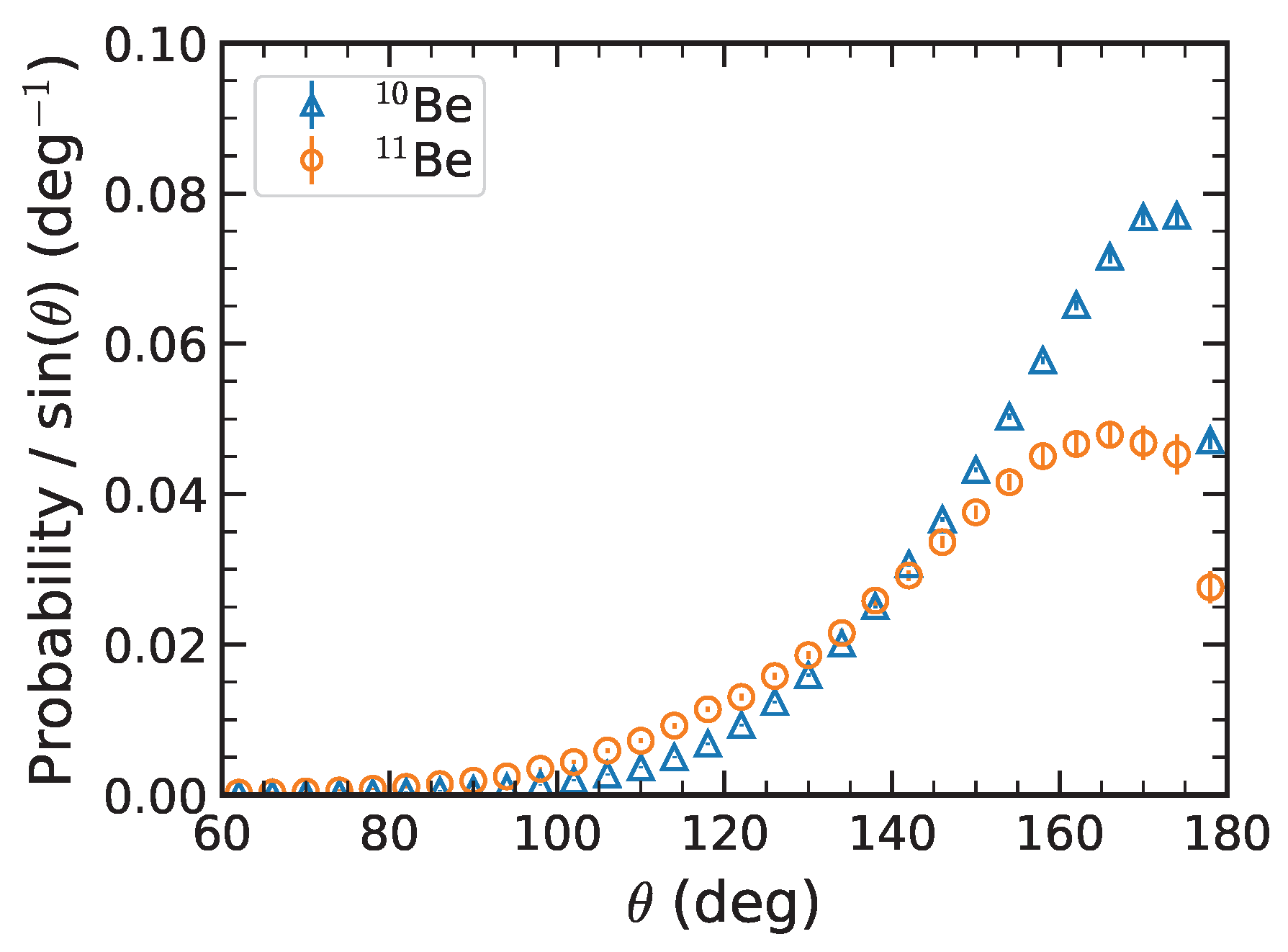
In Figure 3, we plot the angular distribution of two clusters (cluster1–center–cluster2) in the 10Be and 11Be ground states calculated by NLEFT. This distribution is due to the valence neutrons, as in the case of 8Be, the angle between two clusters will always be 180°. The integration of the probability over the whole range gives one. More valence neutrons (three in 11Be compared to two in 10Be) lead to a wider distribution of this angle.
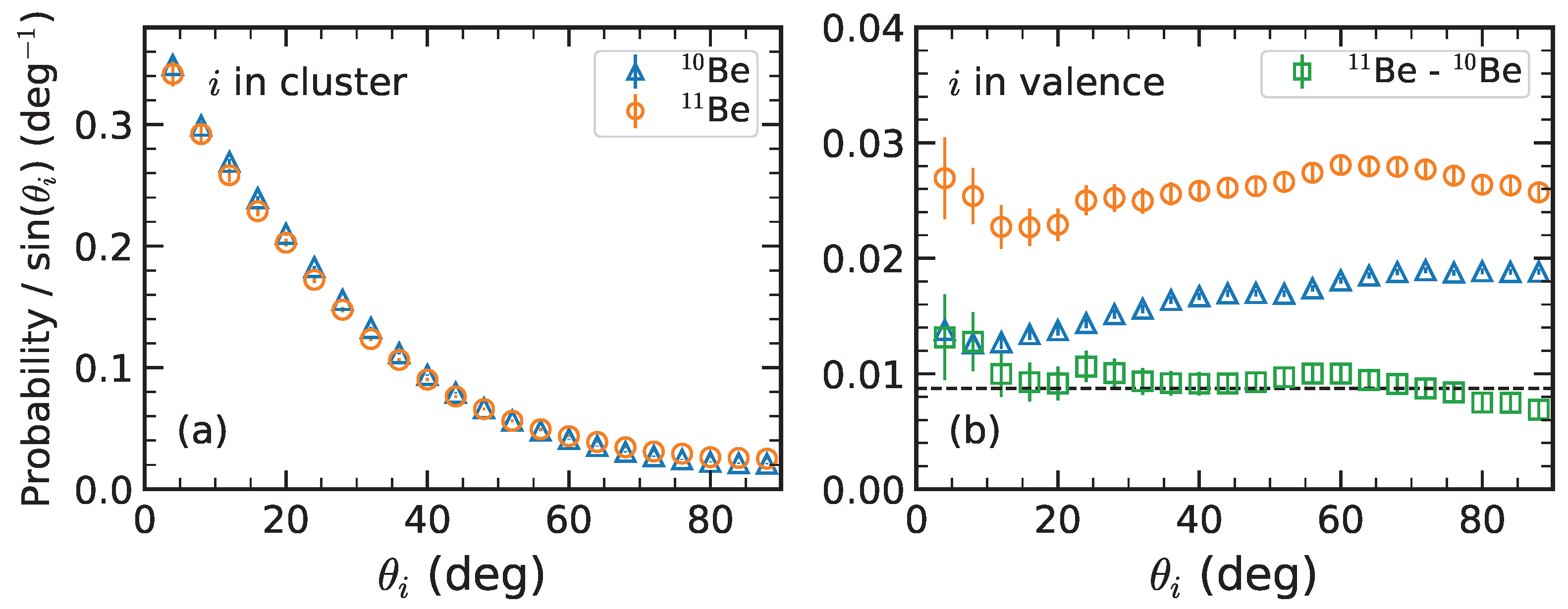
In Figure 4, we plot the probability distribution of the angle between each nucleon, with the z-axis in the 10Be and 11Be ground states calculated by NLEFT in the intrinsic frame shown in Figure 1. The distribution is symmetric to 90° and therefore only half is plotted. Integration over the whole range gives the particle numbers: 8 for panel (a), and 2 (10Be) and 3 (11Be) for panel (b). The dashed line in Figure 4b indicates the expected angular distribution for a homogeneous sphere, p ( θ ) = π 360 sin θ (normalized to 1). For nucleons in the clusters, the distribution is highest around 0° and gradually decreases to 90°. This is because we aligned the clusters along the z-axis. For valence neutrons, the distribution is much higher around 90° compared to nucleons in the clusters, as they mostly move around the neck of the two clusters. For nucleons in the π -orbital in 10Be, while a higher probability is observed towards 90 degrees, a certain probability can also be seen at small angles. This is related to how the one-body density is constructed from the fully correlated many-nucleon distributions. After grouping the closest two protons and two neutrons, one cluster is rotated to the z-axis. With this procedure, the valence neutron has nonvanishing probability to locate near the z-axis. In panel (b), the difference between 10Be and 11Be is also plotted. It can be seen that the extra valence neutron in 11Be leads to a higher probability around 0° near the top of the cluster region. Overall, this extra valence neutron is distributed rather smoothly in all angles, showing both the center part of the σ orbital and the s-wave character of a halo.

4. Conclusions and Perspectives

In this work, we investigated the structure of the paradigmatic halo nucleus 11Be using ab initio NLEFT calculations with high-precision N3LO chiral interactions. By leveraging the wavefunction matching method, we overcame the sign problem and obtained a good description of the binding energies and radii for both 10Be and 11Be, properly reproducing the well-known parity inversion in the 11Be ground state.
Using the pinhole algorithm, we computed the intrinsic 3D density distributions and radial profiles, providing a microscopic view of the internal structure. We observed well-developed cluster structures in both isotopes. A detailed comparison of the angular and radial distributions between 10Be and 11Be demonstrates that the halo formation in 11Be is driven by the valence neutron occupying a σ -type molecular orbital. This configuration results in a more prolate deformation and a significant extension of the neutron density at large distances compared to the 10Be core, where valence neutrons occupy π -type orbitals.
Future studies should apply this framework to explore other exotic systems near the driplines. The ability to successfully describe the clustering and halo correlations using this lattice EFT approach opens new avenues for understanding the emergence of nuclear molecular structures from first principles.

Author Contributions

Conceptualization, S.S. and U.-G.M.; methodology, all authors; software, all authors; validation, all authors; formal analysis, S.S.; investigation, S.S.; resources, S.S. and U.-G.M.; data curation, S.S. and U.-G.M.; writing—original draft preparation, S.S.; writing—review and editing, all authors; visualization, S.S.; supervision, U.-G.M.; project administration, U.-G.M.; funding acquisition, S.S. and U.-G.M. All authors have read and agreed to the published version of the manuscript.

Funding

This work was funded by “the Fundamental Research Funds for the Central Universities”, National Natural Science Foundation of China under Grant No. U2541242 and 12435007. The work of SE is supported in part by the Scientific and Technological Research Council of Turkey (TUBITAK Project No. 123F464). The work of UGM was supported in by the European Research Council (ERC) under the European Union’s Horizon 2020 research and innovation programme (ERC AdG EXOTIC, Grant Agreement No. 101018170), by the CAS President’s International Fellowship Initiative (PIFI) (Grant No. 2025PD0022). SS gratefully acknowledges the Computational resources provided by the HPC platform of Beihang University. SS and UGM gratefully acknowledge the Gauss Centre for Supercomputing e.V. for funding this project by providing computing time on the GCS Supercomputer JUWELS at Jülich Supercomputing Centre (JSC). DL acknowledges support from the U.S. Department of Energy, grants DE-SC0026198, DE-SC0013365, and DE-SC0023175.

Data Availability Statement

The original data presented in the study are openly available from ScienceDB.

Acknowledgments

We acknowledge the organizers of the conference “International Symposium Commemorating the 40th Anniversary of the Halo Nuclei (HALO-40)” for the contribution invite.

Conflicts of Interest

The authors declare no conflicts of interest.

Abbreviations

The following abbreviations are used in this manuscript:
NLEFTNuclear Lattice Effective Field Theory
χEFTChiral Effective Field Theory
WFMWavefunction Matching
GIRGalilean Invariance Restoring
N3LONext-to-Next-to-Next-to-Leading Order
OPEOne-Pion Exchange
2NTwo-nucleon
3NThree-nucleon

References

  1. Tanihata, I.; Kobayashi, T.; Yamakawa, O.; Shimoura, S.; Ekuni, K.; Sugimoto, K.; Takahashi, N.; Shimoda, T.; Sato, H. Measurement of Interaction Cross-Sections Using Isotope Beams of Be and B and Isospin Dependence of the Nuclear Radii. Phys. Lett. B 1988, 206, 592–596. [Google Scholar] [CrossRef]
  2. Fukuda, M.; Ichihara, T.; Inabe, N.; Kubo, T.; Kumagai, H.; Nakagawa, T.; Yano, Y.; Tanihata, I.; Adachi, M.; Asahi, K.; et al. Neutron halo in 11 Be studied via reaction cross sections. Phys. Lett. B 1991, 268, 339–344. [Google Scholar] [CrossRef]
  3. Nakamura, T.; Shimoura, S.; Kobayashi, T.; Teranishi, T.; Abe, K.; Aoi, N.; Doki, Y.; Fujimaki, M.; Inabe, N.; Iwasa, N.; et al. Coulomb dissociation of a halo nucleus Be-11 at 72A MeV. Phys. Lett. B 1994, 331, 296–301. [Google Scholar] [CrossRef]
  4. Talmi, I.; Unna, I. Order of Levels in the Shell Model and Spin of Be-11. Phys. Rev. Lett. 1960, 4, 469–470. [Google Scholar] [CrossRef]
  5. Alburger, D.; Chasman, C.; Jones, K.; Olness, J.; Ristinen, R. Parity of Be 11. Phys. Rev. 1964, 136, B916. [Google Scholar] [CrossRef]
  6. Schmitt, K.T.; Jones, K.L.; Bey, A.; Ahn, S.H.; Bardayan, D.W.; Blackmon, J.C.; Brown, S.M.; Chae, K.Y.; Chipps, K.A.; Cizewski, J.A.; et al. Halo nucleus 11Be: A Spectroscopic study via neutron transfer. Phys. Rev. Lett. 2012, 108, 192701. [Google Scholar] [CrossRef]
  7. Winfield, J.S.; Fortier, S.; Catford, W.; Pita, S.; Orr, N.; Van de Wiele, J.; Blumenfeld, Y.; Chapman, R.; Chappell, S.; Clarke, N.; et al. Single neutron transfer from Be-11(gs) via the (p,d) reaction with a radioactive beam. Nucl. Phys. A 2001, 683, 48–78. [Google Scholar] [CrossRef]
  8. Fortier, S.; Pita, S.; Winfield, J.S.; Catford, W.N.; Orr, N.A.; Van de Wiele, J.; Blumenfeld, Y.; Chapman, R.; Chappell, S.P.G.; Clarke, N.M.; et al. Core excitation in 11 Be gs via the p(11 Be, 10 Be)d reaction. Phys. Lett. B 1999, 461, 22–27. [Google Scholar] [CrossRef]
  9. Aumann, T.; Navin, A.; Balamuth, D.P.; Bazin, D.; Blank, B.; Brown, B.A.; Bush, J.E.; Caggiano, J.A.; Davids, B.; Glasmacher, T.; et al. One-Neutron Knockout from Individual Single-Particle States of B-11e. Phys. Rev. Lett. 2000, 84, 35–38. [Google Scholar] [CrossRef]
  10. Fukuda, N.; Nakamura, T.; Aoi, N.; Imai, N.; Ishihara, M.; Kobayashi, T.; Iwasaki, H.; Kubo, T.; Mengoni, A.; Notani, M.; et al. Coulomb and nuclear breakup of a halo nucleus Be-11. Phys. Rev. C 2004, 70, 054606. [Google Scholar] [CrossRef]
  11. Palit, R.; Adrich, P.; Aumann, T.; Boretzky, K.; Carlson, B.V.; Cortina, D.; Pramanik, U.D.; Elze, T.W.; Emling, H. Exclusive measurement of breakup reactions with the one neutron halo nucleus Be-11. Phys. Rev. C 2003, 68, 034318. [Google Scholar] [CrossRef]
  12. Kwan, E.; Wu, C.; Summers, N.; Hackman, G.; Drake, T.; Andreoiu, C.; Ashley, R.; Ball, G.; Bender, P.; Boston, A.; et al. Precision measurement of the electromagnetic dipole strengths in Be11. Phys. Lett. B 2014, 732, 210–213. [Google Scholar] [CrossRef]
  13. Chen, J.; Lou, J.L.; Ye, Y.L.; Li, Z.H.; Ge, Y.C.; Li, Q.T.; Li, J.; Jiang, W.; Sun, Y.L. Elastic scattering and breakup of Be11 on protons at 26.9A MeV. Phys. Rev. C 2016, 93, 034623. [Google Scholar] [CrossRef]
  14. Otsuka, T.; Fukunishi, N.; Sagawa, H. Structure of exotic neutron-rich nuclei. Phys. Rev. Lett. 1993, 70, 1385–1388. [Google Scholar] [CrossRef] [PubMed]
  15. Vinh Mau, N. Particle-vibration coupling in one neutron halo nuclei. Nucl. Phys. A 1995, 592, 33–44. [Google Scholar] [CrossRef]
  16. Barranco, F.; Potel, G.; Broglia, R.A.; Vigezzi, E. Structure and reactions of 11Be: Many-body basis for single-neutron halo. Phys. Rev. Lett. 2017, 119, 082501. [Google Scholar] [CrossRef]
  17. Nunes, F.M.; Thompson, I.J.; Johnson, R.C. Core excitation in one neutron halo systems. Nucl. Phys. A 1996, 596, 171–186. [Google Scholar] [CrossRef]
  18. Kanada-En’yo, Y.; Horiuchi, H. Structure of excited states of Be-11 studied with antisymmetrized molecular dynamics. Phys. Rev. C 2002, 66, 024305. [Google Scholar] [CrossRef]
  19. Kimura, M.; Suhara, T.; Kanada-En’yo, Y. Antisymmetrized molecular dynamics studies for exotic clustering phenomena in neutron-rich nuclei. Eur. Phys. J. A 2016, 52, 373. [Google Scholar] [CrossRef]
  20. Forssen, C.; Navratil, P.; Ormand, W.E.; Caurier, E. Large basis ab initio shell model investigation of Be-9 and Be-11. Phys. Rev. C 2005, 71, 044312. [Google Scholar] [CrossRef]
  21. Calci, A.; Navrátil, P.; Roth, R.; Dohet-Eraly, J.; Quaglioni, S.; Hupin, G. Can Ab Initio Theory Explain the Phenomenon of Parity Inversion in 11Be? Phys. Rev. Lett. 2016, 117, 242501. [Google Scholar] [CrossRef]
  22. Geng, J.; Zhao, P.W.; Niu, Y.F.; Long, W.H. A coherent microscopic picture for the exotic structure of 11Be. Phys. Lett. B 2024, 858, 139036. [Google Scholar] [CrossRef]
  23. Shen, S.; Elhatisari, S.; Lee, D.; Meißner, U.G.; Ren, Z. Ab Initio Study of the Beryllium Isotopes Be7 to Be12. Phys. Rev. Lett. 2025, 134, 162503. [Google Scholar] [CrossRef] [PubMed]
  24. Lee, D. Lattice simulations for few- and many-body systems. Prog. Part. Nucl. Phys. 2009, 63, 117–154. [Google Scholar] [CrossRef]
  25. Lähde, T.A.; Meißner, U.G. Nuclear Lattice Effective Field Theory: An Introduction; Springer: Berlin/Heidelberg, Germany, 2019; Volume 957. [Google Scholar]
  26. Lee, D. Lattice Effective Field Theory Simulations of Nuclei. Ann. Rev. Nucl. Part. Sci. 2025, 75, 109–128. [Google Scholar] [CrossRef]
  27. Elhatisari, S.; Bovermann, L.; Ma, Y.-Z.; Epelbaum, E.; Frame, D.; Hildenbrand, F.; Kim, M.; Kim, Y.; Krebs, H.; Lähde, T.A.; et al. Wavefunction matching for solving quantum many-body problems. Nature 2024, 630, 59–63. [Google Scholar] [CrossRef] [PubMed]
  28. Li, N.; Elhatisari, S.; Epelbaum, E.; Lee, D.; Lu, B.N.; Meißner, U.G. Neutron-proton scattering with lattice chiral effective field theory at next-to-next-to-next-to-leading order. Phys. Rev. C 2018, 98, 044002. [Google Scholar] [CrossRef]
  29. Li, N.; Elhatisari, S.; Epelbaum, E.; Lee, D.; Lu, B.; Meißner, U.G. Galilean invariance restoration on the lattice. Phys. Rev. C 2019, 99, 064001. [Google Scholar] [CrossRef]
  30. Elhatisari, S.; Epelbaum, E.; Krebs, H.; Lähde, T.A.; Lee, D.; Li, N.; Lu, B.n.; Meißner, U.G.; Rupak, G. Ab initio Calculations of the Isotopic Dependence of Nuclear Clustering. Phys. Rev. Lett. 2017, 119, 222505. [Google Scholar] [CrossRef]
  31. Lu, B.N.; Li, N.; Elhatisari, S.; Lee, D.; Epelbaum, E.; Meißner, U.G. Essential elements for nuclear binding. Phys. Lett. B 2019, 797, 134863. [Google Scholar] [CrossRef]
  32. Wang, M.; Huang, W.J.; Kondev, F.G.; Audi, G.; Naimi, S. The AME 2020 atomic mass evaluation (II). Tables, graphs and references. Chin. Phys. C 2021, 45, 030003. [Google Scholar] [CrossRef]
  33. Kelley, J.H.; Kwan, E.; Purcell, J.E.; Sheu, C.G.; Weller, H.R. Energy levels of light nuclei. Nucl. Phys. A 2012, 880, 88–195. [Google Scholar] [CrossRef]
  34. Nortershauser, W.; Tiedemann, D.; Žáková, M.; Andjelkovic, Z.; Blaum, K.; Bissell, M.L.; Cazan, R.; Drake, G.W.F.; Geppert, C.; Kowalska, M.; et al. Nuclear Charge Radii of Be-7, Be-9, Be-10 and the one-neutron halo nucleus Be-11. Phys. Rev. Lett. 2009, 102, 062503. [Google Scholar] [CrossRef]
  35. Tanihata, I.; Savajols, H.; Kanungo, R. Recent experimental progress in nuclear halo structure studies. Prog. Part. Nucl. Phys. 2013, 68, 215–313. [Google Scholar] [CrossRef]
  36. Elhatisari, S.; Hildenbrand, F.; Meißner, U.G. Ab initio lattice study of neutron–alpha scattering with chiral forces at N3LO. J. Phys. G 2025, 52, 125102. [Google Scholar] [CrossRef]
  37. Von Oertzen, W. Two-center molecular states in9B, 9Be, 10Be, and10B. Z. Für Phys. A Hadron. Nucl. 1996, 354, 37–43. [Google Scholar] [CrossRef]
  38. Kanada-En’yo, Y.; Horiuchi, H.; Dote, A. Structure of excited states of Be-10 studied with antisymmetrized molecular dynamics. Phys. Rev. C 1999, 60, 064304. [Google Scholar] [CrossRef]
  39. Itagaki, N.; Okabe, S. Molecular orbital structures in Be-10. Phys. Rev. C 2000, 61, 044306. [Google Scholar] [CrossRef]
  40. Li, P.J.; Beaumel, D.; Lee, J.; Assié, M.; Chen, S.; Franchoo, S.; Gibelin, J.; Hammache, F.; Harada, T.; Kanada-En’yO, Y.; et al. Validation of the Be10 Ground-State Molecular Structure Using Be10(p,pα)He6 Triple Differential Reaction Cross-Section Measurements. Phys. Rev. Lett. 2023, 131, 212501. [Google Scholar] [CrossRef]
  41. Chen, J.; Ayyad, Y.; Bazin, D.; Mittig, W.; Serikow, M.Z.; Keeley, N.; Wang, S.M.; Zhou, B.; Zamora, J.C.; Beceiro-Novo, S.; et al. Near-Threshold Dipole Strength in Be10 with Isoscalar Character. Phys. Rev. Lett. 2025, 134, 012502. [Google Scholar] [CrossRef] [PubMed]
Figure 1. Intrinsic 3D density distribution of (a) 10Be and (b) 11Be ground states and (c) their difference obtained by the pinhole algorithm.
Particles 09 00025 g001
Figure 2. Radial density distribution of 10Be and 11Be ground states obtained by NLEFT. (a) Total densities, (b) densities of the 2 clusters, and (c) densities of the valence neutrons. The dashed line in the inset indicates the asymptotic density distribution for | E | = 1.9 MeV, with the shadow band indicating the error propagated from the binding energy uncertainty.
Particles 09 00025 g002
Figure 3. Angular distribution of two clusters (cluster1–center–cluster2) in 10Be and 11Be ground states calculated by NLEFT.
Particles 09 00025 g003
Figure 4. Probability distribution of angle between nucleons and the z-axis in the 10Be and 11Be ground states calculated by NLEFT, in the α -aligned frame of Figure 1. (a) Nucleons in clusters, (b) nucleons in valence neutrons. The gray dashed line indicates the expected angular distribution for a homogeneous sphere normalized to 1.
Particles 09 00025 g004
Table 1. Ground-state energies and radii of 10Be and 11Be obtained through NLEFT calculation with N3LO interaction [23], in comparison with experimental data [32,33,34,35].
Nuclear StateEnergy (MeV)Charge Radius (fm)Matter Radius (fm)
NLEFTExp.NLEFTExp.NLEFTExp.
10Be 63.7 ( 3 ) 65.0 2.51(4)2.36(2)2.53(2)2.30(2)
11Be 65.6 ( 3 ) 65.5 2.54(4)2.46(2)2.86(1)2.91(5)
Disclaimer/Publisher’s Note: The statements, opinions and data contained in all publications are solely those of the individual author(s) and contributor(s) and not of MDPI and/or the editor(s). MDPI and/or the editor(s) disclaim responsibility for any injury to people or property resulting from any ideas, methods, instructions or products referred to in the content.