1. Introduction
The year 2025 marks the 40th anniversary of the discovery of halo nuclei, to which this conference in Beijing is dedicated. The experimental verification by Isao Tanihata and colleagues at RIKEN (Japan) [
1], that the radius of the heaviest lithium isotopes significantly deviates from the simple
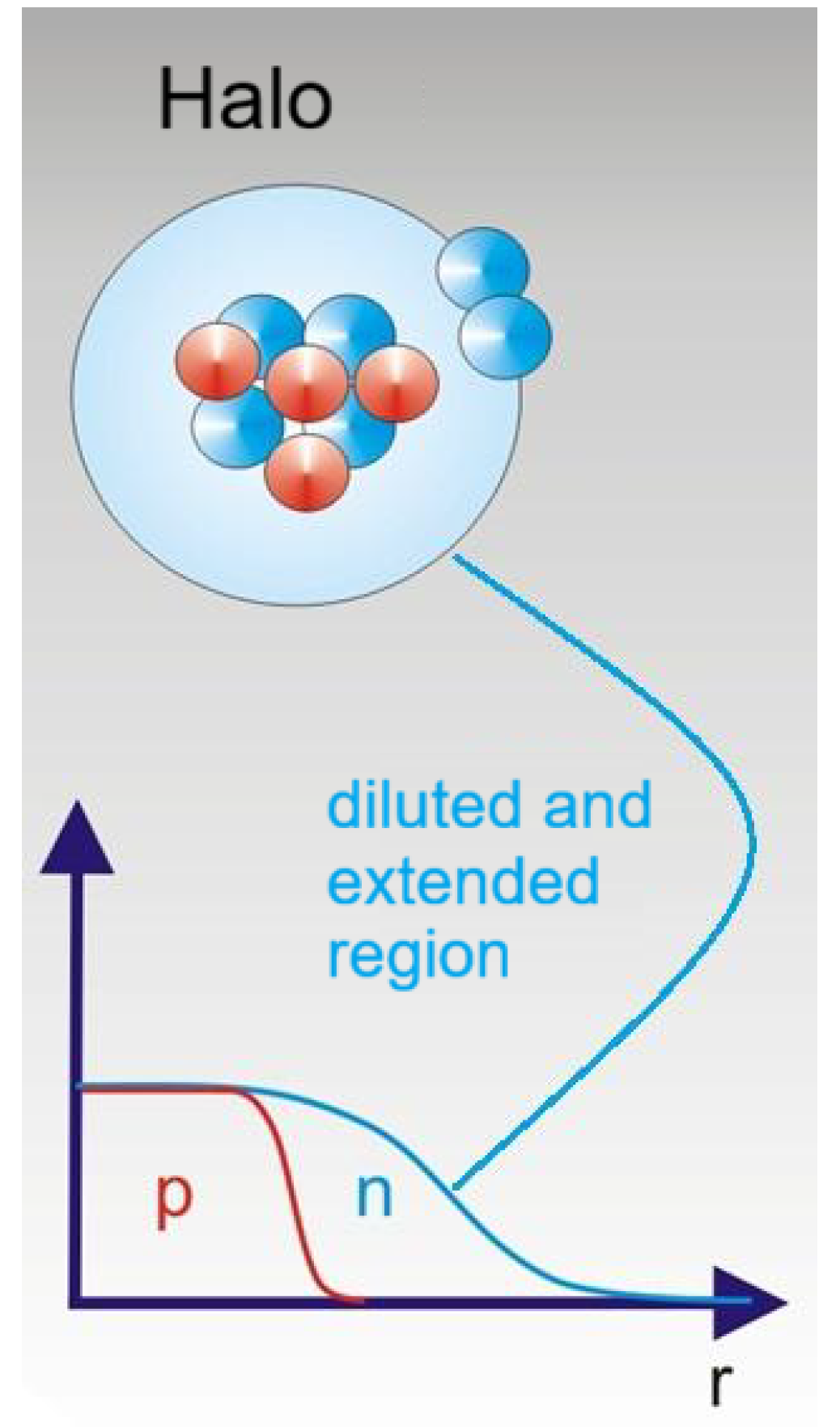
Fermi rule has challenged our views of basic nuclear physics. This initial accomplishment is an important cornerstone and must be celebrated because it has generated a sort of butterfly effect in nuclear physics, with far-reaching consequences that were unimaginable only 40 years ago. It has spurred new developments in quantum mechanics and the rise of new theoretical ideas, the first of which is the interpretation of halos as extended nucleon orbitals by Jonson and Geissel [
2] (see
Figure 1). One- and two-neutron halos have been found in many isotopes of the nuclear chart, especially far from the stability line, where the imbalance of neutrons over protons makes it easier to populate low-
ℓ near-threshold energy levels that are more prone to give rise to extended halos and a wealth of new phenomena. This, in turn, has demanded new data, and experiments have pushed the limits of our reach far beyond the valley of stability, venturing deep into the region of the nuclear chart, where unstable systems gradually fade toward the drip line.
The field is now too large to attempt a balanced and complete review. Therefore, I will concentrate on the contribution by the Padova group, mainly initiated by the keen interest of the late Prof. Vitturi in this matter, including the work of all the post-docs, collaborators and friends that have participated in this venture.
While ab initio theories are theoretically superior to empirical few-body models, they still struggle to reproduce the physics of halo and cluster nuclei. Consequently, there remains a significant opportunity for our current approach to provide meaningful new results, particularly for medium-mass nuclei.
In the next sections, we will very briefly discuss some of the most successful works that have been published in recent years on the topics of halo phenomena, cluster nuclei, three-body models and pairing interactions. In particular, the results of the three-body model based on the hyper-spherical formalism for and will be described, highlighting the relations with the island of inversion. Then, another work dealing with proton–neutron correlations will be discussed for the interesting case of , where an effective weakening of the p–n interaction is in place.
2. New Insights on the Structure of at the Border of the Island of Inversion
In 2020, the results of two new experiments were published. Ref. [
3] provided various measurements of reaction cross-sections for beams of
on carbon, essentially confirming the large matter radius and the two-neutron halo structure of this isotope. In Ref. [
4], new spectroscopic information on the subsystem
was measured that proved to be crucial for our interpretation of these systems. The central point is the role played by the
orbital in determining the structure and the halo nature of
. About the same time, we reported the results of a three-body approach on
=
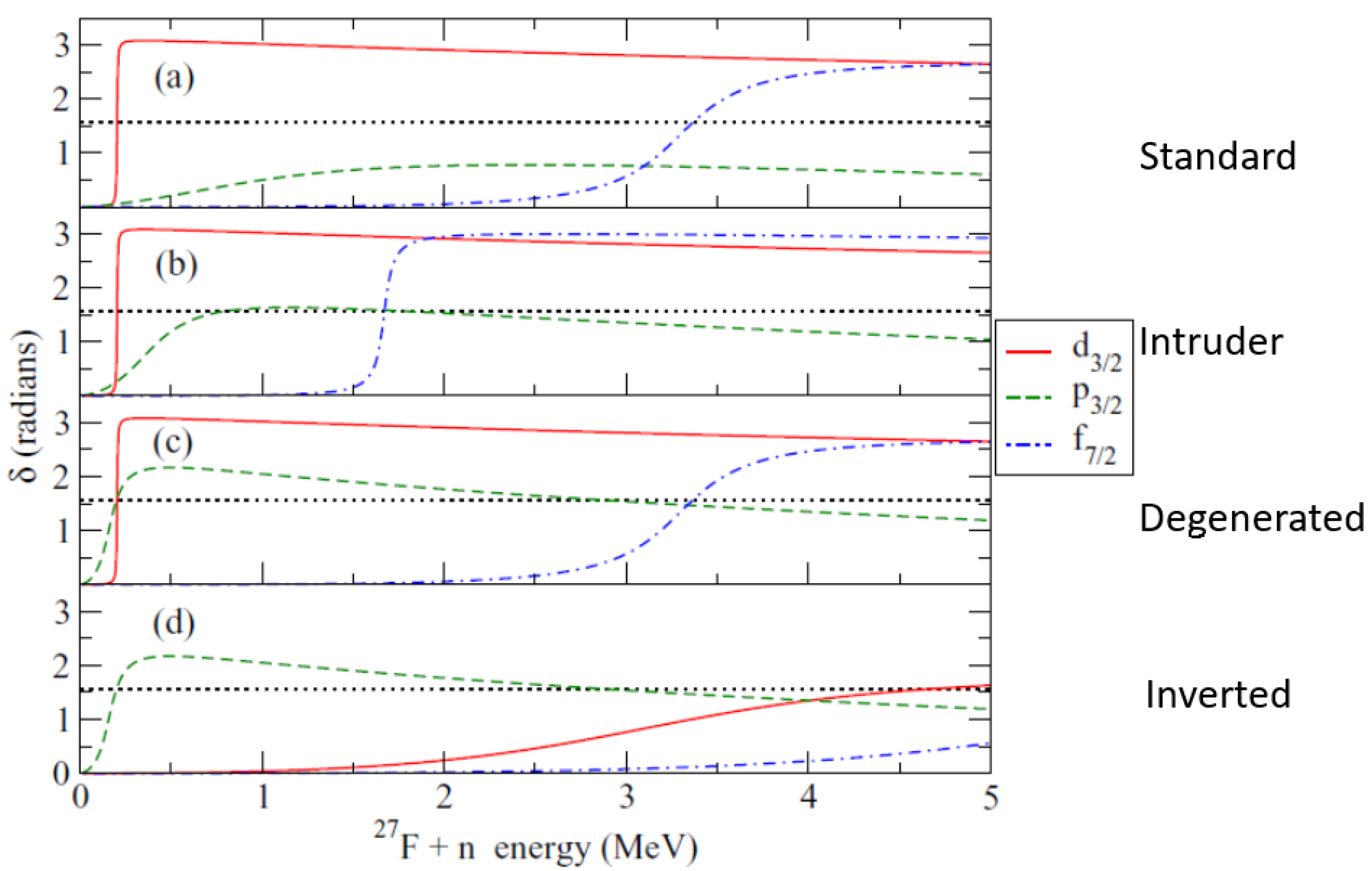
where we analyzed various hypotheses for the ordering of the single-particle levels, which we called standard, intruder, degenerate and inverted scenarios in Ref. [
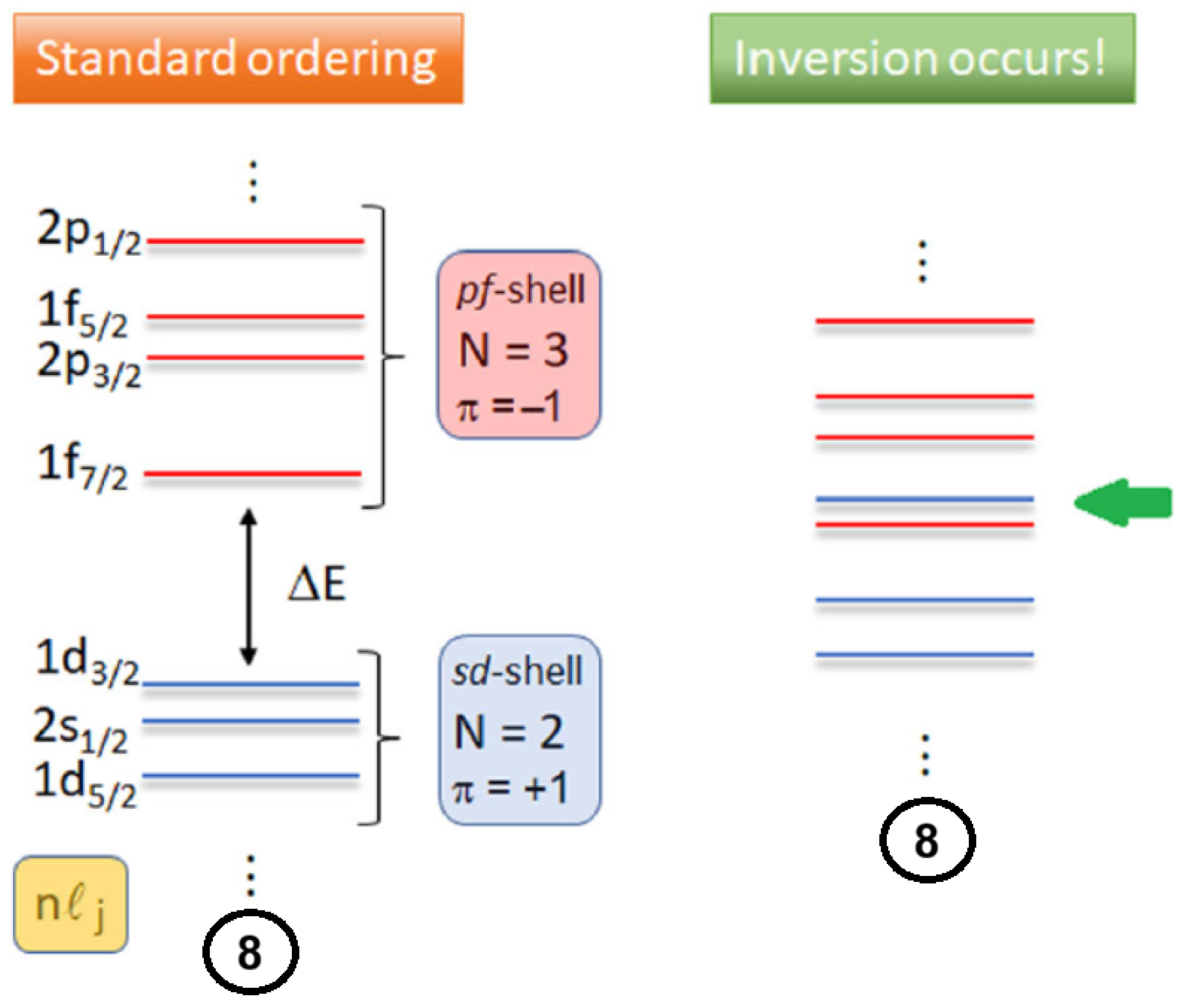
5]. It is not uncommon that, moving to the drip lines, large energy gaps that are associated with shell gaps close and rearrange to such an extent that some states of the
pf-shell might lie below some states in the
sd-shell, producing a shell inversion, as shown in
Figure 2. The region between
and
where this phenomenon occurs is thus called an island of inversion. We believe that
must also be part of this island, extending its southern shore.
The details of the hyper-spherical approach that we used to model this system are summarized in Ref. [
5], and more can be found in Refs. [
6,
7]. The core–neutron interaction is a Woods–Saxon plus spin–orbit adjusted to the available experimental information in
, while the neutron–neutron potential is chosen as the Gogny–Pires–Tourreil (GPT) potential. A small phenomenological Gaussian three-body potential is added to the Hamiltonian. The resulting phase shifts for the
system are shown in
Figure 3 for the various scenarios.
Subsequently, the () wave functions are built within the hyper-spherical harmonics expansion formalism (HHE), and the three-body Hamiltonian is then diagonalized in a Transformed Harmonic Oscillator (THO) basis, which allows some control over the density of states in the continuum region. This is necessary because we want to calculate the ground and excited states, but we also want to calculate low-lying continuum states in order to study the electric dipole excitations to the continuum.
Soon after the publication of the new experimental data [
4], we refined our model coming up in Ref. [
8] with the scenario that we believe is the correct one for
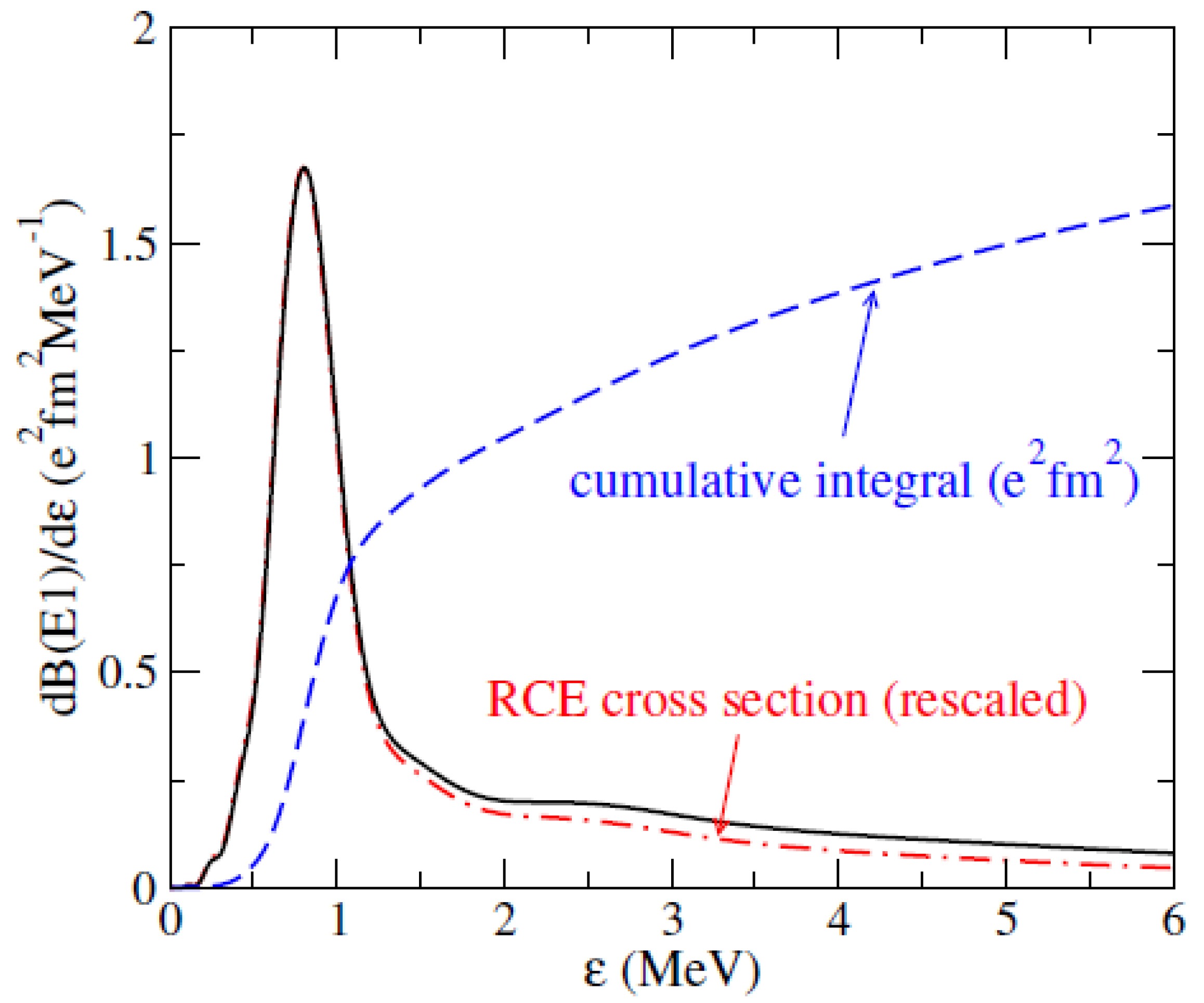
, i.e., an inverted scenario (D), but not too far from the degenerate one. We also calculated the dipole strength distribution (with a total cumulative strength of about
), see
Figure 4, and predicted the Relativistic Coulomb Excitation (RCE) cross-section, suggesting how this could lead to a further confirmation of these results. These two quantities are proportional at low energy and in certain regimes.
In a subsequent in-depth analysis, [
9], we studied the convergence of the HHE method with the hyper-angular momentum for the dipole distribution. We employed continuum states in a pseudostate approach using THO basis and calculated form factors that are used in continuum-discretized coupled-channel (CDCC) calculations to describe low-energy scattering. Our predictions show the typical low-lying enhancement of the E1 response expected for halo nuclei and the relevance of dipole couplings for low-energy reactions on heavy targets.
3. Extensions to : Radii, B(E1) and Halo Structure
The next interesting system in this chain of fluorine isotopes is . This nucleus is studied here as a core of plus two neutrons. Admittedly, this is not ideal because is already seen as a core plus two neutrons, so a more appropriate set-up would consider a five-body model with 4 valence neutrons. As this was beyond our reach, we tried with the three-body model, relying on the fact that the core has been found to posses only a moderate halo.
If, as in
Figure 2, the
and
orbitals are switched,
has (ideally) 4 neutrons in the
p state, and the next isotope,
, might have a very similar structure with the crucial
p shell filled and some neutrons in the next shell. Therefore, a delicate balance is in place between the more tightening effect of two extra neutrons in a high-angular-momentum state (not leading to halo) and an even lower binding energy (which leads to halo formation). It might turn out that
is less of a pronounced halo than its predecessor!
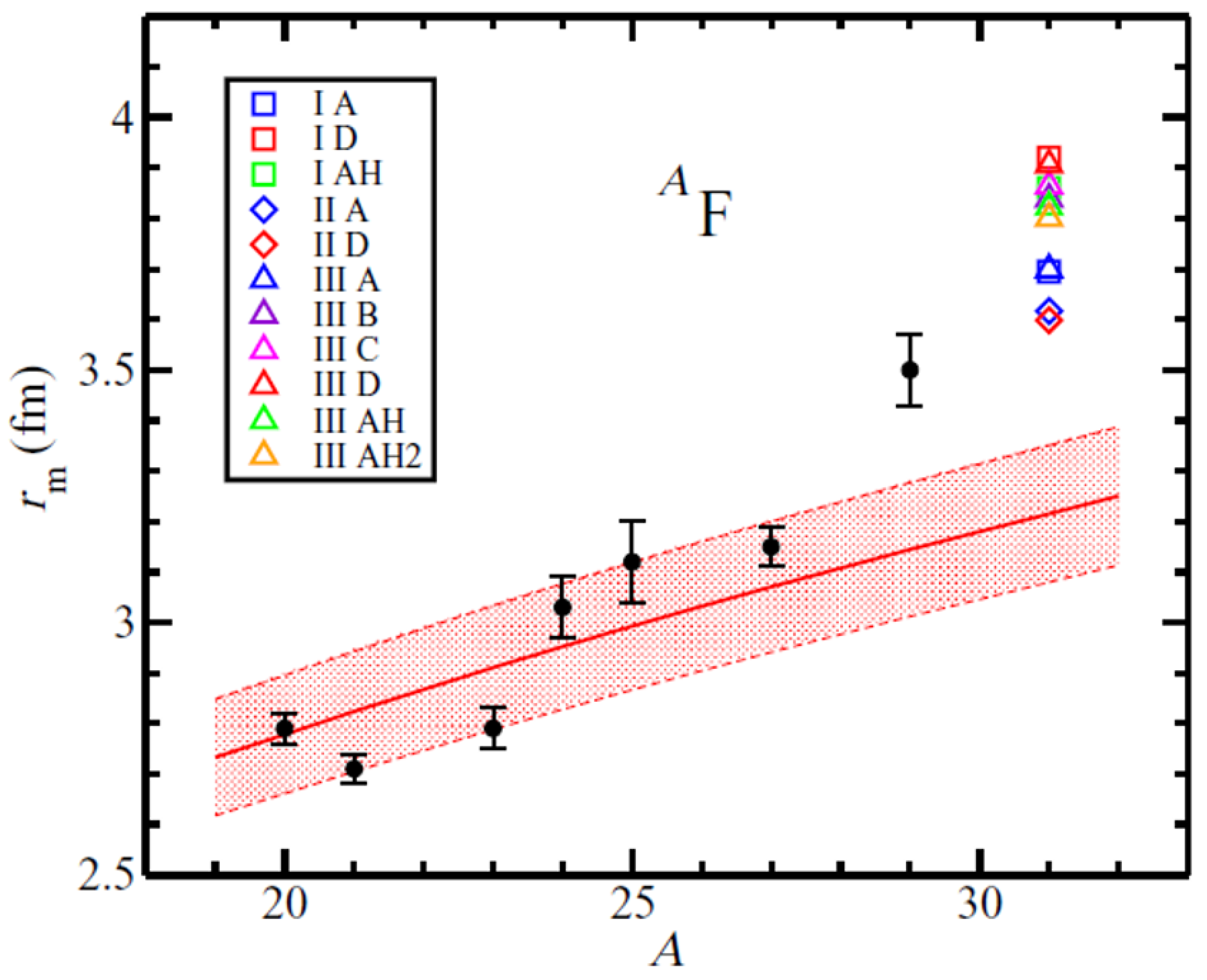
Again, we have built several different scenarios, stretching the models’ parameters to the limits in all possible ways, and we have examined the consequences. The radii obtained in all the scenarios indicate, without much spread, that
has an extended halo structure, as can be seen in
Figure 5, and is far from the
behavior.
Without repeating the analysis in Ref. [
10], our results indicate that the crucial factor is the dominance of pf-shell configurations, with various degrees of p-wave components. In all cases, they point to increased radius and larger B(E1), the hallmarks of halo formation. We predicted a total integrated B(E1) strength in excess of ≳
, compatible with the formation of a halo.
This nucleus still defies proper experimental verification due to the extreme neutron-to-proton ratio and thus low experimental beam intensity.
4. p–n Correlations in the External Orbitals of
We move now from neutron–neutron correlations in neutron-rich nuclei to proton–neutron correlations in proton-rich nuclei.
The
, located at the crossing of the
and
magic-number lines, is a bound system. The
system, i.e., a
, is also bound, while the mirror
=
is not bound. Therefore, we are looking at a critical proton drip line region where the addition of a single proton is sufficient to change the game. The
ground state of
=
is an interesting nucleus because it is interpreted as an effective deuteron built out of the orbitals surrounding the
core. In Ref. [
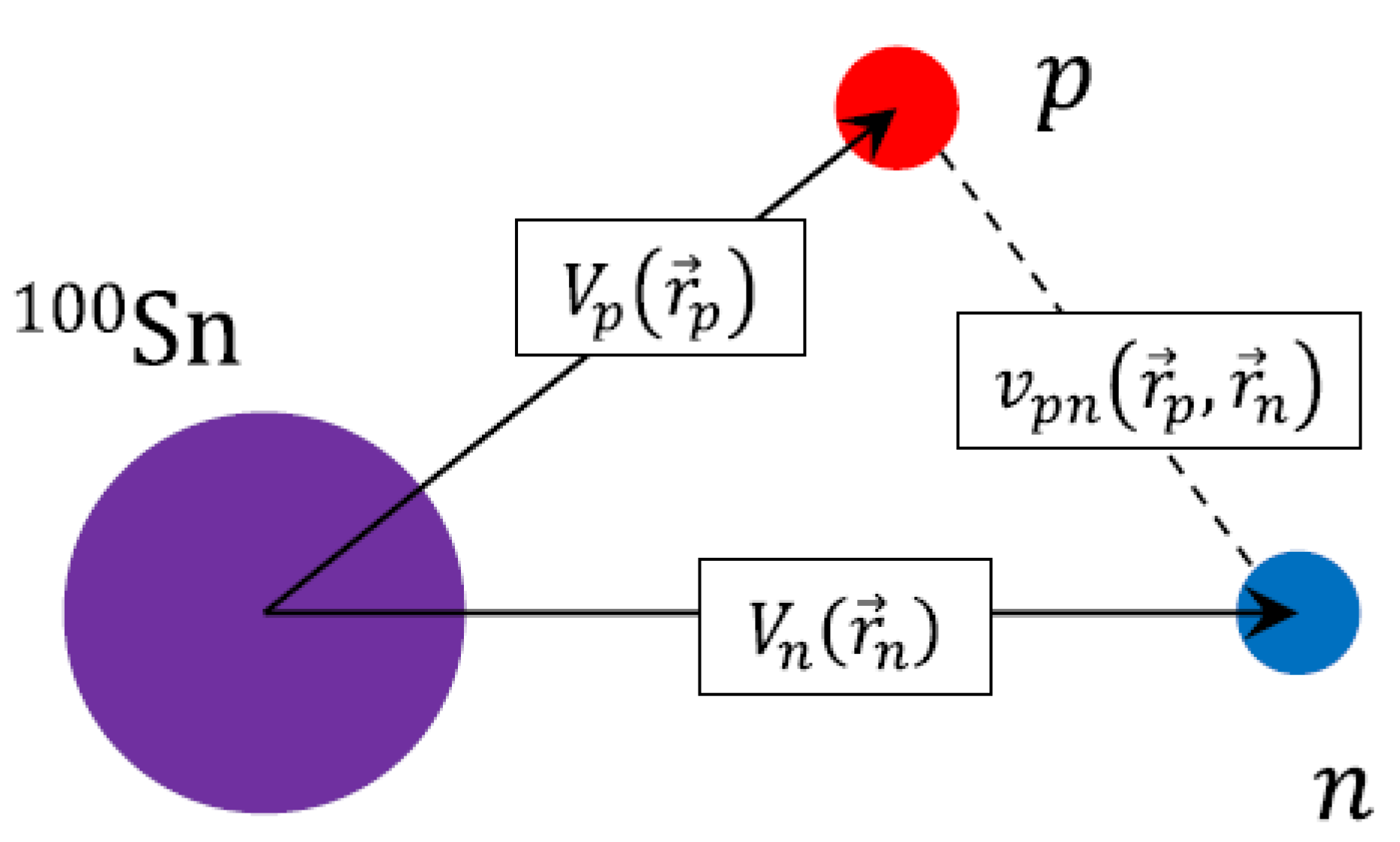
11] it is suggested that it might be a proton emitter due to a weakening effect of the proton–neutron (p–n) interaction with respect to a bare deuteron. A time-dependent three-body calculation (similar to the approach adopted by Oishi in Ref. [
12]) is performed based on the quantum evolution operator in which the Hamiltonian (with center of mass correction) is modeled, as in
Figure 6.
The effective proton–neutron interaction is corrected by a factor such that reproduces the bare deuteron interaction.
The
ground state of
is suggested as a possible proton-emitter unbound resonance. This conclusion is reached by assuming a weakening effect on the proton–neutron (pn) interaction with respect to a bare deuteron. An analogous, but less dramatic, reduction is necessary to reproduce the empirical binding energies of similar systems with lower mass:
(
) and
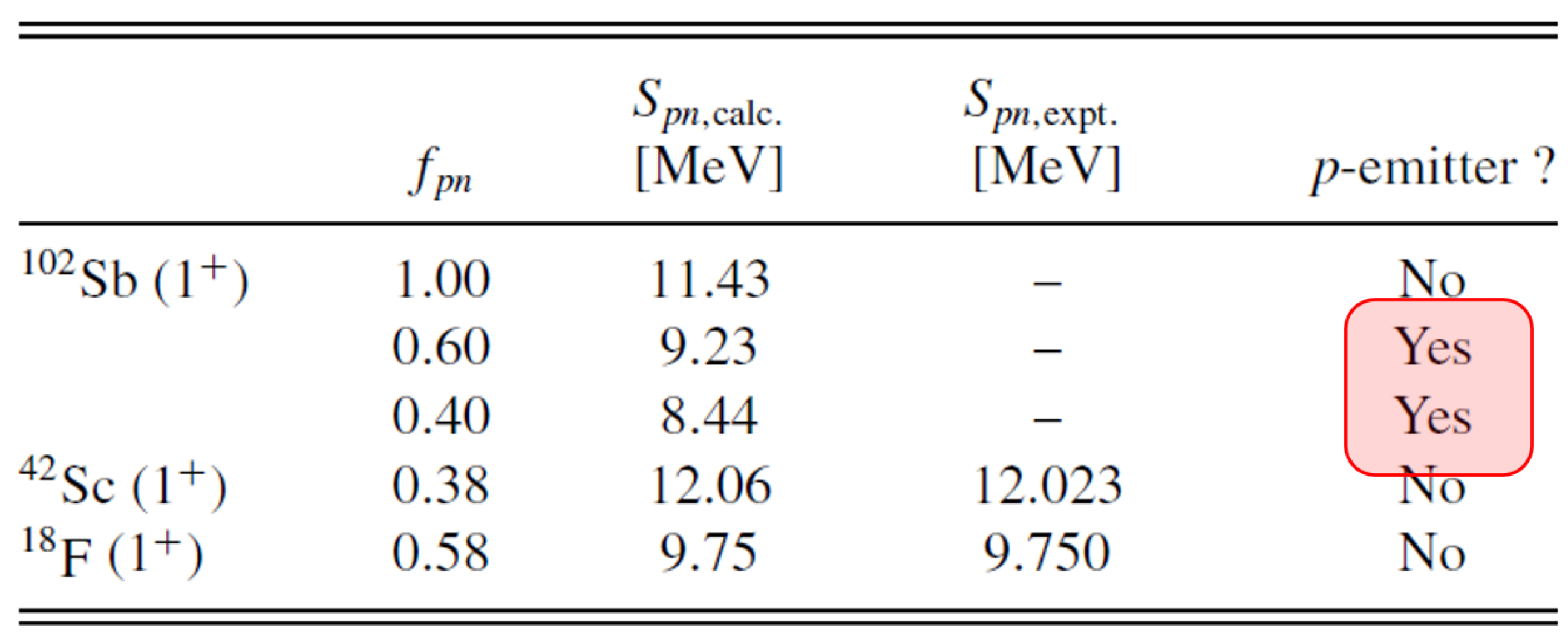
. The results are reported in
Figure 7.
We expect that realistic calculation will yield a coefficient f that is much smaller than 1, and in this case is the threshold for binding. Thus, it is very likely that is an unbound nucleus that is prone to proton emission.
If one attempts a simple power-law fit of the
coefficient from
Figure 7 with masses, including bare deuteron, fluorine and scandium, one obtains a value of about
for tin, which is much lower than the threshold. Another observation is that the coefficients decrease with increasing
ℓ because forming a deuteron becomes progressively harder for orbitals with higher angular momentum. Therefore, going from
f to
g, one expects a lowering of this value.
This system might prove to be very important in order to further constrain the p–n interaction. Therefore, experiments should be planned to search for a low-lying resonance in the spectrum of .
5. Conclusions
The long quest for halo nuclei, initiated 40 years ago, is not in any way concluded. Experimental physicists are conceiving new accelerators to push the limits of the asymmetry and intensity frontiers and new detectors to enhance our discovery potential and enlarge the number of measured observables. Theorists are inventing new models, conducting comparisons with experimental data, adjusting the theories and repeating the process, spiraling towards a comprehensive description of nuclear physics far from stability. Forty years later, the excitement for this endeavor remains as strong as ever.