1. Introduction
Glioblastoma multiforme (GBM) is a World Health Organization (WHO) grade 4 astrocytic glioma and represents the most common and aggressive primary malignant tumor of the adult central nervous system (CNS). GBM accounted for 54% of all malignant CNS tumors diagnosed in U.S. adults between 2013 and 2017 [
1]. Despite decades of research, GBM continues to carry a dismal prognosis and remains one of the deadliest CNS malignancies, with marginal improvement in overall survival (OS) over the past 30 years and fewer than 5% of patients living beyond five years after diagnosis [
1,
2]. Current standard-of-care therapy consists of maximal safe surgical resection followed by adjuvant radiation therapy and chemotherapy, yet even this multimodal approach provides limited long-term survival benefit. Advances in immuno-oncology, including immune checkpoint inhibitors, oncolytic virotherapy, non-replicating viral vectors, and CAR-T cell approaches, may offer additional therapeutic benefit as adjuncts or future alternatives to the current standard of care [
3,
4].
GBM therapy remains limited by several major obstacles, including the blood–brain barrier and the highly infiltrative nature of tumor cells, both of which restrict effective drug delivery and prevent complete surgical resection [
5,
6]. Tumor heterogeneity and dynamic genetic evolution further contribute to resistance against chemoradiation and targeted therapies, leading to rapid recurrence despite aggressive treatment [
5]. Additionally, the profoundly immunosuppressive tumor microenvironment (TME) and low immunogenicity of GBM hinder the effectiveness of emerging immunotherapies such as checkpoint inhibitors and CAR-T cells [
4]. The complex TME, which consists of glioma stem cells, neuronal and glial cells, stromal elements, and diverse immune cell populations, fosters tumor growth, invasion, and therapeutic resistance [
3]. One recent development in understanding the TME includes the newly discovered glymphatic system (GS), implicated in regulating the blood–brain barrier, immune regulation, and access to therapeutic agents. This review integrates current knowledge of GS physiology with emerging evidence of its dysfunction in brain disease, establishing a foundation for understanding its relevance to GBM.
2. Literature Search Strategy
This narrative review was conducted to synthesize current evidence on the role of aquaporin-4 (AQP4), glymphatic dysfunction, and astrocyte–vascular interactions in glioblastoma and related brain tumor pathophysiology. The review was not designed as a systematic review, but rather as a qualitative, hypothesis-driven synthesis of experimental and clinical literature with a focus on key studies.
A literature search was performed using PubMed and Scopus databases to identify relevant peer-reviewed articles published primarily in English. Searches covered studies published up to the time of manuscript preparation. Key search terms included combinations of “aquaporin-4,” “AQP4,” “glymphatic system,” and “glioblastoma”. Reference lists of relevant articles were also manually screened by authors to identify additional studies of relevance.
Both experimental and clinical studies were considered, including in vivo animal models, in vitro cellular studies, and human imaging or pathological investigations. Review articles were used selectively to provide contextual background and to identify foundational or highly cited primary studies. To improve interpretability, the reviewed literature was stratified into three evidence categories, which were preclinical experimental studies, including rodent models of glioblastoma and aquaporin-4 manipulation experiments; human imaging or clinical studies, including MRI-based glymphatic assessments and patient-derived observations; and conceptual or secondary analyses, including review articles synthesizing mechanistic insights from multiple experimental systems. Findings derived directly from primary experimental data were clearly differentiated from hypotheses or interpretations proposed in secondary literature. This framework allows clearer evaluation of the strength and translational relevance of the available evidence.
Study selection and thematic organization were performed by the lead author, with input from co-authors to ensure accuracy and balance. The included literature was analyzed qualitatively and organized into thematic sections addressing changes in AQP4 expression and polarity in tumor and peritumoral regions, functional consequences for edema formation, tumor growth, and invasion, and implications for glymphatic dysfunction and therapeutic targeting.
3. The Glymphatic System: Physiology and Function
The discovery of the GS in 2012 fundamentally transformed our understanding of brain fluid movement. Using in vivo two-photon imaging, Iliff and colleagues demonstrated that cerebrospinal fluid (CSF) travels from the subarachnoid space into periarterial channels, exchanges with interstitial fluid (ISF), and drains along perivenous pathways, establishing a brain-wide clearance network dependent on glial regulation [
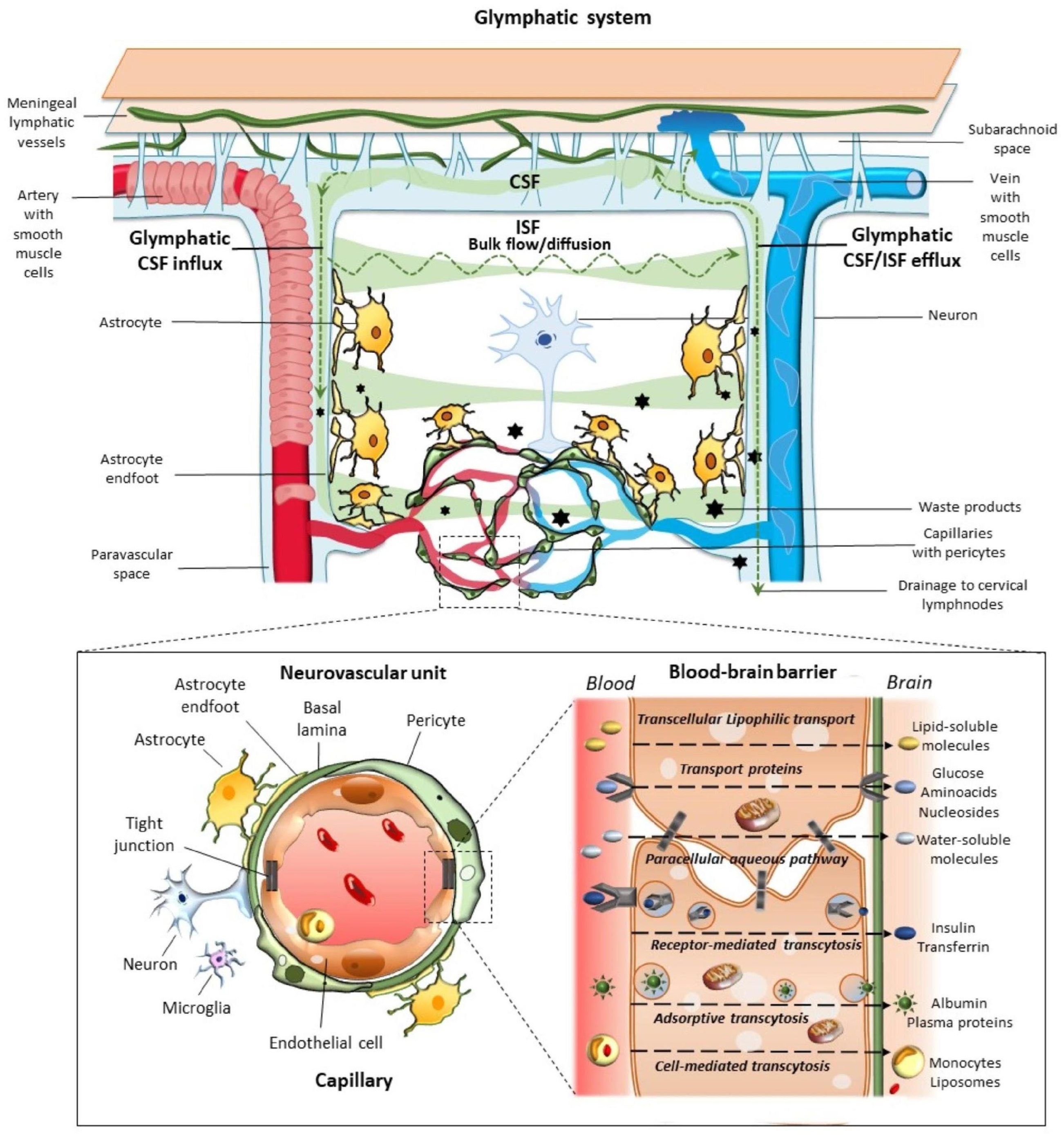
7]. The GS, named to reflect its reliance on glial cells, is organized around perivascular spaces (PVS), astrocytic endfeet, and the water channel AQP4, which collectively facilitate bulk flow movement of CSF and ISF (
Figure 1) [
8]. AQP4 polarization at astrocytic endfeet appears essential for efficient solute transport, as disruptions to AQP4 localization markedly reduce glymphatic flow and waste clearance [
9]. The astrocytic endfeet form a tunnel-like structure that separates the PVS from the brain tissue, thus enabling the directional flow of fluid [
8]. One of the mechanisms that drives the flow of fluid through the PVS is the contraction and dilation of the heart during the cardiac cycle [
8]. The deep veins within the brain located in the perivenous system play a major but incompletely understood role in drainage. The neurovascular unit (NVU) conceptually defines the neuronal, astrocytic, endothelial, vasomotor apparatus and microglia maintaining the blood–brain barrier and contains the astrocyte-driven GS.
Beyond its architectural components, the GS dynamically responds to physiological and mechanical conditions. Studies demonstrate that circadian rhythm, particularly slow-wave sleep, particularly non-rapid-eye movement (NREM) 1–4 Hz sleep, enhances glymphatic inflow, increases interstitial space volume, and promotes clearance of neurotoxic proteins such as amyloid-β [
8,
10]. Fluid velocity is strongly related to the depth of the stage of sleep and AQP4 expression, with glymphatic flow being highest specifically during the NREM3 stage and reduced during sleep disruption, REM sleep and wakefulness [
8,
11]. Conversely, aging, vascular dysfunction, and neuroinflammation are associated with impaired glymphatic transport, suggesting that this system plays a critical role in maintaining neuronal homeostasis across the lifespan and in multiple CNS pathologies [
8,
9,
12]. Glymphatic activity is also linked to cardiovascular activity and dynamics. Hypertension has been shown to decrease glymphatic function in rats [
13]. Similarly, other cardiovascular diseases such as congestive heart failure and arrhythmias impact vascular activity and ultimately change the pulsations of the arterial walls, leading to reduced perivascular flow. Together, these findings establish the GS as a fundamental regulator of cerebral waste clearance, solute exchange, and fluid homeostasis.
The GS may influence the brain TME by modulating fluid flow, metabolite clearance, and solute distribution. Several studies demonstrate that tumors, particularly GBM, distort perivascular pathways, alter AQP4 expression, and elevate interstitial fluid pressure, all of which are predicted to impair glymphatic transport [
14]. Experimental models show reduced CSF tracer influx and delayed clearance in tumor-bearing brains, indicating that neoplastic tissue may mechanically and functionally disrupt glymphatic circulation [
12]. Such impairment could lead to accumulation of inflammatory byproducts, altered nutrient gradients, and reduced penetration of therapeutic agents and alter the TME. By regulating solute transport, interstitial fluid composition, and clearance of metabolic or signaling molecules, GS dysfunction may contribute to tumor growth, invasion, and resistance to therapy. Despite this progress, a substantial gap remains regarding how glymphatic flow behaves in the context of brain tumors, where tissue architecture, vascular integrity, and interstitial pressure are profoundly altered.
Figure 1.
Overview of the glymphatic system and neurovascular unit. The glymphatic system contributes to the transport of nutrients and signaling molecules into the brain parenchyma while promoting the clearance of proteins and interstitial waste solutes out of the brain. Subarachnoid CSF enters the brain parenchyma via para-arterial spaces and then mixes with the interstitial fluid (ISF) and waste solutes in the parenchyma. Whether this occurs through convective bulk flow or diffusion remains debated. The resulting CSF–ISF exchange and the interstitial waste solutes enter the paravenous space through gaps between the astrocytic end-feet to be drained either back to the CSF-dural sinus-meningeal lymphatic vessels or to the deep cervical lymph nodes. Green arrows and shades indicate the CSF and CSF–ISF fluid transport, while black stars indicate the interstitial waste solutes that exit the parenchyma via the paravenous efflux pathway. The insert depicts the main components of the NVU at the level of intraparenchymal capillaries, including perivascular astrocytes with their end-feet, neurons, microglia, pericytes, endothelial cells (ECs), and basement membrane (basal lamina). Capillary ECs are held together by tight junctions forming the blood–brain barrier (BBB), where the different transport routes are represented, including transcellular lipophilic transport, carrier protein-mediated transport, paracellular aqueous transport, and receptor-mediated transcytosis, as well as adsorptive and cell-mediated transcytosis. Reproduced from Natale et al., Glymphatic System as a Gateway to Connect Neurodegeneration From Periphery to CNS. Front Neurosci 2021 under a CC BY 4.0 license [
15]. The figure is included to illustrate the canonical structural organization of the glymphatic system described in foundational literature.
Figure 1.
Overview of the glymphatic system and neurovascular unit. The glymphatic system contributes to the transport of nutrients and signaling molecules into the brain parenchyma while promoting the clearance of proteins and interstitial waste solutes out of the brain. Subarachnoid CSF enters the brain parenchyma via para-arterial spaces and then mixes with the interstitial fluid (ISF) and waste solutes in the parenchyma. Whether this occurs through convective bulk flow or diffusion remains debated. The resulting CSF–ISF exchange and the interstitial waste solutes enter the paravenous space through gaps between the astrocytic end-feet to be drained either back to the CSF-dural sinus-meningeal lymphatic vessels or to the deep cervical lymph nodes. Green arrows and shades indicate the CSF and CSF–ISF fluid transport, while black stars indicate the interstitial waste solutes that exit the parenchyma via the paravenous efflux pathway. The insert depicts the main components of the NVU at the level of intraparenchymal capillaries, including perivascular astrocytes with their end-feet, neurons, microglia, pericytes, endothelial cells (ECs), and basement membrane (basal lamina). Capillary ECs are held together by tight junctions forming the blood–brain barrier (BBB), where the different transport routes are represented, including transcellular lipophilic transport, carrier protein-mediated transport, paracellular aqueous transport, and receptor-mediated transcytosis, as well as adsorptive and cell-mediated transcytosis. Reproduced from Natale et al., Glymphatic System as a Gateway to Connect Neurodegeneration From Periphery to CNS. Front Neurosci 2021 under a CC BY 4.0 license [
15]. The figure is included to illustrate the canonical structural organization of the glymphatic system described in foundational literature.

3.1. Cellular Organization
Despite lacking a traditional lymphatic system, the significant energy expenditure of the brain suggests a need for cellular waste clearance offered by the GS [
16]. Historically, brain fluid movement was considered a largely passive process driven by diffusion and hydrostatic forces. However, advances in imaging, molecular characterization, and computational modeling have revealed that CSF–ISF exchange is an active, regulated process with significant implications for neurological hemostasis [
17]. The GS consists of PVS that drive the bidirectional movement of bulk fluid through the brain [
8]. In the periphery, ultrafiltrate enters lymphatic capillaries that eventually form lymphatic ducts that return filtrate to the venous system. In contrast, filtrate from capillaries in the CNS cannot penetrate the blood–brain barrier. To overcome this, fluid moves along PVS to enter the brain parenchyma alongside arteries [
8]. Perivascular pumping from transmitted kinetic energy of cardiac contraction and pulsation pressure waves as well as respiration movements facilitates CSF absorption into PVS [
11]. From here, the CSF leaves the brain through a system of channels consisting of perivenous and perineuronal spaces as well as cranial and spinal nerves [
11].
Astrocytes are the most numerous glial cells and have important functions in maintaining the overall health of neurons, maintaining blood–brain barrier integrity, and regulating cerebral fluid flow. The end feet of astrocytes change in response to arterial tone. As the arterial diameter decreases, the astrocyte endfeet decrease in size [
8]. Protein complexes, such as the dystrophin-associated complex, anchor the AQP4 channel at the membrane and are enriched at the astrocytic endfeet.
In the CNS, the AQP4 water channels play a major role in the functioning of the GS. It is the most abundant aquaporin in the central nervous system and regulates the CSF-interstitial fluid exchange in the perivascular spaces. AQP4 is localized around blood vessels, and its role in regulated fluid balance has been identified. AQP-4-deficient mice displayed decreased CSF interstitial influx and a 70% reduction in solute clearance, suggesting that fluid movement through the glymphatic system is AQP-4-dependent [
7].
3.2. Metabolic Regulation
The GS plays a major role in maintaining CNS homeostasis. The first role is nutrient transport to the brain, including glucose, lipids, amino acids, and certain lipoproteins (e.g., apolipoprotein E) [
18]. The second role is the clearance of metabolic products such as lactate, soluble proteins amyloid-β (Aβ), and tau, and foreign bodies from brain parenchyma into CSF [
18]. The third role is immune regulation via transport of immune cells and antigens through the meningeal lymphatics to provide continuous immune surveillance. Despite extensive investigation, the mechanisms by which immune cells and inflammatory mediators access the brain parenchyma and trigger neuroinflammation remain incompletely understood [
18]. Increases in PVS have been linked to inflammatory disease infiltration and diseases, including multiple sclerosis [
19,
20,
21,
22,
23].
4. Evidence for Glymphatic Involvement in Glioblastoma
Direct experimental evidence linking glymphatic dysfunction to GBM pathophysiology has emerged primarily from rodent tumor models and in vivo imaging studies over the past decade (
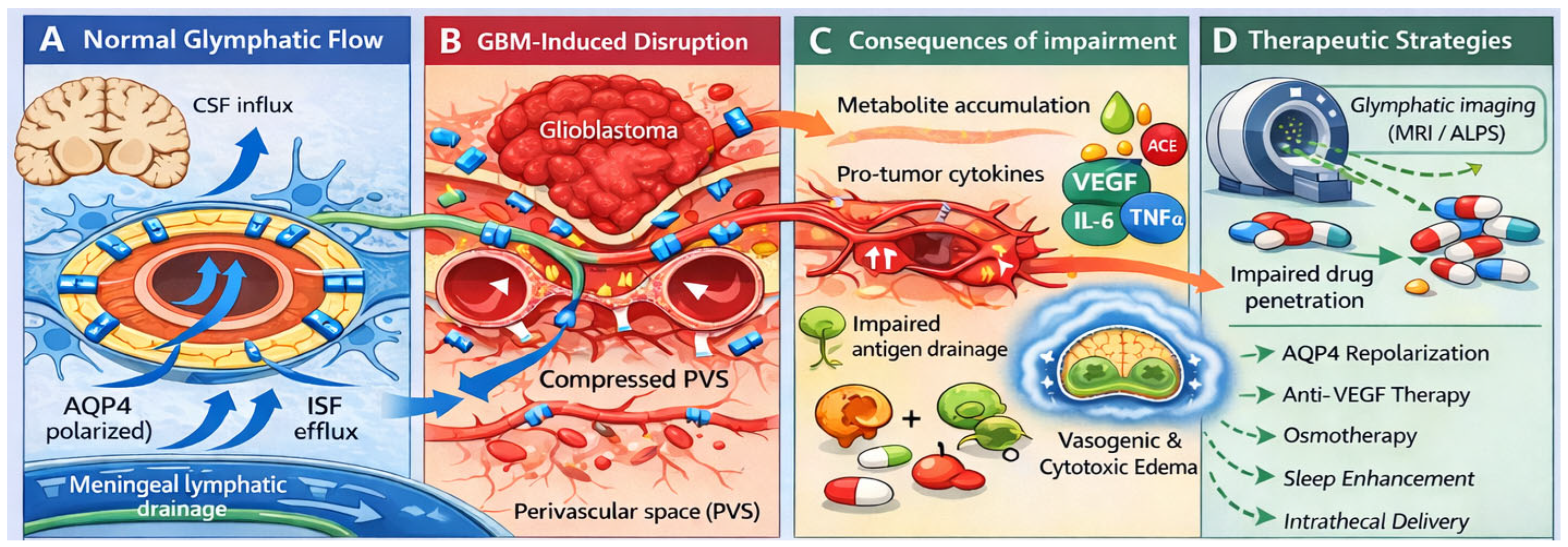
Figure 2) [
24]. GS visualization of CSF movement in living brain tissue has been performed using tracer-based imaging, where fluorescent or contrast-enhanced molecules injected into the CSF can be tracked as they flow through perivascular channels into the brain parenchyma [
24,
25]. When this approach was applied to orthotopic rat glioma models, CSF tracers distributed poorly within tumor-bearing hemispheres and accumulated instead in contralateral healthy tissue [
24]. Moreover, tracers in mice models lingered abnormally before draining into systemic circulation, indicating that both inflow and outflow arms of the glymphatic circuit were compromised [
25]. Together, these findings indicate that both the inflow and outflow arms of the glymphatic circuit are disrupted in the presence of gliomas.
Glioma demonstrates structural disruption at the NVU. Close examination of tumor-infiltrated brains revealed that glioma cells actively invade the PVS, physically displacing the astrocytic endfeet that normally line vascular walls [
26]. This displacement destroys the polarized architecture essential for directional fluid movement. Instead of being confined to perivascular membranes where they facilitate bulk flow, AQP4 channels scatter across glial cell surfaces in a disorganized pattern [
26,
27]. In classic rat glioma models, this reorganization is visually apparent. In fact, tumor cells themselves express abundant AQP4, but the protein no longer assembles into the orthogonal arrays of particles that characterize normal perivascular membranes [
28].
4.1. Changes in AQP4 Expression/Polarity in Tumor and Peritumoral Zones
Disruption of AQP4 expression and localization is evident in GBM. In healthy brain tissue, AQP4 displays a highly organized expression pattern within the astrocytic endfeet in contact with blood vessels and forming a high-capacity interface for water exchange [
7,
29]. By contrast, astrocytic membranes facing the neuropil express relatively little AQP4, which is actively maintained by molecular scaffolding systems, most notably the dystrophin-associated protein complex [
30]. In tumor-infiltrated regions, the normal perivascular enrichment of AQP4 collapses, and the channel redistributes across cell membranes in a diffuse, nonpolarized pattern [
28]. Quantitative studies in rodent glioma models demonstrate this shift directly, as immunohistochemistry shows loss of AQP4 localization at astrocytic endfeet with redistribution across tumor cells and reactive astrocytes throughout the tumor microenvironment. Notably, this change often occurs without a reduction in total AQP4 expression. AQP4 translation has been noted in tumor-bearing tissue, particularly within reactive astrocytes responding to tumor-associated injury [
28,
31]. This apparent paradox reveals that the effectiveness of glymphatic flow depends on the spatial distribution of AQP4, not its overall abundance. Tumor-driven inflammation, extracellular matrix remodeling, and reactive astrocyte transformation likely disrupt the same molecular scaffolds that preserve AQP4 polarity in healthy tissue [
31,
32,
33,
34,
35,
36]. This suggests that tumor-associated glymphatic dysfunction arises not from AQP4 deficiency itself, but from failure of the cellular architecture that positions the channel to support directional fluid transport. Restoring this architecture, rather than simply increasing AQP4 expression, may, therefore, represent a more promising therapeutic strategy [
37,
38].
The mechanisms underlying this depolarization have been partially elucidated through genetic studies that dissociate protein expression from protein localization. Mice lacking alpha-syntrophin, a key component of the dystrophin-associated protein complex, express normal total levels of AQP4, but without the anchoring scaffold, the channels fail to concentrate at the astrocytic endfeet; consequently, CSF influx into the brain parenchyma decreases markedly, and interstitial solute clearance is greatly reduced [
37,
38]. By extension, the loss of perivascular AQP4 polarization in glioma likely explains much of the functional impairment observed in tumor-bearing rodents, even when total protein levels remain unchanged [
39]. Recent work also identified dystrophin 71 as a key anchor that maintains AQP4 localization at perivascular membranes, where, during ischemia, degradation of dystrophin 71 results in AQP4 redistribution away from astrocytic endfeet, diminished glymphatic clearance, and worsened brain edema despite unchanged total AQP4 expression [
40].
4.2. Manipulations of AQP4 Affecting Tumor Growth and Edema
AQP4 functions in seemingly contradictory roles in GBM due to disruption of normal NVU homeostasis. Animal models show that AQP4 plays different roles depending on the type of edema. In cytotoxic edema models, such as acute water intoxication and ischemic stroke where the blood–brain barrier remains intact, mice overexpressing AQP4 develop severe brain swelling due to increased intracellular water uptake by astrocytes [
41]. AQP4 knockout mice are protected from cytotoxic edema because water entry into the parenchyma is reduced. In vasogenic edema models, such as cortical cold injury or intraparenchymal fluid infusion that disrupts the blood–brain barrier and leads to extracellular fluid accumulation, AQP4-deficient mice accumulate more extracellular fluid and exhibit higher intracranial pressure. This indicates that AQP4 normally facilitates the clearance of vasogenic edema fluid from the brain [
42,
43].
In gliomas with mixed cytotoxic and vasogenic edema, AQP4 upregulation may exacerbate cytotoxic swelling through increased astrocytic water influx while also playing a role in vasogenic edema clearance. Tumor masses disrupt blood–brain barrier integrity, causing vasogenic edema, while surrounding reactive tissue experiences metabolic stress that can trigger cytotoxic swelling. This mixed pathology may explain why AQP4 expression in glioma correlates with poor prognosis in some studies but appears protective in others [
42]. At the cellular level, AQP4 influences both glioma invasion and survival. In vitro AQP4 knockdown reduces water permeability, impairs migration, alters cytoskeletal organization, and diminishes osmotic stress responses [
44]. AQP4 silencing in GBM cell lines decreases proliferation and induces apoptosis through cytochrome c release and altered Bcl-2 expression [
45]. When these AQP4-deficient GBM cells are implanted in mice, they form smaller tumors than control cells. This suggests that AQP4 plays a role in multifunctional mediator glioma dissemination and cell survival.
As discussed in
Section 3.1, loss of perivascular AQP4 polarization is a defining feature of glioblastoma and has important functional consequences for edema formation, tumor invasion, and therapeutic resistance. Experimental and imaging studies further substantiate this depolarization phenomenon in glioblastoma [
46].
5. Mechanistic Insights and Hypotheses
Current understanding of glymphatic dysfunction in GBM derives predominantly from preclinical experimental studies, particularly rodent glioma models, whereas human evidence remains limited and is largely based on advanced neuroimaging approaches that indirectly assess glymphatic activity.
5.1. How Glioblastoma Disrupts Glymphatic Function
Through hypoxia-inducible factors and vascular endothelial growth factor (VEGF) signaling, GBM is able to direct pathological angiogenesis that entirely modifies the cerebral vasculature [
6]. GBM can induce neoangiogenesis that lacks the need for physiological perivascular flow, creating vessels that are dilated, tortuous, and overall architecturally disorganized [
6]. GBM vessels demonstrate disrupted tight junctions leading to leakage of plasma proteins into the interstitial space as a result of blood–brain barrier breakdown. The physiological osmotic and hydrostatic gradients are essential for the normal functioning of CSF–ISF exchange; by creating a permeable BBB, GBM is able to alter these gradients and thus reverse or deteriorate this flow that is needed for the functioning of the GS [
14].
5.2. Structural Distortion of Perivascular Spaces by Tumor Mass
Experimental studies in rodent glioblastoma models demonstrate that glymphatic fluid flow is maintained through PVS channels but becomes mechanically disrupted in the presence of a GBM tumor mass. The expansion and infiltration of GBM contributes to the compression and distortion of these PVS conduits, which not only diminishes their efficacy but also potentially completely obliterates them in areas of condensed tumor infiltration [
14]. The PVS of the brain infiltrated by GBM shows reduced volume and perturbed morphology on advanced imaging relative to healthy tissues. The cerebral edema associated with the tumor only magnifies this structural distortion further, constricting the space available for fluid circulation. Beyond these cellular and molecular disruptions, the expanding tumor mass imposes mechanical constraints on fluid circulation. Elevated intracranial pressure caused by tumor growth and edema compresses venous outflow pathways, creating a bottleneck in which fluid entering through periarterial routes cannot exit efficiently and progressively accumulates [
24,
25,
47]. The result is a vicious cycle in which structural, molecular, and mechanical factors reinforce one another to produce the profound glymphatic dysfunction characteristic of tumor-bearing brains. These observations are primarily derived from preclinical imaging and histological studies in murine glioma models, which demonstrate structural compression of perivascular pathways and altered CSF–interstitial exchange.
Meningeal lymphatic vessels serve the purpose of being the terminal drainage circuit for fluid derived from the brain. Although the exact mechanisms remain unclear, these meningeal lymphatic vessels may undergo functional deterioration in patients with GBM [
8,
25]. Studies of other neurological conditions have shown that chronically elevated intracranial pressure, modifications of CSF composition, and tumor inflammatory signaling adversely affect the functioning of meningeal lymphatic vessels, suggesting that the same could be true of GBM as well [
8,
25]. This overall impairment of drainage via venous and lymphatic vessels results in the accumulation of fluid, a dramatic increase in interstitial pressure, and a reduction in elimination capacity. Collectively, these mechanisms diminish the overall efficiency of glymphatic circulation.
5.3. How Glymphatic Impairment May Promote Tumor Progression
Various mechanisms govern how GBM-mediated disruption of the GS can also promote tumor progression.
5.3.1. Impaired Drainage of Protumor Growth Factors
Impaired regulation of solubles through interstitial fluid, such as VEGF, can induce angiogenesis [
14]. Impediment of normal pro-inflammatory cytokine clearance results in accumulation of interleukin-6 (IL-6) and tumor necrosis factor-alpha (TNF-α), which promote tumor growth [
3,
48,
49,
50]. The recruitment and polarization of M2-phenotype macrophages and regulatory T cells due to increased IL-6 can lead to suppression of antitumor immunity.
5.3.2. Accumulation of Lactate and Acidic Metabolites Enhancing Invasion
The Warburg effect applies in GBM, with elevated lactate production playing a role in GBM where the GS fails to eliminate lactate and other metabolic byproducts [
17]. Thus, glymphatic dysfunction causes the buildup of these acidic metabolites in the tumor microenvironment, resulting in a lowered extracellular pH inhibiting proteolytic matrix metalloproteinases (MMPs) as well as inducing expression of acid-sensing ion channels and pH-dependent signaling pathways that promote the movement of GBM cells [
5,
7,
51,
52]. The consequence of these effects is an overall environment that stimulates infiltration and invasion by GBM.
5.3.3. Modulation of Immune Surveillance Due to Altered Antigen Drainage
The GS also expedites and maintains the drainage of antigens and immune mediators from the brain parenchyma during immune surveillance [
25]. Normally, the GS allows immune cells in the periphery to inspect antigens derived from the CNS and appropriately mount immune responses. By impeding the drainage of antigens associated with GBM tumors, these alterations lead to a reduction in the passage of such molecules to draining lymph nodes. This prevents the priming and activation of tumor-specific T cells, potentially contributing to the poor immunogenicity of GBM and the ineffectiveness of immune checkpoint inhibitors as a therapeutic agent [
4]. Further, alterations in the flow of fluid may negatively impact the circulation of dendritic cells and other antigen-presenting cells, diminishing their ability to leave the tumor microenvironment and initiate adaptive immune responses.
5.3.4. Enhanced Interstitial Pressure and Therapy Resistance
GBM and other solid tumors are known to cause elevated interstitial fluid pressure (IFP) due to a combination of aforementioned effects, including vascular leakiness, impaired lymphatic drainage, and compact cellular packing. When the GS is dysfunctional, this problem is exacerbated due to reduced fluid drainage from the tumor and peritumoral regions [
14]. This has significant implications for therapeutic efficacy and delivery.
The resultant elevated IFP causes a reduction in the pressure gradient separating blood vessels and surrounding tissue, which restricts the extravasation of therapeutic agents from the circulation into the tumor mass. This problem is magnified for large molecules, such as monoclonal antibodies and nanoparticle-based drug carriers, that are already limited by their relative difficulty in penetrating the BBB. Even for therapeutic agents that are able to successfully cross the BBB, they are then unevenly distributed throughout the tumor due to the elevated IFP, leaving untreated regions that can give rise to recurrence [
6,
53,
54,
55]. Blood vessels could also become compressed within the tumor because of this increase in IFP, leading to hypoxic regions that are resistant to radiation therapy and certain chemotherapeutic agents.
6. Therapeutic and Diagnostic Implications
6.1. Imaging the Glymphatic System in Glioblastoma
While it can be a unique challenge to visualize the functioning of the glymphatic system in a non-invasive manner for patients with GBM, it can also be a critically advantageous way to assess CSF–ISF flow. The most common approach of doing so thus far has been the utilization of intrathecal gadolinium-based tracers with contrast-enhanced MRI, allowing for the visualization of both the flow of CSF tracer along perivascular spaces and its clearance [
8,
56]. Regions where there appears to be diminished tracer uptake or delayed elimination are indicative of impairment of glymphatic transport. This subsequently allows for not only an indirect measure of overall glymphatic function but also reveals variations in different brain regions. An alternative approach to non-invasive imaging without the use of contrast is diffusion tensor imaging along the perivascular space (DLTI-ALPS), which evaluates the directionality of water diffusion along perivascular pathways [
12,
57,
58,
59]. CSF pulsatility and flow dynamics can be further assessed with the use of other approaches, such as PET imaging with novel tracers and advanced MRI sequences.
Molecular biomarkers can be used in conjunction with these methods of imaging to better assess glymphatic integrity in patients with GBM. Analyzing the expression of AQP4 and the patterns of polarization on surgical specimens may function as prognostic indicators of astrocytic dysfunction [
14]. Emerging computational models of fluid dynamics could potentially serve as a profoundly advantageous way of not only simulating glymphatic flow but also predicting the effects of tumor mass, edema, and vascular abnormalities on CSF–ISF exchange. Such models could therefore guide surgical decision-making and identify the patients that are most likely to benefit from glymphatic-based interventions.
6.2. Predictive Value and Targeting AQP4 and Astrocytic Polarization
Preclinical edema studies have demonstrated the efficacy of TGN-020, a selective AQP4 inhibitor, but further research is needed to reveal its effects on tumor development [
60]. The rationale behind this therapeutic novel strategy appears to be paradoxical, though; inhibiting AQP4 causes a reduction in vasogenic edema but could also hamper glymphatic clearance even further. Other approaches emphasize reestablishing physiologic AQP4 polarization through the use of dystrophin-associated protein complex modulators, anti-inflammatory agents, or gene therapy. Further, there is also potential for agents that diminish the permeability induced by VEGF or stabilize endothelial tight junctions, leading to the restoration of normal pressure gradients and perivascular transport [
6].
6.2.1. Physical Methods (Osmotherapy, CSF Diversion)
Another promising approach for therapeutic interventions is attempting to reduce increased interstitial fluid pressure. The use of osmotherapy through mannitol or hypertonic saline can withdraw fluid from the brain parenchyma and thus diminish IFP and augment drug penetration [
12]. Although CSF diversion procedures are not frequently utilized in the management and treatment of GBM, they could restore the pressure gradients that drive glymphatic flow and thus benefit patients with elevated intracranial pressure.
6.2.2. Sleep Enhancement, Respiratory Control, and Lifestyle Interventions That Enhance Glymphatic Clearance
Sleep is critical in the maintenance of normal glymphatic functioning; hence, attempts to enhance sleep quality could also be beneficial in the management of GBM [
10,
61]. The already diminished functioning of the glymphatic system in patients with GBM is potentially compounded by sleep disturbances due to corticosteroids, seizures, and anxiety. Attempts to educate patients on sleep hygiene, utilize pharmacological aids, and treat sleep apnea could improve glymphatic function. Preliminary clinical evidence suggests that lymphatic transport may also be regulated by respiratory patterns and body positioning during sleep, highlighting another potential target for lifestyle interventions.
6.2.3. Glymphatic Pathways as Routes for Enhanced Drug Distribution
The far-reaching distribution of the GS also highlights its utility as a promising drug delivery conduit. The administration of convection-enhanced delivery could allow therapeutic agents to utilize perivascular pathways and subsequently attain more extensive distribution [
8,
62,
63]. Moreover, other methods of administration, such as intrathecal or intraventricular, can allow drugs to bypass the blood–brain barrier by leveraging glymphatic flow pathways. This could be particularly useful for large molecular agents such as monoclonal antibodies that face challenges in penetrating the BBB [
4,
64,
65].
6.2.4. Implications for Nanoparticle and Antibody Delivery
The optimization of glymphatic transport may be dependent on the use of specific nanoparticle sizes that effectively enable both perivascular flow and interstitial penetration [
64]. By improving glymphatic clearance, there can be enhanced trafficking of tumor antigens to lymph nodes, which can allow therapeutic antibodies to more successfully respond to checkpoint blockades [
4,
66,
67]. A better understanding of these dynamics could help guide dosing strategies and improve patient selection.
6.2.5. Interaction with Immune Checkpoint Inhibitors and Oncolytic Viruses
Preclinical investigations, particularly in rodent tumor models, suggest that glymphatic pathways may facilitate broader distribution of therapeutic agents such as oncolytic viruses, allowing their spread to infiltrative tumor cells [
68]. There is also potential for immune checkpoint inhibitors to improve systemic immune responses via the enhancement of antigen drainage. However, the efficacy of such checkpoint inhibitors may ultimately be restricted by the immunosuppressive GBM microenvironment. Thus, approaches that are aimed at simultaneously improving glymphatic clearance and also modifying the immunosuppressive environment could be more effective.
6.2.6. Synergies Between Radiotherapy, Antiangiogenic Agents, and Glymphatic Modulation
Evidence regarding the impact of standard therapies on glymphatic function is largely indirect and derived from both preclinical models and clinical observations. Glymphatic function is likely to be affected by the effects of standard radiotherapy, which include endothelial impairment, astrocyte reactivity, and decreased tumor burden [
2]. By reducing edema and IFP, antiangiogenic agents such as bevacizumab could allow for improved drug delivery through the improvement of glymphatic flow [
6].
7. Future Directions and Outstanding Questions
Although emerging studies highlight meaningful interactions between GBM and the glymphatic system, major knowledge gaps remain. Current rodent models and small-animal imaging techniques demonstrate altered tracer transport, AQP4 depolarization, and perivascular distortion, yet they lack the anatomical fidelity and methodological precision needed to replicate human glymphatic dynamics [
69]. Imaging limitations further constrain interpretation, as available modalities still cannot fully resolve CSF–ISF movement or perivascular flow at tumor invasion fronts [
55]. Additionally, it remains unclear how closely GBM invasion aligns with perivascular pathways, the extent to which tumor growth perturbs meningeal lymphatic outflow [
70], and whether molecular features such as AQP4 depolarization or altered cytokine composition correlate with tumor aggressiveness. The impact of impaired antigen drainage on T-cell priming and systemic immune responses also remains poorly defined, reinforcing the need for integrative models of glymphatic–immune interactions [
71].
Translational progress will depend on developing imaging approaches that quantify glymphatic impairment and computational models capable of capturing patient-specific CSF–ISF transport dynamics [
72]. These tools may allow glymphatic metrics to function as biomarkers of tumor progression, therapeutic response, or risk of recurrence. They may also guide emerging strategies aimed at restoring perivascular architecture, improving AQP4 polarization, reducing interstitial pressure, or exploiting glymphatic pathways for drug and immunotherapy delivery. Drug distribution could be further enhanced by integrating glymphatic modulation along with temozolomide through osmotherapy or sleep optimization, which can be especially helpful within the infiltrative boundaries that give rise to tumor recurrence.
From a translational standpoint, the most pressing experimental needs include longitudinal imaging studies combining intrathecal MRI tracers or ALPS-DTI with clinical outcomes, mechanistic models integrating glymphatic transport with immune trafficking, and interventional studies testing whether sleep optimization, osmotherapy, or anti-angiogenic therapy can partially restore glymphatic flow. Clinically, early-phase trials incorporating glymphatic imaging as an exploratory biomarker are urgently warranted.
8. Conclusions
The GS has emerged as a critical yet underexplored regulator of cerebral homeostasis, and growing evidence indicates that its integrity is disrupted in GBM. Beyond passive impairment, recent findings point to a bidirectional relationship where the GS serves not only as a victim of tumor-induced structural and physiological alterations but also as a modulator of tumor growth, treatment response, and peritumoral microenvironment through fluid transport, waste clearance, and immune trafficking. Glymphatic alterations may yield metrics, such as novel biomarkers, for early detection, therapeutic monitoring, and prognostication. Strategies aimed at restoring or manipulating glymphatic flow could complement existing GBM treatments by improving drug delivery, reducing interstitial pressure, and modulating immune and metabolic landscapes. Experimental studies, advanced imaging approaches, computational modeling, and well-designed clinical investigations are essential to integrate glymphatic physiology into GBM treatment. Ultimately, advancing this field will require coordinated efforts across neuro-oncology, vascular biology, immunology, advanced MRI physics, and fluid mechanics to determine whether modulation of glymphatic function can meaningfully alter the clinical trajectory of GBM.
Author Contributions
Conceptualization, E.D.; methodology, E.D.; writing—original draft preparation, E.D., M.B., M.R., A.S., V.A. and D.M.; writing—review and editing, E.D., M.B., M.R., A.S., V.A., D.M. and M.K.; visualization, E.D. and M.K.; supervision, M.K. All authors have read and agreed to the published version of the manuscript.
Funding
This research received no external funding.
Institutional Review Board Statement
Not applicable.
Informed Consent Statement
Not applicable.
Data Availability Statement
No new data were created or analyzed in this study. Data sharing is not applicable to this article.
Acknowledgments
ChatGPT/DALL-E was used to generate
Figure 2. The authors have reviewed and edited the output and take full responsibility for the content of this publication.
Conflicts of Interest
Michael Karsy reports grant (JNJ/Ethicon), consulting (Leica) relationships. No funder had a role in the design of the study; in the collection, analyses, or interpretation of data; in the writing of the manuscript; or in the decision to publish the results.
Abbreviations
The following abbreviations are used in this manuscript:
| AQP4 | Aquaporin-4 |
| CNS | Central nervous system |
| GBM | Glioblastoma multiforme |
| GS | Glymphatic system |
| ISF | Interstitial fluid |
| NVU | Neurovascular unit |
| PVS | Perivascular spaces |
References
- Ostrom, Q.T.; Cote, D.J.; Ascha, M.; Kruchko, C.; Barnholtz-Sloan, J.S. Adult Glioma Incidence and Survival by Race or Ethnicity in the United States from 2000 to 2014. JAMA Oncol. 2018, 4, 1254–1262. [Google Scholar] [CrossRef]
- Wen, P.Y.; Weller, M.; Lee, E.Q.; Alexander, B.M.; Barnholtz-Sloan, J.S.; Barthel, F.P.; Batchelor, T.T.; Bindra, R.S.; Chang, S.M.; Chiocca, E.A.; et al. Glioblastoma in adults: A Society for Neuro-Oncology (SNO) and European Society of Neuro-Oncology (EANO) consensus review on current management and future directions. Neuro Oncol. 2020, 22, 1073–1113. [Google Scholar] [CrossRef]
- Demir, E.; Montgomery, D.; Saloum, A.; Yaghi, N.K.; Karsy, M. Current Understanding Regarding the Glioma Microenvironment and Impact of the Immune System. Neuroglia 2025, 6, 13. [Google Scholar] [CrossRef]
- Liu, Y.; Zhou, F.; Ali, H.; Lathia, J.D.; Chen, P. Immunotherapy for glioblastoma: Current state, challenges, and future perspectives. Cell. Mol. Immunol. 2024, 21, 1354–1375. [Google Scholar] [CrossRef] [PubMed]
- Chiariello, M.; Inzalaco, G.; Barone, V.; Gherardini, L. Overcoming challenges in glioblastoma treatment: Targeting infiltrating cancer cells and harnessing the tumor microenvironment. Front. Cell. Neurosci. 2023, 17, 1327621. [Google Scholar] [CrossRef]
- Shergalis, A.; Bankhead, A., 3rd; Luesakul, U.; Muangsin, N.; Neamati, N. Current Challenges and Opportunities in Treating Glioblastoma. Pharmacol. Rev. 2018, 70, 412–445. [Google Scholar] [CrossRef] [PubMed]
- Iliff, J.J.; Wang, M.; Liao, Y.; Plogg, B.A.; Peng, W.; Gundersen, G.A.; Benveniste, H.; Vates, G.E.; Deane, R.; Goldman, S.A.; et al. A paravascular pathway facilitates CSF flow through the brain parenchyma and the clearance of interstitial solutes, including amyloid β. Sci. Transl. Med. 2012, 4, 147ra111. [Google Scholar] [CrossRef]
- Hablitz, L.M.; Nedergaard, M. The Glymphatic System: A Novel Component of Fundamental Neurobiology. J. Neurosci. 2021, 41, 7698–7711. [Google Scholar] [CrossRef]
- Zeppenfeld, D.M.; Simon, M.; Haswell, J.D.; D’Abreo, D.; Murchison, C.; Quinn, J.F.; Grafe, M.R.; Woltjer, R.L.; Kaye, J.; Iliff, J.J. Association of Perivascular Localization of Aquaporin-4 with Cognition and Alzheimer Disease in Aging Brains. JAMA Neurol. 2017, 74, 91–99. [Google Scholar] [CrossRef]
- Fultz, N.E.; Bonmassar, G.; Setsompop, K.; Stickgold, R.A.; Rosen, B.R.; Polimeni, J.R.; Lewis, L.D. Coupled electrophysiological, hemodynamic, and cerebrospinal fluid oscillations in human sleep. Science 2019, 366, 628–631. [Google Scholar] [CrossRef]
- Gao, Y.; Liu, K.; Zhu, J. Glymphatic system: An emerging therapeutic approach for neurological disorders. Front. Mol. Neurosci. 2023, 16, 1138769. [Google Scholar] [CrossRef]
- Rasmussen, M.K.; Mestre, H.; Nedergaard, M. Fluid transport in the brain. Physiol. Rev. 2022, 102, 1025–1151. [Google Scholar] [CrossRef] [PubMed]
- Mortensen, K.N.; Sanggaard, S.; Mestre, H.; Lee, H.; Kostrikov, S.; Xavier, A.L.R.; Gjedde, A.; Benveniste, H.; Nedergaard, M. Impaired Glymphatic Transport in Spontaneously Hypertensive Rats. J. Neurosci. 2019, 39, 6365–6377. [Google Scholar] [CrossRef]
- Zhang, W.; Zhou, Y.; Wang, J.; Gong, X.; Chen, Z.; Zhang, X.; Cai, J.; Chen, S.; Fang, L.; Sun, J.; et al. Glymphatic clearance function in patients with cerebral small vessel disease. Neuroimage 2021, 238, 118257. [Google Scholar] [CrossRef]
- Natale, G.; Limanaqi, F.; Busceti, C.L.; Mastroiacovo, F.; Nicoletti, F.; Puglisi-Allegra, S.; Fornai, F. Glymphatic System as a Gateway to Connect Neurodegeneration from Periphery to CNS. Front. Neurosci. 2021, 15, 639140. [Google Scholar] [CrossRef] [PubMed]
- Nycz, B.; Mandera, M. The features of the glymphatic system. Auton. Neurosci. 2021, 232, 102774. [Google Scholar] [CrossRef] [PubMed]
- Benveniste, H.; Liu, X.; Koundal, S.; Sanggaard, S.; Lee, H.; Wardlaw, J. The Glymphatic System and Waste Clearance with Brain Aging: A Review. Gerontology 2019, 65, 106–119. [Google Scholar] [CrossRef]
- Zou, K.; Deng, Q.; Zhang, H.; Huang, C. Glymphatic system: A gateway for neuroinflammation. Neural Regen. Res. 2024, 19, 2661–2672. [Google Scholar] [CrossRef]
- Liu, X.-Y.; Ma, G.-Y.; Wang, S.; Gao, Q.; Guo, C.; Wei, Q.; Zhou, X.; Chen, L.-P. Perivascular space is associated with brain atrophy in patients with multiple sclerosis. Quant. Imaging Med. Surg. 2022, 12, 1004–1019. [Google Scholar] [CrossRef]
- Ineichen, B.V.; Okar, S.V.; Proulx, S.T.; Engelhardt, B.; Lassmann, H.; Reich, D.S. Perivascular spaces and their role in neuroinflammation. Neuron 2022, 110, 3566–3581. [Google Scholar] [CrossRef]
- Levit, E.M.; Horwath, E.A.; Schwartz, D.L.; Silbert, L.C.; Shinohara, R.T.; Solomon, A.J. Quantity and volume of perivascular spaces are inversely associated with multiple sclerosis relative to cerebrovascular disease and migraine. Ann. Clin. Transl. Neurol. 2025, 12, 2569–2574. [Google Scholar] [CrossRef]
- Miyata, M.; Kakeda, S.; Iwata, S.; Nakayamada, S.; Ide, S.; Watanabe, K.; Moriya, J.; Tanaka, Y.; Korogi, Y. Enlarged perivascular spaces are associated with the disease activity in systemic lupus erythematosus. Sci. Rep. 2017, 7, 12566. [Google Scholar] [CrossRef]
- Yao, X.-Y.; Gao, M.-C.; Bai, S.-W.; Xie, L.; Song, Y.-Y.; Ding, J.; Wu, Y.-F.; Xue, C.-R.; Hao, Y.; Zhang, Y.; et al. Enlarged perivascular spaces, neuroinflammation and neurological dysfunction in NMOSD patients. Front. Immunol. 2022, 13, 966781. [Google Scholar] [CrossRef]
- Kaur, J.; Ding, G.; Zhang, L.; Lu, Y.; Luo, H.; Li, L.; Boyd, E.; Li, Q.; Wei, M.; Zhang, Z.; et al. Imaging glymphatic response to glioblastoma. Cancer Imaging 2023, 23, 107. [Google Scholar] [CrossRef]
- Ma, Q.; Decker, Y.; Muller, A.; Ineichen, B.V.; Proulx, S.T. Clearance of cerebrospinal fluid from the sacral spine through lymphatic vessels. J. Exp. Med. 2019, 216, 2492–2502. [Google Scholar] [CrossRef]
- Watkins, S.; Robel, S.; Kimbrough, I.F.; Robert, S.M.; Ellis-Davies, G.; Sontheimer, H. Disruption of astrocyte-vascular coupling and the blood-brain barrier by invading glioma cells. Nat. Commun. 2014, 5, 4196. [Google Scholar] [CrossRef] [PubMed]
- Castaneyra-Ruiz, L.; Gonzalez-Marrero, I.; Garcia-Abad, L.H.; Gonzalez-Arnay, E.; Camacho, M.; Carmona-Calero, E.M.; Lee, S.; Tran, C.T.-Q.; Hanak, B.W.; Muhonen, M.; et al. Aquaporin-4 in glioblastoma: A nexus of glymphatic dysfunction, edema, immune evasion, and treatment resistance. Front. Cell. Neurosci. 2025, 19, 1685491. [Google Scholar] [CrossRef] [PubMed]
- Noell, S.; Ritz, R.; Wolburg-Buchholz, K.; Wolburg, H.; Fallier-Becker, P. An allograft glioma model reveals the dependence of aquaporin-4 expression on the brain microenvironment. PLoS ONE 2012, 7, e36555. [Google Scholar] [CrossRef] [PubMed]
- Maugeri, R.; Schiera, G.; Di Liegro, C.M.; Fricano, A.; Iacopino, D.G.; Di Liegro, I. Aquaporins and Brain Tumors. Int. J. Mol. Sci. 2016, 17, 1029. [Google Scholar] [CrossRef]
- Salman, M.M.; Kitchen, P.; Halsey, A.; Wang, M.X.; Tornroth-Horsefield, S.; Conner, A.C.; Badaut, J.; Iliff, J.J.; Bill, R.M. Emerging roles for dynamic aquaporin-4 subcellular relocalization in CNS water homeostasis. Brain 2022, 145, 64–75. [Google Scholar] [CrossRef]
- Saadoun, S.; Papadopoulos, M.C.; Davies, D.C.; Krishna, S.; Bell, B.A. Aquaporin-4 expression is increased in oedematous human brain tumours. J. Neurol. Neurosurg. Psychiatry 2002, 72, 262–265. [Google Scholar] [CrossRef] [PubMed]
- Noell, S.; Wolburg-Buchholz, K.; Mack, A.F.; Ritz, R.; Tatagiba, M.; Beschorner, R.; Wolburg, H.; Fallier-Becker, P. Dynamics of expression patterns of AQP4, dystroglycan, agrin and matrix metalloproteinases in human glioblastoma. Cell Tissue Res. 2012, 347, 429–441. [Google Scholar] [CrossRef] [PubMed]
- Amiry-Moghaddam, M.; Otsuka, T.; Hurn, P.D.; Traystman, R.J.; Haug, F.-M.; Froehner, S.C.; Adams, M.E.; Neely, J.D.; Agre, P.; Ottersen, O.P.; et al. An α-syntrophin-dependent pool of AQP4 in astroglial end-feet confers bidirectional water flow between blood and brain. Proc. Natl. Acad. Sci. USA 2003, 100, 2106–2111. [Google Scholar] [CrossRef] [PubMed]
- Warth, A.; Kröger, S.; Wolburg, H. Redistribution of aquaporin-4 in human glioblastoma correlates with loss of agrin immunoreactivity from brain capillary basal laminae. Acta Neuropathol. 2004, 107, 311–318. [Google Scholar] [CrossRef]
- Yue, R.-Z.; Guo, X.; Li, W.; Li, C.; Shan, L. HDAC7 knockout mitigates astrocyte reactivity and neuroinflammation via the IRF3/cGAS/STING signaling pathway. Front. Cell. Neurosci. 2025, 19, 1683595. [Google Scholar] [CrossRef]
- Wu, S.; Hao, W.; Suo, Q.; Lu, Q.; Liu, Z.; Yao, Y.Q.; Shi, R.; Haroon, K.; Chen, Y.; Shao, X.; et al. Piezo1 induces Wnt7b+ astrocytes transformation to modulate glial scar stiffness and neuro-regeneration after stroke. Theranostics 2026, 16, 668–688. [Google Scholar] [CrossRef]
- Neely, J.D.; Amiry-Moghaddam, M.; Ottersen, O.P.; Froehner, S.C.; Agre, P.; Adams, M.E. Syntrophin-dependent expression and localization of Aquaporin-4 water channel protein. Proc. Natl. Acad. Sci. USA 2001, 98, 14108–14113. [Google Scholar] [CrossRef]
- Mestre, H.; Hablitz, L.M.; Xavier, A.L.; Feng, W.; Zou, W.; Pu, T.; Monai, H.; Murlidharan, G.; Rivera, R.M.C.; Simon, M.J.; et al. Aquaporin-4-dependent glymphatic solute transport in the rodent brain. eLife 2018, 7, e40070. [Google Scholar] [CrossRef]
- Liang, W.; Sun, W.; Li, C.; Zhou, J.; Long, C.; Li, H.; Xu, D.; Xu, H. Glymphatic system dysfunction and cerebrospinal fluid retention in gliomas: Evidence from perivascular space diffusion and volumetric analysis. Cancer Imaging 2025, 25, 51. [Google Scholar] [CrossRef]
- Yang, J.; Cao, C.; Liu, J.; Liu, Y.; Lu, J.; Yu, H.; Li, X.; Wu, J.; Yu, Z.; Li, H.; et al. Dystrophin 71 deficiency causes impaired aquaporin-4 polarization contributing to glymphatic dysfunction and brain edema in cerebral ischemia. Neurobiol. Dis. 2024, 199, 106586. [Google Scholar] [CrossRef]
- Yang, B.; Zador, Z.; Verkman, A.S. Glial cell aquaporin-4 overexpression in transgenic mice accelerates cytotoxic brain swelling. J. Biol. Chem. 2008, 283, 15280–15286. [Google Scholar] [CrossRef]
- Papadopoulos, M.C.; Manley, G.T.; Krishna, S.; Verkman, A.S. Aquaporin-4 facilitates reabsorption of excess fluid in vasogenic brain edema. FASEB J. 2004, 18, 1291–1293. [Google Scholar] [CrossRef]
- Papadopoulos, M.C.; Verkman, A.S. Aquaporin-4 and brain edema. Pediatr. Nephrol. 2007, 22, 778–784. [Google Scholar] [CrossRef]
- Bhattacharjee, A.; Jana, A.; Bhattacharjee, S.; Mitra, S.; De, S.; Alghamdi, B.S.; Alam, M.Z.; Mahmoud, A.B.; Al Shareef, Z.; Abdel-Rahman, W.M.; et al. The role of Aquaporins in tumorigenesis: Implications for therapeutic development. Cell Commun. Signal. 2024, 22, 106. [Google Scholar] [CrossRef]
- Ding, T.; Zhou, Y.; Sun, K.; Jiang, W.; Li, W.; Liu, X.; Tian, C.; Li, Z.; Ying, G.; Fu, L.; et al. Knockdown a water channel protein, aquaporin-4, induced glioblastoma cell apoptosis. PLoS ONE 2013, 8, e66751. [Google Scholar] [CrossRef] [PubMed]
- Valente, O.; Messina, R.; Ingravallo, G.; Bellitti, E.; Zimatore, D.S.; de Gennaro, L.; Abbrescia, P.; Pati, R.; Palazzo, C.; Nicchia, G.P.; et al. Alteration of the translational readthrough isoform AQP4ex induces redistribution and downregulation of AQP4 in human glioblastoma. Cell Mol. Life Sci. 2022, 79, 140. [Google Scholar] [CrossRef] [PubMed]
- Xu, D.; Zhou, J.; Mei, H.; Li, H.; Sun, W.; Xu, H. Impediment of Cerebrospinal Fluid Drainage Through Glymphatic System in Glioma. Front. Oncol. 2021, 11, 790821. [Google Scholar] [CrossRef]
- Hasan, T.; Caragher, S.P.; Shireman, J.M.; Park, C.H.; Atashi, F.; Baisiwala, S.; Lee, G.; Guo, D.; Wang, J.Y.; Dey, M.; et al. Interleukin-8/CXCR2 signaling regulates therapy-induced plasticity and enhances tumorigenicity in glioblastoma. Cell Death Dis. 2019, 10, 292. [Google Scholar] [CrossRef]
- West, A.J.; Tsui, V.; Stylli, S.S.; Nguyen, H.P.T.; Morokoff, A.P.; Kaye, A.H.; Luwor, R.B. The role of interleukin-6-STAT3 signalling in glioblastoma. Oncol. Lett. 2018, 16, 4095–4104. [Google Scholar] [CrossRef] [PubMed]
- Cherry, E.M.; Lee, D.W.; Jung, J.-U.; Sitcheran, R. Tumor necrosis factor-like weak inducer of apoptosis (TWEAK) promotes glioma cell invasion through induction of NF-κB-inducing kinase (NIK) and noncanonical NF-κB signaling. Mol. Cancer 2015, 14, 9. [Google Scholar] [CrossRef]
- Kapoor, N.; Bartoszewski, R.; Qadri, Y.J.; Bebok, Z.; Bubien, J.K.; Fuller, C.M.; Benos, D.J. Knockdown of ASIC1 and epithelial sodium channel subunits inhibits glioblastoma whole cell current and cell migration. J. Biol. Chem. 2009, 284, 24526–24541. [Google Scholar] [CrossRef]
- Lim, H.; Albatany, M.; Martínez-Santiesteban, F.; Bartha, R.; Scholl, T.J. Longitudinal measurements of intra- and extracellular pH gradient in a rat model of glioma. Tomography 2018, 4, 46–54. [Google Scholar] [CrossRef]
- Carman-Esparza, C.M.; Stine, C.A.; Atay, N.; Kingsmore, K.M.; Wang, M.; Woodall, R.T.; Rockne, R.C.; Cunningham, J.J.; Munson, J.M. Interstitial fluid transport dynamics predict glioblastoma invasion and progression. npj Biomed. Innov. 2025, 2, 30. [Google Scholar] [CrossRef]
- Persson, A.I.; Ilkhanizadeh, S.; Miroshnikova, Y.A.; Frantz, A.; Lakins, J.N.; James, C.D.; McKnight, T.R.; Berger, M.S.; Bergers, G.; Weiss, W.A.; et al. High interstitial fluid pressure regulates tumor growth and drug uptake in human glioblastoma. Neuro-Oncology 2014, 16, iii32. [Google Scholar] [CrossRef]
- Kingsmore, K.M.; Logsdon, D.K.; Floyd, D.H.; Peirce, S.M.; Purow, B.W.; Munson, J.M. Interstitial flow differentially increases patient-derived glioblastoma stem cell invasion via CXCR4, CXCL12, and CD44-mediated mechanisms. Integr. Biol. 2016, 8, 1246–1260. [Google Scholar] [CrossRef] [PubMed]
- Ringstad, G.; Valnes, L.M.; Dale, A.M.; Pripp, A.H.; Vatnehol, S.-A.S.; Emblem, K.E.; Mardal, K.-A.; Eide, P.K. Brain-wide glymphatic enhancement and clearance in humans assessed with MRI. JCI Insight 2018, 3, e121537. [Google Scholar] [CrossRef]
- Fang, K.; Wang, C.; Zhang, Y.; Wu, S.; Liu, L.; Wen, X. Noninvasive assessment of glymphatic dysfunction and IDH mutation in glioma with DTI-ALPS and DTI metrics. Quant. Imaging Med. Surg. 2025, 15, 5007–5022. [Google Scholar] [CrossRef] [PubMed]
- Tian, B.; Jiang, X.; Luo, X.; Zhang, W. Analysis of the glymphatic system function in high-grade glioma patients using diffusion tensor imaging along perivascular spaces. BMC Neurol. 2025, 25, 181. [Google Scholar] [CrossRef]
- Zeng, S.; Huang, Z.; Zhou, W.; Ma, H.; Wu, J.; Zhao, C.; Yang, Z.; Qiu, H.; Chu, J. Noninvasive evaluation of the glymphatic system in diffuse gliomas using diffusion tensor image analysis along the perivascular space. J. Neurosurg. 2025, 142, 187–196. [Google Scholar] [CrossRef]
- Li, J.; Jia, Z.; Xu, W.; Guo, W.; Zhang, M.; Bi, J.; Cao, Y.; Fan, Z.; Li, G. TGN-020 alleviates edema and inhibits astrocyte activation and glial scar formation after spinal cord compression injury in rats. Life Sci. 2019, 222, 148–157. [Google Scholar] [CrossRef]
- Xie, L.; Kang, H.; Xu, Q.; Chen, M.J.; Liao, Y.; Thiyagarajan, M.; O’Donnell, J.; Christensen, D.J.; Nicholson, C.; Iliff, J.J.; et al. Sleep drives metabolite clearance from the adult brain. Science 2013, 342, 373–377. [Google Scholar] [CrossRef]
- Sperring, C.P.; Argenziano, M.G.; Savage, W.M.; Teasley, D.E.; Upadhyayula, P.S.; Winans, N.J.; Canoll, P.; Bruce, J.N. Convection-enhanced delivery of immunomodulatory therapy for high-grade glioma. Neuro-Oncol. Adv. 2023, 5, vdad044. [Google Scholar] [CrossRef]
- Plog, B.A.; Mestre, H.; Olveda, G.E.; Sweeney, A.M.; Kenney, H.M.; Cove, A.; Dholakia, K.Y.; Tithof, J.; Nevins, T.D.; Lundgaard, I.; et al. Transcranial optical imaging reveals a pathway for optimizing the delivery of immunotherapeutics to the brain. JCI Insight 2018, 3, e120922. [Google Scholar] [CrossRef]
- Yang, L.; Kress, B.T.; Weber, H.J.; Thiyagarajan, M.; Wang, B.; Deane, R.; Benveniste, H.; Iliff, J.J.; Nedergaard, M. Evaluating glymphatic pathway function utilizing clinically relevant intrathecal infusion of CSF tracer. J. Transl. Med. 2013, 11, 107. [Google Scholar] [CrossRef]
- Lilius, T.O.; Mortensen, K.N.; Deville, C.; Lohela, T.J.; Stæger, F.F.; Sigurdsson, B.; Fiordaliso, E.M.; Rosenholm, M.; Kamphuis, C.; Beekman, F.J.; et al. Glymphatic-assisted perivascular brain delivery of intrathecal small gold nanoparticles. J. Control. Release 2023, 355, 135–148. [Google Scholar] [CrossRef]
- Song, E.; Mao, T.; Dong, H.; Boisserand, L.S.B.; Antila, S.; Bosenberg, M.; Alitalo, K.; Thomas, J.-L.; Iwasaki, A. VEGF-C-driven lymphatic drainage enables immunosurveillance of brain tumours. Nature 2020, 577, 689–694. [Google Scholar] [CrossRef]
- Hu, X.; Deng, Q.; Ma, L.; Li, Q.; Chen, Y.; Liao, Y.; Zhou, F.; Zhang, C.; Shao, L.; Feng, J.; et al. Meningeal lymphatic vessels regulate brain tumor drainage and immunity. Cell Res. 2020, 30, 229–243. [Google Scholar] [CrossRef]
- Mahmoud, A.B.; Ajina, R.; Aref, S.; Darwish, M.; Alsayb, M.; Taher, M.; AlSharif, S.A.; Hashem, A.M.; Alkayyal, A.A. Advances in immunotherapy for glioblastoma multiforme. Front. Immunol. 2022, 13, 944452. [Google Scholar] [CrossRef] [PubMed]
- Smith, A.J.; Verkman, A.S. CrossTalk opposing view: Going against the flow: Interstitial solute transport in brain is diffusive and aquaporin-4 independent. J. Physiol. 2019, 597, 4421–4424. [Google Scholar] [CrossRef] [PubMed]
- Louveau, A.; Smirnov, I.; Keyes, T.J.; Eccles, J.D.; Rouhani, S.J.; Peske, J.D.; Derecki, N.C.; Castle, D.; Mandell, J.W.; Lee, K.S.; et al. Structural and functional features of central nervous system lymphatic vessels. Nature 2015, 523, 337–341. [Google Scholar] [CrossRef] [PubMed]
- Weller, R.O.; Djuanda, E.; Yow, H.Y.; Carare, R.O. Lymphatic drainage of the brain and the pathophysiology of neurological disease. Acta Neuropathol. 2009, 117, 1–14. [Google Scholar] [CrossRef] [PubMed]
- Koundal, S.; Elkin, R.; Nadeem, S.; Xue, Y.; Constantinou, S.; Sanggaard, S.; Liu, X.; Monte, B.; Xu, F.; Van Nostrand, W.; et al. Optimal Mass Transport with Lagrangian Workflow Reveals Advective and Diffusion Driven Solute Transport in the Glymphatic System. Sci. Rep. 2020, 10, 1990. [Google Scholar] [CrossRef] [PubMed]
| Disclaimer/Publisher’s Note: The statements, opinions and data contained in all publications are solely those of the individual author(s) and contributor(s) and not of MDPI and/or the editor(s). MDPI and/or the editor(s) disclaim responsibility for any injury to people or property resulting from any ideas, methods, instructions or products referred to in the content. |



 ,
,