Article

Properties and Depth-Related Changes in Moderately Fire-Affected Pedunculate Oak Wood

1
Faculty of Forestry and Wood Sciences, Czech University of Life Sciences Prague, Kamýcká 129, 165 00 Prague, Czech Republic
2
Department of Forest Utilization and Forestry Technology, Faculty of Forestry, University of Agriculture in Krakow, Al Mickiewicza 21, 31-120 Krakow, Poland
*
Author to whom correspondence should be addressed.
Fire 2026, 9(6), 248; https://doi.org/10.3390/fire9060248
Submission received: 26 April 2026 / Revised: 26 May 2026 / Accepted: 9 June 2026 / Published: 11 June 2026

Abstract

Wildfires significantly affect wood properties and usability, yet their impact on hardwood species remains insufficiently understood. This study presents an exploratory characterization of moderately fire-affected pedunculate oak (Quercus robur L.) wood, combining physical, mechanical, chemical, and thermal analyses to evaluate depth-related changes within outer stem zones. Samples were collected from bark and from wood originating approximately 1 cm and 1–2 cm beneath the cambial region to evaluate radial variation associated with moderate surface fire exposure. The oven-dry density of fire-affected wood reached 720 kg·m−3, corresponding to values marginally below the literature reference ranges reported for unaffected oak wood. Bending strength decreased to 85.56 MPa, while compressive strength remained within or marginally above the literature reference (71.16 MPa), and Brinell hardness (42.75 MPa) stayed within the typical range for oak. Chemical and elemental analyses revealed degradation of polysaccharides and carbon enrichment in surface layers. FTIR and DSC analyses suggested partial hemicellulose degradation, structural modification of cellulose, and reduced thermal reactivity in outer stem regions. Despite these changes, the higher heating value (19.09–19.56 MJ·kg−1) remained within the literature reference ranges reported for oak wood. The results suggest that under moderate surface fire conditions, fire-induced changes were primarily concentrated in outer stem layers, while inner wood retained properties comparable to the literature reference values for unaffected oak wood. These findings indicate that moderately fire-affected oak wood may remain suitable for selected material or energy-related applications following appropriate quality assessment and removal of thermally altered surface zones.

1. Introduction

Wildfires represent a major disturbance factor in forest ecosystems, and their frequency and intensity have increased in many regions in recent decades, largely due to climate change and prolonged drought periods [1,2,3]. In addition to ecological impacts, fire significantly affects the quality and usability of wood, which is important from both economic and material utilization perspectives [4,5,6].
Exposure of wood to elevated temperatures leads to a series of physical and chemical changes. Hemicelluloses are the most thermally sensitive components and begin to degrade at relatively low temperatures (approximately 180–260 °C), followed by progressive depolymerization of cellulose and structural changes in lignin [7,8,9]. These processes result in mass loss, reduction in hydroxyl groups, and the formation of more thermally stable carbon-rich structures [7,10]. Therefore, changes in density, mechanical properties, hygroscopicity, and energy-related characteristics can be expected [11,12,13].
Thermal degradation is typically limited to zones close to the exposed surface, leading to pronounced gradients in material properties along the radial direction of the stem [14,15]. This depth-related behavior is important when evaluating the usability of fire-affected wood, as inner parts of the stem may retain properties closer to unaffected material despite visible surface damage.
The utilization of fire-damaged wood has gained increasing attention in the context of sustainable forest management and resource efficiency. Salvage logging can reduce economic losses and contribute to material recovery; however, its effectiveness depends on reliable assessment of wood quality and the extent of thermal degradation [16,17,18]. Previous studies have shown that inner wood layers may retain properties comparable to unaffected material despite visible surface damage [19,20,21].
Most existing studies on fire-affected wood have focused primarily on coniferous species, whereas hardwoods have received comparatively limited attention despite their economic and structural importance. This represents an important limitation, as hardwoods differ in anatomical structure, porosity, and chemical composition, which may influence heat transfer and degradation mechanisms. Pedunculate oak (Quercus robur L.) is a key hardwood species widely used in structural and high-value applications due to its density, strength, and durability [22,23,24]. Its anatomical structure, vessel distribution, density, and chemical composition suggest that its response to thermal exposure may differ from that reported for softwood species [25,26,27,28].
Conventional methods for evaluating fire-affected wood are typically based on physical and mechanical testing combined with bulk chemical analysis. While these approaches provide useful information, they offer limited insight into the underlying structural and thermal processes. Techniques such as FTIR spectroscopy and differential scanning calorimetry (DSC) enable more detailed evaluation of changes in chemical structure and thermal behavior, particularly in relation to polysaccharide degradation, lignin stability, and thermal reactivity of wood components [29,30,31,32,33].
The aim of this study is to provide an exploratory characterization of moderately fire-affected pedunculate oak wood with emphasis on depth-related variation within outer stem regions. Physical, mechanical, chemical, and thermal properties were evaluated in combination to improve understanding of how moderate surface fire exposure may influence hardwood material performance. Particular attention was given to the relationship between chemical modification, thermal behavior, and mechanical response. The study extends previous work on fire-affected coniferous species [22] by focusing on hardwood species and integrating FTIR and DSC analyses with conventional physical and mechanical characterization.

2. Materials and Methods

2.1. Materials

Pedunculate oak wood (Quercus robur L.) was collected from a post-fire stand in the Kielce Forest District (Sojowa Forest Range, near Snochowice; Świętokrzyskie Voivodeship, Poland; 50.946276° N, 20.302873° E). The wildfire occurred in May 2024 and was classified as a moderate-severity surface fire. Visual assessment indicated stem scorching, defined as visible bark discoloration and superficial surface charring caused by thermal exposure, with char depths typically below 3–4 mm and no crown fire occurrence. Char depth was evaluated visually and by local manual measurements after bark removal.
Ten trees representing dominant and co-dominant canopy positions were selected. Trees were harvested in September 2024, approximately four months after the fire event. Samples were collected from the lower stem section at approximately 1.3 m above ground level.
In the present study, fire-affected wood refers to the outer stem zone located within approximately 0–20 mm beneath the bark, representing wood exposed to moderate surface fire conditions. Since visible charring was generally limited to the outer bark region, the investigated material likely experienced relatively moderate and spatially heterogeneous thermal exposure rather than severe carbonization.
To evaluate radial variation associated with fire exposure, samples were collected from three positions: bark, wood originating approximately 1 cm beneath the cambial region, and wood originating from approximately 1–2 cm beneath the cambial region. These distances refer to the dominant radial origin of the sampled material rather than to the measured char penetration depth. Samples were prepared from peripheral mature wood adjacent to the cambium, while juvenile wood from the pith region was not included in the analyses.
Specimens were prepared according to ISO 3129:2019 [34]. Due to the dimensions required for mechanical testing, individual specimens represented broader radial zones rather than strictly discrete depth layers. The indicated sampling depths, therefore, correspond primarily to the central region of the sampled material.
Samples intended for physical and chemical analyses were oven-dried at 103 ± 2 °C to constant mass. Specimens for mechanical testing were conditioned at 20 °C and 65% relative humidity until equilibrium moisture content (approximately 12%) was reached. After mechanical testing, the remaining material was processed into chips according to TAPPI T 257 [35] and subsequently homogenized for chemical, FTIR, DSC, and calorific analyses.

2.2. Physical Properties

The oven-dry density of the samples was determined in accordance with PN-EN 384:2010 [36]. Density measurement was performed using specimens originating predominantly from the outer stem regions located approximately 1 and 1–2 cm beneath the cambial zone. Prior to measurement, all specimens were oven-dried at 103 ± 2 °C to constant mass, ensuring a moisture content of 0% (oven-dry basis).
The external dimensions (tangential, radial, and longitudinal) of the specimens were measured using an electronic caliper with an accuracy of ±0.1 mm, while specimen mass was determined using an analytical balance with an accuracy of ±0.01 g. A total of 30 specimens were used for density determination.
The oven-dry density was calculated as the ratio of oven-dry mass to the geometric volume of each specimen. Since all reported density values refer to the oven-dry state, comparisons with literature data were limited to values measured or converted to equivalent oven-dry conditions.
Due to the moderate and spatially heterogeneous nature of fire exposure, the obtained density values should be interpreted as representative of moderately fire-affected outer stem regions rather than discrete thermally homogeneous layers.

2.3. Mechanical Properties

Prior to mechanical testing, all specimens were conditioned at 20 °C and 65% relative humidity until equilibrium moisture content was reached (approximately 12%). All reported mechanical properties, therefore, correspond to conditioned specimens at approximately 12% moisture content.
Mechanical tests were performed using specimens originating predominantly from the outer stem regions located approximately 1 cm and 1–2 cm beneath the cambial zone. Due to the specimen dimensions required by the testing standards, the tested material represented broader radial regions rather than discrete thermally homogeneous layers.

2.3.1. Static Bending Strength

Static bending strength was determined in accordance with ISO 13061-3:2014 [37]. The testing procedure followed established methodologies reported in the literature [38,39]. Specimens measuring 20 × 20 × 300 mm were tested in a three-point bending configuration using an AG-XV universal testing machine (Shimadzu Corporation, Kyoto, Japan). The loading span was 240 mm, and the crosshead speed was 5 mm·min−1. Bending tests were performed with loading applied in the radial direction relative to the annual rings.
The maximum load at failure was recorded and used to calculate the modulus of rupture (MOR) according to the standard procedure. A total of 20 specimens were tested. The obtained MOR values, therefore, primarily characterize the moderately fire-affected outer stem region.

2.3.2. Determination of Ultimate Stress in Compression Parallel to Grain

Compressive strength parallel to the grain was determined in accordance with ISO 13061-17:2017 [40]. The testing procedure followed standard methodologies reported in the literature [41]. Specimens measuring 20 × 20 × 30 mm were loaded axially using an AG-XV universal testing machine (Shimadzu Corporation, Kyoto, Japan) until failure. The maximum load was recorded and used to calculate compressive strength according to the standard procedure.
A total of 20 samples were tested for this experiment. The obtained results primarily represent the behavior of moderately fire-affected outer stem regions.

2.3.3. Brinell Hardness

Brinell hardness of pedunculate oak wood (Quercus robur L.) was determined in accordance with PN-EN 408:2010 [42]. The testing procedure followed standard methods for hardwood materials. Specimen dimensions were measured using an electronic caliper with an accuracy of ±0.1 mm.
Hardness measurements were performed using a DuraVision-30 tester (Struers Aps, Ballerup, Denmark) equipped with a 10 mm diameter steel ball indenter. A load of 10 kg was applied for 10 s, maintained for 30 s, and subsequently released. The indentation diameter was recorded and used to calculate Brinell hardness according to the standard procedure.
To account for the heterogeneous structure of oak wood, measurements were performed separately in earlywood and latewood zones. A total of 30 measurements were performed. The obtained hardness values, therefore, primarily characterize the moderately fire-affected outer stem region.

2.4. Chemical Properties

2.4.1. Chemical Composition

The chemical composition of the samples was determined according to standardized procedures using homogenized material obtained separately from bark, wood originating approximately 1 cm beneath the cambial region, and wood originating from approximately 1–2 cm beneath the cambial region.
Ash content was measured according to TAPPI T 211 om-02 [43] by combustion at 525 ± 25 °C. Content of extractives was determined using ethanol–toluene extraction according to TAPPI T 204 cm-17 [44]. Cellulose content was determined using the Seifert method [45]. Acid-insoluble lignin was determined according to TAPPI T 222 om-11 [46]. Holocellulose content was determined using the Wise method [47]. Hemicellulose content was subsequently calculated as the difference between holocellulose and cellulose content.
All chemical composition values are expressed as percentages of oven-dry mass. Each analysis was performed in triplicate.

2.4.2. Elemental Composition

Elemental composition (C, H, N, and S) was determined using a Vario EL Cube elemental analyzer (Elementar Analysensysteme GmbH, Langenselbold, Germany). Approximately 0.5 g of homogenized material obtained from the investigated radial zone was used for each measurement. Each sample was analyzed in triplicate, and results were expressed as percentages of oven-dry mass.
The elemental analysis was performed to evaluate possible changes associated with thermal exposure, particularly carbon enrichment and reduction of hydrogen-containing functional groups in outer stem regions.

2.4.3. Fourier Transform Infrared Spectroscopy (FTIR)

FTIR analysis was performed to evaluate structural changes in major wood polymers, particularly cellulose, hemicelluloses, and lignin, associated with moderate fire exposure. Measurements were performed separately for bark, wood originating approximately 1 cm beneath the cambial region, and wood originating from approximately 1–2 cm beneath the cambial region.
Pellets (1.2 cm in diameter and approximately 1 mm thick) were prepared by pressing about 50 mg of finely ground and homogenized sample material under a pressure of approximately 50 MPa.
FTIR spectra were recorded using a Nicolet iS20 FTIR spectrometer (Thermo Fisher Scientific Inc., Waltham, MA, USA) in the spectral range of 400–4000 cm−1, with a resolution of 4 cm−1 and accumulation of 64 scans per sample. All spectra were baseline-corrected and normalized prior to comparison of relative peak intensities.
The analysis focused primarily on qualitative changes in absorption bands associated with lignin, cellulose, hemicelluloses, and hydroxyl-containing functional groups.

2.4.4. Differential Scanning Calorimetry (DSC)

Thermal behavior of the samples was analyzed using a Mettler Toledo DSC 3+ differential scanning calorimeter (Mettler-Toledo GmbH, Greifensee, Switzerland). Approximately 5–10 mg of the homogenized sample was placed in aluminum pans and analyzed over a temperature range of 0–500 °C under a nitrogen atmosphere. Measurements were performed at a constant heating rate of 10 °C·min−1.
DSC analysis was carried out separately for bark. Thermal behavior of the samples was analyzed using a Mettler Toledo DSC 3+ instrument (Mettler-Toledo GmbH, Switzerland). Approximately 5–10 mg of homogenized sample material was placed in aluminum crucibles and analyzed over a temperature range of 0–500 °C under a nitrogen atmosphere. Measurements were performed at a constant heating rate of 10 K·min−1.
DSC analysis was carried out separately for bark, wood originating approximately 1 cm beneath the cambial region, and wood originating from approximately 1–2 cm beneath the cambial region. The analysis was used to evaluate potential changes in thermal stability and decomposition behavior of fire-affected wood components relative to reference behavior reported for unaffected oak wood.

2.5. Heat of Combustion

The higher heating value (HHV) was determined using an isoperibolic bomb calorimeter (Parr 6400, Parr Instrument Company, Moline, IL, USA). Samples originating from bark, wood approximately 1 cm beneath the cambial region, and wood originating from approximately 1–2 cm beneath the cambial region were ground, homogenized, and pressed into pellets (1 g). Prior to analysis, all samples were oven-dried to 0% moisture content.
Combustion was performed in an oxygen atmosphere at a pressure of 30 bar. Each measurement was performed in triplicate, and results were expressed in MJ·kg−1 on an oven-dry basis.
Bark samples were included in the analysis primarily as a representation of the most directly fire-exposed stem fraction, enabling qualitative comparison of combustion-related properties between bark and underlying wood tissues across radial positions. The analysis was intended to evaluate whether moderate fire exposure influenced the energy-related properties of outer stem regions.

3. Results

3.1. Wood Density

The oven-dry density of moderately fire-affected oak wood was determined to be 720 kg·m−3. This value corresponds to the lower range of reference values reported for unaffected oak wood, which generally range between 730 and 770 kg·m−3 depending on species, site conditions, and growth characteristics [23,24].
The observed reduction in density may be associated with partial thermal degradation of wood components, particularly hemicelluloses, as well as localized formation of microstructural defects such as cracks or voids in the outer stem regions exposed to elevated temperatures. These processes can contribute to mass reduction while only minimally affecting specimen volume, resulting in a lower bulk density.
Similar trends have been reported in studies dealing with thermally modified and fire-affected wood, where density decreases were associated with partial thermal decomposition and structural modification of the wood matrix [20,22].
However, considering that visible charring was generally limited to superficial stem regions, the obtained density values should be interpreted cautiously. The relatively high-density values observed in the investigated material may suggest that thermal effects were spatially limited and that deeper stem regions retained properties comparable to the literature reference values for unaffected oak wood. Nevertheless, no direct microstructural or temperature measurements were performed; therefore, the extent of internal thermal alteration cannot be fully confirmed.
Since all values refer to the oven-dry state, comparisons with the literature data were restricted to equivalent conditions. Consequently, the observed differences are more likely related to thermal exposure than to variations in moisture content.

3.2. Mechanical Properties

The mechanical behavior of moderately fire-affected oak wood was evaluated using static bending strength (modulus of rupture, MOR), compressive strength parallel to the grain, and Brinell hardness. These parameters provide complementary information regarding the possible influence of moderate thermal exposure on the load-bearing behavior of outer stem regions.
The obtained values are summarized in Table 1 together with the literature reference values reported for unaffected oak wood.
Static bending strength reached an average value of 85.56 MPa, corresponding to values slightly below the literature reference ranges reported for oak wood (90–110 MPa) [5,24]. This reduction may be associated with partial thermal modification of polysaccharide components, particularly hemicelluloses, as well as localized formation of microstructural defects in thermally affected outer stem regions. The relatively high variability of the results (coefficient of variation approximately 36%, calculated as the ratio of standard deviation to mean value × 100) may additionally reflect heterogeneous thermal exposure among specimens.
Compressive strength parallel to the grain reached an average value of 71.16 MPa, corresponding to the upper range or slightly above the literature reference values reported for oak wood (60–70 MPa) [5,24]. Similar behavior has previously been reported in thermally modified wood and may be associated with thermal drying effects and localized structural changes within the cell wall that can influence resistance to axial loading [20,41]. However, considering the absence of unaffected control specimens, natural variability among samples cannot be excluded.
Brinell hardness reached an average value of 42.75 MPa, remaining within the typical range reported for oak wood (35–45 MPa) [24]. The relatively high variability of the measured values (coefficient of variation approximately 41%) may reflect local anatomical heterogeneity, particularly differences between earlywood and latewood, as well as uneven thermal exposure across the outer stem regions.
The results suggest that moderate surface fire exposure may have influenced bending behavior more noticeably than compressive strength or hardness. At the same time, the relatively preserved mechanical properties observed in deeper outer stem regions are consistent with the assumption that thermal effects were spatially limited under the investigated fire conditions. Nevertheless, no direct temperature measurements or microstructural analyses were performed; therefore, the extent of internal thermal modification should be interpreted cautiously.

3.3. Chemical Properties

The chemical composition of the analyzed oak wood showed distinct differences among the investigated radial positions, reflecting possible effects of moderate thermal exposure in the outer stem regions (Table 2).
The bark fraction exhibited substantially higher ash (11.03%) and extractive contents (3.04%) compared to the wood fractions. This behavior is consistent with the naturally higher mineral content and accumulation of inorganic compounds in bark tissues. In contrast, the inner wood fractions (1 cm and 1–2 cm beneath the cambial region) showed considerably lower ash contents (0.63% and 0.23%, respectively), remaining within or close to the typical ash content range reported for oak wood (approximately 0.3–1.0%) [25,26].
Extractive content was highest in the wood originating approximately 1 cm beneath the cambial region (1.03%), compared to the 1–2 cm region (0.63%). This increase may indicate redistribution or relative concentration of low-molecular compounds in the thermally affected outer zone. However, direct migration processes associated with fire exposure were not experimentally verified in the present study.
Cellulose content showed a slight increase with depth, from 42.45% at 1 cm to 43.70% at 1–2 cm, while bark exhibited substantially lower values (32.85%). These values are consistent with cellulose contents commonly reported for unaffected Quercus robur L. (approximately 40–45%) [25,26].
Lignin content was highest in bark (23.42%) and slightly lower in the investigated wood fractions (21.95% at 1 cm and 20.30% at 1–2 cm). These values remain within the typical lignin content range reported for oak wood (20–25%) [26].
Content of hemicellulose reached its highest value in the wood originating approximately 1 cm beneath the cambial region (39.30%) and decreased at 1–2 cm depth (29.83%). Compared to values commonly reported for unaffected oak wood (approximately 25–35%) [25], the elevated hemicellulose content observed in the outer wood zone may reflect relative enrichment effects or redistribution associated with moderate thermal exposure.
Holocellulose content was highest in the 1 cm region (81.76%) and decreased toward the 1–2 cm region (73.53%) and bark (66.29%). Holocellulose values were calculated as the sum of cellulose and hemicellulose fractions.
The results suggest that moderate fire exposure may have influenced the chemical composition in outer stem regions, particularly in the material originating approximately 1 cm beneath the cambial zone, where the most pronounced variations in extractives and polysaccharide-related fractions were observed. In contrast, deeper regions (1–2 cm) retained chemical composition values closer to the literature reference ranges reported for unaffected oak wood.
Elemental analysis (Table 3) revealed characteristic trends potentially associated with moderate thermal exposure in oak wood.
Carbon content was highest in bark (69.35%) and decreased toward inner wood regions (52.10% at 1 cm and 52.73% at 1–2 cm). This trend may reflect progressive carbonization in the outermost stem layers and partial thermal degradation of polysaccharide components. The elevated carbon content in bark is consistent with the formation of carbon-rich material following loss of volatile compounds during fire exposure.
Hydrogen content showed an opposite trend, with lower values in bark (3.74%) and higher values in wood originating from 1 cm (5.74%) and 1–2 cm (5.39%) beneath the cambial region. Reduced hydrogen content in the outer stem layers may be associated with dehydration reactions and volatilization processes occurring during thermal degradation.
Nitrogen and sulphur contents remained low across all investigated regions, ranging between 0.11–0.30% (N) and 0.01–0.07% (S), with no clear systematic variation attributable to fire exposure. These elements are generally present in minor amounts in wood and are less sensitive to moderate thermal exposure.
Compared to the literature reference values reported for unaffected Quercus robur L. (carbon approximately 49–52%, hydrogen approximately 5.8–6.2%) [25,26], the investigated inner wood fractions showed comparable elemental composition. In contrast, bark exhibited significantly higher carbon and lower hydrogen contents, indicating more pronounced thermal modification in the directly exposed outer stem fraction.
The elemental composition results are consistent with the chemical composition analysis and suggest that moderate thermal effects were concentrated primarily in the outer stem regions. However, since no direct temperature measurements or microstructural analyses were performed, the extent of internal thermal alteration should be interpreted cautiously.
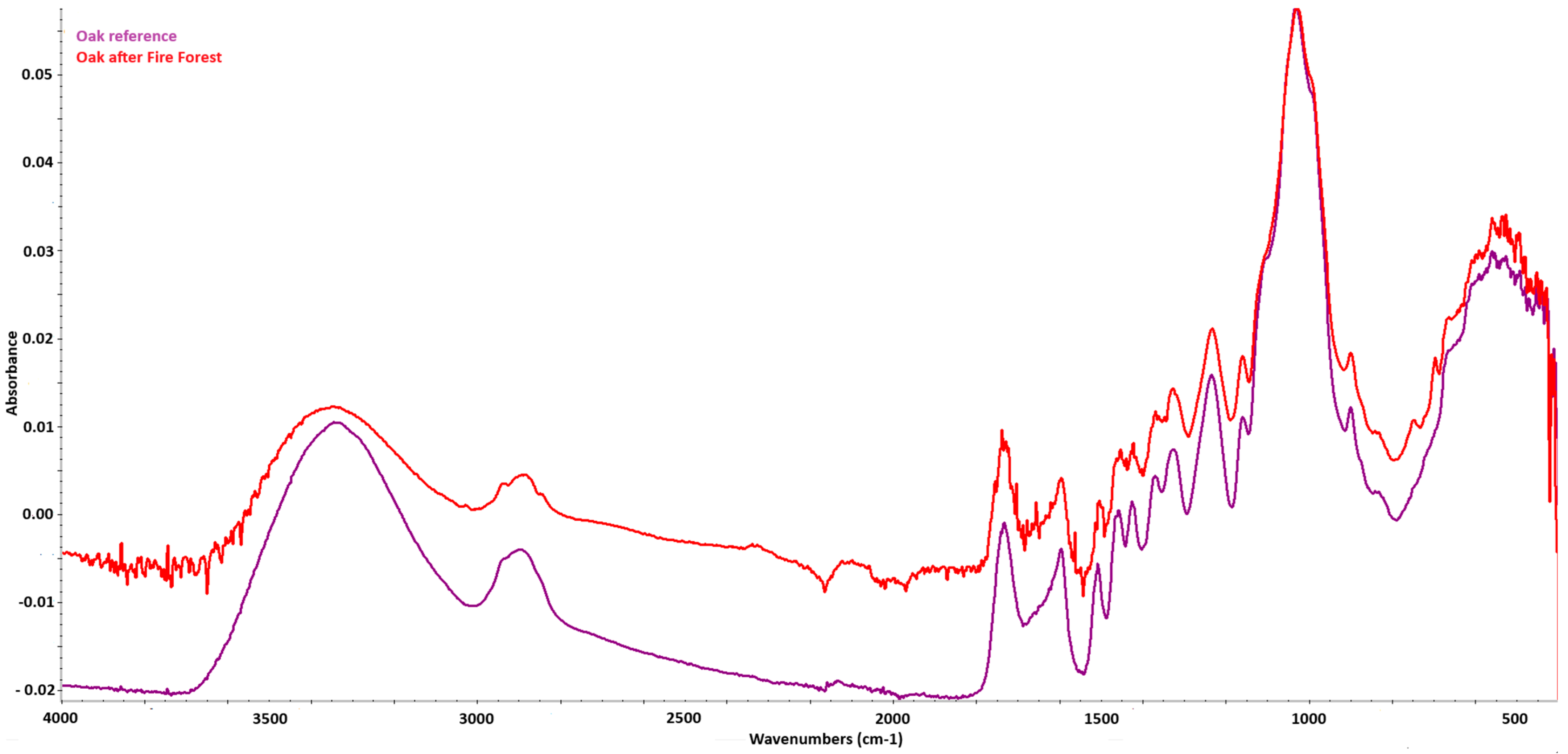
The FTIR spectra of moderately fire-affected oak wood revealed distinct differences in the chemical structure of the investigated samples depending on radial position relative to the bark (Figure 1).
The most pronounced spectral differences were observed in the region around 1730 cm−1, corresponding to C=O stretching vibrations associated primarily with hemicelluloses. Reduced intensity of this band in the outer stem regions may indicate partial thermal degradation of hemicellulose components. This observation is consistent with the chemical composition analysis, which showed variations in hemicellulose-related fractions in material originating closer to the bark. Similar behavior has been widely reported, as hemicelluloses are among the most thermally sensitive wood components [30].
In contrast, the band near 1510 cm−1, attributed to aromatic skeletal vibrations in lignin, remained relatively stable or slightly increased in intensity in outer stem regions. This behavior may reflect relative lignin enrichment with preferential degradation of polysaccharides during thermal exposure. Such apparent enrichment does not necessarily indicate an absolute increase in lignin content [29].
Changes were also observed in the region around 1030 cm−1, associated with C–O stretching vibrations in cellulose and hemicelluloses. Variations in this band may indicate structural rearrangements in carbohydrate polymers related to depolymerization or reorganization processes during heating.
The broad absorption band around 3300 cm−1, corresponding to O–H stretching vibrations, showed reduced intensity in outer stem regions. This decrease reflects dehydration processes and reductions in hydroxyl-containing functional groups, consistent with the reduced hydrogen content observed in elemental analysis.
The FTIR results suggest that moderate thermal exposure primarily affected polysaccharide components, leading to partial degradation of hemicelluloses, modification of cellulose-related structures, and relative enrichment of lignin-associated bands. These findings are generally consistent with the chemical composition and elemental analyses and suggest that thermal modification was concentrated predominantly in outer stem regions.
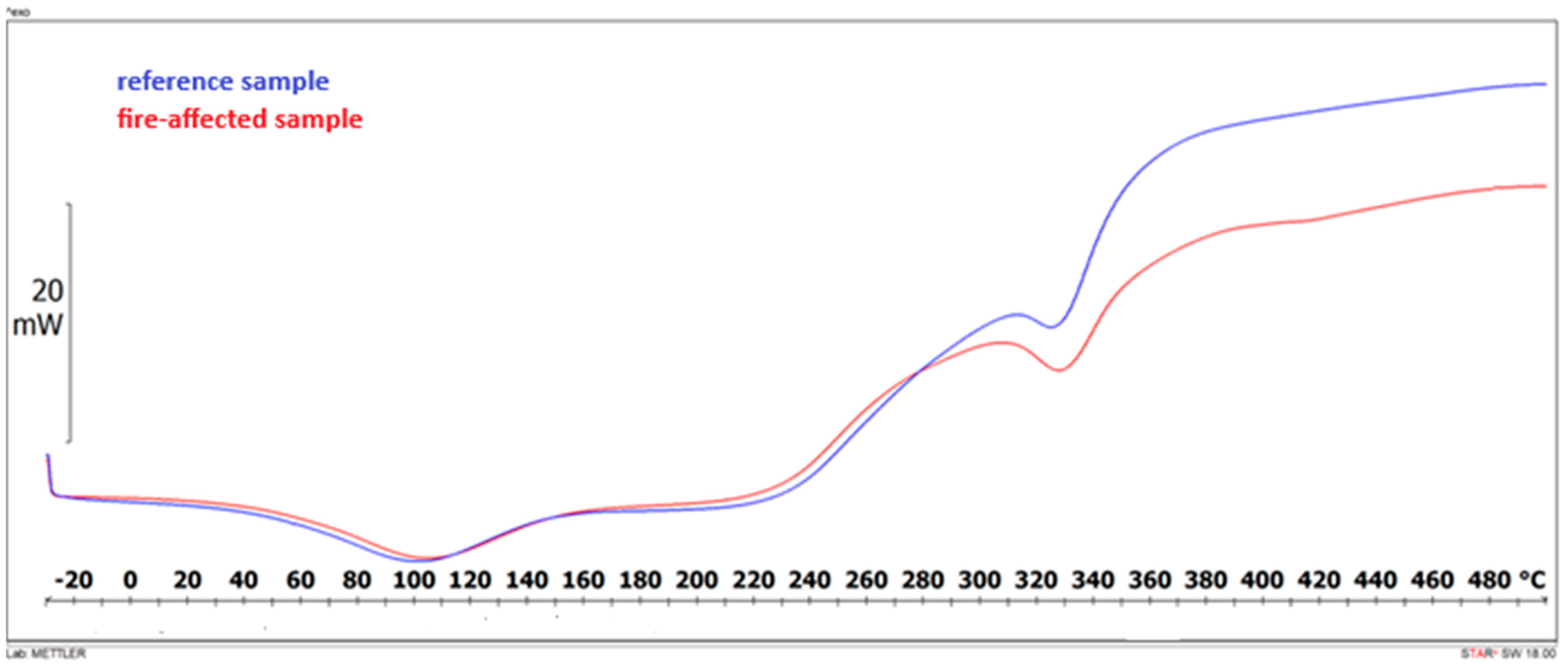
The DSC curves of moderately fire-affected and reference oak wood revealed differences in thermal behavior (Figure 2). The reference sample (blue curve), representing an unaffected oak wood reference material, exhibited higher peak intensities compared to the moderately fire-affected sample (red curve), indicating a greater proportion of thermally reactive components.
In both samples, an initial endothermic effect was observed at approximately 80–120 °C, corresponding to the evaporation of bound moisture [33]. This effect was slightly less pronounced in the fire-affected sample, which may suggest reduced hygroscopicity associated with prior thermal exposure.
The main thermal decomposition occurred between approximately 250–380 °C, where overlapping degradation reactions of hemicelluloses, cellulose, and lignin typically occur [7,10]. The reference sample exhibited a more pronounced peak in this region, whereas the moderately fire-affected sample showed reduced intensity. This behavior may indicate partial degradation of thermally labile polysaccharide components during fire exposure.
The characteristic peak around 320–340 °C, associated primarily with cellulose decomposition [7,10], was more pronounced in the reference sample. In contrast, the moderately fire-affected sample exhibited a reduced and broadened peak, potentially indicating structural modification of cellulose-related components.
At temperatures above approximately 350 °C, both samples showed gradual thermal responses associated with lignin decomposition and char formation [10]. However, the moderately fire-affected sample exhibited a smoother and less intensive response, which may reflect the presence of partially pre-degraded structures and increased proportions of thermally stable carbonaceous material.
The DSC results suggest reduced intensity of thermal decomposition processes in moderately fire-affected wood, particularly within polysaccharide-related fractions. These observations are generally consistent with FTIR and elemental analyses and support the assumption that moderate thermal exposure induced localized chemical and structural modification of outer stem regions.

3.4. Heat of Combustion

The higher heating values (HHVs) obtained for moderately fire-affected oak wood are presented in Table 4. The results show moderate variation among bark and the investigated wood regions, reflecting differences in chemical composition and degree of thermal exposure.
The highest HHV was recorded in the wood originating approximately 1 cm beneath the cambial region (19.56 MJ·kg−1), followed by the 1–2 cm region (19.09 MJ·kg−1). In contrast, bark exhibited lower values (17.99 MJ·kg−1), despite its higher carbon content. This behavior may be associated with the substantially higher mineral content and ash of bark, which reduces the effective calorific value.
Compared to the literature reference values reported for unaffected Quercus robur L. (typically 18.5–19.5 MJ·kg−1) [25,26], the investigated wood fractions showed comparable or only slightly elevated HHV. The moderate increase observed in the outer wood region may be related to localized thermal modification processes, including partial degradation of polysaccharides and relative carbon enrichment. This interpretation is generally consistent with the elemental analysis results, which indicated increased carbon content in outer stem regions.
The relatively small differences observed among the investigated radial positions suggest that moderate fire exposure did not substantially alter the energy potential of the wood. However, the lower HHV observed in bark highlights the influence of anatomical fraction and mineral content on combustion-related properties.
The results suggest that moderate surface fire exposure caused only limited changes in calorific value, predominantly within the outermost stem regions. Consequently, moderately fire-affected oak wood may retain potential for energy-related utilization following appropriate assessment and separation of heavily altered surface material.

4. Discussion

The present study combines physical, mechanical, chemical, elemental, FTIR, DSC, and calorific analyses to evaluate moderately fire-affected pedunculate oak wood. Moderate surface fire exposure appeared to affect primarily outer stem regions, whereas deeper investigated wood zones retained properties relatively close to the literature reference values for unaffected oak wood.
The observed reduction in oven-dry density and bending strength may be associated with partial thermal modification of polysaccharide components, particularly hemicelluloses, which are among the most thermally sensitive constituents of wood [7,9]. Partial degradation of these components can contribute to weakening of the cell wall matrix and localized formation of microstructural defects, potentially resulting in reduced mechanical resistance. Similar trends have previously been reported in thermally modified and fire-affected wood [13,14,20].
In contrast, compressive strength parallel to the grain remained within or slightly above the literature reference ranges. Comparable behavior has been described in thermally modified wood and may be associated with thermal drying effects and localized structural rearrangements within the cell wall [20,41]. However, considering the absence of unaffected control samples from the same stand, the contribution of natural sample variability cannot be excluded.
The combined interpretation of chemical composition, elemental analysis, FTIR spectroscopy, and DSC results suggests that moderate thermal exposure primarily affected polysaccharide-related fractions in outer stem regions. Variations in hemicellulose content, together with reduced FTIR band intensity around 1730 cm−1 and lower DSC peak intensity in the main decomposition region, indicate partial degradation or modification of thermally labile carbohydrate components. At the same time, relatively stable lignin-associated FTIR bands near 1510 cm−1 and increased carbon content in bark suggest relative enrichment of thermally more stable carbonaceous structures. Similar chemical and structural changes have been reported in studies dealing with thermally modified wood and heat-induced degradation of lignocellulosic materials [6,9,29,30].
The elemental analysis further supports this interpretation. Elevated carbon content and reduced hydrogen content in bark may reflect dehydration and devolatilization reactions occurring in directly exposed outer stem fractions. In contrast, the investigations of the inner wood regions showed elemental composition values relatively close to the literature reference ranges reported for unaffected oak wood. Similarly, the relatively limited variation in higher heating value suggests that moderate fire exposure did not substantially alter the energy-related properties of the investigated wood regions.
Compared to previous studies focused primarily on coniferous species [14,22], the present results suggest that thermal modification in oak wood remained relatively localized under the investigated fire conditions. This behavior may be associated with the higher density and specific anatomical structure of hardwood species, which can influence heat transfer and thermal degradation patterns differently from softwoods. However, direct comparison among studies remains limited due to differences in fire severity, exposure duration, sampling methodology, and wood anatomy.
Since the investigated trees were harvested approximately four months after the wildfire event, partial post-fire weathering effects cannot be excluded. Environmental exposure during this period may have influenced moisture redistribution, extractive migration, or superficial oxidation processes in outer stem regions.
From a practical perspective, the obtained results suggest that moderately fire-affected oak wood may retain potential for selected material or energy-related applications following appropriate inspection, sorting, and removal of thermally altered outer layers. Nevertheless, the relatively high variability observed in some mechanical properties indicates substantial local heterogeneity within outer stem regions and highlights the importance of careful quality assessment prior to utilization.
Several limitations of the present study should be acknowledged. The investigation focused on a single hardwood species exposed to moderate-severity surface fire conditions, and unaffected control samples from the same stand were not available for direct statistical comparison. In addition, the sampling resolution was relatively coarse, and no direct temperature measurements or microstructural analyses were performed. Consequently, the results should be interpreted as an exploratory assessment of moderately fire-affected oak wood rather than as a fully controlled evaluation of thermal degradation processes.
The combined analytical results suggest that moderate fire exposure induced localized modification primarily within outer stem regions, while deeper investigated wood zones retained properties relatively close to the literature reference values for unaffected oak wood.

5. Conclusions

Fire exposure of pedunculate oak wood (Quercus robur L.) resulted primarily in localized changes within outer stem regions exposed to moderate surface fire conditions. Oven-dry density reached 720 kg·m−3, while static bending strength decreased to 85.56 MPa compared to the literature reference ranges reported for unaffected oak wood. In contrast, compressive strength parallel to the grain (71.16 MPa) and Brinell hardness (42.75 MPa) remained within or slightly above typical literature values.
Chemical, elemental, FTIR, and DSC analyses suggested partial modification of polysaccharide fractions, particularly hemicelluloses, together with localized carbon enrichment in outer stem regions. At the same time, wood originating approximately 1–2 cm beneath the cambial region retained properties relatively close to the literature reference values reported for unaffected oak wood.
A higher heating value remained within the typical range reported for oak wood (19.09–19.56 MJ·kg−1), indicating that moderate fire exposure did not substantially alter the energy-related properties of the investigated material.
The obtained results suggest that under the investigated conditions, fire-induced modification in oak wood was primarily concentrated in outer stem regions, while deeper investigated wood zones retained relatively preserved physical, mechanical, and thermal properties. However, the results should be interpreted with caution, since the study focused on a single hardwood species exposed to moderate-severity surface fire conditions and unaffected control samples from the same stand were not available.
The findings indicate that moderately fire-affected oak wood may retain potential for selected material or energy-related applications following appropriate inspection, sorting, and removal of thermally altered surface layers.

Author Contributions

Conceptualization, K.H. and M.B.G.; methodology, K.H., T.H., M.B.G. and R.R.; validation, L.S., K.H., T.H. and B.B.; formal analysis, L.S., K.H., T.H., M.B.G., R.R. and P.R.; investigation, L.S., K.H., M.B.G. and B.B.; resources, M.B.G., K.M., K.S. and R.R.; data curation, M.B.G., K.S., R.R. and P.R.; writing—original draft preparation, L.S., K.H., T.H., A.Z., M.B.G. and P.R.; writing—review and editing, L.S., K.H., M.B.G., K.S. and K.M.; visualization, K.H.; supervision, K.H.; project administration, K.H. All authors have read and agreed to the published version of the manuscript.

Funding

This research was funded by the Faculty of Forestry and Wood Sciences, CULS Prague, excellence project “The impact of fires on the wood quality of Central European climax tree species”.

Institutional Review Board Statement

Not applicable.

Informed Consent Statement

Not applicable.

Data Availability Statement

The raw data supporting the conclusions of this article will be made available by the authors on request.

Acknowledgments

The authors would like to thank the Faculty of Forestry and Wood Sciences at the Czech University of Life Sciences in Prague for its support.

Conflicts of Interest

The authors declare no conflicts of interest.

References

  1. IPCC. Climate Change 2021: The Physical Science Basis; Cambridge University Press: Cambridge, UK, 2021. [Google Scholar]
  2. Bowman, D.M.J.S.; Balch, J.K.; Artaxo, P.; Bond, W.J.; Carlson, J.M.; Cochrane, M.A.; D’Antonio, C.M.; DeFries, R.S.; Doyle, J.C.; Harrison, S.P.; et al. Fire in the Earth system. Science 2009, 324, 481–484. [Google Scholar] [CrossRef] [PubMed]
  3. Jones, M.W.; Abatzoglou, J.T.; Sander, V.; Andela, N.; Lasslop, G.; Forkel, M.; Smith, A.J.P.; Burton, C.; Betts, R.A.; van der Werf, G.R.; et al. Global and regional trends and drivers of fire under climate change. Rev. Geophys. 2022, 60, e2020RG000726. [Google Scholar] [CrossRef]
  4. Rowell, R.M. Handbook of Wood Chemistry and Wood Composites, 2nd ed.; CRC Press: Boca Raton, FL, USA, 2012. [Google Scholar]
  5. White, R.H.; Dietenberger, M.A. Fire safety of wood construction. In Wood Handbook: Wood as an Engineering Material: Chapter 18; USDA Forest Service: Washington, DC, USA, 2010. [Google Scholar]
  6. Esteves, B.; Pereira, H. Wood modification by heat treatment. BioResources 2009, 4, 370–404. [Google Scholar] [CrossRef]
  7. Yang, H.; Yan, R.; Chen, H.; Lee, D.H.; Zheng, C. Characteristics of hemicellulose, cellulose and lignin pyrolysis. Fuel 2007, 86, 1781–1788. [Google Scholar] [CrossRef]
  8. Brebu, M.; Vasile, C. Thermal degradation of lignin. Cellul. Chem. Technol. 2010, 44, 353–363. [Google Scholar]
  9. Poletto, M.; Zattera, A.J.; Forte, M.M.C.; Santana, R.M. Thermal decomposition of wood: Influence of wood components and cellulose crystallite size. Bioresour. Technol. 2012, 109, 148–153. [Google Scholar] [CrossRef]
  10. Grønli, M.G.; Várhegyi, G.; Di Blasi, C. Thermogravimetric analysis and devolatilization kinetics of wood. Ind. Eng. Chem. Res. 2002, 41, 4201–4208. [Google Scholar] [CrossRef]
  11. Lowden, L.A.; Hull, T.R. Flammability behaviour of wood and a review of the methods for its reduction. Fire Sci. Rev. 2013, 2, 4. [Google Scholar] [CrossRef]
  12. Lublóy, É.; Mészáros, D.T.; Takács, L.G.; Cimer, Z.; Norbert, H. Examination of the fire performance of wood materials treated with different precautions. J. Therm. Anal. Calorim. 2023, 148, 4129–4140. [Google Scholar] [CrossRef]
  13. Lukina, A.; Lisyatnikov, M.S.; Lukin, M.V.; Vatin, N.I.; Roshchina, S. Strength properties of raw wood after a wildfire. Mag. Civ. Eng. 2023, 119, 11907. [Google Scholar] [CrossRef]
  14. Marttila, J.; Möttönen, V.; Haapala, A.; Ylimäki, P.; Kilpeläinen, P.; Verkasalo, E. Wood Material Properties of Forest Fire-Damaged Norway Spruce and Scots Pine for Mechanical Wood Processing in Finland. Appl. Sci. 2024, 14, 238. [Google Scholar] [CrossRef]
  15. Todaro, L.; Rita, A.; Negro, F.; Moretti, N.; Saracino, A.; Zanuttini, R. Behavior of pubescent oak (Quercus pubescens Willd.) wood to different thermal treatments. iForest—Biogeosciences For. 2015, 8, 748–755. [Google Scholar] [CrossRef]
  16. Lowell, E.C.; Willits, S.A.; Krahmer, R.L. Deterioration of Fire-Killed and Fire-Damaged Timber in the Western United States; General Technical Report PNW-GTR-292; U.S. Department of Agriculture, Forest Service, Pacific Northwest Research Station: Portland, OR, USA, 1992. [Google Scholar]
  17. Sessions, J.; Bettinger, P.; Buckman, R.; Newton, M.; Hamann, J. Hastening the return of complex forests following fire: The consequences of delay. J. For. 2004, 102, 38–45. [Google Scholar] [CrossRef]
  18. Donato, D.C.; Fontaine, J.B.; Campbell, J.L. Post-wildfire logging hinders regeneration and increases fire risk. Science 2006, 311, 352. [Google Scholar] [CrossRef]
  19. Papalou, A.; Baros, D.K. Assessing Structural Damage after a Severe Wildfire: A Case Study. Buildings 2019, 9, 171. [Google Scholar] [CrossRef]
  20. Qian, J.; Yue, K.; Lv, C.; Zhu, L.; Jiao, X.; Wu, P.; Xu, C.; Sun, K. Measurements of the mechanical properties of larch at elevated and high temperature under nitrogen conditions. Polym. Test. 2023, 128, 108228. [Google Scholar] [CrossRef]
  21. Reinprecht, L. Wood Deterioration, Protection, and Maintenance; Wiley: Hoboken, NJ, USA, 2016. [Google Scholar]
  22. Holeček, T.; Sahula, L.; Hájková, K.; Zeidler, A.; Gach, M.B.; Tylek, P.; Słowiński, K.; Wąsik, R.; Michalec, K.; Marcinik, T. Changes in Chemical and Mechanical Wood Properties in Silver Fir, Norway Spruce and Scots Pine Trees as a Result of High Temperatures Due to Fire. Fire 2026, 9, 6. [Google Scholar] [CrossRef]
  23. Wagenführ, R. Holzatlas (Wood Atlas); Fachbuchverlag Leipzig im Carl Hanser Verlag: Leipzig, Germany, 2007. [Google Scholar]
  24. Dinwoodie, J.M. Timber: Its Nature and Behaviour, 2nd ed.; E & FN Spon: London, UK, 2000. [Google Scholar]
  25. Fengel, D.; Wegener, G. Wood: Chemistry, Ultrastructure, Reactions; Walter de Gruyter: Berlin, Germany, 1984. [Google Scholar]
  26. Sjöström, E. Wood Chemistry: Fundamentals and Applications, 2nd ed.; Academic Press: San Diego, CA, USA, 1993. [Google Scholar]
  27. Röder, T.; Koch, G.; Sixta, H. Application of confocal Raman spectroscopy for the topochemical distribution of lignin and cellulose in plant cell walls of beech wood (Fagus sylvatica L.) compared to UV microspectrophotometry. Holzforschung 2004, 58, 480–482. [Google Scholar] [CrossRef]
  28. Tyree, M.T.; Zimmermann, M.H. Xylem Structure and the Ascent of Sap; Springer: Berlin/Heidelberg, Germany, 2002. [Google Scholar]
  29. Faix, O. Classification of lignins from different botanical origins by FTIR spectroscopy. Holzforschung 1991, 45, 21–27. [Google Scholar] [CrossRef]
  30. Pandey, K.K. A study of chemical structure of soft and hardwood and wood polymers by FTIR spectroscopy. J. Appl. Polym. Sci. 1999, 71, 1969–1975. [Google Scholar] [CrossRef]
  31. Colom, X.; Carrillo, F. Comparative Study of Wood Samples of the Northern Area of Catalonia by FTIR. J. Wood Chem. Technol. 2005, 25, 1–11. [Google Scholar] [CrossRef]
  32. Hill, C.A.S. Wood Modification; Wiley: Hoboken, NJ, USA, 2006. [Google Scholar]
  33. Bryś, A.; Bryś, J.; Ostrowska-Ligęza, E.; Kaleta, A.; Górnicki, K.; Głowacki, S.; Koczoń, P. Wood biomass characterization by DSC or FT-IR spectroscopy. J. Therm. Anal. Calorim. 2016, 126, 27–35. [Google Scholar] [CrossRef]
  34. ISO 3129:2019; Wood—Sampling Methods and General Requirements for Physical and Mechanical Testing. International Organization for Standardization: Geneva, Switzerland, 2019.
  35. TAPPI T 257 sp-14; Sampling and Preparing Wood for Analysis. Technical Association of the Pulp and Paper Industry: Peachtree Corners, GA, USA, 2014.
  36. PN-EN 384:2010; Structural Timber—Determination of Characteristic Values of Mechanical Properties and Density. Polski Komitet Normalizacyjny: Warsaw, Poland, 2010.
  37. ISO 13061-3:2014; Physical and Mechanical Properties of Wood—Test Methods for Small Clear Wood Specimens—Part 3: Determination of Static Bending Strength. International Organization for Standardization: Geneve, Switzerland, 2014.
  38. Fataraitė-Urbonienė, E.; Juodeikienė, I.; Albrektas, D.; Meškauskas, S. Influence of heat treatment on the static bending strength of spruce wood. Mater. Sci. 2019, 25, 455–459. [Google Scholar] [CrossRef]
  39. İşleyen, Ü.K.; Kesik, H.İ. Experimental and numerical analysis of compression and bending strength of old wood reinforced with CFRP strips. Structures 2021, 33, 259–271. [Google Scholar] [CrossRef]
  40. ISO 13061-17:2017; Physical and Mechanical Properties of Wood—Test Methods for Small Clear Wood Specimens—Part 17: Determination of Ultimate Stress in Compression Parallel to Grain. International Organization for Standardization: Geneve, Switzerland, 2017.
  41. Ibanez, C.M.; Kartal, S.N.; Soytürk, E.E.; Kurul, F.; Şeker, S.; Önses, M.S.; Çelik, N.; Temiz, A.B. Changes in the physical and mechanical properties of Pinus taeda and Eucalyptus bosistoana wood modified by contact charring. BioResources 2023, 18, 8614–8630. [Google Scholar] [CrossRef]
  42. PN-EN 408:2010; Timber Structures—Structural Timber and Glued Laminated Timber—Determination of Some Physical and Mechanical Properties. Polski Komitet Normalizacyjny: Warsaw, Poland, 2010.
  43. TAPPI T 211 om-02; Ash in Wood, Pulp, Paper and Paperboard: Combustion at 525 °C. Technical Association of the Pulp and Paper Industry: Peachtree Corners, GA, USA, 2007.
  44. TAPPI T 204 cm-17; Solvent Extractives of Wood and Pulp. Technical Association of the Pulp and Paper Industry: Peachtree Corners, GA, USA, 2017.
  45. Seifert, K. Uber ein neues Verfahren zur Schnellbestimmung Der Rein-Cellulose. Das Pap. 1956, 10, 301–306. [Google Scholar]
  46. TAPPI T 222 om-11; Acid-Insoluble Lignin in Wood and Pulp. Technical Association of the Pulp and Paper Industry: Peachtree Corners, GA, USA, 2006.
  47. Wise, L.E.; Murphy, M.; D’Addieco, A.A. Chlorite holocellulose, its fractionation and bearing on summative wood analysis and on studies on the hemicelluloses. Pap. Trade J. 1946, 122, 35–43. [Google Scholar]
Figure 1. Comparison of FTIR spectra of moderately fire-affected and reference oak wood.
Fire 09 00248 g001
Figure 2. Comparison of DSC curves of moderately fire-affected (red) and reference (blue) oak wood.
Fire 09 00248 g002
Table 1. Mechanical properties of fire-affected oak wood compared with reference values.
PropertyFire-Affected Wood
(Mean ± SD)
Reference Values
(Quercus robur L.)
Static bending strength (MPa)85.56 ± 30.8390–110 [5,24]
Compressive strength grain (MPa)71.16 ± 7.1060–70 [5,24]
Brinell hardness (MPa)42.75 ± 17.4135–45 [24]
Table 2. Chemical composition of moderately fire-affected oak wood.
Chemical CompositionBarkTrunk Up to 1 cmTrunk 1–2 cm
Ash, %11.03 (0.62)0.63 (0.04)0.23 (0.05)
Extractives, %3.04 (0.07)1.03 (0.11)0.63 (0.04)
Cellulose, %32.85 (0.38)42.45 (1.20)43.70 (0.92)
Lignin, %23.42 (0.29)21.95 (0.08)20.30 (0.29)
Hemicelluloses, %33.43 (0.86)39.30 (0.74)29.83 (0.57)
The standard deviation is shown in parentheses.
Table 3. Elemental composition of moderately fire-affected oak wood.
ElementBarkTrunk Up to 1 cmTrunk 1–2 cm
Carbon, %69.35 (4.52)52.10 (3.68)52.73 (2.37)
Hydrogen, %3.74 (0.24)5.74 (0.36)5.39 (0.44)
Nitrogen, %0.11 (0.02)0.26 (0.06)0.30 (0.02)
Sulphur, %0.01 (0.00)0.05 (0.02)0.07 (0.00)
The standard deviation is shown in parentheses.
Table 4. Heat of combustion of moderately fire-affected oak wood compared with the literature reference values.
PropertyFire-Affected Wood
(MJ·kg−1)
Reference Values
(Quercus robur L.) (MJ·kg−1)
Bark17.99 (0.41)18.0–19.0 [26]
Trunk up to 1 cm19.56 (0.08)18.5–19.5 [25,26]
Trunk 1–2 cm19.09 (0.08)18.5–19.5 [25,26]
The standard deviation is shown in parentheses.
Disclaimer/Publisher’s Note: The statements, opinions and data contained in all publications are solely those of the individual author(s) and contributor(s) and not of MDPI and/or the editor(s). MDPI and/or the editor(s) disclaim responsibility for any injury to people or property resulting from any ideas, methods, instructions or products referred to in the content.