Abstract
The intensification of wildfires in Portugal has highlighted the urgent need for technical tools capable of supporting more effective risk mitigation decisions. In particular, the lack of explicit criteria for prioritizing the implementation of wildfire mitigation programs has contributed to reactive and fragmented interventions that are often misaligned with actual levels of hazard and exposure. This study proposes a spatially explicit methodology for classifying and ranking villages in wildfire-prone territories under two operational programs: Protection of People, Assets and Fuel Management. The framework was applied to eight municipalities across three Portuguese regions with high wildfire recurrence, using a multi-criteria decision analysis approach (AHP) integrated with geospatial data. Five physical and social variables were considered: critical area, vegetation cover, fire history, slope, and population density. Expert-derived weights were incorporated into two program-specific models. Implementation priority levels were generated using standard deviation classification at both municipal and regional scales. The results reveal marked territorial contrasts and strong intra-municipal variability, particularly in heterogeneous landscapes. A high degree of convergence between the two programs was observed (79–90%), although 10–21% of villages shifted between priority classes. The dual-scale analysis shows how a small number of high-hazard municipalities disproportionately shape the overall priority structure. The proposed framework supports more transparent, consistent, and risk-informed prioritization, strengthening territorial wildfire governance and complementing national mitigation programs such as “Safe Villages” and “Safe People” and “Condominium of Villages”.
Keywords:
wildfire; implementation prioritization; multi-criteria analysis; AHP; exposure; hazard; Portugal 1. Introduction
Wildfires are increasingly recognized as a major environmental and societal challenge, particularly in fire-prone regions such as southern Europe. While traditionally concentrated in countries like Portugal, Spain, and Greece, wildfire hazard has expanded geographically in recent years [1,2]. This shift reflects the combined influence of climate change, land-use transformations, and changes in rural dynamics, favoring the creation of highly flammable and difficult-to-manage landscapes [3,4,5]. As a result, wildfire management has become a strategic priority across Europe.
Portugal stands out within southern Europe for the frequency, severity, and socioecological impacts of wildfires over the past two decades [2,6]. Among the most devastating years were 2003, 2005 and especially 2017, when two major fire events, in June and October, resulted in more than one hundred fatalities and the destruction of more than 500,000 hectares [7]. In that year, Portugal accounted for over 50% of the total area burned across the four most affected southern European countries, surpassing even the exceptional fire seasons of 2003 and 2005. Beyond the tragic loss of life, the 2017 fires caused extensive damage to private infrastructure, including tourism and business, residential buildings, agricultural areas, and large expanses of forest [7,8,9,10]. These events not only revealed the intensifying conditions of fire regimes under a changing climate but also exposed deep structural weaknesses in land use planning, territorial cohesion, and civil protection systems [11,12]. These structural vulnerabilities are exacerbated by the geographical distribution of human villages across the country, many of which are in territories where flammable vegetation predominates, topography is rugged, and accessibility is limited. As climate conditions continue to evolve, the recurrence of extreme fire events is expected to increase, further amplifying the pressure on local authorities to develop spatially targeted and socially sensitive risk mitigation strategies [13,14,15,16,17].
While Portugal’s wildfire risk is shaped by its unique territorial and social configuration, some of the underlying challenges are shared with other fire-prone regions across the globe [18,19]. In response to recurring wildfire crises, countries like the United States, Canada, and Australia have developed a range of mitigation frameworks that, although adapted to distinct geographic and social contexts, offer valuable insights into integrated wildfire risk reduction and public engagement in wildfire mitigation and preparedness at the community level [20,21,22,23]. These include structured programs that combine fuel management, community preparedness, and policy coordination. Among the most influential initiatives are Firewise (USA), FireSmart (Canada), and Fire Adapted Communities (USA), which serve as global references for community-based fire risk reduction. These programs promote voluntary action, vegetation management, resilient construction practices, and local collaboration, and have contributed to embedding fire risk into planning and governance frameworks [24,25,26,27]. In parallel, several southern European countries, including Spain, Italy, and Greece, have launched regional initiatives focused on fuel management through livestock grazing, mechanical intervention, and volunteer-based fire prevention. While these efforts vary in scale and structure, they reflect a broader shift toward integrated landscape approaches [28,29,30]. In line with this trend, Portugal has also developed a broad range of wildfire mitigation policies and programs. Since 2021, wildfire prevention and management in Portugal has been guided by the National Plan for Integrated Wildfire Management (PNGIFR), which defines the overarching strategic framework for reducing rural fire risks across the country. At the local level, this strategy is implemented through updated Municipal Plans for the Defense of Forest Against Wildfires (PMDFCI), which have been revised to align with the national priorities of integrated landscape management, territorial resilience, and risk governance. In recent years, several complementary initiatives have been launched at regional and community levels. These include programs focused on resin extraction and fire detection, vegetation control near energy infrastructure and community-based grazing projects [31]. National landscape transformation strategies have also emerged, including the Landscape Reordering and Management Program (PRGP), Integrated Landscape Management Areas (AIGP), and the Condominium of Villages (CA) program. The latter, established in 2020, supports initiatives focused on transforming land use and land cover and managing combustible materials around built-up areas [32,33,34]. Its primary aim is to enhance the resilience of villages in fire-prone territories. Complementing these territorial strategies, awareness and preparedness programs such as “Safe Villages” and “Safe People” programs, initiated in 2018 by the National Authority for Emergency and Civil Protection, aim to strengthen community resilience by promoting local engagement, risk awareness, and training in self-protection measures in case a wildfire occurs [35].
Although these programs demonstrate political and institutional commitment, they often suffer from a lack of clear, data-driven prioritization schemes. Although numerous decision-support tools and wildfire mitigation strategies exist, few incorporate mechanisms that explicitly rank villages based on physical conditions, social exposure and vulnerability, or that provide spatially grounded criteria for intervention planning. A recent systematic review by Thompson et al. (2016) [36] emphasizes that most wildfire risk models focus on hazard or exposure but fail to translate this information into operational prioritization schemes. Similarly, Fischer and Charnley (2012) [37] note that the implementation of community protection programs often lacks strategic targeting, relying instead on improvised or individually driven decision-making. Yung et al. (2022) [38] further debate that, across multiple jurisdictions, inconsistent prioritization frameworks hinder the efficient scaling of mitigation efforts, leading to fragmented governance and suboptimal resource allocation. Other authors, such as Kirschner et al. (2023) [23], reinforce the need for transparent, spatially explicit criteria to improve the effectiveness and fairness of wildfire management, especially under constrained budgets. In the Portuguese context, Benali et al. (2023) [39] revealed significant mismatches between wildfire risk levels and the actual implementation of mitigation programs, with only ~1% coverage in very high-risk villages and comparatively higher rates in lower-risk areas. These findings are consistent with those of Aparício et al. (2022) [40], who evaluated the national network of strategic fuel breaks and concluded that its current deployment lacks a coherent prioritization logic, often resulting in suboptimal spatial coverage and limited impact on high-risk areas.
These gaps in follow-up and accountability limit the development of evidence-based prioritization and reduce the strategic effectiveness of current interventions [41]. Collectively, these findings underscore that, in the absence of explicit and spatially informed prioritization frameworks, wildfire mitigation policies risk failing to deliver protection that is both effective and equitable [42,43,44]. When such frameworks are lacking, interventions often become reactive, discretionary, or influenced by political visibility and institutional capacity—rather than directed toward communities facing the highest levels of exposure and vulnerability. In this context, this study aims to address this challenge by developing a hierarchical classification of the villages within three wildfire-prone regions of Portugal, designed to support the prioritization of strategies for the protection of people and assets and/or fuel management. Through the application of a spatial multi-criteria analysis that integrates both physical and social indicators, this study intends to contribute to advancing the operationalization of risk-based planning.
2. Materials and Methods
2.1. Study Area
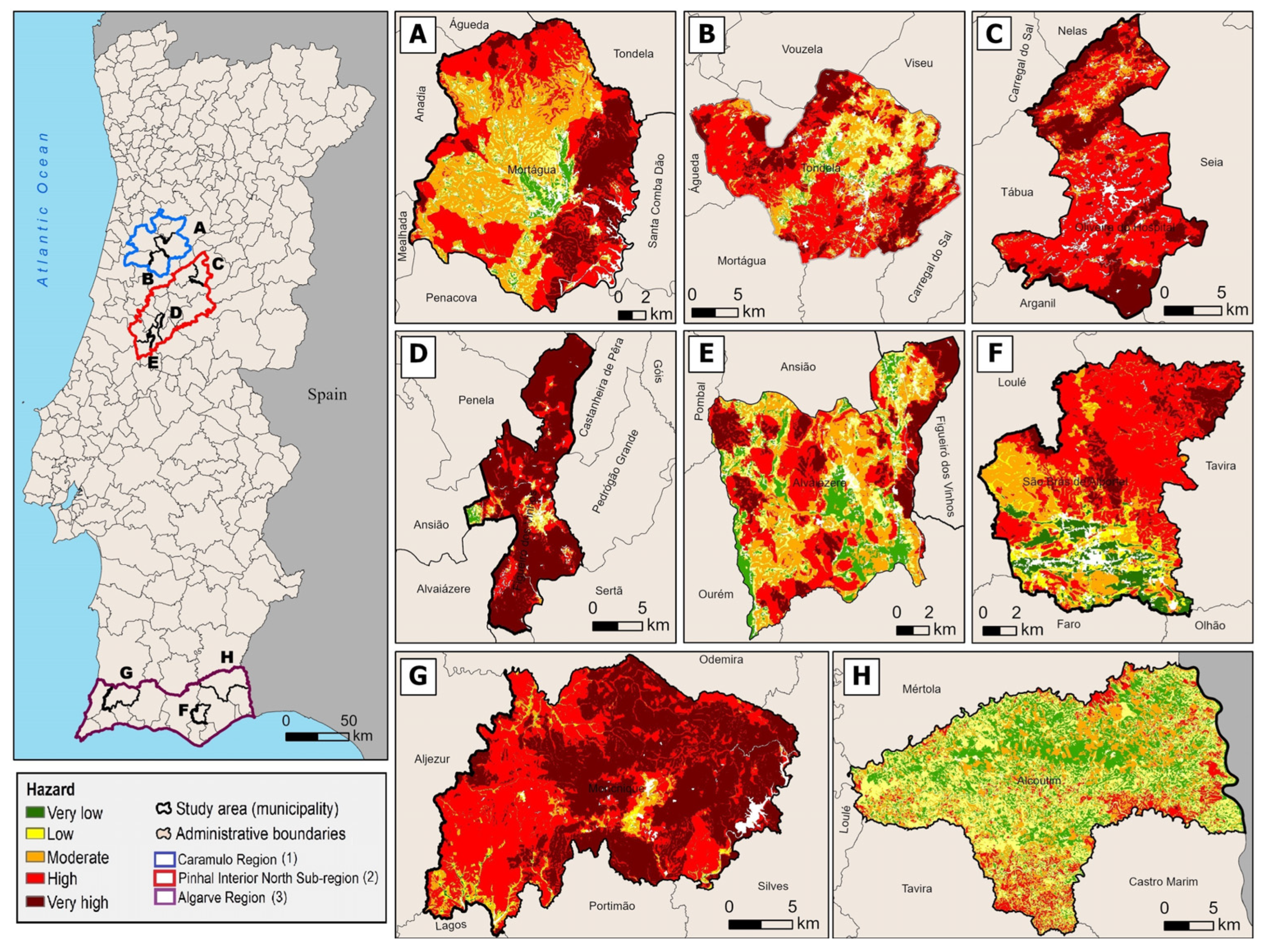
This study focuses on eight municipalities across three fire-prone regions of mainland Portugal. The regions include Caramulo Mountain (Tondela and Mortágua municipalities), the Pinhal Interior Norte subregion (Alvaiázere, Figueiró dos Vinhos, and Oliveira do Hospital municipalities), and the Algarve region (Alcoutim, Monchique, and São Brás de Alportel municipalities) (Figure 1). The selection was based on the spatial distribution of fire-prone areas, their high recurrence of fire events, significant variation in landscape morphology, and distinct socio-demographic profiles. This spatial heterogeneity provides a robust framework for analyzing variations in wildfire exposure and hazard level.
Figure 1.
Location of study areas in mainland Portugal. The left map highlights the three selected regions: Caramulo (1, blue), Pinhal Interior Norte (2, red), and Algarve (3, purple). The peripheral maps (A–H) show details of the studied municipalities, with structural wildfire hazard based on the official map from the National Forest Services [45].
The municipalities display considerable variation in terms of area, slope, altitude, land use, and vegetation cover (Table 1). Alcoutim (H) has the largest surface (575.36 km2), while Monchique (G) exhibits the steepest average slope (13.5°), and Figueiró dos Vinhos (D) the highest mean elevation (446 m). Land cover patterns are equally diverse: Alvaiázere (E) presents the highest proportion of agricultural land (25.5%), whereas Monchique (G) stands out with over 90% of its area occupied by forest and shrubland. Monchique (G) also registers the highest wildfire hazard level, with 91% of its territory classified as “high” or “very high” hazard, according to national fire hazard maps [45]. The number of built-up areas (representing villages) also varies across municipalities, ranging from 115 in Alcoutim to 697 in Tondela, based on the official database provided by the Directorate General of Territory [46]. According to Statistics Portugal, a village is generally defined as a cluster of 10 or more residential buildings. However, the official Built-Up Areas (BUA) dataset [46] categorizes the BUA into three types: (i) Type 1—concentrated villages (≥10 residential buildings); (ii) Type 2—dispersed villages (scattered buildings or clusters with <10 houses); and (iii) Type 3—non-residential areas. For this analysis, all Type 3 areas (non-residential) and Type 2 areas smaller than 0.2 hectares, typically representing isolated buildings, were excluded to focus only on meaningful village units with potential intervention relevance.
Table 1.
Biophysical characteristics of the studied municipalities, organized into different categories: topographic characteristics; land use and cover characteristics; wildfire hazard; and urbanization (source: Topography—European Environment Agency (EAA); land use and cover and urbanization—Directorate General of Territory (DGT); Hazard—Institute Nature Conservation and Forests (ICNF)). Enclosed in parentheses is the corresponding map in Figure 1 for each municipality.
Regarding demographic trends, the central and inland municipalities have experienced sustained population decline. Between 2011 and 2021 [47,48], Alvaiázere (E) and Figueiró dos Vinhos (D) lost 14.4% of their population, while Monchique (G) and Tondela (B) also registered declines of over 9% and 10%, respectively (Table 2). In contrast, São Brás de Alportel (F), located in the Algarve, recorded a 5.5% population increase, alongside moderate growth in number of buildings. These divergent demographic trends reflect broader dynamics of rural abandonment, aging populations, and peri-urban expansion, all of which influence the spatial distribution of wildfire exposure and emergency planning needs.
Table 2.
Rate of change in resident population and number of buildings in the study areas between 2011 and 2021 [47,48]. Enclosed in parentheses is the corresponding map in Figure 1 for each municipality.
2.2. Data Collection
This study draws on a multi-source dataset that integrates demographic, topographic, and wildfire history variables, all obtained from publicly available sources. The selection of indicators was guided by their relevance to wildfire dynamics and their alignment with national spatial planning frameworks, thereby supporting integration into existing governance and management instruments.
Physical landscape features such as slope and vegetation cover were included due to their influence on fire behavior, while population density and building patterns were incorporated as proxies for exposure and potential loss. Variables were chosen to reflect both biophysical hazard and human dimensions. To represent these dimensions spatially, datasets were compiled from official sources across thematic domains. The built-up areas were derived from the 2018 national cartography provided by the Directorate General of Territory (DGT), in vector format at a 1:25,000 scale [46]. These data allow for the identification of urbanized zones and were used to quantify exposure (resident population). Land use and land cover data were also sourced from the DGT, offering a detailed spatial classification of agricultural, forest, shrubland, and urban areas. Population and buildings data were retrieved from the 2011 and 2021 national censuses, published by Statistics Portugal (INE–BGRI) [47,48]. These data include resident population counts and the total number of buildings. They support the analysis of demographic trends, reflected in population decline, peri-urban expansion, and human exposure in rural landscapes. Wildfire history was reconstructed using perimeter records of burned areas from 1975 to 2023, provided by the Institute for Nature Conservation and Forests (ICNF). These were rasterized to produce a cell-based count of the number of times each location burned over a 48-year period, thus generating a spatial metric of fire recurrence. Structural wildfire hazard was assessed using the official 2020 national hazard map developed by the ICNF. This raster layer classifies territory into hazard levels based on biophysical factors such as vegetation, slope, elevation, and historical burned area. Finally, topographic data were extracted from the 2019 Digital Elevation Model (DEM) developed by the European Environment Agency (EEA) [49]. The raster data at 25 m × 25 m resolution were used to compute slope classes, considering that high slopes are associated with higher fire spread and suppression difficulty. This study was performed using programming tools, specifically Python (3.13) and R languages (4.2.2), to streamline the spatial analysis processes and enable their easy replication in other areas.
2.3. Analysis
2.3.1. Variable Selection and Spatial Framework
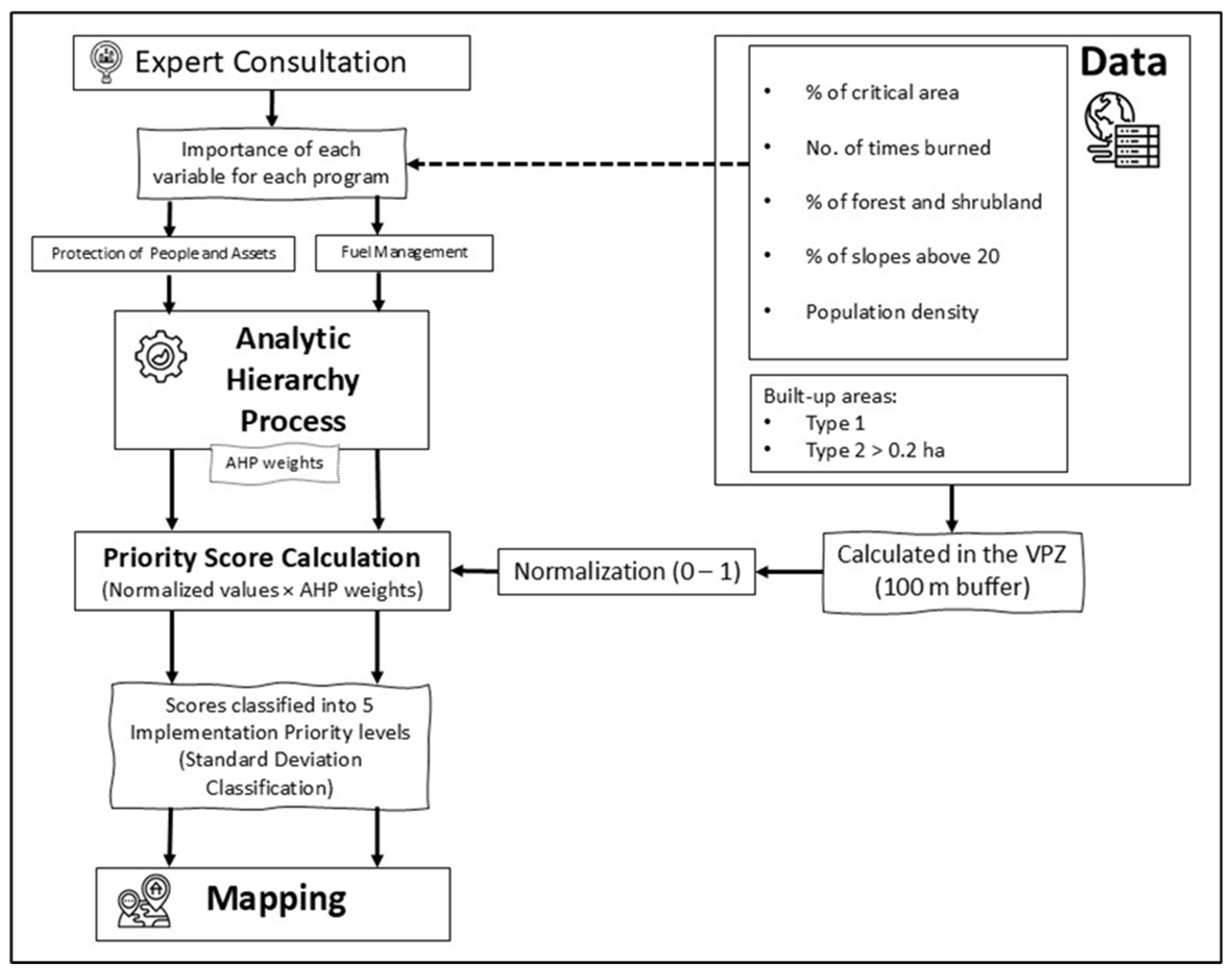
The methodological design of this study (Figure 2) is structured around two Portuguese programs, each corresponding to different wildfire mitigation objectives and operational logics: (i) Protection of People and Assets Programs: Focuses on reducing wildfire-related impacts on human life, buildings, and socio-economic infrastructure. It encompasses civil protection planning, evacuation strategies, early warning systems, and structural defense measures. Exposure in this context is primarily shaped by the spatial distribution of people and buildings in hazardous areas, as well as their proximity to combustible vegetation and accessibility for emergency services. (ii) Fuel Management Programs emphasize the modification of landscape conditions to reduce fire intensity and spread potential. Key interventions include vegetation clearance, prescribed burning, grazing, and the creation of fuel breaks. While the two types of programs overlap spatially, their prioritization criteria differ. For example, a densely populated village surrounded by fuel may be a top priority for protection, while a sparsely populated area with extreme slopes and high fire recurrence may be a top priority for fuel management. This methodological framework enables decision-makers to distinguish between these objectives, supporting more targeted and cost-effective wildfire mitigation strategies, and potentially design more synergistic interventions.
Figure 2.
Methodological workflow for the spatial prioritization of villages according to wildfire mitigation objectives.
The study applies a spatial multi-criteria approach to classify villages according to their relative exposure and intervention needs in both programs. The analysis is based on the Village Protection Zone (VPZ), defined by Decree-Law no. 82/2021 as the 100 m regulatory perimeter surrounding villages where fuel management and protection measures apply. Five core indicators were selected based on their relevance to fire behavior and human exposure, as well as their alignment with national fire-risk mapping systems and spatial planning instruments: (i) Critical area (%): The proportion of the surrounding zone of villages (VPZ) classified as high or very high structural wildfire hazard; (ii) Slope (°): Influences flame length, rate of spread, and accessibility for suppression; (iii) Forest and shrubland cover (%): Proxy for fuel availability in the immediate landscape [2,14,50]; (iv) Population density (residents/ha): Reflects human exposure levels, serving as a proxy for potential evacuation complexity and emergency response [51]; and (v) Fire recurrence: The number of wildfire events occurring within the VPZ from 1975 to 2023, providing insight into the fire history and fire recurrence patterns [52,53]. Fire recurrence was used as an indicator of long-term landscape propensity to burn, reflecting persistent structural conditions, since areas with recurrent fire histories tend to remain fire-prone even after recent burning. Due to the Mediterranean climate with Atlantic influence, these areas tend to rapidly accumulate fuel, particularly understory, where fire intensity may be reduced but can still re-burn in subsequent years. All indicators were calculated within the VPZ. The only parameter that could not be directly extracted from the available variables was the 2021 population density; the method used to obtain it is described below.
2.3.2. Population Estimates for 2021
Since disaggregated population data for the year 2021 were not directly available for the Built-Up Areas (BUA), but only at the parish level, an estimation procedure was applied using the relative population changes observed between the 2011 and 2021 censuses [47,48].The method relies on the assumption that population trends at the parish level can be proportionally applied to the built-up areas within those parishes (1).
The built-up areas dataset, which provides information on 2011 population density and total area (in hectares), was used to estimate the absolute number of residents in each settlement for that year. Based on these values, it was possible to calculate the total population in 2011 for each built-up area and then apply the observed demographic change from 2011 to 2021. This formula (2) is applied to estimate the total resident population in each built-up area (BUA) for the year 2021, based on the population observed in 2011 and the demographic variation at the parish level between 2011 and 2021. It does not compute population density directly. Once the total resident population per BUA is estimated, population density can then be obtained by dividing the estimated population by the area of each respective BUA (2):
2.3.3. Expert Consultation and Analytic Hierarchy Process
To establish the relative importance of the five selected variables within each type of program, a structured expert elicitation process was carried out. A total of 16 specialists participated in this stage, including professional wildfire researchers, civil protection authorities, and forest and land management institutions, ensuring a multidisciplinary perspective grounded in both scientific knowledge and operational experience. Each expert was asked to evaluate the importance of the five variables using a five-point Likert scale, where 1 indicated the least relevant variable and 5 the most critical. Importantly, the assessment was conducted for two separate programs: (1) Protection of People and Assets; (2) Fuel Management. This approach allowed experts to differentiate the role of each factor depending on the specific objectives of the intervention. For example, population density might be seen as essential in prioritizing evacuation planning, while vegetation cover might be more critical in determining fuel reduction needs. Responses were compiled into two independent datasets, one for each type of program, and analyzed using the Analytic Hierarchy Process (AHP), a well-established decision-support method designed to assist in structuring and prioritizing complex, multi-criteria problems.
Originally developed by Thomas L. Saaty in the late 1960s, AHP enables model hierarchical problems by breaking them down into key criteria and comparing them pairwise to determine their relative importance [13]. The AHP unfolds in three main stages [54]: (i) decomposition of the problem into a structured set of criteria, (ii) systematic pairwise comparisons between criteria using a numerical scale of relative importance, and (iii) synthesis of weights by computing eigenvectors or applying least-squares techniques. These steps ensure that subjective expert input is converted into a coherent, quantifiable weighting scheme that can be directly integrated into spatial planning. To apply these weights in a consistent and comparable manner, all variables were normalized to a 0–1 range using min–max rescaling to ensure comparability between indicators expressed in different units and to allow the consistent application of AHP weights in the composite score calculation. After that, each built-up area was assigned a “Implementation Priority” score by multiplying the normalized value of each variable by its respective weight and summing the results. This composite score represents the relative priority of each village for targeted intervention in the two programs.
The classification of implementation priority was based on a standard deviation classification, which allows for the identification of statistically significant distances from the central tendency of the distribution. This approach offers a more robust and interpretable framework than arbitrary or fixed interval classifications, as it anchors the definition of priority levels in the underlying statistical properties of the data. Five priority classes were defined using thresholds at ±0.5 and ±1.5 standard deviations from the mean, corresponding to “Very Low,” “Low,” “Moderate,” “High,” and “Very High” categories. This scheme is particularly suitable for wildfire risk contexts where exposure and hazard are highly skewed and spatially heterogeneous, as it highlights areas that stand out in relation to the broader distribution rather than forcing equal proportions into each class.
The classification was applied at two distinct analytical scales, reflecting different decision-making logics. At the municipal scale, the classification was based on local means and standard deviations, capturing intra-municipal variability and enabling the identification of priority villages relative to the specific territorial, demographic, and hazard context of each municipality. This scale corresponds to the operational level at which most wildfire prevention and protection programs are currently designed and implemented in Portugal. At the national scale, the same standard deviation classification was applied to the entire dataset of villages across the eight municipalities, using overall mean and standard deviation values. This broader perspective allows for a critical comparison between municipalities, exposing how local priorities align, or diverge, from regional patterns of hazard and exposure. Importantly, this dual approach enables the identification of villages that may appear as high priority in local terms but are relatively less critical in the broader regional context, and vice versa. Such differences reveal the scalar sensitivity of prioritization outcomes and underscore the potential trade-offs between operational feasibility at local scales and strategic coherence at broader territorial scales. This issue is particularly relevant in contexts where the responsibility for wildfire mitigation is shared across multiple governance levels: a village classified as “high priority” within a low-hazard municipality may not warrant the same urgency when compared to “moderate” priority villages located in municipalities with structurally higher exposure and hazard levels. Explicitly distinguishing between municipal and regional classifications therefore helps to avoid misleading equivalences and supports more transparent and technically grounded decision-making across scales.
Additionally, descriptive statistics of fire recurrence were calculated for each national scale priority class to verify the consistency of the model outputs in relation to fire history.
3. Results
The final weights of each variable, derived through AHP, reflect different priorities depending on the strategic focus of the program (Table 3).
Table 3.
Relative weights assigned to each indicator according to policy objective, based on expert evaluation using the Analytic Hierarchy Process (AHP). The weights were derived separately for two strategic wildfire mitigation programs—Protection of People and Assets, and Fuel Management—and reflect the perceived importance of each variable (critical area, forest and shrubland cover, population density, fire recurrence, and slope) in supporting spatial prioritization.
3.1. Municipality Scale Analysis
The application of the multi-criteria analysis model reveals significant territorial variation in composite scores, as well as notable differences in the distribution of assigned priorities depending on the programmatic objective.
The normalized scores (Table 4) indicate distinct patterns of priority between municipalities, both in terms of average values and range. Municipalities with extensive critical areas and high forest cover, such as Monchique and Oliveira do Hospital, present the highest mean scores in both programs (Monchique: SP = 0.433; FM = 0.448; Oliveira do Hospital: SP = 0.366; FM = 0.338). In contrast, municipalities like Alcoutim, Mortágua, and Alvaiázere show mean values below 0.20, reflecting lower exposure. Score dispersion, measured by standard deviation, is more pronounced in municipalities characterized by heterogeneity in settlement patterns and land use. A particularly noteworthy case is Figueiró dos Vinhos, where the standard deviation reaches 0.193 in both programs, indicating high intra-municipal variability in exposure and wildfire hazard.
Table 4.
Descriptive statistics of implementation priority scores by municipality and program objective. Summary of weights for both Protection of People and Assets (SP) and Fuel Management (FM) programs across eight municipalities. For each municipality and program, the number of villages, minimum and maximum scores, mean score, and standard deviation are presented.
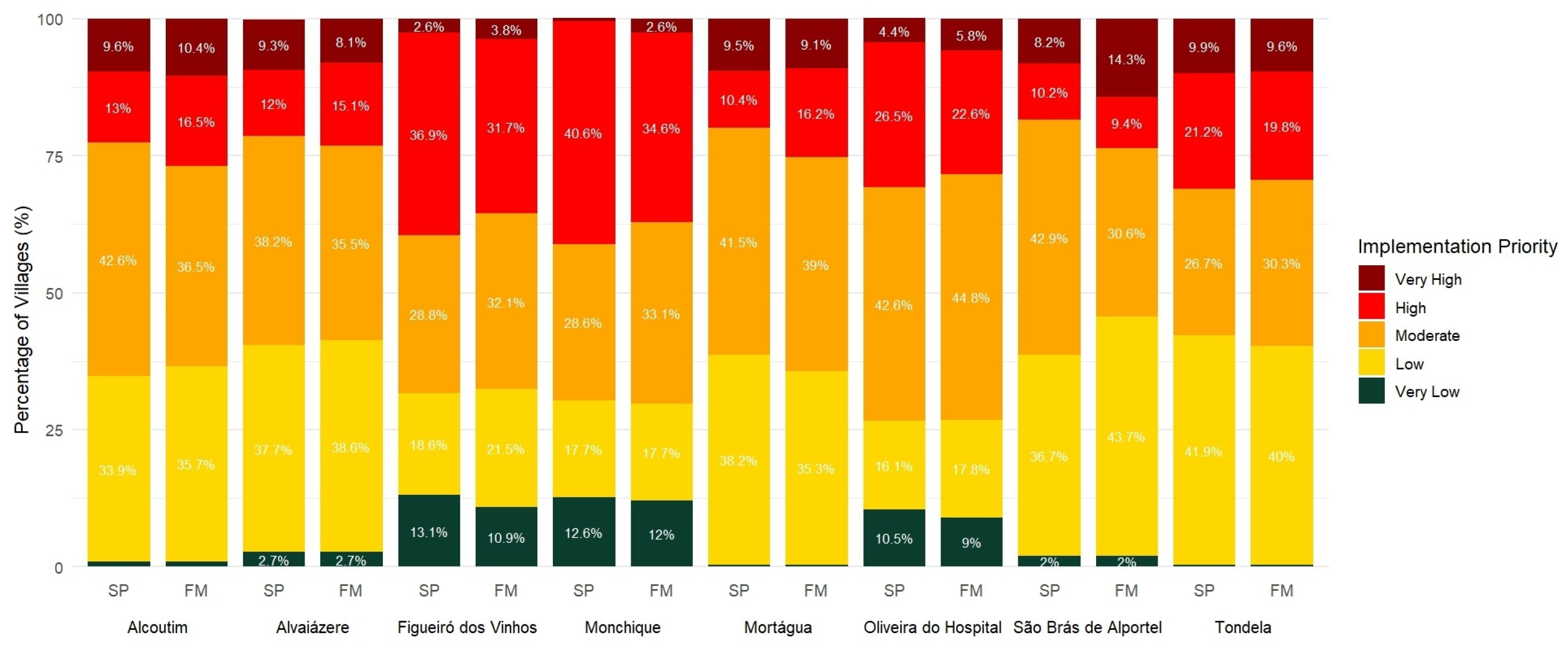
Figure 3 presents the distribution of villages across priority classes for each municipality and program, based on the standard deviation classification. The results show clear differences between municipalities, as well as internal variations within some of them. Monchique has the highest concentration of villages in the upper priority classes, with more than 40% of villages classified as “High” or “Very High” for the protection of people and assets program. Oliveira do Hospital shows a similar pattern, with a substantial proportion of villages also falling into the two upper classes for both programs. These results confirm that the classification method used can capture stable structural differences between municipalities with high and persistent risk conditions. Figueiró dos Vinhos and Monchique displays a different pattern, with a wide distribution of villages across all classes, including both “Very Low” and “High” categories. This indicates a high level of internal variation, linked to the coexistence of sparsely populated vegetated areas and more exposed villages nuclei within the same municipality. Such contrasts are important for operational planning, as they reveal areas that require different types of intervention. In São Brás de Alportel, 14.3% of villages fall into the “Very High” category for the fuel management program, despite the municipality’s overall lower hazard profile. This points to the presence of specific local clusters where physical conditions strongly increase hazard level relative to the surrounding area. Finally, municipalities with a large number of villages, such as Tondela and Alvaiázere, have most of their villages in the lower and moderate categories.
Figure 3.
Distribution of implementation priority classes (%) by municipality and program. The figure shows the percentage of built-up areas (villages) classified in each priority category (Very Low, Low, Moderate, High, Very High) for the two operational programs: SP (Protection of People and Assets) and FM (Fuel Management). The values reflect the relative distribution of priority classes within the 100 m buffer around built-up areas, derived through AHP-based multi-criteria analysis and standard deviation classification.
The overlap between the two programs (Table 5), measured by class coincidence, is high, ranging from 79% in Alcoutim to 90% in Alvaiázere and Oliveira do Hospital. This strong correspondence suggests that, despite their distinct objectives, the physical and social criteria considered in both models lead to partially convergent exposure patterns. However, between 10% and 21% of villages, depending on the municipality, change class between the two programs. These changes occur predominantly between adjacent classes (e.g., 2 → 3 or 3 → 4), showing that small differences in variable weightings can influence the final classification. The most frequent transitions are observed in Figueiró dos Vinhos, Monchique, Mortágua, and São Brás de Alportel, where systematic shifts between adjacent classes occur. Alcoutim shows the lowest level of coincidence, with frequent 4 → 3 transitions, while Alvaiázere, Oliveira do Hospital, and Tondela display the highest levels of agreement, with most villages classified in 2 × 2.
Table 5.
Comparison between Fuel Management (FM) and Protection of People and Assets (SP) program classifications, by municipality.
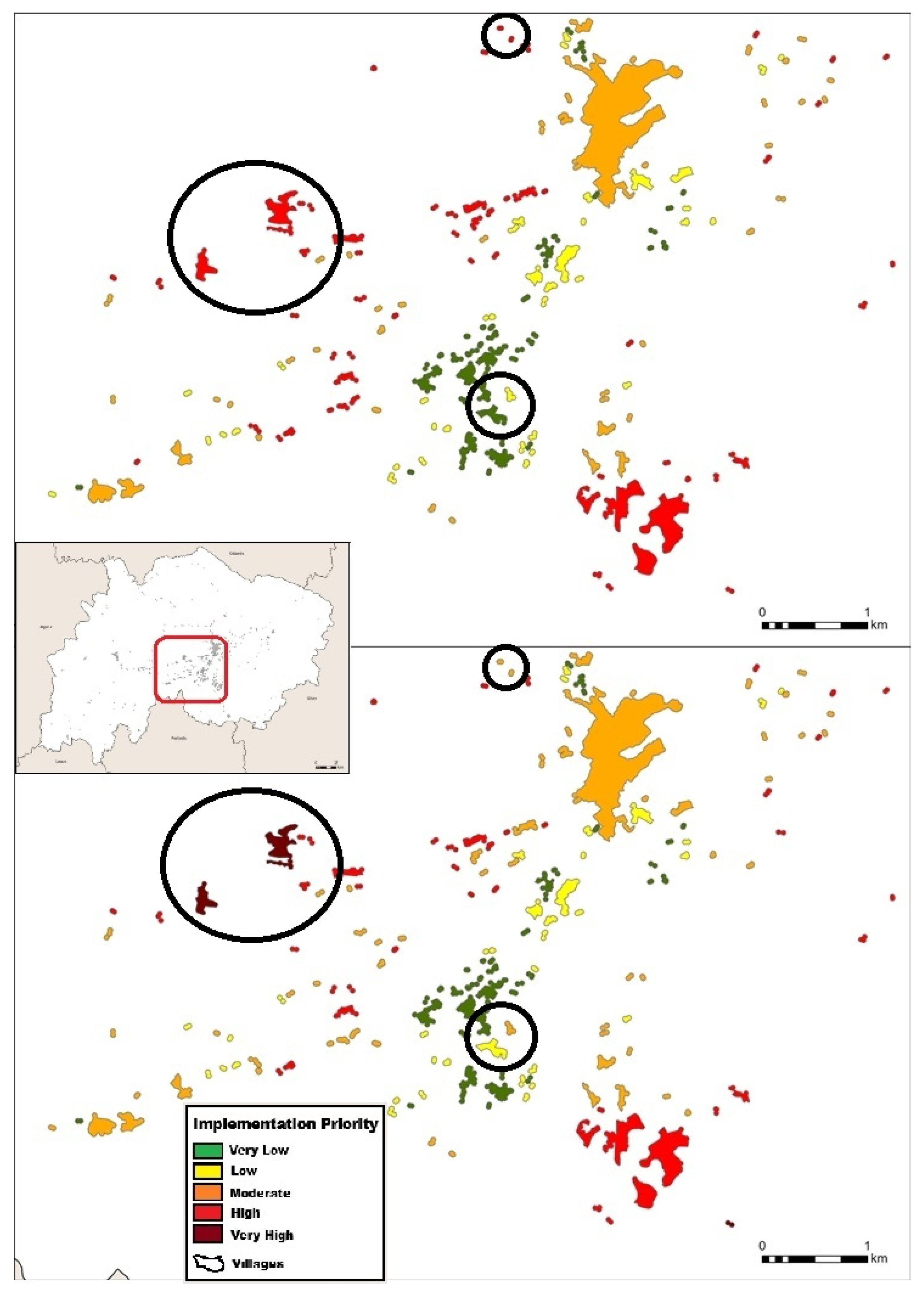
To complement Table 5, Figure 4 and Figure 5 show the locations of class changes between the two programs for two selected municipalities: Figueiró dos Vinhos and Monchique. This figure provides a clear visual overview of where and how the classifications differ. In Monchique (Figure 4), both programs display large, contiguous clusters of villages classified in the two upper priority classes, with only minor local shifts between adjacent categories. In Figueiró dos Vinhos (Figure 5), strong local variability is visible, with adjacent villages often assigned to different classes, particularly in the FM program.
Figure 4.
Spatial distribution of implementation priority classes for villages in Monchique, according to the two operational programs: (up) Protection of People and Assets, and (down) Fuel Management. The maps show the classification of built-up area buffers (100 m) into five priority categories (Very Low, Low, Moderate, High, and Very High), based on AHP-derived multi-criteria analysis and standard deviation classification.
Figure 5.
Spatial distribution of implementation priority classes for villages in Figueiró dos Vinhos, according to the two operational programs: (left) Protection of People and Assets, and (right) Fuel Management. The maps show the classification of built-up area buffers (100 m) into five priority categories (Very Low, Low, Moderate, High, and Very High), based on AHP-derived multi-criteria analysis and standard deviation classification.
3.2. National-Scale Analysis
At the national scale, the classification was applied to the entire dataset of 2928 villages existing in the eight studied municipalities, using overall mean and standard deviation values. For the Protection of People and Assets program (SP), priority scores range from 0 to 0.742, with a mean of 0.212 and a standard deviation of 0.183. For the Fuel Management program (FM), the range is similar (0 to 0.754), with a slightly higher mean of 0.222 and a standard deviation of 0.181. These distributions are positively skewed, with most villages concentrated in the lower part of the distribution and a smaller number of villages displaying markedly higher scores.
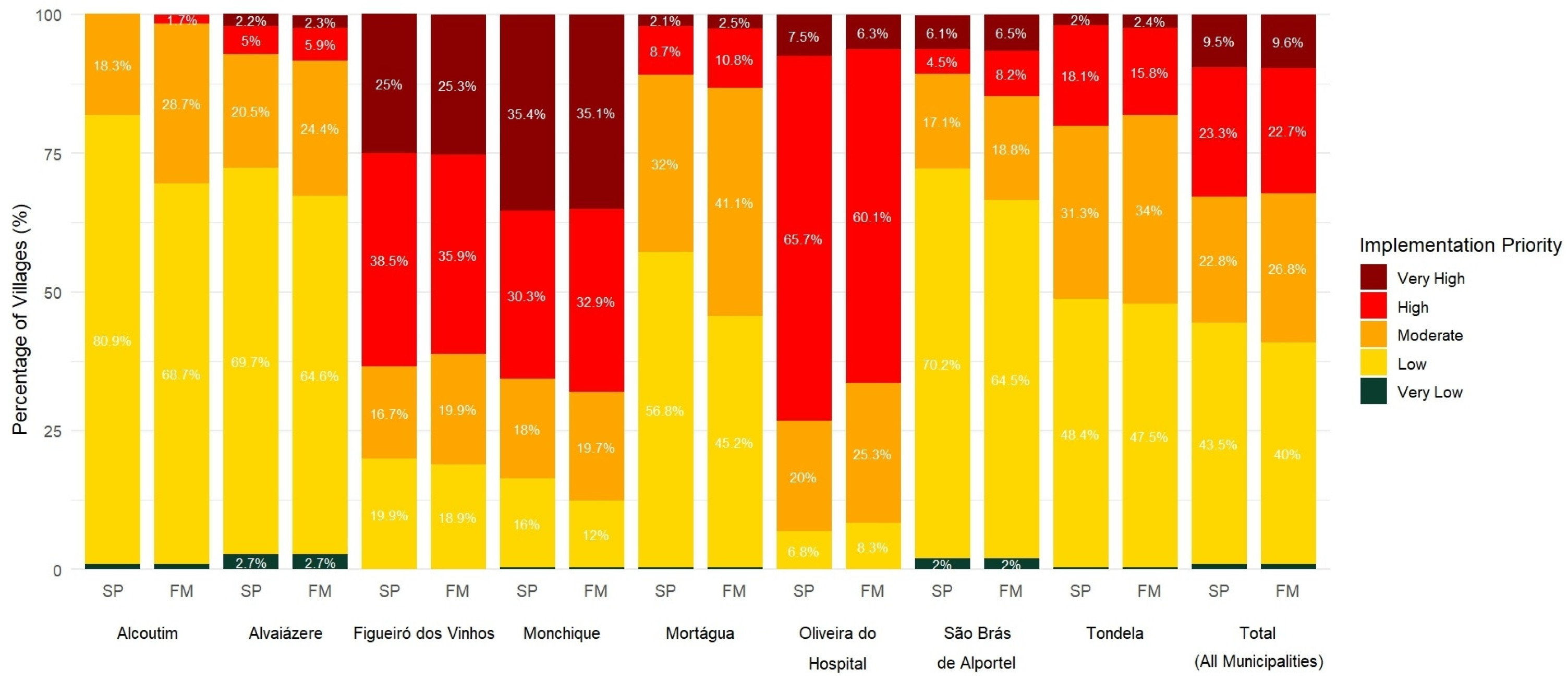
The classification results reflect this pattern. In the SP program, 0.9% of villages fall into the “Very Low” category, 43.5% into “Low,” 22.8% into “Moderate,” 23.3% into “High,” and 9.5% into “Very High.” The FM program shows a similar structure, with 0.9% classified as “Very Low,” 40% as “Low,” 26.8% as “Moderate,” 22.7% as “High,” and 9.6% as “Very High.” This indicates that most villages are in lower-priority categories, while a relatively small group concentrates the highest levels of exposure and hazard, standing out clearly from the national distribution.
The cross-classification between the two programs shows a high level of agreement. Most villages are classified in the same category in both programs, with transitions mainly occurring between adjacent classes (for example, between “Low” and “Moderate” or between “Moderate” and “High”). Out of the 2928 villages, 1145 are consistently classified as “Low” in both programs, 598 as “Moderate,” 604 as “High,” and 262 as “Very High.”
When analyzing the national scale by municipality (Figure 6), distinct patterns emerge. Oliveira do Hospital, Monchique, and Figueiró dos Vinhos concentrate a large share of villages in the two upper priority classes. In Oliveira do Hospital, more than 65% of villages are classified as “High” in the SP program and 60% in the FM program. Monchique shows a similarly high proportion of villages in the “High” and “Very High” categories, exceeding 65% in total, while Figueiró dos Vinhos also has more than 60% in the upper classes in both programs. In contrast, Alcoutim and Alvaiázere show a predominance of “Low”-priority villages, exceeding 65% in both programs, reflecting regionally lower exposure levels. Mortágua and Tondela present a more balanced distribution, with a significant concentration in the “Moderate” category and smaller shares in “High.”
Figure 6.
Distribution of implementation priority classes (%) by municipality and program at the national scale. The figure shows the percentage of built-up areas (villages) classified in each priority category (Very Low, Low, Moderate, High, Very High) for the two operational programs: SP (Protection of People and Assets) and FM (Fuel Management). The values reflect the relative distribution of priority classes within the 100 m buffer around built-up areas, derived through AHP-based multi-criteria analysis and standard deviation classification.
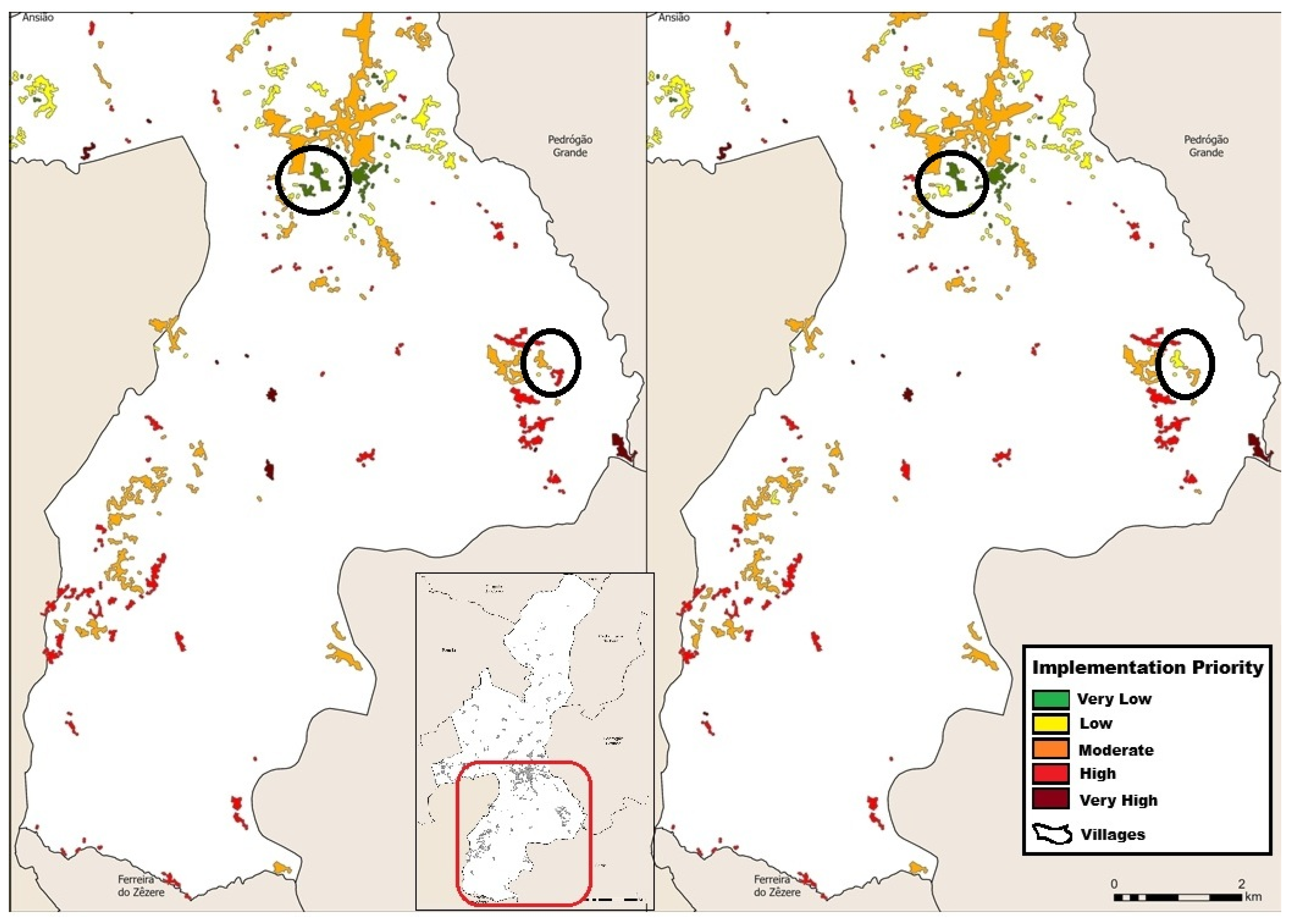
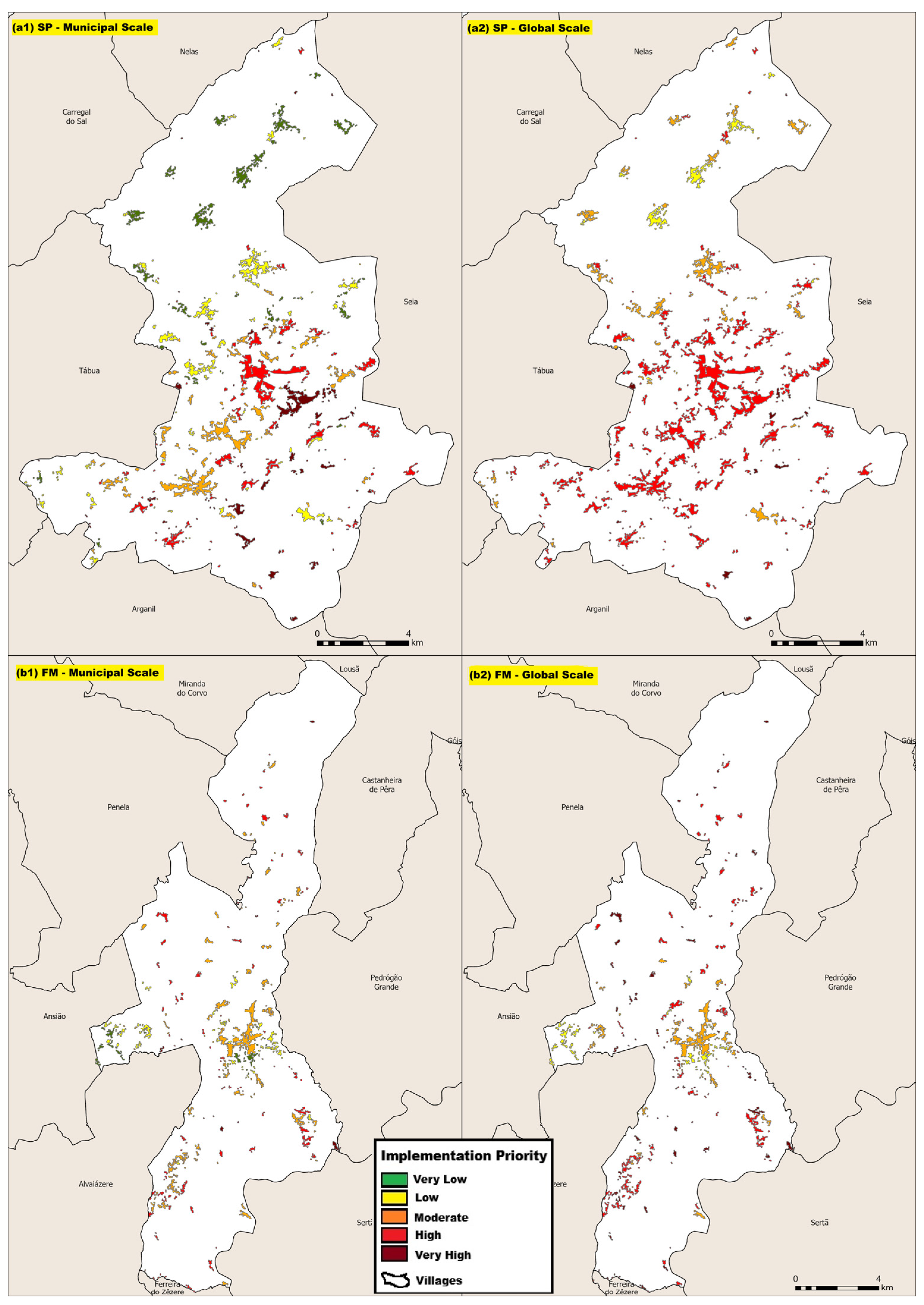
When all municipalities are analyzed together, a clear redistribution of the overall priority structure emerges, marked by a relative increase in the proportion of the high- and very-high-priority classes. This shift reflects the influence of a subset of municipalities with extensive areas classified in the upper categories, most notably Monchique, Oliveira do Hospital (Figure 7a) and Figueiró dos Vinhos (Figure 7b). In these municipalities, critical classes account for a substantial share of the total area, which significantly shapes the aggregated distribution and amplifies the representation of higher priority levels. Conversely, municipalities such as Alcoutim exhibit a markedly different profile: the predominance of low and moderate classes at the municipal scale translates into a limited contribution to the upper priority classes in the overall analysis. As a result, their influence on the aggregated structure remains marginal when compared to municipalities with more extensive critical areas.
Figure 7.
Spatial distribution of implementation priority classes at municipal and national scales for the two operational programs: Oliveira do Hospital: (a1) SP—Municipal Scale; (a2) SP—National Scale; Figueiró dos Vinhos: (b1) FM—Municipal Scale; (b2) FM—National Scale. The maps show the classification of 100 m buffers around built-up areas into five priority categories (Very Low, Low, Moderate, High, Very High) using AHP-based multi-criteria analysis and standard deviation classification.
A comparison between the municipal-scale and national-scale classifications (Figure 3 and Figure 6) reveals systematic differences in how implementation priorities are distributed across municipalities, depending on the spatial reference used for standard deviation classification. At the municipal scale, priority classes are defined relative to the internal score distribution of each municipality, which enhances local contrasts and highlights intra-municipal variability. As a result, municipalities such as Mortágua, Tondela and Alvaiázere display a predominance of low and moderate classes, while still containing locally relevant high-priority clusters. In contrast, when the national-scale classification is applied, using the overall mean and standard deviation of the entire dataset, municipalities with structurally high exposure, such as Monchique, Oliveira do Hospital and Figueiró dos Vinhos, concentrate a much larger share of villages in the upper-priority classes, exceeding 60–65% of villages classified as High or Very High in both programs. Conversely, municipalities with lower absolute hazard levels, such as Alcoutim and Alvaiázere, contribute marginally to the national high-priority classes, despite containing locally high-priority villages under the municipal-scale approach. This contrast demonstrates that municipal-scale classification is more sensitive to local heterogeneity and relative exposure patterns, whereas national-scale classification emphasizes absolute risk levels and systematically prioritizes structurally high-risk territories. Together, the two perspectives provide complementary information, supporting both operational planning at the local level and strategic prioritization at broader spatial scales.
Relationship Between Fire Recurrence and Implementation Priority Classes
To provide an empirical verification of the reliability of the framework, descriptive statistics of fire recurrence were analyzed across the five implementation priority classes for both operational programs. Results show a consistent increase in fire recurrence from lower- to higher-priority classes (Table 6), indicating a positive association between implementation priority scores and the number of times burned. For both programs, villages classified in priority class 1 present zero minimum, mean, and median values of fire recurrence, whereas classes 2 and 3 show low central tendency values. Priority classes 4 and 5 exhibit higher maximum, mean, and median numbers of past wildfire events. This pattern indicates that villages assigned to higher-priority classes are generally located in areas with more frequent historical burning, supporting the capacity of the framework to capture long-term landscape propensity to burn and providing an internal validation of the model outputs based on independent historical fire information.
Table 6.
Descriptive statistics of fire recurrence (No of times burned in the VPZ) by implementation priority class for the Protection of People and Assets (SP) and Fuel Management (FM) programs. For each priority class and program, the minimum, maximum, mean, and median number of times burned are presented.
4. Discussion
The spatial multi-criteria framework developed in this study, grounded in expert knowledge, offers new empirical insights into the territorial configuration of wildfire hazard and exposure in Portuguese rural landscapes. By integrating biophysical and social indicators through the Analytic Hierarchy Process (AHP) and applying the model at two complementary spatial scales, this work highlights both persistent structural patterns and context-dependent variations that are often overlooked in existing policy frameworks. More broadly, it demonstrates how structured, data-driven approaches can provide a technically robust basis for the prioritization of wildfire mitigation programs in resource-constrained contexts.
4.1. Territorial Patterns and Intra-Municipal Variability
At the municipal scale, the results revealed clear contrasts in priority classes between territories. Monchique, Oliveira do Hospital, and Figueiró dos Vinhos consistently emerge as high-priority municipalities under both Protection of People and Assets and Fuel Management programs. These municipalities combine extensive critical areas, continuous forest and shrubland cover and a long history of recurrent wildfires, generating structurally hazardous landscapes that systematically concentrate high-priority classes. These findings are consistent with previous assessments of wildfire risk in Portugal, which have repeatedly identified these areas as recurrent hotspots of extreme fire behavior and community exposure [8,13,16]. Conversely, municipalities such as Alcoutim, and to a lesser extent Mortágua and Alvaiázere, display predominantly low or moderate priority levels, reflecting structurally lower exposure and hazard configurations, which are partly associated with a higher proportion of agricultural land. This differentiation underscores the framework’s capacity to represent territorial specificities that are often masked by national-scale hazard assessments [39]. A particularly relevant outcome is the marked internal variability within certain municipalities, especially Figueiró dos Vinhos, where priority classes span from “Very Low” to “High” within a relatively small territory. This intra-municipal heterogeneity mirrors the coexistence of sparsely populated vegetated areas and more consolidated village nuclei embedded in flammable landscapes. Such fine-grained contrasts are rarely captured in aggregated hazard maps or administrative classifications, yet they are operationally decisive: high-density villages requiring evacuation planning and structural protection often coexist with low-exposure areas within the same administrative unit. Similar patterns of localized variability have been documented in Mediterranean and North American contexts, where small-scale differences in slope, vegetation structure, or built morphology strongly influence wildfire risk configurations [14,22,50].
4.2. Scale Effects and Resource Allocation
The national-scale analysis highlights how a small subset of municipalities disproportionately shapes the overall distribution of priority classes. When all municipalities are analyzed together, the relative weight of “High” and “Very High” categories increases substantially, driven by municipalities with consistently high hazard levels, such as Monchique, Figueiró dos Vinhos, and Oliveira do Hospital. This dynamic illustrates how aggregated prioritization frameworks can be skewed by extreme cases, potentially overshadowing smaller but locally relevant hotspots in overall less exposed territories. Similar concentration effects have been identified in prioritization studies elsewhere [36,43], raising critical questions about equity in resource allocation between structurally high-risk and moderately exposed areas. Importantly, the current analysis was conducted at the municipal scale, which, while essential for capturing social, historical, and physical specificities, does not allow direct comparison between municipalities. For example, villages in Alcoutim may appear as high priority within their municipality, even though their absolute hazard levels are far lower than those observed in Monchique. A national-scale prioritization layer would therefore complement municipal assessments, enabling coherent and equitable resource allocation across regions and ensuring that resources are directed primarily to areas with the highest hazard, especially considering the constraints in financial, operational, and human resources available for wildfire management. Nonetheless, municipal-level analysis remains indispensable, because it is at this scale that most of the programs are implemented, communities are mobilized, and interventions are executed. Municipal analyses capture local institutional capacities and historical legacies, ensuring that planning aligns with prevailing administrative frameworks. The ideal configuration is a multi-level decision system: national or regional prioritization provides strategic coherence, while municipal prioritization supports operational effectiveness.
4.3. Program-Specific Priorities and Unexpected Patterns
The comparison between Protection of People and Assets and Fuel Management programs reveals both convergence and divergence. High levels of class overlap (79–90%) across municipalities confirm that, despite distinct objectives, both programs are shaped by overlapping hazard and exposure patterns. This aligns with international evidence showing that wildfire hazard and exposure often co-exist, particularly in more densely vegetated interfaces [23,44]. However, between 10% and 21% of villages change class between programs. These shifts, typically between adjacent categories, arise from differences in indicator weightings, such as greater emphasis on population density for protection versus vegetation structure for fuel management and highlight the importance of maintaining program-specific prioritization criteria rather than relying on a single undifferentiated risk index. The distinction between programs is not merely technical but operationally significant. Villages which have low population densities but are surrounded by dense vegetation and/or have high fire recurrence (e.g., in Alcoutim or Mortágua) emerge as priorities for fuel management, whereas densely villages located in high-exposure areas (e.g., in Figueiró dos Vinhos or São Brás de Alportel) are prioritized for the protection of people and assets. These patterns reflect broader transformations in fire regimes linked to climate change, land-use transitions, and rural abandonment [2,11]. As argued by Bergonse et al. (2022) [16], incorporating social factors is crucial for understanding local risk, since biophysical hazard alone does not fully explain the distribution of impacts.
Unexpected spatial patterns reinforce this point. In Alcoutim and parts of Mortágua, sparsely populated villages surrounded by continuous vegetation and with frequent fire histories were classified as high fuel management priority despite low population densities, capturing landscape-driven hazard dynamics. Conversely, in São Brás de Alportel and in consolidated clusters within Figueiró dos Vinhos, villages with moderate fire recurrence but higher population densities were assigned high protection priorities. These cases illustrate how similar risk levels may emerge from different structural configurations, underscoring the value of disaggregated, program-specific approaches.
4.4. Methodological Considerations and Limitations
Methodologically, the use of AHP proved effective for operationalizing prioritization under uncertainty. Expert-derived weights allowed the explicit incorporation of professional knowledge regarding the relative importance of indicators, ensuring transparency and replicability. This aligns with calls in the literature for participatory weighting processes to enhance the legitimacy and consistency of prioritization frameworks [22,23]. Moreover, applying standard deviation classification, rather than fixed thresholds or quantiles, enabled statistically grounded class definitions suitable for positively skewed wildfire hazard distributions. Nevertheless, some limitations must be acknowledged. Population estimates at the village level were derived indirectly from parish-level changes, introducing uncertainty in exposure calculations. The set of indicators, while relevant, did not include infrastructural accessibility, suppression capacity, or detailed social vulnerability data. Moreover, this analysis was applied to eight municipalities representing different Portuguese regions, but not the full national diversity. Future research should improve demographic data resolution, integrate additional variables related to suppression and vulnerability, and scale up the analysis nationally. Longitudinal analyses could further examine how changes in land use, vegetation, and demographic dynamics alter prioritization over time, supporting adaptive management strategies. Another limitation relates to the simplified representation of wildfire processes through a reduced number of indicators. Some variables used in the model act as proxies for more complex characteristics. For instance, forest and shrubland cover is used as an approximation of fuel availability and continuity, although these properties are influenced by vegetation structure, species composition, management history, and time since the last fire, which are not explicitly accounted for. This simplification may lead to local inaccuracies in representing fuel conditions. However, this choice was intentional and reflects the objective of developing a simple and operational methodology based on variables that are easily accessible and derived from official datasets, facilitating replication and practical application.
4.5. Policy and Operational Implications
From an operational perspective, the findings underscore the limitations of reactive, discretionary prioritization practices, which have produced misalignments between hazard levels and intervention coverage in Portugal [39]. By contrast, the proposed framework provides a transparent, spatially explicit basis for guiding wildfire mitigation programs such as Safe Villages, Safe People (SF programs) and Condominium of Villages (FM program). Its ability to differentiate between programmatic priorities, capture intra-municipal heterogeneity, and highlight structural hotspots across multiple scales makes it a valuable decision-support tool for municipal, intermunicipal, and regional authorities. Recent research has evaluated the implementation and territorial distribution of the “Safe Villages” and “Safe People” programs, confirming their national framework while also highlighting significant local heterogeneity, financial and operational constraints, political dependency, and uneven community engagement [25,55,56,57,58]. These studies underscore the need to complement such programs with robust, data-driven prioritization tools capable of guiding spatial targeting, promoting fairness, and optimizing resource allocation in wildfire-prone territories. More broadly, the study contributes to international debates on wildfire governance by demonstrating how multi-criteria spatial analysis can operationalize planning based on risk assessment within complex socioecological systems. The comparison with Benali et al. (2023) [39] is particularly relevant: fewer than 1% of “very-high-risk” villages received interventions after 2017, illustrating the consequences of lacking prioritization frameworks. Similar issues have been documented in the United States, where decisions often become reactive and politically driven in the absence of systematic prioritization [36,38]. The model proposed here offers a potential corrective, providing a structured, technically defensible foundation for spatial prioritization at multiple governance levels.
5. Conclusions
The increasing severity and frequency of wildfires in Portugal require decision-support frameworks capable of integrating physical, social, and territorial dimensions of risk and supporting transparent and efficient prioritization of interventions. This study proposes a multicriteria decision analysis (AHP) approach combined with geospatial data to classify and rank villages according to two operational objectives: protection of people and assets, and fuel management. Applied to eight municipalities across different Portuguese regions, the framework revealed strong territorial contrasts and significant intra-municipal variability. The results showed that, while there is significant convergence between the two classification programs, relevant variations also exist between villages depending on their biophysical and social profiles. This differentiation is critical for guiding more targeted and effective interventions, particularly in contexts of high exposure and resource scarcity. The proposed model demonstrated the ability to capture these nuances and generate a priority map with sufficient resolution to support both local planning and broader prevention strategies. Importantly, the dual-scale analysis (municipal and regional) underscores the necessity of combining strategic prioritization at higher scales with operational planning at the local level. The main contribution of this study lies in translating risk assessment into spatial planning practice through a clear, replicable, and adaptable methodology that is applicable to different territorial contexts. At the same time, this work reinforces evidence that has already been highlighted in national and international literature, particularly regarding the misalignment between actual risk levels and mitigation actions, and the need to strengthen the technical foundation of political decisions in civil protection and forest management. This study confirms that it is both possible (and necessary) to integrate spatial data, technical criteria, and local knowledge to respond more effectively to the challenge of wildfires. In doing so, it offers a robust decision-support tool that can inform programs such as “Safe Villages” and “Safe People” and “Condominium of Villages”, helping to move away from reactive, discretionary practices towards systematic, risk-informed prioritization. Beyond its national relevance, the framework provides a methodological contribution to international debates on risk-informed spatial planning in complex socioecological systems.
Author Contributions
Conceptualization, A.G., S.O. and J.L.Z.; methodology, A.G., S.O. and J.L.Z.; software, A.G.; validation, A.G., D.M.P., S.O. and J.L.Z.; formal analysis, A.G., S.O. and J.L.Z.; investigation, A.G., S.O. and J.L.Z.; data curation, A.G.; writing—original draft preparation, A.G.; writing—review and editing, A.G., D.M.P., S.O. and J.L.Z.; visualization, A.G., S.O. and J.L.Z.; supervision, S.O. and J.L.Z. All authors have read and agreed to the published version of the manuscript.
Funding
This work was supported by the Fundação para a Ciência e a Tecnologia, I.P. [grant numbers: 2020.07651.BD; 2020.03873.CEECIND; UID/00295/2025, https://doi.org/10.54499/UID/00295/2025].
Data Availability Statement
The data presented in this study is available on request from the corresponding author.
Conflicts of Interest
The authors declare no conflicts of interest.
References
- Schmuck, G.; San-Miguel-Ayanz, J.; Durrant, T.; Boca, R.; Libertà, G.; Petroliagkis, T.; Di Leo, M.; Rodrigues, D.; Boccacci, F.; Schulte, E. Forest Fires in Europe, Middle East and North Africa 2014; Publications Office of the European Union: Luxembourg, 2015. [Google Scholar] [CrossRef]
- Chuvieco, E.; Yebra, M.; Martino, S.; Thonicke, K.; Gómez-Giménez, M.; San-Miguel, J.; Oom, D.; Velea, R.; Mouillot, F.; Molina, J.R.; et al. Towards an Integrated Approach to Wildfire Risk Assessment: When, Where, What and How May the Landscapes Burn. Fire 2023, 6, 215. [Google Scholar] [CrossRef]
- Dupuy, J.-L.; Fargeon, H.; Martin-StPaul, N.; Pimont, F.; Ruffault, J.; Guijarro, M.; Hernando, C.; Madrigal, J.; Fernandes, P. Climate change impact on future wildfire danger and activity in southern Europe: A review. Ann. For. Sci. 2020, 77, 35. [Google Scholar] [CrossRef]
- Aragoneses, E.; Chuvieco, E. Generation and mapping of fuel types for fire risk assessment. Fire 2021, 4, 59. [Google Scholar] [CrossRef]
- Morton, D.C.; Bond-lamberty, B. Amazon forest fires projected to increase by an order of magnitude under climate change and agricultural expansion. Earth Syst. Dyn. 2017, 8, 1237–1246. [Google Scholar]
- San-Miguel-Ayanz, J.; Durrant, T.; Boca, R.; Maianti, P.; Liberta, G.; Jacome Felix Oom, D.; Branco, A.; De Rigo, D.; Suarez-Moreno, M.; Ferrari, D.; et al. Forest Fires in Europe, Middle East and North Africa 2023; Publications Office of the European Union: Luxembourg, 2024. [Google Scholar] [CrossRef]
- San-Miguel-Ayanz, J.; Durrant, T.; Boca, R.; Libertà, G.; Branco, A.; De Rigo, D.; Ferrari, D.; Maianti, P.; Artes Vivancos, T.; Costa, H.; et al. Forest Fires in Europe, Middle East and North Africa 2017; Publications Office of the European Union: Luxembourg, 2018. [Google Scholar] [CrossRef]
- Oliveira, S.; Gonçalves, A.; Benali, A.; Sá, A.; Zêzere, J.L.; Pereira, J.M. Assessing risk and prioritizing safety interventions in human settlements affected by large wildfires. Forests 2020, 11, 859. [Google Scholar] [CrossRef]
- Benali, A.; Sá, A.C.L.; Pinho, J.; Fernandes, P.M.; Pereira, J.M.C. Understanding the Impact of Different Landscape-Level Fuel Management Strategies on Wildfire Hazard in Central Portugal. Forests 2021, 12, 522. [Google Scholar] [CrossRef]
- CTI. Avaliação Dos Incêndios Ocorridos Entre 14 E 16 de Outubro de 2017 Em Portugal Continental. 2018. Available online: https://www.parlamento.pt/Documents/2018/Marco/RelatorioCTI190318N.pdf (accessed on 13 October 2025).
- Tedim, F.; Leone, V.; Amraoui, M.; Bouillon, C.; Coughlan, M.R.; Delogu, G.M.; Fernandes, P.M.; Ferreira, C.; McCaffrey, S.; McGee, T.K.; et al. Defining extreme wildfire events: Difficulties, challenges, and impacts. Fire 2018, 1, 9. [Google Scholar] [CrossRef]
- OECD. Taming Wildfires in the Context of Climate Change: The Case of Portugal, 37th ed.; OECD Publishing: Paris, France, 2023. [Google Scholar] [CrossRef]
- Nunes, A.N.; Figueiredo, A.; Pinto, C.D.; Lourenço, L. An Evaluation of Wildfire Vulnerability in the Wildland–Urban Interfaces of Central Portugal Using the Analytic Network Process. Fire 2023, 6, 194. [Google Scholar] [CrossRef]
- Fox, D.; Carrega, P.; Ren, Y.; Caillouet, P.; Bouillon, C.; Robert, S. How wildfire risk is related to urban planning and Fire Weather Index in SE France (1990–2013). Sci. Total Environ. 2018, 621, 120–129. [Google Scholar] [CrossRef]
- Argañaraz, J.; Radeloff, V.; Bar-Massada, A.; Gavier-Pizarro, G.; Scavuzzo, C.; Bellis, L. Assessing wildfire exposure in the Wildland-Urban Interface area of the mountains of central Argentina. J. Environ. Manag. 2017, 196, 499–510. [Google Scholar] [CrossRef]
- Bergonse, R.; Oliveira, S.; Santos, P.; Zêzere, J.L. Wildfire Risk Levels at the Local Scale: Assessing the Relative Influence of Hazard, Exposure, and Social Vulnerability. Fire 2022, 5, 166. [Google Scholar] [CrossRef]
- Badia, A.; Pallares-Barbera, M.; Valldeperas, N.; Gisbert, M. Wildfires in the wildland-urban interface in Catalonia: Vulnerability analysis based on land use and land cover change. Sci. Total Environ. 2019, 673, 184–196. [Google Scholar] [CrossRef]
- Mendes, J.M.; Tavares, A.O.; Santos, P.P. Social vulnerability and local level assessments: A new approach for planning. Int. J. Disaster Resil. Built Environ. 2020, 11, 15–43. [Google Scholar] [CrossRef]
- Parente, J.; Pereira, M.; Amraoui, M.; Fischer, E. Fischer, Heat waves in Portugal: Current regime, changes in future climate and impacts on extreme wildfires. Sci. Total Environ. 2018, 631–632, 534–549. [Google Scholar] [CrossRef] [PubMed]
- McGee, T.K. Public engagement in neighbourhood level wildfire mitigation and preparedness: Case studies from Canada, the US and Australia. J. Environ. Manag. 2011, 92, 2524–2532. [Google Scholar] [CrossRef] [PubMed]
- Hoffman, K.M.; Christianson, A.C.; Dickson-Hoyle, S.; Copes-Gerbitz, K.; Nikolakis, W.; Diabo, D.A.; McLeod, R.; Michell, H.J.; Al Mamun, A.; Zahara, A.; et al. The right to burn: Barriers and opportunities for Indigenous-led fire stewardship in Canada. Facets 2022, 7, 464–481. [Google Scholar] [CrossRef]
- Ager, A.A.; Kline, J.D.; Fischer, A.P. Fischer, Coupling the Biophysical and Social Dimensions of Wildfire Risk to Improve Wildfire Mitigation Planning. Risk Anal. 2015, 35, 1393–1406. [Google Scholar] [CrossRef]
- Kirschner, J.A.; Clark, J.; Boustras, G. Governing wildfires: Toward a systematic analytical framework. Ecol. Soc. 2023, 28, 6. [Google Scholar] [CrossRef]
- Vaqueiro, N.M.F. Prevenção E Mitigação de Incêndios Florestais NA Interface Urbano-Florestal. Análise Dos Programas Aldeia Segura E Pessoas Seguras. Master’s Thesis, University of Coimbra, Coimbra, Portugal, 2022. [Google Scholar]
- Lopes, J. Proteção de Pessoas E Bens Em Áreas de Elevado Risco de Incêndio. Master’s Thesis, University of Lisbon, Lisbon, Portugal, 2024. [Google Scholar]
- Ergibi, M.; Hesseln, H. Awareness and adoption of FireSmart Canada: Barriers and incentives. For. Policy Econ. 2020, 119, 102271. [Google Scholar] [CrossRef]
- Paveglio, T.B.; Schmidt, A.; Medley-Daniel, M. The Fire Adapted Communities Pathways Tool: Facilitating Social Learning and a Science of Practice. J. For. 2024, 122, 194–205. [Google Scholar] [CrossRef]
- Athanasiou, M.; Bouchounas, T.; Korakaki, E.; Tziritis, E.; Xanthopoulos, G.; Sitara, S. Introducing the use of fire for wildfire prevention in Greece: Pilot application of prescribed burning in Chios island. Adv. For. Fire Res. 2022, 2022, 1487–1494. [Google Scholar] [CrossRef]
- Schlickman, E.; Milligan, B. Shepherding for Wildfire Adaptation: A Case Study of Two Grazing Management Techniques in the Mediterranean Basin. Landsc. Archit. Front. 2022, 10, 28–39. [Google Scholar] [CrossRef]
- Nuss-Girona, S.; Soy, E.; Canaleta, G.; Alay, O.; Domènech, R.; Prat-Guitart, N. Fire Flocks: Participating Farmers’ Perceptions after Five Years of Development. Land 2022, 11, 1718. [Google Scholar] [CrossRef]
- Ascoli, D.; Plana, E.; Oggioni, S.D.; Tomao, A.; Colonico, M.; Corona, P.; Giannino, F.; Moreno, M.; Xanthopoulos, G.; Kaoukis, K.; et al. Fire-smart solutions for sustainable wildfire risk prevention: Bottom-up initiatives meet top-down policies under EU green deal. Int. J. Disaster Risk Reduct. 2023, 92, 103715. [Google Scholar] [CrossRef]
- DGT. Áreas Integradas de Gestão da Paisagem. 2021. Available online: https://www.dgterritorio.gov.pt/paisagem/ptp/aigp (accessed on 10 July 2025).
- DGT. Condomínio de Aldeia—Programa Integrado de Apoio às Aldeias Localizadas Em Territórios Vulneráveis. 2020. Available online: https://www.dgterritorio.gov.pt/paisagem/ptp/condominio-aldeia (accessed on 23 June 2025).
- DGT. Programas de Reordenamento E Gestão Da Paisagem. 2021. Available online: https://www.dgterritorio.gov.pt/paisagem/ptp/prgp (accessed on 23 June 2025).
- ANPC. Aldeia Segura, Pessoas Seguras—Guia de Apoio à Implementação, Lisboa. 2018. Available online: https://aldeiasseguras.pt/wp-content/uploads/2020/05/Guia-de-Apoio-a-Implementacao.pdf (accessed on 10 May 2025).
- Thompson, M.P.; Bowden, P.; Brough, A.; Scott, J.H.; Gilbertson-Day, J.; Taylor, A.; Anderson, J.; Haas, J.R. Application of wildfire risk assessment results to wildfire response planning in the Southern Sierra Nevada, California, USA. Forests 2016, 7, 64. [Google Scholar] [CrossRef]
- Fischer, A.; Charnley, S. Risk and cooperation: Managing hazardous fuel in mixed ownership landscapes. Environ. Manage. 2012, 49, 1192–1207. [Google Scholar] [CrossRef]
- Yung, L.; Gray, B.J.; Wyborn, C.; Miller, B.A.; Williams, D.R.; Essen, M. New types of investments needed to address barriers to scaling up wildfire risk mitigation. Fire Ecol. 2022, 18, 30. [Google Scholar] [CrossRef] [PubMed]
- Benali, A.; Aparício, B.A.; Gonçalves, A.; Oliveira, S. Defining priorities for wildfire mitigation actions at the local scale: Insights from a novel risk analysis method applied in Portugal. Front. For. Glob. Change 2023, 6, 1270210. [Google Scholar] [CrossRef]
- Aparício, B.A.; Alcasena, F.; Ager, A.A.; Chung, W.; Pereira, J.M.C.; Sá, A.C.L. Evaluating priority locations and potential benefits for building a nation-wide fuel break network in Portugal. J. Environ. Manage. 2022, 320, 115920. [Google Scholar] [CrossRef]
- Beighley, M.; Hyde, A.C. Portugal Wildfire Management in a New Era: Assessing Fire Risks, Resources and Reforms. Indep. Rep. 2018, 9, 52. Available online: https://www.isa.ulisboa.pt/files/cef/pub/articles/2018-04/2018_Portugal_Wildfire_Management_in_a_New_Era_Engish.pdf (accessed on 7 December 2025).
- Connor, C.D.O.; Calkin, D.E.; Thompson, M.P. An empirical machine learning method for predicting potential fire control locations for pre-fire planning and operational fire management. Int. J. Wildl. Fire 2017, 26, 587–597. [Google Scholar] [CrossRef]
- Alcasena, F.J.; Ager, A.A.; Bailey, J.D.; Pineda, N.; Vega-García, C. Towards a comprehensive wildfire management strategy for Mediterranean areas: Framework development and implementation in Catalonia, Spain. J. Environ. Manag. 2019, 231, 303–320. [Google Scholar] [CrossRef] [PubMed]
- Ager, A.A.; Day, M.A.; Alcasena, F.J.; Evers, C.R.; Short, K.C.; Grenfell, I. Predicting Paradise: Modeling future wildfire disasters in the western US. Sci. Total Environ. 2021, 784, 147057. [Google Scholar] [CrossRef] [PubMed]
- Instituto da Conservação da Natureza e das Florestas ICNF. Metodologia Para a Produção Da Carta de Perigosidade de Incêndio Rural de Cariz Estrutural. 2020. Available online: https://www.icnf.pt/api/file/doc/96bb210ebf341cda (accessed on 10 May 2025).
- DGT. Cartografia de Áreas Edificadas E Da Interface Urbano-Rural Para Portugal Continental 2018. 2020. Available online: http://mapas.dgterritorio.pt/viewer/areasedificadas/Info/AreasEdificadasREADME_1Junho2020.pdf (accessed on 24 June 2025).
- INE. Censos 2021 Resultados Definitivos—Portugal. 2022. Available online: https://www.ine.pt/xportal/xmain?xpid=INE&xpgid=ine_publicacoes&PUBLICACOESpub_boui=65586079&PUBLICACOESmodo=2 (accessed on 24 June 2025).
- INE. Censos 2011: Resultados Definitivos-Portugal, Lisboa. 2012. Available online: https://censos.ine.pt/xportal/xmain?xpid=CENSOS&xpgid=ine_censos_publicacao_det&contexto=pu&PUBLICACOESpub_boui=73212469&PUBLICACOESmodo=2&selTab=tab1&pcensos=61969554 (accessed on 24 June 2025).
- Oliveira, S.; Gonçalves, A.; Zêzere, J.L. Reassessing wildfire susceptibility and hazard for mainland Portugal. Sci. Total Environ. 2020, 762, 143121. [Google Scholar] [CrossRef] [PubMed]
- Bountzouklis, C.; Fox, D.M.; Di Bernardino, E. Environmental factors affecting wildfire-burned areas in southeastern France, 1970-2019. Nat. Hazards Earth Syst. Sci. 2022, 22, 1181–1200. [Google Scholar] [CrossRef]
- Birkmann, J.; Cardona, O.D.; Carreño, M.L.; Barbat, A.H.; Pelling, M.; Schneiderbauer, S.; Kienberger, S.; Keiler, M.; Alexander, D.; Zeil, P.; et al. Framing vulnerability, risk and societal responses: The MOVE framework. Nat. Hazards 2013, 67, 193–211. [Google Scholar] [CrossRef]
- Moghli, A.; Santana, V.M.; Baeza, M.J.; Pastor, E.; Soliveres, S. Fire Recurrence and Time Since Last Fire Interact to Determine the Supply of Multiple Ecosystem Services by Mediterranean Forests. Ecosystems 2022, 25, 1358–1370. [Google Scholar] [CrossRef]
- Coop, J.D.; Parks, S.A.; Stevens-Rumann, C.S.; Ritter, S.M.; Hoffman, C.M. Extreme fire spread events and area burned under recent and future climate in the western USA. Glob. Ecol. Biogeogr. 2022, 31, 1949–1959. [Google Scholar] [CrossRef]
- Satty, T. The Analytic Hierarchy Process; McGraw-Hill: New York, NY, USA, 1980. [Google Scholar]
- Pires, G. Avaliação Da Vulnerabilidade E Do Risco de Incêndios Rurais Em Mondim de Basto: Proposta Metodológica Para Implementação Dos Programas “Aldeia Segura, Pessoas Seguras”. Master’s Thesis, University of Coimbra, Coimbra, Portugal, 2024. [Google Scholar]
- Neves, A. Aldeias Seguras, Pessoas Seguras—O Sentimento de Segurança Das Populações. O Caso Do Concelho de Loulé. Master’s Thesis, Instituto Superior de Ciências da Informação e Administração, Aveiro, Portugal, 2022. [Google Scholar]
- Pinto, D.; Rodrigues, A. “Aldeia Segura, Pessoas Seguras”: Um Diagnóstico Estratégico para uma Preparação das Comunidades Adequada. 2023. Available online: https://vsiaar.riscos.pt/wp-content/uploads/2025/07/WP_ID123.pdf (accessed on 12 December 2025).
- Gonçalves, A.; Oliveira, S.; Zêzere, J.L. Assessing the implementation of wildfire mitigation initiatives for the protection of villages in Portugal, Trees. For. People 2025, 21, 100935. [Google Scholar] [CrossRef]
Disclaimer/Publisher’s Note: The statements, opinions and data contained in all publications are solely those of the individual author(s) and contributor(s) and not of MDPI and/or the editor(s). MDPI and/or the editor(s) disclaim responsibility for any injury to people or property resulting from any ideas, methods, instructions or products referred to in the content. |
© 2026 by the authors. Licensee MDPI, Basel, Switzerland. This article is an open access article distributed under the terms and conditions of the Creative Commons Attribution (CC BY) license.