
Article

Evaluation of the Relationship Between Escape Passage Length and Fire Door Pressure Difference
1
School of Environment and Architecture, University of Shanghai for Science and Technology, Shanghai 200093, China
2
State Grid Shanghai Municipal Electric Power Company, Shanghai 201899, China
3
School of Environmental Science and Engineering, Donghua University, Shanghai 201620, China
*
Author to whom correspondence should be addressed.
Submission received: 20 December 2025 / Revised: 16 January 2026 / Accepted: 22 January 2026 / Published: 25 January 2026
(This article belongs to the Special Issue Modeling, Experiment and Simulation of Tunnel Fire)

Abstract

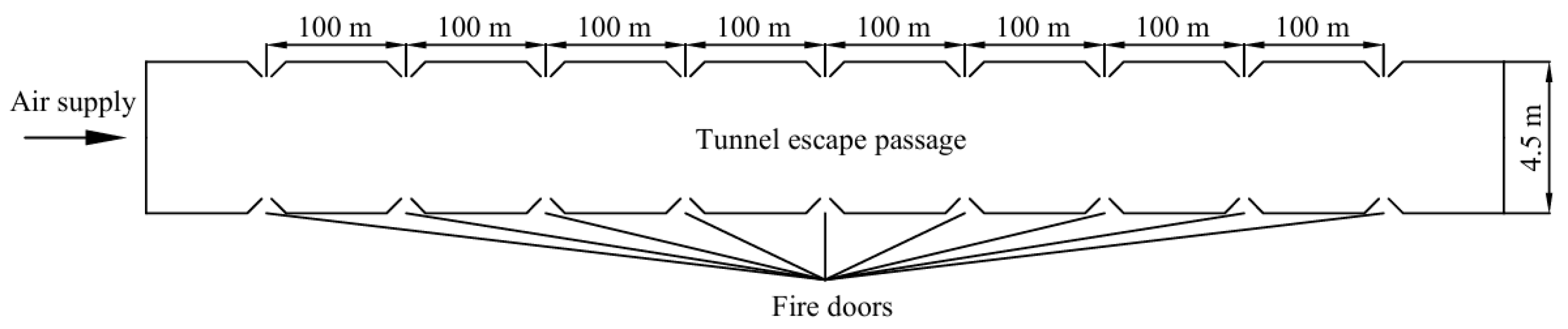
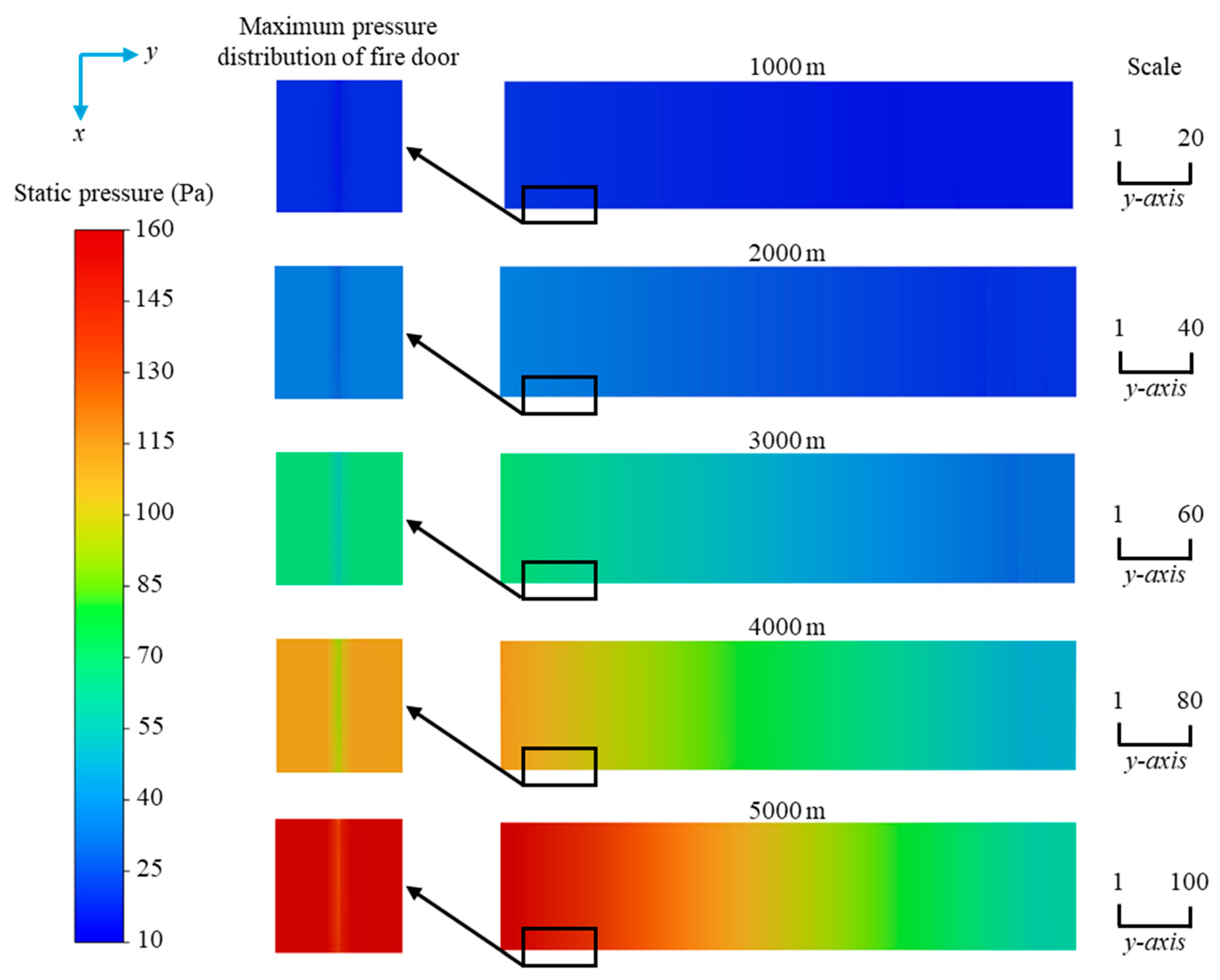
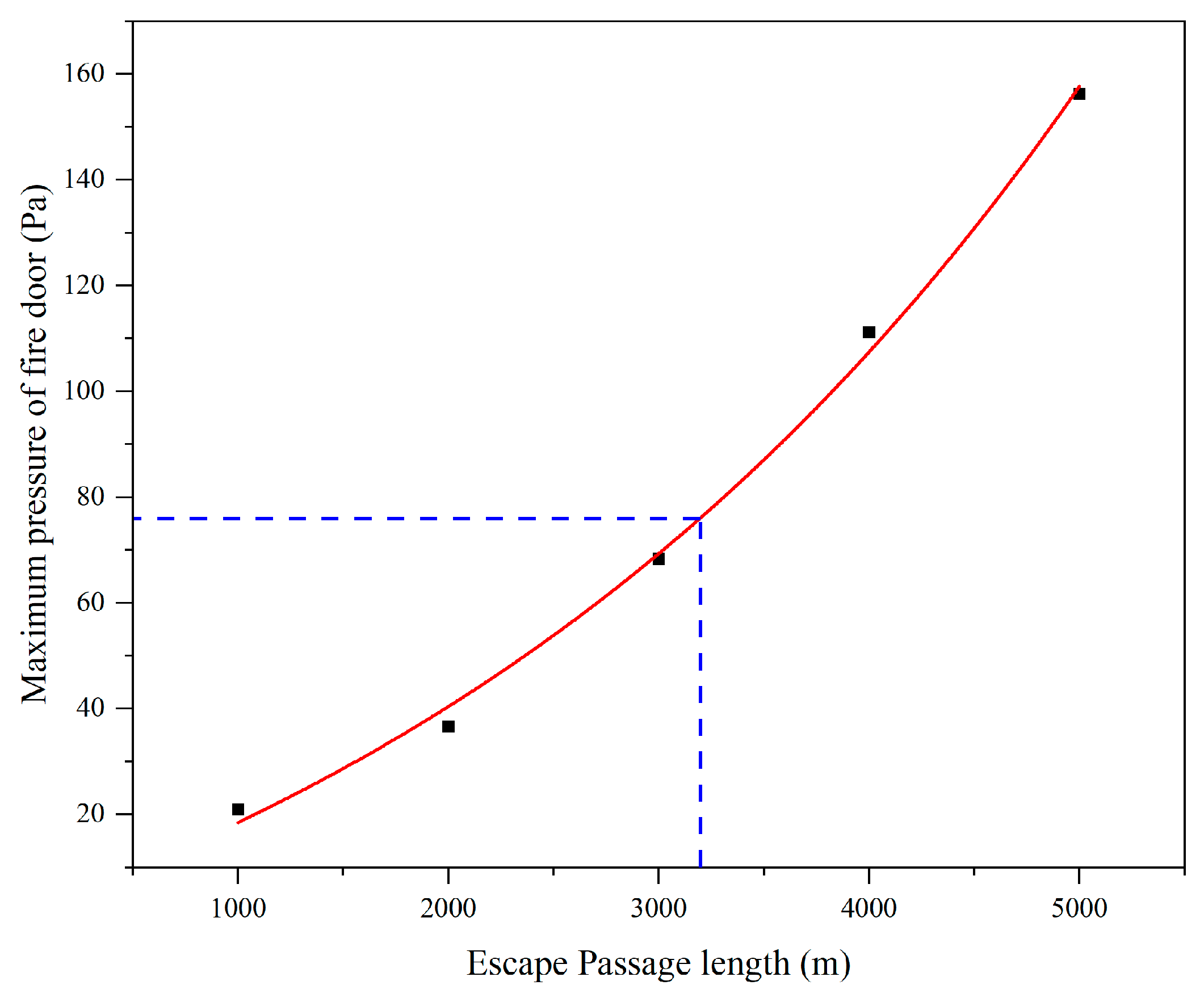
The issue of overpressure at fire doors in escape passage is often overlooked in traditional tunnel design. Current design approaches tend to overemphasize maintaining positive pressure inside the passage for smoke prevention, which results in excessive resistance when opening fire doors. This can hinder emergency evacuation efficiency and pose a threat to personnel safety. This study focused on a typical 1000-m-long straight escape passage to investigate the overpressure problem of fire doors in highway tunnels from both theoretical and empirical perspectives. Traditional pressure calculations for tunnel escape passages adopt relevant guiding designs from the building category, which may lead to certain errors. Therefore, on this basis, this paper employs pressure calculation equations based on the specific pipeline characteristics of smoke control systems. By solving the pressure calculation equations for the fire doors in escape passages, the thrust required to open the doors in the closed state was analyzed. Results show that the force needed to open a fire door can reach up to 168 N under fire conditions, which far exceeds the allowable limits stipulated in relevant design standards. Furthermore, the results indicate that the maximum allowable length of the escape passage should not exceed 3200 m within acceptable pressure limits through numerical simulation. A mathematical relationship between passage length and fire door pressure was also established, confirming the accuracy of the maximum allowable passage length. This study analyzed the hazards of overpressure in escape passages and proposes a method for determining the maximum permissible passage length, aiming to balance the requirements of smoke control with the safety of personnel evacuation.
Keywords: escape passage; fire door; pressure difference; passage length escape passage; fire door; pressure difference; passage length