1. Introduction
Coniferous species such as Norway spruce (
Picea abies), Scots pine (
Pinus sylvestris), and silver fir (
Abies alba) represent the principal raw-material base for the Central European wood-processing industry [
1]. Their favorable mechanical properties, dimensional uniformity, and long-term availability have resulted in widespread use in construction timber, pulp, and engineered wood products [
2,
3,
4,
5]. Although changes in forest management and climate have recently increased the incidence of biotic and abiotic disturbances, large-scale wildfires remain a relatively new phenomenon in this region [
6,
7].
Wildfire frequency and severity are now rising due to prolonged droughts, elevated temperatures, and shifts in fuel structure. As Central European conifers have not evolved under regular fire regimes, their thermal resistance and post-fire material behavior are insufficiently understood. This knowledge gap has direct implications for post-disturbance salvage operations, industrial processing, and the classification of fire-affected timber [
8,
9,
10,
11,
12,
13].
Thermal exposure can substantially alter the physical, chemical, and mechanical behavior of wood [
14,
15,
16,
17,
18]. Hemicelluloses are particularly heat-sensitive and degrade at 150–200 °C [
19], whereas lignin exhibits higher thermal stability and may undergo condensation reactions during heating [
20,
21]. These changes influence density, stiffness, brittleness, and moisture transport. Mechanical responses may range from strength reduction to apparent strength increases linked to moisture loss and localized thermal densification [
22]. However, most existing studies evaluate controlled laboratory heat treatments rather than naturally fire-affected material, and they rarely assess changes at different depths from the bark inward. Consequently, the extent to which moderate, real-fire exposure affects the functional properties of conifer wood remains unclear [
23].
The limited research available on post-fire wood indicates that thermal effects are highly heterogeneous and depend on fire intensity, exposure time, and anatomical structure. Moreover, surface measurements may overrepresent the mechanically densified zone and may not reflect the behavior of inner wood. The lack of consistent data hampers the development of guidelines for the utilization of fire-affected timber in both mechanical and energetic applications [
12,
24].
There is currently no systematic evaluation of the mechanical, chemical, and energetic properties of naturally fire-affected Abies alba, Picea abies, and Pinus sylvestris in Central Europe, nor of how thermal alteration varies with depth beneath the bark. To address this gap, this study investigates:
- (i)
Changes in oven-dry density, bending strength, compressive strength parallel to grain, and Brinell hardness;
- (ii)
Thermally induced shifts in chemical and elemental composition at multiple depths;
- (iii)
The effect of fire exposure on the heat of combustion.
By characterizing the extent of fire-induced degradation—or modification—this work provides baseline data to support decision-making in post-fire timber utilization and forest resource management.
2. Materials and Methods
2.1. Materials
Wood material was collected from a post-fire stand in the Kielce Forest District (Sojowa Forest Range, near Snochowice; Świętokrzyskie Voivodeship, Poland; 50.946276° N, 20.302873° E).
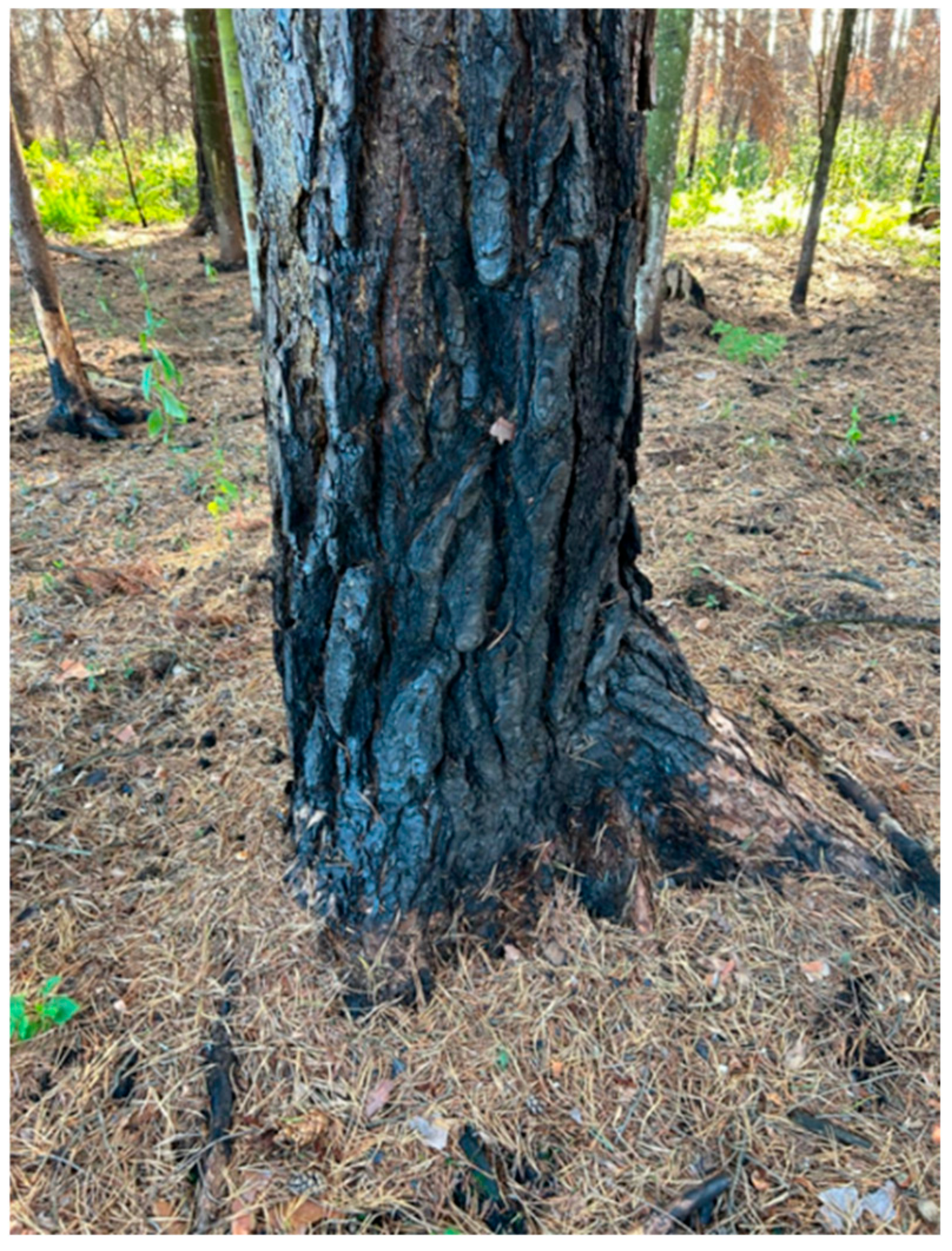
The wildfire occurred in May 2024 and was classified by the local forest service as a moderate-severity surface fire. Visual assessment showed stem scorching with char depths typically below 3–4 mm and no evidence of crown fire behavior. Fire severity along each sampled stem was documented through photographic records and point measurements of char thickness—
Figure 1.
Three commercial conifer species were included: silver fir (Abies alba) Norway spruce (Picea abies), and Scots pine (Pinus sylvestris). For each species, ten trees representing dominant and co-dominant canopy positions were selected to capture the natural size variability within the stand. Trees were harvested at the end of September 2024, approximately four months after the fire, which reflects a realistic salvage-logging interval but limits the generalizability to other post-fire timeframes.
For this study, fire-affected wood refers specifically to the thermally altered outer zone of the stem, operationally defined as the region within 0–20 mm beneath the bark, where direct thermal exposure was evident.
Wood specimens were prepared accordance to ISO 3129:2019 [
25]. For each species, 30 samples were produced for each mechanical test category:
External dimensions were measured using an electronic caliper (accuracy ± 0.1 mm). All samples were oven-dried at 103 ± 2° C to 0% moisture content prior to testing to ensure consistent moisture conditions across mechanical and physical analyses.
Following destructive mechanical testing, the remaining material was reduced to uniform chips according to Tappi T 257 sp-14 [
26] for chemical and calorimetric analyses.
2.2. Physical Properties
The oven-dry density of the samples was determined in accordance with PN-EN 384:2010 [
27]. After preparation procedure, all specimens were oven-dried at 103 ± 2 °C to constant mass, ensuring a moisture content of 0% (oven-dry basis). External dimensions (tangential, radial, and longitudinal) were measured using an electronic caliper with an accuracy of ±0.1 mm, and mass was recorded using an analytical balance with an accuracy of ±0.01 g.
Oven-dry density (ρ0) was calculated as the ratio of oven-dry mass to geometric volume of each specimen. Because all density values reported in this study refer explicitly to the oven-dry state, comparisons with literature were restricted to data measured or converted to comparable oven-dry conditions.
2.3. Mechanical Properties
Before each mechanical test, all specimens were conditioned at 65% relative humidity and 20 °C until constant mass was achieved. This conditioning procedure resulted in an equilibrium moisture content of approximately 12%, which corresponds to the standard reference condition used for mechanical testing of wood. All reported strength and hardness values therefore reflect properties at 12% moisture content.
2.3.1. Static Bending Strength
Static bending strength was determined in accordance with ISO 13061-3:2014 [
28]. The testing procedure followed methodological approaches described by Fataraitė-Urbonienė et al. [
29], and İşleyen & Kesik [
30]. Specimens with nominal dimensions of 20 × 20 × 300 mm were loaded in a three-point bending configuration using a Shimadzu AG-XV universal testing machine (Tokyo, Japan). The loading span was 240 mm, and the crosshead speed was set to 5 mm∙min
−1.
The maximum load at failure was recorded and used to calculate the modulus of rupture (MOR) based on ISO-specified equations. For each species, 20 replicates were tested to ensure statistical representativeness of the fire-affected outer wood zone (0–20 mm beneath the bark).
Because the mechanical assessment focuses on this thermally altered region, the MOR values primarily characterize the behavior of the modified surface layers rather than the bulk properties of the entire stem.
2.3.2. Determination of Ultimate Stress in Compression Parallel to Grain
Compressive strength parallel to the grain was determined in accordance with ISO 13061-17:2017 [
31]. The testing procedure followed the methodological approach described by Ibanez et al. [
32]. Specimens with nominal dimensions of 20 × 20 × 30 mm were loaded axially on the Shimadzu AG-XV universal testing machine (Tokyo, Japan) until failure. The maximum applied load was recorded and used to calculate the ultimate compressive stress based on standardized equations.
For each species, 20 replicates were tested to obtain representative values for the fire-affected outer wood zone (0–20 mm beneath the bark). As with bending tests, the compression results primarily reflect the behavior of thermally modified surface layers and should not be interpreted as bulk properties of the entire stem cross-section.
2.3.3. Brinell Hardness
Brinell hardness was determined in accordance with PN-EN 408:2010 [
33]. The testing procedure followed approaches described by Bayramoglu et al. [
34] and Yusof et al. [
35]. Specimens prepared for hardness testing were measured using an electronic caliper with an accuracy of ±0.1 mm.
Hardness measurements were performed on DuraVision-30 hardness tester (Struers ApS, Ballerup, Denmark) using a steel ball indenter with a diameter of 10 mm. A load of 10 kg was applied for 10 s, maintained for an additional 30 s, and subsequently released. Indentation depth was recorded and used to calculate Brinell hardness according to the standard formula.
To account for anatomical variability, hardness was measured separately in representative areas of earlywood and latewood. For each species, 30 replicates were evaluated to obtain statistically robust values for the fire-affected outerwood zone (0–20 mm beneath the bark). As with the other mechanical properties assessed, the hardness values primarily characterize the surface-modified region influenced by thermal exposure.
2.4. Chemical Properties
2.4.1. Chemical Components of Wood
The chemical composition of the wood samples was determined by analyzing the of major structural components (ash, extractives, cellulose, lignin, holocellulose, and hemicelluloses) according to standardized chemical procedures.
Ash content was quantified following TAPPI T 211 om-02 [
36] by combusting oven-dried samples at 525 ± 25 °C until constant mass was achieved. The results were expressed as a percentage of oven-dry mass.
Extractive content was determined according to TAPPI T 6 wd-73 [
37]. Approximately 2 g of finely milled wood (particle size < 0.5 mm) was sequentially extracted with ethanol–toluene (7:3
v/
v), in a Soxhlet apparatus. After solvent evaporation and drying to constant mass, the extractive content was expressed relative to the oven-dry weight.
Cellulose content was determined by the Seifert method [
38] using an acetylacetone–dioxane–hydrochloric acid reagent system. The insoluble residue was filtered, washed, and oven-dried at 105 °C, and expressed as a percentage of the oven-dry sample.
Acid-insoluble lignin was determined according to TAPPI T 222 om-11 [
39]. Approximately 1 g of extractive-free wood meal was hydrolyzed with 72% H
2SO
4 at 20 °C for two h, diluted to 3% H
2SO
4, and subsequently heated for four h. The remaining solid residue was filtered, washed, dried, and weighed to determine lignin content on an oven-dry basis.
Holocellulose content was determined according to the Wise method [
40], using sodium chlorite and acetic acid at 70 °C to delignify the material. The resulting residue was washed, oven-dried to constant mass, and expressed as a percentage of oven-dry wood.
Hemicelluloses content was calculated as the difference between holocellulose and cellulose. This indirect estimation is widely used to quantify the non-cellulosic polysaccharide fraction.
To evaluate how fire-induced thermal exposure varies with depth, samples were analyzed at three stem positions: (i) bark, (ii) wood at 1 cm from the cambium, and (iii) wood at 2 cm from the cambium. Each analysis was performed in quadruplicate to ensure analytical reliability.
2.4.2. Elemental Composition of Wood
The elemental composition (C, H, N, S) of the samples was determined using a Vario EL Cube elemental analyzer (Elementar Analysensysteme, Langenselbold, Germany). The analysis was based on the dynamic flash combustion method, in which samples are combusted in an oxygen-rich environment at high temperature, and the resulting gases (CO2, H2O, N2, SO2) are quantified by thermal conductivity detector.
For each tree, subsamples were collected from three different stem positions:
- (i)
Bark;
- (ii)
Wood located 1 cm from the cambium;
- (iii)
Wood located 2 cm from the cambium.
Approximately 0.5 g of finely milled and homogenized material was used for each measurement. All samples were analyzed on an oven-dry basis.
Each measurement was performed in triplicate to ensure analytical reproducibility and statistical reliability. The results were expressed as mass percentage of the oven-dry sample.
2.5. Heat of Combustion
The higher heating value (HHV) of the samples was determined using an isoperibolic bomb calorimeter (Model 6400, Parr Instrument Company, Moline, IL, USA). The procedure follows the principle of complete oxidation of the sample in an oxygen-rich atmosphere under constant-pressure conditions, with the released heat quantified from the measured temperature rise of the calorimetric system.
Prior to analysis, the material was finely milled, homogenized, and pressed into pellets of approximately 1.0 g to ensure uniform density and combustion stability. The pellets were oven-dried to 0% moisture content to eliminate the influence of residual water on the calorimetric measurement. Each pellet was weighed to the nearest 0.001 g and placed in stainless-steel combustion crucible equipped with a cotton thread fuse for controlled ignition by an electrically heated ignition wire.
Combustion was performed in a pure oxygen atmosphere at ≈30 bar, ensuring complete oxidation to CO2, H2O, and trace NOx). The resulting temperature rise was recorded automatically and converted to HHV in MJ∙kg−1 (dry basis) using the instrument’s calibration constants.
To assess the influence of fire-related thermal exposure with depth, samples from bark, 1 cm, and 2 cm stem positions were analyzed. Each measurement was performed in triplicate for statistical reliability.
3. Results
3.1. Wood Density
The oven-dry density values measured for the fire-affected samples of
Picea abies,
Pinus sylvestris, and
Abies alba are presented in
Table 1. Across all three species, density was slightly lower than the reference values reported for unaffected wood. This reduction is consistent with partial thermal degradation of structural polysaccharides and the formation of microcracks in the outer stem regions exposed to elevated temperatures.
Among the studied species, Pinus sylvestris exhibited the highest mean density, followed by Abies alba and Picea alba. The differences reflect both inherent anatomical variation and the degree to which heat penetrated the samples surface layers. The within species variability was relatively low, indicating that the sampling and conditioning procedures ensured good material homogeneity despite the natural heterogeneity of fire-affected wood.
Because the reported values represent oven-dry density, comparisons with literature data were restricted to sources that provide equivalent moisture conditions. Differences between fire-affected and reference values should therefore be interpreted primarily as an effect of thermal exposure rather than moisture variability.
3.2. Mechanical Properties
The mechanical behavior of the fire-affected wood was evaluated through static bending strength (MOR), compressive strength parallel to the grain, and Brinell hardness. These parameters provide complementary insights into how elevated temperatures modify the load-bearing capacity of surface-exposed stem regions.
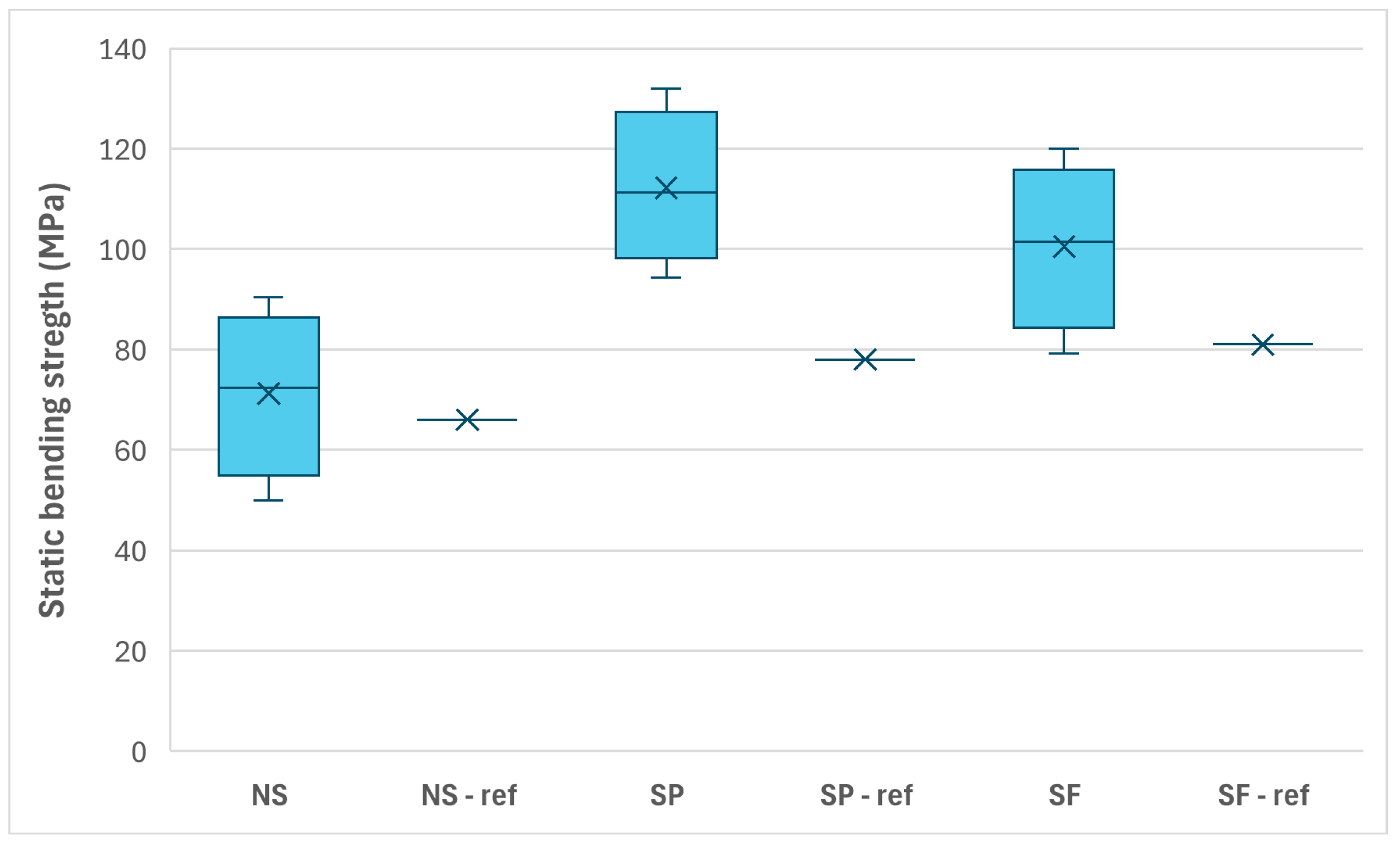
Static bending strength results are shown in
Figure 2. For all species, MOR values of the fire-affected samples were comparable to, or in some cases higher than, reference values reported for unaffected wood. The slight increase observed particularly in Pinus sylvestris and Abies alba likely reflects a combination of reduced moisture content and thermally induced stiffening of cell-wall polymers in the outer wood. However, these increases should be interpreted cautiously, as fire exposure may also induce greater brittleness and reduce the energy absorption capacity of the material—properties that were not assessed in this study. Furthermore, the literature reference values represent broad natural variability and do not constitute direct control samples.
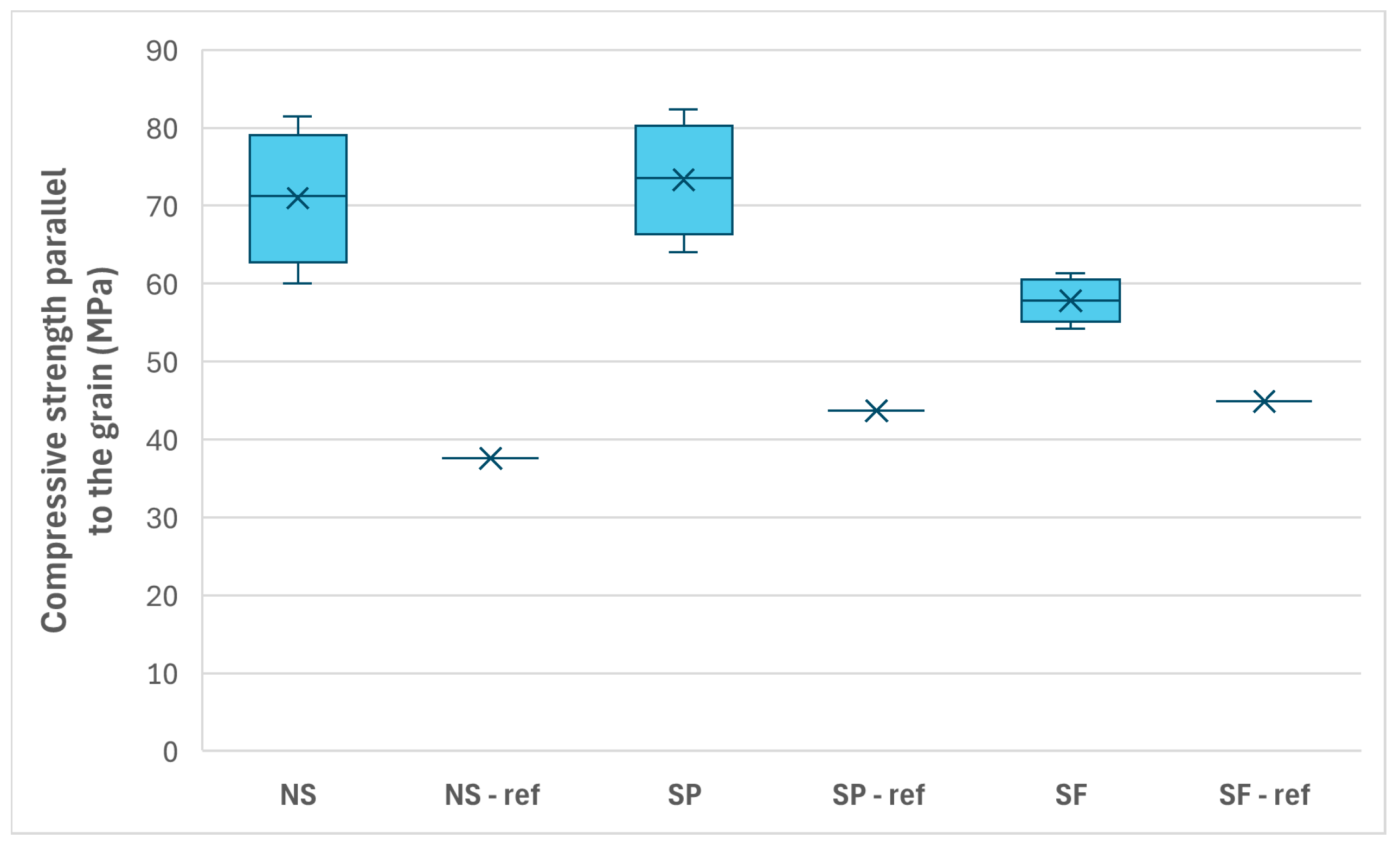
Compressive strength parallel to the grain (
Figure 3) showed a more pronounced increase relative to reference values. This behavior is consistent with the effects of thermal drying and localized densification of surface tissues, which enhance axial stiffness. Similar trends have been reported in mildly heat-modified softwoods. Nevertheless, the results mainly reflect the fire-affected outer layer (0–20 mm beneath the bark), which may not represent the mechanical properties of the full stem cross-section.
Brinell hardness values (
Table 2) remained within the typical range for the studied species, with only minor deviations compared to reference data. Slight reductions in earlywood hardness were observed and may be associated with localized softening or deformation of cell walls during heating. Despite this, hardness values showed a consistent correlation with density, mirroring trends observed in compression and bending results.
3.3. Chemical Properties
The chemical composition of the analyzed samples exhibited clear differences between species and stem depths, reflecting both natural anatomical variation and the effects of thermal exposure (
Table 3). The bark fraction of all species showed substantially higher ash and extractive contents than the corresponding wood fractions, which is consistent with the typically high mineral and resin content of conifer bark. The elevated extractive content in the outer wood at 1 cm depth indicates partial migration or concentration of low-molecular compounds during heating, a phenomenon commonly observed in thermally stressed softwoods.
Cellulose, lignin, and hemicellulose contents showed moderate shifts with increasing depth. In Pinus sylvestris and Abies alba, cellulose content increased slightly from the bark towards the inner wood (1–2 cm), while hemicellulose content tended to decrease. These trends are consistent with the known susceptibility of hemicelluloses to thermal degradation and the relative stability of cellulose and lignin at moderate fire-exposure temperatures.
The lignin content of the bark of Abies alba was notably high. Although bark can naturally exhibit a wide range of lignin concentrations, values of this magnitude should be interpreted cautiously, as they may reflect analytical artefacts (e.g., incomplete extractive removal, condensed residues, or altered bark-to-wood ratios in the sampled tissue). Importantly, this anomaly does not affect the interpretation of the chemical composition of the wood fractions, which showed lignin levels within the expected range for conifers.
Elemental analysis (
Table 4) revealed characteristic changes associated with thermal exposure. Carbon content increased from bark to inner wood, while hydrogen content showed an opposite trend. These patterns reflect progressive carbonization and the loss of oxygenated volatiles, processes commonly associated with heat-altered biomass. Nitrogen and sulfur contents remained low across all species and depths, with no systematic trends attributable to fire exposure.
Overall, the chemical data indicate that fire-induced thermal modification primarily affects the outermost regions of the stem, leading to partial degradation of hemicelluloses, relative enrichment of lignin and carbon, and redistribution of extractives. These changes corroborate the mechanical results, which show altered stiffness and strength in the same surface layers.
3.4. Heat of Combustion
The higher heating values (HHV) obtained for the analyzed samples are presented in
Table 5. Across all species, HHVs showed only moderate variation between the bark and inner wood layers. Bark consistently exhibited slightly higher HHV than wood at 1–2 cm depth, which is consistent with its higher extractive and carbon content.
For Pinus sylvestris, HHV remained relatively uniform across the sampled depths and was the highest among the three species. This agrees with the naturally higher resin and extractive content of pine, which increases energy density. Picea abies and Abies alba displayed a modest decrease in HHV toward the inner 1–2 cm depth, particularly in spruce, which may reflect lower levels of fire-induced carbonization in these regions.
The slight increase in HHV observed in some fire-affected outer wood layers corresponds well with the chemical results, which showed partial degradation of hemicelluloses and a relative enrichment of carbon. Such trends are typical of thermally modified biomass and indicate limited but measurable enhancement of energy potential in heat-exposed tissues.
Overall, the HHVs for all species fell within the expected range for coniferous biomass, suggesting that the fire-affected wood retains its energetic usability. However, variability between depths indicates that thermal effects are spatially localized, and that bulk fuel quality depends on the proportion of altered outer wood.
4. Discussion
The results of this study show that thermal exposure associated with a moderate-severity surface fire produces measurable but spatially localized modifications in the physical, mechanical, and chemical properties of conifer wood. These changes are most prominent in the surface layers of the stem and must therefore be interpreted with respect to the limited penetration depth of heat during the fire event.
The slight reduction in oven-dry density across all species is consistent with partial degradation of hemicelluloses and the formation of microcracks in the outer wood. Previous studies have reported similar density decreases following heat exposure or mild thermal modification, reflecting loss of low-molecular components and structural relaxation within the cell wall. However, because density was assessed only in the surface-affected region, the measured values may underestimate the density of the deeper, unaffected wood [
52,
53].
The mechanical results indicate that bending and compressive strength in the fire-affected material were comparable to, or in some cases higher than, reference values from the literature. This apparent strengthening can be explained by several thermally induced mechanisms: moisture reduction below the fiber saturation point, partial condensation of lignin, and local densification caused by polymer softening and shrinkage during cooling. These factors are known to increase short-term stiffness and strength in thermally modified wood. Nevertheless, these increases must be interpreted with caution. First, the reference values used for comparison represent broad natural variability and are not direct controls. Second, exposure to elevated temperatures often reduces toughness, increases brittleness, and promotes earlywood collapse—properties not assessed in the present study. As a result, the increased strength parameters observed here do not necessarily imply improved structural performance, particularly under dynamic or long-term loading [
54,
55,
56,
57,
58].
Brinell hardness values showed only minor deviations from literature values, indicating that surface cohesion is less sensitive to thermal exposure than bending or compression. Slight reductions in earlywood hardness may reflect localized softening or deformation of thin-walled cells. The generally preserved hardness further confirms that the thermal impact was confined to the outermost regions of the stem.
Chemical analyses support the observed mechanical changes. The reduction in hemicellulose content and relative enrichment of lignin and carbon with depth are typical signatures of limited thermal degradation. Because hemicelluloses are the most thermally labile wood polymers, their partial loss can contribute to cell-wall stiffening, whereas lignin condensation may enhance short-term dimensional stability [
59,
60,
61,
62]. The anomalously high lignin content measured in the bark of Abies alba should be interpreted cautiously, as bark is chemically heterogeneous and prone to analytical artefacts, particularly when exposed to heat. Importantly, the lignin values in the wood fractions fall within expected ranges for conifers and support the conclusion that thermal effects were moderate.
The heat-of-combustion results demonstrate that fire-affected wood retains its energetic usability. Slight increases in HHV in the outer layers correspond well with the chemical indicators of partial carbonization. However, the spatial heterogeneity in thermal effects suggests that fuel quality at the stand level will depend on the proportion of altered outer wood relative to unaffected inner wood [
63].
Taken together, the results show that surface fire exposure can modify the mechanical and chemical properties of conifer wood, but these effects are limited in depth and do not necessarily impair all aspects of wood quality. At the same time, the enhanced short-term strength observed in the surface layers should not be misinterpreted as evidence of improved performance for structural applications. Without data on toughness, fatigue, durability, or resistance to fluctuating moisture, it is not possible to confirm whether the fire-affected wood meets the requirements for high-grade construction uses.
Finally, several limitations must be acknowledged. The study is based on a single fire site and a single salvage-logging period, although post-fire degradation is known to evolve rapidly. Mechanical tests were performed on small clear specimens taken from the thermally affected outer wood, which may overrepresent the densified surface layer. Statistical comparisons were limited to descriptive parameters, and future studies should incorporate inferential testing (e.g., ANOVA with post hoc analysis) to better quantify the significance of observed differences. Additional measurements of modulus of elasticity, fracture toughness, and long-term performance would further improve the understanding of post-fire wood behavior.
5. Conclusions
This study evaluated the mechanical, chemical, and energetic properties of silver fir, Norway spruce, and Scots pine wood harvested several months after a forest fire event. The results show that, despite visible external damage, fire-affected wood retains a substantial portion of its functional properties. Mechanical tests indicated that some strength parameters, particularly compressive strength and in certain cases bending strength, can remain unchanged or even increase as a consequence of reduced moisture content and localized thermal densification near the surface. However, such effects were not consistent across species, and they do not necessarily imply improved structural performance, as increased brittleness and reduced toughness were not assessed and may limit engineering applications.
Chemical analyses revealed moderate thermally induced changes, including partial degradation of polysaccharides and a relative increase in carbon content toward the surface. These changes were spatially heterogeneous and dependent on sampling depth. The heat of combustion remained within the expected range for coniferous biomass, suggesting that fire-affected wood remains suitable for energetic use.
While the findings demonstrate that wood from post-fire stands may retain practical value, the applicability of such material—particularly for structural purposes—must be assessed with caution. The study was limited to a single fire site, one post-fire harvesting period, and small clear specimens taken from shallow depths. Broader sampling, mechanical tests that capture brittleness and fracture behavior, and controlled characterization of fire severity would be needed to generalize the results.
Overall, timely harvesting and processing of fire-affected coniferous wood can enable its continued use, especially for energy production or lower-grade applications, thereby contributing to resource efficiency and reducing material losses following wildfire events.
Author Contributions
Conceptualization, K.H. and M.B.G.; methodology, T.H., K.H., M.B.G. and P.T.; validation, T.H., L.S., K.H. and R.W.; formal analysis, T.H., K.H., M.B.G., P.T. and T.M.; investigation, T.H., M.B.G. and T.M.; resources, M.B.G., P.T., K.S. and R.W.; data curation, M.B.G., K.S., R.W. and T.M.; writing—original draft preparation, T.H., K.H., A.Z., M.B.G. and T.M.; writing—review and editing, L.S., K.H., M.B.G., K.S. and K.M.; visualization, K.H.; supervision, K.H.; project administration, K.H. All authors have read and agreed to the published version of the manuscript.
Funding
This research was funded by the Faculty of Forestry and Wood Sciences, CULS Prague, excellence project “The impact of fires on the wood quality of Central European climax tree species”.
Institutional Review Board Statement
Not applicable.
Informed Consent Statement
Not applicable.
Data Availability Statement
Dataset available on request from the authors: The raw data supporting the conclusions of this article will be made available by the authors on request.
Conflicts of Interest
The authors declare no conflicts of interest.
References
- Małek, S.; Barszcz, J.; Majsterkiewicz, K. Ocena stopnia zagrożenia rozpadem drzewostanów świerkowych w Beskidzie Śląskim i Beskidzie Żywieckim w latach 2005–2012. In Ekologiczne i Hodowlane Uwarunkowania Przebudowy Drze-Wostanów Świerkowych; Małek, S., Ed.; Wydawnictwo Uniwersytetu Rolniczego w Krakowie: Krakow, Poland, 2015; pp. 275–292. [Google Scholar]
- Chevalier, R.; Catapano, A.; Pommier, R.; Montemurro, M. A review on properties and variability of Pinus Pinaster Ait. ssp. Atlantica existing in the Landes of Gascogne. J. Wood Sci. 2024, 70, 14. [Google Scholar] [CrossRef] [Scilit]
- Dias, A.; Carvalho, A.; Silva, M.E.; Lima-Brito, J.; Gaspar, M.J.; Alves, A.; Rodrigues, J.C.; Pereira, F.; Morais, J.; Lousada, J.L. Physical, chemical and mechanical wood properties of Pinus nigra growing in Portugal. Ann. For. Sci. 2020, 77, 72. [Google Scholar] [CrossRef] [Scilit]
- Seliger, A.; Ammer, C.; Kreft, H.; Zerbe, S. Diversification of coniferous monocultures in the last 30 years and implications for forest restoration: A case study from temperate lower montane forests in Central Europe. Eur. J. For. Res. 2023, 142, 1353–1368. [Google Scholar] [CrossRef] [Scilit]
- Seim, A.; Marquer, L.; Bisson, U.; Hofmann, J.; Herzig, F.; Kontic, R.; Lechterbeck, J.; Muigg, B.; Neyses-Eiden, M.; Rzepecki, A.; et al. Historical Spruce Abundance in Central Europe: A Combined Dendrochronological and Palynological Approach. Front. Ecol. Evol. 2022, 10, 909453. [Google Scholar] [CrossRef] [Scilit]
- Berčák, R.; Holuša, J.; Trombik, J.; Resnerová, K.; Hlásny, T. A Combination of Human Activity and Climate Drives Forest Fire Occurrence in Central Europe: The Case of the Czech Republic. Fire 2024, 7, 109. [Google Scholar] [CrossRef] [Scilit]
- Dupuy, J.; Fargeon, H.; Martin-StPaul, N.; Pimont, F.; Ruffault, J.; Guijarro, M.; Hernando, C.; Madrigal, J.; Fernandes, P. Climate change impact on future wildfire danger and activity in southern Europe: A review. Ann. For. Sci. 2020, 77, 35. [Google Scholar] [CrossRef] [Scilit]
- Broda, M.; Popescu, C.M.; Poszwa, K.; Roszyk, E. How thermal treatment affects the chemical composition and the physical, mechanical and swelling properties of Scots pine juvenile and mature wood. Wood Sci. Technol. 2024, 58, 1153–1180. [Google Scholar] [CrossRef] [Scilit]
- Jančíková, V.; Jablonský, M. Thermal Modification of Wood—A Review. Sustain. Chem. 2025, 6, 19. [Google Scholar] [CrossRef] [Scilit]
- Xue, J.; Xu, W.; Zhou, J.; Mao, W.; Wu, S. Effects of High-Temperature Heat Treatment Modification by Impregnation on Physical and Mechanical Properties of Poplar. Materials 2022, 15, 7334. [Google Scholar] [CrossRef] [Scilit]
- Renner, J.S.; Mensah, R.A.; Jiang, L.; Xu, Q. A critical assessment of the fire properties of different wood species and bark from small- and bench-scale fire experiments. J. Therm. Anal. Calorim. 2023, 148, 1423–1434. [Google Scholar] [CrossRef] [Scilit]
- Marttila, J.; Möttönen, V.; Haapala, A.; Ylimäki, P.; Kilpeläinen, P.; Verkasalo, E. Wood Material Properties of Forest Fire-Damaged Norway Spruce and Scots Pine for Mechanical Wood Processing in Finland. Appl. Sci. 2024, 14, 238. [Google Scholar] [CrossRef] [Scilit]
- Zhao, J.; Liu, H.; Gernay, T.; Chen, Z.; Zhao, S.; Yang, S. Investigation on the residual mechanical properties of glulam after exposure to elevated temperature. Constr. Build. Mater. 2024, 422, 135851. [Google Scholar] [CrossRef] [Scilit]
- Leonardos, L.; Gnilke, A.; Sanders, T.G.M.; Shatto, C.; Stadelmann, C.; Beierkuhnlein, C.; Jentsch, A. Synthesis and Perspectives on Disturbance Interactions, and Forest Fire Risk and Fire Severity in Central Europe. Fire 2024, 7, 470. [Google Scholar] [CrossRef] [Scilit]
- Neumann, M.; Vilardell, L.V.; Müller, M.M.; Vacik, H. Fuel loads and fuel structure in Austrian coniferous forests. Int. J. Wildland Fire 2022, 31, 693–707. [Google Scholar] [CrossRef] [Scilit]
- Achchige, Y.M.S.; Volkova, L.; Filkov, A.I.; Weston, C.J. Effect of bark properties on the cambium cell viability of Eucalyptus species under low radiative heat exposure. For. Ecol. Manag. 2022, 521, 120443. [Google Scholar] [CrossRef] [Scilit]
- Rinta-Paavola, A.; Sukhomlinov, D.; Hostikka, S. Modelling Charring and Burning of Spruce and Pine Woods During Pyrolysis, Smoldering and Flaming. Fire Technol. 2023, 59, 2751–2786. [Google Scholar] [CrossRef] [Scilit]
- Poletto, M.; Zattera, A.J.; Santana, R.M.C. Thermal decomposition of wood: Kinetics and degradation mechanisms. Bioresour. Technol. 2012, 126, 7–12. [Google Scholar] [CrossRef] [Scilit]
- Esteves, B.; Pereira, H. Wood modification by heat treatment: A review. BioResources 2009, 4, 370–404. [Google Scholar] [CrossRef] [Scilit]
- Yang, H.; Yan, R.; Chen, H.; Lee, D.H.; Zheng, C. Characteristics of hemicellulose, cellulose and lignin pyrolysis. Fuel 2007, 86, 1781–1788. [Google Scholar] [CrossRef] [Scilit]
- Candelier, K.; Dumarçay, S.; Pétrissans, A.; Desharnais, L.; Gérardin, P.; Pétrissans, M. Comparison of chemical composition and decay durability of heat treated wood cured under different inert atmospheres: Nitrogen or vacuum. Polym. Degrad. Stab. 2013, 98, 677–681. [Google Scholar] [CrossRef] [Scilit]
- Zachar, M.; Čabalová, I.; Kačíková, D.; Zacharová, L. The Effect of Heat Flux to the Fire-Technical and Chemical Properties of Spruce Wood (Picea abies L.). Materials 2021, 14, 4989. [Google Scholar] [CrossRef] [Scilit] [PubMed]
- Domingos, I.; Ayata, U.; Ferreira, J.; Cruz-Lopes, L.; Sen, A.; Sahin, S.; Esteves, B. Calorific Power Improvement of Wood by Heat Treatment and Its Relation to Chemical Composition. Energies 2020, 13, 5322. [Google Scholar] [CrossRef] [Scilit]
- Mitrenga, P.; Vandlíčková, M.; Konárik, M.; Košútová, K. Impact of Heat Treatment of Spruce Wood on Its Fire-Technical Characteristics Based on Density and the Side Exposed to Fire. Appl. Sci. 2022, 12, 6452. [Google Scholar] [CrossRef] [Scilit]
- ISO 3129:2019; Wood—Sampling Methods and General Requirements for Physical and Mechanical Tests. International Organization for Standardization: Geneve, Switzerland, 2019.
- Tappi T 257 sp-14; Sampling and Preparing Wood for Analysis. Tappi Test Methods: Atlanta, GA, USA, 2015.
- PN-EN 384:2010; Structural Timber—Determination of Characteristic Values of Mechanical Properties and Density. Polski Komitet Normalizacyjny: Warsaw, Poland, 2010.
- ISO 13061-3:2014; Physical and Mechanical Properties of Wood—Test Methods for Small Clear Wood Specimens—Part 3: Determination of Static Bending Strength. International Organization for Standardization: Geneve, Switzerland, 2014.
- Fataraitė-Urbonienė, E.; Juodeikienė, I.; Albrektas, D.; Meškauskas, S. Influence of heat treatment on the static bending strength of spruce wood. Mater. Sci. 2019, 25, 455–459. [Google Scholar] [CrossRef] [Scilit]
- İşleyen, Ü.K.; Kesik, H.İ. Experimental and numerical analysis of compression and bending strength of old wood reinforced with CFRP strips. Structures 2021, 33, 259–271. [Google Scholar] [CrossRef] [Scilit]
- ISO 13061-17:2017; Physical and Mechanical Properties of Wood—Test Methods for Small Clear Wood Specimens—Part 17: Determination of Ultimate Stress in Compression Parallel to Grain. International Organization for Standardization: Geneve, Switzerland, 2017.
- Ibanez, C.M.; Kartal, S.N.; Soytürk, E.E.; Kurul, F.; Şeker, S.; Önses, M.S.; Çelik, N.; Temiz, A.B. Changes in the physical and mechanical properties of Pinus taeda and Eucalyptus bosistoana wood modified by contact charring. BioResources 2023, 18, 8614–8630. [Google Scholar] [CrossRef] [Scilit]
- PN-EN 408:2010; Timber Structures—Structural Timber and Glued Laminated Timber—Determination of Some Physical and Mechanical Properties. Polski Komitet Normalizacyjny: Warsaw, Poland, 2010.
- Bayramoglu, M.M.; Demir, A.; Birinci, A.U.; Ozturk, H.; İlhan, O.; Candan, Z.; Demirkir, C. Effect of lumber quality grade on the mechanical properties and product costs of cross-laminated timber panels. BioResources 2025, 20, 3519–3533. [Google Scholar] [CrossRef] [Scilit]
- Yusof, N.M.; Tahir, P.M.; Lee, S.H.; Khan, M.A.; James, R.M.S. Mechanical and physical properties of Cross-Laminated Timber made from Acacia mangium wood as function of adhesive types. J. Wood Sci. 2019, 65, 20. [Google Scholar] [CrossRef] [Scilit]
- Tappi T 211 om-02; Ash in Wood, Pulp, Paper and Paperboard: Combustion at 525 °C. Tappi Test Methods: Atlanta, GA, USA, 2007.
- Tappi T 6 wd-73; Alcohol-Benzene Solubility of Wood. Tappi Test Methods: Atlanta, GA, USA, 2015.
- Seifert, K. Uber ein neues Verfahren zur Schnellbestimmung Der Rein-Cellulose. Das Pap. 1956, 10, 301–306. [Google Scholar]
- Tappi T 222 om-11; Acid-Insoluble Lignin in Wood and Pulp. Tappi Test Methods: Atlanta, GA, USA, 2006.
- Wise, L.E.; Murphy, M.; D’Addieco, A.A. Chlorite holocellulose, its fractionation and bearing on summative wood analysis and on studies on the hemicelluloses. Pap. Trade J. 1946, 122, 35–43. [Google Scholar]
- Huber, C.; Langmaier, M.; Stadlmann, A.; Hochbichler, E.; Grabner, M.; Teischinger, A.; Konnerth, J.; Grabner, M.; Müller, U.; Pramreiter, M. Potential alternatives for Norway spruce wood: A selection based on defect-free wood properties. Ann. For. Sci. 2023, 80, 41. [Google Scholar] [CrossRef] [Scilit]
- Aleinikovas, M.; Grigaliûnas, J. Differences of Pine (Pinus sylvestris L.) Wood Physical and Mechanical Properties from Different Forest Site Types in Lithuania. Balt. For. 2006, 12, 9–13. [Google Scholar]
- Hadinata, M.E.; Kozakiewicz, P. The density of Silver fir (Abies alba Mill.) wood from diverse origins in a provenance trial in Rogów. Ann. WULS For. Wood Technol. 2025, 129, 43–53. [Google Scholar] [CrossRef] [Scilit]
- Lis, A.; Lis, P. Charakterystyka wytrzymałości drewna jako jego podstawowej właściwości mechanicznej. Budownictwo 2013, 19, 77–86. [Google Scholar]
- Dritan, A.; Kapidani, A. The effect of sodium chloride treatment on bending strength of silver fir wood (Abies alba Mill.). In Proceedings of the 2nd International Balkans Conference on Challenges of Civil Engineering, Tirana, Albania, 23–25 May 2013. [Google Scholar]
- Horáček, P.; Fajstavr, M.; Stajanović, M. The variability of wood density and compression strength of Norway spruce (Picea abies /L./Karst.) within the stem. Beskydy 2017, 10, 17–26. [Google Scholar] [CrossRef] [Scilit]
- Zatoń, P.; Mańkowski, P.; Kozakiewicz, P. Relationship between the compressive strength, density and the width of the annual rings in a high-quality part of timber of Scots pine (Pinus sylvestris L.) wood. Ann. WULS For. Wood Technol. 2023, 121, 135–141. [Google Scholar] [CrossRef] [Scilit]
- Rodrigo, B.G.; Esteban, L.G.; de Palacios, P.; García-Fernández, F.; Guindeo, A. Caracterización físico-mecánica de la madera de Abies alba Miller procedente del pirineo español mediante probetas libres de defectos. Inf. Constr. 2013, 65, 530. [Google Scholar] [CrossRef] [Scilit]
- Salem, M.Z.M.; Zeidler, A.; Böhm, M.; Srba, J. Norway Spruce (Picea abies [L.] Karst.) as a Bioresource: Evaluation of Solid Wood, Particleboard, and MDF Technological Properties and Formaldehyde Emission. BioResources 2013, 8, 1199–1221. [Google Scholar] [CrossRef] [Scilit]
- Aniszewska, M.; Gendek, A.; Tamelová, B.; Malaťák, J.; Velebil, J.; Krilek, J.; Čabalová, I.; Mikłaszewicz, I.; Zychowicz, W.; Drożdżek, M.; et al. Physico-Mechanical and Energy Properties of Pine (Pinus sylvestris) and Beech (Fagus sylvatica) Wood from Railroad Ties. Forests 2024, 15, 485. [Google Scholar] [CrossRef] [Scilit]
- Torelli, N.; Sinjur, I.; Piškur, M. Lastnosti in kakovost jelovine (Abies alba Mill.). Stud. For. Slov.–Strok. Znan. Dela 2009, 69–78. [Google Scholar]
- Martinka, J.; Chrebet, T.; Kráľ, J.; Balog, K. An examination of the behaviour of thermally treated spruce wood under fire conditions. Wood Res. 2013, 58, 599–606. [Google Scholar]
- Park, Y.; Han, Y.; Choi, Y.S.; Lee, H.M.; Yoon, S.M.; Yeo, H.; Eom, C.D. Correlation analysis between mass loss of wood due to thermal modification and equilibrium moisture content of thermally modified wood. BioResources 2024, 19, 1283–1294. [Google Scholar] [CrossRef] [Scilit]
- Krajewski, A.; Kozakiewicz, P.; Witomski, P. Comparison of selected properties of natural aged wood and contemporary timber of Pinus sylvestris L. investigated using standard methods and measuring of transition speed of ultrasounds along the fibre. Wood Res. 2020, 65, 405–414. [Google Scholar] [CrossRef] [Scilit]
- Nasir, V.; Fathi, H.; Fallah, A.; Kazemirad, S.; Sassani, F.; Antov, P. Prediction of Mechanical Properties of Artificially Weathered Wood by Color Change and Machine Learning. Materials 2021, 14, 6314. [Google Scholar] [CrossRef] [Scilit] [PubMed]
- Kretschmann, D.E. Mechanical properties of wood—Chapter 5. In Wood handbook: Wood as an Engineering Material; Ross, J.R., Ed.; Forest Products Laboratory: Madison, WI, USA, 2010. [Google Scholar]
- Arous, S.; Koubaa, A.; Bouafif, H.; Bouslimi, B.; Braghiroli, F.L.; Bradai, C. Effect of Pyrolysis Temperature and Wood Species on the Properties of Biochar Pellets. Energies 2021, 14, 6529. [Google Scholar] [CrossRef] [Scilit]
- Kymäläinen, M.; Hautamäki, S.; Lillqvist, K.; Segerholm, K.; Rautkari, L. Surface modification of solid wood by charring. J. Mater. Sci. 2017, 52, 6111–6119. [Google Scholar] [CrossRef] [Scilit]
- Todaro, L.; Rita, A.; Cetera, P.; D’Auria, M. Thermal treatment modifies the calorific value and ash content in some wood species. Fuel 2015, 140, 1–3. [Google Scholar] [CrossRef] [Scilit]
- Sikora, A.; Kačík, F.; Gaff, M.; Vondrová, V.; Bubeníková, T.; Kubovský, I. Impact of thermal modification on color and chemical changes of spruce and oak wood. J. Wood Sci. 2018, 64, 406–416. [Google Scholar] [CrossRef] [Scilit]
- Chen, Y.; Tshabalala, M.A.; Gao, J.; Stark, N.M.; Fan, Y. Color and surface chemistry changes of extracted wood flour after heating at 120 °C. Wood Sci. Technol. 2014, 48, 137–150. [Google Scholar] [CrossRef] [Scilit]
- Di Blasi, C. Modeling chemical and physical processes of wood and biomass pyrolysis. Prog. Energy Combust. Sci. 2008, 34, 47–90. [Google Scholar] [CrossRef] [Scilit]
- Výbohová, E.; Geffertová, J. Heating value of thermally treated wood. Drewno 2020, 63, 206. [Google Scholar] [CrossRef] [Scilit]
| Disclaimer/Publisher’s Note: The statements, opinions and data contained in all publications are solely those of the individual author(s) and contributor(s) and not of MDPI and/or the editor(s). MDPI and/or the editor(s) disclaim responsibility for any injury to people or property resulting from any ideas, methods, instructions or products referred to in the content. |




 ,
,