
Article

Influence of Different Catalysts on Ammonia Synthesis Performance in Coaxial DBD Plasma

1
Electric Power Research Institute, Yunnan Power Grid Co., Ltd., Kunming 650217, China
2
State Key Laboratory of Power Grid Environmental Protection, School of Electrical and Automation Engineering, Wuhan University, Wuhan 430072, China
*
Author to whom correspondence should be addressed.
Plasma 2026, 9(2), 20; https://doi.org/10.3390/plasma9020020
Submission received: 23 April 2026 / Revised: 27 May 2026 / Accepted: 29 May 2026 / Published: 4 June 2026
(This article belongs to the Special Issue Recent Advances of Dielectric Barrier Discharges, 2nd Edition)

Abstract

In the renewable energy-driven “green electricity–green hydrogen–green ammonia” pathway, the development of low-temperature and low-energy-consumption ammonia synthesis technologies is of great significance. In this work, a plasma-catalytic ammonia synthesis system was established using a coaxial dielectric barrier discharge (DBD) reactor. The effects of different catalysts, including Ag, Cu, γ-Al2O3, BaTiO3 and Co/BaTiO3, Ni/BaTiO3 on ammonia synthesis performance were systematically investigated. The reaction process was analyzed using voltage–current waveforms, Lissajous figures, and optical emission spectroscopy (OES). The results show that different catalytic systems have a significant influence on ammonia synthesis performance, with the promotional effect ranked as follows: Ni/BaTiO3 > Co/BaTiO3 > BaTiO3 > Ag > γ-Al2O3 > Cu. Among them, Ni/BaTiO3 exhibited the best performance. Under the conditions of N2:H2 = 1:1 and a gas flow rate of 2.5 L/min, the NH3 synthesis rate reached 259.48 μmol/min, and the maximum energy efficiency reached 1.40 g-NH3/kWh. Catalyst characterization results indicate that the BaTiO3 support maintained a stable crystal structure, while the loaded metal species were highly dispersed and uniformly distributed on the support surface, which is beneficial for the adsorption and conversion of reactive species on the catalyst surface. Discharge characteristic analysis shows that the introduction of BaTiO3 enhanced the local electric field and improved the uniformity of micro-discharges, while the further incorporation of metal active components strengthened the micro-discharge behavior. OES results reveal that the intensities of characteristic emission lines, such as NH, N2+, and Hα, were significantly enhanced in the Ni/BaTiO3 system, facilitating the formation and conversion of NHx intermediates. The superior performance of Ni/BaTiO3 is attributed to the coupling between BaTiO3-induced dielectric enhancement and Ni-promoted surface hydrogenation and NH3 desorption. This work provides mechanistic insight into catalyst-dependent DBD plasma-catalytic ammonia synthesis and offers an experimental basis for the further optimization of plasma-based ammonia production.

1. Introduction

The flexible conversion between green electricity and green hydrogen is widely regarded as an effective pathway for mitigating the challenges associated with renewable energy integration. Hydrogen energy, characterized by cleanliness, high efficiency, and low carbon emissions, is emerging as a crucial energy carrier for replacing fossil fuels and facilitating the transition toward a zero-carbon energy system [1]. However, hydrogen still faces technical bottlenecks in storage and transportation, such as low volumetric energy density and stringent safety requirements, which limit its large-scale application. In contrast, ammonia (NH3), as an important basic chemical feedstock, is widely used in fertilizers, environmental protection, refrigeration, and defense industries. It also possesses advantages such as high hydrogen content, easy liquefaction, and convenient storage and transportation, and is therefore regarded as a highly promising hydrogen storage medium and energy carrier [2,3]. Therefore, the development of ammonia-based hydrogen energy utilization pathways is of great significance.
Currently, industrial ammonia production mainly relies on the Haber–Bosch process, which operates under high-temperature (400–500 °C) and high-pressure (10–30 MPa) conditions [4]. This process also depends on fossil-fuel-derived hydrogen, resulting in high energy consumption and significant CO2 emissions [5,6]. In addition, it is dominated by large-scale centralized production, making it difficult to adapt to the intermittency and distributed nature of renewable energy. Therefore, the development of novel ammonia synthesis technologies that can operate under mild conditions and be coupled with renewable energy has become a key research focus.
In recent years, various emerging ammonia synthesis routes have been proposed, including electrochemical nitrogen reduction, photocatalytic ammonia synthesis, and low-temperature thermos-catalytic methods [7]. However, these technologies generally suffer from low ammonia production rates, insufficient energy efficiency, or poor reaction stability, which limits their practical applications [8,9]. In contrast, non-thermal plasma (NTP) technology can activate and dissociate N2 molecules through high-energy electrons under ambient temperature and pressure, thereby bypassing the high energy barriers associated with conventional thermal catalysis and providing a new reaction pathway for ammonia synthesis. In non-equilibrium plasma systems, the electron temperature is significantly higher than the gas temperature, enabling the generation of vibrationally excited N2, N radicals, and H radicals, which promote NH3 formation [10,11]. Among various plasma types, dielectric barrier discharge (DBD) is widely used in plasma-assisted ammonia synthesis due to its simple structure, stable operation at atmospheric pressure, and ease of coupling with catalysts [12]. The DBD plasma-catalytic ammonia synthesis process involves multiple processes, including gas-phase discharge activation, catalyst surface reactions, and plasma–catalyst interactions. Therefore, the research focus of this system is not only to improve the NH3 synthesis rate and energy efficiency, but also to further understand the effects of different catalysts on discharge characteristics, reactive species generation, and surface reaction pathways. A systematic investigation of the influence of different types of catalysts on DBD behavior, reactive species formation, and NH3 synthesis pathways is of great significance for deepening the understanding of the mechanism of plasma-catalytic ammonia synthesis.
In terms of reactor configuration, coaxial DBD reactors coupled with catalysts for ammonia synthesis have been well established and extensively reported in the literature [13,14,15,16,17]; this reactor configuration is suitable for plasma-catalytic ammonia synthesis under low-temperature conditions and represents one of the promising approaches for distributed small-scale ammonia synthesis technologies. Compared with simple optimization of reactor structure, the introduction of catalysts is considered a key factor for further improving the NH3 synthesis rate and energy efficiency. In plasma-catalysis synergistic systems, heterogeneous catalysts not only provide surface reaction sites but also modulate discharge characteristics, thereby influencing the generation and conversion of reactive species [18]. Previous studies have demonstrated that different types of catalysts have a significant impact on ammonia synthesis performance. Hong et al. [19] employed a nanodiamond-coated catalyst deposited on α-Al2O3 spheres, achieving a maximum energy efficiency of 0.29 g/kWh. Wang et al. [13] investigated the role of a Ni/Al2O3 catalyst in plasma-enhanced catalytic ammonia synthesis and found that the synergistic effect between Ni active sites and weak acidic sites on the Al2O3 surface significantly promoted the formation of NH2 intermediates, leading to an ammonia synthesis rate of 471 μmol/g/h. In addition, Rouwenhorst et al. [20] studied the catalytic effect of Ru-K/MgO catalysts on DBD plasma ammonia synthesis and found that the synergistic effect between Ru active sites and potassium promoter modification resulted in a maximum ammonia synthesis rate of 1750 μmol/g/h and a maximum energy efficiency of 1.23 g/kWh. Andersen et al. [21] combined a zero-dimensional kinetic model to investigate the influence of M/MgAl2O4 (Ru, Co) catalysts on DBD ammonia synthesis, obtaining a maximum NH3 synthesis rate of 1476 μmol/h and a maximum energy efficiency of 1.19 g/kWh, and demonstrated that N2 dissociation is the rate-determining step in ammonia synthesis. Liu et al. [22,23] compared the effects of dielectric materials with different dielectric constants (BaTiO3, TiO2, SiO2) on DBD ammonia synthesis and found that BaTiO3 achieved the highest NH3 concentration of 1344 ppm, which is 106% higher than that of SiO2, with an energy efficiency of 0.68 g/kWh. They further investigated catalysts consisting of Fe, Co, and Ni loaded BaTiO3 supports, among which Ni/BaTiO3 exhibited the best performance, reaching a maximum NH3 concentration of 2912 ppm and a maximum energy efficiency of 0.78 g/kWh. It was found that high-dielectric-constant materials can enhance the reduced electric field in the plasma and increase the proportion of high-energy electrons, thereby strengthening electron-impact reactions, promoting the generation of reactive species such as N and H, and accelerating NH3 formation. The relevant references mentioned in this study, along with recent research on DBD plasma–catalyst coupling for ammonia synthesis, are summarized in Table 1.
Although the above studies have made important progress in improving the performance of DBD plasma-catalytic ammonia synthesis, several issues still require further investigation. First, it remains challenging to achieve both a high NH3 synthesis rate and high energy efficiency under relatively high gas throughput. Second, the roles of different catalyst properties in regulating DBD characteristics, reactive species generation, and surface conversion pathways are still not fully understood. In particular, the respective contributions of metal conductivity, oxide surface properties, dielectric polarization, and transition-metal surface reactivity need to be further distinguished under comparable plasma reaction conditions. To address these issues, the catalysts in this work were selected to represent different material functions in the plasma-catalytic ammonia synthesis system. Ag and Cu were used as representative conductive metal catalysts to examine whether metallic conductivity and metal particle-induced electric-field redistribution alone can promote NH3 formation. γ-Al2O3 was selected as a conventional oxide support with relatively low dielectric constant, while BaTiO3 was selected as a high-dielectric-constant material to evaluate the role of dielectric polarization and local electric-field enhancement. Co/BaTiO3 and Ni/BaTiO3 were further introduced to investigate the combined effect of a high-dielectric support and transition-metal active species. Therefore, the catalyst selection in this work was intended to construct a representative comparison framework involving metal conductivity, oxide surface properties, dielectric enhancement, and supported metal active sites, rather than simply increasing the number of catalyst samples.
Based on this, a coaxial DBD plasma-catalytic ammonia synthesis experimental platform was constructed in this work. Co/BaTiO3 and Ni/BaTiO3 supported catalysts were prepared, and typical catalytic materials such as Ag, Cu, and γ-Al2O3 were introduced as comparative systems to systematically investigate the effects of different catalysts on NH3 synthesis performance and plasma behavior. Combined with voltage–current waveforms, Lissajous figures, OES diagnostics, and characterizations including XRD, SEM, EDS, BET, and XPS, further deepens the understanding of the dielectric enhancement effect of BaTiO3, the surface reactions of Ni/Co metal active species, and the synergistic mechanism of plasma–catalyst coupling in ammonia synthesis.

2. Experimental Section

2.1. Experimental Setup

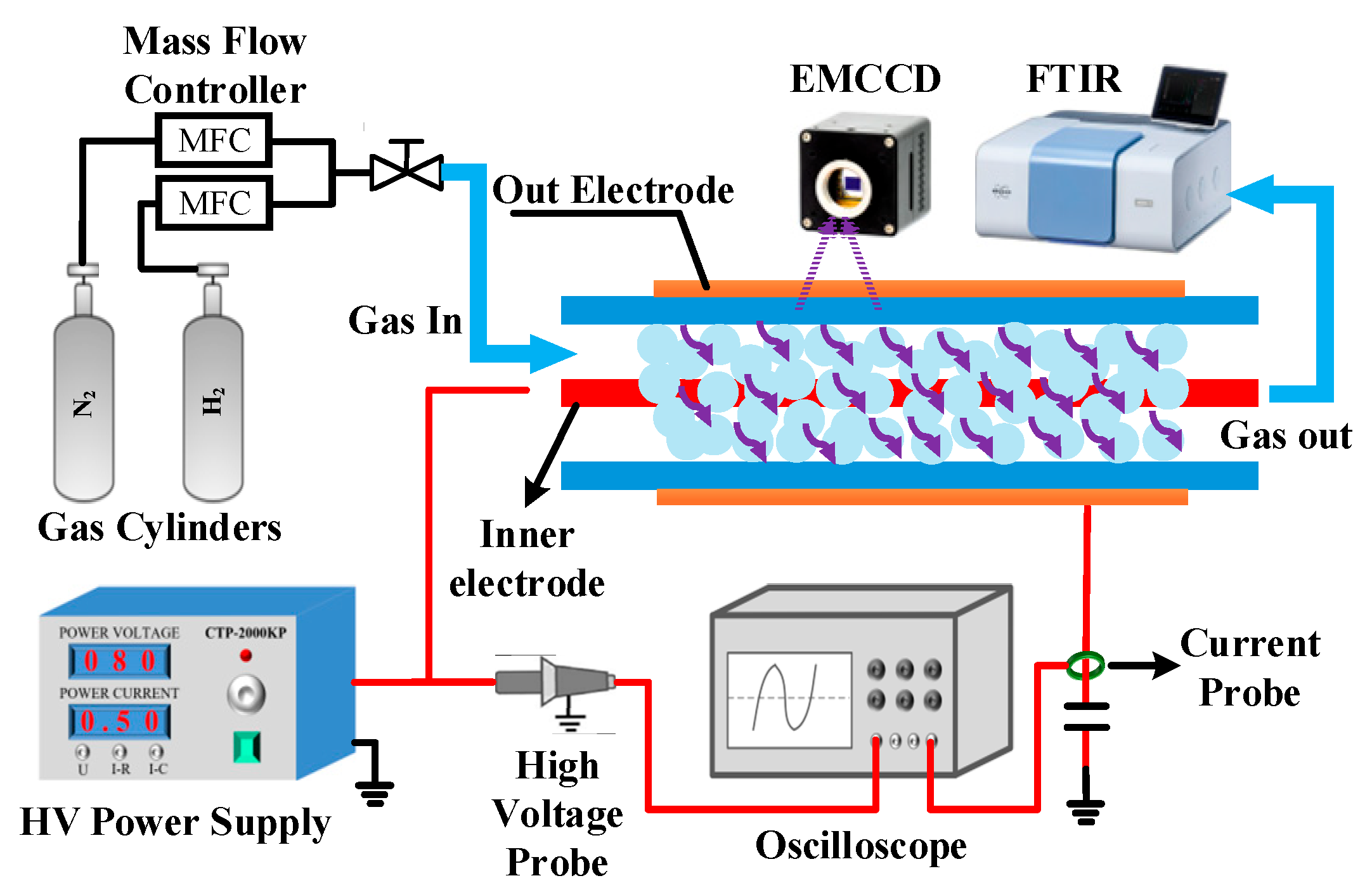
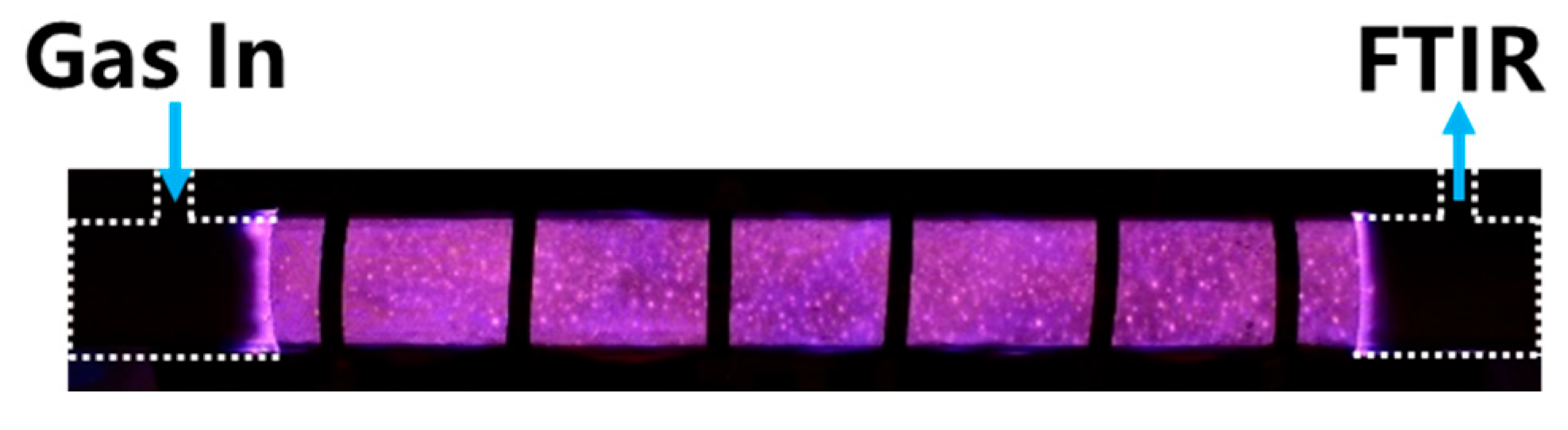
This work constructed a DBD plasma-catalytic ammonia synthesis experimental platform, as shown in Figure 1. The coaxial DBD reactor chamber used a quartz tube with an outer diameter of 28 mm and a wall thickness of 1.5 mm as the dielectric layer. A copper mesh wrapped around the outer surface of the quartz tube served as the outer electrode, with a total length of 20 cm. A smooth copper rod with an outer diameter of 22 mm was used as the high-voltage inner electrode, ensuring a discharge gap of 1.5 mm. The corresponding discharge setup is shown in Figure 2. A gas mixture of N2 and H2 with a purity of 99.999% was introduced into the reactor inlet. The flow rates of N2 and H2 were controlled by mass flow controllers (Sevenstar CS200, 0–5 SLM, Sevenstar Flowmeter Co., Ltd., Beijing, China) and fed into the DBD reactor. The outlet gas was analyzed using a Fourier-transform infrared (FTIR) spectrometer to measure gas concentrations. The DBD reactor was powered by an AC high-voltage power supply (CTP-2000KP, Suman Electronic Co., Ltd., Nanjing, China). The discharge voltage was measured using a high-voltage probe (P6015A, Tektronix Inc., Beaverton, OR, USA), while the discharge current was monitored using a current probe (Pearson 2877, Pearson Electronics, Palo Alto, CA, USA). A sampling capacitor (CM = 0.47 μF) was connected in series at the grounded terminal of the reactor to measure the total transferred charge in the plasma discharge. All output signals were recorded by an oscilloscope (TBS2204B, Tektronix Inc., Beaverton, OR, USA) for voltage-current waveform analysis and discharge power calculation. In this study, the discharge voltage was adjusted within the range of 6–10 kV, the discharge frequency was fixed at 6 kHz, and the gas flow rate was controlled between 0.5 and 3 L/min. In addition, the volumetric ratio of N2/H2 was varied from 1:4 to 4:1 to investigate its effect on ammonia synthesis performance. It is noteworthy that the dimensions of the DBD reactor used in this study were determined based on preliminary tests of discharge stability and ammonia synthesis performance. By adjusting the outer diameter of the inner electrode, the effects of different discharge gaps were compared, and the influence of discharge length on the ammonia generation rate was also investigated. Based on these results, the reactor configuration was finally selected by comprehensively considering stable discharge, relatively low energy consumption, appropriate gas residence time, and structural operability. It should be noted that both the electrode material and electrode structure may affect the DBD characteristics and reaction performance. However, the focus of this study is to reveal the influence of different catalysts on plasma-assisted ammonia synthesis performance. Therefore, to ensure the comparability of the catalyst comparison experiments, all experiments were conducted using the same reactor structure and electrode configuration. The optimization of electrode structure and the effects of different electrode materials on ammonia synthesis performance will be systematically investigated in future studies.

2.2. Parameter Definition and Calculation

The discharge power (Pdis) was determined using the Lissajous figure method:
P dis = f · C M · S
where CM is the external capacitance, f is the frequency of the AC power supply, and S represents the area enclosed by the Lissajous figure.
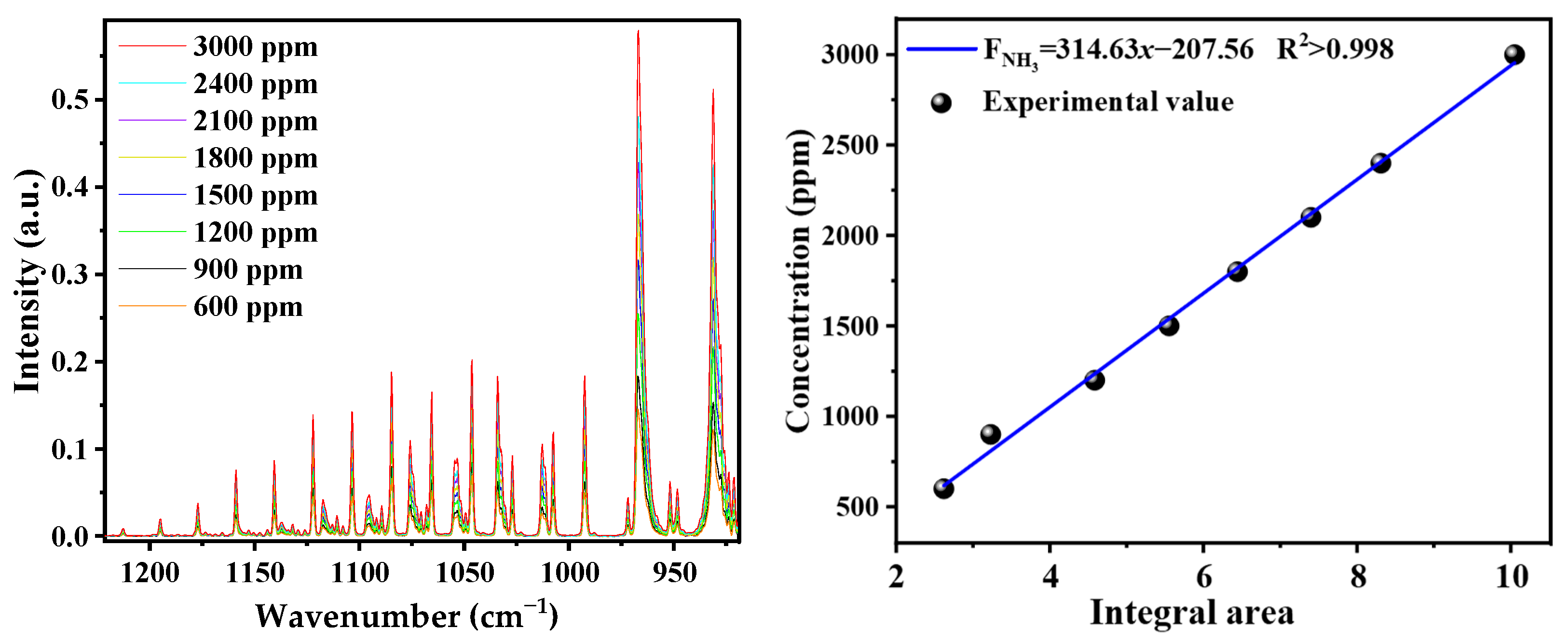
FTIR was used to quantitatively measure the NH3 concentration in the outlet gas. During the entire measurement process, the mass flow controllers maintained a constant total gas flow rate. The produced NH3 was introduced into the FTIR gas cell (optical path length: 20 cm, CaF2 windows). Once the FTIR signal became stable, the absorption spectra were recorded. In this study, the NH3 concentration was quantified based on a calibration curve established using NH3 standard gases with nitrogen as the balance gas. Specifically, NH3 standard gases with concentrations of 600, 1200, 1500, 1800, 2100, 2400, and 3000 ppm were prepared by adjusting the flow rates of a 3000 ppm NH3 standard gas and high-purity N2 gas using mass flow controllers. The FTIR absorption spectra of the NH3 standard gases with different concentrations were then measured and integrated. Based on the Beer–Lambert law, a linear relationship between the NH3 concentration and the integrated absorbance area was established, thereby obtaining the NH3 example spectra and calibration curve, as shown in Figure 3. The results show a good linear correlation between the NH3 concentration and the integrated absorbance area, with a coefficient of determination R2 close to 1.
NH3 synthesis rate is calculated by:
Y N H 3 = Q total 24 L mol 1 × c N H 3
where Qtotal represents the total flow rate of N2 and H2, 24 L·mol−1 is the molar volume of gas at room temperature, and c NH 3 denotes the measured NH3 concentration the NH3 energy consumption is calculated by:
E NH 3 = P dis × 60 Y NH 3

2.3. OES

OES was used to evaluate the relative variations in the emission intensities of key reactive species over different catalysts. During the experiments, plasma emission was collected from the side of the discharge region of the DBD reactor via an optical fiber and transmitted to a spectrometer (SR-750-B1, Andor Technology Ltd., Belfast, UK, equipped with an 1800 grooves/mm grating and a 50 μm entrance slit, providing a spectral resolution of 0.05 nm) for analysis. To improve the detection sensitivity of weak emission signals, a high-sensitivity electron-multiplying charge-coupled device (DU970P_BVE, EMCCD, Andor Technology Ltd., Belfast, UK) detector was employed, enabling effective acquisition of weak molecular and atomic emission lines generated in the discharge. All OES measurements were performed after the reactor reached a steady-state operation under each set of experimental conditions. The optical collection position was kept identical for all tests. The EMCCD gain was set to 50, and the exposure time was fixed at 0.6 s to ensure the comparability of spectral data among different catalysts.

2.4. Preparation of Catalysts

In this study, the Ag, Cu, γ-Al2O3, and BaTiO3 catalysts used for comparison were commercially obtained and used without further treatment. Ag was obtained from Macklin Biochemical Co., Ltd. (Shanghai, China, CAS: 7440-22-4), and Cu was obtained from Macklin Biochemical Co., Ltd. (Shanghai, China, CAS: 7440-50-8), γ-Al2O3 was obtained from Aladdin Chemical Co., Ltd. (Shanghai, China, CAS: 1344-28-1), and BaTiO3 was obtained from Aladdin Chemical Co., Ltd. (Shanghai, China, CAS: 12047-27-7). Co/BaTiO3 and Ni/BaTiO3 were prepared using commercial BaTiO3 as the support.
Supported catalysts were prepared via a wetness impregnation method. BaTiO3 with a high dielectric constant was used as the support, and the metal loading was 3 wt.%, with a total catalyst mass of 1.0 g. The water uptake capacity of the support was determined by dropwise addition of deionized water until complete saturation, yielding a value of 1.2 ± 0.2 mL/g. Metal precursor solutions were then prepared according to the target loading. For the Co/BaTiO3 catalyst, the precursor solution was obtained by reacting Co3O4 (Macklin Biochemical, Shanghai, China, CAS: 1307-96-6) powder with dilute hydrochloric acid. For the Ni/BaTiO3 catalyst, Ni(CH3COO)2·4H2O (Macklin Biochemical, Shanghai, China, CAS: 373-02-4) was dissolved in deionized water to form the precursor solution. The prepared precursor solution was gradually added to the BaTiO3 support, followed by thorough stirring to ensure uniform dispersion of the metal species on the support surface. The resulting samples were dried at 120 °C for 5 h and subsequently reduced at 500 °C for 5 h under a 10% H2 atmosphere with a flow rate of 200 mL/min. Finally, 3 wt.% Co/BaTiO3 and Ni/BaTiO3 catalysts were obtained. In all plasma-catalytic packed-bed experiments, the catalysts were supported on quartz wool and packed into the discharge region of the DBD reactor. Specifically, 2.0 g of quartz wool was first uniformly packed into the 20 cm long discharge region. Subsequently, 1.0 g of catalyst powder, including Ag, Cu, γ-Al2O3, BaTiO3, Co/BaTiO3, or Ni/BaTiO3, was weighed and uniformly dispersed on the surface of the quartz wool to ensure a consistent catalyst loading per unit length in the discharge region across different experiments. For the blank control, only quartz wool was used. For the quartz bead experiment, quartz beads with an average diameter of approximately 1 mm were directly filled into the discharge region to form a stable packed bed without obvious movement during gas flow.

2.5. Material Characterization

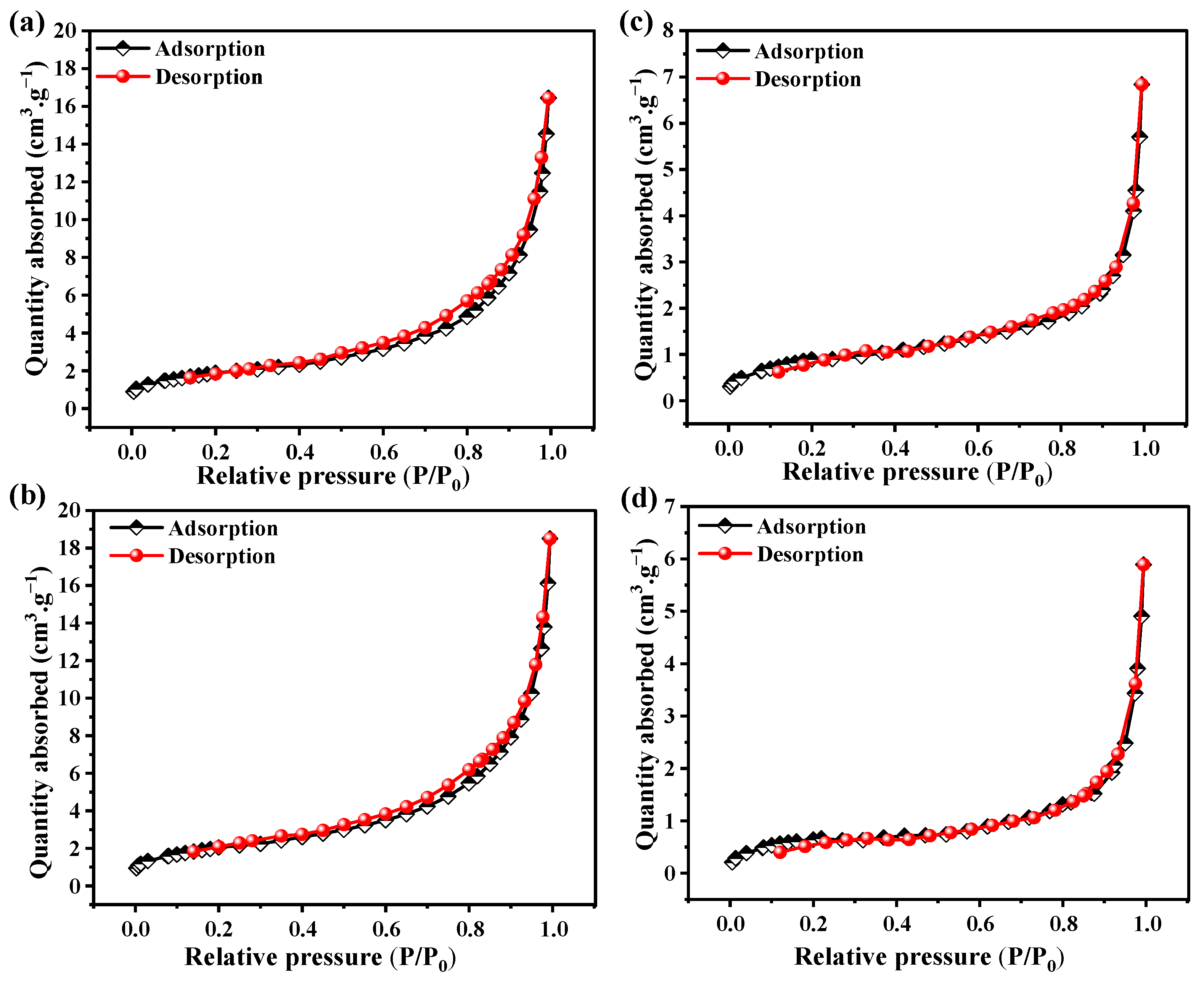
Figure 4 shows the N2 adsorption–desorption isotherms of the catalysts, and the corresponding textural properties, including the Brunauer–Emmett–Teller (BET) surface area, pore volume, and average pore diameter, are summarized in Table 2. The measurements were performed using a 3Flex/ASAP 2460 surface area and porosity analyzer (Micromeritics, Norcross, GA, USA).
The Co/BaTiO3 and Ni/BaTiO3 catalysts exhibited surface areas of 7.59 and 3.53 m2/g before reaction, respectively, which slightly decreased to 6.97 and 2.73 m2/g after the plasma catalytic reaction. Meanwhile, the pore volume of Co/BaTiO3 changed from 0.028 to 0.025 cm3/g, while that of Ni/BaTiO3 changed from 0.010 to 0.009 cm3/g. In addition, the average pore diameters of both catalysts were within the mesoporous range, and the nitrogen adsorption–desorption isotherms exhibited typical type-IV adsorption behavior, indicating mesoporous structural characteristics. The relatively small changes in the BET parameters before and after reaction suggest that the catalysts maintained relatively stable pore structures and accessible reaction surfaces under plasma reaction conditions, which may help maintain gas diffusion pathways and catalytic interfaces during ammonia synthesis.
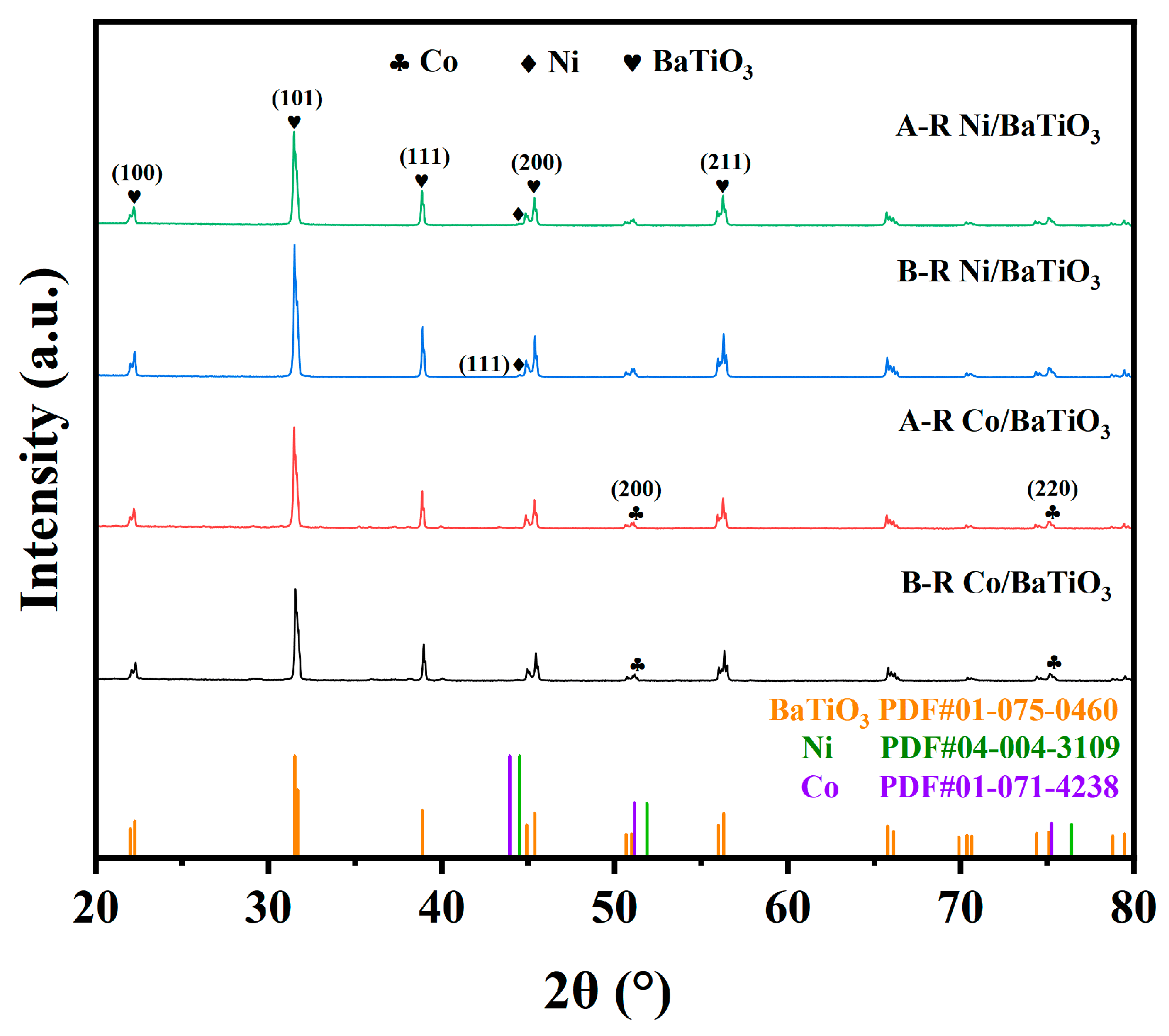
X-ray diffraction (XRD, XPert Pro, PANalytical B.V., Almelo, Netherlands) was employed to characterize the crystal structures of Co/BaTiO3 and Ni/BaTiO3 catalysts, as shown in Figure 5. The results indicate that both catalysts retain the characteristic diffraction peaks of the BaTiO3 support, which are located at 2θ = 22.240°, 31.657°, 38.895°, 45.379°, 56.282° and 66.119°, corresponding to the (100), (110), (111), (200), (211) and (220) crystal planes of BaTiO3 (BaTiO3, PDF#01-075-0460), respectively. This confirms that metal loading and subsequent thermal treatment do not alter the main crystalline phase of BaTiO3, and the support maintains its tetragonal perovskite structure. In addition, for Ni/BaTiO3, a weak diffraction peak associated with metallic Ni appeared at 2θ = 44.507°, which can be assigned to the Ni (111) plane (Ni, PDF#04-004-3109). For Co/BaTiO3, weak Co-related diffraction peaks were observed at 2θ = 51.149° and 75.250°, which can be assigned to the Co (200) and (220) planes, respectively (Co, PDF#01-071-4238). Due to the low loading amount of Co and Ni active species, only 3 wt.%, and the partial overlap between metal-related peaks and BaTiO3 diffraction peaks, these metal diffraction peaks exhibited relatively low intensities.
The crystallite size estimation was performed based on XRD peak fitting and full width at half maximum (FWHM) analysis, and the crystallite sizes were calculated using the Scherrer equation. The results show that the average crystallite size of the BaTiO3 support in the Co/BaTiO3 catalyst increased from 37.3 ± 1.8 nm before reaction to 47.0 ± 2.1 nm after reaction, while the average crystallite size of the BaTiO3 support in the Ni/BaTiO3 catalyst changed from 40.3 ± 1.6 nm before reaction to 37.9 ± 1.1 nm after reaction, indicating that both catalysts maintained relatively good structural stability under the plasma reaction conditions. In addition, due to the relatively low loading amount of Co and Ni active species (3 wt.%), the corresponding XRD diffraction peaks were weak, making it difficult to reliably calculate the crystallite sizes of the metallic active species using the Scherrer equation.
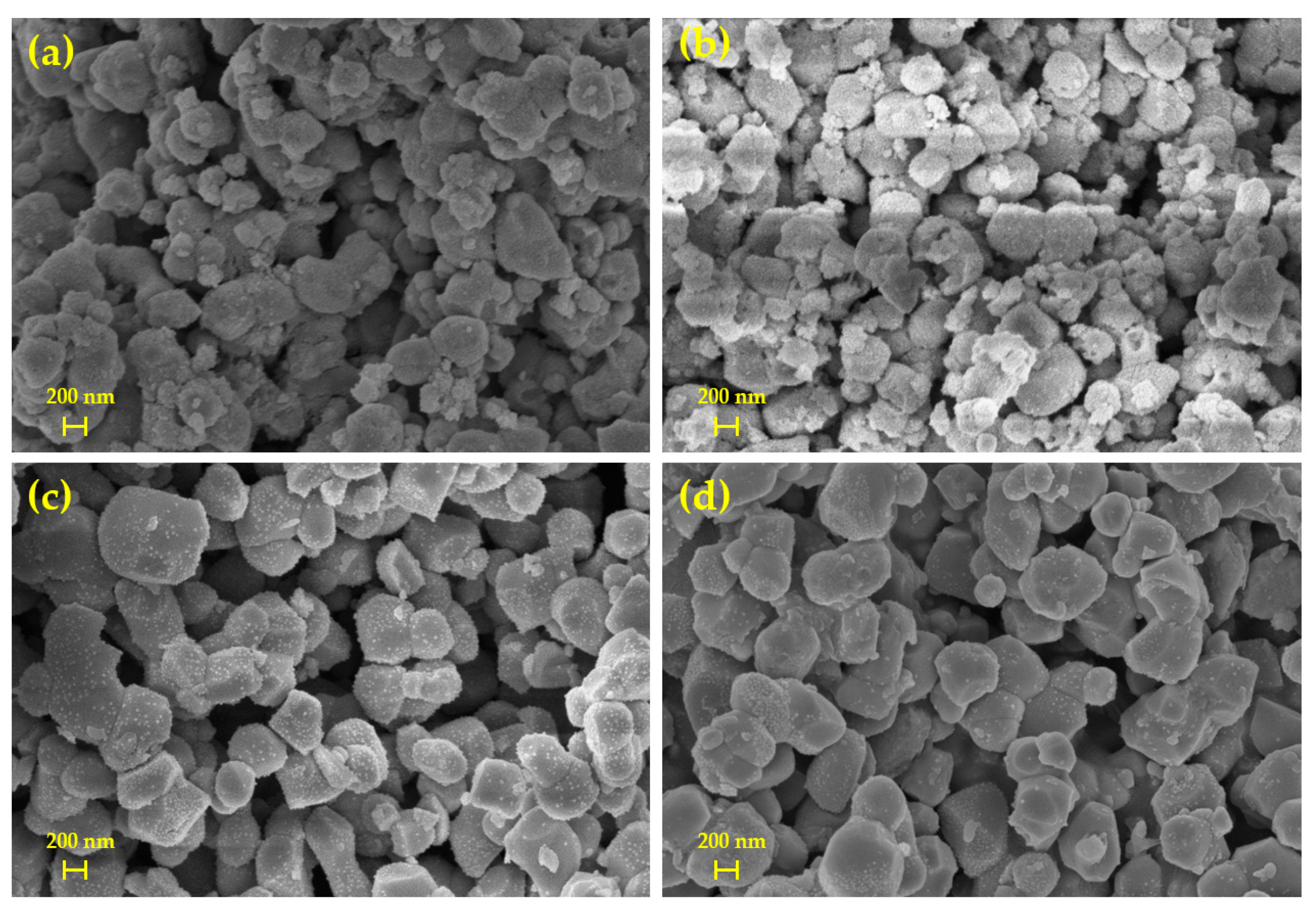
Field-emission scanning electron microscopy (SEM, Zeiss SIGMA, Carl Zeiss, Oberkochen, Germany) was employed to characterize the morphologies of the Co/BaTiO3 and Ni/BaTiO3 catalysts before and after reaction, as shown in Figure 6.
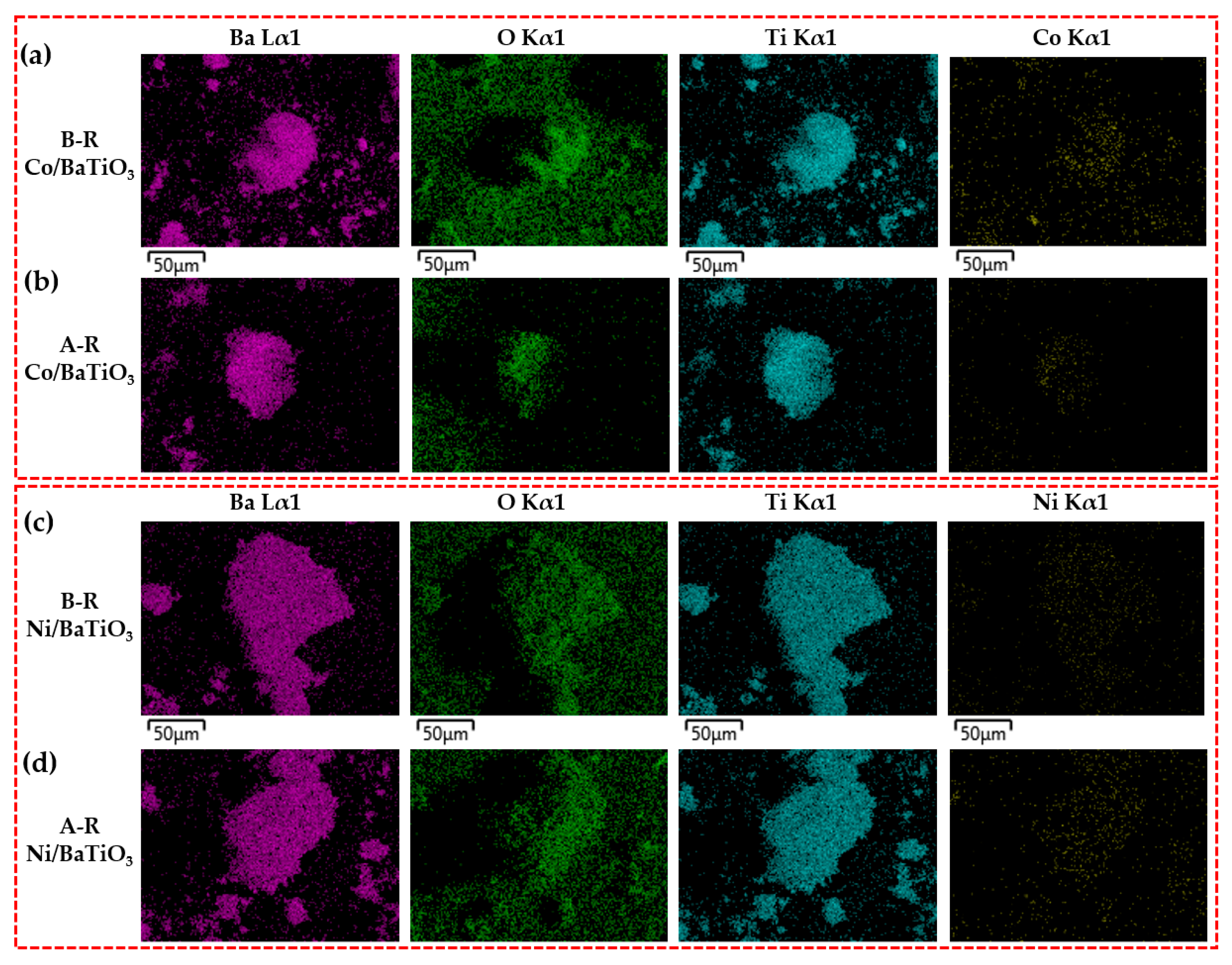
In addition, energy-dispersive X-ray spectroscopy (EDS, Oxford Instruments plc., Oxford UltimMax 40, Abingdon, UK) was employed to analyze the elemental distribution of Co/BaTiO3 and Ni/BaTiO3 catalysts before and after reaction, as shown in Figure 7, and the corresponding elemental composition results are summarized in Table 3. The EDS elemental mapping images show that Ba, Ti, and O were clearly distributed in the catalyst regions, indicating that the main elements of the BaTiO3 support were retained after the plasma-catalytic reaction. Meanwhile, Co and Ni signals were detected in the corresponding catalysts. This indicates that Co and Ni active species were introduced onto the BaTiO3 support.
Further qualitative analysis of the dispersion state of the active metal species was performed based on SEM morphology, EDS elemental mapping, and elemental composition analysis. The SEM results showed that no obvious large-scale particle agglomeration was observed either before or after the reaction, indicating that the overall catalyst morphology remained relatively stable. The EDS elemental mapping results revealed relatively uniform distributions of Co and Ni on the BaTiO3 support surface. Meanwhile, the elemental composition analysis showed only slight changes in the Co and Ni contents before and after the reaction, suggesting that the active metal species could be stably retained on the catalyst surface during the plasma reaction process. Therefore, based on the XRD, SEM, and EDS characterization results, the Co/Ni active species can be considered to be relatively uniformly dispersed on the BaTiO3 support surface.
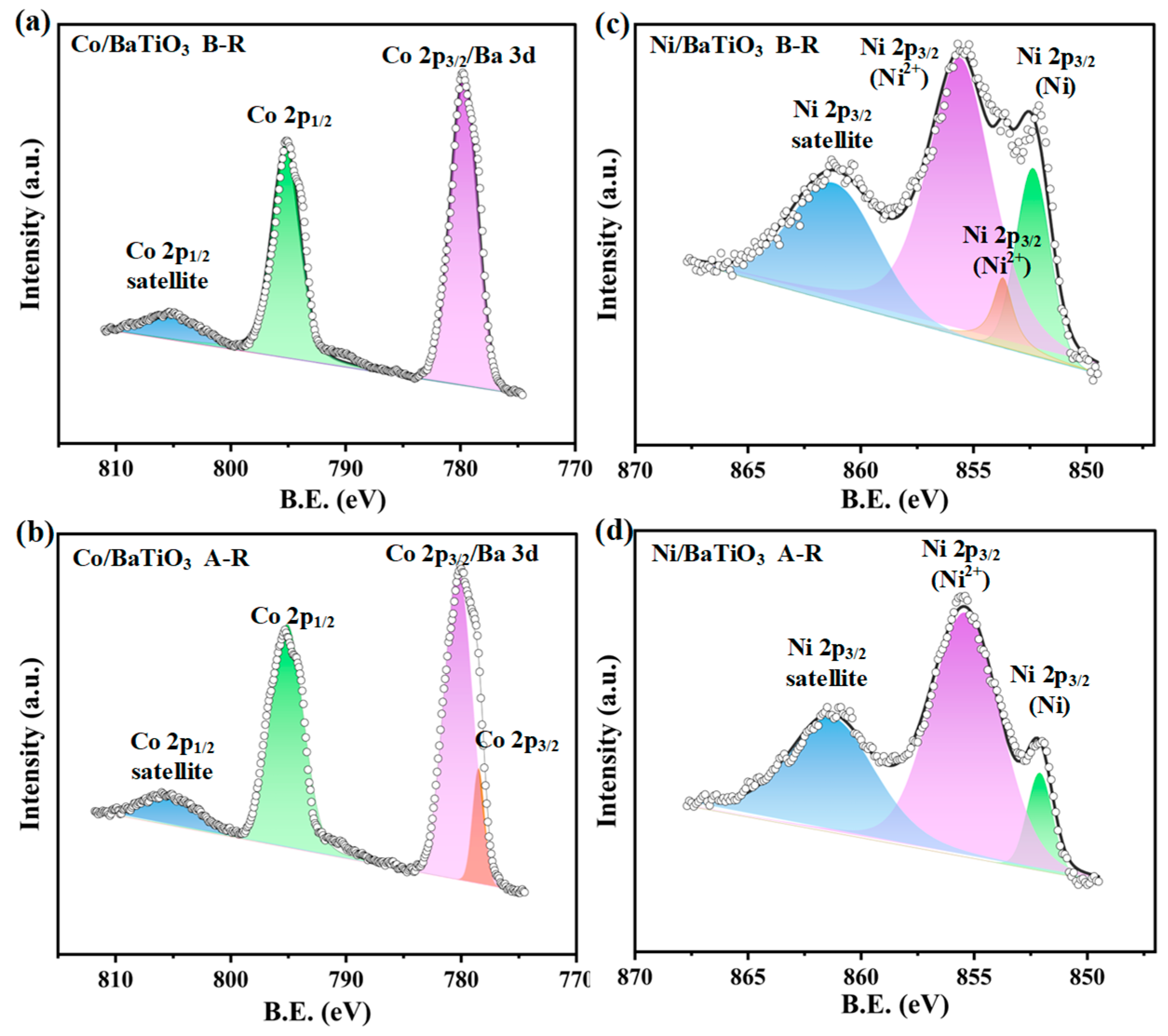
X-ray Photoelectron Spectroscopy (XPS, ESCALAB Xi+, Thermo Fisher Scientific, Waltham, MA, USA) analysis was further performed to investigate the surface chemical states of the Co/BaTiO3 and Ni/BaTiO3 catalysts before and after the plasma-catalytic reaction, as shown in Figure 8. For Co/BaTiO3, the Co 2p signal was relatively weak, and the Co 2p region may partially overlap with the Ba 3d signal from the BaTiO3 support, making it difficult to clearly distinguish and deconvolute the main Co 2p peaks. Co-related satellite features were observed before and after reaction, indicating the presence of surface Co species on the BaTiO3 support. The retention of these Co-related satellite features after reaction suggests that the surface Co species were relatively stable under the present plasma-catalytic reaction conditions. For Ni/BaTiO3, the Ni 2p spectra exhibited Ni-related peaks and satellite peaks before reaction, confirming the presence of surface Ni species on the BaTiO3 support. After reaction, the Ni-related signals were still observed without obvious disappearance, suggesting that the surface Ni species were largely retained under the present plasma reaction conditions.
Therefore, the comparison of XPS spectra before and after the reaction indicates that the supported Co, Ni surface species showed reasonable stability during the plasma-catalytic process. Combined with the BET results, these characterizations confirm the real specific surface area, accessible reaction surface, and surface-exposed metal species of the catalysts. These surface-exposed Co/Ni species may serve as potential active sites for plasma-catalytic ammonia synthesis. Combined with the EDS elemental mapping results, Ni and Co species are relatively well dispersed on the BaTiO3 surface, with no obvious large-scale aggregation observed. The SEM results also show that no severe collapse or sintering of the catalyst morphology occurs before and after the reaction. Therefore, Co and Ni species can serve as potential surface reaction sites for the adsorption of plasma-activated N2/H2 species, surface hydrogenation, and NH3 desorption.
It should be noted that XPS mainly reflects the surface elemental composition and chemical states of the catalyst, while EDS mainly reflects the spatial distribution of elements. These two techniques can provide evidence for the existence and distribution of surface-active metal species, but they cannot be directly regarded as an accurate quantification of the true active site density.

3. Results and Discussion

3.1. Discharge Characteristics with Different Catalysts

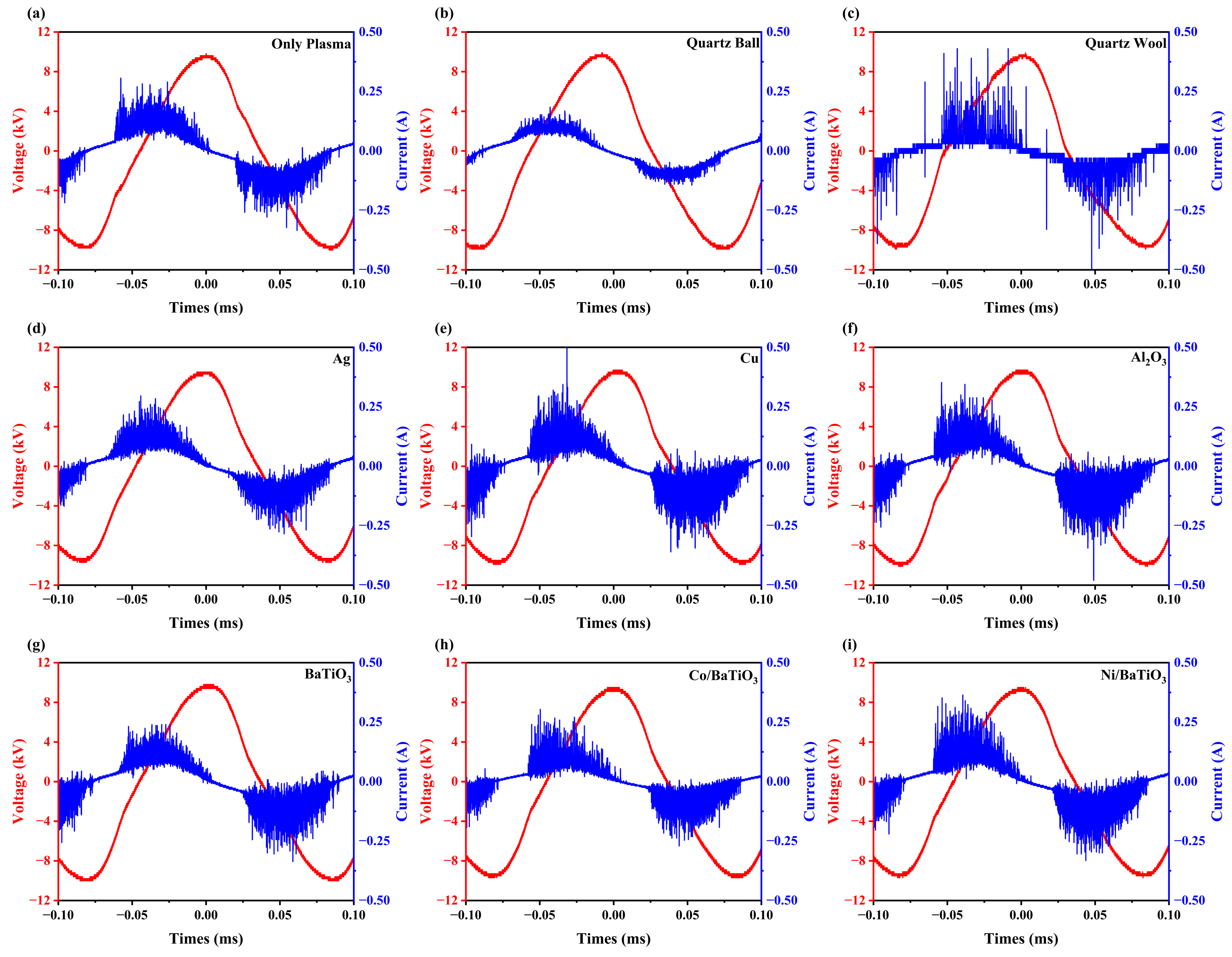
To investigate the influence of different packed catalysts on the discharge characteristics of DBD, the real-time discharge voltage and current waveforms during ammonia synthesis were measured. Figure 9 presents the voltage and current waveforms under identical operating conditions (peak voltage of 10 kV and frequency of 6 kHz) for the plasma-only case, quartz wool packing, and quartz wool-supported Ag, Cu, γ-Al2O3, BaTiO3, as well as supported catalysts Co/BaTiO3 and Ni/BaTiO3. Under all experimental conditions, the discharge waveforms exhibit typical filamentary micro-discharge characteristics of DBD [26].
When quartz wool was introduced into the discharge gap, both the number and amplitude of current pulses increased compared with the plasma-only condition. This indicates that the porous structure of quartz wool can create numerous micro-discharge channels within the discharge gap, thereby enhancing local electric-field inhomogeneity, increasing the number of micro-discharges, and strengthening the overall discharge intensity. In contrast, when 1 mm quartz beads were packed in the discharge gap, the current pulse amplitude decreased significantly. This is mainly because quartz beads, as insulating dielectrics, accumulate surface charges during discharge and generate a counter electric field, which suppresses the development of electron avalanches within individual micro-discharge channels and thereby inhibits the instantaneous discharge current. Meanwhile, the packing of quartz beads shortens the effective discharge length of each micro-discharge channel, further leading to a reduction in current pulse amplitude [27]. For the Ag catalyst supported on quartz wool, the current pulse amplitude was slightly lower than that observed for quartz wool alone, indicating that the presence of Ag metal particles partially modified the local electric-field distribution and stabilized certain discharge channels. In the Cu catalyst system, both the number and amplitude of current pulses increased significantly, suggesting that Cu generated additional electric-field-enhanced regions within the discharge gap, thereby promoting the formation of more micro-discharge channels. For the γ-Al2O3 and BaTiO3 catalyst systems, the current waveforms exhibit more densely distributed and more uniformly arranged micro-discharge pulses. Owing to their relatively high dielectric constants, γ-Al2O3 and BaTiO3 possess strong dielectric polarization capability, which significantly enhances the local electric field distortion within the discharge gap. This facilitates electron energy gain and promotes gas breakdown, leading to a more uniform and stable micro-discharge distribution in the plasma region [22]. Upon further introduction of the supported catalysts Co/BaTiO3 and Ni/BaTiO3, the number of current pulses increases further, accompanied by a more densely distributed pulse pattern. Compared with the BaTiO3-only system, metal loading introduces additional active sites with enhanced electron emission capability on the catalyst surface. These metallic active centers can promote secondary electron emission, thereby reducing the electric-field strength required for gas breakdown and further facilitating the formation of micro-discharge channels [28].
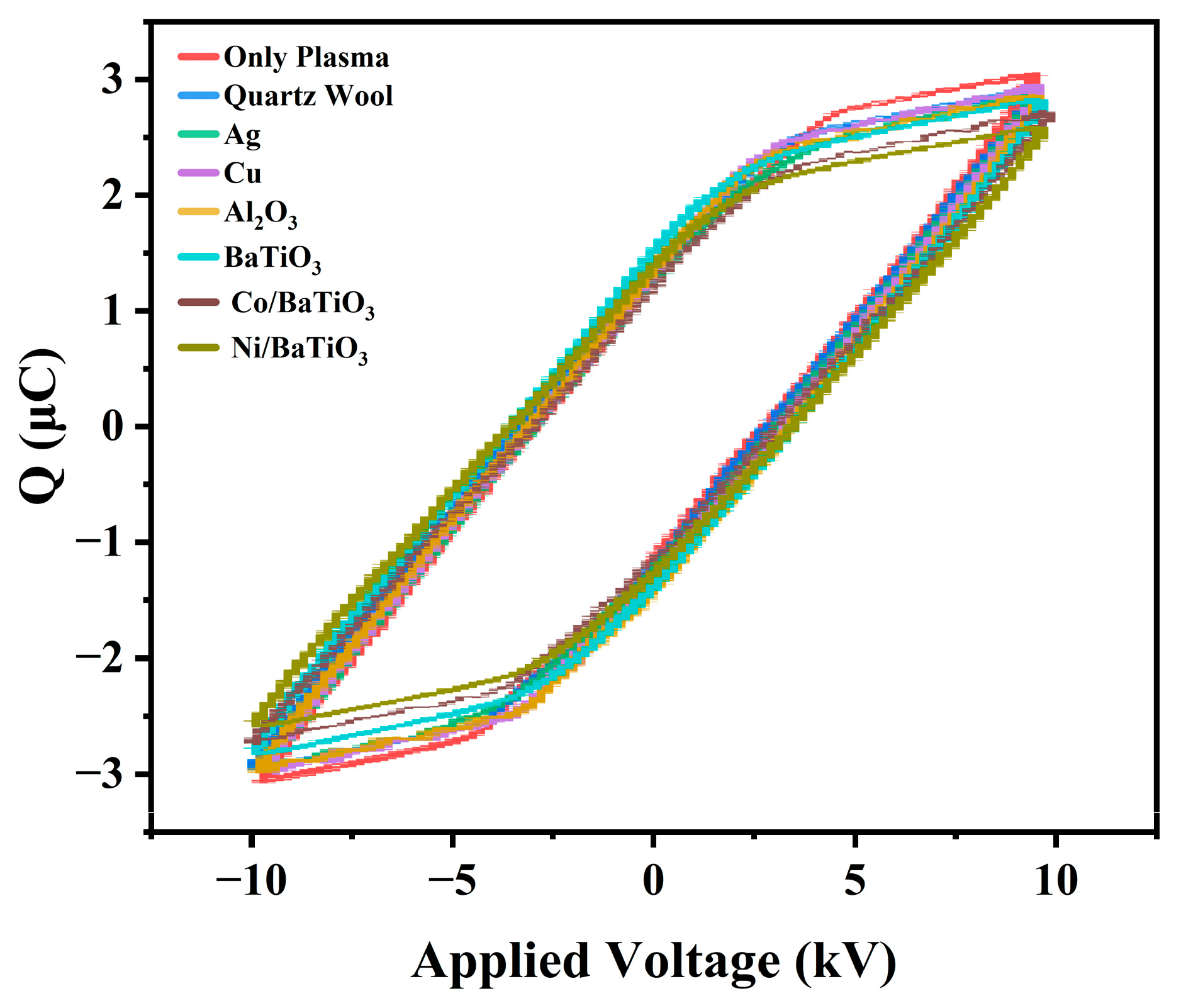
To further investigate the influence of different catalysts on the DBD characteristics, Lissajous figures were constructed under identical operating conditions based on the measured discharge voltage and the voltage across the sampling capacitor, as shown in Figure 10. It can be observed that the closed-loop shapes under different conditions change from a parallelogram-like form to an elliptical shape, indicating variations in discharge behavior. The Lissajous patterns for Ag-, Cu-, and γ-Al2O3-filled systems exhibit similar morphologies, suggesting that these catalysts have no significant effect on the overall discharge characteristics. In contrast, when BaTiO3, Co/BaTiO3, and Ni/BaTiO3 are introduced, the Lissajous figures show a more pronounced elliptical tendency, indicating a transition in the discharge mode from typical filamentary micro-discharges to a combination of surface discharge and weakened micro-discharge behavior [29,30]. The introduction of high-dielectric-constant BaTiO3 not only facilitates the formation of a more uniform and stable plasma discharge region, but also increases the effective collision probability between electrons and reactant molecules, thereby enhancing N2 activation efficiency [31]. After the introduction of supported catalysts Co/BaTiO3 and Ni/BaTiO3, the effective charge transfer per discharge cycle decreases. This is mainly attributed to the fact that the incorporation of metallic active components alters the charge accumulation and release behavior on the catalyst surface. The metal particles promote surface charge redistribution, thereby reducing the degree of charge accumulation on the dielectric surface.

3.2. FTIR Analysis of NH3 Products in DBD Plasma Synthesis

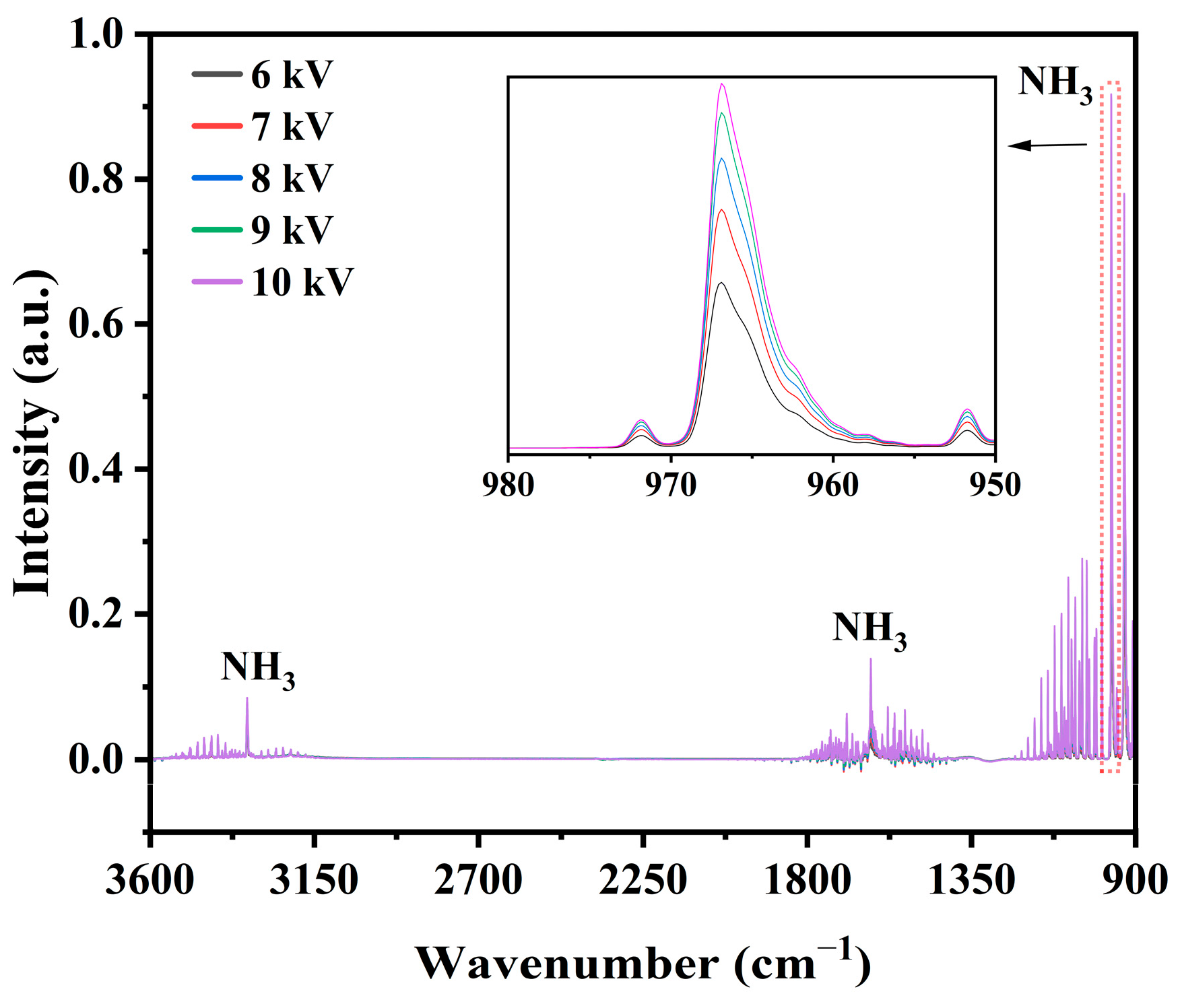
To confirm the formation of ammonia products in the plasma synthesis process, the reaction effluent was analyzed by FTIR spectroscopy. Figure 11 illustrates the concentration variation in FTIR absorption spectra of Ni/BaTiO3 under different applied voltages. Distinct characteristic absorption peaks can be observed at approximately 3333 cm−1, 1625 cm−1, and 967 cm−1, which are assigned to the N-H stretching vibration, bending vibration, and deformation vibration of NH3 molecules, respectively [32]. In addition, a characteristic peak of NH4+ is detected at around 3017 cm−1 [33], indicating the presence of NH3 and partially formed NHX intermediates in the gas-phase reaction products. Furthermore, the NH3 concentration under different operating conditions was quantified based on the integrated intensity of the characteristic NH3 peak at 967 cm−1, combined with the calibration relationship established above. This enables quantitative comparison of NH3 production under different catalysts and reaction parameters.

3.3. Effect of N2/H2 Ratio on NH3 Synthesis Rate and Energy Efficiency

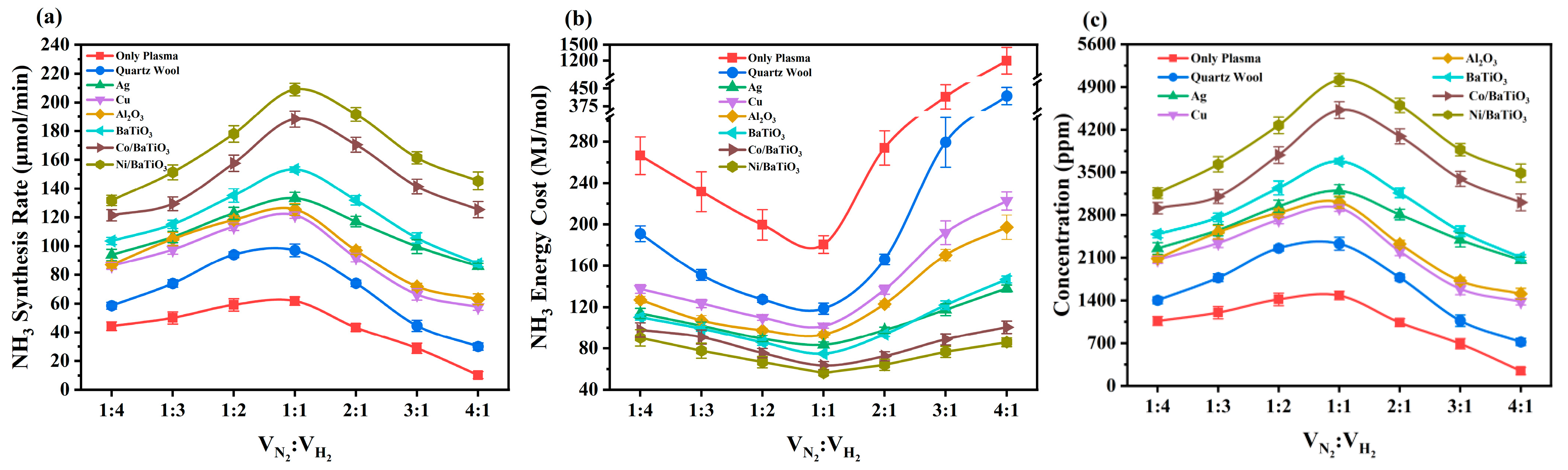
Under the conditions of a discharge voltage of 10 kV, a discharge frequency of 6 kHz, and a total gas flow rate of 1 L/min, Figure 12a–c show the variations in NH3 synthesis rate, energy consumption, and NH3 concentration, respectively, under different N2/H2 volumetric ratios with various catalyst packings. The results indicate that, for all catalyst systems, the NH3 synthesis rate initially increases and then decreases with increasing H2 volume fraction, exhibiting a clear non-monotonic trend. Compared with the plasma-only blank system, all catalyst-assisted systems significantly enhance the NH3 synthesis rate. Among them, the Ni/BaTiO3 catalyst exhibits the best performance. At a N2:H2 ratio of 1:1, the NH3 synthesis rate reaches 208.96 μmol/min, which is 237.25% higher than that of the plasma-only condition. According to previous studies, the dissociation energy of the N≡N triple bond is 9.8 eV, which is more than twice that of H2 (4.52 eV). Therefore, the activation and dissociation of N2 is considered the rate-determining step in ammonia formation [13]. A moderate increase in H2 content promotes the generation of reactive H species in the plasma, thereby facilitating the recombination of N and H species in both the gas phase and on the catalyst surface [34]. However, when the H2 fraction becomes too high, excessive energy is consumed in H2 dissociation, which suppresses N2 dissociation and consequently leads to a decrease in NH3 synthesis rate. Overall, the promotion effect of different catalysts follows the order: Ni/BaTiO3 > Co/BaTiO3 > BaTiO3 > Ag > γ-Al2O3 > Cu > quartz wool > plasma-only. This indicates that the supported catalysts Ni/BaTiO3 and Co/BaTiO3 exhibit superior performance in plasma-assisted ammonia synthesis. This enhancement can be attributed to the high dielectric constant of BaTiO3, which strengthens the local electric field in the discharge region and improves micro-discharge behavior, thereby increasing electron energy and electron density. In addition, the loaded metal active species (Ni and Co) provide additional surface-active sites, promoting the adsorption and reaction of reactive nitrogen and hydrogen species on the catalyst surface [35], ultimately enhancing NH3 formation efficiency. A similar dependence of NH3 synthesis on the N2/H2 ratio was reported by Wang et al. for Ni/Al2O3, where the feed composition affected the balance between N2 activation and hydrogenation of nitrogen-containing intermediates; however, the reported energy efficiency was 0.29 g-NH3/kWh, lower than that obtained in this work [13]. Liu et al. also reported that Ni/BaTiO3 showed the best performance among M/BaTiO3 catalysts under optimized N2/H2 conditions, but its maximum energy efficiency was 0.78 g-NH3/kWh, indicating that the present Ni/BaTiO3 system provides more efficient energy utilization [23].

3.4. Effect of Total Gas Flow Rate on NH3 Synthesis Rate and Energy Efficiency

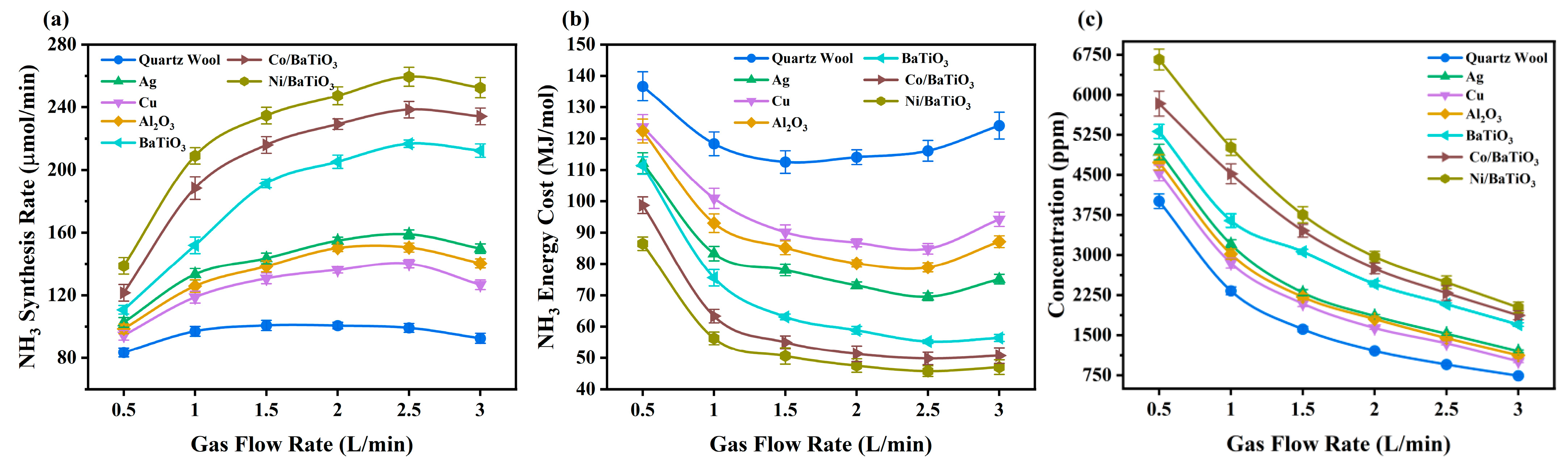
In different catalyst systems, the gas flow rate is a key factor influencing the NH3 synthesis rate and energy efficiency, as it is directly related to the processing capacity of the DBD reactor [36]. Figure 13a–c show the variations in NH3 synthesis rate and energy consumption, and NH3 concentration, respectively, as a function of total gas flow rate under the optimal N2/H2 volumetric ratio (N2:H2 = 1:1) in DBD plasma-catalytic systems with different catalysts. The results indicate that, for all catalyst systems, the NH3 synthesis rate first increases and then decreases with increasing gas flow rate, while the energy consumption exhibits an initial decreasing and subsequent increasing trend. When the total gas flow rate increases from 0.5 L/min to 2.5 L/min, the Ni/BaTiO3 system shows an increase in NH3 synthesis rate from 138.77 μmol/min to 259.48 μmol/min, accompanied by a decrease in NH3 energy consumption from 86.47 MJ/mol to 45.78 MJ/mol. However, further increasing the gas flow rate led to a decline in NH3 production performance. This behavior can be explained as follows: at low gas flow rates, the residence time of the gas in the discharge region is excessively long, allowing the NH3 formed within the plasma zone to undergo secondary dissociation at the downstream end of the discharge region. As the gas flow rate increases, the reactant flux increases, which enhances the effective collision frequency between high-energy electrons and gas molecules. Meanwhile, the reduced residence time suppresses the secondary decomposition of NH3, thereby promoting NH3 formation [24]. However, when the flow rate becomes too high, the residence time in the discharge region becomes insufficient, leading to a reduction in the effective electron–molecule collision time, as well as shortened adsorption and reaction times of active species on the catalyst surface, ultimately inhibiting the overall reaction process. Liu et al. reported that the gas flow rate significantly affected Co-Ni/Al2O3-assisted DBD ammonia synthesis by changing the residence time and plasma–catalyst contact process, with a maximum energy efficiency of 0.83 g-NH3/kWh [24]. Andersen et al. also showed that the feed flow rate influenced NH3 concentration and energy efficiency in Co/MgAl2O4-packed DBD systems, but the reported maximum energy efficiency was 1.19 g-NH3/kWh, which is lower than the 1.40 g-NH3/kWh achieved in this work [21].

3.5. Effect of Peak Discharge Voltage on NH3 Synthesis Rate and Energy Efficiency

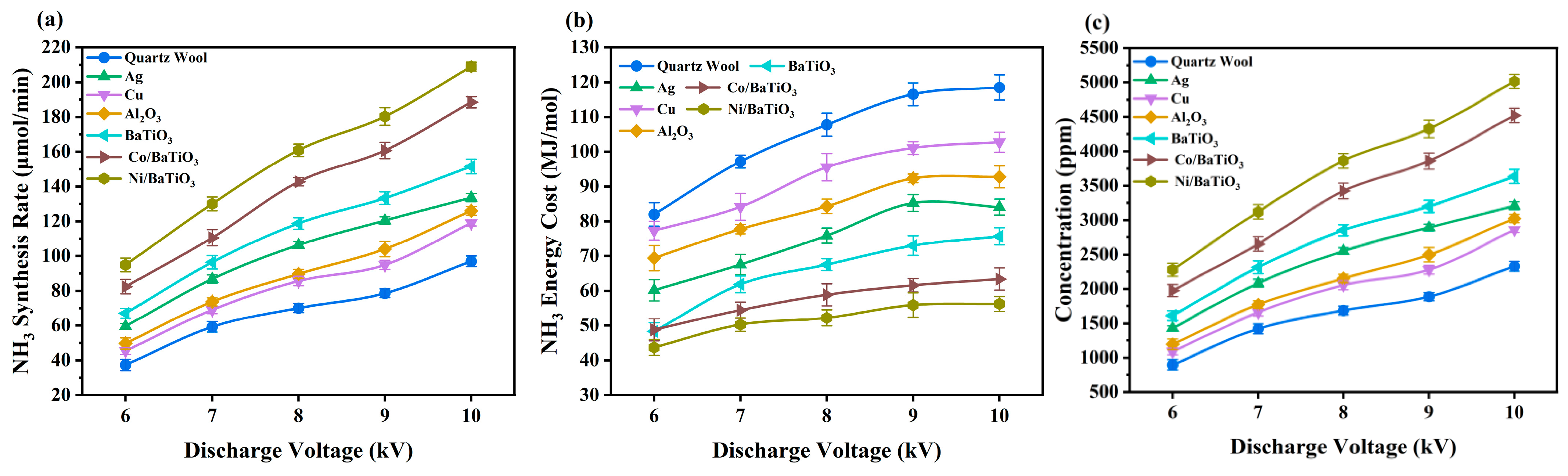
Figure 14a–c show the effects of discharge peak voltage on NH3 synthesis rate, energy consumption, and NH3 concentration, respectively, under the optimal N2/H2 volumetric ratio for different catalyst systems. The results indicate that the NH3 synthesis rate increases with increasing discharge peak voltage for all catalyst configurations, while clear differences are observed among different catalysts. Overall, the performance follows the order: Ni/BaTiO3 > Co/BaTiO3 > BaTiO3 > Ag > γ-Al2O3 > Cu > quartz wool support. At a discharge peak voltage of 10 kV, the Ni/BaTiO3 system achieves the highest NH3 synthesis rate of approximately 208.96 μmol/min. Meanwhile, at a lower discharge peak voltage of 6 kV, the NH3 energy consumption decreases to 43.71 MJ/mol. This behavior can be attributed to the fact that increasing the discharge voltage enhances the electric field strength, thereby promoting the generation of high-energy electrons. As a result, the dissociation, excitation, and ionization of N2 and H2 molecules are accelerated, leading to the formation of a greater number of reactive species, including N and H radicals, excited N2, and N2+ ions [13]. Meanwhile, the increased discharge voltage also enhances the micro-discharge density and expands the plasma discharge region, thereby increasing the effective collision probability among reactive species and further promoting the NH3 synthesis rate [14]. However, it can also be observed that the NH3 energy consumption gradually increases with increasing discharge voltage. This is because, in DBD plasma-assisted ammonia synthesis, the input power increases nonlinearly with the applied voltage. Under high-voltage conditions, not only is the target reaction promoted, but undesired processes such as gas heating, excessive ionization, and NH3 decomposition are also intensified, leading to an increase in energy consumption for ammonia synthesis. Similar voltage-dependent behavior has also been reported in previous DBD plasma ammonia synthesis studies. Chen et al. investigated NH3 synthesis in a coaxial DBD reactor using porous SiO2 and nonporous glass beads as catalyst supports, and found that both N2 conversion and NH3 energy yield increased with the applied voltage [37]; however, their study mainly focused on inert support materials, whereas the present work further introduces Ni/BaTiO3 with both dielectric enhancement and metal active sites, leading to higher NH3 synthesis performance. Xu et al. studied the effect of pulse voltage in a DBD reactor and found that, without noble gas addition, the NH3 synthesis rate first increased and then decreased with increasing voltage, indicating that excessive voltage could promote NH3 decomposition [38]; by comparison, the Ni/BaTiO3 system in this work maintains the highest NH3 synthesis rate among all tested catalysts and achieves a maximum energy efficiency of 1.40 g-NH3/kWh under optimized conditions.

3.6. Relationship Between NH3 Synthesis Rate and Energy Efficiency

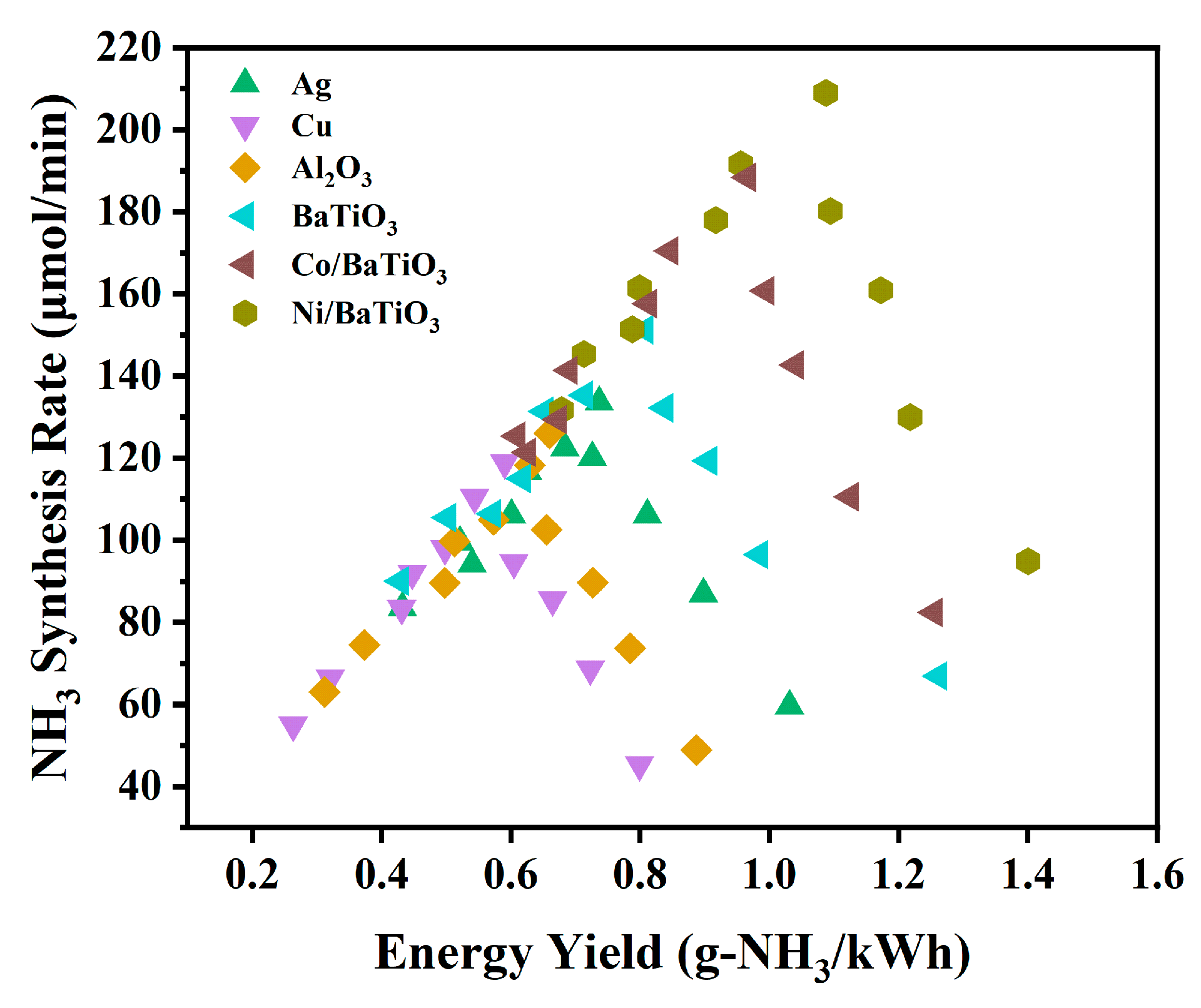
Figure 15 illustrates the relationship between NH3 synthesis rate and energy efficiency for different catalyst systems under a total gas flow rate of 1 L/min, varying N2/H2 volumetric ratios and discharge peak voltages. The results show that the scatter distributions of all catalyst systems exhibit a clear nonlinear behavior, indicating that the NH3 synthesis rate does not vary monotonically with energy efficiency. Instead, relatively high NH3 synthesis rates are observed within a specific energy efficiency range. Among all catalysts, the data points for Ni/BaTiO3 are mainly located in the upper-right region of the plot, corresponding to simultaneously high NH3 synthesis rates and high energy efficiency values. The maximum energy efficiency reaches 1.40 g-NH3/kWh, significantly outperforming the other catalyst systems. This demonstrates that the Ni/BaTiO3 catalyst not only significantly enhances the NH3 synthesis rate but also maintains a relatively high level of energy utilization over a broad operating window. For the single-component catalyst systems, BaTiO3 exhibits better performance compared with Ag, Cu, and γ-Al2O3. Its data points are relatively concentrated in the higher NH3 synthesis rate region, indicating that high-dielectric-constant supports can effectively enhance the discharge process and improve plasma–catalyst interactions. Similar rate–efficiency trade-offs have been reported in DBD plasma-catalytic ammonia synthesis. Rouwenhorst et al. achieved a maximum energy efficiency of 1.23 g-NH3/kWh over Ru-K/MgO [20], while Andersen et al. reported 1.19 g-NH3/kWh over Co/MgAl2O4 [21]. Compared with these representative systems, the Ni/BaTiO3 catalyst in this work reaches a higher maximum energy efficiency of 1.40 g-NH3/kWh while maintaining a high NH3 synthesis rate, suggesting a more favorable balance between plasma activation and catalytic surface conversion.

3.7. OES Analysis of DBD Plasma with Different Catalysts

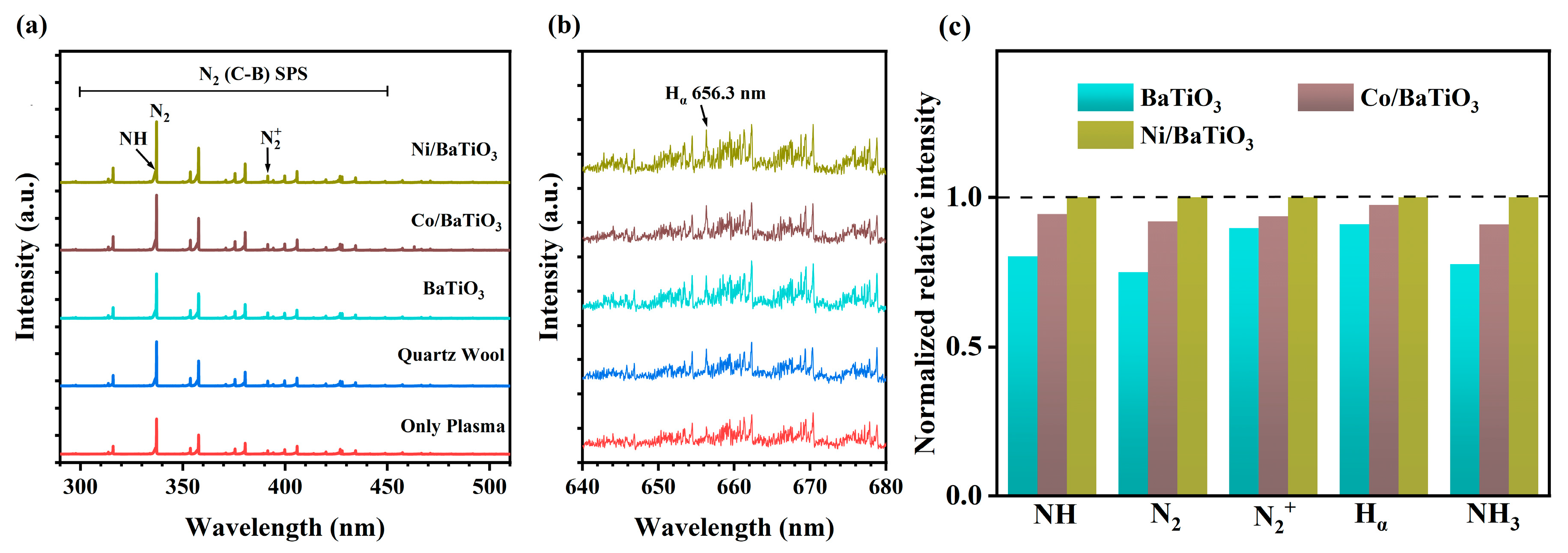
To further elucidate the formation characteristics of reactive species in different catalyst systems, OES was employed for diagnostic analysis. OES measurements were conducted at a discharge voltage of 9 kV, a frequency of 6 kHz, and the optimal N2/H2 volumetric ratio corresponding to each catalyst system. All measurements were carried out under identical discharge conditions to ensure comparability among the different catalysts. The OES analysis was primarily intended for qualitative comparison of reactive species generation and to assess the relative influence of each catalyst on key species such as NH, N2+, and Hα. As shown in Figure 16a,b, the emission spectra in the ranges of 300–500 nm and 640–680 nm under different catalyst conditions are presented, respectively. Notably, no significant signals were observed in the 500–640 nm range, and thus this spectral region is not shown in the figure. It can be observed that characteristic emission lines corresponding to NH, N2, N2+, and Hα are detected in all systems, indicating the presence of multiple reactive species associated with ammonia synthesis during the plasma discharge process. In particular, the emission line at 336.7 nm is attributed to the NH (A3Π→X3Σ) electronic transition [39], This reflects the formation of NHX intermediate species. The second positive system of N2 (C3Πu→B3Πg), distributed in the 300–400 nm region, corresponds to the main emission band of electronically excited nitrogen molecules. In addition, a characteristic peak of the first negative system of N2+ (B2Σu+→X2Πg+) is observed at around 391.4 nm, indicating that during the discharge process, N2 molecules undergo not only electronic excitation but also partial ionization [13]. In addition, a distinct Hα emission line is observed at 656.3 nm, corresponding to the radiative transition of hydrogen atoms from the n = 3 to n = 2 energy level, indicating the presence of a considerable amount of reactive hydrogen atoms in the discharge region.
To further compare the effect of different catalysts on the generation of plasma reactive species, the intensities of characteristic emission peaks in each system were normalized, as shown in Figure 16c. Among all systems, the Ni/BaTiO3 catalyst exhibits the highest intensities of characteristic species, including NH, N2+, and Hα emission lines. Based on the experimental results presented above, the increase in the concentration of reactive species in the gas phase contributes to the enhanced efficiency of NH3 synthesis in the DBD system.
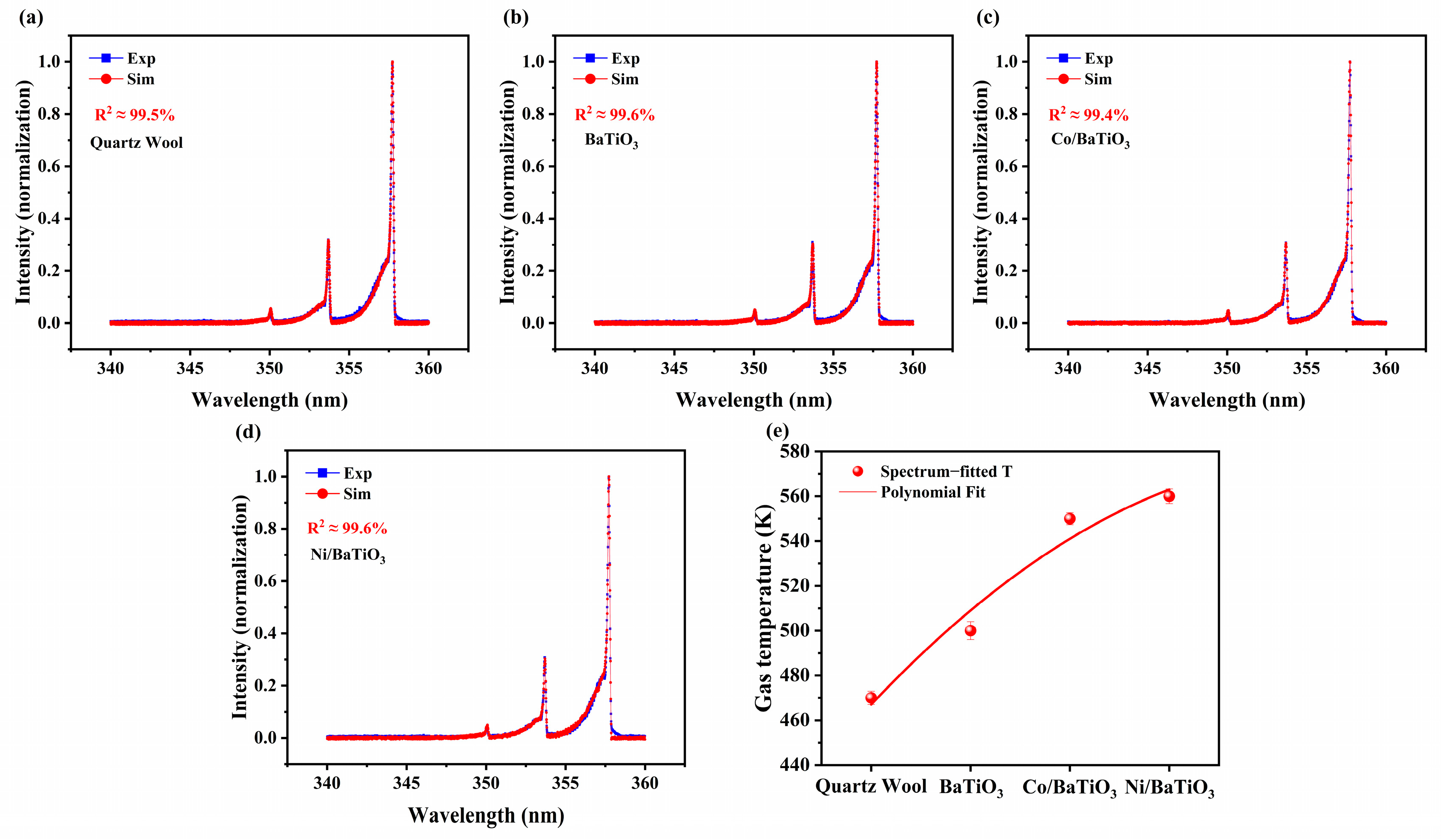
Beyond the qualitative identification of reactive species, OES was further used to estimate the gas temperature in the discharge region. Since DBD plasma is a non-thermal equilibrium system, where the electron temperature, gas temperature, and catalyst bed temperature are not completely identical, OES was employed to analyze the emission spectra in the discharge region and to characterize the plasma excitation state and gas temperature features. Previous studies have used the N2 second positive system, N2 (C3Πu→B3Πg), for plasma temperature diagnostics by Boltzmann analysis or by fitting the experimental N2 (C→B) emission bands with simulated spectra [40,41]. In this work, the emission spectra in the range of 340–360 nm were fitted using the Boltzmann method to estimate the gas temperature under different packing systems. Since the rotational temperature of N2 can be approximately regarded as the gas temperature in atmospheric-pressure DBD plasma, T g was obtained by achieving the best match between the simulated and experimental spectra, as shown in Figure 17.
The fitting results show that all systems exhibit high fitting accuracy, with R 2 values of approximately 99.4–99.6%, indicating the reliability of this method. The gas temperature follows the order of quartz wool < BaTiO3 < Co/BaTiO3 < Ni/BaTiO3, with the Ni/BaTiO3 system reaching the highest gas temperature of approximately 560 K.

3.8. Mechanistic Analysis of DBD Plasma—Catalyst Coupling

The above OES results provide direct evidence for the plasma activation of N2/H2. In the DBD plasma-catalytic ammonia synthesis process in the N2/H2 system, energetic electrons first collide with gas-phase N2 and H2 molecules, causing N2 to undergo excitation, ionization, and partial dissociation, while also promoting the dissociation of H2 to generate reactive hydrogen species. The main processes include N2 + e⟶ N2* + e, N2 + e⟶ N2+ + 2e, N2 + e⟶ 2N* + e, and H2 + e⟶ 2H* + e [12]. Subsequently, these plasma-generated reactive species may participate in NH3 formation through gas-phase reactions and surface-assisted pathways, including adsorption, stepwise hydrogenation, and desorption on the catalyst surface.
For the plasma-only system, NH3 formation mainly depends on gas-phase electron-impact activation of N2/H2 and subsequent reactions among plasma-generated N- and H-containing species. However, due to the absence of additional catalytic surfaces and dielectric packing, the generation and surface conversion of reactive species are relatively limited. After quartz wool is introduced, its porous structure can increase the number of local micro-discharge channels and provide additional contact interfaces, thereby slightly improving plasma activation. Nevertheless, quartz wool is chemically inert and has limited ability to promote surface hydrogenation reactions, so its enhancement of NH3 synthesis remains limited. For the conductive metal catalysts, Ag and Cu can modify the local electric-field distribution to some extent owing to their high electrical conductivity. However, the experimental results indicate that single conductive metals cannot effectively promote NH3 synthesis. This may be attributed to the relatively weak dielectric polarization ability of Ag and Cu, which limits their capacity to enhance the local electric field compared with high-dielectric-constant materials. Meanwhile, Ag and Cu have relatively weak binding ability toward N2 species, making it difficult to provide efficient surface reaction pathways for the adsorption, stepwise hydrogenation, and NH3 desorption of nitrogen-containing intermediates [42]. Therefore, metallic conductivity alone is insufficient to achieve efficient plasma-catalytic ammonia synthesis.
For γ-Al2O3, as a conventional oxide support widely used in heterogeneous catalysis, its surface can provide certain adsorption sites for plasma-generated reactive species. However, compared with BaTiO3, γ-Al2O3 has a lower dielectric constant and weaker dielectric polarization ability, resulting in a limited effect on local electric-field enhancement and micro-discharge regulation. Therefore, the NH3 synthesis performance of γ-Al2O3 is lower than that of BaTiO3, indicating that dielectric properties play an important role in the plasma-catalytic ammonia synthesis system.
In contrast, BaTiO3, as a high-dielectric-constant material, can enhance the local electric field, promote micro-discharge formation, and increase the energy injected into the plasma. This facilitates electron-impact reactions and promotes the generation of chemically reactive species, thereby enhancing N2/H2 activation [22]. Therefore, BaTiO3 exhibits better NH3 synthesis performance than Ag, Cu, and γ-Al2O3, demonstrating the importance of dielectric enhancement in DBD plasma-catalytic ammonia synthesis.
When Co or Ni active species are further loaded onto BaTiO3, the catalyst can combine the dielectric enhancement effect of BaTiO3 with the surface reaction ability of transition-metal active sites. The plasma-generated N* and H* species may be adsorbed on the surfaces of Co/BaTiO3 or Ni/BaTiO3 and converted to NH3 through a stepwise hydrogenation pathway, namely N* + H* ⟶ NH*, NH* + H* ⟶ NH2*, and NH2* + H* ⟶ NH3*, followed by the desorption of NH3* from the catalyst surface to form gaseous NH3.
In addition, Barboun et al. reported that the NH3 desorption peak temperature follows the order Ni < Co, indicating that, after reactive nitrogen species have been generated by plasma, Ni is more favorable for the stepwise hydrogenation of surface nitrogen species and NH3 desorption. In contrast, Co has a stronger affinity for nitrogen species, which may favor nitrogen adsorption or retention; however, excessively strong Co–N interactions may also make subsequent NHX hydrogenation and NH3 release relatively difficult [43]. Therefore, Co/BaTiO3 may be more inclined to capture and stabilize activated nitrogen species, whereas Ni/BaTiO3 is more favorable for the stepwise hydrogenation of NHx intermediates and NH3 release.
Overall, the different catalyst systems investigated in this work provide a comparative basis for understanding how conductive metals, conventional oxide supports, high-dielectric materials, and supported transition-metal catalysts influence plasma activation and surface conversion.

4. Conclusions

This work investigated the role of different catalysts in plasma-assisted ammonia synthesis using a coaxial DBD reactor system. The results demonstrate that the catalyst type has a significant impact on NH3 synthesis performance, with the activity order of Ni/BaTiO3 > Co/BaTiO3 > BaTiO3 > Ag > γ-Al2O3 > Cu. Under the optimized operating conditions, the Ni/BaTiO3 system exhibited the best overall performance. At a N2:H2 ratio of 1:1 and a total gas flow rate of 2.5 L/min, the NH3 synthesis rate reached 259.48 μmol/min, with an energy efficiency of 1.40 g-NH3/kWh. Discharge characteristics and OES diagnostics indicate that, compared with the plasma-only system, the incorporation of high-dielectric-constant BaTiO3 led to a more homogeneous discharge, while metal loading increased the number of micro-discharge events. In particular, the Ni/BaTiO3 system exhibited higher intensities of NH, N2+, and Hα emission lines, which facilitated the formation and subsequent conversion of NHX intermediates. Combined with XRD, SEM, and EDS characterizations, it was confirmed that the metallic active species were well dispersed on the BaTiO3 support, thereby enhancing the interaction between gas-phase reactive species and the catalyst surface. Overall, this study achieved relatively high NH3 synthesis rates and energy efficiency within the investigated systems, demonstrating the superior performance of the Ni/BaTiO3 catalyst in plasma-assisted ammonia synthesis and providing experimental insights for the further optimization of such systems. For future large-scale applications, the NH3 production capacity could be further improved by increasing the effective discharge volume, enhancing the gas processing capacity, and adopting a modular parallel configuration of multiple DBD reactors. This numbering-up strategy may help maintain discharge uniformity and operational stability during scale-up.

Author Contributions

Conceptualization, F.Q. and X.P.; methodology, F.Q., X.Z. (Xin Zhang) and S.J.; validation, F.Q. and X.Z. (Xin Zhang); formal analysis, F.Q. and S.J.; investigation, F.Q., X.Z. (Xin Zhang), S.J., H.Z. and L.W.; data curation, F.Q., X.Z. (Xin Zheng) and Y.S.; writing—original draft preparation, F.Q., X.Z. (Xin Zhang) and Y.S.; writing—review and editing, X.P. and R.L.; visualization, F.Q. and J.H.; supervision, X.P.; project administration, X.P.; funding acquisition, X.P. All authors have read and agreed to the published version of the manuscript.

Funding

This research was funded by the National Natural Science Foundation of China (No. 52377155) and the Science and Technology Projects of China Southern Power Grid (YNKJXM20240034, YNKJXM20240035).

Data Availability Statement

The original contributions presented in this study are included in the article.

Conflicts of Interest

Authors Fangcheng Qiu, Yufeng Song, Jian Huang, Xin Zheng and Ronghai Liu were employed by the company Yunnan Power Grid Co., Ltd. The remaining authors declare that the research was conducted in the absence of any commercial or financial relationships that could be construed as a potential conflict of interest.

References

  1. Li, K.; Liu, Y.; Cheng, J.; Wang, B.; Zhang, J.; Jin, Y.; Lu, Z.; Liu, Y.; Zhang, L.; Zhang, X. Dielectric barrier discharge-induced NH3 synthesis from N2 and H2: The disclosure of plasma chemistry. Plasma Sci. Technol. 2025, 27, 115501. [Google Scholar] [CrossRef]
  2. Sazali, N. Emerging technologies by hydrogen: A review. Int. J. Hydrogen Energy 2020, 45, 18753–18771. [Google Scholar] [CrossRef]
  3. Kovač, A.; Paranos, M.; Marciuš, D. Hydrogen in energy transition: A review. Int. J. Hydrogen Energy 2021, 46, 10016–10035. [Google Scholar] [CrossRef]
  4. Appl, M. The Haber-Bosch heritage: The ammonia production technology. In Proceedings of the 50th Anniversary of the IFA Technical Conference, Sevilla, Spain, 25–26 September 1997; Volume 25, pp. 25–26. [Google Scholar]
  5. Schrock, R.R. Reduction of dinitrogen. Proc. Natl. Acad. Sci. USA 2006, 103, 17087. [Google Scholar] [CrossRef]
  6. Rafiqul, I.; Weber, C.; Lehmann, B.; Voss, A. Energy efficiency improvements in ammonia production—Perspectives and uncertainties. Energy 2005, 30, 2487–2504. [Google Scholar] [CrossRef]
  7. Chen, J.G.; Crooks, R.M.; Seefeldt, L.C.; Bren, K.L.; Bullock, R.M.; Darensbourg, M.Y.; Holland, P.L.; Hoffman, B.; Janik, M.J.; Jones, A.K.; et al. Beyond fossil fuel–driven nitrogen transformations. Science 2018, 360, eaar6611. [Google Scholar] [CrossRef]
  8. Rezaie, F.; Læsaa, S.; Sahin, N.E.; Catalano, J.; Dražević, E. Low-Temperature Electrochemical Ammonia Synthesis: Measurement Reliability and Comparison to Haber-Bosch in Terms of Energy Efficiency. Energy Technol. 2023, 11, 2300410. [Google Scholar] [CrossRef]
  9. Nørskov, J.; Chen, J.; Miranda, R.; Fitzsimmons, T.; Stack, R. Sustainable Ammonia Synthesis-Exploring the Scientific Challenges Associated with Discovering Alternative, Sustainable Processes for Ammonia Production; US DOE Office of Science: Washington, DC, USA, 2016.
  10. Hong, J.; Prawer, S.; Murphy, A.B. Plasma catalysis as an alternative route for ammonia production: Status, mechanisms, and prospects for progress. ACS Sustain. Chem. Eng. 2018, 6, 15–31. [Google Scholar] [CrossRef]
  11. Patil, B.S.; Cherkasov, N.; Srinath, N.V.; Lang, J.; Ibhadon, A.O.; Wang, Q.; Hessel, V. The role of heterogeneous catalysts in the plasma-catalytic ammonia synthesis. Catal. Today 2021, 362, 2–10. [Google Scholar] [CrossRef]
  12. Qu, Z.; Zhou, R.; Sun, J.; Gao, Y.; Li, Z.; Zhang, T.; Zhou, R.; Liu, D.; Tu, X.; Cullen, P.; et al. Plasma-assisted sustainable nitrogen-to-ammonia fixation: Mixed-phase, synergistic processes and mechanisms. ChemSusChem 2024, 17, e202300783. [Google Scholar] [CrossRef]
  13. Wang, Y.; Craven, M.; Yu, X.; Ding, J.; Bryant, P.; Huang, J.; Tu, X. Plasma-enhanced catalytic synthesis of ammonia over a Ni/Al2O3 catalyst at near-room temperature: Insights into the importance of the catalyst surface on the reaction mechanism. ACS Catal. 2019, 9, 10780–10793. [Google Scholar] [CrossRef]
  14. Tu, X.; Gallon, H.J.; Twigg, M.V.; Gorry, P.A.; Whitehead, J.C. Dry reforming of methane over a Ni/Al2O3 catalyst in a coaxial dielectric barrier discharge reactor. J. Phys. D Appl. Phys. 2011, 44, 274007. [Google Scholar] [CrossRef]
  15. Xie, Q.; Zhuge, S.; Song, X.; Lu, M.; Yu, F.; Ruan, R.; Nie, Y. Non-thermal atmospheric plasma synthesis of ammonia in a DBD reactor packed with various catalysts. J. Phys. D Appl. Phys. 2020, 53, 064002. [Google Scholar] [CrossRef]
  16. Srinath, N.V.; PDEng, B.S.P.; Hessel, V.; Gallucci, F. Plasma Catalytic Ammonia Synthesis at Atmospheric Pressure in a Dielectric Barrier Discharge Reactor; Technische Universiteit Eindhoven: Eindhoven, The Netherlands, 2017. [Google Scholar]
  17. Liu, Y.; Xu, X.; Song, Q.; Guo, Z. Co-Ni/MOF-74 catalyst packed-bed DBD plasma for ammonia synthesis. Plasma Process. Polym. 2024, 21, 2300086. [Google Scholar] [CrossRef]
  18. Patil, B.S.; Cherkasov, N.; Lang, J.; Ibhadon, A.; Hessel, V.; Wang, Q. Low temperature plasma-catalytic NOx synthesis in a packed DBD reactor: Effect of support materials and supported active metal oxides. Appl. Catal. B Environ. 2016, 194, 123–133. [Google Scholar] [CrossRef]
  19. Hong, J.; Aramesh, M.; Shimoni, O.; Seo, D.H.; Yick, S.; Greig, A.; Charles, C.; Prawer, S.; Murphy, A.B. Plasma catalytic synthesis of ammonia using functionalized-carbon coatings in an atmospheric-pressure non-equilibrium discharge. Plasma Chem. Plasma Process. 2016, 36, 917–940. [Google Scholar] [CrossRef]
  20. Rouwenhorst, K.H.; Burbach, H.G.; Vogel, D.W.; Paulí, J.N.; Geerdink, B.; Lefferts, L. Plasma-catalytic ammonia synthesis beyond thermal equilibrium on Ru-based catalysts in non-thermal plasma. Catal. Sci. Technol. 2021, 11, 2834–2843. [Google Scholar] [CrossRef]
  21. Andersen, J.; Holm, M.; van’t Veer, K.; Christensen, J.; Østberg, M.; Bogaerts, A.; Jensen, A. Plasma-catalytic ammonia synthesis in a dielectric barrier discharge reactor: A combined experimental study and kinetic modeling. Chem. Eng. J. 2023, 457, 141294. [Google Scholar] [CrossRef]
  22. Liu, J.; Zhu, X.; Hu, X.; Tu, X. Plasma-assisted ammonia synthesis in a packed-bed dielectric barrier discharge reactor: Roles of dielectric constant and thermal conductivity of packing materials. Plasma Sci. Technol. 2022, 24, 025503. [Google Scholar] [CrossRef]
  23. Liu, J.; Zhu, X.; Zhou, C.; Du, J.; Gan, Y.; Chen, G.; Tu, X. Plasma-catalytic ammonia synthesis over BaTiO3 supported metal catalysts: Process optimization using response surface methodology. Vacuum 2022, 203, 111205. [Google Scholar] [CrossRef]
  24. Liu, Y.; Wang, C.W.; Xu, X.F.; Liu, B.W.; Zhang, G.M.; Liu, Z.W.; Chen, Q.; Zhang, H.B. Synergistic effect of Co-Ni bimetal on plasma catalytic ammonia synthesis. Plasma Chem. Plasma Process. 2022, 42, 267–282. [Google Scholar] [CrossRef]
  25. Carroll, C.E.; Ranganathan, R.V.; Voy, C.C.; Zhang, Z. Application of Calcium Hydride, Calcium Nitride, and Lithium Hydride Catalysts for Enhanced Ammonia Synthesis in Dielectric Barrier Discharge Plasma. Plasma Chem. Plasma Process. 2025, 45, 829–841. [Google Scholar] [CrossRef]
  26. Butterworth, T.; Elder, R.; Allen, R. Effects of particle size on CO2 reduction and discharge characteristics in a packed bed plasma reactor. Chem. Eng. J. 2016, 293, 55–67. [Google Scholar] [CrossRef]
  27. Patil, B.S.; Van Kaathoven, A.S.; Peeters, F.J.; Cherkasov, N.; Lang, J.; Wang, Q.; Hessel, V. Deciphering the synergy between plasma and catalyst support for ammonia synthesis in a packed dielectric barrier discharge reactor. J. Phys. D Appl. Phys. 2020, 53, 144003. [Google Scholar] [CrossRef]
  28. Kruszelnicki, J.; Engeling, K.W.; E Foster, J.; Kushner, M.J. Interactions between atmospheric pressure plasmas and metallic catalyst particles in packed bed reactors. J. Phys. D Appl. Phys. 2021, 54, 104001. [Google Scholar] [CrossRef]
  29. HKim, H.-H.; Teramoto, Y.; Negishi, N.; Ogata, A. A multidisciplinary approach to understand the interactions of nonthermal plasma and catalyst: A review. Catal. Today 2015, 256, 13–22. [Google Scholar] [CrossRef]
  30. Mei, D.; Zhu, X.; Wu, C.; Ashford, B.; Williams, P.T.; Tu, X. Plasma-photocatalytic conversion of CO2 at low temperatures: Understanding the synergistic effect of plasma-catalysis. Appl. Catal. B Environ. 2016, 18, 525–532. [Google Scholar] [CrossRef]
  31. Wagner, H.E.; Brandenburg, R.; Kozlov, K.V.; Sonnenfeld, A.; Michel, P.; Behnke, J.F. The barrier discharge: Basic properties and applications to surface treatment. Vacuum 2003, 71, 417–436. [Google Scholar] [CrossRef]
  32. Rabiee Golgir, H.; Gao, Y.; Zhou, Y.S.; Fan, L.; Thirugnanam, P.; Keramatnejad, K.; Jiang, L.; Silvain, J.F.; Lu, Y.F. Low-temperature growth of crystalline gallium nitride films using vibrational excitation of ammonia molecules in laser-assisted metalorganic chemical vapor deposition. Cryst. Growth Des. 2014, 14, 6248–6253. [Google Scholar] [CrossRef]
  33. Teunissen, E.H.; Van Santen, R.A.; Jansen, A.P.J.; Van Duijneveldt, F.B. Ammonium in zeolites: Coordination and solvation effects. J. Phys. Chem. 1993, 97, 203–210. [Google Scholar] [CrossRef]
  34. Xie, D.; Sun, Y.; Zhu, T.; Fan, X.; Hong, X.; Yang, W. Ammonia synthesis and by-product formation from H2O, H2 and N2 by dielectric barrier discharge combined with an Ru/Al2O3 catalyst. RSC Adv. 2016, 6, 105338–105346. [Google Scholar] [CrossRef]
  35. Song, Q.; Yin, X.; Zhang, H. Ni-MOF-74 Derived Carbon-Based Ni Catalysts for Efficient Catalytic Ammonia Synthesis via Pulsed DBD Plasma. Plasma Process. Polym. 2025, 22, 2400173. [Google Scholar] [CrossRef]
  36. Khoja, A.H.; Tahir, M.; Amin, N.A.S. Dry reforming of methane using different dielectric materials and DBD plasma reactor configurations. Energy Convers. Manag. 2017, 144, 262–274. [Google Scholar] [CrossRef]
  37. Chen, Z.; Jaiswal, S.; Diallo, A.; Sundaresan, S.; Koel, B.E. Effect of porous catalyst support on plasma-assisted catalysis for ammonia synthesis. J. Phys. Chem. A 2022, 126, 8741–8752. [Google Scholar] [CrossRef]
  38. Xu, Y.; Yuan, H.; Wang, H.; Lu, K.; Yang, D. Effectiveness of noble gas addition for plasma synthesis of ammonia in a dielectric barrier discharge reactor. Appl. Sci. 2024, 14, 3001. [Google Scholar] [CrossRef]
  39. Shah, J.; Wu, T.; Lucero, J.; Carreon, M.A.; Carreon, M.L. Nonthermal plasma synthesis of ammonia over Ni-MOF-74. ACS Sustain. Chem. Eng. 2018, 7, 377–383. [Google Scholar] [CrossRef]
  40. Acharya, T.R.; Shrestha, R.; Lamichhane, P.; Sharma, S.B.; Chalise, R.; Chapagain, K.R.; Alfè, D.; Chaudhary, D.K. Dielectric barrier discharge plasma enhances room-temperature ammonia sensing in ZnO thin films for rapid environmental monitoring. Chem. Eng. J. 2026, 535, 175514. [Google Scholar] [CrossRef]
  41. Lamichhane, P.; Acharya, T.R.; Park, J.; Amsalu, K.A.; Park, B.; Choi, E.H. Surface activation of thin polyvinyl alcohol films by atmospheric pressure plasma jet: Influence of electron temperature. Plasma Process. Polym. 2023, 20, e2300102. [Google Scholar] [CrossRef]
  42. Shen, H.; Choi, C.; Masa, J.; Li, X.; Qiu, J.; Jung, Y.; Sun, Z. Electrochemical ammonia synthesis: Mechanistic understanding and catalyst design. Chem 2021, 7, 1708–1754. [Google Scholar] [CrossRef]
  43. Barboun, P.M.; Otor, H.O.; Ma, H.; Goswami, A. Plasma-catalyst reactivity control of surface nitrogen species through plasma-temperature-programmed hydrogenation to ammonia. ACS Sustain. Chem. Eng. 2022, 10, 15741–15748. [Google Scholar] [CrossRef]
Figure 1. DBD plasma-catalytic ammonia synthesis experimental setup.
Plasma 09 00020 g001
Figure 2. Photograph of the DBD reactor during discharge operation.
Plasma 09 00020 g002
Figure 3. The FTIR spectrum and calibration curve.
Plasma 09 00020 g003
Figure 4. N2 adsorption–desorption results of Co/BaTiO3 and Ni/BaTiO3 catalysts before and after reaction: (a) Co/BaTiO3 before reaction (B-R); (b) Co/BaTiO3 after reaction (A-R); (c) Ni/BaTiO3 before reaction (B-R); and (d) Ni/BaTiO3 after reaction (A-R).
Plasma 09 00020 g004
Figure 5. XRD patterns of Co/BaTiO3 and Ni/BaTiO3 catalysts before and after reaction.
Plasma 09 00020 g005
Figure 6. SEM images of Co/BaTiO3 and Ni/BaTiO3 catalysts before and after reaction: (a) Co/BaTiO3 (B-R); (b) Co/BaTiO3 (A-R); (c) Ni/BaTiO3 (B-R); and (d) Ni/BaTiO3 (A-R).
Plasma 09 00020 g006
Figure 7. EDS elemental mapping of Co/BaTiO3 and Ni/BaTiO3 catalysts before and after reaction: (a) Co/BaTiO3 (B-R); (b) Co/BaTiO3 (A-R); (c) Ni/BaTiO3 (B-R); and (d) Ni/BaTiO3 (A-R). The distributions of Ba (purple), O (green), Ti (cyan), and Co/Ni (yellow) are shown.
Plasma 09 00020 g007
Figure 8. XPS spectra of the catalyst before and after the reaction. (a) Co/BaTiO3 (Detected elements: Co, B-R), (b) Co/BaTiO3 (Detected elements: Co, A-R), (c) Ni/BaTiO3 (Detected elements: Ni, B-R), (d) Ni/BaTiO3 (Detected elements: Ni, A-R).
Plasma 09 00020 g008
Figure 9. Voltage-current waveforms of DBD coupled with different catalysts. (a) Only Plasma, (b) Quartz Ball, (c) Quartz Wool, (d) Ag, (e) Cu, (f) γ-Al2O3, (g) BaTiO3, (h) Co/BaTiO3, (i) Ni/BaTiO3.
Plasma 09 00020 g009
Figure 10. Lissajous figures of DBD coupled with different catalysts.
Plasma 09 00020 g010
Figure 11. FTIR absorption spectra of NH3 obtained over the Ni/BaTiO3 catalyst under different applied voltages (N2:H2 = 1:1, f = 6 kHz, Qtotal = 1 L/min).
Plasma 09 00020 g011
Figure 12. Effect of N2/H2 ratio on NH3 synthesis performance in DBD plasma catalysis: (a) synthesis rate; (b) energy efficiency; (c) NH3 concentration.
Plasma 09 00020 g012
Figure 13. Effect of total gas flow rate on DBD plasma-catalytic ammonia synthesis performance: (a) NH3 synthesis rate; (b) NH3 energy efficiency; (c) NH3 concentration.
Plasma 09 00020 g013
Figure 14. Effect of discharge voltage on DBD plasma-catalytic ammonia synthesis performance: (a) NH3 synthesis rate; (b) NH3 energy efficiency; (c) NH3 concentration.
Plasma 09 00020 g014
Figure 15. Relationship between NH3 synthesis rate and energy efficiency for different catalysts.
Plasma 09 00020 g015
Figure 16. OES analysis of DBD plasma with different catalysts: (a) 300–500 nm spectra; (b) Hα emission; (c) normalized intensities of NH, N2, N2+, Hα and NH3 synthesis rate.
Plasma 09 00020 g016
Figure 17. Gas temperature estimation based on the fitting of N2(C-B) emission spectra: (a) Quartz wool, (b) BaTiO3, (c) Co/BaTiO3, and (d) Ni/BaTiO3. The experimental spectra and Boltzmann-fitted spectra of the N2 second positive system N2 (C-B) in the range of 340–360 nm are shown. (e) Variation in gas temperature under different packing systems.
Plasma 09 00020 g017
Table 1. Current research on DBD plasma-catalytic ammonia synthesis using coupled catalysts.
YearCatalystN2:H2Flow Rate (mL/min)Power (W)Concentration (ppm)Synthesis Rate (μmol/g/h)Energy Efficiency (g/kWh)Ref.
2016O-ND/Al2O31:360982300 0.16[19]
2019Ni/Al2O31:25625.1 4710.29[13]
2021Ru-K/MgO1:120 17501.23[20]
2022Co-Ni/Al2O31:120030.81 30000.83[24]
2022Ni/BaTiO31:1100252912 0.78[23]
2023Co/MgAl2O41:180103000 1.19[21]
2024Co-Ni/MOF-741:120030.84 26090.72[17]
2025CaH21:220027 64401.2[25]
2026Ni/BaTiO31:125001965015.1415,5691.40This work
Table 2. Physical characteristics of Co/BaTiO3 and Ni/BaTiO3 catalysts before and after the reaction.
NumberCatalystsB-R/A-RSurface Area (m2/g)Pore Volume (cm3/g)Average Pore Diameter (nm)
(a)Co/BaTiO3B-R7.590.02811.04
(b)Co/BaTiO3A-R6.970.02514.09
(c)Ni/BaTiO3B-R3.530.0108.61
(d)Ni/BaTiO3A-R2.730.00911.28
Table 3. EDS elemental composition of Co/BaTiO3 and Ni/BaTiO3 catalysts before and after reaction.
Sample B-RA-R
Co/BaTiO3elementwt.%wt.% Sigmawt.%wt.% Sigma
O20.970.9413.951.11
Ti25.050.7030.611.03
Co1.290.501.490.64
Ba52.691.0153.941.33
Ni/BaTiO3O16.390.7418.040.75
Ti22.700.6223.460.64
Ni3.120.522.230.51
Ba57.790.8856.270.90
Disclaimer/Publisher’s Note: The statements, opinions and data contained in all publications are solely those of the individual author(s) and contributor(s) and not of MDPI and/or the editor(s). MDPI and/or the editor(s) disclaim responsibility for any injury to people or property resulting from any ideas, methods, instructions or products referred to in the content.