
Article

Analysis of Microstructural Effects on the Thermal Conductivity of Alumina-Spinel Refractories Compared to Alumina Ceramics
1
Institute of Research for Ceramics (IRCER), UMR CNRS 7315, University of Limoges, 12 Rue Atlantis, F-87068 Limoges, France
2
Institute of Mineral Engineering (GHI), RWTH Aachen University, Mauerstrasse 5, D-52064 Aachen, Germany
3
Department of Life Science and Applied Chemistry, Graduate School of Engineering, Nagoya Institute of Technology (NITech), Gokiso-cho, Showa-ku, Nagoya 466-8555, Japan
4
RHI Magnesita GmbH, Technology Center, Magnesitstrasse 2, A-8700 Leoben, Austria
*
Author to whom correspondence should be addressed.
Ceramics 2026, 9(2), 26; https://doi.org/10.3390/ceramics9020026
Submission received: 16 January 2026 / Revised: 14 February 2026 / Accepted: 16 February 2026 / Published: 19 February 2026
(This article belongs to the Special Issue Advances in Ceramics, 3rd Edition)

Abstract

Alumina-spinel refractory bricks, composed of 82 wt.% alumina and 18 wt.% MgAl2O4 spinel phases, are used in steel ladles due to their ability to resist chemical attack and thermal shock. Thermal shock resistance is determined, in part, by the thermal conductivity of the material. Thermal conductivity measurements for alumina-spinel refractory, three model alumina ceramics, and single crystal sapphire were made with the laser-flash technique from 20 °C to 1000 °C. At room temperature, these gave 6.5 W m−1 K−1 for the refractory, 5.8 to 22 W m−1 K−1 for the alumina ceramics, and 36 W m−1 K−1 for sapphire, despite all materials containing >81 vol.% of alumina. The differences are explained by the roles of porosity, grain boundary thermal resistance, and the spinel phase (refractory). In order to estimate the thermal conductivity of alumina grains in each material, these microstructural effects are modelled with Landauer’s relation for porosity and thermal resistors in series for grains combined with grain boundaries. For two alumina ceramics, the grains yielded similar behaviour to the single crystal. By taking the spinel phase into account with a two-phase mixture relation, the alumina grains in the refractory were estimated with a value of 31 ± 2 W m−1 K−1, close to sapphire.

1. Introduction

The fabrication of ceramics, metals, and glasses involves high-temperature processes where refractory materials are crucial. As examples, they are used as thermal insulation or simply to contain the hot molten metal or glass. For such functions, these materials have been developed over time to achieve outstanding properties, especially regarding high-temperature resistance, mechanical and thermal properties, resistance to thermal shock, and also resistance to chemical corrosion. Today, research on refractory materials remains essential to enable them to play a key role in current societal challenges of sustainable development, such as energy efficiency and decarbonization [1].
A significant amount of the refractory market is devoted to the steelmaking industry [2,3]. The vessel used for the secondary metallurgy, called the steel ladle, is the highest consumer of refractories of the entire steel process due to the large energy input required to maintain the liquid steel above the casting temperature (Tmelt > 1500 °C) [4,5]. It is in this context that the present work was made as part of the European Union HORIZON project ATHOR (Advanced THermomechanical multiscale mOdelling of Refractory linings), whose purpose was to investigate the thermomechanical behaviour of refractory linings used for steel ladles in the steelmaking industry. The consortium involved 7 European universities and 8 industrial partners [6,7]. The present study focuses on alumina-spinel bricks, which are used in the middle zone of the working lining. This region is in contact with the hot liquid steel and is also subjected to thermal shocks due to the cycling processes of filling and tapping [8,9]. The spinel phase of MgAl2O4 offers a good combination of physical and chemical properties, such as high refractoriness (the melting point of the spinel is around 2135 °C), high mechanical strength, and high resistance to chemical attack, which make alumina-spinel bricks suitable for contact with hot liquid metal [10]. This material is also studied for optical, nuclear, and gas sensor applications [11,12,13].
The ability of the refractory material to resist thermal shock depends on several physical characteristics: Young’s modulus, the coefficient of thermal expansion, and also the thermal conductivity. A higher value of thermal conductivity enables the material to dissipate heat more quickly and consequently minimize any thermal gradients inside the brick, reducing potential damage [14,15]. This emphasizes the importance of the thermal conductivity with respect to the application of alumina-spinel bricks in the working lining. In fact, both thermal conductivity (λ) and heat capacity (Cp) are key physical properties in the performance of a refractory material used in a high-temperature application. If a sudden temperature change (thermal shock) occurs in the external boundary conditions, the thermal response time and transient temperature distribution within the refractory are, in addition to conductivity, determined by the heat capacity. In the case of refractories and most ceramics, these thermal properties depend essentially on lattice vibrations. Variation of vibrational heat capacity with temperature is described by the well-known Debye model [16]. With respect to thermal conductivity, heat is carried by lattice vibrations across the solid when it is subjected to a thermal gradient. An increase in mutual interference between the lattice vibrations at higher temperatures explains why the thermal conductivity decreases through shortening of the mean free path. However, in contrast to the heat capacity per unit mass (specific heat), the thermal conductivity can also be strongly modulated by the microstructure. The present study is devoted to the thermal conductivity of single-phase alumina ceramics and alumina-spinel refractories with a strong focus on the influence of the microstructure. Three aspects are examined in particular: the effect of pore volume fraction, the effect of grain boundary/interface thermal resistance, and the situation where two solid phases, alumina and spinel, are present.
Many papers in the literature discuss how the increase of the pore volume fraction reduces the thermal conductivity due to the lower thermal conductivity value of the gas, usually air, compared to that of the solid phase [17,18,19,20,21]. Evidently, porous refractories, characterized by very low values of thermal conductivity, are suitable as thermal insulation [22]. A number of reviews/papers assess the ability of different models to predict the thermal conductivity of a porous solid [23,24,25]. Providing the choice of the model is well adapted to the spatial distribution of the pores (open or closed, shape) in the solid and the solid-phase thermal conductivity is known, accurate agreement with experimental results for single-phase ceramics can be achieved, even with fairly simple analytical relations such as the Maxwell–Eucken relation [26] or Landauer’s relation [27]. For alumina-silica and alumina-calcia refractories, Akiyoshi et al. developed a general expression to predict the thermal conductivity empirically as a function of chemical composition, density, and porosity [28].
The approach above can be exploited in a straightforward manner if the solid-phase thermal conductivity remains constant with variation of porosity. However, this is not always the case when significant changes in grain size occur. Two effects can be identified. When the heat path is crossed by a grain boundary, this acts as an additional localized thermal resistance (or Kapitza resistance) due to the increased atomic disorder in the interface region [29]. Smaller grain size increases the number of interfaces crossing the heat path per unit length, which increases the total grain boundary thermal resistance. A second effect concerns very small grain sizes (<300 nm), where even the crystallite boundaries parallel to the heat flow can play a role. Because of the finite size of the crystal lattice in this situation, the low-frequency long wavelength vibrations (or phonons) moving in all directions are filtered out by the grain boundaries and do not contribute to the intrinsic grain thermal conductivity. Both of these effects result in a lower thermal conductivity for a small-grain ceramic in comparison to a large-grain ceramic or single crystal. In previous work on small-grain porous alumina ceramics, a method to separate the contributions of localized grain boundary thermal resistance from the grain conductivity was proposed [30].
Finally, if the roles of porosity and of grain boundaries/interfaces can be either accounted for or neglected, the next step is to examine the thermal conductivity of a material containing two solid phases. Though numerical modelling may be considered, a first approach is similar to that used for porosity, with analytical relations chosen with respect to the spatial distribution of the two-phase mixture. For example, close agreement has been achieved between experimental values of thermal conductivity for alumina inclusions in a glass matrix and predictions with the Maxwell–Eucken relation [31].
Most refractory materials are complex, with less refined starting materials, yielding two or more solid phases, with strong variation in the grain sizes as well as porosity. Despite that, the purpose of the present paper is to apply an approach developed successfully for simpler ceramic materials (single-phase, with fairly narrow ranges of grain and pore sizes) to an industrial refractory, namely alumina-spinel bricks, in order to elucidate the different contributions to the overall thermal conductivity. The analysis will be made using analytical relations that have been simplified by attributing a value of zero to the pore thermal conductivity. Contributions of radiation heat transfer across large pores (>0.1 mm) and within semi-transparent polycrystalline ceramics or even single crystals to the effective thermal conductivity have been neglected. This is because of the smaller pore size, the presence of grain boundaries in these materials, which attenuate radiation transfer through scattering, and the temperature range of measurements [32,33]. By accounting for the pore volume fraction, grain boundary/interface thermal resistance, and in the case of alumina-spinel refractory (a mixture of two solid phases), values for the intrinsic conductivity of the alumina grains in each material have been estimated. Results will be compared for single crystal sapphire, model single-phase alumina ceramics, and the alumina-spinel refractory brick.

2. Materials and Methods

2.1. Materials

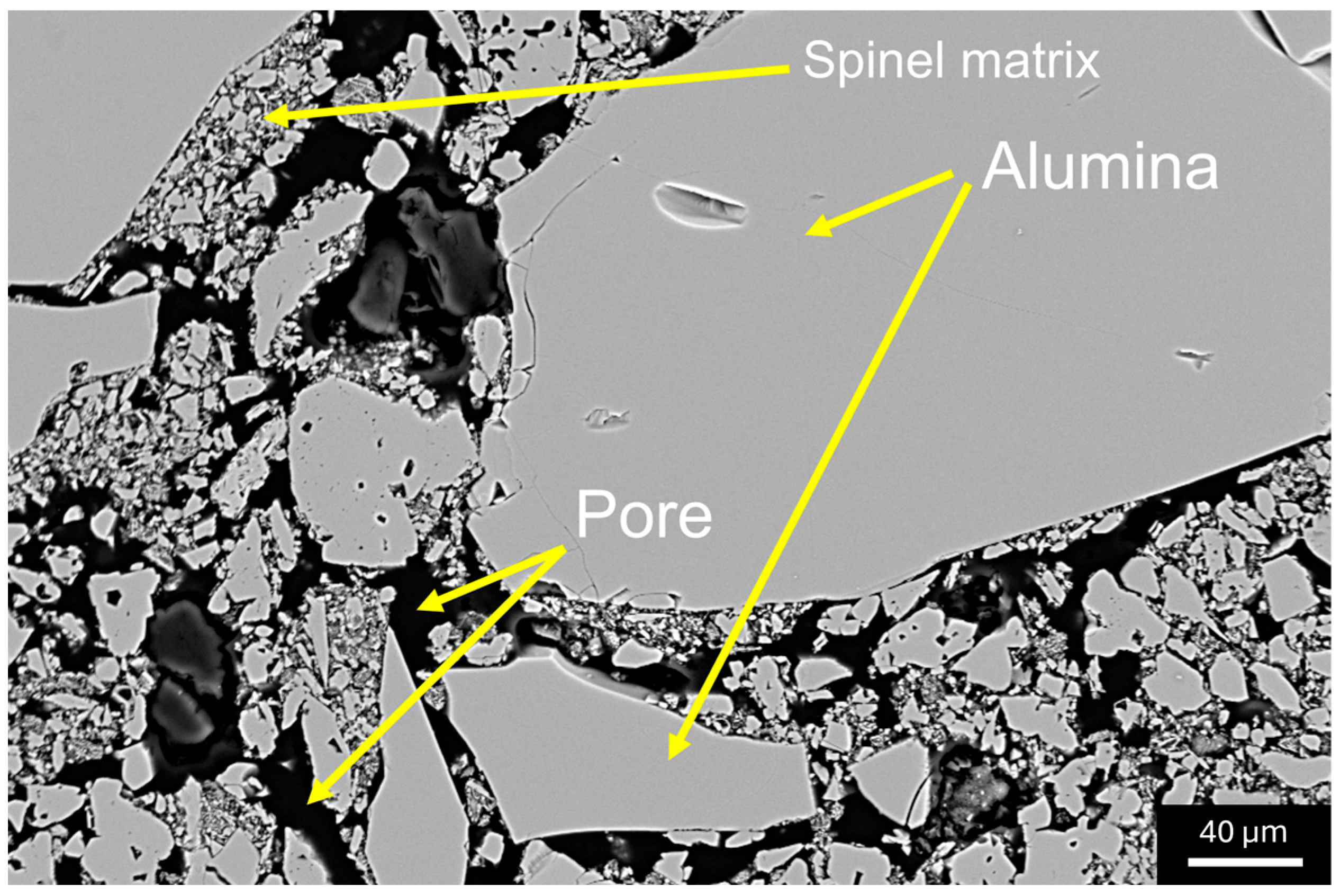
The study was devoted to alumina-spinel refractory bricks, provided by RHI Magnesita GmbH (Vienna, Austria), and single-phase alumina ceramics. In terms of stoichiometric oxides, according to XRF measurements, the alumina-spinel bricks contain 94 wt.% of Al2O3, 5 wt.% of MgO, and 1 wt.% of other oxides [8,9,34,35,36,37]. When magnesia and alumina are heated together during brick fabrication, they react to form an intermediate spinel phase (MgAl2O4). Assuming stoichiometric spinel for convenience in the calculations, this corresponds to 82 wt.% of alumina phase and 18 wt.% of spinel phase, or equivalently 81 vol.% alumina and 19 vol.% spinel based on the respective densities of each phase. Working on the same refractory bricks, Samadi found similar values with XRD analysis, obtaining 81.4 wt.% of alumina and 18.6 wt.% of spinel [9]. The SEM micrograph in Figure 1 shows the presence of alumina aggregates of different sizes, a fine matrix of spinel phase, and pores both in the grains and in the matrix.
In order to obtain thermal conductivity values for the spinel phase, specific samples with a high spinel content (87 vol.%) were made at RWTH Aachen University from an alumina-rich magnesium aluminate spinel powder denoted AR78. This powder is one of the raw materials typically used for the fabrication of alumina-spinel bricks. After uniaxial pressing of the dry AR78 powder, sintering at 1600 °C for 6 h yielded specimens with dimensions of 10 mm in diameter and 2 mm in thickness.
In the current work, the analysis was made by comparing the behaviour of alumina-spinel bricks (94 wt.% alumina) with the behaviour of four alumina model materials (>99 wt.% alumina) with differences in the microstructural characteristics. Table 1 summarizes the major characteristics of each investigated material.
Sample densities were evaluated by dry mass measurements and an estimate for disc volume based on average diameter and thickness. The pore volume fraction (νp), corresponding to total porosity, is then given by the following equation:
ν p = 1 ρ ρ 0
where ρ is the sample (apparent) density and ρ 0 is the theoretical density. In the porous samples, an average grain diameter (ϕ) was estimated using the software measurement bar on a population of grains (>50 grains) observed by scanning electron microscopy. The number of grain boundaries or interfaces per unit length (n) is then given by the following equation:
n = 1 ϕ
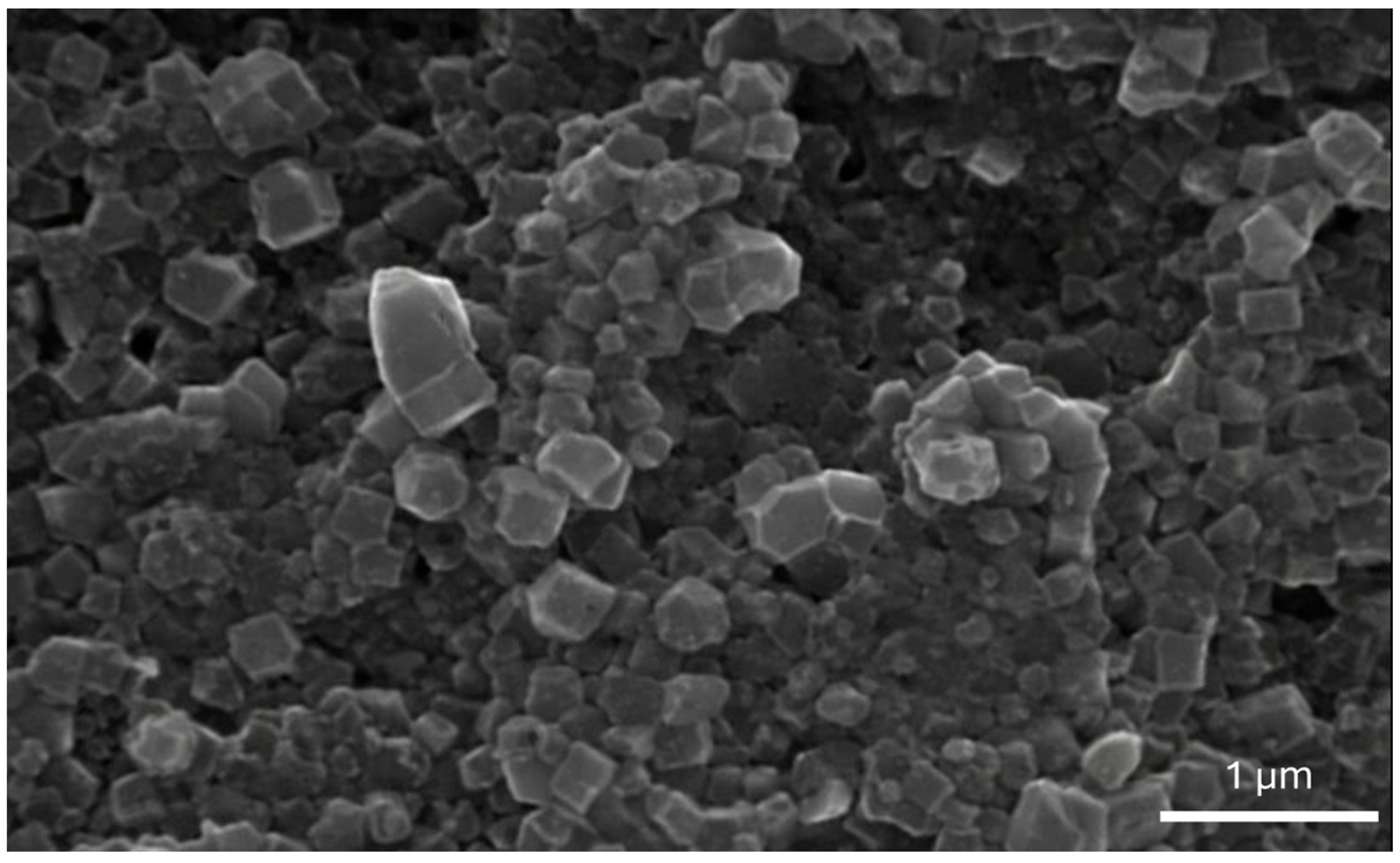
The Alumina TM-DA samples were made, with powder supplied by TAIMEI chemicals (Tokyo, Japan), at NITech (Nagoya, Japan) using the pulse electric current sintering method (PECS) [38]. The samples were sintered in a furnace at 1200 °C for 5 min with a heating rate of 100 K/min and subjected to a uniaxial pressure of 100 MPa, yielding an almost fully dense material with limited grain growth. Figure 2 shows an example of the microstructure of Alumina TM-DA samples. It is possible to observe the presence of small grains (0.15 μm to 0.5 μm) homogeneously distributed without much porosity.
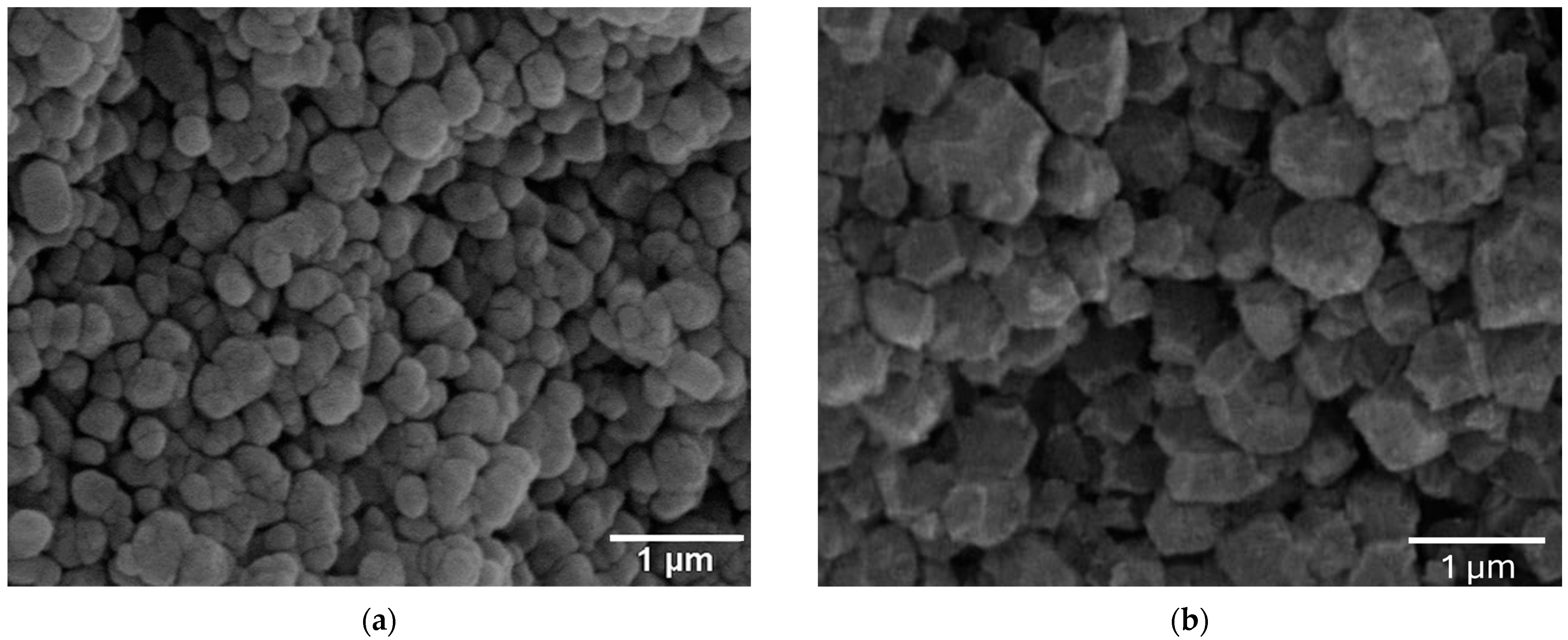
The Alumina AKP30-1300 (Figure 3a) and Alumina AKP30-1450 (Figure 3b) samples were prepared at IRCER by uniaxial pressing of the dry powder, supplied by Sumitomo Chemicals (Tokyo, Japan) and denoted AKP30, and then fired respectively at 1300 °C and 1450 °C for 6 min [30].

2.2. Methods

The thermal conductivity values were evaluated using the laser-flash method [39,40]. This technique, developed by Parker et al. in 1961 [41], measures the thermal diffusivity of a solid by sending a short-duration light energy pulse to impact on the front face of a sample held at a given temperature. Then, an infrared detector records the temperature evolution on the back face as a function of time. The evaluation of the thermal diffusivity (α) from the temperature–time behaviour can be performed with different models, such as those of Parker [41], Cape-Lehman [42], Degiovanni [43], or Mehling [44]. In this study, we have mainly used the Cape-Lehman model, which takes into account heat losses through the sample boundaries during experimental tests. However, for high-temperature measurements, when a direct radiative heat transfer between sample faces was observed, the Mehling analysis was used to account for this signal perturbation.
The measurements were carried out up to 1273 K with a heating rate of 5 K/min in an argon atmosphere using a NETZSCH LFA 427 Laser-Flash device (Selb, Germany). For each temperature, the values correspond to an average of three consecutive measurements, and the sample thickness value was adjusted to incorporate the effect of thermal expansion. The tests were repeated twice using two different samples, which exhibited a difference in thermal conductivity of less than 1%. The accuracy of this method is taken to be ±3% [39,40].
Once the thermal diffusivity is evaluated, the thermal conductivity (λ) can then be calculated using the following equation:
λ = α · ρ · C p
where λ is the thermal conductivity [W m−1 K−1], α is the thermal diffusivity [m2 s−1], ρ is the bulk density [kg m−3], and Cp is the specific heat capacity [J kg−1 K−1]. The bulk density value was also adjusted to take thermal expansion of the material into account.
In contrast to thermal conductivity, heat capacity per unit mass does not depend on microstructural characteristics such as porosity or grain size [45]. For this reason, heat capacity values from literature were used for all alumina samples [46]. For the Alumina-Spinel sample, values were calculated using the rule of mixtures based on the composition given in Section 2.1 and heat capacity data from literature for each simple oxide [46]:
C p =   i m i C p i
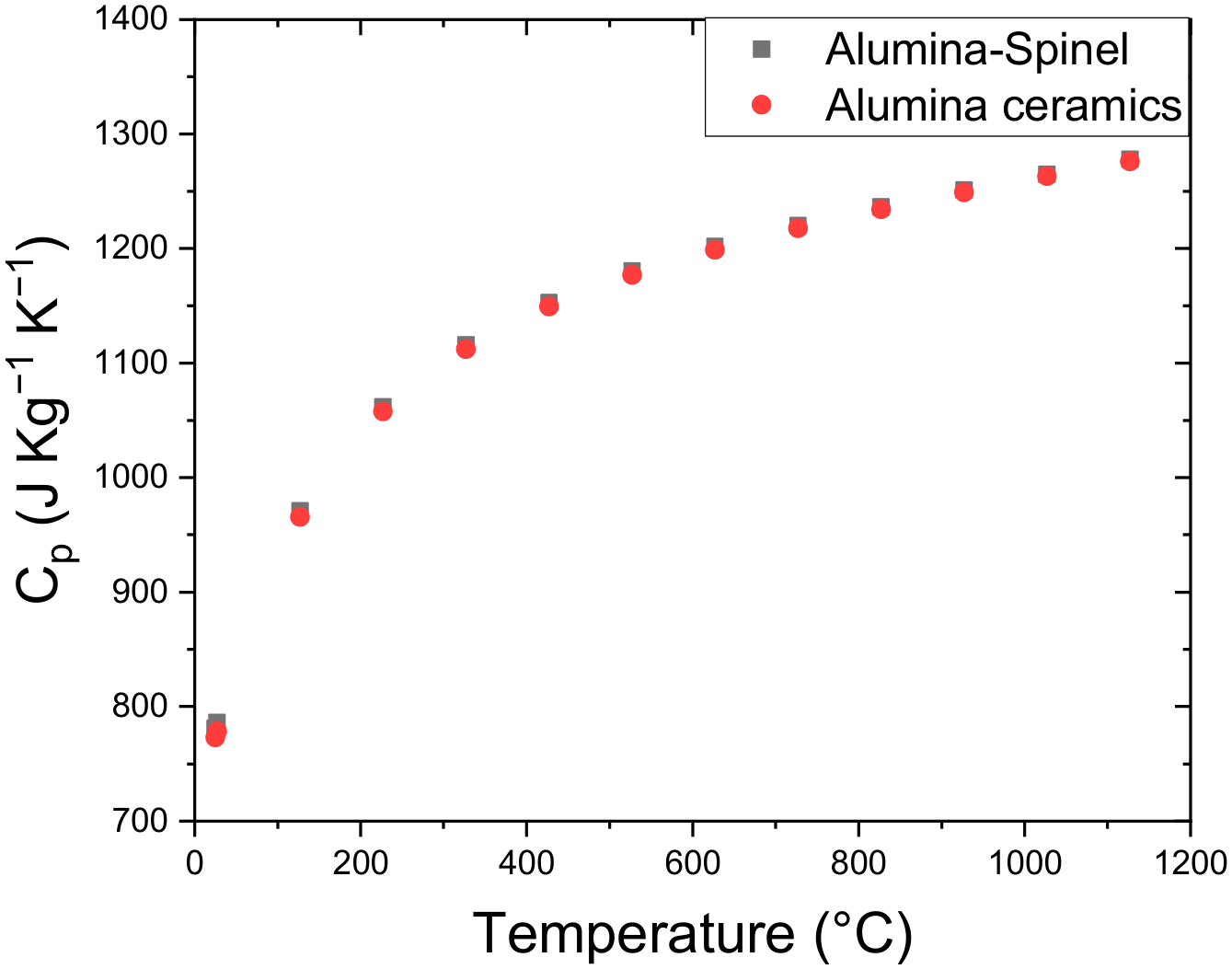
where mi is the percentage in mass and Cpi is the specific heat of each component i [47]. In earlier work on raw and calcined clays, we have shown for stable materials that Equation (4) yields results within ±5% of high-quality measurements, providing the chemical composition is known accurately [48]. Richet achieved an even better agreement to ±1% for glass compositions [49]. Direct measurements by calorimetry will not necessarily be more precise. Figure 4 shows the Cp(T) curves used for each material [46].

3. Results and Discussions

3.1. Evolution of the Thermal Conductivity with the Temperature

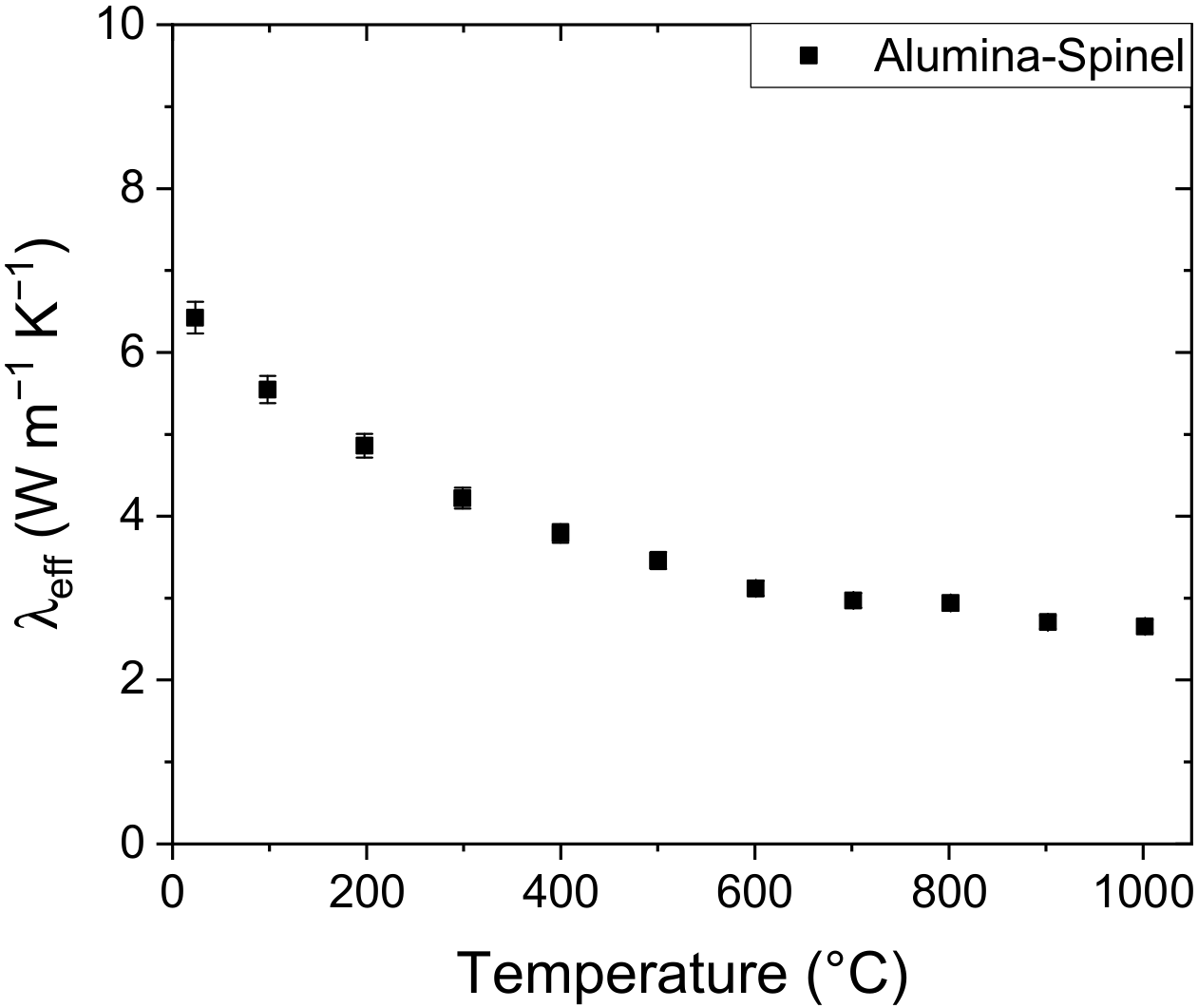
Figure 5 plots the measured thermal conductivity (λeff) of an Alumina-Spinel sample as a function of the temperature. Repeating the run with a second sample of alumina-spinel refractory exhibited differences in values of thermal conductivity of less than 1%.
The graph shows that the thermal conductivity decreases with the increase of the temperature: λeff changes from 6.5 W m−1 K−1 at room temperature to 3 W m−1 K−1 at 1273 K. To explain this trend, consider that in ceramic materials, the thermal conductivity is determined by scattering of phonons through inelastic collisions. In analogy with the kinetic theory of gases following Debye’s initial approach [16], Klemens describes this property in terms of an integral over the vibrational frequencies ω [50]:
λ = 1 3 0 ω D C V ω ν ω l ω d ω
where λ is the thermal conductivity, Cv the specific heat at constant volume, ν the elastic wave velocity, l the mean free path of lattice vibrations, and ω D the Debye frequency.
For alumina ceramics or in the single crystal form (sapphire), heat is essentially transported by lattice vibrations. The amplitude of these vibrations relates to the number of phonons that occupy the mode ω. An increase in these vibrational amplitudes with temperature means that the probability of phonon-phonon scattering is higher. Thus, the mean free path for the lattice vibrations l(ω) decreases with the increase of temperature, and consequently, the thermal conductivity decreases.
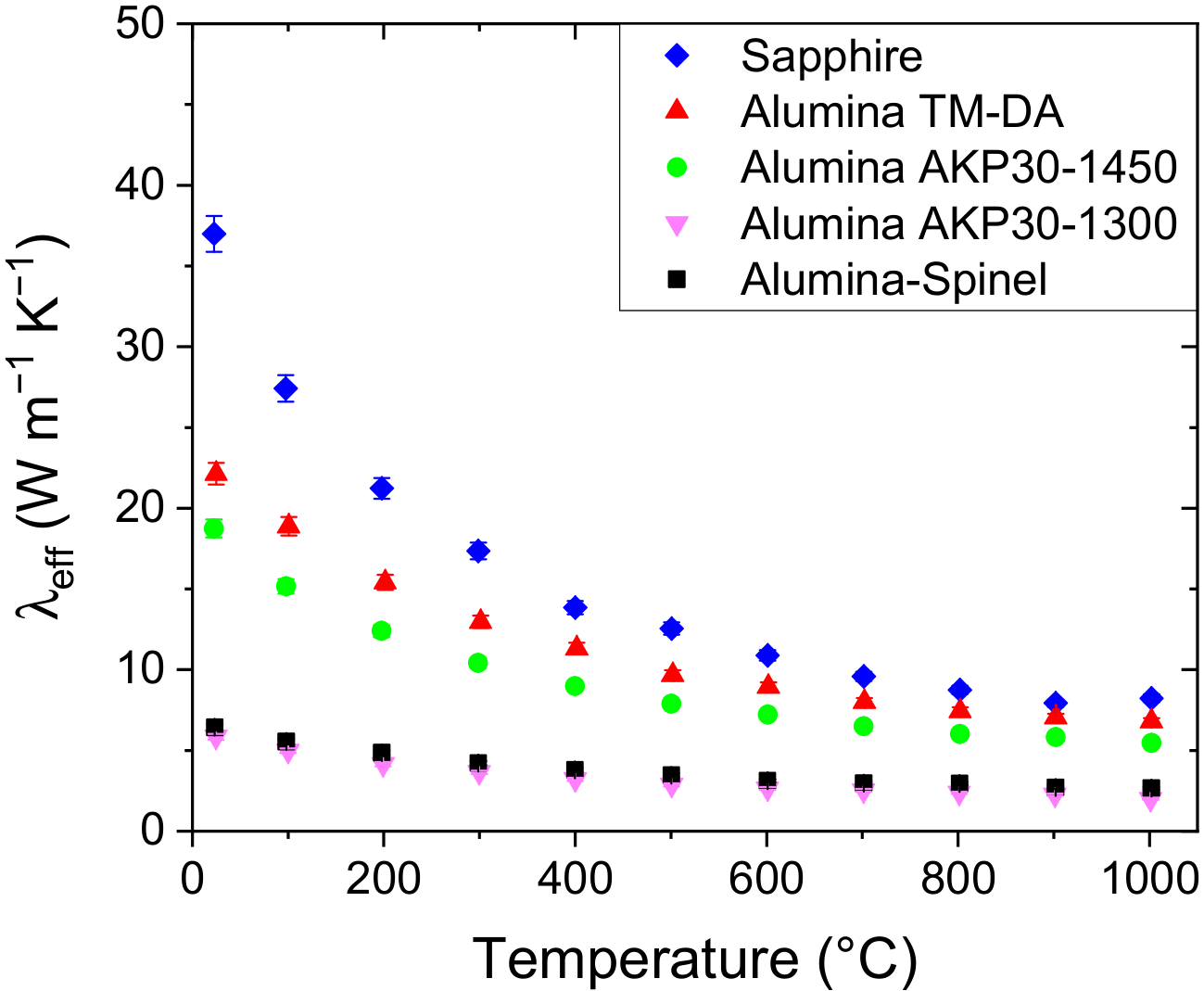
However, in such ceramic materials, it is also important to examine the polycrystalline aspect. Phonons can interact not only with other phonons, but also with grain and pore boundaries and other defects. All these “imperfections” will act as scattering sites, reducing the mean free path. These interactions of the phonons with the microstructure can explain the differences exhibited in Figure 6. The graph shows, in fact, that for all the investigated materials, the thermal conductivity values decrease with the increase of temperature due to the increase of the phonon-phonon scattering mechanism. However, the values are quite different from each other, despite the fact that they are all alumina-based materials. At room temperature, for instance, λeff varies from 36 W m−1 K−1 in the case of Sapphire to 5.8 W m−1 K−1 for the Alumina AKP30-1300 sample. The Sapphire sample is a single crystal, and thus it has only external boundaries. On the contrary, all the other samples are polycrystalline materials with different porosities, different grain sizes, and consequently different numbers of grain boundaries crossing the heat path (Table 1).

3.2. Effect of the Porosity

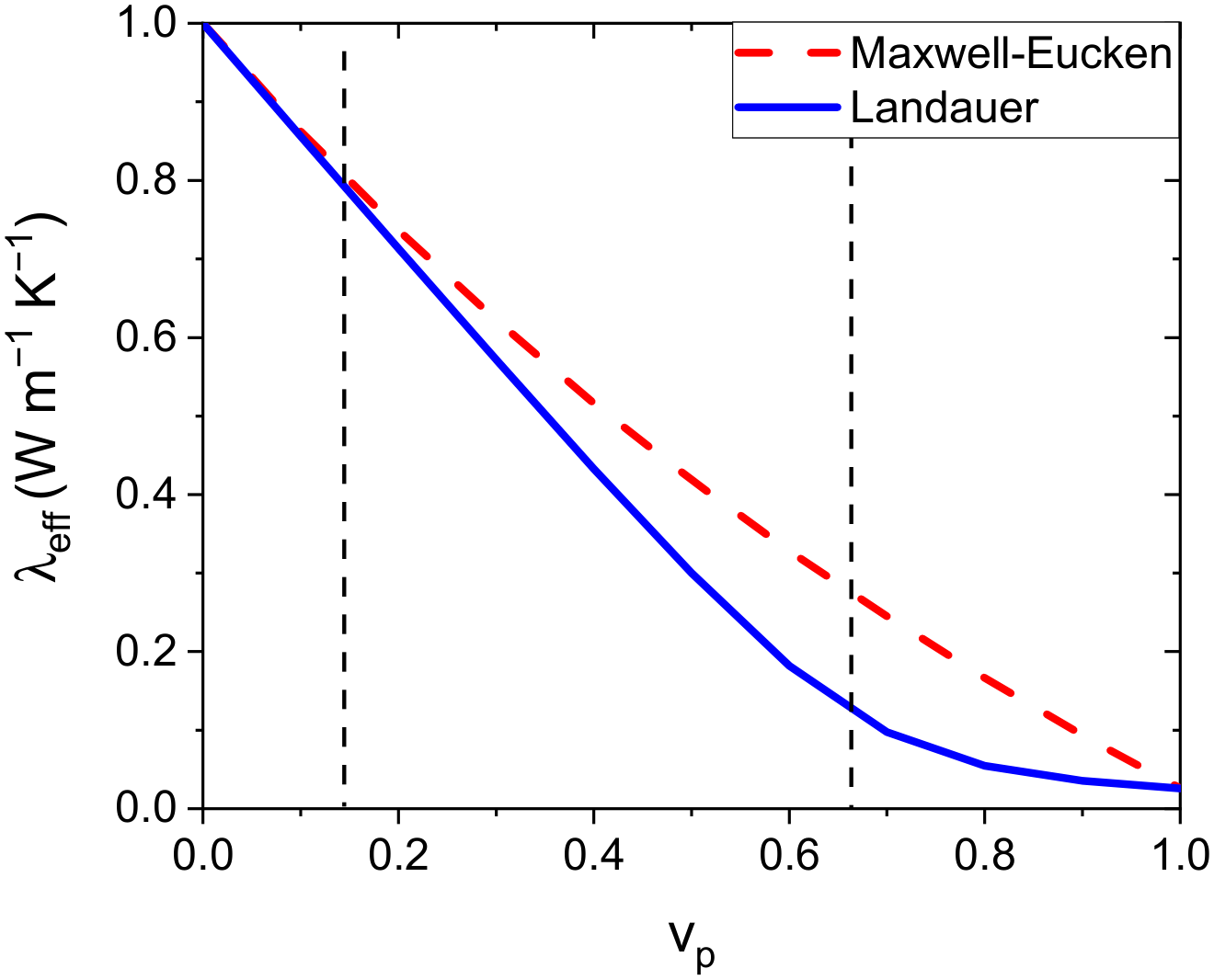
The influence of the porosity can be studied by considering a mixture of two phases, in which the pores correspond to one of the phases: with the increase of the pore volume fraction (νp), the effective thermal conductivity of the material (λeff) decreases due to the low thermal conductivity of the gas. Figure 7 illustrates the thermal conductivity variations with porosity, based on analytical models with different assumptions for the porous phase arrangement in the solid matrix. The Maxwell–Eucken relation assumes that the pores are isolated spherical inclusions in the solid, which describes a closed porosity behaviour [26], whereas Landauer’s relation takes into account the open nature of the porosity [27] for values of νp > 0.15. This is revealed by the divergence of the two curves at νp = 0.15, a value typically considered to mark the transition between closed and open porosity in ceramics made by powder pressing. In earlier work on sintered powder compacts, good agreement within ±4% between predictions with Landauer’s relation and experimental data has been obtained on oxide ceramics with open and randomly distributed porosity up to at least 50% [17].
Consequently, a material with a higher pore volume fraction exhibits a lower thermal conductivity, providing the thermal conductivity of the solid phase does not vary. However, this is not always the case. For instance, the Alumina-Spinel brick sample has a porosity of 19%, like that of Alumina AKP30-1450 (Table 1), but the thermal conductivity values are quite different. Figure 6 shows that the Alumina-Spinel sample (black points) has a thermal conductivity closer to that of Alumina AKP30-1300 (magenta points), even if this material has almost twice the amount of porosity (38%). Therefore, the results imply that the materials have different solid-phase thermal conductivity values.
Following an approach that was adopted for porous alumina ceramics [30], to verify this hypothesis, Landauer’s relation was used to estimate the thermal conductivity of the polycrystalline solid phase without the effect of the porosity [17,27]:
λ e f f =   1 4 λ P 3 ν P 1 + λ s 2 3 ν P   + λ P 3 ν P 1 + λ s 2 3 ν P 2 + 8 λ P λ s 1 2
where λp is the thermal conductivity of the pore phase and λs the thermal conductivity of the solid phase. Considering that λpλs, Equation (6) was simplified using λp = 0:
λ e f f = λ s 1 3 2 υ p
Equation (7) was then re-expressed as follows:
λ s = λ e f f 1 3 2 ν P
to evaluate the thermal conductivity for equivalent 100% dense ceramics. The obvious interest of calculating the thermal conductivity of the solid phase(s) is for comparison between materials of different chemical composition/crystal structure and for similar materials with different microstructures (grain size, morphology...) without the problem of porosity variation. This was first done in 1954 by Kingery et al. using Loeb’s relation, which is less precise than the Maxwell–Eucken or Landauer relations for describing the effect of porosity [51]. Justification for the accuracy of the extrapolation back to 100% dense material can be found in references [17,23]. The procedure is less reliable for materials with high pore content (>60%), but Landauer’s relation yields good results in the range 0 < νp < 0.6. The refractory in this work contains 20% porosity.
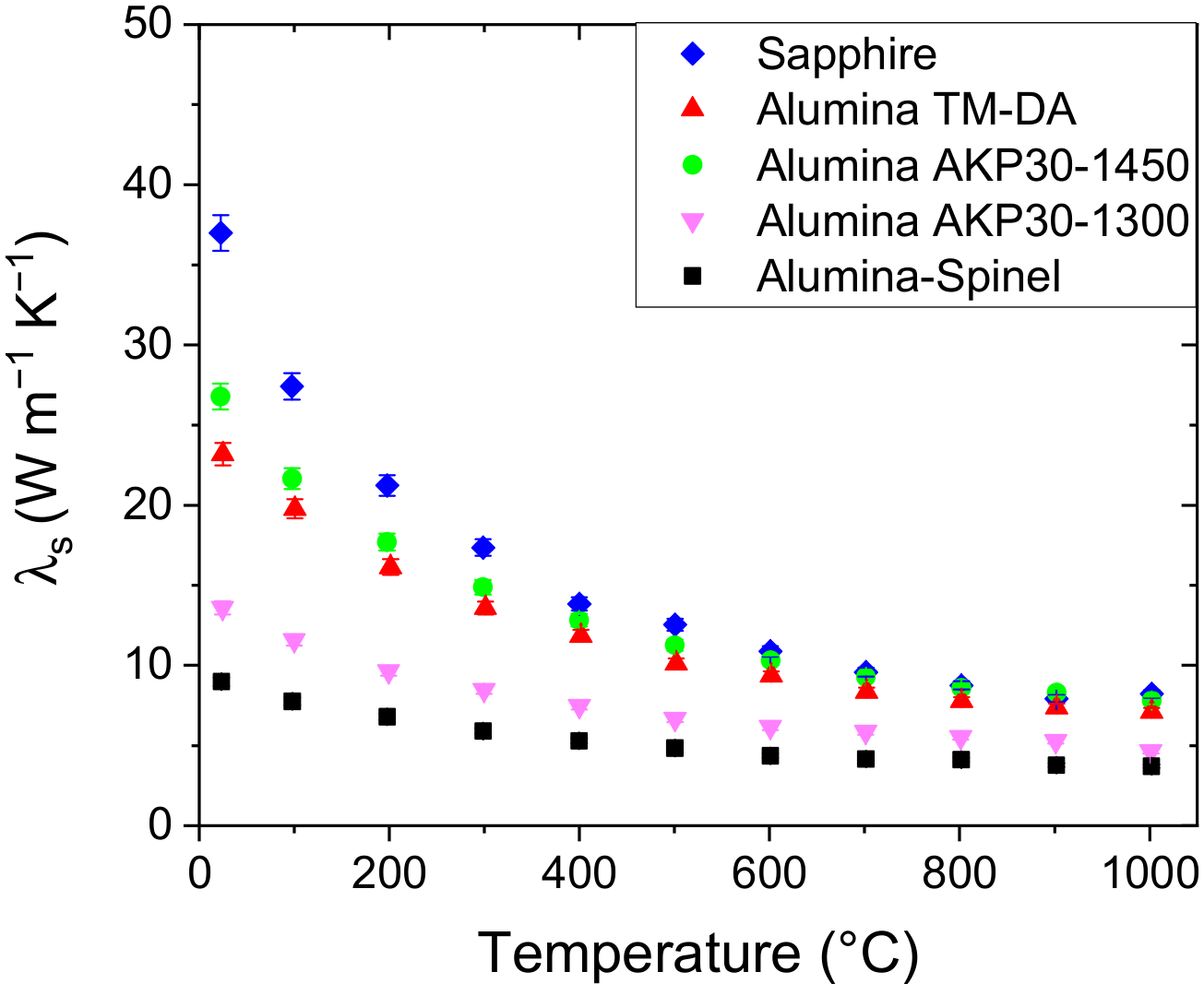
The results of these calculations of the thermal conductivity for the solid phases are presented in Figure 8. It can be noted that an error of 2% in the evaluation of pore volume fraction (a reasonable estimate of uncertainty) leads to an error of 4% in λs, but this actually partially compensates any original error in ρ and hence λeff through Equation (3). The graph confirms that the materials have different values of thermal conductivity for the solid phase. Furthermore, the estimated values are still significantly less than that of Sapphire (36 W m−1 K−1). For instance, at room temperature λs varies from 27 W m−1 K−1 in the case of Alumina AKP30-1450 to 9 W m−1 K−1 in the case of the Alumina-Spinel sample.

3.3. Effect of the Grain Boundaries and Grain Size

Grain boundaries are disordered regions that act as scattering sites, reducing the mean free path. They can be considered as Kapitza resistances, which cause a localized temperature drop at the interface [30,52]. The overall thermal conductivity can then be described using Equation (9) as grain boundary thermal resistances in series with the grains:
1 λ s =   1 λ g r a i n + n R i n t
where λs is the thermal conductivity of the polycrystalline material after removing the effect of the porosity, λgrain is the thermal conductivity of the grains, n is the number of grain boundaries per unit length, and Rint is the average grain boundary thermal resistance. This equation handles the effect of two grain size mechanisms: (i) the presence of grain boundaries crossing the heat path given by the second term of the right-hand side in Equation (9) and (ii) the effect of finite grain size, which can alter the grain conductivity in the first term of the right-hand side in Equation (9). If the grains are small, the number (n) of grain boundaries increases, and thus, the thermal conductivity of the polycrystalline material decreases. Furthermore, if the grains are very small, the hypothesis of an ideal three-dimensional infinite lattice is no longer valid, and this cuts off all the low-frequency long wavelength phonons, which cannot contribute to the thermal conductivity of the crystallite (λgrain) [5,30].
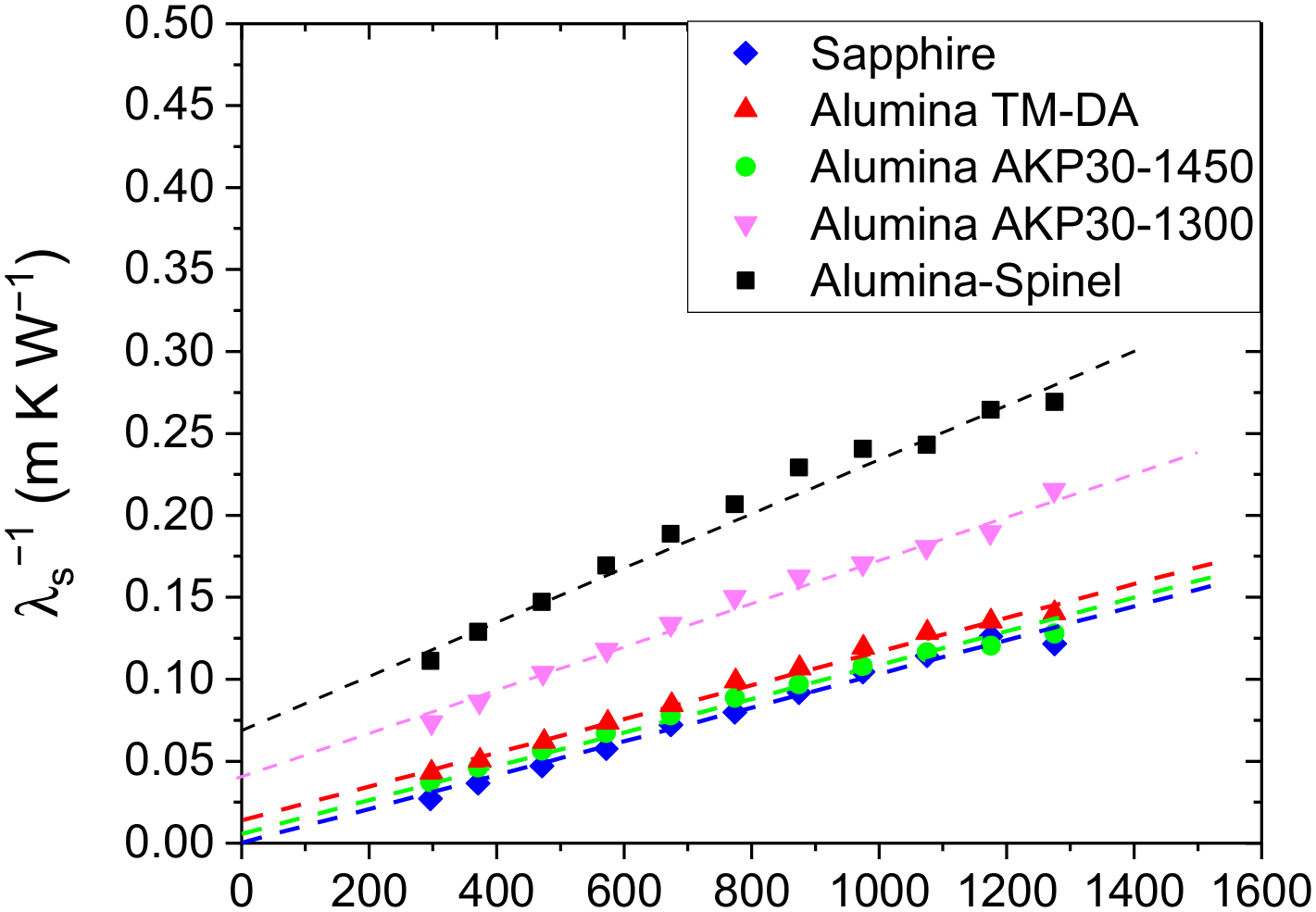
These effects related to grain size can explain the differences between Sapphire, Alumina TM-DA, and Alumina AKP30-1450 shown in Figure 8. We have used a method to separate the two contributions in Equation (9) and estimate the grain thermal conductivity [30] with the advantage that exact knowledge of the average grain size is not actually required. For this, phonon–phonon interactions are assumed to be the dominant mechanism, and consequently, the thermal resistivity attributed to the grains is considered to vary linearly with the temperature over the range 500 K–1000 K, as represented by the term aT in the relation:
1 λ s = a T + n R i n t
where T is temperature, and a is a constant. This corresponds to the well-known 1/T dependence of thermal conductivity, observed at medium temperatures for many ceramics, including alumina.
Equation (10) is exploited graphically to deduce first the effect of the grain boundaries as Kapitza resistances and then the grain conductivity at each temperature. Figure 9 shows that the thermal resistivity values of all the alumina-based materials behave linearly with temperature and are above the values of Sapphire. The differences shown on the y-axis by extrapolation to T = 0 K can be attributed to the total thermal resistance of the grain boundaries (nRint), taken to be constant with temperature [30].
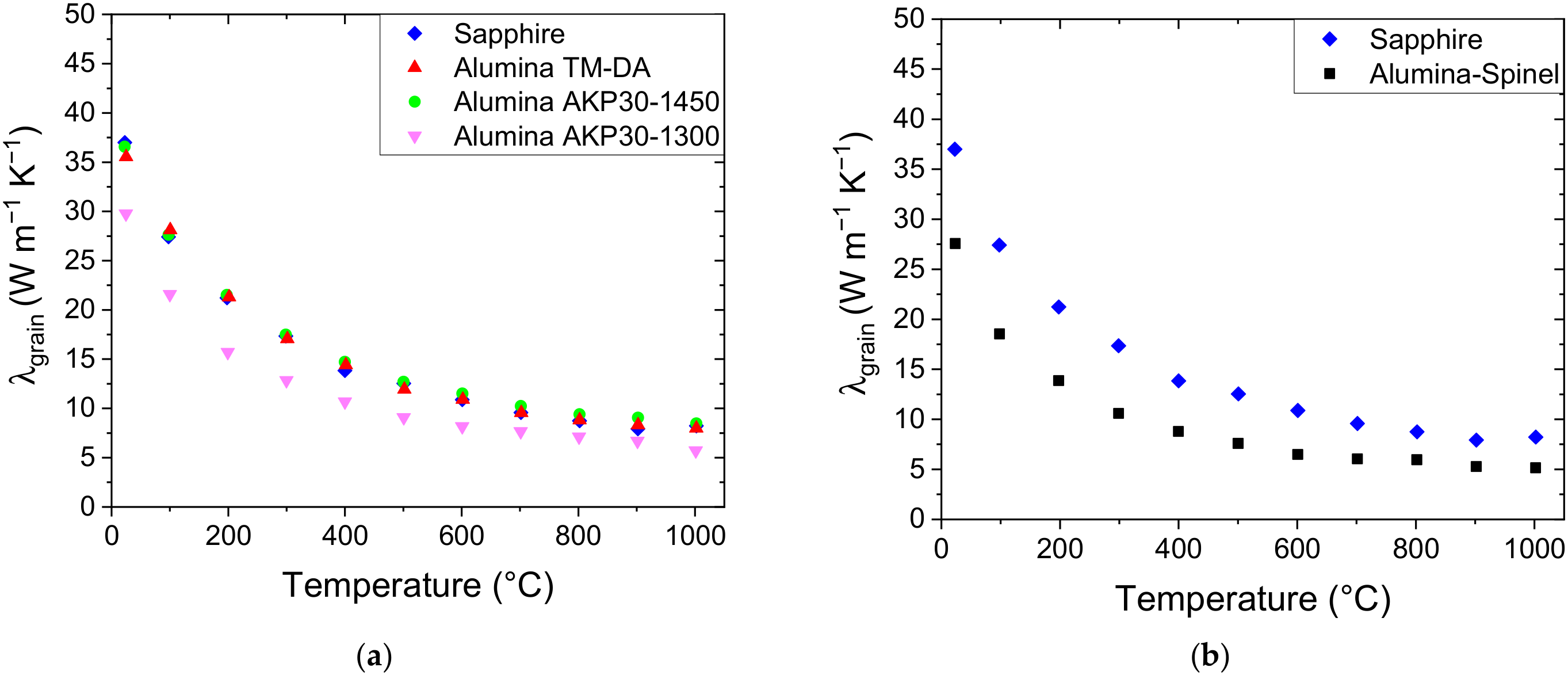
By subtracting this contribution from Equation (9), it is possible to evaluate the thermal conductivity of the grains (λgrain), which is plotted in Figure 10. Figure 10a shows that the calculations of grain conductivity for Alumina TM-DA and Alumina AKP30-1450 yield values that are almost identical to those of the Sapphire single crystal (36 W m−1 K−1 at room temperature).
The case of Alumina AKP30-1300 involves additional factors, the effects of which are revealed in Table 2. This table gives the values of the slope coefficient “a” for each sample in Figure 9 and an estimate of the average grain boundary thermal resistance for the alumina ceramics (Rint). It can be seen that the samples Alumina TM-DA and Alumina AKP30-1450 exhibit values of “a” very close to the single crystal, as well as similar average grain boundary thermal resistances, implying that the microstructural aspects of grain size and pore volume fraction have been satisfactorily accounted for. Sample AKP30-1300 exhibits significantly higher values of “a” and average grain boundary thermal resistance. In fact, this sample, held for 6 min at 1300 °C, is the least advanced in the sintering process in terms of densification and grain growth. A neat explanation of the higher value of “a” is that the initial sintering mechanism of neck formation has not been completed, reducing the particle-particle contact area (or effective heat-carrying cross-section through the grains) [53]. This will increase the value of “a” [54]. The other aspect of less advanced sintering is that higher energy grain boundaries (with greater thermal resistance) have not been eliminated, consistent with the higher value of Rint for AKP30-1300 [30,53]. The smaller grain size (Table 1), approximately 0.3 μm, of this sample, through the effect of finite grain size inhibiting the grain conductivity, may also have a role. All these aspects relate to less advanced sintering for the AKP30-1300 sample.
Finally, the thermal resistivity of the Alumina-Spinel sample (equivalent to 100% dense material) is even higher with the highest value of “a” (Table 2). This might also relate to incomplete sintering of the refractory powder with a thermal treatment, say at 1400 °C. It is difficult to evaluate average grain boundary thermal resistance for two reasons. First, there is a very wide range of grain sizes in the refractory brick, from approximately 1 μm to 3 mm, as estimated from SEM micrographs. Second, the refractory powder contains two phases: alumina grains and spinel grains. Nevertheless, after correction for porosity and thermal resistance of the interfaces using the same procedure as employed for the alumina ceramics, representative values of the conductivity for the alumina-spinel grains are plotted in Figure 10b, yielding 27.5 W m−1 K−1 at room temperature. The aspect of a two-phase mixture is examined in the next section.

3.4. Effect of Phase Mixture

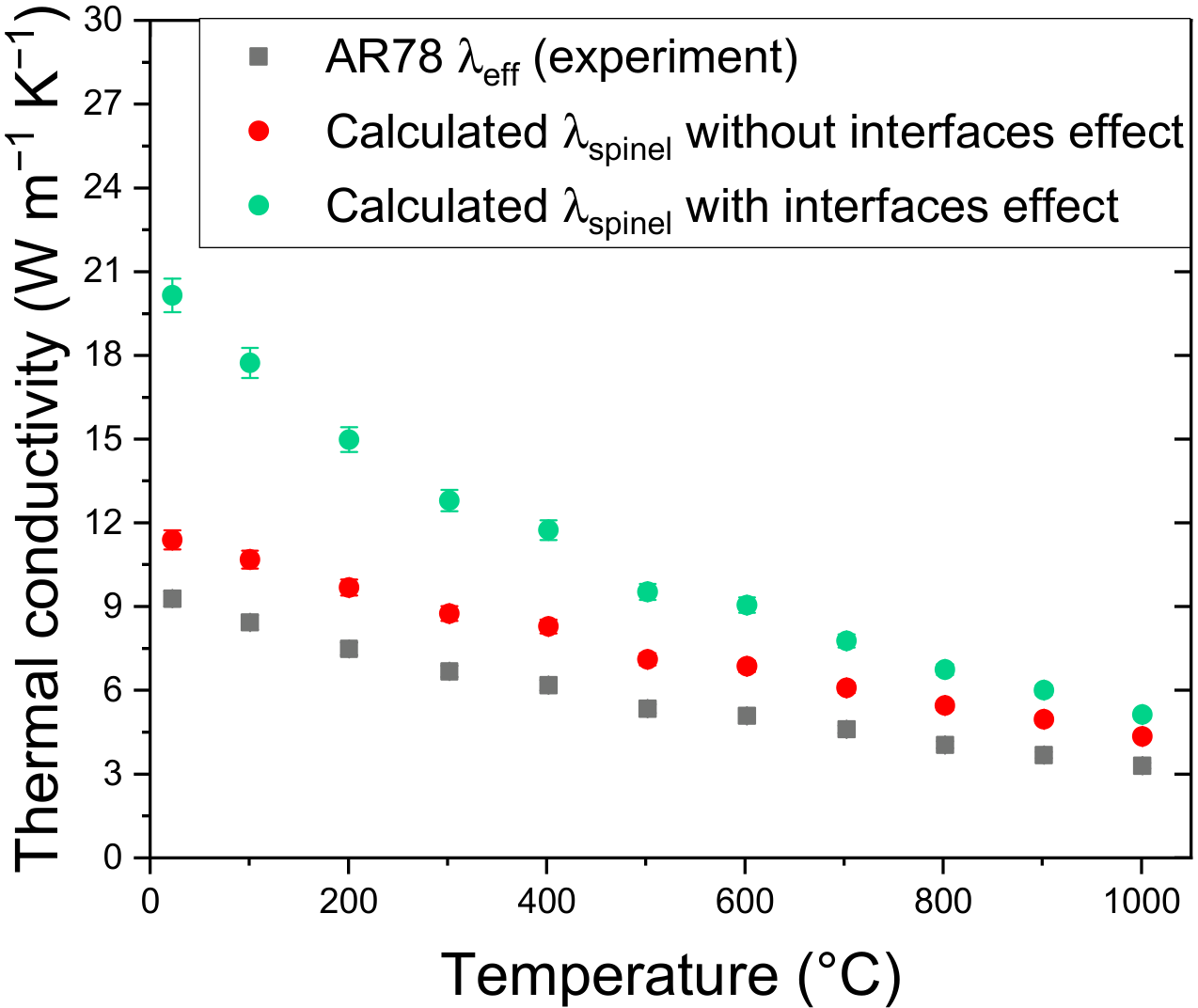
Alumina-spinel refractory bricks contain approximately 81 vol.% alumina and 19 vol.% spinel (MgAl2O4). To evaluate the influence of the spinel phase on the combined thermal conductivity, samples where the spinel phase is predominant (87 vol.% spinel and 13 vol.% alumina) were prepared, denoted AR78. These samples were measured with the laser-flash method up to 1273 K, revealing a steady decrease of the thermal conductivity with temperature (Figure 11, black points) attributed to the increase in phonon-phonon scattering. More refined values for the spinel phase thermal conductivity were then obtained in the following way.
The experimental results for an AR78 sample showed an overall thermal conductivity of 9.3 W m−1 K−1 at room temperature, including the effect of 20% porosity. The same approach previously described for the alumina ceramics and the alumina-spinel refractory bricks was then adopted to calculate the thermal conductivity of the AR78 sample without the effects of the microstructure. Firstly, Equation (8) was used to calculate the thermal conductivity of the solid phases (λs) equal to 13.3 W m−1 K−1 at room temperature. Then, two cases were analyzed: (a) the effect of the interfaces was neglected, which gave the lower values of thermal conductivity for the spinel phase; (b) the interfaces were taken into account.
In the first case, for a mixture of two solid phases, solving Landauer’s relation [27] for the thermal conductivity of the spinel phase (λspinel) gave the following:
λ s p i n e l =   2 λ s 2 λ s λ a l u m i n a 3 ν a l u m i n a 1 λ a l u m i n a + λ s 2 3 ν a l u m i n a
where λalumina and νalumina are respectively the thermal conductivity and the volume fraction of the alumina grains. Using the proportion above for AR78 and a value for λalumina = 36 W m−1 K−1, Equation (11) gives λspinel = 11.4 W m−1 K−1 at room temperature (Figure 11, red points).
In the second case, Equation (9) was first used to estimate the thermal conductivity of the grains (λgrain) equal to 22 W m−1 K−1 at room temperature. Then, Equation (11) was modified by replacing λs with λgrain:
λ s p i n e l = 2 λ g r a i n 2 λ g r a i n λ a l u m i n a 3 ν a l u m i n a 1 λ a l u m i n a + λ g r a i n 2 3 ν a l u m i n a
By considering again the proportion above for AR78 and a value for λalumina = 36 W m−1 K−1, Equation (12) gives λspinel = 20.2 W m−1 K−1 at room temperature (Figure 11, green points).
These results are fairly similar to those in the literature: for stoichiometric spinel, Braulio et al. [55] cited values from 15 W m−1 K−1 at room temperature to 5 W m−1 K−1 at 1273 K, more or less the same as Balabanov et al. [56], who found 17 W m−1 K−1 at room temperature. Our values are in the same range as the second case; while Ni et al. [57] calculated, with molecular dynamics values, from 9 W m−1 K−1 at room temperature to 5.5 W m−1 K−1 at 1273 K, similar to the first case.
Next, the calculated data for λspinel were used to estimate the thermal conductivity of the alumina grains (λalumina) in the alumina-spinel refractory brick. First, a sensitivity analysis was made on the room temperature value of λalumina with respect to variation in λspinel and the choice of analytical relation (model) representing the microstructure. In a straightforward approach, the upper bound for λgrain is given by the combination of thermal resistors in parallel:
λ g r a i n = v a l u m i n a λ a l u m i n a + v s p i n e l λ s p i n e l
and the lower bound by thermal resistors in series:
1 λ g r a i n = v a l u m i n a λ a l u m i n a + v s p i n e l λ s p i n e l
Given that the spinel phase is observed to constitute a fine matrix around the alumina grains (Figure 1), the Maxwell–Eucken relation describes spherical grains surrounded by an insulating phase [26]:
λ g r a i n = λ s p i n e l λ a l u m i n a + 2 λ s p i n e l + 2 v a l u m i n a λ a l u m i n a λ s p i n e l λ a l u m i n a + 2 λ s p i n e l v a l u m i n a λ a l u m i n a λ s p i n e l
These relations are solved in each case for λalumina. If one considers that the phase of alumina grains exhibits a certain continuity (or connectivity between grains), then Landauer’s relation is pertinent, similar to Equation (12). Solving this for λalumina yields the following:
λ a l u m i n a = 2 λ g r a i n 2 λ g r a i n λ s p i n e l 3 ν s p i n e l 1 λ s p i n e l + λ g r a i n 2 3 ν s p i n e l
The relations were tested for three values of λspinel = 11.4 W m−1 K−1, 15 W m−1 K−1, and 20.2 W m−1 K−1, corresponding to earlier calculations made with Equations (11) and (12) with and without the contribution of the interfaces. The value of λspinel = 15 W m−1 K−1 is intermediate and corresponds roughly to values given by Braulio et al. or Balabanov et al. [55,56]. The values of λgrain now refer to the points in Figure 10b (black squares) for the Alumina-Spinel refractory sample, which have already been corrected for porosity and grain boundary effects, and at room temperature, are equal to 27.5 W m−1 K−1. Table 3 gives the estimated values for the thermal conductivity of the alumina grains (λalumina).
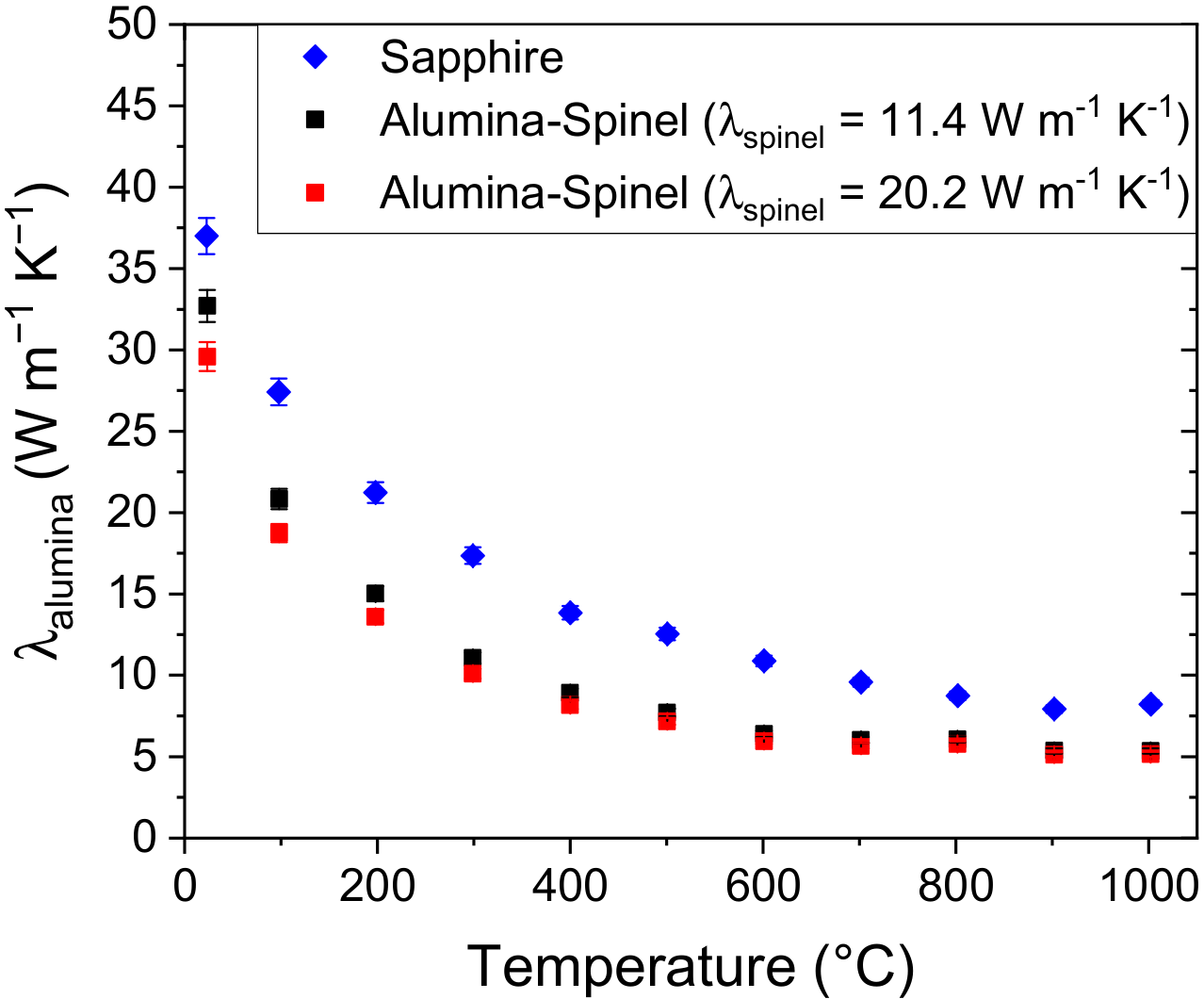
Apart from the series model, the estimates are fairly insensitive to the value of λspinel, yielding narrow bands of values close to 31 ± 2 W m−1 K−1. However, neither of the bounds, in the form of thermal resistors in series or parallel, is completely representative of the spatial distribution of the more insulating spinel phase. Both the Maxwell–Eucken and Landauer relations provide useful approximations to the dispersion of alumina grains in a spinel matrix, and yield, in fact, only small differences in their calculated values. For convenience, Landauer’s relation is chosen for the final calculation using Equation (16). The results for the two extreme cases (λspinel equal to 11.4 and 20.2 W m−1 K−1) are shown in Figure 12.
It can be pointed out that even if the calculated values for the alumina grains in the refractory brick are still apart from those of the Sapphire single crystal, they are much closer than the original measured values (Figure 5). For instance, 31 W m−1 K−1 at room temperature is within 14% of 36 W m−1 K−1 for Sapphire. Remaining differences could be assigned to the presence of other minor phases or small fractions of impurities modifying the conductivity of alumina. Popov et al. [58] demonstrated that small quantities of Cr and Ti, which substitute into the Al2O3 lattice, inhibit conduction. But given the number of steps and approximations describing the effects of pore volume fraction, grain boundaries/interfaces, and spatial solid phase distribution in the calculation of λalumina, the final set of values can be considered as plausible and satisfactory.
Finally, the same analysis procedure was applied to data in [54] for an almost pure industrial alumina refractory with 18% porosity. The measured value for the alumina refractory at room temperature was 15 W m−1 K−1, yielding after analysis an encouraging benchmark value of 30 W m−1 K−1 for the alumina grains.

4. Conclusions

Understanding the relationship between the microstructure and the material’s properties is fundamental for predicting the behaviour of refractory materials in service conditions. This paper presents a straightforward analytical approach to describe the modulation of thermal conductivity by:
i.
The pore phase using Landauer’s relation;
ii.
The grain boundary thermal resistance by assuming it acts in series with the thermal resistance of the grains;
iii.
A second solid phase using again Landauer’s relation for a mixture of two phases.
Experimentally, measurements of the macroscopic thermal conductivity from room temperature to 1273 K were made on alumina-spinel refractory containing 81 vol.% of alumina and 19 vol.% of spinel (MgAl2O4), revealing a decrease from 6.5 W m−1 K−1 to 3 W m−1 K−1. These values imply that, though the alumina grains are the major phase, the thermal conductivity has been strongly modulated by the microstructure and second phase. Given the complex nature of the refractory material, similar experimental measurements were made on a sapphire single crystal and model single-phase alumina ceramics with variation in the porosity and grain size. In order to deduce the thermal conductivity of the alumina grains in each material for comparison to the sapphire single crystal, the analysis first corrected for the effect of porosity with a simplified Landauer’s equation. Then the contribution of the grain boundary/interface thermal resistance was evaluated from a plot of thermal resistivity versus temperature, assuming this has a constant value. The thermal conductivity of the alumina grains in the 97% dense Alumina TM-DA sample and the 81% dense Alumina AKP30-1450 sample were shown to be very close to the Sapphire single crystal: 36 W m−1 K−1 at room temperature. Slightly lower values, obtained for 62% dense Alumina AKP30-1300, were attributed to less complete sintering of this sample.
For the alumina-spinel refractory, a supplementary step to this approach took the presence of the spinel phase into account, for example, with Landauer’s equation. This yielded an estimate of the thermal conductivity of the alumina grains in the refractory equal to 31 ± 2 W m−1 K−1 at room temperature. Fluctuations in sample thermal conductivity of the order of 5% due to measurement uncertainty or in the spinel fraction evaluation (example: 22 vol.% for an alumina-rich spinel instead of 19 vol.%) give values within the same range. Of the three steps in the analysis procedure, the estimate of the grain boundary/interface thermal resistance is considered to be most liable to errors. However, this grain boundary/interface contribution, through control of grain size distribution, offers interesting potential for increasing thermal conductivity and improving thermal shock resistance. Future work should be directed towards this aspect for both model single-phase ceramics and industrial refractory materials.

Author Contributions

Investigation, data curation, and writing—original draft preparation, D.V.; resources and sample preparation, H.U.M., I.K., and S.H.; writing—review and editing, D.S.S., and B.N.-A.; supervision, D.S.S., B.N.-A., and N.T.-D. All authors have read and agreed to the published version of the manuscript.

Funding

This work was supported by the funding scheme of the European Commission, Marie Skłodowska-Curie Actions Innovative Training Networks in the frame of the H2020 European project ATHOR—Advanced THermomechanical multiscale mOdelling of Refractory linings—764987 Grant.

Institutional Review Board Statement

Not applicable.

Informed Consent Statement

Not applicable.

Data Availability Statement

All data will be made available upon request.

Acknowledgments

We would like to express our sincere gratitude to RHI Magnesita GmbH (Austria) for donating the refractory materials that made this study possible. We also gratefully acknowledge RWTH Aachen University (Germany) and NITech (Japan) for their support with sample preparation and the SEM micrographs, which significantly contributed to a more comprehensive interpretation of the results.

Conflicts of Interest

Author Hans Ulrich Marschall was employed by the company RHI-Magnesita. The authors declare that the research was conducted in the absence of any commercial or financial relationships that could be construed as a potential conflict of interest.

References

  1. Gomes, M.R.; Leber, T.; Tillmann, T.; Kenn, D.; Gavagnin, D.; Tonnesen, T.; Gonzalez-Julian, J. Towards H2 implementation in the iron- and steelmaking industry: State of the art, requirements, and challenges for refractory materials. J. Eur. Ceram. Soc. 2024, 44, 1307–1334. [Google Scholar] [CrossRef] [Scilit]
  2. Garbers-Craig, A.M. How cool are refractory materials? J. S. Afr. Inst. Min. Metall. 2008, 108, 1–16. [Google Scholar]
  3. Jubayed, M.; Klima, K.M.; Rubel, M.; Siebring, R.; Léonard, A. Environmental assessment of refractories in the steel industry: A comprehensive LCA framework with an innovative data retrieval approach. Clean. Eng. Technol. 2026, 30, 101128. [Google Scholar] [CrossRef] [Scilit]
  4. Ghosh, A.; Chatterjee, A. Ironmaking and Steelmaking: Theory and Practice, 2nd ed.; PHI Learning: New Delhi, India, 2008. [Google Scholar]
  5. Vitiello, D. Thermo-Physical Properties of Insulating Refractory Materials. Ph.D. Thesis, University of Limoges, Limoges, France, 2021. [Google Scholar]
  6. Institute of Research for Ceramics-IRCER-Limoges, ATHOR. 2017. Available online: https://www.etn-athor.eu/project-overview/ (accessed on 1 January 2018).
  7. Huger, M.; Derrick, G.; Gruber, D.; Gasser, A.; Pereira, J. Final Report: Advanced THermomechanical Multiscale Modelling of Refractory Linings, 2022. Available online: https://www.etn-athor.eu/wp-content/uploads/sites/18/2022/06/Final-report-v1.3.pdf (accessed on 6 February 2026).
  8. Kaczmarek, R.P. Improvement of Strain Field Monitoring at High Temperature and Thermomechanical Characterization of Alumina Spinel Refractory Materials. Ph.D. Thesis, University of Limoges, Limoges, France, 2021. [Google Scholar]
  9. Samadi, S. Advanced Mechanical Characterizations and Thermomechanical Modeling of Shaped Alumina Spinel Material in Steel Ladle. Ph.D. Thesis, Montanuniversität Leoben, Leoben, Austria, 2021. [Google Scholar]
  10. Schacht, C.A. Refractories Handbook, 10th ed.; Marcel Dekker, Inc.: New York, NY, USA, 2004. [Google Scholar]
  11. Kuzovkov, V.N.; Kotomin, E.A.; Lushchik, A.; Popov, A.I.; Shablonin, E. The annealing kinetics of the F-type defects in MgAl2O4 spinel single crystals irradiated by swift heavy ions. Opt. Mater. 2024, 147, 114733. [Google Scholar] [CrossRef] [Scilit]
  12. Halefoglu, Y.Z.; Souadi, G.; Ayvacikli, M.; Bulcar, K.; Topaksu, M.; Canimoglu, A.; Madkhali, O.; Karmouch, R.; Can, N. Tb-doped MgAl2O4 phosphors: A study of structural and luminescence characteristics. Appl. Radiat. Isot. 2024, 203, 111101. [Google Scholar] [CrossRef] [Scilit] [PubMed]
  13. Pan, A.; Song, H.; Wang, W.; Zhang, H.; Hao, S.; Xie, J.; Wang, A. Interatomic potential of the MgAl2O4/Al interface and its application in strengthening mechanisms. J. Mater. Res. Technol. 2024, 32, 67–76. [Google Scholar] [CrossRef] [Scilit]
  14. Brochen, E.; Clasen, S.; Dahlem, E.; Dannert, C. Determination of the Thermal Shock Resistance of Refractories. Refract. Worldforum 2016, 8, 79–85. [Google Scholar]
  15. Andreev, K.; Tadaion, V.; Zhu, Q.; Wang, W.; Yin, Y.; Tonnesen, T. Thermal and mechanical cyclic tests and fracture mechanics parameters as indicators of thermal shock resistance–case study on silica refractories. J. Eur. Ceram. Soc. 2019, 39, 1650–1659. [Google Scholar] [CrossRef] [Scilit]
  16. Debye, P. Kinetic Theory of Matter and Electricity. In Gottinger Wolfskehlvortrage; B.G. Teubner: Leipzig, Germany; Berlin, Germany, 1914. [Google Scholar]
  17. Smith, D.S.; Alzina, A.; Bourret, J.; Nait-Ali, B.; Pennec, F.; Tessier-Doyen, N.; Otsu, K.; Matsubara, H.; Elser, P.; Gonzenbach, U.T. Thermal conductivity of porous materials. J. Mater. Res. 2013, 28, 2260–2272. [Google Scholar] [CrossRef] [Scilit]
  18. Loeb, A.L.; Conductivity, T. A Theory of Thermal Conductivity of Porous Materials. J. Am. Ceram. Soc. 1954, 37, 96–99. [Google Scholar] [CrossRef] [Scilit]
  19. Barea, R.; Osendi, M.I.; Ferreira, J.M.F.; Miranzo, P. Thermal conductivity of highly porous mullite material. Acta Mater. 2005, 53, 3313–3318. [Google Scholar] [CrossRef] [Scilit]
  20. Coble, R.L.; Kingery, W.D. Effect of Porosity on Physical Properties of Sintered Alumina. J. Am. Ceram. Soc. 1956, 39, 377–385. [Google Scholar] [CrossRef] [Scilit]
  21. Francl, J.; Kingery, D. Thermal conductivity: IX, Experimental Investigation of effect of porosity on thermal conductivity. J. Am. Ceram. Soc. 1954, 37, 99–107. [Google Scholar] [CrossRef] [Scilit]
  22. Vitiello, D.; Nait-Ali, B.; Tessier-Doyen, N.; Rebouillat, L.; Smith, D.S. Thermal conductivity of porous refractory material after aging in service with carbon pick-up. Open Ceram. 2022, 11, 100294. [Google Scholar] [CrossRef] [Scilit]
  23. Pabst, W.; Gregorová, E. Conductivity of porous materials with spheroidal pores. J. Eur. Ceram. Soc. 2014, 34, 2757–2766. [Google Scholar] [CrossRef] [Scilit]
  24. Collishaw, P.G.; Evans, J.R.G. An assessment of expressions for the apparent thermal conductivity of cellular materials. J. Mater. Sci. 1994, 29, 486–498. [Google Scholar] [CrossRef] [Scilit]
  25. Pabst, W.; Hostasa, J. Thermal conductivity of ceramics-from monolithic to multiphasic, from dense to porous, from micro to nano. Adv. Mater. Sci. Res. 2011, 7, 1–112. [Google Scholar]
  26. Xu, J.Z.; Gao, B.Z.; Kang, F.Y. A reconstruction of Maxwell model for effective thermal conductivity of composite materials. Appl. Therm. Eng. 2016, 102, 972–979. [Google Scholar] [CrossRef] [Scilit]
  27. Landauer, R. The electrical resistance of binary metallic mixtures. J. Appl. Phys. 1952, 23, 779–784. [Google Scholar] [CrossRef] [Scilit]
  28. Akiyoshi, M.M.; Christoforo, A.L.; Luz, A.P.; Pandolfelli, V.C. Thermal conductivity modelling based on physical and chemical properties of refractories. Ceram. Int. 2017, 43, 4731–4745. [Google Scholar] [CrossRef] [Scilit]
  29. Hua, Z.; Spackman, J.; Ban, H. Characterization of Kapitza resistances of natural grain boundaries in cerium oxide. Materialia 2019, 5, 100230. [Google Scholar] [CrossRef] [Scilit]
  30. Smith, D.S.; Puech, F.; Nait-Ali, B.; Alzina, A.; Honda, S. Grain boundary thermal resistance and finite grain size effects for heat conduction through porous polycrystalline alumina. Int. J. Heat Mass Transf. 2018, 121, 1273–1280. [Google Scholar] [CrossRef] [Scilit]
  31. Tessier-Doyen, N.; Grenier, X.; Huger, M.; Smith, D.S.; Fournier, D.; Roger, J.P. Thermal conductivity of alumina inclusion/glass matrix composite materials: Local and macroscopic scales. J. Eur. Ceram. Soc. 2007, 27, 2635–2640. [Google Scholar] [CrossRef] [Scilit]
  32. Lee, D.W.; Kingery, W.D. Radiation Energy Transfer and Thermal Conductivity of Ceramic Oxides. J. Am. Ceram. Soc. 1960, 43, 594–607. [Google Scholar] [CrossRef] [Scilit]
  33. Routschka, G.; Wuthnow, H. Thermal conductivity. In Handbook of Refractory Materials: Design, Properties, Testing, 5th ed.; Vulkan-Verlag: Essen, Germany, 2011; pp. 322–607. [Google Scholar]
  34. Teixeira, L.; Samadi, S.; Gillibert, J.; Jin, S.; Sayet, T.; Gruber, D.; Blond, E. Experimental Investigation of the Tension and Compression Creep Behavior of Alumina-Spinel Refractories at High Temperatures. Ceramics 2020, 3, 372–383. [Google Scholar] [CrossRef] [Scilit]
  35. Darban, S.; Reynaert, C.; Ludwig, M.; Prorok, R.; Jastrzębska, I.; Szczerba, J. Corrosion of Alumina-Spinel Refractory by Secondary Metallurgical Slag Using Coating Corrosion Test. Materials 2022, 15, 15. [Google Scholar] [CrossRef] [Scilit]
  36. Samadi, S.; Jin, S.; Gruber, D.; Harmuth, H. Thermomechanical finite element modeling of steel ladle containing alumina spinel refractory lining. Finite Elem. Anal. Des. 2022, 206, 103762. [Google Scholar] [CrossRef] [Scilit]
  37. Soares, T.R.L.; Kieliba, I.; Azenha, M.; Tonnesen, T.; Lourenço, P.B. A theta projection model for compressive creep behaviour of refractories at high temperature: Application to alumina-spinel. Meccanica 2023, 58, 2401–2420. [Google Scholar] [CrossRef] [Scilit]
  38. Munir, Z.A.; Quach, D.V.; Ohyanagi, M. Electric current activation of sintering: A review of the pulsed electric current sintering process. J. Am. Ceram. Soc. 2011, 94, 1–19. [Google Scholar] [CrossRef] [Scilit]
  39. ASTM E1461; Standard Test Method for Thermal Diffusivity by the Flash Method. ASTM International: West Conshohocken, PA, USA, 2013; pp. 1–11.
  40. Vitiello, D.; Nait-Ali, B.; Tessier-Doyen, N.; Tonnesen, T.; Laím, L.; Rebouillat, L.; Smith, D.S. Thermal conductivity of insulating refractory materials: Comparison of steady-state and transient measurement methods. Open Ceram. 2021, 6, 100118. [Google Scholar] [CrossRef] [Scilit]
  41. Parker, W.J.; Jenkins, R.J.; Butler, C.P.; Abbott, G.L. Flash method of determining thermal diffusivity, heat capacity, and thermal conductivity. J. Appl. Phys. 1961, 32, 1679–1684. [Google Scholar] [CrossRef] [Scilit]
  42. Cape, J.A.; Lehman, G.W. Temperature and finite pulse-time effects in the flash method for measuring thermal diffusivity. J. Appl. Phys. 1963, 34, 1909–1913. [Google Scholar] [CrossRef] [Scilit]
  43. Degiovanni, A.; Laurent, M. Une nouvelle technique d’identification de la diffusivité thermique pour la méthode «flash». Rev. Phys. Appl. 1986, 21, 229–237. [Google Scholar] [CrossRef] [Scilit]
  44. Mehling, H.; Hautzinger, G.; Nilsson, O.; Fricke, J.; Hofmann, R.; Hahn, O. Thermal diffusivity of semitransparent materials determined by the laser-flash method applying a new analytical model. Int. J. Thermophys. 1998, 19, 941–949. [Google Scholar] [CrossRef] [Scilit]
  45. Smith, D.S.; Naït-Ali, B. Thermal properties of ceramic materials. In Encyclopedia of Materials: Technical Ceramics and Glasses; Elsevier: Amsterdam, Netherlands, 2021; pp. 855–866. [Google Scholar]
  46. Knacke, O.; Kubaschewski, O.; Hesselmann, K. Thermal Chemical Properties of Inorganic Substances, 2nd ed.; Springer: Berlin/Heidelberg, Germany, 1977. [Google Scholar]
  47. Günther, D.; Steimle, F. Mixing rules for the specific heat capacities of several HFC-mixtures. Int. J. Refrig. 1997, 20, 235–243. [Google Scholar] [CrossRef] [Scilit]
  48. Lakhal, S.B.; Lecomte-Nana, G.; Nait-Ali, B.; Lemercier, H.; Smith, D.S. A method for estimating the specific heat capacity of a raw clay mixture. ZI Ziegelind. Int. Brick Tile Ind. Int. 2014, 6, 27–35. [Google Scholar]
  49. Richet, P. Heat capacity of silicate glasses. Chem. Geol. 1987, 62, 111–124. [Google Scholar] [CrossRef] [Scilit]
  50. Klemens, P.G. Heat conduction in solids by phonons. Thermochim. Acta 1993, 218, 247–255. [Google Scholar] [CrossRef] [Scilit]
  51. Kingery, W.D.; Francl, J.; Coble, R.L.; Vasilos, T.; Conductivity, T. Data for Several Pure Oxide Materials Corrected to Zero Porosity. J. Am. Ceram. Soc. 1954, 37, 107–110. [Google Scholar] [CrossRef] [Scilit]
  52. Schelling, P.K.; Phillpot, S.R.; Keblinski, P. Kapitza conductance and phonon scattering at grain boundaries by simulation. J. Appl. Phys. 2004, 95, 6082–6091. [Google Scholar] [CrossRef] [Scilit]
  53. Smith, D.S.; Dosal, J.M.; Oummadi, S.; Nouguier, D.; Vitiello, D.; Alzina, A.; Nait-Ali, B. Neck formation and role of particle-particle contact area in the thermal conductivity of green and partially sintered alumina ceramics. J. Eur. Ceram. Soc. 2022, 42, 1618–1625. [Google Scholar] [CrossRef] [Scilit]
  54. Smith, D.S.; Fayette, S.; Grandjean, S.; Martin, C.; Telle, R.; Tonnessen, T. Thermal resistance of grain boundaries in alumina ceramics and refractories. J. Am. Ceram. Soc. 2003, 86, 105–111. [Google Scholar] [CrossRef] [Scilit]
  55. Braulio, M.A.L.; Rigaud, M.; Buhr, A.; Parr, C.; Pandolfelli, V.C. Spinel-containing alumina-based refractory castables. Ceram. Int. 2011, 37, 1705–1724. [Google Scholar] [CrossRef] [Scilit]
  56. Balabanov, S.S.; Belyaev, A.V.; Popov, P.A. Heat Conduction of Ceramic Materials Based on MgAl2O4 and ZnAl2O4. J. Eng. Phys. Thermophys. 2020, 93, 719–724. [Google Scholar] [CrossRef] [Scilit]
  57. Ni, C.M.; Fan, H.W.; Wang, X.D.; Yao, M. Thermal conductivity prediction of MgAl2O4: A non-equilibrium molecular dynamics calculation. J. Iron Steel Res. Int. 2020, 27, 500–505. [Google Scholar] [CrossRef] [Scilit]
  58. Popov, P.A.; Solomennik, V.D.; Belyaev, P.V.; Lytvynov, L.A.; Puzikov, V.M. Thermal conductivity of pure and Cr3+ and Ti3+ doped AI2O3 crystals in 50-300 K temperature range. Funct. Mater. 2011, 18, 476–480. [Google Scholar]
Figure 1. SEM micrograph of an Alumina-Spinel brick. The microstructure is composed of alumina grains of different sizes (the biggest size is ~3 mm) and a fine spinel matrix. The image was taken at GHI-RWTH (Aachen, Germany).
Ceramics 09 00026 g001
Figure 2. SEM micrograph of Alumina TM-DA. The image was taken at Nagoya Institute of Technology-NITech (Japan).
Ceramics 09 00026 g002
Figure 3. SEM micrographs of Alumina AKP30-1300 (a) and Alumina AKP30-1450 (b) taken at IRCER [30].
Ceramics 09 00026 g003
Figure 4. Specific heat capacity as a function of temperature for the alumina ceramics (Sapphire, Alumina AKP30-1450, Alumina AKP30-1300, and Alumina TM-DA), red dots, and the refractory material (Alumina-Spinel), black dots. The values for Alumina-Spinel were calculated using the rule of mixtures.
Ceramics 09 00026 g004
Figure 5. Thermal conductivity (λeff) as a function of the temperature for an Alumina-Spinel refractory sample.
Ceramics 09 00026 g005
Figure 6. Thermal conductivity (λeff) as a function of the temperature of five alumina-based materials: four model materials (Sapphire, Alumina TM-DA, Alumina AKP30-1450, and Alumina AKP30-1300) and one refractory material (Alumina-Spinel).
Ceramics 09 00026 g006
Figure 7. Predicted values of effective thermal conductivity of a hypothetical material (fully dense = 1 W m−1 K−1) as a function of the pore volume fraction using the analytical relations of Maxwell–Eucken and Landauer.
Ceramics 09 00026 g007
Figure 8. Calculated thermal conductivity values for equivalent 100% dense ceramics as a function of temperature. The effect of porosity was corrected using Equation (8).
Ceramics 09 00026 g008
Figure 9. Thermal resistivity values as a function of the temperature for four alumina model materials (Sapphire, Alumina TM-DA, Alumina AKP30-1450, and Alumina AKP30-1300) and one refractory material (Alumina-Spinel).
Ceramics 09 00026 g009
Figure 10. Calculated values of grain thermal conductivity as a function of temperature for the Alumina ceramics (a) and the Alumina-Spinel refractory sample (b) compared to Sapphire.
Ceramics 09 00026 g010
Figure 11. The black points show the experimental results of the thermal conductivity as a function of temperature for the spinel samples prepared at RWTH Aachen University using the AR78 powder. The red points are the calculated thermal conductivity values of the spinel phase without considering the effect of the interfaces, while the green points are the calculated thermal conductivity values of the spinel phase taking the effect of the interfaces into account.
Ceramics 09 00026 g011
Figure 12. Thermal conductivity of the alumina grains in the Alumina-Spinel sample as a function of the temperature after corrections for the microstructural effects in the Sapphire sample. The black points do not take the effect of the interfaces in the calculation of λspinel into account, while the red points do.
Ceramics 09 00026 g012
Table 1. Summary of the porosity, average grain size, and sintering temperature of five alumina-based materials: one refractory material (Alumina-Spinel) and four model materials.
Sample
Designation
MaterialsTotal Porosity
(%)
Average Grain Size or Range (μm)Sintering Temperature
(°C)
Alumina-SpinelRefractories 19--
SapphireModel
materials
0Single crystal-
Alumina TM-DA30.15–0.51200
Alumina AKP30-1450200.451450
Alumina AKP30-1300380.301300
Table 2. Evaluation of the constant (a) in a linear temperature range (500 K–1000 K) using Equation (10), the average grain boundary thermal resistance (Rint) using Equation (9), and the number of grain boundaries per unit length (n) using Equation (2).
Sample
Designation
a
(500 K–1000 K)
Average Grain Size or Range
(μm)
n
(m−1)
Rint
(m2 K W−1)
Alumina-Spinel1.70 ± 0.04 × 10−41.01.0 × 106-
3.0 × 1033.3 × 102-
Sapphire1.05 ± 0.03 × 10⁻⁴---
Alumina TM-DA1.05 ± 0.03 × 10−40.303.3 × 1064.5 × 10−9
Alumina AKP30-14501.01 ± 0.009 × 10−40.452.2 × 1064.5 × 10−9
Alumina AKP30-13001.38 ± 0.03 × 10−40.303.3 × 1061.2 × 10−8
Table 3. Sensitivity analysis at room temperature: calculated values of thermal conductivity for the alumina grains (λalumina) in an alumina-spinel refractory brick with variation in λspinel using resistors in parallel and series as bounds, the Landauer and Maxwell–Eucken relations (λgrain = 27.5 W m−1 K−1).
Thermal Conductivity Spinel
λspinel (W m−1 K−1)
Parallel Model: Equation (13)
λalumina (W m−1 K−1)
Landauer:
Equation (16)
λalumina (W m−1 K−1)
Maxwell–Eucken: Equation (15)
λalumina (W m−1 K−1)
Series Model:
Equation (14)
λalumina (W m−1 K−1)
20.2 29.2 29.429.530.0
1530.431.131.534.2
11.431.332.533.741.1
Disclaimer/Publisher’s Note: The statements, opinions and data contained in all publications are solely those of the individual author(s) and contributor(s) and not of MDPI and/or the editor(s). MDPI and/or the editor(s) disclaim responsibility for any injury to people or property resulting from any ideas, methods, instructions or products referred to in the content.