
Article

Low-Cost Synthesis and Characterization of Iron Phosphate Ceramics for Immobilizing Spent FCC Catalysts
by
Cesar Martins Fraga
1,
Edmilson Monteiro de Souza
2 and
Alexander Machado Cardoso
1,*
1
Departament of Biology, Rio de Janeiro State University (UERJ), Rio de Janeiro 23070-200, RJ, Brazil
2
Naval and Fisheries Department, Rio de Janeiro State University (UERJ), Rio de Janeiro 23070-200, RJ, Brazil
*
Author to whom correspondence should be addressed.
Ceramics 2026, 9(2), 29; https://doi.org/10.3390/ceramics9020029
Submission received: 23 January 2026 / Revised: 16 February 2026 / Accepted: 20 February 2026 / Published: 22 February 2026
(This article belongs to the Special Issue Advances in Ceramics, 3rd Edition)

Abstract

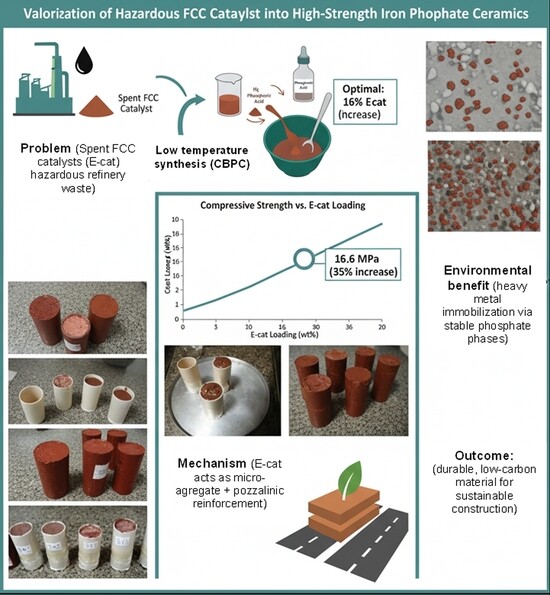
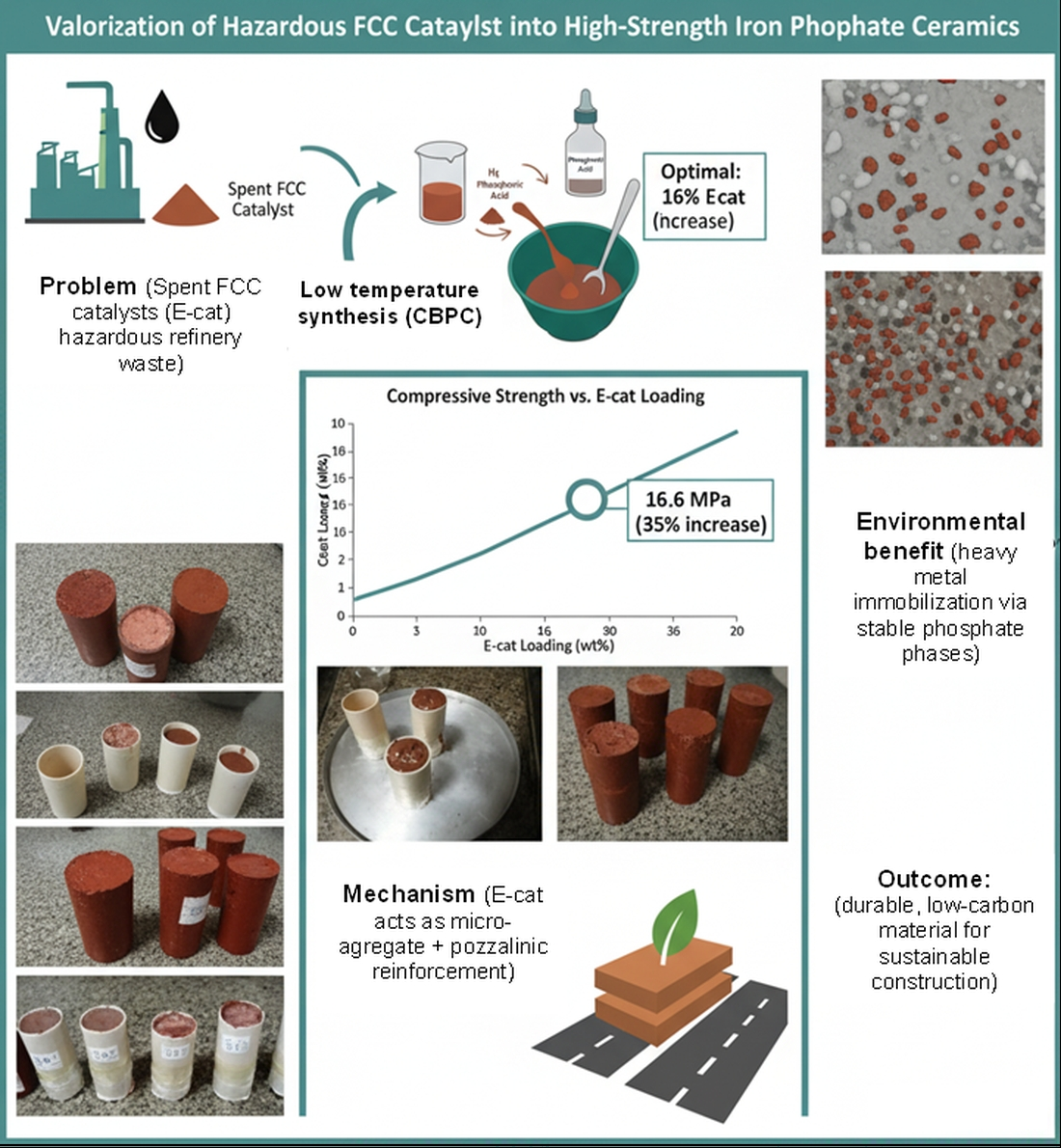
Spent fluid catalytic cracking catalysts (E-cat) are a challenging waste from the petroleum refining industry, enriched with heavy metals such as nickel, vanadium, and iron. This study proposes a circular valorization strategy by incorporating E-cat into a chemically bonded iron phosphate ceramic matrix, known for its excellent waste stabilization properties. Composites were synthesized at room temperature using E-cat, hematite, and phosphoric acid, with E-cat contents from 0% to 35%. Characterization by XRF, XRD, SEM, compressive strength, and water absorption tests identified an optimal formulation containing 16% E-cat, achieving a maximum compressive strength of 16.6 MPa, 35% higher than the control. This improvement can be attributed to the dual function of E-cat, acting both as a micro-aggregate that promotes matrix densification and as a pozzolanic component that enhances mechanical reinforcement. These results demonstrate that iron phosphate ceramics represent a low-energy and sustainable strategy for the immobilization of spent catalysts and the production of durable construction composites.

Graphical Abstract

1. Introduction

The continuous expansion of industrial activities, although vital for global economic progress, has simultaneously amplified the challenge of managing complex solid waste streams, particularly those enriched with toxic metals and refractory compounds [1]. Among these, spent fluid catalytic cracking (FCC) catalysts represent one of the largest single waste fractions generated by the petroleum refining industry, with global production estimates exceeding 800,000 metric tons annually [2,3]. The FCC process is indispensable for converting heavy gas oils into high-value, lighter fractions like gasoline. However, the catalyst, primarily composed of aluminosilicate zeolites, undergoes progressive deactivation and contamination by metals such as nickel, vanadium, and iron, which are deposited during operation [4].
Traditional waste management options, including incineration, landfilling and low-grade ceramic reuse, are increasingly constrained by stringent environmental regulations, escalating disposal costs, and the imperative for a circular economic approach Consequently, there is an urgent and critical need to develop sustainable valorization pathways that both mitigate environmental risks and transform spent fluid catalytic cracking catalysts (E-cat) into materials of technical or economic value.
Globally, E-cat are generated in large volumes and are still managed predominantly through conventional disposal routes, including incineration, landfilling with recycling and valorization remaining limited to niche or regional applications. In many refineries, E-cat is classified as hazardous or special industrial waste due to its elevated concentrations of Ni, V, and other metals, and therefore its management is subject to strict environmental regulation [5]. Landfilling and interim storage remain the most common practices worldwide, particularly in regions lacking mature recycling infrastructure. E-cat is typically stabilized and disposed of in controlled hazardous waste landfills or temporarily stockpiled while awaiting final disposal [6,7]. Although this option is technically simple and low-cost in the short term, it offers no material recovery, consumes landfill capacity, and poses long-term environmental risks related to metal leaching, especially under acidic conditions. To reduce disposal volumes, thermal treatments such as incineration or vitrification have been proposed. High-temperature vitrification can effectively immobilize heavy metals within a glassy matrix, significantly reducing leachability [8]. However, these approaches are energy-intensive, capital-demanding, and associated with high CO2 emissions, limiting their practical deployment at a large scale.
The chemical composition of E-cat, dominated by amorphous silica (SiO2) and alumina (Al2O3), confers pozzolanic activity, making it a promising candidate for partial replacement of Portland cement or incorporation into geopolymeric matrices [9]. Indeed, recent studies have explored E-cat’s potential as a fine aggregate or supplementary cementitious material in non-sintered bricks and concrete [10,11]. However, while cementitious reuse offers short-term material recovery, it often provides limited control over the long-term immobilization and leaching behavior of hazardous heavy metals [12].
Chemically Bonded Phosphate Ceramics (CBPCs) have emerged as a highly promising, low-temperature alternative for waste stabilization [13]. CBPCs are synthesized via an acid-base reaction between a phosphate solution (phosphoric acid) and metal oxides (Fe2O3, MgO, or CaO), forming dense, durable matrices composed of hydrated and crystalline phosphate phases [13,14]. These materials are particularly valued for the immobilization of toxic or radioactive waste due to their rapid setting, high mechanical strength at curing conditions, and superior chemical stability across a wide pH range [15]. The formation of highly insoluble metal phosphate phases provides a robust, thermodynamically stable barrier against contaminant leaching [16].
Integrating E-cat into an iron phosphate (Fe–P) ceramic matrix presents a compelling synergistic opportunity. The aluminosilicate phases within the E-cat can function as reactive aggregates, mechanically reinforcing the matrix while potentially participating in the phosphate bonding process, thereby enhancing the overall immobilization efficiency [12]. Furthermore, Fe–P systems have been successfully employed to stabilize various industrial residues containing heavy metals, demonstrating metal retention rates exceeding 99% under aggressive leaching protocols [15,17].
The present study investigates the development of eco-friendly composites produced from spent refinery catalyst (E-cat) incorporated into an iron phosphate binder system. The main objectives were to (i) evaluate how varying E-cat loadings affect the mechanical and physical properties of the resulting composites, (ii) explore the microstructural evolution through SEM and XRD analyses, and (iii) assess the potential of this system as a technological route for the stabilization and valorization of hazardous refinery residues. Beyond addressing a pressing environmental problem, this study contributes to the advancement of sustainable materials engineering by proposing a scalable, low-energy, and cost-effective process for converting industrial waste into durable, potentially marketable products suitable for civil construction and environmental remediation applications.

2. Materials and Methods

2.1. Preparation of Iron Phosphate Ceramics

The ceramic composites were synthesized via an acid–base reaction at room temperature, following a modified procedure [13]. A baseline Fe2O3:Fe0 mass ratio of 49:1 was adopted to facilitate the partial reduction of Fe3+ to Fe2+, which is known to promote the formation of mixed iron (II/III) phosphate phases, enhancing the final product’s stability [16]. E-cat, obtained from a commercial petroleum refinery located in southeastern Brazil, was incorporated into the Fe–P system at four different mass proportions relative to the total solid content: 0% (control), 16%, 29%, and 35%. These specific loadings were selected based on preliminary tests showing that 16% provided optimal reinforcement, while higher concentrations tested the limits of matrix cohesion. The dry powders were homogenized for 5 min before the controlled addition of the phosphoric acid solution (85%). The resulting paste was manually mixed for approximately 5 min (a duration optimized to ensure homogeneity) until a uniform consistency was achieved, then cast into cylindrical PVC molds (3.9 cm × 8.0 cm). All specimens were cured under controlled laboratory conditions for 28 days. The absence of external heating or pressure underscores the low-energy synthesis route, a key feature for industrial scalability [11].

2.2. Physicochemical Characterization

The elemental composition of the raw materials and composites was analyzed by X-ray fluorescence (XRF) using a AXIOS spectrometer (Malvern Panalytical, Almelo, The Netherlands) equipped for fused-bead analysis with a fusion machine (Katanax Inc., Rue Jean-Perrin, QC, Canada). Crystalline phases were identified by X-ray diffraction (XRD) using a CubiX3 diffractometer (Malvern Panalytical, Almelo, The Netherlands) with a PW 3050/60 goniometer (θ–θ configuration). The system operated with Co Kα radiation at 40 kV and 30 mA, with scans performed from 5° to 60° (2θ) at a step size of 0.02°. Prior to analysis, samples were finely ground in a MiniMill II ball mill (Malvern Panalytical, Almelo, The Netherlands) at 400 rpm for 15 min to ensure homogeneity. Microstructural features were examined by scanning electron microscopy (SEM) using a JSM-6490LV microscope (Jeol, Tokyo, Japan) operated under low-vacuum conditions. Fractured surfaces of the cured specimens were analyzed at magnifications ranging from 35× to 2000× to observe particle morphology, porosity, and interfacial bonding.

2.3. Mechanical and Physical Properties

Compressive strength was measured after 28 days of curing using a FT-400K-C universal testing machine (Forney, TX, USA) at a loading rate of 0.5 MPa/s. The reported values represent the mean of three replicates per formulation. Water absorption and apparent density were determined according to Brazilian Standards NBR 15270 [18] (for ceramic materials) and NBR 7215 [19] (for hydraulic binders). Samples were oven-dried at 105 °C until constant mass, immersed in water for 24 h, and reweighed to calculate the absorption ratio. These tests collectively provided insight into the influence of E-cat content on the densification, porosity, and mechanical behavior of the resulting iron phosphate composites.

3. Results

3.1. Physicochemical and Morphological Characterization

The spent FCC catalyst (E-cat) is a fine, light-grey powder (Supplementary Figure S1). Its chemical composition, determined by XRF analysis, was dominated by SiO2 (53.6%) and Al2O3 (39.1%), which is consistent with its aluminosilicate zeolite framework. The analysis also quantified the presence of key heavy metal contaminants, with vanadium and nickel concentrations measured at 532 ppm and 281 ppm, respectively. The material also contained 1.62% of rare earth oxides (RE2O3), a common component used to enhance catalytic stability. The selected loadings (0, 16, 29, and 35%) were deliberately spaced to represent (i) a reference binder system, (ii) moderate E-cat content expected to enhance packing and reactivity, and (iii) high-load conditions approaching the practical processing limit of the phosphate matrix. E-cat contents above 35% were not investigated because preliminary mixing trials showed that higher loadings led to severe workability loss and incomplete consolidation of the phosphate matrix. At E-cat contents exceeding 35%, the amount of available phosphate binder became insufficient to properly wet, encapsulate, and chemically bind the solid particles, resulting in poor paste cohesion, excessive porosity, and premature cracking during casting and curing. The reaction is naturally exothermic; peak temperatures were recorded at 106 °C for the control, and 84.5 °C, 76 °C, and 45 °C for the 16%, 29%, and 35% E-cat composites, respectively.
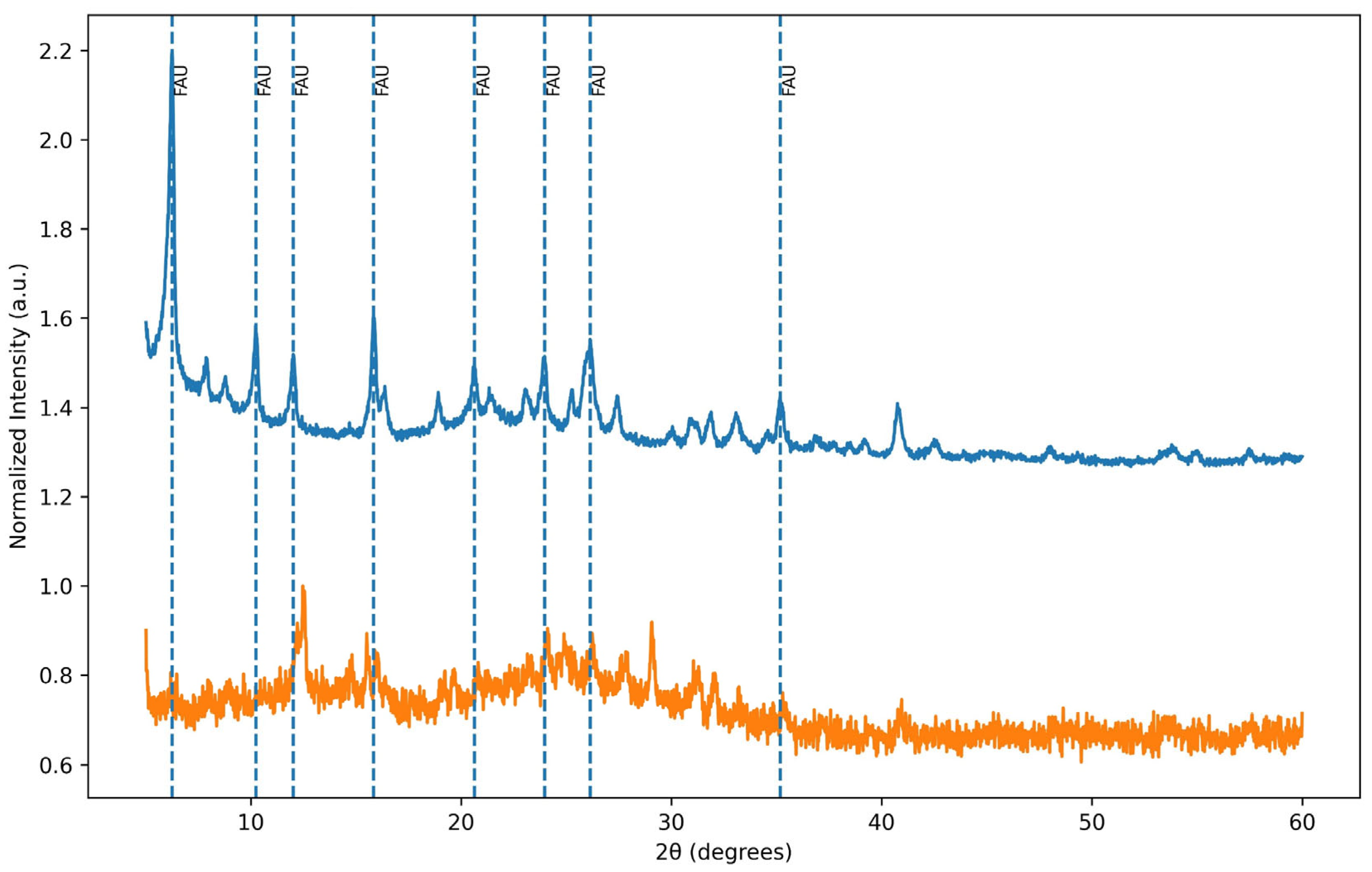
The XRD pattern of the pure spent FCC catalyst (E-cat) confirms the presence of FAU-type faujasite (zeolite Y), characterized by reflections at approximately 6.2°, 10.2°, 12.0°, 15.8°, 20.6°, 23.9°, and 26.1° (2θ). These peaks are consistent with a crystalline aluminosilicate framework (Na–Al–Si–O) typical of zeolite Y. In the composite containing 16% E-cat, these reflections remain detectable, indicating preservation of the zeolitic structure during CBPC formation. Additional reflections appearing between 24 and 31° are attributed to iron phosphate phases, mainly FePO4 and Fe3(PO4)2, formed during the acid–base reaction between the iron precursor and phosphoric acid. A broad amorphous halo between 20 and 35° suggests the presence of a partially amorphous phosphate matrix (Figure 1). The coexistence of crystalline zeolitic micro-aggregates and newly formed iron phosphate phases supports the development of a hybrid microstructure, which correlates with the improved compressive strength observed at 16% E-cat loading.

3.2. Mechanical Properties of the Ceramic Composites

The 28-day compressive strength of the cured ceramic composites demonstrated a clear and non-linear relationship with the E-cat content (Table 1). The reference formulation (0% E-cat) established a baseline strength of 12.3 ± 0.97 MPa. A significant improvement in mechanical performance was observed in the formulation containing 16% E-cat, which achieved a maximum compressive strength of 16.6 ± 2.22 MPa, representing a 35% increase over the control material. On the other hand, increasing the E-cat loading to 29% resulted in a marked decrease in strength to 7.5 ± 0.57 MPa. Although this value is substantially lower than the peak strength, it remains well above the minimum threshold of 1.5 MPa for non-structural masonry blocks. The formulation with the highest E-cat content (35%) yielded a composite with a compressive strength of 6.8 MPa, indicating a continuing downward trend. 16% E-cat represents the experimentally determined optimum within the investigated range, and smaller incremental variations could potentially refine this value further.

3.3. Physical Properties of the Ceramic Composites

The physical properties of the composites were consistent with the mechanical strength data. The apparent density of the cured specimens showed an inverse correlation with E-cat content, decreasing from 1.92 g/cm3 for the reference sample to 1.79 g/cm3 for the 35% E-cat composite, reflecting an increase in the material’s overall porosity. Water absorption tests further corroborated this observation. The reference material exhibited a water absorption of 14%, whereas the value increased to 18% for the 16% E-cat composite and reached 23% for the 35% E-cat composite. All tested compositions remained within the 8–23% absorption range typically considered acceptable for conventional ceramic building materials (Table 1). Leaching tests on the optimized composite demonstrated very low concentrations of leached heavy metals: nickel (Ni) at 0.053 mg/L and vanadium (V) at 0.544 mg/L. These results strongly suggest that the iron phosphate matrix effectively immobilizes these elements, even when exposed to conditions that promote leaching. The robust chemical bonding within the CBPC structure ensures that both the main components and the incorporated heavy metals exhibit high stability in aqueous environments, thus mitigating concerns about their release.

3.4. Microstructural Analysis of Cured Composites

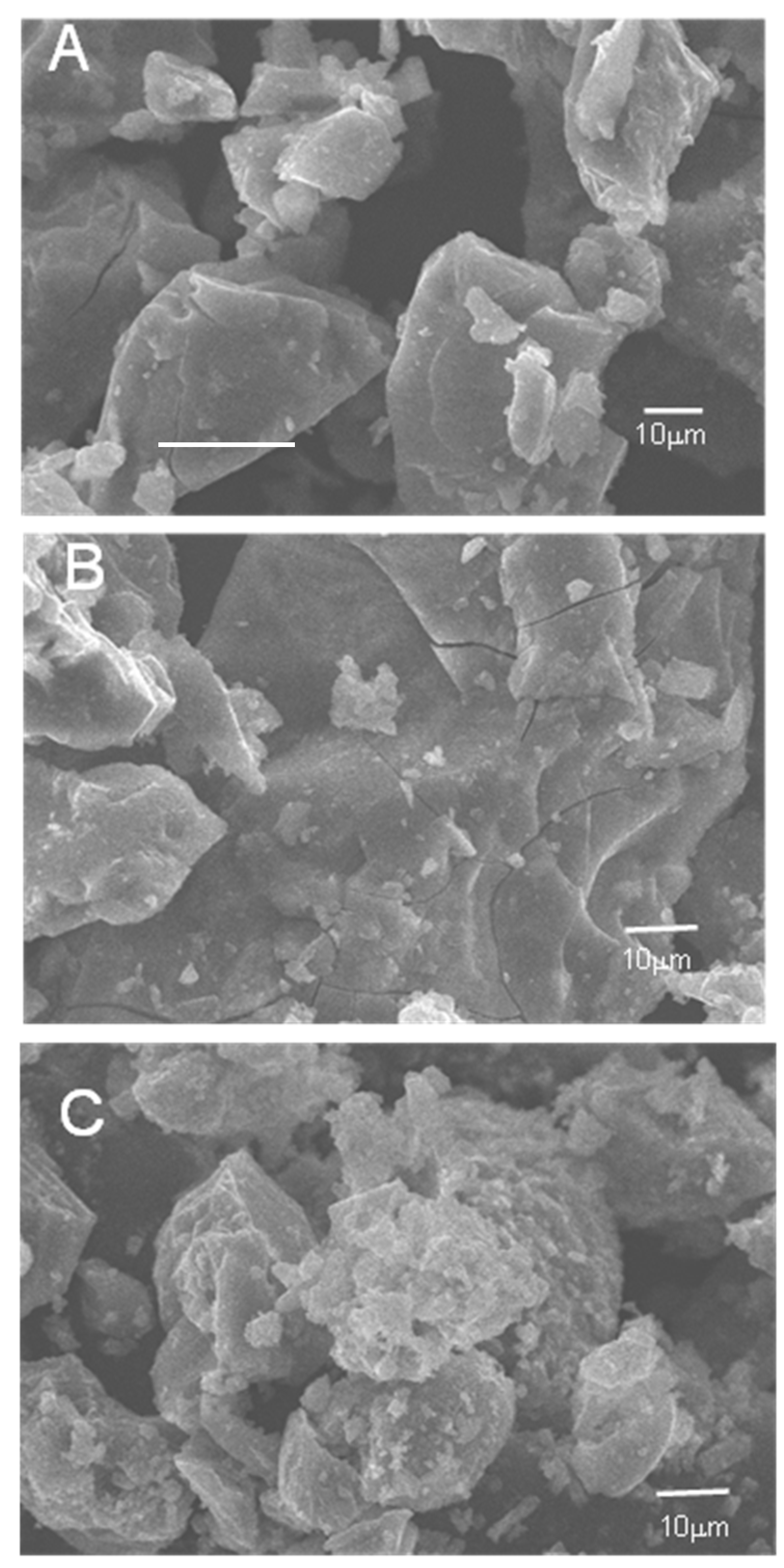
SEM analysis of the fractured surfaces of the 28-day cured specimens provided critical insights into the internal microstructure and its relationship to the observed mechanical properties (Figure 2 and Supplementary Figure S2). The reference sample (Figure 2A) revealed a dense and relatively homogeneous iron phosphate matrix, characterized by tightly packed, angular crystalline structures.
The micrograph of the 16% E-cat composite (Figure 2B) showed the spherical E-cat particles to be well-distributed and firmly embedded within the phosphate binder. A strong interfacial bond is evident, with the matrix material appearing to grow on and around the catalyst particles, effectively integrating them into the structure. The overall microstructure appears compact, with limited microporosity. In contrast, the composite containing 29% E-cat (Figure 2C) displayed a significantly more open and porous microstructure. The image shows larger voids between particles and a less cohesive matrix. Many E-cat spheres appear to be only partially coated by the binder, and the interface between the particles and the matrix is less distinct, suggesting weaker adhesion. This higher degree of porosity and reduced matrix integrity directly accounts for the lower compressive strength measured for this formulation.

4. Discussion

The experimental evidence demonstrates the technical feasibility of incorporating E-cat into an iron phosphate ceramic matrix, yielding composites with promising mechanical and structural integrity. The E-cat does not merely act as an inert filler; it actively participates in the consolidation process, profoundly influencing microstructural development and the final properties of the material [20].
The observed enhancement in compressive strength at the moderate E-cat content (16%) is a direct consequence of the waste material’s dual functionality within the Fe–P system. Firstly, the fine, spherical morphology of the E-cat particles (Supplementary Figure S1) acts as an efficient micro-aggregate, significantly improving particle packing density and reducing the overall void content of the matrix. This filler effect promotes a denser, more homogeneous microstructure, which is the physical basis for enhanced mechanical performance [10]. Secondly, the chemical composition of E-cat, rich in amorphous silica and alumina, confers a degree of pozzolanic reactivity, particularly under the acidic environment generated by the phosphoric acid binder.
This acid-activated aluminosilicate is hypothesized to react with phosphate species, leading to the formation of complex aluminum-iron-phosphate linkages that chemically reinforce the matrix [10]. This chemical interaction is the most compelling explanation for the 35% strength increase observed in the 16% formulation relative to the binder-only control sample [20]. The decline in mechanical strength observed at higher E-cat loadings (29% and 35%) is a classic structure-property relationship in composite materials [14]. As the E-cat content increases beyond the optimal threshold, the available phosphate binder becomes insufficient to fully encapsulate and bond all the particles. This binder deficiency leads to the formation of unbonded zones, increased microporosity, and a weaker particle-matrix interface, as visually confirmed by the SEM analysis. The resulting discontinuities compromise the structural integrity, facilitating water absorption and reducing the material’s density, which aligns perfectly with the physical test data. The optimal 16% E-cat content therefore represents a delicate balance between maximizing filler densification and ensuring adequate binder availability for complete chemical and physical cohesion [13].
The superior compressive strength recorded for the 16% E-cat formulation (16.6 MPa) is associated with an optimal balance between crystalline and amorphous phases. Crystalline iron phosphate phases contribute to load-bearing capacity, while the amorphous phosphate–aluminosilicate phase acts as a continuous binder, enhancing interparticle cohesion and stress distribution. Such a hybrid crystalline–amorphous microstructure is widely recognized as advantageous in chemically bonded phosphate ceramics, where strength depends on matrix continuity and densification rather than on extensive crystallization alone [13].
The preservation of faujasite peaks further indicates that the E-cat functions as a mechanically stable micro-aggregate, reinforcing the matrix without undergoing structural collapse. The clear definition of these peaks suggests efficient anchoring of E-cat particles within the phosphate binder, which is consistent with SEM observations showing good interfacial bonding and limited microporosity. This structural integrity explains the simultaneous increase in compressive strength despite a moderate rise in water absorption (18%), which remains within acceptable limits for non-structural ceramic materials. At higher E-cat contents (29–35%), the pronounced increase in the amorphous fraction reflects an insufficient availability of phosphate binder to promote both crystallization and complete particle encapsulation. As a result, a more disordered and porous microstructure develops, leading to a sharp reduction in compressive strength (7.5 and 6.8 MPa) and increased water absorption (up to 22%). Although the amorphous phase contributes to initial bonding, it cannot compensate for the loss of matrix continuity and weakened particle–binder interfaces. Similar trends have been reported in phosphate and geopolymer systems with high aluminosilicate residue loadings, where excessive solid content limits densification and degrades mechanical performance [9,11].
Overall, the XRD and SEM results strongly corroborate the mechanical and physical data, demonstrating the existence of an optimal E-cat content at which microstructural organization, phase balance, and particle packing are maximized. In this study, that optimum occurs at 16% E-cat, yielding the highest compressive strength alongside adequate density and controlled water absorption. This correlation confirms that the performance of the composites arises from a synergistic microstructural reinforcement mechanism, in which E-cat acts simultaneously as a structural micro-aggregate and as a reactive aluminosilicate component within the phosphate bonding system. This synergy underpins the potential of the material as a sustainable ceramic product for construction applications and industrial waste stabilization.
Beyond the mechanical performance, the most significant contribution of this work lies in its environmental implications: the capacity of the Fe–P system to immobilize the heavy metals inherent in the E-cat, specifically Ni and V. The phosphate immobilization mechanism is two-fold, involving both physical encapsulation and robust chemical stabilization [15]. During the acid-base reaction, the formation of highly insoluble iron phosphate minerals creates an exceptionally stable chemical environment [16]. This mineral structure provides a barrier against the dissolution and subsequent leaching of contaminants. Simultaneously, the heavy metal contaminants, nickel and vanadium, are known to co-precipitate or be incorporated into the forming phosphate structure, potentially forming stable mixed-metal phosphate phases [16,21]. This chemical trapping mechanism significantly reduces the mobility of heavy metals under varying environmental conditions [13]. While dedicated leaching tests are necessary for full environmental certification, the dense microstructure and low open porosity observed in the optimized 16% E-cat composite are strong predictors of excellent long-term immobilization performance. This dense, chemically stable matrix is superior to many conventional cementitious stabilization methods, which often rely primarily on physical encapsulation and are susceptible to acid attack. The CBPC system thus offers a superior, more durable solution for managing refinery waste [11,22,23].
The synergistic reinforcement observed at 16% E-cat loading distinguishes this system from conventional CBPCs incorporating other industrial by-products, such as fly ash or blast-furnace slag. While fly ash primarily functions as a fine filler with moderate pozzolanic activity in magnesium phosphate systems [24,25], the E-cat in this iron phosphate matrix exhibits a more pronounced dual-action mechanism. The preservation of the faujasite zeolite framework suggests that E-cat particles act as high-surface-area structural anchors that facilitate the localized dissolution of aluminosilicate species under acidic conditions. This process promotes the formation of complex Al–Fe–P linkages, creating a hybrid crystalline–amorphous binder that enhances interparticle cohesion more effectively than the calcium-phosphate or silicate-rich phases typically formed with slag [26,27]. Unlike the predominantly physical encapsulation observed in many fly ash-based composites [28], the interaction between E-cat and the phosphoric acid binder yields a superior matrix continuity, explaining the 35% increase in compressive strength. This chemical synergy, coupled with the effective immobilization of inherent heavy metals within the insoluble phosphate network, underscores the unique potential of E-cat as a high-performance reactive aggregate for sustainable ceramic production.
The findings underscore the potential of the iron phosphate CBPC system as a scalable technology for achieving the dual goals of waste stabilization and value-added material production [23]. Unlike geopolymer or Portland-based matrices, the synthesis occurs entirely at room temperature, drastically minimizing the energy input and CO2 emissions associated with high-temperature processing [11]. This low-carbon synthesis route is highly aligned with the principles of the circular economy and the global push towards sustainable infrastructure [8,23]. The ability to safely incorporate up to 16% of a hazardous industrial residue without compromising structural performance provides a clear environmental and economic advantage. The resulting composite, with a compressive strength of 16.6 MPa, is suitable for numerous applications in the construction sector, such as non-structural masonry units, paving blocks, or even as durable material for environmental remediation projects [10]. The integration of industrial waste into CBPCs represents a promising, technically robust, and sustainable platform for creating high-performance composites that merge environmental remediation with materials [1,4,5].

5. Conclusions

This study successfully demonstrates the technical feasibility and environmental potential of producing durable iron phosphate composites by incorporating a spent FCC catalyst (E-cat) as a functional component. The optimal 16% loading represents a balance where E-cat acts as a micro-aggregate, filling the matrix and providing pozzolanic reinforcement. Mechanical enhancement is supported by the appearance of new phases in XRD. However, at 29% and 35%, the high surface area of E-cat (183 m2/g) demands more binder than available, leading to the observed drop in density and strength. While E-cat is classified as Class IIB (non-hazardous), its immobilization in the Fe-P matrix provides a robust barrier against metal leaching. The 16.6 MPa strength exceeds the NBR 15270 requirements for structural (3.0 MPa) and non-structural (1.5 MPa) masonry, making these ceramics suitable for bricks and paving blocks. Unlike Portland cement, this synthesis occurs at room temperature without high-temperature clinkerization, offering a significant reduction in the carbon footprint. This study demonstrates the feasibility of valorizing E-cat in iron phosphate ceramics. An optimal loading of 16% E-cat yields a high-strength (16.6 MPa) composite suitable for construction. The low-energy synthesis and effective waste integration provide a sustainable pathway for refinery waste management, aligning with circular economic principles.

Supplementary Materials

The following supporting information can be downloaded at: https://www.mdpi.com/article/10.3390/ceramics9020029/s1. Figure S1: Spent catalyst (E-cat) samples and their microstructure. (A) E-cat samples in test tubes showing gray color variations, primarily attributed to differences in chemical composition and degree of aging during catalytic operation. (B) Scanning electron microscopy (SEM) micrographs of E-cat particles exhibiting predominantly spherical morphology; the scale bar corresponds to 20 µm (800× magnification). (C) Photographs of CBPC samples containing 35% E-cat (maximum incorporation) and 16% E-cat (optimal mechanical performance); Figure S2. Scanning electron microscopy (SEM) micrographs of ceramic sample (with 0% of E-cat) at different magnifications: (A) 35×, (B) 200×, (C) 500×, (D) 800×, (E) 1000×, and (F) 2000×. The images reveal the heterogeneous surface morphology and particle aggregation, with progressively clearer visualization of crystal-like structures and surface texture at higher magnifications; Figure S3. Scanning electron microscopy (SEM) micrographs of ceramic sample (with 16% of E-cat) at different magnifications: (A) 35×, (B) 200×, (C) 500×, (D) 800×, (E) 1000×, and (F) 2000×. Compared with 0% (Figure S2), the 16% E-cat sample exhibits a more compact and cohesive morphology, with larger and denser aggregates; Figure S4: Scanning electron microscopy (SEM) micrographs of ceramic sample (with 29% of E-cat) at different magnifications: (a) 35×, (b) 200×, (c) 500×, (d) 800×, (e) 1000×, and (f) 2000×. Compared with 0% (Figure S2) and 16% (Figure S3), the 29% sample displays an intermediate morphological pattern, characterized by irregularly shaped particles with moderate aggregation and a relatively rough surface texture.

Author Contributions

C.M.F.: Writing—original draft, Methodology, Investigation, Funding acquisition, Formal analysis, Conceptualization; E.M.d.S.: Writing—review and editing, Investigation, Formal analysis. A.M.C.: Writing—review and editing, Investigation, Supervision, Funding acquisition, Conceptualization. All authors have read and agreed to the published version of the manuscript.

Funding

This work was supported by National Council for Scientific and Technological Development (CNPq) (grant number: 313307/2021-0) and Brazilian Federal Agency for Support and Evaluation of Graduate Education (CAPES).

Institutional Review Board Statement

Not applicable.

Informed Consent Statement

Not applicable.

Data Availability Statement

The original contributions presented in this study are included in the article. Further inquiries can be directed to the corresponding author.

Acknowledgments

The authors greatly appreciate all the UERJ and FCC S/A staff who supported this work.

Conflicts of Interest

The authors declare no conflicts of interest.

Abbreviations

The following abbreviations are used in this manuscript:
FCCFluid Catalytic Cracking
CBPCChemically Bonded Phosphate Ceramic
SiO2Amorphous silica
Al2O3Alumina
XRFX-ray Fluorescence
XRDX-ray Diffraction
SEMScanning Electron Microscopy

References

  1. Oladimeji, T.; Oyedemi, M.; Emetere, M.; Agboola, O.; Adeoye, J.; Odunlami, O. Review on the impact of heavy metals from industrial wastewater effluent and removal technologies. Heliyon 2024, 10, e40370. [Google Scholar] [CrossRef] [Scilit] [PubMed]
  2. Chen, J.; Sun, S.; Xiao, F.; Tu, G. Advancing total management of oily spent hydroprocessing catalyst: From hazardous waste to circular and eco-sustainable utilization. J. Environ. Manag. 2025, 381, 125202. [Google Scholar] [CrossRef] [Scilit]
  3. Ying, Z.; Chen, J.; Shang, Z.; Liu, T.; Xu, S.; Wu, G. Recovery and resource utilization of spent hydrogenation catalysts: A review. Environ. Sci. Technol. 2025, 59, 14809–14831. [Google Scholar] [CrossRef] [Scilit]
  4. Wang, Q.; Li, Y.; Benally, C.; Li, Y.; Chen, C.; An, Z.; El-Din, M.G. Spent fluid catalytic cracking (FCC) catalyst enhances pyrolysis of refinery waste activated sludge. J. Clean. Prod. 2021, 295, 126382. [Google Scholar] [CrossRef] [Scilit]
  5. El-Sharkawy, M.; Alotaibi, M.O.; Li, J.; Du, D.; Mahmoud, E. Heavy metal pollution in coastal environments: Ecological implications and management strategies: A review. Sustainability 2025, 17, 701. [Google Scholar] [CrossRef] [Scilit]
  6. Alonso-Fariñas, B.; Rodríguez-Galán, M.; Arenas, C.; Torralvo, F.A.; Leiva, C. Sustainable management of spent fluid catalytic cracking catalyst from a circular economy approach. Waste Manag. 2020, 110, 10–19. [Google Scholar] [CrossRef] [Scilit] [PubMed]
  7. Hasan, M.M.; Haque, R.; Jahirul, M.I.; Rasul, M.G. Pyrolysis of plastic waste for sustainable energy recovery: Technological advancements and environmental impacts. Energy Convers. Manag. 2025, 326, 119511. [Google Scholar] [CrossRef] [Scilit]
  8. Harasymchuk, I.; Koci, V.; Vitvarova, M. Chemical recycling: Comprehensive overview of methods and technologies. Int. J. Sustain. Eng. 2024, 17, 124–148. [Google Scholar] [CrossRef] [Scilit]
  9. Wan, Q.; Zhang, R.; Zhang, Y. Structure and properties of phosphate-based geopolymer synthesized with the spent fluid catalytic-cracking (SFCC) catalyst. Gels 2022, 8, 130. [Google Scholar] [CrossRef] [Scilit] [PubMed]
  10. Zhang, D.; Fang, S.; Zhang, H.; Liu, Z.; Zhang, Z.; Zhang, S. Utilization of spent FCC catalyst as fine aggregate in non-sintered brick: Alkali activation and environmental risk assessment. Front. Chem. 2021, 9, 674271. [Google Scholar] [CrossRef] [Scilit]
  11. André, R.A.; Colonetti, E.; Elyseu, F.; Dal-Bó, A.G.; Rabelo, N.d.R.; Peterson, M. Analysis of the properties of chemically bound phosphate ceramics with metakaolin. Appl. Clay Sci. 2023, 243, 107054. [Google Scholar] [CrossRef] [Scilit]
  12. Pang, B.; Liu, R.; Cui, Y. Study on solidification behaviors of chemically bonded phosphate ceramics for lead ion. J. Build. Eng. 2023, 76, 107191. [Google Scholar] [CrossRef] [Scilit]
  13. Wagh, A.S. Chemically Bonded Phosphate Ceramics: 21st Century Materials with Diverse Applications; Springer: Cham, Switzerland, 2016. [Google Scholar] [CrossRef] [Scilit]
  14. Ding, Z.; Li, Y.Y.; Lu, C.; Liu, J. An investigation of fiber reinforced chemically bonded phosphate ceramic composites at room temperature. Materials 2018, 11, 858. [Google Scholar] [CrossRef] [Scilit]
  15. Huang, K.; Chen, G.; Li, X.; Xie, Y.; Liu, Y.; Yang, Y.; Mai, Y.; Shi, K. Phosphate-based glasses and glass–ceramics for immobilization of simulated radioactive sludge via microwave sintering: Mechanism and performance. J. Radioanal. Nucl. Chem. 2025, 334, 1691–1702. [Google Scholar] [CrossRef] [Scilit]
  16. Xu, S.; Cheema, A.I.; Zhang, Y.; Dong, B. Application of phosphate-based binders for the stabilization and solidification of metal-contaminated soil: Mechanisms and efficacy evaluation. Toxics 2024, 12, 907. [Google Scholar] [CrossRef] [Scilit]
  17. Wagh, A.S.; Jeong, S.Y. Chemically bonded phosphate ceramics: I. A dissolution model of formation. J. Am. Ceram. Soc. 2004, 86, 1838–1844. [Google Scholar] [CrossRef] [Scilit]
  18. ABNT NBR 15270-1; Componentes Cerâmicos—Blocos e Tijolos de Cerâmica para Alvenaria — Parte 1: Requisitos. ABNT: São Paulo, Brazil, 2023.
  19. ABNT NBR 7215; Cimento Portland—Determinação da Resistência à Compressão de Corpos de Prova Cilíndricos. ABNT: Rio de Janeiro, Brazil, 2019.
  20. Lei, Z.; Pavia, S. Potential of spent fluid cracking catalyst (FCC) waste for low-carbon cement production: Effect of treatments to enhance reactivity. Cement 2023, 14, 100081. [Google Scholar] [CrossRef] [Scilit]
  21. Na Kim, H.; Cho, D.-W.; Yim, G.-J.; Park, J.H. Stabilization of metal(loid)s using iron phosphate-coated biochar and its impact on lettuce (Lactuca sativa L.) growth in soil. Korean J. Chem. Eng. 2025, 42, 1705–1716. [Google Scholar] [CrossRef] [Scilit]
  22. Fu, H.; Chen, Y.; Liu, T.; Zhu, X.; Yang, Y.; Song, H. Research on hazardous waste removal management: Identification of the hazardous characteristics of fluid catalytic cracking spent catalysts. Molecules 2021, 26, 2289. [Google Scholar] [CrossRef] [Scilit]
  23. Borthakur, P.P.; Borthakur, B. The role of industrial catalysts in accelerating the renewable energy transition. Chem. Proc. 2025, 17, 6. [Google Scholar] [CrossRef] [Scilit]
  24. Xu, B.; Ma, H.; Shao, H.; Li, Z.; Lothenbach, B. Influence of fly ash on compressive strength and micro-characteristics of magnesium potassium phosphate cement mortars. Cem. Concr. Res. 2017, 99, 86–94. [Google Scholar] [CrossRef] [Scilit]
  25. Mo, L.; Lv, L.; Deng, M.; Qian, J. Influence of fly ash and metakaolin on the microstructure and compressive strength of magnesium potassium phosphate cement paste. Cem. Concr. Res. 2018, 111, 116–129. [Google Scholar] [CrossRef] [Scilit]
  26. Jia, Z.; Zhang, Y.; Mo, L. Influence of Ultrafine Fly Ash and Slag Powder on Microstructure and Properties of Magnesium Potassium Phosphate Cement Paste. Materials 2024, 17, 2556. [Google Scholar] [CrossRef] [Scilit]
  27. Cárdenas Balaguera, C.A.; Gómez Botero, M.A. Characterization of steel slag for the production of chemically bonded phosphate ceramics (CBPC). Constr. Build. Mater. 2020, 241, 118138. [Google Scholar] [CrossRef] [Scilit]
  28. Yang, J.; Yu, X.; He, X.; Su, Y.; Zeng, J.; Dai, F.; Guan, S. Effect of Ultrafine Fly Ash and Water Glass Content on the Performance of Phosphorus Slag-Based Geopolymer. Materials 2022, 15, 5395. [Google Scholar] [CrossRef] [Scilit]
Figure 1. Comparative X-ray diffraction patterns of pure spent FCC catalyst (blue) and CBPC composite containing 16% E-cat (orange). The pure catalyst exhibits characteristic reflections of FAU-type faujasite (zeolite Y) at approximately 6.2°, 10.2°, 12.0°, 15.8°, 20.6°, 23.9°, and 26.1° (2θ).
Ceramics 09 00029 g001
Figure 2. Scanning electron microscopy (SEM) micrographs of ceramic samples containing 0% (A), 16% (B), and 29% (C) E-cat at 1000× magnification. The images reveal heterogeneous surface morphology and particle aggregation, with clearer visualization of crystal-like structures and surface textures.
Ceramics 09 00029 g002
Table 1. Physical and mechanical properties of cured composites.
E-Cat (%)Compressive Strength (MPa)Apparent Density (g/cm3)Water Absorption (%)
012.3 ± 0.971.9214
1616.6 ± 2.221.9618
297.5 ± 0.571.8222
356.8± 0.241.7923
Disclaimer/Publisher’s Note: The statements, opinions and data contained in all publications are solely those of the individual author(s) and contributor(s) and not of MDPI and/or the editor(s). MDPI and/or the editor(s) disclaim responsibility for any injury to people or property resulting from any ideas, methods, instructions or products referred to in the content.