1. Introduction
Digital transformation is reshaping the competitive environment of modern economies and requiring organisations to continuously adapt workforce capabilities to evolving occupational demands. Small- and medium-sized enterprises (SMEs) face particular challenges because they often have limited resources for workforce development and lack standardized tools for identifying competence gaps. The resulting misalignment between employees’ existing capabilities and the skills required by digitally evolving occupations may constrain the effective adoption of new technologies and undermine SME competitiveness. To address this problem, the present study adopts the European Skills, Competences, Qualifications and Occupations (ESCO) framework as a common reference for identifying, standardising, and comparing workforce competences. Existing data-driven approaches generally treat organisational performance analytics, workforce skill assessment, and learning provision as separate functions. This fragmentation makes it difficult to translate performance signals into comparable competence assessments and targeted reskilling interventions. The present study addresses this gap by integrating these functions within a single ESCO-grounded framework developed as part of the LUCE (LUtech Campus Ecosystem) project. Accordingly, the study asks the following: How can ESCO-based assessment of workforce skills be integrated with organizational performance indicators to support data-driven reskilling in SMEs? The proposed framework addresses this question by connecting workforce competence profiles with occupational requirements and translating the resulting skill gaps into targeted training recommendations. The study makes theoretical, methodological, and technological contributions. Theoretically, it integrates human capital theory, the knowledge-based view of the firm, and skill-biased technical change to conceptualize workforce competences as a condition for realizing the productive potential of digital technologies [
1,
2,
3,
4,
5,
6], from which it derives the proposition that SMEs whose workforce lacks emerging-technology competences may face a binding human capital–technology complementarity constraint. Consistent with the study’s design science orientation, this complementarity relationship is advanced as a proposition that motivates the framework, not as a claim the present cross-sectional design sets out to confirm; the study’s central, evaluated contribution is the diagnostic instrument itself—a standardised, ontology-grounded, and comparable measurement of workforce skill gaps—while any downstream effect of those gaps on firm performance is reserved for future longitudinal testing. Methodologically, the study reconceptualizes the skill gap as an ontology-grounded and commensurable construct, overcoming the limited comparability of firm-specific competence taxonomies [
7,
8]. Technologically, it integrates performance analytics, skill assessment, and learning provision within an ESCO-aligned Intelligent Learning Management System prototype, which serves as a proof of concept for the framework rather than constituting the study’s primary contribution. The remainder of the paper reviews the relevant literature, develops the theoretical framework and propositions, presents the methodology and ESCO-aligned competency framework, and reports the empirical results and training recommendations. It then describes the system architecture and implementation before discussing the study’s implications, limitations, ethical considerations, and directions for future research.
The remainder of the paper is organized as follows.
Section 2 reviews the relevant literature on digital transformation, skill gaps, and workforce reskilling in SMEs, and identifies the research gap the study addresses.
Section 3 develops the theoretical framework and states the propositions that link firm performance, workforce skill gaps, and reskilling.
Section 4 presents the research methodology, including the data, the formal definition of the Skill Gap Indicator, and the validation and robustness procedures.
Section 5 introduces the ESCO-aligned competency framework used to assess workforce skill gaps.
Section 6 describes how training programs are identified from the skill gap analysis and reports the empirical results, including the exploratory test of the performance–skill gap relationship.
Section 7 sets out the design and architecture of the SME Performance Learning Management System, and
Section 8 details its implementation and functional modules.
Section 9 discusses the results, positioning the framework within the literature and drawing out its managerial, practical, and research implications.
Section 10 acknowledges the study’s limitations and ethical considerations, and
Section 11 concludes by summarizing the contribution and outlining directions for future research. Finally,
Appendix A reports the employee-level skill scores, skill gaps, and training recommendations for the anonymized SME sample, and
Appendix B provides the technical specification supporting reproducibility.
2. Literature Review
The evolving nature of digital economies is reshaping labour markets and redefining workforce capability requirements, and there is broad consensus that demographic change, technological innovation, and digitalisation are producing structural imbalances between labour supply and demand, particularly for advanced digital and transversal competences [
9]. Demographic projections suggest these imbalances will intensify in technologically advanced sectors [
9], compounded by unequal access to digital competences across population groups, with older workers facing particular difficulties [
10]. Yet, consensus on the existence of a mismatch conceals persistent disagreement on its measurement, its breadth, and whether interventions actually close it—tensions that the present study takes as its point of departure and that the ESCO framework, with its standardised labels, concept URIs, and explicit occupation–skill relations, is intended to address by rendering otherwise heterogeneous evidence commensurable.
A first body of work documents how competence demand is being reshaped across an unusually wide range of domains: manufacturing and Industry 4.0 production [
11,
12], software engineering [
13], construction and the built environment [
14,
15], interconnected and safety-critical systems [
16], supply chains [
17,
18,
19], energy and infrastructure [
20], public health [
21,
22], cultural heritage [
23], creative industries [
24], petroleum and geoscience [
25], governance and digital auditing [
26], and smart cities [
27]. Read critically, however, the value of this breadth is also its principal weakness; each study characterises competence demand within the idiom of its own sector, so the resulting picture is fragmented and not directly comparable across domains. The recurring finding that emerging roles require
integrated profiles combining technical and transversal competences—problem solving, collaboration, adaptability [
13]—is reported repeatedly but rarely against a shared, standardised vocabulary, which is precisely the comparability gap an ESCO-based representation is designed to close.
A second, methodological tension concerns how competences and gaps are measured. One strand grounds analysis in standardised taxonomies, interpreting demand and disparities as an uneven distribution of ESCO-aligned competences across the workforce and regions [
28]; another, faster-growing strand applies AI and data-driven techniques to map unstructured sources such as CVs and job descriptions to occupational requirements [
29,
30]. These approaches embody a genuine trade-off that the literature has not resolved: taxonomy-based methods gain interoperability and cross-context comparability at the cost of flexibility, whereas learning-based extraction gains adaptability but forfeits standardization and remains vulnerable to the noise and incompleteness of self-presented data. The present framework deliberately occupies the standardised pole while treating extraction as a replaceable component, so that data-driven methods can be substituted without abandoning the ESCO-grounded representation.
A third debate concerns the assumed causal chain from training to capability to organisational outcomes. A large literature treats reskilling and upskilling as the natural remedy for mismatch and stresses the alignment of education systems with labour market needs [
31,
32,
33], supported by new training environments such as learning factories and domain-specific platforms [
34,
35], game-based assessment [
36], and virtual simulation [
37]. Yet much of this work assumes rather than demonstrates that closing measured skill gaps improves firm performance, and persistent mismatches reported even amid intensive reskilling efforts—among young workers [
38], across geographies [
39], and globally as AI reshapes employment [
40,
41]—suggest the link is weaker or more contingent than often presumed. A related limitation is structural: performance analytics, skill assessment, and learning provision are typically studied as separate functions rather than as an integrated pipeline, and contributions are often demonstrated within sector- or firm-specific systems [
19,
42,
43] that do not generalise.
Finally, the framing of digital transformation as inseparable from sustainability and human-centred development [
44,
45,
46,
47,
48], and the emergence of entirely new occupational profiles around AI and digital twins [
49,
50,
51,
52], raise a question the standardised-taxonomy literature has yet to confront: whether a European reference ontology can keep pace with, and remain valid across, labour markets whose sectoral specialisations and emerging roles differ markedly from those for which it was codified. Taken together, these unresolved tensions—comparability versus sector-specificity, standardised versus data-driven measurement, the assumed versus demonstrated training–performance link, and the integration of functions that are usually treated separately—define the space this study addresses: a single ESCO-grounded framework that links firm-level performance to workforce skill gaps and to standardised reskilling pathways, while remaining explicit about what it can and cannot yet establish empirically.
Research gap. Synthesising the tensions above, the specific gap this study addresses is twofold. Structurally, performance analytics, workforce skill assessment, and learning provision are treated in the literature as separate functions—typically supported by proprietary, sector- or firm-specific systems—so that organisational performance signals are never linked to standardised workforce competences within a single interoperable representation. Conceptually, the workforce skill gap is itself defined in firm-idiosyncratic terms, against internally curated competence vocabularies rather than as a commensurable quantity anchored to a shared occupational ontology. The combination of these two limitations is consequential for the international research community, and not only for practice; in the absence of a standardised, ontology-grounded measure, empirical findings on skill gaps remain fragmented across sectors and incomparable across regions and countries, and the theoretically central relationship between organisational performance and workforce competence cannot be tested cumulatively. This study addresses the gap by grounding the entire pipeline—from firm-level performance benchmarking to CV-based skill extraction, ESCO mapping, and training recommendation—in a single European occupational ontology, thereby reconceiving the skill gap as a standardised, comparable construct. In doing so, it not only integrates functions that are usually disjointed but also renders the performance–competence relationship empirically testable; consistent with this, the present study is able to subject that relationship to explicit statistical examination (
Section 6), illustrating both the analytical leverage the framework provides and the limits of what can be established on the current sample.
The literature synthesized in
Table 1 was identified through a structured search of Scopus, Web of Science, and Google Scholar, combining the terms “skill gap”, “reskilling/upskilling”, “digital transformation”, “Industry 4.0”, “ESCO”, “people analytics”, and “SME”. The search was restricted primarily to 2021–2026 to capture the current state of the field and complemented by foundational works on human capital, the knowledge-based view, and skill-biased technical change; studies were retained when they addressed workforce competences, skill mismatch, or reskilling in relation to organisational or sectoral digital transformation. The retained studies were then grouped into four macro-themes by their substantive focus. Each macro-theme is “ESCO-aligned” in the sense that the competences it addresses were mapped onto ESCO’s three constituent pillars: skills/competences, knowledge, and occupations. The labour market stream maps to ESCO occupation–skill relations and standardised skill labels; the Industry 4.0 stream to sector-specific technical skills and knowledge concepts; the digital-learning stream to the linkage between ESCO skills and learning outcomes; and the human capital and sustainability stream to transversal and green competences within the ESCO taxonomy. This alignment renders otherwise heterogeneous literatures comparable through a single standardised vocabulary and locates each stream relative to the occupation–skill structure that the proposed framework operationalises. A synthesis organised by these ESCO-aligned domains is presented in
Table 1.
3. Theoretical Framework and Propositions
This section develops the theoretical foundations of the framework and states the relationships it expects to hold among firm performance, workforce skill gaps, and reskilling. The argument integrates three established traditions—human capital theory, the knowledge-based view, and skill-biased technical change—into a single firm-level mechanism: the complementarity between workforce human capital and digital technology. Human capital theory provides the micro-foundation, conceiving workers’ skills as capital that raises productivity and treating training as an investment that augments it [
1,
2,
53]. The knowledge-based view scales this to the organisation, rooting competitive advantage in accumulated knowledge resources and the capabilities that renew them [
3,
4,
54], consistent with the resource-based and dynamic-capabilities perspectives [
55,
56]. Together they imply that a firm’s productive potential is bounded by the human capital embodied in its workforce. The third tradition specifies why digital transformation makes competence deficits binding; endogenous-growth theory identifies technology and human capital as the central drivers of productivity [
57,
58], while the skill-biased technical change and task-based literatures show that digital technologies shift the task content of occupations and are complementary to skilled labour [
5,
6,
59]. The productive impact of technology is therefore conditional on a workforce able to operate it—a constraint especially acute for SMEs, which combine limited development resources with weak access to standardised skill-assessment tools [
7,
8]. Integrating these traditions yields the mechanism that motivates this study; as digital transformation raises the skill content of occupations, SMEs whose workforce lags on emerging-technology competences face a binding complementarity constraint and tend to underperform. Consistent with its design science orientation, this study advances the relationships below as propositions that motivate and guide the design of the artifact, not as hypotheses the present cross-sectional evidence is intended to confirm. Accordingly, the empirical contribution we claim and evaluate is the construct validity and utility of the diagnostic instrument itself—the standardised, ESCO-anchored measurement of workforce skill gaps—whereas the propositions linking those gaps to firm performance are theory-derived expectations whose confirmation requires longitudinal, employer-sourced data and is reserved for future work. Accordingly, the empirical tests in this paper should be read as validating the framework’s engineering feasibility and the diagnostic’s construct validity and utility—that the pipeline extracts, maps, and scores ESCO competences and produces a stable, comparable indicator—and not as tests of the substantive performance–competence hypothesis, which the modular, replaceable extraction layer and the present design are not intended to adjudicate.
Proposition 1 (P1). In digitally transforming SMEs, organisational underperformance and deficits in technology-related workforce human capital tend to co-occur, consistent with firm-level capital–skill complementarity—stated as a proposition motivating the design, not as a claim tested by confirmation in the present study.
Because SMEs typically enter digital transformation with workforces neither recruited nor trained for digitally intensive tasks, and lack resources for structured development, the resulting deficit is expected to be broad rather than localized, spanning the full range of digital competence domains [
8,
60,
61].
Proposition 2 (P2). Digital competence deficits in SMEs are pervasive across digital competence domains, reflecting a broad rather than localized misalignment between the workforce and the requirements of digitally evolving occupations.
Finally, if underperformance reflects a binding complementarity constraint, then closing the competence gap through targeted upskilling should raise workforce human capital and, by restoring complementarity, improve performance. As the present cross-sectional design measures the gap but does not observe post-intervention outcomes, this is stated as a forward-looking proposition.
Proposition 3 (P3). Targeted technological upskilling that closes ESCO-defined competence gaps raises workforce human capital and, through restored complementarity, improves firm performance—a relationship to be assessed through longitudinal evaluation.
These relationships are deliberately framed as propositions rather than hypotheses, for a substantive reason: the cross-sectional setting can characterize and measure them but cannot confirm them. For P1, an exploratory test against a contrasting group of higher-performing firms (
Section 6) found no statistically significant association, indicating that P1 cannot be confirmed on the present data and requires longitudinal, employer-sourced evidence. Stating the relationships as explicit propositions keeps the theoretical expectations transparent and falsifiable while signalling accurately that their confirmation is future work. Within this framework, ESCO renders the otherwise latent complementarity constraint observable and commensurable, converting the abstract human-capital–technology gap into a measurable, comparable construct.
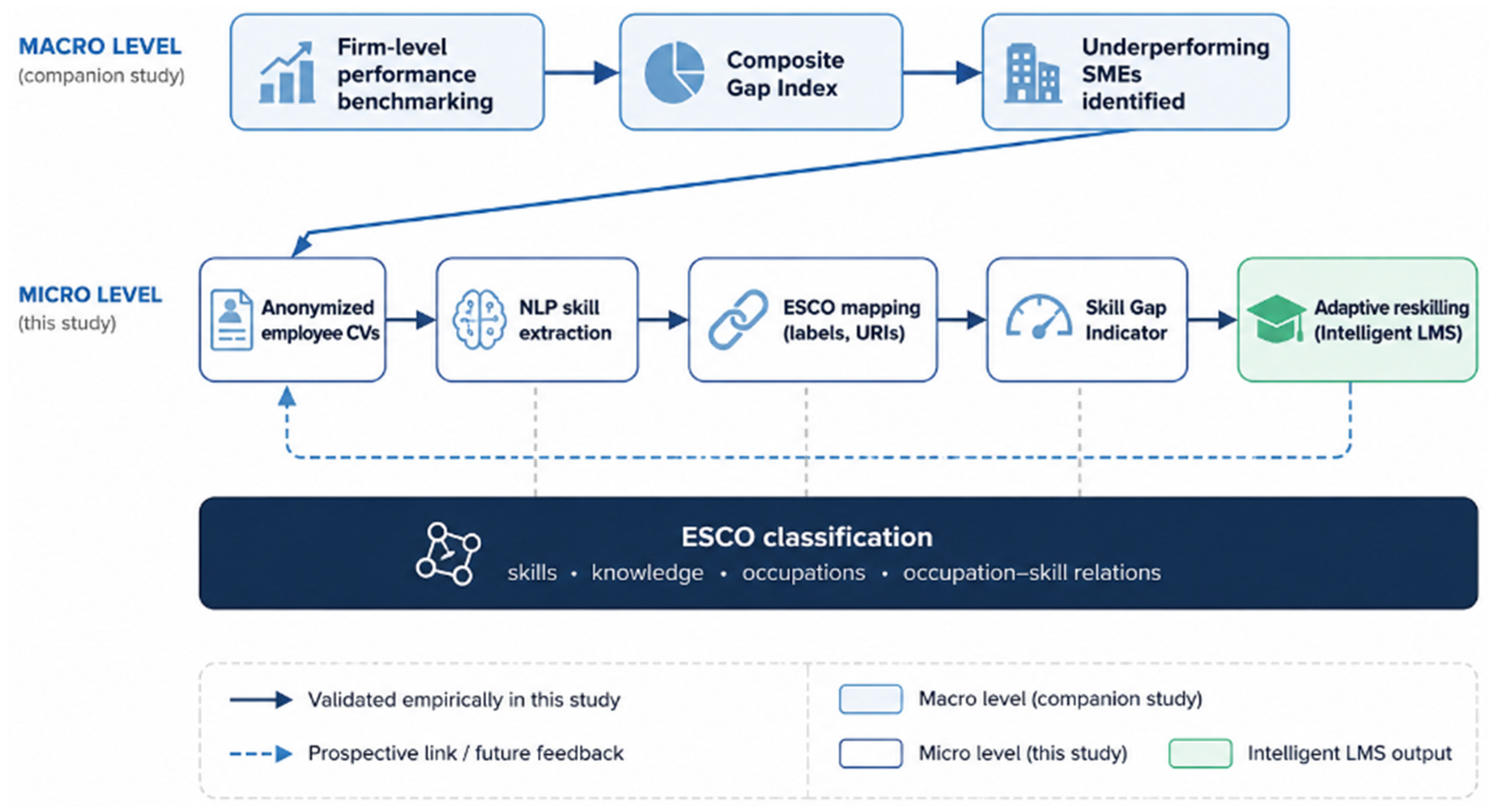
The framework’s individual components—ESCO, NLP-based extraction, skill gap analysis, and LMS—are well established, and we claim no novelty in them separately; the contribution is conceptual, methodological, and technological. Theoretically, it reconceives the skill gap, usually treated descriptively, as the firm-level expression of a complementarity constraint. Methodologically, against approaches relying on firm-idiosyncratic or non-standardised taxonomies, it introduces a commensurable measure—the gap as the complement of evidenced ESCO coverage—with transferable design principles and an explicit inferential apparatus, making the construct comparable across firms, sectors, and regions and, for the first time in this setting, empirically testable. Technologically, the novelty lies not in the components but in their integration into a single ESCO-grounded pipeline linking macro-level performance benchmarking to micro-level skill extraction, mapping, and recommendation. The genuine scientific advance, however, is not this integration—which is instrumental, an engineering achievement—but the construct and the design principles abstracted from it; in design science terms [
62,
63], the contribution is not the artefact but the generalizable knowledge it instantiates, valid independently of the specific tools used. The overall logic of the framework is summarised in
Figure 1.
The framework yields four transferable design principles:
DP1 (commensurability)—anchoring skill gap measurement to a standardised occupational ontology renders the gap comparable across firms, sectors, and regions;
DP2 (macro–micro integration)—embedding individual diagnostics and firm-level performance signals in one ontology-grounded representation enables their joint diagnosis;
DP3 (transferable metric)—defining the gap as the complement of evidenced ontology coverage produces a conservative, portable indicator;
DP4 (modularity)—decoupling the framework from any specific extraction method makes its validity independent of the underlying NLP technique.
4. Research Methodology
The present study adopts a data-driven, multi-stage methodology to identify workforce skill gaps in SMEs and support targeted reskilling through an ESCO-aligned Intelligent Learning Management System (LMS), responding to the growing need for reskilling strategies where workforce competences determine SME competitiveness [
7,
8,
60]. The methodology comprises five phases: (1) construction of a composite performance signal from key performance indicators (KPIs); (2) classification of firms by economic activity and geography; (3) identification of underperforming enterprises; (4) analysis of anonymized employee curricula vitae (CVs) to detect skill gaps; and (5) generation of ESCO-aligned training recommendations. Phases (1)–(3) rely on the Composite Performance Gap Index detailed in the companion study and are summarised here only to contextualise the skill gap analysis.
KPI selection draws on the literature linking technology adoption, organisational efficiency, and human capital development [
64,
65,
66], which consistently identifies insufficient workforce competences as a major barrier to SME digital transformation [
8].
In the core phase, anonymized CVs are mapped to ESCO concepts through preferred labels, alternative labels, and concept URIs, each competence being classified by ESCO category (skill/competence or knowledge) and linked to occupations through occupation–skill relations. Skill extraction is a modular, replaceable component; the contribution is the ESCO-grounded representation, while the NLP method—here a transparent rule-based keyword matcher—can be substituted without altering the framework. Profiles are evaluated against 27 ESCO-aligned digital competences (
Section 5), identifying gaps at individual and organisational levels [
8,
60].
Finally, gaps are matched to LMS training programs indexed by ESCO skill category, aligning learning content with standardised labour market requirements and providing coherent decision-support for targeted reskilling [
67,
68].
The dataset comprises approximately 1182 valid firm-level observations across the main performance variables, complemented by a structured layer of standardised skill and occupation information linking firm performance to workforce competence profiles. Data collection and analysis were carried out from January 2026; the firm-level performance variables were computed from company financial statements for the financial years 2015–2024, and the workforce profiles were retrieved from publicly available professional profiles over the same period. Although the study originates within the Puglia-based LUCE project, the firm-level dataset is not confined to a single regional ecosystem; the analysed firms are distributed across the three Italian macro-areas in balanced proportions (North ≈ 388, Centre ≈ 370, South ≈ 392) and span four sectors in comparable shares (Tourism, Commerce, Services, Manufacturing). The empirical base is therefore nationwide and multi-sectoral rather than locally bounded. A z-score normalization was applied to all firm-level variables to ensure comparability. At the micro level, the analysis initially focuses on the 50 lowest-ranked firms, subsequently extended to a contrasting group of higher-performing firms, yielding the combined multi-region sample used to test the performance–skill gap relationship in
Section 6. Workforce analysis relies exclusively on publicly available professional profiles, anonymized before processing. Profiles were retrieved for 15 of the 50 lower-ranked firms, yielding 133 anonymized CVs (1 to 23 per firm; mean 8.9). The sample is therefore not representative; firms are drawn from the performance tails, and only individuals with public profiles are observed. The micro-level findings are accordingly a demonstration of real data, not population-level estimates.
Table 2 maps each performance dimension to its associated ESCO-aligned skill gap, ESCO skill category, and corresponding learning pathway, providing the conceptual bridge between organisational performance and standardised workforce competences.
Formal definition of the Skill Gap Indicator. Let
denote the reference set of ESCO-aligned digital competences that constitute the target competence profile for digitally transforming roles, with
(the competence domains specified in
Section 5). For each analysed employee i and each competence r ∈ R, define a binary evidence indicator that operationalises the comparison with ESCO.
if the CV of employee i contains at least one NLP-extracted skill mention that maps to competence r—through an exact match on r’s ESCO preferred label, a match on any of its alternative labels, or its unique concept URI—and otherwise.
Let be the set of reference competences evidenced in the employee’s CV.
Weights. Each competence is assigned a weight with wr = 1. In the present baseline all competences are weighted equally, , so that no competence is privileged a priori; the formulation, however, admits non-uniform weights—for instance reflecting the occupational relevance or scarcity of each competence—whose calibration is left to future work. Because the equal-weighted rankings prove insensitive to the weighting scheme (see Robustness; mean Spearman ρ = 0.97) and cross-sector versus sector-specific relevance is already partly captured by the fifteen sector-specific competences (S13–S27), we retain equal weighting as a transparent default and treat sector-differentiated weighting—assigning competences weights that reflect their relevance within each of the four sectors—as a natural refinement for future work.
Coverage and indicator. The employee’s skill coverage is the weighted share of reference competences evidenced in the profile, and the Skill Gap Indicator is its complement:
Scale and normalization. By construction, SGIi ∈ [0, 1]; the indicator is intrinsically normalized, since the weights sum to one (equivalently, under equal weights, the count of evidenced competences is divided by the reference-set size K). No further rescaling is applied.
Interpretation of extreme values. SGIi = 0 denotes full coverage—all reference competences are evidenced in the CV—while SGIi = 1 denotes their complete absence; intermediate values give the weighted share of reference competences not evidenced.
Aggregation. At the firm level, the indicator is the arithmetic mean of the individual values across the firm’s analysed employees:
where
is the number of analysed CVs of firm f. The indicator can be further decomposed by competence domain: for each domain
, the domain-level gap is the (weighted) proportion of analysed employees whose CV provides no evidence of the competences belonging to d, which supports the identification of the domains in which reskilling is most needed and the subsequent prioritisation of training recommendations.
The high mean Skill Gap Indicator (0.956) does not imply an almost entirely unskilled workforce; it results from three combined factors, none a literal near-universal deficit. First, the formula: the indicator is the complement of coverage against 27 ESCO-aligned competences (SGIi = 1 − |Si|/27), so with an average of 1.19 evidenced competences it mechanically yields 1 − 1.19/27 ≈ 0.956. Second, the extraction method: the rule-based keyword extractor has limited recall (≈0.54), missing competences that are present and inflating the gap. Third, the data source: CVs are sparse and rarely enumerate an occupation’s full ESCO skill set, capping detectable competences (a visibility limit, not true absence). The indicator is therefore not miscalibrated but deliberately conservative—an upper bound on the true gap—while its rank-ordering of individuals and firms remains informative for prioritising reskilling.
Validation. The extraction layer was evaluated on 30 CVs against a reference annotation produced by a large language model, partly verified by an author; independent expert annotation is identified as future work. The baseline achieved micro-averaged precision of 0.38, recall of 0.54, and F1 of 0.45 (accuracy was 0.96, inflated by prevalent true negatives). Error analysis identifies three types: Italian-language variants absent from ESCO labels generate false negatives; lexically ambiguous tokens generate occasional false positives; and implicitly conveyed competences, not lexically stated, are the principal source of the recall gap. Resolving these would require semantic-similarity or learning-based mapping, identified as the priority for improvement.
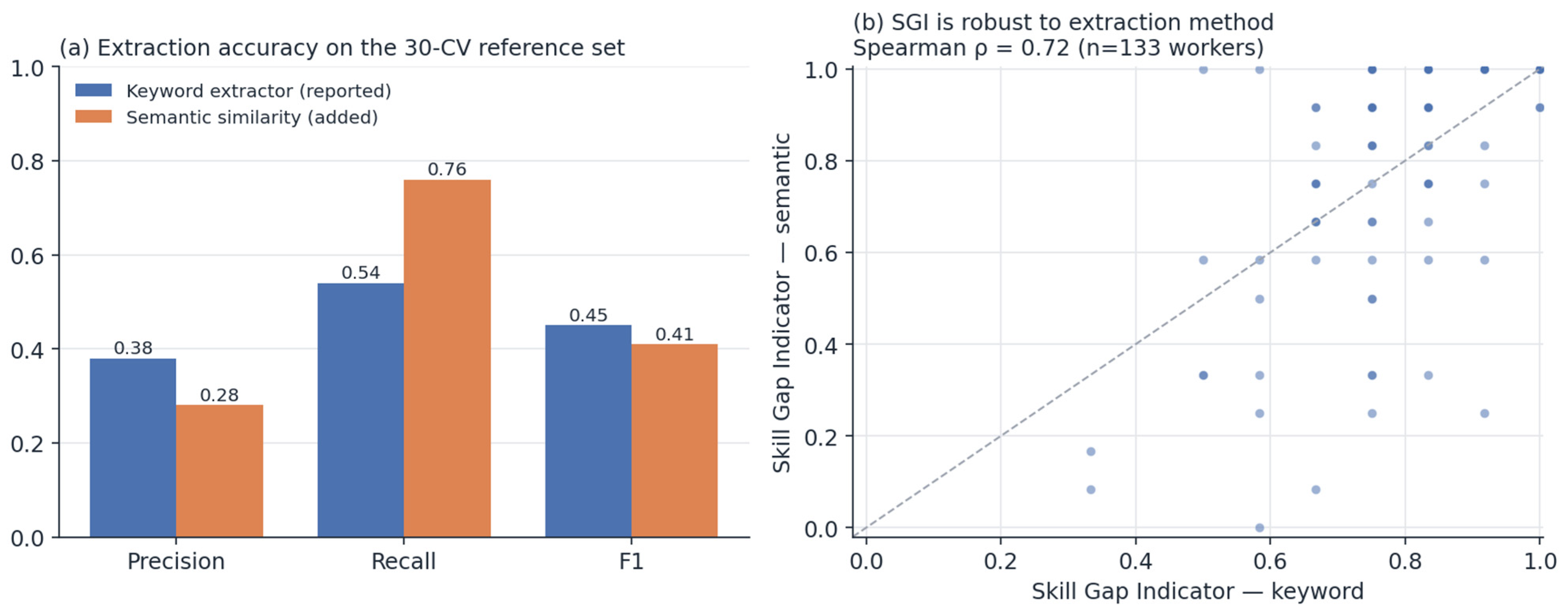
Benchmarking the extraction layer. To test whether the empirical results depend on the accuracy of the keyword extractor, we implemented a second, independent extraction method—semantic-similarity mapping—and benchmarked the two on the same 30-CV reference annotation and the same competence set. Each CV is segmented into overlapping passages and encoded with a multilingual sentence-embedding model; each competence is encoded from its ESCO label, operational definition, and associated skill labels; a competence is assigned when its best-matching passage exceeds a threshold calibrated by leave-one-out cross-validation. Because the encoder is multilingual and matches meaning rather than surface form, it is designed to recover precisely the two dominant error classes of the baseline: Italian-language variants absent from the English ESCO labels, and implicitly conveyed competences. On the reference set the semantic extractor raises recall from 0.54 to 0.76 while precision decreases from 0.38 to 0.28, leaving F1 comparable (0.45 vs. 0.41; PR-AUC 0.32) (
Table 3). The recall gain confirms that the baseline’s shortfall is lexical rather than conceptual—the competences are present in the text but not in a form a keyword matcher detects—and that neither extractor inflates coverage, consistent with the conservative-upper-bound interpretation of the indicator. Crucially, recomputing the Skill Gap Indicator for all workers under both methods leaves its rank-ordering substantially unchanged (per-worker Spearman ρ = 0.72; per-firm ρ = 0.71), so the relative ordering that drives prioritisation for reskilling—the basis of the study’s empirical claims—is robust to the choice of extraction method. See
Table 3.
Figure 2 visualises the benchmark:
Figure 2a contrasts the accuracy profiles of the two extractors on the reference set, making explicit the precision-for-recall trade-off of semantic mapping, while
Figure 2b plots the Skill Gap Indicator computed under each method for every worker, showing that the points align closely along the diagonal and that the indicator’s rank-ordering is therefore largely invariant to the extraction method.
Robustness. A bootstrap (2000 resamples) yields a 95% confidence interval of [0.950, 0.968] around the mean. Across 200 weighting schemes the mean stayed within [0.940, 0.978], with rank-ordering highly preserved (mean Spearman ρ = 0.97); dropping five competences at random left it within [0.950, 0.976]. The indicator is thus stable to weighting and reference-set composition, though its absolute level is sensitive to extraction strictness (single-label matching raised it to 0.987)—consistent with a conservative upper bound whose relative structure is robust. To address robustness to extraction error—the most consequential source of uncertainty—we assessed the indicator under two perturbations of the extraction layer. First, recomputing the Skill Gap Indicator with an independent semantic-similarity extractor preserves the worker-level ranking (Spearman ρ = 0.72;
Section 4). Second, a Monte Carlo analysis that re-samples the extracted competence matrix at the measured error rates (false-negative rate 0.46 from recall = 0.54; false-positive contribution consistent with precision = 0.38; 2000 replications) yields a worst-case worker-level rank correlation of ρ ≈ 0.44 (95% CI [0.29, 0.57]) under fully independent re-extraction. The indicator’s ordering therefore retains a significant positive signal even under substantial extraction error, though it is attenuated—consistent with its use as a conservative, exploratory screening tool rather than a precise measure.
Statistical analysis. The Skill Gap Indicator’s stability was quantified via non-parametric bootstrap and sensitivity analyses, with rank stability assessed through Spearman correlations, and the extraction validated through precision, recall, and F1. The association between firm performance (composite Gap Index) and mean workforce skill gap was tested with Pearson and Spearman correlations across 24 firms, and group differences with the Mann–Whitney U test and, across performance quartiles, the Kruskal–Wallis test and one-way ANOVA. Given the limited firms (n = 24) and restricted variance, we favour these robust, low-parameter tests over multivariate econometric models, identified as future work with larger, employer-sourced data.
With only 24 firms, no credible confirmatory test of a firm-level performance–competence relationship is possible; the correlations and group comparisons reported here are therefore exploratory and hypothesis-generating, presented for transparency rather than as inferential evidence.
5. ESCO-Aligned Competency Framework for Skill Gap Assessment
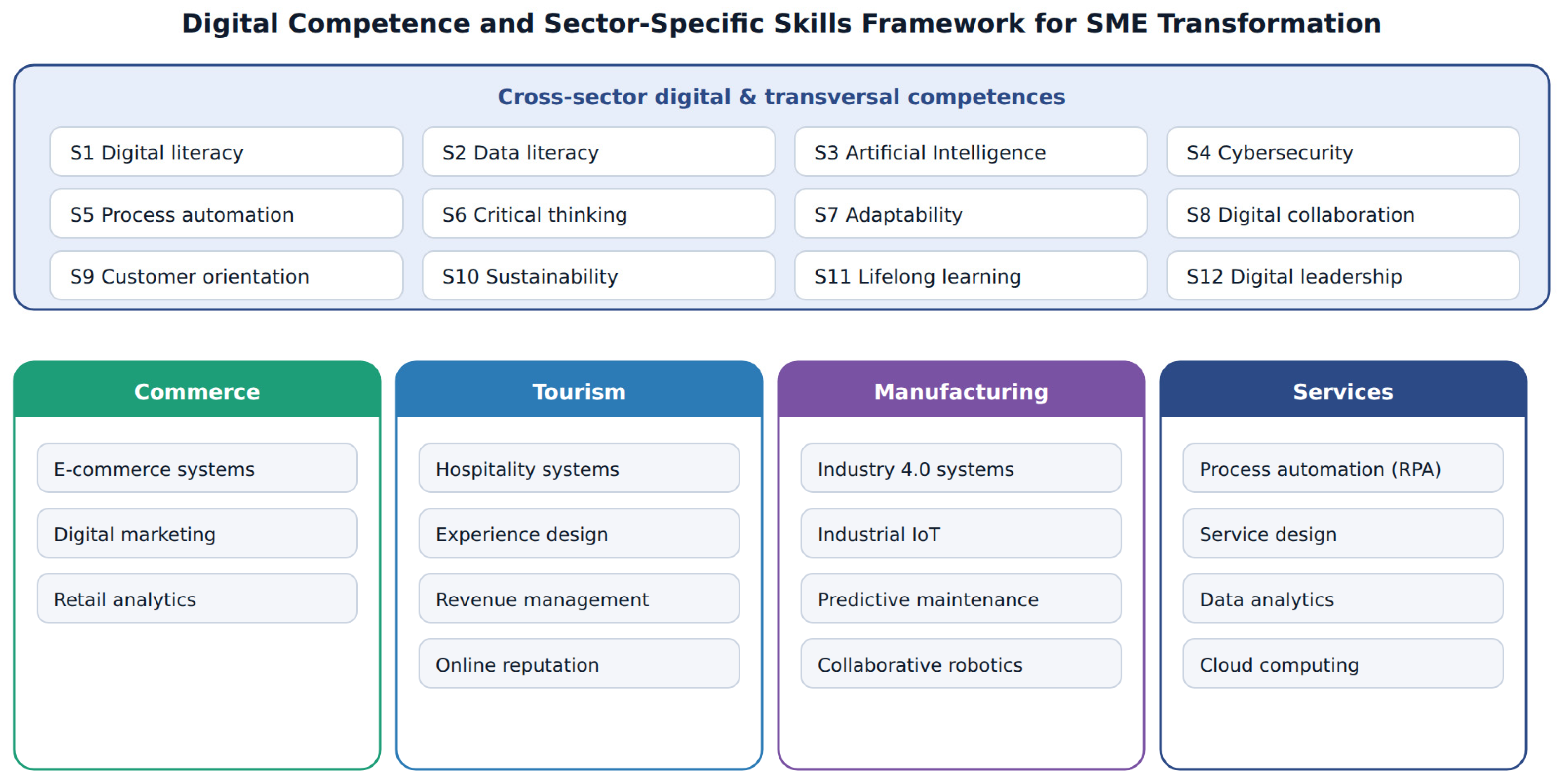
The reference set comprises 27 ESCO-aligned competences, selected through an explicit, two-part criterion. The first part is a set of twelve cross-sector, transversal and digital competences (
Table 4, S1–S12), chosen because they recur in the digital-transformation and digital-skills literature as the capabilities most consistently associated with organisational digital readiness—spanning digital and data literacy, artificial intelligence, cybersecurity, and process automation, together with the cognitive and organisational competences (critical thinking, adaptability, digital collaboration, customer orientation, sustainability, lifelong learning, and digital leadership) that condition their effective use [
8,
69,
70]. Each is defined against ESCO preferred and alternative labels, ensuring that the set is grounded in a standardised taxonomy rather than in an ad hoc list. The second part is a set of fifteen sector-specific competences (
Table 5, S13–S27), derived for each of the four sectors analysed (tourism, commerce, services, and manufacturing) from the ESCO occupation–skill relations of their dominant occupations, so that sectorally distinctive technological requirements are represented alongside the common core. This two-tier design keeps the indicator comparable across firms and sectors through the shared cross-sector core, while retaining sector-specific sensitivity; the selection is therefore anchored to ESCO and to the established competence literature rather than being assumed.
The competences presented in
Table 4 represent a set of transversal and digital competences systematically aligned with the ESCO classification. These competences form the core of the skill assessment framework adopted in this study, enabling the standardised identification, classification, and comparison of workforce capabilities across organisational contexts. Each competence area is defined in accordance with ESCO skill/competence and knowledge categories and is associated with structured descriptors that support semantic interoperability, including standardised labels and keywords used for automated skill extraction and mapping.
The competences specified hereafter are generic, transversal competences consistent with the ESCO nomenclature, representing core competences needed in the digital and knowledge economy. These competences set the bar to assess the profile of the workforce based on ESCO categories of skill/competence and knowledge and thus help determine skill gaps impacting organisational performance since digital human capital is an important element shaping competitiveness of firms in digitally transforming economies [
71]. Four clusters are identified. The first cluster includes digital and data competences (digital literacy, data literacy, artificial intelligence, cybersecurity) that belong to the ESCO category of digital and technical skills and are crucial for working with digital tools, performance data and AI [
70]. The second cluster contains transversal cognitive and organisational competences (critical thinking, adaptability, and digital collaboration), which correspond to ESCO transversal skills and are vital for solving problems in a digitally mediated environment [
72]. The third cluster includes process-efficiency and value-creation competences (process automation, customer-oriented skills) connected with innovation and organisational learning [
73]. The fourth cluster includes strategic competences (sustainability, lifelong learning, and digital leadership) found as critical competences for digital transformation. The proposed framework also takes into account sector-specific competences, which are characterized by particular technological demands of the sector [
74,
75]: e-commerce, digital marketing and retail analytics in the sector of commerce [
76]; digital service delivery and revenue optimization in the tourism sector [
77]; Industry 4.0 technologies in manufacturing [
74]; process automation and data analytics in the services sector. Combination of transversal and sector-specific competences connects the assessment of workforce with the process of sectoral transformation [
75,
76]. See
Table 5.
6. Identification of Training Programs Based on Skill Gap Analysis
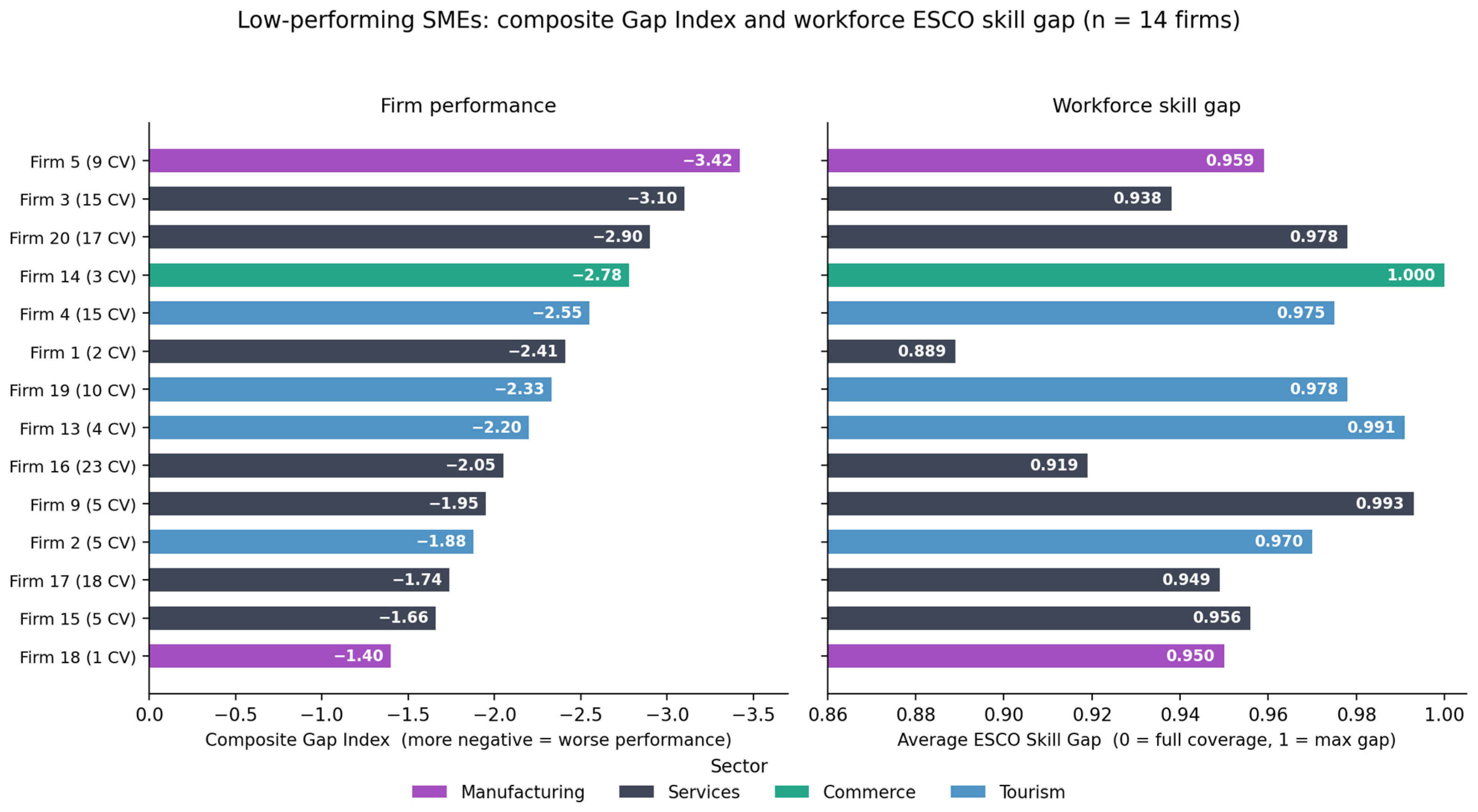
Table 6 below contains an ESCO-based assessment of the skill gap for the selected sample of firms. Benchmarking results reveal significant performance gaps compared to sector norms in terms of productivity, profitability, financial stability, and growth. In the proposed framework, the underperformance is assessed together with workforce competences by matching performance indicators with ESCO-based competences based on anonymized CVs—a case study of the relationship between competences and firm performance. Previous literature suggests that SME underperformance is associated with workforce competences and access to training [
66,
78]. For each firm,
Table 6 shows (i) the number of CVs, (ii) the average ESCO-based skill score, (iii) the skill gap indicator, and (iv) the number of training interventions recommended. The average skill score is low for all the firms—close to zero—in terms of CVs containing few position-related competences, which can be associated with difficulties in developing digital competences in SMEs [
61,
79]. The value of the Skill Gap Indicator is consistently high (0.89–0.99), indicating a structural deficiency [
8]. Importantly, the recommendations for training for all the firms are consistent—training in artificial intelligence, data analytics, digital tools, process automation, and change management—which points to gaps in the core competences of digital transformation [
80]. Nevertheless, as shown in
Section 6, there is no statistically significant relationship between the skill gap and firm performance. See
Table 6 below.
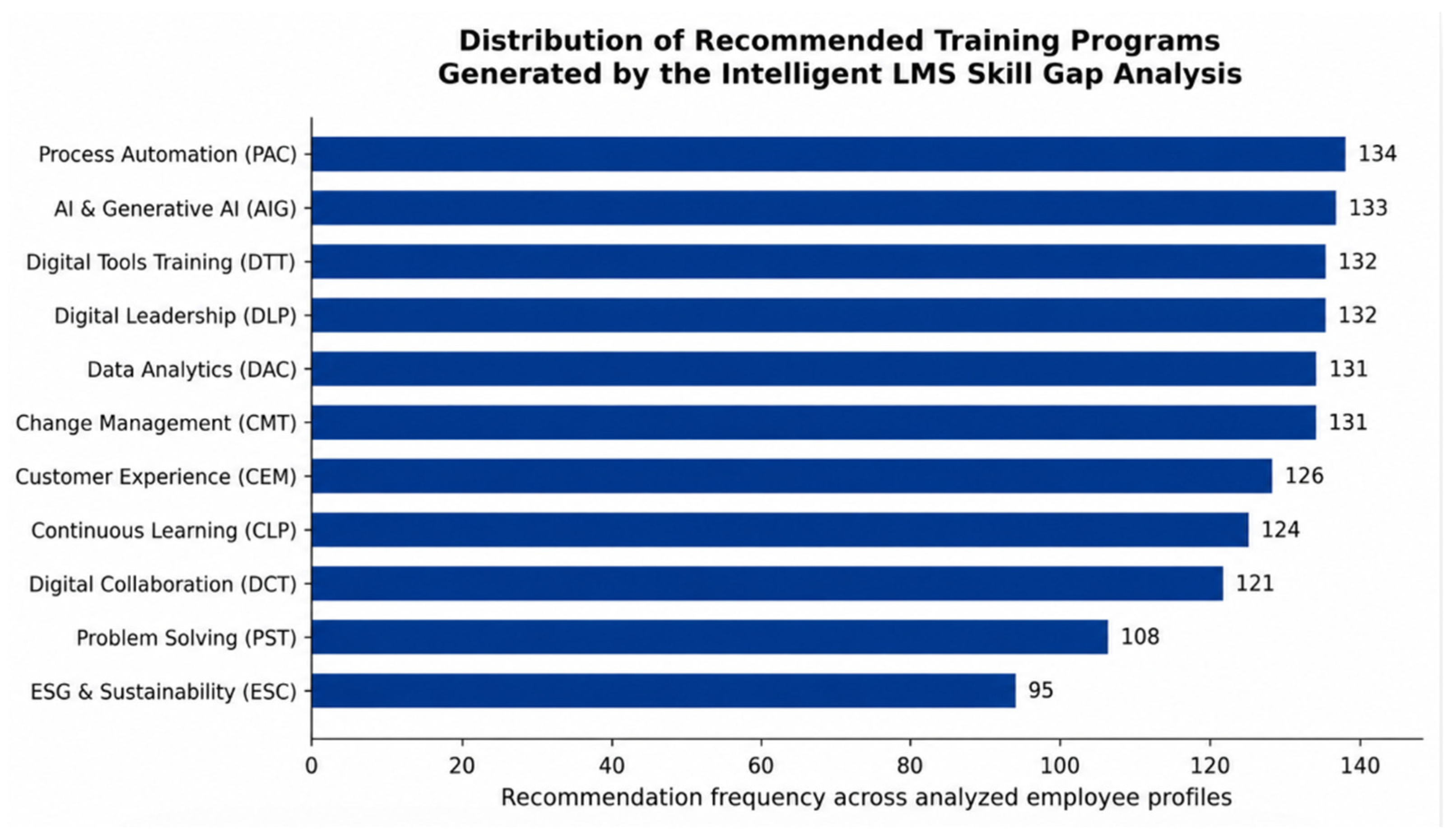
Figure 3 shows the distribution of the most frequently recommended training programs suggested by the skill gap analysis module of the proposed LMS. The results reveal a high concentration of recommendations around a set of competences considered vital to the digital transformation journey, consistent with prior work on skill gap analysis and workforce development in Industry 4.0 [
8,
66]. The Process Automation Course (PAC) dominates with a frequency of 133, reflecting the high skill gap associated with automation. The AI and Generative AI Course (AIG) ranks second with 133, while the Digital Leadership Program (DLP) and Digital Tools Training (DTT) follow with 132 each—reflecting the increasing importance of AI competences, digital leadership, and the efficient use of digital tools in modern organisational contexts [
81]. Change Management Training (CMT) and the Data Analytics Course (DAC) follow at 131, indicating that organisations require training in both technology and management to navigate digital transformation. Customer Experience Management (CEM), the Continuous Learning Program (CLP), and Digital Collaboration Tools (DCTs) also appear frequently, while Problem Solving Training (PST) and the ESG and Sustainability Course (ESC) appear at relatively lower frequencies (108 and 95, respectively).
Figure 3 suggests that the LMS effectively translates the identified skill gaps into training recommendations, with a clear emphasis on digital and technological competences.
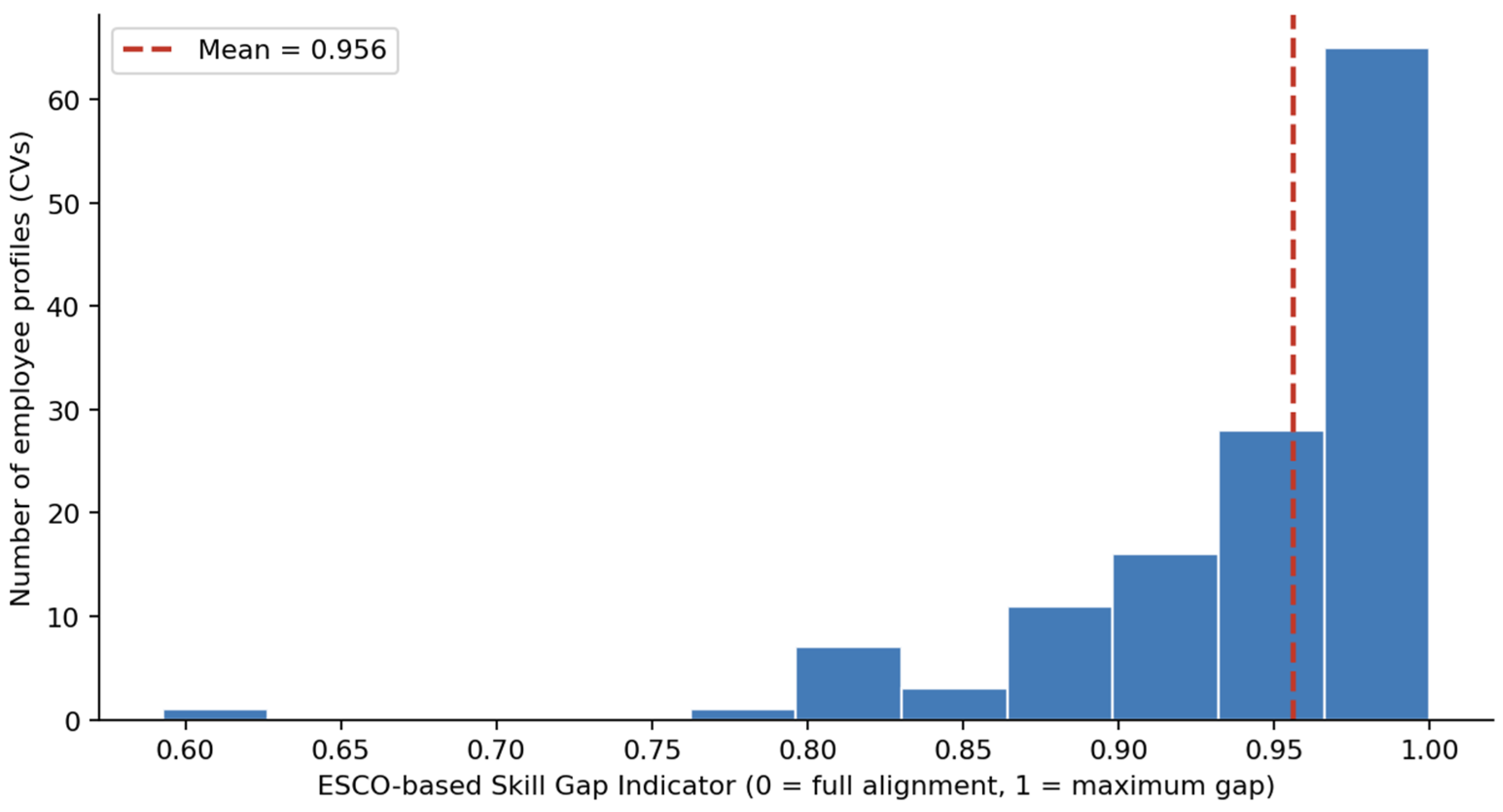
The aggregate distribution of the detected gaps is summarised in
Figure 4, which reports the ESCO-based Skill Gap Indicator across the analysed workforce. The indicator is concentrated in the upper part of its range, with a mean of 0.956 and limited dispersion (SD 0.063); on average, employee profiles evidence only 1.19 of the 27 reference competences. Because the indicator is computed from competences evidenced in CVs—which seldom enumerate the full ESCO skill set of an occupation—this concentration partly reflects the sparsity of CV reporting, and the value is therefore interpreted as a conservative upper-bound estimate of the skill gap rather than a literal share of absent competences. Even under this conservative reading, the distribution points to a pervasive misalignment between workforce profiles and ESCO occupational requirements; moreover, the indicator preserves a meaningful rank-ordering of individuals and firms, providing a robust empirical basis for prioritising reskilling interventions. Because roughly half of the profiles (about 49%) evidence none of the 27 reference competences, the indicator has limited power to discriminate among low-coverage workers at the individual level. This near-ceiling behaviour is a direct consequence of the data source—sparse, selectively maintained public professional profiles—so the micro-level results are best read as a proof-of-concept demonstration on a convenience sample rather than as a representative measurement of workforce capability.
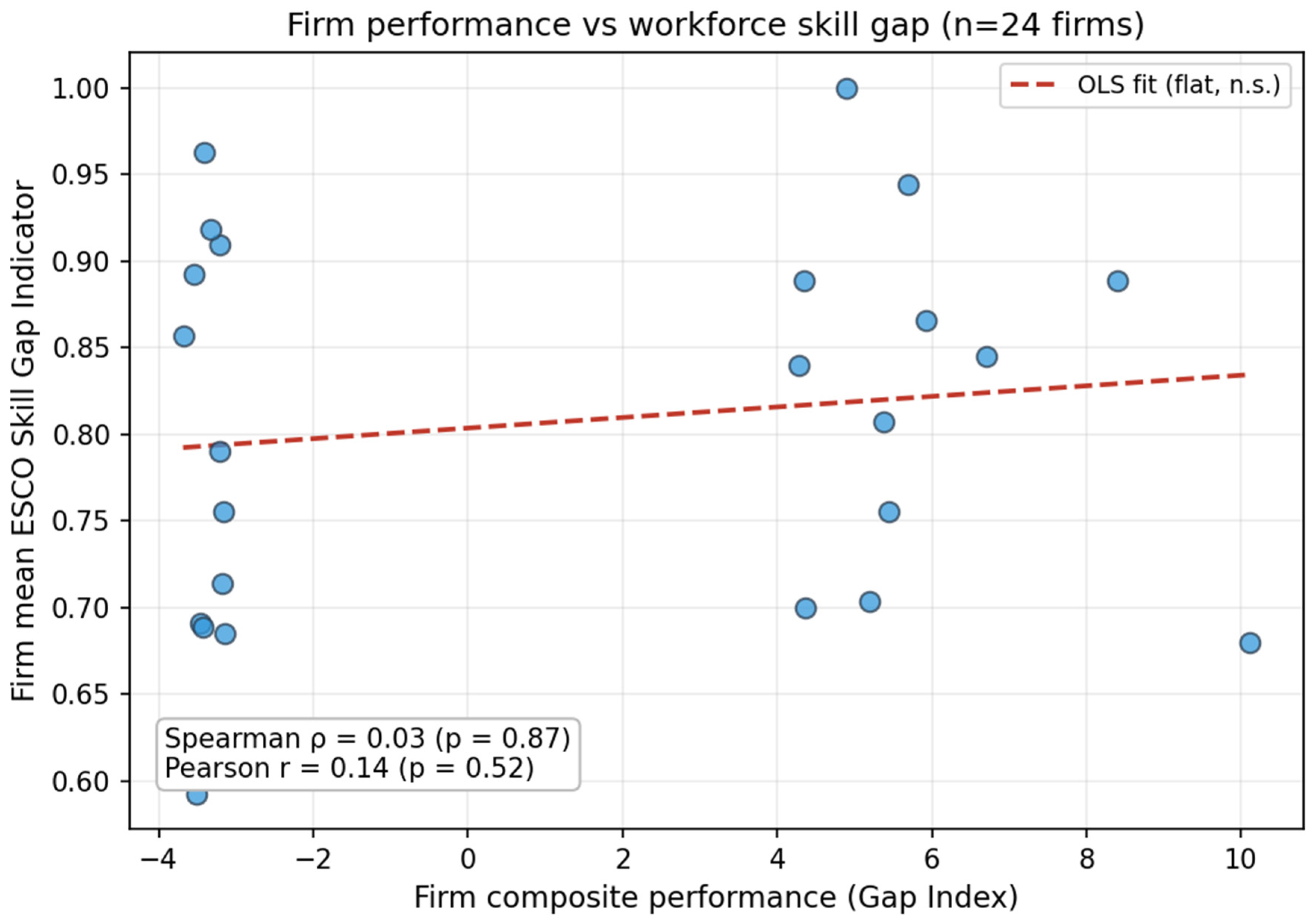
Exploratory test of the performance–skill gap relationship. This analysis is exploratory and hypothesis-generating, not confirmatory; because the study is cross-sectional and Proposition P1 concerns a firm-level relationship that unfolds over time, the test reported here cannot establish or refute P1—it can only probe whether a contemporaneous association is detectable in the present data. With this caveat, we examine whether the workforce skill gap is empirically associated with organisational performance—the relationship articulated as Proposition P1—by extending the skill-extraction procedure to the workforce of a contrasting group of higher-performing firms, drawn from across the full range of the composite Gap Index. The combined sample comprised 24 firms spanning the entire performance distribution, from the lowest-ranked firms (Gap Index ≈ −3.7) to genuinely high-performing ones (Gap Index ≈ +10), with 229 worker profiles in total. No statistically significant association emerged between firm-level performance and the mean workforce Skill Gap Indicator (Spearman ρ ≈ 0.04, p ≈ 0.87; Pearson r ≈ 0.14, p ≈ 0.52), and the relationship remained non-significant when controlling for sector. Beyond sector, a genuine test of the complementarity constraint would require controlling for firm-level confounders—firm size, sectoral technological intensity, workforce age structure, and managerial quality—that could jointly shape both performance and measured skill coverage; with only 24 firms such a multivariate control model is not estimable, which is a further reason we treat the relationship as a proposition and defer its confirmatory testing, with these controls, to future longitudinal, employer-sourced work.
Notably, this absence of association persists despite higher-performing firms employing a more formally qualified workforce (postgraduate qualifications in roughly 60% of profiles, versus 33% in lower-performing firms); higher educational attainment does not translate into a smaller gap in the advanced digital competences captured by the ESCO-based indicator. These findings suggest that, in micro and small enterprises, financial performance and the digitally-oriented human capital observable through public CVs are largely decoupled—firm success in these segments appears to rest on factors other than the workforce’s measured digital-skill profile. We therefore treat P1 as not supported by the present data, while emphasizing that the cross-sectional design, the modest number of firms, and the reliance on self-presented public profiles preclude any causal conclusion. A confirmatory test would require longitudinal data and complete, employer-provided workforce records, which we identify as a priority for future work.
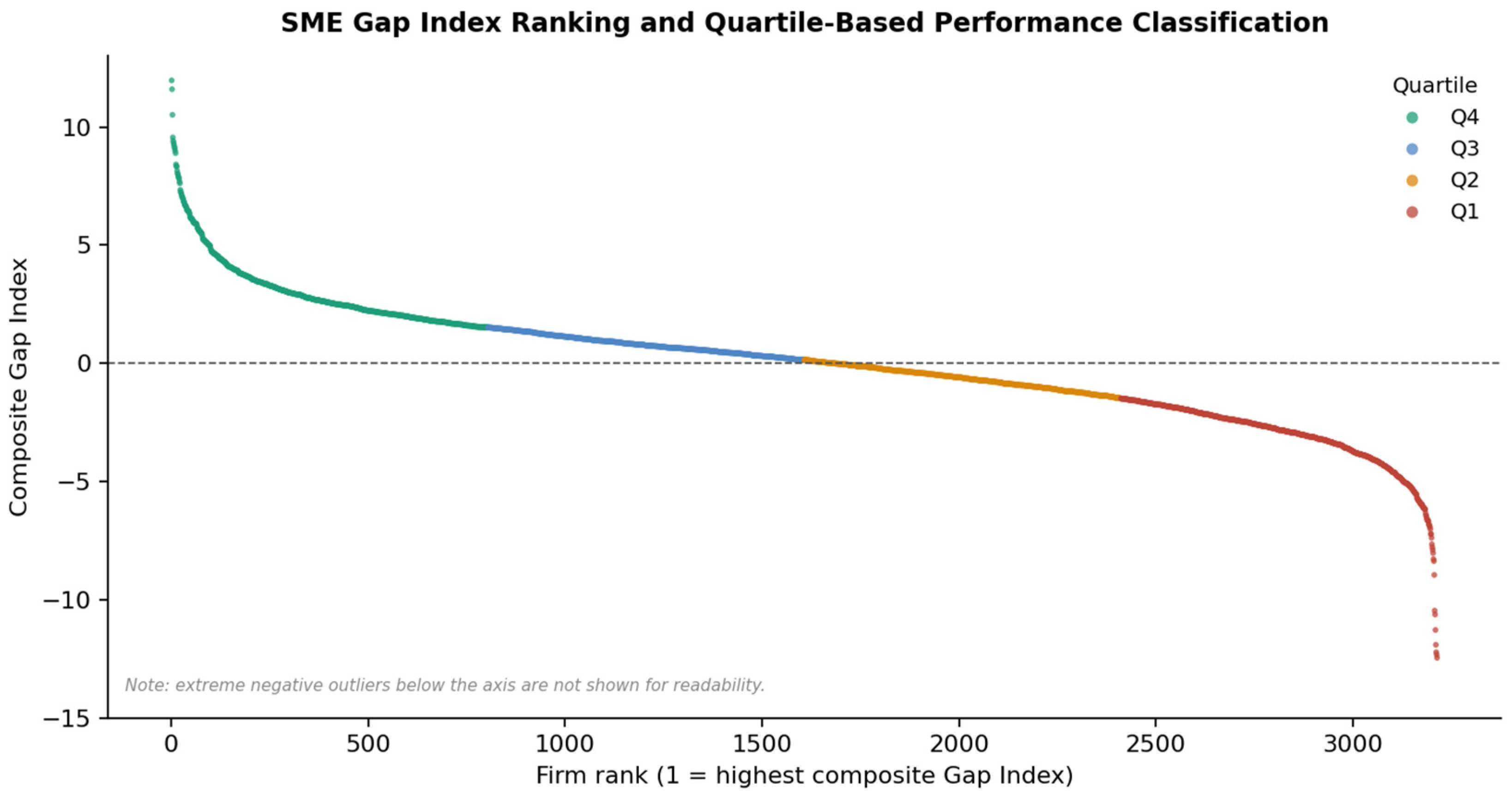
To assess whether workforce skill gaps differ systematically across performance levels, we grouped the analysed firms into performance quartiles by their composite Gap Index and compared the mean workforce Skill Gap Indicator with a one-way ANOVA. The parametric assumptions were satisfied (Shapiro–Wilk W = 0.93,
p = 0.32; Levene’s test
p = 0.72). The ANOVA revealed no significant difference across quartiles (F(3, 10) = 1.00,
p = 0.43, η
2 = 0.23), a result corroborated by the non-parametric Kruskal–Wallis test (H = 2.47,
p = 0.48) and by Dunn’s post hoc comparisons with Bonferroni correction (all adjusted
p > 0.9). Consistent with the near-ceiling behaviour of the indicator, workforce skill gaps do not differ systematically across firm-performance quartiles; given the small number of firms per group, this multi-group comparison is exploratory and underpowered. See
Figure 5.
Interpreting the null association. The absence of a significant performance–skill gap relationship should not be read as evidence that workforce digital human capital is irrelevant to SME performance; several structural features of the present setting make a null result the expected outcome while leaving the framework’s diagnostic value intact. First, and most important, the workforce Skill Gap Indicator is compressed near its upper bound for every firm (0.889–1.000); with almost no variance in the regressor, any covariation with performance is mechanically undetectable—a range-restriction effect—so the null reflects the near-saturation of CV-evidenced gaps rather than the absence of an underlying relationship. Second, because the indicator captures documented, CV-evidenced coverage rather than latent competence, it is a downward-biased proxy whose measurement error attenuates any true association toward zero. Third, the test rests on a small, cross-sectional sample (n = 24) with limited performance variance, and the use of a workforce mean masks role-level heterogeneity in the human capital that actually drives performance—both reducing statistical power. Finally, in the service-oriented segments that dominate the sample (tourism, hospitality, commerce), firm performance plausibly depends on determinants beyond digital competence—location and asset quality, capital intensity, seasonal demand, market positioning, and managerial and financial resources—so digital human capital need not be the binding constraint. Accordingly, the framework’s usefulness rests on its validated function—a standardised, ESCO-anchored diagnostic that renders workforce gaps comparable and supports training prioritisation—which does not require P1 to hold. In design science terms, the artifact’s value is established by its construct validity and utility, not by the confirmation of P1; whether measured gaps covary with, or ultimately drive, firm performance is a separate, longitudinal question that the present cross-sectional design cannot settle.
The framework operates as an embedded, iterative process rather than a linear pipeline. Data collection is continuous, integrating qualitative data (e.g., CVs) with quantitative performance metrics so the process runs on continuously updated, contextualized data. Skill extraction via natural language processing is embedded in the system, converting unstructured text into standard ESCO-aligned units. Skill gap analysis is the primary embedded function, comparing current competencies with ESCO occupational criteria and generating gap indicators in real time. Training recommendations are not a separate stage but an intrinsic part of the system’s response, dynamically adjusting intervention priorities according to the severity and relevance of the detected gaps. Visualization and decision-support features are integral parts of the system as well.
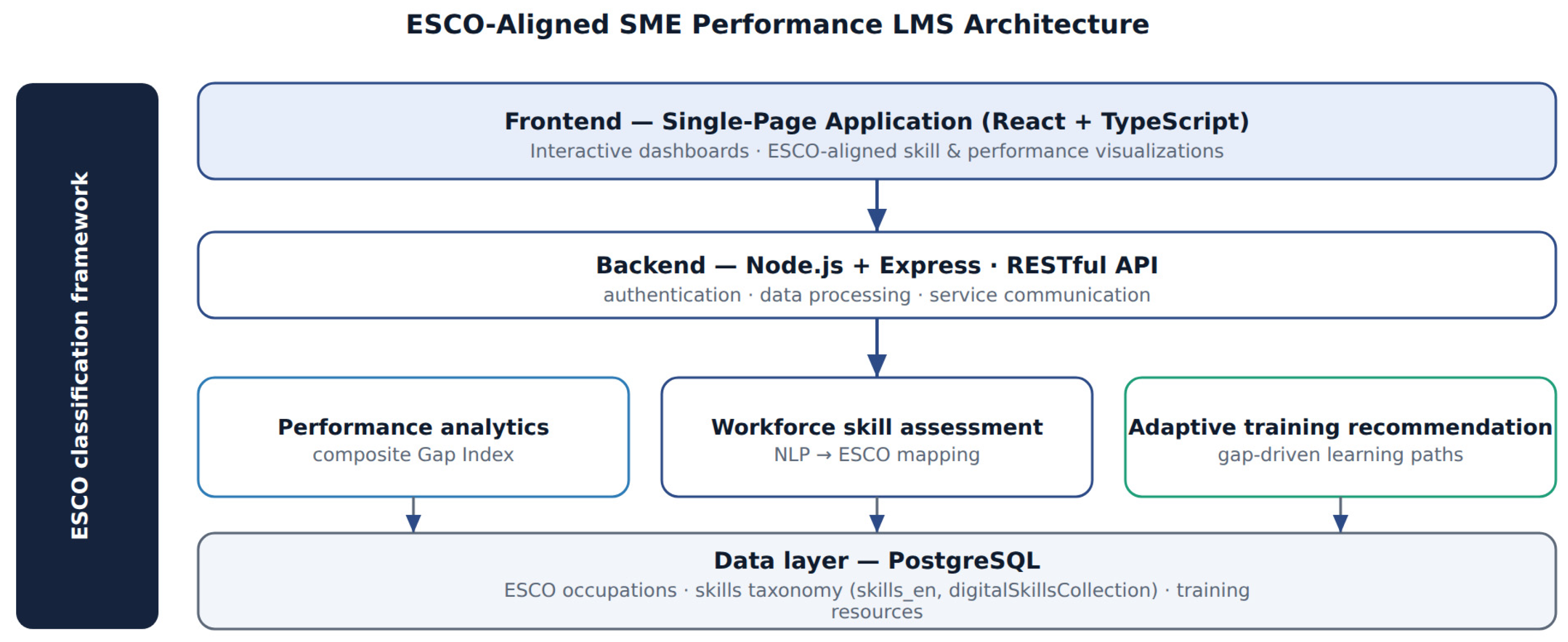
7. Design and Architecture of the SME Performance Learning Management System
The SME Performance Learning Management System is an integrated, ESCO-aligned platform that helps SMEs identify organisational performance gaps and corresponding workforce skill mismatches. Structuring skills, competences, and occupations through standardised taxonomies, it ensures interoperability and comparability, combining firm-level performance signals with employee-level skill assessment and adaptive learning in a unified environment [
70,
82]. The analytical core comprises three ESCO-compliant modules. The performance analytics module computes a composite signal from productivity, growth, and financial stability, interpreted against ESCO occupational benchmarks [
75]. The skill assessment module extracts competences from CVs, maps them to ESCO concepts [
8,
80], and computes a Skill Gap Indicator. The recommendation module links gaps to ESCO-classified learning pathways, prioritised by gap severity [
81].
Implementation and reproducibility. The frontend is a React 18.3/TypeScript 5.6 single-page application (Vite 7.3, Tailwind CSS 3.4 with Shadcn UI, Recharts 2.15, Wouter 3.3, TanStack React Query 5.60); the backend an Express.js 5.0 RESTful server with passport-local 1.0 authentication; persistence uses PostgreSQL via the Drizzle ORM 0.39 with type-safe shared schemas. The data model comprises five entities: companies (performance indicators, composite Gap Index, quartile), skills (27 ESCO competences, S1–S12 cross-sector, S13–S27 sector-specific), employees (anonymized profiles), employee_skill_assessments (binary per-skill records), and courses. The Gap Index aggregates six standardised dimensions—persistence, growth, productivity, profitability, financial stability, volatility—as PAG + GAG + PRG + PFG + FSG − VOLG, with volatility subtracted, yielding performance quartiles. The micro-level pipeline is deterministic and rule-based, using no large language models; CV text is scanned for lexical evidence of each competence, mapped to ESCO through preferred labels, alternative labels, or concept URIs, and stored as binary assessments from which the Skill Gap Indicator is computed as the complement of evidenced coverage. A documented REST interface exposes firms, employees, skills, assessments, courses, and recommendations.
9. Discussion of Results: Digital Skill Gaps and Performance-Driven Learning
9.1. Positioning and the Added Value of ESCO
These findings position the framework within the people-analytics literature. Existing approaches typically treat performance analytics, skill assessment, and learning as separate functions, rely on proprietary taxonomies that do not transfer across organisations, and target large firms with rich HR systems [
87,
88,
89]. The present model offers instead a multi-level, closed-loop, replicable protocol grounded in a public ontology, reproducible across firms, sectors, and regions and feasible for resource-constrained SMEs. The contribution is therefore methodological; the object of study is not the software platform but a firm-level organisational and economic phenomenon—the human capital gap that constrains digital transformation. The added value of ESCO is central to this contribution. Anchoring competences to standardised ESCO labels and concept URIs—rather than to internally defined, firm-specific competence lists—makes the skill gap a commensurable quantity; profiles become directly comparable across employees, firms, sectors, and regions, and interoperable with external labour market data and job postings. This transparency and portability, absent from closed proprietary systems, is what turns an internal diagnostic into standardised, auditable evidence that supports comparison, benchmarking, and reuse beyond the individual firm.
9.2. Comparison with Commercial Platforms and Learning Systems
A more demanding comparison is with commercial skill-intelligence systems that already combine ontologies, AI-based CV parsing, and recommendation [
88,
89]. These are technically more mature, notably in machine-learning extraction, and the framework does not aim to outperform them on sophistication. Its distinctiveness is structural: it explicitly links firm-level economic performance to the aggregated workforce skill gap—rather than treating talent management in isolation—and remains accessible to resource-constrained SMEs, operating on lightweight public data. The system is likewise complementary to, not a replacement for, established learning platforms such as Moodle, Canvas, or SAP SuccessFactors, which are mature at delivering and tracking content. It addresses a different function—ontology-grounded skill gap diagnostics that connect performance signals to competences and training (
Table 7). Whereas standards such as SCORM and xAPI standardize learning objects but not competences, anchoring competences to ESCO links performance, gaps, and reskilling in a single decision-support loop. This comparison is functional and conceptual; an empirical head-to-head evaluation is left to future work.
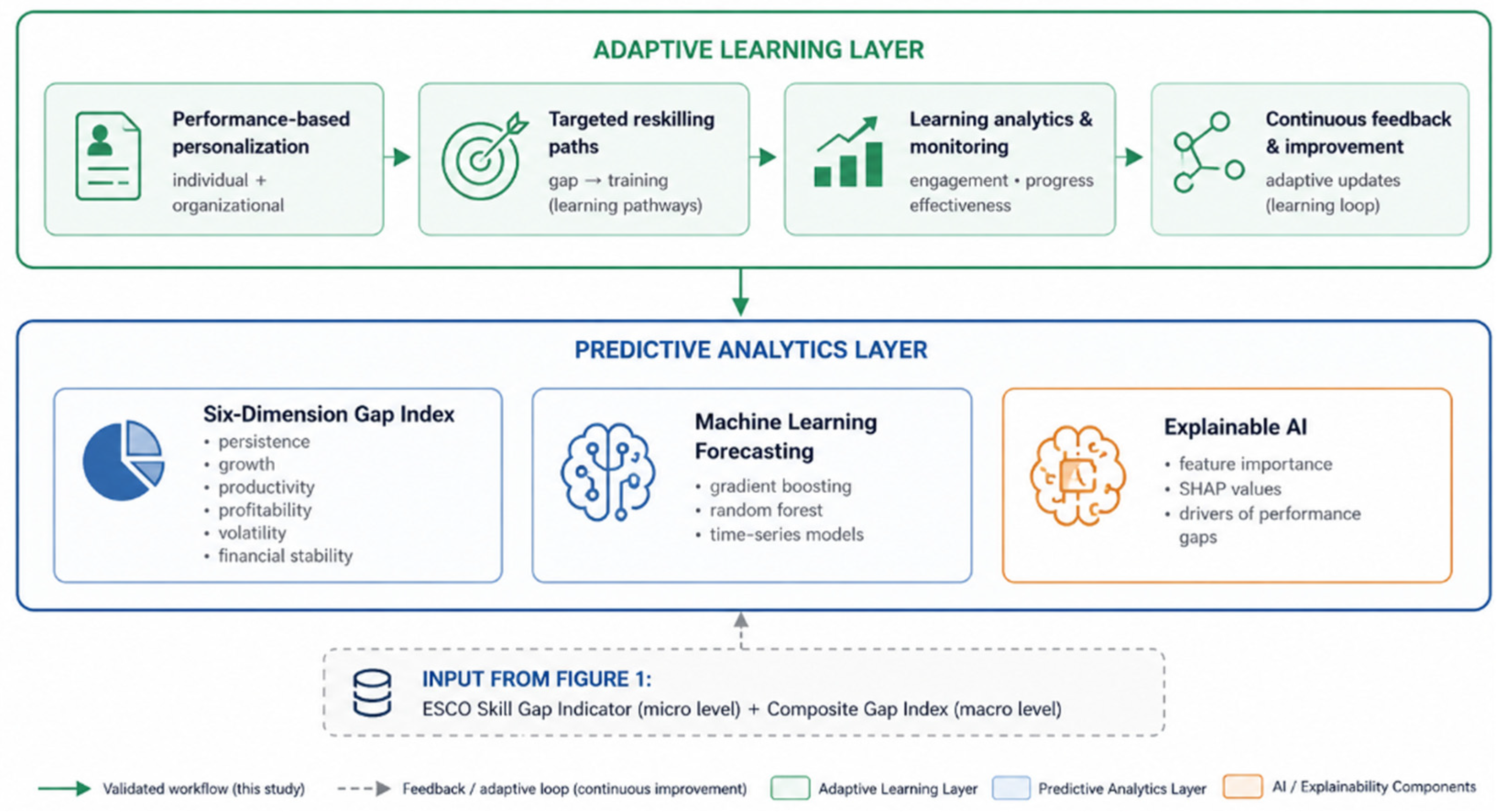
The conceptual architecture of the Intelligent LMS Framework bridges organisational performance and dynamic workforce learning. The upper Adaptive Learning and Skill Mapping layer aligns workforce skills with organisational needs; it begins with NLP-based skill extraction and proceeds to performance-based personalisation that tailors training to individual and organisational requirements. Within this layer, a targeted reskilling-path module links identified skill gaps to training programs in areas such as digital technologies, automation, leadership, and data analytics, supported by a performance-to-skill mapping that connects performance metrics to the competences they require. The lower Predictive Performance Engine provides the analytics and forecasting functions, including the six-dimension Gap Index and machine-learning-based performance forecasting (e.g., gradient boosting, random forest), together with Explainable AI components that surface the factors most strongly associated with performance gaps. Overall, the framework illustrates how advanced analytics, AI-based skill intelligence, and adaptive learning can be combined to support strategic workforce planning and organisational performance. See
Figure 8.
9.3. Managerial and Practical Implications
Beyond its scholarly contribution, the framework yields concrete implications for three categories of decision-makers in SMEs, in each case by virtue of expressing competences and gaps in the standardised, comparable language of ESCO rather than in firm-specific terms.
For managers and business decision-makers, the system functions as a diagnostic and prioritisation tool. By benchmarking a firm against its sector through the composite Gap Index and decomposing the workforce skill gap by competence domain, it allows a manager to see not only that the firm underperforms but in which specific areas its workforce is least equipped. A manager observing that the firm sits in the lowest performance quartile and that its largest gaps lie in Process Automation and Data Analytics can concentrate a limited training budget on those domains rather than spreading it indiscriminately, turning a generic awareness of “skill shortage” into a targeted, defensible allocation decision.
For HR specialists, the system produces, for each employee, an ESCO-standardised competence profile and the corresponding gap relative to occupational requirements. This supports the construction of individual development plans, the identification of competences that are critically absent across the entire workforce (a concentration risk), and the orientation of recruitment toward the missing profiles. Because the profiles are expressed in ESCO labels and URIs, they are directly comparable with job postings and labour market data, aligning internal development with external standards.
For policymakers and regional innovation actors, aggregating the gaps across many SMEs in a territory reveals systemic, rather than firm-idiosyncratic, training needs. An agency observing that tourism SMEs in a region share pervasive gaps in digital marketing and revenue management can design targeted funding schemes and collective training programmes addressing those domains, allocating public resources where the standardised evidence indicates the greatest shared deficit.
In all three cases, the practical value lies not in a claim that the recommended training will mechanically raise performance—a relationship this study advances as a proposition rather than a demonstrated effect—but in replacing ad hoc, non-comparable competence judgements with a standardised diagnostic that makes training, recruitment, and policy decisions comparable across employees, firms, sectors, and regions.
9.4. Research Implications
Beyond its managerial value, the study has several implications for research. Theoretically, by reconceiving the skill gap as the firm-level expression of a human capital–technology complementarity constraint rather than a descriptive shortfall, it offers a construct that future work can operationalize and test, shifting attention from whether gaps exist to whether and when they bind on performance. The four design principles (commensurability, macro–micro integration, transferable metrics, modularity) are portable abstractions that invite replication and extension in other institutional settings, sectors, and taxonomies beyond ESCO, supporting cumulative, comparable evidence rather than firm-idiosyncratic findings. The non-significant performance–skill gap association is itself a research prompt. It raises the question of whether digitally-oriented human capital, as evidenced in public profiles, is a binding constraint on SME performance in low-tech service segments, or whether performance there rests on other factors—and it motivates the research designs needed to answer this: longitudinal, employer-sourced data with firm-level controls and, ideally, quasi-experimental variation around training interventions. It also foregrounds measurement questions—range restriction, CV-based proxies versus latent competence, and the sensitivity of results to extraction accuracy—that future work on NLP-based skill measurement and expert-validated benchmarks can address. Finally, the ESCO-grounded, commensurable indicator provides an infrastructure for comparative research across firms, sectors, and regions, enabling the accumulation of standardised evidence on reskilling and digital transformation in SMEs.
10. Limitations
Several limitations should be acknowledged. The firm-level dataset has many missing financial values—common in SME data—which may affect the performance signals and firm selection, and the composite performance signal, though a legitimate synthesis, remains simplified, not capturing innovation capability, technology adoption, or organisational culture [
83]. Most relevant, the CV-based extraction is limited on three levels. First, construct validity: the pipeline is validated for extracting competences stated in a CV, not for whether they reflect a worker’s actual stock, so it measures documented, CV-evidenced coverage rather than latent competence—compounded because extraction is keyword-driven (missing non-standard phrasings), blind to tacit competences, and insensitive to evidence strength; external validation against structured assessments or qualifications, weighting evidence by strength via ESCO, is needed. Second, calibration: with profiles evidencing on average 1.19 of 27 competences, the indicator sits near its upper bound (mean 0.956, SD 0.063) and is a conservative, screening-oriented proxy [
8]. Third, accuracy: the rule-based baseline reaches F1 ≈ 0.45, but because extraction is modular, semantic-similarity or learning-based methods can be substituted (benchmarked in
Section 4). Given this accuracy, the indicator is treated as a conservative screening diagnostic used in exploratory analysis, not as a dependent or independent variable in confirmatory hypothesis testing; expert human annotation of the reference set, beyond the present LLM-assisted annotation, is identified as a priority for strengthening it.
As a research prototype, the system reports absolute validation rather than superiority over closed commercial platforms. Generalizability is limited; the N ≈ 133 CVs were drawn as a convenience sample from publicly available professional profiles—sparse, selectively maintained, and biased toward digitally oriented white-collar workers—which both compresses the indicator near its ceiling, reducing individual-level discrimination, and makes the micro-analysis a proof-of-concept demonstration rather than a representative estimate, though qualified by the larger firm-level layer and the indicator’s within-sample stability. This selection bias is of indeterminate net direction and reinforces the conservative reading, while numerical results stay context-dependent despite ESCO’s portability. Finally, the cross-sectional design precludes causal interpretation and leaves training’s effect on the gap (P3) untested; a pre/post pilot (three to six months) with a comparison group, plus a user study (SUS, TAM, UTAUT), would provide first evidence.
Ethical and Privacy Considerations. Three dimensions arise. On privacy, the analysis used only publicly available information, and every profile was irreversibly anonymized before processing—names, contacts, photographs, and employer and colleague names removed, no linkage key retained, only binary competence assessments stored; the resulting data cannot be linked to identifiable persons and falls outside GDPR scope for the analytical phase, reinforced by data minimisation, restricted access, and aggregate reporting, though a non-anonymized deployment would require a legal basis, defined retention, and human oversight. On fairness, because the indicator measures documented rather than actual competences, it can disadvantage workers through non-standard phrasing, age [
10], differently described roles, and documentation quality, making it unsuitable for consequential individual decisions; ESCO’s alternative labels, the deterministic auditable pipeline, and aggregate-only use mitigate this. On automation, the framework remains a decision-support tool in which human judgement bears responsibility for any action, framing outputs as a conservative proxy under a transparent, contestable taxonomy. The principal ethical risks are real but contained by design.
11. Conclusions
This study set out to operationalize an ESCO-aligned framework for detecting workforce skill gaps in SMEs and enabling reskilling through an Intelligent Learning Management System, motivated by the challenge of keeping workforce competences aligned with a rapidly changing technological environment. Taking the population of underperforming firms identified in the companion study as its entry point, the paper concentrated on the micro level, where the alignment between individual competences and standardised occupational requirements is decisive for competitiveness. The skill gap layer processes anonymized CVs through Natural Language Processing, normalizing competences against ESCO via preferred labels, alternative labels, and concept URIs and linking them to occupations through occupation–skill relations. Comparing individual profiles against 27 ESCO-aligned digital competences yields a Skill Gap Indicator with a mean of 0.956—interpreted, given its reliance on CV-evidenced competences, as a conservative upper-bound estimate rather than a literal deficit—concentrated in digital technologies, data analysis, process automation, and innovation management. The contribution is theoretical, methodological, and technological. Theoretically, it frames reskilling as the relaxation of a human capital–technology complementarity constraint, grounded in human capital theory, the knowledge-based view, and skill-biased technical change. Methodologically, it reconceptualizes the skill gap as an ontology-grounded, commensurable construct—the complement of evidenced ESCO coverage—comparable across firms, sectors, and regions. Technologically, it integrates firm-level performance analytics, CV-based skill assessment, and learning provision into a single ESCO-grounded pipeline; the prototype instantiates this contribution rather than constituting it. For policymakers and regional innovation systems, the tool could help identify enterprises that would benefit from workforce-development programs. The conclusions are framed prudently: P1 and P2 are descriptive theoretical expectations, while P3—that closing ESCO-defined gaps improves performance—is a forward-looking proposition requiring comparative and longitudinal data, identified as the priority for future research. Two points follow for the framework’s status. First, the claim validated here is that workforce skill gaps are measurable and comparable through CV-based ESCO mapping—a construct-detectability result—which is logically distinct from the proposition (P1) that such gaps constitute a binding complementarity constraint on firm performance. Second, should P1 remain unsupported after sample expansion and controlled longitudinal testing, this would be a substantive finding calling for revision of the complementarity theory in this setting, not a refutation of the diagnostic instrument or of the design principles, whose value rests on construct validity and utility rather than on the confirmation of P1.





 ,
,