
Quantitative Modeling and Standardized Representation of Hierarchical Product Gene Structures for New Energy Vehicles



Abstract
1. Introduction
2. Related Work
2.1. Current Research Status on Product-Gene Representation and Quantitative Modeling
2.2. Research Status on Standardized Description and Interoperability of Product Data
2.3. Research Contributions
3. Model Construction and Analysis
3.1. Problem Description
3.2. Quantitative Definitions of Hierarchical Structure
4. Construction of Product-Gene Information Quantitative Models
4.1. Core-Parameter Quantification System
4.1.1. Core Parameters Quantification System
4.1.2. Core Parameters of Assembly Genes
4.1.3. Core Parameters of Component Genes
4.2. Quantitative Model of Association Rules
5. Standardized Description System for Product-Gene Information
5.1. Standardized Metadata Definition
5.2. Standardized Semantic Description Specification
5.3. Standardized Data-Format Model
6. Case Study
6.1. Case Background and Data Sources
6.2. Hierarchical Decomposition and Validation Based on the Theoretical Model
6.2.1. Platform-Gene Decomposition and Validation of Parameter Constraints
6.2.2. Assembly–Gene Decomposition and Validation of Inter-Level Association Strength
6.2.3. Component-Gene Decomposition and Validation of Intra-Level Association Strength
6.2.4. Validation of the Standardized Description System
6.3. Integrated Analysis of the Case-Validation Results
6.4. Model Discrimination Capability and Robustness Analysis
7. Conclusions and Future Work
7.1. Main Conclusions
- (1)
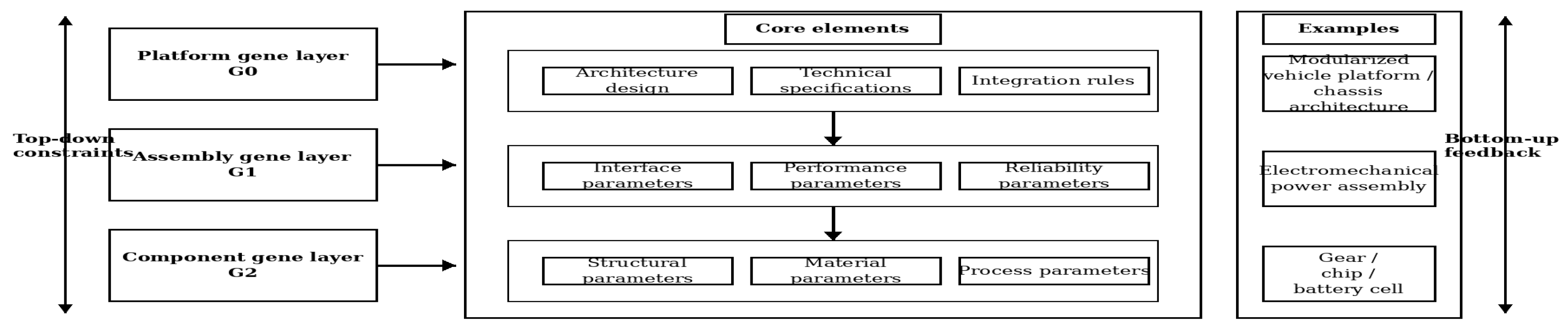
- A generic three-level framework covering platform, assembly, and component genes is proposed. By defining hierarchical sets and mapping functions on the basis of set theory and function theory, the quantitative boundary-constraint mechanism is clarified, and hierarchical partitioning is advanced from qualitative judgment to quantitative delineation, thereby resolving the problem of ambiguous hierarchical boundaries.
- (2)
- A full-level core-parameter quantification system and a dual-dimensional association-strength model are established. Through constraint equations and mathematical formulations, parameter constraints, inter-level relationships, and intra-level collaborative relationships can be accurately represented, thereby overcoming the limitations of traditional qualitative association analysis and enabling precise compatibility assessment.
- (3)
- By integrating international standards such as ISO 10303 and ISO 15531, a tripartite standardized description system based on metadata, semantics, and format is constructed. The proposed mathematical mapping method between product-gene information and standardized data formats enables cross-platform and cross-software sharing of gene information, thereby helping to eliminate barriers to data sharing.
- (4)
- The new energy vehicle case shows that the comprehensive association strengths between the three-electric assemblies and the platform gene are all higher than the compatibility threshold, and the intra-level association strengths of the three component pairs are all higher than the synergy threshold. Further threshold-perturbation validation shows that the model can form differentiated judgments for compatible, boundary-compatible, and incompatible states, indicating that the proposed quantitative modeling method has certain engineering applicability.
7.2. Limitations and Future Prospects
Author Contributions
Funding
Data Availability Statement
Conflicts of Interest
Appendix A

| Parameter | Value | Source/Basis | Explanation |
|---|---|---|---|
| Architecture compatibility coefficient λ | 0.85 | Official technical white paper of Company A’s Platform B | Calculated with reference to GB/T 30555-2014. Four common NEV body types were considered; Platform B explicitly supports three of them, and the maturity coefficient derived from technical documents is 1.13. Thus, λ ≈ (3/4) × 1.13 = 0.85. |
| Wheelbase range | [2700, 3200] mm | Official technical white paper of Company A’s Platform B | Generic wheelbase interval covering mainstream NEV dimensions. |
| System efficiency η | 0.92 | Official technical white paper of Company A’s Platform B | Overall efficiency of the battery–motor–control system. |
| Lifecycle T | 8 years | Official technical white paper of Company A’s Platform B | Consistent with the lifecycle norms of vehicle platforms. |
| Degree of interface standardization σ | 0.88 | Calculated from ISO-based interface-conformity assessment | Obtained by comparing Company A’s interface specifications with five ISO-oriented dimensions: label consistency, semantic compatibility, format compatibility, protocol matching, and extensibility. The result satisfies σ ≥ 0.8. |
| Data transmission rate v | 8 Mbps | Determined from ISO high-speed CAN requirements and Platform B real-time control demand | Selected within the ISO-recommended 5–10 Mbps interval and calibrated using a 20% redundancy margin for three-electric-system real-time communication. |
| Assembly Type | Core Parameter | Assembly Value | Platform Constraint Parameter | Threshold | Source/Basis |
|---|---|---|---|---|---|
| Battery assembly | Compatibility accuracy δ | 0.05 mm | 0.08 mm | 0.012 mm | Assembly: Company A Concept Vehicle C technical white paper; Platform: Platform B technical white paper; Threshold: GB/T 1804-2000 [28]. |
| Battery assembly | Transmission latency τ | 5 ms | 10 ms | 1.5 ms | Same as above. |
| Battery assembly | Power density ρ | 2.1 kW/kg | 2.0 kW/kg | 0.3 kW/kg | Same as above. |
| Battery assembly | Temperature range | [−30, 60] °C | [−30, 60] °C | 10 °C | Same as above. |
| Battery assembly | MTBF | 15,000 h | 12,000 h | 1800 h | Same as above. |
| Motor assembly | Compatibility accuracy δ | 0.06 mm | 0.08 mm | 0.012 mm | Assembly: Concept Vehicle C white paper; Platform: Platform B white paper; Threshold: GB/T 1804-2000. |
| Motor assembly | Transmission latency τ | 6 ms | 10 ms | 1.5 ms | Same as above. |
| Motor assembly | Power density ρ | 3.2 kW/kg | 3.0 kW/kg | 0.45 kW/kg | Same as above. |
| Motor assembly | Temperature range | [−30, 65] °C | [−30, 60] °C | 10 °C | Same as above. |
| Motor assembly | MTBF | 14,000 h | 12,000 h | 1800 h | Same as above. |
| Electric-control assembly | Compatibility accuracy δ | 0.07 mm | 0.08 mm | 0.012 mm | Company A public information and third-party evaluation; threshold based on GB/T 1804-2000. |
| Electric-control assembly | Transmission latency τ | 4 ms | 10 ms | 1.5 ms | Third-party response-speed testing and Platform B control-system design norms; compliant with real-time communication requirements. |
| Electric-control assembly | Power density ρ | 1.8 kW/kg | 1.8 kW/kg | 0.27 kW/kg | Company A public technical data and third-party testing. |
| Electric-control assembly | Temperature range | [−40, 85] °C | [−30, 80] °C | 12 °C | Third-party thermal-management testing and Platform B thermal-management norms; consistent with GB/T 21437-2021 [29]. |
| Electric-control assembly | MTBF | 16,000 h | 12,000 h | 1800 h | Company A reliability-test data and Platform B reliability norms; calibrated against core-component reliability datasets. |
| Parent Assembly | Component Name | Core Parameters and Assigned Values | Data Source |
|---|---|---|---|
| Battery assembly | Blade battery cell | Dimensional tolerance ±0.02 mm; material strength 350 MPa; operating efficiency 0.99; machining precision 5 μm | Autohome special technical evaluation. |
| Battery assembly | Battery management module (BMS) | Dimensional tolerance ±0.03 mm; material strength 200 MPa; operating efficiency 0.98; machining precision 8 μm | Same source as above. |
| Motor assembly | Stator (hairpin winding) | Dimensional tolerance ±0.01 mm; material strength 400 MPa; operating efficiency 0.97; machining precision 3 μm | Dongchedi technical analysis. |
| Motor assembly | Rotor (permanent magnet) | Dimensional tolerance ±0.02 mm; material strength 380 MPa; operating efficiency 0.96; machining precision 4 μm | Same source as above. |
| Electric-control assembly | IGBT module | Dimensional tolerance ±0.04 mm; material strength 180 MPa; operating efficiency 0.95; machining precision 10 μm | Company A official technical parameter release plus Autohome evaluation, cross-validated. |
| Electric-control assembly | Control chip | Dimensional tolerance ±0.01 mm; material strength 150 MPa; operating efficiency 0.99; machining precision 2 μm | Same source as above. |
References
- Zhao, S.; Zhang, Q.; Peng, Z.; Lu, X. Product platform configuration for product families: Module clustering based on product architecture and manufacturing process. Adv. Eng. Inform. 2022, 52, 101622. [Google Scholar] [CrossRef] [Scilit]
- Berschik, M.C.; Zuefle, M.; Laukotka, F.N.; Krause, D. Product family engineering along the life cycle: Research aspects to cope with variability in advanced systems. Des. Sci. 2024, 10, e27. [Google Scholar] [CrossRef] [Scilit]
- Nzetchou, S.; Durupt, A.; Remy, S.; Eynard, B. Semantic enrichment approach for low-level CAD models managed in PLM context: Literature review and research prospect. Comput. Ind. 2022, 135, 103575. [Google Scholar] [CrossRef] [Scilit]
- Cai, X.T.; Wang, S. Design-gene-based secure mechanism for collaborative product development. Adv. Eng. Inform. 2021, 47, 101228. [Google Scholar] [CrossRef] [Scilit]
- Brahma, A.; Wynn, D.C. Concepts of change propagation analysis in engineering design: A review. Res. Eng. Des. 2023, 34, 117–151. [Google Scholar] [CrossRef] [Scilit]
- Xiao, R.; Lin, W. Research on data-driven product family design. J. Mach. Des. 2020, 37, 1–10. [Google Scholar]
- Peng, Z.; Huang, M.; Zhong, Y.; Chen, L.; Liu, G. A new method for interoperability and conformance checking of product manufacturing information. Comput. Electr. Eng. 2020, 85, 106650. [Google Scholar] [CrossRef] [Scilit]
- Jia, J.; Zhang, Y.; Saad, M. Knowledge graph-based multi-granularity tacit design knowledge reuse for product design. J. Comput. Des. Eng. 2025, 12, 53–79. [Google Scholar] [CrossRef] [Scilit]
- Xu, W.; Guo, C.; Guo, S.; Wang, L.; Li, X. A novel quality comprehensive evaluation method based on product gene for solving the manufacturing quality tracking problem of large equipment. Comput. Ind. Eng. 2021, 152, 107032. [Google Scholar] [CrossRef] [Scilit]
- Guo, Y.; Wang, L.; Zhang, Z.; Cao, J.; Xia, X.; Liu, Y. Integrated modeling for retired mechanical product genes in remanufacturing: A knowledge graph-based approach. Adv. Eng. Inform. 2024, 59, 102254. [Google Scholar] [CrossRef] [Scilit]
- Lin, W.; Liu, X.; Xiao, R. Data-driven product functional configuration: Patent data and hypergraph. Chin. J. Mech. Eng. 2022, 35, 57. [Google Scholar] [CrossRef] [Scilit]
- Zhang, P.; Wang, H.; Li, X.; Nie, Z.; Ma, Z. Research on digital characterization and identification process model of functional genes for intelligent innovative design. Adv. Eng. Inform. 2023, 56, 101983. [Google Scholar] [CrossRef] [Scilit]
- Zhang, L.; Tan, R.; Peng, Q.; Miao, R.; Liu, L. Product innovation based on the host-gene and target-gene recombination under the technological parasitism framework. Adv. Eng. Inform. 2024, 59, 102341. [Google Scholar] [CrossRef] [Scilit]
- Wang, H.; Zhang, P.; Nie, Z.; Ma, Z.; Ren, Z.; Zhang, Y. An intelligent integrated innovation design method based on flow functional genes coding and digitization. Adv. Eng. Inform. 2025, 64, 103044. [Google Scholar] [CrossRef] [Scilit]
- Khan, M.; Cameron, B. What determines EV architecture? An analysis of the most influential battery electric vehicle design decisions from market data. J. Eng. Des. 2025, 37, 1381–1397. [Google Scholar] [CrossRef] [Scilit]
- Wong, F.S.; Wynn, D.C. M-ARM: An automated systematic approach for generating new variant design options from an existing product family. Res. Eng. Des. 2024, 35, 389–408. [Google Scholar] [CrossRef] [Scilit]
- ISO 10303-242:2025; Industrial Automation Systems and Integration—Product Data Representation and Exchange—Part 242: Application Protocol: Managed Model-Based 3D Engineering. International Organization for Standardization: Geneva, Switzerland, 2025.
- Lipman, R.R. STEP File Analyzer Software. J. Res. Natl. Inst. Stand. Technol. 2017, 122, 16. [Google Scholar] [CrossRef] [Scilit] [PubMed]
- Kwon, S.; Monnier, L.V.; Barbau, R.; Bernstein, W.Z. Enriching standards-based digital thread by fusing as-designed and as-inspected data using knowledge graphs. Adv. Eng. Inform. 2020, 46, 101102. [Google Scholar] [CrossRef] [Scilit]
- Barbau, R.; Krima, S.; Rachuri, S.; Narayanan, A.; Fiorentini, X.; Foufou, S.; Sriram, R.D. OntoSTEP: Enriching product model data using ontologies. Comput.-Aided Des. 2012, 44, 575–590. [Google Scholar] [CrossRef] [Scilit]
- Li, H.; Xiao, R. An evolutionary design-gene model for complex products based on functional construction. J. Mech. Eng. 2003, 39, 41–48. [Google Scholar] [CrossRef] [Scilit]
- Zhou, H.; Fu, P.; Li, F.; Zhou, Y. Research on an adaptive design method based on product genes. China Mech. Eng. 2012, 23, 1175–1179. [Google Scholar]
- Watson, J.D.; Baker, T.A.; Bell, S.P.; Gann, A.; Levine, M.; Losick, R. Molecular Biology of the Gene. Pearson/Benjamin Cummings. 2013. Available online: https://repository.cshl.edu/id/eprint/30325/ (accessed on 26 May 2026).
- Nicholl, D.S.T. An Introduction to Genetic Engineering; Cambridge University Press: Cambridge, UK, 2023. [Google Scholar]
- Heckert, N.A.; Filliben, J.J.; Croarkin, C.M.; Hembree, B.; Guthrie, W.F.; Tobias, P.; Prinz, J. Handbook 151: NIST/SEMATECH e-Handbook of Statistical Methods [EB/OL]; National Institute of Standards and Technology: Gaithersburg, MD, USA, 2002.
- ISO 15531-1:2004; Industrial Automation Systems and Integration—Industrial Manufacturing Management Data—Part 1: General Overview. International Organization for Standardization: Geneva, Switzerland, 2004.
- GB/T 30555-2014; Rules for Screw Expander (Unit) Thermal Acceptance Test. General Administration of Quality Supervision, Inspection and Quarantine of the People’s Republic of China and Standardization Administration of China: Beijing, China, 2014.
- GB/T 1804-2000; General Tolerances—Tolerances for Linear and Angular Dimensions without Individual Tolerance Indications. State Bureau of Quality and Technical Supervision: Beijing, China, 2000.
- GB/T 21437-2021; Road Vehicles-Test Method of Electrical Disturbances from Conduction and Coupling—Part 3: Electrical Transient Transmission by Capacitive and Inductive Coupling via Lines Other than Supply Lines. State Administration for Market Regulation and Standardization Administration of the People’s Republic of China: Beijing, China, 2021.

| Biological-Gene Concept | Engineering Meaning in Product Genes | Implementation in This Model |
|---|---|---|
| Heredity | Reuse of platform architectures, interface rules, and core parameters across vehicle models | Constraint mapping from platform genes to assembly genes |
| Variation | Adjustment of assembly or component parameters within the allowable constraint range | Deviation of cost-type, benefit-type, and interval-type indicators |
| Selection | Elimination of schemes that fail to satisfy threshold requirements | Association-strength threshold judgment |
| Adaptation | Matching between assemblies/components and platform requirements | Inter-level compatibility judgment |
| Evolution | Iteration and updating of platforms and assemblies with technological development | Version number, lifecycle, and parameter-update mechanism |
| Gene Level | Basic Attributes (Required) | Functional Attributes (Required) | Relational Attributes (Required) |
|---|---|---|---|
| Platform gene | Gene ID, name, version number, product family, release date | Architecture function type, system-integration level, technology-route code | List of sub-assembly gene IDs, association-rule ID, enterprise ID (unified social credit code) |
| Assembly gene | Gene ID, name, version number, parent platform-gene ID, compatible product model | Subsystem function code, modular compatibility grade, performance assurance grade | Parent platform-gene ID, list of child component-gene IDs, association-rule ID |
| Component gene | Gene ID, name, version number, parent assembly–gene ID, manufacturer ID | Individual function code, assembly-function grade, performance-support grade | Parent assembly–gene ID, associated component-gene ID, process-standard ID |
| Parameter Name | Parameter Value | Basis for Assignment | Remarks |
|---|---|---|---|
| Architecture compatibility coefficient | 0.85 | Official technical white paper of Company A’s Platform B | |
| Wheelbase range | [2700, 3200] mm | Official technical white paper of Company A’s Platform B | Generic wheelbase interval covering mainstream NEV dimensions |
| System efficiency | 0.92 | Official technical white paper of Company A’s Platform B | Integrated efficiency of the battery–motor–control system |
| Lifecycle | 8 years | Official technical white paper of Company A’s Platform B | Consistent with industry norms for platform technical iteration cycles |
| Degree of interface standardization | 0.88 | Calculated from ISO-based interface-conformity assessment | Conformity with ISO standards; satisfies the threshold σ ≥ 0.8 |
| Data transmission rate | 8 Mbps | Determined from ISO high-speed CAN specifications and Platform B real-time communication requirements | Supports real-time vehicle-control requirements |
| Assembly Type | Core Parameter | Indicator Type | Assembly Value | Platform Constraint Parameter | Threshold |
|---|---|---|---|---|---|
| Battery assembly | Compatibility accuracy | Cost-type | 0.05 mm | 0.08 mm | 0.012 mm (0.15 × 0.08) |
| Battery assembly | Transmission latency | Cost-type | 5 ms | 10 ms | 1.5 ms (0.15 × 10) |
| Battery assembly | Power density | Benefit-type | 2.1 kW/kg | 2.0 kW/kg | 0.3 kW/kg (0.15 × 2.0) |
| Battery assembly | Temperature range | Interval-type | [−30, 60] °C | [−30, 60] °C | 10 °C (0.15 × 60, rounded) |
| Battery assembly | MTBF | Benefit-type | 15,000 h | 12,000 h | 1800 h (0.15 × 12,000) |
| Motor assembly | Compatibility accuracy | Cost-type | 0.06 mm | 0.08 mm | 0.012 mm (0.15 × 0.08) |
| Motor assembly | Transmission latency | Cost-type | 6 ms | 10 ms | 1.5 ms (0.15 × 10) |
| Motor assembly | Power density | Benefit-type | 3.2 kW/kg | 3.0 kW/kg | 0.45 kW/kg (0.15 × 3.0) |
| Motor assembly | Temperature range | Interval-type | [−30, 65] °C | [−30, 60] °C | 10 °C (0.15 × 60, rounded) |
| Motor assembly | MTBF | Benefit-type | 14,000 h | 12,000 h | 1800 h (0.15 × 12,000) |
| Electric-control assembly | Compatibility accuracy | Cost-type | 0.07 mm | 0.08 mm | 0.012 mm (0.15 × 0.08) |
| Electric-control assembly | Transmission latency | Cost-type | 4 ms | 10 ms | 1.5 ms (0.15 × 10) |
| Electric-control assembly | Power density | Benefit-type | 1.8 kW/kg | 1.8 kW/kg | 0.27 kW/kg (0.15 × 1.8) |
| Electric-control assembly | Temperature range | Interval-type | [−40, 85] °C | [−30, 80] °C | 12 °C (0.15 × 80, rounded) |
| Electric-control assembly | MTBF | Benefit-type | 16,000 h | 12,000 h | 1800 h (0.15 × 12,000) |
| Assembly Type | Parameter-Wise Association Scores | Overall Association Strength | Threshold | Compatibility Judgment | Explanation |
|---|---|---|---|---|---|
| Battery assembly | 1.000, 1.000, 0.999, 0.993, 1.000 | 4.992 | 3.5 | Compatible | All deviations are smaller than the threshold; scores are close to 1 |
| Motor assembly | 1.000, 1.000, 0.999, 0.924, 1.000 | 4.923 | 3.5 | Compatible | The temperature interval slightly exceeds the basic threshold; mild attenuation occurs |
| Electric-control assembly | 1.000, 1.000, 0.993, 0.697, 1.000 | 4.690 | 3.5 | Compatible | Low-temperature tolerance exceeds the range; the score decreases slightly but remains above threshold |
| Parent Assembly | Component Name | Core Parameters and Assigned Values |
|---|---|---|
| Battery assembly | Battery cell | Dimensional tolerance ±0.02 mm; material strength 350 MPa; operating efficiency 0.99; machining precision 5 μm |
| Battery assembly | Battery management module (BMS) | Dimensional tolerance ±0.03 mm; material strength 200 MPa; operating efficiency 0.98; machining precision 8 μm |
| Motor assembly | Stator (hairpin winding) | Dimensional tolerance ±0.01 mm; material strength 400 MPa; operating efficiency 0.97; machining precision 3 μm |
| Motor assembly | Rotor (permanent magnet) | Dimensional tolerance ±0.02 mm; material strength 380 MPa; operating efficiency 0.96; machining precision 4 μm |
| Electric-control assembly | IGBT module | Dimensional tolerance ±0.04 mm; material strength 180 MPa; operating efficiency 0.95; machining precision 10 μm |
| Electric-control assembly | Control chip | Dimensional tolerance ±0.01 mm; material strength 150 MPa; operating efficiency 0.99; machining precision 2 μm |
| Parent Assembly | Component Pair | Pearson Correlation Coefficient | Weight Coefficients ω_j and ω_k | Association Strength | Synergy Judgment |
|---|---|---|---|---|---|
| Battery assembly | Battery cell—BMS | 0.999718 | 0.6, 0.4 | 0.24 | Synergistic |
| Motor assembly | Stator—Rotor | 0.999996 | 0.5, 0.5 | 0.25 | Synergistic |
| Electric-control assembly | IGBT module—Control chip | 0.999147 | 0.7, 0.3 | 0.21 | Synergistic |
| Sample | Sample Nature | Parameter Setting | Five Association Scores | Overall Association Strength S | Threshold | Judgment |
|---|---|---|---|---|---|---|
| Actual battery assembly | Original case sample | 0.05 mm, 5 ms, 2.1 kW/kg, [−30, 60] °C, 15,000 h | 1.000, 1.000, 0.999, 0.993, 1.000 | 4.992 | 3.5 | Compatible |
| Boundary-compatible perturbation sample A | Threshold-perturbation sample | 0.092 mm, 11.5 ms, 2.0 kW/kg, [−30, 65] °C, 12,000 h | 0.500, 0.500, 0.993, 0.924, 0.993 | 3.911 | 3.5 | Compatible |
| Boundary-incompatible perturbation sample B | Threshold-perturbation sample | 0.092 mm, 11.5 ms, 1.7 kW/kg, [−30, 65] °C, 12,000 h | 0.500, 0.500, 0.500, 0.924, 0.993 | 3.417 | 3.5 | Incompatible |
| Clearly incompatible perturbation sample C | Threshold-perturbation sample | 0.110 mm, 15 ms, 1.5 kW/kg, [−45, 85] °C, 9000 h | 0.001, 0.000, 0.034, 0.001, 0.034 | 0.070 | 3.5 | Incompatible |
| Sample | α = 2 | α = 3 | α = 4 | α = 5 | Judgment Change |
|---|---|---|---|---|---|
| Actual battery assembly | 4.810, compatible | 4.934, compatible | 4.977, compatible | 4.992, compatible | No |
| Boundary-compatible perturbation sample A | 3.493, incompatible | 3.723, compatible | 3.845, compatible | 3.911, compatible | Yes |
| Boundary-incompatible perturbation sample B | 3.112, incompatible | 3.270, incompatible | 3.363, incompatible | 3.417, incompatible | No |
| Clearly incompatible perturbation sample C | 0.521, incompatible | 0.261, incompatible | 0.135, incompatible | 0.070, incompatible | No |
Disclaimer/Publisher’s Note: The statements, opinions and data contained in all publications are solely those of the individual author(s) and contributor(s) and not of MDPI and/or the editor(s). MDPI and/or the editor(s) disclaim responsibility for any injury to people or property resulting from any ideas, methods, instructions or products referred to in the content. |
© 2026 by the authors. Published by MDPI on behalf of the International Institute of Knowledge Innovation and Invention. Licensee MDPI, Basel, Switzerland. This article is an open access article distributed under the terms and conditions of the Creative Commons Attribution (CC BY) license.
Share and Cite
Yi, H.; Qin, Y. Quantitative Modeling and Standardized Representation of Hierarchical Product Gene Structures for New Energy Vehicles. Appl. Syst. Innov. 2026, 9, 125. https://doi.org/10.3390/asi9060125
Yi H, Qin Y. Quantitative Modeling and Standardized Representation of Hierarchical Product Gene Structures for New Energy Vehicles. Applied System Innovation. 2026; 9(6):125. https://doi.org/10.3390/asi9060125
Chicago/Turabian StyleYi, Huiyong, and Yong Qin. 2026. "Quantitative Modeling and Standardized Representation of Hierarchical Product Gene Structures for New Energy Vehicles" Applied System Innovation 9, no. 6: 125. https://doi.org/10.3390/asi9060125
APA StyleYi, H., & Qin, Y. (2026). Quantitative Modeling and Standardized Representation of Hierarchical Product Gene Structures for New Energy Vehicles. Applied System Innovation, 9(6), 125. https://doi.org/10.3390/asi9060125