Article

Laser-Welded Corrugated-Core Sandwich Composition—Numerical Modelling Strategy for Structural Analysis

by
Peter Nilsson
1,
Seyed Rasoul Atashipour
2,3,* and
Mohammad Al-Emrani
4
1
WSP Sweden, Fabriksgatan 1, SE-412 50 Gothenburg, Sweden
2
Department of Mechanical Engineering, Kettering University, 1700 University Ave, Flint, MI 48504, USA
3
Department of Mechanics and Maritime Sciences, Division of Dynamics, Chalmers University of Technology, SE-412 96 Gothenburg, Sweden
4
Department of Architecture and Civil Engineering, Chalmers University of Technology, SE-412 96 Gothenburg, Sweden
*
Author to whom correspondence should be addressed.
J. Compos. Sci. 2023, 7(9), 349; https://doi.org/10.3390/jcs7090349
Submission received: 24 July 2023 / Revised: 10 August 2023 / Accepted: 16 August 2023 / Published: 23 August 2023

Abstract

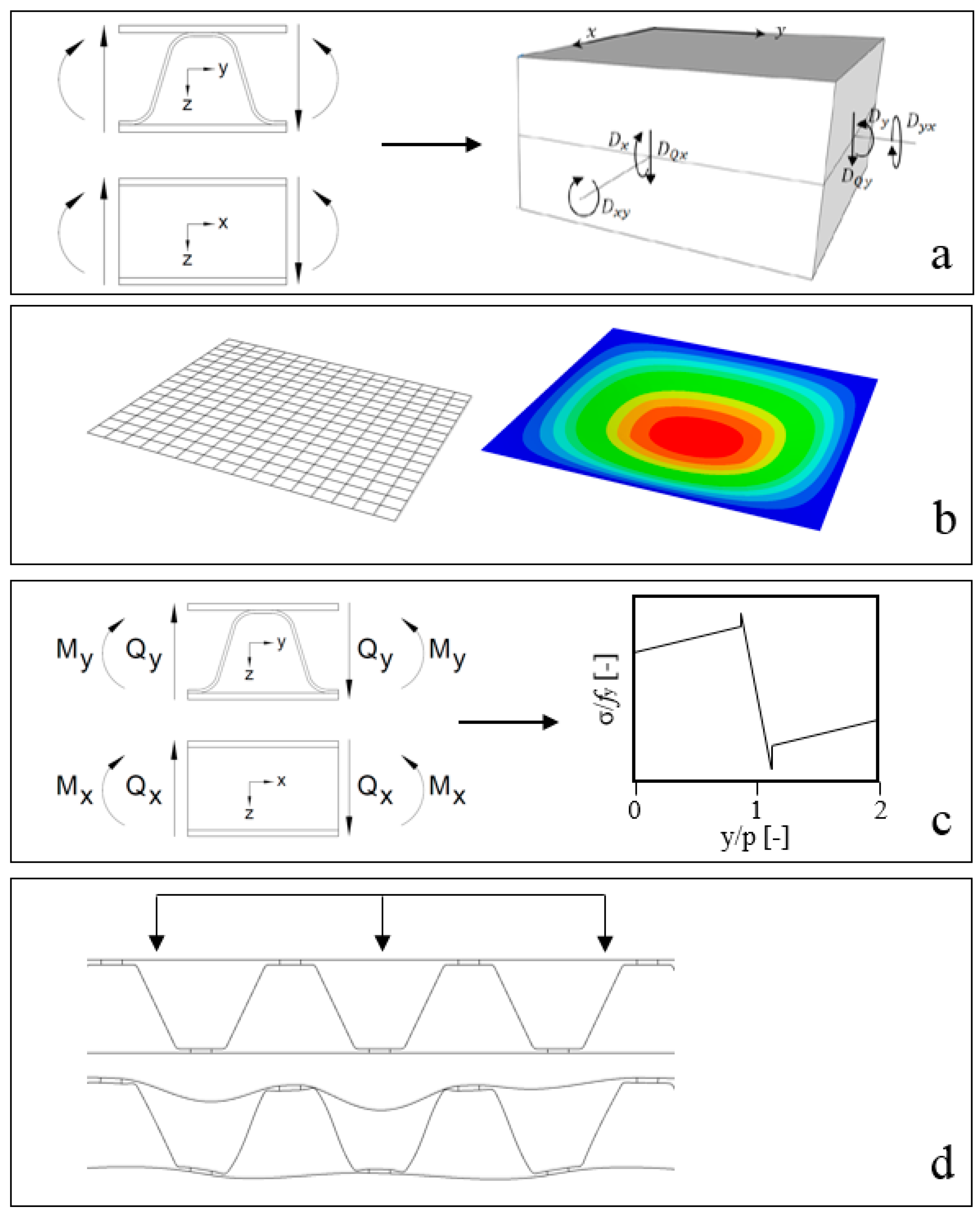
Laser-welding technology has recently enabled the production of corrugated-core steel sandwich panels (CCSSPs) as an innovative large-scale, lightweight structural solution in maritime and infrastructure applications. Detailed numerical analyses, specifically weld-region stress prediction in the presence of transverse patch loading and supports, are computationally challenging and time-consuming for their optimal design. This paper introduces an efficient, simplified combined sub-modelling approach for accurately predicting the detailed structural response of welded corrugated-core steel panels. The approach rests on the homogenisation of the three-dimensional (3D) panel into a two-dimensional equivalent orthotropic single layer (EOSL), where the effect of transverse compressive loads and local support conditions are captured separately via different 2D and 3D sub-modelling techniques, together with a model introduced for calculation of the weld region’s equivalent spring stiffnesses. A laser-welded corrugated-core steel sandwich panel (CCSSP), as a future generation of the steel bridge deck, was examined using different modelling approaches. It was shown that the proposed combined sub-modelling approach can accurately predict stresses and displacements in all the constituent members of the cross-section, including the welds, in a reasonable calculation time when compared with a 3D reference model, unlike the conventional homogenisation approaches.
Keywords: corrugated-core steel sandwich panel (CCSSPs); compressive load effect; combined sub-modelling approach; equivalent orthotropic single layer (EOSL); weld-region-equivalent spring stiffness corrugated-core steel sandwich panel (CCSSPs); compressive load effect; combined sub-modelling approach; equivalent orthotropic single layer (EOSL); weld-region-equivalent spring stiffness