Review

Life-Cycle Assessment and Sustainability of High-Performance and Ultra-High-Performance Fiber-Reinforced Concrete (HPFRC/UHPFRC) from Mix Design to Structural Performance


1
School of Civil and Environmental Engineering, University of Technology Sydney, Ultimo, NSW 2007, Australia
2
School of Information, Systems and Modelling, University of Technology Sydney, Ultimo, NSW 2007, Australia
3
Department of Civil Engineering, Shahrekord University, Shahrekord 88186-34141, Iran
4
Department of Civil and Environmental Engineering, Politecnico di Milano, 20133 Milan, Italy
*
Authors to whom correspondence should be addressed.
J. Compos. Sci. 2026, 10(6), 308; https://doi.org/10.3390/jcs10060308
Submission received: 1 May 2026 / Revised: 1 June 2026 / Accepted: 4 June 2026 / Published: 5 June 2026
(This article belongs to the Special Issue Smart and Low-Carbon Concrete Composites)

Abstract

High-performance and ultra-high-performance fiber-reinforced concretes (HPFRC/UHPFRC) have emerged as advanced cementitious composites capable of achieving superior mechanical performance, durability, and structural efficiency compared with conventional concrete. However, their widespread adoption remains challenged by relatively high material costs and significant embodied environmental impacts associated with elevated binder and fiber contents. This study presents a comprehensive life-cycle review of advanced high-performance cementitious composites, evaluating their sustainability from raw material extraction and mix design to structural application, service life, and end-of-life considerations. The review synthesizes current knowledge on material composition, production processes, structural performance, durability characteristics, and environmental impacts through the framework of life-cycle assessment (LCA). Particular attention is given to the influence of mix-design parameters, including binder composition, supplementary cementitious materials (SCMs), aggregate systems, and fiber type, on embodied carbon, energy demand, and mechanical performance. A dataset compiled from published experimental studies covering high-performance and ultra-high-performance concrete mixtures is analyzed to examine relationships between compressive strength, embodied energy, and carbon footprint, highlighting the dominant role of cementitious binders and fiber production in environmental impacts. Although advanced fiber-reinforced concretes generally exhibit higher cradle-to-gate emissions than conventional concrete, their superior mechanical properties, improved durability, reduced material demand, and extended service life can substantially reduce life-cycle environmental impacts at the structural level. The review further discusses emerging strategies for developing low-carbon high-performance cementitious composites, including clinker reduction, recycled and alternative fibers, optimized particle packing, and AI-assisted mix design. Finally, key research gaps are identified, particularly regarding standardized LCA methodologies, long-term durability data, harmonized performance-based functional units, and circular-economy strategies for material recycling and reuse. The findings highlight that performance-based life-cycle evaluation is essential for accurately assessing the sustainability potential of advanced high-performance cementitious composites in resilient and low-carbon infrastructure systems.

1. Introduction

High-performance concrete (HPC), high-performance fiber-reinforced concrete (HPFRC), ultra-high-performance concrete (UHPC), and ultra-high-performance fiber-reinforced concrete (UHPFRC) represent a family of advanced cementitious composites developed to achieve superior mechanical performance, durability, and structural efficiency compared with conventional concrete. These materials are generally characterized by optimized particle packing, low water-to-binder ratios, the use of supplementary cementitious materials (SCMs), advanced chemical admixtures, and, in fiber-reinforced systems, the incorporation of discrete fibers to enhance tensile behavior, toughness, and crack resistance [1,2,3].
Advanced high-performance cementitious composites typically contain Portland cement, silica fume, fly ash, slag, limestone fillers, or other finely divided supplementary materials, combined with carefully graded fine aggregates and high-range water-reducing admixtures (superplasticizers) [3,4,5]. Fiber-reinforced mixtures additionally incorporate steel, synthetic, basalt, glass, carbon, or hybrid fiber systems to improve post-cracking behavior and energy absorption capacity. Depending on mixture design and performance objectives, these materials may exhibit compressive strengths ranging from approximately 50 MPa to well above 150 MPa, covering both high-performance and ultra-high-performance categories reported in the literature [1,6].
Advanced high-performance cementitious composites generally consist of Portland cement, silica fume, fly ash, slag, limestone fillers, quartz powder, or other finely divided supplementary materials combined with high-range water-reducing admixtures and carefully graded aggregates [3,4,5]. Fiber-reinforced systems additionally incorporate steel, synthetic, basalt, glass, carbon, or hybrid fibers to improve post-cracking behavior and energy absorption capacity. Fiber-reinforced systems additionally incorporate steel, synthetic, basalt, glass, carbon, or hybrid fibers to improve post-cracking behavior and energy absorption capacity [7]. Depending on mixture composition and intended application, HPC/HPFRC, typically characterized by compressive strengths in the 40–120 MPa range, and UHPC/UHPFRC, which requires higher compressive strength thresholds as defined by ASTM C1856 [8]. Consequently, the boundary between HPC, HPFRC, UHPC, and UHPFRC is not always clearly defined, and classification criteria may vary among published studies, standards, and guidelines.
The principal advantages of these materials include enhanced compressive and tensile strength, improved fatigue resistance, superior crack control, and significantly greater durability compared with conventional concrete [1,3,6,9,10]. Fiber-reinforced systems can exhibit strain-hardening behavior and increased fracture energy through crack-bridging mechanisms, resulting in improved ductility and impact resistance [4,10]. In addition, their dense microstructure and low permeability provide superior resistance to chloride ingress, freeze–thaw cycles, sulfate attack, carbonation, and other deterioration mechanisms, thereby extending service life in aggressive environments [1,11,12].
Compared with conventional concrete, advanced high-performance cementitious composites can achieve higher load-bearing capacity and improved durability while reducing maintenance requirements and enhancing structural efficiency. Their superior mechanical properties frequently allow reductions in member dimensions, reinforcement ratios, and total material consumption while maintaining equivalent structural performance [1,13]. These advantages have promoted increasing use in bridges, buildings, precast components, marine infrastructure, pavements, protective structures, and rehabilitation applications [4,11,12,13,14].
Despite these advantages, advanced high-performance concretes are often associated with elevated environmental impacts due to their relatively high binder contents, specialized constituent materials, and, in some cases, intensive curing requirements. Cement production remains one of the largest contributors to global anthropogenic CO2 emissions, while steel fibers and other high-performance constituents further increase embodied energy and carbon footprints. Consequently, growing attention has been directed toward evaluating the environmental sustainability of these materials using life-cycle assessment (LCA) methodologies that consider both initial environmental burdens and long-term benefits associated with improved durability, reduced maintenance, and extended service life.
It should be noted that terminology used in the literature is not always consistent. Several studies classify mixtures as UHPC or UHPFRC despite exhibiting mechanical properties that overlap with those commonly associated with HPC or HPFRC. Therefore, the present review adopts a broader perspective encompassing high-performance and ultra-high-performance cementitious composites to provide a comprehensive evaluation of material composition, structural performance, durability, and environmental sustainability across the full spectrum of advanced concrete technologies.
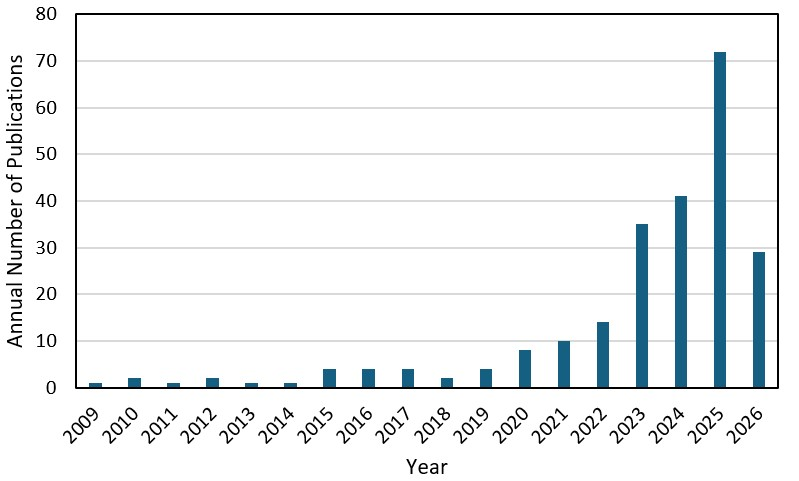
The rapid growth of scientific publications reflects the increasing global research interest in advanced high-performance cementitious composites over the past two decades (Figure 1). The bibliometric data presented in Figure 1 were obtained from the Scopus database on 27 May 2026 because of its extensive coverage of peer-reviewed engineering and construction-materials literature.
Despite their numerous advantages, advanced high-performance cementitious composites face several challenges that limit their broader implementation. Many high-performance and ultra-high-performance mixtures rely on elevated binder contents, specialized SCMs, and fiber reinforcement systems, which increase material costs and contribute to higher embodied carbon emissions and energy consumption compared with conventional concrete [1,6,15]. In particular, steel fibers, nano-modified constituents, and advanced curing requirements may further increase both environmental and economic burdens, restricting the use of these materials to applications where enhanced performance or durability justifies the additional costs [1,3,15]. Furthermore, the design and production of advanced cementitious composites often require strict quality control, optimized mix design procedures, and specialized construction practices, while design standards and performance classifications are still evolving in many regions [1,9,11,15]. These technical, economic, and environmental challenges highlight the necessity of rigorous sustainability assessment systems, with Life Cycle Assessment (LCA) at the center.
LCA is a standardized approach, established in ISO 14040 and ISO 14044 [16,17], for assembling and assessing the inputs, outputs, and potential environmental impacts of a product system across its life cycle, which often includes raw material extraction, manufacturing, use, and end-of-life (cradle-to-grave) stages [18]. For construction materials, LCA provides a formal framework that goes beyond approaches that are purely mechanical or cost-based in evaluation criteria and quantifies environmental performance in terms of embodied energy, greenhouse gas emissions, resource depletion, and other impact categories across the entire service life of structures [1,15,19,20,21].
In the case of cement-based materials such as UHPFRC, the significance of LCA is further increased by the intensive energy required, which leads to CO2 emissions during clinker production and, in certain situations, fiber manufacturing. Typical cradle-to-gate analyses of UHPFRC show that cement and steel fibers are the main contributors to carbon emissions, and that raw material acquisition is the major source of environmental load per cubic meter of material [15,18]. At the same time, the high durability and mechanical performance of UHPFRC facilitate optimized structural solutions, reduction in material quantities per unit performance, and significant decreases in maintenance and repair activities, thereby reducing life-cycle emissions and resource utilization at the element or structural level [1,13,15,22].
Another advantage of LCA is that it explicitly includes the benefits of service-life extension and durability. It can be used to quantify the influence of the low permeability and crack control of UHPFRC on the frequency and intensity of interventions, traffic disruptions, and related indirect emissions by modeling deterioration processes and maintenance scenarios, especially in infrastructure exposed to chlorides, freeze–thaw cycles, or mechanical damage [1,12,13,22]. Comprehensive cradle-to-grave or cradle-to-cradle studies can also consider end-of-life factors such as demolition energy, recycling or reuse of UHPFRC materials, and potential carbonation or CO2 uptake, thereby providing a more comprehensive view of long-term environmental performance [1,15].
The boundaries of LCA systems differ in the case of UHPFRC. Cradle-to-gate studies, which address raw materials and production up to the factory gate, can be used to benchmark mix designs, select binder compositions, and compare fibers, including industrial and recycled tire steel fibers [15,18]. Cradle-to-grave analyses can also be applied to include construction, use, maintenance, and end-of-life stages, allowing assessment of service-life extension, reduced repair frequency, and disposal or recycling scenarios, which are especially significant for durability-driven materials such as UHPFRC [1,15,22]. Cradle-to-cradle strategies further extend this approach by promoting closed material loops and valorization of waste or recycled materials, including recycled fibers or industrial by-products, thus linking the development of UHPFRC to circular economy goals [15,18].
In recent sustainable construction practice, LCA is therefore an essential decision-support tool for mix design optimization, structural design selection, and policy formulation for advanced cementitious materials. It enables the identification of environmentally favorable strategies, including partial replacement of cement with SCMs, the use of recycled fibers, and optimized structural solutions that exploit the high performance of UHPFRC while reducing its embodied impacts [1,15,18,19].
Although numerous review studies have investigated specific aspects of HPC, HPFRC, UHPC, and UHPFRC technologies, including mixture design, mechanical performance, durability, structural applications, and sustainability, most existing reviews focus on individual topics rather than providing an integrated assessment of the relationships among mixture composition, structural performance, durability, and environmental impacts across the entire life cycle. Furthermore, relatively limited attention has been devoted to critically examining methodological inconsistencies among published LCA studies and evaluating how environmental impacts relate to structural efficiency and service-life performance.
Therefore, this review evaluates the sustainability of advanced high-performance cementitious composites from a life-cycle perspective. The assessment considers a broad range of high-performance and ultra-high-performance concrete systems reported in the literature and investigates the relationships among material composition, mechanical performance, durability characteristics, and environmental indicators. The analysis is conducted at three levels: material, component, and structural scales. Particular emphasis is placed on key environmental indicators such as global warming potential (GWP) and cumulative energy demand, while also examining methodological limitations, regional variability, and uncertainties affecting current sustainability assessments. By synthesizing existing knowledge and identifying critical research gaps, this review aims to support the development of more sustainable, durable, and environmentally efficient high-performance cementitious materials for future infrastructure applications.

2. Material Composition and Mix Design

2.1. Constituents of HPFRC/UHPFRC

A highly engineered cementitious matrix is developed as the basis of advanced high-performance cementitious composites, particularly UHPC and UHPFRC, in which each constituent is selected to enhance strength, ductility, and durability through microstructural densification and multi-scale reinforcement [11,23,24,25,26]. Ordinary Portland cement (OPC), combined with highly reactive mineral additions such as silica fume, quartz flour, and more recently other SCMs, including ground granulated blast furnace slag (GGBS), fly ash, rice husk ash, metakaolin, and limestone fillers, typically forms the binder system. In UHPC and UHPFRC systems, exceptionally low water–binder ratios (often <0.22) and high binder contents (often >600 kg/m3) are key factors in forming a dense calcium silicate hydrate (C–S–H) network with capillary porosity significantly lower than that of normal concrete [27,28]. Silica fume and other finely divided pozzolans participate in pozzolanic reactions with portlandite and act as microfillers that refine the pore structure and increase particle packing within the matrix [28,29]. Optimized packing of cement, microfillers, and SCMs reduces void content, increases compressive strength, and limits the formation of deleterious products such as expansive ettringite and alkali–silica reaction products [27,29].
The overall granular skeleton of UHPC and UHPFRC differs from that of conventional concrete. In many UHPC and UHPFRC formulations, coarse aggregates are omitted or used only in strictly controlled quantities and sizes, and the mix is composed primarily of well-graded fine quartz or silica sands (usually less than 600 μm) to ensure high packing density and uniformity [30,31]. Removal or strong limitation of coarse aggregate reduces heterogeneity in the interfacial transition zone (ITZ), which conventionally governs strength and transport properties, thereby promoting a more homogeneous microstructure and enhanced mechanical performance [23]. Granulometric optimization of fine aggregates, typically aided by particle packing models, ensures that the particle size distributions of sands, fillers, and binders interlock effectively, reducing the paste volume required to achieve desired workability and further minimizing porosity and permeability [27,31].
In HPFRC and UHPFRC systems, the principal reinforcement mechanism is provided by fibers, which transform a high-strength cementitious matrix that would otherwise exhibit relatively brittle behavior. The most commonly used fibers are straight or hooked-end steel fibers, typically 10–20 mm in length and used at volume fractions between 1% and 3%, owing to their high tensile strength and stiffness as well as strong mechanical and chemical bonding with the matrix [5,28]. Synthetic fibers such as polypropylene, polyethylene, and polyvinyl alcohol are also used, either alone or in hybrid systems with steel fibers, to control microcracking, enhance fire resistance, and improve post-cracking behavior [5,32]. Hybrid fiber systems composed of fibers with varying lengths, stiffnesses, and chemistries provide multi-scale crack-bridging capability, bridging microcracks in the cement matrix and macrocracks at the structural scale, thereby improving strain hardening, energy absorption, and durability under mechanical and environmental loading [32]. Fiber geometry, orientation, and content strongly influence tensile strength, fracture energy, and dynamic behavior, and must be matched carefully with matrix rheology to ensure uniform dispersion [5].
UHPC and UHPFRC mixtures rely heavily on chemical admixtures, particularly high-range water-reducing admixtures. Polycarboxylate-based superplasticizers enable extremely low water–binder ratios (<0.25 and often <0.20) while maintaining the high flowability required to suspend fibers and fully consolidate the dense matrix [23,27,28]. They facilitate dispersion of fine particles, prevent flocculation of cement and silica fume, and promote more complete hydration and pozzolanic reactions within a densely packed microstructure [28,29]. The balance among water content, superplasticizer dosage, and fine particle content is especially critical, as workability strongly influences achievable fiber orientation and, consequently, the tensile behavior of the composite [23].
The combination of these ingredients—highly reactive and fine-grade binders, optimized fine aggregate packing, efficient fiber reinforcement, and effective dispersing admixtures— results in a dense and highly refined microstructure with a strong fiber–matrix interface [11,27].
To better illustrate the quantitative differences in constituent proportions between conventional concrete (NC), HPFRC, and UHPFRC, Table 1 summarizes the typical ranges of paste, aggregate, water, superplasticizer, and steel fiber contents reported in the literature. The comparison highlights the differences in constituent proportions among conventional concrete (NC), HPFRC, and UHPFRC mixtures, particularly the generally higher binder and fiber contents and lower aggregate fractions observed in many UHPFRC formulations. These characteristics strongly influence mechanical performance, durability, and embodied environmental impacts.

2.2. Innovations in Mix Design for Performance Optimization

Recent developments in high-performance and ultra-high-performance fiber-reinforced concrete mix design have increasingly relied on rational and computational approaches to maximize performance while maintaining workability, controlling cost, and improving sustainability. Particle packing models, including the Modified Andreasen and Andersen (MAA) model and its compressible packing variants, have been widely adopted to design continuous particle size distributions—particularly among binders, fillers, and aggregates—that achieve maximum packing density and minimal paste voids [31,34]. These models indicate that excessive cement content, when not controlled through optimal granular gradation, may actually reduce strength by increasing the proportion of similarly sized particles and decreasing packing efficiency [31]. Optimized UHPC and UHPFRC formulations guided by particle-packing concepts have achieved compressive strengths of approximately 180–200 MPa while reducing CO2 emissions compared with commercial standards [31,34].
At the nanoscale, the addition of nano-silica, nanoclays, and carbon nanofibers has increasingly been used to enhance hydration kinetics, microstructural refinement, and interfacial bonding [3,35]. Nano-silica acts as both a pozzolanic and nucleation agent, promoting early C–S–H formation and filling nanopores, whereas nanoclays can improve thixotropy and crack resistance [29]. When adequately dispersed, carbon nanofibers and other nano-reinforcements contribute to multi-scale reinforcement by bridging microcracks and increasing toughness; however, poor dispersion can significantly reduce workability and is highly sensitive to the dispersion method [35].
Another important innovation in mix design is the hybrid fiber system. By combining steel fibers of varying lengths, shapes, and aspect ratios, or blending steel with synthetic or basalt fibers, the tensile response across a range of crack-width scales can be tailored [5,28,32]. Short, stiff fibers help control microcracking and increase tensile strength, whereas longer or hooked fibers enhance post-cracking ductility and energy dissipation [5]. Synthetic fibers blended with steel fibers can provide balanced strength and deformation capacity, while improving crack distribution and fire performance at moderate dosages without excessively reducing compressive strength or rheological performance [32].
One of the traditional challenges in the design of HPFRC and UHPFRC mixtures is the trade-off between workability and mechanical performance. Very low water–binder ratios and high fiber volumes tend to reduce flowability and increase the risk of fiber balling, whereas higher water contents or reduced fines may weaken the matrix and decrease durability [23]. Accordingly, rheology-controlled design approaches—using advanced superplasticizer chemistry, viscosity-modifying admixtures, and tailored particle gradation—are increasingly incorporated into mix design practice [23,28]. Another established method for improving early-age strength is heat curing, typically using steam or hot water at 60–90 °C, which accelerates hydration and pozzolanic reactions and further densifies the microstructure [27,31,34]. However, intensive thermal curing can limit field applications and increase embodied energy, motivating research into ambient-cured formulations using optimized binders and nano-additives [27].
In recent years, digital and AI-assisted methods have increasingly been applied to the optimization of high-performance and ultra-high-performance concrete mixtures. Artificial neural networks, Gaussian process regression, and D-optimal mixture design have been used to predict compressive and flexural strengths as functions of constituent proportions and to determine Pareto-optimal mixtures balancing performance, cost, and sustainability [3,34]. These tools enable rapid exploration of large compositional spaces, facilitating the incorporation of waste materials, alternative binders, and novel fiber systems without exhaustive experimental testing. Such approaches improve mechanical properties, durability, and structural efficiency by enabling highly tailored microstructures and multi-scale reinforcement systems while also providing means to control workability and environmental impact [3].

2.3. Sustainability Considerations in Raw Material Selection

Despite their improved performance, advanced high-performance cementitious composites, particularly UHPC and UHPFRC, are often associated with high cement contents and substantial fiber usage, resulting in higher embodied carbon and resource consumption per cubic meter than conventional concretes [27,36]. Consequently, sustainability-oriented mix design strategies increasingly focus on reducing clinker content and steel fiber dosage, replacing them with less impactful constituents, and optimizing formulations at the functional-unit level.
Increased use of OPC partially replaced by SCMs has been reported to significantly reduce carbon footprint while maintaining packing density and reactivity, provided that long-term strength and durability are preserved or enhanced [27,28,37,38,39,40]. Cement replacement with quartz powder or rice husk ash in proportions up to approximately 30% has been shown to maintain compressive strengths exceeding 150 MPa while improving microstructural refinement through secondary C–S–H formation and filler effects [27,28]. Similarly, combinations of metakaolin and limestone fillers with SCMs can reduce clinker content and CO2 emissions while maintaining high performance, particularly when coupled with optimized curing regimes [3,37].
Another approach to improving sustainability involves the use of recycled aggregates and industrial by-products. Although many UHPC and UHPFRC formulations typically exclude coarse aggregates, several studies have incorporated optimized natural or recycled coarse aggregates into high-performance cementitious composites without significantly compromising mechanical performance [28,31,35]. Recycled glass or concrete aggregates can reduce natural resource extraction and waste disposal while improving packing density when properly graded, although adjustments in water content and admixture dosage may be required to avoid negative effects on workability and early-age strength [31,35].
Fiber selection also has significant environmental implications. Conventional high-strength steel fibers are energy- and carbon-intensive; partial or full replacement with recycled tire steel fibers, production-waste carbon fibers, or lower-impact synthetic fibers has been shown to reduce GWP without compromising—and in some cases improving—toughness and crack control in specific formulations [34,37,41]. LCA analyses indicate that the cradle-to-gate GWP of UHPC or UHPFRC mixtures can be reduced by 17–29% through material substitutions such as optimized binder systems and alternative fiber sources [41]. Nevertheless, such modifications often involve trade-offs in early-age strength, stiffness, or long-term performance and must therefore be carefully optimized with respect to fiber volume fraction, geometry, and hybridization to maintain structural performance [5,32].
Designing sustainable HPFRC/UHPFRC mixes should therefore balance mechanical performance and durability with life-cycle environmental impact. Reductions in binder and steel fiber content that slightly decrease material-level strength may still reduce life-cycle emissions if adequate performance is maintained to enable slender, durable structures with longer service life and lower maintenance. The net benefits of specific substitutions also depend on regional availability of SCMs, aggregates, and fibers, transportation distances, and energy mixes, highlighting the need for context-specific LCAs to inform material decisions [20,29]. Ultimately, sustainable design of high-performance and ultra-high-performance cementitious composites represents a multi-criteria optimization problem that integrates particle-packing principles, mechanical performance requirements, durability considerations, and environmental indicators to produce materials with reduced embodied carbon and responsible resource utilization [3].

3. Production and Processing

3.1. Production, Mixing, Placement, and Curing

The production of HPFRC and UHPFRC requires careful control of material handling, batching, mixing, placement, and curing to achieve the desired mechanical performance and durability. Compared with conventional concrete, these materials typically contain lower water–binder ratios, higher powder contents, and fiber reinforcement, making their fresh and hardened properties more sensitive to variations in production parameters [27,33].
Accurate batching of cementitious materials, fine aggregates, fibers, and chemical admixtures is therefore essential to ensure reproducibility and minimize segregation, fiber agglomeration, and variability in mechanical performance [27]. A controlled mixing sequence is commonly adopted, in which dry constituents are first blended to promote particle distribution, followed by the gradual addition of water and superplasticizers, and finally the incorporation of fibers to facilitate uniform dispersion throughout the matrix [42].
High-shear and high-energy mixing techniques are frequently employed to improve particle dispersion, reduce agglomeration of ultrafine materials, and enhance rheological stability [27,29]. However, the workable range remains relatively narrow because excessively low water–binder ratios may reduce flowability, whereas excessive admixture dosages can increase the risk of segregation and bleeding, particularly in fiber-reinforced mixtures [33]. Consequently, optimization of mixing energy, admixture dosage, and mixture rheology is a critical aspect of HPFRC and UHPFRC production, especially when scaling up from laboratory to industrial applications [27].
Because UHPFRC has an extremely low water–binder ratio, high powder content, and fiber reinforcement, strict control of batching, mixing, placement, and curing is more critical than for conventional concrete. Accurate batching of cement, silica fume and other powders, fine aggregates, fibers, and high-range water-reducing admixtures is necessary to ensure reproducibility and prevent segregation or fiber agglomeration, especially at large scale where UHPFRC is highly sensitive to slight variations in moisture content or admixture dosage [27]. The addition sequence is typically optimized: powders and aggregates are first dry-mixed to achieve uniform particle distribution, followed by gradual addition of water and superplasticizer, and finally fibers added in stages to promote uniform dispersion [42].
High-shear or high-energy mixing processes are commonly employed to disperse ultrafine particles and fibers effectively. High-rotation mixers improve wetting of fine particles, break agglomerates of silica fume or nano-additives, and reduce flocculation, resulting in improved rheology and a higher degree of hydration [27,29]. However, the workable rheological range is narrow: extremely low water–binder ratios increase the risk of insufficient flow, whereas excessive superplasticizer dosage can cause bleeding or segregation, particularly in fiber-reinforced mixtures [33]. Achieving optimal conditions requires careful adjustment of admixture chemistry, mixing time, and energy input. Scaling up from laboratory to industrial mixers has been identified as one of the most critical challenges, since non-uniform mixing can affect both fresh properties and mechanical performance [27].
Placement of UHPFRC is typically governed by its self-compacting or highly flowable characteristics. Properly proportioned mixtures are fluid enough to fill complex formworks and surround dense reinforcement with little or no vibration, thereby preserving fiber distribution and preventing segregation [43]. When vibration is used, it should be moderate and carefully controlled, as excessive vibration may cause fiber settlement, matrix bleeding, and preferential orientation that adversely affects isotropic mechanical behavior. In precast and thin-shell elements, casting direction and formwork configuration can intentionally influence fiber orientation to enhance tensile capacity and crack control in critical stress directions [33,43,44]. In 3D-printed UHPFRC, fibers tend to align along the printing direction; this can enhance flexural behavior but also introduces anisotropy that must be considered in design [43].
The combined effects of rheology, casting method, and boundary conditions govern fiber distribution and orientation. Thixotropic mixtures may reduce fiber mobility and increase clustering, whereas overly fluid mixtures may lead to fiber settlement and preferential alignment along flow paths [42]. Uniform dispersion is achieved by controlling viscosity and yield stress, optimizing mixing sequence, and designing appropriate casting procedures. Non-uniform fiber distribution directly affects crack spacing, toughness, and local ductility, making it a critical production parameter linking processing conditions to structural performance [33,43].
Curing is another key stage in UHPFRC production. Conventional high-performance formulations often employ steam curing or heat treatment, typically at temperatures around or above 90 °C for several days and sometimes under pressure, to accelerate hydration and pozzolanic reactions, resulting in rapid strength development, reduced porosity, and improved durability [27,33]. Elevated-temperature curing around 90 °C has been reported to produce higher compressive strength, a denser matrix, and improved resistance to chloride ingress and other aggressive agents compared with ambient curing [27,33]. Higher-temperature and -pressure autoclaving (less commonly used) can further refine microstructure but involves substantial capital and energy costs and is generally limited to specialized applications [27].
Ambient or standard curing is generally more suitable for ready-mixed concrete plants and in situ construction because it eliminates the additional energy demand associated with thermal curing processes. Although ambient curing may result in slower strength development and, in some cases, slightly higher porosity than accelerated curing methods, recent studies have demonstrated that both HPFRC and UHPFRC can achieve excellent mechanical and durability performance through optimized binder compositions, appropriate cement selection, efficient particle packing, and careful control of water–binder ratio [33,45]. These developments are particularly important for expanding practical applications while simultaneously reducing production-related energy consumption and environmental impacts.
Moderate-temperature steam curing (e.g., 60–90 °C) is often considered a compromise between ambient curing and autoclaving, consuming less energy than autoclaving while still enhancing hydration kinetics and microstructural densification [33,42]. Studies of accelerated curing regimes have demonstrated significant improvements in compressive and flexural strength, impact resistance, and residual properties after high-temperature exposure, particularly in fiber-reinforced systems [42].
Overall, production parameters—including batching accuracy, mixing sequence and energy, rheological control, casting technique, fiber distribution and orientation, and curing regime—strongly influence microstructure development, fiber–matrix interaction, and defect formation. These factors directly affect mechanical performance, durability, and structural efficiency, making process control a fundamental aspect of HPFRC and UHPFRC technology [27,33].

3.2. Energy Consumption and Environmental Footprint During Production

Cement manufacturing is an energy- and carbon-intensive and resource-intensive process that dominates the environmental footprint of HPFRC/UHPFRC production and, to a lesser extent, silica fume processing and other ultrafine mineral additives [15]. These effects per cubic meter are amplified by the high binder contents inherent to UHPFRC compared with traditional concrete, and cement and steel fibers are often responsible for more than half of the cradle-to-gate GWP [15,27]. Silica fume is a by-product of silicon and ferrosilicon alloy production; although additional processing energy is moderate, transportation and densification can add non-negligibly to embodied energy and GWP depending on regional supply chains [27]. The embodied CO2 emissions and embodied energy values of the main raw materials commonly used in UHPFRC mixtures, collected from published databases and literature sources, are summarized in Table 2 to support life-cycle inventory modeling and comparative environmental assessments.
Thermal treatments such as curing at around 90 °C, steam curing, or autoclaving require substantial thermal energy input, which—when supplied by fossil fuels—directly increases embodied energy and GWP [27]. Heat curing has also been identified as one of the main contributors to higher production costs and environmental impacts of industrially manufactured UHPFRC compared with water or ambient curing [27,33]. This has stimulated increasing research into formulations that achieve target mechanical and durability performance under ambient or low-temperature curing, thereby reducing operational energy demand [45].
At the cradle-to-gate stage, UHPFRC typically exhibits higher GWP, embodied energy, and resource depletion indicators than normal-strength concrete [15]. The ultra-high strength and durability of UHPFRC enable thinner sections, reduced reinforcement, and longer service life with lower maintenance demand, which can offset higher initial embodied impacts over the life cycle [33]. Reported energy and GWP savings at the structural level in life-cycle studies of ultra-high-performance concretes are partly attributed to reduced material volumes and fewer maintenance interventions [33].
One of the main strategies for minimizing cradle-to-gate environmental impacts is optimized mix design. Partial replacement of OPC with SCMs such as fly ash, slag, and limestone fillers, as well as eco-UHPFRC formulations with reduced cement content, has been shown to lower GWP by approximately 15–30% while maintaining high mechanical performance [27,44,78]. In 3D-printable UHPFRC, high-volume replacement of cement with fly ash and slag has produced significant reductions in GWP while maintaining comparable compressive and flexural strengths when evaluated using combined indices of mechanical performance, rheology, and environmental impact [78]. Similar strategies have been successfully applied in precast eco-UHPFRC thin shells, demonstrating that compressive strengths exceeding 150 MPa can be achieved with lower density and embodied carbon through reduced cement content and optimized aggregate gradation [44].
In addition to GWP and embodied energy, other environmental indicators such as resource depletion and water consumption are also relevant. The use of high-quality quartz sands, silica fume, and, in some cases, specialty fibers makes UHPFRC dependent on limited resources and robust supply chains [27]. The direct water demand for mixing is relatively low (approximately 0.40 m3 per cubic meter of concrete) because of the low water–binder ratio; however, additional water is required for washing, processing, and steam generation during heat curing. Consequently, water consumption may become particularly significant in arid regions [27].
The integration of renewable energy sources into UHPFRC manufacturing, such as biomass, solar thermal systems, or waste-heat recovery for curing, and renewable electricity for mixing and batching, offers strong potential to reduce the carbon intensity of high-temperature processing. Such measures, combined with low-clinker binders, recycled or by-product materials, and optimized cradle-to-gate logistics, can improve environmental performance without sacrificing the long-term durability benefits of UHPFRC. Overall, there is a clear trade-off between embodied energy and emissions during early production stages and potential life-cycle savings achieved through longer service life, reduced maintenance frequency, and material efficiency. Accordingly, balanced evaluation should rely on full LCA rather than material-level comparisons alone [15].

4. Structural Performance and Service Life

4.1. Mechanical Properties of HPFRC and UHPFRC

The mechanical performance of HPFRC and UHPFRC is governed by the combined effects of matrix composition, particle-packing optimization, fiber reinforcement, and curing conditions. Compared with conventional concrete, these advanced cementitious composites exhibit substantially improved compressive strength, tensile capacity, toughness, crack resistance, and durability. Depending on mixture composition and performance objectives, compressive strengths reported in the literature range from approximately 50 MPa for high-performance fiber-reinforced concrete mixtures to well above 200 MPa for ultra-high-performance formulations developed using optimized particle packing, low water–binder ratios, and advanced curing techniques [32,79].
The superior compressive performance of these materials is primarily attributed to their dense microstructure, refined pore system, improved interfacial transition zones, and optimized granular skeletons [79]. While compressive strength is largely controlled by matrix composition and curing conditions, fiber reinforcement contributes significantly to post-peak behavior, residual load-carrying capacity, impact resistance, and performance under cyclic and multiaxial loading [10,80]. Consequently, the mechanical advantages of HPFRC and UHPFRC extend beyond strength enhancement and include substantial improvements in toughness, ductility, and damage tolerance.

4.2. Data Collection and Dataset Development

The environmental-performance database used in this review was compiled from 20 published experimental studies on HPFRC and UHPFRC mixtures. Studies were selected based on the availability of quantitative information regarding mixture composition, and compressive strength. Only studies reporting sufficient data to enable comparative environmental-performance assessment were included.
For each selected study, information was extracted regarding binder composition, supplementary cementitious materials, aggregate content, fiber type and dosage, water-to-binder ratio, and compressive strength. To improve consistency among different sources, environmental indicators were normalized to a common functional unit of 1 m3 of concrete wherever possible.
The final database consisted of 20 representative studies covering a broad range of HPFRC and UHPFRC formulations, including conventional, low-clinker, recycled-material, and sustainability-oriented mixtures [81,82,83,84,85,86,87,88,89,90,91,92,93,94,95,96,97,98,99,100].
Table 3 summarizes the principal parameters reported in experimental HPFRC and UHPFRC mixtures collected from the literature, including binder and filler contents, aggregate proportions, water and superplasticizer dosages, fiber type and volume fraction, and the corresponding mechanical properties [81,82,83,84,85,86,87,88,89,90,91,92,93,94,95,96,97,98,99,100].
The collected dataset indicates that compressive strengths range from 54 to 187 MPa (mean ≈ 117 MPa), while flexural strengths range from 5 to 42 MPa (mean ≈ 19.7 MPa), demonstrating the wide performance spectrum achievable through different mix-design strategies. The observed variability in compressive strength primarily reflects differences in binder composition, SCM replacement levels, particle-packing optimization, curing regimes, aggregate systems, and fiber characteristics. Mixtures incorporating higher binder contents, optimized granular skeletons, and advanced curing regimes generally achieved the highest strength levels, whereas sustainability-oriented formulations incorporating clinker reduction, recycled materials, or alternative constituents exhibited lower but still structurally significant strengths. These findings highlight that mechanical performance is strongly formulation-dependent and should be evaluated based on constituent materials, performance requirements, and intended applications rather than solely on material classification.
In tension and flexure, fiber reinforcement plays the dominant role in controlling post-cracking behavior. Well-designed HPFRC and UHPFRC mixtures can exhibit multiple-cracking behavior, enhanced energy absorption, improved crack control, and, in some cases, strain-hardening responses after first cracking [101]. Flexural performance is highly sensitive to fiber type, volume fraction, aspect ratio, orientation, and hybridization strategy, with reported improvements exceeding 180% compared with corresponding fiber-free matrices [6,10,102,103]. These observations confirm that fiber reinforcement primarily governs post-cracking resistance, toughness, and crack distribution, whereas compressive strength is more strongly influenced by matrix composition and microstructural refinement.
Overall, the results demonstrate that HPFRC and UHPFRC provide a versatile range of mechanical properties that can be tailored through mixture design, constituent selection, and production methods. This flexibility enables the development of materials capable of satisfying diverse structural and sustainability requirements while balancing mechanical performance, durability, and environmental impacts.

4.3. Durability Performance of HPFRC and UHPFRC

The durability performance of HPFRC and UHPFRC is primarily governed by their refined pore structure, low permeability, and enhanced crack-control capability. Reduced water–binder ratios, optimized particle packing, and the incorporation of SCMs significantly decrease capillary porosity and transport properties compared with conventional concrete, thereby limiting the ingress of water, chlorides, sulfates, carbon dioxide, and other aggressive agents [79]. As a result, these materials generally exhibit superior durability and longer service life than conventional structural concretes.
As shown in Table 4, HPFRC and UHPFRC mixtures typically demonstrate substantially lower permeability-related transport parameters than conventional concrete. Water penetration depth, chloride permeability, gas permeability, and chloride concentration at reinforcement level are significantly reduced, particularly in UHPFRC formulations characterized by highly dense microstructures [104,105,106]. These improvements delay chloride ingress, reduce reinforcement-corrosion risk, and extend service life in marine, coastal, and de-icing salt environments.
The dense matrix and effective crack-width control provided by fiber reinforcement inhibit both diffusion and convection of chloride-bearing solutions, thereby reducing the likelihood of reinforcement corrosion [107]. Accelerated corrosion studies have demonstrated significantly lower corrosion rates and longer depassivation times for reinforcement embedded in HPFRC and UHPFRC compared with conventional concrete and, in many cases, compared with traditional high-performance concrete [79,101]. Furthermore, sustainable mixtures incorporating SCMs, Portland limestone cement, and alternative fiber systems have shown excellent resistance to chloride ingress and carbonation under long-term seawater exposure conditions [108].
HPFRC and UHPFRC also exhibit excellent freeze–thaw resistance owing to their low permeability and reduced freezable water content. Experimental investigations have shown that these materials can maintain mechanical properties, mass stability, and dynamic modulus over hundreds of freeze–thaw cycles with limited surface scaling, even in the presence of de-icing salts [79]. Fiber reinforcement further enhances resistance to damage by restricting crack initiation and propagation during repeated thermal and hydraulic loading [32,107].
Resistance to sulfate attack and alkali–silica reaction (ASR) is similarly enhanced by reduced permeability and restricted ion transport. Numerous studies have reported negligible expansion, limited microstructural deterioration, and high durability under sulfate exposure for HPFRC and UHPFRC mixtures [79]. The incorporation of fibers and SCMs further contributes to durability by refining pore structure and reducing the availability of reactive constituents. Even under aggressive environments involving chlorides, sulfates, seawater, or mixed-salt exposure, many advanced fiber-reinforced concretes exhibit only minor reductions in mechanical performance over extended exposure periods [109].
The combination of low permeability, high electrical resistivity, and effective crack control results in exceptionally low deterioration rates in aggressive environments [79,107,108]. Long-term exposure studies have reported minimal changes in mass, stable mechanical properties, and limited corrosion of embedded fibers or reinforcement, supporting the use of HPFRC and UHPFRC in demanding infrastructure applications such as bridges, marine structures, transportation facilities, and industrial environments [80,108].
Fire resistance remains one of the more challenging aspects of durability assessment. The dense microstructure that contributes to excellent durability may also increase susceptibility to explosive spalling during rapid heating because of vapor-pressure buildup and thermal gradients [79]. The incorporation of polypropylene or other thermoplastic fibers has proven effective in mitigating this risk by creating pressure-relief channels during heating and improving fire performance [32,79]. Consequently, fiber type, heating conditions, and fire-protection strategies should be considered during material selection and structural design.
A particularly important durability mechanism is crack-width control. Fiber reinforcement enables the formation of multiple fine cracks rather than a few wide cracks, thereby restricting direct pathways for fluid ingress and aggressive agents [101,107]. This crack-control capability, combined with a dense and low-permeability matrix, substantially slows common deterioration processes such as reinforcement corrosion, freeze–thaw damage, sulfate attack, and chloride penetration. Consequently, HPFRC and UHPFRC can achieve significantly longer service lives and lower maintenance requirements than conventional concrete systems, contributing directly to improved life-cycle sustainability and reduced environmental impacts [109].

5. LCA

5.1. Methodologies for LCA in HPFRC and UHPFRC

LCA provides a standardized framework for quantifying environmental impacts associated with products and systems and is governed by ISO 14040 and ISO 14044 [16,17]. These standards define four iterative phases: goal and scope definition, life cycle inventory (LCI) analysis, impact assessment, and interpretation [41,110,111,112,113,114,115,116,117,118]. LCA has become one of the most widely applied tools for evaluating the environmental performance of HPFRC and UHPFRC because it enables systematic assessment of environmental burdens throughout material production, construction, use, maintenance, and end-of-life stages.
One of the major challenges in evaluating the sustainability of HPFRC and UHPFRC is the strong sensitivity of LCA results to methodological assumptions. Different studies frequently report contrasting conclusions because they employ different functional units, system boundaries, service-life assumptions, allocation procedures, and inventory databases [119,120,121,122]. For example, material-level assessments based on one cubic meter of concrete often indicate higher global warming potential (GWP) and embodied energy than conventional concrete because of the elevated binder and fiber contents commonly used in advanced cementitious composites [15,113]. In contrast, structural-level assessments based on equivalent load-carrying capacity, durability performance, or service life frequently demonstrate lower overall environmental impacts because HPFRC and UHPFRC can reduce material consumption, improve structural efficiency, extend service life, and decrease maintenance requirements [119,120,121,123,124]. Similarly, cradle-to-gate analyses emphasize the environmental burdens associated with raw material production and manufacturing, whereas cradle-to-grave assessments may reveal long-term environmental benefits when durability, maintenance, rehabilitation, and replacement cycles are considered [119,121].
Additional methodological factors contribute substantially to variability among published results. Heat or steam curing can increase embodied energy and carbon emissions depending on the regional energy mix and curing regime employed, whereas ambient-cured formulations may exhibit lower initial environmental impacts but different mechanical and durability characteristics [25,31,43]. The type and replacement level of supplementary cementitious materials (SCMs) also strongly influence environmental performance because fly ash, slag, silica fume, limestone fillers, recycled powders, and alternative binders are associated with different allocation methods and embodied-emission factors across databases [18,41,114,122]. Transportation distances and regional supply chains further affect results, particularly for specialized materials such as steel fibers, silica sand, and nano-materials [119,121,122,125]. In addition, the selection of inventory databases such as Ecoinvent, GaBi, and regional datasets, together with the chosen impact-assessment methodology, may significantly influence both absolute environmental indicators and the comparative ranking of alternative mixtures [113,114]. These factors highlight the need for transparent reporting, sensitivity analyses, and greater harmonization of LCA methodologies for advanced cementitious composites [119,120,121,122].
Although structural-performance- and service-life-based functional units generally provide the most comprehensive basis for evaluating long-term sustainability, the environmental-efficiency analysis presented in this review was primarily normalized using compressive strength because of limitations in the availability and consistency of structural-performance data across the reviewed literature. Most published studies on HPFRC and UHPFRC report detailed mixture proportions, compressive strength values, and environmental indicators, whereas standardized structural-level parameters such as flexural capacity, fatigue resistance, service-life performance, and full-scale structural efficiency are not consistently available or directly comparable among studies.
Furthermore, compressive strength remains one of the most widely reported and readily comparable properties of cementitious materials and is frequently used as a practical normalization parameter in comparative sustainability assessments. Since compressive strength reflects, to a large extent, mixture optimization, binder efficiency, and overall mechanical performance, normalization by compressive strength provides a consistent basis for comparing environmental efficiency across a broad spectrum of HPFRC and UHPFRC mixtures reported in the literature. Nevertheless, future studies should increasingly incorporate structural-performance- and service-life-based functional units to provide a more holistic assessment of sustainability as standardized structural datasets become available.

5.2. Comparative Analysis with Conventional Concrete and Other Advanced Composites

A central methodological issue in evaluating the sustainability of HPFRC and UHPFRC is the distinction between environmental impacts expressed per unit volume of material and those expressed per unit of structural performance. Compared with conventional concrete, advanced fiber-reinforced cementitious composites often exhibit higher global warming potential (GWP) and embodied energy per cubic meter because of their elevated binder contents, fiber reinforcement, and specialized constituent materials [15,119]. However, when environmental impacts are normalized using mechanical performance, structural capacity, durability, or service life, substantially different conclusions may be reached.
Comparisons with reinforced concrete and conventional high-performance concrete demonstrate the importance of selecting appropriate functional units. Sameer et al. reported that although UHPC exhibited higher cradle-to-grave impacts per cubic meter than conventional concrete, bridge designs incorporating UHPC in critical structural components achieved reductions of approximately 14%, 27%, and 43% in carbon, material, and water footprints, respectively, compared with conventional solutions [119]. Similarly, numerical and experimental investigations of beams and girders designed to achieve equivalent structural performance have shown that HPFRC and UHPFRC elements can often satisfy strength and serviceability requirements with reduced material volumes and comparable or lower overall environmental impacts [120,123]. When durability and maintenance requirements are included, life-cycle environmental benefits become even more pronounced.
Comparisons with other advanced cementitious composites and fiber-reinforced polymer (FRP) systems further illustrate the limitations of material-level assessments. Although HPFRC, UHPFRC, and engineered cementitious composites (ECC) may exhibit equal or higher environmental impacts per cubic meter than conventional concrete, their superior durability and structural efficiency can result in lower impacts when evaluated per unit strength, service life, or structural function [114,121]. Likewise, FRP-reinforced systems may benefit from corrosion resistance and reduced structural weight, but the production of carbon and glass fibers remains energy-intensive, emphasizing the importance of evaluating complete life-cycle performance rather than individual material characteristics [125].
A recurring observation across published studies is the trade-off between higher initial embodied impacts and improved long-term performance. Many investigations conclude that HPFRC and UHPFRC provide environmental advantages primarily at the structural and life-cycle levels rather than at the material level. For example, significant reductions in life-cycle environmental impacts and maintenance-related burdens have been reported for structural components such as bridge elements, overlays, and water-retaining structures when durability and service-life extension are incorporated into the assessment framework [121,124]. These benefits are largely attributable to reduced maintenance requirements, longer service lives, and improved structural efficiency.
The environmental advantages of HPFRC and UHPFRC are strongly linked to material efficiency. Their enhanced strength, toughness, and durability often permit reductions in cross-sectional dimensions, reinforcement demand, and total material consumption while maintaining equivalent structural performance [120,123]. Such reductions lower the quantities of cement, aggregates, and reinforcing materials required, while also decreasing transportation, construction, and foundation-related impacts. Furthermore, improved durability minimizes repair frequency and associated environmental burdens arising from maintenance activities, traffic disruptions, equipment use, and replacement operations [119,120,121].
Sensitivity analyses consistently demonstrate that curing conditions, binder composition, and fiber characteristics significantly influence environmental performance. Thermal curing regimes may substantially increase embodied energy and carbon emissions depending on the energy source employed, whereas ambient-cured mixtures generally exhibit lower initial impacts [119,121]. Similarly, fiber type and dosage can strongly affect environmental indicators because steel fibers often represent a significant proportion of material-level emissions, while alternative fiber systems and recycled fibers may provide opportunities for impact reduction [15,18,41]. Consequently, systematic evaluation of these parameters through life-cycle assessment is essential for identifying environmentally optimized HPFRC and UHPFRC mixtures capable of balancing mechanical performance, durability, and sustainability.

5.3. Carbon Footprint and Embodied Energy Considerations

The primary source of embodied CO2 emissions and energy consumption in HPFRC and UHPFRC mixtures is the cementitious binder system, particularly the clinker content associated with Portland cement production. Advanced HPFRC and UHPFRC mixtures often contain substantially higher binder contents than conventional concrete, with some UHPC/UHPFRC formulations exceeding 800–900 kg/m3 [15,113]. Cradle-to-gate impacts are largely governed by binder content or clinker factor; therefore, decarbonization strategies for UHPFRC focus on reducing cement production by lowering clinker content and minimizing energy-intensive kiln processes [41,114,126].
Fiber reinforcement represents another major environmental hotspot. Their production is highly energy-intensive, and several studies indicate that steel fibers account for approximately 30–40% of material costs and up to 40% of CO2 emissions in typical UHPC mixtures [15]. LCA studies of UHPFRC incorporating recycled tire steel fibers show that replacing industrial steel fibers with recycled ones can reduce total carbon emissions per m3 by about 24% and emissions intensity per MPa of compressive strength by roughly 18% while maintaining similar mechanical performance [18]. Other investigations of recycled tire steel fiber reinforcement in high-performance composites report comparable results, supporting the potential for significant impact reductions when secondary fibers are effectively recovered and processed [114,127]. However, recycled fibers may require additional cleaning and processing, and if these operations are not optimized, environmental benefits may be reduced or eliminated [122].
Embodied energy is also increased by heat and steam curing. Many HPFRC and UHPFRC systems, particularly precast applications, rely on accelerated curing regimes to achieve early strength, and the associated thermal energy can make a substantial contribution to cumulative energy demand (CED) and, depending on the energy source, GWP [119,121]. Parametric studies indicate that these impacts can be reduced significantly by adopting ambient or low-temperature curing with longer curing durations or by supplying heat from renewable energy sources, although production logistics must be carefully managed [13,113].
Various carbon-reduction strategies have been investigated. SCMs can reduce clinker content and associated emissions while maintaining the mechanical and durability performance required for high-performance applications. Replacement of OPC with Portland limestone cement (PLC) combined with recycled glass powder has been shown to reduce GWP by about 17% compared with conventional UHPC mixtures of the same strength class [41]. Similarly, incorporation of recycled concrete powder into ultra-high-strength ECC reduced climate-change impact by up to 16% and fossil resource depletion by 19% per m3 compared with conventional ECC, indicating similar opportunities for UHPFRC-type composites [114]. Reviews of low-carbon UHPC formulations also suggest that ultra-high-performance geopolymer concretes may achieve the lowest embodied carbon and energy while meeting compressive strength requirements of 120 MPa or more, highlighting the potential of alternative binders such as LC3 and geopolymers [113,128].
Another major strategy is fiber optimization. Partial substitution of steel fibers with synthetic fibers (e.g., polyester or UHMWPE) and reduction in total fiber volume through improved orientation and casting methods can lower costs and emissions without compromising strain-hardening behavior [41,124,126]. LCA studies of polyethylene-fiber UHPFRC used for bridge rehabilitation have reported environmental impacts 29% lower than conventional UHPFRC strengthening and 55% lower than demolition-and-reconstruction scenarios, primarily due to reduced clinker content and thinner overlays [124]. Likewise, use of recycled tire steel fibers in UHPC and other high-performance systems has shown lower emissions per unit strength compared with industrial fibers, although reliable emission factors and quality-control protocols remain active research topics [18,127].
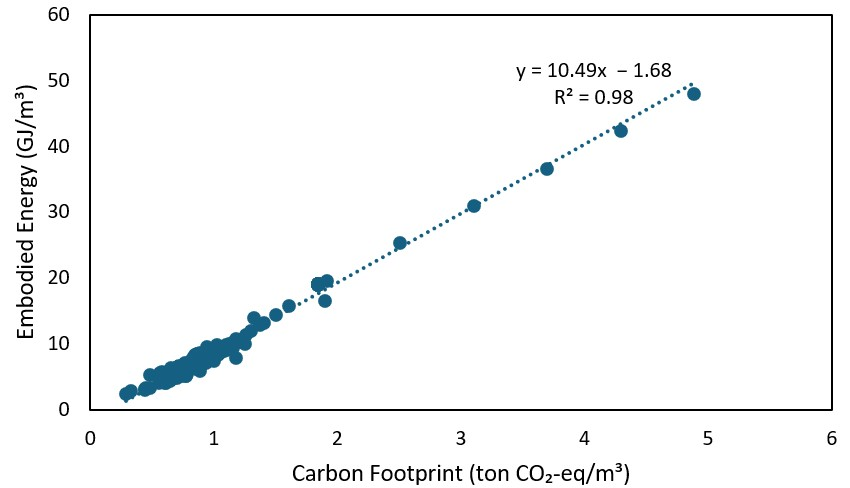
To better interpret the environmental implications of the mix designs summarized in Table 3, the relationship between embodied energy and carbon footprint is illustrated in Figure 2. The results reveal a strong linear correlation between these two indicators (R2 = 0.98), indicating that increases in cumulative energy demand are closely associated with higher greenhouse gas emissions across the analyzed mixtures. This relationship reflects the dominant contribution of energy-intensive constituents such as cement and synthetic fibers to the overall environmental footprint of UHPFRC mixtures. In particular, mixtures incorporating glass fibers tend to exhibit the highest embodied energy and carbon footprint values, which explains the larger values observed in the upper range of the dataset. These findings highlight the importance of fiber type and binder composition in determining the environmental performance of UHPFRC mixtures and emphasize the need for optimized mix designs that balance mechanical performance with reduced embodied environmental impacts.
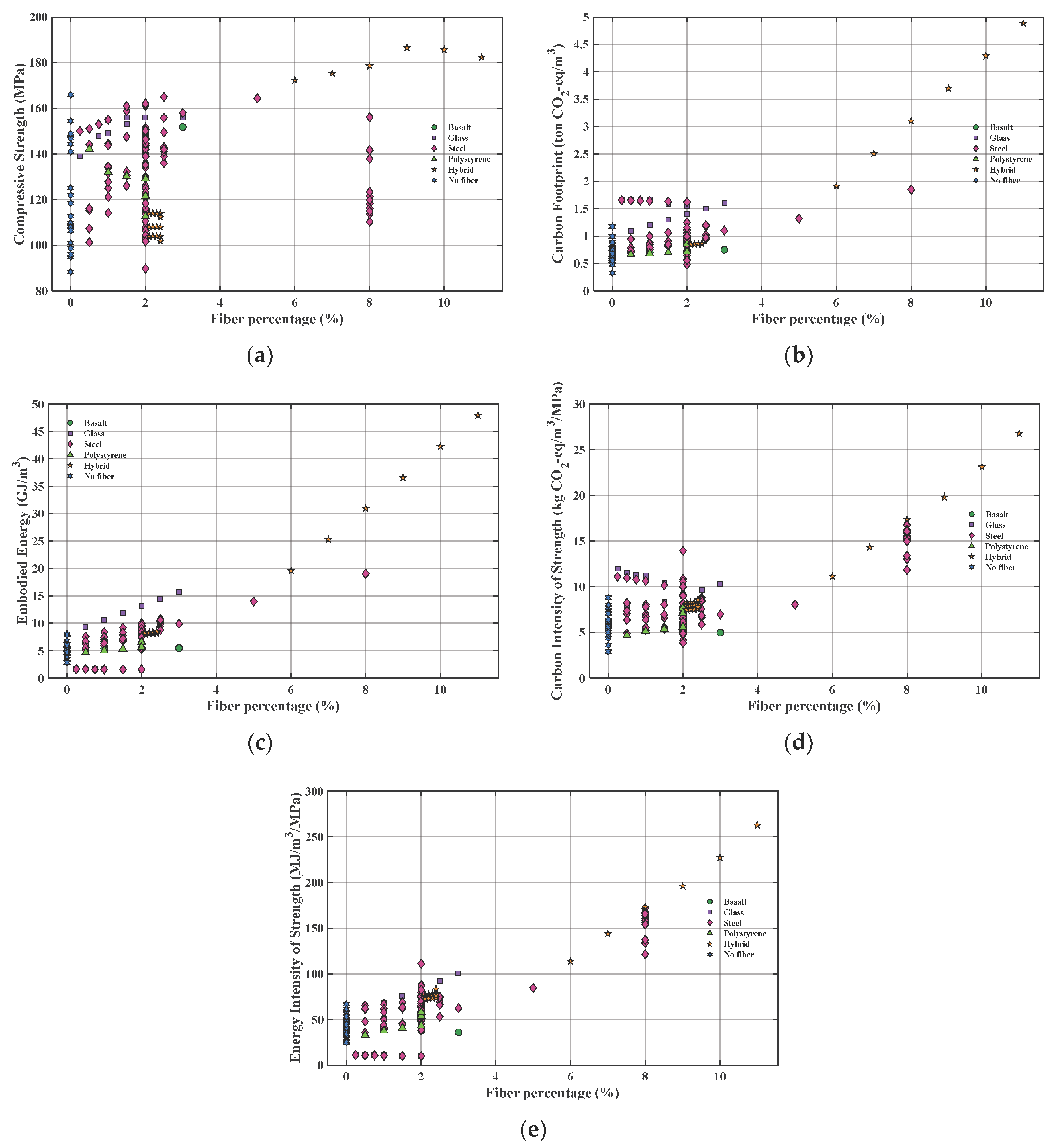
Figure 3 illustrates the influence of key mix-design parameters on the environmental performance of UHPFRC mixtures based on the dataset summarized in Table 3. Figure 3a shows the compressive strength of the mixtures, which varies over a wide range due to differences in binder composition, and fiber reinforcement. Although fibers typically have a limited influence on peak compressive strength compared with binder composition, they contribute significantly to post-cracking behavior, toughness, and crack control, which are critical for structural performance.
Figure 3b,c illustrate the corresponding carbon footprint and embodied energy of the mixtures. These indicators are primarily governed by the amount of energy-intensive constituents such as Portland cement and reinforcing fibers. Mixtures with higher cement contents tend to exhibit increased greenhouse gas emissions because clinker production is the dominant contributor to CO2 emissions in cement-based materials. Fiber reinforcement also plays an important role: steel fibers, glass fibers, and other high-performance fibers require substantial energy during manufacturing, which increases both embodied energy and carbon footprint when used in large quantities.
Figure 3d,e present normalized environmental indicators expressed as carbon intensity of strength and energy intensity. Unlike material-level environmental indicators alone, these metrics relate environmental burdens to the achieved mechanical performance and therefore provide a more meaningful assessment of sustainability. The results indicate that mixtures incorporating optimized binder systems, supplementary cementitious materials, and efficient fiber-reinforcement strategies can achieve high mechanical performance while maintaining relatively low environmental intensity values. This finding highlights the importance of performance-based assessment and demonstrates that environmental efficiency depends not only on reducing embodied impacts but also on maximizing the structural value obtained from each unit of material consumed.
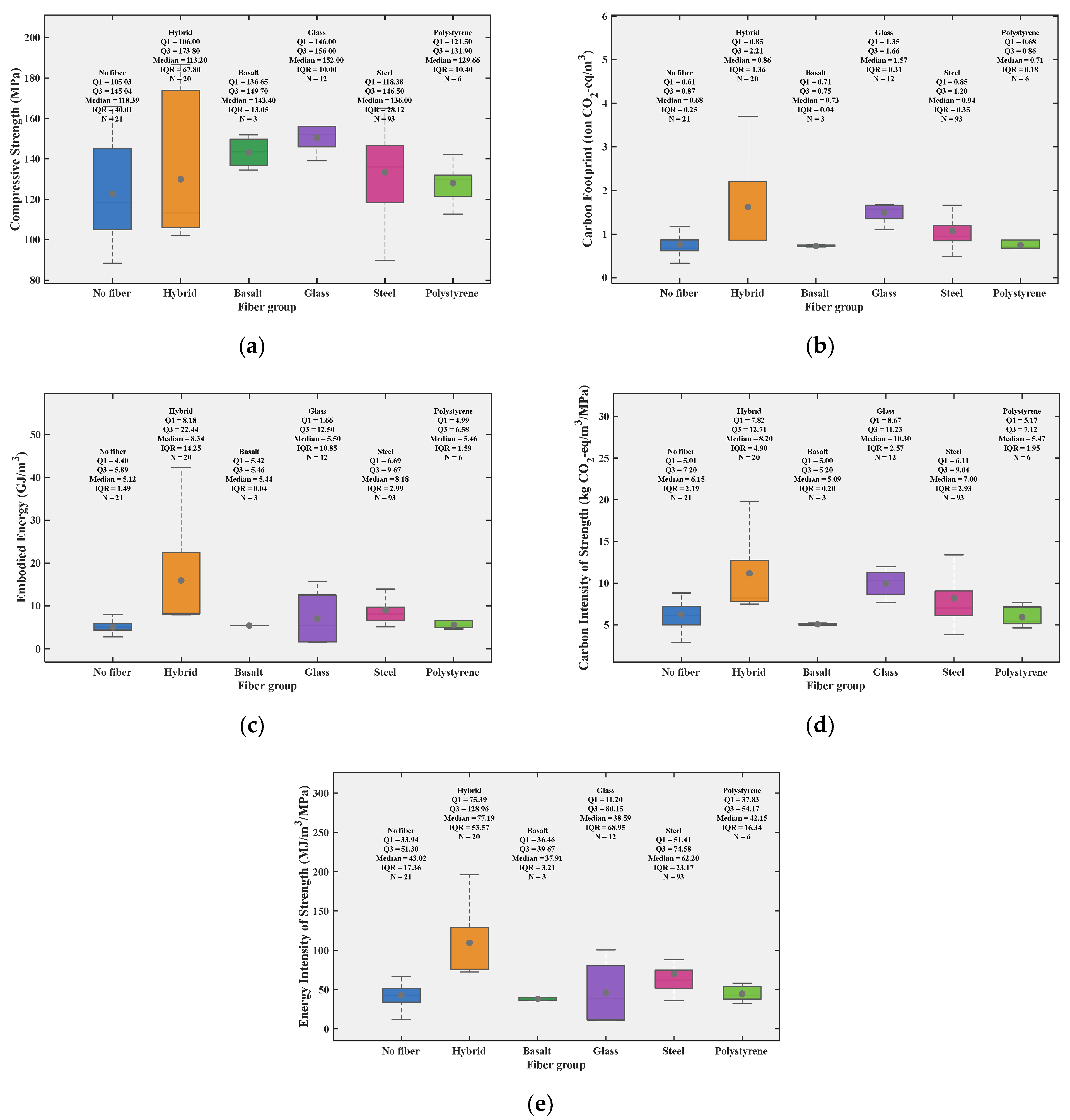
Figure 4 illustrates the influence of fiber volume fraction on the environmental indicators of UHPFRC mixtures, including embodied energy and carbon footprint, rather than the direct relationship between compressive strength and environmental impacts. Increasing fiber content generally improves tensile behavior, ductility, crack resistance, and post-peak performance of UHPFRC systems; however, it also contributes to higher embodied energy and carbon emissions because of the energy-intensive production of steel and synthetic fibers. Therefore, the environmental performance of UHPFRC mixtures is strongly affected by both fiber type and dosage.

6. Future Directions and Research Gaps

Despite significant advances in the development and application of HPFRC and UHPFRC, several scientific, technological, and sustainability-related challenges remain to be addressed. One of the most important research priorities is the development of low-carbon high-performance cementitious composites capable of maintaining superior mechanical and durability performance while reducing environmental impacts. Future studies should focus on reducing clinker content through the incorporation of SCMs, alternative binders such as limestone calcined clay cement (LC3) and geopolymer systems, and optimized particle-packing approaches. Furthermore, greater attention should be directed toward the use of recycled, bio-based, and alternative fibers, including recycled tire steel fibers and hybrid fiber systems, to reduce embodied energy and carbon emissions while preserving tensile strength, toughness, crack control, and durability.
Another promising research direction involves the integration of advanced computational tools into mixture design, performance prediction, and structural optimization. Machine learning, artificial intelligence, and data-driven modeling techniques have demonstrated considerable potential for predicting fresh, mechanical, durability, and environmental properties based on mixture composition and production parameters. Future research should seek to integrate these predictive approaches with LCA, life-cycle costing (LCC), and multi-objective optimization frameworks to simultaneously evaluate structural performance, durability, environmental impacts, and economic feasibility. Such integrated methodologies could facilitate the development of application-specific HPFRC and UHPFRC mixtures optimized for local material availability, environmental conditions, and sustainability objectives.
Additional research is also required to improve understanding of the long-term behavior and life-cycle performance of HPFRC and UHPFRC structures. Although these materials generally exhibit superior durability compared with conventional concrete, long-term field data remain relatively limited, particularly under combined mechanical, thermal, chemical, and environmental loading conditions. Long-term monitoring programs, digital-twin technologies, and improved deterioration models are therefore needed to enhance service-life prediction and reduce uncertainty in LCA.
Finally, greater emphasis should be placed on circular-economy strategies and end-of-life management. The recycling, reuse, and recovery of constituents from HPFRC and UHPFRC systems remain insufficiently investigated, particularly with respect to fiber recovery, separation of cementitious materials, reuse of recycled aggregates, and valorization of demolition waste. Future studies should evaluate the technical feasibility, environmental benefits, and economic implications of these approaches through comprehensive life-cycle frameworks. Addressing these challenges will be essential for enabling the broader adoption of HPFRC and UHPFRC as sustainable, durable, and resource-efficient construction materials for future resilient and low-carbon infrastructure systems.

7. Conclusions

This review presented a comprehensive evaluation of the life-cycle sustainability of high-performance and ultra-high-performance fiber-reinforced concretes (HPFRC and UHPFRC), integrating current knowledge on material composition, production processes, mechanical performance, durability, and environmental impacts. The findings demonstrate that these advanced cementitious composites provide significant improvements in strength, toughness, crack control, and durability compared with conventional concrete. Their superior performance is primarily attributed to optimized particle packing, low water–binder ratios, supplementary cementitious materials, and fiber reinforcement, which collectively produce dense microstructures with enhanced resistance to mechanical and environmental deterioration.
The analysis of published experimental and environmental datasets highlights the strong influence of mixture composition on both mechanical performance and sustainability. While HPFRC and UHPFRC generally exhibit higher embodied carbon and energy at the material level than conventional concrete because of their elevated binder and fiber contents, these initial environmental burdens can be partially offset through improved structural efficiency, reduced material consumption, extended service life, and lower maintenance requirements. Consequently, sustainability assessments should not rely solely on material-level indicators but should incorporate structural performance and life-cycle considerations.
Durability assessment confirms that HPFRC and UHPFRC exhibit excellent resistance to chloride ingress, freeze–thaw cycles, sulfate attack, and other degradation mechanisms owing to their low permeability and effective crack-width control. These characteristics can substantially increase service life in aggressive environments and reduce the environmental and economic impacts associated with repair and rehabilitation activities. However, challenges remain regarding fire-induced spalling, variability in material formulations, and uncertainties associated with long-term field performance.
The review further demonstrates that mix-design optimization is one of the most effective strategies for improving sustainability. The incorporation of supplementary cementitious materials, clinker reduction, alternative binders, recycled constituents, and optimized fiber systems can significantly reduce embodied environmental impacts while maintaining desirable mechanical and durability properties. The environmental benefits of such approaches are highly dependent on local material availability, transportation distances, production methods, and regional energy mixes, emphasizing the importance of context-specific assessments.
Despite the considerable progress achieved to date, several research gaps remain. Greater harmonization of life-cycle assessment methodologies is required to improve comparability among studies. Additional long-term field data are needed to validate durability predictions and service-life models under real operating conditions. Furthermore, the end-of-life management of HPFRC and UHPFRC remains insufficiently explored, particularly regarding fiber recovery, material recycling, and circular-economy implementation.
Overall, HPFRC and UHPFRC represent promising materials for the development of durable, resilient, and resource-efficient infrastructure. Although their production may involve higher initial environmental impacts than conventional concrete, their superior mechanical performance, durability, and structural efficiency can provide substantial life-cycle sustainability benefits when appropriate material selection, structural design, and environmental optimization strategies are employed.

Author Contributions

Conceptualization, H.M.; methodology, H.M.; investigation, H.M.; resources, H.B.; data curation, H.M.; writing—original draft preparation, H.M.; writing—review and editing, H.M., H.B., Y.A., K.S. and N.F.C.; visualization, H.M.; supervision, K.S., H.M., H.B., Y.A. and N.F.C.; project administration, H.M. All authors have read and agreed to the published version of the manuscript.

Funding

This research received no external funding.

Data Availability Statement

The data presented in this study is available on request from the corresponding author. The data is not publicly available due to confidentiality issues.

Conflicts of Interest

The authors declare no conflicts of interest.

Abbreviations

The following abbreviations are used in this manuscript:
AIArtificial Intelligence
ANNArtificial Neural Network
CEDCumulative Energy Demand
CO2Carbon Dioxide
C–S–HCalcium Silicate Hydrate
ECCEngineered Cementitious Composite
FRPFiber-Reinforced Polymer
GGBSGround Granulated Blast Furnace Slag
GPaGigapascal
GWPGlobal Warming Potential
HPCHigh-Performance Concrete
ISOInternational Organization for Standardization
ITZInterfacial Transition Zone
LCALife Cycle Assessment
LCILife Cycle Inventory
MAAModified Andreasen and Andersen Model
MPaMegapascal
NCNormal Concrete
OPCOrdinary Portland Cement
PLCPortland Limestone Cement
SCMsSupplementary Cementitious Materials
UHPCUltra-High-Performance Concrete
UHPFRCUltra-High-Performance Fiber-Reinforced Concrete
wt.%Weight Percent

References

  1. Amran, M.; Huang, S.-S.; Onaizi, A.M.; Makul, N.; Abdelgader, H.S.; Ozbakkaloglu, T. Recent trends in ultra-high performance concrete (UHPC): Current status, challenges, and future prospects. Constr. Build. Mater. 2022, 352, 129029. [Google Scholar] [CrossRef] [Scilit]
  2. Akeed, M.H.; Qaidi, S.; Faraj, R.H.; Mohammed, A.S.; Emad, W.; Tayeh, B.A.; Azevedo, A.R.G. Ultra-high-performance fiber-reinforced concrete. Part I: Developments, principles, raw materials. Case Stud. Constr. Mater. 2022, 17, e01290. [Google Scholar] [CrossRef] [Scilit]
  3. Patel, P.; Panchal, V.; Desai, M.; Patel, D. Ultra-High-Performance Fiber-Reinforced Concrete: A Comprehensive Review. Int. Res. J. Adv. Eng. Manag. (IRJAEM) 2025, 3, 2183–2191. [Google Scholar] [CrossRef] [Scilit]
  4. Angalekar, S.; Ramteke, S.; Kanherkar, R. Experimental Investigation of RCC Beams Using a Layer of Ultra-High-Performance Reinforced Concrete with different Types of Steel Fibers for Beam Strengthening Applications. Int. J. Res. Appl. Sci. Eng. Technol. 2025, 13, 1658–1662. [Google Scholar] [CrossRef] [Scilit]
  5. Gong, J.; Ma, Y.; Fu, J.; Hu, J.; Ouyang, X.; Zhang, Z.; Wang, H. Utilization of fibers in ultra-high performance concrete: A review. Compos. Part B Eng. 2022, 241, 109995. [Google Scholar] [CrossRef] [Scilit]
  6. Shaikh, F.U.A.; Luhar, S.; Arel, H.Ş.; Luhar, I. Performance evaluation of Ultrahigh performance fibre reinforced concrete—A review. Constr. Build. Mater. 2020, 232, 117152. [Google Scholar] [CrossRef] [Scilit]
  7. Shafaie, V.; Ghodousian, O.; Ghodousian, A.; Homayounfar, M.; Rad, M.M. Slant shear tests and fuzzy logic integration for evaluating shear bond strength in SCC and FRSCC repair applications. Case Stud. Constr. Mater. 2025, 22, e04176. [Google Scholar] [CrossRef] [Scilit]
  8. ASTM C1856/C1856M-17; Standard Practice for Fabricating and Testing Specimens of Ultra-High Performance Concrete. ASTM International: West Conshohocken, PA, USA, 2017.
  9. Akeed, M.H.; Qaidi, S.; Ahmed, H.U.; Emad, W.; Faraj, R.H.; Mohammed, A.S.; Tayeh, B.A.; Azevedo, A.R.G. Ultra-high-performance fiber-reinforced concrete. Part III: Fresh and hardened properties. Case Stud. Constr. Mater. 2022, 17, e01265. [Google Scholar] [CrossRef] [Scilit]
  10. El-Abbasy, A.A. Tensile, flexural, impact strength, and fracture properties of ultra-high-performance fiber-reinforced concrete–a comprehensive review. Constr. Build. Mater. 2023, 408, 133621. [Google Scholar] [CrossRef] [Scilit]
  11. Sanya, O.T.; Shi, J. Ultra-high-performance fiber reinforced concrete review: Constituents, properties, and applications. Innov. Infrastruct. Solut. 2023, 8, 188. [Google Scholar] [CrossRef] [Scilit]
  12. Akeed, M.H.; Qaidi, S.; Ahmed, H.U.; Faraj, R.H.; Mohammed, A.S.; Emad, W.; Tayeh, B.A.; Azevedo, A.R.G. Ultra-high-performance fiber-reinforced concrete. Part IV: Durability properties, cost assessment, applications, and challenges. Case Stud. Constr. Mater. 2022, 17, e01271. [Google Scholar] [CrossRef] [Scilit]
  13. Azanaw, G.M. Ultra-High-Performance Concrete (UHPC/UHPFRC) for Civil Structures: A Comprehensive Review of Material Innovations, Structural Applications, and Future Engineering Perspectives. I-Manag. J. Civ. Eng. 2025, 15, 21–30. [Google Scholar]
  14. Rambabu, D.; Sharma, S.K.; Akbar, M.A. Performance evaluation of ultra-high performance concrete (UHPC) and ultra-high performance fibre reinforced concrete (UHPFRC) in pavement applications. Arab. J. Sci. Eng. 2024, 49, 13685–13707. [Google Scholar] [CrossRef] [Scilit]
  15. Amran, M.; Murali, G.; Makul, N.; Tang, W.C.; Alluqmani, A.E. Sustainable development of eco-friendly ultra-high performance concrete (UHPC): Cost, carbon emission, and structural ductility. Constr. Build. Mater. 2023, 398, 132477. [Google Scholar] [CrossRef] [Scilit]
  16. ISO 14040; Environmental Management—Life Cycle Assessment—Principles and Framework. ISO: Geneva, Switzerland, 2006.
  17. ISO 14044; Environmental Management—Life Cycle Assessment—Requirements and Guidelines. ISO: Geneva, Switzerland, 2006.
  18. Wang, Y.; Qiao, P.; Sun, J.; Li, H.; Chen, A. Production of ultra high performance concrete using recycled tire steel fiber: Mechanical properties and life cycle assessment. Mag. Concr. Res. 2025, 77, 552–567. [Google Scholar] [CrossRef] [Scilit]
  19. Dharek, M.S.; Manjunatha, M.; Brijbhushan, S.; Vengala, J.; Tangadagi, R.B. Performance evaluation of hybrid fiber reinforced concrete on engineering properties and life cycle assessment: A sustainable approach. J. Clean. Prod. 2024, 458, 142498. [Google Scholar] [CrossRef] [Scilit]
  20. Mostafaei, H.; Ashoori Barmchi, M.; Bahmani, H. Seismic Resilience and Sustainability: A Comparative Analysis of Steel and Reinforced Structures. Buildings 2025, 15, 1613. [Google Scholar] [CrossRef] [Scilit]
  21. Mostafaei, H.; Chamasemani, N.F.; Mashayekhi, M.; Hamzehkolaei, N.S.; Santos, P. Sustainability Enhancement and Evaluation of a Concrete Dam Using Recycling. Appl. Sci. 2025, 15, 2479. [Google Scholar] [CrossRef] [Scilit]
  22. Karimi, T. A Comprehensive Review on Ultra-High Performance Concrete: Composition, Properties, and Applications. J. Civ. Eng. Urban. 2025, 15, 77–111. [Google Scholar] [CrossRef] [Scilit]
  23. Du, J.; Meng, W.; Khayat, K.; Bao, Y.; Guo, P.; Lyu, Z.; Abu-Obeidah, A.; Nassif, H.; Wang, H. New development of ultra-high-performance concrete (UHPC). Compos. Part B Eng. 2021, 224, 109220. [Google Scholar] [CrossRef] [Scilit]
  24. Bahmani, H.; Mostafaei, H.; Santos, P.; Ferrández, D. Concrete Material Variability and Machine Learning Model Performance: A Comprehensive Review. Buildings 2026, 16, 556. [Google Scholar] [CrossRef] [Scilit]
  25. Mostafaei, H.; Bahmani, H.; Mostofinejad, D. Damping Behavior of Fiber-Reinforced Concrete: A Comprehensive Review of Mechanisms, Materials, and Dynamic Effects. J. Compos. Sci. 2025, 9, 254. [Google Scholar] [CrossRef] [Scilit]
  26. Bahmani, H.; Mostafaei, H.; Mostofinejad, D. Review of energy dissipation mechanisms in concrete: Role of advanced materials, mix design, and curing conditions. Sustainability 2025, 17, 6723. [Google Scholar] [CrossRef] [Scilit]
  27. Ali, A.-S.M.; Sobuz, M.H.R. Eco-Friendly Ultra-High-Performance Fiber-Reinforced Concrete Production: A Review. Civ. Eng. Archit. 2024, 12, 2952–2969. [Google Scholar] [CrossRef] [Scilit]
  28. Da Silva, M.L.; Prado, L.; Félix, E.; Sousa, A.; Aquino, D.P. The Influence of Materials on the Mechanical Properties of Ultra-High-Performance Concrete (UHPC): A Literature Review. Materials 2024, 17, 1801. [Google Scholar] [CrossRef] [Scilit]
  29. Sharma, R.; Jang, J.; Bansal, P. A comprehensive review on effects of mineral admixtures and fibers on engineering properties of ultra-high-performance concrete. J. Build. Eng. 2021, 45, 103314. [Google Scholar] [CrossRef] [Scilit]
  30. Pereira, G.P.; de Oliveira Júnior, M.L.; de Oliveira Ribeiro, P. Influence of constituent materials on the mechanical properties and durability of Ultra-High Performance Fiber Reinforced Concrete (UHPFRC): A critical review. IOP Conf. Ser. Earth Environ. Sci. 2025, 1536, 012036. [Google Scholar] [CrossRef] [Scilit]
  31. Vatannia, S.; Kearsley, E.; Mostert, D. Development of economic, practical and green ultra-high performance fiber reinforced concrete verified by particle packing model. Case Stud. Constr. Mater. 2020, 13, e00415. [Google Scholar] [CrossRef] [Scilit]
  32. Dziomdziora, P.; Smarzewski, P. Effect of Hybrid Fiber Compositions on Mechanical Properties and Durability of Ultra-High-Performance Concrete: A Comprehensive Review. Materials 2025, 18, 2426. [Google Scholar] [CrossRef] [Scilit]
  33. Abbas, S.; Nehdi, M.; Saleem, M. Ultra-High Performance Concrete: Mechanical Performance, Durability, Sustainability and Implementation Challenges. Int. J. Concr. Struct. Mater. 2016, 10, 271–295. [Google Scholar] [CrossRef] [Scilit]
  34. James, I.E.; Okafor, F.; Mama, B.; Ezihe, J.C. Design, modelling and optimisation of ultra high-performance fibre reinforced concrete incorporating waste materials. Discov. Civ. Eng. 2024, 1, 96. [Google Scholar] [CrossRef] [Scilit]
  35. Amin, M.; Hakeem, I.; Zeyad, A.; Tayeh, B.; Maglad, A.; Agwa, I. Influence of recycled aggregates and carbon nanofibres on properties of ultra-high-performance concrete under elevated temperatures. Case Stud. Constr. Mater. 2022, 16, e01063. [Google Scholar] [CrossRef] [Scilit]
  36. Bahmani, H.; Mostafaei, H. Eco-Friendly Self-Compacting Concrete Incorporating Waste Marble Sludge as Fine and Coarse Aggregate Substitute. Buildings 2025, 15, 3218. [Google Scholar] [CrossRef] [Scilit]
  37. Ocelić, A.; Baričević, A.; Smrkić, M. Synergistic Integration of Waste Fibres and Supplementary Cementitious Materials to enhance sustainability of Ultra-High-Performance Concrete (UHPC). Case Stud. Constr. Mater. 2023, 20, e02772. [Google Scholar] [CrossRef] [Scilit]
  38. Bahmani, H.; Mostafaei, H.; Wu, C. Innovative Uses of Iron Ore Tailings in Sustainable Concrete: An In-Depth Review of Achievements, Future Potential, and Strategic Directions. Arab. J. Sci. Eng. 2025, 51, 3931–3950. [Google Scholar] [CrossRef] [Scilit]
  39. Mostafaei, H.; Bahmani, H.; Wu, C. Sustainable high-performance concrete with rubber and PET waste: Mechanical, dynamic, microstructural, and life cycle cost analysis. Int. J. Pavement Eng. 2026, 27, 2624578. [Google Scholar] [CrossRef] [Scilit]
  40. Bahmani, H.; Mostafaei, H. Sustainable high-performance concrete: Harnessing recycled rubber and slag for strength and eco-friendliness. Sci. Rep. 2026, 16, 7376. [Google Scholar] [CrossRef] [Scilit]
  41. Farahzadi, L.; Tellnes, L.G.F.; Shafei, B.; Kioumarsi, M. Life-Cycle Environmental Assessment of Ultra-High-Performance Concrete with Sustainable Materials and Fiber Substitutions. Clean. Eng. Technol. 2024, 23, 100846. [Google Scholar] [CrossRef] [Scilit]
  42. Tayeh, B.; Hadzima-Nyarko, M.; Riad, M.Y.R.; Hafez, R.D.A. Behavior of ultra-high-performance concrete with hybrid synthetic fiber waste exposed to elevated temperatures. Buildings 2023, 13, 129. [Google Scholar] [CrossRef] [Scilit]
  43. Arunothayan, A.; Nematollahi, B.; Ranade, R.; Bong, S.H.; Sanjayan, J. Development of 3D-printable ultra-high performance fiber-reinforced concrete for digital construction. Constr. Build. Mater. 2020, 257, 119546. [Google Scholar] [CrossRef] [Scilit]
  44. Fernandes, P.; Elbashir, D.; Cavaco, E.; Almeida, N.; Henriques, P. Production and assembly of ultra-thin concrete shells using prefabrication. Struct. Concr. 2025, 26, 3905–3915. [Google Scholar] [CrossRef] [Scilit]
  45. Tamataki, K.; Ito, T.; Fujino, Y.; Yoshitake, I. Development of an Ultra-High-Performance Fibre-Reinforced Concrete (UHPFRC) Manufacturable at Ambient Temperature. Buildings 2022, 12, 740. [Google Scholar] [CrossRef] [Scilit]
  46. Şanal, İ. Discussion on the effectiveness of cement replacement for carbon dioxide (CO2) emission reduction in concrete. Greenh. Gases Sci. Technol. 2018, 8, 366–378. [Google Scholar] [CrossRef] [Scilit]
  47. Pallab, N.S.; Sultana, M.; Sakib, S.; Barua, A.; Manzur, T. Reducing Carbon Footprint of RC Structure in Saline Exposure: Bangladesh Perspective. In Proceedings of the 1st International Conference on Net-Zero Built Environment: Innovations in Materials, Structures, and Management Practices; Kioumarsi, M., Shafei, B., Eds.; Springer: Cham, Switzerland, 2024; pp. 739–750. [Google Scholar]
  48. Rezazadeh, F.; Abrishambaf, A.; Zimmermann, G.; Kroll, A. Monitoring of ultra-high performance concrete manufacturing for reproducible quality and waste reduction. Sci. Rep. 2025, 15, 44639. [Google Scholar] [CrossRef] [Scilit]
  49. O’Hegarty, R.; Kinnane, O.; Newell, J.; West, R. High performance, low carbon concrete for building cladding applications. J. Build. Eng. 2021, 43, 102566. [Google Scholar] [CrossRef] [Scilit]
  50. Müller, H.S.; Haist, M.; Vogel, M. Assessment of the sustainability potential of concrete and concrete structures considering their environmental impact, performance and lifetime. Constr. Build. Mater. 2014, 67, 321–337. [Google Scholar] [CrossRef] [Scilit]
  51. Thilakarathna, P.S.M.; Seo, S.; Baduge, K.S.K.; Lee, H.; Mendis, P.; Foliente, G. Embodied carbon analysis and benchmarking emissions of high and ultra-high strength concrete using machine learning algorithms. J. Clean. Prod. 2020, 262, 121281. [Google Scholar] [CrossRef] [Scilit]
  52. Kuruşcu, A.O.; Girgin, Z.C. Efficiency of structural materials in sustainable design. J. Civ. Eng. Archit. 2014, 8, 1260–1265. [Google Scholar]
  53. Kumar, A.; Bheel, N.; Ahmed, I.; Rizvi, S.H.; Kumar, R.; Jhatial, A.A. Effect of silica fume and fly ash as cementitious material on hardened properties and embodied carbon of roller compacted concrete. Environ. Sci. Pollut. Res. 2022, 29, 1210–1222. [Google Scholar] [CrossRef] [Scilit]
  54. Zhang, S.; Li, Z.; Ghiassi, B.; Yin, S.; Ye, G. Fracture properties and microstructure formation of hardened alkali-activated slag/fly ash pastes. Cem. Concr. Res. 2021, 144, 106447. [Google Scholar] [CrossRef] [Scilit]
  55. Yang, T.; Zhang, Z.; Zhang, F.; Gao, Y.; Wu, Q. Chloride and heavy metal binding capacities of hydrotalcite-like phases formed in greener one-part sodium carbonate-activated slag cements. J. Clean. Prod. 2020, 253, 120047. [Google Scholar] [CrossRef] [Scilit]
  56. Vijayarethinam, N. Silica fume applications. World Cem. 2009, 40, 97–100. [Google Scholar]
  57. Murthy, A.R.; Iyer, N.R. Assessment of embodied energy in the production of ultra high performance concrete (UHPC). Int. J. Stud. Res. Technol. Manag. 2014, 2, 113–120. [Google Scholar]
  58. Kathirvel, P.; Sreekumaran, S. Sustainable development of ultra high performance concrete using geopolymer technology. J. Build. Eng. 2021, 39, 102267. [Google Scholar] [CrossRef] [Scilit]
  59. Khan, K.; Johari, M.A.M.; Amin, M.N.; Iqbal, M. Evaluation of the mechanical properties, microstructure, and environmental impact of mortar incorporating metakaolin, micro and nano-silica. Case Stud. Constr. Mater. 2024, 20, e02699. [Google Scholar] [CrossRef] [Scilit]
  60. Chiaia, B.; Fantilli, A.P.; Guerini, A.; Volpatti, G.; Zampini, D. Eco-mechanical index for structural concrete. Constr. Build. Mater. 2014, 67, 386–392. [Google Scholar] [CrossRef] [Scilit]
  61. Abdollahnejad, Z.; Pacheco-Torgal, F.; Félix, T.; Tahri, W.; Aguiar, J.B. Mix design, properties and cost analysis of fly ash-based geopolymer foam. Constr. Build. Mater. 2015, 80, 18–30. [Google Scholar] [CrossRef] [Scilit]
  62. Zhong, H.; Zhang, M. Effect of recycled tyre polymer fibre on engineering properties of sustainable strain hardening geopolymer composites. Cem. Concr. Compos. 2021, 122, 104167. [Google Scholar] [CrossRef] [Scilit]
  63. Guo, P.; Meng, W.; Du, J.; Stevenson, L.; Han, B.; Bao, Y. Lightweight ultra-high-performance concrete (UHPC) with expanded glass aggregate: Development, characterization, and life-cycle assessment. Constr. Build. Mater. 2023, 371, 130441. [Google Scholar] [CrossRef] [Scilit]
  64. Du, J.; Liu, Z.; Christodoulatos, C.; Conway, M.; Bao, Y.; Meng, W. Utilization of off-specification fly ash in preparing ultra-high-performance concrete (UHPC): Mixture design, characterization, and life-cycle assessment. Resour. Conserv. Recycl. 2022, 180, 106136. [Google Scholar] [CrossRef] [Scilit]
  65. Kucukdogan, N. Sustainable brick production using waste foundry sand and cast-iron slag: Reductions in embodied energy, CO2 emissions, and cost. Constr. Build. Mater. 2025, 497, 143889. [Google Scholar] [CrossRef] [Scilit]
  66. Kien, T.T. Comparison of energy consumption, CO2 emissions between normal concrete and UHPC in rural bridge application. J. Sci. Technol. Civ. Eng. (JSTCE) -HUCE 2023, 17, 168–179. [Google Scholar] [CrossRef] [Scilit]
  67. Turner, L.K.; Collins, F.G. Carbon dioxide equivalent (CO2-e) emissions: A comparison between geopolymer and OPC cement concrete. Constr. Build. Mater. 2013, 43, 125–130. [Google Scholar] [CrossRef] [Scilit]
  68. Yu, J.; Wu, H.-L.; Leung, C.K.Y. Feasibility of using ultrahigh-volume limestone-calcined clay blend to develop sustainable medium-strength Engineered Cementitious Composites (ECC). J. Clean. Prod. 2020, 262, 121343. [Google Scholar] [CrossRef] [Scilit]
  69. Xi, H.; Zhang, Z.-L.; Zhuo, F.-Y.; Hou, L.-J.; Zhang, H.; Zhang, W.-J.; Ji, X.-H.; Liu, K.-C.; Shen, Y.-N.; Lao, J.-C. High-strength high-ductility Engineered/Strain-Hardening Geopolymer Composites (EGC/SHGC) incorporating dredged river sand. Case Stud. Constr. Mater. 2025, 22, e04796. [Google Scholar]
  70. Long, G.; Gao, Y.; Xie, Y. Designing more sustainable and greener self-compacting concrete. Constr. Build. Mater. 2015, 84, 301–306. [Google Scholar] [CrossRef] [Scilit]
  71. Abdellatief, M.; Al-Tam, S.M.; Elemam, W.E.; Alanazi, H.; Elgendy, G.M.; Tahwia, A.M. Development of ultra-high-performance concrete with low environmental impact integrated with metakaolin and industrial wastes. Case Stud. Constr. Mater. 2023, 18, e01724. [Google Scholar] [CrossRef] [Scilit]
  72. Wu, C.; Zhou, P.; Li, Q.; Li, J.; Zhu, D. Assessing the carbon reduction potential of high-performance concrete in urban construction. Sustain. Chem. Pharm. 2025, 47, 102170. [Google Scholar] [CrossRef] [Scilit]
  73. Mahjoubi, S.; Barhemat, R.; Meng, W.; Bao, Y. AI-guided auto-discovery of low-carbon cost-effective ultra-high performance concrete (UHPC). Resour. Conserv. Recycl. 2023, 189, 106741. [Google Scholar] [CrossRef] [Scilit]
  74. Martinez-Soto, A.; Valdes-Vidal, G.; Calabi-Floody, A.; Avendaño-Vera, C.; Martínez-Toledo, C. Comparison of environmental loads of fibers used in the manufacture of hot mix asphalt (HMA) and stone mastic asphalt (SMA) mixes using a life cycle assessment (LCA). Sustainability 2022, 14, 14246. [Google Scholar] [CrossRef] [Scilit]
  75. Peng, Z.; Wang, X.; Liu, X.; Ding, L.; Tang, B.; Wu, Z. Carbon emission assessment of basalt fiber and basalt fiber-reinforced polymer (BFRP) reinforced/strengthened concrete structures. Structures 2026, 85, 111128. [Google Scholar] [CrossRef] [Scilit]
  76. Rabie, M.; Bahadori-Jahromi, A.; Shaaban, I.G. Optimisation of glass and carbon fibre-reinforced concrete with external enzymatic self-healing: An experimental and environmental impact study. Buildings 2025, 15, 3455. [Google Scholar]
  77. Khan, M.B.; Waqar, A.; Bheel, N.; Shafiq, N.; Hamah Sor, N.; Radu, D.; Benjeddou, O. Optimization of fresh and mechanical characteristics of carbon fiber-reinforced concrete composites using response surface technique. Buildings 2023, 13, 852. [Google Scholar] [CrossRef] [Scilit]
  78. Arunothayan, A.; Nematollahi, B.; Ranade, R.; Khayat, K.; Sanjayan, J. Digital fabrication of eco-friendly ultra-high performance fiber-reinforced concrete. Cem. Concr. Compos. 2021, 125, 104281. [Google Scholar] [CrossRef] [Scilit]
  79. Li, J.; Wu, Z.; Shi, C.; Yuan, Q.; Zhang, Z. Durability of ultra-high performance concrete–A review. Constr. Build. Mater. 2020, 255, 119296. [Google Scholar] [CrossRef] [Scilit]
  80. Liao, G.; Xu, L.; Wu, L. Long-term stability of ultra-high-performance concrete with steel fibers in various environments. Adv. Cem. Res. 2025, 37, 546–557. [Google Scholar] [CrossRef] [Scilit]
  81. Mahjoubi, S.; Meng, W.; Bao, Y. Auto-tune learning framework for prediction of flowability, mechanical properties, and porosity of ultra-high-performance concrete (UHPC). Appl. Soft Comput. 2022, 115, 108182. [Google Scholar]
  82. Mohammed, B.H.; Sherwani, A.F.H.; Faraj, R.H.; Qadir, H.H.; Younis, K.H. Mechanical properties and ductility behavior of ultra-high performance fiber reinforced concretes: Effect of low water-to-binder ratios and micro glass fibers. Ain Shams Eng. J. 2021, 12, 1557–1567. [Google Scholar] [CrossRef] [Scilit]
  83. Piao, R.; Woo, S.Y.; Lee, D.; Jeong, C.K.; Banthia, N.; Yoo, D.-Y. Investigating the effect of carbon fiber dosage on the mechanical and thermoelectric properties of ultra-high-performance fiber-reinforced concrete. J. Sustain. Cem.-Based Mater. 2025, 14, 1937–1951. [Google Scholar] [CrossRef] [Scilit]
  84. Chen, Z.; Wang, X.; Ding, L.; Jiang, K.; Su, C.; Liu, J.; Wu, Z. Mechanical properties of a novel UHPC reinforced with macro basalt fibers. Constr. Build. Mater. 2023, 377, 131107. [Google Scholar] [CrossRef] [Scilit]
  85. Gesoglu, M.; Güneyisi, E.; Muhyaddin, G.F.; Asaad, D.S. Strain hardening ultra-high performance fiber reinforced cementitious composites: Effect of fiber type and concentration. Compos. Part B Eng. 2016, 103, 74–83. [Google Scholar] [CrossRef] [Scilit]
  86. Wu, Z.; Shi, C.; He, W. Comparative study on flexural properties of ultra-high performance concrete with supplementary cementitious materials under different curing regimes. Constr. Build. Mater. 2017, 136, 307–313. [Google Scholar] [CrossRef] [Scilit]
  87. Ghafari, E.; Costa, H.; Júlio, E.; Portugal, A.; Durães, L. The effect of nanosilica addition on flowability, strength and transport properties of ultra high performance concrete. Mater. Des. 2014, 59, 1–9. [Google Scholar] [CrossRef] [Scilit]
  88. Smarzewski, P.; Barnat-Hunek, D. Property assessment of hybrid fiber-reinforced ultra-high-performance concrete. Int. J. Civ. Eng. 2018, 16, 593–606. [Google Scholar] [CrossRef] [Scilit]
  89. Yu, R.; Spiesz, P.; Brouwers, H.J.H. Mix design and properties assessment of ultra-high performance fibre reinforced concrete (UHPFRC). Cem. Concr. Res. 2014, 56, 29–39. [Google Scholar] [CrossRef] [Scilit]
  90. Wu, Z.; Shi, C.; He, W.; Wu, L. Effects of steel fiber content and shape on mechanical properties of ultra high performance concrete. Constr. Build. Mater. 2016, 103, 8–14. [Google Scholar] [CrossRef] [Scilit]
  91. Corinaldesi, V. The study of using fly ash to produce ultra high performance fibre reinforced concrete. Adv. Mater. Res. 2012, 535, 1889–1892. [Google Scholar] [CrossRef] [Scilit]
  92. Yu, R.; Spiesz, P.; Brouwers, H.J.H. Development of Ultra-High Performance Fibre Reinforced Concrete (UHPFRC): Towards an efficient utilization of binders and fibres. Constr. Build. Mater. 2015, 79, 273–282. [Google Scholar] [CrossRef] [Scilit]
  93. Kang, S.-H.; Jeong, Y.; Tan, K.H.; Moon, J. The use of limestone to replace physical filler of quartz powder in UHPFRC. Cem. Concr. Compos. 2018, 94, 238–247. [Google Scholar] [CrossRef] [Scilit]
  94. Corinaldesi, V.; Moriconi, G. Mechanical and thermal evaluation of ultra high performance fiber reinforced concretes for engineering applications. Constr. Build. Mater. 2012, 26, 289–294. [Google Scholar] [CrossRef] [Scilit]
  95. Hassan, A.M.T.; Jones, S.W.; Mahmud, G.H. Experimental test methods to determine the uniaxial tensile and compressive behaviour of ultra high performance fibre reinforced concrete (UHPFRC). Constr. Build. Mater. 2012, 37, 874–882. [Google Scholar] [CrossRef] [Scilit]
  96. Wu, Z.; Shi, C.; Khayat, K.H. Influence of silica fume content on microstructure development and bond to steel fiber in ultra-high strength cement-based materials (UHSC). Cem. Concr. Compos. 2016, 71, 97–109. [Google Scholar] [CrossRef] [Scilit]
  97. Song, Q.; Yu, R.; Shui, Z.; Wang, X.; Rao, S.; Lin, Z. Optimization of fibre orientation and distribution for a sustainable Ultra-High Performance Fibre Reinforced Concrete (UHPFRC): Experiments and mechanism analysis. Constr. Build. Mater. 2018, 169, 8–19. [Google Scholar] [CrossRef] [Scilit]
  98. Huang, W.; Kazemi-Kamyab, H.; Sun, W.; Scrivener, K. Effect of cement substitution by limestone on the hydration and microstructural development of ultra-high performance concrete (UHPC). Cem. Concr. Compos. 2017, 77, 86–101. [Google Scholar] [CrossRef] [Scilit]
  99. Yu, P.; Ma, W.; Yun, W.; Li, W. Static and dynamic mechanical properties of ultra-high-performance concrete (UHPC) by replacing steel fibers with plastic steel fibers. J. Build. Eng. 2024, 98, 111444. [Google Scholar] [CrossRef] [Scilit]
  100. Błaszczyk, K.; Smarzewski, P. Influence of hybrid fibers on workability, mechanical and dynamic properties of ultra-high performance concrete. Appl. Sci. 2025, 15, 5716. [Google Scholar] [CrossRef] [Scilit]
  101. Saeed, F.H.; Hejazi, F. A Comprehensive Review of Retrofitted Reinforced Concrete Members Utilizing Ultra-High-Performance Fiber-Reinforced Concrete. Materials 2025, 18, 945. [Google Scholar] [CrossRef] [Scilit]
  102. Zaid, O.; Al-Ezzi, M.J.; Al-Dala’ien, R.N.; Ahmed, M.; Anas, S.M. State of the art review on ultra-high-performance fiber reinforced concrete properties standardization and structural applications. Discov. Sustain. 2025, 7, 83. [Google Scholar]
  103. Kim, G.-Y.; Choi, J.-I.; Park, S.-E.; Kim, H.; Lee, Y.; Lee, B.Y. Response of UHPFRC and HDFRC under static and high-velocity projectile impact loads. Constr. Build. Mater. 2018, 188, 399–408. [Google Scholar] [CrossRef] [Scilit]
  104. Maffezzoli, B.P.; Redaelli, D.; Redaelli, E. Caratterizzazione di due calcestruzzi UHPFRC commerciali: Valutazione di proprietà meccaniche e di durabilità. Struct. Build. Eng. Struct. Des. 2022, 2022, 17. [Google Scholar]
  105. Ahmad, S.; Bahraq, A.A.; Al-Fakih, A.; Yusuf, M.O.; Al-Osta, M.A. Transport characteristics and corrosion behavior of ultra-high performance fiber-reinforced concrete with the key mix parameters. Int. J. Concr. Struct. Mater. 2024, 18, 40. [Google Scholar] [CrossRef] [Scilit]
  106. Wang, W.; Liu, J.; Agostini, F.; Davy, C.A.; Skoczylas, F.; Corvez, D. Durability of an ultra high performance fiber reinforced concrete (UHPFRC) under progressive aging. Cem. Concr. Res. 2014, 55, 1–13. [Google Scholar] [CrossRef] [Scilit]
  107. Huang, Y.; Grünewald, S.; Schlangen, E.; Luković, M. Strengthening of concrete structures with ultra high performance fiber reinforced concrete (UHPFRC): A critical review. Constr. Build. Mater. 2022, 336, 127398. [Google Scholar] [CrossRef] [Scilit]
  108. Galli, L.; Suraneni, P. Durability and damage resistance of sustainable Portland limestone cement-based (ultra) high-performance concrete in seawater. Mater. Struct. 2025, 58, 310. [Google Scholar] [CrossRef] [Scilit]
  109. Bandara, S.; Wijesundara, K.; Rajeev, P. Ultra-high-performance fibre-reinforced concrete for rehabilitation and strengthening of concrete structures: A suitability assessment. Buildings 2023, 13, 614. [Google Scholar]
  110. Mostafaei, H.; Kelishadi, M.; Bahmani, H.; Wu, C.; Ghiassi, B. Development of sustainable HPC using rubber powder and waste wire: Carbon footprint analysis, mechanical and microstructural properties. Eur. J. Environ. Civ. Eng. 2025, 29, 399–420. [Google Scholar] [CrossRef] [Scilit]
  111. Bahmani, H.; Mostafaei, H. Impact of Fibers on the Mechanical and Environmental Properties of High-Performance Concrete Incorporating Zeolite. J. Compos. Sci. 2025, 9, 222. [Google Scholar] [CrossRef] [Scilit]
  112. Mostafaei, H.; Rostampour, M.A.; Chamasemani, N.F.; Wu, C. An In-depth exploration of carbon footprint analysis in the construction sector with emphasis on the dam industry. In Carbon Footprint Assessments: Case Studies & Best Practices; Springer: Cham, Switzerland, 2024; pp. 45–80. [Google Scholar]
  113. Zhang, X.; Wu, Z.; Xie, J.; Hu, X.; Shi, C. Trends toward lower-carbon ultra-high performance concrete (UHPC)–A review. Constr. Build. Mater. 2024, 420, 135602. [Google Scholar] [CrossRef] [Scilit]
  114. Mehmood, M.; Nie, W.; Manan, A.; Onyelowe, K.; Arunachalam, K. Life cycle assessment of eco-friendly high performance cementitious composites incorporating construction and industrial waste. Sci. Rep. 2025, 15, 37113. [Google Scholar] [CrossRef] [Scilit]
  115. Rostampour, M.A.; Mostofinejad, D.; Bahmani, H.; Mostafaei, H. Crack Assessment Using Acoustic Emission in Cement-Free High-Performance Concrete Under Mechanical Stress. J. Compos. Sci. 2025, 9, 380. [Google Scholar]
  116. Bahmani, H.; Mostafaei, H.; Shabani, K.; Santos, P. Development of High-Performance Eco-Friendly Concrete Incorporating Recycled Fine Aggregates: Mechanical, Microstructural and Carbon Footprint Assessment. Buildings 2026, 16, 973. [Google Scholar] [CrossRef] [Scilit]
  117. Bahmani, H.; Mostafaei, H.; Rostampour, M.A. Utilization of Stone Quarry Sludge in the Development of Environmentally Friendly High-Strength Concrete. J. Compos. Sci. 2025, 9, 648. [Google Scholar] [CrossRef] [Scilit]
  118. Bahmani, H.; Mostafaei, H.; Mohamad Momeni, R.; Khoshoei, S.M. Utilization of Waste Marble Sludge in Self-Compacting Concrete: A Study on Partial Replacement of Cement and Fine Aggregates. Sustainability 2025, 17, 8523. [Google Scholar] [CrossRef] [Scilit]
  119. Sameer, H.; Weber, V.; Mostert, C.; Bringezu, S.; Fehling, E.; Wetzel, A. Environmental Assessment of Ultra-High-Performance Concrete Using Carbon, Material, and Water Footprint. Materials 2019, 12, 851. [Google Scholar] [CrossRef] [Scilit]
  120. Dong, Y. Performance assessment and design of ultra-high performance concrete (UHPC) structures incorporating life-cycle cost and environmental impacts. Constr. Build. Mater. 2018, 167, 414–425. [Google Scholar] [CrossRef] [Scilit]
  121. Di Summa, D.; Parpanesi, M.; Ferrara, L.; De Belie, N. A holistic life cycle design approach to enhance the sustainability of concrete structures. Struct. Concr. 2023, 24, 7684–7704. [Google Scholar] [CrossRef] [Scilit]
  122. Manso-Morato, J.; Hurtado-Alonso, N.; Revilla-Cuesta, V.; Skaf, M.; Ortega-López, V. Fiber-Reinforced Concrete and Its Life Cycle Assessment: A Systematic Review. J. Build. Eng. 2024, 94, 110062. [Google Scholar] [CrossRef] [Scilit]
  123. Fan, J.; Shao, Y.; Bandelt, M.; Adams, M.; Ostertag, C. Sustainable reinforced concrete design: The role of ultra-high performance concrete (UHPC) in life-cycle structural performance and environmental impacts. Eng. Struct. 2024, 316, 118585. [Google Scholar] [CrossRef] [Scilit]
  124. Hajiesmaeili, A.; Pittau, F.; Denarié, E.; Habert, G. Life Cycle Analysis of Strengthening Existing RC Structures with R-PE-UHPFRC. Sustainability 2019, 11, 6923. [Google Scholar] [CrossRef] [Scilit]
  125. Kromoser, B.; Butler, M.; Hunger, M.; Kimm, M.; Kopf, F.; Mechtcherine, V.; Pressmair, N.; Traverso, M. Article of RILEM TC 292-MCC: Life cycle assessment (LCA) of non-metallic reinforcement for reinforcing concrete: Manufacturing, durability, dismantling, recycling and reuse: A review. Mater. Struct. 2023, 56, 126. [Google Scholar] [CrossRef] [Scilit]
  126. Yu, R.; Song, Q.; Wang, X.; Zhang, Z.; Shui, Z.; Brouwers, H.J.H. Sustainable development of Ultra-High Performance Fibre Reinforced Concrete (UHPFRC): Towards to an optimized concrete matrix and efficient fibre application. J. Clean. Prod. 2017, 162, 220–233. [Google Scholar] [CrossRef] [Scilit]
  127. Wu, L.; Feng, C.; Qiu, J.; Wang, L.; Peng, Y.; Liu, J. Influence of Recycled Tire Steel Fibers on the Mechanical Properties and Carbon Emissions of High-Performance Cement-Based Materials. Materials 2025, 18, 3008. [Google Scholar] [CrossRef] [Scilit]
  128. Chen, G.; Zheng, D.; Chen, Y.-W.; Lin, J.-X.; Lao, W.; Guo, Y.-C.; Chen, Z.; Lan, X.-W. Development of high performance geopolymer concrete with waste rubber and recycle steel fiber: A study on compressive behavior, carbon emissions and economical performance. Constr. Build. Mater. 2023, 393, 131988. [Google Scholar] [CrossRef] [Scilit]
Figure 1. Annual number of publications related to high-performance cementitious compositesresearch from 2005 to 2026.
Jcs 10 00308 g001
Figure 2. Relationship between embodied energy and carbon footprint for the HPFRC and UHPFRC mixtures compiled in Table 3.
Jcs 10 00308 g002
Figure 3. Distribution of mechanical and environmental indicators for the HPFRC and UHPFRC mixtures compiled from the literature dataset summarized in Table 3: (a) compressive strength, (b) carbon footprint, (c) embodied energy, (d) carbon intensity of strength, and (e) energy intensity.
Jcs 10 00308 g003
Figure 4. Influence of fiber volume fraction on embodied energy and carbon footprint of the HPFRC and UHPFRC mixtures: (a) compressive strength distribution, (b) carbon footprint, (c) embodied energy, (d) carbon intensity of strength, and (e) energy intensity.
Jcs 10 00308 g004
Table 1. Components of different types of concrete.
Concrete Type Paste (kg/m3)Aggregate (kg/m3)Water (kg/m3)SP (kg/m3)Steel Fibers (kg/m3)References
NC300–4501700–200090–2251.5–30–39[23,33]
HPFRC500–7001400–1800150–2105–7.839–78.5[11,23]
UHPFRC900–11001100150–22018–25117–157[5,27,30]
Table 2. Embodied CO2 emissions and embodied energy of common raw materials used in UHPFRC mixtures compiled from literature sources for life-cycle inventory modeling.
Raw MaterialsEmbodied CO2 Emission (kgCO2/kg)Embodied Energy (MJ/kg)
ValueReferencesUncertainty RangeValueReferencesUncertainty Range
OPC0.913[46,47,48,49]0.83–0.985.8[50]4.5–7.2
Fly Ash0.020[51]0.010–0.0400.1[52,53]0.04–0.18
GGBS0.042[54]0.020–0.0830.2[55]0.15–0.35
Silica Fume0.024[51,56]0.010–0.0500.1[57,58]0.04–0.20
Nano-silica0.86[59]0.50–1.2015.9[59]10–22
Limestone Powder0.019[60]0.010–0.0350.76[60]0.40–1.10
Sodium Hydroxide0.86[61,62]0.010–0.03018[61,62]0.05–0.18
Sodium Silicate0.43[61,62]0.015–0.0354.6[61,62]0.80–1.40
Glass Powder0.60[63]0.015–0.0351.14[63]0.60–1.20
Sand0.02[64]0.30–0.550.11[65]2.80–4.50
Coarse Aggregate0.0089[66]-0.0408[53,67]-
Silica Sand0.023[68,69]-1.05[66]-
Quartz Power0.023[58]-0.85[58]-
Metakaolin0.4[70,71]-3.48[70,71]-
Steel Fiber1.4965[64,72]1.20–1.8020.56[60,73]16–26
Aramid Fiber6.1[74]-6.1[74]-
Basalt Fiber0.98[75]0.80–1.200.98[75]10–17
Glass Fiber8.1[76]6.0–10.0100[76]75–130
Carbon Fiber33[77]25–40315[76]250–400
Polyethylene Fiber4.08[63]3.0–5.569.40[63]50–90
Tap Water0.0003[70]0.006[70]
Superplasticizer0.72[60]0.50–1.0018.3[60]14–24
Table 3. Summary of HPFRC and UHPFRC mix-design parameters, fiber types/contents, and resulting mechanical properties compiled from experimental studies in the literature.
CategoryVariableRangeUnitMeanS.D.
Binder & Matrix CompositionCement192–1251kg/m3699.4172.2
Fly ash0–475kg/m323.673.6
Slag0–768kg/m341.9128.2
Silica fume0–291kg/m398.695
Nano-silica0–275kg/m310.222.7
Limestone powder0–1058kg/m384.8145
Quartz powder0–1244kg/m363.9198.5
Silica sand0–833kg/m336.7169.3
Sand0–1503kg/m3971.8396
Coarse aggregate0–1300kg/m3136.9322.6
Water90–286kg/m3182.222.8
Superplasticizer5–88kg/m331.816.1
Fiber Properties (Vol.%)Polystyrene0–2%0.070.27
Steel0–17%1.52.26
Glass0–3%0.050.32
Carbon0–6%0.090.63
Basalt0–3%0.030.25
Mechanical PropertiesCompressive strength54–187MPa117.231
Flexural strength5–42MPa19.78.3
Table 4. Comparison of durability-related transport parameters between UHPFRC and conventional concrete [104,105,106].
Durability ParameterUHPFRC Typical ValueNormal Concrete Typical ValueKey Findings/Context
Water Penetration3.3–13.3 mm~30 mm (threshold)UHPFRC shows negligible water penetration depth, significantly lower than the threshold for normal concrete.
Chloride Ion Permeability20–242 Coulombs>3000 Coulombs (typical)UHPFRC exhibits “very low to negligible” chloride permeability, whereas normal concrete typically shows moderate to high permeability.
Gas Permeability10−18–10−17 m210−16–10−15 m2 (typical)UHPFRC lies in the “very high durability range” with average Kgas = 10−18 m2. Heat-treated UHPFRC still maintains 10−17 m2.
Chloride Concentration at Rebar0.03–0.18 wt.%~0.6 wt.% (threshold exceeded)Very low chloride concentrations measured at rebar level, well below the 0.3 wt.% corrosion threshold.
Disclaimer/Publisher’s Note: The statements, opinions and data contained in all publications are solely those of the individual author(s) and contributor(s) and not of MDPI and/or the editor(s). MDPI and/or the editor(s) disclaim responsibility for any injury to people or property resulting from any ideas, methods, instructions or products referred to in the content.