Article

Efficient Buckling Analysis of Thin-Walled Composite Beams with Symmetric and Unsymmetric Layups Using a GBT–Ritz Approach


by
Navid Kharghani
* and
Christian Mittelstedt
Institute for Lightweight Engineering and Structural Mechanics (LSM), Department of Mechanical Engineering, Technical University of Darmstadt, Otto Berndt-Straße 2, 64287 Darmstadt, Germany
*
Author to whom correspondence should be addressed.
J. Compos. Sci. 2026, 10(6), 307; https://doi.org/10.3390/jcs10060307
Submission received: 11 May 2026 / Revised: 31 May 2026 / Accepted: 1 June 2026 / Published: 4 June 2026
(This article belongs to the Special Issue Composite Thin-Walled Structures: Stability and Damage)

Abstract

Thin-walled composite beams with unsymmetric laminates are attracting increasing attention in lightweight aerospace and mechanical structures because they enable enhanced stiffness tailoring and weight reduction beyond the limitations of conventional symmetric stacking sequences. However, despite their practical relevance, unsymmetric thin-walled laminates have received comparatively limited attention in the available buckling literature due to the additional complexity introduced by membrane–bending coupling effects. This study presents an efficient and physically transparent formulation for the buckling analysis of thin-walled composite beams with both symmetric and unsymmetric layups by combining Generalized Beam Theory (GBT) with the Ritz method. The proposed GBT-Ritz framework captures global, local, distortional, torsional, and shear-related deformation modes while consistently incorporating laminate coupling effects associated with unsymmetric configurations. The formulation is applicable to open, closed, branched, and unbranched cross-sections commonly encountered in aerospace structures. Validation against ABAQUS V2017 shell finite element models demonstrates excellent agreement (with discrepancies generally below 6%) in predicting critical buckling loads and mode shapes for various geometries and boundary conditions. The results show that unsymmetric laminates can significantly influence buckling behavior, particularly in open sections and intermediate beam lengths where coupling effects become dominant. Compared with conventional finite element approaches, the proposed method achieves substantially lower computational cost (providing speed-up factors of 1.5 to 2.5) while preserving clear physical insight into interacting instability mechanisms. Overall, the developed framework provides an efficient and practically relevant tool for the analysis and design of advanced thin-walled composite structures with tailored unsymmetric laminates.

1. Introduction

Thin-walled composite beams occupy a strategically important position in lightweight structural design because they combine the load-carrying efficiency of beam-like members with the sectional adaptability of shell-like structural components. In aerospace structures, this class of members appears in primary and secondary components such as wing spars, stringer-stiffened substructures, ribs, frames, and other slender load paths for which stiffness-to-mass ratio, damage tolerance, and tailorability are decisive. The attraction of laminated fiber-reinforced composites in this setting is not only their high specific strength and stiffness, but also the possibility of embedding structural functionality directly into the stacking sequence through directional stiffness tailoring. As a result, the buckling behavior of thin-walled composite beams is not a marginal concern; it is often one of the principal design constraints governing admissible laminate architectures and local section geometry in weight-critical airframes [1,2,3,4,5].
The need for reliable buckling analysis is sharpened by current trends in aerospace design. At the laminate level, the long-standing industrial preference for symmetric stacks is increasingly being re-examined because it limits the design space and can exclude mechanically advantageous solutions. Vermes et al. [4] showed that non-symmetric sub-laminates, when treated intelligently through layup homogenization, can greatly reduce warpage while enabling lighter buckling-driven designs; their results make clear that the classical dismissal of asymmetry is often too restrictive for modern lightweight structures. Taken together, these developments explain why unsymmetric layups are not merely a theoretical curiosity, but part of a broader shift toward more fully tailored composite load-bearing members [2,4].
However, thin-walled composite beams are mechanically demanding systems. Their response may involve restrained warping, local plate-type deformations of webs and flanges, distortional deformation of the cross-section, flexural–torsional interaction, and laminate-induced couplings among extension, bending, torsion, and shear. For symmetric laminates, some of these effects are already nontrivial; for unsymmetric laminates, they become still more intricate because the membrane–bending coupling embodied in the laminate coupling matrix introduces pre-buckling curvature and coupling between in-plane and out-of-plane fields. In practical terms, this means that the instability problem is simultaneously a sectional problem, a member problem, and a laminate problem [1,4,5,6].
In this methodological landscape, Generalized Beam Theory (GBT) offers a particularly appealing middle ground. Originating in the work of Schardt [7,8], GBT describes a thin-walled member by decomposing its cross-sectional deformation into a set of mechanically interpretable modes whose amplitudes vary along the member axis. This modal decomposition is the defining strength of the theory. It allows the analyst to distinguish conventional global modes from local plate modes, distortional modes, torsion- and warping-related modes, and, in later extensions, shear-related modes. Rather than burying all coupling phenomena inside a large finite element eigensystem, GBT exposes them directly in the structure of the model. The recent state-of-the-art survey by Mittelstedt [9] emphasizes precisely this feature and identifies the natural treatment of interacting local, global, and distortional patterns as one of the principal reasons for GBT’s continuing relevance in thin-walled stability analysis. GBT has also undergone major extensions that are directly relevant to composite members. Dinis et al. [10] extended the formulation to thin-walled members with arbitrarily branched open cross-sections, thereby removing an important geometric restriction from early formulations. Silvestre and Camotim [11,12] subsequently developed composite-member formulations that account for arbitrary orthotropy, in-plane section deformation, primary and secondary warping, rotary inertia, and, crucially, warping-related shear deformation. These extensions are significant because they demonstrate that GBT can be adapted to composite thin-walled members without sacrificing the physical mode-based description that makes it valuable in the first place. The proposed formulation was interpreted within a finite-element analysis. More recently, Kharghani and Mittelstedt [13] showed that a novel GBT–Ritz procedure can capture global, local, and distortional buckling of isotropic and symmetrically laminated thin-walled beams with open cross-sections, including branching, with high computational efficiency.
The Ritz method provides the complementary analytical framework. In variational stability analysis, Ritz approximations replace the continuous buckling problem by a finite-dimensional problem in which the total potential energy, or its stationary variation, is evaluated over a set of admissible trial functions. For laminated structures, this is highly attractive because the approach can satisfy essential boundary conditions directly through the basis, can exploit closed-form or semi-closed-form integrations, and can achieve excellent efficiency when the chosen functions reflect the mechanics of the expected solution. Mittelstedt [14] placed the Ritz method among the core tools of modern laminate stability analysis and explicitly links it to shear-deformable buckling formulations and unsymmetric laminate problems. Reviews of Ritz admissible functions and more focused studies on anisotropic plates further show that the method is exceptionally powerful for buckling and vibration of anisotropic structures, provided that the trial space is selected with care. At the same time, the limitations of the Ritz method are well known. Its performance depends strongly on the admissible functions being complete, linearly independent, and compatible with the essential boundary conditions. Poor choices can lead to slow convergence, misleading mode representations, or numerical ill-conditioning. These issues become more pronounced as anisotropy increases and as the kinematics become richer. Vescovini et al. [15] demonstrated that for highly anisotropic plates the convergence behavior of the Ritz method is strongly tied to the structure of the basis functions, which must reflect the anisotropic nature of the solution rather than impose an isotropic intuition onto a fundamentally directional problem. Thus, the Ritz method is not, by itself, a complete answer for thin-walled beam buckling; it needs a kinematic framework that organizes the deformation content before the longitudinal approximation is introduced. This is precisely the point at which coupling Ritz with GBT becomes appealing [9,14,15,16].
The motivation for combining GBT and the Ritz method is simple. GBT provides a mechanics-based description of the cross-sectional behavior through modal functions, while the Ritz method efficiently approximates how these modal amplitudes vary along the beam axis. In other words, GBT defines the kinematics, and Ritz defines how the solution is computed. Despite this clear advantage, the application of a coupled GBT–Ritz framework to laminated composite members is still limited. Outside the GBT context, similar variational approaches have already demonstrated strong potential. For example, Kühn et al. [17] and Herrmann et al. [18] developed discrete-plate models for analyzing local buckling in laminated composite beams. Their formulations include shear deformation and higher-order kinematics, and they accurately capture restrained flange and web buckling with high computational efficiency. However, these approaches model the beam as a set of mechanically constrained plate elements, focusing specifically on local buckling rather than providing a unified formulation capable of capturing global, local, and distortional modes simultaneously. At the same time, reduced-order beam models have also seen significant progress. Banić et al. [19,20,21] developed shear-deformable, geometrically nonlinear beam formulations for various laminated composite configurations, including cross-ply, angle-ply, and general composite cross-sections. These studies highlight the importance of including warping, shear deformation, and geometric nonlinearity in the analysis of thin-walled composite beams, and they offer efficient modeling tools. However, these formulations are based on finite element beam theories rather than GBT modal approaches. Moreover, the extension to angle-ply laminates remains limited to thin, symmetric, and balanced configurations [20]. Finally, Kappel [22] investigated double-double laminate concepts in applications such as wing covers and fuselage skins, demonstrating the growing need for analysis methods that go beyond traditional symmetric stacking sequences. This further emphasizes the demand for unified and flexible modeling frameworks capable of handling more general laminate designs.
In addition to GBT-based approaches, several advanced analytical formulations have recently been proposed for the stability analysis of composite structures. Higher-order and trigonometric shear deformation theories have demonstrated excellent accuracy in capturing transverse shear effects, anisotropic coupling mechanisms, and stability characteristics of laminated and porous composite members. These developments provide efficient alternatives to conventional finite element approaches and highlight the continuing interest in reduced-order analytical formulations for lightweight structural applications. Representative examples can be found in recent studies [23,24,25,26].
The present study directly addresses this gap. Its contribution is not simply the use of GBT for laminated members or the application of the Ritz method to stability problems, as both approaches are already well established. Instead, the novelty lies in their combined use for thin-walled composite beams with unsymmetric layups. This allows the modal clarity of GBT to be preserved while consistently incorporating the membrane–bending coupling effects that arise in unsymmetric laminates into the buckling analysis. The proposed formulation is developed for both symmetric and unsymmetric laminates and is applicable to practical thin-walled beam configurations, including open, closed, branched, and unbranched sections commonly encountered in engineering design. From a methodological perspective, this approach bridges an important gap. Compared with conventional finite element eigenvalue analyses, it offers significantly lower computational cost and improved physical insight into mode interactions. Compared with classical thin-walled beam theories, it provides a more detailed representation of cross-sectional deformation and laminate coupling. In contrast to discrete-plate models, which focus on local instability, the present formulation enables a unified member-level analysis in which global, local, and distortional buckling modes can be captured simultaneously. Furthermore, unlike existing GBT–Ritz formulations that are limited to symmetrically laminated open sections [13], the proposed approach extends the framework to the more general and practically relevant case of unsymmetric laminates. This extension is particularly relevant for aerospace structures, where thin-walled components are highly optimized for weight, governed by stability constraints, and increasingly tailored through laminate design. The proposed formulation extends existing GBT–Ritz methods by incorporating membrane–bending coupling effects associated with unsymmetric laminates. The approach captures additional interactions between global, local, distortional, and shear-related modes while preserving the physical interpretability of GBT. This enables more accurate prediction of buckling behavior in thin-walled composite beams with laminate asymmetry. As such, the proposed framework provides a timely and practically useful addition to existing analytical methods.

2. Theory and Formulations

GBT enhances traditional beam formulations by accounting for cross-sectional deformation, which allows it to capture a broad spectrum of buckling modes, including local, distortional, and global responses. The GBT framework is typically divided into two main stages: an initial cross-sectional analysis, which serves as a preprocessing step, followed by member-level analysis used for evaluating buckling, vibration, or post-buckling behavior. Based on strain–displacement relationships, the strain energy of the cross-section is first established [12]. A stiffness matrix is then formulated to link generalized displacements, expressed as modal amplitudes, with the corresponding internal forces and moments. The governing equations are subsequently derived through an energy minimization procedure, implemented here using the Rayleigh–Ritz approach. The formulation of the present method is detailed in the following subsection.

2.1. Cross-Section Analysis

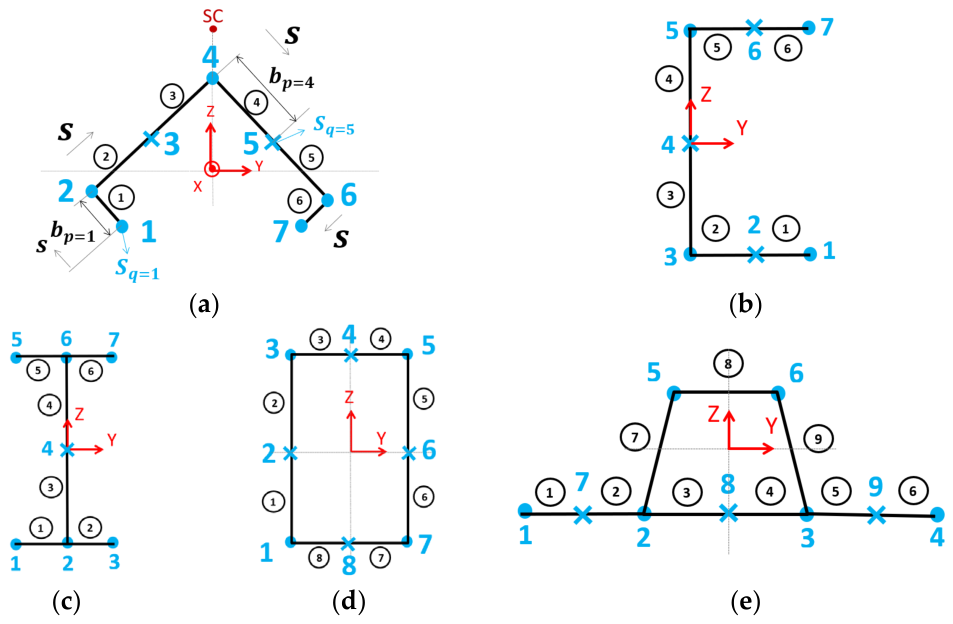
The analysis begins by discretizing the thin-walled cross-section into a series of plate-like elements, each defined by nodes located at its corners and distributed along its edges (Figure 1). Within the framework of GBT, the resulting cross-sectional deformation is represented as a superposition of several fundamental modes, including rigid-body modes corresponding to overall translations and rotations, global modes associated with bending and torsion of the entire section, local buckling modes describing plate bending within individual wall segments, and distortional modes that capture changes in the cross-sectional shape.
The analysis begins by introducing the displacement fields in the following form [12]:
u x , s = u ¯ i ( s ) φ i , x ( x ) + u ¯ j ( s ) φ j ( x )
v x , s = v ¯ i ( s ) φ i ( x )
w x , s = w ¯ i ( s ) φ i ( x )
In this formulation, the index i refers to the conventional deformation modes, while j denotes the shear modes. The functions u ¯ i s , v ¯ i s and w ¯ i ( s ) describe the displacement distributions in the axial x , tangential s , and out-of-plane directions, respectively (Figure 1). In contrast, u ¯ j s represents the axial displacement associated with shear deformation. The corresponding modal amplitudes are given by φ i x for the conventional modes and φ j x for the shear modes. It should be emphasized that the shear-related deformation modes considered within the GBT framework correspond to warping-induced membrane shear effects rather than first-order transverse shear deformation. The coordinate system is defined such that the x -axis runs along the longitudinal direction of the beam, whereas the s -coordinate follows the contour of the cross-section. Starting from the first node, s increases clockwise along the wall segments, as illustrated in Figure 1. The length of segment p is given by:
b p = S q + 1 S q q = 1 , 2 , , n , ( p = 1 , 2 , , n 1 )
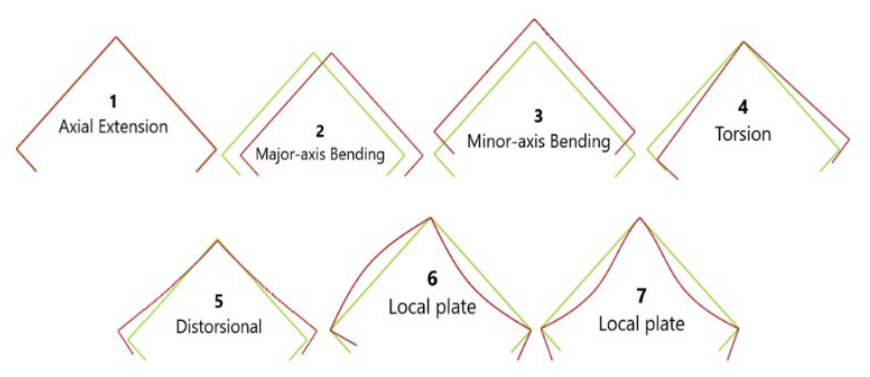
where n denotes the total number of modes, including both natural and intermediate nodes, while q represents the node index. Following the approach proposed by Schardt [7], the warping displacement U q k corresponding to mode k   ( k = 1 ,   2 ,   3 ,   4 ) at node q can be expressed as (Figure 2):
M o d e   1 : U q 1 = 1 , M o d e   2 : U q 2 = Y q
M o d e   3 : U q 3 = Z q , M o d e   4 : U q 4 = ω q
Y q and Z q denote the position of node q relative to the chosen cross-sectional reference axes, while ω q represents the sectorial coordinate associated with that node. Then, for the other modes k = 5 , 6 , , n , the following orthogonality condition should be satisfied [7]:
A U q k U q i d A = 0 k i
Hence, the in-plane displacement of a given face segment (denoted as “p”), which lies between nodes q   and   q + 1 can be evaluated at its midpoint as follows:
f p k = U q k U q + 1 k b p
The functions u ¯ i s and v ¯ i s are assumed to exhibit linear variation within each individual segment, resulting in a piecewise linear distribution over the entire cross-section. With this assumption, u ¯ i s can be completely described by its nodal values. The transverse flexural displacements, w ¯ i s , are confined to a particular segment p . By superimposing the displacement patterns of the basic system, influenced by the warping function u ¯ i s together with the contributions from the terms m q and m q + 1 , the overall displacement field is obtained.
w ¯ i s = w ¯ p × 1 + b p 2 θ ¯ p 2 η 1 b p 2 3 K p m q η + 3 2 η 2 1 2 η 3 + m q + 1 1 2 η + 1 2 η 3
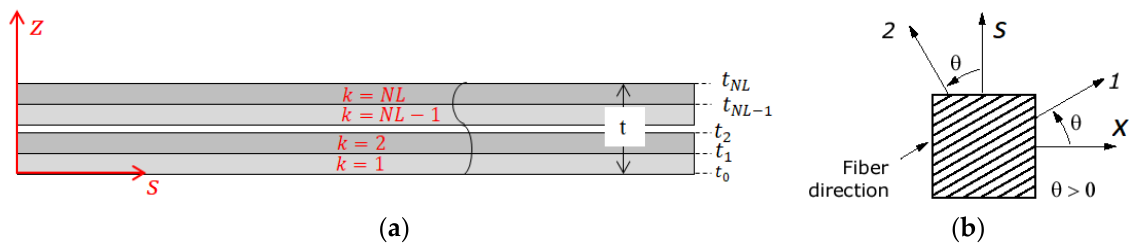
Here, ξ is introduced through the relation η = s S q / b p . The transverse bending stiffness of the plate, denoted as K p , is given by K p = E t 3 / 12 1 ν 2 for isotropic materials. For the orthotropic ones, the corresponding stiffness contribution is represented by the term D 22 from the D-matrix. The matrices A, B, and D describe the in-plane, coupling, and bending behavior of the laminate, respectively [27]. The terms Q ¯ i j refer to the components of the transformed reduced stiffness matrix (Figure 3 and Equation (9)). Furthermore, w ¯ p denotes the transverse displacement at the midpoint of a face, θ ¯ p represents the rotation of the face chord line, and m q corresponds to the transverse bending moment.
A i j , B i j , D i j = t k 1 t k Q ¯ i j 1 , z , z 2 d z i , j = 1 , 2 , 6 , ( k = 1 N L )
According to Figure 3 the fiber orientation angle θ represents the rotation between the principal material direction and the local segment axis. Consequently, the fibers are not restricted to remain parallel to the (s)-direction. It is important to note that the D 22 term of the bending stiffness matrix D is directly incorporated into the formulation. In particular, it plays a key role in defining the segmental bending stiffness, as shown in Equation (8).
The handling of branching cross-sections in the present formulation is based on the method introduced by Dinis et al. [10], who extended GBT to account for members with open branched and mixed cross-sections. At each branching location, the so-called natural nodes of the cross-section are divided into independent and dependent groups. Warping functions are defined only for the independent nodes, where a unit warping displacement is imposed at one node while all others remain fixed. The dependent nodes, in contrast, are assigned calculated warping displacements such that two conditions are fulfilled: first, compatibility of transverse displacements across all intersecting walls at the node, and second, compliance with Vlasov’s requirement of zero membrane shear strain γ x y M = 0 .
For rectangular hollow sections (RHSs), the formulation must account for the closed nature of the cross-section, which fundamentally alters the warping behavior compared to open sections γ x y M 0 . In this case, warping is not independent at each node, but is constrained by the continuity of the closed wall, leading to a single-valued warping field around the perimeter. Following the classical developments of Vlasov [28], the membrane shear strain condition enforces a coupling between warping and in-plane shear flow, resulting in additional constraints that eliminate spurious deformation modes. Within the GBT framework, this is typically handled by introducing a global compatibility condition along the closed contour, ensuring that the warping displacement remains continuous and that no artificial discontinuities arise at the corner nodes. As discussed by Schardt [7] and later extended by Silvestre and Camotim [27], the admissible deformation modes for RHS include distortional and local modes that inherently satisfy the closed-section constraints, while torsional behavior is governed by St. Venant torsion combined with restrained warping effects.
The number of deformation modes in the GBT formulation is directly related to the number of cross-sectional nodes, including both natural and intermediate nodes. Natural nodes are mandatory and define the geometric topology of the cross-section, while intermediate nodes are introduced to enrich the deformation field and enable the identification of additional local modes. Consequently, increasing the number of intermediate nodes allows more local deformation modes to be captured. The mode generation procedure is therefore geometry-based rather than manually selecting specific modes for each cross-section.

2.2. Member Analysis

A simplified form of the energy equation is obtained by expressing it with respect to the amplitude functions and their variations.
δ U = L b t σ x x δ ε x x + σ s s δ ε s s + τ x s δ γ x s d z d s d x = L δ φ δ φ , x δ φ , x x t B ¯ F 1 ¯ D 2 ¯ F 1 ¯ t D 1 ¯ H 1 ¯ D 2 ¯ t H 1 ¯ t C ¯ φ φ , x φ , x x d x
where the GBT matrix Ξ , (The superscript t represents matrix transposition)
Ξ = B ¯ F 1 ¯ D 2 ¯ F 1 ¯ t D 1 ¯ H 1 ¯ D 2 ¯ t H 1 ¯ t C ¯
can be decomposed to 3 matrices:
Ξ ^ = B ^ F ^ 1 D ^ 2 F ^ 1 t D ^ 1 H ^ 1 D ^ 2 t H ^ 1 t C ^ 3 n × 3 n
that demonstrates the components related to the conventional modes.
Ξ ˇ = D ˇ 1 H ˇ 1 0 H ˇ 1 t C ˇ 0 0 0 0 3 n × 3 n
for the shear modes and,
Ξ ~ = F ~ 1 + F ~ 2 D ~ 1 + D ~ 2 H ~ 3 D ~ 1 t + D ~ 2 t H ~ 1 + H ~ 2 C ~ H ~ 3 t C ~ t 0 3 n × 3 n
that highlights the terms that arise from the interaction between the conventional and shear deformation modes. In addition, the strain–displacement relationships can be expressed as follows:
ε x x = u x z 2 w x 2
ε s s = v s z 2 w s 2
γ x s = u s + v x 2 z 2 w s x
In the case of thin-walled sections, displacement gradients and higher-order derivatives are considered. A correction term associated with out-of-plane displacements is included to account for the coupling between torsion and localized warping behavior (Equation (17)) and according to Hooke’s law:
σ x x σ s s τ x s = Q ¯ 11 Q ¯ 12 Q ¯ 16 Q ¯ 12 Q ¯ 22 Q ¯ 26 Q ¯ 16 Q ¯ 26 Q ¯ 66 ε x x ε s s γ x s
By substituting the displacement components u ,   v and w from Equations (1)–(3) into Equations (15)–(18), and making use of the relations given in Equations (9) and (10), the resulting expressions for a symmetric and unsymmetric stacking sequence can be derived as follows:
B ^ i j = S A 22 v ¯ i v ¯ j 2 B 22 w ¯ j , s s v ¯ i + D 22 w ¯ j , s s w ¯ i , s s d s
F 1 ^ i j = S A 26 v ¯ i v ¯ j + u ¯ i , s v ¯ j B 26 w ¯ j , s s u ¯ i , s + w ¯ j , s s v ¯ i + 2 w ¯ j , s v ¯ i + 2 D 26 w ¯ j , s w ¯ i , s s d s
D 1 ^ i j = S A 66 v ¯ i v ¯ j + u ¯ i , s u ¯ j , s + 2 u ¯ i , s v ¯ j 4 B 66 w ¯ j , s u ¯ i , s + w ¯ j , s v ¯ i + 4 D 66 w ¯ j , s w ¯ i , s d s
D 2 ^ i j = S A 12 v ¯ i u ¯ j B 12 v ¯ i w ¯ j + u ¯ i w ¯ j , s s + D 12 w ¯ j , s s w ¯ i d s
H 1 ^ i j = S A 16 u ¯ i , s u ¯ j + u ¯ i v ¯ j B 16 u ¯ i , s w ¯ j + v ¯ i w ¯ j + 2 u ¯ i w ¯ j , s + 2 D 16 w ¯ j , s w ¯ i d s
C ^ i j = S A 11 u ¯ i u ¯ j B 11 w ¯ i u ¯ j + D 11 w ¯ j w ¯ i d s
D ˇ 1 i j = S A 66 u ¯ i , s u ¯ j , s d s
H ˇ 1 i j = S A 16 u ¯ i u ¯ j , s d s
C ˇ i j = S A 11 u ¯ i u ¯ j d s
F ~ 1 i j = S A 26 v ¯ i u ¯ j , s + 2 D 26 w ¯ j , s w ¯ i , s s d s
F ~ 2 i j = S A 26 v ¯ i u ¯ j , s 2 B 26 w ¯ i , s s u ¯ j , s d s
D ~ 1 i j = S A 66 u ¯ i , s u ¯ j , s + v ¯ i u ¯ j , s 2 B 66 w ¯ i , s u ¯ j , s d s
D ~ 2 i j = S A 12 v ¯ i u ¯ j B 12 w ¯ i , s s u ¯ j + D 12 w ¯ i , s s w ¯ j d s
H ~ 1 i j = S A 16 u ¯ i u ¯ j , s + v ¯ i u ¯ j 2 B 16 w ¯ i , s u ¯ j + 2 D 16 w ¯ i , s w ¯ j d s
H ~ 2 i j = S A 16 u ¯ i u ¯ j , s + v ¯ i u ¯ j 2 B 16 w ¯ i , s u ¯ j d s
H ~ 3 i j = S A 16 u ¯ i u ¯ j , s B 16 w ¯ i u ¯ j , s d s
C ~ i j = S A 11 u ¯ i u ¯ j B 11 w ¯ i u ¯ j d s
The proposed GBT–Ritz formulation is developed within the framework of linear elasticity, thin-walled structural assumptions, and small-displacement buckling theory. For unsymmetric laminates, the non-zero membrane–bending coupling terms introduce additional interactions between axial, bending, torsional, and shear-related deformation modes, which are consistently incorporated into the stiffness formulation. Following the assembly of the stiffness and geometric matrices, the buckling problem is solved as a generalized eigenvalue system, where the lowest eigenvalue defines the critical buckling load and the associated eigenvector describes the corresponding instability mode.
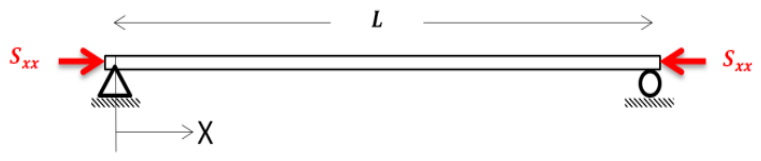
The matrix X , which characterizes the applied loading conditions, is formulated for the buckling analysis [13], as illustrated in Figure 4.
X = 0 0 0 0 X V W 0 0 0 X U 3 n × 3 n
X i j U = S x x u ¯ i u ¯ j d s , i , j = 1 , , n
X i j V W = S x x w ¯ i w ¯ j + v ¯ i v ¯ j d s i , j = 1 , , n
where S x x denotes the pre-buckling longitudinal membrane force resultant per unit width acting along the beam walls, obtained from the applied compressive loading state prior to instability. The displacement amplitudes can be conveniently expressed in vector form, as given below:
Φ = φ φ I φ I I , φ i I = φ i x ,   φ i I I = 2 φ i x 2 ,   i = 1 , 2 , , n
Additionally, Φ is defined as the product of matrix Ψ and vector a :
Φ = Ψ × a
In this formulation, Ψ represents the matrix of shape functions expressed as functions of x, having dimensions of 3n × m. The vector a contains the corresponding unknown coefficients that define these shape functions. As is well established, the φ functions exhibit a trigonometric nature. Accordingly, they may be approximated by expressing them as a series of trigonometric terms with undetermined coefficients:
Simply   supported   B . C . :   φ = i = 1 m a i sin i π x L ,
Clamped   B . C . :   φ = i = 1 m a i 1 cos 2 i π x L
a = a 1 a 2 a m
where m denotes the number of unknown coefficients, corresponding to the degrees of freedom (DOFs) in the assumed shape functions. In this work, both simply supported and clamped boundary conditions are examined to develop and validate the proposed formulation. Trigonometric trial functions are employed within the Ritz framework, as they naturally satisfy the displacement amplitude requirements and ensure rotational compatibility at the supports. The edges parallel to the x-axis are treated as free:
Simply   supported   B . C . :   f i = sin i Π x L ,
Clamped   B . C . :   f i = 1 cos 2 i π x L
f i = d f i d x , f i = d 2 f i d x 2 , i = 1 , 2 , , m
Although unsymmetric laminates introduce additional coupling through the B 16 and B 26 terms, the Ritz approximation remains applied to the modal amplitudes rather than directly to the displacement components. The coupling effects are incorporated through the stiffness matrices and therefore do not require modified admissible functions.
To ensure admissibility and numerical stability within the variational framework, the longitudinal approximation functions were selected such that the essential kinematic constraints are inherently satisfied for each support configuration. For simply supported members, the adopted basis permits compatible transverse deformation while maintaining zero modal amplitudes at the beam ends. In contrast, the clamped formulation additionally suppresses end rotations through higher-continuity trigonometric representations. This choice of approximation space improves the conditioning of the generalized eigenvalue problem and enables efficient representation of both global and localized instability patterns using a relatively limited number of generalized coordinates. Furthermore, the selected functions preserve smooth modal transitions along the beam axis, which is particularly important for capturing coupling-sensitive responses in unsymmetric laminate configurations.
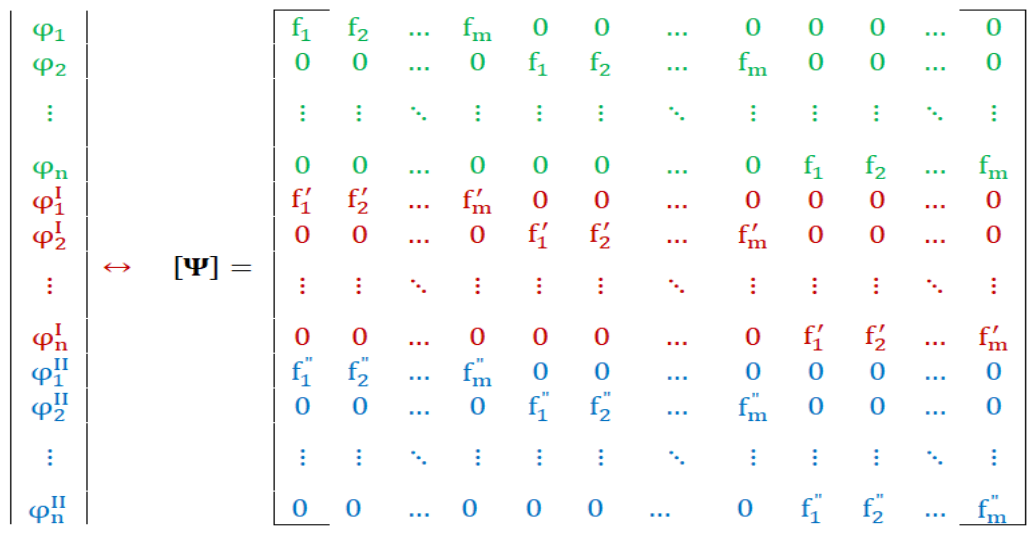
Ψ is assembled as illustrated in Figure 5. The applied load is then scaled using the load multipliers, λ i , obtained from the corresponding eigenvalue problem:
K + λ G a = 0
where K denotes the stiffness matrix associated with the reference configuration Ξ , while G represents the incremental geometric stiffness matrix arising from the applied loading conditions X . The scalar values λ correspond to the eigenvalues, and the vector a defines the associated buckling mode shapes and the eigenvectors:
K = 0 L Ψ t Ξ ^ Ψ + Ψ t Ξ ˇ Ψ + Ψ t Ξ ~ Ψ d x = 0 L Ψ t Ξ ^ + Ξ ˇ + Ξ ~ Ψ d x
G = 0 L Ψ t X Ψ d x
K and G denote symmetric GBT modal matrices of size m × m . In most cases, the primary focus is on the smallest eigenvalue, λ , as it corresponds to the critical buckling condition. The associated buckling mode shape vector, a , is typically normalized and therefore does not reflect the true deformation amplitudes at the critical load.
The present formulation can be extended to continuous beams with intermediate support by introducing piecewise admissible longitudinal functions and enforcing compatibility conditions at internal constraint locations. In such cases, the Ritz approximation may be constructed separately over multiple beam segments while preserving displacement continuity and equilibrium at the connecting interfaces.

2.3. Energy-Based Modal Participation Analysis

Following the solution of the generalized eigenvalue problem (Equation (47)), the obtained eigenvector a defines the buckling mode in terms of the adopted GBT modal basis. However, this vector does not directly provide physical insight into the relative contribution of the individual deformation mechanisms. Therefore, a mode decomposition procedure is performed to quantify the participation of each GBT mode. The displacement field is expressed in terms of modal amplitudes using Equation (40), where Ψ contains the longitudinal shape functions and a represents the modal coefficients. Each component of a corresponds to a specific GBT deformation mode (global bending, torsion, distortional, local, or shear modes). To evaluate the contribution of each mode, an energy-based decomposition is adopted. The total strain energy of the system is given by Equation (10), where Ξ is the GBT stiffness matrix composed of conventional, shear, and interaction terms (Equations (12)–(14)). The contribution of the i -th mode is computed by isolating its corresponding terms in the modal expansion,
U i = 0 L φ i t Ξ φ i d x
where φ i includes only the components associated with mode i. The normalized modal participation is then defined as:
ρ i = U i j = 1 n U j i = 1 n ρ i = 1
For interpretation, individual modes are grouped into families (global, distortional, local, and shear). The participation of each family is obtained by summing the corresponding ρ i . This decomposition enables a clear identification of the dominant buckling mechanisms and their evolution with varying structural parameters, providing deeper physical insight into the interaction between different deformation modes. Although the modal participation factors are computed using individual modal contributions, the stiffness matrix itself contains all coupling effects arising from laminate anisotropy and mode interaction. Consequently, the extracted modal energies are evaluated from the fully coupled eigenvector solution and therefore indirectly include the influence of interaction terms.

3. Results and Discussion

This section provides a detailed comparison of the buckling response of orthotropic thin-walled beams predicted using GBT in combination with the Ritz method and finite element results obtained from ABAQUS V2017. The objective is to evaluate the reliability and consistency of the GBT–Ritz formulation by benchmarking it against numerical simulations for both symmetric and unsymmetric laminate configurations. Particular attention is given to critical buckling loads, associated mode shapes, the influence of boundary conditions, and the contribution of individual deformation modes to the overall structural stability. A range of cross-sectional configurations is investigated, including open and closed as well as branched and unbranched profiles, such as C-sections, I-sections, rectangular hollow sections (RHSs), and single-stiffener box girders. Moreover, the selected geometries reflect typical applications in aerospace structures, where lightweight yet stable components are essential. Beam lengths between 200   m m and 1500   m m are considered to represent practical structural dimensions encountered in such applications. Table 1 summarizes the thickness ranges and laminate configurations considered for the different sections analyzed in this study. Furthermore, Table 2 presents the material properties adopted for the aerospace-grade Carbon Fiber Reinforced Plastic (CFRP) IM//8552.
Finite element simulations were performed in ABAQUS V2017/Standard using S4R shell elements to validate the proposed GBT–Ritz formulation. Structured meshes with local refinement near corners, stiffener junctions, and branching regions were adopted to capture local and distortional instability modes accurately. Mesh convergence studies were conducted for all representative cross-sections, and the mesh density was increased until the variation in the predicted critical buckling loads remained below approximately 1%. Simply supported and clamped boundary conditions were implemented consistently with the assumptions adopted in the GBT–Ritz formulation.

3.1. Thin-Walled Beams with Unsymmetric Stacking Sequence

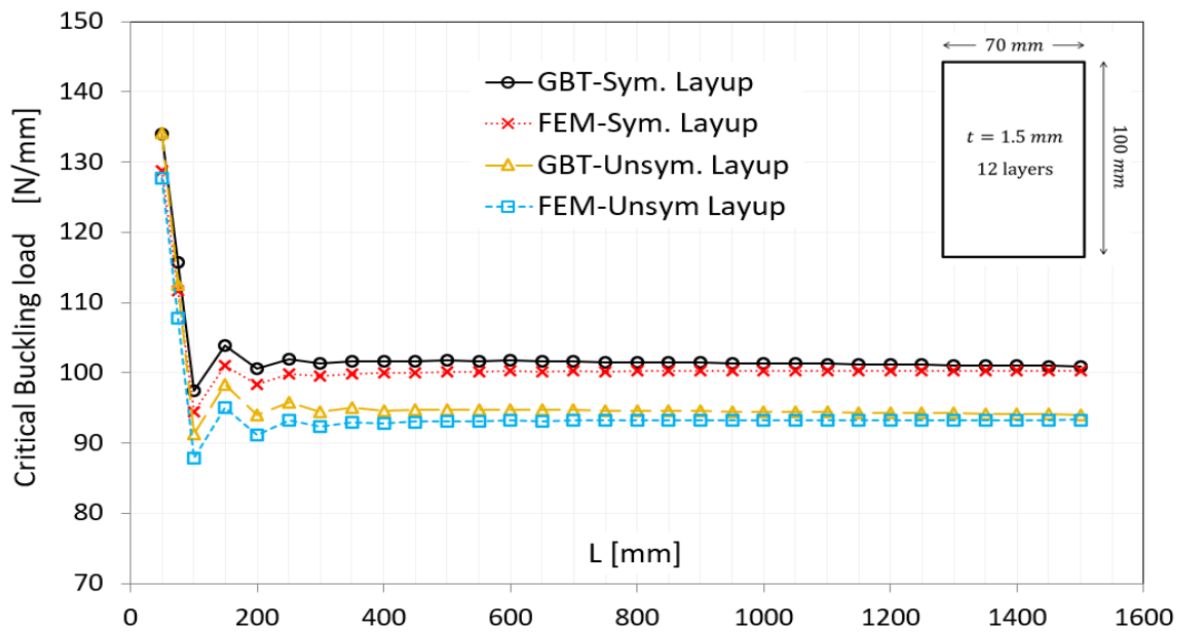
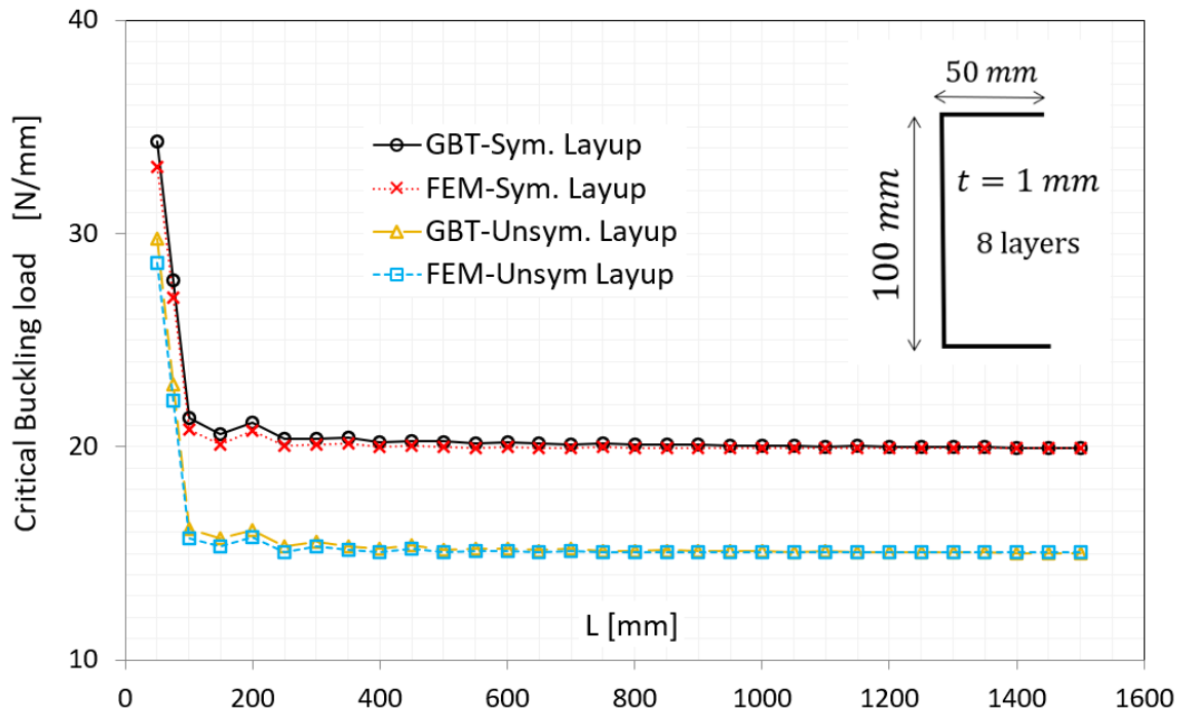
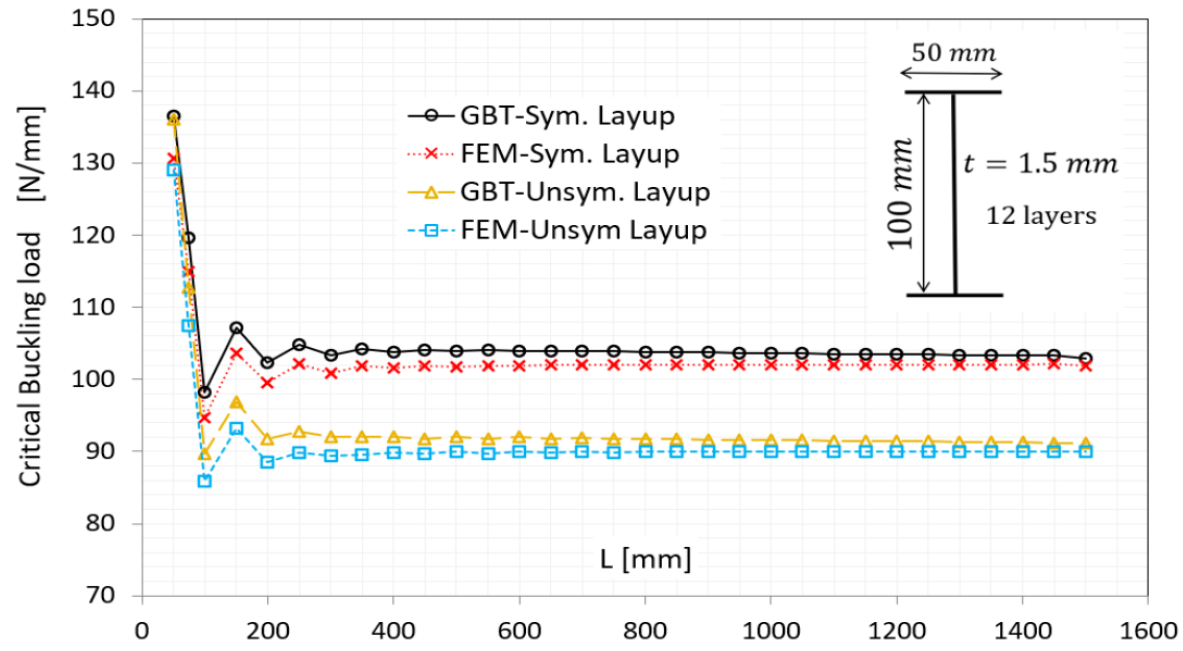
The influence of unsymmetric stacking sequences on the buckling behavior of thin-walled composite beams is examined through a comparison of critical loads obtained using the GBT–Ritz formulation and finite element method (FEM) simulations. The results, presented in Figure 6, Figure 7, Figure 8 and Figure 9, highlight the role of membrane–bending coupling and its dependence on both beam length and cross-sectional geometry.
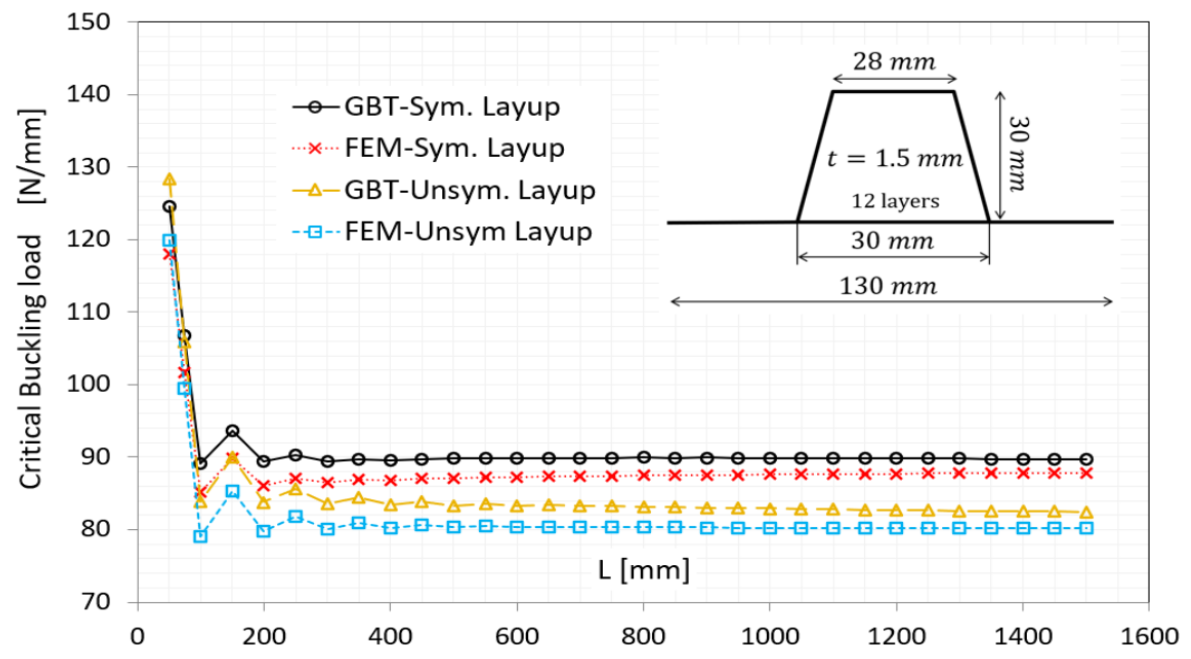
Figure 6 illustrates the variation in the critical buckling load with beam length for C-section beams. A clear distinction is observed between symmetric and unsymmetric laminates. The unsymmetric configuration consistently results in lower critical loads, particularly in the short-to-intermediate length range. This reduction is attributed to the presence of coupling terms in the laminate stiffness matrix, which introduce additional deformation components and effectively reduce structural stiffness. As the beam length increases, the curves tend to converge toward an asymptotic value, indicating a transition from local or distortional buckling modes to global buckling behavior (Table 3). The agreement between GBT and FEM results is excellent across the entire length range, confirming the accuracy of the proposed formulation.
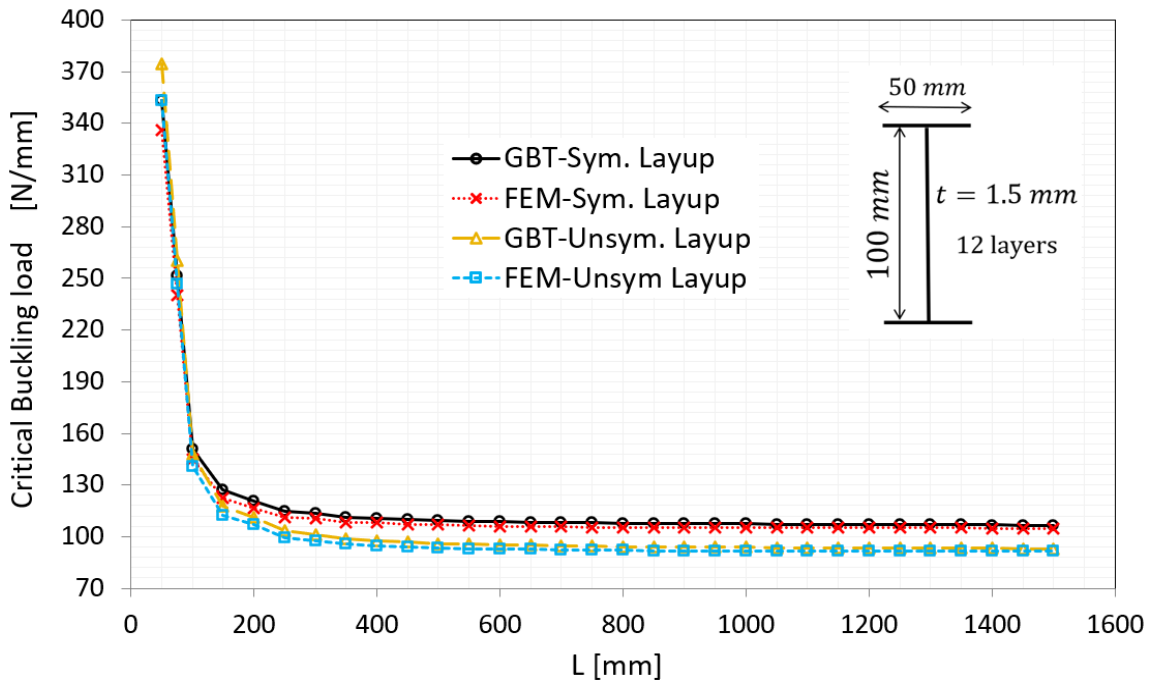
A similar trend is observed for I-section beams in Figure 7, although the magnitude of the critical loads is significantly higher due to the increased bending stiffness of the cross-section. The influence of unsymmetry remains evident, with unsymmetric laminates yielding lower buckling loads compared to their symmetric counterparts. However, the relative difference between the two configurations is slightly reduced compared to the C-section case. This suggests that the structural stiffness provided by the I-section geometry partially mitigates the destabilizing effect of laminate coupling. Again, the close agreement between GBT and FEM demonstrates the robustness of the method.
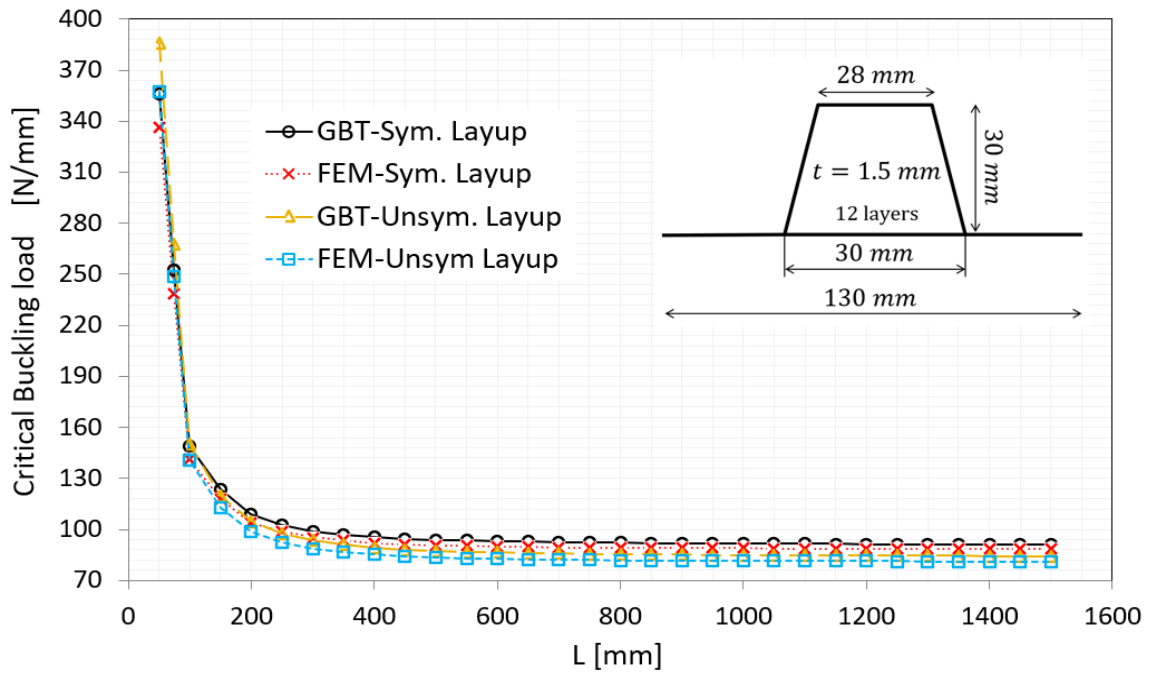
Figure 8 presents the results for RHS beams. In this case, the effect of unsymmetric stacking is less pronounced than in open sections. The closed geometry introduces additional constraints on warping and deformation, which reduces the sensitivity to laminate coupling effects. Consequently, the difference between symmetric and unsymmetric configurations is relatively small, particularly for longer beams. The buckling curves show a rapid decrease in critical load for short lengths, followed by a plateau, indicating a shift from local to global instability modes. For the shortest C-section beam (Figure 5) considered, the unsymmetric laminate reduced the critical buckling load by approximately 9.09% relative to the symmetric configuration. In contrast, the corresponding reduction for the RHS (Figure 8) was only 0.77%, confirming the reduced sensitivity of closed sections to laminate coupling. The consistency between GBT and FEM results further supports the validity of the formulation for closed sections.
The behavior of single-stiffener box girders is shown in Figure 9. These structures exhibit a more complex response due to the interaction between the stiffener and the base plates. The presence of unsymmetric laminates leads to a noticeable reduction in critical load, particularly in the intermediate length range where distortional modes are dominant (Table 3). The stiffener introduces additional coupling between local and global deformation modes, amplifying the influence of laminate asymmetry. Despite this complexity, the GBT–Ritz predictions remain in very close agreement with FEM results, demonstrating the capability of the method to capture intricate mode interactions.

3.2. Clamped Boundary Conditions

The influence of clamped-clamped (CC) boundary conditions on the buckling behavior of thin-walled composite beams is examined in Figure 10, Figure 11, Figure 12 and Figure 13. Compared to the simply supported-simply supported (SS) case discussed previously, the clamped configuration imposes stricter kinematic constraints by enforcing both zero displacement and zero rotation at the beam ends. As a result, the structural stiffness is significantly increased, which is directly reflected in higher critical buckling loads and altered mode characteristics.
Figure 10 presents the variation in the critical buckling load with beam length for I-section beams under clamped boundary conditions. A clear increase in buckling resistance is observed across the entire length range compared to the simply supported case. The curves exhibit a steep decrease in critical load for short beam lengths, followed by a gradual convergence toward a plateau for longer beams. This trend indicates a transition from local or distortional buckling modes to global buckling behavior, similar to the SS case, but occurring at higher load levels due to the additional rotational restraint. Furthermore, the difference between symmetric and unsymmetric laminates remains visible, although it becomes less pronounced than in the simply supported configuration. This suggests that the boundary-induced stiffness partially suppresses the influence of membrane–bending coupling. The reduced sensitivity of clamped beams to laminate asymmetry can be attributed to the suppression of coupling-induced rotations and warping deformations at the supports. The rotational restraint imposed by clamped boundaries limits the development of membrane–bending coupling effects, thereby reducing their influence on the overall buckling response.
A similar response is observed for the single-stiffener box girder in Figure 11. The presence of the stiffener introduces additional interaction between local, distortional, and global modes, which is further influenced by the clamped supports. The critical loads are consistently higher than those obtained under simply supported conditions, while the overall shape of the curves remains comparable. The effect of unsymmetric stacking sequences is still evident, particularly in the short-to-intermediate length range, where coupling effects are more pronounced. However, as the beam length increases, the curves for symmetric and unsymmetric laminates converge, indicating that global buckling dominates and reduces sensitivity to laminate asymmetry.
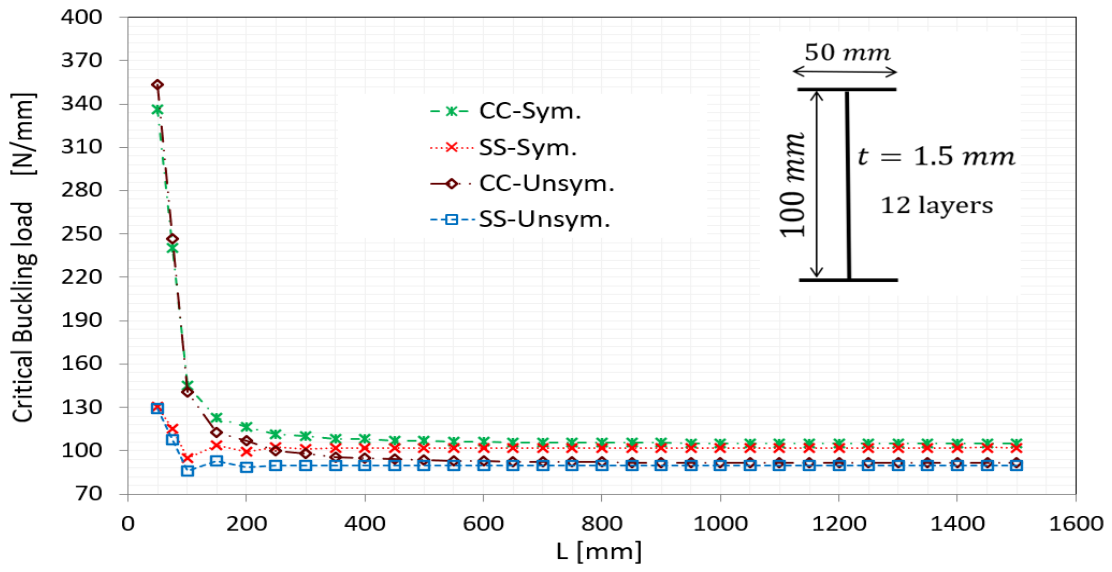
Figure 12 provides a direct comparison between simply supported and clamped boundary conditions for I-section beams. The results clearly demonstrate that clamped supports lead to significantly higher critical buckling loads across all beam lengths. The difference is especially notable in the short-length regime, where local and distortional modes are dominant. As the beam length increases, the gap between SS and CC conditions decreases, reflecting the increasing dominance of global buckling modes, which are less sensitive to boundary conditions. This comparison highlights the critical role of support conditions in determining both the magnitude of the buckling load and the governing instability mechanism.
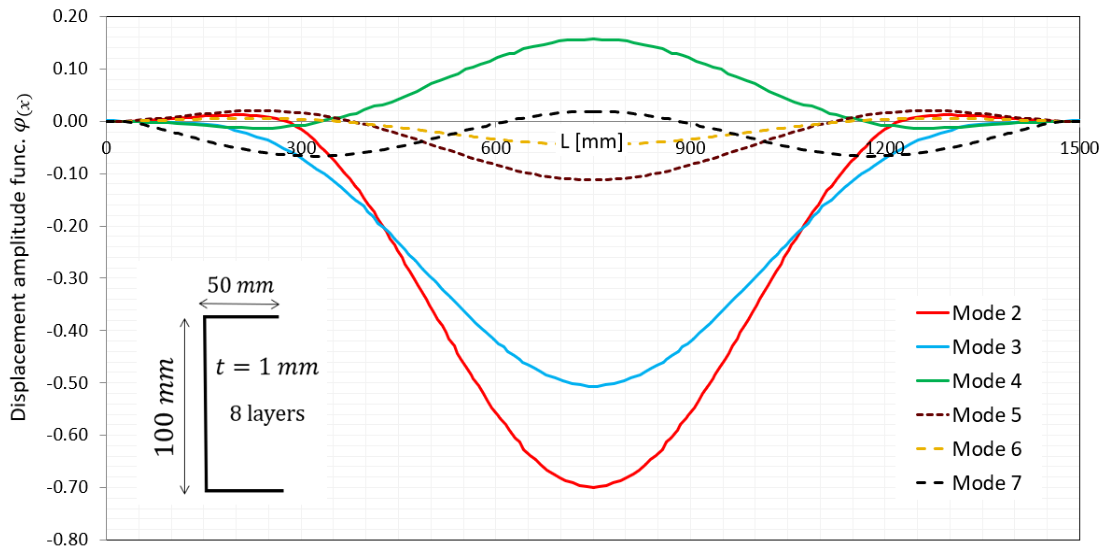
Finally, Figure 13 illustrates the longitudinal displacement amplitude functions for different buckling modes under clamped boundary conditions. The shape functions exhibit the expected characteristics of clamped beams, with zero displacement and zero slope at both ends. Unlike the sinusoidal distributions observed for simply supported beams, the clamped mode shapes are more constrained and exhibit higher curvature near the supports. This behavior confirms the suitability of the adopted Ritz trial functions, which inherently satisfy the clamped boundary conditions through the cosine-based formulation. Moreover, the variation among different modes (global bending, torsion, and local modes) highlights the ability of the GBT–Ritz framework to capture distinct deformation patterns while maintaining consistency with the imposed boundary constraints.

3.3. Mode Decomposition

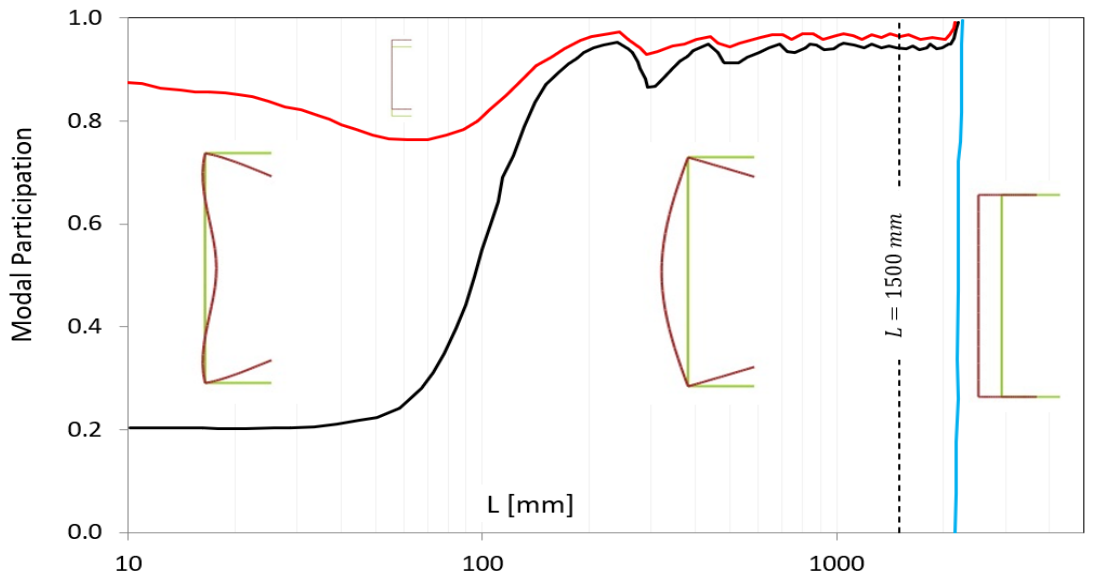
The mode decomposition results provide detailed insight into the evolution of dominant buckling mechanisms as a function of beam length. Figure 14 illustrates the modal participation for the C-section beam, where a clear transition from local/distortional behavior to global buckling is observed. At short lengths, the response is governed by local plate-type and distortional modes, reflected by a more distributed modal contribution. As the beam length increases, the participation gradually shifts toward global bending modes, which become dominant beyond a critical length range. This transition is smooth and highlights the sensitivity of open sections to length-dependent instability mechanisms.
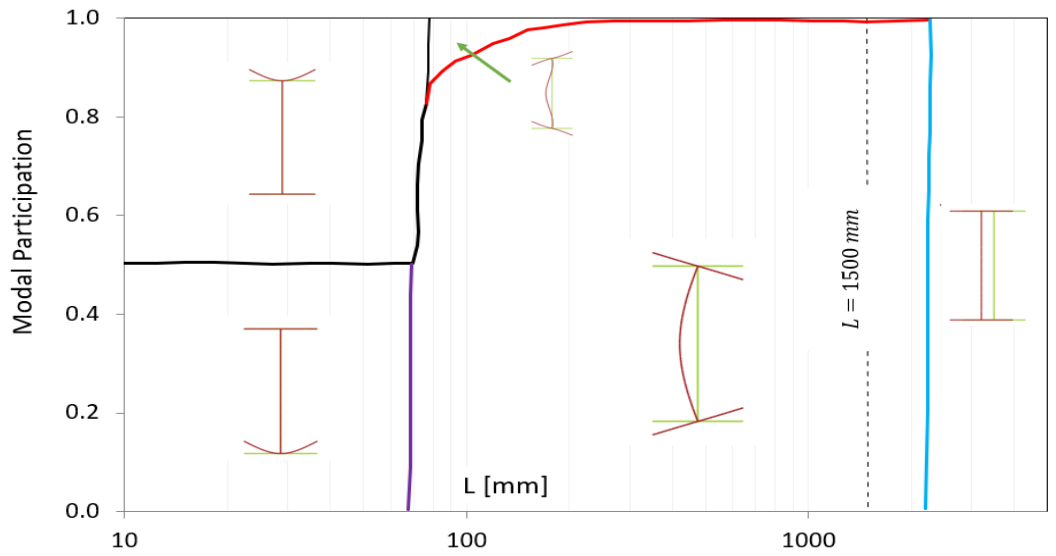
A similar but more pronounced behavior is observed for the I-section in Figure 15. Due to its higher bending stiffness, the transition from local to distortional modes occurs more abruptly compared to the C-section. The modal participation curves indicate that global bending rapidly becomes the governing mechanism even at relatively short beam lengths. This reflects the structural efficiency of the I-section in suppressing local instabilities, effectively concentrating the deformation into global modes.
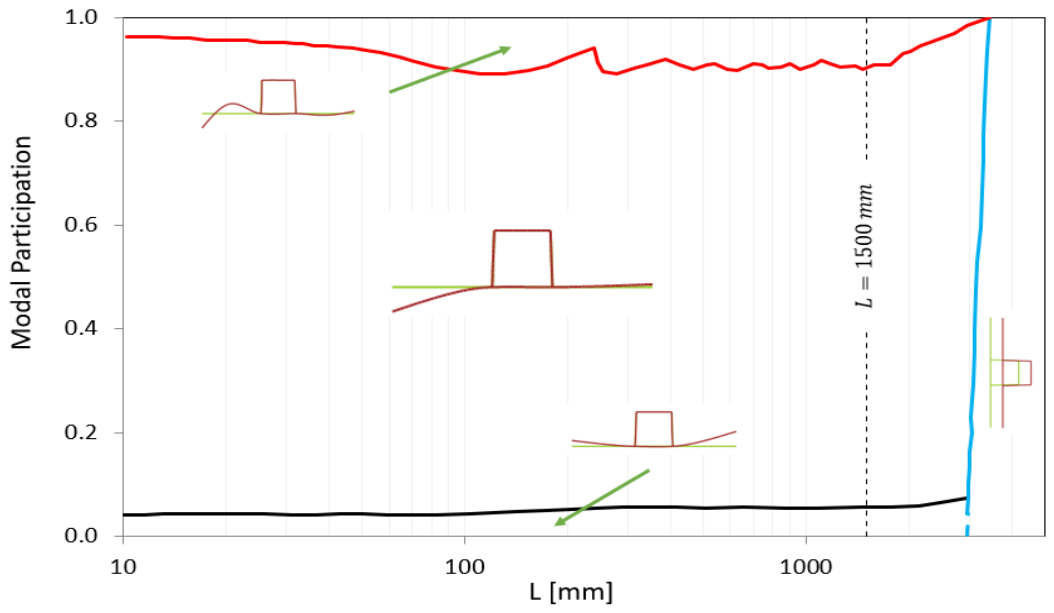
In contrast, the single-stiffener box girder shown in Figure 16 exhibits a more complex interaction between modes. The modal decomposition reveals a persistent contribution of local modes over a wide range of beam lengths, due to the presence of the stiffener and the associated coupling between plate elements. Although global modes eventually dominate for long beams, the transition is less distinct compared to open sections.
The observed redistribution of modal participation with increasing beam length also highlights the strong sensitivity of thin-walled composite members to interaction between competing instability mechanisms. In particular, when global bending modes evolve simultaneously with local or distortional deformation patterns, the resulting coupled response may reduce the structural reserve beyond what would be predicted from isolated mode analysis. This behavior becomes more pronounced in unsymmetric laminates because membrane–bending coupling alters the relative stiffness balance between sectional and member-level deformation modes. In certain intermediate length regimes, rapid shifts in dominant modal participation indicate the presence of closely spaced eigenmodes, which may lead to increased imperfection sensitivity and abrupt changes in the governing instability pattern. From a structural design perspective, these interaction effects should be carefully considered during laminate tailoring and geometric optimization, particularly for lightweight aerospace structures where stability margins are critical. Increasing sectional torsional rigidity, avoiding excessive stiffness anisotropy, and maintaining sufficient separation between local and global critical modes can help reduce the risk of coupling-driven instability amplification.

3.4. Accuracy and Efficiency

The accuracy and computational efficiency of the proposed GBT–Ritz formulation are evaluated through a direct comparison with shell FEM results, as summarized in Table 4, Table 5 and Table 6. These tables provide a quantitative assessment of both the predictive capability and the computational performance of the method across different cross-sectional configurations and laminate types.
Statistical comparisons between the GBT–Ritz and FEM results were performed using the data from Figure 6, Figure 7, Figure 8 and Figure 9, including the mean relative error and standard deviation for all analyzed cases. The results (Table 4) show excellent agreement between the proposed formulation and FE shell models, with mean relative errors generally below 2%, including for unsymmetric laminates with membrane–bending coupling effects. The largest discrepancies occur mainly in the short-to-intermediate beam-length range, where local–distortional interactions are more significant. Overall, the low standard deviation values confirm the stable and reliable predictive capability of the proposed GBT–Ritz framework across different cross-sections and instability regimes.
As shown in Table 5, the GBT–Ritz predictions of the critical buckling loads exhibit very close agreement with the corresponding FEM results for all investigated cases. The deviations remain consistently small across the entire range of beam lengths and cross-sectional geometries, confirming the reliability of the reduced-order formulation. Importantly, this level of accuracy is maintained not only for symmetric laminates but also for unsymmetric stacking sequences, indicating that the formulation successfully incorporates membrane–bending coupling effects. The consistency of the results across different structural configurations further demonstrates that the selected modal basis is sufficiently comprehensive to capture global, local, and distortional deformation mechanisms without the need for excessive modal enrichment.
Additional insight is provided by Table 6, where the computational efficiency of the two approaches is compared. For the box-girder example, the GBT–Ritz formulation results in a system of only 9 × 8 , involving nine unknown modal amplitude coefficients, whereas the corresponding FEshell model comprises approximately 5000 degrees of freedom. Despite this drastic reduction in system size, the accuracy remains largely unaffected, as evidenced in Table 5. This highlights the effectiveness of the modal decomposition inherent in the GBT framework, which allows the dominant deformation mechanisms to be represented using a compact set of physically meaningful modes.
All simulations were performed on a standard workstation equipped with an AMD Ryzen 7 3700X processor and 32 GB of RAM, ensuring a consistent basis for comparison. As reported in Table 6, the computational time required by the GBT–Ritz method is significantly lower than that of the finite element model, resulting in an average speed-up factor of approximately 1.5 to 2.5. This improvement is particularly notable considering that the FEM model involves a much finer spatial discretization and correspondingly higher computational overhead. Furthermore, the results indicate that for unsymmetric laminate configurations under clamped boundary conditions, the differences in predicted critical loads compared to symmetric cases are negligible. This observation suggests that, while laminate asymmetry introduces additional coupling effects, its influence on the overall buckling load may remain limited for the configurations considered.

4. Conclusions

This study presented an efficient GBT–Ritz formulation for the buckling analysis of thin-walled composite beams with both symmetric and unsymmetric laminate configurations. By combining the modal decomposition capabilities of Generalized Beam Theory (GBT) with the computational efficiency of the Ritz method, the proposed framework provides a physically transparent and computationally attractive alternative to conventional shell finite element analyses. The main findings of the study can be summarized as follows:
  • The proposed formulation successfully captures global, local, distortional, torsional, and shear-related buckling modes in thin-walled composite beams with open, closed, branched, and unbranched cross-sections.
  • Membrane–bending coupling effects associated with unsymmetric laminates were consistently incorporated into the formulation through the laminate stiffness matrices, enabling the analysis of more general laminate configurations than those considered in previous GBT–Ritz studies.
  • Excellent agreement was achieved between the GBT–Ritz predictions and shell finite element results, with discrepancies generally remaining below 6% across the benchmark problems investigated.
  • The developed approach substantially reduced computational effort compared with conventional finite element eigenvalue analyses, providing speed-up factors ranging from approximately 1.5 to 2.5 while preserving clear physical insight into the underlying instability mechanisms.
  • Unsymmetric laminates were found to reduce the critical buckling load, particularly in open sections and intermediate beam lengths where coupling effects become dominant.
Overall, the results demonstrate that the proposed GBT–Ritz framework can accurately predict the buckling behavior of thin-walled composite beams while maintaining a significantly lower computational cost than shell finite element models. The method, therefore, represents an efficient tool for preliminary design, parametric studies, and stability assessment of lightweight composite structures, particularly in aerospace applications where laminate tailoring and weight optimization are critical.
The present formulation is based on linear eigenvalue buckling theory and assumes small deformations within the framework of linear elasticity. Consequently, geometric imperfections, material nonlinearities, and post-buckling effects are not considered. In addition, the formulation accounts for warping-induced membrane shear modes within the GBT framework but does not explicitly incorporate higher-order transverse shear deformation theories. Therefore, caution should be exercised when applying the method to thick-walled members, highly nonlinear response regimes, or imperfection-sensitive structures where post-buckling behavior plays a significant role. Future developments may focus on extending the framework toward geometrically nonlinear and post-buckling analyses.

Author Contributions

N.K.: methodology, programming, software, validation, formal analysis, investigation, and writing—original draft preparation. C.M.: supervision, project administration, funding acquisition, and writing—review and editing. All authors have read and agreed to the published version of the manuscript.

Funding

Financial support of the German Research Council: (DFG—Deutsche Forschungsgemeinschaft), project number: 510739591.

Data Availability Statement

The raw and processed data supporting these findings are not available at this time, as they are part of an ongoing study.

Acknowledgments

The authors gratefully acknowledge the financial support of the German Research Council (DFG—Deutsche Forschungsgemeinschaft), project number 510739591.

Conflicts of Interest

The authors declare the following financial interests which may be considered as potential competing interests: Financial support of the German Research Council: (DFG—Deutsche Forschungsgemeinschaft), project number: 510739591.

References

  1. Librescu, L.; Song, O. Thin-Walled Composite Beams; Springer: Dordrecht, The Netherlands, 2006. [Google Scholar]
  2. Ziakos, N.; Kilimtzidis, S.; Kostopoulos, V. Multidisciplinary aeroelastic optimization of high aspect-ratio composite aircraft wings via tow-steering. CEAS Aeronaut. J. 2026, 17, 399–419. [Google Scholar] [CrossRef]
  3. Zhang, G.; Hu, Y.; Yan, B.; Tong, M.; Wang, F. Buckling and post-buckling analysis of composite stiffened panels: A ten-year review (2014–2023). Thin-Walled Struct. 2024, 205, 112525. [Google Scholar] [CrossRef]
  4. Vermes, B.; Tsai, S.W.; Massard, T.; Springer, G.S.; Czigany, T. Design of laminates by a novel “double–double” layup. Thin-Walled Struct. 2021, 165, 107954. [Google Scholar] [CrossRef]
  5. Mittelstedt, C. Buckling and Post-Buckling of Thin-Walled Composite Laminated Beams—A Review of Engineering Analysis Methods. Appl. Mech. Rev. 2020, 72, 020802. [Google Scholar] [CrossRef]
  6. Vo, T.P.; Lee, J. On sixfold coupled buckling of thin-walled composite beams. Compos. Struct. 2009, 90, 295–303. [Google Scholar] [CrossRef][Green Version]
  7. Schardt, R. Verallgemeinerte Technische Biegetheorie: Lineare Probleme; Springer: Berlin/Heidelberg, Germany, 1989. [Google Scholar]
  8. Schardt, R. Generalized beam theory—An adequate method for coupled stability problems. Thin-Walled Struct. 1994, 19, 161–180. [Google Scholar] [CrossRef]
  9. Mittelstedt, C. Generalized beam theory for the analysis of thin-walled structures—A state-of-the-art survey. Thin-Walled Struct. 2024, 200, 111849. [Google Scholar] [CrossRef]
  10. Dinis, P.B.; Camotim, D.; Silvestre, N. GBT formulation to analyse the buckling behaviour of thin-walled members with arbitrarily ‘branched’ open cross-sections. Thin-Walled Struct. 2006, 44, 20–38. [Google Scholar] [CrossRef]
  11. Silvestre, N.; Camotim, D. Generalized Beam Theory to Analyze the Vibration of Open-Section Thin-Walled Composite Members. J. Eng. Mech. 2013, 139, 992–1009. [Google Scholar] [CrossRef]
  12. Silvestre, N.; Camotim, D. Shear Deformable Generalized Beam Theory for the Analysis of Thin-Walled Composite Members. J. Eng. Mech. 2013, 139, 1010–1024. [Google Scholar] [CrossRef]
  13. Kharghani, N.; Mittelstedt, C. Global–Local–Distortional Buckling of Shear-Deformable Composite Beams with Open Cross-Sections Using a Novel GBT–Ritz Approach. J. Compos. Sci. 2025, 9, 608. [Google Scholar] [CrossRef]
  14. Mittelstedt, C. The Ritz Method for Buckling Analysis of Shear-Deformable Laminates. In Mechanics of Composite Structures; Springer: Berlin/Heidelberg, Germany, 2025; pp. 511–563. [Google Scholar]
  15. Vescovini, R.; Dozio, L.; D’Ottavio, M.; Polit, O. On the application of the Ritz method to free vibration and buckling analysis of highly anisotropic plates. Compos. Struct. 2018, 192, 460–474. [Google Scholar] [CrossRef]
  16. Moreno-García, P.; Araújo dos Santos, J.V.; Lopes, H. A Review and Study on Ritz Method Admissible Functions with Emphasis on Buckling and Free Vibration of Isotropic and Anisotropic Beams and Plates. Arch. Comput. Methods Eng. 2018, 25, 785–815. [Google Scholar] [CrossRef]
  17. Kuehn, T.; Pasternak, H.; Mittelstedt, C. Local buckling of shear-deformable laminated composite beams with arbitrary cross-sections using discrete plate analysis. Compos. Struct. 2014, 113, 236–248. [Google Scholar] [CrossRef]
  18. Herrmann, J.; Kühn, T.; Müllenstedt, T.; Mittelstedt, S.; Mittelstedt, C. A Higher Order Shear Deformation Approach to the Local Buckling Behavior of Moderately Thick Composite Laminated Beams. Int. J. Struct. Stab. Dyn. 2018, 18, 1850139. [Google Scholar] [CrossRef]
  19. Banić, D.; Turkalj, G.; Lanc, D. Stability analysis of shear deformable cross-ply laminated composite beam-type structures. Compos. Struct. 2023, 303, 116270. [Google Scholar] [CrossRef]
  20. Banić, D.; Turkalj, G.; Lanc, D. A geometrically nonlinear finite element formulation for buckling analysis of shear deformable angle-ply composite beam-type structures. Comput. Struct. 2024, 301, 107427. [Google Scholar] [CrossRef]
  21. Banić, D.; Turkalj, G.; Kvaternik Simonetti, S.; Lanc, D. Numerical Model for a Geometrically Nonlinear Analysis of Beams with Composite Cross-Sections. J. Compos. Sci. 2022, 6, 377. [Google Scholar] [CrossRef]
  22. Kappel, E. On the Double-Double Laminate Buckling Optimum for the 18-Panel ‘Horse-Shoe’ Reference Case. J. Compos. Sci. 2024, 8, 77. [Google Scholar] [CrossRef]
  23. Turan, F. Lateral–torsional buckling of porous orthotropic thin-walled I-beams under non-uniform transverse loadings: A higher-order shear deformation approach. Int. J. Mech. Mater. Des. 2026, 22, 37. [Google Scholar] [CrossRef]
  24. Turan, F.; Kalay, C.; Kurtulus, I.; Ersen, B. Orthotropic foundation effect on nonlinear bending, buckling, and post-buckling of porous orthotropic laminated beams under non-uniform axially and transversely varying loadings. Mech. Adv. Mater. Struct. 2026, 33, 2647103. [Google Scholar] [CrossRef]
  25. Turan, F. Nonlinear bending, buckling and post-buckling of higher-order shear deformable porous beams subjected to axially varying compressions and linearly varying transverse loadings. Thin-Walled Struct. 2025, 217, 113853. [Google Scholar] [CrossRef]
  26. Turan, F.; Basoglu, M.F.; Hoang, V.N.V. Lateral torsional stability of porous thin-walled I-beams with nonuniform porosity distributions subjected to a uniformly distributed load. Acta Mech. 2025, 236, 153–171. [Google Scholar] [CrossRef]
  27. Silvestre, N.; Camotim, D. First Order Generalised Beam Theory for Arbitrary Orthotropic Materials. Thin-Walled Struct. 2002, 40, 755–789. [Google Scholar] [CrossRef]
  28. Vlasov, V.Z. Thin-Walled Elastic Beams; Israel Program for Scientific Translations: Jerusalem, Israel, 1961. [Google Scholar]
  29. Koerber, H.; Camanho, P.P. High strain rate characterisation of unidirectional carbon-epoxy IM7-8552 in longitudinal compression. Compos. Part A Appl. Sci. Manuf. 2011, 42, 462–470. [Google Scholar] [CrossRef]
Figure 1. Illustration of the geometric characteristics, including natural and intermediate nodes, for various cross-sectional profiles: (a) a detailed view of a C-section, (b) a standard C-section, (c) an I-section, (d) a rectangular hollow section (RHS), and (e) a box girder with a single stiffener.
Jcs 10 00307 g001
Figure 2. Conventional and distortional deformation modes are considered for a C-section composite beam, together with the rigid-body modes. The four primary deformation modes include axial extension (Mode 1), bending about the major and minor axes (Modes 2 and 3), and torsional deformation (Mode 4).
Jcs 10 00307 g002
Figure 3. Laminate parameters shown in (a) thickness direction and (b) plan view.
Jcs 10 00307 g003
Figure 4. Buckling load on a thin-walled beam with the effective length L.
Jcs 10 00307 g004
Figure 5. The schematic of Ψ matrix assembly.
Jcs 10 00307 g005
Figure 6. Comparison of critical buckling load as a function of beam length for thin-walled composite C-section beams with symmetric and unsymmetric layups under simply supported boundary conditions, using FEM and GBT.
Jcs 10 00307 g006
Figure 7. Comparison of critical buckling load as a function of beam length for thin-walled composite I-section beams with symmetric and unsymmetric layups under simply supported boundary conditions, using FEM and GBT.
Jcs 10 00307 g007
Figure 8. Comparison of critical buckling load as a function of beam length for thin-walled composite RHS beams with symmetric and unsymmetric layups under simply supported boundary conditions, using FEM and GBT.
Jcs 10 00307 g008
Figure 9. Comparison of critical buckling load as a function of beam length for thin-walled composite single-stiffener box girder with symmetric and unsymmetric layups under simply supported boundary conditions, using FEM and GBT.
Jcs 10 00307 g009
Figure 10. Comparison of critical buckling load as a function of beam length for thin-walled composite I-section beams with symmetric and unsymmetric layups under clamped boundary conditions, using FEM and GBT.
Jcs 10 00307 g010
Figure 11. Comparison of critical buckling load as a function of beam length for thin-walled composite single-stiffener box girder with symmetric and unsymmetric layups under clamped boundary conditions, using FEM and GBT.
Jcs 10 00307 g011
Figure 12. Comparison of critical buckling load as a function of beam length for thin-walled composite I-section beams with symmetric and unsymmetric layups under both simply supported (SS) and clamped (CC) boundary conditions, using GBT.
Jcs 10 00307 g012
Figure 13. Longitudinal displacement amplitude functions for thin-walled composite C-section beams under clamped boundary conditions, obtained using GBT for different buckling modes (Table 3).
Jcs 10 00307 g013
Figure 14. Mode decomposition of thin-walled composite C-section beams using GBT under buckling conditions for varying beam lengths (Table 3) (The solid lines denote the boundaries between the GBT mode families).
Jcs 10 00307 g014
Figure 15. Mode decomposition of thin-walled composite I-section beams using GBT under buckling conditions for varying beam lengths (Table 3) (The solid lines denote the boundaries between the GBT mode families).
Jcs 10 00307 g015
Figure 16. Mode decomposition using GBT for thin-walled composite single-stiffener box girder beams under buckling, considering varying beam lengths (Table 3) (The solid lines denote the boundaries between the GBT mode families).
Jcs 10 00307 g016
Table 1. Thickness and laminate configurations considered for the different sections analyzed in this study.
N. of LayersThicknessSymmetric LayupUnsymmetric LayupSections
8 1   m m 45 ° / 45 ° / 0 ° / 90 ° s 45 ° / 45 ° / 0 ° / 90 ° 2 C
12 1.5   m m 45 ° / 45 ° / 0 ° / 90 ° / 0 ° / 45 ° s 45 ° / 45 ° / 0 ° / 90 ° / 0 ° / 45 ° 2 Other sections
Table 2. Material properties used for the aerospace-grade CFRP-IM/8552 [29].
E 1 = 171.4   G P a E 2 = 9.08   G P a E 3 = 9.08   G P a
G 12 = 5.29   G P a G 13 = 5.29   G P a G 23 = 3.97   G P a
ν 12 = 0.32 ν 13 = 0.32 ν 23 = 0.50
Table 3. Mode shapes for different cross-sections: C, I, and single-stiffener box girder (SS-BG).
SectionsMajor-Axis BendingMinor-Axis
Bending
TorsionDistortional and Local Modes
Mode 2Mode 3Mode 4Mode 5Mode 6Mode 7Mode 8Mode 9
CJcs 10 00307 i001Jcs 10 00307 i002Jcs 10 00307 i003Jcs 10 00307 i004Jcs 10 00307 i005Jcs 10 00307 i006Jcs 10 00307 i007Jcs 10 00307 i008
IJcs 10 00307 i009Jcs 10 00307 i010Jcs 10 00307 i011Jcs 10 00307 i012Jcs 10 00307 i013Jcs 10 00307 i014Jcs 10 00307 i015Jcs 10 00307 i016
SS-BGJcs 10 00307 i017Jcs 10 00307 i018Jcs 10 00307 i019Jcs 10 00307 i020Jcs 10 00307 i021Jcs 10 00307 i022Jcs 10 00307 i023Jcs 10 00307 i024
Table 4. Statistical comparison between GBT–Ritz and FEM predictions for the cases presented in Figure 6, Figure 7, Figure 8 and Figure 9.
Cross-SectionLaminate TypeMean Relative Error (%)Standard Deviation (%)
C-sectionSymmetric0.840.52
Unsymmetric1.370.79
I-sectionSymmetric0.730.48
Unsymmetric1.180.71
RHSSymmetric0.610.39
Unsymmetric0.960.58
Single-stiffener box girderSymmetric0.880.55
Unsymmetric1.420.83
Table 5. Comparison of critical buckling loads for accuracy assessment under simply supported boundary conditions (Sym. = symmetric laminate; Unsym. = unsymmetric laminate).
Cross-Section TypeLaminate Type L [mm]FEM
P C r F E M [N/mm]
GBT–Ritz
P C r G B T [N/mm]
Relative Error [%]
CSym.5033.1534.313.5
Unsym.5028.6329.774.1
Sym.20020.7621.161.9
Unsym.20015.7816.112.1
ISym.150103.70107.123.3
Unsym.15093.2096.934.0
Sym.300100.93103.352.4
Unsym.30089.4292.022.9
RHSSym.10094.4597.473.2
Unsym.10087.7991.304.0
Sym.700100.22101.621.4
Unsym.70093.2194.701.6
Sym.1500100.31100.910.6
Unsym.150093.3194.060.8
Single Stiffener
Box girder
Sym.10085.1789.174.7
Unsym.10079.0883.825.9
Sym.15089.8293.684.3
Unsym.15085.3090.005.5
Table 6. Comparison of computational efficiency for symmetric layups under simply supported boundary conditions.
CaseMethodDOFs/Unknowns
( C o e f f . × m o d e s )
Speed-Up Factor
I-SectionFEM (Shell)37001
I-SectionGBT–Ritz 7 × 7 = 49 2.5
Single Stiffener Box girderFEM (Shell)50001
Single Stiffener Box girderGBT–Ritz 9 × 8 = 72 1.5
Disclaimer/Publisher’s Note: The statements, opinions and data contained in all publications are solely those of the individual author(s) and contributor(s) and not of MDPI and/or the editor(s). MDPI and/or the editor(s) disclaim responsibility for any injury to people or property resulting from any ideas, methods, instructions or products referred to in the content.