Review

Bibliometric Analysis of Research Trends and Hotspots in Alginate-Based Films

by
Shalahudin Nur Ayyubi
1,
Aprilina Purbasari
2,*,
Aji Prasetyaningrum
2,
Abdul Wafi
3,*,
Syaiful Ahsan
4,
Yustina Yustina
5,
Rahmadhani Triastomo
6,
Galang Adi Saputra
7,
Aulia Rahman
8 and
Al Fauzan
9
1
Doctoral Program in Chemical Engineering, Faculty of Engineering, Universitas Diponegoro, Semarang 50275, Indonesia
2
Department of Chemical Engineering, Faculty of Engineering, Universitas Diponegoro, Semarang 50275, Indonesia
3
Research Center for Food Technology and Processing, National Research and Innovation Agency (BRIN), Yogyakarta 55861, Indonesia
4
Politeknik STMI Jakarta, Ministry of Industry, Jakarta 10510, Indonesia
5
The Indonesian Food and Drug Authority (BPOM), Jakarta 10560, Indonesia
6
Fluid and Process Dynamics Group, Swinburne University of Technology, Melbourne, VIC 3122, Australia
7
Master Program in Chemical Engineering, Faculty of Industrial Technology, Institut Teknologi Bandung, Bandung 40132, Indonesia
8
Department of Vocational and Technology Education, Graduate School, Faculty of Engineering, Universitas Negeri Padang, Padang 25173, Indonesia
9
Master Program in Chemical Engineering, Faculty of Engineering, Universitas Diponegoro, Semarang 50275, Indonesia
*
Authors to whom correspondence should be addressed.
J. Compos. Sci. 2026, 10(6), 304; https://doi.org/10.3390/jcs10060304
Submission received: 10 April 2026 / Revised: 27 April 2026 / Accepted: 28 April 2026 / Published: 1 June 2026
(This article belongs to the Section Biocomposites)

Abstract

The growing demand for sustainable materials as alternatives to conventional petroleum-based plastics has accelerated research on alginate-based films. Alginate is a naturally occurring polysaccharide, mainly extracted from brown algae and widely used in the bioindustry due to its biodegradability, film-forming ability, biocompatibility, and functional versatility. However, a comprehensive understanding of global research trends and emerging directions in this field remains limited. This study presents a bibliometric analysis of global research on alginate-based films from 2001 to December 2024, aiming to identify key trends, collaboration patterns, thematic structures, and future directions. The dataset was retrieved from Scopus and analyzed using VOSviewer (v.1.6.20). A significant increase in publications has been observed over the past five years. The International Journal of Biological Macromolecules was identified as the leading journal. “Agricultural and Biological Sciences” dominated the field. China was the most productive country, while Jhong-Whan Rhim was the most prolific author. Jiangnan University was the most active institution. Keyword analysis revealed three themes: mechanical enhancement, food packaging, and biomedical applications. Recent trends indicate a growing focus on sustainable food packaging development.

Graphical Abstract

1. Introduction

The extensive use of conventional petrochemical-based plastics has long supported industrial development and daily human activities [1]. However, their persistence in the environment has become a critical global issue due to their extremely slow degradation rates and the continuous accumulation of plastic waste in terrestrial and marine ecosystems [2]. It is estimated that approximately 19–23 million metric tons of plastic waste enter the oceans each year, threatening marine biodiversity and ecological balance [2]. In response to these pressing environmental challenges, researchers have been actively developing renewable and biodegradable alternatives to conventional plastics [3,4,5,6]. The global bioplastic packaging sector is rapidly expanding, accounting for about 43% of total bioplastic production (approximately 934,000 tonnes) in 2023 and projected to reach a market value of USD 18.7 billion by 2031 [7,8]. This growing interest is driven by the transition toward sustainable materials aligned with the circular economy framework, emphasizing the utilization of biomass and biowaste resources for developing environmentally friendly polymer films [9,10,11].
Biopolymer-based films are generally thin and continuous polymeric materials, with thicknesses typically ranging from 0.046 mm to 1.5 mm, produced from renewable biological resources, including natural biopolymers (e.g., polysaccharides, proteins, and lipids), synthetic biopolymers (e.g., polylactic acid and polybutylene succinate), and microbial biopolymers (e.g., polyhydroxyalkanoates (PHAs) and bacterial cellulose) [12,13]. These films are commonly used as protective barriers, flexible packaging materials, edible coatings, and functional matrices for food, biomedical, pharmaceutical, and environmental applications [14,15,16]. They are widely developed as sustainable alternatives to conventional plastic materials. Compared with conventional plastic films, biopolymer-based films offer reduced environmental impact while providing chemical and mechanical properties comparable to many petroleum-based plastics [17]. In addition, their biodegradable nature allows faster decomposition through biological processes, with many biopolymer-based films degrading within 3–6 months, whereas conventional plastic films may require several centuries to break down [18].
Among these materials, alginate has attracted considerable attention as a promising raw material for sustainable film production. Alginate is a natural anionic and indigestible polysaccharide primarily extracted from brown seaweeds, particularly species such as Laminaria, Macrocystis, Ascophyllum, and Sargassum, although alginate-like polymers can also be produced by certain bacteria [19]. Among its commercial forms, sodium alginate is the most widely used due to its high water solubility and processing versatility. More specifically, in film applications, alginate has received increasing interest because of its excellent film-forming ability, biocompatibility, non-toxicity, biodegradability, and ability to incorporate active compounds to provide additional functionalities [20,21]. As a result, alginate-based films have been widely investigated for food packaging [22], biomedical devices [23], pharmaceutical delivery systems [24], and environmental engineering [25]. Their versatility and functional tunability make alginate an ideal candidate for replacing conventional petroleum-based plastic films, in line with the principles of the circular bioeconomy and sustainable development goals.
Over the last five years, research on alginate-based films has expanded rapidly, both in terms of material innovation and interdisciplinary applications [26]. Numerous studies have explored the modification of alginate with other biopolymers such as chitosan [27], gelatin [28], and cellulose [29], or with plasticizers [30] and nanoparticles [31], to improve mechanical strength, barrier properties, and moisture resistance. Additionally, advanced fabrication techniques, including ultrasonication [32] and chemical crosslinking [33], have been employed to enhance film performance. Despite the growing number of studies focusing on alginate-based films, the global research landscape on this topic remains fragmented and lacks comprehensive mapping.
Existing reviews primarily discuss the physicochemical properties [34], film fabrication techniques [34], or application-specific performances of alginate films but seldom provide a quantitative evaluation of research patterns, collaboration networks, or emerging trends. The most recent review, “Alginate-Based Active and Intelligent Packaging: Preparation, Properties, and Applications,” provides only a limited and short-term bibliometric overview [26]. Previous bibliometric studies have primarily concentrated on other biopolymers, such as chitosan [35], cellulose [36], and starch [37]. Moreover, the most recent bibliometric effort by R. Tang et al. (2022) [38] provided only a narrow-scope analysis of alginate-based composites for wound dressing applications, without extending the discussion to broader application domains such as food packaging or other biomedical fields. Hence, their study does not reflect the comprehensive and cross-sectoral growth of alginate-based-film research in recent years. In contrast, the present study aims to fill this gap by conducting a systematic bibliometric review of alginate-based films across a wider range of applications. Therefore, a systematic bibliometric analysis is essential to provide a macroscopic view of the field, offering insights into its developmental trajectory, influential contributors, and thematic evolution over time.
Bibliometric analysis has become a widely adopted method for both the qualitative and quantitative assessment of scholarly publications within a specific research domain. This approach combines statistical and mathematical techniques with data visualization to reveal the underlying knowledge structure, research dynamics, and emerging frontiers of a field [39,40,41]. Furthermore, bibliometrics serves as a valuable tool for identifying the most influential contributors, such as authors, institutions, countries, and journals, and for evaluating the intellectual impact of the existing literature [39]. By examining highly cited publications, bibliometric studies offer an objective perspective on landmark works and the recognition of significant scientific contributions within a discipline [42].
To better understand the global development and research landscape of alginate-based films, this study collected and analyzed publication data indexed in Scopus from 2001 to 2024. We aim to analyze and explore several key aspects of alginate-based-film research, including objectives (1) to examine global publication trends; (2) to identify the major contributing countries, institutions, and authors, as well as the most influential journals and subject areas; (3) to map collaborative networks among researchers through social network analysis; (4) to analyze the top-cited articles to highlight the most influential studies in this field; (5) to reveal thematic clusters and research hotspots via keyword co-occurrence analysis; and (6) to identify emerging trends, current challenges, and future research directions for alginate-based film development. It is expected that this comprehensive bibliometric mapping will serve as a valuable reference for researchers to identify knowledge gaps, strengthen interdisciplinary collaborations, and guide future research directions for alginate-based film development.

2. Methodology

2.1. Search Strategy and Data Collection

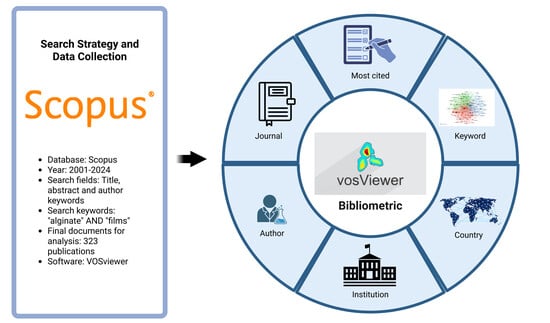
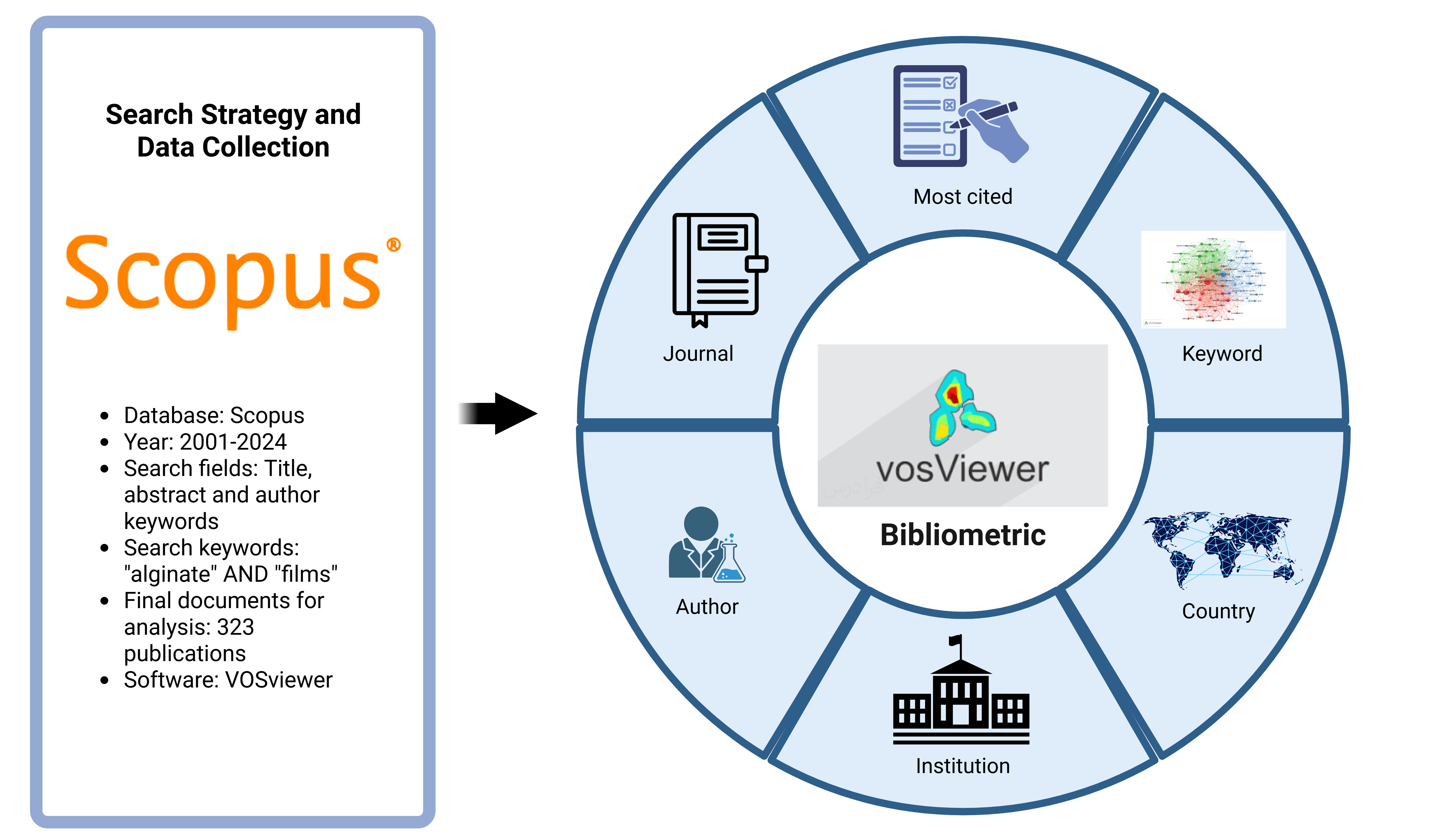
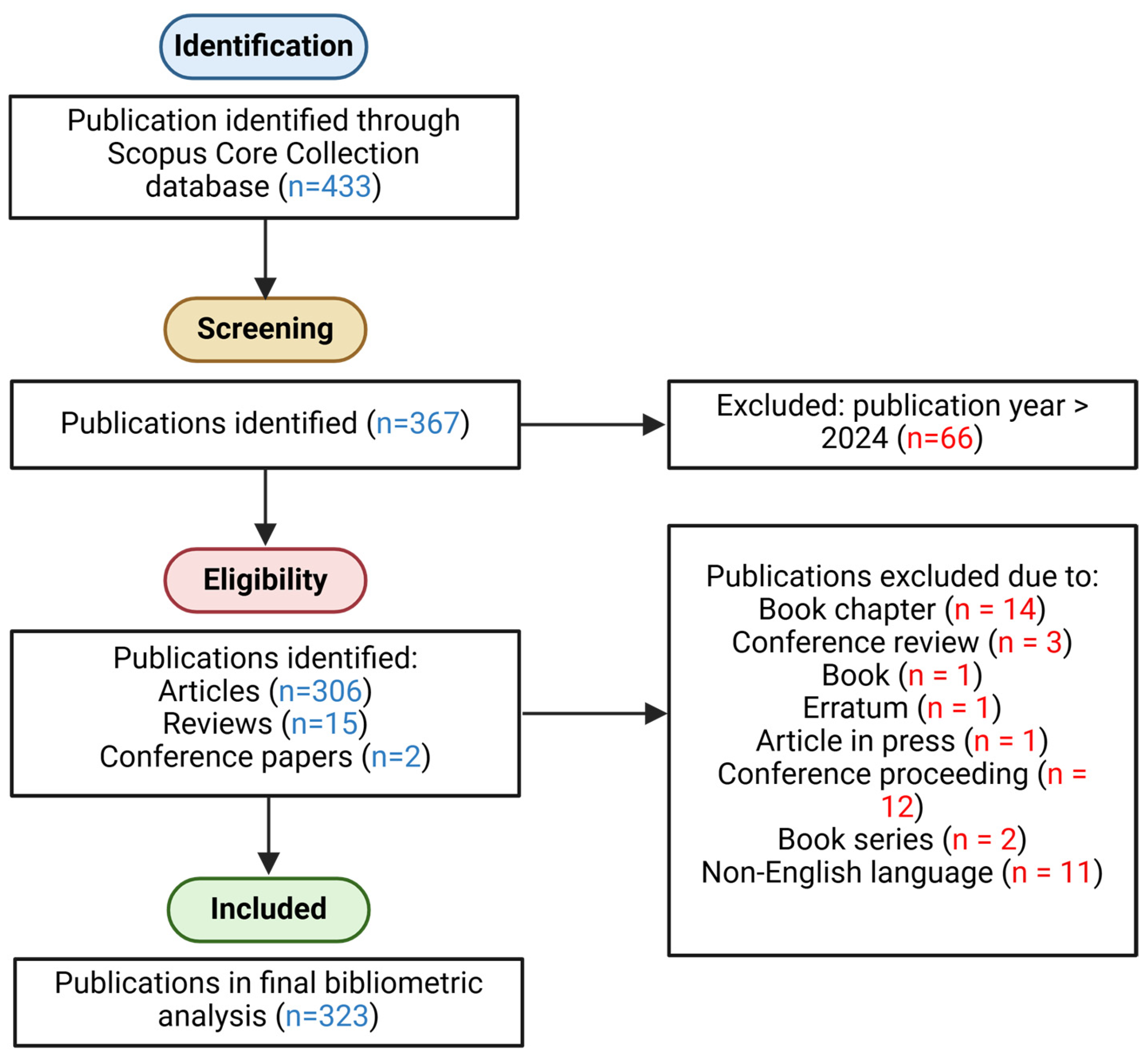
The data for this study were collected from the Scopus database, which provides comprehensive coverage of peer-reviewed literature and reliable citation information. This electronic database is a popular tool among academics seeking access to high-quality analytical insights [43,44]. The search was conducted on 2 August 2025, using the following query: TITLE-ABS-KEY (“alginate-based”) AND (film). To ensure the reliability and consistency of the retrieved dataset and to prevent bias or inconsistencies caused by potential updates or database changes, the cut-off date was set to December 2024, meaning that only documents published up to this period were included in the analysis [45]. We intended to track alginate-based film publications from the earliest dates possible. However, it was found that only publications from 2001 onwards were indexed in the Scopus database. Therefore, the research period was confirmed as 2001–2024. The search was limited to English-language publications, including articles, reviews, and conference papers at the final publication stage, and restricted to journal sources. As a result, a total of 323 documents were retrieved and included for further analysis. Finally, the final dataset was exported in CSV format. Figure 1 presents the complete flowchart of the screening process.

2.2. Data Analysis

The OpenRefine application (v. 3.9.3) and a thesaurus file were used to manually merge and standardize terms with identical meanings to ensure consistency in keyword visualization. The thesaurus file functioned as a supporting tool to automatically unify similar expressions and avoid duplication in the VOSviewer analysis. For example, “cross linking” and “cross-linking” were standardized into “crosslinking.” Similarly, “antimicrobial,” “antimicrobial activity,” and “anti-microbial activity” were merged into “antimicrobial properties,” while “antioxidant” and “antioxidant activities” were combined into “antioxidant activity.” Singular and plural forms of the same keyword, such as “alginate film” and “alginate films,” as well as “biopolymer” and “biopolymers,” were also combined manually. In addition, Microsoft Excel was used to visualize the annual publication trends, while Datawrapper was employed to illustrate the distribution of publication types, contributing countries, and subject areas.
This study aims to perform a comprehensive bibliometric analysis of research on alginate-based films, adapted from the method proposed by Wu et al. [46]. The analysis comprised three main stages. First, a quantitative bibliometric analysis using the Scopus database was conducted to evaluate publication trends, journal distribution, productive countries, authors, institutions, subject areas, and top-cited articles. Second, a social network analysis was performed using VOSviewer (v.1.6.20) to visualize co-authorship collaborations among countries, authors, and institutions [47]. Third, keyword analysis based on keyword co-occurrence networks was also carried out using VOSviewer to identify major research themes, discover hotspots, and trace the evolution of research trends over time [48]. A deeper analysis of thematic clustering and top keyword co-occurrence was performed to interpret the underlying structure and dynamics of research topics. Additionally, a brief content analysis of highly cited publications was included to provide deeper insight into influential studies and emerging topics within alginate-based-film research. Finally, based on this analysis, comprehensive insights were gained into the development trends of alginate-based-film research, while the literature review further revealed the application, prospects, challenges, and future directions of alginate-based-film research.

3. Results and Discussion

3.1. Publication Analysis

After searching the Scopus database, we initially collected 365 documents related to alginate-based-film research. After applying the screening criteria and excluding ineligible publications, a total of 323 articles were retained for bibliometric analysis. The search identified a total of 323 publications related to alginate-based films from 2001 to 2024, including 306 articles, 15 reviews, and 2 conference papers.
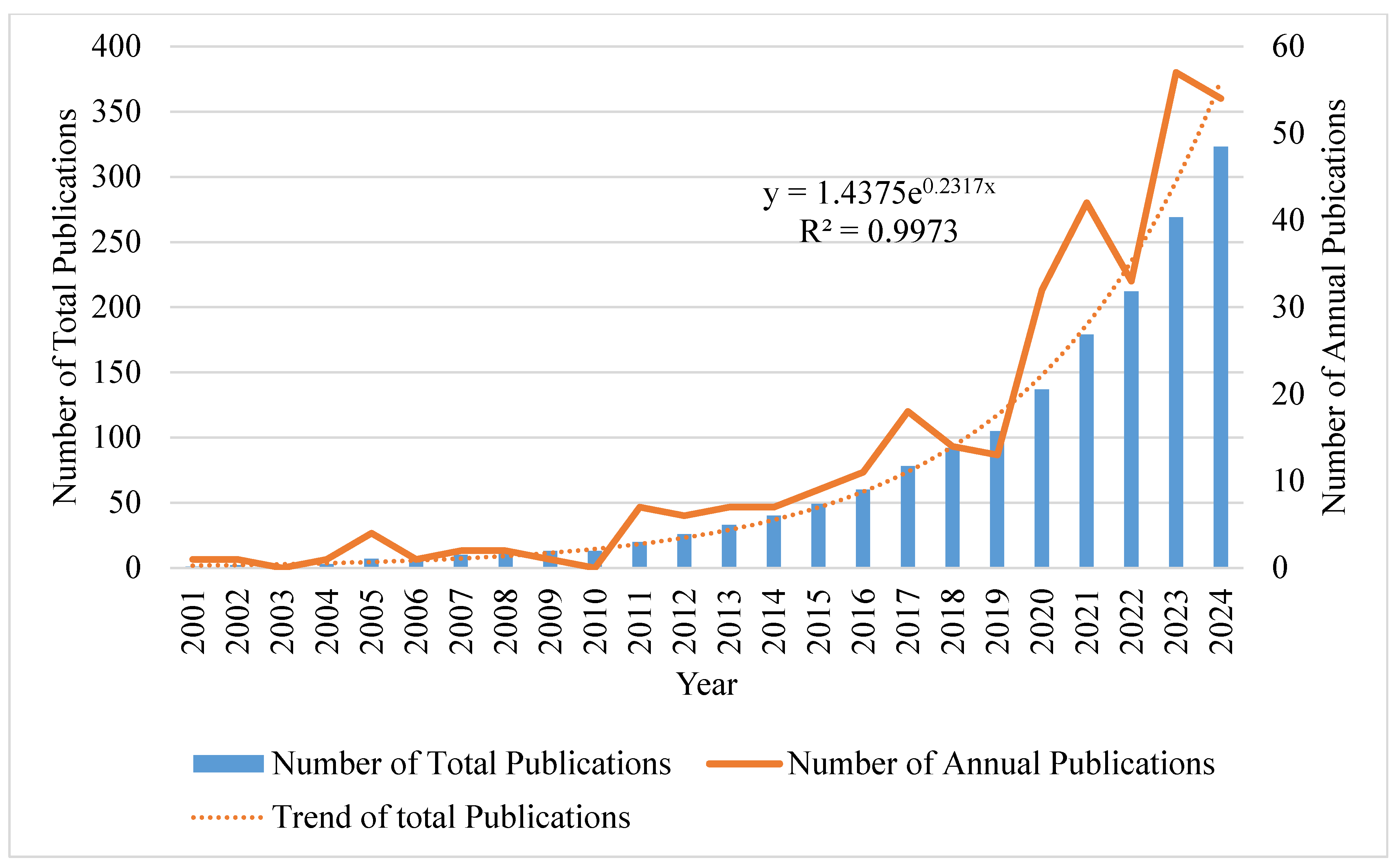
Publication trend analysis can be utilized to predict future developments in a specific research field [49]. This provides guidance for researchers and policymakers in planning strategic steps for the future [50,51]. Figure 2 illustrates the overall trend in publication output over the past two decades. The publications on alginate-based-film research received 15,015 citations in total, reflecting a growing academic interest in this field. As illustrated in Figure 2, line and bar charts were used to display the annual and total publications, respectively. The annual number of publications remained very low between 2001 and 2010, with an average of fewer than three documents per year and some years showing no publications at all. Since 2011, the number has gradually increased, and a sharp rise can be observed after 2019. The publication output grew from 13 in 2019 to 32 publications in 2020 and reached its peak with 57 documents published in 2023. This trend has been sustained, with 54 documents already published in 2024. The exponential trendline model indicates that the number of publications in this domain will continue to grow rapidly in the coming years. Based on this projection, the total number of publications is expected to reach approximately 471 by 2025. This trend indicates that scientific interest in alginate-based films has significantly increased and is expected to continue growing in the future due to their promising applications in various fields [52].

3.2. Journal Analysis

From 2001 to 2024, a total of 166 journals published research related to alginate-based films. For further investigation, we analyzed the top journals that published the largest number of articles related to alginate-based films, along with the number of citations, Impact Factors (IFs 2024), Journal Citation Report (JCR) quartiles, and the publishers’ countries. The impact factor (IF) is a popular bibliometric measure that shows how important and influential scientific journals are [53]. Journals with high impact factors are frequently seen as more prestigious and important [54]. Journals classified as Q1 or Q2 are considered higher quality, while journals in Q1–Q4 have all undergone editorial screening and peer review. Moreover, trials intended for publication in Q1 and Q2 journals require more rigorous planning and implementation [55].
Table 1 shows that the top 10 most productive journals produced 119 papers in this field, accounting for 36.84% of the 323 publications. The International Journal of Biological Macromolecules ranked first with 45 publications and 2525 citations, supported by an IF of 8.5. Food Hydrocolloids followed with 18 articles and the highest citation count among the top 10 (2043 citations), along with a high IF of 12.4. Carbohydrate Polymers ranked third, contributing 12 publications, 1174 citations, and the highest IF among the listed journals at 12.5. Overall, the majority of the top-ranked journals were classified in the Q1 quartile. A smaller portion of journals were classified in Q2, such as Materials and Journal of Food Science and Technology. The dominance of Q1 journals highlights the high academic standards and strong impact of research on alginate-based films [56]. Furthermore, in terms of publishers’ countries, three journals were from the Netherlands, three from the United Kingdom, three from Switzerland, and one from the United States.

3.3. Country Analysis

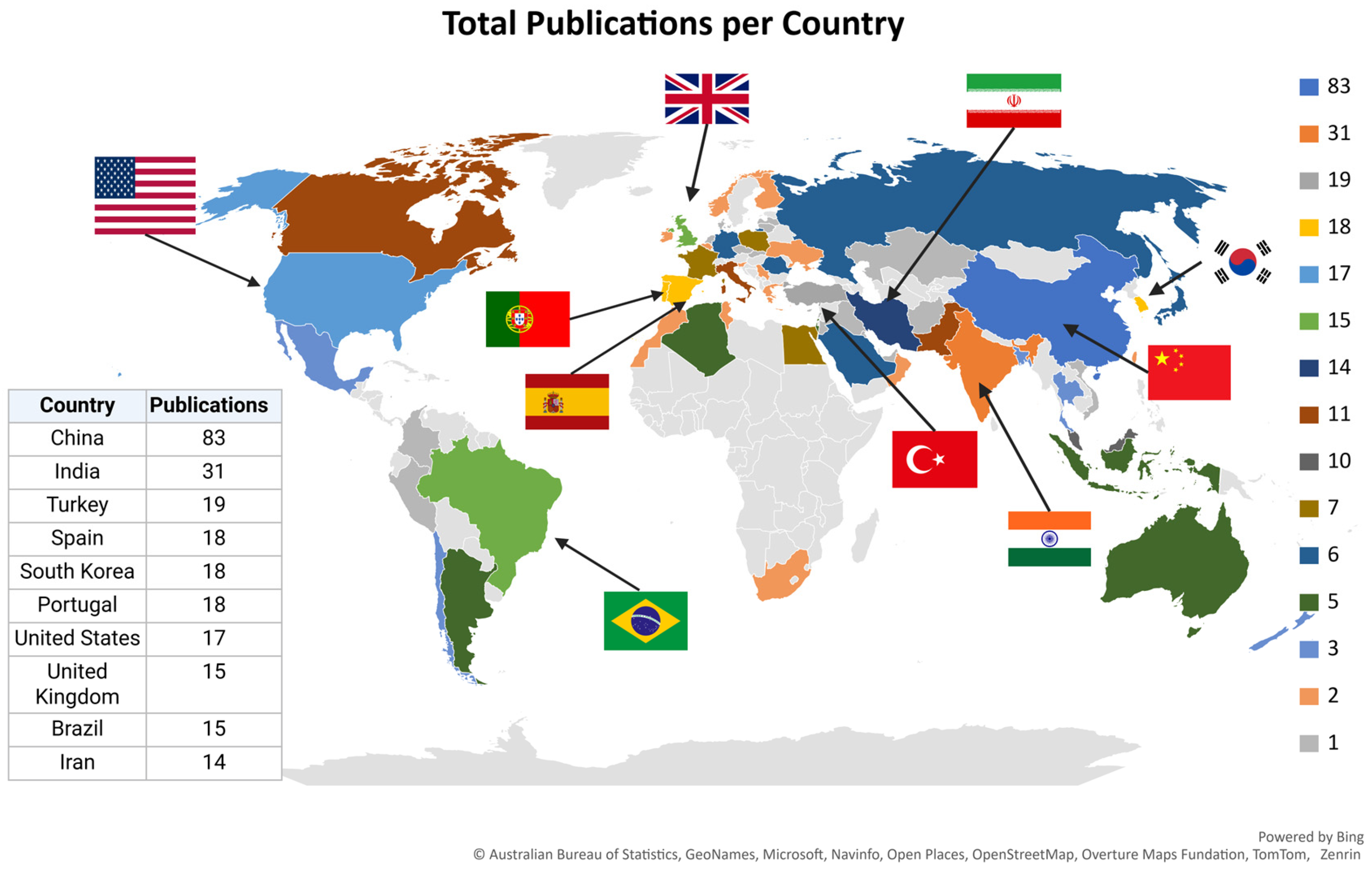
A total of 64 countries were involved in publishing research related to alginate-based films during this period. According to the bibliometric analysis of alginate-based-film publications in 2001–2024 (Table 2), China contributed the highest number of published documents (83 publications, 25.7%), followed by India (31 publications, 9.6%) and Turkey (19 publications, 5.9%). As a top contributor country, China contributed a quarter of the total publications on alginate-based-film research over the past two decades. Meanwhile, Portugal, Spain, and South Korea showed the highest average citations per document, with values of 70.67, 70.50, and 70.33, respectively, indicating the strong visibility and influence of research outputs from these countries. In terms of citations, publications from China were cited 2579 times, ranking first among all countries, followed by India (1429 times) and Portugal (1272 times). Citation count analysis is an essential aspect of bibliometric analysis, which quantitatively evaluates the influence and quality of academic work [57]. One of the key bibliometric indicators used to assess both research productivity and impact is the H-index, which combines the number of publications and the number of associated citations for these publications into a one statistic. This makes it a popular way to measure academic accomplishment [58]. Based on this indicator, China again ranked highest with an H-index of 29, followed by India (16), the United States (14) and South Korea (14). Based on the number of publications related to alginate-based film, the distribution of contributing countries is visualized in Figure 3.
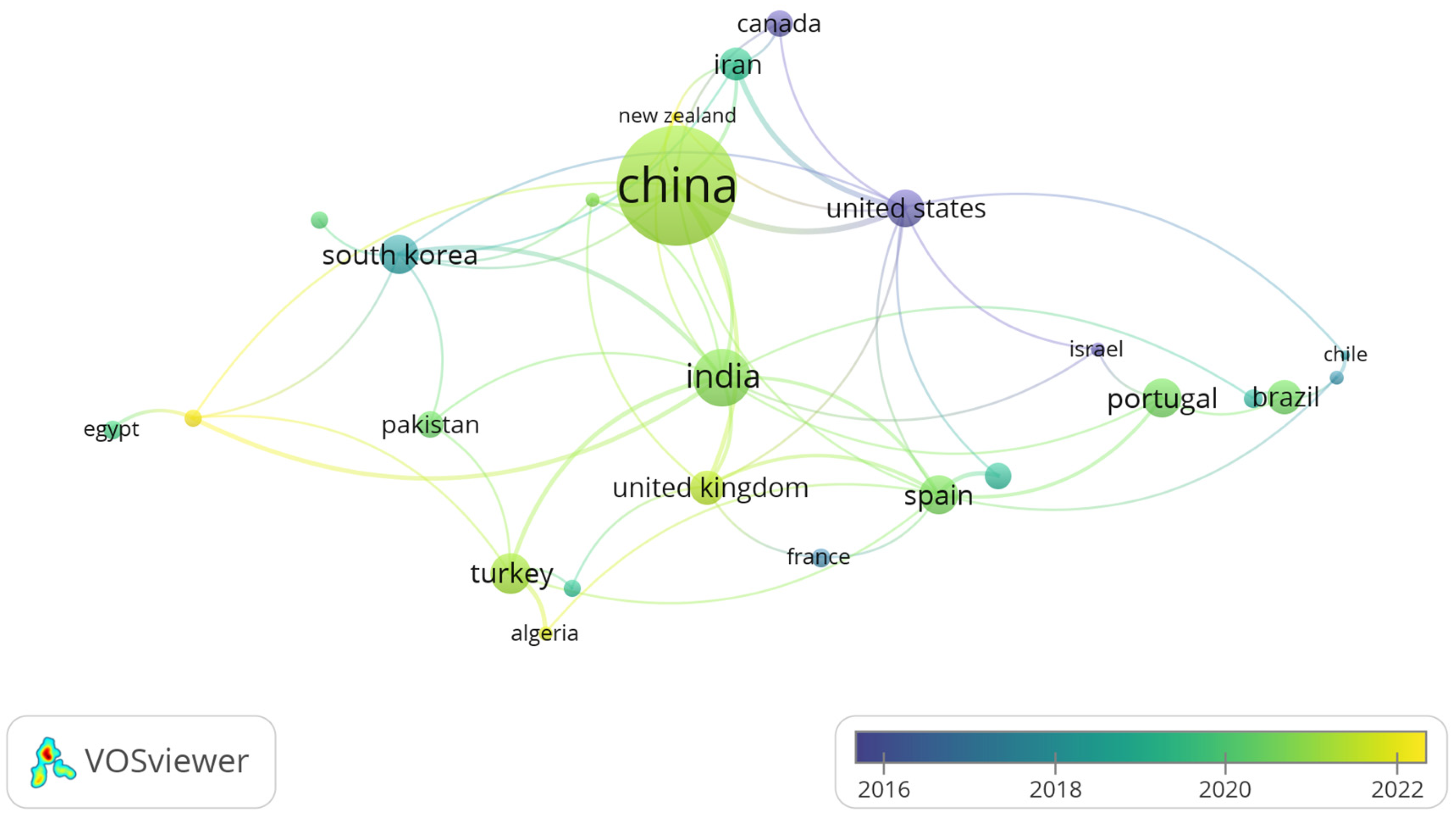
International collaboration is vital and frequently produces high-quality outcomes. In this study, the collaborations among countries in the field of alginate-based-film research were analyzed using VOSviewer co-authorship network visualization [59]. A threshold of a minimum five publications and 30 citations was applied [60], resulting in 27 out of 64 countries meeting the criteria, of which only 23 were interconnected within the collaboration network. The co-authorship overlay visualization (Figure 4) highlights the global collaboration patterns in alginate-based-film research. Countries like China, India, and the United States appear as dominant nodes, indicating high volumes of co-authored publications. Node size represents the number of collaborative documents [61], while the line thickness reflects the strength of co-authorship ties [62]. This is consistent with Total Link Strength (TLS) data, where India (TLS = 21), China (TLS = 19), and the United States (TLS = 17) demonstrate strong international linkages (as shown in Table 2). Thus, larger nodes and higher TLS values confirm that these countries not only produce substantial research outputs but also hold central roles in the international collaboration network. The color gradient illustrates the average publication year (Figure 4). The United States, Israel, and Canada were among earlier contributors, while countries such as China, Saudi Arabia, the United Kingdom, Algeria, and New Zealand have become more active in recent years. Overall, the co-authorship analysis underscores the role of China, India, and the United States as key players in shaping the global collaborative landscape in alginate-based-film research.

3.4. Author Analysis

The results showed that during the observed period, a total of 1499 authors contributed to the field of alginate-based-film research. Among these, only a small group of authors were considered highly influential, as presented in Table 3. Jong-Whan Rhim from Kyung Hee University, South Korea, was identified as the most productive author, contributing eight publications with 770 citations and holding the highest H-index (109) among all authors. His work primarily focuses on biopolymer edible films for sustainable packaging. One of his most highly cited works was “Physical and mechanical properties of water-resistant sodium alginate films.” In this study, the properties of sodium alginate films were modified using CaCl2 treatments through both mixing and immersion methods. The results demonstrated that immersion treatment significantly enhanced tensile strength and water resistance while reducing water vapor permeability, highlighting its effectiveness in improving the functional performance of alginate-based films [63]. The effectiveness of CaCl2 crosslinking arises from the formation of ionic bonds between calcium ions and the carboxyl groups of alginate, producing an “egg-box” structure that stabilizes the polymer matrix. This network not only restricts polymer chain mobility, thereby improving tensile strength, but also reduces the hydrophilic sites available for water penetration, leading to superior moisture resistance [64]. Compared with mixing, the immersion method generally results in more uniform and deeper crosslinking throughout the film, which explains its superior enhancement of both tensile strength and water barrier properties [65,66]. These improvements are particularly important for packaging applications, where sufficient tensile strength ensures mechanical durability [67], and enhanced water resistance helps protect packaged products from moisture, thereby contributing to the extension of food shelf-life [68]. In addition to ionic crosslinking, several other strategies have been reported to enhance the tensile strength and water resistance of alginate-based films, including polymer blending [69], nanofiller incorporation [70], multilayer coating [71], and enzymatic crosslinking [72]. These approaches provide different pathways to reinforce the polymer matrix and reduce moisture sensitivity, making alginate-based films more suitable for packaging applications. Rhim’s contributions highlight both fundamental insights and practical strategies that have inspired further developments in the field. Following him were Miguel Ângelo Cerqueira and Lorenzo Miguel Pastrana-Castro, both affiliated with the International Iberian Nanotechnology Laboratory, Portugal. Each contributed six publications and received 429 citations.
M. L. Lacroix from the Centre Armand-Frappier Santé Biotechnologie, Canada, stood out as the author with the highest citation count, having published six articles with a total of 811 citations. This high number of citations indicates that the author’s work has made a significant contribution to the development of the field. It also suggests that the published studies are widely recognized, frequently used as references, and considered important by other researchers. Her most highly cited work, “Nanocrystalline cellulose (NCC) reinforced alginate-based biodegradable nanocomposite film [73],” received 423 citations. In this study, alginate-based nanocomposite films were prepared by solution casting with varying NCC contents (1–8 wt%). The incorporation of 5 wt% NCC resulted in the highest tensile strength, showing a 37% increase compared to the control, while water vapor permeability decreased by 31%, indicating improved barrier properties. Fourier Transform Infrared Spectroscopy confirmed molecular interactions between the alginate and NCC, while X-ray diffraction revealed crystalline peaks due to NCC incorporation and enhancement of thermal stability. Meanwhile, Yuhong Feng from Hainan University, China, published five articles, accumulating 63 citations. These top authors represent a globally distributed group leading the advancement of research in alginate-based films.
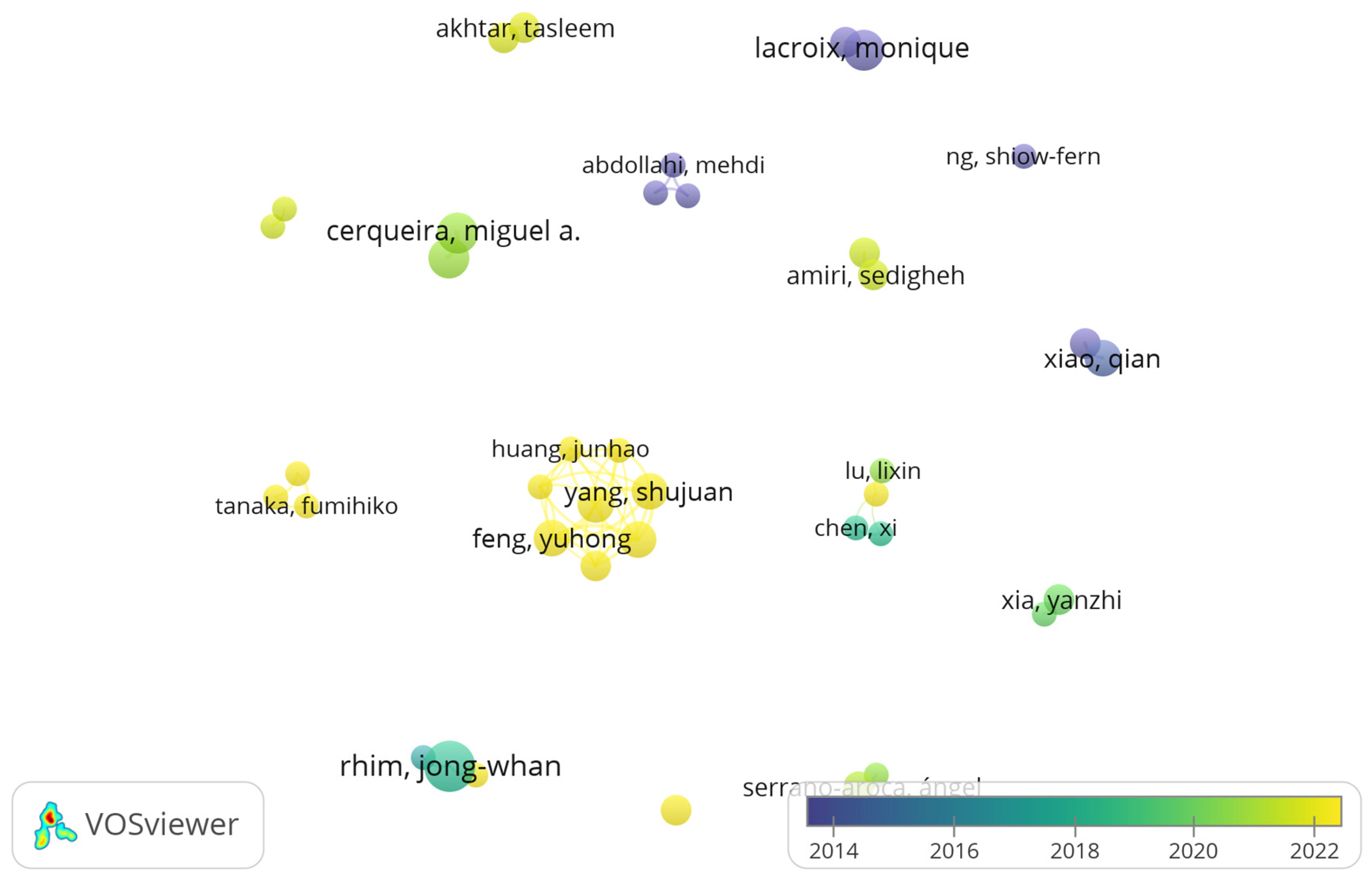
Figure 5 illustrates collaborative patterns among the 39 out of 1499 authors who have published at least three articles on alginate-based films. The most prominent cluster was formed by Shujuan Yang, Jiacheng Li, Gaobo Yu, and Yuhong Feng (all from China), distinguished by having the highest TLS of 28 for each author, indicating a strong and recent collaborative relationship (shown in yellow, indicating average publication years around 2021–2022). This suggests their significant contribution in recent years. The color gradient indicates temporal distribution, with yellow nodes representing more recent publications [74]. Conversely, many authors remain isolated, reflecting limited inter-group associations. Overall, the network predominantly clustered within single institutions, suggesting that research collaboration is still institutionally bound. This limited cross-institutional engagement may hinder broader knowledge exchange and interdisciplinary innovation, underscoring the need to foster more diverse and international collaborations within this research domain.

3.5. Organization Analysis

Table 4 presents the top 10 most productive author organizations in the field of alginate-based-film research. Jiangnan University in China ranked first, contributing 13 articles and 297 citations. Universidade do Minho in Portugal followed with eight articles and 380 citations. The Ministry of Education of the People’s Republic of China ranked third with 7 seven publications, albeit with a relatively lower citation count of 59. Kyung Hee University in South Korea stood out with five publications but had a comparatively high citation impact of 424. Similarly, Centre Armand-Frappier Santé Biotechnologie in Canada, with five articles, garnered the highest citation count in the list (679 citations), indicating the strong impact of its research despite fewer publications [75].
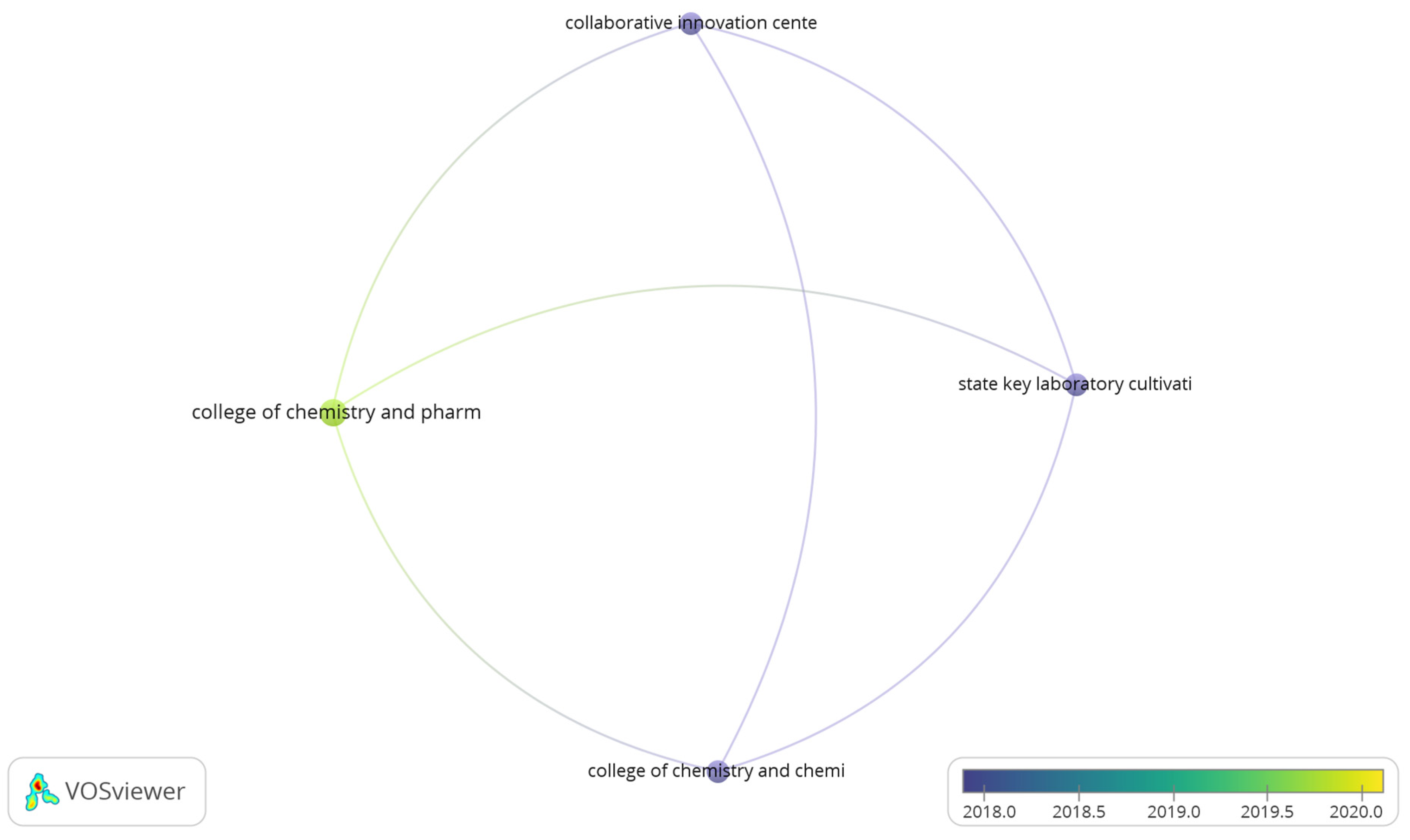
Figure 6 illustrates the collaborative relationships among institutions. The maximum number of organizations was set at 25 per article. The minimum number of articles and citations obtained by 43 of 789 organizations that met the criteria was set at two and zero, respectively. Furthermore, only four of the institutions were connected. These included the Collaborative Innovation Center for Marine Biomass Fiber, the College of Chemistry and Pharmaceutical Science, the State Key Laboratory Cultivating Base for New Fiber Materials and Modern Textiles, and the College of Chemistry and Chemical Engineering, all of which are affiliated with Qingdao University, China. The fact that all four connected organizations belong to a single university indicates that the collaboration network in this research area remains largely internal rather than inter-institutional. This suggests that research activities are still fragmented, with limited cooperation across institutions. Given that international collaboration is widely recognized as a driver of scientific advancement and often leads to higher-quality outputs [55], the absence of significant cross-border partnerships in alginate-based-film research highlights an important gap that should be addressed in future studies.

3.6. Top Subject Area Analysis

Considering that alginate-based films encompass diverse aspects, including material science, chemistry, food technology, and environmental sustainability, research in this field has evolved into a multidisciplinary domain. Subject area analysis is crucial in bibliometric studies, as it provides valuable insight to better understand, manage, and guide scientific research more effectively [76]. In our study, we analyzed the classification of subject areas for the retrieved publications using the Scopus feature, which enabled us to precisely assign each article to its primary discipline [77].
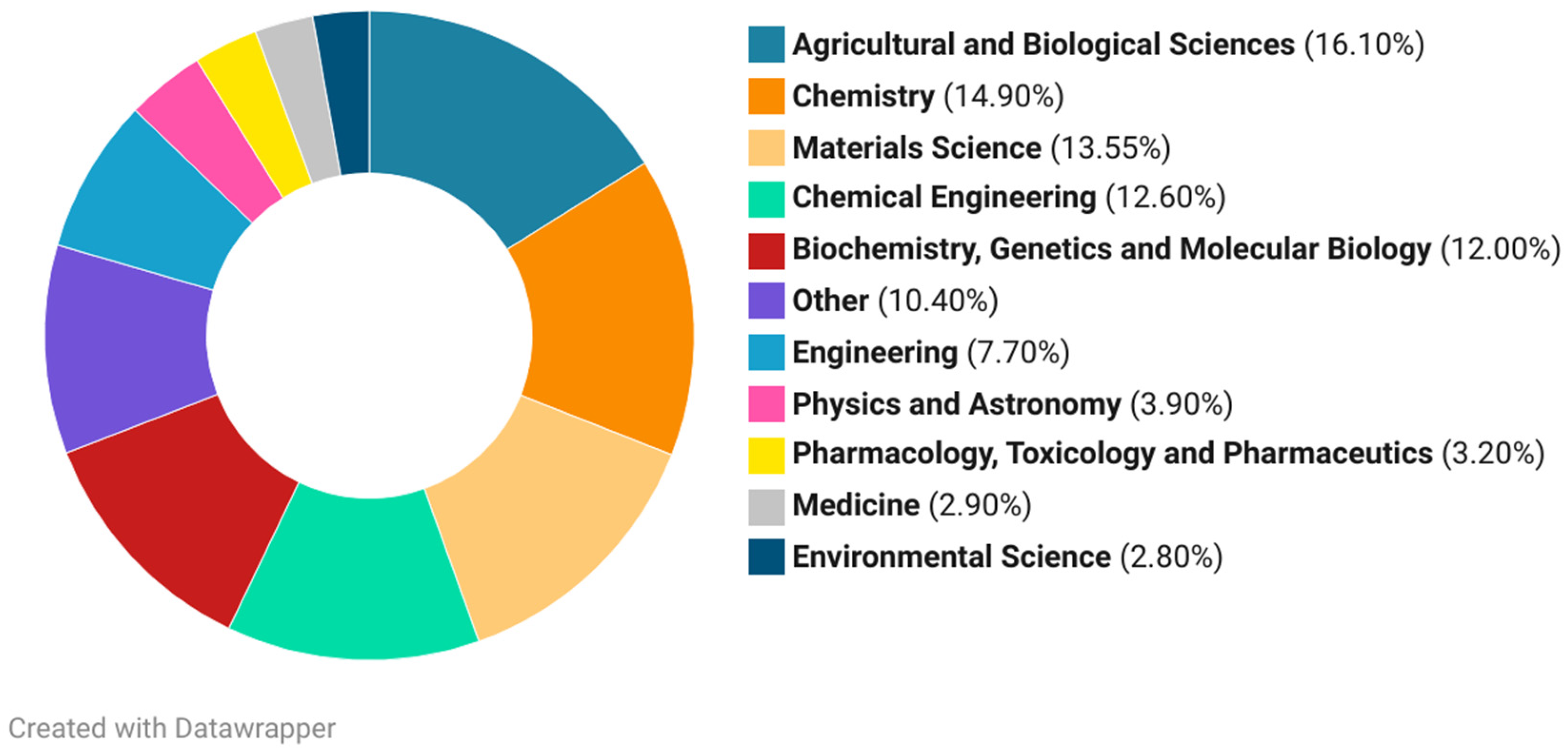
As illustrated in Figure 7, the selected publications span multiple disciplines, with ten major categories being the most prominent. The leading subject area was “Agricultural and Biological Sciences” at 16.10% (110 articles). The subject area of “Agricultural and Biological Sciences” was closely related to alginate-based-film research because these materials not only originate from agricultural and biological resources but also find broad applications in agriculture and food, including biodegradable mulch films, plant protection, microbial biocontrol, nutrient delivery, food packaging, and even waste management [78,79,80]. This strong integration highlights the dual role of alginate-based films as both agriculture-derived materials and practical solutions for advancing sustainable agricultural and food systems. “Chemistry” followed closely at 14.90% (102 articles), underscoring the importance of understanding the molecular structure, physicochemical properties, and chemical modifications of alginate [81]. Understanding the chemical modification of alginate is essential, as techniques such as acylation [82], blending and physical crosslinking [83], esterification [84], and carbodiimide coupling [82] can enhance its stability, degradability, and mechanical strength, thereby broadening its applications across various fields [85,86,87]. “Material Science” accounted for 13.55% of the publications (92 articles). This subject area is particularly important because understanding the material properties of alginate enables researchers to tailor its mechanical strength, barrier performance, and thermal stability, which are critical factors for developing reliable and sustainable packaging applications. “Chemical Engineering” (12.6%, 86 articles), “Biochemistry, Genetics and Molecular Biology” (12%, 82 articles), “Other” (10.4%, 68 articles), “Engineering” (7.7%, 53 articles), “Physics and Astronomy” (3.9%, 27 articles), “Pharmacology, Toxicology and Pharmaceutics” (3.2%, 22 articles), “Medicine” (2.9%, 20 articles), and “Environmental Science” (2.8%, 19 articles) represent other crucial subject areas.

3.7. Analysis of the Most-Cited Articles

The “most-cited articles” is one of the most significant parameters in a field of study, since this highlights the most significant, researched, and advanced subjects associated with the area of interest [88]. The identification of research hotspots is further helped by the examination of highly cited articles [89]. In this study, the top 10 most-cited publications on alginate-based films were identified based on their total citation counts, consisting of seven articles, two review articles, and one conference paper, as we can see in Table 5.
Interestingly, the first, third, and tenth ranked articles fall within the same research theme, focusing on the incorporation of essential oils into alginate-based film to enhance their functional performance. The top-cited article was published by Acevedo-Fani et al., garnering a total of 571 citations. According to this research, the authors developed alginate-based edible films incorporating nanoemulsions of essential oils, finding that thyme oil films delivered the strongest antimicrobial activity, while sage oil films demonstrated superior barrier properties and flexibility [90]. The article ranked in third position (441 citations), authored by Pranoto et al., presented the development of alginate-based edible films incorporating garlic oil, which demonstrated strong antibacterial activity, particularly against S. aureus and B. cereus. Higher garlic oil concentrations improved water vapor barrier properties without altering film color, although mechanical properties were affected, highlighting its potential in antimicrobial food packaging [91]. In another notable study, the article ranked in 10th position (217 citations), authored by Machene et al., investigated sodium alginate-based films enriched with various essential oils, demonstrating strong antibacterial activity (18.5–38.67 mm inhibition zones) and moderate antioxidant capacity. The incorporation of oils improved barrier and thermal properties, reduced tensile strength, and ensured biodegradability, underscoring their potential for sustainable food packaging [92]. Drawing on top-cited studies, incorporating essential oils (EOs) into alginate-based films markedly enhances their performance for active packaging [93,94,95]. Rich in phenolics, terpenes, and aldehydes, EOs provide potent antimicrobial protection against bacteria [96], yeast [97], and molds [98], thereby extending food shelf-life. Their antioxidant capacity further delays oxidative spoilage [99], while the hydrophobic nature of EOs reduces water vapor permeability capacity [100], addressing one of the key limitations of polysaccharide-based films.
The second and seventh most-cited publications are review articles. The article ranked in second position (545 citations), authored by Parreidt et al., presented a comprehensive review of alginate-based edible coating and films, emphasizing their role in enhancing food quality and extending shelf-life. The paper systematically categorized these materials within the broader food packaging framework, detailing the incorporation of active ingredients, application techniques, and the physicochemical mechanisms underlying mass transfer and barrier performance. The review also concluded by identifying critical research gaps and proposing future directions, thereby providing a foundational reference for the development of next-generation alginate-based packaging solutions [101]. In addition, the seventh ranked article (290 citations) by Nair et al. reviewed chitosan and alginate-based edible films/coatings that preserve fruits and vegetables by retaining moisture, controlling gas exchange, and delaying ripening, with functional additives enhancing shelf-life without compromising flavor [102]. Remarkably, both of these review articles focus on the application of alginate-based films in the field of food safety.
The documents occupying the fourth and sixth positions can be grouped under the same research topic, which is associated with the incorporation of nanoparticles as fillers or reinforcement in alginate-based materials. Huq et al. (ranked fourth, 419 citations) prepared alginate-based nanocomposite films reinforced with 1–8wt% nanocrystalline cellulose (NCC) via solution casting, which increased tensile strength, reduced water vapor, and enhanced thermal stability. Similarly, Abdollahi et al. (ranked sixth, 292 citations) compared alginate-bionanocomposites with organic cellulose nanoparticles (CNPs) and inorganic montmorillonite (MMT), showing both reduced water solubility and vapor permeability. For further discussion, the addition of nanoparticles in alginate-based films can improve various physical, mechanical, and functional properties of the film [103,104,105]. This is because when nanoparticles are added, they fill the empty spaces in the film structure, thereby increasing resistance to deformation [106]. Nanoparticles can also change the surface morphology of the film, creating more complex pathways for water vapor [107]. This reduces the film’s permeability to moisture.
The documents occupying the fifth and ninth positions can be grouped in the same research topic, which is related to the application of alginate-based films in the medical field. The article ranked in fifth position (380 citations) by Pereira et al. described the development of alginate-aloe vera hydrogel films with enhanced transparency, thermal stability, and water absorption, demonstrating suitable properties for wound healing applications [108]. Notably, the article ranked in ninth position (243 citations) by Thu et al. reported the development of an alginate-based bilayer hydrocolloid film with improved mechanical properties and controlled drug release, demonstrating effective in vivo performance and strong potential as a slow-release wound dressing [109]. Overall, alginate-based films have shown high effectiveness in wound care by absorbing excess exudate, preserving a moist healing environment, and reducing the risk of bacterial infection, factors that are essential for optimal wound management [110,111,112].
Finally, the article ranked in eighth position (245 citations) by Costa et al. showed that calcium chloride crosslinking and the mannuronic/guluronic ratio strongly influence the mechanical and barrier properties of alginate-based films for food use [113]. Crosslinking itself is a key method for enhancing the mechanical and barrier performance of alginate-based materials by forming three-dimensional networks between polymer chains through covalent or noncovalent bonds, thereby improving their suitability for diverse applications [114,115,116].
In short, an analysis of the top ten most-cited articles on alginate-based films reveals three dominant research themes. The first is active food packaging, with a strong emphasis on incorporating essential oils or nanoparticles to enhance antimicrobial and barrier properties, Additionally, biomedical applications such as wound dressings and drug delivery systems are significant areas of research. Lastly, material modification methods like crosslinking are a key topic, highlighting ongoing efforts to optimize the physical and mechanical properties of alginate-based films.
Table 5. Top 10 most-cited articles in the alginate-based-film research.
RankArticle TitleDocument TypeAuthorsIssueJournalYearCitationsRef.
1Edible films from essential-oil-loaded nanoemulsions: Physicochemical characterization and antimicrobial propertiesArticleAcevedo-Fani et al.Evaluates the physical, mechanical, and antimicrobial properties of alginate-based edible films formulated with essential oil nanoemulsions.Food Hydrocolloids2015571[90]
2Alginate-based edible films and coatings for food packaging applicationsReviewParreidt et al.Reviews the properties, applications, active ingredient incorporation, application methods, barrier characteristics, and future trends of alginate-based edible coatings and films in food packaging.Foods2018545[101]
3Physical and antibacterial properties of alginate-based edible film incorporated with garlic oilConference paperPranoto et al.Evaluates the antibacterial, mechanical, and physical properties of alginate-based edible films incorporated with garlic oil, demonstrating their potential as antimicrobial food packaging.Food Research International2005441[91]
4Nanocrystalline cellulose (NCC)-reinforced alginate-based biodegradable nanocomposite filmArticleHuq et al.Investigates the effect of nanocrystalline cellulose reinforcement on the mechanical, barrier, structural, and thermal properties of alginate-based nanocomposite films.Carbohydrate Polymers2012419[73]
5Development of novel alginate-based hydrogel films for wound healing applicationsArticlePereira et al.Evaluates the optical, chemical, thermal, mechanical, solubility, and swelling properties of alginate–aloe vera hydrogel films, highlighting their suitability for skin applications.International Journal of Biological Macromolecules2013380[108]
6Comparing physico-mechanical and thermal properties of alginate nanocomposite films reinforced with organic and/or inorganic nanofillersArticleAbdollahi et al.Compares the effects of cellulose nanoparticles and montmorillonite nanoclay on the solubility, hydrophobicity, barrier, and mechanical properties of alginate-based nanocomposite films.Food Hydrocolloids2013292[117]
7Enhancing the functionality of chitosan- and alginate-based active edible coatings/films for the preservation of fruits and vegetables: A reviewReviewNair et al.Reviews the use of functional additives such as phenolics, essential oils, and nanomaterials in chitosan–alginate edible films/coatings to enhance antimicrobial, antioxidant, and preservation properties for extending the shelf-life of fruits and vegetables.International Journal of Biological Macromolecules2020290[102]
8Physicochemical properties of alginate-based films: Effect of ionic crosslinking and mannuronic and guluronic acid ratioArticleCosta et al.Investigates the influence of calcium chloride crosslinking and the mannuronic/guluronic acid ratio on the mechanical, barrier, optical, and structural properties of alginate-based films for tailored food packaging applications.Food Hydrocolloids2018245[113]
9Alginate-based bilayer hydrocolloid films as potential slow-release modern wound dressingArticleThu et al.Develops and evaluates an alginate-based bilayer hydrocolloid film for slow-release wound healing, assessing its physical, mechanical, drug release, and in vivo healing performance.International Journal of Pharmaceutics2012243[109]
10Development and characterization of sodium alginate-based active edible films incorporated with essential oils of some medicinal plantsArticleMachene et al.Develops and characterizes sodium alginate-based edible films with various essential oils, evaluating their antibacterial, antioxidant, mechanical, barrier, thermal, and biodegradability properties for potential food packaging applications.International Journal of Biological Macromolecules2020217[92]

3.8. Keyword Analysis

Keyword co-occurrence analysis within a research field serves as an effective approach for identifying emerging research hotspots and frontiers [118]. Employing keyword co-occurrence analysis based on the method proposed by Babaei et al. (2024) [119], we aimed to identify the predominant research themes related to alginate-based film. Out of the initial 3490 keywords identified, we refined our selection to include only those occurring more than five times, resulting in a list of 287 keywords. In addition, a thesaurus file was incorporated to merge keywords with identical or synonymous meanings, such as unifying “cross linking,” and “crosslinking” into a single term, as well as “nanoparticles” and “nanoparticle.” By focusing only on the top 100 keywords, we ensured coherence within the clusters by replacing synonyms with the most widely used term. This step was crucial for maintaining overall consistency and clarity in the analysis. Furthermore, irrelevant keywords were excluded from the dataset to ensure the analysis focused exclusively on topics directly related to alginate-based film.

3.8.1. The Most-Frequent Keywords in Alginate-Based-Film Research

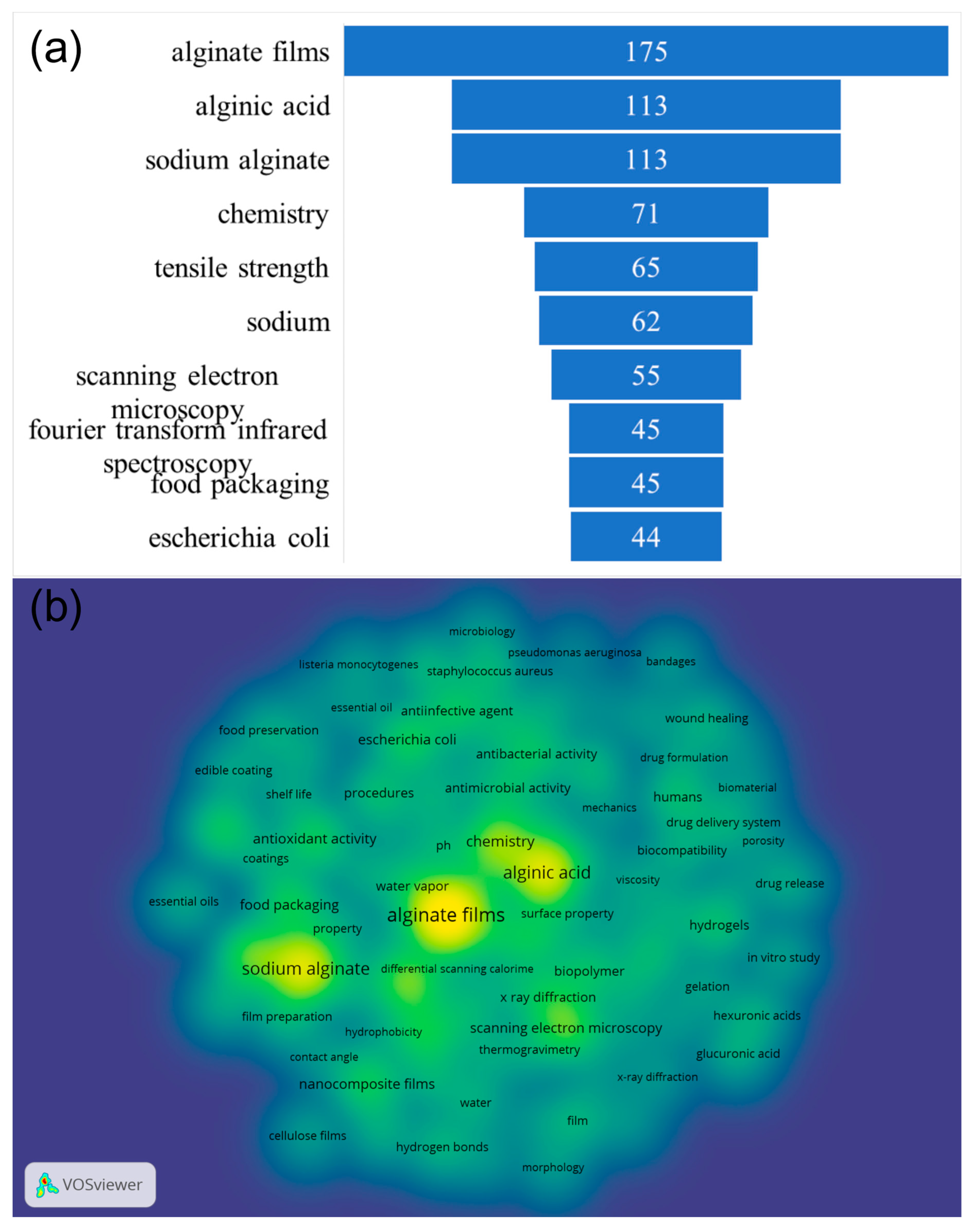
We identified the 10 most-frequent keywords from the analyzed articles and visualized them using a funnel chart, as we can see in Figure 8a. To further explore the core topics, a density visualization map was also created in Figure 8b using VOSviewer software. This map illustrates key research hotspots and emerging trends. Keyword concentrations in brightly colored and high-density zones indicate areas of intense research activity. Based on data obtained from keyword co-occurrence analysis using VOSviewer, the top-ten keywords over the last two decades were “alginate films,” “alginic acid,” “sodium alginate,” “chemistry,” “tensile strength,” “sodium,” “scanning electron microscope,” “Fourier transform infrared spectroscopy,” “food packaging,” and “escherichia coli.” This finding is further supported by the density visualization, where these keywords appeared with brighter colors, indicating their high frequency and centrality in the research field.
The most dominant keyword was “alginate films” (175 occurrences), which directly represents the core subject of investigation. Closely related terms such as “alginic acid” (113 occurrences) and “sodium alginate” (113 occurrences) indicate the primary raw materials used in the synthesis and modification of alginate-based films. The keyword “sodium” (62 occurrences) was likely associated with sodium alginate and its ionic interactions in film formation. Alginic acid is a naturally occurring polysaccharide extracted from brown seaweed [120,121], serving as the fundamental biopolymer backbone, whereas sodium alginate is the water-soluble sodium salt form of alginic acid that is widely employed due to its excellent film-forming ability, biocompatibility, and ease of chemical modification [122,123]. In other words, alginic acid represents the insoluble precursor, while sodium alginate is the more practical and functional derivative, extensively applied in alginate-based film development. The presence of the general keyword “chemistry” (71 occurrences) emphasizes the chemical basis of film formulation, crosslinking, and structural characterization. In addition, “tensile strength” (65 occurrences) reflects a strong focus on mechanical performance, which is critical for evaluating the applicability of alginate-based films in packaging and biomedical contexts. However, alginate-based films are generally limited by their low mechanical strength [124], so many studies are currently directed toward improving this property and reducing these shortcomings to make the films more suitable for practical use. Methodological approaches were represented by “scanning electron microscopy” (55 occurrences) and “Fourier transform infrared spectroscopy” (45 occurrences), both of which are essential characterization tools to investigate film morphology and chemical structure, respectively. Application-oriented keywords such as “food packaging” (45 occurrences) and “escherichia coli” (44 occurrences) reflect the increasing attention on the practical use of alginate-based films as eco-friendly packaging materials with added antimicrobial functionality. This suggests that research is not only concerned with replacing synthetic plastics but also with enhancing food safety by preventing microbial contamination, thereby underscoring the potential of alginate-based films in active packaging applications.

3.8.2. Research Themes and Clusters in Alginate-Based Films

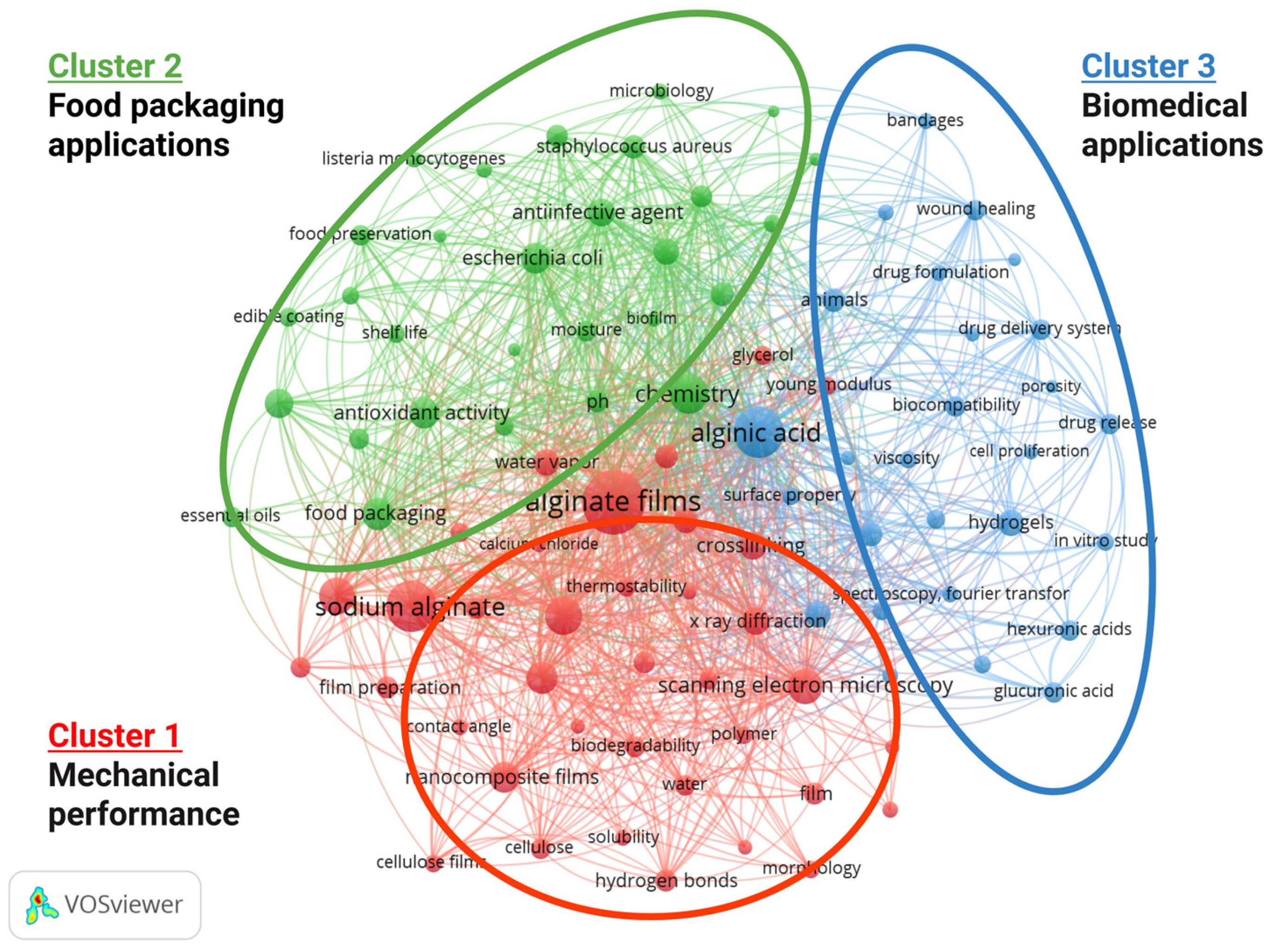
The network visualization of keyword co-occurrence related to alginate-based films over the last twenty years is visualized in Figure 9. In this visualization, the node size represents the frequency of keyword occurrence, where larger nodes correspond to higher levels of occurrence [125]. Moreover, the proximity between nodes illustrates the strength of association among terms, with shorter correlation between the respective keywords [126]. Table 6 provides an overview of each cluster for further investigation, facilitating a thorough comprehension of the data.
  • Cluster (1): Mechanical performance enhancement and structural characterization
Cluster 1, represented by the red cluster, highlights research focusing on enhancement of the mechanical and functional performance of alginate-based films. Core keywords such as “alginate films,” “sodium alginate,” and “tensile strength” emphasize the material basis and its mechanical evaluation, while modification strategies are reflected by “crosslinking,” “nanocomposite films,” and “nanoparticles,” which are frequently employed to reinforce structural integrity and durability. Choi et al. [127] demonstrated using multivalent cations (Ca2+, Fe2+, and Fe3+) significantly enhanced the tensile strength of alginate films while reducing their elongation at break, confirming the crucial role of crosslinking in reinforcing the mechanical stability of alginate-based materials. Also, in the study by Sadeghi et al. [128], it was reported that incorporating sodium alginate derivate from potato peel waste and applying calcium chloride crosslinking significantly enhanced the performance of alginate-based films, particularly by improving tensile strength and reducing water vapor permeability. Moreover, nanocomposites, formed by combining a polymer matrix with nanometer-scale fillers, can markedly enhance the mechanical and barrier properties of alginate-based films [129]. Nanoparticles can enhance the mechanical properties of a polymer matrix because their extremely small size (at the nanometer scale) allows them to disperse uniformly within the polymer matrix and interact strongly with polymer chains [130]. Their presence acts as a reinforcing agent that fills voids in the polymer structure, thereby preventing deformation [131,132]. Several studies have demonstrated that the incorporation of nanoparticles can significantly enhance the mechanical and functional performance of alginate-based films. In particular, the use of cellulose nanoparticles (CNs) [133], cellulose nanofibers (CNFs) [134], montmorillonite clay (MMT) [135], Fe3O4, ZnO [136], silicon dioxide (SiO2) [137], and copper sulfide nanoparticles (CuSNPs) [138] has been shown to improve mechanical strength, increase thermal stability, reduce water permeability, and enhance water vapor barrier properties.
Furthermore, the occurrence of keywords such as “Fourier transform infrared spectroscopy,” “scanning electron microscopy,” and “x-ray diffraction” indicates the widespread use of structural characterization techniques in alginate-based-film research. These analytical methods are frequently encountered in material science studies because they provide fundamental information on chemical structure, crystallinity, and morphology, which is essential for interpreting material behavior and performance. Fourier Transform Infrared Spectroscopy (FTIR) is commonly used to identify chemical interactions between film components, such as hydrogen bonding and interactions among functional groups [26]. In alginate-based films containing essential oils or other additives, FTIR can reveal characteristic absorption peaks of each component, indicating successful incorporation and compatibility within the matrix [139]. FTIR is also applied to examine molecular structure changes after the addition of materials such as essential oils or nanoparticles [140]. Scanning Electron Microscopy (SEM) provides visual information on film surface morphology, including smoothness, roughness, and the presence of additional particles. For example, the addition of beeswax to alginate films has been reported to produce a rougher surface texture, which can be clearly observed by SEM [139]. SEM also helps evaluate blend homogeneity, microstructure, and the distribution of additives such as nanoparticles or other fillers within the polymer matrix [141]. X-ray Diffraction (XRD) is widely applied to analyze the crystallinity of films and structural changes after the incorporation of additives. For instance, the addition of orange by-product powder (OBP) or graphene oxide has been reported to reduce crystallinity and improve thermal stability [142,143]. XRD is also useful for identifying crystalline phases in the film matrix, such as the presence of TiO2 or silver nanoparticles [141,144].
B.
Cluster (2): Food packaging applications and biofunctional properties
Cluster 2, represented by the green cluster, reflects research themes centered on the food applications and biofunctional properties of alginate-based films. Dominant keywords such as “food packaging,” “edible coating,” “food preservation,” and “shelf life” underscore the focus on developing alginate-based films as sustainable active packaging materials aimed at extending product longevity. Alginate-based films are extensively utilized in food packaging applications because they combine several advantageous properties. Alginate is a natural, biodegradable, and non-toxic polysaccharide, making it safe for direct contact with food and environmentally friendly compared to conventional plastics [26,145]. In addition, alginate-based films exhibit excellent film-forming ability and transparency, which allows them to act as effective oxygen barriers, thereby slowing down oxidation and extending the shelf-life of packaged products [146]. From a functional perspective, active packaging represents an innovative strategy in food preservation, where active compounds such as antioxidants, antimicrobials, and probiotics are incorporated into alginate-based films to extend shelf-life and maintain product quality [26]. Numerous studies have shown that alginate-based active films are effective not only for animal-based-food packaging, such as beef [147], chicken fillets [148], fish fillets [149], and lamb [150], but also for fruit and plant-based products. In particular, their application in fruits such as apples [151], avocados [152], bananas [153], blueberries [154] and cherries [155] has consistently demonstrated the ability to preserve essential quality and attributes such as firmness, color, and nutritional content. For example, a study demonstrated that incorporating lycopene microcapsules into alginate-based composite films significantly improved antibacterial activity, oxidation resistance, water vapor barrier, and transparency, while effectively prolonging the shelf-life and maintaining the quality of sweet cherries during storage [155]. A recent study by Mao et al. [156] developed active alginate-based films incorporated with nitrogen-functionalized carbon dots (NCDs) and layered clay. At 3% NCD loading, the films showed increases of 50.0%, 61.1%, and 70.1% in UV barrier, antioxidant, and antibacterial properties, respectively. These improved functional properties effectively reduced browning and extended the shelf-life of bananas, highlighting their strong potential for active food packaging applications. Similarly, for animal-based-food packaging, an agar–sodium alginate bilayer film incorporated with ginger essential oil was demonstrated to effectively suppress microbial growth, delay lipid oxidation and protein decomposition, and extend the shelf-life of beef by 4–6 days compared to commercial polyethylene packaging [157].
Furthermore, the presence of terms such as “antioxidant activity,” “essential oils” and “antimicrobial activity” reflects a strong emphasis on incorporating natural bioactive compounds to enhance functional performance, particularly in providing protection against oxidation and microbial contamination. For instance, the incorporation of essential oils such as rosemary, eucalyptus, oregano, sage, and thyme into alginate-based films has been shown to impart strong antioxidant and antimicrobial activities [158]. Frank et al. [159] reported the development of antibacterial alginate-based biocomposite films incorporated with cinnamon essential oil nanoemulsions (CEO-NEs) as active food packaging materials. The nanoemulsions exhibited a fine droplet size of 92.2 nm, with good dispersion stability, which facilitated their uniform incorporation into the alginate matrix. The addition of CEO-NEs significantly improved the stiffness of the films, as reflected by the increased Young’s modulus, while maintaining tensile strength at acceptable levels. The film containing 20% CEO-NE showed the best overall performance, with tensile strength and elongation at break values of 15.63 MPa and 23.67%, respectively. More importantly, the developed films demonstrated strong antibacterial activity against major foodborne pathogens, including Salmonella typhimurium, Bacillus cereus, Escherichia coli, and Staphylococcus aureus, with inhibition zones ranging from 29.7 to 53.0 mm. These findings highlight that the incorporation of cinnamon essential oil nanoemulsions is an effective strategy to enhance the antibacterial and functional performance of alginate-based films, thereby supporting their potential application as active packaging materials for extending the shelf-life of fresh food products. Moreover, the frequent co-occurrence of pathogenic microorganisms, including Escherichia coli, Staphylococcus aureus, and Listeria monocytogenes, underscores the significance of antimicrobial efficacy in this research domain. These three microorganisms play a crucial role in the spoilage of food through their ability to survive under harsh environmental conditions and to form biofilms that protect them from sanitation efforts [160,161,162]. Overall, this cluster captures a distinct research direction that positions alginate-based films as multifunctional materials for food safety, preservation, and sustainable packaging innovations.
C.
Cluster (3): Biomedical and pharmaceutical applications
Cluster 3, represented by the blue cluster, indicates research primarily oriented toward the biomedical applications of alginate-based films. Core keywords such as “wound healing,” “antimicrobial activity,” “drug release,” and “drug delivery system” demonstrate the extensive use of alginate-based films and their composites in medical and pharmaceutical applications. In biomedical applications, alginate-based films are widely used because they possess favorable properties such as good biocompatibility, low toxicity, and biodegradability [110]. These characteristics make alginate highly suitable for wound care, as it helps maintain a moist environment, allows oxygen and gas exchange, and protects injured tissue during the healing process. Alginate-based films have been extensively developed as potential wound dressing materials because they can absorb excess wound exudate, support faster wound healing, provide permeability to water vapor, carbon dioxide, and oxygen, and reduce the risk of bacterial infection at the wound site [163]. In addition, the mechanical strength, water absorption capacity, barrier properties, and biological activity of alginate-based films can be further enhanced by blending alginate with other polymers or incorporating active agents, allowing these materials to be tailored for different wound healing requirements.
Blending alginate with other polymers has been widely explored by several researchers, to develop wound dressing materials with improved functional performance. Sobczyk et al. [164] investigated chitosan–alginate polyelectrolyte complex (PEC) films by evaluating the influence of processing conditions on their physicochemical and mechanical characteristics. Using a Box–Behnken experimental design, the authors examined factors such as pH, agitation speed, crosslinker content, plasticizer amount, and the type of acid used for chitosan solubilization. The results showed that these parameters and their interactions significantly affected film thickness, liquid absorption capacity, water vapor barrier performance, and mechanical strength, which are key properties for wound dressing materials [164]. In another study, Sobczyk et al. [165] developed chitosan/alginate-based films containing oregano essential oil or ground oregano leaves as antimicrobial agents. The films exhibited suitable water vapor permeability, moderate liquid absorption capacity, and mechanical properties comparable to human skin. The films showed properties desirable for wound dressing applications, including a water vapor flux lower than 35 g m−2 h−1, moderate liquid absorption capacity, and mechanical properties similar to human skin. All formulations showed antimicrobial activity against Escherichia coli and Staphylococcus aureus, indicating their strong potential as wound dressing materials.
The incorporation of nanoparticles has also emerged as another important strategy to enhance multifunctionality, particularly for antimicrobial wound dressings. Farazin et al. [166] fabricated antibacterial wound dressing nanocomposites based on chitosan/PVA/sodium alginate reinforced with mesoporous Ag2O/SiO2 and curcumin nanoparticles. The nanocomposites were prepared with different Ag2O/SiO2 contents (0–20 wt%) using a crosslinking technique. Antibacterial activity was evaluated against Acinetobacter baumannii, Staphylococcus epidermidis, and Proteus. The results showed that increasing Ag2O/SiO2 content significantly enhanced tensile strength, antibacterial activity, and wound healing performance. Similarly, da Rocha Vaz et al. [167] developed bioactive alginate- and chitosan-based films containing silver nanoparticles (AgNPs) to enhance antibacterial performance. The study showed that the addition of AgNPs altered nanoparticle size and surface charge through interactions with the polymer matrix, while alginate provided high electrostatic stability due to its negative charge. Characterization of the drop-cast films demonstrated that AgNPs reduced adhesion and elasticity in alginate films, indicating changes in surface and mechanical behavior. Antimicrobial tests confirmed the effectiveness of AgNPs in both precursor solutions and formed films. Alginate films exhibited rapid gelation upon hydration, which may be beneficial for short-term wound dressing applications, whereas the overall findings highlighted the strong potential of alginate/AgNP composite films as antimicrobial biomaterials for wound care and related biomedical uses [167].
Another widely explored approach is the incorporation of natural bioactive compounds to promote healing responses. Pereira et al. [168] prepared sodium alginate films containing aloe vera extract using a casting/solvent evaporation technique. The thermal and mechanical properties of the films were influenced by the incorporated aloe vera extract, demonstrating their potential as wound dressing materials. The film thickness ranged from 29.00 ± 2.80 μm to 39.33 ± 4.58 μm. The addition of 12% aloe vera increased the film thickness. Blending alginate with aloe vera slightly increased the degradation temperature of the films, indicating strong interactions within the polymer matrix [168]. Another report from Camelo et al. [169] described the development of wound dressing films based on sodium alginate/PVA crosslinked with Ca2+ and loaded with Agaricus blazei Murill hydroalcoholic extract. The films were prepared by a casting method using CaCl2 as the crosslinking agent. Physicochemical, morphological, and water vapor barrier properties were evaluated to determine their suitability for wound healing applications. The films exhibited favorable water vapor barrier performance, which is important for maintaining an appropriate healing environment. In a pre-clinical mouse wound model, the extract-loaded films enhanced antioxidant activity and wound healing performance, as indicated by reduced malondialdehyde levels, increased epidermis and dermis thickness, and higher collagen I deposition [169]. This trend confirms the strong and growing importance of wound healing as a major biomedical application of alginate-based films.
Meanwhile, in the pharmaceutical field, alginate-based films are widely applied as polymeric matrices for drug loading and controlled release in order to improve therapeutic efficacy and safety [24,170]. Drug delivery is an important pharmaceutical application that aims to deliver active compounds at an appropriate dose and release rate to treat disease or manage health conditions effectively. The growing interest in alginate-based films for this purpose is largely related to their polymeric matrix structure, which provides a suitable environment for incorporating various drugs. In addition, alginate-based films possess several favorable properties, including biocompatibility, biodegradability, gel-forming ability, and bioadhesive characteristics, which support drug protection, sustained release, and localized delivery. These advantages make alginate-based films highly attractive materials for modern pharmaceutical and biomedical applications [24]. For instance, Chiaoprakobkij et al. [171] developed curcumin-loaded composite films through the mechanical blending of alginate and chitosan followed by a solution casting technique. In vitro evaluations revealed strong dose-dependent anticancer activity against oral cancer cells, suggesting a sustained release behavior of curcumin from the films. Mucoadhesion studies demonstrated an optimal adhesion time of 30–36 min on porcine oral mucosa under simulated saliva conditions. These findings indicate that the developed films are promising materials for localized oral drug delivery in the treatment of oral lesions and tumors. Overall, the blue cluster shows that alginate-based films have developed from material research into practical biomedical and pharmaceutical applications.

3.8.3. Topic Trend Analysis of Alginate-Based-Film Research

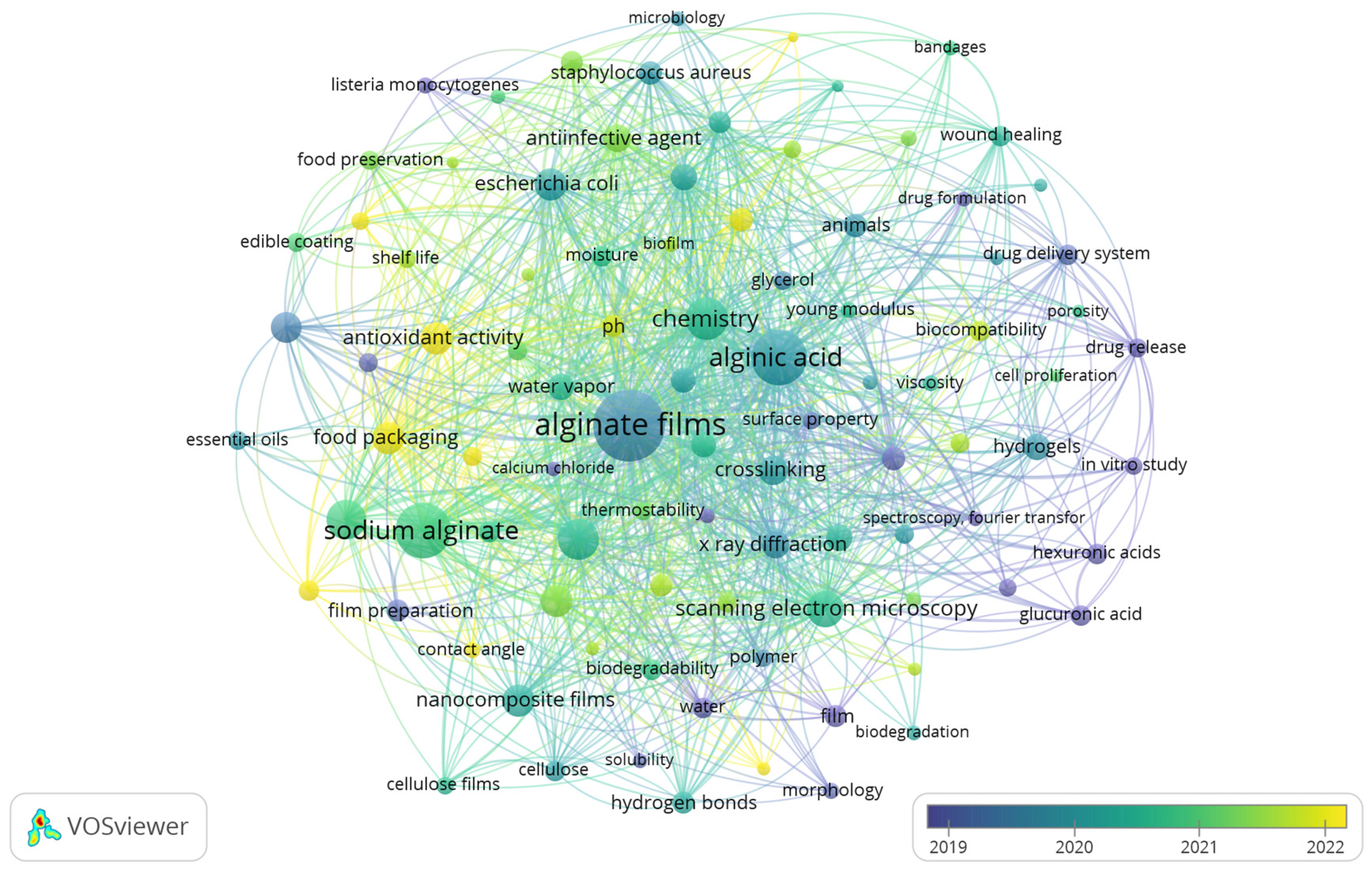
The keyword evolution over time is displayed in Figure 10. Keywords marked in blue denote that their average year of publication was in an earlier era, particularly reflecting the initial phase of research on alginate-based films. Green indicates terms that have been used continuously during the time span of this study, representing the core and persistent themes in the field. Conversely, yellow-highlighted keywords represent newly emerging research hotspots that have recently gained attention in alginate-based film studies.
In studies on alginate-based films during 2019–2022, the research trend gradually shifted from biomedical applications toward an emerging focus on food packaging. As shown in the overlay visualization (Figure 10), earlier studies primarily concentrated on fundamental aspects such as “hydrogels,” “drug release,” “drug delivery system,” and “glucuronic acid” (indicated in blue-purple), whereas more recent research increasingly highlights themes such as “food packaging,” “antimicrobial activity,” “antioxidant activity,” “pH,” and “essential oils” (depicted in yellow). This shift indicates a transition of the research direction from biomedical applications toward applications in the food sector. This trend aligns with the growing global demand for environmentally friendly packaging materials [172], driven by evolving consumer lifestyles and preferences for safer and more durable food products. Recent research in the food sector has particularly emphasized the development of smart packaging. Smart packaging is defined as an advanced packaging system designed not only to preserve food quality and safety but also to provide real-time information about the condition of the packaged product. These systems typically integrate sensors or indicators capable of detecting environmental changes, such as variations in pH, temperature, or the presence of specific gases, and subsequently respond through visible signals, including color changes or other measurable properties [173,174,175]. In general, smart packaging can be categorized into two primary types. Active packaging involves the incorporation of functional components that release or absorb certain substances to prolong shelf-life or maintain food quality. In contrast, intelligent packaging focuses on monitoring the status of packaged food and delivering relevant information to producers, retailers, and consumers [26]. One of the most notable features of alginate-based intelligent packaging is its ability to function as a pH-sensitive colorimetric indicator. By incorporating natural pigments, particularly anthocyanins, alginate-based films are capable of exhibiting visible color changes in response to pH variations, thereby providing a direct indication of food spoilage. For example, anthocyanin-enriched films derived from purple cauliflower or dragon fruit peel demonstrate clear transitions from purple to green, effectively signaling freshness loss in perishable products such as shrimp and pork [176,177]. This color change mechanism is of particular importance, as it enables real-time and user-friendly monitoring of food quality, while correlating pH shifts with microbial activity and spoilage progression [178,179,180].
Furthermore, the reinforcement of alginate-based films has remained a consistently attractive research area over the past three years, as reflected by the green-colored terms such as “nanocomposite films,” “crosslinking,” and “tensile strength”. Alginate-based films are inherently brittle and exhibit poor mechanical performance, including low tensile strength and limited elongation [181], yet these drawbacks can be mitigated through the incorporation of nanofillers, other reinforcing agents, and suitable crosslinking strategies [127,182]. Recent studies further confirm this approach. For example, Smyth et al. (2018) demonstrated that the incorporation of cellulose nanocrystals (CNCs) [183] markedly improves the mechanical strength of alginate-based films while also extending their functional stability under humid and aqueous environments. Moreover, the addition of nanoparticles such as ZnO nanoparticles [184], silver nanoparticles (AgNPs) [185], and montmorillonite (MMT) [117], along with crosslinking agents such as citric acid [33] and calcium chloride [127], has been proven to significantly enhance the mechanical performance of alginate-based films. Overall, reinforcement strategies have become the dominant direction in current research, aiming to overcome the inherent brittleness of alginate-based films and broaden their applicability across food, biomedical, and environmental sectors.
In summary, the bibliometric mapping highlights that current research trends are predominantly focused on the application of alginate-based films for food packaging. Alongside this, significant efforts are directed toward enhancing the mechanical, barrier, and functional properties of alginate-based films through polymer blending, the incorporation of active additives, and advanced processing strategies. Within this context, the development of smart packaging stands out as a particularly promising direction, offering both environmental advantages and functional benefits, including improved food preservation, quality monitoring, shelf-life extension, and reduced ecological impact.

4. Potential Applications of Alginate-Based Films

Alginate-based films have emerged as promising biomaterials due to their renewable origin, biocompatibility, biodegradability, and versatile physicochemical properties [186,187]. In the food sector, alginate-based films are widely applied as edible coatings and packaging materials, providing effective barriers against oxygen and moisture while maintaining food quality and extending shelf-life [101,146]. These advantages highlight their strong potential to replace conventional plastic packaging in the food industry. By incorporating antimicrobial or antioxidant agents such as essential oils, phenolic extracts, or nanoparticles, these films can function as active packaging systems that enhance food safety, reduce microbial contamination, and minimize post-harvest losses. For example, sodium alginate film embedding zein-curcumin nanoparticles delivered strong antibacterial activity and extended the shelf-life of grapes and strawberries by maintaining quality and reducing weight loss [188]. Another example, a sodium alginate edible coating with Helichrysum italicum essential oil, optimally improved barrier and antioxidant properties, inhibited fungal growth, and extended cherry tomato shelf-life to 18 days at ambient conditions [189]. Moreover, the introduction of intelligent packaging approaches, particularly through the integration of pH-sensitive natural extracts, further expanded the functionality of alginate-based films by enabling real-time freshness monitoring [70].
In the biomedical field, alginate-based films show strong potential as biocompatible materials for wound dressing, drug delivery, and tissue engineering. In wound care, alginate-based films effectively absorb exudates and form a moist gel layer that accelerates healing by preventing dryness and supporting cell migration [190]. When in contact with sodium ions (Na+) from wound fluid, calcium ions (Ca2+) in the film are exchanged, forming a soft, non-adherent gel that reduces pain during removal [191]. These features make alginate-based films ideal for treating exuding wounds, especially when enhanced with antimicrobial agents for faster healing and infection prevention. Mousavi et al. [192] developed sodium alginate/xanthan gum bionanocomposite films reinforced with hybrid halloysite nanotubes containing ZnO and licorice root extract, which exhibited strong antibacterial and antioxidant activities, demonstrating their potential for antimicrobial wound dressing applications. In drug delivery applications, alginate-based films offer a highly adaptable platform due to their flexibility, mucoadhesive properties, and biocompatibility, typically prepared through solution casting and ionic cross-linking. This film format is especially advantageous for topical or mucosal applications, enabling sustained drug release directly at a target site through controlled swelling and gradual erosion of the polymer matrix [193]. For example, a study by Ciaramitaro et al. [194] developed chitosan/sodium alginate/carboxymethylcellulose films loaded with indocyanine green (ICG) as an antibiofilm drug delivery system. The films showed controlled release behavior and effectively inhibited Staphylococcus aureus biofilm formation, indicating strong potential as antimicrobial coatings for medical applications. Furthermore, in tissue engineering, alginate-based films are often combined with biopolymers like gelatin or chitosan to improve cell adhesion, proliferation, and mechanical integrity, supporting the regeneration of soft tissues such as skin, cartilage, and vascular structures [195,196,197,198].
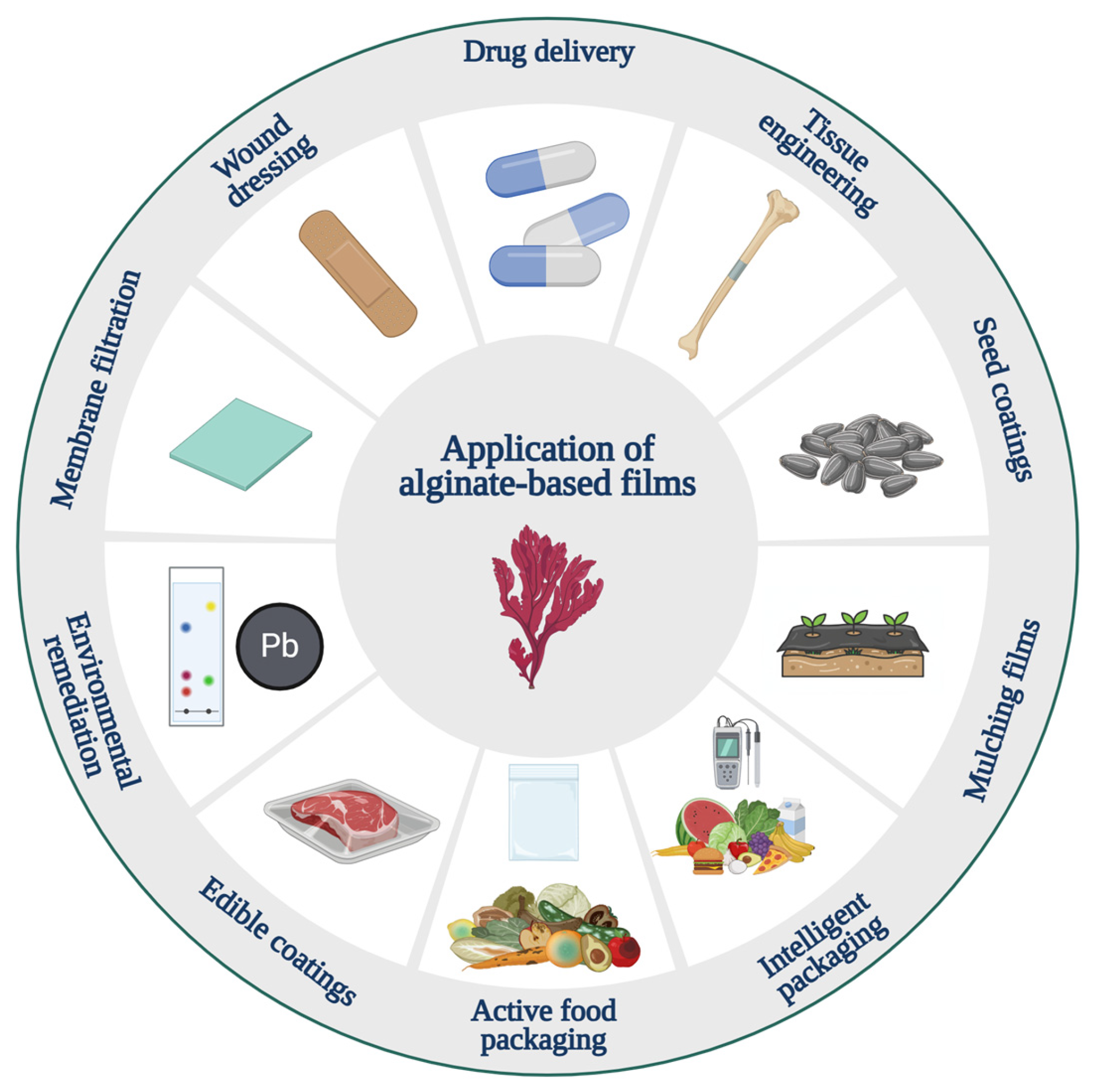
Beyond food and healthcare, alginate-based films also hold promise in agriculture and environmental engineering. In agriculture, they are applied as seed coatings [199] and mulching films [200], which regulate soil temperature, retain moisture, and suppress weed growth. Moreover, alginate sheets can also be used to deliver auxins and other chemicals that help plants grow. For instance, a mix of alginate and a zinc-aluminum double hydroxide with synthetic auxin made bean plant roots bigger, their fresh root matter better, and their shoots longer [199]. In environmental applications, alginate-based films demonstrate strong affinity for heavy metals such as Pb2+, Cu2+, and Cd2+, making them suitable for wastewater treatment and pollutant removal [201,202]. Furthermore, their biodegradability and ability to immobilize microorganisms support their use in sustainable bioremediation processes. Collectively, these applications underscore the multifunctionality of alginate-based films across diverse fields, with thematic keyword analysis confirming that research remains most concentrated in food packaging and biomedical applications. Further details on these applications are summarized in Table 7, while their distribution across various sectors is illustrated in Figure 11.

5. Prospects, Challenges, and Future Directions

Alginate-based films have attracted growing attention as eco-friendly alternatives to petroleum-derived plastics due to their excellent film-forming ability, biodegradability, biocompatibility, non-toxicity, and renewable natural resource origin [52,80], with promising applications in food packaging, biomedical devices, environmental protection, and agriculture. In food systems, alginate films serve as physical barriers and carriers of bioactive compounds, extending shelf-life and ensuring food safety. In the biomedical field, their tunable physicochemical properties allow applications in wound dressing, drug delivery, and tissue engineering scaffolds [110,213,214]. Moreover, alginate films also hold potential in environmental applications, such as heavy metal removal from wastewater as well as selective membranes and biosensors for pollutant monitoring and remediation [215]. In agriculture, alginate-based films are used as seed coatings to enhance germination and seedling vigor as well as biodegradable mulch films to suppress weeds, retain soil moisture, and reduce reliance on conventional plastic mulches.
However, the transition from laboratory research to commercial-scale implementation remains challenging. Several limitations hinder the commercial translation of alginate-based films. Their hydrophilic nature leads to poor water-vapor-barrier properties and limited mechanical strength, restricting their use in humid environments. Moreover, the scalability of producing alginate-based films on an industrial scale remains a significant challenge due to high production costs and complex fabrications process. The extraction of alginate from natural sources such as brown seaweed also requires expensive procedures and has not yet achieved an efficient and standardized method. Another critical issue is the compatibility of alginate with hydrophobic bioactive compounds, which often requires advanced blending strategies. Furthermore, polymer blending can improve mechanical and functional properties but may also increase fabrication costs, creating another economic challenge. Moreover, regulatory constraints, cost competitiveness, and limited consumer awareness represent external barriers that slow down the adoption of alginate-based films in commercial markets.
In our opinion, future research on alginate-based films should primarily focus on enhancing their mechanical properties and functional performance, as their inherent brittleness and poor mechanical strength continue to limit industrial applications. This research orientation is also consistent with the bibliometric keyword analysis. Several strategies have shown promise in this regard, including the addition of crosslinking agents to improve structural integrity, the use of plasticizers to enhance flexibility, the addition of nanofillers to reinforce barrier and mechanical strength, the blending with other polymers to create synergistic improvements in film characteristics, and the integration of functional additives such as antimicrobial and antioxidant agents to expand application fields. The development of cost-effective and energy-efficient processes for alginate extraction and film production is essential to ensure commercial viability. Utilizing renewable feedstocks and aligning with a circular bioeconomy framework could mitigate costs and promote sustainability. In addition, extrusion-based processing, well established in the plastics industry, offers potential if alginate formulations can be optimized for thermomechanical processing. Looking ahead, long-term stability studies at large-scale development will be critical, supported by active collaboration among researchers, industry players, policymakers, and consumers to drive cost reduction, ensure regulatory compliance, foster market acceptance, and ultimately achieve the commercialization and scalability of alginate-based films.

6. Bibliometric Analysis Limitations

This bibliometric study has several limitations that should be acknowledged. The identification of publications was conducted exclusively through the Scopus database, which is widely recognized as one of the most comprehensive sources for scientific literature. However, reliance on a single database means that the study may not fully capture relevant articles indexed in other platforms such as Web of Science or PubMed. In addition, the analysis was restricted to English-language publications, which may overlook potential contributions published in other languages. The dynamic growth in both the number of publications and citations also poses a limitation, as citation mapping and the list of most influential works are subject to continuous change in line with the expansion of research in this field. Additionally, one methodological limitation lies in the keyword co-occurrence analysis, which was restricted to the 100 most frequently occurring keywords. While this approach facilitates clearer visualization and reduces the complexity of the network mapping, it may exclude lower-frequency keywords that could signify emerging, innovative, or niche topics within the field of alginate-based-film research.

7. Conclusions

For the first time, a comprehensive bibliometric analysis was conducted to review alginate-based-film research articles published in the Scopus database. A total of 323 documents, including research articles, reviews, and conference papers, published between 2001 and 2024 were reviewed and analyzed to map trends, key contributors, and research hotspots in this field. In total, 1499 authors from 64 countries contributed to these publications. Over the past 23 years, the annual number of publications has steadily increased, indicating a continuous growth of research interest in alginate-based films. Furthermore, an exponential trendline model suggests that the publication output will continue to rise significantly in the coming years, with projections indicating that the total number of documents may reach approximately 471 by 2025.
The journal analysis revealed that the International Journal of Biological Macromolecules emerged as the most influential and relevant journal in this field, publishing a total of 45 articles, which represents approximately 36.84% of all documents analyzed. Notably, most of the top ten contributing journals belong to the top quartile (Q1) of their respective scientific categories, reflecting a clear preference among researchers to publish their studies in reputable, high-impact journals and underscoring the academic significance and global visibility of research on alginate-based films. In terms of subject area distribution, “Agricultural and Biological Sciences” emerged as the dominant category, accounting for 16.10% (110 articles) of the total publications, reflecting the strong biological and agricultural relevance of alginate-based-film research and its extensive application in biopolymer and food-related studies.
The country analysis identified China as the leading contributor in terms of publication output, accounting for 25.7% of the total publications. Jong-Whan Rhim from Kyung Hee University was identified as the most influential author in this field. At the institutional level, Jiangnan University from China emerged as the most influential organization, recording the highest publication output related to alginate-based films. Based on the co-authorship analysis by country, China leads in terms of international collaboration. However, at the author and institutional levels, collaboration remains relatively limited, suggesting that stronger research networks have yet to be fully established. This presents a significant opportunity for future international cooperation and cross-institutional projects, which could enhance research quality.
The citation analysis revealed that most of the top-cited articles primarily focused on the application of alginate-based films in food packaging, followed by their utilization in biomedical fields. This finding aligns closely with the results of the keyword co-occurrence thematic cluster analysis, which identified three predominant research themes in alginate-based-film studies: mechanical performance enhancement, food packaging applications, and biomedical and pharmaceutical applications. Furthermore, the topic trend analysis supports this observation, indicating that current research on alginate-based films has increasingly focused on smart packaging applications.
In our opinion, future research directions should focus on three main aspects. First, mechanical enhancement remains a key priority, which can be achieved through strategies such as blending alginate with other compatible polymers, introducing chemical crosslinking, and incorporating nanoparticles to improve strength and durability. Second, the incorporation of functional additives should be explored to impart active properties such as antimicrobial, antioxidant, or oxygen barrier functions, thereby broadening the potential applications of alginate-based films. Third, more attention should be given to the scale-up of production processes, with an emphasis on reducing manufacturing costs, ensuring that the final materials can meet consumer and industrial requirements for sustainable and affordable bioplastic packaging. Overall, this bibliometric study serves as a valuable reference for researchers and policymakers by identifying current research gaps and guiding strategic directions for sustainable biopolymer innovation.

Author Contributions

Conceptualization, A.W.; methodology, S.N.A. and Y.Y.; software, S.N.A.; validation, A.W.; formal analysis, R.T.; investigation, A.P. (Aji Prasetyaningrum) and Y.Y.; resources, A.P. (Aprilina Purbasari); data curation, S.N.A. and Y.Y.; writing—original draft preparation, S.N.A.; writing—review and editing, S.A., Y.Y., R.T., G.A.S., A.R. and A.F.; visualization, S.N.A.; supervision, A.P. (Aprilina Purbasari), A.P. (Aji Prasetyaningrum) and A.W.; project administration, A.P. (Aji Prasetyaningrum); funding acquisition, R.T., G.A.S., A.R. and A.F. All authors have read and agreed to the published version of the manuscript.

Funding

This research received no external funding. The Article Processing Charge (APC) was partially funded by Lembaga Penelitian dan Pengabdian kepada Masyarakat (LPPM), Universitas Diponegoro, Indonesia.

Data Availability Statement

The raw data supporting the conclusions of this article will be made available by the authors on request. Further inquiries can be directed to the corresponding author.

Acknowledgments

The authors gratefully acknowledge the Indonesian Endowment Fund for Education (LPDP), Ministry of Finance, Republic of Indonesia, for the Higher Education and Research scholarship support. The authors also extend their appreciation to LPPM Universitas Diponegoro for supporting the Article Processing Charge (APC) through the 2026 publication funding assistance program.

Conflicts of Interest

The authors declare no conflicts of interest.

References

  1. Law, K.L.; Narayan, R. Reducing Environmental Plastic Pollution by Designing Polymer Materials for Managed End-of-Life. Nat. Rev. Mater. 2021, 7, 104–116. [Google Scholar] [CrossRef]
  2. Borrelle, S.B.; Ringma, J.; Lavender Law, K.; Monnahan, C.C.; Lebreton, L.; McGivern, A.; Murphy, E.; Jambeck, J.; Leonard, G.H.; Hilleary, M.A.; et al. Predicted Growth in Plastic Waste Exceeds Efforts to Mitigate Plastic Pollution. Science 2020, 369, 1515–1518. [Google Scholar] [CrossRef]
  3. Ali, S.S.; Elsamahy, T.; Abdelkarim, E.A.; Al-Tohamy, R.; Kornaros, M.; Ruiz, H.A.; Zhao, T.; Li, F.; Sun, J. Biowastes for Biodegradable Bioplastics Production and End-of-Life Scenarios in Circular Bioeconomy and Biorefinery Concept. Bioresour. Technol. 2022, 363, 127869. [Google Scholar] [CrossRef]
  4. Haridevamuthu, B.; Raj, D.; Chandran, A.; Murugan, R.; Seetharaman, S.; Dhanaraj, M.; Almutairi, B.O.; Arokiyaraj, S.; Arockiaraj, J. Sustainable Food Packaging: Harnessing Biowaste of Terminalia Catappa L. for Chitosan-Based Biodegradable Active Films for Shrimp Storage. Carbohydr. Polym. 2024, 329, 121798. [Google Scholar] [CrossRef]
  5. Ayyubi, S.N.; Purbasari, A. The Effect of Composition on Mechanical Properties of Biodegradable Plastic Based on Chitosan/Cassava Starch/PVA/Crude Glycerol: Optimization of the Composition Using Box Behnken Design. Mater. Today Proc. 2022, 63, S78–S83. [Google Scholar] [CrossRef]
  6. Utari, F.D.; Djaeni, M.; Purbasari, A.; Siqhny, Z.D. Drying Characteristics and Kinetics of Rice Flour Biodegradable Film under Different Drying Temperatures. Mater. Today Proc. 2022, 63, S178–S182. [Google Scholar] [CrossRef]
  7. Parveen, N.; Chinna, S.V.; Naik, S.; Raja Vanapalli, K.; Sharma, H.B. Including Those for Text and Data Mining, AI Training, and Similar Technologies. Bioplastic Packaging in Circular Economy: A Systems-Based Policy Approach for Multi-Sectoral Challenges. Sci. Total Environ. 2024, 945, 173893. [Google Scholar] [CrossRef]
  8. Ghasemlou, M.; Barrow, C.J.; Adhikari, B. The Future of Bioplastics in Food Packaging: An Industrial Perspective. Food Packag. Shelf Life 2024, 43, 101279. [Google Scholar] [CrossRef]
  9. Singh, N.; Ogunseitan, O.A.; Wong, M.H.; Tang, Y. Sustainable Materials Alternative to Petrochemical Plastics Pollution: A Review Analysis. Sustain. Horiz. 2022, 2, 100016. [Google Scholar] [CrossRef]
  10. Duan, Y.; Tarafdar, A.; Kumar, V.; Ganeshan, P.; Rajendran, K.; Shekhar Giri, B.; Gómez-García, R.; Li, H.; Zhang, Z.; Sindhu, R.; et al. Sustainable Biorefinery Approaches towards Circular Economy for Conversion of Biowaste to Value Added Materials and Future Perspectives. Fuel 2022, 325, 124846. [Google Scholar] [CrossRef]
  11. Utari, F.D.; Djaeni, M.; Purbasari, A.; Siqhny, Z.D. The Characterization of Modified Rice Flour by Combination of Ultrasonication and Acetylation Process for Biodegradable Packaging. Bioresour. Technol. Rep. 2023, 21, 101349. [Google Scholar] [CrossRef]
  12. Karimi Sani, I.; Masoudpour-Behabadi, M.; Alizadeh Sani, M.; Motalebinejad, H.; Juma, A.S.M.; Asdagh, A.; Eghbaljoo, H.; Khodaei, S.M.; Rhim, J.W.; Mohammadi, F. Value-Added Utilization of Fruit and Vegetable Processing by-Products for the Manufacture of Biodegradable Food Packaging Films. Food Chem. 2023, 405, 134964. [Google Scholar] [CrossRef]
  13. Khalid, M.Y.; Arif, Z.U. Novel Biopolymer-Based Sustainable Composites for Food Packaging Applications: A Narrative Review. Food Packag. Shelf Life 2022, 33, 100892. [Google Scholar] [CrossRef]
  14. Baishya, H.; Kumar, S. Natural Functional Agents Reinforced Biopolymer Composites for Active Food Packaging Applications: A Review. Trends Food Sci. Technol. 2025, 161, 105042. [Google Scholar] [CrossRef]
  15. Roy, S.; Chawla, R.; Santhosh, R.; Thakur, R.; Sarkar, P.; Zhang, W. Agar-Based Edible Films and Food Packaging Application: A Comprehensive Review. Trends Food Sci. Technol. 2023, 141, 104198. [Google Scholar] [CrossRef]
  16. Zhang, W.; Yang, J.; Ghasemlou, M.; Riahi, Z.; Khan, A.; Goksen, G.; Zhang, Y.; Rhim, J.W. Recent Progress on Biopolymer-Based Food Packaging Films/Edible Coatings Functionalized with Catechol Derivatives Based on Mussel Biomimetics. Mater. Sci. Eng. R Rep. 2025, 166, 101068. [Google Scholar] [CrossRef]
  17. Behera, A.K.; Manna, S.; Das, N. Effect of Soy Waste/Cellulose on Mechanical, Water Sorption, and Biodegradation Properties of Thermoplastic Starch Composites. Starch/Staerke 2022, 74, 2100123. [Google Scholar] [CrossRef]
  18. Choudhary, P.; Pathak, A.; Kumar, P.; S, C.; Sharma, N. Commercial Production of Bioplastic from Organic Waste–Derived Biopolymers Viz-a-Viz Waste Treatment: A Minireview. Biomass Convers. Biorefin. 2024, 14, 10817–10827. [Google Scholar] [CrossRef]
  19. Bojorges, H.; López-Rubio, A.; Martínez-Abad, A.; Fabra, M.J. Overview of Alginate Extraction Processes: Impact on Alginate Molecular Structure and Techno-Functional Properties. Trends Food Sci. Technol. 2023, 140, 104142. [Google Scholar] [CrossRef]
  20. Arntzen, M.; Pedersen, B.; Klau, L.J.; Stokke, R.; Oftebro, M.; Antonsen, S.G.; Fredriksen, L.; Sletta, H.; Aarstad, O.A.; Aachmann, F.L.; et al. Alginate Degradation: Insights Obtained through Characterization of a Thermophilic Exolytic Alginate Lyase. Appl. Environ. Microbiol. 2021, 87, e02399-20. [Google Scholar] [CrossRef]
  21. Wardhani, D.H.; Sumardiono, S.; Purbasari, A.; Samsudin, A.M.; Ulya, H.N.; Susanti, A.D. Characterization of O/W emulsions stabilized using modified alginate: Effect of emulsion condition. Acta Sci. Pol. Technol. Aliment. 2025, 24, 203–215. [Google Scholar] [CrossRef]
  22. Tajeddin, B.; Arabkhedri, M. Polymers and Food Packaging. In Polymer Science and Innovative Applications Materials, Techniques, and Future Developments; Elsevier: Amsterdam, The Netherlands, 2020; pp. 525–543. [Google Scholar] [CrossRef]
  23. Alhussaini, M.S.; Alyahya, A.R.A.I.; Al-Ghanayem, A.A. Alginate-Derived Antibacterial and Antifungal Agents: A Review of Applications and Advancements (2019–2025). Int. J. Biol. Macromol. 2025, 318, 145333. [Google Scholar] [CrossRef] [PubMed]
  24. Kirti; Khora, S.S. Alginate: A Promising Biopolymer in Drug Delivery System. In Marine Biomaterials; Springer: Singapore, 2022; pp. 61–95. [Google Scholar] [CrossRef]
  25. Li, J.; He, J. Alginate-Based Films and Membranes: Preparation, Characterization and Applications. In Nanostructured Polymer Membranes; Wiley-Scrivener: Beverly, MA, USA, 2016; Volume 1, pp. 457–489. [Google Scholar] [CrossRef]
  26. Li, H.; Wang, Z.; Zhu, F.; Li, G. Alginate-Based Active and Intelligent Packaging: Preparation, Properties, and Applications. Int. J. Biol. Macromol. 2024, 279, 135441. [Google Scholar] [CrossRef]
  27. Safira, A.B.; Purbasari, A. Optimization and Characterization of Biodegradable Film Based on Glutinous Flour/Glycerol/Chitosan/ZnO Using Response Surface Methodology (RSM)-Central Composite Design (CCD). J. Kim. Sains Dan Apl. 2023, 25, 368–381. [Google Scholar] [CrossRef]
  28. Zhuang, Z.; Peng, B.; Yu, C.; Tang, C.; Jiang, G. Preparation and Application of Citric Acid Crosslinked Gelatin-Polyvinyl Alcohol Composite Films for Active Food Packaging. Int. J. Biol. Macromol. 2025, 328, 147715. [Google Scholar] [CrossRef]
  29. Kumar, B.; Singh, N.; Kumar, P. A Review on Sources, Modification Techniques, Properties and Potential Applications of Alginate-Based Modified Polymers. Eur. Polym. J. 2024, 213, 113078. [Google Scholar] [CrossRef]
  30. Hetalesi Saputri, L.; Purbasari, A.; Djoko Kusworo, T. Technological Intensification of the Edible Film-Making Process Using Bibliometric Analysis. Egypt. J. Chem. 2005, 67, 327–337. [Google Scholar] [CrossRef]
  31. Islam, M.; Javed, A.; Rahman, Z.U.; Al-Ghamdi, Y.O.; Khan, S.A. Antibacterial Composite Films of Oxidized Alginate-Chitosan-ZnO Anchored Cu Nanoparticles for the Degradation of Organic Pollutants. Int. J. Biol. Macromol. 2024, 278, 134764. [Google Scholar] [CrossRef]
  32. Utari, F.D.; Siqhny, Z.D.; Purbasari, A.; Kusworo, T.D.; Utomo, D.P.; Djaeni, M. Properties Enhancement of Brewer Rice Flour Biodegradable Films via Ultrasonication and Acetylation Treatments. Int. J. Technol. 2024, 15, 976–986. [Google Scholar] [CrossRef]
  33. Wang, P.; Yang, S.; Qi, B.; Yang, X.; Li, C.; Wang, D.; Zhao, Y.; Li, L.; Hu, X.; Chen, S. Effect of Synergistic Crosslinking Agent Based on Blending and Layer-by-Layer Assembly Method on Properties of Agar / Sodium Alginate Composite Film. Food Ferment. Ind. 2024, 50, 89–97. [Google Scholar] [CrossRef]
  34. Manikandan, G.; Senthilkumar, G.; Chen, C.W.; Nagarajan, D.; Chang, J.S.; Dong, C.D. Valorization of Brown Seaweed into Next-Generation Alginate Bioplastic Films: Functional Enhancements and Smart Packaging Applications. Carbohydr. Polym. 2025, 370, 124356. [Google Scholar] [CrossRef]
  35. Lam, W.S.; Lam, W.H.; Lee, P.F. The Studies on Chitosan for Sustainable Development: A Bibliometric Analysis. Materials 2023, 16, 2857. [Google Scholar] [CrossRef]
  36. Garrido-Romero, M.; Aguado, R.; Moral, A.; Brindley, C.; Ballesteros, M. From Traditional Paper to Nanocomposite Films: Analysis of Global Research into Cellulose for Food Packaging. Food Packag. Shelf Life 2022, 31, 100788. [Google Scholar] [CrossRef]
  37. de Oliveira, J.P.; da Silva, I.B.; Costa, J.d.S.S.; de Oliveira, J.S.; Oliveira, E.L.; Coutinho, M.L.; de Almeida, M.E.F.; Landim, L.B.; da Silva, N.M.C.; de Oliveira, C.P. Bibliometric Study and Potential Applications in the Development of Starch Films with Nanocellulose: A Perspective from 2019 to 2023. Int. J. Biol. Macromol. 2024, 277, 133828. [Google Scholar] [CrossRef]
  38. Tang, N.F.R.; Heryanto, H.; Armynah, B.; Tahir, D. Bibliometric Analysis of the Use of Calcium Alginate for Wound Dressing Applications: A Review. Int. J. Biol. Macromol. 2023, 228, 138–152. [Google Scholar] [CrossRef]
  39. Hu, S.; Alimire, A.; Lai, Y.; Hu, H.; Chen, Z.; Li, Y. Trends and Frontiers of Research on Cancer Gene Therapy From 2016 to 2020: A Bibliometric Analysis. Front. Med. 2021, 8, 740710. [Google Scholar] [CrossRef]
  40. Wu, H.; Li, Y.; Tong, L.; Wang, Y.; Sun, Z. Worldwide Research Tendency and Hotspots on Hip Fracture: A 20-Year Bibliometric Analysis. Arch. Osteoporos. 2021, 16, 73. [Google Scholar] [CrossRef] [PubMed]
  41. Ayyubi, S.N.; Purbasari, A.; Prasetyaningrum, A.; Puspa, M.B. A Bibliometric Analysis of Cellulose-Based Plastics from 1984 to 2024. E3S Web Conf. 2025, 655, 03001. [Google Scholar] [CrossRef]
  42. Suero-Abreu, G.A.; Barajas-Ochoa, A.; Berkowitz, R. An Analysis of Global Research Trends and Top-Cited Research Articles in Cardio-Oncology. Cardiol. Res. 2021, 12, 309–317. [Google Scholar] [CrossRef]
  43. Boukid, F. Smart Food Packaging: An Umbrella Review of Scientific Publications. Coatings 2022, 12, 1949. [Google Scholar] [CrossRef]
  44. Sinha, A.; Priyadarshi, P.; Bhushan, M.; Debbarma, D. Worldwide Trends in the Scientific Production of Literature on Traceability in Food Safety: A Bibliometric Analysis. Artif. Intell. Agric. 2021, 5, 252–261. [Google Scholar] [CrossRef]
  45. Dirpan, A.; Ainani, A.F.; Djalal, M. A Bibliometrics Visualization Analysis of Active Packaging System for Food Packaging. Heliyon 2023, 9, e18457. [Google Scholar] [CrossRef] [PubMed]
  46. Wu, H.; Zuo, J.; Zillante, G.; Wang, J.; Yuan, H. Construction and Demolition Waste Research: A Bibliometric Analysis. Arch. Sci. Rev. 2019, 62, 354–365. [Google Scholar] [CrossRef]
  47. Jiang, B.; Hong, N.; Zhao, F.; Dong, F. Visualization and Analysis of Mapping Knowledge Domains for Optic Neuritis: A Bibliometric Research from 2013 to 2022. Int. Ophthalmol. 2024, 44, 1–18. [Google Scholar] [CrossRef]
  48. Effah, N.A.A.; Wang, Q.; Owusu, G.M.Y.; Otchere, O.A.S.; Owusu, B. Contributions toward Sustainable Development: A Bibliometric Analysis of Sustainability Reporting Research. Environ. Sci. Pollut. Res. 2023, 30, 104–126. [Google Scholar] [CrossRef]
  49. Nur Rahman, M.Z.; Prakasa, E.; Bijaksana, M.A. Developing a Visual Dashboard to Improve Research Activity Assessment. In Proceedings of the International Conference on Computer, Control, Informatics and its Applications, IC3INA, Bandung, Indonesia, 9–10 October 2024; pp. 366–371. [Google Scholar] [CrossRef]
  50. Xu, M.; Du, J.; Xue, Z.; Guan, Z.; Kou, F.; Shi, L. A Scientific Research Topic Trend Prediction Model Based on Multi-LSTM and Graph Convolutional Network. Int. J. Intell. Syst. 2022, 37, 6331–6353. [Google Scholar] [CrossRef]
  51. Nelis, J.L.D.; da Silva, G.R.; Ortuño, J.; Tsagkaris, A.S.; Borremans, B.; Haslova, J.; Colgrave, M.L.; Elliott, C.T. The General Growth Tendency: A Tool to Improve Publication Trend Reporting by Removing Record Inflation Bias and Enabling Quantitative Trend Analysis. PLoS ONE 2022, 17, e0268433. [Google Scholar] [CrossRef]
  52. Luan, Q.Y.; Wang, Y.S.; Chen, Y.; Chen, H.H. Review on Improvement of Physicochemical Properties of Sodium Alginate-Based Edible Films. J. Food Sci. 2025, 90, e70016. [Google Scholar] [CrossRef] [PubMed]
  53. Larivière, V.; Sugimoto, C.R. The Journal Impact Factor: A Brief History, Critique, and Discussion of Adverse Effects; Springer Handbooks: New York, NY, USA, 2019; pp. 3–24. [Google Scholar] [CrossRef]
  54. Althouse, B.M.; West, J.D.; Bergstrom, C.T.; Bergstrom, T. Differences in Impact Factor across Fields and over Time. J. Am. Soc. Inf. Sci. Technol. 2009, 60, 27–34. [Google Scholar] [CrossRef]
  55. Jiang, C.; Tian, Z.; Jiang, M.; Xu, C.; Mao, M.; Feng, S.; Yuan, H. The Hot Spots and Global Trends of Prevention and Treatment in Postoperative Delirium (POD) from 2004 to 2023: A Bibliometric Analysis. Surg. Open Sci. 2024, 21, 35–44. [Google Scholar] [CrossRef] [PubMed]
  56. Miranda, R.; Garcia-Carpintero, E. Comparison of the Share of Documents and Citations from Different Quartile Journals in 25 Research Areas. Scientometrics 2019, 121, 479–501. [Google Scholar] [CrossRef]
  57. Daud, A.; Amjad, T.; Siddiqui, M.A.; Aljohani, N.R.; Abbasi, R.A.; Aslam, M.A. Correlational Analysis of Topic Specificity and Citations Count of Publication Venues. Libr. Hi Tech 2019, 37, 8–18. [Google Scholar] [CrossRef]
  58. Fraumann, G.; Mutz, R. The H-Index. In Handbook Bibliometrics; De Gruyter Saur: Munich Germany, 2020; pp. 169–177. [Google Scholar] [CrossRef]
  59. van Eck, N.J.; Waltman, L. Software Survey: VOSviewer, a Computer Program for Bibliometric Mapping. Scientometrics 2010, 84, 523–538. [Google Scholar] [CrossRef]
  60. Jin, R.; Yuan, H.; Chen, Q. Science Mapping Approach to Assisting the Review of Construction and Demolition Waste Management Research Published between 2009 and 2018. Resour. Conserv. Recycl. 2019, 140, 175–188. [Google Scholar] [CrossRef]
  61. Isfandyari-Moghaddam, A.; Saberi, M.K.; Tahmasebi-Limoni, S.; Mohammadian, S.; Naderbeigi, F. Global Scientific Collaboration: A Social Network Analysis and Data Mining of the Co-Authorship Networks. J. Inf. Sci. 2023, 49, 1126–1141. [Google Scholar] [CrossRef]
  62. Uddin, S.; Hossain, L.; Rasmussen, K. Network Effects on Scientific Collaborations. PLoS ONE 2013, 8, e0057546. [Google Scholar] [CrossRef]
  63. Rhim, J.W. Physical and Mechanical Properties of Water Resistant Sodium Alginate Films. LWT 2004, 37, 323–330. [Google Scholar] [CrossRef]
  64. Haldar, K.; Chakraborty, S. Investigation of Chemical Reaction during Sodium Alginate Drop Impact on Calcium Chloride Film. Phys. Fluids 2019, 31, 072102. [Google Scholar] [CrossRef]
  65. Catalina, M.; Attenburrow, G.E.; Cot, J.; Covington, A.D.; Antunes, A.P.M. Influence of Crosslinkers and Crosslinking Method on the Properties of Gelatin Films Extracted from Leather Solid Waste. J. Appl. Polym. Sci. 2011, 119, 2105–2111. [Google Scholar] [CrossRef]
  66. Bt Ibrahim, S.F.; Mohd Azam, N.A.N.; Amin, K.A.M. Sodium Alginate Film: The Effect of Crosslinker on Physical and Mechanical Properties. IOP Conf. Ser. Mater. Sci. Eng. 2019, 509, 012063. [Google Scholar] [CrossRef]
  67. Hadi, A.; Nawab, A.; Alam, F.; Zehra, K. Alginate/Aloe Vera Films Reinforced with Tragacanth Gum. Food Chem. Mol. Sci. 2022, 4, 100105. [Google Scholar] [CrossRef]
  68. Deng, P.; Zhang, Y.; Deng, Q.; Sun, Y.; Li, Y.; Wang, Z.; Jiang, F. Multifunctional Sodium Alginate-Based Self-Healing Edible Cross-Linked Coating for Banana Preservation. Food Hydrocoll. 2024, 151, 109753. [Google Scholar] [CrossRef]
  69. Liu, Z.; Liu, Q.; Lin, L.; Wang, Q.; Ma, W.; Cheng, Q.; Yang, J.; Tang, F.; Xu, M.; Yang, X.; et al. Stepwise Reinforcement Strategy for Guar Gum/Sodium Alginate Based Films: Introduction of Carboxylated Cellulose Nanofibers by Different Methods and Further Calcium Ion Crosslinking. Food Hydrocoll. 2024, 156, 110266. [Google Scholar] [CrossRef]
  70. Yang, M.; Kou, X.; Gao, Y.; Zhang, B.; Liu, Q.; Ma, Y.; Xia, Y.; Qu, Y.; Tan, Y. Development of a Novel Curcumin Loaded Lysine Modified Alginate Intelligent Film Reinforced by Lignosulfonic Acid with High Color Stability for Monitoring Shrimp Freshness. Food Packag. Shelf Life 2024, 43, 101278. [Google Scholar] [CrossRef]
  71. Criado-Gonzalez, M.; Fernandez-Gutierrez, M.; San Roman, J.; Mijangos, C.; Hernández, R. Local and Controlled Release of Tamoxifen from Multi (Layer-by-Layer) Alginate/Chitosan Complex Systems. Carbohydr. Polym. 2019, 206, 428–434. [Google Scholar] [CrossRef]
  72. Li, Y.; Qiu, C.; Qi, Y.; Yan, Y. Water Resistance Improvement of Sodium Alginate and Black Wolfberry Anthocyanins Based Films Treated by CaCl2 for Food Packaging. J. Oleo Sci. 2025, 74, 275–285. [Google Scholar] [CrossRef]
  73. Huq, T.; Salmieri, S.; Khan, A.; Khan, R.A.; Le Tien, C.; Riedl, B.; Fraschini, C.; Bouchard, J.; Uribe-Calderon, J.; Kamal, M.R.; et al. Nanocrystalline Cellulose (NCC) Reinforced Alginate Based Biodegradable Nanocomposite Film. Carbohydr. Polym. 2012, 90, 1757–1763. [Google Scholar] [CrossRef]
  74. Nordin, A.H.; Ngadi, N.; Ilyas, A.R.; Nabgan, W.; Norfarhana, A.S. Starch-Based Plastics: A Bibliometric Analysis. Mater. Today Proc. 2022, 74, 519–523. [Google Scholar] [CrossRef]
  75. Saputro, D.R.S.; Prasetyo, H.; Wibowo, A.; Khairina, F.; Sidiq, K.; Wibowo, G.N.A. Bibliometric analysis of neural basis expansion analysis for interpretable time series (N-BEATS) for research trend mapping. Barekeng 2023, 17, 1103–1112. [Google Scholar] [CrossRef]
  76. Gómez, M.C.S.; García, J.L.C.; Castro, S.V.; del Brio Alonso, I. Research Methods in the Educational Field: Bibliometric Analysis—A Comparative Study between Scopus and WoS. Rev. Esp. Educ. Comp. 2025, 141–172. [Google Scholar] [CrossRef]
  77. Purkayastha, A.; Palmaro, E.; Falk-Krzesinski, H.J.; Baas, J. Comparison of Two Article-Level, Field-Independent Citation Metrics: Field-Weighted Citation Impact (FWCI) and Relative Citation Ratio (RCR). J. Informetr. 2019, 13, 635–642. [Google Scholar] [CrossRef]
  78. Carpena-Istan, V.; Jurado, M.M.; Suarez-Estrella, F.; Lopez-Gonzalez, J.A.; Estrella-Gonzalez, M.J.; Martinez-Gallardo, M.R.; Toribio, A.J.; Salinas, J.; Lopez, M.J. Effective Microbial Formulations Using Sustainable Carriers for the Remediation of Plastic-Affected Soils. J. Environ. Manag. 2025, 379, 124887. [Google Scholar] [CrossRef]
  79. Riseh, R.S.; Skorik, Y.A.; Thakur, V.K.; Pour, M.M.; Tamanadar, E.; Noghabi, S.S. Encapsulation of Plant Biocontrol Bacteria with Alginate as a Main Polymer Material. Int. J. Mol. Sci. 2021, 22, 11165. [Google Scholar] [CrossRef]
  80. Yerramathi, B.B.; Muniraj, B.A.; Donadi, J.; Bandi, K.; Kola, M. Transformation of Alginate Based Films into Food Packaging Material—Confines and Possibilities as a Renewable Resource: A Review. React. Funct. Polym. 2025, 215, 106358. [Google Scholar] [CrossRef]
  81. Tao, L.; Shi, C.; Zi, Y.; Zhang, H.; Wang, X.; Zhong, J. A Review on the Chemical Modification of Alginates for Food Research: Chemical Nature, Modification Methods, Product Types, and Application. Food Hydrocoll. 2024, 147, 109338. [Google Scholar] [CrossRef]
  82. Li, Q.Q.; Xu, D.; Dong, Q.W.; Song, X.J.; Chen, Y.B.; Cui, Y.L. Biomedical Potentials of Alginate via Physical, Chemical, and Biological Modifications. Int. J. Biol. Macromol. 2024, 277, 134409. [Google Scholar] [CrossRef]
  83. Handayani, N.A.; Purbasari, A.; Sumardiono, S.; Fatikah, A.F.; Nurrudina, F. The Development of Intelligent Film From Crosslinked–Acylation Cassava Starch and Purple Sweet Potato Anthocyanin for Monitoring Indian Mackerel Fish Freshness. J. Food Process Eng. 2025, 48, e70043. [Google Scholar] [CrossRef]
  84. Putri, A.P.; Picchioni, F.; Harjanto, S.; Chalid, M. Alginate Modification and Lectin-Conjugation Approach to Synthesize the Mucoadhesive Matrix. Appl. Sci. 2021, 11, 11818. [Google Scholar] [CrossRef]
  85. Dey, S.; Roy, S.; Hasnain, M.S.; Nayak, A.K. Grafted Alginates in Drug Delivery. Alginates Drug Deliv. 2020, 71–100. [Google Scholar] [CrossRef]
  86. Ahmed, S. Alginates: Applications in the Biomedical and Food Industries. In Alginates: Applications in the Biomedical and Food Industries; Wiley: Hoboken, NJ, USA, 2019; pp. 1–317. [Google Scholar] [CrossRef]
  87. Pawar, S.N. Chemical Modification of Alginate. In Seaweed Polysaccharides: Isolation, Biological and Biomedical Applications; Elsevier: Amsterdam, The Netherlands, 2017; pp. 111–155. [Google Scholar] [CrossRef]
  88. Ampese, L.C.; Sganzerla, W.G.; Di Domenico Ziero, H.; Mudhoo, A.; Martins, G.; Forster-Carneiro, T. Research Progress, Trends, and Updates on Anaerobic Digestion Technology: A Bibliometric Analysis. J. Clean. Prod. 2022, 331, 130004. [Google Scholar] [CrossRef]
  89. Wang, J.; Maniruzzaman, M. A Global Bibliometric and Visualized Analysis of Bacteria-Mediated Cancer Therapy. Drug Discov. Today 2022, 27, 103297. [Google Scholar] [CrossRef] [PubMed]
  90. Acevedo-Fani, A.; Salvia-Trujillo, L.; Rojas-Graü, M.A.; Martín-Belloso, O. Edible Films from Essential-Oil-Loaded Nanoemulsions: Physicochemical Characterization and Antimicrobial Properties. Food Hydrocoll. 2015, 47, 168–177. [Google Scholar] [CrossRef]
  91. Pranoto, Y.; Salokhe, V.M.; Rakshit, S.K. Physical and Antibacterial Properties of Alginate-Based Edible Film Incorporated with Garlic Oil. Food Res. Int. 2005, 38, 267–272. [Google Scholar] [CrossRef]
  92. Mahcene, Z.; Khelil, A.; Hasni, S.; Akman, P.K.; Bozkurt, F.; Birech, K.; Goudjil, M.B.; Tornuk, F. Development and Characterization of Sodium Alginate Based Active Edible Films Incorporated with Essential Oils of Some Medicinal Plants. Int. J. Biol. Macromol. 2020, 145, 124–132. [Google Scholar] [CrossRef]
  93. Hammoudi, N.; Ziani Cherif, H.; Borsali, F.; Benmansour, K.; Meghezzi, A. Preparation of Active Antimicrobial and Antifungal Alginate-Montmorillonite/Lemon Essential Oil Nanocomposite Films. Mater. Technol. 2020, 35, 383–394. [Google Scholar] [CrossRef]
  94. Jafari, R.; Zandi, M.; Ganjloo, A. Characterization of Alginate-Gelatin Edible Film Containing Anise (Pimpinella anisum L.) Essential Oil. J. Polym. Environ. 2023, 31, 1568–1583. [Google Scholar] [CrossRef]
  95. Karami, P.; Zandi, M.; Ganjloo, A. Evaluation of Physicochemical, Mechanical, and Antimicrobial Properties of Gelatin-Sodium Alginate-Yarrow (Achillea millefolium L.) Essential Oil Film. J. Food Process. Preserv. 2022, 46, e16632. [Google Scholar] [CrossRef]
  96. Andrade-Ochoa, S.; Chacón-Vargas, K.F.; Sánchez-Torres, L.E.; Rivera-Chavira, B.E.; Nogueda-Torres, B.; Nevárez-Moorillón, G.V. Differential Antimicrobial Effect of Essential Oils and Their Main Components: Insights Based on the Cell Membrane and External Structure. Membranes 2021, 11, 405. [Google Scholar] [CrossRef] [PubMed]
  97. Nißl, L.; Westhaeuser, F.; Noll, M. Antimycotic Effects of 11 Essential Oil Components and Their Combinations on 13 Food Spoilage Yeasts and Molds. J. Fungi 2021, 7, 872. [Google Scholar] [CrossRef] [PubMed]
  98. Abers, M.; Schroeder, S.; Goelz, L.; Sulser, A.; St. Rose, T.; Puchalski, K.; Langland, J. Antimicrobial Activity of the Volatile Substances from Essential Oils. BMC Complement. Med. Ther. 2021, 21, 124. [Google Scholar] [CrossRef] [PubMed]
  99. Yu, H.; Zhou, Q.; He, D.; Yang, J.J.; Wu, K.; Chai, X.; Xiang, Y.; Duan, X.; Wu, X. Enhanced Mechanical and Functional Properties of Chitosan/Polyvinyl Alcohol/Hydroxypropyl Methylcellulose/Alizarin Composite Film by Incorporating Cinnamon Essential Oil and Tea Polyphenols. Int. J. Biol. Macromol. 2023, 253, 126859. [Google Scholar] [CrossRef] [PubMed]
  100. Liu, P.; Liu, M.; Wu, Y.; Ouyang, J. Chitosan-Pullulan-Zein Incorporating Artemisia Argyi Essential Oil and TiO2 for the Preservation of Phyllanthus Emblica Fruits: A Comparative Analysis of Coating and Film Effects. Food Packag. Shelf Life 2025, 49, 101518. [Google Scholar] [CrossRef]
  101. Parreidt, T.S.; Müller, K.; Schmid, M. Alginate-Based Edible Films and Coatings for Food Packaging Applications. Foods 2018, 7, 170. [Google Scholar] [CrossRef]
  102. Nair, M.S.; Tomar, M.; Punia, S.; Kukula-Koch, W.; Kumar, M. Enhancing the Functionality of Chitosan- and Alginate-Based Active Edible Coatings/Films for the Preservation of Fruits and Vegetables: A Review. Int. J. Biol. Macromol. 2020, 164, 304–320. [Google Scholar] [CrossRef]
  103. Kumar, H.; Singh, A.K.; Kumar, M.; Singh, K.; Vishal; Gaur, A.; Karuna, M.S.; Nishat, A.; Saltnat, L. Synthesis of Biodegradable Film Made from Sodium Alginate Embedded with Magnesium Nanoparticles for Food Packaging Applications. Theor. Found. Chem. Eng. 2023, 57, 977–984. [Google Scholar] [CrossRef]
  104. Prajapati, R.A.; Jadeja, G.C. Engineering Biodegradable Sodium Alginate Films with Dragon Fruit Peel Powder and MgO Nanoparticles. J. Macromol. Sci. Part B Phys. 2025, 64, 21–47. [Google Scholar] [CrossRef]
  105. Dadkhah, H.; Pirsa, S.; Javadi, A.; Mohtarami, F. Biodegradable Film of Sodium Alginate Film/Flax Seed Mucilage/Norbixin/Tungsten Oxide: Investigation of Color, Crystalline, Thermal, Mechanical and Antibacterial Properties. J. Food Sci. Technol. 2023, 20, 31–43. [Google Scholar] [CrossRef]
  106. Yalcin, B.; Ergungor, Z.; Konishi, Y.; Cakmak, M.; Batur, C. Molecular Origins of Toughening Mechanism in Uniaxially Stretched Nylon 6 Films with Clay Nanoparticles. Polymer 2008, 49, 1635–1650. [Google Scholar] [CrossRef]
  107. Voronova, M.I.; Surov, O.V.; Zakharov, A.G. Nanocrystalline Cellulose with Various Contents of Sulfate Groups. Carbohydr. Polym. 2013, 98, 465–469. [Google Scholar] [CrossRef]
  108. Pereira, R.; Carvalho, A.; Vaz, D.C.; Gil, M.H.; Mendes, A.; Bártolo, P. Development of Novel Alginate Based Hydrogel Films for Wound Healing Applications. Int. J. Biol. Macromol. 2013, 52, 221–230. [Google Scholar] [CrossRef]
  109. Thu, H.E.; Zulfakar, M.H.; Ng, S.F. Alginate Based Bilayer Hydrocolloid Films as Potential Slow-Release Modern Wound Dressing. Int. J. Pharm. 2012, 434, 375–383. [Google Scholar] [CrossRef]
  110. Aderibigbe, B.A.; Buyana, B. Alginate in Wound Dressings. Pharmaceutics 2018, 10, 42. [Google Scholar] [CrossRef] [PubMed]
  111. Imtiaz, M.; Akram, H.; Arshad, B.; Shehzad, A.; Haider, S.; Alam, K.; Khan, S.U.; Mansoor, M.A.; Iqbal, M. Bis-Imidazolium Ionic Liquid and Silver Nanoparticles Mediated Synthesis of Alginate Hydrogels for Bacterial Skin Infection and Wound Healing Applications. Int. J. Biol. Macromol. 2025, 306, 141420. [Google Scholar] [CrossRef] [PubMed]
  112. Kim, S. Recent Trends and Notable Advances of Alginate Based Nano-Particles for Effective Biomedical Materials: Wound Healing and Drug Delivery. Key Eng. Mater. 2023, 945, 27–32. [Google Scholar] [CrossRef]
  113. Costa, M.J.; Marques, A.M.; Pastrana, L.M.; Teixeira, J.A.; Sillankorva, S.M.; Cerqueira, M.A. Physicochemical Properties of Alginate-Based Films: Effect of Ionic Crosslinking and Mannuronic and Guluronic Acid Ratio. Food Hydrocoll. 2018, 81, 442–448. [Google Scholar] [CrossRef]
  114. Azeredo, H.M.C.; Waldron, K.W. Crosslinking in Polysaccharide and Protein Films and Coatings for Food Contact—A Review. Trends Food Sci. Technol. 2016, 52, 109–122. [Google Scholar] [CrossRef]
  115. Aguero, L.; Alpdagtas, S.; Ilhan, E.; Zaldivar-Silva, D.; Gunduz, O. Functional Role of Crosslinking in Alginate Scaffold for Drug Delivery and Tissue Engineering: A Review. Eur. Polym. J. 2021, 160, 110807. [Google Scholar] [CrossRef]
  116. Oryan, A.; Kamali, A.; Moshiri, A.; Baharvand, H.; Daemi, H. Chemical Crosslinking of Biopolymeric Scaffolds: Current Knowledge and Future Directions of Crosslinked Engineered Bone Scaffolds. Int. J. Biol. Macromol. 2018, 107, 678–688. [Google Scholar] [CrossRef]
  117. Abdollahi, M.; Alboofetileh, M.; Rezaei, M.; Behrooz, R. Comparing Physico-Mechanical and Thermal Properties of Alginate Nanocomposite Films Reinforced with Organic and/or Inorganic Nanofillers. Food Hydrocoll. 2013, 32, 416–424. [Google Scholar] [CrossRef]
  118. Ye, N.; Kueh, T.B.; Hou, L.; Liu, Y.; Yu, H. A Bibliometric Analysis of Corporate Social Responsibility in Sustainable Development. J. Clean. Prod. 2020, 272, 122679. [Google Scholar] [CrossRef]
  119. Babaei, S.; Reguyal, F.; Sarmah, A.K. A Bibliometric Analysis of Global Research Hotspots and Progress on Emerging Environmental Pollutants 6PPD and 6PPD-Quinone from 2004 to 2024. Environ. Pollut. 2024, 362, 124969. [Google Scholar] [CrossRef]
  120. Guo, X.; Wang, Y.; Qin, Y.; Shen, P.; Peng, Q. Structures, Properties and Application of Alginic Acid: A Review. Int. J. Biol. Macromol. 2020, 162, 618–628. [Google Scholar] [CrossRef]
  121. Hassabo, A.G.; Mohamed, A.L. Extraction, Structural Properties, and Applications of Alginic Acid. In Natural Gums: Extraction, Properties, and Applications; Elsevier: Amsterdam, The Netherlands, 2023; pp. 619–646. [Google Scholar] [CrossRef]
  122. Zhou, T.; Wang, H.; Han, Q.; Song, Z.; Yu, D.; Li, G.; Liu, W.; Dong, C.; Ge, S.; Chen, X. Fabrication and Characterization of an Alginate-Based Film Incorporated with Cinnamaldehyde for Fruit Preservation. Int. J. Biol. Macromol. 2024, 274, 133398. [Google Scholar] [CrossRef]
  123. Köhn, C.R.; da Rosa Fagundes, L.; Flôres, S.H.; de Oliveira Rios, A. Biodegradable Sodium Alginate Films Enriched with Oils—A Review. Packag. Technol. Sci. 2025, 38, 587–609. [Google Scholar] [CrossRef]
  124. Llorens-Gámez, M.; Salesa, B.; Serrano-Aroca, Á. Physical and Biological Properties of Alginate/Carbon Nanofibers Hydrogel Films. Int. J. Biol. Macromol. 2020, 151, 499–507. [Google Scholar] [CrossRef]
  125. Danesh, F.; GhaviDel, S. Visualizing the Clusters and Dynamics of HPV Research Area. Iran. J. Med. Microbiol. 2019, 13, 266–278. [Google Scholar] [CrossRef]
  126. Li, J.; Wei, R. VOSviewer Application Status and Its Knowledge Base. J. Libr. Inf. Sci. Agric. 2022, 34, 61–71. [Google Scholar] [CrossRef]
  127. Choi, I.; Lee, Y.; Lyu, J.S.; Lee, J.S.; Han, J. Characterization of Ionically Crosslinked Alginate Films: Effect of Different Anion-Based Metal Cations on the Improvement of Water-Resistant Properties. Food Hydrocoll. 2022, 131, 107785. [Google Scholar] [CrossRef]
  128. Sadeghi-Shapourabadi, M.; Robert, M.; Elkoun, S. A Study of the Influence of Sodium Alginate Molecular Weight and Its Crosslinking on the Properties of Potato Peel Waste-Based Films. Appl. Sci. 2025, 15, 6385. [Google Scholar] [CrossRef]
  129. Nijhawan, G.; Sehgal, S.S.; Sharma, S.; Siri, D. Analyzing Size’s Impact on Tensile Strength of Polymer Nanocomposites: Mechanical Testing and Material Characterization. AIP Conf. Proc. 2025, 3157, 120012. [Google Scholar] [CrossRef]
  130. Kubiak, J.M.; Li, B.; Suazo, M.; Macfarlane, R.J. Polymer Grafted Nanoparticle Composites with Enhanced Thermal and Mechanical Properties. ACS Appl. Mater. Interfaces 2022, 14, 21535–21543. [Google Scholar] [CrossRef]
  131. Marotta, A.; Causa, A.; Salzano de Luna, M.; Ambrogi, V.; Filippone, G. Tuning the Morphology of HDPE/PP/PET Ternary Blends by Nanoparticles: A Simple Way to Improve the Performance of Mixed Recycled Plastics. Polymer 2022, 14, 5390. [Google Scholar] [CrossRef] [PubMed]
  132. Caldwell, K.B.; Berg, J.C. Nanoparticles as Interphase Modifiers in Fiber Reinforced Polymeric Composites: A Critical Review. Rev. Adhes. Adhes. 2017, 5, 1–54. [Google Scholar] [CrossRef]
  133. Abdollahi, M.; Alboofetileh, M.; Behrooz, R.; Rezaei, M.; Miraki, R. Reducing Water Sensitivity of Alginate Bio-Nanocomposite Film Using Cellulose Nanoparticles. Int. J. Biol. Macromol. 2013, 54, 166–173. [Google Scholar] [CrossRef]
  134. Hassan, M.; Kassem, N.; El-Sakhawy, M. Effect of Bagasse and Rice Straw Cellulose Nanofibers on Physico-Mechanical Properties of Alginate Nanocomposites Films. Egypt. J. Chem. 2015, 58, 299–316. [Google Scholar]
  135. Alboofetileh, M.; Rezaei, M.; Hosseini, H.; Abdollahi, M. Effect of Montmorillonite Clay and Biopolymer Concentration on the Physical and Mechanical Properties of Alginate Nanocomposite Films. J. Food Eng. 2013, 117, 26–33. [Google Scholar] [CrossRef]
  136. Pilehforooshha, M.; Zandi, M.; Ganjloo, A.; Dardmeh, N. Advanced Biopolymer Films for Sustainable Applications: Integrating Fe3O4 and ZnO Nanoparticles into Pea Protein Isolate-Alginate Matrices. Int. J. Biol. Macromol. 2025, 310, 143306. [Google Scholar] [CrossRef]
  137. Marangoni Júnior, L.; da Silva, R.G.; Anjos, C.A.R.; Vieira, R.P.; Alves, R.M.V. Effect of Low Concentrations of SiO2 Nanoparticles on the Physical and Chemical Properties of Sodium Alginate-Based Films. Carbohydr. Polym. 2021, 269, 118286. [Google Scholar] [CrossRef]
  138. Roy, S.; Rhim, J.W. Effect of CuS Reinforcement on the Mechanical, Water Vapor Barrier, UV-Light Barrier, and Antibacterial Properties of Alginate-Based Composite Films. Int. J. Biol. Macromol. 2020, 164, 37–44. [Google Scholar] [CrossRef]
  139. Shuban, F.S.; Idris, M.I. Fabrication of Natural and Bio-Based Wound Healing Material from Alginate and Beeswax. AIP Conf. Proc. 2024, 2925, 020032. [Google Scholar] [CrossRef]
  140. Moura-Alves, M.; Souza, V.G.L.; Silva, J.A.; Esteves, A.; Pastrana, L.M.; Saraiva, C.; Cerqueira, M.A. Characterization of Sodium Alginate-Based Films Blended with Olive Leaf and Laurel Leaf Extracts Obtained by Ultrasound-Assisted Technology. Foods 2023, 12, 4076. [Google Scholar] [CrossRef]
  141. Kanagaraj, S.S.P.; Rajaram, S.K.; Ahamed, M.; Subedhar, S.; Sankar, K.; Innasimuthu, G.M.; Karuppiah, P. Antimicrobial Activity of Green Synthesized Biodegradable Alginate–Silver (Alg-Ag) Nanocomposite Films against Selected Foodborne Pathogens. Appl. Nanosci. 2023, 13, 651–662. [Google Scholar] [CrossRef]
  142. Ionita, M.; Pandele, M.A.; Iovu, H. Sodium Alginate/Graphene Oxide Composite Films with Enhanced Thermal and Mechanical Properties. Carbohydr. Polym. 2013, 94, 339–344. [Google Scholar] [CrossRef]
  143. Bezerra, P.H.S.; Souza-Santos, Y.J.; Pallone, E.M.J.A.; Carvalho, R.A.; Vanin, F.M. Development of Sodium Alginate Bioplastic Reinforced with Dried Orange Juice By-Product for Use in Packaging. Polymer 2024, 16, 3382. [Google Scholar] [CrossRef]
  144. Basavaraja, C.; Kim, N.R.; Jo, E.A.; Huh, D.S. Characterization and Conductivity Studies of Nanocomposite Films with Polymer Networks Containing Polyaniline-Alginate/Titanium Dioxide. Polym. Compos. 2010, 31, 1754–1761. [Google Scholar] [CrossRef]
  145. Tammina, S.K.; Priyadarshi, R.; Khan, A.; Manzoor, A.; Rahman, R.S.H.A.; Banat, F. Recent Developments in Alginate-Based Nanocomposite Coatings and Films for Biodegradable Food Packaging Applications. Int. J. Biol. Macromol. 2025, 295, 139480. [Google Scholar] [CrossRef]
  146. Kalita, P.; Roy, P.K.; Bhattacharjee, B.; Goswami, A.; Pachuau, L.; Roy, S. Alginate-Based Coating in Post-Harvest Fruits Preservation: A Comprehensive Review. Int. J. Biol. Macromol. 2025, 320, 145799. [Google Scholar] [CrossRef]
  147. Yu, K.; Yang, L.; Zhang, S.; Zhang, N.; Wang, S.; He, Y.; Liu, H. Soy Hull Nanocellulose Enhances the Stretchability, Transparency and Ionic Conductance of Sodium Alginate Hydrogels and Application in Beef Preservation. Food Hydrocoll. 2024, 152, 109938. [Google Scholar] [CrossRef]
  148. Criado, P.; Fraschini, C.; Salmieri, S.; Lacroix, M. Cellulose Nanocrystals (CNCs) Loaded Alginate Films against Lipid Oxidation of Chicken Breast. Food Res. Int. 2020, 132, 109110. [Google Scholar] [CrossRef]
  149. Sáez, M.I.; Suárez, M.D.; Martínez, T.F. Effects of Alginate Coating Enriched with Tannins on Shelf Life of Cultured Rainbow Trout (Oncorhynchus Mykiss) Fillets. LWT 2020, 118, 108767. [Google Scholar] [CrossRef]
  150. Guerrero, A.; Ferrero, S.; Barahona, M.; Boito, B.; Lisbinski, E.; Maggi, F.; Sañudo, C. Effects of Active Edible Coating Based on Thyme and Garlic Essential Oils on Lamb Meat Shelf Life after Long-Term Frozen Storage. J. Sci. Food Agric. 2020, 100, 656–664. [Google Scholar] [CrossRef]
  151. Nicolau-Lapeña, I.; Aguiló-Aguayo, I.; Kramer, B.; Abadias, M.; Viñas, I.; Muranyi, P. Combination of Ferulic Acid with Aloe Vera Gel or Alginate Coatings for Shelf-Life Prolongation of Fresh-Cut Apples. Food Packag. Shelf Life 2021, 27, 100620. [Google Scholar] [CrossRef]
  152. Iñiguez-Moreno, M.; Ragazzo-Sánchez, J.A.; Barros-Castillo, J.C.; Solís-Pacheco, J.R.; Calderón-Santoyo, M. Characterization of Sodium Alginate Coatings with Meyerozyma Caribbica and Impact on Quality Properties of Avocado Fruit. LWT 2021, 152, 112346. [Google Scholar] [CrossRef]
  153. Kulviwat, N.; Eze, F.N.; Ovatlarnporn, C. The Impact of Alginate Composites Enriched with Spent Black Tea, Green Tea, Jasmine Tea, and Oolong Tea Wastes on the Shelf-Life Extension of Fruits and Vegetables. Appl. Food Res. 2023, 3, 100290. [Google Scholar] [CrossRef]
  154. Cui, Z.; Li, Y.; Feng, X.; Hu, Z. Development, RSM-Based Optimization, and Characterization of a Unique Edible Composite Film by Incorporating Clove Essential Oil Based on Sodium Alginate and Aloe Vera Gel to Preserve the Quality of Blueberries. J. Food Process. Preserv. 2023, 2023, 3578799. [Google Scholar] [CrossRef]
  155. Zeng, Y.; Wang, Y.; Tang, J.; Zhang, H.; Dai, J.; Li, S.; Yan, J.; Qin, W.; Liu, Y. Preparation of Sodium Alginate/Konjac Glucomannan Active Films Containing Lycopene Microcapsules and the Effects of These Films on Sweet Cherry Preservation. Int. J. Biol. Macromol. 2022, 215, 67–78. [Google Scholar] [CrossRef]
  156. Mao, L.; Zuo, J.; Liu, Y.; Zheng, B.; Dai, X.; Bai, Z.; Liu, Y.; Yao, J. Alginate Based Films Integrated with Nitrogen-Functionalized Carbon Dots and Layered Clay for Active Food Packaging Applications. Int. J. Biol. Macromol. 2023, 253, 126653. [Google Scholar] [CrossRef]
  157. Zhang, B.; Liu, Y.; Peng, H.; Lin, Y.; Cai, K. Effects of Ginger Essential Oil on Physicochemical and Structural Properties of Agar-sodium Alginate Bilayer Film and Its Application to Beef Refrigeration. Meat Sci. 2023, 198, 109051. [Google Scholar] [CrossRef]
  158. Lopes, A.I.; Melo, A.; Afonso, T.B.; Silva, S.; Barros, L.; Tavaria, F.K.; Pintado, M. Alginate Edible Films Containing Essential Oils: Characterization and Bioactive Potential. Polymer 2025, 17, 1188. [Google Scholar] [CrossRef]
  159. Frank, K.; Garcia, C.V.; Shin, G.H.; Kim, J.T. Alginate Biocomposite Films Incorporated with Cinnamon Essential Oil Nanoemulsions: Physical, Mechanical, and Antibacterial Properties. Int. J. Polym. Sci. 2018, 2018, 1519407. [Google Scholar] [CrossRef]
  160. Byun, K.H.; Kim, H.J. Survival Strategies of Listeria Monocytogenes to Environmental Hostile Stress: Biofilm Formation and Stress Responses. Food Sci. Biotechnol. 2023, 32, 1631–1651. [Google Scholar] [CrossRef]
  161. dos Santos Emiliano, J.V.; Fusieger, A.; Camargo, A.C.; da Cruz Rodrigues, F.F.; Nero, L.A.; Perrone, Í.T.; de Carvalho, A.F. Staphylococcus Aureus in Dairy Industry: Enterotoxin Production, Biofilm Formation, and Use of Lactic Acid Bacteria for Its Biocontrol. Foodborne Pathog. Dis. 2024, 21, 601–616. [Google Scholar] [CrossRef]
  162. Yang, S.C.; Lin, C.H.; Aljuffali, I.A.; Fang, J.Y. Current Pathogenic Escherichia Coli Foodborne Outbreak Cases and Therapy Development. Arch. Microbiol. 2017, 199, 811–825. [Google Scholar] [CrossRef]
  163. Froelich, A.; Jakubowska, E.; Wojtyłko, M.; Jadach, B.; Gackowski, M.; Gadziński, P.; Napierała, O.; Ravliv, Y.; Osmałek, T. Alginate-Based Materials Loaded with Nanoparticles in Wound Healing. Pharmaceutics 2023, 15, 1142. [Google Scholar] [CrossRef]
  164. Sobczyk, A.d.E.; Aguiar, P.F.; Faccin, D.J.L.; Cardozo, N.S.M.; Tessaro, I.C. Effect of Processing Conditions on the Physical-Chemical and Mechanical Properties of Chitosan-Alginate Polyelectrolyte Complex Films for Potential Wound Dressing Application. J. Biomater. Appl. 2025, 40, 236–251. [Google Scholar] [CrossRef]
  165. Sobczyk, A.D.E.; Luchese, C.L.; Faccin, D.J.L.; Tessaro, I.C. Influence of Replacing Oregano Essential Oil by Ground Oregano Leaves on Chitosan/Alginate-Based Dressings Properties. Int. J. Biol. Macromol. 2021, 181, 51–59. [Google Scholar] [CrossRef]
  166. Farazin, A.; Mohammadimehr, M.; Ghasemi, A.H.; Naeimi, H. Design, Preparation, and Characterization of CS/PVA/SA Hydrogels Modified with Mesoporous Ag2O/SiO2 and Curcumin Nanoparticles for Green, Biocompatible, and Antibacterial Biopolymer Film. RSC Adv. 2021, 11, 32775–32791. [Google Scholar] [CrossRef]
  167. da Rocha Vaz, G.M.; Pinelli, J.J.; Bonatto, C.C.; Silva, L.P. Structural and Antimicrobial Properties of Alginate and Chitosan Films with Silver Nanoparticles. Surfaces 2026, 9, 25. [Google Scholar] [CrossRef]
  168. Pereira, R.; Tojeira, A.; Vaz, D.C.; Mendes, A.; Bártolo, P. Preparation and Characterization of Films Based on Alginate and Aloe Vera. Int. J. Polym. Anal. Charact. 2011, 16, 449–464. [Google Scholar] [CrossRef]
  169. Campelo, M.d.S.; Mota, L.B.; Neto, J.F.C.; Barbosa, M.L.L.; Gonzaga, M.L.d.C.; Leal, L.K.A.M.; Bastos, M.D.S.R.; Soares, S.d.A.; Ricardo, N.M.P.S.; Cerqueira, G.S.; et al. Agaricus Blazei Murill Extract-Loaded in Alginate/Poly(Vinyl Alcohol) Films Prepared by Ca2+ Cross-Linking for Wound Healing Applications. J. Biomed. Mater. Res. B Appl. Biomater. 2023, 111, 1035–1047. [Google Scholar] [CrossRef]
  170. Kruk, K.; Winnicka, K. Alginates Combined with Natural Polymers as Valuable Drug Delivery Platforms. Mar. Drugs 2023, 21, 11. [Google Scholar] [CrossRef]
  171. Chiaoprakobkij, N.; Suwanmajo, T.; Sanchavanakit, N.; Phisalaphong, M. Curcumin-Loaded Bacterial Cellulose/Alginate/Gelatin as A Multifunctional Biopolymer Composite Film. Molecules 2020, 25, 3800. [Google Scholar] [CrossRef]
  172. Lim, M. Sustainable Packaging: Analysis of the Customer’s Attitude Towards Utilization of Paper Based Packaging Material. In Sustainable Innovations in Management in the Digital Transformation Era: Digital Management Sustainability; Routledge: London, UK, 2024; pp. 153–162. [Google Scholar] [CrossRef]
  173. Romruen, O.; Kaewprachu, P.; Karbowiak, T.; Rawdkuen, S. Development of Smart Bilayer Alginate/Agar Film Containing Anthocyanin and Catechin-Lysozyme. Polymer 2022, 14, 5042. [Google Scholar] [CrossRef]
  174. Shivakumar, N.; Madhusudan, P.; Daniel, S.C.G.K. Nanomaterials for Smart Food Packaging. In Handbook of Nanomaterials for Industrial Applications; Elsevier: Amsterdam, The Netherlands, 2018. [Google Scholar] [CrossRef]
  175. Singh, M.B.; Singh, P.; Jain, P. Market Demand for Smart Packaging versus Consumer Perceptions. In Green Sustainable Process for Chemical and Environmental Engineering and Science: Methods for Producing Smart Packaging; Elsevier: Amsterdam, The Netherlands, 2023. [Google Scholar] [CrossRef]
  176. Liu, C.; Li, N.; An, X.; Li, X.; Liu, Z. A Smart Food Freshness Indicator Film for Shrimp and Pork with the Higher Visuality, Barrier, Flame Retardancy, and Antibacterial Effects. Food Bioproc. Technol. 2025, 18, 4805–4825. [Google Scholar] [CrossRef]
  177. Huang, H.L.; Tsai, I.L.; Lin, C.; Hang, Y.H.; Ho, Y.C.; Tsai, M.L.; Mi, F.L. Intelligent Films of Marine Polysaccharides and Purple Cauliflower Extract for Food Packaging and Spoilage Monitoring. Carbohydr. Polym. 2023, 299, 120133. [Google Scholar] [CrossRef]
  178. Radoor, S.; Jayakumar, A.; Karayil, J.; Kim, J.T.; Siengchin, S. Nelumbo Nucifera Flower Extract Incorporated Alginate/Polyvinyl Alcohol Films as a Sustainable PH Indicator for Active Food Packaging Applications. Int. J. Biol. Macromol. 2024, 273, 133170. [Google Scholar] [CrossRef]
  179. Ngoc Le, T.A.; Chen, W.N. Composite Films Produced from Upcycling of Tropical Fruit Seeds Are Capable of Monitoring Shrimp Freshness. Food Humanit. 2024, 2, 100234. [Google Scholar] [CrossRef]
  180. Wang, C.; Liu, C. A PH-Sensitive Intelligent Packaging Film Harnessing Anthocyanin for Food Freshness Monitoring. Food Bioproc. Technol. 2024, 17, 5312–5323. [Google Scholar] [CrossRef]
  181. Depeursinge, A.; Racoceanu, D.; Iavindrasana, J.; Cohen, G.; Platon, A.; Poletti, P.-A.; Muller, H. Fusing Visual and Clinical Information for Lung Tissue Classification in HRCT Data. Artif. Intell. Med. 2010, 50, 13–21. [Google Scholar] [CrossRef]
  182. Xiao, J.; Zhao, K.; Tian, X.; Song, Q.; Zhang, K.; Ma, Y.; Wang, W. Impact of Calcium-Carboxylate Interactions in Cellulose Nanofiber Reinforced Alginate Based Film with Triple-Decker-like Structure. LWT 2021, 151, 112197. [Google Scholar] [CrossRef]
  183. Smyth, M.; M’Bengue, M.S.; Terrien, M.; Picart, C.; Bras, J.; Foster, E.J. The Effect of Hydration on the Material and Mechanical Properties of Cellulose Nanocrystal-Alginate Composites. Carbohydr. Polym. 2018, 179, 186–195. [Google Scholar] [CrossRef]
  184. Ngo, T.M.P.; Dang, T.M.Q.; Tran, T.X.; Rachtanapun, P. Effects of Zinc Oxide Nanoparticles on the Properties of Pectin/Alginate Edible Films. Int. J. Polym. Sci. 2018, 2018, 5645797. [Google Scholar] [CrossRef]
  185. Dash, K.K.; Kumar, A.; Kumari, S.; Malik, M.A. Silver Nanoparticle Incorporated Flaxseed Protein-Alginate Composite Films: Effect on Physicochemical, Mechanical, and Thermal Properties. J. Polym. Environ. 2021, 29, 3649–3659. [Google Scholar] [CrossRef]
  186. Bhatia, S.; Al-Harrasi, A.; Shah, Y.A.; Altoubi, H.W.K.; Kotta, S.; Sharma, P.; Anwer, M.K.; Kaithavalappil, D.S.; Koca, E.; Aydemir, L.Y. Fabrication, Characterization, and Antioxidant Potential of Sodium Alginate/Acacia Gum Hydrogel-Based Films Loaded with Cinnamon Essential Oil. Gels 2023, 9, 337. [Google Scholar] [CrossRef]
  187. Abedi-Firoozjah, R.; Bahramian, B.; Tavassoli, M.; Majlesi, M.; Ghaderi, S.; Assadpour, E.; Zhang, F.; Sadeghi, E.; Bangar, S.P.; Jafari, S.M. Alginate-Based Edible Films/Coatings/Nanofibers in Food Packaging: A Comprehensive Review of Recent Advances. Carbohydr. Polym. Technol. Appl. 2025, 11, 100955. [Google Scholar] [CrossRef]
  188. Liang, Q.; Cao, P.; Lu, H.; Du, Y.; Kang, L.; Ma, H.; Ren, X. Ultrasonic Engineering of Zein-Curcumin Nanoparticles/Sodium Alginate Composite Films for Active Food Packaging Applications. Int. J. Biol. Macromol. 2025, 315, 144268. [Google Scholar] [CrossRef]
  189. Nkede, F.N.; Wardak, M.H.; Fanze, M.; Kondo, N.; Wardana, A.A.; Jothi, J.S.; Tanaka, F.; Tanaka, F. The Potential of Helichrysum Italicum Essential Oil-Infused Alginate Coatings and Film for Prolonging the Shelf-Life of Cherry Tomatoes. Food Packag. Shelf Life 2024, 46, 101381. [Google Scholar] [CrossRef]
  190. Varaprasad, K.; Jayaramudu, T.; Kanikireddy, V.; Toro, C.; Sadiku, E.R. Alginate-Based Composite Materials for Wound Dressing Application:A Mini Review. Carbohydr. Polym. 2020, 236, 116025. [Google Scholar] [CrossRef]
  191. Pinto, A.M.; Pereira, R.; Martins, A.J.; Pastrana, L.M.; Cerqueira, M.A.; Sillankorva, S. Designing an Antimicrobial Film for Wound Applications Incorporating Bacteriophages and ε-Poly-L-Lysine. Int. J. Biol. Macromol. 2024, 268, 131963. [Google Scholar] [CrossRef]
  192. Mousavi, S.F.; Arsalani, N.; Ghorbani, M. Preparation of Sodium Alginate and Xanthan Gum Bionanocomposite Films Reinforced with Hybrid Halloysite Nanotubes Containing ZnO and Licorice Root Extract for Wound Dressing Applications. Int. J. Biol. Macromol. 2025, 307, 141974. [Google Scholar] [CrossRef] [PubMed]
  193. El Maghraby, G.M.; Arafa, M.F. Alginate-Chitosan Combinations in Controlled Drug Delivery. In Natural Polysaccharides in Drug Delivery and Biomedical Applications; Academic Press: Cambridge, MA, USA, 2019; pp. 339–361. [Google Scholar] [CrossRef]
  194. Ciaramitaro, V.; Szpunar, M.; Vitale, F.; Tornatore, E.; Presentato, A.; Alduina, R.; Aebisher, D.; Francesca, D.; Martino, C.; Wal, A.; et al. Chitosan, Alginate, and Carboxymethyl Cellulose-Based Film for a Controlled Release of Indocyanine Green for Antibiofilm Applications. Carbohydr. Polym. Technol. Appl. 2025, 10, 100828. [Google Scholar] [CrossRef]
  195. Singh, A.K.; Pramanik, K.; Biswas, A. Constructing a Biofunctionalized 3D-Printed Gelatin/Sodium Alginate/Chitosan Tri-Polymer Complex Scaffold with Improvised Biological and Mechanical Properties for Bone-Tissue Engineering. Biodes. Manuf. 2024, 7, 57–73. [Google Scholar] [CrossRef]
  196. Galli, C.; Parisi, L.; Elviri, L.; Bianchera, A.; Smerieri, A.; Lagonegro, P.; Lumetti, S.; Manfredi, E.; Bettini, R.; Macaluso, G.M. Chitosan Scaffold Modified with D-(+) Raffinose and Enriched with Thiol-Modified Gelatin for Improved Osteoblast Adhesion. Biomed. Mater. 2016, 11, 015004. [Google Scholar] [CrossRef] [PubMed]
  197. Chiaoprakobkij, N.; Seetabhawang, S.; Sanchavanakit, N.; Phisalaphong, M. Fabrication and Characterization of Novel Bacterial Cellulose/Alginate/Gelatin Biocomposite Film. J. Biomater. Sci. Polym. Ed. 2019, 30, 961–982. [Google Scholar] [CrossRef]
  198. Kumawat, A.; Dave, S.; Varghese, S.; Patel, B.; Ghoroi, C. Iron Nano Biocomposite-Infused Biopolymeric Films: A Multifunctional Approach for Robust Skin Repair. ACS Appl. Mater. Interfaces 2024, 16, 30819–30832. [Google Scholar] [CrossRef] [PubMed]
  199. de Castro, V.A.; Duarte, V.G.O.; Nobre, D.A.C.; Silva, G.H.; Constantino, V.R.L.; Pinto, F.G.; Macedo, W.R.; Tronto, J. Plant Growth Regulation by Seed Coating with Films of Alginate and Auxin-Intercalated Layered Double Hydroxides. Beilstein J. Nanotechnol. 2020, 11, 1082–1091. [Google Scholar] [CrossRef]
  200. Feng, M.; Ma, Y.; Niu, S.; Zhuansun, Y. Biodegradable Mulch Film With Improved Mechanical and Barrier Properties for Sustainable Agricultural. J. Appl. Polym. Sci. 2025, 142, e57436. [Google Scholar] [CrossRef]
  201. Dong, S.; Li, Y.; Zhu, K.; Wang, C.; Zhai, S. Advances in Structure Designing and Function Tailoring Strategy toward Alginate-Based Hydrogels for Efficient Water Remediation: A Review. Int. J. Biol. Macromol. 2025, 304, 140801. [Google Scholar] [CrossRef]
  202. Siddiqui, V.U.; Ilyas, R.A.; Sapuan, S.M.; Hamid, N.H.A.; Khoo, P.S.; Chowdhury, A.; Atikah, M.S.N.; Rani, M.S.A.; Asyraf, M.R.M. Alginate-Based Materials as Adsorbent for Sustainable Water Treatment. Int. J. Biol. Macromol. 2025, 298, 139946. [Google Scholar] [CrossRef] [PubMed]
  203. Abdel Aziz, M.S.; Salama, H.E. Developing Multifunctional Edible Coatings Based on Alginate for Active Food Packaging. Int. J. Biol. Macromol. 2021, 190, 837–844. [Google Scholar] [CrossRef] [PubMed]
  204. Li, Y.; Yang, J.; Sun, L.; Liu, B.; Li, H.; Peng, L. Crosslinked Fish Scale Gelatin/Alginate Dialdehyde Functional Films Incorporated with Carbon Dots Derived from Pomelo Peel Waste for Active Food Packaging. Int. J. Biol. Macromol. 2023, 253, 127290. [Google Scholar] [CrossRef]
  205. Tong, W.Y.; Ahmad Rafiee, A.R.; Leong, C.R.; Tan, W.N.; Dailin, D.J.; Almarhoon, Z.M.; Shelkh, M.; Nawaz, A.; Chuah, L.F. Development of Sodium Alginate-Pectin Biodegradable Active Food Packaging Film Containing Cinnamic Acid. Chemosphere 2023, 336, 139212. [Google Scholar] [CrossRef] [PubMed]
  206. Devi, D.; Kumar, S.; Mukherjee, A. Onion Peel Extract as Milk Freshness Indicator in Biopolymer-Based Intelligent Packaging Films. Food Humanit. 2024, 2, 100223. [Google Scholar] [CrossRef]
  207. Thomas, D.; Nath, M.S.; Mathew, N.; R., R.; Philip, E.; Latha, M.S. Alginate Film Modified with Aloevera Gel and Cellulose Nanocrystals for Wound Dressing Application: Preparation, Characterization and in Vitro Evaluation. J. Drug Deliv. Sci. Technol. 2020, 59, 101894. [Google Scholar] [CrossRef]
  208. Shendage, S.S.; Kachare, K.; Gaikwad, K.; Naikwade, M.B.; Kashte, S.; Ghule, A.V. Bioactive Material-sodium Alginate-Polyvinyl Alcohol Composite Film Scaffold for Bone Tissue Engineering Application. Int. J. Biol. Macromol. 2024, 276, 133860. [Google Scholar] [CrossRef]
  209. Abdukerim, R.; Li, L.; Li, J.H.; Xiang, S.; Shi, Y.X.; Xie, X.W.; Chai, A.L.; Fan, T.F.; Li, B.J. Coating Seeds with Biocontrol Bacteria-Loaded Sodium Alginate/Pectin Hydrogel Enhances the Survival of Bacteria and Control Efficacy against Soil-Borne Vegetable Diseases. Int. J. Biol. Macromol. 2024, 279, 135317. [Google Scholar] [CrossRef]
  210. Lv, J.; Chen, P.; Li, S. Novel Biodegradable Mulch Films Made from Vegetable Stalk and Sodium Alginate. Int. J. Biol. Macromol. 2025, 318, 144370. [Google Scholar] [CrossRef]
  211. Li, Q.; Li, Y.; Ma, X.; Du, Q.; Sui, K.; Wang, D.; Wang, C.; Li, H.; Xia, Y. Filtration and Adsorption Properties of Porous Calcium Alginate Membrane for Methylene Blue Removal from Water. Chem. Eng. J. 2017, 316, 623–630. [Google Scholar] [CrossRef]
  212. Rafiee, H.; Shakeri, A.; Mahdavi, H. Layer-by-Layer Assembly of Alginate/Ca2+ as Interlayer on Microfiltration Substrate: Fabrication of High Selective Thin-Film Composite Forward Osmosis Membrane for Efficient Heavy Metal Ions Removal. Chem. Eng. Res. Des. 2022, 188, 564–574. [Google Scholar] [CrossRef]
  213. Guarino, V.; Altobelli, R.; della Sala, F.; Borzacchiello, A.; Ambrosio, L. Alginate Processing Routes to Fabricate Bioinspired Platforms for Tissue Engineering and Drug Delivery. In Biomaterials Science and Engineering; Springer: Berlin/Heidelberg, Germany, 2018; Volume 11, pp. 101–120. [Google Scholar] [CrossRef]
  214. Dave, V.; Tak, K.; Gupta, C.; Verma, K.; Sharma, S. Alginates in Pharmaceutical and Biomedical Application: A Critique. In Alginates: Applications in the Biomedical and Food Industries; John Wiley & Sons: Hoboken, NJ, USA, 2019; pp. 95–123. [Google Scholar] [CrossRef]
  215. Stegner, E.; Bauer-Reich, C. Development of Biodegradable Films for Remote Sensing of Ions in Soil. In Proceedings of the 2024 IEEE International Conference on Electro Information Technology (eIT), Eau Claire, WI, USA, 30 May–1 June 2024; pp. 106–110. [Google Scholar] [CrossRef]
Figure 1. PRISMA flow for the search of documents on alginate-based composite films (created in BioRender. Princess, L. (2026) https://BioRender.com/dqb3iqx (accessed on 9 April 2026)).
Jcs 10 00304 g001
Figure 2. Annual and total publications on alginate-based-film research. The bar chart represents the total publications, while the line chart illustrates the annual publications. The dotted line indicates the trend line for total publications. The exponential curve fits the trend line.
Jcs 10 00304 g002
Figure 3. Global distribution of research publications on alginate-based films.
Jcs 10 00304 g003
Figure 4. Collaboration between countries in alginate-based-film research.
Jcs 10 00304 g004
Figure 5. Collaboration between authors in alginate-based-film research.
Jcs 10 00304 g005
Figure 6. Collaboration between institutions in alginate-based-film research.
Jcs 10 00304 g006
Figure 7. Main subject areas in alginate-based-film research.
Jcs 10 00304 g007
Figure 8. Top 10 most frequent keywords utilized in alginate-based-film research in (a) funnel chart and (b) density visualization where yellow indicates the highest density of keyword occurrences.
Jcs 10 00304 g008
Figure 9. Clustering of the 100 most-frequent authors’ keywords.
Jcs 10 00304 g009
Figure 10. Keyword evolution over time in alginate-based-film research.
Jcs 10 00304 g010
Figure 11. Schematic overview of alginate-based film applications in various fields (created in BioRender. Princess, L. (2026) https://BioRender.com/i1qdihx (accessed on 9 April 2026)).
Jcs 10 00304 g011
Table 1. Top 10 most influential journals in alginate-based-film research.
RankJournalCountryPublicationsCitationsIF (2024)Quartile
1International Journal of Biological MacromoleculesThe Netherlands4525258.5Q1
2Food HydrocolloidsThe Netherlands18204312.4Q1
3Carbohydrate PolymersUnited Kingdom12117412.5Q1
4PolymersSwitzerland101864.9Q1
5Food Packaging and Shelf LifeThe Netherlands925010.6Q1
6FoodsSwitzerland66775.1Q1
7Food Science and NutritionUnited Kingdom51393.8Q1
8LWTUnited States54216.6Q1
9MaterialsSwitzerland52583.2Q2
10Journal of Food Science and TechnologyUnited Kingdom41963.3Q2
Note: IF (2024) = Journal Impact Factor 2024.
Table 2. Top 10 most productive and influential countries in alginate-based-film research.
RankCountryPublicationsPercentage (%)CitationsAverage CitationsH-IndexTotal Link Strength
1China8325.7257931.072922
2India319.6142946.101633
3Turkey195.958630.841215
4Spain185.6126970.501319
5South Korea185.6126670.331411
6Portugal185.6127270.67127
7United States175.385350.181419
8United Kingdom154.654836.531114
9Brazil154.642328.20115
10Iran144.384960.64109
Table 3. Top five most productive authors in alginate-based-film research.
RankAuthorsInstitutionCountryH-IndexPublicationsCitations
1Jong-Whan RhimKyung Hee UniversitySouth Korea1098770
2Miguel Ângelo CerqueiraInternational Iberian Nanotechnology LaboratoryPortugal726429
3M. L. LacroixCentre Armand-Frappier Santé BiotechnologieCanada726811
4Lorenzo Miguel Pastrana-CastroInternational Iberian Nanotechnology LaboratoryPortugal536429
5Yuhong FengHainan UniversityChina26563
Table 4. Top 10 most productive author organizations in alginate-based-film research.
RankAuthor OrganizationCountryPublicationsCitations
1Jiangnan UniversityChina13297
2Universidade do MinhoPortugal8380
3Ministry of Education of the People’s Republic of ChinaChina759
4Universidade Estadual de CampinasBrazil6222
5International Iberian Nanotechnology LaboratoryPortugal6373
6Kyung Hee UniversitySouth Korea5424
7Consejo Nacional de Investigaciones Científicas y TécnicasArgentina5267
8Centre Armand-Frappier Santé BiotechnologieCanada5679
9Hainan UniversityChina534
10Shahid Beheshti University of Medical SciencesIran5272
Table 6. Top 10 most-frequent keywords in each cluster.
ClusterColorTop Ten Keywords Within Each Cluster (Occurrences)
1Redalginate films (175), sodium alginate (113), tensile strength (65), sodium (62), scanning electron microscopy (55), Fourier transform infrared spectroscopy (45), nanocomposite films (43), crosslinking (37), x ray diffraction (34), physical chemistry (28)
2Greenchemistry (71), food packaging (45), scherichia coli (44), antioxidant activity (43), edible films (42), antiinfective agent (35), antibacterial activity (31), antimicrobial activity (26), staphylococcus aureus (25), anti-bacterial agents (24)
3Bluealginic acid (113), hydrogels (32), animals (26), biopolymer (32), infrared spectroscopy (25), drug delivery system (21), hexuronic acids (21), wound healing (20), glucuronic acid (20), drug release (19)
Table 7. Summary of alginate-based film applications across various sectors.
Application AreaSpecific ApplicationFormulation/Alginate CompositeActive Compound/AdditivesKey FindingsRef.
Food scienceTomato preservation (edible coating)Alginate film matrix with aloe vera and garlic oilAloe vera 50% and 66.7% (w/w of total mass); garlic oil 1%, 3%, 5% (v/v)Broad UV-shielding, reduced water-vapor permeability, enhanced antimicrobial activity, transparency maintained, shelf-life extended[203]
Food scienceStrawberry preservation (active packaging)Fish scale gelatin/alginate dialdehyde matrix with carbon dotsPomelo peel derived carbon dots 1%, 3%, 5%, 7% (wt%)Reinforced mechanical and barrier properties, increased UV-blocking, added fluorescence, strong antioxidant and antimicrobial activities, quality preserved and shelf-life extended at room temperature[204]
Food scienceCherry tomato preservation (edible coating)Sodium alginate edible coating with essential oilHelichrysum italicum essential oil 0.3–0.5%Improved UV-blocking and thermal stability, lower water-vapor permeability, higher flexibility, strong antifungal effect, reduced weight loss, better firmness, shelf-life extended[189]
Food scienceFresh beef quality (active packaging)Sodium alginate/pectin biodegradable filmCinnamic acid 0.33% w/vBroad antibacterial activity on beef, substantial microbial-load reduction, improved color retention during storage, biodegradable behavior demonstrated[205]
Food scienceGrapes and strawberries preservation (active packaging)Sodium alginate film with nanoparticlesCurcumin-loaded zein nanoparticles (percentage in final film not reported)Strong antibacterial effect, improved mechanical and barrier performance, reduced fruit weight loss with suppressed respiration/ethylene, shelf-life extended[188]
Food scienceMilk freshness monitoring (intelligent packaging)Gelatin/sodium alginate biopolymer film/label with plant extractOnion peel extract (anthocyanin-rich) 2%, 4%, 10%, 15% (v/v)Clear pH-responsive color change tracking milk freshness; reduced moisture, solubility, and swelling; increased antioxidant activity and total phenolics; feasible sustainable freshness indicator[206]
Food scienceShrimp freshness monitoring (intelligent packaging)Lysine-modified alginate film reinforced with lignosulfonic acid nanoparticles, loaded with curcuminCurcumin 1%, 3%, 5%, 7% (w/w)Markedly improved mechanical strength and water resistance, stronger UV-blocking, enhanced thermal stability, robust antioxidant and antibacterial activities, high color stability, clear pH-responsive color change, effective visual monitoring of shrimp freshness[70]
BiomedicalWound dressing (antibacterial film)Sodium alginate/xanthan gum bionanocomposite with halloysite nanotubesZinc oxide nanoparticles (in halloysite nanotubes) 3%, 5% (w/w of dry material); licorice root extract 5%, 10% (w/w)Enhanced mechanical, thermal, and barrier properties; increased antibacterial and antioxidant activities; higher fibroblast viability; sustained release; strong potential as wound dressing[192]
BiomedicalWound dressing (alginate/aloe vera/cellulose nanocrystal film)Calcium-crosslinked alginate film with aloe vera gel and cellulose nanocrystals; honey as plasticizerAloe vera gel 12.5% (w/v); honey 15% (w/v); cellulose nanocrystals 1% (w/w)Improved mechanical strength and UV shielding; porous, hydrophilic matrix supporting exudate absorption; antibacterial activity; biocompatibility with promoted scratch-wound closure in vitro[207]
BiomedicalAntibiofilm drug-delivery coating (controlled indocyanine green release)Composite film of chitosan/sodium alginate/carboxymethylcelluloseIndocyanine green 100 µM, 200 µM, 500 µMStabilized J-aggregate reservoir with controlled diffusion-governed release; improved film stability; effective inhibition of biofilm formation; promising antimicrobial/antibiofilm coating[194]
BiomedicalBone tissue engineering (flexible film scaffold)Sodium alginate/polyvinyl alcohol composite film incorporating bioactive calcium silicateBioactive calcium silicate 0.1 g, 0.3 g, 0.5 g per film batchHydroxyapatite deposition in simulated body fluid, hemocompatibility, angiogenesis, in vitro/in vivo biocompatibility, and accelerated osteogenesis in a defect model[208]
AgricultureCucumber seed coating against Fusarium root rot (seed coating)Sodium alginate/pectin hydrogel seed coating crosslinked with calcium ions, loaded with biocontrol bacteriaBacillus subtilis ZF71 (108 CFU/mL inoculum); calcium chloride 1–5% (w/v)Biofilm-like microcolonies on seeds, high bacterial survival during storage, uniform/tough coatings at optimized ratios, and higher control efficacy versus bacterial suspension[209]
AgricultureBiodegradable mulch film for crop cultivation (mulch film)Sodium alginate/vegetable stalk composite film with plasticizerVegetable stalk powder 0–80% (w/w of solids); glycerin 0–50% (w/w of solids)High UV blocking, good mechanical/barrier performance, thermal insulation and moisture retention, supports seed germination, rapid soil biodegradation, favorable life-cycle impacts[210]
EnvironmentalDye (methylene blue) removal (adsorptive filtration membrane)Porous calcium alginate membrane prepared by freeze-drying and post crosslinkingCalcium chloride 0.5 M (crosslinking); variation studied 0.1–0.9 MPorous 3D network enables effective filtration and high adsorption; adsorption fits common isotherm/kinetic models; regenerable adsorbent performance[211]
EnvironmentalHeavy-metal ion removal (forward osmosis membrane)Thin-film composite forward osmosis membrane with alginate/calcium interlayer and polyamide active layerCalcium chloride 0.1 wt% (interlayer crosslinking); sodium alginate 0.1 wt% (interlayer deposition)Alginate/Ca2+ interlayer yields smooth, defect-free polyamide, increasing water flux and lowering reverse salt flux; near-complete rejection of representative heavy-metal ions and good operational stability[212]
Disclaimer/Publisher’s Note: The statements, opinions and data contained in all publications are solely those of the individual author(s) and contributor(s) and not of MDPI and/or the editor(s). MDPI and/or the editor(s) disclaim responsibility for any injury to people or property resulting from any ideas, methods, instructions or products referred to in the content.