1. Introduction
Bistable composite laminates (BCLs), produced by asymmetric mechanical prestressing, can maintain two stable configurations without continuous energy input and undergo rapid snap-through under external perturbations. BCLs serve as key building blocks for efficient, low-energy programmable morphing systems [
1] and show strong potential for deployable structures [
2], soft actuators [
3,
4], and energy conversion and harvesting [
5].
Regarding the formation mechanisms and control strategies of bistable behavior, most existing studies have modeled BCLs as laminated plates and have determined their equilibrium configurations and stability distributions based on energy variation or minimum potential energy principles under the assumption of constant curvature [
6,
7]. Based on these studies, recent research has developed multiscale and higher-order modeling frameworks, systematically elucidating the effects of ply orientation, interlaminar thickness ratios, and boundary constraints on the distribution of stable branches and the height of energy barriers [
8,
9,
10]. Wang et al. examined the dynamic snap-through of plates with asymmetric potential energy curves [
11]. Zhang et al. investigated the nonlinear dynamic response of a square bistable composite laminate by frequency domain analysis [
9]. Meanwhile, some studies have explored multistable responses and programmable shape switching through material hybridization and prestress tailoring, significantly expanding the functional scope and application potential of BCLs [
12,
13]. For example, Zhao et al. improved the load-carrying capability of a bistable composite cylindrical shell through elastic fiber prestressing [
14]. Wang et al. achieved programmable multistability and stiffness by controlling the prestress in tension structures [
15].
However, in practical engineering applications, BCLs are often subjected to internal pneumatic pressure and external mechanical loading simultaneously [
16]. For instance, in pneumatic actuators, morphing wings and adaptive shell structures, internal pressure not only serves as an actuation source for shape switching but also directly alters the initial strain field of the laminate, while external loads—including in-plane forces, concentrated forces, and bending moments—modify the overall potential energy landscape through boundary constraints and membrane stresses [
17,
18]. The interplay and competition between these loadings can cause stable-state drift, the reshaping of energy barriers, and significant variations in critical snap-through conditions, giving rise to more complex nonlinear shape evolution behaviors [
19,
20]. Although coupled pneumatic–mechanical actuation has been investigated in square or nearly square bistable laminates, the role of planform geometry in regulating such coupled responses remains insufficiently understood, especially when an additional geometric degree of freedom is introduced, such as rhombus.
In our previous studies [
21,
22], mechanically prestressed bistable actuators with square or nearly square planforms were developed, and the effects of selected design parameters on their equilibrium configurations were investigated. These studies demonstrated the feasibility of integrating pneumatic actuation into mechanically prestressed bistable composites. However, because the planform geometry was essentially fixed, the influence of geometry-induced shear–bending coupling on the coupled response between internal pressure, external mechanical loading, and stable-state transition was not explicitly addressed. In particular, the combined influence of geometric configuration, pneumatic pressurization, and multimode external loading on the equilibrium morphology, load–deflection response, and snap-through energy barrier remains insufficiently understood.
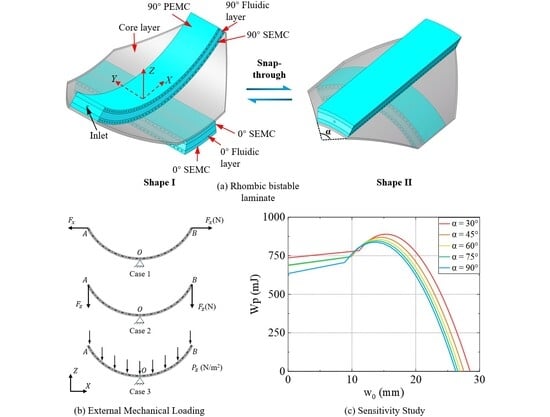
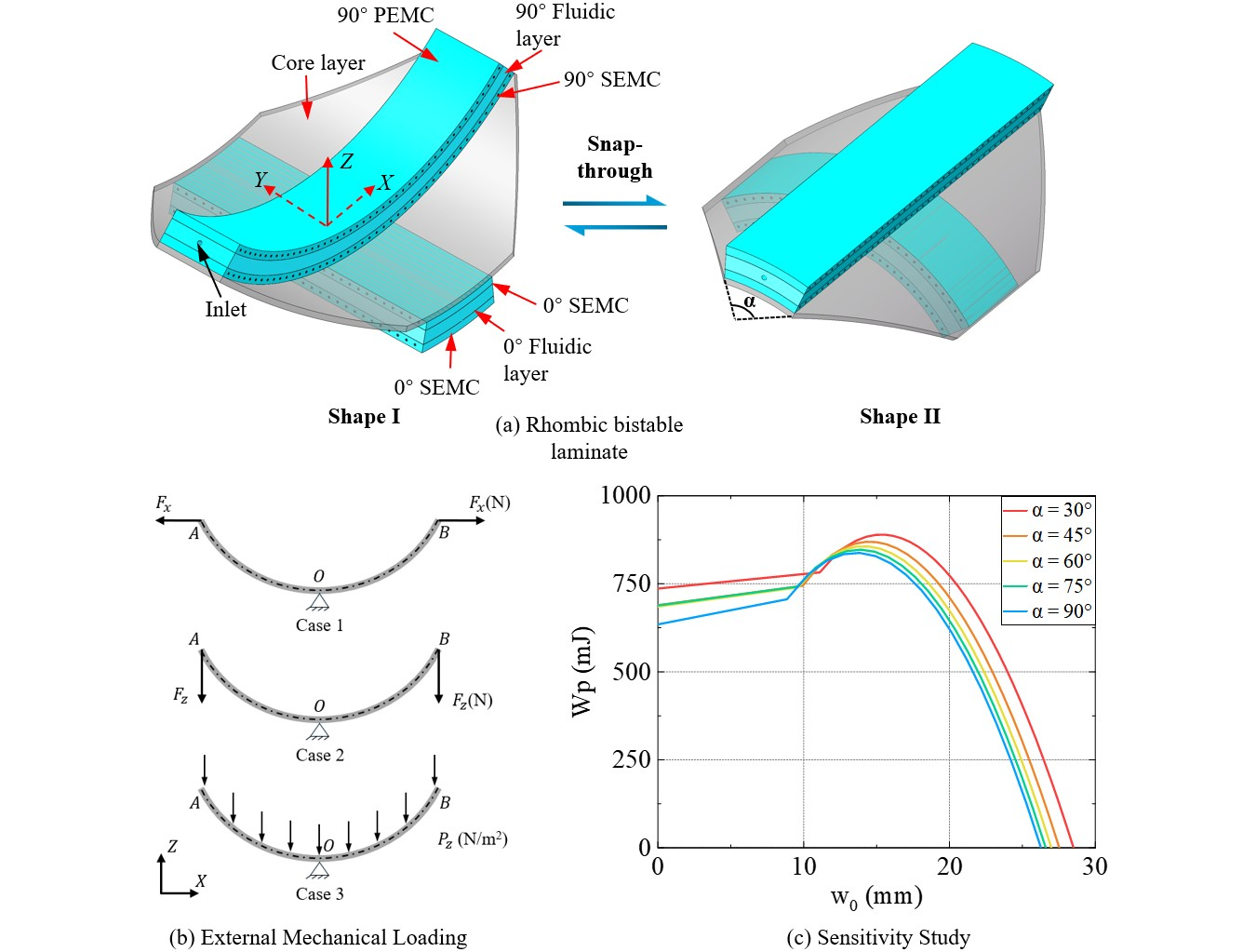
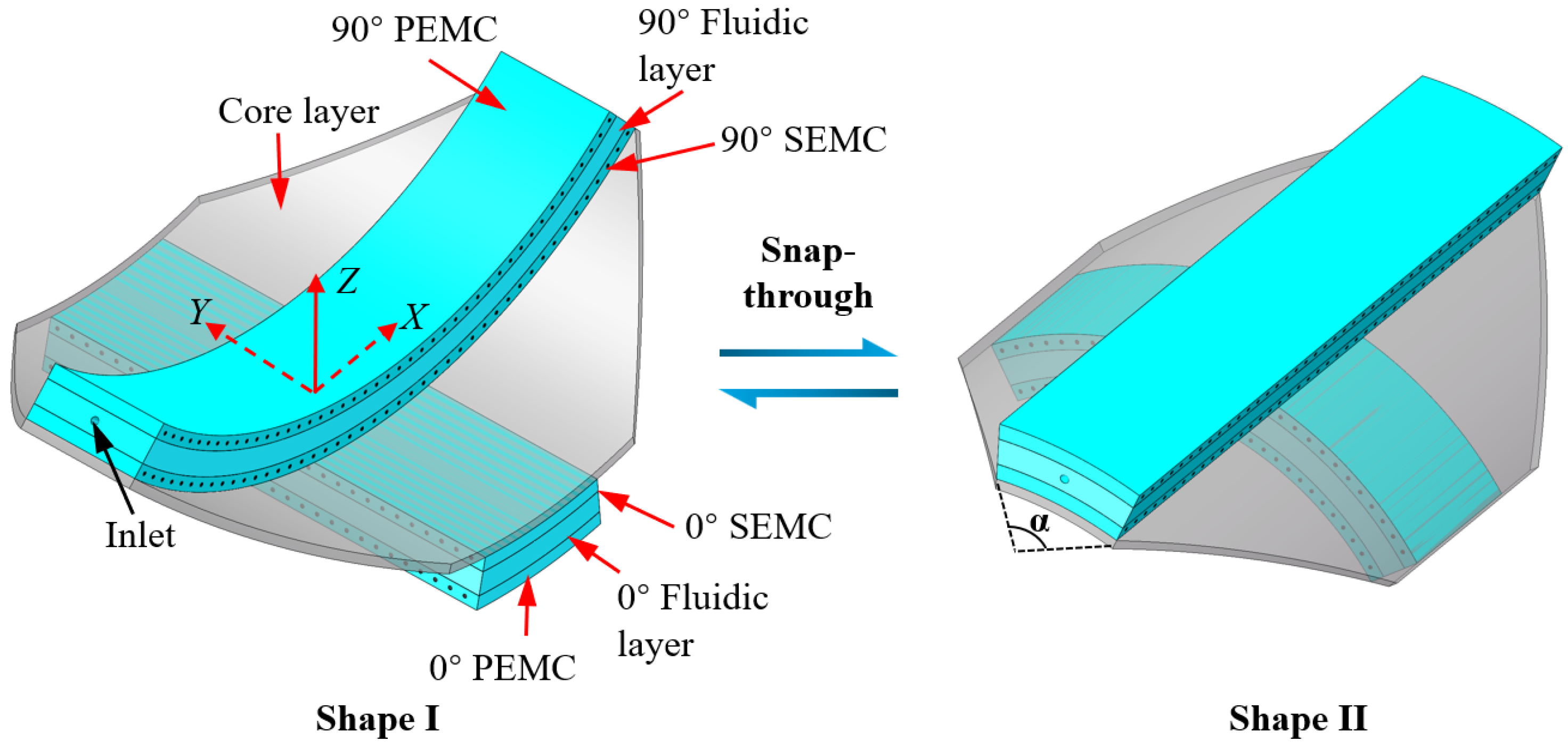
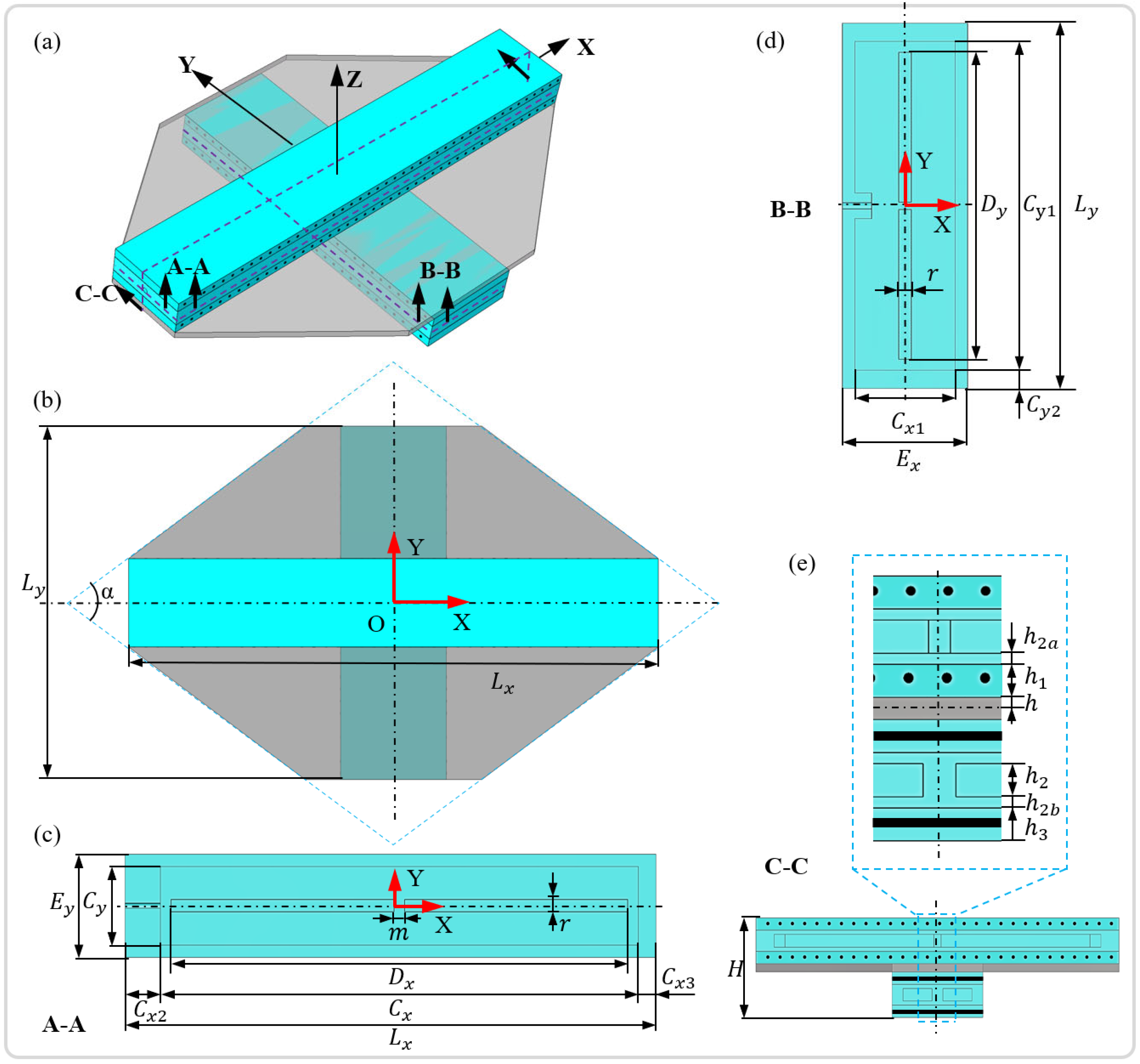
This paper proposes a rhombic bistable composite laminate produced by asymmetric mechanical prestressing, as illustrated in
Figure 1. Unlike conventional square or rectangular bistable laminates, the proposed rhombic configuration includes the interior angle α as an additional geometric design variable, which enables the shear–bending coupling and effective stiffness of the laminate to be tailored beyond conventional prestress- or aspect-ratio-based strategies. As illustrated in
Figure 1, the embedded fluidic channels provide intrinsic pneumatic actuation for pressure-induced shape reconfiguration, while external axial, transverse, and in-plane loads are applied to trigger or assist stable-state switching between the two rhombic curved configurations. A reduced-order analytical model is developed within a unified energy framework to capture the coupled effects of rhombic geometry, prestress distribution, internal pneumatic pressure, and external mechanical loading. This model enables the efficient prediction of the quasi-static deformation path, load–deflection behavior, and critical snap-through energy barrier, thereby providing a design-oriented tool for programmable morphing and load-efficient stable-state switching in rhombic bistable composite laminates.
2. Analytical Model
The proposed model is a reduced-order model intended for quasi-static bistable response and snap-through energy-barrier analysis. It was developed within the framework of classical laminated plate theory, using von Kármán geometric nonlinearity and a Rayleigh–Ritz minimization of the total potential energy. In the Rayleigh–Ritz formulation, the coordinate system is defined at the center point O of the laminate mid-surface, with the unactuated stable state taken as the initial equilibrium configuration undergoing cylindrical bending about the Y-axis. External loads are applied at the end points (Lx/2, 0) and (−Lx/2, 0) or as distributed loads over the mid-surface. No explicit displacement constraints are prescribed along the plate edges; instead, admissible low-order trial functions are employed, and the unknown coefficients are obtained by minimizing the total potential energy. The remaining edges are therefore subject to natural boundary conditions in the variational sense. It should be noted that the present work is an analytical modeling study rather than a standardized experimental testing study; therefore, no specific experimental standard was directly applied. The formulation follows established theoretical frameworks, including classical laminated plate theory, von Kármán geometric nonlinearity, Rayleigh–Ritz energy minimization, and the nonlinear Newton–Raphson solution.
Figure 2 presents the structural configuration and geometric definition of the proposed rhombic bistable laminate. The three main components of the laminate are an upper fluidic prestressed composite layer, denoted as FPC-A; a central core layer; and a lower fluidic prestressed composite layer, denoted as FPC-B. FPC-A contains a 90° prestressed elastomer matrix composite (EMC), a 90° pneumatic channel layer, and a 90° stress-free EMC, as illustrated in
Figure 1. FPC-B has a similar multilayer architecture. Each EMC is fabricated by embedding carbon fibers between two elastomer sheets [
21], with the fiber orientation arranged transverse to the longitudinal direction of the EMC. Here, 90° indicates that the fibers are oriented perpendicular to the X-axis.
The bistable deformation of the laminate is mainly induced by the mechanically prestressed EMC layers integrated within the FPCs. To suppress undesirable ballooning during pneumatic actuation, longitudinal ribs are incorporated into the fluidic layer. These ribs enhance structural constraint and enable the internal pressure to be more effectively converted for global shape transformation. For theoretical modeling, the coordinate system is established at the center of the geometric midplane, as shown in
Figure 2b. In the present study, FPC-A and FPC-B are prestressed along the X- and Y-directions, respectively, and their orientations remain unchanged throughout the analysis. The material properties and design parameters used for the composite laminate are listed in
Table 1 and
Table 2. The interior angle α of the rhombic core panel measured along the X-axis can be adjusted to regulate the degree of orthogonality and thereby obtain rhombic bistable configurations with tunable geometric characteristics. By varying the prestress level and structural dimensions, a series of rhombic bistable laminates with different cylindrical curved shapes can be achieved.
2.1. Strain Formulation
The strains of an arbitrary point
on the actuator are expressed based on the von Karman hypothesis as [
23]:
yielding the relations:
where
and
are the in-plane axial strains,
is the in-plane shear strain, and
,
, and
are the curvatures and twist, respectively, of the midplane. The out-of-plane deflection
is expressed as:
The quadratic expression for
is adopted as a low-order admissible trial function in the Rayleigh–Ritz formulation to represent the dominant global deformation mode under quasi-static conditions. The rhombic plate is divided into three segments, and the energy integrations are performed separately according to the actual boundary geometry of each segment (shown in
Table 3). This approximation is therefore intended to capture the overall response trend rather than local higher-order deformation details, particularly at relatively small rhombic angles.
In-plane strains
and
can be represented using lower-order polynomials with even degree terms [
24]. Hence,
and
can be expressed as second-order polynomials:
To calculate the shear strain, the displacements
and
can be obtained by integrating (4) in Equation (1):
Shear strains can be obtained by substituting (3) and (5) into (1).
Table 3.
The limits of the integrals used for calculating the strain energy of each layer in the bistable laminate (in this table, k = ).
Table 3.
The limits of the integrals used for calculating the strain energy of each layer in the bistable laminate (in this table, k = ).
| Lamina | x | y | z |
|---|
| 90° PEMC | | | |
| | | |
| | | |
| | | |
| 90° SEMC | | | |
| Core | | | |
| |
| |
| 0° PEMC | | | |
| | | |
| | | |
| | | |
| 0° SEMC | | | |
2.2. Constitutive Relations for Prestressed EMCs
Owing to the large prestrain imposed on the prestressed EMC layers, the corresponding strain energy is represented through an empirical strain-dependent formulation. In earlier investigations of mechanically prestressed bistable composites [
25], the material response of EMCs in the prestretch direction was characterized using the following experimentally calibrated constitutive expression:
where
represents the prestress induced by the applied EMC prestrain
. Previous experimental studies [
26,
27] established a calibrated prestrain range of
= 0–1.2, while confirming that the EMC still operated elastically at a higher prestrain level of
= 1.5. For each imposed prestrain, the area beneath the nonlinear stress–strain curve was used to define the equivalent strain energy and was correlated with a Hookean constitutive representation. The strain energy associated with the prestressed direction was therefore evaluated by integrating the empirical stress–strain response as a function of
and the composite in-plane strain
:
Based on the above strain energy formulation, the point-wise method proposed in [
27] was adopted to reduce the computational cost. The nonlinear constitutive response is therefore represented by an equivalent linear modulus
, which is calculated as follows:
Within the reduced-order framework, the strain energy stored in the prestressed EMC along its prestrain direction is calculated by introducing the equivalent linear modulus
, as given by:
2.3. Strain Energy Computation
Under the framework of classical laminate theory [
23], transverse stresses are neglected. Therefore, the strain energy contribution of each layer can be evaluated in a unified manner based on its material constants and geometric dimensions, as follows:
where
is the reduced stiffness coefficient under the plane-stress condition for each individual layer [
28]. In the present model, the core and fluidic layers are regarded as isotropic, whereas the EMC layers are modeled as anisotropic. The corresponding material properties and through-thickness integration intervals are provided in
Table 2 and
Table 3. Since the in-plane Poisson’s ratio of the EMC is assumed to be zero, the coupling stiffness term
vanishes for all EMC layers. Therefore, the strain energy stored in the prestressed EMC is formulated as follows:
The strain energy of the fluidic layer
is written as
2.4. Work Performed by Pneumatic Pressure
The pneumatic work supplied to the upper and lower FPC fluidic layers of the composite laminate is written as [
29]:
where
V is the fluid channel’s pressurized volume, which is equal to the volume integrated for
, and γ = 1.4 is the adiabatic coefficient.
2.5. Work Performed by External Loadings
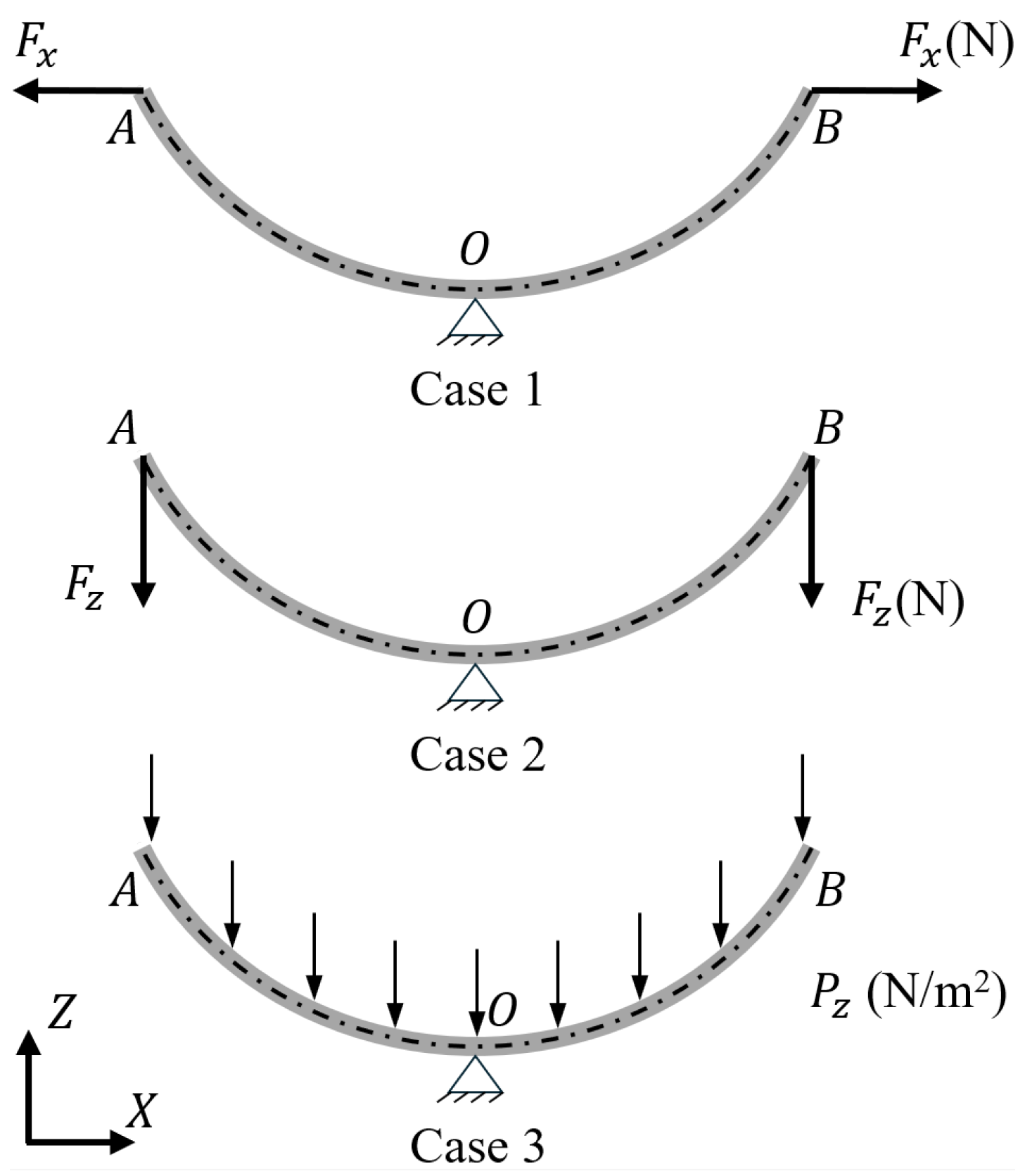
Three cases of external loading applied to the composite are investigated in
Figure 3. The composite, illustrated in the XZ plane, is assumed to be clamped at its midpoint
and to adopt a curved configuration about the
-axis in unactuated stable state I. In cases 1 and 2, actuation forces are applied at points
and
, respectively, whereas case 3 corresponds to a uniformly distributed operational load acting on the middle plane.
Case 1:
The composite is actuated by applying a pair of equal and opposite forces −
and
at A and B along the X-axis, respectively (
Figure 3). The variational work performed by
is expressed as:
Case 2:
The variational work performed on a composite that is actuated by a transverse force −
along the −Z-axis acting at A and B is written as:
Case 3:
The operational load acting on the composite’s middle plane is represented as a uniform in-plane actuation force (
) acting in the −Z-direction. The corresponding variational work is given by:
Figure 3.
Three cases for external forces applied on bistable composite to effect snap-through into second stable shape. The first two cases are pointwise forces, whereas case three is a uniformly distributed force.
Figure 3.
Three cases for external forces applied on bistable composite to effect snap-through into second stable shape. The first two cases are pointwise forces, whereas case three is a uniformly distributed force.
2.6. Computation of Stable Composite Shapes
Subsequently, the total potential energy is minimized through the Rayleigh–Ritz variational method, from which the equilibrium shapes of the laminate are obtained as follows:
where
is the set of coefficients
and
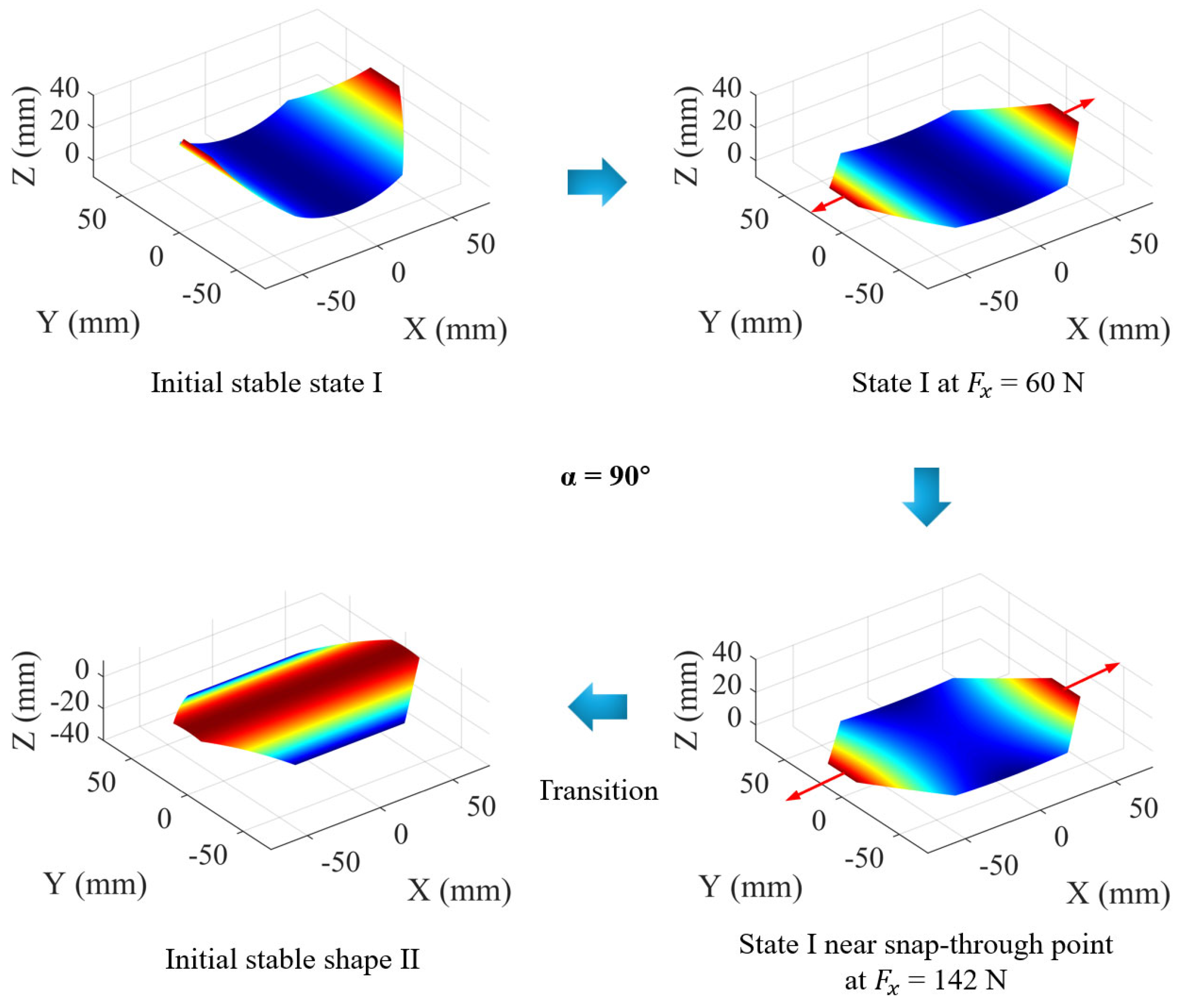
from (3), (4), and (5). The Newton–Raphson method was used to solve the fourteen nonlinear functions that were computed symbolically in MATLAB 2023b. The modeled snap-through procedure of a laminate of prestrains
=
= 0.6 and
= 90° with increasing opposite forces −
and
at A and B along the X-axis using the proposed analytical model is depicted in
Figure 4.
3. Parametric Study
A reduced-order analytical model is established based on classical laminate theory and von Kármán geometric nonlinearity to evaluate the quasi-static equilibrium shapes of the laminates. The geometric descriptions and material parameters used in the model have been validated experimentally in two previous studies by Xu and Zhou, where good agreement was reported between theoretical predictions and measured curvatures as well as out-of-plane deflections [
21,
22].
In this section, a series of parametric studies are conducted to investigate the effect of the coupled response of internal pneumatic pressurization and external mechanical loading under different angles α and prestrains on the bistable behavior of the laminate, including the shape (out-of-plane deflection) and snap-through energy of laminates. The geometric parameters and material characteristics specified in the
Table 1 and
Table 2 are used for analysis unless otherwise specified.
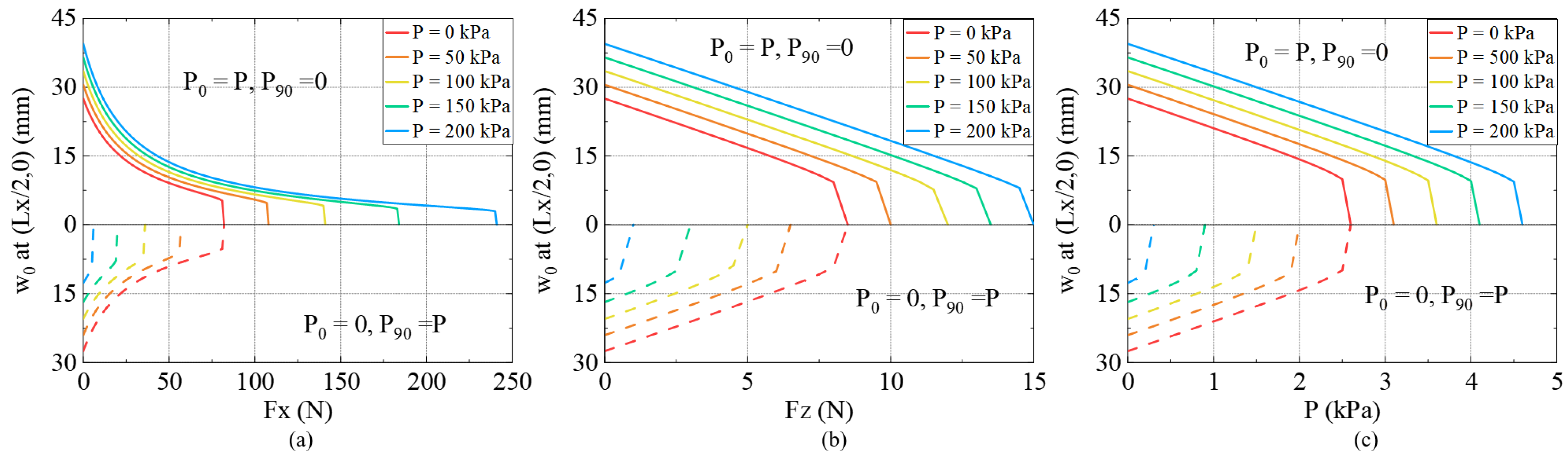
Figure 5a illustrates the quasi-static response and the corresponding out-of-plane deflection
between the pair of external loads
applied along the
-direction at points
and
, coupled with different internal pressures in the embedded fluidic channels. The results indicate that, under the coupled action of internal pressure and external loading, the laminate exhibits typical bistable behavior, where different pressure conditions correspond to distinct stable branches and critical snap-through loads.
When and only increases (upper set of curves), the algebraic value of the out-of-plane deflection in stable state I increases with increasing . Here, denotes the pressure applied in the 0° fluidic layer, and its pneumatic work partially offsets the prestress-induced bending effect of the opposite . As a result, the equivalent bending moment driving the initial curved configuration is reduced, so that the laminate tends toward a flatter quasi-static equilibrium state. Hence, as increases, the critical external load required to trigger snap-through from stable state I to II increases significantly. In contrast, when and increases (lower dashed curves), the out-of-plane deflection decreases with increasing . This is owing to offsetting part of the prestress energy associated with the prestretching of , leading to a flatter laminate configuration and a corresponding reduction in the critical external load required for snap-through. Moreover, under a given pressure condition, the out-of-plane deflection decreases rapidly with increasing external load at the initial loading stage and then gradually levels off. This behavior arises because the relatively large moment arm at the early stage of loading generates a significant bending moment, whereas, as the laminate progressively flattens, the moment arm diminishes and the external work becomes dominated by the reduction in the lever arm, ultimately causing snap-through between the two stable states.
Figure 5b exhibits the quasi-static response between the external load
applied along the
-direction at points
and
. The trends are similar to those in
Figure 5a. The difference is that, under the action of
, the
curves for different internal pressure conditions show a nearly parallel linear decrease in the stable-state region. This is because the external load along the
-direction primarily acts as a direct normal load on the laminate, with little variation in the equivalent moment arm, and the structural response is dominated by bending deformation. Changes in internal pressures
or
mainly adjust the initial prestress energy and equilibrium configuration, resulting in an overall shift in the deflection level without significantly altering the slope of the load–deflection relationship.
Figure 5c further presents the out-of-plane deflection response at point
under in-plane actuation force
applied to the geometric midplane. The results show a monotonic change in the out-of-plane deflection as
increases, and the influence of
on the in-plane actuation force
is consistent with the trend observed for external load
in
Figure 5b. This further demonstrates that in-plane actuation force can be effectively regarded as a continuously adjustable actuating load, which can be used for fine-tuning the equilibrium shape and snap-through behavior of bistable structures.
Figure 6 presents the coupled responses between the out-of-plane deflection
and the work performed by external mechanical loads for different rhombic interior angles
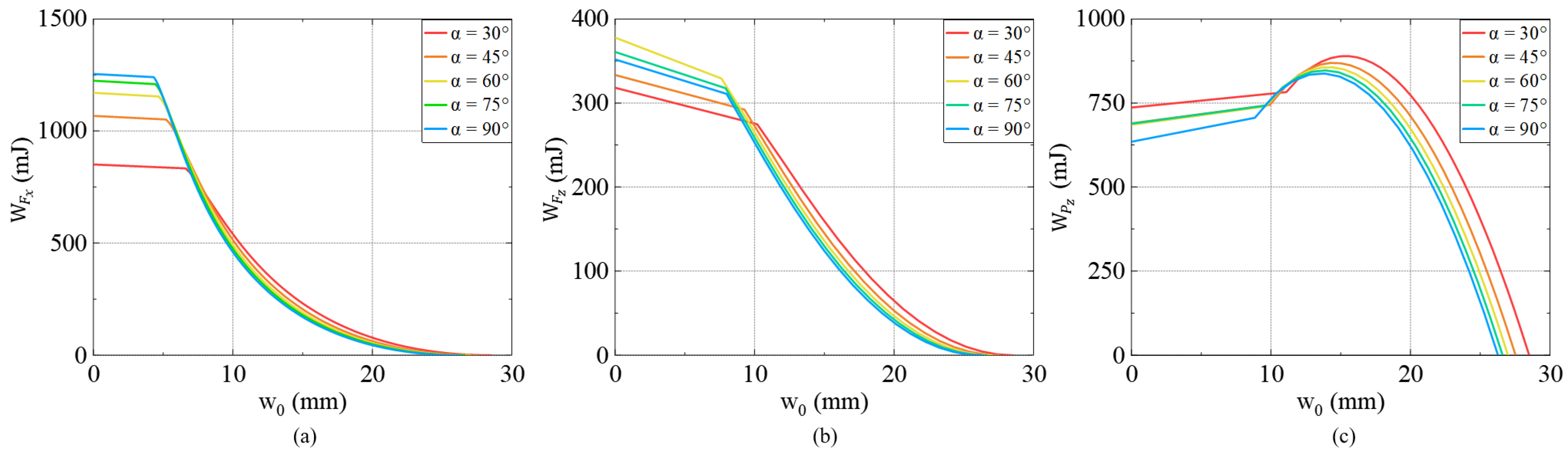
, aiming to evaluate the influence of the core-layer geometry on the bistable behavior under external loading. As external actuation is gradually applied, the structure undergoes progressive flattening, with
decreasing continuously, and eventually crosses the energy barrier to trigger snap-through in the vicinity of
.
Figure 6a illustrates the coupled response between the work performed by
applied along the X-axis and the out-of-plane deflection
for different α. The
curves exhibit pronounced differences in the initial large-deflection regime, while gradually converging as
approaches zero during the flattening process. This indicates that the influence of α on the efficiency of tensile actuation mainly manifests through the initial geometric configuration and the strength of shear–bending coupling: a smaller α corresponds to stronger geometric coupling, enabling the external load to perform more effective work in the large-deflection stage. As the structure progressively flattens, the equivalent moment arm decreases rapidly, weakening the geometric differences and causing the curves for different α to converge prior to snap-through. In addition, as
approaches zero, the snap-through energy increases with increasing α, because the larger the α, the larger the effective core area, causing a higher equivalent stiffness, which elevates the energy barrier that must be overcome for snap-through. Conversely, rhombic configurations with a smaller α exhibit lower equivalent stiffness, making snap-through easier to trigger.
Figure 6b presents the quasi-static response between the work performed by
and the corresponding
. The trend in the curves are similar to that in
Figure 6a. However, a notable difference is that the
curves corresponding to different α remain nearly parallel throughout the entire loading process. This indicates that the geometric parameter α has a relatively weak influence on the actuation path under normal loading and exerts only a limited effect on the decay rate of the response with respect to
. This behavior arises owing to
acting directly in the out-of-plane direction, such that the work input is dominated by bending deformation, while the influence of geometry-induced shear effects is comparatively weaker. Consequently, the differences in actuation efficiency among various α values are not pronounced. Furthermore, the snap-through energy barrier exhibits a non-monotonic dependence on α, first increasing and then decreasing as α increases. This trend results from the competition between the coupling efficiency of the transverse point loads and the global bending mode, as modulated by the geometric configuration. Here, the coupling efficiency refers to the effectiveness with which the applied transverse point loads contribute to the dominant global bending mode along the quasi-static flattening path.
Figure 6c shows the work performed by
versus
curves.
exhibits a non-monotonic trend with respect to
, first increasing, then decreasing, and reaching a peak at an intermediate deflection. This behavior suggests that the pressure–structure coupling with the dominant bending mode is most effective in the moderate-deflection regime. As
approaches zero, the curvature and geometry-induced coupling rapidly diminish, leading to a pronounced reduction in the effective work contribution of the pressure and ultimately triggering snap-through between the stable states. Meanwhile, the geometric parameter α significantly modulates both the magnitude and the location of the energy peak. For a smaller α, stronger shear–bending coupling allows the normal pressure to remain effective over a larger deflection range, resulting in a higher energy peak occurring at a larger
. As α increases and the configuration approaches a square-like geometry, the geometric shear freedom becomes constrained, the coupling efficiency between pressure and the dominant bending mode decreases, and the energy peak is reduced and shifts toward smaller values of
. These results demonstrate that α is a key, sensitive parameter for regulating the actuation efficiency of midplane normal pressure and the distribution of energy barriers.
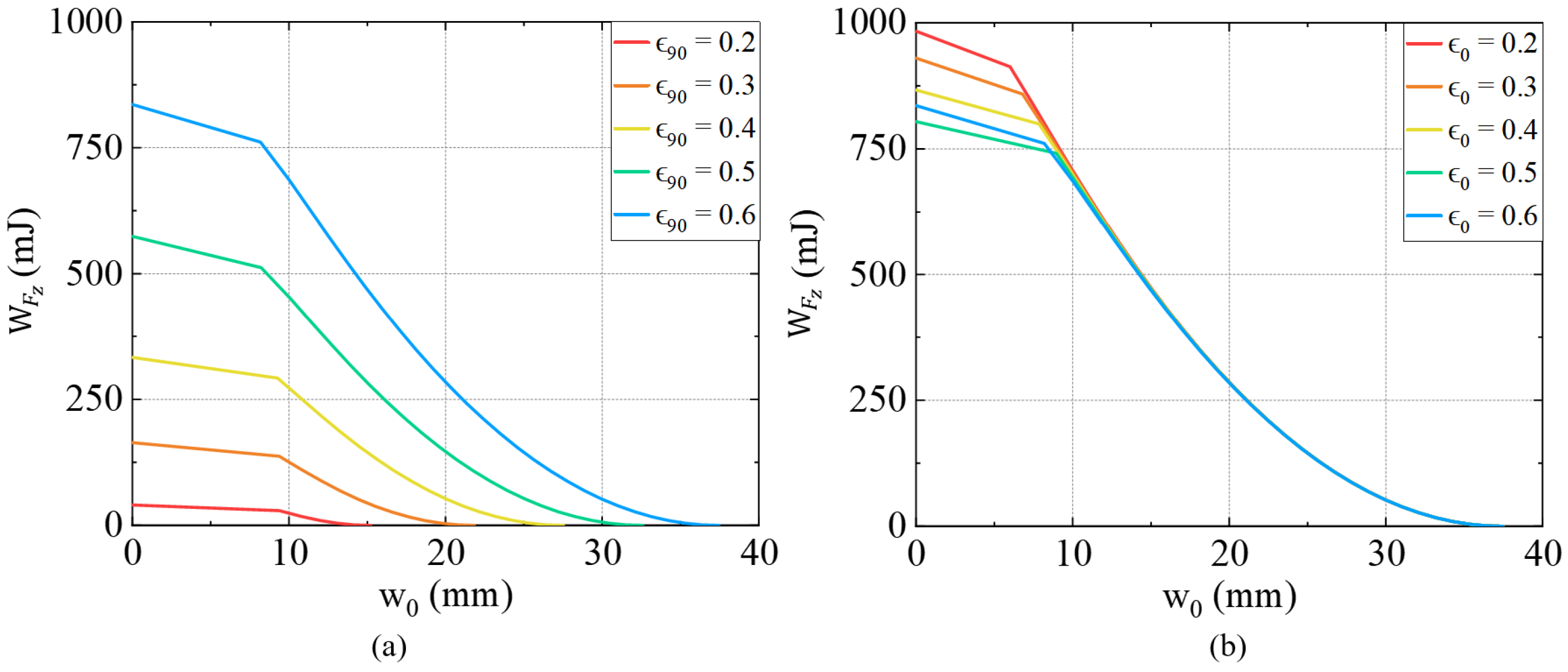
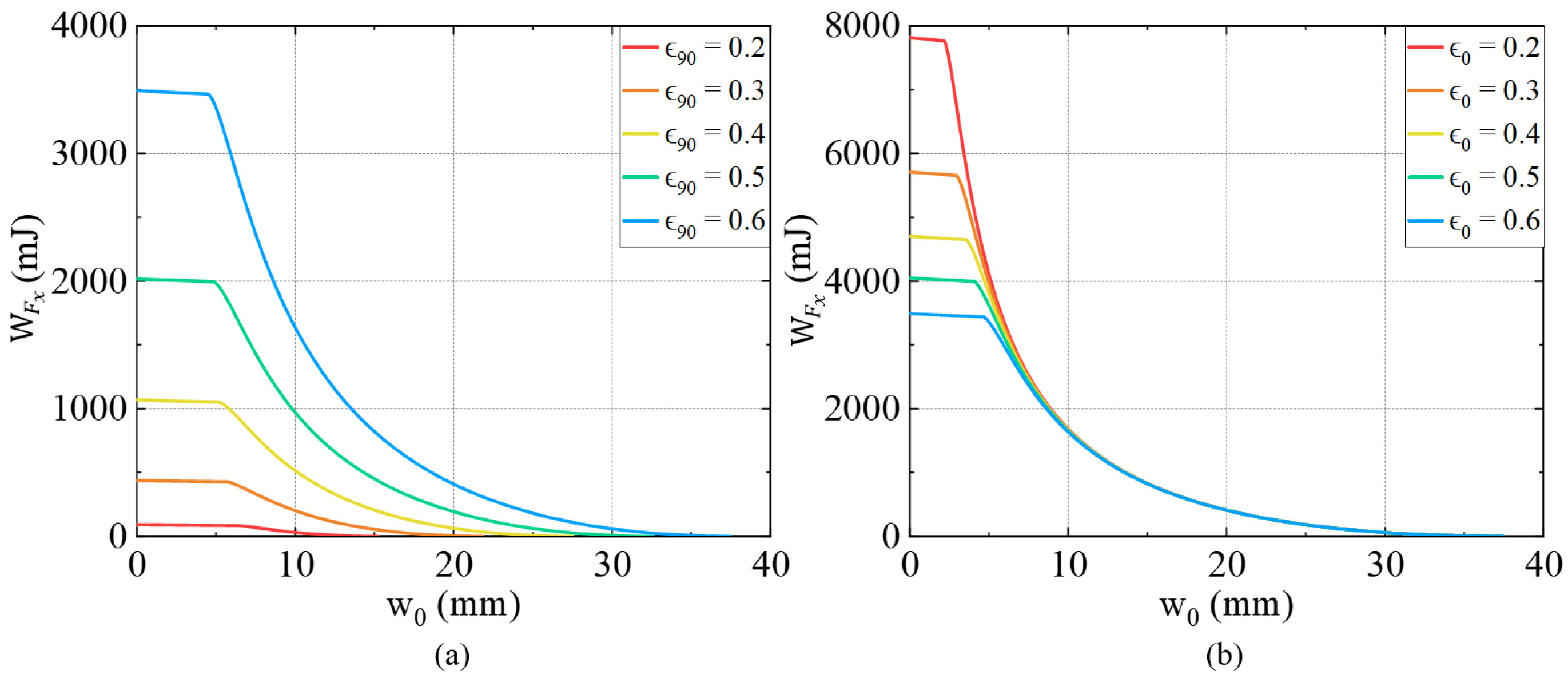
Figure 7 illustrates the
curves for various prestrains applied on the two sides of the laminate when it is in stable state I. Specifically,
Figure 7a corresponds to
with
, whereas
Figure 7b corresponds to
with
; the force remains identical in both cases. The results show that increasing
causes a pronounced increase in the work
required to achieve the same deflection
, resulting in steeper curves and snap-through occurring at a larger
. This behavior indicates that the initial curvature of stable state I increases with increasing
, such that a higher amount of external work must be accumulated to trigger snap-through. Accordingly, the energy curves corresponding to different
remain well-separated over the entire deflection range, demonstrating the strong influence of the actuation efficiency on this prestrain parameter. In contrast, for a fixed
, increasing
reduces the snap-through energy barrier and causes the transition to occur at a smaller
. This effect can be attributed to the additional bending moment introduced by
in a direction opposite to the primary curvature, which partially offsets the strain energy stored due to the front-side prestretch 90° PEMC. Meanwhile, the
curves corresponding to different
values in
Figure 7b largely overlap for
> 10 mm, further indicating that, compared with
,
mainly modulates the response by lowering the energy barrier rather than significantly altering the actuation path. For stable state II, the effects of the two prestains are reversed.
Figure 8 shows the
versus
curves for variations in the prestrains
and
. Overall, the influence of the prestrain parameters on the actuation response under
follows trends similar to those observed for
. The key difference is that the work required to achieve the same deflection
or to trigger snap-through is nearly an order of magnitude lower. This indicates that the transverse point load
couples more directly with the dominant bending mode, thereby actuating structural deformation and stable-state switching with substantially higher energy conversion efficiency during the flattening process.
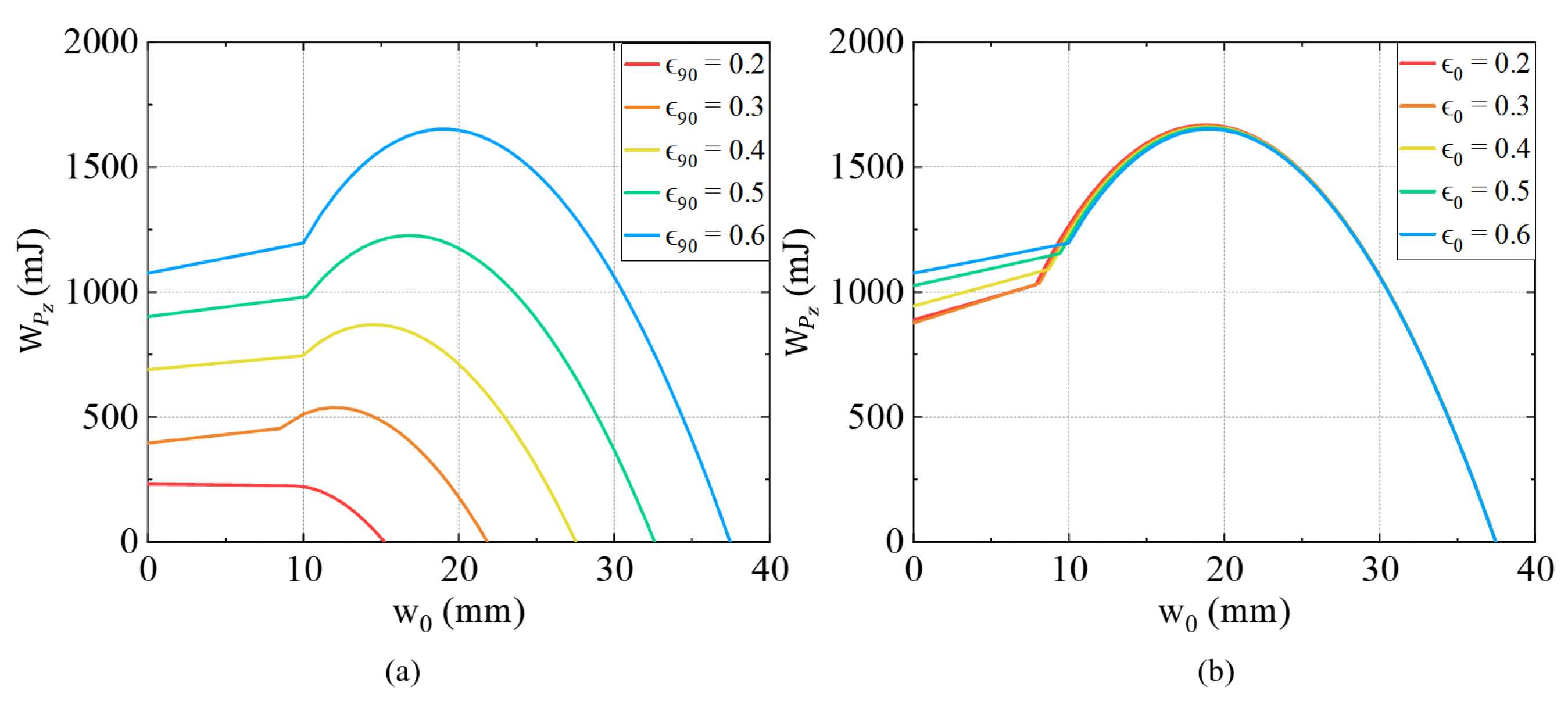
Figure 9 presents the
−
curves for variations in the prestrains. Compared with the actuation by point loads
and
, the
−
curves exhibit a non-monotonic trend as
decreases, with
first increasing and then decreasing, reaching a maximum at an intermediate deflection. The underlying mechanism is analogous to that discussed for
Figure 6c and is therefore not repeated here.
In contrast,
Figure 9b shows that, under a fixed front-side prestrain
, increasing the 0° PEMC’s prestrain
leads to a pronounced increase in the energy required for snap-through. This behavior arises because, under midplane normal pressure, a larger
enhances the overall in-plane membrane constraint and bending stiffness of the laminate, while weakening the pressure–bending coupling efficiency. As a result, the energy barrier during the flattening stage is elevated, causing the snap-through energy to increase with
. Moreover, the snap-through energy under pressure-driven actuation lies between those corresponding to
and
, indicating an intermediate actuation efficiency: compared with the transverse point load
, the coupling between pressure and the bending mode is less direct, whereas, relative to the in-plane load
, the pressure can still effectively contribute to out-of-plane deformation, resulting in a moderate level of energy utilization efficiency.




 ,
,