1. Introduction
In recent years, lightweight aggregates (LWAs) have attracted significant attention due to their versatility and broad applicability across civil engineering [
1,
2], geotechnical engineering [
3,
4], environmental engineering [
5,
6], and agricultural fields [
7,
8]. They are characterized by a low bulk density, typically ranging from 0.8 to 2.0 g/cm
3, which is substantially lower than that of conventional aggregates, which range from 2.4 to 2.8 g/cm
3 [
9]. This reduced density makes them particularly suitable for applications requiring weight reduction, such as lightweight concrete and structural fill materials. In addition to their low density, LWAs exhibit high porosity, which plays a critical role in enhancing thermal insulation and sound absorption properties. The porous structure also facilitates water retention, drainage, and aeration, supporting their use in environmental and agricultural applications, including green roofs and soil conditioning systems. Despite their lightweight nature, LWAs can maintain adequate mechanical strength and durability, enabling their application in structural components such as precast concrete and geotechnical fills.
LWAs are widely recognized for their adaptability and sustainability, as they can be produced from a diverse range of raw materials. Common precursors include natural materials such as clay, shale, pumice, and expanded perlite, as well as industrial by-products and wastes, including fly ash, sewage sludge, waste glass, and cement kiln dust [
1,
2,
5,
9,
10]. Among these, clay has attracted considerable interest due to its natural abundance, low cost, and potential to enhance the economic value of locally available resources, including its use in both lightweight aggregate production and as a supplementary material in concrete applications [
11,
12]. The mineralogical composition of clay is a critical factor governing sintering behavior and the final properties of fired ceramic products. Kaolinite undergoes dehydroxylation at approximately 500–600 °C to form metakaolinite, an amorphous intermediate phase that subsequently contributes to the formation of mullite at higher temperatures [
13,
14]. Illite, being a potassium-bearing phyllosilicate, begins to decompose at lower temperatures and contributes alkali flux that can promote liquid phase formation and particle bonding during sintering [
15]. Quartz and feldspar act as framework minerals that influence the mechanical integrity and thermal expansion behavior of the fired body [
16].
One prominent example of clay-based LWAs is lightweight expanded clay aggregate (LECA). LECA is produced by heating clay pellets in a rotary kiln at temperatures of 1100 °C to 1300 °C. During this process, the clay expands and forms a porous internal structure, resulting in lightweight, durable granules with low bulk density. To further improve the performance of LWAs, secondary materials, particularly industrial wastes, are frequently incorporated into clay-based systems. These additives can facilitate the bloating mechanism during thermal treatment, enhance mechanical strength, and improve overall process efficiency, while simultaneously contributing to waste valorization and cost reduction [
11].
Numerous studies have investigated the incorporation of secondary materials as pore-forming agents in the production of lightweight aggregates (LWAs), aiming to enhance porosity and reduce bulk density. These materials, including agricultural residues (e.g., sawdust and rice husk) and industrial by-products (e.g., fly ash, sewage sludge, and waste glass), are typically introduced into clay matrices and subsequently decompose or combust at elevated temperatures, generating gases that form internal voids.
Several representative studies have demonstrated the effectiveness of this approach. For instance, Bayoussef et al. [
17] reported the use of coffee grounds and sawdust (5–30 wt%) as pore-forming agents in red clay, with sintering at 1100 °C. Their results showed a significant reduction in bulk density with increasing additive content, attributed to the development of interconnected porosity, although this was accompanied by increased water absorption. Similarly, Andreola et al. [
18] fabricated LWAs using red clay mixed with spent coffee grounds (10–20 wt%) and observed a substantial reduction in thermal conductivity along with enhanced water absorption, indicating suitability for drainage and agricultural applications. Despite these advantages, the use of organic and mineral pore-forming agents is often associated with gas emissions during high-temperature sintering. The decomposition of such materials can release gases including CO
2, CO, and H
2O, particularly at temperatures above 600 °C, raising concerns regarding environmental impact and process sustainability [
19]. Furthermore, most of these systems still require sintering temperatures exceeding 1000 °C to achieve sufficient bloating.
In this context, perlite is considered a promising alternative pore-forming material due to its nonhazardous nature, low cost, and excellent thermal stability. Perlite is a naturally occurring amorphous volcanic material with a glassy structure, which undergoes rapid expansion when heated (870–1100 °C) due to the vaporization of entrapped water within its matrix. This expansion results in a highly porous structure with a volume increase of up to 4–20 times its original size [
20,
21,
22]. The incorporation of expanded perlite into clay-based materials has been widely explored. For example, Topcu and Iskdag [
23] investigated the use of expanded perlite in clay bricks at varying replacement ratios, with firing conducted at 950 °C. Their results showed that increasing perlite content reduced compressive strength but enhanced thermal insulation. An optimal replacement level of approximately 30 wt% was identified, balancing lightweight characteristics and mechanical performance, while significantly reducing thermal conductivity compared to conventional bricks. Similarly, Abdelfattah et al. [
7] investigated the use of perlite as additives in LWA production from expandable clays. The incorporation of 10 wt% additives reduced bulk density to below 1.2 g/cm
3 and enhanced the bloating behavior at high sintering temperatures (>1200 °C). A strong correlation between amorphous content and density was observed, with higher amorphous content leading to lower density. In addition, Makrygiannis and Tsetsekou [
24] investigated the incorporation of expanded perlite (20–30 wt%) into clay bricks under varying firing temperatures (830–1000 °C). The results showed that increasing perlite content reduced bulk density and thermal conductivity due to enhanced porosity. However, this was accompanied by a decrease in mechanical strength, indicating a trade-off between porosity and strength. Furthermore, Dutra et al. [
25] investigated the influence of firing temperature (800–1000 °C) on the microstructure of clay-based materials containing perlite as pore-forming agents. The results showed that perlite addition generated interconnected crack-like porosity, which became more pronounced at higher temperatures, leading to increased pore size and connectivity. However, at elevated temperatures (1000 °C), partial melting of perlite reduced its internal porosity.
Although these studies highlight the potential of expanded perlite in modifying the physical properties of lightweight materials, most investigations have been conducted at high sintering temperatures of 1000–1200 °C. A limited number of studies have explored lower sintering temperatures; for example, Dutra et al. [
25] characterized clay–perlite composites sintered at 800 °C and 1000 °C, while Makrygiannis and Tsetsekou [
24] reported adequate mechanical strength at 830 °C. However, neither study focused specifically on optimizing perlite content for LWA production by leveraging its inherent porous structure rather than relying on conventional bloating mechanisms, nor evaluated the resulting properties against commercial benchmarks. Therefore, the feasibility of producing LWAs at reduced sintering temperatures using this approach remains insufficiently explored.
Despite the extensive use of clay-based materials in Thailand, particularly In Buri clay with its long-standing ceramic heritage, the potential of utilizing this locally available resource for LWA production under reduced-temperature conditions remains insufficiently explored. Previous studies have demonstrated that the incorporation of expanded perlite can effectively reduce density and improve thermal insulation properties, although excessive additions may compromise mechanical strength and increase water absorption. While prior studies have investigated clay–perlite composites primarily at sintering temperatures of 1000 °C and above, systematic investigation of this material system at temperatures as low as 800 °C using locally sourced Thai clay remains absent from the literature. Furthermore, existing studies have not benchmarked laboratory-prepared clay–perlite LWAs directly against commercial products.
Therefore, this study aims to investigate the feasibility of producing LWAs from In Buri clay with the incorporation of expanded perlite, focusing on the relationship between perlite content and key physical properties. In particular, LWAs were prepared with varying expanded perlite contents (10–40 wt%) and sintered at a relatively low temperature of 800 °C for 2 h, representing an energy-efficient alternative to conventional high-temperature processing. This work highlights the potential of integrating locally sourced clay with expanded perlite to develop sustainable and lightweight materials suitable for horticultural applications. The novelty of this work lies in the combined investigation of a locally specific clay source (In Buri clay), low-temperature sintering at 800 °C as an energy-efficient alternative, and direct benchmarking against commercial LWA products—aspects that have not been simultaneously addressed in the prior literature.
2. Materials and Methods
2.1. Raw Material
Red clay was used as the primary raw material and was collected from In Buri District, Sing Buri Province, Thailand. Expanded perlite was sourced from Klong Yang Limited Partnership, Bangkok, Thailand. Prior to use, both materials were sieved through a 200-mesh (74 µm) stainless steel sieve to ensure a fine and uniform particle size distribution, sufficient for homogeneous mixing and adequate interfacial contact during sintering, while remaining practical for granulation and handling in production-scale processing. Carboxymethyl cellulose (CMC, supplied by Chemipan Corporation Co., Ltd., Bangkok, Thailand) was incorporated as a binder to enhance the green strength of the prepared mixtures.
2.2. Mixed Proportions
LWA specimens were prepared by blending In Buri red clay with expanded perlite at substitution levels of 10, 20, 30, and 40 wt%. The resulting specimens were labeled as P10, P20, P30, and P40, where the number denotes the weight percentage of expanded perlite. A binder solution was prepared by dissolving CMC in deionized water at a concentration of 5 wt% per liter. The raw powders were first dry-mixed using a mechanical mixer for 10 min to ensure homogeneous distribution of expanded perlite within the clay matrix. Subsequently, the CMC solution was gradually added to the dry mixture to achieve an optimal moisture content, and mixing was continued until a uniform consistency was obtained. Since CMC is an organic binder that decomposes completely during sintering, its contribution to pore formation is considered negligible. Furthermore, as an identical CMC solution volume of 70 mL per 100 g of mixed powder was applied consistently across all compositions, any effect of CMC burnout on microstructure and porosity would be uniform across all samples.
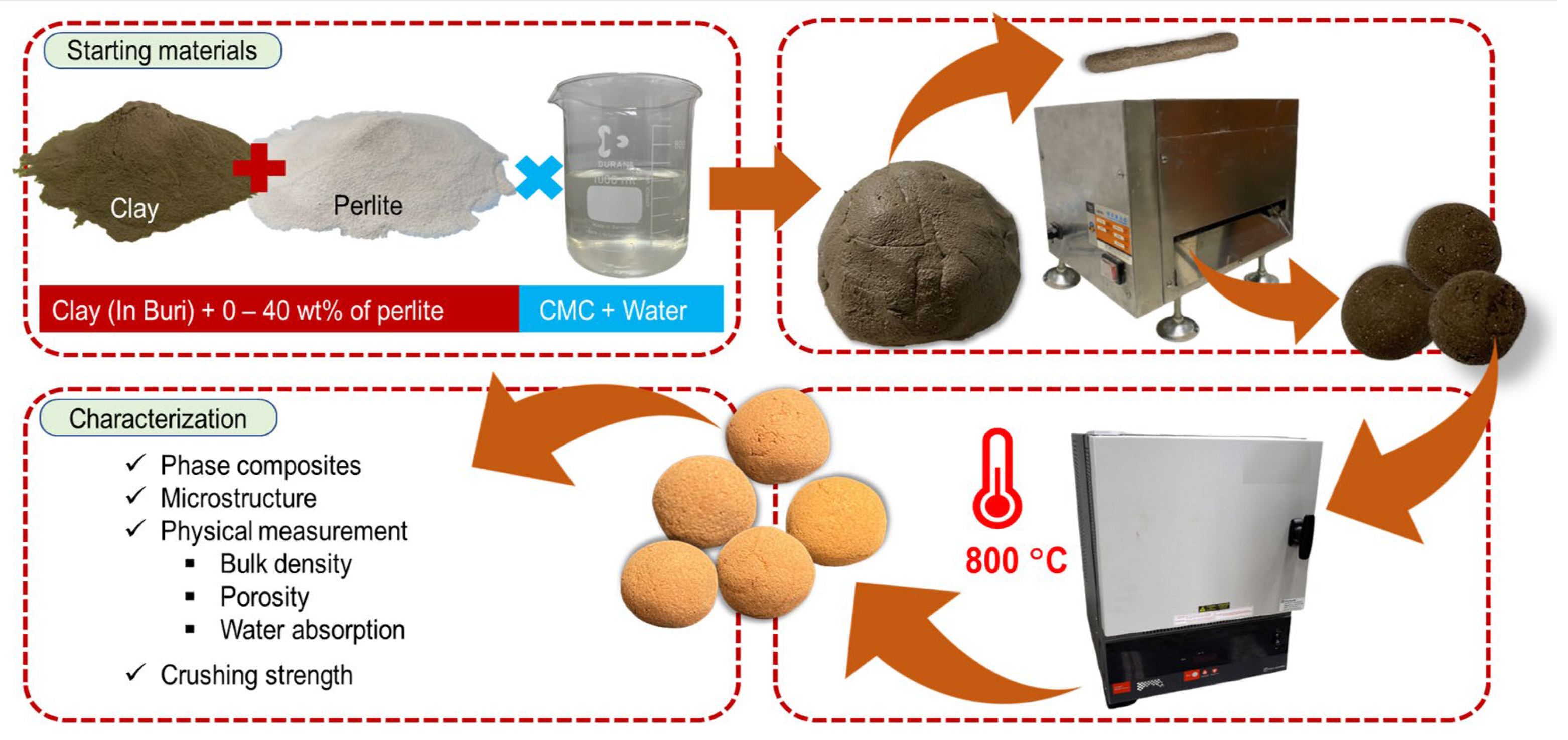
The resulting mixture was subsequently pelletized into near-spherical granules with a mean diameter of approximately 13 mm using a rolling granulator. The green pellets were then dried in an oven at 120 °C for 24 h. After drying, the samples were sintered in an electric furnace at 800 °C for 2 h with a controlled heating rate of 5 °C/min. The sintering temperature of 800 °C was selected based on prior studies demonstrating that sufficient clay–perlite bonding can be achieved at this temperature without inducing the classic bloating mechanism [
24,
25]. A schematic illustration of the LWA fabrication process is presented in
Figure 1.
2.3. Characterization Methods
The chemical compositions of In Buri clay and expanded perlite were analyzed using X-ray fluorescence (XRF) spectroscopy. Powdered samples were prepared as pressed pellets using a hydraulic press prior to analysis. The measurements were carried out using XRF spectrometer (Bruker AXS GmbH, Karlsruhe, Germany) to determine the concentrations of major oxide components.
The phase composition of the raw materials and LWA samples was analyzed using X-ray diffraction (XRD; MiniFlex 600, Rigaku, Tokyo, Japan). The samples were first pulverized and ground into fine powders to ensure homogeneity prior to analysis. XRD patterns were recorded using CuKα radiation (λ = 1.5406 Å) operated at 40 kV and 15 mA. Data were collected over a 2θ range of 10–70° with a step size of 0.02° and a counting time of 10 s per step.
Simultaneous thermal analysis (STA) of the green mixture was performed using a STA 449C thermal analyzer (NETZSCH, Selb, Germany). The measurement was conducted in alumina crucibles at a heating rate of 10 °C/min over a temperature range 30–1200 °C under an air atmosphere.
The linear shrinkage of the LWA specimens was determined by measuring the diameter of each sample before and after sintering. For each condition, measurements were performed on twenty samples, and the average value was reported. The linear shrinkage (
LS, %) was calculated using Equation (1):
where
LS is the linear shrinkage (%), and
D1 and
D2 represent the diameter of the green body and sintered specimen in mm, respectively.
The microstructure and the distribution of perlite within the LWA specimens were examined using a scanning electron microscope (SEM; Quanta 250, FEI, Hillsboro, OR, USA).
The bulk density, apparent porosity, and water absorption of the LWA specimens were determined using the Archimedes principle in accordance with ASTM C20 (2022) [
26]. Prior to measurement, the specimens were immersed in boiling water for 6 h and subsequently allowed to cool and remain submerged overnight to ensure complete saturation. The suspended weight (
S) of each specimen was then measured while immersed in deionized water. Afterward, the specimens were removed, gently wiped with a damp cloth to eliminate surface moisture, and weighed to obtain the saturated weight (
W). Finally, the samples were oven-dried and weighed to determine the dry weight (
D). The bulk density, porosity, and water absorption were calculated using Equations (2)–(4):
where
D is the dry weight,
W is the saturated weight, and
V is the volume of the specimen. The volume (
V) was determined based on the difference between the saturated weight and the suspended weight (
V = W −
S) according to the Archimedes principle.
The crushing strength of the LWA pellets was determined by a uniaxial compression test using a universal testing machine (Bravo TG-64, Tech Quality Co., Ltd., Bangkok, Thailand). Prior to testing, pellets were visually inspected and size-selected to exclude specimens with obvious geometric deformities. The radius (
r) of each pellet was determined by measuring the diameter in four orthogonal directions and calculating the mean value, thereby accounting for minor deviations from perfect sphericity. A total of 20 pellets per composition were tested, and the results are reported as mean values with standard deviations. Each pellet was placed between two parallel rigid plates and loaded at a constant crosshead speed of 2 mm/min until fracture occurred. The load at failure (
) was recorded, and the crushing strength (
) was calculated using Equation (5):
3. Result and Discussion
3.1. Chemical and Phase Composition of Raw Materials
The chemical compositions of the raw materials, In Buri clay and expanded perlite, as determined by X-ray fluorescence (XRF), are presented in
Table 1. The In Buri clay is primarily composed of SiO
2 (63.3 wt%) and Al
2O
3 (22.4 wt%), indicating a typical aluminosilicate composition. The presence of Fe
2O
3 (8.37 wt%), along with minor amounts of CaO (0.94 wt%) and MgO (0.81 wt%), suggests that the clay can be classified as ferruginous-calcareous, which contributes to the reddish coloration of the aggregates after sintering [
18]. In contrast, expanded perlite exhibits a higher SiO
2 content (74.2 wt%), accompanied by Al
2O
3 (13.3 wt%) and relatively low Fe
2O
3 (1.70 wt%). Notably, expanded perlite contains appreciable amounts of alkali oxides, particularly K
2O (6.27 wt%) and Na
2O (1.75 wt%), as well as minor alkaline earth oxides such as CaO and MgO. These oxides act as fluxing agents, which can modify the silicate network and promote viscous phase formation during thermal treatment [
27,
28]. The compositional differences between In Buri clay and expanded perlite suggest that the incorporation of perlite can influence the sintering behavior and microstructure evolution of the resulting LWAs. In particular, the presence of alkali oxides in expanded perlite may promote partial softening of the silicate matrix at relatively low temperatures, while its inherent porous structure contributes to the development of lightweight characteristics.
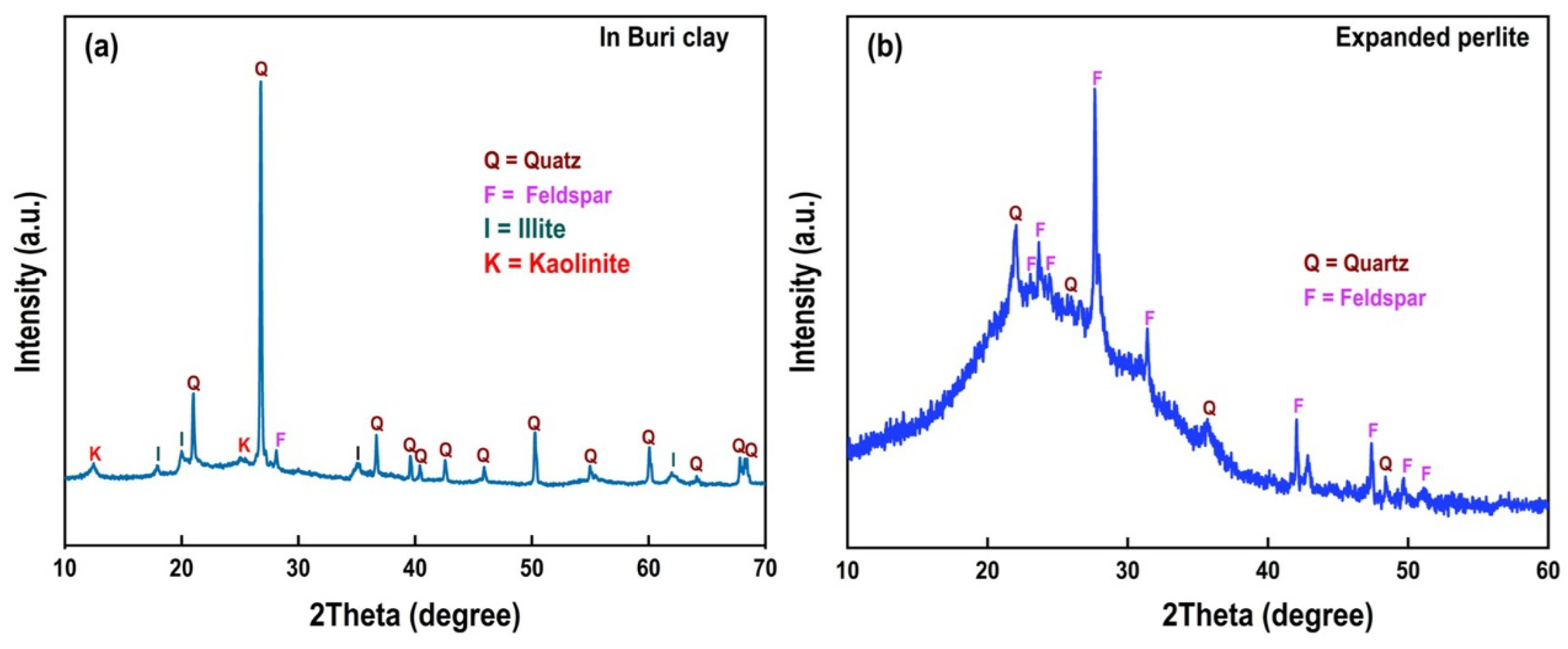
The phase compositions of In Buri clay and expanded perlite, determined by X-ray diffraction (XRD), are presented in
Figure 2. As shown in
Figure 2a, the XRD pattern of In Buri clay is dominated by quartz (SiO
2), as evidenced by the intense diffraction peak at approximately 2θ = 26.6° and several additional quartz reflections at higher diffraction angles. In addition to quartz, minor crystalline phases of feldspar, illite, and kaolinite were also identified. The presence of these aluminosilicate minerals is consistent with the clay-based nature of the raw material and agrees well with the XRF results, which showed that In Buri clay mainly consists of SiO
2 and Al
2O
3. The relatively high Fe
2O
3 content detected by XRF was not clearly reflected as a distinct crystalline iron oxide phase in the XRD pattern, suggesting that iron may be present in low-crystallinity phases or incorporated within the aluminosilicate structure.
In contrast, the XRD pattern of expanded perlite in
Figure 2b exhibits a broad diffuse hump centered in the range of approximately 20–35° (2θ), indicating the predominantly amorphous nature of the material. This feature is characteristic of volcanic glass and confirms that expanded perlite mainly consists of a glassy silicate phase. Superimposed on this amorphous background, several weak diffraction peaks corresponding to quartz and feldspar were observed, indicating the presence of minor crystalline constituents. The occurrence of feldspar is in good agreement with the alkali oxide contents (K
2O and Na
2O) identified by XRF, while the high SiO
2 content is consistent with both the amorphous silicate matrix and the minor quartz phase.
The differences in phase composition between the two raw materials are expected to play an important role in the formation of lightweight aggregates. In Buri clay provides the aluminosilicate matrix necessary for shaping and sintering, whereas expanded perlite contributes a highly porous and predominantly amorphous silicate phase. In addition, the alkali-bearing feldspar phase in expanded perlite may facilitate partial softening of the silicate structure during heating, even at the relatively low sintering temperature used in this work. Therefore, the incorporation of expanded perlite is expected to influence the microstructure and physical properties of the resulting lightweight aggregates, particularly in terms of pore development.
3.2. Thermal Analysis and Shrinkage Behavior
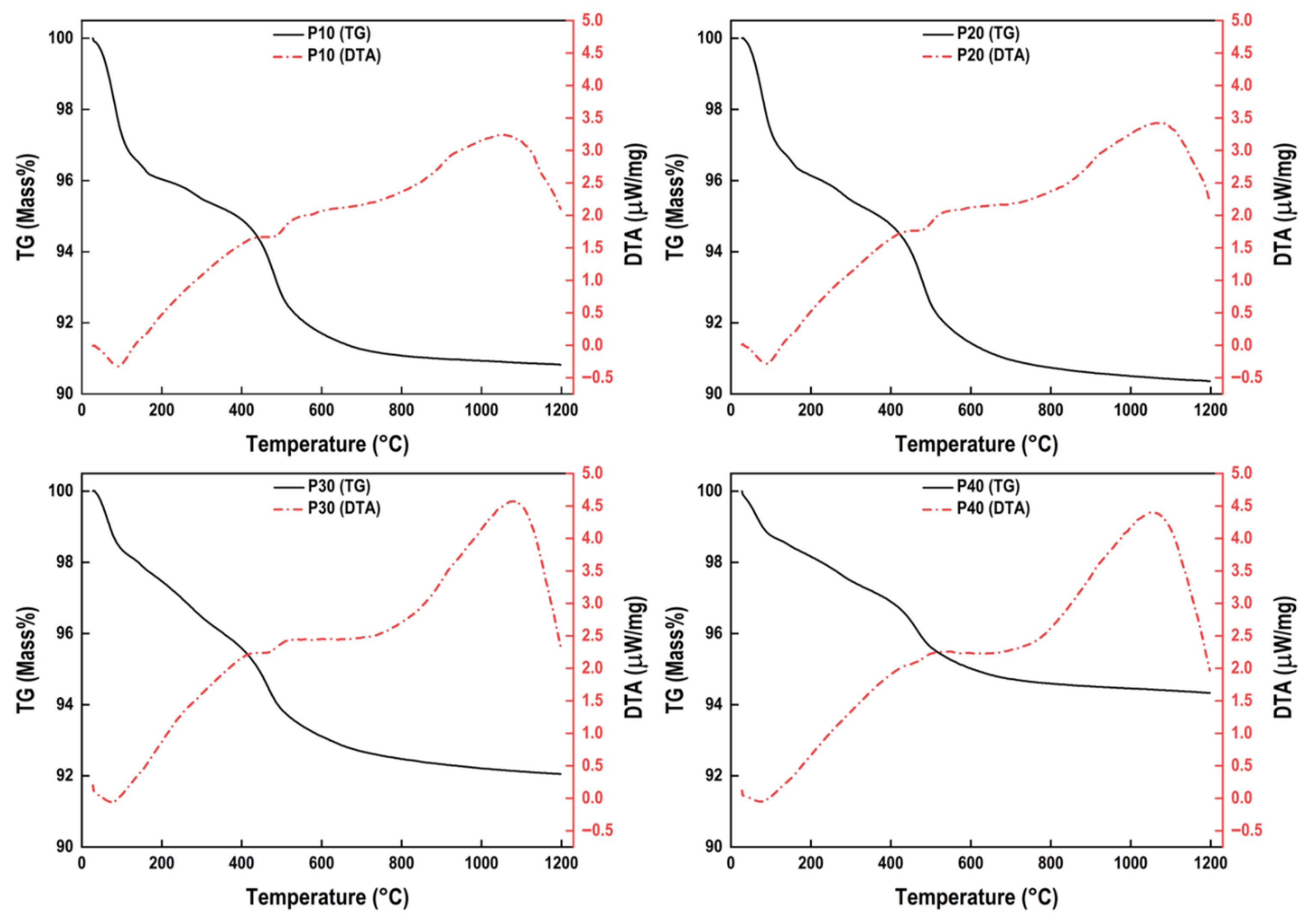
The thermal behavior of the raw material mixtures was analyzed using TG–DTA, as shown in
Figure 3. The TG curves indicate a multi-stage mass loss process associated with dehydration and structural transformations of the clay-based materials. The first stage of mass loss occurs below approximately 200 °C and is attributed to the removal of physically adsorbed and free water, as confirmed by the corresponding endothermic effect observed in the DTA curves. The second stage, occurring in the temperature range of approximately 200–500 °C, is associated with the release of chemically bound water and dehydroxylation of clay minerals [
29,
30]. This process results in a more pronounced decrease in mass compared to the initial stage. A weak endothermic/exothermic event observed near 545 °C in the DTA curves is attributed to the α–β quartz phase transformation, which does not involve significant mass loss [
29]. At higher temperatures (above ~600 °C), the TG curves exhibit gradual stabilization, indicating that most volatile components have been removed. The minor mass change observed in this region may be associated with structural rearrangement and partial densification of the material. Therefore, the thermal analysis demonstrates that the major mass loss occurs below 600 °C, suggesting that the sintering temperature of 800 °C is sufficient to remove volatile components while avoiding excessive thermal decomposition.
A broad thermal event observed in the DTA curves at approximately 1000–1100 °C is attributed to the softening and viscous flow of the amorphous silicate phase, primarily associated with expanded perlite. This behavior is related to the glassy nature of perlite and is further facilitated by the presence of alkali oxides (K
2O and Na
2O), which act as fluxing agents and lower the softening temperature of the silicate network. It is important to note that the glass transition temperature (T
g) of perlite has been reported in the range of 700–800 °C, with a softening temperature of 750–850 °C [
31], indicating that the sintering temperature of 800 °C employed in this study coincides with the upper boundary of the T
g range of expanded perlite. At this temperature, the amorphous glassy phase may undergo structural relaxation, a process prior to full viscous flow, but can still facilitate interfacial bonding. The formation of a fully developed liquid phase or extensive viscous flow is not expected under the present processing conditions.
The intensity of the high-temperature DTA peak (~1100 °C) tends to increase with increasing expanded perlite content (from P10 to P40), indicating a greater contribution of the amorphous glassy phase. This suggests that samples with higher perlite content possess a larger fraction of thermally responsive silicate material. Correspondingly, the TG curves show a reduction in total mass loss with increasing perlite content, reflecting the higher thermal stability of expanded perlite compared to clay. As a result, mixtures with higher perlite content (e.g., P30 and P40) are expected to exhibit enhanced stability and reduced decomposition during heating. Although the viscous flow associated with the DTA peak occurs above 1000 °C, the presence of alkali-rich amorphous phases in perlite may still promote partial softening at lower temperatures (800 °C), contributing to particle bonding and pore structure development in the LWAs.
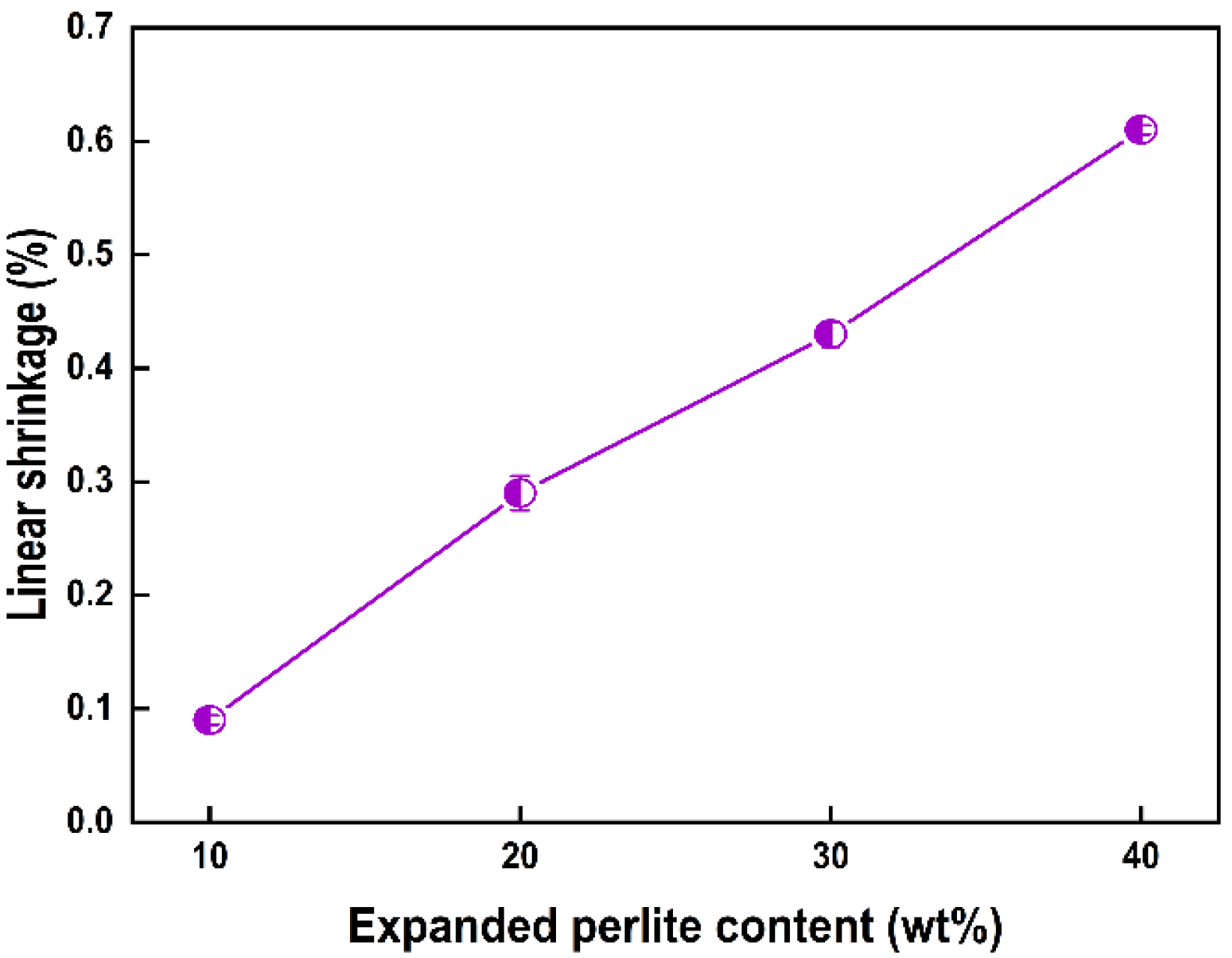
Figure 4 shows the effect of expanded perlite content on the linear shrinkage of LWAs. The linear shrinkage of the LWAs was relatively low, remaining below 0.7% for all compositions; however, a clear increasing trend with increasing expanded perlite content can still be observed. The linear shrinkage of the LWAs increased gradually with increasing expanded perlite content, from 0.09% at 10 wt% to 0.61% at 40 wt%. Although the TG curves indicate lower mass loss with increasing expanded perlite content, the linear shrinkage shows the opposite trend. This behavior suggests that dimensional shrinkage in the present system is not controlled primarily by thermal decomposition, but rather by particle rearrangement and limited softening during sintering. The alkali-rich amorphous phase in expanded perlite may facilitate slight contraction of the matrix, resulting in increased shrinkage despite lower total mass loss. Therefore, the increase in shrinkage with perlite addition can be attributed to enhanced sintering response rather than to greater thermal decomposition. These findings are consistent with previous studies. Topcu et al. [
23] reported that increasing the amount of expanded perlite in clay-based materials led to greater shrinkage, which was attributed to the difference in shrinkage behavior between clay and expanded perlite. In particular, expanded perlite exhibits higher dimensional contraction than clay during thermal treatment.
3.3. Phase Investigation of Sintered LWAs
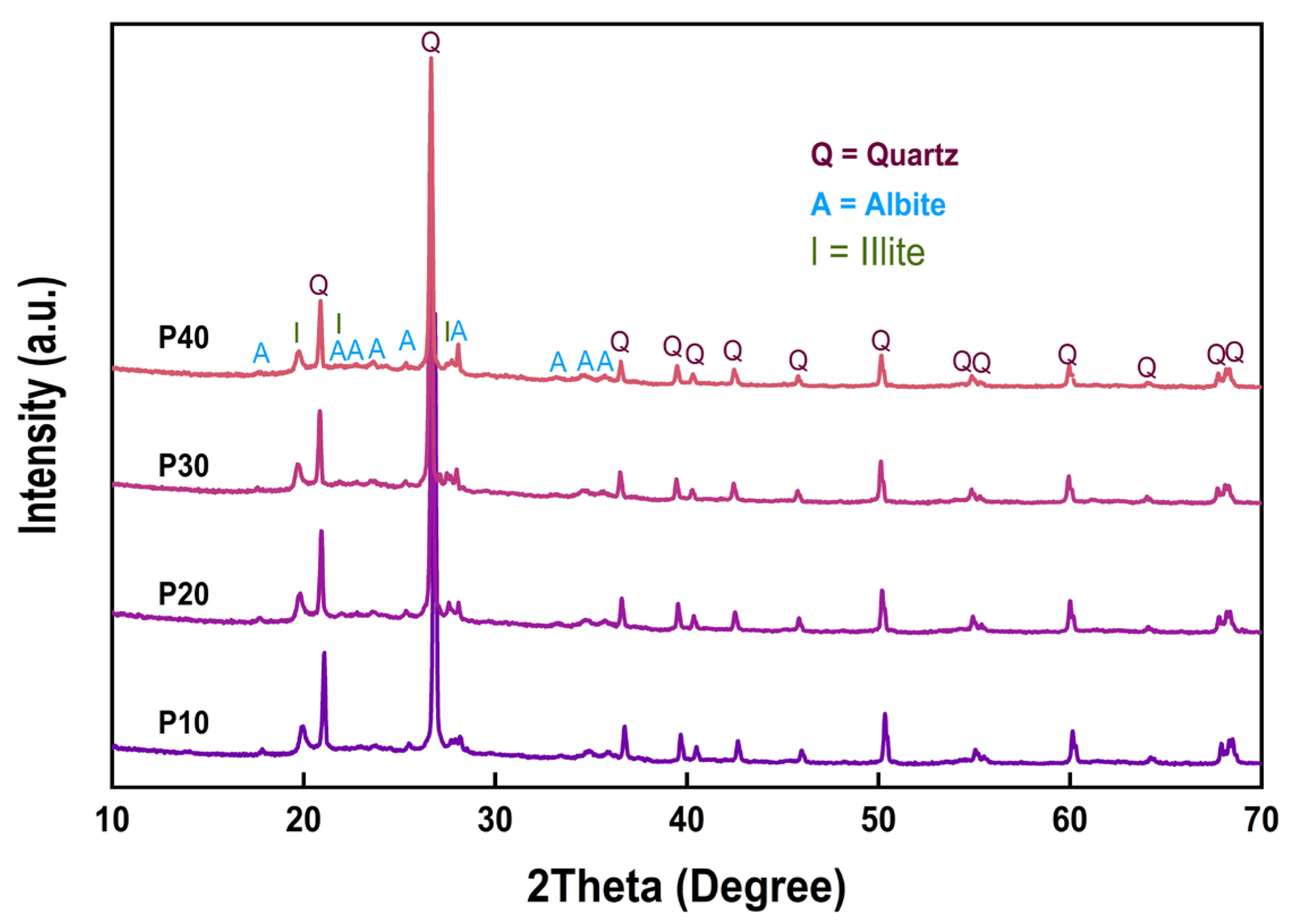
The XRD patterns of the LWAs sintered at 800 °C are presented in
Figure 5. For all compositions (P10–P40), quartz (SiO
2) remained the dominant crystalline phase, as indicated by the strong diffraction peak at approximately 2θ = 26.6° and several additional reflections at higher diffraction angles. This result suggests that the sintering temperature of 800 °C was not sufficient to induce major phase transformation of the silica-rich clay system, and the crystalline framework remained largely quartz-dominated. The retention of quartz as the dominant crystalline phase after sintering at 800 °C, with no evidence of liquid phase formation or new phase development, confirms that bonding in the present system occurs primarily through solid-state sintering mechanisms.
In addition to quartz, minor diffraction peaks corresponding to albite and illite were also observed. The presence of albite is consistent with the alkali oxide contents (Na2O and K2O) identified in the raw materials by XRF, particularly from the expanded perlite, which may contribute alkali-bearing aluminosilicate phases to the system. Illite was also detected as a minor phase, indicating that part of the clay mineral structure remained after sintering at 800 °C. This observation is reasonable because the applied firing temperature was relatively low compared with conventional bloating-based LWA processing, which typically involves more extensive mineralogical transformation at higher temperatures. No significant new crystalline phases were formed after sintering, indicating that the lightweight characteristics of the prepared aggregates were achieved without substantial high-temperature phase evolution.
3.4. Physical Properties of LWAs
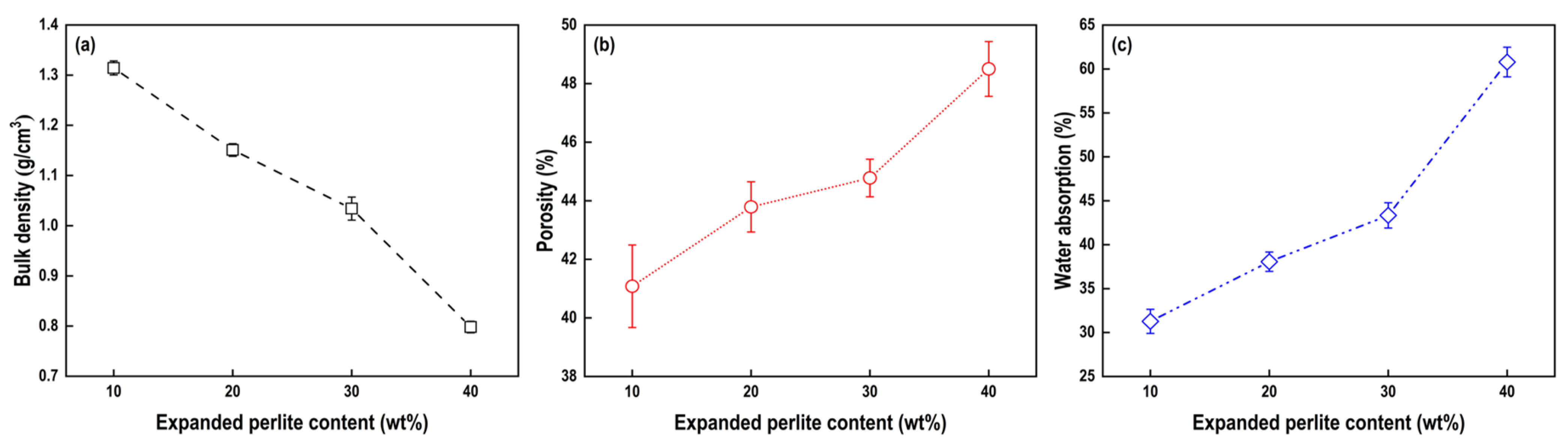
Figure 6a and
Figure 6b shows the effect of expanded perlite content on the bulk density and apparent porosity of the LWAs, respectively. The bulk density decreases continuously from 1.31 ± 0.01 to 0.80 ± 0.01 g/cm
3 as the expanded perlite content increases from 10 to 40 wt%, while the apparent porosity increases from 41.1 ± 1.41% to 48.5 ± 0.94%. This inverse relationship indicates that the incorporation of expanded perlite effectively reduces the overall density of the aggregates by promoting pore formation within the clay matrix.
The reduction in bulk density can be attributed to two main factors. First, expanded perlite possesses a lower intrinsic density compared with clay, and its incorporation partially replaces the denser mineral phases in the matrix. Second, the highly porous and cellular structure of expanded perlite contributes directly to the formation of internal voids, resulting in a more open microstructure. Similar trends in density reduction and porosity enhancement with increasing perlite content have been reported in previous studies on lightweight materials [
24,
32,
33].
Figure 6c presents the water absorption behavior of the LWAs. The water absorption increases significantly with increasing expanded perlite content, from 31.3 ± 1.37% at 10 wt% to 60.8 ± 1.69% at 40 wt%. This trend is consistent with the observed increase in porosity and reflects the high water uptake capacity of the interconnected pore structure. The porous nature of expanded perlite, together with the increased number of voids in the composite, facilitates water penetration and retention within the aggregates. From an application perspective, the high water absorption of LWAs with higher perlite content may be advantageous for horticultural applications, where moisture retention is desirable.
The sintering behavior observed in the present study can be further comparison with clay systems of different mineralogical compositions. Kuzmanović et al. [
34] investigated a kaolinitic–illitic–montmorillonitic clay from western Serbia, which required sintering temperatures of 900–1200 °C to achieve densification, with dilatometric analysis indicating a sintering onset at approximately 931 °C and significant liquid-phase sintering occurring above 1129 °C. In contrast, the In Buri clay–perlite system in the present study achieved sufficient particle bonding at 800 °C through solid-state sintering mechanisms, facilitated by the illite- and kaolinite-dominated mineralogy without significant montmorillonite content. The absence of montmorillonite in In Buri clay is particularly relevant, as montmorillonite’s expandable interlayer structure and higher water retention can complicate sintering behavior and require higher temperatures for structural stabilization. Furthermore, the linear shrinkage values reported by Kuzmanović et al. [
34] at 900 °C (5.33%) are significantly higher than those observed in the present study at 800 °C (0.09–0.61%), consistent with the lower degree of densification achieved at reduced sintering temperatures. The substantially higher water absorption in the present system (41.1–48.5%) compared to that reported for the Serbian clay at 900 °C (14.52%) reflects the fundamental difference in pore formation mechanisms. The Serbian clay undergoes progressive pore closure through vitrification at high temperatures, pore formation in the present system is primarily governed by the pre-existing cellular structure of expanded perlite rather than sintering-driven densification.
3.5. Microstructure
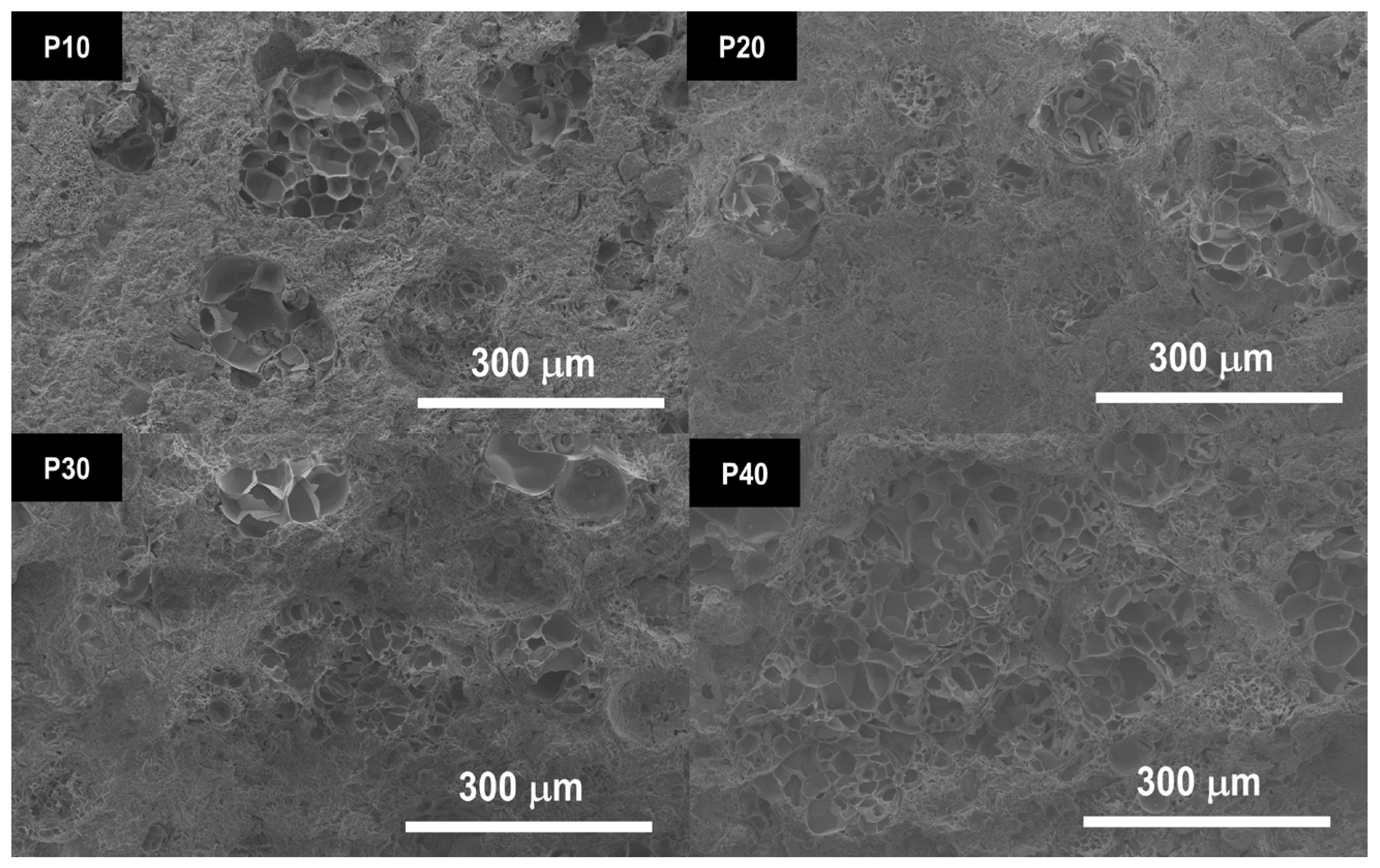
The microstructures of the LWAs with varying expanded perlite contents were examined by SEM, as shown in
Figure 7. It can be clearly observed that the pore structure becomes more developed with increasing expanded perlite content. The samples with lower perlite content (P10) exhibit relatively dense matrices with isolated pores, whereas higher perlite contents (P30 and P40) result in a more porous and interconnected structure.
Two main types of pores can be identified in the LWAs. The first type consists of relatively large, rounded pores associated with the expanded perlite particles, which exhibit a characteristic cellular structure. These pores are predominantly closed or partially closed and originate from the intrinsic porous nature of expanded perlite. The second type corresponds to smaller pores distributed within the clay matrix, which are attributed to the release of volatile components and limited structural rearrangement during sintering. However, accurate quantification of the volumetric ratio between the two pore types was not achievable from SEM cross-sections alone due to the large difference in their size scales; mercury intrusion porosimetry (MIP) is recommended in future studies to provide a more complete quantitative characterization of the pore size distribution.
Pore formation in these composites is directly supported by the SEM micrographs, in which the expanded perlite particles are clearly distinguishable from the clay matrix by their characteristic multicellular. As the perlite content increases from P10 to P40, these cellular particles become more abundant and progressively contribute to the development of an interconnected pore network, consistent with the increase in apparent porosity. Importantly, no microstructural evidence of bloating, such as large irregular voids with smooth glassy walls associated with melt-driven gas expansion, is observed in any composition. These findings confirm that pore formation in the present samples is primarily governed by the pre-existing cellular structure of expanded perlite.
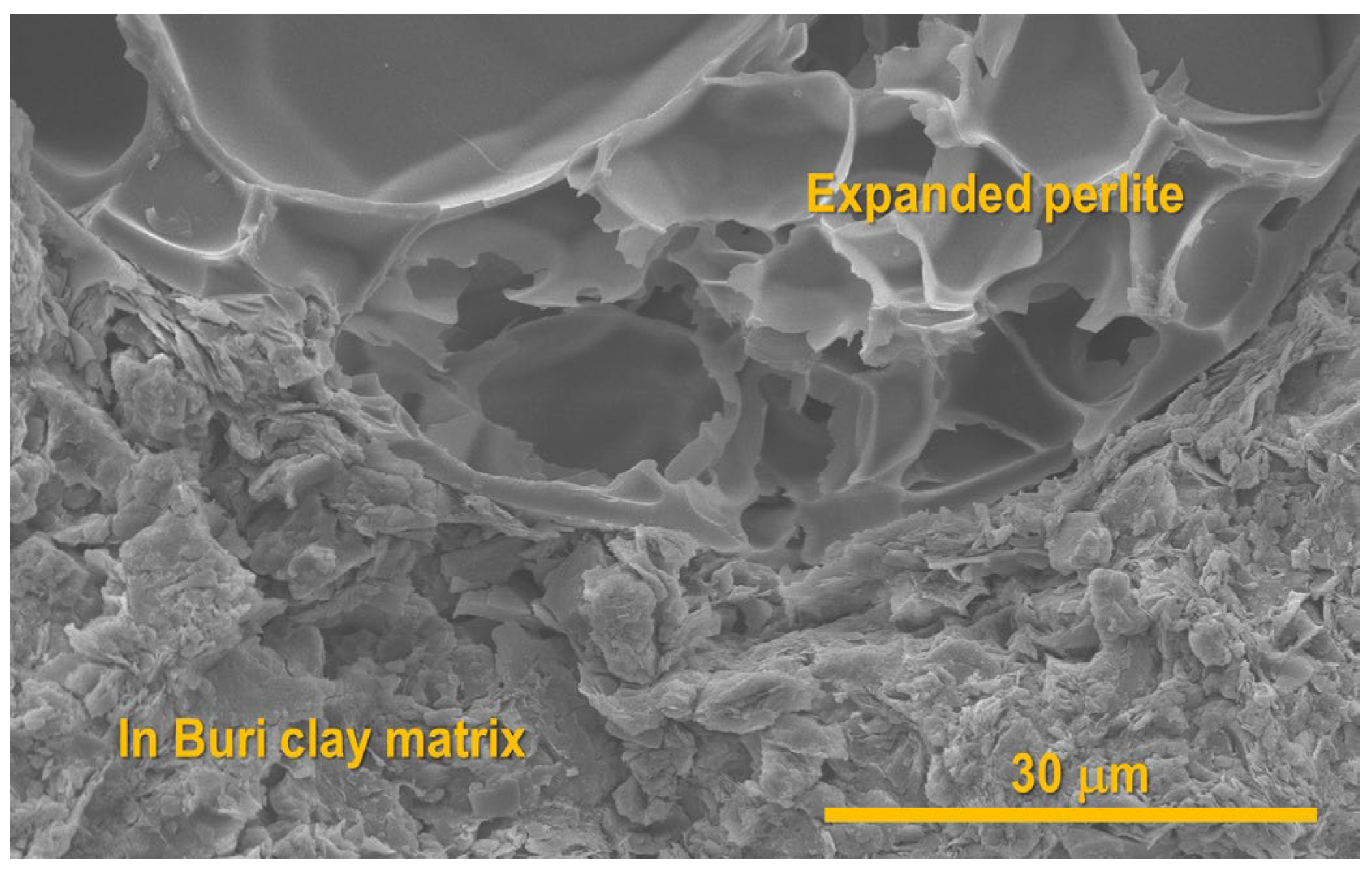
Figure 8 shows a high-magnification SEM image of the interface between the expanded perlite particle and the In Buri clay matrix. No obvious gaps or debonding are observed at the interface under SEM observation, suggesting morphological compatibility between the two phases. The expanded perlite appears to be embedded within the clay matrix without visible delamination. This interfacial compatibility may be attributed to the similar chemical nature of the two components, as both In Buri clay and expanded perlite are predominantly composed of silicate-based compounds, as confirmed by XRF analysis. Such compositional similarity is expected to promote interfacial adhesion and facilitate stress transfer across the interface. However, it should be noted that direct chemical characterization of the interfacial transition zone, such as EDS mapping or line scan analysis, was not performed in the present study and is recommended for future work to provide a more complete understanding of the elemental distribution across the interface.
The SEM observation of the interface further indicates that the incorporation of expanded perlite not only modifies the pore structure but also contributes to the formation of a morphologically stable composite microstructure. Therefore, increasing the expanded perlite content provides a simple and effective approach to tailor the microstructure and, consequently, the physical properties of LWAs.
3.6. Mechanical Properties and Failure Behavior
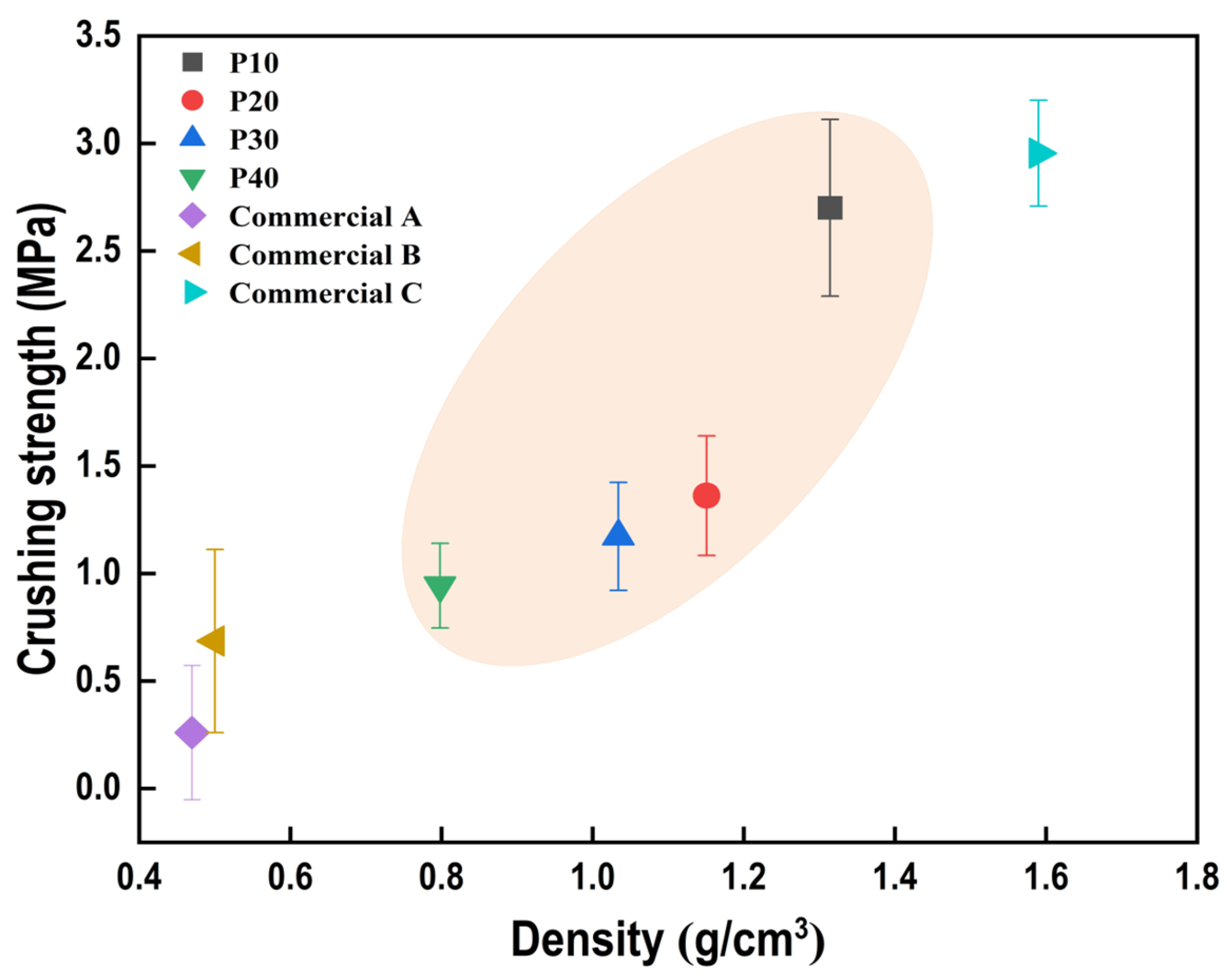
Figure 9 shows the relationship between crushing strength and bulk density of LWA specimens with varying expanded perlite contents (P10–P40) sintered at 800 °C, together with commercial LWA products for comparison. The crushing strength of specimens are 1.34 ± 0.41 MPa, 1.15 ± 0.28 MPa, 1.03 ± 0.25 MPa, and 0.80 ± 0.25 MPa for P10, P20, P30, and P40, respectively. A general increasing trend between bulk density and crushing strength is observed, indicating that samples with higher density tend to exhibit greater mechanical strength. The absence of significant phase transformations in the XRD analysis confirms that sintering at 800 °C proceeds primarily through solid-state mechanisms without liquid phase formation. Consequently, the mechanical performance of the LWAs in the present system is predominantly governed by bulk density and porosity rather than phase composition. As the expanded perlite content increases from P10 to P40, the bulk density decreases, accompanied by a reduction in crushing strength. This behavior is attributed to increased porosity and the formation of a more open microstructure at higher perlite contents, as confirmed by SEM observations. The presence of larger and more interconnected pores acts as stress concentration sites, thereby reducing the load-bearing capacity of the aggregates.
Despite being sintered at a relatively low temperature (800 °C), the prepared LWA samples exhibit a consistent strength–density relationship, indicating that sufficient interparticle bonding and structural integrity can be achieved without high-temperature bloating. Compared with commercial LWA products, the synthesized samples show similar trends. It should be noted that pellet size is known to influence crushing strength in brittle porous materials, with smaller pellets generally exhibiting higher normalized strength due to a lower probability of critical defects [
35]. However, since all compositions in this study were fabricated under identical pelletization conditions with a consistent mean diameter of approximately 13 mm, which is also consistent with the size range of compared commercial LWAs in this study (11–13 mm), the size effect is uniform across all samples and does not affect the validity of comparisons between compositions or with commercial reference materials. Notably, despite the absence of liquid phase formation at the sintering temperature of 800 °C, the crushing strength values of the laboratory-prepared LWAs fall within a comparable range to commercial products of similar bulk density, as shown in
Figure 9. This suggests that solid-state sintering mechanisms are sufficient to produce mechanically competitive LWAs without requiring the high-temperature bloating process employed in commercial production.
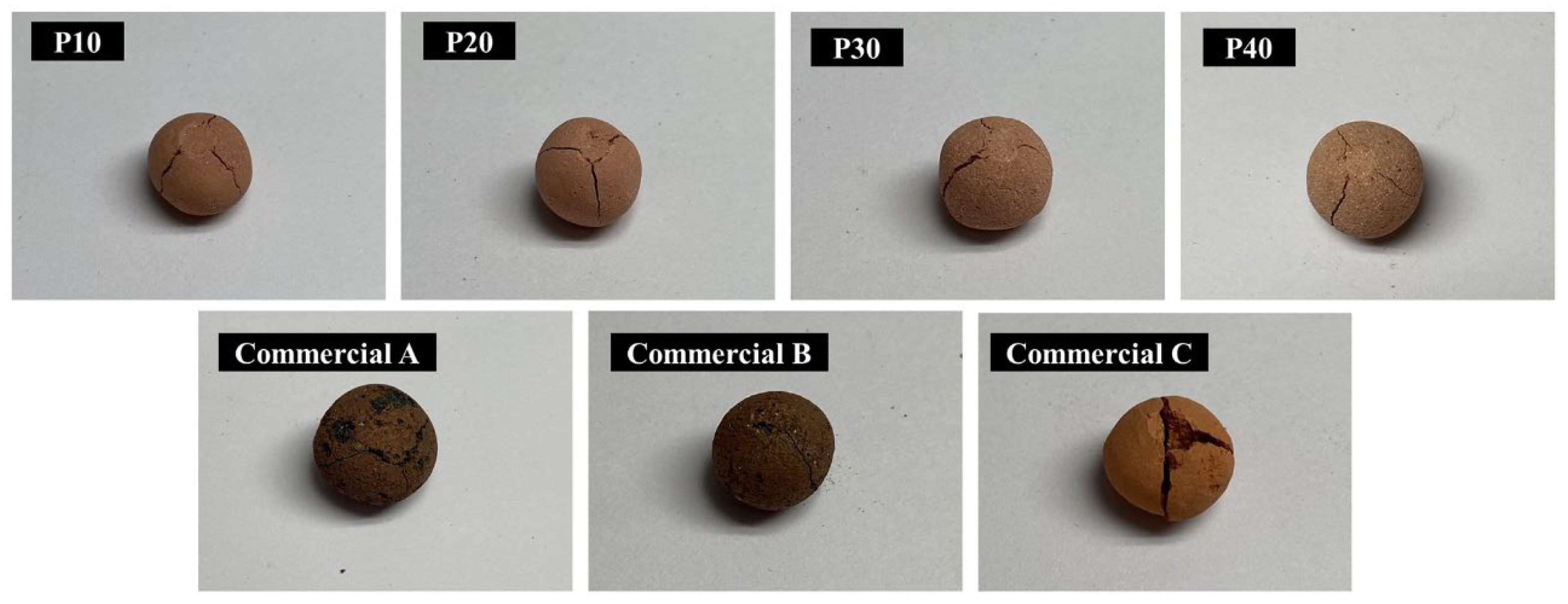
Figure 10 presents the crack patterns of the LWA specimens after the crushing strength test. All samples exhibit sudden fracture upon loading, characterized by surface cracking and fragmentation, which is consistent with the typical failure mode of sintered ceramic-based lightweight aggregates. The laboratory-prepared LWA samples (P10–P40) show relatively uniform crack propagation, whereas the commercial products display more irregular fracture patterns and localized defects. These differences may be associated with variations in microstructural homogeneity and pore distribution.
These results demonstrate that the mechanical performance of LWA can be effectively tailored by controlling the expanded perlite content. While higher perlite content is beneficial for achieving lower density, it leads to reduced crushing strength, highlighting the trade-off between lightweight characteristics and mechanical performance depending on the intended application.


 and
and