
Article

Microstructural Reconstruction and Interfacial Regulation in a CaCl2–Sodium Polyacrylate Organic–Inorganic Composite System for High-Liquid-Limit Clay

1
College of Architecture and Environment, Sichuan University, Chengdu 610065, China
2
Sichuan Xixiang Expressway Construction & Development Co., Ltd., Xichang 615000, China
3
Institute for Disaster Management and Reconstruction, Sichuan University, Chengdu 610065, China
*
Author to whom correspondence should be addressed.
J. Compos. Sci. 2026, 10(5), 248; https://doi.org/10.3390/jcs10050248
Submission received: 16 March 2026 / Revised: 25 April 2026 / Accepted: 27 April 2026 / Published: 30 April 2026
(This article belongs to the Section Composites Applications)

Abstract

High-liquid-limit clay exhibits pronounced water sensitivity due to the strong electrostatic repulsion and weak interparticle bonding within its microstructure, which often limits its direct engineering uses and complicates the reuse of excavated clayey soils generated during the construction of transportation infrastructure. In this study, inorganic salts (KCl, CaCl2 and FeCl3) and carboxyl-containing polymers (PAAS, HPMA and CMC) were screened to construct organic–inorganic composite stabilization systems. Based on the screening results, an organic–inorganic composite system composed of CaCl2 and sodium polyacrylate (PAAS) was developed to regulate interfacial interactions and induce microstructural reconstruction in clay. The synergistic mechanisms governing particle aggregation and dispersion were systematically investigated through Atterberg limit tests, zeta potential measurements, DLVO theoretical calculations, particle size analysis, scanning electron microscopy (SEM) and immersion disintegration experiments, combined with multivariate statistical modeling. Among the tested salt–polymer formulations, a composite system with 2% CaCl2 and 0.1% PAAS showed the most favorable overall performance, achieving an optimal balance between electrostatic compression and steric stabilization, leading to enhanced structural integrity and delayed water-induced disintegration. Ca2+ ions compress the diffuse double layer and promote particle flocculation, whereas adsorbed PAAS chains introduce steric hindrance and interfacial modification. Their synergistic interaction reconstructs the pore–aggregate framework and regulates the interparticle potential energy landscape. DLVO analysis indicates that the optimized system attains a moderate critical interaction distance (hc = 7.31 nm) and primary minimum depth (DPM = −2.72 × 10⁻¹⁶ J), reflecting a balanced interfacial bonding state. Multivariate statistical analyses further reveal a dual control pathway, in which consistency primarily governs disintegration duration, with additional contributions from surface electrochemical properties, while surface properties, soil structure and consistency collectively influence disintegration initiation. These findings elucidate the interfacial regulation and structural evolution mechanisms in organic–inorganic composite systems and provide insights into the design of composite modifiers for water-sensitive particulate materials, particularly for the resource reuse of high-liquid-limit clay excavated during the construction of transportation infrastructure and related geotechnical engineering applications.

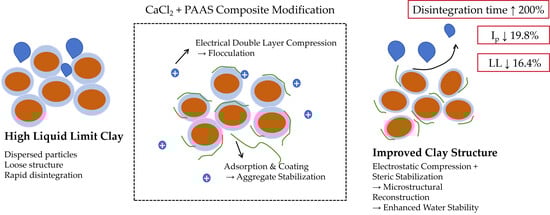
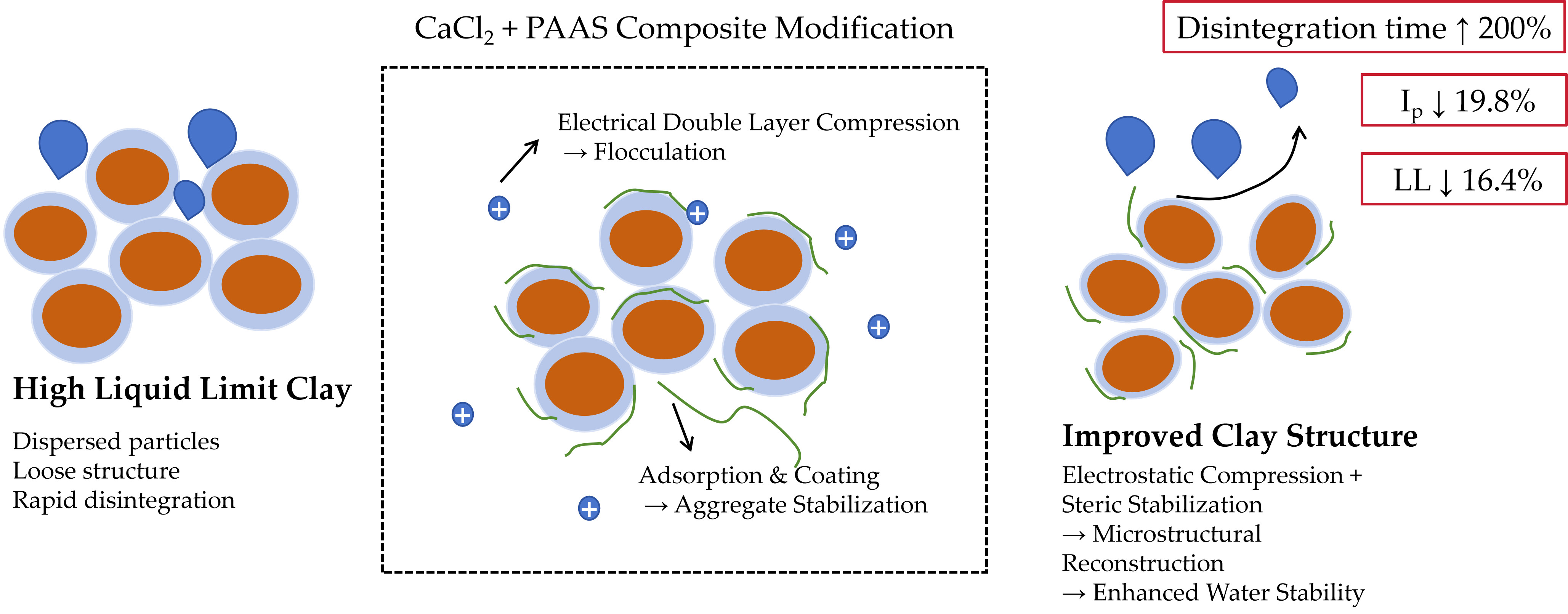
Graphical Abstract

1. Introduction

High-liquid-limit clay is widely distributed in southwestern China and represents a typical water-sensitive particulate clay system characterized by strong electrostatic interactions and hydration-dependent microstructural evolution. Owing to its unique mineral composition and layered structure, exposure to water significantly alters interparticle forces and aggregation states, leading to softening, structural rearrangement and disintegration phenomena [1,2,3,4]. From a materials perspective, these behaviors are governed by interfacial electrochemical properties, particle aggregation–dispersion balance and pore-aggregate framework stability. Therefore, understanding and regulating such interfacial interactions are essential for controlling the structural stability of water-sensitive particulate systems. In transportation infrastructure construction, high-liquid-limit clay is frequently generated as excavated soil during cutting excavation, tunneling, foundation excavation and subgrade construction. Because of its high water sensitivity and poor stability upon wetting, this material is often discarded or stockpiled rather than directly reused, resulting in land occupation and disposal-related concerns. Therefore, improving its water stability is important for promoting the resource reuse of high-liquid-limit clay excavated during the construction of transportation infrastructure and related geotechnical works.
This engineering challenge is closely related to this material’s mineral composition and physicochemical properties. High-liquid-limit clay commonly contains expansive clay minerals, such as montmorillonite and illite, and is characterized by a high-liquid-limit, plasticity index and cation exchange capacity. Hydrating these minerals induces swelling and interlayer expansion, resulting in microstructural changes that affect particle packing and bonding states [5]. Consequently, reductions in liquid limit and plasticity index reflect modifications in particle interaction states and interfacial water structure, and they can be regarded as macroscopic manifestations of altered electrochemical behavior [6]. Previous studies have demonstrated that chemical modifiers, mainly inorganic salts and organic polymers, can regulate the electrochemical properties of particle surfaces and thereby modify the structural and rheological behavior of clay systems [7,8,9,10].
Among these modifiers, inorganic salts primarily compress the diffuse double layer through cation exchange and promote particle flocculation. Molecular simulation studies have shown that divalent ions (Ca2+ and Mg2+) can influence clay swelling behavior via hydration and surface enrichment, thereby affecting the interlayer structure and electrostatic screening [11,12]. Experimental investigations further indicate that CaCl2 is more effective than NaCl at regulating Atterberg limits, whereas FeCl3 exhibits favorable modification effects in expansive clay systems [13,14]. In structural terms, CaCl2 provides divalent Ca2+ ions with relatively strong charge neutralization capabilities, which can interact with negatively charged clay surfaces generated by isomorphous substitution and broken-edge functional groups. By contrast, organic polymers, such as sodium polyacrylate (PAAS), regulate particle interfacial states through adsorption-coating mechanisms and steric hindrance, enhancing structural stability by modifying particle aggregation patterns [6,9,15]. Of these polymers, PAAS contains a carbon-chain backbone bearing abundant carboxylate groups, enabling electrostatic interaction, surface adsorption and hydration-dependent chain extension in aqueous environments.
However, most studies primarily focus on the effects of single modifiers on bulk parameters such as Atterberg limits or strength, whereas the interfacial coupling mechanisms and microstructural reconstruction processes within organic–inorganic composite systems remain insufficiently understood. In particular, the synergistic regulation between electrostatic compression induced by multivalent cations and steric stabilization conferred by polymer adsorption in a multiphase particulate framework warrants systematic investigation.
Therefore, this study investigated high-liquid-limit clay from the Xixiang Expressway project as a representative water-sensitive particulate clay system. A preliminary screening of inorganic salts (KCl, CaCl2 and FeCl3) and organic polymers (PAAS, HPMA and CMC) was conducted based on the Atterberg limits to identify representative inorganic and organic stabilizers. Based on the screening results, CaCl2 and PAAS were selected to construct a CaCl2-PAAS organic–inorganic composite system for subsequent detailed investigation. Particle size analysis, zeta potential (ZP) measurements, DLVO theoretical calculations, SEM observations and immersion disintegration tests were then conducted on the selected composite system. Combined with multivariate statistical analysis, the synergistic mechanisms of CaCl2-PAAS composite modification were systematically clarified, and the relationships between microscopic interfacial parameters and macroscopic disintegration behavior were established. This work provides mechanistic insights into interfacial regulation and structural evolution in organic–inorganic composite modifications of water-sensitive particulate clay systems. It also offers theoretical support for developing composite stabilization strategies for the resource reuse of excavated water-sensitive clayey soils.

2. Materials and Methods

2.1. Materials

2.1.1. Soil Samples

Soil samples were collected from a highway construction spoil disposal site in Yanyuan County, Liangshan Prefecture, Sichuan Province, China, at a depth of 1.0–1.5 m. The samples were naturally air-dried, crushed and passed through a 0.5 mm sieve [16]. Standard compaction tests indicated that the maximum dry density was 1.59 g/cm3, the optimum moisture content was 24.7%, and the natural moisture content was 29.81%.
The mineral composition of the sample soil determined by XRD (D8 Advance, Bruker AXS GmbH, Karlsruhe, Germany) is presented in Table 1. The clay mineral content of the spoil is 44.40%, mainly consisting of illite and illite–montmorillonite mixed-layer minerals. The relatively high clay mineral content leads to pronounced water sensitivity. Upon wetting, interparticle bonding weakens, the soil structure softens, and the strength decreases. Meanwhile, the presence of illite–montmorillonite mixed-layer minerals gives the soil a certain swelling potential. The Atterberg limit test results show that the liquid limit is 53.34%, the plastic limit is 27.73%, and the plasticity index is 25.61. According to the Unified Soil Classification System (ASTM D2487-17) [17], the soil is classified as high-liquid-limit clay (CH). The free swelling ratio is 39%, indicating a medium-to-high swelling potential; therefore, modification is necessary to improve structural stability before practical application.

2.1.2. Reagents and Sample Preparation

To compare the effects of inorganic cations with different valence states on the consistency limits of high-liquid-limit clay and to select a representative inorganic component for the subsequent composite-system study, KCl (Chengdu Kelong Chemical Co., Ltd., Chengdu, China), CaCl2 (Chengdu Kelong Chemical Co., Ltd., Chengdu, China) and FeCl3 (Chengdu Kelong Chemical Co., Ltd., Chengdu, China) were selected as inorganic salt stabilizers, representing monovalent, divalent and trivalent cation systems, respectively. KCl was used as a monovalent-cation reference, CaCl2 was used as a representative divalent salt associated with diffuse double-layer compression and particle flocculation, and FeCl3 was used to evaluate the effect of trivalent cations with stronger charge neutralization capacity.
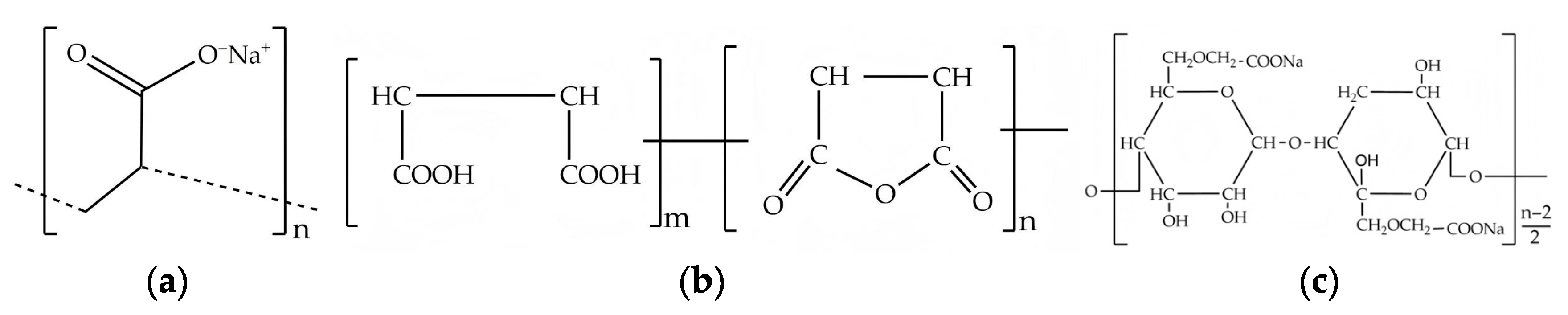
To compare the effects of different organic polymers on the consistency limits of high-liquid-limit clay and to select a representative organic component for the subsequent composite-system study, PAAS (Shanghai Macklin Biochemical Co., Ltd., Shanghai, China), HPMA (Shanghai Macklin Biochemical Co., Ltd., Shanghai, China) and CMC (Shanghai Macklin Biochemical Co., Ltd., Shanghai, China) were selected as organic stabilizers. PAAS was selected as a polyacrylate-based anionic polymer with abundant carboxylate groups, HPMA was selected as a poly(maleic acid)-type polymer rich in carboxyl groups, and CMC was selected as a cellulose-derived polymer containing carboxymethyl and hydroxyl groups. These polymers were used to compare the effects of different molecular backbones and functional groups on clay consistency behavior, and their schematic chemical structures are shown in Figure 1. The three organic stabilizers were dissolved in deionized water to prepare solutions with mass fractions of 20%, 20% and 2%. The main chemical characteristics of the stabilizers used in the preliminary screening are summarized in Table 2.
The dosage of stabilizers was expressed as the percentage of solute mass relative to the dry soil mass. The stabilizers used in the preliminary screening stage and their tested dosage ranges are summarized in Table 3. According to the designed dosages, the stabilizer solutions were uniformly sprayed onto the air-dried soil samples. After thorough mixing, the samples were sealed for 24 h to allow for sufficient interaction between the stabilizers and soil particles.

2.2. Experimental Design and Technical Framework

To systematically reveal the effects of inorganic salt–organic polymer combined stabilization on the water stability of high-liquid-limit clay, experiments were conducted following the technical route of “stabilizer screening–microstructural characterization–water stability evaluation–statistical modeling analysis.”

2.2.1. Stabilizer Screening

According to the Standard for Geotechnical Testing Methods (GB/T 50123-2019) [18], the liquid limit (LL) and plastic limit (PL) were determined using the fall cone method with a soil liquid–plastic limit tester (LP-100D, Nanjing Soil Instrument Factory Co., Ltd., Nanjing, China), and representative dosages were selected based on the results of single-admixture tests. The preliminary screening identified one representative inorganic salt and one representative organic polymer to construct the subsequent composite system. CaCl2 was selected as the inorganic component because it produced the largest overall reduction in LL, PL and Ip among the tested inorganic salts within a relatively feasible dosage range while also representing a typical divalent-cation regulation pathway involving diffuse double-layer compression and particle flocculation. PAAS was selected as the organic component because it showed the strongest overall reduction in the Atterberg limits among the tested polymers and represented a polyacrylate-based adsorption–steric stabilization mechanism.
Based on the screening results, CaCl2 was selected at 2% (low salt, LS) and 8% (high salt, HS), while PAAS was selected at 0.1% (low organic, LO) and 1% (high organic, HO). Accordingly, a 2 × 2 combined stabilization system (HS-HO, HS-LO, LS-HO, LS-LO) was established, together with the corresponding single-component treatments and an untreated control group (CK), resulting in nine experimental groups. For clarity and consistency, the sample codes and corresponding compositions of the CaCl2-PAAS composite system used in the subsequent tests are summarized in Table 4.

2.2.2. Microstructural Characterization

The ZP of soil particles was measured using electrophoretic light scattering. Suspensions were prepared at a soil–water ratio of 1:100, ultrasonically dispersed and centrifuged using a high-speed refrigerated centrifuge (TGL-16, Sichuan Shuke Instrument Co., Ltd., Chengdu, China) to obtain the supernatant. The ZP was then determined using a laser ZP analyzer (Zetasizer Nano ZS90, Malvern Instruments Ltd., Malvern, UK).
Particle size distribution was measured using a laser particle size analyzer (HYL-2076, Dandong Haoyu Technology Co., Ltd., Dandong, China), and characteristic particle sizes (D10, D50 and D90) and gradation parameters (Cu and Cc) were calculated. The interaction potential energy between particles was calculated based on DLVO theory [19,20] to analyze the variation in (Sigma 300, Carl Zeiss AG, Oberkochen, Germany) electrostatic repulsion and van der Waals attraction. Scanning electron microscopy (SEM) was used to observe particle structure and pore characteristics at magnifications of 250×, 5000× and 10,000×.

2.2.3. Water Stability Test

Static water disintegration tests were conducted to evaluate the water stability of the stabilized soils. Soil samples were compacted into 1 cm3 specimens at natural moisture content and immersed in deionized water at 20 °C. The onset time of disintegration (T1) and the disintegration duration (T2) were recorded as disintegration indices to characterize the resistance of the soil to water-induced disintegration.

2.2.4. Statistical Analysis

Spearman rank correlation analysis was used to evaluate the relationships between microstructural parameters (LL, PL, Ip, ZP, potential well depth and characteristic particle size parameters) and disintegration indices (T1, T2). Partial least squares regression (PLS) was further applied to identify key variables, and principal component analysis (PCA) and multiple linear regression (MLR) were used to construct an erosion prediction model. Finally, LMG relative importance analysis was performed to quantify the contributions of different factors to disintegration behavior.

3. Results

3.1. Atterberg Limits Characteristics

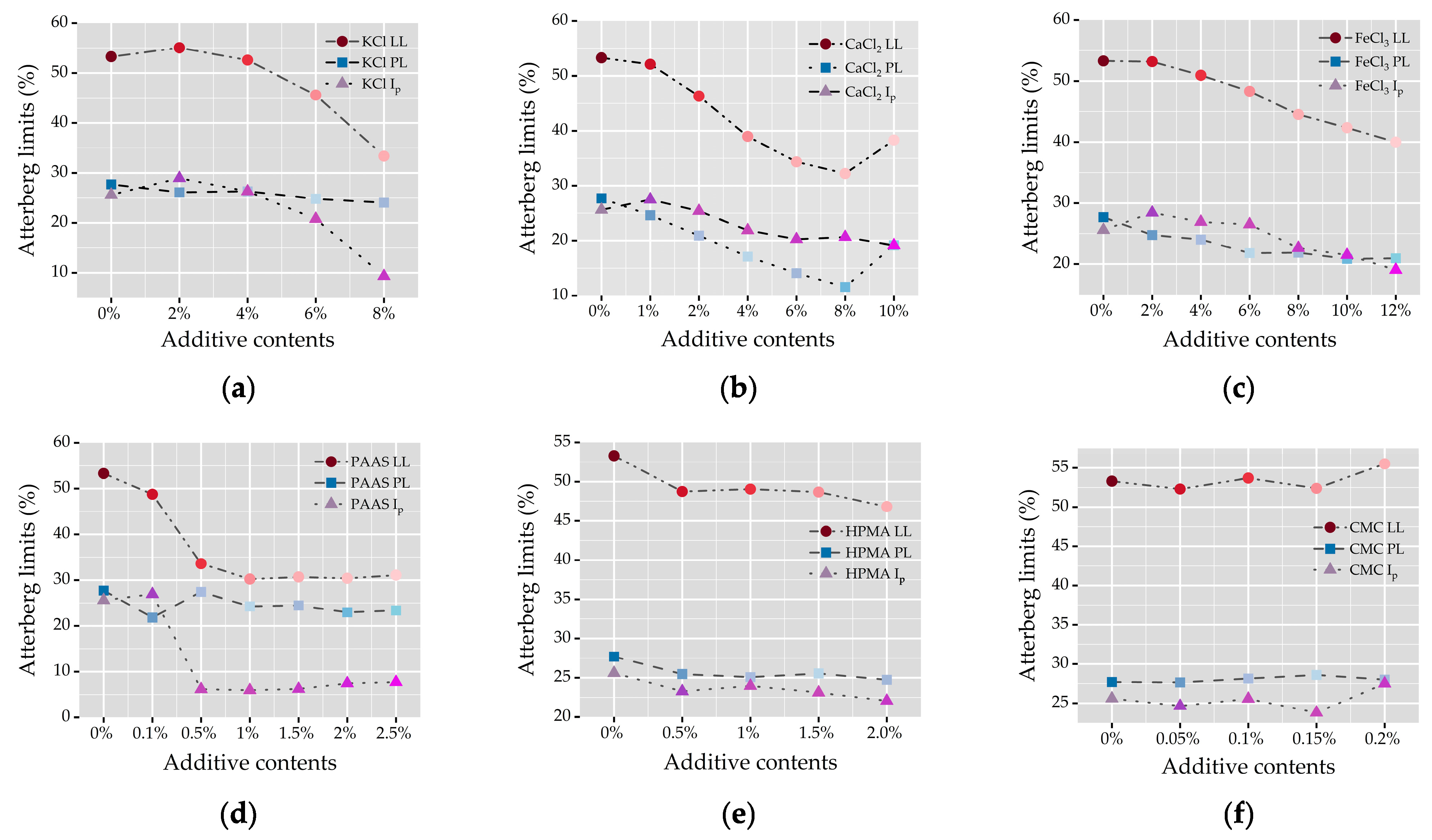
The liquid limit and plastic limit of soils are closely related to engineering properties, such as permeability, swelling–shrinkage behavior and shear strength, and are thus important indicators for evaluating the physical and mechanical characteristics of soils [21,22]. As shown in Figure 2a–c, after the addition of inorganic stabilizers, the PL, LL and Ip of the high-liquid-limit clay generally decreased, but the improvement effects varied among different salts. For CaCl2 treatment, PL, LL and Ip continuously decreased when the dosage was ≤8%. However, when the dosage increased to 10%, PL and LL increased by 7.6% and 6.1%, respectively, compared with the values at 8%. The improvement effect of KCl was relatively weak, and its LL noticeably decreased only when the dosage exceeded 4%. By contrast, FeCl3 exhibited a continuous improvement effect with increasing dosage, and the LL decreased to 39.99% at 12%, representing a 25.02% reduction compared with the control (CK). Overall, the optimal dosages of KCl and CaCl2 were both 8%, while that of FeCl3 was 12%. Of these, CaCl2 showed the best performance, reducing LL from 53.34% to 32.21%, PL from 27.73% to 11.56% and Ip from 25.61 to 20.65.
As shown in Figure 2d–f, after the addition of organic reagents, the LL and Ip of the high-liquid-limit clay also generally decreased. The addition of PAAS significantly reduced Ip from 25.61 to approximately 7. For HPMA, PL decreased from 27.73% to 25.46% at a dosage of 0.5% and then remained relatively stable. For CMC, PL slightly increased to 28.14% at a dosage of 0.1%. The optimal dosages for reducing the Atterberg limits were 1% for PAAS, 2% for HPMA and 0.05% for CMC. Of these, PAAS showed the best overall performance, reducing PL, LL and Ip to 24.27%, 30.21% and 5.95, respectively.
Based on the above single-admixture screening results, CaCl2 and PAAS were selected as representative inorganic and organic stabilizers for the subsequent composite tests. CaCl2 was selected because it produced a stronger reduction in the Atterberg limits than KCl and provided a more practical modification pathway than FeCl3, which may introduce additional complexity due to Fe3+ hydrolysis. PAAS was selected because it showed the best overall performance among the tested polymers, whereas HPMA and CMC produced weaker or less stable improvements.
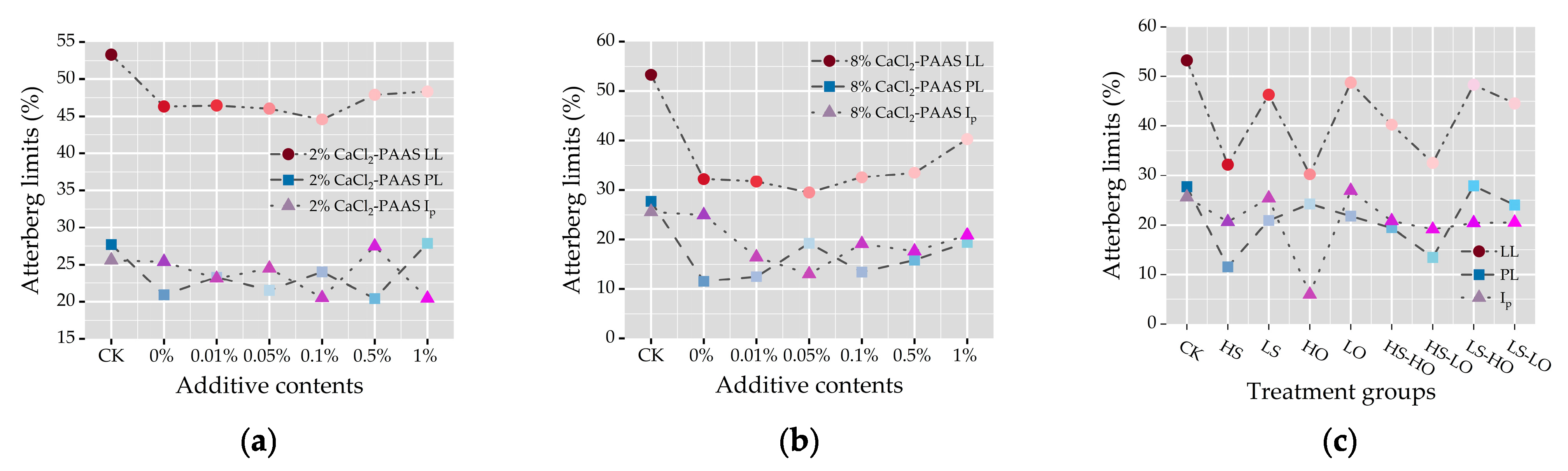
To determine the optimal dosage combination in the combined system, 8% CaCl2 was selected as the high-salt group (HS), while 2% CaCl2 was selected as the low-salt group (LS) according to the requirement in the Test Methods of Soils for Highway Engineering (JTG 3430-2020) [23], which specifies that the liquid limit should be ≤50%. The composite tests showed (Figure 3a,b) that the addition of PAAS under the same salt background generally further reduced Ip, with the most significant effect at a dosage of 1%. Subsequently, 0.1% PAAS was selected as the low-organic group (LO) and 1% PAAS as the high-organic group (HO), and they were combined with LS and HS to form four treatments: LS-LO, LS-HO, HS-LO and HS-HO. The results (Figure 3c) showed that under the LS-LO treatment, LL decreased from 53.34% to 44.56%, and Ip decreased to 20.52, while under the HS-LO treatment, LL decreased to 29.49%, and Ip decreased to 13.05. Compared with the combinations containing 0.05% PAAS, the combinations of 0.1% PAAS with 2% and 8% CaCl2 showed smaller differences in LL and Ip, indicating that this dosage exhibited more stable improvement effects under different salinity conditions.

3.2. Surface Electrochemical Properties

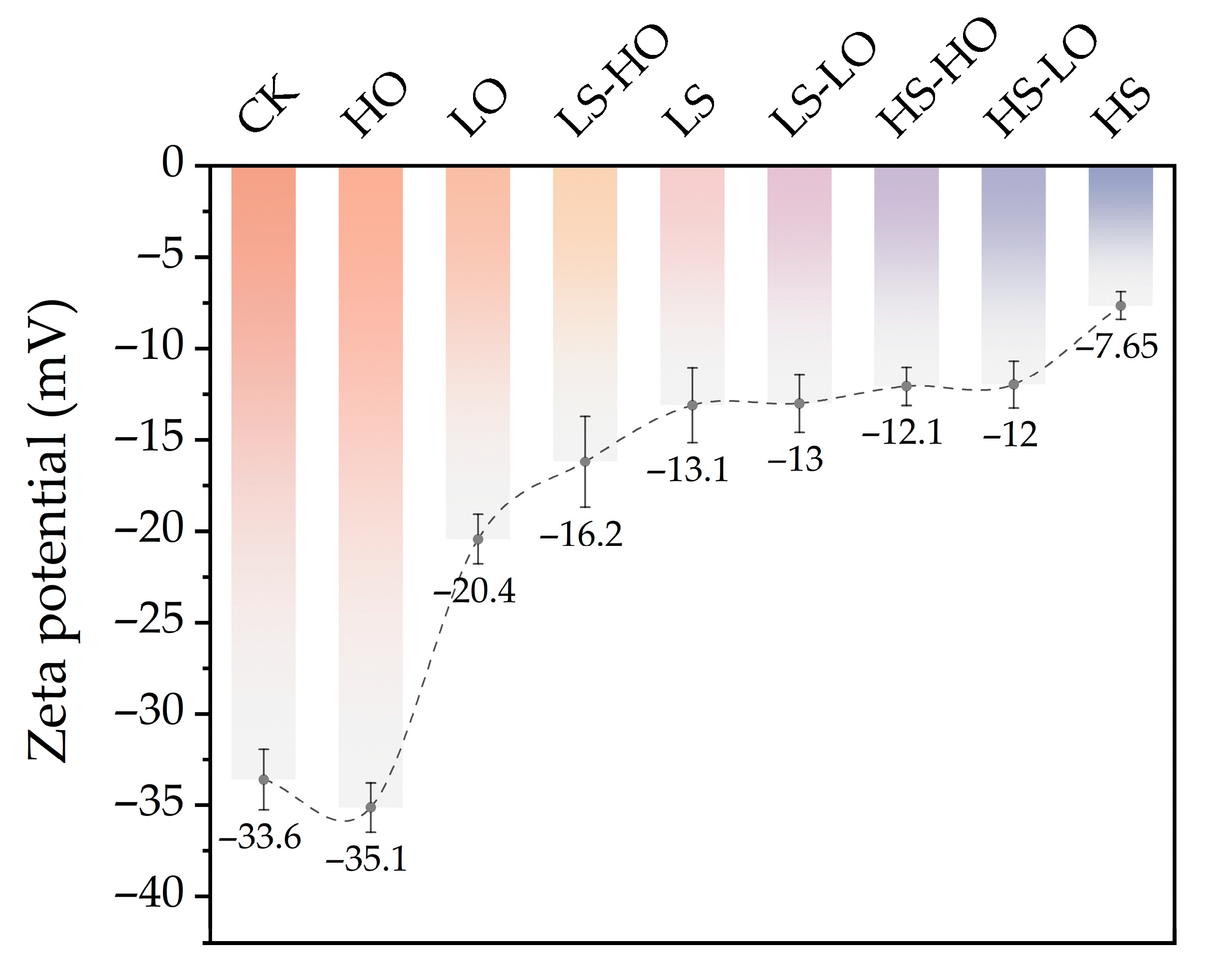
The ZP measurement results are shown in Figure 4. The ZP of the CK group was −33.6 mV, indicating that the surfaces of the original soil particles possessed strong negative charges. After treatment with different stabilizing agents, the absolute values of the ZP showed significant differences.
The HO group exhibited the largest absolute value (−38.1 mV), suggesting that high concentrations of PAAS enhanced the negative surface charge of the particles. By contrast, the HS group showed the smallest absolute value (−7.65 mV), confirming the strong compression effect of high concentrations of Ca2+ on the diffuse double layer. This indicates that high concentrations of CaCl2 significantly reduced the negative surface charge of the particles. The ZPs of the LS, LO and the combined treatment groups were between these two extremes.
Overall, different stabilizing agents and their combinations significantly altered the electrochemical state of the particle surfaces. The HS treatment markedly decreased the ZP, whereas the addition of PAAS increased the absolute value of the potential to a certain extent. In the combined system, the potential variations among treatments reflect the combined regulation of particle surface properties by inorganic salts and organic polymers.

3.3. Interparticle Interaction Energy Based on DLVO Theory

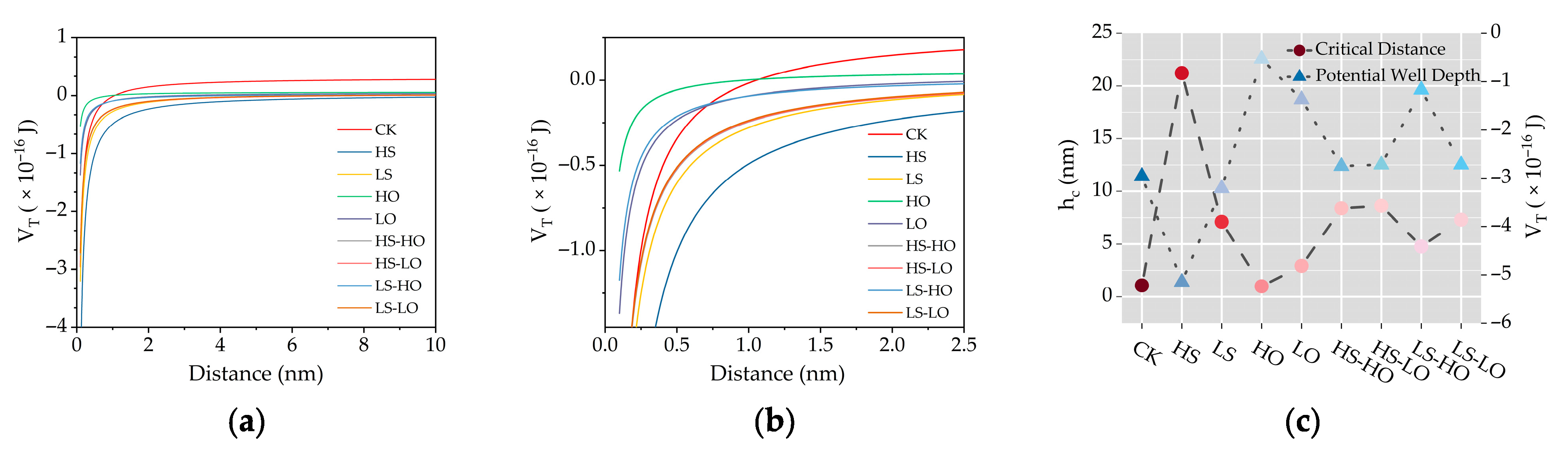
Figure 5 presents the total interparticle interaction energy curves calculated based on DLVO theory, revealing the different regulatory mechanisms of inorganic salts and organic polymers on particle interactions. The CaCl2 treatment significantly increased the critical distance (hc). In the HS group, hc reached 21.22 nm, which was much larger than that of the CK group (1.07 nm) and the LS group (7.11 nm). Meanwhile, the potential well depth (DPM) increased to −5.15 × 10⁻¹⁶ J. This indicates that Ca2+ weakens electrostatic repulsion by compressing the diffuse double layer, allowing attractive interactions to occur at longer distances, thereby promoting particle contact and flocculation. By contrast, PAAS exhibited the opposite trend. In the HO group, hc decreased to 0.98 nm, and DPM became shallower (−0.53 × 10⁻¹⁶ J), indicating that the polymer adsorption layer generated steric hindrance that inhibits particle approach and weakens van der Waals attraction.
In the combined system, hc and DPM exhibited characteristics reflecting the combined effects of salts and polymers. In the HS composite group, hc was approximately 8.4 nm, which was smaller than that of the HS group but still significantly higher than that of the LS group. Its DPM (~−2.75 × 10⁻¹⁶ J) was noticeably shallower than that of the HS group, indicating that PAAS weakened the salt-induced flocculation. Similarly, in the LS composite groups (LS-HO and LS-LO), the DPM values (−1.17 × 10⁻¹⁶ and −2.72 × 10⁻¹⁶ J) were significantly shallower than those of the LS group (−3.21 × 10⁻¹⁶ J). These results indicate that salts primarily control the range of repulsive interactions, while polymers mainly regulate the strength of particle contact; together, they determine the microscopic balance between particle aggregation and dispersion.

3.4. Particle Gradation and Microstructure

3.4.1. Particle Size Distribution Characteristics

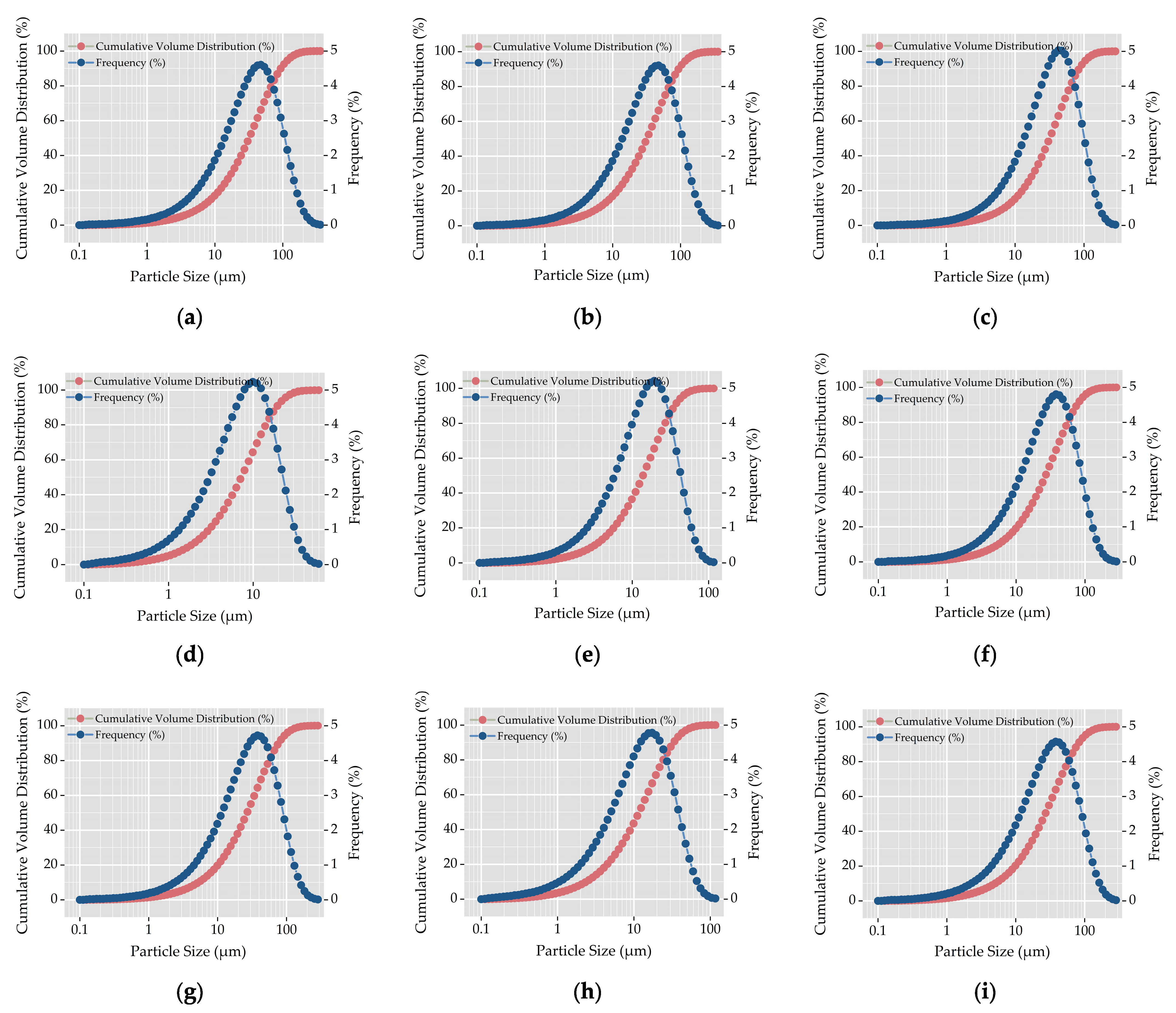
Laser particle size analysis showed that different stabilizer treatments significantly altered the particle distribution characteristics of high-liquid-limit clay (Figure 6 and Table 5). Inorganic salts and organic polymers exhibited distinctly different effects on soil gradation, while the combined treatments reflected the synergy and counterbalance of the two. The high salinity treatment (HS) increased D50 from 35.68 μm to 56.42 μm and D10 from 6.75 μm to 11.61 μm, indicating obvious particle coarsening; however, Cu (3.48) and Cc (0.65) were relatively low, suggesting a narrow particle distribution range and poor gradation. By contrast, the PAAS treatment significantly refined the particles. In the HO group, D10 and D50 decreased to 1.62 μm and 6.47 μm, respectively, with relatively good gradation characteristics (Cu = 5.45; Cc = 1.29). In the combined treatments, the Cu values of all groups were greater than 5, and Cc values were close to 1, indicating an obvious improvement in gradation continuity. Among them, the LS-LO group showed a D50 of 30.06 μm and the highest Cu (6.22), indicating the widest particle size distribution and the most favorable filling between coarse and fine particles.

3.4.2. SEM Microscopic Morphology Observation

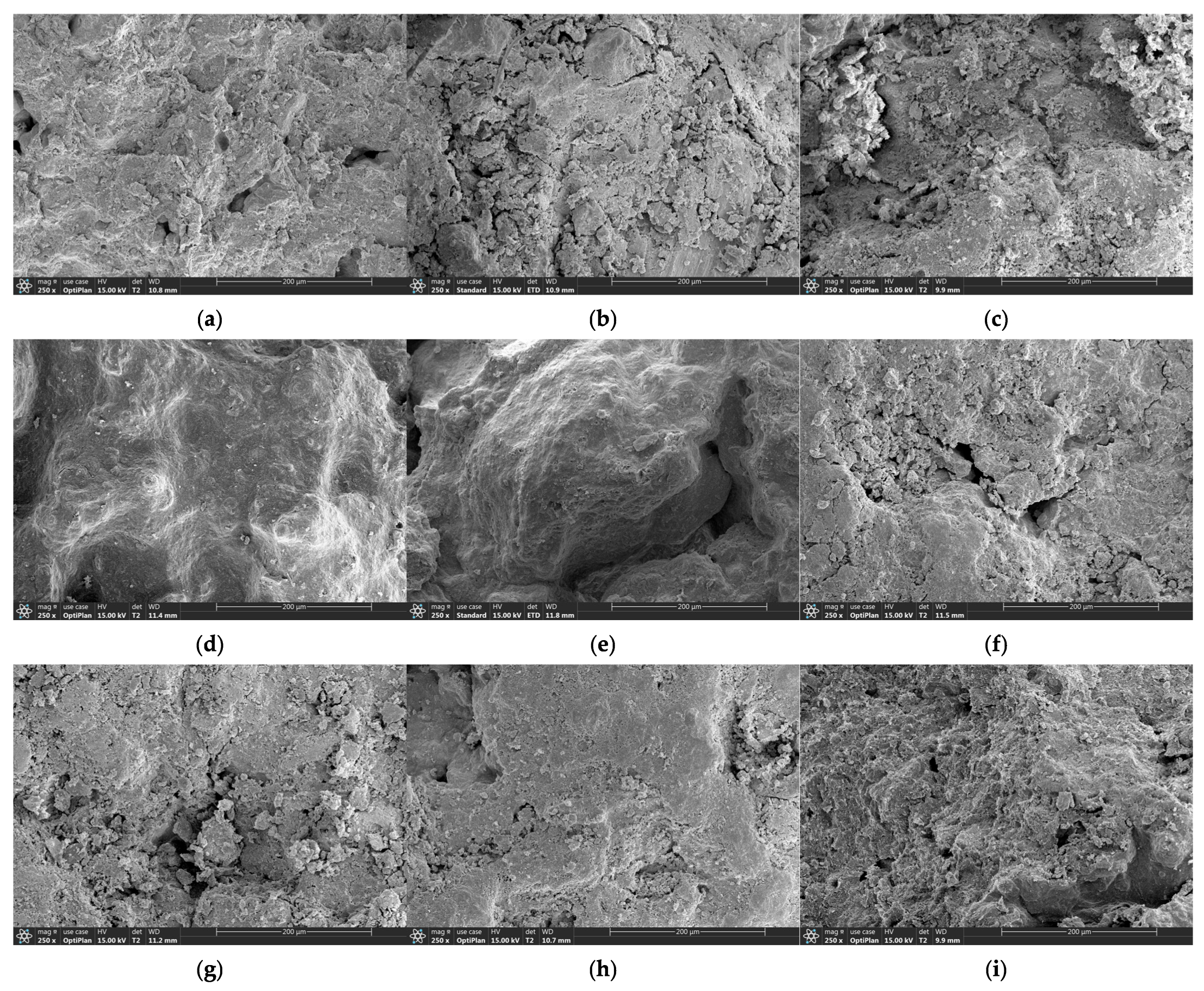
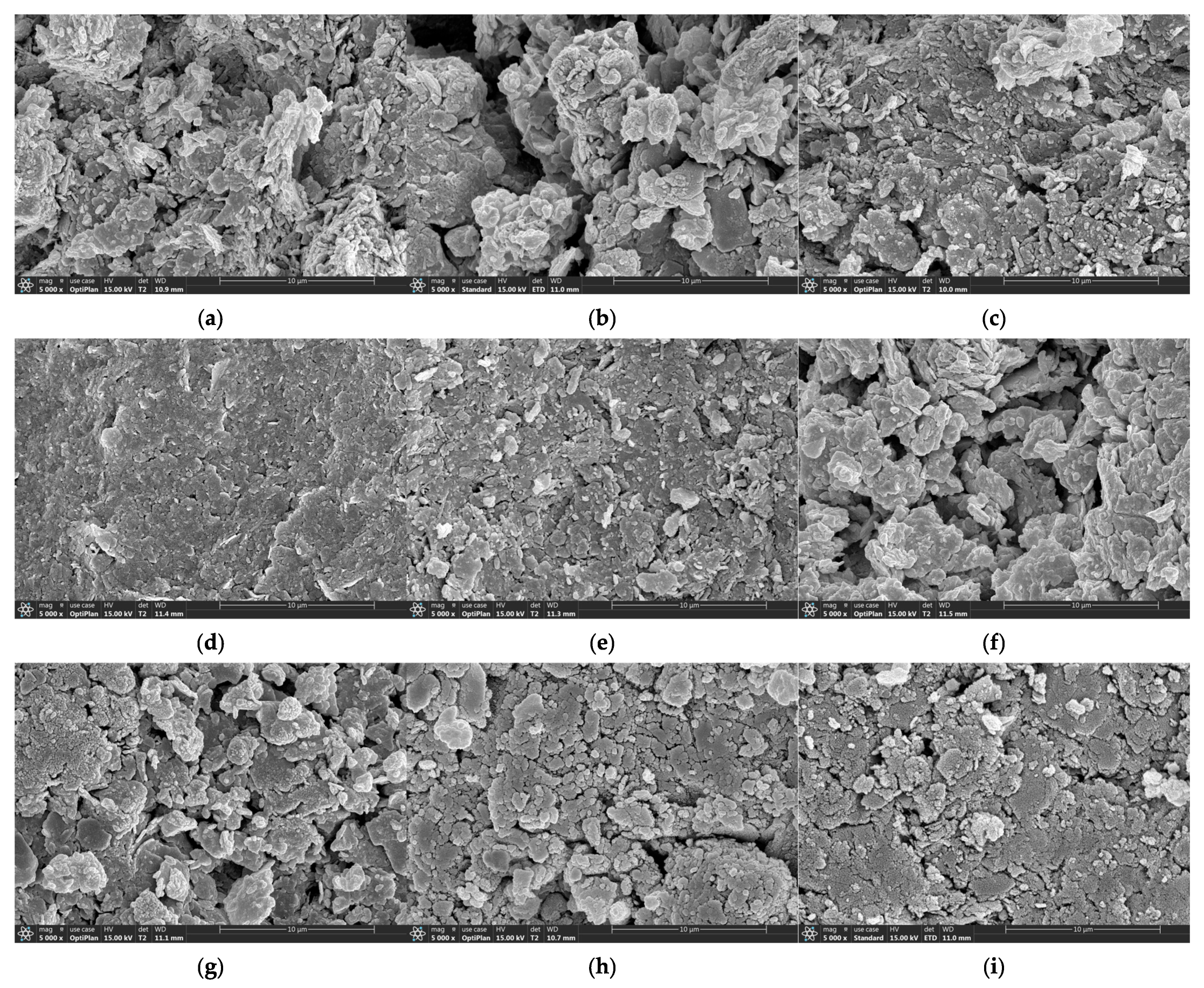
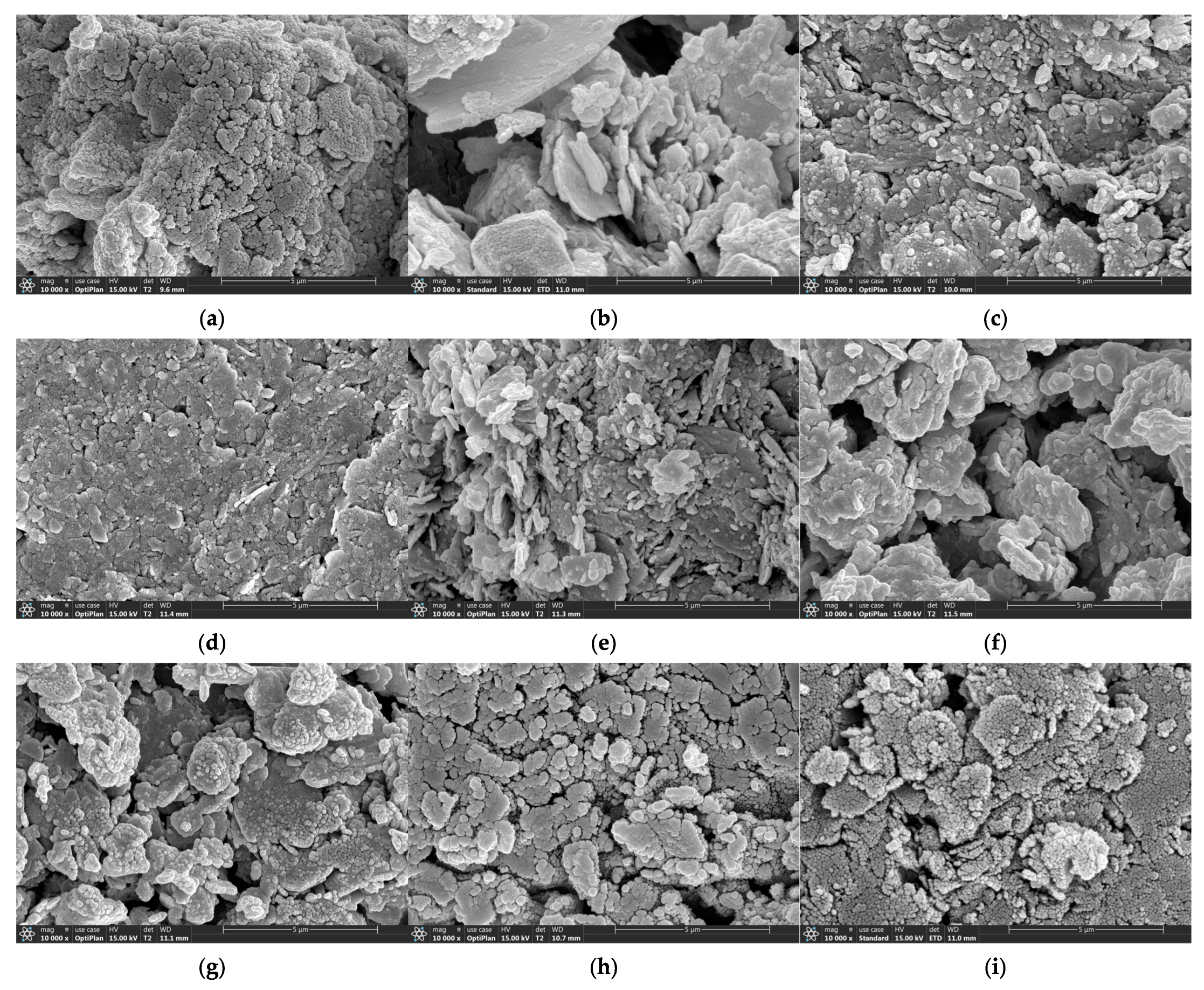
SEM observations revealed the significant reconstruction of the microscopic morphology and pore structure in the high-liquid-limit clay under the different treatments (Figure 7, Figure 8 and Figure 9). The treatment groups exhibited a continuous evolution in structural compactness, pore characteristics and interaction modes between particles or platelets.
At the 250× scale (Figure 7), the HS group (Figure 7b,g) showed the loosest particle framework with wide pores, whereas the LS-treated group (Figure 7c) exhibited a relatively compact structure. Polymer treatments (Figure 7d,e) displayed different characteristics: the HO group formed a dense block structure due to polymer adsorption and coating, while the CK and LO groups were still dominated by relatively loose particle accumulation.
At the 5000× scale (Figure 8), differences in particle packing and pore distribution became more evident. The LS-LO group (Figure 8i) exhibited the most favorable structure, with tightly filled fine particles and small, uniformly distributed pores, forming a dense packing system. By contrast, the HS (Figure 8b) and HS-LO (Figure 8g) groups showed large and strongly connected pores, resulting in a relatively loose structure. The HO group (Figure 8d) presented a continuous polymer matrix in which the original particle morphology was covered. The LS-HO (Figure 8h) and HS-HO (Figure 8f) groups represented transitional states, where polymer bonding formed aggregates, while pore uniformity lay between LS-LO and HS.
At the 10,000× scale (Figure 9), the particle interfacial interaction patterns could be summarized into three types. The first was “polymer adsorption coating”, represented by the HO group (Figure 9d), where a polymer layer covered the surface of illite platelets, making particle boundaries indistinct and achieving physical isolation. The second was “tight particle attachment”, observed in the LS (Figure 9c) and LS-LO groups (Figure 9i), where numerous fine particles adhered to platelet surfaces to form stable connections. The third was “platelet dispersion and weak flocculation”. In the HS group (Figure 9b), platelets were dispersed with fewer attached particles, while the HS-LO group formed only loose flocculated structures with low connection strength.
The multi-scale morphological analysis indicates that salts mainly control the aggregation state of illite platelets and the overall pore structure. LS treatment promotes tight particle connections and reduces pore size, whereas HS treatment forms a loose porous structure. PAAS mainly regulates the interfacial properties of particle surfaces and influences particle connection modes through coating or bonding. In the combined system, their synergistic interaction determines structural stability: under high-salinity conditions, the structure remains relatively loose, whereas under LS conditions, the coating effect of PAAS becomes effective. Among the treatments, LS-LO forms a dense and uniform structure with small and evenly distributed pores, exhibiting the best microscopic morphology.

3.5. Water Stability Behavior

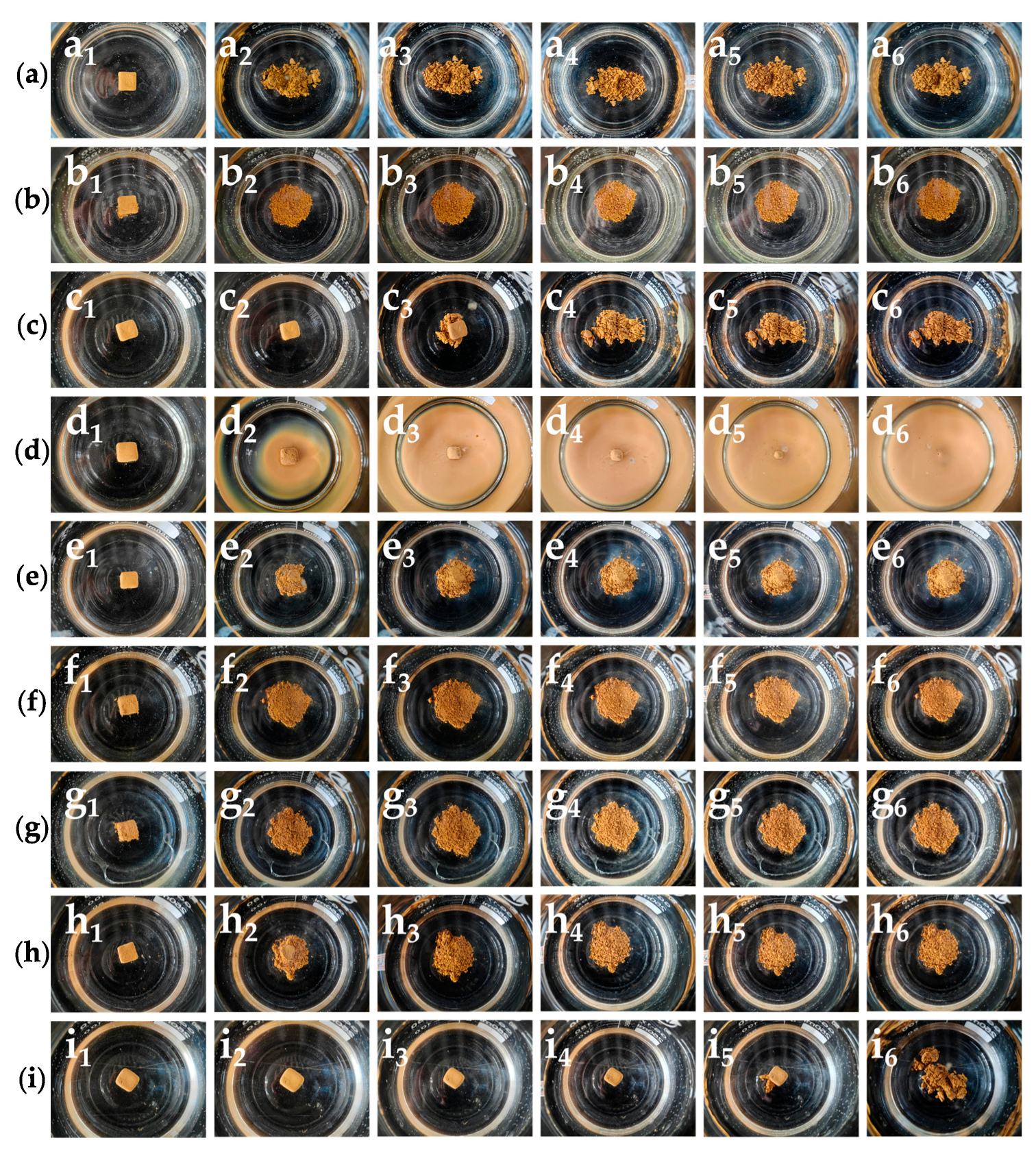
The immersion disintegration test results clearly reflect the differences in stability and disintegration patterns of high-liquid-limit clay under different stabilization treatments (Figure 10 and Figure 11). Figure 10 shows the time evolution of soil disintegration for each treatment. The disintegration morphology, disintegration initiation time and disintegration duration demonstrate the influence of different stabilizers on soil structural stability.
Given the final disintegration morphology (Figure 10), different treatment groups exhibited distinct failure modes. The HO group (Figure 10d) gradually lost its overall structure after immersion and eventually completely dissolved, with the water becoming noticeably turbid, showing a typical colloidal dispersion-type failure. This indicates that a high dosage of PAAS caused the soil particles to become highly dispersed and form a stable suspension system. The HS and LS groups (Figure 10(b6,c6)) mainly demonstrated granular uniform disintegration, where the soil split into numerous fine particles during the disintegration process and dispersed evenly in the water. The CK, LS-HO and LS-LO groups (Figure 10(a6,h6,i6)) were mainly characterized by block-type disintegration. Among them, the LS-LO group exhibited the largest block size, with some plate-like structures still preserved locally, indicating relatively high overall structural stability and strong particle bonding within the soil. The LO and HS-LO groups (Figure 10(e6,g6)) produced a mixture of blocks and fine particles, showing relatively heterogeneous failure patterns. The HS-HO group (Figure 10(f6)) generated uniformly small blocks after disintegration, indicating the relatively complete destruction of the overall structure.
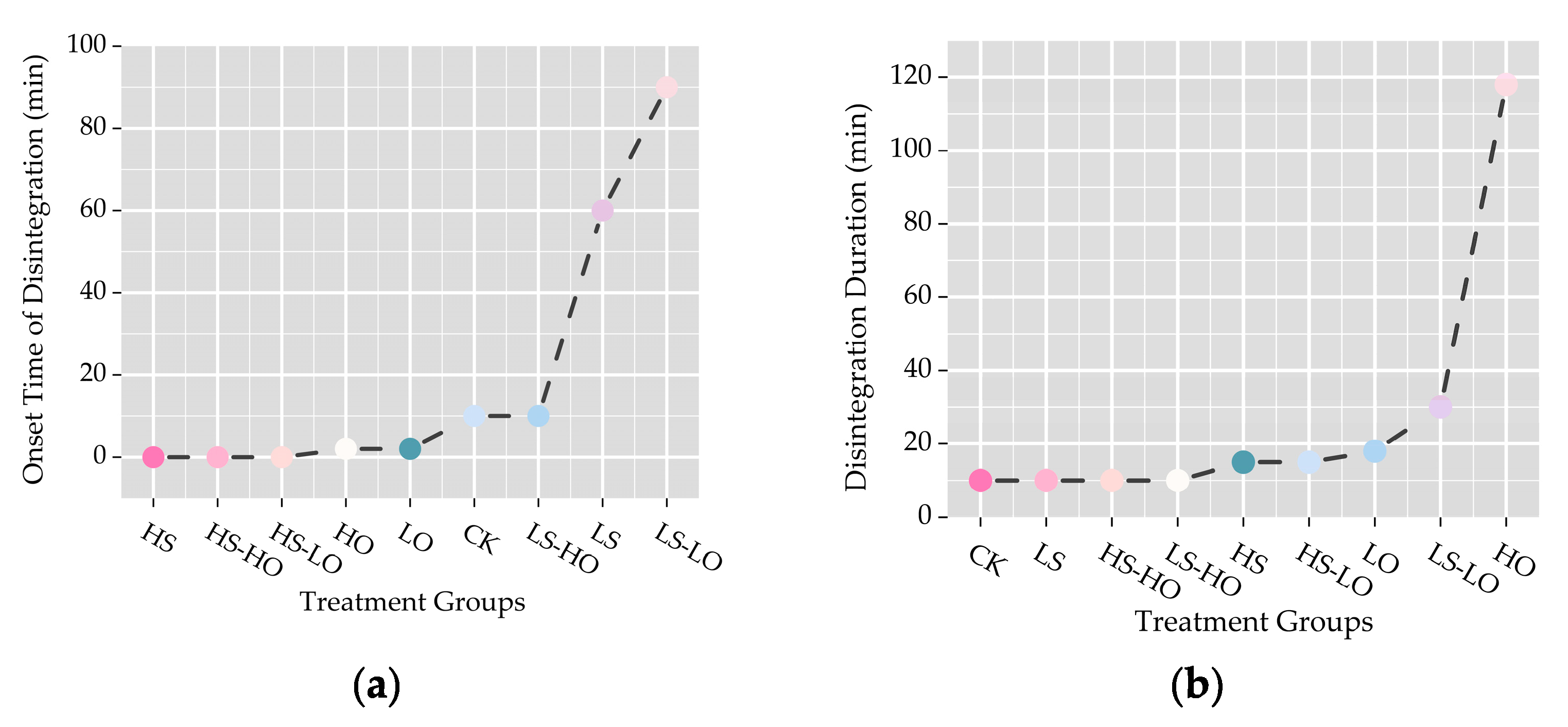
In terms of disintegration initiation time (Figure 11a), significant differences in initial water stability were observed among the treatment groups. The HS, HS-HO and HS-LO groups began to disintegrate immediately after immersion, indicating that under high-salinity conditions, the soil structure was highly unstable and rapidly destroyed upon contact with water. The CK, LO and LS-HO groups began to disintegrate at approximately 10 min, indicating limited but existing water stability. The LS group exhibited higher stability, with the initiation of disintegration delayed to about 60 min, showing that inorganic salts at an appropriate concentration can enhance soil structural stability. The LS-LO group showed the latest initiation time, reaching 90 min, indicating that this combined system had the strongest resistance to initial water erosion.
In terms of disintegration duration (Figure 11b), the HO group showed the slowest process, with the entire dissolution lasting about 118 min and exhibiting progressive dispersion–dissolution behavior. The LS-LO group ranked second, requiring 30 min for complete disintegration. The HS, HS-LO and LO groups required 15–18 min, while the remaining treatment groups completed disintegration within 10 min.

3.6. Spearman Correlation Analysis

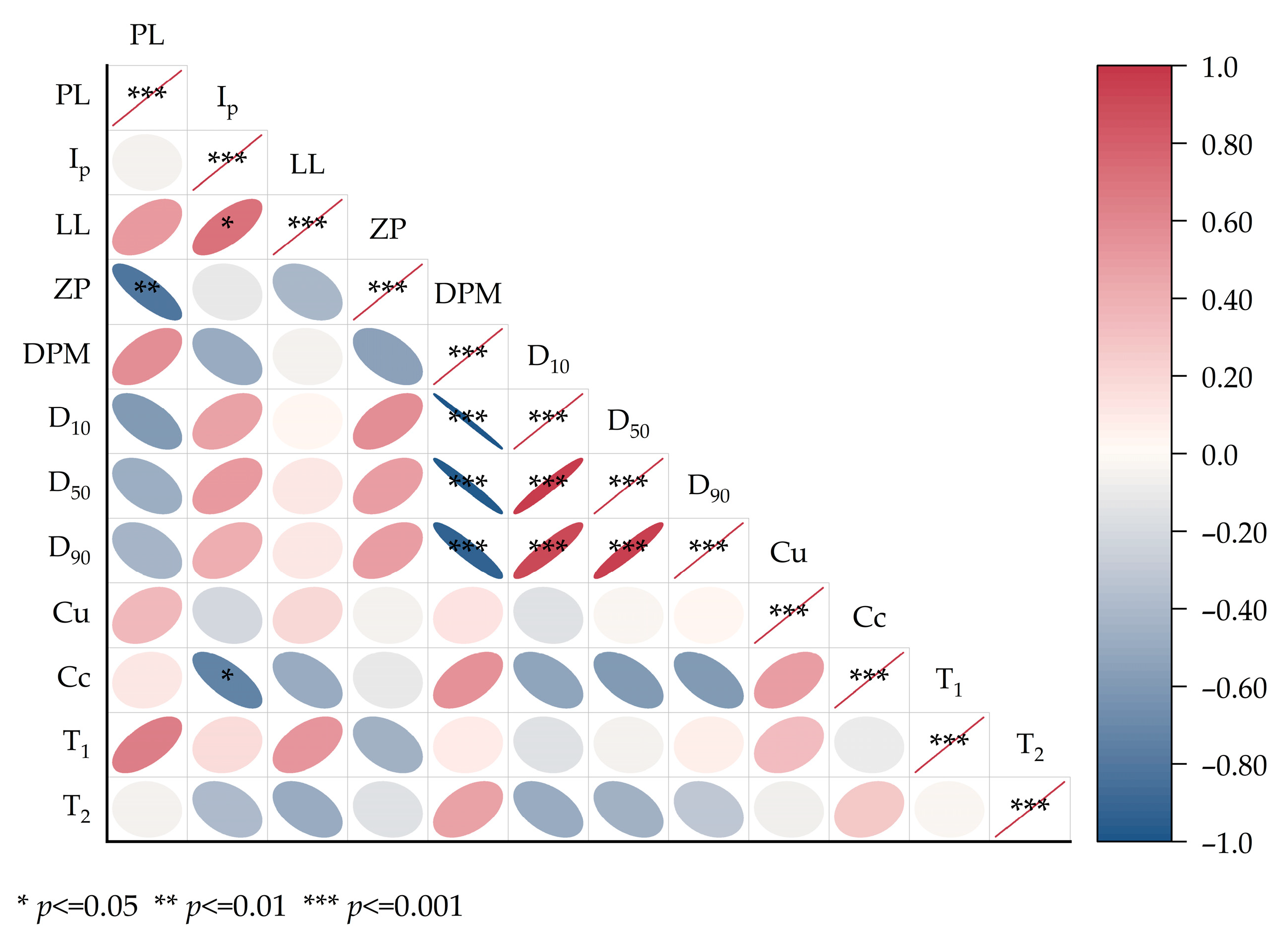
To explore the relationships between microstructural parameters and macroscopic disintegration behavior, a Spearman correlation matrix was constructed using data from the nine treatment groups listed in Table 4. The matrix included ten microstructural parameters (PL, Ip, LL, ZP, DPM, D10, D50, D90, Cu and Cc) and two disintegration indicators (T1: onset time of disintegration; T2: disintegration duration), as presented in Figure 12.
The results indicate that significant correlations exist among several microstructural parameters. ZP showed a significant negative correlation with PL (ρ = −0.817; p < 0.01), suggesting that the stronger compression of the diffuse double layer leads to a thinner water film on particle surfaces, thereby reducing the plastic limit. DPM exhibited extremely significant negative correlations with the characteristic particle sizes D10, D50 and D90 (ρ = −0.996, −0.979 and −0.929, respectively; p < 0.01), revealing a close relationship between particle refinement and the weakening of van der Waals attraction. In addition, Ip showed a positive correlation with LL (ρ = 0.717; p < 0.05) and a negative correlation with Cc (ρ = −0.733, p < 0.05), indicating that soils with higher plasticity tend to possess higher liquid limits and particle gradations that deviate from the ideal state.
With respect to disintegration behavior, the correlation between T1 and T2 was extremely weak (ρ = −0.027), indicating that the initiation and duration of disintegration are largely independent processes. T1 showed positive correlations with PL and LL (ρ = 0.641 and 0.522, respectively) and a negative correlation with ZP (ρ = −0.445), suggesting that soils with higher plastic limits and weaker diffuse double-layer compression tend to exhibit a later onset of disintegration. By contrast, T2 exhibited a positive correlation with DPM (ρ = 0.479) and negative correlations with D10 and D50 (ρ = −0.498 and −0.455, respectively), indicating that soils with finer particles and weaker van der Waals attraction may experience longer disintegration durations.

3.7. Partial Least Squares Regression Analysis

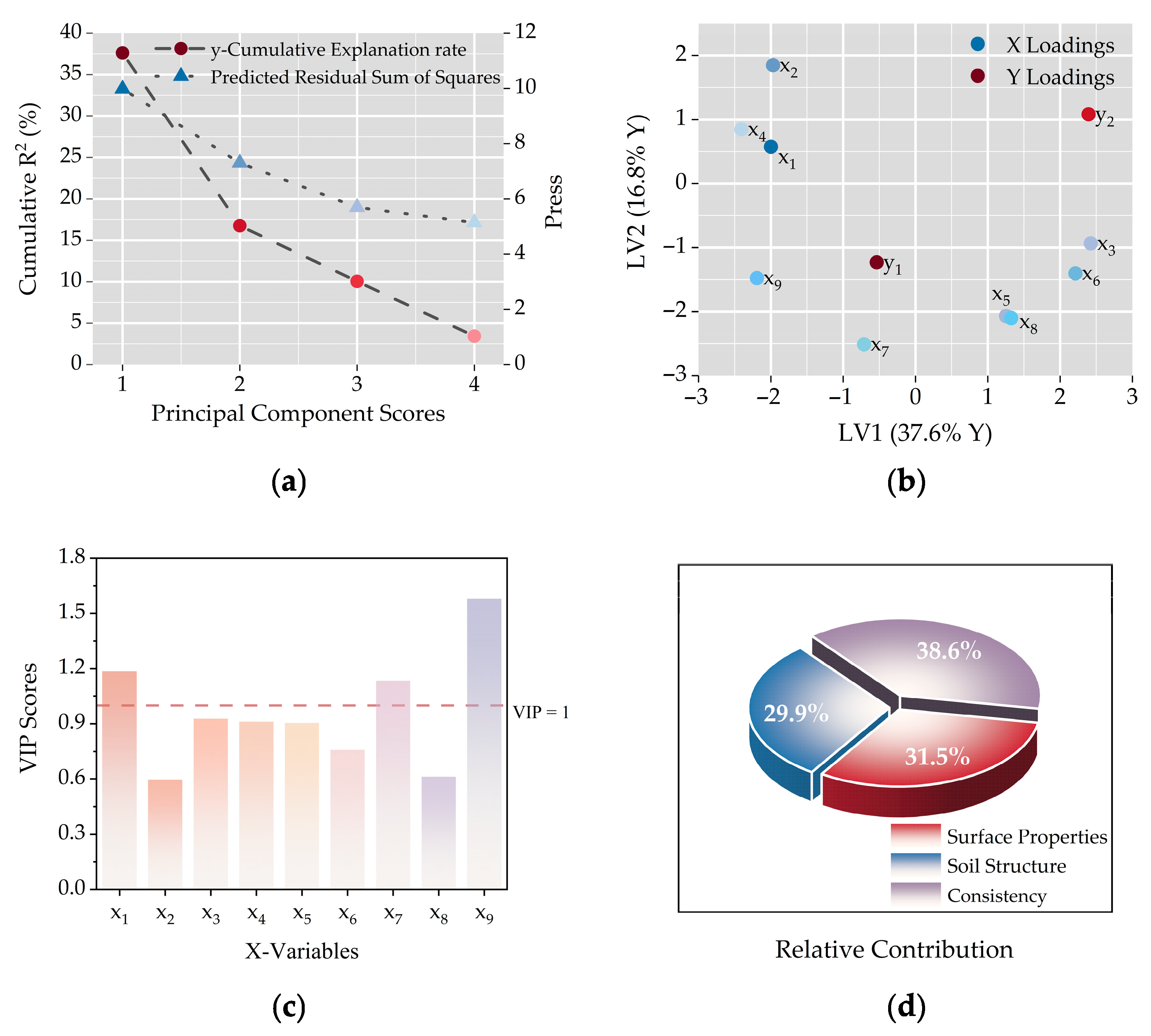
To identify the key microstructural parameters controlling disintegration behavior, partial least squares regression (PLS) was performed using data from the nine treatment groups listed in Table 4. Nine microstructural parameters were used as predictor variables, namely x1: ZP, x2: hc, x3: DPM, x4: D50, x5: Cu, x6: Cc, x7: LL, x8: PL and x9: Ip, while two disintegration indicators were used as response variables, namely y1: onset time of disintegration and y2: disintegration duration.
The leave-one-out cross-validation results (Figure 13a) indicate that the prediction residual sum of squares (PRESS) reached its minimum when the number of principal components was four; therefore, the optimal number of components was determined to be four. The first two principal components explained 54.37% of the cumulative variance in Y, indicating that they captured the majority of variance. The loading plot (Figure 13b) shows that the first latent variable (LV1) was strongly associated with bonding-strength-related variables such as DPM and Cc, and y2 was located in the positive direction of LV1. The second latent variable (LV2) was mainly related to variables reflecting consistency variables, such as LL and PL, and showed a negative relationship with the onset time of disintegration (y1). The VIP (Variable Importance in Projection) results (Figure 13c) indicate that Ip (1.58), ZP (1.19) and LL (1.13) were the key variables influencing disintegration behavior.
Based on their physical significance, the variables were further categorized into three groups: surface properties (x1x3), soil structure (x4x6) and consistency (x7x9) (Figure 13d). Further analysis showed that consistency contributed the most (38.6%), followed by surface properties (31.5%) and soil structure (29.9%). Based on variables with VIP > 1, the following multiple regression models were established:
y 1   =   17.39   +   2.30 x 1   +   3.97 x 7 4.25 x 9
y 2 = 97.6 1.29 x 1 0.28 x 7 4.04 x 9
The results show that the model exhibits good predictive performance for disintegration duration (R2 = 0.89), while the explanatory power for the onset time of disintegration is relatively weak, indicating that the onset of disintegration is controlled by multiple interacting factors.

3.8. PCA-MLR and LMG Relative Importance Analysis

3.8.1. Comprehensive Index Construction and Regression Model

To construct a simplified predictive model applicable to engineering practice, PCA was first conducted on the three variable categories, and the first principal component loadings were extracted as within-group weights. MATLAB R2021b calculations showed that the variance values explained by the first principal component for surface properties, soil structure and consistency were 81.75%, 79.72% and 66.60%, respectively, indicating that the composite indices could adequately represent the original variables. After standardization, three composite indices were obtained: X1, X2 and X3. Their expressions (based on normalized absolute-value weights) are
X 1 = 0.317 x 1 + 0.355 x 2 + 0.328 x 3
X 2 = 0.314 x 4 + 0.319 x 5 + 0.367 x 6
X 3 = 0.415 x 7 + 0.281 x 8 + 0.304 x 9
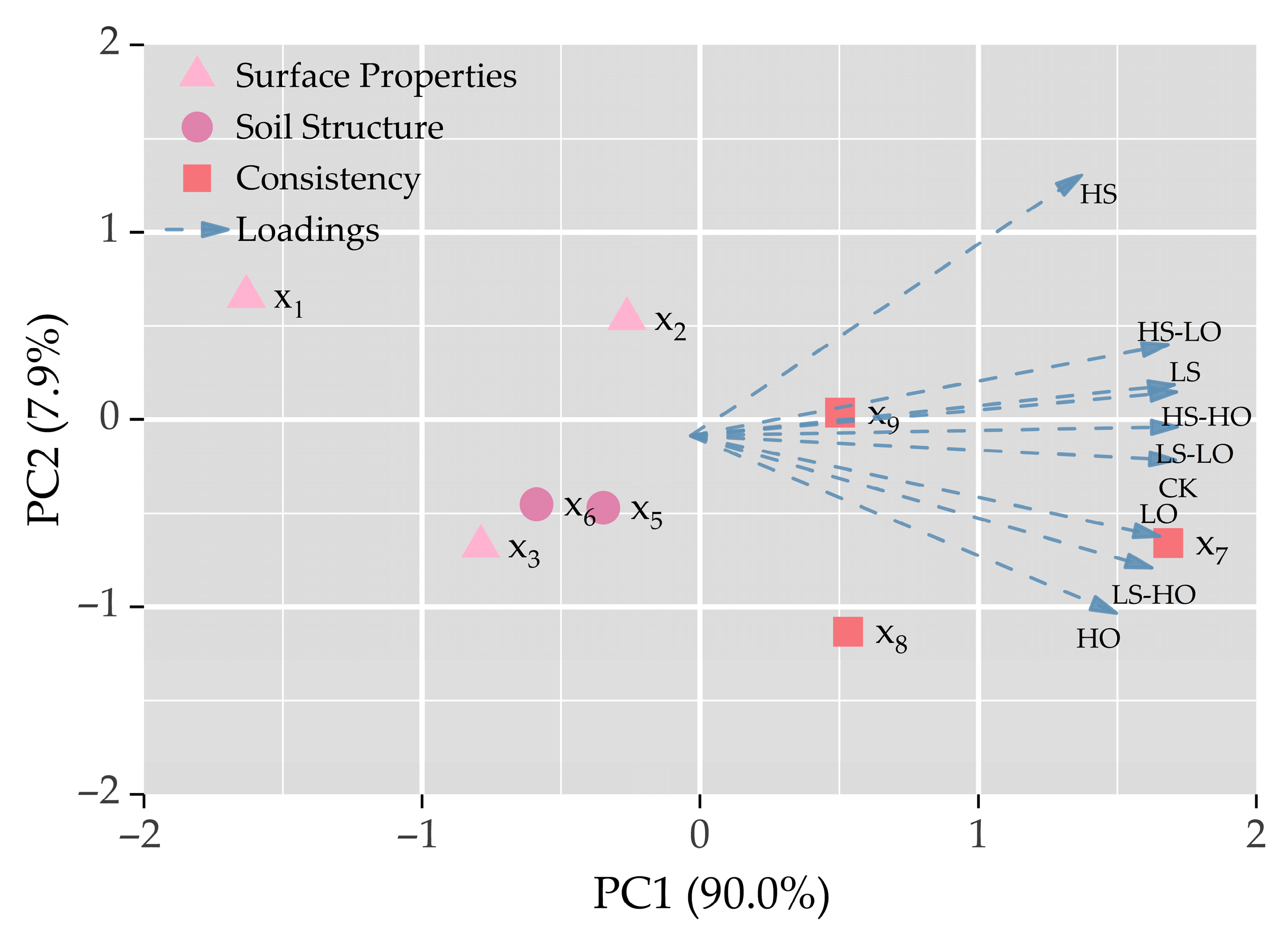
The PCA results (Figure 14) show that PC1 explained 90.0% of the total variance, while PC2 explained 7.9%, indicating strong collinearity among the microstructural parameters. Different treatments showed relatively small differences along the PC1 direction, while the combined treatments exhibited generally higher scores than the single treatments, indicating that the combined stabilization system exerted more comprehensive regulation of microstructural parameters. By contrast, PC2 mainly reflected the differences between the stabilization mechanisms induced by inorganic salts and polymers. Based on these indices, multiple linear regression models were established using X1, X2 and X3 as independent variables to predict the onset time of disintegration (Y1) and disintegration duration (Y2):
Y 1   =   19.333   +   31.011 X 1   +   28.049 X 2   +   13.322 X 3
Y 2 = 26.222 33.624 X 1 8.254 X 2 26.559 X 3
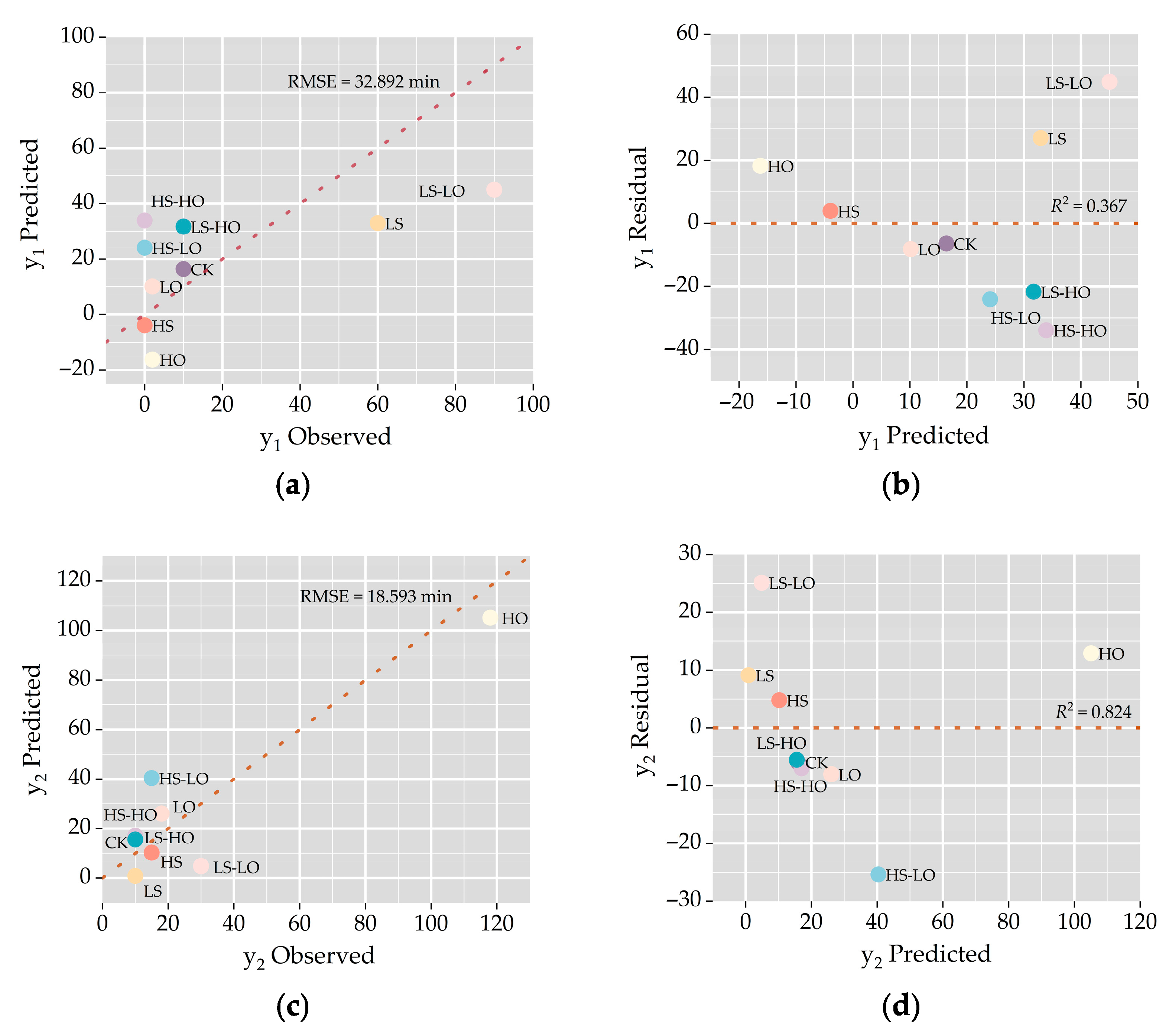
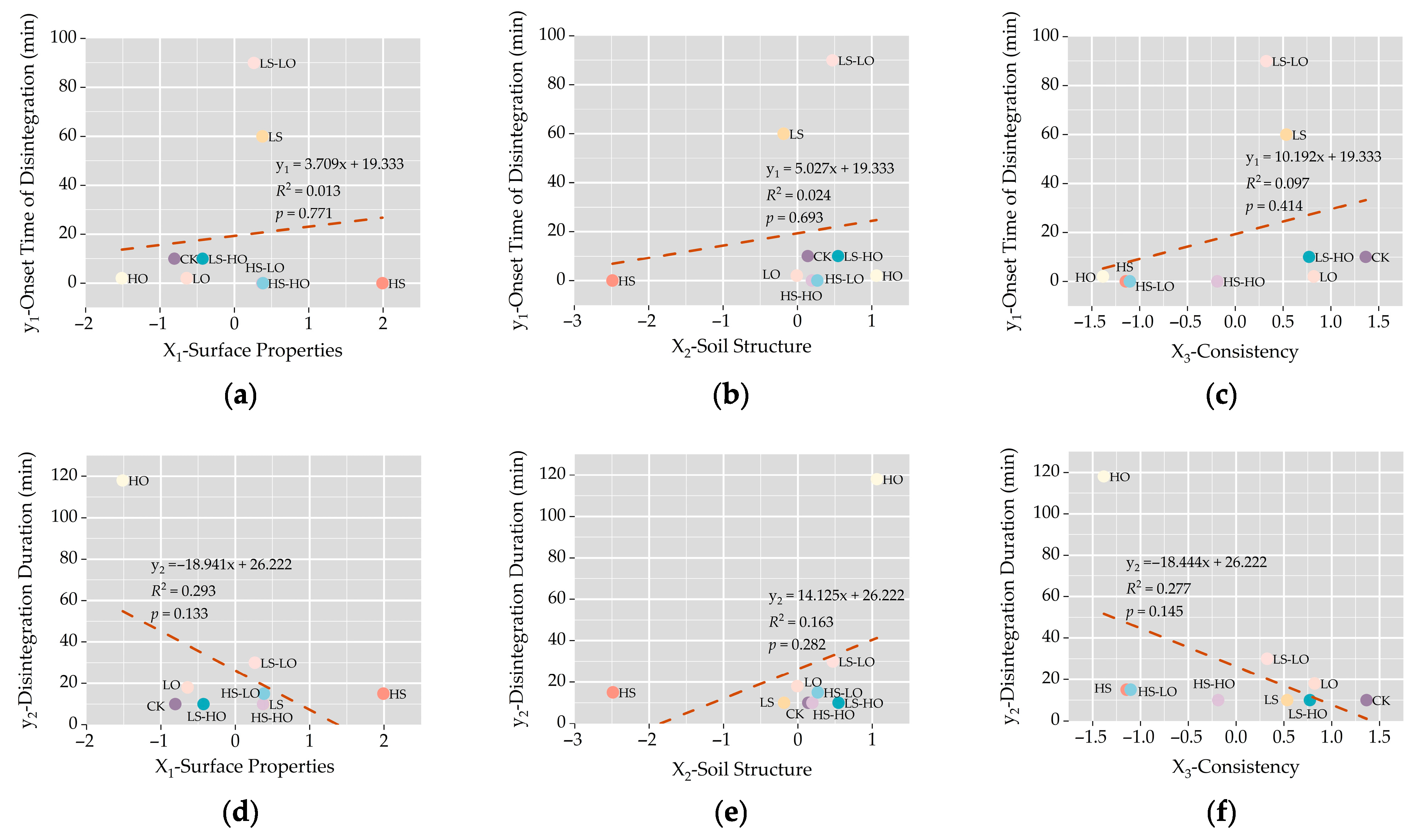
The results indicate that the Y2 model exhibits relatively strong explanatory ability (R2 = 0.824) and can effectively predict disintegration duration, whereas the Y1 model shows weaker explanatory power (R2 = 0.367). Model prediction performance (Figure 15) shows that the predicted and measured values of Y1 are relatively scattered, whereas those of Y2 are closely distributed around the y = x line, indicating significantly higher predictive accuracy for the Y2 model. The single-variable fitting results (Figure 16) indicate that different parameters exhibit varying trends with disintegration behavior; however, the overall goodness of fit remains relatively low (R2 < 0.3). This suggests that the explanatory power of individual variables is limited and that disintegration processes are controlled by multiple interacting factors.

3.8.2. LMG Relative Importance Contribution Decomposition

Based on the PCA-MLR models, the LMG (Lindeman–Merenda–Gold) method was applied to further decompose the independent contribution of each composite index to the model determination coefficient (Figure 17).
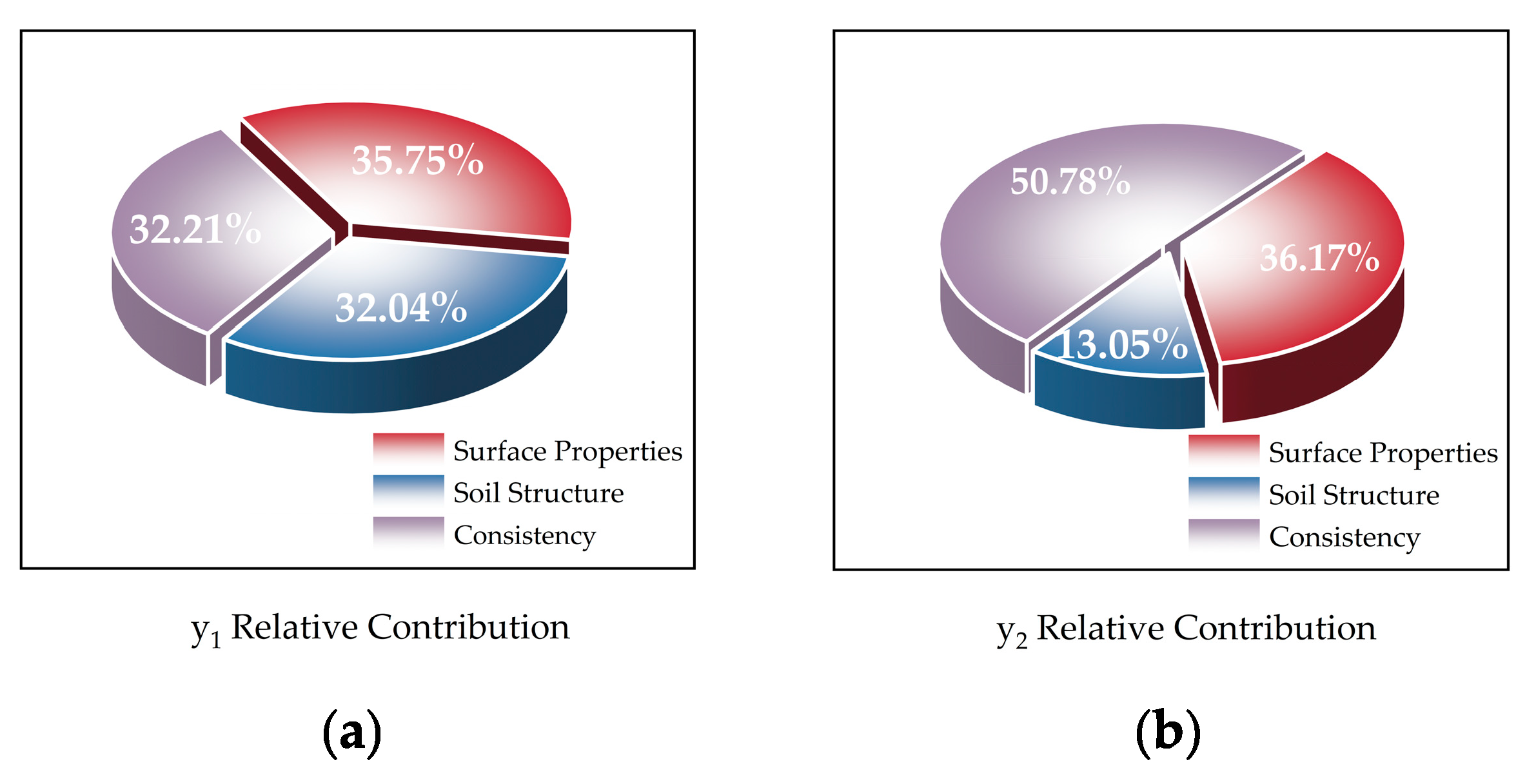
For the Y1 model (Figure 17a), the total R2 = 0.367, and the contributions of surface properties, consistency and soil structure were 35.75%, 32.21% and 32.04%, respectively. The relatively small differences between these contributions indicate that the onset of disintegration is controlled by multiple interacting factors without a single dominant variable, reflecting the complexity of the process. For the Y2 model (Figure 17b), the total R2 = 0.824, with consistency contributing the most (50.78%), followed by surface properties (36.17%), while soil structure contributed the least (13.05%). This indicates that consistency is the primary factor controlling disintegration duration, while surface properties also play an important role.
Moreover, the trends of the LMG contributions are consistent with the regression coefficients, further confirming the reliability of the model. Overall, the results indicate that the onset of disintegration is governed by multiple interacting factors, whereas the disintegration duration is primarily controlled by consistency, with additional influence from surface properties.

4. Discussion

4.1. Electrochemical Regulation of Soil Dispersion–Aggregation Behavior

The selection of CaCl2 and PAAS was based not only on their superior performance in the Atterberg limit screening but also on their mechanistic complementarity. Ca2+ can compress the diffuse double layer and promote particle flocculation, whereas PAAS can adsorb onto particle surfaces through carboxylate groups and provide polymer-mediated steric effects. From a chemical-structure perspective, this complementarity arises from the interaction between divalent Ca2+ ions with strong charge-screening capabilities and an anionic polymer backbone bearing densely distributed carboxylate groups. By contrast, KCl provided limited monovalent-cation regulation, FeCl3 may induce additional hydrolysis-related reactions, and HPMA and CMC showed weaker or less stable improvements. Therefore, the CaCl2-PAAS system was selected as a representative and interpretable organic–inorganic composite system for detailed mechanistic analysis.
Salts and polymers regulate the dispersion–aggregation behavior of high-liquid-limit clay through distinct but chemically related interfacial mechanisms that are governed by ion valence, surface charge distribution and polymer functional groups. When applied together, these modifiers interact to modify the electrochemical environment at clay particle surfaces, thereby influencing particle dispersion and aggregation.
The stabilizing effect of CaCl2 mainly originates from cation exchange and compression of the diffuse double layer. In natural clay systems, particle surfaces are typically dominated by monovalent cations such as Na+ and K+. These ions form a relatively thick diffuse double layer around clay particles, increasing electrostatic repulsion and thereby contributing to higher liquid limits and plasticity. When Ca2+ ions are introduced, their higher valence and stronger electrostatic attraction allow them to preferentially replace Na+ and K+ adsorbed on clay mineral surfaces. In particular, Ca2+ can form outer-sphere complexes on clay mineral surfaces, such as montmorillonite, effectively neutralizing surface negative charges and compressing the diffuse double layer. This process reduces the thickness of the bound water film surrounding particles and promotes particle aggregation [24]. In addition, illite typically exhibits a higher surface charge density than montmorillonite, making it more sensitive to ionic exchange and electrochemical changes in the surrounding solution [25]. As the Ca2+ dosage increases, the absolute value of the ZP gradually decreases, reflecting the progressive compression of the diffuse double layer and the weakening of electrostatic repulsion between particles.
By contrast, PAAS regulates particle interactions primarily through surface adsorption and steric hindrance. Chemically, PAAS is an anionic polymer with a carbon-chain backbone and densely distributed carboxylate groups. In aqueous environments, these carboxylate groups can interact with mineral surfaces and hydrated cations, while the extended polymer chains form an adsorption layer at the particle–water interface. After adsorption, polymer chains attach to particle surfaces, increasing surface electronegativity while forming steric barriers that limit excessive particle contact. Previous studies indicate that polyacrylic polymers can form a “cluster-matrix” adsorption structure on mineral surfaces, where clustered regions generate strong steric hindrance and matrix regions modify surface electrostatic characteristics [26]. This adsorption configuration suppresses direct contact between particles and consequently reduces the soil plasticity index.
When CaCl2 and PAAS are applied together, their mechanisms exhibit both synergistic and competitive interactions. Under low-salinity conditions, moderate compression of the diffuse double layer creates a relatively stable interfacial environment that facilitates polymer adsorption, allowing steric hindrance effects to be fully expressed. In this case, Ca2+ can reduce excessive electrostatic repulsion between negatively charged clay surfaces, while PAAS maintains interparticle separation through its adsorbed chain layer. However, under high-salinity conditions, excessive compression of the diffuse double layer can partially offset the ability of PAAS to increase surface electronegativity. In addition, Ca2+ may compete with polymer segments for interfacial sites or act as a cationic bridge between negatively charged surfaces and carboxylate-containing chains, which can alter polymer conformation and reduce the dispersing effect of extended PAAS chains. Nevertheless, the steric hindrance generated by polymer chains can still partially regulate the flocculated structures induced by salt. Atomic force microscopy studies further suggest that Ca2+ ions can form dense ionic layers at mineral interfaces, providing a favorable substrate for polymer adsorption [27]. This interaction between ionic and polymeric regulation ultimately determines the balance between particle dispersion and aggregation.

4.2. Microstructural Reconstruction and Erosion Response

The water stability of the treated soil is closely associated with microstructural reconstruction induced by salt-driven flocculation and polymer-induced dispersion. Particle size distribution results combined with SEM observations provide direct evidence of the evolution of soil particle structures under different treatments. By modifying the electrochemical properties of particle surfaces, salts and polymers alter interparticle interaction patterns, which subsequently leads to particle reorganization and pore structure evolution. These microstructural changes ultimately determine the macroscopic water stability of the soil.
Salt addition promotes particle aggregation by reducing electrostatic repulsion and enhancing van der Waals attraction between particles. Under high-salinity conditions, excessive flocculation forms large aggregates with relatively loose internal structures and well-developed pore networks. These pores provide rapid infiltration pathways for water, which explains why the HS treatment exhibited rapid disintegration during immersion tests. By contrast, under low-salinity conditions, flocculation is less intense, allowing the soil to maintain a more favorable particle gradation and a relatively stable particle framework.
Polymer modification produces the opposite structural evolution. After PAAS adsorption, the increased surface electronegativity and steric hindrance inhibit particle aggregation and promote particle refinement. This behavior is closely related to the chemical structure of PAAS: its anionic carboxylate groups favor interfacial adsorption, while its flexible carbon-chain backbone can extend into the aqueous phase and form a hydrated adsorption layer. At high polymer dosages, soil particles tend to be encapsulated within continuous polymer adsorption layers, forming a polymer-dominated matrix structure. At lower dosages, polymers mainly attach to particle surfaces without forming a continuous matrix. When water enters such structures, the polymer layer initially swells, and particles are gradually released as hydration proceeds. As a result, the HO treatment shows a gradual dissolution process rather than rapid aggregate disintegration.
In the combined treatment, the final microstructure depends on the balance between salt-induced flocculation and polymer-induced dispersion. Under high salinity conditions, PAAS has a limited ability to modify the already-formed large aggregates. However, under low salinity conditions, PAAS can partially disrupt salt-induced flocculated structures and improve particle gradation. The LS-LO treatment produces a relatively well-graded and dense microstructure, delaying the onset of disintegration and enhancing structural stability during the disintegration process.

4.3. Statistical Validation and Conceptual Mechanism of Water Stability Control

Multivariate statistical analyses further reveal the controlling mechanisms of disintegration behavior and provide quantitative support for two distinct control pathways. In addition, the combination of correlation analysis, PLS and PCA-MLR modeling can differentiate between coupling relationships and causal control pathways.
Spearman correlation analysis indicates strong coupling relationships among microstructural parameters. For instance, DPM shows a strong negative correlation with characteristic particle sizes, while ZP is negatively correlated with PL, indicating that electrochemical surface properties are closely linked to particle gradation and soil consistency. More importantly, the correlation between T1 (onset time of disintegration) and T2 (disintegration duration) is extremely weak, suggesting that the initiation and progression of disintegration are governed by different mechanisms.
PLS regression further distinguishes these two control pathways. Parameters such as DPM and Cc mainly influence the disintegration duration by affecting particle bonding strength and packing density, which determine the structural resistance to continued disintegration. By contrast, consistency, represented by LL and PL, primarily regulates the onset of disintegration by controlling soil water sensitivity and infiltration behavior. The PCA-MLR and LMG analyses provide additional quantitative evidence by decomposing the relative contributions of different parameter groups. The results show that the onset of disintegration is jointly controlled by surface properties, soil structure and consistency, whereas the disintegration duration is mainly governed by consistency, with additional contributions from surface electrochemical properties.
Together, these results support a dual-pathway mechanism for disintegration control in high-liquid-limit clay. The duration of disintegration is governed primarily by consistency, while surface electrochemical characteristics also make important contributions by influencing particle bonding strength and structural stability. By contrast, the initiation of disintegration is jointly influenced by surface properties, structural characteristics and soil water sensitivity. The LS-LO treatment achieves the most stable microstructure by balancing salt-induced flocculation and polymer-induced dispersion, significantly enhancing the disintegration resistance of the soil.

5. Conclusions

This study systematically investigated the synergistic regulation mechanisms of the inorganic salt CaCl2 and the organic polymer PAAS in high-liquid-limit clay through multi-scale experiments and statistical analyses. Unlike previous studies that mainly focused on single modifiers or bulk performance indicators, this work established a unified framework linking modifier composition, interfacial electrochemical behavior, microstructural reconstruction and water-induced disintegration resistance. The main conclusions are as follows:
  • An optimized CaCl2-PAAS composite formulation for improving the water stability of high-liquid-limit clay was identified. The combination of 2% CaCl2 and 0.1% PAAS (LS-LO) achieved the best balance between regulating the Atterberg limits and resistance to water-induced disintegration. LL decreased by 16.4%, Ip decreased by 19.8%, and the onset time of disintegration increased by 200%. The treated system exhibited a gradual block-type structural degradation pattern during immersion, indicating enhanced structural integrity. This result suggests that a low-polymer, salt-assisted composite treatment strategy may be effective for enhancing the reuse potential of excavated high-liquid-limit clay in geotechnical engineering.
  • The complementary roles of inorganic salt and organic polymer in interfacial regulation were clarified. CaCl2 primarily modifies the pore–aggregate framework by compressing the diffuse double layer, whereas PAAS regulates particle interfacial states via adsorption and steric stabilization. The two modifiers exhibit contrasting disintegration behaviors, characterized by rapid structural collapse under high-salinity conditions and slow colloidal dispersion under polymer-dominated conditions. Under the optimized LS-LO ratio, electrostatic compression and steric stabilization act cooperatively to delay structural breakdown and achieve maximum structural stability. This finding provides a mechanistic basis for the design of organic–inorganic composite modifiers for water-sensitive particulate systems.
  • Quantitative relationships between microscopic interfacial parameters and macroscopic disintegration behavior were established. Spearman correlation analysis revealed an extremely strong negative correlation between D50 and DPM (ρ = −0.979), indicating that particle refinement weakens van der Waals attraction between particles. Multivariate statistical modeling further indicates that disintegration duration is primarily controlled by consistency, with important contributions from surface electrochemical properties (ZP, hc and DPM), whereas disintegration initiation is jointly governed by consistency parameters, structural characteristics and interfacial interactions. These quantitative relationships provide useful references for parameter selection and performance evaluation in the engineering stabilization of water-sensitive clayey soils.
Overall, the coordinated use of diffuse double-layer compression and adsorption–steric stabilization may serve as an effective strategy for tailoring the interfacial state and structural stability of water-sensitive particulate systems. From an engineering perspective, the results provide useful guidance for enhancing the water stability and reuse potential of excavated high-liquid-limit clay in transportation infrastructure and related geotechnical applications. In future work, XRD analysis of representative treated samples may be incorporated as a supplementary tool to characterize the structural response of the clay fraction after modification.

Author Contributions

Conceptualization, L.Z. and W.C.; methodology, H.M.; software, L.Z.; validation, P.G., Y.W., F.L. and W.H.; formal analysis, H.M.; investigation, L.Z.; resources, P.G., Y.W., F.L. and W.H.; data curation, L.Z.; writing—original draft preparation, L.Z.; writing—review and editing, W.C.; visualization, H.M.; supervision, Y.W.; project administration, F.L. and W.H.; funding acquisition, P.G. All authors have read and agreed to the published version of the manuscript.

Funding

This research was funded by Sichuan Xixiang Expressway Construction & Development Co., Ltd. [Grant No. 2024-ZL-15] under the G7611 Xichang–Shangri-La (Sichuan Section) Expressway Project, subproject “Key Technology Research on Environmental Protection and Integrated Development of Transportation and Tourism for Expressways in the Greater Shangri-La Ecotourism Area” (STJL-1 Section).

Data Availability Statement

All data generated or analyzed during this study are included in this published article.

Acknowledgments

The authors would like to thank the project team of the G7611 Xichang–Shangri-La (Sichuan Section) Expressway Project for their assistance with field investigation and laboratory testing.

Conflicts of Interest

Authors Pengbin Gao, Yongjian Wu, Fabo Liu and Wenyue Huang were employed by Sichuan Xixiang Expressway Construction & Development Co., Ltd., Xichang, China. The remaining authors declare that this research was conducted in the absence of any commercial or financial relationships that could be construed as potential conflicts of interest.

References

  1. Alewell, C.; Meusburger, K.; Brodbeck, M.; Bänninger, D. Methods to describe and predict soil erosion in mountain regions. Landsc. Urban Plan. 2008, 88, 46–53. [Google Scholar] [CrossRef]
  2. Borga, M.; Stoffel, M.; Marchi, L.; Marra, F.; Jakob, M. Hydrogeomorphic response to extreme rainfall in headwater systems: Flash floods and debris flows. J. Hydrol. 2014, 518, 194–205. [Google Scholar] [CrossRef]
  3. Park, D.W.; Nikhil, N.V.; Lee, S.R. Landslide and debris flow susceptibility zonation using TRIGRS for the 2011 Seoul landslide event. Nat. Hazards Earth Syst. Sci. 2013, 13, 2833–2849. [Google Scholar] [CrossRef]
  4. Pavlova, I.; Jomelli, V.; Brunstein, D.; Grancher, D.; Martin, E.; Déqué, M. Debris flow activity related to recent climate conditions in the French Alps: A regional investigation. Geomorphology 2014, 219, 248–259. [Google Scholar] [CrossRef]
  5. James, K.; Mitchell, K.S.; Catherine, O. Fundamentals of Soil Behavior; John Wiley & Sons, Inc.: Hoboken, NJ, USA, 2025; pp. 49–88. [Google Scholar]
  6. Estabragh, A.R.; Afsari, E.; Javadi, A.A.; Babalar, M. Effect of Two Organic Chemical Fluids on the Mechanical Properties of an Expansive Clay Soil. J. Test. Eval. 2020, 48, 3501–3514. [Google Scholar] [CrossRef]
  7. Abbaslou, H.; Hadifard, H.; Ghanizadeh, A.R. Effect of cations and anions on flocculation of dispersive clayey soils. Heliyon 2020, 6, e03462. [Google Scholar] [CrossRef] [PubMed]
  8. Shafiqu1, Q.S.M.; Hasan, S.H. Improvement an Expansive Soil using Polymethacrylate Polymer. IOP Conf. Ser. Mater. Sci. Eng. 2018, 454, 012138. [Google Scholar] [CrossRef]
  9. Takeno, H.; Kimura, Y.; Nakamura, W. Mechanical, Swelling, and Structural Properties of Mechanically Tough Clay-Sodium Polyacrylate Blend Hydrogels. Gels 2017, 3, 10. [Google Scholar] [CrossRef] [PubMed]
  10. Ta’negonbadi, B.; Noorzad, R. Stabilization of clayey soil using lignosulfonate. Transp. Geotech. 2017, 12, 45–55. [Google Scholar] [CrossRef]
  11. Teich-McGoldrick, S.L.; Greathouse, J.A.; Jové-Colón, C.F.; Cygan, R.T. Swelling Properties of Montmorillonite and Beidellite Clay Minerals from Molecular Simulation: Comparison of Temperature, Interlayer Cation, and Charge Location Effects. J. Phys. Chem. C 2015, 119, 20880–20891. [Google Scholar] [CrossRef]
  12. de Lara, L.S.; Rigo, V.A.; Miranda, C.R. Controlling Clay Swelling–Shrinkage with Inorganic Nanoparticles: A Molecular Dynamics Study. J. Phys. Chem. C 2017, 121, 20266–20271. [Google Scholar] [CrossRef]
  13. Chen, Y.; Tang, L.; Ye, Y.; Cheng, Z.; Zhou, Z. Effects of different chloride salts on granite residual soil: Properties and water–soil chemical interaction mechanisms. J. Soils Sediments 2023, 23, 1844–1856. [Google Scholar] [CrossRef]
  14. Sakr, M.A.; Azzam, W.R.; Meguid, M.A.; Hassan, A.F.; Ghoneim, H.A. Enhancing the Swelling Characteristics and Shear Strength of Expansive Soil Using Ferric Chloride Solution. Int. J. Geosynth. Ground Eng. 2021, 7, 76. [Google Scholar] [CrossRef]
  15. Yang, F.; Zhao, Y.; Dong, H.; Wang, H.; Niu, W.; Zhao, Z.; Song, F.; Tan, H. Mechanical and microscopic characterization of expansive soils modified by water-soluble polymers. Sci. Rep. 2025, 15, 85395. [Google Scholar] [CrossRef]
  16. Medina, V.A. Review on China’s Road Engineering Research: 2013. China J. Highw. Transp. 2013, 26, 1–36. [Google Scholar]
  17. ASTM D2487-17; Standard Practice for Classification of Soils for Engineering Purposes (Unified Soil Classification System). ASTM International: West Conshohocken, PA, USA, 2017.
  18. GB/T 50123-2019; Standard for Geotechnical Testing Methods. China Planning Press: Beijing, China, 2019.
  19. Israelachvili, J.N. Intermolecular and Surface Forces. In Intermolecular and Surface Forces, 3rd ed.; Israelachvili, J.N., Ed.; Academic Press: Boston, MA, USA, 2011. [Google Scholar]
  20. Butler, J.A.V. Theory of the Stability of Lyophobic Colloids. Nature 1948, 162, 315–316. [Google Scholar] [CrossRef]
  21. Stanchi, S.; Freppaz, M.; Zanini, E. The influence of Alpine soil properties on shallow movement hazards, investigated through factor analysis. Nat. Hazards Earth Syst. Sci. 2012, 12, 1845–1854. [Google Scholar] [CrossRef]
  22. Vacchiano, G.; Stanchi, S.; Marinari, G.; Ascoli, D.; Zanini, E.; Motta, R. Fire severity, residuals and soil legacies affect regeneration of Scots pine in the Southern Alps. Sci. Total Environ. 2014, 472, 778–788. [Google Scholar] [CrossRef] [PubMed]
  23. JTG 3430-2020; Test Methods of Soils for Highway Engineering. China Communications Press: Beijing, China, 2020.
  24. Underwood, T.; Erastova, V.; Greenwell, H.C. Ion adsorption at clay-mineral surfaces: The hofmeister series for hydrated smectite minerals. Clays Clay Miner. 2016, 64, 472–487. [Google Scholar] [CrossRef]
  25. Wilson, M.J.; Wilson, L.; Shaldybin, M.V. Clay mineralogy and unconventional hydrocarbon shale reservoirs in the USA. II. Implications of predominantly illitic clays on the physico-chemical properties of shales. Earth-Sci. Rev. 2016, 158, 1–8. [Google Scholar] [CrossRef]
  26. Kurochkina, G.N. The Effect of Preadsorbed Polyelectrolytes on the Surface Properties and Dispersity of Clay Minerals and Soils. Prot. Met. Phys. Chem. Surf. 2019, 55, 266–276. [Google Scholar] [CrossRef]
  27. Chau, H.H.; Li, H.; Atkin, R. Anion Size Controls Cation Wigner Crystal-Like Structures at Silica Interfaces. J. Phys. Chem. Lett. 2025, 16, 5695–5699. [Google Scholar] [CrossRef] [PubMed]
Figure 1. Schematic chemical structures of the organic polymers used in the preliminary screening: (a) PAAS, (b) HPMA, and (c) CMC.
Jcs 10 00248 g001
Figure 2. The Atterberg limits of high-liquid-limit clay change with the dosages of different modified reagents. (a) KCl, (b) CaCl2, (c) FeCl3 effects on the Atterberg limit of high-liquid-limit clay; (d) PAAS, (e) HPMA, (f) CMC effects on the Atterberg limit of high-liquid-limit clay.
Jcs 10 00248 g002
Figure 3. The Atterberg limits of high-liquid-limit clay change with the dosages of different modified reagents. Effects of (a) 2% CaCl2 + PAAS, (b) 8% CaCl2 + PAAS and (c) nine selected treatment groups on the Atterberg limit of high-liquid-limit clay.
Jcs 10 00248 g003
Figure 4. Zeta potential (ZP) of high-liquid-limit clay treated with different modifiers (CK, HS, LS, HO, LO, HS-HO, HS-LO, LS-HO and LS-LO). Sample codes and compositions are defined in Table 4.
Jcs 10 00248 g004
Figure 5. DLVO interaction energy profiles for different treatment groups: (a) full-range curves, (b) enlarged view of the critical region, (c) critical distance (hc) and primary minimum depth (DPM) for each treatment group. Sample codes and compositions are defined in Table 4.
Jcs 10 00248 g005
Figure 6. Particle size distribution of high-plasticity clay under different treatments: (a) CK, (b) HS, (c) LS, (d) HO, (e) LO, (f) HS-HO, (g) HS-LO, (h) LS-HO, (i) LS-LO.
Jcs 10 00248 g006
Figure 7. SEM images at 250× magnification: (a) CK, (b) HS, (c) LS, (d) HO, (e) LO, (f) HS-HO, (g) HS-LO, (h) LS-HO, (i) LS-LO.
Jcs 10 00248 g007
Figure 8. SEM images at 5000× magnification: (a) CK, (b) HS, (c) LS, (d) HO, (e) LO, (f) HS-HO, (g) HS-LO, (h) LS-HO, (i) LS-LO.
Jcs 10 00248 g008
Figure 9. SEM images at 10,000× magnification: (a) CK, (b) HS, (c) LS, (d) HO, (e) LO, (f) HS-HO, (g) HS-LO, (h) LS-HO, (i) LS-LO.
Jcs 10 00248 g009
Figure 10. Disintegration evolution of soil specimens during immersion for different treatment groups. (ai) CK, HS, LS, HO, LO, HS-HO, HS-LO, LS-HO and LS-LO, respectively; (a1–i6) immersion times of 0, 15, 60, 70, 90 and 120 min, respectively.
Jcs 10 00248 g010
Figure 11. Disintegration behavior of treated soils: (a) onset time of disintegration; (b) disintegration duration.
Jcs 10 00248 g011
Figure 12. Spearman correlation matrix showing the relationships between the selected microstructural parameters and disintegration indicators based on data from the nine treatment groups listed in Table 4.
Jcs 10 00248 g012
Figure 13. PLS regression results: (a) cross-validation plot, (b) loading plot of LV1 & LV2, (c) VIP scores of individual variables, and (d) relative contribution of three parameter groups based on normalized VIP. Here, x1x9 represent the selected microstructural parameters, and y1 and y2 represent the onset time of disintegration and disintegration duration, respectively.
Jcs 10 00248 g013
Figure 14. Principal component analysis biplot.
Jcs 10 00248 g014
Figure 15. Model prediction performance: (a) predicted y1 vs. observed y1, (b) residuals vs. predicted y1, (c) predicted y2 vs. observed y2, (d) residuals vs. predicted y2.
Jcs 10 00248 g015
Figure 16. Linear regression between integrated indicators and disintegration time: (ac) y1 vs. X1, X2, X3; (df) y2 vs. X1, X2, X3.
Jcs 10 00248 g016
Figure 17. LMG relative importance analysis showing contribution of integrated indicators to (a) y1 and (b) y2.
Jcs 10 00248 g017
Table 1. Mineral composition of sample soil.
Whole-Rock Mineral Mass Fraction × 10−2Relative Clay Mineral Content × 10−2Mixed-Layer Ratio (s%)
QuartzK-FeldsparPlagioclaseCalciteLimoniteTotal ClaysI/SIlliteI/S
46.631.781.474.151.5044.4011.4088.6010
Table 2. Main chemical characteristics of the stabilizers used in the preliminary screening.
StabilizerDominant Functional GroupsCharge CharacteristicMolecular Weight (kDa)
KCl-Monovalent cation (K+)-
CaCl2-Divalent cation (Ca2+)-
FeCl3-Trivalent cation (Fe3+)-
PAASCarboxylate groupsAnionic polymer4000–5000
HPMACarboxyl groupsAnionic polymer0.4–0.8
CMCCarboxymethyl and hydroxyl groupsAnionic polymer500–700
Table 3. Stabilizers and dosage ranges used in the preliminary screening tests.
Stabilizer TypeStabilizerTested Dosage Range
Inorganic saltKCl0%, 2%, 4%, 6%, 8%
Inorganic saltCaCl20%, 1%, 2%, 4%, 6%, 8%, 10%
Inorganic saltFeCl30%, 2%, 4%, 6%, 8%, 10%, 12%
Organic polymerPAAS0%, 0.1%, 0.5%, 1%, 1.5%, 2%, 2.5%
Organic polymerHPMA0%, 0.5%, 1%, 1.5%, 2%, 2.5%
Organic polymerCMC0%, 0.05%, 0.1%, 0.15%, 0.2%
Table 4. Sample codes and compositions used in this study.
Sample CodeCaCl2 DosagePAAS DosageDescription
CK00Untreated high-liquid-limit clay
HS8%0High-salt treatment
LS2%0Low-salt treatment
HO01%High-organic treatment
LO00.1%Low-organic treatment
HS-HO8%1%High-salt and high-organic composite treatment
HS-LO8%0.1%High-salt and low-organic composite treatment
LS-HO2%1%Low-salt and high-organic composite treatment
LS-LO2%0.1%Low-salt and low-organic composite treatment
Table 5. Particle size distribution characteristics and gradation evaluation of the studied soil.
GroupsD10 (μm)D50 (μm)D90 (μm)CuCcGradation
CK6.7535.68104.815.981.09well-graded
HS11.6156.42157.33.480.65poorly graded
LS7.7435.4895.305.181.10well-graded
HO1.626.4716.085.451.29well-graded
LO3.5815.4840.324.731.06poorly graded
HS-HO6.1530.4185.925.561.14well-graded
HS-LO5.9130.0286.275.651.15well-graded
LS-HO2.6513.0937.105.541.12well-graded
LS-LO5.6230.0689.426.221.13well-graded
Disclaimer/Publisher’s Note: The statements, opinions and data contained in all publications are solely those of the individual author(s) and contributor(s) and not of MDPI and/or the editor(s). MDPI and/or the editor(s) disclaim responsibility for any injury to people or property resulting from any ideas, methods, instructions or products referred to in the content.